1. Introduction
Sustainable development in the construction industry should be assessed across environmental, social, and economic dimensions throughout the whole building life cycle [
1]. In addition to reducing operational energy use, sustainable practice also requires careful planning of maintenance, repair, and replacement during the service period of buildings [
2], because these activities strongly influence recurrent embodied energy (REE), life-cycle cost, and long-term asset performance [
3]. Reliable service-life information is therefore essential for rational material selection, maintenance planning, and building life-cycle management [
4,
5,
6].
Once a building enters service, its materials and components begin to deteriorate under the combined influence of environmental exposure, service conditions, and maintenance conditions [
5,
7]. Insufficient durability, or accelerated degradation, may lead to increasing repair costs, loss of serviceability, aesthetic decline, and in severe cases safety risks for occupants and the public [
8]. This issue has become particularly important in rapidly urbanizing countries such as China, where the construction sector is shifting from large-scale new development toward the operation, maintenance, and renewal of a vast existing building stock [
9,
10]. In this context, durability is not only a materials problem, but also a practical engineering problem closely related to inspection planning, maintenance timing, and resource allocation [
11,
12].
The building envelope acts as the first barrier between indoor space and external actions [
13]. As the outermost protective layer of the envelope, façade cladding is directly exposed to solar radiation, wind-driven rain, humidity, temperature fluctuations, and air pollution, and is therefore especially vulnerable to deterioration [
14]. The service condition of façades directly affects durability, maintenance demand, visual performance, and safety during the building life cycle [
15]. For this reason, façade durability and service-life prediction have been widely studied over recent decades [
16,
17,
18]. To provide a clearer overview of the existing literature, previous studies can be discussed from several closely related perspectives, including in-service monitoring and diagnosis, façade construction technologies and maintenance-related factors, regional or climate-sensitive effects, and mathematical models for façade degradation and service-life prediction.
At a fundamental level, façade degradation can be understood as the gradual degradation of a multi-layer material system under long-term external exposure [
19]. Its essence lies in the progressive accumulation of internal physicochemical and mechanical changes, such as microstructural alteration, interfacial weakening, stress redistribution, and the loss of protective function [
20]. The defects observed on façade surfaces are therefore not isolated phenomena in themselves, but outward manifestations of this progressive deterioration of materials and systems [
21]. Because these changes evolve through coupled actions and cumulative effects, façade degradation is often associated with considerable randomness and uncertainty under real service conditions [
22].
This progressive and uncertain nature of façade degradation makes in-service monitoring and diagnosis essential for understanding deterioration in existing buildings. In engineering practice, inspection-based approaches, such as visual surveys, defect mapping, impact sounding, infrared thermography, and archive-based assessment, remain the principal means of identifying both visible and hidden anomalies in building envelopes. For instance, Li et al. [
23] showed that infrared thermography can effectively characterize defect features in degradation envelopes under complex urban conditions, whereas Liu et al. [
24] proposed an intelligent-assisted diagnostic framework to improve the efficiency and consistency of assessment in existing residential buildings. More recently, this field has evolved toward the integration of UAV-mounted thermography and artificial intelligence. Li et al. [
25] developed a two-stage UAV-thermography-based network for quantitative identification of debonding defects in façades, Wang et al. [
26] proposed an automatic façade deterioration detection system based on infrared–visible image fusion and deep learning, and Ma et al. [
27] extended UAV-mounted infrared thermography from defect detection to the risk assessment of façade tile shedding in high-rise residential buildings. These advances indicate that monitoring practice is moving from conventional condition observation toward more integrated and data-supported evaluation. However, current monitoring-based studies still face several limitations, including inspector subjectivity, fragmented condition records, inconsistent diagnostic criteria, sensitivity to imaging conditions, and the difficulty of translating observed defect information into generalized life-prediction rules. As a result, in-service diagnosis provides indispensable evidence for façade condition assessment, but its integration with quantitative degradation modelling remains insufficient.
In addition to condition monitoring, a large body of research has shown that façade deterioration is strongly influenced by construction technologies, system configuration, workmanship, and maintenance practice. In studies on painted renderings, Petersen et al. [
28] showed that maintenance information can be explicitly incorporated into regression-based service-life prediction, indicating that durability assessment should not rely on age alone. In a related study, the same authors further showed that imperfect maintenance scheduling can significantly affect the physical degradation of painted renderings, thereby highlighting the importance of maintenance adequacy and intervention timing [
29]. Similar conclusions have also been reported for other façade systems. For instance, Souza et al. [
30,
31] demonstrated that both factor-based methods and regression approaches can be used to relate the service life of ceramic tiling systems to construction, material, and environmental variables. At the review level, Parracha et al. [
17] provided a comprehensive discussion of ETICS anomalies, performance requirements, and durability, showing that system configuration and anomaly development are closely linked to long-term service performance. In a broader review of energy-efficient façades, Tahmasbi et al. [
32] highlighted the growing technological diversity and complexity of high-performance façade systems, suggesting that façade design choices are increasingly important to in-service performance under different climatic and urban conditions. Taken together, these studies suggest that façade degradation is not governed solely by exposure intensity, but also by the technological characteristics of the façade system and the quality of subsequent intervention. However, many of these variables remain difficult to quantify consistently in real buildings, especially when detailed execution records and maintenance histories are incomplete [
33].
Another important line of research emphasizes the sensitivity of façade durability to the regional and climatic context. Barrelas et al. [
34] showed that environmental exposure variables, such as façade orientation, distance from the sea, and humidity exposure, have measurable effects on the degradation and service life of façade claddings. In urban environments, traffic-related pollution has also been recognized as an important degradation factor, as deposited pollutants may accelerate façade deterioration, especially in lower façade areas exposed to roadway influence [
35]. Recent evidence from China also confirms the importance of regional and climatic influences. Based on 1030 nationwide façade shedding cases, Zhao et al. [
36] found that region, wind, temperature, material type, and shedding area were significantly interrelated, and that coastal climate, humidity, rainfall, and typhoon-related actions may increase façade deterioration and shedding risk. Comparative studies further suggest that similar assessment frameworks may be applied across different urban contexts, although the dominant exposure conditions and degradation responses remain locally specific. For example, Mousavi et al. [
37] compared natural stone claddings in Tehran and Lisbon and found that similar degradation patterns can be identified under different environmental backgrounds, although the estimated service lives and governing factors are not fully identical. Likewise, Wasserman et al. [
38] showed that marine exposure significantly alters the deterioration patterns and service life of exterior stone claddings in both dry-fixed and wet-fixed systems. More recently, Chew et al. [
39] linked façade durability to climate-change projections in Singapore, suggesting that future increases in temperature, rainfall intensity, extreme rainfall events, and wind speed may alter façade defect risks and inspection needs over time.
A particularly important line of research concerns the development of mathematical models for façade degradation and service-life prediction. From a broad methodological perspective, existing models can be understood as expert-based, empirical or statistical, physical or simulation-based, and hybrid approaches, while their outputs may be either deterministic or stochastic [
22]. Early service-life planning was largely dominated by expert-based and deterministic methods. Among them, the factor method, first systematized within the AIJ service-life planning framework and later adopted in ISO 15686, has remained one of the most influential approaches [
5,
40]. In this method, the estimated service life is obtained by modifying a reference service life through a set of factors related to design, material quality, execution quality, environmental conditions, use conditions, and maintenance level. Its principal advantages are transparency, simplicity, and ease of application in engineering practice, which explains its use in façade studies such as the prediction of ceramic tiling service life in Brasília by Souza et al. [
30], the estimation of external paint finishes on façades by Magos et al. [
41], and the estimation of service life of architectural concrete surfaces by Jardim et al. [
42]. However, the method is strongly dependent on the adopted reference service life and factor values, and it usually produces a single empirical estimate with limited ability to express uncertainty or dispersion.
A second major stage of development was the widespread use of empirical models derived from field observations. In façade research, this has been most clearly represented by graphical or degradation-curve methods, in which a degradation indicator is related to service age and service life is inferred from the intersection between the fitted deterioration curve and an admissible degradation threshold. According to the critical literature review by Silva and de Brito [
16], this route has been widely applied to rendered façades, painted surfaces, natural stone claddings, ceramic claddings, ETICS, and architectural concrete surfaces because it is intuitive and closely linked to inspection data. For example, the same review lists degradation-curve applications by Gaspar and de Brito [
43] for rendered façades, Chai et al. [
44] for painted surfaces, and Ximenes et al. [
45] for ETICS, showing how this modelling tradition has become one of the most common empirical approaches in façade service-life research. Its main limitation, however, is that it primarily reflects average deterioration behavior and therefore provides only limited information about the variability of degradation among individual façades.
To improve explanatory capacity, later studies increasingly adopted regression-based statistical models, especially linear and nonlinear multiple regression, to relate façade degradation not only to age but also to environmental exposure, material properties, façade configuration, and maintenance-related factors. Souza et al. [
31] used regression-based modelling to identify the main factors influencing ceramic cladding degradation in Brasília, while Petersen et al. [
28] extended regression approaches to painted renderings by incorporating maintenance data and imperfect maintenance scheduling into service-life prediction. In parallel, Sousa et al. [
33] revisited ordinary least-squares regression for external paint finishes on rendered façades and explicitly explored its stochastic extension as a basis for proposing a hybrid parametric–expert model. When degradation is represented by discrete or ordered condition classes rather than a continuous index, logistic and ordinal regression provide a natural extension of this statistical tradition, and related probabilistic formulations have also been used in façade studies such as the durability analysis of architectural concrete surfaces by Pereira et al. [
46]. These approaches significantly improve multi-factor analysis, yet in most cases they still describe average effects over the full sample or transitions between predefined classes, and therefore provide limited information on how the same variable may act differently across lower-risk, typical, and high-risk façades.
To account more explicitly for uncertainty, stochastic models were subsequently introduced. Among them, Markov-chain-based models are the most representative, because they describe deterioration as transitions between condition states and are therefore well suited to maintenance optimization and life-cycle state prediction [
47]. In the building-envelope field, Paulo et al. [
48] developed the BuildingsLife framework, in which Markov chains were combined with optimization tools to estimate maintenance plans and transition probabilities for façade degradation. Compared with deterministic models, their main advantage lies in the explicit treatment of randomness and state transitions; however, their application is generally more complex, as it requires robust definitions of condition states, reliable estimates of transition probabilities, and often long-term monitoring data. More recently, façade service-life prediction has also incorporated data-driven and hybrid approaches. Tavares et al. [
49] applied artificial neural networks and fuzzy logic systems to ETICS service-life prediction and obtained estimates around 21 years for a Portuguese sample, illustrating the growing use of artificial-intelligence-based tools in this field. More broadly, computational studies on façade claddings have shown that artificial neural networks and fuzzy systems can be used to capture nonlinear degradation patterns that are difficult to represent using conventional mean-based regression alone [
22]. Taken together, these developments show that the field has evolved from expert-based simplification toward more data-rich and uncertainty-oriented frameworks. Nevertheless, a common limitation remains: many models are still more effective in describing average deterioration trends, predefined state transitions, or overall predictive performance than in representing the heterogeneous degradation trajectories observed under real urban service conditions.
The aim of this study is to improve the practical assessment of painted façade degradation and service life under real urban service conditions. Rather than developing a mathematical model as an end in itself, this study addresses an applied engineering problem: how to better support the inspection, maintenance, and service-life evaluation of existing façades in rapidly urbanizing cities. Because façade degradation results from the simultaneous and interacting action of multiple deterioration agents, its evolution is complex, uncertain, and difficult to characterize using conventional single-trend models. In this context, quantile regression is introduced as an extension of ordinary least squares (OLS) regression. It allows façade degradation to be examined beyond the mean response and helps identify whether key variables act differently across degradation levels. Accordingly, this study pursues the following objectives: (1) to quantify the degradation condition of painted façades using an inspection-based overall degradation level (ODL) index; (2) to identify the main environmental, material, and maintenance-related factors associated with façade deterioration; (3) to compare OLS regression and quantile regression in their ability to describe heterogeneous façade degradation under multidimensional influencing conditions; (4) to investigate whether key degradation drivers exert different levels of influence across lower-, medium-, and higher-degradation façades; and (5) to develop an engineering-oriented framework for risk-based service-life assessment and differentiated management of existing painted façades. To achieve these objectives, field surveys were conducted on 375 painted façades in Ningbo, including visual inspections and interviews, in order to collect information on façade characteristics, degradation condition, exposure, and usage conditions.
4. Quantile Regression Model with Multiple Explanatory Variables
Unlike simple regression, multiple regression models incorporate various factors affecting façade degradation, expressed as Y = β0 + β1X1 + … + βkXk + ε. Including more variables can improve model fit and significance by jointly analyzing age, environment, and material properties within a single framework. However, many influential factors are qualitative and difficult to quantify accurately. Oversimplified numerical representation may fail to capture their true impact on degradation. Quantile regression addresses this by treating heterogeneity as integral to the analysis. Incorporating additional variables enhances explanatory power and reveals how key factors differently influence degradation across quantiles.
4.1. Selected Variables and Descriptive Statistics
A critical step in applying multiple regression models is identifying and optimizing the parameters of the independent variables. As noted earlier, model accuracy is closely related to the inclusion of additional explanatory variables. Considering the challenges and time costs associated with data acquisition, this study selected 12 potential explanatory variables relevant to the durability and performance of the analyzed façades. These include: age, façade orientation, building height, paint color, render type, mortar thickness, distance to the sea, humidity exposure, pollution exposure, substrate wall, water ingress, and façade protection level. With the exception of age, all remaining potential variables are categorical and require coding for numerical processing. Their categories and assigned values are provided in
Table 4.
Variables related to material or façade characteristics were obtained from architectural drawings and technical documentation. The categorical variables for render type, paint color, substrate wall, and building height were coded numerically, while façade orientation was represented using dummy variables. Mortar thickness was treated as an ordinal categorical variable according to its predefined thickness ranges.
Quantifying environmental factors is complex, as it involves multiple climatic parameters and is closely related to a façade’s specific context and location. In this study, environmental variables are defined based on façade location. The distance from the façade to the coastline serves as an indicator reflecting two environmental influences: (i) the wind-driven transport and deposition of sea-salt aerosols and algal spores onto the façade surface, and (ii) the exposure intensity of ultraviolet radiation and relative humidity levels at the façade. Exposure to pollution conditions is primarily associated with traffic in urban centers, and its intensity depends on the relative location of the building to roadways. When a building’s façade faces a high-traffic arterial road such as a highway or major avenue, pollution intensity is coded as 3 (high). If it is near secondary roads with moderate or low traffic flow, pollution intensity is coded as 2 (medium). In rural or coastal areas away from significant traffic, pollution intensity is coded as 1 (low). Exposure to humidity conditions is related to the relative humidity and precipitation characteristics of the façade location. When the prevailing wind carries moisture from the sea and the site is close to the coast or major rivers, humidity exposure intensity is coded as 3 (high). If the location is at some distance from the coast but near lakes or rivers, humidity exposure intensity is coded as 2 (medium). For urban sites farther from the sea, humidity exposure intensity is coded as 1 (low).
Water ingress is not a direct measure of degradation but typically results from other defects like cracks or design errors. Nevertheless, it accelerates façade degradation and can lead to cascading damage. This study includes it due to water’s significant amplifying effect on degradation, which substantially impacts the durability and long-term performance of finishing materials. According to homeowners’ reports, if rainwater infiltrates the interior through the building envelope, it is coded as 1; otherwise, it is coded as 0. Based on the extent of human intervention (e.g., cleaning and minor repairs) during the building’s service life, the variable “façade protection level” was used as a proxy for maintenance adequacy and divided into three grades. Level 1 (Poor), coded as 1, represents no regular maintenance intervention or ineffective intervention; Level 2 (Average), coded as 2, corresponds to interventions with relatively long intervals (>5 years), after which anomalies may reappear; and Level 3 (Good), coded as 3, reflects relatively regular and timely interventions (≤5 years), after which most anomalies are effectively controlled. Since detailed records of maintenance quality and workmanship were unavailable for most buildings, this variable should be understood as a simplified proxy rather than a direct measure of maintenance quality.
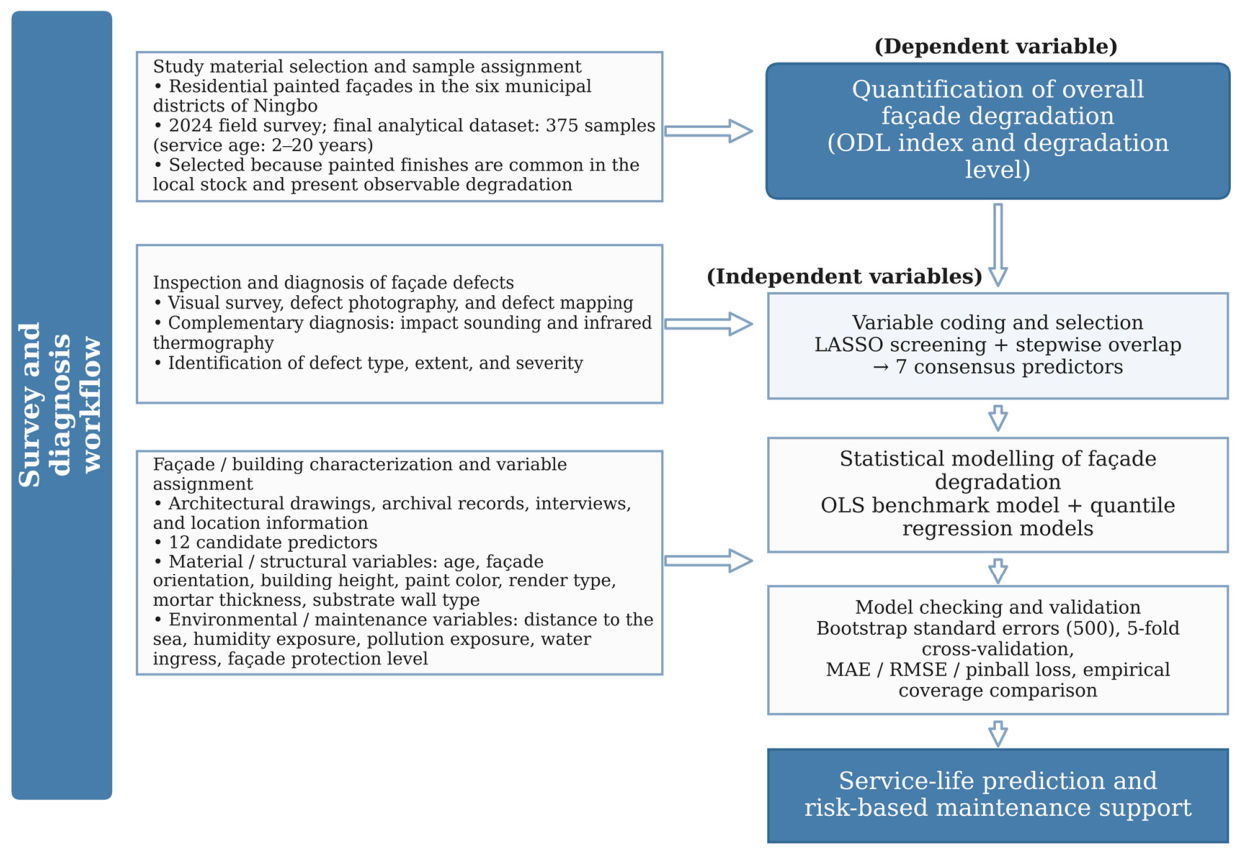
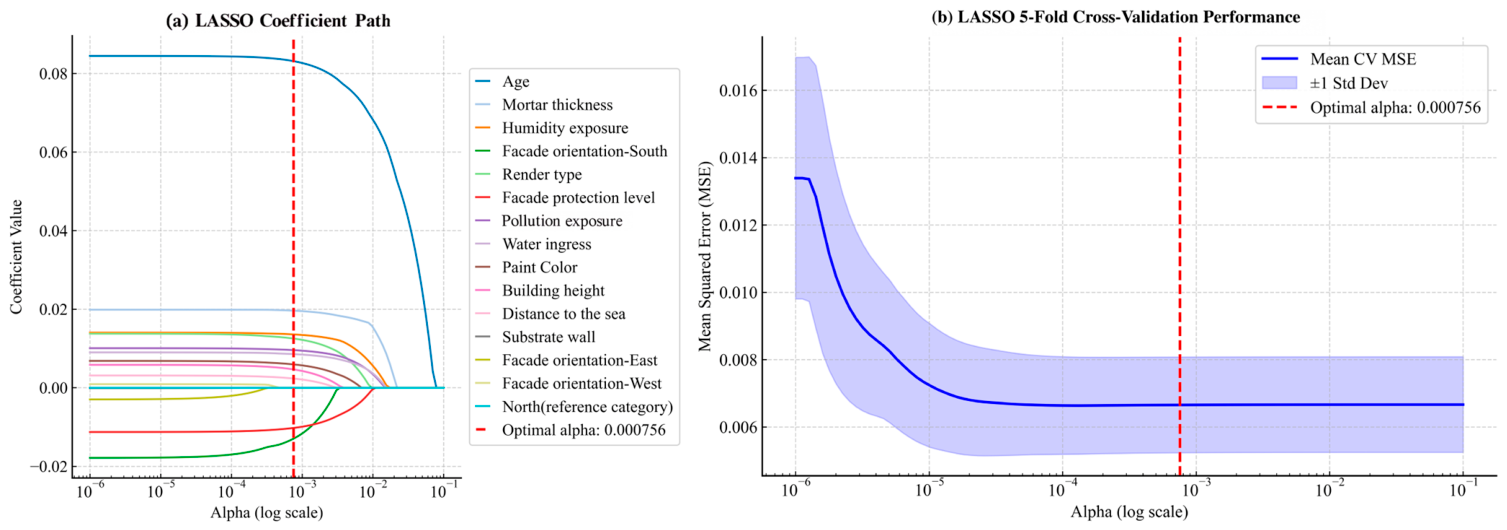
To improve variable-selection stability and reduce the overfitting risk associated with relying on a single screening method, a dual screening strategy was adopted. First, a LASSO regression procedure with 5-fold cross-validated tuning was applied to the full set of 12 candidate predictors for preliminary screening. In this study, LASSO was used to identify a reduced set of candidate variables by shrinking weak predictors toward zero under the selected penalty parameter, rather than to provide the final inferential model. This procedure helps reduce the instability associated with sample-specific variation, limits the influence of weak or redundant predictors, and yields a more parsimonious candidate set for subsequent modeling.
Figure 6 presents the coefficient paths of all candidate predictors as a function of the penalty parameter α, together with the corresponding cross-validation error curve. The optimal penalty parameter was selected at α = 0.000756, and variables with non-zero coefficients under this penalty level were retained as LASSO-selected predictors. Second, an OLS-based stepwise regression procedure was independently applied to the same full set of 12 candidate predictors, using statistical significance (
p < 0.05) and multicollinearity criteria (VIF < 5) to obtain a parsimonious subset of variables. The variables retained by both procedures were regarded as consensus predictors and were subsequently entered into the final refitted multiple linear regression (MLR) and quantile regression (QR) models. In this way, the final predictor set was determined by the overlap between the LASSO-selected variables and the stepwise-selected variables, rather than by either method alone.
Table 5 summarizes the sequence of multiple linear regression (MLR) models generated through the stepwise selection procedure. Candidate predictors were evaluated iteratively, with the variable contributing the greatest improvement in model fit entered at each step and predictors failing the screening criteria excluded. The progression from Model 1 to Model 7 therefore reflects the order of variable inclusion during model construction. For each model, R
2, adjusted R
2, and the standard error of the estimate are reported to characterize model fit at each stage. As additional predictors were entered, model fit improved progressively, as reflected by the increases in R
2 and adjusted R
2, together with the decline in the standard error of the estimate.
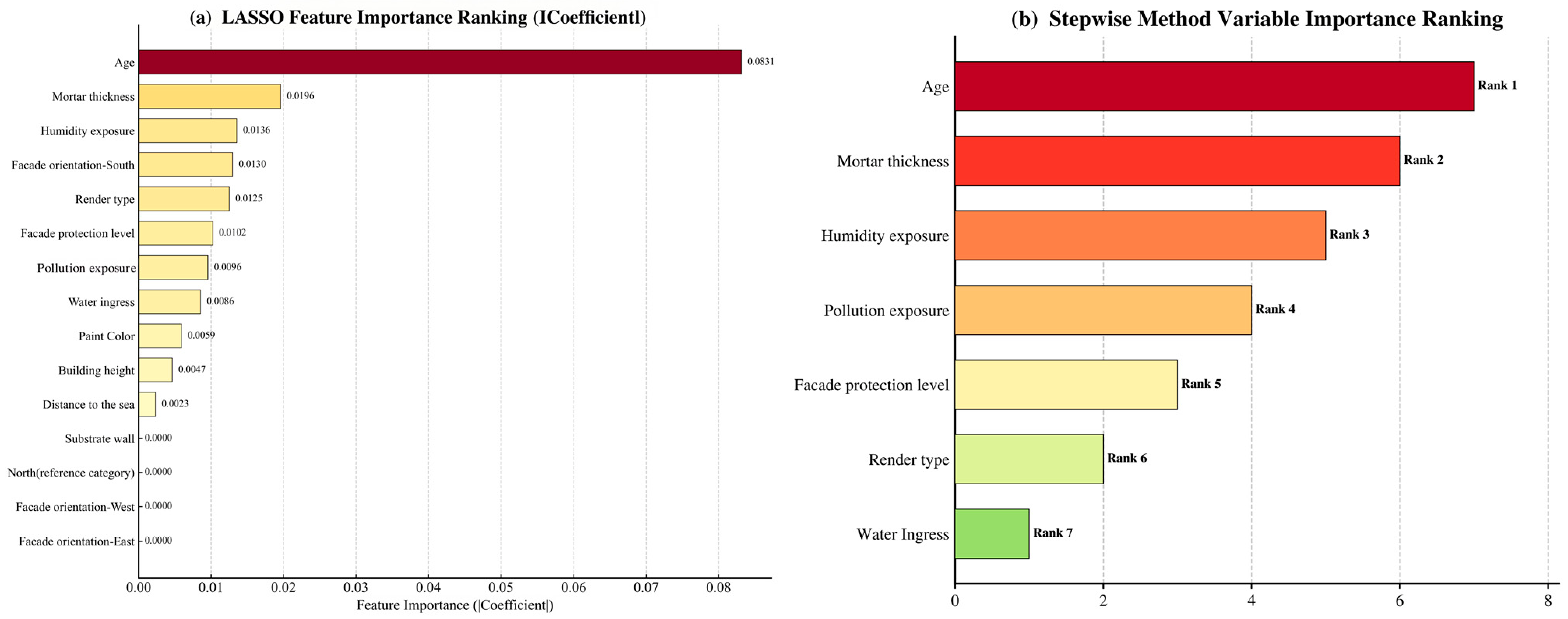
Figure 7 compares the variable screening results from the LASSO and stepwise procedures. In
Figure 7a, age exhibited the largest absolute LASSO coefficient. For façade orientation, the east-, west-, and south-facing dummy variables were defined relative to the north-facing reference category. Under the selected penalty level, substrate wall and the east- and west-facing indicators were shrunk to zero, indicating limited contribution, while the south-facing indicator retained a non-zero coefficient.
Figure 7b shows the subset of predictors retained by the stepwise procedure according to their order of entry into the regression model. Based on the combined screening results, 7 predictors were jointly retained from the original set of 12 candidate variables, including age, mortar thickness, humidity exposure, pollution exposure, façade protection level, render type, and water ingress. These common predictors were then entered into the refitted MLR and QR models.
Table 6 provides descriptions of the input and output parameters used to define the quantile models proposed in this study.
4.2. Regression Results
The quantiles used in the univariate visualization and those adopted in the formal multivariable analysis served different purposes. For the main quantile regression models, five representative quantiles (10th, 30th, 50th, 70th, and 90th) were selected to capture predictor effects across the lower tail, the center, and the upper tail of the conditional distribution of façade degradation. Compared with more extreme upper-tail quantiles (the 95th quantile), this set provides a better balance between distributional representativeness, interpretability, and estimation stability under the present sample size. OLS estimates were reported in parallel as a benchmark for comparison with mean regression. The final regression coefficients for each predictor across the five quantiles and from the OLS model are presented in
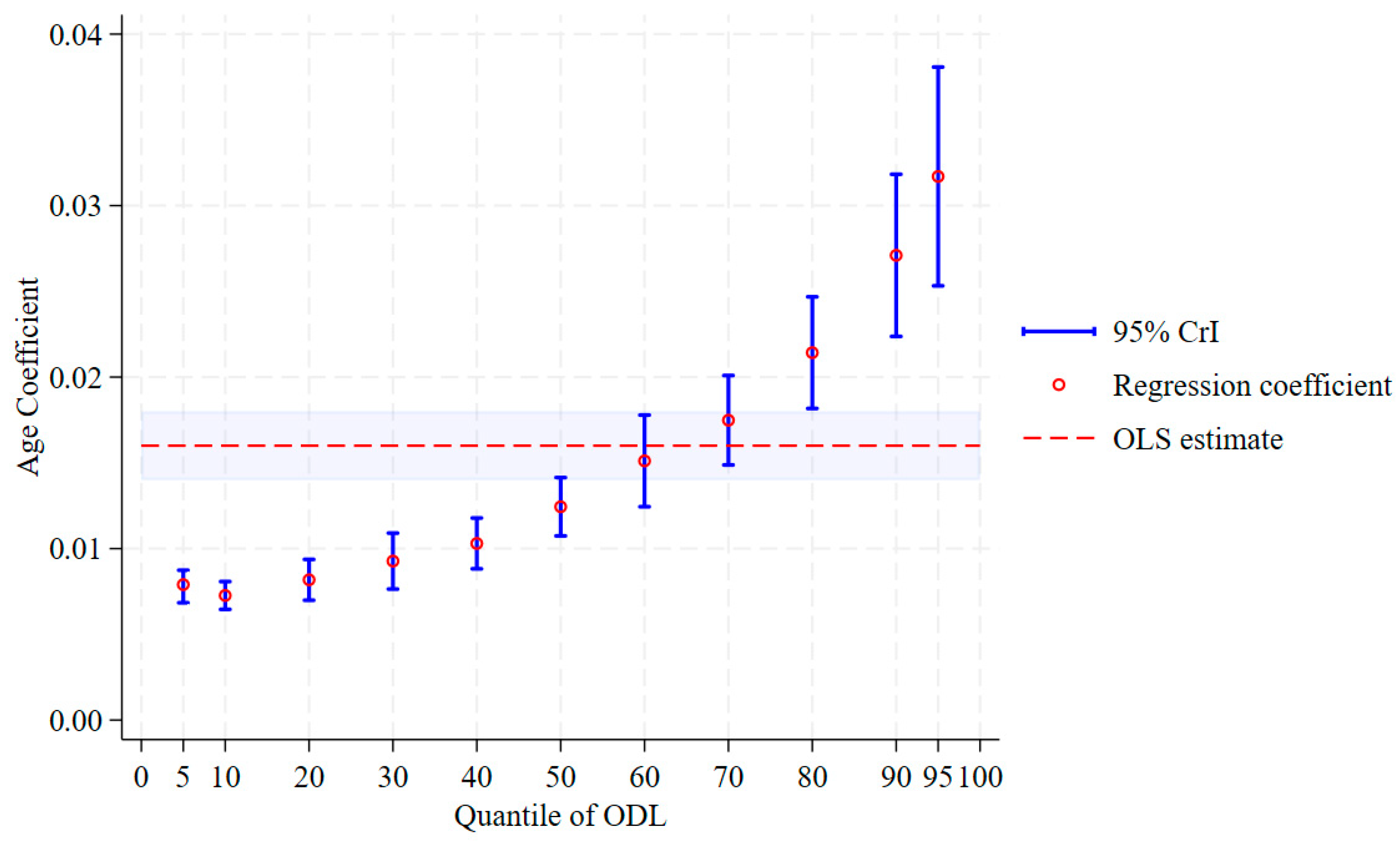
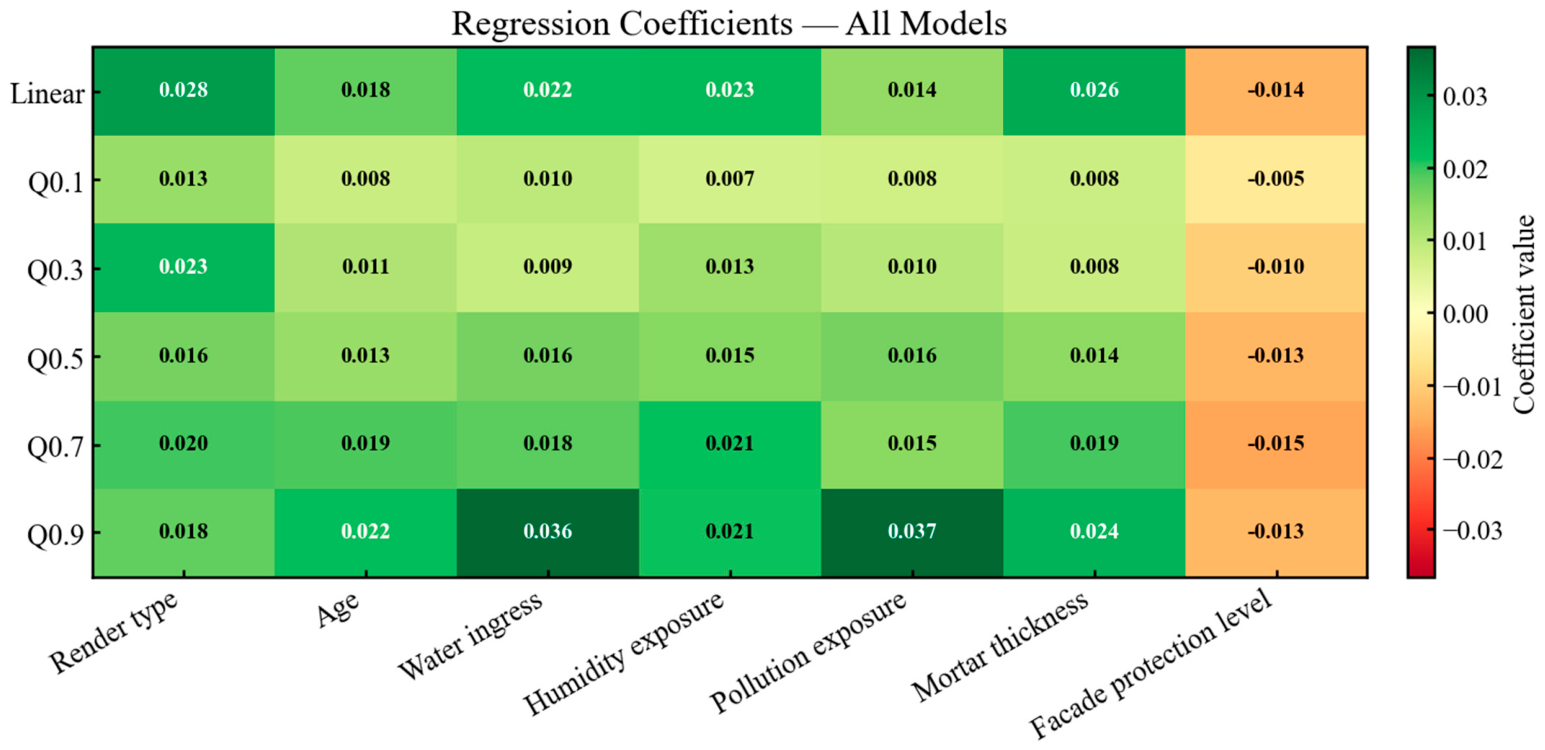
Table 7. Furthermore, to illustrate how the influence of each predictor varies across degradation levels, the corresponding coefficient trends across quantiles are visualized in
Figure 8.
In regression analysis, the estimated coefficient of an independent variable is often regarded simply as the magnitude of its effect on the dependent variable. The OLS regression results indicate that different predictors demonstrate varying effects on façade degradation level. Age (0.018), mortar thickness (0.027), humidity exposure (0.019), pollution exposure (0.024), water ingress (0.015), and render type (0.027) show statistically significant positive effects. In contrast, façade protection level exhibits a significant negative effect (−0.014). However, these effects are not uniform. The quantile regression results reveal that the influence of the same predictor on degradation level also varies considerably across different quantiles.
Age has a statistically significant positive effect on façade degradation across all quantiles, with its regression coefficients increasing nonlinearly from 0.008 (10th quantile) to 0.022 (90th quantile). This heterogeneity in age effects persists even upon additional covariates, and stronger marginal effects are observed at higher quantiles of degradation.
Humidity exposure has a statistically significant positive effect on façade degradation across all quantiles, with the magnitude of this effect increasing as quantiles rise. However, the regression coefficient stabilizes at ~0.020 in the upper quantiles (70th–90th), indicating that the detrimental impact of humidity for façades at higher quantiles approaches a saturation threshold.
Pollution exposure has a statistically significant positive effect on façade degradation across all quantiles, and this effect generally intensifies as the quantile rises. This amplifying pattern is most pronounced at the upper quantiles, where the regression coefficient increases sharply from 0.016 (70th quantile) to 0.037 (90th quantile).
Mortar thickness has a statistically significant positive effect on façade degradation across all quantiles. The regression coefficients exhibit an overall upward trend, characterized by a limited effect (0.008) for façades at lower quantiles (10th–30th) followed by a pronounced rise with increasing quantiles.
Water ingress has a positive effect on façade degradation, with statistical significance confirmed at the 10th, 50th, 70th, and 90th quantiles. The regression coefficients exhibit a positive and increasing trend across these quantiles. Notably, the magnitude of the effect intensifies for façades at higher quantiles, with the coefficient rising from 0.016 at the 70th quantile to 0.037 at the 90th quantile.
Façade protection level is the sole variable exhibiting a negative effect on façade degradation, with statistical significance confirmed at the 10th, 30th, 50th, and 70th quantiles. As the quantile increases, the regression coefficient values also increase, indicating that protection level exhibits increasing returns in mitigating degradation as façade degradation advances. However, at the 90th quantile, the regression coefficient drops abruptly, becoming statistically insignificant.
The coefficient for render type exhibits no clear monotonic trend across quantiles and is statistically significant only at the 10th, 30th, and 50th quantiles. Compared to ordinary mortar, thermal insulation mortar exerts a consistently positive effect on façade degradation across the quantile range. This effect is substantial even at lower quantiles, with a coefficient of 0.023 at the 30th quantile. It should be noted, however, that this effect is not statistically significant at higher quantiles (70th–90th).
Using the regression coefficients of the predictor variables at different quantile levels (τ) provided in
Table 5, the mathematical formulation of the proposed multiple linear quantile regression model is expressed in Equation (6).
The numerical representation of the model’s variables has clear physical meaning, and the results are logically interpretable. For example, the negative coefficient for the façade protection level indicates that, all else being equal, better maintenance (shorter intervals) correlates with less degradation. Furthermore, the coefficient’s magnitude varies with the degradation level, meaning regular upkeep has a stronger inhibiting effect on more severely deteriorated façades. This logic applies similarly to other predictors in the model.
4.3. Predictive Validation of the Final Models
To evaluate the predictive performance of the final models on unseen data, an internal validation procedure based on 5-fold cross-validation was conducted. The dataset was randomly divided into five approximately equal subsets. In each iteration, four subsets were used for model training and the remaining subset was used for testing. This procedure was repeated until each subset had served once as the test set. The predictive performance of the ordinary least squares (OLS) model and the quantile regression (QR) models was then summarized across the five folds. According to the implemented validation workflow, MAE and RMSE were calculated for all models, R2 was calculated for the OLS model, and pinball loss was calculated for the QR models as a dedicated indicator of quantile prediction quality.
Table 8 summarizes the cross-validated predictive results. Among all models, the Q0.5 model achieved the lowest MAE, indicating that median regression provided the most accurate prediction for typical observations. However, the OLS model yielded the lowest RMSE and the smallest fold-to-fold variation, suggesting that it offered the most stable overall point prediction performance. By contrast, the Q0.1 and Q0.9 models showed substantially larger MAE and RMSE values. This result should not be interpreted as evidence of poor model quality, because these models were designed to estimate the lower and upper conditional quantiles rather than the conditional mean. Therefore, their main value lies in describing the distributional boundaries of degradation rather than minimizing conventional point-prediction errors.
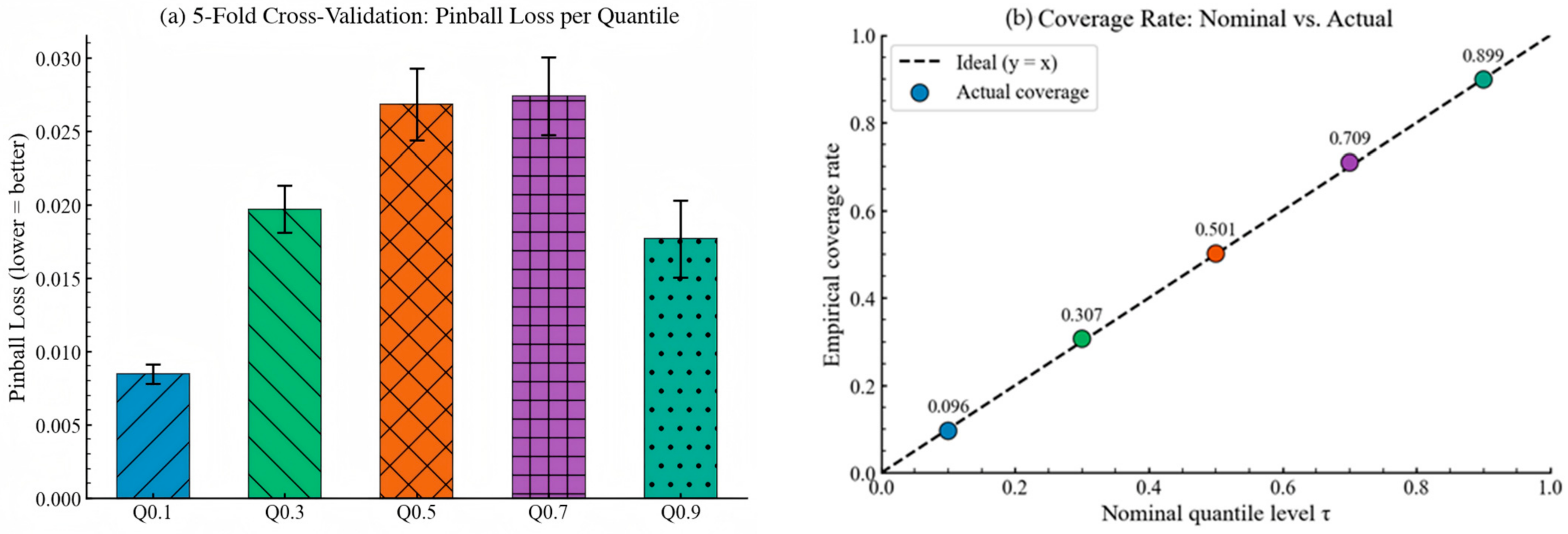
The predictive quality of the quantile models was further assessed using pinball loss, as shown in
Figure 9a. The cross-validated pinball loss values were 0.0085 ± 0.0007 for Q0.1, 0.0197 ± 0.0016 for Q0.3, 0.0268 ± 0.0025 for Q0.5, 0.0274 ± 0.0027 for Q0.7, and 0.0177 ± 0.0026 for Q0.9. These relatively small fold-to-fold variations indicate that quantile estimation remained reasonably stable across different training–testing splits. Because pinball loss is specifically designed for quantile prediction, it complements rather than replaces MAE and RMSE. Overall, these results support the use of QR models for describing different parts of the conditional distribution of façade degradation.
In addition, the calibration of the fitted quantiles was examined through empirical coverage rates, as shown in
Figure 9b. The observed coverage rates were 0.096, 0.307, 0.507, 0.701, and 0.904 at the nominal quantile levels of 0.1, 0.3, 0.5, 0.7, and 0.9, respectively. These values are all close to the ideal diagonal, with deviations of no more than 0.007, suggesting good agreement between the fitted quantiles and the observed ODL distribution. This result further supports the usefulness of quantile regression for uncertainty characterization and risk stratification. However, because these coverage rates were calculated from models fitted on the full dataset, they should be interpreted as an in-sample calibration check rather than a strict out-of-sample validation result.
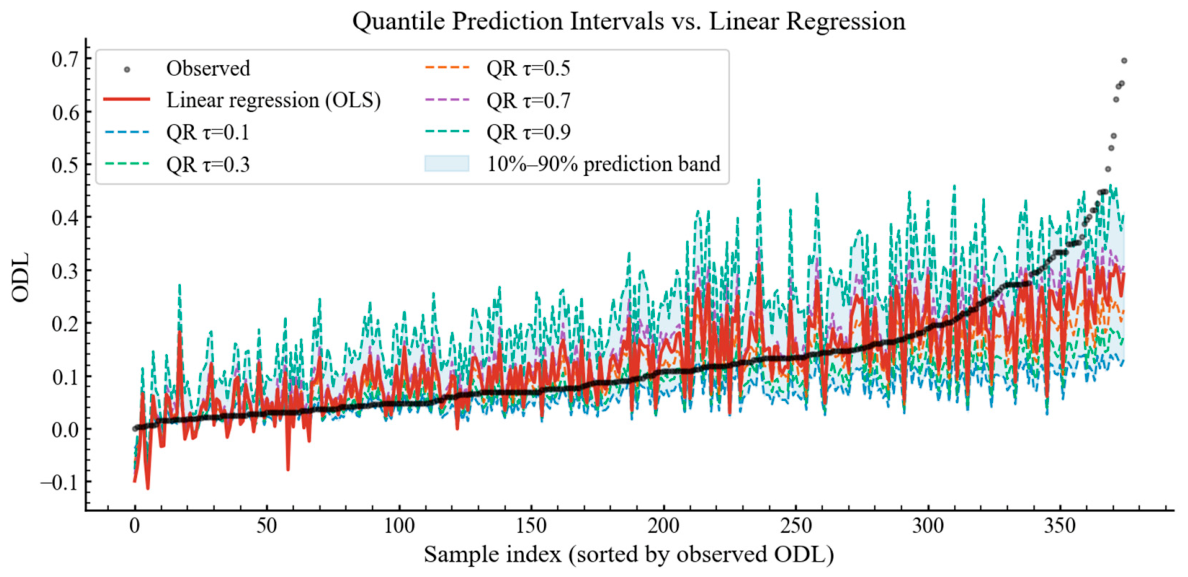
Overall, the validation results suggest that the OLS model is more suitable when the objective is stable point prediction, because it mainly captures the central tendency of the data and provides a relatively reliable estimate of the conditional mean. However, the fitted quantile prediction intervals shown in
Figure 10 indicate that façade degradation cannot be fully described by the mean trend alone. As the ODL level increases, the prediction band between the lower and upper quantiles becomes progressively wider, indicating greater dispersion and more pronounced heteroscedasticity among highly degraded façades. This pattern suggests that prediction uncertainty increases substantially in the upper-risk region, where the OLS fitted curve is less capable of representing the widening spread of the data. By contrast, the quantile curves provide a richer description of the lower-tail, central, and upper-tail conditional trajectories of façade degradation, thereby offering additional insight into distributional heterogeneity, uncertainty, and high-risk degradation pathways. It is also noteworthy that a few observations at the far right remain above the Q0.9 curve, suggesting that although the model captures the overall distribution reasonably well, the most extreme degradation cases are still slightly underestimated. It should be noted, however, that
Figure 10 is based on full-sample fitted values and is intended as a visualization of distributional structure and uncertainty rather than a strict out-of-sample validation result. Taken together, these findings suggest that OLS and quantile regression should be regarded as complementary tools: the former is preferable for stable point prediction, while the latter is better suited for risk-based service-life assessment and uncertainty-aware decision-making.
5. Discussion of the Results
In this section, we will conduct a detailed discussion of the results from
Section 3 and
Section 4.
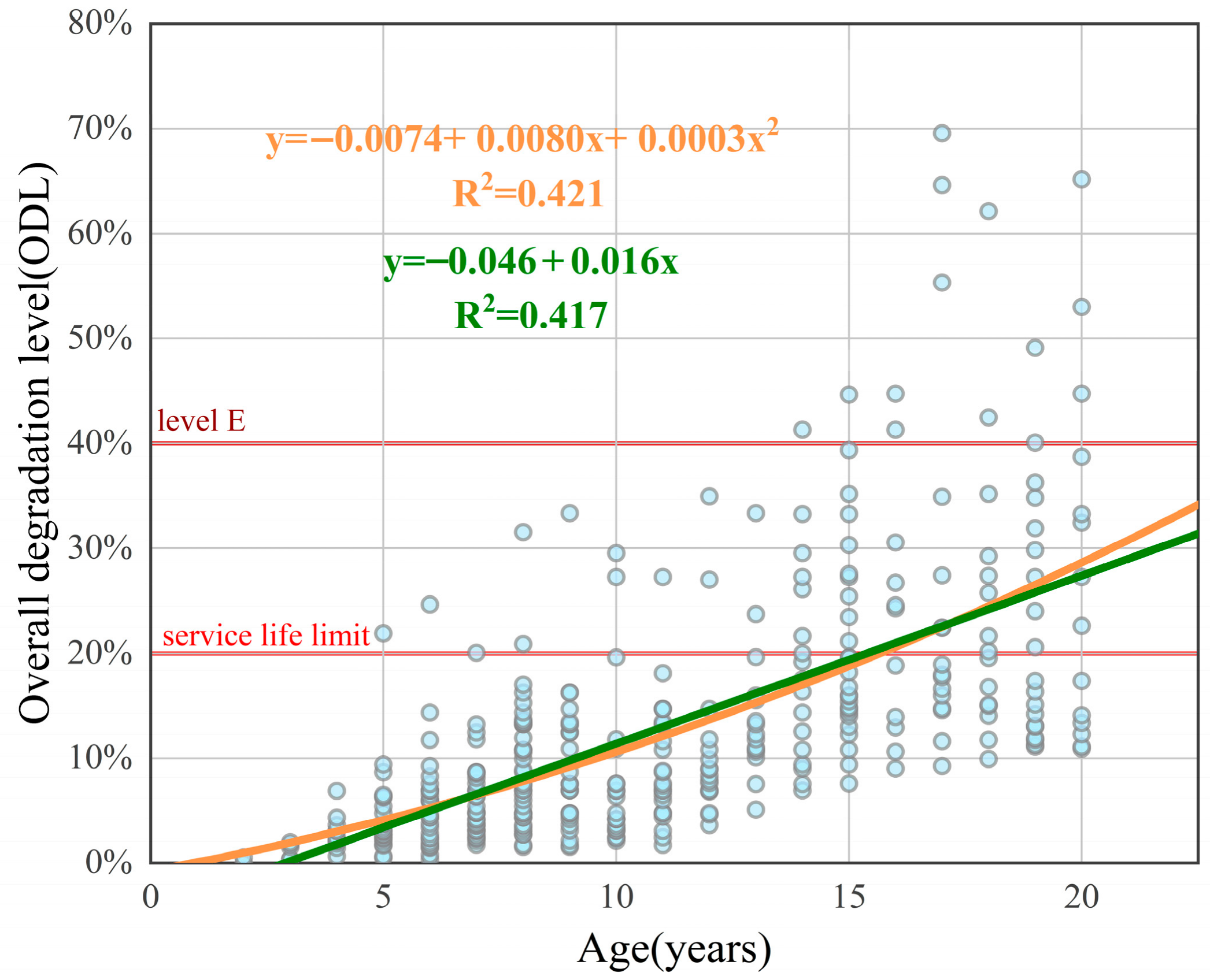
First, the rationale for employing the quantile regression method to develop the service life prediction model in this study is as follows. When using traditional OLS regression methods to fit sample degradation data, the results consistently showed suboptimal performance (with low R
2 values), indicating limitations in the accuracy of predicting service life for models built using this method. Similar fitting limitations have been noted in other studies; for example, Ana Luíza et al. [
18] obtained an R
2 of 0.5624 when fitting degradation data for 308 tiled façades with a quadratic model, while Galbusera et al. [
61] reported R
2 values of 0.4014 and 0.3798 for linear and nonlinear models, respectively. However, most studies report generally higher R
2 values [
44,
54,
55,
62]. This discrepancy arises because regression outcomes are influenced by dataset characteristics: OLS regression relies on the assumptions of homoscedasticity and normally distributed residuals to ensure reliable standard errors and, thus, accurate confidence intervals. Additionally, the presence of significant outliers may adversely affect model precision.
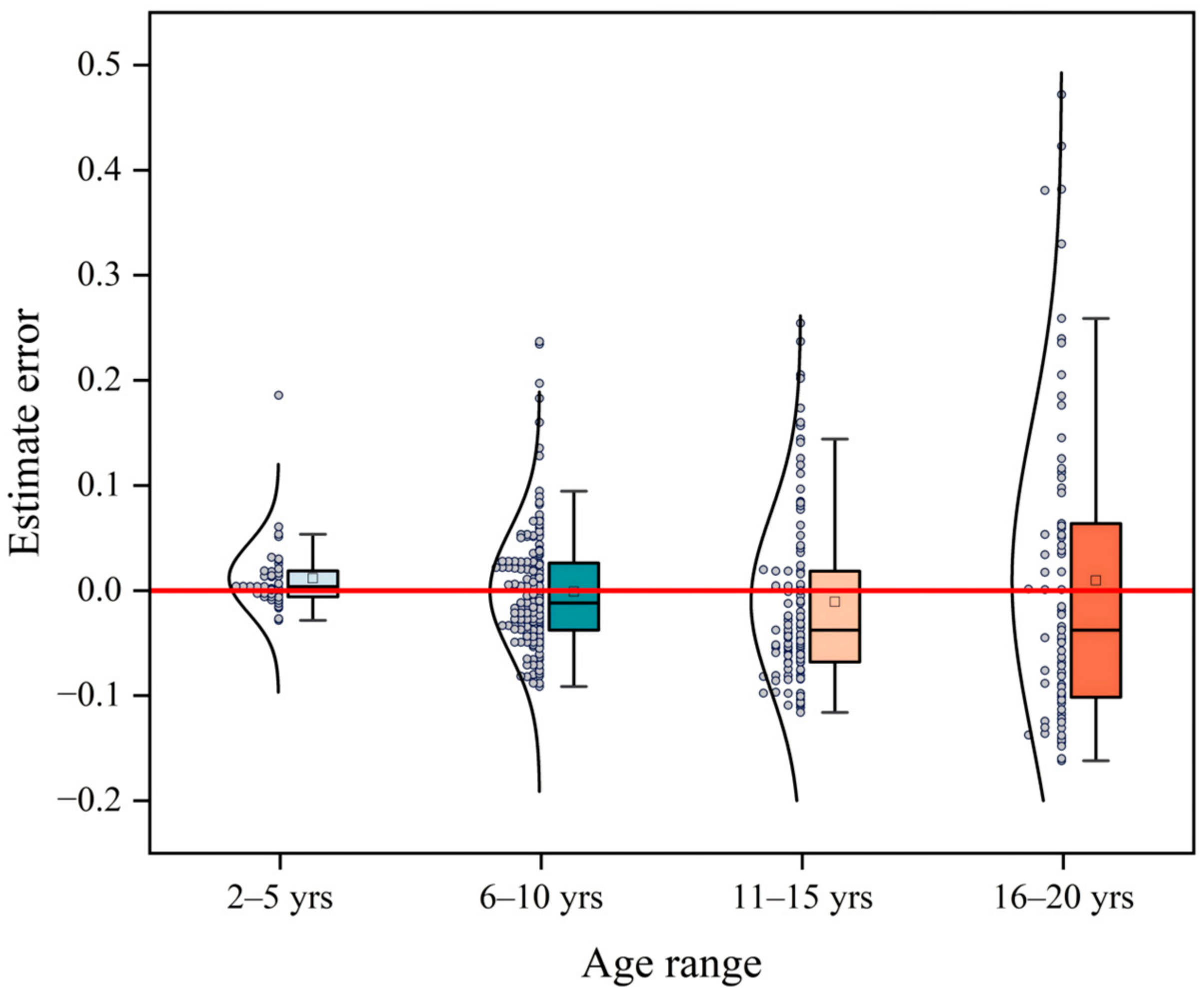
The residual analysis results in
Figure 11 reveal that as the range of age increases, the distribution of residuals widens, exhibiting a funnel-shaped pattern. This suggests a progressive decline in model accuracy and violates the fundamental assumptions of OLS regression. In cross-sectional surveys sampling façades of different ages, the distribution of degradation levels is likely to display such heteroscedasticity; that is, the variability in degradation level tends to increase over time. This conclusion follows a clear logic: during the initial stages of degradation, the influence of these inherent differences is not yet pronounced, and the degree of degradation among façades remains relatively similar. However, due to significant variations in initial materials and quality, construction execution, internal structure, climatic environment, and subsequent maintenance management, the rate and extent of degradation inevitably differ across façades. Over time, these disparities become progressively amplified, resulting in increasingly dispersed degradation levels among façades of the same service age.
In summary, the fundamental reason lies in the model’s inability to adequately capture and explain the inherent and substantial uncertainty present in service life data. This uncertainty stems from multiple sources, including the complexity of the degradation mechanisms, individual variations among façades, the interference of random factors, and potentially high levels of noise within the data itself. Therefore, when data exhibit heteroscedasticity or skewed distributions, a single mean-life estimate obscures such distributional information. OLS regression models based on the conditional mean are therefore likely unsuitable for describing the complex degradation process of building façades. In practical engineering applications, the time to failure of components is not a fixed value but rather exhibits distinct probabilistic distribution characteristics [
63]. Consequently, reliance on a point estimate of service life prevents decision-makers from assessing the likelihood of different longevity outcomes, thereby impeding effective risk management.
Galbusera et al. [
61] attempted to enhance the interpretability of regression models by removing “low-quality” data from the sample, arguing that these biased data points stemmed from improper construction or severe design flaws, directly leading to inaccurate research outcomes. However, some view this approach as incomplete, as even samples exhibiting extreme values should be regarded as integral components of the overall distribution [
64]. Arbitrary removal would result in information loss or estimation bias. Furthermore, studying extreme degradation conditions holds intrinsic value [
65,
66], as it reveals the behavioral characteristics of façade degradation under extreme boundary conditions. This contributes to identifying potential risks and refining relevant theories.
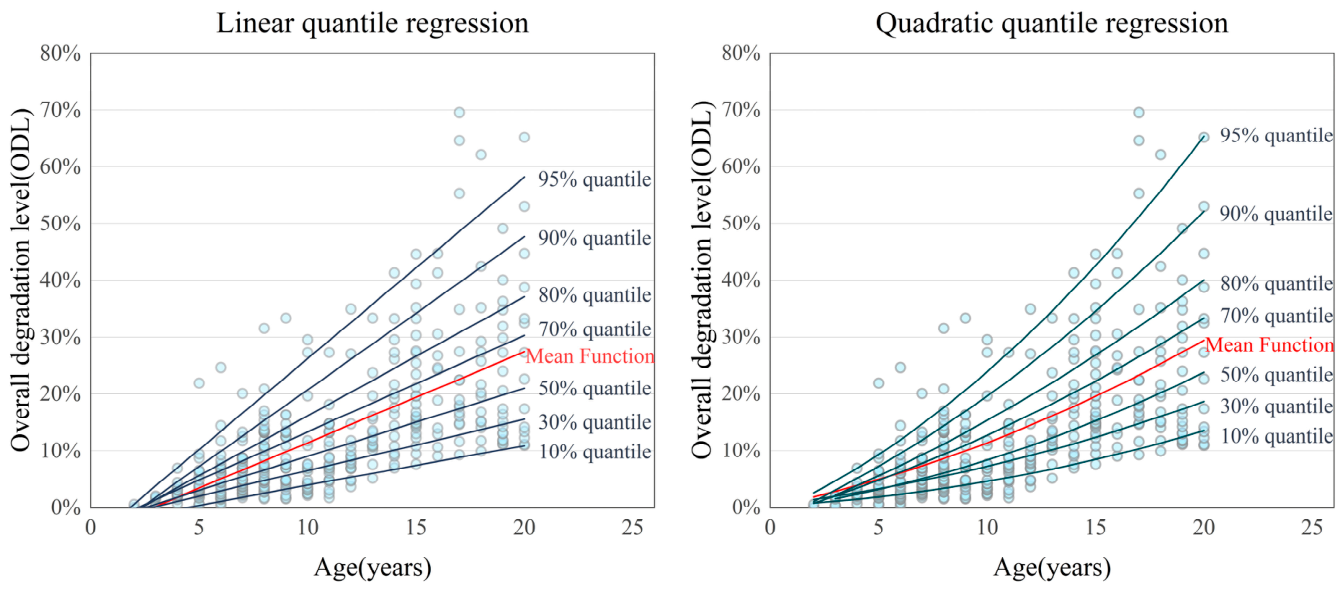
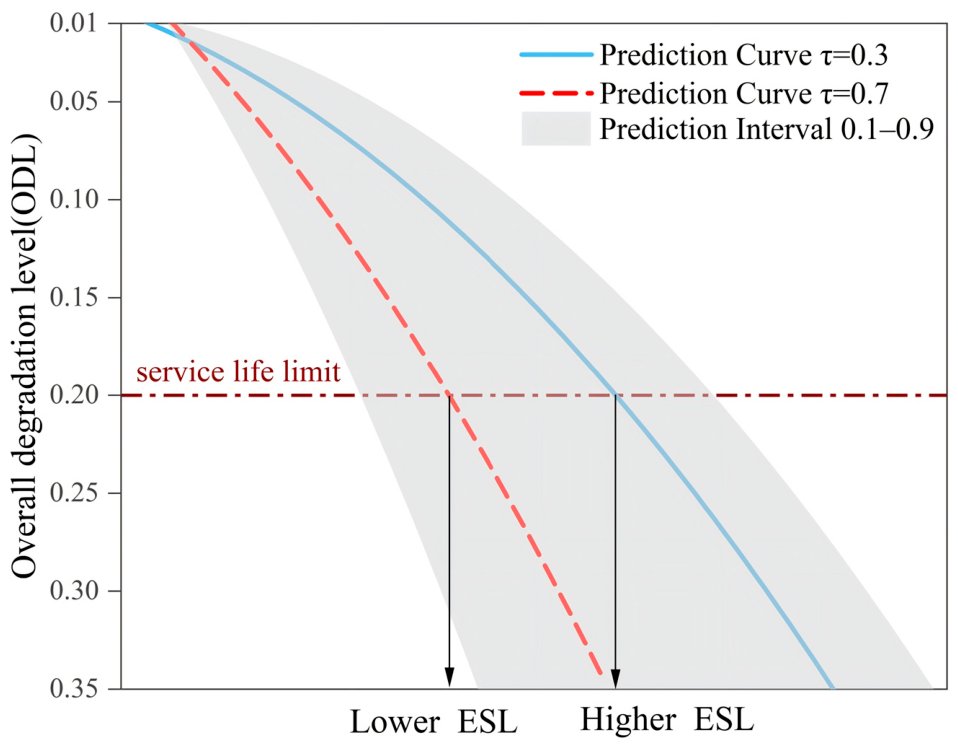
Therefore, building upon the deterministic approach, this study further introduces a quantile regression model to more comprehensively capture the evolution of degradation across the entire conditional distribution. The results show that predictions from the quantile regression model vary substantially across quantiles. Unlike point estimates, which reflect only the central trend, quantile regression captures differences across the conditional distribution. As shown in
Figure 12, this characteristic enables decision-makers to select appropriate prediction confidence levels based on specific application contexts: for different quantile levels (τ), when τ > 0.5, the regression emphasizes the upper half of the data distribution, yielding more conservative (shorter) service life predictions; when τ < 0.5, it focuses on the lower half, yielding more optimistic (longer) predictions; and when τ = 0.5, quantile regression directly estimates the median predicted service life, serving as a robust representative value that effectively mitigates the influence of outliers.
By selecting a specific quantile level (τ), decision-makers are essentially performing a precise risk–cost tradeoff: For highly sensitive façades with severe historical or failure consequences, a high τ value can be adopted for prediction, enabling the formulation of preventive strategies aimed at controlling the probability of engineering failure below an acceptable strict confidence level. For instance, selecting τ = 0.9 for decision-making implies that only about 10% of samples are expected to fail by the end of the façade’s service life under this decision, even if this means the façade may not fully achieve its intended performance. For highly redundant façades with stable degradation or no pedestrian traffic, low τ-value predictions may be referenced. This strategy focuses on optimizing maintenance cycles and resource allocation, maximizing the façade’s performance potential within defined risk thresholds. This enhances lifecycle economic benefits while ensuring overall safety, though it also entails corresponding potential failure risks.
Secondly, stepwise regression was employed to identify predictors that serve as degradation drivers in the quantile regression model, thereby enhancing the explanatory power of the service-life prediction model. From a set of potential factors influencing façade degradation, seven variables were ultimately selected as predictors for the dependent variable: age, mortar thickness, humidity exposure, pollution exposure, water ingress, render type, and façade protection level. These variables collectively reflect key dimensions influencing façade degradation, encompassing the suitability of the materials themselves, the standard of operation and maintenance decisions, and the environmental exposure conditions. Finger et al. [
67] argue that the interaction between material deficiencies, poor execution quality, and environmental factors can lead to severe issues.
These findings align with the results of studies by Souza [
31] and Silva et al. [
68]. Their research similarly identified age, moisture exposure, exposure to pollution, façade protection level, and render type as significant explanatory variables affecting façade degradation behavior. The present study extends this existing knowledge by additionally incorporating mortar thickness and water ingress. The former reflects the potential impact of construction layering on durability, while the latter emphasizes the critical role of water in the degradation process. This enhanced variable set more comprehensively captures degradation mechanisms, spanning from material properties to environmental influences. Furthermore, by focusing on thermal insulation mortar versus cement mortar, the study examines and compares their distinct effects on façade degradation behavior.
Finally, the enhanced service-life prediction model developed in this study, which incorporates key predictors, also aims to examine the influence of these predictors on façade degradation, particularly their differential effects across various locations of the degradation conditional distribution. Adopting the quantile regression method proposed by Koenker and Bassett, the 10th, 30th, 50th, 70th, and 90th quantiles were selected for model construction. The 10th and 30th quantiles reflect changes in lower ODL values within the distribution, while the 50th and 70th quantiles reflect changes in moderate and higher ODL values, respectively. The 90th quantile reflects changes in extreme ODL values within the distribution. The multiple mathematical models derived from quantile regression effectively capture the degradation processes along different pathways, as well as the behaviors and mechanisms influenced by degradation factors.
Age, as a key degradation driver variable on the time scale, determines the duration and cumulative effects of the action of degradation agents, leading to increased degradation levels over time. However, age’s influence on the degradation process is heterogeneous; its marginal contribution gradually increases as the levels of façade degradation quantile rises. In linear models, age’s regression coefficient intuitively reflects the rate of façade degradation, with the degradation rate accelerating as the degree of degradation increases. This coefficient effectively describes the variation in decay rates across different degradation pathways and can be used to identify and distinguish degradation patterns with differing degradation rates. Research by Ana Luiza et al. [
18] further indicates that the degradation process is not constant over time. A clear positive correlation exists between the rate of degradation and the degree of degradation, validating the physical meaning of the model.
Humidity is one of the primary environmental agents causing defects in painted façades. In high-humidity environments, the condensation film forming on façade surfaces not only provides essential moisture for microbial growth but also acts as a natural binder for salts and particulate matter [
69]. Humidity exerts a stronger influence on façades with higher levels of degradation. However, at the upper tail of the degradation distribution, this effect does not intensify further. A plausible explanation is that biological colonization and efflorescence are the two anomalies most closely associated with humidity-induced defects [
69], and the aesthetic impacts caused by them likely reach a maximum at higher levels of façade degradation and then stabilize.
High-concentration urban pollutants such as CO, SO
2, NO
2, NO
x, and PM
10 have become significant external factors contributing to the degradation of existing building façades. On the one hand, particulate matter like dust adheres to surfaces, causing staining and serving as nutrients for microbial growth, thereby diminishing the aesthetic appeal of façades [
70]. On the other hand, pollutants like SO
2 and NO
x dissolve in surface water films or rainwater to form acidic solutions. These solutions penetrate the wall structure, reacting with Ca(OH)
2 and C-S-H in the cement paste to produce gypsum or various soluble/crystalline expansive salts [
71]. This process causes surface paint to soften and peel, or leads to partial mortar detachment [
72]. Higher pollution exposure exacerbates degradation more severely at the upper tail of the façade degradation distribution, with effects particularly pronounced at the 90th quantile. A likely cause is that degradation compromises the façade surface coating due to pre-existing cracks and reduced hydrophobicity, allowing pollutant solutions to diffuse inward more readily along crack pathways. Simultaneously, increased porosity in aged plaster mortar provides greater reactive surface area and retention space for solutions, significantly accelerating material degradation rates.
Water ingress through wall assemblies and deficiencies in the envelope’s waterproofing are among the most common causes of premature building degradation, primarily because water acts as a catalyst for various corrosive reactions [
73]. In terms of its impact, the presence of water ingress significantly accelerates the degradation of façades at the 90th quantile compared to those at other quantiles. A plausible explanation for this phenomenon is that, in façades with extreme degradation, multiple defects from premature degradation coexist. This creates synergistic reactions between different degradation factors, with water acting as a reaction medium that further exacerbates the destructive potential of these degradation mechanisms. However, the presence of surface cracks also provides pathways for water ingress into the wall. More severe façade degradation typically implies a higher leakage risk, creating a clear mutually reinforcing relationship between the two.
Regarding the level of façade protection, the results align with expectations: façades that undergo regular cleaning and simple maintenance measures exhibit a higher estimated service life than other scenarios. As the level of façade degradation increases, the inhibitory effect of protective measures on degradation generally shows an enhancing trend. However, at the 90th quantile of the distribution, the influence of façade protection levels no longer holds statistical significance. Such façades typically indicate extreme degradation processes and the highest degradation rates. At this point, the degradation rate exceeds the intervention capacity of routine maintenance and cleaning. Relying solely on façade protection becomes insufficient to effectively slow the overall degradation process. Only through large-scale renovation or complete replacement can its functional use and performance be restored.
Regarding Render types, lightweight insulating mortar exhibits more severe façade degradation than ordinary cement mortar. It has lower density, inferior mechanical properties, and higher capillary water absorption, but lower thermal conductivity [
74]. While it offers better energy efficiency, its durability is comparatively poorer. Additionally, because of its low thermal mass, the material is more susceptible to large daily surface temperature fluctuations, which can promote repeated condensation. This, in turn, not only favors microbial growth but may also induce microcracking through thermal expansion and moisture-related swelling and shrinkage [
17]. Regarding the impact on façade degradation, no significant differences were observed across different degradation quantiles. At the upper tail of the façade degradation distribution, the effects no longer reached statistical significance. This may be attributed to the fact that thermal insulation mortar was only introduced in Ningbo City in 2005 (with the launch of relevant energy-saving pilot and demonstration projects) [
75]. The maximum age of the samples was less than 18 years, insufficient to reach the stage of more severe degradation. The proportion of such samples was small, resulting in an excessively low sample weight in the high-degradation group and reduced statistical power. As the service duration extends, the deterioration disadvantage is expected to gradually manifest. Follow-up studies should continue tracking to validate long-term performance differences.
Regarding the impact of render thickness, greater thickness ranges exhibit more severe façade degradation. This effect is more pronounced on façades with higher degradation levels, while for the degradation of façades at the lower tail, variations in thickness have a relatively limited influence. In thermal insulation render, increased thickness enhances energy efficiency, whereas ordinary cement render is typically applied within 10–30 mm to meet leveling requirements. Silveira et al. [
76] demonstrated that thinner render layers exhibit higher density and lower water permeability, with multi-layer application further reducing permeability, though some observed differences lacked statistical significance. Water-retention capacity is closely related to render thickness. Thick-layer rendering, owing to its larger volume, greater self-weight, higher moisture content, and slower drying rate, poses considerable curing challenges. Inadequate curing may lead to early moisture loss and consequently insufficient strength development. According to China’s construction acceptance standards (GB 50210-2018) [
77], thick rendering requires layered application (7–8 mm per layer), and reinforcement (e.g., wire mesh) is mandated when total thickness reaches 35 mm to enhance crack resistance and integrity. Consequently, extreme degradation samples may reflect improper construction or curing practices (non-layered application, insufficient curing, omitted reinforcement), which exacerbate deterioration and amplify thickness effects. In contrast, low-degradation samples with stringent construction control demonstrate greater durability and stability, with thickness exerting only limited influence.
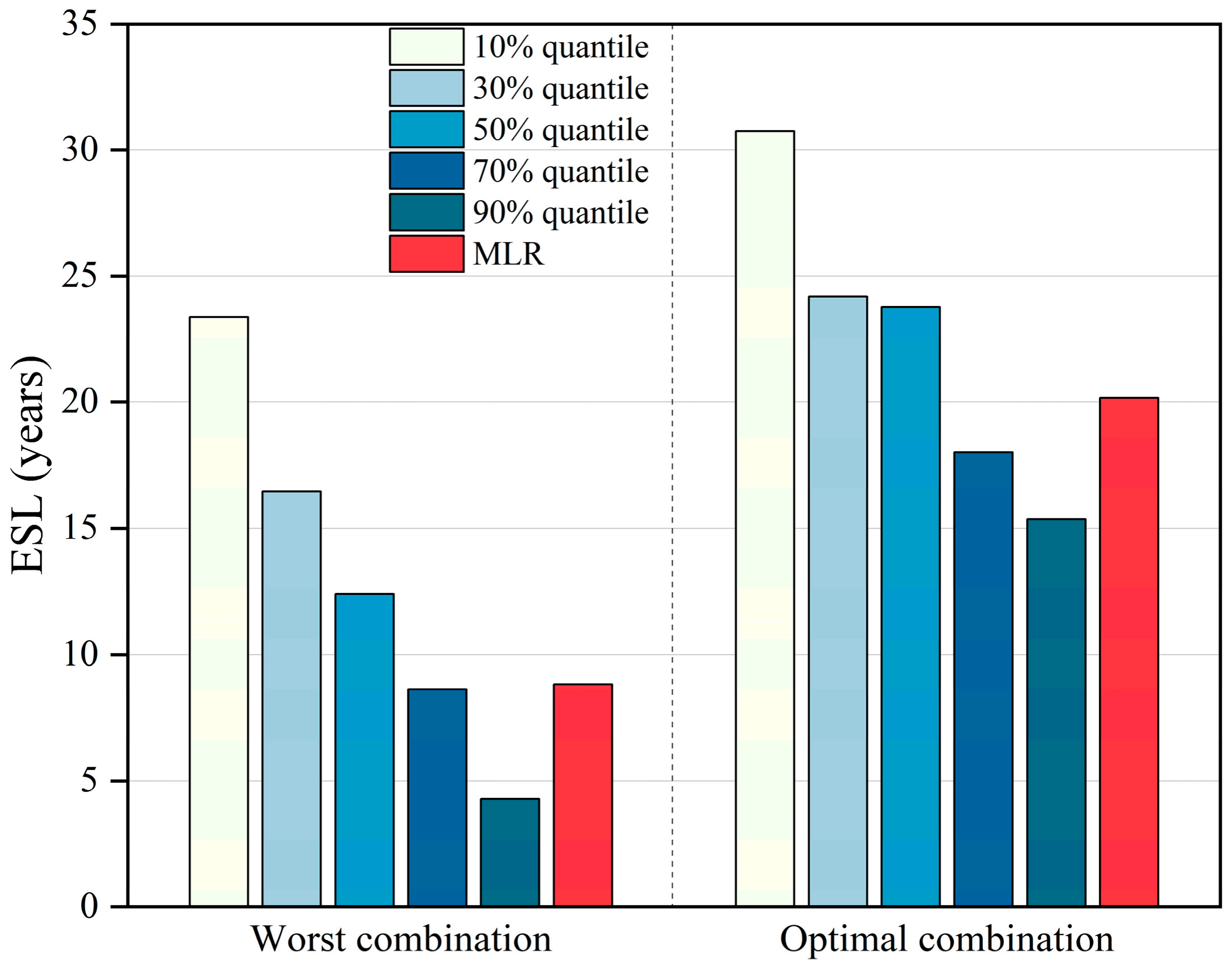
Figure 13 presents the estimated service life (ESL) values obtained from the quantile regression (QR) model and the multiple linear regression (MLR) model. The worst possible combination, corresponding to the use of thermal insulation mortar, the maximum mortar thickness, high exposure to humidity and pollution, poor façade protection, and the presence of water ingress, yields the shortest service life. Conversely, the most favorable combination, which involves the use of cement mortar, minimum thickness, low exposure to humidity and pollution, good protection, and no water ingress, results in the longest service life.
Based on the obtained results, the estimated service life of painted façades explained by the QR model ranges between 4.3 and 31.8 years. In contrast, the MLR model only accounts for a service life range of 8.8 to 20.2 years. The median regression yields a range of 12.4 to 23.8 years, which appears more optimistic due to the influence of extreme values on the mean service life. As the quantile increases from the 10th to the 90th, the estimated service life shifts from 4.3–15.4 years to 23.4–30.6 years. This variation is attributable to factors not captured by the model, such as construction quality, material performance, and measurement errors. Although statistically elusive, their effects are inherently reflected in the modeling of the entire conditional distribution via quantile regression. It is recommended to use the 70th quantile as a representative predicted value. This implies that 70% of actual service lives are expected to exceed the predicted value derived from this quantile, making the estimate more robust. Using the 70th quantile, the QR model estimates a service life between 8.6 and 18 years, with a sample mean service life of 13.6 years.
The estimated service life in this study aligns with findings from previous research. Using a graphical method, Chai [
44] predicted that the average service life of painted façades is approximately 10 years. Petersen [
28] employed an MLR model to forecast a service life of 3–12 years for unpainted surfaces without maintenance, and 5–13 years after maintenance interventions. According to the ABNT [
78] guidelines, the design service life of painted surfaces must be at least 8 years. Statistically, most reliable predictions from existing studies typically fall within the range of 3–15 years [
16].
Additionally, the quantile regression model estimates a service life ranging from 4.3 to 23.4 years for painted façades under the least favorable conditions, showing a considerable spread, with higher service life values particularly evident at lower quantiles. Conversely, under the most favorable condition settings, estimates range from 15.36 to 30.75 years, consistently yielding high service life values across all quantiles. This reflects that, when façades are subjected to adverse factors, ensuring high construction and design quality along with superior material performance can substantially extend their service life. Under more favorable conditions, it may be acceptable to select materials or assemblies with relatively lower durability, provided other aspects, such as thicker lightweight mortar layers or darker colors, are optimized to ensure functional requirements like energy efficiency, aesthetics, or cost-effectiveness.
To better position the proposed method within the existing body of façade service-life research,
Table 9 provides a comparative assessment of the main characteristics of commonly used approaches and the quantile regression framework developed in this study. Previous studies based on graphical degradation curves and factor methods have offered practical tools for façade service-life estimation, but they generally provide only average trends or single-value estimates. Mean-based regression models further improve explanatory power by incorporating multiple variables, yet they still mainly describe the conditional mean of degradation. In contrast, the present QR framework extends this line of research by explicitly modelling different parts of the conditional distribution of façade degradation. This allows the method to distinguish lower-risk, typical, and higher-risk deterioration trajectories, which is particularly relevant for inspection prioritization and maintenance planning in existing buildings.
The comparison also highlights that the proposed method should not be interpreted as universally superior in all respects. In this study, the OLS model yielded the lowest RMSE and the most stable overall point-prediction performance, whereas the Q0.5 model achieved the lowest MAE (0.0537), corresponding to an improvement of approximately 5.3% relative to the OLS benchmark (0.0567) for typical observations. This suggests that OLS remains useful when the objective is stable mean prediction, while QR is more advantageous when the objective is to characterize uncertainty, distributional heterogeneity, and risk-sensitive degradation behavior. In addition, the fitted quantiles showed good calibration, with empirical coverage deviations of no more than 0.007, which supports the reliability of the quantile-based interpretation.
A further point of novelty lies in the way service life is expressed. The MLR model provided a service-life range of 8.8–20.2 years, whereas the QR framework yielded a substantially wider interval of 4.3–31.8 years. This difference is important because it reveals that façade deterioration in real service conditions cannot be adequately represented by a narrow average-based estimate alone. Instead, the QR framework captures the broader range of possible outcomes implied by different degradation levels and influencing conditions. From an engineering perspective, this wider yet structured representation is useful because it enables stakeholders to select more conservative or more optimistic service-life reference values depending on maintenance priorities and acceptable levels of risk. In this sense, the 70th quantile, which gives a service-life range of 8.6–18 years with a mean of 13.6 years, may serve as a practical and relatively robust engineering reference.
From a broader perspective, the originality of the present work lies not only in applying quantile regression to façade service-life prediction, but also in demonstrating its added value relative to established approaches. Scientifically, the method captures the differential influence of key variables across degradation levels, which conventional mean-based models do not show directly. Technically, it transforms field inspection data into a risk-sensitive predictive framework. In applied terms, it provides a basis for more selective inspection planning and maintenance prioritization in large existing building stocks. Although the present study did not directly quantify economic or environmental outcomes, the ability to distinguish between lower-risk and higher-risk service-life trajectories may help reduce inefficient maintenance timing and improve the allocation of technical and financial resources in practice.
6. Conclusions
This study represents the first reported application of the quantile regression method to establish a service life prediction model and analyze influencing factors, based on visual inspection data of degradation from 375 painted façade samples in Ningbo. The research assessed the deterioration patterns of façades over time and revealed the differential effects of various factors across different degradation levels. The main findings are summarized as follows:
Façade degradation is characterized by a non-uniform rate and a highly heterogeneous progression over time. Quantile regression provides multiple degradation curves and corresponding equations at different quantiles, thereby capturing the diversity of degradation trajectories associated with different deterioration rates. In this way, it overcomes the limitation of single-mean point-estimation models and offers a broader range of predictions, from longer-life to shorter-life scenarios, thus supporting differentiated management and maintenance decisions under different risk preferences.
The degradation of painted façades is influenced primarily by age, mortar substrate thickness and type, exposure to humidity and pollution, and water ingress, while façade protection serves as an inhibiting factor. However, the results obtained from quantile regression provide additional insights concerning the impact of independent variables on the different degradation levels. At higher levels of façade degradation, certain degradation factors such as humidity, pollution, mortar thickness, and water ingress exhibit stronger impacts, indicating their importance in driving high degradation. Regarding mortar types, the use of insulating mortar exhibits a significant effect compared to ordinary mortar even at lower levels of degradation. Consistent with expectations, protective measures demonstrate greater effectiveness in mitigating degradation for façades exhibiting more severe degradation.
Quantile regression also extends the understanding of degradation behavior along different degradation pathways, revealing variations in façade degradation at different quantile levels. Specifically, façades at the 90th quantile exhibit a high degradation rate and an advanced state of degradation. At this point, the effects of pollution exposure and water ingress suddenly become markedly amplified. This may stem from pre-existing defects in these façades, such as high porosity, cracks, or coating deterioration, amplifying related degradation mechanisms. Meanwhile, the effect of humidity exposure does not intensify further, possibly because aesthetic defects induced by humidity have already reached a plateau. Furthermore, the effects of routine maintenance are no longer significant at this stage, and functional recovery likely depends on large-scale renovation or replacement. While mortar thickness contributes to inherent defects in high-quantile façades due to challenges in thick-layer application and curing, its impact is minimal on well-constructed façades at lower quantiles (e.g., 10th and 30th). The statistically non-significant effect of mortar type in high-quantile façades may be attributed to insufficient sample age, thus warranting continued observation and further research.
The established model predicts a service life range between 4.3 and 31.8 years, exhibiting a significantly broader range compared to estimates obtained from the MLR model. This demonstrates that the QR model can better account for the complexity of the degradation process in this cladding system. It is recommended to use the 70th quantile to ensure stability against premature failure in engineering applications; the resulting mean service life of 13.6 years aligns with previous research findings. When a façade is under the most unfavorable conditions, this approach reflects a wider variation in predicted service life, and enhancing the quality of design, construction, and maintenance will significantly extend the façade’s service life. Conversely, under favorable conditions, even higher quantiles still yield relatively high service life values, allowing for appropriate material selection that balances functionality and economic efficiency.
The predictive validation results further confirm the value of the proposed method. Under 5-fold cross-validation, the Q0.5 model achieved the lowest MAE, while the OLS model retained the lowest RMSE and the most stable point prediction. At the same time, the fitted quantiles showed good calibration, with empirical coverage deviations not exceeding 0.007. This comparison indicates that OLS is more suitable for stable mean prediction, whereas quantile regression is more effective in describing the heterogeneity and uncertainty of façade degradation. Therefore, the QR framework provides a clearer advantage when the objective is not only point prediction, but also risk-sensitive service-life assessment and differentiated maintenance planning.
This study presents a service-life prediction model, and its findings regarding the influence of degradation factors on service life contribute to extending the knowledge of degradation behavior, particularly in cases of extreme degradation. The final outcomes hold significant reference value for designers by assisting them in optimizing the selection of finishing materials for specific environments. Simultaneously, they provide support for managers and stakeholders to help refine maintenance strategies, thereby enhancing the sustainability of solutions adopted throughout a building’s life cycle. However, the results of the proposed model are dependent on the existing dataset and the representation of predictor variables. Further in-depth exploration is necessary to address the specificities of the degradation evolution process. Adapting and calibrating the model from this study for application to other databases is of considerable value, as each database is constrained by its unique conditions. Moreover, building upon the current exploratory research approach by incorporating the quantification and analysis of additional degradation-influencing factors will further improve the research framework.