Article

Study on Collapse Mechanism and Collapse Resistance Evaluation Method for Crossed Cable-Truss Spoke Structure
1
School of Civil Engineering, Tianjin University, Tianjin 300350, China
2
China Construction Eighth Engineering Bureau First Construction Co., Ltd., Jinan 250100, China
3
National Science Center for Earthquake Engineering, Tianjin University, Tianjin 300350, China
4
School of Naval Architecture, Ocean and Civil Engineering, Shanghai Jiao Tong University, Shanghai 220240, China
*
Author to whom correspondence should be addressed.
Buildings 2026, 16(9), 1664; https://doi.org/10.3390/buildings16091664
Submission received: 9 March 2026 / Revised: 17 April 2026 / Accepted: 21 April 2026 / Published: 23 April 2026

Abstract

The new crossed cable-truss spoke structure (CCTSS) significantly improves the lateral stiffness and integral stability of the ordinary spoke cable-truss structure, but it still has the shortcomings of general tensile structures, like low redundancy and weak collapse resistance. Its collapse resistance is still unclear. In the paper, the structural characteristics of CCTSS are introduced. Secondly, the influence of initial prestresses on the collapse performance of CCTSS is studied. Then the collapse response features and collapse mechanism of the members and joints of CCTSS are revealed under the actions of no loads, full-span loads and half-span loads. Finally, a calculation method of the dynamic force amplification coefficient is proposed based on the collapse results of CCTSS, and a calculation method of the importance of members and joints is further proposed based on the dynamic internal force amplification coefficient, which indirectly evaluates structural collapse resistance. The results show that CCTSS has good local collapse resistance, but the failure of ring cables and joints at the ring cables will cause the structure to lose its integral bearing capacity. Meanwhile, the proposed calculation method of the importance of components and joints has a simple calculation process and is convenient to utilize, which has good engineering application value. The research content provides a theoretical basis and analysis method for structural safety design.

1. Introduction

It is really common to see the local damage or integral progressive collapse of the structure caused by the failure of a single member or joint. More and more scholars pay more attention to the research fields of structural anti-collapse because of the serious damage caused by structural collapse to citizens and society, but most of the research results are mainly limited to the field of frame concrete structures [1,2,3]. Such as, the progressive collapse of the corner structure of the Ronan Point Apartment Building in London first attracted the attention of the government and researchers on the study of the progressive collapse of structures [4]. The collapse of the Federal Building in Oklahoma in 1995 and the Twin Towers of the World Trade Center in 2001, following the terrorist attacks, refocused the attention of the construction and engineering community on structural collapse [5]. In recent years, the local or integral structural collapse of large public buildings has become increasingly prominent, like the roof collapse of Bormann Market in Moscow in 2006 and many practical collapse accidents [6].
Spatial structures can be divided into rigid spatial structures and flexible spatial structures (or tensile structures). Although the achievements of collapse resistance research on rigid spatial structures are more and more in the world [7,8,9], the collapse resistance problems of flexible spatial structures have not attracted much attention from scholars due to the limited utilization of flexible spatial structures and few collapse accidents. The existing studies mainly stay on preliminary theoretical analysis and concrete collapse accidents [10]. The former mainly includes grid structures [11] and reticulated shell structures [12] and so on, and the latter includes cable dome structures [13], spoke structures [14] and spatial cable-truss structures without inner ring cables [15,16] and so on. The research on rigid spatial structures started earlier, while that on flexible spatial structures started later [17]. Tensile structures are one of the most typical structural forms of spatial structures, with advantages like light mass, considerable spanning ability and fast construction speed, but they have low redundancy and weak collapse resistance at the same time. Therefore, the collapse resistance of tensile structures is one of the important indicators to evaluate the integral structural mechanical performance in the design [18]. The current research on the collapse resistance of tensile structures mainly has the following achievements.
He J et al. [19] simulated the structural response features of various components of cable dome structure using the dynamic method, revealed the collapse failure mode of the structure and found that the failure of a single ring cable would lead to structural failure and the safety grade of various components would decrease from the outside to the inside. Hui Z et al. [20] studied the progressive collapse path and collapse failure mode of the Geiger type of cable dome structure, and the structurally important matrix and component important coefficient were proposed and obtained that inner ring cables and struts at outer ring cables had a great influence on the collapse results. Zong Z L et al. [21] conducted cable rupture experiments on the sunflower-type cable dome structure with a span of 6 m, and the results showed that the structure would vibrate slightly when a single cable was broken, and cable failure at different positions would have different degrees of influence on the structure. Gao Z Y et al. [22] studied the collapse failure mode and dynamic collapse response of the rigid bracing dome structure by using the transient dynamics theory, and the results showed that the failure of the outer ring strut, inner ring strut and joint would lead to the progressive collapse of the structure. Liang H Q et al. [23] carried out a collapse analysis on local cable or strut failure of the rib-ring herp-cable dome structure, and structural internal force and displacement time history curves after the failure of components and joints were obtained. Zhang W J et al. [17] carried out a progressive collapse model experiment of the Geiger cable dome structure with a diameter of 6 m, and the progressive collapse law was obtained and found that the outer ring cable is the key component for the collapse resistance of the Geiger cable dome structure. Shekastehband et al. [24,25] studied the effects of gradual and sudden failure of components on the vulnerability of tensegrity structures, and the effects of self-stress level, component slenderness ratio, damping ratio and other parameters on structures were considered. They found that the damping ratio had a greater impact on structures and even changed the collapse mode of structures. Abedi et al. [26] studied the rupture effect of various components (cables and struts) of tensegrity structures and found that damping and external load level were the most important factors affecting the collapse resistance of structures. Huang H et al. [27] utilized the live and dead element skill to analyze the cable rupture, like ring cables, ridge cables and valley cables for the integral finite element model of Century Lotus Stadium in Foshan. Liu Z S et al. [28] carried out the study on the failure of radial cables, struts and ring cables of spoke cable-truss structures, and the collapse mechanism and failure modes were revealed, and they found that the failure of ring cables would lead to the collapse of the whole structure. Tian G Y et al. [29] conducted a cable rupture experiment on a spoke cable-truss structure in Shenzhen Bao’an Stadium and found that after a radial cable failed, the cable forces of its two-sided cable-truss frames increased significantly while the cable forces of the other cables changed little, and the rupture of ring cables would lead to the structural failure, but dynamic effects were not considered in the process of the cable rupture. Lu J et al. [18] studied the collapse response of various cables (struts) of a spatial cable-truss structure without inner ring cables and revealed the structural collapse mechanism. Liu R J et al. [30] conducted a small-scale model experiment on a spatial cable-truss structure without inner ring cables, and the collapse failure mode and collapse response results were obtained by utilizing the pseudo-static method of cable or strut rupture.
The crossed cable-truss spoke structure (CCTSS) is a new type of spoke cable-truss structure system. It forms a structure with more stable topological relationships through the arrangement of diagonal crossing cables. At present, the theoretical analysis of the redundancy of CCTSS has been carried out in ref. [31], and then the importance of components was studied through the theoretical calculation. However, the collapse resistance of the CCTSS has not been studied. The collapse resistance evaluation method has important guiding significance to the evaluation of structural collapse resistance. Based on the transient dynamic principle of ANSYS [19], the paper studies the collapse mechanism and collapse resistance evaluation method of CCTSS. Firstly, the influence of prestress on the collapse performance of the structure is studied. Secondly, the collapse failure mechanism, collapse failure strength and collapse mode of components and joints under no load are studied. Then, the collapse response of the structure under full-span loads and half-span loads is further studied. Finally, the calculation method of the maximum dynamic force amplification factor and the calculation method of the importance of components and joints are proposed, and the conclusions of the paper are given.

2. Collapse Analysis Theory

CCTSS belongs to the type of tensile structure, and its stiffness is mainly composed of elastic stiffness, gravity stiffness and geometric stiffness. The elastic stiffness is mainly controlled by the initial cable force and material properties. The gravity stiffness mainly takes into account the sag of the cable. The geometric stiffness exists in the direction perpendicular to the cable axis, which is generally far less than the elastic stiffness. Therefore, the stiffness of tensile structures is mainly controlled by the elastic stiffness, which is controlled by cable forces. Meanwhile, the cable force of tensile structures is extremely large because the structural span is large. The duration of collapse is short and the dynamic response is large when the structures collapse; therefore it is not only necessary to analyze the static and dynamic properties of the tensile structures but also to study their collapse performance and further evaluate the collapse resistance according to the collapse results.
At present, the theoretical analysis methods of collapse resistance include the nonlinear finite element method, discrete element method, finite particle method, dynamic relaxation method, force density method, etc. [32,33]. The nonlinear finite element method is mainly used to study the progressive collapse of structures, and the nonlinear finite element theory has been well integrated into the large general finite element software like ANSYS and ABAQUS, which is convenient to use and easy to master for designers and researchers. The collapse resistance design methods include the conceptual design method, tensile strength method, removing key component method and key component method. Currently, the removing key component method is generally utilized to study the collapse response of the remaining structure to evaluate whether the structural progressive collapse occurs. Therefore, based on the nonlinear dynamic analysis module in the finite element software ANSYS 19.2 and the removing key component method, the collapse of CCTSS is studied. The nonlinear collapse analysis theory is transient dynamic theory as follows:
The general formula of the dynamic balance equation of structures as follows,
M u ¨ + C u ˙ + K u = { F }
where {F} is the arbitrary function of time. M , C and K represent the mass matrix, damping matrix and stiffness matrix, respectively. u ¨ , u ¨ and u represent the acceleration column, velocity column and displacement column, respectively.
The Newmark method, an implicit solution method, can be used to solve the instantaneous rupture response of structures. The Newmark method uses a finite difference method, and Equations (2) and (3) can be obtained within a time interval ( t ),
u ˙ n + 1 = u ˙ n + [ 1 γ u ˙ n + γ u ¨ n + 1 ] t
u n + 1 = u n + u ˙ n t + [ 1 2 β u ¨ n + β u ¨ n + 1 ] t 2
where γ and β are integration parameters of the Newmark method, γ = 1 / 2 and β = 1 / 4 for constant average acceleration: unconditionally stable, 2nd order. It is suitable for solving nonlinear transient analysis.
Increasing γ introduces numerical damping to dissipate high-frequency spurious oscillations at the cost of low-frequency accuracy. While β governs the assumption of acceleration, the condition γ = 1 / 2 and β 1 / 4 ( γ + 1 / 2 ) 2 ensures unconditional stability. However, excessively large γ can degrade the accuracy of nonlinear responses due to overdamping.
According to Equation (1), the dynamic balance control formula of a structure at time t n + 1 can be written as follows,
M u ¨ n + 1 + C u ˙ n + 1 + K u n + 1 = { F }
In order to solve u n + 1 , Equations (2) and (3) can be further written as follows,
u ¨ n + 1 = a 0 u n + 1 u n a 2 u ˙ n a 3 u ¨ n
u ˙ n + 1 = u ˙ n + a 6 u ¨ n + a 7 u ¨ n + 1
By combining Equations (4)–(6), u n + 1 can be obtained as follows,
a 0 M + a 1 C + K u n + 1 = { F } + M ( a 0 u n + a 2 u ˙ n + a 3 u ¨ n ) + C ( a 1 u n + a 4 u ˙ n )
where a 0 = 1 β t 2 , a 1 = γ β t , a 2 = 1 β t , a 3 = 1 2 β 1 , a 4 = γ 2 β 1 , a 5 = t 2 ( γ β 2 ) , a 6 = t ( 1 γ ) , a 7 = t γ . According to Equations (2) and (3), the coefficients can be obtained: a 0 = 4 t 2 , a 1 = 2 t , a 2 = 4 t , a 3 = 1 , a 4 = 1 , a 5 = 0 , a 6 = 0.5 t , a 7 = 0.5 t . The t is generally 0.001~0.01 s.
After u n + 1 is obtained, the velocity and acceleration at time t n + 1 can be obtained by Equations (5) and (6).
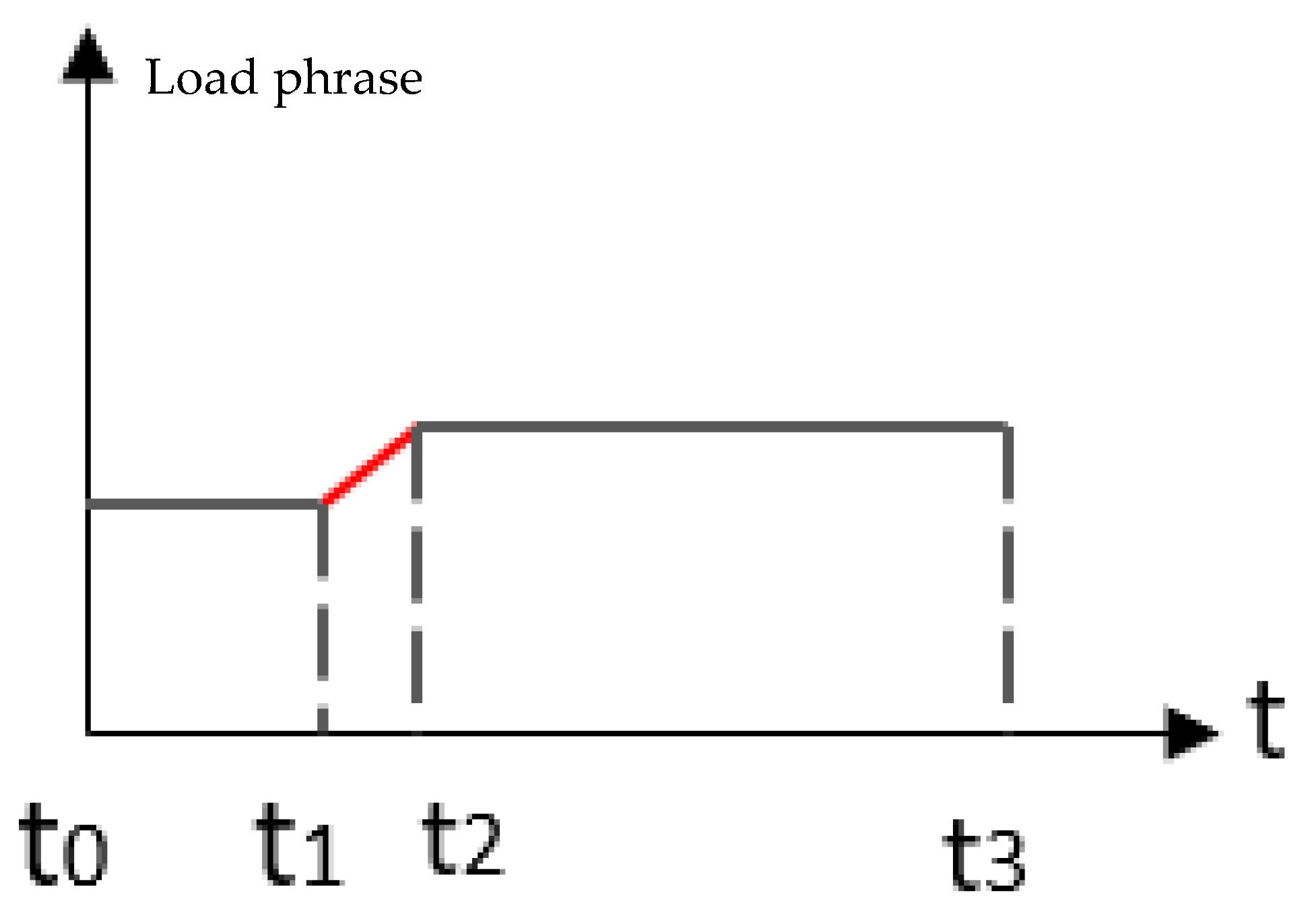
Based on the transient dynamics of ANSYS software, the removal duration is shown in Figure 1. The t 0 stands for the zero point of time. The t 0 ~ t 1 stands for th phase of form-finding and static analysis. The t 1 ~ t 2 stands for th phase of rupture cable or strut, which lasts for 0.01 s. The t 2 ~ t 3 stands for th phase of free oscillation after rupture of the cable and strut, which lasts for 15 s.

3. The Introduction of CCTSS

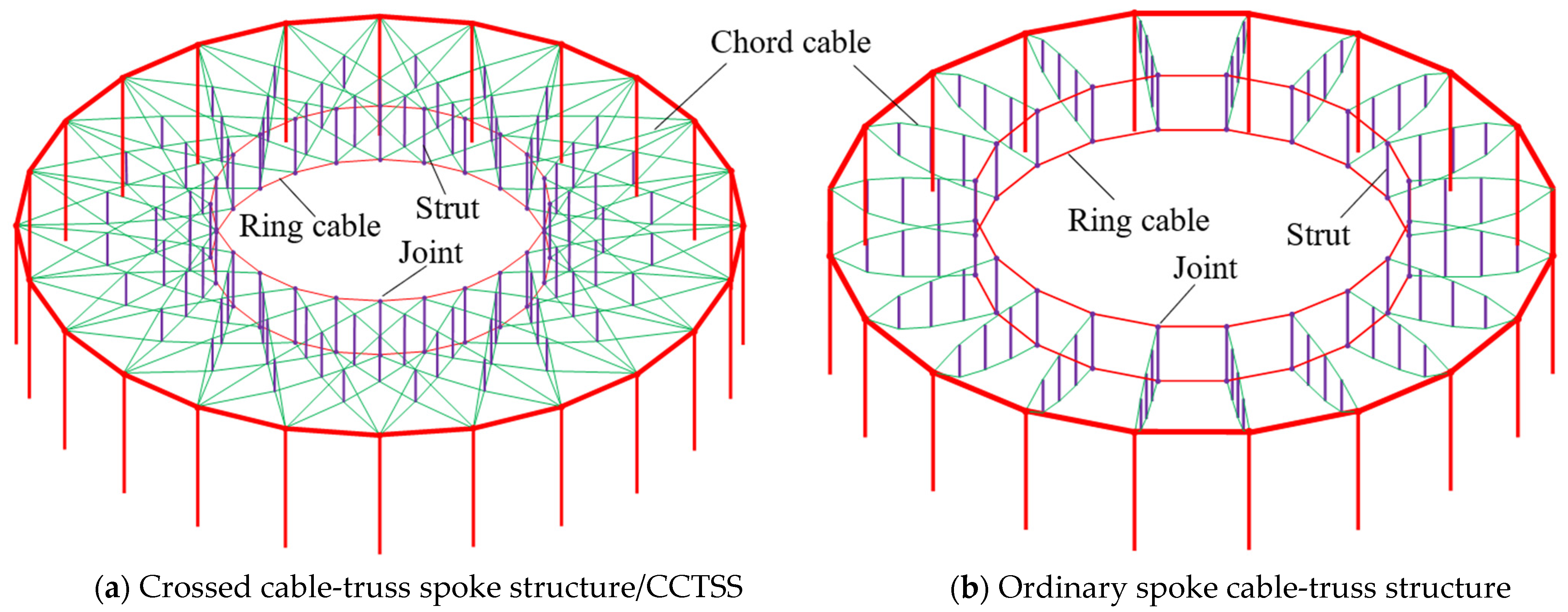
The CCTSS in Figure 2a is a new structural form of spoke cable-truss structure, which abandons the radial parallel arrangement of upper and lower cables of the ordinary spoke cable-truss structure in Figure 2b and utilizes an oblique crossing cable arrangement to form the shape of an upper and lower crossed cable net with a more robust topological relationship. It reduces the angle and distance between cables, increases the continuity between cables, and significantly improves the lateral stiffness and integral stability of ordinary spoke cable-truss structures. However, the topological relationship of the cable net becomes more complex at the same time, and the influence between cables is more significant. As a result, the influence of cable length error on the mechanical properties of the structure is significantly different from that of an ordinary spoke cable-truss structure and other cable structures. It is not clear whether the failure of key components or joints will cause the progressive collapse of the local and integral structure, and the collapse of the structure will seriously threaten people’s life safety and cause a bad social influence. Meanwhile, a reasonable evaluation method of collapse resistance has a decisive influence on the structural safe use and project cost; it is imperative to study the collapse mechanism of CCTSS and the evaluation method of collapse resistance.
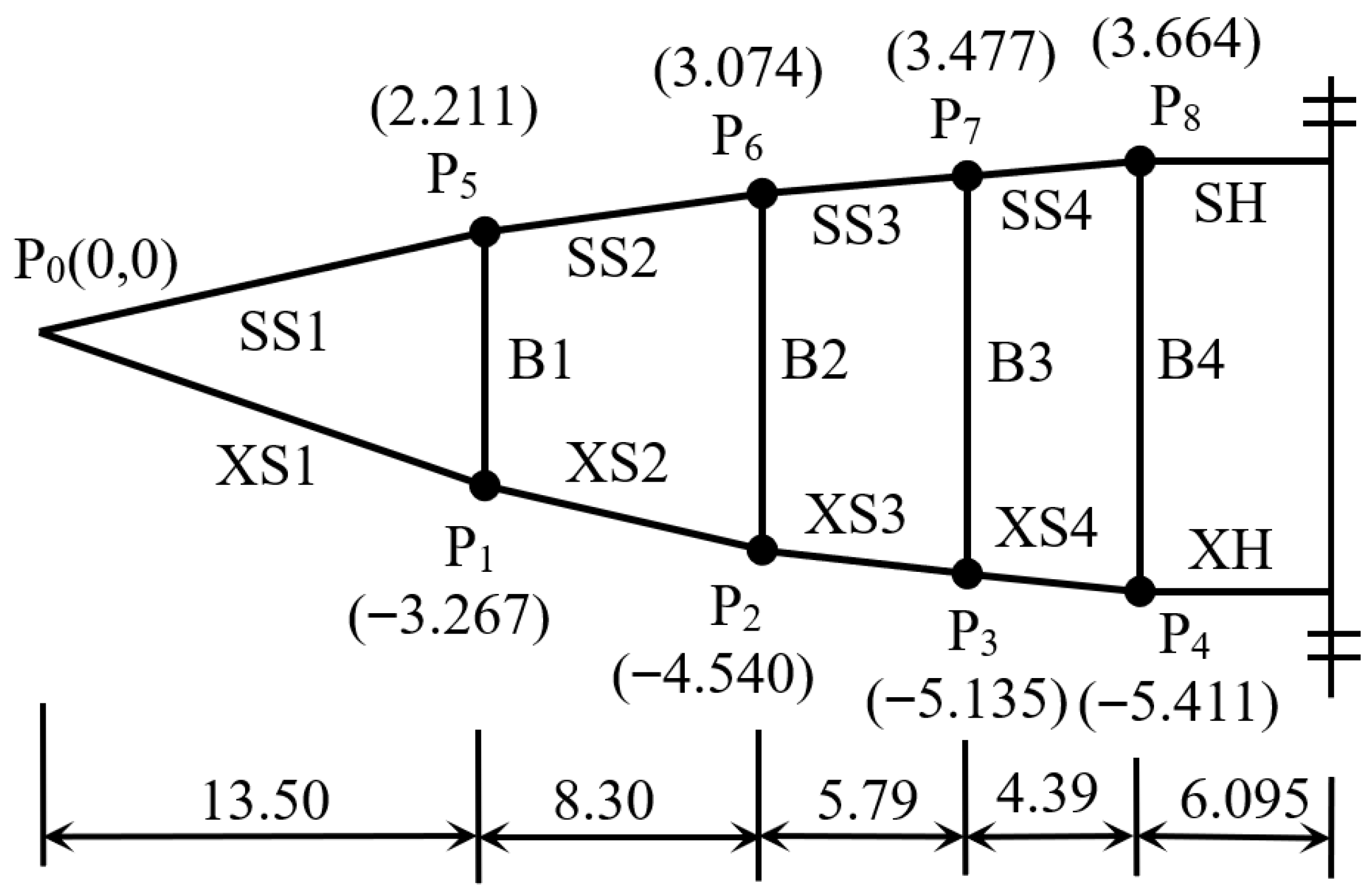
In order to study the collapse performance of CCTSS, a finite element model with a span of 100 m is built as shown in Figure 2. Cables and struts adopt two force member elements, which are equal to the Link 10 element in ANSYS software. The structural parameters are shown in Table 1 and Table 2 from reference [34]. The size and element number of a single planar cable-truss frame of CCTSS are shown in Figure 3. The symbol “SS” represents upper chord cable, and “XS”represents lower chord cables, and B represents struts. The “SH” represents the upper ring cable and “XH” represents the lower ring cable. The method of member failure is “live and die element skill”, and the failed members and joints are shown in Figure 3. The failed members are SS1~SS4, XS1~XS4, B1~B4, SH and XH. The failed joints are P1~P8. The “tension positive”/“compression negative” is defined in the paper.

4. The Influence of Damping Coefficient and Prestress on the Collapse Performance of CSCTS

When the structural damping is not considered, the structure will continue to shake after collapse and cannot be terminated. However, the structure is not only affected by its own structural damping but also by the damping in the air and other environments in practical projects, so that the vibration of the structure quickly attenuates to zero. So it is necessary to study reasonable damping. As the prestress of the structure determines the stiffness of the integral structure, it is also necessary to reveal the mechanical relationship and physical sense between prestress and damping.

4.1. The Influence of Damping on the Collapse Performance

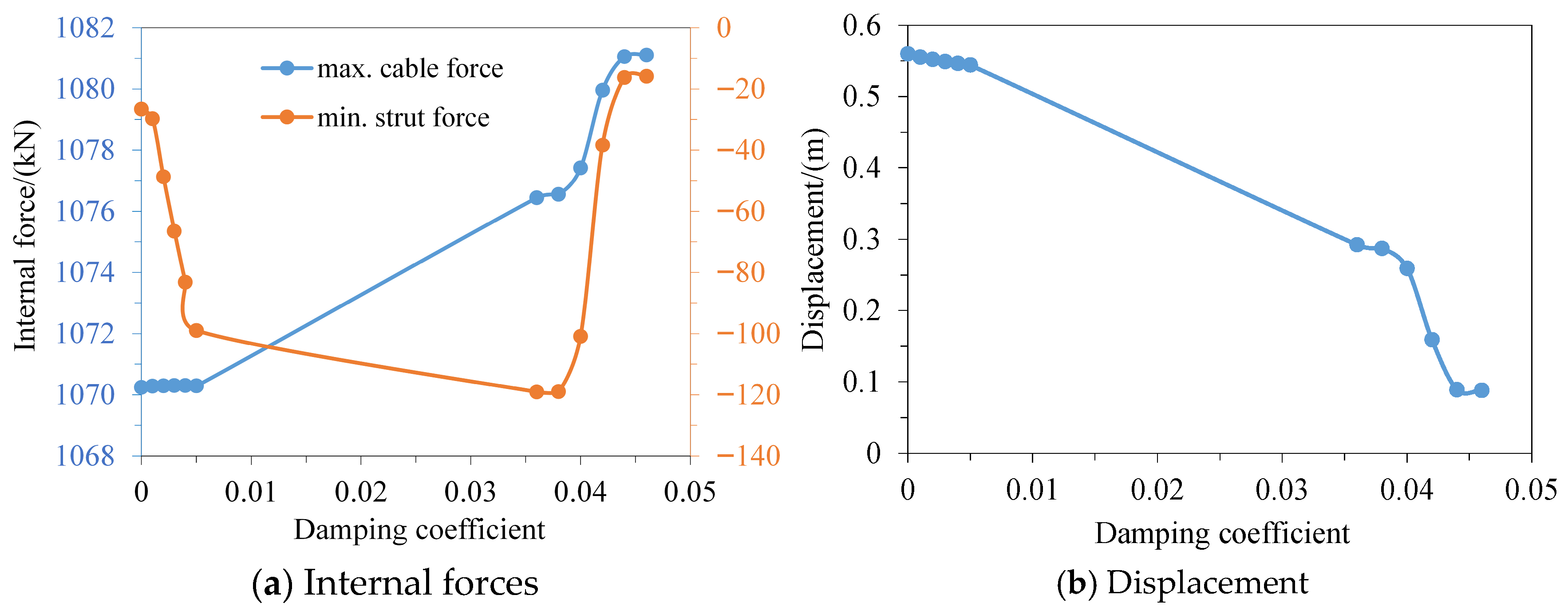
When the transient dynamic method of ANSYS is utilized for structural collapse analysis, the range of damping is rarely studied, but the damping has an influence on collapse results. Therefore, the study on damping has important research value for structural collapse analysis. The lower inner ring cable XH of CSCTS is taken as an example in Figure 3, and the influence of different damping on the collapse performance of CSCTS is studied, as shown in Figure 4.
It is observed from Figure 4 that with the increase in damping, the maximum cable force and maximum displacement continuously increase after the rupture of the ring cable (XH), while the minimum pressure of struts decreases first and then increases. When the damping increases from 0.001 to 0.046, the maximum internal force gradually increases from 1070.24 kN to 1081.10 kN, which changes slightly. The minimum pressure for struts first decreases from −26.725 kN to −119.09 kN and then increases from −119.09 kN to −15.963 kN. Therefore, the minimum pressure of struts changes dramatically, as shown in Figure 4a. The maximum displacement decreases from 0.559 m to 0.088 m, which changes dramatically. According to the deformation and collapse failure mode, the maximum displacement of the structure appears at the broken cable, and the maximum tension and the minimum compression appear at the symmetric position of the broken cable; the collapse results conform to the general collapse laws. It can be known from the change law of collapse results that different damping has little influence on the cable force but has a great influence on the maximum displacement and the internal forces of struts. The damping may change the collapse mode, failure strength and collapse mechanism of CSCTS. Therefore, the reasonable damping should be selected to accurately reveal the collapse mechanism of the structure in the numerical simulation.
When the damping is from 0.001 to 0.005, the maximum internal force after collapse is from 1070.24 kN to 1070.29 kN, the maximum displacement is from 0.544 m to 0.555 m, and the minimum pressure of struts is from −99.02 kN to −26.72 kN. When the damping coefficient is 0.001, the structural collapse response is compared with the results obtained by using the default damping of ANSYS Software, shown in Table 3.
Based on the above analysis results, it is known that the default damping coefficient of ANSYS Software or 0.001 can be used for the collapse analysis for CSCTS. Therefore, the following studies are carried out using the default damping coefficient of ANSYS Software in the paper.

4.2. The Influence of Prestress on the Collapse Mechanism

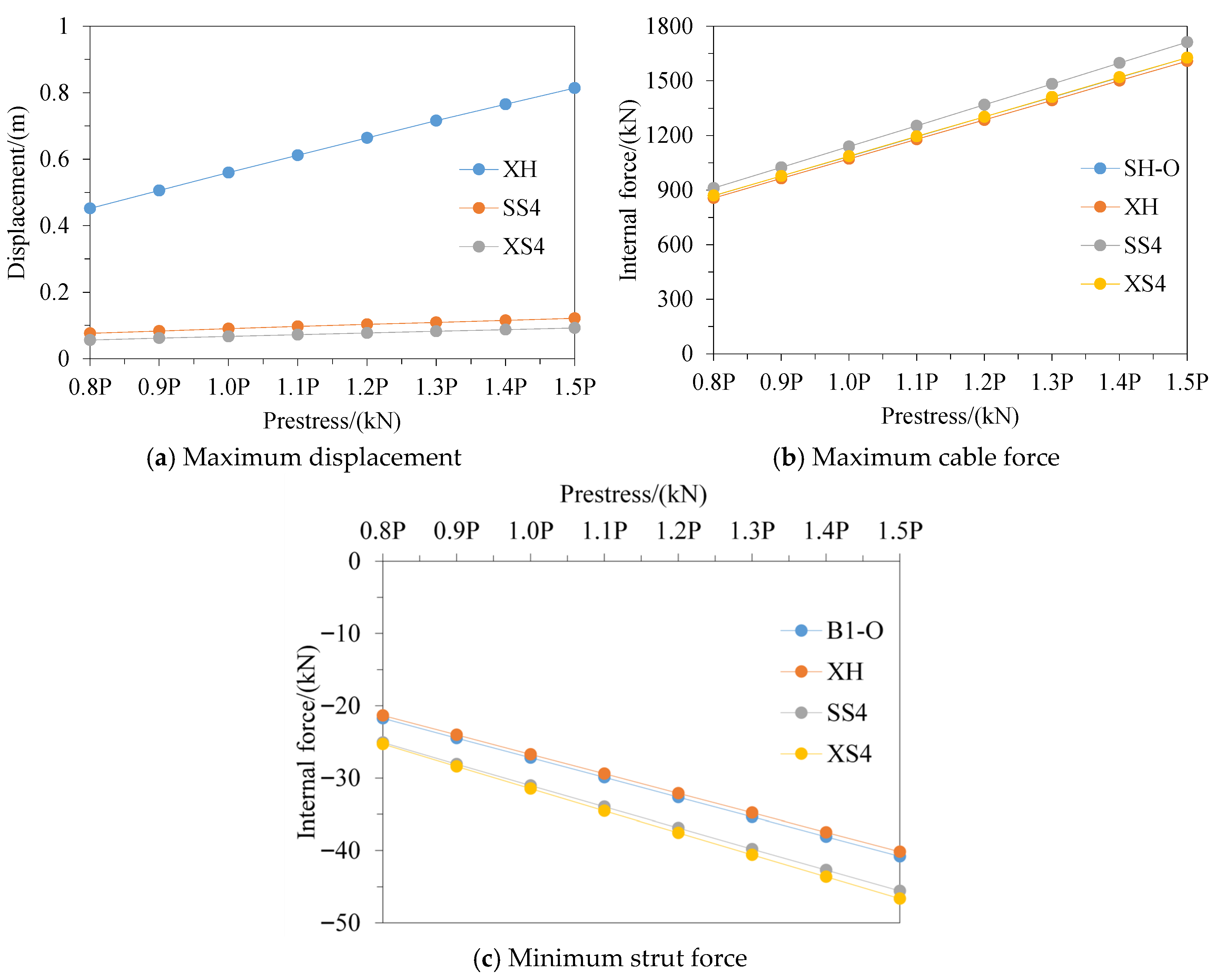
For CSCTS, when there is no prestress, it is relaxed and has no stiffness. When there is prestress, the structure forms a stable geometric shape and has the ability to resist external loads. Therefore, the stiffness of the structure is controlled by the prestress. Therefore, it is necessary to study the influence of different prestressed values on the collapse performance of CSCTS as shown in Figure 5. In Figure 5, XH, SS4 and XS4 are the rupture positions, and XX-O represents the internal force value of the original structure.
It is observed from Figure 5 that with the increase in prestress, the maximum displacement, maximum cable force and minimum strut force all increase greatly after the chord cables or ring cables are ruptured, but they all change linearly in the linear elastic range. According to the initial collapse positions, the maximum displacement after collapse occurs at the collapse position, the maximum cable force occurs at the upper ring cable (SH), and the minimum internal force of struts occurs at strut (B1). From collapse strength, when the upper and lower cables rupture, the maximum displacement of the structure changes slightly, but the maximum internal force changes greatly. When the lower ring cable ruptures, the maximum displacement of the structure has exceeded the maximum allowable value [δ] = l/250 = 0.4 m specified in the specification [32], and the maximum displacement keeps increasing with the increase in the prestress. Therefore, a reasonable prestress level should be selected in the structural design stage to reduce the construction difficulty of the structure as far as possible on the premise of ensuring that the structure does not collapse.

5. The Influence of Prestress on the Collapse Performance of CCTSS

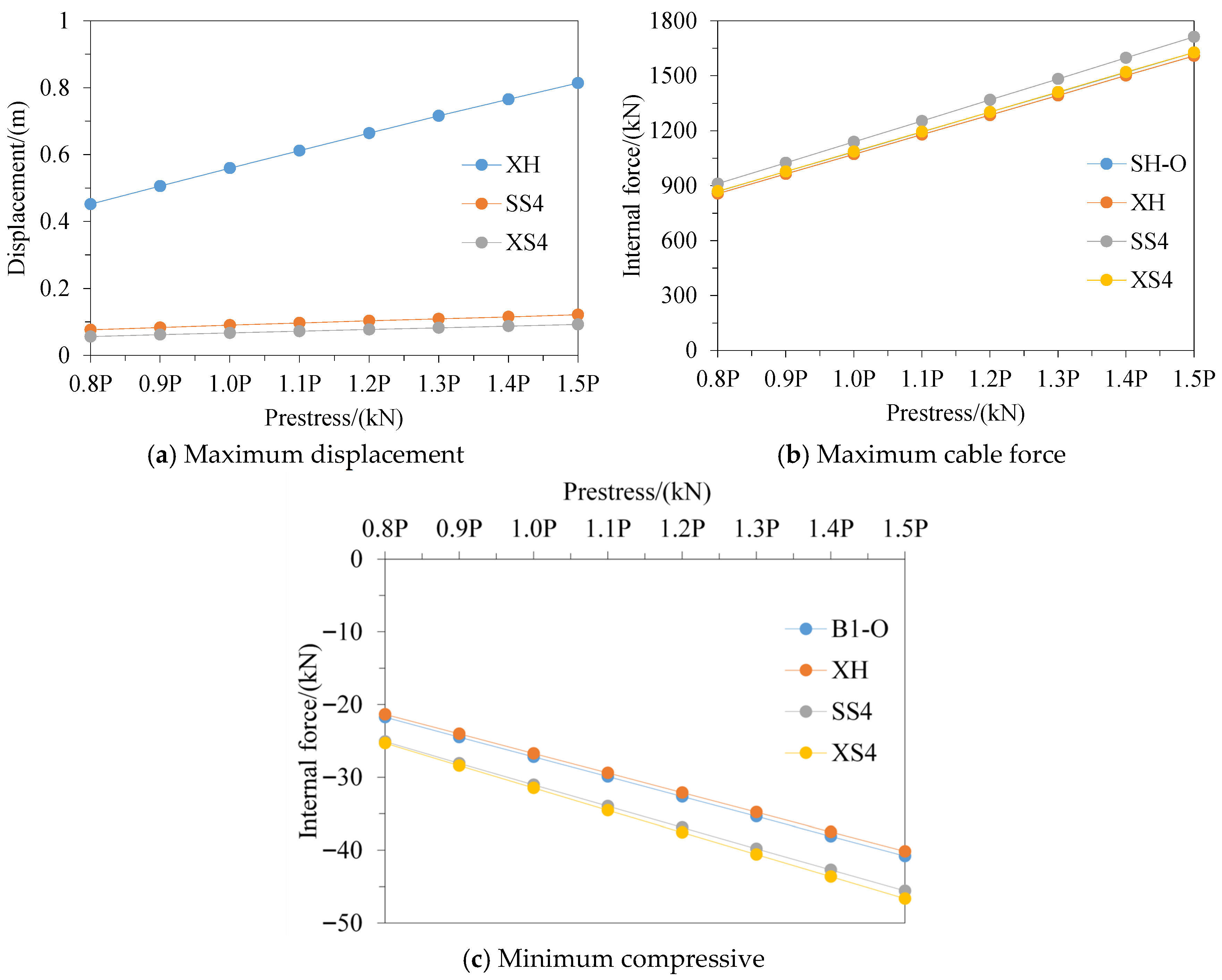
For CCTSS, when there is no prestress, it is relaxed and has no stiffness and cannot bear the external loads. When there is prestress, the structure forms a stable geometric shape and has the ability to resist external loads. Therefore, the stiffness of the structure is controlled by prestresses. Therefore, it is necessary to study the influence of different prestress values on the collapse performance of CCTSS, and the results are shown in Figure 6. In Figure 6, XH, SS4 and XS4 are rupture positions, and XX-O represents the internal force value of the original structure.
It is observed from Figure 6 that with the increase in prestress, the maximum displacement, maximum cable force and minimum compressive stress all increase greatly after the chord cables or ring cables are ruptured, but they all change linearly in the linear elastic range. According to the initial collapse positions, the maximum displacement after collapse occurs at the collapse position, the maximum cable force occurs at the upper ring cable (SH), and the minimum internal force of struts occurs at strut (B1). From collapse strength, when the upper and lower cables are ruptured, the maximum displacement of the structure changes slightly, but the maximum internal force changes greatly. When lower ring cables are ruptured, the maximum displacement of the structure exceeds the maximum allowable value [ δ ] = l / 250 = 0.4   m specified in the specification [35], and the maximum displacement keeps increasing with the increase in the prestress. Therefore, a reasonable prestress level should be selected in the structural design stage to reduce the construction difficulty of the structure as far as possible on the premise of ensuring that the structure does not collapse.

6. The Collapse Analysis Under No Loads

The dynamic response of CCTSS after the failure of components and joints is studied, and the components include SS1 to SS4, XS1 to XS4, SH, XH, and B1 to B4, and the joints include P1 to P8, shown in Figure 3. The default damping of 0.01 of ANSYS is adopted in the collapse analysis and the prestress is selected as 1.0 P.

6.1. The Collapse Mechanism After the Rupture of Components

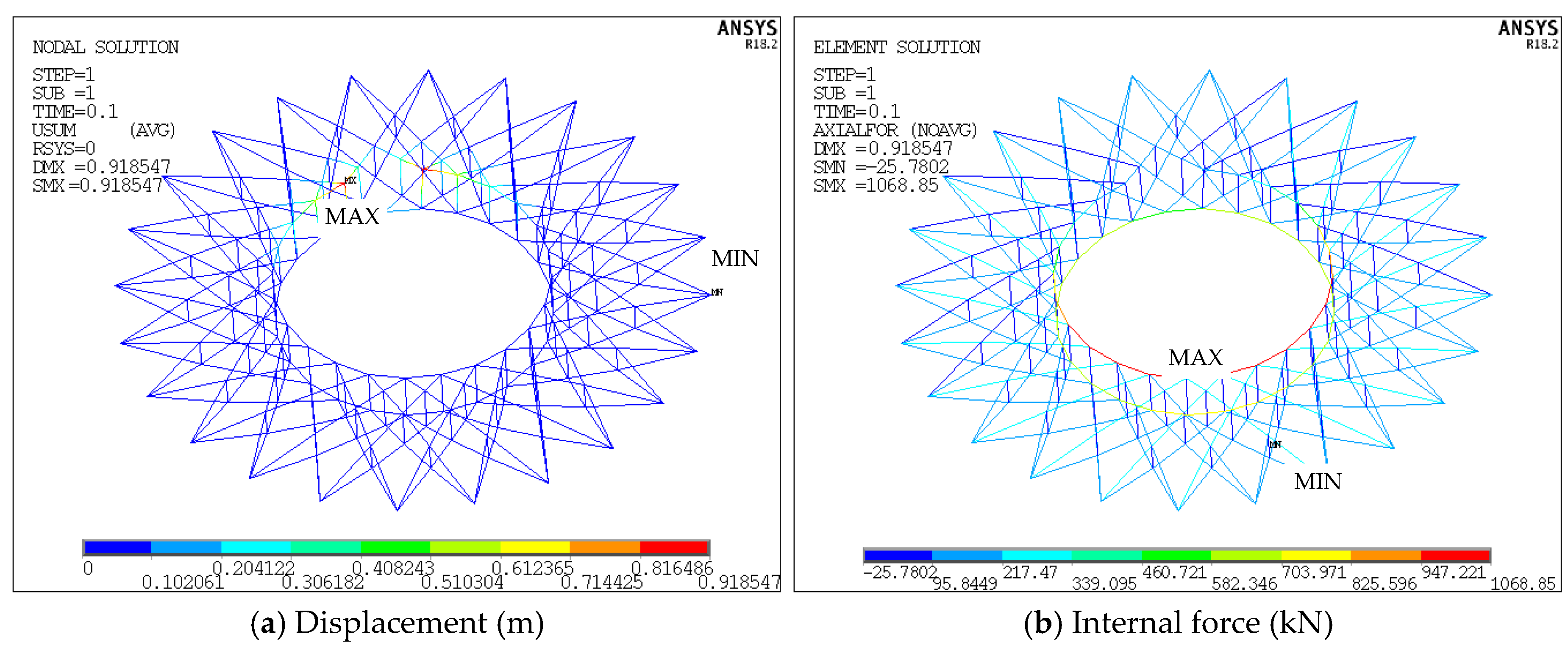
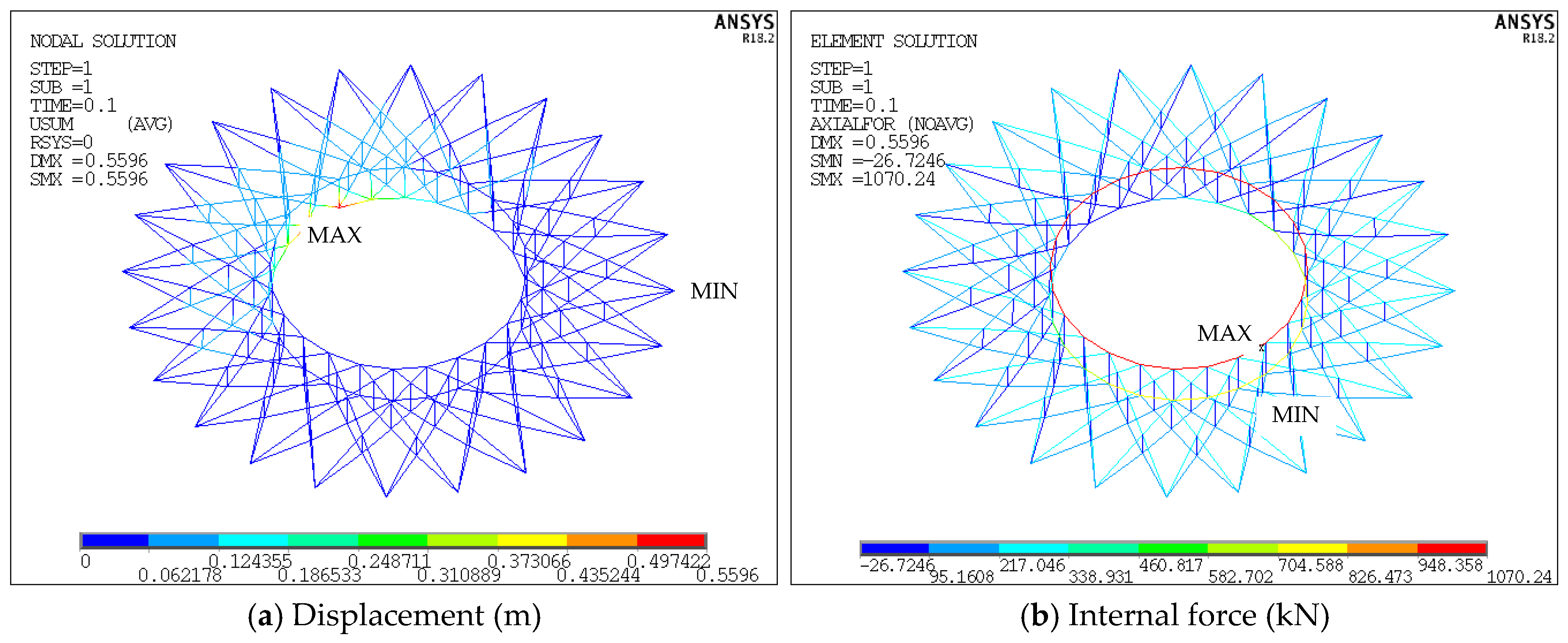
When SS1~SS4, XS1~XS4, SH, XH, and B1~B4 are ruptured respectively, the collapse results of the structure are shown in Table 4, and the structural response after the lower ring cable (SH) is ruptured is shown in Figure 7.
From Table 4, when an arbitrary component ruptures in the no-load state, the structure will not collapse, and the maximum cable force and minimum compressive force are in the same position. However, when ring cables (SH or XH) are ruptured, the prestress of the structure is lower than the initial prestress and the deformation is great at the same time, and the relaxation of prestress occurs which is extremely unfavorable to the normal use of the structure. The cable forces of the structure are from 1070.24 kN to 1138.21 kN. The maximum cable force is 1138.21 kN when the SS4 ruptures, and the minimum cable force of the structure is 1070.24 kN which is lower than the initial cable force (1084.39 kN) when the SH ruptures. The compressive forces of struts are from −26.14 kN to −31.47 kN. The maximum compressive force is −26.14 kN when SH ruptures, and the minimum compressive force is −31.47 kN when the XS4 ruptures. It is observed from the analysis results that XS4, SS4, SH and XH are the most sensitive or key components, and it can be further inferred that the joints where the four sensitive components converge are the key joints of the structure, namely, the joints P4 and P8 at ring cables are the key joints.
When the chord cables (XS and SS) and struts (B) are ruptured, the structural displacement changes slightly. However, the structural displacement changes largely when the ring cables (SH and XH) are ruptured. Considering that cable structures generally adopt flexible membrane material as structural roofs, it is easy to cause serious stagnant water and snow, etc. when the structural deformation is large, which has an adverse effect on the structure.

6.2. The Collapse Mechanism of the Rupture of Joints

The rupture or failure of joints can be equivalent to the rupture of the cables and struts connected to the joints. When the joints (from P1 to P8) are ruptured respectively, the collapse results of the structure are shown in Table 5, and the structural response after the joint P4 is ruptured is given, shown in Figure 8.
From Table 5, the structure will not collapse if the arbitrary joint ruptures in the no-load state. The maximum cable force and minimum compressive force are in the same positions. However, when the joints at ring cables (P4 and P8) rupture, the prestress of the structure is lower than the initial prestress and the deformation is great, and the relaxation of prestress occurs which is extremely unfavorable to the normal use of the structure. It is known by comparing Table 4 and Table 5 that the collapse laws of the rupture of joints are similar to those of the rupture of components. When all kinds of joints are ruptured, the cable forces are from 1066.43 kN to 1189.20 kN. When the joint P7 is ruptured, the maximum cable force is 1189.20 kN. When the joint P4 is ruptured, the minimum cable force is 1066.43 kN and lower than the initial cable force. The minimum compressive force is between −25.78 kN and −32.10 kN, and the compressive forces are −25.780 kN when the joint P8 ruptures, and the minimum compressive force is −32.10 kN when the joint P4 ruptures. It is known from the above results that the joints P4 and P8 are the key joints of CCTSS, which is consistent with the conclusions in Section 6.1 and verifies the correctness of the conclusion in Section 6.1.
The structural displacement changes largely when the joints at ring cables (P4 and P8) are ruptured, but when other joints are ruptured, the structural displacement changes slightly. Considering that cable structures generally adopt flexible membrane materials as the structural roofs, it is easy to cause serious stagnant water and snow, etc. when the structural deformation is large, which has an adverse effect on the structure.
From the structural collapse results under no loads, the ring cable, SH4 and XS4 are structurally sensitive components, while the joints at the ring cables (P4 and P8) are the key nodes of the structure. When an arbitrary member or joint is disconnected without loads, the structure will not collapse. However, the collapse results or the collapse mechanism of the structure under external loads are still unknown. Therefore, the structural collapse mechanism under external loads will be further studied below.

7. The Collapse Analysis Under External Loads

The rupture of the key components and joints is studied under external loads. The components include SS1 to SS4, XS1 to XS4, SH, XH, and B1 to B4, and the joints include P1 to P8, shown in Figure 3. The surface load of 0.6 k N / m 2 is applied to CCTSS according to ref. [18], and then transform the surface loads into the equivalent nodal load F . The equivalent nodal loads of four types of nodes are calculated as F p 1 = 70.095   k N , F p 2 = 36.733   k N , F p 3 = 26.726   k N , and F p 4 = 24.641   k N respectively. The total loads applied to CCTSS are F = 24 × [ F p 1 F p 2 F p 3 F p 4 ] , (negative sign indicates downward direction of external loads). The collapse analysis under external loads is divided into full-span loads and half-span loads.

7.1. The Collapse Analysis Under Full-Span Loads

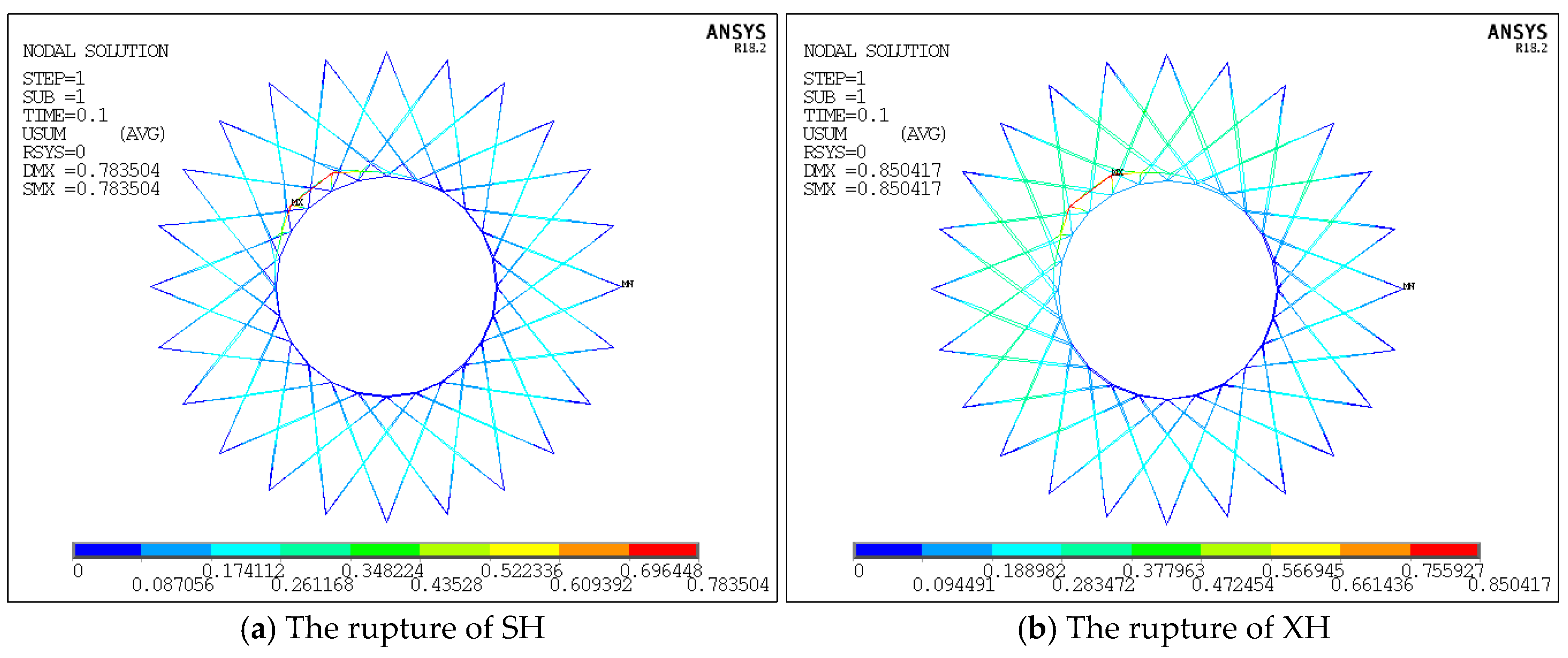
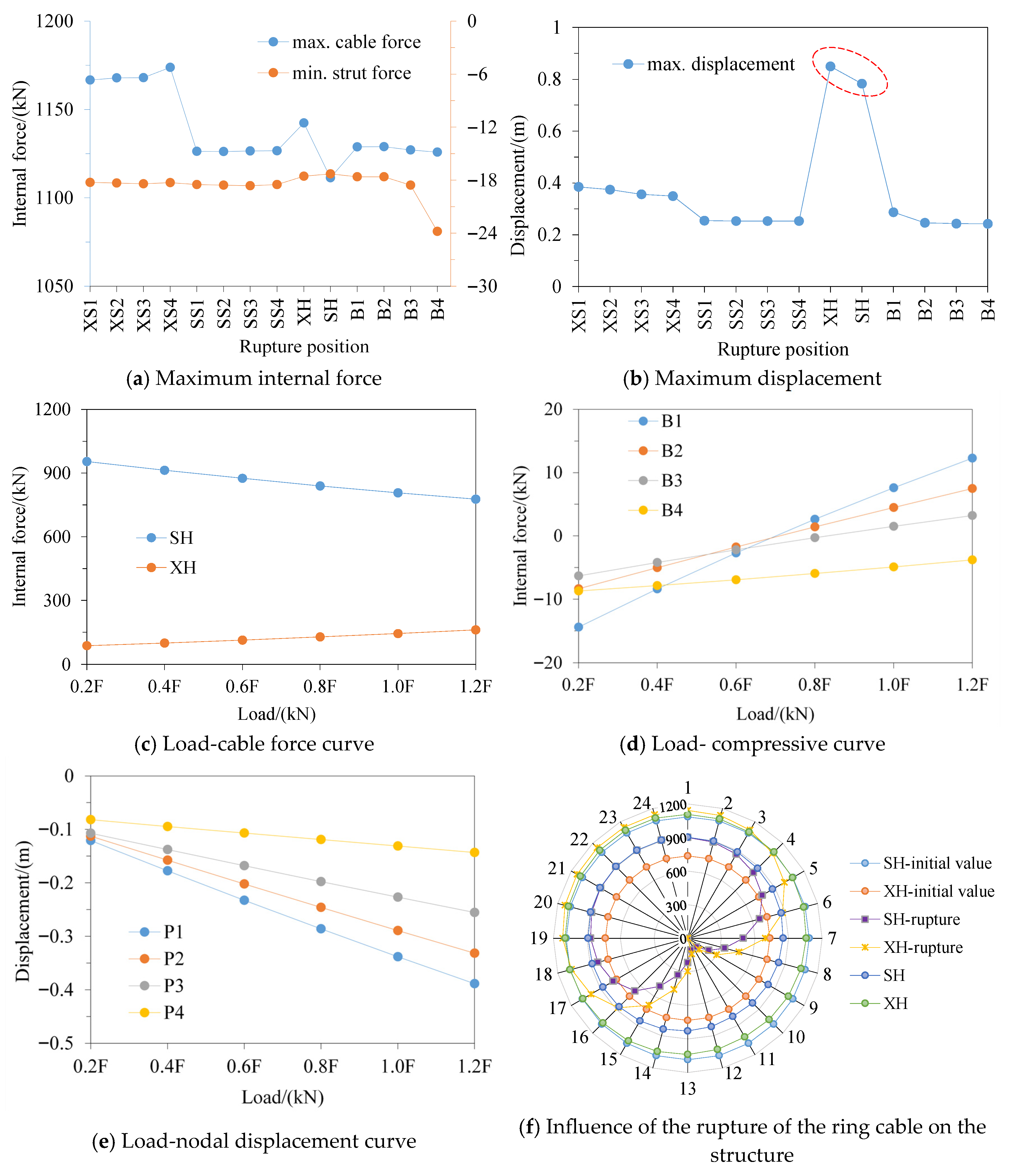
Since cables are sensitive components, the following research mainly analyzes the collapse of various cables of CCTSS. When components SS1~SS4, XS1~XS4, SH and XH rupture respectively, the collapse results of the structure are shown in Figure 9. The collapse results of the structure after the rupture of ring cables (SH and XH) are given, shown in Figure 9f. The downward direction is positive for the displacement.
From Figure 9a,b, when an arbitrary component ruptures, the maximum internal force of the structure does not exceed the minimum broken strength of all kinds of cables; that is, the structure does not collapse under full-span loads. The maximum displacement of the structure under full-span loads still occurs at the rupture of ring cables (SH and XH), which is the same as the conclusion obtained without loads. However, the maximum displacement after the rupture of all components is obviously greater than the collapse response without loads (except for the SH). When the ring cables (SH and XH) are ruptured, the maximum displacement of the structure is 0.783 m and 0.853 m respectively (Figure 9b), indicating that the ring cables are still the key components of the structure under full-span loads. When the upper chord cables XS4 are ruptured, the maximum cable force is 1173.85 kN and is located at SH. When the ring cable SH is ruptured, the minimum cable force is 1111.33 kN and is located at SH. When the strut B4 ruptures, the minimum compressive force is −23.805 kN and is located at B1. When the ring cable SH is ruptured, the maximum compressive force is −17.292 kN and is located at B1.
From Figure 9c, when the upper ring cable (XH) ruptures, the internal forces of the upper ring cables gradually decrease with the increase in loads, while the internal forces of the lower ring cables increase continuously, but the internal force value is very small. The lower ring cables basically lose their bearing capacity, but the structure does not collapse. It is known from Figure 9d that when the SH ruptures, the internal forces of struts change from the state of compression to the state of tension, which changes the stress state of struts. It is known from Figure 9e that the maximum vertical displacement of the structure decreases with the increase in external loads. It can be known from Figure 9f that when the SH at axis 11 is ruptured, the cable forces of upper ring cables decrease significantly at all axes, and the cable forces of upper ring cables at the axes from 9 to 13 near axis 11 are basically zero, indicating that the structure basically loses bearing capacity when the upper ring cables (SH) are ruptured. Similarly, when the XH ruptures, its collapse mechanism is the same as that of the SH. Meanwhile, the collapse law after the rupture of the ring cables is basically the same as refs. [27,28].
It should be pointed out that under full-span loads, when the joints from P1 to P8 rupture respectively, the calculation is not convergent due to excessive structural deformation. Namely, the failure of joints (from P1 to P8) under full-span loads will lead to the loss of the integral bearing capacity of the structure.

7.2. The Collapse Analysis Under Half-Span Loads

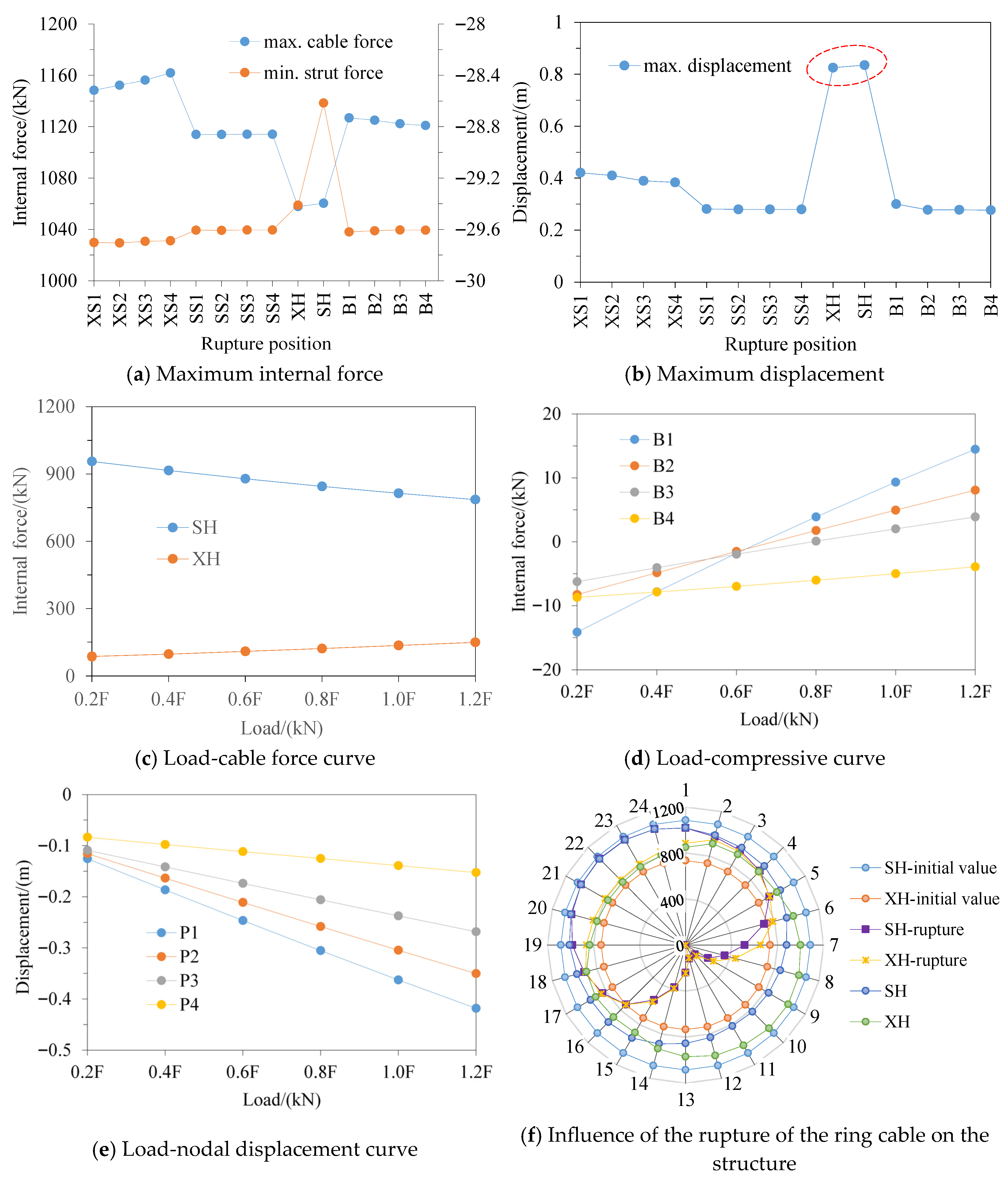
When the SS1~SS4, XS1~XS4, SH and XH rupture respectively, the collapse results of the structure are shown in Figure 10. The collapse results of the structure after the rupture of ring cables (SH and XH) are given, shown in Figure 10f.
From Figure 10a,b, when an arbitrary component ruptures, the maximum internal force of the structure does not exceed the minimum broken strength of different cables; that is, the structure does not collapse under half-span loads. The maximum displacement of the structure under half-span loads still occurs at the rupture of ring cables (SH and XH), which is the same as the conclusion obtained without loads. However, the maximum displacement after the rupture of all components is obviously greater than the collapse response without loads (except for the SH). When the ring cables (SH and XH) are ruptured, the maximum displacement of the structure is 0.825 m and 0.835 m respectively (Figure 10b), indicating that the ring cables are still the key components of the structure under half-span loads. When the lower chord cables XS4 are ruptured, the maximum cable force is 1161.91 kN and is located at the SH. When the ring cable XH is ruptured, the minimum cable force is 1057.83 kN and is located at the SH. When the lower chord cable XS1 ruptures, the minimum compressive force is −29.703 kN and is located at B1. When the ring cable SH is ruptured, the maximum compressive force is −28.616 kN and is located at B1.
From Figure 10c, when the upper ring cable (XH) ruptures, the internal forces of the upper ring cables gradually decrease with the increase in loads, while the internal forces of the lower ring cables increase continuously, but the internal force value is very small. The lower ring cables basically lose their bearing capacity, but the structure does not collapse. It is known from Figure 10d that when the SH ruptures, the internal forces of struts change from the state of compression to the state of tension, which changes the stress state of struts. It is known from Figure 10e that the maximum vertical displacement of the structure decreases with the increase in external loads. It can be known from Figure 10f that when the SH at the axis 11 is ruptured, the cable forces of upper ring cables decrease significantly at all axes, and the cable forces of upper ring cables at the axes from 9 to 13 near the axis 11 are basically zero, indicating that the structure basically loses bearing capacity when the upper ring cables (SH) are ruptured. Similarly, when the XH ruptures, its collapse mechanism is the same as that of the SH. Meanwhile, the collapse law after the rupture of the ring cables is basically the same as refs. [27,28].
It should be pointed out that under half-span loads, when the joints from P1 to P8 rupture respectively, the calculation is not convergent due to excessive structural deformation. Namely, the failure of joints (from P1 to P8) under half-span loads will lead to the loss of the integral bearing capacity of the structure.

7.3. Discussions on Collapse Results Under External Loads

In order to further analyze the importance degree of various components and the collapse results, the influence of the rupture of various components on the internal force of SH is shown in Table 6. (The symbol Ffull-load represents the internal forces of components under full-span loads, Dfull-load represents the displacements of joints under full-span loads, and the meanings of other symbols can be inferred).
From Table 6, under the full-span and half-span loads, the variations in internal forces of lower chord cables (XSi) after the collapse range from 7.58% to 8.25% and from 5.89% to 7.15% respectively. The variations in internal forces of the upper chord (SSi) range from 3.86% to 3.90% and from 2.72% to 2.74% respectively. The variations in internal forces of ring cables (SH and XH) range from 2.48% to 5.34% and from 2.21% to 2.45% respectively. The variations in internal forces of struts range from 3.83% to 4.10% and from 3.37% to 3.92% respectively. Therefore, the internal forces under full-span loads are greater than those under half-span loads. The change laws of displacement are similar to those of internal forces, namely the collapse results under full-span loads are greater than those under half-span loads. Therefore, the full-span load is more unfavorable to the collapse performance of the structure compared to the collapse results under half-span load, and the law is the same as shown in Figure 9f and Figure 10f.
The collapse results under full-span loads are taken as an example, and the comparative results between the maximum internal forces obtained after the rupture and the initial values of various components are shown in Table 7.
It is known from Table 7 that when the XS4 ruptures, the internal force itself changes the most, increasing by 213.56 kN. When the XH ruptures, the internal force itself changes the most, increasing by 407.86 kN. In terms of the influence of various components after rupture on internal forces, the XS4 of lower chord cables (XSi) has the greatest influence on internal forces and the maximum influence value is 138.67%; the SS4 of the upper chord cables (SSi) has the greatest influence on internal forces and the maximum influence value is 36.07%; the internal forces of lower ring cables increase by 55.53%; and the internal force of upper ring cables decreases by 16.38%.
Meanwhile, the internal forces of the structure decrease and are far smaller than the initial internal force when the upper chord cables (SSi) and ring cables (SH and XH) rupture. Therefore, although the rupture of upper chord cables and ring cables will not cause the collapse of the structure, it will lead to the loss of the integral bearing capacity of the structure. In the event of extremely serious weather, the structure will not be in its normal use state. The collapse failure modes after the ring cables rupture are shown in Figure 11.

8. Collapse-Resistant Evaluation

At present, some scholars have studied the collapse resistance evaluation of tensile structures. For example, Liu Z S et al. [28] defined the reliability index of the spoke cable-truss structure in case of failure through reliability analysis. Shekastehband et al. [24] quantitatively evaluated the progressive collapse resistance of cable net structures by calculating whether the progressive collapse areas and internal forces of components exceeded the minimum broken strength. Chen W J et al. [31] and Yuan X F et al. [36] studied the redundancy characteristics of cable-strut tensile structures through the redundancy theory, and the evaluation indices were proposed to assess the structural redundancy characteristics. Gao Z Y et al. [22] proposed the criterion of progressive collapse and its collapse type, and the importance coefficient of components was given based on the damage coefficient of response difference values. Chen L M et al. [37] adopted a genetic algorithm to develop a robust section optimization design method based on cable dome structures to improve the robustness of components and joints, and then an element importance classification method based on collapse modes was proposed [38]. Lu J Y et al. [39] divided the structures into four categories to evaluate the collapse resistance of the structures through the indices like the nodal displacements and the internal forces of the remaining structures after cable rupture.
The existing methods mainly assess the collapse resistance of structures and the importance of components and joints through reliability theory, redundancy theory, collapse areas, etc., but there is still a lack of a simple and quantitative method to assess the collapse resistance of structures. The simple and effective collapse resistance assessment method can not only reasonably evaluate the collapse resistance of structures but also can be conveniently used by engineering designers, which has good engineering application value. Based on the collapse results, the calculation method of the maximum dynamic force amplification coefficient is first proposed, and then the calculation method of the importance of components and joints is proposed based on the maximum dynamic amplification coefficient. The proposed method of the importance of components and joints is utilized to assess the local collapse resistance of the structures.

8.1. The Calculation Method of the Maximum Dynamic Force Amplification Coefficient

According to the collapse response characteristics of the structure, the calculation formula of the maximum dynamic force coefficient is proposed as follows,
D m a x = | F m a x min F m i n , F 0 min F m i n , F 0 |
where D m a x represents the maximum dynamic force amplification coefficient which is an absolute value. F m a x represents the maximum dynamic internal force in the process of collapse. F m i n represents the minimum dynamic internal force in the process of collapse. F 0 represents the initial internal force. The m i n { F m i n , F 0 } represents the minimum value of F m i n and F 0 .
As the full-span loads are more unfavorable to the collapse performance of the structure, the dynamic response of the structure under full-span loads is taken as an example. The maximum dynamic amplification coefficients of various cables after ruptures are calculated based on Equation (8), and the results are shown in Table 8.
From Table 8, the maximum dynamic force amplification coefficients of various components after rupture can be obtained according to Equation (8). When XH and SH are ruptured, the maximum dynamic force amplification coefficients are 6.93 and 7.22 respectively. The reason is that all crossed cables are hung and connected to the ring cables, which results in all forces and loads being applied to the ring cables. The ring cables are key or important components. When the upper chord cables (from SS1 to SS4) are ruptured, the maximum dynamic force amplification coefficient is D m a x = 1.49 and is located at SS4. When the lower chord cables (from XS1 to XS4) are ruptured, the maximum dynamic force amplification coefficient obtained is D m a x = 1.39 and is located at XS4. According to the analysis results, the maximum dynamic force amplification coefficients of all components are ranked as SH > XH > SSi > XSi, while the upper chord cables (SSi) and lower chord cables (XSi) are ranked as SS4 > SS3 > SS2 > SS1 and XS4 > XS3 > XS2 > XS1, respectively.
It should be pointed out that the maximum dynamic force amplification coefficient of structures is a parameter to measure the dynamic response of the structure in the process of cable rupture, and its purpose is to evaluate the maximum dynamic response of a component in the process of rupture. However, sometimes it cannot be used to assess whether a component is bound to collapse. For example, the internal forces of CCTSS decrease instead of increasing after the ring cables are ruptured because the rupture of the ring cables leads to the loss of the integral bearing capacity of the structure.

8.2. The Evaluation Method of the Importance of Components and Joints

8.2.1. The Evaluation Method of the Importance of Components

The evaluation method of component importance can directly utilize the calculation method of the maximum dynamic force amplification coefficient. The reason is that the importance of components is used to express the importance of joints. Namely, Equation (8) is used to calculate the component importance coefficient. The calculation formula of the component importance coefficient is as follows,
C i = D m a x = | F m a x min F m i n , F 0 min F m i n , F 0 |
where C i represents the importance coefficient of the ith component.
As the importance coefficient of components defined in the paper is the same as the maximum force amplification coefficient, it is known from Table 8 that the importance coefficient of components is ranked in the same order as the maximum dynamic force coefficient, namely SH > XH > SSi > XSi. Meanwhile, the upper chord cables (SSi) and lower chord cables (XSi) are ranked as SS4 > SS3 > SS2 > SS1 and XS4 > XS3 >XS2 > XS1, respectively. The conclusions obtained in Section 8.2.1 basically agree with the conclusion in ref. [31].

8.2.2. The Evaluation Method of the Importance of Joints

The calculation method of joint importance is proposed based on the evaluation results of component importance, and the evaluation method of joint importance is as follows,
N i = 1 n i = 1 n C i
where N i represents the importance coefficient of the ith joint, and n represents the number of components connected with the ith joint.
Based on the importance coefficients of components in Table 9, the importance coefficients of various joints of CCTSS can be calculated according to Equation (10), shown in Table 9. (The maximum dynamic force amplification coefficients of all kinds of struts (from B1 to B4) are 0.05, 0.04, 0.01, and 0.09, respectively.)
It is observed from Table 9 that the distribution range of the joint importance coefficient for CCTSS is from 0.93 to 3.50, and then the joint importance is ranked as P8 > P4 > P7 > P3 > P2 > P6 > P1 > P5. From the joint importance coefficient, it is known that the importance of joints at upper ring cables is basically higher than that of joints at lower ring cables, and the importance of joints at ring cables is basically higher than that of other joints, and the joints at ring cables are of significant importance. Therefore, the reliability and security of joints at ring cables of CCTSS must be guaranteed in the design. Meanwhile, the conclusions obtained in Section 7.2 basically agree with the conclusion in ref. [31]. As the ref. [31] adopted the redundancy theory; the method proposed in this paper avoids the complicated formula derivation and programming required in ref. [31], and is simple to use and easy to learn.

9. Conclusions and Discussions

9.1. Conclusions

In the paper, the collapse mechanism and the collapse resistance evaluation method of CCTSS are systematically studied, which provides important guidance for engineers and designers. The main conclusions are as follows:
(1)
The damping has little effect on collapse results when the damping is from 0.01~0.05. When the structure is in the linear elastic range, the influence of prestress on the collapse results is relatively small.
(2)
The influence of prestress on collapse performance shows that the greater the prestress is, the greater the collapse response will be. The reasonable prestress level should be selected to reduce the construction difficulty as far as possible in the design stage.
(3)
The results without loads show that XS4 and SS4 belong to sensitive components. The failure of SH and XH is a more sensitive component. Ring-cable joints are the key joints that are most unfavorable to CCTSS.
(4)
The results under loads show that the collapse response under full-span loads is greater than that under half-span loads. The progressive collapse will not occur when each component ruptures, but CCTSS basically loses its integral bearing capacity when ring cables rupture.
(5)
The calculation method of the maximum dynamic force amplification coefficient is proposed based on the collapse results, which easily determines the importance of components and joints.

9.2. Discussions

Based on the transient dynamic module of ANSYS Software, the paper studies the collapse mechanism and the collapse resistance evaluation method of CCTSS. The influence of the damping coefficient and prestress on the collapse response of the structure is obtained. The failure mechanism of components and joints, the collapse failure strength and the collapse mode without loads are studied. The collapse response of the structure under full-span and half-span loads is further studied. Finally, a calculation method of the dynamic force amplification coefficient is proposed based on the collapse results of CCTSS, and a calculation method of the importance of members and joints is proposed based on the dynamic force amplification coefficient, which indirectly evaluates structural collapse resistance.
Meanwhile, the following problems and difficulties faced by the paper need further research. Readers and scientists can also use ABAQUS or LS-DYNA Software to study the collapse mechanism of CCTSS and further evaluate the importance of the components and joints of the structure and compare with the conclusions of the paper. In addition, the elastic constitutive model of materials is only involved in the paper, and the elastic-plastic constitutive model of materials is not used. In the next step, the elastic-plastic constitutive model of cable and strut will be used to study the progressive collapse mechanism of CCTSS so as to further reveal its progressive collapse mechanism. In this paper, a calculation method of the maximum dynamic force amplification coefficient is proposed based on the collapse results of the structure, and the collapse resistance of the structure is studied based on the maximum dynamic force amplification coefficient. It belongs to the collapse resistance evaluation method of local structure, and there is still a lack of a dynamic elastic-plastic collapse resistance evaluation method for the whole structure. Finally, although the simulation analysis of the collapse resistance of the new cross-spoke cable-truss structure has been completed, there are few studies on the progressive collapse scale model experiment. If the funds permit, the real progressive collapse experiment of the scale model of CCTSS can be carried out, and the comparison with the numerical analysis results can be made.

Author Contributions

Conceptualization, J.L. and L.W.; Methodology, P.Q. and J.L.; Software, J.L.; Validation, L.W. and J.H.; Formal analysis, J.L.; Investigation, P.Q. and L.W.; Data curation, P.Q.; Writing—original draft, P.Q. and J.L.; Writing—review and editing, L.W. and J.H.; Supervision, L.W. and J.H.; Project administration, P.Q.; Funding acquisition, L.W. All authors have read and agreed to the published version of the manuscript.

Funding

The authors would like to acknowledge the financial support of the Natural Science Foundation of Tianjin (No. 24PTLYHZ00290) and the National Natural Science Foundation of China (51878014).

Data Availability Statement

The original contributions presented in this study are included in the article. Further inquiries can be directed to the corresponding author.

Conflicts of Interest

Authors Peng Qi and Jian Lu were employed by the company China Construction Eighth Engineering Bureau First Construction Co., Ltd. The remaining authors declare that the research was conducted in the absence of any commercial or financial relationships that could be construed as a potential conflict of interest.

References

  1. General Services Administration. Progressive Collapse Analysis and Design Guidelines for New Federal Office Buildings and Major Modernization Projects; General Service Administration: Washington, DC, USA, 2003. [Google Scholar]
  2. Gerasimidis, S.; Ellingwood, B. Twenty years of advances in disproportionate collapse research and best practices since 9/11/2001. J. Struct. Eng. 2023, 149, 02022002. [Google Scholar] [CrossRef]
  3. Meng, B.; Xiong, Y.P.; Zhou, W.H.; Duan, S.C.; Li, H. Progressive collapse behavior of composite substructure with large rectuangular beam-web openings. Eng. Struct. 2023, 295, 116861. [Google Scholar] [CrossRef]
  4. Starossek, U. Progressive Collapse of Structures; Thomas Telford: London, UK, 2009. [Google Scholar]
  5. Zhang, W.J.; Hu, S.L.; Zhang, Y.G. A review on progressive collapse of large-span space structure. In Proceedings of the 9th National Academic Symposium on Modern Structural Engineering; Tianjin University Press: Tianjin, China, 2009; pp. 368–372. [Google Scholar]
  6. He, J.; Wu, X.; Guido, B.; Benyamin, G.; George, V. Finite element models and 3D numerical simulations of novel steel joints for progressive collapse mitigation. Eng. Struct. 2026, 358, 122644. [Google Scholar] [CrossRef]
  7. UFC 4-023-03; Security Engineering: Design of Buildings to Resist Progressive Collapse. Ministry of National Defense: Arlington, VA, USA, 2005.
  8. Japanese Society of Steel Construction Council on Tall Buildings and Urban Habitat; Japan Iron and Steel Federation. Guidelines for Collapse Control Design, I Design; Japan Iron and Steel Federation: Tokyo, Japan, 2005. [Google Scholar]
  9. Japanese Society of Steel Construction Council on Tall Buildings and Urban Habitat; Japan Iron and Steel Federation. Guidelines for Collapse Control Design, II Research; Japan Iron and Steel Federation: Tokyo, Japan, 2005. [Google Scholar]
  10. Jiang, X.F.; Chen, Y.Y. A review on the progressive collapse and control design of building structures. China Civ. Eng. J. 2008, 41, 1–8. [Google Scholar] [CrossRef]
  11. Han, Q.H.; Xu, Y.; Lu, Y.; Xu, J.; Zhao, Q.H. Failure mechanism of steel arch trusses: Shaking table testing and FEM analysis. Eng. Struct. 2015, 82, 186–198. [Google Scholar] [CrossRef]
  12. Ye, J.H.; Qi, N. Progressive collapse simulation based on DEM for single-layer reticulated domes. J. Constr. Steel Res. 2017, 128, 721–731. [Google Scholar] [CrossRef]
  13. Guo, J.M.; Jiang, J.Q. An algorithm for calculating the feasible pre-stress of cable-struts structure. Eng. Struct. 2016, 118, 228–239. [Google Scholar] [CrossRef]
  14. Deng, H.; Zhang, M.R.; Liu, H.C.; Dong, S.L.; Zhang, Z.H.; Chen, L.M. Numerical analysis of the pretension deviations of novel Crescent-shaped tensile canopy structural system. Eng. Struct. 2016, 119, 24–33. [Google Scholar] [CrossRef]
  15. Lu, J.; Xue, S.D.; Li, X.Y.; Liu, Q. Study on static and dynamic experimental of spatial cable-truss structure without inner ring cables based on grid-jumped layout of struts. Int. J. Adv. Steel Constr. 2022, 18, 783–792. [Google Scholar] [CrossRef]
  16. Lu, J.; Li, X.Y.; Xue, S.D.; Majid, D. Study on force Mechanism of Cable-truss Frame and jumped layout of Annular Crossed Cable-truss Structure. Int. J. Adv. Steel Constr. 2021, 17, 243–252. [Google Scholar] [CrossRef]
  17. Zhang, W.J.; He, J. Experimental study on progressive collapse resistance of Geiger type cable dome structure model. J. Build. Struct. 2021, 42, 213–219. [Google Scholar] [CrossRef]
  18. Lu, J.; Xue, S.D.; Li, X.Y. Study the influence of grid-jumping layout on spatial cable-truss structure without inner ring cables with rupture of local cables (struts). J. Int. Assoc. Shell Spat. Struct. 2022, 64, 2–15. [Google Scholar] [CrossRef]
  19. He, J.; Yuan, X.F.; Jin, B. Analysis of cable domes with rupture of local cable. J. Vib. Shock 2010, 29, 13–16. [Google Scholar] [CrossRef]
  20. Hui, Z.; Qin, W.H.; Xu, J.W.; Zhang, P.; Zhang, T.Q.; Xie, P.; Zhang, R.L. Nonlinear analysis of progressive collapse behavior of Geiger type carbon fiber cable dome structure. J. Vib. Shock 2021, 40, 114–122. [Google Scholar] [CrossRef]
  21. Zong, Z.L.; Guo, Z.X. Experimental research on mechanical properties and cable broken of Levy cable dome. J. Eng. Mech. 2013, 30, 271–276. [Google Scholar] [CrossRef]
  22. Gao, Z.Y.; Xue, S.D.; Luo, D.J.; Yang, W.Q. Progressive collapse analysis of Levy type rigid bracing dome. Adv. Eng. Sci. 2021, 53, 178–183. [Google Scholar] [CrossRef]
  23. Liang, H.Q.; Dong, S.L. Effect of local failure on structural behavior of herringbone ribbed dome. J. Build. Struct. 2015, 36, 70–80. [Google Scholar] [CrossRef]
  24. Shekastehband, B.; Abedi, K.; Dianat, N.; Chenaghlou, M.R. Experimental and numerical studies on the collapse behavior of tensegrity systems considering cable rupture and strut collapse with snap-through. Int. J. Non-Linear Mech. 2012, 47, 751–768. [Google Scholar] [CrossRef]
  25. Shekastehband, B.; Abedi, K.; Chenaghlou, M.R. Sensitivity analysis of tensegrity system due to member loss. J. Constr. Steel Res. 2011, 67, 1325–1340. [Google Scholar] [CrossRef]
  26. Shekastehband, B.; Abedi, K. Collapse behavior of tensegrity systems due to cable rupture. Int. J. Struct. Stab. Dyn. 2013, 13, 1250079. [Google Scholar] [CrossRef]
  27. Huang, H.; Xian, Y.Q.; Xi, K.L.; Liu, B.Q. Experimental study and numerical analysis on the progressive collapse resistance of SCMS. Int. J. Steel Strust. 2019, 19, 301–318. [Google Scholar] [CrossRef]
  28. Liu, Z.S.; Li, H.; Liu, Y.; Wang, J.C.; Tafsirojjaman, T.; Shi, G.L. A novel numerical approach and experimental study to evaluate the effect of component failure on spoke-wheel cable structure. J. Build. Eng. 2022, 61, 105268. [Google Scholar] [CrossRef]
  29. Tian, G.Y. Research on Key Technology of Design Theory and Construction Control in Spoke Tension Structure. Ph.D. Thesis, Tsinghua University, Beijing, China, 2012. [Google Scholar]
  30. Liu, R.J.; Li, X.Y.; Xue, S.D.; Marijke, M.; Ye, J.H. Numerical and experimental research on annular crossed cable-truss structure under cable rupture. Earthq. Eng. Eng. Vib. 2017, 16, 557–569. [Google Scholar] [CrossRef]
  31. Zhou, J.Y.; Chen, W.J.; Zhao, B.; Qiu, Z.Y.; Dong, S.L. Distributed indeterminacy evaluation of cable-strut structures: Formulations and applications. J. Zhejiang Univ.-Sci. A 2015, 16, 737–748. [Google Scholar] [CrossRef]
  32. Jiang, J.; Lv, D.G.; Lu, X.Z.; Li, G.Q.; Ye, J.H. Research progress and development trends on progressive collapse resistance of building structures. J. Build. Struct. 2022, 43, 1–28. [Google Scholar] [CrossRef]
  33. Vaezzadeh, A.; Dolatshahi, M.K. Progressive collapse resistance of cable net structures. J. Constr. Steel Res. 2022, 195, 107347. [Google Scholar] [CrossRef]
  34. Lu, J.; Chen, W.J. Structural design and manufacturing length errors analyses of crossed spoke cable-truss structure. Adv. Struct. Eng. 2023, 26, 1260–1275. [Google Scholar] [CrossRef]
  35. JGJ 257-2012; Technical Specification for Cable Structure. China Academy of Building Research (CABR): Beijing, China, 2012.
  36. Jiang, S.H.; Yuan, X.F.; Ma, S. Redundancy theory and evaluation index of cable–strut system. Adv. Struct. Eng. 2019, 22, 2110–2123. [Google Scholar] [CrossRef]
  37. Chen, L.M.; Zeng, Y.H.; Gao, W.F.; Liu, Y.J.; Zhou, Y.Y. Section optimization design of a flexible cable-bar tensile structure based on robustness. Appl. Sci. 2021, 11, 8861. [Google Scholar] [CrossRef]
  38. Chen, L.M.; Li, Z.B.; Liu, Y.J.; Huang, K.; Zeng, Y.H.; Zhou, Y.Y.; Dong, S.L. Analysis and evaluation of the progressive collapse behavior of a cable dome structure. Buildings 2022, 17, 1700. [Google Scholar] [CrossRef]
  39. Lu, J.Y.; Dong, X.; Li, N.; Wu, X.Y. Progressive collapse-resistant capacity analysis of torus-dome cable-strut structure due to cable rupture. Eng. Mech. 2016, 33, 173–178. [Google Scholar]
Figure 1. The removal duration of the cable or strut.
Buildings 16 01664 g001
Figure 2. Spoke cable-truss structures.
Buildings 16 01664 g002
Figure 3. Size and element number of half-planar cable-truss frame (unit: m).
Buildings 16 01664 g003
Figure 4. The influence of different damping on the collapse results.
Buildings 16 01664 g004
Figure 5. The influence of prestress on the collapse performance of CSCTS.
Buildings 16 01664 g005
Figure 6. The influence of prestress on the collapse performance of CCTSS.
Buildings 16 01664 g006
Figure 7. The collapse results after the rupture of the lower ring cable (XH).
Buildings 16 01664 g007
Figure 8. The collapse results after the rupture of the joint (P8).
Buildings 16 01664 g008
Figure 9. The collapse results from the rupture of various components.
Buildings 16 01664 g009
Figure 10. The collapse results from the rupture of various components.
Buildings 16 01664 g010
Figure 11. The collapse failure mode of the ring cables under full-span loads.
Buildings 16 01664 g011
Table 1. Structural parameters.
Element TypeElastic
Modulus/(kN/m2)
Density/(kN/m2)Linear Expansion
of Coefficient
Cable1.5 × 1057.81.2 × 10−5
Strut2.06 × 1057.81.2 × 10−5
Beam2.06 × 1057.81.2 × 10−5
Table 2. Distribution of prestresses (P) of various components of CCTSS.
Element NumberSS1SS2SS3SS4XS1XS2XS3XS4SHXHB1B2B3B4
Original length ( m )13.688.355.804.4013.898.405.824.406.106.105.487.618.619.08
Section area ( m m 2 ) 682.82682.82682.82682.82765.51765.51765.51765.511360.922488.581822.071822.071822.072652.21
Prestress ( k N ) 229.94228.11227.48227.14158.15155.48154.52154.011084.39734.48−27.20−15.54−12.30−19.31
Self-stress mode1.0131.0051.0021.00060.6960.6850.6810.6784.7773.236
Table 3. Collapse results of the damping coefficient (0.01) and the default damping of ANSYS Software.
Damping
Coefficient
Max. Cable Force/(kN)Min. Strut Force/(kN)Max.
Displacement/(m)
ANSYS Software1070.24−26.730.559
0.0011070.28−29.770.555
Table 4. The collapse response results after the rupture of components.
Element NumberMax. Displacement/(m)PositionMax. Cable Force/(kN)PositionMin. Compression
/(kN)
PositionCollapse Mode
XS10.104Rupture position1085.42SH−30.99B1No collapse
XS20.073Rupture position1085.45SH−31.17B1No collapse
XS30.065Rupture position1085.41SH−31.32B1No collapse
XS40.067Rupture position1085.51SH−31.47B1No collapse
SS10.133Rupture position1125.01SH−30.56B1No collapse
SS20.097Rupture position1128.91SH−30.74B1No collapse
SS30.087Rupture position1133.21SH−30.88B1No collapse
SS40.090Rupture position1138.68SH−31.03B1No collapse
XH0.559Rupture position1070.24SH−26.72B1No collapse
SH0.921Rupture position1073.71SH−26.14B1No collapse
B10.272Rupture position1086.82SH−28.05B1No collapse
B20.136Rupture position1084.59SH−29.05B1No collapse
B30.087Rupture position1084.12SH−27.31B1No collapse
B40.054Rupture position1083.73SH−27.24B1No collapse
Table 5. The collapse response results after the rupture of joints.
Element
Number
Max. Displacement/(m)PositionMax. Cable Force/(kN)PositionMin. Compressive/(kN)PositionCollapse Mode
P10.237Rupture position1088.41SH−31.518B1No collapse
P20.136Rupture position1087.49SH−31.613B1No collapse
P30.084Rupture position1086.77SH−32.102B1No collapse
P40.562Rupture position1066.43SH−26.488B1No collapse
P50.269Rupture position1147.17SH−31.388B1No collapse
P60.159Rupture position1159.38SH−31.335B1No collapse
P70.102Rupture position1189.20SH−31.796B1No collapse
P80.918Rupture position1068.85SH−25.780B1No collapse
Table 6. The percent (%) of change in internal forces of components.
Element Number XS1XS2XS3XS4SS1SS2SS3SS4XHSHB1B2B3B4
Ffull-load7.587.697.718.253.863.863.893.905.342.484.104.103.933.83
Dfull-load32.9132.6232.3232.7731.9831.7331.4931.9735.4436.4335.2035.2231.7612.48
Fhalf-load5.896.256.627.152.722.722.742.742.452.213.923.753.503.37
Dhalf-load9.209.219.169.158.858.858.848.848.135.208.898.868.848.85
Note: The figure in Table 6 = abs [100 × (after value − initial value)/initial value].
Table 7. The change in the results of internal forces of components before and after collapse.
Element NumberXS1XS2XS3XS4SS1SS2SS3SS4XHSH
Initial internal force/kN158.15155.48154.52154.01229.94228.11227.48227.14734.481084.39
Max. internal force/kN349.16349.64356.14367.57284.23291.58299.28309.081142.34906.749
Percent/%120.77124.87130.48138.6723.6127.8231.5636.0755.53−16.38
Min. internal force/kN184.30174.64167.66160.51135.22131.86128.35123.88144.13110.27
Percent/%16.5312.328.504.22−41.19−42.20−43.58−45.46−80.38−89.83
Note: The figure in Table 7 = abs [100 × (Max./Min. value − nitial value)/initial value].
Table 8. The maximum dynamic force amplification coefficient for various cables.
Element NumberXS1XS2XS3XS4SS1SS2SS3SS4XHSH
D m a x 1.211.251.301.391.101.211.331.496.937.22
Table 9. The importance coefficient of various joints.
Joint NumberP1P2P3P4P5P6P7P8
N i 0.991.031.083.340.931.021.133.50
Disclaimer/Publisher’s Note: The statements, opinions and data contained in all publications are solely those of the individual author(s) and contributor(s) and not of MDPI and/or the editor(s). MDPI and/or the editor(s) disclaim responsibility for any injury to people or property resulting from any ideas, methods, instructions or products referred to in the content.