Study on Collapse Mechanism and Collapse Resistance Evaluation Method for Crossed Cable-Truss Spoke Structure


Abstract
1. Introduction
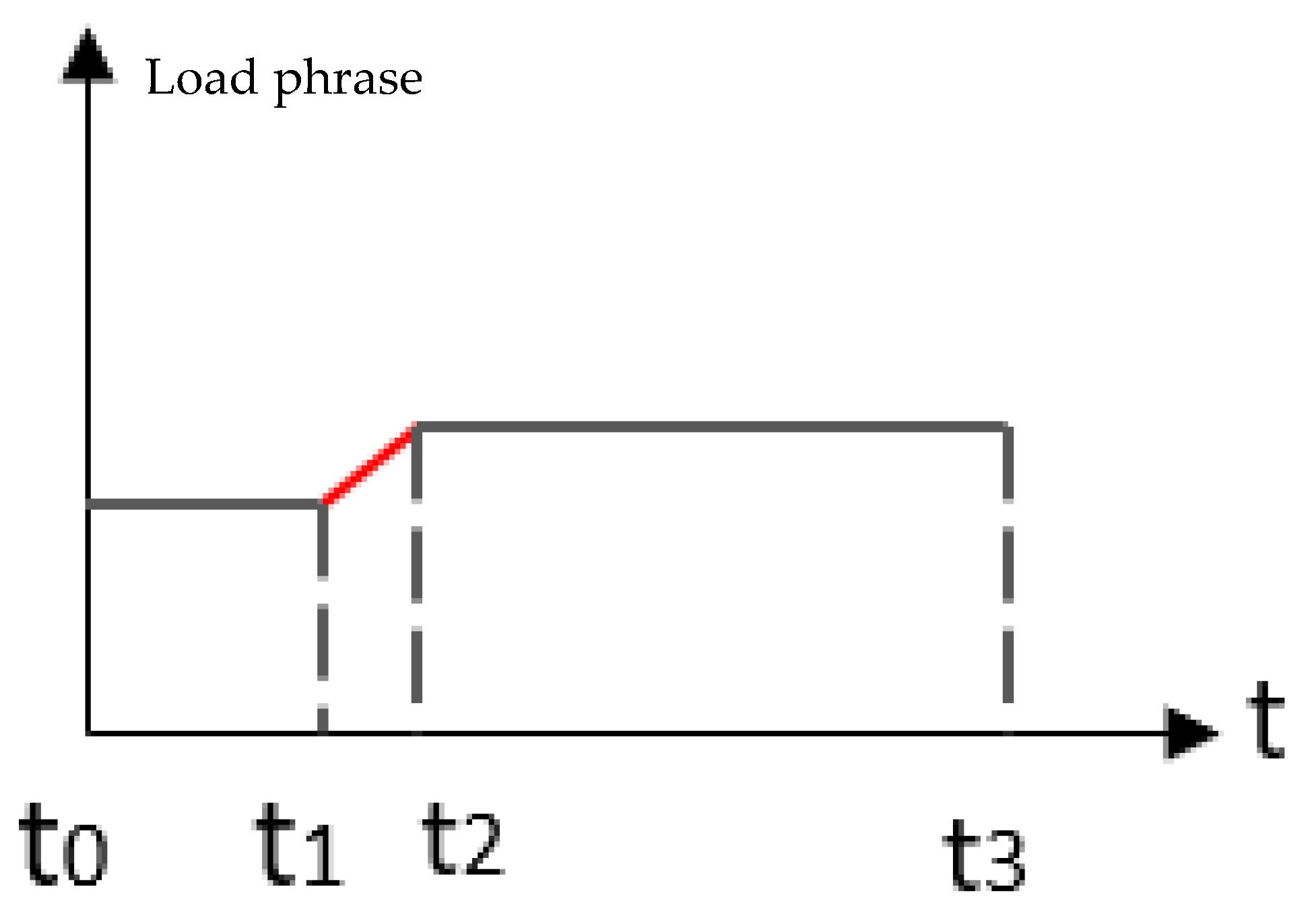
2. Collapse Analysis Theory
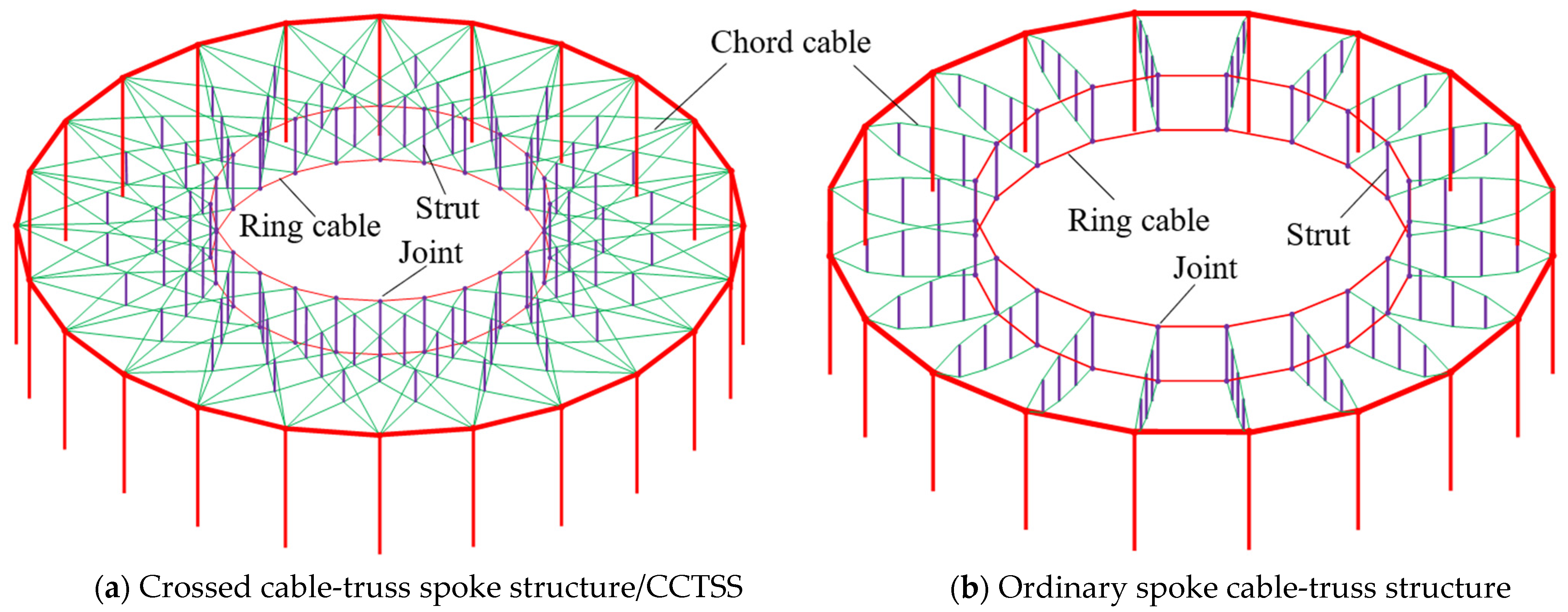
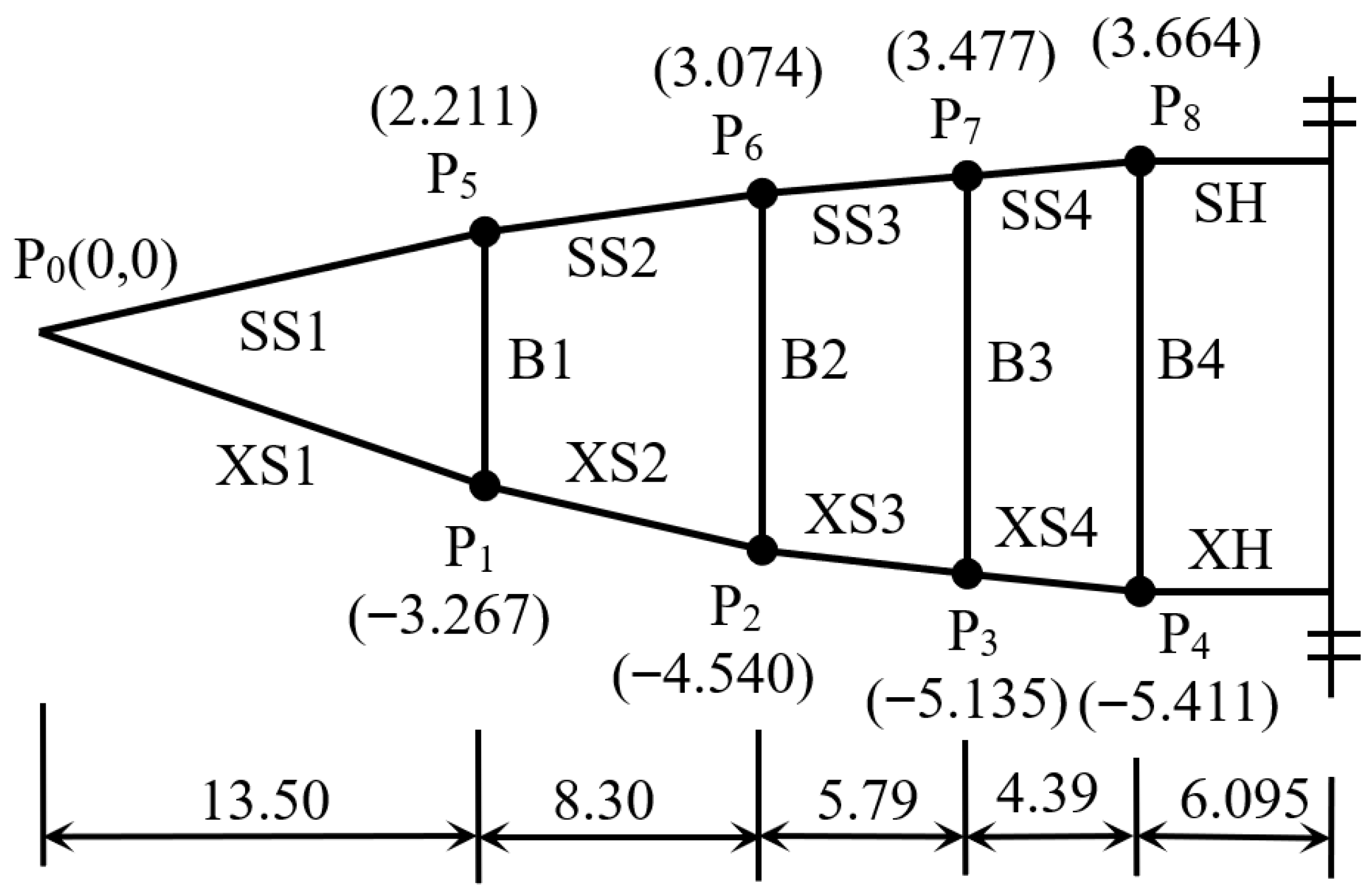
3. The Introduction of CCTSS
4. The Influence of Damping Coefficient and Prestress on the Collapse Performance of CSCTS
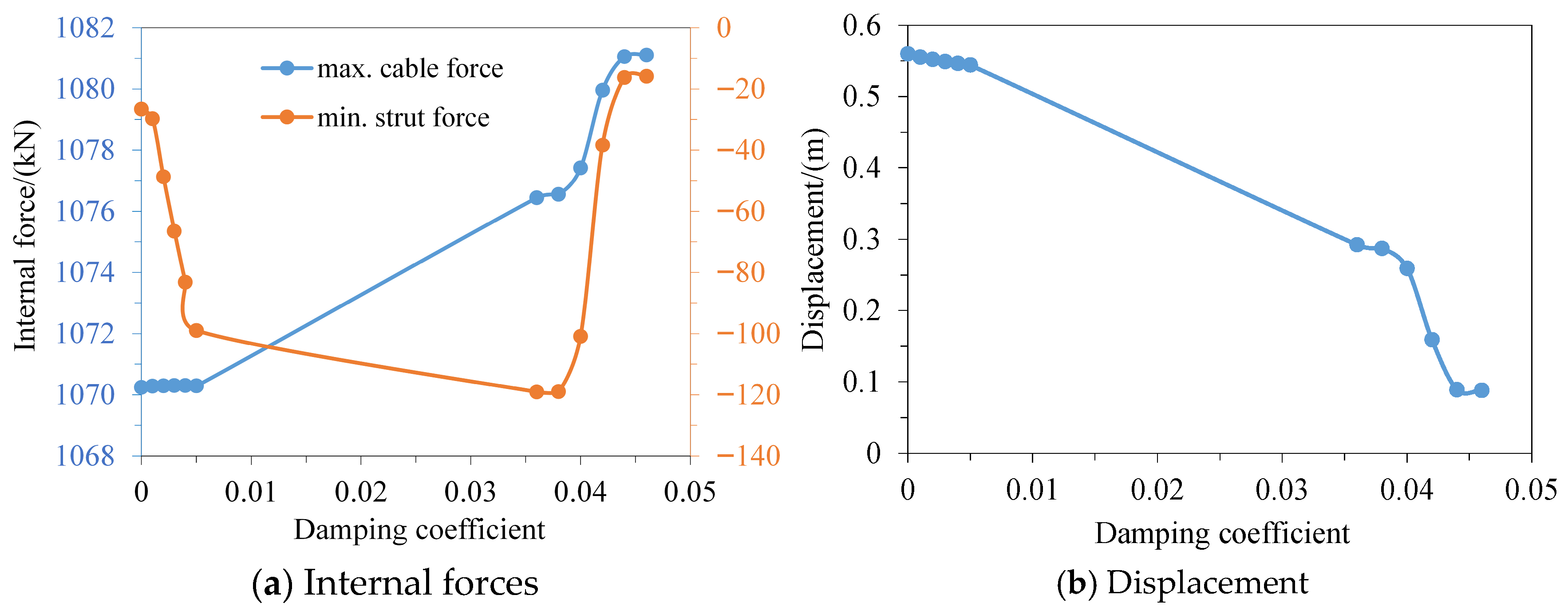
4.1. The Influence of Damping on the Collapse Performance
4.2. The Influence of Prestress on the Collapse Mechanism
5. The Influence of Prestress on the Collapse Performance of CCTSS
6. The Collapse Analysis Under No Loads
6.1. The Collapse Mechanism After the Rupture of Components
6.2. The Collapse Mechanism of the Rupture of Joints
7. The Collapse Analysis Under External Loads
7.1. The Collapse Analysis Under Full-Span Loads
7.2. The Collapse Analysis Under Half-Span Loads
7.3. Discussions on Collapse Results Under External Loads
8. Collapse-Resistant Evaluation
8.1. The Calculation Method of the Maximum Dynamic Force Amplification Coefficient
8.2. The Evaluation Method of the Importance of Components and Joints
8.2.1. The Evaluation Method of the Importance of Components
8.2.2. The Evaluation Method of the Importance of Joints
9. Conclusions and Discussions
9.1. Conclusions
- (1)
- The damping has little effect on collapse results when the damping is from 0.01~0.05. When the structure is in the linear elastic range, the influence of prestress on the collapse results is relatively small.
- (2)
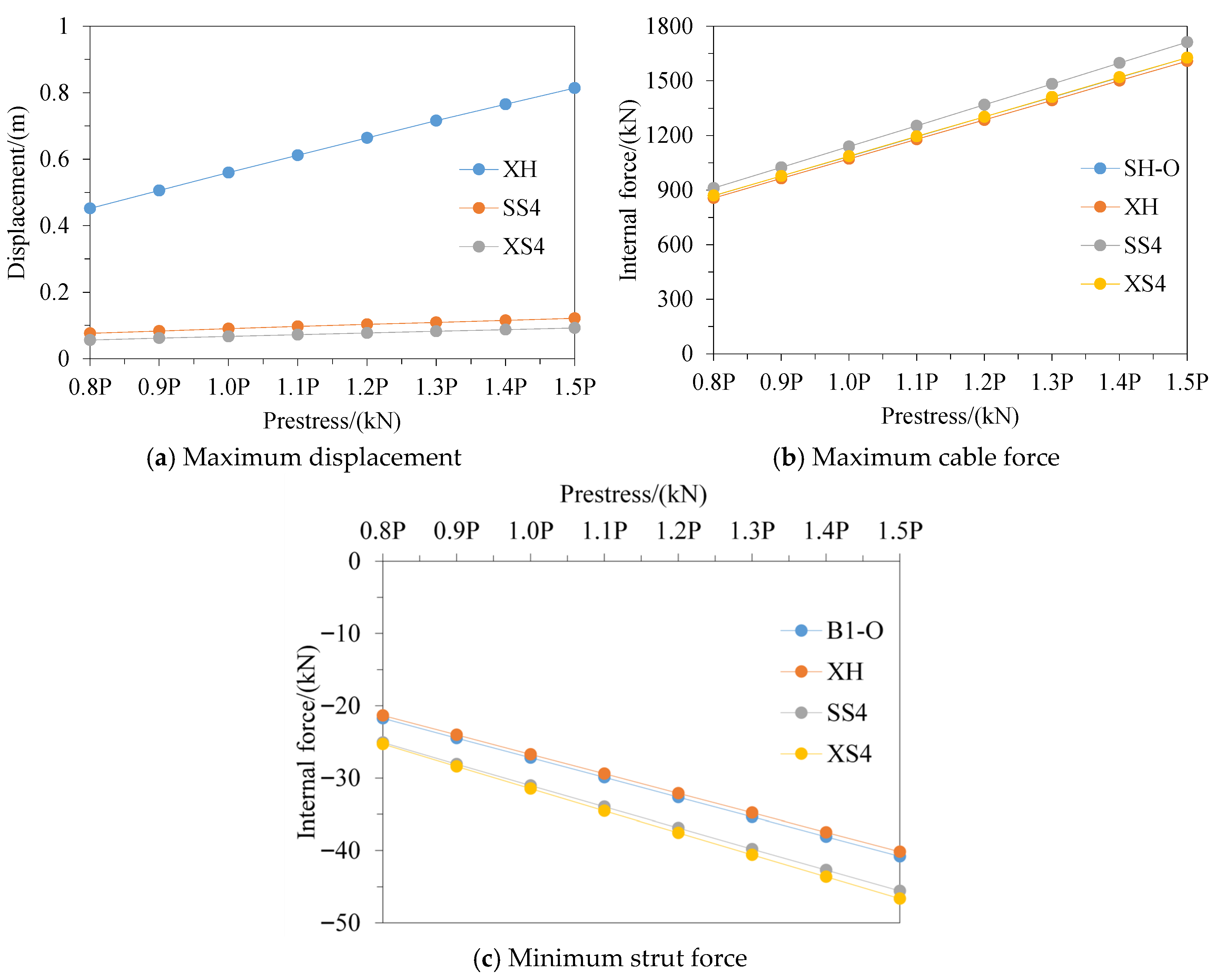
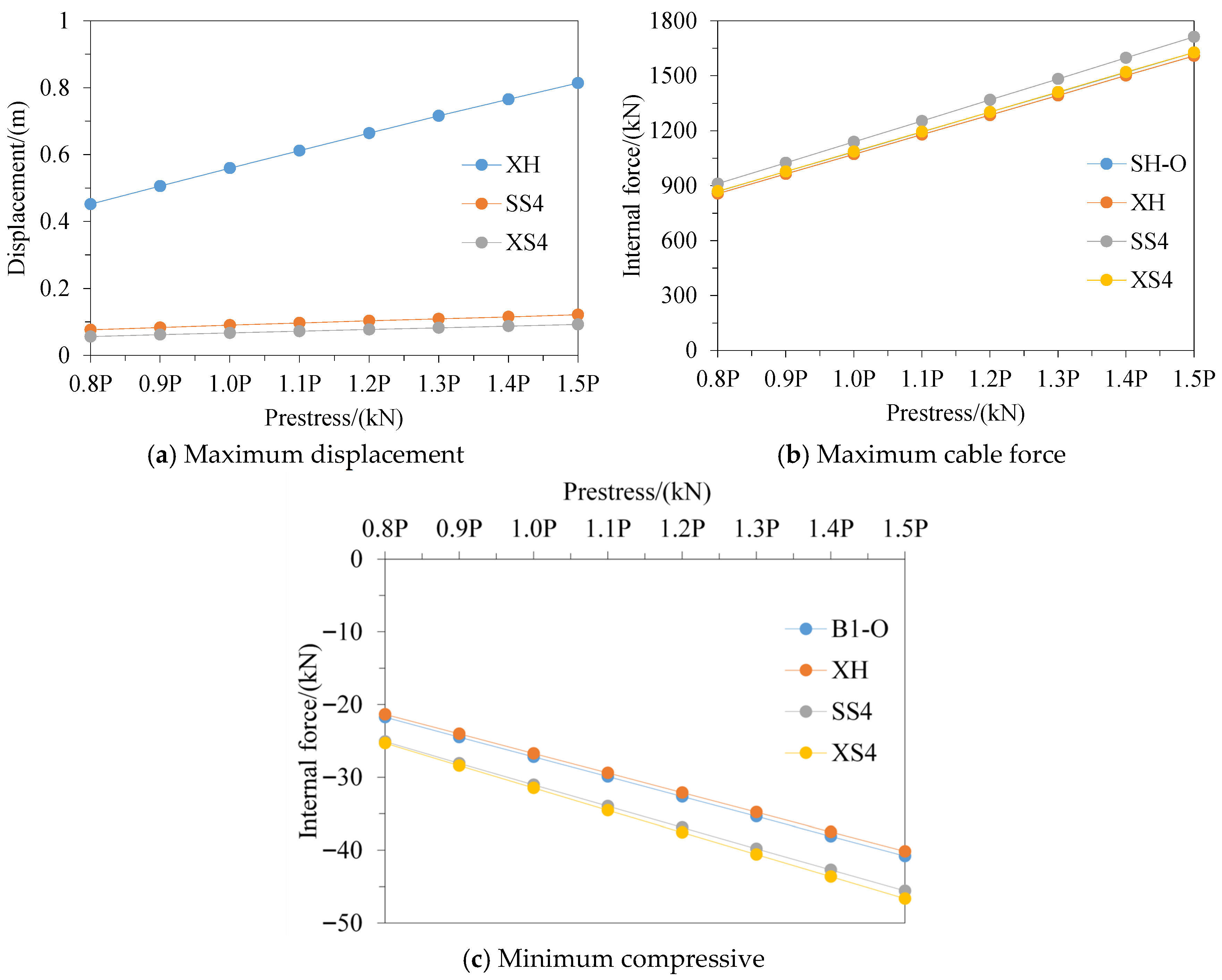
- The influence of prestress on collapse performance shows that the greater the prestress is, the greater the collapse response will be. The reasonable prestress level should be selected to reduce the construction difficulty as far as possible in the design stage.
- (3)
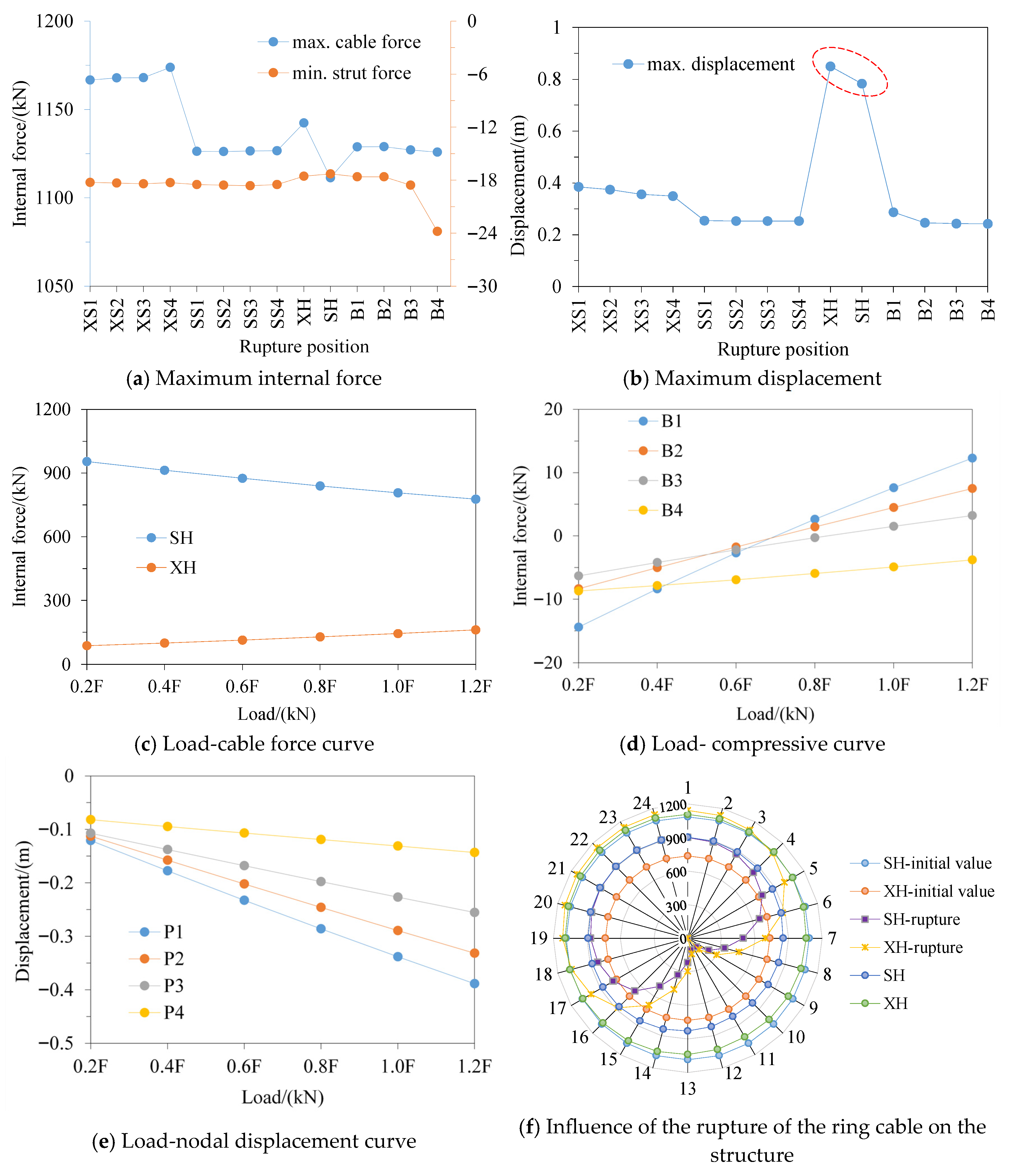
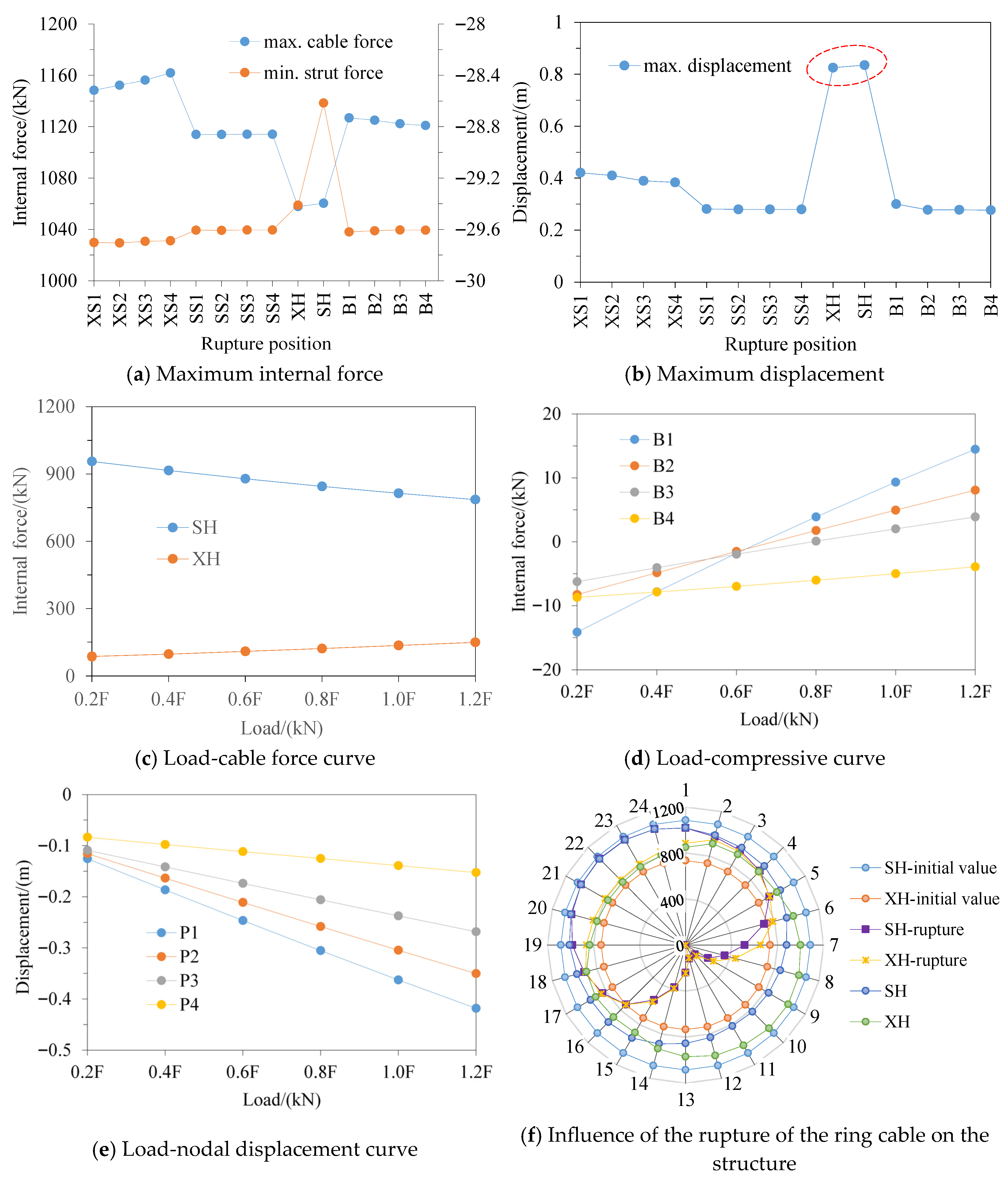
- The results without loads show that XS4 and SS4 belong to sensitive components. The failure of SH and XH is a more sensitive component. Ring-cable joints are the key joints that are most unfavorable to CCTSS.
- (4)
- The results under loads show that the collapse response under full-span loads is greater than that under half-span loads. The progressive collapse will not occur when each component ruptures, but CCTSS basically loses its integral bearing capacity when ring cables rupture.
- (5)
- The calculation method of the maximum dynamic force amplification coefficient is proposed based on the collapse results, which easily determines the importance of components and joints.
9.2. Discussions
Author Contributions
Funding
Data Availability Statement
Conflicts of Interest
References
- General Services Administration. Progressive Collapse Analysis and Design Guidelines for New Federal Office Buildings and Major Modernization Projects; General Service Administration: Washington, DC, USA, 2003. [Google Scholar]
- Gerasimidis, S.; Ellingwood, B. Twenty years of advances in disproportionate collapse research and best practices since 9/11/2001. J. Struct. Eng. 2023, 149, 02022002. [Google Scholar] [CrossRef]
- Meng, B.; Xiong, Y.P.; Zhou, W.H.; Duan, S.C.; Li, H. Progressive collapse behavior of composite substructure with large rectuangular beam-web openings. Eng. Struct. 2023, 295, 116861. [Google Scholar] [CrossRef]
- Starossek, U. Progressive Collapse of Structures; Thomas Telford: London, UK, 2009. [Google Scholar]
- Zhang, W.J.; Hu, S.L.; Zhang, Y.G. A review on progressive collapse of large-span space structure. In Proceedings of the 9th National Academic Symposium on Modern Structural Engineering; Tianjin University Press: Tianjin, China, 2009; pp. 368–372. [Google Scholar]
- He, J.; Wu, X.; Guido, B.; Benyamin, G.; George, V. Finite element models and 3D numerical simulations of novel steel joints for progressive collapse mitigation. Eng. Struct. 2026, 358, 122644. [Google Scholar] [CrossRef]
- UFC 4-023-03; Security Engineering: Design of Buildings to Resist Progressive Collapse. Ministry of National Defense: Arlington, VA, USA, 2005.
- Japanese Society of Steel Construction Council on Tall Buildings and Urban Habitat; Japan Iron and Steel Federation. Guidelines for Collapse Control Design, I Design; Japan Iron and Steel Federation: Tokyo, Japan, 2005. [Google Scholar]
- Japanese Society of Steel Construction Council on Tall Buildings and Urban Habitat; Japan Iron and Steel Federation. Guidelines for Collapse Control Design, II Research; Japan Iron and Steel Federation: Tokyo, Japan, 2005. [Google Scholar]
- Jiang, X.F.; Chen, Y.Y. A review on the progressive collapse and control design of building structures. China Civ. Eng. J. 2008, 41, 1–8. [Google Scholar] [CrossRef]
- Han, Q.H.; Xu, Y.; Lu, Y.; Xu, J.; Zhao, Q.H. Failure mechanism of steel arch trusses: Shaking table testing and FEM analysis. Eng. Struct. 2015, 82, 186–198. [Google Scholar] [CrossRef]
- Ye, J.H.; Qi, N. Progressive collapse simulation based on DEM for single-layer reticulated domes. J. Constr. Steel Res. 2017, 128, 721–731. [Google Scholar] [CrossRef]
- Guo, J.M.; Jiang, J.Q. An algorithm for calculating the feasible pre-stress of cable-struts structure. Eng. Struct. 2016, 118, 228–239. [Google Scholar] [CrossRef]
- Deng, H.; Zhang, M.R.; Liu, H.C.; Dong, S.L.; Zhang, Z.H.; Chen, L.M. Numerical analysis of the pretension deviations of novel Crescent-shaped tensile canopy structural system. Eng. Struct. 2016, 119, 24–33. [Google Scholar] [CrossRef]
- Lu, J.; Xue, S.D.; Li, X.Y.; Liu, Q. Study on static and dynamic experimental of spatial cable-truss structure without inner ring cables based on grid-jumped layout of struts. Int. J. Adv. Steel Constr. 2022, 18, 783–792. [Google Scholar] [CrossRef]
- Lu, J.; Li, X.Y.; Xue, S.D.; Majid, D. Study on force Mechanism of Cable-truss Frame and jumped layout of Annular Crossed Cable-truss Structure. Int. J. Adv. Steel Constr. 2021, 17, 243–252. [Google Scholar] [CrossRef]
- Zhang, W.J.; He, J. Experimental study on progressive collapse resistance of Geiger type cable dome structure model. J. Build. Struct. 2021, 42, 213–219. [Google Scholar] [CrossRef]
- Lu, J.; Xue, S.D.; Li, X.Y. Study the influence of grid-jumping layout on spatial cable-truss structure without inner ring cables with rupture of local cables (struts). J. Int. Assoc. Shell Spat. Struct. 2022, 64, 2–15. [Google Scholar] [CrossRef]
- He, J.; Yuan, X.F.; Jin, B. Analysis of cable domes with rupture of local cable. J. Vib. Shock 2010, 29, 13–16. [Google Scholar] [CrossRef]
- Hui, Z.; Qin, W.H.; Xu, J.W.; Zhang, P.; Zhang, T.Q.; Xie, P.; Zhang, R.L. Nonlinear analysis of progressive collapse behavior of Geiger type carbon fiber cable dome structure. J. Vib. Shock 2021, 40, 114–122. [Google Scholar] [CrossRef]
- Zong, Z.L.; Guo, Z.X. Experimental research on mechanical properties and cable broken of Levy cable dome. J. Eng. Mech. 2013, 30, 271–276. [Google Scholar] [CrossRef]
- Gao, Z.Y.; Xue, S.D.; Luo, D.J.; Yang, W.Q. Progressive collapse analysis of Levy type rigid bracing dome. Adv. Eng. Sci. 2021, 53, 178–183. [Google Scholar] [CrossRef]
- Liang, H.Q.; Dong, S.L. Effect of local failure on structural behavior of herringbone ribbed dome. J. Build. Struct. 2015, 36, 70–80. [Google Scholar] [CrossRef]
- Shekastehband, B.; Abedi, K.; Dianat, N.; Chenaghlou, M.R. Experimental and numerical studies on the collapse behavior of tensegrity systems considering cable rupture and strut collapse with snap-through. Int. J. Non-Linear Mech. 2012, 47, 751–768. [Google Scholar] [CrossRef]
- Shekastehband, B.; Abedi, K.; Chenaghlou, M.R. Sensitivity analysis of tensegrity system due to member loss. J. Constr. Steel Res. 2011, 67, 1325–1340. [Google Scholar] [CrossRef]
- Shekastehband, B.; Abedi, K. Collapse behavior of tensegrity systems due to cable rupture. Int. J. Struct. Stab. Dyn. 2013, 13, 1250079. [Google Scholar] [CrossRef]
- Huang, H.; Xian, Y.Q.; Xi, K.L.; Liu, B.Q. Experimental study and numerical analysis on the progressive collapse resistance of SCMS. Int. J. Steel Strust. 2019, 19, 301–318. [Google Scholar] [CrossRef]
- Liu, Z.S.; Li, H.; Liu, Y.; Wang, J.C.; Tafsirojjaman, T.; Shi, G.L. A novel numerical approach and experimental study to evaluate the effect of component failure on spoke-wheel cable structure. J. Build. Eng. 2022, 61, 105268. [Google Scholar] [CrossRef]
- Tian, G.Y. Research on Key Technology of Design Theory and Construction Control in Spoke Tension Structure. Ph.D. Thesis, Tsinghua University, Beijing, China, 2012. [Google Scholar]
- Liu, R.J.; Li, X.Y.; Xue, S.D.; Marijke, M.; Ye, J.H. Numerical and experimental research on annular crossed cable-truss structure under cable rupture. Earthq. Eng. Eng. Vib. 2017, 16, 557–569. [Google Scholar] [CrossRef]
- Zhou, J.Y.; Chen, W.J.; Zhao, B.; Qiu, Z.Y.; Dong, S.L. Distributed indeterminacy evaluation of cable-strut structures: Formulations and applications. J. Zhejiang Univ.-Sci. A 2015, 16, 737–748. [Google Scholar] [CrossRef]
- Jiang, J.; Lv, D.G.; Lu, X.Z.; Li, G.Q.; Ye, J.H. Research progress and development trends on progressive collapse resistance of building structures. J. Build. Struct. 2022, 43, 1–28. [Google Scholar] [CrossRef]
- Vaezzadeh, A.; Dolatshahi, M.K. Progressive collapse resistance of cable net structures. J. Constr. Steel Res. 2022, 195, 107347. [Google Scholar] [CrossRef]
- Lu, J.; Chen, W.J. Structural design and manufacturing length errors analyses of crossed spoke cable-truss structure. Adv. Struct. Eng. 2023, 26, 1260–1275. [Google Scholar] [CrossRef]
- JGJ 257-2012; Technical Specification for Cable Structure. China Academy of Building Research (CABR): Beijing, China, 2012.
- Jiang, S.H.; Yuan, X.F.; Ma, S. Redundancy theory and evaluation index of cable–strut system. Adv. Struct. Eng. 2019, 22, 2110–2123. [Google Scholar] [CrossRef]
- Chen, L.M.; Zeng, Y.H.; Gao, W.F.; Liu, Y.J.; Zhou, Y.Y. Section optimization design of a flexible cable-bar tensile structure based on robustness. Appl. Sci. 2021, 11, 8861. [Google Scholar] [CrossRef]
- Chen, L.M.; Li, Z.B.; Liu, Y.J.; Huang, K.; Zeng, Y.H.; Zhou, Y.Y.; Dong, S.L. Analysis and evaluation of the progressive collapse behavior of a cable dome structure. Buildings 2022, 17, 1700. [Google Scholar] [CrossRef]
- Lu, J.Y.; Dong, X.; Li, N.; Wu, X.Y. Progressive collapse-resistant capacity analysis of torus-dome cable-strut structure due to cable rupture. Eng. Mech. 2016, 33, 173–178. [Google Scholar]





| Element Type | Elastic Modulus/(kN/m2) | Density/(kN/m2) | Linear Expansion of Coefficient |
|---|---|---|---|
| Cable | 1.5 × 10⁵ | 7.8 | 1.2 × 10⁻⁵ |
| Strut | 2.06 × 10⁵ | 7.8 | 1.2 × 10⁻⁵ |
| Beam | 2.06 × 10⁵ | 7.8 | 1.2 × 10⁻⁵ |
| Element Number | SS1 | SS2 | SS3 | SS4 | XS1 | XS2 | XS3 | XS4 | SH | XH | B1 | B2 | B3 | B4 |
|---|---|---|---|---|---|---|---|---|---|---|---|---|---|---|
| Original length () | 13.68 | 8.35 | 5.80 | 4.40 | 13.89 | 8.40 | 5.82 | 4.40 | 6.10 | 6.10 | 5.48 | 7.61 | 8.61 | 9.08 |
| Section area ( | 682.82 | 682.82 | 682.82 | 682.82 | 765.51 | 765.51 | 765.51 | 765.51 | 1360.92 | 2488.58 | 1822.07 | 1822.07 | 1822.07 | 2652.21 |
| Prestress ( | 229.94 | 228.11 | 227.48 | 227.14 | 158.15 | 155.48 | 154.52 | 154.01 | 1084.39 | 734.48 | −27.20 | −15.54 | −12.30 | −19.31 |
| Self-stress mode | 1.013 | 1.005 | 1.002 | 1.0006 | 0.696 | 0.685 | 0.681 | 0.678 | 4.777 | 3.236 | — | — | — | — |
| Damping Coefficient | Max. Cable Force/(kN) | Min. Strut Force/(kN) | Max. Displacement/(m) |
|---|---|---|---|
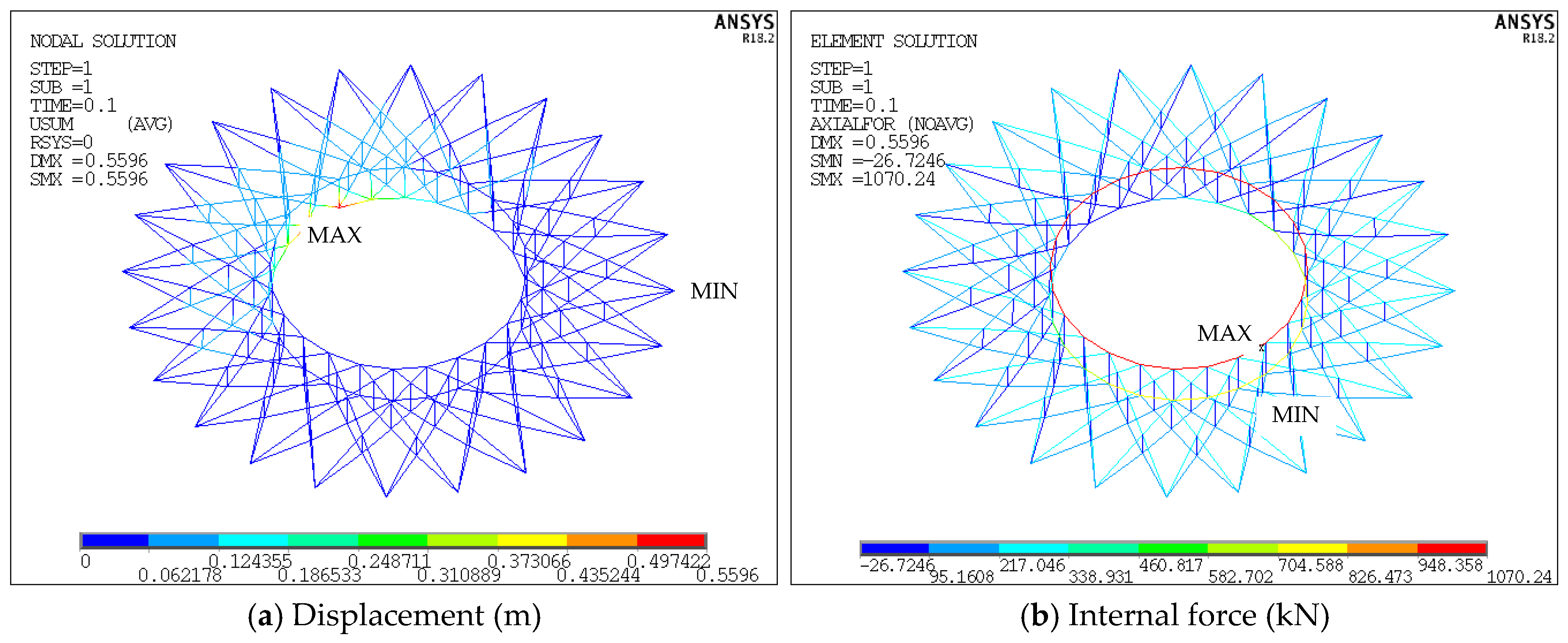
| ANSYS Software | 1070.24 | −26.73 | 0.559 |
| 0.001 | 1070.28 | −29.77 | 0.555 |
| Element Number | Max. Displacement/(m) | Position | Max. Cable Force/(kN) | Position | Min. Compression /(kN) | Position | Collapse Mode |
|---|---|---|---|---|---|---|---|
| XS1 | 0.104 | Rupture position | 1085.42 | SH | −30.99 | B1 | No collapse |
| XS2 | 0.073 | Rupture position | 1085.45 | SH | −31.17 | B1 | No collapse |
| XS3 | 0.065 | Rupture position | 1085.41 | SH | −31.32 | B1 | No collapse |
| XS4 | 0.067 | Rupture position | 1085.51 | SH | −31.47 | B1 | No collapse |
| SS1 | 0.133 | Rupture position | 1125.01 | SH | −30.56 | B1 | No collapse |
| SS2 | 0.097 | Rupture position | 1128.91 | SH | −30.74 | B1 | No collapse |
| SS3 | 0.087 | Rupture position | 1133.21 | SH | −30.88 | B1 | No collapse |
| SS4 | 0.090 | Rupture position | 1138.68 | SH | −31.03 | B1 | No collapse |
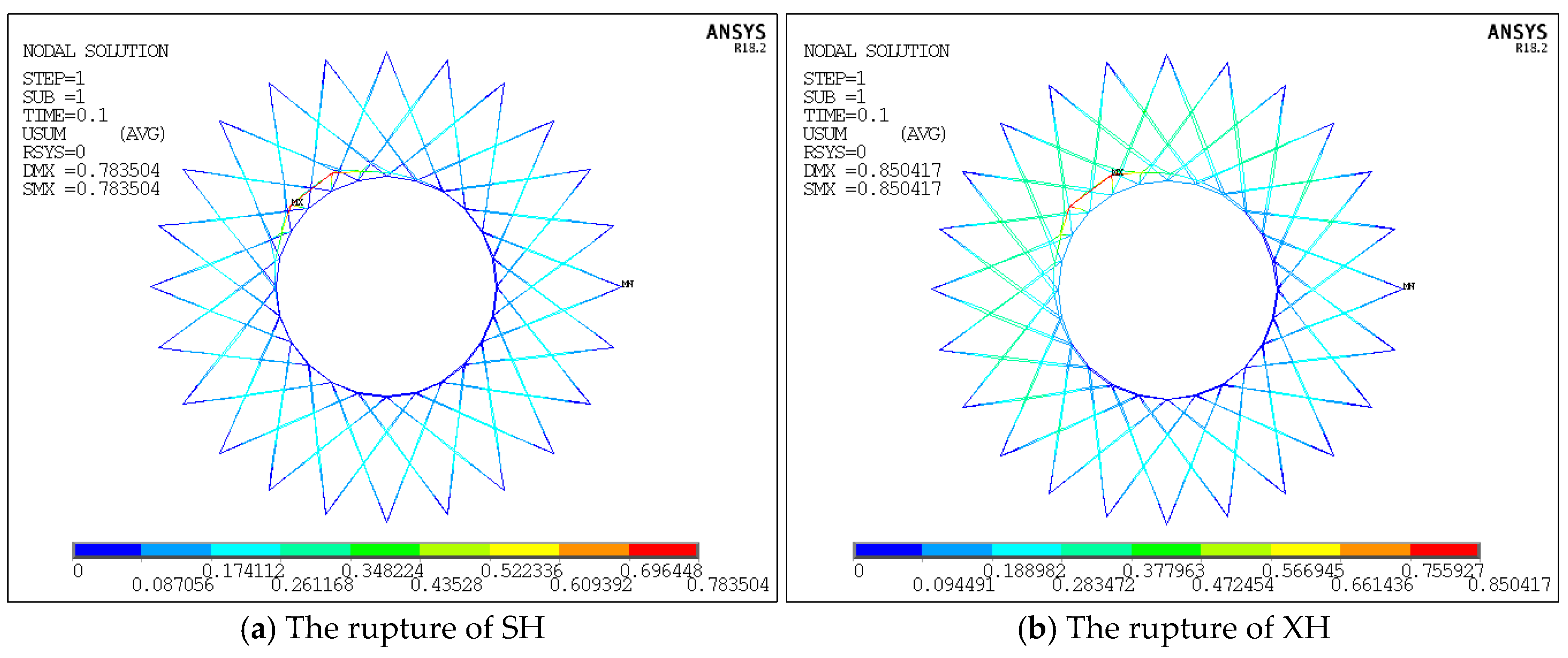
| XH | 0.559 | Rupture position | 1070.24 | SH | −26.72 | B1 | No collapse |
| SH | 0.921 | Rupture position | 1073.71 | SH | −26.14 | B1 | No collapse |
| B1 | 0.272 | Rupture position | 1086.82 | SH | −28.05 | B1 | No collapse |
| B2 | 0.136 | Rupture position | 1084.59 | SH | −29.05 | B1 | No collapse |
| B3 | 0.087 | Rupture position | 1084.12 | SH | −27.31 | B1 | No collapse |
| B4 | 0.054 | Rupture position | 1083.73 | SH | −27.24 | B1 | No collapse |
| Element Number | Max. Displacement/(m) | Position | Max. Cable Force/(kN) | Position | Min. Compressive/(kN) | Position | Collapse Mode |
|---|---|---|---|---|---|---|---|
| P1 | 0.237 | Rupture position | 1088.41 | SH | −31.518 | B1 | No collapse |
| P2 | 0.136 | Rupture position | 1087.49 | SH | −31.613 | B1 | No collapse |
| P3 | 0.084 | Rupture position | 1086.77 | SH | −32.102 | B1 | No collapse |
| P4 | 0.562 | Rupture position | 1066.43 | SH | −26.488 | B1 | No collapse |
| P5 | 0.269 | Rupture position | 1147.17 | SH | −31.388 | B1 | No collapse |
| P6 | 0.159 | Rupture position | 1159.38 | SH | −31.335 | B1 | No collapse |
| P7 | 0.102 | Rupture position | 1189.20 | SH | −31.796 | B1 | No collapse |
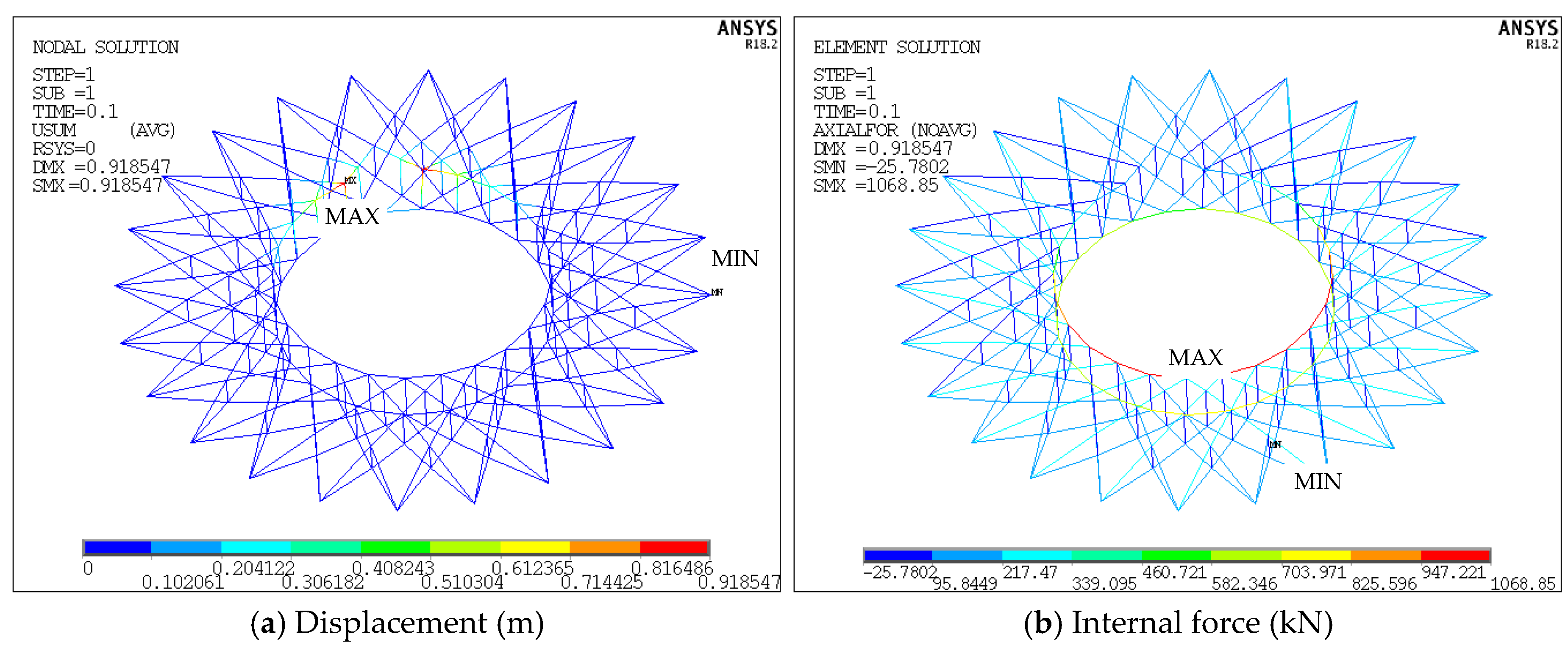
| P8 | 0.918 | Rupture position | 1068.85 | SH | −25.780 | B1 | No collapse |
| Element Number | XS1 | XS2 | XS3 | XS4 | SS1 | SS2 | SS3 | SS4 | XH | SH | B1 | B2 | B3 | B4 |
|---|---|---|---|---|---|---|---|---|---|---|---|---|---|---|
| Ffull-load | 7.58 | 7.69 | 7.71 | 8.25 | 3.86 | 3.86 | 3.89 | 3.90 | 5.34 | 2.48 | 4.10 | 4.10 | 3.93 | 3.83 |
| Dfull-load | 32.91 | 32.62 | 32.32 | 32.77 | 31.98 | 31.73 | 31.49 | 31.97 | 35.44 | 36.43 | 35.20 | 35.22 | 31.76 | 12.48 |
| Fhalf-load | 5.89 | 6.25 | 6.62 | 7.15 | 2.72 | 2.72 | 2.74 | 2.74 | 2.45 | 2.21 | 3.92 | 3.75 | 3.50 | 3.37 |
| Dhalf-load | 9.20 | 9.21 | 9.16 | 9.15 | 8.85 | 8.85 | 8.84 | 8.84 | 8.13 | 5.20 | 8.89 | 8.86 | 8.84 | 8.85 |
| Element Number | XS1 | XS2 | XS3 | XS4 | SS1 | SS2 | SS3 | SS4 | XH | SH |
|---|---|---|---|---|---|---|---|---|---|---|
| Initial internal force/kN | 158.15 | 155.48 | 154.52 | 154.01 | 229.94 | 228.11 | 227.48 | 227.14 | 734.48 | 1084.39 |
| Max. internal force/kN | 349.16 | 349.64 | 356.14 | 367.57 | 284.23 | 291.58 | 299.28 | 309.08 | 1142.34 | 906.749 |
| Percent/% | 120.77 | 124.87 | 130.48 | 138.67 | 23.61 | 27.82 | 31.56 | 36.07 | 55.53 | −16.38 |
| Min. internal force/kN | 184.30 | 174.64 | 167.66 | 160.51 | 135.22 | 131.86 | 128.35 | 123.88 | 144.13 | 110.27 |
| Percent/% | 16.53 | 12.32 | 8.50 | 4.22 | −41.19 | −42.20 | −43.58 | −45.46 | −80.38 | −89.83 |
| Element Number | XS1 | XS2 | XS3 | XS4 | SS1 | SS2 | SS3 | SS4 | XH | SH |
|---|---|---|---|---|---|---|---|---|---|---|
| 1.21 | 1.25 | 1.30 | 1.39 | 1.10 | 1.21 | 1.33 | 1.49 | 6.93 | 7.22 |
| Joint Number | P1 | P2 | P3 | P4 | P5 | P6 | P7 | P8 |
|---|---|---|---|---|---|---|---|---|
| 0.99 | 1.03 | 1.08 | 3.34 | 0.93 | 1.02 | 1.13 | 3.50 |
Disclaimer/Publisher’s Note: The statements, opinions and data contained in all publications are solely those of the individual author(s) and contributor(s) and not of MDPI and/or the editor(s). MDPI and/or the editor(s) disclaim responsibility for any injury to people or property resulting from any ideas, methods, instructions or products referred to in the content. |
© 2026 by the authors. Licensee MDPI, Basel, Switzerland. This article is an open access article distributed under the terms and conditions of the Creative Commons Attribution (CC BY) license.
Share and Cite
Qi, P.; Lu, J.; Wang, L.; Hu, J. Study on Collapse Mechanism and Collapse Resistance Evaluation Method for Crossed Cable-Truss Spoke Structure. Buildings 2026, 16, 1664. https://doi.org/10.3390/buildings16091664
Qi P, Lu J, Wang L, Hu J. Study on Collapse Mechanism and Collapse Resistance Evaluation Method for Crossed Cable-Truss Spoke Structure. Buildings. 2026; 16(9):1664. https://doi.org/10.3390/buildings16091664
Chicago/Turabian StyleQi, Peng, Jian Lu, Lichen Wang, and Jianhui Hu. 2026. "Study on Collapse Mechanism and Collapse Resistance Evaluation Method for Crossed Cable-Truss Spoke Structure" Buildings 16, no. 9: 1664. https://doi.org/10.3390/buildings16091664
APA StyleQi, P., Lu, J., Wang, L., & Hu, J. (2026). Study on Collapse Mechanism and Collapse Resistance Evaluation Method for Crossed Cable-Truss Spoke Structure. Buildings, 16(9), 1664. https://doi.org/10.3390/buildings16091664