From Brownfields to Low-Carbon Cities: A Methodological Framework for the Sustainable Renovation of Industrial Buildings and Their Envelopes


Abstract
1. Introduction
1.1. Background
1.2. State of the Art
1.3. Research Objectives
- (1)
- Evaluate suitable solutions for designing and optimising new perimeter casings using composite materials to enhance energy efficiency and adaptability.
- (2)
- Improve the thermal performance of the building envelope through innovative material selection and system design.
- (3)
- Carry out thermal simulations of exterior wall systems, comparing traditional materials to innovative composite-based alternatives.
- (4)
- Comparatively evaluate different wall configurations using multiple performance criteria, assessed through the simple additive weighting (SAW) method for multi-criteria decision-making.
- (5)
- Analyse the environmental impact of selected wall variants using a comprehensive Life Cycle Assessment (LCA).
- (6)
- Provide a comprehensive assessment of the findings, synthesising the results and offering recommendations for future research directions in the field of energy-efficient retrofitting.
2. Method
3. Envelope Material Selection and Thermal Analysis Framework
4. Model Validation
5. Model Description
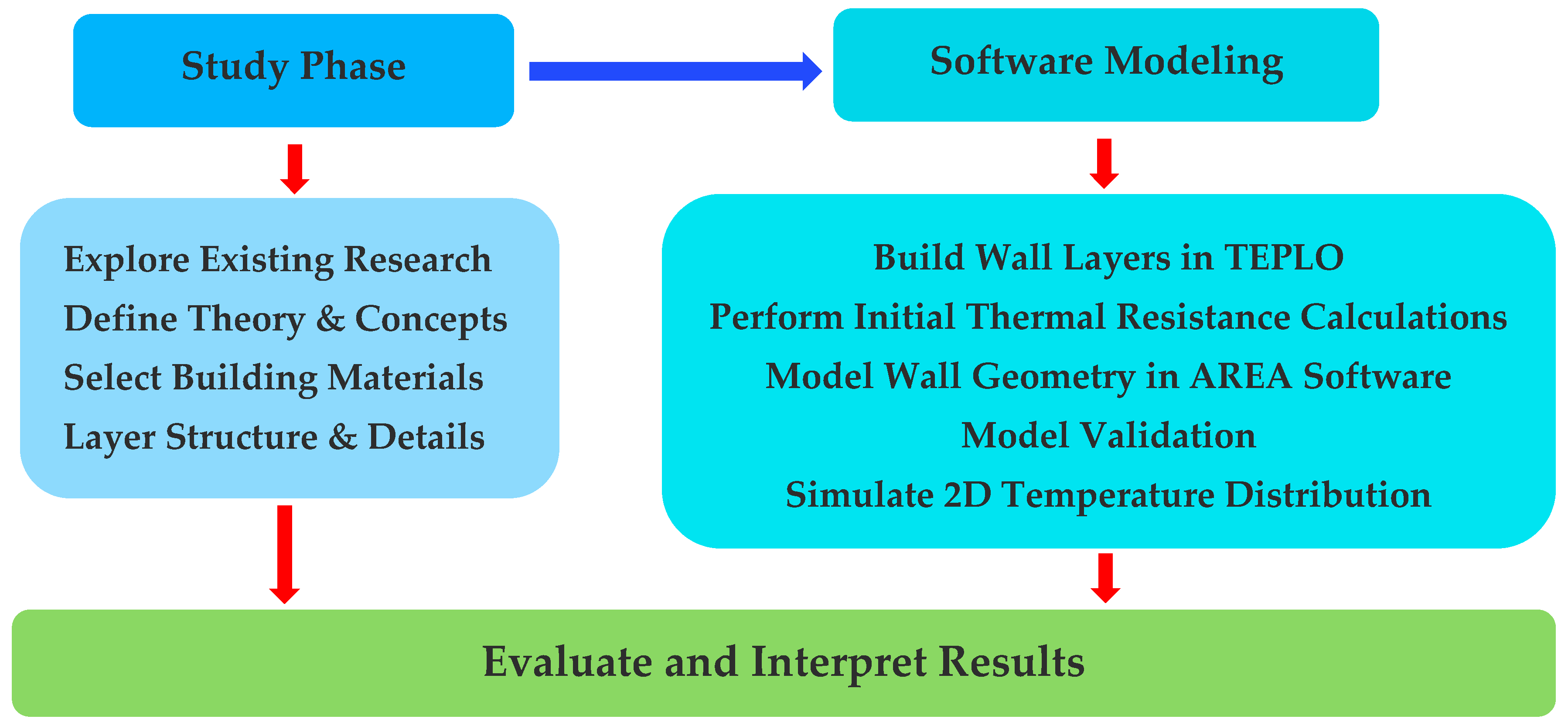
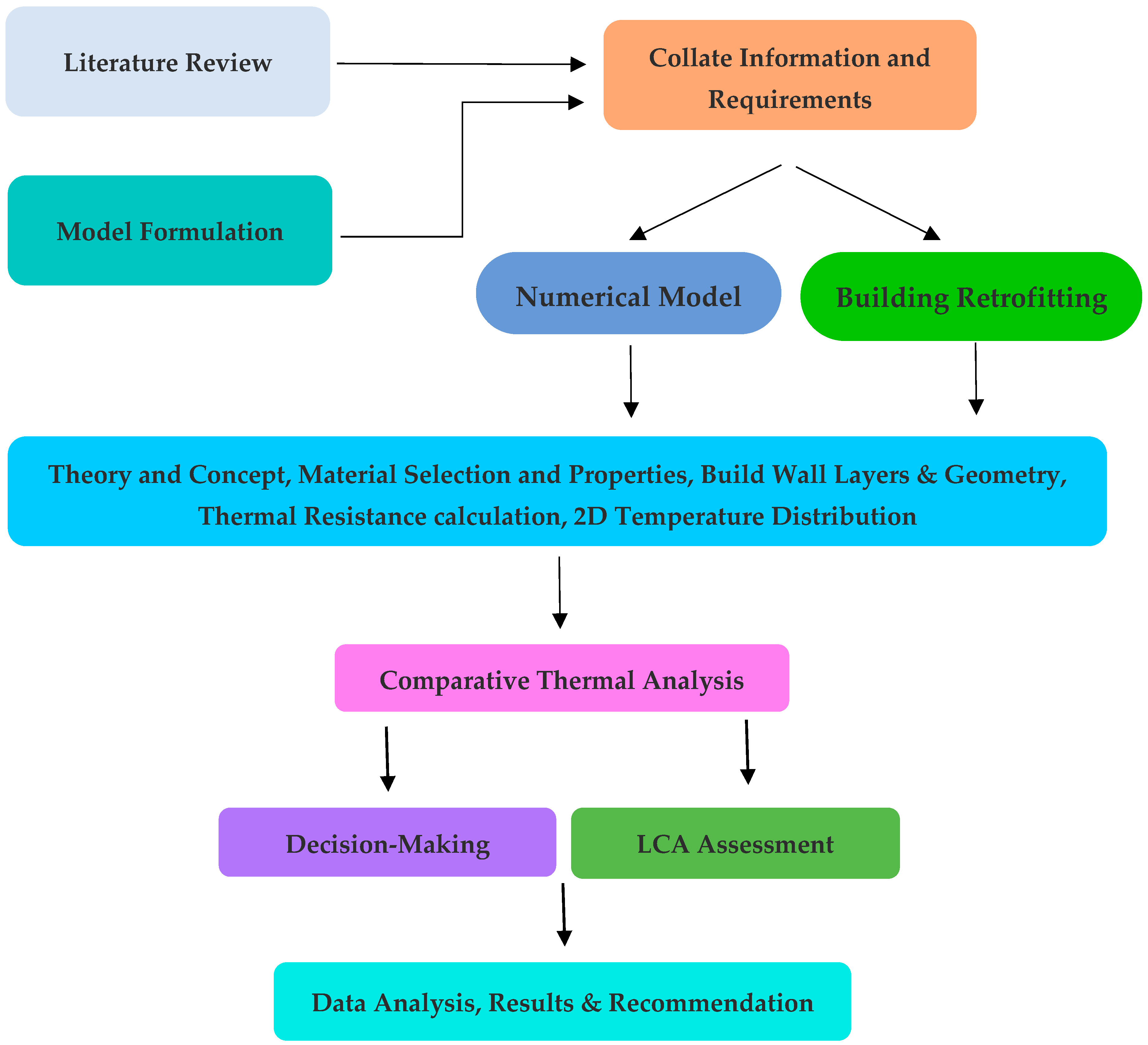
- 1D analytical solution and numerical verification (FDM): A one-dimensional steady-state heat conduction model was first formulated analytically using the separation of variables method, under the assumptions of isotropic and homogeneous thermal conductivity and no internal heat generation. This analytical model was subsequently discretised using the finite difference method (FDM) and implemented in Python. The domain was divided into a uniform grid, and central difference approximations were applied to obtain a system of algebraic equations. Solving this system yielded nodal temperatures and heat fluxes, providing a numerical verification of the analytical solution under simplified conditions.
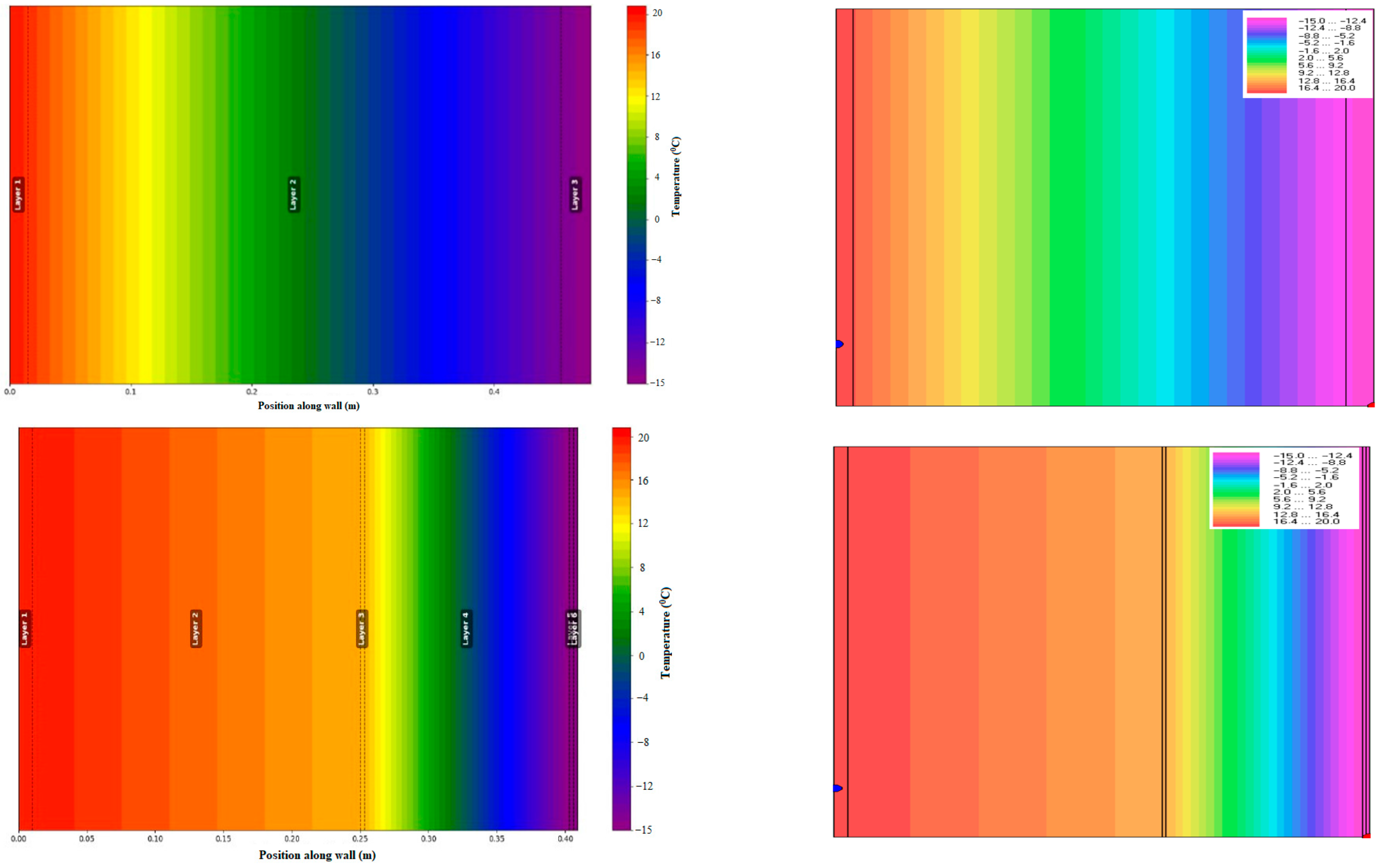
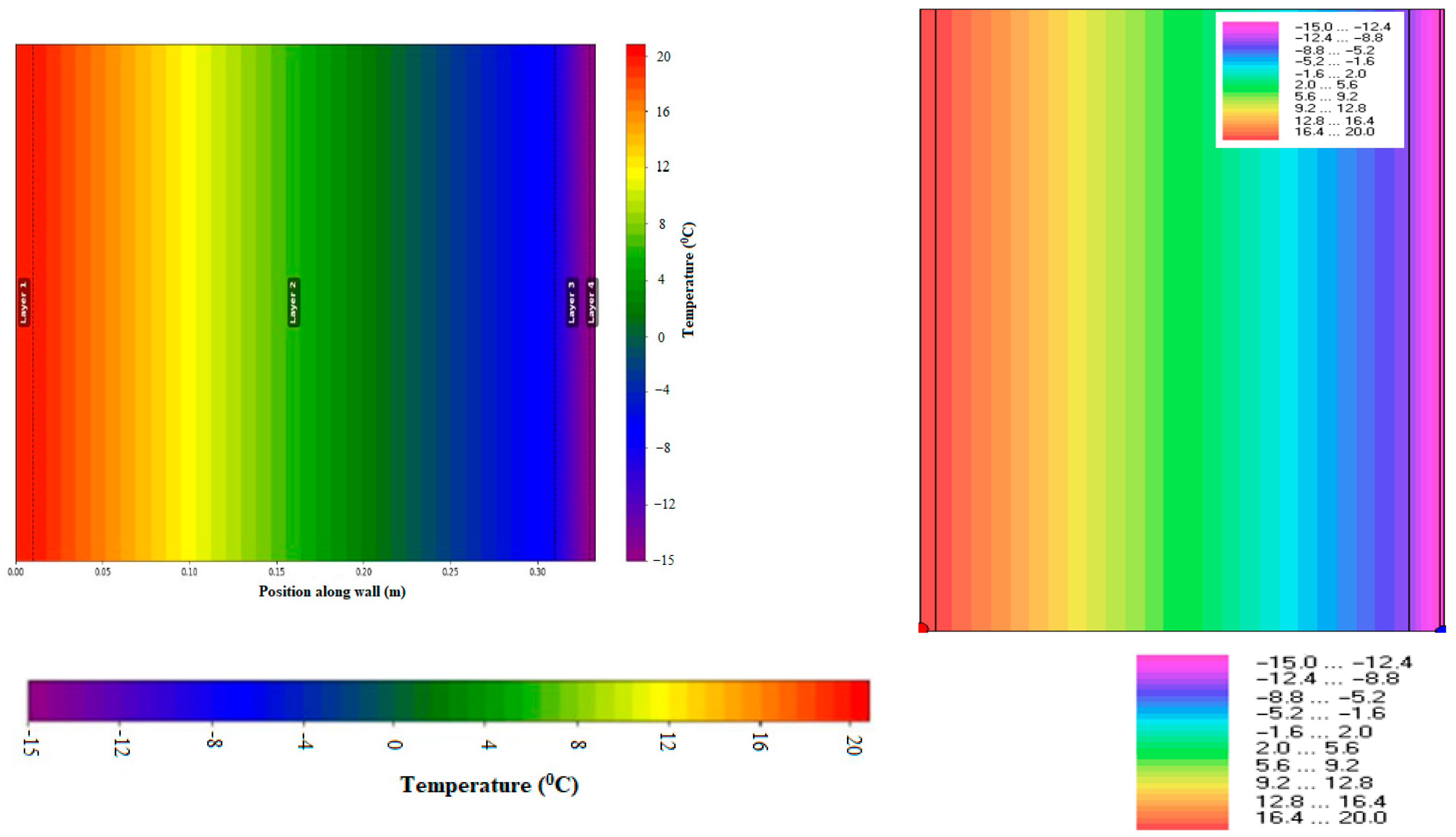
- 2D simulations: The main 2D simulations were performed using AREA 2017, which solves the problem using the finite element method (FEM) with Galerkin formulation (triangular elements and Gauss elimination) according to the official programme manual [61]. AREA computes steady-state temperature fields, heat fluxes, and temperature factors following EN ISO 10211 and EN ISO 10211-2 (2002).
Boundary Condition
6. Results and Discussion
6.1. Physical and Structural Optimisation of Wall Systems
6.2. Thermal Modelling Results
6.2.1. U-Values for Building Envelopes of Different Materials
6.2.2. Temperature Distribution
6.2.3. Hygrothermal Performance, Surface Temperature, and Condensation Risk Assessment
6.3. Multi-Criteria Decision-Making Using SAW
6.4. Life Cycle Assessment (LCA) of Different Wall Configurations
6.5. Integrated Discussion
6.5.1. Integrated Prefabricated Facade Systems for Energy-Efficient Building Renovation in the EU
6.5.2. Practical Implications
6.5.3. Limitations and Uncertainties
7. Conclusions and Recommendations
7.1. Conclusions
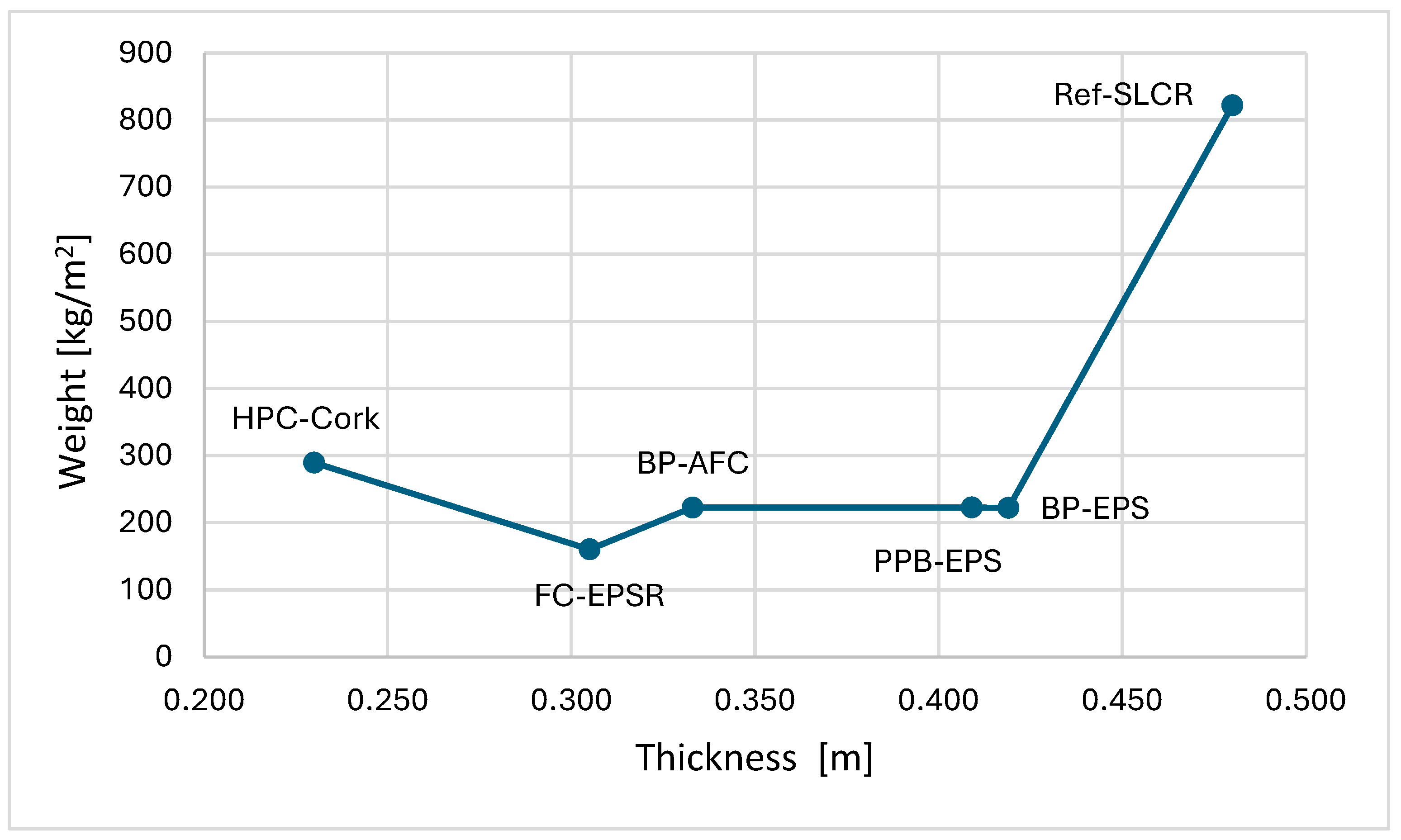
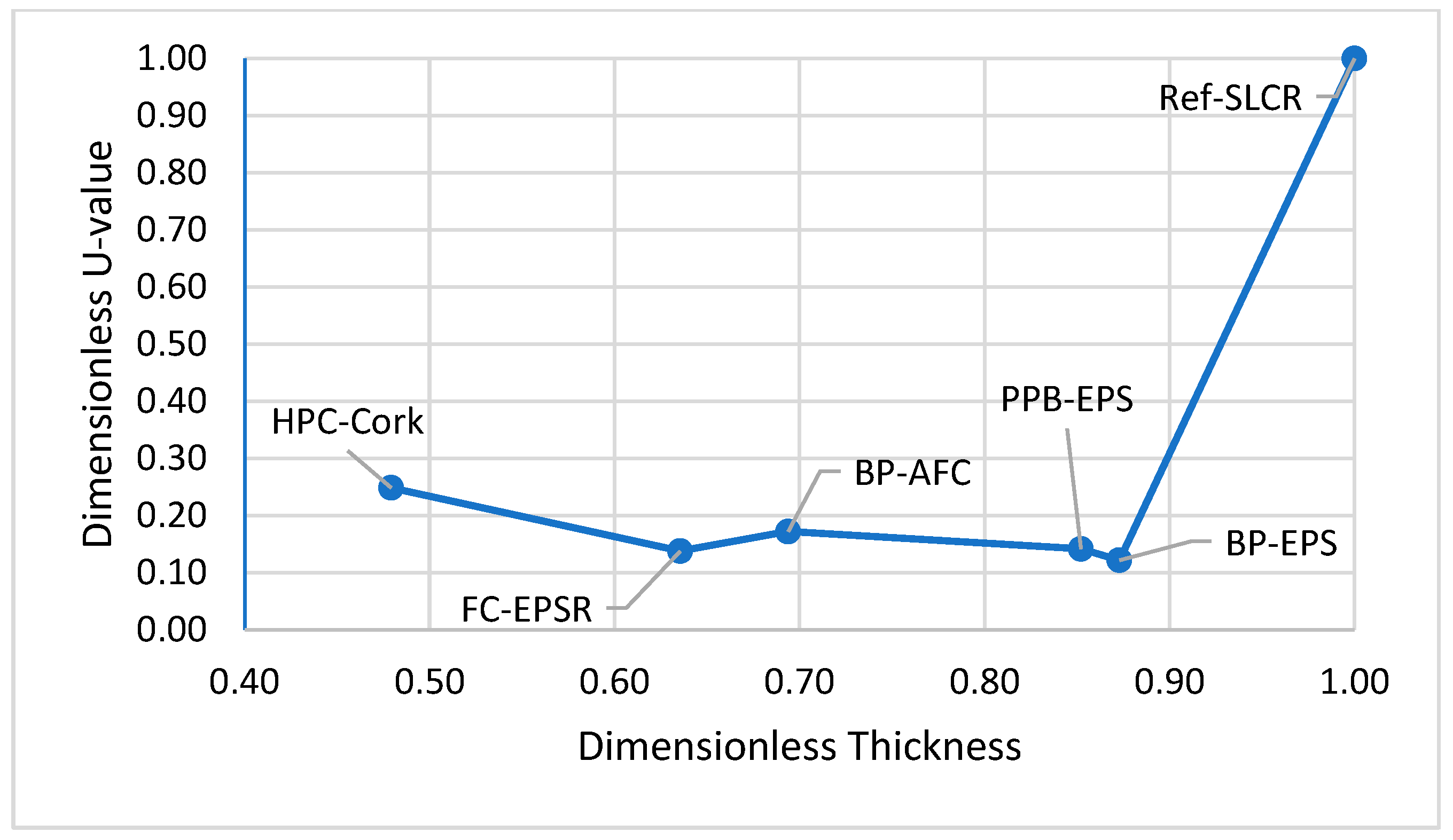
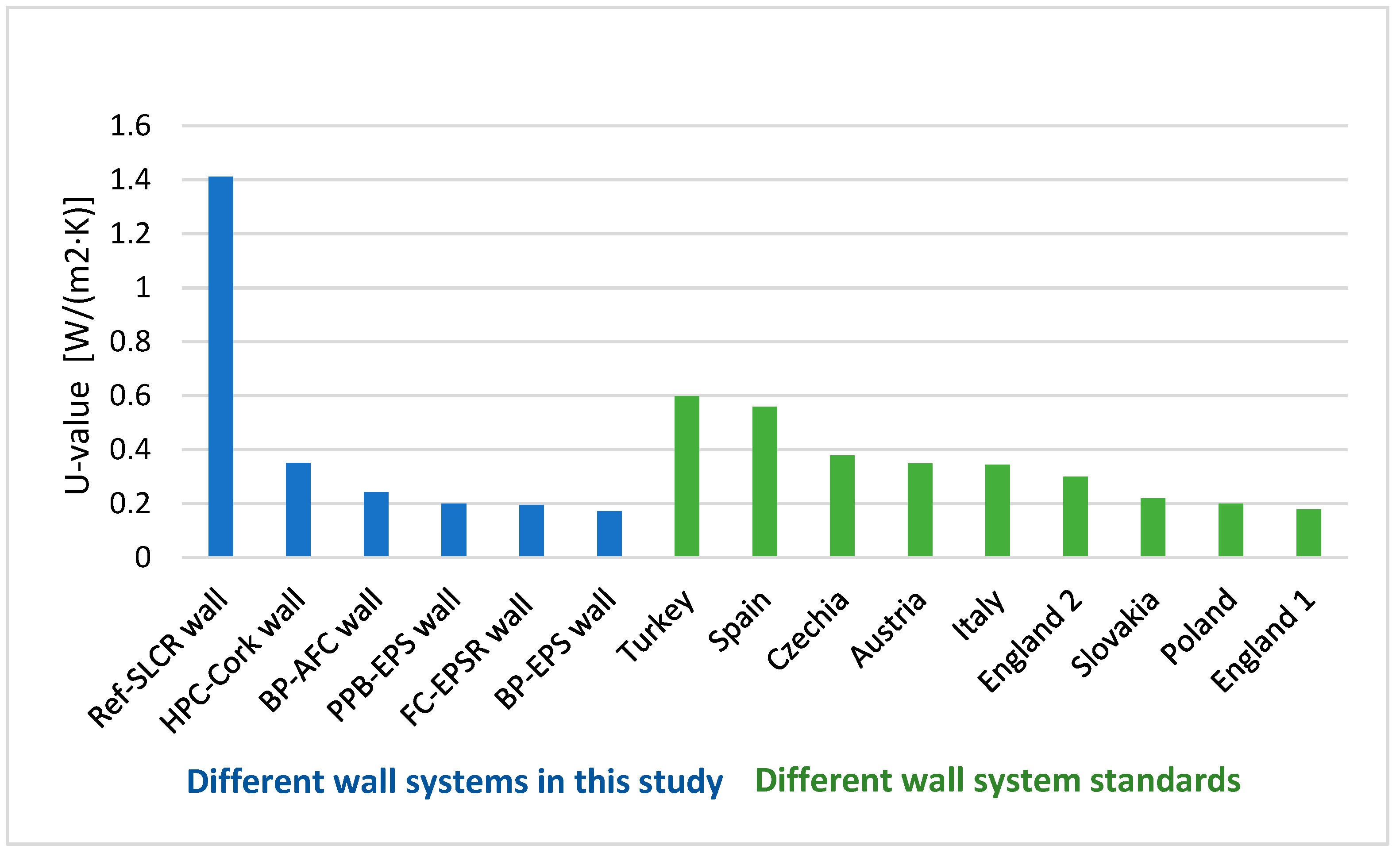
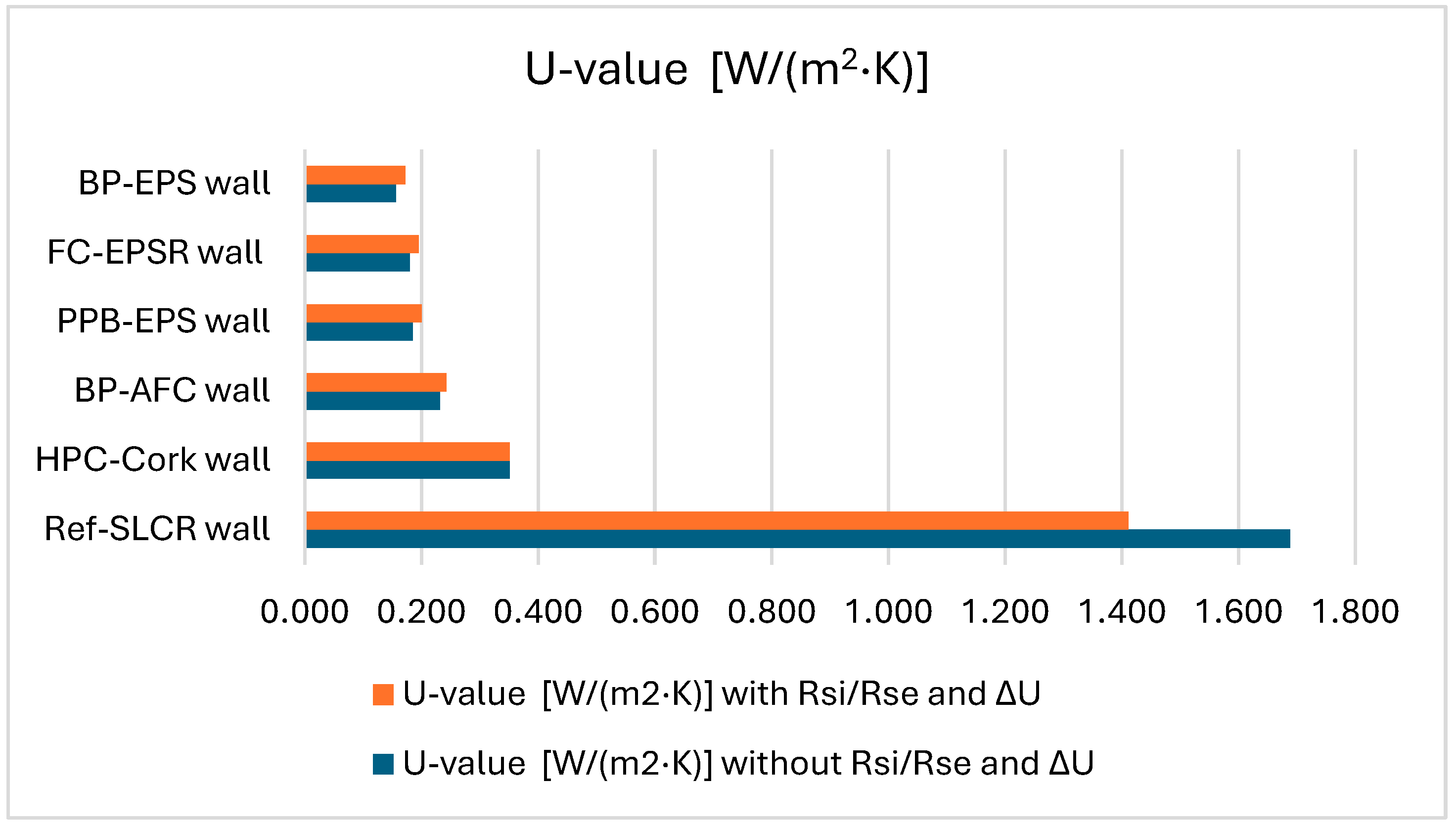
- Innovative wall systems significantly outperform the traditional Ref-SLCR wall, achieving up to 87.8% lower U-values and 80.5% lower weight, thereby supporting energy-efficient retrofit applications.
- HPC-Cork, PPB-EPS, BP-AFC, BP-EPS, and FC-EPSR walls show major reductions in thickness (up to 52%) and density, minimising structural loads in conversion projects.
- Wall thickness does not correlate directly with insulation performance; material conductivity and layer configuration are the dominant factors in thermal efficiency.
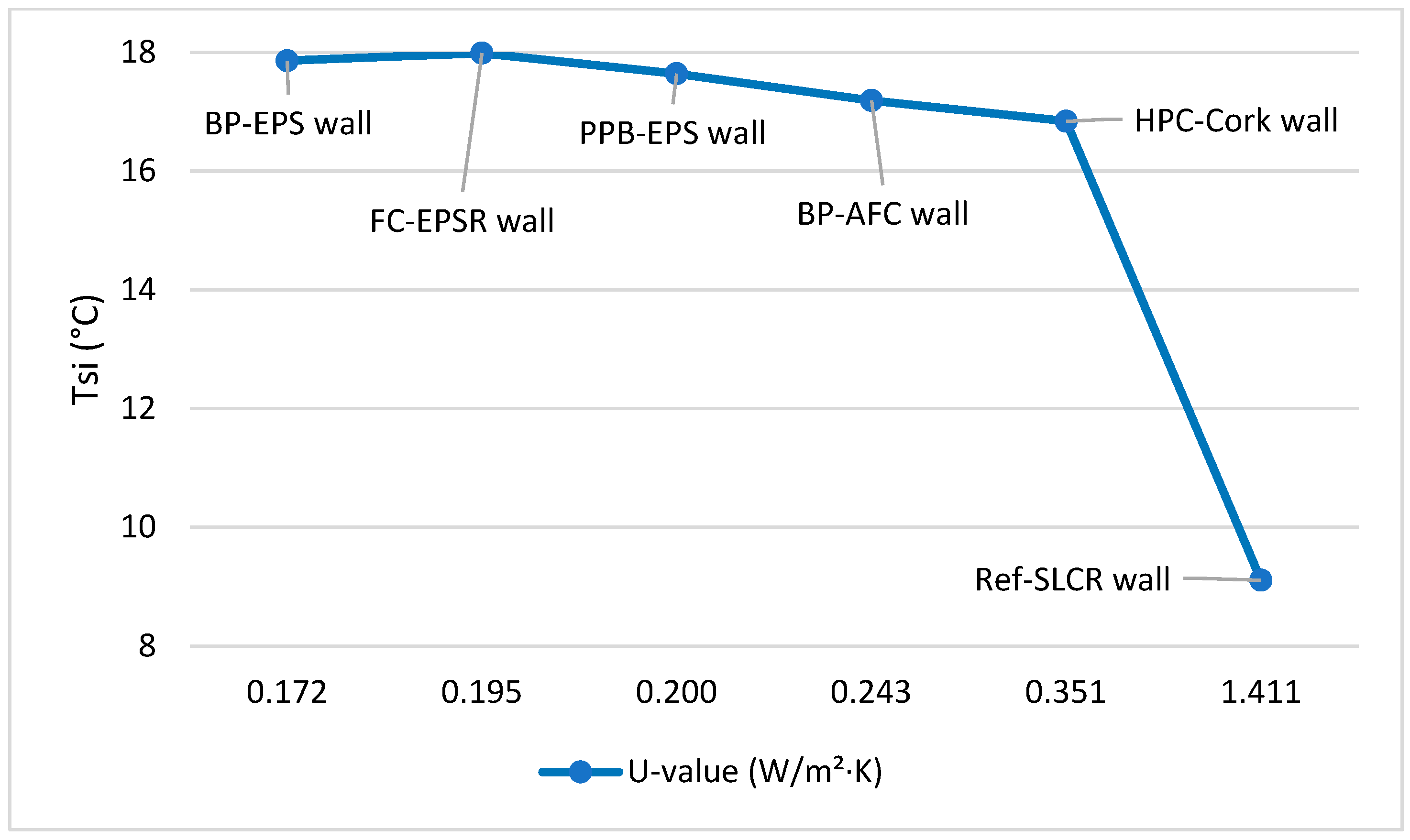
- The BP-EPS wall provides the lowest corrected U-value (0.172 W/m2·K), while FC-EPSR delivers the most balanced overall thermal behaviour.
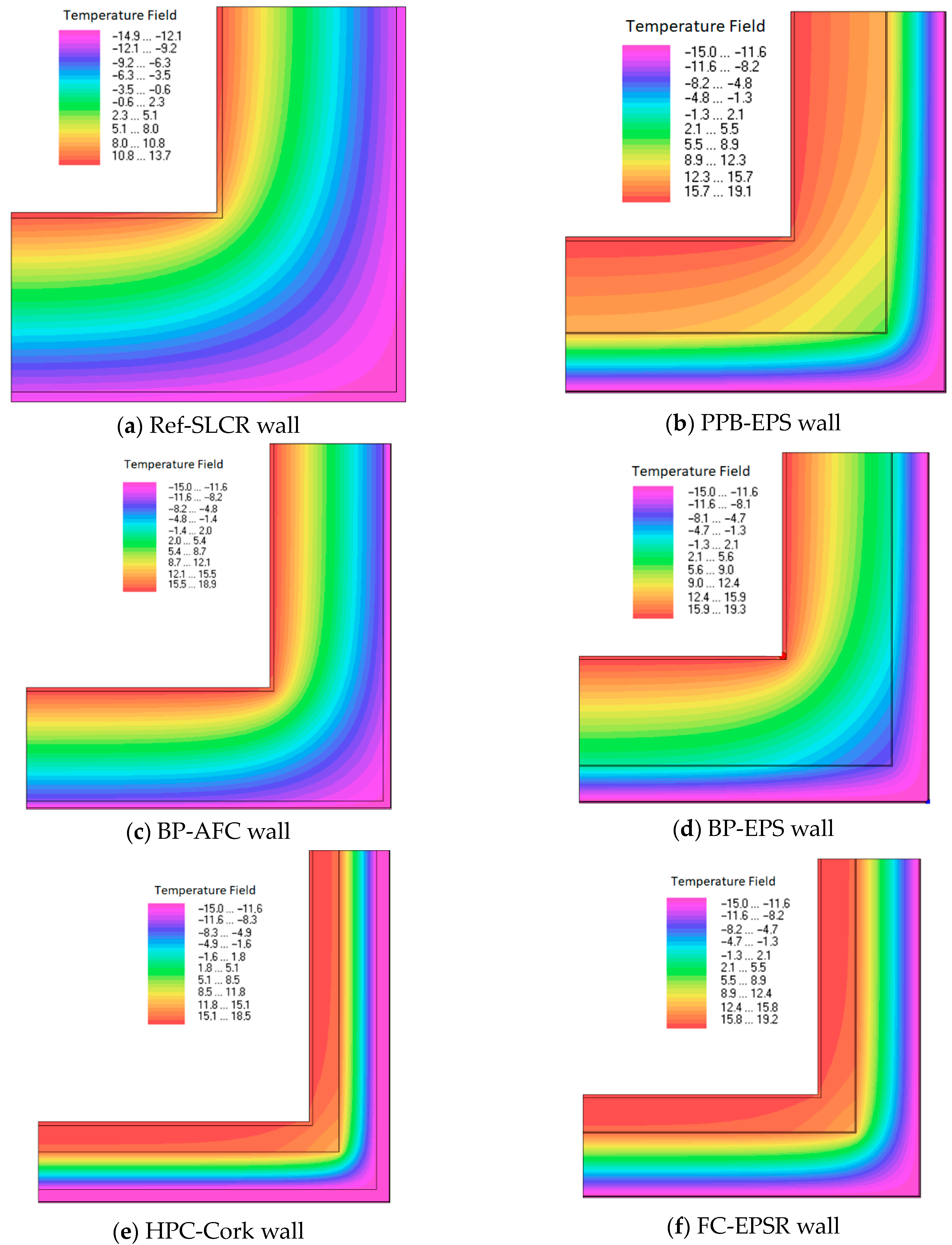
- 2D simulations show that traditional walls experience strong thermal bridging, producing low corner temperatures and extended cold zones.
- Innovative systems maintain higher isotherm continuity, reducing corner heat losses and improving envelope uniformity.
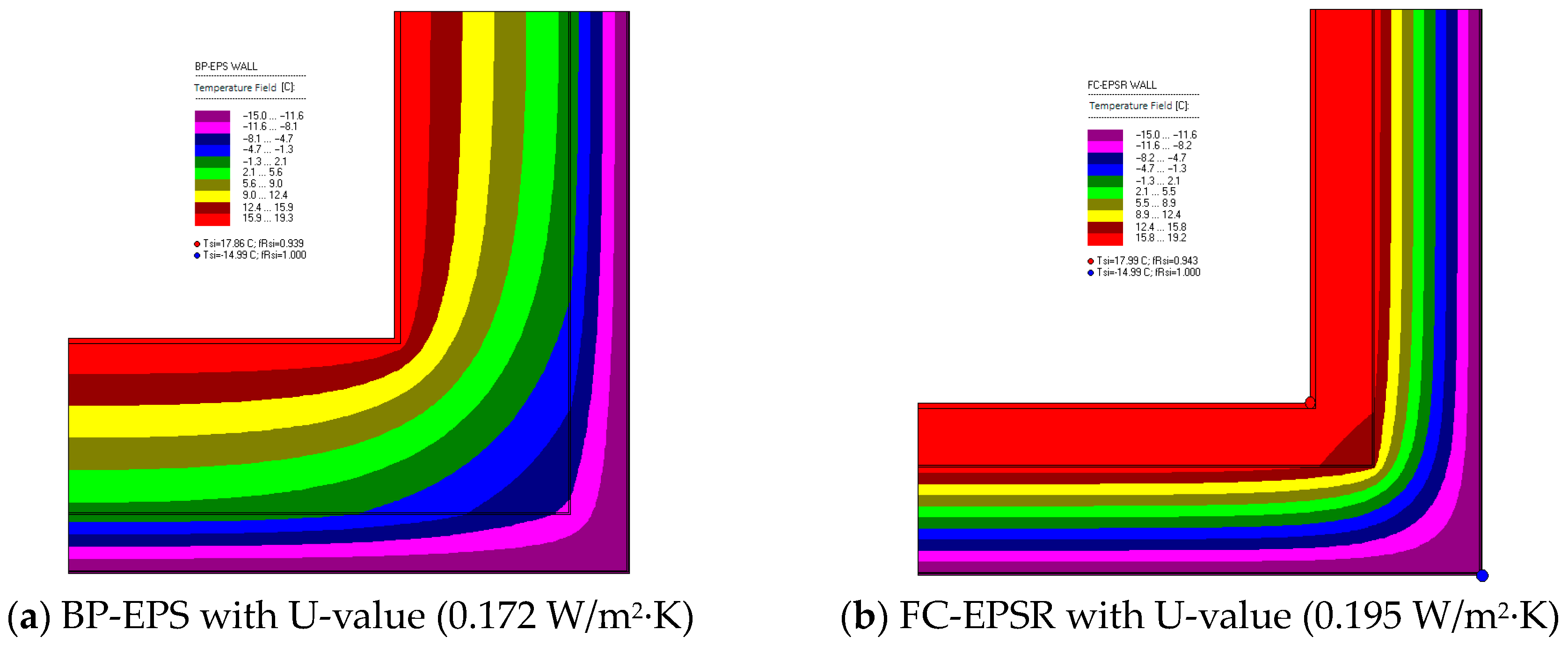
- Despite having a slightly higher U-value, FC-EPSR achieves better corner temperature (Tsi) than BP-EPS. This is due to FC-EPSR’s smoother heat-flow transitions and reduced thermal-bridge distortion.
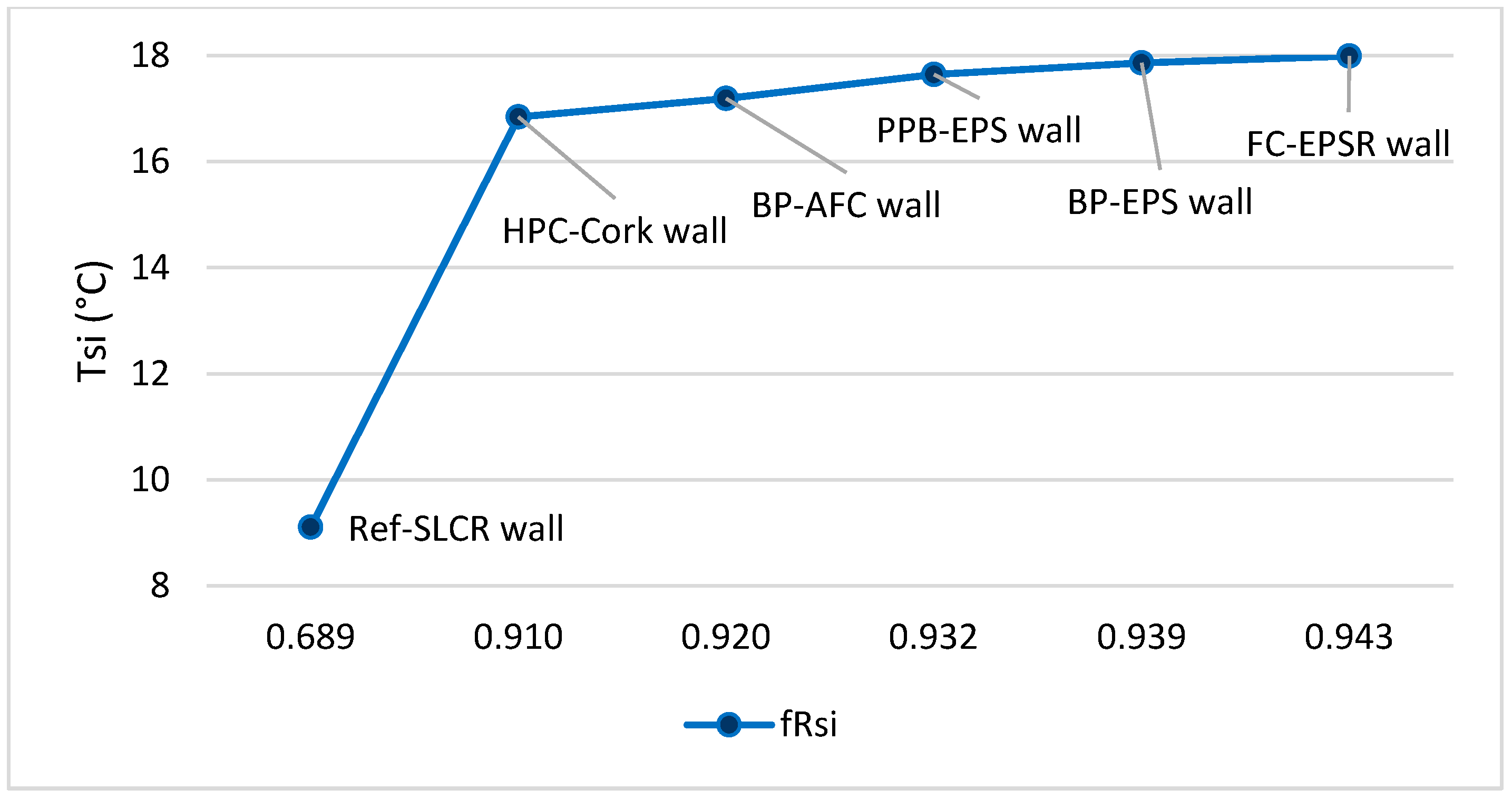
- The reference wall shows low thermal comfort (fRsi = 0.689, Tsi = 9.11 °C), representing high condensation and mould risk.
- All innovative walls exceed the critical fRsi = 0.75 threshold, achieving a Tsi of 16.84–17.99 °C, consistent with indoor comfort standards.
- Lower U-values generally result in higher Tsi, though minor deviations show the importance of a complete layer-configuration analysis.
- FC-EPSR has the lowest internal condensation fraction (~35.7%) and the highest fRsi (0.943), proving superior moisture resilience and long-term durability.
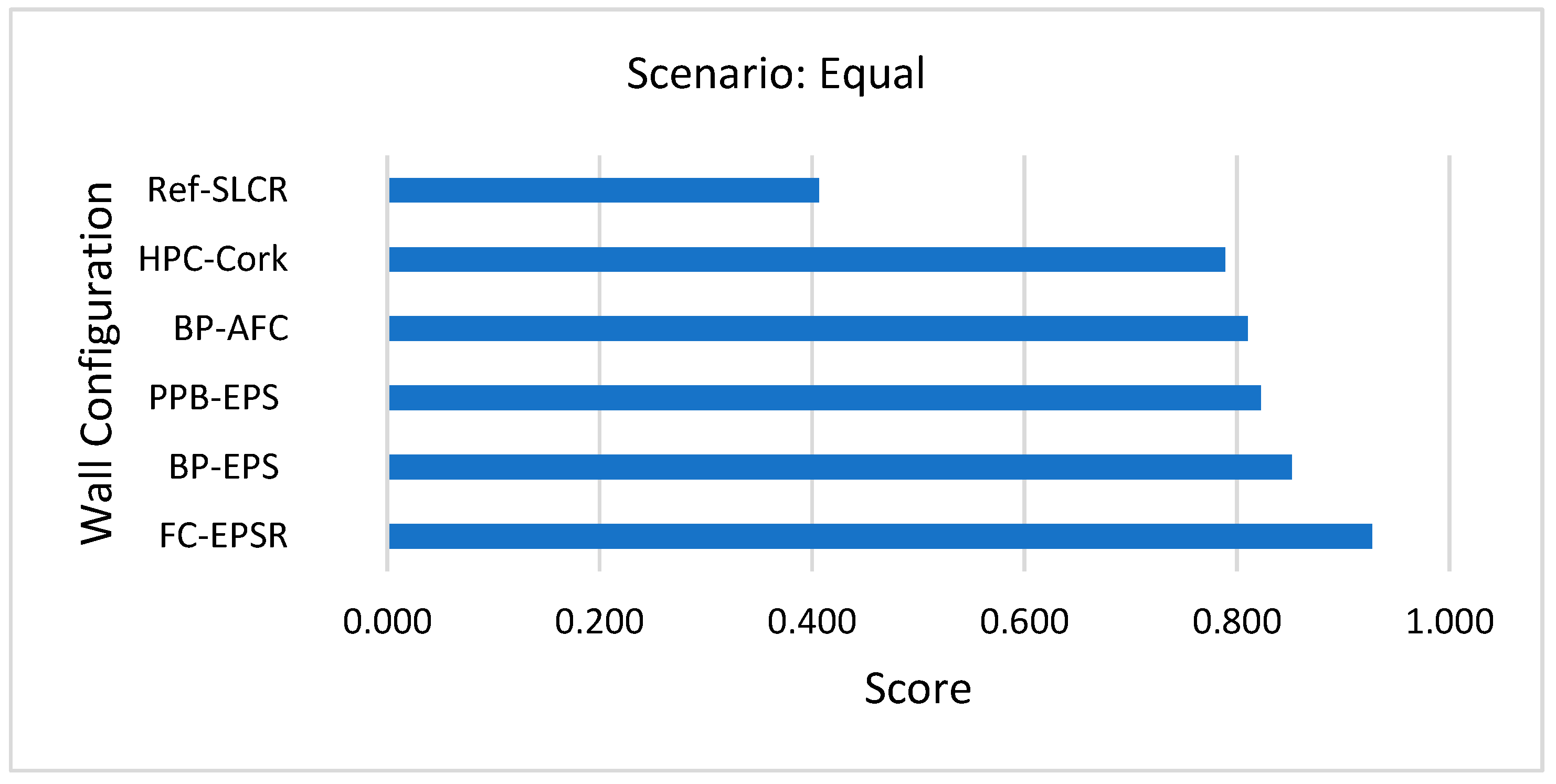
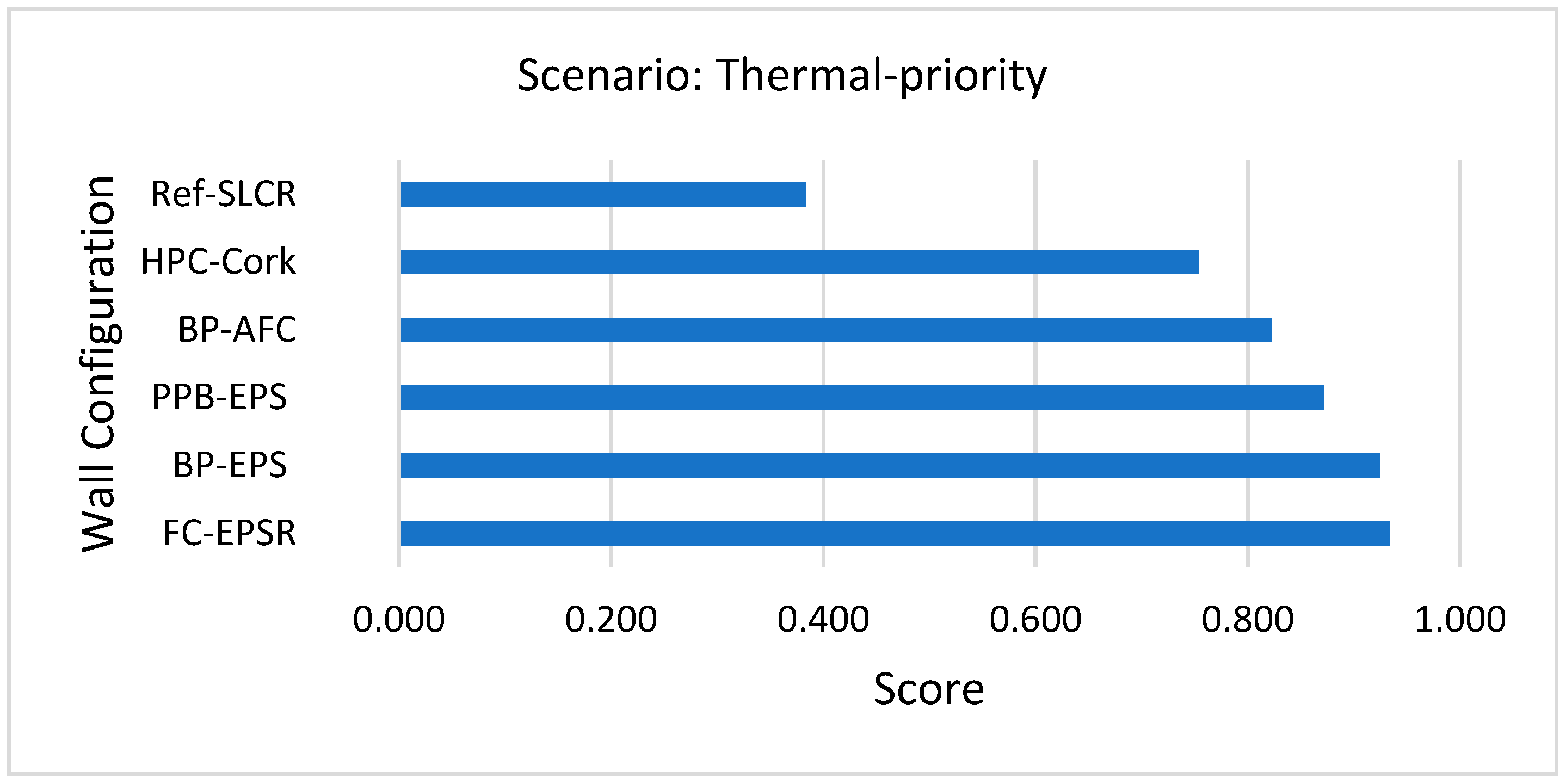
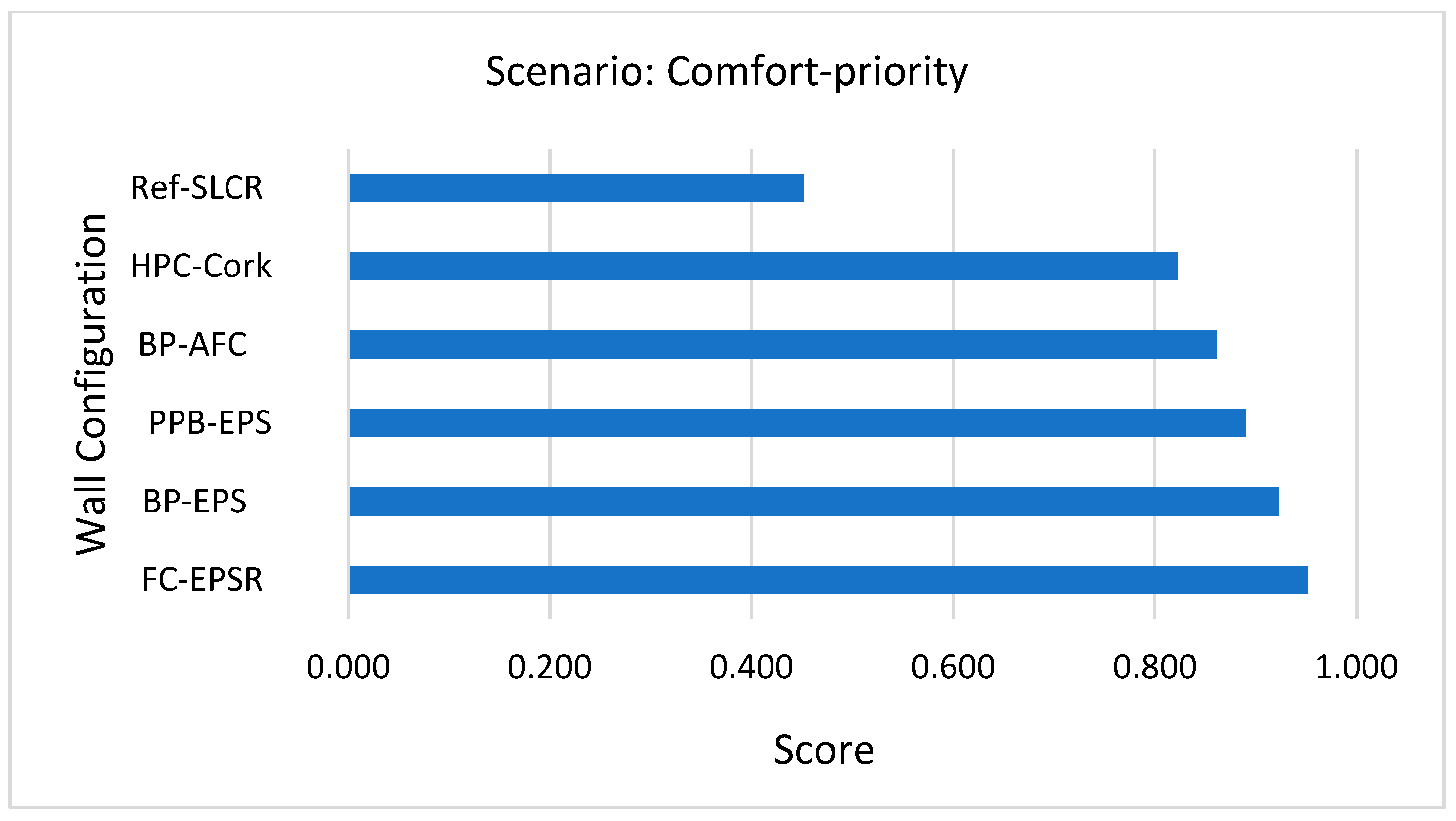
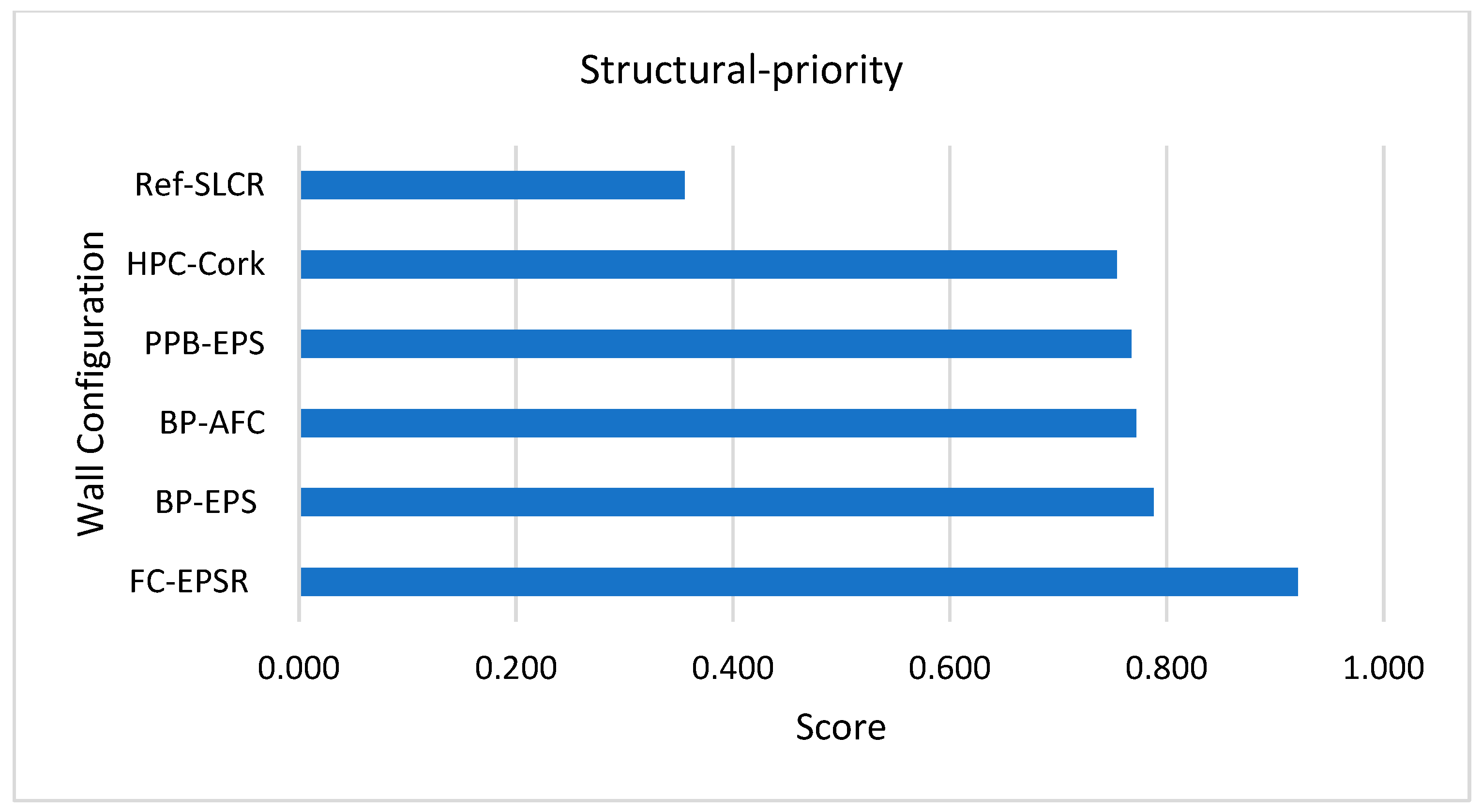
- Across all MCDM–SAW scenarios, FC-EPSR consistently ranks as the best overall performer.
- Monte-Carlo uncertainty analysis confirms FC-EPSR’s robustness, maintaining top ranking under variable weighting conditions.
- Optimised multilayer composite walls can substantially improve energy efficiency, structural feasibility, thermal comfort, and moisture safety in building retrofits.
- The FC-EPSR configuration provides the most balanced performance across all criteria, representing a highly effective solution for the adaptive reuse of industrial buildings and for achieving long-term energy and climate objectives.
- Although the BP–EPS wall system achieves the lowest corrected U-value, the results indicate that it may not represent the optimal solution when real building conditions are considered. The FC–EPSR configuration shows improved overall hygrothermal performance, with relatively higher Tsi and fRsi values and a lower condensation risk. Its enhanced behaviour at the internal corner, as observed in the 2D numerical simulations, suggests a reduction in thermal bridging effects and a potential improvement in local thermal comfort. Therefore, these findings suggest that wall performance should not be evaluated based on U-value alone, but should also consider thermal bridge effects and moisture-related behaviour.
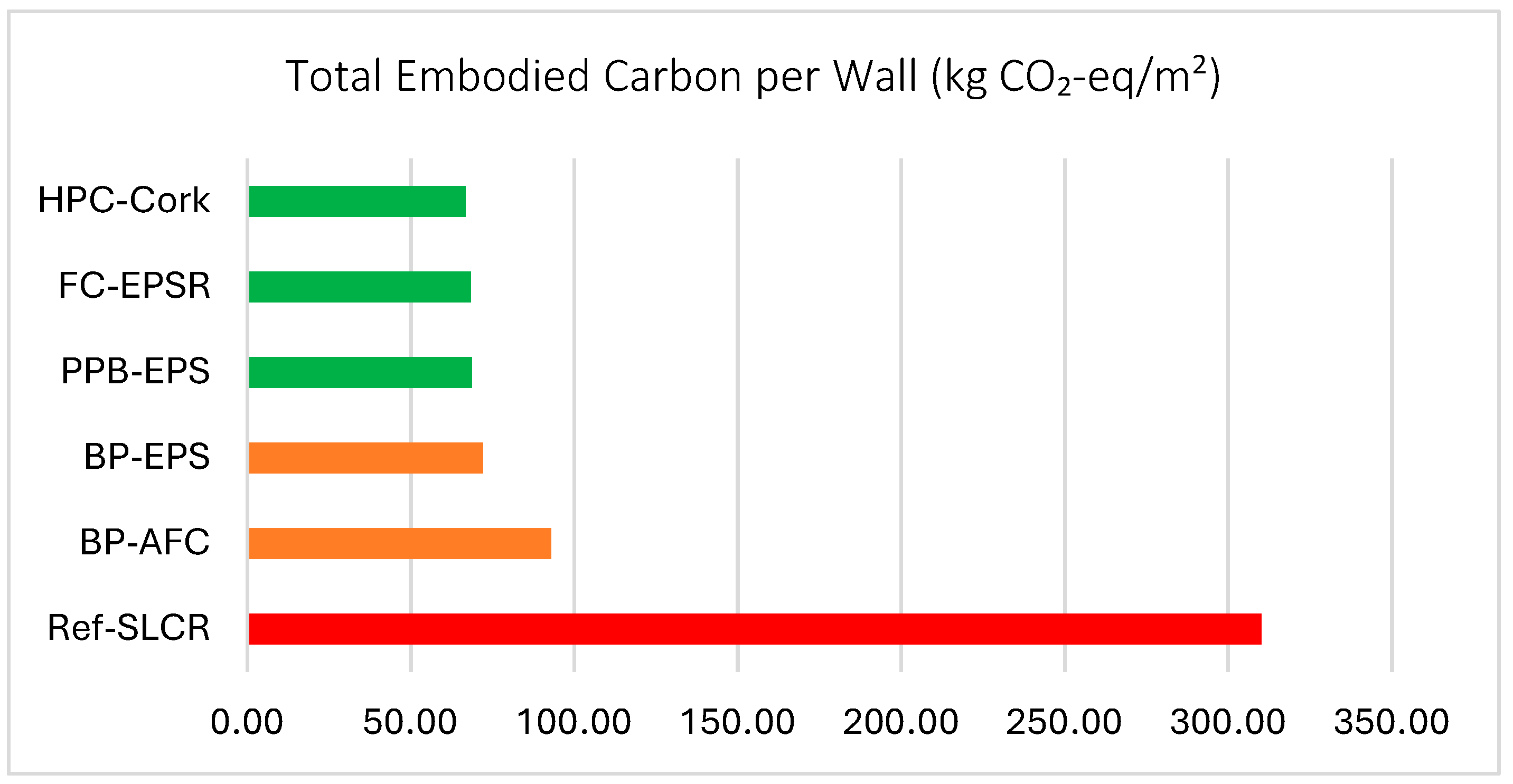
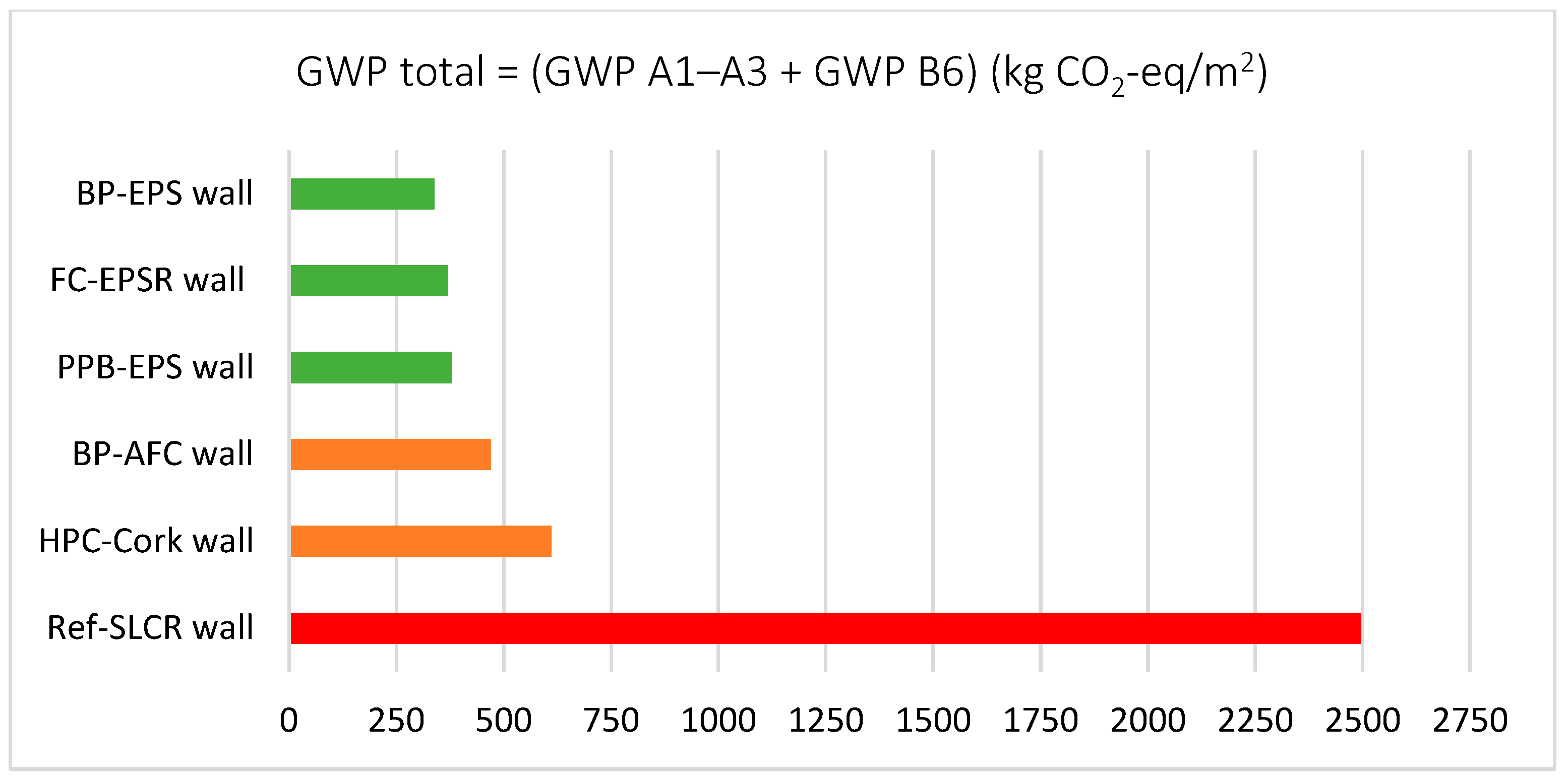
- This study evaluated six wall configurations by integrating embodied (A1–A3) and operational (B6) carbon emissions to determine their whole-life environmental performance. The results show that, for the (A1–A3) stage, innovative assemblies such as HPC-Cork, FC-EPSR, PPB-EPS, and BP-EPS achieve the lowest global warming potential, each remaining below 75 kg CO2-eq/m2, which is approximately 4.5 times lower than the conventional Ref-SLCR wall. In contrast, the reference wall exceeded 310 kg CO2-eq/m2, underscoring the carbon-intensive nature of traditional masonry and cementitious materials.
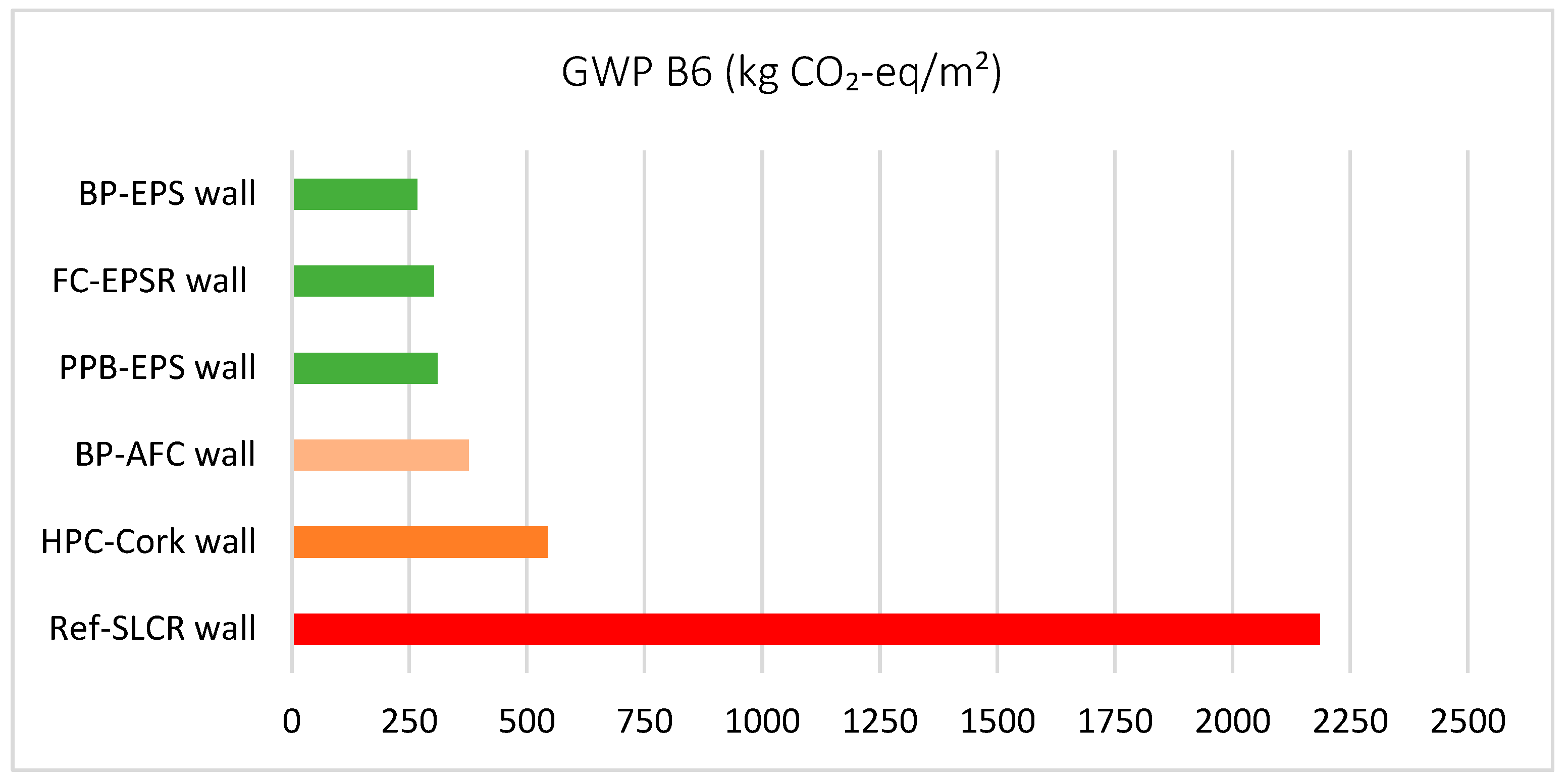
- The Ref-SLCR wall, with an embodied carbon footprint of 310.06 kg CO2-eq/m2, is comparable to some insulated alternatives, such as BP-EPS, which has a footprint of 72.11 kg CO2-eq/m2. However, when considering operational carbon emissions, the Ref-SLCR wall performs significantly worse. The results emphasise that improving thermal performance is the most effective method for reducing life cycle emissions. Even though high-performance insulated walls may have slightly higher embodied carbon, they achieve much lower carbon emissions throughout the building’s service life.
- Material selection also played a critical role in circularity. Recycled EPS, foamed concrete, high-performance concrete, ceramic bricks, and cork demonstrated notable end-of-life recovery potential, supporting EU objectives for resource efficiency and low-carbon renovation. Overall, the findings highlight that combining low-impact materials with effective insulation provides a practical and scalable pathway for reducing whole-life carbon in existing building envelopes, particularly in post-industrial European contexts.
- This study is based on steady-state 2D simulations with standardised surface resistances and no experimental validation; results should be interpreted as a comparative assessment, with caution when applied to real retrofit projects.
7.2. Recommendations
- The proposed approach will be extended to include other components of the building envelope, such as roofs, floors, ceilings, and window openings, as well as their interaction with technical building systems. This broader scope will enable a more comprehensive assessment of the overall thermal behaviour and energy performance of renovated structures. Furthermore, coupling the wall-based heat transfer model with dynamic simulations of complete building envelopes will provide deeper insights into seasonal variations, airtightness, and integrated retrofit strategies. Such developments will enhance the applicability of the presented methodology for whole-building energy optimisation in sustainable renovation projects.
- The integration of photovoltaic (PV) modules into the exterior building shell, particularly façades, will be considered as part of multifunctional envelope systems. Building-integrated photovoltaics (BIPV) can enhance on-site renewable energy generation while contributing to the thermal performance and shading of façades. The results of this study, which highlight the role of external layers and surface temperatures in reducing heat losses, demonstrate that similar principles can be applied to BIPV façades to achieve both energy efficiency and architectural integration in renovated industrial buildings.
- Future studies should also evaluate proposed systems for their economic efficiency, including life cycle cost analysis (LCCA), payback period, and net present value (NPV), to ensure long-term cost-effectiveness. This aspect is particularly relevant for post-industrial buildings, where investment decisions depend on both energy performance and financial viability. In addition, the environmental assessment should be extended to a full cradle-to-grave life cycle analysis, including end-of-life stages (C1–C4) and Beyond-Life (D), to provide a more comprehensive evaluation of long-term environmental impacts.
Author Contributions
Funding
Data Availability Statement
Conflicts of Interest
Appendix A


Appendix B

| Scenario | Tsi | fRsi | U-Value | Weight | Thickness | Top-Ranked |
|---|---|---|---|---|---|---|
| Equal | 0.20 | 0.20 | 0.20 | 0.20 | 0.20 | FC-EPSR |
| Thermal priority | 0.25 | 0.20 | 0.35 | 0.10 | 0.10 | FC-EPSR |
| Comfort priority | 0.35 | 0.25 | 0.20 | 0.10 | 0.10 | FC-EPSR |
| Structural priority | 0.15 | 0.10 | 0.15 | 0.35 | 0.25 | FC-EPSR |
References
- Yousefi, M.; Pahn, M. Experimental study on the thermal behavior of a novel wall structure composed of different layers to improve the store and supply capabilities of the wall. J. Build. Eng. 2025, 107, 112736. [Google Scholar] [CrossRef]
- Yun, W.-S.; Ryu, W.; Lee, D.; Seo, H. Energy-saving potential estimation of retrofitting aged buildings considering external wall insulation degradation. J. Build. Eng. 2024, 94, 110022. [Google Scholar] [CrossRef]
- Afsoosbiria, H.; Kubečková, D.; Musenda, O.K.; Mohamed, K. Variability of material solutions for the perimeter walls of buildings in post-industrial settlements as part of energy rehabilitation and achieving carbon neutrality. Energies 2024, 17, 6236. [Google Scholar] [CrossRef]
- Kubečková, D.; Kubenková, K.; Afsoosbiria, H.; Musenda, O.K.; Mohamed, K. External Thermal Insulation Composite Systems—Past and Future in a Sustainable Urban Environment. Sustainability 2024, 16, 8500. [Google Scholar] [CrossRef]
- Ziapour, B.M.; Khodaverdizadeh, N.; Afzal, S.; Hashtroudi, A. Enhancing building energy efficiency using a hybrid Trombe wall with PV and reflective mirrors. J. Build. Eng. 2025, 111, 113376. [Google Scholar] [CrossRef]
- Alharbey, R.A.; Daqrouq, K.O.; Alkhateeb, A. Energy exchange of inserting eco-friendly bio phase change material into the vertical walls to make the buildings energy efficient. J. Build. Eng. 2022, 56, 104777. [Google Scholar] [CrossRef]
- European Commission, Directorate-General for Energy. Stakeholder Consultation on the Renovation Wave Initiative: Synthesis Report, Directorate C—Renewables, Research and Innovation, Energy Efficiency. October 2020. Available online: https://energy.ec.europa.eu/topics/energy-efficiency/energy-efficient-buildings/renovation-wave_en (accessed on 2 May 2025).
- Broniewicz, E.; Broniewicz, M.; Skubiak, B.; Bryliński, A.; Grabowska, P. Adaptive reuse of buildings. Ekon. Sr. 2022, 4, 338–357. [Google Scholar] [CrossRef]
- Initiative, C.B. Aligning Buildings with the Paris Climate Agreement: Insights and Developments from the Green Bond Market. Aligning Buildings with a Climate-Compatible 2050, n.d. Available online: https://docslib.org/download/10613936/aligning-buildings-with-the-paris-climate-agreement-insights-and-developments-from-the-green-bond-market (accessed on 13 April 2026).
- Vardopoulos, I. Critical sustainable development factors in the adaptive reuse of urban industrial buildings: A fuzzy DEMATEL approach. Sustain. Cities Soc. 2019, 50, 101684. [Google Scholar] [CrossRef]
- Grozdanovic, N.P.; Stoiljkovic, B.; Kekovic, A.; Murgul, V. The possibilities for conversion and adaptive reuse of industrial facilities into residential dwellings. Procedia Eng. 2016, 165, 1836–1844. [Google Scholar] [CrossRef]
- Živković, M.; Kurtović-Folić, N.; Jovanović, G.; Kondić, S.; Mitković, M. Current strategies of urban and architectural conversion as a result of increased housing demands. Teh. Vjesn. 2016, 23, 561–568. [Google Scholar] [CrossRef]
- Afsoosbiria, H. Energy-Efficient Walls Used in Selected Buildings Suitable for Conversion. Doctoral Dissertation, Faculty of Civil Engineering, VŠB–Technical University of Ostrava, Ostrava, Czech Republic, 2025. [Google Scholar]
- Banti, N. Existing industrial buildings—A review on multidisciplinary research trends and retrofit solutions. J. Build. Eng. 2024, 84, 108615. [Google Scholar] [CrossRef]
- Nejat, P.; Jomehzadeh, F.; Taheri, M.M.; Gohari, M.; Majid, M.Z.A. A global review of energy consumption, CO2 emissions and policy in the residential sector. Renew. Sustain. Energy Rev. 2015, 43, 843–862. [Google Scholar] [CrossRef]
- Moradi, S.; Hirvonen, J.; Lastovets, N.; Sormunen, P. Energy efficiency through building renovation: A study of challenges and solutions. In Proceedings of the 1st International Conference on Net-Zero Built Environment NTZR 2024; Kioumarsi, M., Shafei, B., Eds.; Lecture Notes in Civil Engineering; Springer: Cham, Switzerland, 2025; Volume 237. [Google Scholar] [CrossRef]
- Camarasa, C.; Mata, É.; Navarro, J.P.J.; Reyna, J.; Bezerra, P.; Angelkorte, G.B.; Feng, W.; Filippidou, F.; Forthuber, S.; Harris, C.; et al. A global comparison of building decarbonization scenarios by 2050 towards 1.5–2 °C targets. Nat. Commun. 2022, 13, 3077. [Google Scholar] [CrossRef]
- El Sayed El Said Mohamed, S.; Ismail, A.Y. Building Conversion to An Energy Efficient Building. Int. J. Eng. Res. Technol. 2021, 9. [Google Scholar] [CrossRef]
- Manioğlu, G.; Yılmaz, Z. Economic evaluation of the building envelope and operation period of heating system in terms of thermal comfort. Energy Build. 2006, 38, 266–272. [Google Scholar] [CrossRef]
- Pieczka, M.; Wowrzeczka, B. Art in Post-Industrial Facilities—Strategies of Adaptive Reuse for Art Exhibition Function in Poland. Buildings 2021, 11, 487. [Google Scholar] [CrossRef]
- Jóźwik, R. The problem of urban redevelopment of the post-industrial King’s Cross central area in London. Bud. Archit. 2018, 17, 63–69. [Google Scholar] [CrossRef]
- Pszczółkowski, M. Adaptation problems of the post-industrial heritage on the example of selected objects of Bydgoszcz. Civ. Environ. Eng. Rep. 2016, 22, 145–156. [Google Scholar] [CrossRef][Green Version]
- Sikorski, D.; Smętkiewicz, K. The contemporary transformation of post-industrial areas in post-socialist Polish cities: Case studies from Wrocław (Kleczków) and Kraków (Zabłocie). Stud. Reg. Lokal. 2024, 3, 22–38. [Google Scholar] [CrossRef]
- Bosák, V.; Nováček, A.; Slach, O. Industrial culture as an asset, barrier and creative challenge for restructuring of old industrial cities: Case study of Ostrava (Czechia). GeoScape 2018, 12, 52–64. [Google Scholar] [CrossRef]
- Reports, M.G. Moravian Geographical Reports 14; Institute of Geonics, Czech Academy of Sciences: Brno, Czech Republic, 2006; ISSN 1210-8812. [Google Scholar]
- POHO2030, Jan Karel Industrial Park. 2025. Available online: https://poho2030.cz/en/projekty/industrialni-park-jan-karel/ (accessed on 1 June 2025).
- Popelka, P.; Popelková, R.; Mulková, M. Black or Green Land? Industrialisation and Landscape Changes of the Ostrava–Karviná Mining District in the 19th and 20th Century; University of Ostrava: Ostrava, Czech Republic, 2016; ISBN 978-80-7464-823-6. [Google Scholar]
- POHO Park, Důl Gabriela v Karviné. Available online: https://www.kudyznudy.cz/aktivity/poho-park-dul-gabriela-v-karvine (accessed on 1 June 2025).
- Jančák, V.; Kupková, L.; Chromý, P. Land Use/Cover Changes in Selected Regions in the World; IGU-LUCC Research Reports; International Geographical Union: Cape Town, South Africa, 2021; Volume XVI, ISBN 978-4-907651-17-6. [Google Scholar]
- Marschalko, M.; Raclavský, K.; Dirner, V. Evaluation of landscape element changes by means of GIS in former mining districts of Ostrava-Jih, Vítkovice, Moravská and Slezská Ostrava, Přívoz, Radvanice and Bartovice. In Sborník Vědeckých Prací Vysoké Školy Báňské; Řada Hornicko-Geologická, Technické Univerzity Ostrava: Ostrava, Czech Republic, 2006; Volume 52, pp. 9–23. ISSN 0474-8476. [Google Scholar]
- Matěj, M.; Ryšková, M. Methodology for the Evaluation and Protection of Industrial Heritage from the Perspective of Heritage Management; Specialist and Methodological Publications; National Heritage Institute: Ostrava, Czech Republic, 2018; Volume 100. [Google Scholar]
- Havrlant, J.; Krtička, L. Reclamation of devastated landscape in the Karviná region (Czech Republic). Environ. Socio-Econ. Stud. 2014, 2, 1–12. [Google Scholar] [CrossRef][Green Version]
- Euroace. Buildings in the Fit for 55 Package for a Climate Neutral Economy in 2050. Energy Efficient Buildings. 2023. Available online: https://build-up.ec.europa.eu/system/files/2023-06/23-06-01_Buildings_FF55_Update.pdf (accessed on 13 April 2026).
- Energy Performance of Buildings Directive (EPBD), Implementation Guide. 2024. Available online: https://efficientbuildings.eu/wp-content/uploads/2024/11/Efficient-Buildings-Europe-Implementation-Guide-2024_online.pdf (accessed on 13 April 2026).
- European Parliament and Council. Energy Efficiency. Council Directive 2012/27/EU of 25 October 2012. 2012. Available online: https://eur-lex.europa.eu/legal-content/EN/NIM/?uri=celex:32012L0027 (accessed on 1 March 2021).
- European Commission. Directive No. 264/2020 on the Energy Performance of Buildings. 2020. Available online: https://energy.ec.europa.eu/topics/energy-efficiency/energy-efficient-buildings/energy-performance-buildings-directive_en (accessed on 8 December 2024).
- Pomponi, F.; Moncaster, A. Circular economy for the built environment: A research framework. J. Clean. Prod. 2017, 143, 710–718. [Google Scholar] [CrossRef]
- Patil, S.; Choudhary, A.; Pawar, M.; Patil, K.; Pawar, M. An overview of study on smart construction materials and advanced construction techniques. Int. J. Eng. Sci. Adv. Comput. Bio-Technol. 2022, 12, 29574–29576. [Google Scholar]
- Chandrasekaran, V.; Dvarioniene, V.; Vitkute, A.; Gecevicius, G. Environmental impact assessment of renovated multi-apartment building using LCA approach: Case study from Lithuania. Sustainability 2021, 13, 1542. [Google Scholar] [CrossRef]
- Abdeen, A.; Mushtaha, E.; Hussien, A.; Ghenai, C.; Maksoud, A.; Belpoliti, V. Simulation-based multi-objective genetic optimization for promoting energy efficiency and thermal comfort in existing buildings of hot climate. Results Eng. 2024, 21, 101815. [Google Scholar] [CrossRef]
- Farhanieh, B.; Sattari, S. Simulation of energy saving in Iranian buildings using integrative modelling for insulation. Renew. Energy 2006, 31, 417–425. [Google Scholar] [CrossRef]
- Daniel, S.; Ghiaus, C. Multi-criteria decision analysis for energy retrofit of residential buildings: Methodology and feedback from real application. Energies 2023, 16, 902. [Google Scholar] [CrossRef]
- Caruso, M.; Pinho, R.; Bianchi, F.; Cavalieri, F.; Lemmo, M.T. Multi-criteria decision-making approach for optimal seismic/energy retrofitting of existing buildings. Earthq. Spectra 2023, 39, 191–217. [Google Scholar] [CrossRef]
- Villalba, P.; Sánchez-Garrido, A.J.; Yepes, V. A review of multi-criteria decision-making methods for building assessment, selection, and retrofit. J. Civ. Eng. Manag. 2024, 30, 465–480. [Google Scholar] [CrossRef]
- Ongpeng, J.M.C.; Rabe, B.I.B.; Razon, L.F.; Aviso, K.B.; Tan, R.R. A multi-criterion decision analysis framework for sustainable energy retrofit in buildings. Energy 2022, 239, 122315. [Google Scholar] [CrossRef]
- Jafari, A.; Valentin, V. Selection of optimization objectives for decision-making in building energy retrofits. Build. Environ. 2018, 130, 94–103. [Google Scholar] [CrossRef]
- Taherdoost, H. Analysis of Simple Additive Weighting Method (SAW) as a multi-attribute decision-making technique: A step-by-step guide. J. Manag. Sci. Eng. Res. 2023, 6, 21–24. [Google Scholar]
- Sigalingging, E.D.; Erlina, E.; Muda, I.; Herubawa, D.A. Application of the Simple Additive Weighting Method in the performance assessment of energy companies based on ROA and DAR. J. Theor. Appl. Inf. Technol. 2024, 102, 22. [Google Scholar]
- Nguyen, T.N.; Hoang, T.K.V.; Dung, N.T.T.; Bui, Q.L. The implementation of Simple Additive Weighting method in choosing wall bricks. J. Eng. Sci. Adv. Comput. Bio-Technol. 2024, 12, 1. [Google Scholar]
- Pracovní Postup Cemix: Sádrové Omítky. Available online: https://www.izomat.cz/out/media/pp_sadrove_omitky.pdf (accessed on 7 June 2025).
- Moura, B.; da Silva, T.R.; Soares, N.; Monteiro, H. Eco-efficiency of concrete sandwich panels with different insulation core materials. Sustainability 2025, 17, 1687. [Google Scholar] [CrossRef]
- Wei, J.; Wang, T.; Zhong, Y.; Zhang, Y.; Leung, C.K.Y. Performance evaluation of foamed concrete with lightweight aggregate: Strength, shrinkage, and thermal conductivity. Materials 2024, 17, 3869. [Google Scholar] [CrossRef] [PubMed]
- Manual for TEPLO 2017 Program. Available online: https://kps.fsv.cvut.cz/index.php?lmut=cz&part=people&id=52&sub=369 (accessed on 13 April 2026).
- Ponechal, R.; Rybárik, J. Study of summer overheating on the new masonry self-insulating block. In Proceedings of enviBUILD 2019, Buildings and Environment; Slovak University of Technology: Bratislava, Slovakia; pp. 134–139. Available online: https://www.researchgate.net/publication/346791559_STUDY_OF_SUMMER_OVERHEATING_ON_THE_NEW_MASONRY_SELF-INSULATING_BLOCK (accessed on 13 April 2026).
- Tenapors Neo EPS 70. Available online: https://www.tenapors.lv/en/product/tenapors-neo-eps-70-en (accessed on 30 September 2024).
- Fiber Mesh Reinforcing. Available online: https://www.fiberglassscreen.org/fiberglassmesh/fiber-mesh-reinforcing.htm (accessed on 30 September 2024).
- Baumaster Mosaic Plaster. Available online: https://baumaster.eu/en/products/thermal-insulation/mosaic-plaster (accessed on 30 September 2024).
- Zukowski, M.; Haese, G. Experimental and numerical investigation of a hollow brick filled with perlite insulation. Energy Build. 2010, 42, 1402–1408. [Google Scholar] [CrossRef]
- Yang, J.; Wu, H.; Liang, Y.; Cen, J.; Zhang, X. A comparative assessment of different aerogel-insulated building walls for enhanced thermal insulation performance. Gels 2023, 9, 943. [Google Scholar] [CrossRef]
- ISO 10211:2017; Thermal Bridges in Building Construction—Heat Flows and Surface Temperatures—Detailed Calculations. International Organization for Standardization (ISO): Geneva, Switzerland, 2017. Available online: https://www.iso.org/standard/65710.html (accessed on 13 April 2026).
- Manual for AREA 2017 Program. 2024. Available online: https://kps.fsv.cvut.cz/index.php?lmut=cz&part=people&id=52&sub=357 (accessed on 13 April 2026).
- ČSN EN ISO 6946; Tepelné Vlastnosti Konstrukcí a Budov—Tepelný Odpor a Součinitel Prostupu Tepla—Výpočtová Metod. ČNI Praha: Prague, Czech Republic, 2008.
- ISO 13788:2012; Hygrothermal Performance of Building Components and Building Elements—Internal Surface Temperature to Avoid Critical Surface Humidity and Interstitial Condensation—Calculation Methods. International Organization for Standardization: Geneva, Switzerland, 2020.
- ČSN 730540; Thermal Protection of Buildings, Part 1, 3 and 4. Czech Technical Standard: Prague, Czech Republic, 2007.
- STN 730540; Thermal Protection of Buildings, Part 2 and 3. Slovak Office of Standards Metrology & Testing (UNMS): Bratislava, Slovakia, 2012.
- Hamza, N. Double versus single skin facades in hot arid areas. Energy Build. 2008, 40, 240–248. [Google Scholar] [CrossRef]
- ISO 6946:2017; Building Components and Building Elements—Thermal Resistance and Thermal Transmittance—Calculation Methods, 3rd ed. International Organization for Standardization: Geneva, Switzerland, 2022.
- Šála, J. Interpretation of Provisions of the Czech Standard ČSN 73 0540 Thermal Protection of Buildings for Residential Wooden Houses and Design Recommended Practice; Prague, Czech Republic, 2007. Available online: https://mpo.gov.cz/assets/dokumenty/32933/36506/408874/priloha003.pdf (accessed on 7 June 2025).
- Kosny, J.; Desjarlais, A.O. Influence of architectural details on the overall thermal performance of residential wall systems. J. Therm. Insul. Build. Envel. 1994, 18, 53–69. [Google Scholar] [CrossRef]
- Paz-Pérez, J.A.; López-Guerrero, R.E.; Carpio, M. Evaluating the impact of thermal bridges on the thermal performance of concrete and mass timber buildings: Case study in Chile. Case Stud. Therm. Eng. 2025, 74, 107014. [Google Scholar] [CrossRef]
- Passive House Institute. Criteria and Algorithms for Certified Passive House Components: Opaque Construction Systems. Version 3.0_en. 17 September 2020. Available online: https://cms.passivehouse.com/media/filer_public/c9/17/c917b947-7ab8-4599-ad05-623c3e634040/03_certification_criteria_construction_systems_en.pdf (accessed on 7 June 2025).
- New Zealand Green Building Council. Thermal Bridge Reference Document. February 2023. Available online: https://23159811.fs1.hubspotusercontent-na1.net/hubfs/23159811/Thermal%20Bridge%20Reference%20Document.pdf (accessed on 7 June 2025).
- Passive House Institute. Criteria for Certified Passive House Components: Attic Staircase. Version 1.0. 17 November 2014. Available online: https://database.passivehouse.com/Media/certified_components_v2/component/model/icons/03_zertifizierungskriterien_dachbodentreppe_en.pdf (accessed on 7 June 2025).
- Thermal Insulation, Durability, and Applications in Construction. Available online: https://www.stabalux.com/wp-content/uploads/PDF/en/9.0%20Stabalux_Wissenswertes%20Holz_EN.pdf (accessed on 7 June 2025).
- Citterio, M.; Cocco, M.; Erhorn-Kluttig, H. Thermal Bridges in the EPBD Context: Overview on Member States’ Approaches in Regulations, European Project ASIEPI, Italian National Agency for New Technologies, Energy and Environment (ENEA), and Fraunhofer Institute of Building Physics, Germany. 2008. Available online: https://build-up.ec.europa.eu/sites/default/files/P064_EN_ASIEPI_WP4_IP1_p3073.pdf (accessed on 13 April 2026).
- Liu, Z.A.; Hou, J.; Chen, Y.; Liu, Z.; Zhang, T.; Zeng, Q.; Dewancker, B.J.; Meng, X.; Jiang, G. Effectiveness assessment of different kinds/configurations of phase-change materials (PCM) for improving the thermal performance of lightweight building walls in summer and winter. Renew. Energy 2023, 202, 721–735. [Google Scholar] [CrossRef]
- Marwan, M. The effect of wall material on energy cost reduction in building. Case Stud. Therm. Eng. 2020, 17, 100573. [Google Scholar] [CrossRef]
- Yehya, N.; Charaf, H.; Maatouk, C. Numerical analysis of phase-change material integration in building envelopes: A case study in Lebanon. Buildings 2025, 15, 1369. [Google Scholar] [CrossRef]
- Han, Y.; He, Z.; Wu, S.; Liu, Y.; Lian, Y.; Wang, C.; Feng, J.; Zhou, Z. Enhancing building energy efficiency with thermal mass optimization. Adv. Appl. Energy 2025, 18, 100224. [Google Scholar] [CrossRef]
- Alayed, E.; Bensaid, D.; O’Hegarty, R.; Kinnane, O. Thermal mass impact on energy consumption for buildings in hot climates: A novel finite element modelling study comparing building constructions for arid climates in Saudi Arabia. Energy Build. 2022, 271, 112324. [Google Scholar] [CrossRef]
- Reilly, A.; Kinnane, O. The impact of thermal mass on building energy consumption. Appl. Energy 2017, 198, 108–121. [Google Scholar] [CrossRef]
- Stazi, F.; Ulpiani, G.; Pergolini, M.; Di Perna, C.; D’Orazio, M. The role of wall layers properties on the thermal performance of ventilated facades: Experimental investigation on narrow-cavity design. Energy Build. 2020, 209, 109622. [Google Scholar] [CrossRef]
- Leccese, F.; Salvadori, G.; Asdrubali, F.; Gori, P. Passive thermal behaviour of buildings: Performance of external multi-layered walls and influence of internal walls. Appl. Energy 2018, 225, 1078–1089. [Google Scholar] [CrossRef]
- Wang, D.; Yu, W.; Zhao, X.; Dai, W.; Ruan, Y. The influence of thermal insulation position in building exterior walls on indoor thermal comfort and energy consumption of residential buildings in Chongqing. IOP Conf. Ser. Earth Environ. Sci. 2016, 40, 012081. [Google Scholar] [CrossRef]
- Panjaitan, M.I. Simple Additive Weighting (SAW) method in determining beneficiaries of foundation benefits. J. Teknol. Komput. 2019, 13, 19–25. [Google Scholar]
- Podvezko, V. The comparative analysis of MCDA methods SAW and COPRAS. Eng. Econ. 2011, 22, 134–146. [Google Scholar] [CrossRef]
- Trzaskalik, T.; Wachowicz, T. Multiple Criteria Decision Making ’10–11: Scientific Publications; Publisher of The University of Economics in Katowice: Katowice, Poland, 2011; ISBN 978-83-7246-722-5. ISSN 2084-1531. [Google Scholar]
- Tzeng, G.-H.; Huang, J.-J. Multiple Attribute Decision Making: Methods and Applications; Taylor & Francis Group: Abingdon, UK; CRC Press: Boca Raton, FL, USA, 2011; ISBN 978-1-4398-6157-8. [Google Scholar]
- Bozorg-Haddad, O.; Loáiciga, H.; Zolghadr-Asli, B. A Handbook on Multi-Attribute Decision-Making Methods; John Wiley & Sons: Hoboken, NJ, USA, 2021. [Google Scholar] [CrossRef]
- Więckowski, J.; Sałabun, W. Sensitivity analysis approaches in multi-criteria decision analysis: A systematic review. Appl. Soft Comput. 2023, 148, 110915. [Google Scholar] [CrossRef]
- Llantoy, N.; Chàfer, M.; Cabeza, L.F. A comparative life cycle assessment (LCA) of different insulation materials for buildings in the continental Mediterranean climate. Energy Build. 2020, 225, 110323. [Google Scholar] [CrossRef]
- Asdrubali, F.; Grazieschi, G.; Roncone, M.; Thiebat, F.; Carbonaro, C. Sustainability of building materials: Embodied energy and embodied carbon of masonry. Energies 2023, 16, 1846. [Google Scholar] [CrossRef]
- Kayan, B.A.; Jitilon, D.S.K.; Azaman, M.N.M. Low carbon of lime plaster repair: Life cycle assessment approach in achieving sustainable maintenance management for heritage buildings. J. Cult. Herit. Manag. Sustain. Dev. 2021, 11, 596–613. [Google Scholar] [CrossRef]
- Kayan, B.A.; Konar, S.N.M.; Ibrahim, Z.; Razali, N.; Forster, A.M. Environmental maintenance appraisal on lime-based mortar repair for heritage buildings conservation. Plan. Malays. 2024, 22, 288–302. [Google Scholar] [CrossRef]
- Czernik, S.; Marcinek, M.; Michałowski, B.; Piasecki, M.; Tomaszewska, J.; Michalak, J. Environmental footprint of cementitious adhesives—Components of ETICS. Sustainability 2020, 12, 8998. [Google Scholar] [CrossRef]
- Baptista, J.F.; Kokare, S.; Francisco, A.V.; Godina, R.; Aelenei, D. A comparative life cycle assessment of ETICS and ventilated façade systems with timber cladding. Energy Build. 2024, 304, 113842. [Google Scholar] [CrossRef]
- Alasmar, R.; Schwartz, Y.; Burman, E. An evaluation of embodied carbon emissions of building materials in Jordanian dwellings, SimBuild 2024. In Proceedings of the Eleventh National Conference of IBPSA-USA, Denver, CO, USA, 21–23 May 2024; Institute for Environmental Design and Engineering, UCL: London, UK, 2024. [Google Scholar]
- Kinnane, O.; O’Hegarty, R.; Reilly, A. What is sustainable or low impact concrete? Acad. J. Civ. Eng. 2019, 37, 621–626. [Google Scholar]
- Zimele, Z.; Sinka, M.; Korjakins, A.; Bajare, D.; Sahmenko, G. Life cycle assessment of foam concrete production in Latvia. Environ. Clim. Technol. 2019, 23, 70–84. [Google Scholar] [CrossRef]
- Environmental Product Declaration (EPD) for Construction Product No. 007245. Available online: https://www.zag.si/wp-content/uploads/zag/epd/007245_a35808cc1ea8ead80c392cae86057c0e.dat (accessed on 7 June 2025).
- Larivière-Lajoie, R.; Blanchet, P.; Amor, B. Evaluating the importance of the embodied impacts of wall assemblies in the context of a low environmental impact energy mix. Build. Environ. 2022, 207, 108534. [Google Scholar] [CrossRef]
- Orr, J. Calculation of Carbon Footprint Values for Masonry Walls Constructed Using Wi System and HBP Blocks Compared with Traditional Windposts, Traditional Precast Concrete Lintels, and Standard Block; Report A27150-001; Version 2.5; Wembley Innovation Ltd.: Wembley, UK; Haughley Block Plant Ltd.: Suffolk, UK, 2023. [Google Scholar]
- Orr, J.; Gibbons, O.; Arnold, W. Climate Emergency: Calculating Embodied Carbon—A Brief Guide to Calculating Embodied Carbon, The Structural Engineer, Institution of Structural Engineers. July 2020. Available online: https://www.istructe.org/IStructE/media/Public/TSE-Archive/2020/A-brief-guide-to-calculating-embodied-carbon.pdf (accessed on 13 April 2026).
- Hammond, G.P.; Jones, C.I. Embodied energy and carbon in construction materials. Proc. Inst. Civ. Eng. Energy 2008, 161, 87–98. [Google Scholar] [CrossRef]
- Hammond, G.; Jones, C. Bath Inventory of Carbon and Energy (ICE) Database, Version 4; University of Bath: Bath, UK, 2010. [Google Scholar]
- Hammond, G.; Jones, C. Embodied Carbon: The Inventory of Carbon and Energy (ICE); Lowrie, F., Tse, P., Eds.; BSRIA and University of Bath: Bath, UK, 2011. [Google Scholar]
- Kunič, R. Carbon footprint of thermal insulation materials in building envelopes. Energy Effic. 2017, 10, 1511–1528. [Google Scholar] [CrossRef]
- Hammond, G.; Jones, C. Inventory of Carbon & Energy (ICE), Version 2.0: Summary Tables; Sustainable Energy Research Team (SERT), Department of Mechanical Engineering; University of Bath: Bath, UK, 2011. [Google Scholar]
- Institute, P. Perlite: The Most Sustainable Insulation Solution for Buildings. 2023. Available online: www.perlite.org (accessed on 13 April 2026).
- Liu, M.; Zhu, G.; Tian, Y. The historical evolution and research trends of life cycle assessment. Green Carbon 2024, 2, 425–437. [Google Scholar] [CrossRef]
- ISO 14040:2006; Environmental Management—Life Cycle Assessment—Principles and Framework. International Organization for Standardization: Geneva, Switzerland, 2006.
- ISO 14044:2006; Environmental Management—Life Cycle Assessment—Requirements and Guidelines. International Organization for Standardization: Geneva, Switzerland, 2006.
- Bribián, I.Z.; Capilla, A.V.; Usón, A.A. Life cycle assessment of building materials: Comparative analysis of energy and environmental impacts and evaluation of the eco-efficiency improvement potential. Build. Environ. 2011, 46, 1133–1140. [Google Scholar] [CrossRef]
- Afsoosbiria, H.; Afsoosbiria, H.; Machowska, A. Optimizing building sustainability: A life-cycle CO2 emissions assessment of novel and conventional insulation wall materials. In Proceedings of the International Conference Synergy of Architecture and Civil Engineering SINARG 2025; Faculty of Civil Engineering and Architecture: Split, Croatia, 2025; Volume 1, pp. 197–208. [Google Scholar] [CrossRef]
- Afsoosbiria, H.; Machowska, A. Development of sustainable concrete using by-products as a green material, and potential solutions for sustainability in mass concrete construction—Comprehensive review. Sustainability 2025, 17, 9983. [Google Scholar] [CrossRef]
- Afsoosbiria, H.; Afsoosbiria, H.; Machowska, A. Life cycle assessment of novel materials for low-carbon concrete production. In Proceedings of the International Conference Synergy of Architecture and Civil Engineering SINARG 2025; Faculty of Civil Engineering and Architecture: Split, Croatia, 2025; Volume 1, pp. 371–382. [Google Scholar] [CrossRef]
- EN 832:1998/AC:2002; Thermal Performance of Buildings—Calculation of Energy Use for Heating—Residential Buildings. CEN: Brussels, Belgium, 2008.
- Koffi, B.; Cerutti, A.; Duerr, M.; Iancu, A.; Kona, A.; Janssens-Maenhout, G. CoM Default Emission Factors for the Member States of the European Union—Version 2017, European Commission, Joint Research Centre (JRC) Dataset. 2017. Available online: http://data.europa.eu/89h/jrc-com-ef-comw-ef-2017 (accessed on 13 April 2026).
- Persson, L. A Comparison Between Embodied and Operational Carbon in a Building Envelope from a Life Cycle Perspective; KTH Royal Institute of Technology: Stockholm, Sweden, 2022; Available online: https://www.diva-portal.org/smash/record.jsf?pid=diva2%3A1697898&dswid=9804 (accessed on 13 April 2026).
- Yazicioglu, F.; Kus, H. A comparative analysis of embodied and operational CO2 emissions from the external wall of a reconstructed Bosphorus mansion in Istanbul. In Sustainability in Energy and Buildings, Smart Innovation, Systems and Technologies; Hakansson, A., Höjer, M., Howlett, R., Jain, L., Eds.; Springer: Berlin/Heidelberg, Germany, 2013; Volume 22. [Google Scholar] [CrossRef]
- New Zealand Green Building Council (NZGBC), Embodied Carbon Calculator Guide. For Credit 19 Life Cycle Impacts in Green Star—Design & As-Built NZ v1.1 and the Net Zero Upfront Carbon Standard; New Zealand Green Building Council: Auckland, New Zealand, 2023. [Google Scholar]
- Rabani, M.; Madessa, H.B.; Ljungström, M.; Aamodt, L.; Løvvold, S.; Nord, N. Life cycle analysis of GHG emissions from building retrofitting: The case of a Norwegian office building. Build. Environ. 2021, 204, 108159. [Google Scholar] [CrossRef]
- Sebastiani, I.; D’Amore, S.; Pinotti, R.; Pampanin, S. Integrated rehabilitation of reinforced concrete buildings: Combining seismic retrofit by means of low-damage exoskeleton and energy refurbishment using multi-functional prefabricated façade. J. Build. Eng. 2024, 95, 110368. [Google Scholar] [CrossRef]
- Afsoosbiria, H.; Kubečková, D. Structural and architectural trends of contemporary construction in countries with different climatic zones: Review state of art. In Proceedings of the International Conference Synergy of Architecture and Civil Engineering SINARG 2025; Faculty of Civil Engineering and Architecture: Split, Croatia, 2025; Volume 1, pp. 35–51. [Google Scholar] [CrossRef]
- CSN 73 0540-2; Thermal Protection of Buildings—Part 2: Requirements. Czech Office for Standards, Metrology and Testing: Prague, Czech Republic, 2007.
- Bundesministerium der Justiz, Bundesamt für Justiz, Gebäudeenergiegesetz (GEG)—Gesetz zur Einsparung von Energie und zur Nutzung Erneuerbarer Energien zur Wärme- und Kälteerzeugung in Gebäuden, BGBl. I S. 1728, Zuletzt Geändert Durch Art. 1 des Gesetzes vom 16 Okt. 2023 (BGBl. 2023 I Nr. 280). Available online: https://www.gesetze-im-internet.de/geg/ (accessed on 13 April 2026).
- Amtmann, M. A Classification of the Austrian Residential Building Stock; Scientific Report D 6.9: Reference Buildings—The Austrian Building Typology; Österreichische Energieagentur—Austrian Energy Agency: Vienna, Austria, 2010. [Google Scholar]
- UK Government. The Building Regulations 2010: Conservation of Fuel and Power; Approved Document, Volume 1: Dwellings; 2021 Edition Incorporating 2023 Amendments—For Use in England; UK Government: London, UK, 2023. [Google Scholar]
- UK Government. The Building Regulations 2010: Conservation of Fuel and Power; Approved Document, Volume 2: Buildings Other than Dwellings; 2021 Edition Incorporating 2023 Amendments—For Use in England; UK Government: London, UK, 2023. [Google Scholar]
- Hrčka, R.; Štompf, P.; Jochim, S.; Mikuš, M.E.; Iskra, M. The measurement of hemp concrete thermal and moisture properties for an effective building construction proposal in region of Slovakia (Central Europe). Materials 2025, 18, 1651. [Google Scholar] [CrossRef] [PubMed]
- Calis, M. Change of U-value with extreme temperatures on different types of block walls. J. Build. Eng. 2024, 85, 108653. [Google Scholar] [CrossRef]
- Tejedor, B.; Barreira, E.; de Freitas, V.P.; Kisilewicz, T.; Nowak-Dzieszko, K.; Berardi, U. Impact of stationary and dynamic conditions on the U-value measurements of heavy-multi leaf walls by quantitative IRT. Energies 2020, 13, 6611. [Google Scholar] [CrossRef]
- Meng, X.; Gao, Y.; Wang, Y.; Yan, B.; Zhang, W.; Long, E. Feasibility experiment on the simple hot box-heat flow meter method and the optimization based on simulation reproduction. Appl. Therm. Eng. 2015, 83, 48–56. [Google Scholar] [CrossRef]
- Mandilaras, I.; Atsonios, I.; Zannis, G.; Founti, M. Thermal performance of a building envelope incorporating ETICS with vacuum insulation panels and EPS. Energy Build. 2014, 85, 654–665. [Google Scholar] [CrossRef]
- Litti, G.; Khoshdel, S.; Audenaert, A.; Braet, J. Hygrothermal performance evaluation of traditional brick masonry in historic buildings. Energy Build. 2015, 105, 393–411. [Google Scholar] [CrossRef]
- Ibrahim, A.; Alsukkar, M.; Dong, Y.; Hu, P. Investigations for the daylighting performance of trapezoid profile shadings using multi-objective optimization. J. Build. Eng. 2025, 99, 111645. [Google Scholar] [CrossRef]
- Sustainable Construction, Buildings and Energy. Available online: https://www.cvut.cz/en/university-centre-for-energy-efficient-buildings (accessed on 20 November 2024).
- Building Code n.283/2021 (CZ), as Amended (Regulation 1 January 2024). Available online: https://www.zakonyprolidi.cz/cs/2021-283 (accessed on 8 December 2024).
- European Commission. Communication from the Commission, Ecodesign Working Plan 2016–2019. (COM(2016) 773 Final). 2016. Available online: https://ec.europa.eu/energy/sites/ener/files/documents/com_2016_773.en_.pdf (accessed on 1 August 2019).
- Ürge-Vorsatz, D.; Koeppel, S.; Mirasgedis, S. Appraisal of policy instruments for reducing buildings’ CO2 emissions. Build. Res. Inf. 2007, 35, 458–477. [Google Scholar] [CrossRef]
- Grubb, M. Energy policies and the greenhouse effect. In Policy Appraisal; Dartmouth: Aldershot, UK, 1991; Volume 1. [Google Scholar]
- Crossley, D.; Hanrin, J.; Vine, E.; Eyre, N. Public Policy Implications of Mechanisms for Promoting Energy Efficiency and Load Management in Changing Electricity Businesses; Task VI of the International Energy Agency (IEA) Demand-side Management Program; Hornsby Heights: Paris, France, 1999. [Google Scholar]
- Vine, E.; Hanrin, J.; Eyre, N.; Crossley, D.; Maloney, M.; Watt, G. Public policy analysis of energy efficiency and load management in changing electricity businesses. Energy Policy 2003, 31, 405–430. [Google Scholar] [CrossRef]
- Bürger, V.; Klinski, S.; Lehr, U.; Leprich, U.; Nast, M.; Ragwitz, M. Policies to support renewable energies in the heat market. Energy Policy 2008, 36, 3150–3159. [Google Scholar] [CrossRef]
- Fischer, C.; Parry, I.W.H.; Pizer, W.A. Instrument choice for environmental protection when technological innovation is endogenous. J. Environ. Econ. Manag. 2003, 45, 523–545. [Google Scholar] [CrossRef]
- Rizzi, F.; Frey, M.; Iraldo, F. Towards an integrated design of voluntary approaches and standardization processes: An analysis of issues and trends in the Italian regulation on ground coupled heat pumps. Energy Convers. Manag. 2011, 52, 3120–3131. [Google Scholar] [CrossRef]
- Kuik, O.; Osterhuis, F. Policy instruments for environmental innovations. In Proceedings of the DIME Workshop “Empirical Analyses of Environmental Innovation”; Fraunhofer ISI: Karlsruhe, Germany, 2008. [Google Scholar]
- Rammel, C.; van den Bergh, J.C.J.M. Evolutionary policies for sustainable development: Adaptive flexibility and risk minimizing. Ecol. Econ. 2003, 47, 121–133. [Google Scholar] [CrossRef]
- Ürge-Vorsatz, D.; Harvey, L.D.D.; Mirasgedis, S.; Levine, M.D. Mitigation of CO2 emissions from energy use in the world’s buildings. Build. Res. Inf. 2007, 35, 379–398. [Google Scholar] [CrossRef]
- Chidiak, M. Lessons from the French experience with voluntary agreements for greenhouse-gas reduction. J. Clean. Prod. 2002, 10, 121–128. [Google Scholar] [CrossRef]
- Rietbergen, M.G.; Farla, J.C.M.; Blok, K. Do agreements enhance energy efficiency improvements? Analysing the actual outcome of long-term agreements on industrial energy efficiency improvements in the Netherlands. J. Clean. Prod. 2002, 10, 153–163. [Google Scholar] [CrossRef]
- Casals, X.G. Analysis of building energy regulation and certification in Europe: Their role, limitations and differences. Energy Build. 2006, 38, 381–392. [Google Scholar] [CrossRef]
- Mlecnik, E.; Visscher, H.; van Hal, A. Barriers and opportunities for labels for highly energy-efficient houses. Energy Policy 2010, 38, 4592–4603. [Google Scholar] [CrossRef]
- Dascalaki, E.G.; Balaras, C.A.; Gaglia, A.G.; Droutsa, K.G.; Kontoyiannidis, S. Energy performance of buildings—EPBD in Greece. Energy Policy 2012, 45, 469–477. [Google Scholar] [CrossRef]
- Tronchin, L.; Fabbri, K. Energy performance certificate of building and confidence interval in assessment: An Italian case study. Energy Policy 2012, 48, 176–184. [Google Scholar] [CrossRef]
- Ekins, P.; Lees, E. The impact of EU policies on energy use in and the evolution of the UK built environment. Energy Policy 2008, 36, 4580–4583. [Google Scholar] [CrossRef]
- Petersdorff, C.; Boermans, T.; Harnisch, J. Mitigation of CO2 emissions from the EU-15 building stock: Beyond the EU Directive on the Energy Performance of Buildings. Environ. Sci. Pollut. Res. Int. 2006, 13, 350–358. [Google Scholar] [CrossRef] [PubMed]





| Item | Description | Thickness, d (m) | Conductivity, (W/m. K) | Density, ρ (kg/m3) | (m2K/w) |
|---|---|---|---|---|---|
| Ref-SLCR wall | Internal lime plaster | 0.015 | 0.870 | 1600 | 0.0172 |
| Solid bricks | 0.440 | 0.800 | 1700 | 0.5500 | |
| External lime-cement plaster | 0.025 | 0.990 | 2000 | 0.0253 | |
| PPB-EPS wall | Internal lime plaster | 0.010 | 0.716 | 1600 | 0.0140 |
| Porotherm D 24 Profi brick | 0.240 | 0.290 | 800 | 0.8276 | |
| ETICS adhesive layer | 0.003 | 0.700 | 1300 | 0.0043 | |
| EPS | 0.150 | 0.033 | 16.00 | 4.5455 | |
| Reinforcement layer of ETICS | 0.003 | 0.750 | 1000 | 0.0040 | |
| Penetration + Mosaic plaster | 0.003 | 0.700 | 1750 | 0.0043 | |
| BP-AFC wall | Internal lime plaster | 0.010 | 0.7160 | 1600 | 0.0140 |
| Hollow brick filled with perlite | 0.300 | 0.0900 | 654 | 3.3333 | |
| AFC | 0.020 | 0.0208 | 266.20 | 0.9615 | |
| Penetration + Mosaic plaster | 0.003 | 0.7000 | 1750 | 0.0043 | |
| BP-EPS wall | Interior gypsum plaster | 0.010 | 0.528 | 1250 | 0.0189 |
| Hollow brick filled with perlite | 0.300 | 0.0900 | 654 | 3.3333 | |
| ETICS adhesive layer | 0.003 | 0.700 | 1300 | 0.0043 | |
| EPS | 0.100 | 0.033 | 16.00 | 3.0303 | |
| Reinforcement layer ETICS | 0.003 | 0.750 | 1000 | 0.0040 | |
| Penetration + Mosaic plaster | 0.003 | 0.700 | 1750 | 0.0043 | |
| HPC-Cork wall | Interior gypsum plaster | 0.010 | 0.528 | 1250 | 0.0189 |
| HPC (Inner) | 0.075 | 0.707 | 2357 | 0.1061 | |
| Cork | 0.107 | 0.040 | 115 | 2.675 | |
| HPC (Outer) | 0.035 | 0.707 | 2357 | 0.495 | |
| Penetration + Mosaic plaster | 0.003 | 0.700 | 1750 | 0.0043 | |
| FC-EPSR wall | Interior gypsum plaster | 0.010 | 0.528 | 1250 | 0.0189 |
| Foamed concrete | 0.100 | 0.500 | 1300 | 0.2000 | |
| ETICS adhesive layer | 0.003 | 0.700 | 1300 | 0.0043 | |
| EPS, recycled (2 layers 0.093) | 0.186 | 0.035 | 30 | 5.310 | |
| Reinforcement layer ETICS | 0.003 | 0.750 | 1000 | 0.0040 | |
| Penetration + Mosaic plaster | 0.003 | 0.700 | 1750 | 0.0043 |
| Parameter (W/m2·K) | Definition of Parameters |
|---|---|
| U | Final U-value: The total thermal transmittance of the wall, including all corrections |
| Ui | Ideal (unadjusted) U-value: This is the calculated U-value based on the layer-by-layer thermal resistance of the wall |
| ΔUtbk | Correction for thermal bridges |
| Construction Mode | Solution | ΔUtbk (W/m2·K) |
|---|---|---|
| Minimal thermal bridging | Successfully optimised | 0.02 |
| Moderate thermal bridging | Typical or repeated | 0.05 |
| Standard thermal bridging | Standard | 0.10 |
| Significant thermal bridging | Neglected | 0.15 and above |
| Case | Each Wall Layer | EF | Case | Each Wall Layer | EF |
|---|---|---|---|---|---|
| Ref-SLCR wall | Internal lime plaster | 0.780 | BP-AFC wall | Internal lime plaster | 0.780 |
| Solid bricks | 0.330 | Hollow brick filled with perlite | 0.290 | ||
| External lime-cement plaster | 0.890 | AFC | 4.200 | ||
| PPB-EPS wall | Internal lime plaster | 0.780 | Penetration + Mosaic plaster | 0.238 | |
| Porotherm D 24 Profi brick | 0.200 | HPC-Cork wall | Interior gypsum plaster | 0.164 | |
| ETICS adhesive layer | 0.357 | HPC (Inner) | 0.190 | ||
| EPS | 5.800 | Cork | 1.156 | ||
| Reinforcement layer of ETICS | 0.412 | HPC (Outer) | 0.190 | ||
| Penetration + Mosaic plaster | 0.238 | Penetration + Mosaic plaster | 0.238 | ||
| BP-EPS wall | Interior gypsum plaster | 0.164 | FC-EPSR wall | Interior gypsum plaster | 0.164 |
| Hollow brick filled with perlite | 0.290 | Foamed concrete | 0.467 | ||
| ETICS adhesive layer | 0.357 | ETICS adhesive layer | 0.357 | ||
| EPS | 5.800 | EPS, recycled (2 layers 0.093) | 0.321 | ||
| Reinforcement layer ETICS | 0.412 | Reinforcement layer ETICS | 0.412 | ||
| Penetration + Mosaic plaster | 0.238 | Penetration + Mosaic plaster | 0.238 |
Disclaimer/Publisher’s Note: The statements, opinions and data contained in all publications are solely those of the individual author(s) and contributor(s) and not of MDPI and/or the editor(s). MDPI and/or the editor(s) disclaim responsibility for any injury to people or property resulting from any ideas, methods, instructions or products referred to in the content. |
© 2026 by the authors. Licensee MDPI, Basel, Switzerland. This article is an open access article distributed under the terms and conditions of the Creative Commons Attribution (CC BY) license.
Share and Cite
Afsoosbiria, H.; Kubečková, D. From Brownfields to Low-Carbon Cities: A Methodological Framework for the Sustainable Renovation of Industrial Buildings and Their Envelopes. Buildings 2026, 16, 1662. https://doi.org/10.3390/buildings16091662
Afsoosbiria H, Kubečková D. From Brownfields to Low-Carbon Cities: A Methodological Framework for the Sustainable Renovation of Industrial Buildings and Their Envelopes. Buildings. 2026; 16(9):1662. https://doi.org/10.3390/buildings16091662
Chicago/Turabian StyleAfsoosbiria, Hamed, and Darja Kubečková. 2026. "From Brownfields to Low-Carbon Cities: A Methodological Framework for the Sustainable Renovation of Industrial Buildings and Their Envelopes" Buildings 16, no. 9: 1662. https://doi.org/10.3390/buildings16091662
APA StyleAfsoosbiria, H., & Kubečková, D. (2026). From Brownfields to Low-Carbon Cities: A Methodological Framework for the Sustainable Renovation of Industrial Buildings and Their Envelopes. Buildings, 16(9), 1662. https://doi.org/10.3390/buildings16091662