Article

Experimental Study on the Mechanical Properties and Microstructural Characteristics of Pumice Concrete Reinforced with Nanocomposite Materials


1
State Key Laboratory of Water Engineering Ecology and Environment in Arid Area, Inner Mongolia Agricultural University, Hohhot 010018, China
2
College of Water Conservancy and Civil Engineering, Inner Mongolia Agricultural University, Hohhot 010018, China
3
Inner Mongolia Key Laboratory of Ecohydrology and High-Efficient Utilization of Water Resources, College of Water Conservancy and Civil Engineering, Inner Mongolia Agricultural University, Hohhot 010018, China
4
Inner Mongolia Section of the Yellow River Basin Water Resources and Water Environment Comprehensive Management Autonomous Region Collaborative Innovation Center, Hohhot 010018, China
5
School of Architectural Engineering, Hulunbuir University, Hulunbuir 021008, China
6
Inner Mongolia Autonomous Region Engineering Research Center for Safe Mining and Comprehensive Utilization of Mineral Resources in Colleges and Universities, Hulunbuir 021008, China
*
Authors to whom correspondence should be addressed.
Buildings 2026, 16(8), 1579; https://doi.org/10.3390/buildings16081579
Submission received: 18 March 2026 / Revised: 14 April 2026 / Accepted: 14 April 2026 / Published: 16 April 2026
(This article belongs to the Section Building Materials, and Repair & Renovation)

Abstract

Natural pumice can reduce the self-weight of concrete, but its high porosity, high water absorption, and weak interfacial bonding tend to limit the strength and durability of lightweight aggregate concrete. To address this issue, this study proposes a method for preparing and applying reinforced pumice lightweight aggregates, namely, using nano-SiO2-modified fly ash to construct a nanocomposite material at the micro-interface for the reinforcement treatment of natural pumice aggregates, and reveals the mechanism by which this treatment enhances the performance of lightweight aggregate concrete. Through aggregate performance tests, compressive strength tests, XRD, SEM, and freeze–thaw cycle tests, the effects of the reinforced pumice aggregate on the performance of lightweight concrete were systematically investigated. The results show that after the reinforcement treatment, the water absorption of the pumice aggregate decreases by 17.6%, and the cylinder compressive strength increases by 34.3%. As the replacement ratio of reinforced pumice increases, both the early-age and later-age compressive strengths of the concrete continuously improve. When all the pumice aggregate is reinforced, the 3 d and 28 d compressive strengths increase by 35.1% and 33.44%, respectively. Meanwhile, the reinforced pumice effectively improves the interfacial bonding between the aggregate and the cement paste, reducing the width of the interfacial transition zone by 32%, enhancing the matrix compactness, and delaying crack propagation. The study demonstrates that the reinforced pumice aggregate possesses favorable characteristics, not only effectively improving the mechanical properties and freeze–thaw resistance of lightweight concrete but also providing a new technical pathway for the high-performance utilization of porous lightweight aggregates, offering a reference for the resource utilization of industrial solid waste and engineering applications in cold regions.

1. Introduction

The Inner Mongolia Autonomous Region is located in the cold and arid area of northern China, where winters are long, and temperature fluctuations are substantial. In some areas, infrastructure is exposed to long-term coupled actions of freeze–thaw cycles, wind erosion, and complex environmental conditions, which place higher demands on concrete materials, particularly in terms of high strength, light weight, thermal insulation, and durability. Meanwhile, Inner Mongolia is rich in both natural minerals and energy resources. Natural pumice is abundant and widely distributed in this region, and it is characterized by low apparent density, well-developed internal pores, high water absorption capacity, and low thermal conductivity, showing considerable potential in lightweight aggregates, thermal insulation materials, and functional construction materials [1,2,3]. In addition, as one of the most important energy bases and a major coal-producing province in China, Inner Mongolia generates a large amount of fly ash from coal-fired power plants [4]. Although progress has been made in the resource utilization of fly ash in cement, concrete, and road materials in recent years, its overall utilization level still has room for improvement. Improper disposal continues to cause land occupation and ecological pressure.
As a typical natural porous lightweight aggregate, pumice has low apparent density and good thermal properties, making it particularly valuable in resource-rich and cold regions. Especially in areas such as Inner Mongolia, where abundant pumice resources coexist with severe cold-service environments, the development and utilization of pumice lightweight aggregate has a sound material basis and promising engineering applicability [5,6,7]. However, the large number of open and interconnected pores developed inside pumice leads to high water absorption, low particle strength, and poor dimensional stability. During mixing, pumice can absorb free water and disturb the local water-to-binder ratio [8]. This not only weakens the compressive load-bearing capacity of concrete but also aggravates moisture migration, microcrack initiation, and surface scaling under freeze–thaw cycles [9,10,11,12,13]. Therefore, the strengthening modification of pumice aggregate to address its high water absorption and low strength is of practical significance for expanding the application of pumice lightweight concrete and promoting regional solid waste utilization and low-carbon building materials.
In recent years, extensive efforts have been devoted to improving the performance of pumice lightweight aggregate concrete, primarily focusing on aggregate surface modification, incorporation of functional materials, and cement paste modification strategies [14]. Tuncer et al. [15] applied polyester coating to pumice aggregates, which increased the apparent density by 45% and reduced water absorption by 85%. However, the polymer layer hindered the effective bonding between the aggregate and cement paste, resulting in a significant reduction in compressive strength. Moreover, this method involves complex processing procedures and relatively high costs. Felekoğlu et al. [16] treated pumice surfaces using alkali-activated silane, which improved the concrete strength to some extent; nevertheless, the multi-step treatment process and the long-term interfacial stability remain uncertain. Karahüseyin et al. [17] produced lightweight geopolymer concrete using basalt fiber, pumice, and industrial waste. Although the thermal conductivity was significantly reduced, the improvement in compressive strength was limited. Mahvash et al. [18] introduced phase change materials into concrete, which reduced thermal conductivity by 44% but simultaneously increased water absorption by 18% and decreased compressive strength by 37%. Mehmet et al. [19] reported that the addition of nanocarbon black improved compressive and flexural strengths by 9.9% and 10.6%, respectively; however, this enhancement came at the expense of substantially increased material costs. Overall, polymer-based and phase change materials are effective in improving specific properties but tend to weaken the aggregate–paste interfacial bonding, reduce load-bearing capacity, and involve complex processing procedures [20]. In contrast, fibers and nanocarbon black can enhance mechanical performance to a certain extent, yet typically at the cost of increased material consumption and economic burden [21]. In addition, nanomaterials have been widely employed in cement-based materials in recent years. They can promote hydration reactions through nucleation effects and refine pore structure via micro-filling, thereby enhancing matrix densification and interfacial properties [22,23,24]. However, most existing studies focus primarily on the modification of the cement paste, while insufficient attention has been paid to the synergistic enhancement of the aggregate itself and its interfacial transition zone (ITZ). This leads to an imbalance in performance improvement across different scales. Previous studies have demonstrated that the failure behavior of lightweight aggregate concrete is jointly governed by the aggregate strength and the ITZ structure [25,26]. In particular, the intrinsic weaknesses of pumice aggregates often dominate the failure process, indicating that optimizing the cement matrix alone is insufficient to achieve comprehensive performance enhancement.
To address these limitations, some studies have attempted to improve pumice concrete through composite modification approaches. For instance, Wang et al. [27] used a combination of rubber powder and sodium silicate to enhance durability, but this resulted in a certain degree of strength reduction. Hokazono et al. [28] improved frost resistance by high-temperature treatment of pumice aggregates; however, this method is energy-intensive and unsuitable for large-scale application. In general, these approaches suffer from limitations such as single-property improvement, high cost, or complex processing, which hinder their practical engineering implementation. Therefore, developing a simple, cost-effective, and scalable method that can simultaneously optimize the pore structure of pumice aggregates and enhance interfacial performance, thereby improving the overall mechanical properties and durability of concrete, remains an urgent challenge.
Based on this, the present study used nano-SiO2-modified fly ash to construct a nanocomposite modifier for strengthening pumice aggregate. The aim was to reduce the water absorption of pumice aggregate, improve its pore structure, and enhance its bonding ability with the cementitious matrix through filling, pozzolanic reaction, and interface optimization. On this basis, concretes were prepared by replacing natural pumice aggregate with different proportions of strengthened pumice aggregate. Scanning electron microscopy (SEM), X-ray diffraction (XRD), and microhardness tests were then employed to investigate the effects of strengthened pumice aggregate on strength development, microstructural evolution, and interfacial bonding mechanisms in concrete.

2. Materials and Methods

2.1. Materials

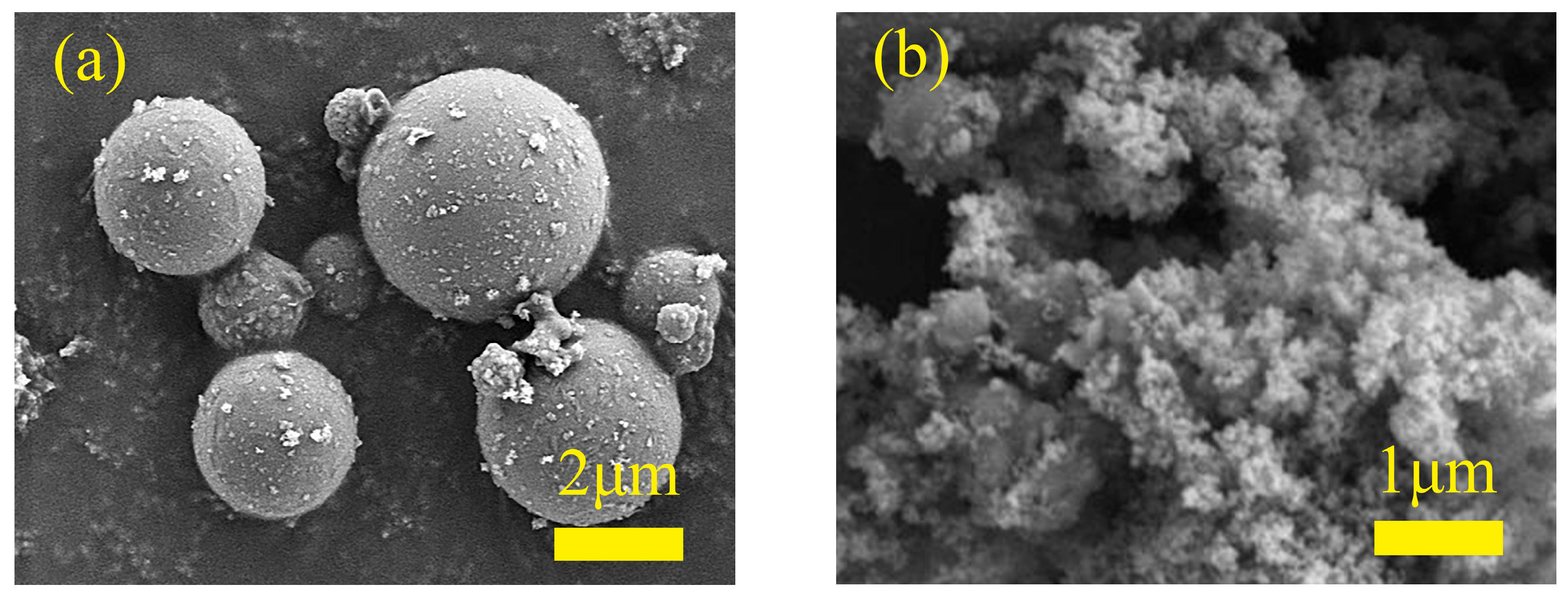
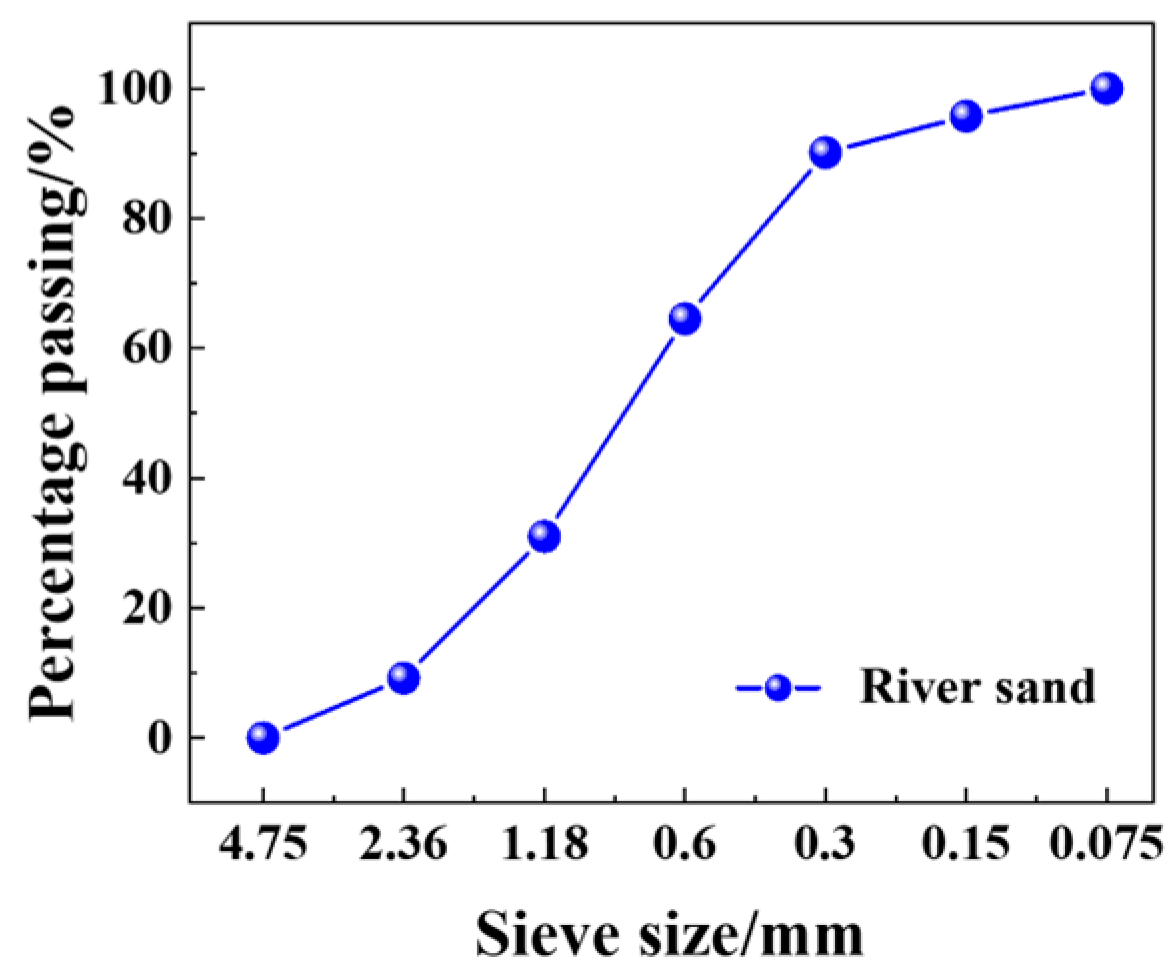
The nano-SiO2 used in this study was purchased from Suzhou Bisili New Materials Co., Ltd., Suzhou, China. The fly ash was obtained from the Huangbaici Coal Mine Thermal Power Plant in Wuhai, China and its chemical composition is listed in Table 1. All chemical composition values are expressed in mass percentage (wt.%). The morphologies of the fly ash particles and nano-SiO2 powder observed by scanning electron microscopy (SEM) are shown in Figure 1. As shown in the figure, the fly ash consists of numerous spherical particles with smooth surfaces (Figure 1a), with an average particle size of approximately 45 μm. Due to agglomeration caused by van der Waals forces among particles, the average particle size of nano-SiO2 ranged from 20 to 30 nm (Figure 1b). The coarse aggregate was natural pumice from the Inner Mongolia, China Autonomous Region, crushed and sieved to a particle size range of 26.50–4.75 mm. Its bulk density was measured as 690 kg/m3, apparent density as 1593 kg/m3, crushing index as 22%, and 1 h water absorption as 16.7%. The mixing water was ordinary tap water from Hohhot, China. The cement used was Jidong P·O 42.5 ordinary Portland cement, Inner Mongolia, China and its chemical composition is presented in Table 2. Natural river sand was used as the fine aggregate, with a water content of 1.63%, a clay content of 1.54%, a bulk density of 1519 kg/m3, and an apparent density of 2590 kg/m3. The grading curve is shown in Figure 2. The admixture, a polycarboxylate-based high-performance water-reducing agent, was purchased from Shanxi Feikesi Material Technology Co., Ltd., Xinzhou, Shanxi, China and its water reduction rate is 22.

2.2. Preparation of the Nanocomposite Modifier

To achieve uniform adsorption of nano-SiO2 on the surface of fly ash particles, the critical dosage of nano-SiO2 is about 5% as estimated from the volume ratio of the two materials. Correspondingly, the number of nano-SiO2 particles adsorbed per fly ash particle is about 5.7 × 10⁸. The time-dependent SEM analysis shown in Figure 3 and Figure 4 revealed the microscopic dispersion evolution of nano-SiO2 on the fly ash surface. When the ball-milling dispersion time was 30 min, nano-SiO2 was uniformly dispersed and tightly coated the fly ash surface, forming a distinct roughened interfacial structure (Figure 3d). However, when the dispersion time was extended to 40 min (Figure 3e) or the nano-SiO2 dosage exceeded 5% (Figure 4d,e), excessive mechanical energy input or insufficient interparticle spacing induced re-agglomeration dominated by van der Waals forces [29,30,31]. Based on the above evolution behavior, the optimal parameters for the nanocomposite modifier were determined as a ball-milling time of 30 min and a nano-SiO2 dosage of 5%. Under these optimal conditions, nano-SiO2 was uniformly anchored on the fly ash surface, increasing the specific surface area and active reaction sites of fly ash and thereby facilitating subsequent reactions.

2.3. Preparation of Strengthened Pumice Aggregate

The pumice aggregate was first immersed in water until its internal pores were fully saturated, after which it was taken out and processed to a saturated surface-dry condition. Subsequently, the measured saturated surface-dry pumice aggregate and the nanocomposite modifier were successively added into a mixer operating at 40 r/min and mechanically mixed for 3 min. During mixing, water was sprayed continuously. After mixing, the strengthened aggregate was removed and air-dried under natural conditions for subsequent performance tests.
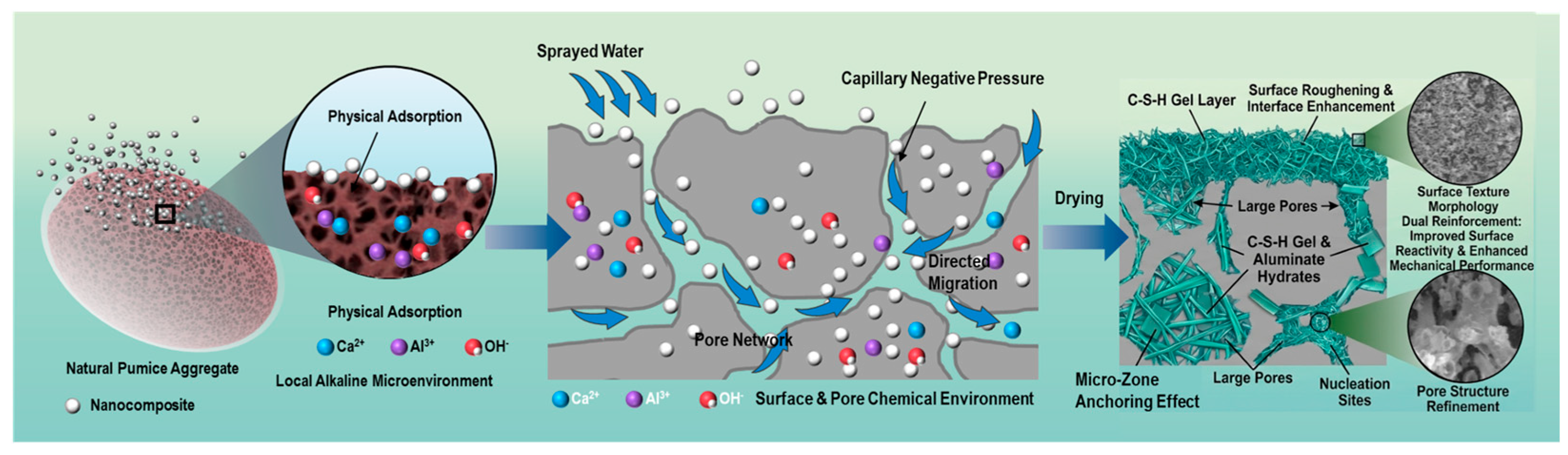
As shown in Figure 5, under the shear force generated by mechanical mixing, the nanocomposite modifier was uniformly dispersed and physically adsorbed onto the moist pumice surface. At this stage, the pore water in the pumice dissolved free Ca2+, Al3+, and other ions on the surface, forming a locally alkaline microenvironment. The sprayed water reactivated the water-absorbing behavior of the pumice surface, instantly generating capillary negative pressure that drove the nanocomposite particles to migrate directionally from the surface into the interior along open pores. Water served as the reaction medium while simultaneously activating the chemical environment both on the surface and within the pores. After drying, a dense C-S-H gel coating roughened the pumice surface texture and enhanced interfacial bonding. Within the pores, the generated C-S-H and a small amount of calcium aluminate hydrates filled and refined the pore structure, transforming large pores into micropores and producing a “micro-anchoring” effect that provided nucleation sites for subsequent hydration. The dual strengthening effect of the surface coating and the crystals formed within the pores not only improved the surface reactivity of pumice but also enhanced the overall mechanical performance of the aggregate through increased cohesion.

2.4. Specimen Preparation and Curing

The mix proportion of pumice concrete was designed according to the Technical Specification for Lightweight Aggregate Concrete, with a design strength grade of C30 and a water–cement ratio of 0.46. The experiment adopted the equal volume replacement method, in which reinforced pumice aggregate (NF) at replacement rates of 0%, 20%, 40%, 60%, 80%, and 100% was used to replace natural pumice aggregate for concrete preparation (see Table 3), where JZ denotes the control group. The concrete preparation procedure was as follows: Materials were weighed according to the mix proportion, and the superplasticizer was mixed with water for later use. After moistening the mixer, river sand, cement, and the mixed solution were added sequentially and mixed for 60 s, followed by the addition of natural pumice and reinforced pumice with further mixing for 180 s. After verifying that the slump met the requirement, the concrete was cast into 100 mm cube molds and 100 × 100 × 400 mm prism molds and compacted on a vibrating table with rodding until no air bubbles emerged, and the surface was leveled with a trowel. After casting, the specimens were placed in a standard curing room (temperature 20 ± 2 °C, relative humidity 98 ± 2%).

2.5. Test Methods

2.5.1. Property Tests of Strengthened Pumice Aggregate

  • The water absorption and cylinder compressive strength of the aggregate were determined according to GB/T 17431.1-2010 [32]. Strengthened pumice aggregate with a nominal particle size of 5–25 mm was used for both tests. For the water absorption test, the specimens were oven-dried at 105 ± 5 °C to constant mass, cooled, and then immersed in clean water at 20 ± 5 °C for 24 h. The saturated surface-dried mass and oven-dried mass were subsequently measured. For the cylinder compressive strength test, the aggregate was sieved to remove fines and then filled into a steel cylinder with an inner diameter of 113 mm and a height of 100 mm in three layers with compaction. Loading was applied at a rate of 0.5 MPa/s until the compressive deformation reached 20 mm, and the corresponding pressure value was recorded. All tests were repeated three times, and the arithmetic mean was taken as the final result.
  • The micro-morphology of the strengthened pumice aggregate was observed using a ZEISS Sigma 360 field-emission environmental scanning electron microscope (SEM), Carl Zeiss Microscopy GmbH, Oberkochen, Germany and the phase composition of hydration products was analyzed using a Rigaku Ultima IV X-ray diffractometer (XRD), Rigaku Corporation, Tokyo, Japan at a scanning rate of 2°/min.

2.5.2. Mechanical Properties of Lightweight Aggregate Concrete

The compressive strength test was conducted in accordance with GB/T 50081-2019 [33]. Cube specimens with dimensions of 100 mm × 100 mm × 100 mm were used. A WHY-2000 microcomputer-controlled electro-hydraulic servo testing machine was employed, and the load was applied at a rate of 0.5 MPa/s. The cube compressive strengths at curing ages of 3, 7, 14, 21, and 28 d were measured. For each age, one group of specimens was prepared, with three parallel specimens in each group. The final strength was expressed as the arithmetic mean of the three measurements.

2.5.3. X-Ray Diffraction (XRD) Analysis

Phase analysis was carried out using a Rigaku Ultima IV X-ray diffractometer, Rigaku Corporation, Tokyo, Japan at a scanning rate of 5°/min. The samples were taken from fragments at the center of the crushed concrete specimens after the 28 d compressive-strength test. These fragments were immersed in absolute ethanol to stop hydration, dried, and ground into powder, and 5 g of the powdered sample was used for testing.

2.5.4. Scanning Electron Microscopy

The samples were taken from representative central fragments of the broken specimens after compressive strength testing at 7 and 28 d. The samples were immersed in absolute ethanol to terminate hydration and then dried at low temperature. Their microstructural morphology and interfacial transition zone characteristics were examined using a ZEISS Sigma 360 field-emission environmental scanning electron microscope, Carl Zeiss Microscopy GmbH, Oberkochen, Germany

2.5.5. Interfacial Microhardness Test

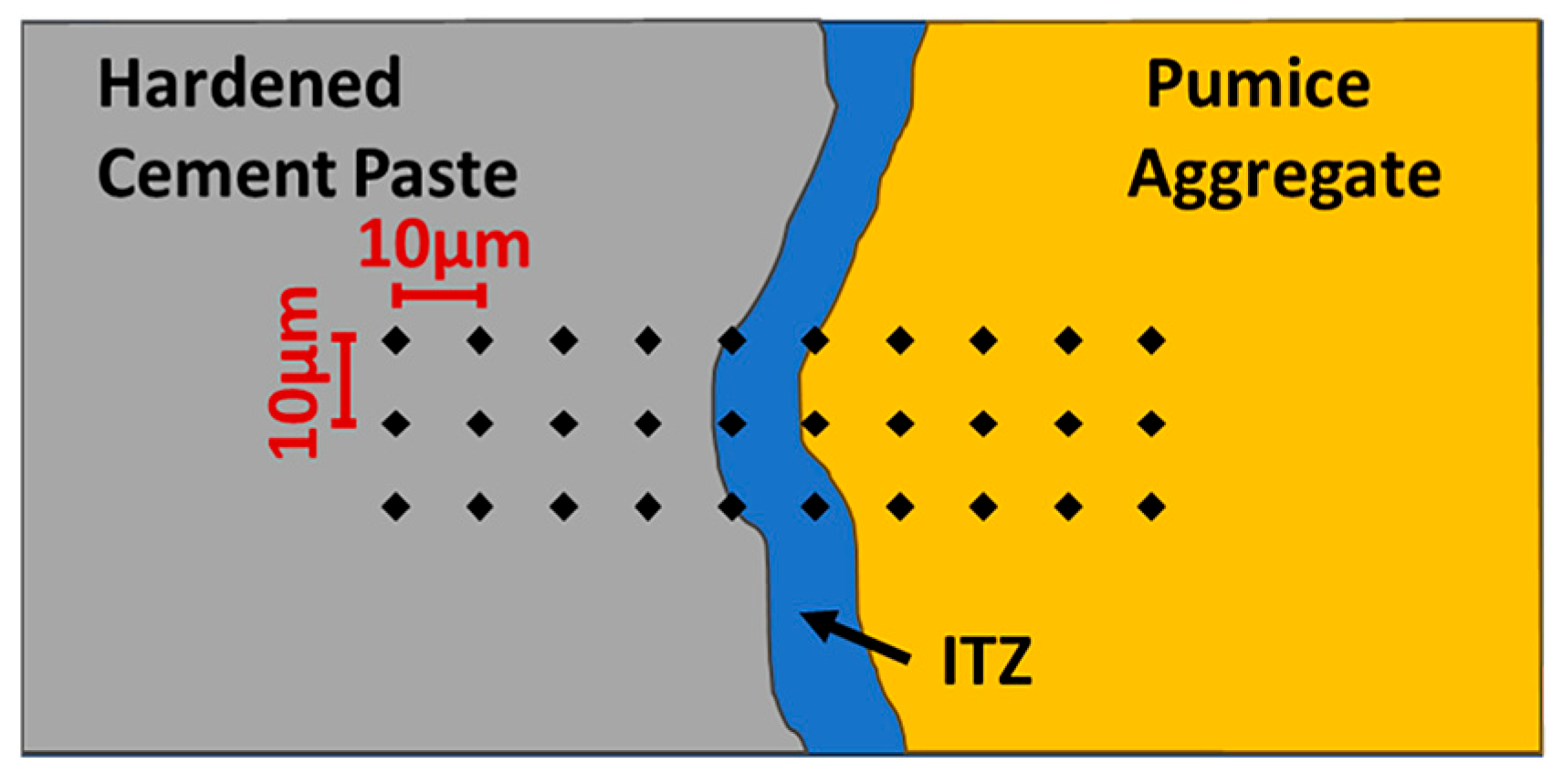
An INNOVATEST FALCON 507 instrument, INNOVATEST Europe BV, Maastricht, The Netherlands was used to determine the microhardness of the ITZ in pumice concrete and strengthened pumice concrete at 28 d. During the test, as shown in Figure 6, linear indentations were performed from the edge of the hardened cement paste toward the pumice aggregate, with consecutive points at a step size of 10 μm. The indentation line was then translated twice parallel to the initial path, also with a translation spacing of 10 μm. The microhardness value at each point was taken as the arithmetic mean of three indentation measurements.

2.5.6. Rapid Freeze–Thaw Cycling Test

According to GB/T 50082-2024 [34], freeze–thaw cycling tests were conducted using prismatic specimens with dimensions of 100 mm × 100 mm × 400 mm, with three parallel specimens in each group. After standard curing for 28 d, the specimens were saturated until the water absorption reached at least 98%. Before the freeze–thaw test, the initial mass of each specimen was measured, and the dynamic elastic modulus was determined using a ZBL-F800 dynamic modulus tester, Beijing ZBL Science & Technology Co., Ltd, Beijing, China. The specimens were then subjected to freeze–thaw cycles in an HSK-150D freeze–thaw testing machine, Beijing Aerospace Keyu Testing Instrument Co., Ltd, Beijing, China. After every 25 cycles, the specimens were removed, and their mass loss rate and relative dynamic elastic modulus were measured. Each index was measured separately for the three specimens in each group, and the arithmetic mean was taken as the final result.

3. Results

3.1. Performance Analysis of Strengthened Pumice Aggregate

3.1.1. Physical Properties

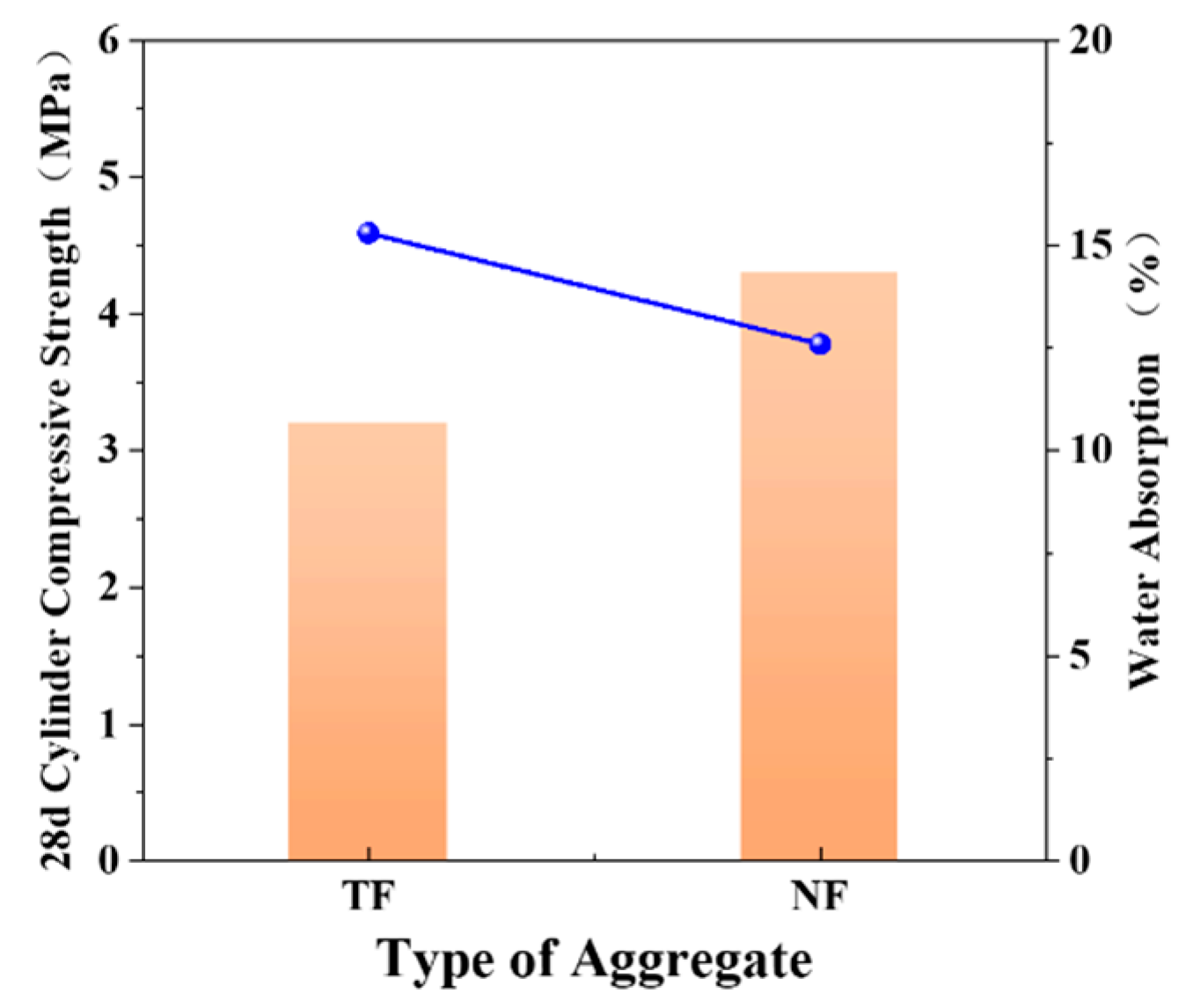
Figure 7 compares the 24 h water absorption and cylinder compressive strength of strengthened pumice aggregate (NF) and natural pumice aggregate (TF). After strengthening by the nanocomposite modifier, the 24 h water absorption of NF decreased from 15.3% for TF to 12.6%, corresponding to a reduction of 17.6%. This indicates that SiO2 exhibited high pozzolanic activity and rapidly reacted with calcium hydroxide to form dense calcium silicate hydrate (C-S-H) gel. Meanwhile, the continued pozzolanic reaction of fly ash further generated additional C-S-H and a small amount of calcium aluminate hydrates (CaO·Al2O3·10H2O). These hydration products were deposited and grew in situ within the pores of pumice aggregate, effectively filling and refining the open pores and blocking the penetration pathways of water molecules, thereby reducing the water absorption of the aggregate.
At the same time, the cylinder compressive strength of NF increased by 34.3% compared with TF. This improvement can be attributed to two aspects. First, the dense C-S-H gel physically filled the pores, making the matrix more compact. Second, the fibrous or network-like crystals formed by the C-S-H gel and fly ash hydration interwove and overlapped within the pores, constructing a microscopic reinforcing framework similar to a “truss support”, which significantly enhanced the mechanical performance of the aggregate.

3.1.2. Microstructure

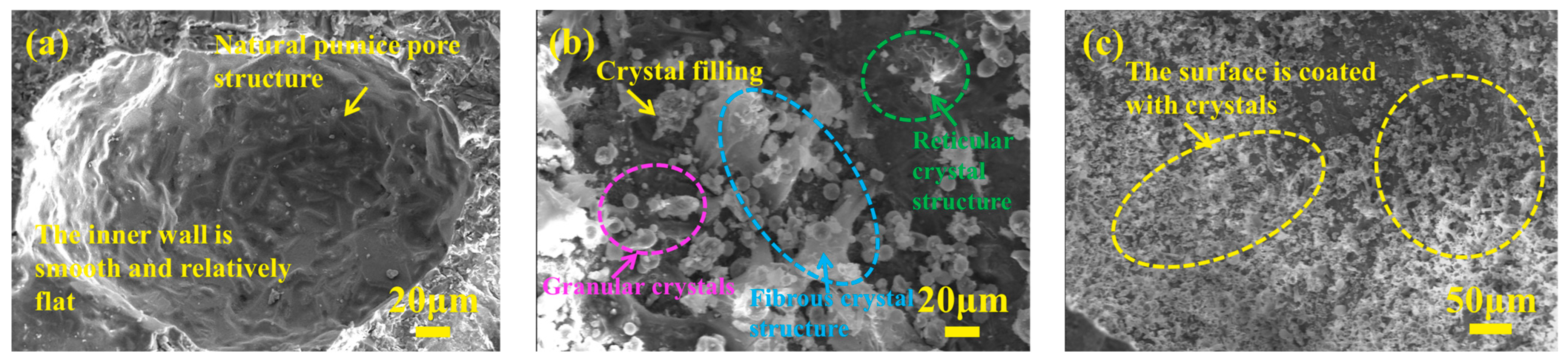
Figure 8 presents the microscopic morphological characteristics of TF and NF aggregates. SEM observation shows that the pore inner walls of TF in Figure 8a are smooth and relatively simple in structure, whereas the pores of NF in Figure 8b are filled with a large number of granular, fibrous, and network-like crystals. Further analysis indicates that the crystal formation within the pores of NF originates from the in situ crystallization behavior of the nanocomposite modifier under the action of water. During the coating process, the water sprayed onto the aggregate surface activated both the high reactivity of nano-silica and the latent hydraulic activity of fly ash, generating hydration products mainly composed of C-S-H gel along with a small amount of ettringite (AFt). Within the pumice pores, concentration gradients of Ca2+ and SiO32− provided the driving force for crystal growth, promoting the preferential growth of C-S-H gel at sharp tips. Meanwhile, the confined microenvironment of the aggregate pores forced the crystals to grow directionally along one dimension, eventually forming radially clustered crystals that filled the pumice pores and thereby enhanced the physical properties of the aggregate.
Figure 8c shows the microstructure of the surface coating on NF. It can be observed that a large number of interwoven crystals, mainly granular and network-like in morphology, are relatively uniformly distributed on the aggregate surface. These crystals are also mainly composed of C-S-H gel, and their formation process is similar to that within the pores. The crystals generated on the surface provide more active reaction sites for the aggregate and roughen the aggregate surface, thereby enhancing the mechanical interlocking effect between the aggregate and cement paste and resulting in strong bonding at the pumice–paste interface.

3.1.3. Phase Analysis

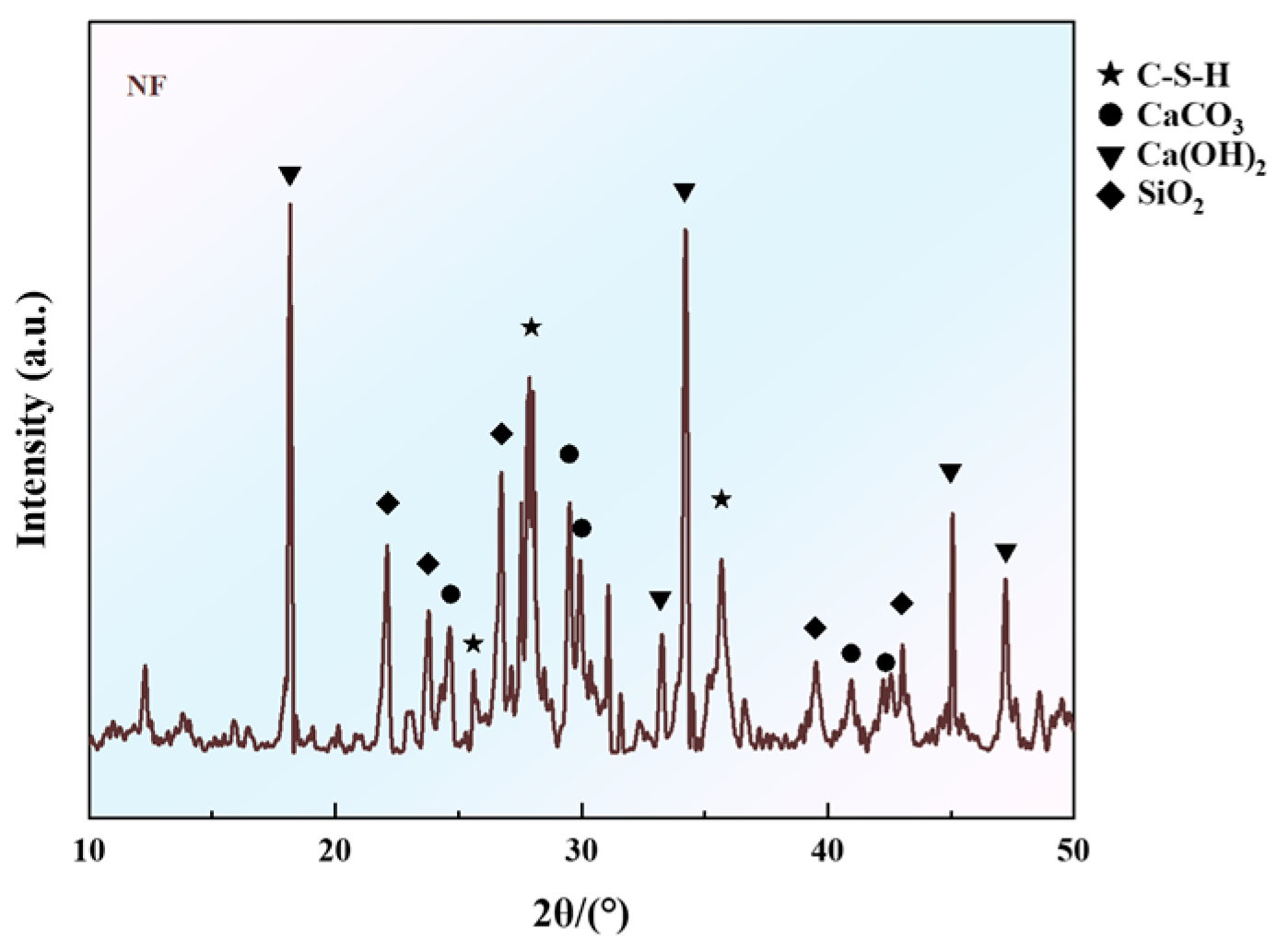
The XRD patterns show that the diffraction peak of Ca(OH)2 is the most prominent (Figure 9), indicating that during the hydration reaction between the nanocomposite modifier and natural pumice, the active CaO contained in the pumice aggregate reacted with water to form Ca(OH)2. At the same time, the hydration of some active components in fly ash was also accompanied by the generation of Ca(OH)2. The diffraction peak of C-S-H gel exhibits a typical broadened diffuse feature, confirming that it exists in an amorphous or poorly crystalline state. The formation of C-S-H gel results from the continuous pozzolanic reaction. Specifically, the highly reactive nano-silica and the active SiO2 and Al2O3 in fly ash, together with the dissolved active silico-aluminate components from the pumice aggregate, further reacted with the Ca(OH)2 generated in the system, producing C-S-H gel through the pozzolanic effect [35,36]. This process is crucial to the improvement in the mechanical performance of pumice, as the generated C-S-H gel effectively fills the internal pores and increases the compactness of the aggregate. The diffraction peak of SiO2 is also present in the pattern, mainly in the form of quartz crystals and amorphous silica. This SiO2 may originate from nano-silica in the nanocomposite modifier that did not fully participate in the reaction, as well as the original siliceous components existing in stable crystalline form in the pumice aggregate. Since the pozzolanic reaction mainly occurs on the surface of active SiO2, some inert or crystalline SiO2 remains unreacted in the system. The formation of CaCO3 is mainly attributed to the carbonation reaction between Ca(OH)2 and CO2 in the air under humid or open environmental conditions, making it a secondary reaction product.

3.2. Compressive Strength Analysis of Strengthened Pumice Concrete

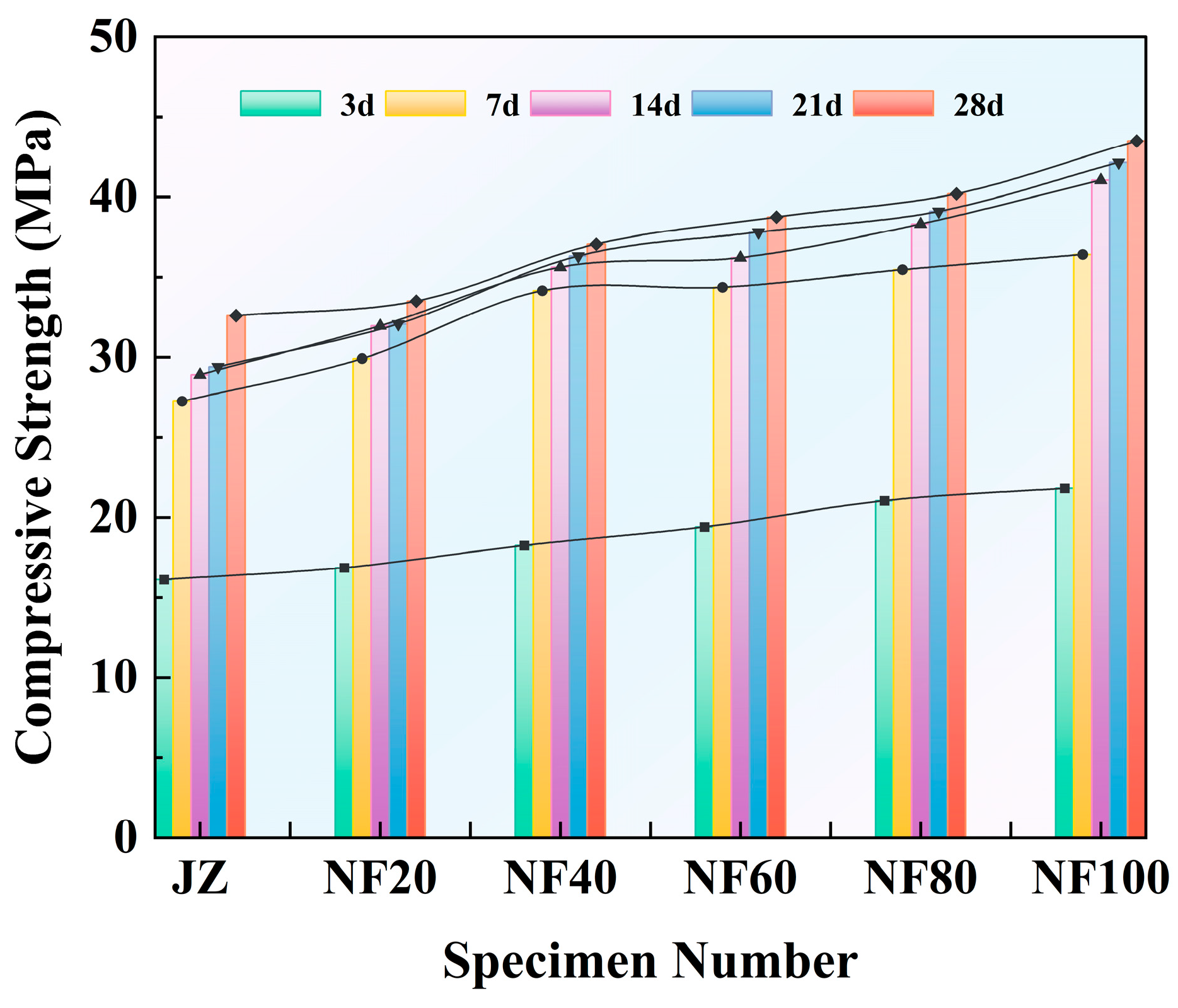
Figure 10 shows the evolution of compressive strength of pumice concrete at different curing ages with different replacement ratios of strengthened pumice. The data indicate that the compressive strength of concrete exhibited a clear increasing trend with increasing strengthened pumice content. At 3 d, the cube compressive strengths of the NF-20%, NF-40%, NF-60%, NF-80%, and NF-100% groups increased by 4.66%, 13.35%, 20.5%, 30.62%, and 35.1%, respectively, compared with the JZ-0% group. This is because the crystal coating formed on the surface of strengthened pumice enhanced the reactivity of the aggregate, while the interwoven crystals within the open pores effectively filled the pores and further refined the structure, thereby providing more reaction sites for the cement paste. Consequently, as the replacement ratio of strengthened pumice increased, more strengthened pumice aggregates formed tighter bonding with the cement paste, improving the early-age compressive strength.
At 28 d, the compressive strengths of the NF-20%, NF-40%, NF-60%, NF-80%, and NF-100% groups increased by 2.76%, 13.65%, 18.87%, 23.31%, and 33.44%, respectively, compared with the JZ-0% group. The overall trend indicates that the higher the replacement ratio, the more pronounced the strength gain. On the one hand, the continued hydration of cement and its synergistic interaction with strengthened pumice aggregate promoted the formation of more gel-like hydration products and enhanced the mechanical interlocking between aggregate and paste, resulting in a denser microstructure in the ITZ. On the other hand, as the proportion of strengthened pumice aggregate in the concrete skeleton increased, the overall load-bearing capacity of the aggregate skeleton was further optimized, thereby continuously improving the mechanical performance of concrete.

3.3. Failure Morphology of Strengthened Pumice Concrete

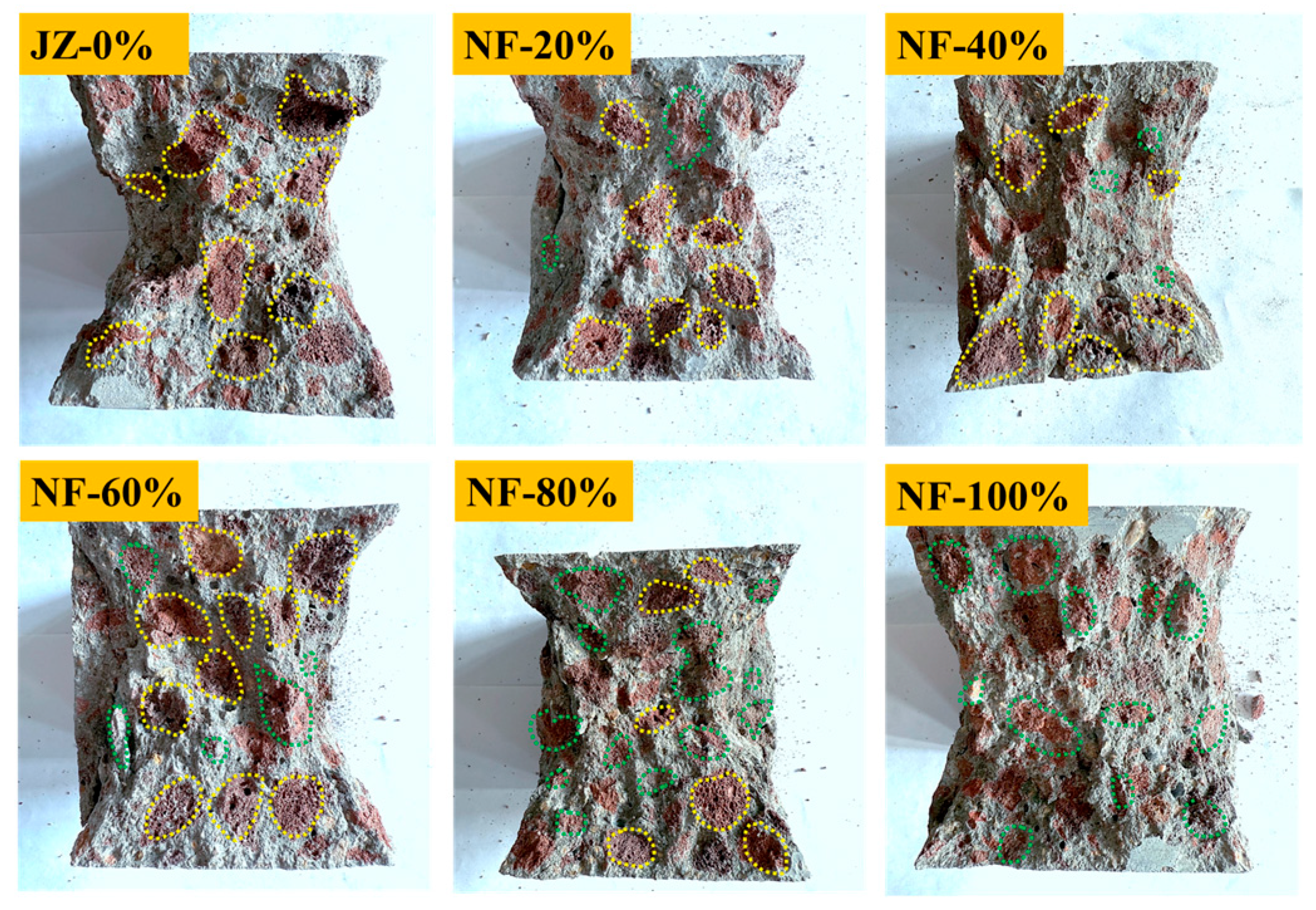
Figure 11 shows the compressive failure morphology of pumice concrete at 28 d. It can be seen that the JZ-0% group exhibited typical brittle failure, with crack propagation mainly following a “through-aggregate” mode (yellow marks in the figure). Since the intrinsic strength of pumice aggregate is lower than that of the surrounding cement mortar matrix, cracks did not deflect along the aggregate–mortar interface during propagation but instead directly penetrated through the pumice aggregate, causing the specimen to fail by aggregate crushing rather than interface debonding. As a porous volcanic clastic rock, pumice has an intrinsic strength lower not only than that of ordinary crushed stone but also than that of hardened cement paste. Therefore, under external loading, pumice becomes the weak link in the load-bearing system, and cracks preferentially propagate through the aggregate, eventually leading to overall failure. In contrast, the NF-100% group maintained relatively good integrity after failure, with the failure mode dominated by fragmentation rather than an obvious penetrating fracture, indicating a more ductile failure characteristic. This can be mainly attributed to the highly compact interfacial structure formed between strengthened pumice and cement paste, which enhanced lateral restraint and produced a more uniform stress distribution. Moreover, when cracks propagated into the high-strength interfacial region, they tended to deflect or branch, thereby extending the crack path and improving the energy dissipation capacity of the system [37]. As the replacement ratio of strengthened pumice increased, both the failure cross-sectional area and the shear failure angle gradually decreased.

3.4. SEM Morphology Analysis of Strengthened Pumice Concrete

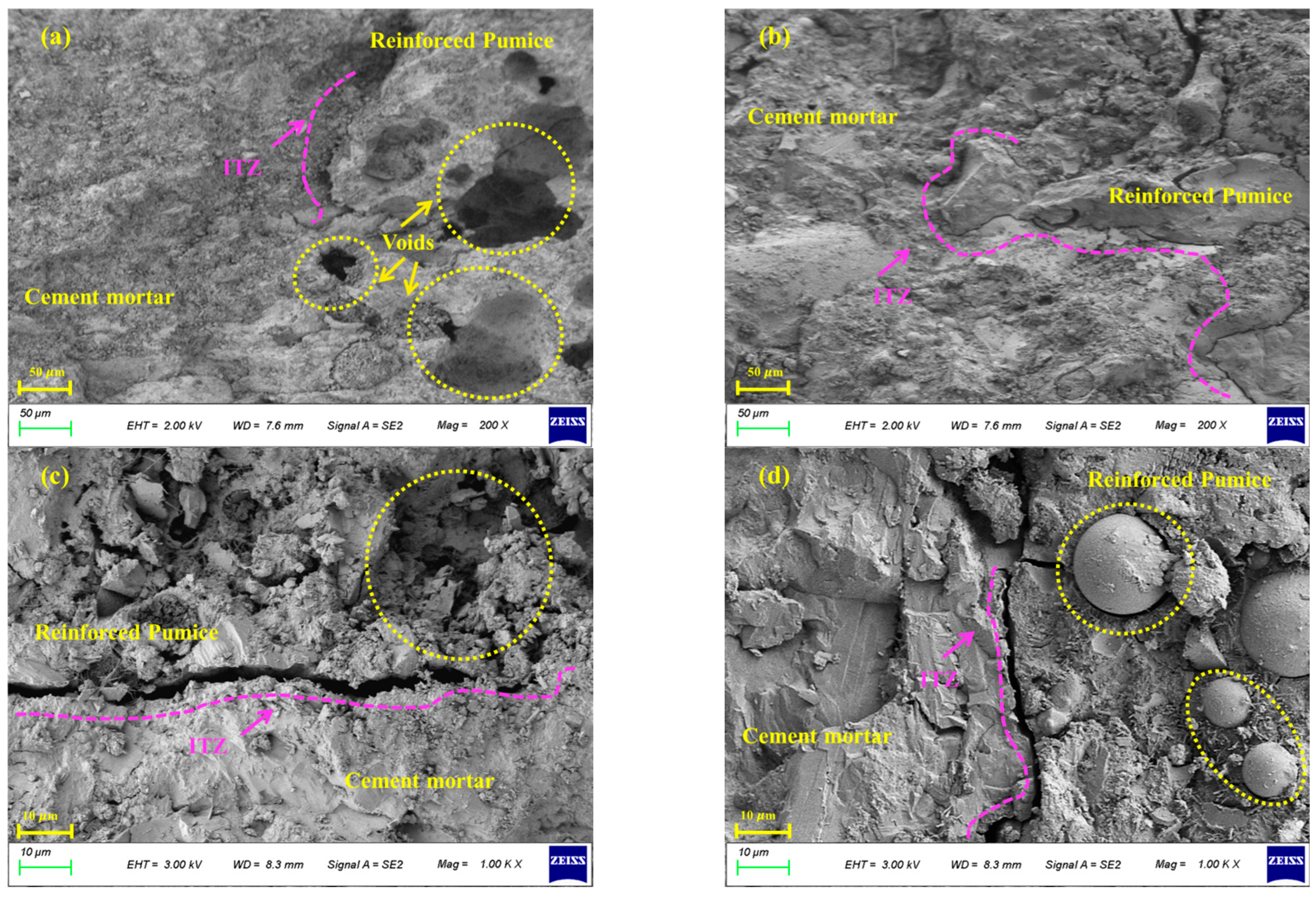
Figure 12 presents the microstructural morphology of the specimens at different curing ages. Figure 12a,b show the interfacial bonding state between aggregate and paste in the JZ-0% and NF-100% groups at 7 d, respectively. In the JZ-0% group, the open-pore structure on the surface of natural pumice is relatively simple, and the inner pore walls are smooth. As a result, hydration products mainly accumulate within the pores and cannot effectively bridge with the external cement paste. Therefore, an obvious weak interfacial zone forms between the aggregate and paste, which is prone to debonding under load, leading to an increase in the critical crack size and adversely affecting the early-age mechanical performance of concrete. In contrast, in the NF-100% group, the surface activity of the strengthened pumice aggregate was improved, and its internal microstructure became denser. During cement hydration, the active surface of the strengthened aggregate not only provided more nucleation sites but also promoted the abundant generation and interweaving of C-S-H gel in the interfacial region, forming a mechanically interlocked structure and effectively suppressing interface debonding.
Figure 12c,d further compare the microscopic morphology of the ITZ in the JZ-0% and NF-100% groups at 28 d. The fracture surface of the JZ-0% group is loose, and obvious continuous cracks can be observed in the interfacial region, indicating insufficient bonding between hydration products and the aggregate surface and the inability to form a stable and effective interface. In the NF-100% group, however, the active components on the strengthened aggregate surface participated in hydration, resulting in a denser layer of hydration products in the interfacial region. This not only restricted crack width in the interface zone but also, through the pinning effect at crack tips, induced crack deflection, bending, and even branching, thereby lengthening the crack propagation path, increasing fracture energy consumption, and delaying the formation and extension of macroscopic cracks. Consequently, the overall mechanical performance of concrete was improved.

3.5. Phase Analysis of Strengthened Pumice Concrete

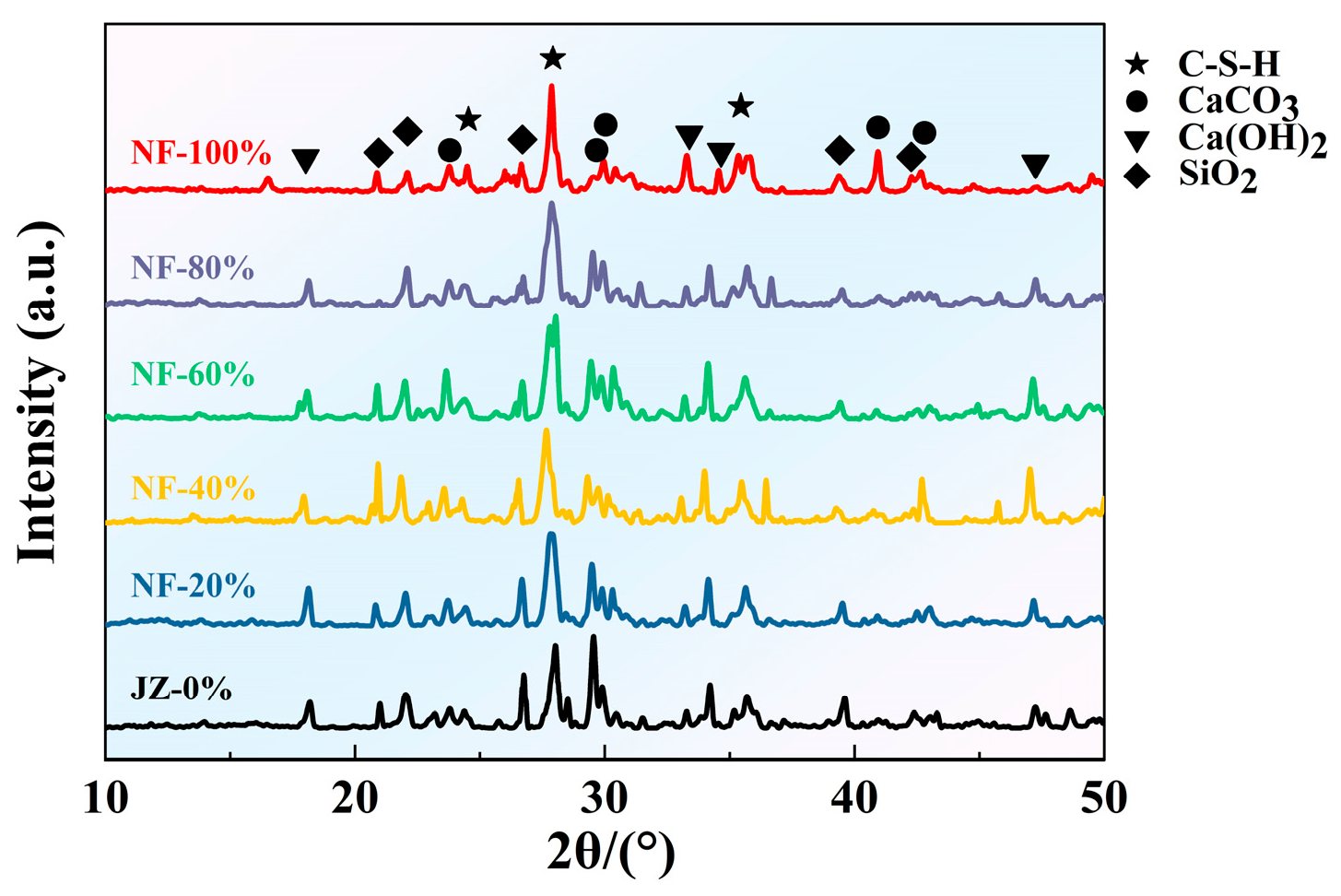
The XRD patterns (Figure 13) indicate that, with increasing replacement ratio of strengthened pumice, the intensity of the characteristic diffraction peaks of Ca(OH)2 gradually decreased, suggesting a marked change in both the crystallinity and relative content of Ca(OH)2 in the concrete. Combined with the preceding analysis, this can be explained as follows. First, the active crystalline products generated in situ on the surface coating and within the open pores of strengthened pumice act as highly efficient heterogeneous nucleation sites in the early hydration stage, inducing cement hydration products to precipitate preferentially around them, accelerating the formation of C-S-H gel, and simultaneously promoting the consumption and transformation of Ca(OH)2 crystals. Second, as hydration proceeds, the densification effect of strengthened pumice on the concrete microstructure becomes increasingly evident. The pore structure in the aggregate–paste ITZ is refined, and the overall compactness of the concrete is enhanced. CO2 from the environment diffuses inward through capillary pores and reacts with the remaining Ca(OH)2, leading to carbonation and the formation of CaCO3 precipitates [38,39]. These results indicate that the attenuation of the Ca(OH)2 characteristic peaks in the XRD patterns corresponds well with the improvement trend of the macroscopic mechanical properties of concrete. Through the incorporation of strengthened pumice, a synergistic enhancement mechanism was achieved, spanning micro-scale interface strengthening, meso-scale pore optimization, and macro-scale skeleton effects, thereby effectively promoting the continuous improvement of concrete mechanical performance.

3.6. Interfacial Microhardness Analysis

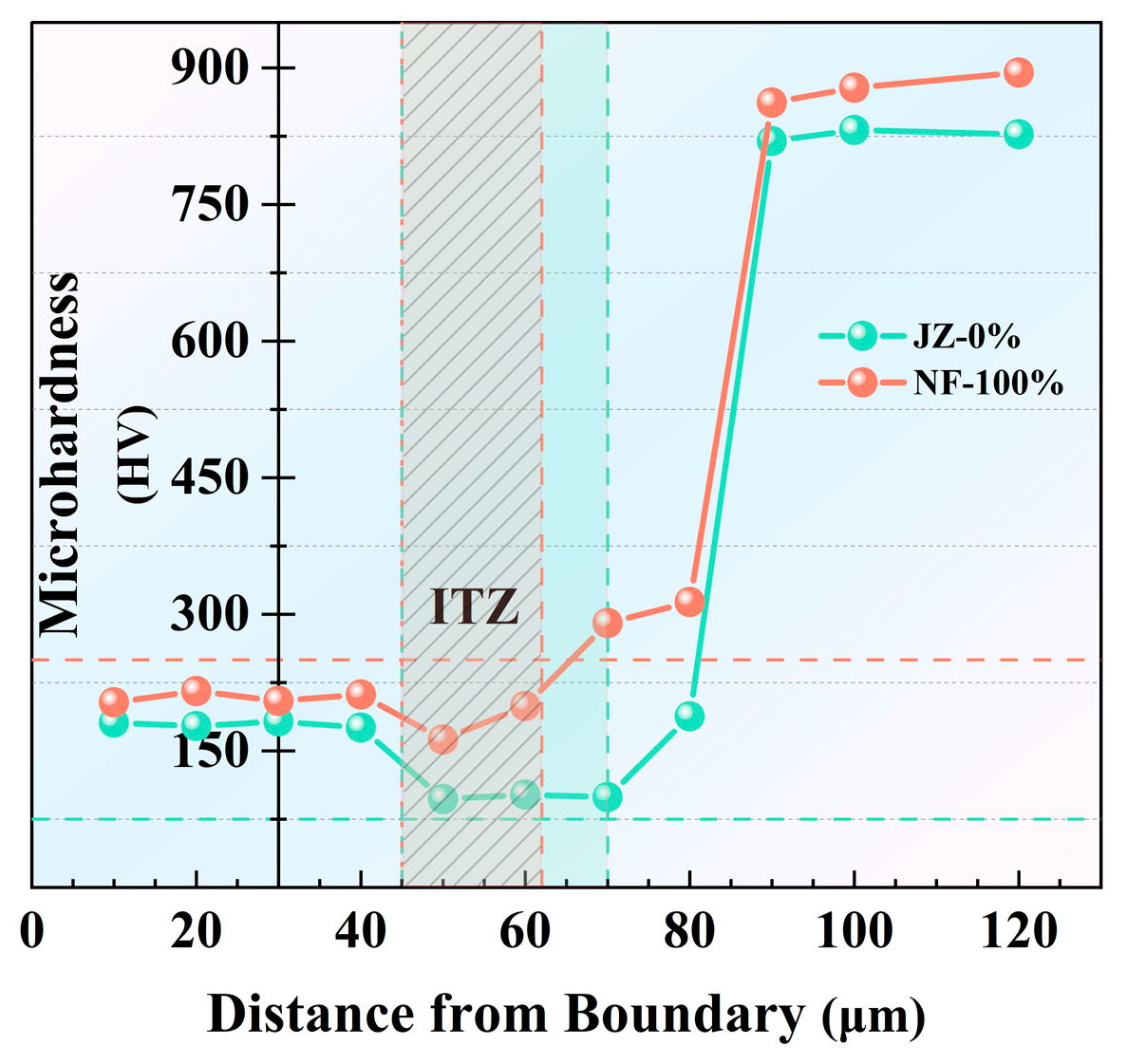
Figure 14 presents the microhardness of the interfacial region of pumice concrete at 28 d. This region consists of the two-phase interfacial transition zone (ITZ) formed between pumice and cement stone. In terms of ITZ width, the JZ group exhibited an ITZ width of 25 μm, whereas that of the NF-100% group decreased to 17 μm, representing a reduction of 32%. This indicates that the strengthened treatment of pumice significantly reduced the extent of the weak interfacial region. Further analysis of the microhardness distribution characteristics reveals that at distances of 50 μm and 60 μm from the interface, the microhardness values of the NF-100% group are 162.3 HV and 199.3 HV, which are 67.7% and 98% higher than those of the JZ-0% group, respectively. In particular, at 70 μm, the microhardness of the NF-100% group reaches 288.5 HV, which is significantly higher than the corresponding value of 99.1 HV for the JZ-0% group. This improvement is mainly attributed to the enrichment of highly reactive crystalline products in the surface coating of strengthened pumice, which increased the surface roughness of the aggregate and created a more favorable surface topography for the adhesion and spreading of cement paste. When strengthened pumice completely replaced natural pumice, the highly active aggregate surface and the cement paste formed a strong mechanical interlocking effect, promoting the transformation of the aggregate–paste interface from a conventional “weak-bonded” structure to a “strongly interlocked” structure, thereby improving the compactness and overall mechanical performance of the ITZ.

3.7. Freeze–Thaw Cycle Performance of Strengthened Pumice Concrete

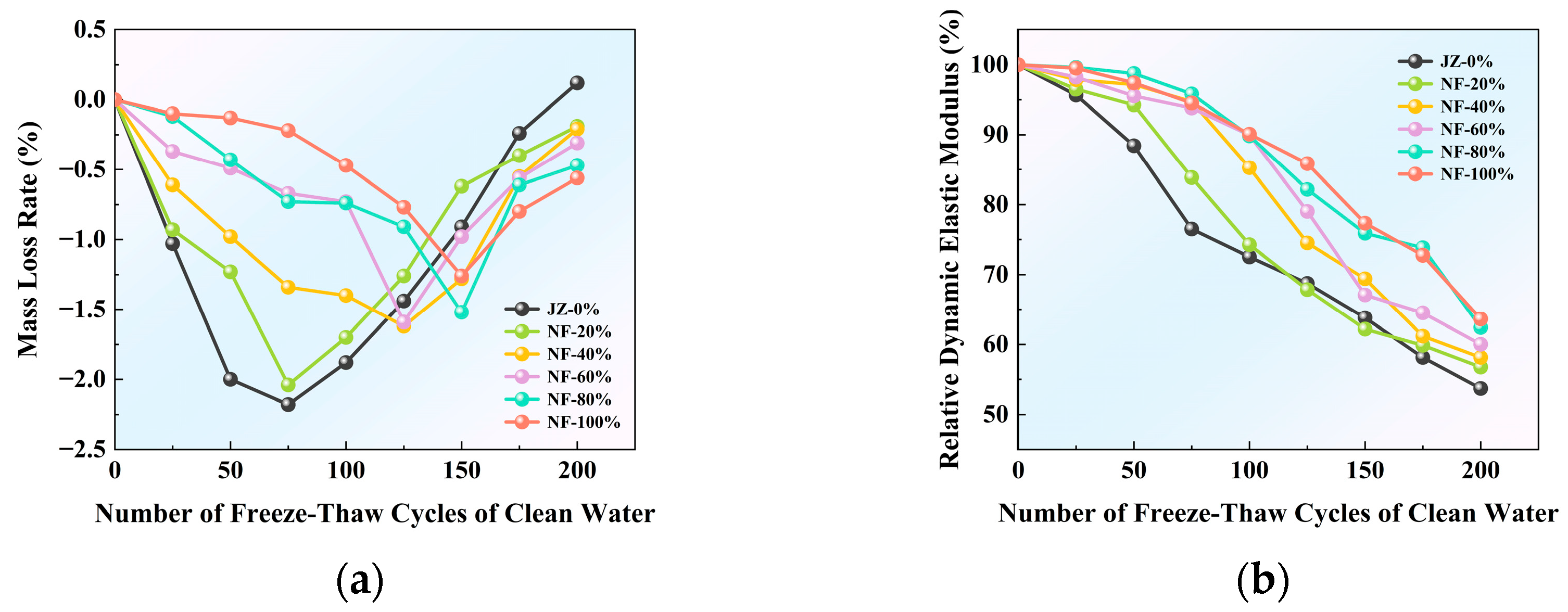
The variation in mass loss rate of strengthened pumice concrete with different replacement ratios is shown in Figure 15a. As the number of freeze–thaw cycles increased, the mass loss rate of all groups first decreased and then increased. In the initial stage of freeze–thaw cycling, the specimens gained mass due to water absorption. After 25 cycles, the masses of the JZ-0%, NF-20%, NF-40%, NF-60%, NF-80%, and NF-100% groups increased by 1.03%, 0.93%, 0.61%, 0.37%, 0.12%, and 0.10%, respectively. As the number of cycles increased, internal microcracks propagated, and water absorption increased, resulting in a further increase in mass. The JZ-0% and NF-20% groups began to show mass loss after 100 cycles; the NF-40% and NF-60% groups after 125 cycles; and the NF-80% and NF-100% groups after 150 cycles. In the JZ-0% and NF-20% groups, the reduced bonding in the ITZ and surface scaling led to mass loss. By contrast, in the high-replacement groups, the strengthened pumice improved the interface structure and enhanced compactness, thereby effectively suppressing water ingress.
The variation in relative dynamic elastic modulus with freeze–thaw cycles is shown in Figure 15b. All groups exhibited a trend of a gradual decrease followed by a rapid decline. After 25 cycles, the relative dynamic elastic moduli of the JZ-0% and NF-20% groups decreased slowly, while after 50 cycles, they dropped rapidly, reaching 58.125% and 59.85%, respectively, and after 175 cycles, the specimens failed. In contrast, the NF-40%, NF-60%, NF-80%, and NF-100% groups showed a slower decline. After 200 cycles, their relative dynamic elastic moduli were 58.12%, 60.015%, 62.411%, and 63.625%, respectively. Among them, the NF-40% group had already failed, whereas the remaining groups exhibited excellent frost resistance. These results indicate that the internal damage degree of concrete decreases and frost resistance improves with increasing replacement ratio of strengthened pumice.
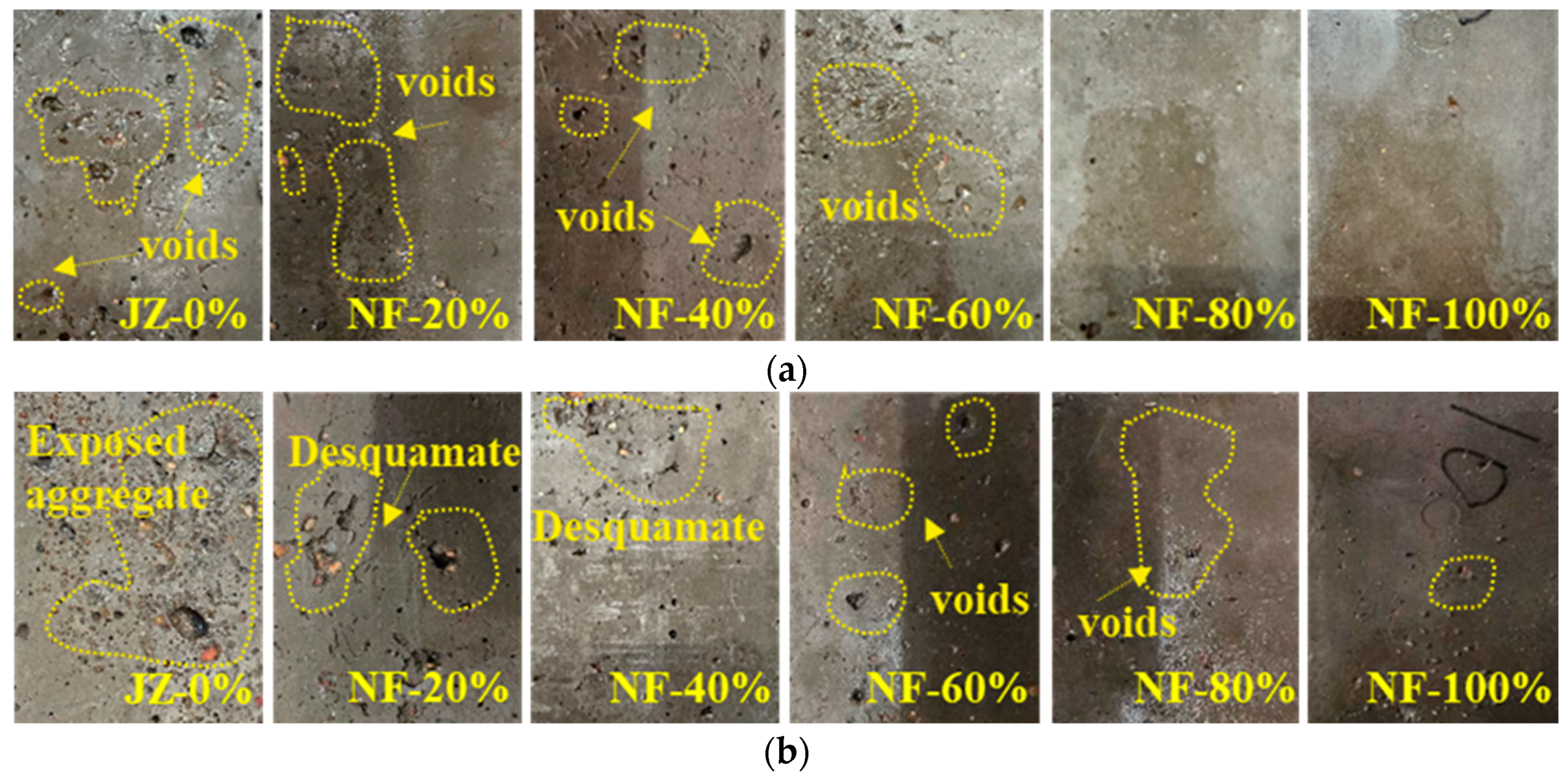
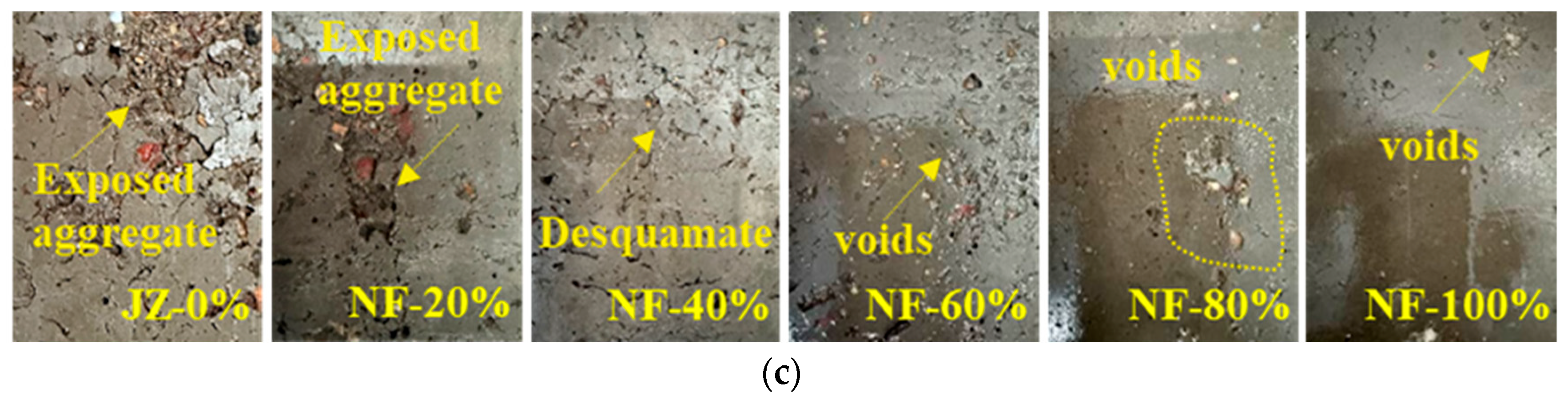
Figure 16 shows the evolution of the surface morphology of strengthened pumice concrete with different replacement ratios under freeze–thaw cycling in clean water. After 100 freeze–thaw cycles, the JZ-0% group suffered the most severe damage, characterized by serious surface spalling, numerous cracks in the paste, and exposure of fine aggregates. As the replacement ratio of strengthened pumice increased, the degree of surface spalling gradually decreased, and the cracks in the paste changed from wide and pronounced to finer ones. Among all groups, the NF-80% and NF-100% specimens exhibited the least surface damage, demonstrating excellent freeze–thaw resistance.

4. Discussion

The results show that the nanocomposite modifier constructed from nano-SiO2-modified fly ash not only achieved surface coating of pumice aggregate but, more importantly, induced in situ filling and interface reconstruction within its open pores, thereby generating a continuous strengthening effect at both the aggregate and concrete scales. Compared with previously reported polymer coating or silane treatment methods, this approach simultaneously improved the water absorption and strength of the aggregate and further enhanced the compactness and durability of the ITZ in lightweight concrete, thus avoiding the drawbacks of some existing treatments that reduce water absorption but weaken strength or improve local performance while increasing processing complexity and cost [15,16]. The nano-SiO2 and fly ash system employed in this study consists of common industrial materials, with fly ash being a low-cost industrial byproduct. Therefore, while achieving performance improvement, this approach offers good cost controllability and potential for engineering applications.
The novelty of this study lies not in the use of a single additive but in the structural pre-strengthening of natural pumice aggregate. Mechanistically, the strengthening effect mainly arises from the coupling of three aspects. First, nano-SiO2 provides highly active nucleation sites and promotes the precipitation of C-S-H gel at early ages. Second, fly ash continuously participates in the pozzolanic reaction at later stages and generates additional cementitious products. Third, the open-pore structure of pumice itself offers spatial conditions for the migration and in situ deposition of the nanocomposite modifier. This process leads to effective pore filling and reduction in aggregate water absorption, enhances the intrinsic strength of the aggregate, and simultaneously provides a material basis for the densification of the interfacial transition zone (ITZ). As a result, pore filling and surface roughening transform the aggregate from a phase characterized by “high water absorption, low strength, and weak interface” into a reinforcing phase with enhanced cohesion and surface reactivity.
Furthermore, the continuous increase in concrete compressive strength essentially reflects a shift in the controlling failure location. In unmodified pumice concrete, cracks tend to penetrate directly through the low-strength aggregate, indicating that the aggregate body itself is the dominant weak phase in the load-bearing system. After strengthening, however, the failure mode changes from a brittle fracture through the aggregate to a more ductile mode characterized by fragmentation and crack deflection, indicating that both aggregate strength and interface strength are synchronously improved, resulting in a reorganization of the crack propagation path. This is corroborated by the SEM and microhardness results. These findings suggest that pre-strengthening of lightweight aggregate is more direct and effective in improving interface performance than merely optimizing the paste. This interface-dominated strengthening mechanism also explains the improvement in freeze–thaw performance, making it particularly suitable for structures that are sensitive to self-weight and exposed to freeze–thaw risks, such as prefabricated components in cold regions, hydraulic structures, and road base materials. For lightweight concrete structures in cold regions or those requiring high durability, it is recommended to prioritize the use of reinforced pumice aggregate at medium-to-high replacement ratios (NF-60%–NF-100%) to achieve both mechanical performance and freeze–thaw resistance. Moreover, this method is based on conventional material systems and is compatible with existing concrete production processes, demonstrating good engineering feasibility. However, certain limitations still exist in this study. The long-term durability (e.g., carbonation, chloride ion erosion) and erosion–abrasion resistance of reinforced pumice concrete require further investigation.

5. Conclusions

This study investigated the strengthening effect of a nanocomposite modifier on pumice aggregate, systematically evaluated the performance enhancement induced by strengthened pumice at different replacement ratios in lightweight concrete, and further analyzed its influence on the mechanical properties and microstructural characteristics of concrete. Based on the experimental results and microstructural analysis, the following conclusions can be drawn:
  • After strengthening with the nanocomposite modifier, the active SiO2 and fly ash generated high-density C-S-H gel and fibrous crystals through hydration, which filled the pores of pumice aggregate in situ, constructed a microscopic reinforcing framework, and blocked water penetration. As a result, the water absorption of pumice aggregate decreased by 17.6%, while the cylinder compressive strength increased by 34.3%.
  • The incorporation of strengthened pumice improved the compressive strength of lightweight concrete. As the replacement ratio increased, the compressive strength continuously increased. In the NF-100% group, the compressive strength at 3 d and 28 d was 35.1% and 33.44% higher, respectively, than that of the control group. The failure mode changed from typical brittle fracture through the aggregate to fragmentation-type ductile failure, which can be attributed to the dense interfacial structure that improved lateral restraint and energy dissipation capacity.
  • SEM results confirmed that the strengthened pumice aggregate improved the bonding state between the aggregate and the paste. At 7 d, the increased surface activity of the NF-100% aggregate promoted the generation and interweaving of hydration products, effectively suppressing interfacial debonding. At 28 d, the ITZ of the NF-100% group became denser, the crack propagation path was lengthened, and fracture energy consumption increased, thereby improving the overall mechanical performance of the concrete.
  • The microhardness analysis showed that strengthened pumice induced the transformation of the aggregate–paste interface from a weakly bonded structure to a strongly interlocked one, thereby improving the micromechanical properties of the ITZ. In the NF-100% group, the ITZ width decreased by 32%. Within the range of 50–70 μm from the interface, the microhardness increased by 67.7–98%, indicating a significant enhancement in interface compactness and mechanical performance.
  • The freeze–thaw cycling test in water demonstrated that increasing the replacement ratio of strengthened pumice effectively enhanced the frost resistance of concrete. In the high-replacement groups (NF-60% to NF-100%), the optimized interface structure and improved compactness effectively suppressed water ingress, delayed mass loss, and slowed the reduction in relative dynamic elastic modulus.

Author Contributions

Validation, R.Q.; Formal analysis, R.Q.; Investigation, R.Q.; Resources, H.W. and M.F.; Writing—original draft, R.Q.; Writing—review & editing, R.Q., H.W. and M.F.; Supervision, H.W. and M.F.; Project administration, H.W. and M.F.; Funding acquisition, H.W. and M.F. All authors have read and agreed to the published version of the manuscript.

Funding

Hulunbuir City Science and Technology Program Projects (ST2024005); National Natural Science Foundation of China Project (52469024 and 52469023); Science and Technology Program Projects of the Inner Mongolia Autonomous Region (2025KYPT0099 and 2025KYPT0091).

Data Availability Statement

The original contributions presented in the study are included in the article, further inquiries can be directed to the corresponding author/s.

Acknowledgments

Inner Mongolia Autonomous Region Science and Technology Leading Talent Team (2022LJRC0007).

Conflicts of Interest

The authors declare no conflicts of interest.

References

  1. Wang, X.; Li, D.; Bai, R.; Liu, S.; Yan, C.; Zhang, J. Evolution of the pore structure of pumice aggregate concrete and the effect on compressive strength. Rev. Adv. Mater. Sci. 2023, 62, 20230112. [Google Scholar] [CrossRef]
  2. Moolchandani, K. Advancements in pumice-based concrete: A comprehensive review. Next Mater. 2025, 8, 100646. [Google Scholar] [CrossRef]
  3. Dwarampudi, M.; Venkateshwari, B. Performance of light weight concrete with different aggregates—A comprehensive review. Discov. Civ. Eng. 2024, 1, 46. [Google Scholar] [CrossRef]
  4. Yang, S.; Lin, L.; Li, S.P.; Li, Q.; Wang, X.T.; Sun, L. Assessment and comparison of three high-aluminum fly ash utilization scenarios in Inner Mongolia, China using an eco-efficiency indicator. Waste Manag. Res. 2017, 35, 515–524. [Google Scholar] [CrossRef]
  5. Wang, X.; Feng, R.; Li, J.; Liu, S.; Yan, C. Wear characteristics and degradation mechanism of natural pumice concrete under ice friction during ice flood season. Constr. Build. Mater. 2022, 341, 127742. [Google Scholar] [CrossRef]
  6. Tuncer, M.; Bideci, A.; Çomak, B.; Durmuş, G.; Bideci, Ö.S. Experimental Investigation of Durability Properties of Polymer Coated Pumice Aggregate Lightweight Concretes. Polymers 2025, 17, 253. [Google Scholar] [CrossRef] [PubMed]
  7. Li, W.; Wang, H.; Zhang, W. Damage and Deterioration Mechanism of Coal Gangue Mixed Pumice Aggregate Concrete Under Freeze–Thaw Cycles. Int. J. Concr. Struct. Mater. 2023, 17, 57. [Google Scholar] [CrossRef]
  8. Fořt, J.; Afolayan, A.; Medveď, I.; Scheinherrová, L.; Černý, R. A review of the role of lightweight aggregates in the development of mechanical strength of concrete. J. Build. Eng. 2024, 89, 109312. [Google Scholar] [CrossRef]
  9. Durgun, M.Y.; SevinÇ, A.H. Comparative study of concrete properties using basalt, barite, pumice, and marble aggregates subjected to extreme temperatures. J. Build. Eng. 2025, 113, 114036. [Google Scholar] [CrossRef]
  10. Bideci, A.; Bideci, Ö.S.; Ashour, A. Mechanical and thermal properties of lightweight concrete produced with polyester-coated pumice aggregate. Constr. Build. Mater. 2023, 394, 132204. [Google Scholar] [CrossRef]
  11. Muhtar. Performance-based experimental study into quality zones of lightweight concrete using pumice aggregates. Case Stud. Constr. Mater. 2023, 18, e01960. [Google Scholar] [CrossRef]
  12. Lv, X.J.; Cao, M.L.; Li, Y.; Li, Y. Experimental Study on the Pumice Aggregate Concrete. Mater. Sci. Forum 2013, 743, 329–333. [Google Scholar] [CrossRef]
  13. Huo, J.F.; Chu, J.J.; Yang, H. Experimental Study on Frost Resistance Properties of Pumice Mixed Aggregate Concrete. Adv. Mater. Res. 2012, 476, 1661–1664. [Google Scholar] [CrossRef]
  14. Behera, D.; Liu, K.-Y.; Rachman, F.; Worku, A.M. Innovations and Applications in Lightweight Concrete: Review of Current Practices and Future Directions. Buildings 2025, 15, 2113. [Google Scholar] [CrossRef]
  15. Tuncer, M.; Bideci, A.; Bideci, Ö.S.; Çomak, B.; Durmuş, G. Engineering properties and thermal conductivity of lightweight concrete with polyester-coated pumice aggregates. Sci. Eng. Compos. Mater. 2025, 32, 20250057. [Google Scholar] [CrossRef]
  16. Felekoğlu, B. A method for improving the early strength of pumice concrete blocks by using alkyl alkoxy silane (AAS). Constr. Build. Mater. 2011, 28, 305–310. [Google Scholar] [CrossRef]
  17. Karahüseyin, S.; Erdoğdu, Ş. Assessment of the effect of basalt fiber on the mechanical behavior and thermal conductivity properties of structural lightweight geopolymer concrete. Innov. Infrastruct. Solut. 2026, 11, 70. [Google Scholar] [CrossRef]
  18. Mahvash, A.; Mostofinejad, D.; Saljoughian, A. Thermal and mechanical properties of concrete incorporating pumice containing form-stable phase change materials and silica fume. J. Energy Storage 2025, 114, 115933. [Google Scholar] [CrossRef]
  19. Mehmet, U. Investigation of physical and mechanical properties of nanocarbon black-added lightweight UHPC. Mag. Concr. Res. 2023, 75, 1243–1252. [Google Scholar] [CrossRef]
  20. Bideci, Ö.S.; Bideci, A.; Ashour, A.; Khan, A. Acoustic, Thermal, and Mechanical Performance of Polymer-Coated Pumice Aggregate Lightweight Concretes. Polymers 2025, 17, 3248. [Google Scholar] [CrossRef] [PubMed]
  21. Bhuvaneshwari, P.; Aravind, S.; Shravan, H.; Kanna, R.N. Structural response of glass fiber reinforced polymer tubes infilled with lightweight aggregate concrete. Mater. Today Proc. 2022, 49, 1378–1382. [Google Scholar] [CrossRef]
  22. Xiong, X.; Li, X. Prediction of compressive strength of nano concrete used in construction under freeze-thaw cycles. Int. J. Microstruct. Mater. Prop. 2025, 18, 48–58. [Google Scholar] [CrossRef]
  23. Zhang, M.; Li, Z.; Du, L.; Tian, Z.; Liu, D. Durability of marine concrete with nanoparticles under coupled action of fatigue load, dry–wet cycles and Cl corrosion. Mag. Concr. Res. 2024, 76, 845–857. [Google Scholar] [CrossRef]
  24. Ahmed, A.S.; Ebrahem, E.; Feky, E.S.M. Achieving sustainable performance: Synergistic effects of nano-silica and recycled expanded polystyrene in lightweight structural concrete. Sci. Rep. 2024, 14, 26648. [Google Scholar] [CrossRef]
  25. Zivkovic, J.; Øverli, A.J. Failure of Lightweight Aggregate Concrete in Compression under Stress Gradients. Nord. Concr. Res. 2019, 60, 51–66. [Google Scholar] [CrossRef]
  26. Alexandre, J.B.; Augusto, G. Compressive behavior and failure modes of structural lightweight aggregate concrete—Characterization and strength prediction. Mater. Des. 2012, 46, 832–841. [Google Scholar] [CrossRef]
  27. Wang, H.; Shu, L.; Ma, K.; He, X. Durability Improvement of Pumice Lightweight Aggregate Concrete by Incorporating Modified Rubber Powder with Sodium Silicate. Materials 2024, 17, 786. [Google Scholar] [CrossRef]
  28. Hokazono, M.; Ijichi, M.; Tsuboguchi, T.; Yasui, K. Enhancing the Mechanical and Frost Resistance Properties of Sustainable Concrete Using Fired Pumice Aggregates. Materials 2025, 18, 4191. [Google Scholar] [CrossRef]
  29. Khaloo, A.; Mobini, H.M.; Hosseini, P. Influence of different types of nano-SiO2 particles on properties of high-performance concrete. Constr. Build. Mater. 2016, 113, 188–201. [Google Scholar] [CrossRef]
  30. Liu, X.; Feng, P.; Shu, X.; Ran, Q. Effects of highly dispersed nano-SiO2 on the microstructure development of cement pastes. Mater. Struct. 2019, 53, 582–590. [Google Scholar] [CrossRef]
  31. Meng, J.; Zhong, J.; Xiao, H.; Ou, J. Interfacial design of nano-TiO2 modified fly ash-cement based low carbon composites. Constr. Build. Mater. 2020, 270, 121470. [Google Scholar] [CrossRef]
  32. GB/T 17431.2-2010; Lightweight Aggregate and Its Test Methods—Part 2: Test Methods for Lightweight Aggregates. National Standard of the People’s Republic of China: Beijing, China, 2010.
  33. GB/T 50081-2019; Standard for Physical and Mechanical Performance Testing Methods of Concrete. National Standard of the People’s Republic of China: Beijing, China, 2019.
  34. GB/T 50082-2024; Standard for Testing Methods of Long-Term and Durability Performance of Concrete. National Standard of the People’s Republic of China: Beijing, China, 2024.
  35. Feng, W.; Tang, Y.; Zhang, Y.; Qi, C.; Ma, L.; Li, L. Partially fly ash and nano-silica incorporated recycled coarse aggregate based concrete: Constitutive model and enhancement mechanism. J. Mater. Res. Technol. 2022, 17, 192–210. [Google Scholar] [CrossRef]
  36. Zhang, P.; Xie, N.; Cheng, X.; Feng, L.; Hou, P.; Wu, Y. Low dosage nano-silica modification on lightweight aggregate concrete. Nanomater. Nanotechnol. 2018, 8, 184798041876128. [Google Scholar] [CrossRef]
  37. Hoover, G.C.; Bažant, P.Z. Comprehensive concrete fracture tests: Size effects of Types 1 & 2, crack length effect and postpeak. Eng. Fract. Mech. 2013, 110, 281–289. [Google Scholar] [CrossRef]
  38. Scrivener, L.K.; Crumbie, K.A.; Laugesen, P. The Interfacial Transition Zone (ITZ) Between Cement Paste and Aggregate in Concrete. Interface Sci. 2004, 12, 411–421. [Google Scholar] [CrossRef]
  39. Chen, Q.; Zhang, J.; Wang, Z.; Zhao, T.; Wang, Z. A review of the interfacial transition zones in concrete: Identification, physical characteristics, and mechanical properties. Eng. Fract. Mech. 2024, 300, 109979. [Google Scholar] [CrossRef]
Figure 1. Microscopic images of fly ash and nano-SiO2: (a) SEM images of fly ash; (b) SEM images of nano-SiO2.
Buildings 16 01579 g001
Figure 2. Grading curve of river sand.
Buildings 16 01579 g002
Figure 3. The influence of dispersed time on the surface morphology of nano-SiO2 adsorbing fly ash: (a) SEM image in 0 min; (b) SEM image in 10 min; (c) SEM image in 20 min; (d) SEM image in 30 min; (e) SEM image in 40 min.
Buildings 16 01579 g003
Figure 4. The influence of different nano-SiO2 contents on the surface morphology of fly ash: (a) 1% SEM image; (b) 3% SEM image; (c) 5% SEM image; (d) 7% SEM image; (e) 10% SEM image.
Buildings 16 01579 g004
Figure 5. Schematic diagram of the “surface coating–pore reinforcement” dual strengthening mechanism of nanocomposites on pumice.
Buildings 16 01579 g005
Figure 6. Schematic diagram of microhardness test points.
Buildings 16 01579 g006
Figure 7. Water absorption rate and cylinder pressure strength.
Buildings 16 01579 g007
Figure 8. SEM comparison of TF and NF aggregates: (a) TF surface open-pore internal structure; (b) NF surface open-pore internal structure; (c) NF surface coating.
Buildings 16 01579 g008
Figure 9. XRD spectrum of NF.
Buildings 16 01579 g009
Figure 10. Compressive strength of lightweight concrete at various ages.
Buildings 16 01579 g010
Figure 11. The compressive failure mode of 28 d lightweight concrete.
Buildings 16 01579 g011
Figure 12. Comparison of the microscopic morphology of pumice concrete: (a) SEM images of the 7 d JZ-0% group specimens; (b) SEM images of the 7 d NF-100% group specimens; (c) SEM images of the 28 d JZ-0% group specimens; (d) SEM images of the 28 d NF-100% group specimens.
Buildings 16 01579 g012
Figure 13. XRD patterns.
Buildings 16 01579 g013
Figure 14. 28 d ITZ microhardness.
Buildings 16 01579 g014
Figure 15. Loss of quality in pumice concrete and changes in relative dynamic elastic modulus: (a) mass loss rate; (b) relative dynamic elastic modulus.
Buildings 16 01579 g015
Figure 16. The surface morphological characteristics of pumice concrete under the action of freeze–thaw cycles of water: (a) the surface morphological characteristics of pumice concrete under 25 freeze–thaw cycles; (b) the surface morphological characteristics of pumice concrete under 50 freeze–thaw cycles; (c) the surface morphological characteristics of pumice concrete under 100 freeze–thaw cycles.
Buildings 16 01579 g016aBuildings 16 01579 g016b
Table 1. The main chemical composition of fly ash.
IngredientSiO2Al2O3Fe2O3CaONa2OMgOK2OOther
Content/%5228.137520.20.055.62
Table 2. Properties of cement.
Cement TypeSetting Time (Min)Flexural Strength (MPa)Compressive Strength (MPa)
Initial
Setting
Final
Setting
3 d28 d3 d28 d
P·O 42.51552905.58.226.650.4
Table 3. Design of pumice concrete mix proportions.
Test Specimen GroupCement/
(kg/m3)
Natural Pumice/
(kg/m3)
Enhanced Pumice/
(kg/m3)
Sand/
(kg/m3)
Water/
(kg/m3)
HRWRA/
(kg/m3)
JZ-0%42565006951954.3
NF-20%4255201496951954.3
NF-40%4253902986951954.3
NF-60%4252604486951954.3
NF-80%4251305976951954.3
NF-100%42507466951954.3
Disclaimer/Publisher’s Note: The statements, opinions and data contained in all publications are solely those of the individual author(s) and contributor(s) and not of MDPI and/or the editor(s). MDPI and/or the editor(s) disclaim responsibility for any injury to people or property resulting from any ideas, methods, instructions or products referred to in the content.