The Impact of Spatial Quality Satisfaction on Place Attachment in Student Dormitories: A Structural Equation Modeling Approach



Abstract
1. Introduction
- Propose a theoretical model explaining the interrelationships between Spatial Quality Satisfaction (SQS), Overall Dormitory Satisfaction (ODS), and Place Attachment (PA);
- Treat SQS and ODS as distinct variables;
- Identify and detail the specific factors constituting SQS and incorporate them into a model;
- Examine the effects of each SQS factor, both individually and holistically, on ODS and PA;
- Investigate the mediating role of ODS in the relationship between SQS and PA.
- To identify the criteria and factors constituting SQS in student dormitories;
- To develop a comprehensive “Spatial Quality Satisfaction Scale” and demonstrate its validity and reliability;
- To adapt the “Dormitory Satisfaction Scale” and the “Place Attachment Scale” found in the literature to a local/specific context of student dormitories and present these adapted scales, proving both their validity and reliability;
- To determine the power of each SQS factor to represent the holistic perception of spatial quality satisfaction;
- To examine the individual and holistic effects of SQS factors on ODS and PA;
- To investigate the mediating role of ODS in the relationship between SQS factors and PA.
- RQ1: What are the criteria and factors constituting spatial quality satisfaction in student dormitories?
- RQ2: How does satisfaction with each main factor of spatial quality affect overall dormitory satisfaction?
- RQ3: How does satisfaction with each main factor of spatial quality affect place attachment?
- RQ4: How does overall dormitory satisfaction mediate the effect of satisfaction with each main spatial quality factor on place attachment?
- RQ5: How does overall dormitory satisfaction affect place attachment?
- RQ6: To what extent does satisfaction with each main factor of spatial quality represent the overall perception of spatial quality satisfaction?
- RQ7: How does the perception of overall spatial quality satisfaction affect overall dormitory satisfaction?
- RQ8: How does the perception of overall spatial quality satisfaction affect place attachment?
- RQ9: What is the role of overall dormitory satisfaction as a mediating variable in the effect of overall spatial quality satisfaction on place attachment?
2. Theoretical Framework
2.1. Place Attachment
- It enhances individuals’ sense of security, pleasure, and emotional perception.
- It assists individuals in expressing their actions and behaviors.
- It provides an important reference for individuals to understand their own identity and express themselves.
- It contributes to well-being and improves quality of life.
- It plays a key role in enabling individuals to maintain their presence in the space by transforming the space from a formal to a sincere atmosphere.
- It enables the space to be embraced, protected, and personalized by its users.
- It helps reduce feelings of alienation and loneliness by establishing a connection with the social environment.
2.2. Spatial Quality Satisfaction
2.3. The Relationship Between Place Attachment and Spatial Quality Satisfaction
3. Methodology
3.1. Theoretical Model
- The research questions (RQ2-RQ9) and the theoretical framework;
- A study emphasizing the significant mediating role of overall dormitory satisfaction in the relationship between fulfilled preferences and place attachment [30].
3.2. Data Collection Tool Design
3.3. Study Area and Sample
3.4. Data Collection Method and Process
3.5. Validity and Reliability Analyses
3.5.1. Validity and Reliability Analyses of the Spatial Quality Satisfaction Scale
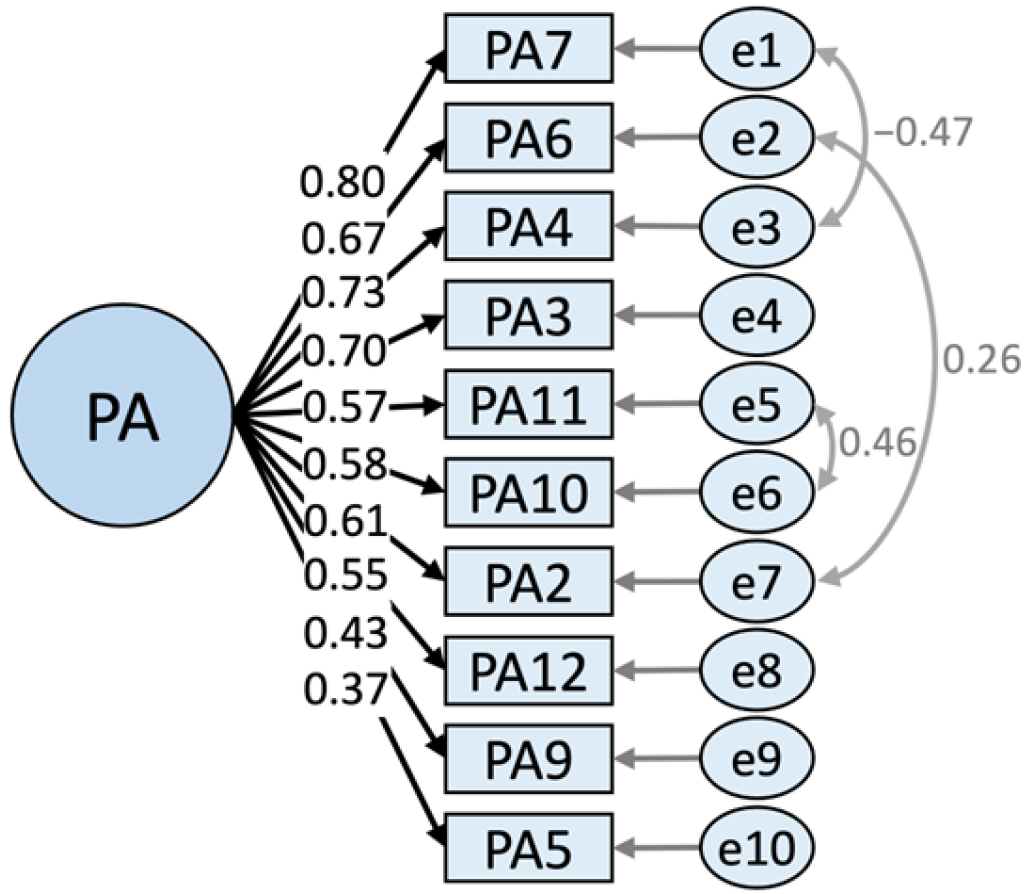
3.5.2. Validity and Reliability Analyses of the Place Attachment Scale
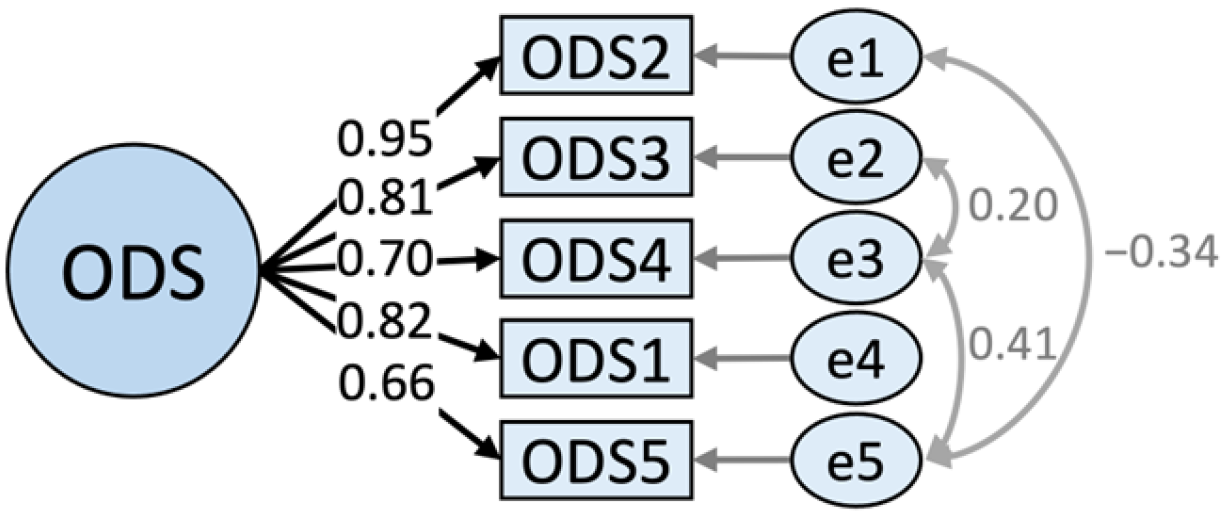
3.5.3. Validity and Reliability Analyses of the Overall Dormitory Satisfaction Scale
3.6. Data Analysis
4. Results
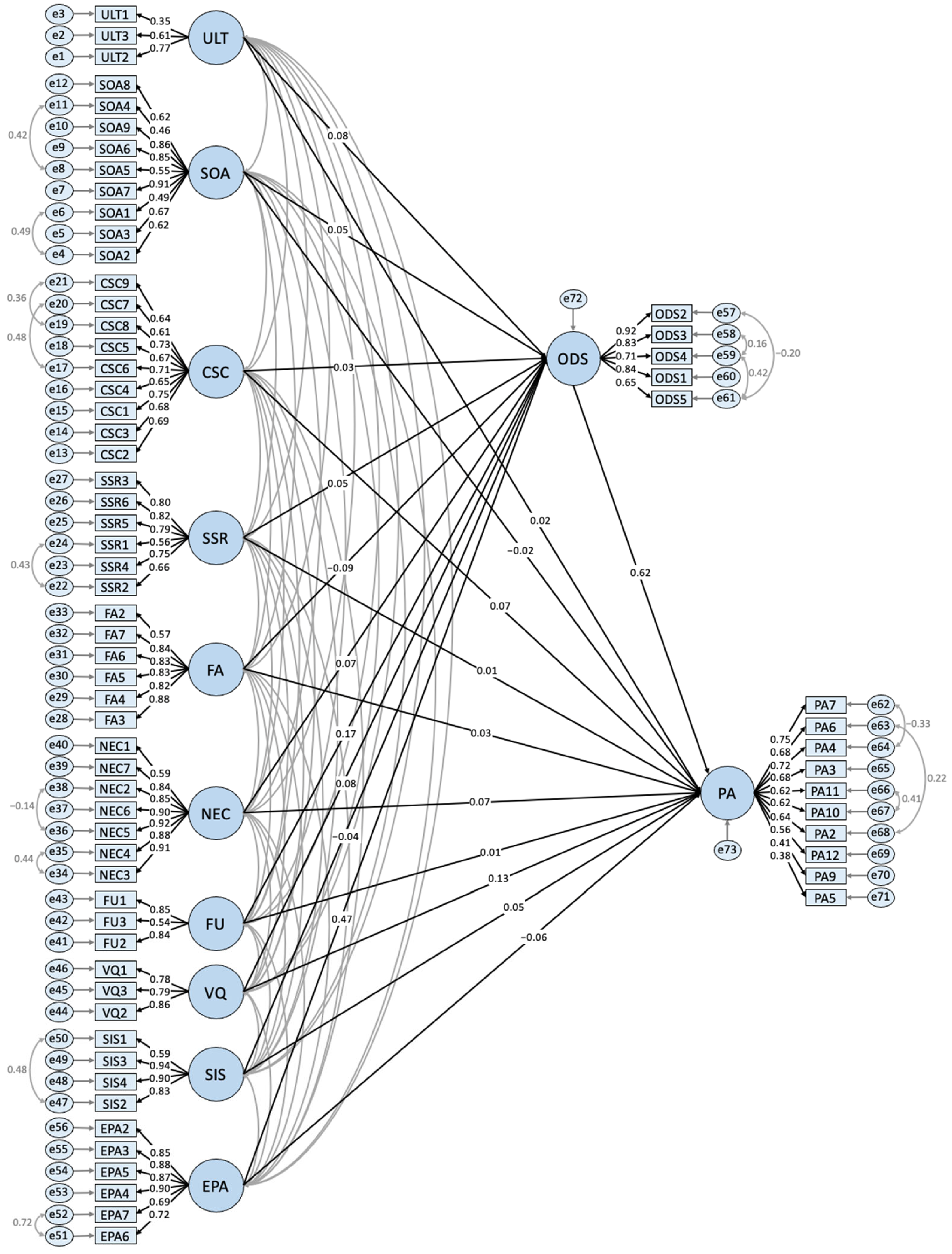
4.1. Results Related to Research Model 1
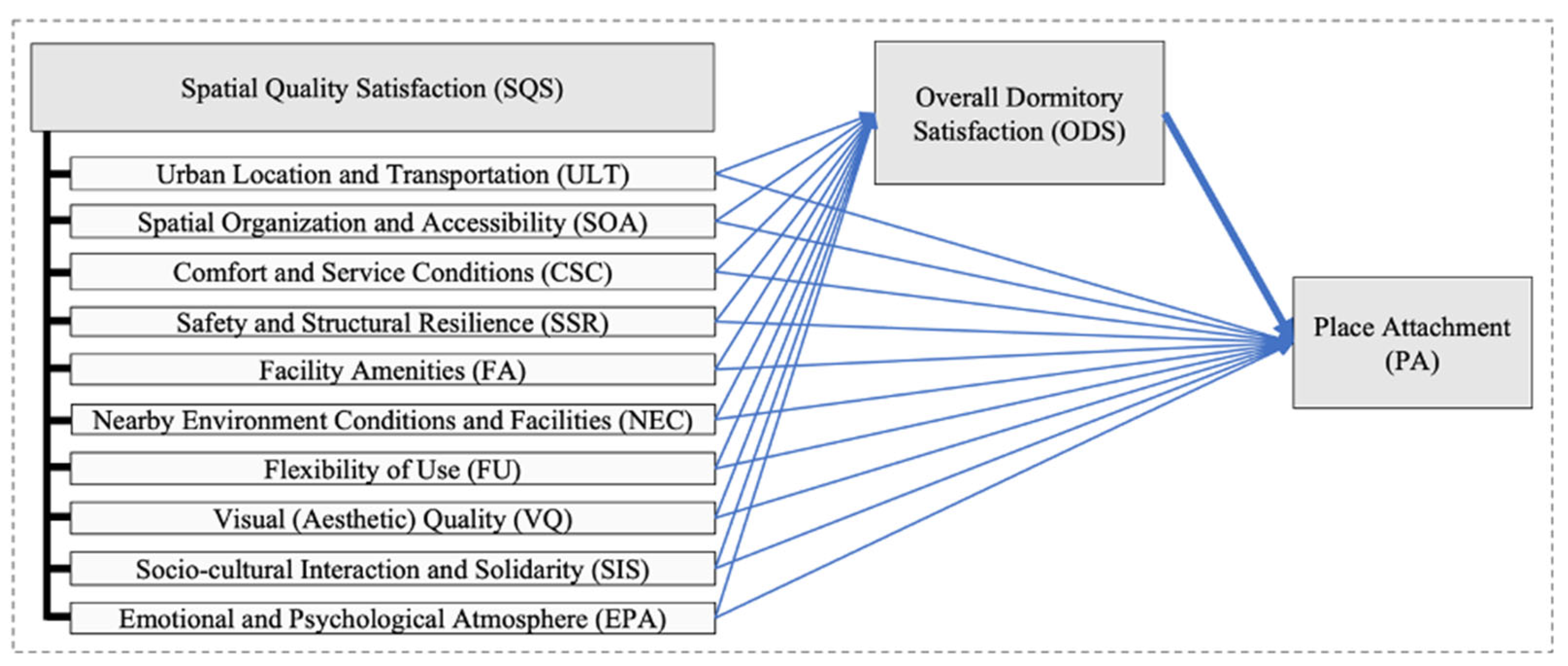
- Flexibility of Use (FU) exerts a statistically significant, positive, and weak-to-moderate effect on Overall Dormitory Satisfaction (ODS) (β = 0.168, p < 0.01);
- Emotional and Psychological Atmosphere (EPA) exerts a statistically significant, positive, and moderate effect on ODS (ODS) (β = 0.469, p < 0.001);
- Overall Dormitory Satisfaction (ODS) has a statistically significant, positive, and strong effect on Place Attachment (PA) (β = 0.615, p < 0.001);
- ODS plays a significant mediating role (weak effect size) in the relationship between FU and PA (β = 0.103) (0.019, 0.193);
- ODS plays a significant mediating role (moderate effect size) in the relationship between EPA and PA (β = 0.289) (0.191, 0.409).
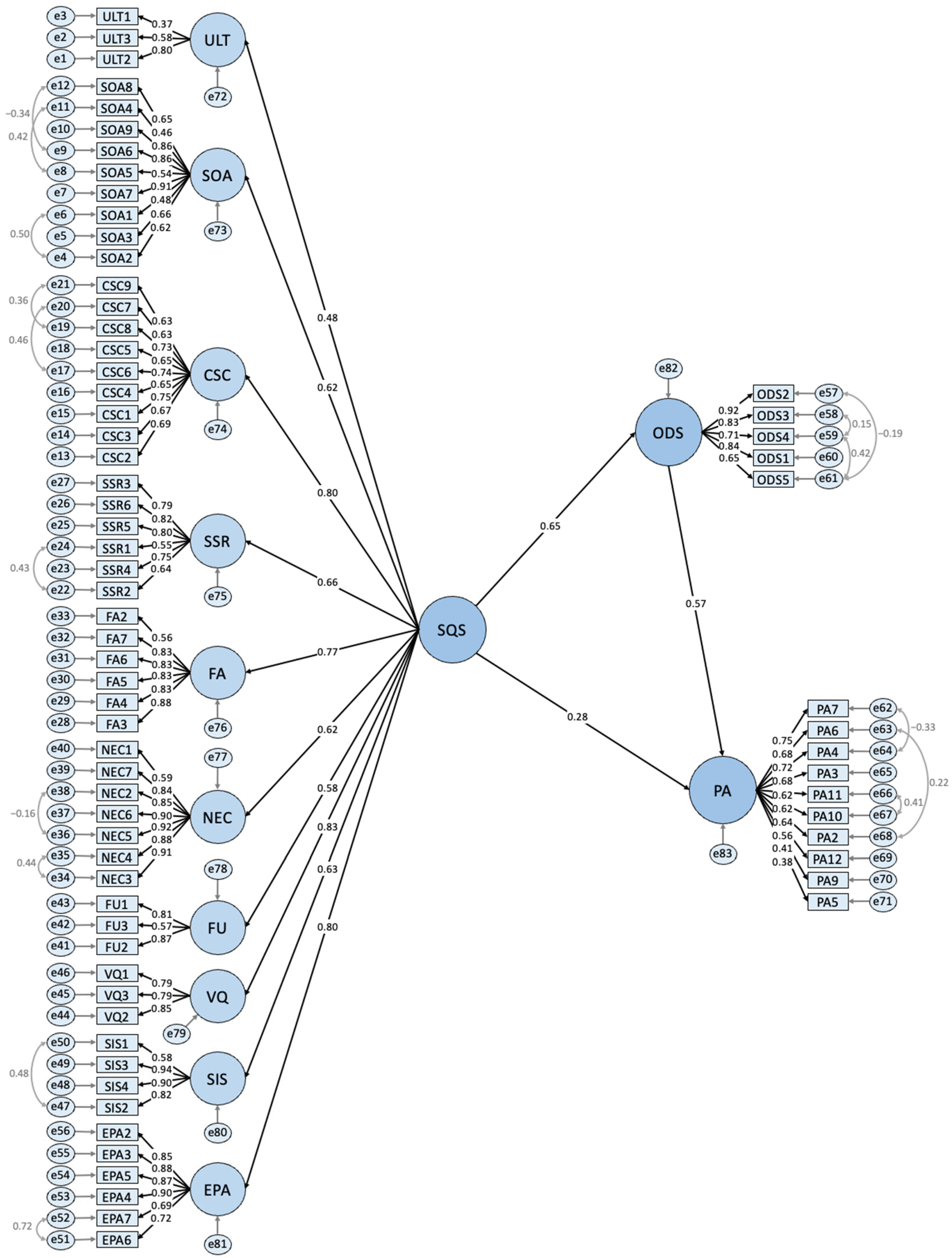
4.2. Results Related to Research Model 2
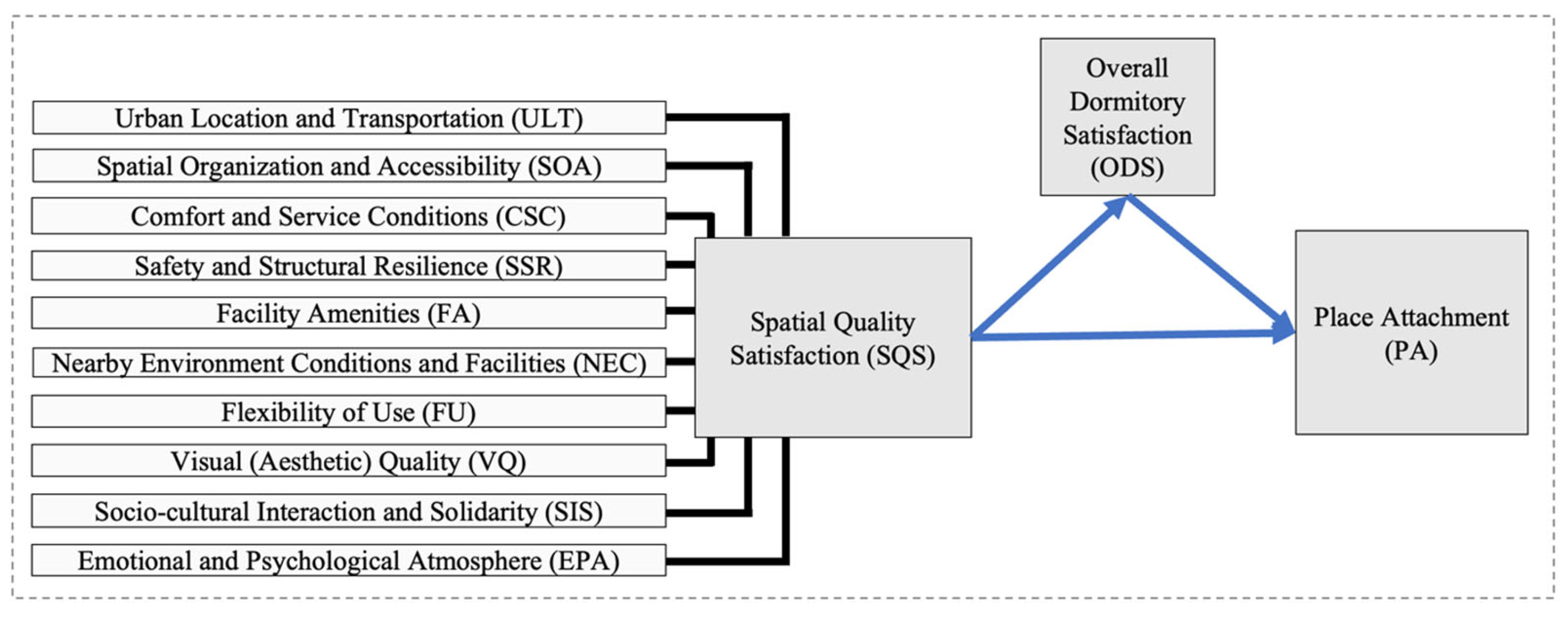
- Spatial Quality Satisfaction (SQS), as a holistic construct, exerts a statistically significant, positive, and strong effect on Overall Dormitory Satisfaction (ODS) (β = 0.654, p < 0.001).
- SQS exerts a statistically significant, positive, and moderate effect on Place Attachment (PA) (β = 0.278, p < 0.001).
- ODS plays a significant mediating role (moderate effect size) in the relationship between SQS and PA (β = 0.370) (0.289, 0.460).
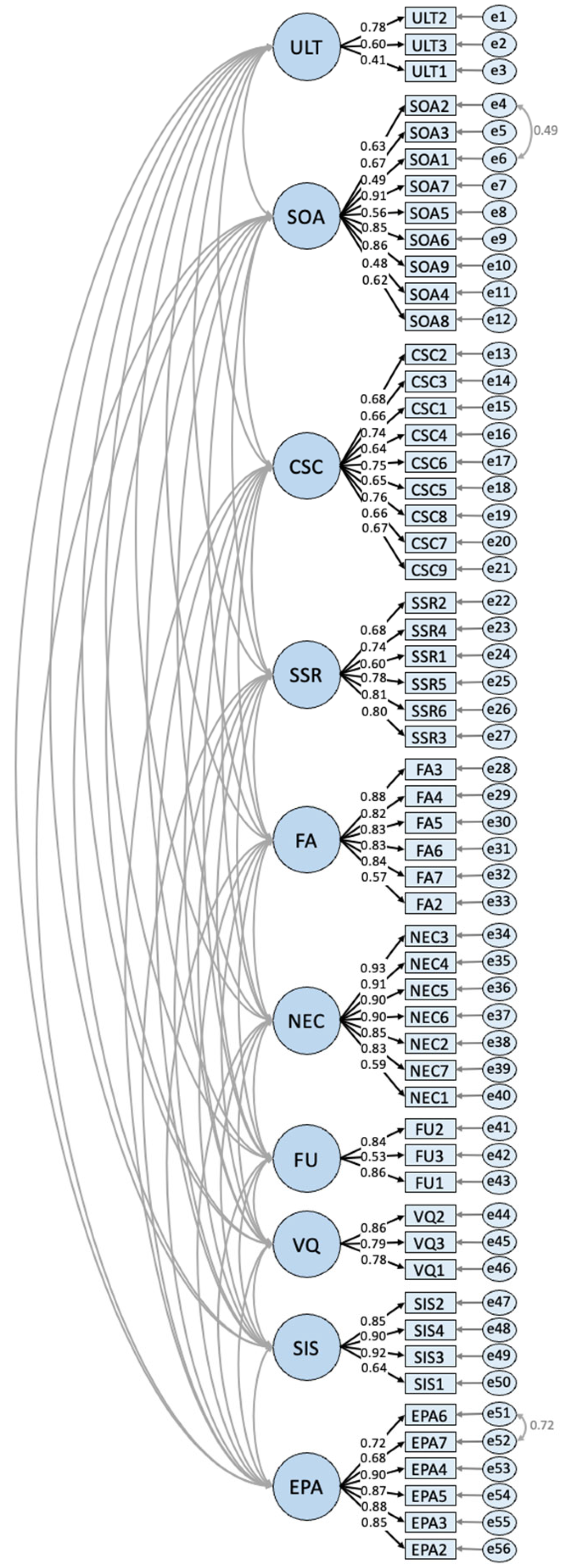
- Urban Location and Transportation (ULT): Weak-to-moderate representation (λ = 0.48).
- Spatial Organization and Accessibility (SOA): Strong representation (λ = 0.62).
- Comfort and Service Conditions (CSC): Very strong representation (λ = 0.80).
- Safety and Structural Resilience (SSR): Strong representation (λ = 0.66).
- Facility Amenities (FA): Very strong representation (λ = 0.77).
- Nearby Environmental Conditions and Facilities (NEC): Strong representation (λ = 0.62).
- Flexibility of Use (FU): Moderate-to-strong representation (λ = 0.58).
- Visual (Aesthetic) Quality (VQ): Very strong representation (λ = 0.83).
- Socio-cultural Interaction and Solidarity (SIS): Strong representation (λ = 0.63).
- Emotional and Psychological Atmosphere (EPA): Very strong representation (λ = 0.80).
5. Discussion
5.1. Individual Effects of SQS Factors
5.2. Holistic Perception of SQS
5.3. Dual-Model Comparison: Theoretical Advancement
6. Conclusions
6.1. Summary of Key Findings
6.2. Original Value/Contribution
6.3. Limitations and Future Research
Author Contributions
Funding
Institutional Review Board Statement
Informed Consent Statement
Data Availability Statement
Acknowledgments
Conflicts of Interest
Abbreviations
| SQS | Spatial quality satisfaction |
| PA | Place attachment |
| ODS | Overall dormitory satisfaction |
| WoS | Web of Science |
| ULT | Urban location and transportation |
| SOA | Spatial organization and accessibility |
| CSC | Comfort and service conditions |
| SSR | Safety and structural resilience |
| FA | Facility amenities |
| NEC | Nearby environmental conditions and facilities |
| FU | Flexibility of use |
| VQ | Visual (aesthetic) quality |
| SIS | Socio-cultural interaction and solidarity |
| EPA | Emotional and psychological atmosphere |
| EFA | Exploratory factor analysis |
| CFA | Confirmatory factor analysis |
| SEM | Structural equation modeling |
| RQ | Research question |
| GSB | Ministry of Youth and Sports |
| EFF | Evlad-ı Fatihan female |
| HHF | Hundi Hatun female |
| ACM | Ahmet Cevdet Pasha male |
| SSM | Şemseddin Sami male |
| KLM | Kırklareli male |
| MS | Microsoft |
| SPSS | Statistical package for social sciences |
| AMOS | Analysis of moment structures |
| KMO | Kaiser–Meyer–Olkin |
| CMIN/DF | Chi-square to degrees of freedom ratio |
| RMSEA | Root mean square error of approximation |
| CFI | Comparative fit index |
| TLI | Tucker–Lewis index |
| IFI | Incremental fit index |
| RFI | Relative fit index |
| NFI | Normed fit index |
| SRMR | Standardized root mean square residual |
| AI | Artificial Intelligence |
| VR | Virtual Reality |
Appendix A

| Urban Location and Transportation (ULT) |
| ULT1: Ease of transportation from the dormitory to the university campus |
| ULT2: Ease of transportation from the dormitory to the city center |
| ULT3: Location of the dormitory within the city |
| Spatial Organization and Accessibility (SOA) |
| SOA1: Ease of access from the dorm room to other spaces of the dormitory |
| SOA2: Location of dormitory spaces within the dormitory complex |
| SOA3: Ease of movement/circulation within the dormitory spaces |
| SOA4: Suitability of dormitory spaces for individuals with physical disabilities |
| SOA5: Location of entrances (complex, building) in the dormitory |
| SOA6: Dimensions of dormitory spaces (height, width, depth) |
| SOA7: The shape/form of the dormitory spaces |
| SOA8: Orientation of dormitory spaces |
| SOA9: Internal layout/arrangement of dormitory spaces |
| Comfort and Service Conditions (CSC) |
| CSC1: Air quality conditions in dormitory spaces |
| CSC2: Physical quality conditions in dormitory spaces (absence of moisture, dampness, water leaks, etc.) |
| CSC3: Thermal comfort conditions in dormitory spaces |
| CSC4: Acoustic comfort conditions in dormitory spaces |
| CSC5: Lighting comfort conditions in dormitory spaces |
| CSC6: General cleanliness/hygiene conditions in dormitory spaces |
| CSC7: Number/capacity of trash bins in dormitory spaces |
| CSC8: Maintenance and repair conditions in dormitory facilities |
| CSC9: General operation/service conditions in dormitories |
| Safety and Structural Resilience (SSR) |
| SSR1: Security control status at dormitory entrances/exits (complex, building) |
| SSR2: Security status of dormitory premises against theft |
| SSR3: Safety status of dormitory premises against physical accidents |
| SSR4: General safety status of the dormitory against animal attacks |
| SSR5: General safety status of the dormitory against fire incidents |
| SSR6: General resilience of the dormitory against natural disasters |
| Facility Amenities (FA) |
| FA1: Availability of interior furnishings and small appliances in dormitory |
| FA2: Facilities for parking vehicles (cars, motorcycles, etc.) in dormitory |
| FA3: Facilities for socio-cultural activity areas in dormitory |
| FA4: Facilities for relaxation/lounge areas in dormitory |
| FA5: Recreation and entertainment facilities in dormitory |
| FA6: Educational/study area facilities in dormitory |
| FA7: Daily living and service area facilities in dormitory |
| FA8: Infrastructure and communication systems facilities in dormitory |
| Nearby Environment Conditions and Facilities (NEC) |
| NEC1: Nearby environment physical conditions |
| NEC2: Nearby environment socio-cultural conditions |
| NEC3: Nearby environment commercial and employment facilities |
| NEC4: Nearby environment healthcare facilities |
| NEC5: Nearby environment social facilities |
| NEC6: Nearby environment recreation and entertainment facilities |
| NEC7: Nearby environment educational facilities |
| Flexibility of Use (FU) |
| FU1: Flexibility to personalize/modify of dormitory spaces |
| FU2: Flexibility to personalize/modify comfort conditions in dormitory spaces |
| FU3: Functionality diversity/flexibility in dorm rooms |
| Visual (Aesthetic) Quality (VQ) |
| VQ1: Visual appeal (color, texture, style, etc.) of dormitory spaces |
| VQ2: The pleasantness and attractiveness of the view from dormitory spaces |
| VQ3: The harmony of the overall appearance of the dormitory complex with its surroundings |
| Socio-cultural Interaction and Solidarity (SIS) |
| SIS1: Individuals’ desire to engage in social interaction within dormitory spaces |
| SIS2: The level of social interaction within dormitory spaces |
| SIS3: Level of overall social solidarity in dormitory |
| SIS4: Level of overall cultural interaction in dormitory |
| Emotional and Psychological Atmosphere (EPA) |
| EPA1: Level of privacy in dormitory spaces |
| EPA2: Level of peacefulness in dormitory spaces |
| EPA3: Level of freedom in dormitory spaces |
| EPA4: Level of happiness in dormitory spaces |
| EPA5: Level of intimacy in dormitory spaces |
| EPA6: The overall effect of dormitory spaces on individuals’ mood |
| EPA7: The overall effect of dormitory spaces on individuals’ quality of life |
Appendix B
| Participant Information Questions |
|---|
| 1-What is your gender? ( ) Female ( ) Male |
| 2-What is your marital status? ( ) Single ( ) Married |
| 3-How old are you? ( ) 17 ( ) 18 ( ) 19 ( ) 20 ( ) 21 ( ) 22 ( ) 23 ( ) 24 ( ) 25+ |
| 4-Which department are you studying in? (Please write: ………………………………) |
| 5-What is your academic year level? |
| ( ) Preparatory class ( ) 1st Year ( ) 2nd Year ( ) 3rd Year ( ) 4th Year |
| 6-What is the degree level of your department? |
| ( ) Associate degree ( ) Bachelor’s degree ( ) Postgraduate degree |
| 7-Which campus is your department based in? |
| ( ) Kayalı ( ) Kavaklı ( ) Karahıdır ( ) Other |
| 8-In which city does your family reside? (Please write: ………………………………) |
| 9-Which dormitory do you reside in? |
| ( ) Evlad-ı Fatihan Female Student Dormitory |
| ( ) Hundi Hatun Female Student Dormitory |
| ( ) Ahmet Cevdet Pasha Male Student Dormitory |
| ( ) Şemseddin Sami Male Student Dormitory |
| ( ) Kırklareli Male Student Dormitory |
| 10-How long have you been living in dormitory? |
| ( ) 1–12 months ( ) 13–24 months ( ) 25–36 months |
| ( ) 37–48 months ( ) 49–60 months ( ) 61 months and over |
| 11-What is the capacity of your dormitory room? ( ) 1 ( ) 2 ( ) 3 ( ) 4 |
| 12-On which floor is your dormitory room located? |
| ( ) −1st ( ) Ground Floor ( ) 1st ( ) 2nd ( ) 3rd ( ) 4th ( ) 5th |
| Place Attachment (PA) | SD | D | N | A | SA | |
|---|---|---|---|---|---|---|
| PA1 | I know this dormitory very well. | ( ) | ( ) | ( ) | ( ) | ( ) |
| PA2 | I defend it when somebody criticizes it. | ( ) | ( ) | ( ) | ( ) | ( ) |
| PA3 | I miss it when I am not here. | ( ) | ( ) | ( ) | ( ) | ( ) |
| PA4 * | I don’t like this dormitory. | ( ) | ( ) | ( ) | ( ) | ( ) |
| PA5 | I feel secure in this dormitory. | ( ) | ( ) | ( ) | ( ) | ( ) |
| PA6 | I am proud of this dormitory. | ( ) | ( ) | ( ) | ( ) | ( ) |
| PA7 | It is a part of myself. | ( ) | ( ) | ( ) | ( ) | ( ) |
| PA8 * | I have no influence on its affairs. | ( ) | ( ) | ( ) | ( ) | ( ) |
| PA9 | I want to be involved in what is going on here. | ( ) | ( ) | ( ) | ( ) | ( ) |
| PA10 * | I leave this dormitory with pleasure. | ( ) | ( ) | ( ) | ( ) | ( ) |
| PA11 | I would not like to move out from here. | ( ) | ( ) | ( ) | ( ) | ( ) |
| PA12 | I am rooted here. | ( ) | ( ) | ( ) | ( ) | ( ) |
| Spatial Quality Satisfaction (SQS) | SD | D | N | A | SA | |
|---|---|---|---|---|---|---|
| 1-Urban Location and Transportation (ULT) | ||||||
| ULT1 | It is easy to reach my university campus from the dormitory (on foot, by public transport, or by bicycle). | ( ) | ( ) | ( ) | ( ) | ( ) |
| ULT2 | It is easy to reach the city center from the dormitory (on foot, by public transport, or by bicycle. | ( ) | ( ) | ( ) | ( ) | ( ) |
| ULT3 | I am satisfied with the dormitory’s location within the city. | ( ) | ( ) | ( ) | ( ) | ( ) |
| 2-Spatial Organization and Accessibility (SOA) | ||||||
| SOA1 | It is easy to access other spaces of the dormitory from my room. | ( ) | ( ) | ( ) | ( ) | ( ) |
| SOA2 | I am satisfied with the location of the spaces within the dormitory complex. | ( ) | ( ) | ( ) | ( ) | ( ) |
| SOA3 | I can move around easily within the dormitory spaces. | ( ) | ( ) | ( ) | ( ) | ( ) |
| SOA4 | The dormitory spaces are accessible for individuals with physical disabilities. | ( ) | ( ) | ( ) | ( ) | ( ) |
| SOA5 | I think the locations of the dormitory entrances (complex entrance, building entrances) are appropriate. | ( ) | ( ) | ( ) | ( ) | ( ) |
| SOA6 | I am satisfied with the size (height, width, depth) of the spaces in the dormitory. | ( ) | ( ) | ( ) | ( ) | ( ) |
| SOA7 | I am satisfied with the forms of spaces in the dormitory. | ( ) | ( ) | ( ) | ( ) | ( ) |
| SOA8 | I am satisfied with the orientation of spaces in the dormitory. | ( ) | ( ) | ( ) | ( ) | ( ) |
| SOA9 | I am satisfied with the interior layout/arrangement of spaces in the dormitory. | ( ) | ( ) | ( ) | ( ) | ( ) |
| 3-Comfort and Service Conditions (CSC) | ||||||
| CSC1 | The dormitory spaces generally have fresh air. | ( ) | ( ) | ( ) | ( ) | ( ) |
| CSC2 | The dormitory spaces generally do not have physical problems such as humidity, dampness, water leakage, or cracks. | ( ) | ( ) | ( ) | ( ) | ( ) |
| CSC3 | The dormitory spaces provide thermal comfort in both cold and hot condition. | ( ) | ( ) | ( ) | ( ) | ( ) |
| CSC4 | The dormitory spaces are generally quiet/free from noise. | ( ) | ( ) | ( ) | ( ) | ( ) |
| CSC5 | The lighting (natural light, lamps, bulbs, etc.) in the dormitory spaces is sufficient. | ( ) | ( ) | ( ) | ( ) | ( ) |
| CSC6 | I am satisfied with the general cleanliness/hygiene of the dormitory spaces. | ( ) | ( ) | ( ) | ( ) | ( ) |
| CSC7 | The number/capacity of trash bins in the dormitory spaces is sufficient. | ( ) | ( ) | ( ) | ( ) | ( ) |
| CSC8 | I am satisfied with the maintenance and repair of the dormitory spaces. | ( ) | ( ) | ( ) | ( ) | ( ) |
| CSC9 | I am satisfied with the general operational/service conditions of the dormitory. | ( ) | ( ) | ( ) | ( ) | ( ) |
| 4-Safety and Structural Resilience (SSR) | ||||||
| SSR1 | The dormitory entrances and exits (complex, building) are under security control. | ( ) | ( ) | ( ) | ( ) | ( ) |
| SSR2 | The dormitory spaces are secure against theft. | ( ) | ( ) | ( ) | ( ) | ( ) |
| SSR3 | The dormitory spaces are safe from physical accidents (falls, slips, collisions, electric shocks, etc.). | ( ) | ( ) | ( ) | ( ) | ( ) |
| SSR4 | I think the dormitory is generally safe from animal attacks. | ( ) | ( ) | ( ) | ( ) | ( ) |
| SSR5 | I think the dormitory is generally safe from fire incidents. | ( ) | ( ) | ( ) | ( ) | ( ) |
| SSR6 | I think the dormitory is generally resilient to natural disasters (earthquake, flood, storm, lightning). | ( ) | ( ) | ( ) | ( ) | ( ) |
| 5-Facility Amenities (FA) | ||||||
| FA1 | The interior furnishings and small appliance amenities in the dormitory spaces are sufficient. | ( ) | ( ) | ( ) | ( ) | ( ) |
| FA2 | The vehicle (car, motorcycle, bicycle, etc.) parking facilities in the dormitory are sufficient. | ( ) | ( ) | ( ) | ( ) | ( ) |
| FA3 | The socio-cultural facilities in the dormitory are sufficient. | ( ) | ( ) | ( ) | ( ) | ( ) |
| FA4 | The relaxation facilities in the dormitory are sufficient. | ( ) | ( ) | ( ) | ( ) | ( ) |
| FA5 | The entertainment/recreation facilities in the dormitory are sufficient. | ( ) | ( ) | ( ) | ( ) | ( ) |
| FA6 | The study facilities in the dormitory are sufficient. | ( ) | ( ) | ( ) | ( ) | ( ) |
| FA7 | The daily life (cooking, storage, laundry, shopping, pet care, smoking, etc.) and service (canteen, infirmary, hairdresser, tailor, elevator, etc.) facilities in the dormitory are sufficient. | ( ) | ( ) | ( ) | ( ) | ( ) |
| FA8 | Infrastructure and communication facilities in the dormitory are sufficient. | ( ) | ( ) | ( ) | ( ) | ( ) |
| 6-Nearby Environmental Conditions and Facilities (NEC) | ||||||
| NEC1 | I am satisfied with the natural and built physical conditions in the nearby environments of the dormitory complex. | ( ) | ( ) | ( ) | ( ) | ( ) |
| NEC2 | I am satisfied with the socio-cultural conditions in the nearby environments of the dormitory complex. | ( ) | ( ) | ( ) | ( ) | ( ) |
| NEC3 | I am satisfied with the commercial and employment facilities in the nearby environments of the dormitory complex. | ( ) | ( ) | ( ) | ( ) | ( ) |
| NEC4 | I am satisfied with the healthcare facilities in the nearby environments of the dormitory complex. | ( ) | ( ) | ( ) | ( ) | ( ) |
| NEC5 | I am satisfied with the socialization facilities in the nearby environments of the dormitory complex. | ( ) | ( ) | ( ) | ( ) | ( ) |
| NEC6 | I am satisfied with the entertainment and recreation facilities in the nearby environments of the dormitory complex. | ( ) | ( ) | ( ) | ( ) | ( ) |
| NEC7 | I am satisfied with the educational facilities in the nearby environments of the dormitory complex. | ( ) | ( ) | ( ) | ( ) | ( ) |
| 7-Flexibility of Use (FU) | ||||||
| FU1 | I am able to personalize and decorate in the dormitory spaces according to my preferences. | ( ) | ( ) | ( ) | ( ) | ( ) |
| FU2 | I am able to control and adjust the comfort conditions (heating, cooling, ventilation, lighting, noise) in the dormitory spaces according to my preferences. | ( ) | ( ) | ( ) | ( ) | ( ) |
| FU3 | I am able to comfortably perform various activities (studying, socializing, eating, etc.) in my dormitory room besides sleeping. | ( ) | ( ) | ( ) | ( ) | ( ) |
| 8-Visual (Aesthetic) Quality (VQ) | ||||||
| VQ1 | The dormitory spaces are visually appealing (in terms of color, texture, style, etc.). | ( ) | ( ) | ( ) | ( ) | ( ) |
| VQ2 | The view from the windows of the dormitory spaces is pleasant and attractive. | ( ) | ( ) | ( ) | ( ) | ( ) |
| VQ3 | The overall appearance of the dormitory complex is in harmony with the surrounding environment. | ( ) | ( ) | ( ) | ( ) | ( ) |
| 9-Socio-cultural Interaction and Solidarity (SIS) | ||||||
| SIS1 | I usually engage in social interactions with others in the dormitory spaces according to my own preference. | ( ) | ( ) | ( ) | ( ) | ( ) |
| SIS2 | I am satisfied with the level of social interaction in the dormitory spaces. | ( ) | ( ) | ( ) | ( ) | ( ) |
| SIS3 | I am satisfied with the overall environment of social solidarity in the dormitory. | ( ) | ( ) | ( ) | ( ) | ( ) |
| SIS4 | I am satisfied with the overall environment of cultural interaction in the dormitory. | ( ) | ( ) | ( ) | ( ) | ( ) |
| 10-Emotional and Psychological Atmosphere (EPA) | ||||||
| EPA1 | I am satisfied with the level of privacy in the dormitory spaces. | ( ) | ( ) | ( ) | ( ) | ( ) |
| EPA2 | I generally feel peaceful in the dormitory spaces. | ( ) | ( ) | ( ) | ( ) | ( ) |
| EPA3 | I generally feel free in the dormitory spaces. | ( ) | ( ) | ( ) | ( ) | ( ) |
| EPA4 | I generally feel happy in the dormitory spaces. | ( ) | ( ) | ( ) | ( ) | ( ) |
| EPA5 | I generally perceive the dormitory spaces as intimate. | ( ) | ( ) | ( ) | ( ) | ( ) |
| EPA6 | The dormitory spaces generally have a positive effect on my mood. | ( ) | ( ) | ( ) | ( ) | ( ) |
| EPA7 | The dormitory spaces generally have a positive effect on my quality of life | ( ) | ( ) | ( ) | ( ) | ( ) |
| Overall Dormitory Satisfaction (ODS) | SD | D | N | A | SA | |
|---|---|---|---|---|---|---|
| ODS1 | Overall, I am satisfied with this dormitory. | ( ) | ( ) | ( ) | ( ) | ( ) |
| ODS2 | I am happy to stay in this dormitory. | ( ) | ( ) | ( ) | ( ) | ( ) |
| ODS3 | I will recommend that my friends stay in this dormitory. | ( ) | ( ) | ( ) | ( ) | ( ) |
| ODS4 | I would like to stay in this dormitory next semester as well. | ( ) | ( ) | ( ) | ( ) | ( ) |
| ODS5 | I would not prefer moving to another dormitory. | ( ) | ( ) | ( ) | ( ) | ( ) |
Appendix C
| Variables | Sub-Variables | n | % |
|---|---|---|---|
| Gender | Female | 275 | 61.1 |
| Male | 175 | 38.9 | |
| Marital Status | Single | 450 | 100.0 |
| Age | 18 | 52 | 11.6 |
| 19 | 63 | 14.0 | |
| 20 | 114 | 25.3 | |
| 21 | 112 | 24.9 | |
| 22 | 56 | 12.4 | |
| 23 and above | 53 | 11.8 | |
| Field of Study | Science, Engineering, and Architecture | 62 | 13.8 |
| Social and Humanities Sciences | 127 | 28.2 | |
| Health Sciences | 148 | 32.9 | |
| Economics and Administrative Sciences | 39 | 8.7 | |
| Technical Programs | 32 | 7.1 | |
| Transportation and Service Sciences | 42 | 9.3 | |
| Year of Study | Preparatory and 1st Year | 204 | 45.3 |
| 2nd Year | 156 | 34.7 | |
| 3rd and 4th Year | 90 | 20.0 | |
| Degree Level | Associate degree | 118 | 26.2 |
| Bachelor’s degree | 332 | 73.8 | |
| Campus Location | Kayalı | 332 | 73.8 |
| Kavaklı | 83 | 18.4 | |
| Karahıdır | 35 | 7.8 | |
| Region Where the Family Lives | Marmara Region | 85 | 18.9 |
| Istanbul Province | 159 | 35.3 | |
| Thrace Region | 73 | 16.2 | |
| Other | 133 | 29.6 | |
| Dormitory | Evlad-ı Fatihan Female Student Dormitory | 146 | 32.4 |
| Hundi Hatun Female Student Dormitory | 129 | 28.7 | |
| Ahmet Cevdet Pasha Male Dormitory | 97 | 21.6 | |
| Şemseddin Sami Male Student Dormitory | 40 | 8.9 | |
| Kırklareli Male Student Dormitory | 38 | 8.4 | |
| Duration of Residence | 1–12 months | 200 | 44.4 |
| 13–24 months | 141 | 31.3 | |
| 25–36 months | 62 | 13.8 | |
| 37 months and over | 47 | 10.5 | |
| Number of Roommates | 4 | 450 | 100.0 |
| Floor Level | Ground floor | 112 | 24.9 |
| 1st floor | 93 | 20.6 | |
| 2nd floor | 111 | 24.7 | |
| 3rd and 4th floors | 134 | 29.8 |
References
- Bachelard, G. The Poetics of Space; Jolas, M., Translator; Orion Press: New York, NY, USA, 1964. [Google Scholar]
- Massey, D. For Space; SAGE Publications: London, UK, 2005. [Google Scholar]
- Merleau-Ponty, M. Phenomenology of Perception; Smith, C., Translator; Routledge: London, UK, 1962. [Google Scholar] [CrossRef]
- Norberg-Schulz, C. Genius Loci: Towards a Phenomenology of Architecture; Rizzoli: New York, NY, USA, 1980. [Google Scholar]
- Pallasmaa, J. The Eyes of the Skin: Architecture and the Senses, 4th ed.; John Wiley & Sons: Hoboken, NJ, USA, 2024. [Google Scholar]
- Tschumi, B. Architecture and Disjunction; MIT Press: Cambridge, MA, USA, 1994. [Google Scholar]
- Lefebvre, H. The Production of Space; Nicholson-Smith, D., Translator; Blackwell: Oxford, UK, 1991. [Google Scholar]
- Tuan, Y.F. Space and Place: The Perspective of Experience; University of Minnesota Press: Minneapolis, MN, USA, 1977. [Google Scholar]
- Altman, I.; Rogoff, B. World views in psychology: Trait, interactional, organismic, and transactional perspectives. In Handbook of Environmental Psychology; Stokols, D., Altman, I., Eds.; John Wiley & Sons: New York, NY, USA, 1987; Volume 1, pp. 7–40. [Google Scholar]
- Manzo, L.C. Beyond house and haven: Toward a revisioning of emotional relationships with places. J. Environ. Psychol. 2003, 23, 47–61. [Google Scholar] [CrossRef]
- Heidegger, M. Being and Time; Macquarrie, J.; Robinson, E., Translators; Blackwell: Oxford, UK, 1962. [Google Scholar]
- Pallasmaa, J. Space, place and atmosphere: Emotion and peripheral perception in architectural experience. Lebenswelt 2014, 4, 230–245. [Google Scholar] [CrossRef]
- Cresswell, T. Place: A Short Introduction; Blackwell Publishing: Oxford, UK, 2004. [Google Scholar]
- Relph, E. Place and Placelessness; Pion: London, UK, 1976. [Google Scholar]
- Gifford, R. Environmental Psychology: Principles and Practice, 5th ed.; Optimal Books: Colville, WA, USA, 2014. [Google Scholar]
- Canter, D. The Psychology of Place; St. Martin’s Press: New York, NY, USA, 1977. [Google Scholar]
- Hashemnezhad, H.; Heidari, A.A.; Hoseini, P.P. Sense of place and place attachment. Int. J. Archit. Urban Dev. 2013, 3, 5–12. [Google Scholar]
- Scannell, L.; Gifford, R. Defining place attachment: A tripartite organizing framework. J. Environ. Psychol. 2010, 30, 1–10. [Google Scholar] [CrossRef]
- Hidalgo, M.C.; Hernández, B. Place attachment: Conceptual and empirical questions. J. Environ. Psychol. 2001, 21, 273–281. [Google Scholar] [CrossRef]
- Lewicka, M. Place attachment: How far have we come in the last 40 years? J. Environ. Psychol. 2011, 31, 207–230. [Google Scholar] [CrossRef]
- Low, S.M.; Altman, I. Place attachment: A conceptual inquiry. In Place Attachment; Altman, I., Low, S.M., Eds.; Springer: Boston, MA, USA, 1992; pp. 1–12. [Google Scholar] [CrossRef]
- Fullilove, M.T. Psychiatric implications of displacement: Contributions from the psychology of place. Am. J. Psychiatry 1996, 153, 1516–1523. [Google Scholar] [CrossRef]
- Scannell, L.; Gifford, R. The experienced psychological benefits of place attachment. J. Environ. Psychol. 2017, 51, 256–269. [Google Scholar] [CrossRef]
- Whettingsteel, E.; Oliver, R.; Tiwari, R. It would give you a space to be yourself: Increasing a sense of belonging for Aboriginal students in boarding schools. Aust. Int. J. Rural Educ. 2020, 30, 84–110. [Google Scholar] [CrossRef]
- Lewicka, M. Ways to make people active: The role of place attachment, cultural capital, and neighborhood ties. J. Environ. Psychol. 2005, 25, 381–395. [Google Scholar] [CrossRef]
- Gbadegesin, J.T.; Komolafe, M.O.; Gbadegesin, T.F.; Omotoso, K.O. Off-campus student housing satisfaction indicators and the drivers: From student perspectives to policy re-awakening in governance. J. Hum. Behav. Soc. Environ. 2021, 31, 889–915. [Google Scholar] [CrossRef]
- Maina, J.J.; Zaki, B.M.; Robert, B.B.; Chidoks, E. Factors influencing residential satisfaction within off-campus student housing in Kaduna state, Nigeria. J. Umm Al-Qura Univ. Eng. Archit. 2025, 16, 1442–1456. [Google Scholar] [CrossRef]
- Milli Eğitim Bakanlığı [Ministry of National Education]. Milli Eğitim İstatistikleri: Örgün Eğitim [National Education Statistics: Formal Education]; Ministry of National Education: Ankara, Turkey, 2025. Available online: https://sgb.meb.gov.tr/www/resmi-istatistikler/icerik/64 (accessed on 20 October 2025).
- Khozaei, F.; Hassan, A.S.; Khozaei, Z. Understanding students’ satisfaction with hostel and sense of attachment to place, case study at University Sains Malaysia. Am. J. Eng. Appl. Sci. 2010, 3, 516–520. [Google Scholar] [CrossRef]
- Khozaei, F.; Ramayah, T.; Hassan, A.S.; Surienty, L. Sense of attachment to place and fulfilled preferences, the mediating role of housing satisfaction. Prop. Manag. 2012, 30, 292–310. [Google Scholar] [CrossRef]
- Amole, D. Residential satisfaction and levels of environment in students’ residences. Environ. Behav. 2009, 41, 866–879. [Google Scholar] [CrossRef]
- Devlin, A.S.; Donovan, S.; Nicolov, A.; Nold, O.; Zandan, G. Residence hall architecture and sense of community: Everything old is new again. Environ. Behav. 2008, 40, 487–521. [Google Scholar] [CrossRef]
- He, W.; Zeng, N. The Relationship Between University Dormitory Environmental Factors and Students’ Informal Learning Experiences: A Case Study of Three Universities in Guangdong Province. Buildings 2025, 15, 2518. [Google Scholar] [CrossRef]
- Chow, K.; Healey, M. Place attachment and place identity: First-year undergraduates making the transition from home to university. J. Environ. Psychol. 2008, 28, 362–372. [Google Scholar] [CrossRef]
- Samadieh, M.; Rezaei, N. A serial mediation model of sense of belonging to university and life satisfaction: The role of social loneliness and depression. Acta Psychol. 2024, 250, 104562. [Google Scholar] [CrossRef]
- Scopelliti, M.; Tiberio, L. Homesickness in university students: The role of multiple place attachment. Environ. Behav. 2010, 42, 335–350. [Google Scholar] [CrossRef]
- Lewicka, M. What makes neighborhood different from home and city? Effects of place scale on place attachment. J. Environ. Psychol. 2010, 30, 35–51. [Google Scholar] [CrossRef]
- Aksel, E.; Imamoglu, Ç. Neighborhood location and its association with place attachment and residential satisfaction. Open House Int. 2020, 45, 327–340. [Google Scholar] [CrossRef]
- Casakin, H.; Reizer, A. Place attachment, residential satisfaction, and life satisfaction: Traditional and renewed kibbutz. J. Hum. Behav. Soc. Environ. 2017, 27, 639–655. [Google Scholar] [CrossRef]
- Chen, N.; Hall, C.M.; Yu, K.; Qian, C. Environmental satisfaction, residential satisfaction, and place attachment: The cases of long-term residents in rural and urban areas in China. Sustainability 2019, 11, 6439. [Google Scholar] [CrossRef]
- Lee, J.; Kyle, G.; Scott, D. The mediating effect of place attachment on the relationship between festival satisfaction and loyalty. J. Travel Res. 2012, 51, 754–767. [Google Scholar] [CrossRef]
- Ramkissoon, H.; Mavondo, F.T. The satisfaction–place attachment relationship: Potential mediators and moderators. J. Bus. Res. 2015, 68, 2593–2602. [Google Scholar] [CrossRef]
- Zhang, J.; Zhang, Z.; Liang, Y. Exploring the impact of accessibility on place attachment in urban public open spaces: A case study of Jiamusi City, China. Buildings 2024, 14, 957. [Google Scholar] [CrossRef]
- Mesch, G.S.; Manor, O. Social ties, environmental perception, and local attachment. Environ. Behav. 1998, 30, 504–519. [Google Scholar] [CrossRef]
- Stedman, R.C. Toward a social psychology of place: Predicting behavior from place-based cognitions, attitude, and identity. Environ. Behav. 2002, 34, 561–581. [Google Scholar] [CrossRef]
- Tuan, Y.F. Rootedness versus sense of place. Landscape 1980, 24, 3–8. [Google Scholar]
- Ardekani, R.B.; Helmi, F. Factors affecting the sense of belonging to dormitories. Spec. J. Archit. Constr. 2019, 5, 69–80. [Google Scholar]
- Abbas, S.; Okdeh, N.; Roufayel, R.; Kovacic, H.; Sabatier, J.-M.; Fajloun, Z.; Abi Khattar, Z. Neuroarchitecture: How the Perception of Our Surroundings Impacts the Brain. Biology 2024, 13, 220. [Google Scholar] [CrossRef] [PubMed]
- Valentine, C.; Steffert, T.; Mitcheltree, H.; Steemers, K. Architectural Neuroimmunology: A Pilot Study Examining the Impact of Biophilic Architectural Design on Neuroinflammation. Buildings 2024, 14, 1292. [Google Scholar] [CrossRef]
- Joye, Y. Architectural Lessons from Environmental Psychology: The Case of Biophilic Architecture. Rev. Gen. Psychol. 2007, 11, 305–328. [Google Scholar] [CrossRef]
- Kamphuisen, F.M.; Joye, Y.; Bolderdijk, J.W. An agent-based model of the extinction of experience: How nature availability and connectedness to nature co-evolve over time. J. Environ. Psychol. 2025, 106, 102629. [Google Scholar] [CrossRef]
- Kellert, S.R. Building for Life: Designing and Understanding the Human-Nature Connection. Renew. Resour. J. 2006, 24, 8–24. [Google Scholar]
- Kellert, S.R.; Heerwagen, J.H.; Mador, M.L. (Eds.) Biophilic Design: The Theory, Science, and Practice of Bringing Buildings to Life; John Wiley & Sons: Hoboken, NJ, USA, 2008. [Google Scholar]
- Kellert, S.R.; Calabrese, E.F. The Practice of Biophilic Design. 2015. Available online: www.biophilic-design.com (accessed on 23 February 2026).
- Williams, D.R.; Vaske, J.J. The measurement of place attachment: Validity and generalizability of a psychometric approach. For. Sci. 2003, 49, 830–840. [Google Scholar] [CrossRef]
- Yazdanfar, S.A.; Heidari, A.A.; Nekooeimehr, F. An investigation of the relationship between sense of place and place attachment among dormitory students. Int. J. Archit. Eng. Urban Plan. 2013, 23, 121–131. [Google Scholar]
- Gao, F.; Sun, Y.; Zhou, Y.; Sang, M.; Zhao, J.; Han, L. Shyness and depression: The mediating roles of interpersonal competence, dormitory belonging and inferiority. Child. Youth Serv. Rev. 2020, 119, 105571. [Google Scholar] [CrossRef]
- Spanierman, L.B.; Soble, J.R.; Mayfield, J.B.; Neville, H.A.; Aber, M.; Khuri, L.; De La Rosa, B. Living learning communities and students’ sense of community and belonging. J. Stud. Aff. Res. Pract. 2013, 50, 308–325. [Google Scholar] [CrossRef]
- Ahmed, E.N.E. Improving the design quality of housing buildings. Archit. Plan. J. 2015, 23, 1–12. [Google Scholar] [CrossRef]
- Harputlugil, T.; Gültekin, A.T.; Prins, M.; Topçu, Y.İ. Architectural design quality assessment based on analytic hierarchy process: A case study. METU J. Fac. Archit. 2014, 31, 139–161. [Google Scholar] [CrossRef]
- Reeves, C.A.; Bednar, D.A. Defining quality: Alternatives and implications. Acad. Manag. Rev. 1994, 19, 419–445. [Google Scholar] [CrossRef]
- Amole, D. Exploring the relationship between typology and quality in the context of students’ residential facilities. Glob. Built Environ. Rev. 2008, 6, 34–53. [Google Scholar]
- Garvin, D.A. What does “product quality” really mean? Sloan Manag. Rev. 1984, 26, 25–43. [Google Scholar]
- Dewulf, G.; Meel, J.V. Sense and nonsense of measuring design quality. Build. Res. Inf. 2004, 32, 247–250. [Google Scholar] [CrossRef]
- Hassanain, M.A. Design quality assessment of campus facilities through post occupancy evaluation. Int. J. Build. Pathol. Adapt. 2023, 41, 693–712. [Google Scholar] [CrossRef]
- Van der Voordt, D.J.M.; Van Wegen, H.B.R. Architecture in Use: An Introduction to the Programming, Design and Evaluation of Buildings; Routledge: London, UK, 2005. [Google Scholar]
- Dhiman, N.S. Architectural design quality indicators for museums and galleries in the Indian context. Int. J. Multidiscip. Res. 2023, 5, 1–44. [Google Scholar]
- Greene, S. Cityshape: Communicating and evaluating community design. J. Am. Plan. Assoc. 1992, 58, 177–189. [Google Scholar] [CrossRef]
- Preiser, W.F.E.; Hardy, A.E.; Schramm, U. Building Performance Evaluation: From Delivery Process to Life Cycle Phases, 2nd ed.; Springer: Cham, Switzerland, 2018. [Google Scholar] [CrossRef]
- Gaete-Sepulveda, M.; Murach, A. A holistic model for student-centered on and off-campus housing–a cross-country evaluation. Int. J. Sustain. High. Educ. 2025. [Google Scholar] [CrossRef]
- Mehaffy, M.W.; Kryazheva, Y.; Rudd, A.; Salingaros, N.A. A New Pattern Language for Growing Regions: Places, Networks, Processes; Sustasis Press: Portland, OR, USA, 2020. [Google Scholar]
- Mehaffy, M.W.; Salingaros, N.A.; Lavdas, A.A. The “Modern” Campus: Case Study in (Un)Sustainable Urbanism. Sustainability 2023, 15, 16427. [Google Scholar] [CrossRef]
- Alexander, C.; Ishikawa, S.; Silverstein, M.; Jacobson, M.; Fiksdahl-King, I.; Angel, S. A Pattern Language: Towns, Buildings, Construction; Oxford University Press: New York, NY, USA, 1977. [Google Scholar]
- George, J.; Prakash, V.P. Exploring the Influence of Neuroarchitecture on Human Behavior and Well-being. Int. J. Sci. Res. Eng. Manag. 2024, 8. [Google Scholar] [CrossRef]
- Shakour, S.; Youssef, N. Using Neuroscience to Design Interior Spaces to Enhance Sensory and Functional Experiences. J. Art Archit. Res. Stud. 2025, 8, 1–9. [Google Scholar]
- Valentine, C. Architectural Allostatic Overloading: Exploring a Connection between Architectural Form and Allostatic Overloading. Int. J. Environ. Res. Public Health 2023, 20, 5637. [Google Scholar] [CrossRef]
- Valentine, C. The impact of architectural form on physiological stress: A systematic review. Front. Comput. Sci. 2024, 5, 1237531. [Google Scholar] [CrossRef]
- Carmona, M. Public Places Urban Spaces: The Dimensions of Urban Design, 3rd ed.; Routledge: London, UK, 2021. [Google Scholar] [CrossRef]
- Chohan, A.H.; Irfan, A.; Awad, J. Development of quality indicators of housing design (QIHD), an approach to improve design quality of affordable housing. Open House Int. 2015, 40, 10–17. [Google Scholar] [CrossRef]
- Das, T. Architectural design quality indicators for educational built environment in the Indian context. Int. J. Appl. Eng. Res. 2022, 17, 66–73. [Google Scholar] [CrossRef]
- Bonaiuto, M.; Aiello, A.; Perugini, M.; Bonnes, M.; Ercolani, A.P. Multidimensional perception of residential environment quality and neighbourhood attachment in the urban environment. J. Environ. Psychol. 1999, 19, 331–352. [Google Scholar] [CrossRef]
- AboWardah, E.S.; Ramadan, M.G. Incorporating sociocultural dimensions in assessing building performance: Comparative study for public library buildings. Int. J. Des. Educ. 2020, 15, 17–42. [Google Scholar] [CrossRef]
- Hou, H.C.; Lai, J.H.K.; Edwards, D. Gap theory based post-occupancy evaluation (GTbPOE) of dormitory building performance: A case study and a comparative analysis. Build. Environ. 2020, 185, 107312. [Google Scholar] [CrossRef]
- Safizadeh, M. Simulation of the circulation complexity in student residence buildings using space syntax analyses (Case studies: Highland Hall, Rita Atkinson, Rutgers University and Tooker Residences, USA). Archit. Eng. Des. Manag. 2024, 20, 741–760. [Google Scholar] [CrossRef]
- Akoz Cevrimli, B.; Ulusoy, M. Analysing the relationship between space quality and place attachment in urban coasts using structural equation modelling: The Antalya Konyaaltı case. Int. J. Urban Sci. 2025, 1–39. [Google Scholar] [CrossRef]
- Bonaiuto, M.; Fornara, F.; Bonnes, M. Indexes of perceived residential environment quality and neighbourhood attachment in urban environments: A confirmation study on the city of Rome. Landsc. Urban Plan. 2003, 65, 41–52. [Google Scholar] [CrossRef]
- Fornara, F.; Bonaiuto, M.; Bonnes, M. Cross-validation of abbreviated perceived residential environment quality (PREQ) and neighborhood attachment (NA) indicators. Environ. Behav. 2010, 42, 171–196. [Google Scholar] [CrossRef]
- Karsono, B.; Wahid, J.; Novianti, Y.; Nurhaiza; Hassan, S.M. Place attachment in public space case study: Hiraq Square Lhokseumawe Aceh-Indonesia. Adv. Eng. Res. 2020, 195, 46–50. [Google Scholar] [CrossRef]
- Sam, N.; Bayram, N.; Bilgel, N. The perception of residential environment quality and neighbourhood attachment in a metropolitan city: A study on Bursa, Turkey. Can. J. Humanit. Soc. Sci. 2012, 1, 22–39. [Google Scholar]
- Aigbavboa, C.; Thwala, W.; Eke, A.C. An evaluation of students’ satisfaction with university hall of residence. In Proceedings of the 18th International Symposium on Advancement of Construction Management and Real Estate; Yang, D., Qian, Y., Eds.; Springer: Heidelberg, Germany, 2014; pp. 703–711. [Google Scholar]
- Akinluyi, M.L. An evaluation of functional, aesthetic, structural qualities and satisfaction in selected students’ housing for the university. ICONARP Int. J. Archit. Plan. 2015, 3, 1–27. [Google Scholar]
- Akinluyi, M.L. A study of social, physical qualities and satisfaction in selected students halls of residence, University of Ibadan, Nigeria. Int. J. Archit. Urban Dev. 2016, 6, 5–20. [Google Scholar]
- Amole, D. Residential satisfaction in students’ housing. J. Environ. Psychol. 2009, 29, 76–85. [Google Scholar] [CrossRef]
- Babatunde, S.O.; Perera, S. Public-private partnership in university female students’ hostel delivery: Analysis of users’ satisfaction in Nigeria. Facilities 2017, 35, 64–80. [Google Scholar] [CrossRef]
- Dizaj, M.D.; Khanghahi, T.H. Students’ residential preferences: A case study is dormitories of University of Mohaghegh Ardabili. J. Asian Archit. Build. Eng. 2022, 21, 1348–1363. [Google Scholar] [CrossRef]
- Eke, C.; Aigbavboa, C.; Thwala, W. Determination of satisfaction with university student residence—a report from South. In Proceedings of the International Conference on Civil and Environmental Engineering (CEE’2013), Johannesburg, South Africa, 27–28 November 2013. [Google Scholar]
- Frederick, K.W.L.; Aminuddin, A. Perception of students housing complex in Malaysian public university: Case study: University of Malaya. Malays. Archit. J. 2019, 1, 41–48. [Google Scholar]
- Gabbianelli, L.; Pencarelli, T. On-campus accommodation service quality: The mediating role of students’ satisfaction on word of mouth. TQM J. 2023, 35, 1224–1255. [Google Scholar] [CrossRef]
- Gong, A.; Söderberg, B. Residential satisfaction in student housing: An empirical study in Stockholm, Sweden. J. Hous. Built Environ. 2024, 39, 537–555. [Google Scholar] [CrossRef]
- Hou, H.C.; Zhang, D.; Lai, J.H.K. Qualitative and quantitative investigation into the indoor built environment of modular student housing: A multiple-room case study. Energy Build. 2023, 280, 112734. [Google Scholar] [CrossRef]
- Kim, M.K.; Kim, M.J. Affordable modular housing for college students emphasizing habitability. J. Asian Archit. Build. Eng. 2016, 15, 49–56. [Google Scholar] [CrossRef]
- Kocaman, G.Y.; Sezer, F.S.; Cetinkol, T. User satisfaction of indoor environmental quality in student dormitories. Eur. J. Sustain. Dev. 2017, 6, 11–22. [Google Scholar] [CrossRef]
- Navarez, J.C. Student residential satisfaction in an on-campus housing facility. In Proceedings of the DLSU Research Congress 2017, Manila, Philippines, 20–22 June 2017. [Google Scholar]
- Ning, Y.; Chen, J. Improving residential satisfaction of university dormitories through post-occupancy evaluation in China: A socio-technical system approach. Sustainability 2016, 8, 1050. [Google Scholar] [CrossRef]
- Satria, W.D.; Susanti, B.; Juliantina, I. Mix methods for measuring satisfaction and priority factors of student housing facilities: A case study in University of Sriwijaya, Indonesia. ADRRI J. Eng. Technol. 2019, 4, 1–14. [Google Scholar]
- Topraklı, A.Y. A post occupancy evaluation study for university students’ user satisfaction of dormitories. J. Youth Res. 2019, 7, 39–60. [Google Scholar]
- Adokiye, D.; Daramola, O.F.; Anjorin, O.G.; Olushola, D.O. Assessing occupant satisfaction in Mary Hall residence at Caleb University, Lagos. Afr. J. Environ. Sci. Renew. Energy 2024, 17, 86–97. [Google Scholar] [CrossRef]
- Beder, D.; Imamoglu, Ç. Correlates of dormitory satisfaction and differences involving social density and room locations. J. Hous. Built Environ. 2023, 38, 2307–2323. [Google Scholar] [CrossRef] [PubMed]
- Chafjiri, R.P. A study on the satisfaction factors in designing the students house: A case study of boys dormitory campus of the University of Guilan. IIOAB J. 2016, 7, 105–115. [Google Scholar]
- Davis, G.; Roizen, R. Architectural determinants of student satisfaction in college residence halls. In EDRA Two: Proceedings of the Second Annual Environmental Design Research Association Conference; Archea, J., Eastman, C., Eds.; Dowden, Hutchinson & Ross: Stroudsburg, PA, USA, 1970; pp. 28–44. [Google Scholar]
- Dong, Z.; Zhao, K.; Ren, M.; Ge, J.; Chan, I.Y.S. The impact of space design on occupants’ satisfaction with indoor environment in university dormitories. Build. Environ. 2022, 218, 109143. [Google Scholar] [CrossRef]
- Kader, S. Development of student satisfaction survey tool to evaluate living-learning residence hall. In Proceedings of the ARCC 2017 Conference: Architecture of Complexity, Salt Lake City, UT, USA, 14–17 June 2017; pp. 326–335. [Google Scholar]
- Martin, C.S.; Kutschke, E. Indoor Environment Quality + Residence Hall Pioneer Hall Renovation, University of Minnesota Minneapolis, MN: Sustainable Post-Occupancy Evaluation Survey (SPOES); Martin & Guerin Design Research, LLC: Minneapolis, MN, USA; Center for Sustainable Building Research, University of Minnesota: Minneapolis, MN, USA, 2021. [Google Scholar]
- Najib, N.U.M.; Yusof, N.A.; Osman, Z. Measuring satisfaction with student housing facilities. Am. J. Eng. Appl. Sci. 2011, 4, 52–60. [Google Scholar] [CrossRef]
- Nazarpour, M.; Norouzian-Maleki, S. Exploring the antecedents of Iranian college students’ residential satisfaction using structural equation modeling. Fam. Consum. Sci. Res. J. 2021, 50, 93–108. [Google Scholar] [CrossRef]
- Nazarpour, M.T.; Norouzian-Maleki, S. A comparative study of satisfaction evaluation between students of mid-rise and high-rise student housing. Facilities 2021, 39, 508–524. [Google Scholar] [CrossRef]
- Nemati, M.A.; Rastaghi, Z. Quality assessment of on-campus student housing facilities through a holistic post-occupancy evaluation (A case study of Iran). Archit. Eng. Des. Manag. 2024, 20, 719–740. [Google Scholar] [CrossRef]
- Öztürk, S.M.; Dinçer, A.E. Evaluation of the dormitories in the physical and psychological requirements: The case of Karabük Province. ICONARP Int. J. Archit. Plan. 2020, 8, 47–61. [Google Scholar] [CrossRef]
- Sanni-Anibire, M.O.; Hassanain, M.A. Quality assessment of student housing facilities through post-occupancy evaluation. Archit. Eng. Des. Manag. 2016, 12, 367–380. [Google Scholar] [CrossRef]
- Sawyerr, P.T.; Yusof, N. Student satisfaction with hostel facilities in Nigerian polytechnics. J. Facil. Manag. 2013, 11, 306–322. [Google Scholar] [CrossRef]
- Smith, K.; Asantewa, J.; AndohKwaw, P.; Owarewaa Ampaw, E. Influence of physical features of housing environment on students halls of residence. Univers. J. Bus. Manag. 2024, 4, 28–42. [Google Scholar] [CrossRef]
- Tuglo, M.E.; Olu, E.F.; Dedo, A.D. Students’ residential satisfaction with hostel facilities in universities in Ghana: A study of AAMUSTED-Kumasi campus. J. Tour. Herit. Res. 2024, 7, 126–137. [Google Scholar]
- Abu-Obeid, N.N.; Ibrahim, A.F. The effect of dormitory type and room view on the perception of privacy and territoriality by female residents. Archit. Sci. Rev. 2002, 45, 231–241. [Google Scholar] [CrossRef]
- Büyüköztürk, Ş. Sosyal Bilimler için Veri Analizi El Kitabı: İstatistik, Araştırma Deseni SPSS Uygulamaları ve Yorum [Data Analysis Handbook for Social Sciences: Statistics, Research Design, SPSS Applications and Interpretation], 31st ed.; Pegem Akademi: Ankara, Turkey, 2024. [Google Scholar] [CrossRef]
- Tabachnick, B.G.; Fidell, L.S. Using Multivariate Statistics, 7th ed.; Pearson: Boston, MA, USA, 2019. [Google Scholar]
- Yurtlar, K.Y.K. Kırklareli-KYK Yurtlar [Kırklareli-KYK Dormitories]. Available online: https://www.kykyurtlar.com/kirklareli-kyk-yurtlari/ (accessed on 1 November 2025).
- KLU Barınma Destek Birimi. Barınma [Housing]. Available online: https://barinmadestek.klu.edu.tr/ (accessed on 30 March 2025).
- Sekaran, U. Research Methods for Business: A Skill-Building Approach, 4th ed.; John Wiley & Sons: New York, NY, USA, 2003. [Google Scholar]
- Carey, L. Measuring and Evaluating School Learning, 3rd ed.; Allyn & Bacon: Boston, MA, USA, 2001. [Google Scholar]
- Sekaran, U.; Bougie, R. Research Methods for Business: A Skill Building Approach, 7th ed.; Wiley & Sons: London, UK, 2016. [Google Scholar]
- Orcan, F. Exploratory and confirmatory factor analysis: Which one to use first? J. Meas. Eval. Educ. Psychol. 2018, 9, 414–421. [Google Scholar] [CrossRef]
- Schumacker, R.E.; Lomax, R.G. A Beginner’s Guide to Structural Equation Modeling, 2nd ed.; Lawrence Erlbaum Associates: Mahwah, NJ, USA, 2004. [Google Scholar] [CrossRef]
- Park, S.; Yu, H.; Menassa, C.C.; Kamat, V.R. A comprehensive evaluation of factors influencing acceptance of robotic assistants in field construction work. J. Manag. Eng. 2023, 39, 04023010. [Google Scholar] [CrossRef]
- Cronbach, L.J. Coefficient alpha and the internal structure of tests. Psychometrika 1951, 16, 297–334. [Google Scholar] [CrossRef]
- Hair, J.F.; Black, W.C.; Babin, B.J.; Anderson, R.E. Multivariate Data Analysis, 8th ed.; Cengage Learning: Boston, MA, USA, 2019. [Google Scholar]
- Kaiser, H.F. An index of factorial simplicity. Psychometrika 1974, 39, 31–36. [Google Scholar] [CrossRef]
- Bartlett, M.S. A note on the multiplying factors for various chi-square approximations. J. R. Stat. Soc. Ser. B 1954, 16, 296–298. [Google Scholar] [CrossRef]
- Field, A. Discovering Statistics Using IBM SPSS Statistics, 5th ed.; Sage Publications: London, UK, 2018. [Google Scholar]
- Kline, R.B. Principles and Practice of Structural Equation Modeling, 4th ed.; Guilford Press: New York, NY, USA, 2016. [Google Scholar]
- Streiner, D.L. Figuring out factors: The use and misuse of factor analysis. Can. J. Psychiatry 1994, 39, 135–140. [Google Scholar] [CrossRef]
- Nunnally, J.C.; Bernstein, I.H. Psychometric Theory, 3rd ed.; McGraw-Hill: New York, NY, USA, 1994. [Google Scholar]
- George, D.; Mallery, P. SPSS for Windows Step by Step: A Simple Guide and Reference, 4th ed.; Allyn & Bacon: Boston, MA, USA, 2003. [Google Scholar]
- Browne, M.W.; Cudeck, R. Alternative ways of assessing model fit. In Testing Structural Equation Models; Bollen, K.A., Long, J.S., Eds.; Sage Publications: Newbury Park, CA, USA, 1993; pp. 136–162. [Google Scholar]
- Hu, L.; Bentler, P.M. Cutoff criteria for fit indexes in covariance structure analysis: Conventional criteria versus new alternatives. Struct. Equ. Model. 1999, 6, 1–55. [Google Scholar] [CrossRef]
- Byrne, B.M. Structural Equation Modeling with AMOS: Basic Concepts, Applications, and Programming, 3rd ed.; Routledge: New York, NY, USA, 2016. [Google Scholar] [CrossRef]
- Brown, T.A. Confirmatory Factor Analysis for Applied Research, 2nd ed.; The Guilford Press: New York, NY, USA, 2015. [Google Scholar]
- Dragan, D.; Topolšek, D. Introduction to structural equation modeling: Review, methodology and practical applications. In Proceedings of the 11th International Conference on Logistics & Sustainable Transport, Celje, Slovenia, 19–21 June 2014. [Google Scholar]
- Ullman, J.B.; Bentler, P.M. Structural equation modeling. In Handbook of Psychology: Research Methods in Psychology; Schinka, J.A., Velicer, W.F., Eds.; John Wiley & Sons: Hoboken, NJ, USA, 2003; Volume 2, pp. 607–634. [Google Scholar] [CrossRef]
- Hayes, A.F. Introduction to Mediation, Moderation, and Conditional Process Analysis: A Regression-Based Approach, 2nd ed.; Guilford Press: New York, NY, USA, 2018. [Google Scholar]
- Preacher, K.J.; Hayes, A.F. Asymptotic and resampling strategies for assessing and comparing indirect effects in multiple mediator models. Behav. Res. Methods 2008, 40, 879–891. [Google Scholar] [CrossRef]
- Lavdas, A.A. Eye-Tracking Applications in Architecture and Design. Encyclopedia 2024, 4, 1312–1323. [Google Scholar] [CrossRef]
- Lavdas, A.A.; Mehaffy, M.W.; Salingaros, N.A. AI, the beauty of places, and the metaverse: Beyond “geometrical fundamentalism”. Archit. Intell. 2023, 2, 8. [Google Scholar] [CrossRef]
- Lavdas, A.A.; Sussman, A. Applications of Biometrics in Architectural and Environmental Design. In Environmental Neuroscience; Kühn, S., Ed.; Springer: Cham, Switzerland, 2024; pp. 227–254. [Google Scholar] [CrossRef]
- Bell, P.A.; Greene, T.C.; Fisher, J.D.; Baum, A. Environmental Psychology, 5th ed.; Harcourt College Publishers: Fort Worth, TX, USA, 2001. [Google Scholar]
- Koffka, K. Principles of Gestalt Psychology; Harcourt, Brace: New York, NY, USA, 1935. [Google Scholar]
- von Bertalanffy, L. General System Theory: Foundations, Development, Applications; George Braziller: New York, NY, USA, 1968. [Google Scholar]


| Factors | Criteria | Related Literature |
|---|---|---|
| Urban Location and Transportation (ULT) | ULT1-ULT3 | [26,27,30,31,90,91,92,93,94,95,96,97,98,99,100,101,102,103,104,105,106] |
| Spatial Organization and Accessibility (SOA) | SOA1-SOA9 | [26,27,31,32,65,91,92,93,94,95,96,97,99,100,101,102,103,104,105,106,107,108,109,110,111,112,113,114,115,116,117,118,119,120,121] |
| Comfort and Service Conditions (CSC) | CSC1-CSC9 | [26,27,30,31,32,65,91,92,93,94,95,96,98,99,100,101,102,103,104,105,106,107,108,109,110,111,112,113,114,115,116,117,119,120,121,122] |
| Safety and Structural Resilience (SSR) | SSR1-SSR6 | [26,27,30,31,65,90,91,92,93,94,95,96,97,99,100,101,104,105,106,107,112,114,115,116,117,119,120,121,122] |
| Facility Amenities (FA) | FA1-FA8 | [26,27,30,31,32,65,90,93,94,95,96,97,98,99,100,101,102,103,104,105,106,107,109,110,112,113,114,115,116,117,118,119,120,121,122] |
| Nearby Environment Conditions and Facilities (NEC) | NEC1-NEC7 | [26,27,65,96,97,99,101,103,104,107,109,115,116,117,119,121] |
| Flexibility of Use (FU) | FU1-FU3 | [30,31,32,65,93,95,104,108,109,110,111,112,113,114,115,116,117,119] |
| Visual (Aesthetic) Quality (VQ) | VQ1-VQ3 | [26,27,30,31,32,65,91,92,93,94,95,96,101,104,106,107,109,110,112,113,114,115,116,117,118,119] |
| Socio-cultural Interaction and Solidarity (SIS) | SIS1-SIS4 | [27,30,31,32,93,96,98,99,101,103,107,108,110,112,115,116,121,123] |
| Emotional and Psychological Atmosphere (EPA) | EPA1-EPA7 | [26,27,30,31,32,65,91,92,93,94,95,96,97,99,104,107,108,109,110,112,113,114,115,116,117,118,120,121,122,123] |
| Dormitory Name | Capacity (Student) |
|---|---|
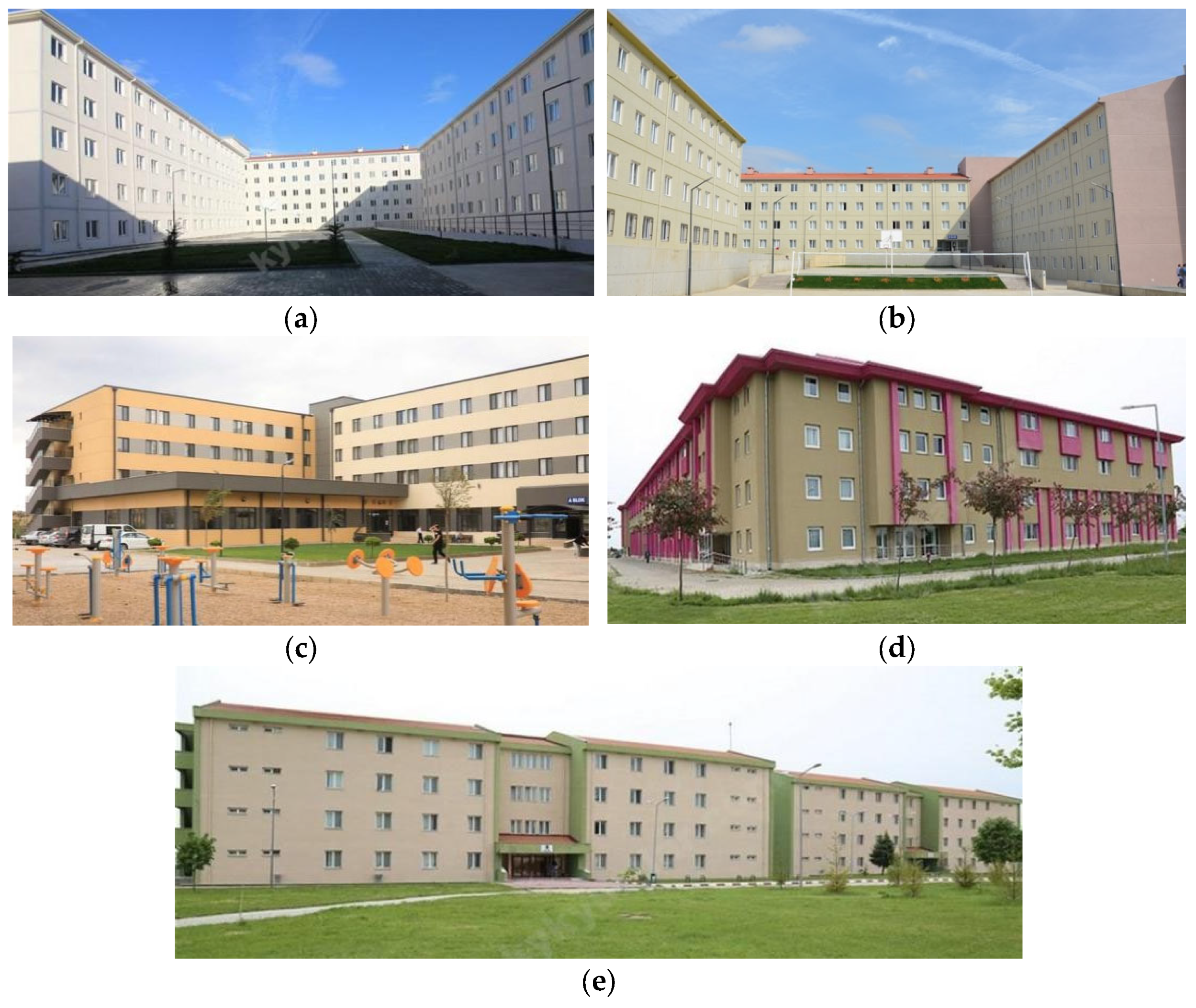
| Evlad-ı Fatihan Female (EFF) Student Dormitory | 2250 |
| Hundi Hatun Female (HHF) Student Dormitory | 2000 |
| Ahmet Cevdet Pasha Male (ACM) Dormitory | 1500 |
| Şemseddin Sami Male (SSM) Student Dormitory | 624 |
| Kırklareli Male (KLM) Student Dormitory | 580 |
| Total | 6954 |
| Dormitory Name | Capacity (Student) | Proportional Distribution |
|---|---|---|
| EFF Student Dormitory | 2250 | 146 |
| HHF Student Dormitory | 2000 | 129 |
| ACM Student Dormitory | 1500 | 97 |
| SSM Student Dormitory | 624 | 40 |
| KLM Student Dormitory | 580 | 38 |
| Total | 6954 | 450 |
| Items | Factors | |||||||||
|---|---|---|---|---|---|---|---|---|---|---|
| F1 (ULT) | F2 (SOA) | F3 (CSC) | F4 (SSR) | F5 (FA) | F6 (NEC) | F7 (FU) | F8 (VQ) | F9 (SIS) | F10 (EPA) | |
| ULT2 | 0.774 | |||||||||
| ULT3 | 0.646 | |||||||||
| ULT1 | 0.546 | |||||||||
| SOA2 | 0.812 | |||||||||
| SOA3 | 0.733 | |||||||||
| SOA1 | 0.699 | |||||||||
| SOA7 | 0.675 | |||||||||
| SOA5 | 0.632 | |||||||||
| SOA6 | 0.620 | |||||||||
| SOA9 | 0.601 | |||||||||
| SOA4 | 0.588 | |||||||||
| SOA8 | 0.544 | |||||||||
| CSC2 | 0.693 | |||||||||
| CSC3 | 0.682 | |||||||||
| CSC1 | 0.643 | |||||||||
| CSC4 | 0.613 | |||||||||
| CSC6 | 0.581 | |||||||||
| CSC5 | 0.575 | |||||||||
| CSC8 | 0.574 | |||||||||
| CSC7 | 0.541 | |||||||||
| CSC9 | 0.419 | |||||||||
| SSR2 | 0.756 | |||||||||
| SSR4 | 0.731 | |||||||||
| SSR1 | 0.712 | |||||||||
| SSR5 | 0.702 | |||||||||
| SSR6 | 0.657 | |||||||||
| SSR3 | 0.646 | |||||||||
| FA3 | 0.785 | |||||||||
| FA4 | 0.783 | |||||||||
| FA5 | 0.764 | |||||||||
| FA6 | 0.706 | |||||||||
| FA7 | 0.627 | |||||||||
| FA2 | 0.526 | |||||||||
| NEC3 | 0.885 | |||||||||
| NEC4 | 0.873 | |||||||||
| NEC5 | 0.848 | |||||||||
| NEC6 | 0.836 | |||||||||
| NEC2 | 0.822 | |||||||||
| NEC7 | 0.770 | |||||||||
| NEC1 | 0.582 | |||||||||
| FU2 | 0.774 | |||||||||
| FU3 | 0.720 | |||||||||
| FU1 | 0.643 | |||||||||
| VQ2 | 0.659 | |||||||||
| VQ3 | 0.642 | |||||||||
| VQ1 | 0.571 | |||||||||
| SIS2 | 0.823 | |||||||||
| SIS4 | 0.776 | |||||||||
| SIS3 | 0.773 | |||||||||
| SIS1 | 0.732 | |||||||||
| EPA6 | 0.764 | |||||||||
| EPA7 | 0.751 | |||||||||
| EPA4 | 0.725 | |||||||||
| EPA5 | 0.710 | |||||||||
| EPA3 | 0.685 | |||||||||
| EPA2 | 0.655 | |||||||||
| Reliability | 0.537 | 0.890 | 0.888 | 0.875 | 0.901 | 0.944 | 0.755 | 0.847 | 0.899 | 0.926 |
| Total Reliability | 0.961 | |||||||||
| Explained Variance (%) | 2.898 | 9.005 | 8.865 | 7.351 | 7.698 | 11.223 | 3.808 | 3.842 | 5.790 | 7.844 |
| Total Explained Variance (%) | 68.324 | |||||||||
| KMO = 0.941; χ2(1540) = 18,982.879; Bartlett’s Test of Sphericity (p) < 0.001 | ||||||||||
| Fit Index | Model Values | Acceptable Values |
|---|---|---|
| CMIN/DF | 2.436 | ≤5 |
| RMSEA | 0.057 | ≤0.10 |
| CFI | 0.887 | ≥0.80 |
| TLI | 0.879 | ≥0.80 |
| IFI | 0.888 | ≥0.80 |
| RFI | 0.811 | ≥0.80 |
| NFI | 0.824 | ≥0.80 |
| SRMR | 0.064 | ≤0.10 |
| Factors | Items | Factor Loadings | Standard Errors | t Values | p Values |
|---|---|---|---|---|---|
| F1 (ULT) | ULT2 | 0.778 | - | - | - |
| ULT3 | 0.602 | 0.121 | 8.505 | *** | |
| ULT1 | 0.412 | 0.096 | 5.935 | *** | |
| F2 (SOA) | SOA2 | 0.627 | - | - | - |
| SOA3 | 0.672 | 0.090 | 12.282 | *** | |
| SOA1 | 0.491 | 0.057 | 12.805 | *** | |
| SOA7 | 0.905 | 0.102 | 15.261 | *** | |
| SOA5 | 0.563 | 0.107 | 10.614 | *** | |
| SOA6 | 0.846 | 0.103 | 14.594 | *** | |
| SOA9 | 0.857 | 0.103 | 14.723 | *** | |
| SOA4 | 0.478 | 0.101 | 9.202 | *** | |
| SOA8 | 0.619 | 0.105 | 11.491 | *** | |
| F3 (CSC) | CSC2 | 0.677 | - | - | - |
| CSC3 | 0.655 | 0.063 | 12.715 | *** | |
| CSC1 | 0.738 | 0.068 | 14.152 | *** | |
| CSC4 | 0.640 | 0.077 | 12.446 | *** | |
| CSC6 | 0.752 | 0.074 | 14.395 | *** | |
| CSC5 | 0.653 | 0.059 | 12.673 | *** | |
| CSC8 | 0.761 | 0.073 | 14.546 | *** | |
| CSC7 | 0.664 | 0.081 | 12.874 | *** | |
| CSC9 | 0.671 | 0.087 | 12.990 | *** | |
| F4 (SSR) | SSR2 | 0.681 | - | - | - |
| SSR4 | 0.743 | 0.079 | 14.108 | *** | |
| SSR1 | 0.599 | 0.055 | 11.605 | *** | |
| SSR5 | 0.780 | 0.072 | 14.707 | *** | |
| SSR6 | 0.806 | 0.067 | 15.125 | *** | |
| SSR3 | 0.802 | 0.065 | 15.057 | *** | |
| F5 (FA) | FA3 | 0.878 | - | - | - |
| FA4 | 0.817 | 0.047 | 22.540 | *** | |
| FA5 | 0.825 | 0.047 | 22.941 | *** | |
| FA6 | 0.826 | 0.044 | 22.979 | *** | |
| FA7 | 0.842 | 0.030 | 23.809 | *** | |
| FA2 | 0.566 | 0.056 | 13.105 | *** | |
| F6 (NEC) | NEC3 | 0.934 | - | - | - |
| NEC4 | 0.906 | 0.029 | 33.975 | *** | |
| NEC5 | 0.903 | 0.031 | 33.635 | *** | |
| NEC6 | 0.896 | 0.031 | 32.816 | *** | |
| NEC2 | 0.845 | 0.036 | 27.939 | *** | |
| NEC7 | 0.833 | 0.037 | 26.950 | *** | |
| NEC1 | 0.587 | 0.047 | 14.517 | *** | |
| F7 (FU) | FU2 | 0.836 | - | - | - |
| FU3 | 0.534 | 0.073 | 11.085 | *** | |
| FU1 | 0.850 | 0.050 | 17.368 | *** | |
| F8 (VQ) | VQ2 | 0.861 | - | - | - |
| VQ3 | 0.793 | 0.052 | 19.117 | *** | |
| VQ1 | 0.780 | 0.043 | 18.714 | *** | |
| F9 (SIS) | SIS2 | 0.853 | - | - | - |
| SIS4 | 0.899 | 0.048 | 25.395 | *** | |
| SIS3 | 0.924 | 0.047 | 26.517 | *** | |
| SIS1 | 0.641 | 0.050 | 15.134 | *** | |
| F10 (EPA) | EPA6 | 0.715 | - | - | - |
| EPA7 | 0.683 | 0.036 | 26.680 | *** | |
| EPA4 | 0.900 | 0.056 | 18.679 | *** | |
| EPA5 | 0.870 | 0.055 | 18.058 | *** | |
| EPA3 | 0.882 | 0.055 | 18.296 | *** | |
| EPA2 | 0.854 | 0.053 | 17.721 | *** |
| Items | F1: Place Attachment (PA) |
|---|---|
| PA7 | 0.756 |
| PA6 | 0.740 |
| PA4 | 0.719 |
| PA3 | 0.707 |
| PA11 | 0.696 |
| PA10 | 0.694 |
| PA2 | 0.687 |
| PA12 | 0.630 |
| PA9 | 0.473 |
| PA5 | 0.437 |
| Reliability | 0.839 |
| Explained Variance (%) | 43.864 |
| KMO = 0.860; χ2(45) = 1583.345; Bartlett’s Test of Sphericity (p) < 0.001 | |
| Fit Index | Model Values | Acceptable Values |
|---|---|---|
| CMIN/DF | 4.278 | ≤5 |
| RMSEA | 0.085 | ≤0.10 |
| CFI | 0.932 | ≥0.80 |
| TLI | 0.905 | ≥0.80 |
| IFI | 0.933 | ≥0.80 |
| RFI | 0.880 | ≥0.80 |
| NFI | 0.914 | ≥0.80 |
| SRMR | 0.048 | ≤0.10 |
| Factors | Items | Factor Loadings | Standard Errors | t Values | p Values |
|---|---|---|---|---|---|
| F1 (PA) | PA7 | 0.796 | - | - | - |
| PA6 | 0.668 | 0.054 | 13.856 | *** | |
| PA4 | 0.727 | 0.061 | 12.770 | *** | |
| PA3 | 0.695 | 0.057 | 14.499 | *** | |
| PA11 | 0.570 | 0.062 | 11.746 | *** | |
| PA10 | 0.583 | 0.058 | 12.046 | *** | |
| PA2 | 0.607 | 0.057 | 12.489 | *** | |
| PA12 | 0.551 | 0.057 | 11.355 | *** | |
| PA9 | 0.429 | 0.062 | 8.756 | *** | |
| PA5 | 0.372 | 0.056 | 7.572 | *** |
| Items | F1: Overall Dormitory Satisfaction (ODS) |
|---|---|
| ODS2 | 0.893 |
| ODS3 | 0.866 |
| ODS4 | 0.846 |
| ODS1 | 0.843 |
| ODS5 | 0.777 |
| Reliability | 0.899 |
| Explained Variance (%) | 71.535 |
| KMO = 0.837; χ2(10) = 1448.301; Bartlett’s Test of Sphericity (p) < 0.001 | |
| Fit Index | Model Values | Acceptable Values |
|---|---|---|
| CMIN/DF | 1.754 | ≤5 |
| RMSEA | 0.041 | ≤0.10 |
| CFI | 0.999 | ≥0.80 |
| TLI | 0.995 | ≥0.80 |
| IFI | 0.999 | ≥0.80 |
| RFI | 0.988 | ≥0.80 |
| NFI | 0.998 | ≥0.80 |
| SRMR | 0.009 | ≤0.10 |
| Factors | Items | Factor Loadings | Standard Errors | t Values | p Values |
|---|---|---|---|---|---|
| F1 (ODS) | ODS2 | 0.947 | - | - | - |
| ODS3 | 0.811 | 0.039 | 22.681 | *** | |
| ODS4 | 0.701 | 0.044 | 17.640 | *** | |
| ODS1 | 0.822 | 0.037 | 23.161 | *** | |
| ODS5 | 0.663 | 0.050 | 14.808 | *** |
| Fit Index | Model Values | Acceptable Values |
|---|---|---|
| CMIN/DF | 1.985 | ≤5 |
| RMSEA | 0.047 | ≤0.10 |
| CFI | 0.898 | ≥0.80 |
| TLI | 0.891 | ≥0.80 |
| IFI | 0.898 | ≥0.80 |
| RFI | 0.812 | ≥0.80 |
| NFI | 0.814 | ≥0.80 |
| SRMR | 0.063 | ≤0.10 |
| Hypothesis | β | Standard Errors | t | p | Results |
|---|---|---|---|---|---|
| ULT➔ ODS | 0.077 | 0.094 | 1.231 | 0.218 | Not supported |
| SOA➔ ODS | 0.047 | 0.143 | 0.673 | 0.501 | Not supported |
| CSC➔ ODS | 0.026 | 0.151 | 0.258 | 0.796 | Not supported |
| SSR➔ ODS | 0.045 | 0.089 | 0.682 | 0.495 | Not supported |
| FA➔ ODS | −0.092 | 0.086 | −1.284 | 0.199 | Not supported |
| NEC➔ ODS | 0.067 | 0.076 | 1.010 | 0.313 | Not supported |
| FU➔ ODS | 0.168 | 0.074 | 2.746 | 0.006 ** | Supported |
| VQ➔ ODS | 0.080 | 0.088 | 1.019 | 0.308 | Not supported |
| SIS➔ ODS | −0.040 | 0.069 | −0.728 | 0.466 | Not supported |
| EPA➔ ODS | 0.469 | 0.091 | 6.322 | *** | Supported |
| ULT➔ PA | 0.022 | 0.068 | 0.368 | 0.713 | Not supported |
| SOA➔ PA | −0.017 | 0.104 | −0.254 | 0.799 | Not supported |
| CSC➔ PA | 0.074 | 0.110 | 0.777 | 0.437 | Not supported |
| SSR➔ PA | 0.013 | 0.065 | 0.215 | 0.830 | Not supported |
| FA➔ PA | 0.033 | 0.063 | 0.483 | 0.629 | Not supported |
| NEC➔ PA | 0.067 | 0.055 | 1.087 | 0.277 | Not supported |
| FU➔ PA | 0.007 | 0.055 | 0.114 | 0.909 | Not supported |
| VQ➔ PA | 0.130 | 0.064 | 1.765 | 0.078 | Not supported |
| SIS➔ PA | 0.045 | 0.050 | 0.885 | 0.376 | Not supported |
| EPA➔ PA | −0.062 | 0.069 | −0.864 | 0.388 | Not supported |
| ODS➔ PA | 0.615 | 0.047 | 10.071 | *** | Supported |
| ULT➔ ODS➔ PA | 0.047 | Confidence Interval (−0.038, 0.154) | Not supported | ||
| SOA➔ ODS➔ PA | 0.029 | Confidence Interval (−0.074, 0.145) | Not supported | ||
| CSC➔ ODS➔ PA | 0.016 | Confidence Interval (−0.161, 0.198) | Not supported | ||
| SSR➔ ODS➔ PA | 0.028 | Confidence Interval (−0.061, 0.140) | Not supported | ||
| FA➔ ODS➔ PA | −0.057 | Confidence Interval (−0.174, 0.044) | Not supported | ||
| NEC➔ ODS➔ PA | 0.041 | Confidence Interval (−0.049, 0.119) | Not supported | ||
| FU➔ ODS➔ PA | 0.103 | Confidence Interval (0.019, 0.193) | Supported | ||
| VQ➔ ODS➔ PA | 0.049 | Confidence Interval (−0.064, 0.161) | Not supported | ||
| SIS➔ ODS➔ PA | −0.024 | Confidence Interval (−0.105, 0.042) | Not supported | ||
| EPA➔ ODS➔ PA | 0.289 | Confidence Interval (0.191, 0.409) | Supported | ||
| Fit Index | Model Values | Acceptable Values |
|---|---|---|
| CMIN/DF | 2.105 | ≤5 |
| RMSEA | 0.050 | ≤0.10 |
| CFI | 0.882 | ≥0.80 |
| TLI | 0.877 | ≥0.80 |
| IFI | 0.883 | ≥0.80 |
| RFI | 0.807 | ≥0.80 |
| NFI | 0.809 | ≥0.80 |
| SRMR | 0.076 | ≤0.10 |
| Hypothesis | β | Standard Errors | t | p | Results |
|---|---|---|---|---|---|
| SQS➔ ODS | 0.654 | 0.260 | 7.489 | *** | Supported |
| SQS➔ PA | 0.278 | 0.146 | 4.391 | *** | Supported |
| SQS➔ ODS➔ PA | 0.370 | Confidence Interval (0.289, 0.460) | Supported | ||
| Factors | Factor Loading (λ) | Representation Level |
|---|---|---|
| ULT | 0.48 | Weak-moderate |
| SOA | 0.62 | Strong |
| CSC | 0.80 | Very strong |
| SSR | 0.66 | Strong |
| FA | 0.77 | Very strong |
| NEC | 0.62 | Strong |
| FU | 0.58 | Moderate-strong |
| VQ | 0.83 | Very strong |
| SIS | 0.63 | Strong |
| EPA | 0.80 | Very strong |
Disclaimer/Publisher’s Note: The statements, opinions and data contained in all publications are solely those of the individual author(s) and contributor(s) and not of MDPI and/or the editor(s). MDPI and/or the editor(s) disclaim responsibility for any injury to people or property resulting from any ideas, methods, instructions or products referred to in the content. |
© 2026 by the authors. Licensee MDPI, Basel, Switzerland. This article is an open access article distributed under the terms and conditions of the Creative Commons Attribution (CC BY) license.
Share and Cite
Tekin, O.; Başdoğan, S. The Impact of Spatial Quality Satisfaction on Place Attachment in Student Dormitories: A Structural Equation Modeling Approach. Buildings 2026, 16, 1575. https://doi.org/10.3390/buildings16081575
Tekin O, Başdoğan S. The Impact of Spatial Quality Satisfaction on Place Attachment in Student Dormitories: A Structural Equation Modeling Approach. Buildings. 2026; 16(8):1575. https://doi.org/10.3390/buildings16081575
Chicago/Turabian StyleTekin, Oktay, and Serhat Başdoğan. 2026. "The Impact of Spatial Quality Satisfaction on Place Attachment in Student Dormitories: A Structural Equation Modeling Approach" Buildings 16, no. 8: 1575. https://doi.org/10.3390/buildings16081575
APA StyleTekin, O., & Başdoğan, S. (2026). The Impact of Spatial Quality Satisfaction on Place Attachment in Student Dormitories: A Structural Equation Modeling Approach. Buildings, 16(8), 1575. https://doi.org/10.3390/buildings16081575