Review

BIM Implementation: A Scientometric Analysis of Global Research Trends and Progress of Two Decades

1
Sustainable Infrastructure Research & Innovation Group, Department of Civil, Structural and Environmental Engineering, Munster Technological University, T12 P928 Cork, Ireland
2
Sustainable Infrastructure Research & Innovation Group, School of Building & Civil Engineering, Munster Technological University, T12 P928 Cork, Ireland
*
Author to whom correspondence should be addressed.
Buildings 2026, 16(8), 1509; https://doi.org/10.3390/buildings16081509
Submission received: 10 February 2026 / Revised: 23 March 2026 / Accepted: 8 April 2026 / Published: 12 April 2026
(This article belongs to the Section Construction Management, and Computers & Digitization)

Abstract

Over the past decade, Building Information Modelling (BIM) has become increasingly adopted across the Architecture, Engineering, Construction, and Operation (AECO) industry. As its use in practice has expanded, BIM has also received growing scholarly attention. Existing research has largely concentrated on specific applications of BIM, such as construction management, sustainable building design, infrastructure development, and facility management. However, comparatively limited attention has been given to examining BIM implementation from a global perspective. This study addresses this gap by applying a scientometric approach to analyse global BIM implementation research published between 2004 and 2023. The analysis is conducted using co-authorship, co-word, and co-citation analysis to map the structure and development of the research field. A total of 1349 published articles were obtained from the Scopus database for the analysis. The study identifies the most productive and influential contributors to BIM implementation research, including leading researchers, research institutions, countries, subject areas, and academic journals. In addition, the analysis highlights several key thematic domains within global BIM research. These include topics related to Industry Foundation Classes (IFC), Internet of Things (IoT), Geographic Information Systems (GIS), Historic Building Information Modelling (HBIM), and Digital Twin technologies, which appear as prominent keywords within the BIM implementation literature. Beyond mapping these trends, this paper integrates dispersed scientometric evidence into a coherent global perspective, revealing how BIM implementation research has evolved, matured, and diversified across regions and disciplines. It also establishes a structured knowledge base that can serve as a benchmark for future comparative studies, performance assessments, and policy development initiatives in the digital construction domain. These findings provide valuable insights for researchers, practitioners, and policymakers by illustrating landscape of BIM-related research and highlighting potential directions for future investigation.

1. Introduction

Building Information Modelling, which represents a digital representation and integrated process for managing the physical and functional characteristics of built assets, has played a significant role in advancing digital transformation across the AEC industry [1]. Rather than functioning solely as a digital modelling tool, BIM operates as a collaborative information management framework that supports the development and use of data-rich models to assist decision-making across the entire project lifecycle. The geometric and semantic information embedded within these models facilitates key processes such as design coordination, procurement, manufacturing, and construction. Initially, BIM was primarily applied during the pre-planning, design, and construction phases of buildings, infrastructure, and integrated projects. However, contemporary research and practice have expanded its scope to encompass maintenance, refurbishment, reconstruction, and decommissioning processes [2].
Over the past decade, as BIM has rapidly advanced, numerous new research directions have emerged. The fusion of BIM with various other cutting-edge technologies has become increasingly prevalent. Javier Irizarry proposed an integrated system that combines BIM with GIS to visually represent the current status of materials throughout the supply network [3]. Another Study developed a conceptual framework for managing building defects by combining ontology and augmented reality (AR) with BIM to strengthen on-site defect management processes [4]. In the backdrop of worsening global environmental conditions, greater emphasis has been placed on the conservation of natural resources. The construction industry has increasingly reached a broad consensus on the importance of sustainable development within this context. Yujie Lu introduced a taxonomy known as the “green BIM triangle,” which conceptualises the interplay between BIM and green buildings [5]. This taxonomy offers valuable insights into the advantages and challenges associated with the implementation of BIM. A framework was proposed that integrates BIM with Genetic Algorithm optimisation and Monte Carlo simulation. This integrated approach provides a decision-support tool for the construction industry, assisting stakeholders in selecting suitable building materials while enhancing the environmental and economic sustainability of buildings [6].
In parallel with these technological advancements, the AEC sector has been undergoing a broader process of digital transformation, within which BIM has emerged as a central enabling platform for integrating digital information, processes, and stakeholders across the project lifecycle. Recent research highlights that BIM plays a key role in supporting digital transformation initiatives within the built environment by improving information flow, enabling collaborative data environments, and facilitating data-driven decision-making across construction projects [7,8,9].
Furthermore, the increasing adoption of BIM and other digital technologies has led to growing interest in evaluating the digital maturity of organisations within the construction sector. Digital maturity assessment frameworks have been developed to measure the capability of organisations to implement and manage digital technologies effectively, including BIM-enabled processes and information management systems. Such frameworks help identify organisational gaps in skills, processes, and technological infrastructure, thereby supporting strategic planning for advancing digital transformation within the construction industry [10,11].

Positioning Within Existing Scientometric Reviews

As shown in Table 1, several bibliometric and scientometric studies have previously examined the broader knowledge structure of BIM. Earlier work examined global BIM research, managerial BIM themes, knowledge domains, intellectual structure, and regional development patterns using bibliometric or scientometric techniques. For example, Zhao (2017) analysed 614 Web of Science records from 2005 to 2016 using co-author, co-word, and co-citation analysis [12]; He et al. (2017) reviewed 126 papers on managerial areas of BIM using Scopus and Web of Science [13]; Santos et al. (2017) reviewed 381 BIM papers published between 2006 and 2015 [14]; Olawumi et al. (2017) analysed 445 Web of Science articles to identify research categories and funding structures [15]; Li et al. (2017) mapped BIM knowledge domains using 1874 Web of Science records [16]; Saka and Chan (2019) examined 914 Web of Science journal articles across six continents [17]; Liu et al. (2019) reviewed 1455 Web of Science records covering global BIM research from 2004 to 2019 [18]; and Wen et al. (2021) analysed 1369 Web of Science publications from 2010 to 2019 using bibliometric visualisation methods [19].
However, most of these studies focused on BIM research broadly defined on specific subdomains such as managerial BIM, or on regional and thematic segmentation rather than on BIM implementation as a distinct knowledge stream. Even where implementation-related themes were discussed, they were typically embedded within wider BIM literature, making it difficult to isolate how implementation research itself has evolved, what its dominant clusters are, and which implementation-oriented papers and themes have shaped the field. Accordingly, the present study can be positioned more precisely as a global scientometric analysis centred specifically on BIM implementation research.
Taken together, these studies demonstrate that BIM research has been examined from several perspectives, including global publication trends, intellectual structures, thematic domains, and regional patterns of development. Nevertheless, most prior scientometric investigations have treated BIM as a broad research field rather than isolating BIM implementation as a distinct analytical focus. As a result, the specific evolution, structure, and thematic development of BIM implementation research remain comparatively underexplored. The present study therefore focuses specifically on BIM implementation literature, enabling a clearer understanding of how BIM implementation-related research has developed over time, which thematic clusters dominate the field, and which influential publications and research communities have shaped this area of study.
To address this gap, the present study applies a scientometric approach to analyse global BIM implementation research published between 2004 and 2023. Using bibliometric visualisation techniques, including co-authorship, co-citation, and keyword co-occurrence analyses, the study maps the intellectual structure, collaboration patterns, and thematic evolution of BIM implementation literature. This approach enables the identification of major research clusters, influential publications, and emerging research directions within the field.

2. Materials and Methods

Scientometrics, a subfield of information science, focuses on the quantitative analysis of patterns within scientific literature. Its primary aim is to provide a comprehensive understanding of emerging trends and the intellectual structure of research domains. In recent years, scientometric analysis has become one of the most widely adopted approaches for evaluating research performance. This method is applied not only to assess the contributions of individual researchers but also to evaluate the performance of departments, faculties, universities, countries, and academic journals [20].
Co-citation analysis is a method used to examine the relationships between scientific publications. It identifies influential or core works within a research field by analysing how frequently two or more publications are cited together in subsequent literature. These citation relationships illustrate that scientific knowledge develops through interconnected and systematic linkages rather than through isolated contributions. Co-citation patterns therefore reflect the objective evolution of scientific research, demonstrating the cumulative, continuous, and inheritable nature of scholarly knowledge, as well as its interdisciplinary connections. Citation networks further enable researchers to trace the intellectual origins of ideas and follow their subsequent development across time. Importantly, citations in scientific literature are not evenly distributed; instead, they exhibit patterns of concentration and dispersion, reflecting the varying levels of influence and attention that different publications receive within the academic community.
Co-word analysis is a bibliometric technique first introduced by Callon [11]. It is based on the statistical examination of words that co-occur within the same body of literature. By analysing the frequency with which terms appear together, the method evaluates the strength of relationships between concepts and identifies patterns of association or divergence. As a form of content analysis, co-word analysis enables the mapping of relationships among informational elements within textual data. It focuses particularly on keywords shared across publications and organises related literature according to the interactions among these keywords. Consequently, the keywords used to summarise the content of publications act as fundamental elements in shaping the conceptual structure of research fields [21]. This approach offers insights into the thematic connections and relationships within a body of literature. For example, frequent co-occurrence of terms such as “BIM implementation,” “interoperability,” and “IFC” may indicate a thematic cluster focused on data exchange standards, whereas links between “Digital Twin,” “IoT,” and “facility management” reflect emerging directions in integrating BIM with smart asset management technologies.
To ensure comprehensive and reliable research data, Scopus was selected as the primary data source for this study. As summarised in Table 1, most previous scientometric analyses of BIM research have relied predominantly on the Web of Science database. Therefore, this study deliberately utilised Scopus to provide a complementary perspective and broaden the coverage of BIM implementation research. Scopus is widely recognised for its extensive journal coverage in engineering, construction management, and built environment disciplines, and it indexes a large number of peer-reviewed publications relevant to BIM research. Comparative studies have also shown that Scopus offers broader journal coverage than Web of Science, particularly in engineering and applied sciences, while providing comprehensive citation and metadata export capabilities suitable for bibliometric analysis [22,23].
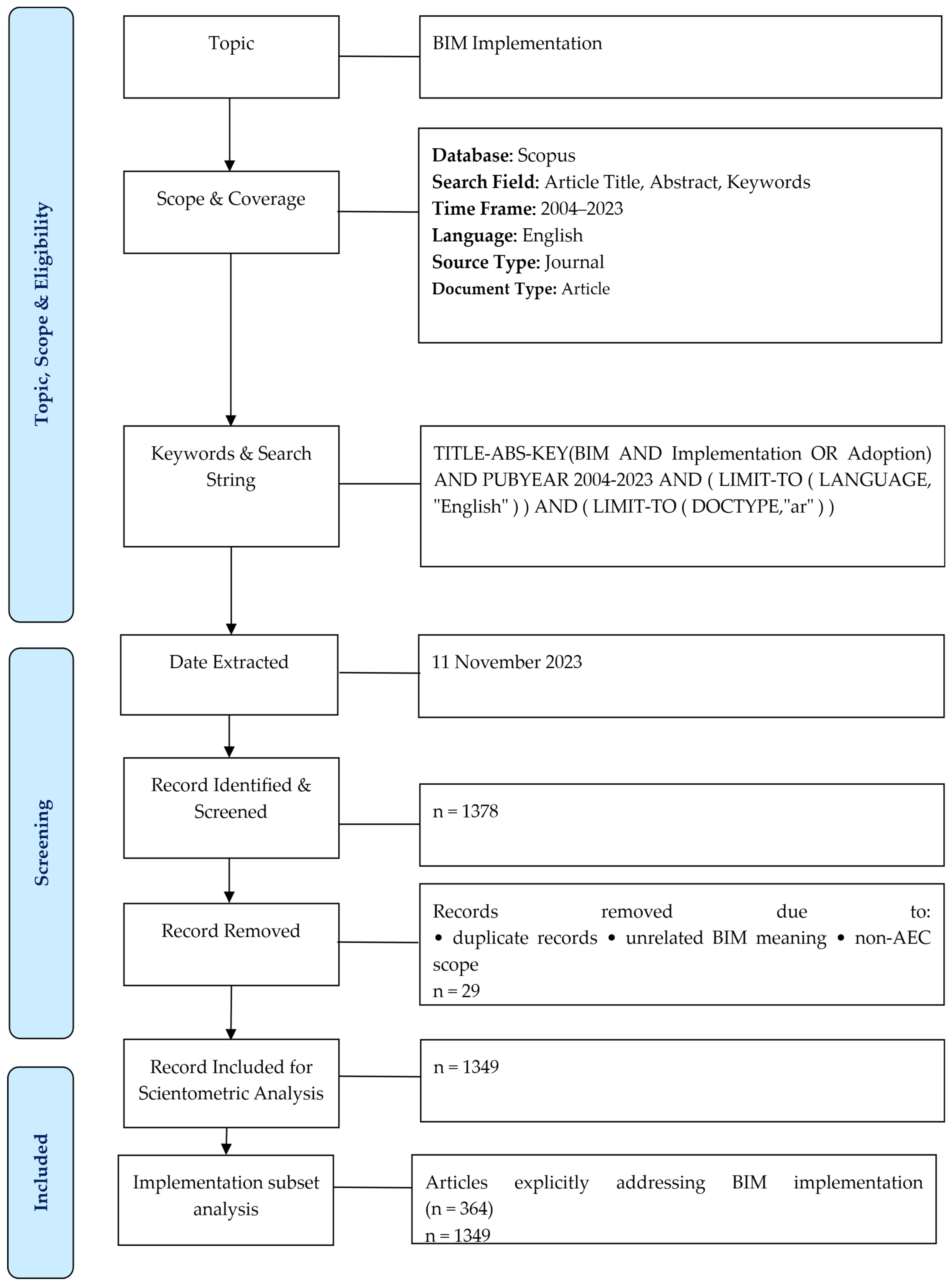
Journal articles published over the last two decades (2004–2023) were retrieved using BIM implementation main keywords, resulting in a data set of 1378 literature entries. However, the number of entries that shared a similar acronym but had irrelevant implications, such as “Budget Impact Model (BIM),” among others were manually eliminated, resulting in a refined dataset of 1349 literature entries. Conference papers were subsequently excluded from the dataset, and only journal articles were retained for detailed analysis. The overall methodology adopted in this study is shown in Figure 1. A PRISMA-inspired screening workflow was adopted to improve the transparency and replicability of the dataset construction process. The literature identification process began with a Scopus search using the predefined Boolean search string applied to the title, abstract, and keyword fields. The initial search returned 1378 records. These records were then screened to remove publications that were not relevant to the intended meaning of BIM within the architecture, engineering, and construction context, including records in which the acronym “BIM” referred to unrelated terms. After this screening step, 1349 journal articles remained and were retained as the final dataset for the scientometric analysis.
The inclusion criteria comprised: (i) journal articles indexed in Scopus; (ii) publications written in English; (iii) studies published between 2004 and 2023; and (iv) publications relevant to BIM implementation or adoption within the built environment domain. The exclusion criteria comprised: (i) conference papers and other non-journal document types; (ii) non-English publications; and (iii) records unrelated to Building Information Modelling in the construction context. In addition to the full scientometric dataset, a refined subset of 364 articles explicitly addressing BIM implementation or BIM adoption in their titles was identified for the focused analysis presented in Section 3.6.
To identify relevant publications, a structured search strategy was developed using the Scopus database. The search query was designed to capture studies related to BIM implementation and adoption within the construction domain. The following Boolean search expression was used: TITLE-ABS-KEY (“BIM”) AND TITLE-ABS-KEY (implementation OR adoption). Searching within the title, abstract, and keyword fields ensures that the retrieved publications are strongly related to the research topic while maintaining adequate coverage of relevant studies.
The search strategy was deliberately structured around the core terms “BIM” and “implementation/adoption”, as the objective of this study is to examine BIM implementation research as a distinct knowledge domain. In bibliometric research, search design requires a balance between comprehensiveness and conceptual specificity, as overly broad search strings may introduce adjacent but analytically different studies and thereby reduce the coherence of science-mapping results. The selected terms represent the most widely established and consistently used descriptors of BIM implementation in the AEC literature. While related expressions such as “integration”, “diffusion”, “BIM strategy”, and “digital construction adoption” are present in the wider literature, these terms are often used in broader or context-dependent ways and may extend beyond the specific scope of BIM implementation research. Accordingly, the final search query was defined to maintain a clear conceptual boundary and ensure the relevance and internal consistency of the dataset. This focused keyword strategy is consistent with previous scientometric studies on BIM research [12], where a limited set of core keywords is commonly used to retrieve literature directly relevant to the investigated topic while avoiding the inclusion of unrelated records.
To conduct the scientometric analysis, VOSviewer version 1.6.20 was employed as the primary analytical tool in this study. VOSviewer is widely recognised as a specialised software for constructing and visualising bibliometric networks and has been extensively applied in scientometric studies across engineering and construction management research. The software enables the analysis of relationships among various research entities, including publications, journals, authors, research institutions, countries, and keywords. These relationships can be examined through several bibliometric techniques, such as co-authorship analysis, keyword co-occurrence, citation analysis, bibliographic coupling, and co-citation analysis [24]. One of the key advantages of VOSviewer is its ability to efficiently process large bibliographic datasets and generate clear network visualisations that reveal the structure and thematic clusters of a research field. In addition, the software is highly compatible with bibliographic data exported from the Scopus database, which facilitates reliable data processing and network mapping. VOSviewer also quantifies both the number of connections and the strength of relationships between nodes, enabling the generation of graphical network maps that support the interpretation of bibliometric structures and research trends [25].

3. Results and Discussion

This section presents and discusses the results of the scientometric analyses conducted on the selected literature related to BIM implementation in the AEC industry.

3.1. Geographical and Temporal Distribution of BIM Implementation Research (2004–2023)

In the typical progression of technological development within any research field, there is a general similarity. The process typically initiates with an initial conception phase. Subsequently, as research tools become more widely available, the capacity and scope of the research expand, marking the onset of the proliferation phase. During this stage, researchers often apply the developed research methods to other fields. Ultimately, the field enters a declining phase as the technology becomes less prominent or is surpassed by newer developments [26].
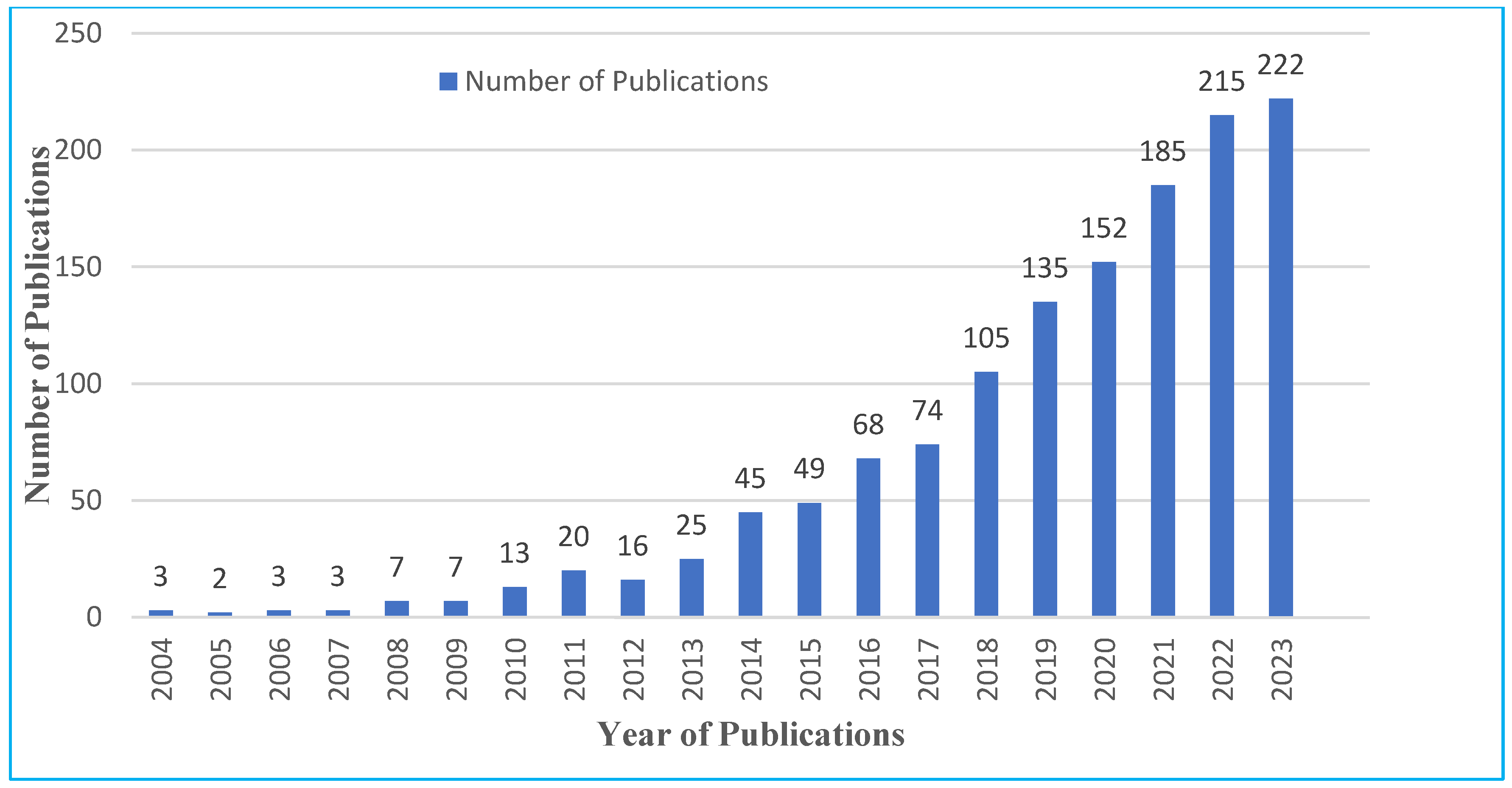
In this study, an analysis was conducted on the number of papers published in the field of BIM Implementation over the past two decades (2004–2023), along with an examination of the countries or regions where these papers originated. Figure 2 presents the yearly distribution of BIM-related publications retrieved from the Scopus database between 2004 and 2023. The results indicate a steady and sustained growth in BIM implementation research over the last twenty years. During (2004–2013), the number of publications remained relatively low, reflecting the emerging stage of BIM research within the AEC industry. From approximately 2014 onwards, publication output increased consistently, with particularly strong growth observed after 2017. The publication trajectory shows a gradual expansion of scholarly attention to BIM implementation as the technology became more widely adopted in practice and academia. Several policy and standardisation developments occurred during this period, including the UK Government BIM Level 2 mandate in 2016 and the publication of the ISO 19650 series beginning in 2018 [27]. While these initiatives are widely recognised as important milestones in the global diffusion of BIM, the publication data suggest that research activity expanded progressively associated with specific policy events.
These milestones encouraged both academia and industry to explore BIM implementation strategies, maturity assessment, and integration with emerging technologies such as IoT, cloud computing, and Digital Twins, leading to a surge in related publications. Between 2004 and 2013, publication output in the BIM field displayed fluctuations, with fewer than 100 papers published. This limited output reflects the exploratory phase of BIM research, when conceptual discussions and pilot projects were still emerging, software interoperability was under development, and global awareness of BIM’s potential benefits remained relatively low. This suggests that BIM research was in its early conception stage during this period. However, from 2013 onwards, as BIM technology gained wider adoption in engineering practice and various software tools were actively promoted, the number of BIM-related publications experienced a marked increase between 2014 and 2023. By 2017, the total number of publications had exceeded 300, indicating that BIM research had entered a phase of rapid expansion.
From 2020 to 2023, over 150 journal articles were published annually, with the total number exceeding 1000 in 2020. The trajectory of BIM publications demonstrates and accelerating rise, indicating its entry into a stage of rapid growth. Notably, over five years (2018–2023), 75% of the total papers related to BIM Implementation were published.
The geographical spread of publications was determined using author affiliation data extracted from the bibliographic records and analysed using VOSviewer. Countries were attributed based on the institutional affiliations of all authors associated with each publication. Using the full counting method implemented in VOSviewer, each country represented in the author affiliations of a publication was assigned one publication count. Consequently, publications involving international co-authorship contribute to the counts of multiple countries, and the total across countries may exceed the total number of publications.
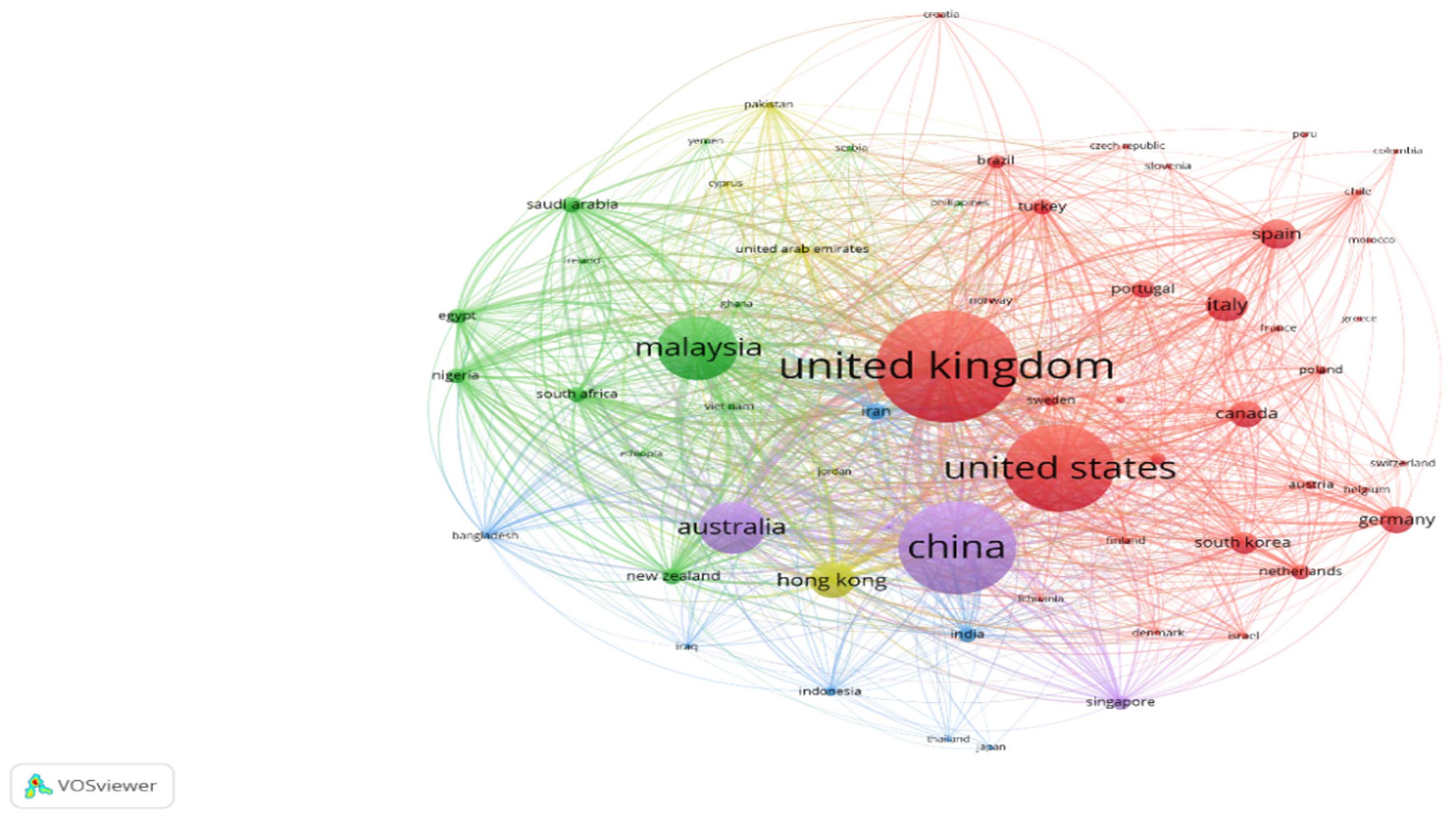
The geographical distribution of BIM research was also examined by identifying the top 20 countries or regions that have contributed most actively to BIM-related studies during the last two decades, as presented in Table 2. Among them, the United Kingdom ranks first in terms of publication output, with 216 publications, representing approximately 16% of the total. This dominance can be attributed to the UK Government’s early and strategic commitment to BIM adoption, particularly following the 2011 Government Construction Strategy and the implementation of the Level 2 BIM mandate in 2016, which positioned the UK as a global leader in BIM policy, standardisation and practice. The UK’s strong network of research-intensive universities, such as the University of Cambridge and University College London, further accelerated scholarly contributions through collaborative industry-academic research on BIM frameworks, maturity models, and digital transformation in construction. China follows closely with 180 publications, representing 13.3%. The United States, Malaysia, Australia, among others, follow in the subsequent positions. In addition to total publication output and citation counts, a citation index was calculated to provide a normalised indicator of research influence by country. The citation index represents the average number of citations per publication, calculated by dividing the total citation count by the number of articles attributed to each country.
The citation index highlights countries that produce comparatively fewer publications but achieve high scholarly impact. For example, Israel and Belgium appear among the highest-ranked countries in the citation index despite not being among the top producers of BIM-related publications. This suggests that although their publication volume is relatively limited, their contributions have achieved a strong academic influence within the BIM research community.
The international collaboration network generated using VOSviewer is presented in Figure 3. The network is based on co-authorship relationships between countries, derived from the institutional affiliations of authors in the analysed publications. Each node represents a country, while links indicate collaborative relationships formed through co-authored articles. The size of each node reflects the number of publications attributed to that country, and the thickness of the links represents the strength of collaboration between countries. The colour gradient represents betweenness centrality, a network metric indicating the extent to which a country acts as an intermediary connecting different parts of the collaboration network. Countries such as the United States, Germany, United Kingdom, Italy, Spain, Canada, Poland, and the Netherlands exhibit relatively high centrality, suggesting their important role in linking international research communities within BIM implementation studies.

3.2. Analysis of Journal Co-Citations

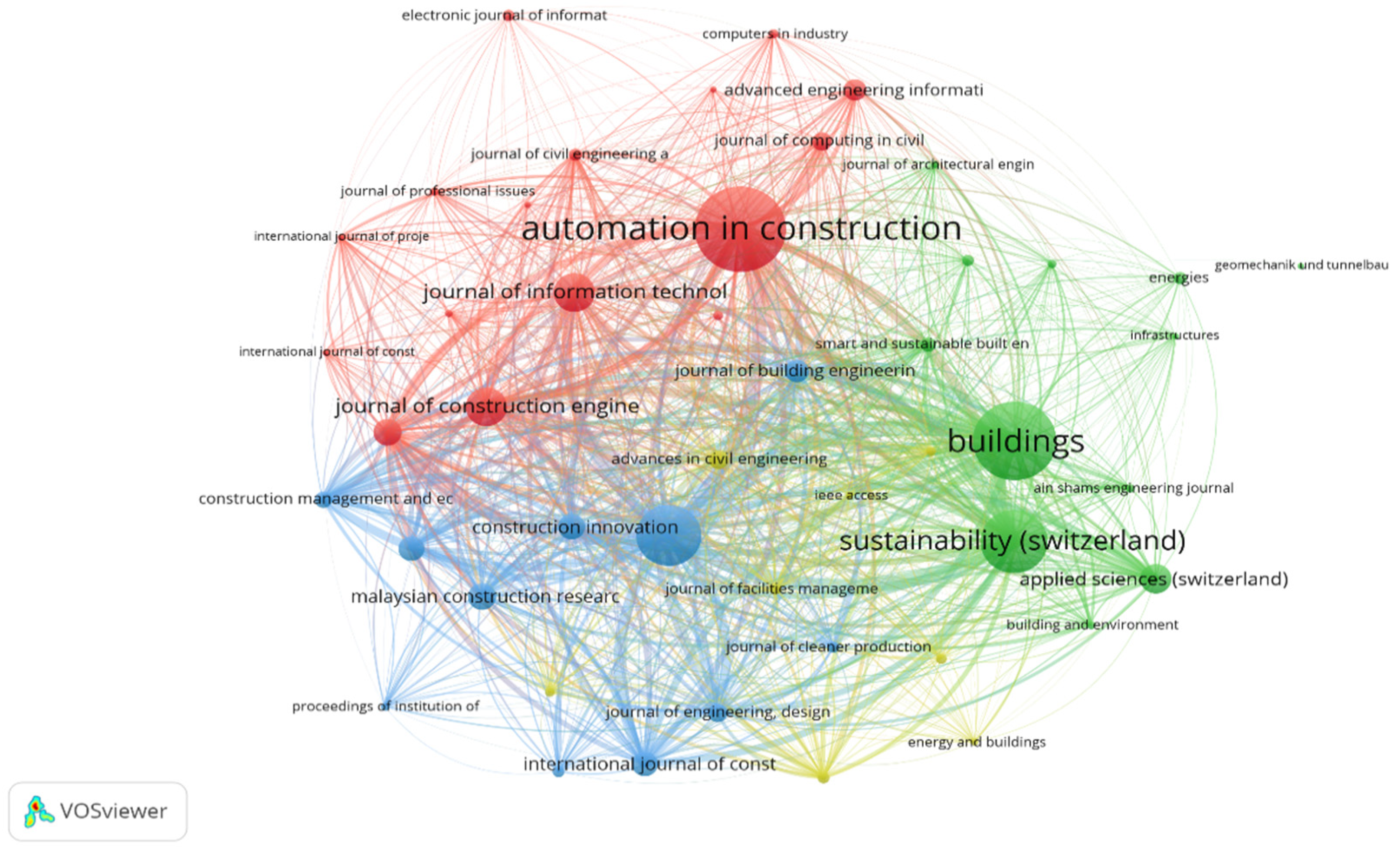
A journal co-citation analysis was conducted using VOSviewer. Journal co-citation occurs when two documents published in different journals are cited together by another document in a separate journal [28,29]. Figure 4 illustrates the co-citation network of journals related to BIM implementation. In this visualisation, each node represents a journal, and the size of the node indicates the number of citations received within the co-citation network, reflecting the journal’s relative influence in the BIM research domain. The links between nodes represent co-citation relationships, while the number and thickness of these links indicate the strength of the connections between journals.
As illustrated in Figure 4, journals are grouped into several clusters, representing sets of journals that are frequently cited together within the BIM literature. These clusters reflect related research areas within the broader BIM knowledge structure. “Automation in Construction” occupies a central position with a dense network of connections, indicating its strong influence within BIM-related research.
Table 3 presents the ten most highly co-cited journals. Automation in Construction is the most influential journal in terms of total citation frequency, with a significantly higher number of citations compared to other journals. This suggests that Automation in Construction holds a robust authority in the field of BIM. Following closely are influential journals such as Journal of Construction Engineering and Management, Engineering, Construction and Architectural Management, Journal of Management in Engineering, Architectural Engineering and Design Management, and Advanced Engineering Informatics. In addition to citation counts, the table also reports the host country of each journal publisher in order to illustrate the geographical distribution of major publication outlets. Notably, all the highest cited journals originate from Europe and USA, underscoring that the primary research hubs for BIM are still concentrated in these regions.
The relationship with the data presented in Table 3 is also evident in Figure 4, where Automation in Construction appears at the centre of the network, highlighting its strong influence and contribution to BIM research. The similar colour-coding in Figure 4 indicates the close association among these journals, while the spatial proximity between nodes reflects the strength of their co-citation relationships.

3.3. Analysis of Author Co-Citation

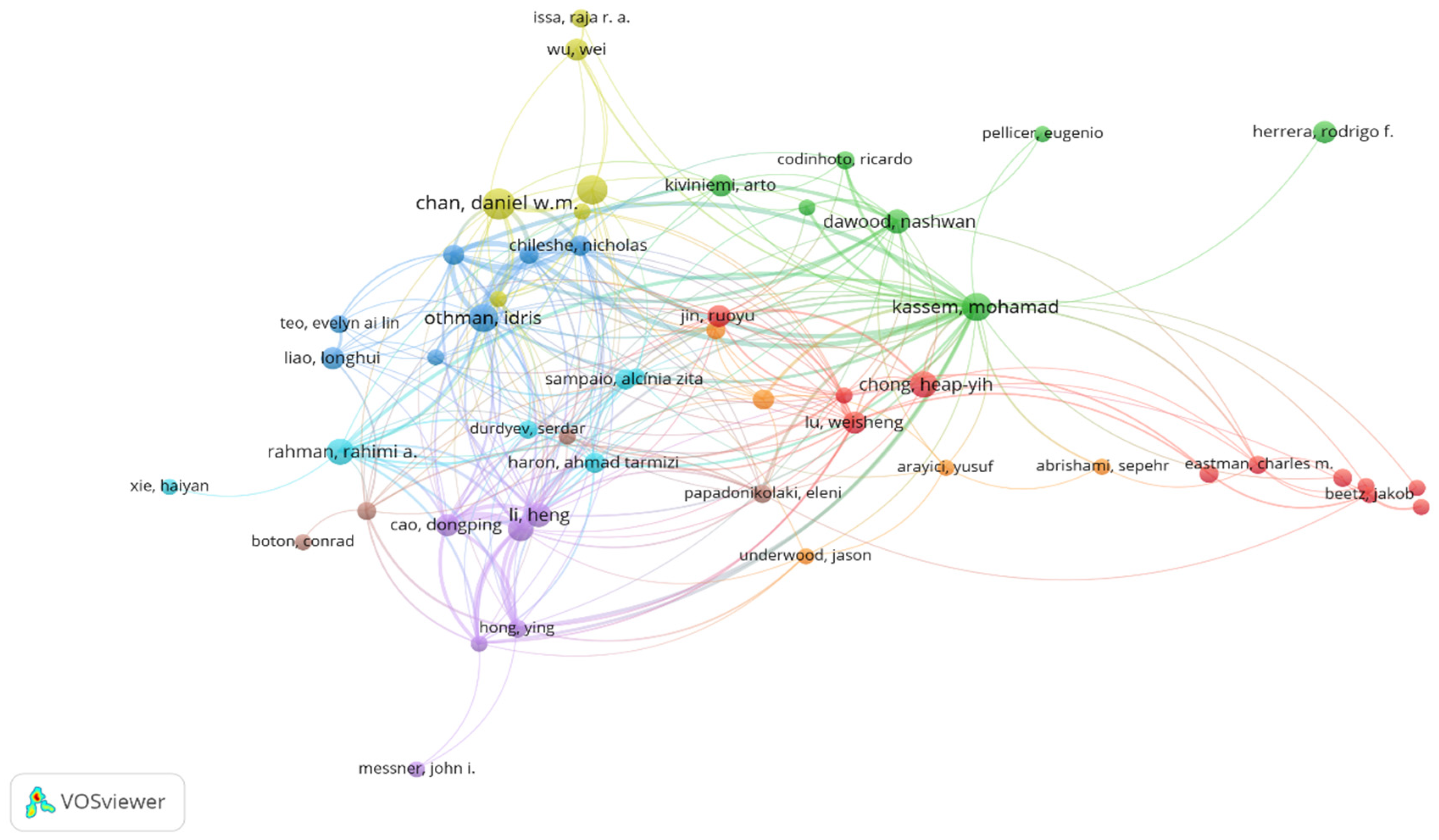
Author co-citation analysis serves to unveil relationships among authors whose works are cited in the same articles, enabling the analysis of the evolution of research communities. Figure 5 illustrates the author co-citation network, where node size corresponds to the number of articles authored by each individual. The links between authors signify indirect cooperative relationships established through co-citation frequency. Consequently, Table 4 showcases the most contributing authors identified through this analysis.
The geographical diversity observed in the locations of these highly cited authors highlights the global reach of BIM research, indicating that significant contributions have been made from various parts of the world.

3.4. Analysis of Articles Co-Citation

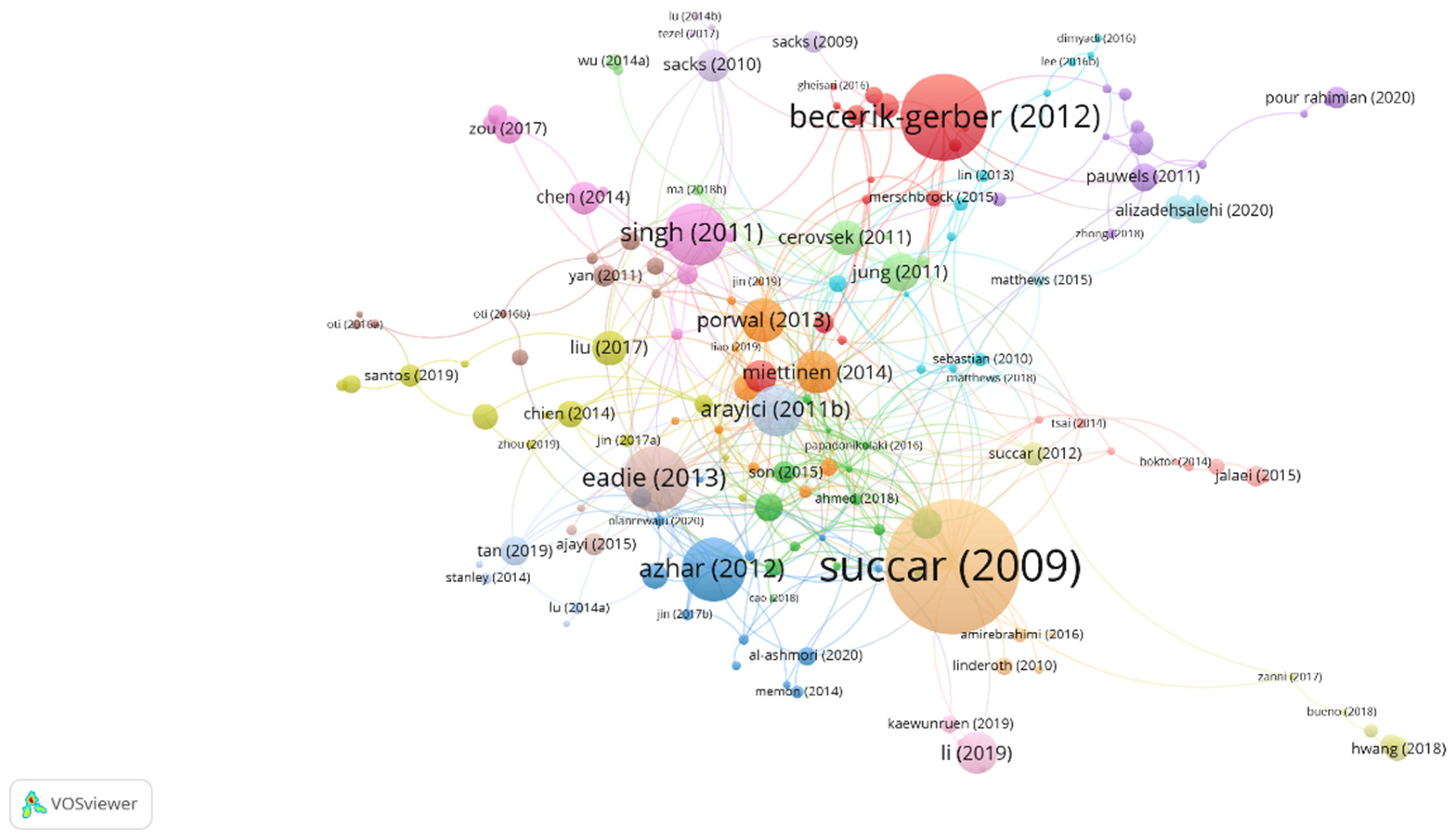
Articles co-citation analysis serves to understand the underlying intellectual structures within a knowledge domain and illustrate both the quantity and authority of references cited by publications. Through this analytical process, co-citation clusters were identified. The summarised list of the top 20 cited articles can be found in Table 5. According to the Scopus citation metric, Succar 2009 [30], Becerik-Gerber (2012) [31] and Eadie (2013) [32] received 975, 631 and 482 citations, respectively, and occupied the top three positions, followed by Azhar et al. (2012) [33] (frequency = 467), Singh Vishal (2011) [34] (frequency = 457) Arayici Y (2011) [35] (frequency = 374), Porwal Atul (2013) [36] (frequency = 325), and Miettinen, Reijo (2014) [37] (frequency = 315). Succar [30] formulated a BIM framework with well-defined knowledge components, laying the groundwork for both research and practical implementation within the industry for various stakeholders.
Among the analysed publications, the article by Succar (2009) [30] is identified as the most highly cited paper within the dataset. This work has played a significant role in shaping BIM research by proposing a structured framework for understanding BIM maturity and capability levels. Its high citation count reflects the substantial influence of this conceptual framework on subsequent studies investigating BIM implementation, adoption, and maturity assessment within the construction industry.
Figure 6 illustrates a network of document co-citations and co-citation clusters. Each node within the network represents a document and is labelled with the first author’s name and the publication year. The links between nodes signify the co-citation relationship between the respective documents. Additionally, the size of each node reflects the co-citation frequency of the associated article.

3.5. Analysis of Co-Occurring Keywords

Keywords play a crucial role in representing the core content of articles and demonstrating the evolution of research topics over time. In the VOSviewer software, two types of keywords are identified: (i) “author keywords,” supplied by the authors, and (ii) “Index keywords,” recognised by the VOSviewer software. In this study, author keywords extracted from the 1349 bibliographic records were used to construct the keyword co-occurrence network, as they more accurately reflect the thematic focus defined by the authors of each publication.
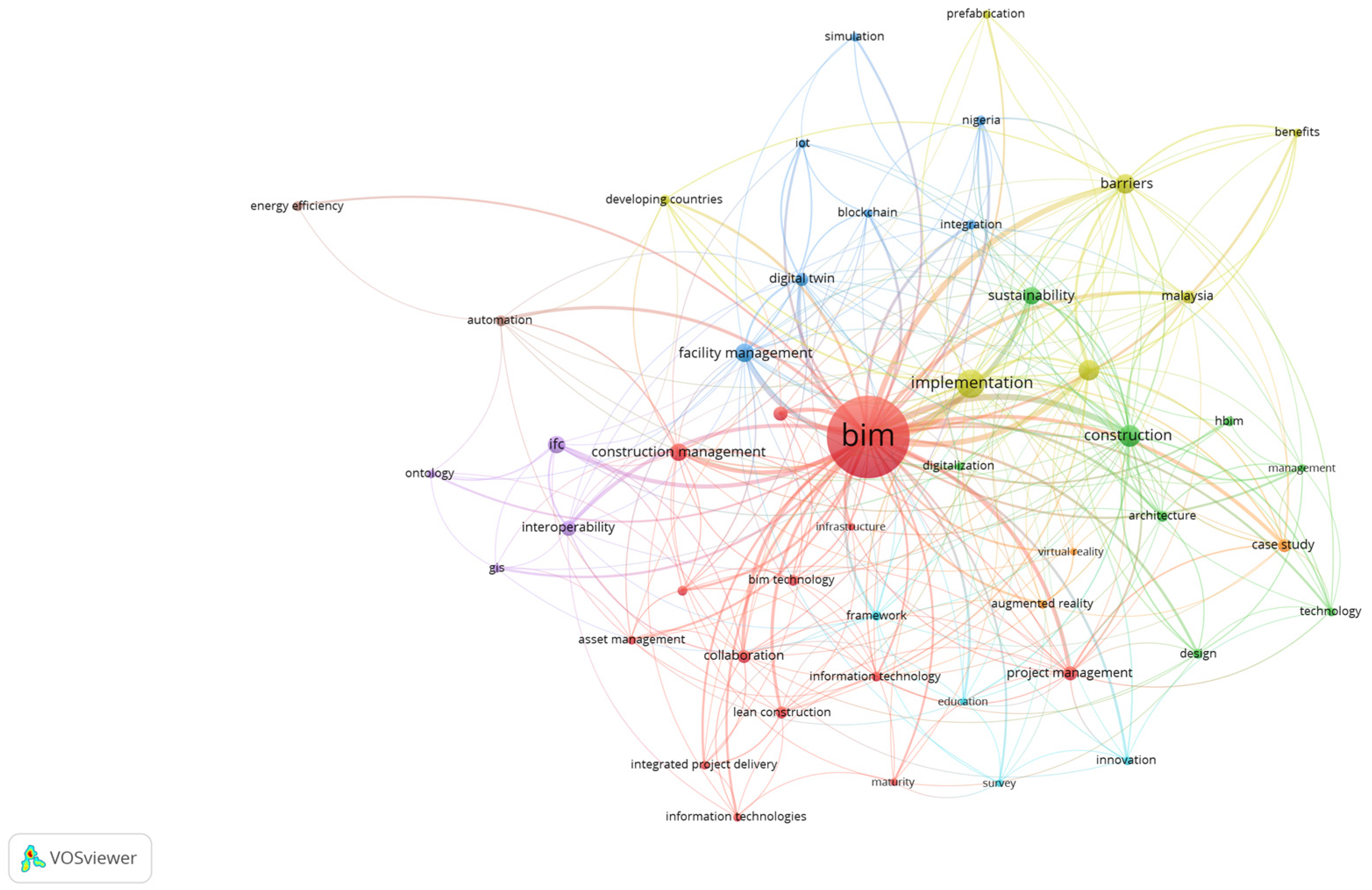
Keyword co-occurrence analysis was conducted using VOSviewer to identify the most frequently occurring research themes and the relationships between them within the BIM implementation literature. Prior to conducting the co-occurrence analysis, a thesaurus file was used in VOSviewer to standardise the keyword dataset by merging synonymous and conceptually overlapping terms. This step ensures that each node represents a unique concept, thereby improving the reliability of co-occurrence relationships and the clarity of the resulting clusters. In the generated network (Figure 7), each node represents a keyword, while links between nodes indicate the frequency with which two keywords appear together in the same publication. The size of each node reflects the occurrence frequency of the keyword, and the thickness of the connecting links indicates the strength of co-occurrence between keyword pairs. Clusters represent groups of keywords that frequently appear together and therefore reflect related thematic areas within the BIM research landscape.
As illustrated in Figure 7, highly frequent keywords are “BIM”, “Implementation”, “construction industry”, “information management”, “construction management”, “barriers”, and “benefits”. The prominence of these keywords indicates that a substantial portion of the BIM literature focuses on organisational adoption, implementation challenges, and the management of digital information within construction projects.
These dominant keywords reflect the foundational stage of BIM implementation research, where the primary emphasis has been on understanding adoption drivers, organisational readiness, and the challenges associated with integrating BIM into existing construction practices. This suggests that early research efforts were largely oriented towards identifying barriers and demonstrating the benefits of BIM as a means of encouraging wider industry uptake.
Additional keywords appearing within the network include “interoperability”, “IFC”, “GIS”, “virtual reality”, “augmented reality”, and “education”. Their presence within the co-occurrence network indicates that these topics are frequently discussed alongside BIM implementation in the analysed literature. For example, interoperability and the IFC data schema are often discussed in relation to information exchange between software platforms and stakeholders involved in BIM-enabled projects [50].
The emergence of these keywords indicates a shift in the research focus from basic adoption concerns towards more advanced implementation challenges, particularly those related to information exchange, system integration, and the extension of BIM into wider digital ecosystems. This reflects the increasing maturity of BIM implementation research, where attention is moving beyond whether BIM should be adopted to how it can be effectively integrated with other technologies and workflows.
The keyword clusters identified in Figure 7 therefore reflect several major thematic areas within the BIM implementation literature, including BIM adoption and implementation practices, digital construction technologies, information interoperability, and applications supporting project management and decision-making.
From an analytical perspective, these clusters collectively illustrate the evolution of BIM implementation research from an initial focus on adoption and barriers towards a more structured and multi-dimensional discourse encompassing process integration, interoperability, and digital innovation. This progression highlights a transition from exploratory research aimed at validating BIM benefits to more mature studies concerned with optimisation, standardisation, and integration within the broader digital construction landscape. Keywords related to virtual reality and augmented reality appearing in the co-occurrence network suggest growing interest in the use of immersive technologies to support BIM-based visualisation, design review, and construction planning processes [51]. This indicates that recent research is increasingly positioning BIM as a central platform within a wider ecosystem of emerging digital technologies, rather than as a standalone tool.
Education also appears as a recurring theme within the keyword network. The presence of keywords related to BIM education indicates the importance of integrating BIM knowledge and digital construction skills into civil engineering and construction management curricula. Incorporating BIM into construction education aims to equip students with the competencies required for digital project delivery and collaborative information management within the construction industry [52]. The prominence of education-related keywords further suggests a growing recognition that successful BIM implementation is not solely a technological challenge but also a skills and capability issue, requiring long-term investment in workforce development and knowledge transfer.

3.6. BIM Implementation Articles Analysis

The analysis involved a meticulous review of 1349 articles, with a focus on those explicitly addressing either BIM implementation or BIM adoption in their titles. A refined selection process yielded a total of 364 articles, organised based on their impact in BIM implementation research, measured by the citation count of each article. The resulting Table 6 showcases the top 25 BIM implementation articles with the highest citation counts. This table includes essential details such as author names, article titles, publication years, citation counts, and the respective journal names. Each article is also accompanied by a reference link, providing a valuable resource for researchers in the field of BIM implementation.
The top five most cited articles are affiliated with the Automation in Construction journal. Notably, Eadie’s work [32], “BIM implementation throughout the UK construction project lifecycle: An analysis,” holds the highest citations of 482, while Succar’s [43] contribution, “Macro-BIM adoption: Conceptual structures,” as the fifth highest citations of 221.
A noteworthy observation is the geographic distribution of highly cited articles, with a concentration in the UK, Europe, China, Hong Kong, Australia, and Malaysia. This trend underscores the heightened activity in BIM implementation research within developed countries.


4. Conclusions

In this study, scientometric analysis was conducted using bibliometric mapping techniques to review the literature on BIM implementation published between 2004 and 2023. A visual bibliometric analysis was performed on 1349 publications, incorporating co-author, co-word, and co-citation analyses The following conclusions are derived from these analyses.
(1)
The analysis indicates a steady increase in BIM implementation research output over the past two decades. The growth in publication volume reflects the expanding academic and industry interest in digital construction technologies and information management practices associated with BIM. Rather than identifying distinct developmental stages, the scientometric results highlight a continuous expansion of scholarly activity in this research domain.
(2)
The results of the journal co-citation analysis indicate that Automation in Construction is the most frequently cited and influential outlet within the bibliometric dataset analysed in this study. Its prominence can be attributed to the consistent publication of high-impact research on digital construction technologies, information modelling, and innovation management, which has positioned the journal at the core of the BIM research network. Following closely are influential journals such as the Journal of Construction Engineering and Management, Engineering Construction and Architectural Management, Journal of Management in Engineering, Architectural Engineering and Design Management, and Advanced Engineering Informatics.
(3)
The geographic distribution of publications shows that BIM implementation research is produced by authors affiliated with institutions across multiple regions, with strong contributions from countries such as the United Kingdom, China, and the United States. The collaboration network analysis further indicates that several countries play important intermediary roles in connecting international research communities through co-authored publications.
(4)
The keyword co-occurrence analysis highlights several frequently occurring themes within the BIM implementation literature, including BIM adoption and implementation practices, construction project management, information management, and interoperability-related topics. Additional keywords associated with technologies such as GIS, IoT, and digital construction tools appear within the network, indicating their connection to BIM research within the analysed dataset.
(5)
From the overall dataset, 364 publications explicitly addressing BIM implementation were identified. The increasing number of studies focusing on implementation-related topics reflects the growing research attention dedicated to understanding the practical application, adoption challenges, and organisational integration of BIM within the construction industry.
Overall, this study provides a scientometric overview of BIM implementation research by mapping publication patterns, collaboration networks, influential journals, and thematic structures derived from keyword co-occurrence analysis. While scientometric analysis relies primarily on bibliographic metadata rather than full-text content, the results offer a structured perspective on how BIM implementation research is organised within the academic literature. The findings provide a useful knowledge base for researchers and practitioners seeking to understand the structure of the field and identify areas for further investigation.

5. Implications and Future Research Directions

The findings of this scientometric analysis provide several implications for both research and practice in the field of BIM implementation. From a theoretical perspective, the mapping of publication patterns, collaboration networks, and keyword clusters helps clarify the intellectual structure of BIM implementation research and highlights the main thematic areas explored in the literature. The results indicate that research has concentrated primarily on BIM adoption, implementation barriers, information interoperability, and digital construction technologies.
From a practical perspective, the analysis highlights the increasing importance of integrating BIM with emerging digital technologies such as GIS, digital twins, and immersive visualisation tools. These developments suggest that future industry applications will increasingly rely on integrated digital platforms supporting collaborative project delivery and information management across the lifecycle of built assets.
Based on the thematic patterns identified through the keyword co-occurrence analysis, several potential directions for future research can be identified:
(1)
Developing standardised frameworks for evaluating BIM implementation maturity and organisational capability.
(2)
Exploring interoperability challenges and data exchange mechanisms between BIM and other digital platforms such as GIS and digital twin environments.
(3)
Investigating the integration of BIM with emerging technologies such as artificial intelligence, internet of things, and immersive virtual environments.
(4)
Examining organisational and managerial factors influencing BIM adoption in different regional and regulatory contexts.
These directions highlight opportunities for advancing both the theoretical understanding and practical implementation of BIM within the architecture, engineering, and construction industry.

6. Limitations of the Study

A limitation of this study is that the bibliographic dataset was extracted in November 2023. Although BIM research continues to grow rapidly, the objective of this study was to examine long-term structural trends in BIM implementation research rather than short-term publication dynamics. Previous bibliometric studies indicate that core knowledge structures, influential journals, and dominant research themes remain relatively stable over time. Future studies may extend this work by updating the dataset to capture subsequent developments and assess the continuity of emerging trends.

Author Contributions

Conceptualization, A.F., M.O., R.U. and J.H.; methodology, A.F., M.O. and J.H.; validation, A.F.; formal analysis, A.F.; investigation, A.F., M.O. and R.U.; resources, M.O. and J.H.; data curation, A.F., M.O. and J.H.; writing—original draft preparation, A.F.; writing—review and editing, A.F., M.O., J.H., T.M. and S.C.; visualisation A.F. and M.O.; supervision, M.O.; J.H., T.M. and S.C.; funding acquisition, M.O., J.H. and T.M. All authors have read and agreed to the published version of the manuscript.

Funding

This research project is funded by the Build Digital Project, supported by the Department of Public Expenditure, National Development Plan Delivery and Reform, Ireland.

Data Availability Statement

No new data were created in this study. Data sharing is not applicable to this article.

Acknowledgments

The authors would like to acknowledge support from the Build Digital Project, funded by the Department of Public Expenditure, National Development Plan Delivery and Reform, Ireland.

Conflicts of Interest

The authors declare no conflicts of interest.

Abbreviations

The following abbreviations are used in this manuscript:
BIMBuilding Information Modelling
AECArchitecture, Engineering, and Construction
FMFacilities Management
IFCIndustry Foundation Classes
IoTInternet of Things
GISGeographic Information System
HBIMHistoric Building Information Modelling
ARAugmented Reality
VRVirtual Reality
SMESmall and Medium-sized Enterprises
CDECommon Data Environment
ISOInternational Organisation for Standardisation
VOSviewerVisualisation of Similarities Viewer
ICTInformation and Communication Technology

References

  1. Azhar, S. Building Information Modeling (BIM): Trends, Benefits, Risks, and Challenges for the AEC Industry. Leadersh. Manag. Eng. 2011, 11, 241–252. [Google Scholar] [CrossRef] [Scilit]
  2. Volk, R.; Stengel, J.; Schultmann, F. Building Information Modeling (BIM) for Existing Buildings—Literature Review and Future Needs. Autom. Constr. 2014, 38, 109–127. [Google Scholar] [CrossRef] [Scilit]
  3. Irizarry, J.; Karan, E.P.; Jalaei, F. Integrating BIM and GIS to Improve the Visual Monitoring of Construction Supply Chain Management. Autom. Constr. 2013, 31, 241–254. [Google Scholar] [CrossRef] [Scilit]
  4. Park, C.-S.; Lee, D.-Y.; Kwon, O.-S.; Wang, X. A Framework for Proactive Construction Defect Management Using BIM, Augmented Reality and Ontology-Based Data Collection Template. Autom. Constr. 2013, 33, 61–71. [Google Scholar] [CrossRef] [Scilit]
  5. Lu, Y.; Wu, Z.; Chang, R.; Li, Y. Building Information Modeling (BIM) for Green Buildings: A Critical Review and Future Directions. Autom. Constr. 2017, 83, 134–148. [Google Scholar] [CrossRef] [Scilit]
  6. Marzouk, M.; Azab, S.; Metawie, M. BIM-Based Approach for Optimizing Life Cycle Costs of Sustainable Buildings. J. Clean. Prod. 2018, 188, 217–226. [Google Scholar] [CrossRef] [Scilit]
  7. Farea, A.; Otreba, M.; Ullah, R.; McKenna, T.; Carroll, S.; Harrington, J. Digital Transformation of the AEC Industry: A Review of BIM Implementation Toolkits from Leading Countries. Smart Sustain. Built Environ. 2026, 1–24. [Google Scholar] [CrossRef] [Scilit]
  8. Farea, A.; Otreba, M.; Ullah, R.; Mckenna, T.; Carroll, S.; Harrington, J. Macro BIM Adoption: Global Initiatives and Strategies. In Civil Engineering Research in Ireland 2024 (CERI2024) Conference; Civil Engineering Research Association of Ireland: Galway, Ireland, 2024. [Google Scholar]
  9. Farea, A.; Munir, M.; Ullah, R.; Otreba, M.; Carroll, S.; Harrington, J. Comparison of the Barriers to BIM Adoption and Digital Transformation within the Construction Industry of Pakistan and Ireland. In Proceedings of the 2023 IEEE 22nd International Conference on Trust, Security and Privacy in Computing and Communications (TrustCom), Exeter, UK, 1–3 November 2023; pp. 2394–2399. [Google Scholar] [CrossRef] [Scilit]
  10. Ullah, R.; Harrington, J.; Farea, A.; Otreba, M.; Carroll, S.; McKenna, T. Digital Maturity Assessment Tools for the Construction Industry: A PRISMA-ScR Scoping Review. Buildings 2026, 16, 239. [Google Scholar] [CrossRef] [Scilit]
  11. Ullah, R.; Harrington, J.; Farea, A.; Otreba, M.; Carroll, S.; Mckenna, T. Navigating Digital Maturity: Analysis of Digital Maturity Assessment Tools. In Civil Engineering Research in Ireland 2024 (CERI2024) Conference; Civil Engineering Research Association of Ireland: Galway, Ireland, 2024. [Google Scholar]
  12. Zhao, X. A Scientometric Review of Global BIM Research: Analysis and Visualization. Autom. Constr. 2017, 80, 37–47. [Google Scholar] [CrossRef] [Scilit]
  13. He, Q.; Wang, G.; Luo, L.; Shi, Q.; Xie, J.; Meng, X. Mapping the Managerial Areas of Building Information Modeling (BIM) Using Scientometric Analysis. Int. J. Proj. Manag. 2017, 35, 670–685. [Google Scholar] [CrossRef] [Scilit]
  14. Santos, R.; Costa, A.A.; Grilo, A. Bibliometric Analysis and Review of Building Information Modelling Literature Published between 2005 and 2015. Autom. Constr. 2017, 80, 118–136. [Google Scholar] [CrossRef] [Scilit]
  15. Olawumi, T.O.; Chan, D.W.M.; Wong, J.K.W. Evolution in the Intellectual Structure of BIM Research: A Bibliometric Analysis. J. Civ. Eng. Manag. 2017, 23, 1060–1081. [Google Scholar] [CrossRef] [Scilit]
  16. Li, X.; Wu, P.; Shen, G.Q.; Wang, X.; Teng, Y. Mapping the Knowledge Domains of Building Information Modeling (BIM): A Bibliometric Approach. Autom. Constr. 2017, 84, 195–206. [Google Scholar] [CrossRef] [Scilit]
  17. Saka, A.B.; Chan, D.W.M. A Global Taxonomic Review and Analysis of the Development of BIM Research between 2006 and 2017. Constr. Innov. Inf. Process Manag. 2019, 19, 465–490. [Google Scholar] [CrossRef] [Scilit]
  18. Liu, Z.; Lu, Y.; Peh, L.C. A Review and Scientometric Analysis of Global Building Information Modeling (BIM) Research in the Architecture, Engineering and Construction (AEC) Industry. Buildings 2019, 9, 210. [Google Scholar] [CrossRef] [Scilit]
  19. Wen, Q.-J.; Ren, Z.-J.; Lu, H.; Wu, J.-F. The Progress and Trend of BIM Research: A Bibliometrics-Based Visualization Analysis. Autom. Constr. 2021, 124, 103558. [Google Scholar] [CrossRef] [Scilit]
  20. Konur, O. The Evaluation of the Global Research on the Education: A Scientometric Approach. Procedia—Soc. Behav. Sci. 2012, 47, 1363–1367. [Google Scholar] [CrossRef] [Scilit]
  21. Wang, Z.-Y.; Li, G.; Li, C.-Y.; Li, A. Research on the Semantic-Based Co-Word Analysis. Scientometrics 2012, 90, 855–875. [Google Scholar] [CrossRef] [Scilit]
  22. Mongeon, P.; Paul-Hus, A. The Journal Coverage of Web of Science and Scopus: A Comparative Analysis. Scientometrics 2016, 106, 213–228. [Google Scholar] [CrossRef] [Scilit]
  23. Falagas, M.E.; Pitsouni, E.I.; Malietzis, G.A.; Pappas, G. Comparison of PubMed, Scopus, Web of Science, and Google Scholar: Strengths and Weaknesses. FASEB J. 2008, 22, 338–342. [Google Scholar] [CrossRef] [Scilit] [PubMed]
  24. van Eck, N.J.; Waltman, L. Software Survey: VOSviewer, a Computer Program for Bibliometric Mapping. Scientometrics 2010, 84, 523–538. [Google Scholar] [CrossRef] [Scilit]
  25. Laengle, S.; Modak, N.M.; Merigó, J.M.; De La Sotta, C. Thirty Years of the International Journal of Computer Integrated Manufacturing: A Bibliometric Analysis. Int. J. Comput. Integr. Manuf. 2018, 31, 1247–1268. [Google Scholar] [CrossRef] [Scilit]
  26. Shneider, A.M. Four Stages of a Scientific Discipline; Four Types of Scientist. Trends Biochem. Sci. 2009, 34, 217–223. [Google Scholar] [CrossRef] [Scilit]
  27. ISO 19650-1:2018; Organization and Digitization of Information About Buildings and Civil Engineering Works, Including Building Information Modelling (BIM)—Information Management Using Building Information Modelling—Part 1: Concepts and Principles. International Organization for Standardization (ISO): Geneva, Switzerland, 2018.
  28. Cancino, C.; Merigó, J.M.; Coronado, F.; Dessouky, Y.; Dessouky, M. Forty Years of Computers & Industrial Engineering: A Bibliometric Analysis. Comput. Ind. Eng. 2017, 113, 614–629. [Google Scholar] [CrossRef] [Scilit]
  29. Merigó, J.M.; Pedrycz, W.; Weber, R.; de la Sotta, C. Fifty Years of Information Sciences: A Bibliometric Overview. Inf. Sci. 2018, 432, 245–268. [Google Scholar] [CrossRef] [Scilit]
  30. Succar, B. Building Information Modelling Framework: A Research and Delivery Foundation for Industry Stakeholders. Autom. Constr. 2009, 18, 357–375. [Google Scholar] [CrossRef] [Scilit]
  31. Becerik-Gerber, B.; Jazizadeh, F.; Li, N.; Calis, G. Application Areas and Data Requirements for BIM-Enabled Facilities Management. J. Constr. Eng. Manag. 2012, 138, 431–442. [Google Scholar] [CrossRef] [Scilit]
  32. Eadie, R.; Browne, M.; Odeyinka, H.; McKeown, C.; McNiff, S. BIM Implementation throughout the UK Construction Project Lifecycle: An Analysis. Autom. Constr. 2013, 36, 145–151. [Google Scholar] [CrossRef] [Scilit]
  33. Azhar, S.; Khalfan, M.; Maqsood, T. Building Information Modeling (BIM): Now and Beyond. Australas. J. Constr. Econ. Build. 2012, 12, 15–28. [Google Scholar] [CrossRef] [Scilit]
  34. Singh, V.; Gu, N.; Wang, X. A Theoretical Framework of a BIM-Based Multi-Disciplinary Collaboration Platform. Autom. Constr. 2011, 20, 134–144. [Google Scholar] [CrossRef] [Scilit]
  35. Arayici, Y.; Coates, P.; Koskela, L.; Kagioglou, M.; Usher, C.; O’Reilly, K. Technology Adoption in the BIM Implementation for Lean Architectural Practice. Autom. Constr. 2011, 20, 189–195. [Google Scholar] [CrossRef] [Scilit]
  36. Porwal, A.; Hewage, K.N. Building Information Modeling (BIM) Partnering Framework for Public Construction Projects. Autom. Constr. 2013, 31, 204–214. [Google Scholar] [CrossRef] [Scilit]
  37. Miettinen, R.; Paavola, S. Beyond the BIM Utopia: Approaches to the Development and Implementation of Building Information Modeling. Autom. Constr. 2014, 43, 84–91. [Google Scholar] [CrossRef] [Scilit]
  38. Cerovsek, T. A Review and Outlook for a “Building Information Model” (BIM): A Multi-Standpoint Framework for Technological Development. Adv. Eng. Inform. 2011, 25, 224–244. [Google Scholar] [CrossRef] [Scilit]
  39. Liu, Y.; van Nederveen, S.; Hertogh, M. Understanding Effects of BIM on Collaborative Design and constructionAn Empirical Study in China. Int. J. Proj. Manag. 2017, 35, 686–698. [Google Scholar] [CrossRef] [Scilit]
  40. Chen, L.; Luo, H. A BIM-Based Construction Quality Management Model and Its Applications. Autom. Constr. 2014, 46, 64–73. [Google Scholar] [CrossRef] [Scilit]
  41. Khajavi, S.H.; Motlagh, N.H.; Jaribion, A.; Werner, L.C.; Holmstrom, J. Digital Twin: Vision, Benefits, Boundaries, and Creation for Buildings. IEEE Access 2019, 7, 147406–147419. [Google Scholar] [CrossRef] [Scilit]
  42. Sacks, R.; Radosavljevic, M.; Barak, R. Requirements for Building Information Modeling Based Lean Production Management Systems for Construction. Autom. Constr. 2010, 19, 641–655. [Google Scholar] [CrossRef] [Scilit]
  43. Succar, B.; Kassem, M. Macro-BIM Adoption: Conceptual Structures. Autom. Constr. 2015, 57, 64–79. [Google Scholar] [CrossRef] [Scilit]
  44. Tan, T.; Chen, K.; Xue, F.; Lu, W. Barriers to Building Information Modeling (BIM) Implementation in China’s Prefabricated Construction: An Interpretive Structural Modeling (ISM) Approach. J. Clean. Prod. 2019, 219, 949–959. [Google Scholar] [CrossRef] [Scilit]
  45. Zou, Y.; Kiviniemi, A.; Jones, S.W. A Review of Risk Management through BIM and BIM-Related Technologies. Saf. Sci. 2017, 97, 88–98. [Google Scholar] [CrossRef] [Scilit]
  46. Li, J.; Greenwood, D.; Kassem, M. Blockchain in the Built Environment and Construction Industry: A Systematic Review, Conceptual Models and Practical Use Cases. Autom. Constr. 2019, 102, 288–307. [Google Scholar] [CrossRef] [Scilit]
  47. Sebastian, R. Changing Roles of the Clients, Architects and Contractors through BIM. Eng. Constr. Archit. Manag. 2011, 18, 176–187. [Google Scholar] [CrossRef] [Scilit]
  48. Jung, Y.; Joo, M. Building Information Modelling (BIM) Framework for Practical Implementation. Autom. Constr. 2011, 20, 126–133. [Google Scholar] [CrossRef] [Scilit]
  49. Pauwels, P.; Van Deursen, D.; Verstraeten, R.; De Roo, J.; De Meyer, R.; Van De Walle, R.; Van Campenhout, J. A Semantic Rule Checking Environment for Building Performance Checking. Autom. Constr. 2011, 20, 506–518. [Google Scholar] [CrossRef] [Scilit]
  50. Venugopal, M.; Eastman, C.M.; Teizer, J. An Ontology-Based Analysis of the Industry Foundation Class Schema for Building Information Model Exchanges. Adv. Eng. Inform. 2015, 29, 940–957. [Google Scholar] [CrossRef] [Scilit]
  51. Jiao, Y.; Zhang, S.; Li, Y.; Wang, Y.; Yang, B. Towards Cloud Augmented Reality for Construction Application by BIM and SNS Integration. Autom. Constr. 2013, 33, 37–47. [Google Scholar] [CrossRef] [Scilit]
  52. Becerik-Gerber, B.; Ku, K.; Jazizadeh, F. BIM-Enabled Virtual and Collaborative Construction Engineering and Management. J. Prof. Issues Eng. Educ. Pract. 2012, 138, 234–245. [Google Scholar] [CrossRef] [Scilit]
  53. Eastman, C.M.; Jeong, Y.-S.; Sacks, R.; Kaner, I. Exchange Model and Exchange Object Concepts for Implementation of National BIM Standards. J. Comput. Civ. Eng. 2010, 24, 25–34. [Google Scholar] [CrossRef] [Scilit]
  54. Chan, D.W.M.; Olawumi, T.O.; Ho, A.M.L. Perceived Benefits of and Barriers to Building Information Modelling (BIM) Implementation in Construction: The Case of Hong Kong. J. Build. Eng. 2019, 25, 100764. [Google Scholar] [CrossRef] [Scilit]
  55. Arayici, Y.; Coates, P.; Koskela, L.; Kagioglou, M.; Usher, C.; O’Reilly, K. BIM Adoption and Implementation for Architectural Practices. Struct. Surv. 2011, 29, 7–25. [Google Scholar] [CrossRef] [Scilit]
  56. Son, H.; Lee, S.; Kim, C. What Drives the Adoption of Building Information Modeling in Design Organizations? An Empirical Investigation of the Antecedents Affecting Architects’ Behavioral Intentions. Autom. Constr. 2015, 49, 92–99. [Google Scholar] [CrossRef] [Scilit]
  57. Elmualim, A.; Gilder, J. BIM: Innovation in Design Management, Influence and Challenges of Implementation. Archit. Eng. Des. Manag. 2014, 10, 183–199. [Google Scholar] [CrossRef] [Scilit]
  58. Al-Ashmori, Y.Y.; Othman, I.; Rahmawati, Y.; Amran, Y.H.M.; Sabah, S.H.A.; Rafindadi, A.D.; Mikić, M. BIM Benefits and Its Influence on the BIM Implementation in Malaysia. Ain Shams Eng. J. 2020, 11, 1013–1019. [Google Scholar] [CrossRef] [Scilit]
  59. Ding, Z.; Zuo, J.; Wu, J.; Wang, J.Y. Key Factors for the BIM Adoption by Architects: A China Study. Eng. Constr. Archit. Manag. 2015, 22, 732–748. [Google Scholar] [CrossRef] [Scilit]
  60. Cao, D.; Li, H.; Wang, G.; Huang, T. Identifying and Contextualising the Motivations for BIM Implementation in Construction projectsAn Empirical Study in China. Int. J. Proj. Manag. 2017, 35, 658–669. [Google Scholar] [CrossRef] [Scilit]
  61. Linderoth, H.C.J. Understanding Adoption and Use of BIM as the Creation of Actor Networks. Autom. Constr. 2010, 19, 66–72. [Google Scholar] [CrossRef] [Scilit]
  62. Davies, R.; Harty, C. Implementing “Site BIM”: A Case Study of ICT Innovation on a Large Hospital Project. Autom. Constr. 2013, 30, 15–24. [Google Scholar] [CrossRef] [Scilit]
  63. Shou, W.; Wang, J.; Wang, X.; Chong, H.Y. A Comparative Review of Building Information Modelling Implementation in Building and Infrastructure Industries. Arch. Comput. Methods Eng. 2015, 22, 291–308. [Google Scholar] [CrossRef] [Scilit]
  64. Biagini, C.; Capone, P.; Donato, V.; Facchini, N. Towards the BIM Implementation for Historical Building Restoration Sites. Autom. Constr. 2016, 71, 74–86. [Google Scholar] [CrossRef] [Scilit]
  65. Sackey, E.; Tuuli, M.; Dainty, A. Sociotechnical Systems Approach to BIM Implementation in a Multidisciplinary Construction Context. J. Manag. Eng. 2014, 31, A4014005. [Google Scholar] [CrossRef] [Scilit]
  66. Ciribini, A.L.C.; Mastrolembo Ventura, S.; Paneroni, M. Implementation of an Interoperable Process to Optimise Design and Construction Phases of a Residential Building: A BIM Pilot Project. Autom. Constr. 2016, 71, 62–73. [Google Scholar] [CrossRef] [Scilit]
  67. Manning, R.; Messner, J.I. Case Studies in BIM Implementation for Programming of Healthcare Facilities. Electron. J. Inf. Technol. Constr. 2008, 13, 446–457. [Google Scholar]
  68. Ahn, Y.H.; Kwak, Y.H.; Suk, S.J. Contractors’ Transformation Strategies for Adopting Building Information Modeling. J. Manag. Eng. 2016, 32, 05015005. [Google Scholar] [CrossRef] [Scilit]
  69. Lu, W.; Fung, A.; Peng, Y.; Liang, C.; Rowlinson, S. Cost-Benefit Analysis of Building Information Modeling Implementation in Building Projects through Demystification of Time-Effort Distribution Curves. Build. Environ. 2014, 82, 317–327. [Google Scholar] [CrossRef] [Scilit]
  70. Charef, R.; Emmitt, S.; Alaka, H.; Fouchal, F. Building Information Modelling Adoption in the European Union: An Overview. J. Build. Eng. 2019, 25, 100777. [Google Scholar] [CrossRef] [Scilit]
  71. Hong, Y.; Hammad, A.W.A.; Sepasgozar, S.; Akbarnezhad, A. BIM Adoption Model for Small and Medium Construction Organisations in Australia. Eng. Constr. Archit. Manag. 2019, 26, 154–183. [Google Scholar] [CrossRef] [Scilit]
Figure 1. Flow diagram of the methodology.
Buildings 16 01509 g001
Figure 2. Yearly distribution of the retrieved articles.
Buildings 16 01509 g002
Figure 3. Bibliographical coupling of countries.
Buildings 16 01509 g003
Figure 4. Journal co-citation network.
Buildings 16 01509 g004
Figure 5. Analysis of author co-citation.
Buildings 16 01509 g005
Figure 6. Document co-citation network.
Buildings 16 01509 g006
Figure 7. Network of co-occurring keywords.
Buildings 16 01509 g007
Table 1. Summary of prior review and scientometric studies.
StudyPeriod CoveredDatabase(s)MethodSample SizeMain FocusLimitation
Zhao (2017), A scientometric review of global BIM research: Analysis and visualization, [12]2005–2016Web of Science Co-author, co-word, co-citation analysis614Global BIM research status, hot topics, trend visualisationBroad BIM mapping; not implementation-specific and limited to the 2005–2016 window.
He et al. (2017), Mapping the managerial areas of Building Information Modeling (BIM) using scientometric analysis, [13]2007–2015Scopus + Web of ScienceScientometric analysis; knowledge mapping126Managerial/non-technical areas of BIM Narrowly focused on managerial BIM rather than the wider implementation literature.
Santos et al. (2017), Bibliometric analysis and review of Building Information Modelling literature published between 2005 and 2015, [14]2006–2015 Web of Science Bibliometric review + content categorisation381Research categories, most cited works, emerging BIM fieldsBroad BIM categorisation; not implementation-specific limited to the 2006–2015 window.
Olawumi et al. (2017), Evolution in the intellectual structure of BIM research: A bibliometric analysis, [15]2006–2016 Web of ScienceBibliometric analysis + research category analysis445Intellectual structure, categories, funding structure, project sectorsBroad BIM intellectual structure and formation, limited to 2006–2016
Li et al. (2017), Mapping the knowledge domains of Building Information Modeling (BIM): A bibliometric approach, [16]2004–2015Web of ScienceBibliometric approach; core and expanded datasets1874BIM knowledge domains and knowledge baseVery broad knowledge-domain mapping limited to 2004–2015
Saka and Chan (2019), A global taxonomic review and analysis of the development of BIM research between 2006 and 2017, [17]2006–2017Web of ScienceComparative taxonomic review + scientometric analysis914Continental comparison of BIM development, themes, and trendsStrong geographic comparison, but still a broad BIM-development study rather than an implementation-focused one.
Liu et al. (2019), A Review and Scientometric Analysis of Global Building Information Modeling (BIM) Research in the AEC Industry, [18]2004–2019Web of Science Scientometric review1455Global BIM research in AEC, major clusters and trendsBroad BIM/AEC scope with no BIM Implementation focus.
Wen et al. (2021), The progress and trend of BIM research: A bibliometrics-based visualization analysis, [19]2010–2019Web of ScienceBibliometrics-based visualisation analysis1369BIM research progress and development trendsBroad BIM trend study, not centred specifically on implementation and adoption research.
Table 2. Top 20 contributing countries.
Ranking Based on ArticlesRanking Based on CitationsRanking Based on Citation Index
RankCountryArticlesCountryCitationsCountryCitation Index
1UK216UK8624Israel77
2China180USA6787Belgium66
3USA168Australia4945Slovenia63
4Malaysia123China3881Finland61
5Australia101Hong Kong2675Australia49
6Hong Kong68South Korea1965South Korea47
7Italy66Canada1435Netherlands45
8Spain58Germany1396USA40
9Germany52Malaysia1366UK40
10Canada51Netherlands1348Hong Kong39
11South Korea42Italy1176Singapore37
12Portugal35Singapore992Sweden36
13Iran33Israel918Taiwan35
14Saudi Arabia32Finland853Canada28
15Turkey32Taiwan846Germany27
16New Zealand31Sweden787Ghana27
17Egypt30Spain727Norway27
18India30Nigeria719Pakistan26
19Netherlands30New Zealand704Nigeria25
20Nigeria29Portugal557UAE24
Table 3. Top 10 most influential journals.
NoSourceHost CountryCountCitations
1Automation in ConstructionNetherlands9710,193
2Journal of Construction Engineering and ManagementUSA402080
3Engineering, Construction and Architectural ManagementUK671831
4Journal of Management in EngineeringUSA261169
5Architectural Engineering and Design ManagementUK24943
6Advanced Engineering InformaticsUK21898
7Sustainability (Switzerland)Switzerland69863
8Journal of Cleaner ProductionUSA10853
9BuildingsSwitzerland88801
10Journal of Building EngineeringNetherlands22753
Table 4. Top 10 contributing authors.
NoAuthorArticlesCitationsAffiliations
1Chan, Daniel W.M.13691Hong Kong Polytechnic University
2Olawumi, Timothy O.12733Edinburgh Napier University
3Kassem, Mohamad111041Newcastle University
4Othman, Idris11268Universiti Teknologi PETRONAS
5Chong, Heap-Yih10174Curtin University
6Rahman, Rahimi A.10123Universiti Malaysia Pahang
7Dawood, Nashwan9539Teesside University
8Li, Heng9316Hong Kong Polytechnic University
9Wang, Guangbin9376Tongji University
10Cao, Dongping8264Tongji University
Table 5. The top 20 BIM cited articles.
NoArticleCitationsNoArticleCitations
1Succar (2009) [30]97511Cerovsek (2011) [38]259
2Becerik-Gerber (2012) [31]63112Liu (2017c) [39]257
3Eadie (2013) [32]48213Chen (2014) [40]242
4Azhar (2012) [33]46714Khajavi (2019) [41]236
5Singh (2011) [34]45715Sacks (2010) [42]234
6Arayici (2011b) [35]37416Succar (2015) [43]221
7Porwal (2013) [36]32517Tan (2019) [44]211
8Miettinen (2014) [37]31518Zou (2017) [45]207
9Li (2019b) [46]30919Sebastian (2011) [47]201
10Jung (2011) [48]27920Pauwels (2011) [49]201
Table 6. Top 25 BIM implementation articles with the highest citation.
NoAutorTitleYearCitationsSource Title
1Eadie [32]“BIM implementation throughout the UK construction project lifecycle: An analysis”2013482Automation in Construction
2Arayici [35]“Technology adoption in the BIM implementation for lean architectural practice”2011374Automation in Construction
3Miettinen [37]“Beyond the BIM utopia: Approaches to the development and implementation of building information modeling”2014314Automation in Construction
4Jung [48]“Building information modelling (BIM) framework for practical implementation”2011279Automation in Construction
5Succar [43]“Macro-BIM adoption: Conceptual structures”2015221Automation in Construction
6Tan [44]“Barriers to Building Information Modeling (BIM) implementation in China’s prefabricated construction: An interpretive structural modeling (ISM) approach”2019211Journal of Cleaner Production
7Eastman [53]“Exchange model and exchange object concepts for implementation of national BIM standards”2010190Journal of Computing in Civil Engineering
8Chen [54]“Perceived benefits of and barriers to Building Information Modelling (BIM) implementation in construction: The case of Hong Kong”2019187Journal of Building Engineering
9Arayici [55]“BIM adoption and implementation for architectural practices”2011186Structural Survey
10Son [56]“What drives the adoption of building information modeling in design organizations? An empirical investigation of the antecedents affecting architects’ behavioral intentions”2015162Automation in Construction
11Elmualim [57]“BIM: Innovation in design management, influence and challenges of implementation”2014154Architectural Engineering and Design Management
12Al-Ashmori [58]“BIM benefits and its influence on the BIM implementation in Malaysia”2020142Ain Shams Engineering Journal
13Ding [59]“Key factors for the BIM adoption by architects: A China study”2015135Engineering, Construction and Architectural Management
14Cao [60]“Identifying and contextualising the motivations for BIM implementation in construction projects: An empirical study in China”2017133International Journal of Project Management
15Linderoth [61]“Understanding adoption and use of BIM as the creation of actor networks”2010131Automation in Construction
16Davies [62]“Implementing ‘site BIM’: A case study of ICT innovation on a large hospital project”2013128Automation in Construction
17Shou [63]“A Comparative Review of Building Information Modelling Implementation in Building and Infrastructure Industries”2015108Archives of Computational Methods in Engineering
18Biagini [64]“Towards the BIM implementation for historical building restoration sites”2016105Automation in Construction
19Sackey [65]“Sociotechnical systems approach to BIM implementation in a multidisciplinary construction context”2014101Journal of Management in Engineering
20Ciribini [66]“Implementation of an interoperable process to optimise design and construction phases of a residential building: A BIM Pilot Project”201697Automation in Construction
21Manning [67]“Case studies in BIM implementation for programming of healthcare facilities”200897Electronic Journal of Information Technology in Construction
22Ahn [68]“Contractors’ Transformation Strategies for Adopting Building Information Modeling”201694Journal of Management in Engineering
23Lu [69]“Cost-benefit analysis of Building Information Modeling implementation in building projects through demystification of time-effort distribution curves”201493Building and Environment
24Charef [70]“Building Information Modelling adoption in the European Union: An overview”201992Journal of Building Engineering
25Hong [71]“BIM adoption model for small and medium construction organisations in Australia”201990Engineering, Construction and Architectural Management
Disclaimer/Publisher’s Note: The statements, opinions and data contained in all publications are solely those of the individual author(s) and contributor(s) and not of MDPI and/or the editor(s). MDPI and/or the editor(s) disclaim responsibility for any injury to people or property resulting from any ideas, methods, instructions or products referred to in the content.