1. Introduction
Geopolymer materials, as eco-friendly cementitious materials utilizing industrial solid wastes (e.g., slag, fly ash, and metakaolin) as precursors, have attracted extensive attention in construction engineering due to their advantages of high mechanical strength, low carbon emission, and resource utilization [
1,
2,
3,
4]. Compared with traditional Portland cement, geopolymers prepared from industrial solid wastes such as slag and fly ash can effectively realize resource utilization of solid waste and reduce environmental pollution, showing broad application prospects in infrastructure construction and building repair engineering [
3,
5,
6]. Among various geopolymers, slag-based geopolymers are widely used in practical engineering, and their macroscopic performance and microstructure are largely determined by the composition of alkaline activators [
7,
8]. Alkali content and water glass modulus are two key parameters of alkaline activators that directly regulate the geopolymerization reaction process, including the dissolution rate of slag, the formation and evolution of reaction products, and the optimization of pore structure [
9,
10].
However, previous research on slag-based geopolymers has some obvious limitations. Firstly, most research focuses on the single-factor effect of alkali content or water glass modulus, while the synergistic regulation mechanism of the two parameters on the mechanical properties and microstructure of geopolymer mortar remains unclear. Secondly, for mechanical properties, the optimal range of alkali content and water glass modulus reported in different studies varies greatly due to differences in raw materials and mix proportions, and the differentiated response mechanism of compressive strength and flexural strength to alkali content has not been fully explained. Thirdly, although C-A-S-H gel is recognized as the main strength-forming phase, the quantitative correlation between the content, short-range order of C-A-S-H gel, and activator parameters, as well as its guiding role in macroscopic performance optimization, lacks systematic investigation [
11,
12,
13,
14].
With the continuous development of micro-testing technology, the multi-scale characterization and correlation analysis between microstructure and macro-properties have become an important means to understand the performance mechanism of geopolymers [
3,
15,
16]. Nanoindentation technology, combined with X-ray diffraction (XRD) and mercury intrusion porosimetry (MIP), provides a powerful multi-scale characterization method for solving the above problems [
17,
18]. Nanoindentation can quantitatively characterize the micromechanical properties (elastic modulus, hardness) and relative content of different phases in geopolymers; XRD can analyze the phase composition and short-range order of C-A-S-H gel; MIP can accurately test the pore structure parameters. The combination of these techniques enables in-depth revelation of the intrinsic mechanism of alkali content and water glass modulus regulating the macroscopic performance of slag-based geopolymer mortar [
19,
20].
Based on the above research gaps, this study proposes some research hypotheses. Alkali content and water glass modulus synergistically regulate the geopolymerization reaction by affecting the dissolution rate of slag and the polymerization degree of reaction products. Within a certain range, increasing alkali content and optimizing water glass modulus promote the formation of C-A-S-H gel with high content and good short-range order, reduce porosity, and refine pore structure, thereby improving the compressive strength of geopolymer mortar; however, excessive alkali content will increase the brittleness of the matrix and induce microcracks, leading to a continuous decrease in flexural strength. The main objective of this study is to systematically investigate the effects of alkali content and water glass modulus on the flowability, compressive strength, and flexural strength of slag-based geopolymer mortar, and to reveal the regulation mechanism from the perspectives of phase composition, pore structure, and micromechanical properties. The novelty of this study lies in clarifying the synergistic regulation effect of alkali content and water glass modulus on the microstructure and macroscopic performance of slag-based geopolymer mortar and establishing a multi-scale correlation model of “activator parameters—microstructure—macroscopic properties”.
To achieve this goal, slag-based geopolymer mortar with different alkali contents and water glass moduli was prepared. The flowability test and mechanical property test were carried out to obtain the macroscopic performance evolution law. Nanoindentation technology was used to quantitatively characterize the elastic modulus, hardness, and relative content of each phase. XRD was employed to analyze the phase composition and short-range order of C-A-S-H gel. MIP was used to test the pore structure parameters. This study is expected to provide a theoretical basis and experimental support for the performance optimization, mix proportion design, and practical application of slag-based geopolymer mortar.
2. Test Details
2.1. Raw Materials
S95 ground granulated blast-furnace slag (GGBFS) was used as the precursor material, with a specific surface area of 430 m
2/kg and a density of 2.90 g/cm
3, complying with the Chinese standard GB/T 18046 [
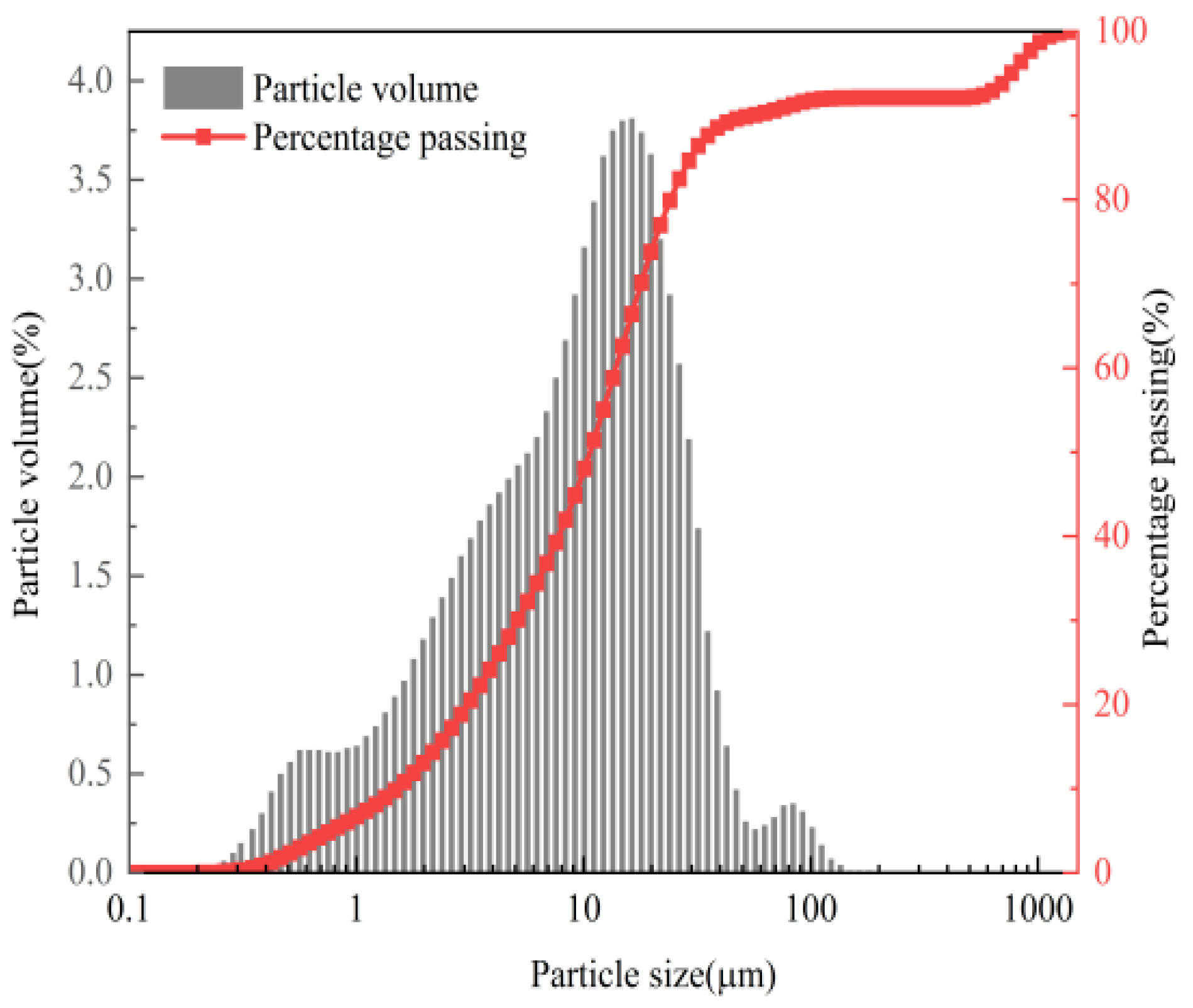
21]. Its particle size distribution is presented in
Figure 1, and the chemical composition is provided in
Table 1. The alkaline activator consisted of a mixture of solid NaOH (98.7% purity) and sodium silicate solution (Na
2SiO
3, containing 8.15% Na
2O, 26% SiO
2, and 57.7% H
2O). The modulus (molar ratio of SiO
2 to Na
2O) of the sodium silicate was 3.29. Laboratory tap water was used as the mixing water. Quartz sand with a SiO
2 content of 99.5%, derived from natural ore and a particle size range of 0.45–0.71 mm (26–40 mesh), was employed as the fine aggregate.
2.2. Mix Proportion and Preparation of Specimens
The well-mixed geopolymer mortar was cast into molds measuring 40 mm × 40 mm × 160 mm and consolidated using a vibrating table. The surface was immediately covered with plastic film to prevent moisture loss. The specimens were maintained at ambient temperature for 24 h prior to demolding. After demolding, they were placed in sealed bags, labeled, and stored in a curing chamber maintained at 20 ± 2 °C with a relative humidity of 95% until the designated curing age for further testing.
The mix proportion of the specimens is shown in
Table 2. Take M1.4–8% as an example, where M1.4 denotes the water glass modulus and 8% indicates the alkali content.
2.3. Test Methods
2.3.1. Flowability Test
The flowability of the slag-based geopolymer mortar was determined in accordance with the method specified in the Test method for fluidity of cement mortar (GB/T 2419-2005) [
22].
2.3.2. Mechanical Property Testing
According to the Test method of cement mortar strength (ISO method) (GB/T 17671–2021) [
23], the compressive and flexural strengths of the specimens were tested at 3, 7, and 28 days. Flexural strength testing was first conducted at a loading rate of 50 N/s until failure. Following flexural testing, the six resulting half-prisms were subjected to compressive strength testing at a loading rate of 2400 N/s, and the average value was reported as the compressive strength. All strength values were recorded to an accuracy of 0.1 MPa.
2.3.3. X-Ray Diffraction Analysis
X-ray diffraction (XRD) analysis was carried out to identify the hydration products. Before testing, the samples were dried, finely ground, and passed through a 75 μm sieve. Diffraction patterns were recorded over a 2θ range of 5° to 80° at a scanning speed of 0.02°/s. The mineralogical composition of the hydration products was analyzed and interpreted using MDI Jade 6 software.
2.3.4. Mercury Intrusion Porosimetry
For mercury intrusion porosimetry (MIP), specimens were immersed in anhydrous ethanol for 7 days to stop hydration, and then oven-dried at 60 °C to constant weight prior to testing. Pore structure measurements were performed using an AutoPore IV 9500 mercury porosimeter (McMurtry Tek (Shanghai) Instrument Co., Ltd., Shanghai, China). The test procedures and parameters were set in accordance with the Pore size distribution and porosity of solid materials by mercury porosimetry and gas adsorption—Part 1: Mercury porosimetry (GB/T 21650.1-2008) [
24].
2.3.5. Nanoindentation Testing
Nanoindentation tests were conducted using a Nano Indenter G200 (Agilent Corporation, Santa Clara, CA, USA) to characterize the micromechanical properties of the paste. Samples were taken from the specimens after 3 and 28 days of curing and immersed in anhydrous ethanol for at least 7 days to terminate hydration. Prior to testing, the samples were vacuum-dried and then impregnated with a low-viscosity epoxy resin. The specimens were prepared using a metallographic grinder–polisher. Grinding was performed sequentially with SiC abrasive papers of grit sizes 120, 400, 800, 1200, 1500, and 2000, each for at least 15 min. Subsequently, polishing was carried out for approximately 30 min using diamond suspensions with particle sizes of 6.00, 3.00, 1.00, 0.50, 0.25, and 0.05 μm to obtain a suitable surface finish for nanoindentation.
During testing, a 10 × 10 grid of 100 indents was performed on each sample, with a spacing of 20 μm between adjacent indentation points. The load was applied at a constant loading rate of 10 nm/s until a maximum indentation depth of 2000 nm was reached, followed by a holding period of 5 s to minimize the influence of creep in the geopolymer material. After holding, the load was unloaded to zero at the same rate. Poisson’s ratio of the tested sample was assumed to be 0.2, while the elastic modulus and Poisson’s ratio (
υ) of the diamond indenter were taken as 1141 GPa and 0.07, respectively. The hardness (
H) and reduced modulus (
Er) at each test point were derived from the load–displacement curves using the Oliver–Pharr method. The elastic modulus (
E) at each test point was then calculated using the following relationship:
where
Ei is the elastic modulus of the diamond indenter, and
υi is Poisson’s ratio of the diamond indenter. The nanoindentation data obtained from 100 test points for each sample were analyzed using the deconvolution method, yielding three Gaussian distributions. Based on this analysis, the theoretical PDF and CDF were derived. The mechanical properties of each phase in the geopolymer material are represented as
x = (
E,
H), where
E denotes the elastic modulus and
H denotes the hardness. The corresponding probability density function is given by:
In the equation,
is the arithmetic mean value obtained for each type of hydration product, and
is the standard deviation.
In the equation, NJ represents the number of indentation points corresponding to the j-th phase in the test data, and xk denotes the experimentally obtained value. For specimen analysis, the overall probability distribution function is obtained by the weighted superposition of the probability density functions of individual phases. The number of peaks approximately corresponds to the number of distinct phases present in the material. Through multi-peak Gaussian fitting, curves that accurately fit the experimental elastic modulus and hardness data can be derived. The weighted contribution of each phase is related to its volumetric fraction in the bulk material. By deconvolving the Gaussian functions, key parameters of each phase can be extracted, facilitating the investigation of the micromechanical characteristics of hydration products.
Comparative experiments were conducted using cement specimens with different mix proportions. Based on the analytical results obtained, the effects of mix proportion can be evaluated both qualitatively and quantitatively. This approach aids in optimizing the mix design and determining the parameters within the Gaussian model:
where Dx(x
i) is the cumulative distribution function obtained from all indentation points. In the three parameter-calculation methods described above, the sum of the volumetric fractions of all phases is 1.0.
3. Results and Discussion
3.1. Mechanical Response of Geopolymer Mortar to Alkali Content
3.1.1. Flowability
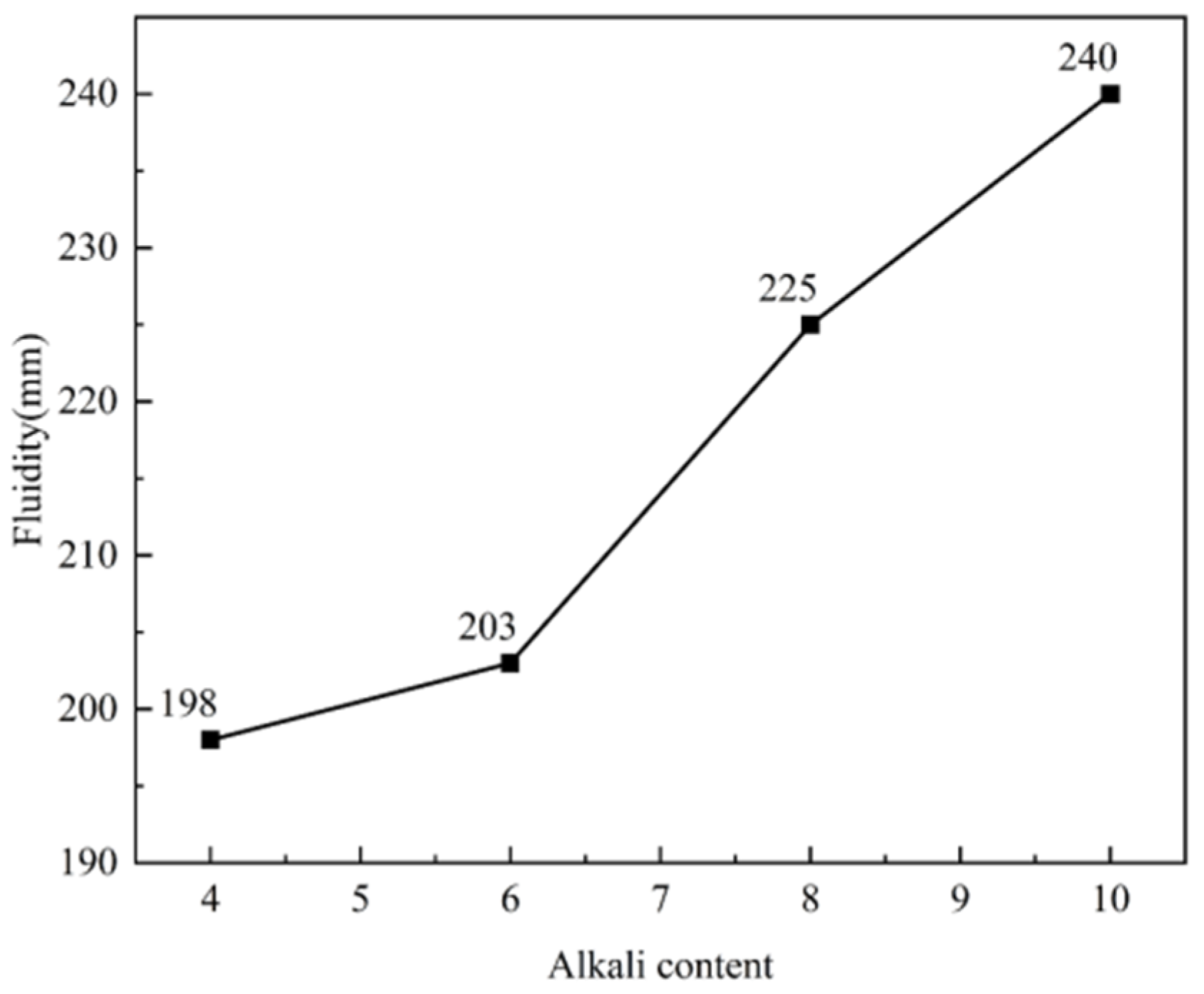
As shown in
Figure 2, flowability exhibits a monotonic positive correlation with alkali content and can be enhanced by increasing the alkali content. When the alkali content increases from 4% to 10%, the flowability rises from 198 mm to 240 mm. This trend can be attributed to the increase in OH
− ion concentration in the solution at higher alkali levels. The strong polarity of OH
− ions promotes the depolymerization of Si–O and Al–O bonds within the slag glass phase, thereby accelerating the dispersion and dissolution of slag particles. Consequently, the frictional resistance among fine slag particles is mitigated, leading to improved flowability of the geopolymer paste. This finding is consistent with the research conclusion of Taghvayi et al. [
8], who pointed out that the increase in alkali content in alkaline activator can effectively reduce the internal friction of slag-based geopolymer paste and improve its fluidity, and the fluidity growth trend is more obvious when the alkali content is in the range of 4~10%. In addition, Liu et al. [
10] also found in the study of ferronickel slag geopolymer that the increase in OH
− concentration is the core factor to improve the paste flowability, which further verifies the rationality of the flowability variation law in this experiment.
3.1.2. Mechanical Properties
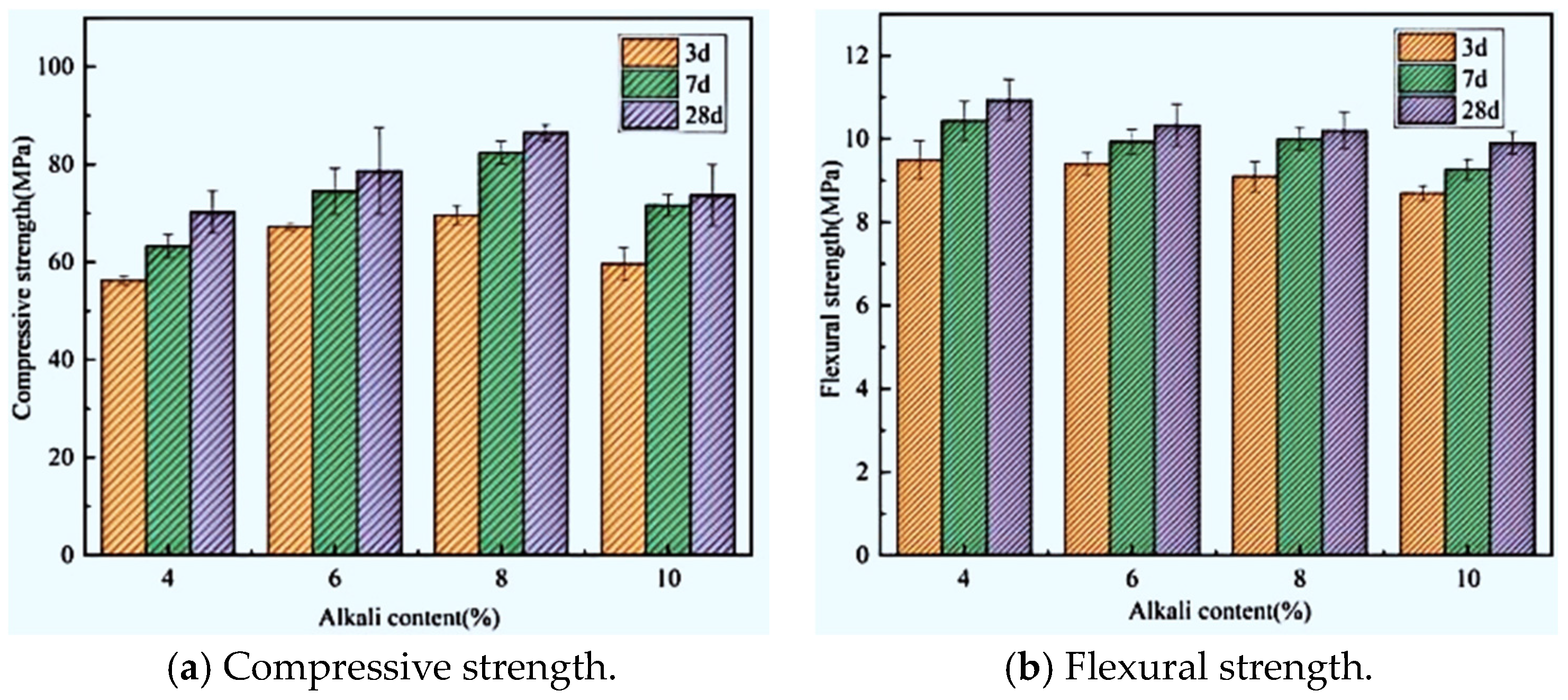
Figure 3 illustrates the effect of alkali content on the compressive and flexural strengths of geopolymer mortar.
As shown in
Figure 3a, compressive strength first increases and then decreases with increasing alkali content. When the alkali content rises from 4% to 8%, compressive strength progressively increases, reaching a maximum value of 86.4 MPa at 8% alkali content. At the same curing age, this represents a 23.1% increase compared to the specimen with 4% alkali content. In contrast,
Figure 3b shows that flexural strength exhibits a continuous, slight downward trend with increasing alkali content. At 28 days of curing, flexural strength decreases by 5.5%, 6.4%, and 9.1% relative to the 4% alkali content specimen.
This behavior stems from the differentiated response of compressive and flexural strength to microstructure evolution under alkaline excitation. Under moderately alkaline conditions (4~8%), the rapid dissolution of amorphous aluminosilicate phases in slag under alkaline conditions releases substantial amounts of silicate and calcium ions. These ions subsequently form N-A-S-H and C-A-S-H gels that fill the pores within the matrix, thereby densifying the microstructure, reducing porosity, and ultimately enhancing compressive strength. Similar to the research results of Abd et al. [
9] on fly ash/slag-blended geopolymer mortar, the compressive strength of geopolymer materials increases with the increase in alkali content in a certain range, and the optimal alkali content of slag-based geopolymer is generally concentrated in 7~9%, which is highly consistent with the 8% optimal alkali content obtained in this study. However, with the increase in alkali content, the polymerization degree of [SiO
4] and [AlO
4] tetrahedra is improved gradually, and a rigid three-dimensional Si–O–Al network structure is formed in the matrix, which reduces the plastic deformation capacity of the geopolymer mortar and increases the brittleness of the matrix. Bending strength is more sensitive to the brittleness of the matrix than compressive strength, resulting in a slight decrease in flexural strength with the increase in alkali content in the low-alkali stage. When the alkali content exceeds 8% (high alkaline condition), the mechanical properties of the specimen show a significant decline in flexural strength and a slight decrease in compressive strength, which is caused by the multi-factor coupling of rigid three-dimensional network, microcrack initiation, and pore structure coarsening.
In addition, the mechanical properties of geopolymer mortar improve with prolonged curing age. As the reaction proceeds, additional reaction products are generated, further filling pores within the hardened matrix and enhancing its compactness. Nevertheless, the increase in strength at later curing ages is relatively modest. At 7 days of curing, the compressive strengths of the specimens reach 90.0%, 94.7%, 95.5%, and 97.1% of their respective 28-day values. Similarly, the flexural strengths at 7 days attain 95.4%, 96.1%, 98.0%, and 93.9% of the corresponding 28-day strengths. These findings confirm that geopolymer mortar exhibits pronounced early-age strength development. This early strength development characteristic is consistent with the research conclusion of Zhao et al. [
19] on alkali-activated slag glass powder cementitious materials, who pointed out that slag-based geopolymer materials can complete more than 90% of the strength development within 7 days of curing, which is a typical characteristic different from ordinary Portland cement. Li et al. [
1] also found a similar early strength law in the study of fiber-reinforced geopolymer filling materials, which further proves the excellent early mechanical properties of slag-based geopolymer mortar.
3.1.3. Nanoindentation Testing
(1) Micromechanical Properties
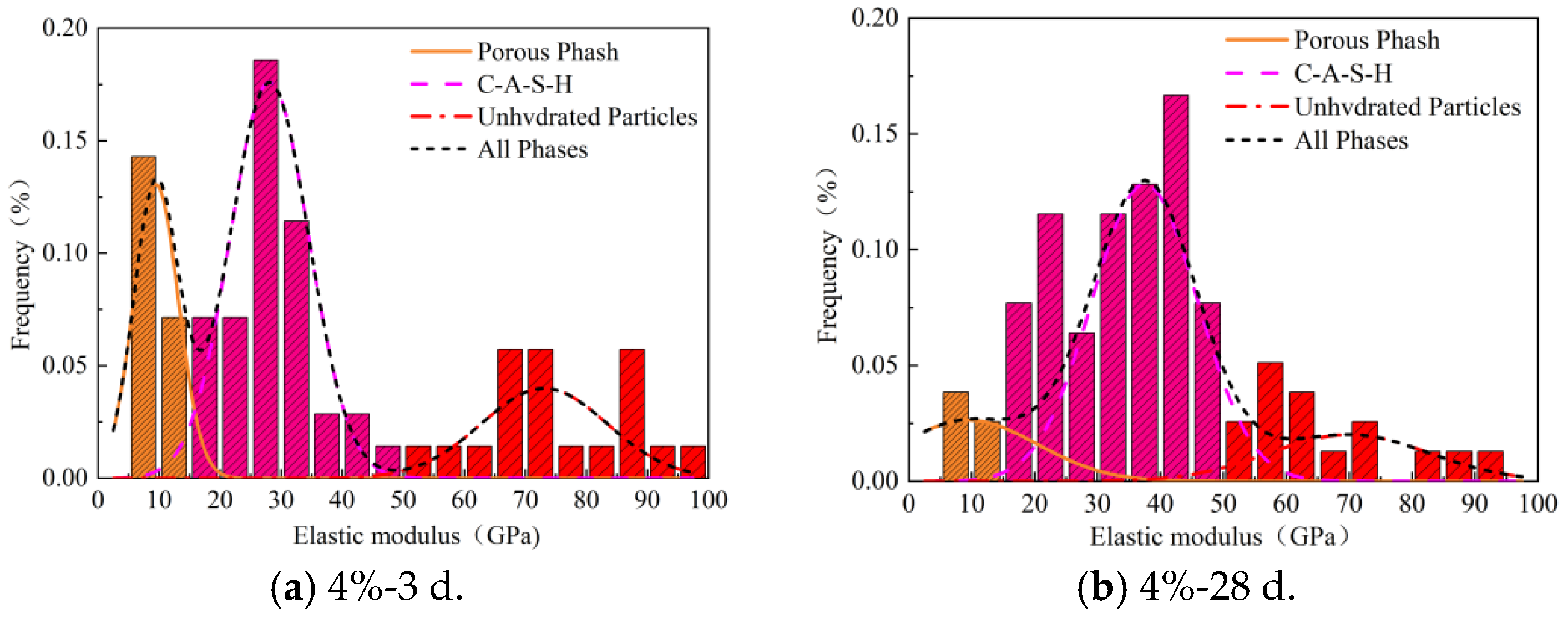
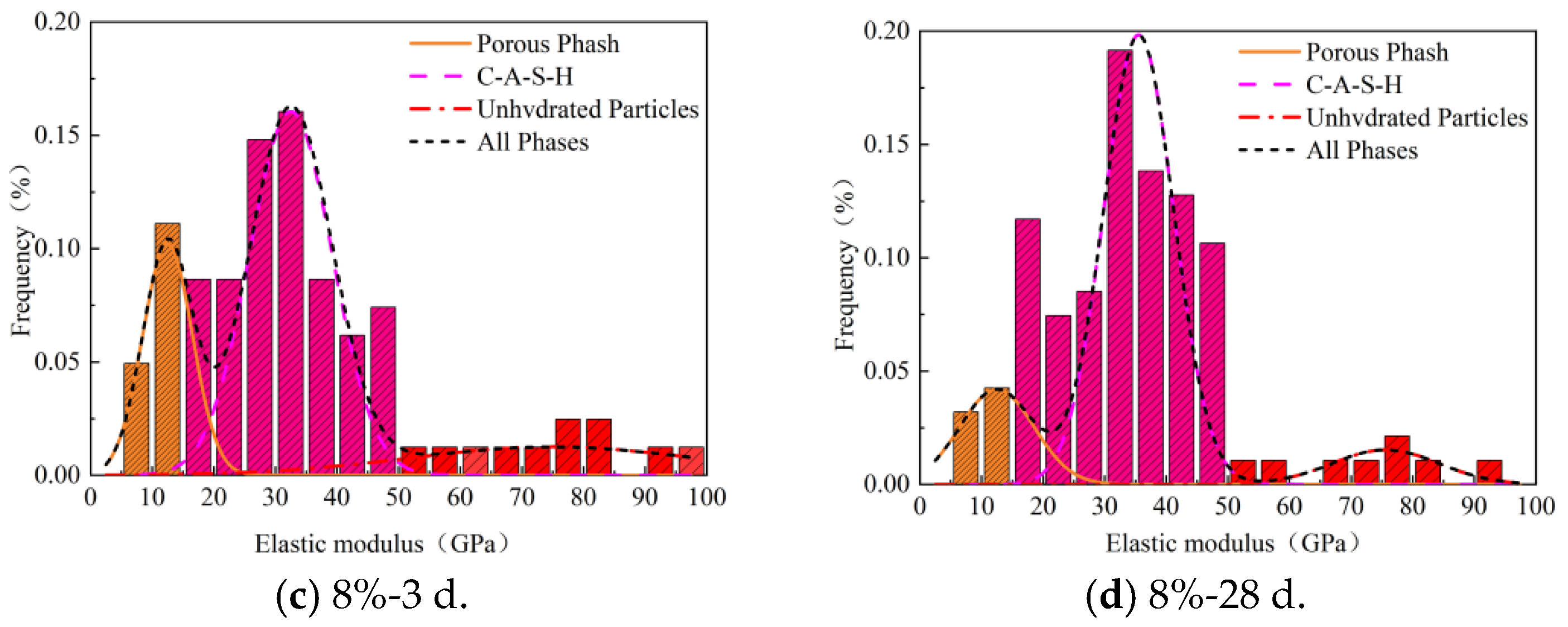
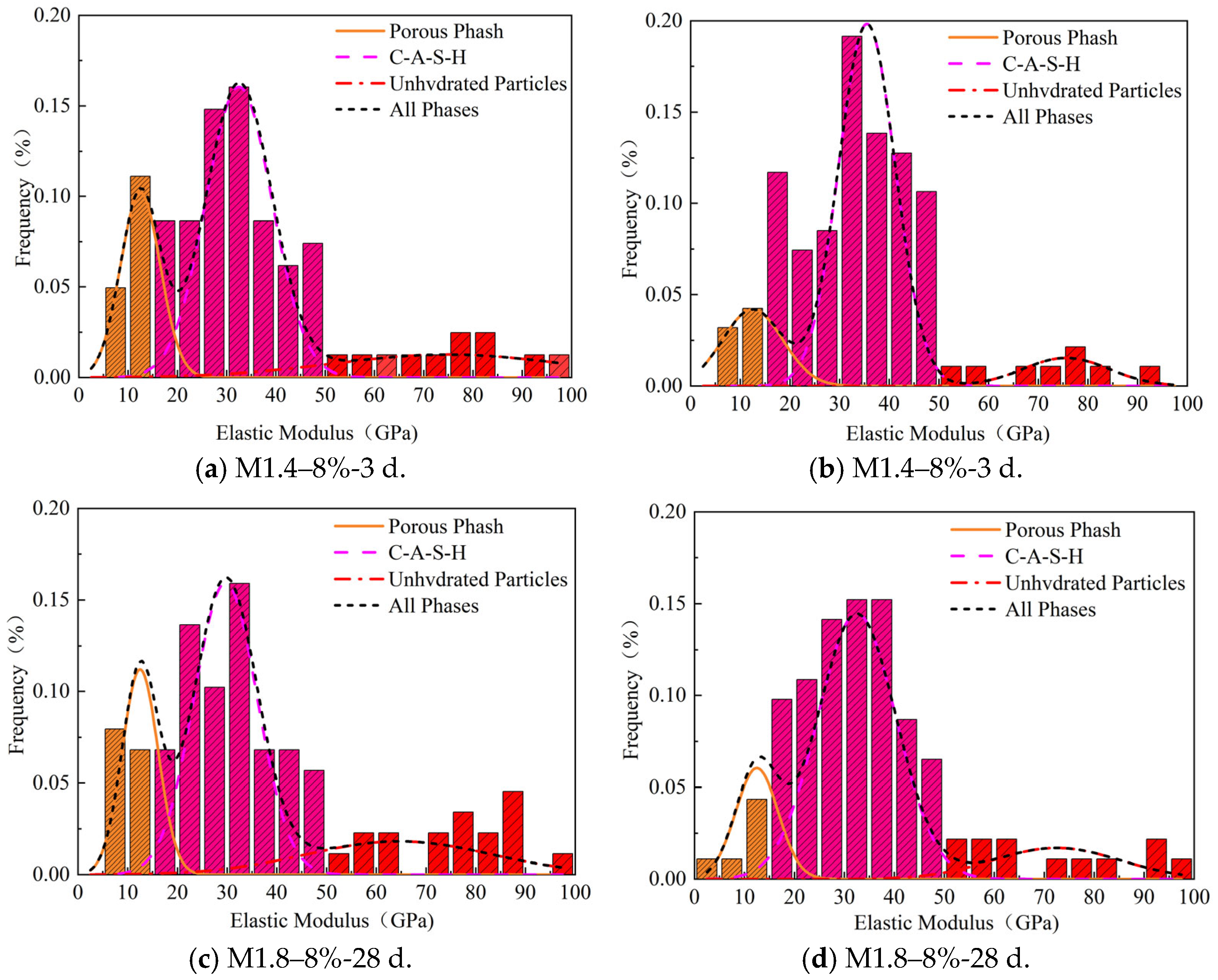
Figure 4 shows the fitted elastic modulus distribution of geopolymer mortar with varying alkali content. Based on previous studies utilizing nanoindentation to investigate the micromechanical properties of geopolymer binders, the elastic modulus of different phase constituents in hardened paste can be categorized into three types: porous phase, reaction products, and unreacted particles. The first category corresponds to the porous phase, with elastic modulus values ranging from 9 to 15 GPa. A comparison of
Figure 4 reveals that the pore structure of the matrix becomes more refined with increasing curing age, accompanied by a gradual decrease in the proportion of the porous phase. The second category corresponds to the reaction products. Taking the specimen with 4% alkali content as an example, the elastic modulus at 3 days is mainly distributed between 20 and 35 GPa, whereas at 28 days, it is primarily concentrated between 50 and 100 GPa. The third category corresponds to unreacted slag particles. As illustrated, the elastic modulus of unreacted particles exhibits a relatively wide distribution, ranging from 60 to 80 GPa. However, at a curing age of 28 days, the modulus is predominantly concentrated between 50 and 80 GPa.
Previous studies have indicated that the primary reaction product in the second category is C-A-S-H gel, which possesses a higher elastic modulus than N-A-S-H gel. In the later stages of the reaction, increased formation of C-A-S-H gel occurs, suggesting that C-A-S-H gel is the principal contributor to the strength development of geopolymer mortar. Additionally, the proportion of reaction products increases with rising alkali content. The alkalinity of the activator governs the extent of silicon and aluminum dissolution from aluminosilicate precursors; higher alkalinity promotes the formation of additional C-A-S-H gel, which fills pores and densifies the internal matrix structure.
In summary, with increasing curing age and alkali content, the elastic modulus of gel products progressively dominates the micromechanical response. This indicates that the micromechanical properties of the gel phases can effectively reflect the macroscopic mechanical performance of the specimens.
Based on the analysis and quantification of the probability density function (PDF) curves, the micromechanical elastic modulus of the geopolymer paste specimens was evaluated, and the results are summarized in
Table 3. The symbol “±” denotes the error interval, and this study adopts standard values. As shown in the Table, both curing age and alkali content exert a relatively limited influence on the elastic modulus values of the geopolymer paste, with the values fluctuating within a certain range. However, the relative contents of reaction products and unreacted particles exhibit more pronounced variations. Taking the specimen with 4% alkali content cured for 3 days as an example, the nanoindentation results were analyzed in conjunction with XRD data. The first phase, corresponding to the porous phase, exhibits an elastic modulus of 9.2 GPa with a relative content of 23.1%. The second phase, identified as C-A-S-H gel, shows an elastic modulus of 28.1 GPa and a relative content of 56.6%. The third phase represents unreacted slag particles, with an elastic modulus of 75.3 GPa and a relative content of 20.3%. Due to the relatively low alkali content, the dissolution of reactive species such as [SiO
4]
4−, [AlO
4]
5−, and Ca
2+ is limited, thereby slowing the dissolution rate of slag and the subsequent geopolymerization reaction. Consequently, the relative content of reaction products is lower than that observed in specimens with an alkali content of 8%.
(2) Relationship between Micromechanical Elastic Modulus and Hardness
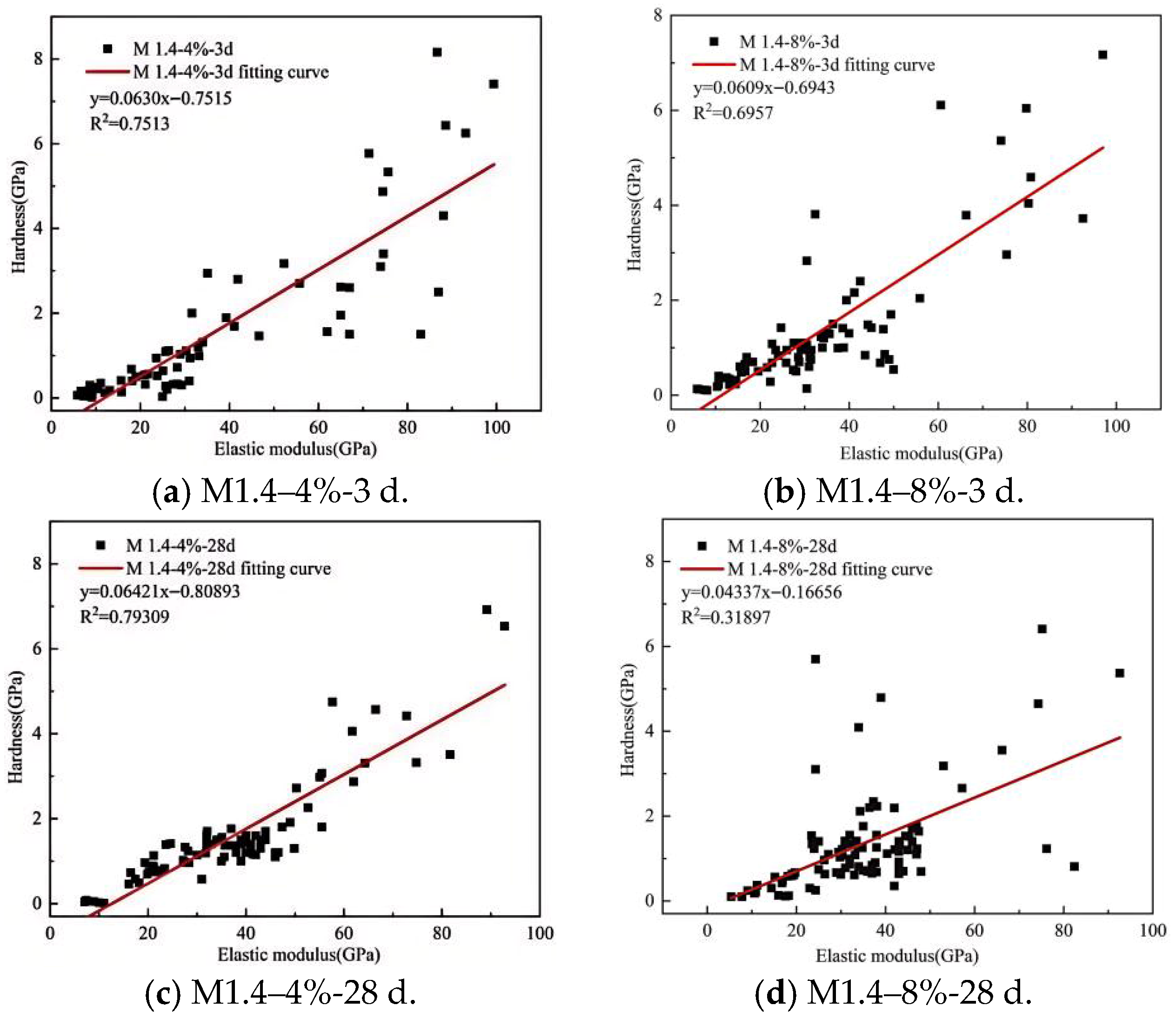
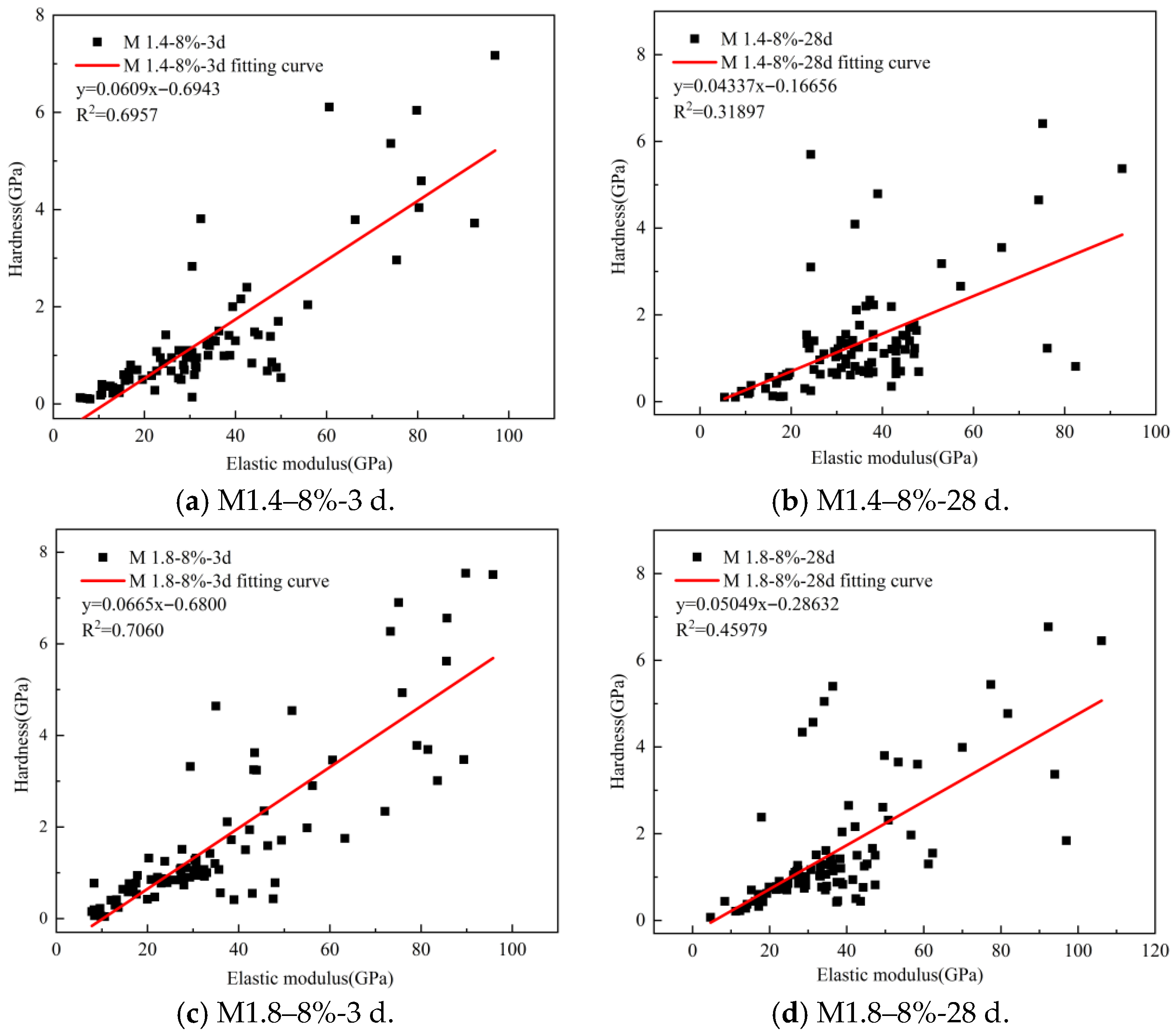
The relationship between the elastic modulus and hardness of geopolymer mortar specimens at different curing ages is presented in
Figure 5. As shown in the Figure, an increase in elastic modulus tends to be accompanied by an increase in hardness. However, the linear correlation between elastic modulus and hardness across different specimens remains relatively weak, with the highest coefficient of determination reaching only R
2 = 0.79309. Furthermore, most data points corresponding to elastic modulus and hardness are concentrated within the porous phase and reaction product regions, whereas those in the unreacted particle region exhibit greater dispersion. For instance, at an alkali content of 8% and a curing age of 28 days, the coefficient of determination is as low as R
2 = 0.31897. Nevertheless, at both early and later curing stages, the microscale elastic modulus and hardness of the slag-based geopolymer paste demonstrate a positive correlation. The microscopic elastic modulus and hardness of slag geopolymer slurry show a linear relationship overall. Moreover, the correlation between elastic modulus and hardness at 28 days is stronger than that at 3 days. As the curing age increases, the reaction proceeds further, resulting in a more refined and denser internal structure of the cementitious matrix, thereby enhancing the correlation between microscale elastic modulus and hardness.
3.1.4. Microstructural Characterization
(1) XRD
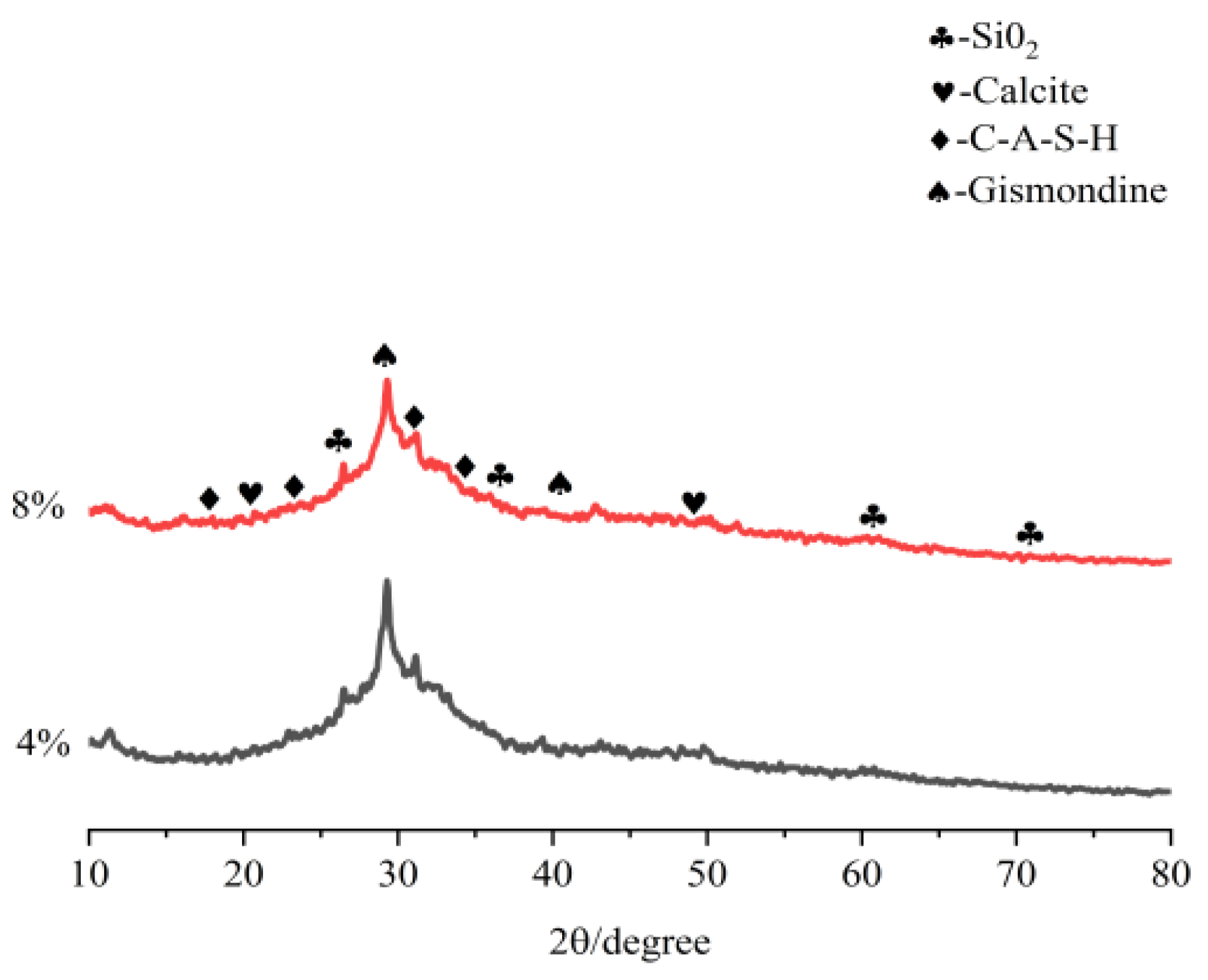
To investigate the effect of alkali content on the phase composition of reaction products in slag-based geopolymers and to corroborate the nanoindentation findings, specimens with alkali contents of 4% and 8% were selected for XRD analysis.
Figure 6 presents the X-ray diffraction (XRD) patterns of slag-based geopolymer mortar at 28 days of curing. As shown in the Figure, quartz (SiO
2, 2θ = 26.6°, and 50.1°), calcite (CaCO
3, 2θ = 29.4°, and 36.0°), C-A-S-H gel, and gismondine (CaAl
2Si
2O
8·4H
2O, 2θ = 18.5°) phases are identified in the geopolymers with varying alkali contents. Prominent characteristic peaks of quartz are observed in all samples, and their relative intensities change only marginally with increasing alkali content. This indicates that the quartz crystals originate from the slag raw material and remain largely unaffected by OH
− ions, with no new crystalline phases formed during geopolymerization.
A broad hump in the 2θ range of 15–40° is attributed to the amorphous C-A-S-H gel phase, which is a typical XRD feature of C-A-S-H gel due to its short-range ordered Si-O-Si/Al-O-Si bond arrangement. This hump is the key indicator for identifying amorphous C-A-S-H gel in slag-based geopolymers, as its shape, intensity, and width directly reflect the content and short-range order degree of the gel phase.
By comparing the hump characteristics of specimens with different alkali contents, it can be observed that: when the alkali content increases from 4% to 8%, the intensity of the hump significantly enhances and the full width at half maximum (FWHM) narrows, which indicates an increase in the content of C-A-S-H gel and an improvement in its short-range order degree. This is consistent with the nanoindentation results that the relative content of C-A-S-H gel increases from 56.6% (4% alkali content) to 75.3% (8% alkali content), and the matrix porosity decreases from 14.7% to 9.7% (MIP data). When the alkali content further increases to 10%, the hump intensity weakens and the FWHM broadens, suggesting a reduction in the content of C-A-S-H gel and a decrease in its short-range order degree. This phenomenon is due to the formation of a dense reaction product film on the slag surface under high alkali conditions, which hinders the further dissolution of slag and the progress of geopolymerization, as discussed in
Section 3.1.2.
Regarding the peak position (2θ shift) of the amorphous hump, no obvious offset is observed among the specimens with different alkali contents (all concentrated around 2θ = 27.3°~27.5°), indicating that alkali content primarily affects the content and order degree of C-A-S-H gel rather than the basic bond structure (Si-O bond length) of the gel phase. This is because the Ca/Si ratio of C-A-S-H gel in slag-based geopolymers is relatively stable under the experimental alkali content range (4~10%), and no significant variation in the local atomic arrangement of the gel is caused.
(2) Pore Structure
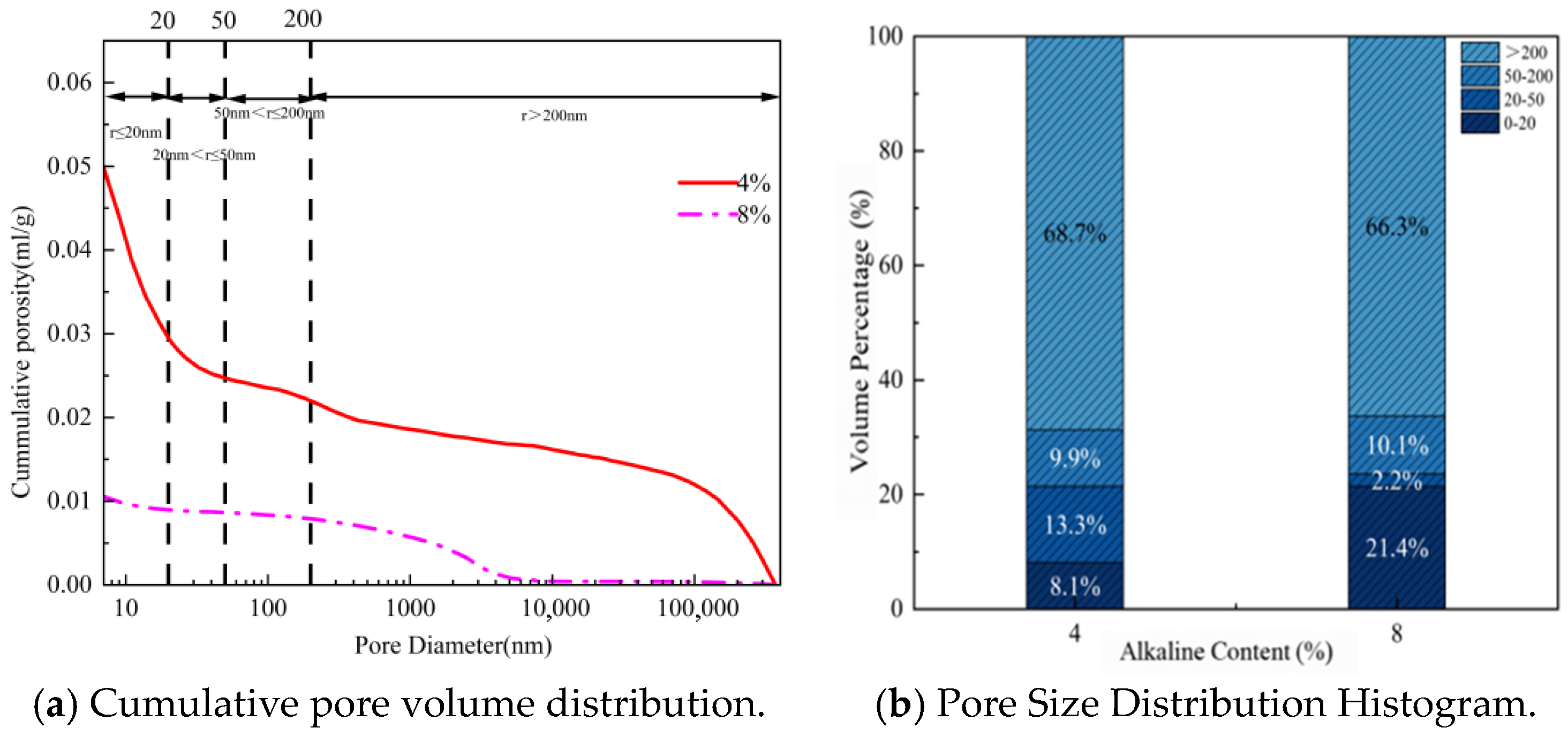
Table 4 presents the mercury intrusion porosimetry (MIP) results for geopolymer mortar specimens cured for 28 days under different alkali contents. As shown in
Table 4, when the alkali content increases from 4% to 8%, the porosity decreases from 14.7% to 9.7%, and the average pore diameter correspondingly reduces from 36.55 nm to 14.82 nm. These results indicate that the increase in alkali content promotes the formation of additional hydration products, leading to further refinement of the pore structure within the matrix.
Figure 7 illustrates the effect of alkali content on the pore size distribution of slag-based geopolymer mortar. Pores are typically classified according to their diameter into harmless pores (<20 nm), less-harmful pores (20–50 nm), harmful pores (50–200 nm), and highly harmful pores (>200 nm). At an alkali content of 8%, harmless pores account for 21.4% of the total pore volume, which is 13.3 percentage points higher than that observed in the specimen with 4% alkali content. For the specimen with 4% alkali content, harmful and highly harmful pores constitute 9.9% and 68.7% of the total pore volume, respectively. In contrast, when the alkali content increases to 8%, the proportions of harmful and highly harmful pores are 10.1% and 66.3%, respectively. These findings suggest that increasing alkali content promotes the depolymerization and polycondensation reactions of aluminosilicate precursors, facilitating the formation of additional C-A-S-H gel. This process refines the pore structure of the matrix and enhances its densification, thereby contributing to improved mechanical properties of the material.
3.2. Mechanical Response of Geopolymer Mortar to Water Glass Modulus
3.2.1. Flowability
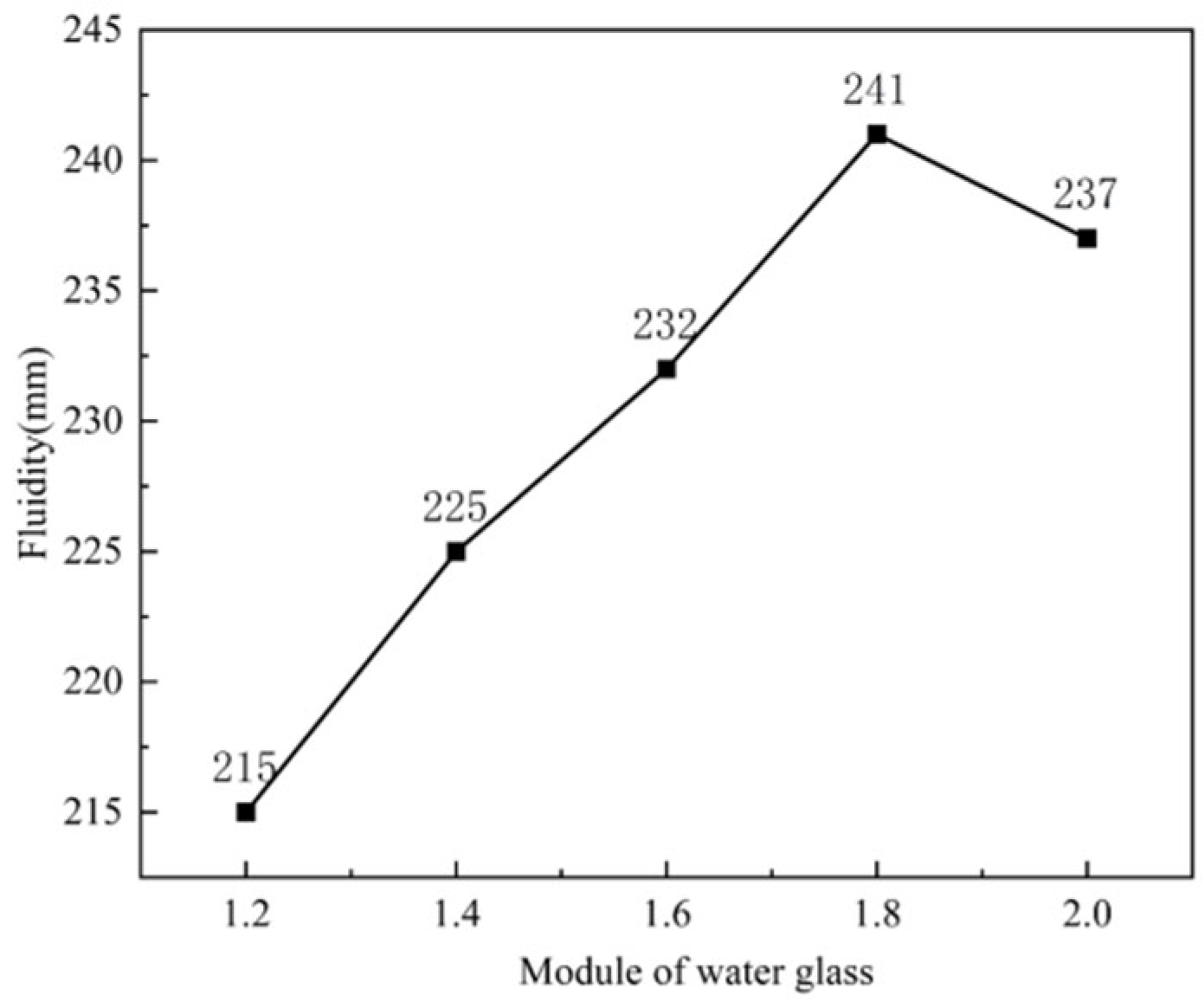
Figure 8 illustrates the effect of water glass modulus on the flowability of geopolymer paste. As shown, the flowability first increases and then decreases with increasing water glass modulus. At a modulus of 1.2, the flowability is 215 mm. As the modulus increases from 1.2 to 1.8, the flowability gradually improves, reaching a maximum value of 241 mm. However, further increases in the water glass modulus lead to a slight reduction in flowability.
Studies have shown that the flowability of geopolymer paste is closely related to the viscosity of the alkaline activator. When the water glass modulus is below 1.8, the activator viscosity is sufficient to coat the slag particles and facilitate paste flow. As the modulus increases, the viscosity of the activator correspondingly rises, which restricts paste flow and results in decreased flowability. In addition, an increase in the silicon content of the activator (i.e., a higher modulus) can delay the formation of flocculated structures within the paste. Meanwhile, the associated increase in free water content enlarges the distance between solid particles, reduces interparticle friction, and thereby contributes to improved flowability. The interplay between these opposing factors ultimately governs the observed flowability trend.
3.2.2. Mechanical Properties
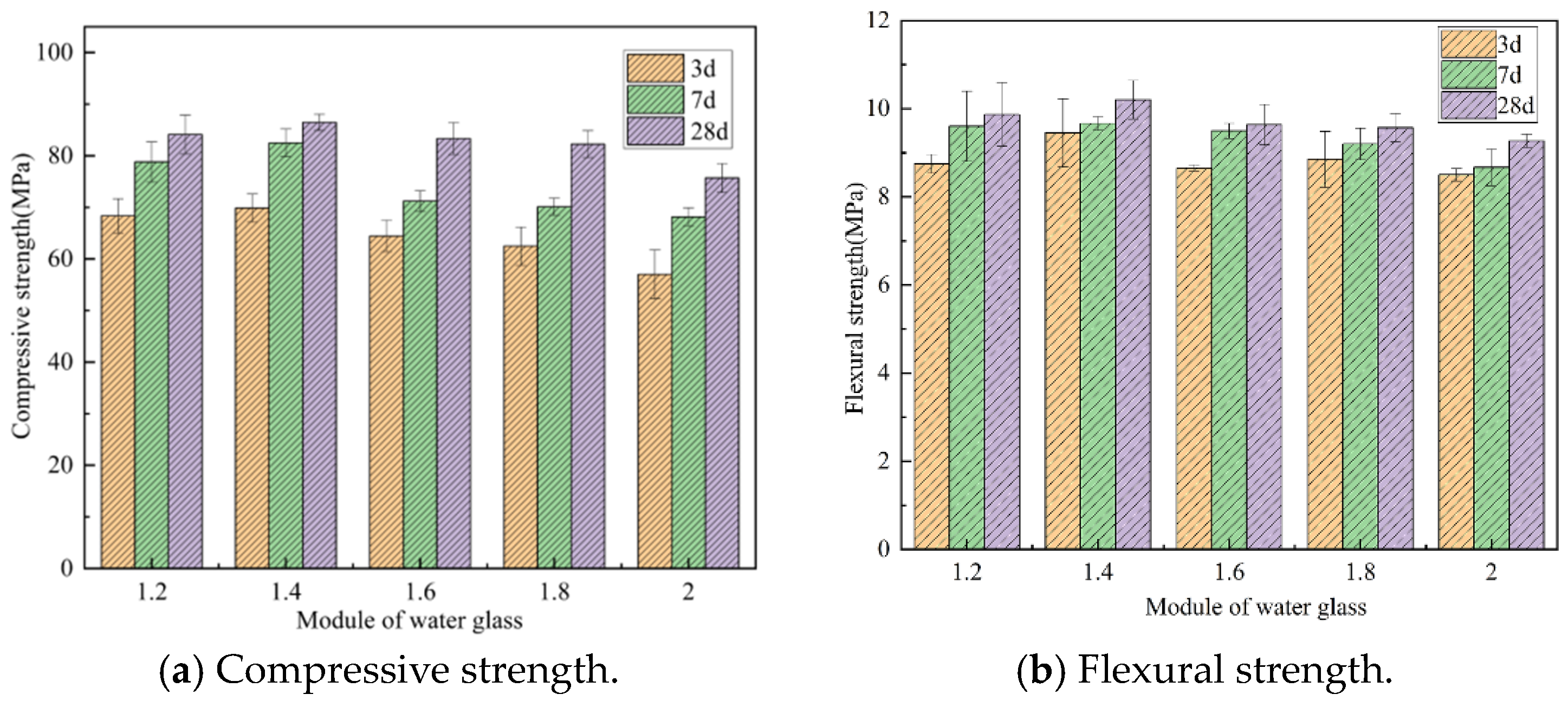
Figure 9 illustrates the effect of water glass modulus on the compressive strength of geopolymer mortar at different curing ages.
As shown in
Figure 9a, the compressive strength first increases and then decreases with increasing water glass modulus across all curing ages. The maximum compressive strength is achieved at a modulus of 1.4, reaching 70 MPa, 82.5 MPa, and 86.5 MPa at 3, 7, and 28 days, respectively. When the water glass modulus increases from 1.4 to 2.0, the compressive strengths at the corresponding curing ages decrease to 57 MPa, 68.1 MPa, and 75.7 MPa, representing reductions of 18.5%, 17.5%, and 12.5%, respectively. Nevertheless, the compressive strength remains above 70 MPa overall, demonstrating the high-strength characteristics of geopolymer binders.
Figure 9b presents the effect of water glass modulus on the flexural strength of geopolymer mortar. As illustrated, the flexural strength follows a trend consistent with that of compressive strength, also reaching its maximum at a modulus of 1.4, with values of 9.4 MPa, 9.7 MPa, and 10.2 MPa at 3, 7, and 28 days, respectively. Compared to the flexural strengths at a modulus of 2.0 (8.5 MPa, 8.7 MPa, and 9.3 MPa at 3, 7, and 28 days, respectively), the strengths at a modulus of 1.4 increase by 10.5%, 11.5%, and 9.7%, respectively.
This behavior can be attributed to the close relationship between the compressive strength of geopolymers and both the dissolution rate of precursor materials and the degree of geopolymerization. The alkalinity of the activator governs the dissolution rate of aluminosilicate precursors and the polymerization degree of the reaction products. Under low-modulus conditions (corresponding to a higher pH value), the dissolution of slag is promoted, releasing substantial amounts of reactive ions such as [SiO4]4−, [AlO4]5−, and Ca2+. This enhances the polymerization of reaction products and facilitates the formation of abundant C-A-S-H and N-A-S-H gels, thereby improving compressive strength. As the water glass modulus increases, the pH value decreases, resulting in a reduced dissolution rate of slag and a lower concentration of reactive ions. Consequently, the amount of reaction products formed diminishes, the matrix becomes less dense, and porosity increases. In addition, an excessively high modulus may introduce excess free SiO2, which precipitates as amorphous silica species. The hardened paste formed under these conditions exhibits relatively lower strength, thereby exerting a negative effect on compressive strength. Moreover, the amount of evaporable water is also related to compressive strength; excess sodium silicate may hinder water evaporation and microstructural development, ultimately leading to a reduction in compressive strength.
Furthermore, as an early-strength cementitious material, geopolymer mortar can achieve more than 90% of its 28-day compressive strength within 7 days. For instance, at a water glass modulus of 1.4, the compressive strengths at 7 and 28 days are 82.5 MPa and 86.5 MPa, respectively. This phenomenon can be attributed to the continuous progression of the geopolymerization reaction, which generates additional reaction products that fill the pores within the matrix. Consequently, porosity decreases, the internal structure becomes denser, and strength is further enhanced.
3.2.3. Nanoindentation Testing
(1) Micromechanical Properties
As described above, the measured nanoindentation data were classified into distinct phases. The first category corresponds to the porous phase, with elastic modulus values distributed in the range of 9–15 GPa. The second and third categories correspond to reaction products and unreacted particles, respectively. A comparison of
Figure 10a,c reveals that when the water glass modulus increases from 1.4 to 1.8, the frequency of reaction products does not differ significantly, whereas the frequency of unreacted particles increases. This suggests that at a modulus of 1.8, a portion of the slag within the matrix does not undergo sufficient geopolymerization. This phenomenon is primarily attributed to the accelerated dissolution rate of slag under lower modulus conditions, which promotes depolymerization and polycondensation reactions, leading to the formation of more reaction products. In contrast, as the water glass modulus increases, the pH value decreases, resulting in a reduced dissolution rate of slag and a lower concentration of reactive ions. Consequently, fewer reaction products are formed, which is manifested micromechanically as a reduction in the proportion of reaction products. With increasing curing age, the frequency distribution of elastic modulus indicates that reaction products gradually become dominant, while the proportion of unreacted particles decreases slightly.
It can be observed from
Table 5 that the effects of water glass modulus and curing age on the elastic modulus of geopolymer mortar are consistent with the previous test results. Specifically, variations in mixture proportions primarily influence the relative contents of reaction products and unreacted particles, while exerting only a limited effect on their elastic modulus values. This phenomenon may be attributed to the fact that the elastic modulus of each phase is calculated within predefined ranges during phase classification, resulting in similar numerical values.
Taking the specimen with a water glass modulus of 1.4 cured for 3 days as an example, the nanoindentation results were analyzed in conjunction with XRD data (detailed in the following section). The first phase exhibits an elastic modulus of 10.7 GPa with a relative content of 23.6%. The second phase corresponds to C-A-S-H gel, with an elastic modulus of 31.5 GPa and a relative content of 62.4%. The third phase represents unreacted particles, with an elastic modulus of 76.3 GPa and a relative content of 14.0%. Furthermore, at a modulus of 1.4, the relative content of reaction products is slightly higher than that at a modulus of 1.8, whereas the relative contents of the porous phase and unreacted particles are slightly lower. This is because the geopolymerization reaction requires an appropriate amount of water to proceed effectively. Excess sodium silicate hinders water evaporation and microstructural development, thereby slowing the dissolution and polymerization reactions of slag particles. These findings further indicate that the micromechanical properties of the tested specimens are closely related to their macroscopic mechanical performance.
(2) Relationship between Micromechanical Elastic Modulus and Hardness
Figure 11 illustrates the relationship between elastic modulus and the hardness of geopolymer mortar specimens prepared with different water glass modulus values. The observed trend is consistent with that previously discussed for the effect of alkali content. As the elastic modulus increases, hardness exhibits a corresponding variation; however, the linear correlation between the two parameters remains relatively weak. Among all specimens, the best-fitting result is obtained for the sample with a water glass modulus of 1.8 cured for 3 days, yielding a coefficient of determination of R
2 = 0.7060. Data points exhibiting a relatively strong linear relationship between elastic modulus and hardness are primarily concentrated in the porous-phase and reaction product regions. In contrast, data points in the unreacted particle region show greater dispersion, with the elastic modulus of unreacted particles displaying a wide distribution.
3.2.4. Microstructural Characterization
(1) XRD
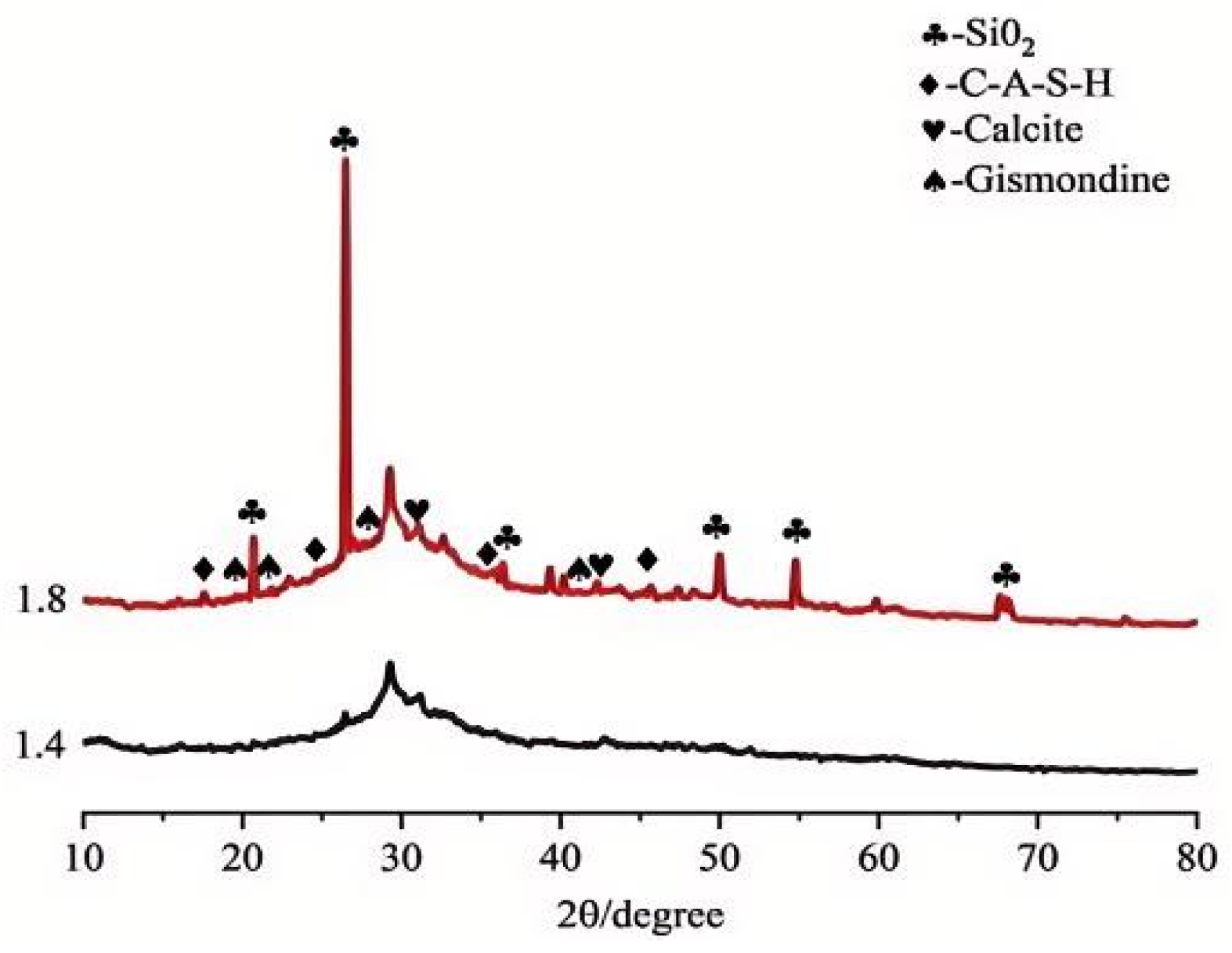
To investigate the effect of water glass modulus on the phase composition of slag-based geopolymer products and to corroborate the nanoindentation findings, specimens with moduli of 1.4 and 1.8 were selected for XRD analysis.
Figure 12 presents the X-ray diffraction (XRD) patterns of slag-based geopolymer mortar cured for standard curing for 28 days. As shown in the Figure, a broad diffraction hump appears in the 2θ range of 15–40°, attributed to the amorphous C-A-S-H gel phase, while the intensity variations in other crystalline diffraction peaks are relatively minor. With increasing modulus, the characteristic diffraction peak of quartz becomes more pronounced in the specimen with a modulus of 1.8. This can be explained by the higher alkalinity of the activator under low-modulus conditions. The elevated concentration of OH
− ions promotes the dissolution of reactive aluminosilicate phases, generating silicate and aluminate tetrahedra that subsequently combine with Ca
2+ to form C-A-S-H gel. The presence of this amorphous C-A-S-H gel contributes significantly to the strength development of geopolymers. Changing the water glass modulus does not induce the formation of new crystalline phases, indicating that the type of reaction products is not the key factor affecting electrical conductivity. In addition, diffraction peaks corresponding to CaCO
3 are also observed. Around 2θ ≈ 30°, the peak of the specimen with a modulus of 1.8 is sharper than that of the specimen with a modulus of 1.4, and the peak intensity of CaCO
3 shows a positive correlation with the modulus. This may be attributed to the limited penetration of CO
2 within a denser pore structure, which indirectly confirms that the slag-based geopolymer with a modulus of 1.4 exhibits superior mechanical properties.
(2) Pore Structure
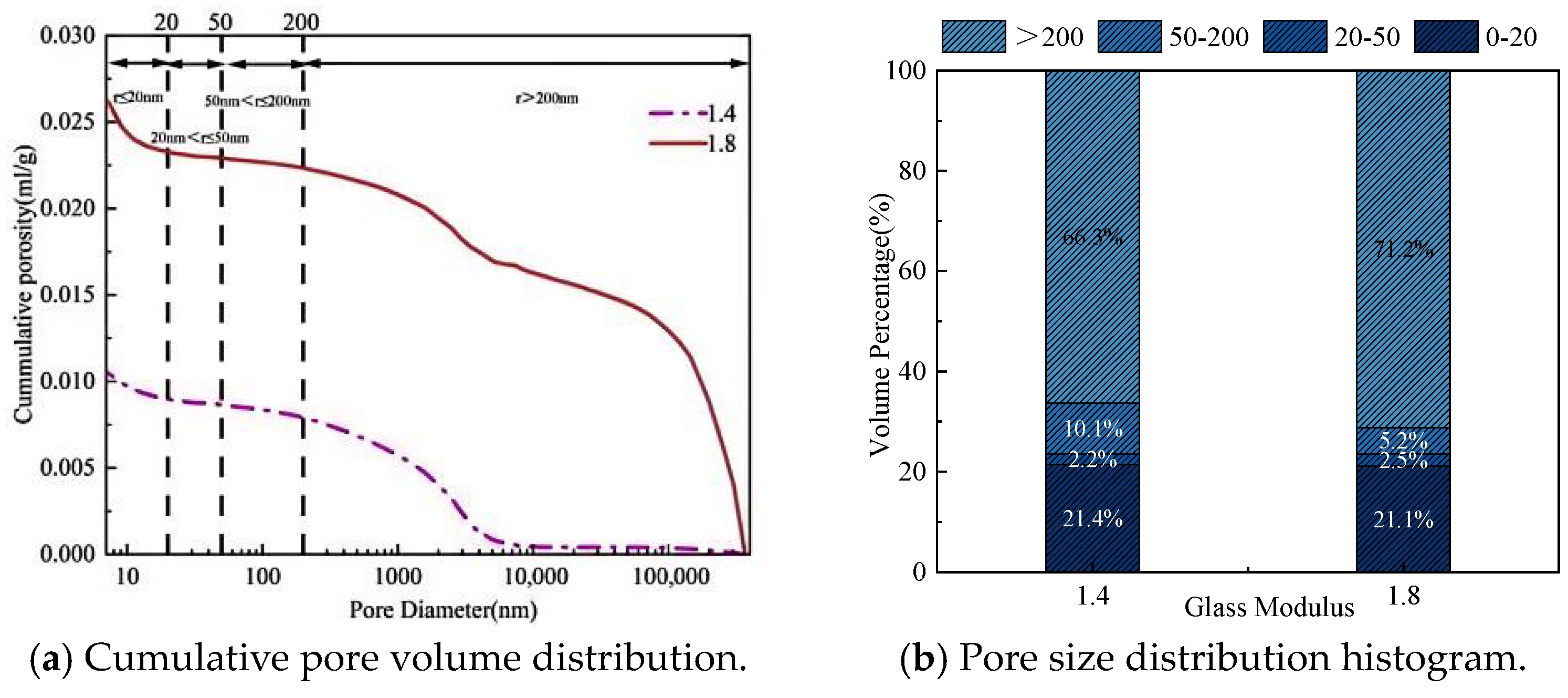
Table 6 presents mercury pressure test results at different water glass moduli and standard 28-day curing ages. The data reveals that a modulus of 1.4 yields an average pore size of 14.82 nm, compared to 33.71 nm for a modulus of 1.8. Porosity also increases from 9.7% to 13.5% with rising water glass modulus. Under low-modulus conditions (higher pH values), slag releases abundant reactive ions such as [SiO
4]
4−, [AlO
4]
5−, and Ca
2+, enhancing hydration product polymerization and generating substantial C-A-S-H gel. However, higher moduli and lower pH values slow slag dissolution rates, reduce reactive ion quantities, and, consequently, decrease hydration product formation. This leads to reduced matrix density and increased porosity.
Figure 13 illustrates the effect of water glass modulus on the pore size distribution of geopolymer mortar. An increase in modulus reduces the volume percentage of harmless pores (i.e., the proportion relative to the total pore volume) within the matrix. At a modulus of 1.4, harmless pores account for 21.4% of the total pore volume, while the proportions of less harmful and highly harmful pores are 2.2% and 66.3%, respectively. When the modulus increases to 1.8, the proportion of harmless pores decreases slightly to 21.1%, whereas the proportions of less harmful and highly harmful pores increase to 2.5% and 71.2%, respectively. This coarsening of the pore structure reflects a deterioration in the internal compactness of the matrix, which consequently leads to a reduction in mechanical performance.
4. Conclusions
This study prepared geopolymer mortar using slag as the primary raw material by adjusting alkali content and water glass modulus. Based on experimental data obtained from this study, the following conclusions were drawn.
(1) Alkali content significantly affects the flowability and mechanical properties of slag-based geopolymer mortar, and leads to differentiated evolution characteristics of compressive and flexural strength. The mortar’s flowability progressively increases with rising alkali content, reaching 240 mm3 at 10% alkalinity. Compressive strength initially increases but then decreases with higher alkali levels, achieving a maximum of 86.4 MPa at 8% alkalinity after 28 days. Flexural strength shows a sustained slight decline as alkali content increases, primarily due to heightened matrix brittleness and increased microcrack formation caused by elevated alkalinity levels.
(2) The hydration products of slag geopolymers primarily consist of C-A-S-H gel, with minimal influence from varying alkali content and water glass modulus on hydration product composition. As alkali content and water glass modulus increase, both the volume contents of unhydrated particles and C-A-S-H gel phase in the slag geopolymers system exhibit corresponding rises or declines. Taking 28-day curing samples with 4% and 8% alkali content as examples, the 4% sample demonstrates porous-phase elastic modulus at 8.9 GPa (content 13.8%), C-A-S-H elastic modulus at 33.3 GPa (content 70.0%), and unhydrated particle elastic modulus at 75.3 GPa (content 16.2%). The 8% sample shows porous-phase elastic modulus at 10.0 GPa (content 16%), C-A-S-H elastic modulus at 33.2 GPa (content 75.3%), and unhydrated particle elastic modulus at 72.0 GPa (content 8.7%). Higher C-A-S-H gel phase volume contents correlate with more compact matrix structures.
(3) The water glass modulus significantly influences the fluidity and mechanical properties of slag-based geopolymer mortar. Fluidity exhibits an initial increase followed by a decrease as the water glass modulus rises, reaching a maximum value of 241 mm at a modulus of 1.8. Compressive strength and flexural strength also show a similar trend, with optimal mechanical performance achieved at a modulus of 1.4, demonstrating 86.5 MPa compressive strength and 10.2 MPa flexural strength after 28 days. Further increases in water glass modulus beyond 1.4 lead to reduced pH values of the accelerator, decreased slag dissolution rates, and reduced C-A-S-H gel content, resulting in increased matrix porosity and diminished mechanical properties.
(4) The optimal mix proportion of slag-based geopolymer mortar obtained in this study is: alkali content: 8%, water glass: modulus 1.4, and W/B 0.35, which can provide a reference for the practical engineering application of slag-based geopolymer mortar.
Author Contributions
Conceptualization, methodology, D.W.; investigation, writing—original draft preparation, C.H.; writing—review and editing, D.W. All authors have read and agreed to the published version of the manuscript.
Funding
This research received no external funding.
Data Availability Statement
The original contributions presented in the study are included in the article, further inquiries can be directed to the corresponding author.
Conflicts of Interest
The authors declare that they have no known competing financial interests or personal relationships that could have appeared to influence the work reported in this paper.
References
- Li, J.; Zhang, X.; Pang, S.; Wu, Y.; Yang, C.; Su, L.; Liu, J.; Wei, X. Study on the compressive strength and failure mechanism of fiber-reinforced polymer green filling materials. Constr. Build. Mater. 2024, 452, 138990. [Google Scholar] [CrossRef] [Scilit]
- Mahfoud, E.; Ndiaye, K.; Maherzi, W.; Aggoun, S.; Abriak, N.-E.; Benzerzour, M. Carbonation in just add water geopolymer based on fly ash and dredged sediments mix. Constr. Build. Mater. 2024, 452, 138959. [Google Scholar] [CrossRef] [Scilit]
- Ebrahim, M.A.A.; Ahmed, A.D.; Elwafa, A.R. Development of an eco-friendly geopolymer mortar using slag and fly ash with high bentonite content for thermal and environmental applications. Sci. Rep. 2024, 14, 26727. [Google Scholar] [CrossRef] [Scilit] [PubMed]
- Liu, Z.; Qi, X.; Ke, J.; Shui, Z. Enhancing the toughness of ultra-high performance concrete through improved fiber-matrix interface bonding. Constr. Build. Mater. 2025, 491, 142616. [Google Scholar] [CrossRef] [Scilit]
- Hai, R.; Guan, Q.; Zhang, X.; Yang, F.; Cui, L.; Liu, J. Effect of Water Glass on the Hydration Process of Slag-Fly Ash-Based Geopolymer. Materials 2025, 18, 2450. [Google Scholar] [CrossRef] [Scilit] [PubMed]
- Wang, T.; Fan, X.; Gao, C. Development of High-Strength Geopolymer Mortar Based on Fly Ash-Slag: Correlational Analysis of Microstructural and Mechanical Properties. Constr. Build. Mater. 2024, 456, 139215. [Google Scholar] [CrossRef] [Scilit]
- Zhang, B.; Zhu, H.; Wei, K.S.; Feng, P.; Dong, Z. Optimization of mix proportion of alkali-activated slag mortars prepared with seawater and coral sand. Constr. Build. Mater. 2021, 283, 122805. [Google Scholar] [CrossRef] [Scilit]
- Taghvayi, H.; Behfarnia, K.; Khalili, M. The effect of alkali concentration and sodium silicate modulus on the properties of alkali-activated slag concrete. J. Adv. Concr. Technol. 2018, 16, 293–305. [Google Scholar] [CrossRef] [Scilit]
- Abd, E.A.; Taman, M.; Behiry, R.; El-Naggar, M.; Eissa, M.; Hassan, A.M.; Bar, W.A.; Mongy, T.; Osman, M.; Hassan, A.; et al. Neutron imaging of moisture transport, water absorption characteristics and strength properties for fly ash/slag blended geopolymer mortars: Effect of drying temperature. Constr. Build. Mater. 2024, 449, 138436. [Google Scholar] [CrossRef] [Scilit]
- Liu, K.; Li, Z.; Sun, J. Effects of the silicate modulus of water glass on the hydration and mechanical properties of alkali-activated blast furnace ferronickel slag. Front. Mater. 2021, 8, 748833. [Google Scholar] [CrossRef] [Scilit]
- Alanazi, H.; Kim, Y.; Hu, J.; Little, D.N.; Jung, J.S. Multiscale characterization of fly ash–based geopolymer and type V portland cement exposed to MgSO4. J. Mater. Civ. Eng. 2022, 34, 12. [Google Scholar] [CrossRef] [Scilit]
- Wei, Y.; Guo, W.Q.; Liang, S.M. Testing methods and comparison of micro-mechanical creep properties of cement-based materials. China Sci. Tech. Sci. 2026, 56, 1–15. [Google Scholar] [CrossRef] [Scilit]
- Alharbi, N.; Varela, B.; Hailstone, R. Alkali-activated slag characterization by scanning electron microscopy, X-ray micro-analysis and nuclear magnetic resonance spectroscopy. Mater. Charact. 2020, 168, 110504. [Google Scholar] [CrossRef] [Scilit]
- Cui, Y.; Chen, S.; Li, L.; Wang, X.; Liu, J. Atomistic insights into the hydration behavior of NASH gel via Ca2+ substitution: A molecular dynamics simulation study. J. Non-Cryst. Solids 2026, 673, 123892. [Google Scholar] [CrossRef] [Scilit]
- Li, S.; Zhao, J.; Wang, L. Nanoindentation Characterization of C-A-S-H Gel in Alkali-Activated Slag Mortar. Front. Mater. 2023, 10, 1024567. [Google Scholar]
- Wang, Y.; Chen, L.; Li, J. Micromechanical Properties of N-A-S-H/C-A-S-H Mixed Gels in Slag-Fly Ash Geopolymers. Compos. Part B Eng. 2025, 243, 111890. [Google Scholar]
- Xu, S.; Tang, J.; Wang, L. Experimental research on the chlorine salt corrosion resistance of alkali activated low-carbon concrete. Front. Mater. 2024, 11, 1513262. [Google Scholar] [CrossRef] [Scilit]
- Stefaniuk, D.; Sobótka, M.; Jarczewska, K.; Logoń, D.; Majcher, K.; Musiał, M.; Niewiadomski, P.; Pakos, W.; Różański, A.; Trapko, T. Microstructure properties of cementitious mortars with selected additives for electromagnetic waves absorbing applications. Cem. Concr. Compos. 2022, 134, 104732. [Google Scholar] [CrossRef] [Scilit]
- Zhao, J.; Li, S. Study on processability, compressive strength, drying shrinkage and evolution mechanisms of microstructures of alkali-activated slag-glass powder cementitious material. Constr. Build. Mater. 2022, 344, 128196. [Google Scholar] [CrossRef] [Scilit]
- Hu, Z.; Yang, Y.W.; Zhang, H. Durability and damage evolution of steel fiber and Nano-SiO2 reinforced concrete under freeze-thaw and salt erosion environments based on acoustic emission and Computed Tomography analysis. J. Build. Eng. 2025, 114595. [Google Scholar] [CrossRef] [Scilit]
- GB/T 18046-2017; Granulated Blast Furnace Slag Powder for Use in Cement, Mortar, and Concrete. China Standards Press: Beijing, China, 2017.
- GB/T 2419-2005; Method for Determination of Flowability of Cement Mortar. China Standards Press: Beijing, China, 2005.
- GB/T 17671-2021; Test Method for Strength of Cement Mortar (ISO Method). China Standards Press: Beijing, China, 2021.
- GB/T 21650.1-2008; Determination of Pore Size Distribution and Porosity of Solid Materials by Mercury Compression Method and Gas Adsorption Method Part 1: Mercury Compression Method. China Standards Press: Beijing, China, 2008.
Figure 1.
Particle size distribution of slag.
Figure 1.
Particle size distribution of slag.
Figure 2.
Effect of alkali content on the flowability of geopolymer mortar.
Figure 2.
Effect of alkali content on the flowability of geopolymer mortar.
Figure 3.
Effect of alkali content on the mechanical properties of geopolymer mortar.
Figure 3.
Effect of alkali content on the mechanical properties of geopolymer mortar.
Figure 4.
Fitted elastic modulus distribution of geopolymer mortar with different alkali contents.
Figure 4.
Fitted elastic modulus distribution of geopolymer mortar with different alkali contents.
Figure 5.
Relationship between elastic modulus and hardness of geopolymer mortar.
Figure 5.
Relationship between elastic modulus and hardness of geopolymer mortar.
Figure 6.
XRD patterns of geopolymer mortar with different alkali contents.
Figure 6.
XRD patterns of geopolymer mortar with different alkali contents.
Figure 7.
Effect of alkali content on the pore structure of slag-based geopolymer.
Figure 7.
Effect of alkali content on the pore structure of slag-based geopolymer.
Figure 8.
Effect of water glass modulus on the flowability of geopolymer mortar.
Figure 8.
Effect of water glass modulus on the flowability of geopolymer mortar.
Figure 9.
Effect of water glass modulus on the mechanical properties.
Figure 9.
Effect of water glass modulus on the mechanical properties.
Figure 10.
Fitted elastic modulus distribution of geopolymer mortar.
Figure 10.
Fitted elastic modulus distribution of geopolymer mortar.
Figure 11.
Relationship between elastic modulus and hardness of geopolymer mortar.
Figure 11.
Relationship between elastic modulus and hardness of geopolymer mortar.
Figure 12.
XRD patterns of geopolymer mortar.
Figure 12.
XRD patterns of geopolymer mortar.
Figure 13.
Effect of water glass modulus on the pore structure of geopolymer.
Figure 13.
Effect of water glass modulus on the pore structure of geopolymer.
Table 1.
Chemical composition of slag (%).
Table 1.
Chemical composition of slag (%).
| Oxides | SiO2 | Al2O3 | CaO | Na2O | Fe2O3 | SO3 | K2O | MgO | TiO2 | Others |
|---|
| Slag | 29.60 | 12.85 | 44.26 | 7.39 | 0.62 | 2.02 | 0.47 | 0.44 | 1.45 | 0.90 |
Table 2.
Design of slag-based geopolymer mix proportion.
Table 2.
Design of slag-based geopolymer mix proportion.
| Sample Number | Slag (g) | Alkali Content | Water Glass Modulus | Quartz Sand (g) | W/B |
|---|
| M1.4–4% | 100 | 4% | 1.4 | 135 | 0.35 |
| M1.4–6% | 100 | 6% | 1.4 | 135 | 0.35 |
| M1.4–8% | 100 | 8% | 1.4 | 135 | 0.35 |
| M1.4–10% | 100 | 10% | 1.4 | 135 | 0.35 |
| M1.2–8% | 100 | 8% | 1.2 | 135 | 0.35 |
| M1.6–8% | 100 | 8% | 1.6 | 135 | 0.35 |
| M1.8–8% | 100 | 8% | 1.8 | 135 | 0.35 |
| M2.0–8% | 100 | 8% | 2.0 | 135 | 0.35 |
Table 3.
Fitting results of nanoindentation tests for geopolymer with different alkali contents.
Table 3.
Fitting results of nanoindentation tests for geopolymer with different alkali contents.
| Sample Name | | M1.4–4% | M1.4–8% |
|---|
| | Curing Age | 3 d | 28 d | 3 d | 28 d |
|---|
Elastic Modulus
E/(GPa) | Porous Phase | 9.2 ± 1.9 | 8.9 ± 1.5 | 10.7 ± 2.8 | 10.0 ± 2.6 |
| C-A-S-H | 28.1 ± 7.2 | 33.3 ± 9.4 | 31.5 ± 9.0 | 33.2 ± 9.3 |
| Unhydrated Particles | 75.3 ± 12.6 | 67.0 ± 12.9 | 76.3 ± 12.3 | 72.0 ± 12.1 |
Relative Content
(%) | Porous Phase | 23.1 | 13.8 | 23.6 | 16.0 |
| C-A-S-H | 56.6 | 70 | 62.4 | 75.3 |
| Unhydrated Particles | 20.3 | 16.2 | 14.0 | 8.7 |
Table 4.
Pore structure characteristics of slag-based geopolymer.
Table 4.
Pore structure characteristics of slag-based geopolymer.
| Sample Name | Average Pore Diameter (nm) | Total Pore Volume (mL/g) | Porosity (%) |
|---|
| M1.4–4% | 36.55 | 0.057 | 14.7 |
| M1.4–8% | 14.82 | 0.011 | 9.7 |
Table 5.
Fitting results of nanoindentation tests for slag-based geopolymer.
Table 5.
Fitting results of nanoindentation tests for slag-based geopolymer.
| Sample Name | | M1.4–8% | M1.8–8% |
|---|
| | Curing Age | 3 d | 28 d | 3 d | 28 d |
|---|
| Elastic Modulus E/(GPa) | Porous Phase | 10.7 ± 2.8 | 10.0 ± 2.6 | 10.6 ± 2.2 | 10.8 ± 3.3 |
| C-A-S-H | 31.5 ± 9.0 | 33.2 ± 9.3 | 30.7 ± 9.0 | 32.0 ± 8.9 |
| Unhydrated Particles | 76.3 ± 12.3 | 72.0 ± 12.1 | 75.0 ± 13.0 | 71.0 ± 16.0 |
| Relative Content (%) | Porous Phase | 23.6 | 16.0 | 23.2 | 15.9 |
| C-A-S-H | 62.4 | 75.3 | 58.2 | 71.0 |
| Unhydrated Particles | 14.0 | 8.7 | 18.6 | 13.1 |
Table 6.
Pore structure characteristics of slag-based geopolymer.
Table 6.
Pore structure characteristics of slag-based geopolymer.
| Sample Name | Average Pore Diameter (nm) | Total Pore Volume (mL/g) | Porosity (%) |
|---|
| M1.4–8% | 14.82 | 0.011 | 9.7 |
| M1.8–8% | 33.71 | 0.030 | 13.5 |
| Disclaimer/Publisher’s Note: The statements, opinions and data contained in all publications are solely those of the individual author(s) and contributor(s) and not of MDPI and/or the editor(s). MDPI and/or the editor(s) disclaim responsibility for any injury to people or property resulting from any ideas, methods, instructions or products referred to in the content. |