From Motion to Form: Systematizing Motion-Data Processing for Architectural Generative Design


Abstract
1. Introduction
- How can dynamic bodily movements be systematically extracted via ML and translated into quantitative architectural parameters?
- What are the morphological and architectural impacts (e.g., volumetric efficiency, ground contact ratio, effective occupancy ratio) of computational data-processing strategies (extension, division, clumping) compared to non-processed data?
- How do these processing methods compensate for the inherent limitations of raw motion-tracking data and contribute to a potential data-centric generative design process?
2. Research Methodology
3. Interrelationship Between the Human Body and Architecture
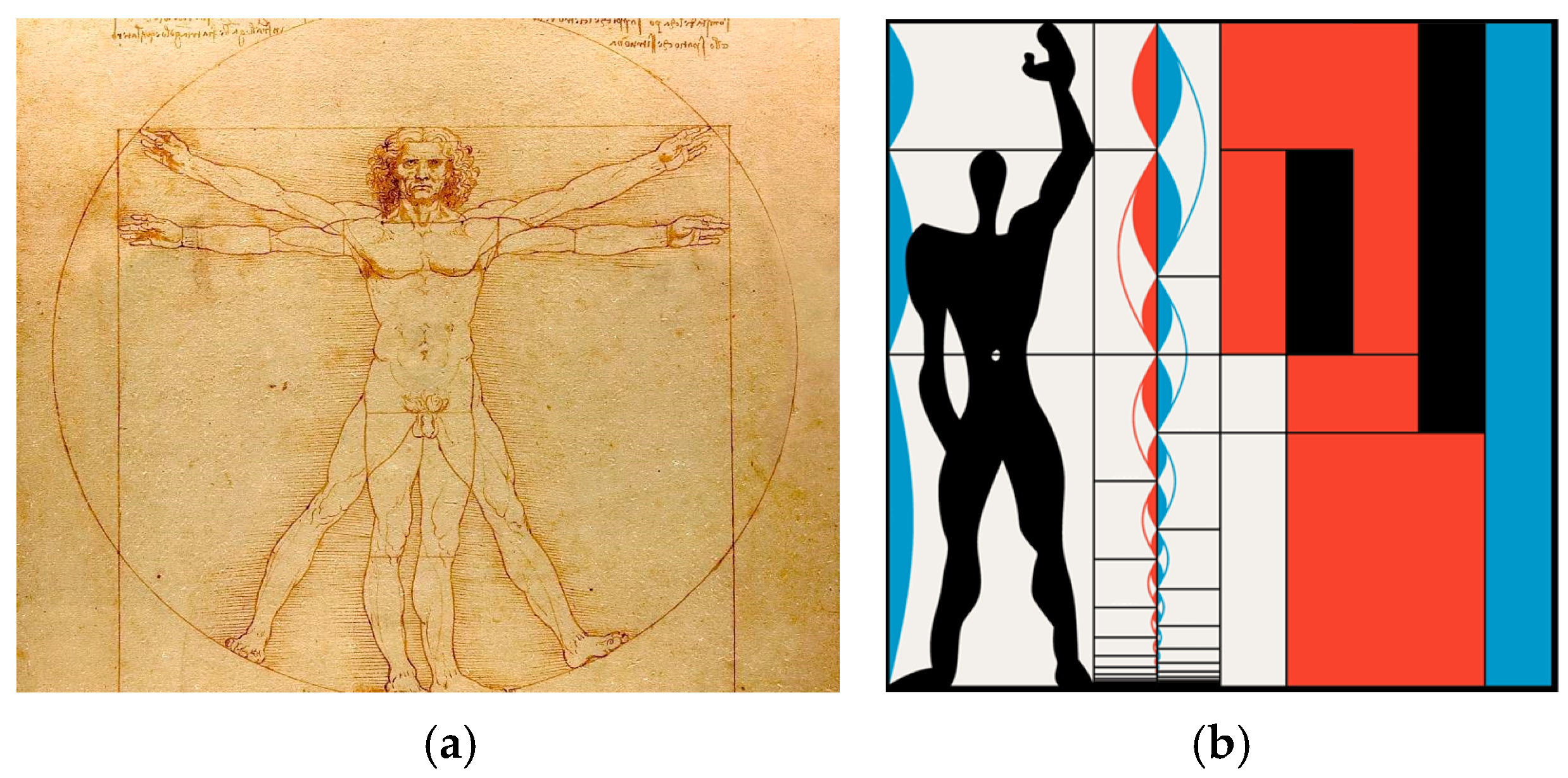
3.1. Theoretical Consideration of the Human Body in Architecture
3.2. Classification of Human Body Activities
4. Body Motion-Tracking Technologies (Motion Capture Systems)
4.1. Theoretical Consideration of Motion Capture Technology
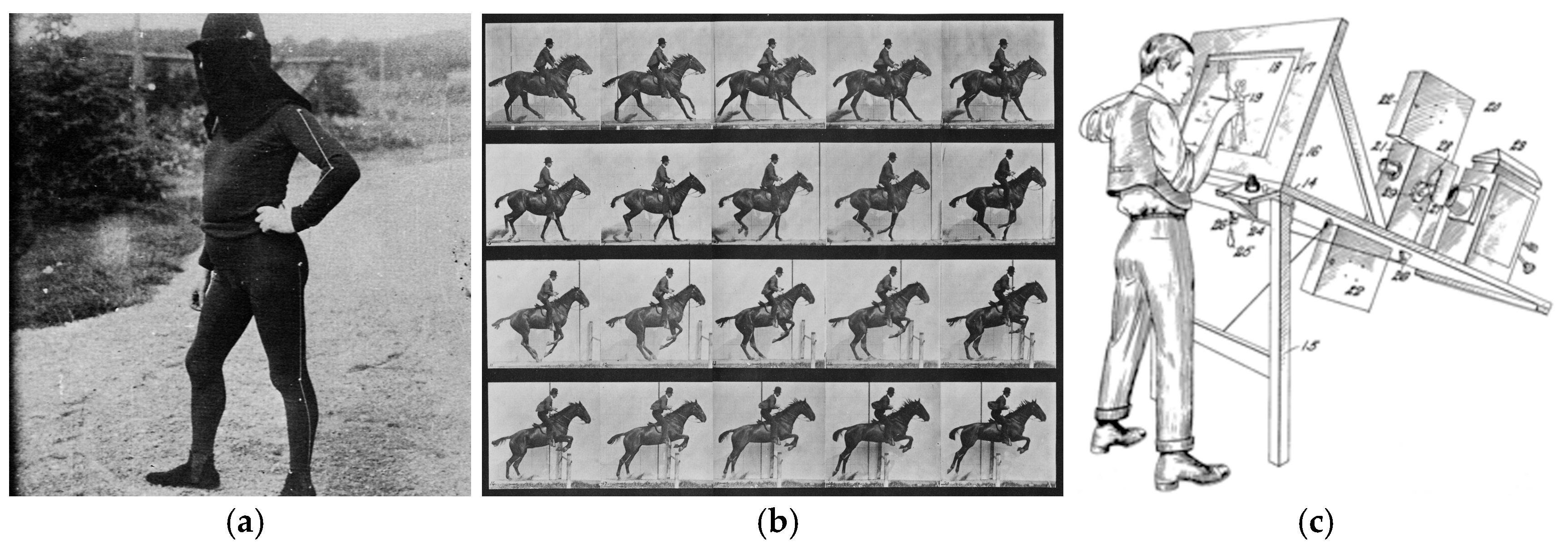
4.2. Utilization of Body Motion-Tracking Information in Architectural and Artistic Works
5. Typification and Organization of Motion Capture Technology
5.1. Classification of Motion Capture Technologies
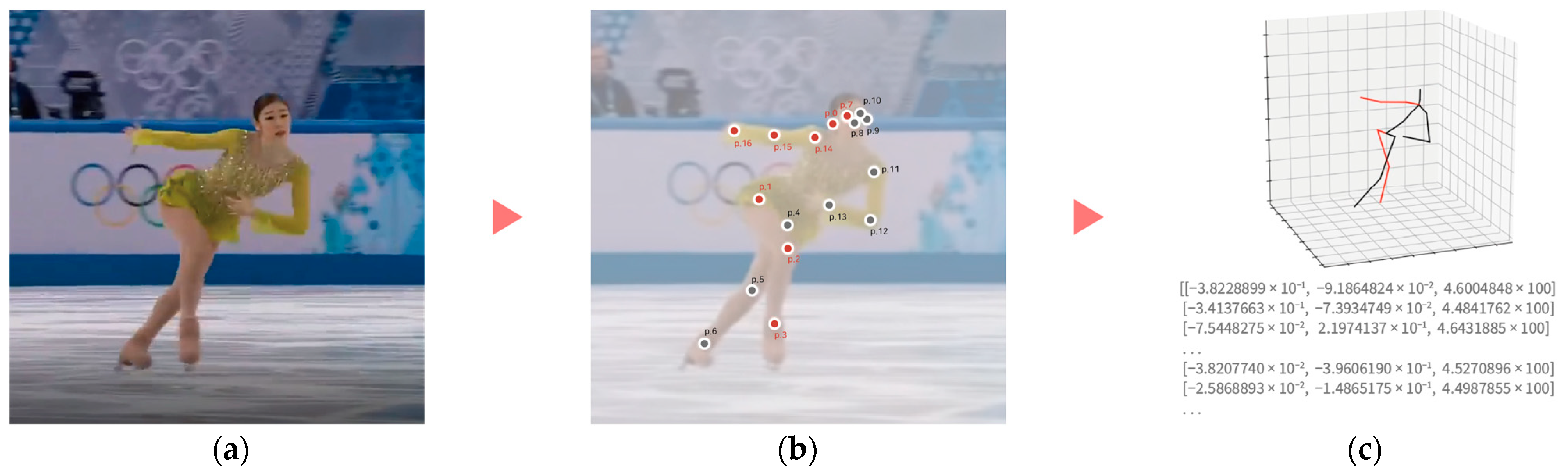
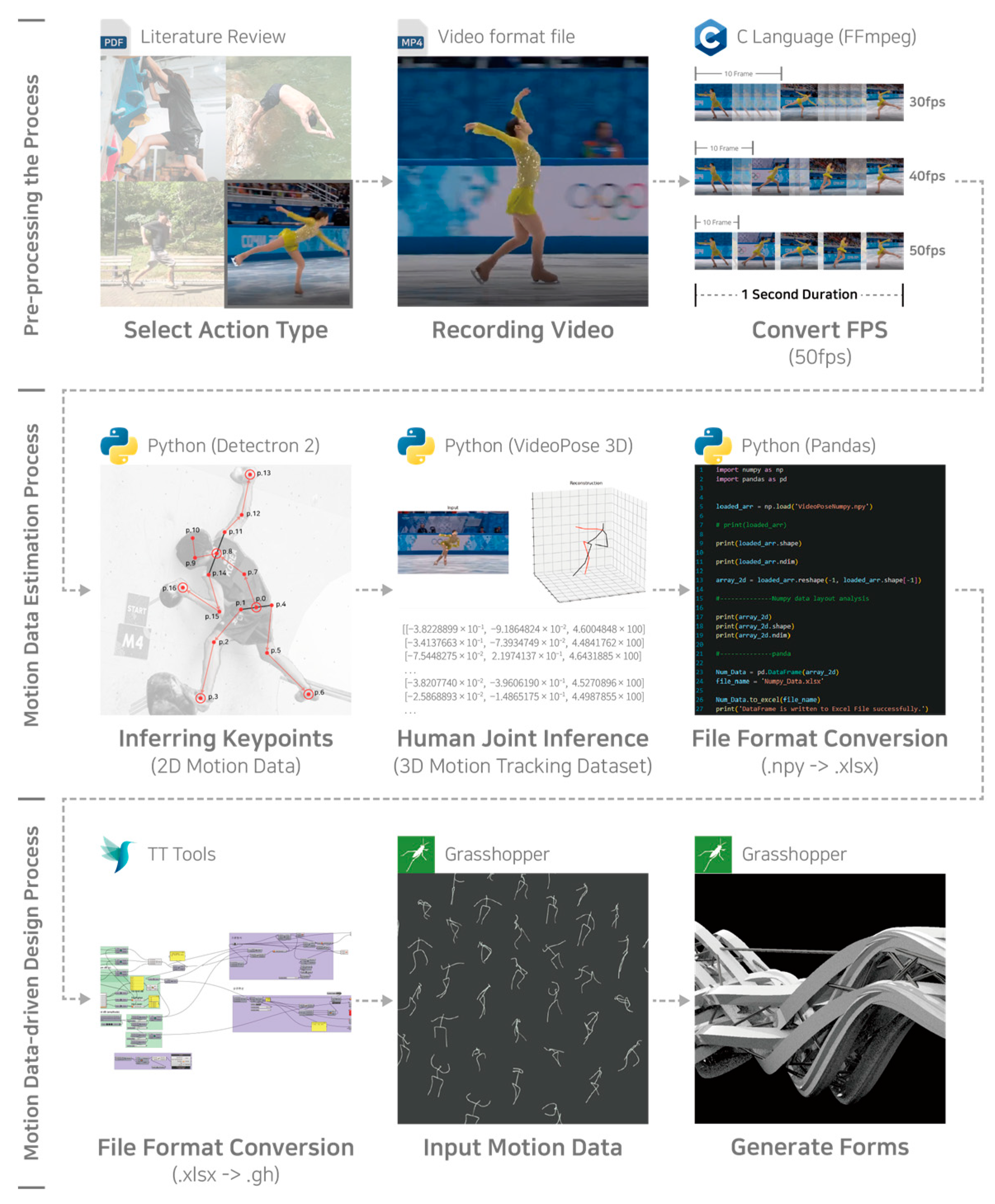
5.2. VideoPose3D (ML Motion Estimation Based on Key Point of Image Feature Data)
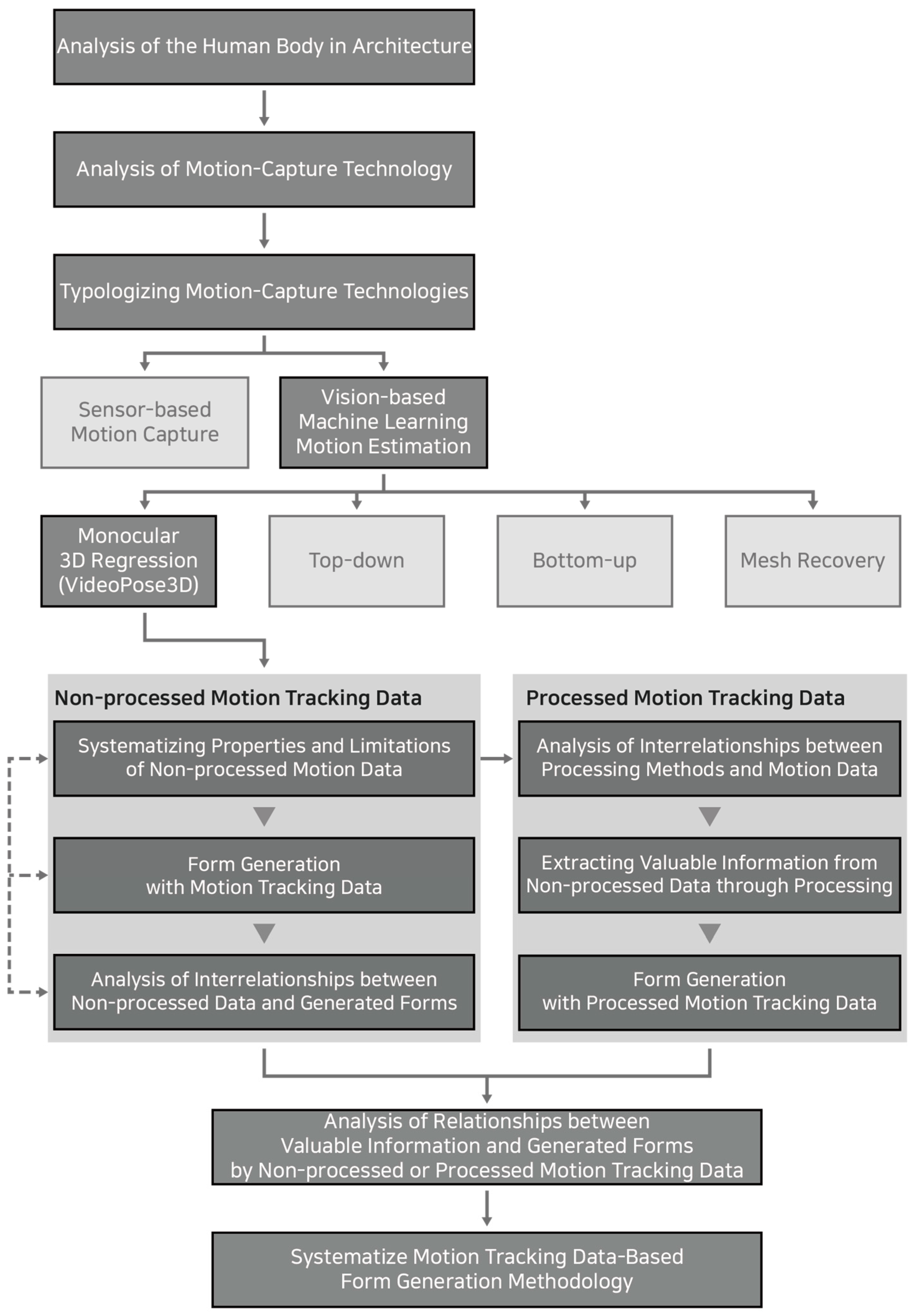
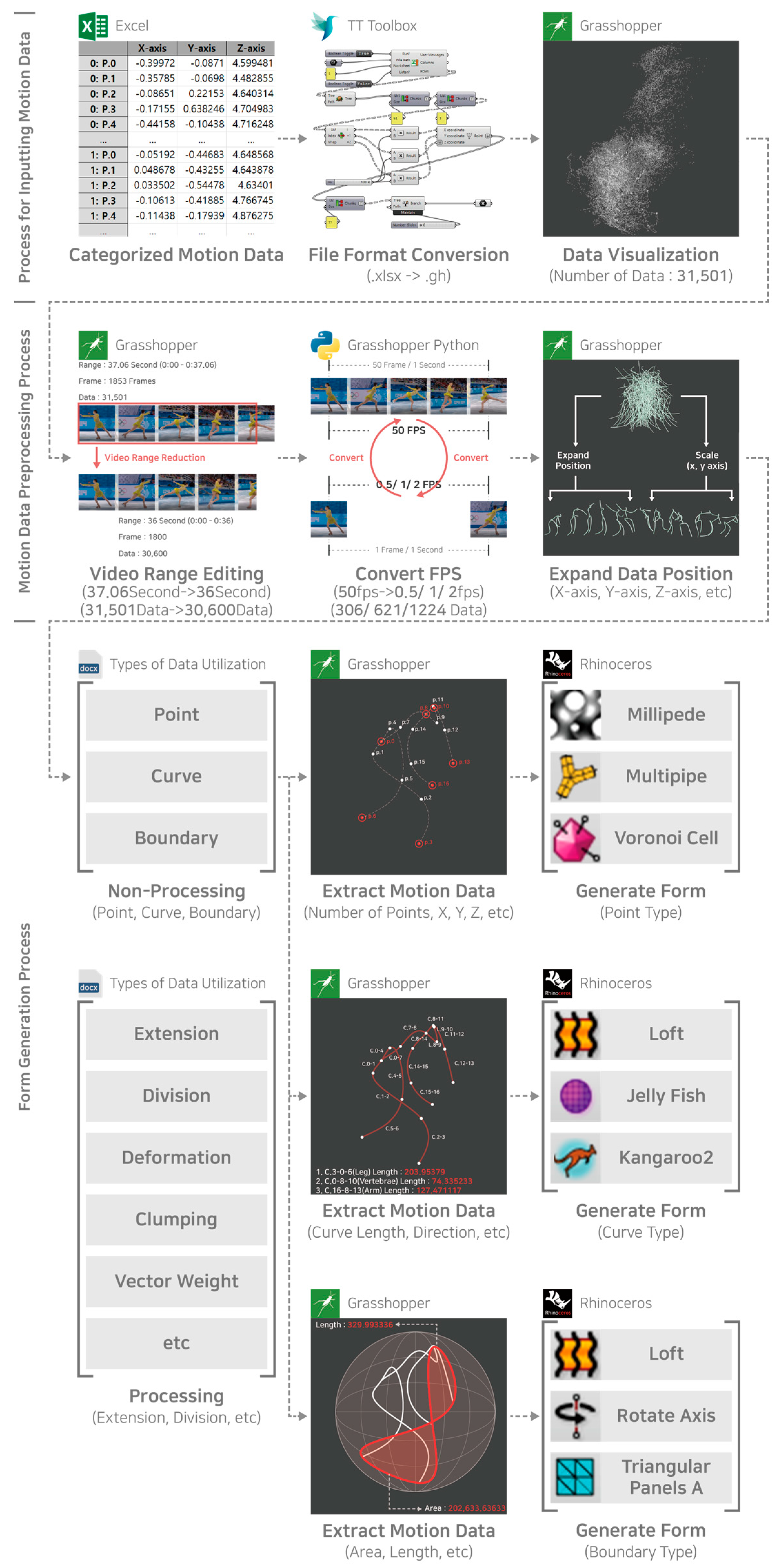
6. Form Generation Process with Motion-Tracking Technology-Based 3D Data
6.1. Characteristics and Form Generation Using Non-Processed Motion-Tracking Data
6.2. Characteristics of and Form Generation Using Processed Motion-Tracking Data
7. Results
7.1. Systematization of Form Generation Characteristics by Type of Non-Processed Motion-Tracking Data
- Point data serve as a fundamental element for extracting and generating other body movement data by combining x, y, and z coordinate values for each joint and converting them into a 3D digital language. Generated through the quantification of physical positional data, point data form an organic network based on the abstract interrelationships inherent between joints. Forms utilizing them exhibit complex relationship-centered configurations driven by the interrelationships and organic directionality between points (joint coordinates). While the massive volume of diverse data generated according to video length, activity type, FPS values, and frame-specific motion forms can be utilized as parameters to expand morphological possibilities, it presents a limitation by inducing computational complexity and requiring excessive processing time for form generation. Furthermore, point data provide no additional information beyond simple physical coordinate data and can be utilized as positional data only during form generation. Consequently, a limitation exists wherein the subjective judgment of the designer and additional parameters are required to induce diversity in the generated forms.
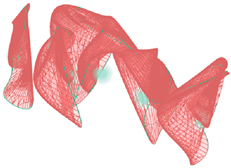
- Curve data generate linear elements that fill the gaps between joints, serving as a digital language and data resource that embodies the concept of a skeletal framework. While the linear topology remains constant regardless of changes in body movement, data diversity is generated solely through variations in detailed attributes such as angle and position. Forms utilizing this method create surface configurations through the overlapping of linear elements, driven by the organic flow of body movement. Morphological variety is secured on the basis of detailed data such as inherent length, directionality, and position; moreover, these data-driven forms, which change dramatically according to activity type, induce dynamic configurations. However, because curve data result from intuitively converting physical activity into data, a limitation emerges: the range of acquirable data within a physical environment is restricted by the specific physical capabilities of the individual subject.
- Boundary data represent the RoM. They detect the area encompassing point and curve data and convert them into digital data. As they represent the area generated by the physical body itself, changes in the data appear relatively minimal when the activity is performed by the same body or across different body movements. However, similar to curve data, they include various detailed attributes, which support data variety. Forms utilizing this approach create volumes and continuous flows with gradual changes, generated through the overlapping of surface elements. Variety in configuration is secured through detailed data such as on inherent length, directionality, and position. However, a limitation exists: excluding activities that induce dramatic motion changes, most forms generated from standard activities result in natural and organic designs with strong functional characteristics. Furthermore, forms derived from similar activities tend to be similar (Table 11).
7.2. Systematization of Form Generation Characteristics by Type of Processed Motion-Tracking Data
- The three primary limitations of point data can be summarized as follows. First, the processing time for form generation is excessive, and digital computation becomes complex due to the explosive volume of data. Second, there is an influx of parameters unrelated to body movement during form generation, which results from the provision of only simple physical coordinate data. Third, because the amount of detailed point data provided regarding motion data is scarce, the criteria for evaluating the aesthetics of the generated forms are confined to the designer’s subjective judgment. These limitations can be addressed by motion-tracking data-processing methods.
- The limitation of explosive data volume is overcome by the clumping method. Unlike the arbitrary adjustment of video FPS for data extraction used in this study, the clumping method compensates for this limitation through data classification based on specific systems and principles rather than arbitrary rules. The absence of variety in detailed data is overcome by the extension method. By establishing differential hierarchies for each joint and point, it provides additional data that are highly related to motion data and can be utilized as secondary parameters for form generation. The subjective aesthetic evaluation criteria are partially overcome by the division method. It converts aesthetic evaluation criteria into objective numerical values based on the degree of separation between reference points and forms or based on the arrangement data of forms centered on reference points.
- The three main limitations of curve data can be summarized as follows. First, the dynamic patterns of surface forms generated by the overlapping of linear data present difficulties regarding practicality and ease of construction. Second, the acquirable data are limited by the physical capabilities of the figure in the video being measured. Third, because forms generated from data visualizing the skeletal framework involve the intersection of multiple surfaces, their application is centered on the subdivided spaces or forms created by these intersections rather than on the flow of body movement itself. These limitations can be addressed by motion-tracking data-processing methods.
- The reduction in practical applicability caused by dynamic designs generated from overlapping curve data is resolved through clumping-based processing. By simplifying the visualization of skeletal linear data, this method presents results that are more abbreviated and organized than existing structures. The limitation on data types acquirable due to a figure’s physical capabilities is overcome through extension-based processing, which provides motion data that cannot emerge from actual physical capabilities or environments. The limitation of design being confined to subdivided spaces and forms, which appear in forms generated using curve data, secures variety through division-based processing. Utilizing only a portion of the data rather than the entire set enables the generation of refined structures centered on flow.
- The three primary limitations of boundary data can be summarized as follows. First, there is difficulty in securing design variety due to monotonous forms with strong functional aspects. Second, the activity type is crucial during the data extraction process, and the data obtainable from identical activities are limited. Third, in the case of vigorous activities, as only dynamic forms are generated, there are difficulties in generating functional forms. These limitations can be addressed by motion-tracking data-processing methods.
- The limitation regarding securing design variety is resolved by the extension method. This method provides form variety by transforming area configurations around specific joints to reflect the designer’s intent. Limitations concerning restricted data based on dynamics and similarity in activity type are addressed by the division method. By subdividing areas to derive multiple datasets from partial motions rather than from the entire body, this approach weakens the relationship between the activity type, dynamics, and acquired data. The limitation wherein vigorous activities generate only extreme forms is resolved by the clumping method. By aggregating data using weighted vectors derived from the average distance of joints from the center, this method produces a gradual area, thus securing form functionality while mitigating design dynamics (Table 15).
7.3. Quantitative and Architectural Evaluation of Generated Forms
8. Discussion
9. Conclusions
Author Contributions
Funding
Data Availability Statement
Conflicts of Interest
Abbreviations
| AI | Artificial intelligence |
| RoM | Range of motion |
| VR | Virtual reality |
| FPS | Frames per second |
| RGB | Red, green, and blue |
| RGB-D | Red, green, and blue—depth |
| IMU | Inertial measurement unit |
| ML | Machine learning |
| JSON | JavaScript Object Notation |
References
- Schwab, K. The Fourth Industrial Revolution; Crown Business: New York, NY, USA, 2017. [Google Scholar]
- Anshari, M.; Syafrudin, M.; Fitriyani, N.L. Fourth Industrial Revolution between knowledge management and digital humanities. Information 2022, 13, 292. [Google Scholar] [CrossRef]
- Lee, M.; Yun, J.J.; Pyka, A.; Won, D.; Kodama, F.; Schiuma, G.; Park, H.; Jeon, J.; Park, K.; Jung, K.; et al. How to respond to the Fourth Industrial Revolution, or the Second Information Technology Revolution? Dynamic new combinations between technology, market, and society through open innovation. J. Open Innov. Technol. Mark. Complex. 2018, 4, 21. [Google Scholar] [CrossRef]
- Jeon, J.; Suh, Y. Analyzing the major issues of the 4th Industrial Revolution. Asian J. Innov. Policy 2017, 6, 262–273. [Google Scholar] [CrossRef]
- Philip Chen, C.L.; Zhang, C.-Y. Data-intensive applications, challenges, techniques and technologies: A survey on big data. Inf. Sci. 2014, 275, 314–347. [Google Scholar] [CrossRef]
- Siefkes, C.; Siniakov, P. An Overview and Classification of Adaptive Approaches to Information Extraction. In Journal on Data Semantics IV; Lecture Notes in Computer Science; Spaccapietra, S., Ed.; Springer: Berlin/Heidelberg, Germany, 2005; Volume 3730, pp. 172–212. [Google Scholar] [CrossRef]
- Pan, Y.; Zhang, L. A BIM-data mining integrated digital twin framework for advanced project management. Autom. Constr. 2021, 124, 103564. [Google Scholar] [CrossRef]
- Janiesch, C.; Zschech, P.; Heinrich, K. Machine learning and deep learning. Electron. Mark. 2021, 31, 685–695. [Google Scholar] [CrossRef]
- Pfitzner, F.; Braun, A.; Borrmann, A. From data to knowledge: Construction process analysis through continuous image capturing, object detection, and knowledge graph creation. Autom. Constr. 2024, 164, 105451. [Google Scholar] [CrossRef]
- Tanwar, S.; Popat, A.; Bhattacharya, P.; Gupta, R.; Kumar, N. A taxonomy of energy optimization techniques for smart cities: Architecture and future directions. Expert Syst. 2022, 39, e12703. [Google Scholar] [CrossRef]
- Ciardiello, A.; Rosso, F.; Dell’Olmo, J.; Ciancio, V.; Ferrero, M.; Salata, F. Multi-objective approach to the optimization of shape and envelope in building energy design. Appl. Energy 2020, 280, 115984. [Google Scholar] [CrossRef]
- Pilechiha, P.; Mahdavinejad, M.; Pour Rahimian, F.; Carnemolla, P.; Seyedzadeh, S. Multi-objective optimisation framework for designing office windows: Quality of view, daylight, and energy efficiency. Appl. Energy 2020, 261, 114356. [Google Scholar] [CrossRef]
- Pallasmaa, J. The Eyes of the Skin: Architecture and the Senses, 2nd ed.; Academy Press: Chichester, UK, 2005. [Google Scholar]
- Oh, H.S. A Study on the Tendency of the Expression of Contemporary Architecture from the View Point of ‘Body’. Master’s Thesis, Kookmin University, Seoul, Republic of Korea, 2003. [Google Scholar]
- Vitruvius. The Ten Books on Architecture; Morgan, M.H., Translator; Dover Publications: New York, NY, USA, 1960. [Google Scholar]
- Tschumi, B. The Manhattan Transcripts, 2nd ed.; Academy Editions: London, UK, 1994. [Google Scholar]
- Lynn, G. Animate Form; Princeton Architectural Press: New York, NY, USA, 1999. [Google Scholar]
- Li, S.; Liu, L.; Peng, C. A review of performance-oriented architectural design and optimization in the context of sustainability: Dividends and challenges. Sustainability 2020, 12, 1427. [Google Scholar] [CrossRef]
- Shin, S.J. A Study on the Relationship between Meaning of Extended Body and Digital Fabrication in Contemporary Architecture: Focused on Small Scale Pavilion. Master’s Thesis, Ajou University, Suwon, Republic of Korea, 2014. [Google Scholar]
- Kim, S.C. A Study on the Visualization Method of Body Motion Data in Architecture Digital Technology. Master’s Thesis, Ajou University, Suwon, Republic of Korea, 2023. [Google Scholar]
- Lim, G.T. Phenomenology and Architecture Theory; Spacetime (Sigongmunhwasa): Seoul, Republic of Korea, 2014. [Google Scholar]
- Kim, E.Y. A Study on the Expression of Space Design by Physical Perception: Focusing on the Organic Phenomenon of Modern Architecture. Master’s Thesis, Chosun University, Gwangju, Republic of Korea, 2005. [Google Scholar]
- Nogueira, P. Motion Capture Fundamentals. In Proceedings of the Doctoral Symposium in Informatics Engineering, Porto, Portugal, 26–27 January 2012; Volume 303. [Google Scholar]
- Topuz, H.H. Motion-Based Dynamic Form Generation to Contribute to the Kinetic Design Diversity. Ph.D. Thesis, Istanbul Technical University, Istanbul, Turkey, 2021. [Google Scholar]
- Ingleby, T.; Orlando, S. Translating movement into architectural form. Nexus Netw. J. 2021, 23, 1017–1037. [Google Scholar] [CrossRef]
- Ankalaki, S.; Thippeswamy, M.N. Static and dynamic human activity detection using multi CNN-ELM approach. In Emerging Research in Computing, Information, Communication and Applications; Lecture Notes in Electrical Engineering; Shetty, N.R., Patnaik, L.M., Nagaraj, H.C., Hamsavath, P.N., Nalini, N., Eds.; Springer: Singapore, 2022; Volume 789. [Google Scholar] [CrossRef]
- Bi, H.; Perello-Nieto, M.; Santos-Rodriguez, R.; Flach, P. Human activity recognition based on dynamic active learning. IEEE J. Biomed. Health Inform. 2021, 25, 922–934. [Google Scholar] [CrossRef]
- Das Antar, A.; Ahmed, M.; Ahad, M.A.R. Challenges in Sensor-Based Human Activity Recognition and a Comparative Analysis of Benchmark Datasets: A Review. In Proceedings of the 2019 Joint 8th International Conference on Informatics, Electronics & Vision (ICIEV) and 2019 3rd International Conference on Imaging, Vision & Pattern Recognition (icIVPR), Spokane, WA, USA, 30 May–2 June 2019; pp. 134–139. [Google Scholar]
- Menolotto, M.; Komaris, D.S.; Tedesco, S.; O’Flynn, B.; Walsh, M. Motion capture technology in industrial applications: A systematic review. Sensors 2020, 20, 5687. [Google Scholar] [CrossRef]
- Kim, J.J.; Kim, J.Y. Typological characteristics of methods in formalization process of body movement. J. Korean Inst. Inter. Des. 2006, 15, 28–35. [Google Scholar]
- Kern, S. Anatomy and Destiny: A Cultural History of the Human Body; Bobbs-Merrill: Indianapolis, IN, USA, 1975; p. 66. [Google Scholar]
- Kim, W.G. Metropolis; Open Books: Paju, Republic of Korea, 2002. [Google Scholar]
- Jensenius, A.R. Action-Sound: Developing Methods and Tools to Study Music-Related Body Movement. Ph.D. Thesis, University of Oslo, Oslo, Norway, 2007. [Google Scholar]
- Ha, E.; Byeon, G.; Yu, S. Full-body motion capture-based virtual reality multi-remote collaboration system. Appl. Sci. 2022, 12, 5862. [Google Scholar] [CrossRef]
- Stathopoulou, D. From Dance Movement to Architectural Form. Ph.D. Thesis, University of Bath, Bath, UK, 2011. [Google Scholar]
- Kim, J.J. (Ed.) Bodyscape; Damdi Publishing Company: Seoul, Republic of Korea, 2007. [Google Scholar]
- Crolla, K. Choreographed Architecture—Body-Spatial Exploration. In Learning, Prototyping and Adapting, Proceedings of the 23rd International Conference on Computer-Aided Architectural Design Research in Asia (CAADRIA 2018), Beijing, China, 17–19 May 2018; The Association for Computer-Aided Architectural Design Research in Asia (CAADRIA): Hong Kong, China, 2018; Volume 1, pp. 101–110. [Google Scholar] [CrossRef]
- Ruescas-Nicolau, A.V.; Medina-Ripoll, E.J.; Parrilla Bernabé, E.; de Rosario Martínez, H. Multimodal human motion dataset of 3D anatomical landmarks and pose keypoints. Data Brief 2024, 53, 110157. [Google Scholar] [CrossRef] [PubMed]
- Desmarais, Y.; Mottet, D.; Slangen, P.; Montesinos, P. A review of 3D human pose estimation algorithms for markerless motion capture. Comput. Vis. Image Underst. 2021, 212, 103275. [Google Scholar] [CrossRef]
- Wang, X.M.; Smith, D.T.; Zhu, Q. A webcam-based machine learning approach for three-dimensional range of motion evaluation. PLoS ONE 2023, 18, e0293178. [Google Scholar] [CrossRef]
- Menache, A. Understanding Motion Capture for Computer Animation and Video Games; Morgan Kaufmann: San Francisco, CA, USA, 2000. [Google Scholar]
- Feng, B.; Zhang, X.; Zhao, H. The research of motion capture technology based on inertial measurement. In Proceedings of the 2013 IEEE 11th International Conference on Dependable, Autonomic and Secure Computing (DASC), Chengdu, China, 21–22 December 2013; pp. 238–243. [Google Scholar]
- Pavllo, D.; Feichtenhofer, C.; Grangier, D.; Auli, M. 3D human pose estimation in video with temporal convolutions and semi-supervised training. In Proceedings of the IEEE/CVF Conference on Computer Vision and Pattern Recognition (CVPR), Long Beach, CA, USA, 16–20 June 2019; pp. 7753–7762. [Google Scholar]
- Kocabas, M.; Athanasiou, N.; Black, M.J. VIBE: Video inference for human body pose and shape estimation. In Proceedings of the IEEE/CVF Conference on Computer Vision and Pattern Recognition (CVPR), Seattle, WA, USA, 13–19 June 2020; pp. 5253–5263. [Google Scholar]
- Kim, S.-J.; Lee, Y.-J.; Park, G.-M. Real-time joint animation production and expression system using deep learning model and Kinect camera. J. Broadcast. Eng. 2021, 26, 269–282. [Google Scholar]
- Maji, D.; Nagori, S.; Mathew, M.; Poddar, D. YOLO-pose: Enhancing YOLO for multi person pose estimation using object keypoint similarity loss. In Proceedings of the IEEE/CVF Conference on Computer Vision and Pattern Recognition (CVPR), New Orleans, LA, USA, 19–24 June 2022; pp. 2637–2646. [Google Scholar]
- Suo, X.; Tang, W.; Li, Z. Motion capture technology in sports scenarios: A survey. Sensors 2024, 24, 2947. [Google Scholar] [CrossRef]
- Rao, Y.; Perez-Pellitero, E.; Zhou, Y.; Song, J. Reality’s canvas, language’s brush: Crafting 3D avatars from monocular video. arXiv 2023, arXiv:2312.04784. [Google Scholar]
- An, H.-S.; Jeon, Y.-C.; Kim, S.-W. Digital architectural form generation through pixel system-driven image feature information. Buildings 2024, 14, 3635. [Google Scholar] [CrossRef]
- Ionescu, C.; Papava, D.; Olaru, V.; Sminchisescu, C. Human3.6M: Large scale datasets and predictive methods for 3D human sensing in natural environments. IEEE Trans. Pattern Anal. Mach. Intell. 2013, 36, 1325–1339. [Google Scholar] [CrossRef]
- Zhang, S.; Wang, C.; Dong, W.; Fan, B. A survey on depth ambiguity of 3D human pose estimation. Appl. Sci. 2022, 12, 10591. [Google Scholar] [CrossRef]
- Huang, Y.; Zhang, Z.; Su, P.; Li, T.; Zhang, Y.; He, X.; Li, H. Performance-Driven Generative Design in Buildings: A Systematic Review. Buildings 2025, 15, 4556. [Google Scholar] [CrossRef]
- Wiese, H.; Drude, J.P.; Becker, M. Capturing Motion, Tracing Developments, Creating Space: An Exploration about Motion Capture Methodologies in Architecture. In ACADIA 2024: Designing Change; Nahmad-Vazquez, A., Johnson, J., Taron, J., Rhee, J., Hapton, D., Eds.; ACADIA: Calgary, Canada, 2024; Volume 2, pp. 29–40. Available online: https://papers.cumincad.org/cgi-bin/works/Show?acadia24_v2_38 (accessed on 7 January 2026).



| Human Body Activities | ||
|---|---|---|
| Typology of Activities | Example | |
| Static Activities | Lying, Sitting, Standing, etc. | |
| Dynamic Activities | Walking, Running, etc. | |
| Activities with Postural Transitions | Static to Static | Sitting to Standing |
| Static to Dynamic | Sitting to Walking | |
| Dynamic to Static | Walking to Standing | |
| Dynamic to Dynamic | Walking to Running | |
| Era | Title | Designer | Feature | Data Type |
|---|---|---|---|---|
| Modern | Picasso Drawing with Light | Gjon Mili/ Picasso | Captures bodily motion as light points to translate temporal movement trajectories into spatialized visual records. | Point |
| Modulor | Le Corbusier | Systematizes human proportions into a scalar metric to establish harmonic order and functional standardization in architectural design. | Point/ Curve | |
| Unique Forms of Continuity in Space | Umberto Boccioni | Synthesizes dynamic bodily curves to visualize the fluid continuity and formal integration between the figure and its surrounding environment. | Curve | |
| Nude Descending a Staircase | Marcel Duchamp | Projects sequential kinetic curves onto a spatial plane to represent the temporal progression of the body through overlapping geometric fragments. | Curve | |
| Bauentwurfslehre | Ernst Neufert | Establishes functional design standards by quantifying ergonomic dimensions and operational boundaries of the human body for architectural optimization. | Curve/ Boundary | |
| Kinesphere | Rudolf Von Laban | Defines a movement-centric spatial domain by mapping the three-dimensional reach boundaries of the human body. | Boundary | |
| Contemporary | Choreographing Space | Elli Athanasiou/ Dimitra Gougoudi | Translates choreographic movement sequences into a generative architectural language that dictates spatial morphology and flow. | Point/ Curve |
| Choreographed Architecture | Enrica Fung/ Kristof Crolla | Synthesizes continuous kinetic trajectories with the Kinesphere concept to generate free-form architectural surfaces that define the building’s exterior envelopes. | Curve | |
| Space MO | Jong Jin Kim | Constructs organic spatial volumes by layering time-sequential motion capture data into 3D surfaces that reflect both positional shifts and postural changes of the body. | Curve/ Boundary | |
| Embryological House | Greg Lynn | Generates flexible living space boundaries that respond to inhabitant requirements by utilizing variable curve parameters based on biological growth principles, thereby departing from the constraints of fixed modules. | Boundary | |
| The Evolving Room: Inhabiting Zero Wasted Space | Stavros Gargaretas | Optimizes spatial efficiency by layering the temporal boundaries of daily activities to create a zero-wasted living environment tailored to individual movement. | Boundary |
| Year | Title | Designer | Feature | Processing Type |
|---|---|---|---|---|
| 1921 | Ambulant Architecture | Oskar Schlemmer | Transforms the biological body into cubic and abstract spatial forms based on “The Laws of Surrounding Cubical Space,” redefining the performer as a dynamic architectural unit that delineates spatial boundaries. | Point/Curve Extension |
| The Marionette | Converts organic human anatomy into a quasi-machine by substituting joints with spheres and limbs with geometric shapes according to the “Functional Laws of the Body,” shifting design focus from natural motion to mechanical abstraction. | Point/Curve Clumping | ||
| A Technical Organism | Simplifies kinetic trajectories such as rotation, intersection, and direction into geometric motifs (spirals, disks, and vortices) based on the “Laws of Motion,” translating the body’s movement path into a structural design element within space. | Boundary Clumping | ||
| Dematerialization | Fragments the physical body into metaphysical symbols (stars, crosses) through the “Symbolization of Limbs,” implementing a design process where the bodily presence is dissolved and integrated into a higher mathematical order. | Division Deformation | ||
| 1922 | Triadic Ballet | Transforms the biological body into a volumetric “Art Figure” composed of geometric modules like spheres and cylinders through the “Clothes-Priority “ principle, implementing a design process where the sculptural form and material of the costume dictate the kinetic trajectories and directly generate the architectural logic of the performance space. | Part Extension | |
| 1927 | Slat Dance | Based on the ‘law of spatial extension,’ rods were attached to the body’s extremities to extend the human body’s range of motion into linear vector data. The trajectory of this extended body functions as a design language that pierces and partitions the depth and boundaries of three-dimensional space in real time. | Curve Extension | |
| 2012 | Alloplastic Architecture | Behnaz Farahi | Extracts user proximity and gesture data via Kinect sensors. These data points are mapped to Shape Memory Alloy (SMA) actuators to drive a kinetic tensegrity system. This transforms static architectural space into a responsive, “alloplastic” entity that establishes an empathetic interaction between the user and the environment. | Point Extension |
| 2018 | MoSculp | MIT CSAIL | Estimates 3D human poses and meshes from 2D video sequences. Temporal motion trajectories are transformed into 4D volumetric swept surfaces. By materializing transient dynamics into physical “motion sculptures,” the system provides a tangible visualization of the aesthetic essence of human movement. | Curve Division |
| 2018 | ANYΠAKOH (Disobedience) | Studio INI | Utilizes real-time pedestrian load and location data as a trigger for a mechanical framework. The system reconfigures an elastic skin to expand or contract along the walking path. This creates a “disobedient” kinetic pavilion where human action actively redefines and disrupts traditional architectural boundaries. | Vector Weight |
| 2019 | Urban Imprint | Captures vertical load and pressure data from footsteps. A mechanical pulley-and-cable system inverts floor depression into the formation of an upward ceiling dome. This reinterprets rigid urban infrastructure as a responsive “augmented materiality” that expands and contracts in direct response to individual presence. | Vector Weight |
| Utilization of Motion-Tracking Data | Designer | Quantified Segment Data | Types of Data Extracted |
|---|---|---|---|
| Non-processing | Joint | Point | 3D Coordinate System (x, y, z axis) |
| Bone | Curve | Interpolate Curve/Poly Line (Length, Tangent, Division Point, etc.) | |
| Range of Motion (RoM) | Boundary | Closed Interpolate Curve/ Closed Nurbs Curve (Area, Curvature, Control Point, etc.) | |
| Processing | Relationship Information Between Motion Data | Extension | Direction, Vector, Value, etc. |
| Division | Criteria, Number of Splits, etc. | ||
| Deformation | Shape Types, Parameter of Shape, etc. | ||
| Clumping | Distance between Points, etc. | ||
| Vector Weight | Moment, Threshold, Direction, etc. | ||
| etc. | |||
| No. | Author | Title | Motion Capture Method | Segment Method |
|---|---|---|---|---|
| 1. | Bo Feng et al. (2013) [42] | The Research of Motion Capture Technology Based on Inertial Measurement |
|
|
| 2. | Dario Pavllo et al. (2019) [43] | 3D human pose estimation in video with temporal convolutions and semi-supervised training |
|
|
| 3. | Kocabas et al. (2020) [44] | VIBE: Video Inference for Human Body Pose and Shape Estimation |
|
|
| 4. | Sang-Joon Kim et al. (2021) [45] | Real-Time Joint Animation Production and Expression System using Deep Learning Model and Kinect Camera |
|
|
| 5. | Debapriya Maji et al. (2022) [46] | YOLO-Pose: Enhancing YOLO for Multi Person Pose Estimation Using Object Keypoint Similarity Loss |
|
|
| 6. | Xiang Suo et al. (2024) [47] | Motion Capture Technology in Sports Scenarios: A Survey |
|
|
| 7. | Yuchen Rao et al. (2024) [48] | Reality’s Canvas, Language’s Brush: Crafting 3D Avatars from Monocular Video |
|
|
| Motion Capture Method | Operational Modality | Segment Method | Example Method | |
|---|---|---|---|---|
| Sensor-Based Motion Capture | Optical Motion Capture | Marker-Based | Vicon and OptiTrack | |
| Marker-less | Multi-view RGB | CMU Panoptic | ||
| RGB-D Camera | Kinect and Intel RealSense | |||
| Non-Optical Motion Capture | Mechanical | Gypsy7 | ||
| Magnetic | Nest of Birds and Polhemus | |||
| Inertial (IMU) | Xsens and Smartsuit Pro II | |||
| Acoustic | Academic Research | |||
| Vision-Based Machine Learning Motion Estimation | 2D Pose Estimation | Top-Down | YOLO-Pose | |
| Bottom-Up | OpenPose and AlphaPose | |||
| 3D Pose Estimation | Monocular 3D Regression | VideoPose3D and PoseFormer | ||
| Mesh Recovery | HMR, VIBE, and SPIN | |||
| Type of Activities | Utilization of Motion-Tracking Data | Motion Capture Method | |
|---|---|---|---|
| Activities with Postural Transitions | Motion Data Non-processing | Motion Data Processing | Vision-Based Machine Learning Motion Estimation |
| 3D Pose Estimation | |||
| Monocular 3D Regression | |||
| Dynamic to Dynamic | Joint | Relational Attributes of Motion Data | VideoPose3D |
| Bone | |||
| Range of Motion (RoM) | |||
| Category | Specification/Parameter |
|---|---|
| Source Video | Figure skating (selected for high-dynamic transitions) |
| Data Volume | 37.06 s/50 FPS (total 1853 frames) |
| Data Points | 31,501 coordinate points (refined to 30,600) |
| Frame Sampling Rates | 0.5 FPS (306 pts), 1 FPS (621 pts), 2 FPS (1224 pts) |
| Software Environment | Python 3.7.9, Visual Studio, Numpy, Pandas |
| Form Generation | Rhinoceros 7 and 8, Grasshopper (geometric sculpting) |
| Motion Data Type | Non-Processed | Extension | Division | Clumping |
|---|---|---|---|---|
| Point (Joint) |  |  | 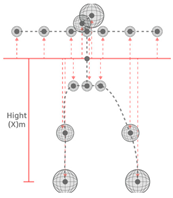 |  |
| Curve (Bone) |  |  |  |  |
| Boundary (RoM) | 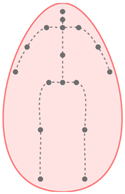 |  |  |  |
| Motion Data Type | Form Type No. 1 | Form Type No. 2 | Form Type No. 3 |
|---|---|---|---|
| Point (Joint) |  | 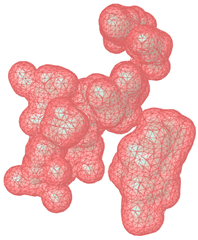 |  |
| Curve (Bone) |  |  |  |
| Boundary (RoM) |  |  |  |
| Motion Data Type | Characteristics of Motion Data Non-Processing | Properties as Parameters for Generate Form | Morphological Limits |
|---|---|---|---|
| Point (Joint) |
| Complex relationship-centered form through mutual interrelationships and organic directionality between points (joint coordinates) |
|
| Curve (Bone) |
|
|
|
| Boundary (RoM) |
| Overlapping area elements create a continuous flow of gradual changes, forming volumetric shapes |
|
| Motion Data Type | Extension | Division | Clumping |
|---|---|---|---|
| Point (Joint) |  |  |  |
| Type 1 | Type 2 | Type 3 | |
| Curve (Bone) |  |  |  |
| Type 2 | Type 1 | Type 3 | |
| Boundary (RoM) |  |  |  |
| Type 2 | Type 1 | Type 3 |
| Preprocessing for Form Generation Process | Form Generation Using Data Features | Analyzing and systematizing relationships between motion data and form |
 | ||
 |  |  |
| Pt + Di | Crv + Di + Cl | Bo + Di |
 |  |  |
| Pt + Cl | Pt + Di | Bo + Ex |
| Motion Data Processing Type | Point | Curve | Boundary |
|---|---|---|---|
| Extension | Emphasizes joint hierarchy by applying differential weighting to enhance data and expand morphological possibilities | Extends body segments to generate extreme dynamic data beyond existing physical motion capabilities | Transforms uniform boundary forms through selective expansion centered on specific joints, enabling designer-intended dynamic adjustments |
| Division | Establishes relational weighting based on distance from the core, creating aesthetic evaluation and criteria-driven classification systems (Metric) | By dividing overall body data into segmented clusters, it enables the creation of refined forms through the selective utilization of body parts | Subdivides unified boundary into multi-segmented data, enabling partial motion-driven multiple boundary extractions that weaken activity-data dependency |
| Clumping | Simplifies data by clustering proximate joints based on specific criteria, reducing computational complexity while maintaining morphological integrity | Simplifies complex skeletal data by consolidating multiple curves into unified forms, generating restrained morphologies with reduced dynamic variability | Aggregates boundaries using weighted vector values based on distance from joints, mitigating abrupt changes and torsional distortions inherent in dynamic motion |
| Data Type | Form Type | Processing | Volumetric Efficiency (%) | Ground Contact Ratio (%) | Effective Occupancy Ratio (%) |
|---|---|---|---|---|---|
| Point | Type 1 | Non-Processed | 25.31 | 35.01 | 10.43 |
| Extension | 25.61 | 38.91 | 10.65 | ||
| Type 2 | Non-Processed | 15.57 | 19.85 | 66.07 | |
| Division | 17.21 | 35.45 | 58.38 | ||
| Type 3 | Non-Processed | 22.84 | 41.05 | 44.48 | |
| Clumping | 49.41 | 53.59 | 73.01 | ||
| Curve | Type 1 | Non-Processed | 25.48 | 54.41 | 9.72 |
| Extension | 21.02 | 54.41 | 21.37 | ||
| Type 2 | Non-Processed | 28.71 | 36.95 | 94.41 | |
| Division | 28.21 | 28.97 | 95.69 | ||
| Type 3 | Non-Processed | 18.95 | 7.63 | 8.07 | |
| Clumping | 22.87 | 10.90 | 40.38 | ||
| Boundary | Type 1 | Non-Processed | 37.29 | 40.96 | 10.87 |
| Extension | 29.70 | 42.79 | 15.79 | ||
| Type 2 | Non-Processed | 36.74 | 40.95 | 22.16 | |
| Division | 25.95 | 22.33 | 32.00 | ||
| Type 3 | Non-Processed | 29.07 | 68.55 | 74.13 | |
| Clumping | 28.15 | 57.53 | 87.42 |
Disclaimer/Publisher’s Note: The statements, opinions and data contained in all publications are solely those of the individual author(s) and contributor(s) and not of MDPI and/or the editor(s). MDPI and/or the editor(s) disclaim responsibility for any injury to people or property resulting from any ideas, methods, instructions or products referred to in the content. |
© 2026 by the authors. Licensee MDPI, Basel, Switzerland. This article is an open access article distributed under the terms and conditions of the Creative Commons Attribution (CC BY) license.
Share and Cite
An, H.-S.; Yoon, N.; Kim, S.-W. From Motion to Form: Systematizing Motion-Data Processing for Architectural Generative Design. Buildings 2026, 16, 1492. https://doi.org/10.3390/buildings16081492
An H-S, Yoon N, Kim S-W. From Motion to Form: Systematizing Motion-Data Processing for Architectural Generative Design. Buildings. 2026; 16(8):1492. https://doi.org/10.3390/buildings16081492
Chicago/Turabian StyleAn, Hee-Sung, Nari Yoon, and Sung-Wook Kim. 2026. "From Motion to Form: Systematizing Motion-Data Processing for Architectural Generative Design" Buildings 16, no. 8: 1492. https://doi.org/10.3390/buildings16081492
APA StyleAn, H.-S., Yoon, N., & Kim, S.-W. (2026). From Motion to Form: Systematizing Motion-Data Processing for Architectural Generative Design. Buildings, 16(8), 1492. https://doi.org/10.3390/buildings16081492