Inheritance and Optimization of Mechanical Traits for Hybrid Girder Bridges: A Novel Bionic Perspective


Abstract
1. Introduction
1.1. Research Motivation from a Bionic Perspective
1.2. Mechanical Studies of Hybrid Girder Bridges
1.3. Contribution of This Study
2. Bionic Model and Hypothesis
- (1)
- The rootstock, scion, and hybrid girders adhere to classical beam theory, assuming linear elasticity, small deformations, and the preservation of planar cross-section integrity, while excluding nonlinear effects such as plasticity, geometric nonlinearity, and interfacial slip.
- (2)
- The critical mechanical trait considered in this study is the maximum bending moment, as it represents the worst-case stress condition and typically governs strength failure in girder structures. Notably, shear effects are not considered in the present analysis, as shear failure is generally brittle and is avoided in bridge design through appropriate detailing and code provisions. In practice, girder bridges are designed to ensure ductile behavior, with flexural response governing the failure mode [27,28]. However, when deformation governs the design, such as in high-speed railway hybrid girder bridges, the mechanical trait should instead be defined in terms of girder deformation. Although the resulting formulations may differ, the underlying methodology remains consistent with that developed in this study based on bending moment.
- (3)
- Bending loads are modeled as uniformly distributed line loads perpendicular to the girder axis, with load intensity scaled according to material unit weight and volumetric distribution, thereby capturing the dominance of self-weight in the preliminary design. At the preliminary design stage, bridge self-weight dominates the response, while live loads typically contribute only up to 20% for long spans. Moreover, most national codes (U.S., China, Europe) model live loads as linearly distributed, similar to self-weight. Therefore, this study focuses on linearly distributed loads.
- (4)
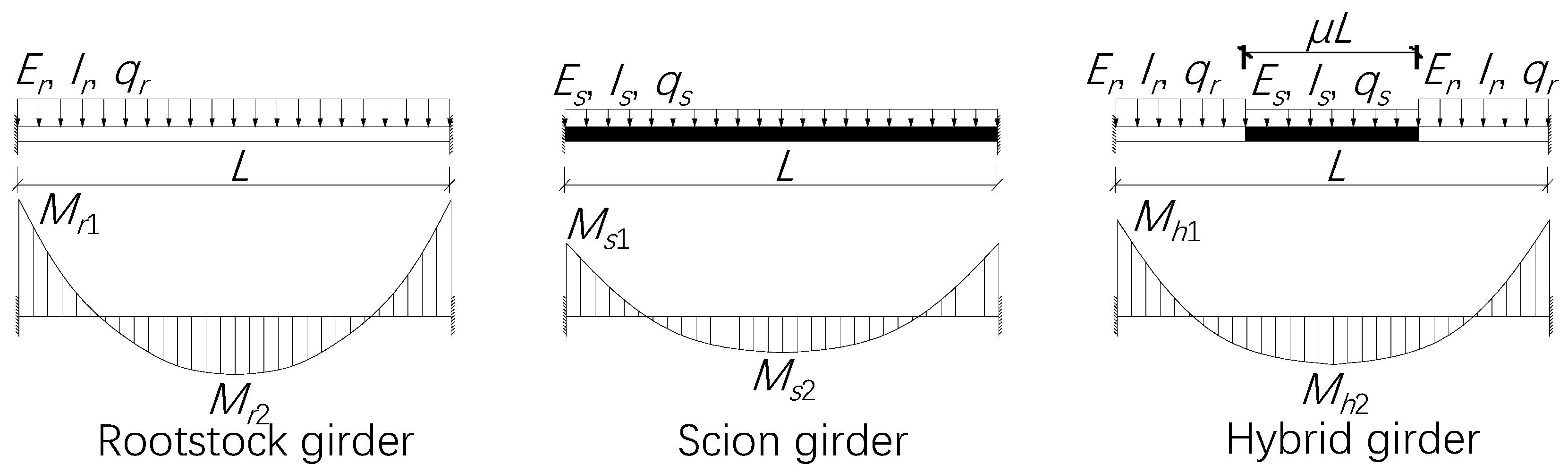
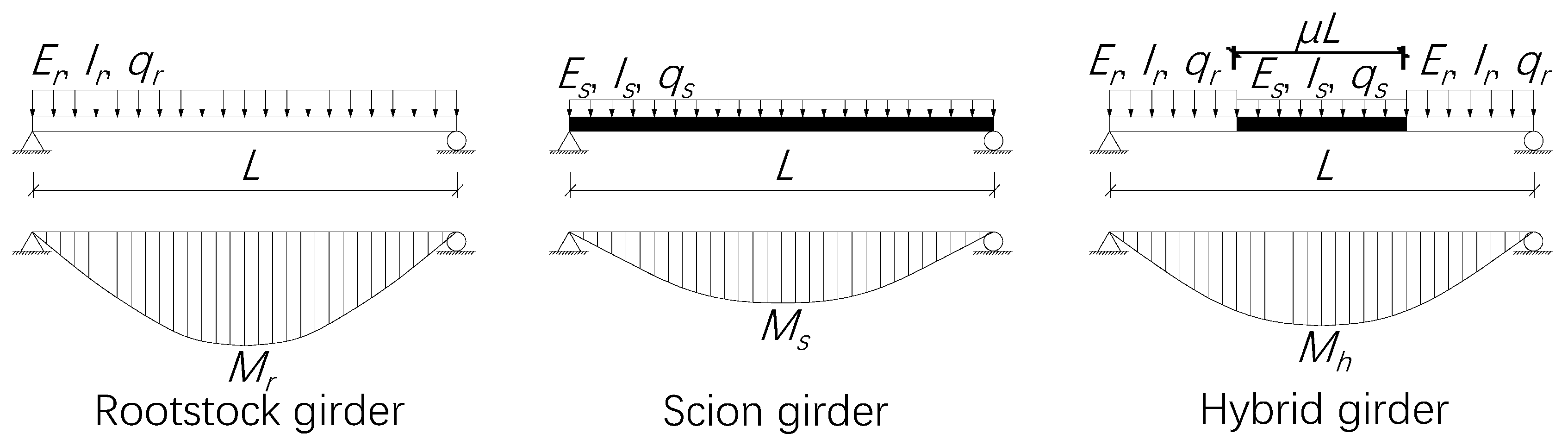
- Two boundary configurations of fixed and simply supported are adopted as theoretical boundary cases to enable the derivation of closed-form solutions for mechanical trait inheritance and optimization. In practice, most hybrid girder bridges are continuous structures whose boundary conditions fall between these two idealized cases. Consequently, their mechanical behavior can be reasonably interpreted as lying within the bounds defined by the pinned and fixed solutions. Moreover, both the maximum bending moment (Mmax) in the simply supported case and the differential bending moment (ΔM = Mmax − Mmin) in the fixed configuration serve as equivalent indicators of bending stress.
- (5)
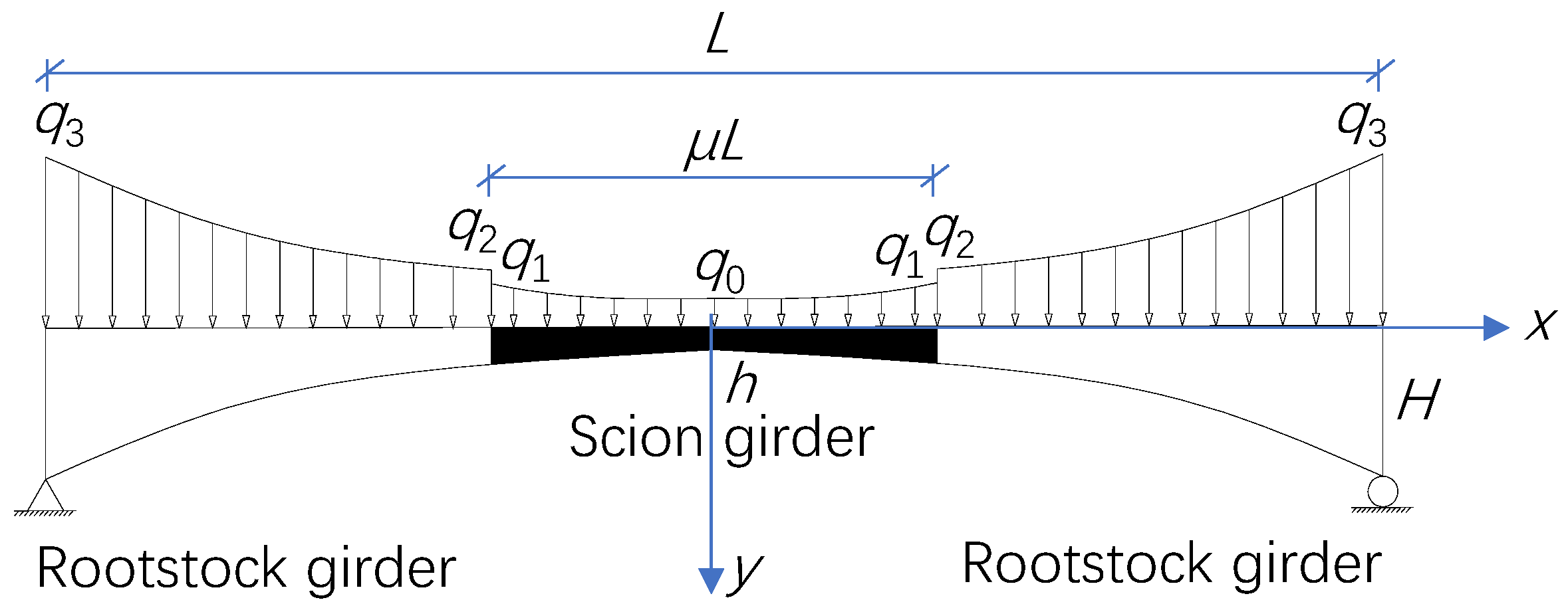
- The scion girder is assumed to be located at mid-span, which reflects most practical applications. However, in less common cases, the scion girder may be positioned near the supports. In such scenarios, the proposed methodology remains applicable, provided that the hybrid girder model is appropriately modified.
3. Theory of Trait Inheritance
3.1. Girders with Equal Cross-Sections
3.2. Girders with Variable Cross-Sections
4. Theory of Trait Optimization
4.1. Optimization Process
4.2. Girders with Equal Cross-Sections
4.3. Girders with Variable Cross-Sections
5. Engineering Demonstration
5.1. Application to the Dongbao River Bridge
5.2. Application to Girder Height Estimations
6. Conclusions
Author Contributions
Funding
Data Availability Statement
Conflicts of Interest
References
- Melnyk, C.W.; Meyerowitz, E.M. Plant grafting. Curr. Biol. 2015, 25, R183–R188. [Google Scholar] [CrossRef]
- Goldschmidt, E.E. Plant grafting: New mechanisms, evolutionary implications. Front. Plant Sci. 2014, 5, 727. [Google Scholar] [CrossRef]
- King, S.R.; Davis, A.R.; Liu, W.; Levi, A. Grafting for disease resistance. HortScience 2008, 43, 1673–1676. [Google Scholar] [CrossRef]
- Rasool, A.; Mansoor, S.; Bhat, K.M.; Hassan, G.I.; Baba, T.R.; Alyemeni, M.N.; Alsahli, A.A.; El-Serehy, H.A.; Paray, B.A.; Ahmad, P. Mechanisms underlying graft union formation and rootstock scion interaction in horticultural plants. Front. Plant Sci. 2020, 11, 590847. [Google Scholar] [CrossRef]
- Martínez-Ballesta, M.C.; Alcaraz-López, C.; Muries, B.; Mota-Cadenas, C.; Carvajal, M. Physiological aspects of rootstock–scion interactions. Sci. Hortic. 2010, 127, 112–118. [Google Scholar] [CrossRef]
- Gautier, A.T.; Chambaud, C.; Brocard, L.; Ollat, N.; Gambetta, G.A.; Delrot, S.; Cookson, S.J. Merging genotypes: Graft union formation and scion–rootstock interactions. J. Exp. Bot. 2019, 70, 747–755. [Google Scholar] [CrossRef]
- Zhou, Z.; Yuan, Y.; Wang, K.; Wang, H.; Huang, J.; Yu, H.; Cui, X. Rootstock-scion interactions affect fruit flavor in grafted tomato. Hortic. Plant J. 2022, 8, 499–510. [Google Scholar] [CrossRef]
- Núñez-Lillo, G.; Ponce, E.; Beyer, C.P.; Álvaro, J.E.; Meneses, C.; Pedreschi, R. A first omics data integration approach in hass avocados to evaluate rootstock–scion interactions: From aerial and root plant growth to fruit development. Plants 2024, 13, 603. [Google Scholar] [CrossRef] [PubMed]
- Raphael, W.; Zgheib, E.; Chateauneuf, A. Experimental investigations and sensitivity analysis to explain the large creep of concrete deformations in the bridge of Chevire. Case Stud. Constr. Mater. 2018, 9, e00176. [Google Scholar] [CrossRef]
- Tang, M.C. The New Shibanpo Bridge, Chongqing, China. Struct. Eng. Int. 2010, 20, 157–160. [Google Scholar] [CrossRef]
- Ingebrigtsen, T. Stolma Bridge, Norway. Struct. Eng. Int. 1999, 9, 100–102. [Google Scholar] [CrossRef]
- Xu, G.; Zeng, M.; Su, Q. Layout and optimization of the external prestressing tendons of hybrid beam rigid frame bridges. IOP Conf. Ser. Earth Environ. Sci. 2021, 719, 032061. [Google Scholar] [CrossRef]
- Fergestad, S.; Rambjør, S.K. Raftsundet Bridge in Lofoten, Norway. Struct. Eng. Int. 1999, 9, 96–99. [Google Scholar] [CrossRef]
- Harmon, K.S. Norway bridges using high performance lightweight aggregate concrete. In Proceedings of the High-Performance Structural Lightweight Concrete Symposium; American Concrete Institute: Phoenix, AZ, USA, 2004; pp. 189–198. [Google Scholar] [CrossRef]
- Hole, K.D.; Fergestad, S.; Aas-Jakobsen, K. Wind induced response of the Sandsfjord Bridge-a balanced cantilever bridge at the western coast of Norway. In IABSE Congress: Challenges in Design and Construction of an Innovative and Sustainable Built Environment; Curran Associates, Inc.: Red Hook, NY, USA, 2016; pp. 173–180. [Google Scholar] [CrossRef]
- Leng, J.; Yang, J.; Zhang, Z.; Zou, Y.; Chen, J.; Zhou, J. Experimental and numerical investigations on force transfer mechanism of steel-concrete joint in hybrid girder bridges. Structures 2023, 54, 153–170. [Google Scholar] [CrossRef]
- Shangguan, B.; Su, Q.; Casas, J.R.; Su, H.; Wang, S.; Zhao, R. Modeling and testing of a composite steel–concrete joint for hybrid girder bridges. Materials 2023, 16, 3265. [Google Scholar] [CrossRef]
- Wang, H.; Yang, L.; Zeng, H. Study on static performance of the steel-concrete joint in a high-speed railway hybrid girder low tower cable-stayed bridge. Structures 2025, 71, 107858. [Google Scholar] [CrossRef]
- Luo, J.; Quan, Z.; Huai, C.; Zhang, K.; Yang, S. Study on bending performances of new steel-UHPC-concrete composite joint in the continuous hybrid girder bridge. Structures 2025, 74, 108596. [Google Scholar] [CrossRef]
- Zhang, P. Research on Mechanical Performance and Design Parameters for Steel-Concrete Mixed Beam Combined Section. Ph.D. Thesis, Chang’an University, Xi’an, China, 2013. [Google Scholar]
- Zeng, M.; Xu, G.; Lin, Z.; Chen, D.; Su, Q. Mechanical calculation and rational structural system of hybrid beam rigid frame bridge. J. Tongji Univ. 2020, 48, 1687–1695. [Google Scholar]
- Qin, F.; Zhou, X.; Liang, B.; Di, J.; Tu, X.; Xu, L.; Zou, Y. Experiment on steel-concrete joint of hybrid girder of a long-span self-anchored suspension bridge. China J. Highw. Transp. 2018, 31, 52–64. [Google Scholar]
- He, Z.Q.; Chen, J.; Liu, Z.; Ma, Z.J. An explicit approach for determining the rational length of steel portion in steel–concrete hybrid girder bridges. J. Bridge Eng. 2023, 28, 05022011. [Google Scholar] [CrossRef]
- Mao, M.; He, Z.Q.; Liu, G. An analytical method for determining the rational position of joint section in steel-concrete hybrid girder bridges. Structures 2024, 69, 107431. [Google Scholar] [CrossRef]
- Shangguan, B.; Wang, F.; Su, Q.; Matanmi, F.O.; Xu, J. Research on the equivalent span of hybrid girder bridges. Materials 2025, 18, 1278. [Google Scholar] [CrossRef]
- Hu, N.; Feng, P.; Dai, G. The gift from nature: Bio-inspired strategy for developing innovative bridges. J. Bionic Eng. 2013, 10, 405–414. [Google Scholar] [CrossRef]
- Zhang, G.; Liu, Y.; Liu, J.; Lan, S.; Yang, J. Causes and statistical characteristics of bridge failures: A review. J. Traffic Transp. Eng. (Engl. Ed.) 2022, 9, 388–406. [Google Scholar] [CrossRef]
- Zhou, J.; Hu, C.; Zhang, J.; Li, T.; Yang, M. Reliability assessment of existing concrete bridges under the passage of heavy trucks considering bending-shear interaction. Struct. Infrastruct. Eng. 2023, 19, 1349–1365. [Google Scholar] [CrossRef]
- Zhou, J.; Zheng, Y.; Tan, Z.; Wei, B.; Zhou, X.; Ruan, X. Feasibility study of bridge load testing using ongoing traffic through rapid estimation of traffic load effects for network-level highway bridges assisted by site-specific ETC data. J. Civ. Struct. Health 2025, 15, 1793–1813. [Google Scholar] [CrossRef]
- Dai, L.; Chen, Y.; Tao, M. Design and innovation of Xin’an Bridge on Dongbao River in Shenzhen. Urban Roads Bridges Flood Control 2017, 1, 55–57+70. [Google Scholar] [CrossRef]





| Model | Constant Cross-Sections | Variable Cross-Sections | ||
|---|---|---|---|---|
| n | μ* | n | μ* | |
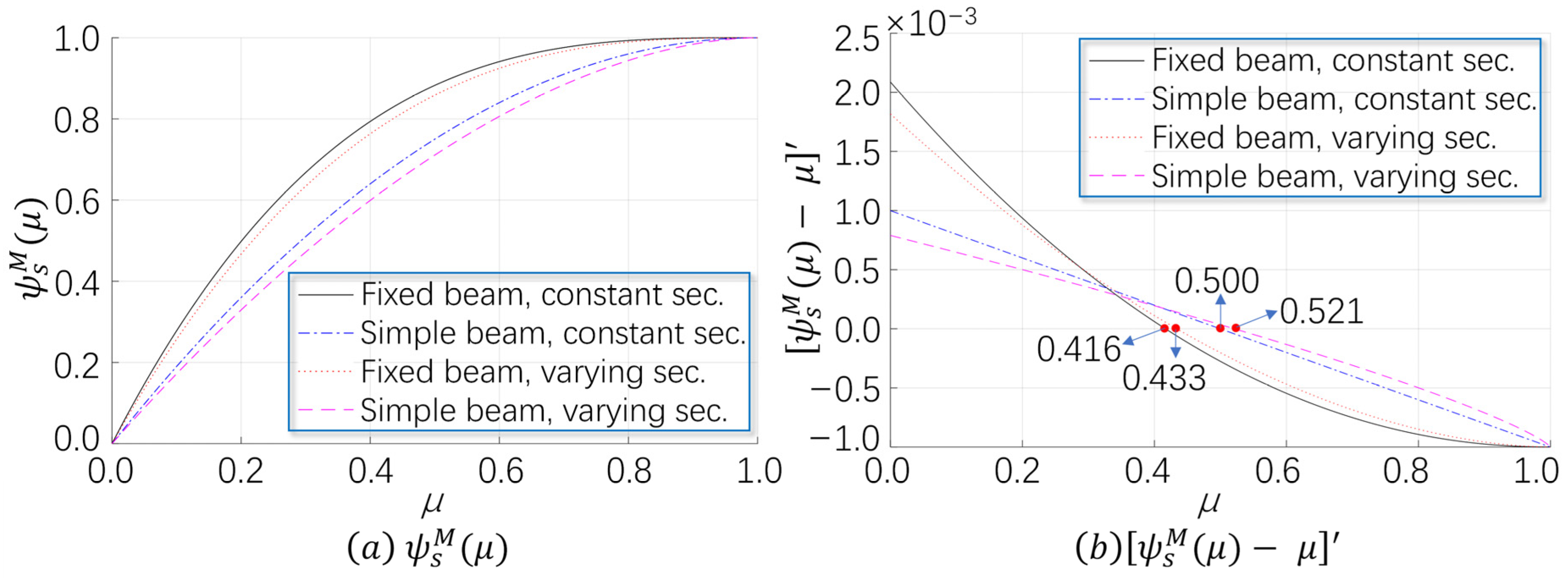
| Fixed-end beam | 3.09 | 0.416 | 2.82 | 0.500 |
| Simple beam | 2.00 | 0.433 | 1.79 | 0.521 |
| Stage | h | qr | qs | M | I | k | |
|---|---|---|---|---|---|---|---|
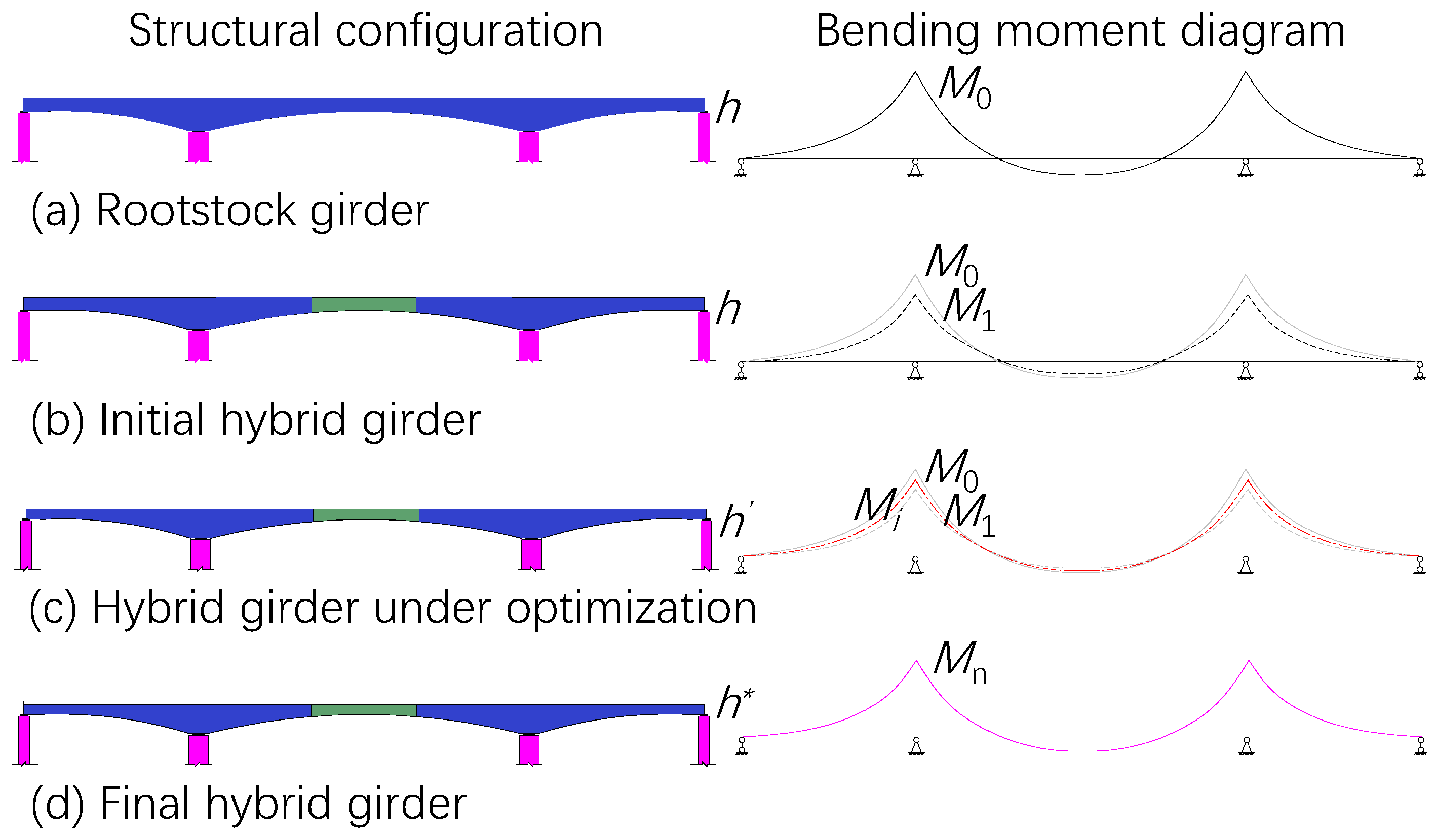
| i = 0 | Rootstock girder | h0 | qr0 | / | M0 | I0 | kref |
| i = 1 | Initial hybrid girder | h1= h0 | qr1 = qr0 | qs1 = qs0 | M1 | I1 = I0 | kh1 |
| i = 2 | 1st optimization | h2 | qr2 | qs2 | M2 | I2 | kh2 |
| i = i | i-1th optimization | hi | qri | qsi | Mi | Ii | khi |
| … | … | ||||||
| i = n | Final hybrid girder | h* | qr* | qs* | M* | I* | kh* |
| Optimization Stage | H (m) | h (m) | I (m4) | M (kN·m) | k (m−1) | (kh − kref)/kref | |
|---|---|---|---|---|---|---|---|
| i = 0 | Rootstock girder | 17.650 | 5.295 | 1774.1 | 7244.58 | 0.1256 | / |
| i = 1 | Initial hybrid girder | 17.650 | 5.295 | 1774.1 | 4815.33 | 0.0835 | −33.53% |
| i = 2 | 1st optimization | 15.403 | 4.621 | 1179.2 | 4432.34 | 0.1157 | −7.95% |
| i = 3 | 2nd optimization | 14.984 | 4.495 | 1085.4 | 4360.79 | 0.1236 | −1.61% |
| i = 4 | 3rd optimization | 14.903 | 4.471 | 1067.9 | 4346.97 | 0.1253 | −0.32% |
| i = 5 | 4th optimization | 14.886 | 4.466 | 1064.5 | 4344.28 | 0.1256 | −0.00% |
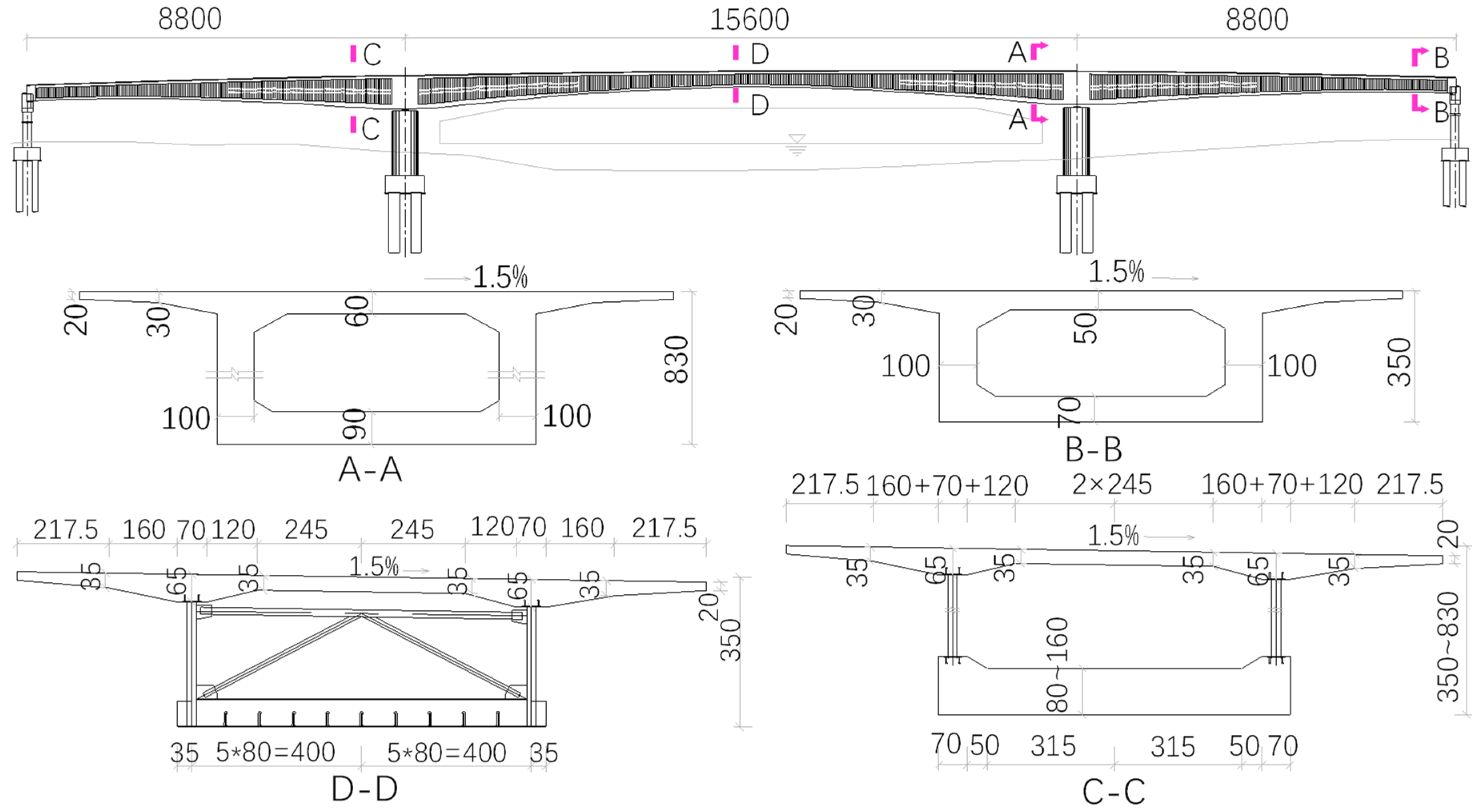
| Real-word design | 15.000 | 4.500 | 1089.0 | 4363.57 | 0.1233 | −1.87% | |
| Optimization Stage | H (m) | h (m) | I (m4) | M (kN·m) | k (m−1) | (kh − kref)/kref | |
|---|---|---|---|---|---|---|---|
| i = 0 | Rootstock girder | 9.176 | 3.870 | 283.54 | 1544.05 | 0.1676 | / |
| i = 1 | Initial hybrid girder | 9.176 | 3.870 | 283.54 | 1215.69 | 0.1319 | −21.27% |
| i = 2 | 1st optimization | 8.474 | 3.573 | 223.25 | 1179.51 | 0.1626 | −2.98% |
| i = 3 | 2nd optimization | 8.389 | 3.537 | 216.60 | 1175.14 | 0.1669 | −0.37% |
| i = 4 | 3rd optimization | 8.378 | 3.533 | 215.80 | 1174.61 | 0.1675 | −0.05% |
| Real-word design | 8.300 | 3.500 | 209.81 | 1170.58 | 0.1717 | 2.45% | |
| Bridge Name | L (m) | γ | μ | Lr (m) | Scaling Factor (δ) | Height-to-Length Ratio | Estimated Girder Height (m) | Real Height (m) | Conformance | Mean Estimation | ||
|---|---|---|---|---|---|---|---|---|---|---|---|---|
| Girder Height (m) | Deviation | |||||||||||
| 1 | Stolma Bridge | 301 | 0.600 | 0.600 | 245 | 1.2272 | 1/14~1/18 | 13.63~17.52 | 15.0 | √ | 15.33 | 2.20% |
| 2 | Shibanpo Bridge | 330 | 0.300 | 0.312 | 262 | 1.2585 | 1/14~1/18 | 14.57~18.73 | 16.0 | √ | 16.39 | 2.42% |
| 3 | Oujiang Bridge | 200 | 0.300 | 0.400 | 149 | 1.3460 | 1/14~1/18 | 8.26~10.61 | 9.0 | √ | 9.29 | 3.19% |
| 4 | Anhaiwan Bridge | 300 | 0.300 | 0.343 | 233 | 1.2887 | 1/14~1/18 | 12.93~16.63 | 15.0 | √ | 14.55 | −3.00% |
| 5 | Taoerhe Bridge | 338 | 0.300 | 0.512 | 231 | 1.4638 | 1/14~1/18 | 12.83~16.49 | 17.0 | × | 14.43 | −15.11% |
| 6 | Cheviré Bridge | 240 | 0.300 | 0.670 | 147 | 1.6303 | 1/14~1/18 | 8.25~10.60 | 9.0 | √ | 9.20 | 2.23% |
| 7 | Dongbao River Bridge | 156 | 0.700 | 0.356 | 142 | 1.1014 | 1/14~1/18 | 7.87~10.12 | 8.3 | √ | 8.85 | 6.66% |
| 8 | Zhoushan Bridge | 260 | 0.300 | 0.327 | 204 | 1.2730 | 1/14~1/18 | 11.35~14.59 | 13.3 | √ | 12.76 | −4.02% |
| 9 | Zhongshan Bridge | 220 | 0.300 | 0.395 | 164 | 1.3408 | 1/14~1/18 | 9.12~11.72 | 11.0 | √ | 10.25 | −6.78% |
| 10 | Longxiang Bridge | 202 | 0.300 | 0.396 | 151 | 1.3419 | 1/14~1/18 | 8.36~10.75 | 10.4 | √ | 9.41 | −9.53% |
| 11 | Hangzhou-Wenzhou Railway Bridge | 216 | 0.300 | 0.380 | 163 | 1.3256 | 1/12~1/16 | 10.18~13.58 | 12.6 | √ | 11.64 | −7.63% |
| 12 | Guangzhan Railway Bridge | 200 | 0.500 | 0.375 | 167 | 1.1993 | 1/12~1/16 | 10.42~13.90 | 15.0 | × | 11.91 | −20.59% |
| 13 | Raftsundet Bridge | 298 | 0.600 | 0.752 | 236 | 1.2653 | 1/14~1/18 | 13.08~16.82 | 14.5 | √ | 14.72 | 1.51% |
Disclaimer/Publisher’s Note: The statements, opinions and data contained in all publications are solely those of the individual author(s) and contributor(s) and not of MDPI and/or the editor(s). MDPI and/or the editor(s) disclaim responsibility for any injury to people or property resulting from any ideas, methods, instructions or products referred to in the content. |
© 2026 by the authors. Licensee MDPI, Basel, Switzerland. This article is an open access article distributed under the terms and conditions of the Creative Commons Attribution (CC BY) license.
Share and Cite
Shangguan, B.; Su, Q.; Zhou, J.; Dai, L. Inheritance and Optimization of Mechanical Traits for Hybrid Girder Bridges: A Novel Bionic Perspective. Buildings 2026, 16, 1472. https://doi.org/10.3390/buildings16081472
Shangguan B, Su Q, Zhou J, Dai L. Inheritance and Optimization of Mechanical Traits for Hybrid Girder Bridges: A Novel Bionic Perspective. Buildings. 2026; 16(8):1472. https://doi.org/10.3390/buildings16081472
Chicago/Turabian StyleShangguan, Bing, Qingtian Su, Junyong Zhou, and Liang Dai. 2026. "Inheritance and Optimization of Mechanical Traits for Hybrid Girder Bridges: A Novel Bionic Perspective" Buildings 16, no. 8: 1472. https://doi.org/10.3390/buildings16081472
APA StyleShangguan, B., Su, Q., Zhou, J., & Dai, L. (2026). Inheritance and Optimization of Mechanical Traits for Hybrid Girder Bridges: A Novel Bionic Perspective. Buildings, 16(8), 1472. https://doi.org/10.3390/buildings16081472