A Study on Spatial Narrative Strategies of China’s National Industrial Heritage: The Case of Nantong Guangsheng Oil Mill


Abstract
1. Introduction
2. Theoretical Foundation and Research Framework
2.1. Definition of Core Concepts
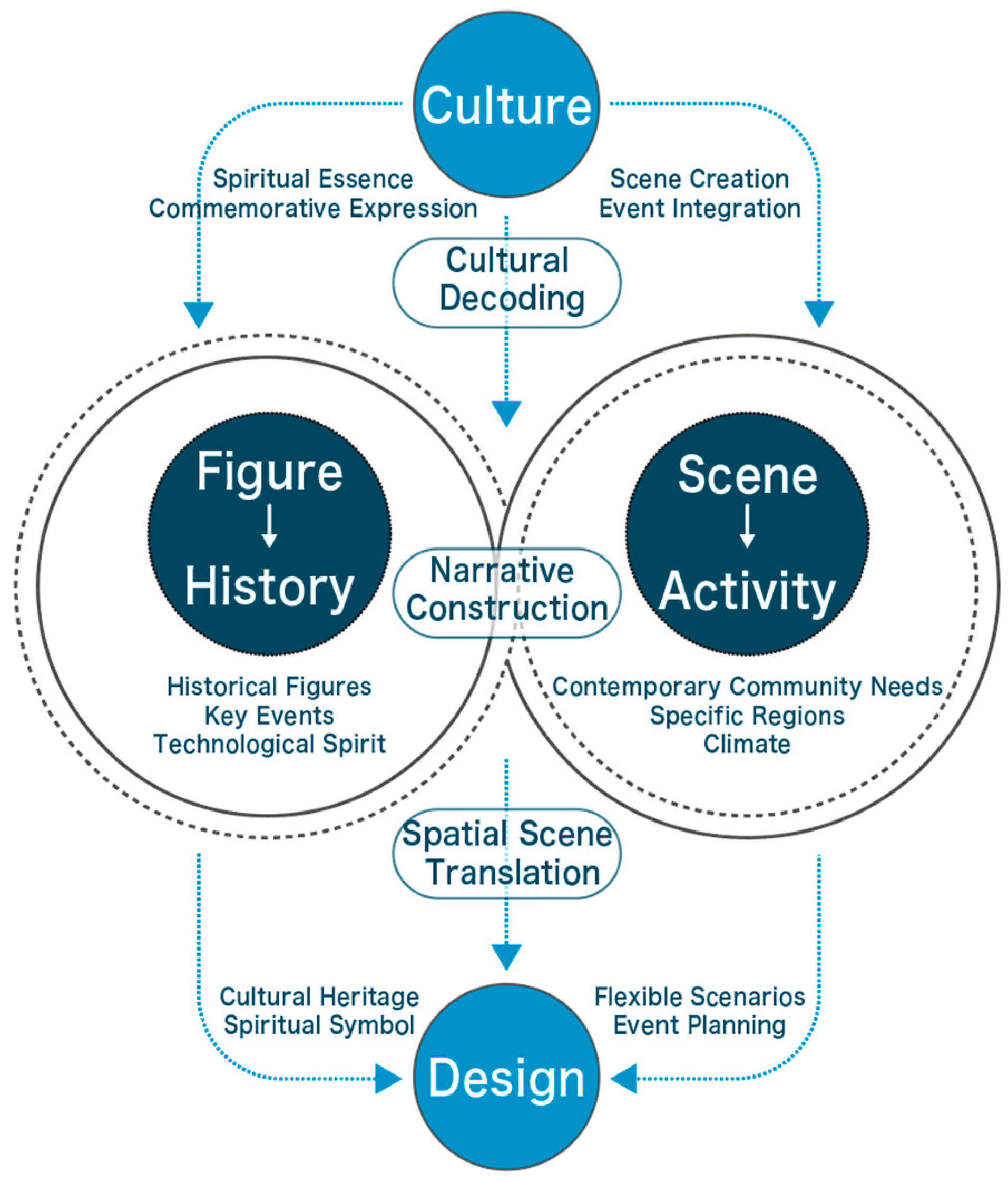
2.2. Proposition and Elaboration of the “Dual-Track Narrative” Framework
3. Methodology
3.1. Research Design and Methodology
3.2. Case Selection
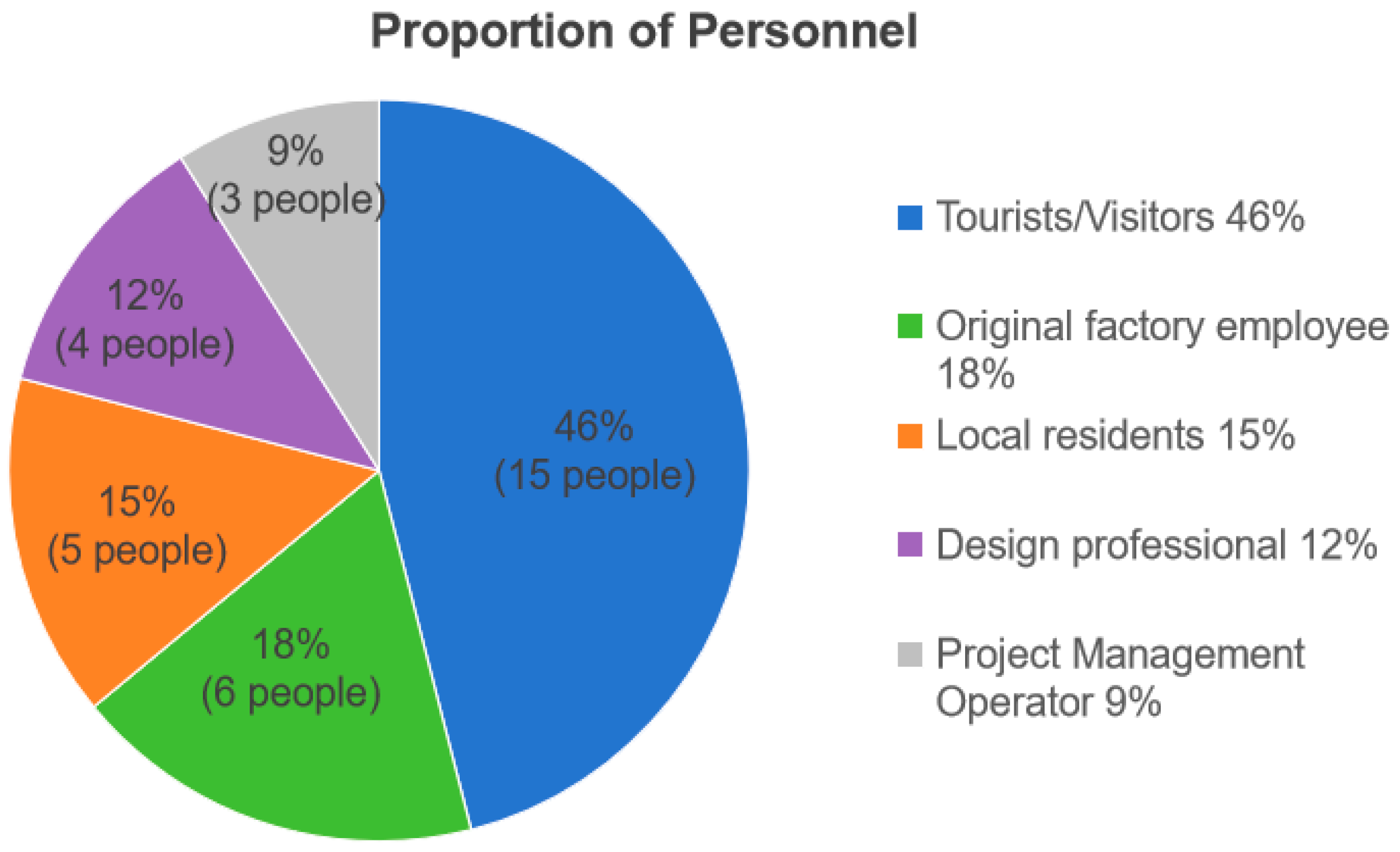
3.3. Data Collection and Analysis
4. Case Study: The Spatial Translation of the “Dual Narrative” at the Nantong Guangsheng Oil Mill
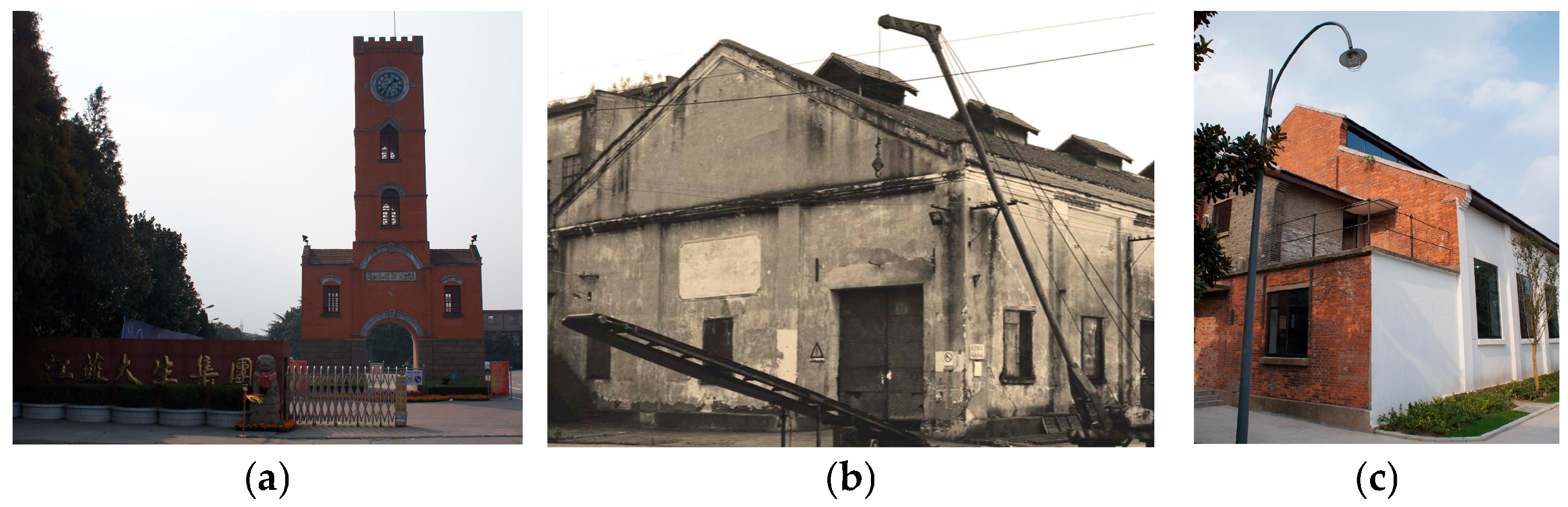
4.1. Case Background
4.2. Spatial Translation of the “Figure-History” Narrative
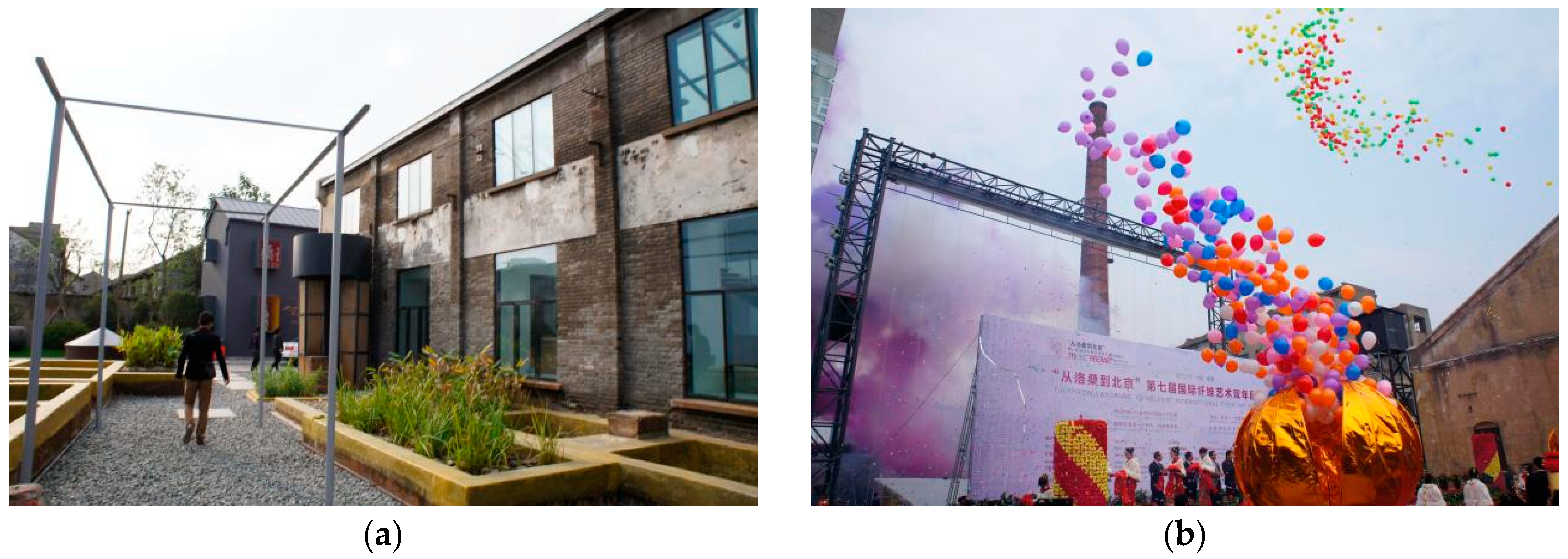
4.3. Spatial Translation of the “Scene-Activity” Narrative
5. Discussion: The Sustainable Empowerment Mechanism of Narrative Strategies
6. Conclusions
Author Contributions
Funding
Institutional Review Board Statement
Informed Consent Statement
Data Availability Statement
Conflicts of Interest
References
- Rix, M. Industrial archaeology. Amat. Hist. 1955, 2, 225–230. [Google Scholar]
- Lowenthal, D. The Past Is a Foreign Country; Cambridge University Press: Cambridge, UK, 1985. [Google Scholar] [CrossRef]
- Alfrey, J.; Putnam, T. The Industrial Heritage: Managing Resources and Uses; Routledge: London, UK, 1992. [Google Scholar] [CrossRef]
- Thrift, N. Spatial Formations; Sage Publications: London, UK, 1996. [Google Scholar] [CrossRef]
- TICCIH. The Nizhny Tagil Charter for the Industrial Heritage; TICCIH: Moscow, Russia, 2003; Available online: https://www.icomos.org/18thapril/2006/nizhny-tagil-charter-e.pdf (accessed on 21 January 2026).
- IBA. Emscher Park. Katalog der Projekte 1999; IBA Emscher Park: Gelsenkirchen, Germany, 1999. (In German) [Google Scholar]
- Latz, P. Landschaftspark Duisburg-Nord. In Syntax of Landscape: The Landscape Architecture of Peter Latz and Partners; Weilacher, U., Ed.; Birkhäuser: Basel, Switzerland, 2001; pp. 76–95. [Google Scholar]
- Powell, K. Architecture Reborn: Converting Old Buildings for New Uses; Rizzoli: New York, NY, USA, 1999. [Google Scholar]
- Kirkwood, N. Manufactured Sites: Rethinking the Post-Industrial Landscape; Spon Press: London, UK, 2001. [Google Scholar] [CrossRef]
- Hospers, G.J. Industrial heritage tourism and regional restructuring in the European Union. Eur. Plan. Stud. 2002, 10, 397–404. [Google Scholar] [CrossRef]
- Miles, S. ‘Our tyne’: Iconic regeneration and the revitalisation of identity in Newcastle Gateshead. Urban Stud. 2005, 42, 913–926. [Google Scholar] [CrossRef]
- Berens, C. Redeveloping Industrial Sites: A Guide for Architects, Planners, and Developers; John Wiley & Sons: Hoboken, NJ, USA, 2011. [Google Scholar]
- Hospers, G.J.; Revilla Diez, J. Rethinking rustbelt regions. Camb. J. Reg. Econ. Soc. 2022, 15, 451–458. [Google Scholar] [CrossRef]
- Harvey, D.C. Heritage, memory and place. In Routledge International Handbook of Heritage and Politics; Routledge: Oxfordshire, UK, 2022; pp. 45–58. [Google Scholar] [CrossRef]
- Zhang, J.; Cenci, J.; Becue, V.; Koutra, S.; Liao, C. Stewardship of Industrial Heritage Protection in Typical Western European and Chinese Regions: Values and Dilemmas. Land 2022, 11, 772. [Google Scholar] [CrossRef]
- Wang, X.R.; Lin, Q. Theory and Practice of Modern Western Landscape Design; China Architecture & Building Press: Beijing, China, 2002. (In Chinese) [Google Scholar]
- Liu, H.Y.; Li, L.L. German Industrial Tourism and Industrial Heritage Protection; The Commercial Press: Beijing, China, 2007. (In Chinese) [Google Scholar]
- Zuo, Y. Preservation and Regeneration of Industrial Architectural Heritage in Berlin, Germany; Southeast University Press: Nanjing, China, 2007. (In Chinese) [Google Scholar]
- Liu, B.Y.; Feng, Z.P. Urban Industrial Land Renewal and Industrial Heritage Conservation; China Architecture & Building Press: Beijing, China, 2009. (In Chinese) [Google Scholar]
- Shi, W.L.; Du, L.Q.; Wang, Y.; Liu, B.Y. Research on Overall Utilization Planning of Industrial Land in Beijing Central City (01–18 Areas); Tsinghua University Press: Beijing, China, 2010. (In Chinese) [Google Scholar]
- Liu, M.L. Deconstruction and construction of art district: Field notes on Beijing 798 Art District. J. Inn. Mong. Univ. Arts 2012, 9, 11–18. (In Chinese) [Google Scholar]
- Wang, J.G. Conservation and Regeneration of Post-Industrial Era Industrial Building Heritage; China Architecture & Building Press: Beijing, China, 2008. (In Chinese) [Google Scholar]
- Lyu, Z. Conserving Living Heritage of Asia-Pacific Region in the Context of Cultural Diversity. Herit. Archit. 2016, 3, 28–39. (In Chinese) [Google Scholar] [CrossRef]
- Ji, H. Analysis on the Integrity of Modern Industrial Heritage: From the Nizhny Tagil Charter to the Dublin Principles. New Archit. 2019, 1, 92–95. (In Chinese). Available online: https://kns.cnki.net/kcms2/article/abstract?v=JGGnQT2jy0Id_97hA092-nhfQqvmKGMhesQqGX8_pB8n6Ty0H8hpftmeWgRoHsphXG_pzozIE_EAYLsj2M64RpMmGc-PyYtkGPITGq3iRhtFSEnyzu9EhOsEVcs5Ib3lH5IB_TPFMdrBs_Y737oWtr80exDWm-uzXI5r84G8hoQfMlbb8KRL2cl-y7Znf-Bg&uniplatform=NZKPT&language=CHS (accessed on 21 January 2026).
- Xu, S.B.; Nobuo, A.; Zhang, S.; Liu, B.Y.; Chang, J.; Wang, L.; Lyu, J.C.; Zuo, Y.; Cao, Y.K.; Zhou, L. Panel Discussion: From “Rust” to “Show”: New Ideas and New Development in the Protection and Reuse of Industrial Heritage. China Cult. Herit 2022, 3, 4–18. (In Chinese). Available online: https://kns.cnki.net/kcms2/article/abstract?v=JGGnQT2jy0JztEV-Depj5mb4Kgva-L2Z87rbbdnUfe0MPs9lPk3fMYjf5tsMqta7G862Gzynibjlqr9lSSNSD6cJTehiDsFrYxpvQJYWmS8JxShWI4y1M-g1xDLjZO7SwCs15fzU6w_upbPM7ozV_jZO_tm0yFXxR4a_9hWp3jVLKO5PGKeCdcp4rCUQUV7N&uniplatform=NZKPT&language=CHS (accessed on 21 January 2026).
- Zhang, J.; EdsLiu, Y.; Wei, W.J. “DIBO Scheme” for the whole process implementation of heritage protection and utilization: A case study of industrial heritage protection and utilization projects in the Old Town of Hedong, Jingdezhen. Urban Rural. Plan. 2021, 1/2, 114–125. (In Chinese). Available online: https://urplanning.fudan.edu.cn/96/49/c35724a431689/page.htm (accessed on 21 January 2026).
- Wang, J.G. Urban Double Repair and Healing Creation for a Living City—China’s Urban Transformation and the Professional Role of Architects. Archit. J. 2022, 8, 1–5. [Google Scholar] [CrossRef]
- Xu, S.B.; Sun, Y.J.; Aoki, N. From industrial heritage to urban heritage: Analysis of the material composition of industrial heritage in Luoyang during the 156 Period. Urban Dev. Stud. 2015, 22, 112–117. (In Chinese). Available online: https://kns.cnki.net/kcms2/article/abstract?v=JGGnQT2jy0IaaqJUv1-ip5AnjfqPF1NgHRBUYNP44x6UlkpmYM7wQeGyaJCuUd85K0-VlwSC2CVyOxx7N2dY9-36r62vTztPCjcws2CRR5boyEx1jC2cT-2VIjm1P_v6W6DymPyQP8AErhanYtdY7vy1yGBCoke2bVHaRiHiWdFJkSi5gBtFWO5iATKuBe9L&uniplatform=NZKPT&language=CHS (accessed on 21 January 2026).
- Wang, X.R.; Lin, Q. Nirvana and Regeneration of Abandoned Quarries—Future Garden of the 11th Jiangsu Horticultural Exposition. Chin. Landsc. Archit. 2022, 38, 27–33. [Google Scholar] [CrossRef]
- Wang, W.; Wei, C.Y.; Chen, J. Exploration of RBD under the Two-oriented Society Urban Construction—Conception of Changsha Taiping Street RBD. Chin. Overseas Archit. 2008, 9, 81–84. (In Chinese). Available online: https://kns.cnki.net/kcms2/article/abstract?v=Jz5IuRg0t02oiY7iXPHmeDuJ_7m55WfjgnWvbpNInFMxDco38B_FixnDrw1jvUuSAKxzqLQNcZ4lIdyLN0zfrYa2ZKbPSr-r20W00KwsqVhg3yB5zvDNhIkwh8-4aHmOe8qg_Xr5WMFA1kF-uD77LY0rTSmcwkpmiCJzs0Lh-7GyPz3vXpTSVw==&uniplatform=NZKPT&language=CHS (accessed on 21 January 2026).
- Meng, F.L.; Cui, Z.M.; Liu, B.Y. Research on the history of modern Beijing’s industrial construction and the value of industrial architectural heritage. Ind. Constr. 2021, 51, 78–83+112. (In Chinese) [Google Scholar] [CrossRef]
- Che, J.; Huang, W.Z. Architectural development and urban pattern changes of Beijing’s primary and secondary industries in the context of industrial transformation. Beijing Plan. Rev. 2023, 4, 106–112. (In Chinese). Available online: https://kns.cnki.net/kcms2/article/abstract?v=Jz5IuRg0t012DqkMRMGrKn4tZmNCKYW_aojr9pSe08pK8pe98F1eSa-K3t3Eym1pje49RHxnLzr-rGvbTJ21C7aisdA76SXpSH6sMbzjyFZUFhDDSxVTutx-KuT6vtYeOODUj4S_raQOdlDbPKlWCkhIVxFwpIHqBExlQ2GVvayG7xO2DCACKQ==&uniplatform=NZKPT&language=CHS (accessed on 21 January 2026).
- Duan, J.Q. Mirror of heritage: Three historical perspectives on post-industrial landscape in urban renewal. Landsc. Archit. 2023, 30, 54–60. (In Chinese) [Google Scholar] [CrossRef]
- Hu, S.Y. Collective memory construction and 3D visualization design of industrial heritage. Shanghai Arts Crafts 2024, 2, 118–121. (In Chinese). Available online: https://qikan.cqvip.com/Qikan/Article/Detail?id=7112447621 (accessed on 21 March 2026).
- Ricoeur, P. Time and Narrative; University of Chicago Press: Chicago, IL, USA, 1984; Volumes 1–3, ISBN 978-0-226-71331. [Google Scholar]
- Nora, P. Between Memory and History: Les Lieux de Mémoire. Representations 1989, 26, 7–24. [Google Scholar] [CrossRef]
- Tilden, F. Interpreting Our Heritage; University of North Carolina Press: Chapel Hill, NC, USA, 1957. [Google Scholar]
- Debord, G. The Society of the Spectacle; Zone Books: New York, NY, USA, 1994; ISBN 978-0-942299-80-9. [Google Scholar]
- Pallasmaa, J. The Eyes of the Skin: Architecture and the Senses, 3rd ed.; Wiley: Chichester, UK, 2012; 130p, Available online: https://www.wiley.com/en-us/The+Eyes+of+the+Skin%3A+Architecture+and+the+Senses%2C+3rd+Edition-p-9781119943501 (accessed on 21 January 2026).
- Casey, E.S. Remembering: A Phenomenological Study, 2nd ed.; Indiana University Press: Bloomington, IN, USA, 2000; 392p, Available online: https://www.jstor.org/stable/j.ctt16gzfjf (accessed on 21 January 2026).
- Buell, L. The Environmental Imagination: Thoreau, Nature Writing, and the Formation of American Culture; Belknap Press of Harvard University Press: Cambridge, MA, USA, 1995; 586p, Available online: https://www.hup.harvard.edu/catalog.php?isbn=9780674258624 (accessed on 21 January 2026).
- Yin, R.K. Case Study Research: Design and Methods, 5th ed.; SAGE Publications: Los Angeles, CA, USA, 2014; ISBN 978-1-4522-4256-9. [Google Scholar]
- Denzin, N.K. The Research Act: A Theoretical Introduction to Sociological Methods, 2nd ed.; McGraw-Hill: New York, NY, USA, 1978; ISBN 0-07-016361-8. [Google Scholar]
- Braun, V.; Clarke, V. Using thematic analysis in psychology. Qual. Res. Psychol. 2006, 3, 77–101. [Google Scholar] [CrossRef]
- Chen, X. The Song of King Gesar as Narrative Space: Translating Epic Narrative into Cultural Landscape. Asia Pac. Econ. Manag. Rev. 2026, 3. [Google Scholar] [CrossRef]
- Loures, L.; Panagopoulos, T.; Burley, J.B. Assessing user preferences on post-industrial redevelopment. Environ. Plan. B Plan. Des. 2016, 43, 871–892. [Google Scholar] [CrossRef]
- Merwin, L.; Umek, L.; Anastasio, A.E. Urban post-industrial landscapes have unrealized ecological potential. Restor. Ecol. 2022, 30, e13643. [Google Scholar] [CrossRef]
- Zhang, J.; Liu, B.Y.; Huo, X.W. Theory and key technologies of sustainable renewal of old industrial zones based on heritage protection and engineering application. Constr. Sci. Technol. 2023, 11, 41–43. [Google Scholar] [CrossRef]
- Xu, X.D.; Wang, J.G. Research on ecological strategies of urban design based on bioclimatic conditions: A case study of urban design in humid and hot regions. Architect. J. 2007, 3, 64–67. (In Chinese). Available online: https://kns.cnki.net/kcms2/article/abstract?v=JGGnQT2jy0K-EuY4pnHU_JubhqNXRcRwvblMRtneTXAFPKmQmeg5zPVPEgDjGfdVsT_tkdt8UBrs8ixryEGROxMQk5hAjoNbattT84evZzvrf_gb3Swz0lSGCHH_r9y-vOP2CaT5IL0r2WMRlzLIqUNe8tuSjdpqp5L-RuK8_bq54N0SCg0ohOB6EbXoMfph&uniplatform=NZKPT&language=CHS (accessed on 21 January 2026).
- Mehan, A. Reimagining post-industrial landscapes through the lens of sustainable development. Agathón Int. J. Archit. Art Des. 2025, 17, 78–83. [Google Scholar] [CrossRef]






| Author | Work | Core Point | References |
|---|---|---|---|
| Paul Ricoeur | Time and Narrative | In Time and Narrative, French philosopher Paul Ricoeur systematically explores the connection between narrative and the human experience of time. He argues that our understanding of time requires us to weave past events into comprehensible narratives through historical storytelling. Meanwhile, fictional narratives provide symbolic expressions of our temporal experience. Spatial narrative involves the plot-driven reconstruction of history through design. Physical remnants of industrial heritage are inherently silent but can be activated and transformed into historical stories with an internal logic that contemporary audiences can recognise through conscious narrative organisation, such as spatial sequences, the shaping of landmarks, and the presentation of traces. | [35] |
| Pierre Nora | Between Memory and History: Les Lieux de Mémoire. | The concept of ‘places of memory’ (lieux de mémoire), proposed by the French historian Pierre Nora, offers a theoretical framework through which to understand the commemorative function of heritage spaces. In modern society, memory is not as vivid an experience as it was in traditional societies. Instead, it relies on specific material or symbolic carriers, or ‘places of memory’. These places serve as anchors for collective memory and embody a group’s identity. The “person-history” design strategy involves actively identifying, protecting and reinforcing these “places of memory” within heritage spaces, thereby transforming them into physical vessels for spiritual heritage. The theoretical foundation of “scene-activity narratives” is heritage interpretation and situationalism. | [36] |
| Freeman Tilden | Interpreting Our Heritage | In his book Interpreting Our Heritage, American scholar Freeman Tilden set out his far-reaching ‘principles of heritage interpretation’. He argued that heritage interpretation is not merely the transmission of information but a stimulating, holistic experience. He emphasised that effective interpretation should reveal the deeper meaning of things, organise information into a coherent whole and connect with visitors’ experiences and personalities. | [37] |
| Guy Debord | The Society of the Spectacle | Guy Debord’s theory of the “constructed situation” emphasises how the environment and activities together create an atmosphere that stimulates authentic human experiences, offering a more critical perspective on the relationship between space and activity. | [38] |
| Juhani Pallasmaa | The Eyes of the Skin | Juhani Pallasmaa’s phenomenological theory of architecture emphasises that spatial meaning is revealed through multi-sensory and embodied perception, arguing that architecture is not merely a visual object but a medium that engages the entire body—touch, hearing, smell, and kinaesthesia—to shape authentic human experience, redefining space as a carrier of embodied memory and existential belonging. | [39] |
| Edward Casey | place memory | Edward Casey’s theory of “place memory” highlights that memory is inherently anchored in specific physical locations, rather than being an abstract mental construct, demonstrating how places act as tangible repositories of personal and collective experience, transforming space from a neutral container into a living medium that preserves, evokes, and generates meaning through embodied attachment. | [40] |
| Lawrence Buell | environmental imagination | Lawrence Buell’s concept of “environmental imagination” explores how human cognition and cultural representation shape the meaning of space, emphasising that environments are not just physical settings but socially and imaginatively constructed entities, bridging the natural and built worlds to reveal how space becomes a site of ethical, cultural, and ecological significance through human perception and narrative. | [41] |
Disclaimer/Publisher’s Note: The statements, opinions and data contained in all publications are solely those of the individual author(s) and contributor(s) and not of MDPI and/or the editor(s). MDPI and/or the editor(s) disclaim responsibility for any injury to people or property resulting from any ideas, methods, instructions or products referred to in the content. |
© 2026 by the authors. Licensee MDPI, Basel, Switzerland. This article is an open access article distributed under the terms and conditions of the Creative Commons Attribution (CC BY) license.
Share and Cite
Yang, Z.; Li, X.; An, Q.; Ma, Y. A Study on Spatial Narrative Strategies of China’s National Industrial Heritage: The Case of Nantong Guangsheng Oil Mill. Buildings 2026, 16, 1457. https://doi.org/10.3390/buildings16071457
Yang Z, Li X, An Q, Ma Y. A Study on Spatial Narrative Strategies of China’s National Industrial Heritage: The Case of Nantong Guangsheng Oil Mill. Buildings. 2026; 16(7):1457. https://doi.org/10.3390/buildings16071457
Chicago/Turabian StyleYang, Zhenyu, Xiaohan Li, Qi An, and Yifan Ma. 2026. "A Study on Spatial Narrative Strategies of China’s National Industrial Heritage: The Case of Nantong Guangsheng Oil Mill" Buildings 16, no. 7: 1457. https://doi.org/10.3390/buildings16071457
APA StyleYang, Z., Li, X., An, Q., & Ma, Y. (2026). A Study on Spatial Narrative Strategies of China’s National Industrial Heritage: The Case of Nantong Guangsheng Oil Mill. Buildings, 16(7), 1457. https://doi.org/10.3390/buildings16071457