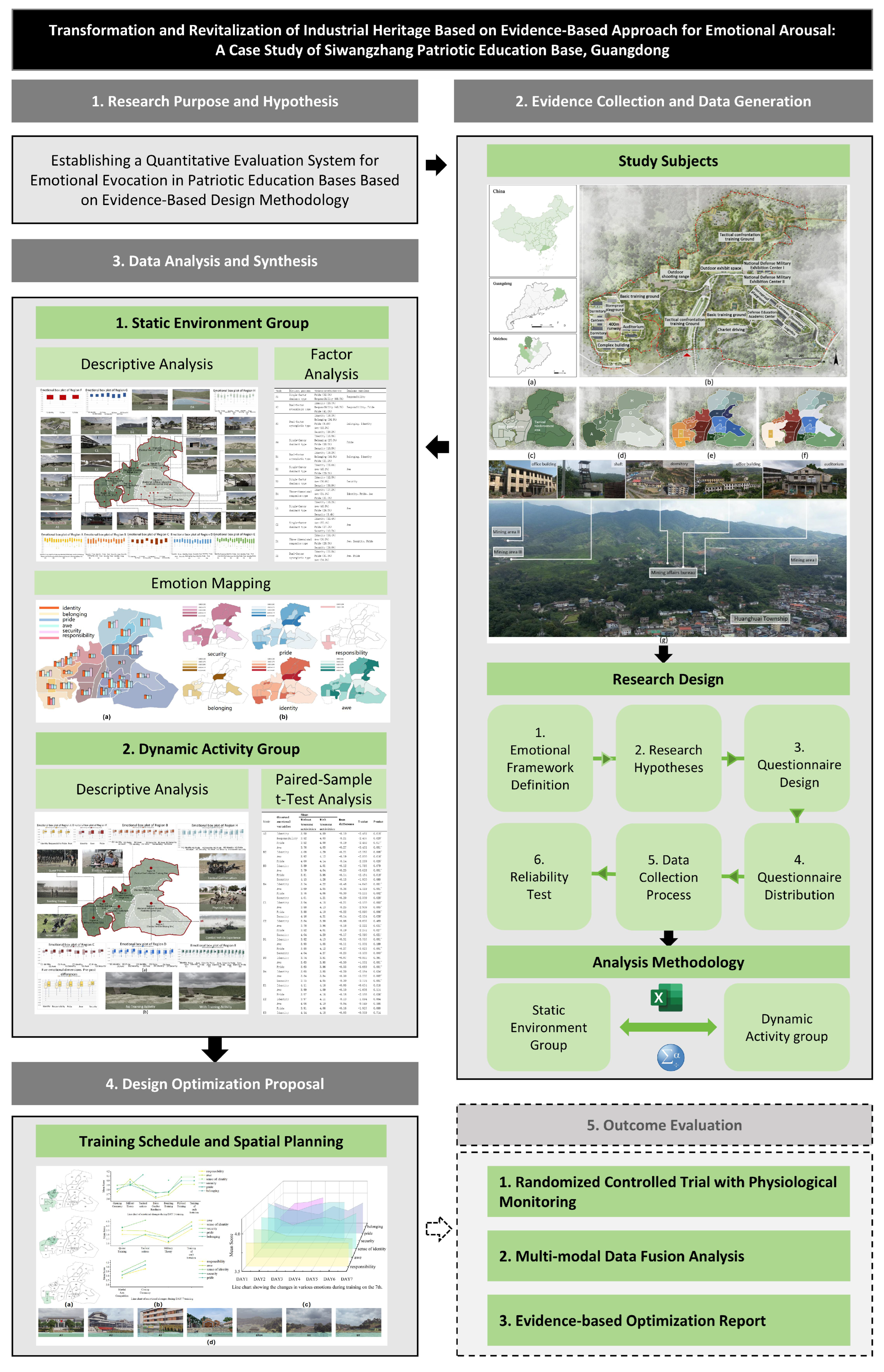
Transformation and Revitalization of Industrial Heritage Based on Evidence-Based Approach for Emotional Arousal: A Case Study of Siwangzhang Patriotic Education Base, Guangdong


Abstract
1. Introduction
2. Literature Review
3. Research Methodology
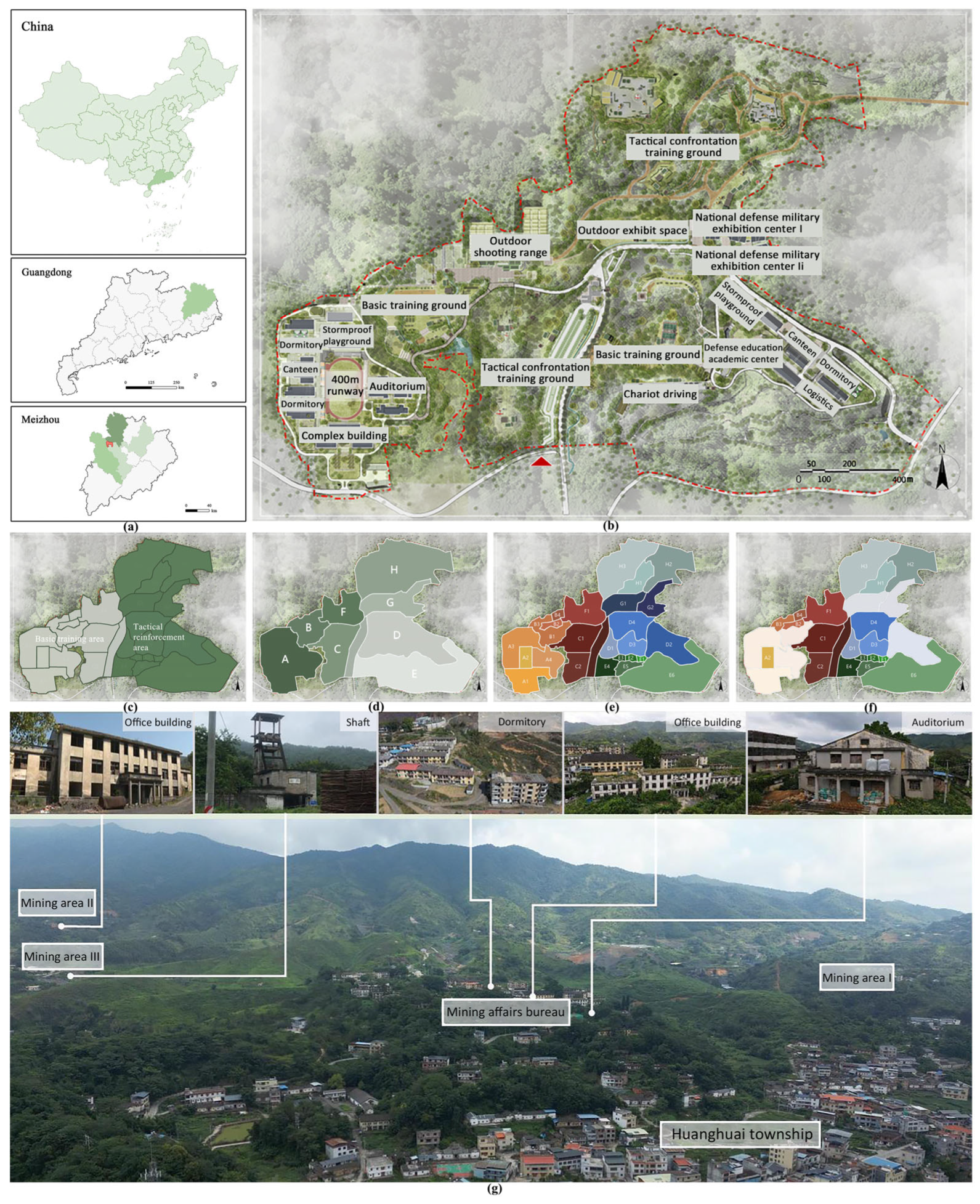
3.1. Study Subjects
3.2. Research Design
3.3. Analysis Methodology
4. Results
4.1. Emotional Characteristics of Spatial Nodes
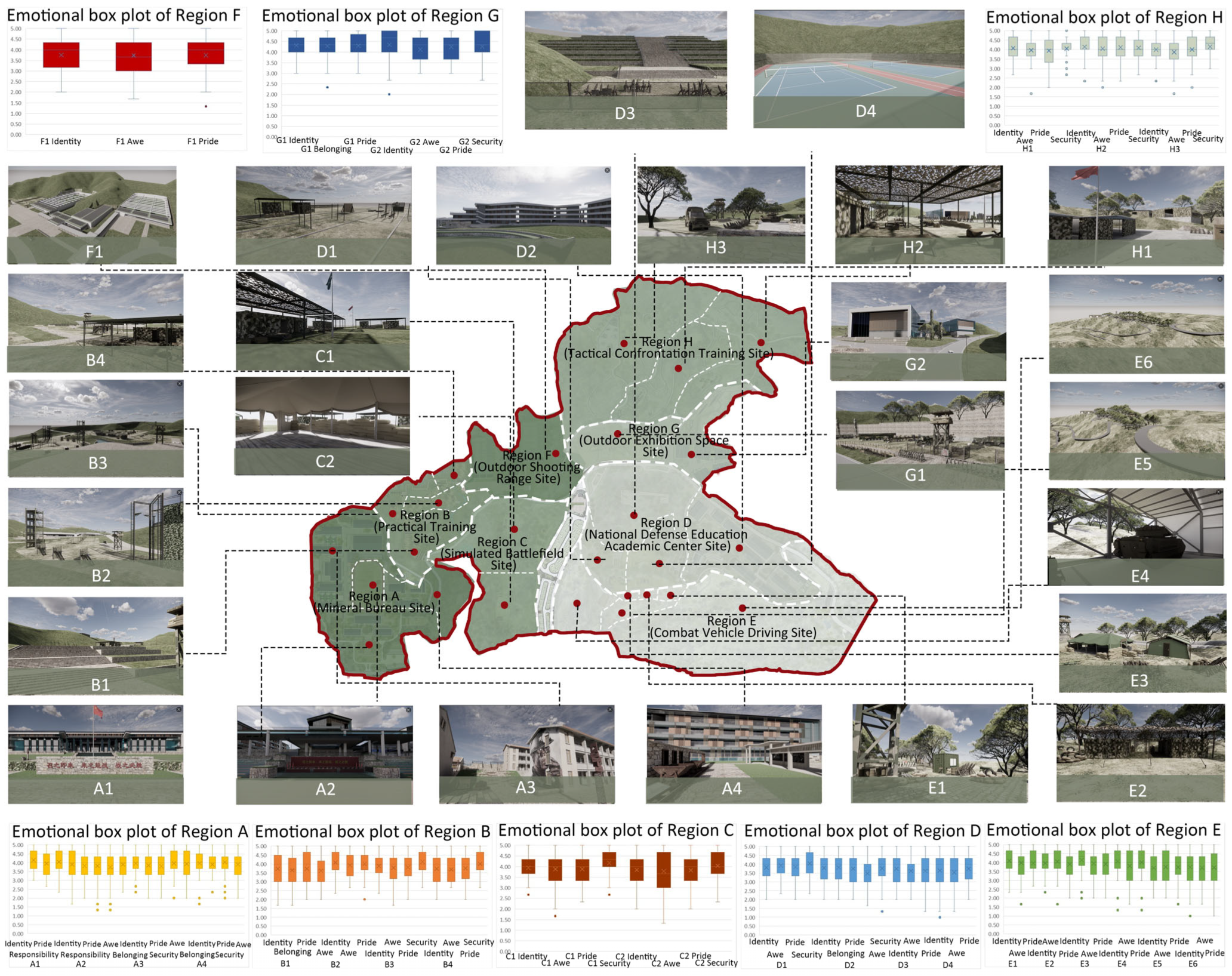
4.1.1. Descriptive Analysis
4.1.2. Factor Analysis
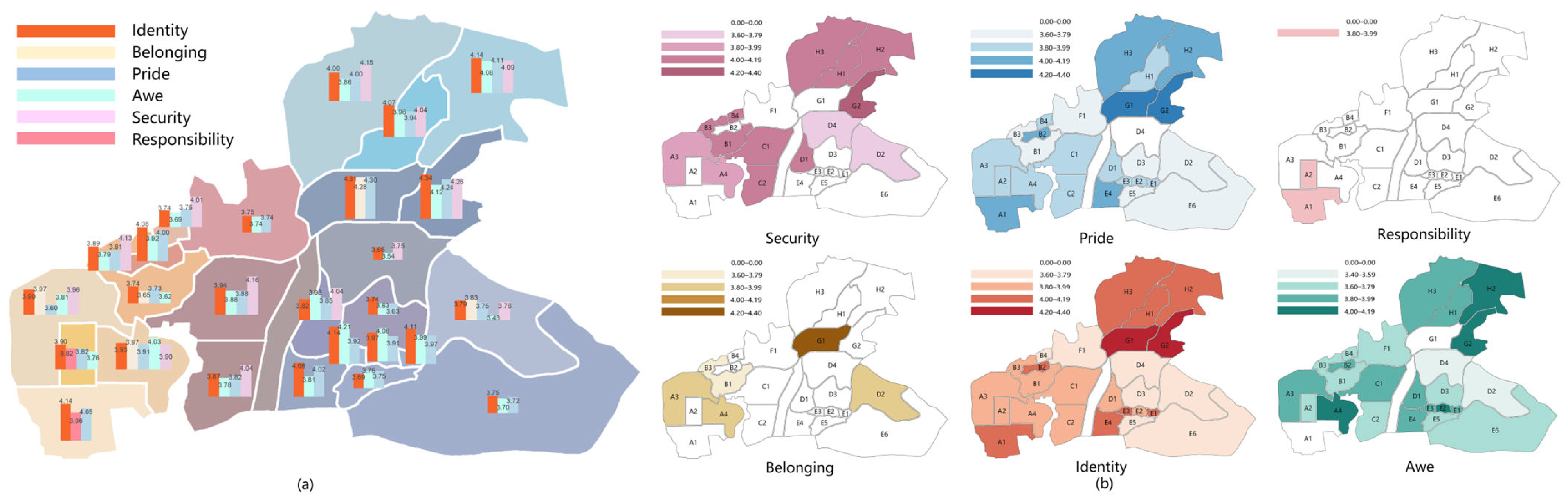
4.1.3. Emotion Mapping
4.2. Activity Intervention Effects
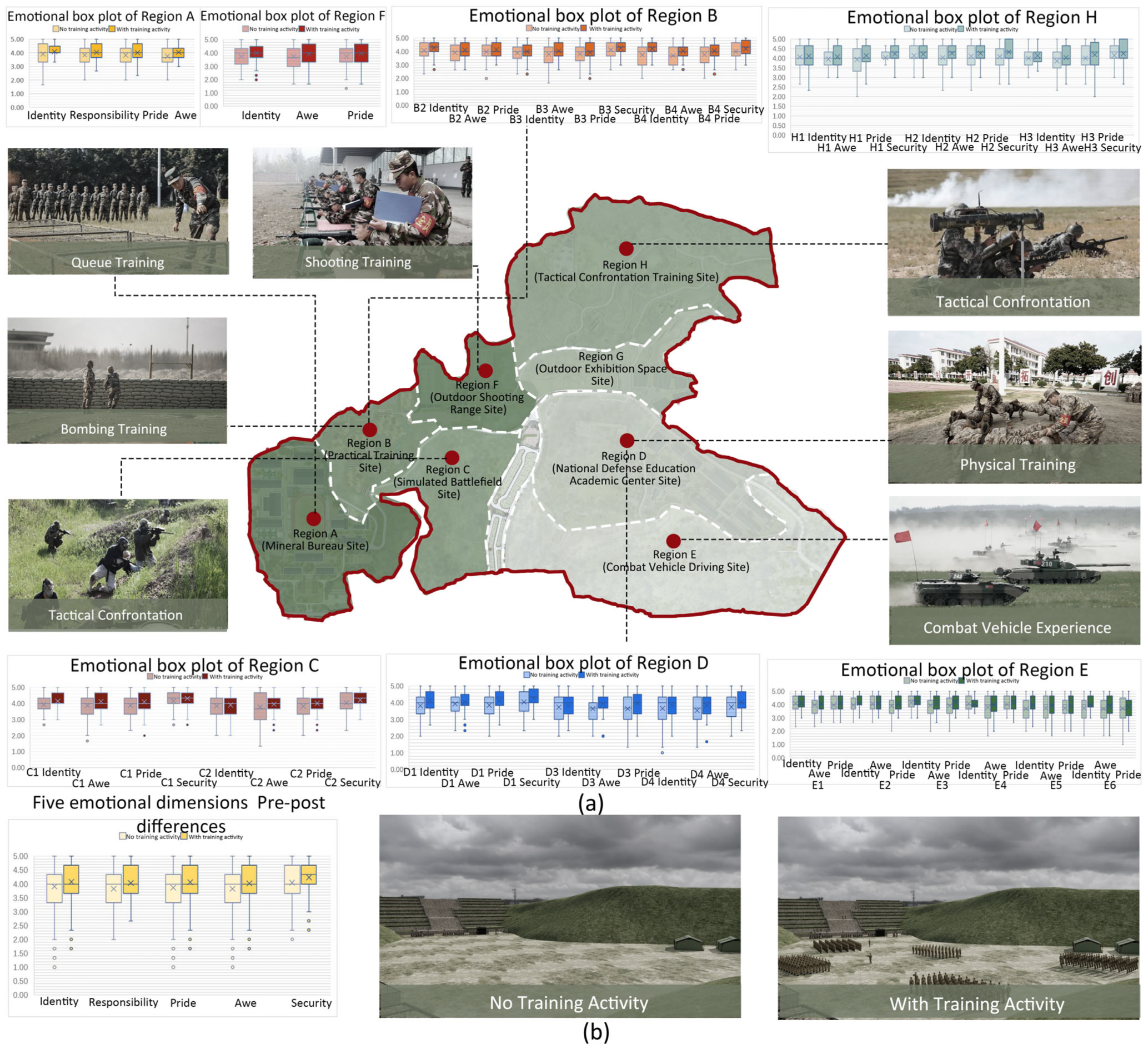
4.2.1. Descriptive Analysis
4.2.2. Paired-Sample t-Test Analysis
5. Discussion
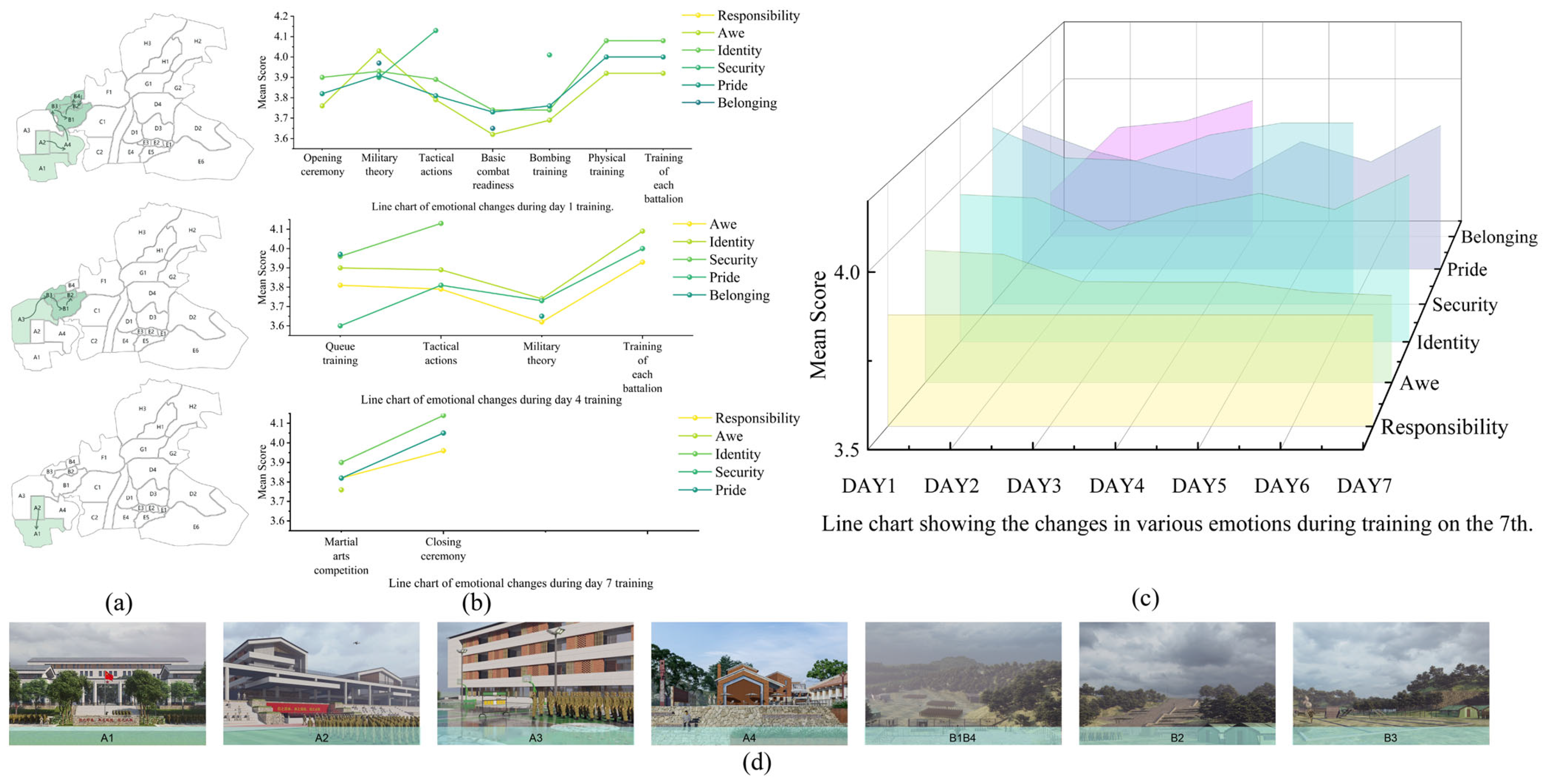
5.1. Training Schedule and Spatial Planning
5.2. Limitations and Future Considerations
6. Conclusions
Author Contributions
Funding
Data Availability Statement
Conflicts of Interest
References
- TICCIH (International Committee for the Conservation of the Industrial Heritage). The Nizhny Tagil Charter for the Industrial Heritage. 2003. Available online: https://www.academia.edu/19750294/TICCIH_s_charter_for_industrial_heritage (accessed on 14 January 2026).
- TICCIH (International Committee for the Conservation of the Industrial Heritage). The Dublin Principles. 2011. Available online: https://www.icomos.org/fr/charte-et-textes-doctrinaux/ (accessed on 14 January 2026).
- Chen, X.; Chen, Y.; Liu, Y. Post-Occupation Evaluation of Industrial Heritage Transformation into a Mixed-Mode Park Within the Context of Urban Renewal: A Case Study of Hebei, China. Buildings 2025, 15, 295. [Google Scholar] [CrossRef]
- Wang, Y.; Hou, B. Development of Post-Industrial Heritage Landscape Design Based on Visual Cognitive Schema Theory: A Case Study of the Shou Gang Industrial Cultural Heritage Site. Buildings 2024, 14, 3194. [Google Scholar] [CrossRef]
- Sun, J.; Zhou, Y. Residents’ place identity at heritage sites: Symbols, memories and space of the “home of Diaolou”. Geogr. Res. 2015, 34, 2381–2394. [Google Scholar]
- Grazuleviciute-Vileniske, I.; Zmejauskaite, D. ‘Archeology’of Hidden Values of Underutilized Historic Industrial Sites in Context of Urban Regeneration and Nature-Based Solutions. Buildings 2025, 15, 205. [Google Scholar] [CrossRef]
- Liu, F.; Zhao, Q.; Yang, Y. An approach to assess the value of industrial heritage based on Dempster–Shafer theory. J. Cult. Herit. 2018, 32, 210–220. [Google Scholar] [CrossRef]
- Zhong, D.; Huang, P.; Xiong, G.; Li, H. Renewal strategies of industrial heritage based on placeness theory: The case of Guangzhou, China. Cities 2024, 155, 105407. [Google Scholar] [CrossRef]
- Bertacchini, E.; Frontuto, V. Economic valuation of industrial heritage: A choice experiment on Shanghai Baosteel industrial site. J. Cult. Herit. 2024, 66, 215–228. [Google Scholar] [CrossRef]
- Hanapi, N.A.; Morrison, T.; Yusof, H. Performance-Based Framework to Prioritize Adaptive Reuse Gallery Design: A Case Study of Tate Modern Towards Architectural and Cultural Engagement along London Riverfront. Int. J. Sustain. Constr. Eng. Technol. 2022, 13, 315–325. [Google Scholar] [CrossRef]
- Ben Ghida, D. Revitalizing urban spaces: Ten key lessons from the “Viaduc des arts” adaptive reuse and placemaking. Front. Archit. Res. 2024, 13, 1095–1112. [Google Scholar] [CrossRef]
- Yang, J.; Huang, Z.; Wu, Z.; Fang, Y. Spatial Distribution Characteristics and Influencing Factors of Industrial Heritage in Kunming, China. Buildings 2025, 15, 1726. [Google Scholar] [CrossRef]
- Lu, X. Adaptive reuse of the industrial built heritage in the Merchant City, Glasgow: The conservation-based planning approach. Int. Plan. Hist. Soc. Proc. 2024, 20, 1023–1036. [Google Scholar]
- Samadzadehyazdi, S.; Ansari, M.; Mahdavinejad, M.; Bemaninan, M. Significance of authenticity: Learning from best practice of adaptive reuse in the industrial heritage of Iran. Int. J. Archit. Herit. 2018, 14, 329–344. [Google Scholar] [CrossRef]
- Hain, V.; Hajtmanek, R. Industrial heritage education and user tracking in virtual reality. In Virtual Reality and Its Application in Education; IntechOpen: London, UK, 2019; Volume 49. [Google Scholar]
- Wang, F.; Sanagustín-Fons, V.; Martínez-Quintana, V. Red Tourism and Youth Education: A Systematic Review of the Literature. Societies 2025, 15, 69. [Google Scholar] [CrossRef]
- Zhou, Q.; Wang, S.; Wang, J. Exploring User Experience in Virtual Industrial Heritage Platforms: Impact of Cultural Identity, Functional Clarity, Scene Interactivity, and Narrative Quality. Buildings 2025, 15, 253. [Google Scholar] [CrossRef]
- Fang, Z.; Yao, J.; Shi, J. The Influence of Environmental Factors, Perception, and Participation on Industrial Heritage Tourism Satisfaction—A Study Based on Multiple Heritages in Shanghai. Buildings 2024, 14, 3508. [Google Scholar] [CrossRef]
- Zhou, H.; Zhang, Q.; Lu, L.; Jiang, Y.; Wu, K. Research on the influence path of red tourism experience on tourists’ well-being: Based on the chain mediating role of tourists’ emotion and national identity. BMC Psychol. 2025, 13, 105. [Google Scholar] [CrossRef]
- Sun, J.; Lv, X. Red heart at dark sites: The production of embodied patriotic ritual in tourism. Tour. Manag. 2025, 106, 104975. [Google Scholar] [CrossRef]
- Li, Y.; Hu, Z. Red tourism in China. J. China Tour. Res. 2008, 4, 156–171. [Google Scholar] [CrossRef]
- Li, Y.; Hu, Z.Y.; Zhang, C.Z. Red tourism: Sustaining communist identity in a rapidly changing China. J. Tour. Cult. Change 2010, 8, 101–119. [Google Scholar] [CrossRef]
- Zhao, S.N. China’s red tourism development. In Handbook on Tourism and China; Huang, S., Chen, G., Eds.; Edward Elgar: Cheltenham, UK, 2020; pp. 231–249. [Google Scholar]
- Zhou, X.; Wong, J.W.C.; Wang, S. Memorable Tourism Experiences in Red Tourism: The Case of Jiangxi, China. Front. Psychol. 2022, 13, 899144. [Google Scholar] [CrossRef]
- Counted, V.; Lee, M.T.; Lomas, T.; Cowden, R.; Allen, K.-A.; Basu, J.; Laidler, D.; Routledge, C.; Seamon, D.; VanderWeele, T.J. Love of place: Conceptual framework and template for measuring the contributory and unitive affection towards a place. Int. J. Intercult. Relat. 2025, 107, 102203. [Google Scholar] [CrossRef]
- Haynes, R.B.; Sackett, D.L.; Richardson, W.S.; William, R.; Ross, L.G. Evidence-based medicine: How to practice & teach EBM. Can. Med. Assoc. J. 1997, 157, 788. [Google Scholar]
- Hamilton, D.K.; Watkins, D.H. Evidence-Based Design for Multiple Building Types; John Wiley & Sons: Hoboken, NJ, USA, 2008. [Google Scholar]
- Barlow, J.; Köberle-Gaiser, M.; Moss, R.; Noble, A. Adaptability and innovation in healthcare facilities. In Lessons from the Past for Future Developments; The Health and Care Infrastructure Research and Innovation Centre: London, UK, 2009. [Google Scholar]
- Ulrich, R.S. View through a window may influence recovery from surgery. Science 1984, 224, 420–421. [Google Scholar] [CrossRef] [PubMed]
- Puccinelli, A. Evidence-Based Design Accreditation and Certification (EDAC). The Center for Health Design. 2010. Available online: https://www.healthdesign.org/certification-outreach/edac (accessed on 14 January 2026).
- Bodryzlova, Y.; Lemieux, A.J.; Dufour, M.; Côté, A.; Lalancette, S.; Crocker, A.G. Hospital design for inpatient psychiatry: A realistic umbrella review. J. Psychiatr. Res. 2024, 178, 94–106. [Google Scholar] [CrossRef]
- Hamilton, D.K.; Gary, J.C.; Scruth, E.; Anderson, H.L.; Cadenhead, C.D.; Oczkowski, S.J.W.; Lau, V.I.; Adler, J.; Bassily-Marcus, A.; Bassin, B. Society of Critical Care Medicine 2024 Guidelines on Adult ICU Design. Crit. Care Med. 2025, 53, e690–e700. [Google Scholar] [CrossRef]
- Pauli, B.; Nilsson, S.; Jansson, P.-A.; Wijk, H.; Alexiou, E.; Lindahl, G.; Berghammer, M.; Degl’Innocenti, A. Literature Review: Evidence-Based Health Outcomes and Perceptions of the Built Environment in Pediatric Hospital Facilities. J. Pediatr. Nurs. 2021, 61, e42–e50. [Google Scholar] [CrossRef]
- Read, J.; Meath, C. A Conceptual Framework for Sustainable Evidence-Based Design for Aligning Therapeutic and Sustainability Outcomes in Healthcare Facilities: A Systematic Literature Review. HERD Health Environ. Res. Des. J. 2024, 18, 86–107. [Google Scholar] [CrossRef]
- Trochelman, K.; Albert, N.; Spence, J.; Murray, T.; Slifcak, E. Patients and Their Families Weigh in on Evidence-Based Hospital Design. Crit. Care Nurse 2012, 32, e1–e10. [Google Scholar] [CrossRef][Green Version]
- Shultz, J.; Jha, R. Using Virtual Reality (VR) Mock-Ups for Evidence-Based Healthcare Facility Design Decisions. Int. J. Environ. Res. Public Health 2021, 18, 11250. [Google Scholar] [CrossRef]
- Charras, K.; Laulier, V.; Varcin, A.; Aquino, J.-P. Designing gardens for people with dementia: Literature review and evidence-based design conceptual frame. Geriatr. Psychol. Neuropsychiatr. Vieil. 2017, 15, 417–424. [Google Scholar] [CrossRef]
- Lin, G.; Yang, Y. The Development, Connotations, and Interests of Research on Landscape Performance Evaluation for Evidence-Based Design. Landsc. Archit. Front. 2020, 8, 74–83. [Google Scholar]
- Vollmer, T.C.; Koppen, G.; Iovița, C.; Schießl, L. Therapeutic Architecture and Temporality: Evidence-Based Design for Long-Stay Facilities for Individuals with Severe Intellectual Disabilities and Challenging Behaviour. Architecture 2024, 4, 541–570. [Google Scholar] [CrossRef]
- Fisher, K. The Biophilic School: A Critical Synthesis of Evidence-Based Systematic Literature Reviews. Architecture 2024, 4, 457–478. [Google Scholar] [CrossRef]
- Davoodi, A.; Johansson, P.; Aries, M. The use of lighting simulation in the evidence-based design process: A case study approach using visual comfort analysis in offices. Build. Simul. 2019, 13, 141–153. [Google Scholar] [CrossRef]
- Ni, J.; Wang, M.; Quek, K. The sources of national pride: Evidence from China and the United States. Nations Natl. 2024, 30, 547–564. [Google Scholar] [CrossRef]
- Gabrielsson, D.; Bohman, A.; Hjerm, M. National identity and democratic trajectories. Ethn. Racial Stud. 2025, 1–23. [Google Scholar] [CrossRef]
- Zhu, Y.; Du, R. Evaluating the impact of urban landscape elements on the sense of security and local belonging-case study: Tongdejie, China. Front. Environ. Sci. 2024, 12, 1340394. [Google Scholar] [CrossRef]
- Xingning City Local Records Office. Natural Resources. 2024. Available online: https://www.xingning.gov.cn/zfjg/xnsdfzbgs/sqgy/wczy/content/post_1509971.html (accessed on 24 December 2025).
- Xingning City Huanghuai Town People’s Government. Lianbo Observation: Xingning Huanghuai—How Did it Transform from a ‘Coal Town’ into a ‘Green Town’? 2023. Available online: https://www.xingning.gov.cn/xzjd/xnshhzrmzf/xwzx/hhdt/content/post_2572265.html (accessed on 24 December 2025).
- Cronbach, L.J. Coefficient alpha and the internal structure of tests. Psychometrika 1951, 16, 297–334. [Google Scholar] [CrossRef]
- Spearman, C. “General Intelligence” Objectively Determined and Measured. In Studies in Individual Differences: The Search for Intelligence; Jenkins, J.J., PatersDon, D.G., Eds.; Appleton-Century-Crofts: New York, NY, USA, 1961. [Google Scholar]
- Pearson, K. LIII. On lines and planes of closest fit to systems of points in space. Lond. Edinb. Dublin Philos. Mag. J. Sci. 1901, 2, 559–572. [Google Scholar] [CrossRef]



| Classification | Activity Type | Total Activity Days | Scheduled Activity Days | Activity Node |
|---|---|---|---|---|
| Mobilization activities | Opening ceremony | 1 | 1 | A1; A2 |
| Closing ceremony | 1 | 7 | A1; A2 | |
| Theoretical activities | Military theory | 3 | 1.2.4 | A3; A4; B1; D2 |
| Exhibition experience | 2 | 2.5 | G1 | |
| Basic combat readiness | 4 | 1.2.3.4 | A3; A4; B1; D2 | |
| Practical training activities | Bombing training | 3 | 1.2.3 | B4; E3 |
| Physical training | 5 | 1.2.3.5.6 | A2; A3; B2; D3 | |
| Shooting training | 3 | 3 | F1 | |
| Queue training | 5 | 2–6 | A2; A3; B3; D3 | |
| Tactical road march | 1 | 4 | no node | |
| Combat vehicle experience | 1 | 3 | E(1.2.4.5.6) | |
| Training of each battalion | 6 | 1–6 | all nodes | |
| Simulated battlefields | Analysis of war cases | 1 | 6 | A3; A4; B1; D2 |
| Tactical actions | 3 | 1.4.5 | B3; D4 | |
| Tactical confrontation | 1 | 6 | C; H | |
| Martial arts competition | 1 | 7 | all nodes |
| Emotional Dimension | Activity Types | Questions |
|---|---|---|
| Identity | Mobilization activities; Theoretical activities; Practical training activities; Simulated battlefields | 1. After visiting the base, how would you evaluate its role in enhancing your sense of identity with China’s developmental achievements? |
| 2. After the visit, how do you assess the base’s effectiveness in strengthening your pride in China’s developmental progress? | ||
| 3. Following your visit, how would you rate the base’s contribution to fostering your patriotic sentiment? | ||
| Pride | Mobilization activities; Theoretical activities; Practical training activities | 1. Following your visit, how would you evaluate its role in enhancing your sense of pride in China’s traditional culture and values? |
| 2. Following your visit, how do you assess the base’s effectiveness in strengthening your pride in China’s future development prospects? | ||
| 3. Following your visit, how would you rate its contribution to fostering your inner sense of honor? | ||
| Awe | Practical training activities; Simulated battlefields | 1. Following your visit, how would you evaluate the base’s effectiveness in evoking your sense of awe toward China’s historical legacy and spiritual traditions? |
| 2. Following your visit, to what extent do you feel it enhanced your awe for China’s historical and cultural heritage? | ||
| 3. Following your visit, how successful was the base in cultivating your feelings of reverence for China’s historical continuity and spiritual inheritance? | ||
| Belonging | Theoretical activities | 1. Following your visit, how would you rate your sense of immersion in the base’s environment? |
| 2. Following your visit, to what extent does the base’s environment make you want to stay longer? | ||
| 3. Following your visit, how well does the base’s environment meet your expectations? | ||
| Responsibility | Mobilization activities | 1. Following your visit, how would you assess the base’s role in strengthening your sense of responsibility to preserve China’s historical and cultural heritage? |
| 2. Following your visit, to what extent has the base enhanced your feeling of responsibility to promote patriotic values in social practice? | ||
| 3. Following your visit, how effectively has the base inspired your determination to contribute to China’s future development? | ||
| Security | Simulated battlefields | 1. Following your visit, how would you evaluate the base’s role in strengthening your confidence in the nation’s ability to safeguard citizen security? |
| 2. Following your visit, to what extent has the base enhanced your trust in China’s defense capabilities and overall security system? | ||
| 3. Following your visit, how effectively has the base improved your sense of personal and environmental safety? |
| Node | Distinct Pattern | Variance Contribution Rate | Dominant Emotions |
|---|---|---|---|
| A1 | Single-factor dominant type | Pride (32.0%) Responsibility (68.0%) | Responsibility |
| A2 | Dual-factor synergistic type | Identity (13.7%) Responsibility (45.3%) Pride (41.0%) | Responsibility, Pride |
| A3 | Dual-factor synergistic type | Identity (30.3%) Belonging (36.8%) Pride (9.4%) Awe (13.3%) Security (10.2%) | Belonging, Identity |
| A4 | Single-factor dominant type | Identity (13.8%) Belonging (27.0%) Pride (35.9%) Security (13.8%) | Pride |
| B1 | Dual-factor synergistic type | Identity (38.2%) Belonging (40.6%) Pride (21.2%) | Belonging, Identity |
| B2 | Single-factor dominant type | Identity (25.6%) Awe (45.1%) Pride (29.3%) | Awe |
| B3 | Single-factor dominant type | Identity (12.5%) Awe (36.6%) Security (50.9%) | Security |
| B4 | Three-dimensional composite type | Identity (37.2%) Awe (31.1%) Pride (31.7%) | Identity, Pride, Awe |
| C1 | Single-factor dominant type | Identity (19.2%) Awe (45.5%) Pride (26.9%) Security (8.4%) | Awe |
| C2 | Single-factor dominant type | Identity (12.4%) Awe (57.4%) Pride (17.5%) Security (12.7%) | Awe |
| D1 | Three-dimensional composite type | Identity (14.4%) Awe (30.5%) Pride (25.3%) Security (30.0%) | Awe, Security, Pride |
| D2 | Dual-factor synergistic type | Identity (22.5%) Pride (31.3%) Awe (34.3%) Security (12.0%) | Awe, Pride |
| D3 | Single-factor dominant type | Identity (8.1%) Awe (31.1%) Pride (60.8%) | Pride |
| D4 | Single-factor dominant type | Awe (23.6%) Security (76.4%) | Security |
| E1 | Single-factor dominant type | Identity (26.4%) Awe (19.8%) Pride (53.8%) | Pride |
| E2 | Single-factor dominant type | Identity (49.8%) Awe (20.0%) Pride (30.2%) | Identity |
| E3 | Single-factor dominant type | Identity (61.8%) Pride (38.2%) | Identity |
| E4 | Dual-factor synergistic type | Identity (52.3%) Pride (47.7%) | Identity, Pride |
| E5 | Single-factor dominant type | Identity (25.6%) Awe (56.5%) Pride (17.9%) | Awe |
| E6 | Single-factor dominant type | Identity (78.5%) Pride (21.5%) | Identity |
| F1 | Single-factor dominant type | Identity (34.7%) Pride (65.3%) | Pride |
| G1 | Single-factor dominant type | Identity (100%) | Identity |
| G2 | Three-dimensional composite type | Identity (28.1%) Awe (20.5%) Pride (26.8%) Security (24.6%) | Identity, Pride, Security |
| H1 | Dual-factor synergistic type | Identity (43.7%) Pride (38.5%) Security (17.8%) | Identity, Pride |
| H2 | Single-factor dominant type | Identity (29.9%) Awe (49.7%) Pride (20.4%) | Awe |
| H3 | Single-factor dominant type | Identity (17.1%) Awe (48.0%) Pride (34.9%) | Awe |
| Node | Observed Emotional Variables | Mean | Mean Difference | T-Value | p-Value | |
|---|---|---|---|---|---|---|
| Without Training Activities | with Training Activities | |||||
| A2 | Identity | 3.90 | 4.09 | −0.19 | −2.451 | 0.018 * |
| Responsibility | 3.82 | 4.03 | −0.21 | −2.407 | 0.020 * | |
| Pride | 3.82 | 4.00 | −0.19 | −2.468 | 0.017 * | |
| Awe | 3.76 | 4.03 | −0.27 | −3.431 | 0.001 ** | |
| B2 | Identity | 4.08 | 4.29 | −0.21 | −2.767 | 0.008 ** |
| Awe | 3.92 | 4.12 | −0.19 | −2.500 | 0.016 * | |
| Pride | 4.00 | 4.14 | −0.14 | −2.289 | 0.026 * | |
| B3 | Identity | 3.89 | 4.01 | −0.12 | −1.793 | 0.079 |
| Awe | 3.79 | 4.04 | −0.25 | −3.628 | 0.001 ** | |
| Pride | 3.81 | 3.95 | −0.14 | −2.454 | 0.018 * | |
| Security | 4.13 | 4.26 | −0.13 | −1.920 | 0.060 | |
| B4 | Identity | 3.74 | 4.22 | −0.48 | −4.649 | 0.001 ** |
| Awe | 3.69 | 4.05 | −0.36 | −4.119 | 0.001 ** | |
| Pride | 3.76 | 4.06 | −0.30 | −3.233 | 0.002 ** | |
| Security | 4.01 | 4.21 | −0.20 | −2.309 | 0.025 * | |
| C1 | Identity | 3.94 | 4.15 | −0.21 | −3.139 | 0.003 ** |
| Awe | 3.88 | 4.13 | −0.25 | −2.909 | 0.005 ** | |
| Pride | 3.88 | 4.10 | −0.22 | −2.890 | 0.006 ** | |
| Security | 4.16 | 4.31 | −0.14 | −2.124 | 0.038 * | |
| C2 | Identity | 3.84 | 3.90 | −0.06 | −0.697 | 0.489 |
| Awe | 3.78 | 3.96 | −0.18 | −2.222 | 0.031 * | |
| Pride | 3.82 | 4.01 | −0.19 | −2.272 | 0.027 * | |
| Security | 4.04 | 4.20 | −0.17 | −2.390 | 0.021 * | |
| D1 | Identity | 3.82 | 4.13 | −0.31 | −3.767 | 0.001 ** |
| Awe | 3.93 | 4.03 | −0.11 | −1.301 | 0.199 | |
| Pride | 3.85 | 4.12 | −0.27 | −3.823 | 0.001 ** | |
| Security | 4.04 | 4.27 | −0.23 | −3.109 | 0.003 ** | |
| D3 | Identity | 3.74 | 3.81 | −0.07 | −0.865 | 0.391 |
| Awe | 3.63 | 3.93 | −0.30 | −4.331 | 0.001 ** | |
| Pride | 3.63 | 3.96 | −0.33 | −3.689 | 0.001 ** | |
| D4 | Identity | 3.65 | 3.85 | −0.20 | −2.184 | 0.034 * |
| Awe | 3.54 | 3.84 | −0.30 | −3.292 | 0.002 ** | |
| Security | 3.75 | 4.05 | −0.30 | −3.776 | 0.001 ** | |
| E1 | Identity | 4.11 | 4.16 | −0.05 | −0.654 | 0.516 |
| Awe | 3.99 | 4.09 | −0.10 | −1.608 | 0.114 | |
| Pride | 3.97 | 4.16 | −0.18 | −2.158 | 0.036 * | |
| E2 | Identity | 3.97 | 4.11 | −0.13 | −1.894 | 0.064 |
| Awe | 4.06 | 4.10 | −0.04 | −0.549 | 0.586 | |
| Pride | 3.91 | 4.06 | −0.16 | −1.927 | 0.060 | |
| E3 | Identity | 4.14 | 4.18 | −0.03 | −0.369 | 0.714 |
| Awe | 3.95 | 4.08 | −0.13 | −1.957 | 0.056 | |
| Pride | 3.92 | 4.15 | −0.23 | −3.176 | 0.003 ** | |
| E4 | Identity | 4.08 | 4.05 | 0.03 | 0.455 | 0.651 |
| Awe | 3.81 | 4.01 | −0.20 | −1.919 | 0.060 | |
| Pride | 4.02 | 4.16 | −0.14 | −1.712 | 0.093 | |
| E5 | Identity | 3.69 | 3.97 | −0.28 | −3.537 | 0.001 ** |
| Awe | 3.75 | 3.94 | −0.18 | −1.813 | 0.076 | |
| Pride | 3.75 | 3.93 | −0.18 | −2.146 | 0.037 * | |
| E6 | Identity | 3.75 | 3.98 | −0.23 | −2.416 | 0.019 * |
| Awe | 3.70 | 3.89 | −0.19 | −2.406 | 0.020 * | |
| Pride | 3.72 | 3.81 | −0.09 | −0.956 | 0.343 | |
| F1 | Identity | 3.75 | 4.01 | −0.26 | −3.033 | 0.004 ** |
| Awe | 3.74 | 3.92 | −0.18 | −2.222 | 0.031 * | |
| Pride | 3.74 | 3.97 | −0.23 | −2.610 | 0.012 * | |
| H1 | Identity | 4.07 | 4.12 | −0.05 | −0.688 | 0.495 |
| Awe | 3.96 | 4.08 | −0.12 | −1.689 | 0.097 | |
| Pride | 3.94 | 4.14 | −0.20 | −2.173 | 0.034 * | |
| Security | 4.04 | 4.23 | −0.18 | −2.589 | 0.012 * | |
| H2 | Identity | 4.14 | 4.21 | −0.08 | −1.302 | 0.198 |
| Awe | 4.04 | 4.26 | −0.21 | −2.785 | 0.007 ** | |
| Pride | 4.11 | 4.27 | −0.16 | −2.538 | 0.014 * | |
| Security | 4.09 | 4.33 | −0.24 | −3.454 | 0.001 ** | |
| H3 | Identity | 4.00 | 4.14 | −0.14 | −1.890 | 0.064 |
| Awe | 3.86 | 4.04 | −0.18 | −2.352 | 0.022 * | |
| Pride | 4.00 | 4.19 | −0.19 | −1.964 | 0.055 | |
| Security | 4.15 | 4.25 | −0.10 | −1.477 | 0.146 | |
Disclaimer/Publisher’s Note: The statements, opinions and data contained in all publications are solely those of the individual author(s) and contributor(s) and not of MDPI and/or the editor(s). MDPI and/or the editor(s) disclaim responsibility for any injury to people or property resulting from any ideas, methods, instructions or products referred to in the content. |
© 2026 by the authors. Licensee MDPI, Basel, Switzerland. This article is an open access article distributed under the terms and conditions of the Creative Commons Attribution (CC BY) license.
Share and Cite
Huang, X.; He, L.; Zhang, Q.; Berk, H.; Li, Y.; Xue, T.; Li, X. Transformation and Revitalization of Industrial Heritage Based on Evidence-Based Approach for Emotional Arousal: A Case Study of Siwangzhang Patriotic Education Base, Guangdong. Buildings 2026, 16, 422. https://doi.org/10.3390/buildings16020422
Huang X, He L, Zhang Q, Berk H, Li Y, Xue T, Li X. Transformation and Revitalization of Industrial Heritage Based on Evidence-Based Approach for Emotional Arousal: A Case Study of Siwangzhang Patriotic Education Base, Guangdong. Buildings. 2026; 16(2):422. https://doi.org/10.3390/buildings16020422
Chicago/Turabian StyleHuang, Xin, Long He, Qiming Zhang, Huxtar Berk, Yang Li, Tian Xue, and Xin Li. 2026. "Transformation and Revitalization of Industrial Heritage Based on Evidence-Based Approach for Emotional Arousal: A Case Study of Siwangzhang Patriotic Education Base, Guangdong" Buildings 16, no. 2: 422. https://doi.org/10.3390/buildings16020422
APA StyleHuang, X., He, L., Zhang, Q., Berk, H., Li, Y., Xue, T., & Li, X. (2026). Transformation and Revitalization of Industrial Heritage Based on Evidence-Based Approach for Emotional Arousal: A Case Study of Siwangzhang Patriotic Education Base, Guangdong. Buildings, 16(2), 422. https://doi.org/10.3390/buildings16020422