Article

Study on Mechanical and Fatigue Behavior of Concrete Beams Prestressed with High Strength Aluminum Alloy Bars

School of Civil Engineering, Chang’an University, Xi’an 710061, China
*
Author to whom correspondence should be addressed.
Buildings 2026, 16(7), 1339; https://doi.org/10.3390/buildings16071339
Submission received: 3 March 2026 / Revised: 21 March 2026 / Accepted: 26 March 2026 / Published: 27 March 2026
(This article belongs to the Topic Low-Carbon Materials and Green Construction)

Abstract

The corrosion of prestressed tendons in concrete structures remains a major durability concern, especially for post-tensioned members exposed to aggressive environments. High-strength aluminum alloy (AA) bars exhibit favorable characteristics such as corrosion resistance, low density, and high ductility and may therefore provide an alternative or supplementary prestressing material in durability-oriented structural design. In this study, a bonded post-tensioned T-shaped concrete beam with hybrid prestressing combining prestressed steel (PS) strands and 7075 AA bars was investigated. A refined finite element model was developed by considering the bond-slip relationship between the AA tendons and grout inside corrugated tubes. The flexural behavior of the beam was analyzed through a combination of finite element simulation and sectional theoretical analysis. In addition, a fatigue-life assessment framework was established based on vehicle fatigue loads and material fatigue constitutive models, and the fatigue performance of the proposed hybrid beams was compared with that of conventional prestressed concrete beams. The theoretical predictions agreed reasonably well with the numerical results. Results indicated that partial replacement of PS strands with corrosion-resistant AA bars could alter the governing fatigue failure mode and improve the fatigue durability of prestressed beams under corrosive conditions. These findings highlight the potential of hybrid AA–PS prestressing as a durability-oriented strategy for concrete beams in corrosive environments.

1. Introduction

Over the past several decades, the impact of complex and variable environmental conditions on the structural durability of prestressed concrete bridges has become increasingly evident. In many regions, limited maintenance budgets and evolving environmental challenges have underscored the need for careful design and upkeep. Prestressed concrete bridges operating in corrosive environments face significant issues, with the corrosion of prestressed steel tendons being particularly prominent. Corrosion leads to a degradation in the performance of these bridges and may even result in structural damage [1,2]. In a statistical analysis of 242 cases of PS tendon corrosion damage, Podolny [3] found that post-tensioned PS tendon corrosion damage accounted for 1/3 of the cases. Therefore, the corrosion problem of PS tendons in post-tensioned prestressed concrete bridges cannot be ignored. Uneven corrosion occurs in tendons in aggressive environments, which leads to the degradation of mechanical properties [4]. The corrosion of PS tendons often causes the structure to undergo brittle fracture without warning. Many studies have focused on the static bending performance of prestressed concrete beams with corroded PS tendons [1,5,6]. However, prestressed concrete bridges often endure fatigue loads caused by high-frequency vehicle traffic during service. In recent years, the fatigue performance of corroded PS tendons and prestressed concrete beams has been systematically studied [7,8]. It is concluded that failure always begins with the fatigue fracture of the PS tendons, and the fatigue life significantly decreases as corrosion is aggravated [9,10]. Experimental studies under constant- and variable-amplitude loading have also shown that the fatigue response and failure evolution of prestressed concrete beams are sensitive to load spectrum and tendon condition [11]. Recent review work has also highlighted that corrosion of prestressing tendons remains one of the key durability threats to prestressed concrete (PC) beams and bridge structures, particularly in relation to flexural performance, residual capacity, and long-term serviceability [12]. In parallel with the development of durable prestressing strategies, recent studies have also emphasized the importance of sustainable concrete materials and durability-oriented material optimization in structural engineering [13,14]. Fiber-reinforced polymers (FRPs) have advantages such as lightness, high strength, and corrosion resistance, making them an effective solution to problems caused by corrosion. There have been many studies on FRP reinforced concrete beams [15,16,17]. Nevertheless, the transverse thermal expansion coefficient of FRP bars is significantly different from that of concrete [18]. Thermal stress may cause splitting cracks and eventually degrade the bond between the concrete and its reinforcing bars, reducing the durability and serviceability of concrete structures [19].
Owing to their excellent comprehensive physical and chemical properties such as low weight, high specific strength, and corrosion resistance, aluminum alloys (AAs) have been widely used for structural reinforcement. Stiffened AA plates have been used to strengthen reinforced concrete beams against bending [20]. Through experimental studies on the shear performance of reinforced concrete beams strengthened externally with AA plates, the feasibility of using AA plate-strengthened concrete members has been verified [21,22]. Some recent studies have attempted to use AA bars in the reinforcement of concrete structures [23,24,25,26]. A series of experimental studies and theoretical analyses were performed on the bending and seismic performance of concrete components strengthened with NSM 7075 AA bars [27,28,29]. A four-point load test of five reinforced concrete beams internally prestressed with straight unbonded AA tendons was conducted [30], and the feasibility of using AAs as prestressing tendons was verified. Therefore, it is practical to use the corrosion-resistant 7075 AAs as prestressing tendons for post-tensioned prestressed concrete beams. More broadly, recent review studies have confirmed the growing interest in aluminum alloy materials in structural engineering and highlighted their potential in aluminum-alloy–concrete composite applications, while also pointing out that structural applications involving prestressed concrete members remain relatively limited [31]. Unfortunately, to date, there have been few reports on the mechanical behavior of concrete structures with 7075 AA prestressing tendons.
Given that AA offers significantly superior corrosion resistance compared to steel materials (such as PS strands) but possesses a relatively lower elastic modulus (approximately one-third that of steel), the direct use of AA tendons may lead to reduced flexural stiffness and increased service deflection. For this reason, a hybrid prestressing strategy combining AA bars and PS strands is adopted in this study to balance durability enhancement and serviceability requirements. This strategy aims to combine corrosion-resistant AA bars with high-strength PS strands, thereby fully leveraging the anti-corrosion advantages of AA while effectively maintaining the stiffness and load-bearing capacity of the prestressed concrete beams. Furthermore, all prestressing tendons are implemented using a post-tensioned bonded technique, which ensures robust bonding between the tendons and the surrounding grout. This technique not only enhances stress transfer efficiency but also significantly improves the protection level of critical reinforcement in aggressive environments, thereby improving the long-term durability of the overall structure.
Although previous studies have demonstrated the feasibility of using AA bars in strengthening systems and have preliminarily explored the use of AA tendons in prestressed members, the current understanding remains limited. Most existing studies focus on AA bars used for strengthening or unbonded prestressing applications, whereas the structural behavior of bonded post-tensioned hybrid AA–PS systems has not been sufficiently investigated. In addition, corrosion-resistant alternatives such as FRP and AA have been studied from different perspectives, but the combined use of AA bars and conventional PS strands in a bonded prestressing configuration has rarely been examined in terms of flexural response, failure mode evolution, and fatigue behavior. Limited attention has also been paid to the fatigue-life prediction and fatigue-governing failure mode of prestressed concrete beams incorporating AA tendons, especially when the bond-slip effect of the AA tendon–grout interface is considered [10,32].
To address the above gaps, this study investigates a bonded post-tensioned hybrid prestressing system for concrete T-beams using 7075 high-strength AA bars together with PS strands. By considering the bond-slip behavior between AA tendons and grout, a refined finite element model (FEM) and a corresponding theoretical framework are established to evaluate the flexural response and fatigue performance of the proposed beam system. Representative vehicle fatigue loads are defined based on regional traffic data, and the fatigue life of the prestressed concrete beams is subsequently assessed. Through this integrated analysis, the influence of replacing corrosion-vulnerable PS tendons with corrosion-resistant AA tendons on the fatigue-governing failure mode and predicted fatigue life is clarified, thereby providing a mechanics-based reference for the durability-oriented design of prestressed concrete beams.

2. Numerical Simulations of the Prestressed Beam

2.1. Design of Prestressed Concrete Beam

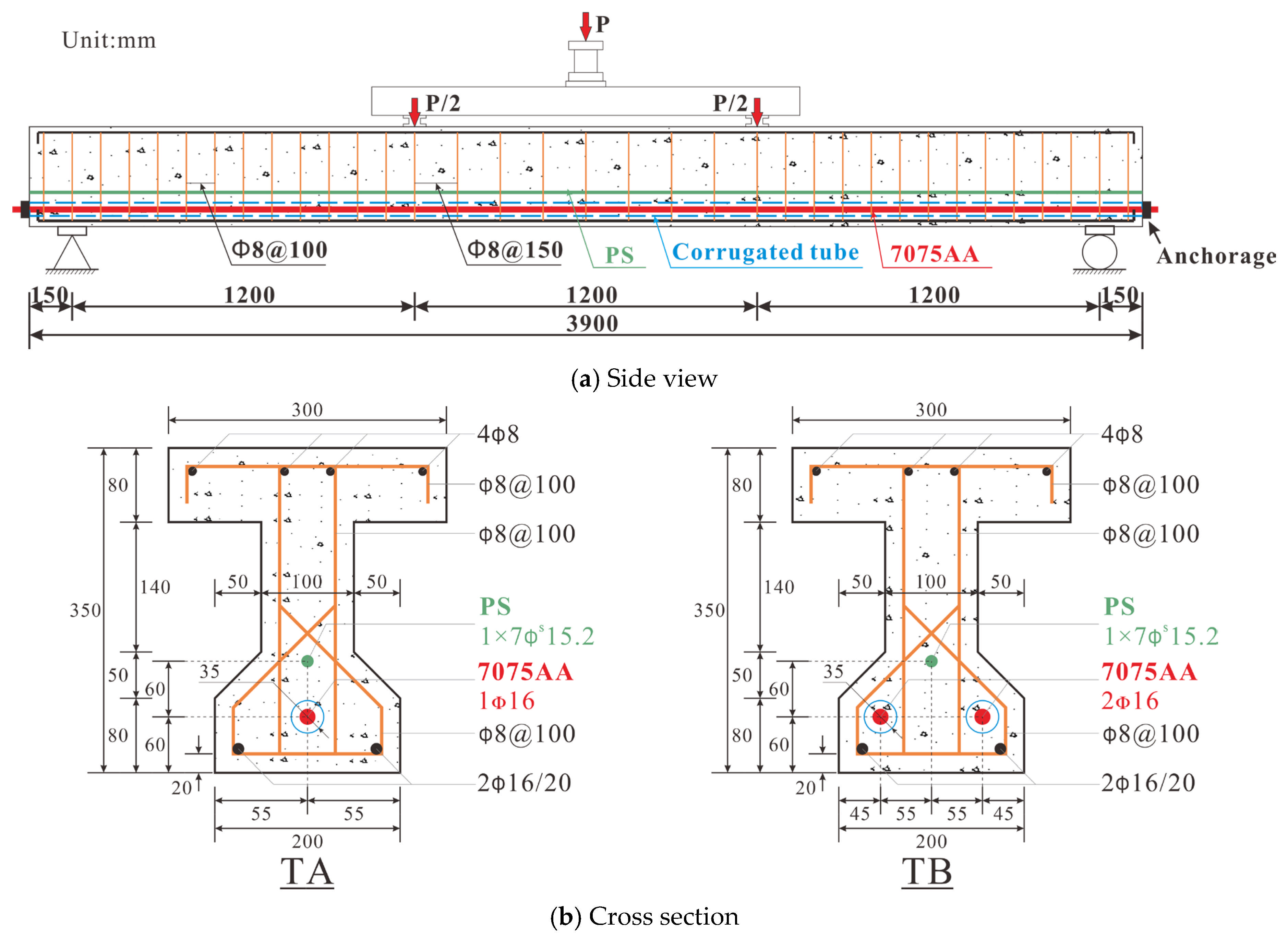
A novel T-shaped concrete beam prestressed with AA bars was designed at a 1:5 model scale, corresponding to a 20 m simply supported beam, as illustrated in Figure 1. To better use the excellent corrosion resistance of the AA bars, they were positioned near the tensile surface of the outer beam, while a more corrosion-prone PS strand was placed with a higher concrete cover to ensure higher protection against corrosion.
In this study, three critical parameters are examined: the partial prestress ratio (PPR), the combined reinforcement index (CRI), and the non-prestressing tensile reinforcement index (ω) [33]. Table 1 provides the specific formulas for each parameter, where Aaa and Aps are the areas of the AA bars and PS strands, respectively; faa,pe and fps,pe are the effective prestresses applied to the AA bars and PS strands, respectively; As is the total area of the tensile steel bars; fy is the yield stress of the tensile steel bars; b is the flange width of the beam; daa and dps are the distances from the centroid of the AA bars and PS strands to the edge of the compression zone, respectively; fc’ is the concrete cylinder compressive strength; and ds is the distance from the centroid of the tensile steel reinforcement to the edge of the compression zone.
The selected parameter ranges were intended to represent realistic design variations for medium-span post-tensioned concrete bridge beams rather than arbitrary numerical cases. The beam specimens were established at a 1:5 scale corresponding to a 20 m simply supported beam, and the chosen combinations of PPR, CRI, and ω were used to reflect practical variations in prestress level, hybrid tendon contribution, and non-prestressed tensile reinforcement ratio. In this way, the six beam cases were designed to cover representative ranges from relatively low to relatively high prestressing contribution and tensile reinforcement demand so that their influence on service-stage stiffness, cracking resistance, flexural capacity, and failure mode could be examined in a comparative manner.
From a design perspective, the results are not intended to provide direct code-based design limits, but they do offer useful qualitative guidance. Increasing effective prestress is beneficial for improving decompression load, cracking load, and service-stage stiffness, whereas increasing the non-prestressed tensile reinforcement ratio is more effective for enhancing yield and ultimate capacity. However, excessively high reinforcement demand, as illustrated by specimen TB-3, may shift the failure mode toward concrete crushing before yielding of the tensile reinforcement, which is undesirable in practical bridge design.
Figure 1. Details of the specimens.
Buildings 16 01339 g001
Table 1. Test matrix.
Specimen IDTensile Steel Tensile BarsStress LevelPPRCRIω
AA Bars
faa,pe/MPa
% of faa,puPS Strands
fps,pe/MPa
% of fps,pu A a a f aa , pe + A p s f p s , pe A aa f aa , pe + A p s f p s , pe + A s f y A aa f aa , pe b d aa f   c + A p s f p s , pe b d p s f   c + A s f y b d s f   c A s f y b d s f   c
TA-12ϕ161ϕ16265401395750.55380.24440.0807
TA-22ϕ16400610.57930.25830.0807
TA-32ϕ20400610.46750.30980.1282
TB-12ϕ162ϕ16400611116600.56750.24630.0807
TB-22ϕ16400611395750.64010.29940.0807
TB-32ϕ20400610.53140.35090.1282

2.2. Material Constitutive Relationship

(1)
7075 AA Bar
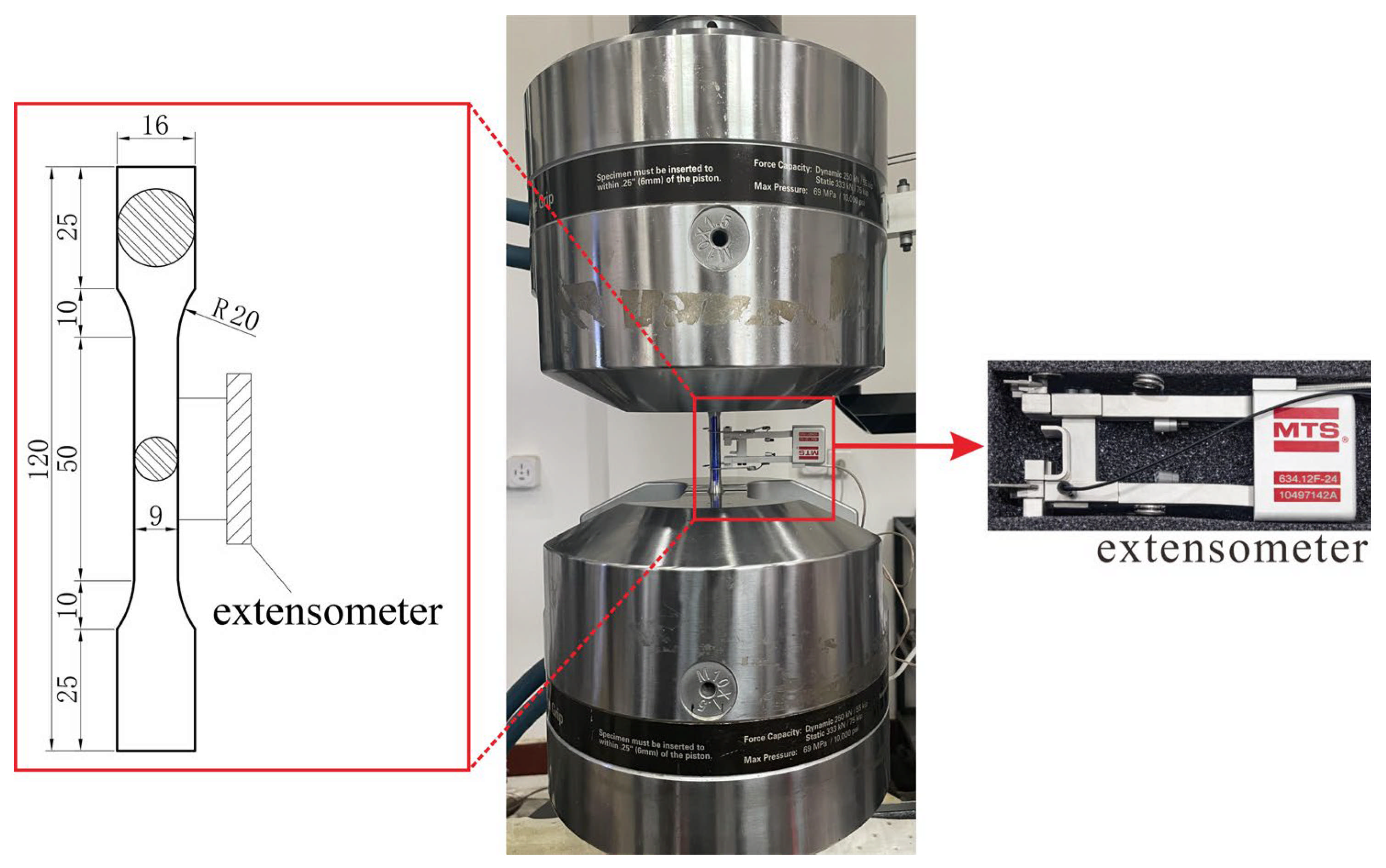
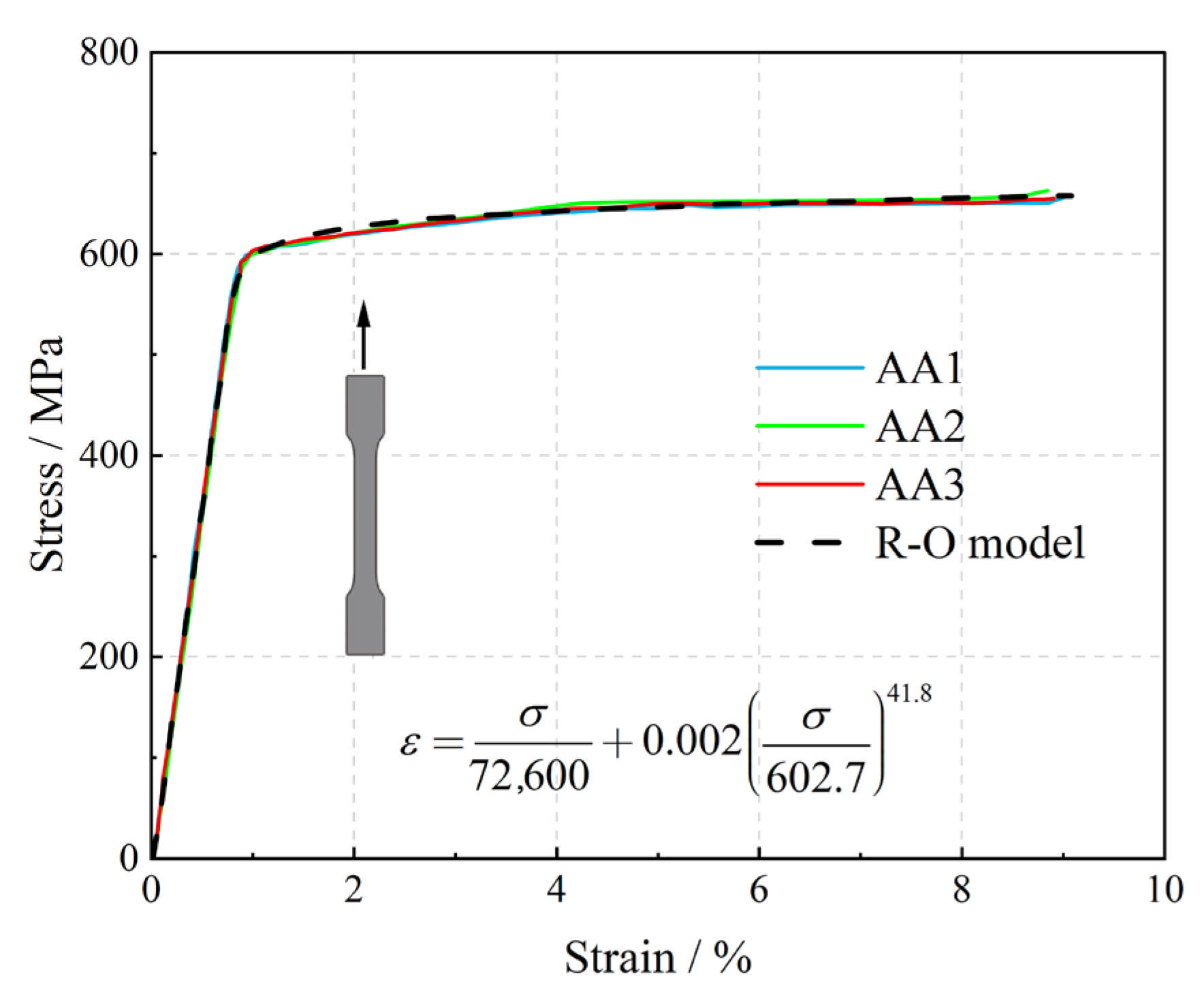
Uniaxial tensile tests were conducted on three AA specimens using a hydraulic servo testing system (MTS 370.25) at a loading rate of 0.0005 s−1, as depicted in Figure 2. The specimens, adhering to Chinese standards [34], measured 120 mm in total length, with a 50 mm gauge length, an initial diameter of 16 mm, and a measured diameter of 9 mm. Strain measurements were taken using an MTS 634.12F-24 extensometer with a 25 mm gauge length. The resulting stress–strain curves are presented in Figure 3. The average nominal yield strength (f0.2) was determined to be 602.7 MPa, with an average ultimate strength of 659.2 MPa and an average elongation at break of 9.03%, indicating excellent ductility. From the stress–strain data of the 7075 AA bars, the average elastic modulus was calculated to be 72.6 GPa.
Figure 2. Test setup of loading device.
Buildings 16 01339 g002
The Ramberg–Osgood (R–O) constitutive model [35] is widely used to predict the mechanical behavior of AA materials. The general expression is as follows:
ε = σ E + 0.002 σ f 0.2 n
where E is the elastic modulus of the AA; n is the degree of strain hardening in the inelastic region, which can be obtained through least-squares fitting; and f0.2 corresponds to the stress at a non-proportional extension of 0.2%.
In Figure 3, the experimental stress–strain curves are compared with those of the R–O model. Although the R–O model slightly overestimated the stress at the inflection point, the overall fit was good, confirming the applicability of the model to AA bars.
Figure 3. Comparison between the R–O model and test results.
Buildings 16 01339 g003
(2)
Concrete
The cubic compressive strength of the concrete was determined as 50 MPa, whose cylinder compressive strength fc’ was 40 MPa. The compressive constitutive relation of the concrete is given by Equation (2), as recommended in the current Chinese design code (GB50010-2010) [36].
σ c = ρ c n E ε c n 1 + ε c / ε c , r n ε c ε c , r f c ε c / ε c , r α c ε c / ε c , r 1 2 + ε c / ε c , r   ε c > ε c , r
where σc and εc are the compressive stress and compressive strain of concrete, respectively; fc and εc,r are the concrete compressive strength and corresponding strain, respectively; and αc is the parameter related to the descending part.
The tensile constitutive relation of concrete can be expressed as follows:
σ t = 1.2 0.2 ( ε t ε t , r ) 5 f t ε t , r ε t ε t ε t , r 1 α t ( ε t ε t , r 1 ) 1.7 + ( ε t ε t , r ) f t ε t , r ε t ε t > ε t , r
where σt and εt are the tensile stress and tensile strain of concrete, respectively; ft and εt,r are the concrete tensile strength and corresponding strain, respectively; and αt is the parameter related to the descending part.
A concrete damage plasticity (CDP) model was used to simulate the properties of concrete using ABAQUS 2022. The relevant parameters for the CDP model are listed in Table 2.
Table 2. Parameters of CDP model.
Parametersψeσb0/σc0Kcν
Value300.11.160.6670.001
Note: ψ is the dilation angle, e is the plastic potential eccentricity, σb0/σc0 is the ratio of the biaxial compressive strength to the uniaxial compressive strength ratio, Kc is the yielding surface shape coefficient, and ν is the viscosity parameter.
(3)
Reinforcement
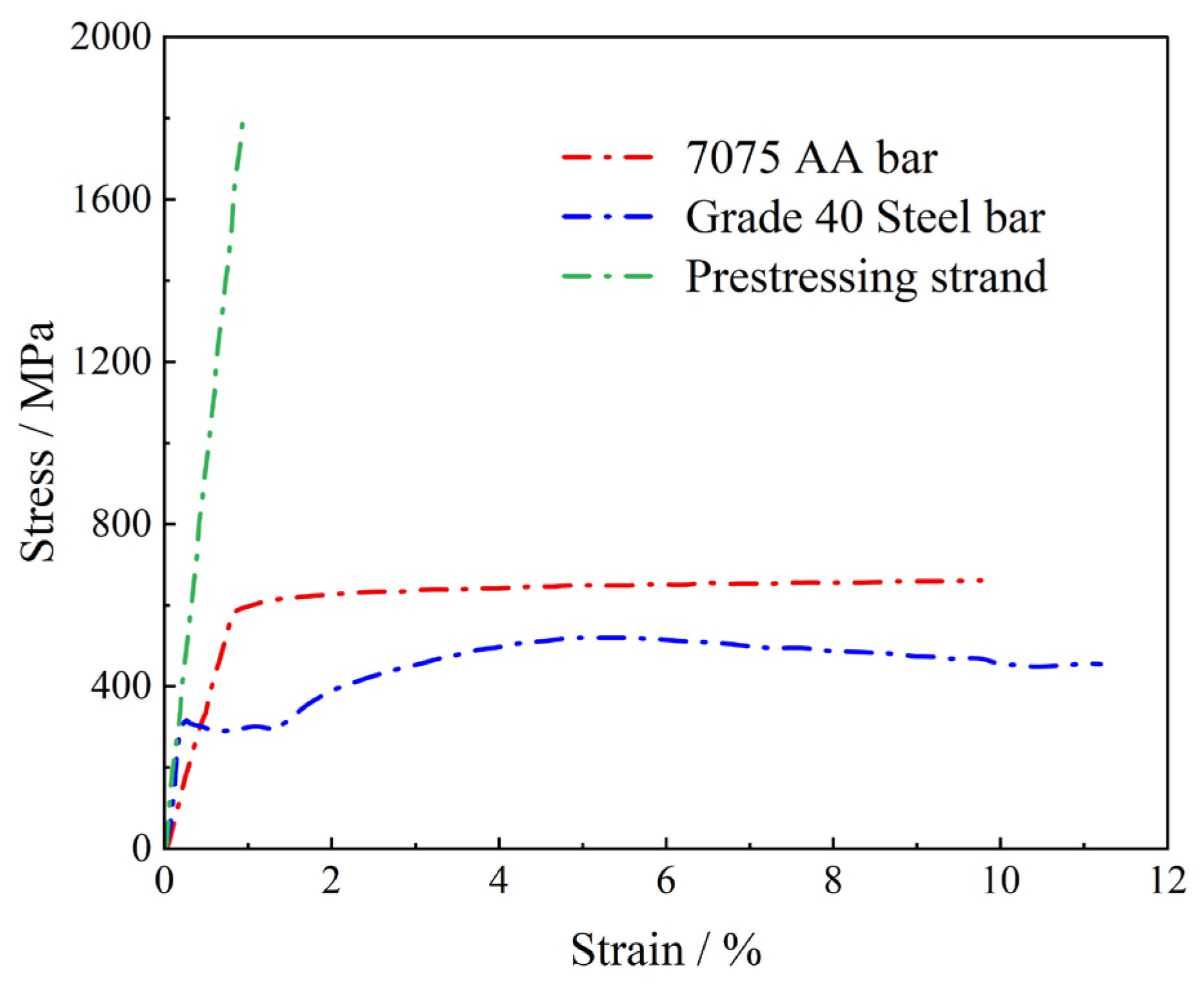
Figure 4 summarizes the stress–strain relationship of the reinforcements used in the analysis from previous experiments [30,37], including the 7075 AA bar, grade 40 steel bar, and PS strand. Except for the PS strands, metallic materials have inherent yield and high deformation capacity.
Figure 4. Stress–strain relationship of reinforcements.
Buildings 16 01339 g004

2.3. Finite Element Model

This section introduces a detailed finite element model of the innovative prestressed concrete beam. The bond–slip constitutive relationship between the AA tendons and the grouting material, as detailed in ref. [38], is represented by Equations (4)–(6). A nonlinear spring element was used to simulate the bond–slip relationship [39]. Since a spring element can only describe a small region, τs curves are transformed from Equation (6) into FS curves, as shown in Equation (7). The average bonding stress τ is uniformly distributed to all spring elements.
τ = τ u ( S S r ) 0.847 S S u τ u + ( τ u τ r ) S S u S u S r S u S S r τ r S r S
τ u = ( 0.620 + 5.187 d l a ) ( 0.653 + 0.768 D d ) f ts
τ r = 0.33 τ u
F = π d L 0 τ
where d is the diameter of the AA tendons, la is the bond anchorage length, D is the diameter of the corrugated tube, and fts is the tensile-splitting strength of the grouting material. Su and Sr are determined as 0.71 mm and 1.5 mm based on experimental results. F is the force at each spring element node, τ is the average bonding stress, d is the diameter of the AA bars, and L0 is the axial grid size of the AA tendons.
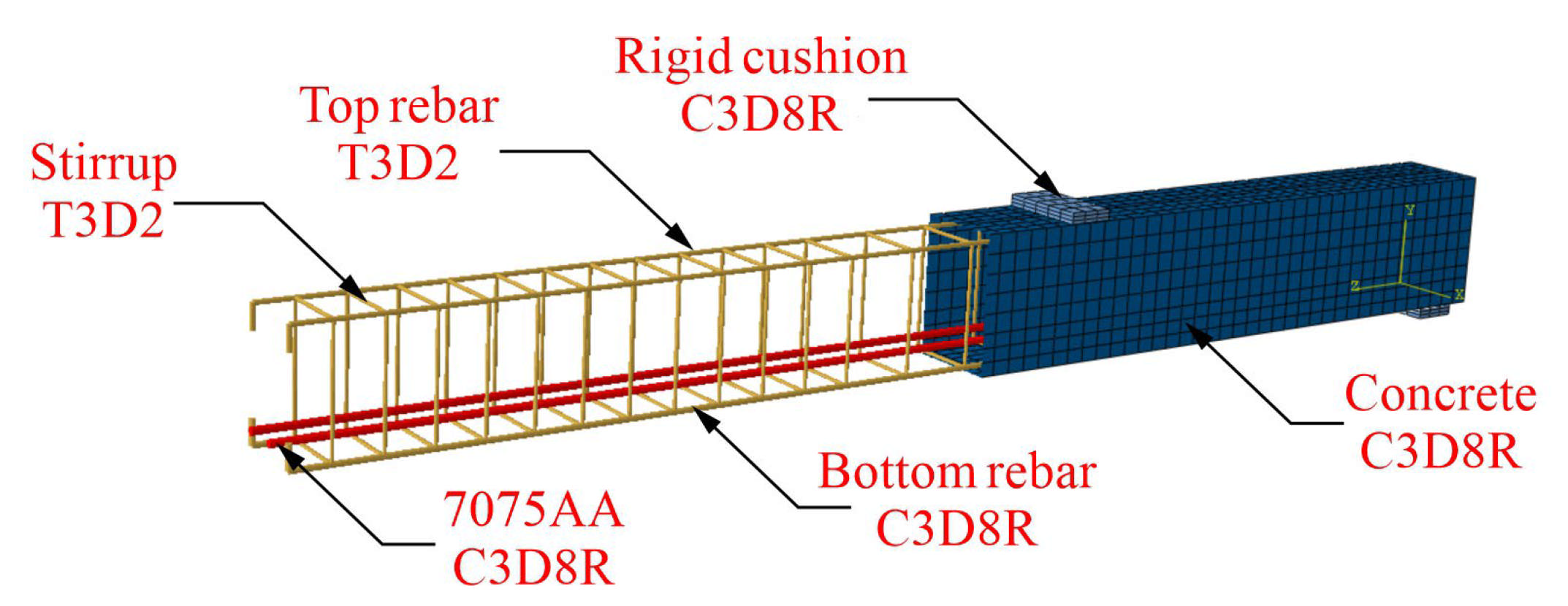
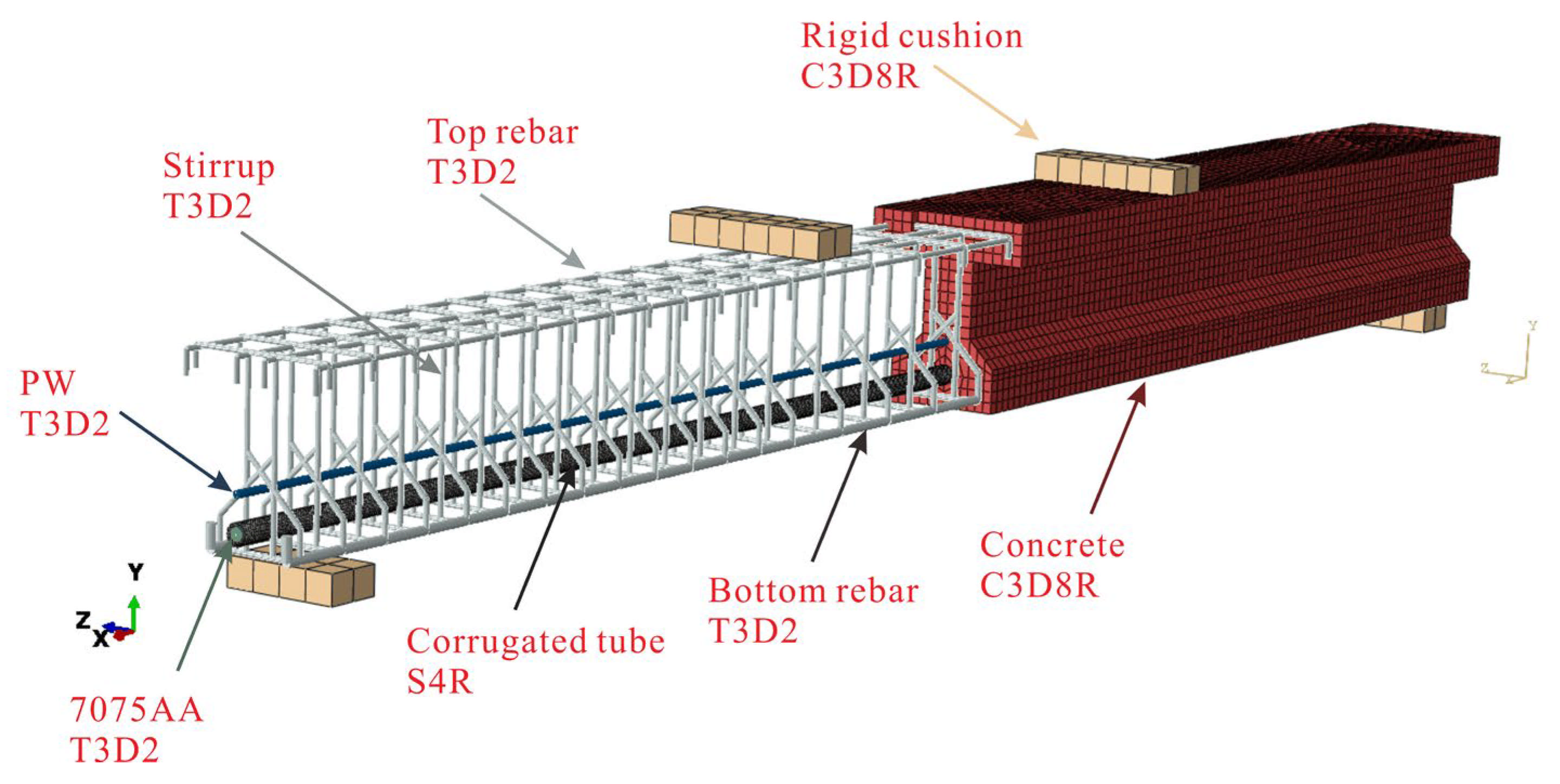
Linear Spring2 springs were introduced along the height direction to simulate the confinement effect of the surrounding grout on the prestressed AA tendons. The stiffness of the linear springs was set as the elastic modulus (79.51 MPa) of the grout [38]. The bond–slip relationship was defined along the length of the beam by modifying the linear springs in the inp file. The initial prestress method in ABAQUS was used to prestress the AA tendons and PS strands, and the pretension stress loss of the PS strands was 228 MPa [40]. A finite element model of the TA is shown in Figure 5.
Additional details of the finite element implementation are presented here to improve the transparency of the model. The adopted bond-slip parameters were taken from ref. [38], which investigated the interfacial behavior of prestressed 7075 AA bars in corrugated ducts with grout, and were therefore regarded as consistent with the tendon–grout system considered in this study. Moreover, the nonlinear analysis was carried out in ABAQUS using automatic incrementation, and the solution process was controlled through the built-in convergence criteria for coupled material and interface nonlinearities. Although a systematic mesh sensitivity study was not separately presented, the adopted mesh density was selected to achieve a reasonable balance between computational efficiency and the stability of the global structural response.
Figure 5. Meshed finite element model.
Buildings 16 01339 g005

2.4. Finite Element Model Verification

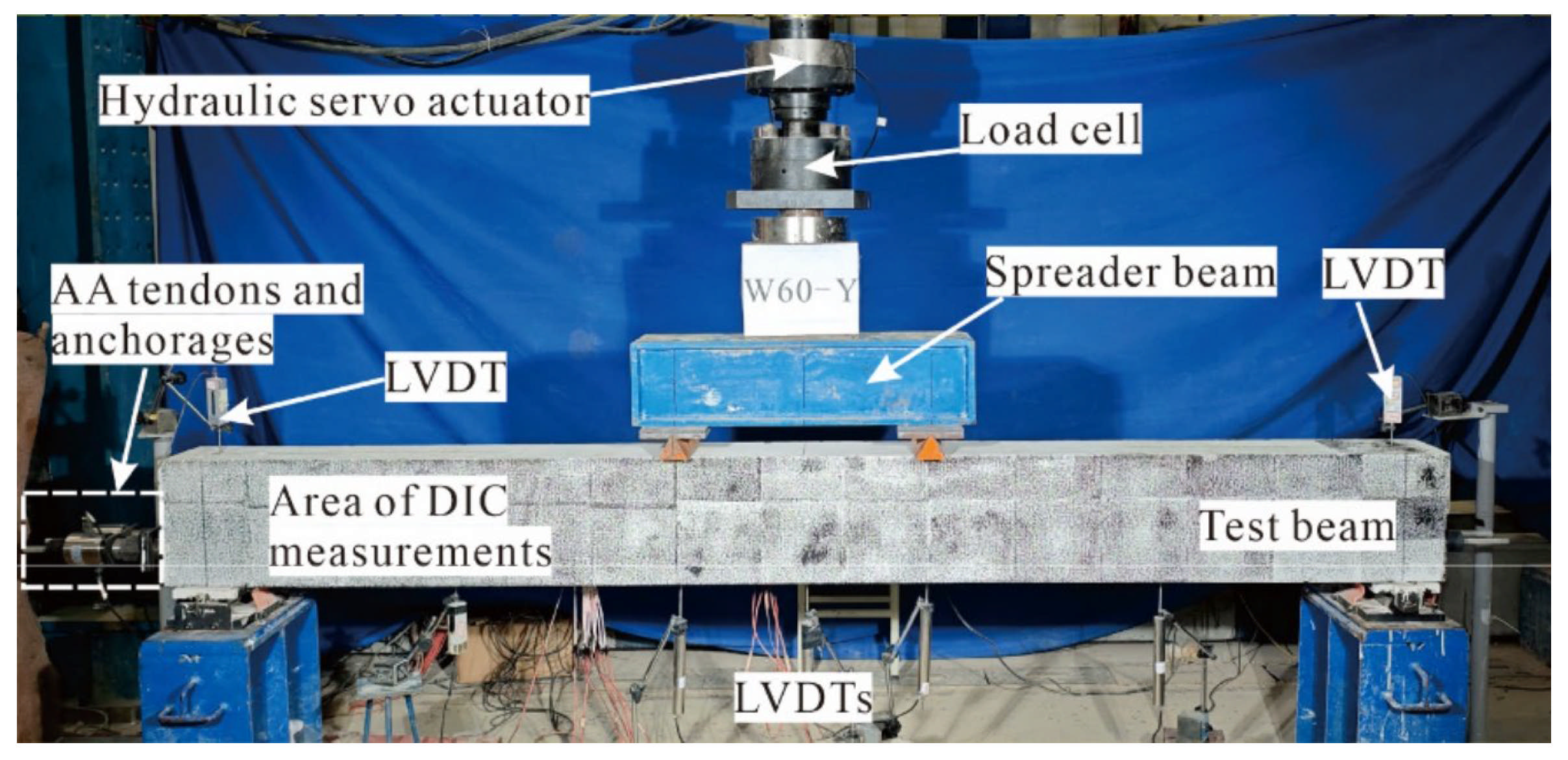
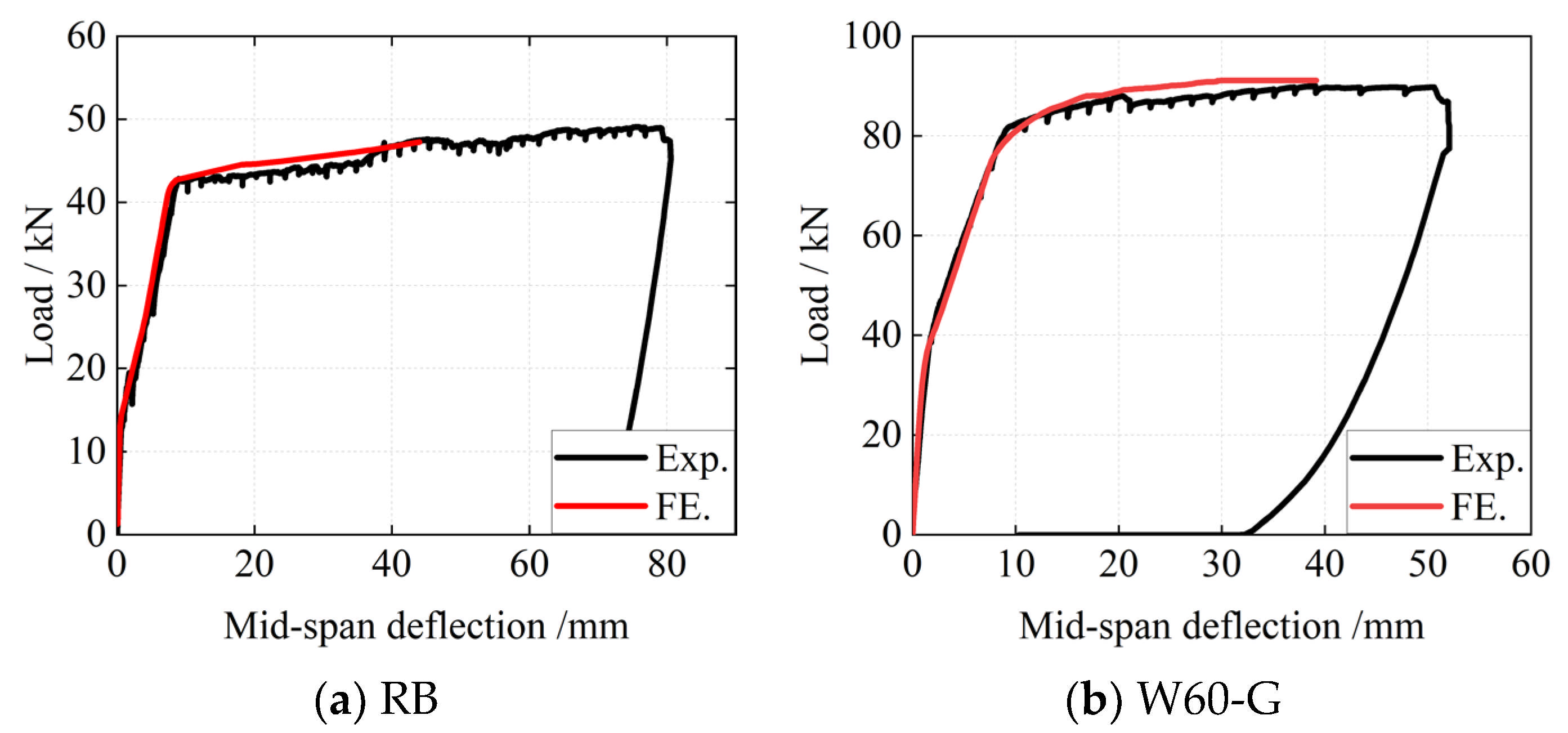
To verify the reasonableness of the finite element modeling strategy adopted in this study, two beam specimens reported by Han et al. were selected for comparison, namely the reference beam RB and the prestressed concrete beam W60-G [41]. Figure 6 shows the experimental setup used in the referenced study, and Figure 7 presents the finite element model established for the validation specimens based on the reported test configuration. According to the reported test program, both specimens had a rectangular cross-section of 200 mm × 300 mm, a total length of 3000 mm, and a span of 2800 mm, and were tested under four-point bending through displacement-controlled loading. The concrete cylinder compressive strength was 36.60 MPa, the yield strength of the 12 mm tensile steel bars was 427.5 MPa, and the 7075 AA tendons had an elastic modulus of 72.41 GPa and a yield strength of 560.37 MPa. Specimen RB was used as the reference beam, whereas specimen W60-G was prestressed with two 12 mm AA tendons at an effective prestress of 365.3 MPa, corresponding to 65.2% of the tendon yield strength [41]. Based on the reported material parameters, geometric dimensions, support conditions, and loading scheme, the corresponding FE models were established for validation.
Figure 6. Experimental setup of the prestressed concrete beam test, with a Linear Variable Displacement Transducer (LVDT) for displacement measurement, reported in the literature [41].
Buildings 16 01339 g006
Figure 7. Finite element model established for the verification beam.
Buildings 16 01339 g007
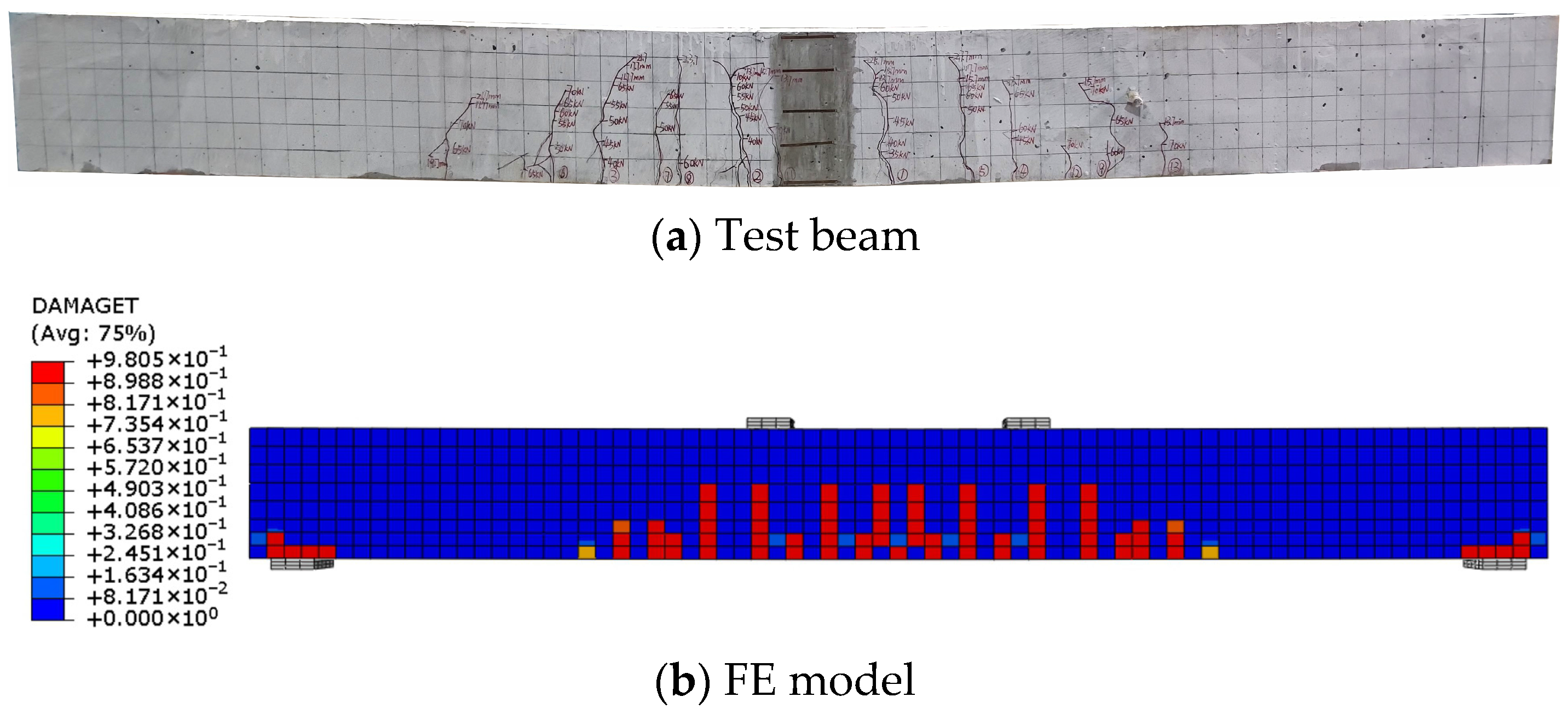
The comparison results indicate that the FE model can reasonably reproduce the global flexural behavior of both RB and W60-G. As shown in Figure 8, the simulated tensile damage pattern of specimen W60-G agrees well with the experimentally observed crack distribution, indicating that the FE model can reasonably capture the main flexural cracking characteristics of the prestressed beam. Figure 9 compares the simulated and experimental load–deflection curves of specimens RB and W60-G, which show reasonable agreement in terms of initial stiffness, cracking transition, and the overall post-cracking trend. Although some deviation is still observed near the yielding and ultimate stages, this discrepancy may be attributed to the simplification of local imperfections, cracking randomness, and material heterogeneity in the numerical model. Overall, the comparison shows that the present FE modeling strategy can reasonably reproduce the flexural response of prestressed concrete beams reinforced with AA tendons.
Figure 8. Comparison of crack patterns of specimen W60-G.
Buildings 16 01339 g008
Figure 9. Comparison of load-deflection curves.
Buildings 16 01339 g009

2.5. Numerical Analysis

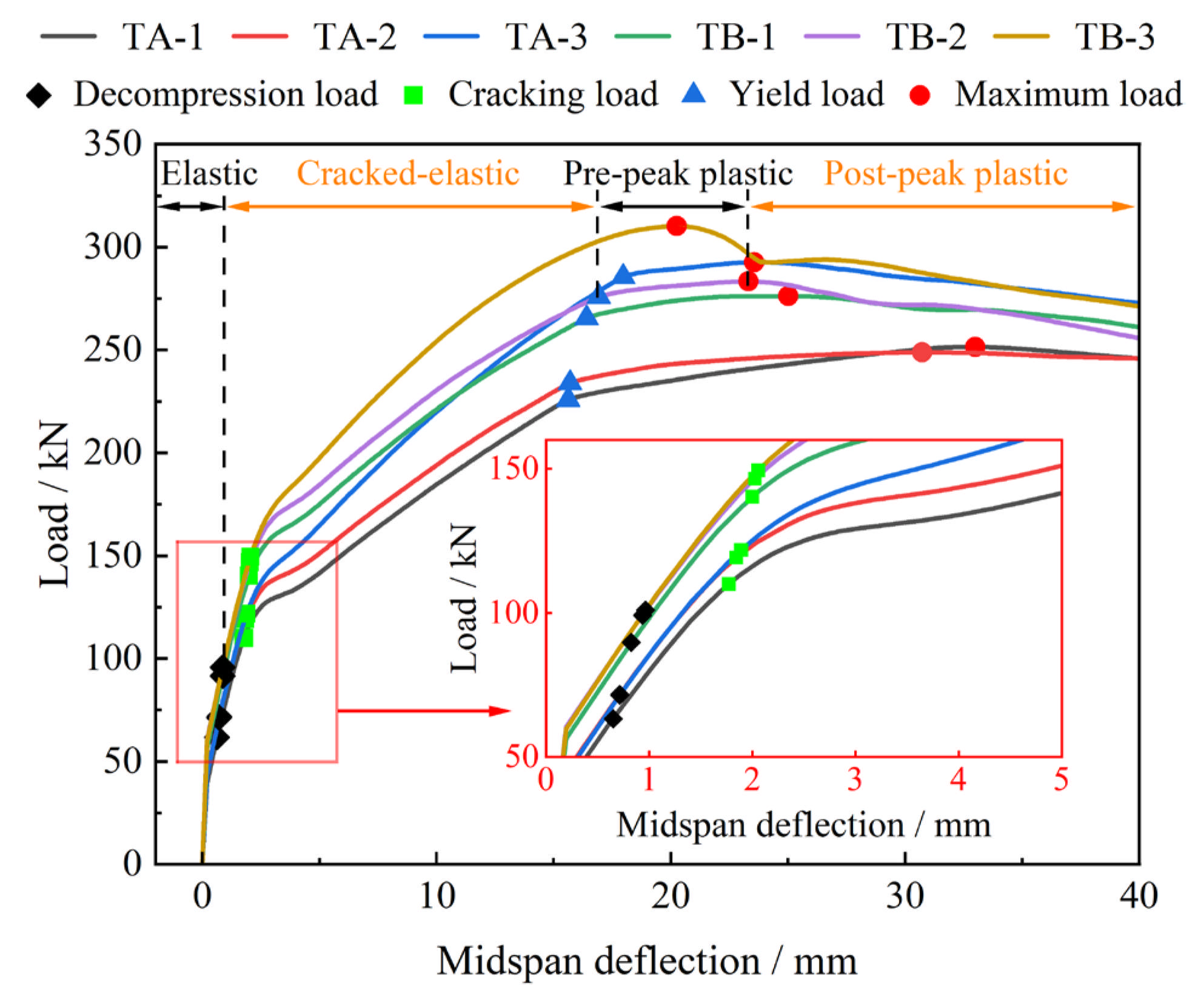
Figure 10 illustrates the load versus mid-span deflection curves for six different cases, revealing four distinct stages: elastic, cracked-elastic, pre-peak plastic, and post-peak plastic. Prior to concrete cracking, all specimens exhibited identical slopes in their load-deflection curves. The decompression load (Pd) and cracking load (Pcr) of the prestressed beams were minimally influenced by the area of non-prestressed tensile steel reinforcement (As), but showed significant improvement with increased effective prestress in the prestressing AA tendons. Post-cracking, a notable reduction in stiffness was observed compared to the pre-cracking phase. As the applied load increased, beams with higher ratios of non-prestressed tensile steel bars demonstrated greater yield and ultimate loads.
As shown in Table 3, except for TB-3, the remaining five specimens had the tensile bar yield first, followed by the AA tendons, and finally, the concrete in the compression zone was crushed, with the strains of the extreme compression concrete reaching 0.0033. With an increase in the effective prestress of prestressed concrete beams reinforced with the same number of tensile steel bars, the decompression load Pd and cracking load Pcr increased. Compared with specimen TA-1, the Pd and Pcr values of specimen TA-2 increased by 13.0% and 8.4%, respectively. Similarly, Pd and Pcr of specimen TB-2 increased by 10.6% and 5.8%, respectively, compared with those of specimen TB-1. Increasing the ratio of non-prestressed tensile steel bars at the bottom had a small effect on Pd and Pcr, but the increase in the yield load Py and maximum load Pu was significant. The Py and Pu values of specimen TA-3 were 22.1% and 17.6% higher than those of specimen TA-2, respectively. The tensile and AA tendons of specimen TB-3 did not yield, and its failure mode was concrete crushing in the compression zone, which should be avoided in the practical application of these novel beams. The load of TB-3 was significantly higher than that of TB-2 after concrete cracking. Overall, the ductility index µ of the concrete beam decreased with the increase in CRI.
These results indicate that, within the investigated parameter range, the hybrid AA–PS configuration can maintain satisfactory flexural stiffness in the short-term response. However, the long-term deflection evolution under sustained prestressing was not considered herein.
To better highlight the parametric investigation conducted in this study, the six beam cases can be interpreted in terms of the three key variables defined in Table 1, namely the partial prestress ratio (PPR), the combined reinforcement index (CRI), and the non-prestressing tensile reinforcement index ω. The comparison between TA-1 and TA-2, as well as between TB-1 and TB-2, indicates that increasing the effective prestress mainly improves the decompression load, cracking load, and service-stage stiffness. The comparison between TA-2 and TA-3, and between TB-2 and TB-3, shows that increasing the non-prestressing tensile reinforcement ratio has a more significant effect on the yield load and ultimate load, while also affecting the ductility of the beam. In addition, the fatigue-life comparison indicates that the prestressing configuration and tendon material influence not only the static flexural response but also the fatigue-governing failure mode and the predicted fatigue life, especially under corrosive conditions.
Figure 10. Load–midspan deflection curves of the specimens obtained from the FE simulations.
Buildings 16 01339 g010
Table 3. Simulation results.
SpecimensPd,sΔd,sPcr,sΔcr,sPy,sΔy,sPu,sΔu,sµ = Δu,sy,sFailure Mode
TA-163.20.637110.01.772225.015.454251.532.9612.133CC/Y
TA-271.40.715119.21.843233.915.698248.930.7221.957CC/Y
TA-371.60.715121.81.891285.517.960292.723.6481.317CC/Y
TB-189.70.826138.62.000265.516.400276.225.0091.525CC/Y
TB-299.20.936146.62.025275.416.813283.323.2401.382CC/Y
TB-3101.00.949149.52.057310.320.254CC
Note: Pd,s, Pcr,s, Py,s, Pu,s, Δd,s, Δcr,s, Δy,s, and Δu,s are the loads and corresponding deflections obtained from the simulation, respectively. CC/Y is the concrete crushing after the tensile steel bars and AA tendons yield, and CC is the concrete crushing before the tensile steel bars and AA bars yield.

3. Theoretical Analysis of the Prestressed Beam

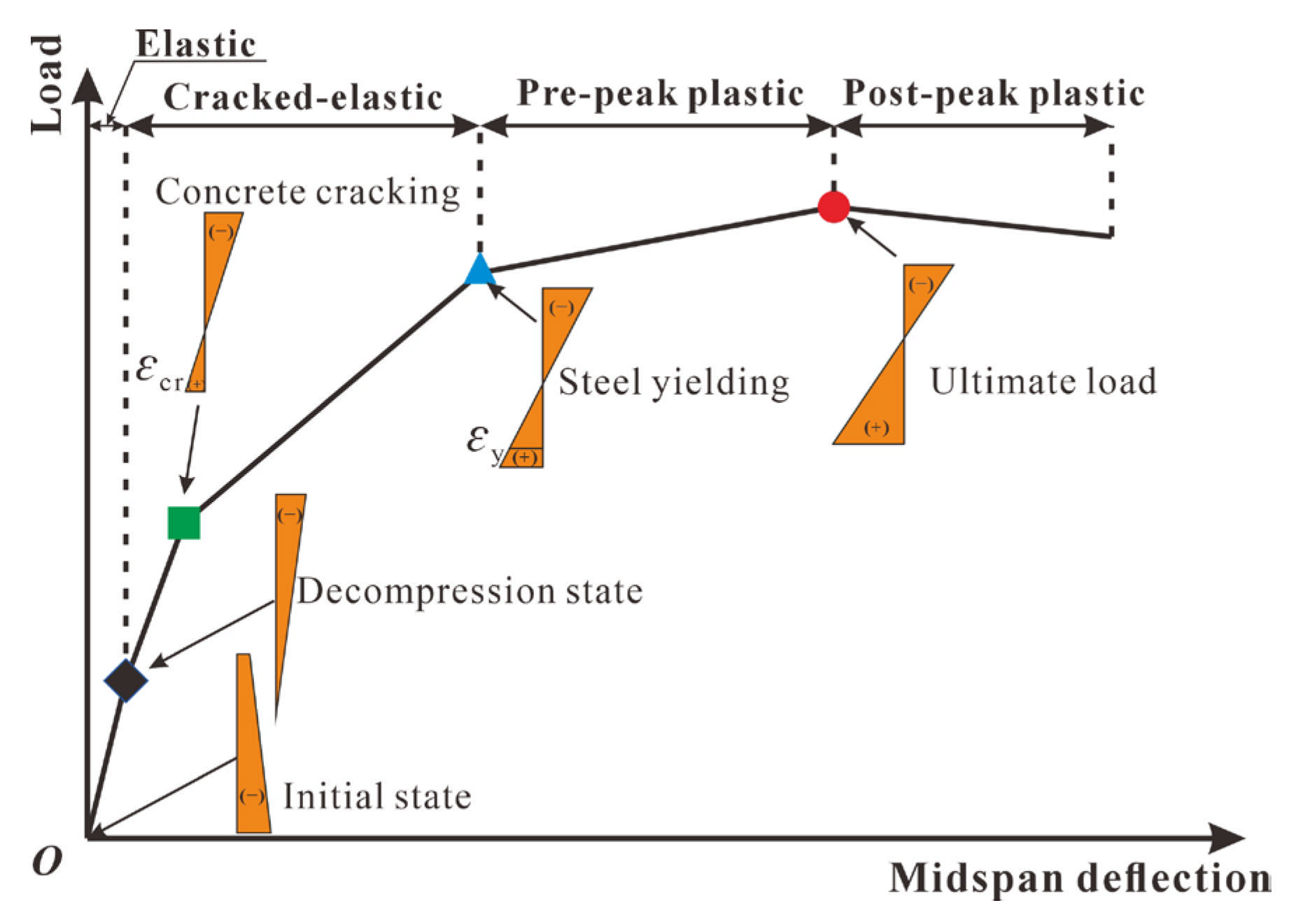
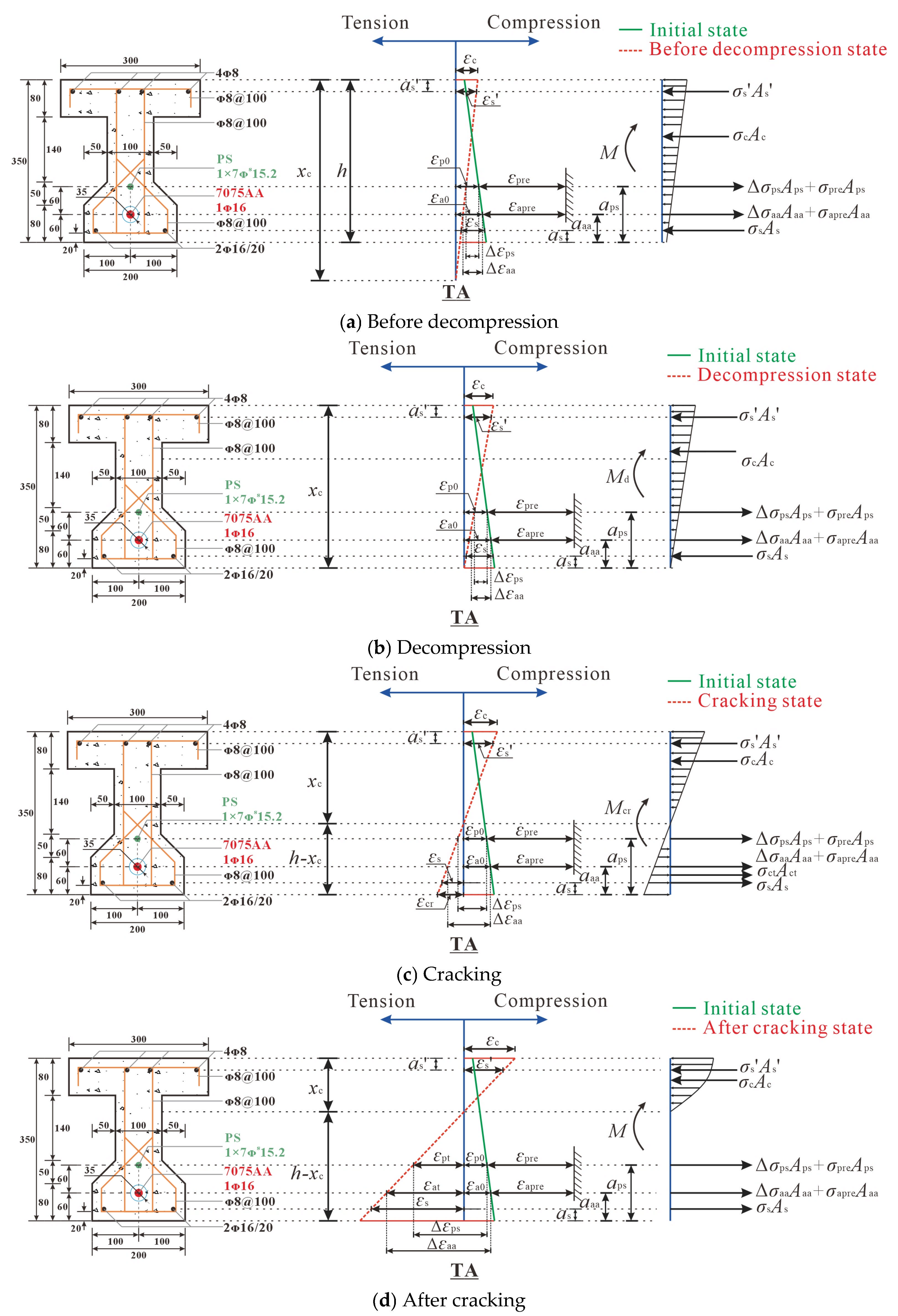
Figure 10 illustrates the load versus mid-span deflection curve from the finite element simulation results, which can be divided into four stages. The strain state corresponding to each stage is depicted in Figure 11. An analytical model was developed to predict the load-bearing capacity of concrete beams prestressed with AA tendons, assuming the concrete’s compressive strain increases until reaching the ultimate strain εcu = 0.0033. This model was implemented in a Python 3.11.1-based computer program.
Figure 11. Flexural response of the prestressed beam.
Buildings 16 01339 g011

3.1. Prediction of Load-Bearing Capacity

Taking the novel prestressed concrete beam TA as an example, Figure 12 illustrates the schematic of bending moment calculations at each stage. According to the load-bearing capacity calculation method provided by ACI 318 [42], the compressive force of the concrete in the compression zone was determined through integration. The following assumptions were made to evaluate the flexural capacity of the beams:
(1)
The section strains comply with the plane section assumption.
(2)
The bond-slip between reinforcements and concrete is neglected.
It should be noted that the analytical model in this section is intended as a simplified sectional method for practical prediction of flexural response and for the subsequent fatigue-life iteration. Therefore, the plane-section assumption is adopted and the local bond-slip between reinforcement and surrounding concrete/grout is neglected. This treatment is considered acceptable for bonded post-tensioned members with sufficient anchorage length, in which the global response is dominated by sectional flexure rather than by local slip. In contrast, the finite element model explicitly incorporates the bond-slip behavior between AA tendons and grout in order to capture the local stress transfer mechanism in a refined manner. Hence, the analytical model and finite element model are used at different levels of fidelity and for different purposes, rather than being contradictory. The comparison presented in Section 3.3 shows that the simplified analytical model provides reasonably close predictions of the key load levels, indicating that the omission of local bond-slip introduces limited error for the global flexural analysis performed in this study.
Based on force and moment equilibrium, the relationship in the beam section before decompression is depicted in Figure 12a:
ε c x c h = ε s x c h + a s = ε s x c a s = ε at x c a aa = ε pt x c a ps
A aa σ aa + A ps σ ps A s σ s A s σ s ε c x c x c h ε c E c b ( x ) x c h ε c ε d ε = 0
M f A aa σ aa ( x c a aa ) A ps σ ps ( x c a ps ) + A s σ s ( x c a s ) + A s σ s ( x c h + a s ) + ε c x c x c h ε c E c b ( x ) ( x c h ε c ε ) 2 d ε = 0
where εc, εs’ and εs, are the strain of concrete, compressive steel bars and tensile steel bars, respectively; εat, and εpt are the strain increases of AA tendons and PS strands, respectively, ignoring the concrete pre-compression strain at the level of AA tendons and PS strands due to prestressing; xc is the depth of the neutral axis; Ec is the elastic modulus of concrete; b(x) is the variable section width of the beam; and Mf is the bending moment before the decompression state.
The Equations (11)–(13) were established to obtain the decompression moment Md.
ε c h = ε s h a s = ε s a s = ε at a aa = ε pt a ps
A aa σ aa + A ps σ ps A s σ s A s σ s 0 ε c E c b ( x ) x c ε c ε d ε = 0
M d + A aa σ aa a aa + A ps σ ps a ps A s σ s a s A s σ s ( x c a s ) 0 ε c E c b ( x ) ( x c ε c ε ) 2 d ε = 0
The cracking moment Mcr is calculated by Equations (14)–(16):
ε c x c = ε s x c a s = ε s h x c a s = ε at h x c a aa = ε pt h x c a ps
A aa σ aa + A ps σ ps + A s σ s A s σ s 0 ε c E c b ( x 1 ) x c ε c ε d ε + 0 ε cr E c b ( x 2 ) h x c ε cr ε d ε = 0
M cr A aa σ aa ( h Z a aa ) A ps σ ps ( h Z a ps ) A s σ s ( h Z a s ) A s σ s ( Z a s ) 0 ε c E c b ( x 1 ) ( x c ε c ε ) 2 d ε + 0 ε cr E c b ( x 2 ) ( h x c ε c ε ) 2 d ε = 0
where b(x1) and b(x2) are the variable section widths of the beams in the compression and tensile zones, respectively.
The yield moment, My and maximum moment, Mu, were calculated using Equations (17)–(19):
ε cr h x c = ε c x c = ε s x c a s = ε s h x c a s = ε at h x c a aa = ε pt h x c a ps
A aa σ aa + A ps σ ps + A s σ s A s σ s 0 ε c σ ( ε ) b f x c ε c d ε + 0 ε c 1 h f x c σ ( ε ) b f b x c ε c d ε = 0
M A aa σ aa ( h Z a aa ) A ps σ ps ( h Z a ps ) A s σ s ( h Z a s ) A s σ s ( Z a s ) 0 ε c σ ( ε ) b f ( x c ε c ) 2 ε d ε + 0 ε c 1 h f x c σ ( ε ) b f b ( x c ε c ) 2 ε d ε = 0
In the above equations, the stresses in the steel bars, PS strands, and AA tendons were calculated using Equations (20)–(23) before steel bars and AA bars yield, as shown below:
σ s = E s ε s
σ s = E s ε s
σ ps = E ps ( Δ ε ps + ε pre )
σ aa = E aa ( Δ ε aa + ε apre )
where Es, Es’, Eps, and Eaa are the elastic modulus of tensile steel bars, compressive steel bars, PS strands, and AA tendons, respectively; and Δεps and Δεaa are the strain increase of PS strands and AA tendons, respectively.
After the steel and AA tendons yielded, the stress was expressed by Equations (24) and (25).
σ s = f y , s + E s ( ε s ε y , s )
σ aa = f 0.2 + E aa ( Δ ε aa + ε apre ε 0.2 )
where fy,s and εy,s are the yield stress and corresponding strain of the steel bars, and f0.2 and ε0.2 are the yield stress and corresponding strain of the AA tendons.
Figure 12. Strain profile of the cross section.
Buildings 16 01339 g012

3.2. Prediction of Midspan Deflection
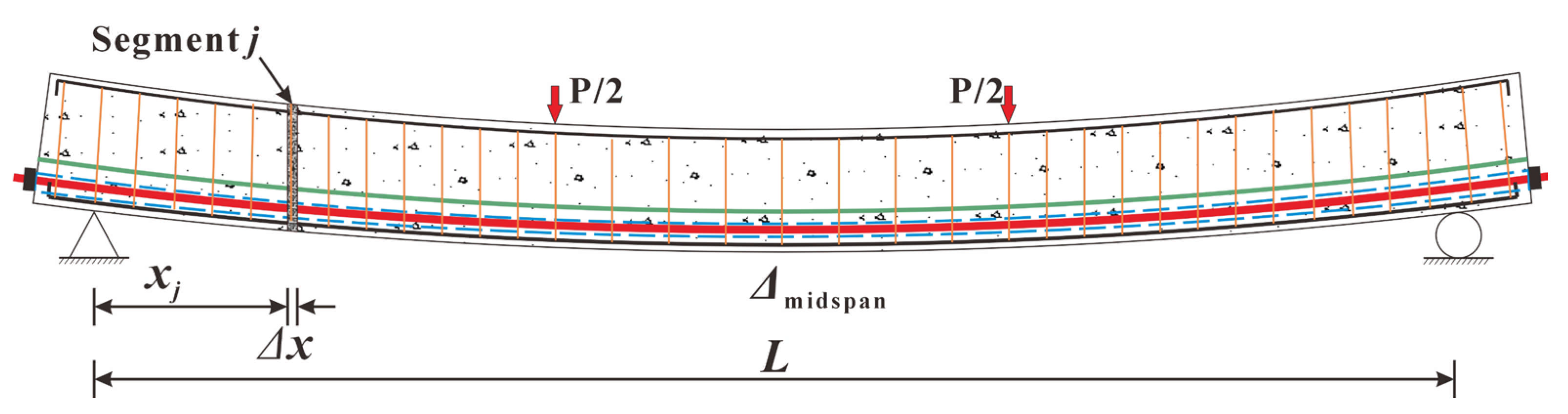
The beam specimen was divided into several vertical segments between the two supports to estimate deformation. The number of segments n was set to 150 to ensure the prediction accuracy, as shown in Figure 13. The midspan deflections of the novel beams were obtained by integrating the curvature of each segment along the length of the beam. Based on the calculation program of Python, the midspan deflection of the beam Δmidspan can be estimated from Equation (26):
Δ midspan = 1 2 j = 1 n φ j Δ x L x j j = 1 n / 2 φ j Δ x L 2 x j
where φj is the curvature at each corresponding segment j; Δx (= L/n) is the length of each segment; L is the length of clear span; and xj is the horizontal distance from the left support to the segment j.
Figure 13. Deformation diagram of beam.
Buildings 16 01339 g013

3.3. Comparison and Analysis

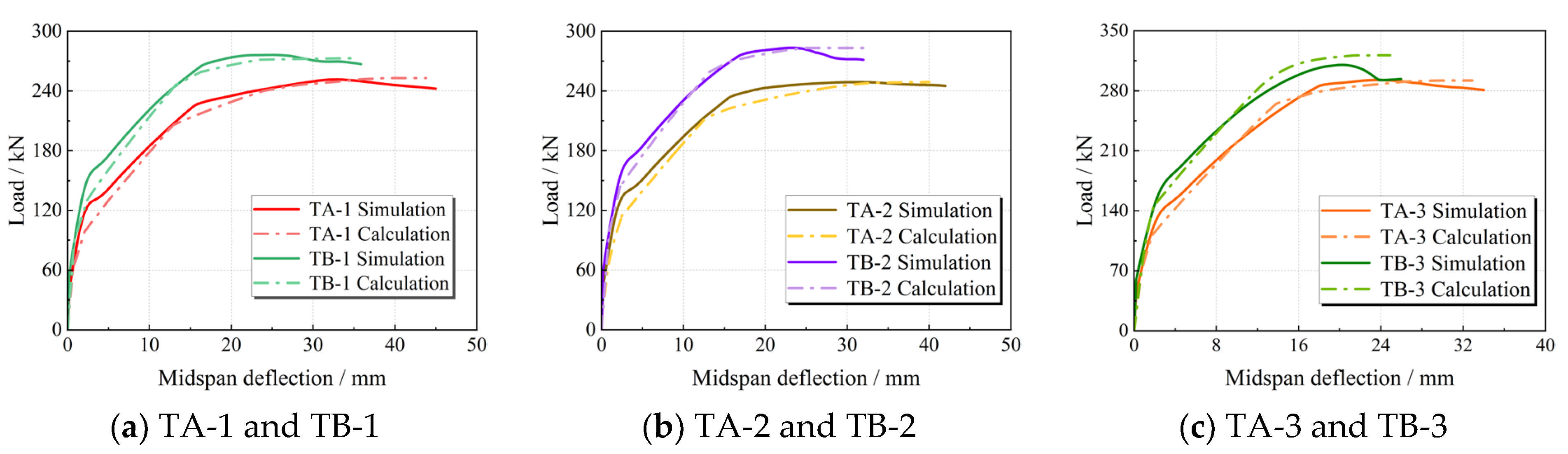
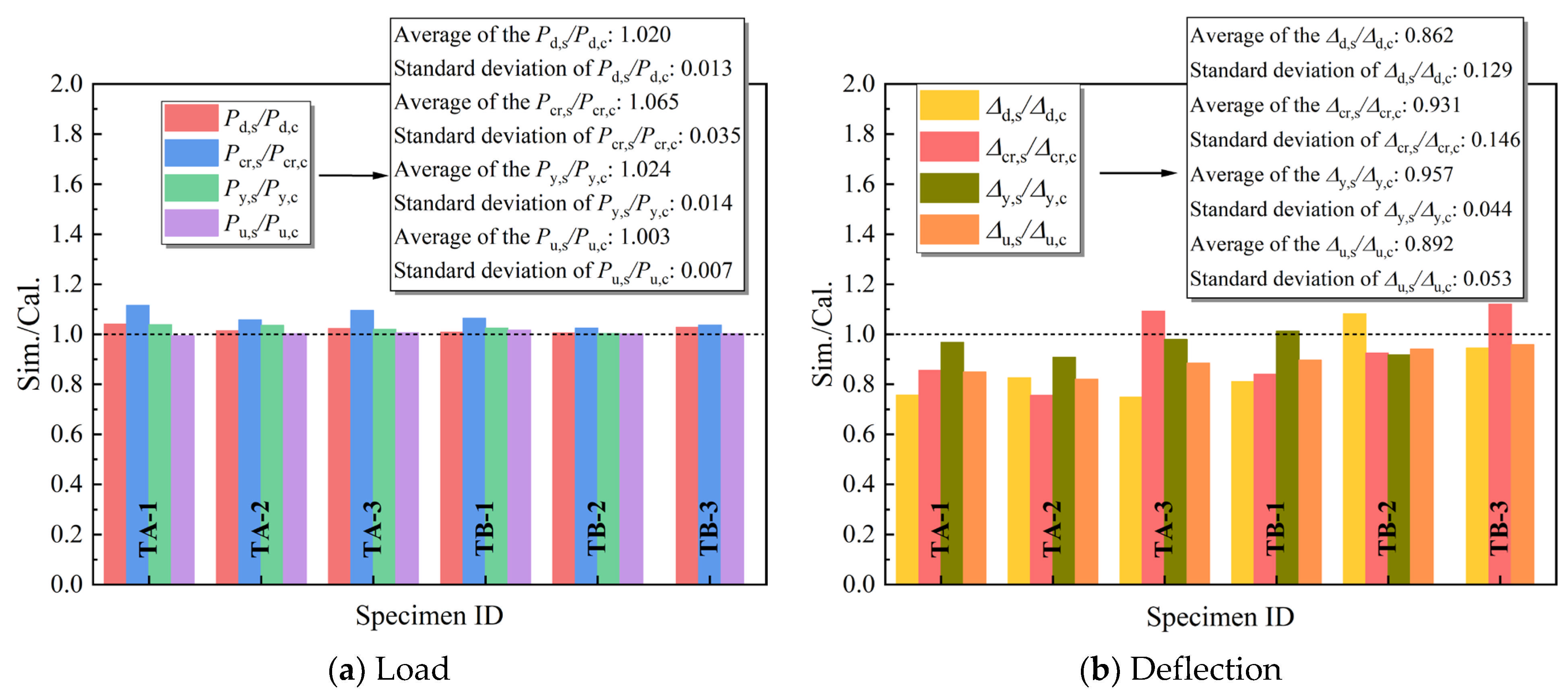
The theoretical load–deflection curves based on Python are shown in Figure 14. Although the finite element simulation results for Pd, Pcr, and Py were slightly higher than the theoretical calculation results and the theoretical stiffness of the beam after concrete cracking was marginally greater than the finite element simulation value, the theoretical calculation results were consistent with the finite element simulation results. Table 4 presents details of the load comparison between the simulated and calculated results. The relative deviation in the loads between the simulated and calculated results was less than 10.4%. The mean values and standard deviations are shown in Figure 15. They indicate that the predicted values obtained from the theoretical model are consistent with the simulation values, suggesting that the proposed analytical model lays the foundation for the subsequent theoretical analysis of fatigue life. The present study provides a mechanics-based and comparative assessment of the proposed hybrid AA–PS prestressed beam system. The material properties of the 7075 AA bars adopted in the model were supported by the tensile tests reported in Section 2.2, and the bond-slip relationship of the AA tendon–grout interface was taken from the experimentally based study in ref. [38]. In addition, the analytical model was checked against the finite element results for the key flexural load levels. Although these steps support the current modeling framework, further beam-level experimental studies under static and cyclic loading would be valuable for validating the global response, failure mode evolution, and fatigue performance of the proposed system.
Figure 14. Comparison of load versus midspan deflection relationship between simulation results and theoretical results.
Buildings 16 01339 g014
Table 4. Load comparison between calculation and simulation values.
SpecimensPdPcrPyPu
Cal.η/%Cal.η/%Cal.η/%Cal.η/%
TA-160.7−4.098.6−10.4216.7−3.7252.90.6
TA-270.4−1.4112.8−5.4226.0−3.4248.5−0.2
TA-370.0−2.2111.2−8.7279.8−2.0291.1−0.6
TB-188.9−0.9130.3−6.0259.1−2.4271.8−1.6
TB-298.7−0.51143.0−2.5274.6−0.3283.1−0.1
TB-398.3−2.7144.3−3.5309.8−0.2
Note: Cal. represents the calculation results; η refers to relative deviation between simulation and calculation results.
Figure 15. Comparison between simulation and calculation results.
Buildings 16 01339 g015

4. Analysis of Fatigue Life

4.1. Material Fatigue Constitutive Model

(1)
S–n Curve
The S–N curve of a material plays a crucial role in the fatigue analysis. The fatigue strength calculation formula for concrete uses Equation (27), as proposed by Aas-Jakobson and Lenschow [43]:
S c , max = 1 β ( 1 R c ) lg N cf
where Sc,max = σmax/fc, σmax is the maximum stress under the fatigue load, fc is the axial compressive strength of concrete, β is set as 0.0685 based on previous studies [44], and Rc = σminmax.
The fatigue life curve of the steel bar was obtained using Equation (28) [45].
lg N f = 24.431 7.662 lg Δ σ s
where Δσs is the stress amplitude of the steel bar.
The fatigue life curve for the PS tendons can be obtained using Equation (29) as proposed by Ma [46].
lg N f = 13.84 3.5 lg Δ σ
The fatigue life curve of the AA tendons can be expressed as follows [47], and the maximum stress σmax of Equation (30) is converted into the stress amplitude Δσ as shown in Equation (31).
lg N f = 17.39 4.97 lg σ max
lg N f = 17.16 4.97 lg Δ σ
(2)
Fatigue Constitutive Model
Holmen proposed a stiffness-degradation model for concrete [48]. The residual strength of the concrete after any number of fatigue loads is expressed as follows [49]:
E N = 1 0.33 N N f E 0
σ r ( N ) = f c N N f x N f x ( 1 ) α d N N f x N f x ( 1 ) 1 2 + N N f x N f x ( 1 ) , Compressive   fatigue f t N N f x N f x ( 1 ) α t N N f x N f x ( 1 ) 1 1.7 + N N f x N f x ( 1 ) , Tensile   fatigue
where αd and αt are defined based on the code for the design of concrete structures (GB50010-2010) [36], and x(N) is a function related to the number of fatigue loading cycles N.
Generally, only elastic deformation occurs in PS and AA tendons under high-cycle fatigue loading [50,51]. Therefore, it was assumed that no degradation in the elastic modulus of the reinforcement occurred during the fatigue loading process. According to the equivalent strain principle, the effective area A s f (N) when a fatigue fracture occurs can be expressed as Equation (34). Assuming that the reduction in the effective area of these three materials under fatigue loading satisfies the Palmgren-Miner linear criterion [52], the expression for the effective area after N fatigue loads is given by Equation (35). The relationship for the residual fatigue strength can be obtained using Equation (36).
A s f ( N ) = A s σ max ( N f ) / f y
A s ( N ) = A s 1 N N f 1 σ max N f / f y
f y ( N ) = f y 1 N N f 1 σ max f y
where fy is the material yield strength, σmax(Nf) is the maximum stress when fatigue fracture occurs, As is the initial area of materials, and N is the number of fatigue loading cycles.
(3)
Fatigue Failure Criteria
Under high-cycle fatigue loading, degradation of the material properties of concrete occurs in advance owing to internal initial defects. Previous studies indicate that concrete fails when the fatigue residual strain Δεr reaches 0.4ε0, where ε0 is the ultimate strain [53,54]. The fatigue failure criterion can be estimated using Equation (37):
Δ ε r 0.4 ε 0 = 0.4 f c / E 0
Wang et al. [55] proposed the material parameters of the fatigue residual strain (Δεr), as shown in Equation (38).
Δ ε r ( N ) = ε r ( 1 ) + 0.00105 ε max 1.98 1 ε min / ε max 5.27 ε unstab   1.41 N 0.395
εr(1) = 0.25(εmax/εunstab)2. εunstab is independent of fatigue life and depends on the properties of the concrete material itself. This was close to the strain corresponding to the peak stress during the first loading failure. Therefore, the peak strain ε0 from the uniaxial compressive stress–strain relationship is used instead of εunstab.
The material fracture occurs when the maximum effective stresses σNmax of steel bars, PS wires, and AA tendons reach their fatigue residual strength, and the fatigue failure criterion is given by Equation (39).
f y ( N ) σ N max

4.2. Vehicle Fatigue Loads

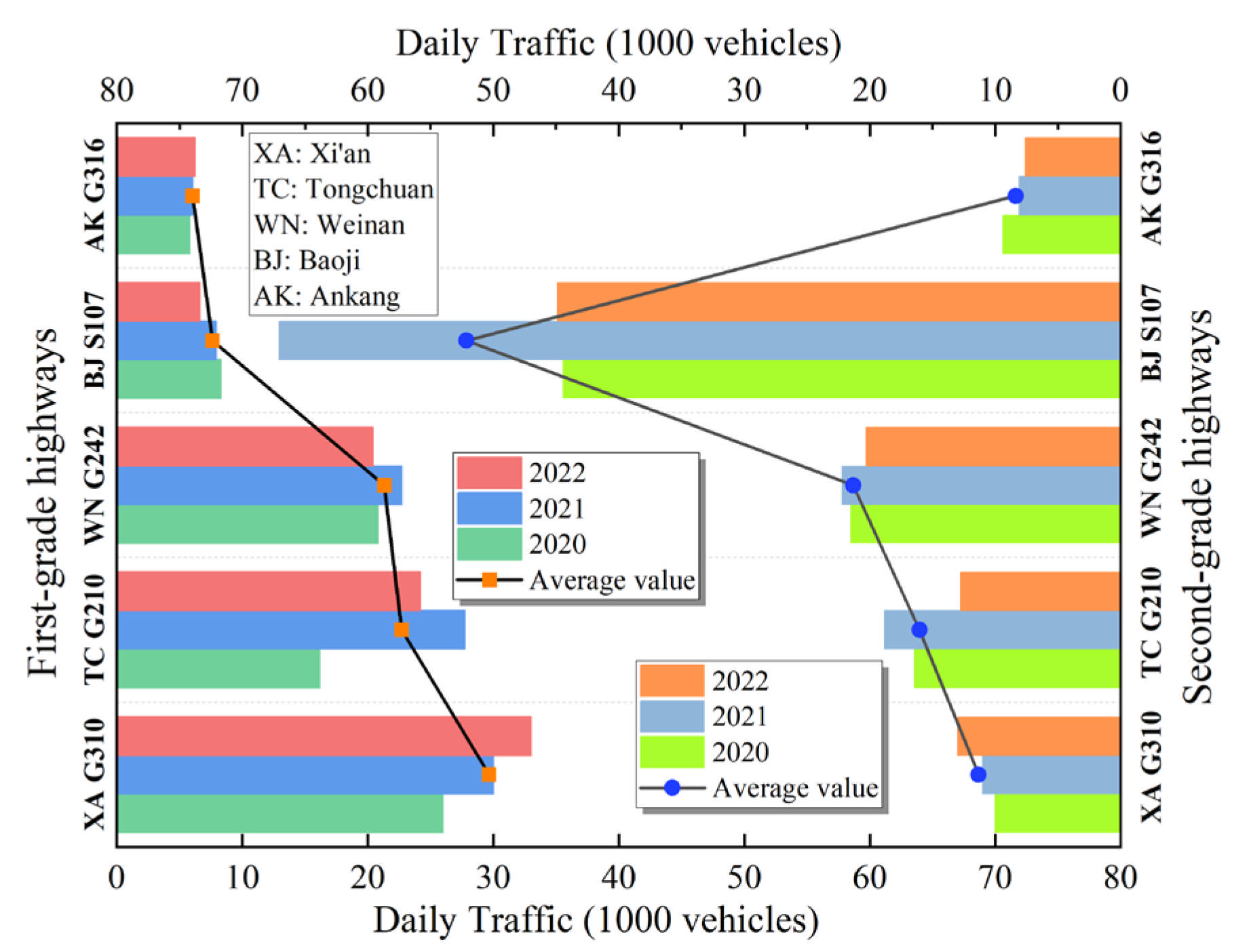
The “Technical Standards of Highway Engineering” (JTG B01-2014) [56] divide highways into five grades. The data in Figure 16 present the average daily traffic volume for first- and second-grade highways in five prefecture-level cities in Shaanxi Province over the past three years. Assuming a lateral distribution coefficient of zero, a vehicle fatigue load model suitable for first- and second-grade highways was adopted [57]. According to the structural model similarity relationship, the geometric similarity constant was 1/5, and the concentrated load similarity constant was 1/25. The calculated absolute maximum bending moment and maximum bending moment at midspan for first-grade highway beams were 14.14 kN·m and 14.29 kN·m, respectively, and for second-grade highway beams, they were 21.76 kN·m and 22.04 kN·m, respectively. Figure 17 shows the most unfavorable effect diagram of the vehicle fatigue load. The midspan bending moment caused by the self-weight of the beams was 2.39 kN·m. Therefore, for both first-grade and second-grade highway bridges, the maximum midspan bending moment, combined with the self-weight of the bridge was taken as the upper limit of the fatigue load, and the midspan bending moment caused by the self-weight of the beam was considered to be the lower limit. The loading frequency for the fatigue loads on first-grade highway bridges was based on the average daily traffic volume of 29,000 vehicles/day in Xi’an on G310, and for second-grade highway bridges on the average daily traffic volume of 52,000 vehicles/day in Baoji on G342.
In the present study, the vehicle fatigue loads were derived from traffic statistics for representative first- and second-grade highways in Shaanxi Province, and were used to establish a region-specific fatigue loading scenario for the scaled beam model. This treatment should be regarded as a traffic-data-informed research load model rather than a universal code-based fatigue verification load. In this sense, the adopted load model is closer to a local traffic spectrum, whereas major bridge design specifications such as AASHTO LRFD [58] and Eurocode EN 1991-2 [59] define standardized fatigue load models for general design verification, and the current Chinese bridge design framework also distinguishes traffic classes and design actions for highway bridges. Therefore, the present loading model is suitable for demonstrating the fatigue response of the proposed beam under representative regional traffic conditions, but further calibration would be needed before extending the results to other bridge classes, countries, or traffic environments.
Figure 16. Traffic volume statistics chart for Shaanxi province.
Buildings 16 01339 g016
Figure 17. Diagram of vehicle fatigue loads showing model of fatigue vehicles.
Buildings 16 01339 g017

4.3. Analysis Process of Fatigue Life

Previous studies indicate that the fatigue strain in concrete follows a distinct three-stage pattern [60]. These three stages of fatigue strain constituted approximately 10%, 80%, and 10% of the total fatigue life, respectively. A segmented linear method was used for fatigue life analysis, with fatigue cycles as increments. A relatively small fatigue cycle step size was selected for the first and third stages of fatigue loading. To facilitate the analysis, a larger fatigue cycle step size was used in the second stage. In addition, it was assumed that the cross-sectional geometry and material-constitutive relationships remained unchanged.
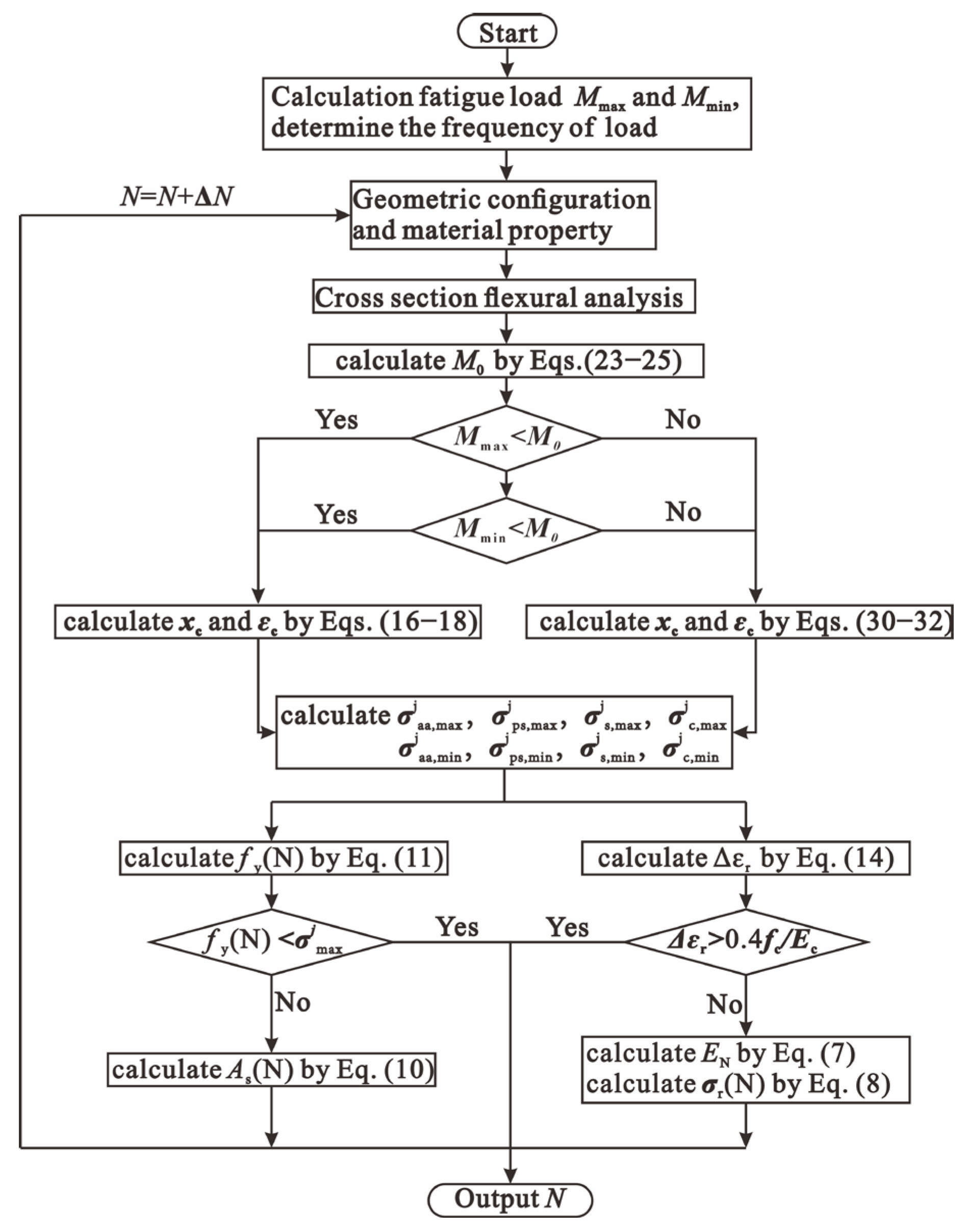
By applying theoretical calculations, a nonlinear analysis of the fatigue life of concrete beams prestressed with 7075 AA bars was conducted. The fatigue test was conducted in Python. A flowchart depicting the fatigue process analysis is shown in Figure 18. Note that when the fatigue load is greater than M0, xc and εc are calculated based on Equations (14)–(16), in which the strain at the bottom of the concrete does not reach εcr. According to the material failure criterion, if no fatigue failure occurred, the calculation program was continued in increments of the fatigue cycles. The calculation program ended when the fatigue failure occurred.
Figure 18. Analysis process of fatigue life.
Buildings 16 01339 g018

4.4. Assumptions, Applicability, and Limitations

The fatigue analysis framework adopted in this study is intended to provide a mechanistic and comparative assessment of the fatigue performance of prestressed concrete beams incorporating AA tendons. Several simplifying assumptions were introduced to make the analysis tractable. First, the cross-sectional geometry and the basic material constitutive forms were assumed to remain unchanged during cyclic loading, while fatigue damage was accounted for through stiffness degradation, residual-strength evolution, and S–N relationships. This assumption is reasonable for high-cycle fatigue analysis before severe section deterioration occurs, but it cannot explicitly capture progressive geometric changes such as concrete spalling, local crushing, tendon cross-section loss, or damage accumulation in the anchorage zone.
Second, the cumulative fatigue damage was evaluated using a linear damage accumulation concept. Although this approach is widely used because of its simplicity and practicality, it does not account for load-sequence effects, interaction between different damage mechanisms, or nonlinear damage evolution under variable-amplitude traffic loading. Therefore, the calculated fatigue life should be interpreted as an estimated value within the adopted assumptions, rather than as an exact prediction of the service life of a real bridge.
Third, the theoretical fatigue analysis is based on sectional response and does not explicitly include local bond-slip or anchorage-slip effects. Such simplification is acceptable when the member is well bonded and the global flexural response governs the fatigue behavior. However, for members with inadequate grouting quality, local anchorage distress, or significant interface deterioration, the present model may overestimate the structural stiffness and fatigue resistance.
Finally, the proposed framework is most suitable for comparative studies, parameter analyses, and failure-mode identification of bonded prestressed beams. For direct application to real bridge structures, further calibration using bridge-specific weigh-in-motion data, environmental deterioration models, and nonlinear cumulative fatigue formulations would be desirable.
In addition, the present study focuses on the short-term flexural response and fatigue behavior of the proposed hybrid AA–PS prestressing system. The long-term effects associated with sustained prestressing, such as creep and stress relaxation of AA tendons, were not explicitly considered in the current analysis. Likewise, the possibility of galvanic corrosion between AA tendons and adjacent steel reinforcement was not investigated in this study. Although the bonded post-tensioned configuration and grout/concrete cover provide physical separation and environmental protection to the embedded tendons, the long-term electrochemical compatibility of dissimilar metallic components still requires dedicated experimental verification. Therefore, the present results should be interpreted within the scope of short- to medium-term mechanical and fatigue assessment, and future work should further address long-term prestress loss, service deflection evolution, and galvanic corrosion risk.

4.5. Durability and Practical Implications of the Proposed Hybrid System

The proposed hybrid AA–PS prestressing system is intended to improve the durability of prestressed concrete beams by replacing corrosion-vulnerable tendons in the tensile outer zone with corrosion-resistant AA bars. From a conceptual durability perspective, this configuration is beneficial because corrosion damage in prestressed concrete members often initiates or develops more critically in tensile regions exposed to cracking and aggressive agents. By placing AA tendons in the outer tensile zone and retaining PS strands in a relatively protected position, the hybrid system may reduce the corrosion susceptibility of the most vulnerable prestressed components while maintaining the overall stiffness and prestressing efficiency of the member.
It should be emphasized that the proposed hybrid AA–PS system is not intended to eliminate all corrosion-related concerns in prestressed concrete beams. Rather, the design strategy aims to reduce corrosion vulnerability in the most critical tensile outer zone by replacing corrosion-sensitive tendons in this region with corrosion-resistant AA bars, while retaining PS strands in a relatively protected position with larger concrete cover. In this sense, the practical advantage of the hybrid system lies in mitigating corrosion risk in the most exposed and fatigue-sensitive region while preserving the mechanical benefits of conventional PS strands.
Nevertheless, the long-term performance of the proposed system cannot be evaluated solely on the basis of the short-term flexural response and fatigue-life analysis presented in this study. Several service-life-related issues still require further investigation, including prestress loss associated with the creep and stress relaxation behavior of AA tendons under sustained loading, long-term deflection development, crack-width evolution, and the effectiveness of grout and concrete cover in maintaining durable protection over time. These factors may influence the actual structural performance during long-term service and should be considered in future durability-oriented assessment.
In addition, although AA materials generally exhibit superior corrosion resistance compared with conventional steel, the electrochemical compatibility between AA tendons and adjacent steel components should also be considered. In the present bonded post-tensioned configuration, the tendons are embedded in grout and concrete, which provides physical separation and environmental protection to some extent. However, the possible galvanic interaction between dissimilar metallic components under long-term exposure to humid or corrosive environments still requires dedicated experimental verification.
From an engineering application perspective, further study is also needed on practical implementation issues, including reliable anchorage systems for AA tendons, construction feasibility during tensioning and grouting, and economic evaluation from a life-cycle perspective. Therefore, while the present study demonstrates the mechanical and fatigue-performance potential of the proposed hybrid system, its long-term durability and practical applicability should be further validated through targeted experimental and engineering investigations.

4.6. Results Analysis

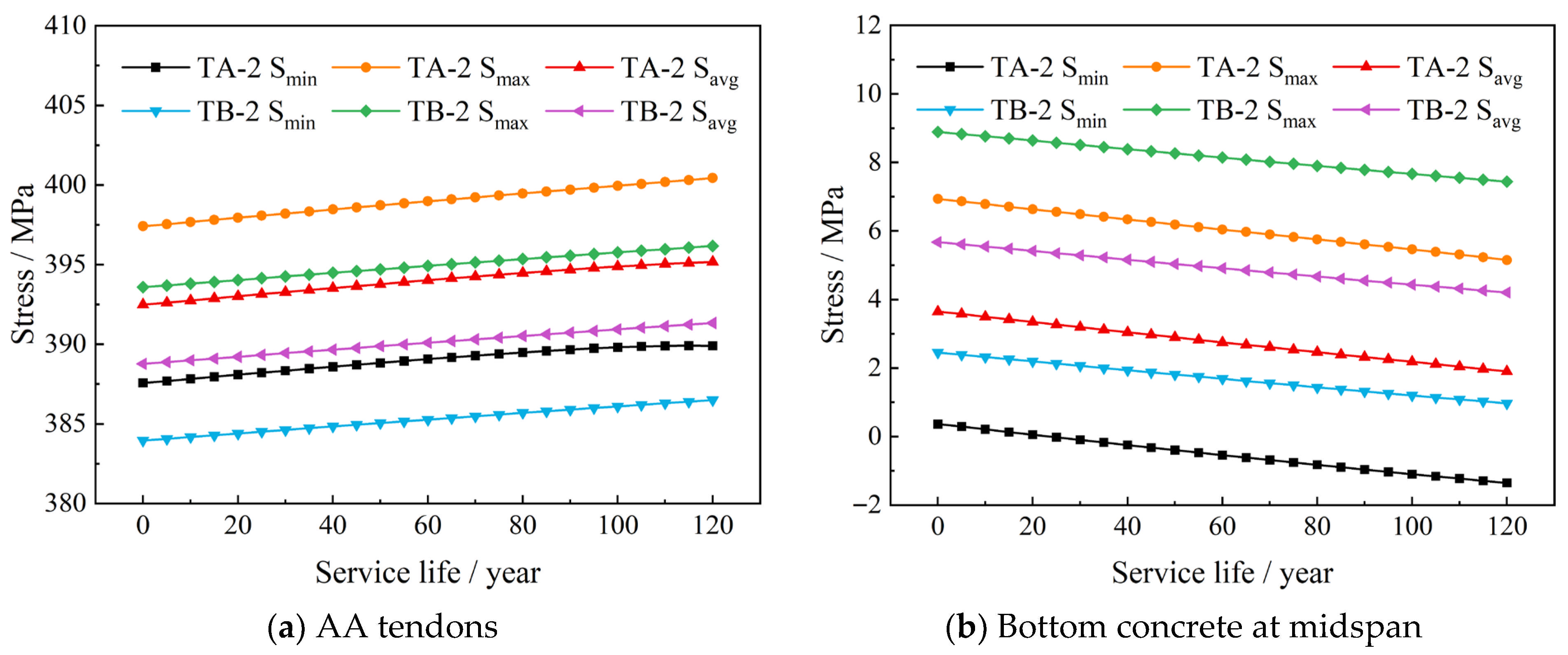
Owing to space constraints, only the stress variation diagrams of the AA tendons and bottom concrete at the midspan for TA-2 and TB-2 of the second-grade highway beams are presented. Figure 19 illustrates the maximum stress Smax, minimum stress Smin, and average stress Savg changes in the AA tendons and bottom concrete at midspan within the service life, respectively. The stress exhibited nearly linear changes that were attributed to the relatively low fatigue loads, resulting in minimal fatigue damage to the novel prestressed concrete beams. Moreover, as shown in Figure 19b, after 20 years of use, TA-2 was subjected to tensile stress in the bottom concrete under fatigue loads. Tensile steel bars may be exposed to air, leading to corrosion and a significant reduction in the fatigue life of prestressed concrete beams. Therefore, efforts should be made to avoid this problem when designing pre-stressed concrete beams. Using two 16 mm AA tendons, the prestressed concrete beams can maintain satisfactory mechanical performance and effectively resist bottom cracking under fatigue loading during service.
The results indicated that the beams exhibited excellent fatigue performances. According to the traffic volume data in Shaanxi Province, the novel prestressed concrete beams TA-2 and TB-2 will not suffer from fatigue failure within 120 years.
Figure 19. Variation of material stress during the service life under fatigue loading.
Buildings 16 01339 g019

5. Validation of Fatigue Life Improvement

To verify the contribution of the 7075 AA bars to the fatigue durability of concrete structures, the PS strands in the fatigue test beams [7,10] were replaced with corrosion-resistant AA tendons while maintaining the same prestress ratio. The fatigue life of the novel concrete beams prestressed with AA tendons was calculated theoretically.

5.1. Load-Bearing Capacity

The effective prestresses of the AA bars obtained by replacing the PS strands with AA tendons are listed in Table 5, and the reinforcement of the beam section is illustrated in Figure 20. The ultimate load Pu of the novel beams closely matched the experimental values. With strong bending capacity, the novel beams provide a solid foundation for further analysis under high-cycle fatigue loading.
Table 5. Comparison of load-bearing capacity of previous studies.
SourceSpecimen IDSteel BarEffective Prestress/MPaPu/kN
PSAA BarsTest BeamsNovel Beams
Zhang et al. [7]PP0HS2ϕ121242.6423.4135.0136.0
PP0MS2ϕ141106.7377.1142.8144.1
PP0LS2ϕ161242.6423.4168.7178.7
Su et al. [10]S03ϕ161167.0406.3235.0232.0

5.2. Cross Section Flexural Analysis

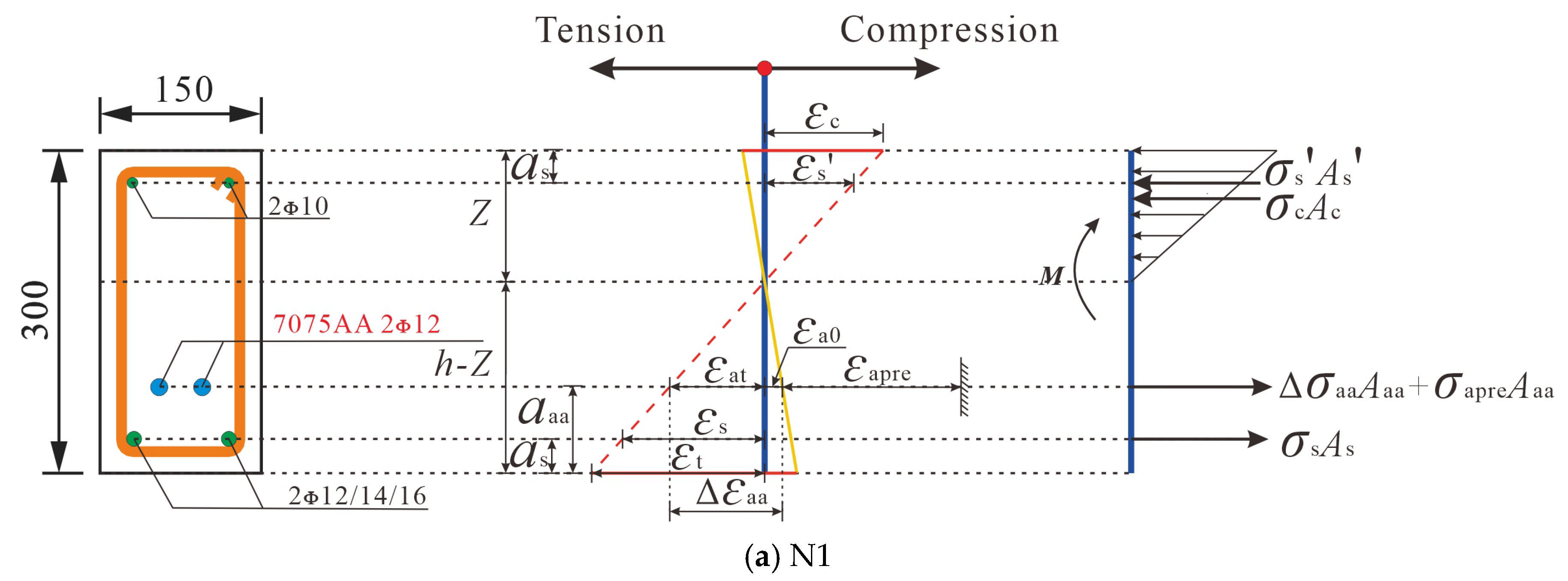
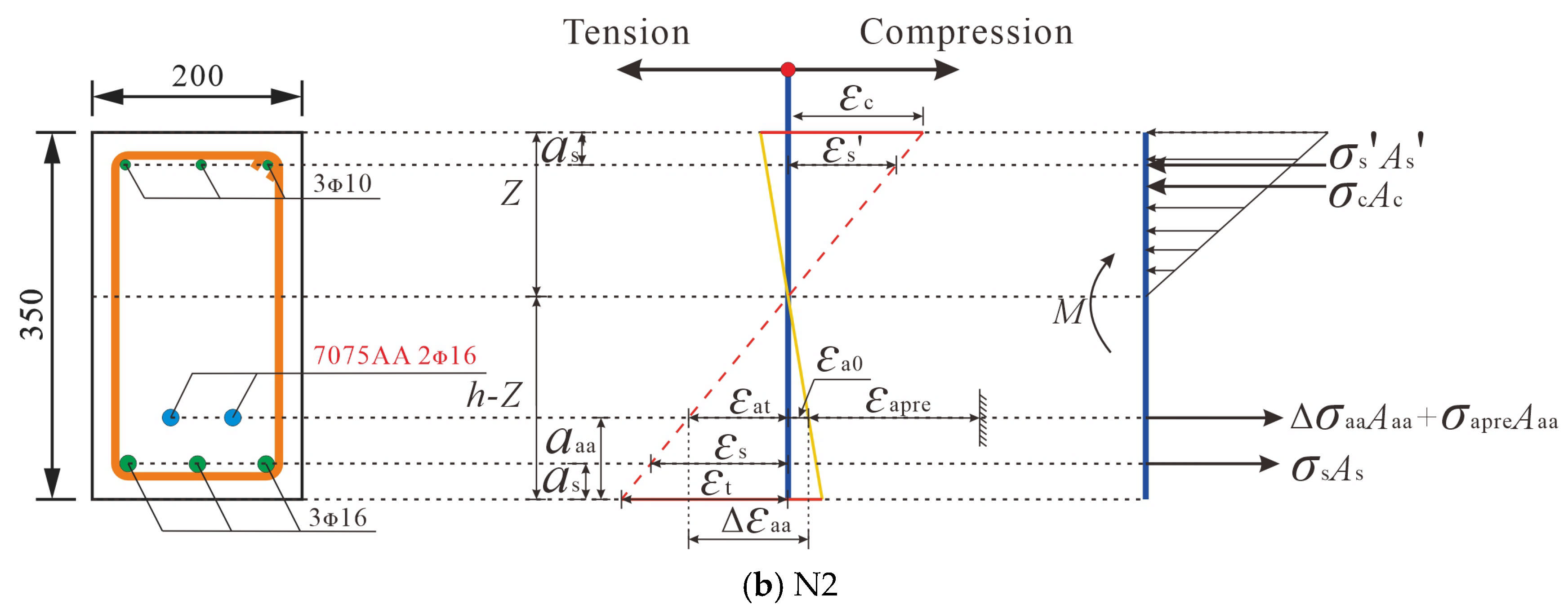
The PS strands of the fatigue test beam in ref. [7] were replaced with 7075 AA tendons, and the new beam after the replacement was named N1. Another new beam was named N2 after the PS strands in ref. [10] were replaced with 7075 AA tendons. The effective prestresses of the AA bars are presented in Table 6 and Table 7. Based on the basic assumptions of the cross-sectional analysis under fatigue loading, as discussed earlier, Figure 20 depicts the strain and stress profiles of the cross-section of the prestressed concrete beam, and Equations (40)–(42) were established.
ε c Z = ε s Z a s = ε s h Z a s = ε at h Z a aa
A aa σ aa + A s σ s A s σ s 1 2 Z b σ c = 0
M A aa σ aa ( h Z a aa ) A s σ s ( h Z a s ) A s σ s ( Z a s ) 1 3 Z 2 b σ c = 0
where Z is the depth of the neutral axis.
Figure 20. Cross section analysis diagram.
Buildings 16 01339 g020aBuildings 16 01339 g020b

5.3. Comparative Analysis of Fatigue Life

Liu et al. [61] and Su et al. [10] independently developed fatigue life prediction methods for prestressed concrete beams with corroded PS strands. In this study, Liu’s approach was used for beam N1 and Su’s method for beam N2. Table 6 and Table 7 compare the fatigue life and failure modes between corroded prestressed beams and novel beams. For uncorroded PS strands, fatigue failure typically occurs through the fracture of tensile steel bars, which experience higher stress amplitudes than PS wires due to their farther distance from the centroid. However, the novel beams exhibited a shorter fatigue life, as their tensile steel bars endured greater stress amplitudes. When PS strands corrode, they suffer from stress corrosion under high-cycle fatigue, which significantly reduces their fatigue life and leads to failure by strand fracture. Replacing the corroded strands with corrosion-resistant AA tendons shifts the failure mode to the tensile steel bars, markedly improving fatigue life.
For example, Table 6 shows that even though PP1MF-1 had a lower corrosion rate than PP2MF-3 and PP3MF-3, its fatigue life was shorter due to lower effective prestress from the AA tendons, resulting in higher stress on the bottom steel bar. Additionally, in PP2MF-1 and PP2MF-2, replacing PS strands with AA tendons altered the failure mode from PS strand fatigue to concrete fatigue because of a lower fatigue load threshold. Table 7 further indicates that beam F0’s fatigue life was reduced by 40.2% compared to the original beam, while beam F4’s fatigue life improved by 449.8% after replacement.
In summary, employing 7075 high-strength AA tendons in place of PS strands can significantly enhance the fatigue durability of prestressed concrete beams in corrosive environments.
Table 6. Fatigue life comparison with reference [7].
Specimen IDCorrosion Rate/%Effective Prestress/MPaFatigue Life/×104Improvement of Fatigue LifeFatigue Failure Mode
PSAA BarsPSAA BarsTest BeamsNovel Beams N1Test BeamsNovel Beams N1
PP0MF-3001281.5436.2196.9/—122−38.0%Steel barSteel bar
PP1MF-31.30.1941126.1379.142.1/38.05530.6%PSSteel bar
PP2MF-32.50.2561223.2407.021.9/20.081269.9%PSSteel bar
PP3MF-35.60.3621203.8388.216.6/15.062273.5%PSSteel bar
PP2HF-34.00.3131145.5375.58.6/8.026202.3%PSSteel bar
PP2LF-33.70.3031145.5376.629.2/26.03726.7%PSSteel bar
PP2MF-1130.1941126.1379.1188.5/168.01666783.8%PSConcrete
PP2MF-21.60.2121339.7449.76.8/6.06399297.1%PSConcrete
Note: The corrosion rate of the AA tendons was calculated using a corrosion correlation model for the steel and 7075 AA tendons [62]. The fatigue life of the test beam is represented by both the test and calculated values. For example, 42.1/38.0 indicates that the test value was 42.1 × 10⁴ cycles and the calculated value was 38.0 × 10⁴ cycles. The improvement in the fatigue life was assessed by comparing the experimental value of the test beam with the calculated value of the novel beam.
Table 7. Fatigue life comparison with reference [10].
Specimen IDCorrosion Rate/%Effective Prestress/MPaFatigue Life/×104Improvement of Fatigue LifeFatigue Failure Mode
PSAA BarsPSAA BarsTest BeamsNovel Beams N1Test BeamsNovel Beams N1
F0001167.0406.3386.3/336225−41.8%Steel barSteel bar
F14.10.3171109.8162.9/15138.1%PS
F26.80.3931072.1108.7/93107.0%PS
F38.20.4261052.660.0/74275.0%PS
F410.80.4791016.340.2/49459.7%PS

6. Conclusions

In the present work, the flexural behavior of T-shaped beams prestressed with hybrid PS strands and AA tendons was investigated by numerical simulation and theoretical analysis. Moreover, a framework for predicting the fatigue life of the prestressed beams was provided. The following conclusions can be drawn:
(1)
The load–deflection curves for the novel beams with hybrid AA tendons and PS strands show four phases: elastic, cracked-elastic, pre-peak plastic, and post-peak plastic. Increasing the reinforcement ratio of AA tendons notably raises both the yield and ultimate loads. While enlarging the non-prestressed steel bar area can improve flexural performance, the total prestressing force from AA tendons and PS strands plays a more pivotal role.
(2)
Theoretical analysis results are compared to numerical simulations and demonstrate the proposed equations can provide accurate predictions with a relative deviation of less than 10.4%. It is suggested that the proposed equations can serve as reliable tools for the rapid assessment of prestressed beam performance in practical engineering applications.
(3)
A framework for predicting the fatigue life of the prestressed beams based on defined vehicle fatigue loads and material fatigue constitutive models was proposed. The analysis indicates that concrete beams TA-2 and TB-2 will not suffer fatigue failure within a service life of 120 years. Two AA prestressing tendons with a diameter of 16 mm can effectively resist bottom cracking under fatigue loading.
(4)
For beams with corroded PS strands, their failure resulted from the fatigue fracture of PS strands instead of tensile steel bars. Replacing PS strands with AA tendons increased the fatigue lives of beams (e.g., N2) by 449.8%, shifting the failure mode to tensile steel bar fatigue fracture. Analytical results show that in corrosive environments, the use of AA as prestressed tendons can significantly improve the fatigue durability of concrete beams. These fatigue-life predictions should be interpreted within the assumptions of the adopted sectional fatigue framework and are mainly intended for comparative assessment of different prestressing configurations.
Limitations: It should be noted that the present study mainly focuses on the short-term flexural response and fatigue behavior of the proposed hybrid AA–PS system. Long-term serviceability, durability evolution, and implementation-related issues were not fully addressed and require further investigation. The present findings are based on material testing, experimentally informed constitutive/interface relationships, finite element simulation, and theoretical analysis. Further beam-level experimental studies under static and cyclic loading would be valuable for strengthening the validation of the proposed hybrid AA–PS prestressed beam system.
Future Work Recommendations: While the proposed hybrid design balances the high elastic modulus of PS strands with the superior corrosion resistance of AA tendons, the present findings mainly reflect the short-term mechanical response and fatigue performance of the system. Future studies should focus on: (a) optimization of the hybrid ratio considering structural performance and life-cycle cost; (b) serviceability-oriented evaluation, including crack-width development, prestress loss, and long-term deflection under sustained loading; (c) long-term prestress loss and deflection evolution associated with the creep and stress relaxation behavior of AA tendons; (d) long-term durability validation under real corrosive environments, including the possible galvanic interaction between AA and steel components; and (e) practical implementation issues, such as anchorage design, construction feasibility, and field applicability of AA tendons in prestressed concrete members.

Author Contributions

Conceptualization, J.Z., Z.C. and B.L.; methodology, Z.C.; software, J.Z., P.P. and M.H.; validation, J.Z., Z.C., P.P. and M.H.; investigation, J.Z., Z.C., X.P., P.P. and M.H.; resources, Z.C. and B.L.; data curation, J.Z. and P.P.; writing—original draft preparation, J.Z. and M.H.; writing—review and editing, Z.C. and B.L.; visualization, Z.C.; supervision, B.L.; project administration, Z.C.; funding acquisition, Z.C. and B.L. All authors have read and agreed to the published version of the manuscript.

Funding

This research was funded by the National Natural Science Foundation of China, [Grant Numbers: 52178103], and the Fundamental Research Funds for the Central Universities, CHD, [Grant Numbers: 300102285203].

Institutional Review Board Statement

Not applicable.

Informed Consent Statement

Not applicable.

Data Availability Statement

All data that support the findings of this study are available from the corresponding author upon reasonable request.

Conflicts of Interest

The authors declare no conflict of interest.

Abbreviations

The following abbreviations are used in this manuscript:
SymbolDefinition
AaaArea of AA bars
ApsArea of PS strands
AsTotal area of tensile steel bars
faa,peEffective prestresses applied to the AA bars
fps,peEffective prestresses applied to the PS strands
fyYield stress of the tensile steel bars
fcCylinder compressive strength of concrete
ftTensile strength of concrete
ftsTensile-splitting strength of grout
bFlange width of the beam
daaDistance from the centroid of AA bars to the edge of the compression zone
dpsDistance from the centroid of PS strands to the edge of the compression zone
dsDistance from the centroid of tensile steel bars to the edge of the compression zone
dDiameter of AA tendons
DDiameter of AA tendons
laBond anchorage length
PPRPartial prestress ratio
CRICombined reinforcement index
ωNon-prestressing tensile reinforcement index
PdDecompression load
PcrCracking load
PyYield load
PuUltimate load
ΔdMid-span deflection at decompression
ΔcrMid-span deflection at cracking
ΔyMid-span deflection at yielding
ΔuMid-span deflection at ultimate state
µDuctility index
σc, εcCompressive stress and strain of concrete
σt, εtTensile stress and strain of concrete
αc, αtParameters related to the descending branches of concrete constitutive laws
τAverage bond stress
FNodal force of spring element
L0Axial grid size of AA tendons
Su, SrCharacteristic slip parameters in the bond–slip relationship
MdDecompression moment
McrCracking moment
MyYield moment
MuMaximum moment
xcNeutral axis depth
EcElastic modulus of concrete
b(x)Variable section width of the beam
ΔσStress amplitude under fatigue loading
σmaxMaximum stress under fatigue loading

References

  1. Coronelli, D.; Castel, A.; Vu, N.A.; Francois, R. Corroded post-tensioned beams with bonded tendons and wire failure. Eng. Struct. 2009, 31, 1687–1697. [Google Scholar] [CrossRef]
  2. Bruce, S.; McCarten, P.; Freitag, S.; Hasson, L. Deterioration of Prestressed Concrete Bridge Beams; Austroads Bridge Conference (2006) (Research Report No. 337); Land Transport: Wellington, New Zealand, 2008. [Google Scholar]
  3. Podolny, W. Corrosion of Prestressing Steels and Its Mitigation. PCI J. 1992, 37, 34–55. [Google Scholar] [CrossRef]
  4. Jiang, C.; Wu, C.; Jiang, X. Experimental study on fatigue performance of corroded high-strength steel wires used in bridges. Constr. Build. Mater. 2018, 187, 681–690. [Google Scholar] [CrossRef]
  5. Wang, L.; Zhang, X.; Zhang, J.; Ma, Y.; Xiang, Y.; Liu, Y. Effect of insufficient grouting and strand corrosion on flexural behavior of PC beams. Constr. Build. Mater. 2014, 53, 213–224. [Google Scholar] [CrossRef]
  6. Rinaldi, Z.; Imperatore, S.; Valente, C. Experimental evaluation of the flexural behavior of corroded P/C beams. Constr. Build. Mater. 2010, 24, 2267–2278. [Google Scholar] [CrossRef]
  7. Zhang, W.; Liu, X.; Gu, X. Fatigue behavior of corroded prestressed concrete beams. Constr. Build. Mater. 2016, 106, 198–208. [Google Scholar] [CrossRef]
  8. Liu, X.; Zhang, W.; Gu, X.; Ye, Z. Probability distribution model of stress impact factor for corrosion pits of high-strength prestressing wires. Eng. Struct. 2021, 230, 111686. [Google Scholar] [CrossRef]
  9. Yu, F.; Jia, J.Q.; Yao, D.L.; Zhu, W.Q. Fatigue behavior of prestressed concrete beams under corrosion. Adv. Mater. Res. 2011, 255, 360–364. [Google Scholar] [CrossRef]
  10. Su, X.; Ma, Y.; Wang, L.; Guo, Z.; Zhang, J. Fatigue life prediction for prestressed concrete beams under corrosion deterioration process. Structures 2022, 43, 1704–1715. [Google Scholar] [CrossRef]
  11. Du, Y.; Wei, J.; Yuan, J.; Lai, Y.; Sun, D. Experimental research on fatigue behavior of prestressed concrete beams under constant-amplitude and variable-amplitude fatigue loading. Constr. Build. Mater. 2020, 259, 119852. [Google Scholar] [CrossRef]
  12. Ding, Z.; Cao, Q. A state-of-the-art review of flexural behaviors of PC beams with corroded prestressing tendons. Structures 2024, 63, 106430. [Google Scholar] [CrossRef]
  13. Imoh, U.U.; Habashneh, M.; Kaine, S.C.; Babafemi, A.J.; Hassan, R.; Movahedi Rad, M. Metakaolin-Enhanced Laterite Rock Aggregate Concrete: Strength Optimization and Sustainable Cement Replacement. Buildings 2025, 15, 4553. [Google Scholar] [CrossRef]
  14. Imoh, U.U.; Apata, A.C.; Movahedi Rad, M. Performance of Concrete Incorporating Waste Glass Cullet and Snail Shell Powder: Workability and Strength Characteristics. Buildings 2025, 15, 2161. [Google Scholar] [CrossRef]
  15. Tuncer, E.; Binici, B.; Canbay, E. Behavior and design of FRP bonded autoclaved aerated concrete beams. Constr. Build. Mater. 2021, 282, 122712. [Google Scholar] [CrossRef]
  16. Betschoga, C.; Tung, N.D.; Tue, N.V. Investigations on the influence of boundary and loading conditions on the shear resistance of FRP concrete beams without shear reinforcement. Compos. Struct. 2020, 262, 113335. [Google Scholar] [CrossRef]
  17. Qu, W.; Zhang, X.; Huang, H. Flexural behavior of concrete beams reinforced with hybrid (GFRP and steel) bars. J. Compos. Constr. 2009, 13, 350–359. [Google Scholar] [CrossRef]
  18. Masmoudi, R.; Zaidi, A.; Gerard, P. Transverse Thermal Expansion of FRP Bars Embedded in Concrete. J. Compos. Constr. 2005, 9, 377–387. [Google Scholar] [CrossRef]
  19. Zaidi, A.; Masmoudi, R.; Bouhicha, M. Numerical analysis of thermal stress-deformation in concrete surrounding FRP bars in hot region. Constr. Build. Mater. 2013, 38, 204–213. [Google Scholar] [CrossRef]
  20. Zhu, J.H.; Wei, L.L.; Wu, W.T.; Xing, F.; Feng, R. Experimental Study of Concrete Strengthened by Stiffened Aluminum Plate. Appl. Mech. Mater. 2014, 584–586, 997–1000. [Google Scholar] [CrossRef]
  21. Abu-Obeidah, A.; Hawileh, R.; Abdalla, J. Finite element analysis of strengthened RC beams in shear with aluminum plates. Comput. Struct. 2015, 147, 36–46. [Google Scholar] [CrossRef]
  22. Abdalla, J.A.; Abu-Obeidah, A.R.; Hawileh, R.A. Use of Aluminum Alloy Plates as Externally Bonded Shear Reinforcement for R/C Beams. Procedia Struct. Integr. 2019, 17, 403–410. [Google Scholar] [CrossRef]
  23. Yu, X.; Xing, G.; Chang, Z. Flexural behavior of reinforced concrete beams strengthened with near-surface mounted 7075 aluminum alloy bars. J. Build. Eng. 2020, 31, 101393. [Google Scholar] [CrossRef]
  24. Xing, G.H.; Chen, X.; Huang, J.; Zhang, Y.; Ozbulut, O.E.; Chang, Z.Q. Reinforced Concrete Beams Strengthened in Flexure with Near-Surface Mounted 7075 Aluminum Alloy Bars. J. Struct. Eng. 2022, 148, 4021242. [Google Scholar] [CrossRef]
  25. Li, X.; Xing, G.; Chang, Z.; Huang, J. Experimental and analytical study of RC beams strengthened with prestressed near-surface mounted 7075 aluminum alloy bars. Structures 2023, 48, 1693–1706. [Google Scholar] [CrossRef]
  26. Xing, G.; Chang, Z.; Ozbulut, O.E. Feasibility of using aluminum alloy bars as near-surface mounted reinforcement for flexural strengthening of reinforced concrete beams. Struct. Concr. 2020, 21, 1557–1576. [Google Scholar] [CrossRef]
  27. Xing, G.; Li, X.; Chang, Z.; Ozbulut, O.E. Behavior of RC Beams Strengthened with Near-Surface Mounted Aluminum Alloy Bars under Fully Reversible Cyclic Loads. J. Bridge Eng. 2022, 27, 04022103. [Google Scholar] [CrossRef]
  28. Xing, G.; Wang, H.; Chang, Z.; Ma, K. Prediction of the seismic behavior of concrete beams strengthened with aluminum alloy bars and/or basalt fiberreinforced polymer bars. Struct. Des. Tall Spec. Build. 2022, 31, e1911. [Google Scholar] [CrossRef]
  29. Wang, H.; Xing, G.; Zhao, J.; Wen, F. Seismic behavior of RC columns strengthened with near-surface-mounted aluminum alloy bars and CFRP wraps. Eng. Struct. 2022, 268, 114742. [Google Scholar] [CrossRef]
  30. Chang, Z.; Xing, G.; Zhao, J.; Huang, J. Feasibility and flexural behavior of RC beams prestressed with straight unbonded aluminum alloy tendons. Adv. Struct. Eng. 2021, 24, 1466–1479. [Google Scholar] [CrossRef]
  31. You, X.; Xing, Z.; Jiang, S.; Zhu, Y.; Lin, Y.; Qiu, H.; Nie, R.; Yang, J.; Hui, D.; Chen, W. A review of research on aluminum alloy materials in structural engineering. Dev. Built Environ. 2024, 17, 100319. [Google Scholar] [CrossRef]
  32. Lu, Z.-H.; Yang, Z.-N.; Li, C.-Q. A new empirical model for flexural stiffness of corroded post-tensioned concrete beams. Eng. Struct. 2023, 295, 116860. [Google Scholar] [CrossRef]
  33. Du, J.S.; Au, F.T.K.; Cheung, Y.K.; Kwan, A.K.H. Ductility analysis of prestressed concrete beams with unbonded tendons. Eng. Struct. 2008, 30, 13–21. [Google Scholar] [CrossRef]
  34. GB/T 228.1; Metallic Materials-Tensile Testing-Part 1: Method of Test at Room Temperature. Standards Press of China: Beijing, China, 2021.
  35. Ramberg, W.; Osgood, W.R. Description of Stress-Strain Curves by Three Parameters; National Advisory Committee for Aeronautics: Washington, DC, USA, 1943. [Google Scholar]
  36. GB 50010-2010; Code for Design of Concrete Structures. China Architecture and Building Press: Beijing, China, 2010.
  37. Obaydullah, M.; Jumaat, M.Z.; Alengaram, U.J.; Darain, K.M.u.; Huda, M.N.; Hosen, M.A. Prestressing of NSM steel strands to enhance the structural performance of prestressed concrete beams. Constr. Build. Mater. 2016, 129, 289–301. [Google Scholar] [CrossRef]
  38. Wang, G. Research and Finite Element Analysis of Interfacial Bonding Properties of Prestressed High Strength Aluminum Alloy Reinforced Concrete Beams. Master’s Thesis, Chang’an University, Xi’an, China, 2023. [Google Scholar]
  39. He, C. Theoretical and Experimental Research on Bonding Performance of Steel Strand in Corrugated Pipe. Master’s Thesis, Hebei University of Technology, Tianjin, China, 2021. [Google Scholar]
  40. Darmawan, M.S.; Stewart, M.G. Spatial time-dependent reliability analysis of corroding pretensioned prestressed concrete bridge girders. Struct. Saf. 2007, 29, 16–31. [Google Scholar] [CrossRef]
  41. Han, M.; Chang, Z.; Xing, G.; Li, J.; Ni, X.; Liu, B. Experimental and theoretical analysis on the flexural behavior of RC beams prestressed with unbonded aluminum alloy tendons. J. Build. Eng. 2026, 119, 115183. [Google Scholar] [CrossRef]
  42. ACI 318; Building Code Requirements for Structural Concrete and Commentary. American Concrete Institute: Detroit, MI, USA, 2017.
  43. Aas-Jakobsen, K.; Lenschow, R. Behavior of reinforced columns subjected to fatigue loading. J. Proc. 1973, 70, 199–206. [Google Scholar]
  44. Tepfers, R.; Kutti, T. Fatigue strength of plain, ordinary, and lightweight concrete. J. Proc. 1979, 76, 635–652. [Google Scholar]
  45. Zhang, W.; Song, X.; Gu, X.; Li, S. Tensile and fatigue behavior of corroded rebars. Constr. Build. Mater. 2012, 34, 409–417. [Google Scholar] [CrossRef]
  46. Ma, L. Research on fatigue properties of domestic1860 low relaxation prestressed steel strand. Railw. Stand. Des. 2000, 20, 21–23. [Google Scholar]
  47. Shuo, W.; Jun, Y.; Lihui, Z.; Jinzhi, F.; Songlin, Z. Effect of Corrosion Damage on Fatigue Behavior of AA7075-T651 Al-alloy. J. Chin. Soc. Corros. Prot. 2021, 42, 486–492. [Google Scholar] [CrossRef]
  48. Holmen, J.O. Fatigue of concrete by constant and variable amplitude loading. Spec. Publ. 1982, 75, 71–110. [Google Scholar]
  49. Zhu, J.; Zhu, X. Study on simplified method for the analysis of fatigue failure process of RC bridges. Eng. Mech. 2012, 29, 107–114,121. [Google Scholar]
  50. Li, Q.; Fang, J.; Jeary, A. Free vibration analysis of cantilevered tall structures under various axial loads. Eng. Struct. 2000, 22, 525–534. [Google Scholar] [CrossRef]
  51. Baxter, W.J.; Wang, P.C. Finite element prediction of high cycle fatigue life of aluminum alloys. Metall. Mater. Trans. A 1990, 21, 1151–1159. [Google Scholar] [CrossRef]
  52. Miner, M.A. Cumulative damage in fatigue. J. Appl. Mech. 1945, 12, 159–164. [Google Scholar] [CrossRef]
  53. Fang, S.G.O.C. Study on Fatigue Reliability Checking Method of Concrete Beams; China Building Industry Press: Beijing, China, 1994. [Google Scholar]
  54. Li, C.; Song, Y.; Zhao, G. Study of residual strain of concrete under fatigue loading. J. Dalian Univ. Technol. 2001, 41, 355–358. [Google Scholar]
  55. Wang, R.; Zhao, G.; Song, Y. Fatigue of plain concrete under compression. China Civ. Eng. J. 1991, 38–47. [Google Scholar]
  56. JTG B01-2014; Technique Standard of Highway Engineering. People’s Communications Press: Beijing, China, 2014.
  57. Chen, B.; Ye, Z.-N.; Chen, Z.; Xie, X. Bridge vehicle load model on different grades of roads in China based on Weigh-in-Motion (WIM) data. Measurement 2018, 122, 670–678. [Google Scholar] [CrossRef]
  58. AASHTO. AASHTO LRFD Bridge Design Specifications; American Association of State Highway and Transportation Officials: Washington, DC, USA, 2012. [Google Scholar]
  59. BS EN 1991-2:2003; Eurocode 1: Actions on structures-Part 2: Traffic loads on bridges. European Committee for Standardization: Brussels, Belgium, 2010.
  60. Wang, S.-Y.; Zhang, L.-X.; Xu, R.-P. Deterioration laws of concrete elastic modulus under fatigue loading. Mech. Eng. 2003, 25, 55–57. [Google Scholar] [CrossRef]
  61. Liu, X.; Zhang, W.; Gu, X.; Ye, Z. Assessment of Fatigue Life for Corroded Prestressed Concrete Beams Subjected to High-Cycle Fatigue Loading. J. Struct. Eng. 2023, 149, 14. [Google Scholar] [CrossRef]
  62. Peng, P. Study on Material Properties of 7075 High Strength Aluminum Alloy and Fatigue Life of Novel Prestressed Concrete Beams Using AA Bars. Master’s Thesis, Chang’an University, Xi’an, China, 2024. [Google Scholar]
Disclaimer/Publisher’s Note: The statements, opinions and data contained in all publications are solely those of the individual author(s) and contributor(s) and not of MDPI and/or the editor(s). MDPI and/or the editor(s) disclaim responsibility for any injury to people or property resulting from any ideas, methods, instructions or products referred to in the content.