Next Article in Journal
Floor Plan Generation of Existing Buildings Based on Deep Learning and Stereo Vision
Previous Article in Journal
Sensing Vegetation Resistance and Recovery Along Urban–Rural Gradients
 
 
Due to scheduled maintenance work on our servers, there may be short service disruptions on this website between 11:00 and 12:00 CEST on March 28th.
Article

Quantitative Evaluation Method for the Circumferential Multi-Point Corrosion States of Stay Cables Based on Self-Magnetic Flux Leakage Detection

1
State Key Laboratory of Mountain Bridge and Tunnel Engineering, Chongqing Jiaotong University, Chongqing 400074, China
2
School of Civil Engineering, Chongqing Jiaotong University, Chongqing 400074, China
3
Chongqing Railway Group Co., Ltd., Chongqing 401120, China
*
Author to whom correspondence should be addressed.
Buildings 2026, 16(7), 1309; https://doi.org/10.3390/buildings16071309

Submission received: 28 February 2026 / Revised: 20 March 2026 / Accepted: 24 March 2026 / Published: 26 March 2026

Abstract

Stay cables are critical load-bearing components in cable-stayed structures, making corrosion distribution vital for damage diagnosis and maintenance. To address the insufficient characterization of circumferential multi-point corrosion distribution in stay cables, a theoretical model of circumferential multi-point defect magnetic charge for the stay cables was established, and a self-magnetic flux leakage experiment was conducted on 37-wire steel specimens with circumferential corrosion. The effects of corroded wire number (N), corrosion time (T), and circumferential angle number (K) on the axial Bx component of the magnetic flux leakage signal were analyzed. The relationship between the θ-Bx-max peak distribution and corrosion patterns was clarified. Quantitative models for corrosion number (c), center (θc), and the cross-sectional corrosion rate (α) were established. The results indicate that c improves the determination of the number of concentrated corrosion sites in the ‘peak platform’ corrosion distribution type. Based on the Lorentz fitting, the maximum prediction error of θc is 15.1%, and the prediction accuracy of the cross-sectional corrosion rate α exceeds 90%. The study provides a reference for the quantifiable characterization and evaluation methods of the circumferential multi-point defect distribution in stay cables.

1. Introduction

Stay cables are the main load-bearing structure in cable-stayed bridges. Under the combined effects of complex environmental conditions and long-term stress, their sheaths are prone to damage, increasing the likelihood of damage to the internal steel strands or steel wire bundles. When the stay cable body is compromised, the bridge’s ultimate bearing capacity is reduced. If such damage accumulates to a critical level, the functionality of the bridge could be destroyed, posing significant threats to people’s property and lives.
The damage to stay cables is primarily categorized into damage along the long axis and circumferential damage. Among these, circumferential damage is of great significance for assessing the condition of the stay cables [1,2]. Therefore, it is crucial to perform circumferential non-destructive detection of stay cables.
In view of the hidden diseases of cable-stayed bridges in service, scholars from various countries have carried out a series of non-destructive detection studies, and the current non-destructive detection methods [3,4,5,6] include X-ray detection, ultrasonic detection, magnetostrictive detection, acoustic emission monitoring, magnetic flux leakage detection and so on. Among them, X-ray detection [7] has some disadvantages such as heavy detection equipment, low efficiency, and environmental pollution. Ultrasonic detection [8] has a low signal-to-noise ratio, low efficiency, and complex operation. The well-established relationship between stay cable deformation and magnetic field in magnetostriction detection [9] has not been achieved, and the detection results are not ideal. The results of acoustic emission monitoring [10] are not intuitive and are prone to interference from environmental noise during practical detection, which ultimately makes it challenging to quantitatively assess the damage. Magnetic flux leakage detection [11] requires excitation equipment, which leads to high costs and inconvenient operations. Scholars have studied and compared a variety of non-destructive detection methods and found that self-magnetic flux leakage detection technology is a relatively stable and convenient detection method [12].
Self-magnetic flux leakage detection was a detection method proposed by Dubov [13] based on the magnetic memory characteristics of ferromagnetic materials. In order to quantitatively analyze the damage of structural members, domestic and international scholars have continuously advanced the study of theoretical damage models and damage inversion methods [14]. A theoretical model is the key to analyzing the influence of component damage on magnetic flux leakage signal distribution and provides theoretical support for extracting the damage quantification index. Coulomb proposed the magnetic Coulomb law based on the interaction force between the point magnetic charges, and derived the magnetic dipole model by analogy with the electric dipole [15], providing a powerful theoretical analysis model for magnetic detection. However, the magnetic dipole model is not suitable for describing actual component damage. Therefore, Yang et al. [16] proposed a magnetic charge model and a magnetic signal expression for single defects of various shapes, resulting in a more accurate defect analysis formula. Trevino et al. [17] proposed an improved three-dimensional magnetic dipole model, in which the normal component of the magnetic flux leakage signal was used to describe more realistic defects by introducing two parameters. Ma et al. [18] established magnetic charge models for axial single-point defects and two-point defects, respectively, and obtained the difference in magnetic leakage signals between different numbers of defects in the pipeline. Although all kinds of magnetic charge models proposed by scholars promote the simulation of real defects, they mainly focus on axial defects, and there is a lack of relevant model research for circumferential defects.
Based on existing theoretical models, researchers have conducted a lot of exploration on defect inversion. In the field of non-cable components, Azizzadeh et al. [19] distinguished the characteristics of axial multi-defects and single defects in pipelines, advancing the quantitative process of axial multi-point defect identification. Qiu et al. [20] quantitatively evaluated the corrosion rate of steel bars and eliminated the differences in the magnetic properties of steel bars. Yang et al. [21] quantified the location and range of steel components’ corrosion areas, which laid a quantitative research foundation for non-destructive detection of bridge steel components. Referring to the research on the defects of other components, many scholars have carried out a lot of research on the defects of the stay cable. Zhou et al. [22] applied this technology for the first time to the non-destructive diagnosis of stay cable damage, and the axial corrosion center was located through the experimental study of the change in axial component along the axial position [23]. Qu et al. [24] obtained the length of axial corrosion by studying the relationship between the peak-valley distance of the normal component of the signal and the axial corrosion range. Breysse et al. [25] quantified the position of the most dangerous axial section under multiple circumferential defects and realized the judgment on the most dangerous axial section. In addition to the quantitative study of the axial defect location and size, the corrosion rate of the defect and the use of each quantitative result are also explored. Li et al. [26] combined the magnetic signal with the Bayesian model, proposed the feature index X to quantify the loss rate, and realized the probability evaluation of the defect degree. Zhang et al. [27] greatly reduced the quantization error by combining multiple cross-sectional loss rate indexes with a backpropagation neural network. Zhang et al. [28] used CNN and CWT intelligent algorithms to process magnetic signals, effectively improving the accuracy and efficiency of magnetic signal identification defects. Building upon the integration of intelligent algorithms, Xin et al. [29] proposed a novel structural damage identification method based on Swin Transformer and continuous wavelet transform, further expanding the potential of deep learning in structural condition assessment. Recent advancements in structural health monitoring over the past five to seven years have introduced sophisticated defect inversion models [30,31]. While these state-of-the-art studies utilizing advanced algorithms (e.g., deep learning and Bayesian networks) have significantly improved the quantitative evaluation of axial corrosion and overall cross-sectional loss [32], they primarily rely on data-driven mappings. Critically, these approaches often bypass the underlying physical modeling of signal coupling. Consequently, when encountering circumferential multi-point defects in cable or pipeline inspections, these models struggle to decouple the overlapping magnetic fields, resulting in a ‘black-box’ evaluation that cannot accurately pinpoint the specific number and angular distribution of the corrosion sites. In addition to intelligent algorithms, the development of detection hardware is equally important. William [33] developed a non-destructive detection device for the no-excitation stay cables, and the theoretical results were well applied to practical projects. Furthermore, optimal sensor placement and sensitivity analysis are critical for capturing reliable data using such devices, as demonstrated in recent damage identification studies for steel truss bridges [34]. Inspired by this, optimizing the circumferential sensor array layout is a fundamental prerequisite for acquiring high-quality SMFL signals. Compared with axial defects, many scholars have also carried out relevant analyses and research on circumferential defects. Liu et al. [35] studied the superposition effect of axial and circumferential magnetic leakage signals, obtained the influence law of axial and circumferential damage on magnetic signals, respectively, and promoted the process of collaborative quantification of circumferential and axial defects. Li et al. [36] obtained a preliminary judgment of the circumferential corrosion location through the analysis of the peak section of the axial component, which provided a research direction for determining the circumferential defect state. Clearly, the quantitative index of circumferential defects is underdeveloped compared with that of axial defects. Existing non-destructive testing methods and traditional magnetic dipole models predominantly focus on isolated or axial defects. When applied to circumferential multi-point corrosion, these traditional methods are fundamentally insufficient because they treat defects independently and fail to account for the fact that magnetic flux leakage signals from adjacent corrosion pits severely overlap and interfere with each other. This spatial signal superposition effect makes it highly challenging to distinguish individual defect boundaries, depths, and counts along the circumferential direction. To overcome this limitation, the methodological novelty of this paper lies in the proposal of a continuous circumferential multi-defect magnetic charge model. Unlike previous models, this approach mathematically decouples the overlapping magnetic fields, enabling the accurate distinction of individual defect boundaries, depths, and counts along the circumferential direction, which leads to the incomplete conclusion of actual defect detection.
Stay cable damage often occurs in the form of corrosion [37]. Therefore, to address the issue of circumferential corrosion distribution characterization of stay cables and enhance the comprehensiveness of cable evaluation, a circumferential multi-defect magnetic charge model will be proposed, tests under different corrosion conditions will be set up, and surface magnetic leakage signals will be collected. By analyzing the axial component of the signal, a quantitative model for locating circumferential corrosion centers’ positions, a model for quantifying the number of concentrated corrosion sites, and a model for assessing the cross-sectional corrosion rate will be established. These models collectively enable a comprehensive evaluation of the multi-point circumferential corrosion state.
Although magnetic charge models have been widely used to describe the magnetic leakage characteristics of ferromagnetic structures, most existing studies mainly focus on axial corrosion defects or single-point damage, where the defect distribution is assumed to occur along the cable axis. In these studies, the magnetic leakage field is primarily analyzed along the axial direction of the cable.
However, circumferential multi-point corrosion presents a fundamentally different defect configuration, in which multiple corrosion sites may exist at different circumferential positions of the cable cross-section. In this situation, the magnetic leakage signals exhibit strong circumferential superposition characteristics, which cannot be directly described using traditional axial magnetic charge models.
To address this limitation, this study establishes a circumferential multi-point magnetic charge model for stay cables based on self-magnetic flux leakage theory, and further proposes quantitative identification methods for the number of corrosion sites, circumferential corrosion center position, and corrosion degree. This framework enables a more comprehensive characterization of circumferential corrosion states in stay cables.

2. Establishment of Theoretical Model

The magnetic dipole is the basic research unit in magnetism. As the fundamental unit, it serves as the basis for analyzing and solving magnetic problems [38]. To detect the damage of circumferential multi-point defects in cable-stayed bridges, a magnetic charge model for analyzing circumferential multi-point defects was proposed based on the magnetic dipole model of single-point defects.
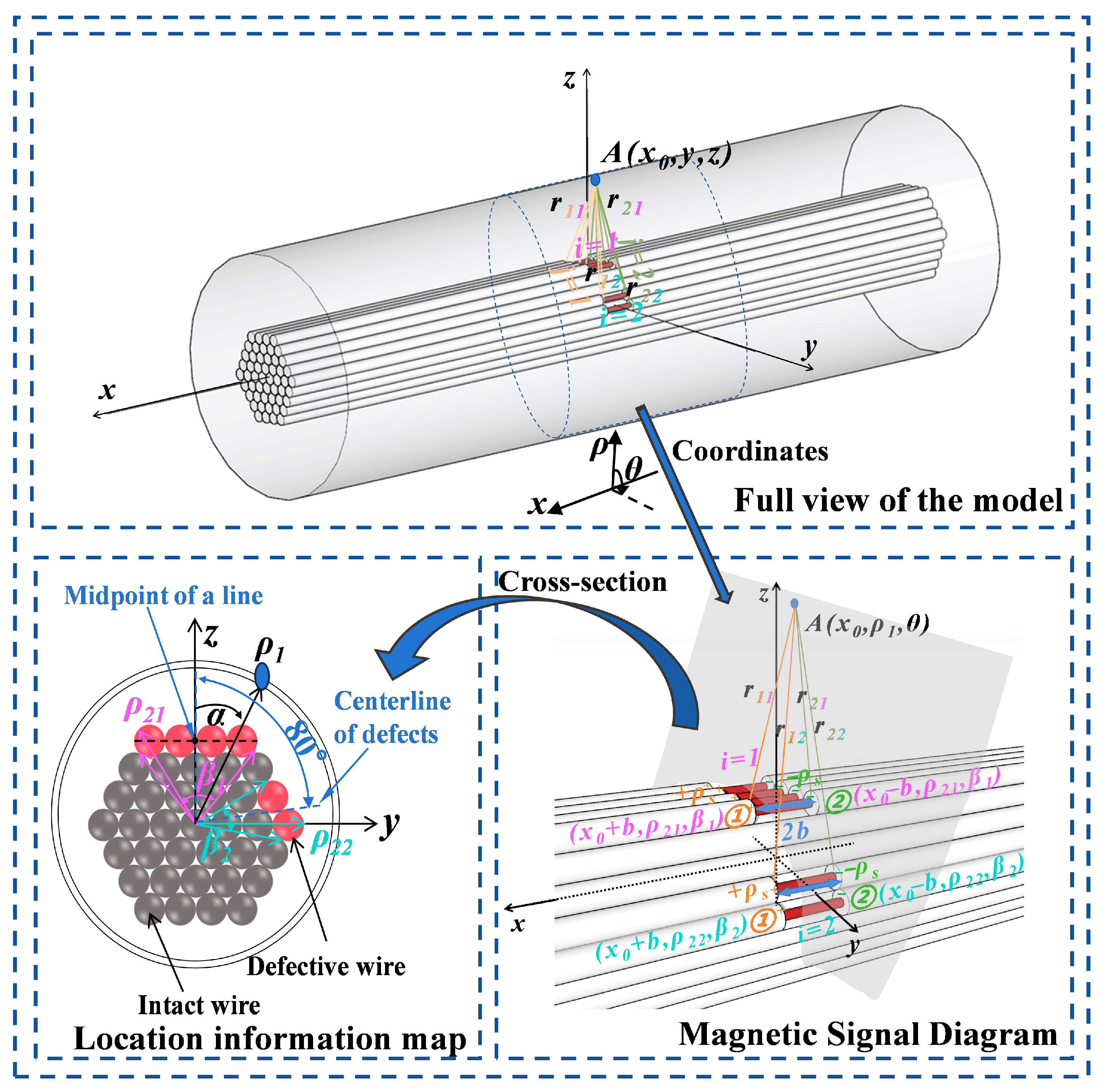
As shown in the full view and the self-magnetic flux leakage signal diagram in Figure 1, there are multiple discontinuous defective steel wires on the surface of the model. This distance between the detection point A and the defect is r. According to the point magnetic dipole theory, the magnetic induction intensity generated by the local defect magnetic charge at point A can be expressed as Equation (1):
d B j i = μ r μ 0 d H j i = μ r ρ s r j i 2 π r j i 3 d s
where dBji is the local magnetic induced intensity; μ0 is the vacuum permeability; μr is the relative permeability; ρs is the magnetic charge density at the defect cross-section; s is the defect area; rji and rji are the scalar and vector distance from the detection point to the defect, respectively; i represents the continuous defect with serial number i; j represents the defect end face with different magnetic charge types (where j = 1 corresponds to the positive magnetic charge surface ①, and j = 2 corresponds to the negative magnetic charge surface ②).
To facilitate the expression of the magnetic induction intensity of the circumferential multi-point defect magnetic charge model, cylindrical coordinates are used instead of Cartesian coordinates for theoretical derivation, taking into account the shape characteristics of the concentric circles of the stay cable and sensor array device. As shown in Figure 1, the axial direction of the specimen is defined as the x-axis, with the defect center taken as the origin. The positive direction of the z-axis is along the radial direction, and the positive polar angle is measured counterclockwise from the z-axis to the y-axis.
Assume that point A is the known position (x0, ρ1, θ), where x0 is the position of the measurement point on the x-axis, ρ1 is the radial distance from the measurement point to the center, and θ is the circumferential angle between the measurement point and the z-axis. These three parameters collectively determine the measurement distance. The position of any defect is (x0 ± b, ρ2i, βi), where x0 + b and x0b are the cross-sections of the ends of the defect filled with the same amount of dissimilar magnetic charges. βi is the angle range β corresponding to the ith continuous defect. This paper takes a model that includes two consecutive defect angles, β1 and β2, as an example. ρ2i is the radial distance from the defect to the center. βi and dρ2i together constitute the cross-sectional loss rate, which determines the magnitude of the magnetic charge at the defect ends.
Then, the dBji shown in Equation (1) is decomposed along the x-axis, and the defect range shown in the location information map is integrated to obtain the axial component Bjix of magnetic induction intensity caused by each j under the same i, as shown in Equations (2) and (3):
B 1 i x = μ r ρ s 2 π ρ R θ 1 θ 2 ( b x 0 ) d ρ 2 i d β i ( b x 0 ) 2 + ( ρ 1 sin θ ρ 2 i sin β i ) 2 + ( ρ 1 cos θ ρ 2 i cos β i ) 2 3 2
B 2 i x = μ r ρ s 2 π ρ R θ 1 θ 2 ( b + x 0 ) d ρ 2 i d β i ( b + x 0 ) 2 + ( ρ 1 sin θ ρ 2 i sin β i ) 2 + ( ρ 1 cos θ ρ 2 i cos β i ) 2 3 2
where x0, ρ1, and θ are the detection position parameters; b is the defect length within the length range of the specimen; ρ2i is the radial distance within the radius R; and βi is the angle range β corresponding to the ith continuous defect, taking any value from 0 to 360°. All variables are summarized in Appendix A, which covers those used in theoretical derivation and subsequent analysis.
After calculating and superimposing the contributions from different i using Equations (2) and (3), the total strength value Bx of the axial component of the magnetic flux leakage signal at point A is obtained, as shown in Equation (4):
B x = i = 1 n j = 1 2 B i j x = i = 1 n F ( x 0 , b , ρ 1 , ρ 2 i , θ , β i )
According to the main variables in the above equation, when the value of continuous defect i is fixed, the magnetic induction intensity at any measuring point is primarily influenced by the position of the measuring point (x0, ρ1, and θ), the circumferential defect depth (dρ2), the axial defect length (b), the circumferential defect angle range (β), and the circumferential angle between the centerlines of different continuous defect (the line connecting the midpoint of the centerline of each continuous defect wire to the center of the specimen).
In summary, the theoretical derivation reveals that the axial MFL component (Bx) is a spatial superposition of magnetic fields generated by all circumferential defects. The model mathematically dictates that the peak amplitude of Bx is highly sensitive to the defect depth (2) and the angular distribution (K, β), while its axial peak location always aligns with the physical center of the defect. Based on this theoretical foundation, numerical simulations were subsequently conducted to intuitively observe the spatial distribution characteristics of the magnetic signals.
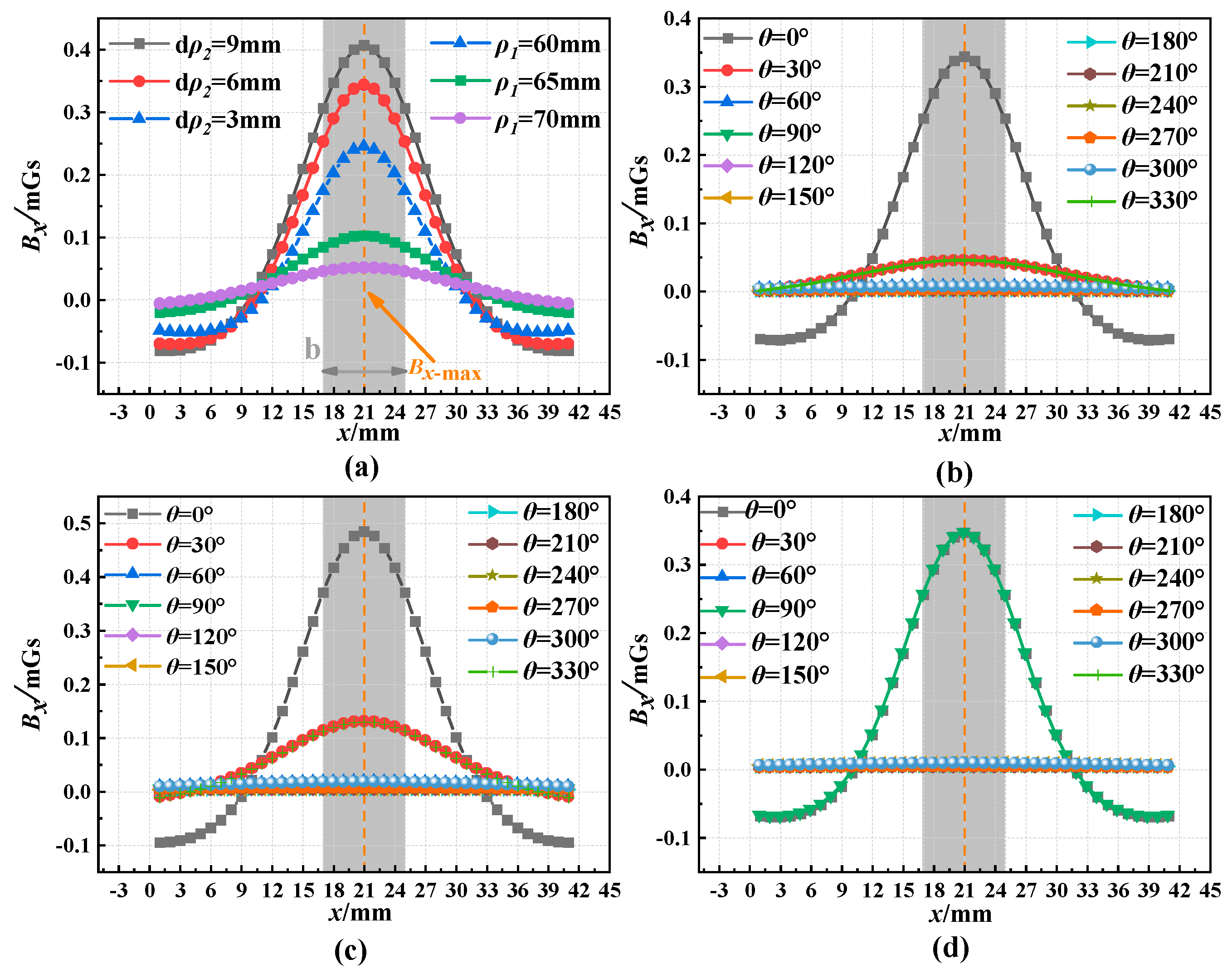
In order to explore the influence of circumferential multi-point defect parameters dρ2, β, and the circumferential angle between different i centerlines on the magnetic leakage signal, a typical representative of multiple defects was selected, where i = 1 or i = 2. Numerical simulation was carried out based on Equation (4). Assume that x0 ranges from 0 to 49 mm and b was always 8 mm, and ρ1, dρ2, θ, β, as well as the circumferential angle between different i centers were selected as variables. When dρ2 was the variable, causing changes in the cross-sectional loss rate, and i was fixed at 1, the simulation results are shown in Figure 2a. The representative value of the change in Bx, the Bx peak value (Bx-max), increases with the increase in dρ2, indicating a positive correlation between Bx-max and the cross-sectional loss rate. When dρ1 was the variable, causing changes in the detection distance, and i was fixed at 1, the simulation results are shown in Figure 2a, and Bx-max decreases with the increase in dρ1, indicating that the farther the detection distance, the smaller the Bx-max value. When θ and β were variables, causing changes in the detection distance and cross-sectional loss rate, respectively, and i was fixed at 1, the simulation results are shown in Figure 2b,c. Bx-max increases at different degrees with β for different θ values, indicating that the farther the detection distance, the smaller the Bx-max value. For the same detection position, Bx-max is positively correlated with the cross-sectional loss rate. When i was either 1 or 2, and θ and the circumferential angle between the centerlines of different values of i were variables, the simulation results are shown in Figure 2c,d. It can be seen that Bx-max will change under all θ, and the closer θ is to the actual circumferential center positions of the continuous defect (the positions of the continuous defect centerlines), the greater the Bx-max variation, reflecting that different corrosion distributions alter the detection distance. By comparing Figure 2a–d, it can be seen that when the axial direction b is kept unchanged, the x-Bx figure always maintains a single peak bulge for any circumferential defect parameter changes, and the position x of Bx-max always corresponds to the axial defect center.
Therefore, the central location of axial defects is independent of the parameters of circumferential multi-point defects. The Bx-max is influenced by both the detection location and the parameters of circumferential defects. The variation in Bx-max at each θ is related to the circumferential corrosion, and the horizontal coordinate θ at which the peak value of Bx-max is observed corresponds to the circumferential corrosion center.

3. Circumferential Multi-Point Corrosion Experimental Design

According to the circumferential multi-point defect magnetic charge model, a circumferential multi-point corrosion experiment on the stay cable was conducted to investigate the relationship between the circumferential defect parameters and Bx.

3.1. Materials and Equipment

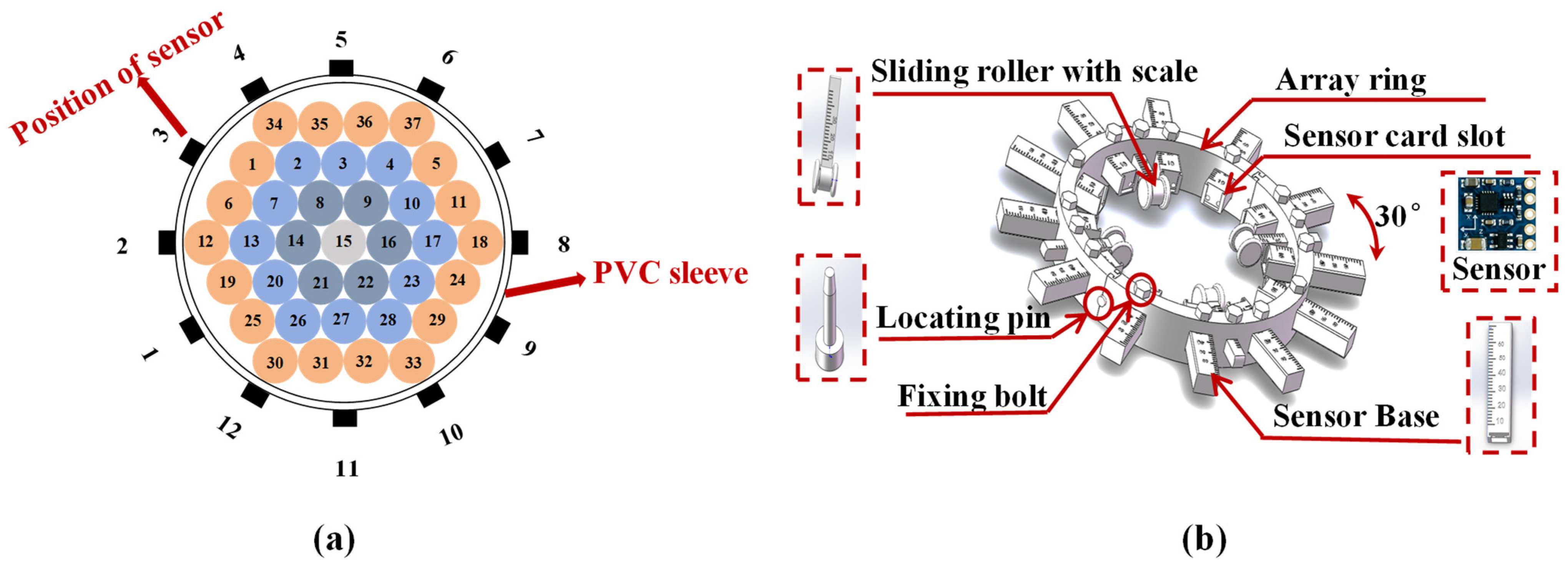
As shown in Figure 3a, the specimen was galvanized 7 mm steel wire 1 m in length [39,40]. The steel wire bundle was composed of 37 steel wires tied in the arrangement of 1, 5, 12, and 18 in each layer. The material information of the galvanized wire is shown in Table 1. A PVC sleeve was used as the protective layer of the wire bundle during the experiment. The Honeywell HMC5883L three-axis magnetometer, with the best overall performance and dimensions of 12 × 18 mm, was selected as the sensor. It has a measurement range of ±8 Gs, a sensitivity of 20 mGs, and a sampling frequency of 0.75 Hz–75 Hz. Based on the result of the theoretical analysis, that the variation in Bx-max at each θ is related to the circumferential corrosion state, a threshold of −6 dB was selected to ensure the resolution of the circumferential magnetic flux leakage signals from the specimen composed of ϕ 7 mm wires. Considering the dimensions of the magnetometer, a rolling circular array device consisting of 12 Honeywell HMC5883L three-axis magnetometers arranged at 30° intervals was designed, as shown in Figure 3b. The array ring is formed by fixing two semicircular rings with an inner diameter of 8 cm using locating pins. Each sensor is placed in the sensor card slot at one end of the sensor base and integrally secured to the array ring with fixing bolts. In addition, a sliding roller with scale is installed on the array ring to facilitate the movement of the sensors during detection.

3.2. Experimental Specimens and Parameters

Combining existing materials, equipment, and experimental experience [23,35,41,42], various test conditions with a constant axial corrosion width of 5 cm were designed, as shown in Table 2. The experiment achieved variations in the circumferential corrosion angle range β by controlling the number of circumferentially corroded steel wires N. Variations in the corrosion depth dρ2 were obtained by controlling the corrosion time T. And the cross-sectional corrosion rate of the specimen under different N and T was represented by α. The relative positions between circumferential concentrated corrosion (continuous defects) in the specimen could be expressed by the circumferential angle between the centerlines of different concentrated corrosion sites (the line connecting the midpoint of the circle centers of the corroded wires and the specimen center). As shown in Figure 1, the circumferential angle between the centerlines of two concentrated corrosion sites was 80°. For simplified labeling, the angle serial number K was used instead of the angle value, where K ranged from 1 to 4. Number 1 represented an angle of 0° between the two concentrated corrosion sites, Number 2 represented 80° or 100°, Number 3 represented 120°, and Number 4 represented 180°. It is acknowledged that electrochemical corrosion produces relatively idealized defects compared to real-world stress-induced pitting. However, drawing on established MFL evaluation methodologies [43], utilizing the equivalent depth (dρ2) is a necessary macroscopic simplification to isolate spatial signal superposition effects. The selection of these specific experimental parameters is physically grounded: the corrosion time (T) directly controls the equivalent corrosion depth and mass loss according to Faraday’s law; the number of corroded wires (N) effectively defines the continuous angular span (β) of a defect cluster; and the angle serial number (K) represents the spatial discreteness between multiple localized pits. The variation in ρ1 was achieved by adjusting the lift-off height H between the sensor and the surface of the PVC specimen, and the variation in θ was achieved using a designed sensor. The specimen numbers under different working conditions were denoted as “H-N-T-K”. For example, “3-2-18-1” indicated that the lift-off height between the sensor and the specimen surface was 3, the number of circumferentially corroded steel wires was 2, the corrosion time was 18 h, and the angle serial number between the centerlines of the concentrated corrosion sites was Number 1. After the simplification of Table 2, all the working conditions were based on the three groups of specimens listed in Table 3 to complete the entire experiment.

3.3. Experimental Process

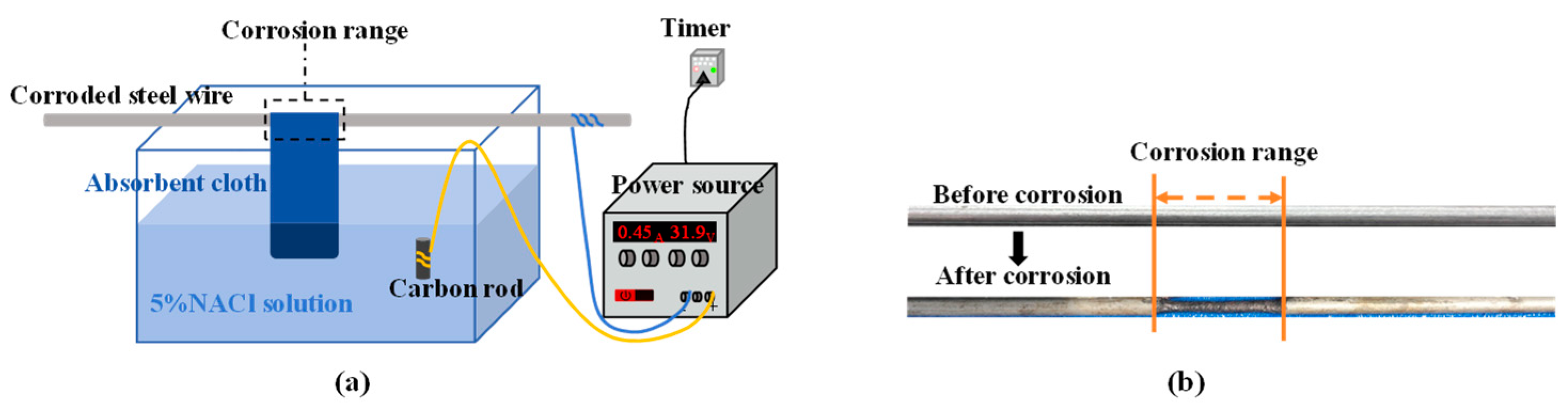
Before starting the detection, the target corroded steel wires underwent an electrochemical accelerated corrosion test [44] o simulate actual corrosion defects, as shown in Figure 4. The schematic diagram of the electrochemical corrosion device is shown in Figure 4a. The negative electrode of the power supply was connected to the carbon rod, which was immersed in 5% NaCl solution, the positive electrode was connected to the steel wire, and the steel wire was connected to the solution with a water-soaked towel to form a closed circuit and achieve accelerated corrosion of the steel wire. During corrosion, the power supply was set to constant current mode with a current of 0.45 A [45], and the corrosion time was controlled using a timer. The effect diagrams of the steel wire before and after corrosion are shown in Figure 4b.
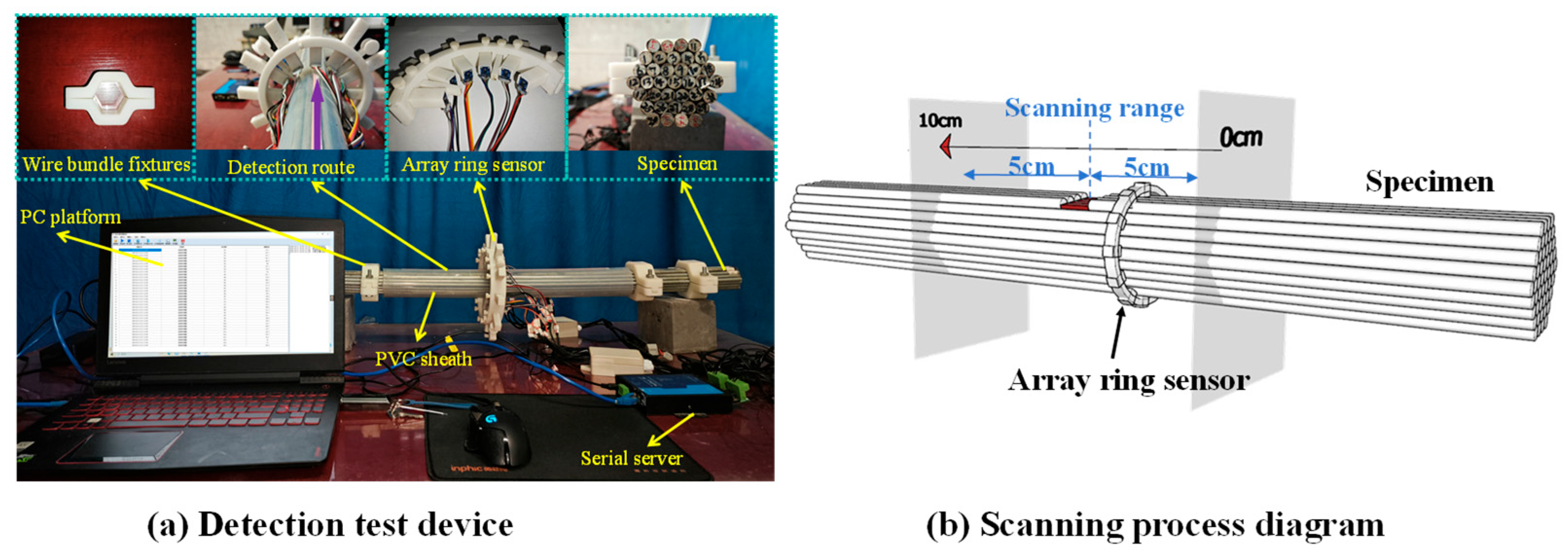
Before and after corrosion, the weight of the target steel wire was measured. According to Faraday’s law of electrolysis, under a constant applied current, the mass loss of the steel wire is directly proportional to the electrochemical reaction time. Thus, the corrosion time (T) serves as a controlled equivalent parameter reflecting the degree of mass loss. The cross-sectional corrosion rate (α) was determined by calculating the mass loss of the wire before and after corrosion and taking its ratio to the initial mass of the specimen. Using a hexagonal fixture (shown in Figure 5a), the specimens listed in Table 3 were bound while maintaining the marked order of the steel wires shown in Figure 3a. With the scanning range defined as a 10 cm-wide region (5 cm on each side of the axial corrosion center) in Figure 5b, the array sensor detection device was used to scan along the predetermined detection path shown in Figure 5a. During the scanning process, the magnetic flux leakage signals within 2 s were collected at 0.5 cm intervals from one end of the specimen to the other. To ensure measurement reliability, a strict sensor calibration process was conducted prior to testing by aligning the output signals of different sensors using a standard reference defect. Because the testing environment was relatively fixed, the background environmental magnetic noise remained constant, and its consistent impact on the target signals was considered negligible for this study. Furthermore, the strong mutual corroboration between the subsequent numerical simulations and experimental data inherently guarantees the repeatability and robustness of the experimental results. The collected magnetic signal data were integrated and processed through a serial port server and then input into the PC software for subsequent analysis.

4. Analysis of Influencing Factors

4.1. Detection Position

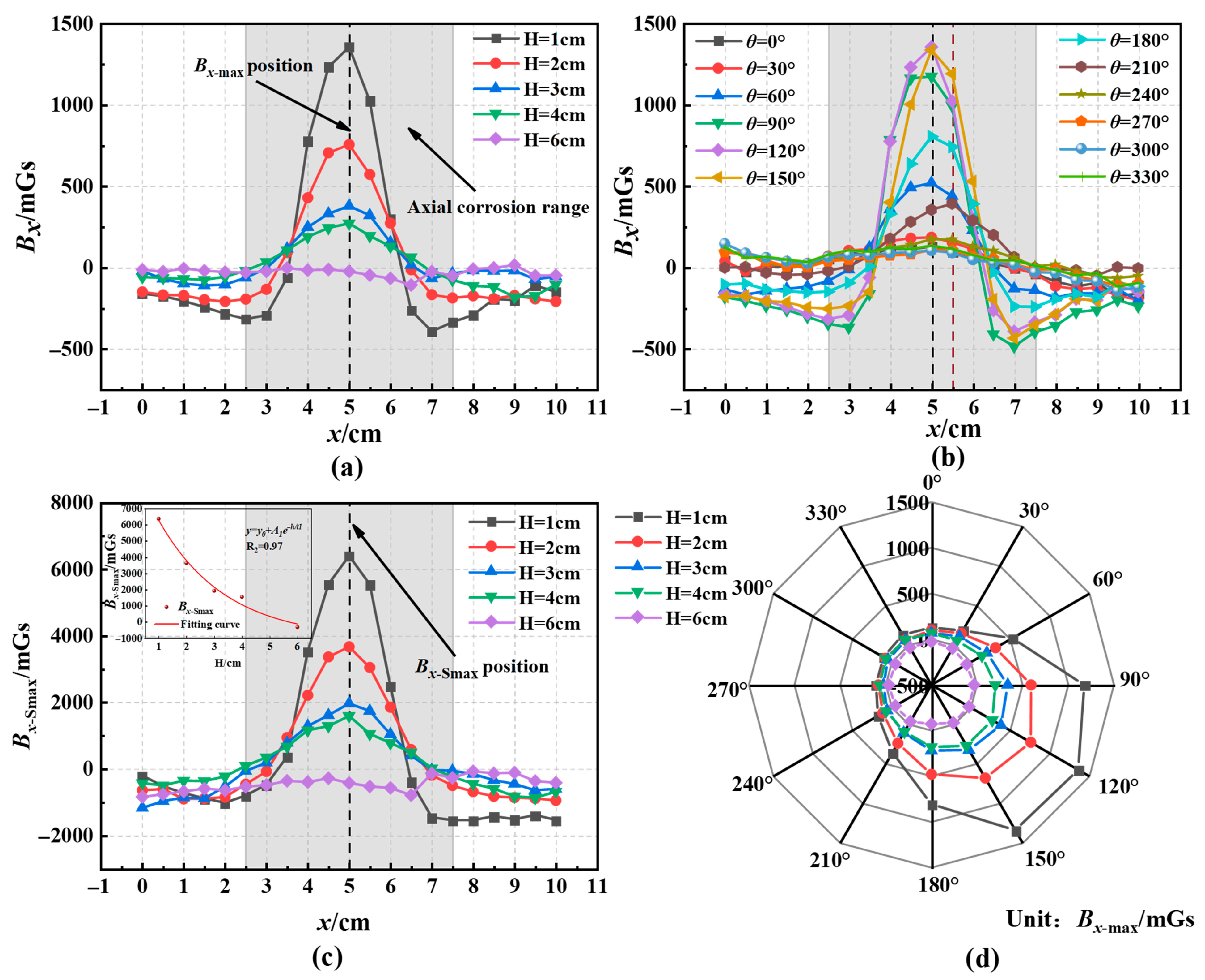
To investigate the effect of the circumferential detection position—comprising lifting height H and circumferential path θ—on circumferential multi-corrosion, an array sensor with 12 circumferential detection paths was employed to collect the magnetic leakage signal Bx of H-4-18-1# specimens along the axial direction x at various heights. The acquisition results are shown in Figure 6.
As shown in Figure 6a, with the increase in lift-off height H, Bx-max also decreases continuously until the distribution law of the x-Bx line cannot be detected. As shown in Figure 6b, when H is kept constant, Bx-max increases as the angle between θ and the circumferential corrosion center decreases. However, this does not alter the pattern of the unimodal bulge in the x-Bx line, which corresponds to the decrease in Bx with increasing ρ1 and θ as described in Equation (4). Therefore, under appropriate H, Bx-max with different θ values is chosen for the study of circumferential multi-point corrosion.
As shown in Figure 6b, the position of Bx-max under each θ is not exactly the same due to the existence of uneven corrosion and detection errors. To avoid such situations, the Bx values measured at each θ for the same x0 under the same H were summed according to Equation (5) to obtain the Bx-S value. Similarly, the x-Bx-S graph for each H can be obtained, as shown in Figure 6c. It can be seen from the graph that the horizontal coordinate of the Bx-S peak value (Bx-Smax) is consistent with and unchanged from the horizontal coordinate of the axial corrosion center. Through this processing, when H was fixed, Bx-Smax was used as the eigenvalue for Bx-S variation, and the measured Bx-max values for each θ that comprise Bx-Smax were used as the eigenvalue for circumferential multi-point corrosion distribution, resulting in the radar chart of Bx-Smax shown in Figure 6d.
B x S | x = x 0 = θ = 0 θ = 330 B x | x = x 0
An exponential function was used to fit each H and its corresponding Bx-Smax, with a goodness of fit of 0.97, as shown in Figure 6c. It can be observed that Bx-Smax decreases with increasing H. When H ranges from 1 to 3 cm, the signal changes with good regularity.

4.2. Corrosion Time

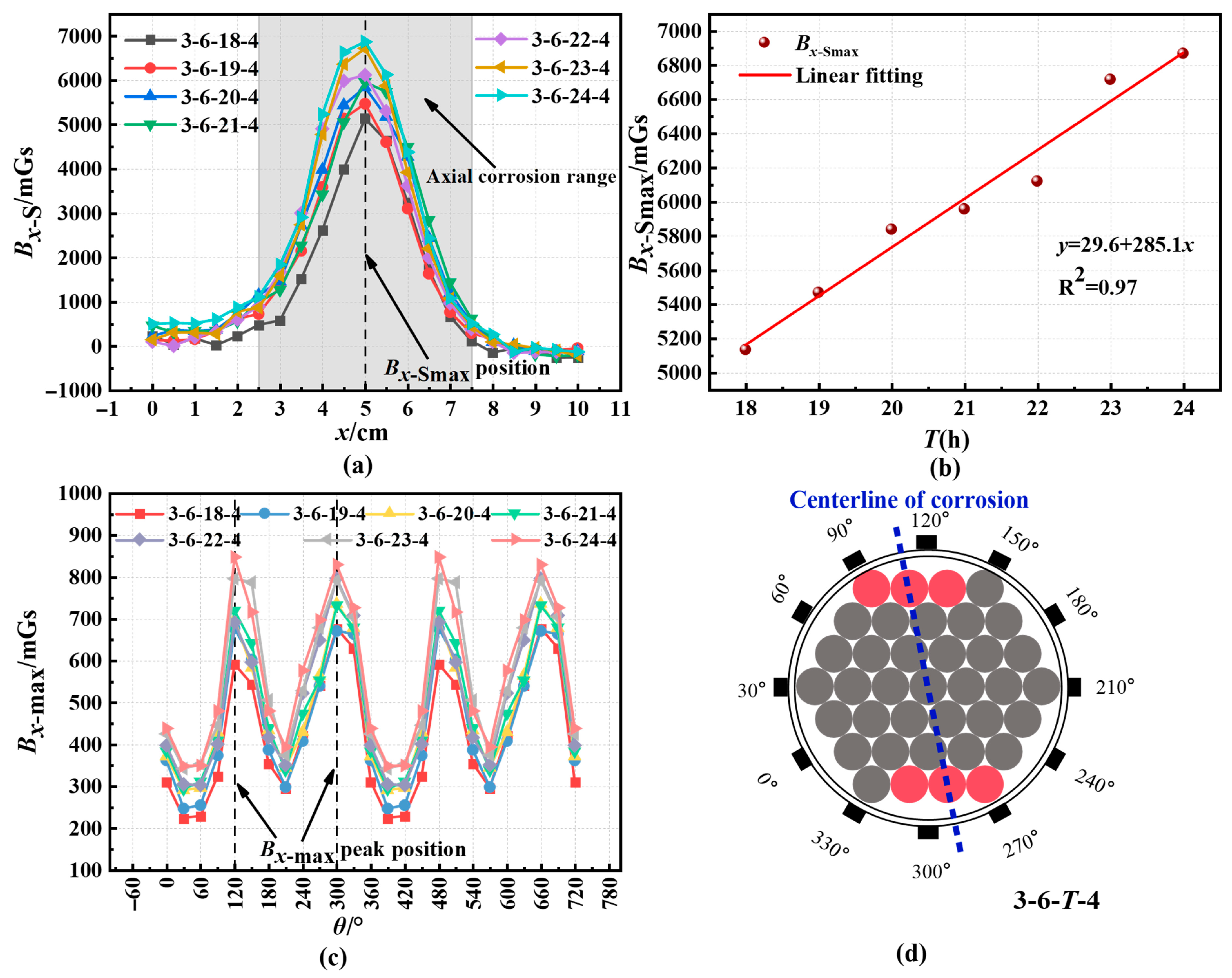
To investigate the effect of circumferential corrosion time T on the magnetic leakage signal Bx, specimens labeled 3-6-T-4# were selected for analysis. The corresponding signal graph is shown in Figure 7.
Figure 7a shows that changing T does not affect the distribution shape of the unimodal bulge of the x-Bx-S polyline or the position of Bx-Smax, which corresponds to the axial corrosion center. Figure 7b is obtained by linear fitting of Bx-Smax and T, where R2 is as high as 0.97. It can be seen that Bx-Smax increases with the increase in corrosion time T.
Compared with the radar chart, the data variation pattern in the rectangular coordinate system is more intuitive. Therefore, to fully display the characteristics of the magnetic leakage signal shape, the radar chart of Bx-max was expanded twofold, with θ = 0° as the starting point, as shown in Figure 7c. It can be seen from the figure that with the increase in T, the circumferential distribution shape of the magnetic flux leakage signal, such as the bulge range of θ-Bx-max, the peak position of the bulges, and the number of unimodal bulges, is not affected, and only the value of Bx-max changes. As shown in Figure 7d, it can be seen that the peak position of Bx-max is related to the center of circumferential concentrated corrosion, and half of the number of single-peak bumps in the θ-Bx-max graph is related to the number of circumferential concentrated corrosion sites.
In summary, this indicates that T only affects the values of Bx-Smax and Bx-max, but does not affect the distribution shape of the magnetic leakage signal along the axial and circumferential directions

4.3. Corroded Wire Number

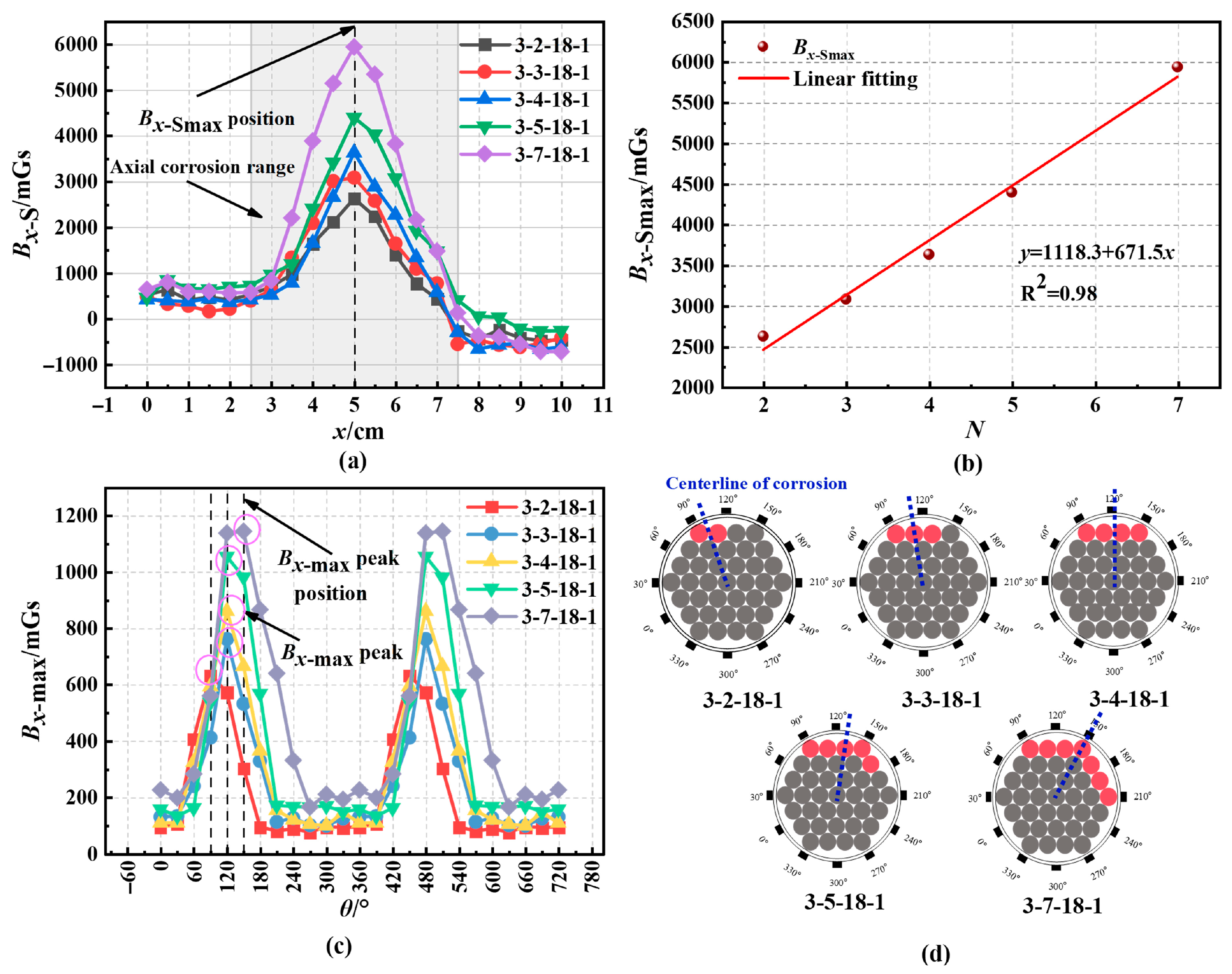
To investigate the effect of the number of circumferentially corroded steel wires N on the signal, the magnetic leakage signal of specimen 3-N-18-1# was selected for analysis. The signal graph is shown in Figure 8.
Figure 8a shows that changes in N still do not affect the distribution shape of the unimodal bulge of the x-Bx-S polyline or the position of Bx-Smax, which corresponds to the axial corrosion center. Through linear fitting of Bx-Smax and N, Figure 8b was obtained, showing goodness of fit as high as 0.98. The graph indicates that as N increases, Bx-Smax also increases.
Figure 8c shows that with an increase in N, both the bulge range of θ-Bx-max and the peak value of Bx-max increase. Combined with Figure 8d, it can be seen that the position of the peak value of Bx-max has a good correspondence with the corrosion center, and moves along the direction of N increase. Half the number of single-peak bumps in the θ-Bx-max graph consistently matches the number of circumferentially concentrated corrosion sites.
Therefore, N influences the convex range of the θ-Bx-max line, the peak location of Bx-max, and the value of Bx-Smax and Bx-max. However, it does not affect the distribution shape of x-Bx-S, the position of Bx-Smax, or the number of single-peak bumps in the θ-Bx-max graph.

4.4. Circumferential Angle Between Corrosion Centers

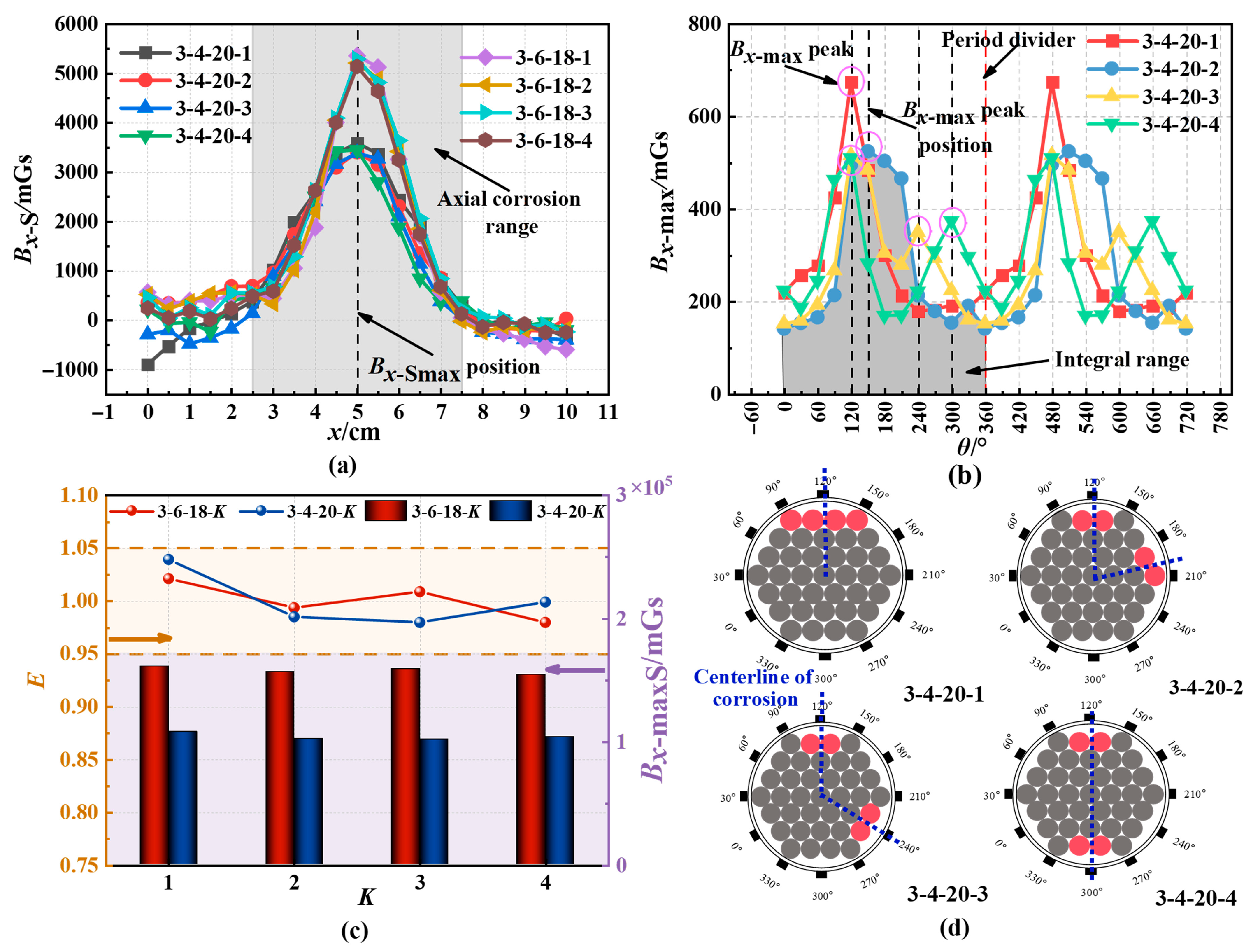
To investigate the effect of the circumferential angle between the concentrated corrosion centers on the signal, specimens labeled 3-4-20-K and 3-6-18-K# were selected for analysis. The resulting signal graph is shown in Figure 9.
As shown in Figure 9a, with the change in K, the distribution shape of x-Bx-S, as well as the value and position of Bx-Smax for specimens 3-4-20-K# and 3-6-18-K#, remain relatively stable, with the position corresponding to the axial corrosion center. To explore the variation in Bx-Smax with K, the θ-Bx-max line chart shown in Figure 9b was analyzed. Line integration of Bx-max was performed over the specified range to obtain a more accurate whole-cycle signal integration, Bx-maxS, compared to Bx-Smax, as shown in Equation (6). The mean value V of the specimen with fixed H-N-T# was obtained from the Bx-maxS values of different K. This mean value was used to normalize the Bx-maxS for any K of the specimen, leading to the dimensionless index E that reflects the relative change in Bx-maxS under different K, as shown in Equation (8). The changes in Bx-maxS and E of each specimen are shown in Figure 9c.
B x - max S = 0 360 B x - max ( θ ) d θ
V = K = 1 K max B x - maxS K max
E = B x - maxS V
where Bx-maxS is the integral value of the entire circumferential signal for any K; Bx-max is the magnetic induction value that constitutes Bx-Smax; V is the mean value of Bx-maxS for all K of the corresponding specimen; and Kmax is the maximum serial number corresponding to the maximum circumferential angle between the corrosion centers, with Kmax = 4.
It can be seen from Figure 9c that the variation in Bx-maxS with different K is within 5%. Considering the errors associated with the line integration and detection, Bx-maxS is considered to remain unchanged. Consequently, it can be further inferred that the value of Bx-Smax does not vary with K.
Due to the similarity between the radar graphs of specimens 3-4-20-K and 3-6-18-K#, only the 3-4-20-K# specimens were used as an example for analysis. As shown in Figure 9b, both the number of single-peak bumps in the θ-Bx-max graph and the distance between each single-peak bump are affected by K. Therefore, the position of Bx-max peak, the range of bulges, and the value of Bx-max also vary with changes in the shape of single-peak bulges. Additionally, the position of the Bx-max peak and half of the number of single-peak bulges in the θ-Bx-max graph show a strong correspondence with each circumferential corrosion center and the number of circumferentially concentrated corrosion, as shown in Figure 9d.
Therefore, K affects the number and the range of single-peak bulges, as well as the value of Bx-max, and the position of Bx-max peak. However, it does not affect the distribution shape of x-Bx-S or the value and position of Bx-Smax.

5. Quantitative Analysis of the Circumferential Multi-Point Corrosion Distribution in Stay Cables

Based on the analysis and conclusion in Section 2 and Section 4, the peak value of Bx-max in the θ-Bx-max graph was selected as the characteristic value for quantifying the circumferential multi-point corrosion distribution. Furthermore, a quantitative analysis was conducted based on the influence laws of various factors on the self-magnetic flux leakage signals.

5.1. Number of Concentrated Circumferential Corrosion

Based on the above analysis of influencing factors, it can be seen that half of the number of single-peak bumps in the θ-Bx-max graph corresponds well to the number of circumferentially concentrated corrosion. Thus, the corresponding circumferential concentrated corrosion number, c’, can be predicted by Equation (9).
c = n 2
where n is the number of Bx-max peaks in the θ-Bx-max graph.
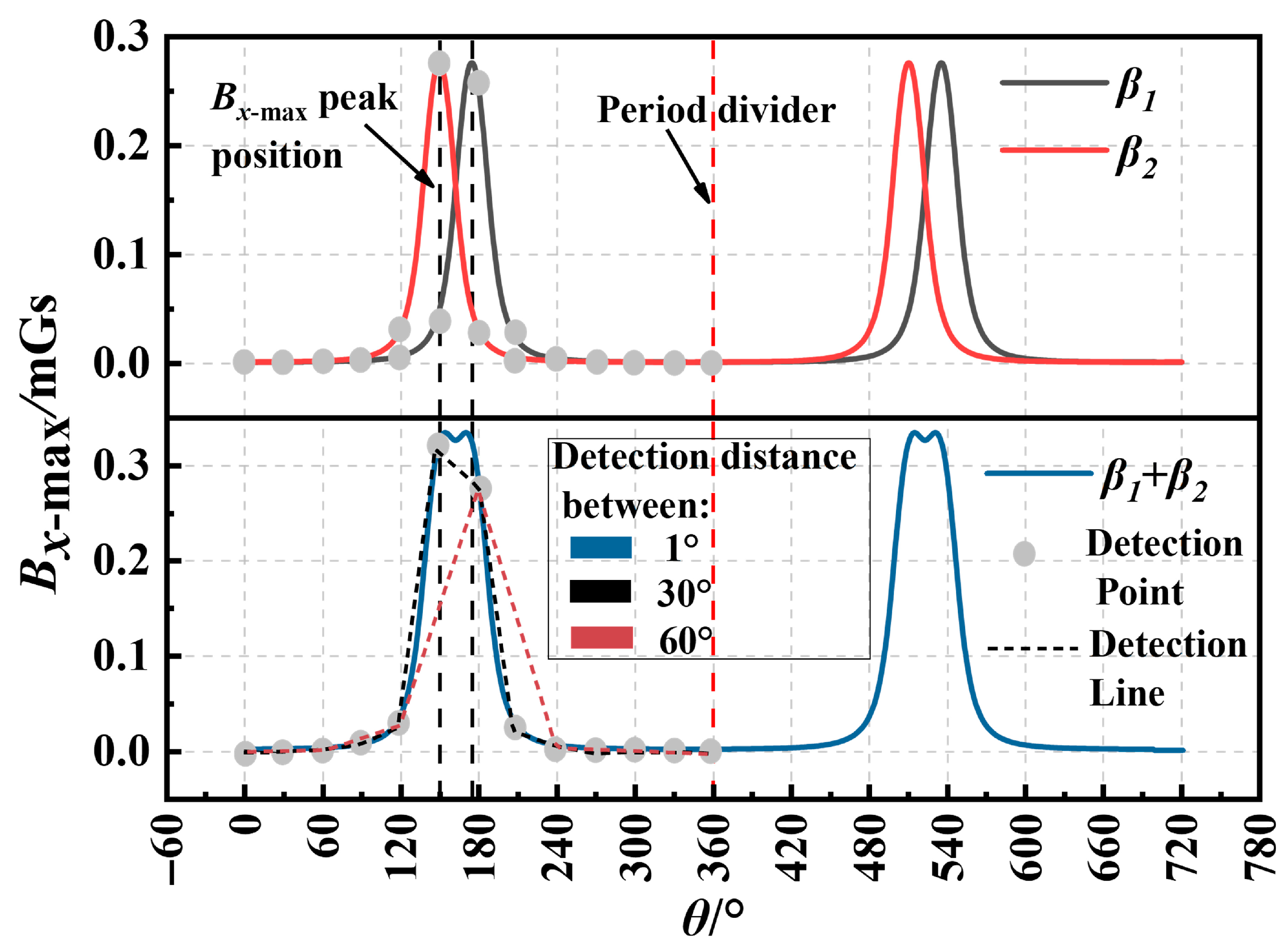
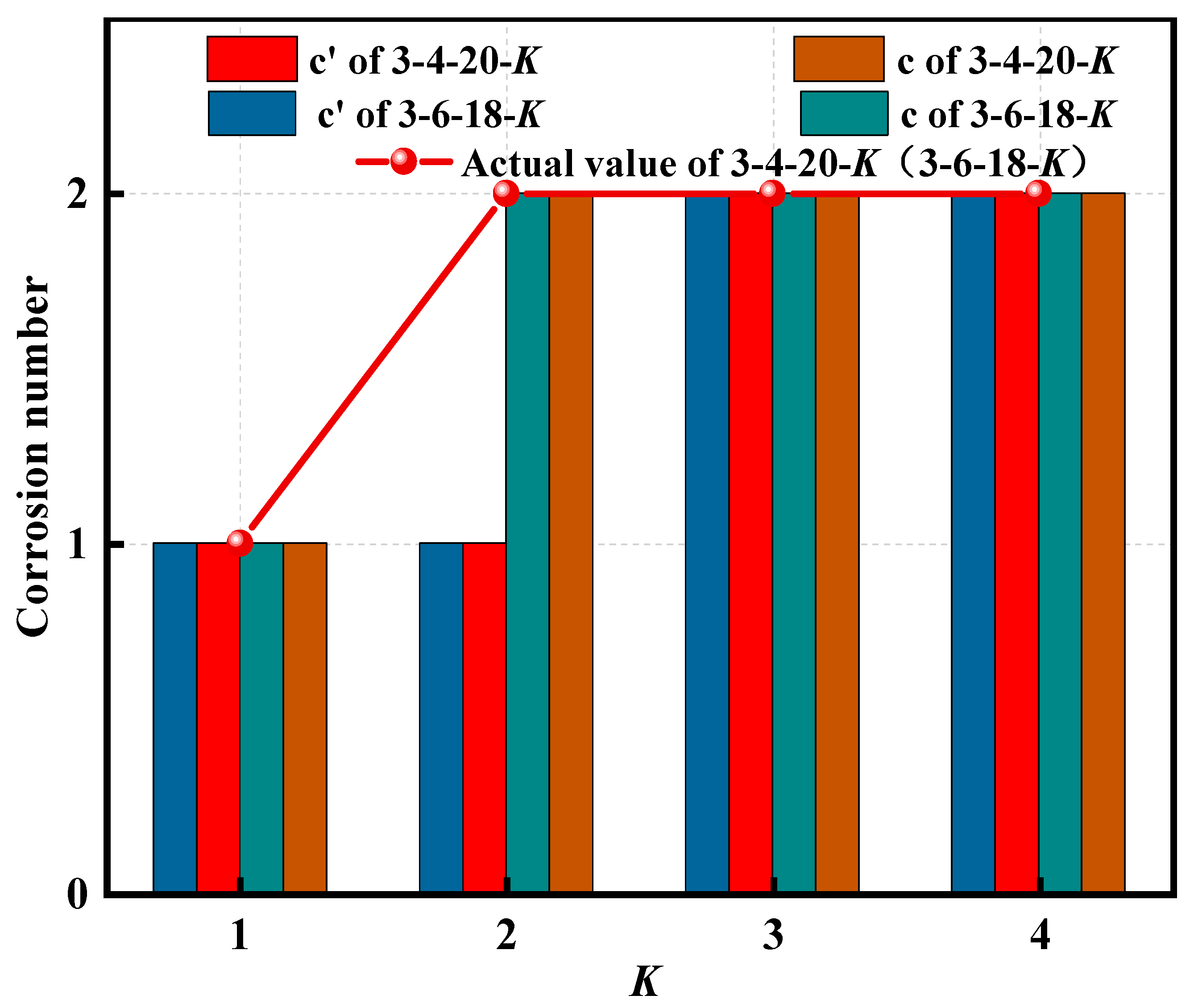
By comparing the predicted value c′ with the actual value (Figure 12), it can be observed that a prediction error occurs when K = 2. An analysis of Figure 9b revealed that with K = 2, the graph exhibited a “peak platform” characteristic compared to other polylines. This indicated that the number of single-peak bumps in the θ-Bx-max graph was influenced by K. Therefore, it is necessary to revise Equation (9) to improve the quantification of the number of circumferential concentrated corrosion sites. In addition, considering that the number of detection points itself may affect the number of protrusions in the signal curve, and to eliminate the effect of detection point quantity on the quantification accuracy, two adjacent circumferential concentrated corrosion sites with the same β were selected for numerical simulation at the Bx-Smax cross-sectional position x0, which was unaffected by circumferential defects, based on the established theoretical model in Equation (4). The θ-Bx-max graph obtained, as shown in Figure 10, demonstrated that the Bx-max of multi-point circumferential corrosion was the sum of the Bx-max values for each β. This confirms that the size of the circumferential angle between adjacent β centerlines (K) is the fundamental reason for the “peak platform” in the θ-Bx-max graph. Moreover, the θ-Bx-max graphs obtained from detection points with different numbers and positions, as shown in Figure 9b and Figure 10, reveal that fewer detection points lead to greater signal distortion, which hinders the quantification of circumferential multi-point defects.
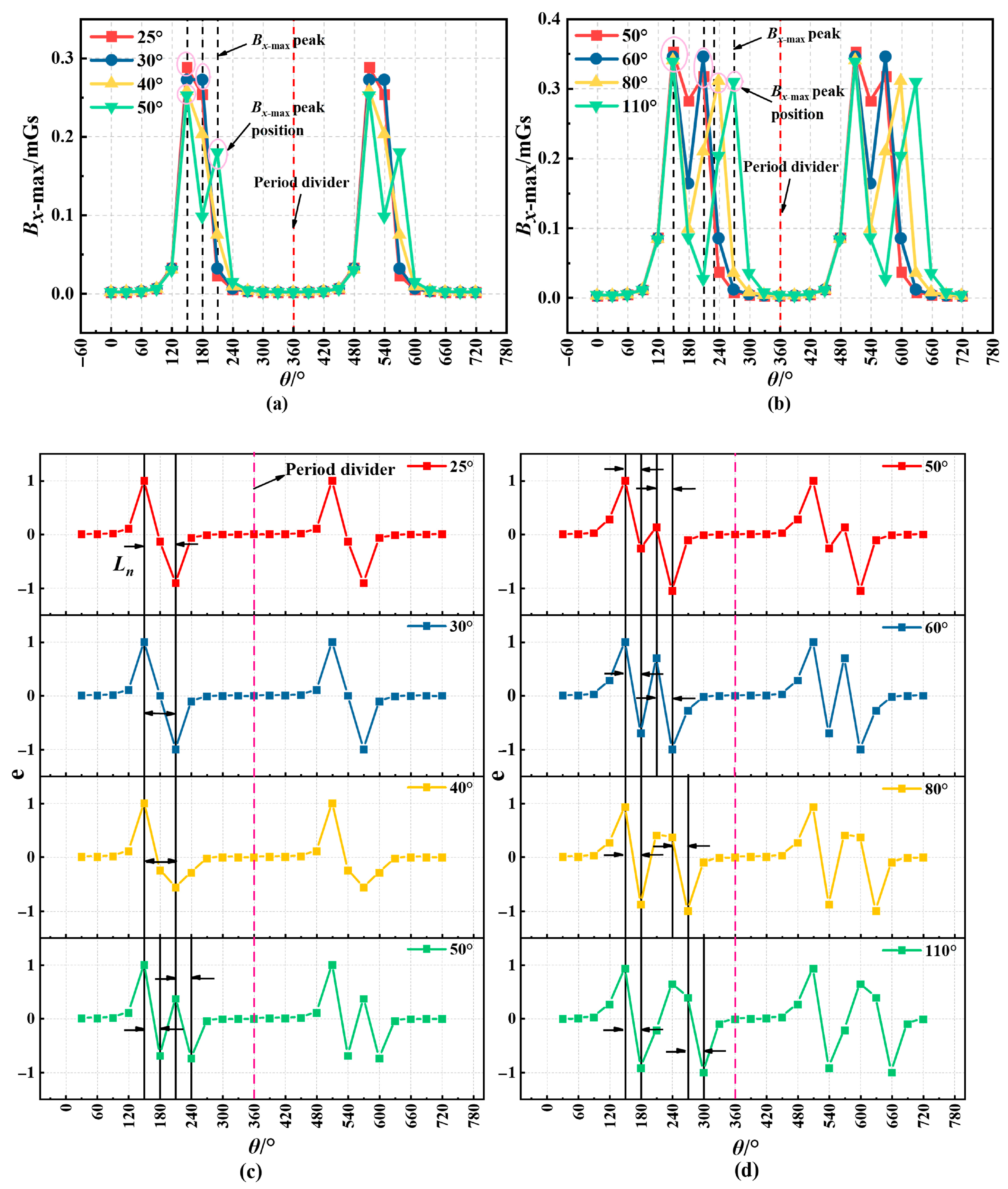
By comparing the θ-Bx-max polylines obtained from different detection points in Figure 10, it was confirmed that 12 detection points can effectively describe the image features, thereby theoretically eliminating the influence of the number of detection points on the quantification of peak counts and identifying K as the primary influencing factor. Based on this theoretical conclusion, to achieve a stable quantitative formulation correction, a numerical simulation was conducted using 12 sensors for two adjacent circumferential concentrated corrosion sites with the same β but different centerline angles (K) and a depth of 3 mm, yielding the results shown in Figure 11a,b. Based on the characteristics of the “peak platform” in the graph, the growth rate of the θ-Bx-max polyline was calculated. For ease of observation, the growth rate was normalized to obtain e. Considering the rise-and-fall pattern of the single-peak bumps in the θ-Bx-max polyline, the axial length between the positive and negative extrema in the θ-e graph within the range of the nth single-peak bump was defined as Ln. This specific parameter, Ln, was chosen because it intrinsically captures the angular span of a single defect and remains largely unaffected by the signal amplitude variations caused by adjacent defect interference. Furthermore, utilizing the mode value (Ln-mode) effectively filters out local signal distortions, providing a robust baseline width. After processing, the θ-e graphs are shown in Figure 11c,d, where the red dashed lines represent the periodic division lines. By processing Ln according to Equation (10), the corrected number of concentrated corrosion sites c was obtained. The corrected results are compared with the actual values in Table 4.
c = n + n = 1 n ( L n L n - mode 1 ) 2
where Ln is the distance between the positive and negative extremes corresponding to the nth bulge, and Ln-mode is the mode value of the distances between the extreme values of a single bulge.
As shown in Table 4, the corrected Equation (10) can significantly improve the prediction accuracy of the simulated number of corrosion sites. Similarly, Equation (10) was applied to 3-4-20-K# and 3-6-18-K# following the same procedure shown in Figure 11. The comparison between the predicted value c and the actual value under different K values in Figure 12 confirms that Equation (10) provides highly accurate predictions of the number of concentrated corrosion sites. Validation with experimental data further confirms the effectiveness of the quantitative formula modified based on numerical simulation. Furthermore, by comparing the predicted value c from Equation (10) with the predicted value c′ from Equation (9), the distribution type at K = 2 can be determined.
Although the parameter Ln serves as an empirical abstraction, it is deeply rooted in the physical behavior of MFL signals. Specifically, as the spatial distance between two concentrated corrosion sites increases, a distinct magnetic local minimum inevitably forms between their respective signal peaks. Ln mathematically captures this physical boundary characteristic. Furthermore, the reliability of this signal pattern and its corresponding abstraction has been consistently corroborated by both numerical simulations and experimental results.

5.2. Circumferential Corrosion Center Position

Based on the analyses of various factors in Section 2 and Section 4, the position of the peak of the θ-Bx-max line was found to correspond well to the circumferential corrosion center. Equation (11) is presented.
θ c = θ max
where θmax is the value of θ corresponding to the peak value of Bx-max in the θ-Bx-max graph.
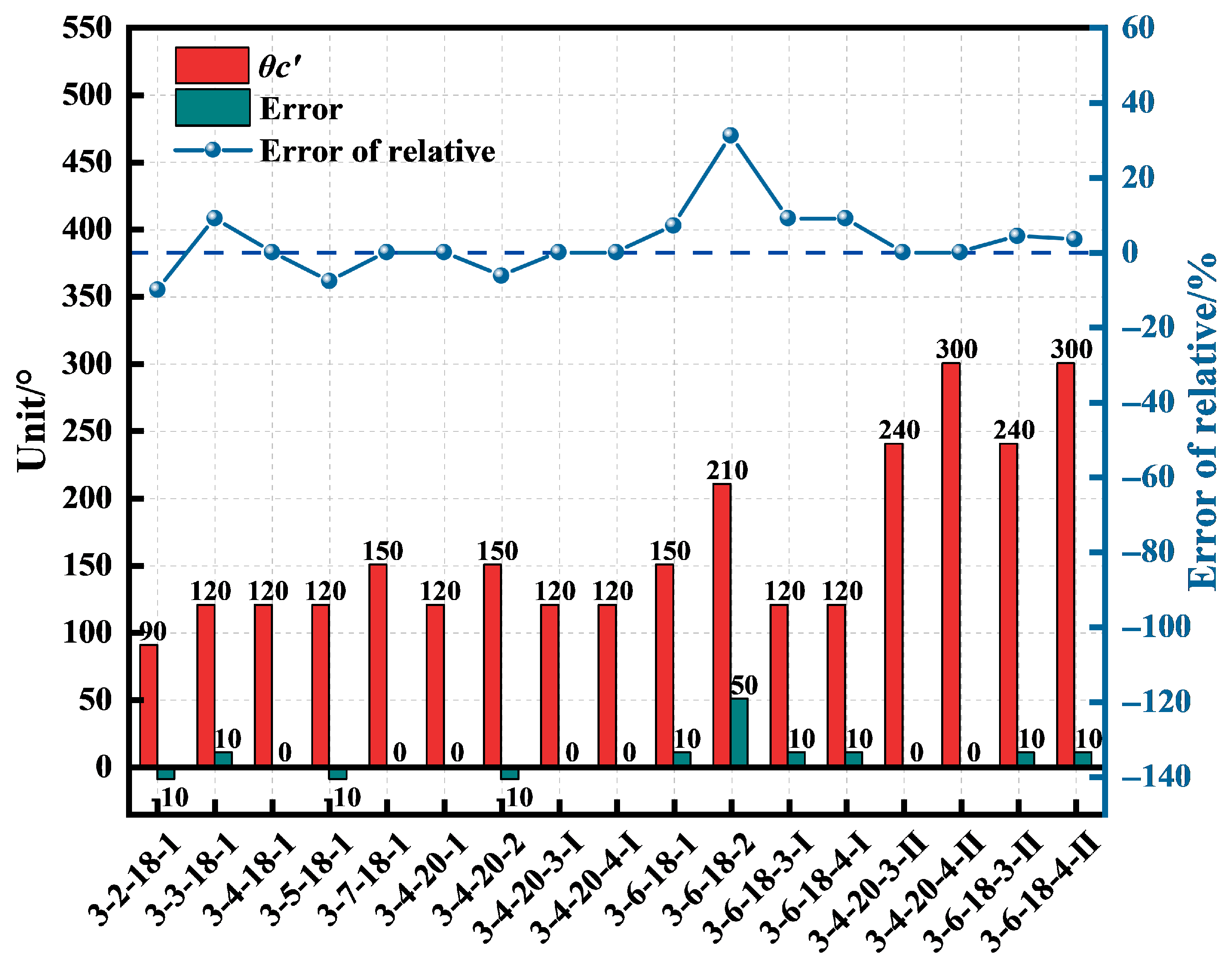
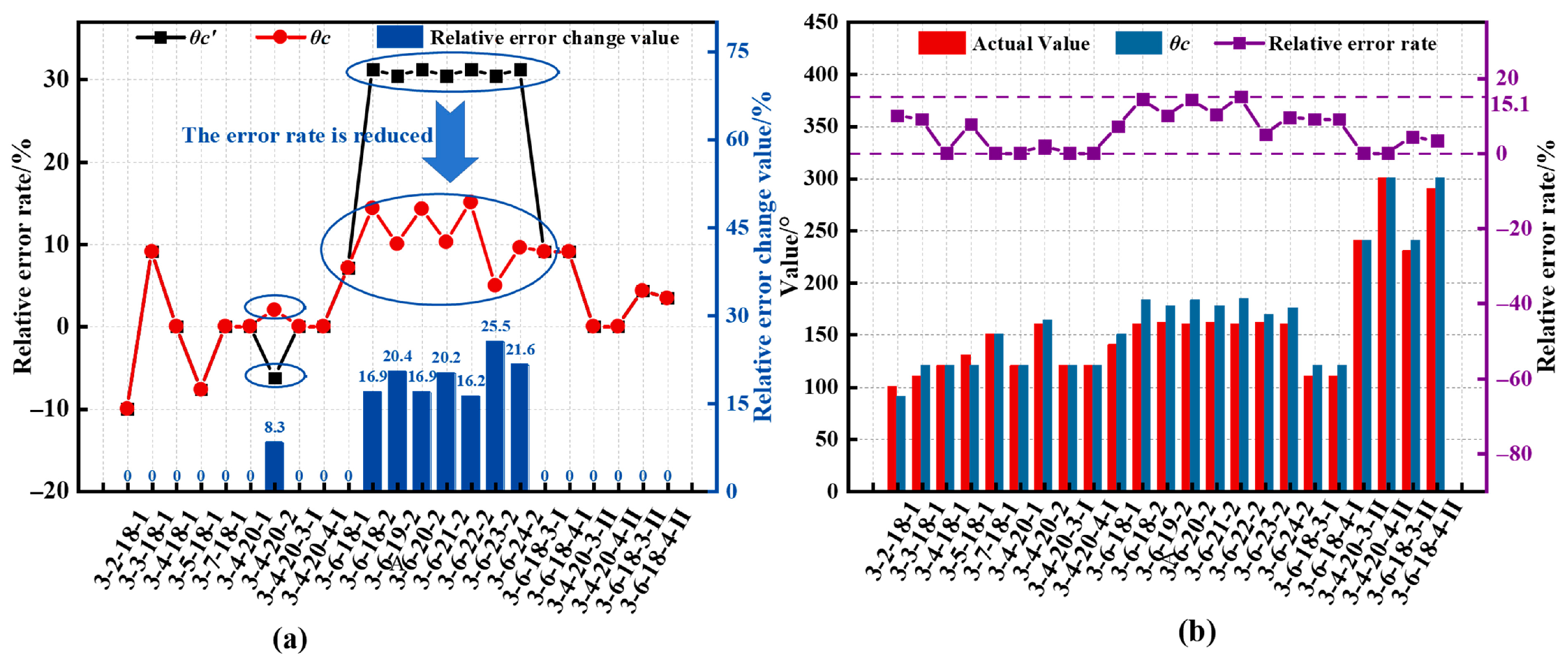
By analyzing the θ-Bx-max graph of the specimen, the position of θc for the center of circumferential corrosion was predicted using Equation (11). The multiple predicted values for the same specimen were numbered in Roman numerals from left to right. The relative deviation between the predicted θc and the actual values (based on Section 4.1, where the bisector position of the two centerlines is taken as the circumferential corrosion center position under the corrosion condition of K = 2) for each specimen is shown in Figure 13. It can be seen from the graph that, except for the specimen corresponding to K = 2, the deviations for the other specimens are less than 10%, corresponding to an angle deviation of less than 10°, while the angle for a single steel wire is 20°. Therefore, the circumferential corrosion centers of the specimens positioned using Equation (11) exhibit high stability. To ensure reliable peak detection while maintaining measurement efficiency, the number of circumferential detection points can be economically selected within the angular range corresponding to 0–2 times the circumferential angle of a single steel wire.
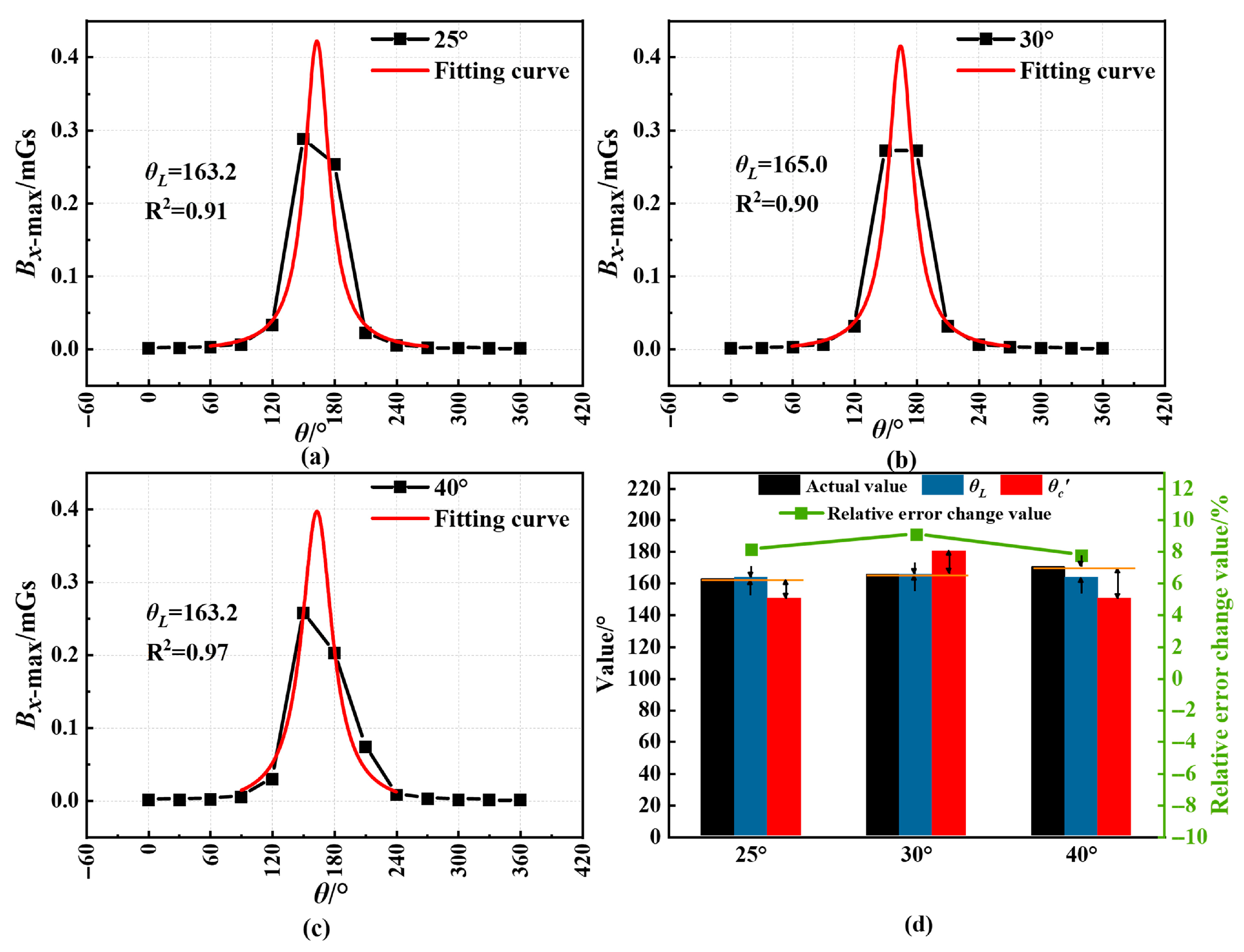
For the case of a significant deviation in the predicted value when K = 2, the prediction method should be optimized. By combining Equations (2)–(4) and examining the numerical simulation in Figure 10, it can be seen that the shape of the single-peak distribution resembles a Lorentzian curve. Therefore, the numerical simulation signal in Figure 11a can be fitted using the Lorentzian function in Equation (12).
B x - max = 2 G π w 4 θ θ L 2 + w 2
where θL is the horizontal coordinate value at the peak of the fitting curve, and both w and G are parameters related to the degree of circumferential corrosion and the range of the corrosion angle.
By observing the fitting graphs of the numerical simulation signals with different angles between β, as shown in Figure 14a–c, it is observed that the goodness of fit of the Lorentzian curve to the θ-Bx-max curve is above 0.90. Moreover, Figure 14d shows that the relative error predicted using the Lorentzian curve is reduced by approximately 8% compared to θc’, effectively reducing the prediction error of the circumferential corrosion center position.
Based on the effective improvement in the prediction results of the circumferential corrosion center position using the Lorentzian formula for numerical simulation, a revised segmented prediction formula for the corrosion center position is proposed, as shown in Equation (13). The predicted results of the corrosion center position using Equation (13) are compared with those predicted using Equation (11), as shown in Figure 15a.
Based on the improvement in the prediction results of the circumferential corrosion center position using the Lorentzian formula for numerical simulation, a revised segmented prediction formula for the corrosion center position is proposed, as shown in Equation (13). Obviously, the optimized prediction results demonstrate greater superiority, reducing the relative error by 25.5%. The comparison between the predicted values determined using the segmented formula and the actual values is shown in Figure 15b, indicating that the maximum relative error between the predicted value θc and the actual circumferential corrosion center position is only 15.1%, further verifying the high accuracy of the segmented prediction for θc.
θ c = θ c = θ max K 2 θ L K = 2

5.3. Circumferential Corrosion Degree

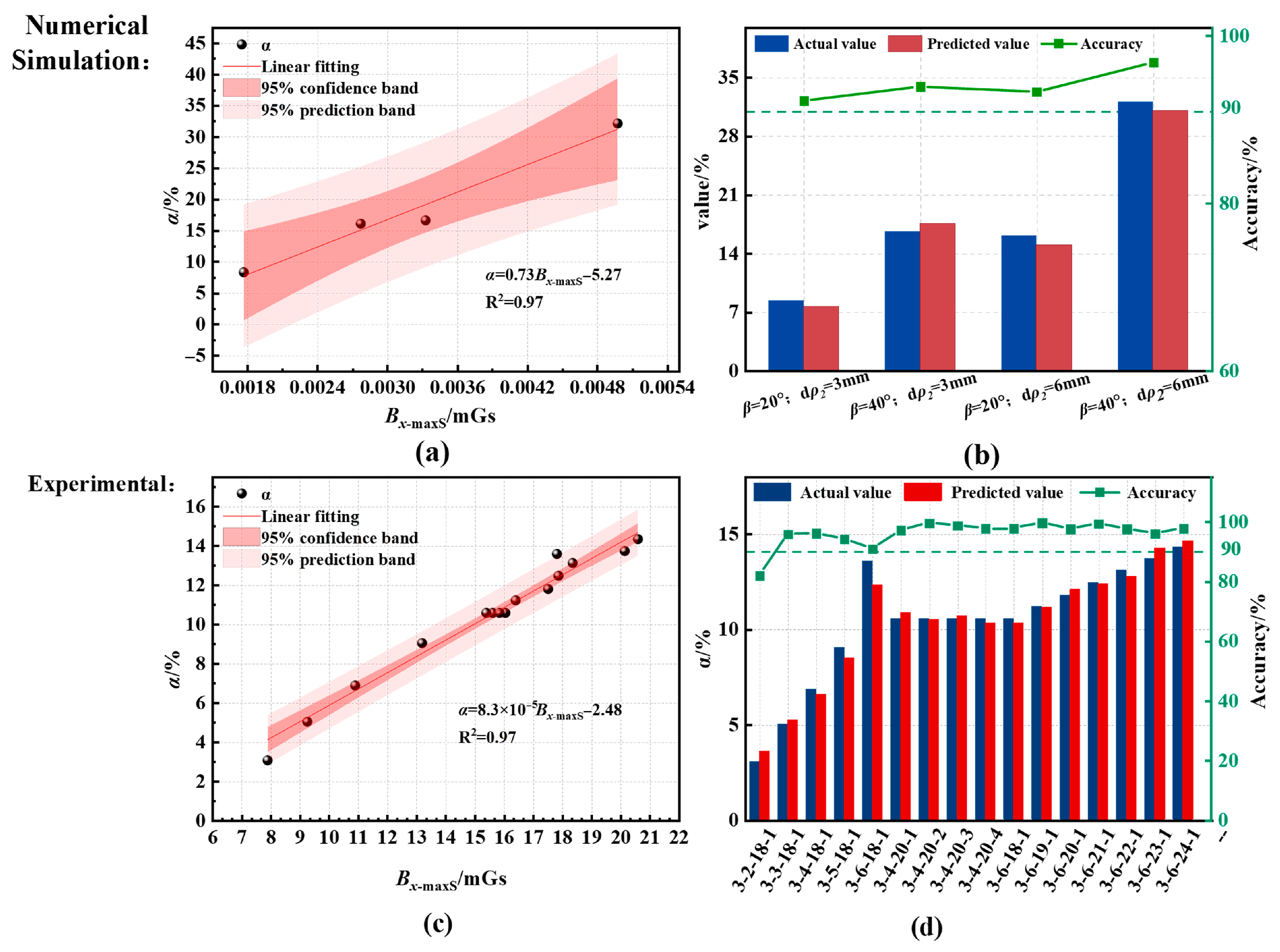
As shown in Figure 7a,b, Figure 8a,b and Figure 9a,c, both corrosion time and the number of corroded wires exhibit linear relationships with the total magnetic flux leakage signals. Accordingly, Bx-maxS and α from numerical simulation and experiment were linearly fitted according to Equation (14), resulting in Figure 16a,c. As shown in the figures, the R2 values for the linear fitting exceed 0.97, indicating that α is proportional to the Bx-maxS value. The prediction results of α based on Equation (14) are shown in Figure 16b,d, where the average prediction accuracy exceeds 90%.
α = C B x max S + D
where C and D are fitting parameters, which are related to the differences among specimens and the detection errors, respectively.
The strong linear relationship (R2 > 0.97) observed between the integrated signal Bx-maxS and the cross-sectional corrosion rateαis not merely a statistical trend. From a physical perspective, Bx-maxS represents the integration of the leakage magnetic field along the entire circumference. This spatial integration effectively captures the ‘total volume’ of the outward-leaking magnetic flux, which is fundamentally proportional to the total amount of missing ferromagnetic material (mass loss) at that specific cross-section. To intuitively highlight the performance of the proposed quantitative models and facilitate comparison, the key findings and prediction accuracies are summarized in Table 5 below.

5.4. Assessment Method of Circumferential Multi-Point Corrosion State

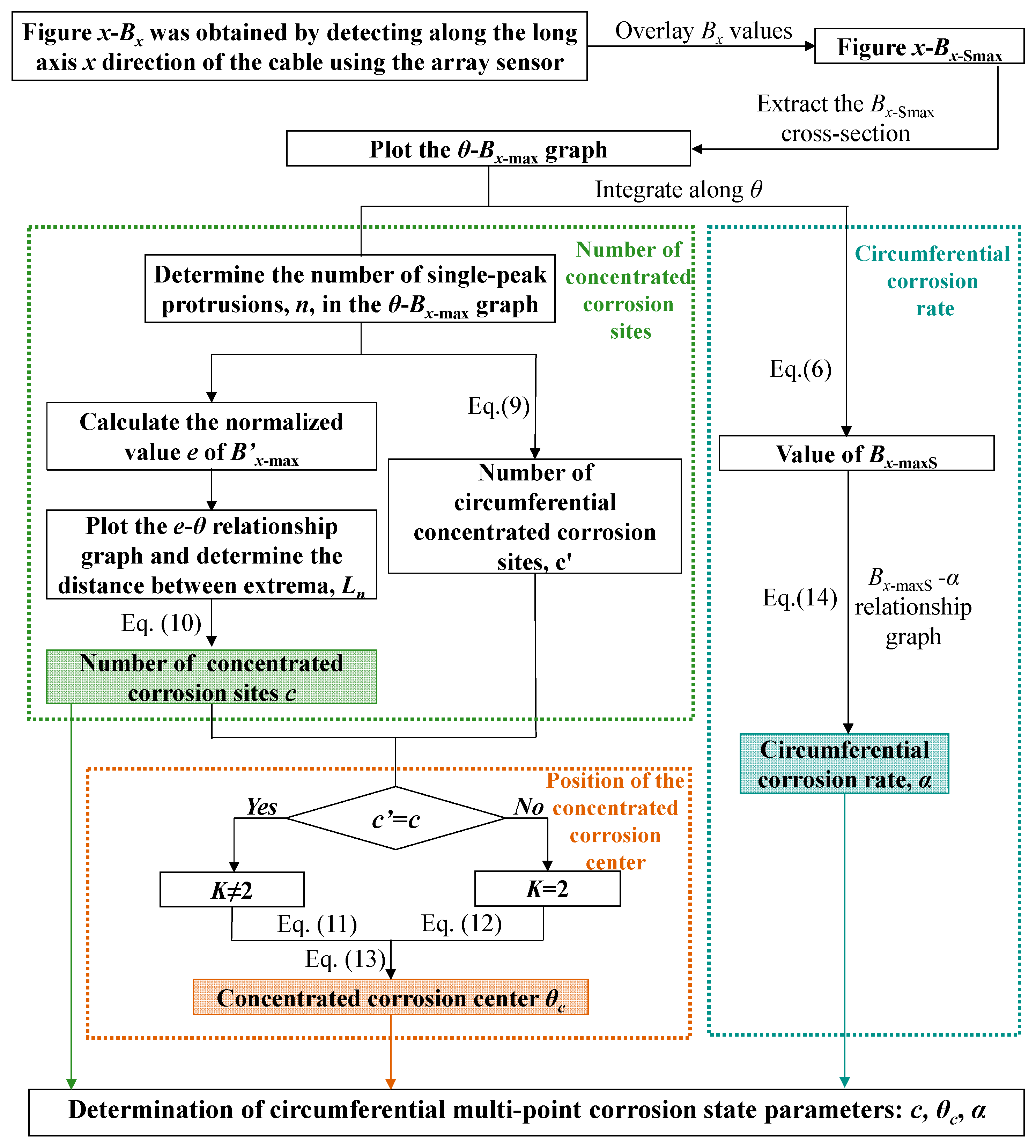
Due to the characteristics of the natural environment in which the stay cable is located, the circumferential corrosion is typically non-uniform and not confined to single areas. Based on the quantification of the circumferential corrosion defect information, including the number of concentrated corrosion c, the corrosion center θc, and the cross-sectional corrosion rate α, which enables the identification of circumferential multi-point corrosion distribution in stay cables. The circumferential multi-point corrosion state of the stay cable is evaluated. Based on the quantitative formulas for the distribution parameters of each circumferential corrosion proposed in this paper, a defect evaluation method is further proposed, as shown in Figure 17.

6. Conclusions

This paper addresses the occurrence of circumferential multi-point corrosion in stay cables. Based on self-magnetic flux leakage technology, a circumferential multi-point defect model has been established; corrosion detection tests have been conducted on parallel steel wire bundles under different corrosion conditions; the variation patterns of the magnetic induction intensity Bx have been analyzed; and an evaluation method for circumferential multi-point corrosion states has been proposed. The specific conclusions are as follows:
(1)
The circumferential multi-point defect magnetic charge model was derived. Through the analysis of the numerical simulation signal map of the model, it is initially clarified that the closer the path θ is to the corrosion region, the greater the influence of changes in circumferential defect size on its detection value Bx-max. It is also found that Bx-max and its peak value correspond of Bx-max corresponds to the variation patterns of the axial corrosion center position and the circumferential corrosion center position, respectively.
(2)
Based on the parameter characteristics of the theoretical model, similar tests were conducted to clarify the patterns of signal variation. It is found that the peak value of Bx summation (Bx-smax) is negatively correlated with the lift-off height (H), and positively correlated with the number of corroded steel wires (N) and the corrosion duration (T), which specifically represents the corrosion dimensions. The θ-Bx-max polylines distribution on the Bx-Smax cross-section reflects the circumferential multi-point corrosion distribution. The number of single-peak bumps depends only on K and equals twice the number of concentrated sites. The Bx-max peak position shifts with N and K, while Bx-Smax is determined by N and T.
(3)
A method for evaluating the circumferential corrosion state parameters of stay cables is proposed. Based on the variation characteristics of the θ-Bx-max curve, quantitative indices are established for parameters including the number of circumferential concentrated corrosion sites c, the circumferential corrosion center position θc, and the cross-sectional corrosion rate α. The corrected value of c exhibits high accuracy. The prediction error of θc determined using the piecewise formula is at most 15.1%. These quantitative indices were further used to establish an evaluation method for circumferential multi-point corrosion distribution.
Regarding practical implications for real bridge inspection scenarios, the proposed evaluation methodology and the circular sensor array design can be readily integrated into automated cable-climbing robots. This provides a non-contact, highly efficient technical framework for generating digital twin models of cable corrosion states. However, the limitations of the current study must be acknowledged. The experiments were conducted under controlled laboratory conditions utilizing electrochemical accelerated corrosion on unloaded specimens. In actual field conditions, corrosion mechanisms are far more irregular (e.g., localized pitting), and stay cables constantly suffer from complex stress-corrosion coupling, varying temperature fields, and dynamic fatigue loads, all of which may introduce non-linear magnetic memory effects. Therefore, future research directions will focus on investigating the MFL signal characteristics under multi-physics coupling (stress and natural corrosion) and conducting in situ validation on operational cable-stayed bridges to further robust the evaluation algorithms.

Author Contributions

Conceptualization, R.X. and Q.T.; methodology, Q.T.; software, Q.T. and R.D.; validation, Y.D., G.C., J.C. and R.D.; formal analysis, Q.T.; investigation, G.C.; resources, R.X.; data curation, J.C.; writing—original draft preparation, Q.T.; writing—review and editing, R.X.; visualization, G.C.; supervision, R.X.; project administration, Y.D.; funding acquisition, R.X. All authors have read and agreed to the published version of the manuscript.

Funding

This study was supported by the National Key Research and Development Program of China (2024YFB2605700), the National Natural Science Foundation of China (52578349, 52278291), the Chongqing Natural Science Foundation of China (CSTB2022TIAD-KPX0205), and the Major Scientific Research Projects of China Railway Group Co., Ltd. (2022-ZD-11), and the Postgraduate Research Innovation Project of Chongqing Jiaotong University (CYS240458).

Data Availability Statement

The data presented in this study are available from the first and corresponding author upon request. The data is not publicly available due to the policy of the data provider.

Conflicts of Interest

Author Yaxi Ding was employed by the company Chongqing Railway Group Co., Ltd. The remaining authors declare that the research was conducted in the absence of any commercial or financial relationships that could be construed as a potential conflict of interest.

Appendix A

Table A1. All variables adopted in this study.
VariablesDefinition
dBjiLocal magnetic induced intensity vector
μ0Vacuum permeability (constant)
μrRelative permeability of the material
ρsMagnetic charge density at the defect cross-section
sDefect area
rji, rjiScalar and vector distance from the detection point to the defect, respectively
iSerial number of the continuous defect
jDefect end face type (j = 1 for positive magnetic charge surface ①, j = 2 for negative magnetic charge surface ②)
x0x0 Position of the measurement point on the x-axis
ρ1Radial distance from the measurement point to the center
θCircumferential angle between the measurement point and the z-axis (also used as circumferential path)
bDefect length within the length range of the specimen
dρ2Circumferential defect depth
βiAngle range β corresponding to the i th continuous defect
RRadius of the specimen
BijxAxial component of magnetic induction intensity caused by each j under the same i
HLift-off height between the sensor and the specimen surface
NNumber of circumferentially corroded steel wires
TCorrosion time, serving as a controlled equivalent parameter reflecting the degree of mass loss
KAngle serial number representing the circumferential angle between the centerlines of different concentrated corrosion sites
αCross-sectional corrosion rate of the specimen
BxTotal strength value of the axial component of the magnetic flux leakage signal
Bx-maxThe peak value of Bx
Bx-SThe sum of Bx values measured at each θ for the same x0 under the same H
Bx-maxSThe integral value of the entire circumferential signal (Bx-max) for any K
VThe mean value of Bx-maxS for all K of the corresponding specimen
KmaxThe maximum serial number corresponding to the maximum circumferential angle between the corrosion centers (Kmax = 4)
EA dimensionless index reflecting the relative change in Bx-maxS under different k
nThe number of Bx-max peaks in the θ-Bx-max graph
c’The initially predicted circumferential concentrated corrosion number (uncorrected)
LnThe axial length/distance between the positive and negative extremes corresponding to the nth single-peak bulge
Ln-modeThe mode value of the distances between the extreme values of a single bulge
cThe corrected number of concentrated corrosion sites
θmaxThe value of θ corresponding to the peak value of Bx-max in the θ-Bx-max graph
θcThe initially predicted position of the center of circumferential corrosion
θcThe actual or corrected circumferential corrosion center position
θLThe horizontal coordinate value at the peak of the fitting curve in the Lorentzian function
w, GParameters related to the degree of circumferential corrosion and the range of the corrosion angle in the Lorentz fitting
C, DFitting parameters related to the differences among specimens and detection errors, respectively

References

  1. Liu, S.; Chen, M. Wire Rope Defect Recognition Method Based on MFL Signal Analysis and 1D-CNNs. Sensors 2023, 23, 3366. [Google Scholar] [CrossRef] [PubMed]
  2. Cao, Z.; Liu, Y.; Xu, B.; Li, X. Investigation of the impact of cable corrosion on the ultimate strength and fatigue life of ca-ble-stayed bridges. Sci. Rep. 2025, 15, 41868. [Google Scholar] [CrossRef] [PubMed]
  3. Civera, M.; Surace, C. Non-Destructive Techniques for the Condition and Structural Health Monitoring of Wind Turbines: A Literature Review of the Last 20 Years. Sensors 2022, 22, 1627. [Google Scholar] [CrossRef]
  4. Wang, B.; Zhong, S.; Lee, T.-L.; Fancey, K.S.; Mi, J. Non-Destructive Testing and Evaluation of Composite Materials/Structures: A State-of-the-Art Review. Adv. Mech. Eng. 2020, 12, 1687814020913761. [Google Scholar] [CrossRef]
  5. Noorsuhada, M.N. An Overview on Fatigue Damage Assessment of Reinforced Concrete Structures with the Aid of Acoustic Emission Technique. Constr. Build. Mater. 2016, 112, 424–439. [Google Scholar] [CrossRef]
  6. Md Nor, N.; Abdullah, S.; Mohamad Halim, M.A.H.; Arifin, A. Evaluation of the Behaviour of Steel Bar in the Concrete Under Cyclic Loading Using Magnetic Flux Leakage and Acoustic Emission Techniques. Materials 2023, 16, 2172. [Google Scholar] [CrossRef] [PubMed]
  7. de Mendonça Filho, F.F.; Copuroglu, O.; Schlangen, E.; Šavija, B. Determination of Loss of Reinforcement Due to Corrosion through X-Ray Computer Micro-Tomography. Materials 2021, 14, 893. [Google Scholar] [CrossRef] [PubMed]
  8. Fan, Z.; Bai, K.; Chen, C. Ultrasonic Testing in the Field of Engineering Joining. Int. J. Adv. Manuf. Technol. 2024, 132, 4135–4160. [Google Scholar] [CrossRef]
  9. Zitoun, A.; Dixon, S.; Kazilas, M.; Hutchins, D. Defect Detection and Imaging in Composite Structures Using Magnetostrictive Patch Transducers. Sensors 2023, 23, 600. [Google Scholar] [CrossRef]
  10. Zaki, A.; Chai, H.K.; Aggelis, D.G.; Alver, N. Non-Destructive Evaluation for Corrosion Monitoring in Concrete: A Review and Capability of Acoustic Emission Technique. Sensors 2015, 15, 19069–19101. [Google Scholar] [CrossRef] [PubMed]
  11. Dehui, W.; Lingxin, S.; Xiaohong, W.; Zhitian, L. A Novel Non-Destructive Testing Method by Measuring the Change Rate of Magnetic Flux Leakage. J. Nondestruct. Eval. 2017, 36, 24. [Google Scholar] [CrossRef]
  12. Feng, B.; Wu, J.; Tu, H.; Tang, J.; Kang, Y. A Review of Magnetic Flux Leakage Nondestructive Testing. Materials 2022, 15, 7362. [Google Scholar] [CrossRef] [PubMed]
  13. Dubov, A.A. A Study of Metal Properties Using the Method of Magnetic Memory. Met. Sci. Heat. Treat. 1997, 39, 401–405. [Google Scholar] [CrossRef]
  14. Lee, J.; Wang, D.; Dharmawan, I.D.M.O. Theoretical Model of Self-Magnetic Flux Leakage and Its Application in Estimating the Depth Direction of a Fatigue Crack. Appl. Sci. 2023, 13, 533. [Google Scholar] [CrossRef]
  15. Seleznyova, K.; Strugatsky, M.; Kliava, J. Modelling the Magnetic Dipole. Eur. J. Phys. 2016, 37, 025203. [Google Scholar] [CrossRef]
  16. Yang, L.; Huang, P.; Gao, S.; Du, Z.; Bai, S. Research on the Magnetic Flux Leakage Field Distribution Characteristics of Defect in Low-Frequency Electromagnetic Detection Technique. IEICE Electron. Express 2021, 18, 20200362. [Google Scholar] [CrossRef]
  17. Trevino, D.A.G.; Dutta, S.M.; Ghorbel, F.H.; Karkoub, M. An Improved Dipole Model of 3-D Magnetic Flux Leakage. IEEE Trans. Magn. 2016, 52, 6201707. [Google Scholar] [CrossRef]
  18. Ma, T.; Wang, H.; Tang, Y.; Chen, H. Numerical Analysis on Magnetic Leakage Field of Pipeline Defect. J. Vibroeng. 2015, 17, 3594–3607. [Google Scholar]
  19. Azizzadeh, T.; Safizadeh, M.S. Identification and Sizing of Neighboring Pits Using Three-Axis Magnetic Flux Leakage Technique. J. Test. Eval. 2021, 49, 1837–1852. [Google Scholar] [CrossRef]
  20. Qiu, J.; Zhang, H.; Zhou, J.; Zhang, W. An SMFL-Based Non-Destructive Quantification Method for the Localized Corrosion Cross-Sectional Area of Rebar. Corros. Sci. 2021, 192, 109793. [Google Scholar] [CrossRef]
  21. Yang, Y.; Ma, X.; Su, S.; Wang, W. Study on Corrosion Damage Characterization and Tensile Strength Evaluation for Locally Corroded Bridge Steel via Metal Magnetic Memory Method. Measurement 2023, 207, 112406. [Google Scholar] [CrossRef]
  22. Xia, R.; Zhou, J.; Zhang, H.; Liao, L.; Zhao, R.; Zhang, Z. Quantitative Study on Corrosion of Steel Strands Based on Self-Magnetic Flux Leakage. Sensors 2018, 18, 1396. [Google Scholar] [CrossRef] [PubMed]
  23. Meng, Q.; Pan, P.; Yang, X.; Song, J.; Wang, J. Self-magnetic flux leakage-based detection and quantification for high-strength steel wires of bridge cables considering corrosion-fatigue coupling effect. J. Magn. Magn. Mater. 2022, 561, 169641. [Google Scholar] [CrossRef]
  24. Qu, Y.; Zhou, J.; Liu, R.; Liao, L.; Zhao, Q. Research on the Detection of the Broken Wire Damage of a Cable in the Circumferential Directions Based on Self-Magnetic Flux Leakage. KSCE J. Civ. Eng. 2021, 25, 879–890. [Google Scholar] [CrossRef]
  25. Breysse, D.; Elachachi, S.M.; Yotte, S. Corrosion Effects on Failure at Various Scales in Suspension Cables. In Proceedings of the 11th International Conference on Fracture 2005, Turin, Italy, 20–25 March 2005; Curran Associates, Inc.: Parker, CO, USA, 2005; p. 5320. [Google Scholar]
  26. Li, X.; Sun, Y.; Liu, X.; Zhang, S. Adaptive Multi-Scale Bayesian Framework for MFL Inspection of Steel Wire Ropes. Machines 2024, 12, 801. [Google Scholar] [CrossRef]
  27. Zhang, D.; Zhao, M.; Zhou, Z.; Pan, S. Characterization of Wire Rope Defects with Gray Level Co-Occurrence Matrix of Magnetic Flux Leakage Images. J. Nondestruct. Eval. 2013, 32, 37–43. [Google Scholar] [CrossRef]
  28. Zhang, Y.; Feng, Z.; Shi, S.; Dong, Z.; Zhao, L.; Jing, L.; Tan, J. A Quantitative Identification Method Based on CWT and CNN for External and Inner Broken Wires of Steel Wire Ropes. Heliyon 2022, 8, e11623. [Google Scholar] [CrossRef]
  29. Xin, J.; Tao, G.; Tang, Q.; Zou, F.; Xiang, C. Structural damage identification method based on Swin Trans-former and continuous wavelet transform. Intell. Robot. 2024, 4, 200–215. [Google Scholar] [CrossRef]
  30. Jia, J.; Li, Y. Deep Learning for Structural Health Monitoring: Data, Algorithms, Applications, Challenges, and Trends. Sensors 2023, 23, 8824. [Google Scholar] [CrossRef] [PubMed]
  31. Vashisht, R.; Viji, H.; Sundararajan, T.; Mohankumar, D.; Sumitra, S. Structural Health Monitoring of Cantilever Beam Using Bayesian Neural Network and Deep Learning. In Structural Integrity Assessment; Springer: Singapore, 2019. [Google Scholar]
  32. Shen, Y.; Zhou, W. Development of a convolutional neural network model to predict the size and location of corrosion defects based on magnetic flux leakage signals. Int. J. Press. Vessel. Pip. 2024, 207, 105123. [Google Scholar] [CrossRef]
  33. Seavey, W. Robotic Magnetic Flux Leakage Inspection System for Cable Stays and Related Methods. U.S. Patent 11,796,506, 24 October 2023. [Google Scholar]
  34. Mao, Y.; Xiao, F.; Tian, G.; Xiang, Y. Sensitivity Analysis and Sensor Placement for Damage Identification of Steel Truss Bridge. Structures 2025, 73, 108310. [Google Scholar] [CrossRef]
  35. Liu, B.; Luo, N.; Feng, G. Quantitative Study on MFL Signal of Pipeline Composite Defect Based on Improved Magnetic Charge Model. Sensors 2021, 21, 3412. [Google Scholar] [CrossRef] [PubMed]
  36. Li, Y.; Sun, C.; Liu, Y. Magnetic Flux Leakage Testing Method for Pipelines with Stress Corrosion Defects Based on Improved Kernel Extreme Learning Machine. Electronics 2023, 12, 3707. [Google Scholar] [CrossRef]
  37. Lan, C.; Xu, Y.; Liu, C.; Li, H.; Spencer, B.F. Fatigue Life Prediction for Parallel-Wire Stay Cables Considering Corrosion Effects. Int. J. Fatigue 2018, 114, 81–91. [Google Scholar] [CrossRef]
  38. Whitaker, A. Einstein, Bohr and the Quantum Dilemma: From Quantum Theory to Quantum Information; Cambridge University Press: Cambridge, UK, 2006; ISBN 978-0-521-67102-6. [Google Scholar]
  39. Li, R.; Miao, C.; Wei, T. Effect of Environmental Factors on Electrochemical Corrosion of Galvanized Steel Wires for Bridge Cables. Anti-Corros. Methods Mater. 2022, 69, 111–118. [Google Scholar] [CrossRef]
  40. Farquhar, D.J. Cable Stayed Bridges. In ICE Manual of Bridge Engineering; ICE Manuals; ICE Publishing: London, UK, 2008; pp. 357–381. ISBN 978-0-7277-3802-8. [Google Scholar]
  41. Qu, Y.; Zhang, H.; Zhao, R.; Liao, L.; Zhou, Y. Research on the Method of Predicting Corrosion Width of Cables Based on the Spontaneous Magnetic Flux Leakage. Materials 2019, 12, 2154. [Google Scholar] [CrossRef]
  42. Xue, S.; Shen, R.; Xue, H.; Zhu, X.; Wu, Q.; Zhang, S. Failure Analysis of High-Strength Steel Wire Under Random Corrosion. Structures 2021, 33, 720–727. [Google Scholar] [CrossRef]
  43. Zhou, J.; Zhang, H.; Liao, L.; Zhao, R.; Xia, R.; Yang, M. The Non-Destructive Test of Steel Corrosion in Reinforced Concrete Bridges Using a Micro-Magnetic Sensor. Sensors 2016, 16, 1439. [Google Scholar] [CrossRef]
  44. Wang, S.; Zhang, D.; Wang, D.; Zhang, Z. Electrochemical Corrosion Behavior of Steel Wires in a Coalmine with a Corrosive Medium. Min. Sci. Technol. 2011, 21, 71–76. [Google Scholar] [CrossRef]
  45. Xia, R.; Zhang, H.; Xiao, Y.; Liao, L.; Zhou, J. Theoretical Analysis and Experimental Verification of Magneto-Mechanical Effect for Loaded Ferromagnetic Structure with Initial Corrosion. J. Magn. Magn. Mater. 2022, 559, 169541. [Google Scholar] [CrossRef]
Figure 1. Circumferential multi-defect magnetic charge model.
Buildings 16 01309 g001
Figure 2. Numerical simulation of multiple point defects around the stay cable: (a) Different dρ2 and dρ1; (b) Different θ with β at 20°; (c) Different θ with β at 40°; (d) Different θ with a 90° angle between two i centers.
Buildings 16 01309 g002
Figure 3. Cross-sectional layout diagram of the array device and specimen: (a) Cross-sectional diagram of a wire bundle; (b) Sensor array device diagram.
Buildings 16 01309 g003
Figure 4. Corrosion schematic diagram: (a) Schematic diagram of electrochemical corrosion device; (b) Steel wire morphology before and after corrosion.
Buildings 16 01309 g004
Figure 5. Schematic of the test device and scanning process: (a) Detection test device; (b) Scanning process diagram.
Buildings 16 01309 g005
Figure 6. Bx distribution of leakage signals at different detection positions: (a) Bx at different values of H; (b) Bx at different values of θ; (c) Bx-S and Bx-Smax graphs at different H values; (d) Radar graph of Bx-max.
Buildings 16 01309 g006
Figure 7. Bx-S and Bx-max at different values of T: (a) Bx-S graph at different values of T; (b) Fitting graph of Bx-Smax with T; (c) Radar expansion graph; (d) Corrosion schematic.
Buildings 16 01309 g007
Figure 8. Bx-S and Bx-max at different values of N; (a) Bx-S graph at different values of N; (b) Fitting graph of Bx-Smax with N; (c) Radar expansion graph; (d) Corrosion schematic.
Buildings 16 01309 g008
Figure 9. Bx-S, Bx-max, and Bx-maxS graphs at different values of K: (a) Bx-S graph at different values of K; (b) Radar expansion graph; (c) Graph of Bx-maxS variation at different values of K; (d) Corrosion schematic.
Buildings 16 01309 g009
Figure 10. Analysis of the peak platform cause based on circumferential numerical simulation.
Buildings 16 01309 g010
Figure 11. θ-e line graphs at different distances between β: (a) Bx-max graph of different corrosion distance when β is 20°; (b) Bx-max graph of different corrosion distance when β is 40°; (c) θ-e graph of different corrosion distance when β is 20°; (d) θ-e graph of different corrosion distance when β is 40°.
Buildings 16 01309 g011
Figure 12. Comparison graph of predicted value and actual value.
Buildings 16 01309 g012
Figure 13. Graph of predicted results for θc.
Buildings 16 01309 g013
Figure 14. Graph of Lorentz fitting for numerical simulation and comparison of circumferential corrosion center position prediction results: (a) The distance between β is 25°; (b) The distance between β is 30°; (c) The distance between β is 40°; (d) Comparison of prediction effects of θL and θc.
Buildings 16 01309 g014
Figure 15. Comparison graph of predicted and actual values for the circumferential corrosion center: (a) Comparison graph of relative error before and after θc correction; (b) Comparison graph of θc and actual values.
Buildings 16 01309 g015
Figure 16. Correlation graph of α with Bx-maxS and prediction performance graph of α: (a) Fitting Graph of α and Bx–maxS; (b) Comparison graph of predicted values and actual values; (c) Fitting graph of α and Bx-maxS; (d) Comparison graph of predicted values and actual values.
Buildings 16 01309 g016
Figure 17. Flowchart of the method for assessing the circumferential multi-point corrosion condition.
Buildings 16 01309 g017
Table 1. Basic Information and Elements of Steel Wire.
SpecificationDiameter/mmTensile Strength
/MPa
C/%Si/%Mn/%P/%S/%Cu/%
PPWS-7 × 17≥16700.75–0.850.12–0.320.60–0.90≤0.025≤0.025≤0.20
Table 2. Specimen numbering under different working conditions and corrosion rate.
Specimen NumberH/cmNT/hKα(%)
3-2-18-1321813.02
3-3-18-1331815.00
H-4-18-11, 2, 3, 4, 641816.84
3-4-20-K34201, 2, 3, 410.07
3-5-18-1351819.00
3-6-18-K36181, 2, 3, 410.54
3-6-19-K36192, 3, 411.18
3-6-20-K36202, 3, 411.77
3-6-21-K36212, 3, 412.44
3-6-22-K36222, 3, 413.08
3-6-23-K36232, 3, 413.70
3-6-24-K36242, 3, 414.30
3-7-18-13718113.55
Table 3. Corrosion schematic diagram of the specimen.
Specimen NumberTransverse Section Drawing
H-N-18-1Buildings 16 01309 i001
3-4-20-KBuildings 16 01309 i002
3-6-T-KBuildings 16 01309 i003
Note: Gray is the complete steel wire, and red is the corroded steel wire.
Table 4. The predicted value of the numerical simulation corrosion number of different β at different corrosion distances.
β is the 20°/40° DistanceActual Corrosion Numberc’c
25°/50°2/21/22/2
30°/60°1/2
40°/80°1/2
50°/110°2/2
Table 5. Summary of the proposed quantitative models for circumferential multi-point corrosion.
Quantitative ParameterProposed Index/ModelMain Finding & Physical InterpretationPrediction Accuracy/Error
Number of concentrated corrosion sites (c)Mode-based baseline width Ln-mode (Equation (10))Corrects the “peak platform” misjudgment caused by severe signal overlap at specific angular spacings (K = 2); accurately isolates discrete pitsHigh accuracy (Effectively eliminated the theoretical prediction errors)
Circumferential corrosion center (θc)Lorentz fitting segmented formula (Equation (13))The angular position of the signal peak physically aligns with the center of the corrosion cluster. Lorentz fitting reduces local signal distortionMaximum relative prediction error ≤ 15.1%
Cross-sectional corrosion rate (α)Linear fitting with integrated signal Bx-maxS (Equation (14))The angular position of the signal peak physically aligns with the center of the corrosion cluster. Lorentz fitting reduces local signal distortionAverage prediction accuracy > 90%
Disclaimer/Publisher’s Note: The statements, opinions and data contained in all publications are solely those of the individual author(s) and contributor(s) and not of MDPI and/or the editor(s). MDPI and/or the editor(s) disclaim responsibility for any injury to people or property resulting from any ideas, methods, instructions or products referred to in the content.