Next Article in Journal
Quantitative Evaluation Method for the Circumferential Multi-Point Corrosion States of Stay Cables Based on Self-Magnetic Flux Leakage Detection
Previous Article in Journal
Domain Knowledge-Enhanced Large Language Model Framework for Automated Multiple Choice Question Option Generation in Construction Safety Assessment
Previous Article in Special Issue
Research on the Formation Mechanism of Spontaneous Living Spaces and Their Impact on Community Vitality
 
 
Due to scheduled maintenance work on our servers, there may be short service disruptions on this website between 11:00 and 12:00 CEST on March 28th.
Article

Sensing Vegetation Resistance and Recovery Along Urban–Rural Gradients

1
College of Geography and Remote Sensing Sciences, Xinjiang University, Urumqi 830046, China
2
Department of Geography, Geomatics and Environment, University of Toronto Mississauga, Mississauga, ON L5L 1C6, Canada
3
United Graduate School of Agricultural Science, Tokyo University of Agriculture and Technology, Tokyo 183-8509, Japan
*
Author to whom correspondence should be addressed.
Buildings 2026, 16(7), 1308; https://doi.org/10.3390/buildings16071308

Submission received: 7 February 2026 / Revised: 12 March 2026 / Accepted: 19 March 2026 / Published: 26 March 2026
(This article belongs to the Special Issue Advancing Urban Analytics and Sensing for Sustainable Cities)

Abstract

Understanding vegetation-mediated mitigation of urban heat islands (UHI) is essential for sustainable urban adaptation strategies. Although vegetation responses to extreme heat events have been widely explored using satellite remote sensing and statistical methods, evidence remains limited regarding how these responses vary along urban–rural gradients, particularly in terms of resistance and recovery dynamics. This study focuses on the North Tianshan Slope Urban Agglomeration (TNSUA) in Xinjiang, China. Based on Enhanced Vegetation Index (EVI) data from 2000 to 2022, an urban–rural gradient was delineated using impervious surface fraction. Vegetation resistance and recovery during extreme heat events were quantified to reveal spatiotemporal response patterns. Generalized additive models (GAMs) and Random Forest (RF) models were applied to identify key driving factors and to evaluate their relative importance across multiple spatial scales. The results indicate that rural land cover along the gradient provides a strong cooling effect, particularly in areas with an urban development intensity (UDI) of 70–85%. Vegetation responses show pronounced seasonal differences, with urban vegetation generally exhibiting lower resistance and recovery than rural vegetation. At the county scale, local UHI intensity is the dominant driver of vegetation responses, whereas at the pixel scale, precipitation and vapor pressure deficit (VPD) play the most critical roles. Overall, this study improves the understanding of vegetation responses to extreme heat events in arid regions and provides scientific support for nature-based urban heat adaptation strategies.

1. Introduction

The Intergovernmental Panel on Climate Change (IPCC) has stated that continued global warming is projected to lead to more frequent and intense extreme weather events in the future [1]. Extreme weather events impose immediate and severe pressures on ecosystems, resulting in abrupt ecological responses [2,3,4]. A growing body of evidence shows that extreme weather events can cause substantial alterations in terrestrial vegetation at regional to global scales [5,6,7,8]. Terrestrial vegetation not only bears the brunt of extreme heat but also functions as a crucial ecological buffer [9,10]. Investigating the vegetation’s responses to extreme weather events can offer crucial insights for formulating science-based ecological management strategies and promoting sustainable and resilient regional development [11,12].
Urban and rural vegetation is usually managed through planning and green infrastructure; however, urban expansion, heat island effects, and extreme weather events can together influence vegetal growth and further diminish ecosystem services [13,14,15]. The responses of urban and rural vegetation to extreme heat events are various across scales [16]. Rural land cover can effectively alleviate heat stress in urban centers by forming a “cooling belt” [17]. Comparative analyses of urban vegetation show that the cooling capacity of vegetation (CCV) is substantially stronger in humid–hot cities than in arid–hot cities [18,19,20]. However, existing studies often focus either on urban ecosystems or rural landscapes separately, with relatively limited attention paid to the transitional zones along urban–rural gradients, where land use intensity, vegetal structure, and human interventions change rapidly [21]. This limitation creates an important conceptual gap in understanding how vegetation responses to extreme heat vary continuously across urban–rural systems.
Vegetation resistance and recovery are critical functional indicators that reveal how plants respond to extreme heat [22,23]. Vegetation growth differs markedly between urban and rural areas, due to variations in local microclimates and human interventions [24]. Large-scale studies indicate that vegetation responses to extreme heat events are modulated by both temperature intensity and moisture stress, and may exhibit seasonal lag effects [25,26]. Vegetation in arid and semi-arid regions generally exhibits more negative responses [27,28,29]. Wang [24] reported that during extreme heat months, urban vegetation responds more negatively than rural vegetation, with temperature, humidity, vegetation type, and impervious surface fraction being the main factors driving the differences between urban and rural vegetation responses. Back [30] suggested that human interventions, such as irrigation, can enhance the resistance and recovery capacity of urban vegetation. In contrast, Mehmood [26] found that natural vegetation responds more directly to climatic conditions and moisture stress during extreme heat, with its resistance and recovery capacity exhibiting stronger spatial heterogeneity. Hossain [31] noted that under water-abundant conditions, highly stress-tolerant vegetation tends to have lower recovery capacity, whereas under water-limited conditions, less stress-tolerant vegetation may exhibit higher recovery capacity. These studies significantly enhanced the understanding of vegetation responses to extreme weather events. Nevertheless, inconsistencies remain among the existing findings regarding the relative importance of climatic drivers, land use characteristics, and anthropogenic influences in shaping vegetation resistance and recovery under extreme heat conditions. Although existing studies have examined vegetation responses to extreme heat events, most have overlooked the critical spatial dimension of urban–rural gradients. In particular, comparative analyses of vegetation resistance and recovery dynamics under extreme heat conditions in semi-arid regions remain limited.
To address these gaps, this study develops a multi-scale analytical framework based on urban–rural gradients to systematically investigate vegetation response mechanisms under persistent extreme heat in a semi-arid urban agglomeration. By delineating urban ladders ( UL s ) and rural ladders ( RL s ), we characterize variations in development intensity and peri-urban buffer structures along the gradient. A percentile-based method for identifying “hot months” is employed to capture sustained heat stress events rather than isolated temperature extremes. Vegetation resistance and recovery indices are further used to quantify immediate and lagged ecological responses. The study integrates multiple datasets, including satellite-derived vegetation indices, climatic observations, and socio-environmental indicators, to construct a spatially explicit analytical framework. Machine learning approaches and spatial regression techniques are combined to capture nonlinear relationships and spatial heterogeneity in vegetation responses. By integrating nonlinear modeling with spatially explicit analytical approaches, this study reveals seasonal- and scale-dependent variations in the drivers of vegetation response and seeks to address the following research questions:
  • Can neighboring rural land cover effectively mitigate the UHI?
  • Do urban and rural vegetation show significant differences in terms of their resistance and recovery?
  • If present, what environmental drivers explain these differences?
By addressing these questions, this study provides new insights into how urban–rural landscape structures regulate vegetation responses to extreme heat events. The findings contribute to improving urban green infrastructure planning, optimizing ecological buffer zones along urban–rural gradients, and supporting climate adaptation strategies in semi-arid urban regions.

2. Materials and Methods

2.1. Study Area

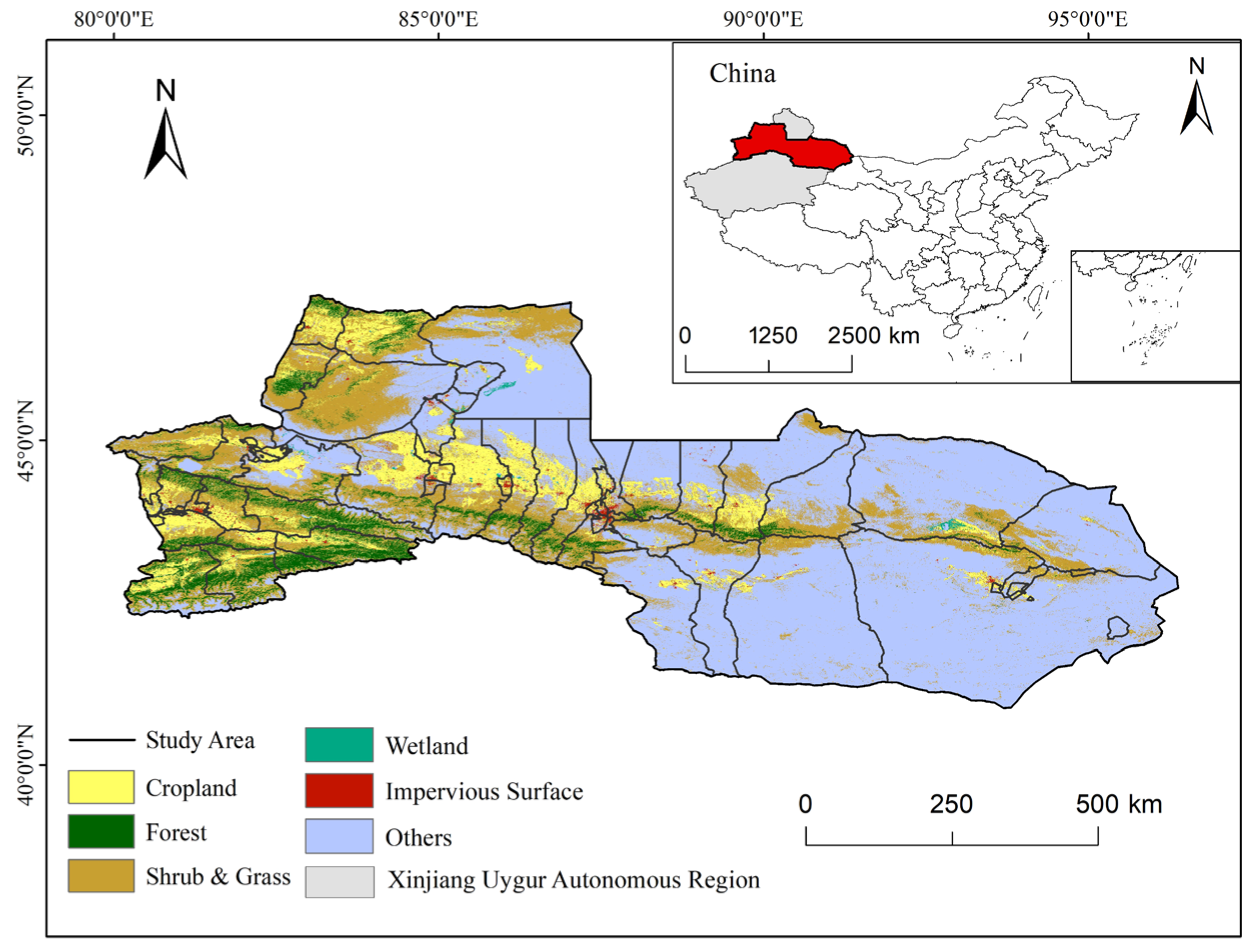
The study area is the TNSUA (79°53′17″ E–96°23′10″ E, 40°52′31″ N–47°14′10″ N) in Xinjiang, China (Figure 1). It is located along the northern foothills of the Tianshan Mountains and the southern edge of the Junggar Basin and is the most densely populated and highly urbanized region in Xinjiang [32].
It is a semi-arid region with a typical temperate continental climate, characterized by a mean annual temperature of approximately 7 °C and mean annual precipitation generally below 250 mm [33,34]. Grasslands constitute the principal land cover types, accompanied by scattered forest patches along the mountain area. Urban and rural settlements demonstrate a pronouncedly uneven spatial distribution, characterized by a multiple-nuclei urban system in which densely populated areas are predominantly confined to oases. The rapid expansion of built-up urban areas has intensified the UHI effect, and this thermal stress has profoundly altered vegetation’s physiological responses and ecological recovery processes [35].

2.2. Data Sources

This study integrates multi-source datasets spanning from 2000 to 2022, covering Land and Vegetation, Meteorological, Climate Indicators, and Anthropogenic factors. All the spatial datasets were harmonized to a unified spatial resolution and coordinate system (WGS 1984) prior to the analysis. Raster resampling and vector-raster conversion were performed where necessary to ensure spatial consistency. The data sources and corresponding description are provided in Table 1.

2.3. Methods

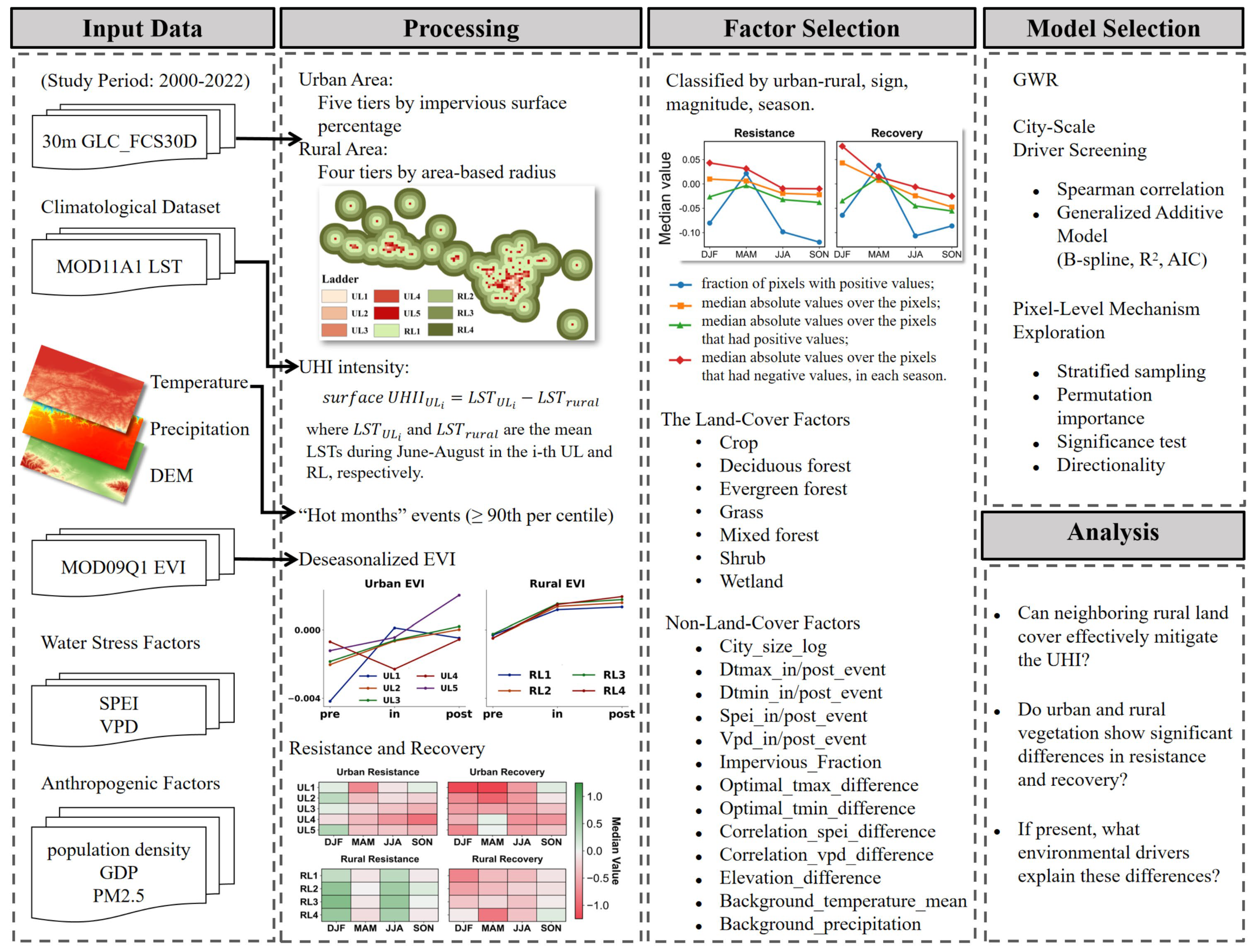
This study integrates multi-source remote sensing data and statistical models to study vegetation resistance and recovery during “hot month” events across urban–rural gradients in the TNSUA. The workflow is composed of four main parts (Figure 2).
First, we constructed urban–rural gradients for quantifying differences between anthropogenic activities and the natural environment. Urban areas were divided into five UL s according to the impervious surface percentage, while RL s were defined as concentric buffer areas extending outward from city boundaries based on the urban area’s size and distance ladders [17]. Subsequently, we calculated the UHI intensity.
Second, we characterized the intensity and persistence of extreme heat events based on “hot months” events. Based on a 1 km monthly mean temperature dataset [38], we calculated the 90th percentile of the monthly mean temperature for each calendar month and used it as the threshold. Consecutive months exceeding this threshold were then classified as one “hot months” event. If consecutive months exceed the threshold, they were considered a single “hot months” event.
Third, vegetation growth dynamics were characterized using deseasonalized 250 m EVI time series. Vegetation resistance was defined as the relative change in EVI during a “hot months” event, reflecting the immediate vegetation response to extreme heat events, whereas vegetation recovery represented the delayed response following the events [46]. These indicators were further aggregated to a 1 km spatial resolution.
Finally, statistical models and machine learning models were combined to quantitatively assess the relative importance of climatic factors, moisture stress conditions, and land cover factors in shaping vegetation resistance and recovery.

2.3.1. Definition of Urban and Rural Ladders

To assess the effects of rural land cover on the mitigation of UHI, we delineated both urban and rural areas into five UL s [47] and four RL s [48].
To obtain RL s , we extracted impervious surface pixels based on the 30 m land cover dataset [36]. For each 3 km × 3 km grid [17,49], the ratio of impervious surface area to total area was calculated with
UDI i = S IP , i S i × 100 % .
UDI i is the urban development intensity, S IP , i is the impervious surface area, and S i is the total area. Based on UDI, the grid cells were reclassified into five strata with 15% intervals: UL 1 (85–100%), UL 2 (70–85%), UL 3 (55–70%), UL 4 (40–55%), and UL 5 (25–40%), following the urban–rural gradients delineation framework proposed by Yang [17].
RL s were defined as concentric buffer areas extending outward from the urban boundary up to 20 km, segmented into four rings of increasing radius: RL 1 (2.5–5 km), RL 2 (5–10 km), RL 3 (10–15 km), and RL 4 (15–20 km), consistent with the spatial influence range identified by Yang [17]. The RL radius for each city was normalized with
D = D min + ( D max D min ) × S S min ( S max S min ) ,
where D is the radius of RL, S is the built-up area of the target city, and S min and S max are the minimum and maximum built-up areas among all cities.

2.3.2. “Hot Months” Event

“Hot months” are defined relative to historical climatological thresholds, serving as robust indicators of persistent heat extremes and capturing the cumulative intensity and duration of high-temperature stress [50]. We defined the “hot months” using month-specific thresholds. A month was classified as “hot” if its mean temperature exceeded the historical 90th percentile for the same month of the year, a threshold selected following sensitivity tests using the 85th, 90th, and 95th percentiles, and consistent with the findings of Wang [24]. Consecutive hot months were merged into a “hot months “event, which typically lasted for 1–3 months [51].
To characterize vegetation responses to high temperatures across seasons, we defined the seasons: DJF (December to February), MAM (March to May), JJA (June to August), and SON (September to November).
The “hot months” event was assigned to the seasons it overlapped, with the events spanning multiple seasons counted in each. Seasonal variations in vegetation resistance and recovery were quantified as the median values of the RL s for all events within each season.

2.3.3. Vegetation Resistance and Recovery

To quantify the concurrent and delayed responses of vegetation to extreme heat events, we calculated vegetation resistance and recovery at 250 m. Resistance represents the maximum deviation of the EVI from its pre-event level during a “hot months” event, while recovery reflects the mean deviation of EVI from the pre-event level during the three months immediately following the event.
Resistance = 2 × ( EVI in EVI pre ) ( EVI pre + | EVI in EVI pre | )
Recovery = 2 × ( EVI post EVI pre ) ( EVI pre + | EVI post EVI pre | )
EVI pre was defined as the mean EVI of the same months throughout the study period, excluding the year in which the “hot months” event occurred, thereby representing the typical baseline vegetation condition under non-extreme conditions. Specifically, for a hot month event occurring in a given calendar month, EVI pre represents the multi-year mean EVI of that same month across all non-event years at each pixel. This month-matched and pixel-wise approach ensures that the reference condition reflects the typical vegetation state for that location and month, thereby minimizing the biases caused by seasonal variability and spatial heterogeneity [52,53]. EVI in corresponds to the EVI of the month during the “hot months” event that exhibited the greatest deviation from EVI pre . EVI post was calculated as the mean EVI during the three months immediately following the termination of the “hot months” event. The three-month recovery window was selected because vegetation responses to extreme heat often exhibit short-term lag effects, and a three-month period can capture the typical recovery process while reducing the influence of short-term fluctuations or subsequent seasonal changes [54,55].

2.3.4. Statistical Analysis

To analyze urban–rural differences, we introduced factors such as climate factors, environmental context, and land cover types in rural areas, which are summarized in Table 2, and quantitatively assessing their explanatory power. Land cover factors include the composition of the rural areas, thereby reflecting the background biome context of the city rather than differences in internal urban vegetation types. The inclusion of these factors helps not only to reveal the spatial heterogeneity of urban–rural differences among cities, but also to identify key ecological and environmental factors affecting urban and rural vegetation responses.
To identify the primary factor that lead to urban–rural differences in vegetation resistance and vegetal recovery from “hot months” events, we conducted city-scale analyses using Spearman correlation and GAM. The model performance was evaluated using the coefficient of determination (R2). We implemented leave-one-city-out cross-validation for all single-variable GAMs and the multivariate land cover GAM to evaluate the model’s performance on unseen cities and reduce potential spatial dependence. For individual non-land-cover variables (e.g., VPD, SPEI, and UHI metrics), single-variable GAMs were fitted using B-splines to quantify each predictor’s explanatory power. For the seven rural land cover variables, a multivariate GAM was fitted simultaneously to obtain the overall R2, avoiding the interpretation of individual coefficients due to multicollinearity. Partial Spearman correlations were also calculated to assess the independent contributions of each land cover type. To account for the multicollinearity among predictors, we interpret variable importance as the strength of association with the response rather than implying independent causal effects. The Spearman correlation and GAM were formulated as follows:
ρ = 1 6 i = 1 n d i 2 n ( n 2 1 )
ρ is the Spearman rank correlation coefficient, n is the number of observations, and d i denotes the difference between the ranks of the two variables for the i-th observation.
g ( E ( Y ) ) = β 0 + j = 1 p f j ( X j )
Y represents the response variable, g( ) is the link function, β 0 is the intercept, X j denotes the j-th explanatory variable, and f j ( ) is a smooth function describing the potentially nonlinear effect of X j on Y.
This study used the geographically weighted regression (GWR) model to analyze the spatial effects of natural and human factors on temperature. The GWR model was implemented in ArcMap 10.8, using a fixed kernel type with the optimal bandwidth determined by the corrected Akaike Information Criterion. The dependent variable was the annual mean air temperature at the city level. Eight explanatory variables were included in the GWR model, representing both natural and anthropogenic influences, including impervious fraction, precipitation, DEM, EVI, SPEI, GDP, population density, and PM2.5 concentration. At the pixel scale, RF combined with SHAP (SHapley Additive exPlanations) were employed to quantify the relative importance of each factor and identify potential interaction effects, ensuring statistical robustness while capturing local spatial heterogeneity.

3. Results

3.1. Effects of Rural Land Cover Composition on Mitigating UHI

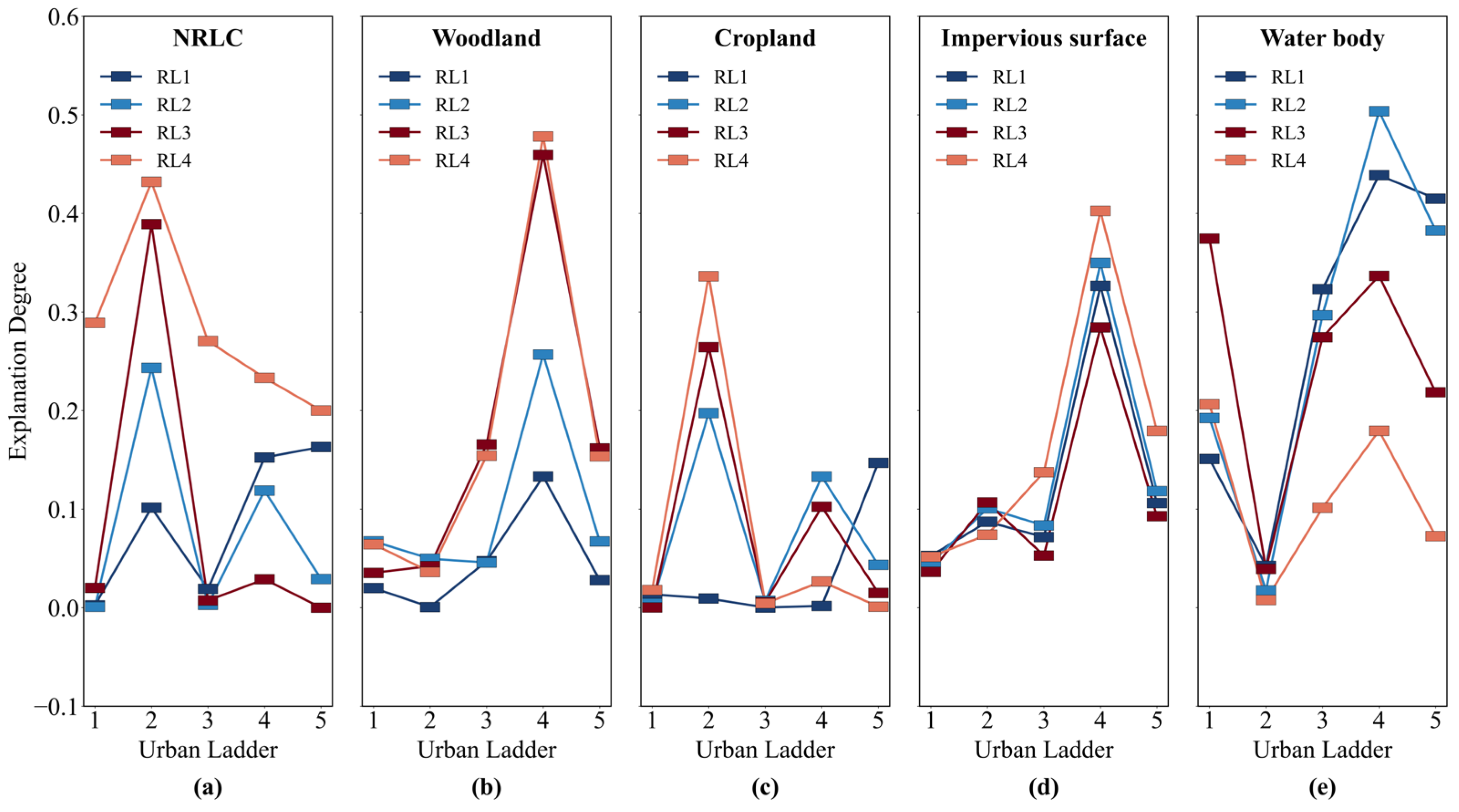
RL 4 exhibited the most pronounced cooling effect on UL 2 (Figure 3). Land cover patterns exerted significant explanatory power over UHI intensity across UL s , with neighboring rural land cover (NRLC) providing cooling effects for all UL s . Considering specific land cover types, woodland showed the peak explanatory power for UHI within the UL 4 layer, but its effect on the urban core was relatively weak, highlighting the spatial limitation of woodland-based UHI mitigation. In contrast, impervious surfaces exhibit a broader adaptation range across urban areas, affecting multiple layers; however, their ecological function is also significantly constrained by distance ladders, preventing effective regulation in areas immediately adjacent to the city. The ability of different rural land cover types to regulate UHI depends on specific combinations of distance ladders and urban areas.

3.2. Vegetation Resistance and Recovery: Urban vs. Rural

3.2.1. Spatiotemporal Patterns of Resistance and Recovery

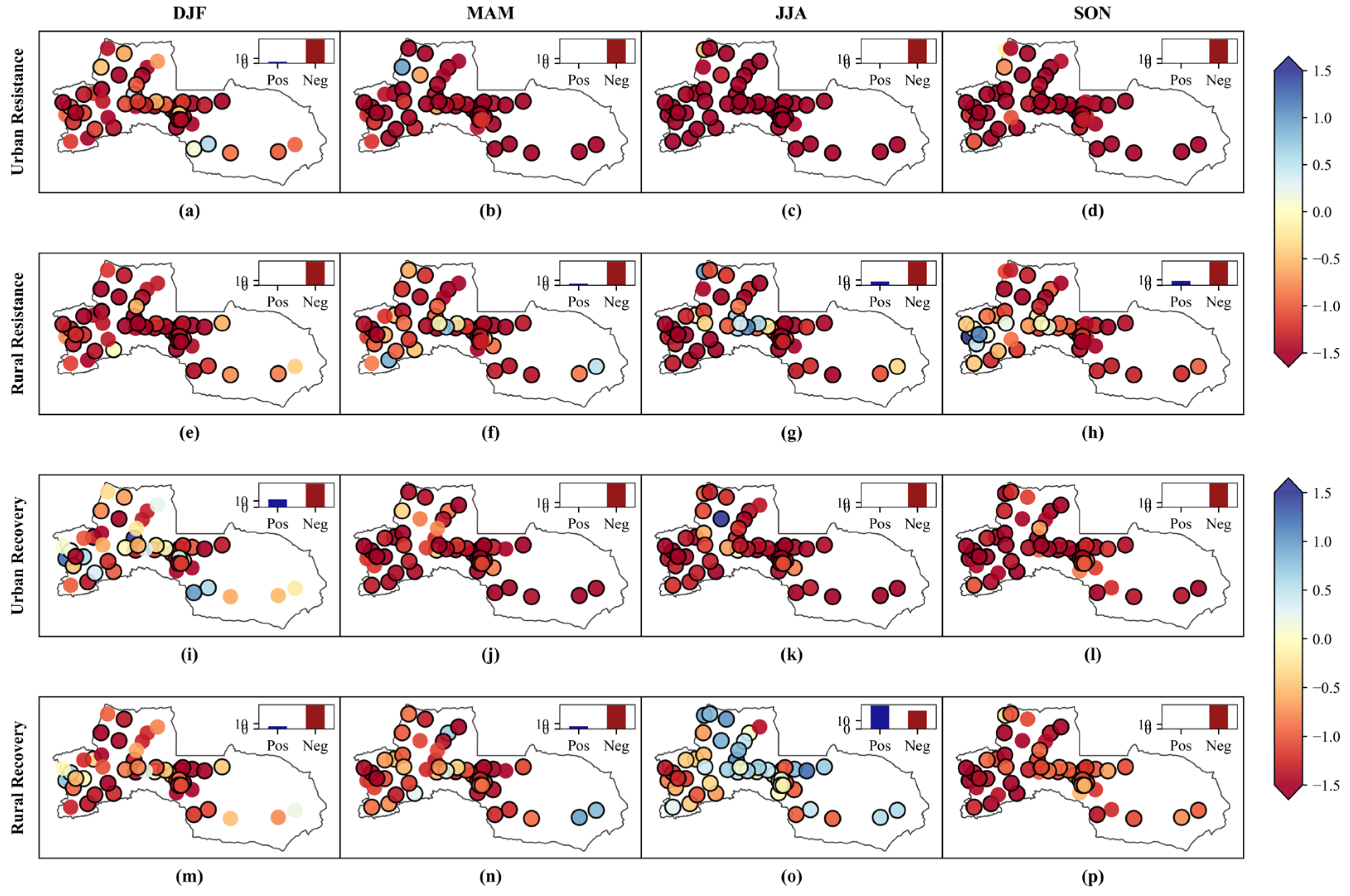
This study further revealed the actual responses and differences in vegetation across different cities, showing that urban vegetation generally exhibits more negative resistance and recovery compared to rural vegetation (Figure 4). Vegetation resistance was predominantly negative in both urban and rural areas across the four seasons in the TNSUA.
Urban vegetation exhibited the highest positive resistance in summer, while rural vegetation peaked in winter and spring (Figure 4a–h). Increased positive resistance was observed in the western region than in the eastern region (Figure 4a–h). In the three months following the high-temperature months, rural vegetation mainly exhibited its positive recovery in winter, whereas urban vegetation only showed weak positive recovery in summer, with negative recovery dominating the other seasons (Figure 4i–p). The largest magnitude of negative recovery occurred in spring (Figure 4i–p).
Regarding the disparity between urban and rural vegetation, the differences were the most pronounced in winter, with rural areas exhibiting significantly higher resistance and, especially, recovery than urban areas at a significance level of p < 0.05. Seasonally, urban vegetation resistance and recovery peaked in summer, whereas rural vegetation showed a gradual increase in resistance and recovery from summer to winter, reaching its maximum in winter. Spatially, the western and central cities displayed the most pronounced advantages in resistance and recovery.
The “hot months” in spring and summer had the greatest impact on vegetation across the TNSUA. Urban vegetation was more vulnerable than rural vegetation and exhibited more negative responses, highlighting the regulatory role of regional differentiation on vegetation growth under “hot months” events.
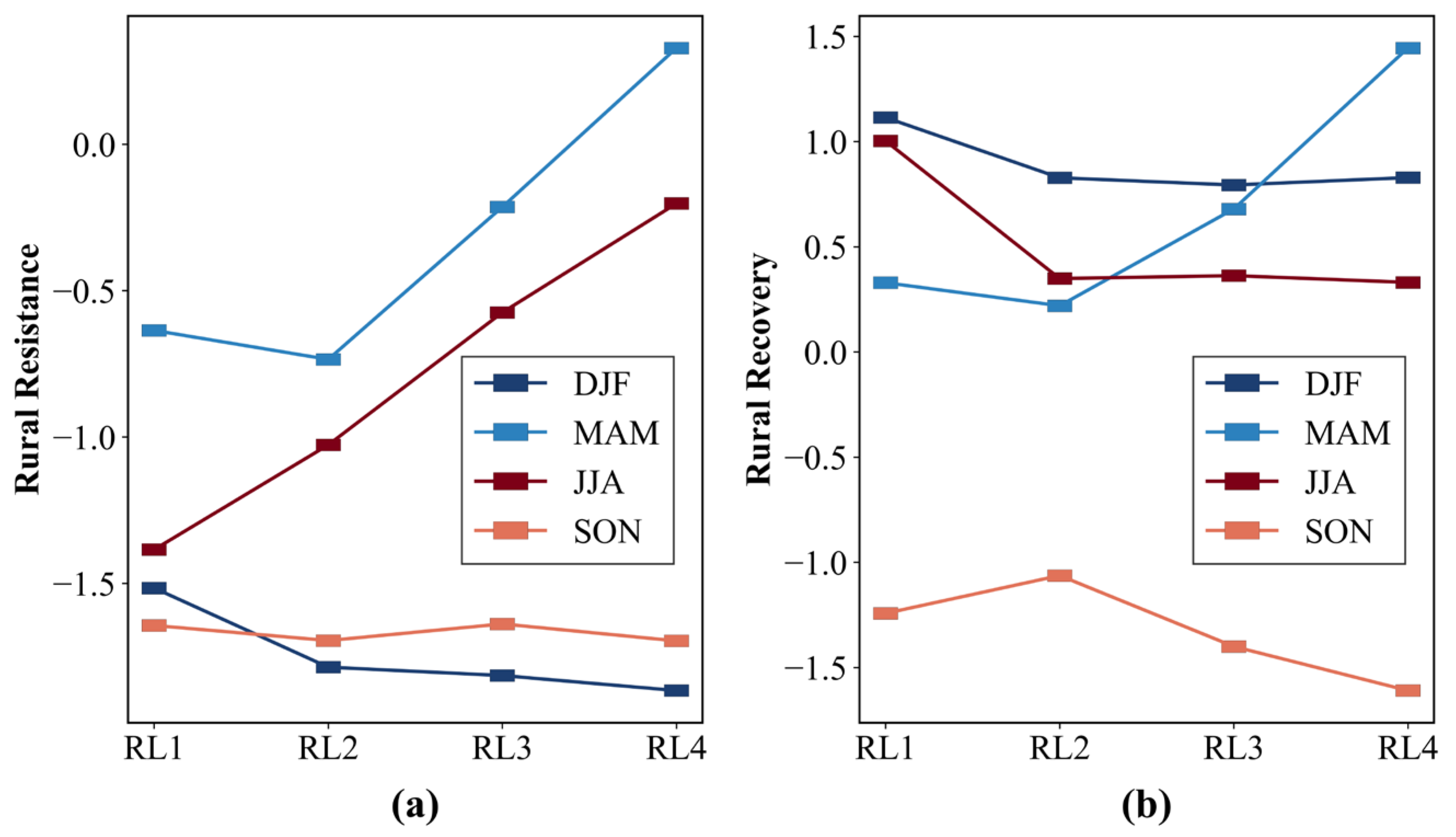
Rural vegetation exhibits significant temporal trends in relation to both resistance and recovery. The regulatory effect of neighboring rural land cover on UHI intensity is not only constrained by spatial patterns but also shows significant temporal dynamics. In addition to spatial differences, rural vegetation responses to “hot months” events also change seasonally. Therefore, this study further explores the temporal dimension by analyzing the median values of vegetation resistance and recovery corresponding to each rural ladder within the study area. The results show that during the spring and summer growing seasons, resistance sharply increases, whereas in autumn and winter, it steadily decreases. Recovery continuously increases in spring, decreases initially and then stabilizes in summer and winter, and remains steady with increasing distance, while in autumn recovery decreases, indicating a weakening of the distance-dependent effect. At the regional scale (Figure 5), rural ecosystem recovery shows clear seasonal and ladder variations: it generally increases in spring but decreases in autumn and winter. This seasonal variation suggests that climate conditions and the vegetation growth cycle jointly drive the temporal responses of rural ecosystems under extreme heat, highlighting the seasonal sensitivity of rural vegetation to external disturbances. RL 4 consistently exhibits a higher resistance and recovery compared to the other three rural ladders, indicating that vegetation in rural fringe areas demonstrates stronger recovery to “hot months” events.

3.2.2. Seasonal and Regional Urban–Rural Response Differences

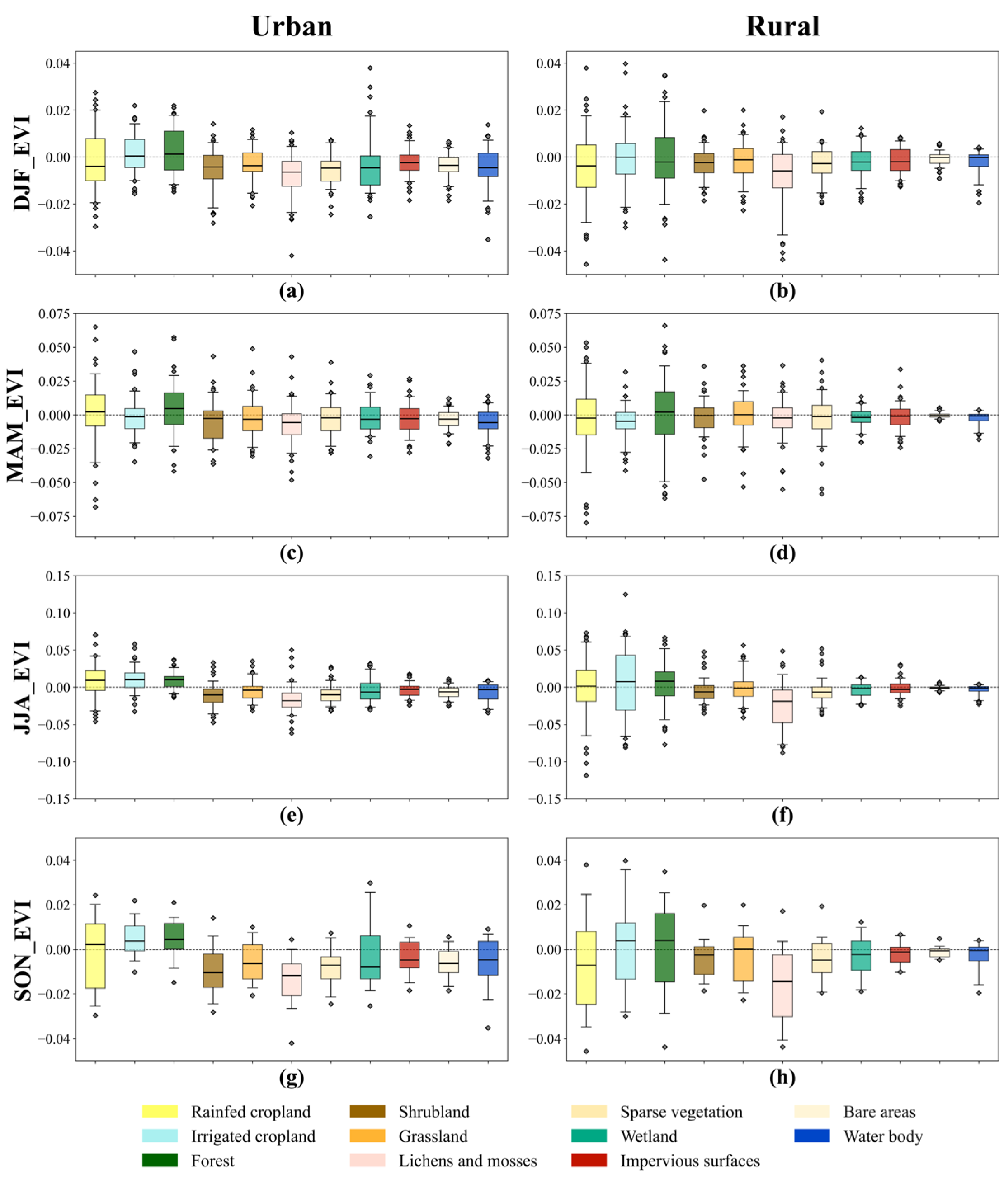
The essence of the urban–rural differences in vegetation responses lies in the variation in the vegetation’s growth conditions. To investigate the causes of the urban–rural differences in vegetation resistance and recovery, we first compared vegetation’s growth status under normal conditions for different land cover types in both urban and rural areas. As shown in Figure 6, except for dryland cropland and forest, the median EVI for all other land cover types in urban areas was lower than that for the same types in rural areas. This pattern indicates that the urban environment exerted a persistent inhibitory effect on vegetation’s growth, resulting in urban vegetation having a relatively disadvantaged “growth baseline” even during non-stress periods. This inherent growth disadvantage may have been one of the fundamental reasons for its weaker resistance and slower recovery when facing “hot months” events.
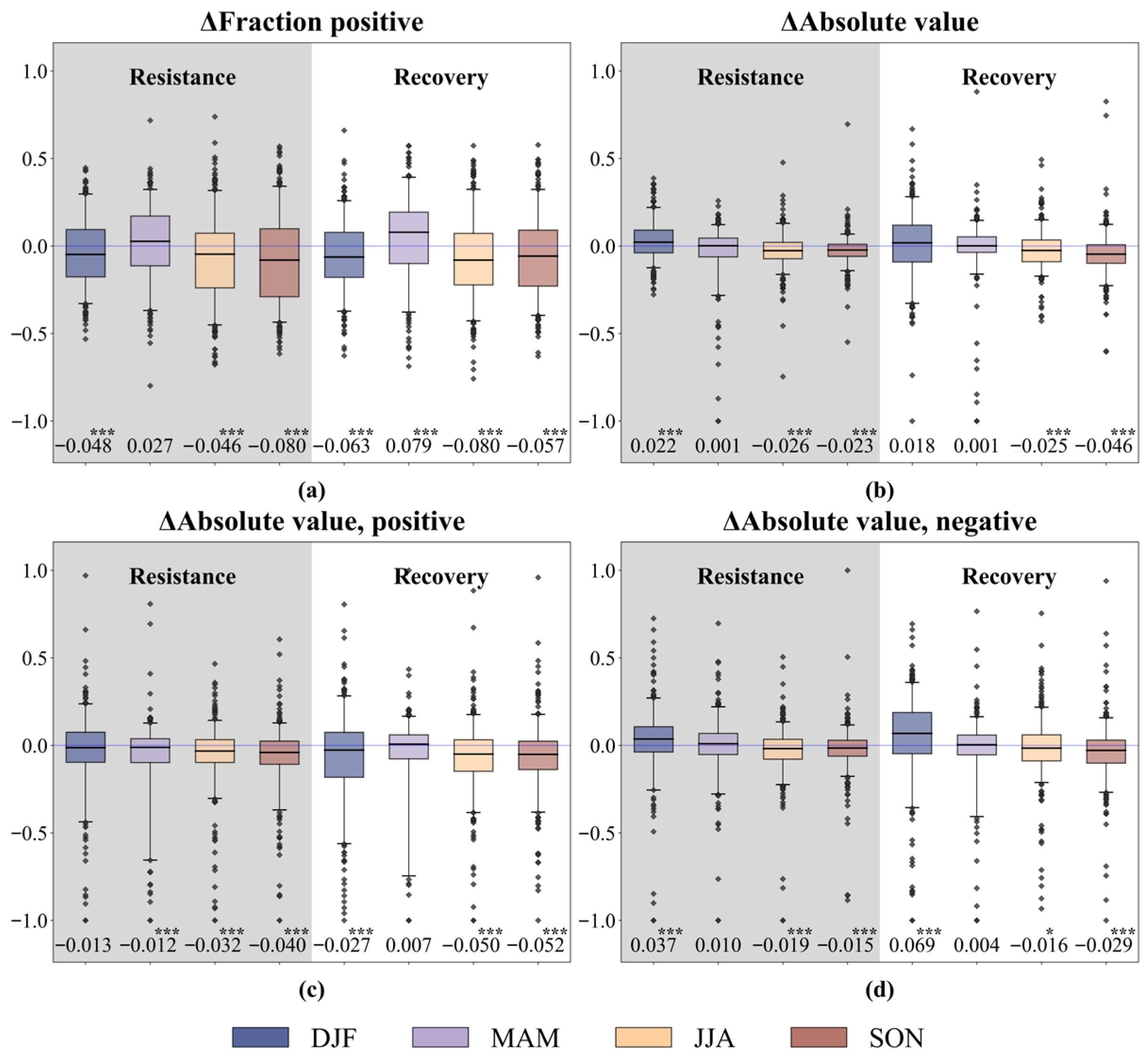
Seasonally, in summer and autumn, the fraction of positive resistance in urban areas was similar to that in rural areas. However, in winter and spring, the fraction of positive resistance in urban areas was significantly lower than that in rural areas (Figure 7a). Regardless of the sign of resistance, the magnitude of responses in urban areas during winter and spring was consistently smaller than in rural areas (Figure 7b–d). This suggests that during “hot months” events, the urban environment further weakened the vegetation’s ability to cope with high temperatures.
When resistance and recovery were negative, the negative response magnitude in urban areas during summer was significantly higher than that in rural areas (Figure 7d). In other words, urban vegetation experienced more intense stress than rural vegetation when “hot months” events occurred during the cold season (Figure 7c,d).
Finally, the difference in the fraction of positive responses between urban and rural areas peaked in autumn, while in other seasons, it was below zero, indicating that rural vegetation had a higher fraction of positive responses (Figure 7a). The urban–rural difference in vegetation responses decreased from summer to winter (Figure 7d). Therefore, the overall resistance and recovery of urban vegetation were more negative than those of rural vegetation.

3.3. Driving Factors of Urban–Rural Vegetation Response Differences: Multi-Scale Analysis

To explore the driving mechanisms behind urban–rural vegetation response differences, this study integrated correlation analysis, GAM, and RF methods to assess the impact of various potential factors at different scales.

3.3.1. Identification of Key Driving Factors

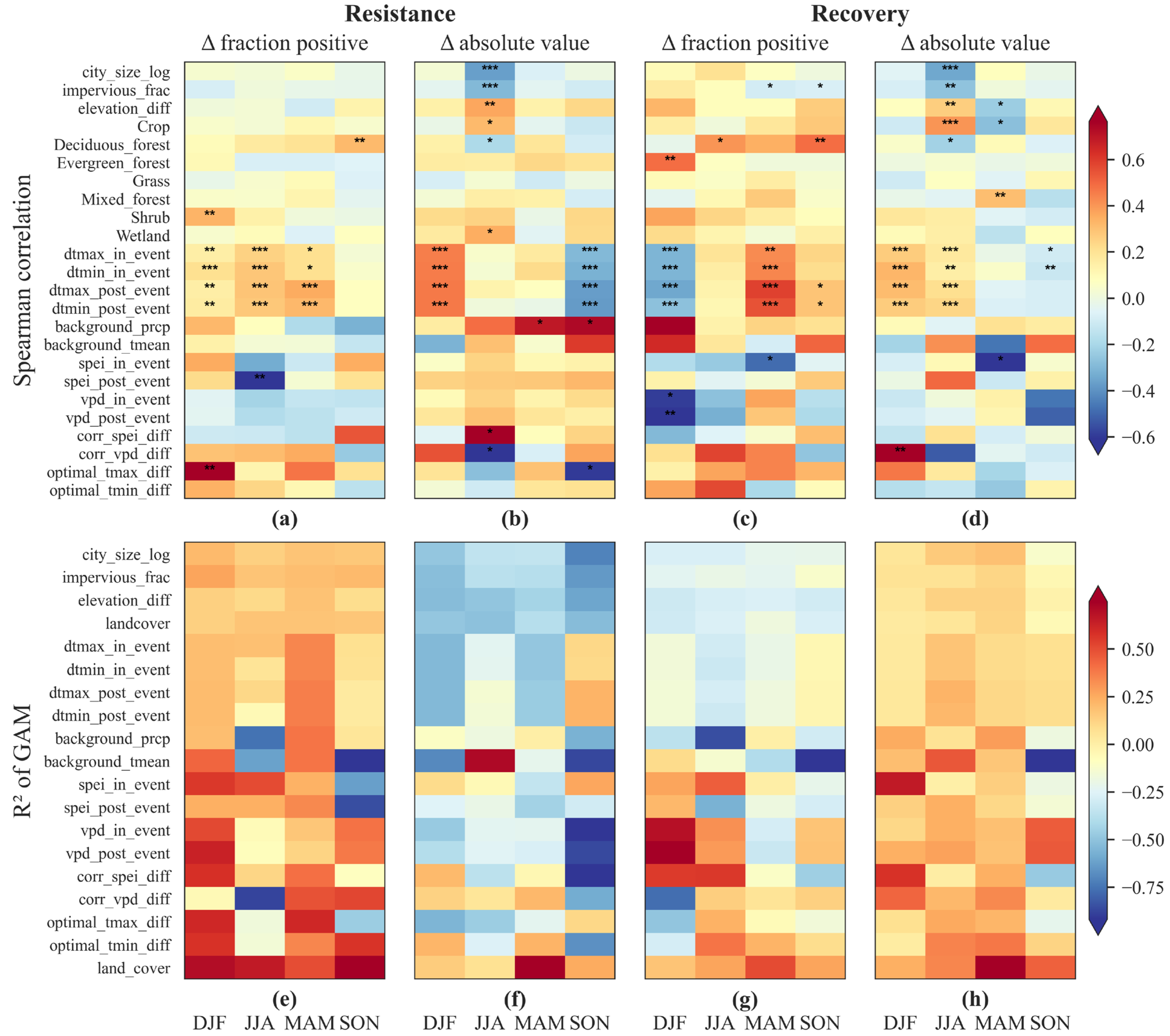
Through the correlation analysis of urban–rural vegetation response differences (Figure 8a–d), this study preliminarily identified the key influencing factors. The analysis revealed that UHI intensity is a key climactic factor that dominates the sign of the difference: it shows a positive correlation with both resistance and recovery differences in summer, while in winter the correlation with the recovery difference becomes negative. At the same time, moisture stress (SPEI and VPD) significantly modulates the strength of the recovery, showing a negative correlation with the difference direction in both summer and winter.
At the landscape level, land cover type factors exhibited the strongest linear explanatory power (R2: 20–60%), suggesting that land cover might be a key factor influencing the difference patterns. In terms of the magnitude of the difference, the driving factors showed stronger seasonal consistency: urban development intensity (urban size and impervious surface fraction) was negatively correlated with the response magnitude in spring, while rural landscape composition and terrain features (elevation difference) showed seasonal reversal effects. In addition, regional climate backgrounds (precipitation and temperature) and vegetation moisture stress conditions also played important roles in modulating the magnitude of the differences.
To identify the potential nonlinear effects between factors and quantify their independent contributions, nonlinear models were further applied (Figure 8e–h). The results confirmed the previous conclusions: although the simple linear correlation between land cover factors and difference magnitude was weak, the nonlinear models showed a high explanatory variance (R2 significantly increased). This indicates that the effect of land use on the difference magnitude mainly operates through nonlinear mechanisms, and its complex effects cannot be captured by linear relationships. This analysis further clarified the existence of specific nonlinear relationships between factors such as UHI intensity and response differences.
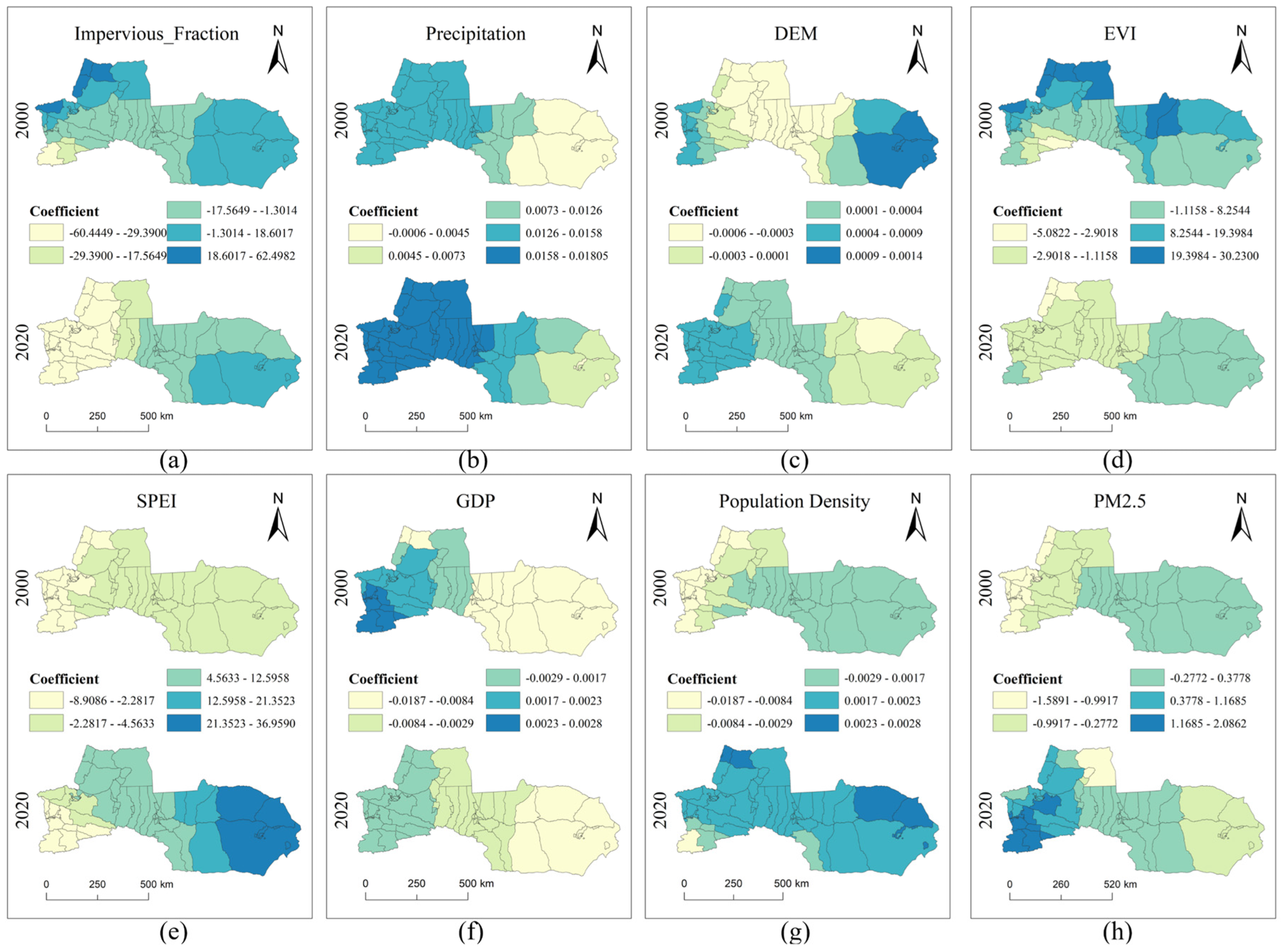
The results show significant spatial variation in relation to the impacts of SPEI, EVI, and impervious fraction (Figure 9). In 2000, impervious surface expansion in the northwest had a strong positive effect on temperature, but by 2020, its influence had become negative, suggesting that suitable policies could enhance urban vegetation’s recovery to extreme heat. The SPEI’s coefficients transitioned from slightly negative in 2000 to slightly negative in the west by 2020, indicating that intensified droughts raised the temperatures. The EVI’s positive coefficients were concentrated in the north in 2000, while in 2020, negative values dominated. Natural factors, especially moisture stress, showed spatial heterogeneity, with precipitation decreasing eastward and the SPEI increasing. Human factors, linked to urbanization, showed high values near urban areas, expanding outward over time. The GWR model showed strong explanatory power, with local R2 values ranging from 0.097 to 0.833 in 2000 and from 0.220 to 0.876 in 2020, with most cities exhibiting values above 0.7. This indicates that the selected natural and anthropogenic variables effectively explain the spatial variability of temperature patterns, and highlights that the strong spatial heterogeneity captured by the GWR model.

3.3.2. Nonlinear Effects and Spatial Heterogeneity at Pixel Scale

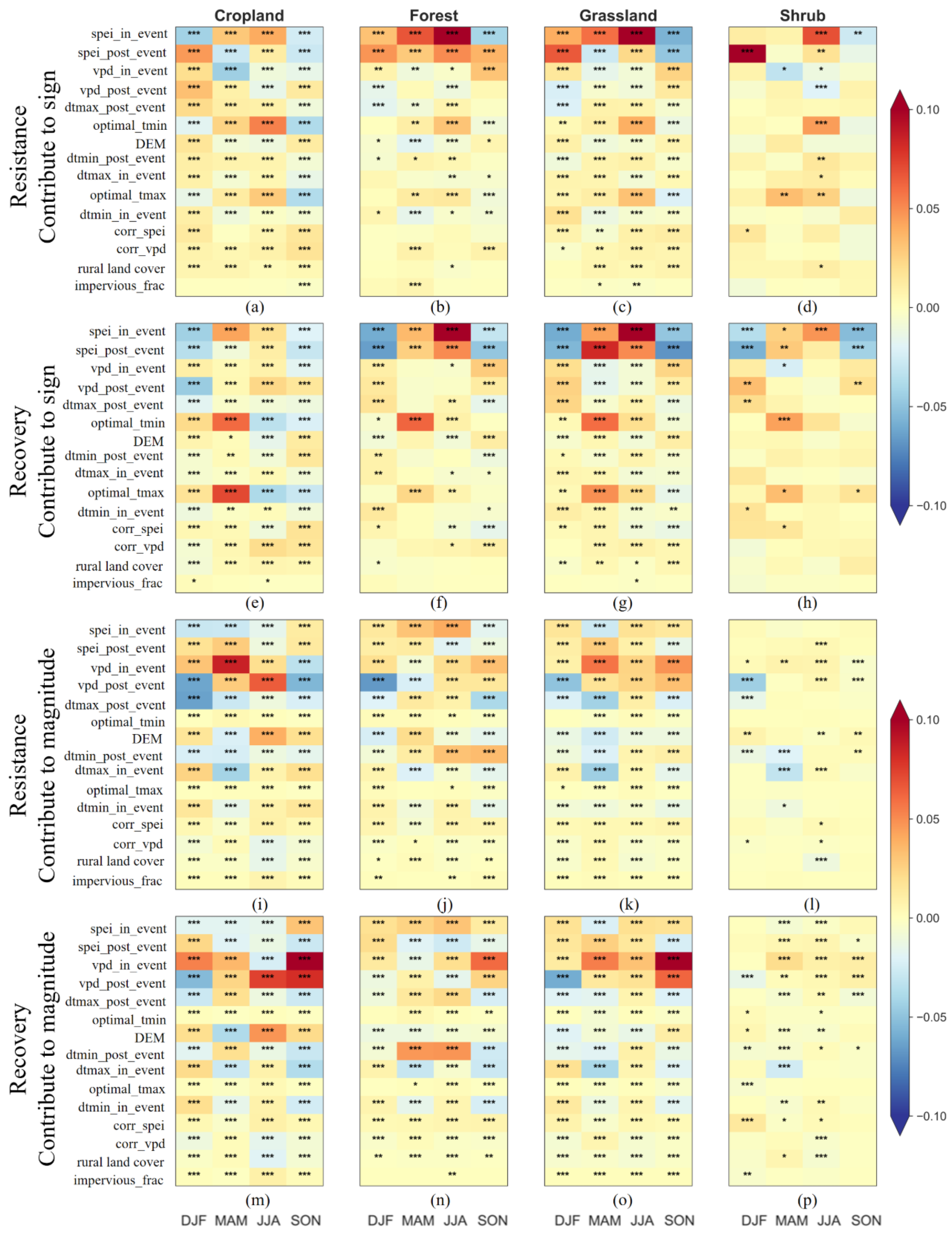
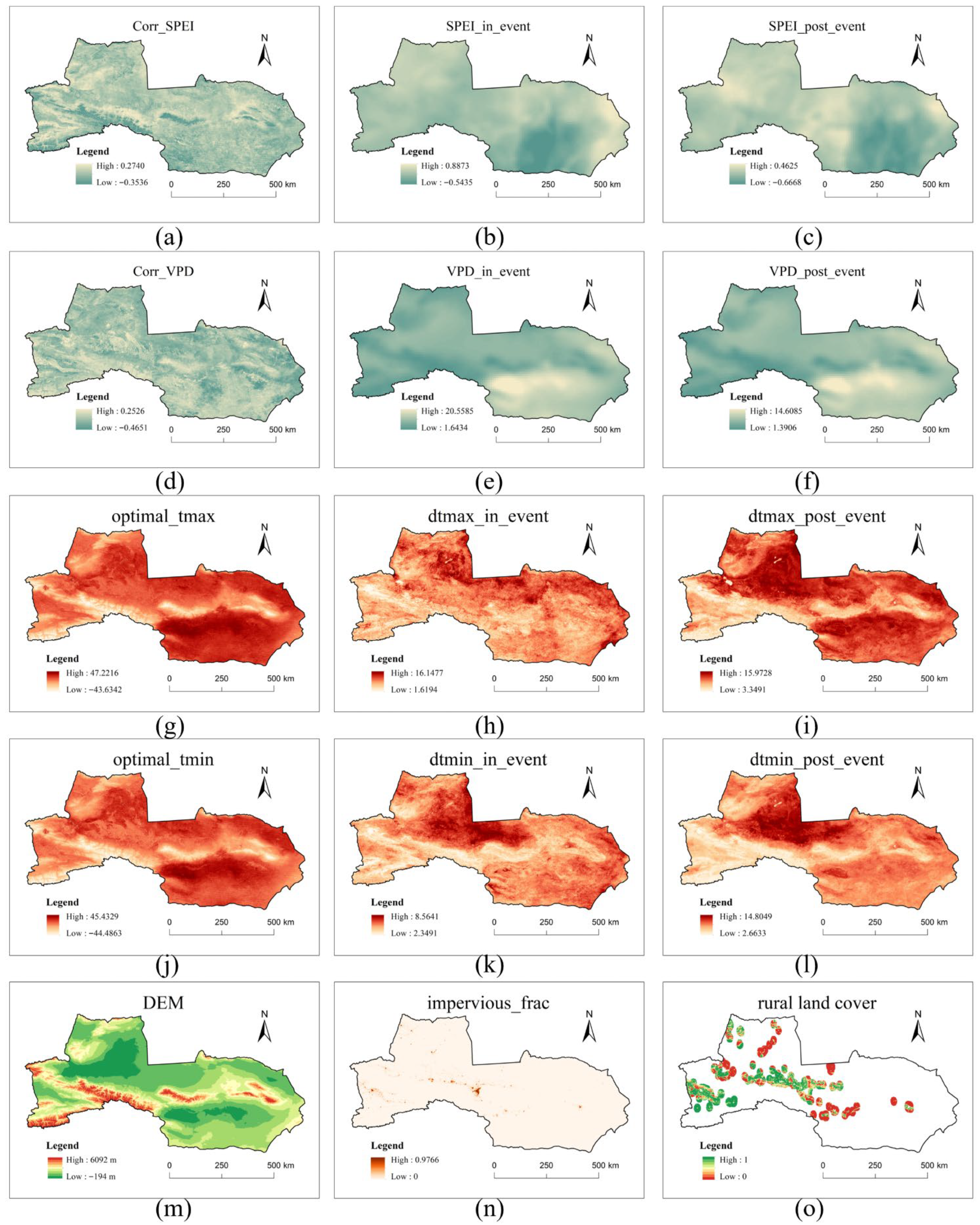
Figure 10 shows that during and in the three months following a “hot months” event, SPEI and VPD were the most influential predictive factors, indicating that moisture stress is a key driver of urban–rural vegetation response differences. Additionally, the optimal maximum temperature (“optimal_tmax”) and optimal minimum temperature (“optimal_tmin”) also had strong positive effects. Regarding vegetation types, forests and grasslands were more sensitive to meteorological factors. The SPEI during the event and after the event showed significant positive contributions to the resistance and recovery of forests and grasslands in autumn and winter, while the VPD in the event and after the event contributed significantly to the recovery magnitude in spring. These findings suggest that under the same moisture stress conditions, different land cover can lead to different urban–rural vegetation response patterns through variations in vegetal structure and function, highlighting the key role of surface properties in regulating the ecosystem’s recovery. Both “optimal_tmin” and “optimal_tmax” showed significant positive effects on recovery across all vegetation types in autumn. The spatial distributions of all factors are presented in Figure 11.

4. Discussion

4.1. Rural Land Cover Effects on UHI Mitigation

Natural land cover and relatively simple functional patterns in rural areas have significant potential to mitigate UHI effects. This study aims to explore the quantitative and qualitative impacts of rural land cover on mitigating UHI effects in the TNSUA from 2000 to 2022. Furthermore, cities are categorized based on their UDI to conduct a differentiated analysis of the impact of rural land cover on UHI mitigation across varying urbanization intensities. By doing so, we effectively constrain and quantify the influence of urban development via the research findings. The results show that NRLC can mitigate the UHI effect across the entire urban area. Specifically, the study found that NRLC significantly cools urban areas, with the most pronounced effect in areas with a UDI of 70–85%. The RL 4 land cover type was found to have the most significant impact on UHI effects, similarly to the finding from Yang [17]. From a planning and management perspective, the results highlight the importance of rural ecosystems in mitigating urban thermal stress at the urban agglomeration scale. In particular, rural land cover types with higher ecological stability should be considered in climate-adaptive spatial planning. Protecting and optimizing peri-urban ecological spaces may enhance the overall resilience of regional ecosystems to extreme heat events.

4.2. Seasonal Variations in Urban–Rural Vegetation Response Differences

This study found that high-temperature months generally promoted negative responses in vegetation, with urban vegetation responding more promptly to “hot months” events compared to rural vegetation, which exhibited delayed responses (Figure 4). Thus, the results indicate that high-temperature months may promote vegetation growth in the TNSUA during cold seasons but primarily inhibit growth in warmer seasons. Eastern cities in the urban agglomeration generally exhibited more negative responses than those in the central and western regions, where built-up urban areas were larger, aligning with the UHI effect. Despite stronger heat island effects in the western and central regions, the regression results indicated this was due to the lower vegetation moisture stress and higher optimal growth temperatures in those areas. The cities in the western and central regions are located in the Ili River Valley and Oasis areas, where vegetation moisture stress is lower, and optimal growth temperatures are higher, allowing urban vegetation to continue growing at higher temperatures through stronger transpiration [56].

4.3. Factors Influencing Urban–Rural Vegetation Response Differences

The local UHI intensity is an important factor in explaining differences in vegetation’s response signs (e.g., “dtmax_in_event”, “dtmax_post_event”, “dtmin_in_event”, and “dtmin_post_event” in Figure 8). To explore the driving factors influencing temperature, this study used the GWR model to analyze natural and human factors. It was found that EVI, SPEI, and impervious surface fraction were key temperature-regulating factors, consistent with the results observed in Figure 8 and Figure 10, suggesting mutual interactions and constraints between temperature, vegetation, and moisture stress. Among the different land cover types, moisture stress was crucial in influencing urban–rural differences (e.g., corr_vpd and corr_spei in Figure 10). In urban-scale and pixel-scale regression analyses, predictive factors related to temperature were important for both the signs and magnitudes of the responses, though the specific predictive factors varied. In urban-level regressions, factors such as seasonal climate characteristics (background_pre), urban size, impervious surface fraction, and rural land cover types were significant (Figure 8). In pixel-scale regressions, the most important temperature-related predictive factors were urban–rural optimal temperature differences (optimal_tmax_diff and optimal_tmin_diff) (Figure 10). Taken together, these results suggest that temperature and moisture stress are the main drivers influencing vegetation resistance and recovery. This finding is consistent with the results reported by Wang [24] and Sui [57], who also highlighted the combined roles of temperature conditions and water availability in regulating vegetation responses to extreme heat events.

4.4. Limitations and Future Directions

This study has some limitations. First, the study used a traditional 3-month seasonal window, which may obscure the exact transition time between positive and negative recovery. Methods based on vegetation phenology or local temperature seasonality may yield more consistent spatial patterns. Second, the datasets used in this study mainly relied on a single data source, lacking cross-validation or uncertainty assessments using multi-source data. Future studies should combine multi-source climate data, different vegetation index products, and high-resolution urban data to systematically assess the robustness of the results and improve the reliability of the conclusions. Third, the EVI data used in this study were derived from MODIS products, publicly available from only 2000 onward. This limited the length of the time series, making it difficult to fully account for long-term climate change trends. Future studies could use longer multi-source remote sensing or climate reanalysis data to better separate the effects of long-term warming and extreme events on vegetation responses. In addition, this study focused on environmental influences on vegetation at the regional scale. The study area was classified into two main categories, urban and rural, to maintain spatial consistency between the climate and vegetation data. We acknowledge that differences in land use and vegetation composition may affect the responses, and future research should incorporate higher-resolution land cover and vegetation data to better control for heterogeneity and to refine the urban–rural comparisons. Finally, we used a Random Forest model with SHAP for feature attribution. Although Random Forest is relatively robust to multicollinearity for prediction, multicollinearity among the predictors (e.g., temperature, and moisture stress) can still influence SHAP interpretation. Therefore, our SHAP analysis aims to reveal the overall contribution patterns rather than the independent causal effects of individual predictors.
Previous studies have shown that vegetation responses to extreme heat events are closely related to multiple ecological mechanisms. High temperatures not only directly suppress photosynthetic efficiency and stomatal conductance, but also increase VPD, thereby intensifying moisture stress in ecosystems [58]. VPD is an important driver affecting vegetation water and carbon fluxes, and its influence is expected to increase further under climate warming [59]. The resulting soil moisture deficit further constrains carbon uptake processes and reduces vegetation resistance during heat events [60]. In many cases, extreme heat events also occur simultaneously with drought conditions, forming compound heat–drought events that greatly reduce the ecosystem’s productivity and prolong vegetation’s recovery time [61]. Vegetation recovery rates are mainly controlled by water replenishment, with stronger droughts generally leading to longer recovery times [62]. However, vegetation in arid regions can enhance its survival under long-term heat and water stress through adaptive strategies such as deeper root systems, a reduced leaf area, and improved water use efficiency [63]. Future research could further investigate the resistance and recovery of different vegetation types under compound climate events based on vegetation’s characteristics.
Although this study focuses on a single semi-arid region, its analytical workflow, including urban–rural gradients’ delineation, hot month identification, and vegetation resilience assessment, can be transferred to other climatic and geographic contexts. The findings also offer practical insights for urban planning and climate adaptation, such as optimizing green infrastructure placement along urban–rural gradients, selecting heat-tolerant vegetation species based on resistance and recovery patterns, and strengthening ecological buffer zones to enhance urban resilience to extreme heat events.

5. Conclusions

This study systematically examined vegetation resistance and recovery responses during persistent “hot months” within an urban–rural gradient framework in a semi-arid urban agglomeration. The results indicate that rural areas play an important ecological buffering role in mitigating the thermal stress associated with the UHI. Meanwhile, vegetation responses exhibit clear seasonal and spatial scale-dependent differences.
The main findings are summarized as follows. First, rural areas play an important ecological buffering role in mitigating UHI. Along urban–rural gradients, vegetation in rural areas shows higher stability under persistent heat conditions compared with in urban areas. This suggests that rural ecosystems play an important role in regulating regional thermal environments and alleviating UHI impacts. Second, RL 4 -type rural land cover exhibits the most significant buffering effect in relation to maintaining vegetation stability. The results show that RL 4 areas demonstrate higher vegetation resistance and recovery during extreme heat periods, indicating that this type of rural land cover plays a key role in maintaining regional ecological stability and regulating thermal environments. Third, the coupling effects of temperature and moisture stress represent an important mechanism influencing vegetation stability. Under persistent heat conditions, moisture stress plays a critical role in regulating vegetation responses, suggesting that the interaction between temperature and moisture stress significantly influences vegetation resistance and recovery. Finally, vegetation responses show clear seasonal and scale-dependent characteristics. Across different seasons and urban–rural gradient levels, vegetation stability and its driving factors vary, indicating that both urbanization intensity and climatic conditions jointly shape vegetation responses to extreme heat events. From a planning and management perspective, the results highlight the importance of rural ecosystems in mitigating urban thermal stress at the urban agglomeration scale. In particular, rural land cover types with higher ecological stability should be considered in climate-adaptive spatial planning. Protecting and optimizing peri-urban ecological spaces may enhance the overall resilience of regional ecosystems to extreme heat events.

Author Contributions

Conceptualization, K.L., N.L., L.Z., H.G., Z.L., H.T., X.W., Y.Z. and J.X.; data curation, K.L., N.L., H.G., Z.L., H.T., X.W. and Y.Z.; formal analysis, K.L., N.L., H.G., H.T., X.W. and Y.Z.; investigation, K.L., N.L., H.G., H.T., X.W. and Y.Z.; methodology, K.L., N.L., H.G. and H.T.; project administration, L.Z. and Z.L.; resources, K.L., N.L., L.Z., Z.L. and J.X.; software, K.L. and N.L.; supervision, L.Z.; validation, K.L., H.T., X.W. and Y.Z.; visualization, K.L., N.L., H.G., H.T., X.W. and Y.Z.; writing—original draft, K.L., N.L. and H.G.; writing—review and editing, K.L. and L.Z. All authors have read and agreed to the published version of the manuscript.

Funding

This research was funded by the Talent Program “Tianchi Talent (Young Doctor)” in Xinjiang Uygur Autonomous Region, grant number 5105250180F; the National College Students’ Innovation and Entrepreneurship Training Program, grant number 202410755003; and the National Natural Science Foundation of China Regional Project, grant number 42361026. The APC was funded by Xinjiang University through the National Natural Science Foundation of China Regional Project, grant number 42361026.

Data Availability Statement

The original data presented in this study are publicly available from the following sources. EVI time series data (2000–2022) were obtained from Google Earth Engine based on the MOD09Q1 product (available online: https://code.earthengine.google.com/; accessed on 7 February 2026). Land cover data were obtained from the GLC_FCS30D dataset (2000–2022) (Zhang et al.; available online: https://doi.org/10.5194/essd-16-1353-2024). DEM data were obtained from Google Earth Engine using the SRTM dataset (available online: https://developers.google.com/earth-engine/datasets/; accessed on 7 February 2026). Mean precipitation and mean temperature datasets (2000–2022) were obtained from the National Tibetan Plateau/Third Pole Environment Data Center (available online: https://data.tpdc.ac.cn/zh-hans/data/faae7605-a0f2-4d18-b28f-5cee413766a2 and accessed on 7 February 2026; available online: https://data.tpdc.ac.cn/zh-hans/data/71ab4677-b66c-4fd1-a004-b2a541c4d5bf and accessed on 7 February 2026). Daily maximum and minimum air temperature datasets (2003–2022) were obtained from Zenodo (available online: https://doi.org/10.5281/zenodo.10983219; https://doi.org/10.5281/zenodo.10983207; https://doi.org/10.5281/zenodo.10951766; and https://doi.org/10.5281/zenodo.10983199). LST data (2000–2022) were obtained from Google Earth Engine based on the MOD11A1 product (available online: https://developers.google.com/; accessed on 7 February 2026). The SPEI and VPD datasets (2000–2022) were obtained from Zenodo (available online: https://doi.org/10.5281/zenodo.14634774). PM2.5 concentration data (2000–2022) were obtained from the National Tibetan Plateau/Third Pole Environment Data Center (available online: https://data.tpdc.ac.cn/zh-hans/data/6168e75d-93ab-4e4a-b7ff-33152e49d0bf; accessed on 7 February 2026). Population density data were obtained from the LandScan database (available online: https://landscan.ornl.gov; accessed on 7 February 2026). GDP data (2000 and 2020) were obtained from the Resource and Environmental Science Data Registration and Publishing System (available online: https://doi.org/10.12078/2017121102). All datasets are publicly accessible, and no special permissions are required to access them.

Acknowledgments

We would like to thank the editor and anonymous reviewers for their valuable comments and suggestions for this paper. The datasets are provided by National Tibetan Plateau/Third Pole Environment Data Center (http://data.tpdc.ac.cn, accessed on 7 February 2026). We are also grateful to the Data Center for Resources and Environmental Sciences, Chinese Academy of Sciences (RESDC) (http://www.resdc.cn, accessed on 7 February 2026).

Conflicts of Interest

The authors declare no conflicts of interest.

Abbreviations

The following abbreviations are used in this manuscript:
UHIUrban Heat Islands
TNSTMTianshan North Slope Urban Agglomeration
EVIEnhanced Vegetation Index
GAMGeneralized Additive Models
RFRandom Forest
UDIUrban Development Intensity
VPDVapor Pressure Deficit
IPCCIntergovernmental Panel on Climate Change
CCVCooling Capacity of Vegetation
LSTLand Surface Temperature
SPEIStandardized Precipitation–Evapotranspiration Index
UL s Urban Ladders
RL s Rural Ladders
AICAkaike Information Criterion
NRLCNeighboring Rural Land Cover

References

  1. Seneviratne, S.I.; Zhang, X.; Adnan, M.; Badi, W.; Dereczynski, C.; Di Luca, A.; Ghosh, S.; Iskandar, I.; Kossin, J.; Lewis, S.; et al. Weather and Climate Extreme Events in a Changing Climate. In Climate Change 2021: The Physical Science Basis; Contribution of Working Group I to the Sixth Assessment Report of the Intergovernmental Panel on Climate Change; Masson-Delmotte, V., Zhai, P., Pirani, A., Connors, S.L., Péan, C., Berger, S., Caud, N., Chen, Y., Goldfarb, L., Gomis, M.I., et al., Eds.; Cambridge University Press: Cambridge, UK; New York, NY, USA, 2021; pp. 1513–1766. [Google Scholar] [CrossRef]
  2. Weiskopf, S.R.; Rubenstein, M.A.; Crozier, L.G.; Gaichas, S.; Griffis, R.; Halofsky, J.E.; Hyde, K.J.W.; Morelli, T.L.; Morisette, J.T.; Muñoz, R.C.; et al. Climate change effects on biodiversity, ecosystems, ecosystem services, and natural resource management in the United States. Sci. Total Environ. 2020, 733, 137782. [Google Scholar] [CrossRef]
  3. Sabater, S.; Freixa, A.; Jiménez, L.; López-Doval, J.; Pace, G.; Pascoal, C.; Perujo, N.; Craven, D.; González-Trujillo, J.D. Extreme weather events threaten biodiversity and functions of river ecosystems: Evidence from a meta-analysis. Biol. Rev. 2023, 98, 450–461. [Google Scholar] [CrossRef] [PubMed]
  4. Wang, W.; Xu, C.; He, J.; Chi, Z.; Bai, W.; Liu, R. Resilience-Vulnerability Balance and Obstacle Factor Analysis in Urban Flooding: A Case Study in the Qinghai-Tibetan Plateau. Buildings 2024, 14, 1274. [Google Scholar] [CrossRef]
  5. Li, J.; Zhang, Y.; Bevacqua, E.; Zscheischler, J.; Keenan, T.F.; Lian, X.; Zhou, S.; Zhang, H.; He, M.; Piao, S. Future increase in compound soil drought–heat extremes exacerbated by vegetation greening. Nat. Commun. 2024, 15, 10875. [Google Scholar] [CrossRef]
  6. Duan, H.; Huang, B.; Liu, S.; Guo, J.; Zhang, J. Impact of extreme climate indices on vegetation dynamics in the Qinghai–Tibet Plateau: A comprehensive analysis utilizing long-term dataset. ISPRS Int. J. Geo-Inf. 2024, 13, 457. [Google Scholar] [CrossRef]
  7. Zhao, Q.; Zhang, X.; Li, C.; Xu, Y.; Fei, J.; Hao, F.; Song, R. Diverse vegetation response to meteorological drought from propagation perspective using event matching method. J. Hydrol. 2025, 653, 132776. [Google Scholar] [CrossRef]
  8. Yan, W.; Zhou, J.; Wang, X.; Luo, J.; Yang, F.; Wu, R. Vegetation resistance to compound drought and heatwave events buffers the spatial shift velocities of vegetation vulnerability. Commun. Earth Environ. 2025, 6, 320. [Google Scholar] [CrossRef]
  9. Rakoto, P.Y.; Deilami, K.; Hurley, J.; Amati, M.; Sun, Q. Revisiting the cooling effects of urban greening: Planning implications of vegetation types and spatial configuration. Urban For. Urban Green. 2021, 64, 127266. [Google Scholar] [CrossRef]
  10. Li, H.; Zhao, Y.; Wang, C.; Liu, Y.; Zhang, X.; Zhang, J.; Wu, T.; Wang, Y.; Zhang, L. Cooling efficacy of trees across cities is determined by background climate, urban morphology, and tree trait. Commun. Earth Environ. 2024, 5, 754. [Google Scholar] [CrossRef]
  11. Cardone, B.; Di Martino, F.; Mauriello, C.; Miraglia, V. A GIS-based framework to analyze the behavior of urban greenery during heatwaves using satellite data. ISPRS Int. J. Geo-Inf. 2024, 13, 377. [Google Scholar] [CrossRef]
  12. Farinós-Dasí, J.; Pinazo-Dallenbach, P.; Peiró Sánchez-Manjavacas, E.; Rodríguez-Bernal, D.C. Disaster risk management, climate change adaptation and the role of spatial and urban planning: Evidence from European case studies. Nat. Hazards 2025, 121, 23479–23512. [Google Scholar] [CrossRef]
  13. Bowler, D.E.; Buyung-Ali, L.; Knight, T.M.; Pullin, A.S. Urban greening to cool towns and cities: A systematic review of the empirical evidence. Landsc. Urban Plan. 2010, 97, 147–155. [Google Scholar] [CrossRef]
  14. Kumar, P.; Debele, S.E.; Khalili, S.; Halios, C.H.; Sahani, J.; Aghamohammadi, N.; Andrade, M.F.; Athanassiadou, M.; Bhui, K.; Calvillo, N.; et al. Urban heat mitigation by green and blue infrastructure: Drivers, effectiveness, and future needs. Innovation 2024, 5, 100588. [Google Scholar] [CrossRef]
  15. Zheng, M.; Zheng, D.; Shen, Q.; Jia, F. Quantifying long-term spatiotemporal variation in and drivers of the surface daytime urban heat island effect in major Chinese cities: Perspectives from different climate zones. ISPRS Int. J. Geo-Inf. 2025, 14, 239. [Google Scholar] [CrossRef]
  16. Zhou, S.; Zheng, H.; Liu, X.; Gao, Q.; Xie, J. Identifying the effects of vegetation on urban surface temperatures based on urban–rural local climate zones in a subtropical metropolis. Remote Sens. 2023, 15, 4743. [Google Scholar] [CrossRef]
  17. Yang, M.; Ren, C.; Wang, H.; Wang, J.; Feng, Z.; Kumar, P.; Haghighat, F.; Cao, S.J. Mitigating urban heat island through neighboring rural land cover. Nat. Cities 2024, 1, 522–532. [Google Scholar] [CrossRef]
  18. Sun, Y.; Hu, T. Detection of the anthropogenic signal and urbanization effects in extreme temperature changes in eastern China. Atmos. Ocean. Sci. Lett. 2023, 16, 100332. [Google Scholar] [CrossRef]
  19. Ren, Z.; Wang, C.; Guo, Y.; Hong, S.; Zhang, P.; Ma, Z.; Hong, W.; Wang, X.; Geng, R.; Meng, F. The cooling capacity of urban vegetation and its driving force under extreme hot weather: A comparative study between dry-hot and humid-hot cities. Build. Environ. 2024, 263, 111901. [Google Scholar] [CrossRef]
  20. Wang, Y.; Zhang, Y.; Song, Y.; Lee, J.; Li, G.; Song, Z.; Zhou, Z.; Zhang, J.; Xu, J.; Li, J.; et al. Evaluating the Cooling Effects and Building Energy-Saving Potential of Vegetation and Albedo: A Case Study of Gyeonggi-Do, South Korea. Buildings 2025, 15, 597. [Google Scholar] [CrossRef]
  21. Liu, Z.; Zhou, Y.; Feng, Z. Response of Vegetation Phenology to Urbanization in Urban Agglomeration Areas: A Dynamic Urban–Rural Gradient Perspective. Sci. Total Environ. 2023, 864, 161109. [Google Scholar] [CrossRef]
  22. Van Meerbeek, K.; Jucker, T.; Svenning, J.-C. Unifying the concepts of stability and recovery in ecology. J. Ecol. 2021, 109, 1150–1161. [Google Scholar] [CrossRef]
  23. Yi, C.; Jackson, N. A review of measuring ecosystem recovery to disturbance: Focus on tree mortality in a warming world. Environ. Res. Lett. 2021, 16, 053008. [Google Scholar] [CrossRef]
  24. Wang, Y.; Mao, J.; Brelsford, C.M.; Ricciuto, D.M.; Yuan, F.; Shi, X.; Rastogi, D.; Mayes, M.M.; Kao, S.-C.; Warren, J.M.; et al. Thermal, water, and land cover factors led to contrasting urban and rural vegetation resilience to extreme hot months. PNAS Nexus 2024, 3, 147. [Google Scholar] [CrossRef] [PubMed]
  25. Kong, D.; Miao, C.; Wu, J.; Zheng, H.; Wu, S. Time lag of vegetation growth on the Loess Plateau in response to climate factors: Estimation, distribution, and influence. Sci. Total Environ. 2020, 744, 140726. [Google Scholar] [CrossRef] [PubMed]
  26. Mehmood, K.; Anees, S.A.; Shahzad, F.; Muhammad, S.; Liu, Q.; Khan, W.R.; Shah, M.; Jamjareegulgarn, P. Exploring vegetation health in Southern Thailand under climate stress from temperature and water impacts between 2000 and 2023. Sci. Rep. 2025, 15, 30491. [Google Scholar] [CrossRef] [PubMed]
  27. Hua, T.; Wang, X.; Zhang, C.; Lang, L.; Li, H. Responses of vegetation activity to drought in northern China. Land Degrad. Dev. 2017, 28, 1913–1921. [Google Scholar] [CrossRef]
  28. Huang, L.; Lin, K.; Yao, Z.; Liu, Z.; Liu, M. Contrasting vegetation response to compound temperature and moisture extremes across the Northern Hemisphere. J. Environ. Manag. 2025, 377, 124598. [Google Scholar] [CrossRef]
  29. Zhang, M.; Yuan, X.; Zeng, Z.; Pan, M.; Wu, P.; Xiao, J.; Keenan, T.F. A pronounced decline in northern vegetation resistance to flash droughts from 2001 to 2022. Nat. Commun. 2025, 16, 2984. [Google Scholar] [CrossRef]
  30. Back, Y.; Jasper-Tönnies, A.; Bach, P.M.; Kumar, P.; Santamouris, M.; Rauch, W.; Kleidorfer, M. Current interventions are inadequate to maintain cities’ recovery during concurrent drought and excessive heat. Earth’s Future 2025, 13, e2024EF005208. [Google Scholar] [CrossRef]
  31. Hossain, M.L.; Li, J.; Lai, Y.; Beierkuhnlein, C. Long-term evidence of differential resistance and recovery of grassland ecosystems to extreme climate events. Environ. Monit. Assess. 2023, 195, 734. [Google Scholar] [CrossRef]
  32. Zhang, L.; Fang, C.; Zhu, C.; Gao, Q. Ecosystem service trade-offs and identification of eco-optimal regions in urban agglomerations in arid regions of China. J. Clean. Prod. 2022, 373, 133823. [Google Scholar] [CrossRef]
  33. Chen, H.; Liu, L.; Zhang, Z.; Wang, Y.; Li, X. Spatio-temporal correlation between human activity intensity and land surface temperature on the north slope of Tianshan Mountains. J. Geogr. Sci. 2022, 32, 1935–1955. [Google Scholar] [CrossRef]
  34. Zhu, C.; Fang, C.; Zhang, L. Analysis of the coupling coordinated development of the Population–Water–Ecology–Economy system in urban agglomerations and obstacle factors discrimination: A case study of the Tianshan North Slope Urban Agglomeration, China. Sustain. Cities Soc. 2023, 90, 104359. [Google Scholar] [CrossRef]
  35. Yan, Y.; Chai, Z.; Yang, X.; Simayi, Z.; Yang, S. The temporal and spatial changes of the ecological environment quality of the urban agglomeration on the northern slope of Tianshan Mountain and the influencing factors. Ecol. Indic. 2021, 133, 108380. [Google Scholar] [CrossRef]
  36. Zhang, X.; Zhao, T.; Xu, H.; Liu, W.; Wang, J.; Chen, X.; Liu, L. GLC_FCS30D: The first global 30 m land-cover dynamics monitoring product with a fine classification system for the period from 1985 to 2022 generated using dense-time-series Landsat imagery and the continuous change-detection method. Earth Syst. Sci. Data 2024, 16, 1353–1379. [Google Scholar] [CrossRef]
  37. Peng, S. 1-km Monthly Precipitation Dataset for China (1901–2024); National Tibetan Plateau/Third Pole Environment Data Center: Beijing, China, 2023; p. 3114194. [Google Scholar] [CrossRef]
  38. Peng, S. 1-km Monthly Mean Temperature Dataset for China (1901–2024); National Tibetan Plateau/Third Pole Environment Data Center: Beijing, China, 2023; p. 270961. [Google Scholar] [CrossRef]
  39. Wang, M.; Wei, J.; Wang, X.; Luan, Q.; Xu, X. All-Sky Daily Max Ambient Air Temperature Datasets at 1-km Resolution from 2003–2012 in China; Zenodo: Geneva, Switzerland, 2024; p. 10983219. [Google Scholar] [CrossRef]
  40. Wang, M.; Wei, J.; Wang, X.; Luan, Q.; Xu, X. All-Sky Daily Max Ambient Air Temperature Datasets at 1-km Resolution from 2013–2022 in China; Zenodo: Geneva, Switzerland, 2024; p. 10983207. [Google Scholar] [CrossRef]
  41. Wang, M.; Wei, J.; Wang, X.; Luan, Q.; Xu, X. All-Sky Daily Min Ambient Air Temperature Datasets at 1-km Resolution from 2003–2012 in China; Zenodo: Geneva, Switzerland, 2024; p. 10983219. [Google Scholar] [CrossRef]
  42. Wang, M.; Wei, J.; Wang, X.; Luan, Q.; Xu, X. All-Sky Daily Min Ambient Air Temperature Datasets at 1-km Resolution from 2013–2022 in China; Zenodo: Geneva, Switzerland, 2024; p. 10983199. [Google Scholar] [CrossRef]
  43. Zhang, Q.; Miao, C. CHM_Drought: A New High-Resolution Multi-Drought Indices Dataset for Mainland China (V1.0); Zenodo: Geneva, Switzerland, 2025; p. 14634774. [Google Scholar] [CrossRef]
  44. Wei, J.; Li, Z. ChinaHighPM2.5: High-Resolution and High-Quality Ground-Level PM2.5 Dataset for China (2000–2023); National Tibetan Plateau/Third Pole Environment Data Center: Beijing, China, 2023; p. 3539349. [Google Scholar] [CrossRef]
  45. Xu, X. Kilometer-Grid GDP Spatial Distribution Dataset of China; Resource and Environmental Science Data Registration and Publishing System: Beijing, China, 2017; p. 2017121102. [Google Scholar] [CrossRef]
  46. Gazol, A.; Camarero, J.J.; Anderegg, W.R.L.; Vicente-Serrano, S.M. Impacts of droughts on the growth recovery of Northern Hemisphere forests. Glob. Ecol. Biogeogr. 2017, 26, 166–176. [Google Scholar] [CrossRef]
  47. Molinaro, R.; Silveira, M.; Ribeiro, F.; Almeida, D. Urban development index (UDI): A comparison between the city of Rio de Janeiro and four other global cities. Sustainability 2020, 12, 823. [Google Scholar] [CrossRef]
  48. Zhang, Q.M.; Li, H.; Wang, J.; Chen, X. The influence of different urban and rural selection methods on the spatial variation of urban heat island intensity. In Proceedings of the IEEE International Geoscience and Remote Sensing Symposium (IGARSS), Yokohama, Japan, 28 July–2 August 2019. [Google Scholar] [CrossRef]
  49. Liu, H.; Huang, B.; Yang, C. Assessing the coordination between economic growth and urban climate change in China from 2000 to 2015. Sci. Total Environ. 2020, 732, 139283. [Google Scholar] [CrossRef]
  50. Perkins, S.E.; Alexander, L.V. On the measurement of heat waves. J. Clim. 2013, 26, 4500–4517. [Google Scholar] [CrossRef]
  51. Cebrián, A.C.; Asín, J.; Gelfand, A.E.; Schliep, E.M.; Castillo-Mateo, J.; Beamonte, M.A.; Abaurrea, J. Spatio-temporal analysis of the extent of an extreme heat event. Stoch. Environ. Res. Risk Assess. 2022, 36, 2737–2751. [Google Scholar] [CrossRef]
  52. Sun, N.; Liu, N.; Zhao, X.; Zhao, J.; Wang, H.; Wu, D. Evaluation of Spatiotemporal Resilience and Resistance of Global Vegetation Responses to Climate Change. Remote Sens. 2022, 14, 4332. [Google Scholar] [CrossRef]
  53. Li, X.; Piao, S.; Wang, K.; Wang, X.; Wang, T.; Ciais, P.; Chen, A.; Lian, X.; Peng, S.; Peñuelas, J. Temporal Trade-off between Gymnosperm Resistance and Resilience Increases Forest Sensitivity to Extreme Drought. Nat. Ecol. Evol. 2020, 4, 1075–1083. [Google Scholar] [CrossRef]
  54. Bastos, A.; Ciais, P.; Friedlingstein, P.; Sitch, S.; Zaehle, S. Direct and Seasonal Legacy Effects of the 2018 Heat Wave and Drought on European Ecosystem Productivity. Sci. Adv. 2020, 6, eaba2724. [Google Scholar] [CrossRef]
  55. Flach, M.; Brenning, A.; Gans, F.; Reichstein, M.; Sippel, S.; Mahecha, M.D. Vegetation Modulates the Impact of Climate Extremes on Gross Primary Production. Biogeosciences 2021, 18, 39–57. [Google Scholar] [CrossRef]
  56. Fang, T.; Hu, W.; Yan, C.; Zhang, C.; Wang, B.; Hayat, M.; Qiu, G.Y. Observed evaporative cooling of urban trees and lawns during heatwaves. Nat. Cities 2022, 2, 1183–1193. [Google Scholar] [CrossRef]
  57. Sui, X.; Xu, Q.; Tao, H.; Zhu, B.; Li, G.; Zhang, Z. Vegetation Dynamics and Recovery Potential in Arid and Semi-Arid Northwest China. Plants 2024, 13, 3412. [Google Scholar] [CrossRef] [PubMed]
  58. Hatfield, J.L.; Prueger, J.H. Temperature Extremes: Effect on Plant Growth and Development. Weather Clim. Extrem. 2015, 10, 4–10. [Google Scholar] [CrossRef]
  59. Novick, K.A.; Ficklin, D.L.; Stoy, P.C.; Williams, C.A.; Bohrer, G.; Oishi, A.C.; Papuga, S.A.; Blanken, P.D.; Noormets, A.; Sulman, B.N.; et al. The Increasing Importance of Atmospheric Demand for Ecosystem Water and Carbon Fluxes. Nat. Clim. Change 2016, 6, 1023–1027. [Google Scholar] [CrossRef]
  60. Ahlström, A.; Raupach, M.R.; Schurgers, G.; Smith, B.; Arneth, A.; Jung, M.; Reichstein, M.; Canadell, J.G.; Friedlingstein, P.; Jain, A.K.; et al. The Dominant Role of Semi-Arid Ecosystems in the Trend and Variability of the Land CO2 Sink. Science 2015, 348, 895–899. [Google Scholar] [CrossRef]
  61. Schwalm, C.R.; Anderegg, W.R.L.; Michalak, A.M.; Fisher, J.B.; Biondi, F.; Koch, G.; Litvak, M.; Ogle, K.; Shaw, J.D.; Wolf, A.; et al. Global Patterns of Drought Recovery. Nature 2017, 548, 202–205. [Google Scholar] [CrossRef]
  62. Zscheischler, J.; Seneviratne, S.I. Dependence of Drivers Affects Risks Associated with Compound Climate Events. Sci. Adv. 2017, 3, e1700263. [Google Scholar] [CrossRef] [PubMed]
  63. Chaves, M.M.; Maroco, J.P.; Pereira, J.S. Understanding Plant Responses to Drought—From Genes to the Whole Plant. Funct. Plant Biol. 2003, 30, 239–264. [Google Scholar] [CrossRef] [PubMed]
Figure 1. Graphical description of the TNSUA.
Buildings 16 01308 g001
Figure 2. The technical flowchart of studying vegetation resistance and recovery during “hot months” events along an urban–rural gradients. Ladders: urban ladders ( UL s ); rural ladders ( RL s ). Seasons: DJF (December to February), MAM (March to May), JJA (June to August), and SON (September to November). Pre: baseline EVI (average of same months excluding the event year). In: maximum EVI during the “hot months” event. Post: mean EVI over the three months following the event.
Buildings 16 01308 g002
Figure 3. Effects of rural land cover types on the surface UHI intensity across UL s . (ae): NRLC, woodland, cropland, impervious surface, and water body. The x-axis represents the urban levels ( UL i ; i = 1–5) and the y-axis represents the explanation degree (R2) of different land cover types for surface UHI intensity.
Buildings 16 01308 g003
Figure 4. Patterns of vegetation resistance and recovery. (ad): Median resistance for urban areas; (eh): median recovery for urban areas; (il): median resistance for rural areas; and (mp): median recovery for rural areas across the 54 county-level cities in the study area. The dot sizes are fractional to the number of “hot months” events in that season. Dots with edges indicate that the values were significantly different from zero at p-value ≤ 0.05, and dots without edges indicate insignificance. The bar charts in the upper right corner of each subplot show the number of cities with positive (Pos) and negative (Neg) median values. Seasons: DJF (December to February), MAM (March to May), JJA (June to August), and SON (September to November).
Buildings 16 01308 g004
Figure 5. Seasonal variations in the median (50th percentile) resistance and recovery of the four rural ladders. (a): Seasonal variations in median rural resistance for rural areas; (b): Seasonal variations in median rural recovery for rural areas. The x-axis represents different rural ladders ( RL i ; i = 1–4). The y-axis represents the resistance and recovery values of the corresponding rural ladder for the season. Seasons: DJF (December to February), MAM (March to May), JJA (June to August), and SON (September to November).
Buildings 16 01308 g005
Figure 6. Comparison of EVI distributions for different land cover types in urban and rural areas. Seasons: DJF (December to February), MAM (March to May), JJA (June to August), and SON (September to November). (a,c,e,g): EVI values for different land cover types in urban areas across DJF, MAM, JJA, and SON, respectively; (b,d,f,h): EVI values for different land cover types in rural areas across DJF, MAM, JJA, and SON, respectively.
Buildings 16 01308 g006
Figure 7. Distribution of urban–rural differences in four seasons. (a): Fraction of pixels with positive resistances and recoveries; (b): median absolute resistances and recoveries over the pixels; (c): median absolute resistances and recoveries over the pixels that had positive values; (d): median absolute resistances and recoveries over the pixels that had negative values, in each season. In each subplot, the left shaded background is used to distinguish between resistance boxplots and recovery boxplots. Boxplots show, from top to bottom, the 95th, 75th, 50th, 25th, and 5th percentiles of all metrics; the scattered points are values outside the 5th–95th percentile range. The number below each boxplot shows the value of the 50th percentile. Stars above the values indicate significance: * indicates a p-value < 0.05, a significant difference; *** indicates a p-value < 0.001, an extremely significant difference. Seasons: DJF (December to February), MAM (March to May), JJA (June to August), and SON (September to November).
Buildings 16 01308 g007
Figure 8. Correlation and model fitting results between different indicators and urban–rural differences. Specifically, (ad) show Spearman and partial Spearman correlation coefficients; (eh) show the coefficient of determination R2 based on GAM. Partial Spearman correlation is mainly used for land cover factors (cropland, deciduous broadleaf forest, evergreen broadleaf forest, grassland, mixed forest, shrubland, and wetland); other factors use Spearman correlation. The correlation results are sorted by coefficient size and annotated with stars for significant differences: * indicates a p-value < 0.10, ** indicates a p-value < 0.05, and *** indicates a p-value < 0.01. For GAMs, land cover factors are entered as a single regression variable, labeled as land cover in the figure; other factors are entered individually into the model. Seasons: DJF (December to February), MAM (March to May), JJA (June to August), and SON (September to November).
Buildings 16 01308 g008
Figure 9. Spatial distribution maps of temperature driving factors based on GWR model. (a): impervious fraction; (b): precipitation; (c): DEM; (d): EVI; (e): SPEI; (f): GDP; (g): population density; (h): PM2.5. For each subfigure, the upper panel shows the spatial distribution in 2000, and the lower panel shows the spatial distribution in 2020.
Buildings 16 01308 g009
Figure 10. Pixel-scale regressions were conducted based on land cover types to assess the contribution of each predictor to the sign and magnitude of urban–rural differences in vegetation resistance and recovery. (ad): Resistance sign for cropland, forest, grassland, and shrub, respectively; (eh): recovery sign for the same four land cover types; (il): resistance magnitude; (mp): recovery magnitude. For each subfigure, the heatmap shows the contribution of each predictor across seasons, with the y-axis listing predictors and the x-axis representing seasons. “Rural land cover” denotes the dominant rural land cover type within each category; non-dominant types were omitted for clarity. Statistical significance was determined using a Z-test: * indicates a p-value < 0.10, ** indicates a p-value < 0.05, and *** indicates a p-value < 0.01. Seasons: DJF (December to February), MAM (March to May), JJA (June to August), and SON (September to November).
Buildings 16 01308 g010
Figure 11. Spatial distribution maps of all factors in Figure 10. (a): Corr_SPEI; (b): SPEI_in_event; (c): SPEI_post_event; (d): Corr_VPD; (e): VPD_in_event; (f): VPD_post_event; (g): optimal_tmax; (h): dtmax_in_event; (i): dtmax_post_event; (j): optimal_tmin; (k): dtmin_in_event; (l): dtmin_post_event; (m) DEM; (n): impervious_frac; (o): rural land cover.
Buildings 16 01308 g011
Table 1. Decryption of data and its source.
Data TypeData NameTimeAccuracySource
Land and VegetationEVI Time Series2000–2022250 mGoogle Earth Engine
GLC_FCS30D2000–202230 mOpenLandMap [36]
DEM200030 mGoogle Earth Engine
Meteorologicalmean precipitation dataset2000–20221 kmThe National Tibetan Plateau Data Center [37,38]
mean temperature dataset2000–20221 km
daily air temperature datasets
(Tmax)
2003–2012
2013–2022
0.01°Zenodo [39,40,41,42]
daily air temperature datasets
(Tmin)
2003–2012
2013–2022
0.01°
Land surface temperature
(LST)
2000–20221 kmGoogle Earth Engine
Climate IndicatorsStandardized Precipitation–Evapotranspiration Index
(SPEI)
2000–20220.1°Zenodo [43]
VPD2000–20220.1°
Anthropogenic factorsPM2.52000–20221 kmThe National Tibetan Plateau Data Center [44]
population density2000–20221 kmLandScan
GDP2000, 20201 kmThe Data Center for Resources and Environmental Sciences, Chinese Academy of Sciences [45]
Table 2. Possible factors that influence urban–rural differences in resistance and recovery.
TypeFactor NameDescription
Non-land cover factorscity_size_logLogarithm of the size of the city (km2).
impervious_fracAverage fraction of impervious area over all the urban pixels of the city (unit: %).
elevation_diffAverage elevation difference between the urban and rural pixels of the city (unit: m).
dtmax_in/post_eventAverage daytime UHI within each administrative city boundary during (in) or during the three months after (post) the “hot months” event (unit: °C).
dtmin_in/post_eventAverage nighttime UHI within each administrative city boundary during (in) or during the three months after (post) the “hot months” event (unit: °C).
background_prcpClimatological mean precipitation for the month of the “hot months” event (unit: mm). Calculated as the average of monthly mean precipitation over the years 2000–2022 excluding years with hot months in the same month and city, spatially averaged over the city area.
background_tmeanClimatological mean temperature for the month of the “hot months” event (unit: °C). Calculated as the average of monthly mean temperature over the years 2000–2022 excluding years with hot months in the same month and city, spatially averaged over the city area.
spei_in/post_eventMean SPEI within each administrative city boundary during (in) or during the three months following (post) the “hot months” event.
vpd_in/post_eventMean VPD within each administrative city boundary during (in) or during the three months following (post) the “hot months” event.
corr_spei_diffAverage difference in the Pearson’s correlation between deseasonalized EVI and SPEI between the urban and the rural pixels, calculated separately for each season of the year.
corr_vpd_diffAverage difference in Pearson’s correlation between the deseasonalized EVI and vapor pressure deficit between the urban and the rural pixels, calculated separately for each season of the year.
optimal_tmax_diffDifference in the average optimal monthly mean maximum temperature for EVI between urban and rural pixels during the growing season (April to October).
optimal_tmin_diffDifference in the average optimal monthly mean minimum temperature for EVI between urban and rural pixels during the growing season (April to October).
land cover factorsCropFraction of each land cover type in the rural area of the city.
Deciduous_forest
Evergreen_forest
Grass
Mixed_forest
Shrub
Wetland
Disclaimer/Publisher’s Note: The statements, opinions and data contained in all publications are solely those of the individual author(s) and contributor(s) and not of MDPI and/or the editor(s). MDPI and/or the editor(s) disclaim responsibility for any injury to people or property resulting from any ideas, methods, instructions or products referred to in the content.