Review

A Review of the Rheological Properties of 3D-Printed Concrete: Raw Materials, Printing Parameters, and Evolution Mechanisms

1
School of Architecture and Environmental Engineering, Shaoxing Institute of Technology, Shaoxing 312000, China
2
Ningbo Tianyi Green Ecological Technology, Ningbo 315000, China
*
Author to whom correspondence should be addressed.
Buildings 2026, 16(6), 1264; https://doi.org/10.3390/buildings16061264
Submission received: 8 February 2026 / Revised: 6 March 2026 / Accepted: 13 March 2026 / Published: 23 March 2026
(This article belongs to the Section Building Materials, and Repair & Renovation)

Abstract

As a representative digital additive construction material, three-dimensional printed concrete (3DPC) imposes a synergistic rheological requirement on fresh cementitious mixtures, namely “pumpability–extrudability–buildability,” throughout the forming process. Rheological parameters and their temporal evolution not only govern the stability of the material during pumping, nozzle extrusion, and layer-by-layer deposition, but also directly determine interlayer interfacial integrity, geometric fidelity, and the development of macroscopic mechanical performance. This paper provides a systematic review of the regulation strategies and evolutionary characteristics of 3DPC rheology, with particular emphasis on how raw material composition, printing parameters, and multiscale evolution mechanisms influence yield stress, plastic viscosity, and thixotropic behavior. The time-dependent evolution of rheological properties is elucidated across multiple length scales, encompassing microscopic particle interactions and hydration-induced bridging, mesoscopic aggregate force-chain networks and particle migration, and macroscopic shear stimulation coupled with temperature–humidity effects. On this basis, it is further highlighted that existing models and characterization frameworks remain insufficient to capture the time-dependent structural evolution under realistic printing conditions. Therefore, the establishment of unified characterization standards, together with in situ rheological measurements and multiscale simulations, is urgently required to enable the coordinated optimization of material design and printing processes and to facilitate engineering-scale implementation.

1. Introduction

Against the backdrop of Industry 4.0 and the “dual-carbon” strategic agenda, the construction sector is undergoing a critical transition from conventional, labor-intensive practices toward digitalized, intelligent, and low-carbon construction paradigms. As a key enabling technology within digital construction, three-dimensional printed concrete (3DPC) integrates computer-aided design, automated fabrication, and cement-based material engineering, thereby offering a novel technological pathway for the rapid fabrication and customized construction of building components. Compared with traditional cast-in-place concrete, 3DPC is characterized by formwork-free construction, high adaptability to complex geometries, a highly integrated construction workflow, and the potential for significant reductions in material consumption and labor demand. Consequently, it has demonstrated considerable promise in enhancing construction efficiency, reducing resource usage, and expanding structural design freedom [1,2,3].
In practice, 3DPC relies on digital models that are discretized through slicing and path-planning algorithms, followed by the layer-by-layer deposition of fresh cementitious material via pumping and extrusion, thereby realizing the additive manufacturing of structural elements and components [4,5,6]. In recent years, a number of engineering demonstrations involving building components, municipal infrastructure, and small-scale bridges have been successfully implemented [7,8]. Moreover, 3DPC has been widely recognized as a promising candidate technology for in situ construction under extreme environments, such as on the Moon or Mars, in future extraterrestrial missions [9,10,11].
Compared with conventional concrete construction methods, 3DPC imposes markedly different and more stringent requirements on the fresh-state properties of cementitious materials. Performance evaluation is no longer limited to single-condition indicators such as slump or flow spread; instead, it emphasizes the coordinated performance of materials throughout the entire process of pumping, extrusion, deposition, and interlayer stacking. This has led to the establishment of an integrated performance framework centered on “pumpability–extrudability–buildability” [12,13]. During pumping and extrusion, the material must exhibit sufficient flowability and relatively low plastic viscosity to ensure continuous and stable flow under pipeline transport and nozzle confinement. Conversely, during deposition and stacking, rapid structural build-up and the development of adequate static yield stress are required to achieve self-supporting capacity between layers and to maintain geometric stability [14]. These multistage performance requirements are collectively referred to as “printability,” which fundamentally reflects the dynamic evolution of rheological behavior in fresh cementitious materials under varying shear histories and time scales [15,16,17]. The quality of this printing process further governs the structural integrity and mechanical performance of the printed elements. From a mechanical perspective, the compressive strength of properly designed 3DPC can be comparable to that of conventional concrete with similar binder systems. However, owing to the layer-by-layer deposition process, 3DPC commonly exhibits pronounced anisotropic behavior. In particular, the tensile and flexural strengths in the build direction are strongly influenced by interlayer bonding quality and the printing interval time. While inadequate interfacial integration may compromise mechanical continuity, appropriate control of printing parameters and process conditions can effectively mitigate such effects.
Extensive studies have demonstrated that fresh 3DPC systems typically behave as yield-stress-dominated, non-Newtonian pseudoplastic fluids, exhibiting pronounced shear-thinning characteristics and strong time dependence, commonly referred to as thixotropy [18,19,20,21]. Traditional workability indices based on slump or flow tests are insufficient to accurately characterize the performance windows across different printing stages and often fail to predict flow instabilities or structural failures during printing. The inappropriate matching of rheological parameters may lead to a series of practical defects, including nozzle blockage, discontinuous extrusion, and cold joints between layers, as well as the collapse or warping of printed components [22,23,24]. From both a materials science and engineering application perspective, rheological properties have therefore emerged as one of the key bottlenecks restricting the transition of 3DPC from laboratory-scale research to engineering practice and large-scale implementation [25].
Over the past decade, substantial research efforts have been devoted worldwide to the fresh-state behavior, mechanical performance, and durability of 3DPC, resulting in a growing body of review literature. In terms of thematic focus, one category of reviews approaches 3DPC from the perspective of material systems and mix design, systematically summarizing the development of printable cementitious materials with emphasis on raw material selection, reinforcement strategies, and the performance of printed elements [26,27,28,29]. Another category is oriented toward sustainability objectives, highlighting the use of supplementary cementitious materials (SCMs), the valorization of industrial by-products, and their potential contributions to carbon emission reduction [30,31]. In addition, several studies have examined individual performance aspects in detail, such as pumpability [32], thixotropic structural build-up [33,34], buildability enhancement [35], and reinforcement mechanisms [36], while others have provided comprehensive overviews of process windows, underlying mechanisms, and numerical modeling approaches for extrusion-based 3DPC [37].
Despite these advances, existing studies exhibit certain limitations. On the one hand, rheological properties are often treated merely as descriptive components of printability, lacking a systematic analytical framework grounded in fundamental rheological theory, which hampers the establishment of intrinsic links between microstructural evolution and macroscopic printing behavior. On the other hand, the coupled relationships among raw material characteristics, printing process parameters, and the time-dependent evolution of rheological properties have not yet been comprehensively integrated. As a result, the current knowledge remains fragmented and insufficient to support demand-oriented material design and process optimization for engineering applications [17,38]. With the continued development of 3DPC toward higher performance, robustness, and sustainability, a holistic and theoretically informed understanding of the governing factors and evolution mechanisms of its rheological behavior across the entire printing process is urgently needed.
In this context, the present paper takes the rheological properties of 3DPC as its central theme. Within a unified framework encompassing “raw materials–rheological properties–printing parameters–performance evolution,” this review systematically examines the key factors influencing the rheological behavior of 3DPC and their underlying mechanisms. Particular emphasis is placed on the regulatory roles of material composition, printing process parameters, and multiscale structural evolution. The aim is to provide a theoretical basis for demand-driven mix design and process parameter optimization, as well as to offer guidance for the development of characterization standards, the promotion of engineering applications, and the identification of future research directions.

2. Rheological Fundamentals of 3DPC

2.1. Rheological Characteristics of Fresh Cementitious Materials

Rheology provides a fundamental framework for describing the flow and deformation behavior of materials subjected to external forces. Its essence lies in establishing the quantitative relationship among shear stress (τ), shear rate (γ), deformation history, and time evolution [39]. For fresh cement-based materials, rheological properties not only govern workability and handling during conventional placement, but are also directly linked to the controllability of key processes in three-dimensional printing, including continuous pumping, stable extrusion, and interlayer load-bearing performance. As such, rheological parameters constitute one of the cornerstone descriptors within the “printability” evaluation system.
Fresh cementitious materials typically exhibit pronounced yield behavior, shear-thinning characteristics, and strong time dependence, commonly referred to as thixotropy. Their temporal evolution can be attributed to the coupling of two distinct mechanisms: (i) reversible physical structural changes associated with particle flocculation, bridging, and breakdown; and (ii) irreversible chemical structuring driven by hydration reactions, which progressively increase the solid volume fraction and strengthen interparticle connections through hydration product formation [40,41]. At the microscopic scale, Roussel et al. [40] highlighted that interparticle interactions—encompassing colloidal forces and contact bridging—together with viscous dissipation within the pore solution, jointly control the formation of a structural network and its resistance to shear-induced disruption. Under resting conditions, flocculated structures gradually develop, leading to a continuous increase in yield stress and shear modulus (G) over time. Conversely, under shear conditions such as pumping, extrusion, or vibration, these networks are weakened or destroyed, resulting in a more fluidized state characterized by reduced yield stress, decreased viscosity, and enhanced flowability [42]. Therefore, thixotropy may be interpreted as the outcome of competition between “structural build-up” and “structural breakdown” across different time scales and shear histories. This rheological feature is particularly critical for 3D printing applications involving start–stop extrusion, intermittent deposition, and interlayer overlap.
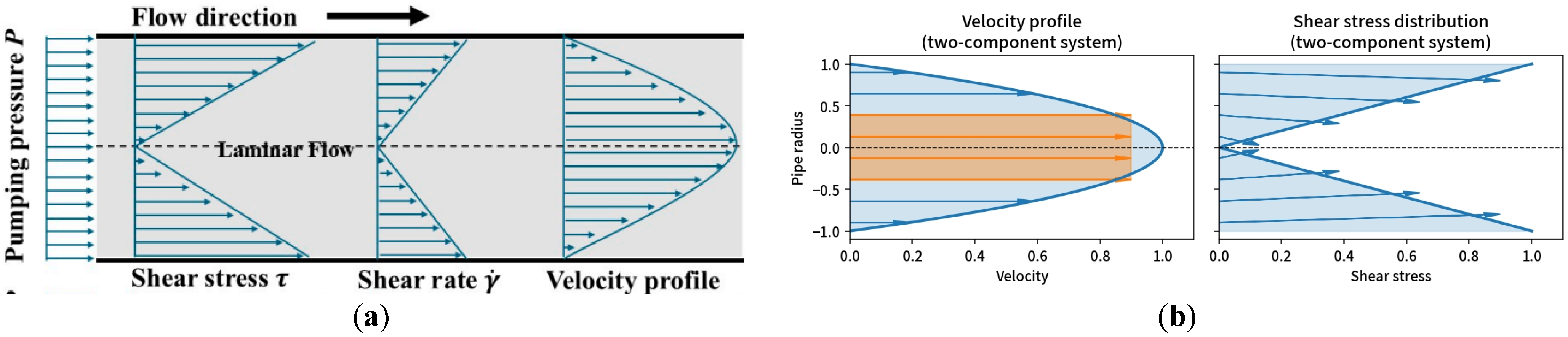
From a process-wide perspective, the rheological requirements vary significantly across different printing stages, yet must remain mutually compatible within a narrow performance envelope. During pumping and transport, the material should exhibit adequate flowability and relatively low plastic viscosity and dynamic yield stress to minimize pressure losses, reduce energy consumption, and avoid flow instabilities induced by pressure fluctuations, thereby ensuring pumpability [43]. Studies have shown that under low flow rates or high yield stress conditions, cementitious materials tend to develop plug flow within flexible hoses: the central core moves as a quasi-rigid plug, while shear is concentrated in a thin near-wall layer, giving rise to distinct velocity and stress distribution zones (Figure 1) [44]. This flow regime indicates that pumping resistance is highly sensitive to yield stress and wall-layer rheology, and also underscores the inadequacy of conventional slump-based indices in predicting pumping stability. In practical 3D concrete printing systems, accelerators are often introduced to regulate setting kinetics, leading to a composite flow regime characterized by a “central plug flow–outer shear flow” structure in two-component pumping systems. The outer fresh cementitious material typically exhibits a shear-dominated laminar velocity profile, while the accelerator—owing to its lower yield stress and viscosity—forms a nearly uniform high-velocity core near the pipe center. This results in a velocity structure that differs markedly from that of single-component systems. Nevertheless, the shear stress distribution still increases approximately linearly from the pipe center toward the wall, while most shear deformation occurs at the interface between the central core and the surrounding material, as well as in the near-wall region.
During deposition and shaping, the material must rapidly develop sufficient static yield stress and structural strength to withstand the deformation induced by self-weight and overburden loads, ensuring dimensional stability, filament integrity, and buildability [24,46]. Khoshnevis et al. [47] theoretically analyzed the slump deformation of extruded filaments, establishing a relationship between slump, static yield stress, and fresh density, and concluding that higher static yield stress and lower density help mitigate deposition-induced deformation. Further, Perrot et al. [48] proposed a green-strength model incorporating geometric effects and time evolution, linking static yield stress to the failure height of printed structures, thereby providing a quantitative framework for buildability prediction. Experimental studies likewise demonstrate that increasing yield stress, optimizing particle gradation and solid fraction, or incorporating fibers and reactive fines to enhance skeleton effects, can substantially improve the number of printable layers and resistance to structural instability [15,24,49].
It should be emphasized that under 3D printing conditions, materials undergo cyclic transitions between “high shear (pumping/extrusion)–low shear (deposition)–resting (interlayer waiting).” Hence, rheology must be characterized as a coupled response of shear history and time-dependent evolution. Beyond yield stress and plastic viscosity, indicators describing structural build-up rate and thixotropic recovery (e.g., structuration rate, hysteresis loop area) are of particular importance for controlling printing intermittency, interlayer bonding, and shape retention.

2.2. Rheological Models for Fresh Cementitious Materials

The macroscopic rheological response of fresh cementitious systems is governed by their evolving microstructural state, which continuously undergoes breakdown and reconstruction during mixing, pumping, and extrusion [50]. Given their heterogeneous composition-including cement particles, fine aggregates, fillers, and chemical admixtures-fresh mortars and concretes typically behave as non-Newtonian viscoplastic fluids with distinct yield stress behavior. For engineering applications, simplified constitutive models play a crucial role in translating complex rheological behavior into design-oriented parameters for mixture optimization and performance comparison.
Among the numerous models available, the Bingham model remains the most widely adopted due to its simplicity and clear physical interpretation. It is expressed as
τ =   τ 0 + μ γ
where τ is shear stress, γ is shear rate, τ0 is yield stress, and μ is plastic viscosity. The yield stress represents the minimum stress required to initiate continuous flow, while plastic viscosity quantifies resistance to shear deformation after yielding. In conventional concrete technology, these two parameters are often sufficient to characterize flow behavior under steady shear conditions. However, for materials used in extrusion-based 3DCP, steady-state rheological parameters alone are insufficient. Printable cementitious mixtures must exhibit pronounced time-dependent behavior, particularly thixotropic structural build-up during resting periods between successive printing stages. This structural evolution governs the transition from a highly flowable state during pumping and extrusion to a load-bearing state after deposition, thereby directly determining pumpability, extrudability, and buildability. In this context, the static yield stress of printable cementitious materials is not constant but evolves with resting time due to particle flocculation, hydration-induced bridging, and the progressive structuration of the particle network. To quantitatively describe this time-dependent evolution, several rheological models have been proposed, among which the structural build-up models developed by Roussel [51], Perrot [52], and Kruger [20] are the most widely applied in the field of 3D concrete printing.
Roussel et al. [51]. introduced the concept of a constant structuration rate Athix, which describes the linear increase in static yield stress with resting time during the early structuration stage. Within the first ~40 min of resting, the evolution of yield stress can be approximated as
τ0(t) = τ0,0 + Athixtrest
Athix = τ0/T
where τ0,0 is the initial static yield stress and Athix represents the thixotropic structuration rate.
To account for nonlinear evolution at longer resting times, Perrot et al. [52]. proposed an exponential yield-stress evolution model:
τ0(t) = τ0,0 + Athixtc (etrest/tc − 1)
which enables a smooth transition from the initial linear increase to exponential structural growth. When the characteristic time parameter tc approaches zero, the Perrot model converges toward the Roussel model. Furthermore, Kruger et al. [20]. developed a model specifically applicable to thixotropic materials with distinguishable dynamic and static yield stresses. This model introduces a re-flocculation stage characterized by a re-flocculation rate, followed by a structural build-up stage governed by the structuration rate. Such formulations allow for prediction of the static yield stress evolution at arbitrary times after cessation of shear or after filament deposition. These structural build-up models provide a quantitative framework for describing the time-dependent rheological evolution of printable cementitious materials and are therefore essential for understanding the formation stability and layer-by-layer buildability in 3D concrete printing.
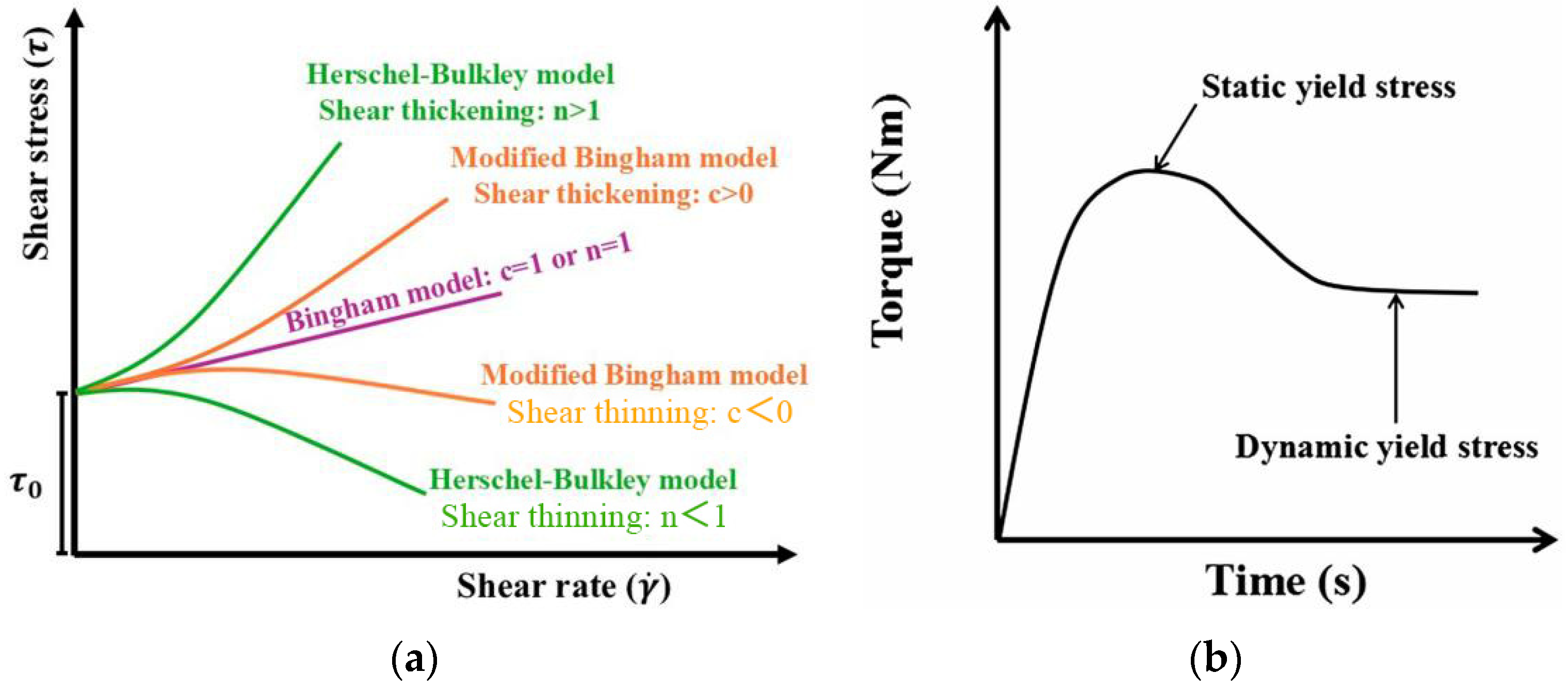
3D printable materials commonly exhibit strong thixotropy and shear-history dependence, leading to distinct upward and downward branches in rheological flow curves. In practice, the descending branch is often used to determine the dynamic yield stress, whereas the stress peak during the ascending branch is associated with the static yield stress. Their difference, or the enclosed hysteresis area, provides a measure of thixotropic intensity. Figure 2 compares typical τγ relationships of Newtonian fluids, shear-thinning/thickening systems, and Bingham-type fluids, illustrating the distinction between static and dynamic yield stresses in printable cementitious suspensions [45,53,54].
For systems containing fibers, nanomaterials, or exhibiting pronounced nonlinear shear-thinning behavior, the τγ relationship often deviates from linearity over a wide shear-rate range, limiting the applicability of the Bingham assumption. In such cases, the Herschel–Bulkley or modified Bingham models are frequently adopted to improve fitting accuracy. The Herschel–Bulkley model, in particular, accounts for both yield stress and shear-dependent viscosity and has demonstrated improved adaptability for complex printable mixtures. For example, Arunothayan et al. [55] reported that this model more accurately captures the flow differences between low- and high-shear regimes in ultra-high-performance printable composites incorporating steel fibers and nanoclay.
To facilitate comparison among different constitutive descriptions, representative rheological models commonly employed in printable cementitious materials are summarized in Table 1, including their constitutive expressions, key parameters, and typical application scenarios. It should be noted that the applicability of these models depends strongly on the experimental configuration, rheometer geometry, and data-processing assumptions, as well as on the structural evolution characteristics of the tested material. Accordingly, the models summarized in Table 1 should be interpreted as simplified descriptors of rheological behavior rather than universal constitutive laws for printable cementitious systems.
The rheological characterization of cementitious suspensions is inherently complex. Most rheometers measure torque as a function of rotational speed, and the conversion of these primary measurements into shear stress and shear rate is strongly dependent on measurement geometry (e.g., coaxial cylinder, vane-in-cup, or parallel plate) and the assumptions used in data reduction. For non-Newtonian printable cementitious composites—particularly those exhibiting pronounced thixotropy and structural evolution—this transformation is not unique and may introduce uncertainties in the derived rheological parameters. Therefore, the applicability of constitutive models must be interpreted cautiously. Although models such as Bingham, Herschel–Bulkley, and modified Bingham are widely used to parameterize experimental flow curves, their validity partly depends on the assumptions adopted during parameter extraction. For instance, the determination of modified Bingham parameters using extensions of the Reiner–Riwlin equation relies on restrictive assumptions regarding flow homogeneity and steady-state conditions, which may not strictly apply to highly thixotropic systems undergoing continuous structural rebuilding. Consequently, the models listed in Table 1 cannot be universally applied to 3D printable cementitious materials without careful consideration of experimental conditions and data-processing procedures.
Nevertheless, despite the heterogeneity of cementitious materials and potential experimental artifacts (e.g., wall slip, shear localization, and particle migration), the Bingham model retains advantages in terms of interpretability, comparability, and reproducibility. As a result, it remains widely used in engineering-oriented studies and benchmark comparisons. Overall, existing rheological models are largely based on idealized continuum assumptions, and their ability to capture the multiscale coupling between shear history, structural evolution, and deposition behavior under realistic printing conditions remains limited. Future research should therefore integrate in situ rheological characterization, structuration kinetics, and process–parameter coupling to establish a more robust rheological framework for 3DPC.

2.3. Rheological Characterization Techniques

Significant differences exist among rheological testing devices in terms of measurement principles, shear ranges, and applicable material scales, and these distinctions must be carefully considered when characterizing printable cementitious materials. High-precision rotational rheometers are widely used to obtain constitutive relationships by controlling shear rate or shear stress, enabling accurate measurement of parameters such as yield stress, plastic viscosity, thixotropy, and structural recovery rate [59]. These instruments are particularly suitable for relatively homogeneous systems such as cement pastes and fine mortars and therefore play a key role in mechanistic studies and rheological modeling. In contrast, coaxial cylinder or Brookfield-type rheometers are commonly used as engineering-oriented devices that estimate flow resistance through torque–speed relationships [60]; they are typically applied for rapid assessments of flowability and consistency in printable mortars during mixture design and field quality control, although their capability for rigorous rheological parameter separation is limited. Extrusion or capillary rheometers directly simulate the extrusion process of 3DCP by measuring extrusion pressure, flow rate, and extrusion velocity, thereby providing rheological information more representative of the actual printing process, particularly for mortar- or aggregate-containing printable concretes [61]. In addition, several studies employ macroscopic in situ tests—such as penetration [62], unconfined compression [63], or sliding tests—to evaluate static yield stress, structural build-up, and early load-bearing capacity after deposition [64]. Although these methods do not provide conventional rheological flow curves, they are directly related to buildability, layer stability, and deformation control during printing. Therefore, different rheological testing approaches should be regarded as complementary tools in 3DCP research, enabling a more comprehensive characterization that links fundamental rheological mechanisms with practical printing performance.

3. Effects of Raw Materials on Rheological Performance

During pumping–extrusion–deposition–stacking, 3DPC is subjected to pronounced variations in shear history and time-dependent structural evolution; consequently, its rheological response is highly sensitive to the characteristics of constituent materials. By modifying particle packing state, paste film thickness, and interparticle interactions (e.g., frictional interlocking, electrostatic/steric repulsion, bridging, and flocculation), raw materials collectively govern the dynamic yield stress, plastic viscosity, static yield stress, and thixotropic recovery of the fresh system, thereby shaping the operable windows of pumpability, extrudability, and buildability.

3.1. Aggregates

3.1.1. Aggregate Characteristics

Aggregates not only determine the mechanical performance and volumetric stability of the hardened composite, but also exert a pronounced influence on yield stress, plastic viscosity, and thixotropic behavior in the fresh state by altering particle geometry, gradation, and interfacial frictional characteristics [18,54,65]. Compared with conventional cast concrete, extrusion-based 3DPC simultaneously demands shape retention/structural build-up under low shear and low-resistance, continuous flow under high shear. Accordingly, the role of aggregates should be interpreted in the context of flow partitioning, lubrication-layer development, and interlayer stacking stability.
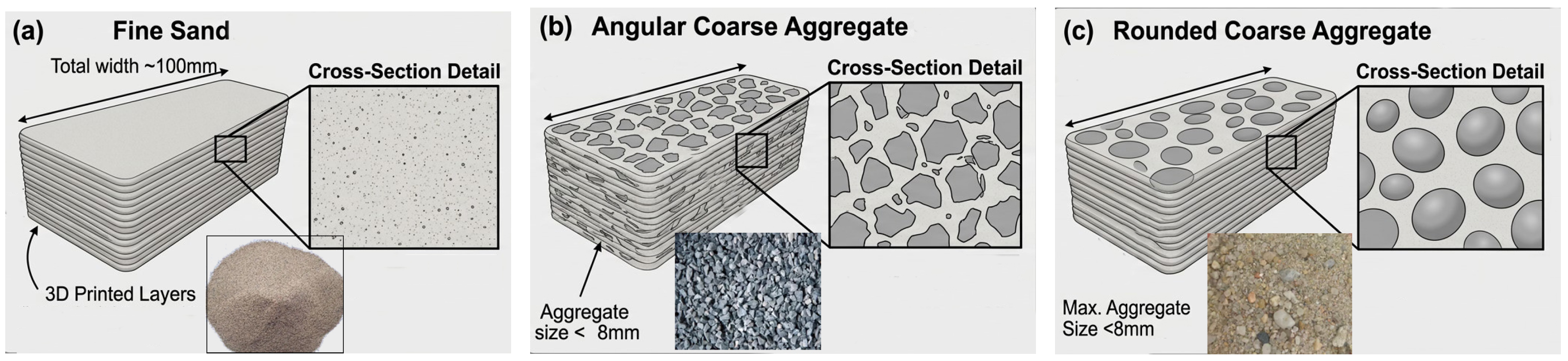
Figure 3 summarizes the coupled effects of aggregate type, morphology, particle size, and gradation on 3DPC shaping behavior and rheological performance [66]. Existing studies generally identify surface texture, particle-size distribution, specific surface area, gradation continuity, and packing density as primary governing factors [65,67]. In most cases, angular and rough aggregates intensify interparticle friction and mechanical interlocking, while increasing free-water demand and enhancing sensitivity to the effective water film thickness, which jointly elevates both yield stress and plastic viscosity [67,68]. From the perspective of printing morphology, aggregates with angular shapes generally contribute to higher yield stress and stronger particle interlocking, which improves the geometric stability and shape retention of the extruded filament after deposition. In contrast, rounded aggregates reduce internal friction and facilitate particle rearrangement during flow, thereby enhancing extrudability but potentially increasing the tendency of the printed layer to spread or deform after deposition. Notably, however, combinations of increased yield stress but decreased plastic viscosity have also been reported [69], indicating that morphology effects are not strictly monotonic. Specifically, while rough particles may raise the stress threshold required to initiate flow (yield stress), an improved gradation and higher packing density can promote a more uniform paste film, potentially reducing resistance during sustained shearing (plastic viscosity). Hence, overall rheological response should not be inferred from a single morphology descriptor; instead, particle size–gradation–paste film thickness must be considered synergistically. With respect to particle size, decreasing the aggregate size typically increases both yield stress and plastic viscosity [70]. This is largely attributable to the higher specific surface area of finer particles, which enhances water absorption and admixture adsorption, weakens lubrication, and reinforces the particle-contact network [71,72,73]. Conversely, increasing the maximum particle size (Dmax) may reduce the overall specific surface area and paste demand, thereby lowering plastic viscosity and facilitating extrusion flow. However, excessively large particles can introduce local structural heterogeneity and may affect the surface smoothness and dimensional stability of the deposited filament. Therefore, an appropriate balance between particle size distribution and maximum particle size is essential to achieve both good extrudability and stable layer geometry during 3D printing. From an interfacial-structuring perspective, a larger specific surface area is often associated with a thicker “particle boundary layer” (comprising adsorbed water, superplasticizer molecules, and the electrical double layer), which facilitates the formation and stabilization of flocculated structures, thereby increasing static yield stress and accelerating structural build-up [20].
For a fixed total aggregate volume and maximum particle size, gradation optimization represents an effective approach for “window-based” rheological tailoring [65]. Continuous gradations (e.g., Fuller–Thompson-type distributions) generally increase packing density, reduce porosity, and lower the paste volume fraction required to fill voids. This can simultaneously enhance structural stability while reducing plastic viscosity, yielding a favorable combination of higher yield stress with lower viscosity [24]. Nevertheless, aggregate source-dependent variations in particle morphology, fines content, and water absorption can render the benefits of gradation optimization system-specific. For instance, Shantanu et al. [65] reported that crushed sand (with a more uniform gradation) exhibited a faster yield-stress evolution and comparatively good flowability, which may be related to its larger particle size, higher packing density, and lower specific surface area.

3.1.2. Fine Aggregates

Extrusion-based 3DPC is predominantly formulated as mortar or fine-aggregate concrete; hence, fine aggregates play a foundational role in governing pumpability, extrudability, and buildability [24,74]. During pipeline transport, particle migration often occurs, resulting in the formation of a near-wall lubrication layer: fines and paste tend to enrich near the pipe wall, whereas relatively coarser particles concentrate toward the pipe center. This induces a partitioned flow regime and affects pressure loss as well as flow-rate stability [75]. To mitigate nozzle-blockage risk and ensure extrusion continuity, most studies limit the maximum particle size to ≤2 mm (e.g., natural river sand) [76,77,78].
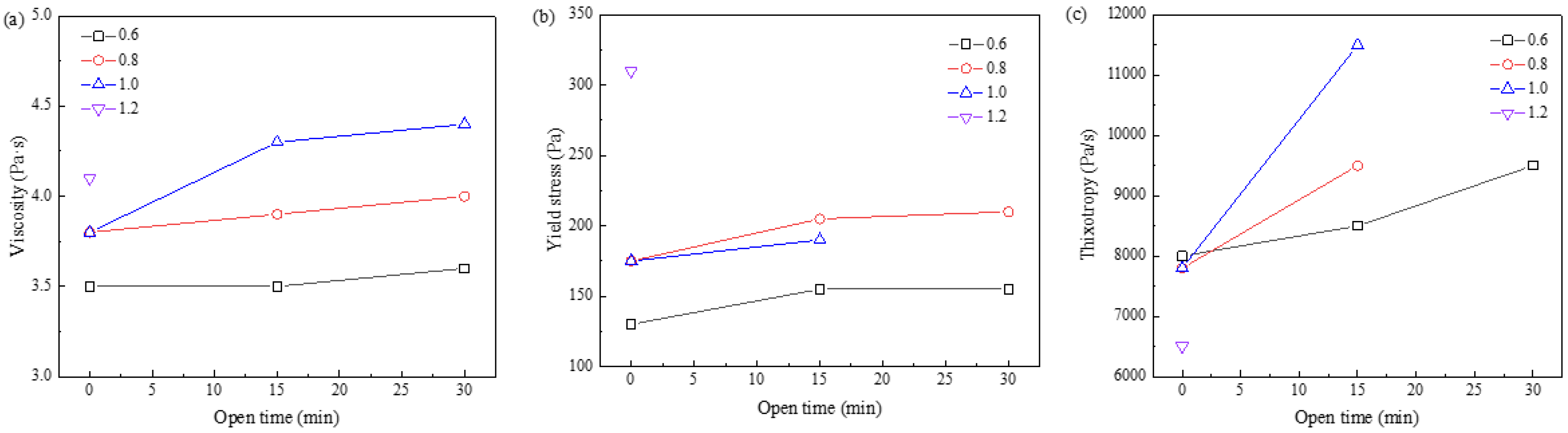
The influence of fine aggregates on rheology can be attributed primarily to three pathways: (i) modulation of the particle-contact network and frictional dissipation, thereby regulating yield stress; (ii) alteration in effective water film thickness via water absorption and fines content, thereby governing plastic viscosity; and (iii) impact on resting structural recovery and thixotropy evolution, which in turn controls open time and sensitivity to interlayer waiting [24,76]. Kuder and Shah [79] introduced a small amount of clay into mortar and found that an addition of ~0.3% improved the surface quality of extruded elements without markedly inducing cracking (Figure 4). Zhang et al. [76] systematically investigated the sand-to-binder ratio (s/b) and reported that s/b = 1.0–1.2 provided an advantageous balance among pumpability, extrudability, and buildability, while elucidating the open-time-dependent evolution of viscosity, yield stress, and thixotropy (Figure 5).
Regarding aggregate substitution, solid wastes such as recycled glass, copper tailings, marble powder, and ceramic residues have increasingly been incorporated to improve sustainability [80,81]. These materials are frequently reported to reduce dynamic yield stress and plastic viscosity and to facilitate extrusion; however, some may result in insufficient static yield stress, thereby compromising buildability. In practice, compensatory strategies—such as gradation optimization, fine-content control, and tailored admixture combinations—are often required.

3.1.3. Coarse Aggregates

Constrained by nozzle dimensions and pumping modes, the maximum aggregate size in 3DPC is typically limited to approximately 4–6 mm in small-nozzle [82], screw-extrusion systems, and most existing studies focus on fine-aggregate systems. However, this limitation is process-dependent rather than intrinsic to 3D printing technology. When larger nozzle diameters and piston-driven pumping systems are adopted, crushed stone or gravel with maximum sizes of 8–10 mm can be successfully incorporated while maintaining extrusion stability and buildability. It is worth noting that excessive binder contents and insufficient coarse aggregates may intensify heat release, increase shrinkage risk, and elevate both cost and embodied carbon [83]. Therefore, 3D printing is not restricted to sand-only systems, but requires the coordinated optimization of aggregate size, conveying mechanism, and paste film thickness.
Rahul et al. [84] and Mechtcherine et al. [85] reported that, under suitable conveying systems (e.g., piston pumping), mixtures incorporating coarse aggregates with maximum sizes of 8–10 mm could still achieve stable printing; moreover, within a certain volume fraction (≤30%), extrudability remained acceptable. Table 2 compares key differences among representative studies, including aggregate types, particle-size ranges, and aggregate-to-binder ratios [86,87]. Overall, the feasibility and benefits of coarse aggregates depend strongly on the coupled compatibility among pumping mode, nozzle scale, paste film thickness, and gradation continuity. Despite initial demonstrations, the effects of coarse aggregates on the time evolution of rheological parameters, interlayer interface quality, and printing stability remain insufficiently quantified. In parallel, recycled coarse/fine aggregates (RCA/RFA) and recycled powders (RP) are of interest for circularity and emissions reduction, yet they often reduce flowability and alter the kinetics of consistency loss [88,89,90,91,92]. Wu et al. [89] observed a decreased flow spread with RCA; Skibicki et al. [90] reported a continuous decline in flowability for RFA volume fractions of 10–50%; Hou et al. [91] found that replacing 10–40% cement with RP reduced flow spread and substantially increased consistency loss, underscoring the impact of recycled constituents on time-dependent rheology and open time; Zhang et al. [92] further indicated that both RFA and RCA reduced flowability, with RFA exhibiting a more pronounced effect. For engineering implementation, it is advisable to jointly assess moisture control, pre-wetting/pre-drying strategies, and competitive admixture adsorption, so as to mitigate cascading risks of “insufficient flowability–increased pumping pressure–interlayer defects” [93,94,95].
In summary, the effects of aggregates on 3DPC rheology may be consolidated into three sets of governing variables. First, morphology and interfacial friction determine the level of shear dissipation, thereby dominating yield stress and shear response. Second, particle size–specific surface area–water absorption alter effective water film thickness and structuration kinetics, controlling the temporal evolution of rheological parameters. Third, gradation and packing density regulate paste film thickness and contact-network topology, providing a structural basis for achieving the favorable shaping window of higher yield stress with lower plastic viscosity. Under extrusion-based conditions, dynamic versus static responses should be distinguished and interlayer waiting time explicitly incorporated into structuration analyses. For the adoption of coarse aggregates in engineering, quantitative relationships among volume fraction, paste film thickness, extrusion pressure fluctuations, and interlayer stability must be established to support integrated material–process design.

3.2. Binder Systems

The binder system governs particle-size characteristics, specific surface area, and reaction kinetics within the paste phase, and is therefore a primary source of fresh-state rheological behavior in 3DPC. Its role can be summarized as follows: on the one hand, it regulates dynamic yield stress and plastic viscosity through particle packing and water film thickness (relevant to pumping/extrusion); on the other hand, it controls the rate of static yield-stress build-up via hydration and structuration kinetics (relevant to deposition/stacking) [23,96,97]. Consequently, binder design should target a coupled optimization of dynamic flow resistance control and static structural build-up rate.

3.2.1. Cement

Ordinary Portland cement (OPC) remains the most widely used base binder; however, in the absence of dedicated structuration-promoting measures, early-age static yield-stress development may be insufficiently rapid, limiting buildable height [96]. To accelerate early load-bearing capacity and structuration, calcium aluminate cement (CAC) and OPC-CAC hybrid systems have been explored. Khalil et al. [98] showed that increasing CAC replacement significantly increased yield stress and its growth rate, thereby improving buildable layer numbers, but could also increase extrusion pressure demand—implying that CAC dosage must be co-optimized with equipment capacity and process parameters [98]. Increasing the cement-to-aggregate (c/a) ratio generally strengthens the particle-contact network and raises yield stress and buildability, albeit at the expense of higher cost and increased shrinkage risk, necessitating balanced engineering trade-offs [99]. Differences among Portland cement types are also non-negligible: Putten et al. [100] suggested that incorporating 10–15% CAC, while maintaining continuous extrusion, can shorten setting time and enhance interlayer stability, providing a potential compromise range.
Cement physical characteristics (e.g., fineness and setting behavior) markedly affect the printing window: higher fineness typically increases water demand and admixture requirement, whereas prolonged initial setting time may extend open time but weaken early load-bearing capacity [101,102,103,104]. Hence, beyond conventional indices, printing-oriented dynamic/static rheological characterization is recommended under alternating shear–rest conditions to evaluate structuration and recovery capacity, thereby supporting cement selection and process compatibility [96]. Table 3 summarizes the key effects of cement systems on rheology and shaping, together with corresponding design implications.

3.2.2. Conventional SCMs

Conventional SCMs provide multi-objective tuning routes for 3DPC through: (i) modifying particle gradation and specific surface area, thereby altering water film thickness and frictional dissipation; and (ii) influencing early-age structuration kinetics via pozzolanic/latent hydraulic reactivity and nucleation effects [107,108,109,110]. Functionally, their roles can be categorized into three pathways. (i) High-specific-surface ultrafines, exemplified by silica fume (SF) and metakaolin (MK), primarily reduce water film thickness and strengthen particle contacts and flocculated networks [111,112], thereby markedly increasing yield stress, plastic viscosity, and thixotropy and improving shape retention and structural build-up. However, they often increase extrusion resistance and thus require synergy with high-range water reducers [107,113,114]. (ii) Low-reactivity spherical materials, typified by Class F fly ash (FA), tend to improve flow and extrusion continuity through a “ball-bearing” effect and volumetric dilution, reducing friction and flocculation intensity; nevertheless, high replacement levels may impair early load-bearing capacity and buildability and should therefore be constrained based on structuration kinetics [115,116]. (iii) “Window-adjusting” materials, such as ground granulated blast-furnace slag (GGBS) and limestone powder (LP), exhibit system-dependent rheological outcomes governed by micro-filling, specific surface area, nucleation effects, and coupled compatibility with cement chemistry and admixtures, making them suitable for the fine-tuning of extrusion/buildability windows [110,117,118].
Accordingly, SCMs should not be selected solely for a single objective (e.g., “improved flow” or “higher strength”), but rather treated as tools for the coordinated control of dynamic flow resistance and static structural build-up. By hybridizing SCMs with complementary functions and optimizing dosage, fineness, and admixture compatibility, the process window can be broadened and robustness against equipment and environmental variations can be improved. Table 4 summarizes typical effects and application boundaries for representative SCMs.

3.2.3. Waste-Derived Binder Constituents

Driven by low-carbon and resource valorization imperatives, waste-derived binder constituents such as steel slag powder and recycled brick powder have increasingly been incorporated into 3DPC formulations [126]. Compared with conventional SCMs, these materials exhibit greater variability in their origin and physico-chemical properties, leading to stronger system dependence in their effects on rheology and structuration. Therefore, evaluation should not be limited to single indices (e.g., slump/flow), but should instead adopt a coupled “structure–rheology–reaction” approach integrating dynamic/static rheology and hydration kinetics [127,128].
Steel slag powder (SSP), characterized by high Ca content and latent reactivity, may either improve or deteriorate workability depending on source and fineness [129,130,131]. Reported trends in dynamic yield stress and plastic viscosity can be non-monotonic, and have been rationalized in terms of changes in interparticle interactions governed by surface energy, zeta potential, and Debye length [127]. In terms of static rheology, steel slag may alter the growth rate of static yield stress, reflecting its modulation of hydration progress [128]. Recycled brick powder (RBP), a low-Ca pozzolanic waste, exhibits pronounced particle-size sensitivity in both setting and rheology: the relative dominance of dilution versus nucleation can delay or accelerate setting, while flowability and yield stress vary with specific surface area, morphology, and gradation optimization [132,133,134]. Some studies further report an exponential correlation between static yield stress and cumulative hydration heat release, offering a feasible route toward quantifying the “hydration–structuration” linkage [135]. Table 5 summarizes typical trends and associated risks.
Collectively, binder regulation can be interpreted as a coupled optimization of two objective functions: dynamic flow resistance control (for pumping/extrusion) and static structural build-up control (for deposition/stacking). Cement systems primarily govern static yield-stress evolution through hydration kinetics [137]; conventional SCMs are dominated by physical effects, although slag exhibits notable chemical coupling and compatibility sensitivity [54]; waste-derived constituents exhibit even greater heterogeneity. Establishing a unified indicator set—encompassing dynamic/static rheology, structuration rate, hydration kinetics, and descriptors of interparticle interactions—would facilitate transferable, window-based mixture design methodologies [127,135,138].

3.3. Chemical Admixtures

Chemical admixtures are indispensable for the fine-tuning of 3DPC rheology. Owing to the stage-dependent rheological demands of the printing process, pumping/extrusion generally requires a low dynamic yield stress and low plastic viscosity, whereas deposition/stacking necessitates a high static yield stress, rapid structural build-up, and robust thixotropic recovery [139]. These objectives are seldom achievable using a single additive; consequently, practical formulations commonly rely on tailored combinations of high-range water reducers SPs, viscosity-modifying agents (VMA), setting regulators, and superabsorbent polymers (SAP).

3.3.1. Superplasticizers

SPs are pivotal for modulating 3DPC rheology by dispersing cement particles and mobilizing entrapped water, thereby reducing dynamic yield stress and plastic viscosity. While traditional naphthalene-based reducers rely on electrostatic repulsion, polycarboxylate ether (PCE) SPs provide combined steric hindrance and electrostatic repulsion, ensuring superior efficiency in low water-to-binder (w/b) systems [140]. This role is particularly critical in mixtures incorporating recycled fine aggregates (RFA), where high water absorption, irregular morphology, and elevated fines content significantly increase internal friction and water demand. In such cases, SPs compensate for the reduced effective water content by enhancing particle dispersion and releasing entrapped water, thus maintaining adequate pumpability and extrudability. However, the dispersion efficiency of SPs is highly contingent on raw material characteristics. Variations in particle morphology, surface roughness, and fines content—especially in systems containing supplementary cementitious materials (SCMs) or recycled aggregates—can alter adsorption behavior and competitive surface interactions. These factors significantly affect the resulting rheological response, necessitating rigorous compatibility assessments during mixture design.
Furthermore, the molecular architecture of PCEs (e.g., backbone configuration and side-chain density) directly influences post-shear reflocculation and thixotropic recovery, enabling a tailored transition from low-resistance flow during extrusion to rapid structural rebuilding upon deposition [20]. SP dosage exhibits distinct critical and saturation regimes: under-dosage leads to incomplete dispersion and extrusion blockage, whereas over-dosage induces excessive lubrication and hydration retardation, compromising static yield stress and interlayer stability [27]. For instance, a marginal increase in PCE dosage (e.g., from 0.10% to 0.11% by binder mass) can trigger structural collapse, highlighting the narrow performance window in 3DPC. Ultimately, SP dosages must be co-optimized through systematic rheological characterization and process-level validation to reconcile stable transport with post-deposition structural integrity [17].

3.3.2. Viscosity-Modifying Agents

VMAs enhance cohesion and segregation resistance while increasing static yield stress and thixotropy, thereby improving post-extrusion shape retention and dimensional stability [141]. VMAs are commonly categorized as organic or inorganic. Organic VMAs such as cellulose ethers (e.g., hydroxypropyl methylcellulose, HPMC) adsorb onto particle surfaces and form hydration-associated films, substantially increasing yield stress and plastic viscosity, albeit typically at the expense of flowability [142]. Inorganic VMAs, represented by nanoclay (NC) (e.g., bentonite) and nano-silica, leverage their high specific surface area and strong adsorption capacity for water and ions to form “house-of-cards” structures and/or promote flocculation, thereby markedly enhancing thixotropy and static yield stress. Their influence on dynamic rheology is, however, contingent on interactions with SPs [119].
VMA efficacy is highly dosage-sensitive. Low additions can improve cohesion and segregation resistance, and appropriate dosages can substantially enhance buildability; excessive dosages, however, markedly increase extrusion resistance and may precipitate nozzle blockage. HPMC, for instance, has been reported to exhibit an optimal dosage window that reconciles extrudability and buildability (e.g., ~0.24% of binder mass) [143]. In blended systems, NC–PCE synergy can produce a desirable rheological profile characterized by low dynamic viscosity, high static yield stress, and high thixotropy: PCE reduces flow resistance during pumping/extrusion, while NC rapidly reconstructs the particle network after shear cessation, improving shape stability and stacking capacity [144]. Nevertheless, competitive adsorption between VMA and SP on particle surfaces may introduce compatibility issues and weaken the intended synergy between dispersion and structural rebuilding [145].

3.3.3. Setting-Time Regulators

Setting-time regulators (STR) modify cement hydration kinetics and thereby govern the time evolution of rheology, serving as an effective means to tune “open time” and the “buildability window” in 3DPC [146]. Retarders (e.g., boric acid, sodium gluconate, and tartrate compounds) may adsorb on clinker particles or hydration products and/or complex Ca2+, suppressing the nucleation and growth of hydration products. This slows the increase in yield stress and plastic viscosity and extends the pumpable/extrudable time window [147,148]. Over-retardation, however, can impair early strength development and is generally detrimental to interlayer bonding [13]. In contrast, accelerators (e.g., potassium carbonate, calcium sulfoaluminate-based systems, and nano-seeding agents) can provide additional nucleation sites or alter ionic equilibria in the pore solution, thereby accelerating early hydration—particularly rapid ettringite formation—and substantially increasing the early growth rate of static yield stress to enhance buildability, albeit with shortened workability and elevated blockage risk [149].
To reconcile the intrinsic conflict between transport/extrusion stability and rapid post-deposition structuration, a spatiotemporally decoupled “retardation–acceleration” strategy has been proposed: a retarder is incorporated into the bulk mixture to secure stable pumping/extrusion, while an accelerator is locally introduced (e.g., injected or sprayed) at the printhead to trigger rapid structural build-up and early stiffening after extrusion [14].
Retarders are typically adopted to stabilize pumpability/extrudability by preserving low dynamic resistance and extending open time, whereas accelerators are mainly introduced to enhance buildability by accelerating early hydration and the growth rate of static yield stress. The spatiotemporally decoupled retardation–acceleration strategy is therefore a practical route to reconcile stable transport/extrusion with rapid post-deposition structuration.

3.3.4. Superabsorbent Polymers

As functional admixtures, SAPs influence 3DPC primarily through a dynamic “absorption–storage–release” mechanism, inducing multistage and multiscale changes in moisture distribution, interparticle interactions, and structural evolution. Their net rheological effect is therefore strongly time- and stage-dependent. During early mixing, dry SAP particles rapidly absorb part of the mixing water, transiently reducing the effective w/b ratio and thereby increasing initial consistency and reducing flowability [150]. During resting or low-shear periods, swollen SAP may act as a physical filler and potential bridging agent; its stored water can perturb interparticle interactions and interfere with the development of hydration-product networks, thereby affecting static yield-stress growth and early structuration [151]. Under sustained shear or at later hydration stages, SAP gradually releases stored water, locally adjusting the paste w/b ratio and, in turn, influencing rheological retention, thixotropic rebuilding, and other time-dependent behaviors [152].
It should be noted that SAP effects are not invariant, but depend strongly on the coupling between SAP properties (e.g., particle size, crosslink density, dosage, and absorption capacity) and environmental conditions (e.g., humidity and temperature). The underlying mechanisms remain complex and represent an active research frontier [153,154]. Unlike admixtures that directly disperse or thicken suspensions, SAP primarily operates by regulating moisture migration and redistribution; as a result, its rheological influence is intrinsically context- and stage-specific.
Overall, chemical admixtures regulate the dynamic flowability, static load-bearing capacity, and thixotropic recovery of 3DPC through physicochemical interactions spanning molecular to particle scales, and thus constitute a key technological lever for achieving the “pumpable–extrudable–buildable” balance. Substantial progress has been made in elucidating the fundamental effects of SPs, VMAs, and setting regulators, with encouraging advances in NC–PCE synergy and spatiotemporally decoupled retardation–acceleration strategies [14,144]. Nevertheless, the micro-mechanistic basis of SAP and emerging hybrid admixture systems under coupled dynamic shearing and hydration, as well as their complex interactions with multi-component material systems, still calls for more universal characterization approaches and theoretical frameworks. Establishing standardized and comparable rheological testing protocols remains a critical prerequisite for both scientific consolidation and engineering translation in this field [145,146].
Table 6 provides a useful classification; however, in the main text, it is recommended to emphasize the mapping of target mechanism (dispersion/thickening/reaction kinetics/moisture migration) → rheological parameter (s) → printing stage, thereby improving readability and practical utility.

3.4. Fibers

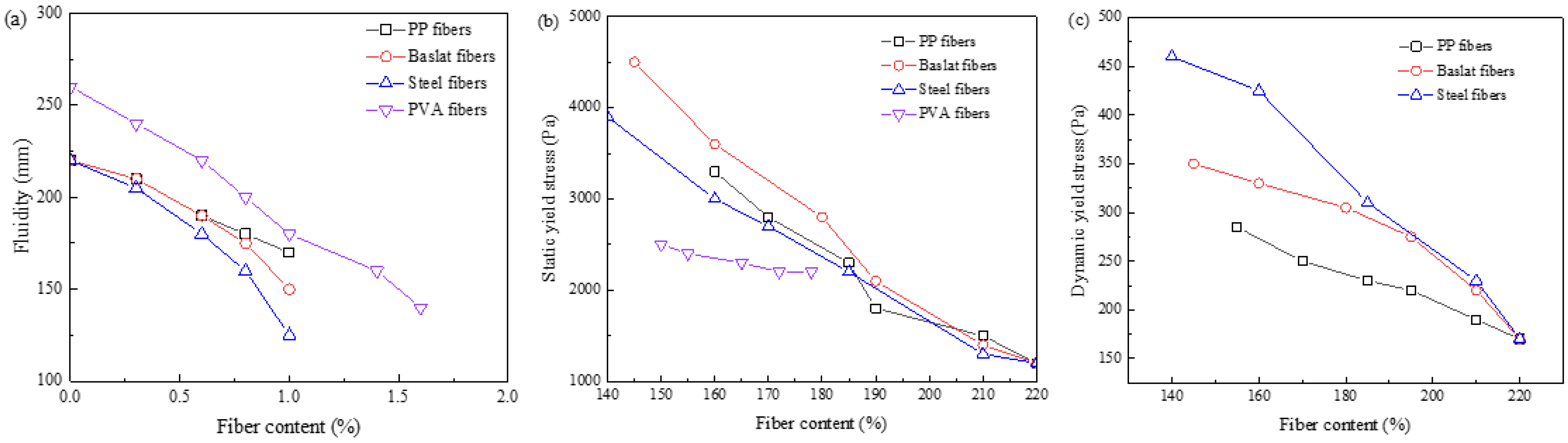
Fibers are widely incorporated to enhance the integrity, crack resistance, and toughness of 3DPC. Their inclusion, however, can markedly alter the fresh-state rheology—particularly yield stress, plastic viscosity, and thixotropy—thereby influencing extrudability and buildability [55,164]. Commonly used fibers include organic fibers (e.g., PP, PE, PVA, and cellulose fibers), steel fibers, and inorganic/high-performance fibers such as basalt, carbon, and glass fibers [165,166,167]. The rheological impact of fibers is primarily governed by fiber length, diameter, aspect ratio, volume fraction, and dispersion state. In general, fiber addition increases both static and dynamic yield stresses and elevates plastic viscosity, largely because fibers introduce spatial interlocking/skeletal effects and intensify internal friction and shear dissipation [168]. Once the fiber content exceeds a threshold, agglomeration and constrained orientation become more likely, substantially increasing extrusion resistance and potentially triggering extrusion instability [169]. For instance, Han et al. observed a pronounced decrease in flow spread with increasing PVA volume fraction [170], and similar trends have been reported for PE, steel, and PP fiber systems [171]. The correlations between flowability and static/dynamic yield stresses (Figure 6) provide a useful basis for interpreting the pervasive trade-off between mechanical enhancement and rheological penalty associated with fiber incorporation [172].
Notably, different fiber types influence rheology through distinct pathways [173]. Organic fibers may redistribute free water and modify the effective water film thickness via water absorption and interfacial bonding, thereby affecting yield stress and flowability [174]. In particular, at low dosages, PVA fibers may exert a limited positive influence on flowability by improving particle dispersion; nevertheless, the flow-reducing effect becomes dominant as dosage increases [175,176]. Owing to their high stiffness and relatively large length, steel fibers more readily form a stable mechanical skeleton within the paste, significantly increasing yield stress and plastic viscosity; this is detrimental to extrudability, especially when the fiber content exceeds ~1% [177]. Basalt, carbon, and glass fibers generally exhibit strong suppression of flowability, while potentially imparting functional attributes such as corrosion resistance and electrical conductivity, making them attractive for functionalized 3DPC systems [164,178]. Natural fibers (e.g., coconut and banana fibers) offer sustainability benefits, but typically further reduce flowability and extrusion stability, thereby imposing stricter requirements on process adaptation and parameter control [179].
Based on current evidence, the mechanisms by which fibers influence 3DPC rheology can be consolidated into three categories: (i) network structuring effects—fiber networks increase internal friction and shear resistance, elevating static/dynamic yield stresses and plastic viscosity [168]; (ii) interfacial water-uptake effects—fiber absorption of free water reduces water film thickness and thus diminishes flowability [174]; (iii) geometric and distribution effects—fiber length, diameter, and aspect ratio, and their orientation/spatial distribution in the shear field, jointly determine rheological response and extrusion behavior [172].
Therefore, while fibers are indispensable for improving the crack resistance, ductility, and structural integrity of 3DPC, their associated rheological costs and printability constraints must be explicitly balanced through mixture design and process-parameter optimization, enabling the synergistic enhancement of mechanical performance and printing robustness [180]. Table 7 summarizes the reported influences of fiber type and dosage on 3DPC rheology and extrudability.

3.5. Nanomaterials

Owing to their high specific surface area and pronounced surface effects, nanomaterials enable the refined tailoring of yield stress, plastic viscosity, and thixotropic recovery by modifying flocculation state, admixture adsorption, and hydration kinetics [20,184,185]. This refinement, however, is often accompanied by thickening and flow loss; thus, engineering deployment should emphasize synergy with SP/VMA and clearly defined dosage windows.
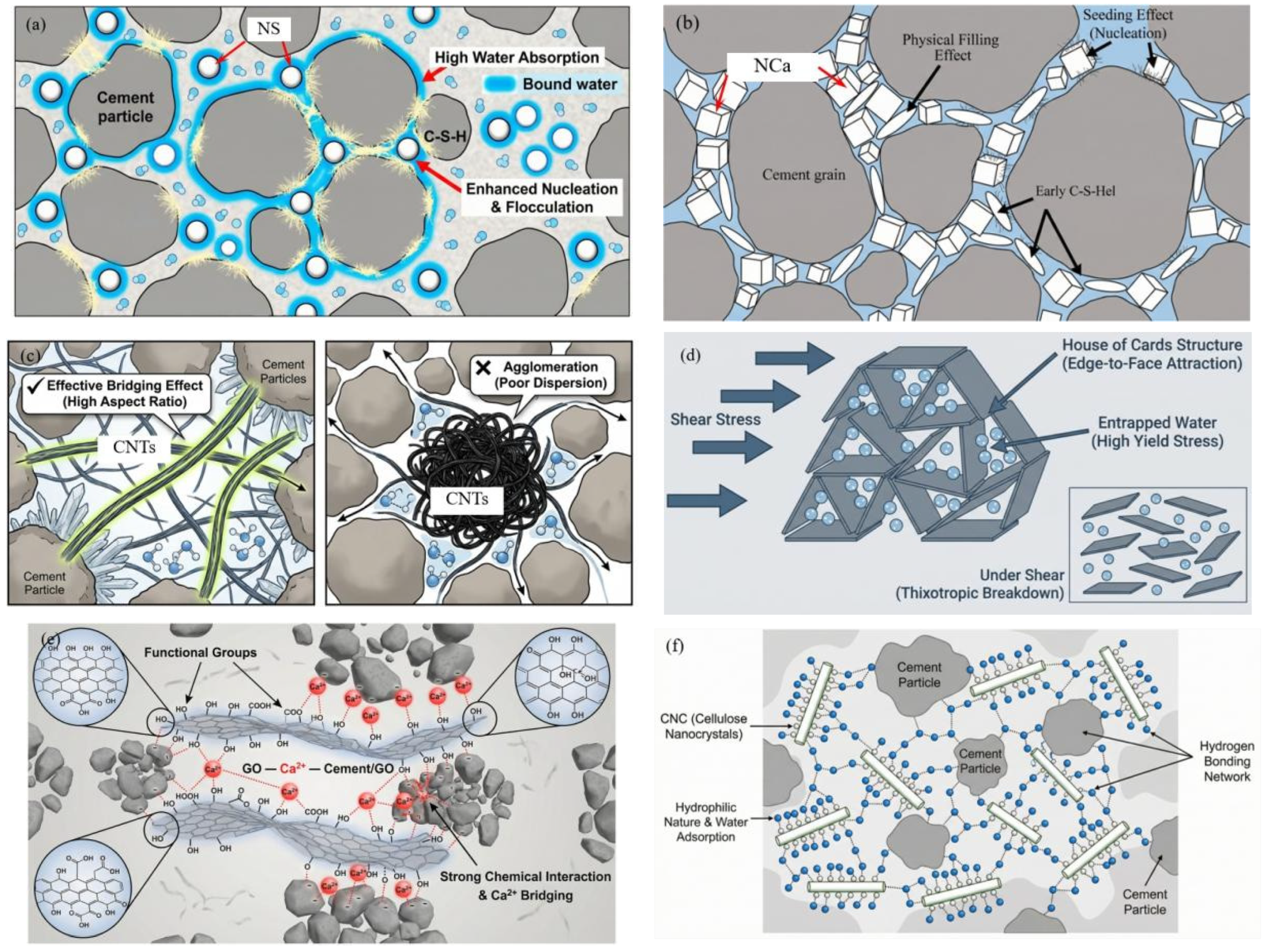
Nano-silica (NS) typically substantially increases static yield stress and viscosity and accelerates early structural build-up, which benefits buildability, but commonly requires the co-dosing of SPs to limit extrusion resistance [186]. NCs are particularly effective in enhancing thixotropy and structural recovery, aligning well with the process requirement of “flowable under high shear–rapidly rebuildable upon shear cessation” [119]. Carbon-based nanomaterials (CNT/CNFs), with their high aspect ratio, can bridge particles and reinforce network structures, thereby increasing yield stress and thixotropy; however, they are more sensitive to dispersion protocols and cost. Graphene oxide (GO), due to the strong interactions between its functional groups and Ca2+/hydration products, often induces pronounced flocculation and thickening [187]. Nano-CaCO3 (NCa) acts mainly via filler and nucleation effects, typically producing more moderate rheological changes [188]. Bio-based nanomaterials such as cellulose nanocrystals (CNC) may exhibit a bidirectional response—reducing yield stress at low dosages but thickening at higher dosages—depending on crystal form, particle size, and interfacial interactions [189,190]. Table 8 shows that it is advisable to unify the dosage basis (e.g., wt.% by binder) and to distinguish, within “primary mechanisms,” among three pathways—water uptake/adsorption, network structuring, and nucleation/reaction regulation—to improve cross-study comparability.
Table 8. Summary of rheological effects of representative nanomaterials in 3DPC.
NanomaterialDosage (wt.%)Change in Static Yield StressChange in Dynamic Yield StressChange in ThixotropyDominant MechanismsRef.
NS1–3↑ 82–141%↑ 62–120%Strong ↑High-specific-surface-area-induced water adsorption; promotion of hydration and flocculation; pronounced thickening effect, often requiring co-dosage of superplasticizer (Figure 7a)[119,191]
CNTs/CNFs0.1–2↑ 100–150%↑ 50–100%Significant ↑High-aspect-ratio particle bridging; reinforcement of the percolated network; strong dependence on dispersion quality (Figure 7b)[86,188]
NCa1–4↑ ~188%Moderate ↑Moderate ↑Physical filling and nucleation effects; relatively mild impact on rheology compared with other nanomaterials (Figure 7c)[192]
NCs0.5–2↑ 50–100%↑ 50–100%Strong ↑Layered platelet structure and “house-of-cards” network formation; highly effective in enhancing thixotropy, with relatively controllable increases in viscosity (Figure 7d)[144,193]
GO0.01–0.05Marked ↑Marked ↑Marked ↑Strong interactions between surface functional groups and Ca2+/hydration products; intense promotion of flocculation and network buildup (Figure 7e)[174,187]
CNC<0.2TunableSize- and crystallinity-dependent effects; potential for multifunctional modification (Figure 7f)[189,190]
Note: “↑” indicates an increase; “↓” indicates a decrease.
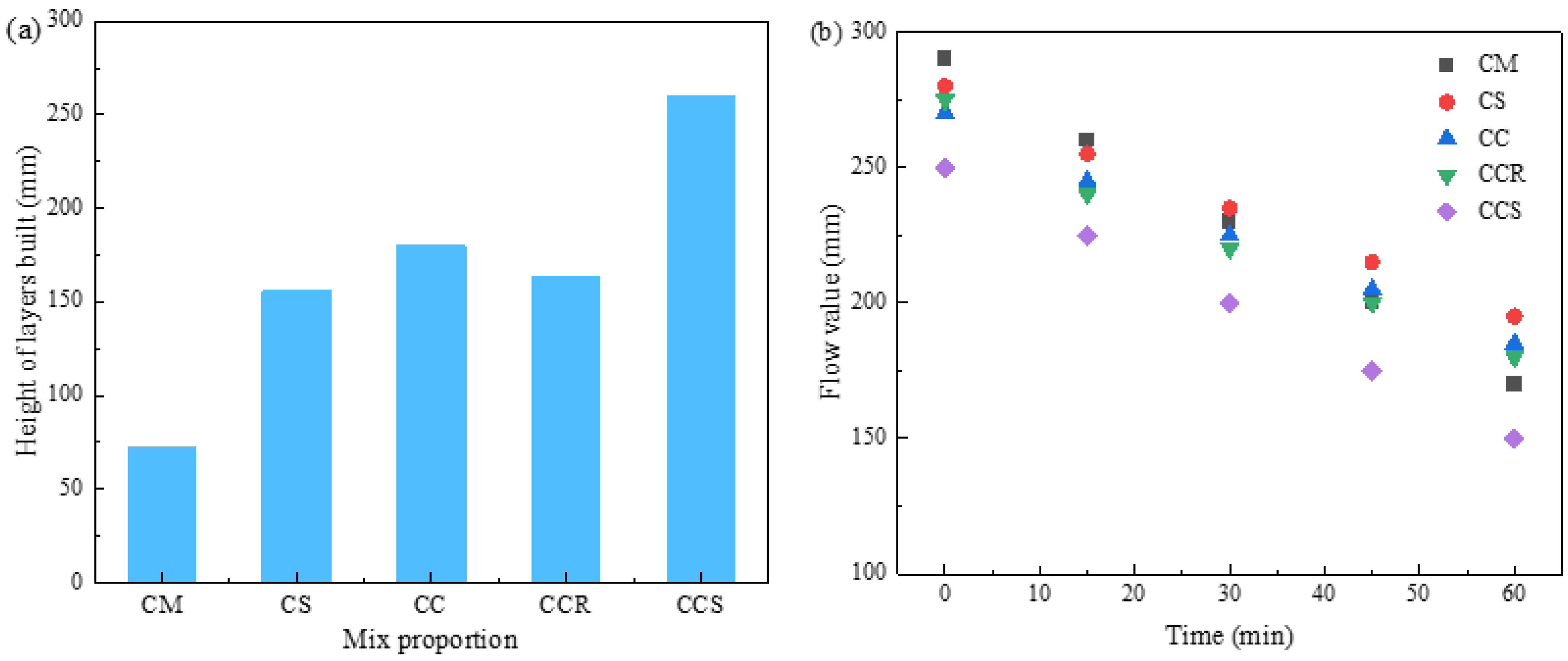
When used alone, nanomaterials often follow the trend of “enhanced structuration-reduced flowability”; therefore, hybridization is pivotal for expanding the printable window. For example, combining nanomaterials with PCE can preserve baseline flowability while improving post-shear structural recovery [144]; co-dosing NS with NCs may generate additive thickening and thixotropy enhancement, thereby improving buildability [119]. Moreover, a multiscale particle packing design incorporating micron-scale SCMs can promote dense packing while reducing reliance on any single ultra-fine component (Figure 8).
Figure 7. Schematic illustration of mechanisms by which nanomaterials regulate the rheology of cementitious pastes: (a) NS, (b) CNTs/CNFs, (c) NCa, (d) NCs, (e) GO and (f) CNC.
Buildings 16 01264 g007
Table 9 presents an integrated framework mapping key constituent materials—including aggregates, cementitious systems, supplementary cementitious materials, chemical admixtures, fibers, and nanomaterials—to their rheological mechanisms and stage-specific performance implications across pumpability, extrudability, and buildability in 3DPC. Because these three printing stages impose distinct and occasionally contradictory rheological requirements, each material parameter is evaluated independently per stage in terms of its governing mechanism (friction reduction/dispersion/thickening/reaction kinetics/moisture migration), primary rheological effects, associated risks, and practical design guidelines, thereby providing a systematic and actionable basis for multi-stage mixture design.
Figure 8. (a) Buildability determination via printed height (number of layers); (b) time-dependent flow values, adapted from reference [119] (CM: control mix; CS: SF modified mix; CC: NC modified mix; CCR: NC+ set retarder modified mix; CCS: silica fume + NC modified mix).
Buildings 16 01264 g008
Synthesis. Collectively, fresh-state rheology and its temporal evolution are governed by the coupled interplay among particle packing, paste film thickness, interparticle interactions, and hydration/structuration kinetics. Aggregates primarily control geometric effects and frictional dissipation; binder systems couple particle-scale physical effects with hydration kinetics; chemical admixtures provide process-oriented levers for dispersion, thickening, and time control; and fibers/nanomaterials predominantly modify yield behavior and thixotropic recovery through network reinforcement and interfacial interactions. For engineering-oriented design, it is recommended to adopt a unified evaluation basis comprising (i) a dynamic extrudability window (τd, μ), (ii) static structuration capacity (τs and its growth rate), and (iii) thixotropic recovery indices, and to pursue coordinated raw-material/process-parameter optimization to improve the transferability and scalability of mix designs.

4. Influence of Printing Parameters on Rheological Performance

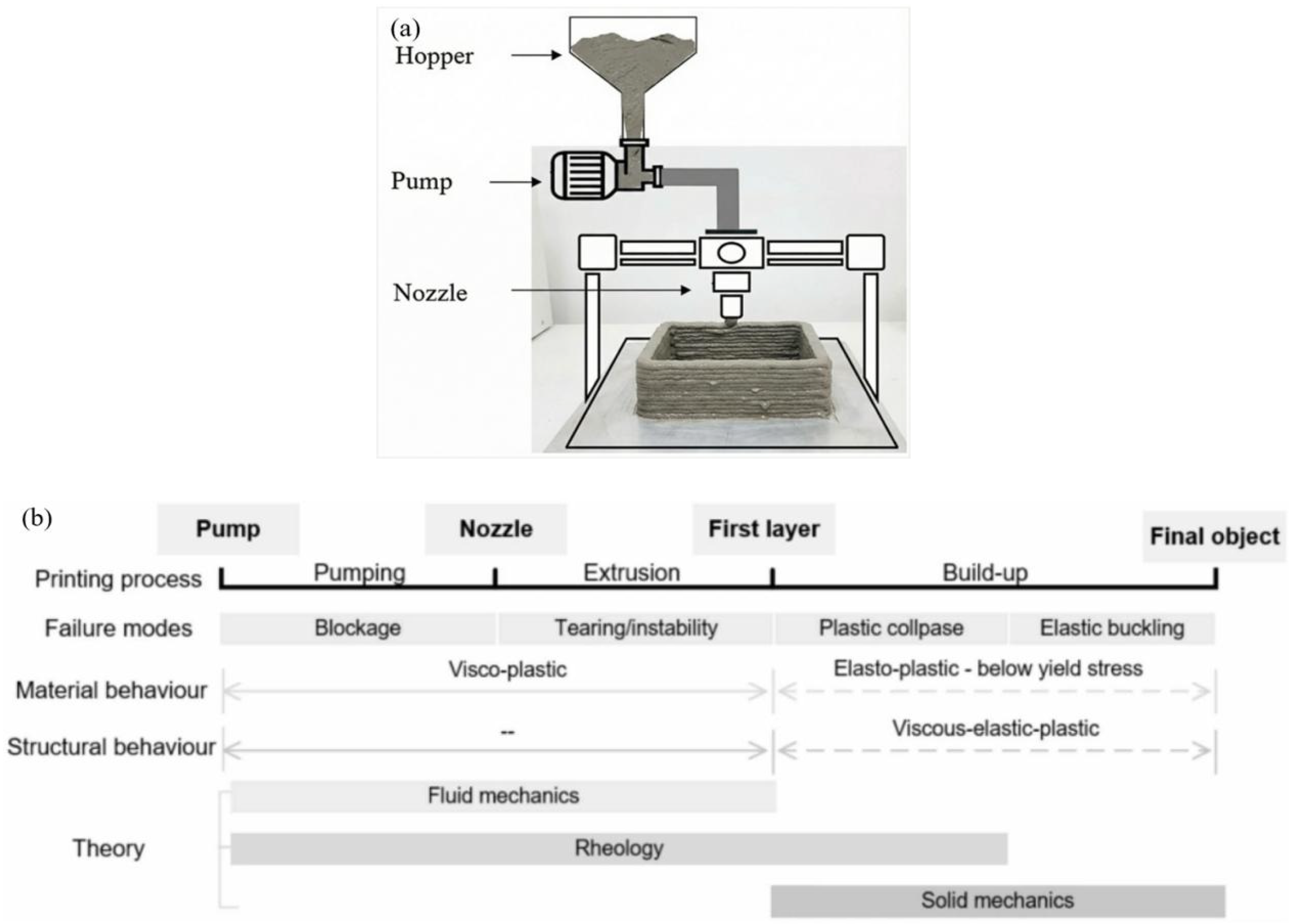
The rheological state of 3DPC is jointly governed by material composition and the printing process. During printing, operations such as nozzle extrusion, deposition compaction, and layer-by-layer stacking impose specific shear histories, characteristic time scales, and environmental boundary conditions. As a result, freshly mixed materials exhibit pronounced time-dependent evolution in yield stress, plastic viscosity, and thixotropic structural rebuilding behavior, which in turn critically affect dimensional accuracy, structural integrity, and early-age mechanical performance of printed components. Consequently, a systematic investigation of how key printing parameters regulate rheological responses along the printing process chain is essential for establishing an integrated framework linking “printing parameters–rheological response–interfacial characteristics–macroscopic performance” [194].

4.1. 3D Printing Process and Rheological Demand Characteristics

Extrusion-based 3DPC typically involves several key stages, including digital modeling and path planning, material mixing and pumping, nozzle extrusion and deposition, and layer-by-layer build-up (Figure 9). Throughout this continuous and inherently non-steady manufacturing process, materials are subjected to distinct rheological requirements at different stages. During pumping, low dynamic yield stress and plastic viscosity are required to minimize transport resistance and ensure stable flow. In the nozzle extrusion stage, pronounced shear-thinning behavior facilitates a reduction in pressure drop and extrusion fluctuations. During deposition and stacking, however, the material must rapidly rebuild its internal structure after shear cessation, developing sufficiently high static yield stress and thixotropy to maintain filament geometry and support the load of subsequent layers [86]. Therefore, the role of printing parameters fundamentally lies in externally controlling the shear–rest cycling path and its associated time scales, enabling dynamic matching of the material’s rheological state to the requirements of each process stage [38].

4.2. Regulation Mechanisms of Key 3D Printing Parameters on Rheological Behavior

The influence of printing parameters on the rheological behavior of 3DPC primarily arises from nozzle geometric boundaries, kinematic and temporal conditions, as well as environmental and equipment-related factors. Among these, nozzle characteristics and printing speed jointly determine the shear intensity experienced by the material during extrusion and deposition, as well as the subsequent structural recovery pathways [15,195].

4.2.1. Nozzle Geometry

As the final interface for material shearing and shaping, nozzle geometry directly controls the range of shear rates and the susceptibility to blockage during extrusion. To mitigate clogging risk, it is widely accepted that the ratio of nozzle equivalent diameter to the maximum aggregate size should exceed 4 [195]. Increasing nozzle size generally corresponds to lower shear rates but imposes higher demands on post-extrusion filament stability and shape retention. Conversely, smaller nozzles subject the material to higher shear conditions, rendering extrusion stability more sensitive to the system’s shear-thinning capacity [15]. Nozzle shape further affects filament cross-sectional geometry and interlayer contact conditions. Rectangular or square nozzles can increase the effective interlayer contact area and improve deposition compaction, thereby enhancing interlayer bonding. Circular nozzles, while offering greater kinematic flexibility for complex paths and corners, may reduce effective contact area due to their curved boundaries, potentially compromising interfacial bonding efficiency [196,197].

4.2.2. Kinematic and Temporal Parameters

The matching relationship between printhead travel speed and material extrusion rate governs whether the filament undergoes stretching or accumulation during deposition, making it a critical factor for cross-sectional uniformity and continuity [197]. As printing speed increases, the time available for structural rebuilding is significantly reduced, thereby imposing stricter requirements on thixotropy and structural recovery rate [195]. The interlayer deposition interval directly influences moisture conditions and hydration degree at the interface. Prolonged intervals may lead to surface moisture loss and advanced hydration of the underlying layer, resulting in weak interfaces or “cold joints” and a substantial reduction in interlayer bond strength [198]. Nozzle height affects filament formation by regulating compaction on the previously deposited layer: excessively low heights may cause surface disturbance, whereas overly high positions reduce compaction and contact quality, ultimately impairing interlayer density and geometric accuracy [197].

4.2.3. Environmental and Equipment Boundary Conditions

Ambient temperature significantly affects hydration kinetics and interparticle water film thickness, thereby influencing yield stress, plastic viscosity, and the rate of structural build-up. Numerous studies report that elevated temperatures accelerate hydration, increasing the growth rate of yield stress and viscosity and promoting rapid post-extrusion shape stabilization [199]. However, in certain material systems and temperature ranges, transient weakening of flocculated structures or viscosity reduction has also been observed, highlighting the strong dependence on material composition, temperature window, and shear history [200]. In addition, transport and extrusion system parameters may induce rheological drift through sustained shearing and residence time effects, thereby affecting printing stability. Long-distance pumping can lead to segregation and performance degradation, representing a major constraint for large-scale 3D printing [38]. Pipe material and internal wall friction influence pressure loss and velocity distribution [201], while in screw-based extrusion systems, screw geometry and rotational speed determine shear intensity and conveying efficiency, ultimately affecting filament uniformity and density [202]. Recently, localized nozzle heating strategies have been proposed to regulate structural recovery after shear unloading, coupling temperature control with pumpability evolution [199].

4.3. Synergistic Effects of Parameters and Their Relationship with Printing Quality

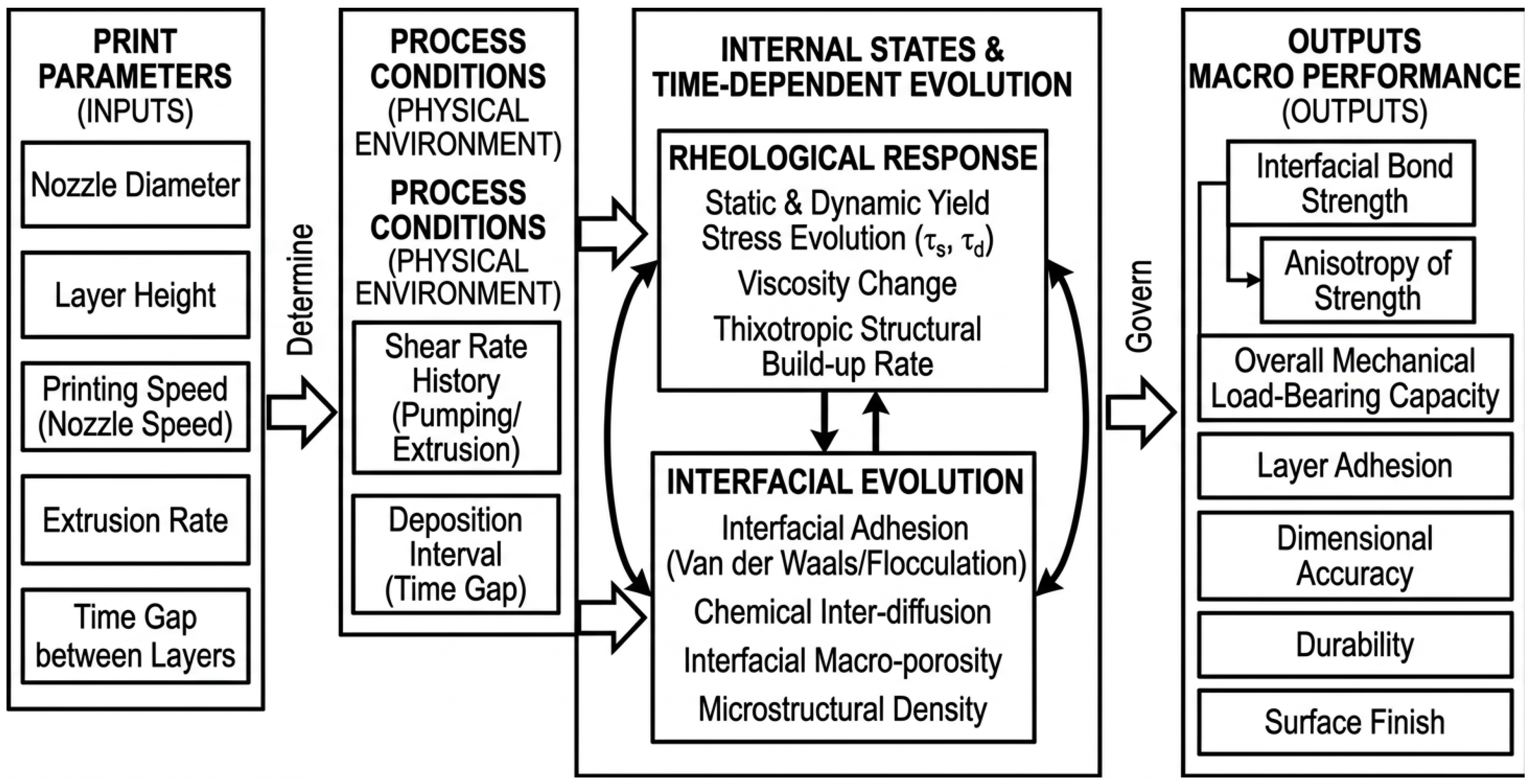
The effects of printing parameters on rheological performance exhibit pronounced coupling characteristics (Table 10). For example, nozzle size and printing speed jointly determine the shear rate level and shear history experienced by the material, while interlayer time interval and ambient temperature collaboratively control interfacial hydration state and structural rebuilding kinetics [198,199]. These multi-parameter interactions ultimately manifest in the characteristics of the interfacial transition zone, pore structure, and anisotropy evolution, thereby governing interlayer bond strength, macroscopic mechanical properties, and durability performance [203]. Accordingly, printing parameters may be regarded as input variables, rheological response and interfacial evolution as key process variables, and macroscopic performance as output variables, forming a systematic framework that describes the transfer pathway from process control to performance development in 3DPC (Figure 10) [204].

5. Mechanisms Governing the Evolution of Rheological Properties

5.1. Micro-Scale Evolution

The rheological evolution of freshly prepared 3DPC paste can be regarded as a time-dependent process jointly driven by interparticle colloidal interactions and the progressive formation of hydration products. From the initial mixing stage to the onset of the hydration acceleration period, a continuous network of hydration products has not yet developed; hence, macroscopic rheological parameters are predominantly governed by interparticle forces and the associated flocculation–deflocculation dynamics. As hydration proceeds, hydration products increasingly assume load-bearing and connectivity functions; the static yield stress enters a sustained growth regime and exhibits more pronounced irreversibility in structural development [209].
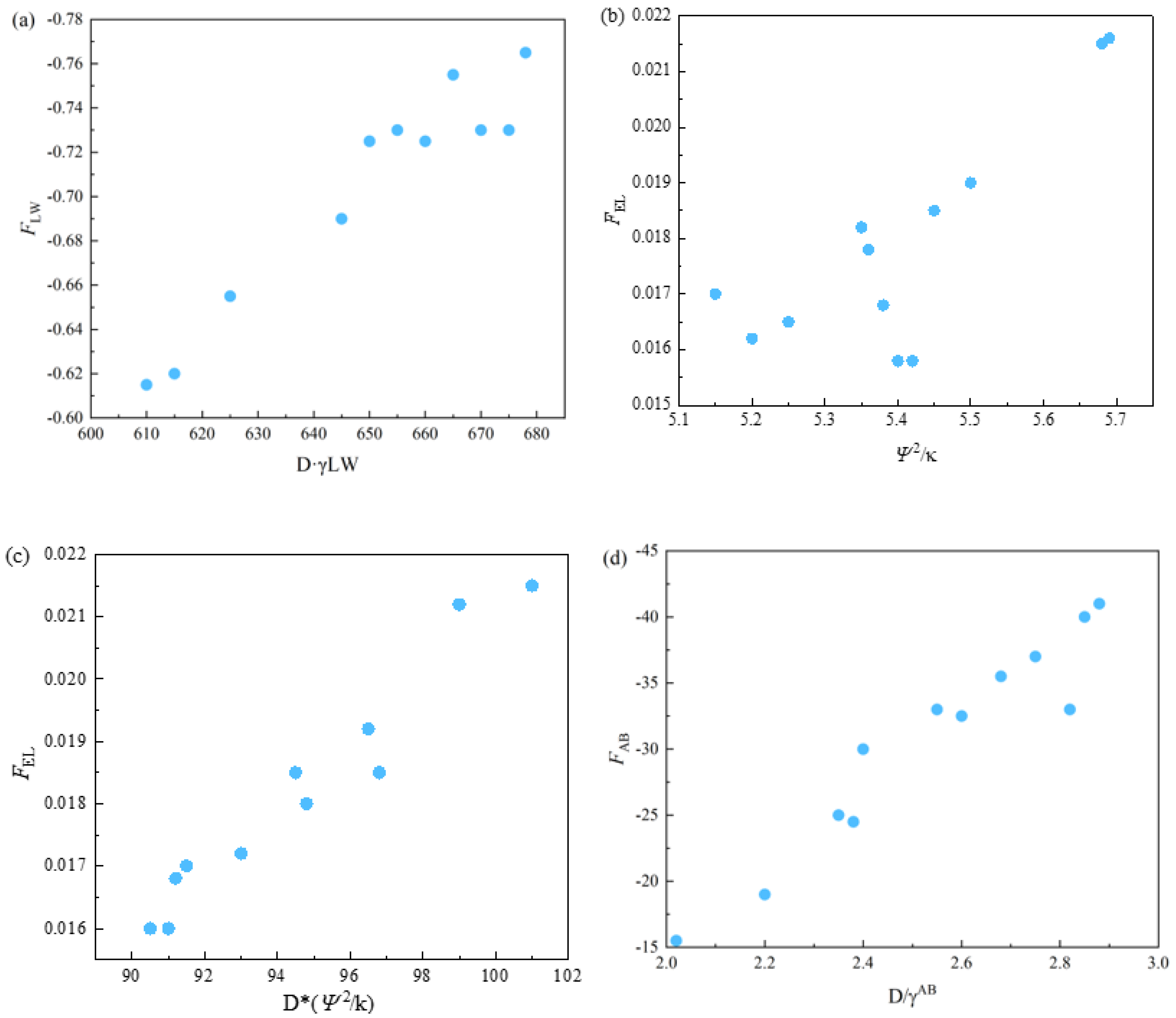
In the very early period following cement–water contact (seconds to tens of minutes), the paste may be approximated as a concentrated suspension with a high solid volume fraction, where yielding primarily originates from colloidal interactions between particles. Within the Derjaguin–Landau–Verwey–Overbeek (DLVO) framework, suspension stability is interpreted as the competition between van der Waals attraction (FLW) and electrostatic double-layer interactions (FEL). The extended DLVO (EDLVO) theory further incorporates acid–base interactions (FAB), such as hydrogen bonding and other short-range forces, rendering it more suitable for describing flocculation and structure formation in polar cementitious systems [191]. In the EDLVO framework, the total interparticle interaction can be parameterized by particle size (D), interparticle separation, surface energy components (nonpolar surface energy γLW and polar surface energy γAB), surface potential (ψ), and the Debye length (κ − 1). Calculations indicate that increasing particle size or γLW, or decreasing surface potential and double-layer thickness, can enhance net attraction and elevate the initial yield stress level (Figure 11) [127]. Comparative analyses by Wu et al. further suggest that EDLVO provides improved applicability for predicting stability across a range of mineral suspension systems [210].
Hydration constitutes the fundamental driver for the transition of the paste structure from “reversible” to “irreversible” strengthening. On the one hand, the consumption of free water and the concomitant increase in the effective solid volume fraction progressively densify the system; on the other hand, hydration products such as C-S-H gel and ettringite can form physical bridges between adjacent particles. Prior studies have shown that C-S-H preferentially nucleates and grows at the “near-contact points” within flocculated particle clusters, gradually transforming the early reversible, colloidally sustained connections into rigid, load-bearing bridges, which ultimately develop into a percolated network spanning the system (Figure 12) [40]. This transition from “reversible flocculation” to an “irreversible skeleton” provides a critical microstructural basis for the sustained increase in static yield stress.
Notably, there is no full consensus regarding the dominant factors controlling rheological evolution prior to the acceleration period. Roussel et al. [210] argued that colloidal interactions dominate only over an extremely short time window and are rapidly superseded by C-S-H bridging effects. In contrast, Huang et al. noted that C-S-H formation remains limited before the acceleration period and is insufficient to generate a continuous network; therefore, rheological changes are more closely associated with the evolution of ionic concentration and its regulation of the electrical double layer, implying that colloidal interactions still contribute substantially [211]. Further quantitative analyses propose that early rheological evolution can be decomposed into two contributions—namely, a “baseline” and a “growth-rate” component: colloidal interactions primarily determine the baseline level of static yield stress before the acceleration period, whereas hydration predominantly controls the subsequent growth rate and the magnitude of the yield stress increase [128,211].

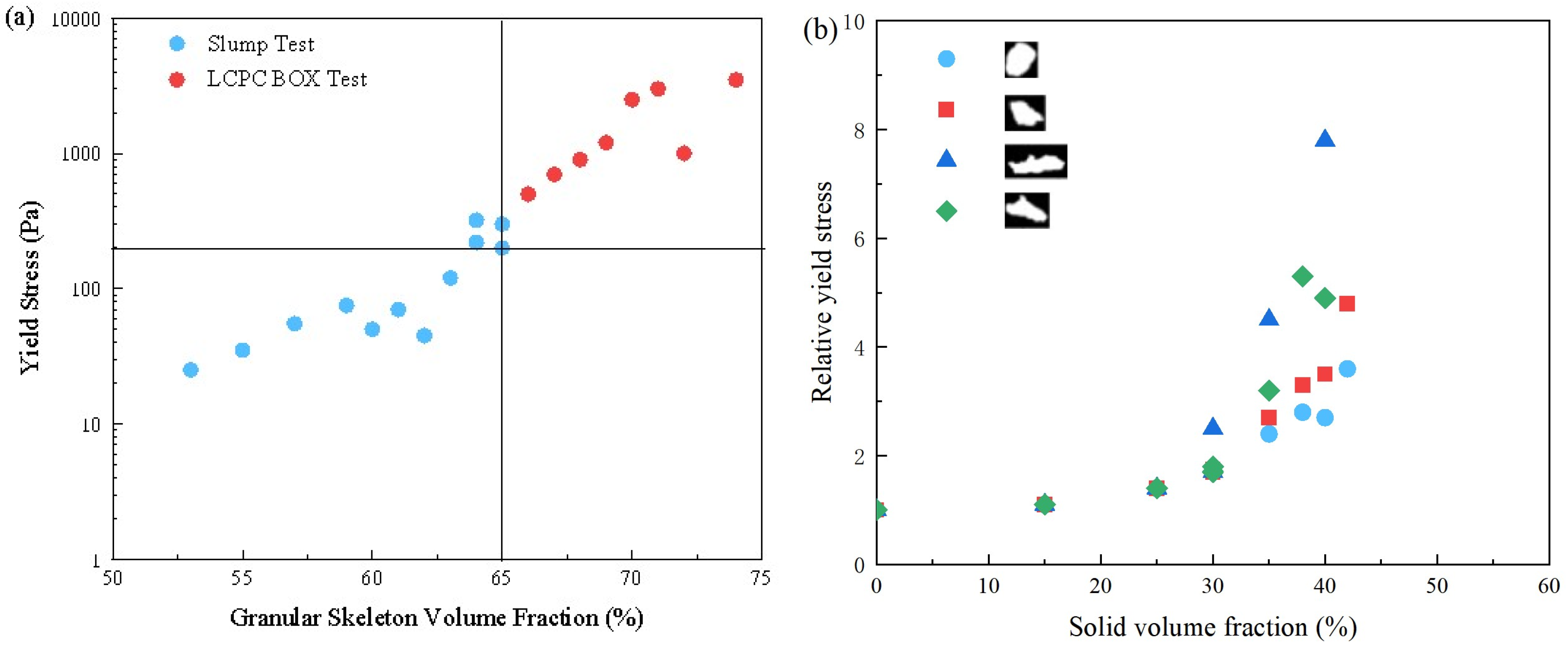
5.2. Meso- to Macro-Scale Mechanisms

At the meso- and macro-scales, 3DPC may be approximated as a two-phase suspension comprising cement paste and aggregates, where aggregate volume fraction and particle morphology can substantially alter rheological regimes and their governing mechanisms. When the aggregate volume fraction remains below the percolation threshold (approximately 60~70%), yielding and viscous dissipation are still primarily controlled by the paste phase. Once the volume fraction exceeds this threshold, direct aggregate contacts become more prevalent and evolve into force-chain networks; frictional dissipation increases markedly, and both yield stress and plastic viscosity exhibit step-like increases (Figure 13) [212]. The Krieger–Dougherty model and the Chateau–Ovarlez–Trung model are commonly employed to capture the dependence of viscosity and yield stress on aggregate volume fraction [213,214]. Moreover, irregular aggregate morphology and higher aspect ratios typically reduce packing efficiency and reinforce contact networks, thereby amplifying yield-stress enhancement effects [215].
During pumping and pipe transport, 3DPC frequently exhibits heterogeneous flow. Shear-induced particle migration (SIPM) drives coarse particles from near-wall high-shear zones toward the low-shear region near the pipe center, producing a characteristic cross-sectional stratification consisting of a “paste-rich lubricating slip layer” and an “aggregate-rich plug-flow core” [216]. While the lubricating layer reduces pumping resistance and facilitates pumpability, it also entails compositional redistribution. Studies have indicated that this process may reduce the effective water-to-binder ratio or induce insufficient paste content in the core, thereby introducing latent defects within extruded filaments and adversely affecting interlayer bonding and durability [217]. Consequently, meso-scale compositional migration and macro-scale pumpability are coupled, jointly constraining cross-sectional uniformity and interfacial quality after extrusion-based deposition [217].

5.3. External Excitation and Environmental Effects

3DPC experiences complex shear histories during mixing, pumping, and extrusion, and its rheological evolution is highly sensitive to shear rate, duration, and the timing of shear application. Shear exerts a “dual effect” on structural evolution. On the one hand, intense shearing can disrupt existing flocculated structures and early-stage bridging, leading to an instantaneous reduction in yield stress and manifesting as “shear softening.” On the other hand, shearing can promote particle dissolution and ionic transport, thereby modifying the pore-solution chemistry and accelerating the nucleation and growth of hydration products, which increases the subsequent structural recovery rate as well as the growth rate of rheological parameters [218]. In addition, the timing of shear application can redirect the evolution pathway: delayed shearing may reduce the immediate yield stress, yet—owing to its “activation” effect on hydration—it can substantially increase the later-stage slope of yield-stress growth, underscoring the strong coupling between process history and microstructural development [18].
Environmental conditions likewise govern time-dependent rheology and the kinetics of structure formation. Temperature regulates the evolution of yield stress and plastic viscosity through its influence on hydration kinetics; increasing temperature typically accelerates hydration and promotes more rapid increases in rheological parameters, thereby shortening post-extrusion setting time and enhancing early structural stability [208]. Accordingly, localized thermal control has been proposed as a process intervention to regulate structural recovery after shear unloading [199]. Humidity primarily constrains hydration continuity through internal relative humidity (IRH): when the capillary-pore IRH drops below approximately 75%, hydration becomes strongly limited or may even cease, potentially resulting in insufficient surface strength and elevated risks of early-age cracking. Furthermore, moisture gradients may develop within printed components, compromising the spatial uniformity of microstructural evolution. Collectively, colloidal interactions, hydration reactions, meso-scale aggregate contact networks, transport-induced compositional migration, and thermo-hygrometric boundary conditions constitute a multi-scale coupled framework—“colloid–reaction–aggregate–transport–environment”-capable of rationalizing the temporal evolution of yield stress, viscosity, and thixotropy in 3DPC under shear-rest cycling and varying boundary conditions [210,217]. A concise summary of the governing mechanisms across different scales and their representative descriptors is provided in Table 11.

6. Conclusions and Future Outlook

6.1. Conclusions

The rheological performance of 3DPC is integral to the processes of pumping, extrusion, deposition, and layering, serving as a pivotal determinant of printability and the quality of component formation. Based on the comprehensive review presented herein, the following key insights are drawn:
(1)
During pumping and extrusion, materials must exhibit low dynamic yield stress and plastic viscosity to ensure continuous conveyance and stable extrusion. Conversely, during deposition and stacking, rapid structural rebuilding post-shear cessation and elevated static yield stress are essential to maintain geometric stability and load-bearing capacity. Thixotropic behavior encapsulates the competitive dynamics of “structural establishment–structural disruption” under varying shear histories and time scales, making it a critical parameter under printing initiation, cessation, and interlayer bonding conditions.
(2)
Aggregate morphology and gradation predominantly affect frictional dissipation and contact network formation, thereby determining yield stress and viscosity levels. The cementitious matrix modulates the growth rate of static yield stress through specific surface area and hydration kinetics. Chemical admixtures offer process-specific control over dispersion, thickening, and setting, while fibers and nanomaterials enhance structural stability through network reinforcement and interfacial interactions, albeit at the expense of increased flow resistance and extrusion pressure.
(3)
Nozzle dimensions and shape dictate local shear rates and interlayer contact conditions. The synchronization of printing speed and extrusion rate, along with interlayer time intervals, governs structural recovery time scales and interfacial hydration states. Environmental and equipment boundary factors can induce rheological drift, affecting large-scale printing stability. The synergistic effects of multiple parameters ultimately manifest in interfacial transition zone characteristics, pore structures, and the anisotropic evolution of macroscopic performance.
(4)
At the micro-scale, interparticle colloidal interactions establish the early yield stress baseline, while hydration product bridging drives subsequent irreversible structural enhancement. At the meso-scale, the formation of force-chain networks upon surpassing the percolation threshold leads to yield stress transitions. At the macro-scale, shear-induced particle migration forms lubricating layers and plug-flow cores, influencing pumpability and extrusion uniformity. Temperature and humidity, along with shear excitation, further modulate hydration dynamics and structural recovery rates.

6.2. Future Outlook

Despite the systematic understanding of 3DPC rheological control, several critical challenges remain to be addressed for engineering applications and standardized design:
(1)
Current discrepancies in testing methodologies, shear history settings, and parameter definitions impede cross-system comparisons and engineering applicability. Future efforts should focus on developing a unified characterization framework for dynamic/static yield stress, structural establishment rates, and thixotropic recovery capabilities across the “pumping–extrusion–deposition” continuum.
(2)
Traditional Bingham or Herschel–Bulkley models inadequately capture time-dependent structural rebuilding and interfacial evolution under actual printing conditions. Future research should integrate in situ rheological testing, interfacial hydration characterization, and multi-scale numerical simulations to establish coupled models linking “shear history–structural evolution–forming stability.
(3)
The significant coupling between raw material design, admixture formulations, and printing parameters renders single-factor optimization insufficient for complex operational demands. Future endeavors should employ data-driven and process control methodologies to achieve synergistic optimization of formulations and process windows, with an emphasis on validating stability under large-scale component and complex path conditions.
(4)
While waste-based cementitious materials, recycled aggregates, and multifunctional nanocomponents offer potential for low-carbon applications, their time-dependent rheological behaviors and interlayer interface durability remain underexplored. Future studies should intensify research into long-term evolution mechanisms under environmental temperature, humidity, and construction boundary conditions to support the reliable application of 3DPC in practical construction scenarios.
In summary, research into the rheological performance of 3DPC is transitioning from empirical mix designs to mechanism-driven and process-controlled approaches. By standardizing characterization protocols, deepening multi-scale mechanistic understanding, and achieving material-process co-design, we can provide critical support for the engineering promotion and reliable structural performance of 3DPC.

Author Contributions

Conceptualization, J.L.; methodology, L.W.; software, J.L.; validation, M.F.; formal analysis, L.W.; investigation, Q.W.; resources, M.F.; data curation, Q.W.; writing—original draft preparation, J.L.; writing—review and editing, Q.W.; visualization, Q.W.; supervision, Q.W.; project administration, M.F.; funding acquisition, Q.W. All authors have read and agreed to the published version of the manuscript.

Funding

This study was financially supported by the 2026 Zhejiang Provincial Philosophy and Social Sciences Planning Annual Regular Project [26NDJC017YBM].

Data Availability Statement

No new data were created or analyzed in this study.

Conflicts of Interest

Author Mingyue Fang was employed by the company Ningbo Tianyi Green Ecological Technology. The remaining authors declare that the research was conducted in the absence of any commercial or financial relationships that could be construed as a potential conflict of interest.

References

  1. De Schutter, G.; Lesage, K.; Mechtcherine, V.; Nerella, V.N.; Habert, G.; Agusti-Juan, I. Vision of 3D printing with concrete—Technical, economic and environmental potentials. Cem. Concr. Res. 2018, 112, 25–36. [Google Scholar] [CrossRef]
  2. Ngo, T.D.; Kashani, A.; Imbalzano, G.; Nguyen, K.T.Q.; Hui, D. Additive manufacturing (3D printing): A review of materials, methods, applications and challenges. Compos. Part B Eng. 2018, 143, 172–196. [Google Scholar] [CrossRef]
  3. Bos, F.; Wolfs, R.; Salet, T. CCR Digital Concrete 2020 SI: Editorial. Cem. Concr. Res. 2020, 135, 106157. [Google Scholar] [CrossRef]
  4. Jeon, K.; Park, M.-B.; Kang, M.; Kim, J.-H. A Study on the Development of an Automated Freeform Fabrication System and Construction Materials. J. Korean Soc. Civ. Eng. 2013, 33, 1665–1673. [Google Scholar] [CrossRef]
  5. Fantino, E.; Chiappone, A.; Roppolo, I.; Manfredi, D.; Bongiovanni, R.; Pirri, C.F.; Calignano, F. 3D Printing of Conductive Complex Structures with In Situ Generation of Silver Nanoparticles. Adv. Mater. (Deerfield Beach Fla.) 2016, 28, 3712–3717. [Google Scholar] [CrossRef]
  6. Paul, S.C.; Tay, Y.W.D.; Panda, B.; Tan, M.J. Fresh and hardened properties of 3D printable cementitious materials for building and construction. Arch. Civ. Mech. Eng. 2018, 18, 311–319. [Google Scholar] [CrossRef]
  7. Vantyghem, G.; De Corte, W.; Shakour, E.; Amir, O. 3D printing of a post-tensioned concrete girder designed by topology optimization. Autom. Constr. 2020, 112, 103084. [Google Scholar] [CrossRef]
  8. Allouzi, R.; Al-Azhari, W.; Allouzi, R. Conventional Construction and 3D Printing: A Comparison Study on Material Cost in Jordan. J. Eng. 2020, 2020, 1424682. [Google Scholar] [CrossRef]
  9. Naser, M.Z.; Chehab, A.I. Materials and design concepts for space-resilient structures. Prog. Aerosp. Sci. 2018, 98, 74–90. [Google Scholar] [CrossRef]
  10. Naser, M.Z. Space-native construction materials for earth-independent and sustainable infrastructure. Acta Astronaut. 2019, 155, 264–273. [Google Scholar] [CrossRef]
  11. Varela Miranda, L.; Valdes, J.R.; Cortes, D.D. Solar bricks for lunar construction. Constr. Build. Mater. 2017, 139, 241–246. [Google Scholar] [CrossRef]
  12. Hou, S.; Duan, Z.; Xiao, J.; Ye, J. A review of 3D printed concrete: Performance requirements, testing measurements and mix design. Constr. Build. Mater. 2021, 273, 121745. [Google Scholar] [CrossRef]
  13. Rehman, A.U.; Kim, J.-H. 3D Concrete Printing: A Systematic Review of Rheology, Mix Designs, Mechanical, Microstructural, and Durability Characteristics. Materials 2021, 14, 3800. [Google Scholar] [CrossRef]
  14. Souza, M.T.; Ferreira, I.M.; Guzi de Moraes, E.; Senff, L.; Novaes de Oliveira, A.P. 3D printed concrete for large-scale buildings: An overview of rheology, printing parameters, chemical admixtures, reinforcements, and economic and environmental prospects. J. Build. Eng. 2020, 32, 101833. [Google Scholar] [CrossRef]
  15. Le, T.T.; Austin, S.A.; Lim, S.; Buswell, R.A.; Gibb, A.G.F.; Thorpe, T. Mix design and fresh properties for high-performance printing concrete. Mater. Struct. 2012, 45, 1221–1232. [Google Scholar] [CrossRef]
  16. Teixeira, J.; Schaefer, C.O.; Maia, L.; Rangel, B.; Neto, R.; Alves, J.L. Influence of Supplementary Cementitious Materials on Fresh Properties of 3D Printable Materials. Sustainability 2022, 14, 3970. [Google Scholar] [CrossRef]
  17. Papachristoforou, M.; Mitsopoulos, V.; Stefanidou, M. Evaluation of workability parameters in 3D printing concrete. Procedia Struct. Integr. 2018, 10, 155–162. [Google Scholar] [CrossRef]
  18. Xiao, J.; Hou, S.; Duan, Z.; Zou, S. Rheology of 3D printable concrete prepared by secondary mixing of ready-mix concrete. Cem. Concr. Compos. 2023, 138, 104958. [Google Scholar] [CrossRef]
  19. Dai, X.; Tao, Y.; Van Tittelboom, K.; De Schutter, G. Rheological and mechanical properties of 3D printable alkali-activated slag mixtures with addition of nano clay. Cem. Concr. Compos. 2023, 139, 104995. [Google Scholar] [CrossRef]
  20. Kruger, J.; Zeranka, S.; van Zijl, G. An ab initio approach for thixotropy characterisation of (nanoparticle-infused) 3D printable concrete. Constr. Build. Mater. 2019, 224, 372–386. [Google Scholar] [CrossRef]
  21. Yahia, A.; Khayat, K.H. Analytical models for estimating yield stress of high-performance pseudoplastic grout. Cem. Concr. Res. 2001, 31, 731–738. [Google Scholar] [CrossRef]
  22. Kruger, J.; Zeranka, S.; van Zijl, G. 3D concrete printing: A lower bound analytical model for buildability performance quantification. Autom. Constr. 2019, 106, 102904. [Google Scholar] [CrossRef]
  23. Tay, Y.W.D.; Qian, Y.; Tan, M.J. Printability region for 3D concrete printing using slump and slump flow test. Compos. Part B Eng. 2019, 174, 106968. [Google Scholar] [CrossRef]
  24. Weng, Y.; Li, M.; Tan, M.J.; Qian, S. Design 3D printing cementitious materials via Fuller Thompson theory and Marson-Percy model. Constr. Build. Mater. 2018, 163, 600–610. [Google Scholar] [CrossRef]
  25. Lowke, D.; Dini, E.; Perrot, A.; Weger, D.; Gehlen, C.; Dillenburger, B. Particle-bed 3D printing in concrete construction—Possibilities and challenges. Cem. Concr. Res. 2018, 112, 50–65. [Google Scholar] [CrossRef]
  26. Bhushan Jindal, B.; Jangra, P. 3D Printed Concrete: Acomprehensive review ofraw material’s properties, synthesis, performance, andpotential field applications. Constr. Build. Mater. 2023, 387, 131614. [Google Scholar] [CrossRef]
  27. Zhang, C.; Nerella, V.N.; Krishna, A.; Wang, S.; Zhang, Y.; Mechtcherine, V.; Banthia, N. Mix design concepts for 3D printable concrete: A review. Cem. Concr. Compos. 2021, 122, 104155. [Google Scholar] [CrossRef]
  28. Li, V.C.; Bos, F.P.; Yu, K.; McGee, W.; Ng, T.Y.; Figueiredo, S.C.; Nefs, K.; Mechtcherine, V.; Nerella, V.N.; Pan, J.; et al. On the emergence of 3D printable Engineered, Strain Hardening Cementitious Composites (ECC/SHCC). Cem. Concr. Res. 2020, 132, 106038. [Google Scholar] [CrossRef]
  29. Chen, Y.; He, S.; Gan, Y.; Çopuroğlu, O.; Veer, F.; Schlangen, E. A review of printing strategies, sustainable cementitious materials and characterization methods in the context of extrusion-based 3D concrete printing. J. Build. Eng. 2022, 45, 103599. [Google Scholar] [CrossRef]
  30. Bhattacherjee, S.; Basavaraj, A.S.; Rahul, A.V.; Santhanam, M.; Gettu, R.; Panda, B.; Schlangen, E.; Chen, Y.; Copuroglu, O.; Ma, G.; et al. Sustainable materials for 3D concrete printing. Cem. Concr. Compos. 2021, 122, 104156. [Google Scholar] [CrossRef]
  31. Nodehi, M.; Ozbakkaloglu, T.; Gholampour, A. Effect of supplementary cementitious materials on properties of 3D printed conventional and alkali-activated concrete: A review. Autom. Constr. 2022, 138, 104215. [Google Scholar] [CrossRef]
  32. Paritala, S.; Singaram, K.K.; Bathina, I.; Khan, M.A.; Jyosyula, S.K.R. Rheology and pumpability of mix suitable for extrusion-based concrete 3D printing—A review. Constr. Build. Mater. 2023, 402, 132962. [Google Scholar] [CrossRef]
  33. Jiao, D.; De Schryver, R.; Shi, C.; De Schutter, G. Thixotropic structural build-up of cement-based materials: A state-of-the-art review. Cem. Concr. Compos. 2021, 122, 104152. [Google Scholar] [CrossRef]
  34. Roussel, N. Rheological requirements for printable concretes. Cem. Concr. Res. 2018, 112, 76–85. [Google Scholar] [CrossRef]
  35. Muthukrishnan, S.; Ramakrishnan, S.; Sanjayan, J. Technologies for improving buildability in 3D concrete printing. Cem. Concr. Compos. 2021, 122, 104144. [Google Scholar] [CrossRef]
  36. Tran, M.V.; Cu, Y.T.H.; Le, C.V.H. Rheology and shrinkage of concrete using polypropylene fiber for 3D concrete printing. J. Build. Eng. 2021, 44, 103400. [Google Scholar] [CrossRef]
  37. Mechtcherine, V.; Bos, F.P.; Perrot, A.; da Silva, W.R.L.; Nerella, V.N.; Fataei, S.; Wolfs, R.J.M.; Sonebi, M.; Roussel, N. Extrusion-based additive manufacturing with cement-based materials—Production steps, processes, and their underlying physics: A review. Cem. Concr. Res. 2020, 132, 106037. [Google Scholar] [CrossRef]
  38. Xiao, J.; Ji, G.; Zhang, Y.; Ma, G.; Mechtcherine, V.; Pan, J.; Wang, L.; Ding, T.; Duan, Z.; Du, S. Large-scale 3D printing concrete technology: Current status and future opportunities. Cem. Concr. Compos. 2021, 122, 104115. [Google Scholar] [CrossRef]
  39. Perrot, A.; Jacquet, Y.; Rangeard, D.; Courteille, E.; Sonebi, M. Nailing of Layers: A Promising Way to Reinforce Concrete 3D Printing Structures. Materials 2020, 13, 1518. [Google Scholar] [CrossRef]
  40. Roussel, N.; Ovarlez, G.; Garrault, S.; Brumaud, C. The origins of thixotropy of fresh cement pastes. Cem. Concr. Res. 2012, 42, 148–157. [Google Scholar] [CrossRef]
  41. Roussel, N. Thixotropy: From measurement to casting of concrete. In Understanding the Rheology of Concrete; Roussel, N., Ed.; Woodhead Publishing: Cambridge, UK, 2012; pp. 286–295. [Google Scholar]
  42. Frantzis, P.; Baggott, R. Rheological characteristics of retarded magnesia phosphate cement. Cem. Concr. Res. 1997, 27, 1155–1166. [Google Scholar] [CrossRef]
  43. Jacobsen, S.; Mork, J.H.; Lee, S.F.; Haugan, L. Pumping of Concrete and Mortar—State of the Art; SINTEF Community: Oslo, Norway, 2009. [Google Scholar]
  44. Rahman, M.; Rawat, S.; Yang, R.; Mahil, A.; Zhang, Y.X. A comprehensive review on fresh and rheological properties of 3D printable cementitious composites. J. Build. Eng. 2024, 91, 109719. [Google Scholar] [CrossRef]
  45. Si, W.; Khan, M.; McNally, C. A Comprehensive Review of Rheological Dynamics and Process Parameters in 3D Concrete Printing. J. Compos. Sci. 2025, 9, 299. [Google Scholar] [CrossRef]
  46. Lomboy, G.R.; Wang, K.; Taylor, P.; Shah, S.P. Guidelines for design, testing, production and construction of semi-flowable SCC for slip-form paving. Int. J. Pavement Eng. 2012, 13, 216–225. [Google Scholar] [CrossRef]
  47. Khoshnevis, B.; Yuan, X.; Zahiri, B.; Zhang, J.; Xia, B. Deformation Analysis of Sulfur Concrete Structures Made by Contour Crafting; USC Press: Los Angeles, CA, USA, 2015. [Google Scholar]
  48. Perrot, A.; Rangeard, D.; Pierre, A. Structural built-up of cement-based materials used for 3D-printing extrusion techniques. Mater. Struct. 2016, 49, 1213–1220. [Google Scholar] [CrossRef]
  49. Voigt, T.; Mbele, J.-J.; Wang, K.; Shah, S.P. Using Fly Ash, Clay, and Fibers for Simultaneous Improvement of Concrete Green Strength and Consolidatability for Slip-Form Pavement. J. Mater. Civ. Eng. 2010, 22, 196–206. [Google Scholar] [CrossRef]
  50. Banfill, P. The rheology of fresh cement and concrete—A review. In Proceedings of the 11th International Cement Chemistry Congress, Durban, South Africa, 11–16 May 2003. [Google Scholar]
  51. Roussel, N. A thixotropy model for fresh fluid concretes: Theory, validation and applications. Cem. Concr. Res. 2006, 36, 1797–1806. [Google Scholar] [CrossRef]
  52. Perrot, A.; Pierre, A.; Vitaloni, S.; Picandet, V. Prediction of lateral form pressure exerted by concrete at low casting rates. Mater. Struct. 2015, 48, 2315–2322. [Google Scholar] [CrossRef]
  53. Lv, X.; Qin, Y.; Liang, H.; Cui, X. Effects of modifying agent on rheology and workability of alkali-activated slag paste for 3D extrusion forming. Constr. Build. Mater. 2021, 302, 124062. [Google Scholar] [CrossRef]
  54. Jiao, D.; Shi, C.; Yuan, Q.; An, X.; Liu, Y.; Li, H. Effect of constituents on rheological properties of fresh concrete-A review. Cem. Concr. Compos. 2017, 83, 146–159. [Google Scholar] [CrossRef]
  55. Arunothayan, A.R.; Nematollahi, B.; Khayat, K.H.; Ramesh, A.; Sanjayan, J.G. Rheological characterization of ultra-high performance concrete for 3D printing. Cem. Concr. Compos. 2023, 136, 104854. [Google Scholar] [CrossRef]
  56. Ranjan Prem, P.; Ravichandran, D.; Kumar Kaliyavaradhan, S.; Ambily, P.S. Comparative evaluation of rheological models for 3D printable concrete. Mater. Today Proc. 2022, 65, 1594–1598. [Google Scholar] [CrossRef]
  57. Tinoco, M.; Gouvêa, L.; Martins, K.; Toledo Filho, R.; Mendoza Reales, O. The use of rice husk particles to adjust the rheological properties of 3D printable cementitious composites through water sorption. Constr. Build. Mater. 2022, 365, 130046. [Google Scholar] [CrossRef]
  58. Zhang, D.; Xu, X.; Li, H. Research Progress on Long-term Performance of 3D Printed Concrete. Mater. Rep. 2025, 39, 24030165. [Google Scholar]
  59. Knutson, M.; Weerakoon, S.P.; Ticknor, C.; Yavitt, B.M.; Priye, A. Development and Implementation of a Low-Cost 3D-Printed Rotational Viscometer for Rheology and Fluid Mechanics Education. J. Chem. Educ. 2025, 102, 1138–1145. [Google Scholar] [CrossRef]
  60. Tucki, K.; Mruk, R.; Gruz, Ł.; Nowakowski, T.; Kulpa, K. Dynamic Viscosity Analysis of Fuels and Their Blends with Bio-Additives as a Function of Temperature. Appl. Sci. 2025, 15, 13210. [Google Scholar] [CrossRef]
  61. Alfani, R.; Grizzuti, N.; Guerrini, G.L.; Lezzi, G. The use of the capillary rheometer for the rheological evaluation of extrudable cement-based materials. Rheol. Acta 2007, 46, 703–709. [Google Scholar] [CrossRef]
  62. Du, L.; Zhou, J.; Lai, J.; Yin, X.; Yang, M.; Chen, T.; Guo, X.; Xiang, B.; Zhao, X. Dynamic damage behavior and anisotropic mechanism of 3D printed reinforced concrete subjected to penetration. Constr. Build. Mater. 2025, 458, 139559. [Google Scholar] [CrossRef]
  63. Yan, Z.; Zeng, J.-J.; Zhuge, Y.; Liao, J.; Zhou, J.-K.; Ma, G. Compressive behavior of FRP-confined 3D printed ultra-high performance concrete cylinders. J. Build. Eng. 2024, 83, 108304. [Google Scholar] [CrossRef]
  64. Aghajani Delavar, M.; Sharma, S.; Chen, H.; Sideris, P.; Kreiger, E. Experimental Investigation on Full-Scale Shear-Critical 3D Printed Concrete Walls Subjected to In-Plane Cyclic Loading. J. Struct. Eng. 2026, 152, 04026019. [Google Scholar] [CrossRef]
  65. Shantanu, B.; Smrati, J.; Manu, S. Criticality of binder-aggregate interaction for buildability of 3D printed concrete containing limestone calcined clay. Cem. Concr. Compos. 2023, 136, 104853. [Google Scholar] [CrossRef]
  66. Tushar, F.H.; Hasan, M.; Hasan, K.; Mawa, J.; Habib, M. Factors affecting flowability and rheological behavior of 3D printed concrete: A comprehensive review. Constr. Build. Mater. 2026, 508, 145140. [Google Scholar] [CrossRef]
  67. Mohan, M.K.; Rahul, A.; Van Tittelboom, K.; De Schutter, G. Rheological and pumping behaviour of 3D printable cementitious materials with varying aggregate content. Cem. Concr. Res. 2021, 139, 106258. [Google Scholar] [CrossRef]
  68. Hu, J.; Wang, K. Effect of coarse aggregate characteristics on concrete rheology. Constr. Build. Mater. 2011, 25, 1196–1204. [Google Scholar] [CrossRef]
  69. Zhao, Y.; Duan, Y.; Zhu, L.; Wang, Y.; Jin, Z. Characterization of coarse aggregate morphology and its effect on rheological and mechanical properties of fresh concrete. Constr. Build. Mater. 2021, 286, 122940. [Google Scholar] [CrossRef]
  70. Duan, Z.; Hou, S.; Xiao, J.; Singh, A. Rheological properties of mortar containing recycled powders from construction and demolition wastes. Constr. Build. Mater. 2020, 237, 117622. [Google Scholar] [CrossRef]
  71. De Vlieger, J.; Boehme, L.; Blaakmeer, J.; Li, J. Buildability assessment of mortar with fine recycled aggregates for 3D printing. Constr. Build. Mater. 2023, 367, 130313. [Google Scholar] [CrossRef]
  72. Shahmirzadi, M.R.; Gholampour, A.; Kashani, A.; Ngo, T.D. Shrinkage behavior of cementitious 3D printing materials: Effect of temperature and relative humidity. Cem. Concr. Compos. 2021, 124, 104238. [Google Scholar] [CrossRef]
  73. Yang, H.; Che, Y. Recycling of aggregate micro fines as a partial replacement for fly ash in 3D printing cementitious materials. Constr. Build. Mater. 2022, 321, 126372. [Google Scholar] [CrossRef]
  74. Liu, Z.; Li, M.; Weng, Y.; Wong, T.N.; Tan, M.J. Mixture Design Approach to optimize the rheological properties of the material used in 3D cementitious material printing. Constr. Build. Mater. 2019, 198, 245–255. [Google Scholar] [CrossRef]
  75. Tay, Y.W.D.; Li, M.Y.; Tan, M.J. Effect of printing parameters in 3D concrete printing: Printing region and support structures. J. Mater. Process. Technol. 2019, 271, 261–270. [Google Scholar] [CrossRef]
  76. Zhang, Y.; Zhang, Y.; She, W.; Yang, L.; Liu, G.; Yang, Y. Rheological and harden properties of the high-thixotropy 3D printing concrete. Constr. Build. Mater. 2019, 201, 278–285. [Google Scholar] [CrossRef]
  77. Mazhoud, B.; Perrot, A.; Picandet, V.; Rangeard, D.; Courteille, E. Underwater 3D printing of cement-based mortar. Constr. Build. Mater. 2019, 214, 458–467. [Google Scholar] [CrossRef]
  78. Tay, Y.W.D.; Panda, B.; Paul, S.C.; Tan, M.J.; Qian, S.Z.; Leong, K.F.; Chua, C.K. Processing and properties of construction materials for 3D printing. Mater. Sci. Forum 2016, 861, 177–181. [Google Scholar] [CrossRef]
  79. Kuder, K.G.; Shah, S.P. Rheology of extruded cement-based materials. ACI Mater. J. 2007, 104, 283. [Google Scholar] [CrossRef] [PubMed]
  80. Ma, G.; Li, Z.; Wang, L. Printable properties of cementitious material containing copper tailings for extrusion based 3D printing. Constr. Build. Mater. 2018, 162, 613–627. [Google Scholar] [CrossRef]
  81. Ting, G.H.A.; Tay, Y.W.D.; Qian, Y.; Tan, M.J. Utilization of recycled glass for 3D concrete printing: Rheological and mechanical properties. J. Mater. Cycles Waste Manag. 2019, 21, 994–1003. [Google Scholar] [CrossRef]
  82. Mankoc, C.; Janda, A.; Arevalo, R.; Pastor, J.; Zuriguel, I.; Garcimartín, A.; Maza, D. The flow rate of granular materials through an orifice. Granul. Matter 2007, 9, 407–414. [Google Scholar] [CrossRef]
  83. Zhang, H.; Wang, Y.; Lehman, D.E.; Geng, Y.; Kuder, K. Time-dependent drying shrinkage model for concrete with coarse and fine recycled aggregate. Cem. Concr. Compos. 2020, 105, 103426. [Google Scholar] [CrossRef]
  84. Rahul, A.; Santhanam, M. Evaluating the printability of concretes containing lightweight coarse aggregates. Cem. Concr. Compos. 2020, 109, 103570. [Google Scholar] [CrossRef]
  85. Mechtcherine, V.; Nerella, V.N.; Will, F.; Näther, M.; Otto, J.; Krause, M. Large-scale digital concrete construction–CONPrint3D concept for on-site, monolithic 3D-printing. Autom. Constr. 2019, 107, 102933. [Google Scholar] [CrossRef]
  86. Panda, B.; Lim, J.H.; Tan, M.J. Mechanical properties and deformation behaviour of early age concrete in the context of digital construction. Compos. Part B Eng. 2019, 165, 563–571. [Google Scholar] [CrossRef]
  87. Lediga, R.; Kruger, D. Optimizing concrete mix design for application in 3D printing technology for the construction industry. Solid State Phenom. 2017, 263, 24–29. [Google Scholar] [CrossRef]
  88. Ding, T.; Xiao, J.; Qin, F.; Duan, Z. Mechanical behavior of 3D printed mortar with recycled sand at early ages. Constr. Build. Mater. 2020, 248, 118654. [Google Scholar] [CrossRef]
  89. Wu, Y.; Liu, C.; Liu, H.; Zhang, Z.; He, C.; Liu, S.; Zhang, R.; Wang, Y.; Bai, G. Study on the rheology and buildability of 3D printed concrete with recycled coarse aggregates. J. Build. Eng. 2021, 42, 103030. [Google Scholar] [CrossRef]
  90. Skibicki, S.; Federowicz, K.; Hoffmann, M.; Chougan, M.; Sibera, D.; Cendrowski, K.; Techman, M.; Pacheco, J.N.; Liard, M.; Sikora, P. Potential of reusing 3D printed concrete (3DPC) fine recycled aggregates as a strategy towards decreasing cement content in 3DPC. Materials 2024, 17, 2580. [Google Scholar] [CrossRef]
  91. Hou, S.; Xiao, J.; Duan, Z.; Ma, G. Fresh properties of 3D printed mortar with recycled powder. Constr. Build. Mater. 2021, 309, 125186. [Google Scholar] [CrossRef]
  92. Zhang, C.S.; Du, Q.C.; Ding, Y.H.; Zhang, M.X.; Guo, S.Q.; Guo, M.; Zhao, Y. Effect of double substitution of recycled coarse and fine aggregates on the workability and mechanical properties of 3D printed concrete. Ceram. Silikáty 2025, 69, 75–92. [Google Scholar]
  93. Sosa, M.E.; Zaccardi, Y.A.V.; Zega, C.J. A critical review of the resulting effective water-to-cement ratio of fine recycled aggregate concrete. Constr. Build. Mater. 2021, 313, 125536. [Google Scholar] [CrossRef]
  94. Sanjayan, J.G.; Nematollahi, B.; Xia, M.; Marchment, T. Effect of surface moisture on inter-layer strength of 3D printed concrete. Constr. Build. Mater. 2018, 172, 468–475. [Google Scholar] [CrossRef]
  95. Rahul, A.; Santhanam, M.; Meena, H.; Ghani, Z. Mechanical characterization of 3D printable concrete. Constr. Build. Mater. 2019, 227, 116710. [Google Scholar] [CrossRef]
  96. Alami, A.H.; Olabi, A.G.; Ayoub, M.; Aljaghoub, H.; Alasad, S.; Abdelkareem, M.A. 3D concrete printing: Recent progress, applications, challenges, and role in achieving sustainable development goals. Buildings 2023, 13, 924. [Google Scholar] [CrossRef]
  97. Zhang, C.; Hou, Z.; Chen, C.; Zhang, Y.; Mechtcherine, V.; Sun, Z. Design of 3D printable concrete based on the relationship between flowability of cement paste and optimum aggregate content. Cem. Concr. Compos. 2019, 104, 103406. [Google Scholar] [CrossRef]
  98. Kaya, E.; Ciza, B.; Yalçınkaya, Ç.; Felekoğlu, B.; Yazıcı, H.; Çopuroğlu, O. A comparative study on the effectiveness of fly ash and blast furnace slag as partial cement substitution in 3D printable concrete. J. Build. Eng. 2025, 108, 112841. [Google Scholar] [CrossRef]
  99. Tran, N.; Van Tran, M.; Tran, P.; Nguyen, A.K.; Nguyen, C.Q. Eco-Friendly 3D-Printed Concrete Using Steel Slag Aggregate: Buildability, Printability and Mechanical Properties. Int. J. Concr. Struct. Mater. 2024, 18, 66. [Google Scholar] [CrossRef]
  100. Van Der Putten, J.; Azima, M.; Lesage, K.; De Schutter, G.; Van Tittelboom, K. Combination of Portland cement and Calcium-Sulfoaluminate cement: The highroad for durable 3D printing? In Rheology and Processing of Construction Materials: RheoCon2 & SCC9; Springer: Cham, Switzerland, 2019; pp. 1–9. [Google Scholar]
  101. Ganesan, K.; Kanagarajan, V.; Dominic, J.R.J. Influence of marine sand as fine aggregate on mechanical and durability properties of cement mortar and concrete. Mater. Res. Express 2022, 9, 035504. [Google Scholar] [CrossRef]
  102. Belmokaddem, M.; Mahi, A.; Senhadji, Y.; Pekmezci, B.Y. Mechanical and physical properties and morphology of concrete containing plastic waste as aggregate. Constr. Build. Mater. 2020, 257, 119559. [Google Scholar] [CrossRef]
  103. Chen, B.; Shao, H.; Li, B.; Li, Z. Influence of silane on hydration characteristics and mechanical properties of cement paste. Cem. Concr. Compos. 2020, 113, 103743. [Google Scholar] [CrossRef]
  104. Wu, Y.-Y.; Zhang, J.; Liu, C.; Zheng, Z.; Lambert, P. Effect of graphene oxide nanosheets on physical properties of ultra-high-performance concrete with high volume supplementary cementitious materials. Materials 2020, 13, 1929. [Google Scholar] [CrossRef]
  105. Zhou, Y.; Althoey, F.; Alotaibi, B.S.; Gamil, Y.; Iftikhar, B. An overview of recent advancements in fibre-reinforced 3D printing concrete. Front. Mater. 2023, 10, 1289340. [Google Scholar] [CrossRef]
  106. Chen, Y.; Zhang, Y.; Pang, B.; Liu, Z.; Liu, G. Extrusion-based 3D printing concrete with coarse aggregate: Printability and direction-dependent mechanical performance. Constr. Build. Mater. 2021, 296, 123624. [Google Scholar] [CrossRef]
  107. Liu, C.; Wang, X.; Chen, Y.; Zhang, C.; Ma, L.; Deng, Z.; Chen, C.; Zhang, Y.; Pan, J.; Banthia, N. Influence of hydroxypropyl methylcellulose and silica fume on stability, rheological properties, and printability of 3D printing foam concrete. Cem. Concr. Compos. 2021, 122, 104158. [Google Scholar] [CrossRef]
  108. Ting, L.; Qiang, W.; Shiyu, Z. Effects of ultra-fine ground granulated blast-furnace slag on initial setting time, fluidity and rheological properties of cement pastes. Powder Technol. 2019, 345, 54–63. [Google Scholar] [CrossRef]
  109. Harashima, A.; Ito, K. The conditions of ettringite formation by the reaction of a blast furnace slag with aqueous alkaline solutions. ISIJ Int. 2016, 56, 1738–1745. [Google Scholar] [CrossRef]
  110. Guo, Z.; Qiu, J.; Jiang, H.; Xing, J.; Sun, X.; Ma, Z. Flowability of ultrafine-tailings cemented paste backfill incorporating superplasticizer: Insight from water film thickness theory. Powder Technol. 2021, 381, 509–517. [Google Scholar] [CrossRef]
  111. He, J.; Cheng, C.; Zhu, X.; Li, X. Effect of silica fume on the rheological properties of cement paste with ultra-low water binder ratio. Materials 2022, 15, 554. [Google Scholar] [CrossRef] [PubMed]
  112. Panda, B.; Unluer, C.; Tan, M.J. Investigation of the rheology and strength of geopolymer mixtures for extrusion-based 3D printing. Cem. Concr. Compos. 2018, 94, 307–314. [Google Scholar] [CrossRef]
  113. Liu, H.; Wang, Z.; Tian, Z.; Bu, J.; Qiu, J. Effect and Mechanism of Metakaolin Powder (MP) on Rheological and Mechanical Properties of Cementitious Suspension. Materials 2022, 15, 5797. [Google Scholar] [CrossRef]
  114. Lu, C.; Yang, H.; Mei, G. Relationship between slump flow and rheological properties of self compacting concrete with silica fume and its permeability. Constr. Build. Mater. 2015, 75, 157–162. [Google Scholar] [CrossRef]
  115. Laskar, A.I.; Talukdar, S. Rheological behavior of high performance concrete with mineral admixtures and their blending. Constr. Build. Mater. 2008, 22, 2345–2354. [Google Scholar] [CrossRef]
  116. Beycioğlu, A.; Aruntaş, H.Y. Workability and mechanical properties of self-compacting concretes containing LLFA, GBFS and MC. Constr. Build. Mater. 2014, 73, 626–635. [Google Scholar] [CrossRef]
  117. Park, C.; Noh, M.; Park, T. Rheological properties of cementitious materials containing mineral admixtures. Cem. Concr. Res. 2005, 35, 842–849. [Google Scholar] [CrossRef]
  118. Zhao, Y.; Gao, Y.; Chen, G.; Li, S.; Singh, A.; Luo, X.; Liu, C.; Gao, J.; Du, H. Development of low-carbon materials from GGBS and clay brick powder for 3D concrete printing. Constr. Build. Mater. 2023, 383, 131232. [Google Scholar] [CrossRef]
  119. Zhang, Y.; Zhang, Y.; Liu, G.; Yang, Y.; Wu, M.; Pang, B. Fresh properties of a novel 3D printing concrete ink. Constr. Build. Mater. 2018, 174, 263–271. [Google Scholar] [CrossRef]
  120. Weng, Y.; Ruan, S.; Li, M.; Mo, L.; Unluer, C.; Tan, M.J.; Qian, S. Feasibility study on sustainable magnesium potassium phosphate cement paste for 3D printing. Constr. Build. Mater. 2019, 221, 595–603. [Google Scholar] [CrossRef]
  121. Thiyagarajan, H.; Mapa, M.; Kushwaha, R. Investigation on the rheological behavior of fly ash cement composites at paste and concrete level. J. Inst. Eng. (India) Ser. A 2018, 99, 295–301. [Google Scholar] [CrossRef]
  122. Liu, R.; Xiong, Z.; Chen, X.; Jia, Q.; Liu, J.; Liu, Y.; Zeng, J.; Zhuge, Y. Industrial waste in 3D printed concrete: A mechanistic review on rheological control and printability. J. Build. Eng. 2025, 113, 114033. [Google Scholar] [CrossRef]
  123. Chen, M.; Yang, L.; Zheng, Y.; Huang, Y.; Li, L.; Zhao, P.; Wang, S.; Lu, L.; Cheng, X. Yield stress and thixotropy control of 3D-printed calcium sulfoaluminate cement composites with metakaolin related to structural build-up. Constr. Build. Mater. 2020, 252, 119090. [Google Scholar] [CrossRef]
  124. Vance, K.; Kumar, A.; Sant, G.; Neithalath, N. The rheological properties of ternary binders containing Portland cement, limestone, and metakaolin or fly ash. Cem. Concr. Res. 2013, 52, 196–207. [Google Scholar] [CrossRef]
  125. Chen, Y.; Li, Z.; Chaves Figueiredo, S.; Çopuroğlu, O.; Veer, F.; Schlangen, E. Limestone and calcined clay-based sustainable cementitious materials for 3D concrete printing: A fundamental study of extrudability and early-age strength development. Appl. Sci. 2019, 9, 1809. [Google Scholar] [CrossRef]
  126. Piatak, N.M.; Parsons, M.B.; Seal, R.R., II. Characteristics and environmental aspects of slag: A review. Appl. Geochem. 2015, 57, 236–266. [Google Scholar] [CrossRef]
  127. Zhang, Z.; Jia, Z.; Shi, J.; Xiong, Y.; Banthia, N.; Gao, Y.; Zhang, Y. Understanding the dynamic rheological property of cement paste blended with steel slag powder: From interparticle force and physico-chemical parameters of view. Constr. Build. Mater. 2024, 422, 135826. [Google Scholar] [CrossRef]
  128. Zhang, Z.; Jia, Z.; Shi, J.; Jiang, Y.; Banthia, N.; Zhang, Y. Clarifying and quantifying the driving force for the evolution of static yield stress of cement pastes. Cem. Concr. Res. 2023, 167, 107129. [Google Scholar] [CrossRef]
  129. Li, Z.; Xu, G.; Shi, X. Reactivity of coal fly ash used in cementitious binder systems: A state-of-the-art overview. Fuel 2021, 301, 121031. [Google Scholar] [CrossRef]
  130. Pan, Z.; Zhou, J.; Jiang, X.; Xu, Y.; Jin, R.; Ma, J.; Zhuang, Y.; Diao, Z.; Zhang, S.; Si, Q. Investigating the effects of steel slag powder on the properties of self-compacting concrete with recycled aggregates. Constr. Build. Mater. 2019, 200, 570–577. [Google Scholar] [CrossRef]
  131. Calmon, J.L.; Tristão, F.A.; Giacometti, M.; Meneguelli, M.; Moratti, M.; Teixeira, J.E.S.L. Effects of BOF steel slag and other cementitious materials on the rheological properties of self-compacting cement pastes. Constr. Build. Mater. 2013, 40, 1046–1053. [Google Scholar] [CrossRef]
  132. Schackow, A.; Stringari, D.; Senff, L.; Correia, S.; Segadães, A. Influence of fired clay brick waste additions on the durability of mortars. Cem. Concr. Compos. 2015, 62, 82–89. [Google Scholar] [CrossRef]
  133. Zhao, Y.; Gao, J.; Liu, C.; Chen, X.; Xu, Z. The particle-size effect of waste clay brick powder on its pozzolanic activity and properties of blended cement. J. Clean. Prod. 2020, 242, 118521. [Google Scholar] [CrossRef]
  134. Msinjili, N.S.; Vogler, N.; Sturm, P.; Neubert, M.; Schröder, H.-J.; Kühne, H.-C.; Hünger, K.-J.; Gluth, G.J. Calcined brick clays and mixed clays as supplementary cementitious materials: Effects on the performance of blended cement mortars. Constr. Build. Mater. 2021, 266, 120990. [Google Scholar] [CrossRef]
  135. Jia, L.; Jia, Z.; Zhang, Z.; Tang, Z.; Wang, W.; Cao, R.; Zhang, Y. Effect of recycled brick powder with various particle features on early-age hydration, water state, and rheological properties of blended cement paste in the context of 3D Printing. Constr. Build. Mater. 2024, 418, 135428. [Google Scholar] [CrossRef]
  136. Kırgız, M.S. Fresh and hardened properties of green binder concrete containing marble powder and brick powder. Eur. J. Environ. Civ. Eng. 2016, 20, s64–s101. [Google Scholar] [CrossRef]
  137. Khalil, N.; Aouad, G.; El Cheikh, K.; Rémond, S. Use of calcium sulfoaluminate cements for setting control of 3D-printing mortars. Constr. Build. Mater. 2017, 157, 382–391. [Google Scholar] [CrossRef]
  138. Zhao, H.; Jassmi, H.A.; Liu, X.; Wang, Y.; Chen, Z.; Wang, J.; Lei, Z.; Wang, X.; Sun, J. Artificial intelligence based microcracks research in 3D printing concrete. Constr. Build. Mater. 2024, 457, 139049. [Google Scholar] [CrossRef]
  139. Le, T.T.; Austin, S.A.; Lim, S.; Buswell, R.A.; Law, R.; Gibb, A.G.; Thorpe, T. Hardened properties of high-performance printing concrete. Cem. Concr. Res. 2012, 42, 558–566. [Google Scholar] [CrossRef]
  140. Saruhan, V.; Keskinateş, M.; Felekoğlu, B. A comprehensive review on fresh state rheological properties of extrusion mortars designed for 3D printing applications. Constr. Build. Mater. 2022, 337, 127629. [Google Scholar] [CrossRef]
  141. Chen, Y.; Figueiredo, S.C.; Li, Z.; Chang, Z.; Jansen, K.; Çopuroğlu, O.; Schlangen, E. Improving printability of limestone-calcined clay-based cementitious materials by using viscosity-modifying admixture. Cem. Concr. Res. 2020, 132, 106040. [Google Scholar] [CrossRef]
  142. Chen, N.; Wang, P.; Zhao, L.; Zhang, G. Water retention mechanism of HPMC in cement mortar. Materials 2020, 13, 2918. [Google Scholar] [CrossRef]
  143. Chen, Y.; Chaves Figueiredo, S.; Yalçinkaya, Ç.; Çopuroğlu, O.; Veer, F.; Schlangen, E. The effect of viscosity-modifying admixture on the extrudability of limestone and calcined clay-based cementitious material for extrusion-based 3D concrete printing. Materials 2019, 12, 1374. [Google Scholar] [CrossRef]
  144. Qian, Y.; De Schutter, G. Enhancing thixotropy of fresh cement pastes with nanoclay in presence of polycarboxylate ether superplasticizer (PCE). Cem. Concr. Res. 2018, 111, 15–22. [Google Scholar] [CrossRef]
  145. Teng, L.; Wei, J.; Khayat, K.H.; Assaad, J.J. Effect of competitive adsorption between specialty admixtures and superplasticizer on structural build-up and hardened property of mortar phase of ultra-high-performance concrete. Cem. Concr. Compos. 2023, 141, 105130. [Google Scholar] [CrossRef]
  146. Bentz, D.P.; Jones, S.Z.; Bentz, I.R.; Peltz, M.A. Towards the formulation of robust and sustainable cementitious binders for 3D additive construction by extrusion. In 3D Concrete Printing Technology; Elsevier: Amsterdam, The Netherlands, 2019; pp. 307–331. [Google Scholar]
  147. Chen, M.; Li, L.; Wang, J.; Huang, Y.; Wang, S.; Zhao, P.; Lu, L.; Cheng, X. Rheological parameters and building time of 3D printing sulphoaluminate cement paste modified by retarder and diatomite. Constr. Build. Mater. 2020, 234, 117391. [Google Scholar] [CrossRef]
  148. Chen, M.; Guo, X.; Zheng, Y.; Li, L.; Yan, Z.; Zhao, P.; Lu, L.; Cheng, X. Effect of tartaric acid on the printable, rheological and mechanical properties of 3D printing sulphoaluminate cement paste. Materials 2018, 11, 2417. [Google Scholar] [CrossRef]
  149. Rubin, A.P.; Hasse, J.A.; Repette, W.L. The evaluation of rheological parameters of 3D printable concretes and the effect of accelerating admixture. Constr. Build. Mater. 2021, 276, 122221. [Google Scholar] [CrossRef]
  150. Kuruva, V.; Deo, S.V.; Murmu, M. Effect of dosage of super absorbent polymer on self-consolidating concrete: Correlation between compressive strength and rheological properties. Mater. Today Proc. 2023, 93, 29–34. [Google Scholar] [CrossRef]
  151. Bessaies-Bey, H.; Baumann, R.; Schmitz, M.; Radler, M.; Roussel, N. Effect of polyacrylamide on rheology of fresh cement pastes. Cem. Concr. Res. 2015, 76, 98–106. [Google Scholar] [CrossRef]
  152. Pourjavadi, A.; Fakoorpoor, S.M.; Hosseini, P.; Khaloo, A. Interactions between superabsorbent polymers and cement-based composites incorporating colloidal silica nanoparticles. Cem. Concr. Compos. 2013, 37, 196–204. [Google Scholar] [CrossRef]
  153. Liu, J.; Khayat, K.H.; Shi, C. Effect of superabsorbent polymer characteristics on rheology of ultra-high performance concrete. Cem. Concr. Compos. 2020, 112, 103636. [Google Scholar] [CrossRef]
  154. Adsul, N.; Lee, J.-W.; Kang, S.-T. Investigating the impact of superabsorbent polymer sizes on absorption and cement paste rheology. Materials 2024, 17, 3115. [Google Scholar] [CrossRef] [PubMed]
  155. He, Y.; Zhang, X.; Hooton, R.; Wang, Y.; Kong, Y.; Wang, X.; Wang, H. Influence of PCE on rheological and hydration performances of cement paste. J. Mater. Civ. Eng. 2020, 32, 04020002. [Google Scholar] [CrossRef]
  156. Marchon, D.; Flatt, R. Impact of chemical admixtures on cement hydration. In Science and Technology of Concrete Admixtures; Elsevier: Amsterdam, The Netherlands, 2016; pp. 279–304. [Google Scholar]
  157. Chen, Y.; Chen, Y.; Xie, Y.; Liu, Y.; Tao, J.; Liu, R.; Li, Z.; Liu, F.; Li, M. The effect of alkyl acrylate ester side chain length of polycarboxylate superplasticizer on the flow behaviour of concrete. Constr. Build. Mater. 2024, 443, 137691. [Google Scholar] [CrossRef]
  158. Zhang, Q.; Chen, J.; Zhu, J.; Yang, Y.; Zhou, D.; Wang, T.; Shu, X.; Qiao, M. Advances in organic rheology-modifiers (chemical admixtures) and their effects on the rheological properties of cement-based materials. Materials 2022, 15, 8730. [Google Scholar] [CrossRef]
  159. Cappellari, M.; Daubresse, A.; Chaouche, M. Influence of organic thickening admixtures on the rheological properties of mortars: Relationship with water-retention. Constr. Build. Mater. 2013, 38, 950–961. [Google Scholar] [CrossRef]
  160. Baskoca, A.; Ozkul, M.; Artirma, S. Effect of chemical admixtures on workability and strength properties of prolonged agitated concrete. Cem. Concr. Res. 1998, 28, 737–747. [Google Scholar] [CrossRef]
  161. Dorn, T.; Hirsch, T.; Stephan, D. Study on the influence of accelerators on the hydration of Portland cement and their applicability in 3D printing. In Proceedings of the International Conference on Rheology and Processing of Construction Materials; Springer: Cham, Switzerland, 2019; pp. 382–390. [Google Scholar]
  162. Secrieru, E.; Mechtcherine, V.; Schröfl, C.; Borin, D. Rheological characterisation and prediction of pumpability of strain-hardening cement-based-composites (SHCC) with and without addition of superabsorbent polymers (SAP) at various temperatures. Constr. Build. Mater. 2016, 112, 581–594. [Google Scholar] [CrossRef]
  163. Geng, J.; He, L.; Chen, M.; Niu, Y. Applicability of rheological properties of superabsorbent polymer cement-based materials using apparent viscosity. Mater. Struct. 2022, 55, 79. [Google Scholar] [CrossRef]
  164. Chu, S.; Li, L.; Kwan, A. Development of extrudable high strength fiber reinforced concrete incorporating nano calcium carbonate. Addit. Manuf. 2021, 37, 101617. [Google Scholar] [CrossRef]
  165. Ramezani, A.; Modaresi, S.; Dashti, P.; GivKashi, M.R.; Moodi, F.; Ramezanianpour, A.A. Effects of different types of fibers on fresh and hardened properties of cement and geopolymer-based 3D printed mixtures: A review. Buildings 2023, 13, 945. [Google Scholar] [CrossRef]
  166. Khayat, K.H.; Meng, W.; Vallurupalli, K.; Teng, L. Rheological properties of ultra-high-performance concrete—An overview. Cem. Concr. Res. 2019, 124, 105828. [Google Scholar] [CrossRef]
  167. Gunnelius, K.; Lundin, T.; Rosenholm, J.B.; Peltonen, J. Rheological characterization of cement pastes with functional filler particles. Cem. Concr. Res. 2014, 65, 1–7. [Google Scholar] [CrossRef]
  168. Chen, M.; Yang, L.; Zheng, Y.; Li, L.; Wang, S.; Huang, Y.; Zhao, P.; Lu, L.; Cheng, X. Rheological behaviors and structure build-up of 3D printed polypropylene and polyvinyl alcohol fiber-reinforced calcium sulphoaluminate cement composites. J. Mater. Res. Technol. 2021, 10, 1402–1414. [Google Scholar] [CrossRef]
  169. Kaci, A.; Bouras, R.; Phan, V.; Andréani, P.; Chaouche, M.; Brossas, H. Adhesive and rheological properties of fresh fibre-reinforced mortars. Cem. Concr. Compos. 2011, 33, 218–224. [Google Scholar] [CrossRef]
  170. Han, K.; Gu, F.; Yang, H.; Tian, X.; Du, X. PVA fiber reinforced red mud-based geopolymer for 3D printing: Printability, mechanical properties and microanalysis. J. Build. Eng. 2024, 97, 110733. [Google Scholar] [CrossRef]
  171. Sun, X.; Zhou, J.; Wang, Q.; Shi, J.; Wang, H. PVA fibre reinforced high-strength cementitious composite for 3D printing: Mechanical properties and durability. Addit. Manuf. 2022, 49, 102500. [Google Scholar] [CrossRef]
  172. Xia, Z.; Geng, J.; Zhou, Z.; Liu, G. Comparative analysis of polypropylene, basalt, and steel fibers in 3D printed concrete: Effects on flowability, printabiliy, rheology, and mechanical performance. Constr. Build. Mater. 2025, 465, 140098. [Google Scholar] [CrossRef]
  173. Wang, W.; Shen, A.; Lyu, Z.; He, Z.; Nguyen, K.T. Fresh and rheological characteristics of fiber reinforced concrete—A review. Constr. Build. Mater. 2021, 296, 123734. [Google Scholar] [CrossRef]
  174. Hulagabali, M.M.; Vesmawala, G.R.; Patil, Y.D. Synthesis, characterization, and application of graphene oxide and reduced graphene oxide and its influence on rheology, microstructure, and mechanical strength of cement paste. J. Build. Eng. 2023, 71, 106586. [Google Scholar] [CrossRef]
  175. Zhang, Y.; Aslani, F. Development of fibre reinforced engineered cementitious composite using polyvinyl alcohol fibre and activated carbon powder for 3D concrete printing. Constr. Build. Mater. 2021, 303, 124453. [Google Scholar] [CrossRef]
  176. Ye, J.; Cui, C.; Yu, J.; Yu, K.; Dong, F. Effect of polyethylene fiber content on workability and mechanical-anisotropic properties of 3D printed ultra-high ductile concrete. Constr. Build. Mater. 2021, 281, 122586. [Google Scholar] [CrossRef]
  177. Singh, A.; Liu, Q.; Xiao, J.; Lyu, Q. Mechanical and macrostructural properties of 3D printed concrete dosed with steel fibers under different loading direction. Constr. Build. Mater. 2022, 323, 126616. [Google Scholar] [CrossRef]
  178. Li, L.; Xiao, B.; Fang, Z.; Xiong, Z.; Chu, S.; Kwan, A. Feasibility of glass/basalt fiber reinforced seawater coral sand mortar for 3D printing. Addit. Manuf. 2021, 37, 101684. [Google Scholar] [CrossRef]
  179. Rudziewicz, M.; Hutyra, A.; Maroszek, M.; Korniejenko, K.; Hebda, M. 3D-Printed Lightweight Foamed Concrete with Dispersed Reinforcement. Appl. Sci. 2025, 15, 4527. [Google Scholar] [CrossRef]
  180. Pang, Z.; Lu, C.; Li, B.; Wang, J. A multiscale model for quantifying fiber orientation effects on the tensile properties of 3D printed Engineered Cementitious Composites (3DP-ECC). J. Build. Eng. 2023, 68, 106090. [Google Scholar] [CrossRef]
  181. Aslani, F.; Dale, R.; Hamidi, F.; Valizadeh, A. Mechanical and shrinkage performance of 3D-printed rubberised engineered cementitious composites. Constr. Build. Mater. 2022, 339, 127665. [Google Scholar] [CrossRef]
  182. Rubio, M.; Sonebi, M.; Amziane, S. 3D printing of fibre cement-based materials: Fresh and rheological performances. In Proceedings of the ICBBM 2017, 2nd International Conference On Bio-Based Building Materials, Clermont-Ferrand, France, 21–23 June 2017. [Google Scholar]
  183. Garshasbi, S.; Mousavi, S.S.; Dehestani, M.; Nazarpour, H. Sustainable production of 3D concrete printing using agricultural waste fibers. Sci. Rep. 2025, 15, 38189. [Google Scholar] [CrossRef] [PubMed]
  184. Chougan, M.; Ghaffar, S.H.; Sikora, P.; Chung, S.-Y.; Rucinska, T.; Stephan, D.; Albar, A.; Swash, M.R. Investigation of additive incorporation on rheological, microstructural and mechanical properties of 3D printable alkali-activated materials. Mater. Des. 2021, 202, 109574. [Google Scholar] [CrossRef]
  185. Zhang, X.; Yang, H.; Yang, Q.; Du, X.; Li, C.; Cheng, X. Effects of particle size of colloidal nanosilica on hydration of Portland cement at early age. Adv. Mech. Eng. 2019, 11, 1687814019828948. [Google Scholar] [CrossRef]
  186. Reales, O.A.M.; Duda, P.; Silva, E.C.; Paiva, M.D.; Toledo Filho, R.D. Nanosilica particles as structural buildup agents for 3D printing with Portland cement pastes. Constr. Build. Mater. 2019, 219, 91–100. [Google Scholar] [CrossRef]
  187. Wang, Q.; Wang, J.; Lv, C.-x.; Cui, X.-y.; Li, S.-y.; Wang, X. Rheological behavior of fresh cement pastes with a graphene oxide additive. New Carbon Mater. 2016, 31, 574–584. [Google Scholar] [CrossRef]
  188. Liu, J.; Wang, K.; Zhang, Q.; Lomboy, G.R.; Zhang, L.; Liu, J. Effects of ultrafine powders on the properties of the lubrication layer and highly flowable concrete. J. Mater. Civ. Eng. 2020, 32, 04020099. [Google Scholar] [CrossRef]
  189. Li, H.; Ding, S.; Zhang, L.; Ouyang, J.; Han, B. Effects of particle size, crystal phase and surface treatment of nano-TiO2 on the rheological parameters of cement paste. Constr. Build. Mater. 2020, 239, 117897. [Google Scholar] [CrossRef]
  190. Montes, F.; Fu, T.; Youngblood, J.P.; Weiss, J. Rheological impact of using cellulose nanocrystals (CNC) in cement pastes. Constr. Build. Mater. 2020, 235, 117497. [Google Scholar] [CrossRef]
  191. Lavergne, F.; Belhadi, R.; Carriat, J.; Fraj, A.B. Effect of nano-silica particles on the hydration, the rheology and the strength development of a blended cement paste. Cem. Concr. Compos. 2019, 95, 42–55. [Google Scholar] [CrossRef]
  192. Liu, Q.; Jiang, Q.; Zhou, Z.; Xin, J.; Huang, M. The printable and hardened properties of nano-calcium carbonate with modified polypropylene fibers for cement-based 3D printing. Constr. Build. Mater. 2023, 369, 130594. [Google Scholar] [CrossRef]
  193. Varela, H.; Barluenga, G.; Palomar, I. Influence of nanoclays on flowability and rheology of SCC pastes. Constr. Build. Mater. 2020, 243, 118285. [Google Scholar] [CrossRef]
  194. Zhang, N.; Sanjayan, J. Extrusion nozzle design and print parameter selections for 3D concrete printing. Cem. Concr. Compos. 2023, 137, 104939. [Google Scholar] [CrossRef]
  195. Panda, B.; Paul, S.C.; Mohamed, N.A.N.; Tay, Y.W.D.; Tan, M.J. Measurement of tensile bond strength of 3D printed geopolymer mortar. Measurement 2018, 113, 108–116. [Google Scholar] [CrossRef]
  196. Shakor, P.; Nejadi, S.; Paul, G. A study into the effect of different nozzles shapes and fibre-reinforcement in 3D printed mortar. Materials 2019, 12, 1708. [Google Scholar] [CrossRef]
  197. Yang, L.; Sepasgozar, S.M.; Shirowzhan, S.; Kashani, A.; Edwards, D. Nozzle criteria for enhancing extrudability, buildability and interlayer bonding in 3D printing concrete. Autom. Constr. 2023, 146, 104671. [Google Scholar] [CrossRef]
  198. Nerella, V.N.; Hempel, S.; Mechtcherine, V. Effects of layer-interface properties on mechanical performance of concrete elements produced by extrusion-based 3D-printing. Constr. Build. Mater. 2019, 205, 586–601. [Google Scholar] [CrossRef]
  199. Muthukrishnan, S.; Ramakrishnan, S.; Sanjayan, J. Effect of microwave heating on interlayer bonding and buildability of geopolymer 3D concrete printing. Constr. Build. Mater. 2020, 265, 120786. [Google Scholar] [CrossRef]
  200. Cheng, H.; Wu, S.; Li, H.; Zhang, X. Influence of time and temperature on rheology and flow performance of cemented paste backfill. Constr. Build. Mater. 2020, 231, 117117. [Google Scholar] [CrossRef]
  201. Jacobsen, S.; Haugan, L.; Hammer, T.A.; Kalogiannidis, E. Flow conditions of fresh mortar and concrete in different pipes. Cem. Concr. Res. 2009, 39, 997–1006. [Google Scholar] [CrossRef]
  202. Zhi, P.; Wu, Y.-C.; Yang, Q.; Kong, X.; Xiao, J. Effect of spiral blade geometry on 3D-printed concrete rheological properties and extrudability using discrete element modeling. Autom. Constr. 2022, 137, 104199. [Google Scholar] [CrossRef]
  203. Panda, B.; Noor Mohamed, N.A.; Paul, S.C.; Bhagath Singh, G.; Tan, M.J.; Šavija, B. The effect of material fresh properties and process parameters on buildability and interlayer adhesion of 3D printed concrete. Materials 2019, 12, 2149. [Google Scholar] [CrossRef] [PubMed]
  204. Ranjbar, N.; Mehrali, M.; Kuenzel, C.; Gundlach, C.; Pedersen, D.B.; Dolatshahi-Pirouz, A.; Spangenberg, J. Rheological characterization of 3D printable geopolymers. Cem. Concr. Res. 2021, 147, 106498. [Google Scholar] [CrossRef]
  205. El Cheikh, K.; Rémond, S.; Khalil, N.; Aouad, G. Numerical and experimental studies of aggregate blocking in mortar extrusion. Constr. Build. Mater. 2017, 145, 452–463. [Google Scholar] [CrossRef]
  206. Kazemian, A.; Yuan, X.; Cochran, E.; Khoshnevis, B. Cementitious materials for construction-scale 3D printing: Laboratory testing of fresh printing mixture. Constr. Build. Mater. 2017, 145, 639–647. [Google Scholar] [CrossRef]
  207. Zhao, Y.; Yang, G.; Zhu, L.; Ding, Y.; Guan, X.; Wu, X.; Yang, Z. Effects of rheological properties and printing speed on molding accuracy of 3D printing basalt fiber cementitious materials. J. Mater. Res. Technol. 2022, 21, 3462–3475. [Google Scholar] [CrossRef]
  208. Xu, W.; Zhang, Y.; Zuo, X.; Hong, M. Time-dependent rheological and mechanical properties of silica fume modified cemented tailings backfill in low temperature environment. Cem. Concr. Compos. 2020, 114, 103804. [Google Scholar] [CrossRef]
  209. Perrot, A.; Lecompte, T.; Khelifi, H.; Brumaud, C.; Hot, J.; Roussel, N. Yield stress and bleeding of fresh cement pastes. Cem. Concr. Res. 2012, 42, 937–944. [Google Scholar] [CrossRef]
  210. Wu, W.; Giese, R.; Van Oss, C. Stability versus flocculation of particle suspensions in water—Correlation with the extended DLVO approach for aqueous systems, compared with classical DLVO theory. Colloids Surf. B Biointerfaces 1999, 14, 47–55. [Google Scholar] [CrossRef]
  211. Huang, T.; Yuan, Q.; Zuo, S.; Shi, C. Evolution of elastic behavior of alite paste at early hydration stages. J. Am. Ceram. Soc. 2020, 103, 6490–6504. [Google Scholar] [CrossRef]
  212. Yammine, J.; Chaouche, M.; Guerinet, M.; Moranville, M.; Roussel, N. From ordinary rhelogy concrete to self compacting concrete: A transition between frictional and hydrodynamic interactions. Cem. Concr. Res. 2008, 38, 890–896. [Google Scholar] [CrossRef]
  213. Krieger, I.M.; Dougherty, T.J. A mechanism for non-Newtonian flow in suspensions of rigid spheres. Trans. Soc. Rheol 1959, 3, 137–152. [Google Scholar] [CrossRef]
  214. Kabagire, K.D.; Diederich, P.; Yahia, A.; Chekired, M. Experimental assessment of the effect of particle characteristics on rheological properties of model mortar. Constr. Build. Mater. 2017, 151, 615–624. [Google Scholar] [CrossRef]
  215. Hafid, H.; Ovarlez, G.; Toussaint, F.; Jezequel, P.; Roussel, N. Effect of particle morphological parameters on sand grains packing properties and rheology of model mortars. Cem. Concr. Res. 2016, 80, 44–51. [Google Scholar] [CrossRef]
  216. Kwon, S.H.; Jang, K.P.; Kim, J.H.; Shah, S.P. State of the art on prediction of concrete pumping. Int. J. Concr. Struct. Mater. 2016, 10, 75–85. [Google Scholar] [CrossRef]
  217. Jo, S.D.; Park, C.K.; Jeong, J.H.; Lee, S.H.; Kwon, S.H. A computational approach to estimating a lubricating layer in concrete pumping. Comput. Mater. Contin. 2012, 27, 189. [Google Scholar]
  218. Han, D.; Ferron, R.D. Influence of high mixing intensity on rheology, hydration, and microstructure of fresh state cement paste. Cem. Concr. Res. 2016, 84, 95–106. [Google Scholar] [CrossRef]
  219. Roussel, N.; Lemaître, A.; Flatt, R.J.; Coussot, P. Steady state flow of cement suspensions: A micromechanical state of the art. Cem. Concr. Res. 2010, 40, 77–84. [Google Scholar] [CrossRef]
Figure 1. Schematic illustration of velocity and shear stress distribution in pipes during pumping: (a) single-component cementitious mixture exhibiting typical plug flow; (b) two-component mixture showing a central plug flow–outer shear flow structure. Reproduced with permission from [45].
Buildings 16 01264 g001
Figure 2. Comparison of rheological parameters: (a) various rheological models and (b) different definitions of yield stress, Reproduced with permission from [45].
Buildings 16 01264 g002
Figure 3. Schematic illustration of the integrated effects of aggregate type, morphology, particle size, and gradation on the rheology and shaping performance of 3DPC, adapted from reference [66].
Buildings 16 01264 g003
Figure 4. Effect of clay content on surface roughness after extrusion (0, 0.15, 0.3, and 3% clay incorporation labeled as W0.25, W0.25C0.15, W0.25C0.3, and W0.25C3, respectively), adapted from reference [79].
Buildings 16 01264 g004
Figure 5. Systematic influence of sand-to-binder ratio on the open-time dependence of (a) viscosity, (b) yield stress, and (c) thixotropy, adapted from reference [76].
Buildings 16 01264 g005
Figure 6. (a) Influence of fibres on the fluidity of 3DPC; correlations between fibre-modified flowability and (b) static yield stress and (c) dynamic yield stress, adapted from reference [66].
Buildings 16 01264 g006
Figure 9. (a) Extrusion-based 3DPC process flow and (b) schematic illustration of stage-dependent rheological requirements Reproduced with permission from [45].
Buildings 16 01264 g009
Figure 10. Schematic framework linking printing parameters, rheological response, interfacial evolution, and macroscopic performance.
Buildings 16 01264 g010
Figure 11. Relationships between interparticle forces in cement paste and physicochemical parameters: (a) FLW and D·γLW; (b) FEL and ψ2/k; (c) FEL and D·ψ2/k; (d) FAB and D/γAB, adapted from reference [127].
Buildings 16 01264 g011
Figure 12. Interaction networks among cement particles at different stages, adapted from reference [40].
Buildings 16 01264 g012
Figure 13. Effects of (a) aggregate volume fraction and (b) particle morphology on the yield stress of concrete systems, adapted from reference [212,215].
Buildings 16 01264 g013
Table 1. Common rheological models and their applicability to 3DPC.
Model TypeTypical ExpressionKey Parameters and MeaningApplicable Materials and BehaviorAdvantagesLimitations and RemarksRef.
Binghamτ = τ0 + μγτ0: dynamic yield stress; μ: plastic viscosityYield-stress fluids with near-linear post-yield flow; widely used in printable mortars/concretesSimple form; clear physical meaning; easy comparison across studiesLimited for strong nonlinearity and pronounced thixotropy; sensitive at low shear[20,56]
Herschel–Bulkleyτ = τ0 + kγnk: consistency; n: rheological index (n < 1 thinning, n > 1 thickening)Nonlinear printable systems with strong shear dependenceHigh fitting accuracy; captures both yield and shear index effectsMore parameters; complex calibration; higher experimental demands[56,57]
Cassonτ1/2 = τ01/2 + (μγ)1/2μ∞: high-shear limiting viscositySuitable for high-shear thinning approximationGood high-shear fitting; reflects viscosity approaching a limitWeak description of low-shear structuration; parameters less intuitive[21]
Power-lawτ = nk: coefficient; n: flow indexSystems where yield stress can be neglectedVery simple; useful for flow sensitivity analysisCannot describe start/stop behavior or deposition transition; requires recalibration[20,56]
Modified Binghamτ = τ0 + μγ + cγ2c: quadratic correction factorSystems exhibiting mild nonlinear deviationsImproved fitting while preserving τ0 and μ interpretabilityEmpirical parameter; reduced transferability; calibration more complex[21,58]
Table 2. Summary of aggregate types, particle size, and mix proportion features reported for 3DPC.
Aggregate
Type
Dmax
(mm)
Aggregate/
Binder Ratio
HighlightsRef.
Lightweight
Aggregate
101.5Enhanced resistance to buckling and collapse during printing; extrudability and buildability validated using a piston-pump-based printing system[84]
Gravel81.79Successfully printed 10 layers (500 mm in height) within 30 min without collapse or deformation, demonstrating satisfactory buildability[85]
Graded River
sand
20.83Achieved adequate buildability without the use of chemical admixtures, indicating suitability for large-scale construction applications[86]
Sand21.5Extended open time of approximately 100 min and a 28-day compressive strength of ~110 MPa, with excellent extrudability and buildability[87]
Table 3. Key effects of cement systems on 3DPC rheology and shaping, and design implications.
Design ParameterTypical Trends/ObservationsImplications for Rheology and PrintabilityRef.
OPC vs. special/composite cementsOPC exhibits relatively slow early structure build-up; OPC–CAC blends can markedly increase yield stress and its growth rateEnhancing static yield stress and structure build-up improves buildability but requires control of extrusion pressure[54,96,98]
c/a ratioIncreasing c/a ratio, higher yield stressBeneficial for buildability; trade-offs with material cost and shrinkage risk must be considered[99]
Cement type variations (e.g., NPC, WPC)Highly reactive systems can maintain shape stability at relatively large spread valuesThe “flowability–buildability” relationship is not strictly inverse and is modulated by hydration kinetics[105]
Fineness and setting behaviorHigher fineness, increased water demand; prolonged initial setting, extended open time but potentially reduced early load-bearing capacityMixture design should be optimized with respect to the targeted printing window[101,102,103,104]
Proportioning parameters (w/b, s/b, etc.)Higher w/b, increased spread; excessively high s/b, extrusion difficultyProportioning parameters should be determined in coordination with the processing window[23,76,97,106]
Table 4. Typical effects of conventional SCMs on 3DPC rheology and corresponding design implications.
SCMsTypical TrendsPrimary MechanismsKey Influencing Factors and RemarksRef.
SFMarkedly increases yield stress, plastic viscosity, and thixotropyWater absorption and reduced water film thickness; ultrafine filler effect increasing interparticle friction; promotion of flocculated network formationCritical/optimal dosage exists; synergistic use with superplasticizers (SPs) is required to avoid excessive extrusion resistance[107,111,113,119]
FAReduces yield stress and plastic viscosity; effect on thixotropy is unclear or slightly negativeSpherical particle “ball-bearing” effect; volumetric dilution weakening flocculated structuresExcessive replacement may impair buildability; sensitive to ash type and fineness[115,116,120,121]
GGBSGenerally reduces plastic viscosity; effect on yield stress is variable (decrease, no change, or increase)Micro-filling and lubrication versus increased water demand due to high specific surface area; coupled with cement chemistryStrong system dependency; optimization should consider cement C3A content and admixture compatibility[54,108,117,122]
MKIncreases yield stress, plastic viscosity, and thixotropyHigh specific surface area reducing water film thickness; promotion of early flocculation and reactive structuringBeneficial for buildability but detrimental to extrudability; recommended to be combined with SPs[113,123]
LPEffect depends on fineness: coarse particles decrease rheological parameters, whereas ultrafine particles increase themDilution and bearing effects (coarse) versus water adsorption and surface area effects (fine); nucleation-induced acceleration of hydrationEffective as a “rheological tuning” agent; particle size distribution design is critical[110,124,125]
Table 5. Rheological effects, governing mechanisms, and research considerations for waste-derived binder constituents in 3DPC.
Solid Waste MaterialRheological EffectsDominant Mechanistic PathwaysImplications and Risks for 3DPCRef.
SSPDynamic rheological parameters may exhibit non-monotonic trends; static yield stress build-up rate may decrease or show strong system dependencyAlteration of water film thickness; effects of particle surface energy, zeta potential, and Debye length on interparticle interactions; hydration inhibition or coupled hydration effectsCan be used to tune buildability; highly sensitive to source and fineness; requires coordinated optimization with admixtures and processing parameters[127,128,130,131]
RBPMay reduce flowability (high specific surface area) or improve flowability (via particle packing optimization); static yield stress generally increases and is particle-size dependentDilution versus nucleation effects; coupling of water film thickness and particle morphology; correlation between static yield stress and hydration heat evolutionOffers potential pozzolanic reactivity and resource utilization benefits; source variability necessitates window-based mixture design strategies[135,136]
Table 6. Effects and mechanisms of major chemical admixtures on the rheology of 3DPC.
Admixture TypeRepresentative MaterialsPrimary Rheological EffectsKey Mechanistic PathwaysApplication Considerations and ChallengesRef.
SPsPCE, SNFReduce dynamic yield stress and plastic viscosity; tailored molecular architectures may enhance thixotropyDispersion of cement flocs via electrostatic repulsion and steric hindrance, thereby releasing entrapped waterPresence of critical and saturation dosages; compatibility with binder system is required; overdosing may impair buildability[155,156,157]
VMAHPMC, NCsIncrease static yield stress, plastic viscosity, and thixotropy; enhance cohesion and shape stabilityOrganic VMAs: adsorption and solution thickening; inorganic VMAs: high specific surface area adsorption and formation of flocculated networksDosage must be precisely optimized; potential competitive adsorption with SPs; excessive addition increases extrusion pressure[142,158,159]
Set retardersBoric acid, sodium gluconateDelay the growth rate of yield stress and viscosity, thereby extending open timeAdsorption on cement particles or hydration products, retarding nucleation and growth of hydration phasesMay compromise early-age strength and interlayer bonding; should be coordinated with acceleration strategies[146,160]
Set acceleratorsPotassium carbonate, calcium sulfoaluminate cementSignificantly accelerate early-age yield stress buildup, enhancing buildabilityProvide nucleation sites and promote rapid formation of early hydration products (e.g., ettringite)Substantially shorten workable time and increase clogging risk; preferably applied for localized activation[137,161]
SAPCross-linked polyacrylatesComplex effects, including initial thickening, intermediate moisture regulation, and late-stage influence on structural buildupDynamic “absorption–storage–release” of water alters local water-to-cement ratio and interparticle interactionsPerformance is jointly affected by particle size, dosage, and ambient humidity; mechanisms remain to be fully elucidated[152,162,163]
Table 7. Summary of the effects of fiber type and dosage on the rheology and extrudability of 3DPC.
Fiber TypeDosage RangePrimary EffectsExtrudabilityRef.
PVA0.25–2%↑ Yield stress and ↑ plastic viscosity; marked loss of flowability at high dosages↓, can be maintained at low dosages[171,175,181]
PE1–2%↑ Yield stress and ↑ viscosity↓, pronounced at high dosages[176]
PP0.2–1%↑ Yield stress (often accompanied by reduced flowability)↓, pronounced at high dosages[172,182]
Steel fibers0.25–2%↑ Yield stress and plastic viscosity (pronounced skeleton/bridging effect)↓, but generally still printable[177,182]
Basalt/glass/carbon fibers0.2–0.8%↑ Structural reinforcement; strong suppression of flowability↓, pronounced at high dosages[164,178]
Natural fibers0.2–0.5%↑ Sustainability; typically accompanied by reduced flowability and stability↓, by ~8–10%[179,183]
Note: “↑” indicates an increase; “↓” indicates a decrease.
Table 9. Integrated framework of key materials, rheological mechanisms, stage-specific performance, and time-dependent rheological evolution in 3DPC.
Material CategoryRepresentative MaterialsPumpability (Hose/Pipeline Transport)Extrudability (Nozzle Flow and Filament Formation)Buildability (Post-Deposition Stacking and Load-Bearing)Design/Application Guidelines
Target Rheological Profile Low dynamic yield stress; low plastic viscosity; stable lubrication layerLow shear-flow resistance; sufficient cohesion; continuous filament formationHigh static yield stress; rapid structural build-up; robust thixotropic recoveryParameters must be tailored per stage; holistic co-optimization is essential
Fine AggregatesNatural sand, river sand✓ Continuous well-graded distribution reduces pumping resistance and segregation risk✓ Optimized fines content ensures filament continuity; insufficient fines cause tearing✓ Dense fines packing strengthens load-bearing particle network; reduces interlayer deformationMaximum particle size ≤ 2 mm; optimize s/b ratio (1.0–1.2); moderate incorporation of clay or waste powder is permissible
Coarse AggregatesCrushed stone, gravel◑ Continuous grading required; gap-graded systems elevate pumping resistance✗ Large or angular coarse particles increase extrusion pressure and blockage risk✓ Moderate volume fraction improves structural stability and load-bearing capacityMaximum size constrained by nozzle/pump geometry (typically 4–10 mm); volume fraction ≤ 30%; must be matched with paste film thickness
Cementitious SystemsOPC, CAC, OPC–CAC blends✓ Adequate paste volume forms stable lubrication layer; excessive paste promotes bleeding✓ Moderate binder/fines level improves filament cohesiveness within equipment pressure limits✓ Sufficient binder content supports rapid hydration; controlled w/b ratio enhances static yield stress growthOPC exhibits slow early structuration; CAC or blended systems accelerate early load-bearing; higher c/a ratio increases yield stress but elevates shrinkage risk
SCMs: SF, MKSF, MK✗ High dosage increases pumping resistance; must be compensated by SPs◑ Enhances cohesion but may increase extrusion pressure at high replacement levels✓ Promotes flocculation network; enhances static yield stress and thixotropic recoveryUse in conjunction with high-range water reducers; control dosage to prevent excessive resistance
SCMs: FAFly ash (Class F/C)✓ Reduces pumping pressure; improves flow stability✓ Lowers extrusion resistance; beneficial at moderate replacement levels✗ High replacement levels may reduce early static yield stress and delay structural build-upAdjust replacement level according to system requirements; combine with accelerators if buildability is critical
SCMs: GGBS, LPGGBS, L✓ Fine-tuning of lubrication and flow stability✓ Improved particle packing enhances filament continuity◑ Moderate nucleation effect; buildability enhancement depends on reactivityParticle size design and cement chemistry compatibility are critical
Waste-Derived SCMsSSP, RBP◑ Variable; high fines content may increase pumping resistance◑ Irregular morphology may affect filament stability; requires careful evaluation◑ Nucleation effect may support structural build-up; highly system-dependentRequires window-based design; rigorous cement–admixture compatibility assessment is essential
SPsPCE, SNF✓ PCE-type SPs preferred; reduce dynamic resistance and extend pumpable window✓ Facilitates low-resistance nozzle flow; dosage must remain within saturation regime✗ Overdosing suppresses static yield stress; excessive lubrication risks interlayer instabilityCo-optimize with VMA and setting regulators; dosage window must be validated by rheometry and print trials
VMAsHPMC, NC✗ Low dosage only; excessive VMA sharply increases pumping resistance✓ Moderate dosage enhances cohesion and anti-segregation; must be co-optimized with SP to avoid blockage✓ Critical for increasing static yield stress and thixotropy; NC–PCE synergy is particularly effectivePrecise dosage optimization required; synergistic/competitive interactions with SPs must be systematically evaluated
Set RetardersBoric acid, sodium gluconate✓ Mild retardation extends pumpable window and preserves transport stability✓ Prevents premature stiffening during nozzle flow; ensures extrusion continuity✗ May reduce static yield stress growth rate and compromise early buildability if overdosedDosage should be minimized; spatiotemporally decoupled use with accelerators is recommended
Set AcceleratorsPotassium carbonate, calcium sulfoaluminate cement, nano-seeding agents✗ Shortens workable time; bulk application increases blockage risk✗ Risks premature stiffening during extrusion if applied uniformly✓ Enhances buildability; spatiotemporally decoupled printhead application is strongly recommendedApply locally at printhead to reconcile stable transport/extrusion with rapid post-extrusion structuration
SAPCross-linked polyacrylates✗ Early water absorption reduces effective w/b; excessive dosage may impair initial flowability◑ Swollen SAP acts as physical filler; influence on extrusion pressure and filament continuity must be evaluated✓ Gradual water release supports structural rebuilding and may reduce autogenous shrinkageDosage and particle size must be carefully calibrated; interaction with binder hydration requires further investigation
FibersPVA, PE, PP, Steel, Basalt/Glass/Carbon fibers, Natural fibers✗ Excessive fiber content increases pumping resistance and segregation risk◑ Low dosage maintains extrudability; high dosage risks nozzle blockage and filament discontinuity✓ Fiber bridging enhances interlayer bonding and resistance to deformationBalance between mechanical reinforcement and rheological performance; low aspect ratio fibers preferred for printability
NanomaterialsNS, NC, CNT/CNF, GO, NCa, CNC✗ Even low dosages may significantly increase pumping resistance; must be compensated by SPs◑ Low dosage may improve cohesion; excessive dosage causes blockage or severe flowability loss✓ Highly effective for enhancing static yield stress and thixotropic recovery; nucleation accelerates structural build-upCo-use with SP/VMA is typically required; dosage window must be established through systematic rheological characterization
Primary Optimization Strategy Co-optimize PCE dosage + continuous grading + adequate paste volumeCo-optimize SP–VMA balance within narrow dosage window + fines contentCo-optimize VMA/accelerator dosage + solid packing; adopt spatiotemporally decoupled retardation–acceleration strategyMulti-parameter co-optimization is essential; no single material variable can independently satisfy all three stage requirements
Symbol key: ✓ = primarily beneficial for this stage; ◑ = conditionally beneficial/requires careful dosage control; ✗ = potentially detrimental or requires strict limitation at this stage.
Table 10. Summary of the effects of key printing parameters on the rheological performance and printing quality of 3DPC.
Parameter CategorySpecific ParameterPrimary Influence on Rheological ResponseKey Influence on Printing Quality/Interfacial CharacteristicsRef.
Geometric parametersNozzle size (equivalent diameter D)Alters extrusion shear rate and pressure drop; larger D corresponds to lower shear, smaller D induces higher shear and stronger dependence on shear thinningAffects filament cross-section, surface quality, and clogging sensitivity; common criterion: D/dmax > 4[15,205]
Nozzle shape (circular, rectangular, square)Modifies local flow field and filament cross-sectional formation via boundary conditionsInfluences effective interlayer contact area, compaction, and bonding; related to stability at corners and complex paths[196,197,206]
Kinematic parametersExtrusion–travel speed matching (Ve vs. Vp)Controls stretching or accumulation during deposition and shear–rest cycling rhythmDetermines filament uniformity and continuity (thinning, piling, insufficient cross-section)[207]
Printing speed (Vp)Higher Vp shortens available structural recovery time, increasing thixotropy demandsAffects geometric accuracy, corner quality, and layer stability; related to buildability window[195]
Time-scale parametersInterlayer time interval (Δt)Controls interfacial moisture state and hydration degree, altering interfacial rheological and bonding evolutionLonger Δt promotes weak interfaces or “cold joints,” significantly reducing bond strength[198]
Geometric/
deposition parameters
Nozzle height (H)Modulates deposition compaction and free filament formation, affecting local yielding and thixotropic rebuildingInfluences interlayer density, contact quality, and dimensional accuracy; too low causes disturbance, too high causes insufficient compaction[195]
Environmental parametersTemperature (T)Generally accelerates hydration and structural build-up; in some systems induces transient viscosity reductionAffects open time, early shape stability, and interlayer bonding evolution, thus impacting build stability and interface quality[199,200,208]
Transport/
equipment parameters
Long-distance pumping and residence timeSustained shear and time-dependent effects may induce segregation and rheological driftLimits large-scale stable printing and cross-sectional consistency; increases defect probability[38]
Pipe material and wall frictionAlters pressure loss and velocity distribution, indirectly modifying shear historyRelated to transport energy consumption, flow stability, and extrusion fluctuations[201]
Extrusion system parametersScrew geometry and rotational speedDetermines shear intensity and conveying efficiency, influencing extrusion uniformity and densityAffects filament continuity, density, and apparent defect formation[202]
Table 11. Multi-scale governing mechanisms, representative descriptors, and predictive models for rheological evolution in 3DPC.
ScaleGoverning ProcessKey Mechanistic FeaturesPrimary Rheological DescriptorsPredictive Analytical/Semi-Empirical ModelsRef.
Micro (particle-colloid)Early structure formation dominated by interparticle interactionsDLVO/EDLVO interactions determine flocculation strength and the baseline of initial yield stress; ionic strength, surface potential, and double-layer thickness regulate stabilityInitial yield stress; thixotropic baselineYODEL (Yield Stress Model): Relates interparticle forces and solid volume fraction to yield stress magnitude; Hattori–Izumi Theory: Describes viscosity evolution based on coagulation kinetics[127,210,219]
Micro (reaction-products)Hydration-product bridging and percolated network developmentC–S–H nucleates/grows at near-contact points and bridges particles; structure evolves from reversible flocculation to an irreversible skeletonGrowth rate of static yield stress (Athix); structural recoveryPerrot Model: Predicts linear/exponential growth of static yield stress (τ0(t)) due to structural build-up; Modified Roussel Model: Describes thixotropic rebuilding rate considering hydration nucleation[40,210]
Micro-temporal evolutionPartitioning of colloidal vs. hydration contributionsBefore acceleration: colloidal interactions provide yield-stress baseline; thereafter hydration governs growth rate and magnitude, with strong compositional sensitivitySlope and amplitude of τs(t)Structural Build-up Indices (Athix): Linear approximation for short-term static yield stress growth; Exponential Growth Models: For longer durations capturing hydration acceleration[128,211]
Meso (paste-aggregate)Force-chain networks induced by volume fraction and morphologyBeyond percolation threshold, force chains form and friction dominates, causing step-like increases in yield stress/viscosity; irregularity and high aspect ratio amplify effectsYield stress; plastic viscosityKrieger–Dougherty Model: Predicts relative viscosity as a function of solid volume fraction and maximum packing density; Chateau–Ovarlez–Trung Model: Homogenization approach for yield stress of suspension with rigid particles[212,215]
Macro (pipe transport)Shear-induced particle migration (SIPM) and stratified flowSIPM produces a lubricating slip layer and a plug-flow core; reduces pumping resistance but redistributes constituents, affecting extrusion uniformity and interfacial qualityApparent viscosity; pressure loss; lubrication layer thicknessBuckingham–Reiner Equation: Describes plug flow in pipes for Bingham fluids; Sliper Model (Sliding Pipe Rheometer): Estimates pumping pressure by decoupling bulk yield stress/viscosity from tribological wall friction[216,217]
External excitation (shear history)Coupling of structural breakdown and hydration activationHigh shear disrupts flocculation/bridging (instant softening); simultaneously enhances dissolution/transport and accelerates nucleation/growth, increasing recovery and growth ratesThixotropic loop area; recovery rate; τ(t) evolutionHattori–Izumi–Roussel Model: Captures thixotropic breakdown under shear and subsequent recovery; Structural Parameter (λ) Models: Describe the degree of flocculation as a function of shear history and time[218]
EnvironmentHydration kinetics and internal relative humidity (IRH) constraintHigher temperature generally accelerates hydration and rheological growth; IRH below ~75% limits hydration, weakening surfaces and increasing early cracking riskTime evolution of τs and η; early strength/cracking indicatorsArrhenius-Based Maturity Functions: Predict equivalent age and property evolution under varying temperatures; Moisture Diffusion–Hydration-Coupled Models: Simulate surface drying and strength development under environmental constraints[208]
Disclaimer/Publisher’s Note: The statements, opinions and data contained in all publications are solely those of the individual author(s) and contributor(s) and not of MDPI and/or the editor(s). MDPI and/or the editor(s) disclaim responsibility for any injury to people or property resulting from any ideas, methods, instructions or products referred to in the content.