Article

Assessing Spatiotemporal Accessibility of Fire Services to Key Units of Fire Safety in Shanghai: Dynamics, Disparities, and Policy Implications


1
College of Tourism & Landscape Architecture, Guilin University of Technology, Guilin 541004, China
2
Institute for Urban Risk Management, Tongji University, Shanghai 200092, China
3
School of Design and Architecture, Zhejiang University of Technology, Hangzhou 310023, China
*
Author to whom correspondence should be addressed.
Buildings 2026, 16(6), 1262; https://doi.org/10.3390/buildings16061262
Submission received: 11 February 2026 / Revised: 9 March 2026 / Accepted: 17 March 2026 / Published: 23 March 2026
(This article belongs to the Topic Advances in Urban Resilience for Sustainable Futures)

Abstract

Accurately assessing the accessibility of fire services is critical for enhancing urban safety and the resilience of the built environment. However, existing studies often lack a systematic analysis of spatiotemporal dynamics across an entire municipality. To address this gap, this study develops a citywide dynamic assessment framework for Shanghai, integrating GIS with real-time traffic data across 240 consecutive intervals to assess the service accessibility of 195 fire stations in relation to 7973 key units of fire safety. The principal findings are threefold. First, the results reveal significant urban–suburban heterogeneity in emergency response times. Notably, the proximity advantage of fire stations in central urban areas is offset by traffic congestion, and the marginal benefit of traffic speed improvement exhibits a sharp decline once the average speed exceeds a critical threshold of 13.7–21.0 km/h. Second, the accessibility ratio demonstrates a clear temporal pattern, being highest on holidays and lowest during weekday peak hours, and follows a nonlinear spatial decline from the urban centre to the periphery. This pattern is influenced more critically by the matching of supply and demand than by fire station density alone. Third, the analysis identifies dynamic vulnerability hotspots, which display a ‘bimodal (M-shaped)’ pattern on weekdays and a ‘unimodal (A-shaped)’ pattern on weekends and holidays. This spatiotemporal mismatch shows that central urban areas, despite higher station density, can suffer from both high fire risk and low accessibility, revealing structural patterns consistent with the ‘Inverse Care Law’ in emergency service provision. This study concludes that merely improving traffic conditions is insufficient; optimising the spatial matching of resources is paramount for effective urban disaster prevention. By developing a refined dynamic assessment framework, this study advances current knowledge by focusing on demand locations consistent with actual fire regulatory priorities and examining spatiotemporal patterns across both urban and suburban areas, thereby providing quantitative, evidence-based support for the strategic planning of fire stations and the enhancement of infrastructure resilience.

1. Introduction

1.1. Background

Urban fire-rescue capacity is globally recognised as a cornerstone of public safety. As fundamental nodes and principal agents of the urban emergency response system, fire stations constitute critical infrastructure whose rational siting and efficient operation minimise both casualties and property loss. Key units of fire safety—defined as sites with high fire occurrence probability or potential for severe human or property damage—are prioritised in urban fire risk prevention and emergency response efforts [1]. These typically include crowded places such as large shopping malls, wholesale markets, transport hubs, public cultural and sports venues, and healthcare and welfare facilities, as well as heritage sites, flammable and explosive installations, and high-rise and underground structures. Such units represent a priority for urban fire risk prevention and emergency response, and their safety directly determines the overall fire resilience of the city. However, fire incidents have shown a marked upward trend in recent years. Worsening urban traffic congestion prolongs fire vehicle response times, often resulting in response delays exceeding target times and consequently increasing the average economic losses caused by fires [2].
The proliferation of big data analytics has revolutionised technical capabilities for assessing urban fire service accessibility, and data-driven optimisation of fire service allocation has become a prominent research frontier. However, existing studies remain predominantly confined to static, small-scale spatial analyses with limited sample sizes and geographic coverage. Key units of fire safety, which are large in number and heterogeneous in hazard level yet exert a major impact on life and property, have rarely been examined systematically. Even when dynamic traffic models are employed, the failure to adequately consider different traffic patterns between weekday and holiday limits the accurate representation of a megacity’s diverse operational realities. This limitation severely constrains the practical guidance offered by fire service accessibility assessments.
In response, this study investigates urban fire service accessibility under dynamic traffic conditions by taking the global megacity Shanghai as the empirical case and systematically assessing the emergency response capability of all its municipal fire stations in reaching key units of fire safety. By integrating real-time traffic big data, GIS-based spatial analytics, and a fire emergency response model, this study quantifies spatiotemporal accessibility between fire stations and key units of fire safety under urban operating conditions, identifies underserved areas and vulnerable spots, and generates evidence-based recommendations for optimising station siting and enhancing fire safety resilience in megacities.

1.2. Literature Review

Within the urban fire-rescue literature, scholarly attention has increasingly situated specific domains of accessibility, service coverage, and fire station allocation optimisation within broader theoretical advances in urban resilience and emergency response planning. These frameworks emphasise dynamic, cross-domain integration essential for managing complex urban risks, with a growing emphasis on incorporating real-time traffic data into operational decision-making. Specifically, three interrelated themes dominate empirical research: accessibility dynamics under varying traffic conditions, spatial coverage assessment, and optimisation models for station siting.
Broader theoretical frameworks provide critical context for conceptualising fire service accessibility as a dynamic component of urban resilience and emergency planning. McNamee and Meacham [3] advanced the Sustainable and Fire Resilient Built Environment (SAFR-BE) framework, demonstrating that urban planning choices must holistically balance environmental objectives with emergency accessibility—underscoring the necessity of evaluating fire service provision through sociotechnical systems approaches rather than isolated coverage metrics. Forcellini [4] formulated interdependency models for fire resilience assessment, quantifying infrastructure functionality loss and recovery trajectories, which directly inform understanding of how supply–demand mismatches and concurrent incidents might cascade to impair accessibility across spatially heterogeneous urban systems. Westbrook and Costa [5] critiqued the 15 min city concept, arguing that space-time compression strategies are essential for emergency response optimisation—a perspective particularly relevant to minimising response time disparities between central and peripheral areas under varying traffic regimes. Complementing this, Di Ludovico et al. [6] integrated agent-based simulation with urban design to evaluate evacuation dynamics under stress conditions, reinforcing the imperative of pre-disaster spatial planning that aligns station siting with actual vulnerability patterns rather than uniform coverage standards. Phua et al. [7] demonstrated through dynamic knowledge graphs that real-time integration of traffic and infrastructure data enables granular accessibility assessment, offering methodological templates for capturing the spatiotemporal fluctuations central to dynamic fire service evaluation.
Existing studies on fire service accessibility have focused on issues such as the impact of real-time traffic on accessibility, the relationship between traffic conditions and accessibility, and accessibility deficiencies. For instance, Church and Li [8] demonstrated in their Los Angeles County study that combining the Cyber Search algorithm with the GIS-based Location Set Covering Problem (LSCP) reduced the spatial efficiency of fire services by 22% during morning peak hours. This demonstrated that traditional fixed-radius assumptions significantly overestimated accessibility in congested road networks, supporting the integration of real-time traffic data. Using fire incidents in Changsha, China and Baidu real-time traffic data, Xu et al. [9] found a 31% reduction in 5 min accessible areas during morning peak hours, corroborating the importance of dynamic traffic. In examining the relationship between traffic conditions and accessibility, Brent and Beland [2] analysed multiple Californian cities and concluded that the effect of congestion on fire service accessibility was highly nonlinear. They further showed that typical congestion mitigation policies yielded only marginal improvements in response times. He et al. [10] used all 2022 fire responses in Shanghai to quantify the effects of time, space and incident classification factors on travel time and speed. They observed that incident urgency was positively associated with speed and negatively with travel time. Furthermore, many studies have highlighted widespread deficiencies in fire service accessibility. For instance, Shahparvari et al. [11] applied location-allocation models to assess the spatial optimisation of existing fire stations in Melbourne, Australia, finding insufficient 5 min coverage and prolonged response times. Chen et al. [12] extended spatial accessibility models to spatiotemporal dimensions to measure fire service accessibility. Utilising AutoNavi traffic data, they revealed that fire service accessibility in Nanjing, China, declined during peak hours, exhibiting characteristic W-pattern fluctuations. Zhu et al. [13] measured fire service accessibility considering the multi-path characteristics of road networks, revealing that accessibility is significantly affected by road network density and travel time reliability.
With respect to fire service coverage, studies have consistently reported insufficient coverage, highlighting the impact of factors such as traffic peaks and congestion on coverage levels from a transport perspective. Kc et al. [14] combined population growth projections for Brisbane, Australia, to 2036 to evaluate the spatial coverage of existing and proposed fire stations, noting that the traditional maximal-coverage logic struggled to accommodate future demand expansion. Liu et al. [15] coupled incident-level data with traffic flow at fire accident locations, thereby validating the systemic disruption of fire response by traffic peaks. Wang et al. [16] used POI data and multi-time traffic situation (MTS) data with AutoNavi real-time traffic to show that 5 min fire-rescue coverage in central Beijing dropped from 96.5% at dawn to 71.4% during the morning peak and proposed methods for identifying fire risks and optimising the spatial layout of fire stations in megacities. Zhu et al. [17] downscaled to the county level, using seven consecutive days of Baidu API traffic data for a county in Hunan, China, to construct a time-weighted effective coverage area (TECA) indicator. The authors confirmed that congestion could shrink a single station’s effective service area by over 30%, thus providing a reference paradigm for microscale dynamic assessment.
Regarding the optimisation of fire station allocations, existing studies have focused on optimising site selection models and simulating real-world demand scenarios. For instance, Han et al. [18] coupled random demand with real-time traffic data, generating random fire locations via Monte Carlo simulation. They proposed a fire station siting strategy for Nanjing, China, targeting a 5 min response time. Chen et al. [19] integrated real-time traffic data with urban functional zones. After incorporating dynamic road conditions into a multi-objective location model for Nanjing, China, the resulting fire station layout demonstrated significantly improved accessibility compared to traditional static methods, providing empirical support for traffic-driven optimisation approaches. He, Xue, Yang, Ding and Liu [10] conducted a Shanghai-wide case study, integrating fire risk grading with the Multi-Criteria Location Planning (MCLP) model. By calculating actual travel times via the Baidu API, they determined that 150 fire stations could achieve 5 min response coverage of over 90% of the city while substantially reducing station utilisation imbalance, providing a framework for re-planning of fire station networks in megacities. Wang et al. [20] employed fractal geometry to analyse fire station distributions across 15 Chinese cities, revealing that the fractal dimension of fire stations is consistently lower than that of buildings, indicating insufficient spatial coverage and hierarchical structural imbalance.
Overall, while existing studies have demonstrated the critical role of real-time traffic data in enhancing fire service accessibility and station optimisation, substantial gaps persist in demand completeness, spatial coverage, and temporal representation. First, demand points are typically derived from sampled points of interest (POIs) or historical fire incidents, with limited sample sizes that fail to target key monitoring locations for fire department operations. High-risk establishments, classified as key units of fire safety, are virtually absent from existing analyses, leading to a systematic underestimation of vulnerability at the most hazardous locations. Second, analytical boundaries are typically confined to city centres or urban areas, leaving administrative peripheries unmapped. Yet fire risk is equally pronounced in outer suburbs and industrial zones, and full-coverage service remains a policy imperative; current findings, therefore, cannot inform holistic citywide planning for megacities. Third, traffic scenarios predominantly concentrate on weekdays and weekends, while continuous estimation of dynamically changing conditions, especially during holidays when flow patterns diverge sharply, remains lacking, neglecting temporal windows within which fire-rescue timeliness may fluctuate critically.

1.3. Contributions and Novelty

Therefore, this study covers the entire administrative area of Shanghai. It utilises all 7973 key units of fire safety as demand points and the city’s 195 public fire stations as response points. By integrating real-time traffic conditions across 24 h periods during weekdays, weekends, and holidays, it constructs a fire service accessibility assessment system for key units of fire safety and provides comprehensive, multi-temporal, and risk-focused decision support for megacity fire planning. Specifically, to provide theoretical grounding and practical guidance for urban emergency resource allocation and planning, it focuses on the following research questions:
  • What are the spatiotemporal patterns of fire service accessibility across Shanghai’s urban–suburban gradient, and how do traffic dynamics modulate the proximity advantage of fire stations?
  • How does fire service accessibility vary across different temporal periods (weekdays vs. holidays, peak vs. off-peak hours), and what factors more prominently (e.g., station density or supply–demand matching) drive these variations?
  • Where are the vulnerable spots located, and do their spatiotemporal patterns reflect general principles of existing theories (e.g., Inverse Care Law) on resource allocation, and if so, how?
  • What are the policy implications for optimising fire station planning and enhancing urban resilience?
Addressing these research questions, this study makes three principal contributions to the literature:
First, methodologically, it develops a refined citywide dynamic assessment framework integrating real-time traffic data to capture temporal dynamics, including weekdays, weekends, and holidays. By assessing service accessibility for all key units of fire safety across Shanghai’s entire administrative area, the framework provides citywide spatial comprehensiveness and continuous temporal coverage while focusing on policy-aligned and regulatory-prioritised targets for fire safety supervision.
Second, empirically, it uncovers a nonlinear relationship between traffic speed and accessibility improvement, identifying a critical threshold beyond which the marginal benefit of traffic enhancement sharply declines—challenging assumptions that congestion mitigation alone can resolve spatial disparities in emergency response.
Third, theoretically, it identifies spatiotemporal patterns consistent with the ‘Inverse Care Law’ in urban emergency service allocation, demonstrating that central urban areas can suffer from both high fire risk and low accessibility due to spatiotemporal mismatches between supply and demand despite higher station density. This finding extends a foundational public health perspective to the domain of urban resilience and infrastructure planning.

2. Overview of the Research Area

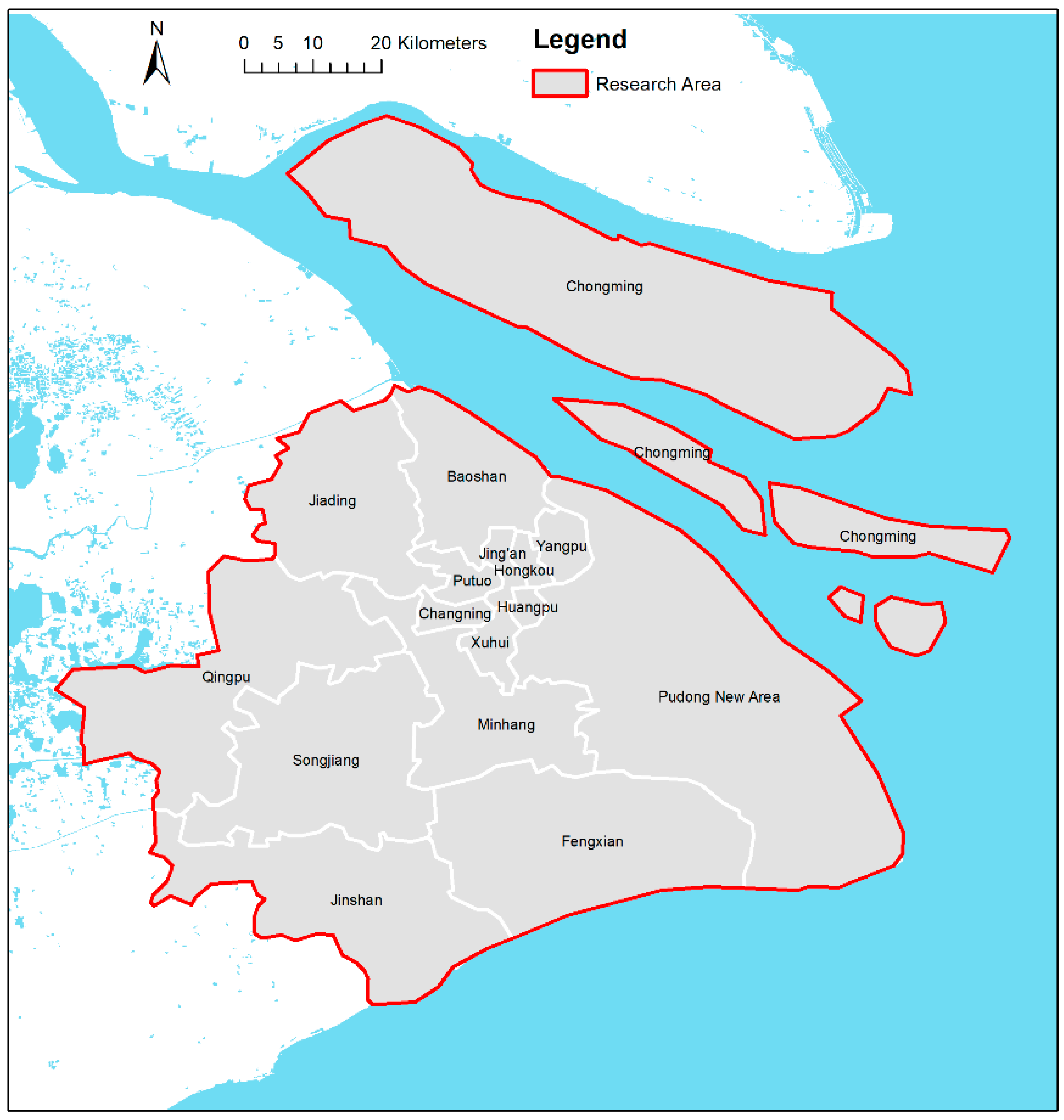
Shanghai Municipality is situated in eastern China at the Yangtze River estuary and administers 16 districts (as shown in Figure 1), with approximately 24.87 million residents [21]. As a global financial centre with a polycentric, clustered spatial structure and a ring-and-radial road network, Shanghai shares the defining characteristics of megacities: high population density, intensive overlap of people and buildings, mixed land use, and heavy traffic. These features render the city representative for investigating fire safety challenges in global megacities.
Fires in key units of fire safety, such as large shopping malls, stadiums, transport hubs, high-rise buildings or underground structures, can readily generate cascading risks across areas. As a global megacity, Shanghai faces substantial fire safety challenges, with 15,191 fires reported in 2024 [22]. Other major global megacities also report considerable fire incident volumes, including 4330 in Tokyo [23], 5222 in Hong Kong [24], and 16,164 in London [25]. Despite differences in statistical standards, these figures reflect the scale of fire safety pressures confronting megacities worldwide.
With the continuous growth in vehicle ownership, Shanghai’s congestion index during morning peak periods ranks among the top ten in China [26]. Factors such as traffic accidents and roadworks frequently cause traffic disruptions, making traffic-induced rescue delays a key focus of fire service research. The average arrival time of fire vehicles within Shanghai’s Outer Ring Road was approximately 8.67 min [27], failing to meet the 5 min response target specified in China’s national standard GB 51080-2015 Code for Planning of Urban Fire Control [28]. A comprehensive assessment of fire service accessibility to Shanghai’s key units of fire safety under dynamic traffic conditions for weekdays, weekends and holidays, therefore, not only tests the municipality’s emergency response capability but also provides a transferable reference for holistic dynamic assessments of fire service accessibility in other megacities with similar urban structures.

3. Methodology

3.1. Research Strategy

The core strategy of this study involves utilising map APIs and urban public data platforms to obtain location data for fire stations and key units of fire safety. Response times are derived through map route planning tools, enabling analysis of fire service accessibility under real-time traffic conditions.
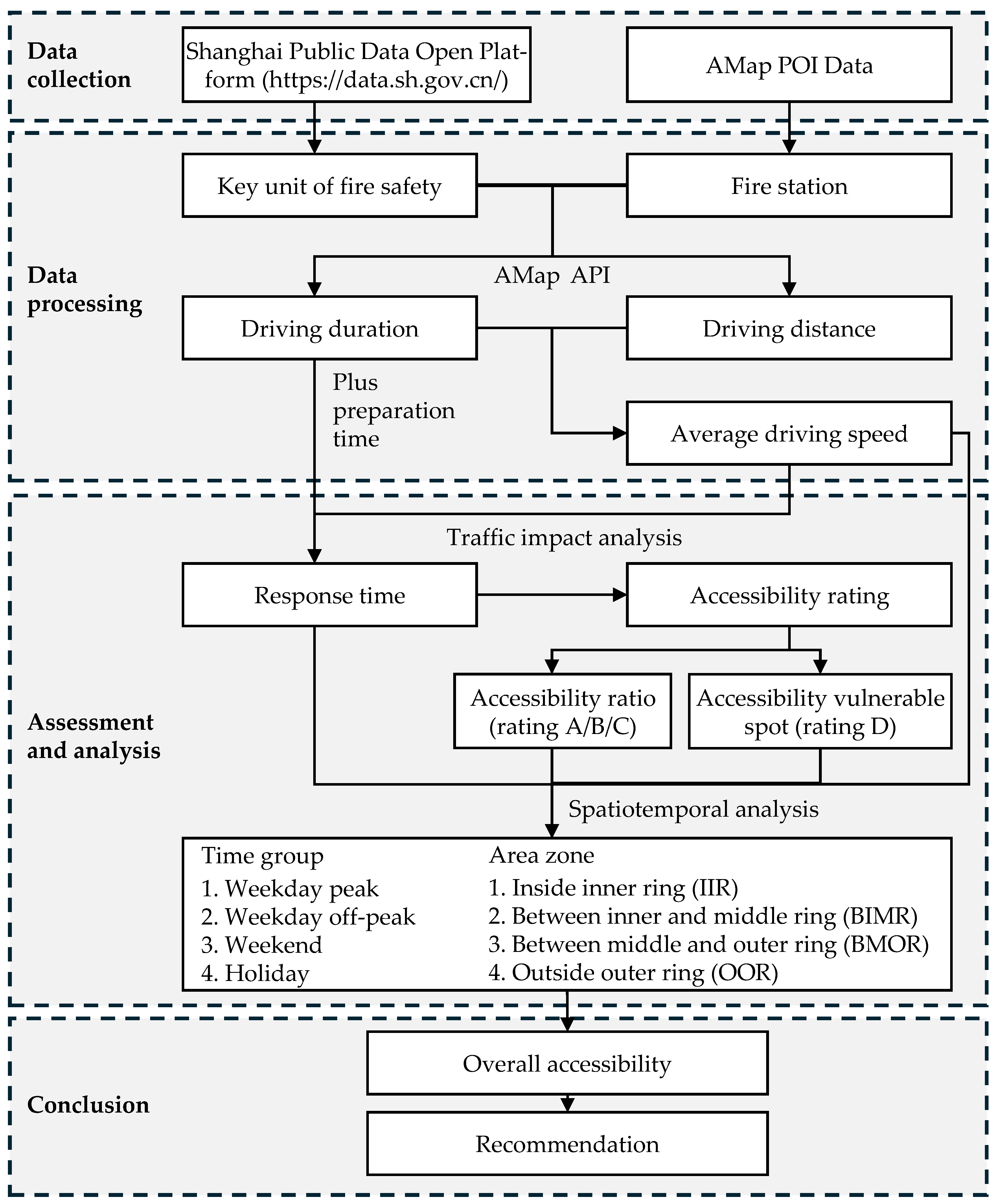
Specifically, step one retrieves the addresses of key units of fire safety from the Shanghai Open Data Platform and the locations of existing fire stations from the AMap POI database. Step two queries the AMap Route API to compute driving duration and distance between each fire station and key unit of fire safety as start and end points and to derive average driving speed for subsequent traffic impact analysis; one minute is added to the driving duration to account for dispatch preparation, yielding the response time. Step three classifies response times into four ratings—A, B, C, and D—based on 5/10/15 min thresholds, in accordance with China’s national standards, thereby identifying vulnerable spots beyond 15 min and measuring accessibility ratio within 5/10/15 min. Step four groups and zones the data for spatiotemporal analysis, considering temporal factors such as peak hours, weekends, and public holidays, alongside spatial factors including inner, middle, and outer ring road structures. Step five aggregates all results to present citywide accessibility findings and offers policy recommendations targeting the principal deficiencies, with modelled overall response times cross-referenced against official fire statistics to verify real-world applicability. Details of each step are illustrated in Figure 2.

3.2. Data Acquisition and Processing

3.2.1. Data Acquisition

This study requires data on fire stations, key units of fire safety, and real-time traffic conditions between them. Data are acquired as follows. First, fire station locations are primarily sourced from AMap’s POI database and cross-validated with information published on the fire department website and satellite imagery. After excluding marine stations, 195 urban public fire stations operational as of April 2025 are retained. Their addresses are geocoded into coordinates using the AMap geocoding API, with the parameter city = Shanghai to constrain the search scope. Second, the key units of fire safety are sourced from the Shanghai Open Data Platform, yielding 7973 addresses for such units for the year 2025. These addresses are likewise geocoded through the AMap geocoding API. Third, real-time traffic data are obtained via the AMap driving direction API with the parameter strategy = 10, which returns routes that avoid congestion, prioritise shorter distances, and minimise travel time. API requests specify fire station coordinates as origins and key unit coordinates as destinations, returning driving duration and distance for route calculation. The average driving speed is then calculated based on these metrics. All procedures are implemented in ArcGIS 10.5 and the AMap API Web service (v4.2.0) using Python (v2024.2.1) within Visual Studio Code (v1.92.2).
This study adopts a nearest-station dispatch logic whereby each key unit of fire safety is assigned to the fire station with minimum driving time, reflecting proximity-based response rather than jurisdictional boundaries. Station availability is assumed constant—that is, each station maintains at least one deployable fire vehicle upon alarm receipt, with concurrent incident depletion excluded from modelling due to data unavailability.

3.2.2. Assessment Time and Grouping

To capture disparities between weekday and holiday traffic patterns, this study selects the period from 00:00 on 4 April 2025 to 23:00 on 13 April 2025 as the assessment period. Within this timeframe, 4 to 6 April constitutes the Chinese public holiday Qingming Festival, 7 to 11 April are regular weekdays, and 12 to 13 April represents the weekend. This 10-day assessment window is designed to balance two objectives: capturing distinct traffic regimes (weekday commuting and weekend and holiday leisure travel) and ensuring API data stability through a continuous short-term query period. Assessment points are established at hourly intervals throughout the period, yielding a total of 240 assessment moments. Each moment comprises 7973 origin–destination pairs, resulting in a cumulative total of 1,913,520 samples for the entire dataset. This dataset enables spatiotemporal comparisons across distinct daily contexts, with hourly intervals adopted to characterise the dominant diurnal and hourly patterns of emergency accessibility under constraints of computational feasibility and limited research resources. To facilitate comparative analysis, these periods are aggregated into four temporal groups based on traffic regime. Assessment dates are first grouped by weekday, weekend, and public holiday to analyse the impact of weekend and holiday travel patterns. To further examine the impact of commuter traffic, the weekday periods are subdivided according to Shanghai’s traffic restriction regulations into peak periods (encompassing both the morning peak from 07:00 to 09:00 and the evening peak from 17:00 to 19:00) and off-peak periods. This yields four groups: weekday peak, weekday off-peak, weekend, and holiday.

3.2.3. Assessment Area and Zoning

The scope of this study covers the entire administrative territory of the Shanghai Municipality. To examine spatial heterogeneity in fire service accessibility, particularly between central urban areas and suburban areas, the scope is divided into four spatial zones based on Shanghai’s road network structure: the zone inside the inner ring (IIR); the zone between the inner and middle rings (BIMR); the zone between the middle and outer rings (BMOR); and the zone outside the outer ring (OOR). Furthermore, to identify clusters of poorly accessible key units of fire safety, kernel density analyses are performed, and the results are visualised using the Natural Breaks (Jenks) classification method.

3.3. Assessment Methods and Indicators

3.3.1. Accessibility Rating

According to China’s national standard GB/T 40947-2021 Guide for Safety Resilient City Evaluation [29], the average response time from alarm receipt to scene arrival is evaluated in 5/10/15 min intervals. GB 51080-2015 Code for Planning of Urban Fire Control [28] specifies a 5 min response time, comprising 1 min for dispatch upon instruction and 4 min for vehicle travel to the scene. To quantify fire service accessibility, this study references these national standards and incorporates studies on the relationship between response times and fire losses [30,31,32], classifying accessibility into four rating levels based on response times, as detailed in Table 1.

3.3.2. Response Time and Traffic Impact

This study assesses fire service accessibility using average response time as the primary metric, supplemented by average driving speed for traffic impact analysis. Response time is the key index for assessing fire service accessibility, directly determining the success of initial fire suppression and casualty control. When examined across spatiotemporal dimensions, it reflects the city’s overall fire-rescue effectiveness. Average driving speed dynamically characterises road network efficiency in supporting rescue operations. Together, these metrics form the core assessment framework for fire service accessibility under traffic constraints, revealing how road network variability affects emergency response capacity. Results are visualised using colour-coded accessibility rating maps (red, orange, yellow, blue) and time-series graphs.
Consider a city with m fire stations as service supply points and n key units of fire safety as demand points. For k consecutive assessment moments, the response time T i t j and driving distance D i t j between the i -th key unit of fire safety and its nearest fire station with the shortest driving time are determined at the j -th assessment moment. Response time T i t j is defined as the driving duration plus a 1 min preparation time. The average response time T t j , A A and average driving speed v t j , A A of the n key units of fire safety at t j are calculated using Equations (1) and (2).
T t j , A A = 1 n i = 1 n T i t j
v t j , A A = 1 n i = 1 n D i t j T i t j
To align with the continuous nature of time in real-world scenarios, the time-weighted approach is employed to calculate the average response time T i , T W A and average driving speed v i , T W A for the i -th key unit of fire safety across the k assessment moments. Given the uniform assessment time intervals in this study, these metrics can be simplified to a uniform time linear average and are calculated using Equations (3) and (4).
T i , T W A = 1 2 k 1 j = 1 k 1 T i t j + T A t j + 1
v i , T W A = 1 2 k 1 j = 1 k 1 D i t j T i t j + D i t j + 1 T i t j + 1
To quantitatively characterise the sensitivity and marginal change pattern of response time with respect to traffic conditions, a descriptive traffic impact elasticity E T I is defined as the percentage change in the average response time per 1% change in the average driving speed, calculated using Equation (5). Here, T A A , b a s e and v A A , b a s e represent the average response time and average driving speed during the baseline period, while Δ T A A and Δ v A A denote the differences in these metrics between the comparison and baseline periods. As a descriptive elasticity, this index reflects how sensitively emergency response time reacts to variations in traffic speed. A higher value indicates greater sensitivity.
E T I = Δ T A A / T A A , b a s e Δ v A A / v A A , b a s e

3.3.3. Calculation of Accessibility Ratio Under Various Ratings

In this study, accessibility ratings for levels A, B, and C are calculated based on the average response times for each key unit of fire safety, to assess accessibility under the 5/10/15 min standards.
The number of key units of fire safety with accessibility level r at moment t j is denoted as P a t j . The accessibility ratio R t j , r for level r at this moment is calculated using Equation (5) as the ratio of units achieving accessibility r to the total number of units. This enables calculation of the fire service accessibility ratio at this moment under various standards: 5 min (A), 10 min (B), and 15 min (C).
R t j , r = P a t j n ,   r = A ,   B ,   C
For the key unit of fire safety i , the number of moments satisfying accessibility level r across k moments are denoted as P a i . The accessibility ratio R i , r for this unit at level r is determined using Equation (6) as the ratio of moments satisfying level r to the total number of moments. This enables calculation of the fire service accessibility ratio for this unit under various standards: 5 min (A), 10 min (B), and 15 min (C).
R t j , r = P a t j n ,   r = A ,   B ,   C
Furthermore, to facilitate comparison, the accessibility ratio for level D is also calculated to examine inaccessibility beyond 15 min.

3.3.4. Calculation of Accessibility Vulnerable Spot

In this study, key units of fire safety classified as accessibility rating D, i.e., those with response times exceeding 15 min, are defined as accessibility vulnerable spots. Identifying these spots and analysing their spatiotemporal clustering reveal weaknesses in fire-rescue capabilities at different times and locations, providing evidence for resource allocation and efficiency improvements.
Temporally, the average response time for all key units of fire safety citywide and within the four spatial zones is assessed at each moment, enabling identification and analysis of temporal vulnerable spots (i.e., vulnerable moments) for fire service accessibility across the city and within different zones. Results are visualised using scatter plots.
Spatially, the average response time for each key unit of fire safety across all moments within the assessment period and for the four temporal groups is assessed, enabling identification and analysis of spatial vulnerable spots (i.e., vulnerable locations) for fire service accessibility across the assessment period and for different groups. Results are visualised using GIS maps.
Correspondingly, changes in average driving speed are analysed to examine how traffic conditions affect response time both spatially and temporally.

3.3.5. Calculation of Overall Assessment of Accessibility

Based on the methods described in Section 3.2 and Section 3.3, the overall fire service accessibility of Shanghai is assessed comprehensively. This involves calculating the average response times and average driving speeds for all 7973 key units of fire safety across all 240 moments within the assessment period. By overlaying temporal and spatial data and calculating accessibility ratios for each rating level, the overall accessibility outcomes for fire response to Shanghai’s key units of fire safety are derived.

4. Results and Analysis

4.1. Distribution and Matching of Fire Stations with Key Units of Fire Safety

The average service area of fire stations exhibited a gradient pattern increasing from central Shanghai towards the suburbs, as detailed in Table 2. In accordance with China’s national standard GB 51080-2015 Code for Planning of Urban Fire Control [28], the service area for general fire stations should not exceed 7 km2, while that in urban fringe areas and new districts should not exceed 15 km2. Apart from the OOR zone, other zones generally complied with these requirements.
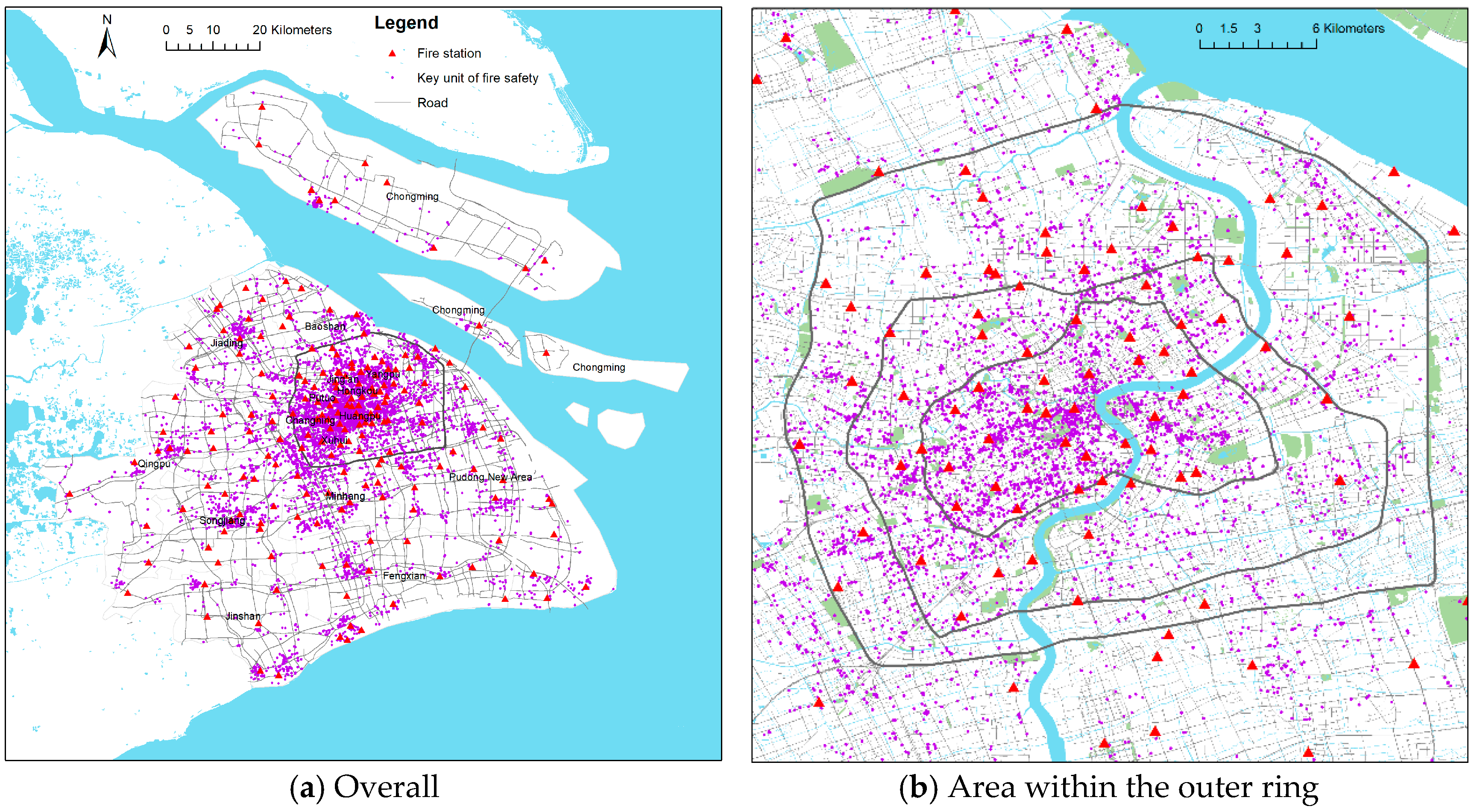
In terms of spatial distribution, the OOR zone hosted the highest number of fire stations and key units of fire safety citywide, with 122 and 3471, respectively, while the BIMR zone had the lowest number, with 21 fire stations. Detailed figures are presented in Table 2. Regarding key units of fire safety, their spatial distribution showed an overall gradient decreasing from the city centre towards the suburbs, exhibiting a pattern of widespread dispersion with localised clustering. Specific details are illustrated in Figure 3. Table 2 indicates that all zones except the OOR zone exhibited a higher density of key units of fire safety than the citywide average, with the IIR zone being particularly notable. Regarding the match between fire stations and key units of fire safety, the IIR zone had the highest number of units served per station, at 78.22 units/station. Apart from the OOR zone, all other zones had a higher number of units served per station than the citywide average of 40.89 units/station, while also exhibiting a gradient decreasing from the city centre to the suburbs.
Thus, the average service area of fire stations in Shanghai generally complied with China’s national standards. The spatial distribution of fire stations was consistent with that of key units of fire safety.

4.2. Response Time and Traffic Impact

The average response time for key units of fire safety in Shanghai varied significantly across different zones and moments, following a general spatial gradient characterised by faster times in central zones and slower times in suburban zones. The maximum average response time was 665.51 s, recorded in the OOR zone during weekday peak, while the minimum was 470.80 s, recorded in the IIR zone during weekday off-peak. Detailed results are presented in Table 3.
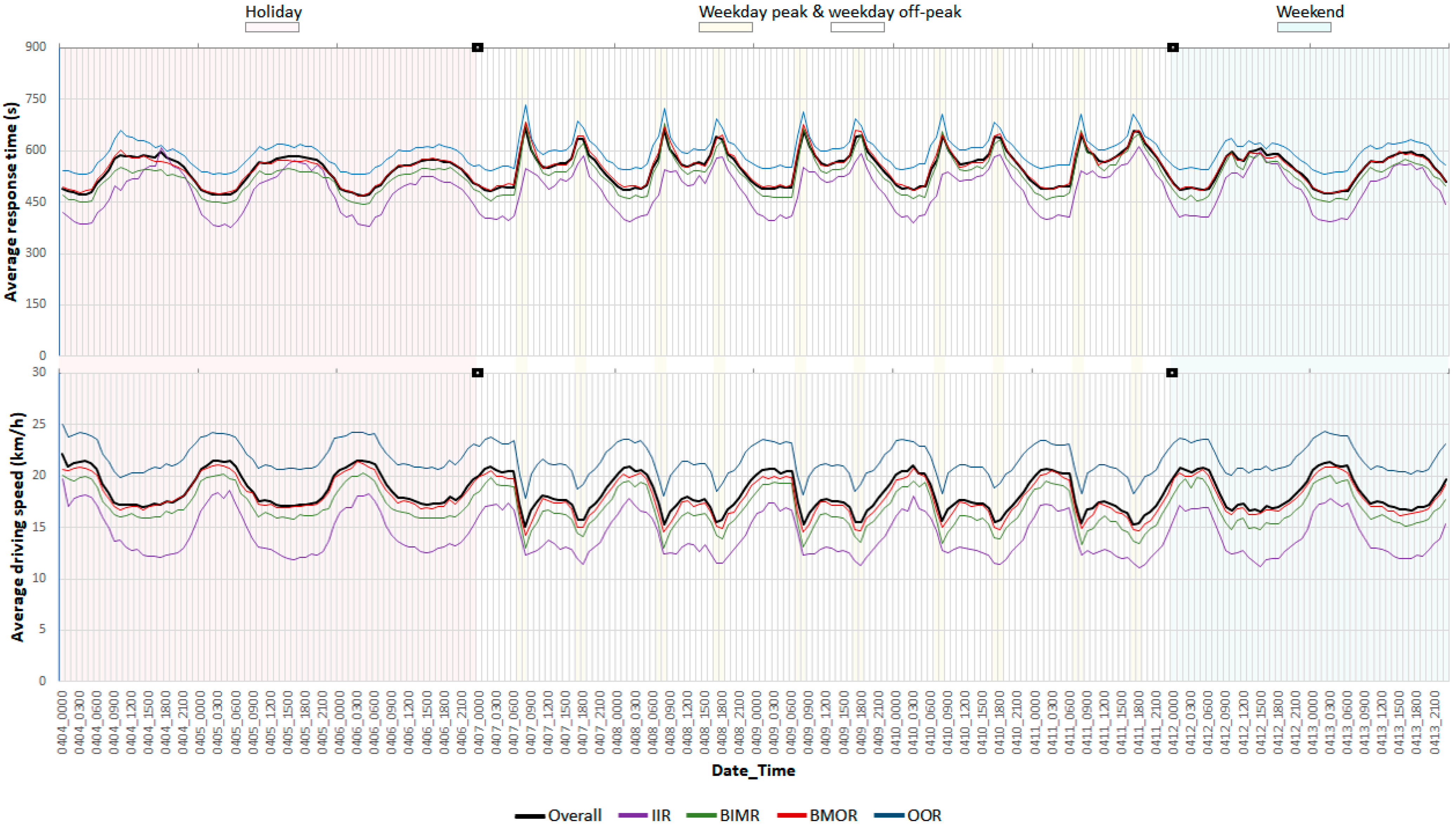
The curves of average response time and average driving speed in Figure 4 show that throughout the assessment period, except for the 14:00–22:00 timeframe on the two days preceding the public holiday, the driving speed in the IIR zone was the slowest among the four zones, but its corresponding response time was almost the fastest.
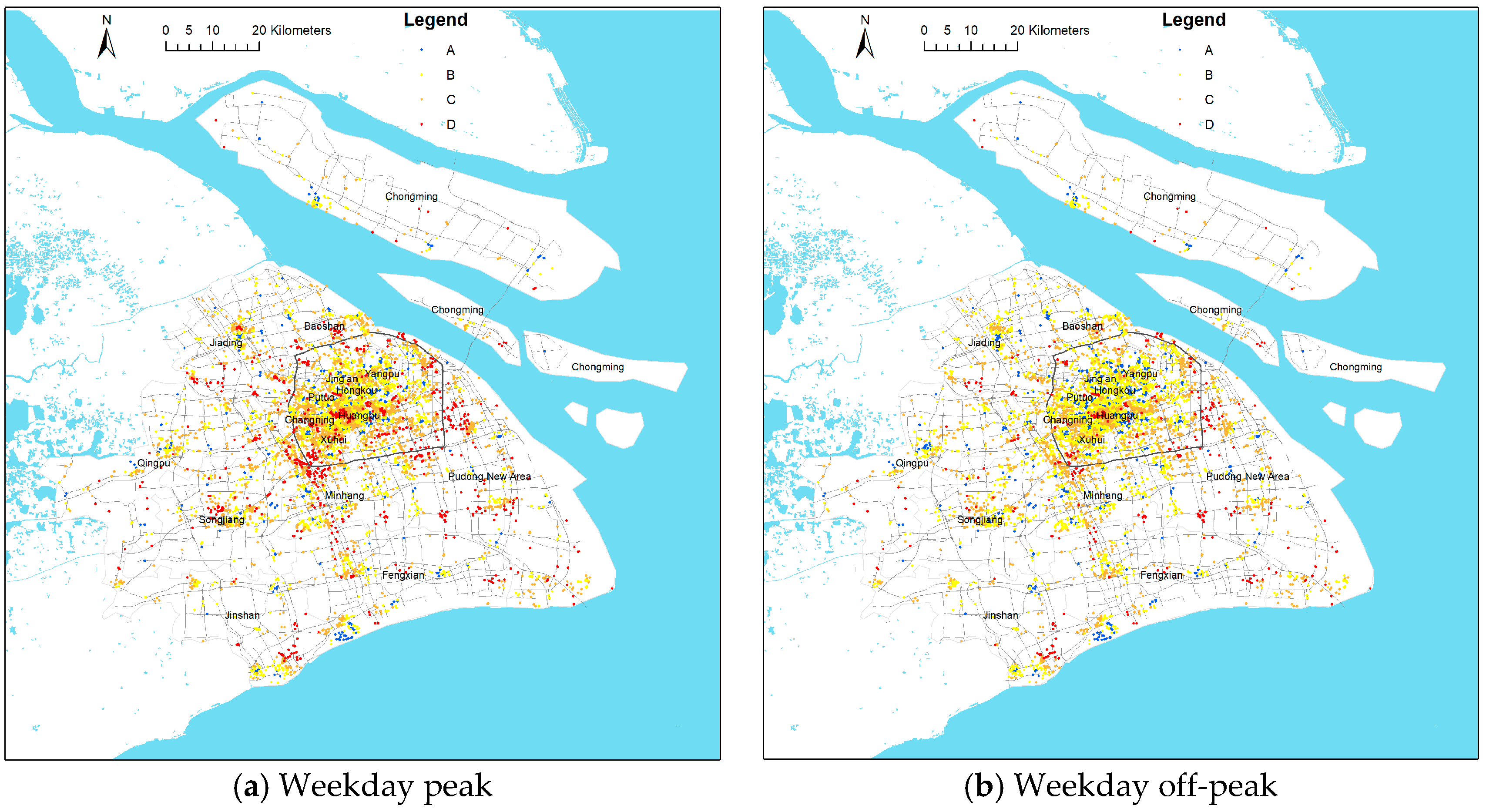
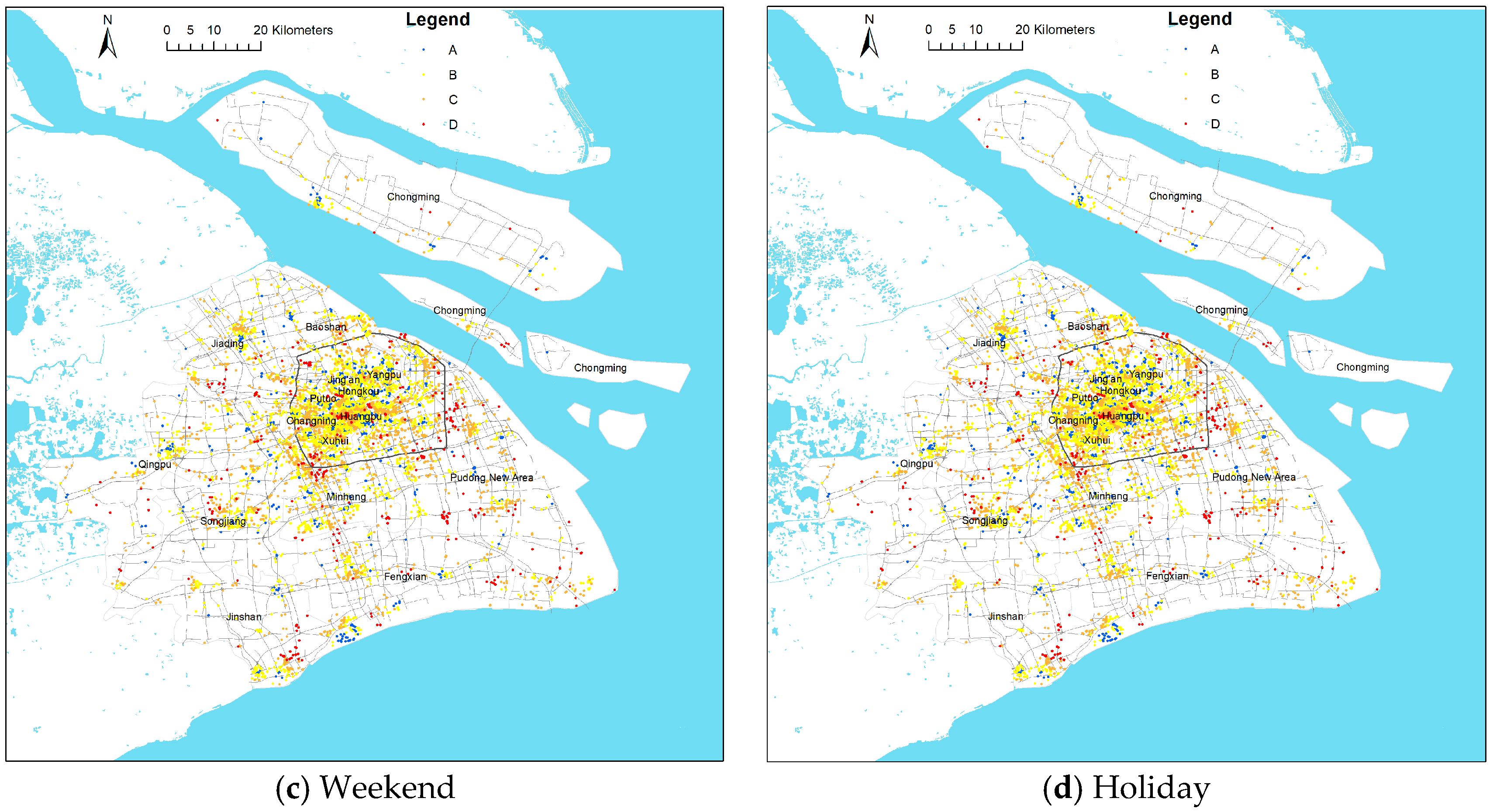
Analysis of Figure 4 and Figure 5 reveals that citywide response times for the weekend and holiday were similar, with peaks and troughs both falling within the 485 s–595 s range, and their peak values were significantly lower than those for the weekdays. In both temporal and spatial dimensions, their patterns were notably similar. Further analysis indicated that the response time peaks during the weekday off-peak fell within the 480 s–580 s range, closely matching response times during the weekend and holiday.
As shown in Table 4, the traffic impact elasticity coefficient progressively decreased from the IIR zone to the OOR zone, aligning with the spatial diminishing pattern of response times being ‘faster in central zones and slower in suburban zones’. Of these temporal groups, the traffic impact was greatest during the weekday peak, especially in the central urban area within the IIR zone, where the coefficient was highest at 0.780, rendering response time highly sensitive to traffic improvements. However, analysis of Figure 4 shows that traffic improvements had a limited optimisation effect on response times, and even without weekday peak congestion, the citywide average response time remained above 300 s.

4.3. Accessibility Ratio Under Various Ratings

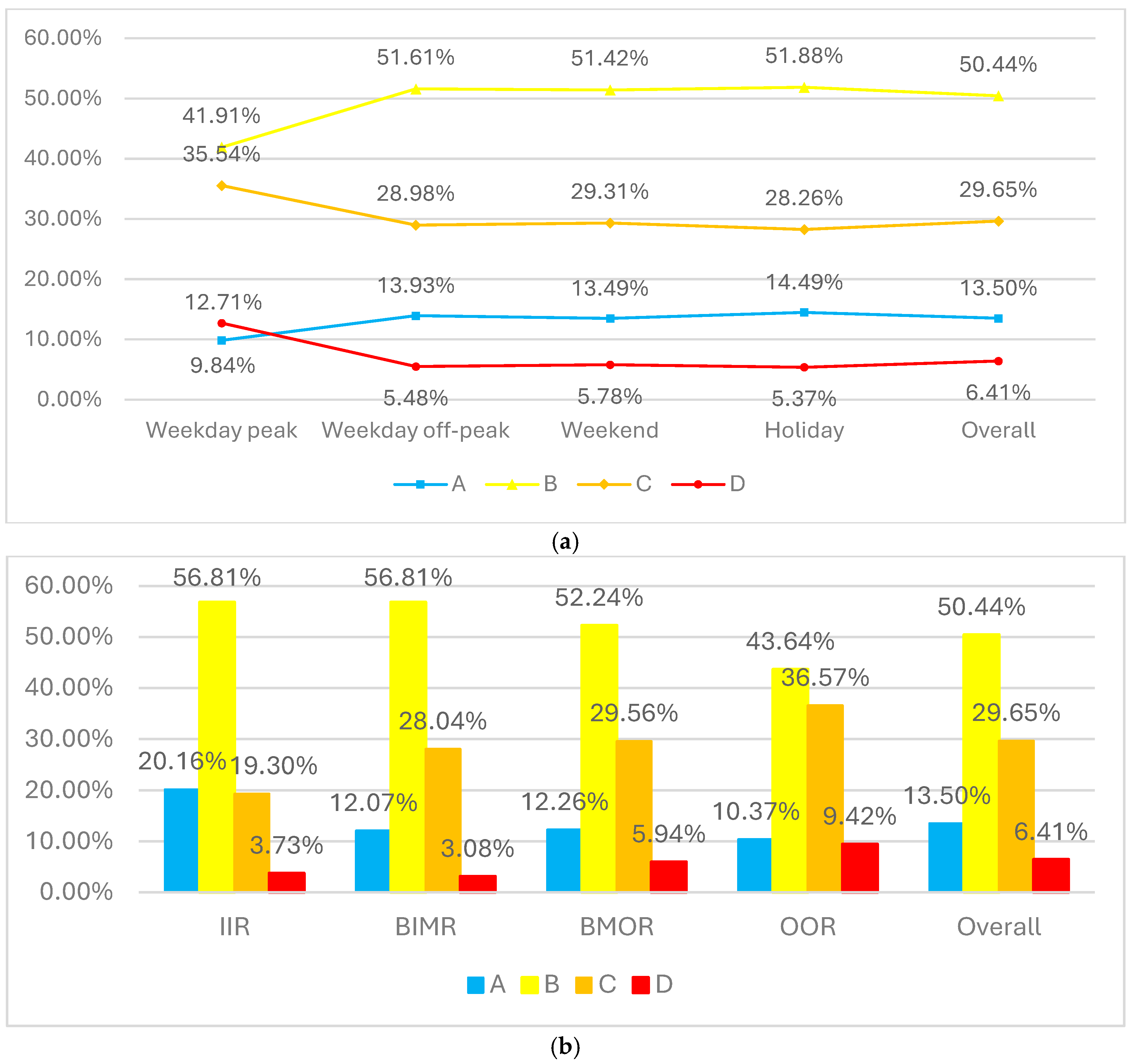
The fire service accessibility ratios for key units of fire safety are detailed in Table 5. The citywide accessibility ratio for level A was 13.50%, while that for level B was the highest across all levels at 50.44%. The gross accessibility ratio (levels A + B + C combined) totalled 93.59%. Based on these overall results, accessibility ratios were calculated separately for different moments and zones for detailed spatiotemporal analysis.
Temporal accessibility ratios were derived from the average response times for each key unit of fire safety. Overall, accessibility ratios exhibited a gradient pattern: holiday > weekday off-peak > weekend > weekday peak. As shown in Figure 6a, accessibility ratios for levels A and B followed similar trends, being higher during weekday off-peak, weekend, and holiday periods, and lowest during the weekday peak. Conversely, the accessibility ratio for level C was highest during the weekday peak and lower in the other three groups.
Spatial accessibility ratios were derived from the average response times for key units of fire safety at each assessment moment. Overall, accessibility ratios exhibited a pattern of initial increase followed by a decrease from inner to outer rings. As illustrated in Figure 6b, moving from the IIR zone towards the suburbs, the accessibility ratio increased slightly, resulting in the BIMR zone having the highest accessibility ratio among the four zones. However, further outwards, the accessibility ratio decreased in both the BMOR and OOR zones, with a more prominent decline in the outer zones.

4.4. Accessibility Vulnerable Spot

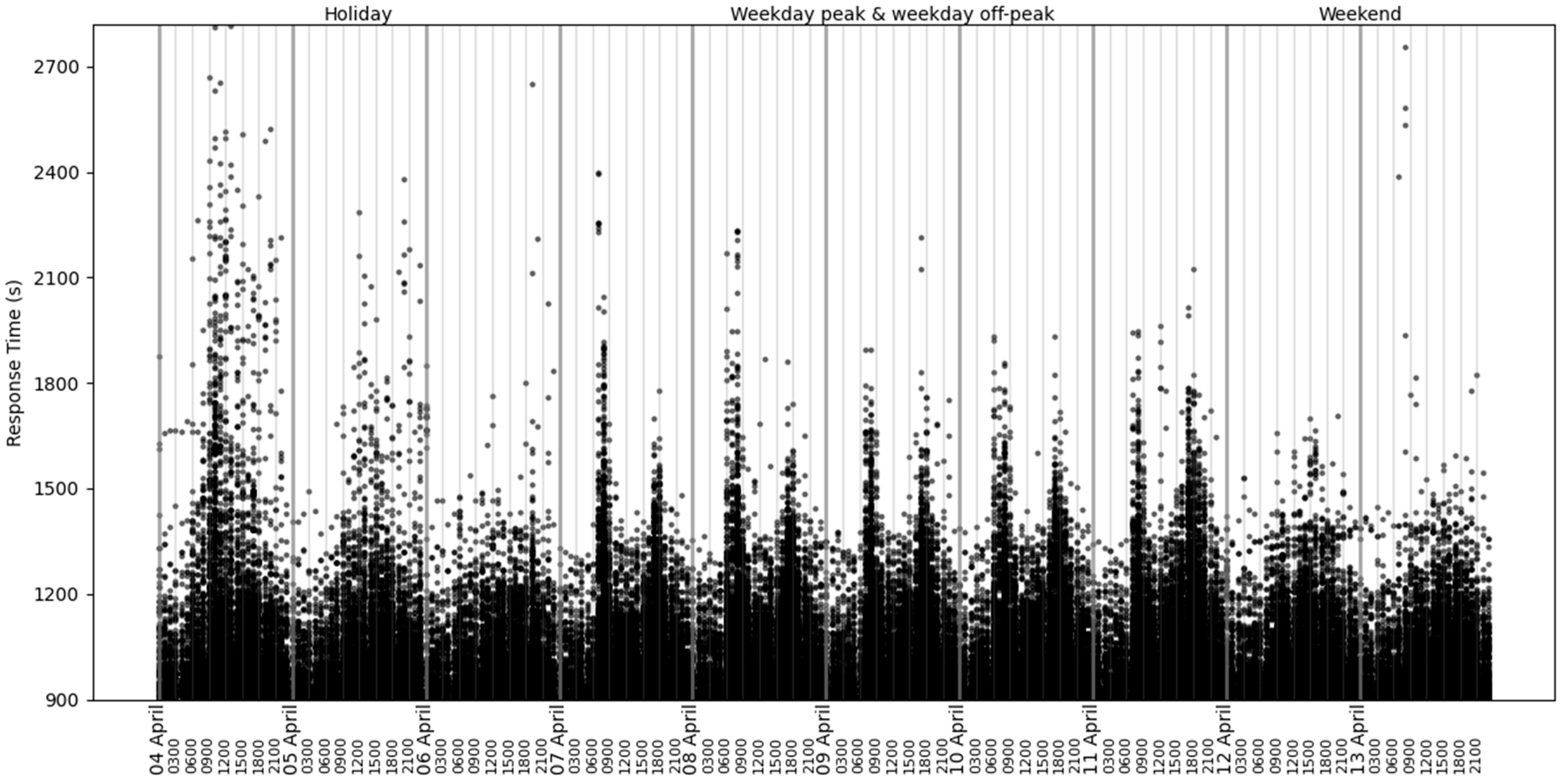
The temporal vulnerable spots were determined by calculating the average response time of all key units of fire safety at each moment within the assessment period. As shown by the scatter plot in Figure 7, the distribution of temporal vulnerable spots exhibited two distinct patterns: a ‘bimodal (M-shaped)’ pattern formed by the combined effects of weekday peak and weekday off-peak periods, and a ‘unimodal (A-shaped)’ pattern with a peak between 12:00 and 15:00, observed similarly during the weekend and holiday.
During the weekday, the morning peak (07:00–09:00) and evening peak (17:00–19:00) generated two converging peaks. The Monday morning and Friday evening peaks showed significantly higher convergence, while weekday off-peak periods showed lower convergence. The combined distribution of vulnerable spots in peak and off-peak periods created the bimodal (M-shaped) pattern.
During the holiday, the first day showed markedly higher convergence, which weakened over the subsequent two days. The vulnerable spots for all three days were concentrated between 09:00 and 18:00, forming an A-shaped pattern. The convergence of vulnerable spots on the weekend resembled that on the holiday but with lower peaks.
From the results in Section 4.2, average response times during the holiday were lower than during the weekdays. However, the scatter plot generated for each response time shows that the holiday had a wider distribution of vulnerable spots and higher extremes, indicating a greater threshold for response times.
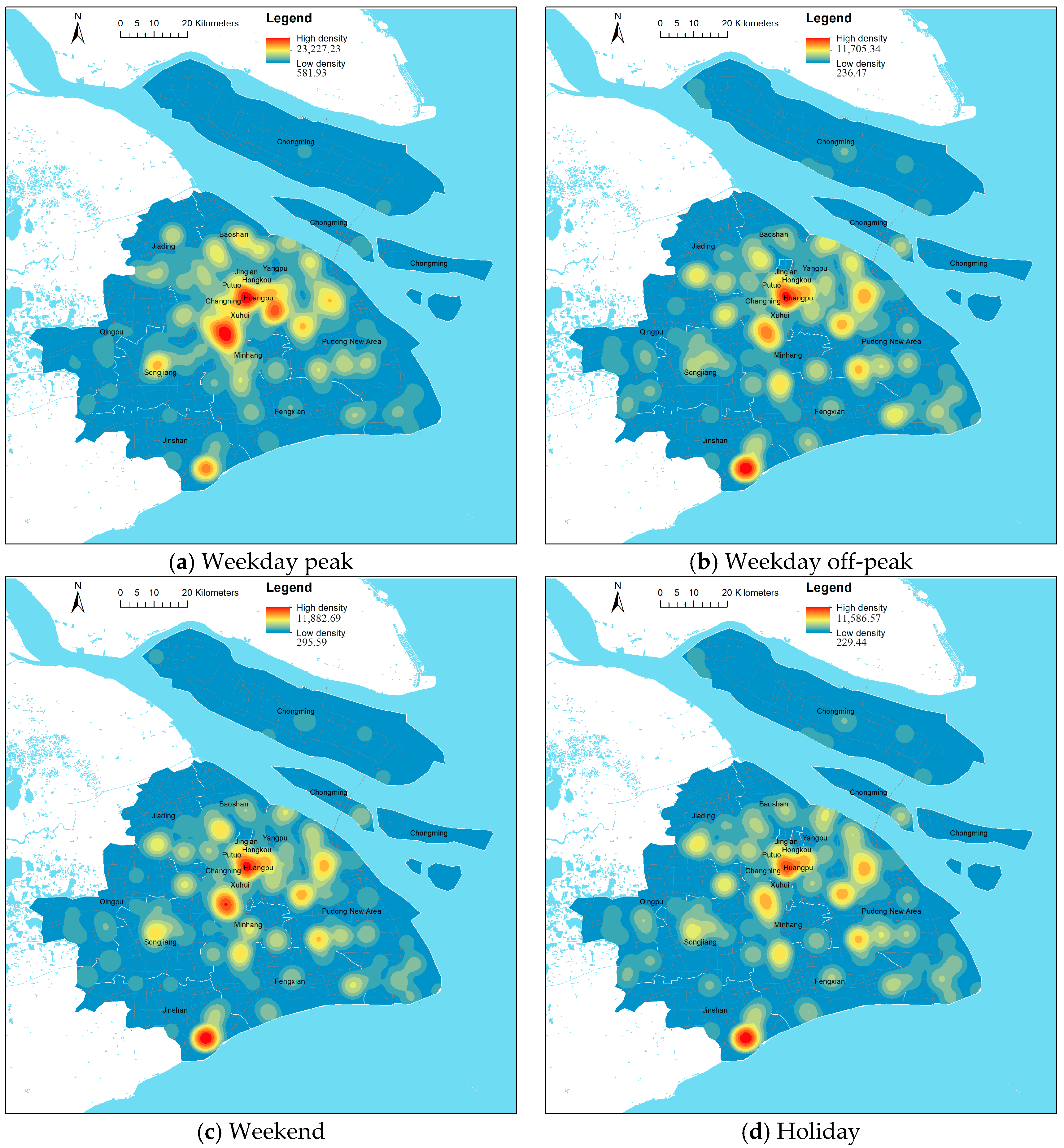
The spatial vulnerable spots were determined by calculating the average response time of each key unit of fire safety across all moments within the assessment period. Analysis of the kernel density map in Figure 8 reveals a dual-pattern distribution of vulnerable spots across different time groups: contiguous clusters in central urban areas versus multi-core dispersion in suburban areas.
In the OOR zone representing outer suburbs, the convergence of vulnerable spots was relatively separate: The university town in central Songjiang District showed convergence during the weekday peak and weekend, with reduced convergence in other periods. Xinzhuang in central Minhang District exhibited enhanced convergence during the weekend compared with the weekday off-peak and holiday, while weekday peak showed a more pronounced convergence increase relative to the weekend. Kangqiao and Tangzhen, alongside Xinchang in northern and central Pudong New Area, showed similar convergence during weekday off-peak, weekend, and holiday, with reduced convergence during weekday peak, particularly pronounced in Xinchang. Shanyang in the southeastern Jinshan District exhibited reduced convergence during weekday peak compared with other periods. This pattern of reduced convergence during weekday peak resembled Pudong New Area’s suburban pattern, differing from suburban counterparts in Minhang District and Songjiang District.
The vulnerable spots across the IIR, BIMR and BMOR zones formed relatively contiguous convergences: the core urban centre formed by Huangpu, Xuhui and Jing’an districts, alongside Lujiazui in Pudong New Area, exhibited convergence at all moments, with significantly heightened convergence during weekday peak.

4.5. Overall Assessment of Accessibility

Overall analysis indicates that Shanghai’s fire service accessibility failed to meet China’s five-minute response standard, exhibiting pronounced spatial heterogeneity characterised by ‘faster in the centres and slower in the suburbs’ alongside periodic temporal fluctuations where ‘holidays show the best performance while weekday peak hours present the worst’. Specifically, the citywide average response time during the assessment period was 548.62 s, falling short of the five-minute requirement stipulated in China’s standard GB 51080-2015 Code for Planning of Urban Fire Control. Spatially, response times increased progressively from the urban core to suburban areas, with a disparity of approximately 110 s between the IIR and OOR zones, highlighting a marked urban–suburban heterogeneity. Temporally, the 5 min accessibility ratio exhibited systematic disparities across different periods, with the following hierarchical order: holiday > weekday off-peak > weekend > weekday peak, reflecting the direct impact of traffic conditions on fire-rescue efficiency. This modelled citywide average of 548.62 s (9.14 min) corresponds well with the official reported response time of 8.67 min [27], indicating that the model reasonably approximates actual response performance.
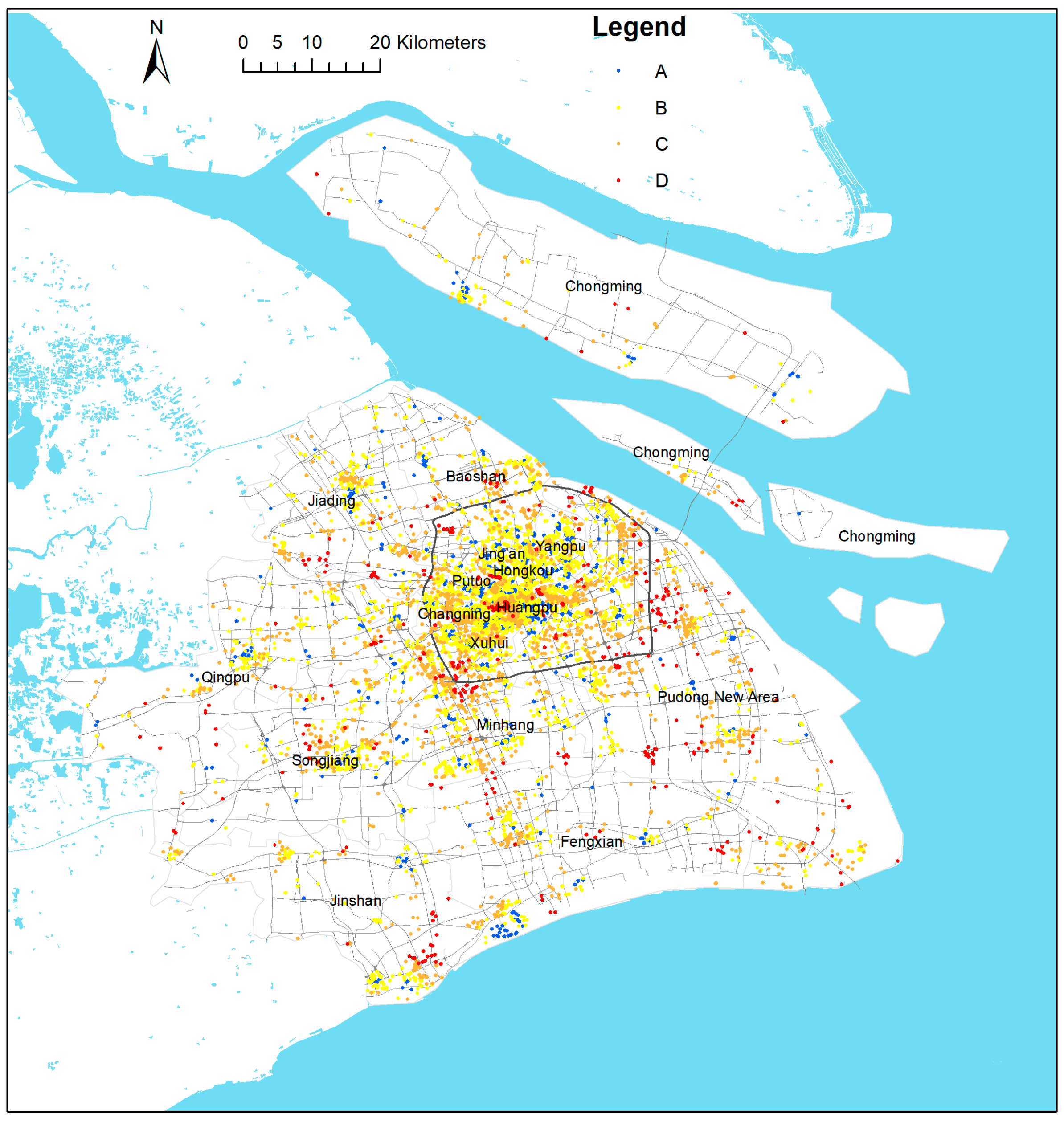
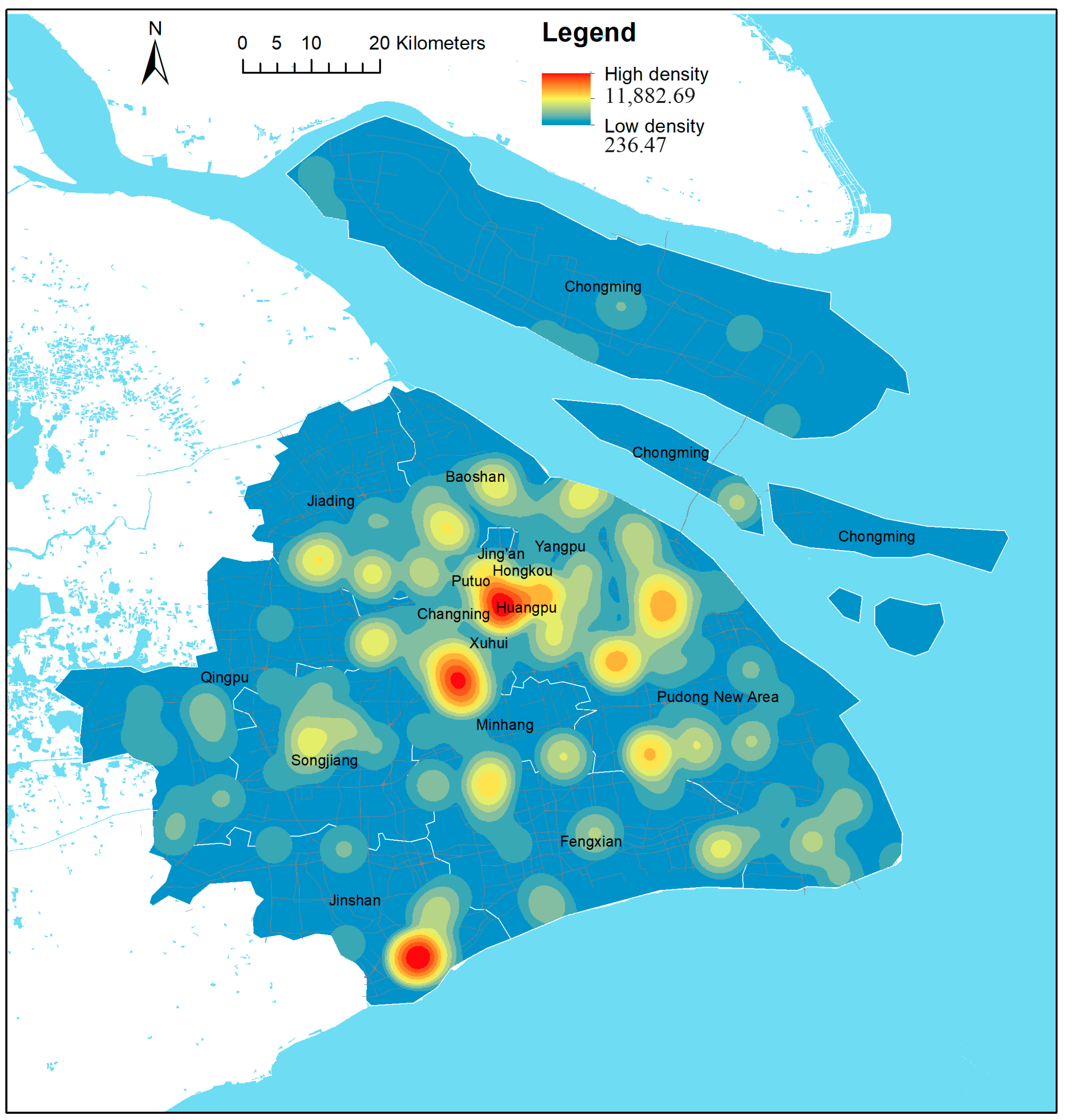
Fire station layout is a key determinant of accessibility patterns. As illustrated in Figure 3 and Figure 9, areas with relatively good accessibility were largely adjacent to fire station clusters. Conversely, as detailed in Figure 10, accessibility vulnerable spots with response times exceeding 15 min exhibited an aggregation pattern of ‘contiguous clusters in the centres and multi-core dispersion in the suburbs’, specifically concentrated in the Huangpu–Xuhui–Jing’an junction, central Minhang and southeastern Jinshan. These vulnerable spots exhibited periodic temporal fluctuations: during weekday evening peak hours, an ‘M-shaped’ pattern emerged, whereas weekends and holidays revealed a daytime ‘A-shaped’ pattern, demonstrating the differential impact of commuting versus leisure activities on fire-rescue efficiency across different zones.

5. Discussion

5.1. Response Time and Traffic Impact

This study, by building a fire service accessibility assessment system for key units of fire safety in Shanghai, reveals two critical correlations between traffic conditions and response times.
First, the impact of traffic on response times varied significantly between urban and suburban areas. This was primarily manifested in the finding that although the average driving speed in the IIR zone was the lowest among the four area zones, its response time was the shortest. It aligns with the findings of Kc and Corcoran [33] in Brisbane, Australia, where emergency fire responses are quicker in inner urban areas than those in the outer peri-urban locales, indicating that the distance advantage afforded by the smaller average rescue radius of fire stations in central urban areas sufficiently offsets the speed disadvantage caused by traffic congestion. Whereas, the optimising effect of traffic improvements on response times diminished progressively from the IIR zone to the OOR zone. The underlying mechanism lies in the higher baseline driving speeds in suburban areas, where congestion-induced speed losses are relatively smaller than in the city centre. This spatial imbalance in fire service accessibility aligned with findings from studies in cities such as New York and Nanjing, China [12,34]. These results suggest that urban traffic intervention strategies should be tailored to local conditions and implemented on a zone-by-zone basis. For instance, in central urban areas, measures such as green wave coordination and fire vehicle priority can effectively reduce response times. In suburban areas, however, the cost-effectiveness of similar investments is relatively low. In the long term, a more effective approach is to directly shorten the rescue radius by establishing additional fire stations, including converting existing facilities into fire stations or constructing new sites where land availability and other conditions permit.
Second, improvements in traffic conditions exhibited diminishing marginal returns when optimising response times. The highly overlapping response time ranges of weekend, holiday, and weekday off-peak primarily reflected the peak suppression effect on weekday peak congestion. This demonstrated that weekday peak traffic congestion constituted the major constraint on fire service accessibility and that once this congestion was alleviated, response times reverted to similar normal levels. Nevertheless, even without weekday peak congestion, the citywide average response time still exceeded five minutes. Through segmented regression analysis, when the citywide average driving speed improved to thresholds of 13.7–21.0 km/h or higher, further speed gains contributed little to reducing response times. At this stage, the dominant factors determining response times shifted from traffic conditions to the density of fire station distribution and their distance from incident locations. This aligns with findings from Brent and Beland [2] in California, namely, policies aimed at mitigating traffic congestion, such as toll roads and public transport, had little significance in improving emergency response times. Together, these findings confirm that traffic improvement alone has a limited impact on emergency response. Therefore, to enhance fire service accessibility, it is recommended to adopt a multi-pronged approach that combines short-term non-structural measures in traffic management and policy alongside long-term structural measures such as optimising fire station layouts and road networks.

5.2. Spatiotemporal Characteristics of Accessibility Ratio

This study reveals distinct spatiotemporal characteristics of fire service accessibility ratios in Shanghai: a temporal gradient and spatial nonlinearity.
Temporally, accessibility ratios followed a gradient decreasing pattern: holiday > weekday off-peak > weekend > weekday peak. Traffic congestion during weekday peaks reduced the 5 and 10 min accessibility ratios. Yet, once outside peak periods, alleviated traffic pressure significantly enhanced the accessibility ratios regardless of whether it was during weekday off-peak, weekend or holiday, creating a dynamic pattern of ‘decreasing on weekday and increasing on holiday’.
Spatially, accessibility ratios did not simply decline from the city centre to the periphery but rather displayed a complex, nonlinear pattern. Among the four zones, the BIMR zone exhibited the highest accessibility ratio. This resulted from its optimal matching of fire station density with the density of key units of fire safety: it avoided both resource overload caused by excessive concentration of key units of fire safety in the IIR zone and increased driving distances resulting from sparse fire station coverage in the OOR zone. This indicates that demand matching, rather than fire station density or rescue distance alone, is the key determinant of accessibility ratios.
By substituting general POI data with key units of fire safety, this study supplemented and refined the POI-based demand assessment framework of Wang, Xu, Sun and Lan [16], making demand definitions better aligned with actual fire risk distribution in megacities. This demand-focused approach suits the risk characteristics of megacities: city centres, with high concentrations of commercial activities and populations, form high-density clusters of key units of fire safety. Despite having the highest fire station density, they still face significant fire resource pressure per unit. While suburban areas, with vast territories and scattered key units of fire safety, experience lower resource pressure per unit, their extended service radius creates vulnerable long-distance coverage gaps.
Moreover, unlike the study of He, Xue, Yang, Ding and Liu [10], which found that 150 fire stations could cover over 90% of Shanghai within a 5 min response time when using incident-based demand assessment, this study employed key units of fire safety as demand points. Results showed that even with Shanghai’s existing 195 fire stations, the 5 min accessibility ratio was only 13.50%. This substantial discrepancy proves that assessment outcomes vary greatly under different demand assumptions. Thus, when providing decision-making support for urban fire planning, it is necessary to move beyond a single-demand perspective. Instead, by integrating fire-prone areas, high-consequence areas, and historically accident-prone locations, a more precise and resilient fire safety assessment system can be built.

5.3. Spatiotemporal Characteristics of Accessibility Vulnerable Spot

The analysis of fire service accessibility vulnerable spots within Shanghai reveals a typical dual spatiotemporal pattern.
Temporally, the distribution of vulnerable spots exhibited fluctuations characterised by a ‘bimodal (M-shaped)’ pattern on weekdays and a ‘unimodal (A-shaped)’ pattern on the weekend and holidays. This M-shaped dual peak caused by congestion during morning and evening commutes reflects the fact that most workplaces, as the main key units of fire safety, concentrate their production and business activities within standard working hours. This dual-peak characteristic aligns with the features revealed in emergency response assessments of cities such as Beijing and Nanjing [12,35]. In comparison, the A-shaped single peak during the weekend and holiday is mainly driven by concentrated daytime activities such as tourism and shopping. This study systematically refines the peak patterns across multiple time periods by incorporating the A-shaped single peak derived from holiday analysis alongside the ‘bimodal (M-shaped)’ pattern on the weekdays. Moreover, the holiday featured a wider response time distribution with higher extremes, indicating greater uncertainty and more sporadic incidents, albeit with a shorter average response time than the weekdays. Hence, contingency planning for extreme scenarios should be strengthened. Yao et al. [36] also note that traditional Chinese holidays such as Qingming and Spring Festival introduce extra fire hazards through customary rituals like ancestral worship and fireworks, highlighting the complexity of holiday-related risks.
Therefore, these distinct temporal patterns call for differentiated policy interventions across two time horizons. Short-term operational measures should focus on dynamic, time-sensitive resource allocation. For weekday M-shaped peaks, this includes deploying temporary standby units near employment clusters during morning and evening rush hours. For holiday A-shaped peaks, proactive deployment should target tourist attractions, shopping districts, and ritual sites, with enhanced coordination between fire services, traffic management, and community micro-fire stations. Long-term structural interventions should address underlying spatial mismatches revealed by both patterns. This involves prioritising new fire station locations in areas with persistent accessibility gaps—such as the high-density employment zones and commercial clusters highlighted in previous studies of urban fire service coverage—integrating fire service accessibility into urban transportation planning, and revising station coverage standards to account for both predictable commuting flows and seasonal demand fluctuations.
Spatially, the distribution of vulnerable spots exhibited a pattern of contiguous clusters in central urban areas versus multi-core dispersion in suburban areas. The core urban centre within the Outer Ring Road, formed by Huangpu, Xuhui and Jing’an districts alongside Lujiazui in Pudong New Area, had contiguous vulnerable spot convergences due to both the high density of key units of fire safety and peak traffic congestion. In suburban areas outside the Outer Ring Road, vulnerable spots were multi-core dispersed, such as in Songjiang University Town and Xinzhuang in Minhang District, with varying clustering modes in different suburbs. This mainly relates to the generally sparse distribution of fire stations and the localised concentration of key units of fire safety’s demands in specific functional areas like universities and industrial parks. The spatial consistency of the vulnerable spots distribution indicates that areas within the Outer Ring Road continue to exhibit persistent deficiencies in Shanghai’s fire-rescue system, regardless of the time period. Given that spatial scale significantly influences the measurement of emergency service accessibility [37], these critical deficiencies may have been underestimated in previous studies focusing solely on city centres or urban areas. Consequently, citywide assessment is vital for targeted policymaking.
Notably, the pattern of contiguous clusters in central urban areas versus multi-core dispersion in suburban areas is consistent with the findings of Yao, Zhang, Chen, Liu and Elsadek [36], showing that Shanghai’s fire risk pattern is high in the centre and low in the periphery. Critically, this spatial pattern overlap exposes a severe systemic paradox: fire service accessibility was weakest where fire risk was highest. This phenomenon, whereby higher demand correlates with reduced resource accessibility, epitomises the Inverse Care Law in public health and geography, first proposed by Tudor Hart [38]. This manifests in this study as follows: in central urban areas, ageing road networks, land scarcity, and prohibitive redevelopment costs severely hinder the establishment of new fire stations and improvements to emergency access. Consequently, despite persistently high fire risk, resource augmentation and optimisation remain highly problematic, ultimately creating a spatial mismatch between risk exposure and mitigation capacity.
To address this spatial mismatch, we propose a two-tiered set of policy interventions: Short-term operational measures should focus on maximising the efficiency of existing resources in central urban areas where new construction is infeasible. These include optimising dispatch protocols to reduce response times within the current station network, implementing dynamic traffic management (e.g., prioritising fire vehicle passage on congested corridors during peak hours), and strengthening coordination with community micro-fire stations to enable rapid first response at the neighbourhood level. For suburban multi-core clusters, short-term measures should establish temporary standby units near major demand nodes (e.g., university towns, industrial parks) during periods of concentrated activity. Long-term structural interventions should tackle the root causes of spatial mismatch through integrated urban planning and innovative policy instruments. First, areas where high fire risk coincides with low accessibility—particularly the contiguous clusters within the Outer Ring Road—should be prioritised in urban regeneration and resilience enhancement programmes. Second, policy instruments such as floor area ratio (FAR) compensation or density bonuses can incentivise developers to incorporate fire stations or micro-fire stations into new mixed-use developments, facilitating adaptive reuse of existing spaces. Third, suburban planning should anticipate future demand growth by reserving land for fire stations in emerging industrial parks and university towns, rather than reacting to deficiencies after they emerge. Fourth, transportation infrastructure upgrades in central areas should prioritise interventions that yield the greatest accessibility gains—such as improving connectivity and redundancy in ageing road networks.

6. Conclusions

This study integrated spatial data from 195 fire stations and 7973 key units of fire safety across Shanghai with real-time traffic dynamics across 240 consecutive moments covering weekday peak and off-peak, weekend, and holiday periods. A tiered assessment system based on 5/10/15 min response time was developed to systematically assess citywide spatiotemporal variations in fire service accessibility.
The study yields three key findings:
First, fire response times exhibited significant urban–suburban traffic-induced heterogeneity. Central urban areas leveraged the proximity advantage gained from densely distributed fire stations, partially offsetting the speed disadvantage caused by traffic congestion to achieve the shortest response times. Suburban areas, despite higher driving speeds, suffered from excessive rescue radius due to sparse fire station coverage, thereby diminishing their speed advantage. Further analysis revealed diminishing marginal returns from traffic improvements in response time optimisation. While alleviating peak congestion reduced response time, achieving citywide 5 min accessibility targets remained challenging. Specifically, beyond an average speed threshold of 13.7–21.0 km/h, marginal contributions declined rapidly.
Second, fire service accessibility ratios temporally exhibited a gradient pattern: holiday > weekday off-peak > weekend > weekday peak, whilst spatially demonstrating a nonlinear variation from central to peripheral areas. Analysis indicated that demand matching, rather than fire station density or rescue distance alone, was the key variable determining the accessibility ratio.
Third, fire service accessibility in vulnerable spots temporally exhibited a ‘bimodal (M-shaped)’ pattern on weekdays and a ‘unimodal (A-shaped)’ pattern on the weekend and holiday. During the holiday, the vulnerable spot featured a wider response time distribution with higher extremes, indicating greater uncertainty. Spatially, areas within the Outer Ring Road remain with persistent deficiencies in Shanghai’s fire service accessibility. Crucially, central urban areas faced the dual pressures of high fire risk coupled with low fire service accessibility. This spatial coupling phenomenon validates the applicability of the Inverse Care Law within fire emergency response, revealing a resource mismatch where higher risk correlates with reduced accessibility to critical resources.
The contributions of this study lie primarily in three aspects:
Methodologically, it establishes a citywide, multi-period integrated framework for assessing fire service accessibility. This represents an advance in GIS-based accessibility modelling by integrating real-time traffic dynamics across continuous time intervals to capture temporal fluctuations. The framework systematically reveals dual spatiotemporal patterns of vulnerable spots while addressing critical research gaps on special time periods and real risk demands by incorporating holidays and key units of fire safety.
Practically, it proposes marginal effect thresholds for traffic improvements and reference ranges for fire station supply–demand matching, providing a quantitative basis for decision-making on fire station layout optimisation and zoned, time-based traffic management strategies under land use and budgetary constraints.
Theoretically, it introduces and validates the Inverse Care Law in fire emergency contexts. By examining spatial mismatches between fire risk and accessibility, it reveals systemic imbalances in emergency resource allocation, thereby deepening understanding of equity-efficiency trade-offs in public service distribution and providing a novel perspective from health geography for urban safety resilience research.
This study is limited by the unavailability of detailed operational data such as fire station jurisdiction, crew and vehicle status, and dispatch under concurrent incident conditions. As the application of smart cities expands in fire safety and vehicle–road–cloud integration matures, future models incorporating constant dispatch and real-time vehicle data will enable more refined dynamic accessibility assessments that better reflect operational realities. Additionally, the 10-day assessment window further constrains findings to observed traffic conditions without claim to annual or seasonal generalisability. Future work based on longer-term, higher-frequency sampling and more detailed quantitative and statistical analyses would enable more rigorous validation and stronger long-term temporal inference.

Author Contributions

Conceptualisation, Y.Z. and X.W.; Methodology, Y.Z.; Software, Y.Z.; Validation, Y.Z.; Investigation, Y.Z.; Resources, S.C. and Y.H.; Writing—original draft, Y.Z. and X.W.; Writing—review and editing, Y.Z., X.W., Y.H. and X.L.; Supervision, X.W., S.C., Y.H. and X.L.; Funding acquisition, S.C. and X.L. All authors have read and agreed to the published version of the manuscript.

Funding

This research was funded by the National Natural Science Foundation of China, grant number 52308082, and the 15th Five-Year Plan for Emergency System Development of Guilin City.

Data Availability Statement

The raw data supporting the conclusions of this article will be made available by the authors on request.

Conflicts of Interest

The authors declare no conflicts of interest.

References

  1. DB31/T 540-2022; Key Unit of Fire Safety Management Requirements. Standard Press of China: Beijing, China, 2022.
  2. Brent, D.A.; Beland, L.P. Traffic congestion, transportation policies, and the performance of first responders. J. Environ. Econ. Manag. 2020, 103, 102339. [Google Scholar] [CrossRef]
  3. McNamee, M.; Meacham, B.J. Conceptual Basis for a Sustainable and Fire Resilient Built Environment. Fire Technol. 2025, 61, 29–62. [Google Scholar] [CrossRef]
  4. Forcellini, D. A Theoretical Framework to Investigate Interdependency in the Assessment of Fire Resilience. Fire 2023, 6, 127. [Google Scholar] [CrossRef]
  5. Westbrook, T.; Costa, D.G. Emergency response in smart 15-minute cities: The space-time compression. Urban Plan. Transp. Res. 2025, 13, 2482831. [Google Scholar] [CrossRef]
  6. Di Ludovico, D.; Eugeni, F.; Zanfardino, G.; Di Marco, A. Urban Design and Resilient Cities: Simulating Crowd Behavior to Reduce Urban Risk. Sustainability 2025, 17, 10730. [Google Scholar] [CrossRef]
  7. Phua, S.Z.; Hofmeister, M.; Tsai, Y.-K.; Peppard, O.; Lee, K.F.; Courtney, S.; Mosbach, S.; Akroyd, J.; Kraft, M. Fostering urban resilience and accessibility in cities: A dynamic knowledge graph approach. Sustain. Cities Soc. 2024, 113, 105708. [Google Scholar] [CrossRef]
  8. Church, R.L.; Li, W. Estimating spatial efficiency using cyber search, GIS, and spatial optimization: A case study of fire service deployment in Los Angeles County. Int. J. Geogr. Inf. Sci. 2016, 30, 535–553. [Google Scholar] [CrossRef]
  9. Xu, Z.; Liu, D.; Yan, L. Evaluating spatial configuration of fire stations based on real-time traffic. Case Stud. Therm. Eng. 2021, 25, 100957. [Google Scholar] [CrossRef]
  10. He, Q.; Xue, L.; Yang, Y.; Ding, P.; Liu, M. Research on Chinese Fire Station Optimal Location Model Based on Fire Risk Statistics: Case Study in Shanghai. Appl. Sci. 2024, 14, 2052. [Google Scholar] [CrossRef]
  11. Shahparvari, S.; Fadaki, M.; Chhetri, P. Spatial accessibility of fire stations for enhancing operational response in Melbourne. Fire Saf. J. 2020, 117, 103149. [Google Scholar] [CrossRef]
  12. Chen, Y.; Li, Y.; Wu, G.; Zhang, F.; Zhu, K.; Xia, Z.; Chen, Y. Exploring Spatiotemporal Accessibility of Urban Fire Services Using Real-Time Travel Time. Int. J. Environ. Res. Public Health 2021, 18, 4200. [Google Scholar] [CrossRef]
  13. Zhu, J.; Xu, X.; Yang, X. Spatial accessibility measurement of urban fire stations considering multi-path characteristic of road networks. J. Transp. Geogr. 2025, 126, 104248. [Google Scholar] [CrossRef]
  14. Kc, K.; Corcoran, J.; Chhetri, P. Spatial optimisation of fire service coverage: A case study of Brisbane, Australia. Geogr. Res. 2018, 56, 270–284. [Google Scholar] [CrossRef]
  15. Liu, D.; Xu, Z.; Wang, Z.; Zhou, Y.; Fan, C. Estimation of effective coverage rate of fire station services based on real-time travel times. Fire Saf. J. 2021, 120, 103021. [Google Scholar] [CrossRef]
  16. Wang, W.; Xu, Z.; Sun, D.; Lan, T. Spatial Optimization of Mega-City Fire Stations Based on Multi-Source Geospatial Data: A Case Study in Beijing. ISPRS Int. J. Geo-Inf. 2021, 10, 282. [Google Scholar] [CrossRef]
  17. Zhu, S.; Liu, W.; Liu, D.; Li, Y. The impact of dynamic traffic conditions on the sustainability of urban fire service. Sustain. Cities Soc. 2023, 96, 104667. [Google Scholar] [CrossRef]
  18. Han, B.; Hu, M.; Zheng, J.; Tang, T. Site Selection of Fire Stations in Large Cities Based on Actual Spatiotemporal Demands: A Case Study of Nanjing City. ISPRS Int. J. Geo-Inf. 2021, 10, 542. [Google Scholar] [CrossRef]
  19. Chen, Y.; Wu, G.; Chen, Y.; Xia, Z. Spatial Location Optimization of Fire Stations with Traffic Status and Urban Functional Areas. Appl. Spat. Anal. Policy 2023, 16, 771–788. [Google Scholar] [CrossRef]
  20. Wang, Z.; Chen, Y.; Zheng, M. Fractal dimension analysis of spatial distribution rationality of urban fire stations. 2026, 405–420. [Google Scholar] [CrossRef]
  21. Shanghai Municipal Bureau of Statistics. Shanghai Statistical Yearbook 2024; China Statistics Press: Beijing, China, 2024. Available online: https://tjj.sh.gov.cn/tjnj/tjnj2024e.htm (accessed on 9 March 2026).
  22. Shanghai Emergency Management Bureau. Media Perspectives on Emergency Management: From Technological Empowerment to Multi-Stakeholder Governance—Shanghai Emergency Management Bureau Director Explains Approach to Enhancing Urban Safety Resilience; Xinhua News Agency: Shanghai, China, 2025. Available online: https://yjglj.sh.gov.cn/xwzx/xw/20250422/56b8c81ba7a84ef2a3bb4fb2dcb1c0d6.html (accessed on 9 March 2026).
  23. Tokyo Fire Department. Facts About Fires in Japan 2024. 2024. Available online: https://www.tfd.metro.tokyo.lg.jp/learning/elib/kasaijittai/r06.html (accessed on 9 March 2026).
  24. Hong Kong Fire Services Department. Year 2025 Statistic Report. 2025. Available online: https://www.hkfsd.gov.hk/eng/fsd_info/publications/statistic/ (accessed on 9 March 2026).
  25. Ministry of Housing, Communities and Local Government, UK. Fire and Rescue Incident Statistics; Ministry of Housing, Communities and Local Government: London, UK, 2025. Available online: https://www.gov.uk/government/statistical-data-sets/fire-statistics-data-tables (accessed on 9 March 2026).
  26. Baidu, Inc. China Urban Transportation Report. 2024. Available online: https://huiyan.baidu.com/cms/report/2024annualtrafficreport/ (accessed on 9 March 2026).
  27. Shanghai Fire and Rescue Department. Shanghai: Construction of 150 Community Micro-Fire Stations to Be Completed by the End of This Month; National Fire and Rescue Administration: Beijing, China, 2024. Available online: https://www.119.gov.cn/include/inc/detail.html?id=1848985357132300290 (accessed on 9 March 2026).
  28. GB 51080-2015; Code for Planning of Urban Fire Control. China Architecture & Building Press: Beijing, China, 2015.
  29. GB/T 40947-2021; Guide for Safety Resilient City Evaluation. Standards Press of China: Beijing, China, 2021.
  30. Department for Communities and Local Government, UK. Update of Response Time Loss Relationships for the Fire Service Emergency Cover Toolkit; Department for Communities and Local Government: London, UK, 2010. Available online: https://www.gov.uk/government/publications/relationship-between-response-times-to-fires-and-loss-of-life-and-property-fire-service-emergency-cover-toolkit (accessed on 9 March 2026).
  31. Buffington, T.; Ezekoye, O.A. Statistical Analysis of Fire Department Response Times and Effects on Fire Outcomes in the United States. Fire Technol. 2019, 55, 2369–2393. [Google Scholar] [CrossRef]
  32. Challands, N. The Relationships Between Fire Service Response Time and Fire Outcomes. Fire Technol. 2010, 46, 665–676. [Google Scholar] [CrossRef]
  33. Kc, K.; Corcoran, J. Modelling residential fire incident response times: A spatial analytic approach. Appl. Geogr. 2017, 84, 64–74. [Google Scholar] [CrossRef]
  34. Chung, S.; Smith, M.; Jin, A.; Hogewood, L.; Kitsak, M.; Cegan, J.; Linkov, I. Access to Emergency Services: A New York City Case Study. Transp. Res. Interdiscip. Perspect. 2024, 25, 101111. [Google Scholar] [CrossRef]
  35. Zhang, Y.; Liu, K.; Ni, X.; Wang, M.; Zheng, J.; Liu, M.; Yu, D. Spatial accessibility of emergency medical services under inclement weather: A case study in Beijing, China. Nat. Hazards Earth Syst. Sci. 2024, 24, 63–77. [Google Scholar] [CrossRef]
  36. Yao, M.; Zhang, D.; Chen, Y.; Liu, Y.; Elsadek, M. Urban Fire Risk Dynamics and Mitigation Strategies in Shanghai: Integrating Spatial Analysis and Game Theory. Land 2024, 13, 1125. [Google Scholar] [CrossRef]
  37. Van Wee, B.; de Jong, T. Differences in levels of accessibility: The importance of spatial scale when measuring distributions of the accessibility of health and emergency services. J. Transp. Geogr. 2023, 106, 103511. [Google Scholar] [CrossRef]
  38. Tudor Hart, J. The Inverse Care Law. Lancet 1971, 297, 405–412. [Google Scholar] [CrossRef] [PubMed]
Figure 1. The scope of Shanghai and its administrative divisions.
Buildings 16 01262 g001
Figure 2. Research flowchart of fire service accessibility for the key unit of fire safety.
Buildings 16 01262 g002
Figure 3. Spatial distribution of fire stations and key units of fire safety in Shanghai.
Buildings 16 01262 g003
Figure 4. Time-series graph for average response time and average driving speed.
Buildings 16 01262 g004
Figure 5. Accessibility rating map based on average response time.
Buildings 16 01262 g005aBuildings 16 01262 g005b
Figure 6. Accessibility ratio under various ratings. (a) Line graph for different time groups. (b) Bar chart for different area zones.
Buildings 16 01262 g006
Figure 7. Scatter plot of accessibility vulnerable spot.
Buildings 16 01262 g007
Figure 8. Kernel density distribution of accessibility vulnerable spot.
Buildings 16 01262 g008
Figure 9. Overall accessibility rating map.
Buildings 16 01262 g009
Figure 10. Overall kernel density distribution of accessibility vulnerable spots.
Buildings 16 01262 g010
Table 1. Accessibility rating for fire service accessibility assessment.
Accessibility Rating Level and Visualisation ColourResponse Time (s)Driving Duration (s)Assessment Description
A[0, 300][0, 240]fully accessible by fire services
B(300, 600](240, 540]accessible by fire services
C(600, 900](540, 840]partially accessible by fire services
D(900, +∞)(840, +∞)inaccessible by fire services
Table 2. Distribution and matching of fire stations and key units of fire safety.
ZoneNumber of Fire StationsNumber of Key Units of Fire SafetyGeographical Area (km2)Average Fire Station Service Area
(km2/Station)
Key Units of Fire Safety Density
(Unit/km2)
Key Units of Fire Safety per Fire Station
(Unit/Station)
IIR272112114.534.2418.4478.22
BIMR211280200.379.546.3960.95
BMOR251110349.5613.983.1844.40
OOR12234715676.0446.520.6128.45
Overall19579736340.5032.521.2640.89
Table 3. Average response time and average driving speed.
ZoneWeekday PeakWeekday Off-PeakWeekendHolidayOverall
Average response time (s)
IIR545.11470.80485.96476.45484.81
BIMR611.30516.87520.91508.27526.90
BMOR631.81539.72542.26535.43550.45
OOR665.51584.52587.97582.92594.85
Average driving speed (km/h)
IIR12.4214.5914.1814.6314.25
BIMR14.3617.2417.0417.4916.91
BMOR15.4018.2518.1218.5517.96
OOR19.4021.9721.8822.1121.67
Table 4. Traffic impact elasticity for different zones.
ZoneWeekday Peak vs. Weekday Off-PeakWeekday Peak vs. WeekendWeekday Peak vs. HolidayWeekday Off-Peak vs. WeekendWeekday Off-Peak vs. HolidayWeekend vs. HolidayAverage
IIR0.7800.7660.7520.5910.5230.4720.647
BIMR0.6970.6830.6890.5120.4980.4680.591
BMOR0.6580.6420.6490.4830.4650.4410.556
OOR0.6290.6150.6220.4620.4480.4210.533
Table 5. Spatial and Temporal Patterns of Accessibility Ratio.
Accessibility Ratio
Accessibility RatingABCTotal(D)
Temporal
Weekday peak9.84%41.91%35.54%87.29%12.71%
Weekday off-peak13.93%51.61%28.98%94.52%5.48%
Weekend13.49%51.42%29.31%94.22%5.78%
Holiday14.49%51.88%28.26%94.63%5.37%
Spatial
IIR20.16%56.81%19.30%96.27%3.73%
BIMR12.07%56.81%28.04%96.92%3.08%
BMOR12.26%52.24%29.56%94.06%5.94%
OOR10.37%43.64%36.57%90.58%9.42%
Overall13.50%50.44%29.65%93.59%6.41%
Disclaimer/Publisher’s Note: The statements, opinions and data contained in all publications are solely those of the individual author(s) and contributor(s) and not of MDPI and/or the editor(s). MDPI and/or the editor(s) disclaim responsibility for any injury to people or property resulting from any ideas, methods, instructions or products referred to in the content.