Article

Field Measurement and Data-Driven Modeling of a Photovoltaic/Thermal and Air-Source Dual-Source Heat Pump System in Dalian, China

1
College of Civil Engineering and Architecture, Dalian University, Dalian 116622, China
2
School of Civil Engineering, Dalian Minzu University, Dalian 116600, China
3
School of Civil Engineering, Chongqing University, Chongqing 400045, China
4
Higher Institution Centre of Excellence (HICoE), UM Power Energy Dedicated Advanced Centre (UMPEDAC), Level 4, Wisma R&D, Universiti Malaya, Jalan Pantai Baharu, Kuala Lumpur 59990, Malaysia
5
Faculty of Infrastructure Engineering, Dalian University of Technology, Dalian 116024, China
*
Authors to whom correspondence should be addressed.
Buildings 2026, 16(6), 1242; https://doi.org/10.3390/buildings16061242
Submission received: 10 February 2026 / Revised: 12 March 2026 / Accepted: 18 March 2026 / Published: 21 March 2026
(This article belongs to the Section Building Energy, Physics, Environment, and Systems)

Abstract

Dual-source heat pump systems combining photovoltaic-thermal (PVT) and air-source technologies have attracted considerable research interest due to their energy complementarity. Based on the climatic characteristics of the Dalian region, this study conducted field measurements and data analysis on a developed dual-source heat pump system incorporating three adaptive operational modes: (1) PVT mode, (2) PVT/air dual-source mode, and (3) photovoltaic (PV)/air-source mode. Compared to Mode (3), Mode (1) achieves a 5.76% higher heating capacity and an 11.56% greater electrical efficiency. Meanwhile, Mode (2) demonstrates a 12.23% increase in heating capacity, and a 9.14% improvement in electrical efficiency relative to Mode (3). A data-driven methodology is provided to quantify the system’s evaporation temperature, the thermal efficiency of PVT mode, and the coefficient of performance (COP) of the PVT heat pump. The economic assessment demonstrates that the proposed dual-source heat pump system achieves a heating cost as low as RMB 0.1125/kWh and a payback period of 6.4 years, indicating favorable economic benefits. This study provides fundamental data and computational methods for the optimized operation of the PVT/air dual-source heat pump.

1. Introduction

Growing global energy demand and environmental concerns have placed renewable energy in a prominent position [1], particularly relevant for China’s cold regions where air conditioning consumes about 45% of building energy [2] and traditional heating pollutes severely. Solar energy is highly favored due to its inexhaustible resource characteristics, while air-source heat pumps (ASHP) have been widely adopted in northern regions [3] owing to their energy-efficient advantage of extracting thermal energy from ambient air without consuming additional fuel.
In the field of PVT heat pumps, Liu et al. investigated the influence of PVT panel area on system performance, established the ratio relationship between the area and the theoretical displacement of the compressor, and found that the system COP increases as this ratio rises [4]. Li et al. compared system performance using fan coil units and radiators as terminal devices, while also analyzing the temperature characteristics of the PVT panels at noon [5]. Han et al. tested the system performance in winter, summer, and transition seasons, with corresponding seasonal COPs of 2.92, 3.69, and 3.46, respectively [6]. In the area of air-source heat pumps, existing research includes studies on subcooling cycles [7], cycles utilizing ejectors for throttling loss recovery [8], improvements to system compressors [9], and the influence mechanisms of air-source side configuration on system performance [10]. Shahzad Yousaf et al. extended a gray-box model originally developed for air-conditioning systems to heat pump systems for accurately predicting heating performance. They utilized symbolic regression to reformulate the correlations for the overall heat transfer coefficient of heat exchangers. The results showed that the model achieved a mean absolute percentage error of less than 3% for heating capacity and below 4% for COP, highlighting its capability for accurately predicting heat pump system performance under various operating conditions [11]. Shahzad Yousaf et al. discussed air conditioning and heat pump models compatible with building energy modeling and proposed a new empirical model. The proposed model, with 20 coefficients, demonstrated superiority over traditional models, achieving prediction errors below 5% for heating/cooling capacity and COP across the experimental units, and below 5% for sensible heat ratio for all units under air conditioning operation mode [12].
However, both PVT and ASHPs face challenges under extreme operating conditions: the former experiences a decline in heating performance during periods of insufficient solar radiation, while the latter suffers from reduced efficiency in low-temperature winter environments [13]. To address this issue, the integrated dual-source heat pump system combining both technologies not only effectively enhances overall heating performance but also significantly improves adaptability to variable climatic conditions and operational stability [14].
Wang et al. developed a heating performance prediction model for a PV/ASHP system based on experimental data and model calculation formulas, using ambient temperature, feedwater temperature, and compressor speed as input variables. Validated with 13 ASHP units from 8 manufacturers, the model’s prediction error remained within ±10%, demonstrating its high accuracy. Furthermore, the system’s power generation could offset 77.26%, 73.77%, and 67.84% of its total electricity consumption under clear, cloudy, and rainy conditions, respectively [15]. Sun et al. compared direct-expansion solar heat pump and ASHP in water heating systems. They found that on clear days, higher solar irradiance raises evaporation temperature, improving the solar system’s COP over the ASHP. On cloudy days, both systems showed similar COP, while at night, the solar heat pump performance dropped significantly without sunlight. Annual analysis confirmed the solar heat pump’s superior COP, especially in winter [16]. Zhang et al. established a solar-assisted ASHP system and investigated its performance. For heating, the system’s COP reached 4.8 on sunny autumn days, dropping to a minimum of 2.7 on overcast days; during winter, the COP ranged from 2.87 to 3.8 [17]. Liu et al. modeled a heat-network-based solar air-source dual-source heat pump system in TRNSYS, with four operational modes: combined heat network/solar/air-source, air-source, solar, and heat-network. Evaluations based on indoor and water tank temperatures showed that the system achieves a 50.79% energy saving rate, and reliably maintains a 20 °C indoor temperature even under unfavorable conditions [18]. Afshin et al. compared the thermal performance, exergy efficiency, economic feasibility, and environmental impact of three system configurations: ASHP, cascade ASHP, and PVT/ASHP. Results indicated that the dual-source mode improved thermal performance by 11.8% in July and 3.3% in January compared to the cascade mode, while also exhibiting optimal exergy efficiency and environmental performance. However, its cost was higher than the other two configurations [19]. Sangmu et al. investigated the viability of replacing PVT-ground source heat pumps by building a PVT air-source dual-source heat pump prototype. They evaluated its heating performance under three operational modes (PVT, air-source, dual-source) and compared it to a PVT ground-source system based on heating performance and economics. The results indicated a 52% performance improvement for the ASHP integrated with PVT, demonstrating its viability as an alternative to the ground-source system [20]. Wang et al. developed a PVT/ASHP water heating system and compared its performance under dual-source and PVT-only operating modes. Under the dual-source mode, the electrical and thermal efficiencies reached 14.5% and 36.02% [21]. Soowon et al. applied the Particle Swarm Optimization algorithm to conduct a comprehensive analysis of the economic and environmental impacts of a PVT air-source dual-source heat pump system and correspondingly optimized the entire system. The results show that the payback period of the optimized model was 9.42 years, which is 3 years shorter than that of the conventional model, while its power consumption was reduced by 43% compared to a standard air-source model [22]. Raghad et al. established a PVT/ASHP system with thermal energy storage (TES), which stores daytime solar thermal energy in a water tank for nighttime release to preheat the ASHP’s inlet air. This configuration reduced winter power consumption by 20%, increased COP, and lowered operating costs [23]. Wang et al. used TRNSYS to establish two concentrating PVT/ASHP systems for heating: one with air cooling and the other with water cooling. The comparison revealed that the COP of the air-cooled system was 22.8% higher than that of a conventional ASHP, whereas the water-cooled system’s COP was 6% lower. The air-cooled system demonstrated the highest energy efficiency [24]. Du et al. conducted an experimental study on a micro-heat pipe-based PVT/ASHP system, comparing the performance of PVT mode, dual-source mode, and air-source mode under typical winter heating conditions. Results showed that the COP values of the three modes were 2.8, 2.1, and 2.0, respectively, with the electrical efficiencies of the PVT and dual-source modes being 13.3% and 6.8%. Based on these findings, the study recommends operating in PVT mode during winter and switching to dual-source mode during transitional seasons [25]. Wang et al. used TRNSYS to construct a PVT air-source dual-source heat pump system coupled with a phase change material tank. With the goal of maximizing comprehensive efficiency, they analyzed the influence of four parameters—hot water tank volume, PVT area, tilt angle, and circulation flow rate—on system performance and determined the optimal parameter set. The system achieved a COP of 3.92, representing an 18.07% improvement over a conventional PVT/ASHP system [26]. Wang et al. integrated a phase change thermal storage unit into a PVT/ASHP to enhance solar energy utilization under low irradiance conditions. The system supports three operating modes: heating with the storage tank, heating with the dual-source heat pump, and simultaneous heating and charging. Results demonstrate a solar energy utilization rate of two-thirds, along with a 73.6% energy saving and 69% carbon reduction compared to conventional air-source heat pumps [27]. Liu et al. analyzed the effects of solar irradiance, wind speed, and ambient temperature on the performance of a PVT/ASHP system. The study revealed that increased solar irradiance enhances the system’s electrical performance but reduces the air-side heat absorption capacity. Higher ambient temperature was found to improve air-side heat absorption, while increased wind speed contributed only marginally to the thermal power output, with an increment of just 3 W [28]. Du et al. developed a simulation model of a PVT air-source dual-source heat pump system based on micro-heat pipes. By analyzing the effects of ambient temperature and solar irradiance on system performance, they formulated an operational strategy. The results indicate that the system should select its operating mode based on solar irradiance: when the irradiance is above a critical value, it operates in a combined PVT and air-source mode; when below this threshold, it switches to a PVT-only mode [29]. Zhang et al. proposed a water-cooled PVT/ASHP system capable of flexible switching between water-cooling mode and PVT/ASHP mode. Experimental results showed that under clear autumn conditions, switching from water-cooling mode to dual-source mode increased the system’s electrical and thermal efficiencies to 16.79% and 18.33%, respectively. Furthermore, under sunny weather, the composite operation of “water-cooling/dual-source” mode resulted in lower total power consumption compared to single-source heat pump operation [30]. A summary of the aforementioned research is presented in Table 1.
As shown in Table 1, existing research has primarily focused on overall performance analysis of dual-source systems, investigation of PVT component structures, or comparisons between two operational modes. The few studies that have involved three operational modes did not maintain consistent environmental conditions. Therefore, this study developed a PVT/air dual-source heat pump system incorporating three operational modes and conducted the following investigations:
  • Quantitative comparison of heating and power generation performance among the three operational modes was performed under consistent environmental conditions (ambient temperature 5.3 °C, solar irradiance 875 W/m2).
  • Through experimental data fitting, the response relationships of evaporation temperature to solar irradiance and ambient temperature for the three modes were systematically quantified.
  • A data-driven prediction method was proposed, with three mathematical models established based on experimental datasets to achieve the following objectives: prediction of the thermal efficiency of the PVT mode; estimation of the system COP; and determination of the matching relationship between heating capacity and PVT area.

2. System Design

2.1. Description of Dual-Source Heat Pump System

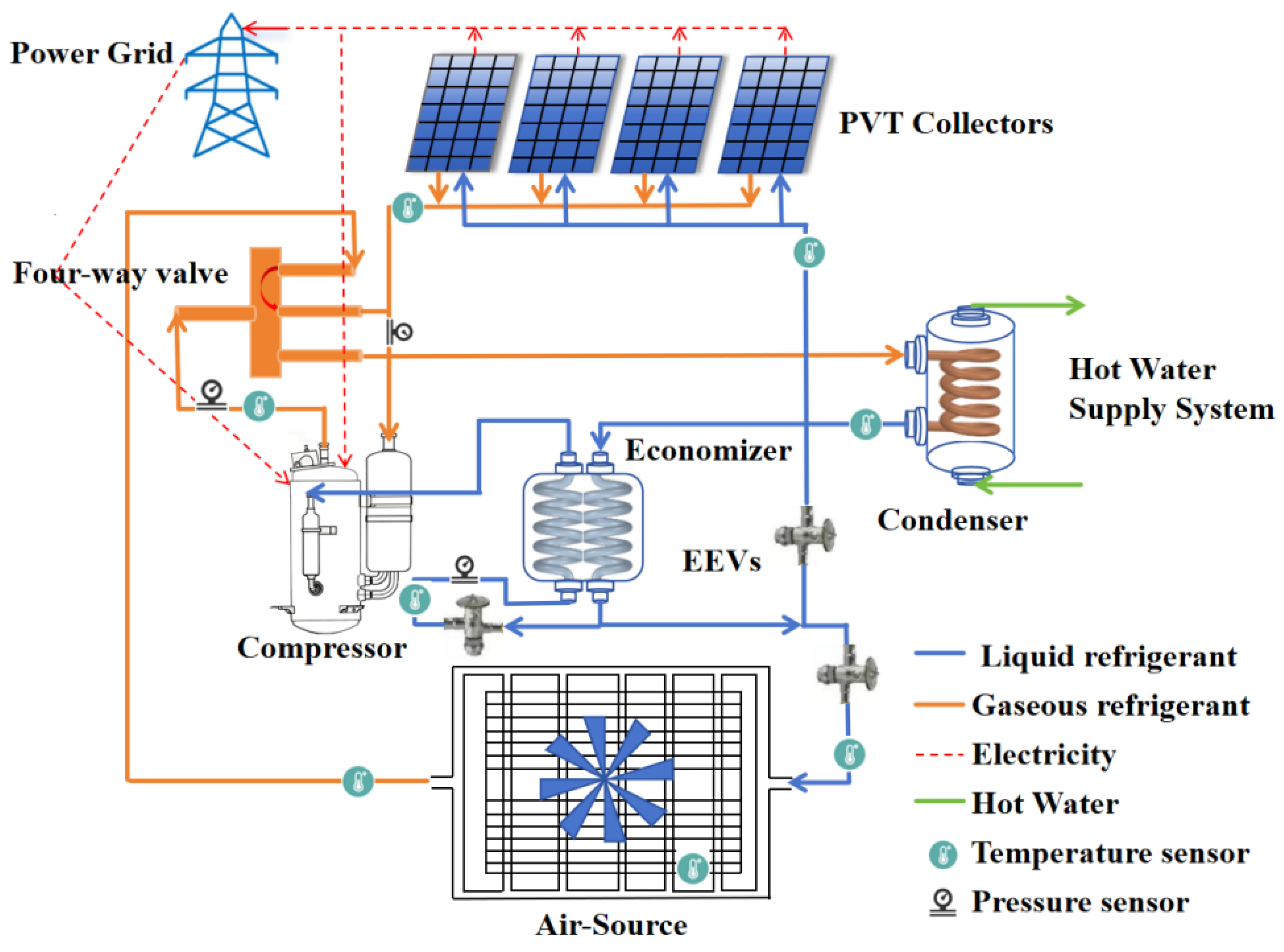
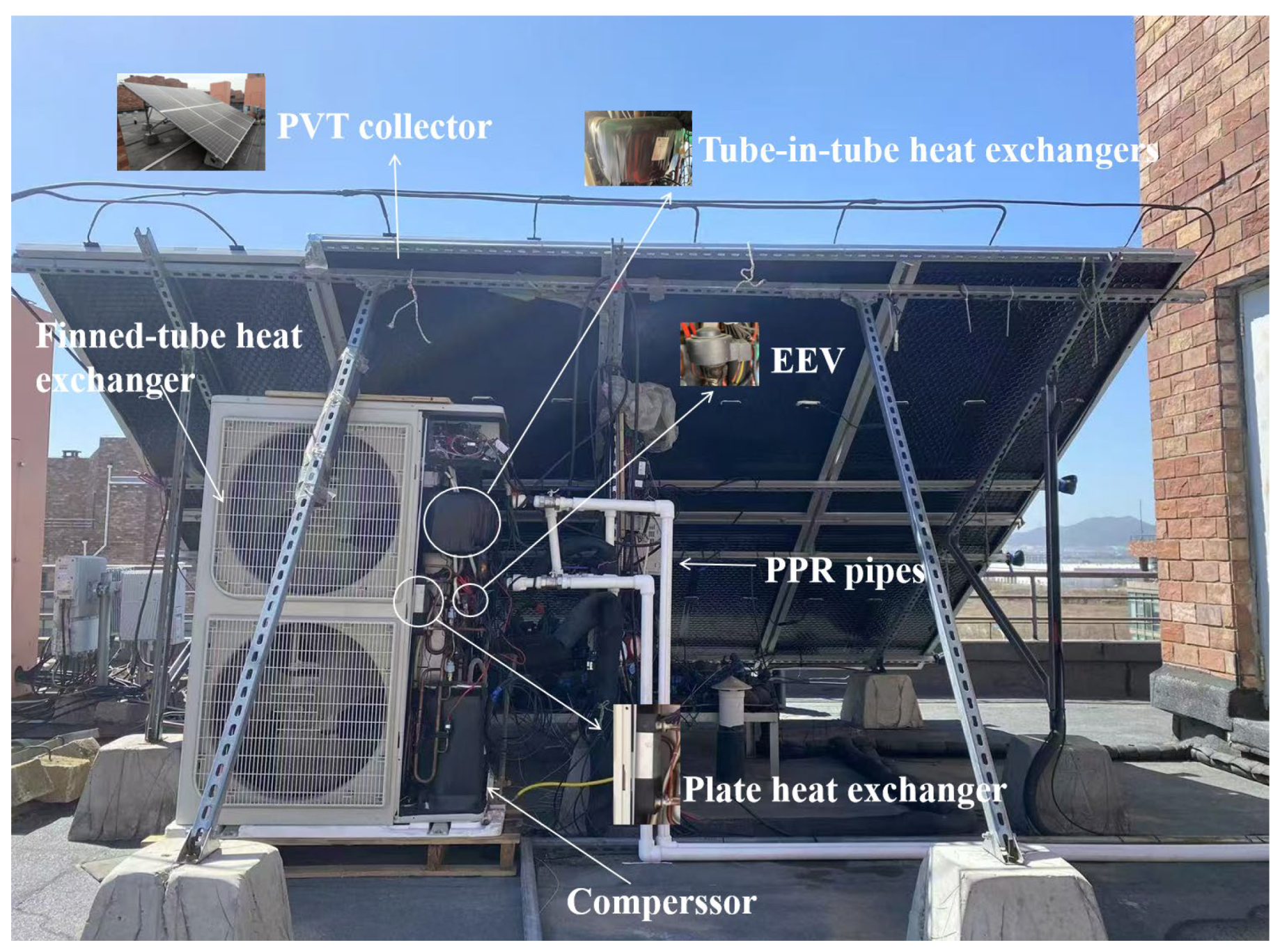
In Dalian, China, a dual-source heat pump system integrating PVT and air-source technologies was constructed, with its system configuration schematically represented in Figure 1. The system comprises the following components: a 6-HP compressor, eight PVT collectors, a finned-tube heat exchanger, three electronic expansion valves (EEVs), a tube-in-tube heat exchanger, a plate heat exchanger, a circulating water pump, and three fan-coil units. Key technical parameters of the system components are summarized in Table 2.
South-facing orientation provides extended daylight hours and higher solar irradiance than other orientations. Therefore, the PVT collectors are deployed on the rooftop of the building facing south. Below them, a finned-tube heat exchanger and heat pump unit are installed. The heat pump unit is connected to the PVT collectors and the finned-tube heat exchanger via copper tubing. The condenser in the system is connected to a water circulation system that employs Polypropylene-Random (PPR) pipes. The terminal section of the water circulation system is connected to three fan-coil units to accommodate diverse thermal load requirements. Flexible hoses are used at the connections between the water circulation system and both the heat pump unit and the fan-coil units. A variable frequency water pump is used for water circulation. The tube-in-tube heat exchanger is used as a condenser, with the inner tube filled with refrigerant and the outer tube filled with water. The PVT collector adopts a composite structure with eight distinct functional layers arranged in a top-to-bottom configuration: glass cover, ethylene vinyl acetate copolymer (EVA), PV cells, EVA, Tedlar®/Polyester/Tedlar®, EVA, refrigerant channels, and an insulation layer [3]. R410A has been selected as the refrigerant for this system due to its environmentally friendly characteristic of zero ozone depletion potential and its high-efficiency thermodynamic performance. The hybrid system integrates the PVT and the finned-tube heat exchanger in a parallel configuration, forming a dual-evaporator system. The system platform is shown in Figure 2.
To compare the heating performance of the system under different operating conditions, the experiment selected two typical seasonal ambient temperature conditions (average ambient temperatures of 20 °C and 5 °C, respectively) and three levels of solar irradiance (>700 W/m2, 400–700 W/m2, and <400 W/m2). Under each combination of ambient temperature and irradiance, the three operating modes were switched by manually controlling the opening and closing of the electronic expansion valves (EEVs). Meanwhile, the superheat was maintained within the optimal operating range of 5–8 °C by adjusting the valve opening: the opening was reduced when the superheat fell below 5 °C, and increased when it exceeded 8 °C. This superheat range is considered the optimal operating range for achieving the best performance of the heat pump system. To ensure strict control of variables and the comparability of experimental data, the test duration for each of the three operating modes was kept consistent under every condition. Based on the testing methodology described above, the heating performance of the three operating modes was compared and ranked under different combinations of ambient temperature and solar irradiance, and the results were used to optimize the system operation strategy.
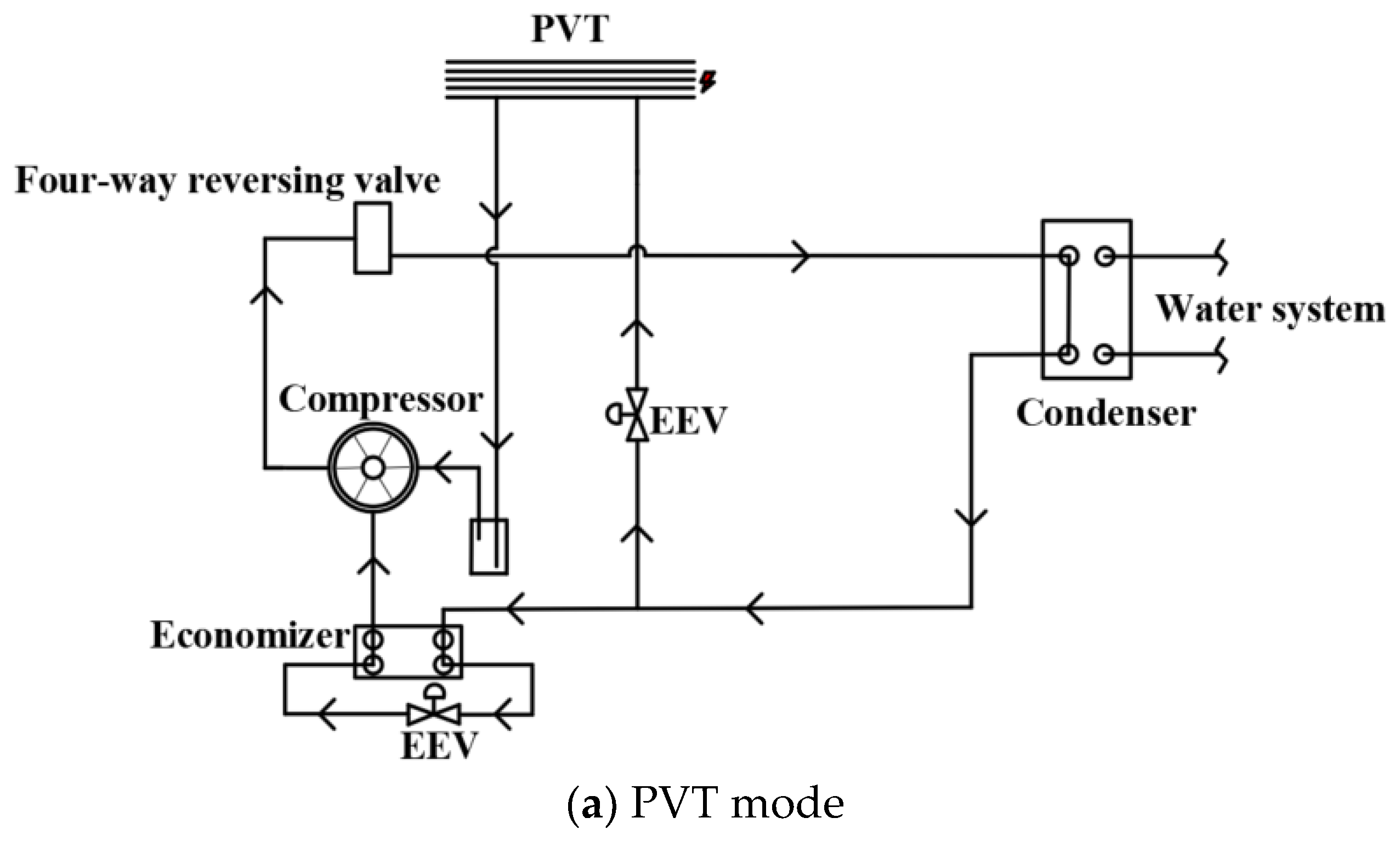
PVT Mode: The air-source expansion valve maintains a fully closed position (0% opening), while the PVT and auxiliary expansion valves are modulated within a range of 0–500 steps to maintain the superheat at 5–8 °C. The PVT collectors serve as energy harvesting components, capturing and converting solar irradiation. Part of the energy is directly converted into electricity via the photovoltaic effect, while the remainder is absorbed as heat by the refrigerant within the PVT collectors. Subsequently, the low-pressure superheated refrigerant—after absorbing heat—is compressed by the compressor and transformed into a medium-pressure gaseous refrigerant. As this medium-pressure gaseous refrigerant flows through the condenser, it releases its heat by exchanging thermal energy with the water system. Afterward, a portion of the refrigerant undergoes throttling in the expansion valve before returning to the PVT collectors, the remaining refrigerant passes through the economizer for vapor injection, mixes with the superheated refrigerant from the evaporator outlet, undergoes intermediate vapor-injection compression in the compressor, and forms high-pressure gaseous refrigerant, proceeding to the next stage of the thermodynamic cycle. This process is illustrated in Figure 3a.
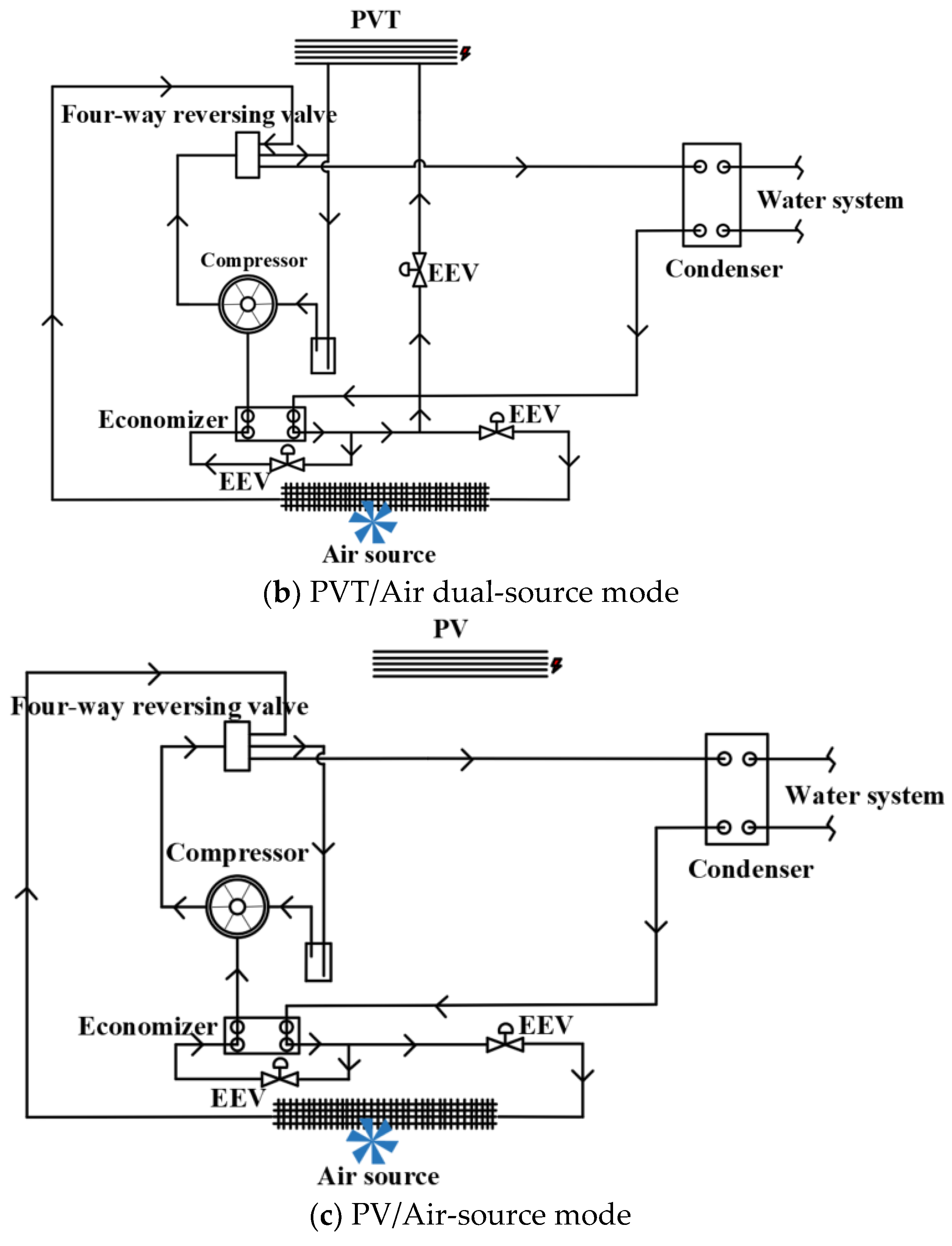
PVT/Air Dual-Source Mode: The PVT, air-source, and auxiliary expansion valves are all adjustable, with their openings controlled within the range of 0–500 positions to maintain respective superheat within 5–8 °C. The system simultaneously absorbs solar irradiation and ambient thermal energy. Part of the solar irradiation is used for power generation, while the remainder, together with air-source heat, is absorbed by the refrigerant. Subsequently, the low-pressure superheated refrigerant—after absorbing heat—is compressed by the compressor and transformed into a medium-pressure gaseous refrigerant. The medium-pressure refrigerant undergoes heat exchange with water in the condenser. Finally, a portion of the refrigerant undergoes throttling in the expansion valve before returning to the dual-evaporator, the remaining refrigerant passes through the economizer for vapor injection, mixes with the superheated refrigerant from the evaporator outlet, undergoes intermediate vapor-injection compression in the compressor, and forms high-pressure gaseous refrigerant, proceeding to the next stage of the thermodynamic cycle, as shown in Figure 3b.
PV/Air-Source Mode: The PVT expansion valve maintains a fully closed position (0% opening), while the air-source and auxiliary expansion valves are modulated within a range of 0–500 steps to maintain the superheat at 5–8 °C. The PV collectors utilize solar irradiance for power generation. In the air-source cycle, refrigerant within the finned-tube heat exchanger absorbs ambient heat. Then the low-pressure superheated refrigerant—after absorbing heat—is compressed by the compressor and transformed into a medium-pressure gaseous refrigerant. As this medium-pressure gaseous refrigerant flows through the condenser, it releases heat by exchanging thermal energy with the water system. Afterward, a portion of the refrigerant undergoes throttling in the expansion valve before returning to the finned-tube exchanger, the remaining refrigerant passes through the economizer for vapor injection, mixes with the superheated refrigerant from the evaporator outlet, undergoes intermediate vapor-injection compression in the compressor, and forms high-pressure gaseous refrigerant, proceeding to the next stage of the thermodynamic cycle, as shown in Figure 3c.
To enable autonomous and efficient operation of the dual-source heat pump system in practical applications, this study proposes an automatic control strategy based on environmental parameters. The strategy uses solar irradiance and ambient temperature as the core input parameters, with the control logic as follows:
When the ambient temperature is above 5 °C, the system dynamically switches operating modes based on the level of solar irradiance:
PVT mode: When solar irradiance exceeds 700 W/m2, the system preferentially switches to PVT mode. Under this condition, abundant solar energy can fully or primarily assume the load on the heat source side, aiming to maximize the utilization efficiency of solar energy.
PVT/Air dual-source mode: When solar irradiance is at a moderate level between 400 W/m2 and 700 W/m2, the system enters dual-source mode. Within this range, a single solar heat source may be insufficient to support the system in maintaining optimal energy efficiency. Therefore, the system coordinates or alternates between the PVT circuit and the air-source circuit for combined energy supply based on real-time load demands.
PV/Air-source mode: When solar irradiance falls below 400 W/m2, the value of the solar heat source is low. The system switches to air-source mode, relying entirely on ambient air for heat exchange to ensure heating stability.
For operating conditions where the ambient temperature is below 5 °C, the system actively enables a compensation logic based on solar irradiance to address the performance degradation of the air-source heat pump. When irradiance exceeds 400 W/m2, priority is given to utilizing PVT or dual-source mode for solar compensation. Conversely, if the irradiance falls below this threshold and the low temperature causes severe degradation of the heat pump performance, the system automatically activates auxiliary electric heating to ensure a stable heating water temperature.

2.2. Instrumentation for System Testing

To monitor system operating status as depicted in Figure 2, temperature sensors are installed at the inlet/outlet ports of the PVT, air-source, compressor, and condenser, with additional sensors mounted on the fins. Pressure sensors are installed at the inlet and outlet ports of the compressor, as well as at the outlet port of the auxiliary expansion valve, monitoring three pressure levels: high, intermediate, and low pressure. Solar irradiance is measured using a pyranometer manufactured and calibrated according to ISO/IEC 17025 requirements, with a spectral measurement range of 285–3000 nm. The PV generation unit interfaces with the grid via a GoodWe inverter. A heat meter records the water flow rate, while the system’s heat output is calculated from water-side measurements. Concurrently, an electricity meter monitors electrical consumption. The specifications of all testing equipment are detailed in Table 3.

3. Performance Evaluation

The most critical evaluation metric for heat pump system performance is COP, which represents the ratio of the heating capacity provided by the heat pump to its power consumption. COP is calculated using Equation (1) [31].
C O P = Q h W
where Qh is the heating capacity of the system (W), W is the power consumption of the compressor (W).
In the experimental system, the heating capacity of the heat pump can be determined from the condenser’s inlet and outlet water temperatures using Equation (2) [20].
Q h = c p M w ( t o , w t i , w )
where cp is the specific heat capacity of water (4.2 kJ·kg−1·°C−1), Mw is the mass flow rate of water (m3/h), and to,w and ti,w are the outlet and inlet temperatures of the condenser, respectively (°C).
When the system operates in PVT mode, the thermal and electrical efficiencies can be calculated using Equations (3) and (4), respectively [32]. Additionally, the heating capacity of the PVT mode, which is necessary for calculating the thermal efficiency, is derived using Equation (5).
η th = Q PVT A PVT × G
η e = E A PVT × G
Q PVT = Q h W
where QPVT is the heating capacity of the PVT collector (W), APVT is the total area of the PVT collectors (m2), and G is the solar irradiation (W/m2).
When operating in PVT mode, two distinct normalized temperature differences are employed: one for analyzing thermal efficiency and the other for analyzing COP. These are obtained from Equations (6) and (7), respectively.
T th * = t a t e G
T C O P * = 100 ( t c t e ) t a + G 100
where ta is the ambient temperature (°C), te is the evaporation temperature (°C), tc is the condensation temperature (°C), and G is the solar irradiation (W/m2).
According to the relevant standards and methods for measurement uncertainty evaluation [33], the uncertainties of the heating capacity, COP, and electrical efficiency of the PVT-SAHP system can be derived from Equations (1), (2) and (4), with the expressions given as follows:
u c ( Q h ) = [ Q h M w ] 2 u 2 ( M w ) + [ Q h t i , w ] 2 u 2 ( t i , w ) + [ Q h t o , w ] 2 u 2 ( t o , w )
u c ( C O P ) = [ C O P M w ] 2 u 2 ( M w ) + [ C O P t i , w ] 2 u 2 ( t i , w ) + [ C O P t o , w ] 2 u 2 ( t o , w ) + [ C O P W ] 2 u 2 ( W )
u c ( η e ) = [ η e E ] 2 u 2 ( E ) + [ η e G ] 2 u 2 ( G )
where u(Mw) denotes the standard uncertainty of flow rate measurement, u(ti,w) and u(to,w) represent the standard uncertainties of supply water temperature and return water temperature respectively, u(W) indicates the standard uncertainty of compressor power consumption, the standard uncertainty of photovoltaic power output, denoted as u(E), and the standard uncertainty of solar irradiance, denoted as u(G).
First, the calculation formulas for heating capacity, COP, and electrical efficiency were substituted into the uncertainty propagation equations. Partial derivatives were taken with respect to each parameter in the respective formulas (flow rate, temperature difference, power consumption, photovoltaic power output, and solar irradiance) and then multiplied by the corresponding standard uncertainties to obtain the uncertainty components of each input variable. Subsequently, the combined uncertainty was obtained using the root-sum-square method. The standard uncertainties for flow rate, temperature difference, power consumption, photovoltaic power output, and solar irradiance are 0.0015 m3/s, 0.46 °C, 0.01 kW, 2%, and 0.2%, respectively. The temperature difference between the inlet and outlet water used in the calculation is 5 °C. The final calculated uncertainties for heating capacity, COP, and electrical efficiency are 4.73%, 1.31%, and 0.003%, respectively. Taking electrical efficiency as an example, the uncertainty can be calculated following the above procedure when solar irradiance and photovoltaic power output are set to 500 W/m2 and 500 W, respectively.
u c ( η e ) = [ η e E ] 2 u 2 ( E ) + [ η e G ] 2 u 2 ( G ) = ( 1 A P V T G ) 2 × ( 0.02 ) 2 + ( E A P V T G 2 ) 2 × ( 0.002 ) 2 = 0.003 %
To ensure the reliability of the raw data, the temperature sensors were calibrated prior to the experiment by comparing their readings when exposed to air with the ambient air temperature. The sensor probes were firmly attached to the surface of the refrigerant flow channels and wrapped with thermal insulation cotton to minimize heat loss to the surroundings. All sensor signals were connected to the same data acquisition system to ensure time synchronization. During the experiment, data recording commenced only after the system had been operating continuously for more than 10 min and the fluctuation range of key performance parameters remained relatively small.

4. Results and Discussion

Field measurements of a PVT-ASHP system were conducted in Dalian, China, from September 2024 to January 2025. The investigation examined the operational characteristics of the PVT-ASHP system under varying operating conditions. During testing, to control variables and compare the performance of the three modes, the condensing temperature was maintained constant at 49.65 °C (range: 48.5–50.5 °C) by adjusting the airflow rates and operation of the three fan coil units. Therefore, all conclusions presented below are valid under this constant condensing temperature condition. Simultaneously, regulation of the EEVs maintained the system’s superheat at 5–8 °C, the optimal range for system operation. The compressor operated at a fixed frequency of 50 Hz. The effects of ambient wind speed and humidity are not considered.

4.1. Heating-Power Generation Performance Comparison Among Three Modes

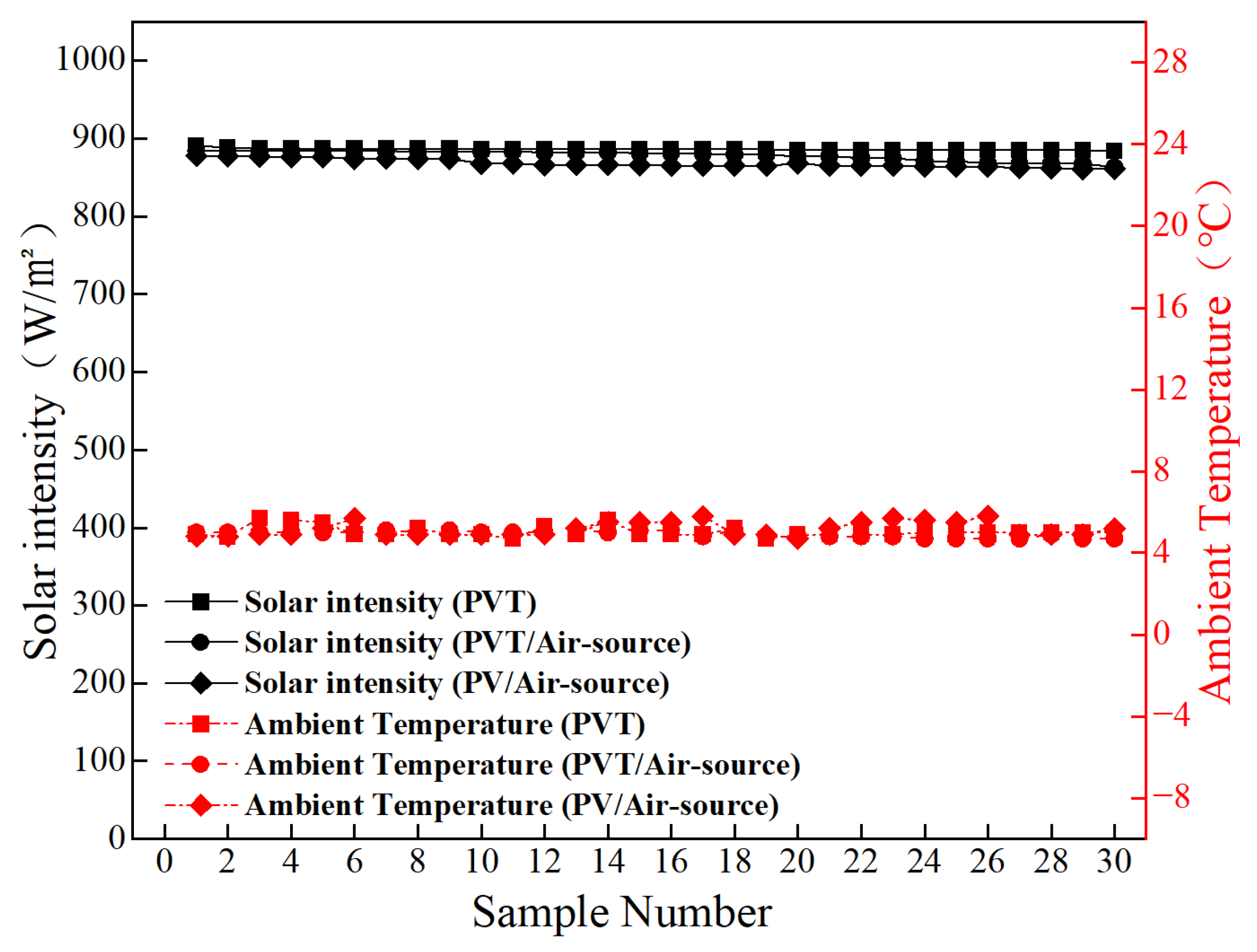
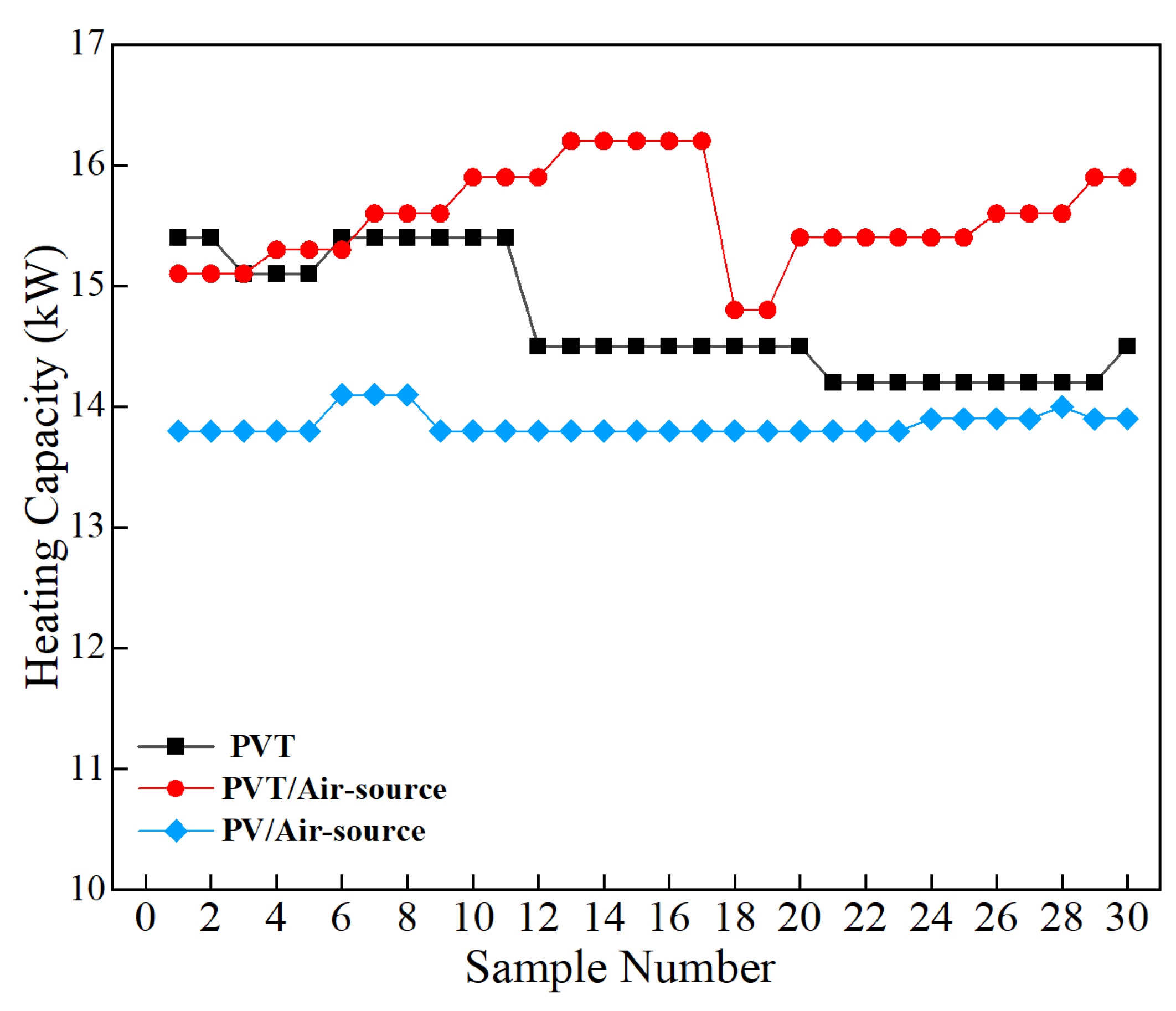
Based on the experimental conditions with ambient temperatures ranging from 4.7 to 5.8 °C and solar irradiance ranging from 860 to 890 W/m2 (Figure 4), 30 data sets were selected from each of the three operating modes for comparative analysis of their heating and electrical performance. As shown in Figure 5, among the three combined heat and power generation modes—(1) PVT mode, (2) PVT/air dual-source mode, and (3) PV/air-source mode—Mode (2) achieved the highest heating capacity of 15.60 kW, followed by Mode (1) with 14.7 kW and Mode (3) with 13.9 kW. Compared to Mode (3), the heating capacities of Mode (2) and Mode (1) were 12.23% and 5.76% higher, respectively.
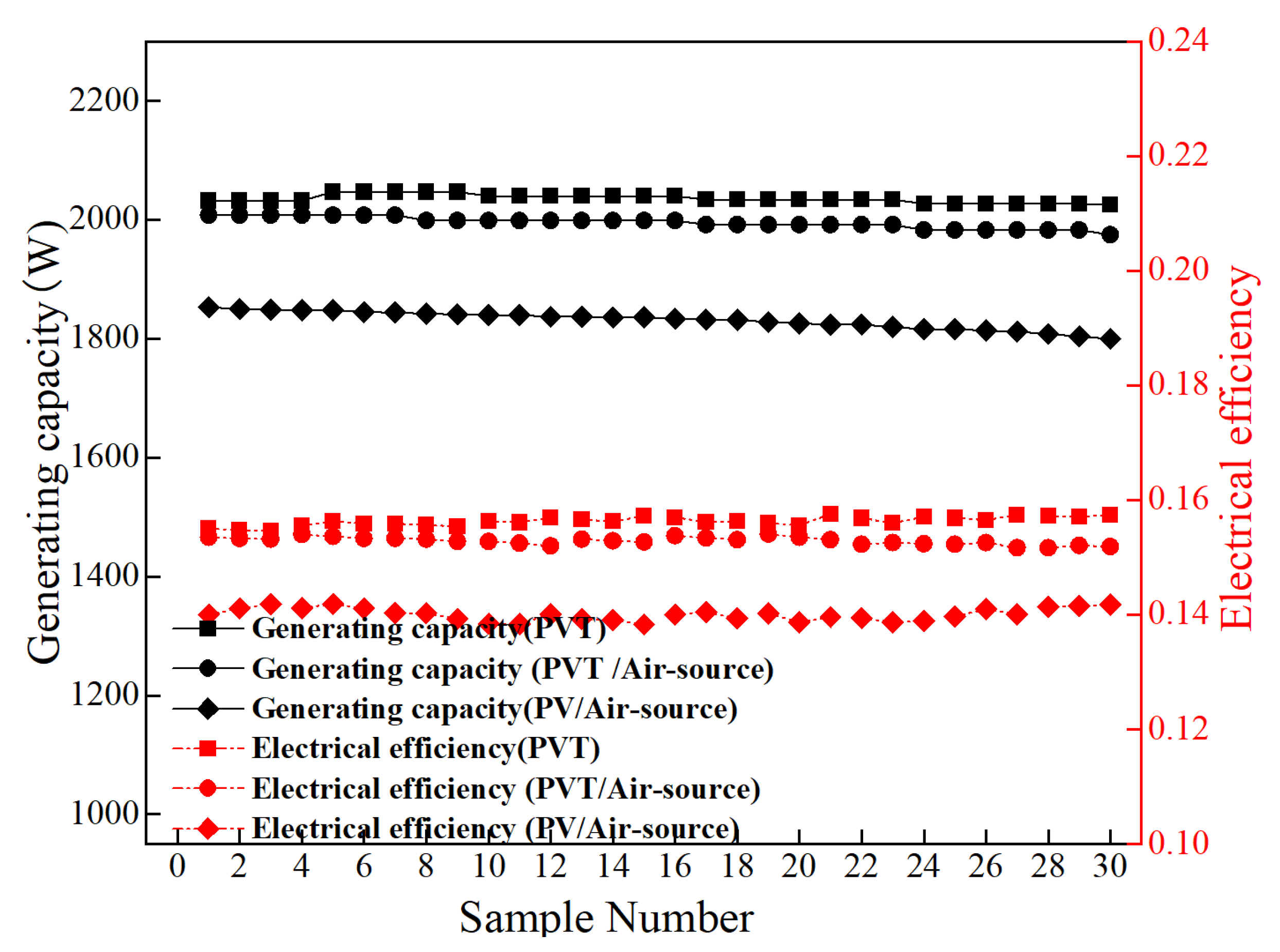
Figure 6 compares the PV power generation performance of the three modes. In terms of average power output, Mode (1) achieved 2036 W, Mode (2) achieved 1995 W, and Mode (3) achieved 1831 W. Regarding peak power output, Mode (1) reached 2047 W, Mode (2) reached 2008 W, and Mode (3) reached 1853 W. For average electrical efficiency, Mode (1) attained 15.64%, Mode (2) attained 15.29%, and Mode (3) attained 14.01%. Compared to Mode (3), the electrical efficiencies of Mode (1) and Mode (2) were 11.56% and 9.14% higher, respectively.

4.2. Analysis of Evaporation Temperature

During the heat pump cycle, when the refrigerant absorbs heat in the evaporator and undergoes a phase change from liquid to gas, the corresponding saturation temperature is referred to as the evaporation temperature. The level of this temperature affects the amount of heat absorbed by the evaporator, which in turn impacts the system’s heating capacity and COP. Therefore, the analysis of the evaporation temperature in heat pump systems is of great necessity.
To comprehensively cover the operating conditions and address the limitations of the experimental data range, a fitting analysis was conducted based on the available data. A total of 500 sets of experimental data were selected for each operating mode and divided into a training set of 400 sets and a validation set of 100 sets. The following fitting formulas are derived from the training set, with their corresponding fitting coefficients presented in Table 4 and evaluation metrics (R2, RMSE, MAE) presented in Table 5. Meanwhile, based on the uncertainty analysis method described above, an uncertainty analysis was performed for each fitting formula, and the calculation results are also listed in Table 5.
PVT mode:
T e _ PVT = 12.667 + 1.848 × 10 2 G 4.505 × 10 5 G 2 + 3.560 × 10 8 G 3 + 0.746 T a
PVT/Air Dual-source mode:
T e _ PVT / Air - source = 8.591 + 2.426 × 10 3 G + 1.00 T a 1.197 × 10 3 T a 2
PV/Air-source mode:
T e _ Air - source = 9.276 + 0.914 T a + 3.518 × 10 3 T a 2
The solar irradiance (G) and ambient temperature (Ta) from the validation set were substituted into the three fitting formulas, and the predicted values were compared with the experimental values. The results show that the relative errors between them are all within ±15%, indicating good agreement.
To validate the physical consistency of the model, a sensitivity analysis was conducted. The partial derivatives of evaporation temperature with respect to solar irradiance and ambient temperature were calculated:
T e _ PVT G = 1.848 × 10 2 9.01 × 10 5 G + 10.68 × 10 5 G 2 ; T e _ PVT T a = 0.746
T e _ PVT / Air - source G = 2.426 × 10 3 ; T e _ PVT / Air - source T a = 1 2.394 × 10 3 T a
T e _ Air - source T a = 0.914 + 7.036 × 10 3 T a
According to the partial derivative formula above, under the measured conditions with irradiance G ranging from 0 to 1000 W/m2 and ambient temperature Ta ranging from 5 to 25 °C, the calculated partial derivatives are all greater than zero. This result indicates that both partial derivatives are positive, implying that the evaporation temperature increases monotonically with increasing irradiance and ambient temperature, which is consistent with thermodynamic expectations.
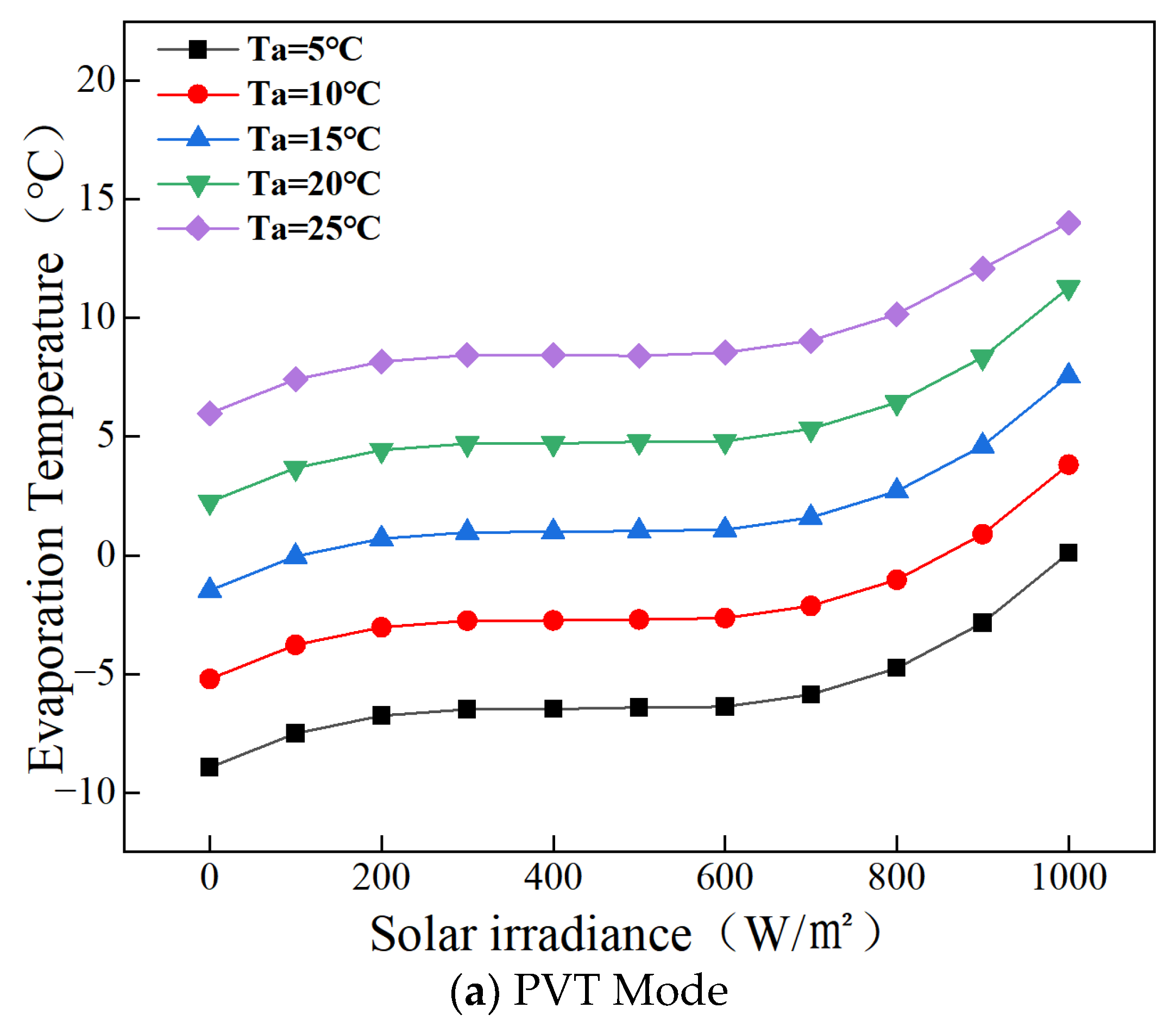
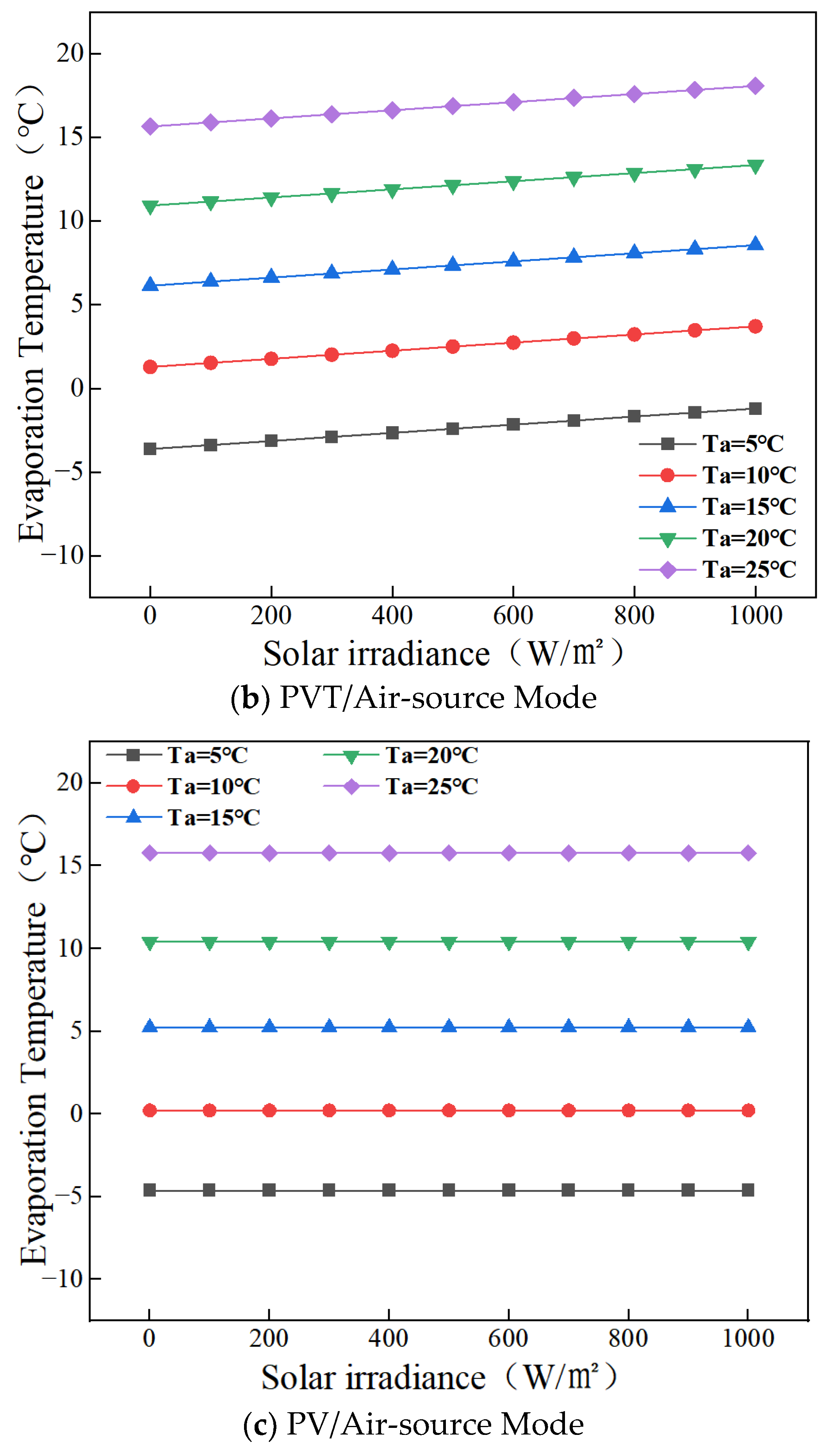
Based on the fitted equations, the variation curves of evaporation temperature with solar irradiance and ambient temperature under three operating modes were calculated and plotted. As shown in Figure 7, in the PVT mode, when the ambient temperature is fixed, the evaporation temperature rises with increasing solar irradiance. When the solar irradiance is fixed, the evaporation temperature also increases with higher ambient temperatures. In the PVT/air dual-source mode, the evaporation temperature similarly increases with higher solar irradiance and ambient temperature. Compared with the PVT mode, solar irradiance has a milder effect on elevating the evaporation temperature in this mode. This indicates that the driving effect of solar irradiance on evaporation temperature is less significant in the dual-source mode than in the PVT mode. In the air-source mode, the evaporation temperature is not affected by solar irradiance and remains constant under different irradiance conditions, while it shows an upward trend as the ambient temperature increases.
A comparison of the evaporation temperatures under the three operating modes reveals the following: under low irradiance conditions, the evaporation temperature in the air-source mode is higher than that in the PVT mode. As irradiance increases, the evaporation temperature in the PVT mode gradually rises, approaching and eventually surpassing that of the air-source mode under low-temperature, high-irradiance conditions. In contrast, the dual-source mode demonstrates significant advantages: its performance is superior to that of the air-source mode under low irradiance and low-temperature conditions, comparable to that of the air-source mode under high-temperature, low-irradiance conditions, and effectively utilizes solar energy under high irradiance to achieve the highest evaporation temperature among the three modes.

4.3. Data-Driven Modeling of the PVT Mode

To establish a reliable performance prediction model, the experimental data were divided into a fitting group and a validation group under the same operating conditions. Empirical formulas for thermal efficiency and COP were first derived using the data from the fitting group. These formulas were then applied to calculate the predicted heating capacity. Finally, the accuracy of the model was validated by comparing the predicted heating capacity with the measured values from the validation group.
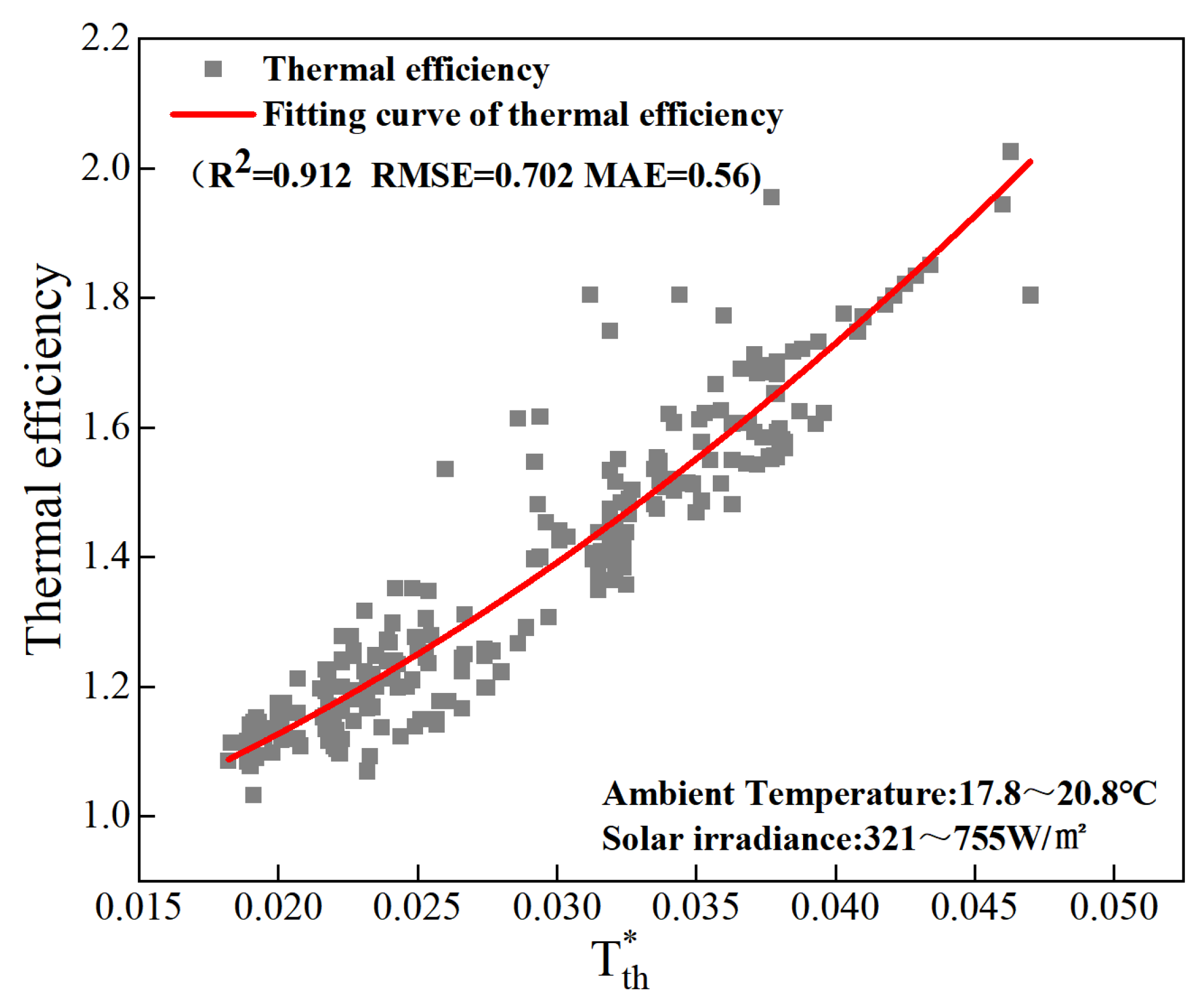
The measured data of evaporation temperature, ambient temperature, and solar irradiance were normalized using Equation (7) to analyze the correlation between thermal efficiency and the normalized temperature difference. Figure 8 presents the fitting curve of thermal efficiency as a function of the normalized temperature difference during autumn operation, and the corresponding fitting equation is:
η th = 0.820 + 7.981 T th * + 369.192 ( T th * ) 2
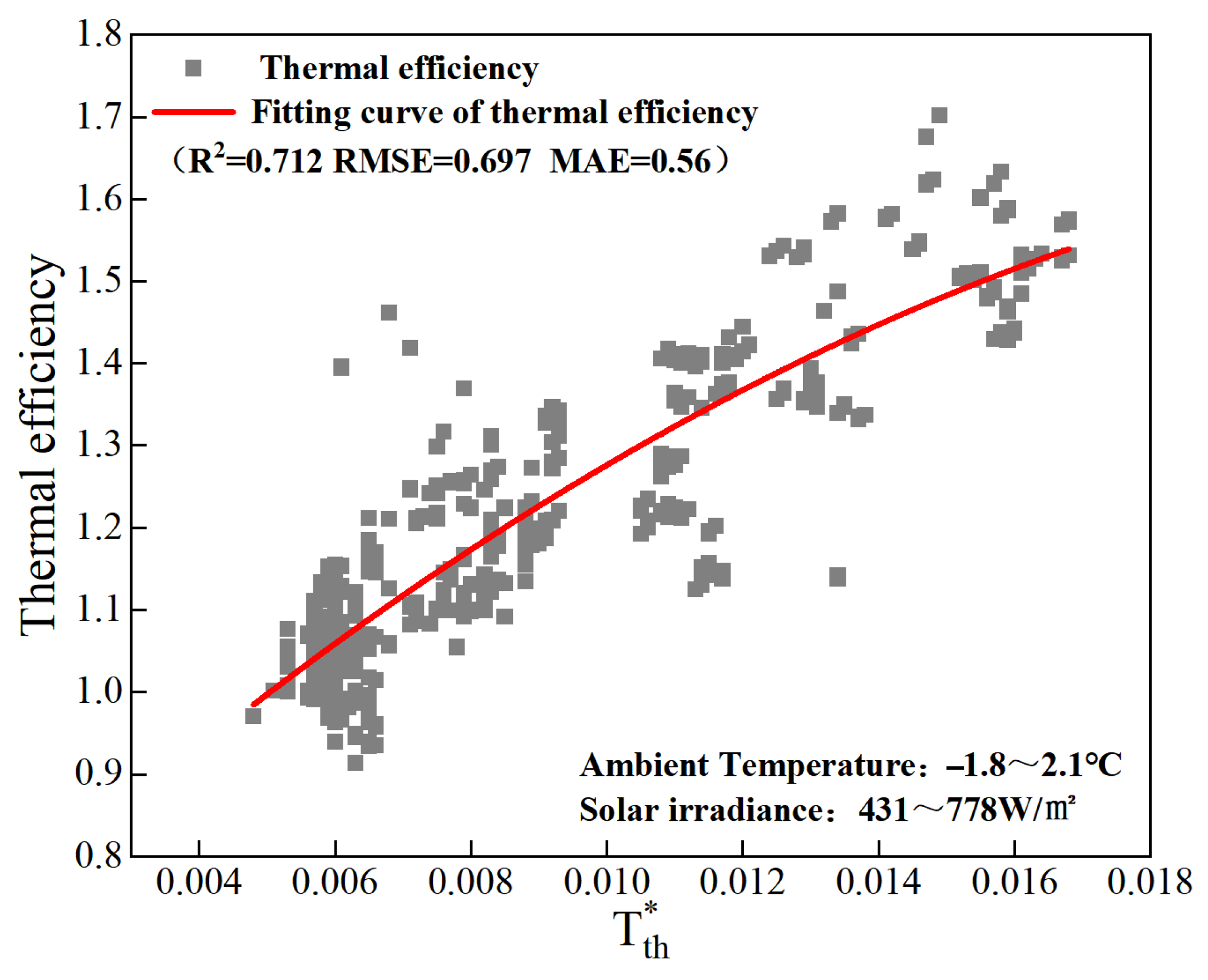
Figure 9 presents the fitting curve of thermal efficiency as a function of the normalized temperature difference during winter operation, and the corresponding fitting equation is:
η th = 0.646 + 77.638 T th * 1454.709 ( T th * ) 2
The thermal efficiency of the PVT mode was calculated using Equations (3) and (5). The heating capacity used in the calculation was measured on the water side of the system. This heating capacity is derived not only from the solar irradiance absorbed by the PVT collectors but also includes the heat absorbed from the ambient air during contact with the air. That is, the heating capacity of the PVT mode equals the radiant heat absorbed by the collectors plus the additional air convective heat gained. Due to the contribution of air convective heat, the calculated thermal efficiency of the PVT mode exceeds the efficiency that would be obtained if only solar radiant heat were considered as the input, resulting in values greater than 1.
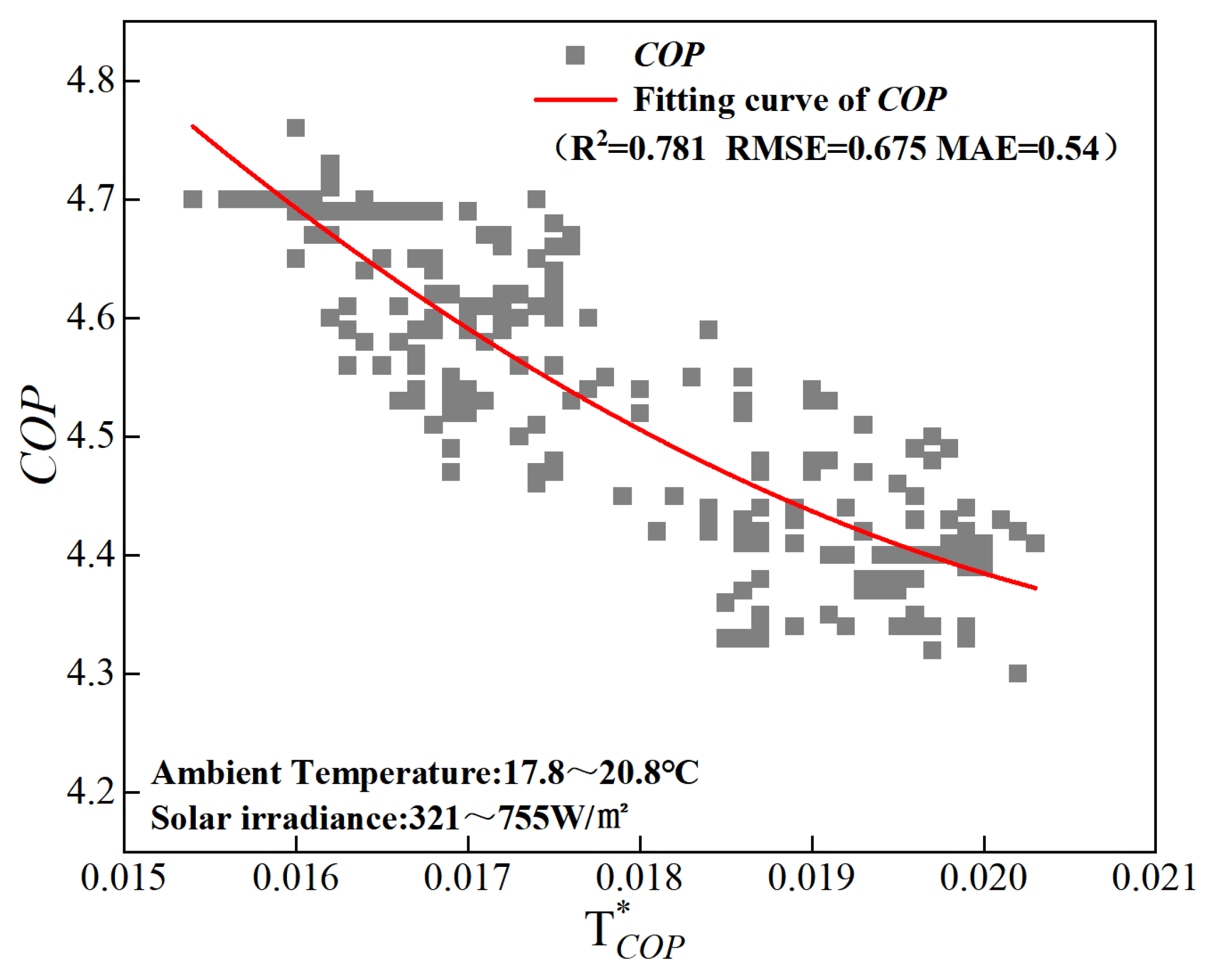
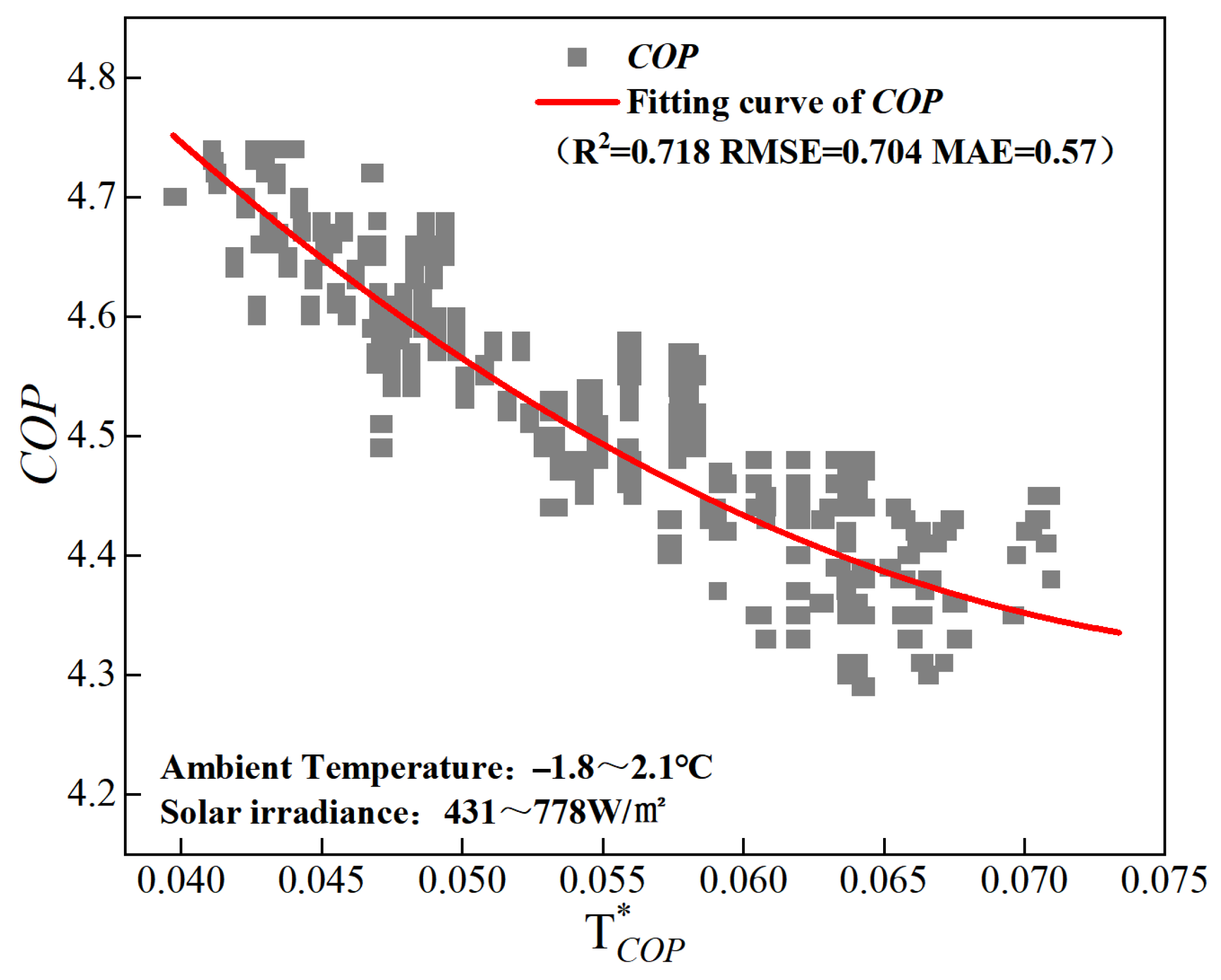
Under the same test conditions, the measured evaporation temperature, condensing temperature, ambient temperature, and solar irradiance data were normalized using Equation (8) to analyze the correlation between COP and the normalized temperature difference. Figure 10 presents the fitting curve of COP as a function of the normalized temperature difference during autumn operation, and the corresponding fitting equation is:
C O P = 8.547 372.094 T C O P * + 8198.302 ( T C O P * ) 2
Figure 11 presents the fitting curve of COP as a function of the normalized temperature difference during winter operation, and the corresponding fitting equation is:
C O P = 7.493 254.812 T C O P * + 4939.084 ( T C O P * ) 2
To verify the physical consistency of the model, a sensitivity analysis was conducted on the fitting formulas for thermal efficiency and COP. By taking the partial derivatives of each formula and substituting the range of measured parameters into the partial derivative expressions, the results show that the partial derivatives of the thermal efficiency fitting formulas are all greater than zero, while those of the COP fitting formulas are all less than zero. These findings are consistent with the trends observed in the figures and conform to physical principles. Meanwhile, based on the uncertainty analysis method described above, the uncertainties of Equations (18)–(21) were calculated to be 3.78%, 4.21%, 3.56%, and 4.26%, respectively.
η th T th * = 7.981 + 738.384 T th *
η th T th * = 77.638 29089.418 T th *
C O P T cop * = 372.094 + 16396.604 T cop *
C O P T cop * = 254.812 + 9878.168 T cop *
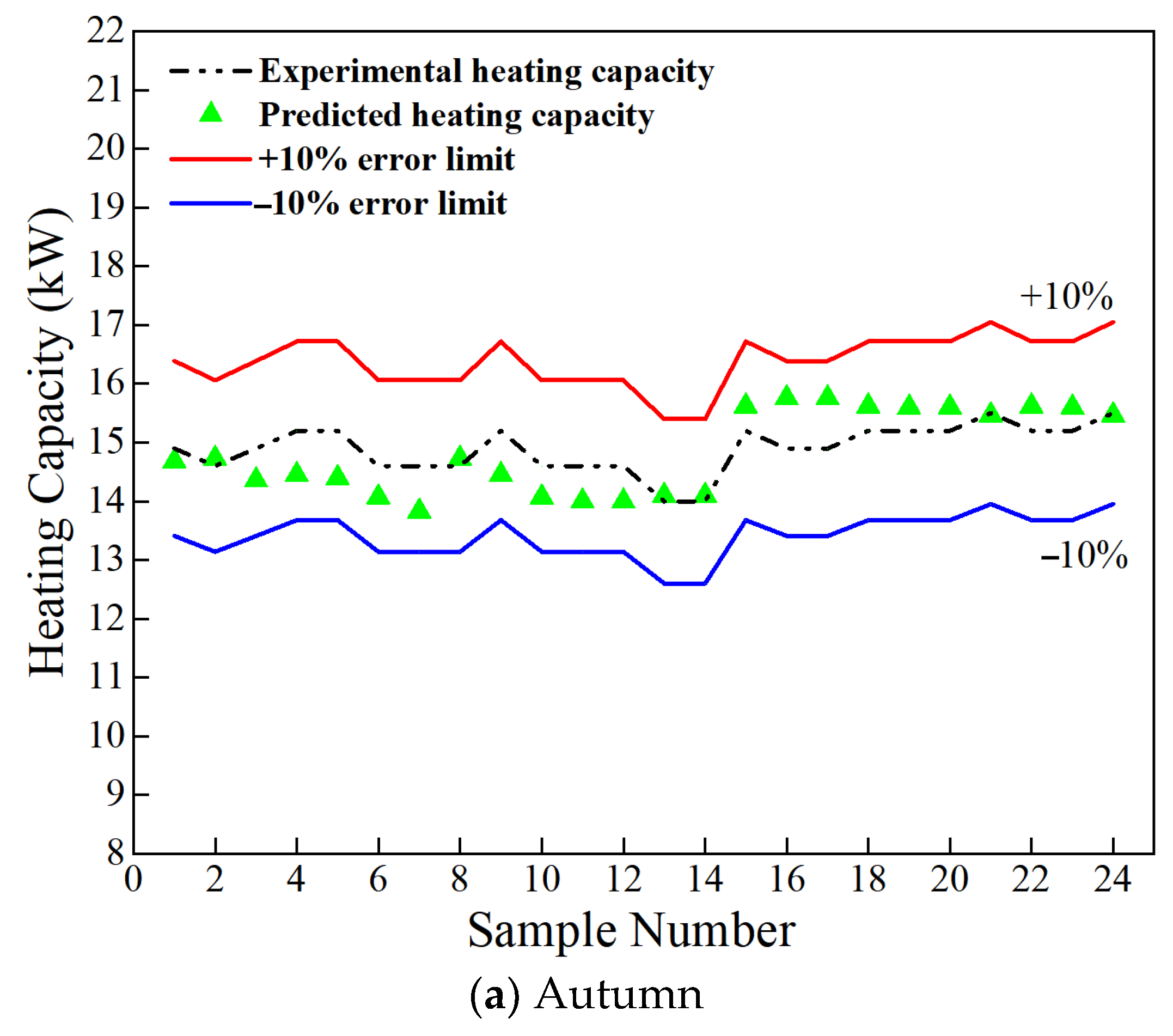
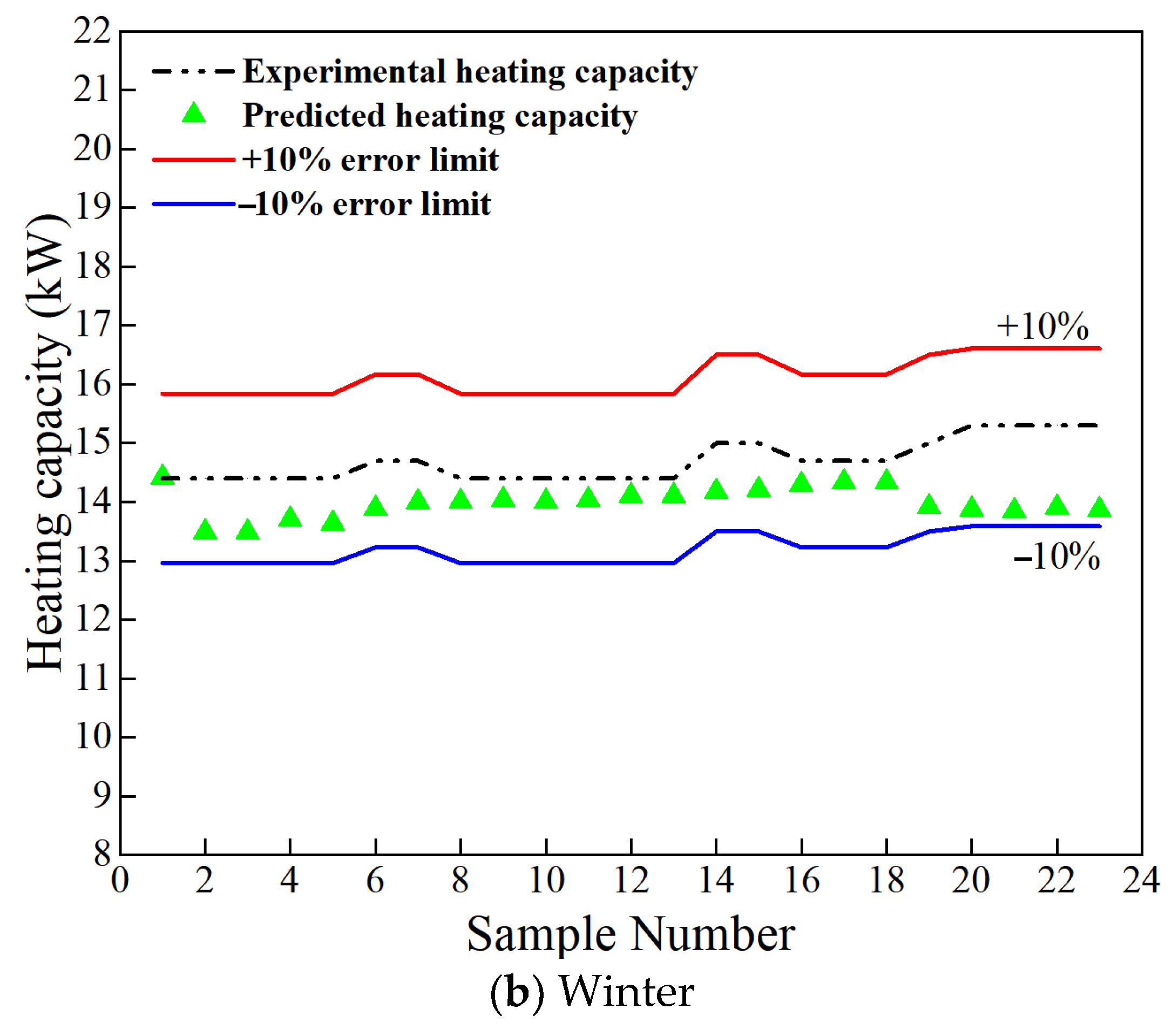
Based on the fitted instantaneous thermal efficiency and COP, along with Equations (1), (3) and (5), the calculation formula for the heating capacity was established:
Q h = η th G A C O P C O P 1
Figure 12 presents a comparison between the calculated and measured heating capacity values, along with the corresponding errors.
These three sets of formulas establish a data-driven methodology for predicting PVT heat pump performance. When provided with solar irradiance, ambient temperature, evaporating temperature, and condensing temperature parameters, the methodology enables three predictions:
(a)
The instantaneous thermal efficiency of the PVT mode is calculated using Equations (18) and (19);
(b)
The COP of the PVT heat pump is determined using Equations (20) and (21);
(c)
Equation (26) provides a dual-function capability, enabling either the calculation of system heating capacity for a given PVT collector area or the reverse-calculation of the required collector area for a target heating capacity.
The proposed methodology can serve as an approach for predicting the performance of PVT heat pumps. To improve the accuracy of the predictive model, additional test data can be acquired for fitting and validation.

4.4. Economic Analysis

To assess the economic feasibility of the proposed PVT/air dual-source heat pump system, this study conducted a comparative analysis between the dual-source system and a conventional air-source heat pump system based on the economic analysis model in ref. [34], considering four aspects: investment cost, operating cost, cost savings, and payback period.
The total purchase cost encompasses the three core components: the air-source unit, the PVT panels, and the water system. The costs of all other components are incorporated into these three parts. The purchase costs of these three components are shown in Table 6.
C pur = C PVT + C air + C water
The total investment cost of the system is estimated as 1.2 times the total purchase cost, and the maintenance cost is estimated as 0.05 times the purchase cost [34]. On this basis, to evaluate the actual cost and investment affordability of the dual-source heat pump system, the simple payback period (Equation (33)) is adopted as an evaluation indicator, and the calculation formula are as follows:
C inv = 1.2 C pur
C m = 0.05 C pur
C op = t op × W × C ele
C sa = C op t op × E × C ele
C heat = C ele × W Q h
C tot ,   dual C tot ,   air i = 0 n ( C op ,   dual C op ,   air ) = 0
The total purchase cost (Cpur) consists of the PVT panel cost, the air-source unit cost, and the water system cost. The PVT panel cost is calculated as the product of the unit price per panel (Cpvt) and the number of panels. The air-source unit cost (Cair) and the total water system cost (Cwater) are also included. The total investment cost (Cinv) and maintenance cost (Cm) are estimated based on Cpur. The total cost is Ctot. The operating cost (Cop) is a function of the annual operation time (top), the total power consumption of the system (W), and the local average electricity price in Dalian (Cele). Finally, the annual cost savings (Csa) represent the reduction in operating expenses compared to a conventional air-source heat pump system.
Based on the electricity price standard in the Dalian region (RMB 0.6/kWh), with an annual operation of 150 days and a daily power generation time of 10 h, calculations using the aforementioned economic analysis model yield the following: the unit heating cost of the dual-source heat pump system is RMB 0.1125/kWh, which is significantly lower than that of electric boilers (RMB 0.873/kWh), natural gas boilers (RMB 0.322/kWh), and traditional air-source heat pump systems (RMB 0.259/kWh) [34].
From an investment payback perspective, the incremental investment payback period of the dual-source heat pump system compared to the traditional air-source heat pump system is 6.4 years, while the design service life of the heat pump system is 10 to 12 years. This indicates that within the system’s service life, users can obtain a net benefit period of approximately 4 to 6 years, demonstrating favorable economic benefits.

5. Conclusions

Based on the valuable data obtained from field experimental tests, a comparative analysis of the three operating modes was conducted, laying the data foundation for the development of the evaporation temperature calculation model. On this basis, data-driven models for the thermal efficiency, COP, and heating capacity of the PVT mode were further established. The main conclusions are summarized as follows:
(1)
With an average ambient temperature of 5.3 °C and solar irradiance of 875 W/m2, three integrated heating-power generation systems were evaluated: (1) PVT mode, (2) PVT/air dual-source mode, and (3) PV/air-source mode. Field measurements demonstrate that, compared to mode (3), mode (1) achieves a 5.76% increase in heating capacity and an 11.56% improvement in electrical efficiency. Mode (2) exhibits a 12.23% greater heating capacity and a 9.14% increase in electrical efficiency.
(2)
The research results on evaporation temperature indicate that in both the PVT and dual-source modes, the evaporation temperature increases with rising solar irradiance and ambient temperature. Compared to the PVT mode, the dual-source mode is less affected by solar irradiance. In contrast, in the air-source mode, the evaporation temperature depends solely on the ambient temperature.
(3)
This study developed a data-driven methodology for predicting PVT heat pump performance, which provides three key functions:
(a)
Calculating the instantaneous thermal efficiency of the PVT mode;
(b)
Predicting the heating COP;
(c)
Determining system heating capacity given a fixed collector area, or deriving the required PVT collector area for a target heating load.
(4)
From an economic perspective, the dual-source heat pump system demonstrates economic feasibility. Its unit heating cost (RMB 0.1125/kWh) is lower than that of electric boilers, gas boilers, and traditional air-source heat pump systems. Meanwhile, the payback period of 6.4 years is considerably shorter than its design service life of 10 to 12 years, proving its economic benefits over the entire life cycle.

Author Contributions

Conceptualization, X.J. and S.L.; methodology, S.J.; validation, Y.N. and S.L.; formal analysis, M.H.; investigation, H.W.; resources, X.J.; writing—original draft preparation, H.W.; writing—review and editing, H.W.; visualization, H.W.; methodology, S.W.; software, H.C.; supervision, S.J.; project administration, X.J. All authors have read and agreed to the published version of the manuscript.

Funding

This research received no external funding.

Data Availability Statement

The original contributions presented in this study are included in the article. Further inquiries can be directed to the corresponding authors.

Acknowledgments

The authors have reviewed and edited the output and take full responsibility for the content of this publication.

Conflicts of Interest

The authors declare no conflicts of interest. The funders had no role in the design of the study; in the collection, analyses, or interpretation of data; in the writing of the manuscript; or in the decision to publish the results.

Abbreviations

The following abbreviations are used in this manuscript:
cpspecific heat of the liquid, kJ/kg·°C
taambient temperature, °C
tccondensation temperature, °C
teevaporation temperature, °C
ti,winlet temperature of water, °C
to,w outlet temperature of water, °C
topoperation time, h
ηeelectrical efficiency
ηththermal efficiency
APVTarea of the PVT panels, m2
ASHPair source heat pump
COPcoefficient of performance
Cairair-source unit cost, RMB
Celeelectricity price, RMB
Cinvtotal investment cost, RMB
Cmmaintenance cost, RMB
Copoperating cost, RMB
Cpurpurchase cost, RMB
CpvtPVT panel cost, RMB
Csaannual cost savings, RMB
Ctottotal cost, RMB
Cwaterwater system cost, RMB
Ethe system’s power generation, W
EEVselectronic expansion valves
EVAethylene vinyl acetate copolymer
Girradiance, W/m2
PPRpolypropylene-random
PVphotovoltaic
PVTphotovoltaic-thermal
PVT-ASHPPVT/air-source dual-source heat pump
Qhheating capacity, kW
TESthermal energy storage
QPVTheating capacity of the PVT, kW
TCOPhp*normalized temperature difference, °C/(°C + W/m2)
Tth*normalized temperature difference, °C·m2/W
Wpower consumption, W

References

  1. Emmi, G.; Baccega, E.; Cesari, S.; Mainardi, E.; Bottarelli, M. Energy analysis of multi-source heat pump system: A real case study application. Renew. Energy 2024, 221, 119708. [Google Scholar] [CrossRef]
  2. Zanetti, E.; Bordignon, S.; Conte, R.; Bisi, A.; Azzolin, M.; Zarrella, A. Experimental and numerical analysis of a CO2 dual-source heat pump with PVT evaporators for residential heating applications. Appl. Therm. Eng. 2023, 233, 121165. [Google Scholar] [CrossRef]
  3. Xu, Z.; Liu, F.; Xu, W.; Wang, Z.; Yang, Y.; Xu, C.; Wu, P.; Li, X. Atmospheric air quality in Beijing improved by application of air source heat pump (ASHP) systems. J. Clean. Prod. 2020, 257, 120582. [Google Scholar] [CrossRef]
  4. Liu, W.; Yao, J.; Jia, T.; Zhao, Y.; Dai, Y.; Zhu, J.; Novakovic, V. The performance optimization of DX-PVT heat pump system for residential heating. Renew. Energy 2023, 206, 1106–1119. [Google Scholar] [CrossRef]
  5. Li, R.; Zhang, J.; Ma, L.; Guo, X.; Han, Y. Field experimental study of a novel overfeed photovoltaic-thermal heat pump for residential heating in northern China. Energy 2025, 337, 138524. [Google Scholar] [CrossRef]
  6. Han, Y.; Zhang, J.; Ma, L.; Hou, B.; Gong, J.; Lv, H. Multigenerational performance analysis of a direct expansion PVT-HP system using year-long experimental data. Renew. Energy 2025, 244, 122615. [Google Scholar] [CrossRef]
  7. Domanski, P.A.; Didion, D.A.; Doyle, J.P. Evaluation of suction-line/liquid-line heat exchange in the refrigeration cycle. Int. J. Refrig. 1994, 17, 487–493. [Google Scholar] [CrossRef]
  8. Huang, H. (Ed.) Heat Pumps for Cold Climate Heating: Variable Volume Ratio Twostage Vapor Compression Air Source Heat Pump Technology and Applications; CRC Press: Boca Raton, FL, USA, 2020; 378p. [Google Scholar]
  9. Jiang, S.; Yu, Y.; Li, S.; Wang, S.; Ma, Z.; Wang, J. Simulation and optimum control of a two-stage compression air source heat pump system: A comparison of two kinds of variable volume approaches. Appl. Therm. Eng. 2023, 226, 120149. [Google Scholar] [CrossRef]
  10. Zhao, W.; Peng, J.; Cao, J.; Yin, R.; Song, J.; Yuan, Y. Characterization and prediction of demand response potential of air conditioning systems integrated with chilled water storage. Energy Build. 2024, 323, 114805. [Google Scholar] [CrossRef]
  11. Yousaf, S.; Ullah, S.; Bradshaw, C.R. A gray-box heat pump system model compatible with building energy modeling engines and reduced quantities of training data. Energy Build. 2025, 345, 116131. [Google Scholar] [CrossRef]
  12. Yousaf, S.; Raza, S.M.M.; Khan, A.; Bradshaw, C.R. A reduced-order model for predicting transient performance of air-source heat pumps. Appl. Energy 2026, 408, 127412. [Google Scholar] [CrossRef]
  13. Guan, S.; Zheng, W.; Guo, J.; Tian, Z.; Jiang, Y.; Shi, H. Experiments on the performance of low temperature air source heat pump based on parallel connection of evaporators. J. Build. Eng. 2024, 98, 111021. [Google Scholar] [CrossRef]
  14. Li, C.; Li, N.; Tan, X.; Yongga, A.; Long, J.; Shen, X. Prediction of evaporation temperature in air-water heat source heat pump based on artificial neural network. J. Build. Eng. 2024, 98, 111036. [Google Scholar] [CrossRef]
  15. Wang, W.; Tan, Y.; Wei, W.; Sun, Y.; Han, S.; Dai, C. A performance prediction model of variable frequency air source heat pump used for photovoltaic power generation scheduling in low-carbon buildings. Renew. Energy 2025, 238, 121960. [Google Scholar] [CrossRef]
  16. Sun, X.; Dai, Y.; Novakovic, V.; Wu, J.; Wang, R. Performance Comparison of Direct Expansion Solar-assisted Heat Pump and Conventional Air Source Heat Pump for Domestic Hot Water. Energy Procedia 2015, 70, 394–401. [Google Scholar] [CrossRef]
  17. Zhang, F.; Cai, J.; Ji, J.; Han, K.; Ke, W. Experimental investigation on the heating and cooling performance of a solar air composite heat source heat pump. Renew. Energy 2020, 161, 221–229. [Google Scholar] [CrossRef]
  18. Liu, X.; Wang, X.; Chuang, E.; Huang, K.; Feng, G.; Li, X.; Cui, Y. Research on solar-air source heat pump coupled heating system based on heat network in severe cold regions of China. Energy Built Environ. 2026, 7, 191–205. [Google Scholar] [CrossRef]
  19. Manesh, A.M.; Liu, H. Thermo-environ-economic analysis of a novel solar-assisted heat pump system; comparison with conventional single stage and cascaded air source heat pumps. Energy 2025, 322, 135647. [Google Scholar] [CrossRef]
  20. Bae, S.; Chae, H.; Nam, Y. Experimental analysis of an integrated system using photovoltaic–thermal and air source heat pump for real applications. Renew. Energy 2023, 217, 119128. [Google Scholar] [CrossRef]
  21. Wang, G.; Quan, Z.; Zhao, Y.; Sun, C.; Deng, Y.; Tong, J. Experimental study on a novel PV/T air dual-heat-source composite heat pump hot water system. Energy Build. 2015, 108, 175–184. [Google Scholar] [CrossRef]
  22. Chae, S.; Bae, S.; Nam, Y. Economic and environmental analysis of the optimum design for the integrated system with air source heat pump and PVT. Case Stud. Therm. Eng. 2023, 48, 103142. [Google Scholar] [CrossRef]
  23. Kamel, R.; Ekrami, N.; Dash, P.; Fung, A.; Hailu, G. BIPV/T+ASHP: Technologies for NZEBs. Energy Procedia 2015, 78, 424–429. [Google Scholar] [CrossRef]
  24. Wang, N.; Chu, S.; Cheng, C.; Zhang, H.; Chen, H.; Gao, D. Performance research and multi-objective optimization of concentrating photovoltaic/thermal coupled air source heat pump heating system. Energy 2024, 296, 131008. [Google Scholar] [CrossRef]
  25. Du, B.; Quan, Z.; Hou, L.; Zhao, Y.; Lou, X.; Wang, C. Experimental study on the performance of a photovoltaic/thermal-air dual heat source direct-expansion heat pump. Appl. Therm. Eng. 2021, 188, 116598. [Google Scholar] [CrossRef]
  26. Wang, F.; Liu, M.; Guo, W.; Liu, X.; Zhang, J.; Li, J.; Hu, G.; Yin, J. Photovoltaic/thermal integrated air source heat pump hot water system with phase change tank. Renew. Energy 2025, 240, 122204. [Google Scholar] [CrossRef]
  27. Wang, Y.; Quan, Z.; Zhao, Y.; Wang, L.; Bai, Z.; Shi, J. Energy and exergy analysis of a novel dual-source heat pump system with integrated phase change energy storage. Renew. Energy 2024, 222, 119905. [Google Scholar] [CrossRef]
  28. Liu, Y.; Quan, Z.; Du, B.; Bai, Z.; Zhao, Y.; Wang, H. Numerical analysis and optimization study of photovoltaic/thermal-air source evaporator based on micro heat pipe arrays. Sol. Energy 2024, 269, 112314. [Google Scholar] [CrossRef]
  29. Du, B.; Quan, Z.; Hou, L.; Zhao, Y.; Lou, X.; Shao, S. Simulation analysis of a photovoltaic/thermal-air dual heat source direct-expansion heat pump. Renew. Energy 2023, 218, 119019. [Google Scholar] [CrossRef]
  30. Zhang, L.; He, W.; Zhu, J.; Liu, X.; Hu, Z.; Yang, C.; Meng, Q.; Wang, S.; Li, M.; Zhang, X.; et al. Experimental study of dual-source heat pump coupled with water-cooled photovoltaic/thermal system. Appl. Therm. Eng. 2025, 258, 124758. [Google Scholar] [CrossRef]
  31. Wang, C.; Gao, Y.; Dai, Z.; Wu, D.; Huang, Z.; Zhang, X.; Jiang, L. Experimental investigation and performance evaluation on a direct expansion solar-air source heat pump system. Int. J. Refrig. 2023, 145, 168–176. [Google Scholar] [CrossRef]
  32. Kim, M.-H.; Kim, D.; Heo, J. Energy performance of direct-expansion solar heat pump integrated with thermal network. Case Stud. Therm. Eng. 2023, 49, 103267. [Google Scholar] [CrossRef]
  33. Yao, J.; Zheng, S.; Chen, D.; Dai, Y.; Huang, M. Performance improvement of vapor-injection heat pump system by employing PVT collector/evaporator for residential heating in cold climate region. Energy 2021, 219, 119636. [Google Scholar] [CrossRef]
  34. Li, S.; Yang, H.; Yuan, J.; Zeng, X.; Yang, Z.; Lu, J. Thermodynamic and economic analyses of modified ejector enhanced solar-air composite dual-source heat pump system in residential buildings. Energy Build. 2024, 308, 113978. [Google Scholar] [CrossRef]
Figure 1. Schematic diagram of the PVT/air dual-source heat pump system.
Buildings 16 01242 g001
Figure 2. Diagram of the experimental platform for the dual-source heat pump system.
Buildings 16 01242 g002
Figure 3. Schematic diagram of the three operation modes of the heat pump system.
Buildings 16 01242 g003aBuildings 16 01242 g003b
Figure 4. Solar irradiance and ambient temperature during the combined heat and power operation of the three modes.
Buildings 16 01242 g004
Figure 5. Comparison of heating capacity among three modes.
Buildings 16 01242 g005
Figure 6. Power generation capacity and electrical efficiency of three operating modes.
Buildings 16 01242 g006
Figure 7. Variation curves of evaporation temperature with ambient temperature and solar irradiance under three modes.
Buildings 16 01242 g007aBuildings 16 01242 g007b
Figure 8. Curve of autumn thermal efficiency vs. normalized temperature difference.
Buildings 16 01242 g008
Figure 9. Curve of winter thermal efficiency vs. normalized temperature difference.
Buildings 16 01242 g009
Figure 10. Curve of autumn COP vs. normalized temperature difference.
Buildings 16 01242 g010
Figure 11. Curve of winter COP vs. normalized temperature difference.
Buildings 16 01242 g011
Figure 12. Measured value, predicted value, and error of heating capacity.
Buildings 16 01242 g012aBuildings 16 01242 g012b
Table 1. Research content of references.
ReferencesExperiment/RegionSimulation/MethodPVT ModeASHP ModePVT/ASHP
Mode
Medium
(PVT)
COP
(Heating)
[4]ShanghaiMatlab
(https://www.mathworks.com/products/matlab.html)
//Refrigerant3.10
[5,6]Dalian///Refrigerant2.97, 2.92
[15]BeijingMatlab//Refrigerant3.59
[16]Shanghai//Refrigerant5.1 (PVT); 3.7 (ASHP)
[17]Hefei///Refrigerant1.87~3.8
[18]/TRNSYS
(http://www.trnsys.com/)
/Water3.55 (ASHP); 6.27 (PVT/
ASHP)
[19]NanjingEES
(https://fchartsoftware.com/ees/)
/Refrigerant2.47 (ASHP); 3.14 (PVT/
ASHP)
[20]Busan//Water4.05 (ASHP); 4.12 (PVT/
ASHP)
[21]Beijing//Water1.40 (PVT); 2.49 (PVT/
ASHP)
[22]/Python
(https://www.python.org/)
//Refrigerant1.49~5.64
[23]/TRNSYS//Air3.45
[24]/TRNSYS/Air, Water4.17 (ASHP); air cooling:
5.12, water cooling: 3.92 (PVT/ASHP)
[25]Zibo/Refrigerant3.6 (PVT); 2.1 (ASHP;
2.0 (PVT/ASHP)
[26]/TRNSYS//Water3.92
[27]BeijingTRNSYS/Water7.0 (PVT); 5.0 (ASHP)
[28]/Matlab//Refrigerant4.62
[29]/Matlab/Refrigerant1.44~3.42 (PVT); 1.42~3.44 (PVT/ASHP)
[30]Hefei///Refrigerant4.73
Table 2. Component parameters of the dual-source heat pump system.
ComponentModelParameters
PVT CollectorPVT-M3/60320Length: 1.77 m, Width: 1.05 m, Rated Power: 320 W
CompressorWHP15600AEKPC9EQRated Power: 3720 W, Displacement: 41.8 mL/rev
Plate heat exchangerKAORI-K030SLength: 194 mm, Width: 80 mm, Quantity: 20 pieces
Tube-in-tube heat exchangersSS-H6000307-F-F1Maximum water-side pressure: 1.5 MPa, Maximum refrigerant-side pressure: 4.2 MPa
EEVsTS132CFull-open pulse: 500, Valve-opening pulse: 32 ± 20
Water pumpCMF8-20T-A-W-G-BQBEMaximum head: 34 m, Rated flow rate: 8 m3/h
Fan-coil unitsFP-204LMAirflow volume: 2040 m3/h, Heat output: 16,200 W
Table 3. Specifications of test components for the experimental system.
ComponentModelSpanAccuracy
Solar Irradiance MeterMS-80 Pyranometer0–4000 W/m2±0.2%
Temperature SensorKeshun PT100 Surface Mount Waterproof Temperature Sensor−200–260 °C0.1%FS (Actual uncertainty: 0.46 °C)
Heat MeterFeilong FLD-R-LSH Series Cold/Hot Water Electromagnetic Flow MeterMass flow rate: 0.8–8 m3/h±0.5%R (Actual uncertainty ± 0.0015 m3/s)
InverterGoodWe GW8000-SDT-30Maximum Output Power: 8.8 kW2%
Electricity MeterHaixing Electric DDZY747 Single Phase Smart Electric Energy MeterVoltage: 90% Un
−110% Un
±1%
Note: % FS is relative to the full scale, and %R is relative to the measured value.
Table 4. Fitting coefficients for the evaporation temperature in the three modes.
ModeVariableValue
PVTa−12.667
b1.848 × 10−2
c−4.505 × 10⁻⁵
d3.560 × 10−8
e0.764
PVT/Air-sourcea−8.5901
b2.426 × 10−3
c1.000
d−1.197 × 10⁻³
Air-sourcea−9.276
b0.914
c3.518 × 10−3
Table 5. Fitting evaluation metrics for the three modes.
ModeMetricsValue
PVT ModeR20.976
RMSE0.701
MAE0.56
Uncertainty3.43%
PVT/Air-source ModeR20.990
RMSE0.637
MAE0.51
Uncertainty4.55%
Air-source ModeR20.989
RMSE0.673
MAE0.54
Uncertainty4.20%
Table 6. Equipment purchase cost.
EquipmentUnitPurchase Cost
PVTRMB/panel1200
Air-source unitRMB18,000
Water systemRMB3000
Disclaimer/Publisher’s Note: The statements, opinions and data contained in all publications are solely those of the individual author(s) and contributor(s) and not of MDPI and/or the editor(s). MDPI and/or the editor(s) disclaim responsibility for any injury to people or property resulting from any ideas, methods, instructions or products referred to in the content.