Neural Signatures of Human Risk Perception in Post-Disaster Scenarios: Insights for Rapid Building Damage Assessment




Abstract
1. Introduction
2. Methodology
2.1. Experiments and Data Acquisition
2.1.1. Participants and Equipment
2.1.2. Stimulus and Task
2.2. EEG Processing and Analysis
2.2.1. Data Preprocessing
2.2.2. Feature Extraction
2.2.3. Single-Trial Classification
3. Results
3.1. Task Feasibility and Behavioral Consistency
3.2. Neural Correlates of Damage-Related Risk Perception
3.3. Single-Trial Evidence for Perceptual Discriminability
4. Discussion
4.1. Cognitive Mechanisms
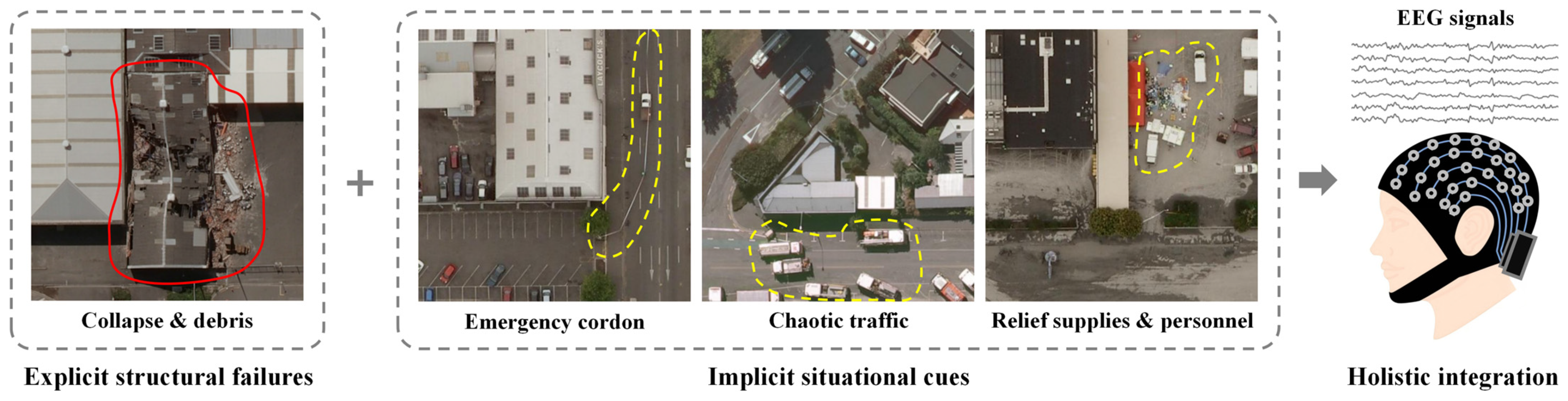
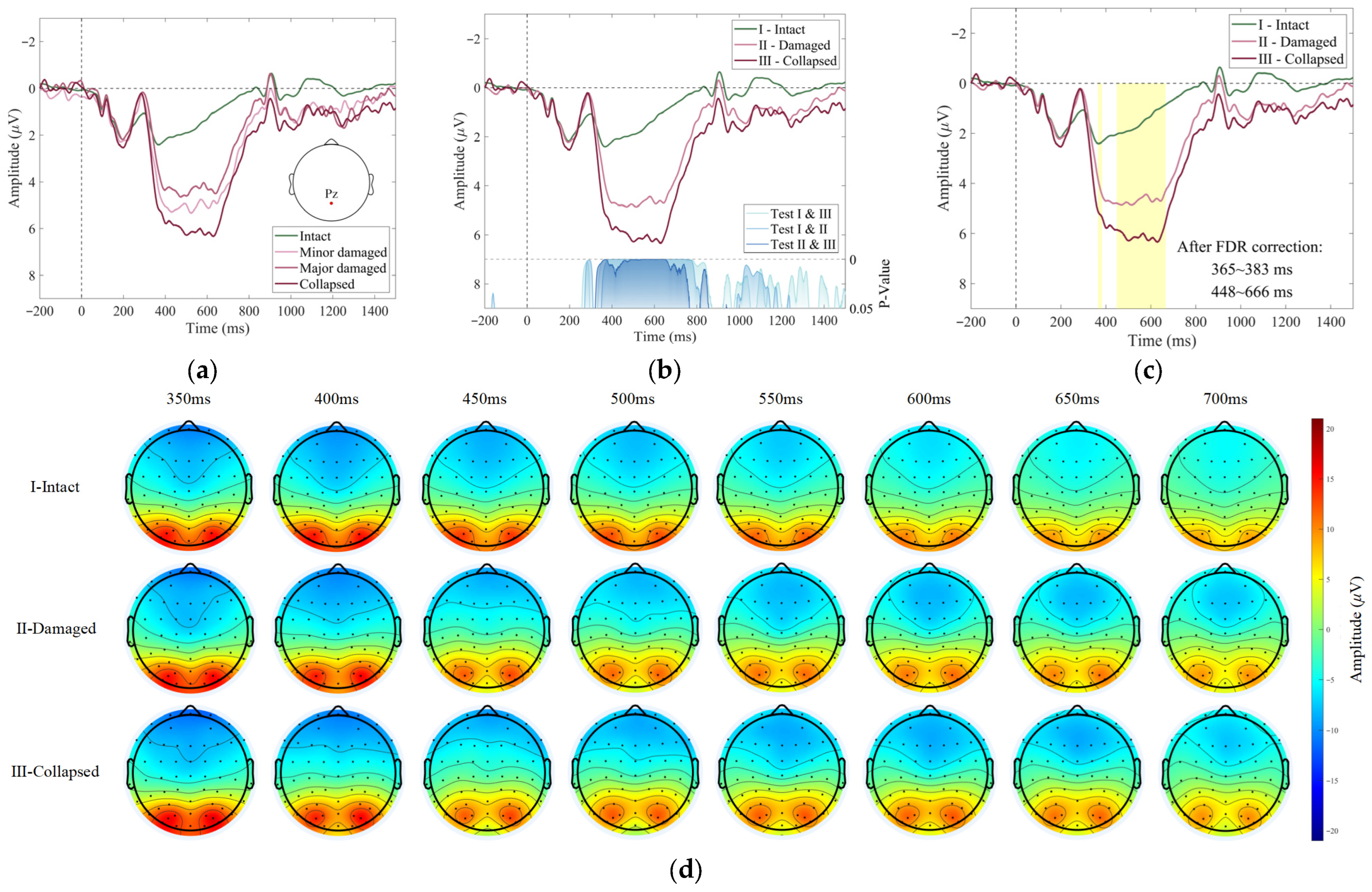
- Risk appraisal relies on parietal–occipital processing that supports fine-grained structural interpretation, rather than simple object-level damage detection. The parietal–occipital dominance observed in the discriminative feature distribution aligns with the cognitive demand for detailed visual analysis and spatial attention [42,43,44,45,46,47]. In post-disaster imagery, intact and damaged buildings often share similar global appearances, while information that is relevant to potential risk is conveyed through localized, indirect, or context-dependent visual cues. Under such conditions, perceptual judgment relies less on global pattern recognition and more on the fine-grained interpretation of local anomalies, thereby transcending simple object detection. The engagement of posterior networks reflects the detailed scrutiny and semantic integration of these ambiguous cues, while the additional fronto-parietal activation suggests goal-directed cognitive regulation, confirming that participants were actively evaluating the structural implications of visual evidence rather than merely detecting salient features [48,49].
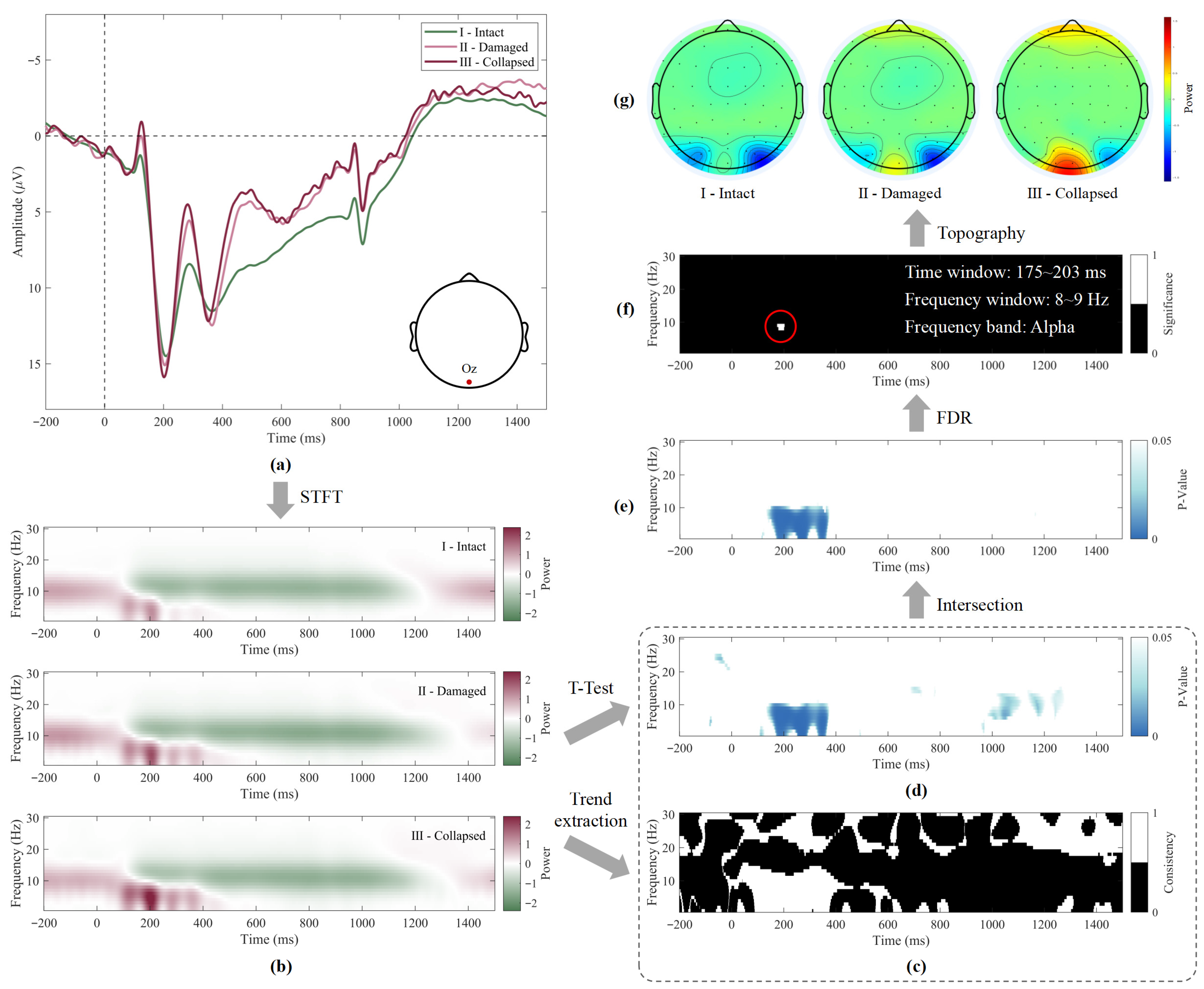
- Damage severity is encoded in late-stage neural responses as a continuous risk representation, rather than a binary classification outcome. While early components (<200 ms) are commonly associated with initial sensory encoding, the dominant discriminative effects emerged in later time windows (>200 ms), reflecting extended post-perceptual evaluation [50]. Rather than reflecting visual saliency alone, the prolonged P3 activity observed in damage conditions is interpreted as increased evaluative demand, as participants integrate incomplete or indirect visual cues to form intuitive inferences about potential hazards. In this sense, damage perception in the present task does not correspond to a simple binary decision, but to an iterative judgment process in which visual evidence is progressively weighed against perceived structural risk. Crucially, the graded P3 amplitude mirrors a continuous spectrum of perceived severity, indicating that the human brain represents damage-related risk in an analog, severity-dependent manner rather than as a discrete label.
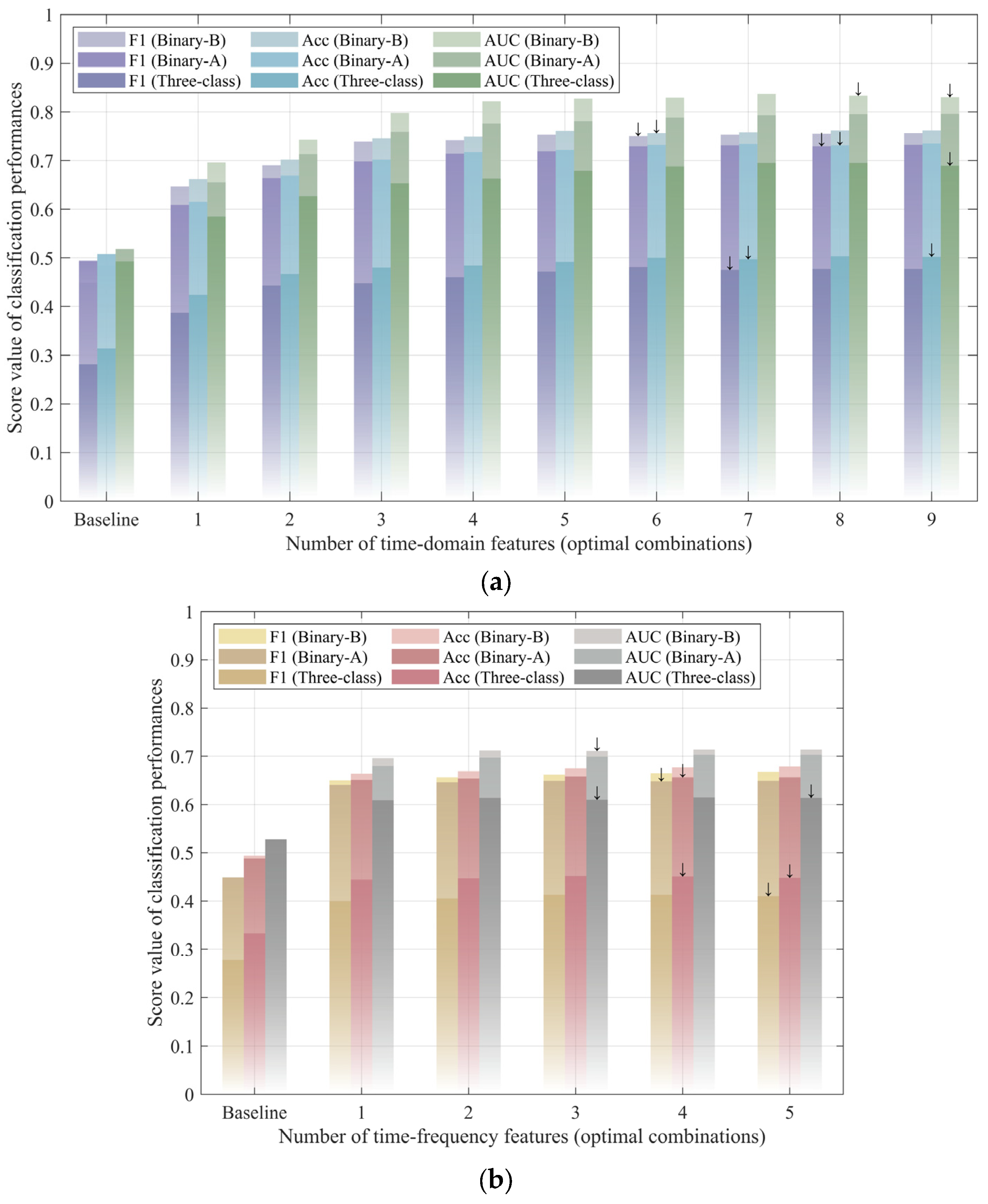
- Multi-frequency oscillatory dynamics reflect coordinated cognitive processing for risk appraisal in visually complex scenarios. The modulation of occipital Alpha activity is commonly linked to selective attention and the suppression of irrelevant information [51], supporting focused processing of ambiguous, risk-relevant visual cues. Theta-band activity reflects working-memory engagement and cognitive control, likely associated with the comparison between observed structures and internal representations of intact buildings [51,52]. Delta-band involvement, often associated with decision-making and signal detection, suggests that images depicting severe structural damage may trigger sustained risk-related appraisal and context updating beyond purely local visual analysis [53]. Together, these oscillatory patterns indicate that rapid damage assessment engages attentional, mnemonic, and evaluative processes in an integrated manner to support reliable judgment under time pressure.
4.2. Single-Trial Interpretation
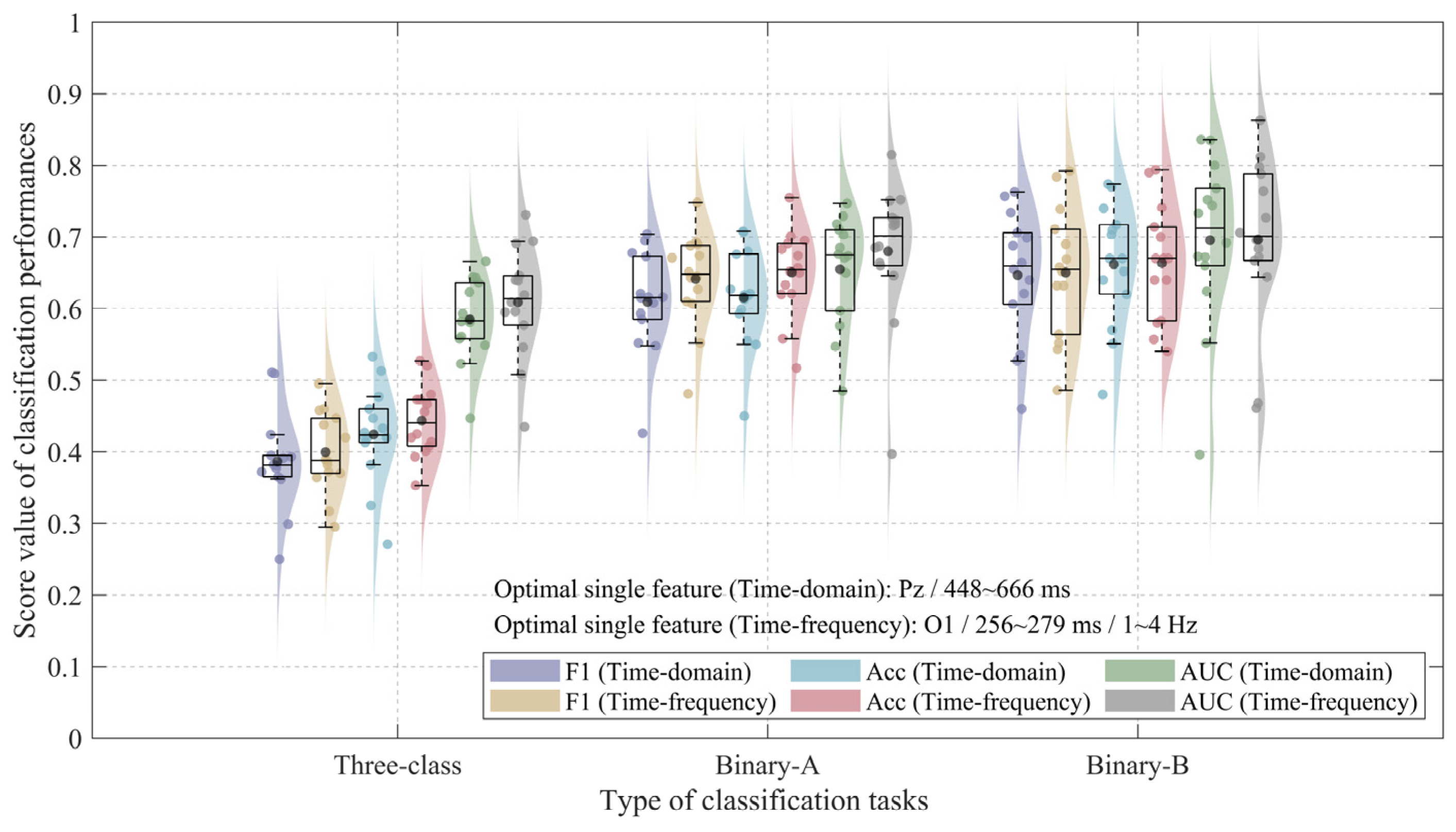
- Time-domain ERP features provide the most robust and scalable basis for single-trial risk decoding. The comparative analysis of feature domains reveals a critical engineering insight: time-domain ERP features offer superior robustness and scalability compared to oscillatory markers. While spectral features capture individual cognitive strategies, the stability of time-locked responses (e.g., the P3 timing) suggests a shared neural template for risk evaluation across observers. This finding is pivotal for developing generalized cognition-informed tools, as it implies that the temporal structure and magnitude of neural responses provide a stable physiological reference for calibrating automated assessment models.
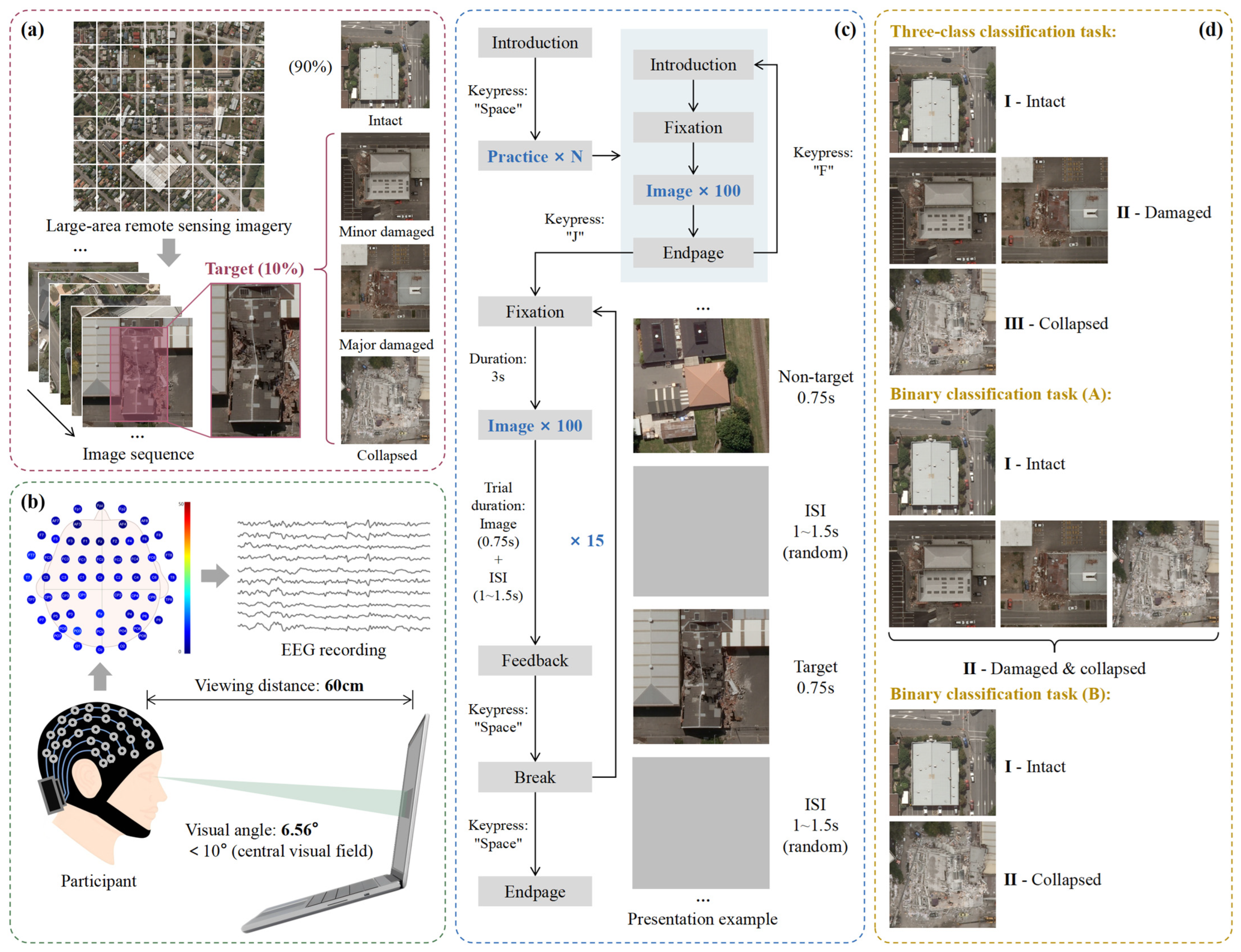
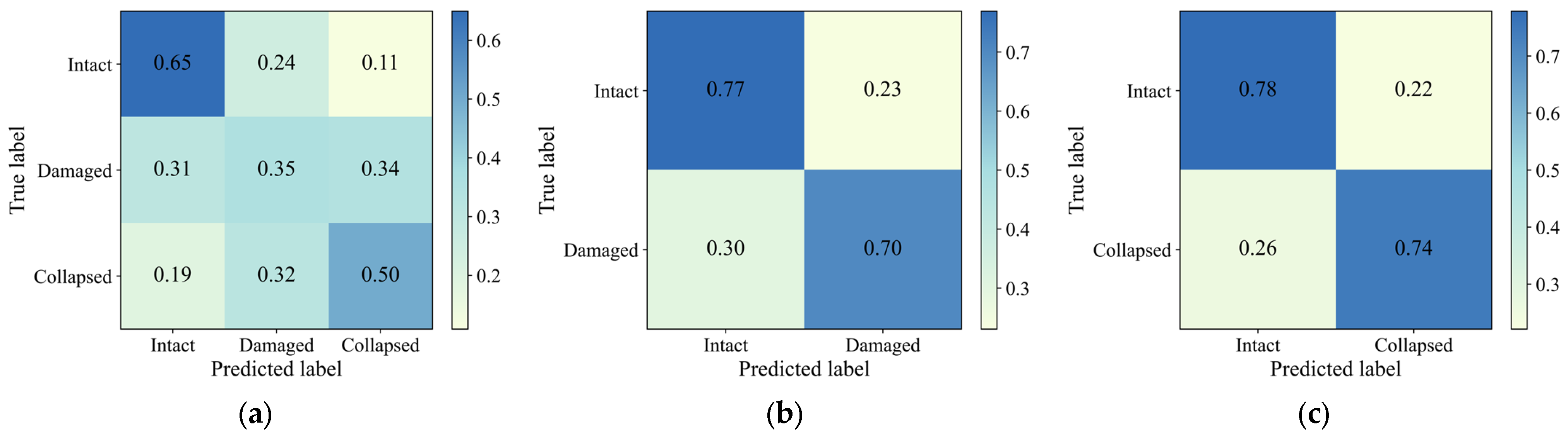
- Misclassification is concentrated in intermediate damage states, reflecting intrinsic perceptual ambiguity rather than noise. The observed asymmetry in perceptual errors, where confusion primarily occurred between damage categories while intact buildings remained distinct, reflects a fundamental characteristic of human judgment under uncertainty. Since participants detected damage as a proxy for perceived risk rather than performing fine-grained grading, the differentiation between damaged and collapsed structures relied on spontaneous inference. The “Damaged” category inherently includes diverse and partially conflicting cues (e.g., limited roof deformation without global collapse), increasing perceptual ambiguity. From this perspective, the reduced discriminability for intermediate damage states should not be viewed merely as noise, but as a neural signature of uncertainty processing. This highlights that ambiguity is an intrinsic component of human risk perception, offering a potential “soft label” for training automated systems to better handle borderline cases in realistic disaster scenes.
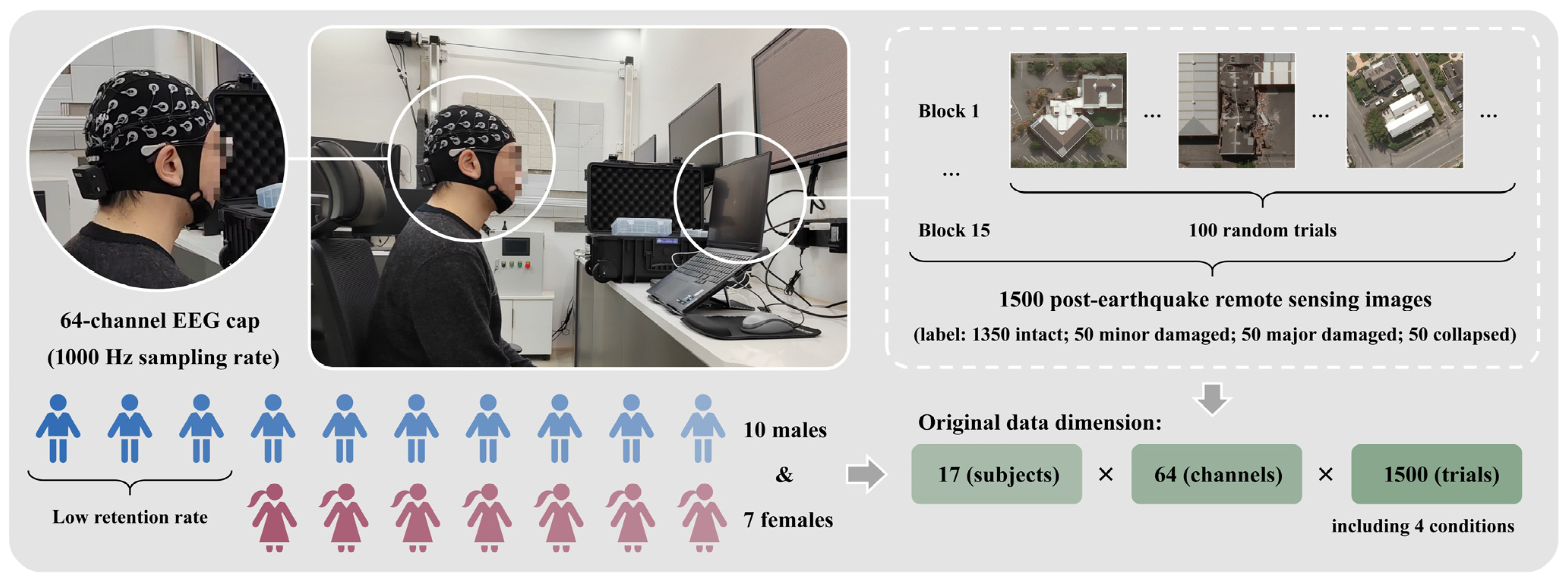
- Inter-individual variability necessitates adaptive human-in-the-loop assessment rather than full automation. The successful decoding using standard SVM classifiers establishes a conservative baseline for feasibility. It proves that discriminative risk information is accessible without relying on “black-box” deep learning models, preserving the interpretability of the neural features. The substantial inter-individual variability observed reflects differences in perceptual strategies and prior experience, which are common sources of human error in visual inspection. Rather than being treated solely as a limitation, such variability represents a defining characteristic of human risk perception, underscoring the necessity of adaptive human-in-the-loop frameworks that can accommodate personalized cognitive baselines to mitigate human error when integrating human judgment with automated analysis.
4.3. Limitations and Future Work
5. Conclusions
Author Contributions
Funding
Institutional Review Board Statement
Informed Consent Statement
Data Availability Statement
Acknowledgments
Conflicts of Interest
Abbreviations
| CV | Computer vision |
| EEG | Electroencephalography |
| ERP | Event-related potential |
| ISI | Inter-stimulus interval |
| ICA | Independent component analysis |
| FDR | False discovery rate |
| STFT | Short-time Fourier transform |
| SVM | Support vector machine |
| Acc | Accuracy |
| F1 | F1 score |
| AUC | Area under the receiver operating characteristic curve |
References
- Braik, A.M.; Koliou, M. Automated building damage assessment and large-scale mapping by integrating satellite imagery, GIS, and deep learning. Comput.-Aided Civ. Infrastruct. Eng. 2024, 39, 2389–2404. [Google Scholar] [CrossRef]
- Kaur, N.; Lee, C.; Mostafavi, A.; Mahdavi-Amiri, A. Large-scale building damage assessment using a novel hierarchical transformer architecture on satellite images. Comput.-Aided Civ. Infrastruct. Eng. 2023, 38, 2072–2091. [Google Scholar] [CrossRef]
- Khajwal, A.B.; Cheng, C.; Noshadravan, A. Post-disaster damage classification based on deep multi-view image fusion. Comput.-Aided Civ. Infrastruct. Eng. 2023, 38, 528–544. [Google Scholar] [CrossRef]
- Singh, D.K.; Hoskere, V. Post Disaster damage Assessment using Ultra-high-resolution Aerial Imagery with Semi-supervised transformers. Sensors 2023, 23, 8235. [Google Scholar] [CrossRef]
- Koliou, M.; van de Lindt, J.W.; McAllister, T.P.; Ellingwood, B.R.; Dillard, M.; Cutler, H. State of the research in community resilience: Progress and challenges. Sustain. Resilient Infrastruct. 2020, 5, 131–151. [Google Scholar] [CrossRef]
- Kang, D.; Cha, Y.J. Autonomous UAVs for structural health monitoring using deep learning and an ultrasonic beacon system with geo-tagging. Comput.-Aided Civ. Infrastruct. Eng. 2018, 33, 885–902. [Google Scholar] [CrossRef]
- Saleem, M.R.; Mayne, R.; Napolitano, R. Evaluating Human Expert Knowledge in Damage Assessment Using Eye Tracking: A Disaster Case Study. Buildings 2024, 14, 2114. [Google Scholar] [CrossRef]
- Yuan, F.-G.; Zargar, S.A.; Chen, Q.; Wang, S. Machine learning for structural health monitoring: Challenges and opportunities. Sens. Smart Struct. Technol. Civ. Mech. Aerosp. Syst. 2020, 11379, 1137903. [Google Scholar]
- Gupta, R.; Hosfelt, R.; Sajeev, S.; Patel, N.; Goodman, B.; Doshi, J.; Heim, E.; Choset, H.; Gaston, M. xbd: A dataset for assessing building damage from satellite imagery. arXiv 2019, arXiv:1911.09296. [Google Scholar] [CrossRef]
- Gupta, R.; Shah, M. Rescuenet: Joint building segmentation and damage assessment from satellite imagery. In 2020 25th International Conference on Pattern Recognition (ICPR); IEEE: New York, NY, USA, 2021. [Google Scholar]
- Weber, E.; Kané, H. Building disaster damage assessment in satellite imagery with multi-temporal fusion. arXiv 2020, arXiv:2004.05525. [Google Scholar] [CrossRef]
- Shen, Y.; Zhu, S.; Yang, T.; Chen, C.; Pan, D.; Chen, J.; Xiao, L.; Du, Q. Bdanet: Multiscale convolutional neural network with cross-directional attention for building damage assessment from satellite images. IEEE Trans. Geosci. Remote Sens. 2021, 60, 1–14. [Google Scholar] [CrossRef]
- Hao, H.; Baireddy, S.; Bartusiak, E.R.; Konz, L.; LaTourette, K.; Gribbons, M.; Chan, M.; Delp, E.J.; Comer, M.L. An attention-based system for damage assessment using satellite imagery. In 2021 IEEE International Geoscience and Remote Sensing Symposium Igarss; IEEE: New York, NY, USA, 2021. [Google Scholar]
- Wu, C.; Zhang, F.; Xia, J.; Xu, Y.; Li, G.; Xie, J.; Du, Z.; Liu, R. Building damage detection using U-Net with attention mechanism from pre-and post-disaster remote sensing datasets. Remote Sens. 2021, 13, 905. [Google Scholar] [CrossRef]
- Cheng, C.S.; Behzadan, A.H.; Noshadravan, A. Deep learning for post-hurricane aerial damage assessment of buildings. Comput.-Aided Civ. Infrastruct. Eng. 2021, 36, 695–710. [Google Scholar] [CrossRef]
- Matin, S.S.; Pradhan, B. Challenges and limitations of earthquake-induced building damage mapping techniques using remote sensing images-A systematic review. Geocarto Int. 2022, 37, 6186–6212. [Google Scholar] [CrossRef]
- van Dyck, L.E.; Gruber, W.R. Seeing eye-to-eye? A comparison of object recognition performance in humans and deep convolutional neural networks under image manipulation. arXiv 2020, arXiv:2007.06294. [Google Scholar]
- Wang, Z.; Cha, Y.-J. Unsupervised deep learning approach using a deep auto-encoder with a one-class support vector machine to detect damage. Struct. Health Monit. 2021, 20, 406–425. [Google Scholar] [CrossRef]
- Oyekoya, O.; Stentiford, F. Perceptual image retrieval using eye movements. Int. J. Comput. Math. 2007, 84, 1379–1391. [Google Scholar] [CrossRef]
- Mohedano, E.; Healy, G.; McGuinness, K.; Giró-I-Nieto, X.; O’cOnnor, N.E.; Smeaton, A.F. Improving object segmentation by using EEG signals and rapid serial visual presentation. Multimed. Tools Appl. 2015, 74, 10137–10159. [Google Scholar] [CrossRef]
- Keysers, C.; Xiao, D.-K.; Földiák, P.; Perrett, D.I. The speed of sight. J. Cogn. Neurosci. 2001, 13, 90–101. [Google Scholar] [CrossRef]
- Torres, E.P.; Torres, E.A.; Hernández-Álvarez, M.; Yoo, S.G. EEG-based BCI emotion recognition: A survey. Sensors 2020, 20, 5083. [Google Scholar] [CrossRef]
- Henry, J.C. Electroencephalography: Basic principles, clinical applications, and related fields. Neurology 2006, 67, 2092-2092-a. [Google Scholar] [CrossRef]
- Haynes, J.-D.; Rees, G. Decoding mental states from brain activity in humans. Nat. Rev. Neurosci. 2006, 7, 523–534. [Google Scholar] [CrossRef] [PubMed]
- Squires, K.C.; Wickens, C.; Squires, N.K.; Donchin, E. The effect of stimulus sequence on the waveform of the cortical event-related potential. Science 1976, 193, 1142–1146. [Google Scholar] [CrossRef] [PubMed]
- Tan, J.; Luo, F.; Zhang, X.; Liu, J. Visual stimulus event related potential and its advances in related studies. Chin. J. Forensic Med. 2017, 32, 44–47. [Google Scholar]
- Donchin, E.; Karis, D.; Bashore, T.R.; Coles, M.G.H.; Gratton, G. Cognitive psychophysiology and human information processing. In Psychophysiology: Systems, Processes, and Applications; Coles, M.G.H., Donchin, E., Porges, S.W., Eds.; Guilford Press: New York, NY, USA, 1986; pp. 244–267. [Google Scholar]
- Bigdely-Shamlo, N.; Vankov, A.; Ramirez, R.R.; Makeig, S. Brain activity-based image classification from rapid serial visual presentation. IEEE Trans. Neural Syst. Rehabil. Eng. 2008, 16, 432–441. [Google Scholar] [CrossRef]
- Matran-Fernandez, A.; Poli, R. Collaborative brain-computer interfaces for target localisation in rapid serial visual presentation. In 2014 6th Computer Science and Electronic Engineering Conference (CEEC); IEEE: New York, NY, USA, 2014. [Google Scholar]
- Matran-Fernandez, A.; Poli, R. Brain–computer interfaces for detection and localization of targets in aerial images. IEEE Trans. Biomed. Eng. 2016, 64, 959–969. [Google Scholar] [CrossRef]
- Fan, L.; Shen, H.; Xie, F.; Su, J.; Yu, Y.; Hu, D. DC-tCNN: A deep model for EEG-based detection of dim targets. IEEE Trans. Neural Syst. Rehabil. Eng. 2022, 30, 1727–1736. [Google Scholar] [CrossRef]
- Sajda, P.; Gerson, A.; Parra, L. High-throughput image search via single-trial event detection in a rapid serial visual presentation task. In First International IEEE EMBS Conference on Neural Engineering; Conference Proceedings; IEEE: New York, NY, USA, 2003. [Google Scholar]
- Gerson, A.D.; Parra, L.C.; Sajda, P. Cortically coupled computer vision for rapid image search. IEEE Trans. Neural Syst. Rehabil. Eng. 2006, 14, 174–179. [Google Scholar] [CrossRef]
- Parra, L.C.; Christoforou, C.; Gerson, A.C.; Dyrholm, M.; Luo, A.; Wagner, M.; Philiastides, M.G.; Sajda, P. Spatiotemporal linear decoding of brain state. IEEE Signal Process. Mag. 2007, 25, 107–115. [Google Scholar] [CrossRef]
- Simanova, I.; Van Gerven, M.; Oostenveld, R.; Hagoort, P. Identifying object categories from event-related EEG: Toward decoding of conceptual representations. PLoS ONE 2010, 5, e14465. [Google Scholar] [CrossRef]
- Wang, C.; Xiong, S.; Hu, X.; Yao, L.; Zhang, J. Combining features from ERP components in single-trial EEG for discriminating four-category visual objects. J. Neural Eng. 2012, 9, 056013. [Google Scholar] [CrossRef] [PubMed]
- Böcker, K.B.E.; Brunia, C.H.M.; Berg-Lenssen, M.M.C.v.D. A spatiotemporal dipole model of the stimulus preceding negativity (SPN) prior to feedback stimuli. Brain Topogr. 1994, 7, 71–88. [Google Scholar] [CrossRef] [PubMed]
- Delorme, A.; Makeig, S. EEGLAB: An open source toolbox for analysis of single-trial EEG dynamics including independent component analysis. J. Neurosci. Methods 2004, 134, 9–21. [Google Scholar] [CrossRef] [PubMed]
- Makeig, S.; Bell, A.; Jung, T.P.; Sejnowski, T.J. Independent component analysis of electroencephalographic data. Adv. Neural Inf. Process. Syst. 1995, 8, 145–151. [Google Scholar]
- Hu, L.; Zhang, Z. EEG Signal Processing and Feature Extraction; Springer: Berlin/Heidelberg, Germany, 2019. [Google Scholar]
- Benjamini, Y.; Hochberg, Y. Controlling the false discovery rate: A practical and powerful approach to multiple testing. J. R. Stat. Soc. Ser. B (Methodol.) 1995, 57, 289–300. [Google Scholar] [CrossRef]
- Iidaka, T.; Yamashita, K.; Kashikura, K.; Yonekura, Y. Spatial frequency of visual image modulates neural responses in the temporo-occipital lobe. An investigation with event-related fMRI. Cogn. Brain Res. 2004, 18, 196–204. [Google Scholar] [CrossRef]
- Peyrin, C.; Baciu, M.; Segebarth, C.; Marendaz, C. Cerebral regions and hemispheric specialization for processing spatial frequencies during natural scene recognition. An event-related fMRI study. Neuroimage 2004, 23, 698–707. [Google Scholar] [CrossRef]
- Rossion, B.; Schiltz, C.; Crommelinck, M. The functionally defined right occipital and fusiform “face areas” discriminate novel from visually familiar faces. Neuroimage 2003, 19, 877–883. [Google Scholar] [CrossRef]
- Sugiura, M.; Shah, N.J.; Zilles, K.; Fink, G.R. Cortical representations of personally familiar objects and places: Functional organization of the human posterior cingulate cortex. J. Cogn. Neurosci. 2005, 17, 183–198. [Google Scholar] [CrossRef]
- Elman, J.A.; Cohn-Sheehy, B.I.; Shimamura, A.P. Dissociable parietal regions facilitate successful retrieval of recently learned and personally familiar information. Neuropsychologia 2013, 51, 573–583. [Google Scholar] [CrossRef]
- Xu, Y.; Chun, M.M. Visual grouping in human parietal cortex. Proc. Natl. Acad. Sci. USA 2007, 104, 18766–18771. [Google Scholar] [CrossRef]
- Marek, S.; Dosenbach, N.U. The frontoparietal network: Function, electrophysiology, and importance of individual precision mapping. Dialogues Clin. Neurosci. 2018, 20, 133–140. [Google Scholar] [CrossRef] [PubMed]
- Scolari, M.; Seidl-Rathkopf, K.N.; Kastner, S. Functions of the human frontoparietal attention network: Evidence from neuroimaging. Curr. Opin. Behav. Sci. 2015, 1, 32–39. [Google Scholar] [CrossRef] [PubMed]
- Luck, S.J.; Kappenman, E.S. The Oxford Handbook of Event-Related Potential Components; Oxford University Press: Oxford, UK, 2011. [Google Scholar]
- Klimesch, W. EEG alpha and theta oscillations reflect cognitive and memory performance: A review and analysis. Brain Res. Rev. 1999, 29, 169–195. [Google Scholar] [CrossRef] [PubMed]
- Herweg, N.A.; Solomon, E.A.; Kahana, M.J. Theta oscillations in human memory. Trends Cogn. Sci. 2020, 24, 208–227. [Google Scholar] [CrossRef]
- Harmony, T. The functional significance of delta oscillations in cognitive processing. Front. Integr. Neurosci. 2013, 7, 83. [Google Scholar] [CrossRef]
- Gu, J.; Xie, Z.; Zhang, J.; He, X. Advances in rapid damage identification methods for post-disaster regional buildings based on remote sensing images: A survey. Buildings 2024, 14, 898. [Google Scholar] [CrossRef]
- Lagap, U.; Ghaffarian, S.; Gelinas-Gagne, S.; Jilma, J.; Liu, Z.; Luo, Z. Towards reliable deep learning for post-disaster damage assessment: An XAI-based evaluation. Int. J. Disaster Risk Reduct. 2025, 108, 105839. [Google Scholar] [CrossRef]
- Lawhern, V.J.; Solon, A.J.; Waytowich, N.R.; Gordon, S.M.; Hung, C.P.; Lance, B.J. EEGNet: A compact convolutional neural network for EEG-based brain-computer interfaces. J. Neural Eng. 2018, 15, 056013. [Google Scholar] [CrossRef]





| Sub ID | M1 | M2 | Retention Rate | Sub ID | M1 | M2 | Retention Rate |
|---|---|---|---|---|---|---|---|
| 01 | 9.7 | 0.5 | 93% | 11 | 10.3 | 1.0 | 99.5% |
| 02 | 10.3 | 0.4 | 97% | 12 | 10.2 | 0.5 | 90.9% |
| 04 | 9.2 | 1.1 | 97.5% | 13 | 10.1 | 0.3 | 99.7% |
| 05 | 11.1 | 1.3 | 94.7% | 14 | 10.7 | 0.7 | 99.7% |
| 07 | 9.5 | 0.6 | 99.1% | 15 | 10.2 | 0.3 | 99.5% |
| 08 | 10.8 | 0.9 | 92.0% | 16 | 9.9 | 0.5 | 100.0% |
| 10 | 9.9 | 0.3 | 99.7% | 17 | 9.5 | 0.5 | 98.5% |
| Time-Domain | Time–Frequency Domain | ||||
|---|---|---|---|---|---|
| Channel | Time Window | Channel | Time Window | Frequency Window | Frequency Band |
| FC1 | 439~466 ms | PO5 | 220~283 ms | 4~7 Hz | Theta |
| CP1 | 389~422 ms | 261~282 ms | 1~4 Hz | Delta | |
| 580~651 ms | Oz | 175~203 ms | 8~9 Hz | Alpha | |
| 657~673 ms | O1 | 186~207 ms | 8~9 Hz | Alpha | |
| Pz | 365~383 ms | 191~206 ms | 7~8 Hz | Theta | |
| 448~666 ms | 240~279 ms | 4~6 Hz | Theta | ||
| P3 | 249~268 ms | 256~279 ms | 1~4 Hz | Delta | |
| 392~431 ms |  | ||||
| 436~764 ms | |||||
| Oz | 411~449 ms | ||||
| O1 | 418~450 ms | ||||
| O2 | 418~440 ms | Topographical distribution of significant electrodes | |||
Disclaimer/Publisher’s Note: The statements, opinions and data contained in all publications are solely those of the individual author(s) and contributor(s) and not of MDPI and/or the editor(s). MDPI and/or the editor(s) disclaim responsibility for any injury to people or property resulting from any ideas, methods, instructions or products referred to in the content. |
© 2026 by the authors. Licensee MDPI, Basel, Switzerland. This article is an open access article distributed under the terms and conditions of the Creative Commons Attribution (CC BY) license.
Share and Cite
Zhu, E.; Yuan, C.; Hao, H.; Kong, Q. Neural Signatures of Human Risk Perception in Post-Disaster Scenarios: Insights for Rapid Building Damage Assessment. Buildings 2026, 16, 1237. https://doi.org/10.3390/buildings16061237
Zhu E, Yuan C, Hao H, Kong Q. Neural Signatures of Human Risk Perception in Post-Disaster Scenarios: Insights for Rapid Building Damage Assessment. Buildings. 2026; 16(6):1237. https://doi.org/10.3390/buildings16061237
Chicago/Turabian StyleZhu, Erqi, Cheng Yuan, Hong Hao, and Qingzhao Kong. 2026. "Neural Signatures of Human Risk Perception in Post-Disaster Scenarios: Insights for Rapid Building Damage Assessment" Buildings 16, no. 6: 1237. https://doi.org/10.3390/buildings16061237
APA StyleZhu, E., Yuan, C., Hao, H., & Kong, Q. (2026). Neural Signatures of Human Risk Perception in Post-Disaster Scenarios: Insights for Rapid Building Damage Assessment. Buildings, 16(6), 1237. https://doi.org/10.3390/buildings16061237