Theoretical Calculation of RCC Layer Thickness Based on Equivalent Elastic Model and Numerical Study on Dam Deformation


 and
and
Abstract
1. Introduction
2. Calculation Theory of RCC Equivalent Elastic Modulus
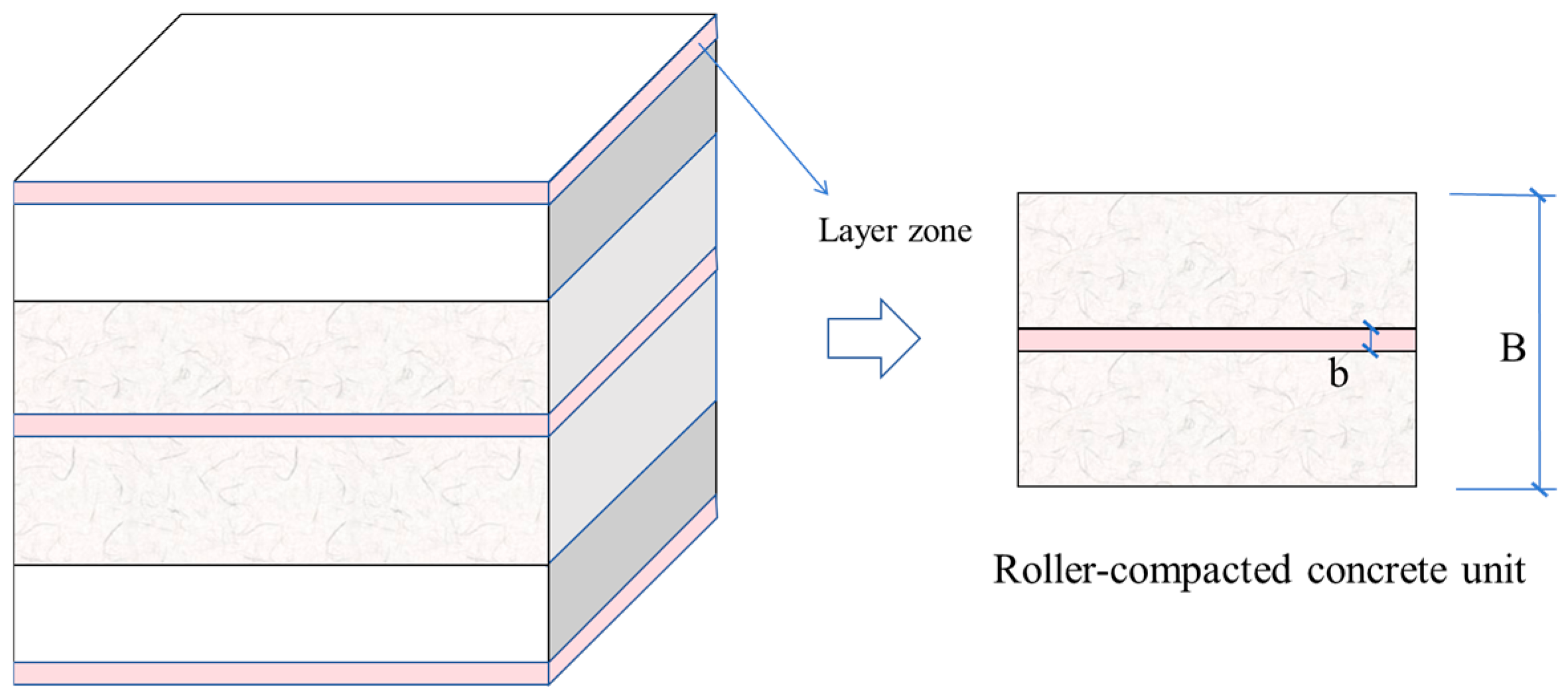
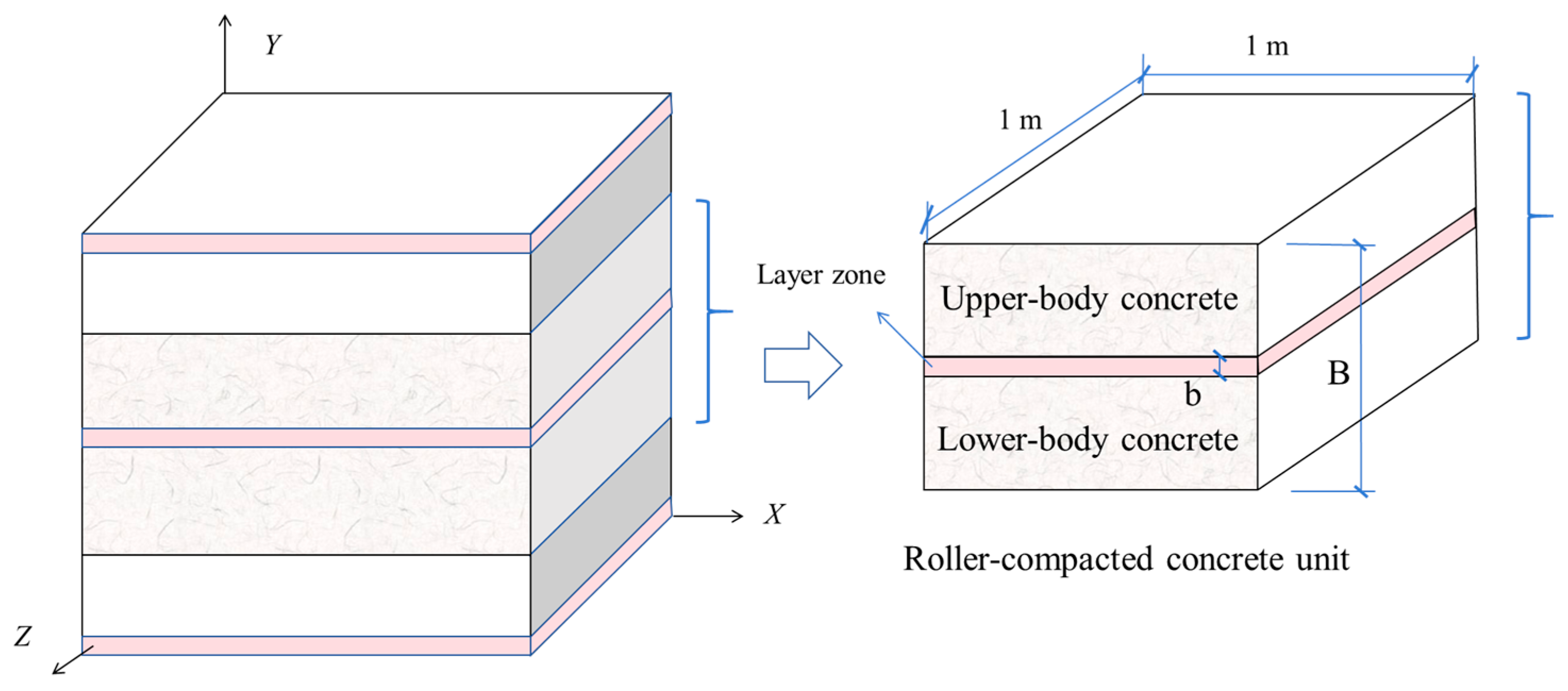
2.1. Constitutive Relation of RCC with Layer Zones
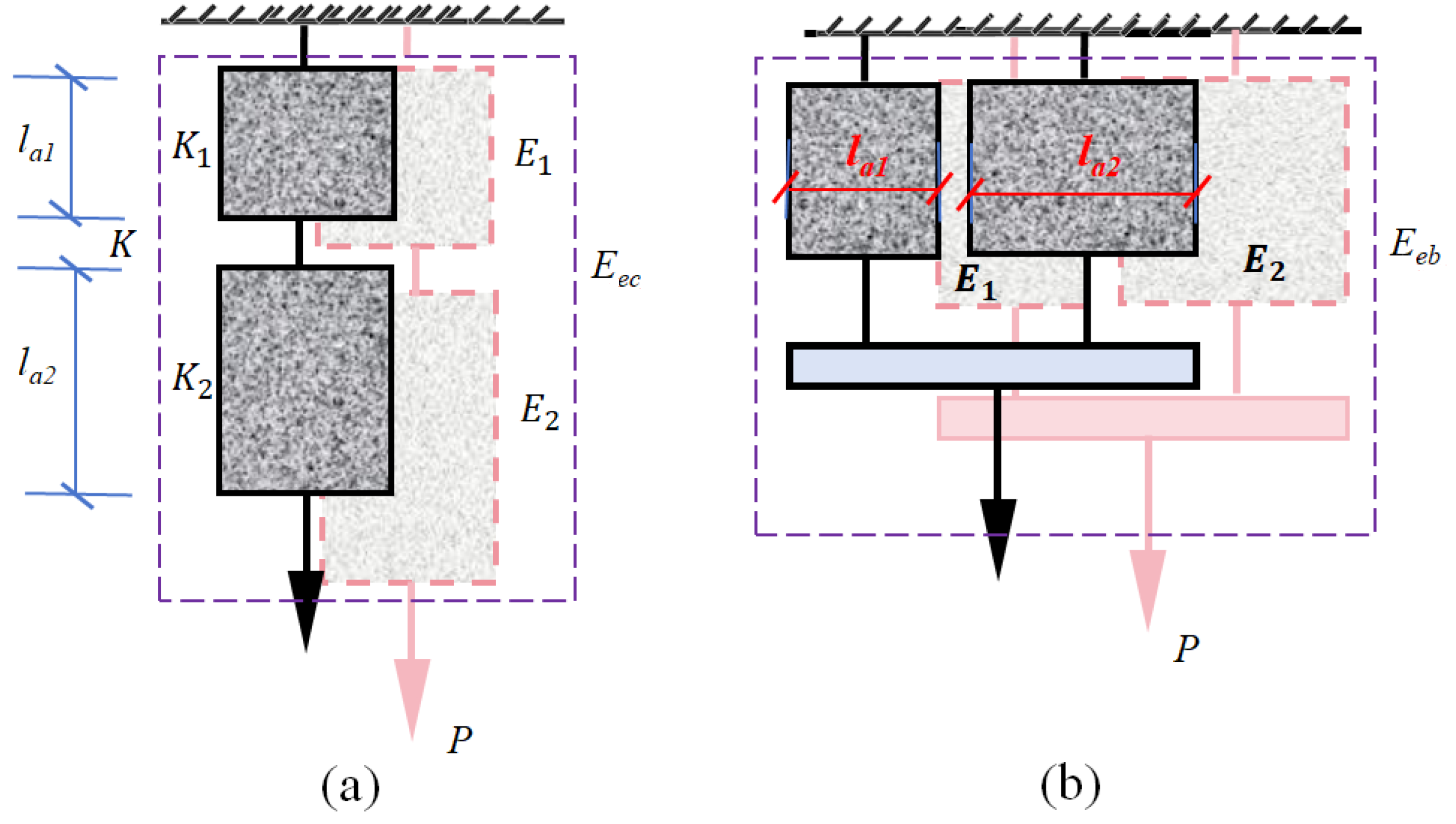
2.2. Calculation Theory of Equivalent Elastic Modulus
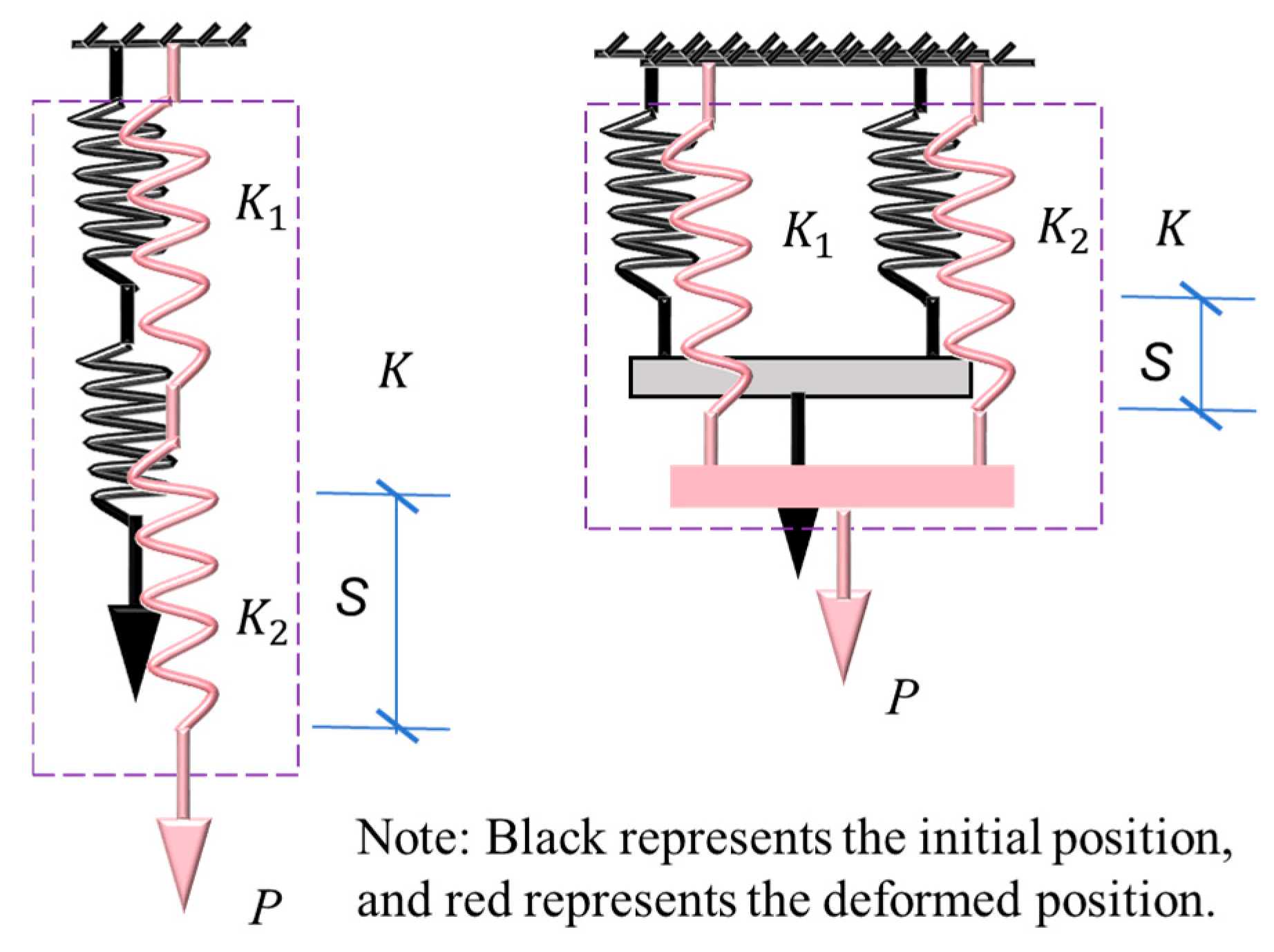
2.2.1. Equivalent Elastic Modulus of Springs
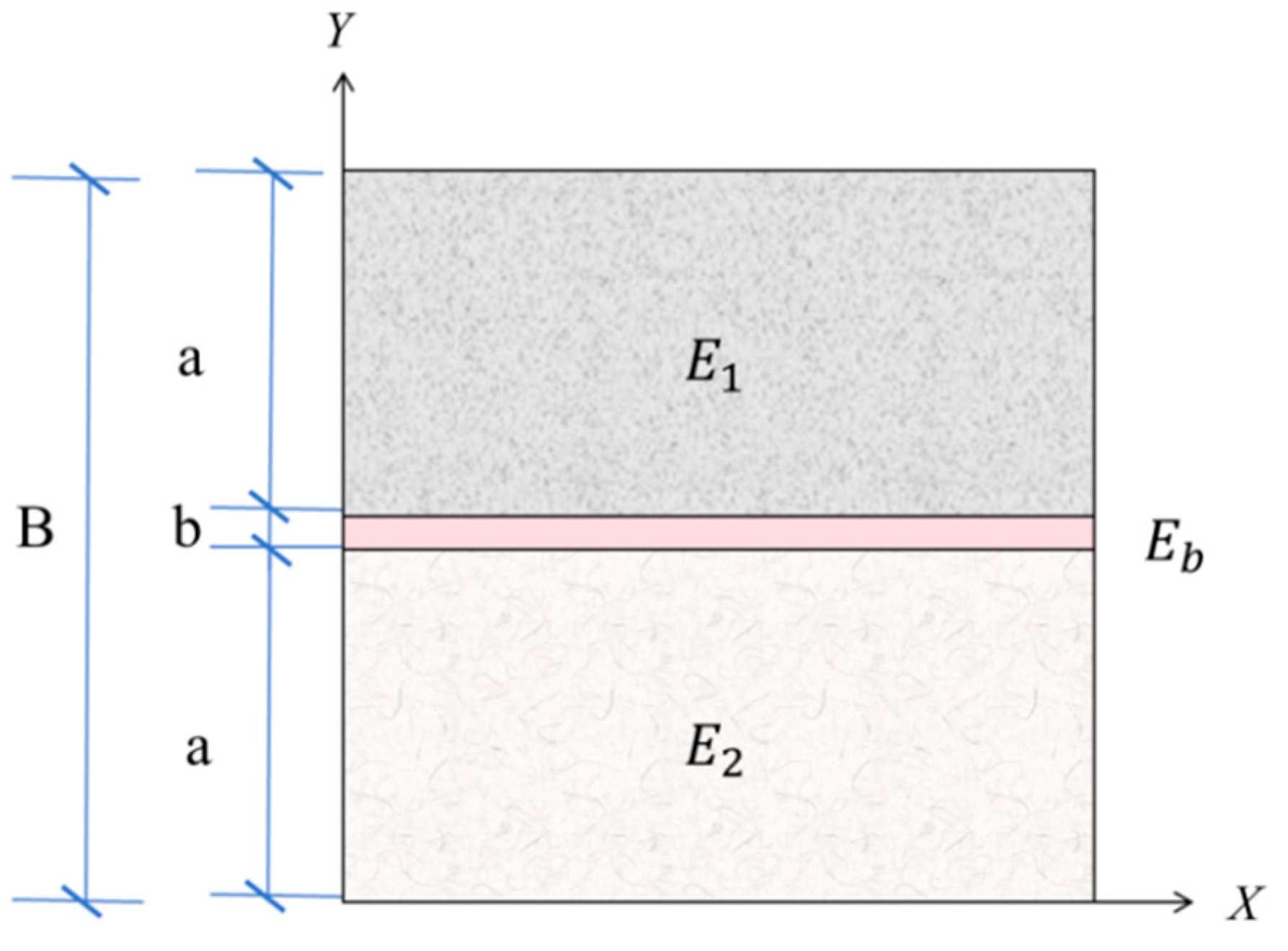
2.2.2. Equivalent Elastic Modulus of Concrete
2.2.3. The Elastic Modulus of the RCC Layer Zone
3. The Analytical Formula for the Thickness of the Layer Zone
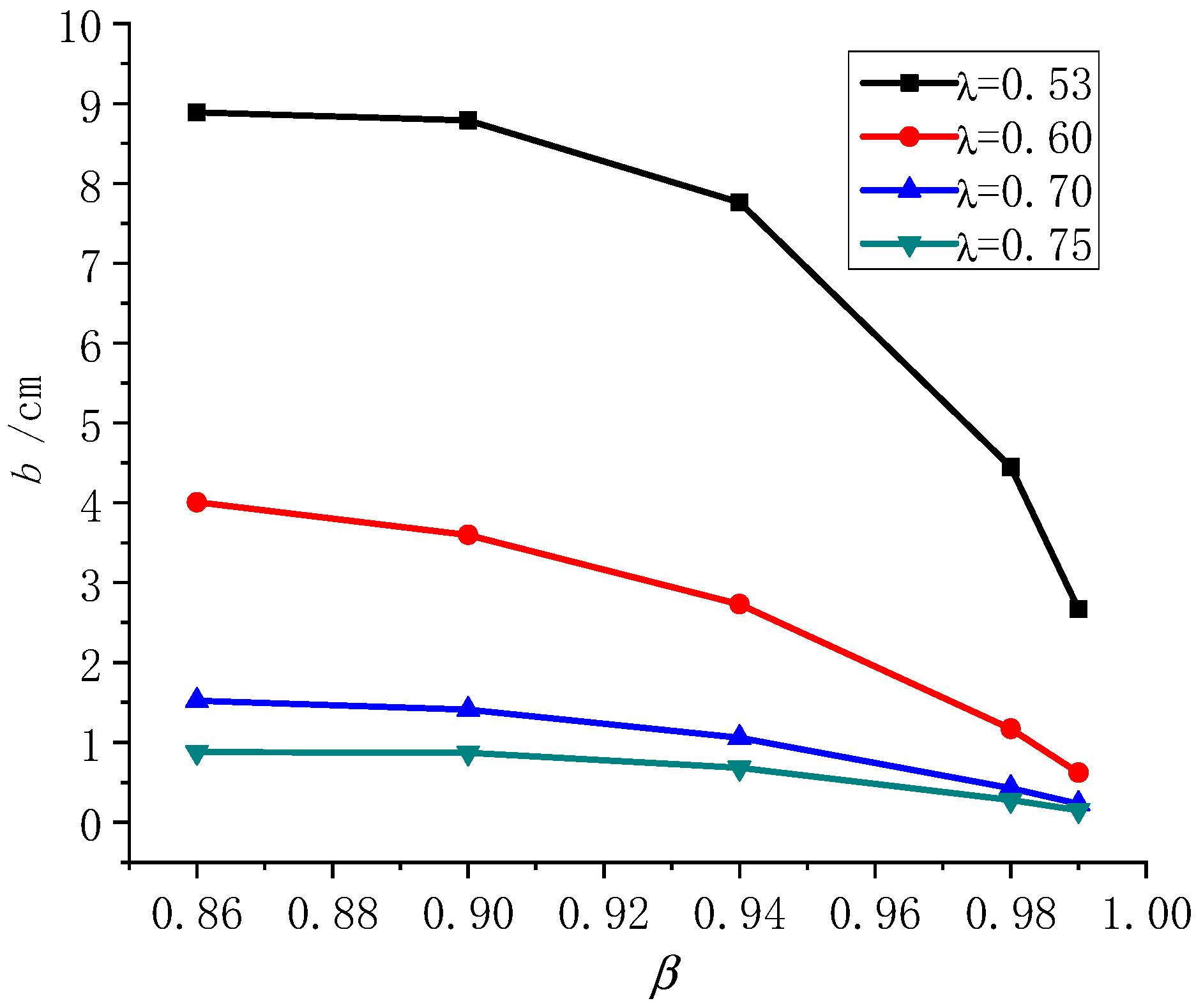
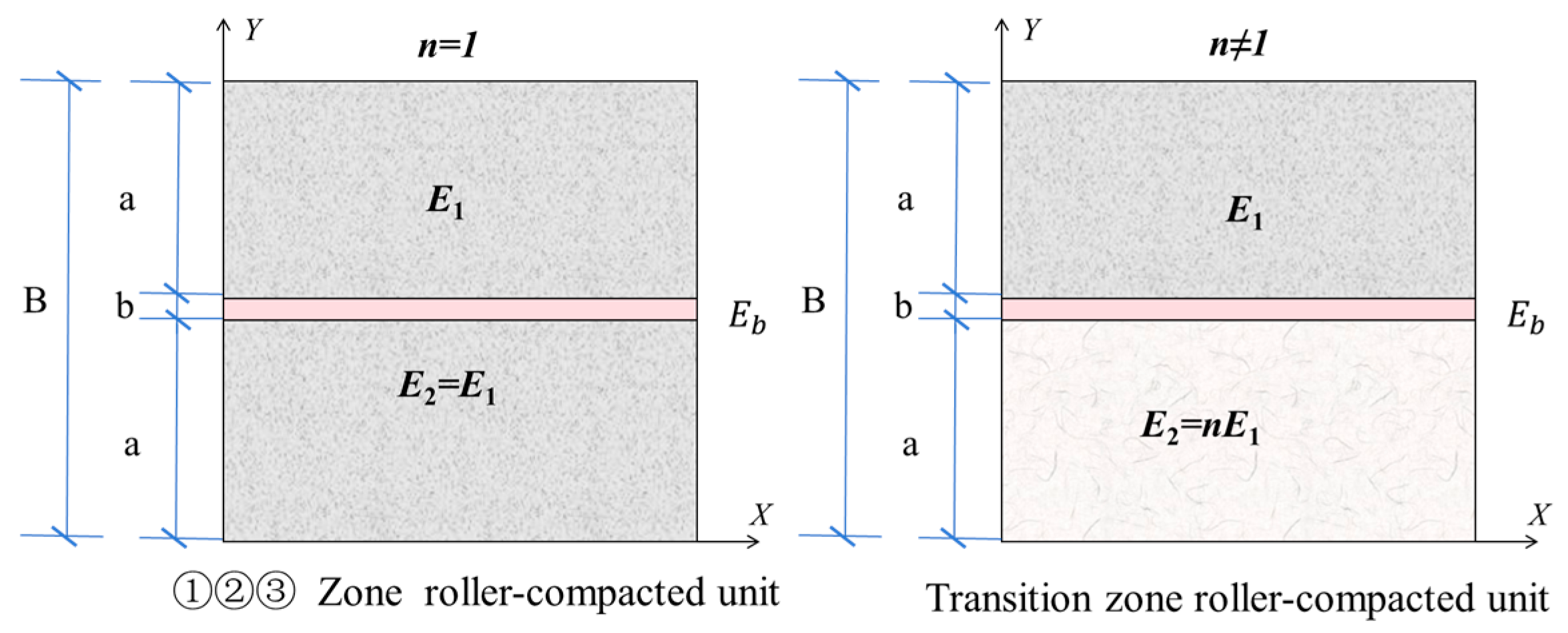
3.1. The Layer Thickness of the Concrete with the Same Properties
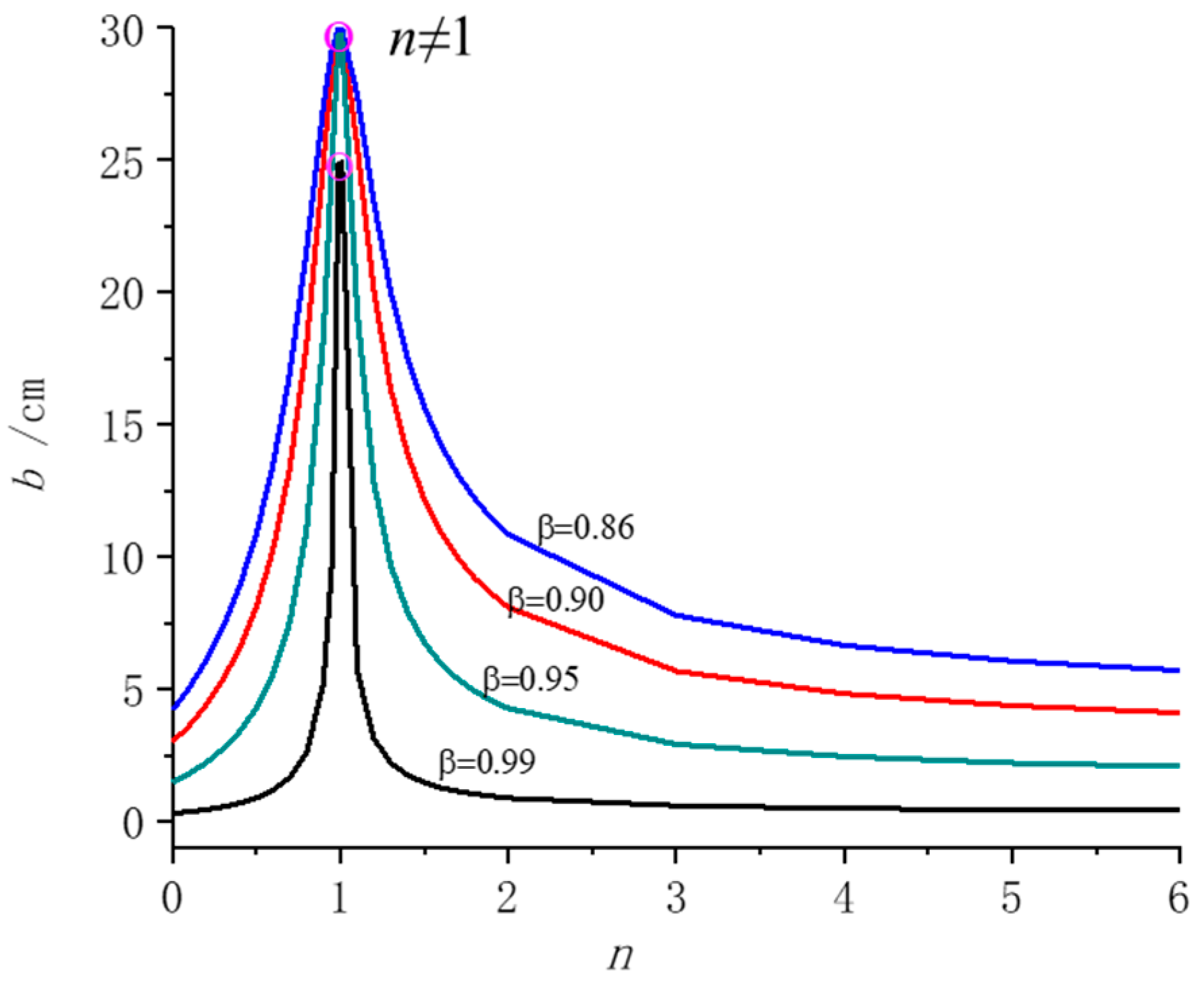
3.2. Layer Thickness of Concrete with Different Properties
3.3. Analytical Formula for Layer Zone Thickness
- (1)
- n = 1
- (2)
- n ≠ 1
4. A Numerical Study on Dam Deformation Considering the Layer Thickness
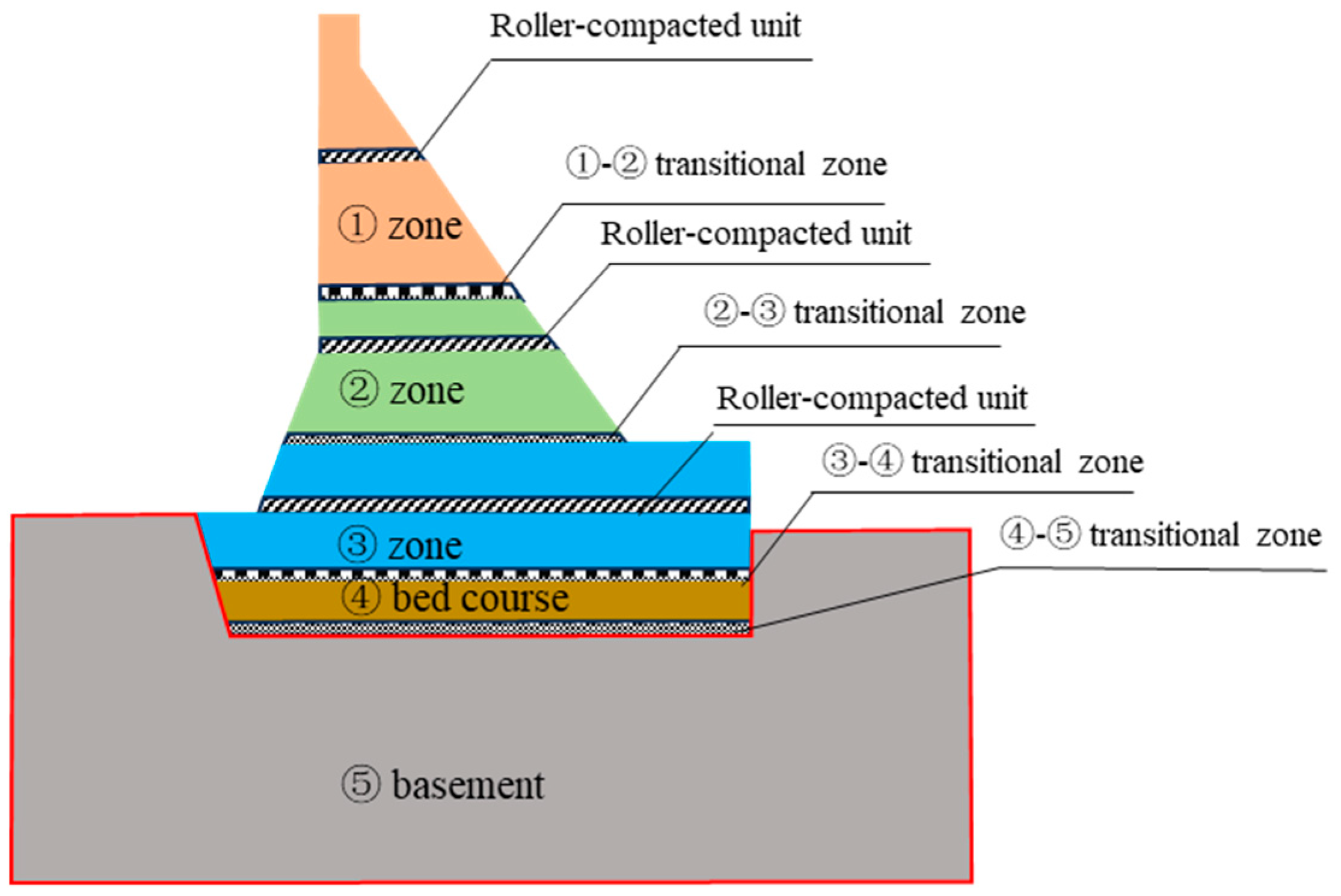
4.1. Dam Material Zoning Without Considering the Influence of the Layer Zones
4.2. Material Zoning Considering the Influence of the Layer Zones
4.3. Calculation Model and Working Load
4.3.1. Finite Element Calculation Model
4.3.2. Calculation of Working Conditions and Loads
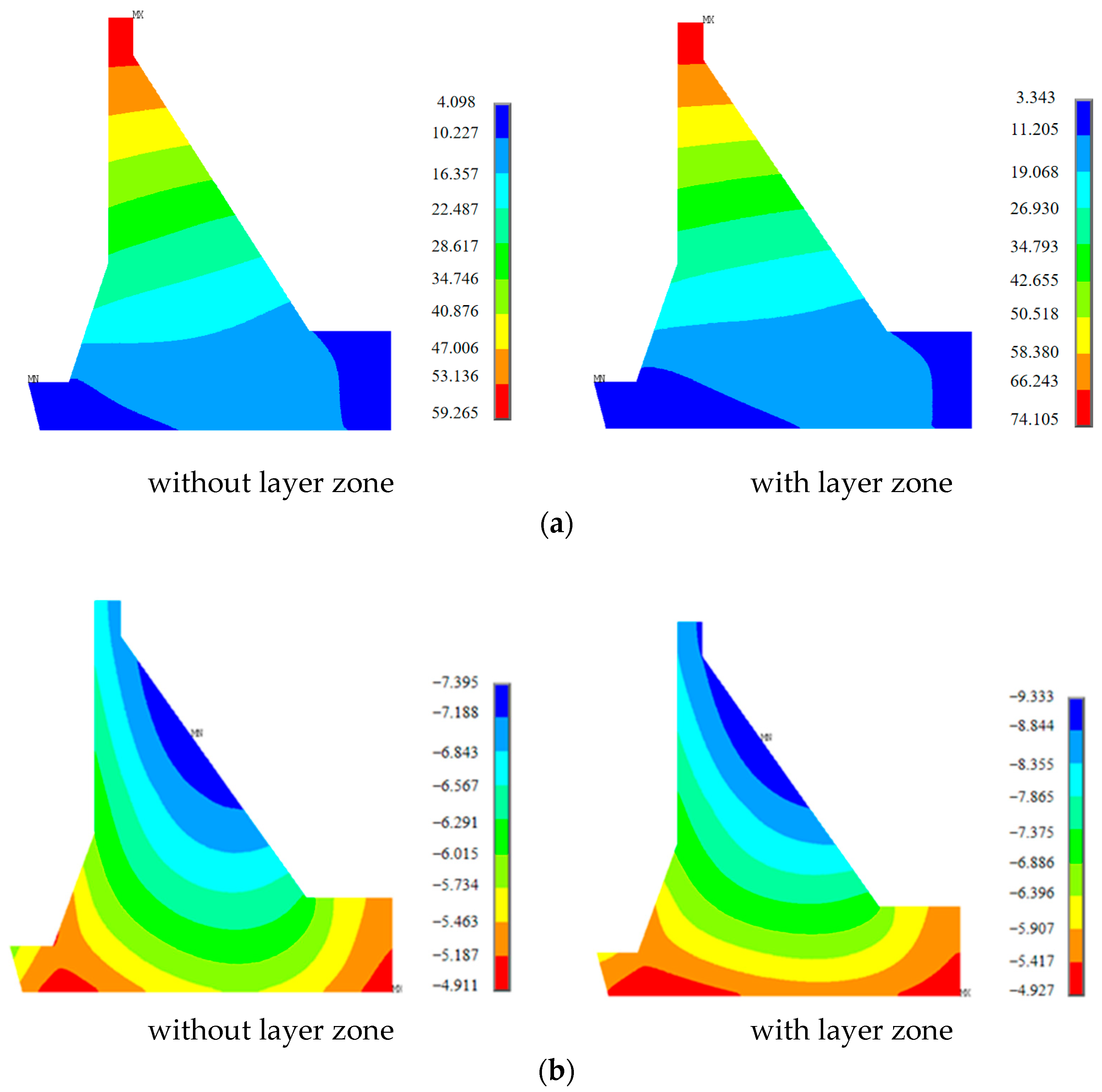
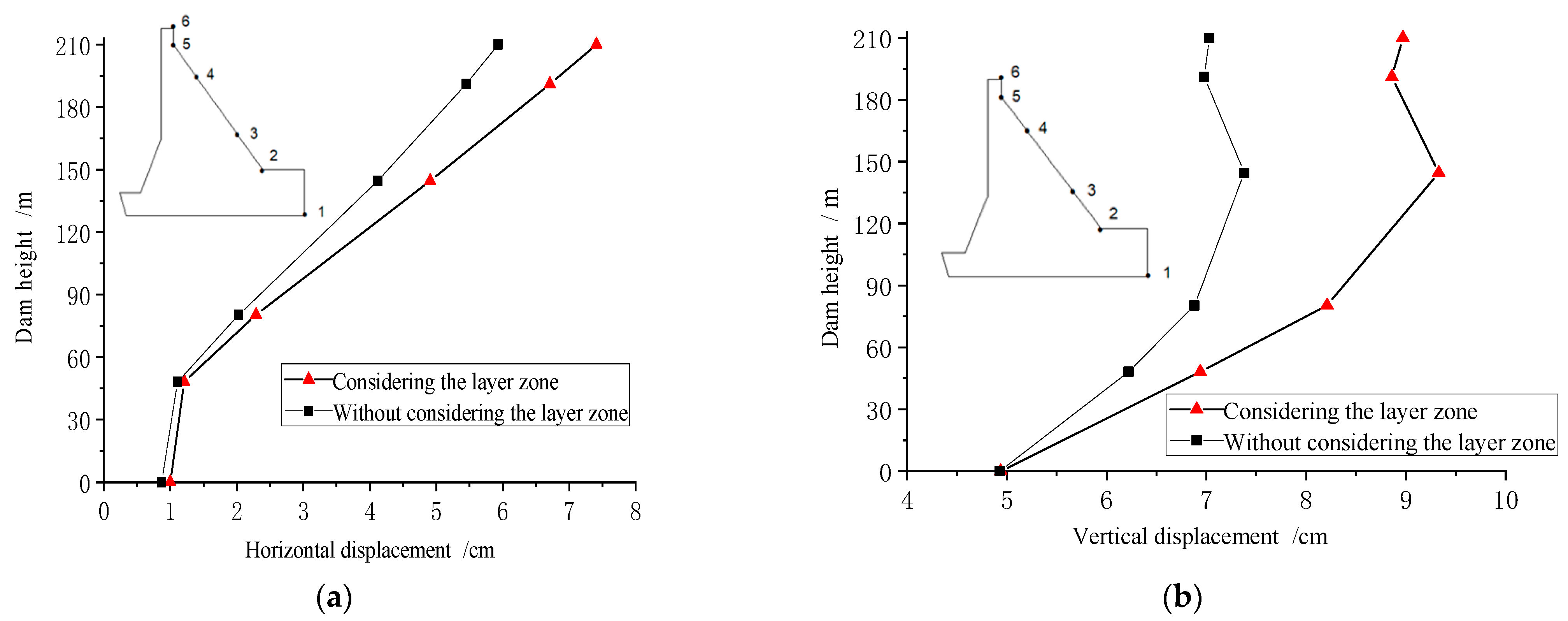
4.3.3. Dam Deformation Analysis
5. Discussion on the Extreme Value of the Layer Zone Thickness
5.1. Rolling-Unit Model of Layer Zone
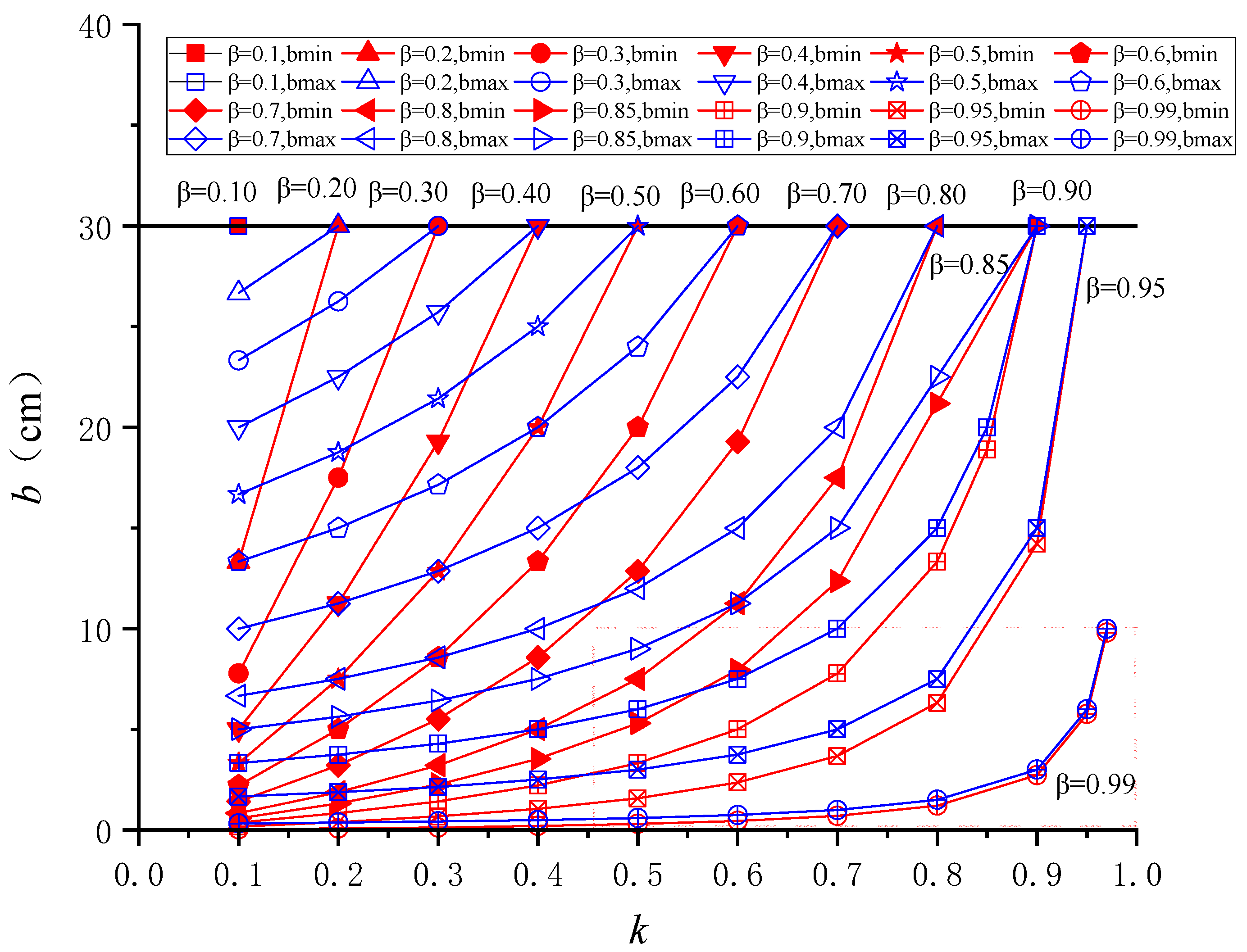
5.2. Layer Thickness Extreme Value
5.2.1. Maximum Value
5.2.2. Minimum Value
5.2.3. Discussion
6. Conclusions
- (1)
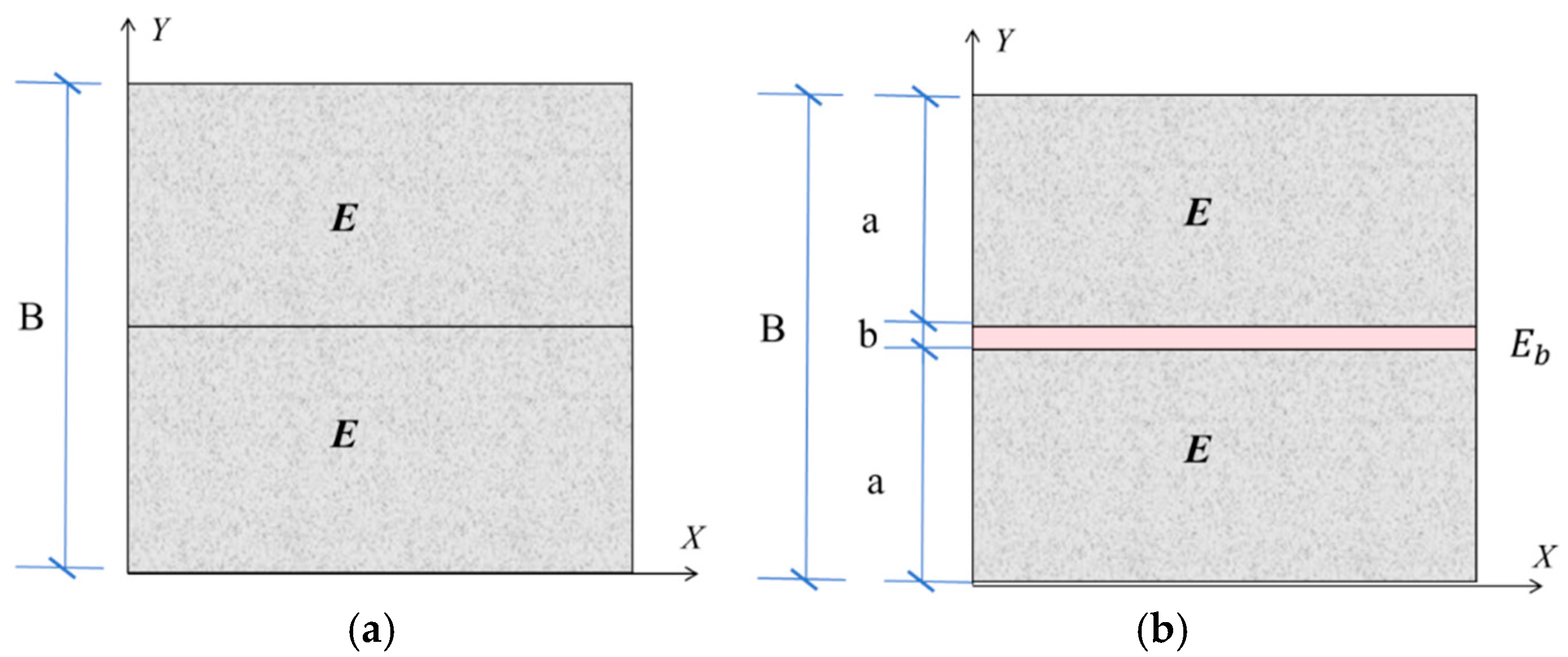
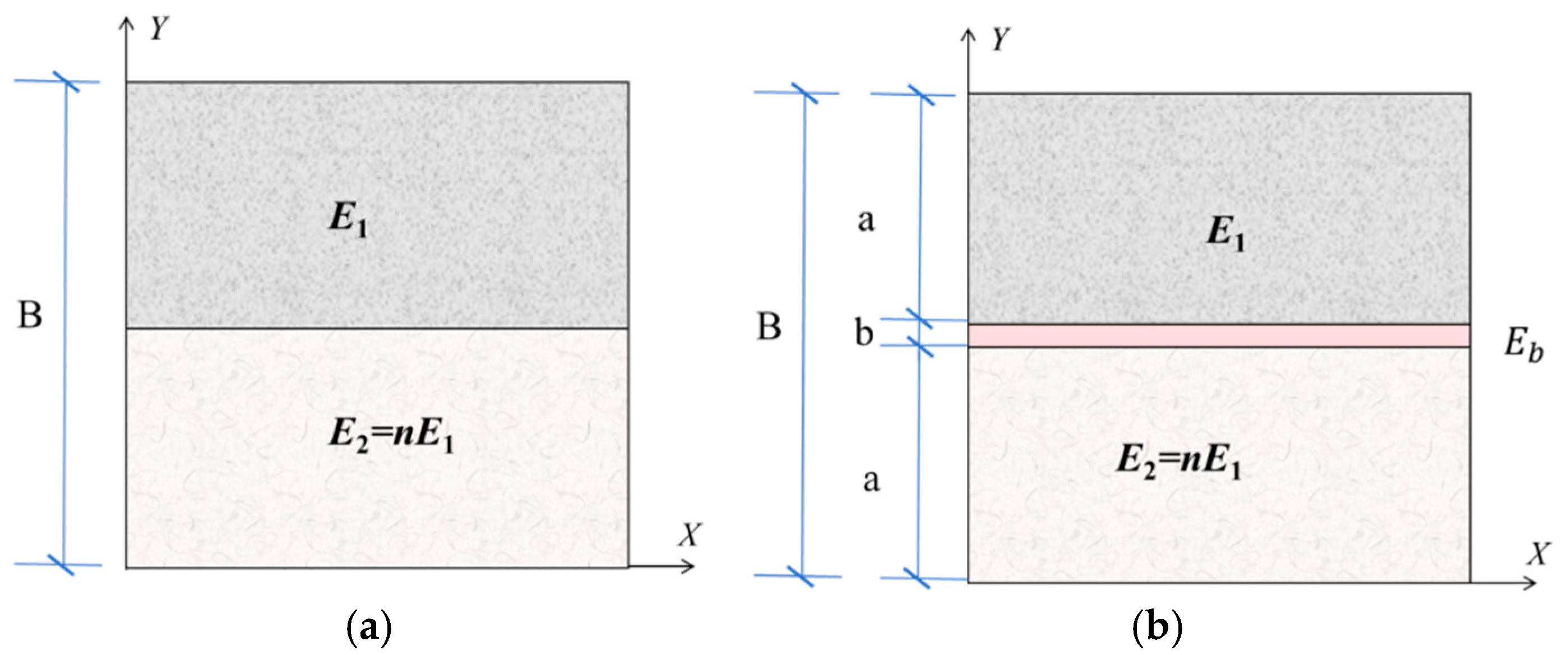
- Based on the equivalent elastic model, the analytical formula of the thickness of the layer zone is derived by introducing the three parameters of β, λ and n, according to the two working conditions of concrete with the same property (n = 1) and concrete with different properties (n ≠ 1). When n = 1, the thickness b value of the layer zone decreases with the increase in λ and β values, which is consistent with the actual situation. When n ≠ 1, the closer the value of n is to 1, the β value is larger, and the thickness of the layer zone is smaller. When the n value approaches infinity, the difference between the elastic modulus of the upper and lower concrete is too large, and the problem of deformation coordination will occur. The upper and lower bodies cannot be bonded.
- (2)
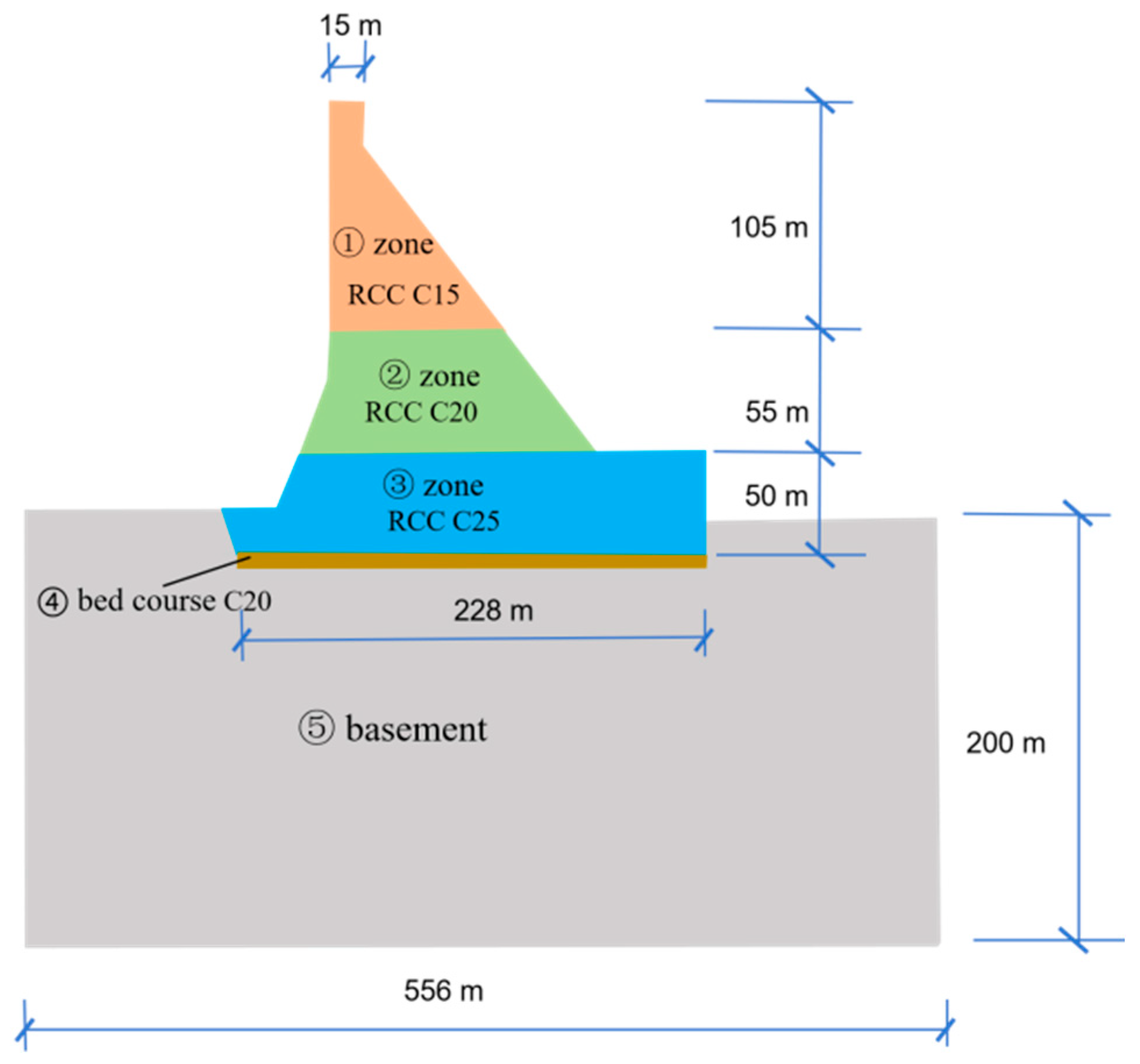
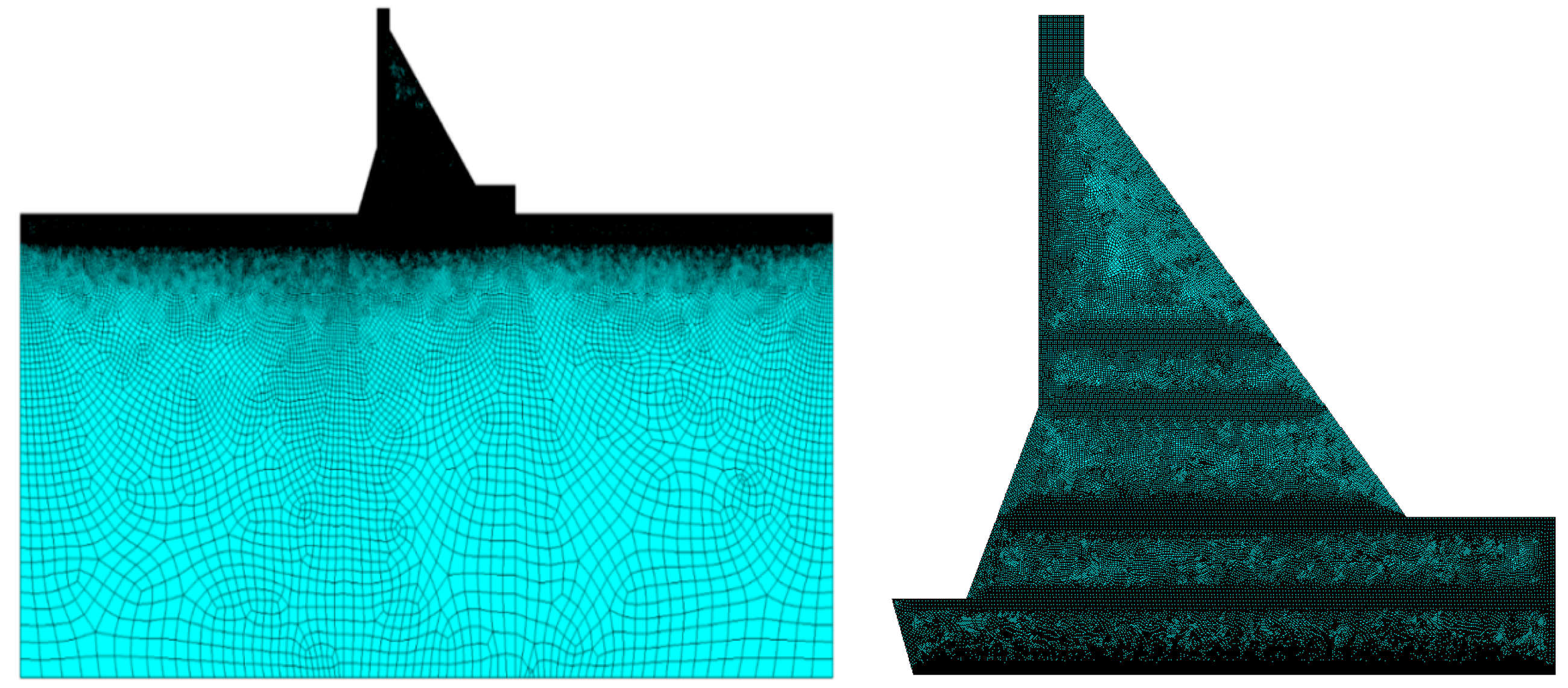
- A finite element numerical analysis is carried out with an example. The results show that the horizontal displacement and vertical displacement of the dam increase significantly after considering the influence of the layer zones. In order to ensure the safety of the dam structure design, the influence of the thickness of the layer zones should be considered.
- (3)
- The extreme range in the thickness of the layer zone is discussed by using the variational theory in elasticity. When β is 0.85–0.99, a reasonable thickness of the layer is obtained, which is consistent with the statistical results of the experimental data in References [19,20]. The larger the k value is, the thicker the layer thickness is, and the closer the layer strength is to the body strength. When k and β are close to 1, the thickness of the layer is close to 10 cm, which is close to the nature of the body.
Author Contributions
Funding
Data Availability Statement
Acknowledgments
Conflicts of Interest
References
- Chhorn, C.; Hong, S.J.; Lee, S.W. A study on performance of roller-compacted concrete for pavement. Constr. Build. Mater. 2017, 153, 535–543. [Google Scholar] [CrossRef]
- Azizmohammadi, M.; Toufigh, V.; Ghaemian, M. Experimental and Analytical Investigation on the Interlayer of Roller Compacted Concrete. J. Mater. Civ. Eng. 2021, 33, 04021090. [Google Scholar] [CrossRef]
- Liu, G.H.; Lu, W.B.; Lou, Y.D.; Pan, W.N.; Wang, Z.Y. Interlayer shear strength of Roller compacted concrete (RCC) with various interlayer treatments. Constr. Build. Mater. 2018, 166, 647–656. [Google Scholar] [CrossRef]
- Courard, L.; Michel, F.; Delhez, P. Use of concrete road recycled aggregates for Roller Compacted Concrete. Constr. Build. Mater. 2010, 24, 390–395. [Google Scholar] [CrossRef]
- Zhu, X.L.; Gao, Y.X.; Song, W.J.; Xu, J.J.; Li, C.Y. Volume Compatibility of Interlayer Treatment Materials with Roller-Compacted Concrete. KSCE J. Civ. Eng. 2022, 26, 1344–1353. [Google Scholar] [CrossRef]
- Xu, W.B.; Li, Y.; Yang, W.; Xu, W.Q.; Xu, Z.Y.; Luo, D.N.; Wang, J.; Wang, H.L. A prediction method for concrete interlayer performance based on moisture content variation. Constr. Build. Mater. 2026, 506, 144946. [Google Scholar] [CrossRef]
- Shen, J.; Wang, S.; Qian, P.; Liu, Y.; Chen, Y. Experimental research on microstructure characteristics and mechanical performance of interfaces between concrete layers. Front. Mater. 2025, 12, 1576065. [Google Scholar] [CrossRef]
- Shen, M.X.; Zhao, Y.; Bi, J.; Wang, C.L.; Du, B.; Zhang, K. In situ experimental study on mechanical properties of interlayer in roller compacted concrete (RCC) dam. Constr. Build. Mater. 2023, 379, 131268. [Google Scholar] [CrossRef]
- Gu, C.S.; Li, Y.; Song, J.X. Research on deformation safety monitoring model of roller compacted concrete dams. Chin. J. Comput. Mech. 2010, 27, 286–290. (In Chinese) [Google Scholar]
- Wei, B.W.; Xu, Z.K.; Xu, B.S. A visco-elasto-plastic rheological model for the layer influence zone of roller compacted concrete dams. J. Hydraul. Eng. 2012, 43, 1097–1102. Available online: https://link.cnki.net/doi/10.13243/j.cnki.slxb.2012.09.016 (accessed on 29 January 2026). (In Chinese)
- Zhou, L.T.; Gu, C.S. Calculation of equivalent deformation parameters for construction layers of roller compacted concrete dams. Water Resour. Power 2009, 27, 77–80. (In Chinese) [Google Scholar]
- Zhou, L.T.; Gu, C.S.; Li, B. Sensitivity analysis of deformation to calculation parameters of roller compacted concrete dams. J. China Three Gorges Univ. Nat. Sci. 2012, 34, 7–9. Available online: https://kns.cnki.net/kcms2/article/abstract?v=jpN_MAf5WI4g5QPEBxXHBmtPc0v7MXzOKtfUWk7bRSvndqwr2Xon872iL2Nl_9HLiCCvHYWlYa7PU8TYqNeB0rSw5M3Dpvj_AbTOnA28TVInbN5hGT11sCAzpJGmpO_Vkw1piSjm4iH1zXvnP_zKbN4Hs1p98UeKIBabGWAdBomrpR3JtfDmhg==&uniplatform=NZKPT&language=CHS (accessed on 29 January 2026). (In Chinese)
- Liu, H.C.; Gao, R.C.; Song, Y.P. Research on equivalent constitutive model of roller compacted concrete arch dams. Water Power 2003, 29, 12–15. Available online: https://kns.cnki.net/kcms2/article/abstract?v=jpN_MAf5WI4HWd4qFi5mJKFVwTgyDb4KF_AXfsWLgZVTS0DeVNB95GOMiZNTcWOpm9RweGJwillYsZ2LTj0vrvk5cpKDQJqrAMNsSHZRpWKViG7QpJ93JMR-zf4rBnGM5RgpspGKB8JXOUTYKLFbg99VM-Gu8f9rho4PFOPPbDnsA1oA-7YIuA==&uniplatform=NZKPT&language=CHS (accessed on 29 January 2026). (In Chinese)
- Liu, G.T.; Hao, J.T. Simplified calculation of stresses in roller compacted concrete arch dams. J. Tsinghua Univ. Sci. Technol. 1996, 36, 27–33. (In Chinese) [Google Scholar] [CrossRef]
- Li, B.; Gu, C.S.; Wu, J.K. Analysis of the gradual variation law of elastic mechanical parameters of roller compacted concrete dams. J. Hydraul. Eng. 2013, 44, 1488–1497. (In Chinese) [Google Scholar] [CrossRef]
- Peng, Y.W.; Gu, C.S.; Wu, Z.R. Analysis of the thickness of the layer influence zone in roller compacted concrete dams. J. Yangtze River Sci. Res. Inst. 2005, 22, 59–61. Available online: https://kns.cnki.net/kcms2/article/abstract?v=jpN_MAf5WI7milO9L30-eGGkuDMb9imetdVmZkGniX0OsKpji4vz5LQW9GaGWOA8IPrg4Tt2w1knMtzeQIfQ_Y3Szy_P7PPaRD02UK1k9hvBBipTjp7rzeAL8n3G_tkj3mUuTJcjXaU-it6Dybg6gujZx0bRdgd007qNN7MiYAMmHcFyDeNFvA==&uniplatform=NZKPT&language=CHS (accessed on 29 January 2026). (In Chinese)
- Peng, Y.W.; Zheng, D.J.; Wu, Z.R. Inversion of elastic modulus and thickness of layers in roller compacted concrete dams. Water Power 2005, 31, 27–29. Available online: https://kns.cnki.net/kcms2/article/abstract?v=jpN_MAf5WI64zAbMwKHK4nGkwhKPyX0KQKRkB98SPlek_kAbtGAL5jqPdxfsxq94TIGdXhlOBSwN9qwDZFCSjIfLmNsdH62H4ItGTdWeDk-ssPSJ9NA-xKifWZ6otHFY5HLWk2zn3cyVbB22SsP4jpqfHhzzKQgZszMpYGBh0cdeakgU1cKaQA==&uniplatform=NZKPT&language=CHS (accessed on 29 January 2026). (In Chinese)
- Liu, D.H.; Ma, Z.R.; Sun, L.F. Discrete element simulation of layered rolling of roller compacted concrete and research on the meso-mechanism of construction stratification. J. Hydraul. Eng. 2024, 55, 1033–1044. (In Chinese) [Google Scholar] [CrossRef]
- Bayqra, S.H.; Özen, S.; Mardani, A.; Ramyar, K. Effect of interlayer cold joint on mechanical properties and permeability of roller compacted concrete. Front. Struct. Civ. Eng. 2025, 19, 284–299. [Google Scholar] [CrossRef]
- Jiang, F.T. The layers and their influence in roller compacted concrete dams. Water Resour. Hydropower Eng. 2008, 39, 19–21. (In Chinese) [Google Scholar] [CrossRef]
- Zhang, S.R.; Wang, X.H.; Wang, C.; Song, R.; Huo, H.Y. Compressive behavior and constitutive model for roller compacted concrete under impact loading: Considering vertical stratification. Constr. Build. Mater. 2017, 151, 428–440. [Google Scholar] [CrossRef]
- Chen, X.D.; Li, L.Y.; Liu, Y.J.; Zhao, Y.D.; Qin, X.N. Deformation health diagnosis of RCC dams considering construction interfaces based on monitoring data and numerical simulation. Meas. Sci. Technol. 2024, 35, 045111. [Google Scholar] [CrossRef]
- Li, M.C.; Guo, X.Y.; Shi, J.; Zhu, Z.B. Seepage and stress analysis of anti-seepage structures constructed with different concrete materials in an RCC gravity dam. Water. Sci. Eng. 2015, 8, 326–334. [Google Scholar] [CrossRef]
- Zhang, Q.Q.; Zhang, L.N. A comparative analysis of RCC and composite buildings using the new plastic deformation (PD) method. Sci. Rep. 2024, 14, 5666. [Google Scholar] [CrossRef] [PubMed]
- Ihteshaam, M.I.; Jin, F. A Comprehensive Literature Review on the Elastic Modulus of Rock-filled Concrete. Eng. Technol. Appl. Sci. 2024, 14, 14760–14767. [Google Scholar] [CrossRef]
- Shi, B.W.; Li, M.C.; Song, L.G.; Zhang, M.X.; Shen, Y. Deformation coordination analysis of CC-RCC combined dam structures under dynamic loads. Water. Sci. Eng. 2020, 13, 162–170. [Google Scholar] [CrossRef]
- Wang, C.; Chen, W.S.; Hao, H.; Zhang, S.R.; Song, R. Experimental investigations of dynamic compressive properties of roller compacted concrete (RCC). Constr. Build. Mater. 2018, 168, 671–682. [Google Scholar] [CrossRef]
- Ghaedi, K.; Hejazi, F.; Ibrahim, Z.; Khanzaei, P. Flexible Foundation Effect on Seismic Analysis of Roller Compacted Concrete (RCC) Dams Using Finite Element Method. KSCE J. Civ. Eng. 2018, 22, 1275–1287. [Google Scholar] [CrossRef]
- Guo, X.Y.; Li, Z.F.; Zhang, M. Dynamic Response Analysis of Asphalt Pavement Based on Transversely Isotropic Subgrade under Different Speeds. Adv. Mater. Res. 2012, 1509, 493–497. [Google Scholar] [CrossRef]
- Ai, Z.Y.; Wang, X.K.; Wang, X.M.; Ye, Z.; Ye, Z.; Yang, J.J. Dynamic behaviours of continuously reinforced concrete pavement on a layered transversely isotropic saturated subgrade under moving loads. Int. J. Numer. Anal. Met. 2023, 47, 2193–2212. [Google Scholar] [CrossRef]
- Peng, Y.W.; Wu, Z.R. Influence of bidirectional different elastic moduli on displacements of RCC dams. Water Power 2005, 31, 24–26. Available online: https://kns.cnki.net/kcms2/article/abstract?v=jpN_MAf5WI7ZVQZxlj3T1_C005mzEXA_SoNFSPVKWORpxxUjdOfDluNJ7HDm2dA1UAahfaelaa4NvK2YBby4Km-Se4puFcBN4w6cG7-1D7VGjMM_Bm1PParaDrftio_h2ScKvzkpx5-x1KZujjZGkYyuy0ZBp1TxFSkl2uHh7CrwP3v0iGFKkQ==&uniplatform=NZKPT&language=CHS (accessed on 29 January 2026). (In Chinese)
- Lin, C.N.; Jin, S.Q.; Tu, C.L. Experimental study on roller compacted concrete with layers at Longtan. J. Hydraul. Eng. 2001, 127, 117–129. Available online: https://kns.cnki.net/kcms2/article/abstract?v=jpN_MAf5WI6Ztx4d6b2-SSS39BLuylljSDCyUxhWOif6YinUUVkySJnCSExex7M6L7WLNqt8mlQuvj_ZSFR8JpiWfvDBSJUfXPX7F2twn4LLUW-pD2hj9XxVaDlIx-W8rMsQWi2_UuaCJ-jIh4X8Xu7qHRAB95lBGlsq1Py7wrYkzhLt-zl4GmGtJO-53GOr&uniplatform=NZKPT&language=CHS (accessed on 29 January 2026). (In Chinese)
- Zhang, G.D. Reading “Experimental Study on Roller Compacted Concrete with Layers at Longtan”. J. Hydraul. Eng. 2002, 128, 99–100. Available online: https://kns.cnki.net/kcms2/article/abstract?v=jpN_MAf5WI4rCm0zJ-v2dB4te7-CEuv24w3cpiXoH2NoGxk5RGBjXnWNwcxYltG_zPD4pXzDL8pirSi4nBn73AmGAf3jjqSKPm0xfPHbW8rtdDIXmfGEIZlh_L4yKkZZcMc3hbSirt8dn4AB6CEooqDVRjylx1-Iyu5UogMluzVtzKq9uVTPwA==&uniplatform=NZKPT&language=CHS (accessed on 29 January 2026). (In Chinese)
- Khanzaei, P.; Samali, B.; Zhang, C. Coupled and uncoupled seepage-stress analysis of roller compacted concrete dams. ISH. J. Hydraul. Eng. 2017, 23, 92–101. [Google Scholar] [CrossRef]
- Li, H.F. Designing Induced Joints in RCC Arch Dams for Enhanced Crack Prevention: A Contact Unit Simulation and Equivalent Strength Theory Approach. J. Civ. Hydraul. Eng. 2024, 2, 1–15. [Google Scholar] [CrossRef]
- Wang, X.H.; Zhang, S.R.; Wang, C.; Shang, C.; Cao, K.L. Investigation into stress wave propagation across interlayers existing in roller compacted concrete (RCC) under impact loadings. Constr. Build. Mater. 2018, 193, 13–22. [Google Scholar] [CrossRef]
- Zhang, J.W.; Zhang, M.X.; Li, M.C.; Min, Q.L.; Shi, B.W. Nonlinear Dynamic Response of a CC-RCC Combined Dam Structure under Oblique Incidence of Near-Fault Ground Motions. Appl. Sci. 2020, 10, 885. [Google Scholar] [CrossRef]









| β | λ = 0.52 | λ = 0.53 | λ = 0.55 | λ = 0.60 | λ = 0.70 | λ = 0.75 | λ = 0.76 |
|---|---|---|---|---|---|---|---|
| b/cm | b/cm | b/cm | b/cm | b/cm | b/cm | b/cm | |
| 0.86 | 10.39 | 8.89 | 6.92 | 4.01 | 1.52 | 0.88 | 0.77 |
| 0.90 | 10.49 | 8.79 | 6.49 | 3.60 | 1.41 | 0.87 | 0.79 |
| 0.94 | 9.86 | 7.76 | 5.32 | 2.73 | 1.06 | 0.68 | 0.62 |
| 0.98 | 6.66 | 4.45 | 2.60 | 1.17 | 0.43 | 0.28 | 0.26 |
| 0.99 | 4.38 | 2.67 | 1.46 | 0.62 | 0.23 | 0.15 | 0.14 |
| Name | Type | Aggregate | Elastic Modulus/GPa | Design Value of Tensile Strength/MPa | Standard Value of Tensile Strength/MPa | Density (kg/m3) | Poisson’s Ratio |
|---|---|---|---|---|---|---|---|
| Zone 1 | C15 | Sandstone | 10.0 | 0.91 | 1.27 | 2200 | 0.167 |
| Zone 2 | C20 | Sandstone | 12.8 | 1.10 | 1.54 | 2200 | 0.167 |
| Zone 3 | C25 | Sandstone | 14.0 | 1.27 | 1.78 | 2200 | 0.167 |
| Cushion | C20 | Limestone | 25.5 | 1.10 | 1.54 | 2350 | 0.167 |
| Bedrock | -- | -- | 9.0 | -- | -- | 2500 | 0.220 |
| Type | Elastic Modulus of Body Concrete/GPa | n = E2/E1 | Layer Zone Thickness b/cm | Elastic Modulus of Layer Zone Eb/GPa | Ex /GPa | Ey /GPa | |
|---|---|---|---|---|---|---|---|
| Upper Body E1 | Lower Body E2 | ||||||
| Zone 1 | 10.0 | 10.0 | 1.00 | 3.60 | 0.87 | 8.90 | 4.41 |
| Zone 2 | 12.8 | 12.8 | 1.00 | 3.60 | 1.11 | 11.40 | 5.65 |
| Zone 3 | 14.0 | 14.0 | 1.00 | 3.60 | 1.21 | 12.47 | 6.18 |
| 1–2 transition zone | 10.0 | 12.8 | 1.28 | 17.00 | 9.38 | 10.26 | 10.11 |
| 2–3 transition zone | 12.8 | 14.0 | 1.09 | 26.00 | 11.85 | 12.06 | 12.04 |
| 3–4 transition zone | 14.0 | 28.0 | 2.00 | 8.10 | 13.22 | 18.90 | 16.80 |
| 4–5 transition zone | 28.0 | 9.0 | 0.32 | 5.60 | 8.51 | 16.65 | 12.26 |
| Working Condition | Upstream Water Level (m) | Downstream Water Level (m) | Load | ||
|---|---|---|---|---|---|
| Deadweight | Hydrostatic Pressure | Uplift Pressure | |||
| No layer | 627.00 | 463.11 | √ | √ | √ |
| Consideration layer | 627.00 | 463.11 | √ | √ | √ |
| Point | Dam Height/m | Without Considering the Layer Zones | Considering the Layer Zones | ||
|---|---|---|---|---|---|
| Horizontal Displacement/cm | Vertical Displacement/cm | Horizontal Displacement/cm | Vertical Displacement/cm | ||
| 1 | 0 | 0.87 | 4.93 | 1.00 | 4.94 |
| 2 | 48.2 | 1.11 | 6.22 | 1.21 | 6.94 |
| 3 | 80.3 | 2.03 | 6.88 | 2.29 | 8.21 |
| 4 | 144.6 | 4.12 | 7.38 | 4.91 | 9.33 |
| 5 | 191.0 | 5.45 | 6.98 | 6.71 | 8.86 |
| 6 | 210.0 | 5.93 | 7.03 | 7.41 | 8.97 |
| β | k | b/cm | β | k | b/cm | β | k | b/cm |
|---|---|---|---|---|---|---|---|---|
| 0.85 | 0.50 | 5.30–9.00 | 0.95 | 0.50 | 1.58–3.00 | 0.99 | 0.60 | 0.45–0.75 |
| 0.85 | 0.60 | 7.94–11.25 | 0.95 | 0.60 | 2.37–3.75 | 0.99 | 0.70 | 0.71–1.00 |
| 0.90 | 0.50 | 3.33–6.00 | 0.95 | 0.70 | 3.68–5.00 | 0.99 | 0.80 | 1.21–1.50 |
| 0.90 | 0.60 | 5.00–7.50 | 0.95 | 0.80 | 6.32–7.50 | 0.99 | 0.90 | 2.73–3.00 |
| 0.90 | 0.70 | 7.78–10.00 | 0.99 | 0.50 | 0.30–0.60 | 0.99 | 0.95 | 5.76–6.00 |
Disclaimer/Publisher’s Note: The statements, opinions and data contained in all publications are solely those of the individual author(s) and contributor(s) and not of MDPI and/or the editor(s). MDPI and/or the editor(s) disclaim responsibility for any injury to people or property resulting from any ideas, methods, instructions or products referred to in the content. |
© 2026 by the authors. Licensee MDPI, Basel, Switzerland. This article is an open access article distributed under the terms and conditions of the Creative Commons Attribution (CC BY) license.
Share and Cite
Han, R.; Hao, Y.; He, S.; Jin, R.; He, D.; Zhang, M.; Wang, Q. Theoretical Calculation of RCC Layer Thickness Based on Equivalent Elastic Model and Numerical Study on Dam Deformation. Buildings 2026, 16, 1186. https://doi.org/10.3390/buildings16061186
Han R, Hao Y, He S, Jin R, He D, Zhang M, Wang Q. Theoretical Calculation of RCC Layer Thickness Based on Equivalent Elastic Model and Numerical Study on Dam Deformation. Buildings. 2026; 16(6):1186. https://doi.org/10.3390/buildings16061186
Chicago/Turabian StyleHan, Ruicong, Ying Hao, Shuanghua He, Ruibao Jin, Dazhi He, Min Zhang, and Qingyun Wang. 2026. "Theoretical Calculation of RCC Layer Thickness Based on Equivalent Elastic Model and Numerical Study on Dam Deformation" Buildings 16, no. 6: 1186. https://doi.org/10.3390/buildings16061186
APA StyleHan, R., Hao, Y., He, S., Jin, R., He, D., Zhang, M., & Wang, Q. (2026). Theoretical Calculation of RCC Layer Thickness Based on Equivalent Elastic Model and Numerical Study on Dam Deformation. Buildings, 16(6), 1186. https://doi.org/10.3390/buildings16061186