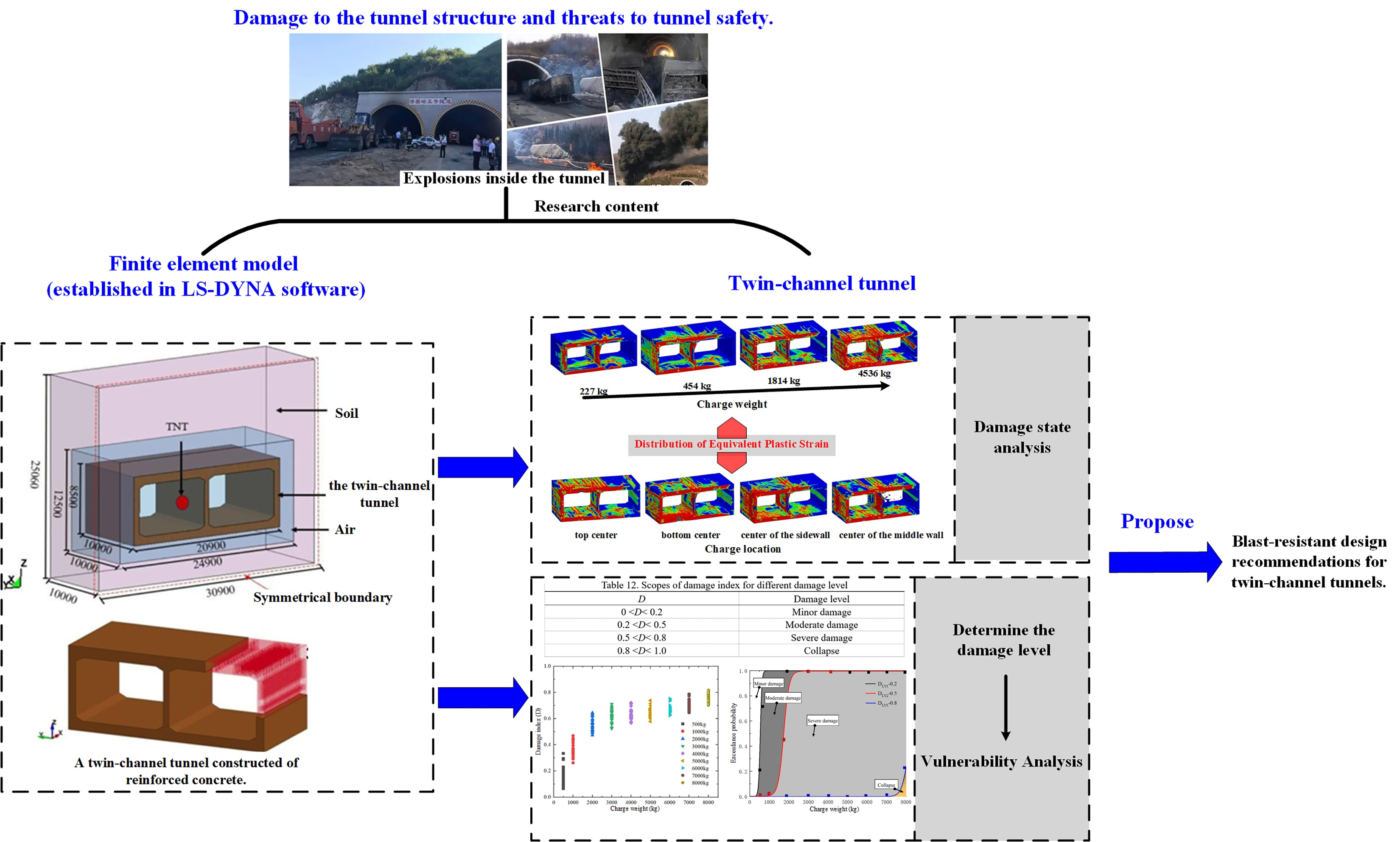
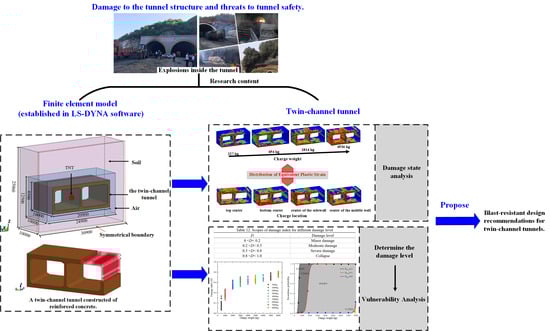
Study on the Damage State and Vulnerability of Twin-Channel Tunnels Under Single-Channel Internal Explosions

Abstract
1. Introduction
2. Development and Validation of Numerical Simulation Model
2.1. Field Test
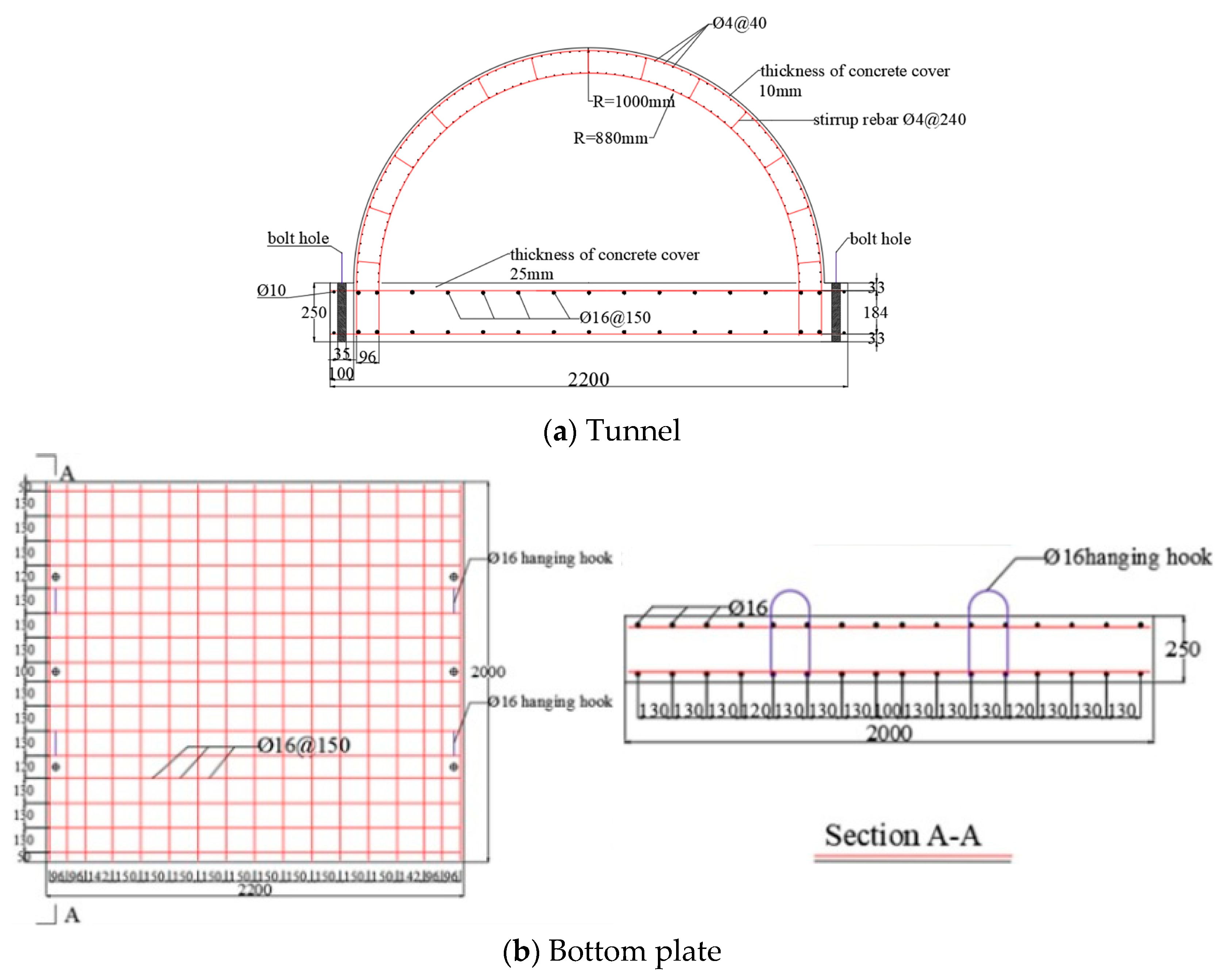
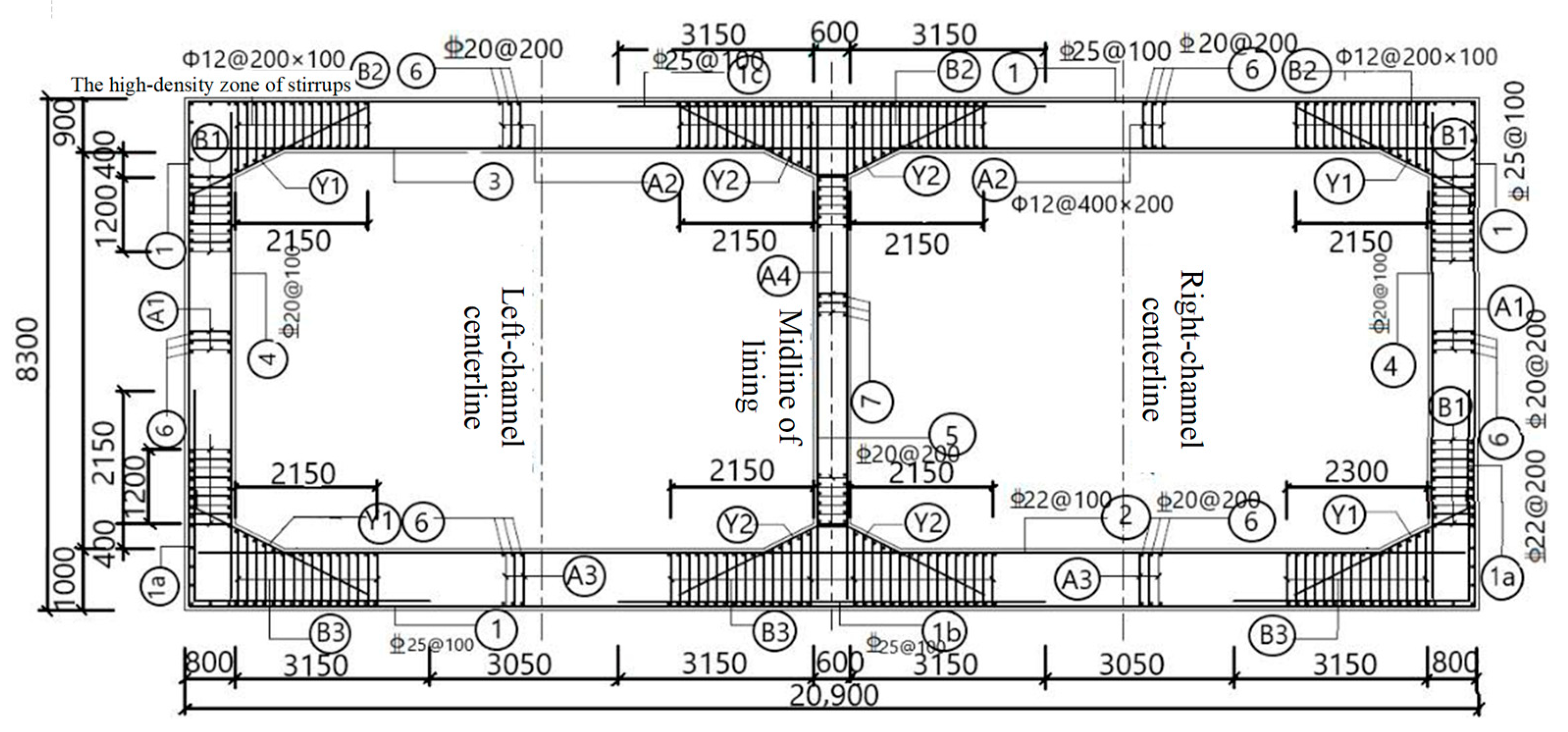
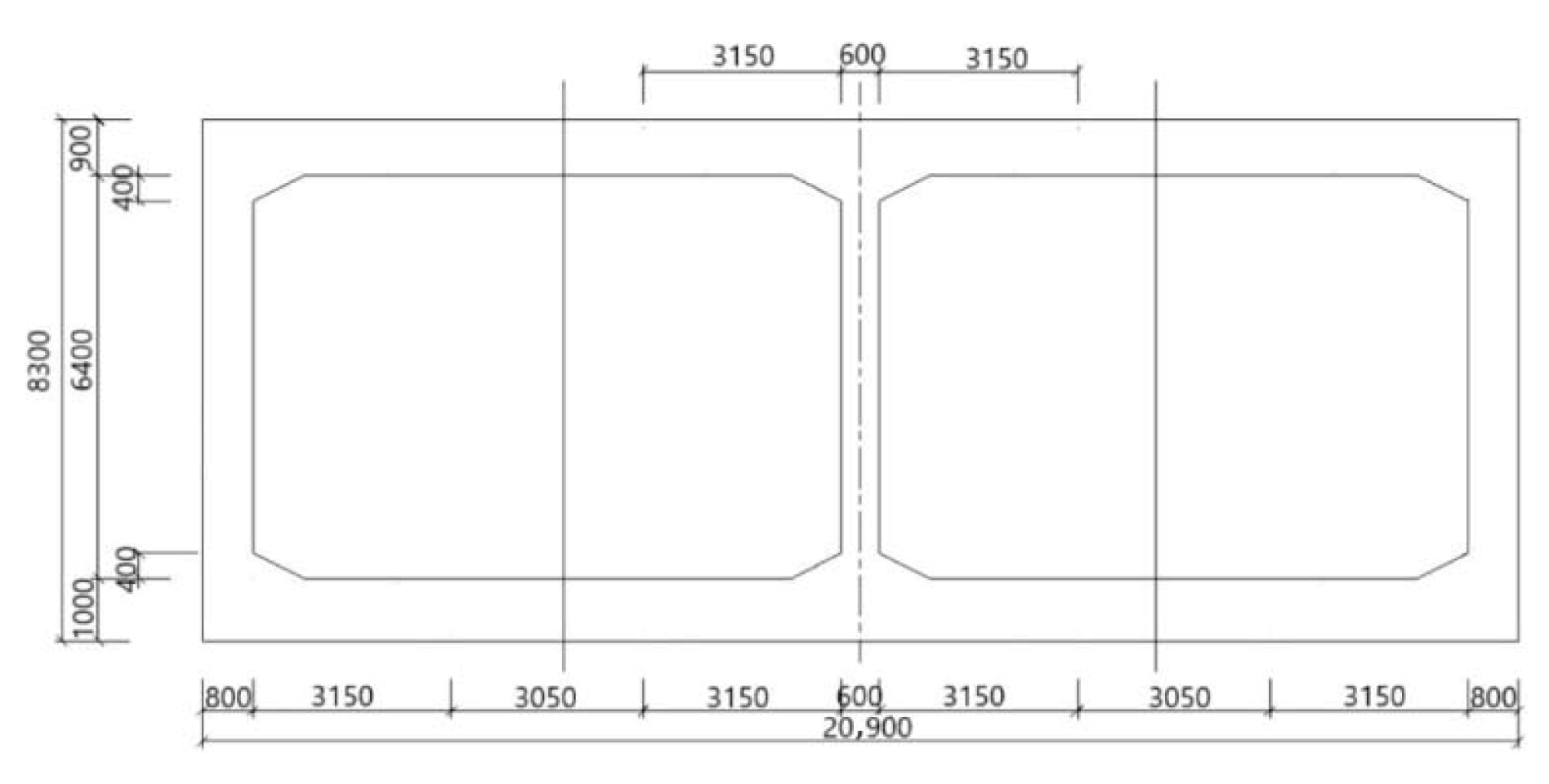
2.1.1. Dimensions and Composition of the Tunnel
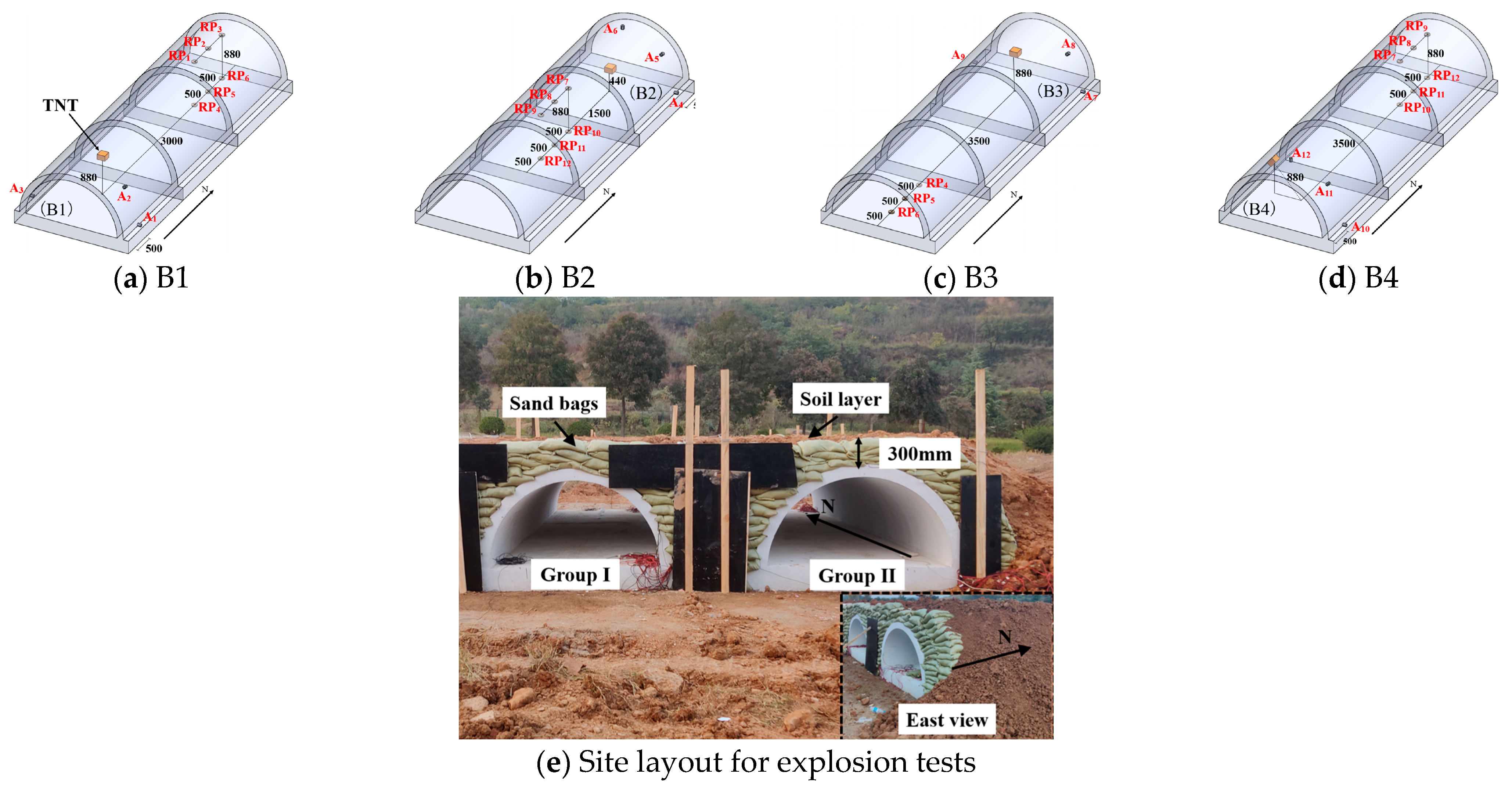
2.1.2. Internal Blast Test
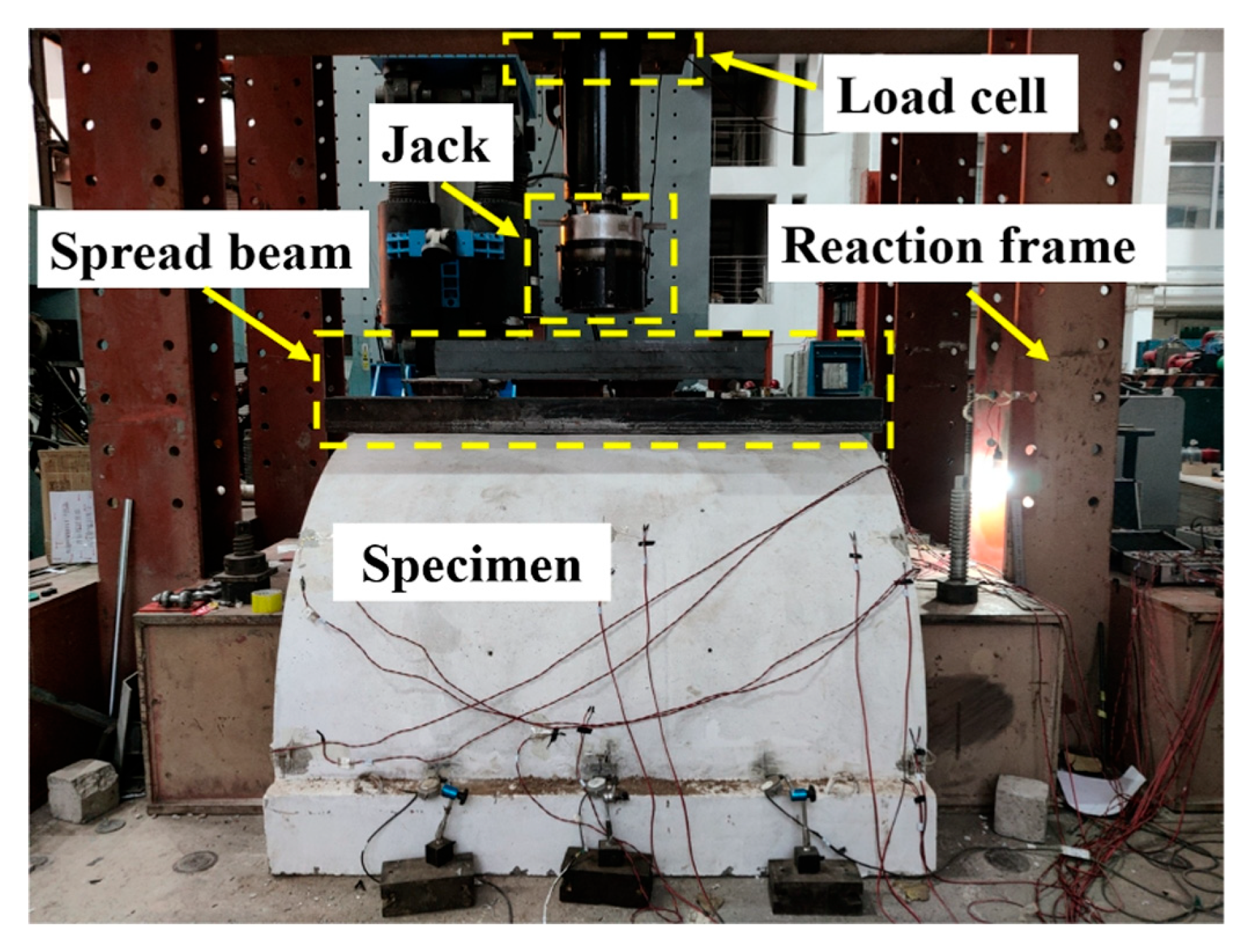
2.1.3. Static Bearing Capacity Test
2.2. Development of Numerical Simulation Model
2.2.1. Numerical Simulation Methods
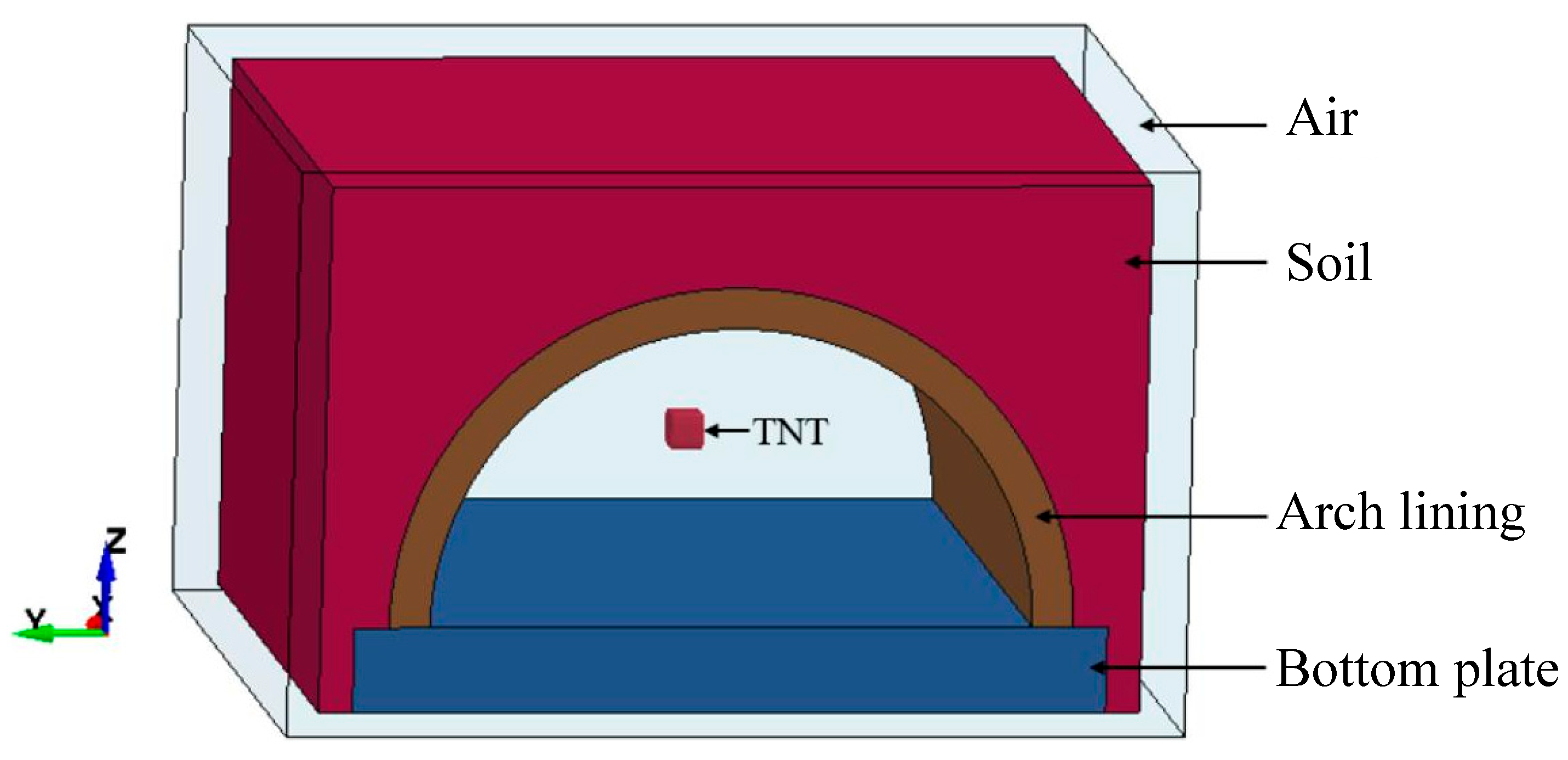
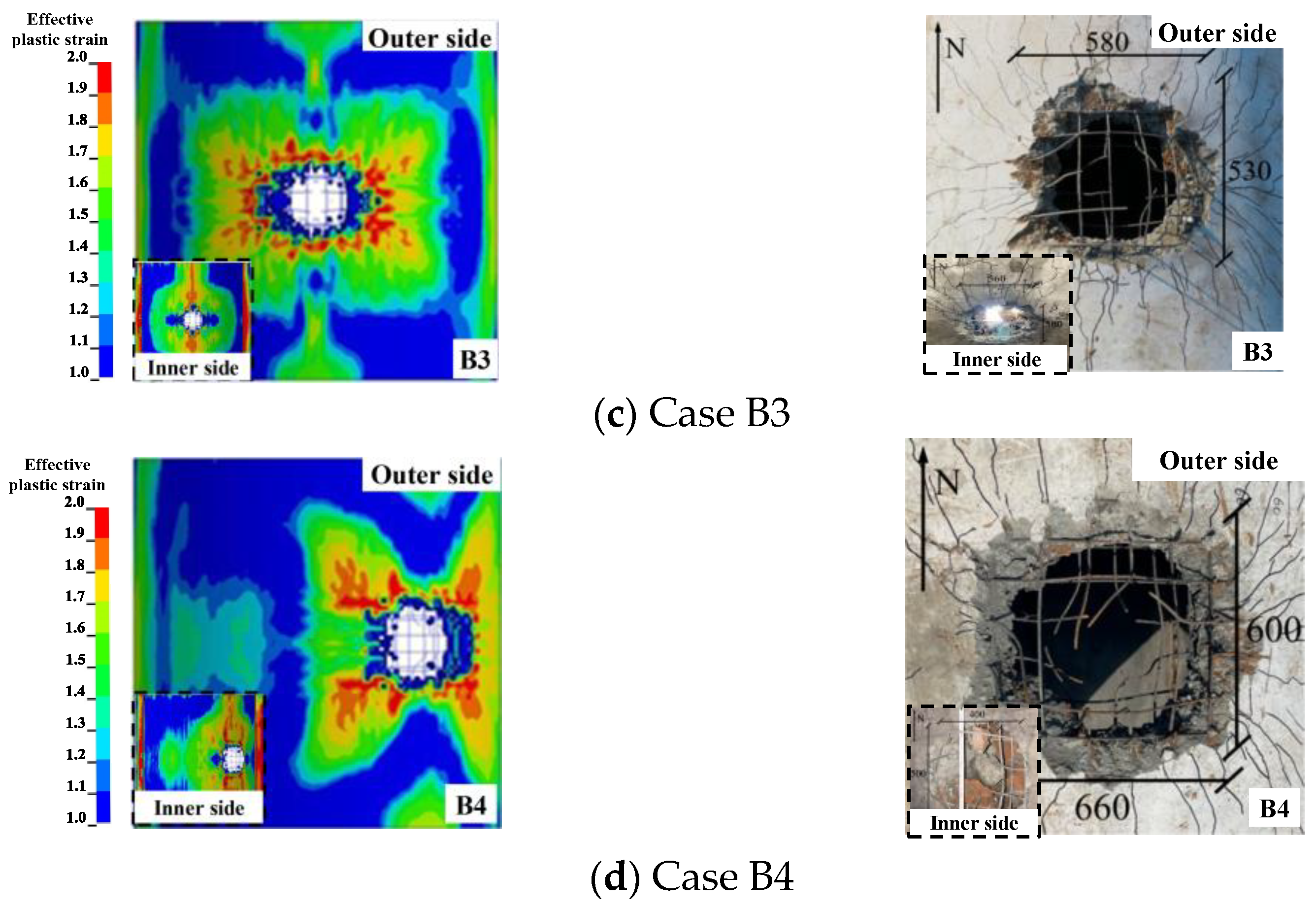
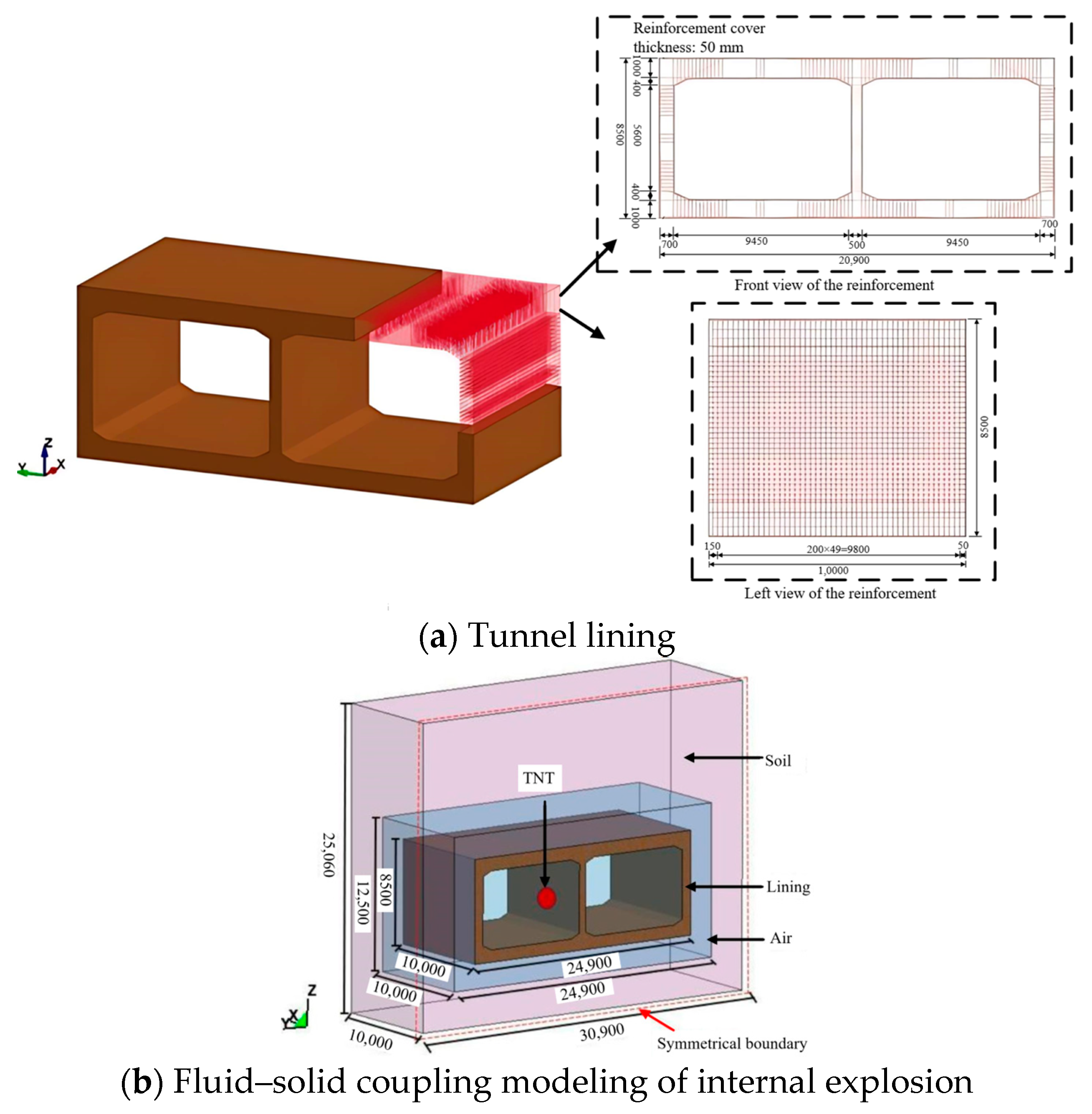
- Stage 1: Application of blast loads (see Figure 5 for calculation model).
- Stage 2: Free vibration stage of the tunnel. At the same time, to improve the computational efficiency of this stage, the air, explosives, and soil in Figure 5 need to be removed.
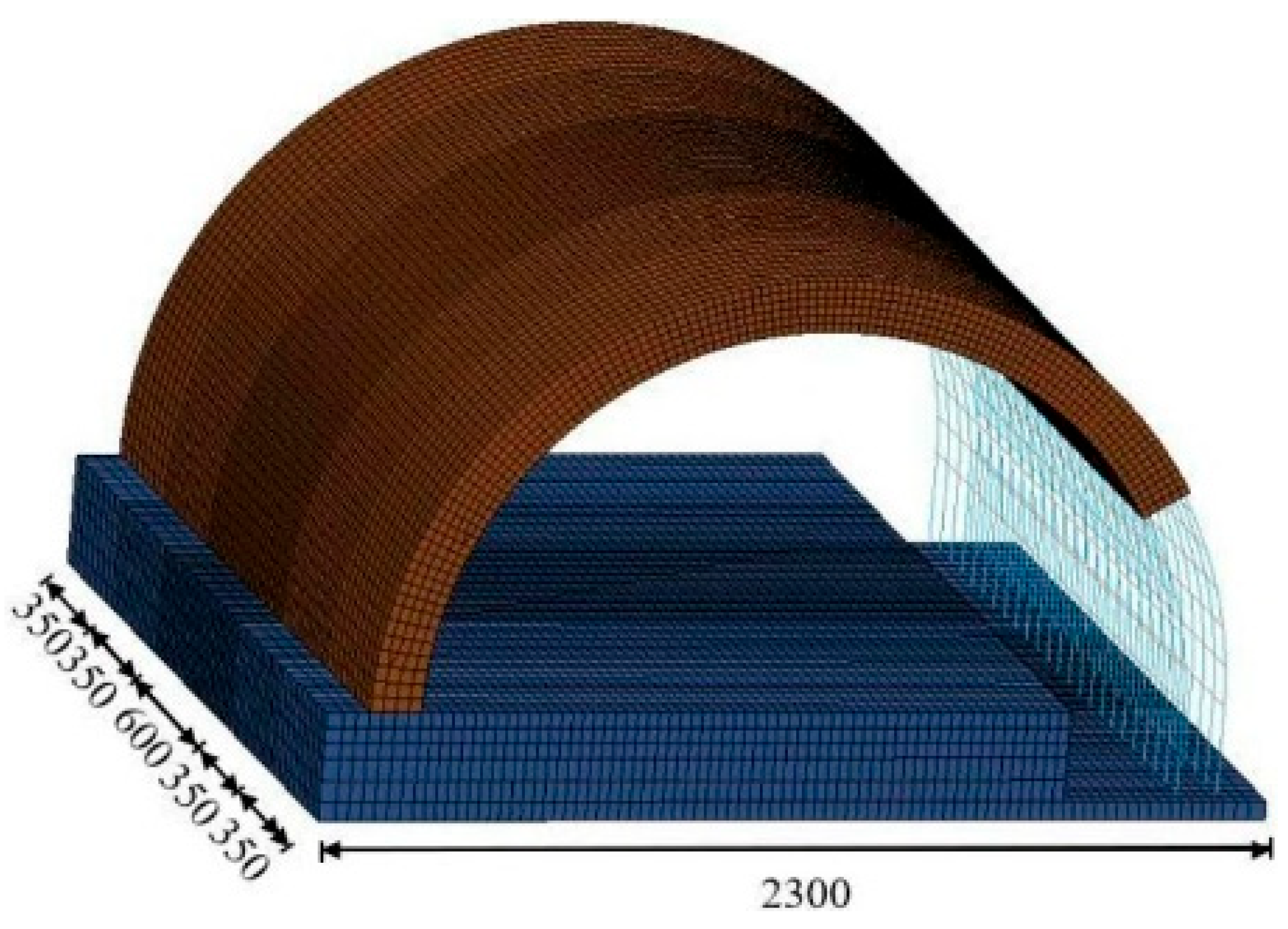
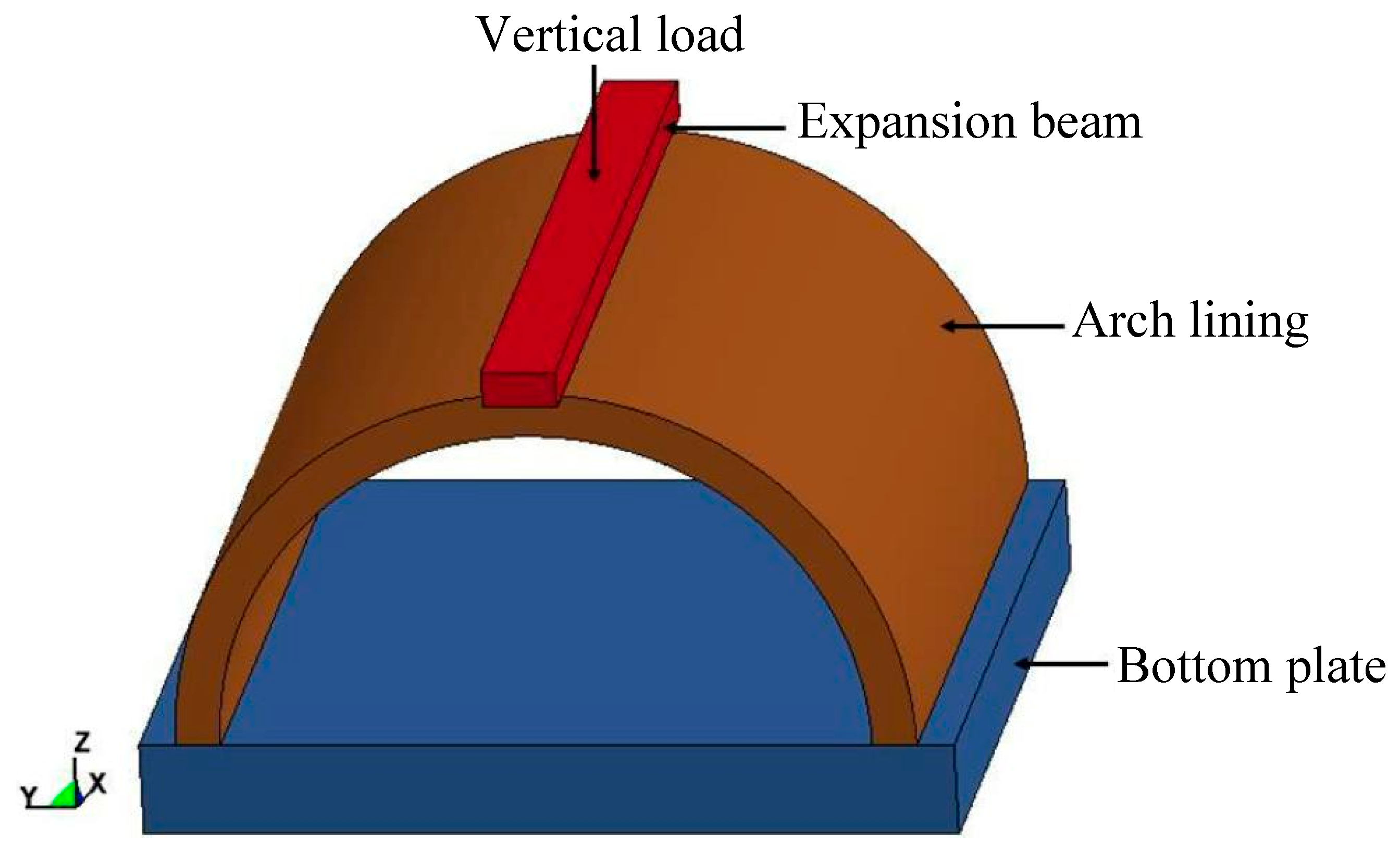
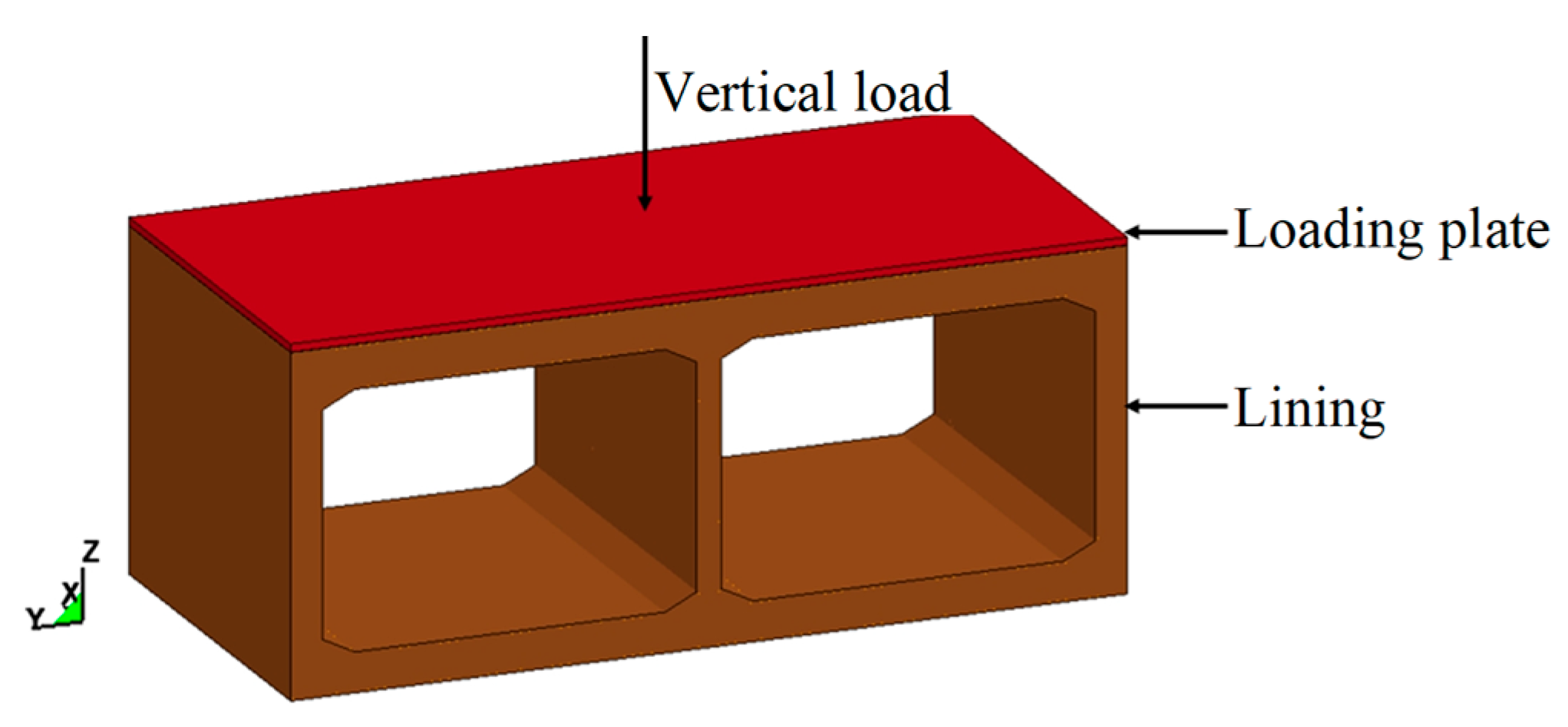
- Stage 3: Static loading stage (see Figure 6 for the calculation model).
2.2.2. Material Models and Parameters
2.3. Validation of Numerical Simulation Model
2.3.1. Comparison of Reflected Overpressure
2.3.2. Comparison of Damage State
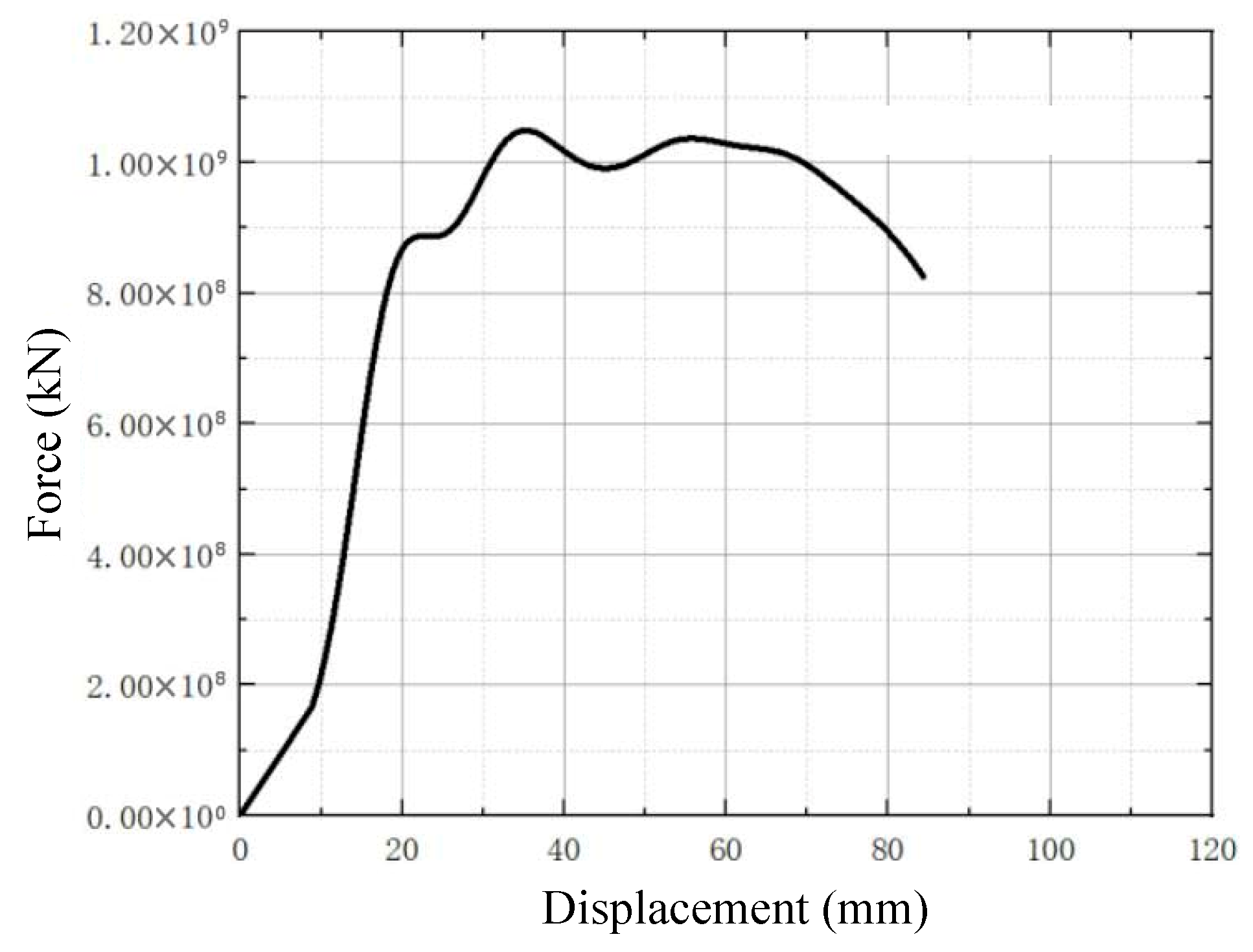
2.3.3. Comparison of Bearing Capacity
3. Numerical Model of Blast Dynamic Response of Twin-Channel Tunnel
4. Simulation Results and Discussion
4.1. Internal Blast Conditions in the Twin-Channel Tunnel
4.2. Structural Damage State Analysis
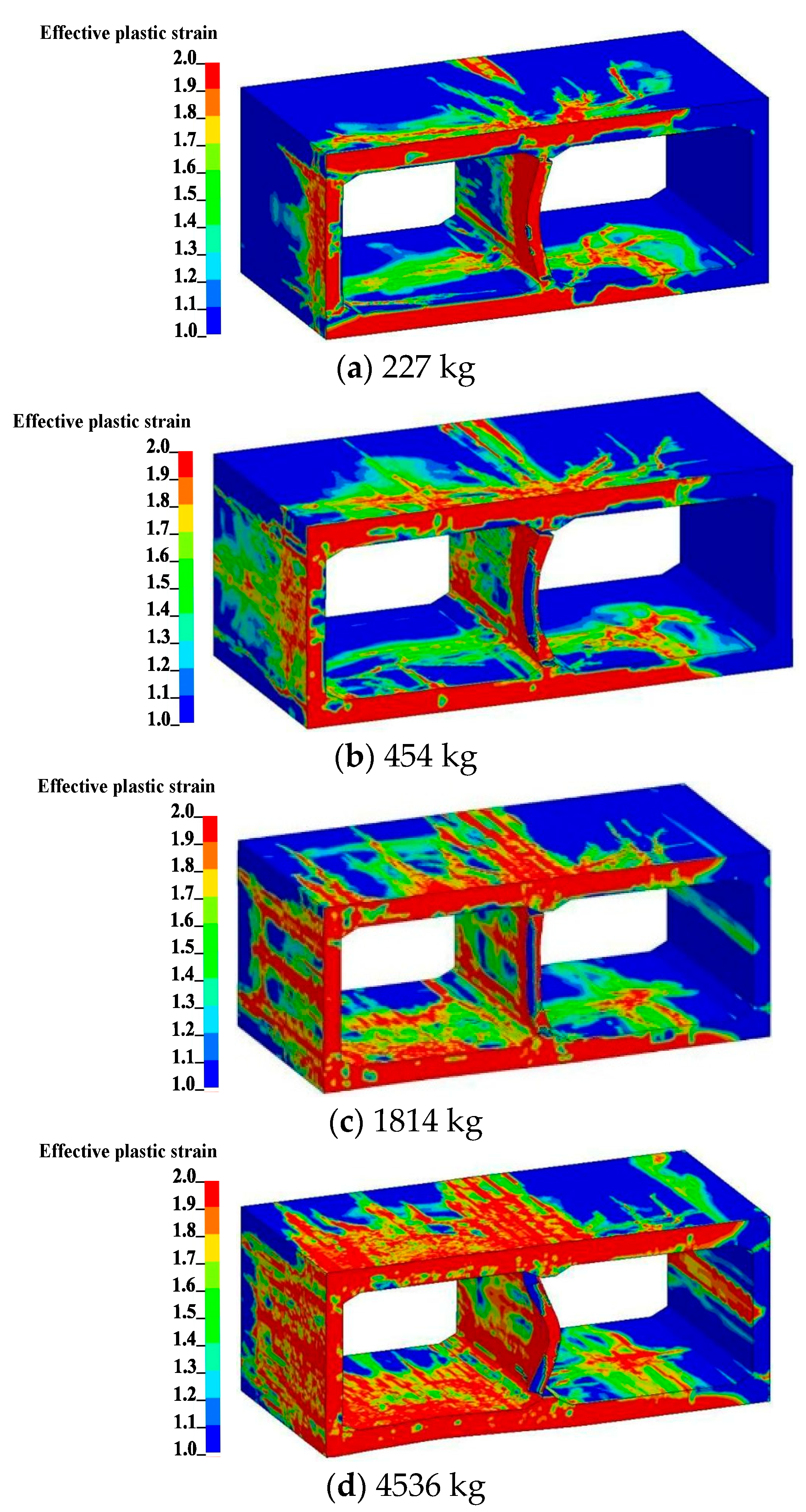
4.2.1. The Effect of Charge Weight
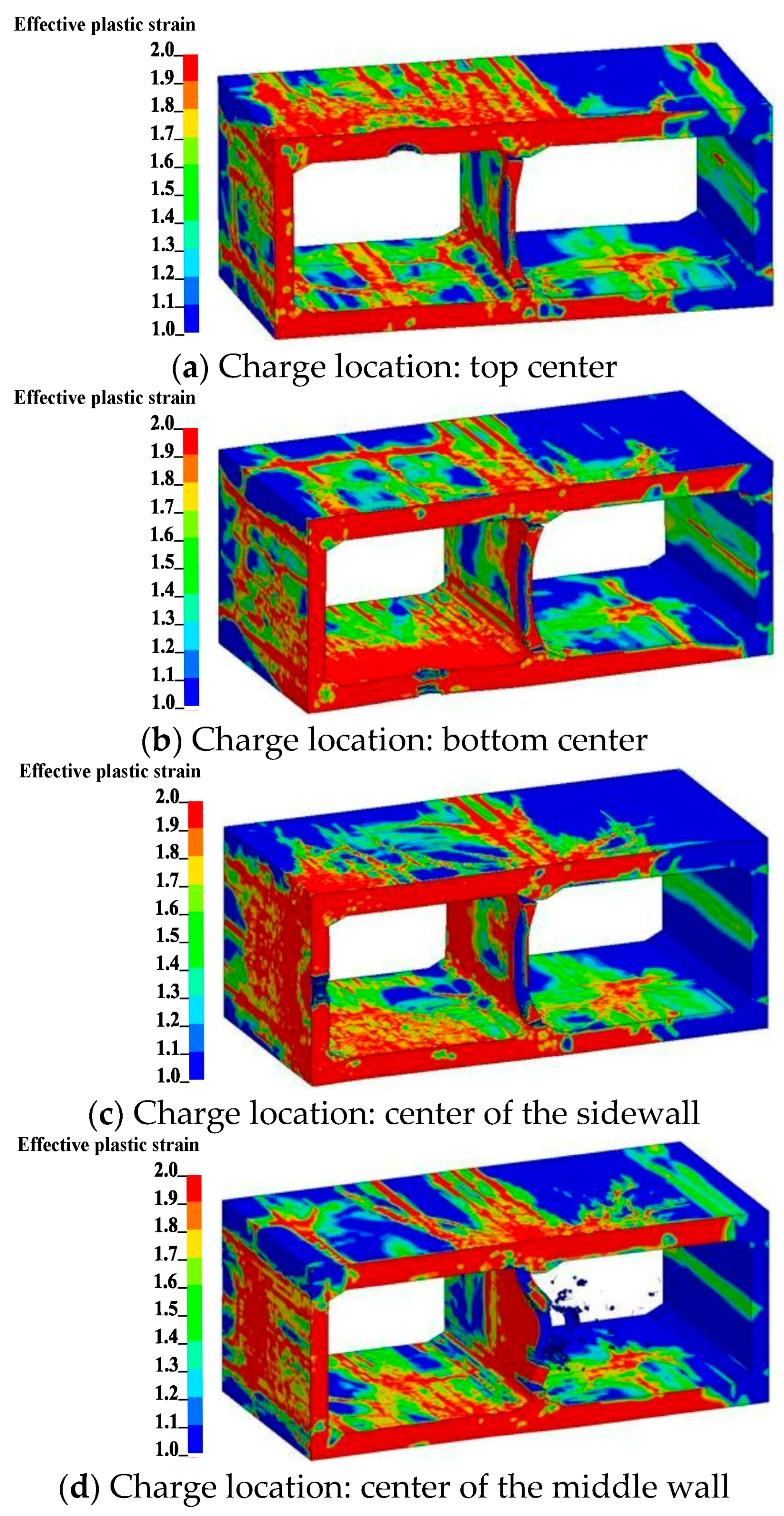
4.2.2. The Effect of the Charging Location
4.3. Structural Vulnerability Analysis
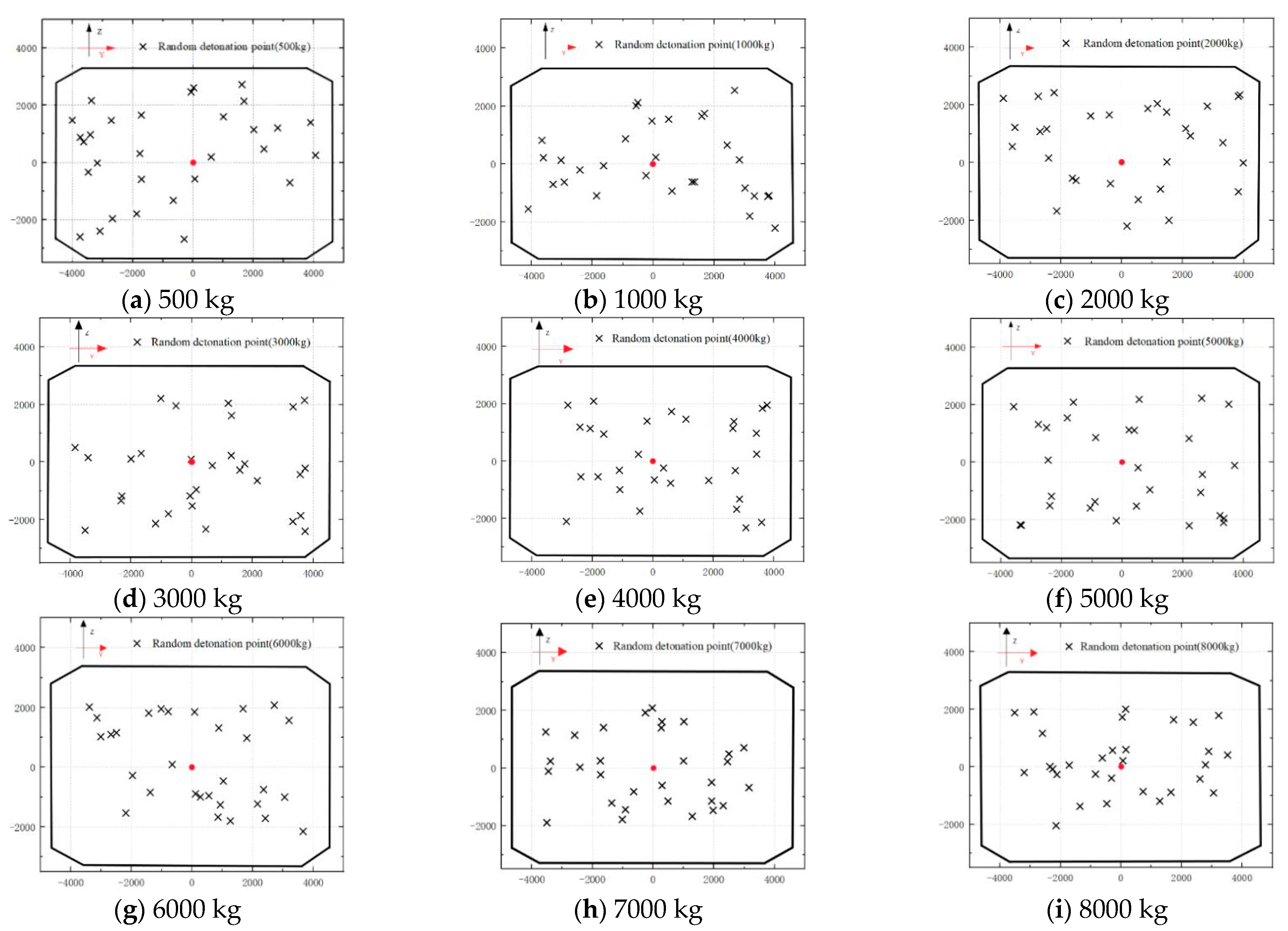
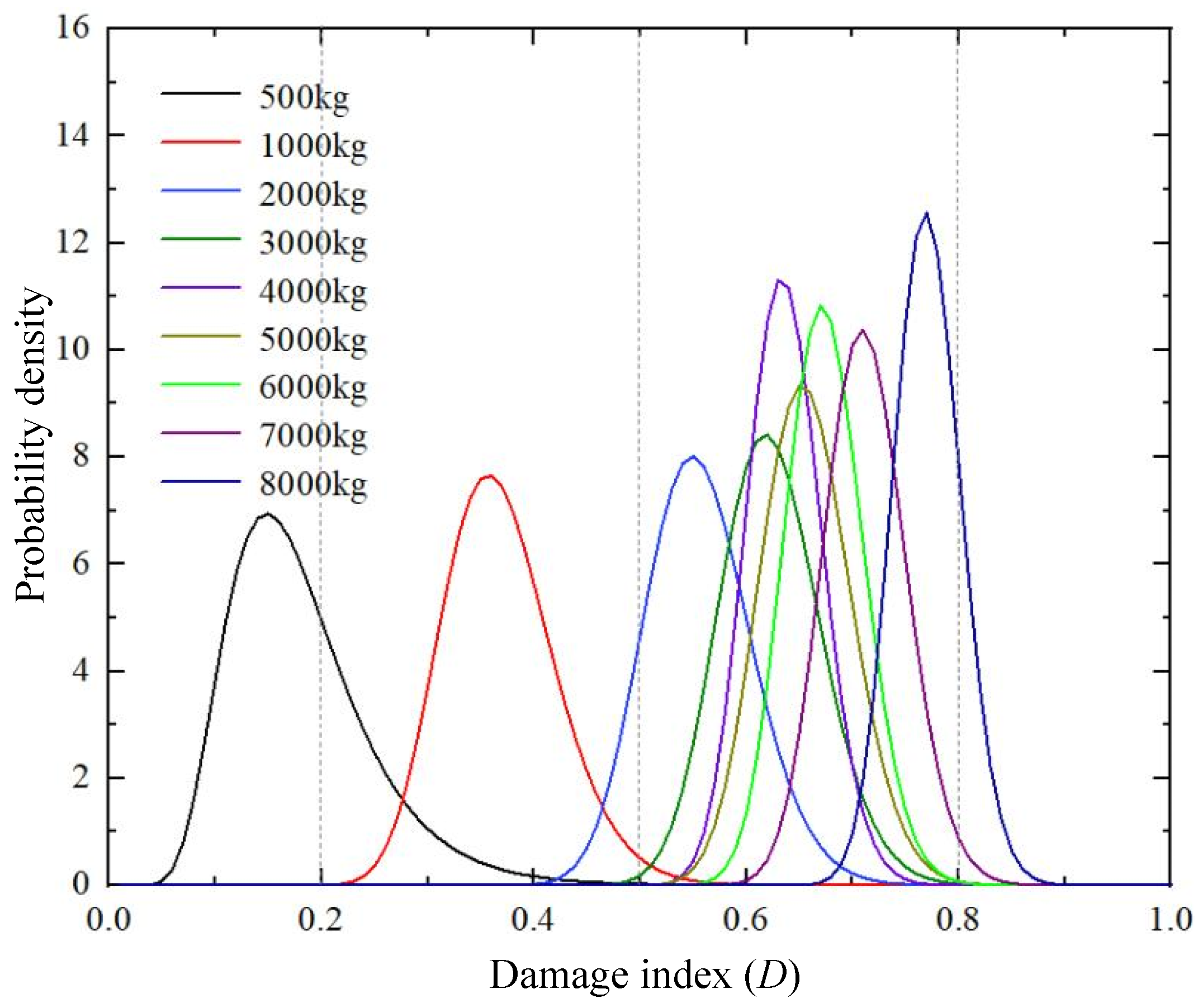
4.3.1. Uncertainty Analysis of Internal Blast Loads
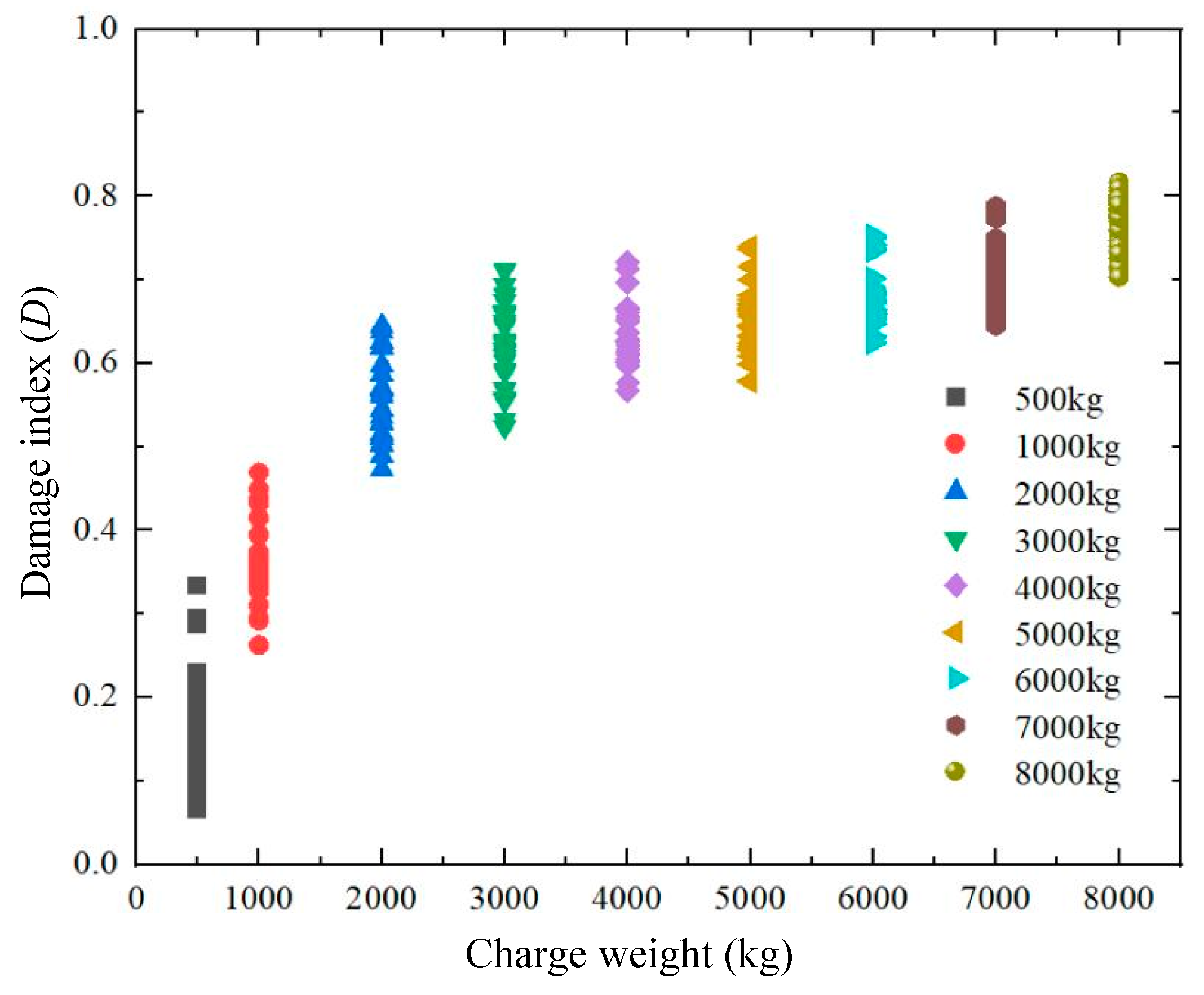
4.3.2. Determining the Index and Level of Damage
4.3.3. Damage Level Analysis
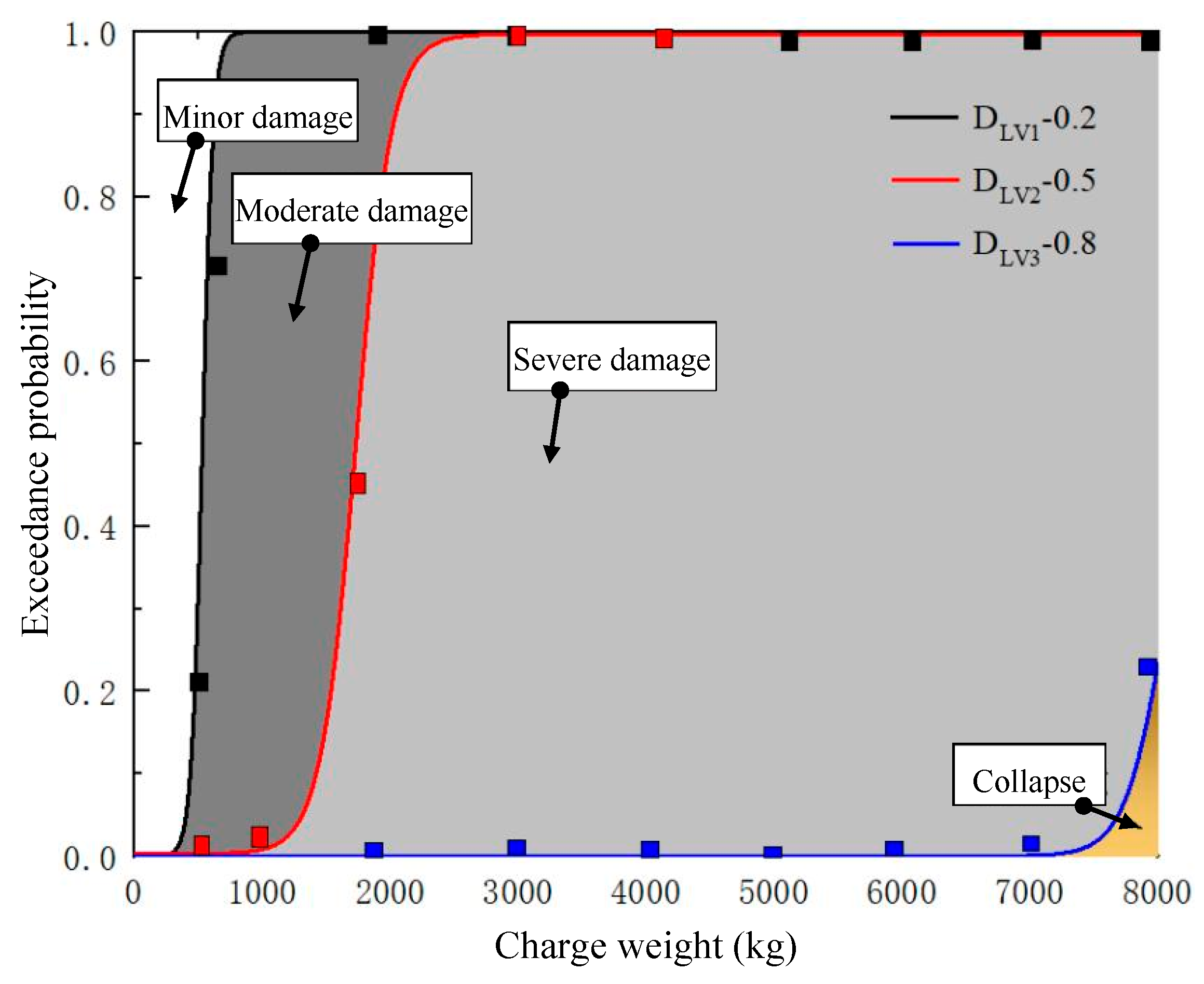
4.3.4. Vulnerability Assessment
5. Conclusions
- (1)
- The thickness of the central wall of the twin-channel tunnel is small, and the earth pressure weakens its bearing capacity. Therefore, the blast resistance of the central wall is poor. Under internal explosion action, the earth pressure reduces the tensile stress on the outer sides of the top slab, bottom slab, and side walls, thereby enhancing their explosion resistance. Unilateral internal explosion loads can cause changes in the relative load-bearing capacity of the twin-channel linings. The relative load-bearing capacity of the twin-channel linings further weakens under the action of earth pressure, thereby affecting the overall damage state of the tunnel. At the same time, the damage state of the central wall also plays an important role. Increasing the thickness of the connection area between the wall and the slab can enhance the blast resistance of that region. As the loading weight increases, the damage to the twin-channel tunnel intensifies. The plastic strain in the top and bottom plates of the non-charged channel gradually propagates along the top and bottom plates. Ultimately, plastic strain appears at the end and mid-section of the right outer wall of the twin-channel tunnel.
- (2)
- The combined effects of structural characteristics and soil-structure interaction cause the deformation and failure patterns of the middle wall to exhibit different phenomena under different charge weights. When the charge weight is low (M ≤ 1814 kg), the concrete at the end of the right side of the center wall fails and falls off, and the center wall deflects to the left. When the charge weight is large (M > 1814 kg), the concrete in the middle and ends of the center wall is damaged, and the center wall deflects to the right. Also, the roof and floor of the left tunnel of the twin-channel tunnel are moving inward.
- (3)
- When explosives were placed on the roof, floor, and outer walls of the twin-channel tunnel (loading weight: 1814 kg), the walls in contact with the explosives suffered localized damage. When explosives are placed on the center wall of the twin-channel tunnel, the concrete at the ends and middle of the center wall is damaged. The charge location has a significant impact on the damage state of the outer wall of the uncharged channel in the twin-channel tunnel. When the charge location is at the top, bottom, and outer wall of the left channel (the channel where explosives are placed) of the tunnel, the effective plastic strain of the outer wall of the right channel is significantly greater than the effective plastic strain when the charge location is at the middle wall.
- (4)
- The damage index increases with increasing charge weight. The damage level of the twin-channel tunnel was mainly slight, moderate, severe, and collapsed for charge weights of 500 kg, 1000 kg, 2000 kg, and 8000 kg, respectively. When the charge weight exceeds 1000 kg, the probability of minor damage reaches 1. When the charge weight reaches 3000 kg, the probability of severe damage reaches 1. The vulnerability diagram developed in this paper allows probabilistic assessment of the damage level of a twin-channel tunnel for different charge weights and blast locations.
- (5)
- This paper suggests the following recommendations in the explosion-resistant design of the twin-channel tunnel: the center wall is the weak part of the twin-channel tunnel. The strengthening of the blast protection level of the center wall is the key to preventing tunnel collapse. The combined TNT-equivalent threshold for vehicles transporting dangerous products in twin-channel tunnels is 300 kg. The combined TNT-equivalent threshold should be reduced when the size of the twin-channel tunnel is smaller than that of this paper.
- (6)
- This article has some shortcomings. Numerical simulation models consume a lot of computational resources. It is necessary to develop a rapid analysis model to assess the vulnerability of twin-channel tunnels under internal explosions. The combined effects of central walls, earth pressure, and internal explosion loads on the damage state and vulnerability of twin-channel tunnels need further investigation. The residual bearing capacity reveals the load-bearing limit of the twin-channel tunnel. However, it is impossible to assess the serviceability limit state of the twin-channel tunnel. In the twin-channel tunnel, the vulnerability curve is influenced by tunnel dimensions. The trend of vulnerability curve changes when tunnel dimensions decrease or increase is unclear.
Author Contributions
Funding
Data Availability Statement
Conflicts of Interest
References
- He, B.; Armaghani, D.J.; Lai, S.H.; He, X.; Asteris, P.G.; Sheng, D. A deep dive into tunnel blasting studies between 2000 and 2023-A systematic review. Tunn. Undergr. Space Technol. 2024, 147, 105727. [Google Scholar] [CrossRef] [Scilit]
- Makarov, V.V. Island megalopolises: Tunnel systems as a critical alternative in solving transport problems. Engineering 2018, 4, 138–142. [Google Scholar] [CrossRef] [Scilit]
- Mussa, M.H.; Mutalib, A.A.; Hamid, R.; Naidu, S.R.; Radzi, N.A.M.; Abedini, M. Assessment of damage to an underground box tunnel by a surface explosion. Tunn. Undergr. Space Technol. 2017, 66, 64–76. [Google Scholar] [CrossRef] [Scilit]
- Liu, J.; Yan, Q.; Wu, J. Analysis of blast wave propagation inside tunnel. Trans. Tianjin Univ. 2008, 14, 358–362. [Google Scholar] [CrossRef] [Scilit]
- Duan, J.; Zong, Q.; Wang, H.; Cheng, B.; Gao, P. Study on stress wave propagation and failure characteristics of key parts in tunnel under blasting load. Sci. Rep. 2024, 14, 29034. [Google Scholar] [CrossRef] [Scilit]
- Zhao, D.; Huang, Y.; Chen, X.; Han, K.; Chen, C.; Zhao, X.; Chen, W. Numerical investigations on dynamic responses of subway segmental tunnel lining structures under internal blasts. Tunn. Undergr. Space Technol. 2023, 135, 105058. [Google Scholar] [CrossRef] [Scilit]
- Saeed, A.; Chen, L.; Feng, B. Development and Advance in Tunnel Structures Subjected to Internal Blast Loads: A Comprehensive Review. Arch. Comput. Methods Eng. 2025, 32, 3265–3307. [Google Scholar] [CrossRef] [Scilit]
- Prasanna, R.; Boominathan, A. Finite-element studies on factors influencing the response of underground tunnels subjected to internal explosion. Int. J. Geomech. 2020, 20, 04020089. [Google Scholar] [CrossRef] [Scilit]
- Yu, H.; Wang, Z.; Yuan, Y.; Li, W. Numerical analysis of internal blast effects on underground tunnel in soils. Struct. Infrastruct. Eng. 2016, 12, 1090–1105. [Google Scholar] [CrossRef] [Scilit]
- Liu, C.; Zhao, G.H.; He, J.Z.; Liu, H.; Cui, J. Damage Pattern and Failure Mechanism of Shield Tunnel Lining under Internal Explosion. Thin-Walled Struct. 2025, 214, 113420. [Google Scholar] [CrossRef] [Scilit]
- Zhao, Y.; Chu, C.; Yi, Y. Study on an engineering measure to improve internal explosion resistance capacity of segmental tunnel lining structures. J. Vibroeng. 2016, 18, 2997–3009. [Google Scholar] [CrossRef] [Scilit]
- Xu, L.F.; Chen, L.; Zhang, X.; Yue, C. Investigation on the performances of folded arch immersed tube tunnel under internal explosion. Structures 2025, 79, 109352. [Google Scholar] [CrossRef] [Scilit]
- Cheng, R.; Chen, W.; Hao, H.; Li, J. Dynamic response of road tunnel subjected to internal Boiling liquid expansion vapour explosion (BLEVE). Tunn. Undergr. Space Technol. 2022, 123, 104363. [Google Scholar] [CrossRef] [Scilit]
- Huang, Z.; Qin, M.; Ma, S.; Qiu, C.; Zhou, Y. Mechanical response and blast resistance evaluation of prefabricated frame tunnels with steel box joints under internal explosion. Eng. Sci. Technol. Int. J. 2024, 55, 101752. [Google Scholar] [CrossRef] [Scilit]
- Duan, Y.; Liu, L.; Yang, J.; Long, J.; He, G.; Lei, S.; Duan, X. Effects of explosion-venting interlayer within utility tunnels on the characteristics of natural gas explosions. Fuel 2024, 377, 132766. [Google Scholar] [CrossRef] [Scilit]
- Tiwari, R.; Chakraborty, T.; Matsagar, V. Analysis of curved tunnels in soil subjected to internal blast loading. Acta Geotech. 2020, 15, 509–528. [Google Scholar] [CrossRef] [Scilit]
- Zhong, C.; Sun, Y. Influence of Explosion Point’s Position on the Propagation Law of Shock Wave. In International Conference on Development and Application of Carbon Nanomaterials in Energetic Materials; Springer Nature: Berlin, Germany, 2022; Volume 276, p. 275. [Google Scholar] [CrossRef] [Scilit]
- Dolatshahi, A.; Nouri Qarahasanlou, A. Pre-existing Crack Effect on Damage of Inner Concrete Lining under an Internal Explosion: A Numerical Study. J. Min. Environ. 2023, 14, 945–960. [Google Scholar] [CrossRef]
- Tiwari, R.; Chakraborty, T.; Matsagar, V. Dynamic analysis of tunnel in soil subjected to internal blast loading. Geotech. Geol. Eng. 2017, 35, 1491–1512. [Google Scholar] [CrossRef] [Scilit]
- Ngo, T.; Mendis, P.; Gupta, A.; Ramsay, J. Blast loading and blast effects on structures-an overview. Electron. J. Struct. Eng. 2007, 1, 76–91. [Google Scholar] [CrossRef] [Scilit]
- Liu, H.B. Soil-structure interaction and failure of cast-iron subway tunnels subjected to medium internal blast loading. J. Perform. Constr. Facil. 2012, 26, 691–701. [Google Scholar] [CrossRef] [Scilit]
- Hua, N.; Elhami-Khorasani, N.; Tessari, A. Review of tunnel fire damage assessment methods and techniques. Transp. Res. Rec. 2021, 2675, 279–290. [Google Scholar] [CrossRef] [Scilit]
- Roy, N.; Sarkar, R. A review of seismic damage of mountain tunnels and probable failure mechanisms. Geotech. Geol. Eng. 2017, 35, 1–28. [Google Scholar] [CrossRef] [Scilit]
- Frenelus, W.; Peng, H.; Zhang, J. Long-term degradation, damage and fracture in deep rock tunnels: A review on the effect of excavation methods. Fract. Struct. Integr. 2021, 15, 128–150. [Google Scholar] [CrossRef] [Scilit]
- Mobaraki, B.; Vaghefi, M. Numerical study of the depth and cross-sectional shape of tunnel under surface explosion. Tunn. Undergr. Space Technol. 2015, 47, 114–122. [Google Scholar] [CrossRef] [Scilit]
- Liu, Z.; Wu, J.; Chen, Q.; Li, S.; Yan, Q.; Yu, H. Analysis on the vulnerability of a tunnel entrance under internal explosion. Sensors 2022, 22, 9727. [Google Scholar] [CrossRef] [Scilit]
- Bai, F.T.; Guo, Q.; Root, K.; Naito, C.; Quiel, S. Blast vulnerability assessment of road tunnels with reinforced concrete liners. Transp. Res. Rec. 2018, 2672, 156–164. [Google Scholar] [CrossRef] [Scilit]
- Zhang, C.; Zhang, D.; Huang, Z.; Lei, C.; Zhang, B.; Huang, H. Fragility assessment of shallow buried tunnels under explosive hazards. Tunn. Undergr. Space Technol. 2024, 152, 105909. [Google Scholar] [CrossRef] [Scilit]
- Liu, Z.C.; Wu, J.; Cao, C.; Li, S.; Yan, Q. Dynamic performance and damage assessment of a shallow buried tunnel under internal explosion. Tunn. Undergr. Space Technol. 2023, 133, 104918. [Google Scholar] [CrossRef] [Scilit]
- Zhou, L.Y.; Li, X.J.; Yan, Q.; Li, S.; Chang, S.; Ren, P. Test and damage assessment of shallow buried RC tunnel under explosion. Undergr. Space 2024, 14, 118–137. [Google Scholar] [CrossRef] [Scilit]
- Draganić, H.; Varevac, D. Analysis of blast wave parameters depending on air mesh size. Shock Vib. 2018, 1, 3157457. [Google Scholar] [CrossRef] [Scilit]
- Qian, H.; Zong, Z.; Wu, C.; Li, J.; Gan, L. Numerical study on the behavior of utility tunnel subjected to ground surface explosion. Thin-Walled Struct. 2021, 161, 107422. [Google Scholar] [CrossRef] [Scilit]
- Wang, G.; Wang, Y.; Lu, W.; Zhou, W.; Chen, M.; Yan, P. On the determination of the mesh size for numerical simulations of shock wave propagation in near field underwater explosion. Appl. Ocean Res. 2016, 59, 1–9. [Google Scholar] [CrossRef] [Scilit]
- Kong, X.; Fang, Q.; Chen, L.; Wu, H. Nonlocal formulation of the modified K&C model to resolve mesh-size dependency of concrete structures subjected to intense dynamic loadings. Int. J. Impact Eng. 2018, 122, 318–332. [Google Scholar] [CrossRef] [Scilit]
- Qian, K.; Fang, Q. Dynamic Increase Factor of Concrete Structures. In Progressive Collapse Resilience of Concrete Structures: Mechanisms, Simulations and Experiments; Springer: Singapore, 2023; pp. 61–109. [Google Scholar] [CrossRef] [Scilit]
- Liu, W. Numerical Simulation with FLAC3D on the Reasonable Value of Lime-Soil Cushion Thickness, Cohesion and Friction Angle of Rigid Pile Composite Foundation in Collapsible Loess Areas. Master’s Thesis, Taiyuan University of Technology, Taiyuan, China, 2012. [Google Scholar]
- Sun, X.D.; Wang, D. Analysis of Soil Cohesion Values. Liaoning Build. Mater. 2010, 3, 39–41. [Google Scholar] [CrossRef]
- Li, X.H.; Zhang, Q.S.; Zhang, X.; Lan, X.D.; An, Q.W. A Method for Calculating the Cohesive Force of Uniform Cohesion Soil. Adv. Eng. Sci. 2019, 1, 137–143. [Google Scholar] [CrossRef]
- FEMA 428; Primer to Design Safe School Projects in Case of Terrorist Attacks and School Shootings. US Department of Homeland Security: Washington, DC, USA, 2012.
- Li, Z.; Wu, S.; Cheng, Z.; Jiang, Y. Numerical investigation of the dynamic responses and damage of linings subjected to violent gas explosions inside highway tunnels. Shock Vib. 2018, 2018, 2792043. [Google Scholar] [CrossRef] [Scilit]
- Osinov, V.A.; Chrisopoulos, S.; Triantafyllidis, T. Numerical analysis of the tunnel-soil interaction caused by an explosion in the tunnel. Soil Dyn. Earthq. Eng. 2019, 122, 318–326. [Google Scholar] [CrossRef] [Scilit]
- Kristoffersen, M.; Minoretti, A.; Børvik, T. On the internal blast loading of submerged floating tunnels in concrete with circular and rectangular cross-sections. Eng. Fail. Anal. 2019, 103, 462–480. [Google Scholar] [CrossRef] [Scilit]
- Xu, L.; Chen, L.; Fang, Q.; Dong, Y. Blast resistance of a folded arch cross-section immersed tunnel subjected to internal explosion. Tunn. Undergr. Space Technol. 2022, 125, 104521. [Google Scholar] [CrossRef] [Scilit]
- Liu, C.; Gao, F.; Deng, S.; Wang, Z.; Lu, H.; Deng, G.; Wang, M. Investigation on the damage and assessment of steel-concrete-steel composite structures subjected penetration and explosive loadings. Structures 2026, 83, 110841. [Google Scholar] [CrossRef] [Scilit]
- Zhou, L.; Li, X.; Yan, Q.; Li, S. Blast test and probabilistic vulnerability assessment of a shallow buried RC tunnel considering uncertainty. Int. J. Impact Eng. 2023, 180, 104717. [Google Scholar] [CrossRef] [Scilit]
- Remennikov, A.; Carolan, D. Blast effects and vulnerability of building structures from terrorist attack. Aust. J. Struct. Eng. 2006, 7, 1–11. [Google Scholar] [CrossRef] [Scilit]
- Shinozuka, M.; Feng, M.Q.; Lee, J.; Naganuma, T. Statistical analysis of fragility curves. J. Eng. Mech. 2000, 126, 1224–1231. [Google Scholar] [CrossRef] [Scilit]
- Makhloof, D.A.; Ibrahim, A.R. Damage Assessment of Reinforced Concrete Structures through Damage Indices: A State-of-the-Art Review. CMES-Comput. Model. Eng. Sci. 2021, 128, 849–874. [Google Scholar] [CrossRef] [Scilit]
- Shi, Y.C.; Hao, H.; Li, Z.X. Numerical derivation of pressure–impulse diagrams for prediction of RC column damage to blast loads. Int. J. Impact Eng. 2008, 35, 1213–1227. [Google Scholar] [CrossRef] [Scilit]
- Baji, H.; Ronagh, H.R.; Li, C.Q. Probabilistic assessment of FRP-confined reinforced concrete columns. Compos. Struct. 2016, 153, 851–865. [Google Scholar] [CrossRef] [Scilit]
- Roy, T.; Matsagar, V. Probabilistic framework for failure investigation of reinforced concrete wall panel under dynamic blast loads. Eng. Fail. Anal. 2021, 125, 105368. [Google Scholar] [CrossRef] [Scilit]
- Huang, Z.; Hu, Z.; Zhang, C.; Pan, Z.; Hu, J.; Chen, X. Deformation characteristics and damage assessment of prefabricated frame tunnels after central and external explosions. Sustainability 2022, 14, 9942. [Google Scholar] [CrossRef] [Scilit]







| Case No. | TNT Mass (kg) | Charge Location | Explosion Type | Charge Location Schematic | |
|---|---|---|---|---|---|
| Cross-Section | Longitude | ||||
| B1 | 1 | Top | Contact explosion |  |  |
| B2 | 2 | Center | Non-contact explosion |  |  |
| B3 | 2 | Top | Contact explosion |  |  |
| B4 | 2 | Hance | Contact explosion |  |  |
| Density (kg/m3) | Maximum Shear Surface Parameter | Poisson’s Ratio | Aggregate Diameter (mm) | Compressive Damage Parameters | Tensile Damage Parameters |
|---|---|---|---|---|---|
| 2400 | 9.607 | 0.19 | 40.0 | 2.7 | 1.2 |
| Volumetric Strain | Pressure (MPa) | Bulk Modulus (MPa) |
|---|---|---|
| 0 | 0 | 14,508.4023 |
| −0.0015 | 21.7626 | 14,508.4023 |
| −0.0043 | 47.4425 | 14,711.5200 |
| −0.0101 | 76.1691 | 15,451.4485 |
| −0.0305 | 144.7213 | 18,382.1458 |
| −0.0513 | 218.2789 | 21,327.3514 |
| −0.0726 | 309.6818 | 24,258.0487 |
| −0.0943 | 473.7719 | 26,477.8343 |
| −0.174 | 2766.0269 | 59,571.5000 |
| −0.208 | 4230.6501 | 72,542.0117 |
| Density (kg/m3) | Elastic Modulus (GPa) | Poisson’s Ratio | Yield Stress (MPa) | C (s−1) | pcs | Failure Strain |
|---|---|---|---|---|---|---|
| 7800 | 206 | 0.3 | 450 | 40 | 5 | 0.15 |
| Density (kg/m3) | C0 | C1 | C2 | C3 | C4 | C5 | C6 | Initial Volume Internal Energy (J/m3) |
|---|---|---|---|---|---|---|---|---|
| 1.29 | 0 | 0 | 0 | 0 | 0.4 | 0.4 | 0 | 0.25 |
| Density (kg/m3) | Detonation Velocity (m/s) | Chapman–Jouget Pressure (GPa) | A (GPa) | B (GPa) | R1 | R2 | ω | Initial Internal Energy (J/m3) |
|---|---|---|---|---|---|---|---|---|
| 1630 | 6930 | 21 | 373.8 | 3.75 | 4.15 | 0.95 | 0.3 | 7 × 10⁹ |
| Density (kg/m3) | Elastic Shear Modulus (MPa) | Poisson’s Ratio | Failure Surface Shape Parameter | Angle of Friction (°) | Cohesive Force (kPa) |
|---|---|---|---|---|---|
| 1830 | 16.01 | 0.3 | 1.0 | 26.0 | 62 |
| Case Code-Measuring Location | Peak Overpressure (MPa) | Error (%) | |
|---|---|---|---|
| Simulation | Test | ||
| B1-RP1 | 0.35 | 0.28 | 25.0 |
| B1-RP2 | 0.28 | 0.52 | 46.1 |
| B1-RP3 | 0.20 | 0.36 | 44.4 |
| B1-RP4 | 0.70 | 0.76 | 7.9 |
| B1-RP5 | 0.53 | 0.73 | 27.4 |
| B1-RP6 | 0.40 | 0.40 | 33.3 |
| B2-RP7 | 0.42 | 0.93 | 30.0 |
| B2-RP10 | 0.92 | 1.29 | 28.7 |
| B2-RP11 | 0.73 | 1.26 | 42.0 |
| B2-RP12 | 0.56 | 0.93 | 39.7 |
| B3-RP4 | 2.55 | 2.75 | 7.3 |
| B3-RP5 | 2.06 | 2.61 | 21.1 |
| B3-RP6 | 1.50 | 2.40 | 37.5 |
| B4-RP7 | 1.24 | 0.84 | 32.2 |
| B4-RP8 | 0.74 | 1.03 | 28.1 |
| B4-RP9 | 0.40 | 0.68 | 41.1 |
| Case Code | Dimensions of Outer Spalling Area (mm) | Error (%) | Dimensions of Inner Spalling Area (mm) | Error (%) | ||
|---|---|---|---|---|---|---|
| Simulation | Test | Simulation | Test | |||
| B1 | 435 × 485 | 500 × 550 | 13.0 × 11.8 | 430 × 470 | 410 × 480 | 4.9 × 2.1 |
| B3 | 500 × 550 | 530 × 580 | 5.6 × 5.1 | 450 × 535 | 500 × 560 | 10.0 × 2.7 |
| B4 | 640 × 700 | 600 × 660 | 6.7 × 6.1 | 475 × 600 | 400 × 500 | 18.7 × 20.0 |
| Case Code | Charge Mass (kg) | Bearing Capacity (kN) | Error (%) | |
|---|---|---|---|---|
| Simulation | Test | |||
| B0 | 0 | 570.00 | 600.00 | 5.0 |
| B1 | 1 | 517.36 | 541.99 | 4.5 |
| B2 | 2 | 500.64 | 531.64 | 6.0 |
| B3 | 2 | 421.36 | 454.21 | 7.2 |
| B4 | 2 | 511.42 | 573.39 | 10.8 |
| Types of Explosion Threats | Compact Sedan | Sedan | Van | Delivery Van |
|---|---|---|---|---|
 |  |  |  | |
| Charge weight (kg) | 227 | 454 | 1814 | 4536 |
| D | Damage Level |
|---|---|
| 0 ˂ D ˂ 0.2 | Minor damage |
| 0.2 ˂ D ˂ 0.5 | Moderate damage |
| 0.5 ˂ D ˂ 0.8 | Severe damage |
| 0.8 ˂ D ˂ 1.0 | Collapse |
| Charge Mass (kg) | Charge Location | |||
|---|---|---|---|---|
| Top | Bottom | Middle Wall | Left Wall | |
| 500 kg |  |  |  |  |
| 2000 kg |  |  |  | 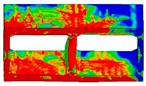 |
| 6000 kg | 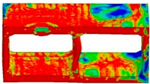 |  |  | 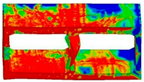 |
| 8000 kg |  |  |  |  |
| Charge Mass (kg) | Charge Location | Minimum Damage Level | Maximum Damage Level | |||
|---|---|---|---|---|---|---|
| Top | Bottom | Middle Wall | Left Wall | |||
| Residual Bearing Capacity/kN (Damage Index) | ||||||
| 500 | 875,000 (0.182) | 950,000 (0.112) | 863,000 (0.193) | 857,000 (0.199) | Minor damage | Minor damage |
| 2000 | 546,000 (0.490) | 564,000 (0.473) | 487,000 (0.545) | 462,000 (0.568) | Moderate damage | Severe damage |
| 6000 | 373,000 (0.651) | 382,000 (0.643) | 342,000 (0.680) | 331,000 (0.691) | Severe damage | Severe damage |
| 8000 | 238,000 (0.778) | 259,000 (0.758) | 23,200 (0.978) | 219,000 (0.795) | Severe damage | Collapse |
| Charge Weight (kg) | Mean | Standard Deviation |
|---|---|---|
| 500 | −1.776 | 0.363 |
| 1000 | −1.009 | 0.144 |
| 2000 | −0.591 | 0.090 |
| 3000 | −0.478 | 0.073 |
| 4000 | −0.456 | 0.051 |
| 5000 | −0.444 | 0.064 |
| 6000 | −0.405 | 0.034 |
| 7000 | −0.341 | 0.054 |
| 8000 | −0.261 | 0.041 |
Disclaimer/Publisher’s Note: The statements, opinions and data contained in all publications are solely those of the individual author(s) and contributor(s) and not of MDPI and/or the editor(s). MDPI and/or the editor(s) disclaim responsibility for any injury to people or property resulting from any ideas, methods, instructions or products referred to in the content. |
© 2026 by the authors. Licensee MDPI, Basel, Switzerland. This article is an open access article distributed under the terms and conditions of the Creative Commons Attribution (CC BY) license.
Share and Cite
Li, F.; Li, Z.; Li, L.; Wang, L. Study on the Damage State and Vulnerability of Twin-Channel Tunnels Under Single-Channel Internal Explosions. Buildings 2026, 16, 1155. https://doi.org/10.3390/buildings16061155
Li F, Li Z, Li L, Wang L. Study on the Damage State and Vulnerability of Twin-Channel Tunnels Under Single-Channel Internal Explosions. Buildings. 2026; 16(6):1155. https://doi.org/10.3390/buildings16061155
Chicago/Turabian StyleLi, Fengzeng, Zhengpeng Li, Liang Li, and Li Wang. 2026. "Study on the Damage State and Vulnerability of Twin-Channel Tunnels Under Single-Channel Internal Explosions" Buildings 16, no. 6: 1155. https://doi.org/10.3390/buildings16061155
APA StyleLi, F., Li, Z., Li, L., & Wang, L. (2026). Study on the Damage State and Vulnerability of Twin-Channel Tunnels Under Single-Channel Internal Explosions. Buildings, 16(6), 1155. https://doi.org/10.3390/buildings16061155