A CFD Study on Wind Pressure Characteristics and Vortex-Induced Vibration of the Yingxian Wooden Pagoda

Abstract
1. Introduction
2. Computational Process
2.1. Geometric Models, Fluid Domains, and Boundary Conditions
2.2. Turbulence Models and Settings
2.3. Grid Partitioning
2.4. Boundary Conditions and Model Parameters
2.5. Numerical Model Validation: Benchmark Testing of 2D Cylinder Flow
3. Results and Analysis
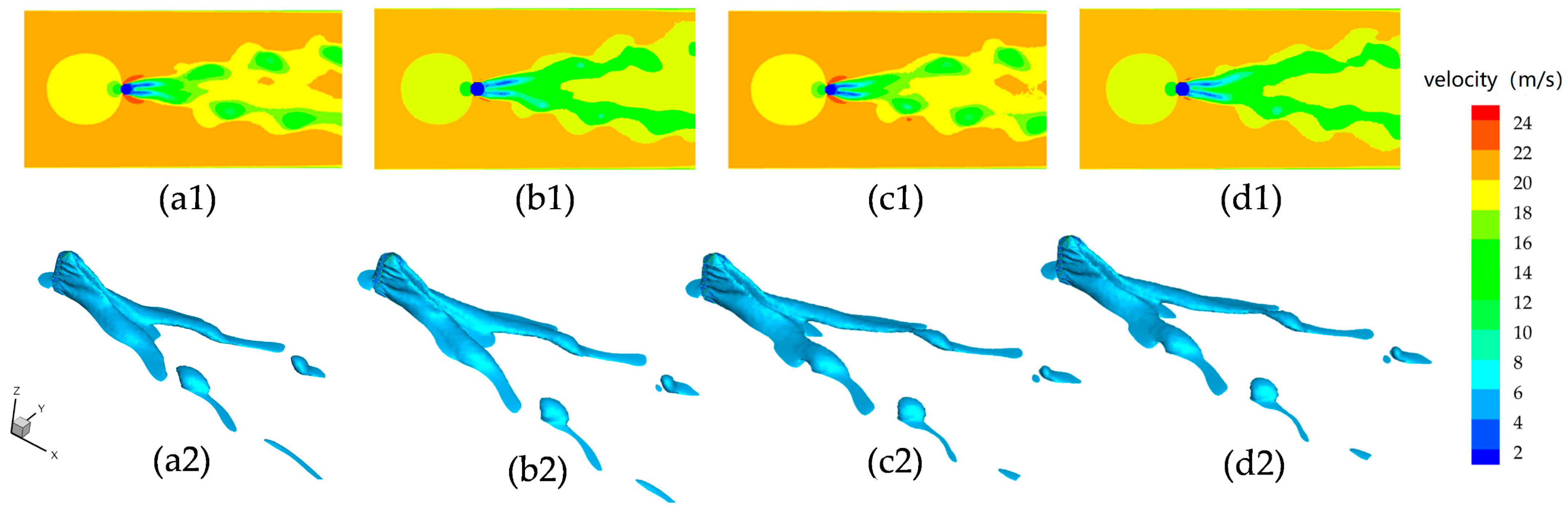
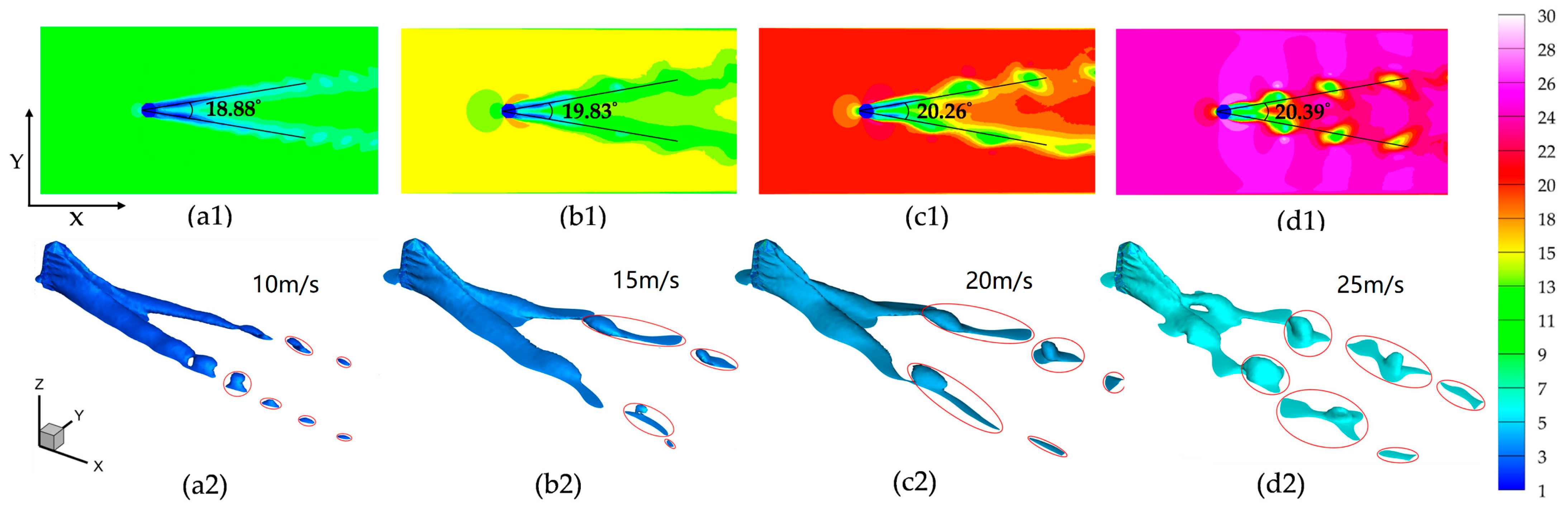
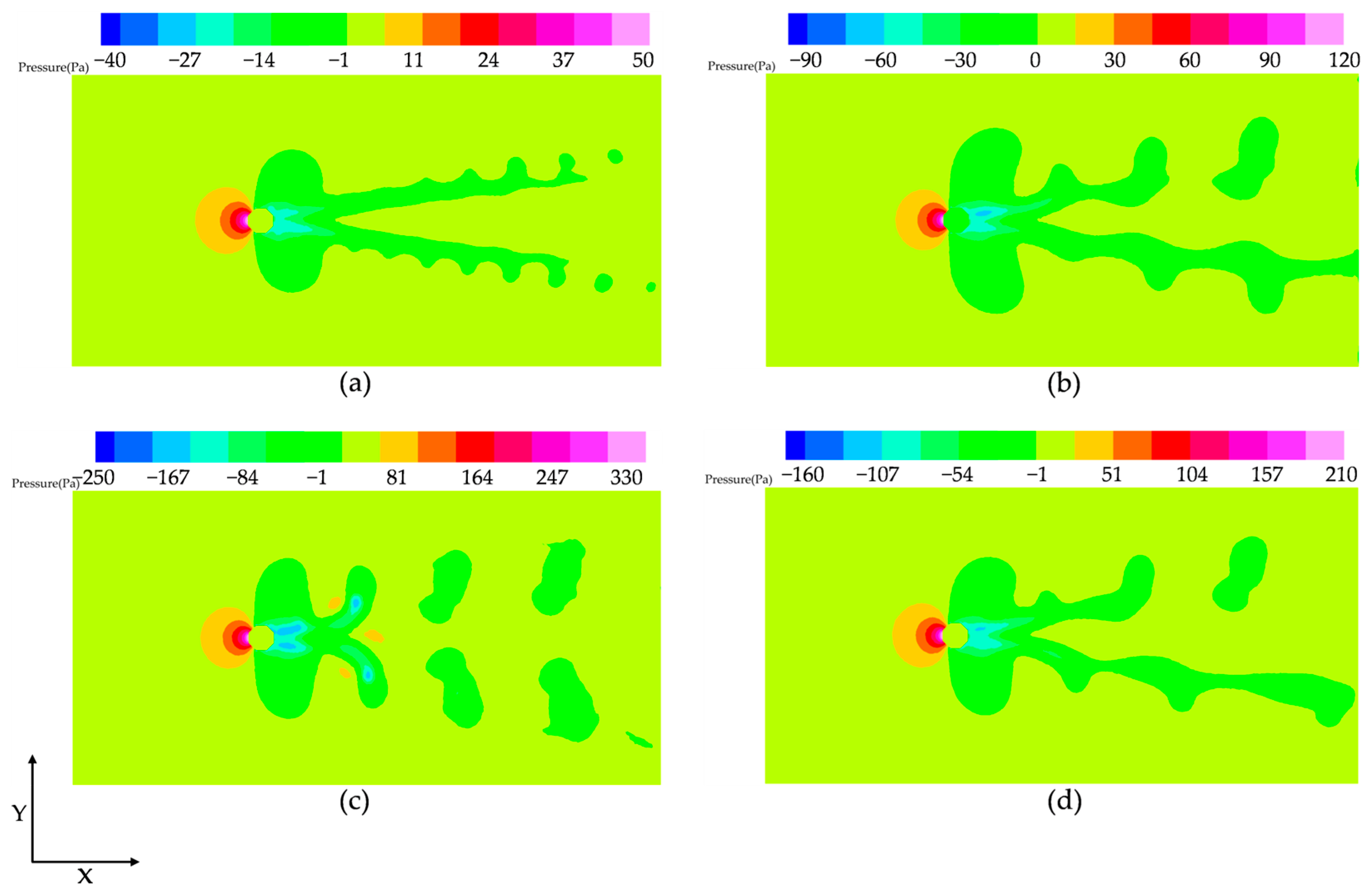
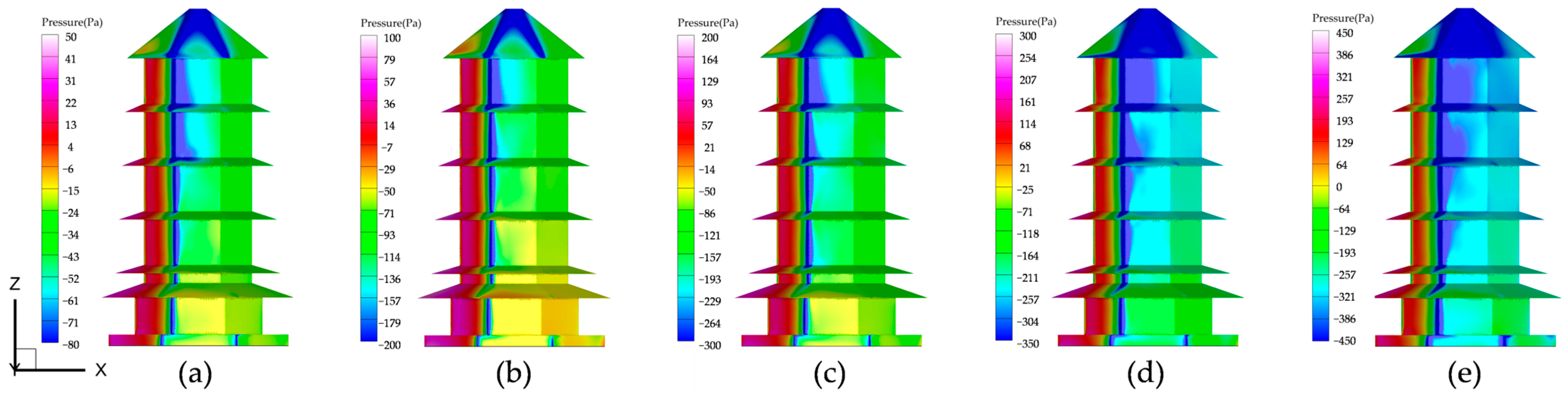
3.1. Flow Field Structure and Pressure Distribution near the Pagoda
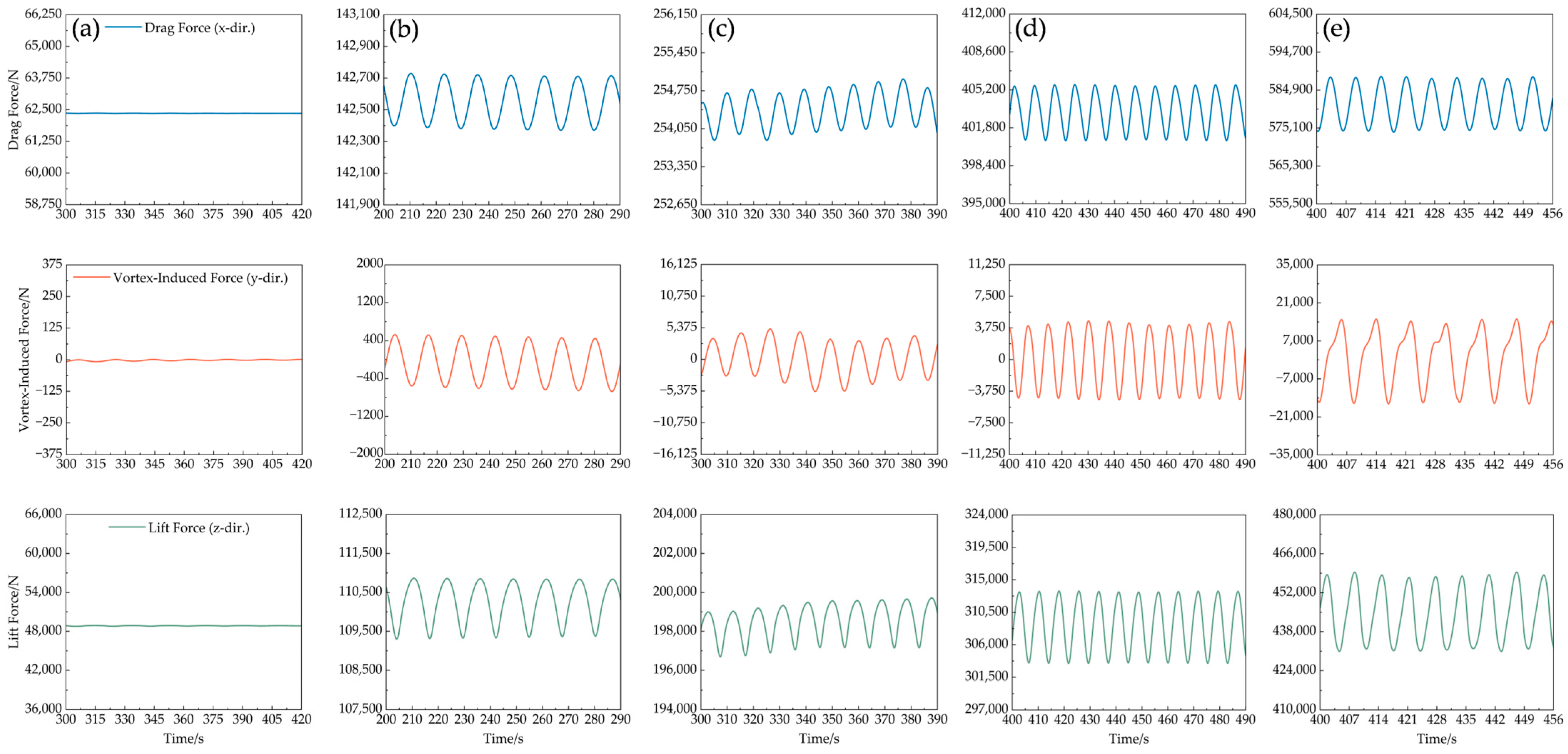
3.2. Vortex-Induced Vibration Analysis of the Yingxian Wooden Pagoda
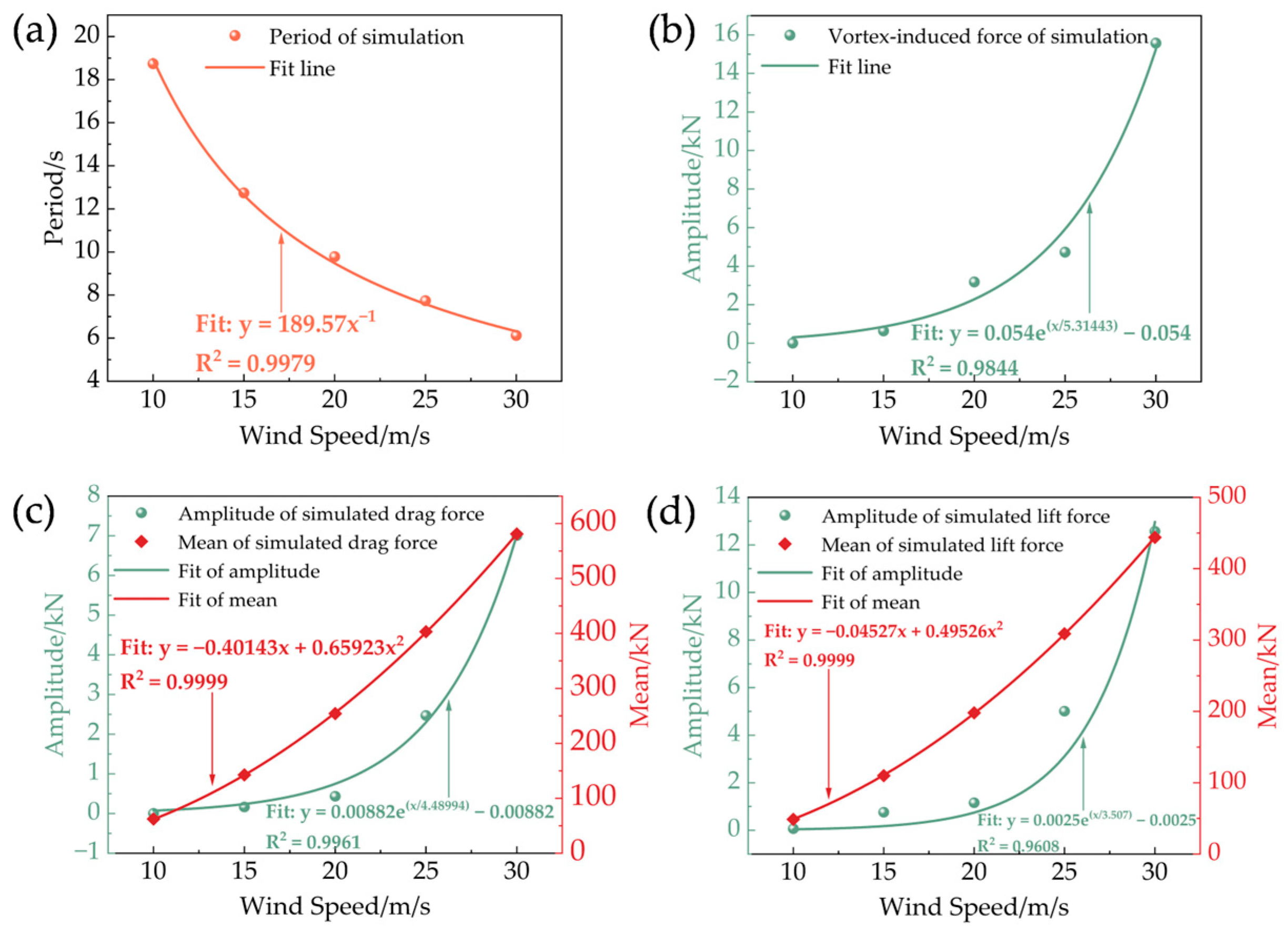
3.3. Relationship Between Vibration Amplitude of the Wooden Pagoda and Wind Speed
4. Conclusions
- (1)
- A detailed description of the verification process and simulation method for the CFD technique is provided for the wooden pagoda structure. A transient simulation approach utilizing the Realizable k-εε turbulence model and an unstructured mesh achieves high accuracy while significantly improving computational efficiency, serving as a reference for low-cost, high-efficiency “digital wind tunnel” evaluations.
- (2)
- The periodic shedding of the Kármán vortex street behind the pagoda and the variation in flow structures at different inlet wind speeds are examined. The simulations show a wind pressure distribution characterized by a high-pressure area on the windward side and a large low-pressure area on the leeward side, driven by boundary-layer separation. The vortex-induced force in the cross-wind (y-direction) is confirmed as a key driver of the structural dynamic response.
- (3)
- The simulations systematically reveal and quantify the periodic vortex-induced forces acting on the Yingxian Wooden Pagoda. These are fluctuating forces in all three directions when the velocity exceeds 10 m/s, with amplitudes increasing exponentially as the inlet velocity rises. The average values of drag and lift forces follow a quadratic relationship with inlet velocity.
- (4)
- The results clearly demonstrate that the traditional Strouhal formula can be adapted by using a correction factor of 0.875, resulting in a vortex-shedding frequency prediction model suitable for this type of ancient pagoda. This offers a quantitative tool for wind-vibration safety evaluations and wind-resistant design of similar wooden structures. Importantly, the correction factor (0.875) was specifically derived considering the octagonal cross-section and geometric proportions of the Yingxian Wooden Pagoda. Its primary application is for octagonal timber pagodas. This shape-specific approach aligns with recent studies indicating that the Strouhal number varies systematically with changes in the corner geometry of bluff bodies. Therefore, applying this factor to pagodas with different cross-sectional shapes (e.g., square, circular, or hexagonal) is not advised, as vortex-shedding dynamics may differ significantly.
Author Contributions
Funding
Data Availability Statement
Conflicts of Interest
References
- Jin, W. Yingxian Wooden Pagoda. Wenwu 1976, 11, 75–76. [Google Scholar]
- Di, Z. Dynamic Characteristic Analysis of Yingxian Wooden Pagoda. Ph.D. Thesis, Beijing Jiaotong University, Beijing, China, 2020. [Google Scholar]
- Hou, W.; Wang, L.; Yong, X. Research on the Protection of Yingxian Wooden Pagoda; Cultural Relics Publishing House: Beijing, China, 2016. [Google Scholar]
- Li, T.; Zhang, S.; Li, S. Wind Pressure Model Test Analysis of Ancient Wooden Pagoda. J. Exp. Mech. 2002, 17, 354–362. [Google Scholar]
- Li, T.; Zhang, S.; Li, S. Vibration Analysis of Yingxian Wooden Pagoda under Wind Action. Mech. Eng. 2003, 25, 40–42. [Google Scholar]
- Fernandez-Aldama, R.; Papadakis, G.; Lopez-Garcia, O.; Avila-Sanchez, S.; Riziotis, V.A. High-fidelity simulations of airfoil vortex-induced vibrations: From 2D to blade-like aspect ratios. J. Phys. Conf. Ser. 2024, 2767, 022054. [Google Scholar] [CrossRef]
- Li, C.; Yuan, S.; Zhang, Z. Numerical Simulation of Wind-Sand Flow Around Buildings. Build. Energy Environ. 2012, 31, 66–68+59. [Google Scholar]
- Li, Y.H.; Deng, Y.; Li, A.Q. A nondestructive method for controlling wind loads and wind-induced responses of wooden pagoda. Wind Struct. 2022, 34, 525–538. [Google Scholar] [CrossRef]
- Mi, X.C.; Meng, X.J.; Yang, Q.S.; Li, T.Y.; Wang, J.P. Analysis of the Residual Deformation of Yingxian Wood Pagoda. Adv. Civ. Eng. 2020, 2020, 2341375. [Google Scholar] [CrossRef]
- Van Hinsberg, N.P.; Frede, A. Square-section prism with rounded edges in a uniform cross-flow: Effect of incidence angle and Reynolds number on the (un) steady aerodynamics and proneness to galloping. J. Wind Eng. Ind. Aerod. 2025, 257, 105993. [Google Scholar] [CrossRef]
- Liu, Y.; Su, Z. Numerical Simulation of Flow Around a Square Cylinder at Different Reynolds Numbers. J. China Univ. Metrol. 2006, 40–43, 49. [Google Scholar]
- Zheng, L. (Ed.) ANSYS Fluent 15.0 Fluid Calculation: From Beginner to Master (Upgraded Edition); Publishing House of Electronics Industry: Beijing, China, 2015. [Google Scholar]
- McDonald, P.W. The Computation of Transonic Flow Through Two-Dimensional Gas Turbine Cascades. J. Eng. Gas Turbines Power 1971, 93, 345–354. [Google Scholar]
- Wang, H.; Liu, Y. (Eds.) ANSYS Fluent Numerical Calculation Method and Examples for Fluid; China Railway Publishing House: Beijing, China, 2015. [Google Scholar]
- Li, Y.H.; Deng, Y.; Li, A.Q.; Xu, T. Comparative Studies of Computational Fluid Dynamic Geometric Models at Multiple Levels of Details in Evaluating Wind Action on Asian Ancient Wooden Tower. Int. J. Archit. Herit. 2023, 17, 970–987. [Google Scholar] [CrossRef]
- Mohotti, D.; Wijesooriya, K.; Dias-da-Costa, D. Comparison of Reynolds Averaging Navier-Stokes (RANS) Turbulent Models in Predicting Wind Pressure on Tall Buildings. J. Build. Eng. 2019, 21, 1–17. [Google Scholar] [CrossRef]
- Yang, Y. Numerical Simulation of Wind Flow Around High-Rise Buildings. Master’s Thesis, Shandong University of Science and Technology, Qingdao, China, 2019. [Google Scholar] [CrossRef]
- Rezhati, A. Numerical Calculation of Wind Flow Around High-Rise Buildings. Master’s Thesis, Nanjing University of Science and Technology, Nanjing, China, 2013. [Google Scholar]
- Shih, T.-H.; Liou, W.W.; Shabbir, A.; Yang, Z.; Zhu, J. A New k-ϵ Eddy Viscosity Model for High Reynolds Number Turbulent Flows. Comput. Fluids 1995, 24, 227–238. [Google Scholar] [CrossRef]
- Zou, J.J.; Liu, Y.L.; Kong, Q.; Zhang, A.M. Moving mesh FSI approach for VIV simulation based on DG method with AMR technique. arXiv 2025, arXiv:2503.24134v3. [Google Scholar] [CrossRef]
- Idrissi, A.; El Mghari, H.; El Amraoui, R. CFD simulation advances in urban aerodynamics: Accuracy, validation, and high-rise building applications. Results Eng. 2025, 26, 105148. [Google Scholar] [CrossRef]
- Han, Y.D.; Chun, Q.; Hua, Y.W. Wind-Induced Vibration of Traditional Chinese Citygate Buildings in the Ming-Qing Dynasties—A Case Study of the Nanjing Drum Tower. Int. J. Archit. Herit. 2021, 18, 227–242. [Google Scholar] [CrossRef]
- Huang, Y. Vortices of Wind and High-Rise Buildings. Physics 2010, 39, 632–633. [Google Scholar]
- Jiang, Y.; Shen, G.; Han, K.; Ke, Y.; Chen, Y.; Yu, S. Effects of corner modification on the Strouhal number of high-rise buildings under skewed wind. J. Build. Eng. 2024, 97, 110925. [Google Scholar] [CrossRef]


| Computational Models | Parameter Settings |
|---|---|
| Solver | SIMPLE Second Order of Pressure First Order Upwind of Turbulent Kinetic Energy Transient |
| Turbulence Model | Realizable k-ε |
| Standard Wall Function | |
| Gravity | −9.81 m/s2 |
| Inlet Boundary Types | velocity inlet |
| Inlet velocity magnitude | 10 m/s 15 m/s 20 m/s 25 m/s 30 m/s |
| Wall Conditions | No-slip wall at the bottom free-slip wall at the sides and top |
| Convergence Error | 0.0001 |
| Wind Speeds | ||||||
|---|---|---|---|---|---|---|
| 10 m/s | 15 m/s | 20 m/s | 25 m/s | 30 m/s | ||
| Drag force (-dir) | Maximum/kN | 62.366 | 142.729 | 254.965 | 405.673 | 588.240 |
| Minimum/kN | 62.354 | 142.400 | 253.838 | 400.703 | 574.233 | |
| Mean/kN | 62.360 | 142.564 | 254.200 | 403.146 | 581.000 | |
| Amplitude/kN | 0.005 | 0.165 | 0.436 | 2.470 | 7.004 | |
| Cycle time/s | 18.92 | 12.74 | 9.77 | 7.65 | 6.15 | |
| Vortex-Induced force (-dir) | Maximum/kN | 0.000837 | 0.637 | 3.556 | 4.727 | 15.008 |
| Minimum/kN | −0.00562 | −0.635 | −2.797 | −4.723 | −16.149 | |
| Mean/kN | 0.00169 | 0.00163 | 0.442 | −0.219 | −0.129 | |
| Amplitude/kN | 0.00323 | 0.636 | 3.176 | 4.725 | 15.578 | |
| Cycle time/s | 18.40 | 12.78 | 9.79 | 7.68 | 6.23 | |
| Lift force (-dir) | Maximum/kN | 48.900 | 110.617 | 199.012 | 313.452 | 456.354 |
| Minimum/kN | 48.763 | 109.329 | 196.699 | 303.435 | 431.213 | |
| Mean/kN | 48.831 | 109.978 | 198.001 | 308.907 | 443.892 | |
| Amplitude/kN | 0.068 | 0.762 | 1.157 | 5.009 | 12.570 | |
| Cycle time/s | 18.90 | 12.70 | 9.78 | 7.88 | 6.00 | |
| Wind Speeds | 10 m/s | 15 m/s | 20 m/s | 25 m/s | 30 m/s |
|---|---|---|---|---|---|
| Theoretical cycle/s | 21.621 | 14.414 | 10.811 | 8.649 | 6.443 |
| Simulated cycle/s | 18.740 | 12.740 | 9.780 | 7.740 | 6.127 |
| Corrected Theoretical cycle/s | 18.919 | 12.613 | 9.459 | 7.568 | 6.306 |
| Relative Errors | −0.95% | 1.00% | 3.38% | 2.28% | −2.84% |
Disclaimer/Publisher’s Note: The statements, opinions and data contained in all publications are solely those of the individual author(s) and contributor(s) and not of MDPI and/or the editor(s). MDPI and/or the editor(s) disclaim responsibility for any injury to people or property resulting from any ideas, methods, instructions or products referred to in the content. |
© 2026 by the authors. Licensee MDPI, Basel, Switzerland. This article is an open access article distributed under the terms and conditions of the Creative Commons Attribution (CC BY) license.
Share and Cite
Wang, Z.; Zou, W.; Tang, C. A CFD Study on Wind Pressure Characteristics and Vortex-Induced Vibration of the Yingxian Wooden Pagoda. Buildings 2026, 16, 1154. https://doi.org/10.3390/buildings16061154
Wang Z, Zou W, Tang C. A CFD Study on Wind Pressure Characteristics and Vortex-Induced Vibration of the Yingxian Wooden Pagoda. Buildings. 2026; 16(6):1154. https://doi.org/10.3390/buildings16061154
Chicago/Turabian StyleWang, Zhen, Wennan Zou, and Changxin Tang. 2026. "A CFD Study on Wind Pressure Characteristics and Vortex-Induced Vibration of the Yingxian Wooden Pagoda" Buildings 16, no. 6: 1154. https://doi.org/10.3390/buildings16061154
APA StyleWang, Z., Zou, W., & Tang, C. (2026). A CFD Study on Wind Pressure Characteristics and Vortex-Induced Vibration of the Yingxian Wooden Pagoda. Buildings, 16(6), 1154. https://doi.org/10.3390/buildings16061154