Article

Seismic Response and Predictive Modeling of Large-Diameter Shield Tunnels with Voids Behind Lining


1
School of Civil Engineering and Communications, North China University of Water Resources and Electric Power, Zhengzhou 450045, China
2
Collaborative Innovation Center for Efficient Utilization of Water Resources, North China University of Water Resources and Electric Power, Zhengzhou 450046, China
3
Vocational Skills Training School, Henan D.R. Construction Group, Xinxiang 451100, China
*
Authors to whom correspondence should be addressed.
Buildings 2026, 16(6), 1110; https://doi.org/10.3390/buildings16061110
Submission received: 29 January 2026 / Revised: 27 February 2026 / Accepted: 5 March 2026 / Published: 11 March 2026
(This article belongs to the Section Building Structures)

Abstract

Voids behind the lining that develop during long-term operation can seriously compromise the seismic safety performance of metro shield tunnels. To investigate the influence of such void defects on large-diameter shield tunnels, this study systematically analyzed the causes and distribution patterns of voids. A three-dimensional discontinuous finite element model was developed to simulate the interaction among lining segments, connecting bolts, and surrounding rock. The seismic responses, including circumferential stress, interface slip, interface opening, and bolt tensile stress, were analyzed considering coupled factors such as the void circumferential angle, radial depth, distribution location, and geological conditions. Single-factor and multi-factor sensitivity analyses were conducted to evaluate the significance of the above coupled factors on the overall seismic response. The results show that lining circumferential stress, displacement, interface opening, and bolt stress increase with void enlargement, a shift in void location from the crown to the haunch, and deterioration of geological conditions. A void located at the right haunch leads to a peak circumferential stress of 3.27 MPa, causing local segment damage. Sensitivity analysis reveals that void location is the most influential factor affecting the seismic response, while geological conditions exhibit lower sensitivity. A predictive model for the peak circumferential stress around the void was established using multiple linear regression, incorporating void position, circumferential angle, and radial depth. Within the parameter range considered in this study, this model provides a theoretical basis and practical reference for rapid seismic risk assessment and safety management of shield tunnels with void defects.

1. Introduction

Shield tunnels are extensively employed in intercity railways and urban metro systems in seismic regions due to their superior safety performance, rapid construction, high degree of automation, and minimal surface disturbance [1,2]. However, complex hydrogeological conditions, inadequate grouting during construction, and seepage-erosion during operation can readily induce void defects behind the tunnel lining [3,4]. These voids disrupt the continuous contact between the tunnel and the surrounding rock, leading to significant stress concentration and local force imbalances around the void [5,6]. Under seismic loading, this imbalance markedly increases the risk of lining deformation and cracking, which may lead to excessive segment slip and opening, bolt overload and breakage, and potentially result in segment leakage, material corrosion, and localized collapse [7,8,9,10]. These issues severely weaken the overall bearing capacity and long-term operational safety of shield tunnels. Hence, it is crucial to conduct seismic response analysis and risk assessment for shield tunnels with void defects.
The seismic response of underground tunnels is commonly investigated through theoretical analysis, model testing, and numerical simulations. Among these methods, numerical analysis has become predominant due to its superior ability to handle complex conditions. One approach adopts a continuous modeling technique, treating the segmented lining as a homogeneous continuum. Chen et al. [11] employed the Generalized Response Displacement method to conduct a nonlinear seismic analysis of the Su’ao Tunnel, concluding that the method yields conservative predictions compared to three-dimensional finite-element simulations. Li et al. [12] utilized elastic beam elements to simulate the tunnel lining, revealing interaction mechanisms in double-line tunnels during seismic events and highlighting the influence of geometric parameters and nonlinear effects. Another approach involves beam-spring discrete models, which can capture interface effects. Li et al. [13] modeled tunnel segments as beams connected to the ground through springs, dampers, and sliders, focusing on the influence of segment length and segment interface under seismic excitations. Further research has examined interface defects using simplified concepts. Gao et al. [14] simplified the contact between the surrounding rock and the lining as a low-stiffness interface and investigated the effects of void size and location. Sun et al. [15] applied the load-structure method to assess the impact of voids on internal force and overall structural safety. Nevertheless, models based on these assumptions remain limited in predictive accuracy, particularly for critical local responses such as segment opening and bolt stress.
The presence of voids behind the lining significantly modifies the stress distribution and deformation patterns of tunnels. Existing studies on the seismic response of void-affected tunnels have primarily addressed two aspects: the geometric characteristics of the voids and the external geological and loading conditions. Regarding void geometry, Wu et al. [16] demonstrated that voids located at the tunnel haunch exacerbate oval deformation and interface opening. Wang et al. [17] further highlighted that the location of the lining-back void directly influences the tunnel’s seismic response under SV-wave excitation. Regarding external conditions, Zhao et al. [18] discovered that complex foundation conditions around coastal nuclear power plants can amplify the seismic response of shield tunnels. Li et al. [19] revealed that lateral karst caves under oblique seismic wave incidence can exhibit a dual effect, either dissipating energy or intensifying local damage. Mu et al. [20] demonstrated that the interaction between post-wall voids and soil self-stability predominantly governs deformation responses, increasing the risk of sudden structural failure. Despite these insights, most existing research often concentrates on isolated analyses of either geometric parameters or external conditions. Consequently, a comprehensive analytical framework that captures the multiparametric coupling effects of void position, circumferential angle, radial depth, and geological conditions requires further development.
While the academic community has produced extensive findings regarding tunnel numerical modeling and the impact mechanisms of void defects [21], most existing studies remain at the stage of mechanistic analysis and parametric discussion. Yan et al. [22] conducted large-scale shaking-table tests to demonstrate the significant impact of crown voids on tunnel dynamic responses during vertical earthquakes. Nevertheless, their conclusions are constrained by specific test conditions and are not generalizable. Although Shi et al. [23] systematically carried out experiments and simulations based on void geometry parameters, their work did not translate these findings into practical design formulas. Lu et al. [24] developed a finite element model for shield tunnels that considered SMA flexible joints, but its practical use relies heavily on high-performance computing resources. Furthermore, while Li et al. [25] employed a multi-field coupled analysis to reveal the interacting effects between voids and soil properties on segment and bolt forces, their emphasis remained more on theoretical and simulation aspects. Consequently, transforming these advanced research findings into quantitative assessment tools applicable to engineering practice is critical and urgent.
Although it is widely recognized that voids behind tunnel linings degrade seismic performance, methods for accurately assessing their impact on the dynamic response and safety of shield tunnels remain inadequate. Most studies simplify the lining as a homogeneous continuum, failing to capture the discontinuous interface behavior among segments, bolts, and surrounding rock. As a result, the evaluation of critical indicators, such as interface slip, opening, and bolt stress, is less accurate. Moreover, the combined effects of void spatial distribution—including its circumferential angle, radial depth, and location—together with geological conditions, require thorough sensitivity and coupled analyses. These limitations impede the identification of the most critical defect configurations and hinder the development of quantitative predictive models to estimate worst-case stresses and assess risk levels in engineering practice.
To address these limitations, this study investigated a large-diameter shield tunnel on the Zhengzhou intercity railway. A three-dimensional discontinuous finite element model incorporating void defects was developed using ANSYS 16.0. The research systematically examined the causes and distribution patterns of lining-back voids and assessed the influence of multiple factors on key interface seismic responses. These factors included void location, geometric size, and geological conditions. The examined responses covered lining circumferential stress, interface deformation, and bolt stress. A multi-factor coupled sensitivity analysis was conducted to identify the key influencing parameters and quantify their relative significance. Based on the findings, a predictive model was established to estimate the maximum tensile stress in the lining surrounding a void. This research aims to clarify the failure mechanism induced by void defects and to develop a precise, practical risk assessment method, thereby providing technical support for the risk evaluation and safety maintenance of shield tunnels.

2. Void Distribution Patterns and Finite Element Modeling

2.1. Void Distribution Patterns

The spatial distribution of voids behind tunnel linings is primarily characterized by four parameters: location, circumferential angle, radial depth, and longitudinal length [26]. To clarify the actual distribution law of void defects behind tunnel lining, this study systematically compiles field investigation data from over 400 tunnels in China, including high-speed railway, highway, and metro tunnels. The statistical results are summarized in Table 1. Based on these field measurement data and the tunnel cross-section geometry, the distribution characteristics of voids are analyzed from three perspectives: spatial distribution, geometric parameters, and geological influences.
In terms of spatial distribution, eight out of the ten engineering investigations summarized in Table 1 demonstrate a consistent pattern: voids are predominantly concentrated in the crown and haunch regions. Zhang [27] further quantified, through field inspection and statistical analysis, that voids in these two regions account for up to 80% of the total detected voids. This distribution pattern is primarily attributed to two key factors: the surrounding rock in overhead positions, such as the crown and haunch, is prone to gravitational separation from the lining structure, and during construction, it is difficult to achieve complete backfilling and uniform grouting in these overhead areas, which tends to form grouting shadow zones. Yu [28] noted that voids occasionally occur in the sidewall regions, but their occurrence frequency is significantly lower than that in the crown and haunch. In contrast, voids are extremely rare in the foot and base regions, which is highly consistent with the mechanical characteristics of the invert, as it experiences long-term compressive stresses that inhibit separation from the surrounding rock.
Regarding geometric characteristics, field measurement data provide a systematic quantitative analysis of void dimensions, establishing reasonable ranges for each key parameter and laying a solid foundation for subsequent numerical modeling. The circumferential angles, based on Ren’s field measurement data [29], range from 10° to 60°, corresponding to localized areas in the crown and haunch, and align well with the high-frequency void locations. Radial depths are concentrated in the 0.1–0.6 m range, mainly constrained by overburden pressure and rock mass stiffness. The longitudinal lengths of voids are predominantly distributed between 1 m and 8 m, with variations primarily influenced by regional geological conditions and tunnel cross-sectional geometry. Additionally, Xie [30] indicates that in 64 highway tunnels, voids with cross-sectional areas exceeding 3 m2 account for 75.4% of all detected cases, which provides an important reference for classifying the severity of tunnel void defects.
Geological conditions also influence void development to a certain extent. Liu [31] demonstrated that in Grade IV and V weak and fractured rock masses, voids are predominantly concentrated in the arch section, which is closely related to the large deformation and poor bonding characteristics of weak rock masses. Based on a large-sample investigation of 117 highway tunnels, Zhang [32] observed considerable variations in void dimensions, which may be directly associated with the differences in geological conditions across the survey area.
In summary, field measurement data establish the core distribution characteristics of tunnel voids [33,34,35,36]: voids predominantly occur in the crown and haunch regions, with geometric parameters covering circumferential angles of 10–60°, radial depths of 0.1–0.6 m, and longitudinal lengths of 1–8 m; in grade IV and V rock masses, the weaker surrounding rock promotes separation from the lining, which facilitates the development of void defects.
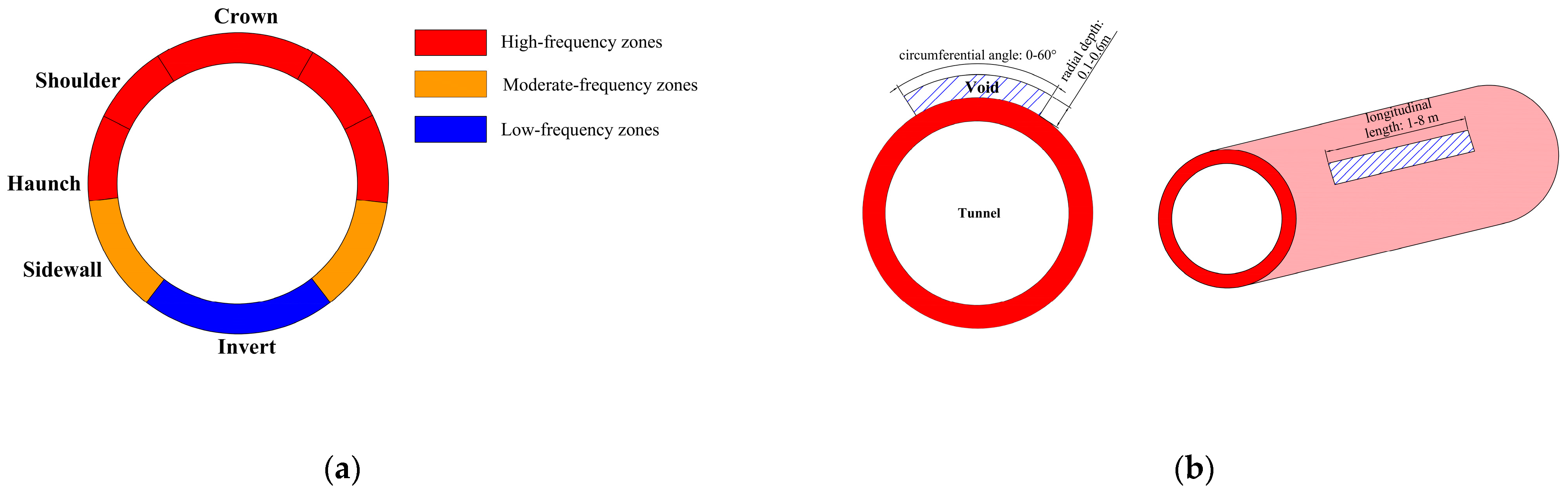
Figure 1 further illustrates the void distribution patterns discussed above. Figure 1a presents the occurrence frequency of voids across the tunnel cross-section: the crown, shoulder, and haunch regions are high-frequency zones (red), containing approximately 80% of voids; the sidewalls exhibit moderate frequency (orange); while voids are extremely rare in the foot and base regions (blue). This indicates that void defects are not randomly distributed but exhibit a clear concentration in the upper half of the tunnel. Figure 1b shows the typical ranges of geometric parameters for voids in the crown and haunch, including circumferential angle, radial depth, and longitudinal length. Although void dimensions vary among individual projects, they are generally confined to the limited space of the crown and haunch, with geometric parameters following certain statistical distributions. This suggests that overburden pressure, rock mass stiffness, and tunnel geometry significantly constrain both the geometric parameters and spatial distribution of voids.

2.2. Engineering Background

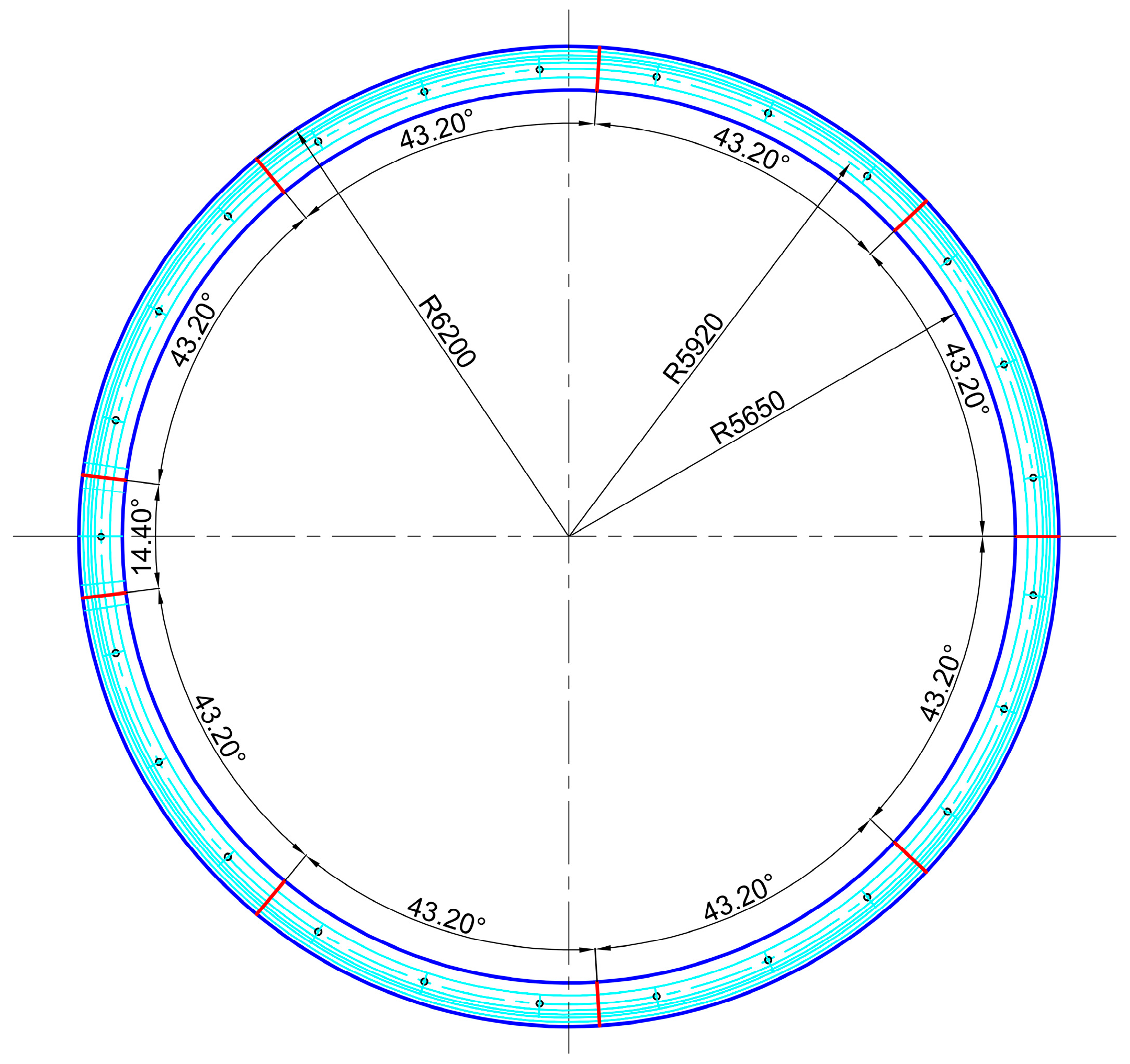
The Zhengzhou Intercity Railway tunnel adopts a single-bore, double-track, large-diameter shield design, extending 3800 m. Featuring a circular cross-section, the tunnel has an outer diameter of 12.4 m, with lining segments 0.55 m thick. Each segment ring spans 2 m and is assembled in a staggered pattern (see Figure 2). Adjacent segments are bolted together using Grade 8.8 M36 bolts, with a preload of 30 kN applied per bolt. The tunnel traverses complex geological formations, including fine sand, silty clay, and silt layers from rock mass grade IV to VI, which are characterized by relatively low stability. The material properties for the tunnel segments and the surrounding soil are detailed in Table 2 and Table 3, respectively.
The project site is located within a seismic fortification zone with a design intensity of Degree VII, corresponding to a basic seismic acceleration of 0.10 g. According to the seismic design code [39], the site is classified as Seismic Group II and Site Category II, featuring a characteristic period of 0.40 s.
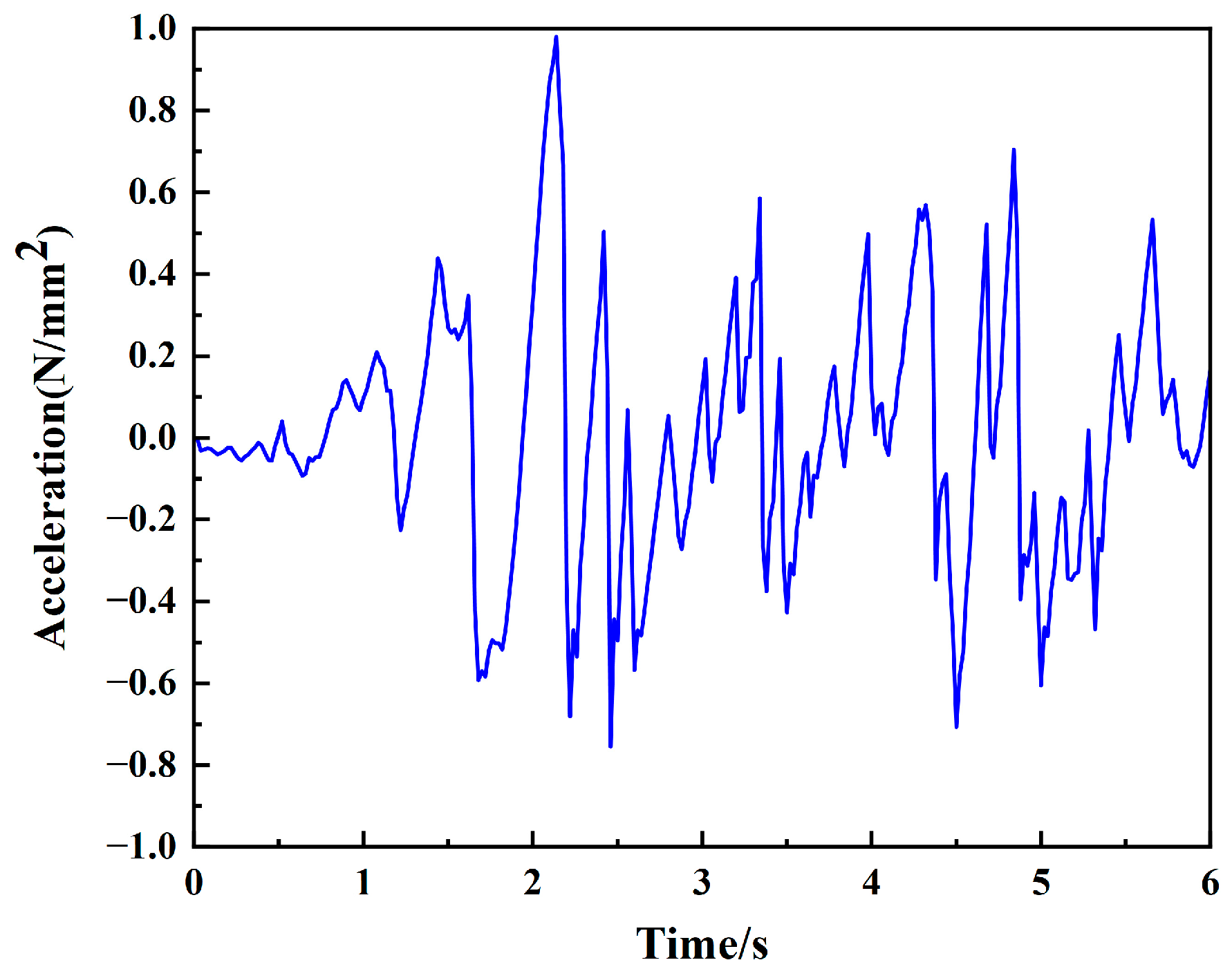
For the seismic input, the El Centro ground motion record from the 1940 Imperial Valley Earthquake is adopted. This record is widely regarded as a benchmark motion in international earthquake engineering and has been extensively utilized in dynamic time-history analyses of underground structures, including tunnels in China. Given that this study focuses on the seismic mechanism and transverse response characteristics of the tunnel cross-section, rather than site-specific seismic design, the use of this well-documented representative record is appropriate and reasonable. The record has a duration of 6 s and a time step of 0.02 s, and is scaled to match the site-specific peak acceleration of 0.10 g.
A bidirectional seismic input is applied by simultaneously applying the transverse horizontal and vertical components of the scaled record. This input approach is specifically selected to assess the transverse seismic performance of the tunnel cross-section. During the scaling process, the horizontal-to-vertical peak acceleration ratio of the original El Centro record is maintained at 1:0.65. The scaled acceleration time histories are illustrated in Figure 3.

2.3. Finite Element Modeling

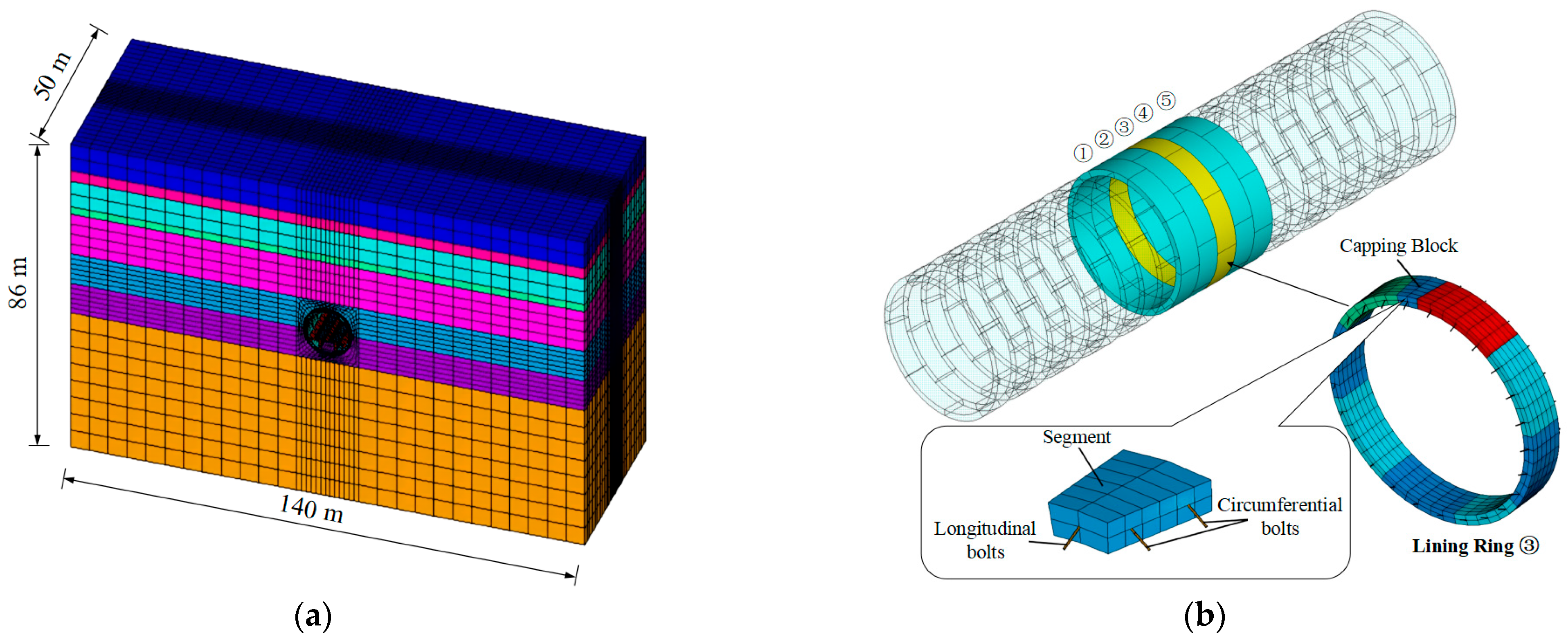
The three-dimensional tunnel-rock interaction model was developed using ANSYS [40,41,42]. To minimize boundary effects, the lateral domain was extended to approximately 11 times the tunnel diameter, while the bottom boundary was positioned at a depth exceeding 3 times the tunnel diameter. The final model dimensions are 140 m (width, X) × 86 m (height, Y) × 50 m (length, Z), as shown in Figure 4a. The tunnel lining, internal structures, and surrounding rock were modeled using SOLID45 solid elements, and bolts were represented with BEAM188 beam elements. A linear elastic constitutive model was applied to the tunnel, whereas a Drucker-Prager elastoplastic model was assigned to the surrounding rock. Nonlinear contact relationships between the lining segments and between the segments and the surrounding rock were simulated using TARGE170 and CONTA173 elements. Bolt-to-segment connections were realized through constraint-equation coupling. To enhance computational accuracy, the mesh was locally refined around the central lining rings (numbered ① to ⑤ in Figure 4b). Normal constraints were imposed on the four lateral boundaries of the surrounding rock, and the bottom boundary was fixed in all three translational directions.

2.4. Numerical Cases and Monitoring Point Distribution

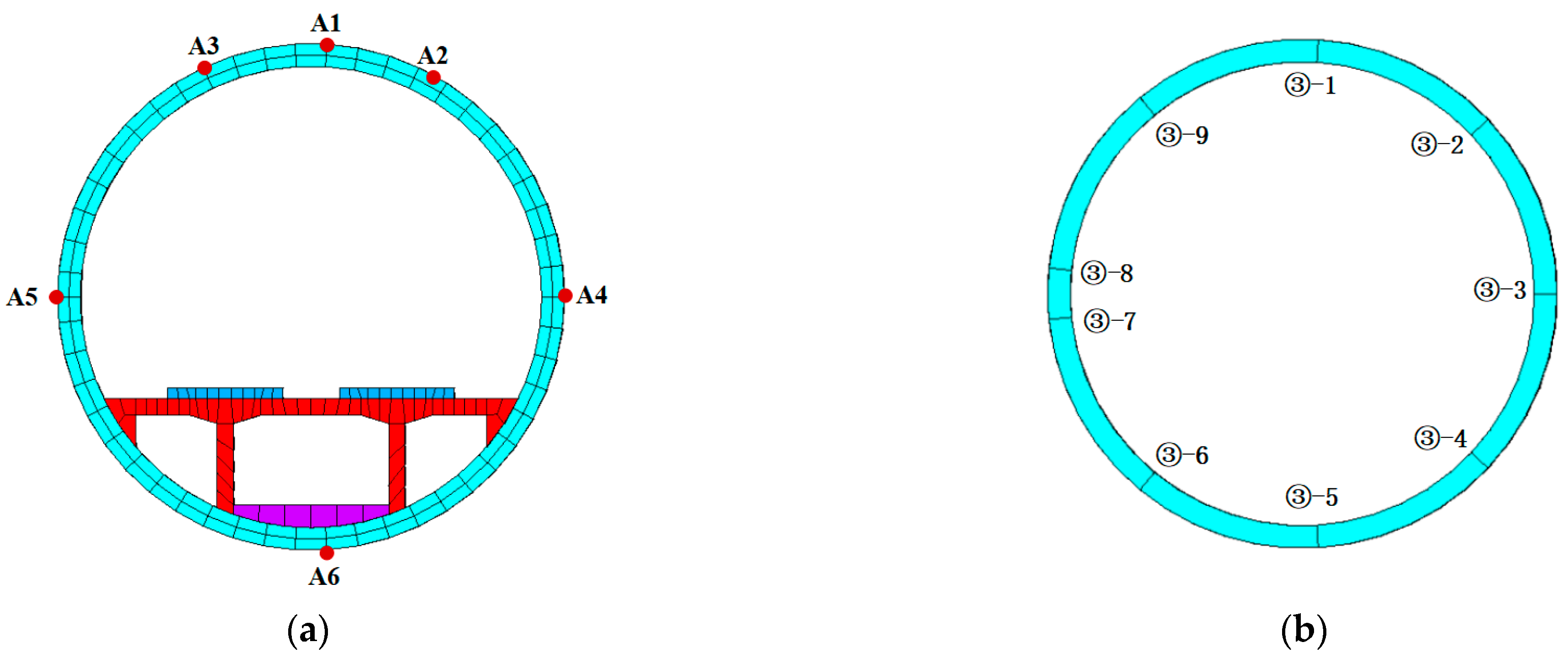
To systematically assess the impacts of the void circumferential angle, radial depth, distribution location, and geological conditions on tunnel seismic performance, five numerical cases were established, as detailed in Table 4. Lining Ring ③ was selected as the primary analysis object (see Figure 5). A total of six monitoring points, A1 to A6, were defined for this ring. A1 is located at the crown, A2 and A3 are positioned on either side of the crown void region, A4 and A5 correspond to the left and right haunches, and A6 is situated at the invert. Additionally, nine longitudinal segment interfaces along ring ③, labeled ③-1 to ③-9, were established to monitor the interface behavior.

3. Results and Discussion

3.1. Seismic Response

This section investigates the seismic response at critical points and interfaces of Lining Ring ③, accounting for the effects of the void circumferential angle, radial depth, distribution location, and complex geological conditions. The key indicators, including circumferential stress, interface slip and opening, and bolt tension stress, are analyzed to evaluate the seismic response and potential failure risks of shield tunnels with void defects under seismic action.

3.1.1. Influence of Void Circumferential Angle

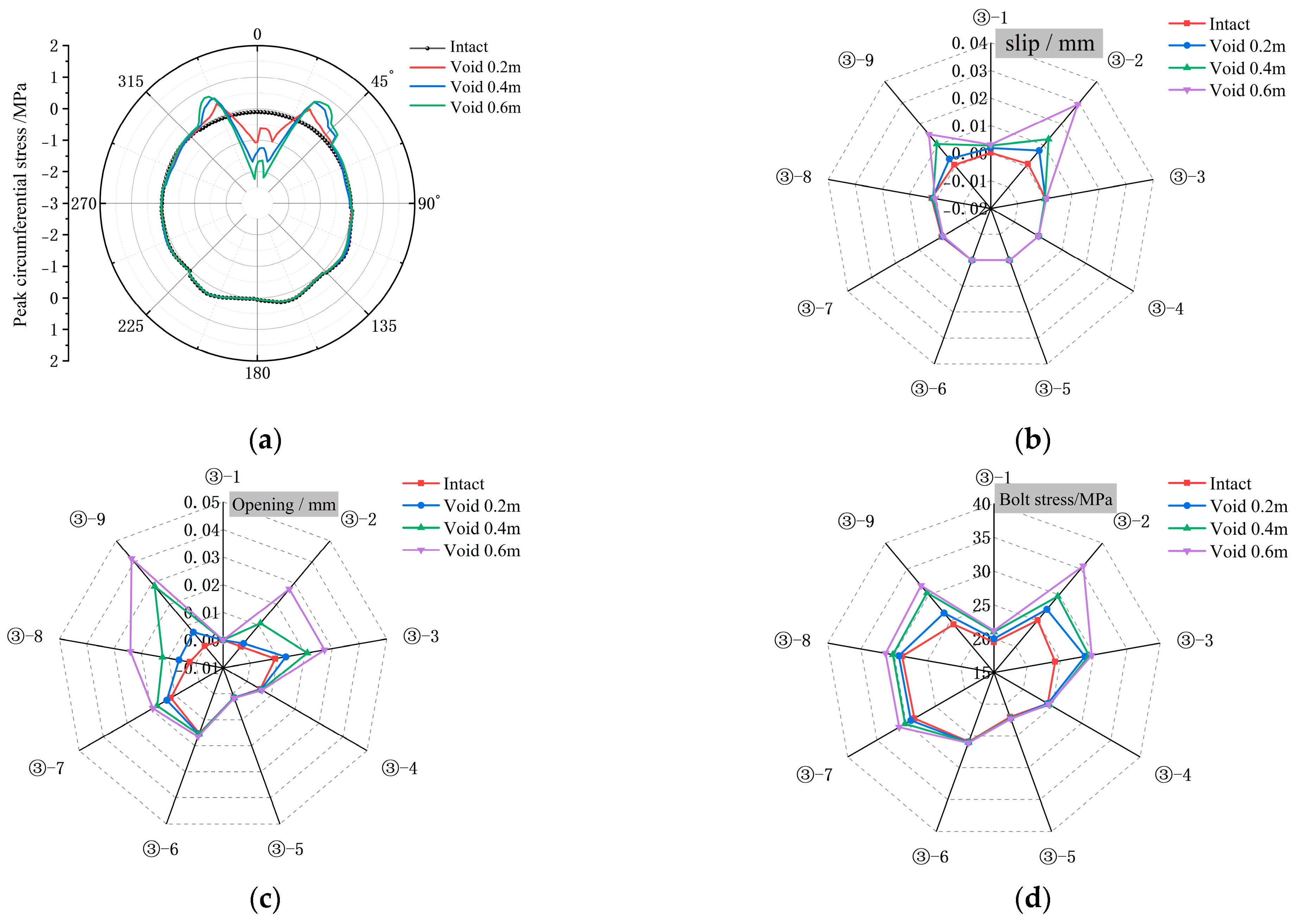
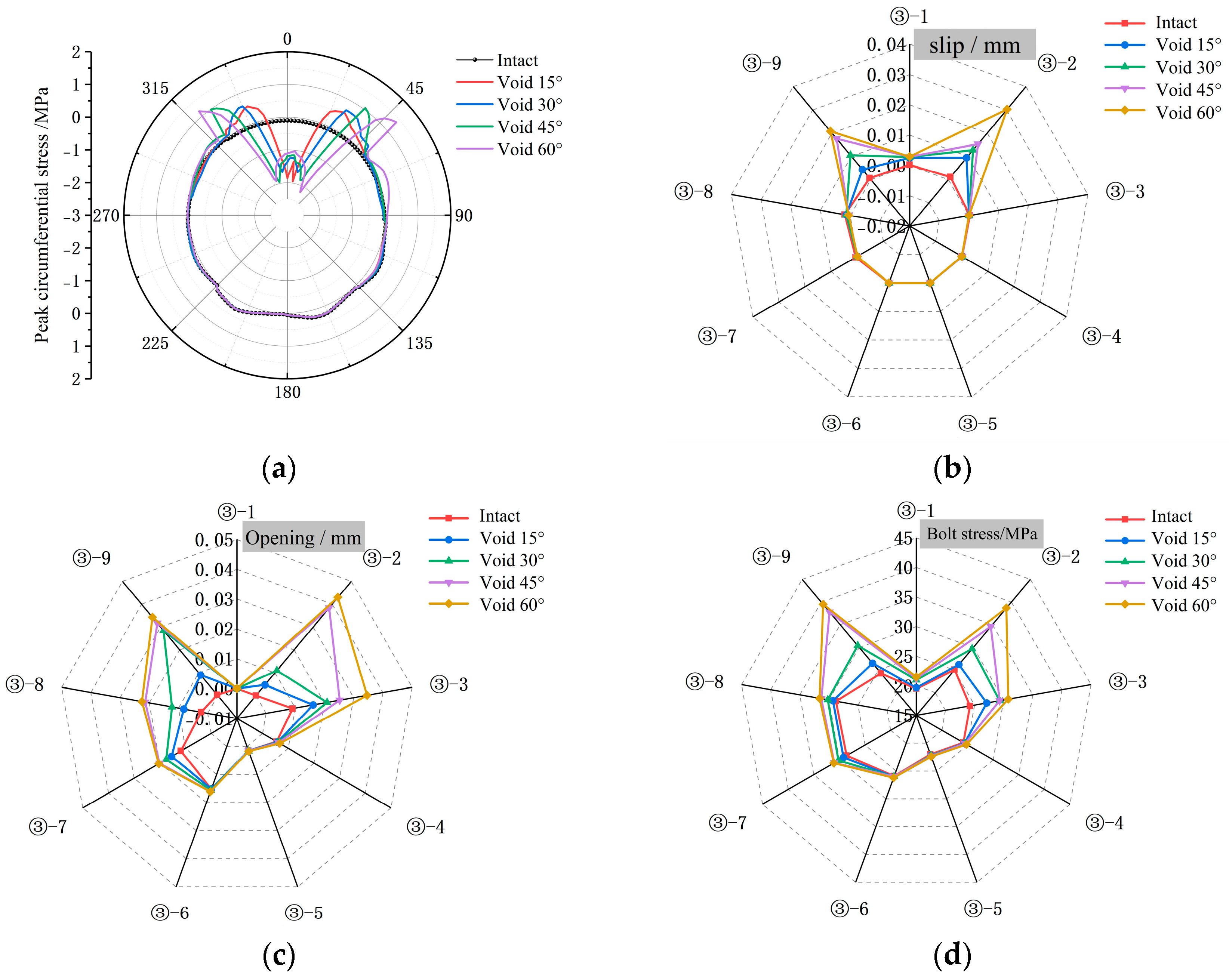
The seismic responses of the tunnel were examined by comparing intact Case 1 with voided Case 2, which considered circumferential angles of 15°, 30°, 45°, and 60°. As shown in Figure 6a, the presence of a void markedly intensifies the circumferential stress variations within the surrounding lining. With increasing void angle, the peak circumferential compressive stress at the crown (Point A1) increases from −0.10 MPa to −2.19 MPa. Meanwhile, the stress state at the void edges (Points A2 and A3) transitions from compression to tension, reaching peak tensile stresses of 1.39 MPa and 1.17 MPa, corresponding to increases of 20.9% and 16.4% compared to the intact case. In contrast, stress variations at locations farther from the void (Points A4 to A6) remain minimal.
According to Figure 6b,c, the peak slip and opening displacements at the crown and haunch interfaces increase substantially, particularly at the left and right shoulder interfaces (③-9 and ③-2). In the absence of a void, the peak slip and opening displacements are 1.46 × 10⁻² mm and 1.52 × 10⁻² mm, respectively. When the void angle increases to 60°, these values reach 5.89 × 10⁻² mm and 4.30 × 10⁻² mm, corresponding to increases of 303% and 180%. Additionally, the opening displacements of other interfaces diminish with increasing distance from the void.
Figure 6d indicates that the peak bolt tensile stress at the left haunch interface (③-8) is 28.6 MPa for the intact case. As the void angle increases, bolt stresses in the haunch and shoulder regions rise notably, reaching 39.5 MPa at interface ③-9 for a 60° void—an increase of 38%. This trend closely aligns with the corresponding changes in interface opening displacements, confirming that segment opening is the direct cause of the increased bolt tension.
Overall, the progressive increase in void circumferential angle aggravates the tunnel’s seismic response. It not only accelerates compressive failure at the crown and tensile failure at the void edges, but also substantially reduces the constraint stiffness of the shoulders and haunches, leading to substantial interface slip and opening, which further amplifies the stress on the connecting bolts.

3.1.2. Influence of Void Radial Depth

The seismic responses of the tunnel were examined by comparing intact Case 1 with voided Case 3, with radial depths of 0.2 m, 0.4 m, and 0.6 m. Figure 7a indicates that the peak circumferential stress at points A1 (crown), A2, and A3 (void edges) is most sensitive to void depth. As the depth increases, the extreme stresses at these points rise to −2.23 MPa, 0.82 MPa, and 0.74 MPa, which represent increases of 21.3%, 10.1%, and 9.2% compared to the intact case.
Figure 7b,c reveal that a void depth of 0.6 m results in peak slip and opening displacements of 4.16 × 10⁻² mm and 4.15 × 10⁻² mm at the left and right shoulder interfaces (③-9 and ③-2). These values correspond to increases of 185% and 173% relative to Case 1.
Figure 7d indicates that the bolt tensile stress also increases with greater void depth. The peak bolt tensile stress at the left shoulder interface (③-8) is 28.6 MPa in the absence of a void; when the depth reaches 0.6 m, the bolt stress at interface ③-2 increases to 35.8 MPa, representing a 25% rise.
Overall, an increase in the void radial depth progressively worsens the tunnel’s seismic response. The influencing mechanism is similar to that of an increasing circumferential void angle, manifesting as intensified stress concentration, enlarged interface deformation, and elevated component stress. Nevertheless, the overall amplification of various response parameters is generally weaker than that caused by changes in the void circumferential angle.

3.1.3. Influence of Void Location

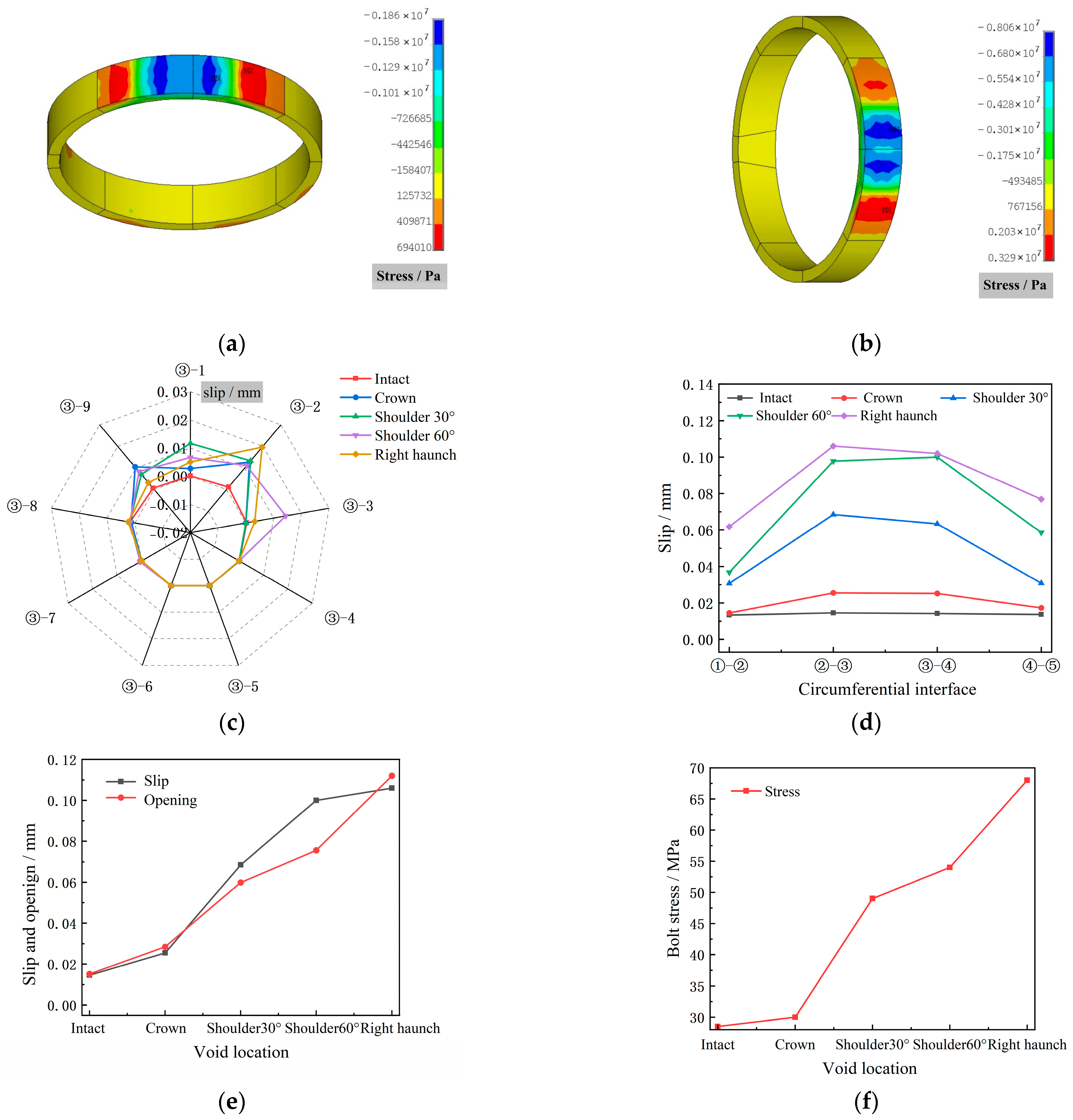
The seismic responses of the tunnel were examined by comparing the intact Case 1 with the voided Case 4, in which voids were positioned at the crown, 30° shoulder, 60° shoulder, and right haunch. As illustrated in Figure 8a,b, with the void at the crown, the lining below primarily experiences circumferential compression, transitioning to circumferential tension towards the void edges. As the void shifts downward to the right haunch, the stress concentration zone relocates accordingly, accompanied by a sharp increase in stress. The peak circumferential compressive stress rises from −1.86 MPa to −8.06 MPa, while circumferential tensile stress increases from 0.69 MPa to 3.29 MPa, representing growth rates of 773% and 1110%, respectively. Notably, this amplified tensile stress of 3.29 MPa exceeds the standard tensile strength of C50 concrete (2.64 MPa, according to GB 50010-2010). This indicates that the concrete at this location has entered a tensile failure state, presenting a high risk of cracking.
Figure 8c,d reveal that deformation at segment interfaces also intensifies as the void moves downward. The slip along the circumferential interface between rings ② and ③ is markedly greater than that within ring ③. Based on Figure 8e, when the void is located at the right haunch, the peak slip and opening displacements reach 1.06 × 10⁻¹ mm and 1.12 × 10⁻¹ mm, corresponding to increases of 626% and 637%, compared to Case 1.
A similar trend is observed in bolt stresses (Figure 8f), which increase as the void position descends. With the void at the right haunch, the peak tensile stress in adjacent bolts reaches 66.1 MPa, an increase of 131%.
Compared with the influence of void geometric parameters, void location exerts a more pronounced effect on the tunnel seismic performance. This is mainly because the tunnel–surrounding soil interaction and the corresponding stress distribution vary significantly along the circumferential direction under seismic excitation. A void at the haunch removes the critical soil restraint where the lining experiences the greatest bending and shearing, leading to severe stress concentrations, excessive interface deformation, and bolt stress amplification. Unlike geometric parameters that only affect the magnitude of deterioration, void location directly determines the seismic failure mode and the position of damage in the lining, thereby dominating overall seismic safety. Consequently, void position should be treated as a critical factor in seismic risk assessment.

3.1.4. Influence of Geological Conditions

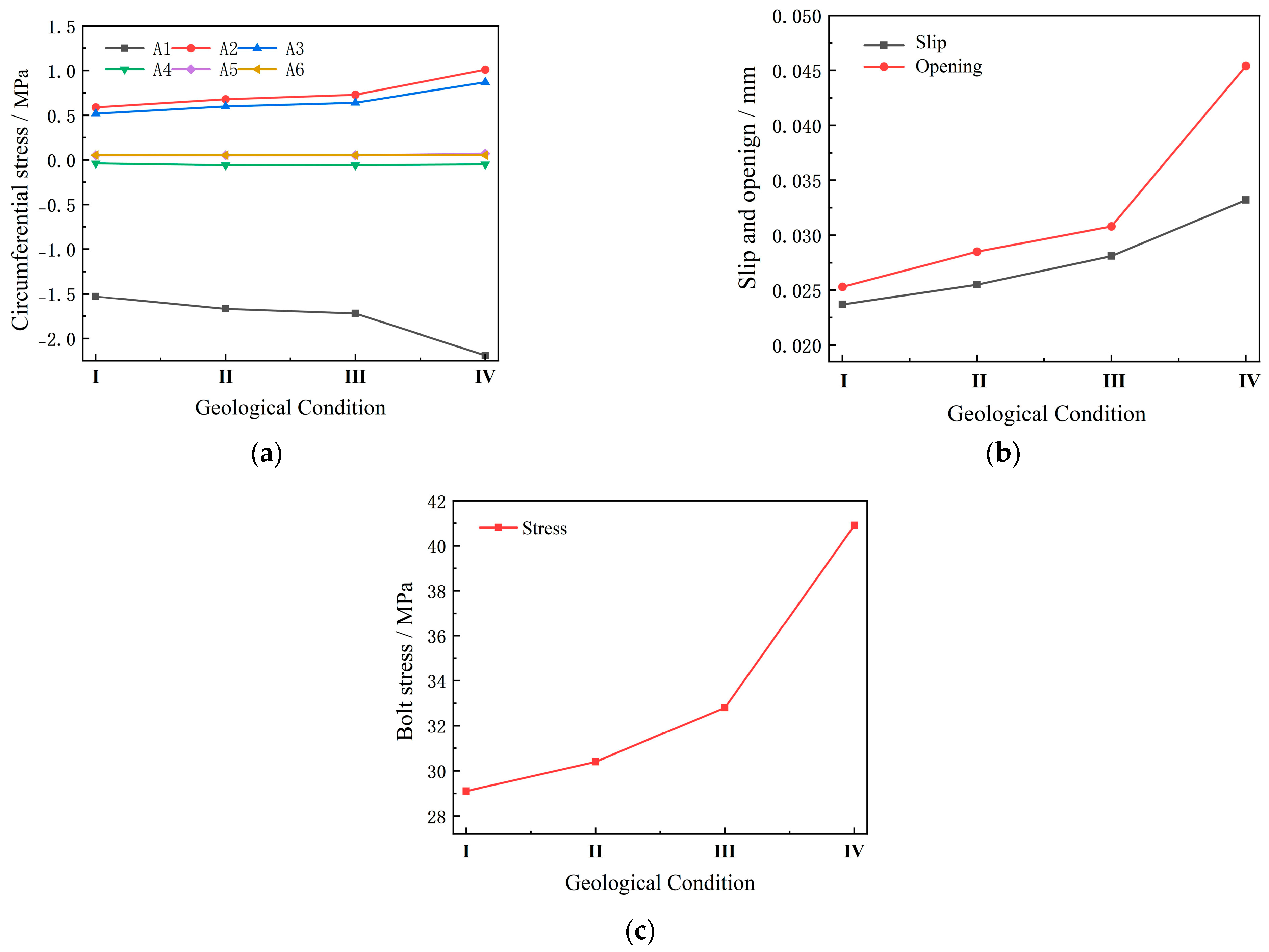
To assess the influence of varying geological stratifications on tunnel seismic responses, a comparative analysis was conducted between Case 1, which corresponds to II-Silty Clay 3, and the voided Case 5, which integrates I-Fine Sand, III-Silty Clay 2, and IV-Silty Sand. Figure 9a shows that as the surrounding rock softens, the circumferential stresses at monitoring points A1, A2, and A3 increase progressively. Specifically, the peak compressive stress at A1 rises to −2.19 MPa. In comparison, the peak tensile stresses at A2 and A3 reach 1.01 MPa and 0.87 MPa, respectively, corresponding to 43%, 102%, and 67% increases relative to those in the stiffer Silty Clay 3.
This trend of response amplification extends to the tunnel lining interface deformations. As illustrated in Figure 9b, both interface slip and opening displacements enlarge with decreasing soil stiffness. Under the most adverse conditions (Silty Sand), the peak slip and opening increase to 3.32 × 10⁻² mm and 4.54 × 10⁻² mm, marking increases of 40% and 79%, respectively.
As illustrated in Figure 9c, the axial force of the connecting bolts exhibits a positive correlation with the decreasing stiffness of the surrounding rock. Under Grade IV surrounding rock conditions, the maximum tensile stress of the bolts rises to 40.9 MPa, an increase of 41% relative to the reference condition.
Compared with the influence of void location, the rock softening exerts a comparatively minor influence on tunnel seismic performance.

3.1.5. Comparison of Seismic Control Indicators

To thoroughly assess the seismic performance of shield tunnels with void defects, it is essential to select and compare the control indicators from two dimensions: local strength and structural integrity. The circumferential tensile stress of the tunnel lining serves as a local strength indicator, which characterizes the risk of concrete cracking. In contrast, indicators of structural integrity include segment interface opening, interface slip, and bolt stress; these factors reflect the waterproofing capacity of joints, the load-transfer performance, and the stress state of the connecting components, respectively. According to the Code for Construction and Acceptance of Shield Tunnelling Method (GB 50446-2017) [43], the maximum allowable segment interface slip is 5 mm. Furthermore, the Standard for Design of Shield Tunnel Engineering (GB/T 51438-2021) [44] stipulates that the maximum segment interface opening should not exceed 2 mm, and the stress in class 8.8 bolts must not surpass the yield strength of 640 MPa. The lining concrete is grade C50, with a standard axial tensile strength of 2.64 MPa.
Based on the analyses presented in Section 3.1.1, Section 3.1.2, Section 3.1.3 and Section 3.1.4, the segment interface opening and slip remain substantially below the code-specified limits across all numerical cases, with bolt stresses also remaining within the elastic range. Even under the most adverse condition—with a void located at the right haunch—the maximum interface slip and opening reach only 1.06 × 10⁻¹ mm and 1.12 × 10⁻¹ mm, respectively, while the bolt stress is 66.1 MPa. These values correspond to 2.1%, 5.6%, and 10.3% of the respective allowable limits, indicating that the waterproofing capacity, the interface load transfer performance, and the stress state of the connecting components are not significantly affected by either seismic action or the presence of void defects. In contrast, under the same condition, the peak circumferential tensile stress of the lining reaches 3.29 MPa, exceeding the standard tensile strength of C50 concrete (2.64 MPa).
This comparative analysis clearly demonstrates that, within the range of void parameters considered in this study, tensile failure of the lining in the circumferential direction occurs before the degradation of interface function. Accordingly, the circumferential tensile stress emerges as the critical indicator for assessing the seismic safety of shield tunnels with void defects. Building on this finding, future research will focus on sensitivity analysis and regression modeling of this parameter to establish a robust theoretical foundation for developing a quantitative predictive model of the seismic performance of shield tunnels with void defects.

3.2. Lining Circumferential Stress Prediction Model

3.2.1. Single-Factor Sensitivity Analysis

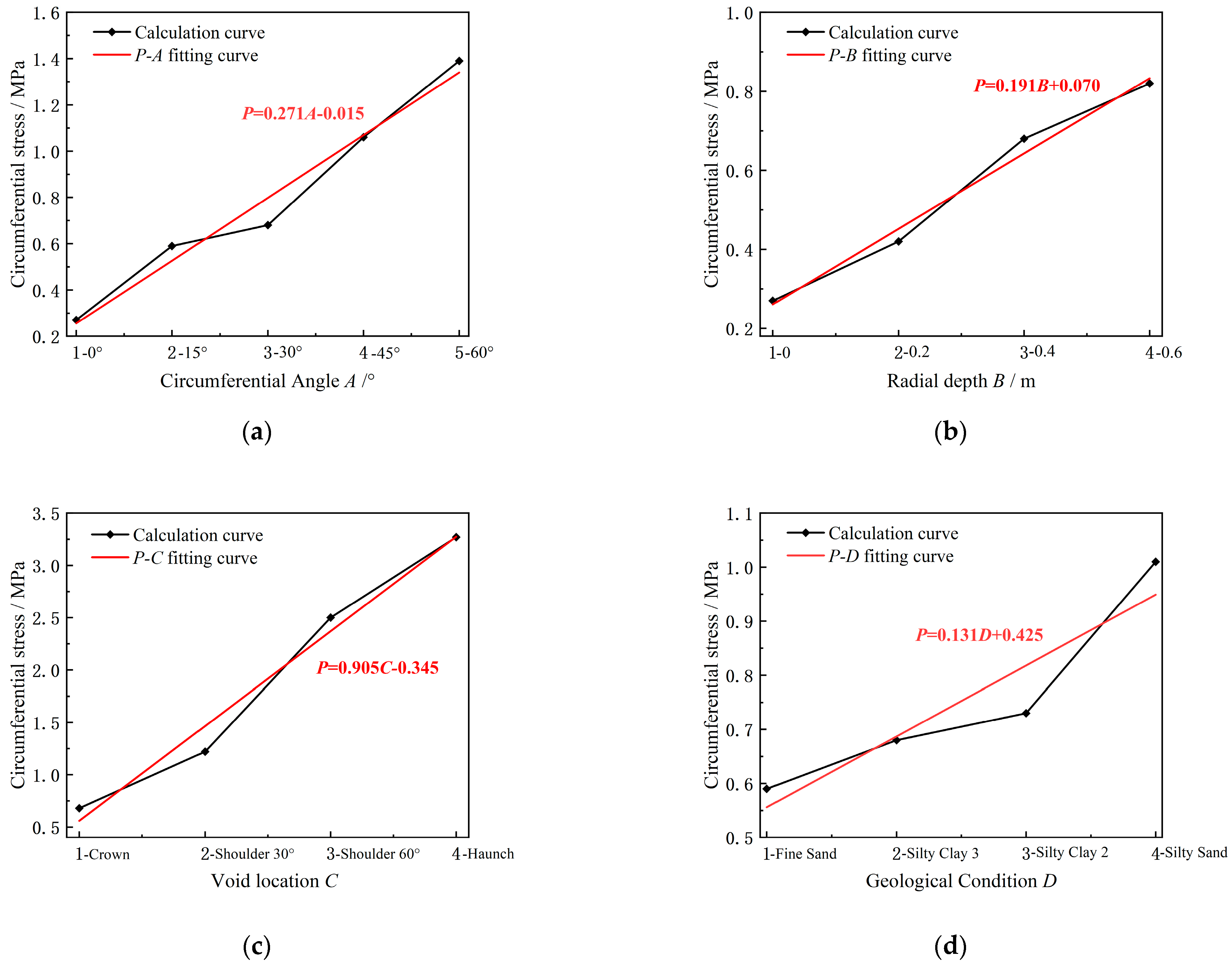
To clarify the key factors influencing the seismic response of tunnels with void defects, this study identified four critical parameters: void circumferential angle (A), void radial depth (B), void location (C), and geological conditions (D). A single-factor sensitivity analysis method was employed to systematically quantify the influence of the factor on the tunnel seismic performance. A benchmark model was established with the void located at the tunnel crown, having a circumferential angle of 30°, a radial depth of 0.4 m, a longitudinal length of 2 m, and is situated in Silty Clay 3. The peak circumferential tensile stress of the lining was adopted as the response variable as it is the most critical indicator of seismic damage.
Figure 10 presents the fitted curves of the lining circumferential stress derived from single-factor sensitivity analysis for the four parameters. In each subplot, the peak circumferential tensile stress (P) obtained from finite element method calculations is plotted against the varying levels of one factor, and the red solid lines represent the fitted curves (P-fit). All the factors exhibit a monotonically increasing trend with respect to the peak circumferential tensile stress, indicating that larger defect dimensions or more adverse locations increase the seismic demand on the lining.
To quantitatively compare the influence of different factors, a dimensionless sensitivity factor S is defined as follows:
S i = P ( x i , max ) P ( x i , min ) / P benchmark x i , max x i , min / x benchmark
where P ( x i , max ) and P ( x i , min ) represent the maximum and minimum peak circumferential tensile stresses corresponding to factor i, respectively; P benchmark denotes the stress under benchmark conditions; x i , max and x i , min are the maximum and minimum levels considered for factor i; and x benchmark is the benchmark value of factor i.
Based on the peak circumferential tensile stress for each factor level, the dimensionless sensitivity factors Si were computed according to Equation (1). A comparison of these sensitivity factors reveals the following ranking: void location > circumferential angle > radial depth > geological conditions (see Table 5). This hierarchy is consistent with the parametric study results presented in Section 3.1, which examine the influence of each factor individually. The agreement between the sensitivity analysis and the parametric study further validates that void location is the most critical factor affecting the seismic response of tunnels with void defects.

3.2.2. Multiple Linear Regression Prediction Model

In practical engineering, the peak circumferential stress of the lining results from the combined effect of multiple factors. To develop a mathematical model for quantitative prediction, the three most significant factors identified from the single-factor sensitivity analysis—void circumferential angle, void radial depth, and void position—were selected for multiple linear regression analysis [45]. Three representative levels were set for each factor, and nine experimental cases were designed using an orthogonal design. The corresponding peak circumferential stresses of the lining are summarized in Table 6.
Multiple linear regression analysis of the peak lining circumferential stress, P, was performed using the Regress function in MATLAB 2022. The resulting linear regression equation is as follows:
P = 0.242 + 0.016 A + 0.975 B + 0.030 C
where P is the peak circumferential stress (MPa) in the lining adjacent to the void; A is the void circumferential angle (°); B is the void radial depth (m); and C is the void distribution location (Crown 0°, Shoulder 30°, and Shoulder 60°).
The goodness-of-fit and statistical significance of the developed regression model were assessed. The results indicate that the model has a coefficient of determination (R2) of 0.946, which is close to 1, suggesting an excellent fit to the sample data. Additionally, the F-statistic is 28.978, exceeding the critical value of 5.41 at the 0.05 significance level, thereby confirming the linear relationship and demonstrating the statistical significance of the regression model.s
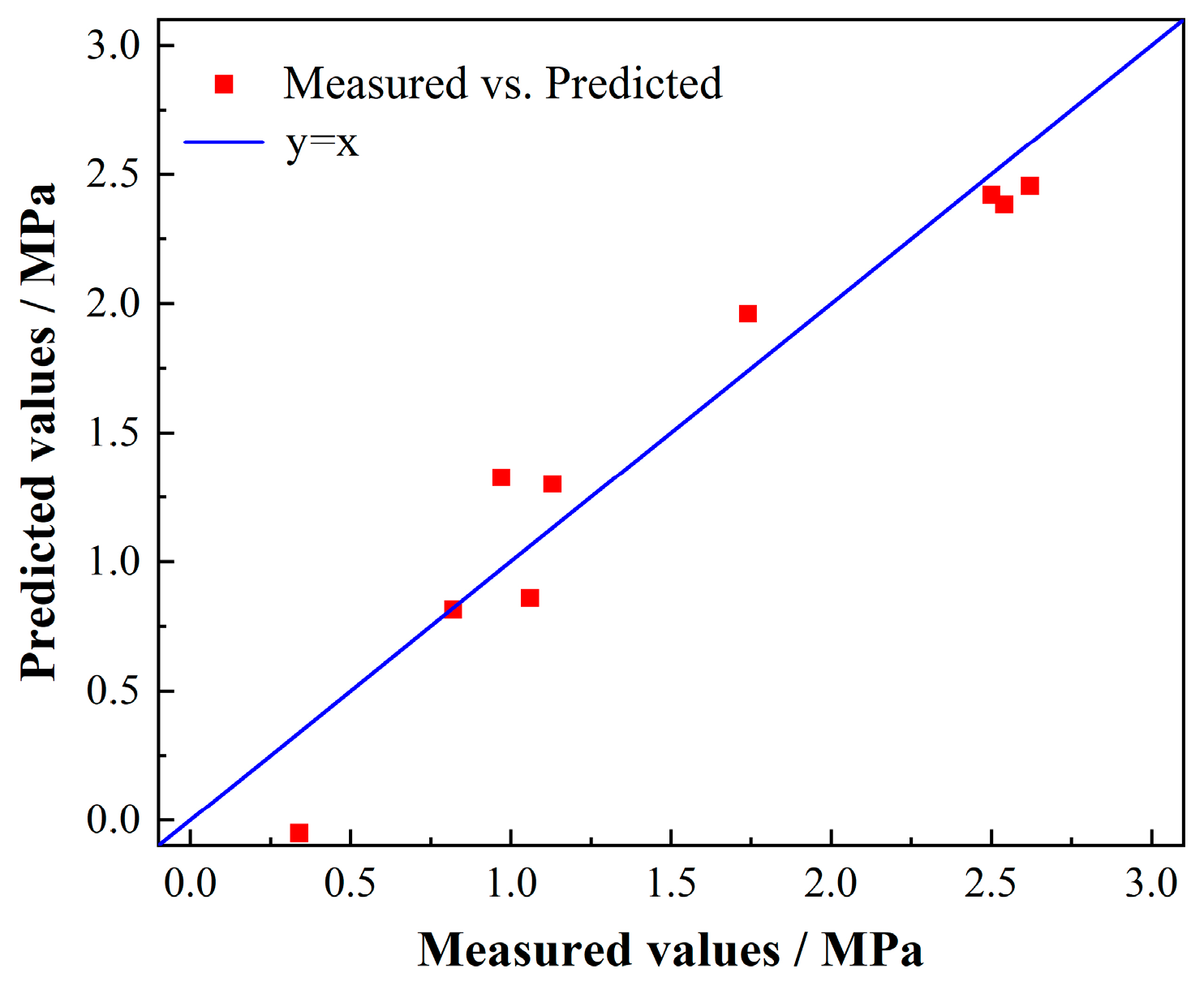
Leave-one-out cross-validation (LOOCV) was conducted to further assess the regression model’s predictive performance on unseen data. Each sample was used sequentially as the test set while the remaining samples were employed to construct the model and make predictions. A scatter plot comparing the measured and predicted values is presented in Figure 11. As illustrated, the data points are generally close to the reference line y = x, indicating good agreement between the measured and predicted values. A quantitative analysis of the cross-validation results yields a mean absolute error (MAE) of 0.194 MPa, a root-mean-square error (RMSE) of 0.225 MPa, and a mean absolute percentage error (MAPE) of 23.88%. The MAPE value is below the commonly accepted 30% error threshold in engineering practice, confirming that the predictive accuracy satisfies engineering application requirements.

4. Conclusions

Based on extensive data collection and refined numerical simulations of shield tunnels with void defects, this study established a finite element model that accurately captures the interaction among lining segments, voids, and surrounding rock. The model was employed to systematically investigate the effects of void circumferential angle, radial depth, distribution location, and geological conditions on the seismic response of tunnels. Through a combination of sensitivity analysis and multiple linear regression, the key influencing factors were identified, and a quantitative predictive model for tunnel seismic performance was established. The following conclusions can be drawn:
(1) The characteristic distribution patterns of voids behind tunnel linings were identified. Voids are predominantly concentrated at the crown and haunch, with circumferential angles of 0–60°, radial depths of 0.1 m–0.6 m, and longitudinal lengths of 1 m–8 m. The probability of void occurrence increases as the geological conditions deteriorate.
(2) The impact mechanism of void defects on the peak circumferential stress of the lining was clarified. The analysis demonstrates that an increased void angle or depth, a location closer to the haunch, or weaker ground conditions intensify stress concentration around the void, resulting in a significant rise in peak tensile stress. Void location exerts the most pronounced effect on lining stress. Specifically, a void at the right haunch can induce the peak tensile stress of 3.27 MPa, exceeding the concrete’s tensile strength and initiating local tensile failure.
(3) The synergistic degradation mechanism of void defects on the response of segment interfaces was revealed. Larger void dimensions, proximity to the haunch, or weaker geological conditions significantly increase interface slip, opening, and bolt stress. Bolt stress exhibits a positive correlation with interface opening, indicating that excessive deformation compromises the structural integrity and seismic capacity.
(4) A quantitative predictive model for seismic performance was developed for the considered shield tunnel with specific design parameters and cross-sectional dimensions. Based on sensitivity analysis, the ranking of influencing factors for shield tunnels with void defects was established as: void location > circumferential angle > radial depth > geological conditions. Using the three most sensitive factors, a multiple linear regression model was constructed to predict the peak circumferential tensile stress in the lining. This model shows excellent fitting accuracy (R2 of 0.946), statistical significance (F-statistic of 28.978), and a low mean absolute percentage error (MAPE of 23.88%). The model provides a practical reference for rapid risk assessment, identification of key monitoring sites, and seismic safety evaluation of similar tunnels with void defects. However, its applicability to other tunnel geometries needs further investigation.
(5) While the proposed model shows strong predictive capabilities within the scope of the present study, several limitations should be acknowledged. The model was developed based on a tunnel with specific cross-sectional dimensions and design parameters; thus, its generalizability to other tunnel geometries requires further validation. The model emphasizes the circumferential tensile stress of the lining as a key control indicator but has not yet been directly validated using field monitoring data. For practical engineering applications, it is recommended that the circumferential tensile stress be evaluated alongside global stability indicators—such as segment interface deformation and tunnel ovalization—to identify suitable combinations for integration into a quantitative prediction framework. Future research will include shaking-table tests, parametric studies covering a wider range of tunnel geometries, and field measurements to systematically validate the model. Additionally, the model parameters will be continuously refined to enhance the model’s applicability and reliability in engineering practice.

Author Contributions

Methodology, H.W. and S.Z.; conceptualization, X.L. and H.W.; validation and data curation, X.L., Z.C. and C.L.; writing—original draft preparation, J.L. and H.W.; writing—review and editing, Z.C. and H.W.; supervision and funding acquisition, S.Z. and C.L. All authors have read and agreed to the published version of the manuscript.

Funding

This research was funded by the Fund for First-Class Discipline Innovation Team of Henan, China (CXTDPY-6), and Key Scientific and Technological Research Projects of Henan Province, China (242102320325).

Data Availability Statement

The original contributions presented in the study are included in the article; further inquiries can be directed to the corresponding authors.

Conflicts of Interest

Author Jiaojiao Li was employed by the company Henan D.R. Construction Group. The remaining authors declare that the research was conducted in the absence of any commercial or financial relationships that could be construed as a potential conflict of interest.

References

  1. He, C.; Feng, K.; Fang, Y. Review and prospects on constructing technologies of metro tunnels using shield tunnelling method. J. Southwest Jiaotong Univ. 2015, 28, 97–109. [Google Scholar] [CrossRef]
  2. Editorial Department of China Journal of Highway and Transport. Review on China’s traffic tunnel engineering research: 2022. China J. Highw. Transp. 2022, 35, 1–40. [Google Scholar] [CrossRef]
  3. Wang, S.; Yu, Q.; Peng, B.; Shen, X. Model tests on influences of cavity defects on mechanical characteristics and failure laws of segment linings of shield tunnels. Chin. J. Geotech. Eng. 2017, 39, 89–98. [Google Scholar] [CrossRef]
  4. Wu, K.; Zhang, X.; Liu, H.; Sun, W.; Zhang, X.; Zhang, L.; Zhang, J.; Li, C. Correlation between surface deformation and construction parameters in silty clay ground tunneling with super large diameter slurry shield TBM. J. Eng. Geol. 2021, 29, 1555–1566. [Google Scholar] [CrossRef]
  5. Zheng, G.; Qiu, H.; Zhang, T.; Wang, T.; Sun, J.; Cui, T.; Diao, Y. Experimental study of the effects of contact loss under a shield tunnel Invert. Acta Geotech. 2024, 19, 4189–4199. [Google Scholar] [CrossRef]
  6. Di, Q.; Li, P.; Zhang, M.; Cui, X. Experimental study on stress distribution characteristics of a shield tunnel under passive failure. Eng. Fail. Anal. 2023, 154, 107725. [Google Scholar] [CrossRef]
  7. Yi, D.; Xue, H.; Yang, S.; Yu, B.; Feng, K.; Lin, G. Analysis of the Influence of Bolt Failure of Shield Tunnel Segment Structure on Transverse Seismic Response. Mod. Tunn. Technol. 2025, 62, 174–181. [Google Scholar] [CrossRef]
  8. Zhang, X.; Zhao, C.; Zhi, L.; Pang, R.; Mo, Y. Seismic fragility analysis of shield building considering strength ratio of mainshock and aftershocks. Nucl. Eng. Technol. 2024, 56, 3397–3404. [Google Scholar] [CrossRef]
  9. Liu, H.; Song, K.; Ye, Z.; Wang, C.; Liu, H. Seismic fragility analysis of in-service shield tunnels considering surface building and joint-bolt corrosion. Soil Dyn. Earthq. Eng. 2022, 162, 107455. [Google Scholar] [CrossRef]
  10. Qi, J.; Zhao, X.; Huang, J.; Hesham El Naggar, M.; Du, X.; Zhao, M. Seismic performance and fragility analysis for shield tunnel segments. Tunn. Undergr. Space Technol. 2026, 1, 107044. [Google Scholar] [CrossRef]
  11. Chen, G.; Ruan, B.; Zhao, K.; Chen, W.; Zhuang, H.; Du, X.; Khoshnevisan, S.; Charng, H. Nonlinear response characteristics of undersized shield tunnel subjected to strong earthquake motions. J. Earthq. Eng. 2020, 24, 351–380. [Google Scholar] [CrossRef]
  12. Li, S.; Chen, Y.; Huang, L.; Guo, E. Study on response and influencing factors of shield single/twin tunnel under seismic loading using FLAC 3D. Shock Vib. 2020, 131, 10633. [Google Scholar] [CrossRef]
  13. Li, J.; Zhong, Z.; Bi, K.; Hao, H. Seismic performance of long-extended utility tunnel and internal pipeline system: A comprehensive parametric study. J. Earthq. Eng. 2025, 29, 2621–2641. [Google Scholar] [CrossRef]
  14. Gao, Y.; Jiang, Y.; Li, B. Estimation of effect of voids on frequency response of mountain tunnel lining based on microtremor method. Tunn. Undergr. Space Technol. 2014, 42, 184–194. [Google Scholar] [CrossRef]
  15. Sun, T.; Wang, W.; Luo, M.; Wang, W.; Wang, Y. Influences of different lining structure defects on overall safety of tunnel structure. J. Archit. Civ. Eng. 2017, 34, 82–90. [Google Scholar]
  16. Wu, L.; Shi, Y.; Hu, M.; Chen, B.; Li, Y.; Chen, H. Deformation response of segment of shield tunnel with void behind lining. Sci. Technol. Eng. 2025, 25, 11370–11377. [Google Scholar] [CrossRef]
  17. Wang, D.; Wang, S.; Zhang, H.; Liu, Z. Seismic response analysis of tunnel with cavity behind lining. J. Vibroeng. 2022, 24, 331–345. [Google Scholar] [CrossRef]
  18. Zhao, J.; Wang, C.; Lan, W. Seismic response analysis of a shield tunnel in a coastal nuclear power plant under a complex foundation. Appl. Sci. 2023, 13, 6233. [Google Scholar] [CrossRef]
  19. Li, M.; Meng, K.; Zhou, J. Seismic response and damage analysis of shield tunnel with lateral karst cavity under oblique SV waves. Buildings 2023, 13, 605. [Google Scholar] [CrossRef]
  20. Mu, Z.; Wei, G.; Zhang, Z.; Jiang, H.; Xu, T.; Qi, Y. Analysis of shield tunnel response to bilateral pit excavation with a focus on perimeter pressure and deformation mechanisms. Sci. Rep. 2024, 14, 23167. [Google Scholar] [CrossRef]
  21. Xu, J.; Gao, M.; Wang, Y.; Yu, Z.; Zhao, J.; DeJong, M. Numerical investigation of the effects of separated footings on tunnel-soil-structure interaction. J. Geotech. Geoenviron. Eng. 2025, 151, 04025057. [Google Scholar] [CrossRef]
  22. Yan, G.; Shen, Y.; Xin, C.; Gao, B.; Zhou, P.; Zhang, X.; Yang, J. Shaking table test research of the influence of voids on seismic responses of tunnel structures. Chin. J. Rock Mech. Eng. 2019, 38, 2491–2501. [Google Scholar] [CrossRef]
  23. Shi, Y.; Chen, Z.; Wei, D.; Tao, Z.; Zhou, X.; Zhao, X.; Hu, J.; Zhou, Y. Analysis of structural response of subway shield tunnel lining under the influence of cavities. Adv. Civ. Eng. 2021, 2021, 3326595. [Google Scholar] [CrossRef]
  24. Lu, Y.; Song, Y.; Wang, Y.; Yuan, J. Three-dimensional nonlinear seismic response of shield tunnel spatial end structure. Adv. Civ. Eng. 2021, 2021, 8441325. [Google Scholar] [CrossRef]
  25. Li, F.; Jiang, C.; Cai, G.; Luo, J.; Yu, Q.; Zhang, H.; Wang, L. Study on force characteristics and safety of segment structure and bolts with and without cavity behind lining with multi-field coupling. Buildings 2023, 13, 2108. [Google Scholar] [CrossRef]
  26. Liu, H. Study on Mechanical and Numerical Model for Road Tunnel Defects Diagnosis. Ph.D. Thesis, Tongji University, Shanghai, China, 2007. [Google Scholar]
  27. Zhang, D. The Research of Tunnel Lining Quality Defects Detection in Geological Radar Correlation Problem. Master’s Thesis, Xi’an University of Architecture and Technology, Xi’an, China, 2015. [Google Scholar]
  28. Yu, D. Study on Safety Evaluation and Treatment Measures of Cavity Defects Behind Railway Tunnel Lining. Master’s Thesis, China Academy of Railway Sciences, Beijing, China, 2018. [Google Scholar]
  29. Ren, R. Research on Geometrical Characteristics and Deterioration Mechanism of Cavities in High-Speed Railway Tunnels. Master’s Thesis, Beijing University of Civil Engineering and Architecture, Beijing, China, 2018. [Google Scholar]
  30. Xie, Y. Analysis and Treatment of Road Tunnel Diseases in Zhaotong YichaAction Research. Master’s Thesis, Chongqing Jiaotong University, Chongqing, China, 2020. [Google Scholar]
  31. Liu, C. Study on Mechanical Characteristics of Tunnel Structure Under the Condition of Void Behind Arch Lining. Master’s Thesis, Qingdao University of Technology, Qingdao, China, 2016. [Google Scholar]
  32. Zhang, S. Study on Influence Mechanism of Lining Defects and Bearing Capacity of Highway Tunnel Lining. Ph.D. Thesis, Lanzhou University, Lanzhou, China, 2020. [Google Scholar]
  33. Che, Z. Study on the Safety of the Straight Wall Tunnel Under the Condition of Void Behind the Lining. Master’s Thesis, Qingdao University of Technology, Qingdao, China, 2020. [Google Scholar]
  34. Zhou, S. Assessment Approach for Healthy Condition of Highway Tunnels Lining Structure Based on Variable Fuzzy Sets Theory. Master’s Thesis, Chang’an University, Xi’an, China, 2015. [Google Scholar]
  35. Cai, P. Lining Diseases Classification and Safety Status Grading Research of Beijing Subway Tunnels. Master’s Thesis, Beijing Jiaotong University, Beijing, China, 2017. [Google Scholar]
  36. Qin, Z. Research on Health Diagnosis and Treatment Technology of Liu Pan Shan Tunnel Structure Disease. Master’s Thesis, Chang’an University, Xi’an, China, 2013. [Google Scholar]
  37. GB/T 50010-2010; Standard for Design of Concrete Structures. China Architecture & Building Press: Beijing, China, 2024.
  38. GB 50017-2017; Standard for Design of Steel Structures. China Architecture & Building Press: Beijing, China, 2018.
  39. GB 50909-2014; Code for Seismic Design of Urban Rail Transit Structures. China Planning Press: Beijing, China, 2014.
  40. Wang, H.; Chen, Z.; Ma, S.; Li, X.; Liu, S.; Zhao, S. Seismic performance analysis of shallow-buried large-scale three-box-section segment-connected pipeline structure under multiple actions. Sci. Rep. 2023, 13, 2584. [Google Scholar] [CrossRef] [PubMed]
  41. Li, F.; Si, P.; He, Y.; Wang, H.; Zhang, Z. Case studies of the load-bearing performance of shield tunnel segment with misaligned defects. Sci. Rep. 2024, 14, 17370. [Google Scholar] [CrossRef]
  42. Xu, J.; Zheng, L.; Song, G.; Zhang, D.; Sheil, B.; Marshall, A. Effects of embedded walls on tunnelling-induced sandy ground displacements: A numerical investigation. Géotechnique 2025, 75, 472–485. [Google Scholar] [CrossRef]
  43. GB 50446-2017; Code for Construction and Acceptance of Shield Tunnelling Method. China Architecture & Building Press: Beijing, China, 2017.
  44. GB/T 51438-2021; Standard for Design of Shield Tunnel Engineering. China Architecture & Building Press: Beijing, China, 2021.
  45. Wu, K.L.; Ding, C.L. Sensitivity analysis on slope stability factor based on orthogonal test. J. East China Jiaotong Univ. 2016, 33, 114–120. [Google Scholar] [CrossRef]
Figure 1. Schematic illustration of void distribution patterns based on field measurements. (a) Spatial distribution of void occurrence frequency. (b) Typical geometric parameters of voids.
Buildings 16 01110 g001
Figure 2. Tunnel cross-section.
Buildings 16 01110 g002
Figure 3. Modified El Centro seismic time history.
Buildings 16 01110 g003
Figure 4. 3D discontinuous tunnel-rock interaction model. (a) Complete model. (b) Refined model section.
Buildings 16 01110 g004
Figure 5. Key location layout of the lining ring ③. (a) Monitoring points. (b) Longitudinal segment interfaces.
Buildings 16 01110 g005
Figure 6. Seismic responses of the lining under various void circumferential angles. (a) Peak lining circumferential stress. (b) Peak slip at segment interfaces. (c) Peak opening at segment interfaces. (d) Peak bolt stress.
Buildings 16 01110 g006
Figure 7. Seismic responses of the lining under various void radial depths. (a) Peak lining circumferential stress. (b) Peak slip at segment interfaces. (c) Peak opening at segment interfaces. (d) Peak bolt stress.
Buildings 16 01110 g007
Figure 8. Seismic responses of the lining under various void locations. (a) Circumferential stress contours around the crown void. (b) Circumferential stress contours around the haunch void. (c) Peak slip at longitudinal interfaces. (d) Peak slip at circumferential interfaces. (e) Comparison of peak slip and opening. (f) Peak bolt stress.
Buildings 16 01110 g008
Figure 9. Seismic responses of the lining under various geological conditions. (a) Peak lining circumferential stress. (b) Comparison of peak slip and opening. (c) Peak bolt stress.
Buildings 16 01110 g009
Figure 10. Fitted curves for single-factor sensitivity analysis of lining circumferential stress. (a) Void circumferential angle. (b) Void radial depth. (c) Void location. (d) Geological condition.
Buildings 16 01110 g010
Figure 11. Comparison of measured and predicted values.
Buildings 16 01110 g011
Table 1. Statistical parameters of voids behind tunnel linings.
InvestigatorProject NameDistribution Characteristics of Voids
Zhang Danfeng13 railway and highway tunnels Located at the crown and haunch (accounting for 80% of cases), with a longitudinal length of 1–4 m.
Yu Dongyang 29 high-speed railway tunnels Located at the crown, haunch, and sidewalls, with a longitudinal length of 1–3 m.
Ren RenA dedicated line tunnel Located at the crown and haunch, with a longitudinal length of 3–6 m, a radial depth of 0.08–0.24 m, and a circumferential angle of 10–60°.
Xie Yu64 highway tunnels The proportion of void areas larger than 3 m2 accounts for 75.4%.
Liu Chang100 highway tunnels Located in the arch section of Grade IV and V surrounding rock, with a longitudinal length of 0–5 m and a radial depth of 0–0.35 m.
Zhang Sen117 highway tunnels Located at the crown and haunch, with a longitudinal length of 2–14 m and a radial depth of 0.30–0.50 m. Higher surrounding rock grade correlates with more frequent occurrence of voids.
Che Zengjun21 straight-wall tunnels Located at the crown and haunch, with an average longitudinal length
of 10 m and a radial depth of 0.10–0.20 m.
Zhou Shaowen13 highway tunnels Located at the crown, with a longitudinal length of 1–3 m and a radial depth of 0.15–0.40 m.
Cai PengchaoBeijing Metro Line 6 With a longitudinal length of 0–2 m and a radial depth of 0.10–0.20 m.
Qin ZhouLiupanshan TunnelLocated at the crown, with a radial depth of 0.08–0.34 m.
Table 2. Tunnel material parameters.
MaterialElastic Modulus
(MPa)
Poisson
Ratio
Density
(kN/m3)
Tensile Strength
(MPa)
Lining (C50) *3.45 × 1040.2025.02.64
Internal frame (C35) *3.15 × 1040.2025.02.20
Invert Backfill (C20) *2.55 × 1040.2025.01.54
High-strength bolts (Grade 8.8, M36) *2.10 × 1050.3078.5800
* Note: The mechanical parameters of C50, C35, and C20 concrete are taken from the Standard for Design of Concrete Structures (GB/T 50010-2010, 2024 Edition) [37]; the mechanical parameters of high-strength bolts are taken from the Standard for Design of Steel Structures (GB/T 50017-2017) [38].
Table 3. Soil material parameters.
Rock
Level
Soil TypeThickness
(m)
Elastic
Modulus
(MPa)
Compression Modulus
(MPa)
Poisson
Ratio
Cohesion
(kPa)
Internal Friction Angle (°)Density (kN/m3)
1Silt7.4921.48.550.3019.023.620.0
2Silty Clay 12.9820.48.140.3024.117.620.3
3Silt7.2723.79.470.3020.421.920.3
4Silty Sand2.1017.87.100.2820.029.019.8
5Silty Clay 211.3321.08.380.3024.720.420.2
6Silty Clay 38.4223.99.550.2525.421.920.0
7Fine Sand8.4227.811.100.2510.033.020.1
8Silty Clay437.9923.99.550.2525.421.920.0
Table 4. Numerical cases for void defect analysis.
Numerical CaseCircumferential Angle (°)Radial Depth (m)Longitudinal Length (m)Void LocationSoil Type
Case No.Sub-Case
Case 11-1----Silty clay 3
Case 22-1150.42Crown Silty clay3
2-230
2-345
2-460
Case 33-1300.22Crown Silty clay 3
3-20.4
3-30.6
Case 44-1300.42Shoulder (30°)Silty clay 3
4-2Shoulder (60°)
4-3Right haunch
Case 55-1300.42CrownFine sand
5-2Silty clay 2
5-3Silty sand
Table 5. Parameters for Single-Factor Sensitivity Analysis.
FactorFactor LevelCharacteristic Function PSensitivity Function SSensitivity Factor
S(*)
LevelLevel Value
A:
Circumferential Angle
(°)
10 P = 0.271 A 0.015 S ( A ) = 0.271 A 0.271 A 0.015 S ( A * ) = 1.019
215
330
445
560
B:
Radial Depth (m)
10 P = 0.191 B + 0.070 S ( B ) = 0.191 B 0.191 B + 0.070 S ( B * ) = 0.891
20.2
30.4
40.6
C:
Distribution Location
(°)
1Crown 0° P = 0.905 C 0.345 S ( C ) = 0.905 C 0.905 C 0.345 S ( C * ) = 1.616
2Shoulder 30°
3Shoulder 60°
4Right haunch 90°
D:
Geological condition
1Fine Sand P = 0.131 D + 0.425 S ( D ) = 0.131 D 0.131 D + 0.425 S ( D * ) = 0.381
2Silty Clay 3
3Silty Clay 2
4Silty Sand
Table 6. Multi-Factor Sensitivity Analysis.
Test GroupInfluencing FactorsTest Result
A: Circumferential
Angle (°)
B: Radial Depth (m)C: Distribution LocationP: Peak Circumferential Stress (MPa)
LevelLevel ValueLevelLevel ValueLevelLevel Value
111510.21Crown 0°0.34
211520.42Shoulder 30°1.13
311530.63Shoulder 60°2.54
423010.22Shoulder 30°0.97
523020.43Shoulder 60°2.50
623030.61Crown 0°0.82
734510.23Shoulder 60°2.62
834520.41Crown 0°1.06
934530.62Shoulder 30°1.74
Disclaimer/Publisher’s Note: The statements, opinions and data contained in all publications are solely those of the individual author(s) and contributor(s) and not of MDPI and/or the editor(s). MDPI and/or the editor(s) disclaim responsibility for any injury to people or property resulting from any ideas, methods, instructions or products referred to in the content.