Skip to Content
BuildingsBuildings
  • Article
  • Open Access

3 March 2026

Optimization of Service Facility Configuration in New Urban Districts from a Community Life Circle Perspective: A Case Study of Qujiang New District, Xi’an


,
,
,
,
,
,
,
and
1
School of Art and Design, Xi’an University of Technology, Xi’an 710054, China
2
School of Human Settlement and Civil Engineering, Xi’an Jiaotong University, Xi’an 710049, China
3
China Northwest Architectural Design and Research Institute, Xi’an 710016, China
*
Author to whom correspondence should be addressed.

Abstract

As a result of China’s rapid urbanization, new urban districts are characterized by a superblock development paradigm that contrasts sharply with core urban areas, where service facilities remain largely congruent with the population distribution. This planning approach has resulted in a pronounced spatial mismatch, with an intensive concentration of public service facilities within commercial cores and a critical lack of facilities proximate to high-density residential clusters. Within the framework of the 15 min community life circle policy, evaluating and optimizing these configurations is imperative for mitigating such structural imbalances. Using Xi’an’s Qujiang New District as a representative empirical case, this study integrates Point of Interest (POI) geospatial data with 330 resident behavioral questionnaires to assess facility distribution and utilization patterns. The findings reveal a distinct spatial pattern of core–periphery polarization, which is significantly influenced by cultural landscapes and commercial land values. Furthermore, the utilization patterns differ markedly across age groups. The reliance of young and middle-aged groups on digital life circles should be viewed not only as a lifestyle preference but also as an adaptation to mitigate physical facility deficits. While digital services compensate for physical facility shortages, they mask the actual lack of community spaces. This further disadvantages older adults, who still rely heavily on walking to access daily services. Addressing the unique characteristics of new urban districts, this study proposes a synergistic physical–digital dual-tier system in which physical infrastructure safeguards the equity baseline, while digital platforms enhance operational efficiency, providing a scientific basis for constructing age-friendly communities.

1. Introduction

The provision of public service facilities constitutes a cornerstone of enhancing public well-being, ensuring social equity, and promoting sustainable urban development [1]. In recent years, China has prioritized the enhancement of urban infrastructure to build livable, resilient, and smart cities, thereby fostering high-quality development. Since the implementation of the Standard for Urban Residential Area Planning and Design in 2018, the “community life circle”, operationalized through spatio-temporal metrics, has emerged as a core paradigm in the transformation of Chinese urban planning [2]. From this perspective, improving the accessibility and convenience of urban service systems is not only an essential pathway to enhancing residents’ subjective well-being but also a strategic measure for implementing human-centered planning philosophies [3,4]. However, the existing literature has predominantly focused on core urban areas with mature built environments, paying insufficient attention to the distinct spatial typology of new urban districts.
Propelled by rapid suburbanization and the commodification of housing in megacities, high-tech development zones, and new urban districts have proliferated across China [5,6]. Serving as principal catalysts for outward spatial expansion, these districts are intrinsically linked to urban economic, social, and cultural dynamics, while being significantly shaped by administrative governance [7]. Designed to alleviate congestion in central districts, new urban districts in China and many other developing nations frequently adopt a “large blocks and wide roads” development model [8,9]. While this model enhances the landscape quality, it often widens the “last-mile” service gap due to severe separation between jobs and housing, the lagging provision of commercial amenities, and oversized spatial scales [10,11,12]. Furthermore, with the pervasiveness of the digital economy, e-commerce and on-demand delivery services are reshaping residents’ spatial perceptions and service procurement modalities. However, few studies have quantitatively examined how this “online substitution effect” influences the spatial planning logic of physical facilities in new urban districts.
Using Qujiang New District in Xi’an as a representative case study, this research constructs a comprehensive evaluation framework that integrates objective geospatial data with subjective resident behavioral metrics. The study is grounded in a dual hypothesis: public service facility configurations in new urban districts exhibit structural deficiencies, driven by the intersecting logic of superblock planning and land finance, while digital life circles, characterized primarily by e-commerce and on-demand logistics, provide critical compensation for these physical shortages. To systematically evaluate these propositions, this research follows a three-phased structure. First, it elucidates the disparities in facility utilization and behavioral adaptation mechanisms across distinct age cohorts. Second, it assesses the current level of facility configuration from the perspective of supply–demand equilibrium. Finally, by synthesizing subjective behavioral surveys with objective spatial analysis, this study identifies optimization pathways for life circles through virtual–physical integration in the digital era.

2. Literature Review

2.1. Theoretical Research on the Community Life Circle

The concept of the “Community Life Circle” is rooted in Perry’s “Neighborhood Unit” theory [13] and has evolved continuously through the introduction of Japan’s “Settlement Sphere”, Melbourne’s “20-Minute Neighborhood”, and Paris’s “15-Minute City”. Its core logic lies in achieving the optimal allocation of resources and coordinated regional development by defining spatial and demographic thresholds, such as the service population and radius. Between 1962 and 1998, Japan promulgated five National Comprehensive Development Plans, establishing a hierarchical life circle system comprising “National, Wide-area, Prefectural, and Municipal” levels [14]. This framework divided the national territory into 400–500 life circles, achieving multi-level interconnectivity through a “compactness + grid” approach [15]. In 2015, the Melbourne government adopted the “20-Minute Neighborhood” as a strategic urban planning framework. By simultaneously addressing public transport, daily services, education, healthcare, and green environments, this initiative aimed to enhance Melbourne’s livability [16]. Subsequently, in 2016, Professor Carlos Moreno proposed the “15-Minute City”, which was institutionalized within the core municipal planning strategy by Paris Mayor Anne Hidalgo. Centered on “Chrono-urbanism,” this concept emphasizes that residents should access six essential social functions—living, working, supplying, caring, learning, and enjoying—within a 15 min walk or bike ride. Moreno’s conceptualization extends beyond mere distance reduction; it represents a temporal reshaping of urban rhythms and a relocalization of social relationships, embodying a sustainable and inclusive urban planning philosophy [17].
In the Chinese context, the Guide for Community Life Circle Planning defines the “Community Life Circle” as a service domain centered on residents’ daily needs. Based on walking or non-motorized transport radii, it forms a service network characterized by basic daily convenience and spatial accessibility through the systematic configuration of public service facilities and optimized spatial structures [6]. According to the Standard for Urban Residential Area Planning and Design (GB50180-2018) [2], in high-density residential areas, the community life circle is structured into a three-tier hierarchy: the 5 min (300 m walking distance), 10 min (500 m walking distance), and 15 min (800–1000 m walking distance) life circles. Empirical research has focused on the quantitative evaluation of facility layouts. For instance, recent studies have analyzed the spatial pattern characteristics and accessibility differences in public health facilities across hierarchical municipalities [18]. These works underscore that optimizing the facility configuration requires not only meeting quantity indices but also ensuring spatial equity.

2.2. Evaluation Methods for Public Service Facilities in the Community Life Circle

Public service facilities within the community life circle encompass essential convenience-oriented infrastructure integrated at the community scale to satisfy residents’ daily needs. Research on the evaluation of these facilities aims to systematically analyze the prevailing configuration patterns and spatial distribution characteristics. This process facilitates a comprehensive assessment of the physical environment and service capacity within the life circle, thereby establishing a scientific foundation for evidence-based optimization strategies.
In terms of the research scale, existing evaluation frameworks are categorized into macro and micro levels. The macro level focuses on analyzing the synergy between the city’s overall spatial structure and facility coverage to identify potential supply gaps [19]. Conversely, the micro level emphasizes the congruence between facility provision and residents’ empirical behavioral preferences, revealing supply–demand contradictions within localized spaces [20]. Existing studies typically revolve around the core logic of supply–demand matching, integrating objective spatial attributes with subjective user experiences [21]. On one hand, emphasis is placed on spatial adaptability, utilizing indicators such as accessibility, coverage radius, walkability, and convenience [22]. On the other hand, attention is directed toward individual perceptual dimensions, including demand fulfillment, usage satisfaction, and the equity of configuration, to comprehensively delineate the suitability of public service facility allocations within the community life circle [23].
Regarding methodological approaches, researchers predominantly utilize GIS platforms, employing geospatial analysis methods, such as kernel density estimation and buffer analysis, to investigate facility coverage, accessibility, and diversity [24,25,26]. These methods provide quantitative evidence for the spatial rationality of facility configurations, offering data support for optimized layouts. To account for the unique characteristics of different service types, several studies have classified public service facilities to conduct research on spatial differentiation [27,28]. Such investigations reveal the spatial complementarity and exclusivity of different facility types by analyzing their distributional patterns, thereby providing refined spatial strategies for configuration. Furthermore, concerning the identification of the spatial structure of the community life circle, previous research has delineated the hierarchical structure of life circles by calculating the concentration and sharing of travel times, proposing a graded implementation strategy for service facilities [29]. Similarly, subsequent studies utilized Point of Interest (POI) data and machine learning algorithms to conduct a granular quantitative analysis of resident travel patterns. Their work uncovered community structural characteristics and proposed facility grading strategies corresponding to different community life circle levels [30,31]. These approaches provide effective pathways for accurately identifying the actual needs within the community life circle and offer a scientific basis for the rational layout of various service facilities.

2.3. Strategies for Public Service Facility Configuration Based on Resident Needs

During the planning and construction of new urban districts, the layout and configuration of public service facilities serve as critical determinants for elevating residents’ quality of life, promoting social equity, and fostering economic development [32,33]. In recent years, with the advancement of geospatial big data technology, an increasing volume of open web data, including Points of Interest (POI) and social media data [34,35,36], has emerged as a crucial element for quantitative research in analyzing the supply volume and spatial distribution of community service facilities. The widespread application of these data has not only enriched the research dimensions of facility configuration in new urban districts but also enhanced the precision of information acquisition, thereby providing robust support for optimizing the configuration of public service facilities.
Research on the optimization of public service facilities in the community life circle is largely predicated on assessments of the existing built environment. By examining the congruence between spatial facility supply and resident demand to analyze discrepancies, these studies clarify the trajectory for configuration optimization [27]. The current literature predominantly focuses on the quantity and distribution of traditional facilities. However, merely increasing the supply volume has limited benefit for the community life circle, whereas optimizing the spatial layout holds higher significance for its construction. Some studies propose prioritization strategies for facility construction based on resident behaviors, such as travel frequency, travel mode, duration, and satisfaction with travel time [20]. These studies emphasize formulating precise layout strategies through in-depth analyses of travel behaviors to meet daily needs, thereby mitigating spatio-temporal inefficiencies. Another strand of research employs classic Location–Allocation (LA) models within ArcGIS, combining facility service radii with spatial distribution patterns to calculate optimal locations aiming to maximize service efficiency and spatial utilization [37,38]. While this approach provides theoretical support for flexible facility configuration, it remains heavily skewed toward static spatial layouts, often overlooking dynamic demand considerations.
Furthermore, with the rapid development of e-commerce and smart delivery services, the integration of online and offline facility configuration modes in the community life circle has increasingly become a focal point of scholarly inquiry. Through online purchasing, smart delivery, and on-demand logistics systems, traditional service models no longer rely solely on physical presence but instead promote virtual–physical integration, providing residents with more convenient choices [39]. This model not only reduces the required scale and quantity of facilities, thereby saving substantial construction and operational costs, but also enables more flexible spatial layouts. By aligning service facilities with users’ actual needs and living scenarios, it significantly enhances the response speed and convenience of community services [40]. Consequently, a growing body of research is exploring the digitalization of life circles and analyzing its impact on facility configuration, aiming to improve the overall efficacy through technological intervention [41]. Optimizing spatial layouts not only improves usage efficiency but also promotes the balance of resident activities within the region, enhancing the accessibility and equity of public services.
In summary, existing research on community life circles has attained substantial milestones. Research themes have transitioned from the early concept of the “Neighborhood Unit” to the “15-Minute City”, which focuses on social equity and temporal restructuring. Methodologically, the deep integration of multi-source urban data and GIS spatial analysis has facilitated a quantitative leap in facility evaluation, shifting the focus from macro-level coverage to micro-level accessibility. Regarding configuration strategies, studies have transitioned from static quantitative index control to dynamic supply–demand matching based on resident travel behavior.
Nevertheless, against the dual backdrop of rapid urbanization and digital transformation, critical gaps remain in the existing literature. First, although the unique spatial scales and residential segregation characteristics of new urban districts render the life circle construction experiences of core urban areas difficult to apply directly, these areas remain under-investigated in current studies. Second, the existing research frequently assumes that residents utilize facilities equally based on proximity, thereby overlooking disparities in behavioral preferences across distinct demographic cohorts. Furthermore, most studies remain confined to the physical configuration of tangible space and fail to quantitatively account for the compensatory or substitutive effects of e-commerce and on-demand delivery services on physical facilities. This limitation may lead to an overestimation of the supply–demand gap in new districts and subsequently result in the proposal of inefficient strategies for physical densification.

2.4. Research Framework

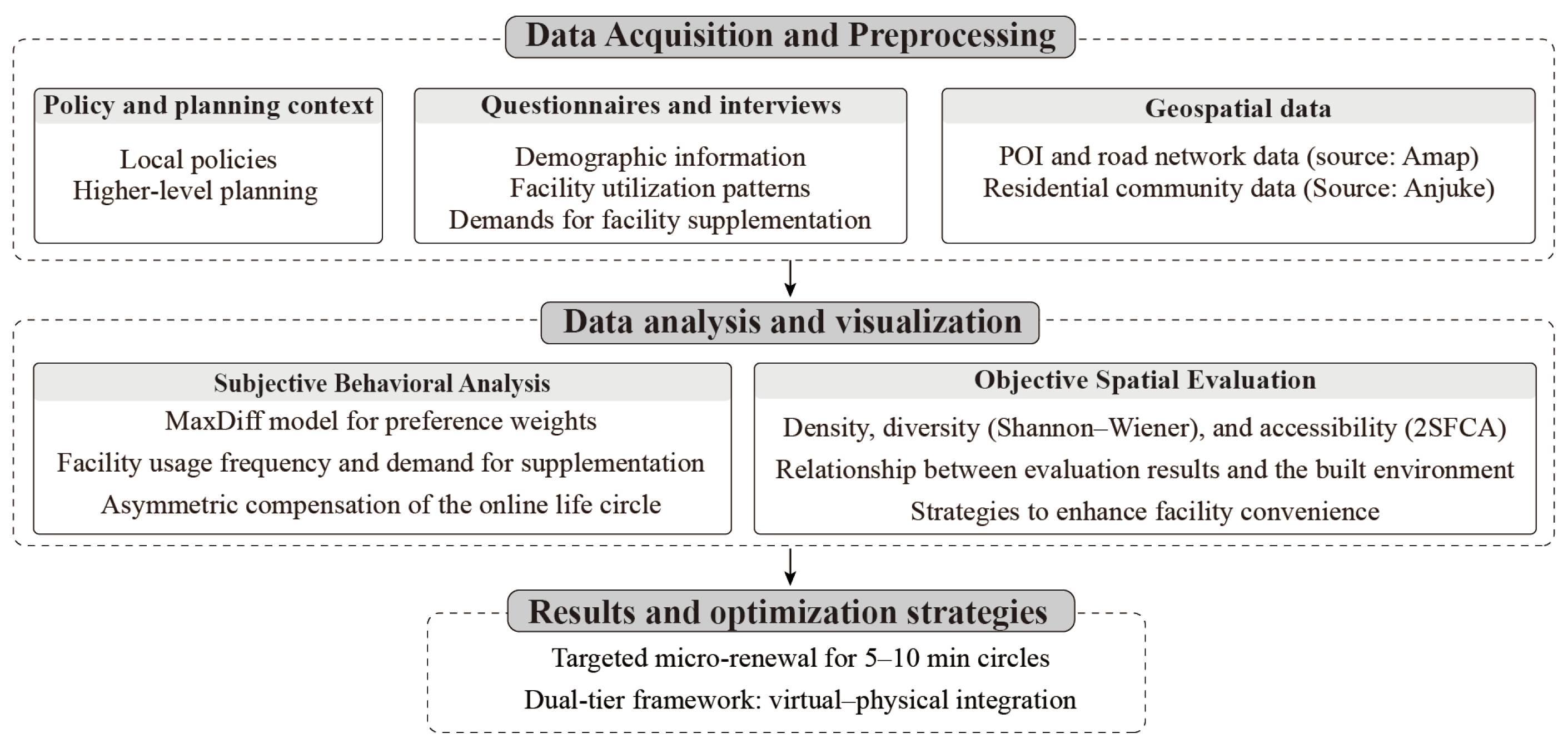
To address the aforementioned research gaps, this study aims to construct a comprehensive research framework integrating physical space, subjective behavior, and digital compensation to elucidate the interaction mechanisms between physical space and resident behavior that lead to the supply–demand mismatch regarding service facilities in new urban districts (Figure 1).
Figure 1. Research methodological framework.
Using Qujiang New District in Xi’an as a representative case study, this research evaluates the provision of public service facilities from the perspective of the community life circle, identifies structural deficiencies in existing configurations, and proposes targeted optimization strategies. Specifically, the study first investigates facility usage patterns through questionnaire surveys and interviews. Second, utilizing the ArcGIS10.7 platform, it assesses the density, accessibility, and diversity of facilities to generate a multidimensional evaluation of the spatial configuration, with 195 residential communities serving as the primary research units. Finally, by synthesizing subjective resident perceptions with objective spatial metrics, this study elucidates the challenges of facility configuration and formulates evidence-based strategies, offering a theoretical and practical framework for facility optimization in other new urban districts.

3. Study Area and Data

3.1. Study Area

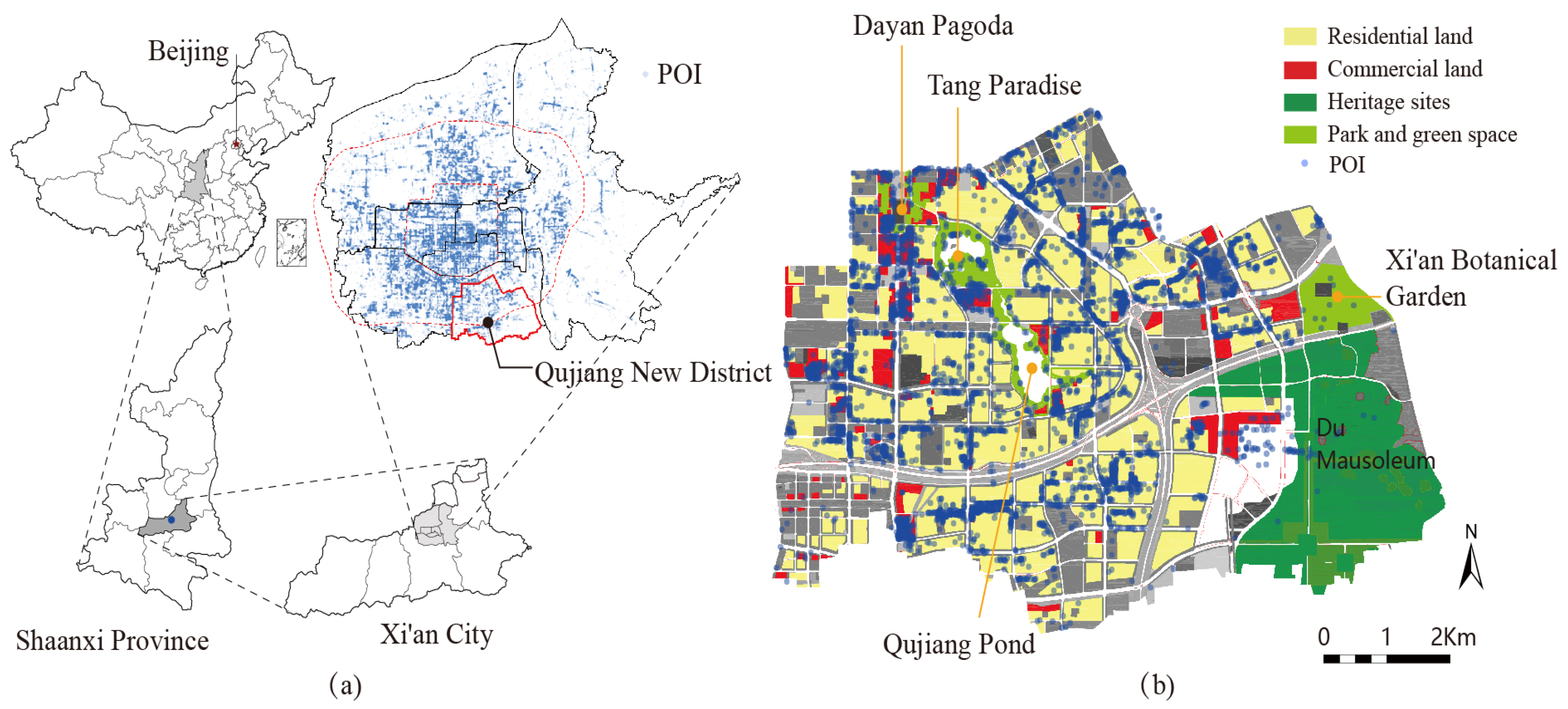
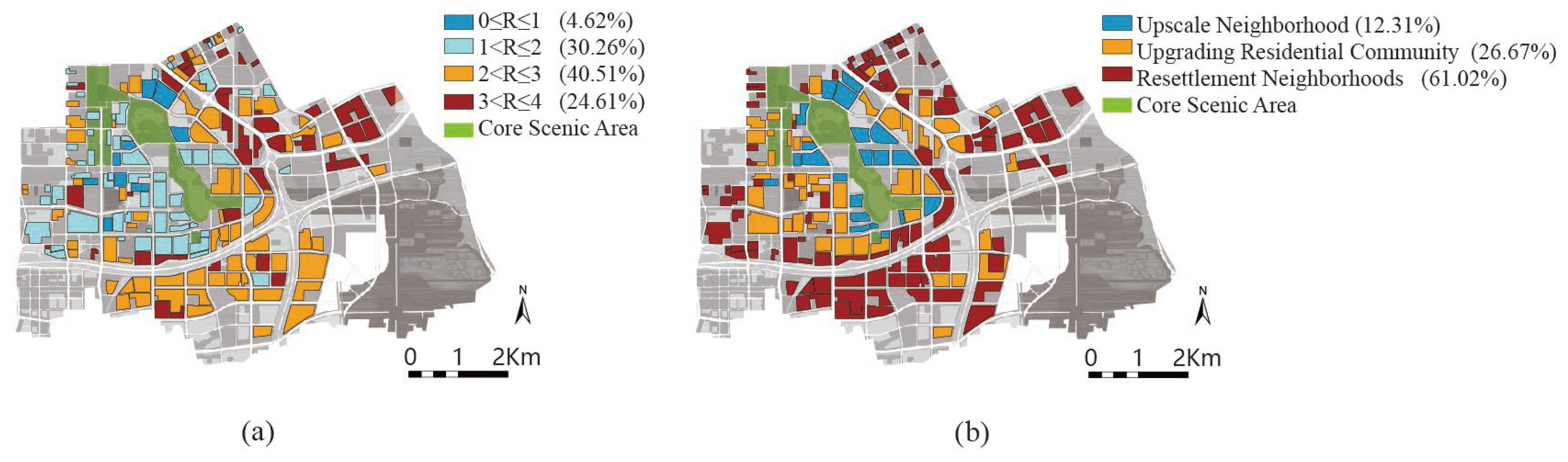
As a pivotal central city in western China, Xi’an was selected in 2021 as one of the inaugural national pilot cities for the “15-Minute Community Life Circle”, with Qujiang New District serving as a representative research case (Figure 2). Since 2000, the district has undergone large-scale development under an administration-led and capital-driven “culture-led tourism” model. By leveraging scarce landscape resources—such as the Big Wild Goose Pagoda—to drive land value appreciation [42], it has prioritized high-end residential and tourism–commercial functions [43]. Spanning approximately 51.5 km2, the district dedicates 10% of its land to scenic areas. Notably, the average residential plot size reaches 0.06 km2—approximately twice the Xi’an average—exemplifying the distinct urban fabric of “wide avenues and large blocks” typical of new districts. The spatial structure exhibits marked differentiation: low-density scenic housing dominates the core, while high-density housing for basic needs and relocation is concentrated in the periphery (Figure A1). Due to rapid development, public service facilities lacked systematic pre-planning; the overall facility density is significantly lower than that of the old city and is highly aggregated in commercial and scenic cores. Consequently, vast residential areas rely solely on scattered commercial podiums for services, distributed in linear or point patterns.
Figure 2. Geographical location and study area: (a) location of Qujiang New District; (b) spatial distribution of land use types and POIs.

3.2. Data Sources

1. Interviews and Surveys: Data for this study were collected over a three-week period from 1 to 21 August 2024. A hybrid methodology incorporating both online and offline distribution channels was employed to execute the questionnaire surveys and resident interviews. The investigation encompassed resident satisfaction with facilities, usage patterns, and various categories of needs. A total of 337 questionnaires were distributed, with online submissions accounting for 65% of the total and offline submissions representing 35%. After excluding invalid responses, such as those from non-eligible participants or those exhibiting logical inconsistencies, 330 valid responses were obtained. The survey covered 50 residential communities within Qujiang New District, accounting for 25.64% of the total number of communities. A five-point Likert scale was utilized for the satisfaction survey, where scores of 1 to 5 correspond to “dissatisfied”, “somewhat dissatisfied”, “neutral”, “somewhat satisfied”, and “satisfied”, respectively. Furthermore, given that the Chi-square analysis demonstrated no statistically significant differences in facility usage across different community types (p > 0.05), the survey results in this article are not stratified by community type.
Verbal informed consent was obtained from all participants in this study. To ensure respondent anonymity, written consent signatures were not collected. This study constitutes a non-interventional social survey involving only non-sensitive demographic data, including age groups, facility usage methods, and demands for additional facilities and does not contain private medical or financial information. Pursuant to Article 32 of the Measures for the Ethical Review of Life Science and Medical Research Involving Humans (National Health Commission Order No. 4 2023), this study is exempt from formal ethical review [44].
2. Spatial Data: The ArcGIS10.7 platform was utilized to develop the primary geospatial database. This includes Points of Interest (POI) data for facilities retrieved through the Amap (Gaode) Application Programming Interface (API) (https://lbs.amap.com/ accessed on 1 March 2025), along with data regarding development age and residential property values for 195 communities collected from the Anjuke platform (https://xa.anjuke.com/ accessed on 1 March 2025).

4. Methodology

4.1. Facility Demand Weight Analysis

Following the Standard for Urban Residential Area Planning and Design (GB50180-2018) [2] and the Technical Guide for Community Life Circle Planning [45], this study focuses on essential public service facilities that safeguard basic livelihoods [46]. Based on resident interviews and expert consultations, a hierarchical evaluation index system was developed. As shown in Table 1, public service facilities are categorized into eight primary domains, including healthcare, cultural and recreational services, education, elderly care, sports and fitness, commercial services, community services, and public transport. These facilities span a continuum from fundamental livelihood necessities to quality-of-life enhancements. Furthermore, they are aligned with the 5 min, 10 min, and 15 min life circle tiers, respectively. To investigate facility demand preferences, the study employed the Maximum Difference Scaling (MaxDiff) model. This methodology is grounded in the Logit model and is widely utilized in empirical research to quantify user preferences for specific attributes. By calculating the demand weights for each facility, discrete weight values for individual factors were derived (Table 1). The model results were significant at the 0.01 level, indicating that the derived preference weights exhibit high statistical robustness.
Table 1. Hierarchical preference weights for community service facilities.

4.2. Methods

The conceptual model of the “life circle” is a concentric spatial model centered on residential locations. In a theoretical ideal, service facilities available within a 15 min walking distance should satisfy the daily needs of residents. Using the family residence as the focal point, this study utilizes the empirical road network to evaluate the facility density, diversity, and accessibility within 5 min, 10 min, and 15 min walking ranges from the center of each residential community.

4.2.1. Facility Density

Facility density refers to the number of public service facilities per unit area within the community life circle, serving as one of the foundational metrics for measuring the sufficiency of facility supply. A high-density facility layout facilitates the optimization of land use efficiency and is crucial for improving the convenience of fulfilling residents’ daily requirements [47]. The calculation formula is as follows:
  I i = P i , j / S i
In Equation (1), I i represents the density index of facility j within the life circle of residential community i ; P i , j is the total number of facilities, j within the life circle of residential community i ; and, S i is the coverage area of the community life circle for residential community i .

4.2.2. Facility Diversity

A diverse facility environment significantly influences resident activities [48]. Therefore, beyond ensuring sufficient quantity and accessible distance, the facility supply should accommodate a diverse range of functional types to satisfy the heterogeneous preferences of different demographic groups. Drawing on calculation methods for measuring the degree of land use mixing, this study utilizes the Shannon–Wiener index to evaluate the diversity of functional formats across different types of public service facilities [49]. The calculation formula is
H i = j = 1 n P j ln P j
In Equation (2), H i represents the facility diversity index available within the life circle of residential community   i , and P j represents the proportion of the quantity of facility j to the total number of facilities within that community’s life circle. A diversity index value closer to 0 indicates a more singular type of facility, whereas a value further from 0 indicates higher diversity.

4.2.3. Facility Accessibility

In the fields of urban planning and transportation, accessibility serves as a crucial indicator for measuring the spatial equity and logic of public service facility configuration [50]. To date, researchers have developed a variety of measurement models tailored to different scales and research objectives. Conventional approaches encompass the closest facility method, gravity-based models, and advanced network analysis techniques. For instance, some studies have combined clustering with accessibility analysis to delineate the boundaries of urban agglomerations [51]. Others have proposed the choice-based accessibility model, which integrates individual behavior into place-based measures [52]. However, this study focuses on the community life circle scale, where pedestrian travel constitutes the predominant mode of resident mobility. Consequently, the central challenge lies in the spatial congruence between limited facility service capacity (supply) and the high density of the residential population (demand). The Two-Step Floating Catchment Area method accounts for both service thresholds and distance decay effects while effectively measuring supply-to-demand ratios. Therefore, this method has been widely applied in evaluating the spatial layout of public services, including education, healthcare, elderly care facilities, and urban parks [53,54]. The calculation formulas are
A i = j d i j d o R j G ( d i , j , d 0 ) j d i j d o S j G ( d i , j , d 0 ) / k d k j d o P k G ( d k j , d 0 )
G ( d i , j , d 0 ) = e 1 2 × ( d i j d 0 ) 2 e 1 2 1 e 1 2 ,   d i j d 0   0 , d i j d 0
In Equation (3), A i represents the facility accessibility for residential community i as calculated by the two-step floating catchment area model. i denotes the residential community (demand point), and j denotes the facility (supply point). d i j represents the distance between demand point i and supply point j ; R j represents the supply-to-demand ratio of supply point j within the spatial catchment of demand point i ( d k j d 0 ). P k represents the population quantity of residential community k within the spatial catchment of supply point j ( d k j d 0 ), and S j represents the service capacity of supply point j . Given the limitations of POI data in reflecting facility service grade and scale, this study defines the service capacity S j as 1 for all facilities. d 0 is the distance threshold of 1.2 km for the community life circle. In Equation (4), G ( d i , j , d 0 ) represents the Gaussian distance decay function.

4.2.4. Construction of Comprehensive Facility Evaluation Index

By combining the empirical preference weights derived from the survey (Table 1) with the model calculation results for the facility density, accessibility, and diversity, the comprehensive facility results for each residential community life circle were calculated. The calculation formula is
E = j = 1 n W j ( a 1 I i + a 2 A i + a 3 H i )
In Equation (5), E is the comprehensive facility index for the life circle of residential community i . I i , A i , and H i are the standardized indicators for facility density, accessibility, and diversity within the life circle of residential community i , respectively. a n represents the weights for each indicator derived from correlation analysis results, and W j is the residents’ preference weight for facility j . The indicator weights a n were obtained by analyzing the correlation between the facility density, diversity, and accessibility, and the resident facility satisfaction results from the questionnaire survey. The correlation results indicate that the weights for facility density a 1 , facility accessibility a 2 , and facility diversity a 3 are 0.43, 0.29, and 0.28, respectively.

5. Results

5.1. Resident Travel Modes and Life Circle Characteristics

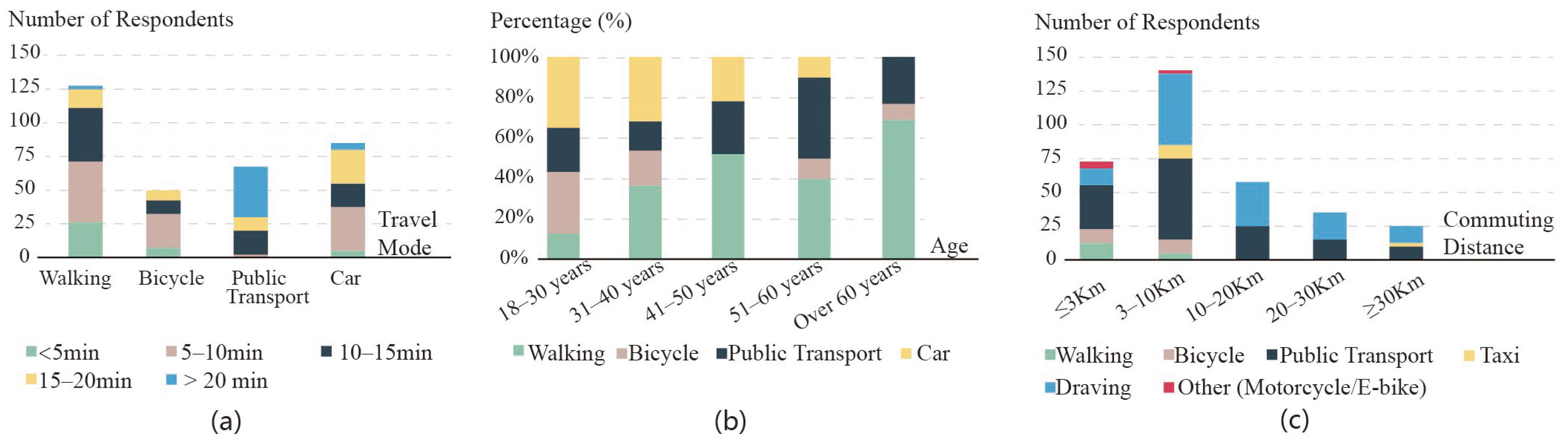
The results from the questionnaire and interviews indicate that the daily activity range of residents in Qujiang New District exhibits a significant “cross-circle” characteristic, far exceeding the traditional “15 min walking circle” (Figure 3a). The main characteristics are as follows.
Figure 3. Spatio-temporal analysis of life circle scope: (a) daily usage range; (b) age-specific travel modes for daily usage; (c) commuting distance and transport modes.
(1)
Facility utilization patterns are driven by age, showing significant travel differentiation (x2 = 25.643, p = 0.012 < 0.05). As age increases, the activity radius of residents gradually shrinks, with a higher preference for walking to use nearby facilities and a significant decrease in the proportion of car travel (Figure 3b). Interviews reveal that individuals over 50 years of age tend to combine walking with exercise, utilizing local convenience facilities (e.g., grocery stores) significantly more frequently than younger groups; for mid-distance facilities, such as comprehensive supermarkets, they primarily rely on public transport. In contrast, young and middle-aged groups, especially families with children, are highly dependent on private cars to reach commercial centers for “one-stop” consumption involving “shopping, childcare, and leisure”.
(2)
Long-distance commuting patterns reinforce the spatio-temporal constraints under the separation of workplace and residence (Figure 3c). The surveys show that 71.97% of residents have a commuting distance exceeding 3 km, with 35.61% commuting more than 10 km. The commuting modes are dominated by public transport (43.18%) and private cars (39.39%). This long-distance and time-consuming commuting mode forces residents to adopt time-compensation strategies, reducing the time spent on physical procurement and instead relying on online consumption and delivery services [55].
(3)
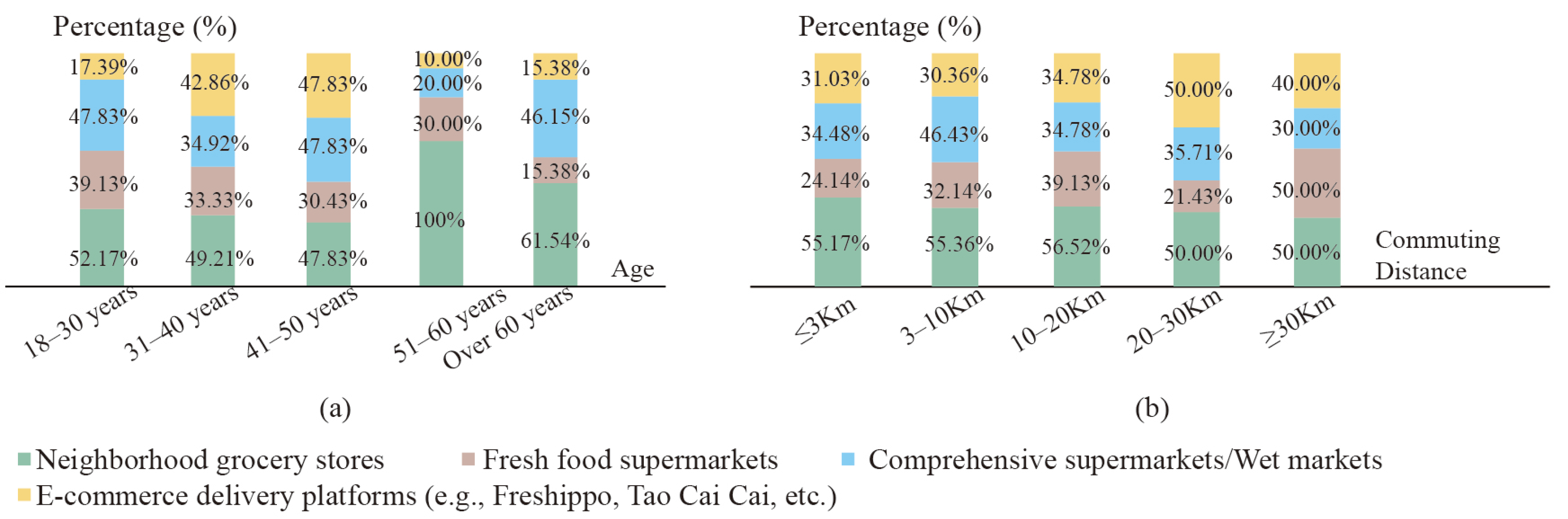
The “digital life circle” exerts a significant compensatory effect on the lack of physical space. Statistics indicate that age significantly influences the use of online platforms (x2 = 11.548, p = 0.021 < 0.05). The 31–50 age group shows a marked preference for e-commerce platforms (with a utilization rate of approximately 45%), effectively mitigating the issue of insufficient physical commercial facilities through “virtual accessibility”(Figure 4). Interviews confirm that digital services—including supermarket delivery, food takeout, door-to-door recycling, and home medical care—have become vital supplements to residents’ daily convenience. However, the utilization rate among those over 50 is relatively low, and the digital divide may further exacerbate a sense of “relative deprivation” regarding access to life services for this demographic.
Figure 4. Resident procurement preferences across supply channels: (a) correlation with age; (b) correlation with commuting distance.

5.2. Facility Accessibility and Supply–Demand Evaluation

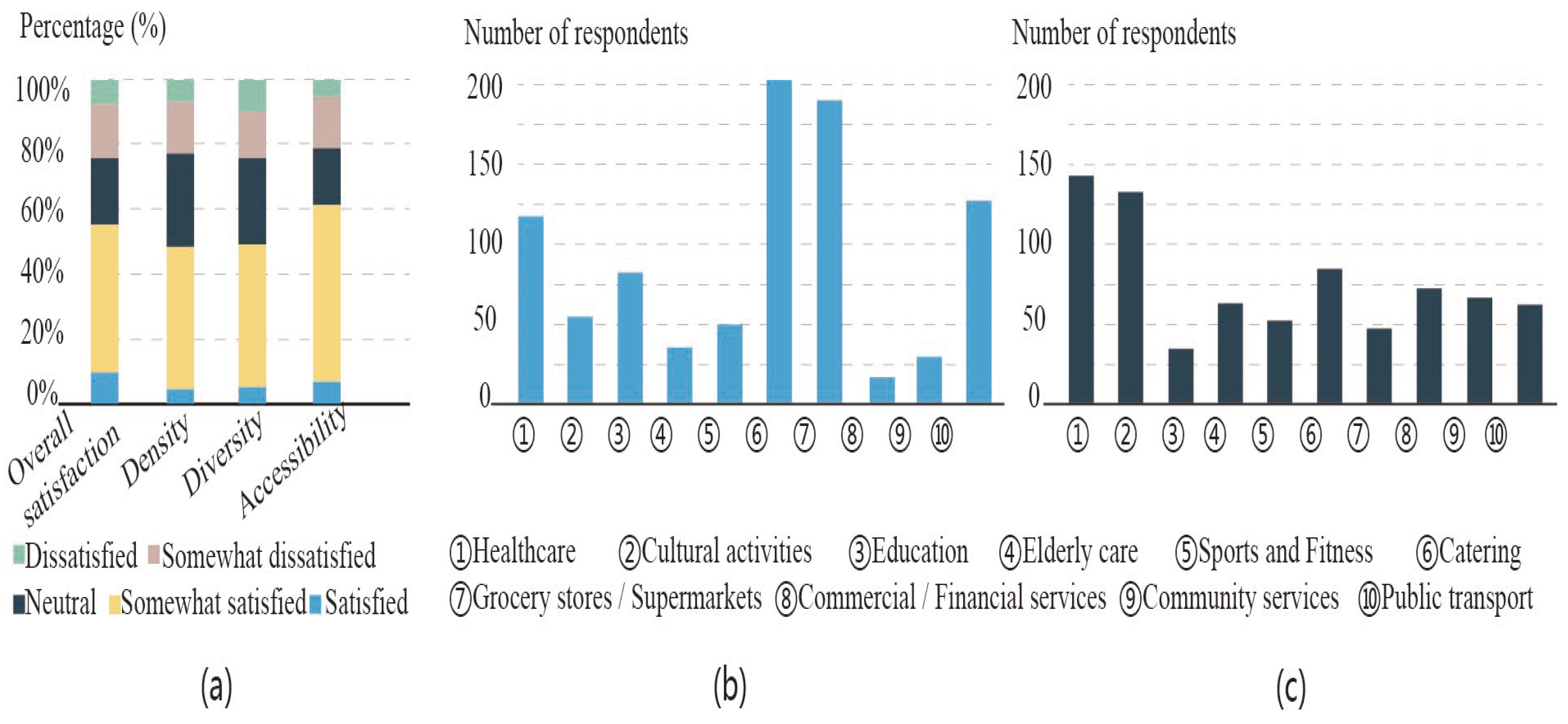
The survey results regarding resident satisfaction indicate an average overall satisfaction score of 3.33, with specific scores for facility density, diversity, and accessibility recorded at 3.23, 3.21, and 3.42, respectively (Figure 5a). Facilities with high daily usage frequency include catering, grocery stores/supermarkets, public transport, healthcare, and education (Figure 5b). Notably, residents expressed the strongest demand for the supplementation of healthcare, cultural facilities, and catering (Figure 5c). This contradiction between subjective demands and objective supply is further corroborated by the subsequent spatial quantitative assessment.
Figure 5. Resident utilization and demand analysis: (a) satisfaction with facility provision; (b) high-frequency daily usage types; (c) prioritization of facility supplementation within the 15 min life circle.
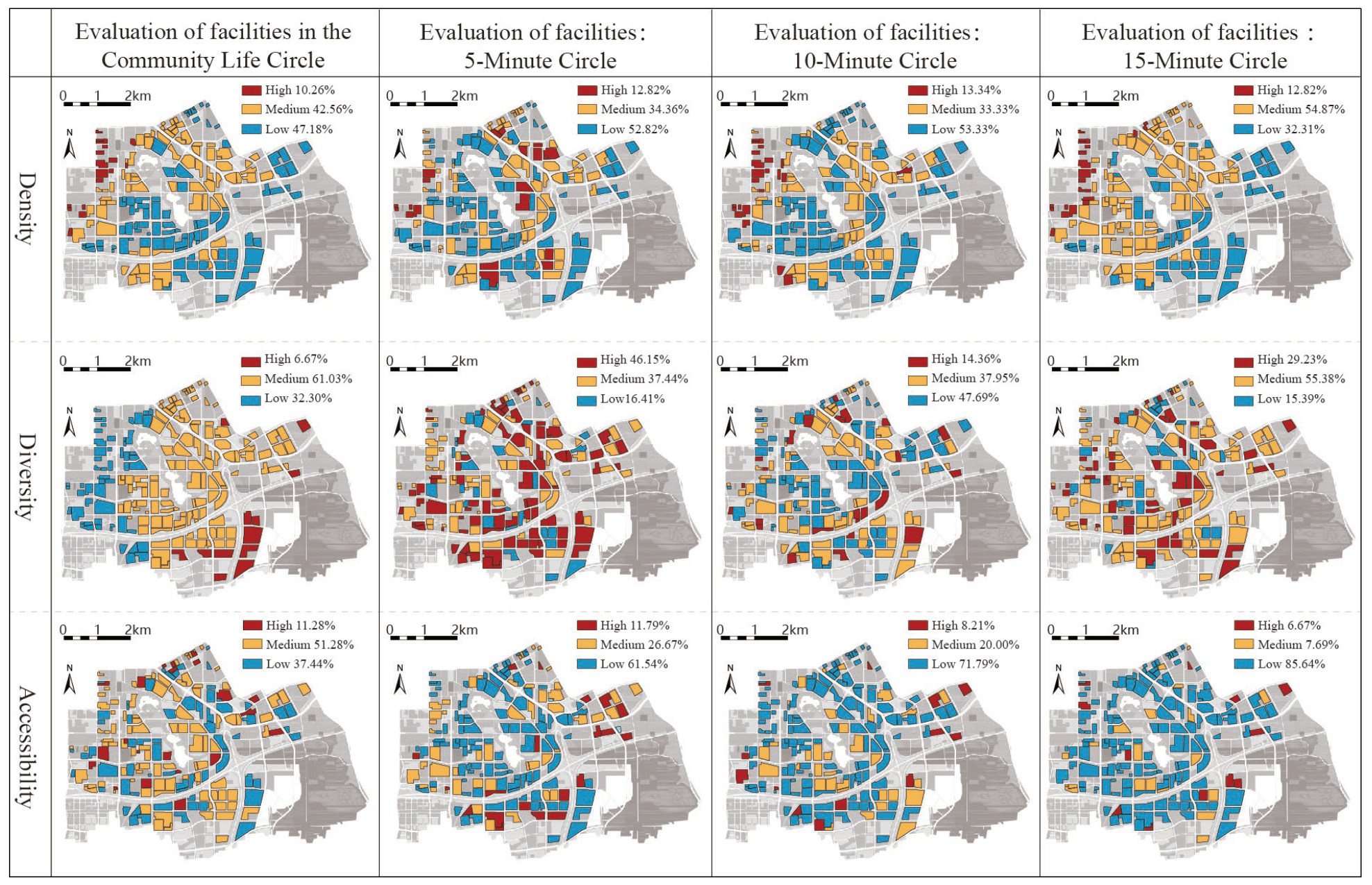
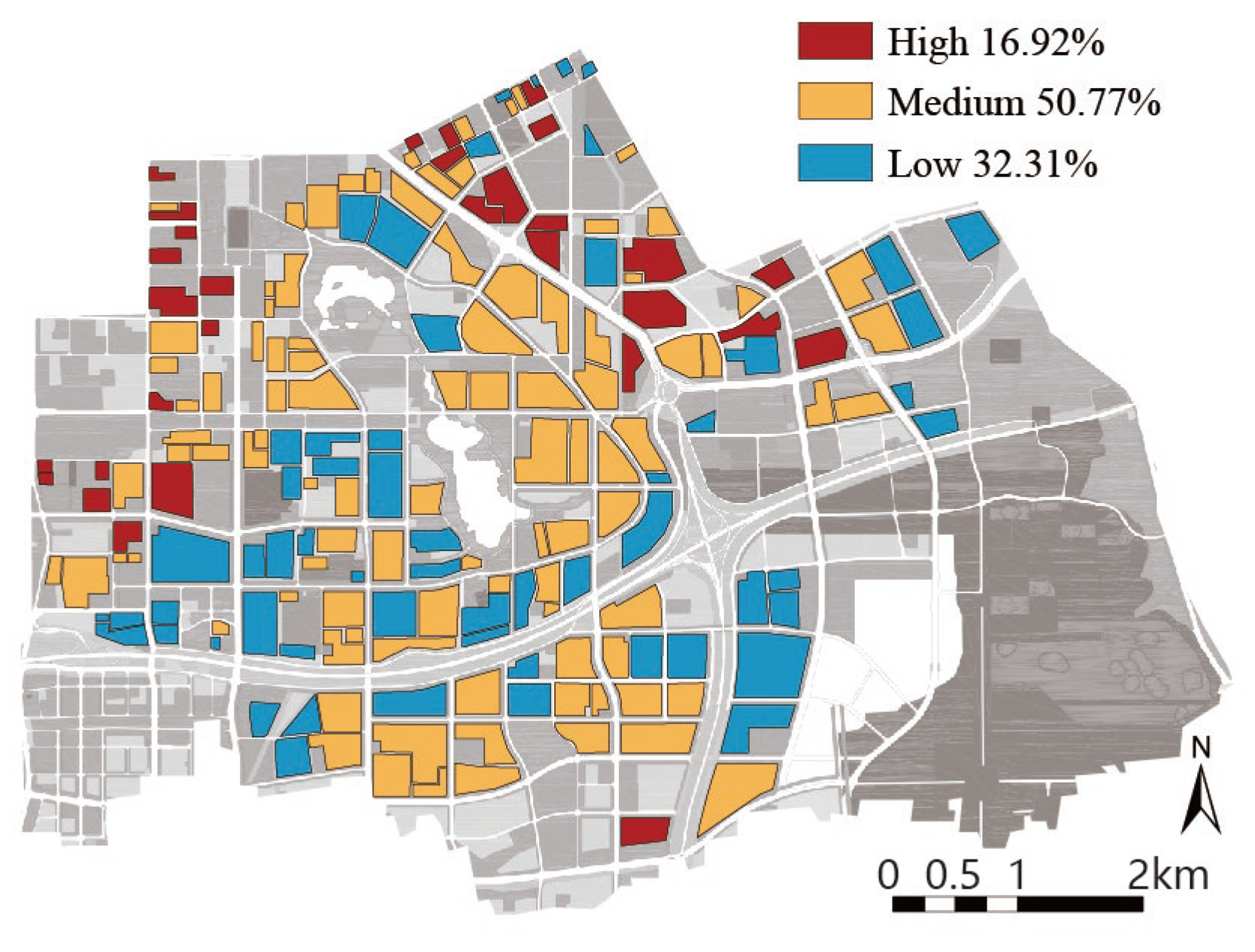
Based on the three-tier life circle evaluation system comprising 5, 10, and 15 min intervals constructed using the ArcGIS10.7 platform, this study performed a quantitative graded evaluation, classified into high, medium, and low tiers, of the density, diversity, and accessibility of service facilities in the residential areas of Qujiang New District (Figure 6). The evaluation results reveal the spatial differentiation of facility configuration within the new urban district and its relationship with the broader planning structure. The overall evaluation results, presented in Figure 7, indicate that the comprehensive facility configuration level is rated as high in only 16.92% of residential areas. These areas exhibit significant spatial agglomeration characteristics, primarily concentrated near the Dayan Pagoda Scenic Area in the northwest and along the core commercial axis. In contrast, 50.77% of residential areas are categorized at a medium level, while 32.31% are rated as low, predominantly distributed in the urban periphery, distant from the commercial core. This spatial pattern suggests that the facility configuration is significantly influenced by the radiating influence of city-level commercial centers rather than distributed equitably to serve the residential population. These objective evaluation results align with the findings from the subjective resident survey. Specifically, residents residing in peripheral areas reported lower levels of satisfaction regarding the convenience of daily life compared to their peers in the core area.
Figure 6. Spatial evaluation of facility density, diversity, and accessibility.
Figure 7. Spatial distribution of comprehensive facility provision levels.
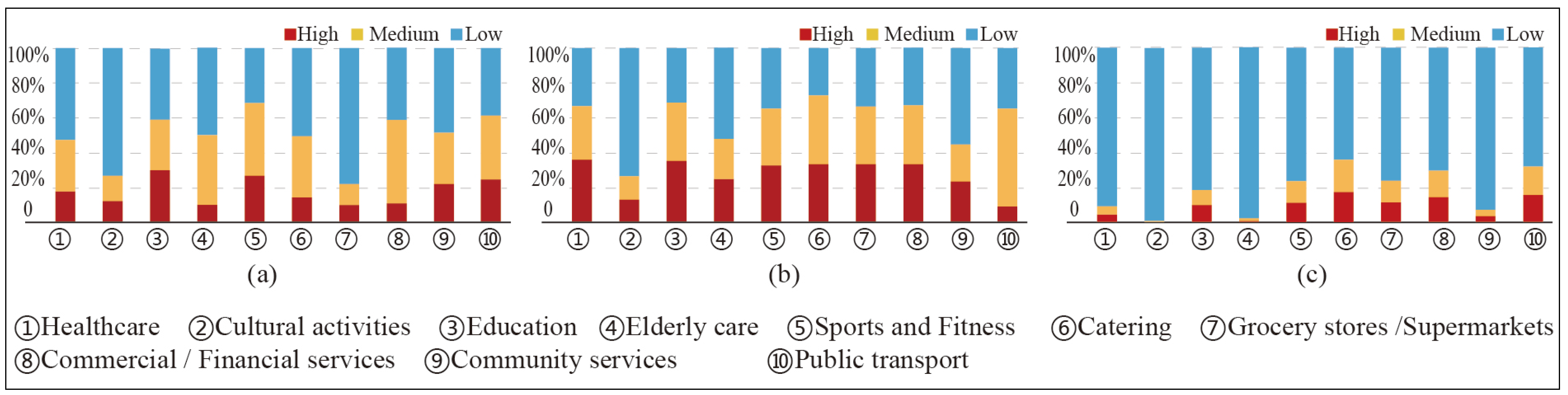
Further analysis reveals structural deficiencies in facility supply. (1) Inadequate Density: Here, 47.18% of residential areas exhibit low facility density, meaning that within a unit area, the quantity of service facilities accessible to most residents is extremely limited, making it difficult to satisfy daily needs. Facilities used most frequently by residents—including catering, grocery stores, and healthcare (Figure 5c)—are spatially scarce (Figure 8a). (2) Insufficient Diversity: Although mixed-use land was reserved during planning, 32.30% of residential areas still exhibit single business formats and lack high-quality cultural, elderly care, and social service facilities. (3) Accessibility Gap: Here, 37.44% of residential areas have poor accessibility. Specifically, within the tiered structure, key facilities such as cultural activity stations, fresh food supermarkets, and community health centers are generally absent in the 10 min life circle, while accessibility to various nursing homes and comprehensive cultural centers in the 15 min life circle is severely inadequate.
Figure 8. Proportions of facility provision levels by category: (a) facility density; (b) facility diversity; (c) facility accessibility.
Notably, the statistical analysis indicates that different types of residential communities do not show statistically significant differences in facility density, diversity, or accessibility (p > 0.05, Table A1). This demonstrates that in Qujiang New District, deficiencies in facility configuration are structural issues determined by the planning morphology of the overall built environment—such as large-scale road networks and superblocks—rather than a result of spatial segregation targeting specific social classes.

5.3. Verification of Case Study

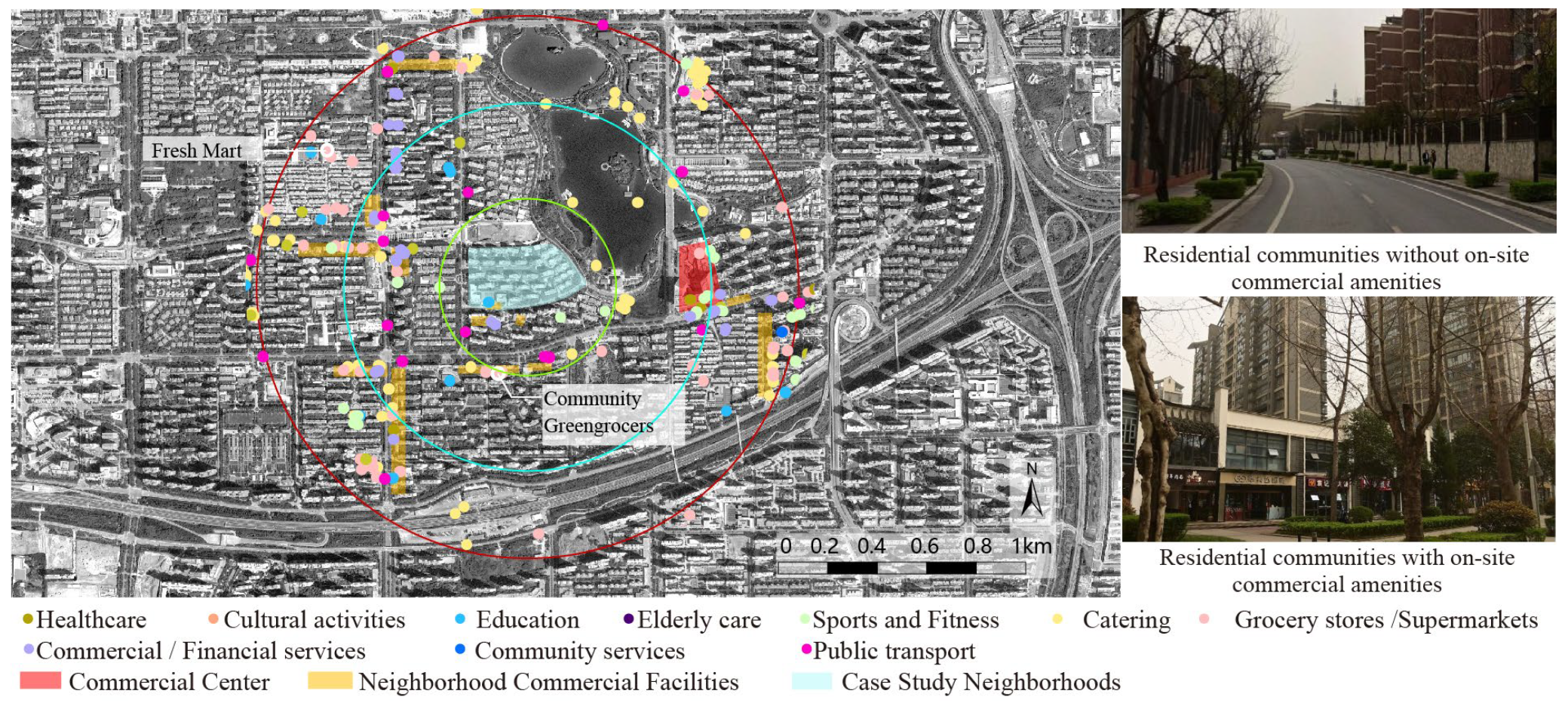
To verify the authenticity of the macro-evaluation at the micro-scale, this study selected a representative residential community built in 2014 for in-depth analysis. The community features a floor area ratio of 1.25 and comprises 777 households. The evaluation results for facility configuration indicate that while the facility density is moderate (119 facilities per square kilometer) and the diversity index is favorable (0.66), accessibility was found to be suboptimal at 0.37. Field verification and interviews further confirmed the consistency between objective indicators and resident perceptions, accurately identifying the spatial “pain points” responsible for low convenience (Figure 9).
Figure 9. Case study analysis.
The field verification confirmed the accuracy of the evaluation results: within the 5 min life circle, there is a marked deficiency of community-level commercial outlets—including pharmacies, laundry services, and convenience stores—along with an absence of fundamental community health service stations and day-care centers for older adults. In the 10 min tier, cultural activity stations are missing, only one local grocery store is available, and the fresh food supermarket is geographically distant (approximately a 15 min walk), causing significant inconvenience for daily procurement. At the 15 min life circle level, facilities such as cultural activity centers and nursing homes are entirely absent, and the accessibility of community service centers remains poor. Furthermore, although the data indicate that the catering density is adequate, interviews revealed a “quality mismatch” issue: the surrounding area is dominated by low-end fast-food outlets that fail to satisfy high-quality consumption demands on holidays, compelling residents to seek services across different circles.
Interviews further elucidated the institutional reasons for the low accessibility scores. Currently, community services are primarily configured based on administrative levels, with only one service center per administrative community, resulting in elderly care and medical coverage that far exceeds the residents’ walking tolerance. This disconnect between administrative management scales and pedestrian scales is the core cause of the facility gaps within 10–15 min life circles. Additionally, interviews with community members indicated that the underlying causes of the current facility scarcity and insufficient convenience lie in the rigidity of early planning indices and a lack of proactive spatial guidance, particularly the absence of flexible spaces such as commercial podiums in some residential areas. Given the existing built environment, it is highly impractical to bridge gaps solely through “new construction”. Instead, residents’ actual sense of gain must be enhanced through refined business format management and space-sharing mechanisms.

6. Discussion

6.1. Spatial Mismatch Mechanism

This study indicates that the land-finance-driven development model, while reshaping macroscopic urban morphology, instated deep-seated contradictions within community life circles at the microscopic level. Distinct from the endogenous evolution of “fine-grained streets and dense road networks” in core urban areas, Qujiang New District represents a typical “government-led and landscape-driven” model. While this top-down planning logic has enhanced the landscape environment, it has also resulted in a structural mismatch between service facility supply and demand.
First, the “large blocks and wide roads” morphology of Qujiang New District physically lengthens residents’ paths to access services. Excessive community sizes lead to sparse road networks and an insufficient proportion of commercial land along the periphery of gated residential complexes. Commercial facilities tend to cluster around scenic areas with high commercial value, forming high-end commercial sectors. Conversely, low-end and high-frequency facilities essential for daily life (such as breakfast stalls, shoe repair stands, and affordable grocery stores) struggle to afford high rents and lack suitable “capillary” street spaces. This leads to a pronounced service gap within the 5–10 min life circle, forcing residents to cross the circle boundaries to obtain basic services. This finding is consistent with research conclusions from suburban and exurban Shanghai [56]. This logic differs essentially from the “chrono-urbanism” in Paris [17] or the “superblocks” in Barcelona [57,58]. The latter focuses on the redistribution of street space rights within high-density small-block fabrics—increasing pedestrian potential by reducing motor vehicle space. In contrast, for Chinese new districts represented by Qujiang, the core challenge is not the competition for road rights but rather how to overcome the physical barriers caused by large-scale gated blocks.
Second, physical constraints on facility accessibility have triggered differentiation across age cohorts [59,60]. Young and middle-aged groups utilize e-commerce and instant delivery to construct algorithm-based “online life circles,” effectively alleviating the physical space constraints. This supports the assertion that online shopping has a significant substitution effect on physical shopping [61]. However, the elderly are trapped by the “digital divide” [62], and their activity radius is forced into physical walking circles with deficient functionality. Given that this group is most sensitive to the spatial distance of elderly care and medical facilities [63] (relevant studies confirm that up to 48.27% of elderly respondents urgently hope to access medical services within 5 min [64]), this extreme reliance on proximal facilities means that the lack of physical amenities directly leads to a precipitous decline in the accessibility to basic survival services. These differences in technological adaptability eventually transform planning defects in physical space into de facto intergenerational inequity.

6.2. Strategies for Optimization and Governance

1. Physical Space Micro-Renewal: Granular Optimization for 5–10 Minute Circles: As the built environment of the new urban district is structurally finalized, extensive new construction remains largely unfeasible. Consequently, an acupuncture-oriented micro-renewal methodology should be implemented.
First, from a policy perspective, rent subsidies should be allocated to low-profit facilities serving vulnerable cohorts, including community canteens and childcare centers [65], to incentivize their presence within residential clusters. Second, underutilized commercial podiums or redundant spaces within residential property boundaries should be repurposed. By reducing the floor area per unit, the coverage of small-scale commercial outlets such as convenience stores and pharmacies, as well as elderly care amenities, can be expanded without additional land consumption. Third, regarding facility supplementation, optimizing the hierarchical configuration of community-level medical, cultural, and sports infrastructure is essential for attaining 15 min life circle objectives. To mitigate service discontinuities within the new district, a tiered precision supply strategy is proposed, as detailed in Table 2. The 5 min circle should prioritize high-frequency and inelastic demands. The 10 min circle should focus on supplementing critically deficient fresh food markets and community health centers. Finally, the 15 min circle should emphasize quality enhancement by prioritizing the integration of cultural activity centers and comprehensive sports venues.
Table 2. Targeted facility supplementation strategies for community life circle optimization.
2. Virtual–Physical Integration: Constructing Smart Community Life Circles
Drawing upon established scholarship [39,40,41], urban planning frameworks should formally acknowledge on-demand logistics as a burgeoning form of urban infrastructure. Shifting the supply of standardized commodities to online platforms facilitates the freeing up of valuable physical space, which should be prioritized for experiential services requiring face-to-face interaction—such as healthcare and elder care—to establish an integrated virtual–physical life circle framework. In this model, the physical life circle serves as a safety net, ensuring equitable access to essential daily services for older adults and vulnerable populations, thereby preventing the social deprivation caused by technological barriers. Simultaneously, the digital life circle enhances operational efficiency through algorithmic matching and on-demand delivery, meeting the high-efficiency demands of younger and middle-aged residents. This stratified configuration effectively balances social equity with service efficiency, fostering age-inclusive and resilient community governance under existing built environment constraints.

6.3. Limitations and Future Work

While this study offers a comprehensive evaluation of facility configurations via multi-source data fusion, certain limitations persist. As a single-case study, Qujiang New District exhibits distinct development characteristics centered on the integration of culture, tourism, and residential functions. Consequently, the generalizability of these findings to other types of new urban districts, such as those dominated by industrial or purely residential land uses, requires further validation. Furthermore, the underlying mechanisms and long-term sustainability of the digital life circle warrant deeper investigation. In evaluating the compensatory effects of online services, this research relied primarily on residents’ usage frequency and subjective satisfaction metrics, rather than incorporating real-time operational data from logistics providers. In practical scenarios, delivery efficiency is dynamically influenced by variables such as real-time courier locations, order volumes, and weather conditions, which may lead to fluctuations in virtual accessibility. Future research could pursue collaborations with e-commerce platforms to introduce real-time delivery trajectory data, enabling a more precise measurement of online service accessibility from a spatio-temporal dynamic perspective.

7. Conclusions

By integrating a comprehensive framework of “objective spatial measurement and subjective behavioral validation,” this study systematically analyzed the supply–demand contradictions of service facilities in Qujiang New District, Xi’an. The findings reveal that, influenced by government-led development sequencing and large-scale block planning, facility provision in the new district exhibits a distinct pattern of core–periphery polarization, resulting in structural accessibility gaps within residential areas. Behavioral investigations confirm that these physical spatial deficiencies trigger significant intergenerational disparities: while younger and middle-aged demographics utilize “online life circles” for functional compensation, older adults are marginalized by both physical constraints and the digital divide, leading to a widening gap in quality of life. Consequently, future life circle optimization must transcend a unidimensional physical perspective and pivot toward a “virtual–physical integration” pathway. On the one hand, near-term “age-inclusive” micro-renewal should be implemented to precisely address high-frequency essential demands within the 5–10 min life circles. On the other hand, on-demand logistics should be proactively institutionalized within the public resource allocation framework to cultivate resilient communities, where physical infrastructure ensures a social safety net and digital platforms maximize operational efficiency, thereby achieving age-inclusive and sustainable development goals.

Author Contributions

Conceptualization, M.W. and Y.Q.; methodology, K.L. and D.Z. (Dingqing Zhang); software, K.L. and M.Z.; validation, M.Z., Y.W., and X.S.; formal analysis, C.W.; investigation, M.W., K.L., and M.Z.; resources, C.W.; data curation, Y.Q.; writing—original draft preparation, M.W.; writing—review and editing, M.W., K.L., and D.Z. (Dian Zhou); visualization, M.W. and C.W.; supervision, D.Z. (Dingqing Zhang) and D.Z. (Dian Zhou); project administration, M.W.; funding acquisition, M.W. All authors have read and agreed to the published version of the manuscript.

Funding

This research was funded by the Natural Science Basic Research Program of Shaanxi (No. 2023-JC-QN-0622), the Scientific Research Startup Foundation of Xi’an University of Technology (No. 106-256082504), National Natural Science Foundation of China (Grant No. 52108030), the Shaanxi Provincial Social Science Foundation (No. 2025J013), and the Fundamental Research Funds for the Central Universities (No. xxj032025025).

Institutional Review Board Statement

The study was conducted in accordance with the Declaration of Helsinki. Ethical review and approval were waived for this study because it involves an anonymous questionnaire survey regarding residents’ satisfaction with urban service facilities. The study poses no physical or psychological risk to participants, and all data were collected anonymously without recording any personally identifiable information.

Data Availability Statement

The data used in the study are available from the authors and will be shared upon reasonable request.

Acknowledgments

The authors would like to acknowledge the Management Committee of Qujiang New District for their valuable support during the preparatory stage of this study, particularly for providing relevant materials free of charge. We also extend our gratitude to the residents of Qujiang New District for their active participation in the surveys and interviews, which were crucial to the success of this research. We sincerely appreciate the generous cooperation and assistance from both parties.

Conflicts of Interest

The authors declare no conflicts of interest.

Appendix A. Survey on Satisfaction with Service Facility Configuration in Qujiang New District

Objective of the Survey: This survey aims to enhance the allocation of service facilities in Qujiang New District from the perspective of the “Community Life Circle.” We invite you to share your feedback on the current usage of existing facilities and your needs for future improvements. All information collected will be used strictly for academic research and internal analysis and will not be disclosed for commercial purposes. We kindly request your honest responses. Thank you for your support and cooperation.
1.
Gender: [Single Choice]
A.
Male
B.
Female
2.
Name of Your Residential Community:
3.
Age: [Single Choice]
  • Under 18
  • 18–30 year
  • 31–40 years
  • 41–50 years
  • 51–60 years
  • Over 60 years
4.
In which aspects do you consider Qujiang New District to be a livable area? [Multiple Choice]
  • Landscape and environment (e.g., high accessibility and sufficient area of green spaces)
  • Convenience of daily service facilities
  • Effective community management
  • Convenient commuting and access to schools
5.
Is your workplace/school located within Qujiang New District? [Single Choice]
  • Yes
  • No
6.
Commuting Distance:
  • Within 3 km
  • 3–10 km
  • 10–20 km
  • 20–30 km
  • Over 30 km
7.
Primary Mode of Commuting:
  • Walking
  • Public transport (Bus/Subway)
  • Bicycle
  • Ride-hailing/Taxi
  • Private car
  • Other _________________
8.
Are you satisfied with the overall arrangement of service facilities within a 15 min walking distance from your residence?
  • Dissatisfied
  • Somewhat dissatisfied
  • Neutral
  • Somewhat satisfied
  • Satisfied
9.
Are you satisfied with the quantity of facilities within a 15 min walking distance?
  • Dissatisfied
  • Somewhat dissatisfied
  • Neutral
  • Somewhat satisfied
  • Satisfied
10.
Do the types of facilities within a 15 min walking range cover your daily needs?
  • Not covered—I must travel far or shop online to meet daily needs.
  • Poor coverage—The lack of facilities causes inconvenience in daily life.
  • Insufficient coverage—Physical facilities are lacking, but online delivery helps compensate.
  • Mostly covered—Facilities are generally adequate; going beyond this range is acceptable.
  • Fully covered—Daily life is very convenient within this range.
11.
How convenient is it to access the facilities you use daily?
  • Inconvenient
  • Somewhat inconvenient
  • Neutral
  • Somewhat convenient
  • Very convenient
12.
How do you usually travel to access most daily necessities (e.g., dining, shopping, pharmacies)? Please select the mode and the corresponding time. Mode of Transport:
  • Walking
  • Bicycle
  • Public transport (Bus/Subway)
  • Driving Time Spent
(based on your chosen mode):
  • Within 5 min
  • 5–10 min
  • 10–15 min
  • 15–20 min
  • Over 20 min
13.
Which three types of service facilities do you use most frequently? [Select 3]
  • Healthcare (community health stations, pharmacies, etc.)
  • Cultural facilities
  • Educational facilities (kindergartens, primary schools, early education centers, extracurricular training institutions, etc.)
  • Elderly care facilities
  • Sports facilities (sports fields, gyms, etc.)
  • Catering
  • Wet markets and fresh food supermarkets
  • Commercial and financial services (banks, telecom outlets, postal outlets, etc.)
  • Community services center
  • Public transportation
14.
Which types of service facilities do you feel are insufficient in your daily life? [Select 3]
  • Healthcare (community health stations, pharmacies, etc.)
  • Cultural facilities
  • Educational facilities (kindergartens, primary schools, early education centers, extracurricular training institutions, etc.)
  • Elderly care facilities
  • Sports facilities (sports fields, gyms, etc.)
  • Catering
  • Wet markets and fresh food supermarkets
  • Commercial and financial services (banks, telecom outlets, postal outlets, etc.)
  • Community services center
  • Public transportation
15.
What is your primary channel for purchasing daily fresh food (e.g., vegetables, fruits, meat, dairy)?
  • Convenience grocery stores
  • Fresh food supermarkets
  • Large supermarkets or traditional wet markets
  • E-commerce platforms (Delivery or community group-buying pickup, e.g., Freshippo, Taocaicai)

Appendix B

Figure A1. Residential community classification in Qujiang New District: (a) community plot ratios; (b) categorized community types.
Buildings 16 00996 g0a1

Appendix C

Table A1. Correlation between residential community categories and facility evaluation indicators.
Evaluation ResultsResidential Category (%)TotalX2p
Upscale
Neighborhood
Upgrading
Residential Community
Resettlement
Neighborhoods
Facility densityHigh0 (0.00%)4 (7.69%)16 (13.45%)20 (10.26%)4.4620.347
Medium11 (45.83%)23 (44.23%)49 (41.18%)83 (42.56%)
Low13 (54.17%)25 (48.08%)54 (45.38%)92 (47.18%)
Facility
diversity
High0 (0.00%)1 (1.92%)12 (10.08%)13 (6.67%)7.8990.095
Medium13 (54.17%)36 (69.23%)70 (58.82%)119 (61.03%)
Low11 (45.83%)15 (28.85%)37 (31.09%)63 (32.31%)
Facility
accessibility
High4 (16.67%)7 (13.46%)11 (9.24%)22 (11.28%)2.0050.347
Medium10 (41.67%)27 (51.92%)63 (52.94%)100 (51.28%)
Low10 (41.67%)18 (34.62%)45 (37.82%)73 (37.44%)

References

  1. Zhang, S.; Wang, L.; Wu, X. Population Shrinkage, Public Service Levels, and Heterogeneity in Resource-Based Cities: Case Study of 112 Cities in China. Sustainability 2022, 14, 15910. [Google Scholar] [CrossRef]
  2. GB 50180-2018; Standard for Urban Residential Area Planning and Design. Ministry of Housing and Urban-Rural Development of the People’s Republic of China: Beijing, China, 2018.
  3. Sun, Y.; Luo, S. A Study on the Current Situation of Public Service Facilities’ Layout from the Perspective of 15-Minute Communities—Taking Chengdu of Sichuan Province as an Example. Land 2024, 13, 1110. [Google Scholar] [CrossRef]
  4. Wan, J.; Sun, H.; Fan, X.; Phillips, A.; Zhao, Y.; Chen, Y.; Wang, Z.; Xiao, H.; Dong, X.; Zhu, W. Refining the 15-minute community living circle: An innovative evaluation method for medical facility allocation in Chengdu. Land Use Policy 2024, 145, 107286. [Google Scholar] [CrossRef]
  5. Zhu, Y.; Wang, D. Growing threat to urban retail? Residential suburbanization and shopping behavior change in Shanghai, China. Cities 2022, 131, 104029. [Google Scholar] [CrossRef]
  6. Bai, X.; Wu, W.; Liu, L.; Shang, W.; Dong, H. Spatio-Temporal Evolution and Implications of Urban Residential Space Based on the New Commercial Housing in Xi’an, China, 2006–2022. Sustainability 2024, 16, 8495. [Google Scholar] [CrossRef]
  7. Ren, Q.; Ni, J.; Li, H.; Mao, G.; Hsu, W.; Yang, J. Analysis on Spatial Characteristics of Supply–Demand Relationship of Amenities in Expanding Central Urban Areas—A Case Study of Huai’an, China. Land 2022, 11, 1137. [Google Scholar] [CrossRef]
  8. Shi, Y.; Li, J.; Li, B.; Hang, T. A New Approach to Evaluate the Integrated Development of City and Industry: The Cases of Shanghai and the Kangqiao Industrial Park. Buildings 2022, 12, 1851. [Google Scholar] [CrossRef]
  9. Zhang, J.; Cheng, J.; Philbin, S.; Ballesteros-Perez, P.; Skitmore, M.; Wang, G. Influencing factors of urban innovation and development: A grounded theory analysis. Environ. Dev. Sustain 2023, 25, 2079–2104. [Google Scholar] [CrossRef]
  10. Yang, Y.; Bao, W.; Wang, Y.; Liu, Y. Measurement of urban-rural integration level and its spatial differentiation in China in the new century. Habitat Int. 2021, 117, 102420. [Google Scholar] [CrossRef]
  11. Duan, J.; Tian, G.; Yang, L.; Zhou, T. Addressing the macroeconomic and hedonic determinants of housing prices in Beijing Metropolitan Area, China. Habitat Int. 2021, 113, 102374. [Google Scholar] [CrossRef]
  12. Lei, W.; Jiao, L.; Xu, G.; Zhou, Z. Urban scaling in rapidly urbanising China. Urban Stud. 2022, 59, 1889–1908. [Google Scholar] [CrossRef]
  13. Bruno, D.; Musante, G.; Dacarro, F. Materials for a debate on the 15-minute city: Public transportation’s effect on urban space and time in two Asia-based alternative proposals. J. Asian Archit. Build. Eng. 2023, 23, 2134–2156. [Google Scholar] [CrossRef]
  14. Zhang, R.; Feng, X.; Yamakuchi, H. Evolution and Enlightenment of Rural Planning Research in Japan from the Perspective of Human Settlements Science. Urban Plan. Int. 2023, 38, 113–123. [Google Scholar] [CrossRef]
  15. Feng, X.; Wang, K.; Mao, Q. Rural Development Strategy, Rural Planning and Governing after Urbanization Rate Reached a Plateau: Taking Yuzhi City and Kobe City in Japan as Examples. Dev. Small Cities Towns 2019, 37, 109–115. [Google Scholar]
  16. Li, Z.; Tang, Z.; Ou, M. Planning Strategies and Implementation Supports of Melbourne’s “20-Minute Neighbourhoods”. Urban Plan. Int. 2022, 37, 7–17. [Google Scholar] [CrossRef]
  17. Moreno, C.; Allam, Z.; Chabaud, D.; Gall, C.; Pratlong, F. Introducing the “15-Minute City”: Sustainability, Resilience and Place Identity in Future Post-Pandemic Cities. Smart Cities 2021, 4, 93–111. [Google Scholar] [CrossRef]
  18. Zhang, D.; Zhang, G.; Zhou, C. Differences in Accessibility of Public Health Facilities in Hierarchical Municipalities and the Spatial Pattern Characteristics of Their Services in Doumen District, China. Land 2021, 10, 1249. [Google Scholar] [CrossRef]
  19. Zhao, P.; Luo, J.; Hu, H. Spatial match between residents’ daily life circle and public service facilities using big data analytics: A case of Beijing. Prog. Geogr. 2021, 40, 541–553. [Google Scholar] [CrossRef]
  20. Zhou, D.; Huang, H. Community Life Cycle Public Facility Configuration Study Based on Demand-Supply Correlation: A Case Study of Guangzhou. Urban Dev. Stud. 2019, 26, 1–5+18. [Google Scholar]
  21. Zhan, M.; Liu, C.; Sun, H. Construction of Urban Renewal Planning and Operation System from the Perspective of Supply and Demand Matching. South Archit. 2024, 12, 24–32. [Google Scholar]
  22. Xiao, Y.; Wang, H.; Zhan, Q. Evaluation of Walking Accessibility to Community Health Care from Life Circle Perspective—Taking the Main Urban Area of Wuhan. J. Geomat. 2023, 48, 121–126. [Google Scholar] [CrossRef]
  23. Huang, H.; Peng, K.; Deng, L. Research on Micro-Renewal of Old Communities under the Guidance of Life Circle Concept and Satisfaction Evaluation: A Case Study of Wuhan Zhiyin Dongyuan Community. Mod. Urban Res. 2022, 4, 73–80. [Google Scholar]
  24. Gu, Z.; Luo, X.; Chen, Y.; Liu, X.; Xiao, C.; Liang, Y. Density, Diversity, and Design: Evaluating the Equity of the Elderly Communities in Three Measures of the Built Environment. Land 2022, 11, 1976. [Google Scholar] [CrossRef]
  25. Jia, G.; Pendyala, R.; Chen, C. How does delivery service change food accessibility: A modified 2-step floating catchment area method. Environ. Plan. B Urban Anal. City Sci. 2025, 52, 985–1001. [Google Scholar] [CrossRef]
  26. Chang, M.; Huang, L.; Zhai, T.; Zhu, J.; Ma, Y.; Li, L.; Zhao, C. A Challenge of Sustainable Urbanization: Mapping the Equity of Urban Public Facilities in Multiple Dimensions in Zhengzhou, China. Land 2023, 12, 1545. [Google Scholar] [CrossRef]
  27. Song, L.; Kong, X.; Cheng, P. Supply-demand matching assessment of the public service facilities in 15-minute community life circle based on residents’ behaviors. Cities 2024, 144, 104637. [Google Scholar] [CrossRef]
  28. Chen, C.; Fu, S. A Method for Optimizing the Layout of Public Service Facilities Based on the Needs of Different Age Groups: An Analysis of Hongkou District, Shanghai. Systems 2023, 11, 426. [Google Scholar] [CrossRef]
  29. Sun, D.; Chai, Y. Study on the Urban Community Life Sphere System and the Optimization of Public Service Facilities: A Case Study of Qinghe Area in Beijing. Urban Dev. Stud. 2017, 24, 7–14. [Google Scholar]
  30. Wu, S.; Wang, J.; Jia, Y. Planning and layout of tourism and leisure facilities based on POI big data and machine learning. PLoS ONE 2025, 20, e0298056. [Google Scholar] [CrossRef]
  31. Yao, L.; Gao, C.; Xu, Y.; Zhang, X.; Wang, X.; Hu, Y. Prediction of Commercial Street Location Based on Point of Interest (POI) Big Data and Machine Learning. ISPRS Int. J. Geo-Inf. 2024, 13, 371. [Google Scholar] [CrossRef]
  32. Cui, X.; Ma, L.; Tao, T.; Zhang, W. Do the supply of and demand for rural public service facilities match? Assessment based on the perspective of rural residents. Sustain. Cities Soc. 2022, 82, 103905. [Google Scholar] [CrossRef]
  33. Tao, S.; He, S.; Chen, X.; Lee, J.; Liu, M. Walking accessibility to non-work facilities and travel patterns in suburban new towns. Cities 2023, 137, 104324. [Google Scholar] [CrossRef]
  34. Tang, X.; Liu, Y.; Pan, Y. An Evaluation and Region Division Method for Ecosystem Service Supply and Demand Based on Land Use and POI Data. Sustainability 2020, 12, 2524. [Google Scholar] [CrossRef]
  35. Chen, Y.; Hu, Y.; Lai, L. Demography-Oriented Urban Spatial Matching of Service Facilities: Case Study of Changchun, China. Land 2022, 11, 1660. [Google Scholar] [CrossRef]
  36. Spyratos, S.; Stathakis, D. Evaluating the services and facilities of European cities using crowdsourced place data. Environ. Plan. B Urban Anal. City Sci. 2018, 45, 733–750. [Google Scholar] [CrossRef]
  37. Yeh, A.; Chow, M. An integrated GIS and location-allocation approach to public facilities planning—An example of open space planning. Comput. Environ. Urban Syst. 1996, 20, 339–350. [Google Scholar] [CrossRef]
  38. Peng, J.; Liu, Y.; Ruan, Z.; Yang, H. Study on the optimal allocation of public service facilities from the perspective of living circle—A case study of Xiangyang High-tech Zone, China. J. Urban Manag. 2023, 12, 344–359. [Google Scholar] [CrossRef]
  39. Niu, Q.; Yi, S.; Gu, C.; Zhu, Y.; Wang, P. New Concept and Approacheset to the Reconfiguration of Service Facilities of Online and Offline Community Life Circle: A Case Study of Wuhan. Urban Plan. Forum 2019, 6, 81–86. [Google Scholar] [CrossRef]
  40. Niu, Q.; Xia, B.; Zhong, Y.; Zhang, Z.; Li, X. Characteristics, Differences and Planning Strategies of Online and Offline Community Living Circle: A Case Study of Typical Communities in Wuhan. Shanghai Urban Plan. Rev. 2022, 5, 112–118. [Google Scholar]
  41. Wu, L.; Niu, Q.; Ajiaibibula, A.; Xi, Y. Exploration of Online and Offline Community Life Circle with Virtuality-Reality Fusion: Theoretical Advances and Planning Practices. Urban Plan. Forum 2024, 2, 25–33. [Google Scholar] [CrossRef]
  42. Sun, X.; Zhu, C.; Li, M.; Yang, R.; Cheng, Y. Spatial Distribution Prediction of Passenger Flow in Tourist Attractions Based on Improved Gravity Model Method: Using Qujiang New District as an Example. CICTP 2023, 2584–2594. [Google Scholar] [CrossRef]
  43. Li, X.; Wu, Y.; Sha, J.; Lin, Q.; Eladawy, A. Tourism-oriented comprehensive land development (TOLD) in subtropical mountain region, Fuzhou, China. Arab. J. Geosci. 2022, 15, 554. [Google Scholar] [CrossRef]
  44. National Health Commission. Issuing the Measures for Ethical Review of Life Science and Medical Research Involving Human Being. Available online: https://www.pkulaw.com/en_law/d94e9e56ed4fc8fcbdfb.html (accessed on 24 March 2025).
  45. Ministry of Natural Resources of the People’s Republic of China. Community Life Circle Planning Technical Guide. Available online: https://m.mnr.gov.cn/gk/tzgg/202105/P020210526624164354716.pdf (accessed on 11 January 2026).
  46. Liu, K.; Zhou, D.; Wang, M.; Liu, T.; Yang, Y. Analysis and Optimization Study for Public Service Facilities Planning of Community Life Circle Based on Supply and Demand Adaptation: A Case Study in Xi’an. Archit. J. 2024, S1, 192–197. [Google Scholar]
  47. Zhang, K.; Yan, D. Enhancing the Community Environment in Populous Residential Districts: Neighborhood Amenities and Residents’ Daily Needs. Sustainability 2023, 15, 13255. [Google Scholar] [CrossRef]
  48. Logan, T.; Hobbs, M.; Conrow, L.; Reid, N.; Young, R.; Anderson, M. The x-minute city: Measuring the 10, 15, 20-minute city and an evaluation of its use for sustainable urban design. Cities 2022, 131, 103924. [Google Scholar] [CrossRef]
  49. Zeng, Y.; Zuo, J.; Li, C.; Luo, J. Assessing the Spatial Equity of Multi-Type Health Service Facilities: An Improved Method Integrating Scale Accessibility and Type Diversity. Land 2024, 13, 795. [Google Scholar] [CrossRef]
  50. Birkenfeld, C.; Victoriano-Habit, R.; Alousi-Jones, M.; Soliz, A.; EI-Geneidy, A. Who is living a local lifestyle? Towards a better understanding of the 15-minute-city and 30-minute-city concepts from a behavioural perspective in Montréal, Canada. J. Urban Mobil. 2023, 3, 100048. [Google Scholar] [CrossRef]
  51. Zhang, D.; Peng, J.; Yang, Z. Identifying Urban Agglomeration’s Range: Integrating Clustering and Accessibility Analysis. Cities 2026, 171, 106708. [Google Scholar] [CrossRef]
  52. Kim, K.; Horner, M.W. Integrating People in Place-Based Accessibility Measures: Design and Application of a Mode Choice Accessibility Model. Ann. Am. Assoc. Geogr. 2025, 115, 854–875. [Google Scholar] [CrossRef]
  53. Zhang, D.; Ma, S.; Fan, J.; Xie, D.; Jiang, H.; Wang, G. Assessing spatial equity in urban park accessibility: An improve two-step catchment area method from the perspective of 15-mintue city concept. Sustain. Cities Soc. 2023, 98, 104824. [Google Scholar] [CrossRef]
  54. Ni, J.; Liang, M.; Lin, Y.; Wu, Y.; Wang, C. Multi-Mode Two-Step Floating Catchment Area (2SFCA) Method to Measure the Potential Spatial Accessibility of Healthcare Services. ISPRS Int. J. Geo-Inf. 2019, 8, 236. [Google Scholar] [CrossRef]
  55. Niu, Q.; Zhu, Y.; Wang, P.; Gu, Z.; Yi, S. Onlineization of Community Life Circle and Its Key Influence Factors: A Case Study of Typical Communities in Wuhan. Urban Dev. Stud. 2021, 28, 111–118. [Google Scholar]
  56. Wu, H.; Wang, L.; Zhang, Z.; Gao, J. Analysis and optimization of 15-minute community life circle based on supply and demand matching: A case study of Shanghai. PLoS ONE 2021, 16, e0256904. [Google Scholar] [CrossRef] [PubMed]
  57. Pérez, K.; Palència, L.; López, M.J.; León-Gómez, B.B.; Puig-Ribera, A.; Gómez-Gutiérrez, A.; Nieuwenhuijsen, M.; Carrasco-Turigas, G.; Borrell, C. Environmental and health effects of the Barcelona superblocks. BMC Public Health 2025, 25, 634. [Google Scholar] [CrossRef]
  58. Nieuwenhuijsen, M.; de Nazelle, A.; Cirach Pradas, M.; Daher, C.; Dzhambov, A.M.; Echave, C.; Gössling, S.; Iungman, T.; Khreis, H.; Kirby, N.; et al. The Superblock model: A review of an innovative urban model for sustainability, liveability, health and well-being. Environ. Res. 2024, 251, 118550. [Google Scholar] [CrossRef]
  59. Loo, B.P.; Lam, W.W. Geographic Accessibility around Health Care Facilities for Elderly Residents in Hong Kong: A Microscale Walkability Assessment. Environ. Plan. B Plan. Des. 2012, 39, 629–646. [Google Scholar]
  60. Kemperman, A.D.; Timmermans, H.J. Heterogeneity in Urban Park Use of Aging Visitors: A Latent Class Analysis. Leis. Sci. 2006, 28, 57–71. [Google Scholar] [CrossRef]
  61. Xiao, Z.; Chai, Y.; Zhang, Y. Overseas Life Circle Planning and Practice. Planners 2014, 10, 89–95. [Google Scholar]
  62. Xi, G.; Zhen, F.; Cao, X.; Xu, F. The interaction between e-shopping and store shopping: Empirical evidence from Nanjing, China. Transp. Lett. 2020, 12, 157–165. [Google Scholar] [CrossRef]
  63. Boakye-Dankwa, E.; Barnett, A.; Pachana, N.A.; Turrell, G.; Cerin, E. Associations between latent classes of perceived neighborhood destination accessibility and walking behaviors in older adults of a low-density and a high-density city. J. Aging Phys. Act. 2019, 27, 553–564. [Google Scholar] [CrossRef]
  64. Liu, Y.; Wang, Y.; Guo, G.; Yang, T.; Liu, Y.; Gao, H.; Jiang, T.; Li, X. Analysis of community older adult care facility construction and demand differentiation based on residential area and population attribute differences. Front. Public Health 2025, 13, 1495608. [Google Scholar] [CrossRef]
  65. Huang, X.; Gong, P.; White, M. Study on spatial distribution equilibrium of elderly care facilities in downtown Shanghai. Int. J. Environ. Res. Public Health 2022, 19, 7929. [Google Scholar] [CrossRef]
Disclaimer/Publisher’s Note: The statements, opinions and data contained in all publications are solely those of the individual author(s) and contributor(s) and not of MDPI and/or the editor(s). MDPI and/or the editor(s) disclaim responsibility for any injury to people or property resulting from any ideas, methods, instructions or products referred to in the content.

Article Metrics

Citations

Article Access Statistics

Multiple requests from the same IP address are counted as one view.