Article

Temperature Field and Gradient Effects for Concrete-Filled Steel Tubular Truss Arch Bridges Under Construction


1
School of Civil Engineering, Chongqing Jiaotong University, Chongqing 400074, China
2
State Key Laboratory of Mountain Bridge and Tunnel Engineering, Chongqing Jiaotong University, Chongqing 400074, China
*
Author to whom correspondence should be addressed.
Buildings 2026, 16(5), 969; https://doi.org/10.3390/buildings16050969
Submission received: 20 January 2026 / Revised: 6 February 2026 / Accepted: 27 February 2026 / Published: 1 March 2026
(This article belongs to the Special Issue Advances in Building Structure Analysis and Health Monitoring)

Abstract

Long-span concrete-filled steel tubular truss arch bridges are extremely sensitive to thermal effects during cantilever construction, with non-uniform temperature distributions arising from mutual shading between members. The current standard JTG/T D65-06—2015 employs a simple gradient model that struggles to capture the temperature gradient characteristics of complex spatial trusses, failing to meet the demands of high-precision construction. Based on a truss-type steel arch bridge in Yunnan, a thermal conduction analysis framework is proposed to calculate the temperature field of the arch rib truss and its effects, and is validated by long-term monitoring data. The results indicate that the maximum temperature difference between the upper and lower chord tubes reaches 14.53 °C, significantly changing the secondary stress distribution. There is a significant negative correlation mechanism between arch rib elevation and solar radiation temperature, necessitating consideration of solar radiation temperature effects during arch rib assembly and closure. This study establishes an analytical method for the thermal effects of long-span steel truss arch ribs, laying the foundation for arch rib profile control and stress analysis.

1. Introduction

The initial internal force state of bridge structures and long-term operational safety are closely related to the control of the construction process [1]. During the construction of concrete-filled steel tubular (CFST) truss arch bridges, the cable-stayed suspension method is frequently employed. Bridge temperature fields are influenced by meteorological parameters such as solar radiation, environmental temperature, and wind velocity. The structural nonlinear temperature field is caused by the normal azimuth and inclination angle of its surface, which causes significant variations in the thermal load effect [2]. Furthermore, the structural temperature at closure directly determines the baseline state of the structure [3]. Closing the arch at an improper temperature will generate significant additional internal forces and excessive deformation. Therefore, the study of temperature effects on the arch during construction is particularly important.
Substantial advancements have been made in analytical methods based on numerical models and analytical theory to address the challenge of efficiently solving bridge temperature fields in complex environments. In terms of numerical models, prior research has formulated one-dimensional solar radiation temperature field models for steel-concrete composite girder bridges [4,5]. Furthermore, refined three-dimensional numerical models capable of capturing non-uniform thermal characteristics have been proposed for truss suspension bridges [6]. Simultaneously, analytical theories have been extensively operationalized for regular cross-sectional members due to their computational simplicity. For main cable structures, researchers have derived analytical solutions for steady-state and transient conditions under solar radiation [7,8], and proposed correction formulas for cross-sectional average temperature deviations [9]. For steel bridge structures, temperature distribution functions determined via steady-state thermodynamic equilibrium equations effectively reveal heat transfer mechanisms and critical influencing factors [10]. However, these simplified computational methods exhibit pronounced methodological constraints when applied to large-span CFST truss arch bridges. Specifically, these methods fail to adequately capture complex mutual shading effects or describe spatial non-uniformity in the temperature fields.
To balance engineering practicality and computational efficiency, simplified temperature gradient characterization methods based on finite element analysis have been widely used in the research of bridge temperature fields [11,12,13]. In the field of box girder bridges, research has evolved from establishing vertical gradient models [14] for steel–concrete composite beams to revealing the transverse thermal characteristics of concrete sections [15], then to examining the impact of longitudinal dimensions on temperature gradients [16,17]. Regarding arch bridges, scholars have proposed vertical temperature gradient models for box ribs [18] and corresponding correction methods for longitudinal inclination based on field monitoring and numerical simulations [19]. For concrete–steel composite structures with more complex thermal properties, refined investigations have progressed from basic solar radiation models [20,21] to more sophisticated models that incorporate circumferential variations in large-diameter members [22] and the effects of interfacial debonding [23]. Studies by Zhang et al. [24] and Liu et al. [25] have further elucidated the non-uniform thermal distributions in complex composite sections under solar exposure. Additionally, numerical frameworks have been refined through mechanical–hydration heat coupling [26,27,28,29] and fire resistance assessments under extreme temperatures [30,31,32]. However, these studies primarily focus on establishing static gradient models for the completed bridge state, which exhibits significant limitations in achieving precise control during the cantilever construction process. Specifically, the time-varying thermal–mechanical coupling mechanism during the construction phase is overlooked, making it difficult to meet the real-time control requirements for the main arch.
Currently, finite element-based temperature gradient models provide acceptable accuracy for standard engineering applications in CFST truss arch bridges. However, existing thermal models predominantly focus on the temperature differentials between upper and lower chords, while ignoring the vertical gradients within individual tubes. This simplification significantly compromises the precision of structural thermal effect calculations. Furthermore, conventional approaches are largely grounded in static design specifications, which fail to capture the transient and time-dependent nature of temperature gradients during the construction phase. Moreover, the high computational cost of high-fidelity finite element analysis precludes its application for real-time monitoring, as it cannot rapidly adapt to the evolving structural and environmental variables during construction. Consequently, establishing an equivalent temperature gradient model is of paramount importance. Such a model would facilitate the rapid evaluation of thermal effects, providing a robust framework for real-time alignment control in large-span bridges.
A calculation framework for the temperature field and its effects for truss steel arch bridges has been proposed and validated on an arch bridge in Yunnan. First, the calculation steps and theoretical analysis of the arch rib temperature gradient model are carried out in Section 2. Then, the numerical analysis of the temperature field and gradient model is carried out in Section 3. Finally, the analysis of temperature stress and deformation effects under gradient temperature loading is carried out in Section 4 and Section 5.

2. Calculation Method for Temperature Gradient of Arch Ribs

2.1. Physical Entity of CFST Truss Arch Bridge

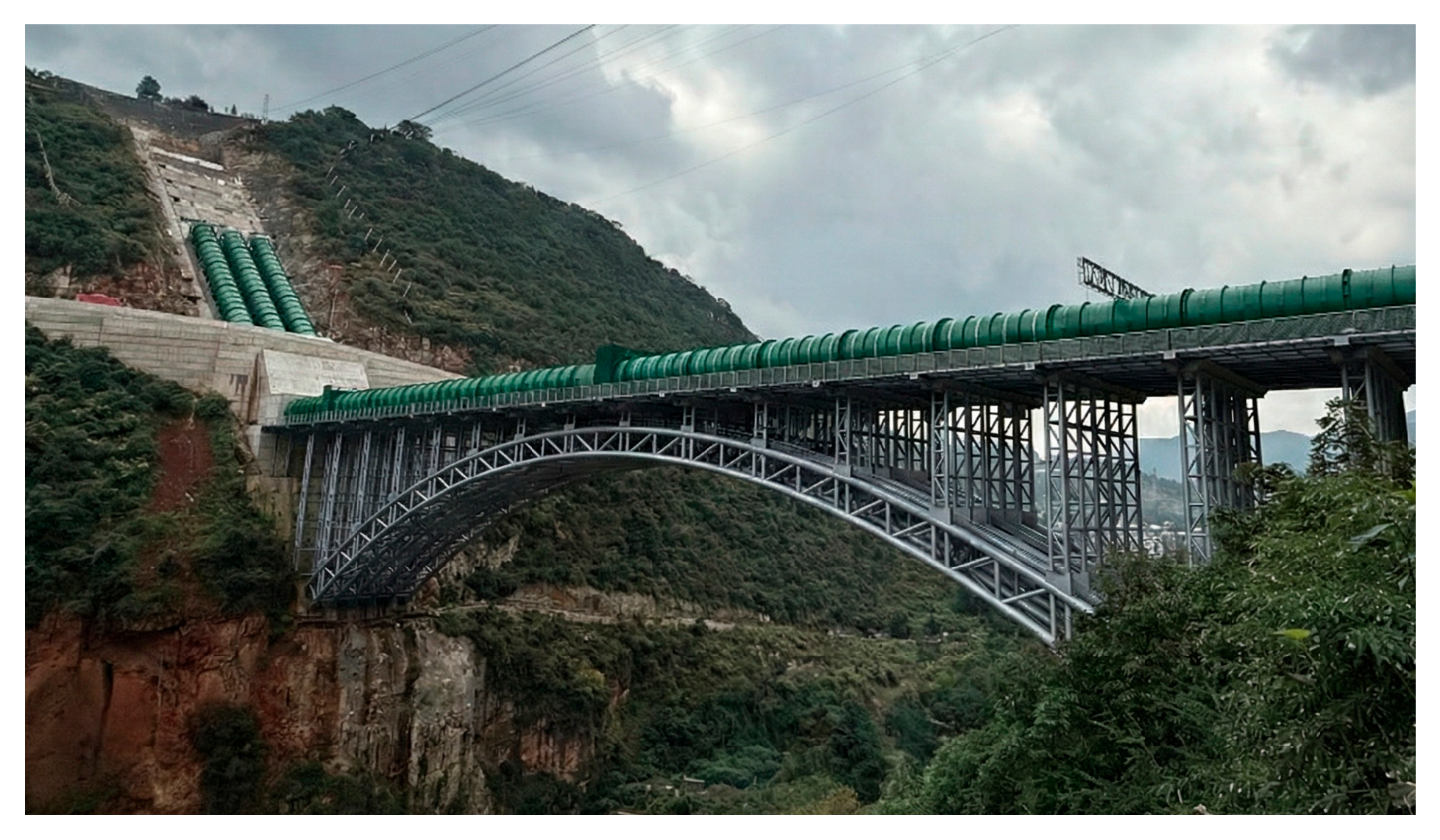
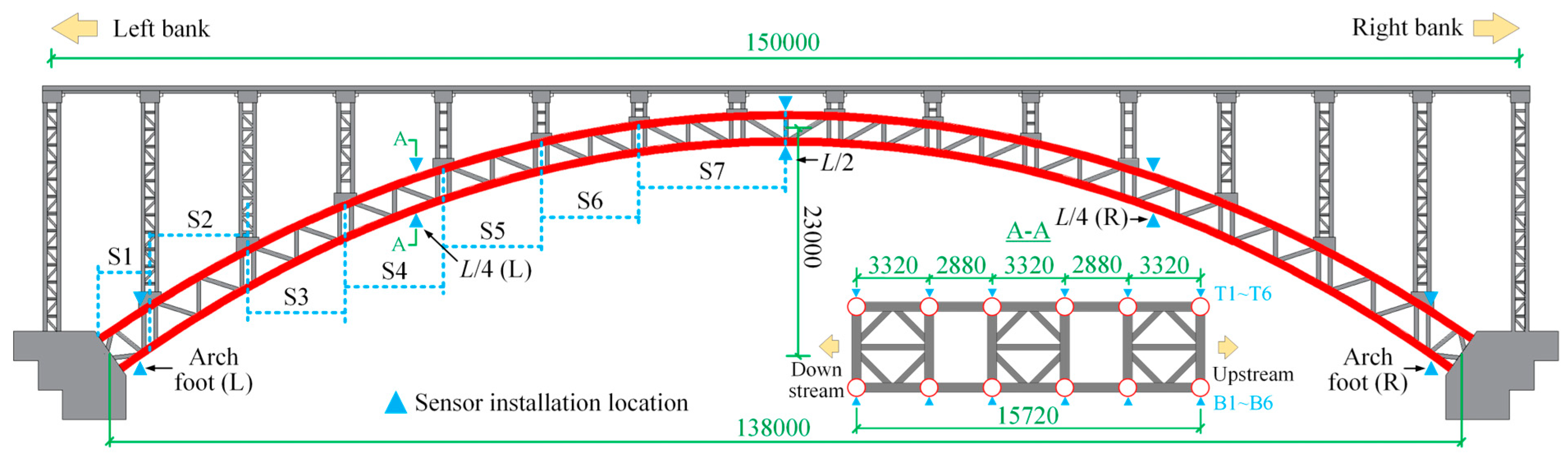
A CFST truss arch bridge in Yunnan is selected as the subject for thermal field re-search. The arch ribs have a calculated span of 138 m with the rise-to-span ratio of 1/6. The arch axis adopts a catenary curve with an arch axis coefficient of 1.6. The arch, painted silver, consists of three arch ribs 3.32 m-wide, spaced 3.10 m apart (center-to-center) and formed of four A800 × 24 mm chord tube frames. The single-line cross-brace is installed between the arch ribs to ensure lateral stability. The chord tubes are connected by horizontal tie tubes (A426 × 16 mm) and diagonal tie tubes (A426 × 12 mm). The elevation of the arch bridge and the actual bridge structure are shown in Figure 1 and Figure 2, respectively. In the figures, “T” and “B” represent the sensor locations on the upper and lower chord tubes, respectively, and are numbered sequentially in the direction of water flow.
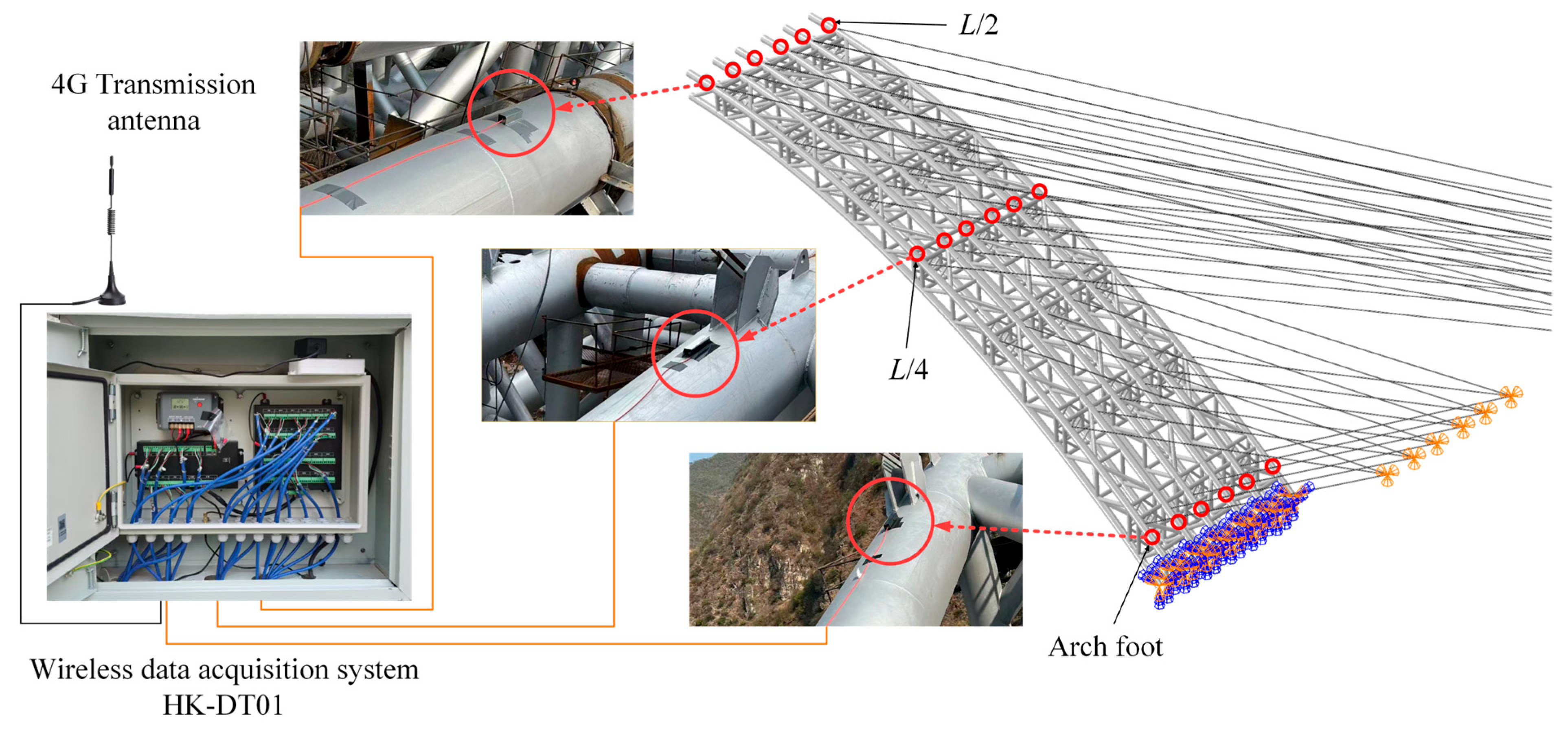
The bridge structure is situated in a mountainous gorge, with the bridge running in a north–south direction. The bridge is positioned at the geographical coordinates of 102.4° east longitude and 25.2° north latitude. Based on the terrain characteristics, the arch ribs are assembled by a diagonal tension-clamping method. Temperature and strain sensors are installed at control sections (arch base, L/4, and L/2) along the span of the main arch (Figure 3). Continuous monitoring is conducted using a wireless data acquisition system to investigate the distribution patterns of non-uniform temperature fields in the steel pipe arch ribs under solar radiation.

2.2. Temperature Field and Its Effects Analysis Framework

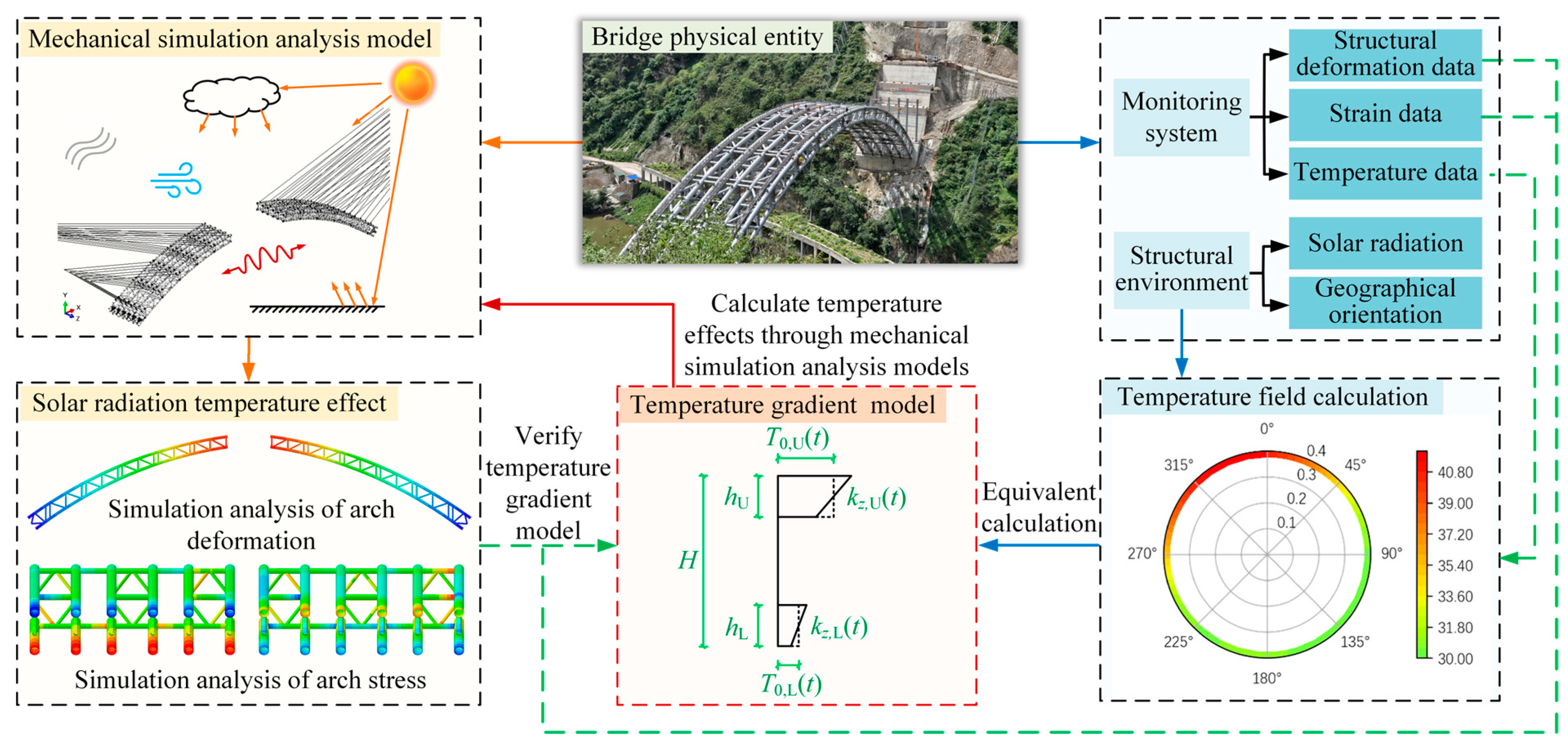
This paper proposes an integrated research framework combining monitoring data, heat transfer theory, and structural mechanics analysis to precisely reveal the temperature distribution and structural response behavior of truss arch bridges under solar radiation (Figure 4). The process is described as follows:
(1)
Data Foundation and Physical Entity Construction: The concrete-filled steel tube truss arch bridge equipped with monitoring system is treated as a physical entity, and structural temperature, ambient temperature, and temperature effects are collected.
(2)
High-Precision Computation of 3D Temperature Fields: The solar radiation heat flux density is calculated using structural geometry parameters and structural inclination angle, establishing a 3D temperature field for the arch rib chord tube based on the finite difference method. Compare the calculated results with the measured temperature data to verify the validity of the temperature distribution pattern.
(3)
Equivalent Gradient Temperature Models: The continuous string tube is divided axially into multiple representative cross-sections, with the temperature distribution at each cross-section condensed into a time-varying gradient temperature model.
(4)
Simulation and Analysis of Structural Temperature Effects: The equivalent gradient temperature model is applied as a time-varying load to the finite element model for thermal coupling analysis, calculating the structure’s stresses and deformations. Compare simulation results with monitoring data to reveal the time-varying behavior of solar radiation temperature effects and validate the overall accuracy of the computational workflow.

2.3. Theory of Temperature Gradient Model

Arch bridges absorb solar radiation, exchange heat with their surroundings, and experience internal heat conduction. The 3D temperature field is established to consider axial heat conduction caused by the variation of the arch rib surface normal angle along the axial direction. In the transient 3D temperature distribution method, the temperature field T can be expressed as a function of coordinates (r, θ, z) of a point in the section and the specific time t as
T = f r , θ , z
According to the first law of thermodynamics, the structural internal energy change equals the heat inflow at its boundaries within any time step Δt. The transient heat conduction equation and external boundary balance equation of chord tube under column coordinates are Equations (2) and (3), respectively:
T t = λ 2 T r 2 + 1 r T r + 1 r 2 2 T θ 2 + 2 T z 2 , λ = k ρ c
k T r = q s u r ,   q s u r = q s + q c + q r
where λ is the thermal diffusivity, which is related to its thermal conductivity k; ρ is density; c is the specific heat; qsur is the heat flux on the structural surface, composed of the solar radiation qs, atmospheric convective heat transfer qc and radiative heat transfer heat flux densities qr.
q s = a s G s + G r + G g ,   q c = h c T a T ,   q r = ε C 0 T a 4 T 4
where as is the absorptivity of the object surface; Gs, Gr, and Gg are the total solar radiation intensity, and sky-scattered and ground reflected radiation intensity, respectively; hc is the film coefficient; ε is the emissivity of the object surface; C0 is the Stefan–Boltzmann constant; Ta is the surrounding ambient temperature. The daily temperature variation process is considered as a sinusoidal function [33].
T a ( t ) = 1 2 T a , max + T a , min + 1 2 T a , max T a , min sin t t 0 π 12
where Ta,max and Ta,min are the daily maximum and minimum temperatures, respectively; t0 is the time when extreme temperature occurrence.
The arch axis is a catenary curve, which is composed of numerous straight segments. Therefore, the axial thermal conduction problem in a catenary chord tube can be equivalently modeled as a straightened one. The transient temperature distribution of the chord tubes is calculated by the finite difference method. The chord tube is uniformly divided into n, m, and p nodes along the axial, radial, and circumferential directions, respectively. The spatial node temperature derivatives are discretized to gain the node temperature update equations at internal and boundary locations. The discrete form of the first derivative for the temperature field Tr,θ,z at time t and radial radius r can be expressed as
T t = T r , θ , z t + 1 T r , θ , z t Δ t ,   1 r T r = 1 r T r + 1 , θ , z T r 1 , θ , z 2 Δ r
The second derivatives of the temperature field Tr,θ,z with respect to the axial, radial, and circumferential steps Δz, Δr, and Δθ are discretized as
2 T z 2 = T r , θ , z + 1 2 T r , θ , z + T r , θ , z 1 Δ z 2 , 2 T r 2 = T r + 1 , θ , z 2 T r , θ , z + T r 1 , θ , z Δ r 2 , 2 T θ 2 = T r , θ + 1 , z 2 T r , θ , z + T r , θ 1 , z Δ θ 2
By substituting Equations (6) and (7) into Equation (2), the updated formula of internal node temperature Tin is Equation (8):
T in t + 1 r , θ , z = T in t r , θ , z + F o r Δ r 2 2 T r 2 + F o r n 2 Δ r 1 r T r + F o θ Δ θ 2 2 T θ 2 + F o z Δ z 2 2 T z 2
where For, Forn, Foθ, and Foz are the radial, radially corrected, circumferential, and axial Fourier numbers, respectively.
F o r = λ Δ t Δ r 2 ,   F o r n = λ Δ t 2 r Δ r ,   F o θ = λ Δ t Δ θ 2 ,   F o z = λ Δ t Δ z 2
The outer surface of the arch ribs is affected by the combined effects of solar radiation heating, convective heat transfer cooling, and thermal radiation cooling. Based on the equilibrium equations for the Neumann boundary condition and Robin boundary condition, the temperature at the outer surface nodes TB,out is updated as
T B , out t + 1 r , θ , z = T B , out t + 1 r 2 , θ , z 2 Δ r k q s + q c + q r
Since there is no air circulation on the internal surface of the arch ribs, the inner boundary, considered an adiabatic boundary (TB,in), is
T B , in r , θ , z T B , in r + 1 , θ , z = 0
The temperature distribution of the chord tube is obtained through the cyclic iteration of the updated internal temperature equation (Equation (8)) and boundary conditions (Equations (10) and (11)) for each time step Δt. Based on the plane section assumption, the nonlinear temperature field within the cross-section is modeled as a time-varying temperature gradient model (T0(t) and kz(t)), which enhances the computational efficiency of the structural temperature effects in the model.
T 0 t = S T r , θ , z t d A A s ,   k z t = S z T r , θ , z t d A I y
where T0 is the equivalent overall temperature; kz is the vertical temperature gradient along the cross-section; As is the cross-sectional area; Iy is the inertia moment of a cross-section at the y-axis.

3. Analysis of Temperature Field and Gradient Model

3.1. Temperature Field Analysis

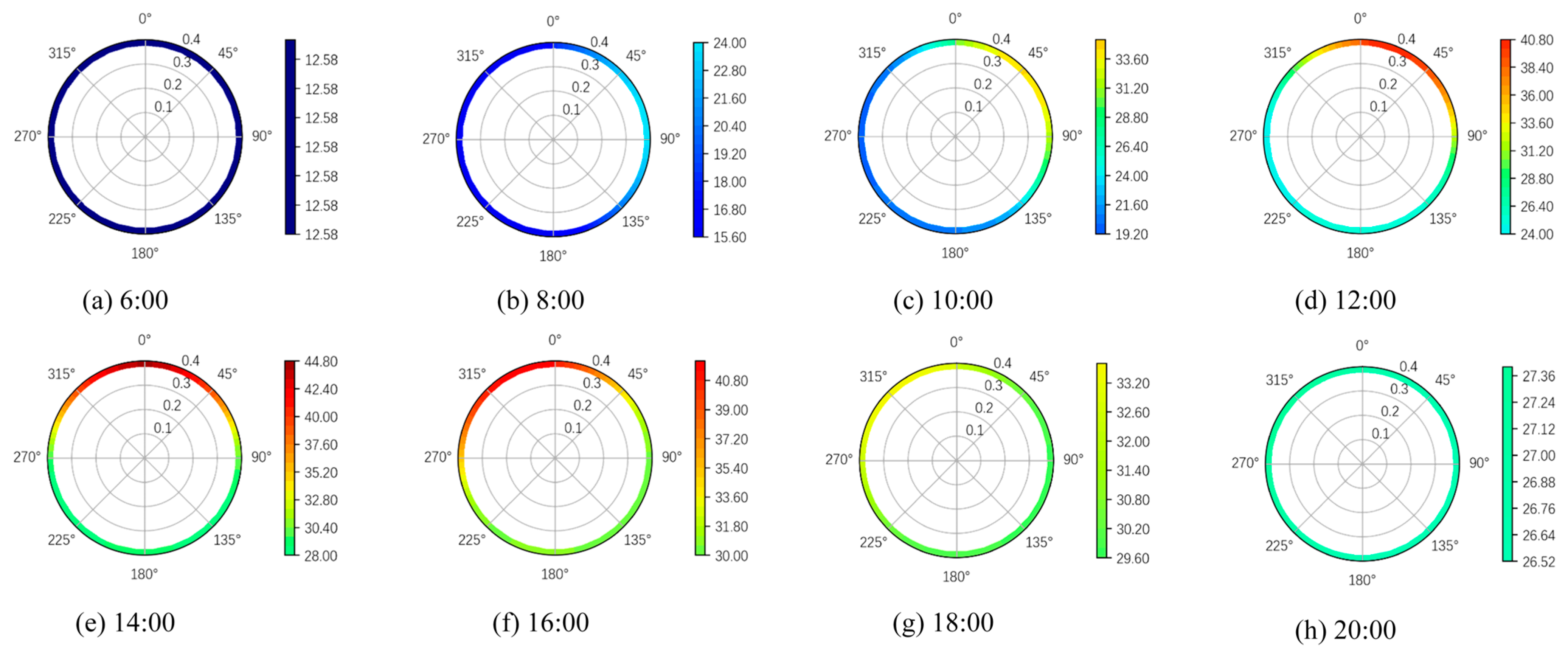
The chord tube is uniformly divided into 10, 32, and 500 nodes in the radial r, circumferential θ, and axial z directions, respectively. The heat flux density of solar radiation at different locations along the arch segment is influenced by the varying inclination and circumferential angles of the arches. Based on an extensive literature investigation [5,23,34], the reasonable values of thermal properties are determined and listed in Table 1. Figure 5 shows the temperature field at the L/2 cross-section, where the cross-sectional circumferential temperature varies with solar incidence angle. The cross-sectional temperature rises gradually from sunrise, reaching its maximum value (44.80 °C) at 14:00 before decreasing, until it becomes uniformly distributed.
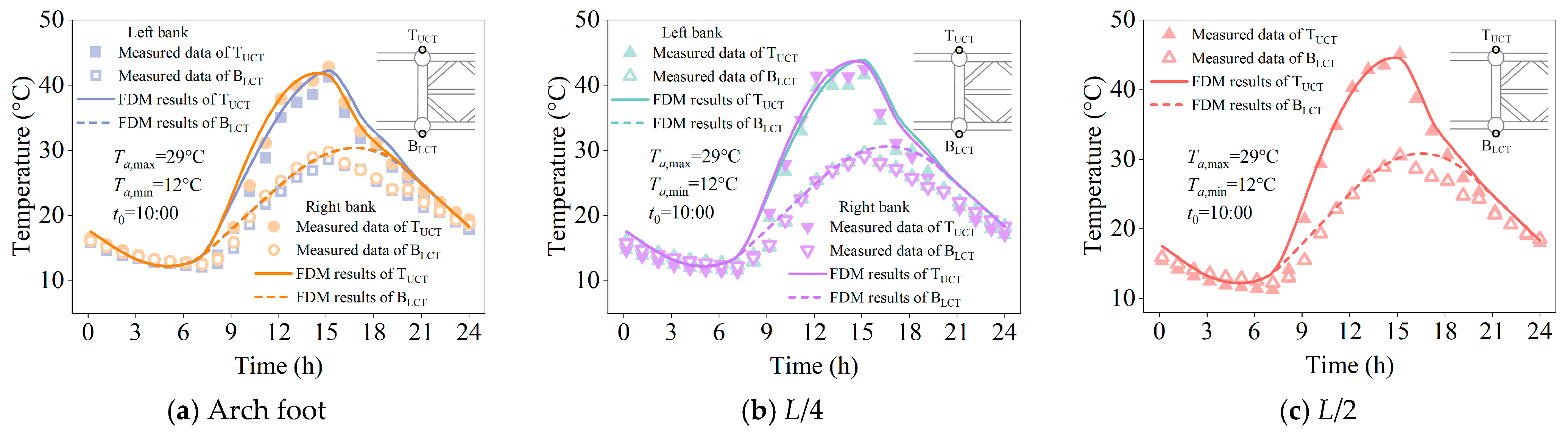
The arch ribs in the transverse direction have the same inclination, and it can be considered that the temperature distribution is identical. However, the inclination of the chord tubes along the axial directions varies, resulting in differing projections of solar radiation along their surface normal directions, which leads to non-uniform temperature distribution (Figure 6). The maximum temperature (45.08 °C) of the cross-section occurs at the L/2 cross-section, which is 3.79 °C and 2.57 °C higher than the arch foot and L/4 section, respectively. The measured temperature variation trends at each section (arch foot, L/4, and L/2) are generally consistent with the numerical results, and the root mean square error between the two is less than 1.78 °C. The maximum temperatures of the arch ribs on the left and right banks occur with a 1h difference. During the heating phase, the solar orientation aligns closely with the normal direction of the right bank arch rib surface, causing its heating rate and heat flux density to be greater than the left bank.

3.2. Temperature Gradient Model

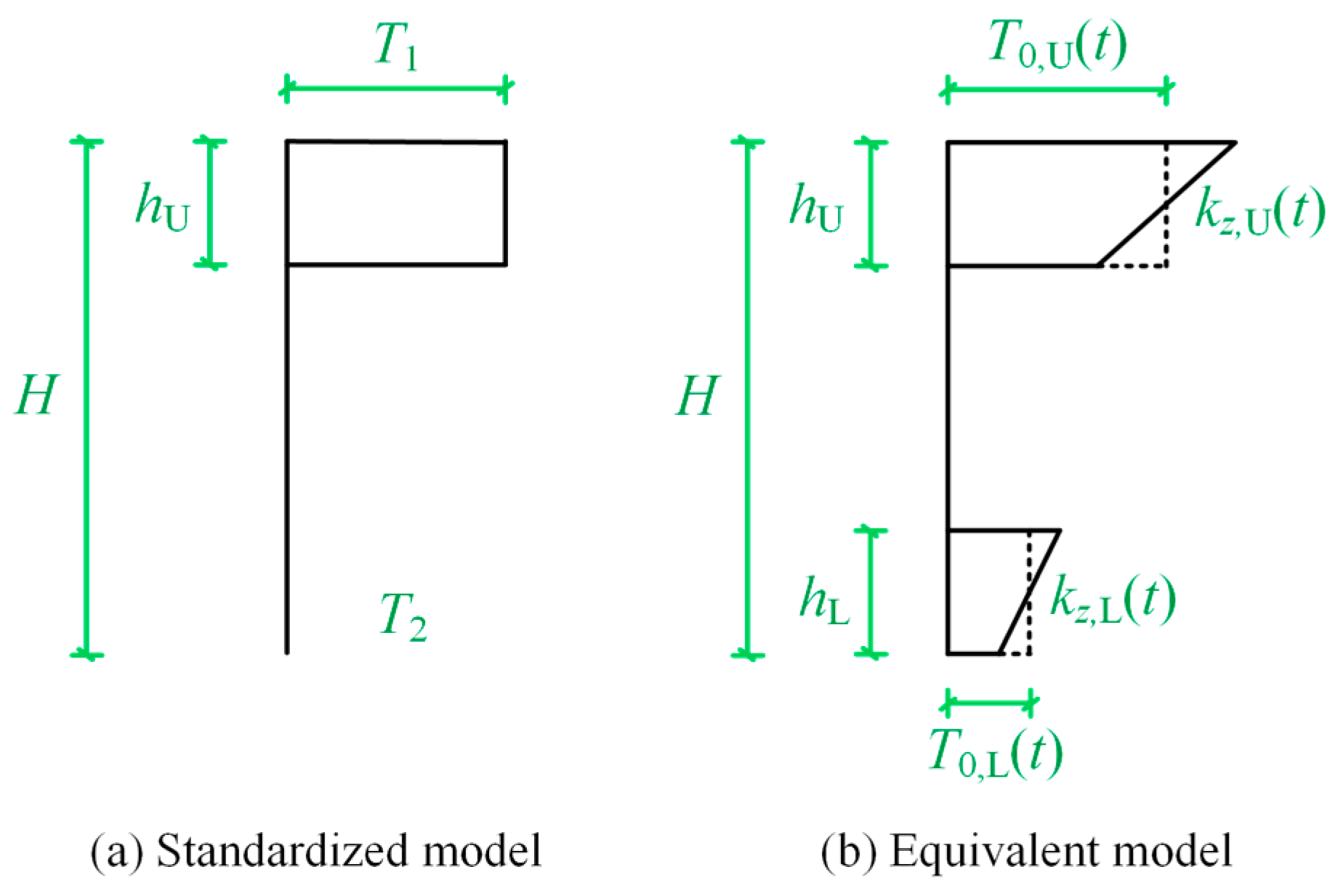
According to the “Specifications for the Design of Highway Concrete-Filled Steel Tubular Arch Bridge” [35], the temperature difference between the upper and lower chords of truss arches with silver surfaces is calculated to be 5 °C. Specifications are determined by probabilistic statistical methods to establish the most unfavorable temperature values during the design reference period. The truss section assumes that solar radiation primarily impacts the top of the upper chord, while the web and lower chord receive insufficient solar radiation. The temperature gradient is simplified to the temperature difference between the average temperatures of the upper and lower chords [3] (Figure 7a). However, the solar elevation during the day causes real-time variations in cross-sectional temperature, making it difficult to directly apply the temperature gradient from the specification to control the thermal effects on the arch. Furthermore, the specification gradient model fails to account for the temperature gradient differences caused by solar radiation, which will prevent accurate calculation of the linear and stress changes in the structure. Therefore, based on the temperature field characteristics of the truss-type arch ribs under solar radiation, a gradient temperature model (Figure 7b) suitable for this structure is proposed, where “U” and “L” represent the upper and lower chord tubes, respectively. The temperature gradient model will be validated through the temperature gradient effect in the subsequent sections.
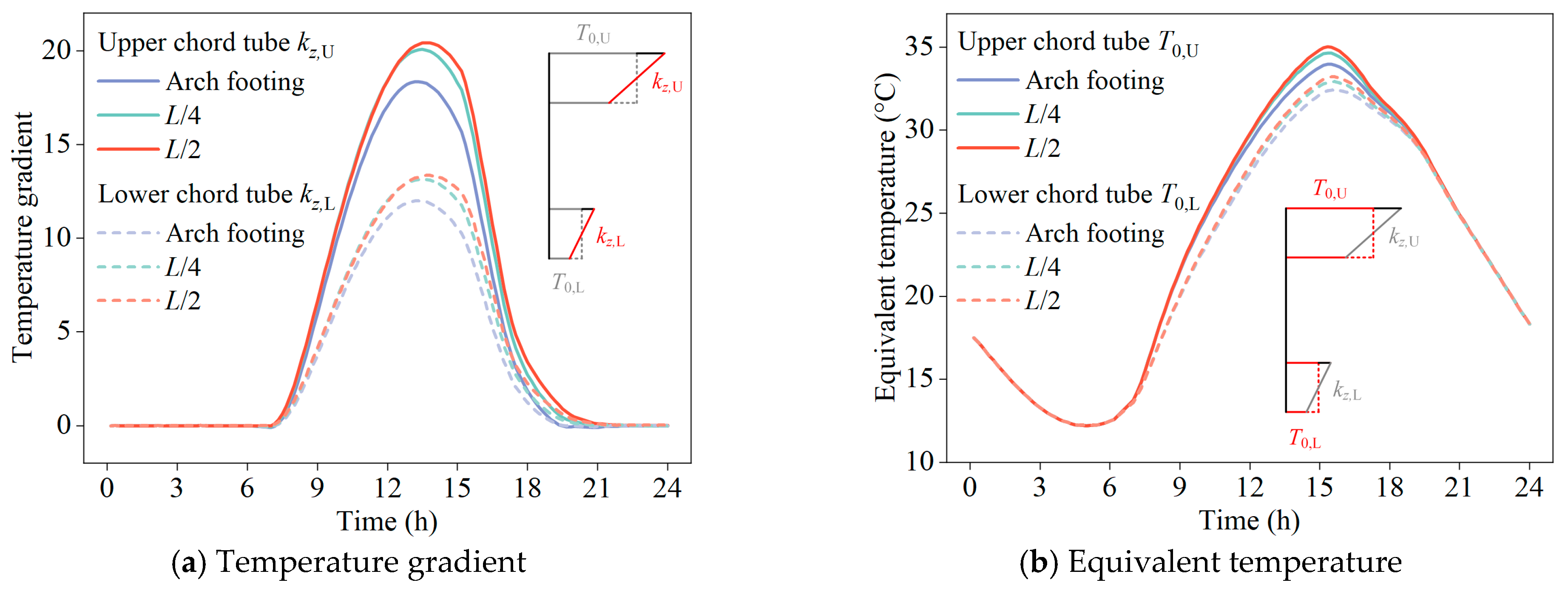
Figure 8 shows the equivalent temperatures (T0,U and T0,L) and the temperature gradient model parameters (kz,U and kz,L) of the upper and lower chord tubes of the left bank arch rib. While the equivalent temperatures T0 across different sections are relatively similar, the gradient temperatures kz exhibit significant differences. The maximum gradient temperature of the upper chord tube is 53.05% higher than the lower one. The temperature gradient model shows the same trend as the cross-sectional temperature (Figure 6).

4. Effects Under Solar Gradient Temperature

4.1. Thermal Effects Analysis

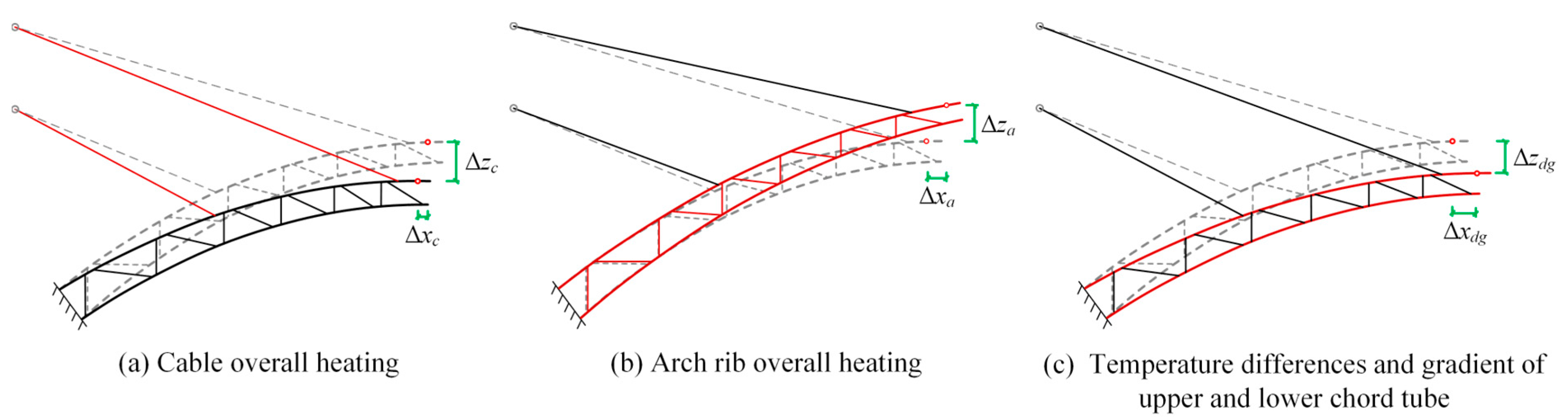
The vertical deformation of the arch due to temperature effects is primarily caused by four factors: an overall rise in the temperature of the stay cables and the arch rib; a temperature difference between the upper and lower chord tubes; and a chord tube temperature gradient (Figure 9). All heating factors induce elongation deformation in the arch ribs (Δxc, Δxa, and Δxdg). Specifically, cable heating, temperature difference, and gradient in the chord tube cause downward deflection (Δzc and Δzdg), while heating the arch rib elevates the arch ribs (Δza). When Δxa + Δxdg < Δxc, the arch rib undergoes downward deflection; conversely, when Δxa + Δxdg > Δxc, the significant elongation of the arch rib is constrained by the stay cables, causing notable additional stresses in both the upper and lower chord tubes. Thermal secondary stresses can reach magnitudes comparable to loading stresses, masking the true stress state of the structure and compromising the accuracy of structural condition assessments.
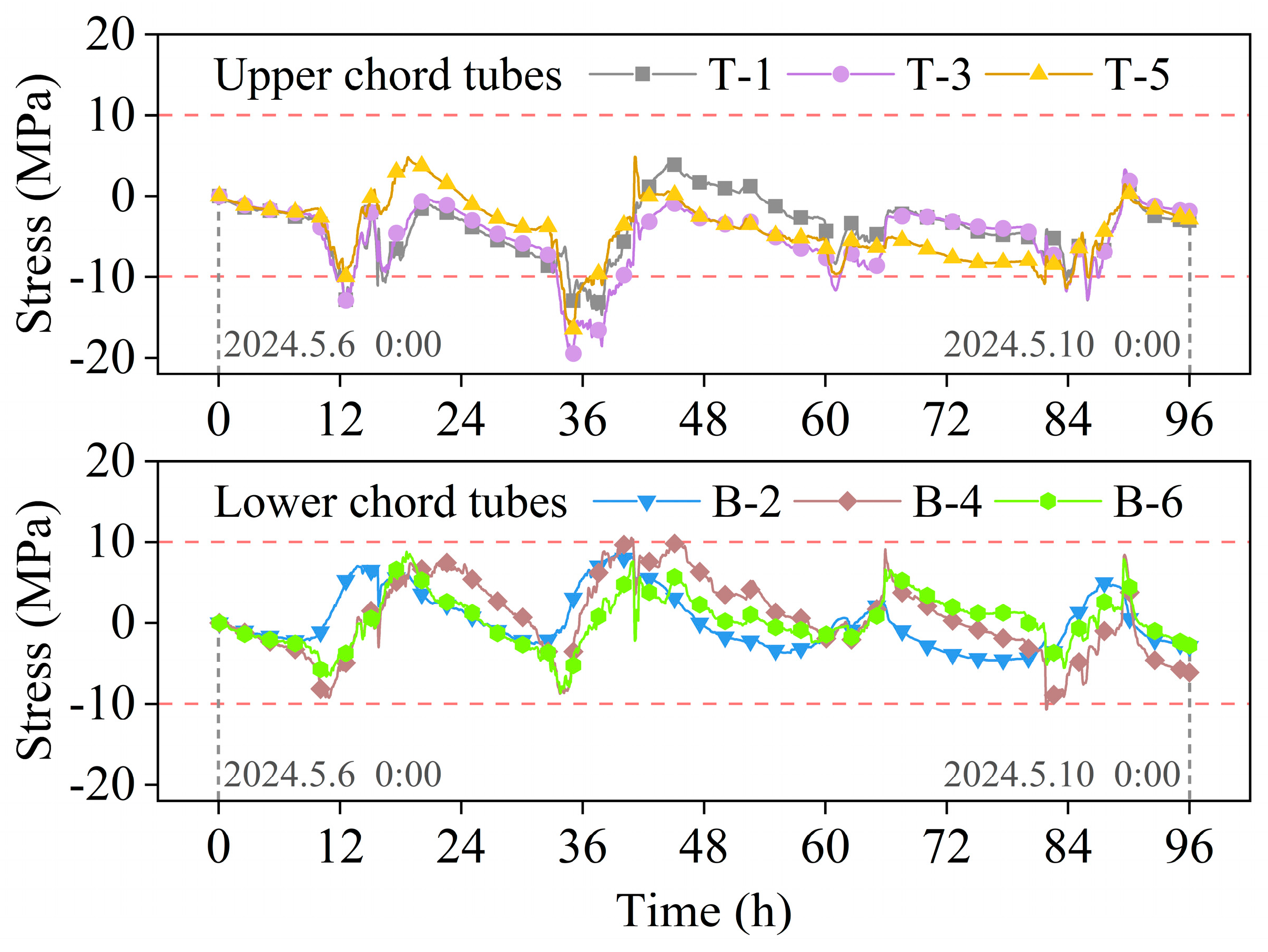
The time-dependent stress patterns induced by solar radiation must be studied to accurately analyze structural stresses during construction. Figure 10 shows the stress monitoring data of the upper and lower chord tubes at the left arch foot over 4 continuous days. During the installation of the arch segment, the thermal deformation of the main arch is constrained by the stay cables. The upper and lower chords at the arch feet generate significant compressive and tensile stresses under the combined effects of self-weight and stay cable forces. According to the “Technical Specifications for Construction Monitoring and Control of Highway Bridges” [36], the error limit of steel structure stress calculations does not exceed ±10 MPa when the stress value is below 100 MPa. The stress limit in the standard is induced by construction loads. However, the stress variation caused by temperature exceeds 10 MPa (Figure 10), demonstrating the significant impact of solar radiation on stress. Therefore, the effect of thermal residual stresses should be eliminated when analyzing stress.

4.2. Shielding Effect Influence

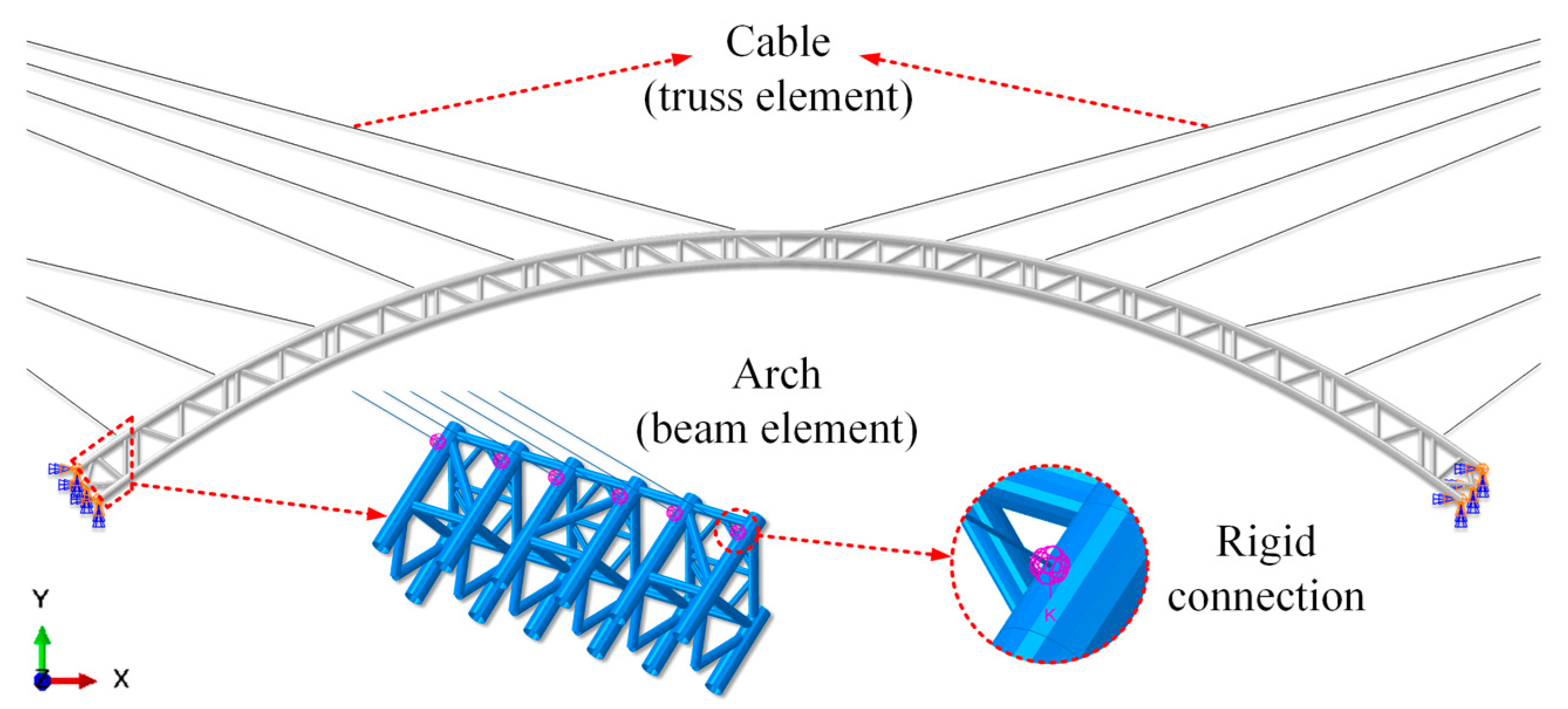
The arch ribs and stay cables are simulated using Beam elements (B31) and Truss elements (T3D2), respectively, when calculating temperature effects. Rigid connections are employed between the arch ribs, the web tubes, and the stay cables. Fixed constraints are applied at the arch feet, while the stay cable endpoints utilize hinged constraints at the mountain anchors (Figure 11). The stay cables exposed in the natural environment are affected by variations in atmospheric temperature and sunlight. During heating and cooling cycles, the cable temperature typically ranges within ±5 °C of the environmental temperature, exceeding it during heating and falling below it during cooling [37].
The relative position between the bridge structure and the sun changes over time. The pre-correction solar radiation calculations failed to account for structural shading effects caused by variations in this relative position. The complex truss arch bridge components block sunlight, thereby reducing solar radiation on the lower chord tubes. The shading coefficient μ is introduced to reduce solar radiation, enabling accurate calculation of temperature effects [38]:
q s u r , s h a d e = 1 μ q s + q c + q r
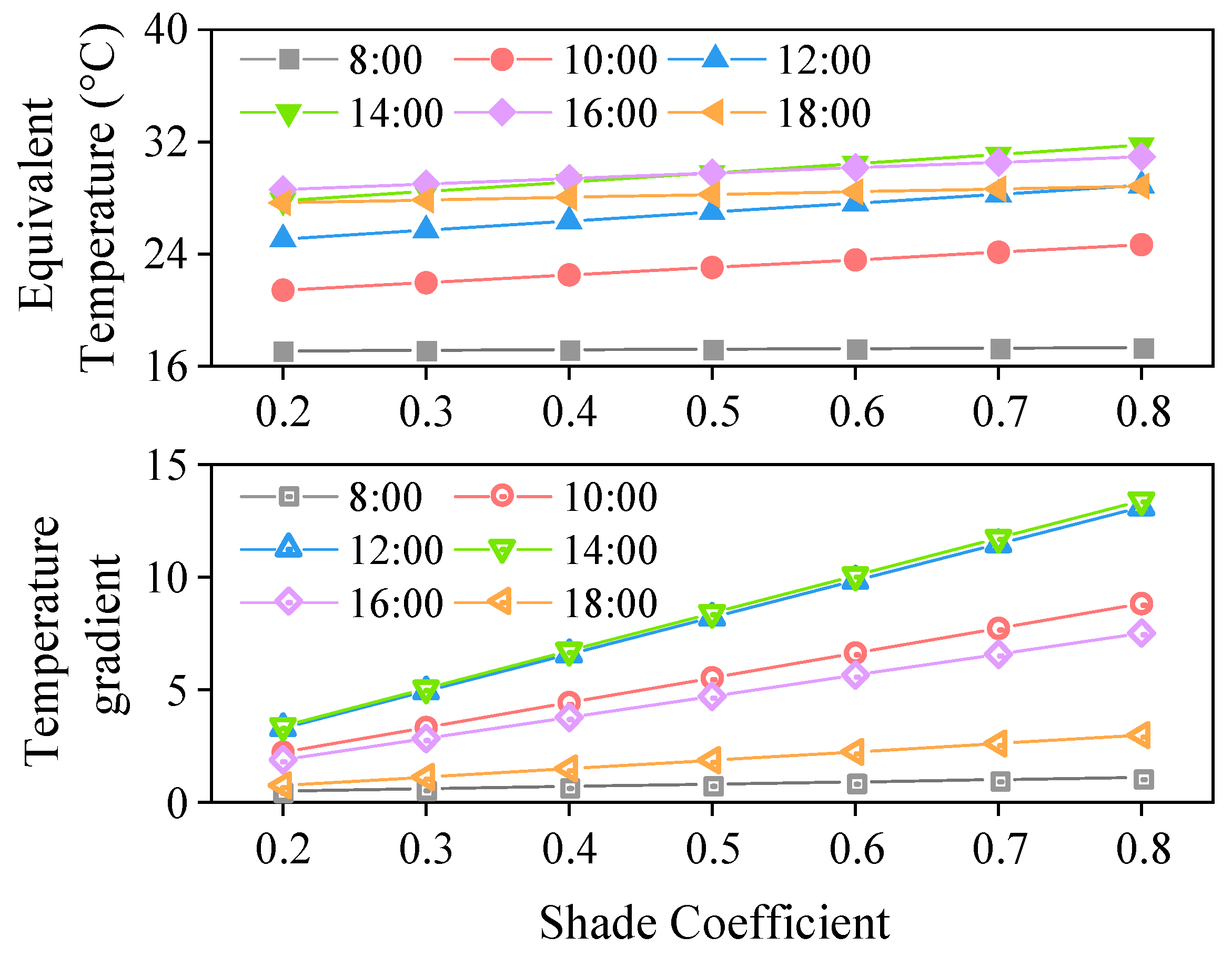
The shading coefficient μ represents the ratio of shaded area to total structural area. A higher shading coefficient indicates a larger proportion of shaded area, resulting in reduced direct solar radiation exposure. When no shading exists, μ = 0; when fully shaded, μ = 1.0; and, for partial shading, 0 < μ < 1.0. A reasonable shading coefficient is obtained by comparing the structural temperature load stress effects under different shading coefficients with measured values. The shading coefficient shows a linear relationship with overall temperature and temperature gradient (Figure 12). The curve slope at each time shows variations influenced by the solar azimuth angle.
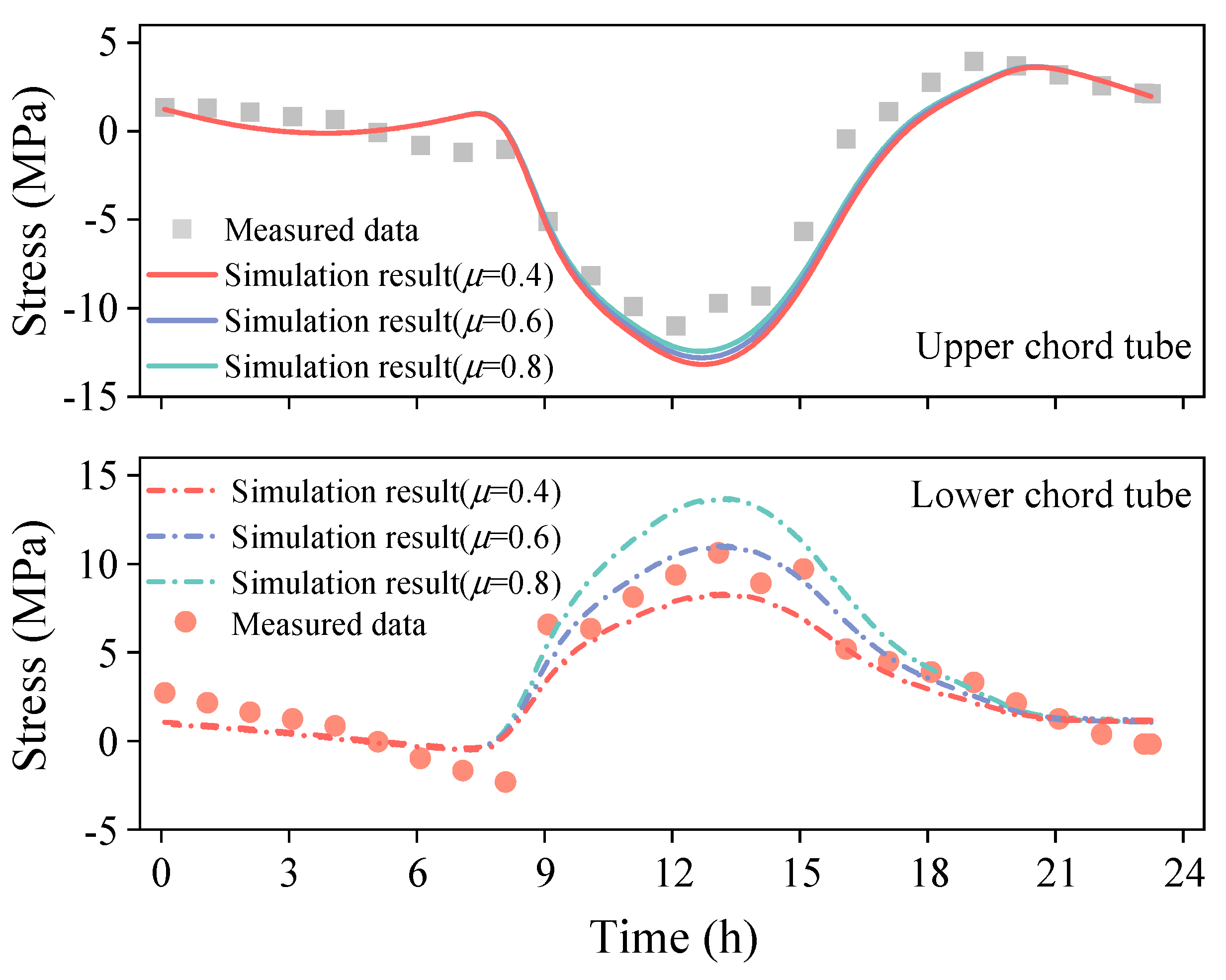
As the primary load-bearing member, the axial thermal expansion of the lower chord directly affects the overall geometry of the arch ribs. Realistic simulation ensures the accuracy of thermal deformation predictions for the arch ribs. By comparing results for different shading coefficients (μ = 0.2, 0.4, 0.6), the simulation results at μ = 0.4 most closely approximated the measured values (Figure 13). In the three specified operating conditions, μ = 0.4 is the optimal parameter, demonstrating the smallest errors in Mean Absolute Error (MAE), Root Mean Squared Error (RMSE), and Symmetric Mean Absolute Percentage Error (SMPE) between the simulation and measured values during daytime (Table 2). When accurate ray-tracing models are unavailable, the shadowing coefficient μ = 0.4 is recommended as the preferred choice for calculating the temperature of the lower chord tubes in similar truss arch bridges.

4.3. Thermal Stress Effects

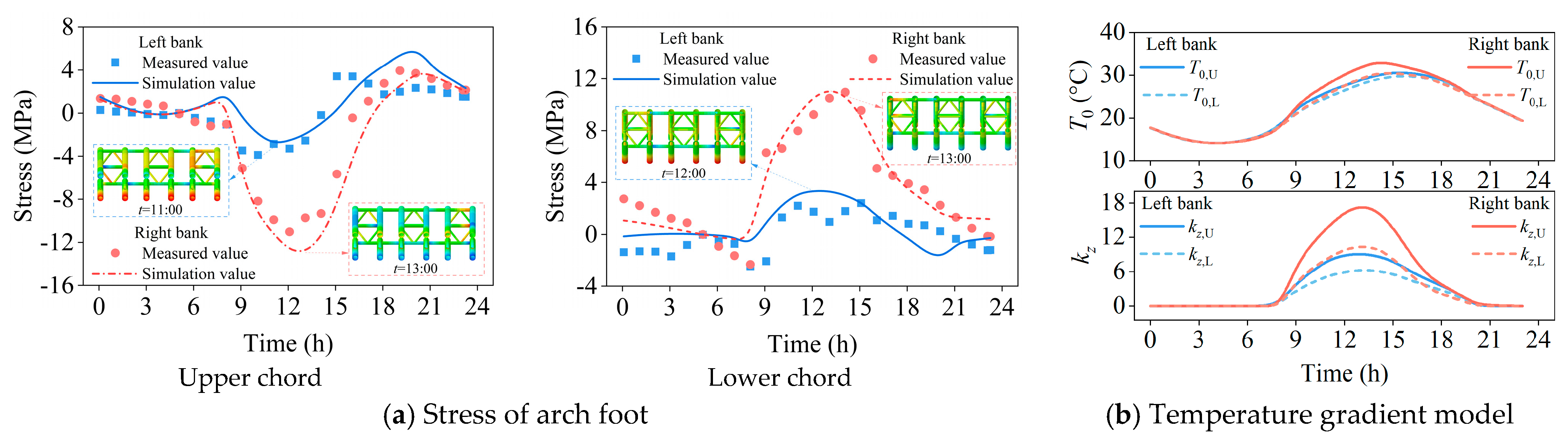
During the installation of left bank arch segment 6 and right bank arch segment 3, arch foot stresses are calculated using the equivalent temperature gradient (Figure 14a). The stress variations exhibit a clear correlation with the structural temperature. The simulation results demonstrate excellent consistency with measured trends, validating the effectiveness of the adopted temperature gradient model. Peak stresses at the arch feet on both sides exhibit a significant time lag of 1~2 h, indicating that the thermal effects on the structure are spatially non-synchronous. Significant differences exist in the peak stresses between the two banks, with the maximum difference reaching 9.16 MPa. Furthermore, the stay cables constrain the main arch and inhibit free thermal expansion, leading to greater tensile stress in the lower chord tubes on the right bank compared to those on the left; this is evidenced by the higher cross-sectional temperatures on the right bank (Figure 14b).

4.4. Thermal Deformation Effects

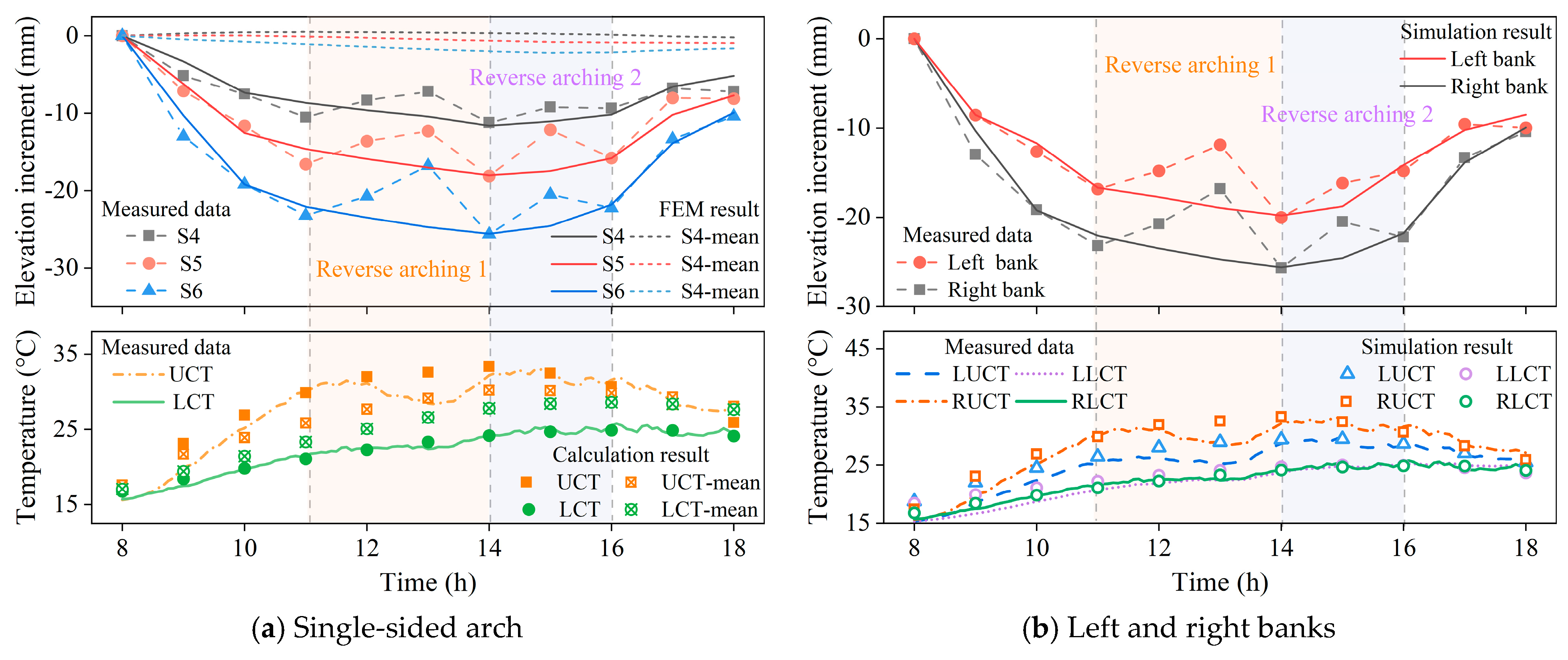
Figure 15a shows the measured elevation of the right bank arch rib referenced to the 8:00 AM data and temperature values. The elevation exhibits a significant negative correlation with the temperature. During the 11:00 to 16:00 PM period, the structure exhibited two instances of “reverse arching”, while the temperature of the arch ribs showed a pronounced downward trend throughout this timeframe. The “reverse arching” phenomenon is caused by weather conditions (cloudy weather) blocking the structure, leading to a rapid drop in the surface temperature of the arch ribs and consequently causing the elevation of control points to trend upward. Furthermore, the deflection trends of the arch rib segments are consistent, and the maximum values occur at the same time (14:00). The maximum deflections of arch segments 4 to 6 are 11.52 mm, 18.69 mm, and 25.85 mm, respectively, and the influence of solar radiation must be considered during tangential assembly of the arch ribs. The most elevation errors can be controlled within 3 mm, demonstrating that the temperature gradient model possesses reliable computational accuracy.
Some researchers consider the temperature gradient of the truss arch ribs as the temperature difference between the upper and lower chord tubes [39,40]. The temperature field across the cross-section is calculated as an average value, with a maximum average temperature difference of 2.6 °C between the upper and lower chord tubes (Figure 15a). The maximum deflections recorded at control points 4–6 of the arch segment are 0.48 mm, 0.78 mm, and 2.20 mm, respectively—significantly lower than the deflections at control points under gradient temperature conditions (11.52 mm, 18.69 mm, and 25.85 mm). However, considering only the average temperature weakens the impact of the vertical temperature gradient, thereby severely underestimating the thermal effects on the arch ribs. Therefore, the influence of temperature gradients across the cross-section must not be ignored during the installation of the arch ribs.
The elevation at the cantilever ends of both banks is consistent (Figure 15b), showing two prominent “reverse arching” phenomena. The main arches on both sides display temperature differences (5.36 °C), which results in greater elevation changes on the right bank compared to the left (6.27 mm). Sunlight significantly affects the elevation difference between the two banks. Sunlight significantly affects the elevation difference between the two banks, and the closure of the arch ribs must be scheduled before sunrise. The relative errors between simulated and measured elevation at the cantilever ends of the left and right banks are controlled within 11.55% and 10.29%, respectively, which validated the effectiveness of the temperature gradient model and provided a reliable basis for controlling the closure profile of the main arches on both banks.

5. Conclusions

A thermal conduction analysis framework is proposed to calculate the temperature field of the CFST truss arch and its effects. The proposed computational method is validated using monitored temperature effects data. The primary conclusions are drawn as follows:
(1)
The maximum temperature difference between the upper and lower chord tubes of the arch rib reached 14.53 °C, while the maximum longitudinal temperature difference along the rib arch was 3.79 °C. The calculated temperature field values for the chord tubes showed satisfactory agreement with the measured values. Furthermore, the proposed gradient temperature model accounts for the vertical temperature gradient within a single tube, accurately reflecting the temperature field characteristics of the chord tubes.
(2)
The stress at the arch foot exceeded the tolerance limit (±10 MPa) specified in specification JTG/T 3650-01-2022. During arch bridge monitoring, the impact of solar radiation temperature must be fully considered to prevent thermal secondary stress masking the true structural stress. When accurate ray-tracing models are unavailable, the shadowing coefficient μ = 0.4 is recommended as the preferred choice for calculating the temperature of the lower chord tubes in truss arch bridges of the same type.
(3)
The structural elevation exhibits a negative correlation with solar radiation temperature. The maximum deflection of the arch ribs (25.85 mm) occurs at 14:00. Additionally, the elevation of the arches on the left and right banks shows a significant difference (6.27 mm). The closure moment should be selected under conditions of minimal elevation difference.
Future research should deeply integrate artificial intelligence technologies to further enhance the intelligent analysis and control of solar radiation temperature effects on complex bridge structures. Combining long-term monitoring data with meteorological records, high-precision temperature field prediction models are established using machine learning or physical information neural networks to achieve dynamic temperature field forecasting that accounts for multidimensional environmental factors.

Author Contributions

Methodology, S.S.; Software, S.S.; Formal analysis, S.S.; Investigation, L.Z.; Data curation, S.S. and J.Q.; Writing—original draft preparation, S.S.; Writing—review and editing, S.S., J.Q. and L.Z.; Visualization, L.Z.; Supervision, J.Q.; Funding acquisition, J.Q. All authors have read and agreed to the published version of the manuscript.

Funding

This work was supported by the National Natural Science Foundation of China (Grant No. 52378283); Natural Science Foundation of Chongqing, China (Grant No. CSTB2023NSCQ-MSX0633); China Postdoctoral Science Foundation (Grant No. 2021M702782); Team Building Project for Graduate Tutors in Chongqing (Grant No. JDDSTD2022003).

Data Availability Statement

The data presented in this study are available in the article.

Conflicts of Interest

The authors declare no conflicts of interest.

References

  1. Wang, Z.M.; Zhang, N.; Wang, S.L. Geometry control of special-shaped arch pylon considering seasonal temperature changes during construction. Structures 2022, 36, 416–427. [Google Scholar] [CrossRef]
  2. Liu, Y.J.; Liu, J.; Zhang, N. Review on solar thermal actions of bridge structures. China Civ. Eng. J. 2019, 52, 59–78. [Google Scholar] [CrossRef]
  3. Liu, J.; Liu, Y.; Zhang, C.; Zhao, Q.; Lyu, Y.; Jiang, L. Temperature action and effect of concrete-filled steel tubular bridges: A review. J. Traffic Transp. Eng. (Engl. Ed.) 2020, 7, 174–191. [Google Scholar] [CrossRef]
  4. Hang, M.S.; Zhang, J.W.; Luo, J.; Wan, N.; Deng, Z.H.; He, Z.A. Construction and experimental verification of an efficient numerical model of one-dimensional temperature field for large-span cable-stayed bridge with steel-concrete composite girders. Eng. Mech. 2024, 41, 197–205. Available online: https://engineeringmechanics.cn/cn/article/doi/10.6052/j.issn.1000-4750.2023.07.S032 (accessed on 26 February 2026). (In Chinese)
  5. Fan, J.S.; Li, B.L.; Liu, C.; Liu, Y.-F. An efficient model for simulation of temperature field of Steel-concrete composite beam bridges. Structures 2022, 43, 1868–1880. [Google Scholar] [CrossRef]
  6. Zhu, Y.; Sun, D.Q.; Guo, H.; Shuang, M. Fine analysis for non-uniform temperature field and effect of railway truss suspension bridge under solar radiation. J. Constr. Steel Res. 2023, 210, 108098. [Google Scholar] [CrossRef]
  7. Xu, H.Y.; Zhao, S.J. Calculation of temperature field of main cable of suspension bridge. J. Railw. Eng. Soc. 2012, 29, 45–50. (In Chinese) [Google Scholar] [CrossRef]
  8. Zhang, W.; Zhang, L.L.; Zhong, N. Temperature field research based on main cable thermal parameters of suspension bridge. J. Chongqing Jiao Tong Univ. (Nat. Sci.) 2016, 35, 1–4. Available online: http://xbzk.cqjtu.edu.cn/CN/abstract/abstract3556.shtml (accessed on 26 February 2026). (In Chinese)
  9. Ma, H.; Zou, S.; Gao, Y.; Xia, Y.; Zhang, Y.; Xiao, J. Temperature field simulation method and average temperature prediction on main cables of suspension bridges. Eng. Struct. 2025, 345, 3059–3067. [Google Scholar] [CrossRef]
  10. Yan, Z.F.; Zhu, J. Steady-state thermal analysis of the ultimate gradient temperature distribution of steel bridges. Ind. Constr. 2023, 53, 386–389. (In Chinese) [Google Scholar]
  11. Fan, J.S.; Liu, Y.F.; Liu, C. Experiment study and refined modeling of temperature field of steel-concrete composite beam bridges. Eng. Struct. 2021, 240, 112350. [Google Scholar] [CrossRef]
  12. Li, Y.; He, S.; Liu, P. Effect of solar temperature field on a Sea-crossing Cable-stayed bridge tower. Adv. Struct. Eng. 2019, 22, 1867–1877. [Google Scholar] [CrossRef]
  13. Fu, M.Z.; Liang, Y.X.; Wu, B.T.; Zhang, L.; Tang, G. Research on deformation analysis and rehabilitation for a Beam–arch combination bridge suffering an extreme temperature field. Appl. Sci. 2022, 12, 6909. [Google Scholar] [CrossRef]
  14. Li, H.X.; Zhang, Z.G.; Deng, N.C. Temperature field and gradient effect of a Steel-concrete composite box girder bridge. Adv. Mater. Sci. Eng. 2021, 2021, 9901801. [Google Scholar] [CrossRef]
  15. Zhai, M.X.; Yang, H.Y.; Li, B.; Hao, J.; Zhou, W.; Cao, H.; Liu, Z. Temperature field and temperature effects for concrete box girder bridges based on monitoring data and numerical simulation. Sensors 2025, 25, 5036. [Google Scholar] [CrossRef]
  16. Zhou, L.R.; Xia, Y.; Brownjohn, J.M.W.; Koo, K.Y. Temperature analysis of a Long-span suspension bridge based on field monitoring and numerical simulation. J. Bridge Eng. 2016, 21, 04015027. [Google Scholar] [CrossRef]
  17. Gu, B.; Zhou, F.Y.; Gao, W.; Xie, F.Z.; Lei, L.H. Temperature gradient and its effect on Long-span prestressed concrete box girder bridge. Adv. Civ. Eng. 2020, 2020, 5956264. [Google Scholar] [CrossRef]
  18. Liu, Z.W.; Yao, M.; Wang, Q.Y.; Ren, Y. Research on the vertical temperature gradient model of Long-span concrete box arch without flange plate based on measured data. Coatings 2025, 15, 288. [Google Scholar] [CrossRef]
  19. Tian, Z.C.; Zhang, Z.J.; Wu, Z.Q.; Peng, W.; Xu, B. Experimental and numerical study of Three-dimensional temperature field in the arch ribs of the reinforced concrete ribbed arch bridge during construction. Adv. Struct. Eng. 2024, 27, 995–1015. [Google Scholar] [CrossRef]
  20. Shi, T.; Zheng, J.L.; Neng, N.C.; Chen, Z.; Guo, X.; Wang, S. Temperature load parameters and thermal effects of a Long-span Concrete-filled steel tube arch bridge in Tibet. Adv. Mater. Sci. Eng. 2020, 2020, 9710613. [Google Scholar] [CrossRef]
  21. Yan, X.K.; Liu, Y.J.; Liu, J.; Lyu, Y.; Wang, X.; Jia, J. Experimental and numerical investigation on vertical temperature gradient of Concrete-filled steel tubular arch under sunlight. Structures 2024, 70, 107550. [Google Scholar] [CrossRef]
  22. Zhou, Q.; Zhou, J.T.; Feng, P.C.; Xin, L.; Jing, S.; Zheng, G. Full-scale experimental study on temperature field of Large-diameter CFST arch bridges under strong radiation and large daily ambient temperature difference. J. Civ. Struct. Health Monit. 2022, 12, 1247–1263. [Google Scholar] [CrossRef]
  23. Bai, Y.X.; Liu, Y.J.; Liu, J.; Wang, Z.; Yan, X. Research on solar radiation-caused radial temperature difference and interface separation of CFST. Structures 2024, 62, 106151. [Google Scholar] [CrossRef]
  24. Zhang, H.S.; Zhao, Y.; Ruan, J.; Nie, X.; Fan, J.-S.; Liu, Y.-F. Experiment study on temperature field and effect on steel-concrete composite bridge towers. Structures 2023, 50, 937–953. [Google Scholar] [CrossRef]
  25. Liu, J.; Liu, Y.J.; Yan, X.; Zhang, G. Statistical investigation on the temperature actions of CFST truss based on long-term measurement. J. Bridge Eng. 2021, 26, 04021045. [Google Scholar] [CrossRef]
  26. Zhou, Q.; Feng, P.C.; Zhou, J.T.; Jing, S.; Zheng, G.; Zhou, W. Temperature field of concrete-filled steel tubular arch bridges and its application. Adv. Civ. Eng. 2022, 2022, 3609682. [Google Scholar] [CrossRef]
  27. Zhou, Q.; Wan, J.; Xin, J.Z.; Mao, J.-Q.; Zhou, J. Non-uniform temperature fields and debonding of a long-span CFST arch bridge under coupled environmental actions. Case Stud. Constr. Mater. 2025, 23, e05109. [Google Scholar] [CrossRef]
  28. Liu, X.F.; Wang, Z.X.; Bai, B.; Wang, T.; Tong, T.; Li, X. In-situ measurements of temperature and strain fields of large-diameter concrete-filled steel tube columns and the refined finite element modeling. Adv. Struct. Eng. 2024, 27, 637–653. [Google Scholar] [CrossRef]
  29. Wu, Y.X.; Wen, Q.; Dai, M.H.; Wang, X.; Li, X.; Tan, X. Mechanical response of long-span CFST arch bridges based on the hydration heat temperature effect. Sci. Rep. 2024, 14, 14648. [Google Scholar] [CrossRef]
  30. Yin, J.; Wang, X.; Wang, S.; Zhang, G.; Guo, T.; Xu, F. Fire performance study of through concrete-filled steel tubular arch bridges. Buildings 2025, 16, 173. [Google Scholar] [CrossRef]
  31. Wang, Y.; Khan, M.; Uy, B.; Lim, L.; Thai, H.-T.; Ngo, T. Behaviour, design and performance of steel-concrete composite walls in fire. J. Constr. Steel Res. 2025, 227, 109408. [Google Scholar] [CrossRef]
  32. Lou, G.B.; Tan, R.X.; Qi, H.; Rao, W.-T.; Huang, D.-F.; Zhao, X. Fire behaviour of fire-protected concrete-filled steel tubular columns. J. Constr. Steel Res. 2025, 226, 109326. [Google Scholar] [CrossRef]
  33. Zhao, J.; Zhu, J.; Lan, X.Y.; Li, Y. New generalized expression of convective heat transfer coefficients for flat steel box girders. Eng. Struct. 2026, 347, 121576. [Google Scholar] [CrossRef]
  34. Zhang, C.Y.; Liu, Y.J.; Liu, J.; Yuan, Z.; Zhang, G.; Ma, Z. Validation of long-term temperature simulations in a steel-concrete composite girder. Structures 2020, 27, 1962–1976. [Google Scholar] [CrossRef]
  35. JTG/T D65-06–2015; Specification for Design of Highway Concrete-Filled Steel Tubular Arch Bridges. Ministry of Transport of the People’s Republic of China: Beijing, China, 2015. (In Chinese)
  36. JTG/T 365-01–2022; Technical Specifications for Construction Monitoring and Control of Highway Bridges. Ministry of Transport of the People’s Republic of China: Beijing, China, 2022. (In Chinese)
  37. Sun, G.F. Theory and Application Study of Sunshine Temperature Effects on Long-Span Starch Bridge. Ph.D. Thesis, University of Shandong, Jinan, China, 2010. (In Chinese) [Google Scholar]
  38. Zhang, H.; Liu, D.Y.; Zhao, W.G.; Ding, S.; Liu, Y.; Yang, J.; Lu, W. Boundary condition and distribution study of temperature field of rail-cum-road steel truss girder. Railw. Sci. 2023, 44, 91–101. (In Chinese) [Google Scholar] [CrossRef]
  39. Wang, G.X.; Ding, Y.L.; Song, Y.S.; Wu, L.-Y.; Yue, Q.; Mao, G.-H. Detection and location of the degraded bearings based on monitoring the longitudinal expansion performance of the main girder of the Dashengguan Yangtze Bridge. J. Perform. Constr. Facil. 2016, 30, 04015074. [Google Scholar] [CrossRef]
  40. Han, N.; Zhao, W.; Zhang, B.; Zhang, H.; Zhou, L. Performance assessment of railway multispan steel truss bridge bearing by thermal excitation. J. Civ. Struct. Health Monit. 2022, 12, 163–178. [Google Scholar] [CrossRef]
Figure 1. Constructure of CFST truss arch bridge (mm).
Buildings 16 00969 g001
Figure 2. Physical entity of CFST truss arch bridge.
Buildings 16 00969 g002
Figure 3. Sensor layout and wireless data acquisition system.
Buildings 16 00969 g003
Figure 4. Calculation process of temperature gradient model and temperature effects.
Buildings 16 00969 g004
Figure 5. Temperature field of L/2 cross-section.
Buildings 16 00969 g005
Figure 6. Temperature of chord tube cross-sections on left and right banks.
Buildings 16 00969 g006
Figure 7. The temperature gradient model.
Buildings 16 00969 g007
Figure 8. Temperature gradient model of arch at left bank.
Buildings 16 00969 g008
Figure 9. Deformation mechanism of arch under temperature effects.
Buildings 16 00969 g009
Figure 10. Measured stress for the upper and lower chord tubes.
Buildings 16 00969 g010
Figure 11. 3D simulated mechanical model.
Buildings 16 00969 g011
Figure 12. Temperature gradient parameters.
Buildings 16 00969 g012
Figure 13. Thermal stress under different shading coefficients.
Buildings 16 00969 g013
Figure 14. Arch foot stress and temperature on left and right banks.
Buildings 16 00969 g014
Figure 15. Elevation and temperature at monitoring points.
Buildings 16 00969 g015
Table 1. Thermal Property.
PropertySteel
Density ρ/(kg/m3)7850.0
Thermal conductivity k/(W/m·°C)55.0
Specific heat c/(J/kg·°C)475.0
Absorptivity as0.5
Emissivity ε0.8
Table 2. Error evaluation indicators under different shading coefficients.
Error Indicatorsμ = 0.2μ = 0.4μ = 0.6
MAE1.0520.4990.647
RMSE1.4611.0271.173
SMAPE0.0840.0630.082
Disclaimer/Publisher’s Note: The statements, opinions and data contained in all publications are solely those of the individual author(s) and contributor(s) and not of MDPI and/or the editor(s). MDPI and/or the editor(s) disclaim responsibility for any injury to people or property resulting from any ideas, methods, instructions or products referred to in the content.