
Optimizing Slurry Seal Mixtures with Different Aggregate Types: Performance, Durability, and Component Interaction Analysis


Abstract
1. Introduction
1.1. Effects of Filler Materials in Slurry Seals
1.2. Effect of Bitumen Emulsion in Slurry Seals
1.3. Effects of Bitumen Emulsion–Aggregate Bond in Slurry Seals
1.4. Effects of Aggregate Chemical Composition on Slurry Seal Mix Design and Performance
1.5. Research Significance
2. Materials and Methods
2.1. Materials
2.1.1. Aggregate
2.1.2. Bitumen Emulsion
2.1.3. Water
2.1.4. Cement
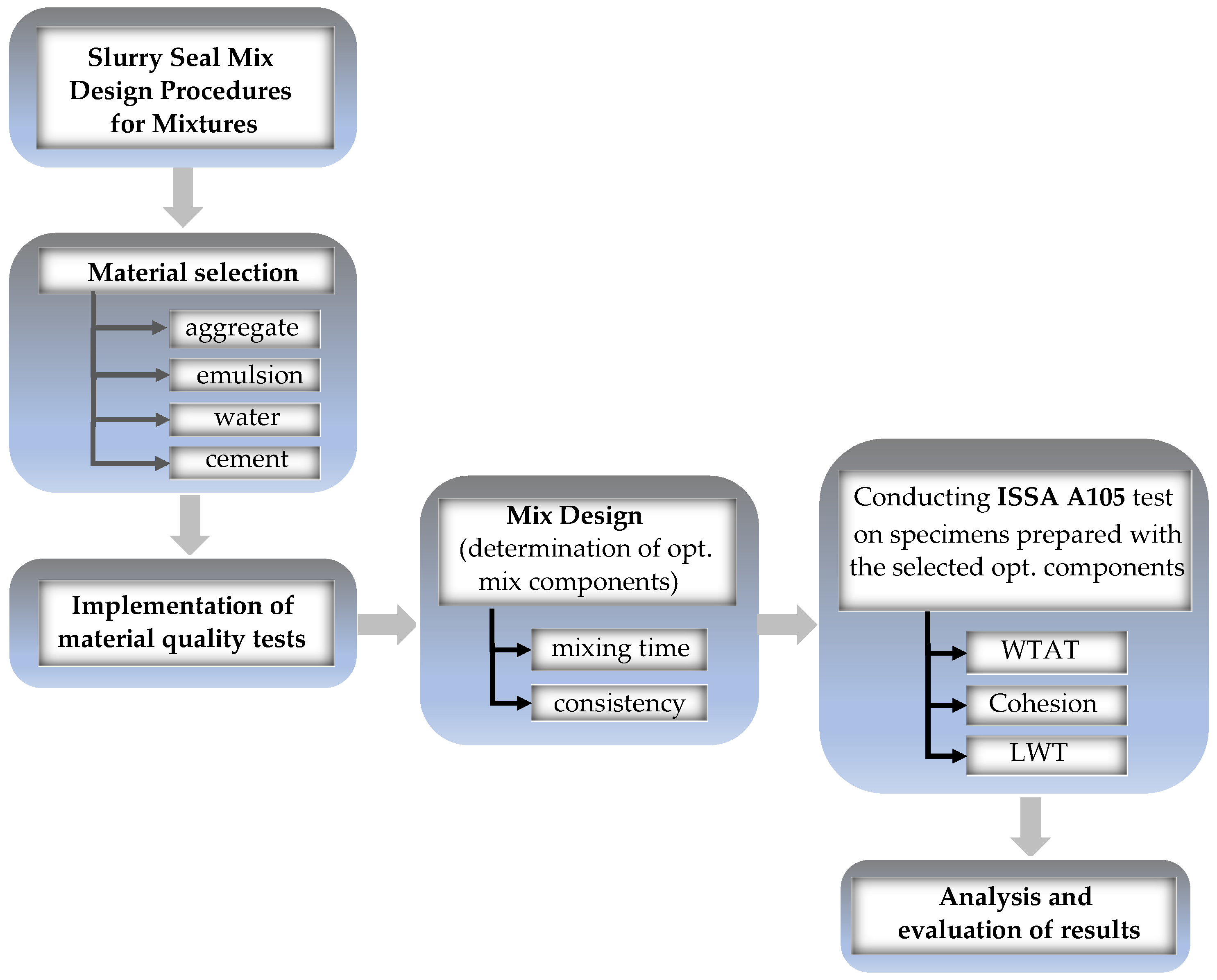
2.2. Slurry Seal Mix Design
3. Experimental Results
3.1. Determination of Material Content for Slurry Seal Mixtures (Mixing Time and Consistency)
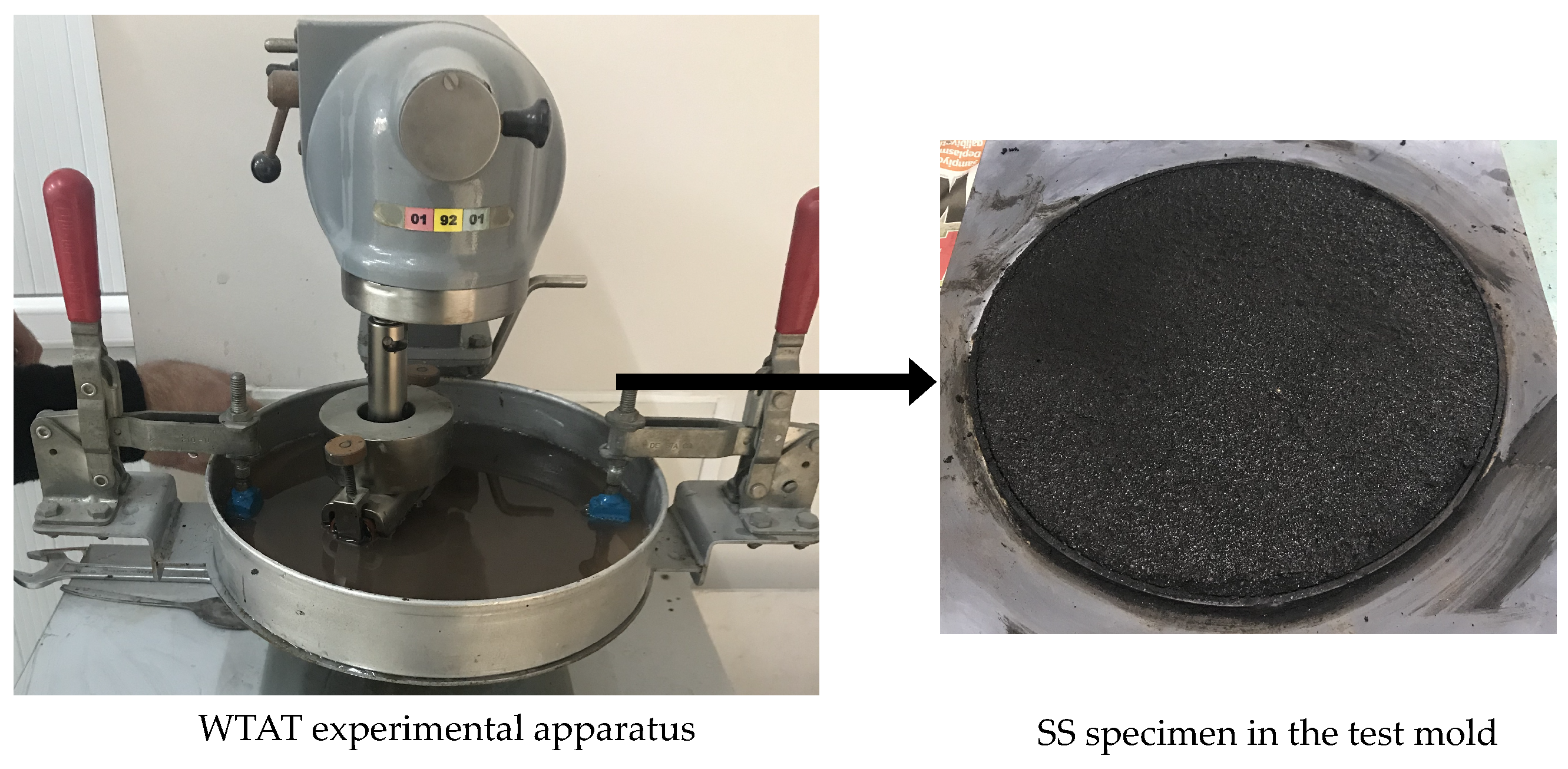
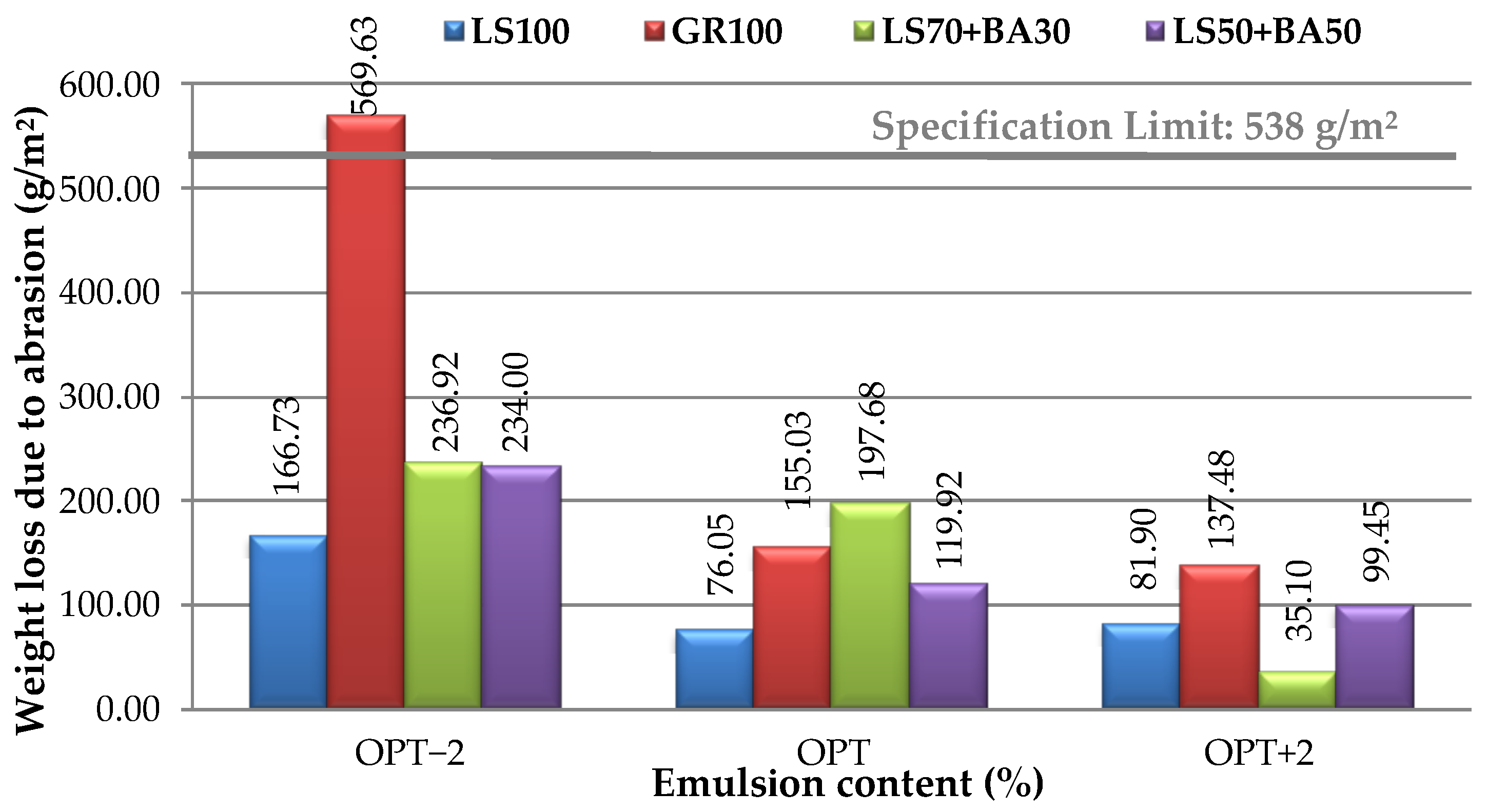
3.2. Wet Track Abrasion Test (WTAT)
3.3. Cohesion Test
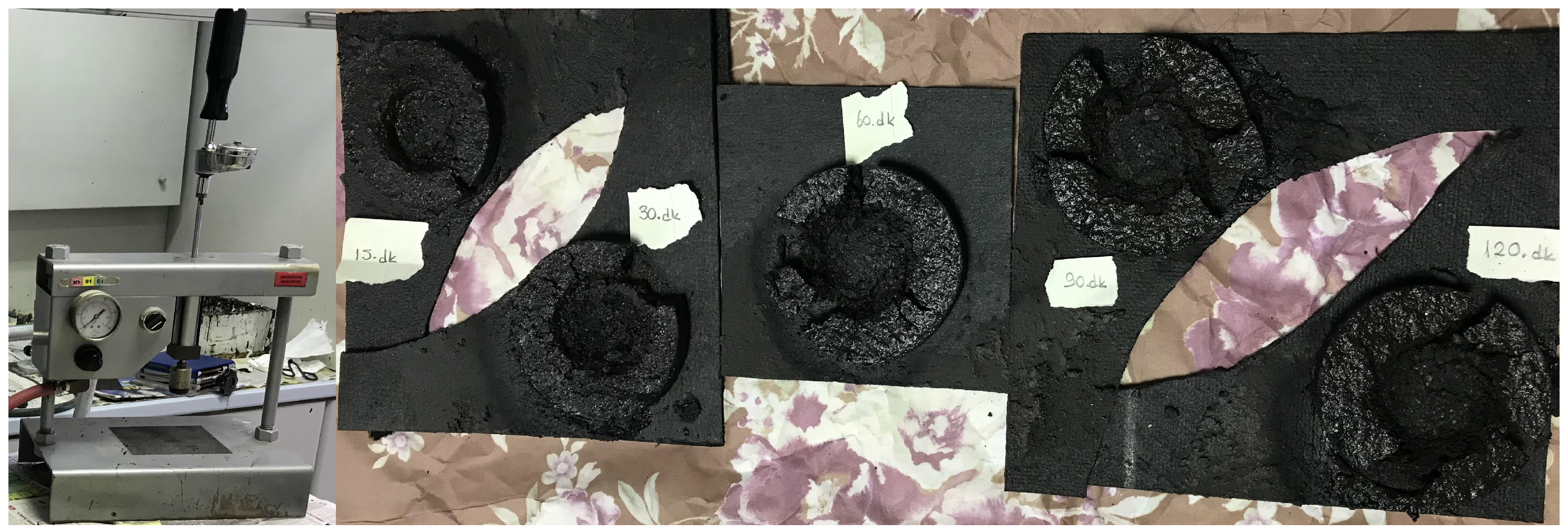
3.4. Loaded Wheel Test (LWT) (Sand Adhesion)
3.5. Determination of Optimum Bitumen Emulsion Content
4. Statistical Analysis
4.1. Analysis of Variance (ANOVA)
4.2. Pearson Correlation Coefficients
5. Conclusions
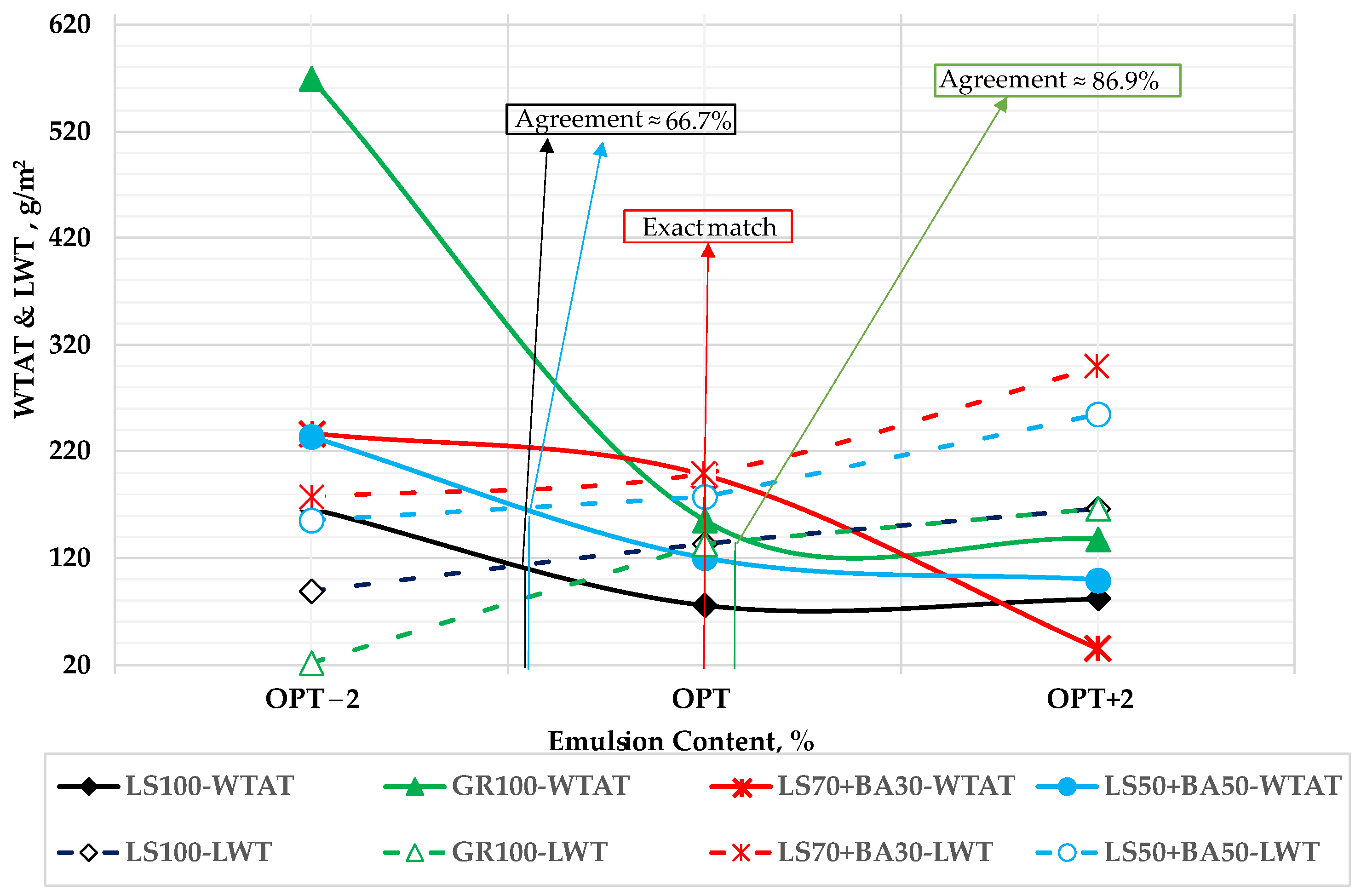
- The LS70+BA30 hybrid mixture reflected the synergistic effect of different aggregates and achieved a complete match between the theoretical design and experimentally determined optimum points. The high surface reactivity of basalt and the low surface reactivity of limestone provided an ideal balance between workability and early strength.
- WTAT tests revealed that pure granite mixtures exceeded specification limits and performed inadequately at low emulsion contents, whereas basalt-substituted mixtures maintained structural integrity across all emulsion ratios.
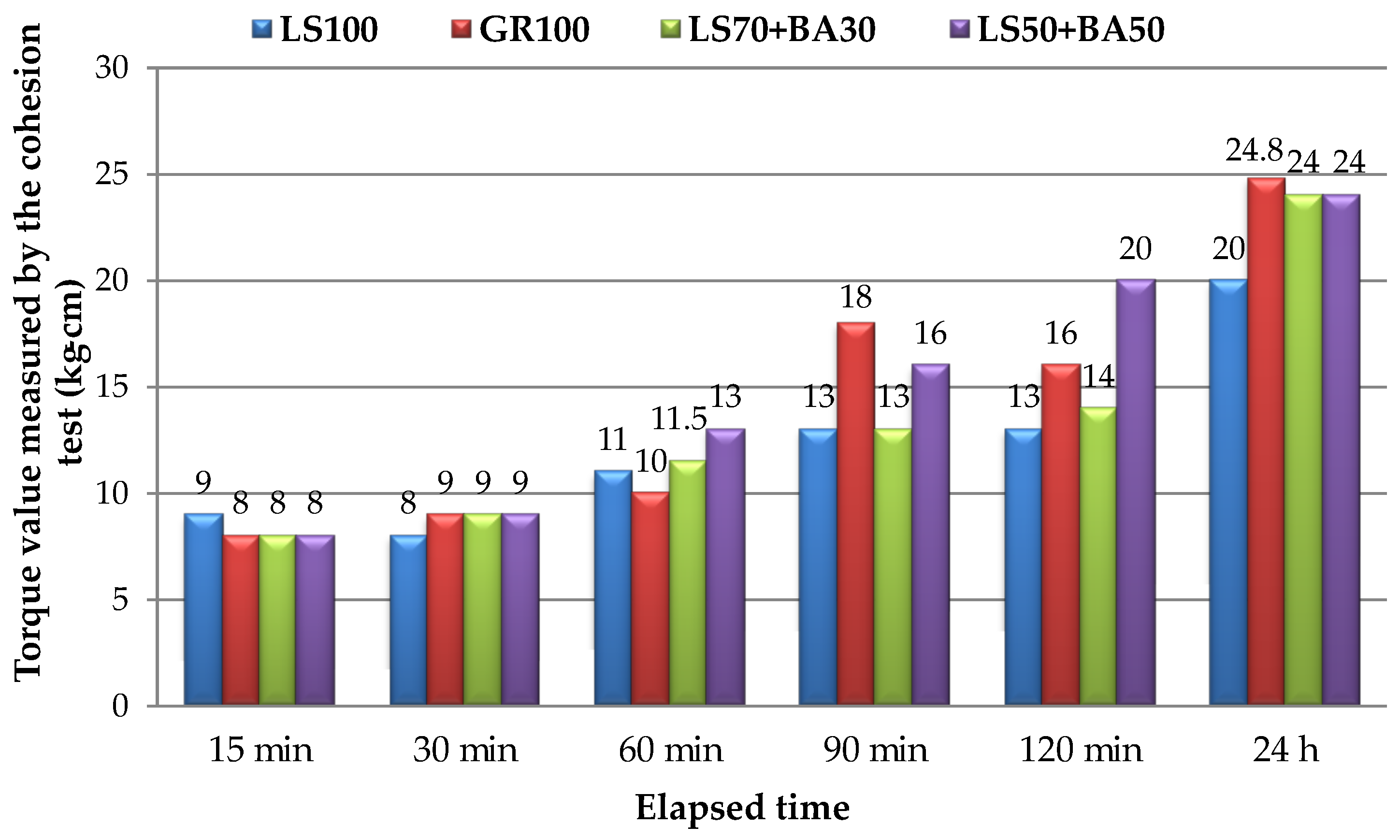
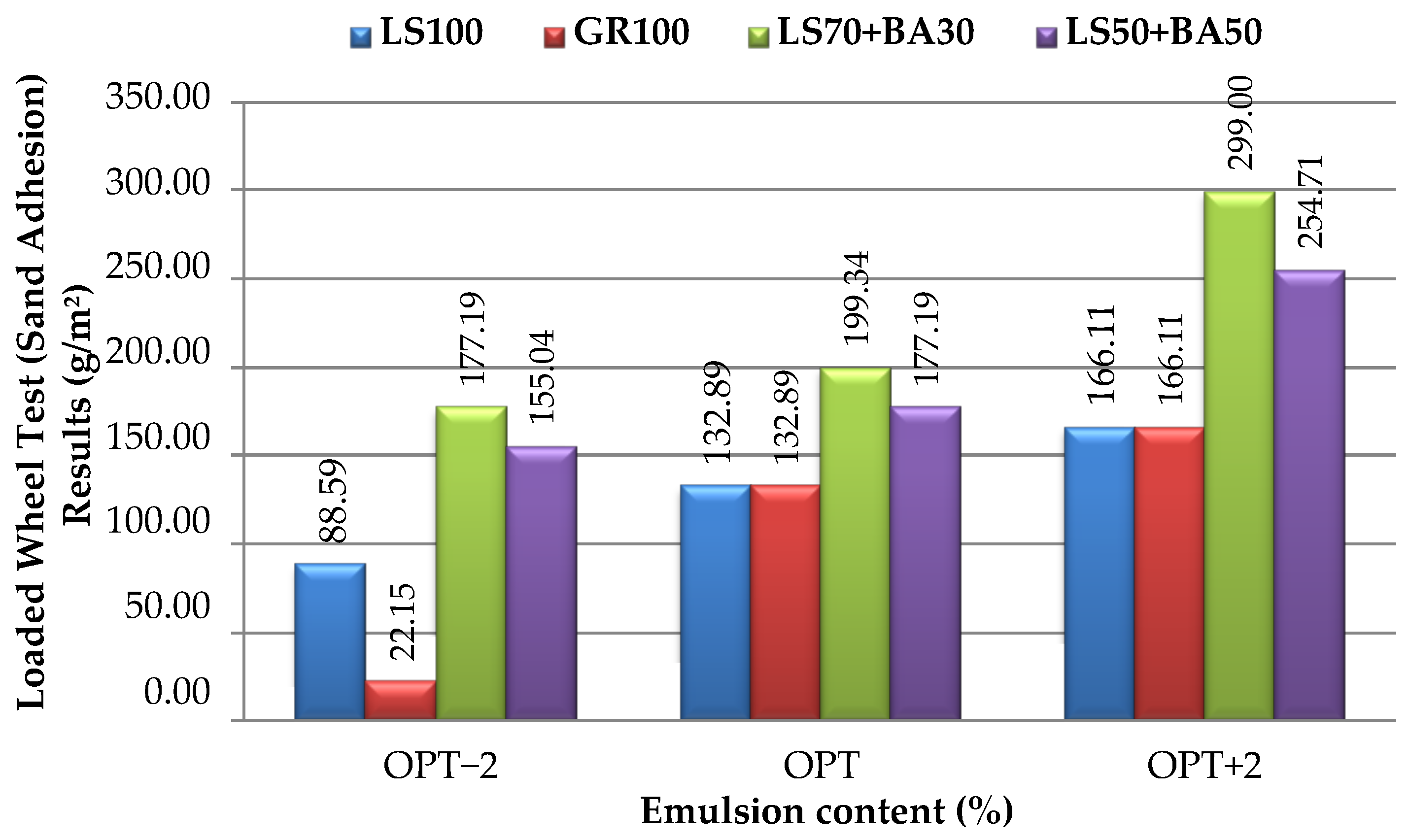
- According to the LWT results, the LS50+BA50 combination, which reached a torque value of 20 kg-cm at 120 min, was identified as the most suitable alternative for projects requiring rapid opening to traffic.
- ANOVA statistical analysis results demonstrated that aggregate origin was the primary factor influencing mixing time (), while water content was the dominant factor affecting consistency ().
- Correlation matrices indicated that mixtures containing limestone aggregates were more sensitive to variations in water content, whereas granite-based mixtures were more sensitive to changes in emulsion content. In basalt-containing hybrid mixtures, emulsion content governed mixing time, while water content controlled consistency.
Funding
Data Availability Statement
Acknowledgments
Conflicts of Interest
Abbreviations
| ISSA | International Slurry Surfacing Association |
| WTAT | Wet Track Abrasion Test |
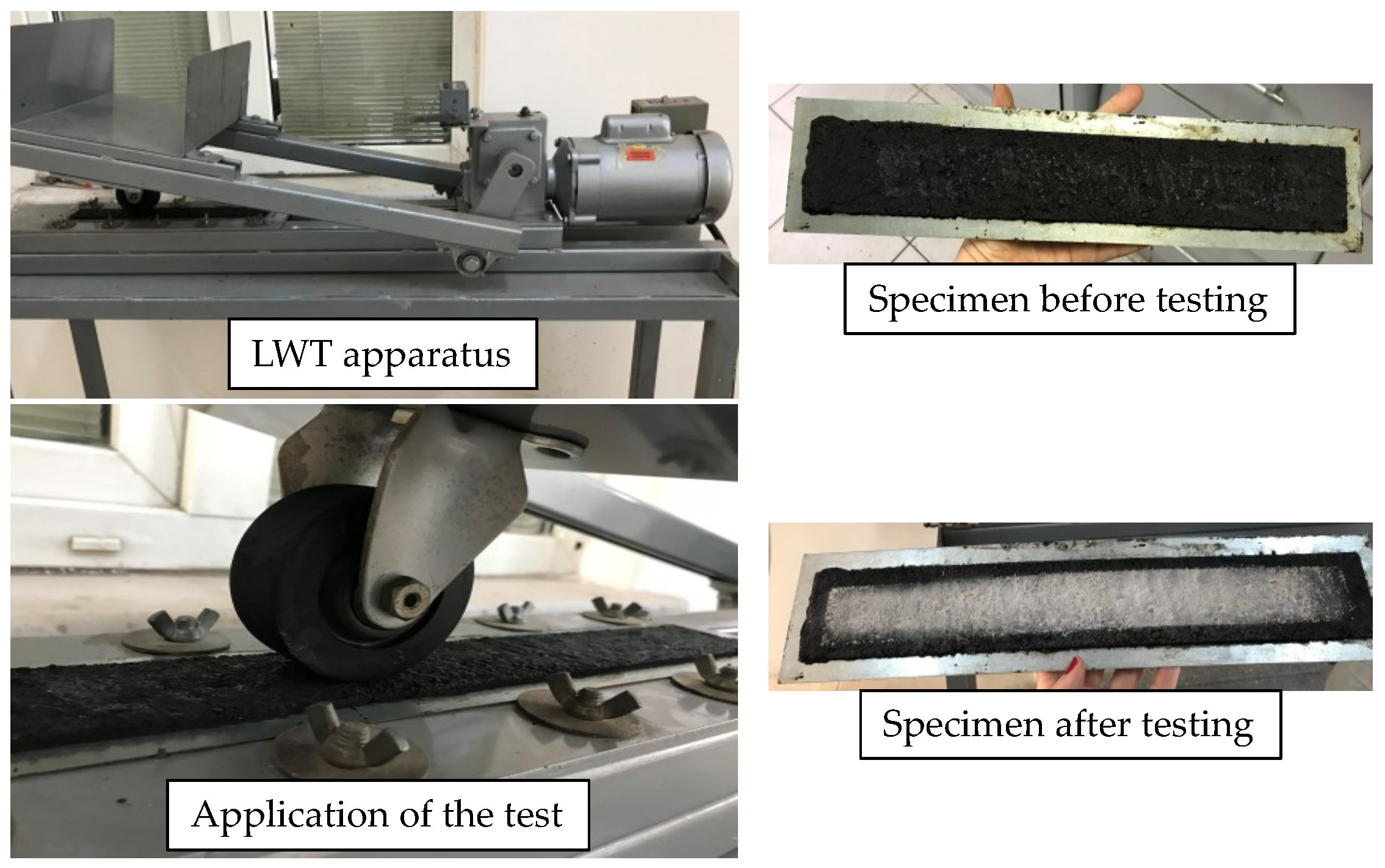
| LWT | Loaded Wheel Test |
| ANOVA | Analysis of Variance |
| ASTM | American Society for Testing and Materials |
| LS | Limestone |
| BA | Basalt |
| GR | Granite |
| OPT | Optimum Emulsion Content |
| SBR | Styrene-Butadiene Rubber |
| AL | Abrasion Loss |
| IW | Initial Weight |
| FW | Final Weight |
| GLM | General Linear Model |
References
- Dong, Q.; Chen, X.; Huang, B.; Gu, X. Analysis of the Influence of Materials and Construction Practices on Slurry Seal Performance Using LTPP Data. J. Transp. Eng. Part B Pavements 2018, 144, 04018046. [Google Scholar] [CrossRef] [Scilit]
- Pittenger, D.M.; Gransberg, D.D. Life cycle cost analysis of Portland cement slurry seal and microsurfacing to correct rutting. J. Struct. Integr. Maint. 2020, 5, 1–7. [Google Scholar] [CrossRef] [Scilit]
- Shabani, S.; Valizadeh, M.; Khavandi, A. Evaluation of the sensitivity of the rheology characteristics of bitumen and slurry seal modified with cellulose nanofiber solution. Constr. Build. Mater. 2024, 422, 135318. [Google Scholar] [CrossRef] [Scilit]
- Broughton, B.; Lee, S.J.; Kim, Y.J. 30 years of microsurfacing: A review. Int. Sch. Res. Not. 2012, 2012, 279643. [Google Scholar] [CrossRef] [Scilit]
- ISSA A-105; Recommended Performance Guideline For Emulsified Asphalt Slurry Seal. Technical Report A105; International Slurry Surfacing Association: Annapolis, MD, USA, 2023.
- Dong, Q.; Huang, B. Failure Probability of Resurfaced Preventive Maintenance Treatments: Investigation into Long-Term Pavement Performance Program. Transp. Res. Rec. 2015, 2481, 65–74. [Google Scholar] [CrossRef] [Scilit]
- Gerber, D. The effects of temperature and traffic on stone orientation of seals with different binders. Master’s Thesis, Stellenbosch University, Stellenbosch, South Africa, 2022. [Google Scholar]
- Zheng, N.; Bi, J.; Dong, S.; Lei, J.; He, Y.; Cui, Z.; Chen, L. Testing and evaluation for long-term skid resistance of asphalt pavement composite seal using texture characteristics. Constr. Build. Mater. 2022, 356, 129241. [Google Scholar] [CrossRef] [Scilit]
- Buss, A. Scientific Innovations in Microsurfacing and Slurry Seal Mixture Design; Technical Report 18-669, TR-755; Institute for Transportation, Iowa State University: Ames, IA, USA, 2019. [Google Scholar]
- Fan, Z.; Wang, C.; Li, Y.; Feng, L.; Chen, Q. State of the art review on fog seal for asphalt pavement: Material composition, classification, performance evaluation, and mechanism analysis. Prog. Org. Coatings 2024, 194, 108573. [Google Scholar] [CrossRef] [Scilit]
- Moura, C.F.N.; Oliveira, J.R.M.; Silva, H.M.R.D.; Palha, C.A.O.F.; Sangiorgi, C. Development and Application of a Microsurfacing Mix Design Method to Assess the Influence of the Emulsion Type. Appl. Sci. 2023, 13, 7925. [Google Scholar] [CrossRef] [Scilit]
- Robati, M.; Carter, A.; Perraton, D. Evaluation of a modification of current microsurfacing mix design procedures. Can. J. Civ. Eng. 2015, 42, 319–328. [Google Scholar] [CrossRef] [Scilit]
- Algburi, K.T.K.; Hesami, S. Optimizing slurry seal asphalt with basalt: An analysis of performance and durability. Innov. Infrastruct. Solut. 2025, 10, 23. [Google Scholar] [CrossRef] [Scilit]
- Wang, H.; Al-Qadi, I.L.; Faheem, A.F.; Bahia, H.U.; Yang, S.H.; Reinke, G.H. Effect of mineral filler characteristics on asphalt mastic and mixture rutting potential. Transp. Res. Rec. 2011, 2208, 33–39. [Google Scholar] [CrossRef] [Scilit]
- Chen, J.S.; Kuo, P.H.; Lin, P.S.; Huang, C.C.; Lin, K.Y. Experimental and theoretical characterization of the engineering behavior of bitumen mixed with mineral filler. Mater. Struct. 2008, 41, 1015–1024. [Google Scholar] [CrossRef] [Scilit]
- Zeng, M.; Wu, C. Effects of Type and Content of Mineral Filler on Viscosity of Asphalt Mastic and Mixing and Compaction Temperatures of Asphalt Mixture. Transp. Res. Rec. 2008, 2051, 31–40. [Google Scholar] [CrossRef] [Scilit]
- Keymanesh, M.R.; Ziari, H.; Zalnezhad, H.; Zalnezhad, M. Mix design and performance evaluation of microsurfacing containing electric arc furnace (EAF) steel slag filler. Constr. Build. Mater. 2021, 269, 121336. [Google Scholar] [CrossRef] [Scilit]
- Mohammadi, M.M.; Asadi Azadgoleh, M.; Ghodrati, A.; Zalnezhad, M.; Ayar, P.; Fini, E. Introducing waste glass powder as a sustainable constituent in microsurfacing. Constr. Build. Mater. 2023, 395, 132271. [Google Scholar] [CrossRef] [Scilit]
- Jalalian Khoshnood, A.; Kamboozia, N.; Ziari, H.; Zalnezhad, M. Evaluation of performance characteristics of polymer-modified slurry seal (PMSS) by replacing filler with ceramic waste powder. Road Mater. Pavement Des. 2023, 24, 2174–2191. [Google Scholar] [CrossRef] [Scilit]
- Bhargava, N.; Siddagangaiah, A.K.; Ryntathiang, T.L. Effect of cement and fly ash dosages on the characteristics and performance of microsurfacing mix. J. Mater. Civ. Eng. 2022, 34, 04021441. [Google Scholar] [CrossRef] [Scilit]
- Chen, X.; Li, Q.; Sesay, T.; You, Q.; Chineche, E.B. Valorization of recycled wastes in pavement preventive maintenance: A review on reclaimed asphalt pavement and recycled waste tire. Heliyon 2024, 10, e27776. [Google Scholar] [CrossRef] [Scilit]
- Saghafi, M.; Tabatabaee, N.; Nazarian, S. Performance evaluation of slurry seals containing reclaimed asphalt pavement. Transp. Res. Rec. 2019, 2673, 358–368. [Google Scholar] [CrossRef] [Scilit]
- Husain, S.F.; Qamhia, I.I.A.; Vyas, A.; Maia, R.S.; Tutumluer, E.; Hajj, R. Emulsion Mixtures of Fractionated Reclaimed Asphalt Pavement and Quarry By-Products: A Laboratory Evaluation. Sustainability 2023, 15, 10735. [Google Scholar] [CrossRef] [Scilit]
- Ahadi, M.R.; Saeed, D.; Hamid, J.P. Effect of Filler and Bitumen Emulsion Type on Set Time and Cure Time of Slurry Seal. In Proceedings of the 5th Eurasphalt & Eurobitume Congress, Istanbul, Turkey, 13–15 June 2012. [Google Scholar]
- Oikonomou, N.; Eskioglou, P. Alternative fillers for use in slurry seal. Glob. NEST J. 2007, 9, 182–186. [Google Scholar]
- Ghodrati, A.; Asadi Azadgoleh, M.; Zalnezhad, M.; Mohammadi, M.M.; Ayar, P.; Vahidi, E. Performance improvement of slurry seal by glass powder: Mechanical evaluation and life cycle assessment. Road Mater. Pavement Des. 2025, 26, 2513–2535. [Google Scholar] [CrossRef] [Scilit]
- Fooladi, A.; Hesami, S. Experimental Investigation of the Effect of Types of Fillers on the Performance of Microsurfacing Asphalt Mixture. J. Mater. Civ. Eng. 2021, 33, 04021139. [Google Scholar] [CrossRef] [Scilit]
- Gransberg, D.D. Synthesis of Highway Practice; Technical Report; Highway Research Board, Division of Engineering, National Research Council, National Academy of Engineering, National Academy of Sciences: Washington, DC, USA, 1969. [Google Scholar]
- You, L.; You, Z.; Dai, Q.; Xie, X.; Washko, S.; Gao, J. Investigation of adhesion and interface bond strength for pavements underlying chip-seal: Effect of asphalt-aggregate combinations and freeze-thaw cycles on chip-seal. Constr. Build. Mater. 2019, 203, 322–330. [Google Scholar] [CrossRef] [Scilit]
- Mercado, R.A.; Salager, J.L.; Sadtler, V.; Marchal, P.; Choplin, L. Breaking of a cationic amine oil-in-water emulsion by pH increasing: Rheological monitoring to modelize asphalt emulsion rupture. Colloids Surfaces A Physicochem. Eng. Asp. 2014, 458, 63–68. [Google Scholar] [CrossRef] [Scilit]
- Zalnezhad, M.; Hesami, E. Effect of steel slag aggregate and bitumen emulsion types on the performance of microsurfacing mixture. J. Traffic Transp. Eng. Engl. Ed. 2020, 7, 215–226. [Google Scholar] [CrossRef] [Scilit]
- ISSA A143; Recommended Performance Guidelines for Micro-Surfacing. Revised 2010; International Slurry Surfacing Association: Annapolis, MD, USA, 2010.
- ASTM D6372-15; Standard Practice for Design, Testing, and Construction of Micro-Surfacing. ASTM International: West Conshohocken, PA, USA, 2015.
- Hu, C.; Zhao, J.; Leng, Z.; Partl, M.N.; Li, R. Laboratory evaluation of waterborne epoxy bitumen emulsion for pavement preventative maintenance application. Constr. Build. Mater. 2019, 197, 220–227. [Google Scholar] [CrossRef] [Scilit]
- Roberts, F.L.; Kandhal, P.S.; Brown, E.R.; Lee, D.Y.; Kennedy, T.W. Hot Mix Asphalt Materials, Mixture Design, and Construction, 3rd ed.; NAPA Research and Education Foundation: Greenbelt, MD, USA, 2009. [Google Scholar]
- Johannes, P.T. Development of an Improved Mixture Design Framework for Slurry Seals and Micro-Surfacing Treatments. Master’s Thesis, University of Wisconsin–Madison, Madison, WI, USA, 2014. [Google Scholar]
- Liu, K.; Yang, Q.; Qiu, X.; Xu, W.; Xiao, S.; Gu, Y.; Ye, Y. An investigation toward adhesion characteristics of emulsified asphalt residue–aggregate interface through MD simulation. Constr. Build. Mater. 2024, 438, 137251. [Google Scholar] [CrossRef] [Scilit]
- Qiu, X.; Xiao, S.; Yang, Q.; Wang, Y.; Wang, F. Meso-scale analysis on shear failure characteristics of asphalt–aggregate interface. Mater. Struct. 2017, 50, 209. [Google Scholar] [CrossRef] [Scilit]
- Zhang, Y.; Gu, F.; Birgisson, B.; Lytton, R.L. Modelling cracking damage of asphalt mixtures under compressive monotonic and repeated loads using pseudo J-integral Paris’ law. Road Mater. Pavement Des. 2018, 19, 525–535. [Google Scholar] [CrossRef] [Scilit]
- Bhasin, A.; Little, D.N. Application of Microcalorimeter to Characterize Adhesion between Asphalt Binders and Aggregates. J. Mater. Civ. Eng. 2009, 21, 235–243. [Google Scholar] [CrossRef] [Scilit]
- Esfahani, M.A.; Khatayi, A. Effect of type and quantity of emulsifier in bitumen polymer emulsion on microsurfacing performance. Int. J. Pavement Eng. 2022, 23, 957–971. [Google Scholar] [CrossRef] [Scilit]
- Yin, H.; Cao, S.; Guo, F.; Wu, X. Adhesion Properties Between Rubber Asphalt Mastic and Aggregate: Verification from Surface Free Energy Theory and Molecular Dynamics. Materials 2025, 18, 3115. [Google Scholar] [CrossRef] [Scilit]
- Baran, S.; Sukhija, M.; Coleri, E. Assessment of aggregate-binder adhesion through field-applicable modified sweep, Vialit, and pull-off tests. Constr. Build. Mater. 2025, 490, 142495. [Google Scholar] [CrossRef] [Scilit]
- Petersen, J.C. Chemical Composition of Asphalt as Related to Asphalt Durability: State of the Art. Transp. Res. Rec. 1984, 999, 13–30. [Google Scholar]
- Tan, W.; Zhu, S.; Kong, L.; Peng, Y.; Xu, L.; Fu, Y. Influence of aggregate chemical composition on the demulsification rate of emulsified asphalt. Front. Mater. 2022, 9, 1079431. [Google Scholar] [CrossRef] [Scilit]
- Li, L.; Guo, M.; Zeng, C. Influence of the Chemical Composition of Asphalt and the 3D Morphology of the Aggregate on Contact Surface Adhesion. Adv. Civ. Eng. 2021, 2021, 8870295. [Google Scholar] [CrossRef] [Scilit]
- Yılmaz, A. Engineering properties of basalt aggregates in terms of use in granular layers of flexible pavements. Case Stud. Constr. Mater. 2022, 17, e01182. [Google Scholar] [CrossRef] [Scilit]
- Zhu, S.; Kong, L.; Peng, Y.; Zeng, Q.; Yan, Q.; Zhu, H.; Wang, D.; Li, Z.; Yang, B. Optimization of emulsified asphalt/aggregate interfacial adhesion driven by asphalt aromatic carbon ratio: Acid-base collaboration mechanism. Energy 2025, 332, 137153. [Google Scholar] [CrossRef] [Scilit]
- Jiang, H.; Zhu, C.; Yao, K.; Jia, F.; Zhang, Y.; Guo, C.; Tian, J.; Sun, Q.; Zhang, Y. Interfacial adhesion mechanism between asphalt and aggregate with different lithology in acid–alkaline aqueous solutions. Can. J. Civ. Eng. 2025, 52, 1658–1669. [Google Scholar] [CrossRef] [Scilit]
- Dalla, M. Complexity of Geological Rocks: A Comprehensive Overview. J. Geol. Geophys. 2024, 13, 1176. Available online: https://www.longdom.org/open-access/complexity-of-geological-rocks-a-comprehensive-overview-108526.html (accessed on 19 February 2026).
- Tang, F.; Zhu, S.; Xu, G.; Ma, T. Study on the Effect of Demulsification Speed of Emulsified Asphalt Based on Surface Characteristics of Aggregates. Materials 2018, 11, 1488. [Google Scholar] [CrossRef] [Scilit]
- Nomlala, B.; Mthembu, Z.; Mturi, G.; Hefer, A. Bitumen-aggregate adhesion: A predictive study based on zeta potential analysis using the streaming potential technique. In Proceedings of the 40th Southern African Transport Conference, Pretoria, South Africa, 4–8 July 2022. [Google Scholar]
- Zhang, H.; Li, H.; Guo, F.; Wang, S.; Yue, J. Research on the Adhesion Performance of Fast-Melting SBS-Modified Emulsified Asphalt–Aggregate Based on the Surface Free Energy Theory. Materials 2025, 18, 3523. [Google Scholar] [CrossRef] [Scilit]
- Ziari, H.; Zalnezhad, M.; Ziari, M. Effect of using steel slag aggregate in slurry seal mixtures containing iron oxide pigments. Modares Civ. Eng. J. 2025, 23, 115. [Google Scholar] [CrossRef]
- Tang, F.; Zhu, S.; Xu, G.; Ma, T. Influence by chemical constitution of aggregates on demulsification speed of emulsified asphalt based on UV-spectral analysis. Constr. Build. Mater. 2019, 212, 102–108. [Google Scholar] [CrossRef] [Scilit]
- General Directorate of Highways. Technical Specifications for Highways. In Technical Specification, Ministry of Transport and Infrastructure; General Directorate of Highways (KGM): Ankara, Turkey, 2013. (In Turkish) [Google Scholar]
- TS EN 933-9+A1; Tests for Geometrical Properties of Aggregates—Part 9: Assessment of Fines—Methylene Blue Test. Turkish Standard; Turkish Standards Institution (TSE): Ankara, Turkey, 2013.
- ASTM D3910-24; Standard Practices for Design, Testing, and Construction of Slurry Seal. ASTM International: West Conshohocken, PA, USA, 2024.
- ISSA TB 113; Test Method for Determining Mix Time for Slurry Seal and Micro-Surfacing Systems. Revised 2010; International Slurry Surfacing Association: Annapolis, MD, USA, 2010.
- ISSA TB 106; Test Method for Measurement of Slurry Seal Consistency. Revised 2010; International Slurry Surfacing Association: Annapolis, MD, USA, 2010.
- Kumar, R.; Ryntathiang, T.L. New Laboratory Mix Methodology of Microsurfacing and Mix Design. Transp. Res. Procedia 2016, 17, 488–497. [Google Scholar] [CrossRef] [Scilit]
- ISSA TB 100; Test Method for Wet Track Abrasion of Slurry Surfacing Systems. Revised 2010; International Slurry Surfacing Association: Annapolis, MD, USA, 2010.
- BS EN 12274-4:2018; Slurry Surfacing. Test Methods. Determination of Cohesion of the Mix. British Standard; European Standard; British Standards Institution: London, UK, 2018.
- ISSA TB-109; Test Method for Measurement of Excess Asphalt in Bituminous Mixtures by Use of a Loaded Wheel Tester and Sand Adhesion. Technical Bulletin 109; International Slurry Surfacing Association (ISSA): Annapolis, MD, USA, 2010.
- Xu, W.; Luo, R. Evaluation of interaction between emulsified asphalt and mineral powder using rheology. Constr. Build. Mater. 2022, 318, 125990. [Google Scholar] [CrossRef] [Scilit]



| Material | Advantages | Disadvantages |
|---|---|---|
| EAF steel slag [17] | Curing and mix performance | Limited use, high binder demand & logistics |
| Waste glass powder [18] | Abrasion, stripping & rut resistance | Limited use & workability issues |
| Ceramic waste powder [19] | Cohesion, abrasion & stability | Inhomogeneity, rapid stiffening & limited use |
| Reclaimed Asphalt [21,22,23] | Abrasion & friction performance & cost reduction | Extended curing & additional compaction |
| Fly ash [20] | Synergistic performance with cement | Poor emulsion compatibility & bonding loss |
| Recycled tires [21] | Rut, fatigue & noise resistance | Binder demand & stability issues |
| Fiber [3] | Cracking resistance | Moisture sensitivity |
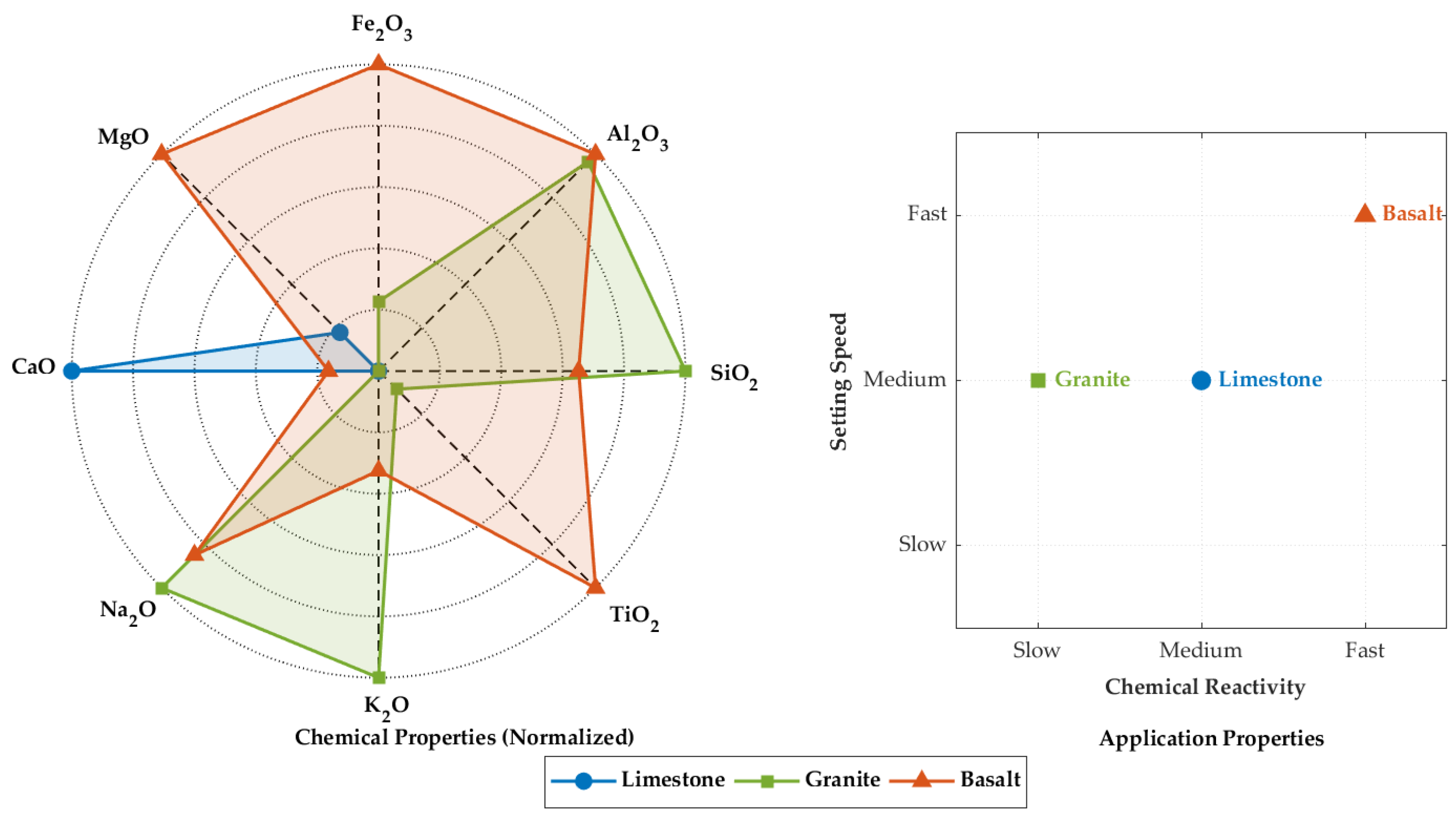
| Aggregate Property | Limestone | Granite | Basalt |
|---|---|---|---|
| Origin [50] | Sedimentary | Magmatic (Int.) | Magmatic (Ext.) |
| Chemical Character [44,45,46] | Basic | Acidic | Neutral |
| Particle Shape [46,51] | Sub-angular | Angular | Highly angular |
| Roughness [13,46,52] | Low | Medium | High |
| Porosity [46,49] | Micro | Low | Micro-Macro |
| Surface Reactivity [13,23] | Low | Low | High |
| Surface Charge [44,45] | (+)/Weakly (−) | (−) (Inert) | pH-dependent |
| Source of Surface Charge [44,45] | , , | ||
| Cationic Emulsion Interaction [31] | Slow-controlled | Slow-weak | Fast-strong |
| Breaking Speed [13] | Slow | Slow | Fast |
| Effect on Workability [49] | Increases | Neutral | Decreases |
| Adhesion [52] | Medium | Medium | High |
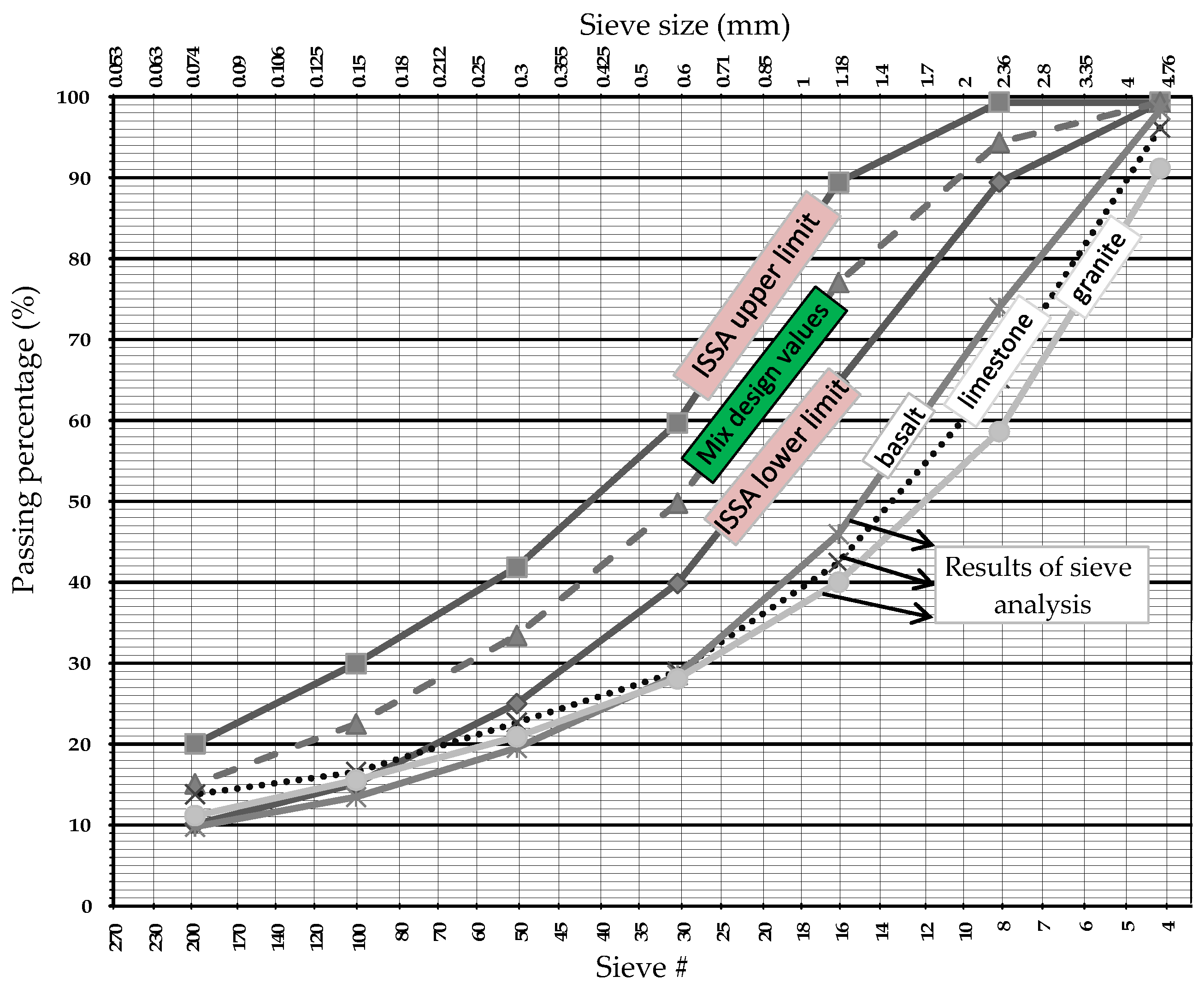
| Sieve Size (mm) | Aggregate Sieve Analysis Results (% Passing) | Grading Range (% Passing) for Type I mix | Avg. Values in Mixtures | ||
|---|---|---|---|---|---|
| Limestone | Granite | Basalt | |||
| 4.75 (No. 4) | 96.8 | 91.7 | 99.0 | 100 | 100 |
| 2.36 (No. 8) | 65.6 | 58.9 | 74.4 | 90–100 | 95 |
| 1.18 (No. 16) | 42.6 | 40.2 | 46.1 | 65–90 | 77.5 |
| 0.600 (No. 30) | 29.0 | 28.1 | 28.5 | 40–60 | 50 |
| 0.300 (No. 50) | 22.7 | 20.9 | 19.5 | 25–42 | 33.5 |
| 0.150 (No. 100) | 16.5 | 15.5 | 13.4 | 15–30 | 22.5 |
| 0.075 (No. 200) | 13.7 | 11.1 | 9.7 | 10–20 | 15 |
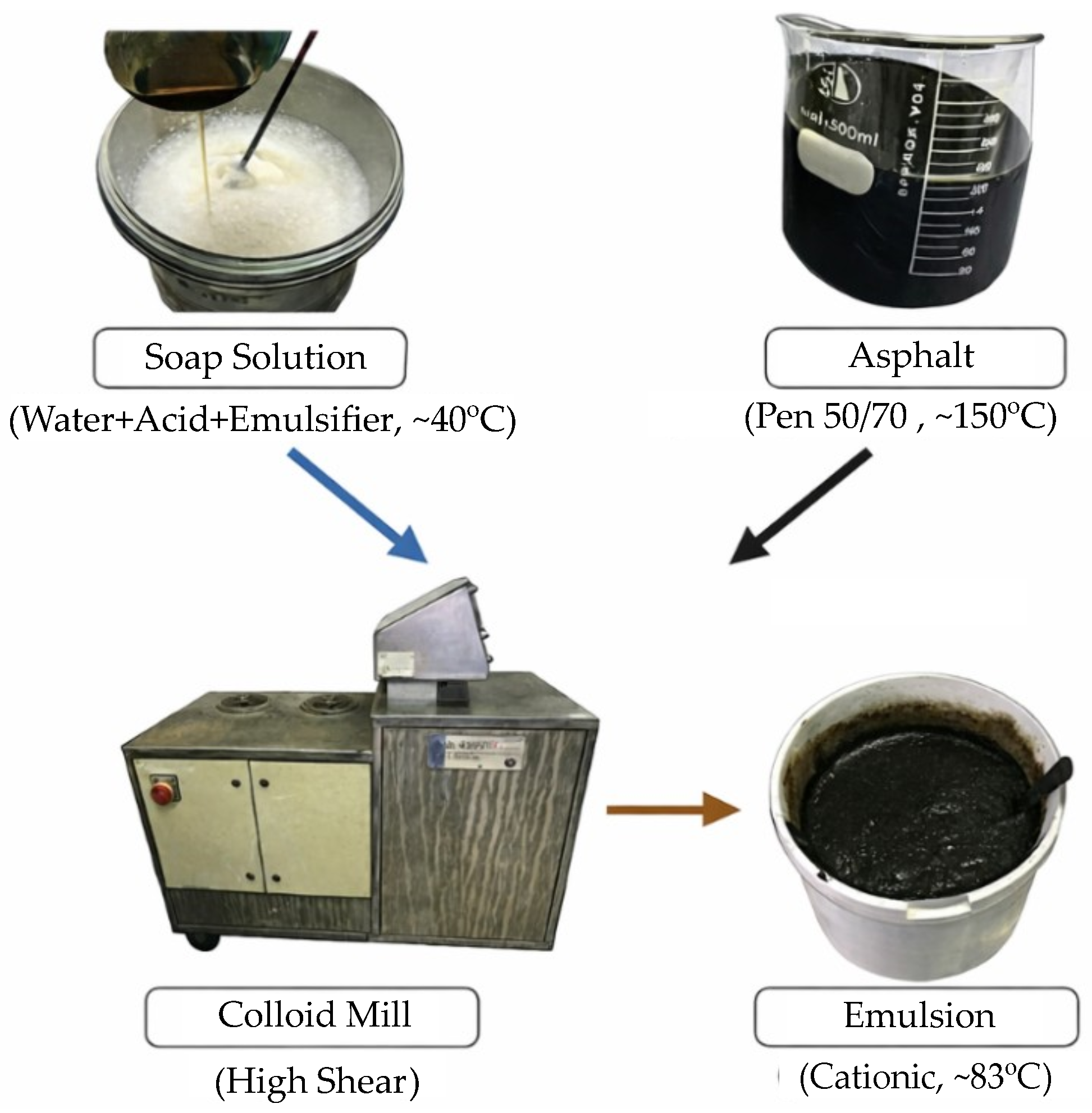
| Test | Method | Result | KGM Tech. Spec. |
|---|---|---|---|
| Breaking Index (BI) | EN 13075-1 | 223.6 | >170 (class 5) |
| Efflux Viscosity (4 mm, 40 °C) | EN 12846-1 | 24 s | 5–70 s (class 5) |
| Binder Residue | EN 1431 | 61.69% | 58–62 (class 6) |
| Sample No | Aggregate Type | Aggregate Amount (g) | Material Content (% of Aggregate) | Mixing Time (s) | Consistency (Flow) Value (cm) | ||
|---|---|---|---|---|---|---|---|
| Emulsion | Water | Cement | |||||
| ISSA Limits | Min. 180 | 2 < Flow < 3 | |||||
| LS1 | Limestone | 500 | 15 | 7 | 0.5 | 45 | 0 |
| LS2 | 20 | 10 | 0 | ||||
| LS3 | 17.5 | 10 | 0.5 | ||||
| LS4 | 15 | 10 | 0.5 | 1.5 | |||
| LS5 | 15 | 9 | 0.5 | 150 | 0 | ||
| LS6 | 15 | 10 | 0.25 | - | 0.5 | ||
| LS7 * | 15 | 11 | 0.5 | 780 | 2.25 | ||
| LS8 | 15 | 8 | 0.5 | 110 | - | ||
| LS9 | 15 | 10 | 0.5 | ||||
| LS10 | 15 | 11 | 0 | 1020 | |||
| LS11 | 15 | 11 | 2 | 630 | |||
| LS12 ** | 13 | 11 | 0.5 | 420 | 2.5 | ||
| LS13 | 17 | 11 | 0.5 | 1200 | |||
| LS14 | 11 | 11 | 0.5 | 150 | - | ||
| Sample No | Aggregate Type | Aggregate Amount (g) | Material Content (% of Aggregate) | Mixing Time (s) | Consistency (Flow) Value (cm) | ||
|---|---|---|---|---|---|---|---|
| Emulsion | Water | Cement | |||||
| ISSA Limits | Min. 180 | 2 < Flow < 3 | |||||
| GR1 | Granite | 500 | 15 | 11 | 0.5 | 360 | 3.5 |
| GR2 | 12 | 11 | 0.5 | 180 | 0 | ||
| GR3 | 13 | 11 | 0.5 | 240 | <2 | ||
| GR4 | 10 | 11 | 0.5 | 40 | - | ||
| GR5 * | 14 | 11 | 0.5 | 600 | 2.5 | ||
| GR6 | 14 | 11 | 1 | >1200 | >3 | ||
| GR7 | 10 | 11 | 2 | 210 | 0 | ||
| GR8 | 12 | 11 | 2 | - | 1 | ||
| GR9 * | 12 | 11 | 1 | >600 | 2.85 | ||
| GR10 ** | 14 | 10 | 2 | 240 | 2.12 | ||
| GR11 | 14 | 12 | 2 | 1200 | >3 | ||
| GR12 | 14 | 8 | 2 | 60 | - | ||
| GR13 | 14 | 10 | 0 | 1200 | >3 | ||
| GR14 | 14 | 10 | 4 | 120 | - | ||
| GR15 | 12 | 10 | 2 | 90 | - | ||
| GR16 | 16 | 10 | 2 | 1200 | >3 | ||
| Sample No | Aggregate Type (%) | Distribution of Mixture Components (%) | Mixing Time (s) | Consistency (cm) | ||||
|---|---|---|---|---|---|---|---|---|
| Granite | Limestone | Basalt | Water | Emulsion | Cement | |||
| GRBA1 | 50 | - | 50 | 11 | 15 | 0 | 10 | - |
| GRBA2 | 50 | - | 50 | 15 | 20 | 0 | 70 | - |
| GRBA3 | 90 | - | 10 | 11 | 15 | 0 | 21 | - |
| GRBA4 | 90 | - | 10 | 15 | 20 | 0 | 80 | - |
| LSBA5 | - | 50 | 50 | 12 | 15 | 1 | 40 | - |
| LSBA6 | - | 90 | 10 | 14 | 16 | 0 | >420 | - |
| LSBA7 | - | 70 | 30 | 13 | 15 | 0 | 160 | - |
| LSBA8 | - | 70 | 30 | 13 | 15 | 2 | 220 | 2.00 |
| LSBA9 | - | 60 | 40 | 13 | 15 | 2 | 120 | - |
| LSBA10 | - | 70 | 30 | 13 | 15 | 1 | 190 | 1.25 |
| LSBA11 | - | 70 | 30 | 15 | 15 | 1 | - | 3.75 |
| LSBA12 ** | - | 70 | 30 | 14 | 15 | 1 | 235 | 2.75 |
| LSBA13 | - | 70 | 30 | 14.5 | 15 | 1 | - | 3.25 |
| LSBA14 | - | 40 | 60 | 14 | 15 | 2 | 50 | - |
| LSBA15 | - | 40 | 60 | 14 | 20 | 2 | 210 | <2.0 |
| LSBA16 | - | 30 | 70 | 14 | 20 | 2 | 150 | - |
| LSBA17 | - | 50 | 50 | 15 | 20 | 2 | >420 | >3.0 |
| LSBA18 | - | - | 100 | 14 | 15 | 2 | 10 | - |
| LSBA19 | - | - | 100 | 14 | 20 | 2 | 40 | - |
| LSBA20 | - | 50 | 50 | 12 | 15 | 1 | 40 | - |
| LSBA21 | - | 50 | 50 | 15 | 20 | 2 | >420 | >3.0 |
| LSBA22 | - | 50 | 50 | 14 | 18 | 2 | 230 | 3.06 |
| LSBA23 | - | 50 | 50 | 13 | 17 | 2 | 140 | - |
| LSBA24 * | - | 50 | 50 | 13 | 18 | 2 | 200 | 2.54 |
| Specimen ID | Initial Weight (g) | Final Weight (g) | Abrasion Loss (g) | Corrected Loss (g/m2) | ISSA Standard |
|---|---|---|---|---|---|
| LS100/OPT−2 | 563.7 | 558.0 | 5.7 | 166.73 | <538 g/m2 |
| LS100/OPT | 659.9 | 657.3 | 2.6 | 76.05 | |
| LS100/OPT+2 | 628.8 | 626.0 | 2.8 | 81.90 | |
| GR100/OPT−2 | 546.9 | 527.4 | 19.5 | 569.63 | |
| GR100/OPT | 619.7 | 614.4 | 5.3 | 155.03 | |
| GR100/OPT+2 | 634.1 | 629.4 | 4.7 | 137.48 | |
| LS70+BA30/OPT−2 | 513.3 | 505.2 | 8.1 | 236.92 | |
| LS70+BA30/OPT | 558.1 | 551.3 | 6.8 | 197.68 | |
| LS70+BA30/OPT+2 | 563.6 | 562.4 | 1.2 | 35.10 | |
| LS50+BA50/OPT−2 | 512.5 | 504.5 | 8.0 | 234.00 | |
| LS50+BA50/OPT | 589.3 | 585.2 | 4.1 | 119.92 | |
| LS50+BA50/OPT+2 | 564.0 | 560.6 | 3.4 | 99.45 |
| Curing Time (min) | LS100 (kg-cm) | GR100 (kg-cm) | LS70+BA30 (kg-cm) | LS50+BA50 (kg-cm) |
|---|---|---|---|---|
| 15 | 9 | 8 | 8 | 8 |
| 30 | 8 | 9 | 9 | 9 |
| 60 | 11 | 10 | 11.5 | 13 |
| 90 | 13 | 18 | 13 | 16 |
| 120 | 13 | 16 | 14 | 20 |
| 1440 | 20 | 24.8 | 24 | 24 |
| Specimen ID | Initial Weight (g) | Final Weight (g) | Sand Adhesion (g) | Sand Adhesion (g/m2) | ISSA Standard |
|---|---|---|---|---|---|
| LS100/OPT−2 | 240.5 | 241.3 | 0.8 | 88.59 | <538 g/m2 |
| LS100/OPT | 248.9 | 250.1 | 1.2 | 132.89 | |
| LS100/OPT+2 | 245.4 | 246.9 | 1.5 | 166.11 | |
| GR100/OPT−2 | 253.5 | 253.7 | 0.2 | 22.15 | |
| GR100/OPT | 236.8 | 238.0 | 1.2 | 132.89 | |
| GR100/OPT+2 | 260.2 | 261.7 | 1.5 | 166.11 | |
| LS70+BA30/OPT−2 | 237.1 | 238.7 | 1.6 | 177.19 | |
| LS70+BA30/OPT | 249.5 | 251.3 | 1.8 | 199.34 | |
| LS70+BA30/OPT+2 | 238.3 | 239.5 | 1.2 | 132.89 | |
| LS50+BA50/OPT−2 | 253.4 | 254.6 | 1.2 | 132.89 | |
| LS50+BA50/OPT | 245.4 | 246.9 | 1.5 | 166.11 | |
| LS50+BA50/OPT+2 | 233.1 | 235.1 | 2.0 | 221.48 |
| Source | Sum of Sq | df | Mean Square | F | p-Value | Partial Eta Sq |
|---|---|---|---|---|---|---|
| Cohesion | ||||||
| Time | 637.00 | 5 | 127.40 | 61.303 | 0.000 | 0.953 |
| Mix Type | 21.84 | 3 | 7.28 | 3.504 | 0.042 | 0.412 |
| Error | 31.17 | 15 | 2.08 | - | - | - |
| LWT | ||||||
| Mix Type | 27,595.15 | 3 | 9198.38 | 15.003 | 0.003 | 0.882 |
| Ratio Level | 24,608.39 | 2 | 12,304.20 | 20.068 | 0.002 | 0.870 |
| Error | 3678.71 | 6 | 613.12 | - | - | - |
| WTAT | ||||||
| Mix Type | 75,317.97 | 3 | 25,105.99 | 24.364 | 0.001 | 0.924 |
| Ratio Level | 3567.89 | 2 | 1783.95 | 1.731 | 0.255 | 0.366 |
| Error | 6182.72 | 6 | 1030.45 | - | - | - |
| Mix Time | ||||||
| Emulsion | 374,400.94 | 1 | 374,400.94 | 4.095 | 0.049 | 0.079 |
| Water | 447,548.61 | 1 | 447,548.61 | 4.895 | 0.032 | 0.093 |
| Cement | 67,283.40 | 1 | 67,283.40 | 0.736 | 0.395 | 0.015 |
| Aggregate Type | 2,014,537.50 | 2 | 1,007,268.75 | 11.017 | 0.000 | 0.315 |
| Error | 4,388,460.10 | 48 | 91,426.25 | 1.000 | 0.500 | - |
| Consistency | ||||||
| Emulsion | 7.59 | 1 | 7.59 | 4.707 | 0.035 | 0.089 |
| Water | 15.88 | 1 | 15.88 | 9.850 | 0.003 | 0.170 |
| Cement | 0.41 | 1 | 0.41 | 0.255 | 0.616 | 0.005 |
| Aggregate Type | 30.51 | 2 | 15.26 | 9.461 | 0.000 | 0.283 |
| Error | 77.40 | 48 | 1.61 | 1.000 | 0.500 | - |
| Mixing Time | Consistency | |||
|---|---|---|---|---|
| Parameter | Limestone | Granite | Limestone | Granite |
| Emulsion | 0.186 | 0.544 | 0.524 | 0.647 |
| Water | 0.625 | 0.236 | 0.571 | 0.319 |
| Cement | 0.081 | −0.226 | −0.140 | −0.369 |
| Parameter | Mixing Time | Consistency |
|---|---|---|
| Basalt Content | −0.154 | −0.129 |
| Emulsion | 0.569 | 0.276 |
| Water | 0.393 | 0.666 |
| Cement | 0.081 | 0.220 |
Disclaimer/Publisher’s Note: The statements, opinions and data contained in all publications are solely those of the individual author(s) and contributor(s) and not of MDPI and/or the editor(s). MDPI and/or the editor(s) disclaim responsibility for any injury to people or property resulting from any ideas, methods, instructions or products referred to in the content. |
© 2026 by the author. Licensee MDPI, Basel, Switzerland. This article is an open access article distributed under the terms and conditions of the Creative Commons Attribution (CC BY) license.
Share and Cite
Değer Şitilbay, B. Optimizing Slurry Seal Mixtures with Different Aggregate Types: Performance, Durability, and Component Interaction Analysis. Buildings 2026, 16, 891. https://doi.org/10.3390/buildings16050891
Değer Şitilbay B. Optimizing Slurry Seal Mixtures with Different Aggregate Types: Performance, Durability, and Component Interaction Analysis. Buildings. 2026; 16(5):891. https://doi.org/10.3390/buildings16050891
Chicago/Turabian StyleDeğer Şitilbay, Betül. 2026. "Optimizing Slurry Seal Mixtures with Different Aggregate Types: Performance, Durability, and Component Interaction Analysis" Buildings 16, no. 5: 891. https://doi.org/10.3390/buildings16050891
APA StyleDeğer Şitilbay, B. (2026). Optimizing Slurry Seal Mixtures with Different Aggregate Types: Performance, Durability, and Component Interaction Analysis. Buildings, 16(5), 891. https://doi.org/10.3390/buildings16050891