Field Application of FBG-Instrumented CFRP Pressure-Dispersed Anchor Cables in Slope Reinforcement: A Case Study on Dangerous Rock Stabilization at Guangyang Island

Abstract
1. Introduction
2. Force Analysis of Pressure-Uniformly-Dispersed Prestressed CFRP Anchor Cables
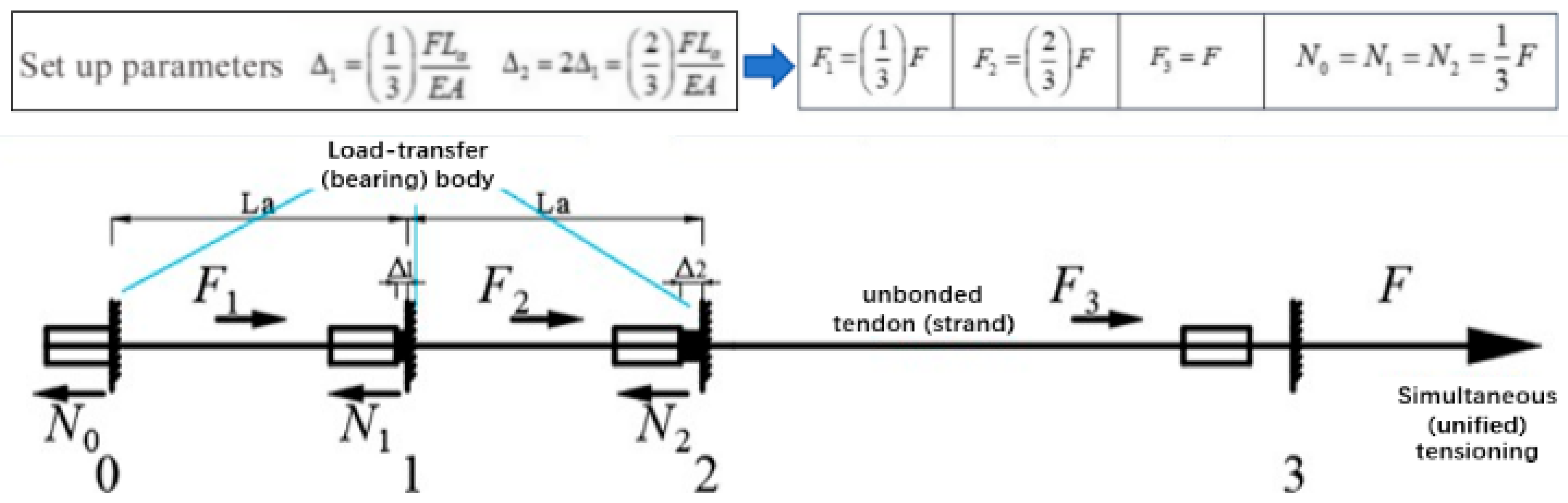
2.1. Basic Principles of Pressure-Uniformly-Dispersed Prestressed CFRP Anchor Cables and Force Distribution Characteristics in the Anchorage Segment
2.2. Force Distribution Characteristics of Pressure-Uniformly-Dispersed Prestressed CFRP Anchor Cable
2.2.1. Basic Assumptions
- (1)
- The spacing between anchor cables is sufficiently large, and the mutual influence between adjacent anchor cables can be ignored;
- (2)
- The carbon fiber plate and the grouting body are in an unbonded state, which does not affect the mechanical properties of the tendon; the force applied by the carbon fiber plate is equivalent to a concentrated force P acting at the bottom of the unit anchor cable bearing body;
- (3)
- Both the grouting body and the rock/soil mass are ideal elastic bodies without self-weight, are continuous, uniform, and isotropic, and in an elastic state, and the interface between them satisfies the Coulomb condition;
- (4)
- The stress on the cross-section of the anchor solid is uniformly distributed;
- (5)
- The length of the anchor cable and the grouting body is sufficient, and the entire interface is within the elastic range. During the derivation process, it is necessary to equivalent the anchor cable and the grouting body as one medium in some parts.
2.2.2. Force Distribution Characteristics
3. Test Design
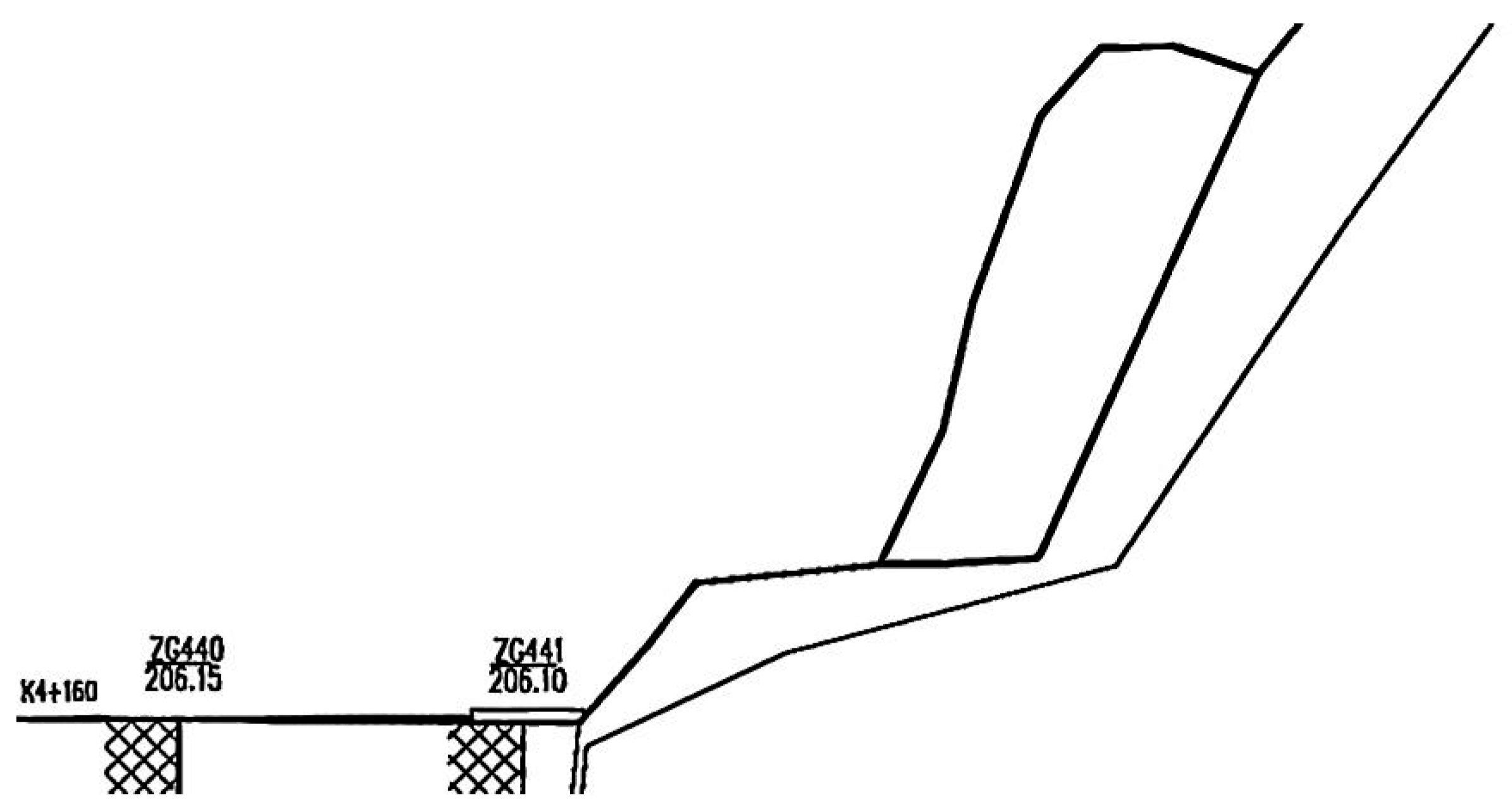
3.1. Engineering Background
- ①
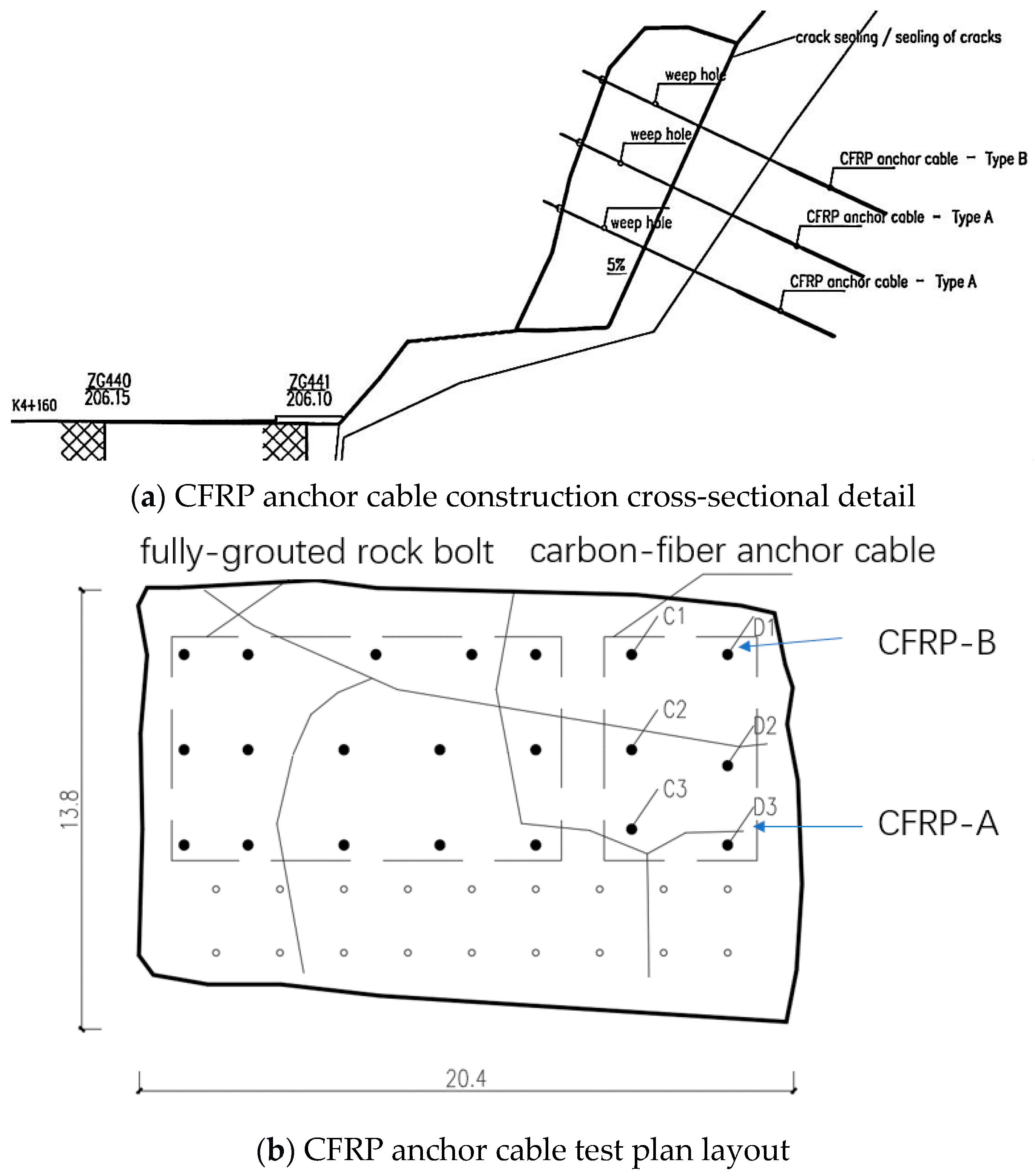
- Hard structural plane: 10°∠70–80°, fracture surface straight and smooth, opening range 5–25 cm, extension length 1.9–8 m, filled with a small amount of rock debris, and development spacing 3–7.5 m;
- ②
- Hard structural plane: 270–280°∠70–80°, fracture surface straight and smooth, opening range 5–25 cm, extension length 1.5–7.0 m, filled with a small amount of rock debris, poor combination, and development spacing 0.5–6.5 m;
- ③
- 340°∠82°, is the unloading fissure of WY4, fissure surface straight, opening 5–15 cm, extension length about 20 m, filled with a small amount of rock debris, poor combination, development spacing 3–6.5 m, and is a hard structural plane.
3.2. Test Scheme
3.3. Test Materials
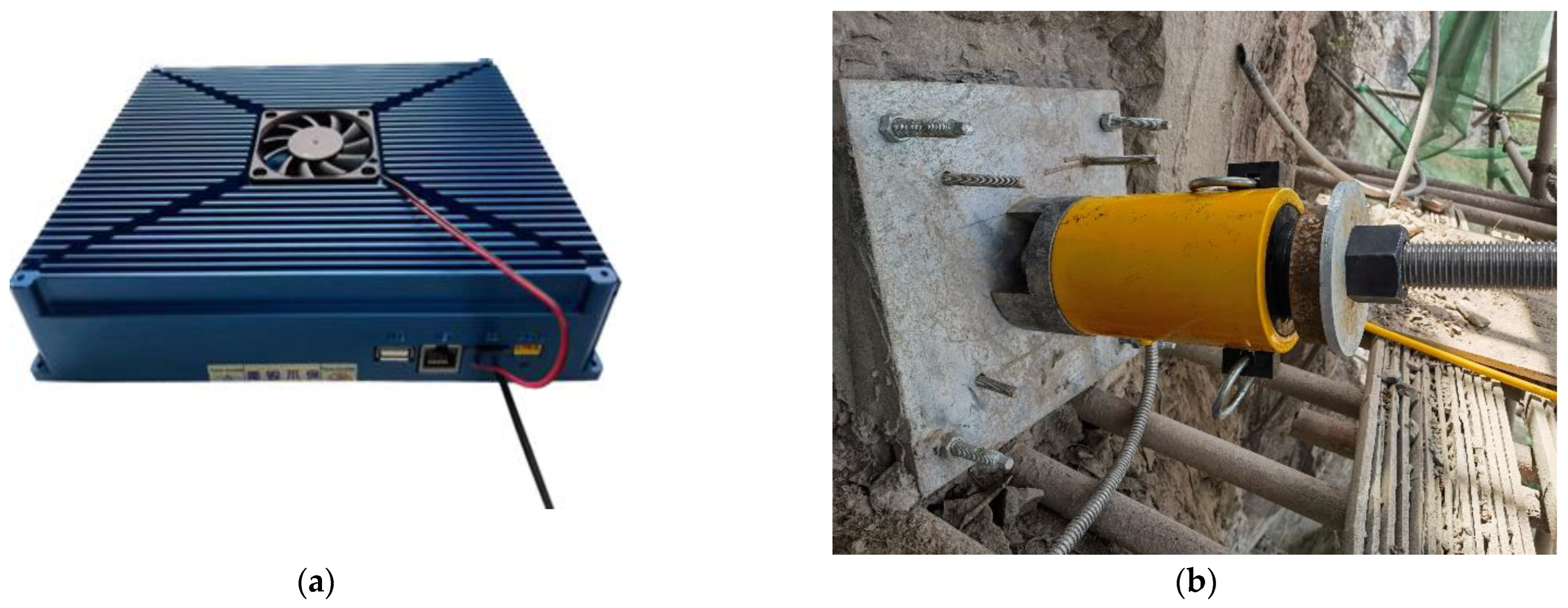
3.4. Test Instruments and Methods
4. Intelligent Anchor Cable Tensioning Test
5. Test Result Analysis
5.1. Analysis of Force Monitoring Data from C1 Anchor Cable Pull-Out Test
5.2. Analysis of Force Monitoring Data from C2 Anchor Cable Pull-Out Test
6. Discussion
Conclusions
- (1)
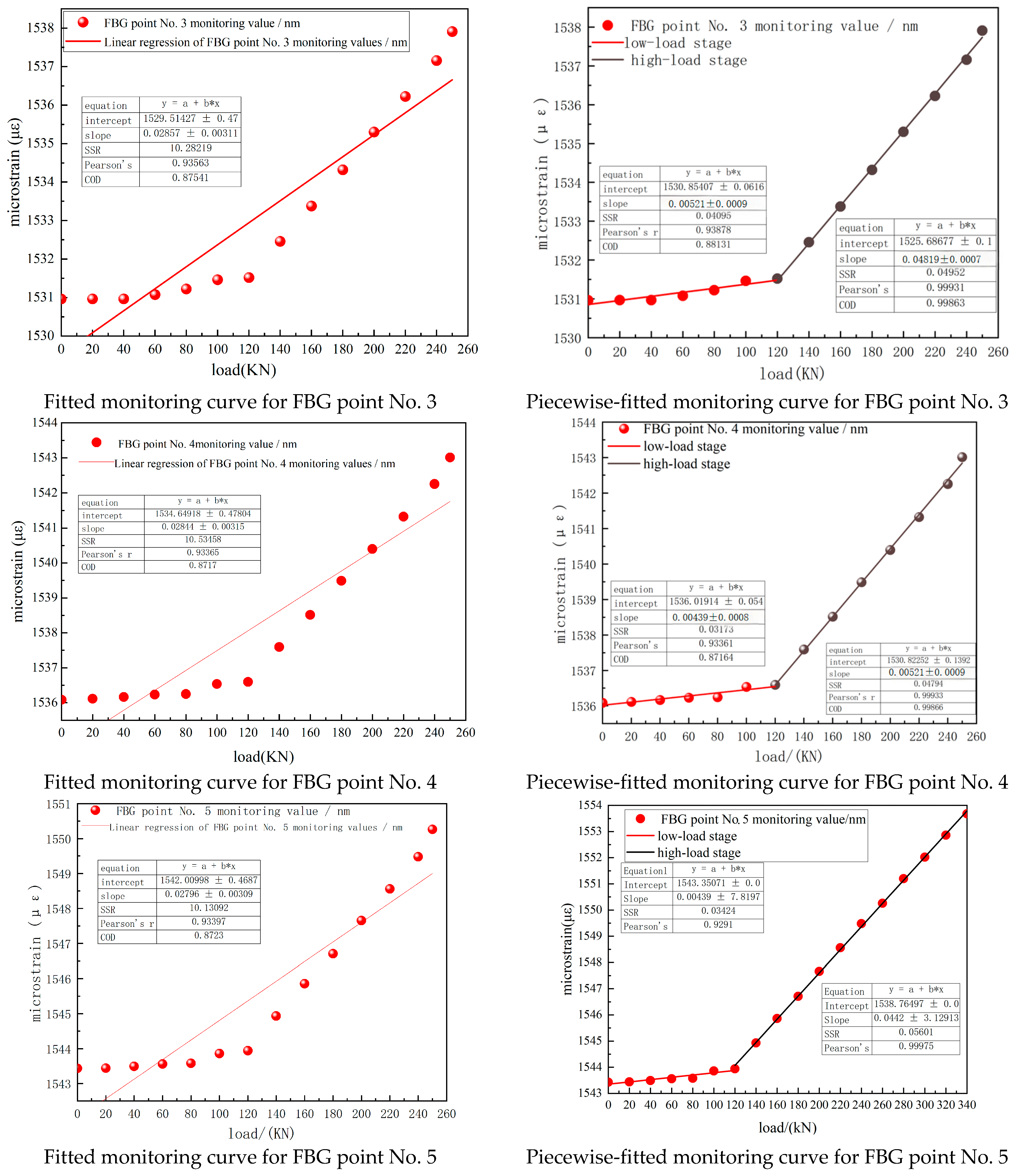
- Validation of Design Performance: Under the specific geological conditions of the Middle Jurassic sandy mudstone formation, the three-stage pressure-dispersed CFRP anchor achieved uniform load distribution (>85% efficiency, <5% variance among segments) once the tensioning load exceeded approximately 120 kN. This confirms that the theoretical design objective of uniform pressure dispersion was achieved for this specific installation.
- (2)
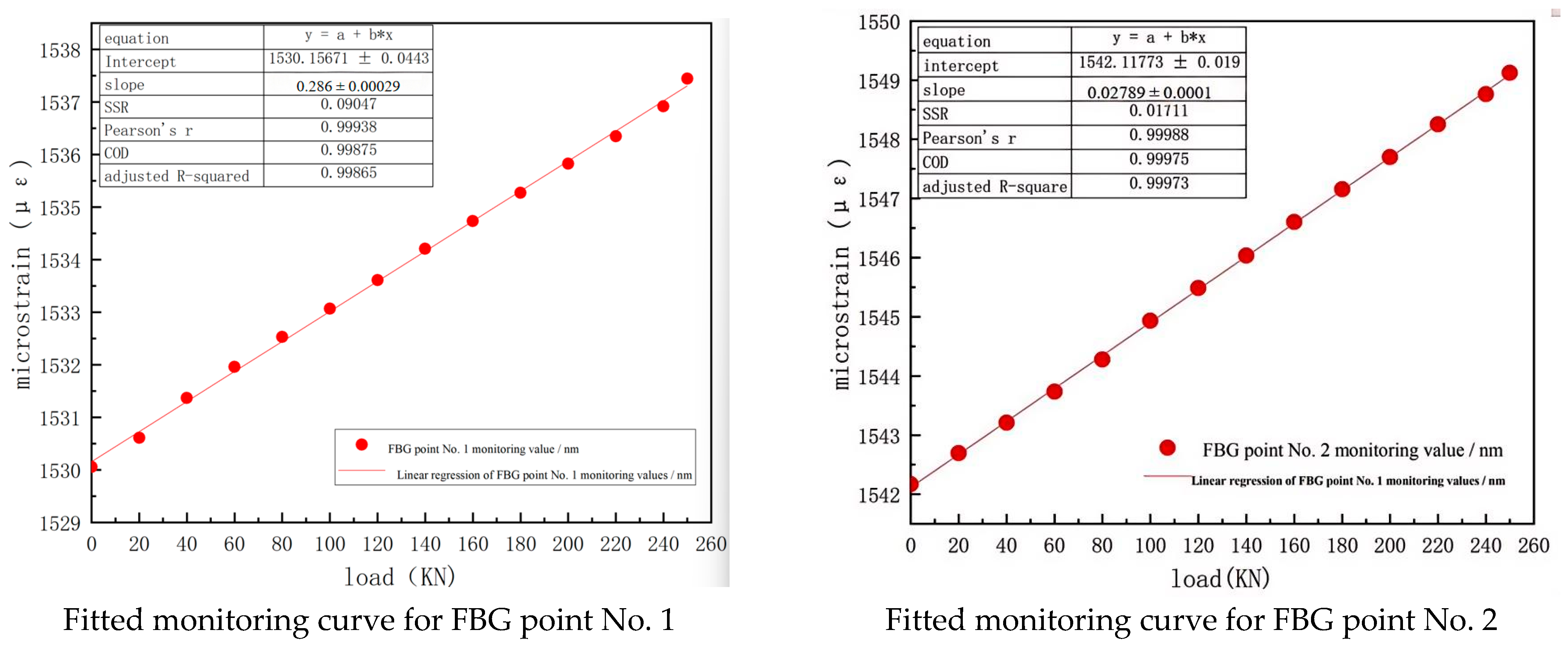
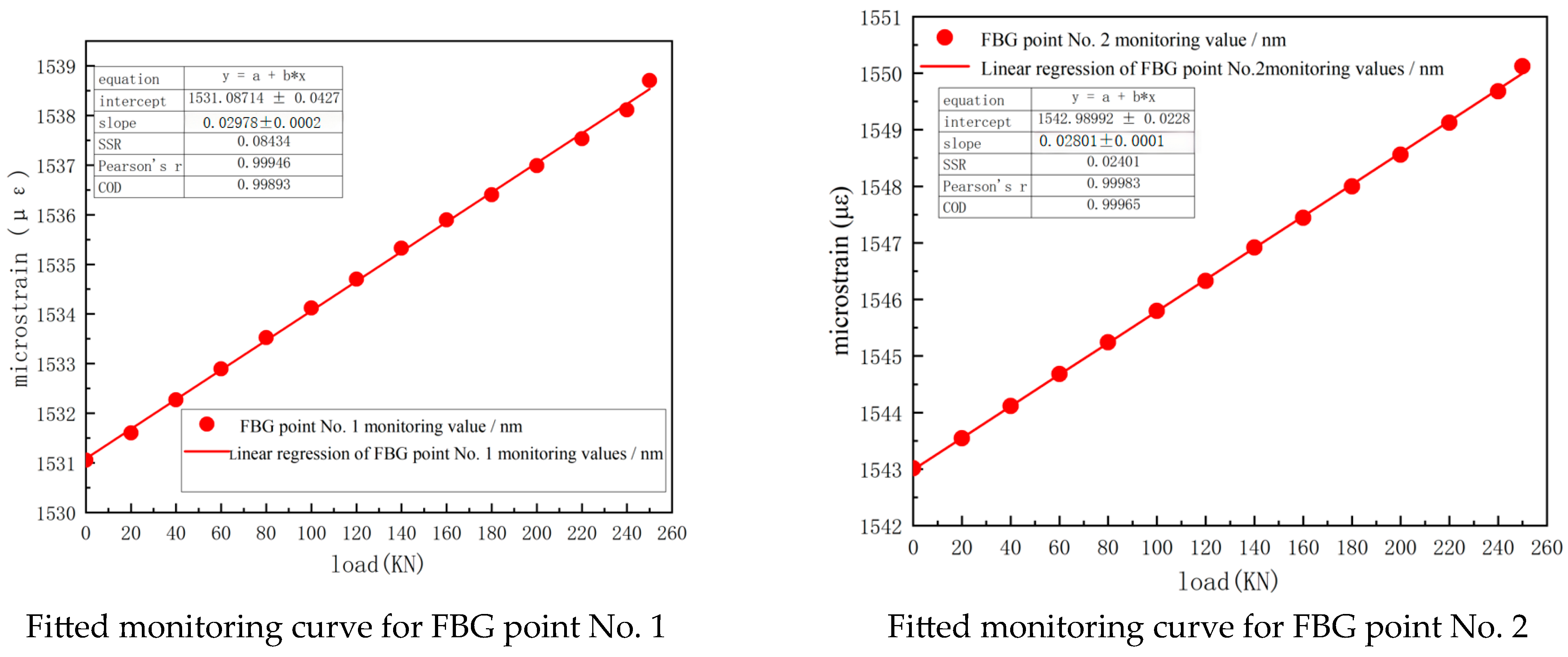
- Monitoring Methodology Demonstration: The distributed FBG array (0.5 m spacing) successfully captured the full-length strain distribution, confirming its suitability for high-resolution monitoring of CFRP anchors in field conditions. The linear response in the free segment (R2 > 0.999) and the quantifiable activation of the anchorage segment demonstrate the practical viability of intelligent anchor systems for construction control and long-term health monitoring.
- (3)
- Mechanistic Confirmation: The observed transition from “delayed activation” to “uniform bearing” in the anchorage segment aligns with established load transfer theory for bonded anchors, providing field validation for CFRP-specific applications.
Author Contributions
Funding
Data Availability Statement
Conflicts of Interest
References
- Yang, H.; Xing, B.; Jiang, H.; Cheng, Q. Experimental Study on the Accumulation Characteristics Model of Slope with Barrier-Type Granular Materials. Earth Sci. Available online: https://kns.cnki.net/kcms/detail/42.1874.p.20211009.1236.006.html (accessed on 11 October 2021).
- Wang, Y.; Nazem, M.; Smith, J.V. Effect of groundwater and associated drainage on a roadside stabilisation method integrating a gabion-faced geogrid-reinforced retaining wall and embedded laterally loaded piles. Arab. J. Geosci. 2022, 15, 1751. [Google Scholar] [CrossRef]
- Lai, J.; Zheng, Y.; Liu, Y.; Li, X.; Abi, E. Vibration test study on double-row anti-slide pile-supported slope under seismic action. Chin. J. Geotech. Eng. 2014, 36, 680–686. [Google Scholar]
- Huang, J. Analysis of Slope Stability Enhancement by Anti-slide Piles and Parameter Optimization. West. Transp. Sci. Technol. 2025, 4, 66–68+86. [Google Scholar] [CrossRef]
- Sakhno, I.; Sakhno, S.; Isaienkov, O.; Kurdiumow, D. Laboratory studies of a high-strength roof bolting by means of self-extending mixtures. Min. Miner. Depos. 2019, 13, 17–26. [Google Scholar] [CrossRef]
- Jia, J.; Hou, Z.; Wang, L.; Bai, S.; Zhang, L.; Lan, C.; Du, R. Development of Fiber Bragg Grating Sensors and Their Application Progress in Civil Engineering. J. Inst. Disaster Prev. 2024, 26, 9–21. [Google Scholar]
- Qu, W.; Ma, L.; Tian, X.; Shi, Z.; Xi, T. Stress Distribution and Influencing Parameter Analysis of Anchorage Segment of Pressure-Dispersed Anchor Cable. J. Water Resour. Archit. Eng. 2021, 19, 23–27. [Google Scholar]
- Zhou, P. Prestressed Construction Technology for Pressure-Dispersed Anchor Cables in High Slopes. Eng. Constr. 2024, 38, 1162–1164+1168. [Google Scholar]
- Yao, H. Tensioning Acceptance Test Study on Pressure-Dispersed Prestressed Anchor Cables for Dam Slope of Yangfanggou Hydropower Station. Express Water Resour. Hydropower Inf. 2023, 44, 47–50. [Google Scholar] [CrossRef]
- Yao, Y. Research on Mechanical Performance and Design Method of Composite Beams with Hollow Section and Partially Encased Concrete; Chang’an University: Xi’an, China, 2023. [Google Scholar]
- Sun, Q. Principle and Experimental Research of Pressure-Dispersed Prestressed CFRP Anchor Cable; Chongqing University of Science and Technology: Chongqing, China, 2024. [Google Scholar]
- Lei, J.; Yang, J.; Yang, X.; Wang, A. Stress Distribution Law and Anchorage Segment Design of Pressure-Type Anchor Cable. J. Railw. Sci. Eng. 2010, 7, 75–79. [Google Scholar]
- Ministry of Housing and Urban-Rural Development of the People’s Republic of China. GB 50086-2015; Technical Specification for Geotechnical Anchorage and Shotcrete Support Engineering. China Planning Press: Beijing, China, 2015.
- GB 50330-2013; Technical Code for Building Slope Engineering (with Clause Explanation). China Architecture & Building Press: Beijing, China, 2013.










| Dangerous Rock-Mass ID | Geometry | Thickness (m) | Width (m) | Height (m) | Volume (m3) | Failure Mode |
|---|---|---|---|---|---|---|
| WY4 | Block-like | 5.8 | 20.4 | 13.8 | 1632.82 | Toppling failure |
| Load Value (kN) | Grating Pt 1 Monitor Value (nm) | Wavelength Shift (nm) | Grating Pt 2 Monitor Value (nm) | Wavelength Shift (nm) | Grating Pt 3 Monitor Value (nm) | Wavelength Shift (nm) | Grating Pt 4 Monitor Value (nm) | Wavelength Shift (nm) | Grating Pt 5 Monitor Value (nm) | Wavelength Shift (nm) |
|---|---|---|---|---|---|---|---|---|---|---|
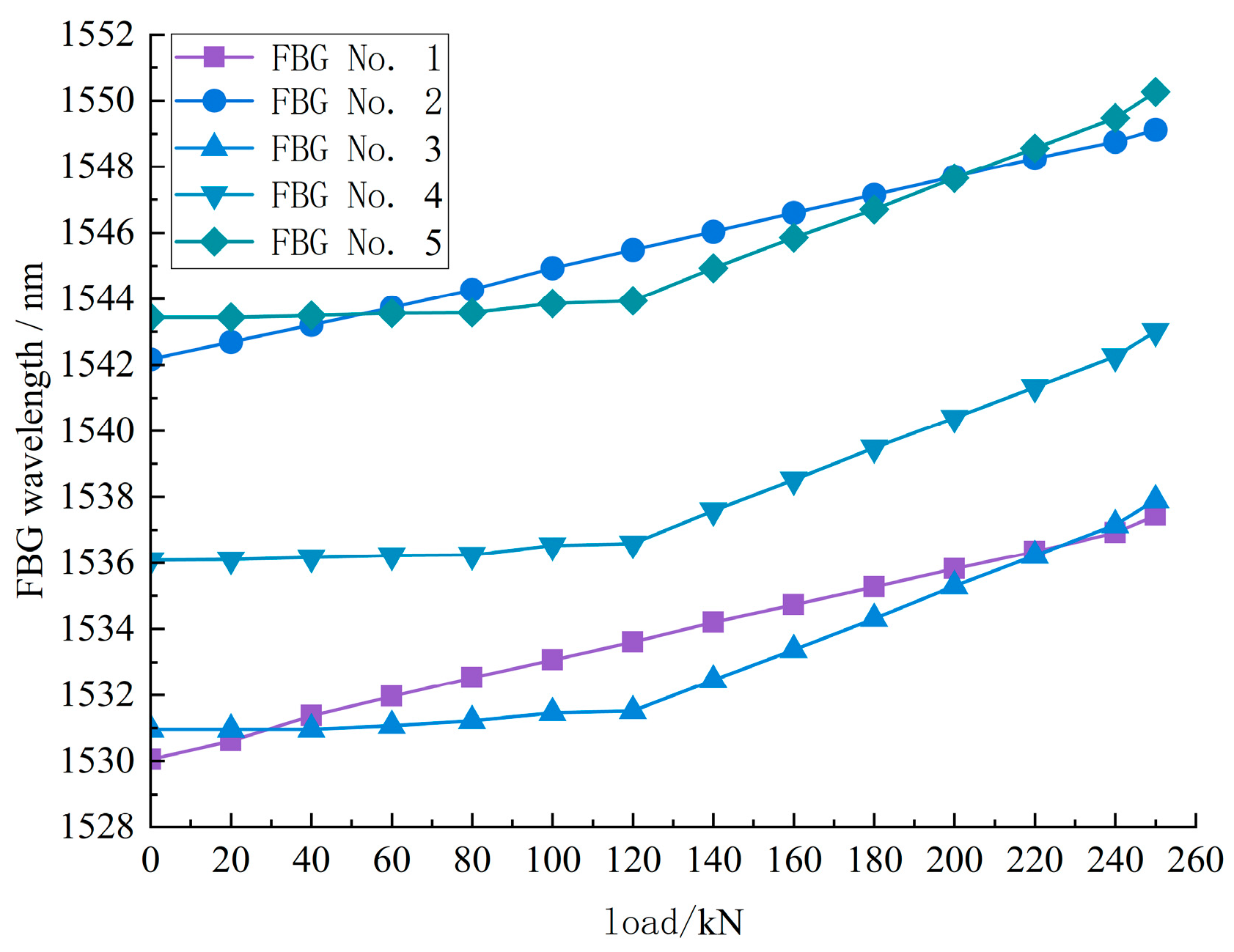
| 0 | 1530.057 | 0.000 | 1542.171 | 0.000 | 1530.962 | 0.000 | 1536.086 | 0.000 | 1543.434 | 0.000 |
| 20 | 1530.612 | 0.555 | 1542.693 | 0.522 | 1530.964 | 0.002 | 1536.113 | 0.027 | 1543.438 | 0.003 |
| 40 | 1531.369 | 0.757 | 1543.209 | 0.516 | 1530.965 | 0.001 | 1536.166 | 0.052 | 1543.493 | 0.055 |
| 60 | 1531.958 | 0.589 | 1543.736 | 0.527 | 1531.075 | 0.110 | 1536.232 | 0.067 | 1543.561 | 0.068 |
| 80 | 1532.528 | 0.570 | 1544.279 | 0.543 | 1531.222 | 0.147 | 1536.247 | 0.015 | 1543.581 | 0.019 |
| 100 | 1533.066 | 0.538 | 1544.930 | 0.651 | 1531.462 | 0.240 | 1536.537 | 0.290 | 1543.858 | 0.278 |
| 120 | 1533.609 | 0.543 | 1545.484 | 0.554 | 1531.517 | 0.055 | 1536.595 | 0.058 | 1543.939 | 0.081 |
| 140 | 1534.205 | 0.596 | 1546.035 | 0.551 | 1532.460 | 0.943 | 1537.592 | 0.997 | 1544.931 | 0.991 |
| 160 | 1534.735 | 0.530 | 1546.601 | 0.566 | 1533.377 | 0.917 | 1538.516 | 0.924 | 1545.856 | 0.925 |
| 180 | 1535.274 | 0.539 | 1547.153 | 0.552 | 1534.319 | 0.942 | 1539.488 | 0.972 | 1546.706 | 0.850 |
| 200 | 1535.827 | 0.553 | 1547.700 | 0.547 | 1535.301 | 0.982 | 1540.398 | 0.911 | 1547.657 | 0.950 |
| 220 | 1536.348 | 0.521 | 1548.251 | 0.551 | 1536.225 | 0.924 | 1541.327 | 0.929 | 1548.560 | 0.903 |
| 240 | 1536.918 | 0.570 | 1548.761 | 0.510 | 1537.158 | 0.933 | 1542.257 | 0.930 | 1549.480 | 0.920 |
| 250 | 1537.445 | 0.527 | 1549.124 | 0.363 | 1537.910 | 0.752 | 1543.011 | 0.754 | 1550.261 | 0.781 |
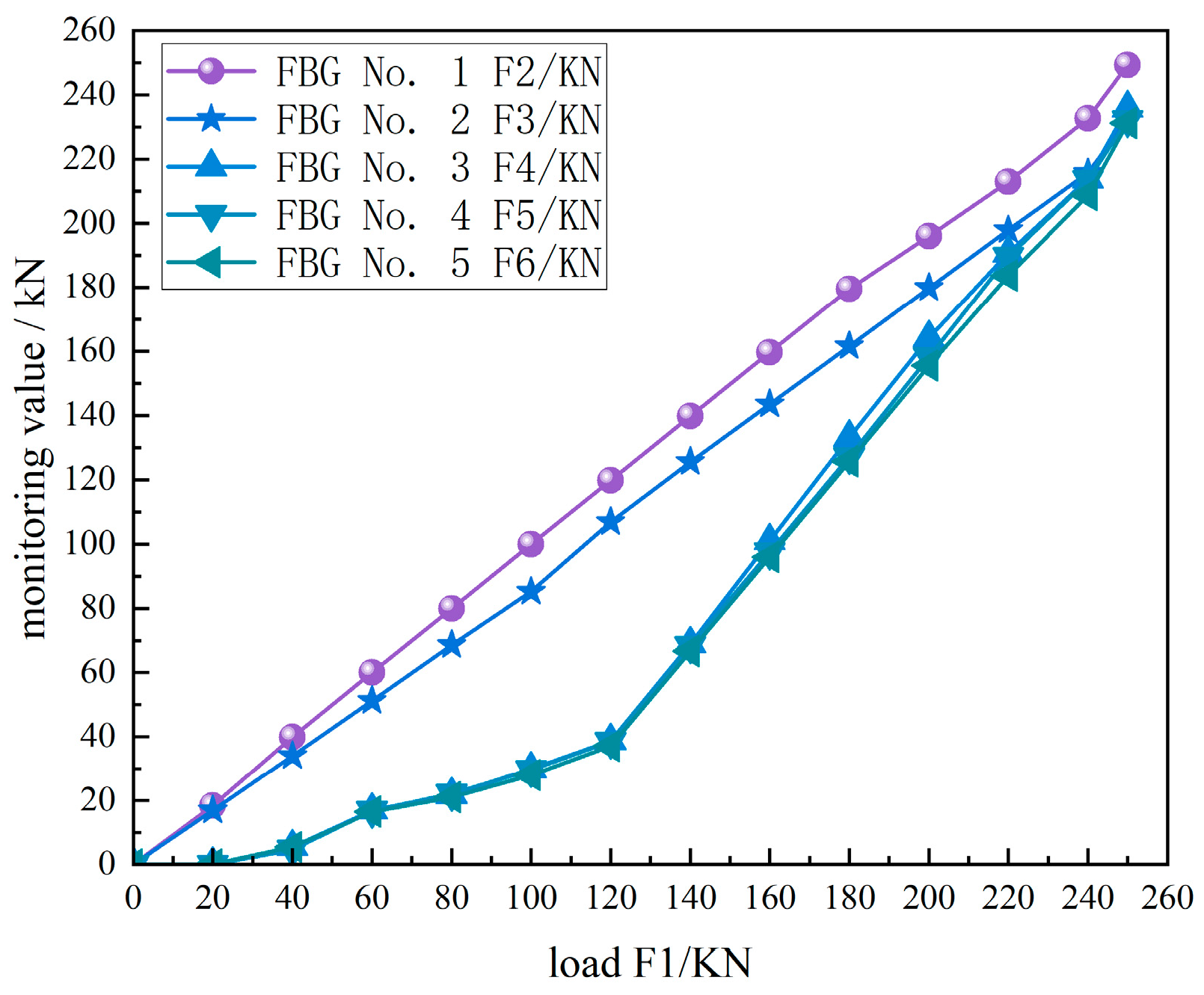
| Load Value F1/kN | Grating 1 F2/kN | Grating 2 F3/kN | Grating 3 F4/kN | Grating 4 F5/kN | Grating 5 F6/kN | Loss Rate (F1–F3)/F1 |
|---|---|---|---|---|---|---|
| 0 | 0 | 0 | 0 | 0 | 0 | 0 |
| 20 | 17.900 | 16.835 | 0.065 | 0.877 | 0.100 | 15.83% |
| 40 | 35.800 | 33.477 | 0.097 | 2.567 | 1.890 | 16.31% |
| 60 | 60.214 | 50.473 | 3.645 | 4.725 | 4.096 | 15.88% |
| 80 | 79.211 | 67.986 | 8.386 | 5.199 | 4.722 | 15.02% |
| 100 | 97.595 | 88.982 | 16.126 | 14.559 | 13.672 | 11.02% |
| 120 | 114.946 | 106.850 | 17.900 | 16.433 | 16.284 | 10.96% |
| 140 | 132.459 | 124.621 | 48.314 | 48.575 | 48.259 | 10.99% |
| 160 | 151.681 | 142.875 | 77.890 | 78.367 | 78.099 | 10.70% |
| 180 | 168.775 | 160.678 | 108.272 | 109.713 | 105.521 | 10.73% |
| 200 | 186.159 | 178.320 | 139.944 | 139.079 | 136.177 | 10.84% |
| 220 | 203.994 | 196.091 | 169.745 | 169.052 | 165.317 | 10.87% |
| 240 | 220.797 | 212.540 | 199.837 | 199.033 | 194.989 | 11.44% |
| 250 | 239.181 | 224.247 | 224.081 | 223.358 | 220.172 | 10.30% |
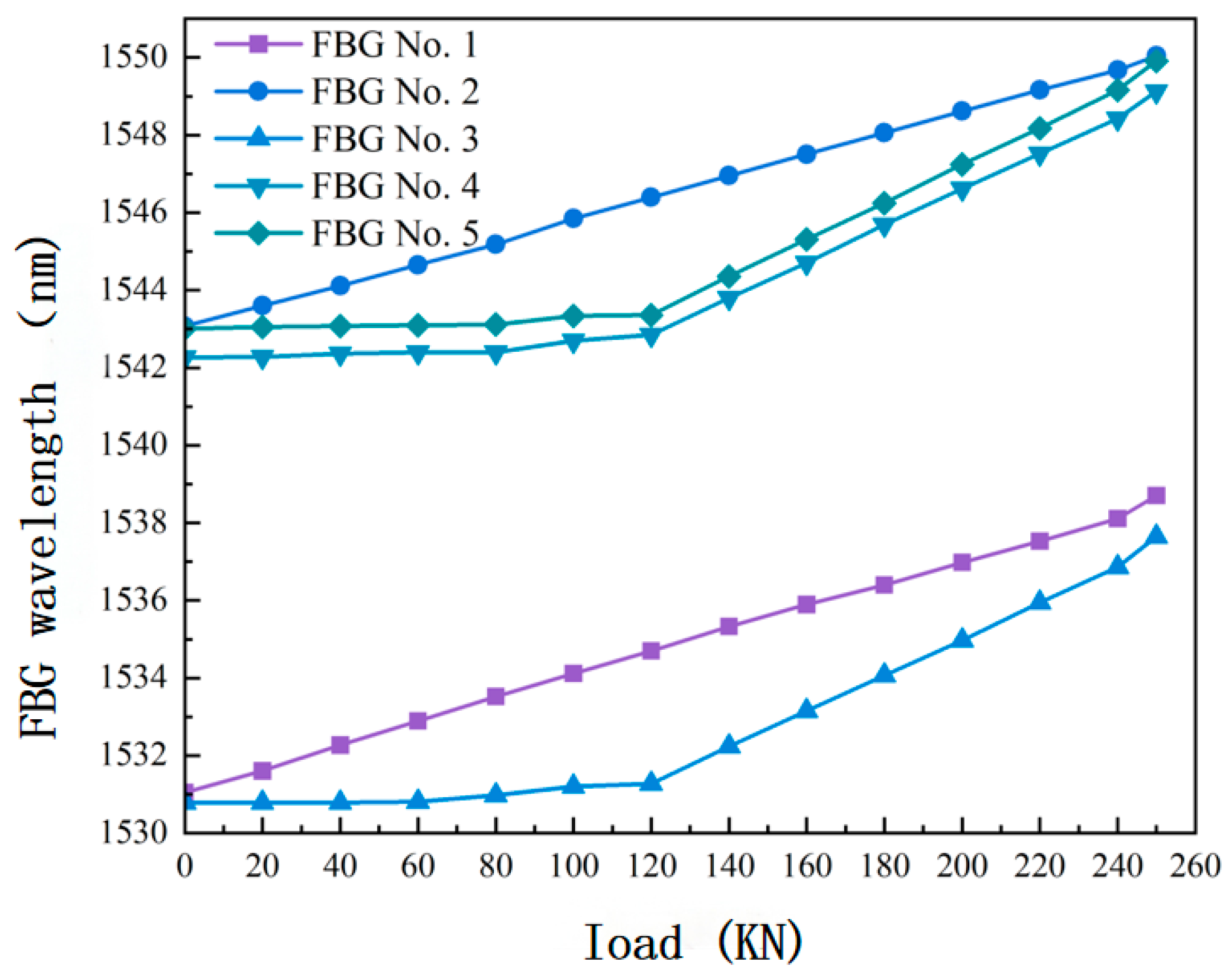
| Load Value (kN) | Grating Pt 1 Monitor Value (nm) | Wavelength Shift (nm) | Grating Pt 2 Monitor Value (nm) | Wavelength Shift (nm) | Grating Pt 3 Monitor Value (nm) | Wavelength Shift (nm) | Grating Pt 4 Monitor Value (nm) | Wavelength Shift (nm) | Grating Pt 5 Monitor Value (nm) | Wavelength Shift (nm) |
|---|---|---|---|---|---|---|---|---|---|---|
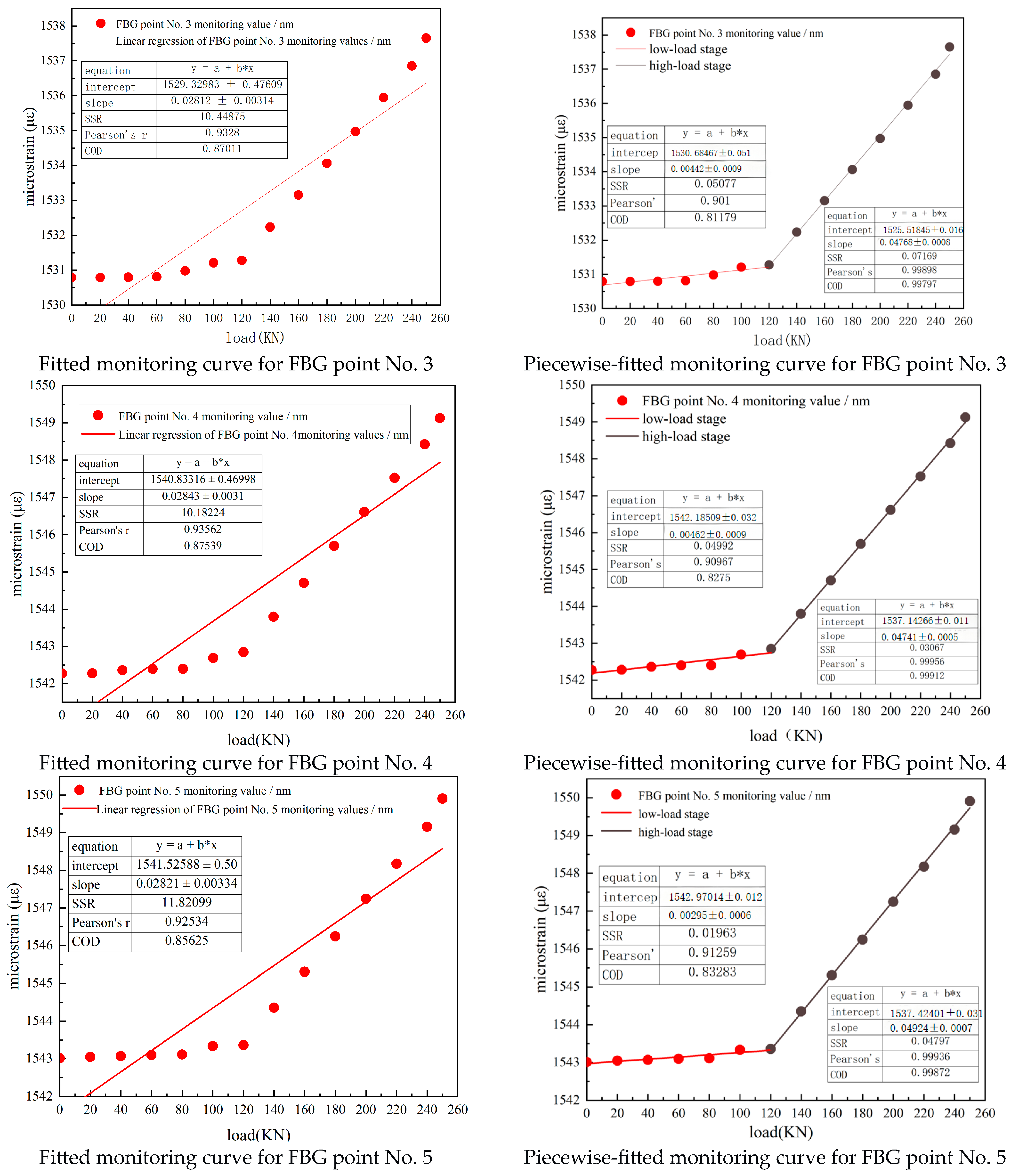
| 0 | 1531.053 | 0.000 | 1543.073 | 0.000 | 1530.792 | 0.000 | 1542.272 | 0.000 | 1543.010 | 0.000 |
| 20 | 1531.605 | 0.553 | 1543.600 | 0.527 | 1530.792 | 0.000 | 1542.276 | 0.004 | 1543.049 | 0.039 |
| 40 | 1532.273 | 0.667 | 1544.113 | 0.513 | 1530.793 | 0.001 | 1542.359 | 0.083 | 1543.070 | 0.021 |
| 60 | 1532.896 | 0.623 | 1544.652 | 0.539 | 1530.808 | 0.015 | 1542.396 | 0.037 | 1543.098 | 0.028 |
| 80 | 1533.523 | 0.627 | 1545.181 | 0.529 | 1530.979 | 0.171 | 1542.397 | 0.001 | 1543.112 | 0.014 |
| 100 | 1534.120 | 0.597 | 1545.848 | 0.667 | 1531.209 | 0.230 | 1542.692 | 0.295 | 1543.336 | 0.223 |
| 120 | 1534.699 | 0.580 | 1546.395 | 0.547 | 1531.278 | 0.069 | 1542.845 | 0.153 | 1543.357 | 0.021 |
| 140 | 1535.328 | 0.629 | 1546.955 | 0.560 | 1532.235 | 0.958 | 1543.797 | 0.952 | 1544.356 | 0.999 |
| 160 | 1535.897 | 0.569 | 1547.506 | 0.551 | 1533.155 | 0.920 | 1544.705 | 0.908 | 1545.307 | 0.951 |
| 180 | 1536.399 | 0.503 | 1548.059 | 0.553 | 1534.063 | 0.908 | 1545.696 | 0.991 | 1546.245 | 0.939 |
| 200 | 1536.985 | 0.586 | 1548.618 | 0.559 | 1534.970 | 0.907 | 1546.618 | 0.922 | 1547.244 | 0.998 |
| 220 | 1537.531 | 0.546 | 1549.162 | 0.544 | 1535.946 | 0.976 | 1547.522 | 0.904 | 1548.173 | 0.929 |
| 240 | 1538.110 | 0.579 | 1549.674 | 0.512 | 1536.855 | 0.909 | 1548.423 | 0.901 | 1549.158 | 0.985 |
| 250 | 1538.703 | 0.594 | 1550.045 | 0.371 | 1537.650 | 0.795 | 1549.125 | 0.703 | 1549.905 | 0.747 |
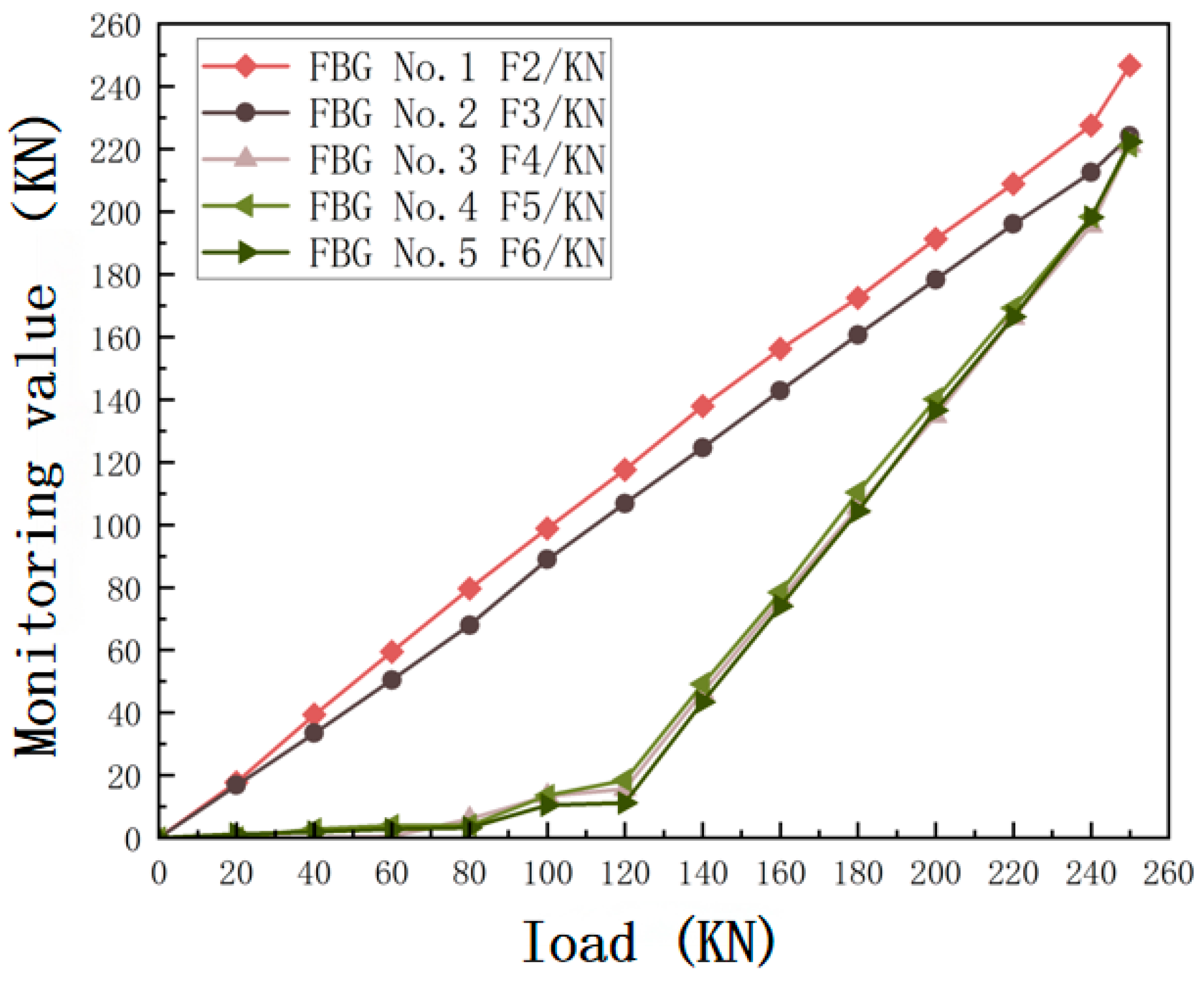
| Load Value F1/kN | Grating 1 F2/kN | Grating 2 F3/kN | Grating 3 F4/kN | Grating 4 F5/kN | Grating 5 F6/kN | Loss Rate (F1–F3)/F1 |
|---|---|---|---|---|---|---|
| 0 | 0 | 0 | 0 | 0 | 0 | 0 |
| 20 | 17.822 | 16.836 | 0.006 | 0.129 | 1.248 | 15.82% |
| 40 | 39.341 | 33.478 | 0.039 | 2.806 | 1.935 | 16.31% |
| 60 | 59.437 | 50.474 | 0.522 | 4.009 | 2.822 | 15.88% |
| 80 | 79.669 | 67.987 | 6.038 | 4.044 | 3.283 | 15.02% |
| 100 | 98.914 | 88.983 | 13.443 | 13.546 | 10.488 | 11.02% |
| 120 | 117.604 | 106.851 | 15.665 | 18.480 | 11.179 | 10.96% |
| 140 | 137.877 | 124.622 | 46.546 | 49.197 | 43.389 | 10.98% |
| 160 | 156.222 | 142.876 | 76.218 | 78.466 | 74.057 | 10.70% |
| 180 | 172.432 | 160.680 | 105.503 | 110.441 | 104.335 | 10.73% |
| 200 | 191.319 | 178.321 | 134.755 | 140.161 | 136.536 | 10.84% |
| 220 | 208.929 | 196.092 | 166.224 | 169.313 | 166.498 | 10.87% |
| 240 | 227.599 | 212.541 | 195.534 | 198.376 | 198.276 | 11.44% |
| 250 | 246.747 | 224.248 | 221.178 | 221.033 | 222.374 | 10.30% |
Disclaimer/Publisher’s Note: The statements, opinions and data contained in all publications are solely those of the individual author(s) and contributor(s) and not of MDPI and/or the editor(s). MDPI and/or the editor(s) disclaim responsibility for any injury to people or property resulting from any ideas, methods, instructions or products referred to in the content. |
© 2026 by the authors. Licensee MDPI, Basel, Switzerland. This article is an open access article distributed under the terms and conditions of the Creative Commons Attribution (CC BY) license.
Share and Cite
Wang, Q.; Li, J.; Huang, K.; Hu, J.; Wang, Z.; He, G.; Lan, W.; Tang, S. Field Application of FBG-Instrumented CFRP Pressure-Dispersed Anchor Cables in Slope Reinforcement: A Case Study on Dangerous Rock Stabilization at Guangyang Island. Buildings 2026, 16, 1016. https://doi.org/10.3390/buildings16051016
Wang Q, Li J, Huang K, Hu J, Wang Z, He G, Lan W, Tang S. Field Application of FBG-Instrumented CFRP Pressure-Dispersed Anchor Cables in Slope Reinforcement: A Case Study on Dangerous Rock Stabilization at Guangyang Island. Buildings. 2026; 16(5):1016. https://doi.org/10.3390/buildings16051016
Chicago/Turabian StyleWang, Qiang, Junjie Li, Kui Huang, Jinyu Hu, Zijian Wang, Gang He, Wenping Lan, and Shuangqing Tang. 2026. "Field Application of FBG-Instrumented CFRP Pressure-Dispersed Anchor Cables in Slope Reinforcement: A Case Study on Dangerous Rock Stabilization at Guangyang Island" Buildings 16, no. 5: 1016. https://doi.org/10.3390/buildings16051016
APA StyleWang, Q., Li, J., Huang, K., Hu, J., Wang, Z., He, G., Lan, W., & Tang, S. (2026). Field Application of FBG-Instrumented CFRP Pressure-Dispersed Anchor Cables in Slope Reinforcement: A Case Study on Dangerous Rock Stabilization at Guangyang Island. Buildings, 16(5), 1016. https://doi.org/10.3390/buildings16051016