A Systematic Review of Digital Technologies for Emergency Preparedness in Buildings




Abstract
1. Background
2. Introduction
2.1. Emergency Preparedness
2.2. Digital Trends
2.3. Interaction of Digital Technologies and Emergency Preparedness
3. Methodology
3.1. Review Design
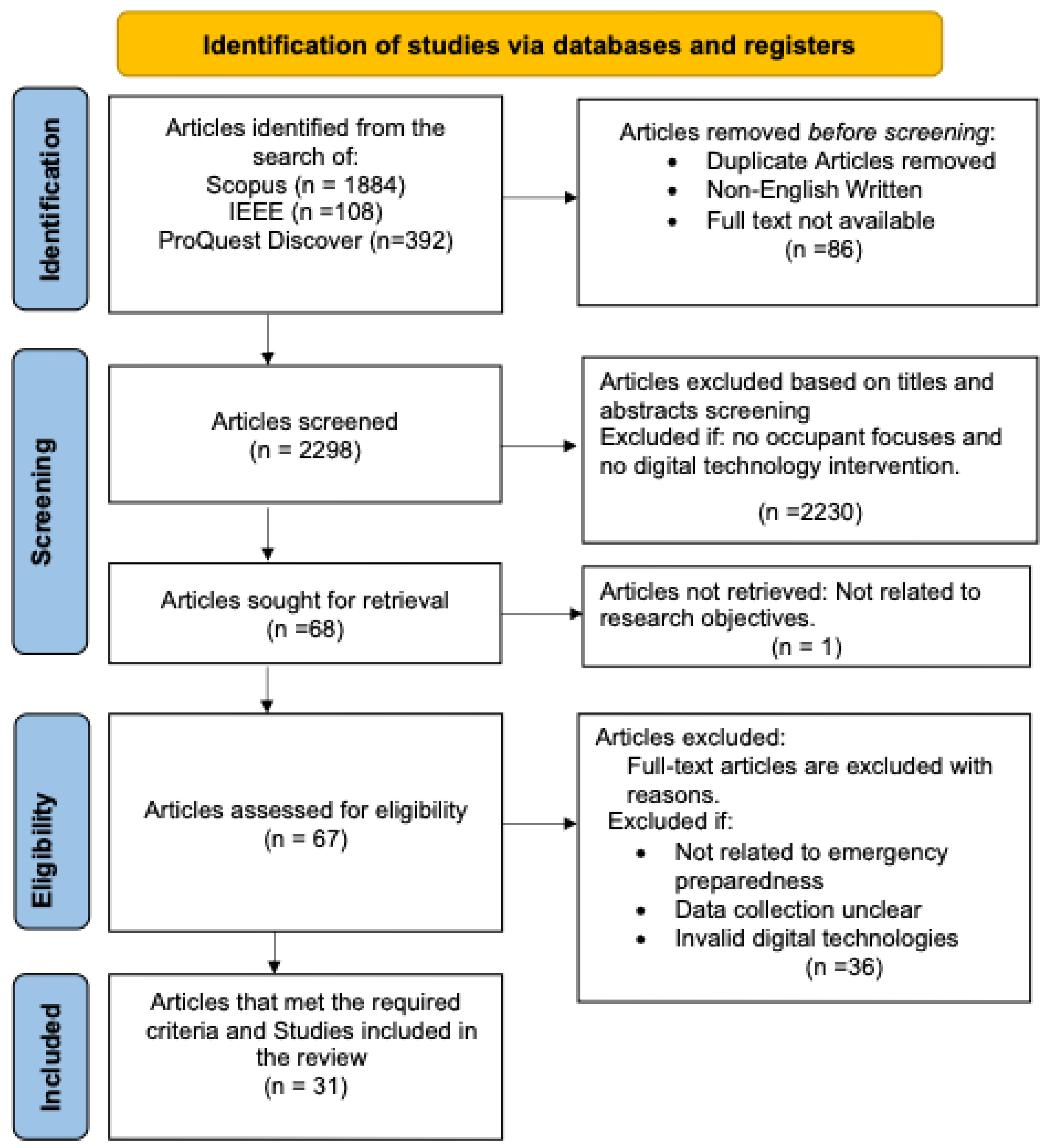
3.2. Search Strategy
3.3. Research Questions
3.4. Analysis Approach
3.5. Inclusion and Exclusion Criteria
- Population setting: studies in building contexts (schools, hospitals, offices, and residential buildings) that address occupant emergency preparedness or evacuation.
- Intervention technology: digital interventions (BIM, IoT, AI/ML, VR/AR, and DTs) applied to preparedness, training, navigation, communication, or evacuation decision support.
- Study type: empirical field deployments, simulation experiments that report occupant outcomes or technical performance in journal articles.
- Language and period: English, published 2015–2025.
- Purely technical studies without occupant focus (e.g., structural analysis only).
- Conceptual papers, reports and book chapters.
- No clear methodology or application of digital technology.
3.6. Data Extraction
4. Results
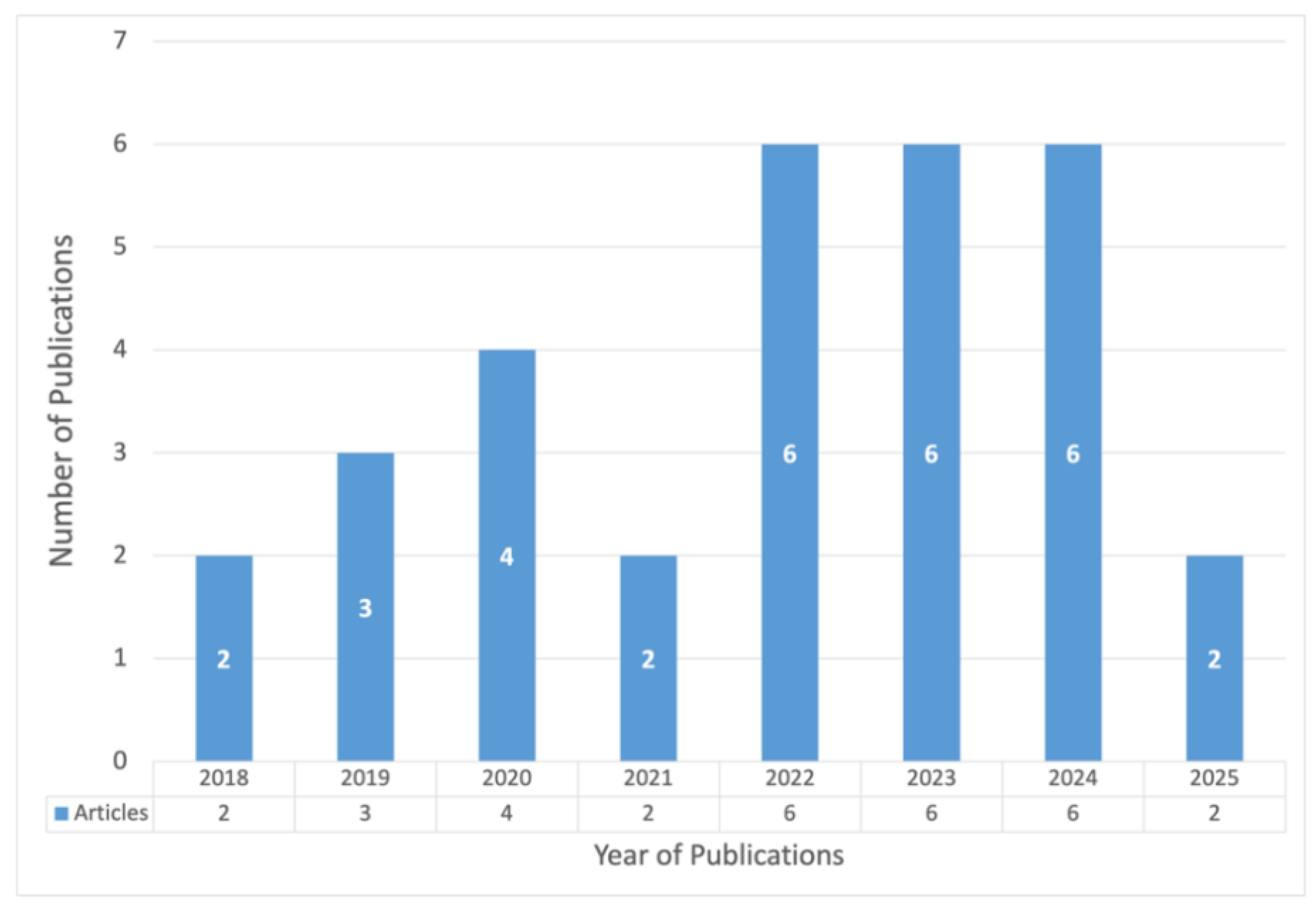
4.1. Selected Publication Trends
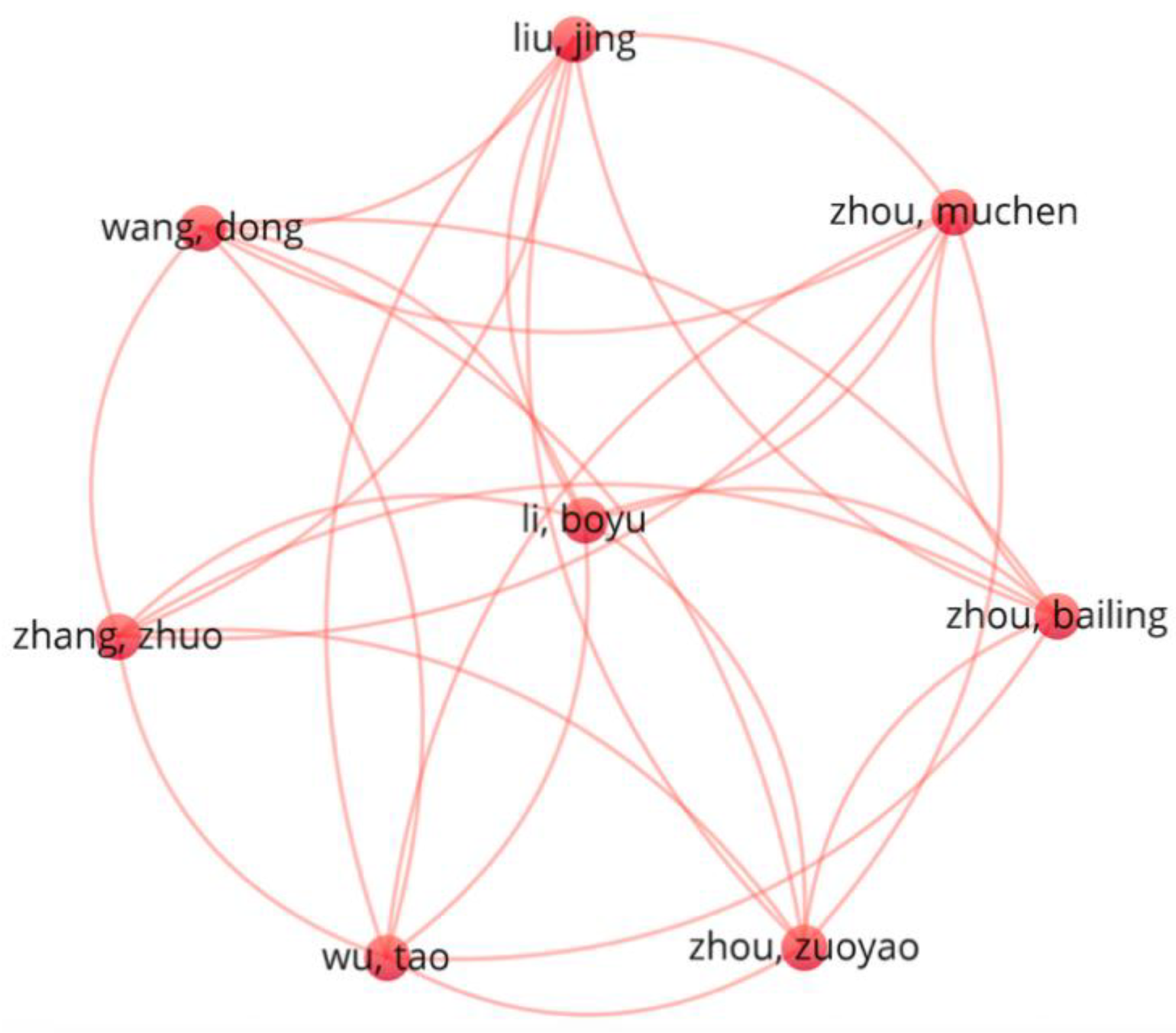
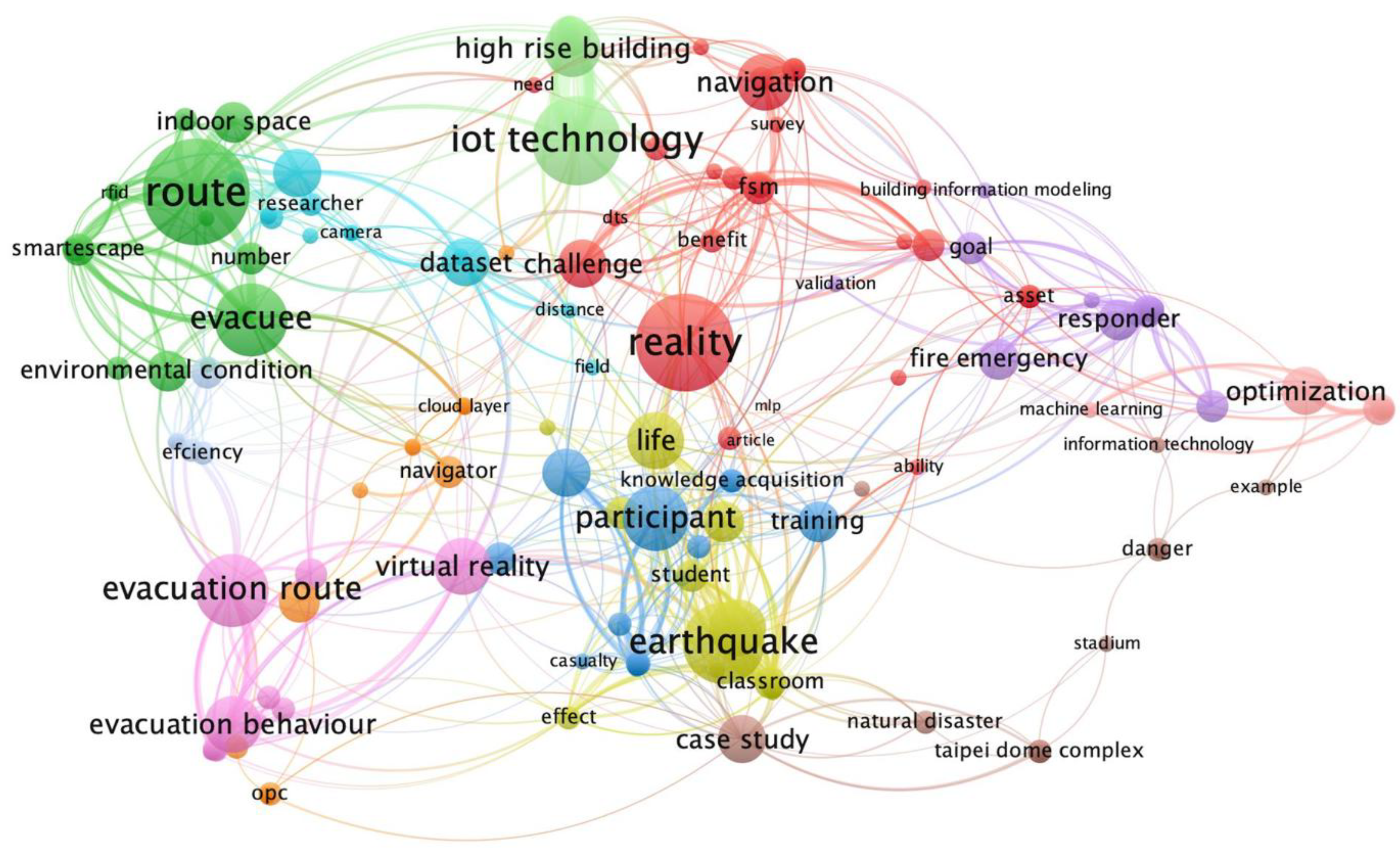
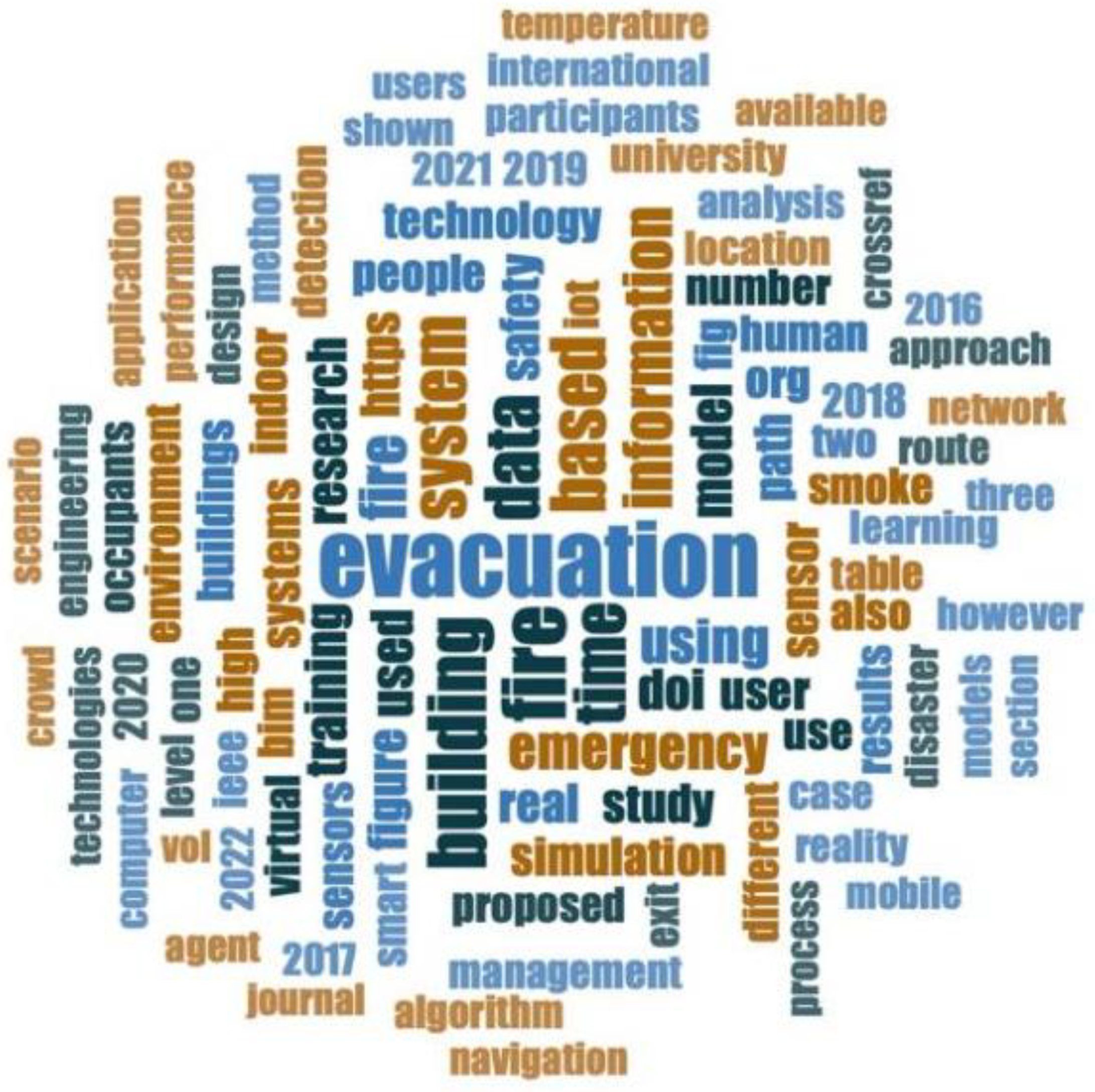
4.2. Keyword and Co-Occurrence Network
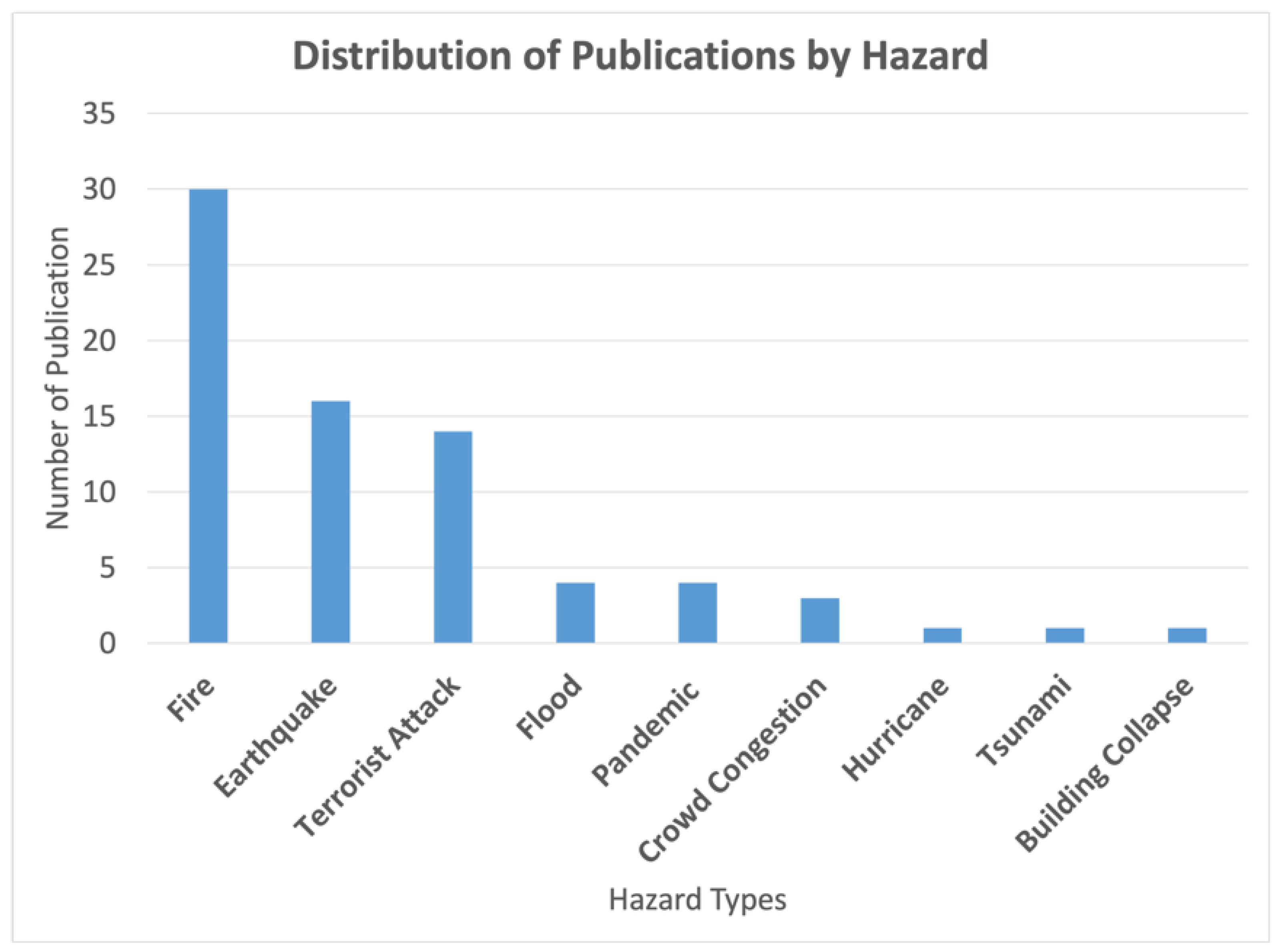
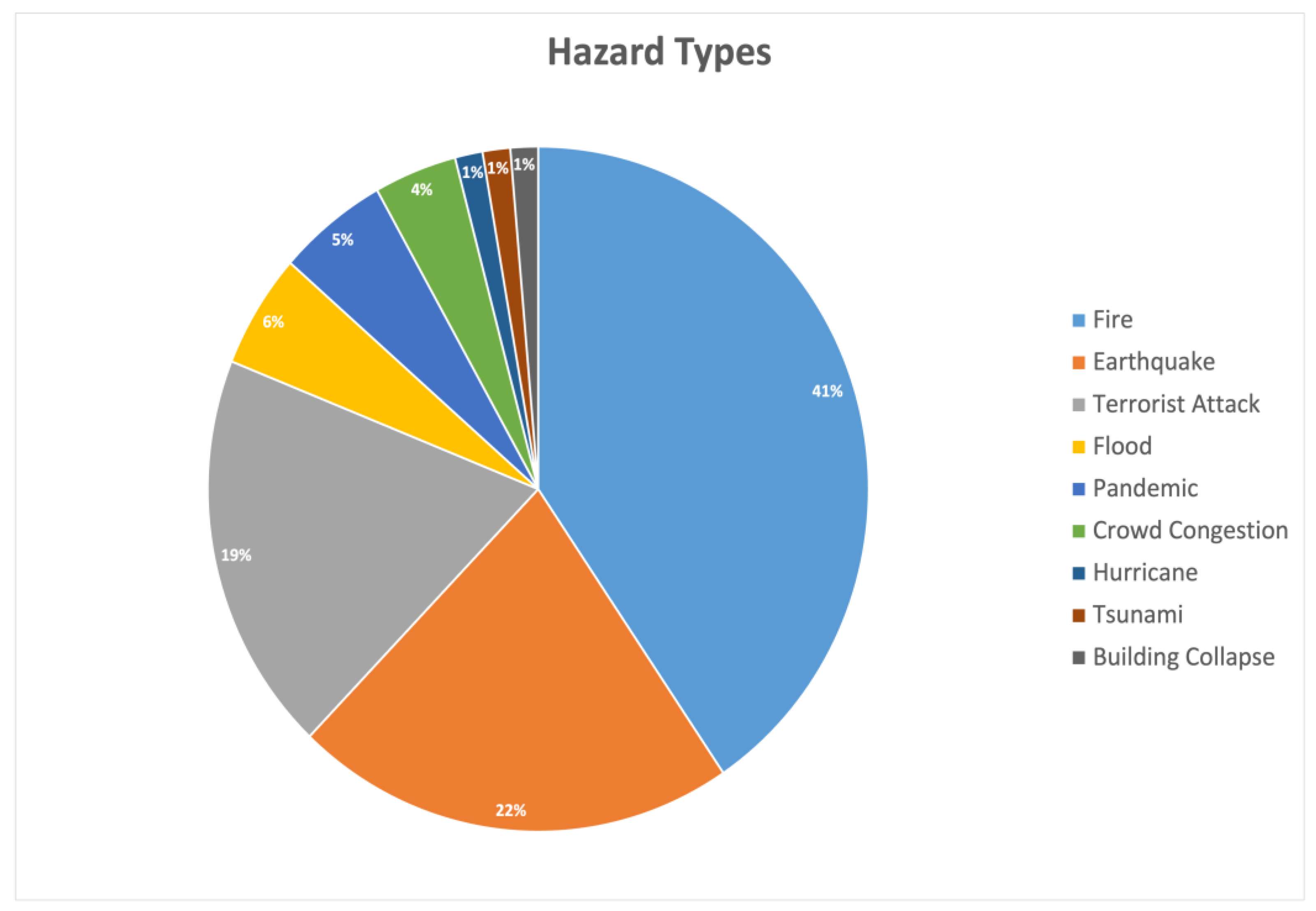
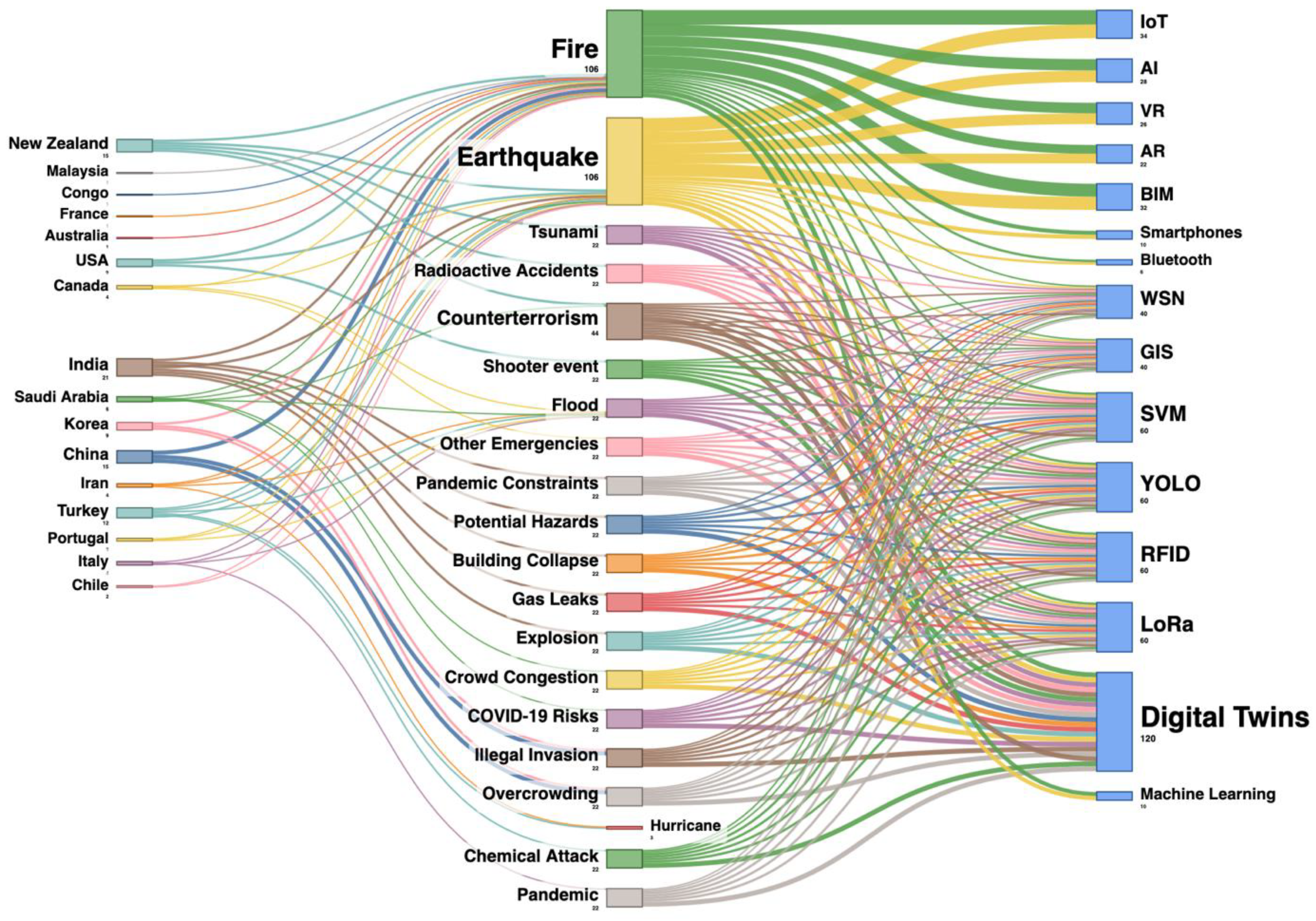
4.3. Distribution of Articles by Hazard Types and Country
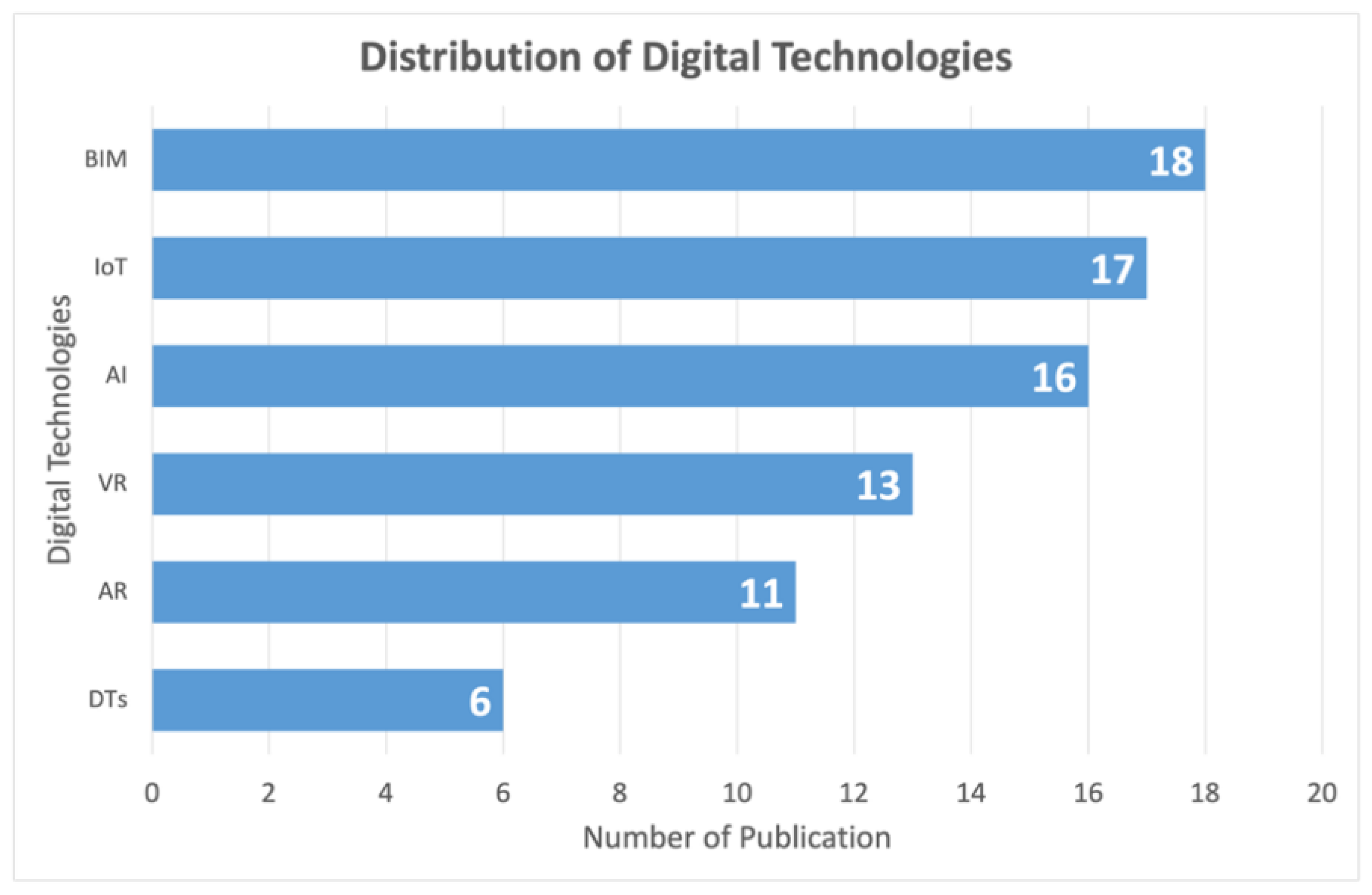
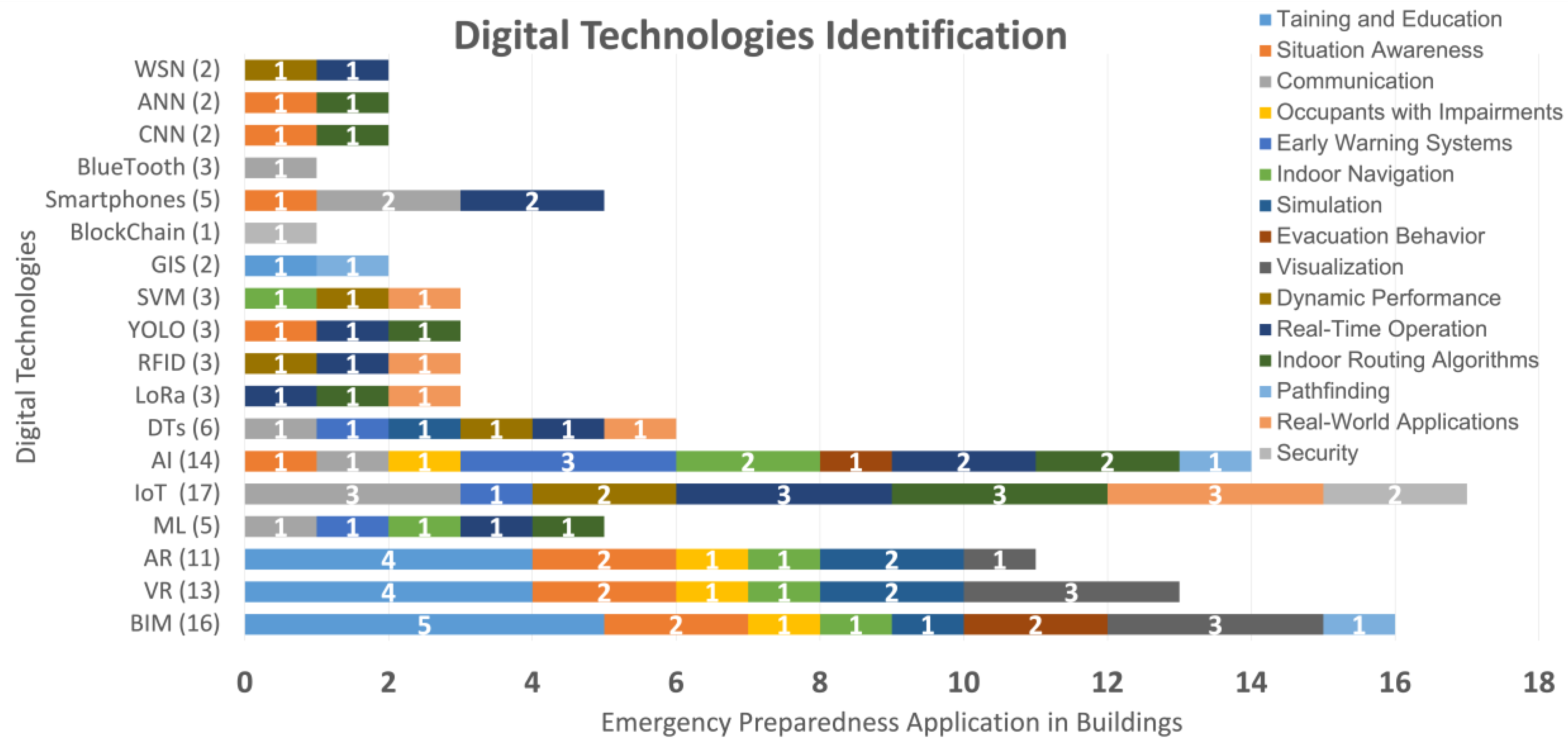
4.4. Frequency of Digital Technology Use
4.5. Challenges in the Effectiveness of Digital Technologies Across Emergency Preparedness Stages
4.6. Human Behavior for Training and Vulnerable Occupants
4.7. Digital Technologies Integration
4.7.1. Early Warning Systems
4.7.2. Indoor Navigation
4.7.3. Emergency Simulations
4.7.4. Power Outage Solutions
5. Discussion
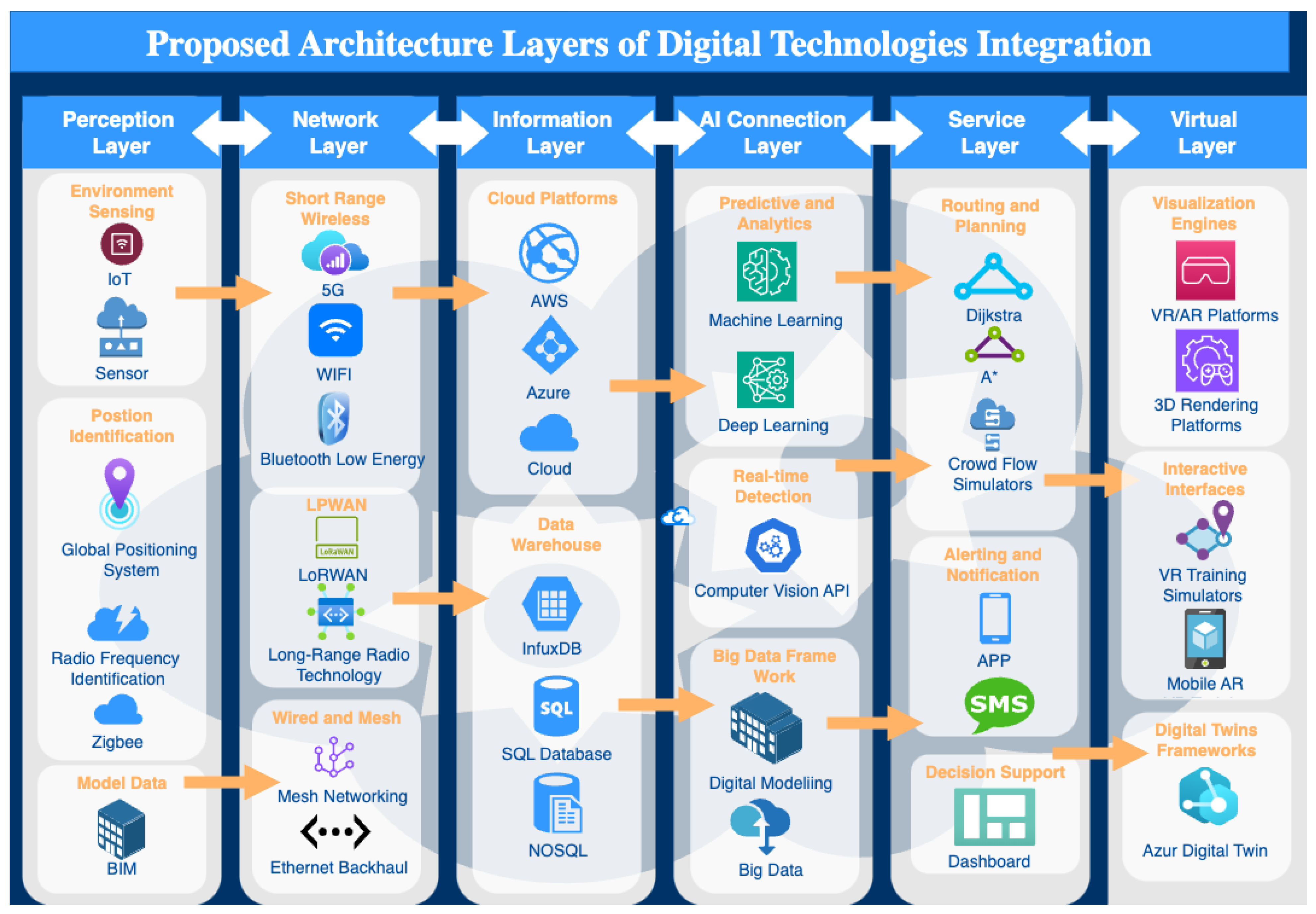
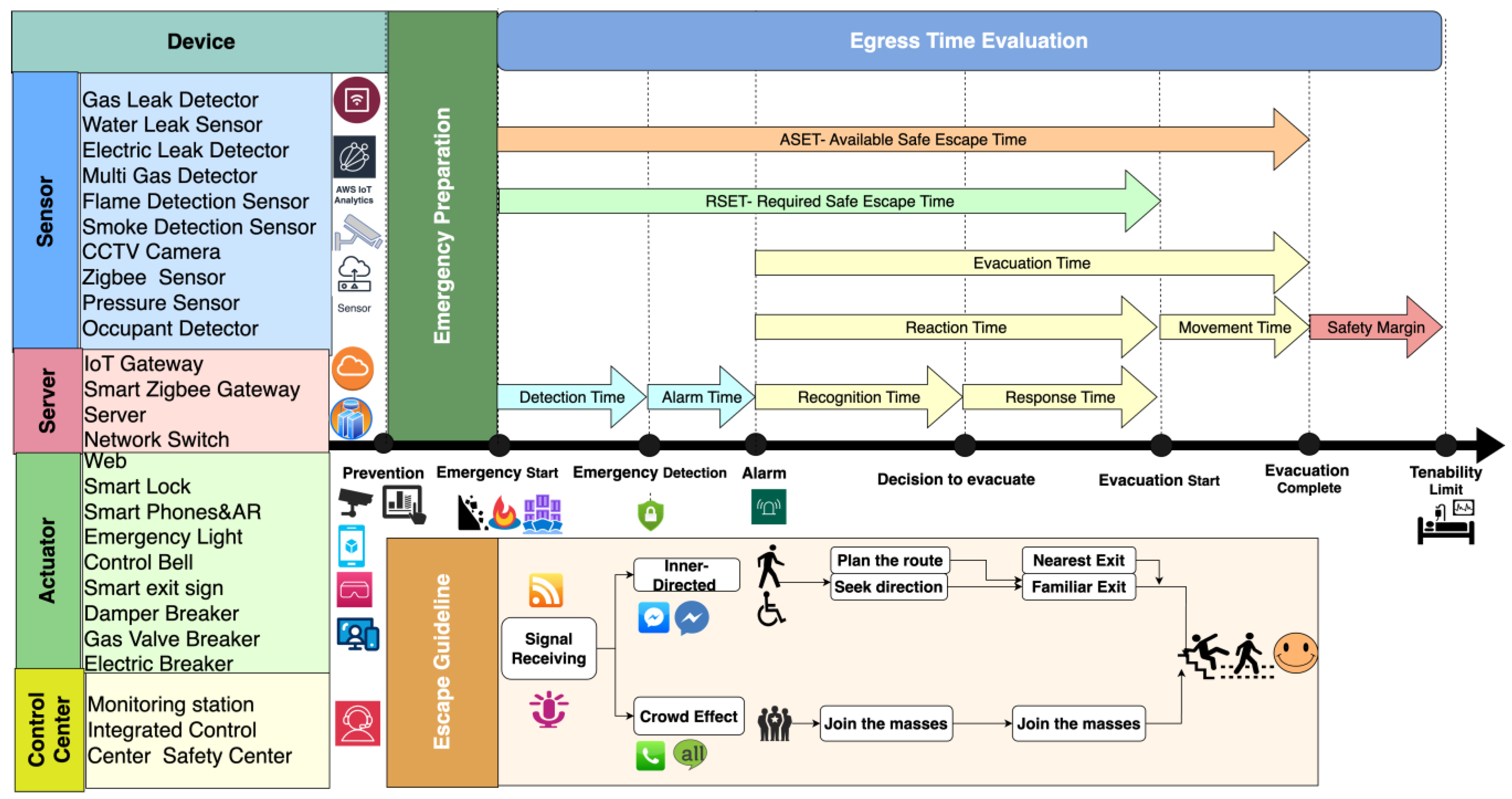
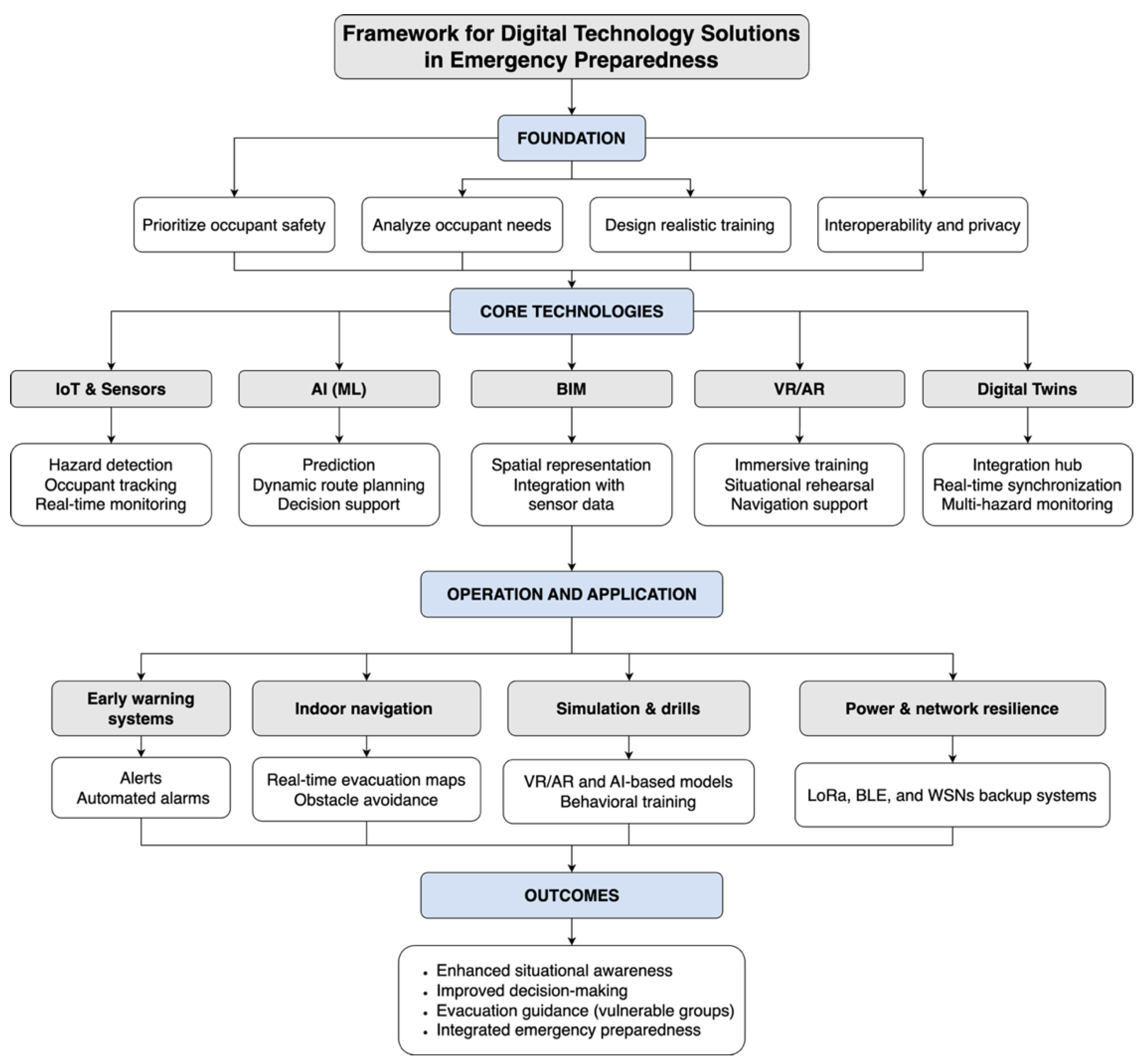
5.1. Proposed Framework
5.2. Digital Technologies Support for Vulnerable Occupants
6. Conclusions
Supplementary Materials
Author Contributions
Funding
Data Availability Statement
Conflicts of Interest
Appendix A

| NO. | Authors and Years | RQ1 | RQ2 | RQ3 |
|---|---|---|---|---|
| 1 | [51] | Virtual Reality Serious Games (IVR SGs) for indoor evacuations, focus on safety knowledge, self-efficacy, and engagement in multi-phase emergency training program. | No control group. Lack of knowledge retention assessment. | Earthquake: AR, VR and BIM for safety awareness, tracking and recognizing. |
| 2 | [20] | AR in building evacuation, in training, navigation, and simulation, identifying validation, and SWOT analysis. | Cost of investment. AR in the early stages. Limited in brightness and color range. | Fire, Earthquake, Tsunami, Radioactive Accidents: AR/VR, BIM and smartphone for navigation and evacuation. |
| 3 | [35] | Sensor-based IoT, BIM, VR, and AR improve fire safety by enhancing occupant situational awareness. Data aids in quick fire location. | Lack of capability to update real-time information. Hard to make BIM in advance. Limitation of AR real-time route finding. | Fire: BIM, Bluetooth, IoT and sensors for fire monitoring. IoT, BIM, VR, and AR for safety and efficiency. Computational Fluid Dynamics (CFD): simulation training. Radio Frequency Identification (RFID): accuracy positioning. |
| 4 | [23] | DTs in fire safety, exploring opportunities, and potential applications to guide future practices. | Data security, accuracy and latency. Sensor reliability. High initial costs. Lack of knowledge in DTs. User acceptance. | Fire: DTs (simulation & evacuation), BIM-based smart system (early fire detection and identify evacuation routes), blockchain (security) and IoT (monitoring and predictive security). |
| 5 | [13] | Evaluating advanced localization technologies: crowd sensing, 6G, UAV, RF, and NILM. | Data privacy and accuracy. Communication latency. Complexity and stability. Coverage and detection. | Earthquake, Flood, Fire: AI, UAV, RF, Non-intrusive load monitoring (NILM), RFID, Zigbee and 6G for localization. |
| 6 | [42] | This study presents a VR–DTs framework for precise, privacy-safe social distancing monitoring and AI training with synthetic data, reducing latency by streaming only extracted info. | Computer vision validation in large-scale datasets. Real-time data update. | Pandemic: DTs (accuracy and privacy for social distancing monitoring and training), AI(YOLOv3) and VR (simulation to create virtual office space to upload real-time location data). Computer vision method to measure social distance. CNNs: social distancing detection. |
| 7 | [18] | Indoor routing system for complex environments manages crowd density, predicts paths, and enforces social distancing using Dijkstra’s and A* algorithms. | Sensor accuracy. Emergency environment changes. Obstacles affect internet communication. | Fire, Crowd and Pandemic: AI & IoT (real-time data update) & Wi-Fi & WLAN, Bluetooth low energy (BLE) & RFID (Indoor navigation). |
| 8 | [7] | Escape algorithms offer safe rescue guidance in fire emergencies. | Difficulty to create real-world validation Focused limited only on fire. | Fire: IoT real-time remote system for fire detection & Smart gateways, sensors, and actuators & AR for visualization and hazard classification. |
| 9 | [21] | YOLOv5m for real-time indoor fire monitoring, and combining detection, and navigation for occupants. | Incorrect detection and wrong alarm. Difficult to collect real world data. | Fire: AI(YOLOv5+DL) & IoT & smart glasses for real-time monitoring, early fire detection, and notification for system in visually impaired people. |
| 10 | [10] | AR navigation offering better crossroads evaluation after stairs and faster responses when evacuation. | Devices limitation smart phone only. Demographic limitation. | Fire: AR navigation and eye-tracking system aids fire detection, and BIM for visualization. |
| 11 | [8] | Optical see-through AR fire safety training is compared with video and XR to evaluate knowledge retention, motivation, and self-efficacy. | Lack of real-world VR experience. High Cost and time requirement in AR development. | Fire, Terrorist attack, and Earthquake: AI & AR: hazards detection, training, and visualization. IoT & ML: predicting hazard situation. |
| 12 | [11] | A virtual fire evacuation drill that integrates BIM, and a physics engine collision model, validated through human experiments. | Lack of control over human behavior. Lack of real-world hazards experience. | Fire: BIM, computational fluid dynamics (CFD) & VR for smoke visualization. GPS: visual impaired person solutions. |
| 13 | [40] | IoT and ML for a smart cane with apps assist visually impaired navigation, using YOLOv3 and MLP for obstacle detection and classification. | Incorrect detection and ML training in crowd environment. Not enough sensors for items detection. Wearable travel aid design challenges. | Fire &Other hazards: YOLO v3 for detection & visual aid technologies (e.g., MLPs, Fast R-CNN, White cane and guide dogs) for visual impaired improvement. |
| 14 | [37] | The indoor evacuation system integrates BIM, GIS, Wi-Fi, Pedestrian Dead Reckoning (PDR), and AR visual guidance to navigation.). | Relies on Wi-Fi,3D, and software. High cost in AR development. | Fire, earthquake, flood, and hurricane: VR/AR improves evacuation & KNN for localization & Dijkstra (pathfinding). Mesh network/ Triangulated Irregular Network (TIN)/System Usability Scale (SUS) (Simplify the network & resolution in open ground). |
| 15 | [36] | DT-based indoor safety system to provide recommendations for safety management. | Lack of method for indoor safety management. | Fire, illegal invasion, and overcrowd: IoT and BIM for obtaining indoor hazard detection. SVM for processing data in levels of danger, and LoRa for wireless communication. |
| 16 | [16] | Intelligent and resilient fire safety systems enhance management to reduce fire damage and improve occupant safety. | Cost of installation. Cybersecurity. | Fire: Fire dynamics simulator (FDS), BIM, IoT, ML and DTs for sensors and detectors to enhance occupant situational awareness. |
| 17 | [4] | Smart Escape is a real-time, intelligent mobile evacuation system for fire and emergencies. | Limitation of RFID for real-time location. Rely on network connection. | Fire, and terrorist attacks: ANN, RFID and Bluetooth. |
| 18 | [17] | Smart building-based fire evacuation system to address occupant evacuation solutions. | Technology relies on technology. High cost. | Fire: BIM, Bluetooth, IoT and AI to improve occupants’ evacuation and collect data. Wireless networks for communication. Fire Dynamic Simulation (FDS) & Agent-Based Simulation (ABS) for estimating evacuation time. |
| 19 | [25] | Hybrid emergency evacuation approach to calculate real-time evacuation paths. | High power requirement in Internet. High cost. | Fire, Earthquake, Flood, and Terrorist Attack: WSNs, Dijkstra algorithms, ZigBee, Bluetooth, IoT and Cloud Computing for evacuation paths monitor, low consumption, low-cost, and low energy. |
| 20 | [22] | Intelligent evacuation system optimizes sensing for real-time hazard prediction. | Network security and Latency. Unpredicting human behavior. | Fire, Earthquake, and Structure failure: AI (SVM & A*), IoT, fog and cloud computing for evacuation. |
| 21 | [27] | AR allows 3D visualization of spatial context to enhance learning cognitive mapping. | Rely on phone connection. | Fire, Earthquake, and terrorist attack: AR (HoloLens) provides 3D visualization. |
| 22 | [19] | IVR in earthquake safety training assesses how education, forecasting, and simulation affect responses. | Simulation lack of earthquake shaking. | Earthquake, and fire: VR simulations and immersive evacuation. |
| 23 | [28] | Innovative approach to enhance occupant behavior predictability by providing real-time information on the best evacuation routes. | Lack of information for occupants. Unclear route findings. | Fire: FDS and ML to reduce evacuation time. |
| 24 | [29] | Database to improve simulation accuracy and suggests design strategies for buildings. | Limitation of analytical data. | Fire: Simulation, Pathfinder and ML to reduce evacuation time. |
| 25 | [30] | The AR mobile app provides a realistic training environment for university stakeholders, enhancing occupant situational awareness and satisfaction. | Lack of control. Time consuming for 3D models. | Fire, chemical attack, earthquake: Rescue Me (AR for emergency situations). Smart glasses: Tsunami drill. |
| 26 | [15] | Implement a BIM-GIS asset management system at an Italian university to enhance user experience and optimize resources. | Rely on internet and data security. | Fire, pandemic, flood, and earthquake: BIM, GIS, AI, IoT, and DTs are used for visualization, building dynamics, security, and automatic hazard response. |
| 27 | [26] | IoT for fire evacuation, evaluating its real-world effectiveness and to advance intelligent fire protection systems. | Limitation of sample size. High-rise building evacuation challenges | Fire: IoT in real-world fire scenarios to enhance escape procedures, reduce reaction time, and improve occupant safety. |
| 28 | [43] | VR for evaluating building layouts, enabling parametric route analysis and collecting evacuation behavior and eye movement data. | Lack of temperature experience. Limitation of occupants for students only. | Fire: VR, Pathfinder, and FDS for fire evacuation, occupant behavior, and attention. |
| 29 | [14] | Multi-agent system guides fire evacuation with routes, and equipment instructions, evaluating phased evacuation and ramp benefits for mobility issues. | Lack of knowledge. Various occupant health status. | Fire and unpredictable hazards: AI, Agent-Based Modeling (ABM), and Safe Gress for fire location, modeling, and occupant interactions. |
| 30 | [24] | Developing evacuation plans using pedestrian simulations based on their environment. | No real-time interaction. | Fire and earthquake: Computer simulation and Pathfinder help to analysis human behavior and Early warning systems. |
| 31 | [31] | Define fire response goals by integrating BIM and IoT, then develop sequence and behavior data models. | Only experts. | Fire: BIM, GIS and IoT in integrated systems to provide information, better communication and enhance occupant situational awareness. |
References
- Weir, A.M.; Wilson, T.M.; Leonard, G.S.; Johnston, D.M. Approaching the challenge of multi-phase, multi-hazard volcanic impact assessment through the lens of systemic risk: Application to Taranaki Mounga. Nat. Hazards 2024, 120, 9327–9360. [Google Scholar] [CrossRef]
- Sanderson, D.; Wilson, T.M.; Johnston, D.M.; Leonard, G.S. Deaggregation of multi-hazard damages, losses, risks, and connectivity: An application to the joint seismic-tsunami hazard at Seaside, Oregon. Nat. Hazards 2021, 109, 1821–1847. [Google Scholar] [CrossRef]
- Owolabi, T.A.; Sajjad, M. A global outlook on multi-hazard risk analysis: A systematic and scientometric review. Int. J. Disaster Risk Reduct. 2023, 92, 103727. [Google Scholar] [CrossRef]
- Atila, U.; Demir, M.; Kaya, S. SmartEscape: A Mobile Smart Individual Fire Evacuation System Based on 3D Spatial Model. ISPRS Int. J. Geo-Inf. 2018, 7, 223. [Google Scholar] [CrossRef]
- Aquino, D.H.; Schilderman, T.; Lyons, M. Building back towards storm-resilient housing: Lessons from Fiji’s Cyclone Winston experience. Int. J. Disaster Risk Reduct. 2019, 33, 355–364. [Google Scholar] [CrossRef]
- Aquino, D.H.; Schilderman, T.; Lyons, M. Challenges to building housing resilience: The case of Fiji post-cyclone Winston. Procedia Eng. 2018, 212, 475–480. [Google Scholar] [CrossRef]
- Park, S.; Lee, J.; Kim, H. Design and implementation of a smart IoT based building and town disaster management system in smart city infrastructure. Appl. Sci. 2018, 8, 2239. [Google Scholar] [CrossRef]
- Paes, D.; Arrieta, C.; Cordeiro, J. Optical see-through augmented reality fire safety training for building occupants. Autom. Constr. 2024, 162, 105371. [Google Scholar] [CrossRef]
- Navarro Bringas, E. Leveraging digital twins towards an occupant-centric built environment: A review. In Proceedings of the 2024 European Conference on Computing in Construction, Crete, Greece, 14–17 July 2024. [Google Scholar]
- Ahn, Y.; Kim, J.; Lee, S. BIM-based augmented reality navigation for indoor emergency evacuation. Expert Syst. Appl. 2024, 255, 124469. [Google Scholar] [CrossRef]
- Xu, Z.; Li, X.; Zhang, Y. Virtual drill for indoor fire evacuations considering occupant physical collisions. Autom. Constr. 2020, 109, 102999. [Google Scholar] [CrossRef]
- Ghasemi, M.; Alizadeh, A.; Rahimi, M. Evaluating multi-hazard preparedness for a major earthquake: Acase study of Tabriz city (NWIran). Int. J. Disaster Risk Reduct. 2025, 116, 105086. [Google Scholar] [CrossRef]
- Alnoman, A.; Alazrai, A.; Aldayel, A.; Alkhodre, A. Emerging AI and 6G-based user localization technologies for emergencies and disasters. IEEE Access 2024, 12, 197877–197906. [Google Scholar] [CrossRef]
- Kasereka, S.K.; Bagula, A.; Boulmakoul, A.; Masinde, M. Enhancing building evacuation efficiency in case of fire breakout by integrating evacuee categorization into an agent-based simulation. IEEE Access 2025, 13, 10595–10618. [Google Scholar] [CrossRef]
- Meschini, S.; Brumana, R.; Previtali, M.; Barazzetti, L. Toward cognitive digital twins using a BIM-GIS asset management system for a diffused university. Front. Built Environ. 2022, 8, 959475. [Google Scholar] [CrossRef]
- Abdullahi, U.I.; Ahmed, A.; Hassan, M.; Yusuf, A. Integrating IoT Technology for Fire Risk Monitoring and Assessment in Residential Building Design. Buildings 2025, 15, 1346. [Google Scholar] [CrossRef]
- Wehbe, R.; Shahrour, I. A BIM-Based Smart System for Fire Evacuation. Future Internet 2021, 13, 221. [Google Scholar] [CrossRef]
- Alamri, A.; Alturki, R.A.; Alamri, S. Multi-user routing algorithm for indoor spaces—Adapted for social distancing. J. King Saud. Univ.-Comput. Inf. Sci. 2022, 34, 7045–7058. [Google Scholar] [CrossRef]
- Rajabi, M.S.; Taghaddos, H.; Zahrai, S.M. Improving Emergency Training for Earthquakes through Immersive Virtual Environments and Anxiety Tests: A Case Study. Buildings 2022, 12, 1850. [Google Scholar] [CrossRef]
- Lovreglio, R.; Kinateder, M. Augmented reality for pedestrian evacuation research: Promises and limitations. Saf. Sci. 2020, 128, 104750. [Google Scholar] [CrossRef]
- Abdusalomov, A.B.; Kutlimuratov, A.; Whangbo, T.K. Improved Real-Time Fire Warning System Based on Advanced Technologies for Visually Impaired People. Sensors 2022, 22, 7305. [Google Scholar] [CrossRef]
- Saini, K.; Kalra, S.; Sood, S.K. Disaster emergency response framework for smart buildings. Future Gener. Comput. Syst. 2022, 131, 106–120. [Google Scholar] [CrossRef]
- Almatared, M.; Almusallam, M.; Alshammari, A. Digital-Twin-Based Fire Safety Management Framework for Smart Buildings. Buildings 2023, 14, 4. [Google Scholar] [CrossRef]
- Ternero, R.; Vázquez, M.; Casado, M. Analysis of Pedestrian Behavior for the Optimization of Evacuation Plans in Tall Buildings: Case Study Santiago, Chile. Buildings 2023, 13, 2907. [Google Scholar] [CrossRef]
- Al-Nabhan, N.; Al-Aboody, N.; Al Islam, A.B.M.A. A hybrid IoT-based approach for emergency evacuation. Comput. Netw. 2019, 155, 87–97. [Google Scholar] [CrossRef]
- Chen, S.; Liu, Y.; Wang, J.; Zhang, L. The Integration of Internet of Things (IoT) Technology into Fire Evacuation Plan in High-rise Buildings. J. Adv. Res. Appl. Sci. Eng. Technol. 2024, 42, 239–253. [Google Scholar] [CrossRef]
- James, S.; Stigall, J.; Bodempudi, S.T.; Sharma, S.; Scribner, D.; Grynovicki, J.; Grazaitis, P. Use of Microsoft HoloLens in Indoor Evacuation. Int. J. Comput. Their Appl. 2019, 26, 3–12. [Google Scholar]
- Neto, J.; Silva, A.; Santos, R.; Costa, P. Guiding Evacuees to Improve Fire Building Evacuation Efficiency: Hazard and Congestion Models to Support Decision Making by a Context-Aware Recommender System. Buildings 2023, 13, 3038. [Google Scholar] [CrossRef]
- Zhou, M.; Zhang, Y.; Liu, H.; Wang, J. Fire Egress System Optimization of High-Rise Teaching Building Based on Simulation and Machine Learning. Fire 2023, 6, 190. [Google Scholar] [CrossRef]
- Catal, C.; Tekinerdogan, B.; Bicakci, K. Evaluation of augmented reality technology for the design of an evacuation training game. Virtual Realit 2020, 24, 359–368. [Google Scholar] [CrossRef]
- Rezaeifam, S.; Ergen, E.; Günaydın, H.M. Fire emergency response systems information requirements’ data model for situational awareness of responders: A goal-directed task analysis. J. Build. Eng. 2023, 63, 105531. [Google Scholar] [CrossRef]
- Shan, S.; Li, Y. Research on the Application Framework of Generative AI in Emergency Response Decision Support Systems for Emergencies. Int. J. Hum. Comput. Interact. 2025, 41, 9191–9208. [Google Scholar] [CrossRef]
- Huang, C.-J.; Chiang, T.-Y. Discussion on Risk Factors of Stadium: A Case Study of Taipei Dome Complex. Eng. Proc. 2023, 38, 22. [Google Scholar]
- Haddaway, N.R.; McGuinness, L.A.; Pritchard, C.C. PRISMA2020: An R package and Shiny app for producing PRISMA 2020-compliant flow diagrams, with interactivity for optimised digital transparency and Open Synthesis. Campbell Syst. Rev. 2022, 18, e1230. [Google Scholar] [CrossRef] [PubMed]
- Chen, H.; Li, H.; Luo, X.; Ding, L. Development of BIM, IoT and AR/VR technologies for fire safety and upskilling. Autom. Constr. 2021, 125, 103631. [Google Scholar] [CrossRef]
- Liu, Z.; Zhang, A.; Wang, W. A Framework for an Indoor Safety Management System Based on Digital Twin. Sensors 2020, 20, 5771. [Google Scholar] [CrossRef]
- Valizadeh, M.; Rafiei, M.H.; Eftekhari, M. Indoor augmented reality (AR) pedestrian navigation for emergency evacuation based on BIM and GIS. Heliyon 2024, 10, e32852. [Google Scholar] [CrossRef]
- Samarasinghe, D.A.S.; Piri, I.S. Assessing design buildability through virtual reality from the perspective of construction students. Built Environ. Proj. Asset Manag. 2022, 12, 823–836. [Google Scholar] [CrossRef]
- Zhao, N.; Ying, F.J.; Tookey, J. Knowledge visualisation for construction procurement decision-making: A process innovation. Manag. Decis. 2022, 60, 1039–1055. [Google Scholar] [CrossRef]
- Saranya, V.S.; Ramesh, K.; Kumar, P. An IoT Machine Learning Approach for Visually Impaired People Walking Indoors and Outdoors. Intell. Syst. Appl. Eng. 2024, 12, 121–129. [Google Scholar]
- Shumlich, A.; Smith, J.; Brown, R. High-Resolution Digital Elevation Model Development to Support Emergency Preparedness in Haida Gwaii, British Columbia, Canada. In OCEANS 2022; Hampton Roads IEEE: Piscataway, NJ, USA, 2022; pp. 1–6. [Google Scholar]
- Mukhopadhyay, A.; Banerjee, S.; Roy, A. Virtual-reality-based digital twin of office spaces with social distance measurement feature. Virtual Real. Intell. Hardw. 2022, 4, 55–75. [Google Scholar] [CrossRef]
- Fu, R.; Li, X.; Zhang, Y. Building layout assessment on fire evacuation efficiency by integrating graph theory virtual reality. J. Build. Eng. 2024, 98, 111498. [Google Scholar] [CrossRef]
- Jayasekara, R.; Perera, S.; Wedawatta, G.; Zuo, J. Evaluating the network of stakeholders in Multi-Hazard Early Warning Systems for multiple hazards amidst biological outbreaks: Sri Lanka as a case in point. Prog. Disaster Sci. 2022, 14, 100228. [Google Scholar] [CrossRef]
- Mirianna, B.; Kelman, I.; Maskrey, A.; van Aalst, M. Opportunities and challenges for people-centered multi-hazard early warning systems: Perspectives from the Global South. iScience 2025, 28, 112353. [Google Scholar]
- Onatayo, E. Integrating AIwith Remote Sensing for Real-Time Disaster Monitoring Rapid Response. Int. J. Res. Publ. Rev. 2025, 6, 4146–4164. [Google Scholar] [CrossRef]
- Ding, Y.; Liu, Z.; Wang, H.; Zhang, X. Smart building evacuation by tracking multi-camera network and explainable Re-identification model. Intell. Eng. Appl. Artif. Intell. 2025, 148, 110394. [Google Scholar] [CrossRef]
- Bavaresco, M.V.; D’Oca, S.; Ghisi, E.; Lamberts, R. Technological innovations to assess and include the human dimension in the building-performance loop: A review. Energy Build. 2019, 202, 109365. [Google Scholar] [CrossRef]
- Ch’ng, E.; Cai, S. Methods for evaluating the adoption and use of digital technologies in GLAMs. MethodsX 2020, 7, 100559. [Google Scholar] [CrossRef]
- Nikou, S.; De Reuver, M.; Kanafi, M.M. Workplace literacy skills—How information and digital literacy affect adoption of digital technology. J. Doc. 2022, 78, 371–391. [Google Scholar] [CrossRef]
- Feng, Z.; González, V.A.; Amor, R.; Spearpoint, M.; Thomas, J.; Sacks, R.; Lovreglio, R.; Cabrera-Guerrero, G. An immersive virtual reality serious game to enhance earthquake behavioral responses and post-earthquake evacuation preparedness in buildings. Adv. Eng. Inform. 2020, 45, 101118. [Google Scholar] [CrossRef]




| Search Database | Search String |
|---|---|
| Scopus | “digital technolog*” OR “smart technolog*” OR “advanced technolog*” OR technolog* OR “emerging technolog*” OR “State-of-the-art technolog*” OR “Innovative technolog*” OR “breakthrough technolog*” OR “Cutting-edge technolog*” OR “Digital innovation” AND safe* OR evacuat* OR prepared* AND building* OR “indoor” OR school* OR hospital* OR hous* AND occupan* OR user* OR people |
| IEEE | |
| ProQuest Discover |
| Steps | Inclusion Criteria | Exclusion Criteria |
|---|---|---|
| Identification | All records from three databases were retrieved, duplicates removed. | Duplicate removal in this phase. Non-English written. |
| Screening | Titles and abstracts discuss digital technologies for occupant safety for emergency preparedness in buildings. | Duplicates (n = 86) removed. No occupant focus (e.g., structural analysis only). No digital technologies intervention. |
| Eligibility | Full texts demonstrating implementation. Clear method and results. Valid digital technologies intervention in the emergency preparedness stages. | Not related to the emergency preparedness stages. Unclear data collection method and results Technologies used are invalid or unrelated. |
| Inclusion | Empirical studies of digital solutions evaluating effectiveness and occupant safety for emergency preparedness in buildings. | Studies not meeting all above criteria upon final review. |
| No. | Country | Frequency of Articles | Emergency Types |
|---|---|---|---|
| 1 | New Zealand | 3 | Fire, Earthquake, Tsunami, Radioactive Accidents, Counterterrorism |
| 2 | Australia | 1 | Fire |
| 3 | USA | 3 | Fire, Earthquake, and Shooter event |
| 4 | France | 1 | Fire |
| 5 | Canada | 1 | Earthquake, Flood, Fire |
| 6 | India | 3 | Fire, Pandemic Constraints, Potential Hazards, Earthquake, Building Collapse, Gas Leaks, Explosion |
| 7 | Saudi Arabia | 1 | Fire, Crowd congestion, Transmission risks of COVID-19 |
| 8 | Korea | 3 | Fire |
| 9 | China | 5 | Fire, Illegal invasion, Overcrowding |
| 10 | Turkey | 2 | Fire, Terrorist Attacks, Chemical Attack, Earthquake |
| 11 | Iran | 1 | Fire, Earthquake, Inundation, Hurricane |
| 12 | Saudi Arabia | 1 | Earthquake, Fire, Flood, Terrorist Attack |
| 13 | Portugal | 1 | Fire |
| 14 | Italy | 1 | Fire, Pandemic, Flood, Earthquake |
| 15 | Malaysia | 1 | Fire |
| 16 | Democratic Republic of the Congo | 1 | Fire |
| 17 | Chile | 1 | Fire, Earthquake |
| No. | Digital Technology | Frequency |
|---|---|---|
| 1 | Building Information Modeling (BIM) | 18 |
| 2 | Internet of Things (IoT) | 17 |
| 3 | Artificial Intelligence (AI) | 16 |
| 4 | VR | 13 |
| 5 | AR | 11 |
| 6 | Digital Twins (DTs) | 6 |
| Vulnerable Occupants | Digital Technology Solutions | Results |
|---|---|---|
| Visually Impaired | Smart glasses (YOLOv5 and audio alerts) AI and IoT provide real-time hazard monitoring. | [10,21,23,35,36,37,40] |
| Mobility-Impaired | BIM-based AR personalized routes by passing stair. | [4,14,17,24,25,28] |
| Hearing Impaired | Visual AR overlays with flashing LED exits. | [8,11,40] |
| Disoriented Occupants | Recommender systems using real-time IoT congestion data. | [4,11,18,25,27,28,37] |
| Technology Classification | Advantages | Challenges | Key Evaluation Aspects |
|---|---|---|---|
| GIS Mapping | Visualize safe routes Resource allocation | Data security Data compatibility issues | Resource allocation effectiveness. |
| VR/ AR/ MR | Immersive environment Enhanced user interaction Overlay virtual elements | Initial costs User Training Motion sickness | Stress reduction features Safety resources availability Training accessibility |
| Mobile Apps | Emergency alerts Shelter locations | Privacy System integration | Information sharing platforms |
| AI(ML) | Integrate IoT data for prediction | AI biases User Training | Automated decision support |
| BIM | IoT for real-time updates. | Specialized training and data compatibility | Building Response Capacity |
| IoT | AI for emergency detection. | Sensor accuracy Reliability in extreme conditions | Accuracy |
| Digital Twins | Simulate hazard scenarios. Real-time simulation. | Complex setup and cost High computational requirements | User acceptance |
| No. | Digital Technologies Integration | Performance | Articles |
|---|---|---|---|
| 1 | IoT Cloud Computing Fog Computing | Decision making remotely. Occupant situational awareness and route planning. Quick response time. | [22] |
| 2 | BIM VR AR | Understand the building typology. Enhance engagement of occupant learning. Build confidence. | [8] |
| 3 | IoT ML | Collect sensing data. Emergency and evacuation route detection. Prediction of hazard area and location. | [8] |
| 4 | IoT AI | Early detection. Evacuation. | [17] |
| 5 | YOLO v3 MLPs CNNs | Emergency image prediction, classification and detection. | [40] |
| 6 | IoT BIM | Decision making. Fire monitor in evacuation. | [23] |
| 7 | AR DTs BIM AI | Improve understanding. Decision making. Interaction. | [23] |
| 8 | IoT BIM AI | Intelligent indoor safety management. Real-time hazard response. | [23] |
| 9 | AR BIM GIS | Navigation and Positioning. Indoor route network. | [37] |
| Vulnerable Occupants | Key Needs | Supporting Digital Technologies |
|---|---|---|
| Visually Impaired |
|
|
| Mobility-Impaired |
|
|
| Hearing Impaired |
|
|
| Disoriented Occupants |
|
|
| Elderly Occupants |
|
|
| Children |
|
|
Disclaimer/Publisher’s Note: The statements, opinions and data contained in all publications are solely those of the individual author(s) and contributor(s) and not of MDPI and/or the editor(s). MDPI and/or the editor(s) disclaim responsibility for any injury to people or property resulting from any ideas, methods, instructions or products referred to in the content. |
© 2026 by the authors. Licensee MDPI, Basel, Switzerland. This article is an open access article distributed under the terms and conditions of the Creative Commons Attribution (CC BY) license.
Share and Cite
Wang, J.; Samarasinghe, D.A.S.; Aquino, D.H.M.; Ying, F. A Systematic Review of Digital Technologies for Emergency Preparedness in Buildings. Buildings 2026, 16, 856. https://doi.org/10.3390/buildings16040856
Wang J, Samarasinghe DAS, Aquino DHM, Ying F. A Systematic Review of Digital Technologies for Emergency Preparedness in Buildings. Buildings. 2026; 16(4):856. https://doi.org/10.3390/buildings16040856
Chicago/Turabian StyleWang, Jiahan, Don Amila Sajeevan Samarasinghe, Diocel Harold M. Aquino, and Fei Ying. 2026. "A Systematic Review of Digital Technologies for Emergency Preparedness in Buildings" Buildings 16, no. 4: 856. https://doi.org/10.3390/buildings16040856
APA StyleWang, J., Samarasinghe, D. A. S., Aquino, D. H. M., & Ying, F. (2026). A Systematic Review of Digital Technologies for Emergency Preparedness in Buildings. Buildings, 16(4), 856. https://doi.org/10.3390/buildings16040856