Article

Finite Element Analyses on Bearing Performance of a Novel Precast Foundation for Cable Termination Support


1
Wuhan Huayuan Electric Power Co., Ltd., Wuhan 430070, China
2
School of Civil Engineering and Architecture, Wuhan University of Technology, Wuhan 430070, China
3
Hubei Bieyige Steel Construction Technology Development Co., Ltd., Wuhan 430070, China
*
Author to whom correspondence should be addressed.
Buildings 2026, 16(4), 848; https://doi.org/10.3390/buildings16040848
Submission received: 20 January 2026 / Revised: 15 February 2026 / Accepted: 18 February 2026 / Published: 20 February 2026
(This article belongs to the Special Issue Seismic Performance of Steel and Composite Structures)

Abstract

This study designs a novel modular prefabricated concrete foundation for cable termination supports in the power industry. This foundation is composed of prefabricated components including concrete segmented foundations, strut and connector via bolted connections, featuring convenient construction and a reduction of nearly 40% in concrete consumption. The finite element model was established using FEA software (Version ABAQUS 2020), and an economical and stable mesh size was selected through mesh convergence analysis. The settlement and bearing capacity of the foundation under axial compression were analyzed. Results show that this prefabricated foundation remains in the elastic stage under service load, with uniform settlement and excellent integrity. The stress of reinforcement bars and bolts is much lower than the material yield strength, and the concrete has ignorable damage. In addition, the safety margin is sufficient, and the force transfer path is clear. The research results can improve the prefabricated system for power facilities and provide technical support for the green and efficient construction of cable termination support foundations.

1. Introduction

Responding to the national call, State Grid Corporation of China put forward requirements for prefabricated and modular construction in 2012 [1]. Currently, the application of prefabricated structures in the superstructure of substation buildings, such as support structures, firewalls, and distribution buildings, has achieved certain results [2,3]. For the foundation part, traditional cast-in-place reinforced concrete technology is mostly adopted in engineering practice, which not only fails to guarantee construction quality but also hinders the green and energy-saving transformation of power facility construction [4].
The power industry encompasses a wide variety of facilities and equipment, such as transmission towers, wind turbines, GIS or HGIS equipment, and substation frames. In recent years, based on differences in the supported structures, facilities, and equipment, researchers have conducted in-depth studies on prefabricated foundations from various perspectives. Yin et al. [5] proposed a three-module prefabricated foundation using mortise and tenon connections suitable for substation distribution buildings and carried out full-scale static load tests. This prefabricated foundation includes post-cast strips, tenons, and U-shaped reinforcement, exhibiting good integrity and bearing capacity, although the bottom connection area requires strengthening. Zhang et al. [6] proposed a “beam-column integrated frame” modular prefabricated foundation for GSU equipment and conducted finite element analysis. This prefabricated foundation consists of modular units including prefabricated foundation beams, grade beams, bearing platform piers, and bearing platform beams. It is material-saving and efficient and can be designed in accordance with current specifications. Tian [7] proposed a new prefabricated spread foundation technology for substations, featuring modular design with wet joints (Incorporated with U-shaped and hooked reinforcements) between modules and four rectangular shear keys between the foundation slab and the pedestal. The weight of a single module of this prefabricated foundation is only half that of a cast-in-place foundation of the same size, significantly improving construction and transportation convenience. Ju et al. [8] designed a prefabricated raft foundation for HGIS equipment and its corresponding inserted-plate grouting connection method. Full-scale tests showed that this raft foundation is convenient for construction and has good flexural stiffness, excellent integrity, and reliable joint connection. For transmission tower foundations, Shao et al. [9] proposed a segmented prestressed prefabricated foundation, which is divided into prefabricated components including base plates, steps, and columns. Its overall integrity is enhanced through a combination of bolted connections and prestressed tendons. Wang et al. [10] innovatively applied mature connection schemes used in the building construction field, such as post-cast connections and lap connections, to slab foundations. Subsequently, they [11] further proposed a new type of prefabricated slab foundation with keyways and pre-embedded “whisker” reinforcement acting as shear keys. Tests and finite element simulations showed that the combined usage of these components could significantly improve the crack resistance and flexural bearing capacity of the foundation, and its mechanical properties were superior to those of cast-in-place components. Wang et al. [12] proposed a tapered pipe-slab prefabricated foundation composed of tapered pipe columns and slab bases for transmission lines in alpine regions and provided corresponding anti-frost-heave optimization measures based on the testing data.
In addition to substation facilities, Li [13] proposed a novel prefabricated foundation technology for onshore wind turbines, achieving initial connection between prefabricated blocks through convex-concave shear keys and enhancing overall integrity with grouting technology. ABAQUS 2020 software analysis results showed that concrete and reinforcement stresses were uniform, reasonable, and within code limits, and the overall stress and deformation met the operational requirements of wind turbines. Zhou [14] addressed issues such as the susceptibility to corrosion of steel pile foundations for offshore wind turbines and limitations in manufacturing and installing large-diameter steel piles by proposing a new connection technology using grouting between a steel sleeve and ultra-high performance concrete (UHPC) piles. This technology involves welding steel shear keys inside the steel sleeve and prefabricating concave trapezoidal shear keys on the UHPC pile, with the connection formed by filling with grout. The design performance of this connection is comparable to that of steel-to-steel connections under axial compression, with similar failure modes. Furthermore, scholars such as Wang [15], Qi [16], and Li [17] have innovatively designed prefabricated structures for wind turbine foundations, proposed various disassembly and assembly processes, and conducted finite element simulations and verifications of core indicators such as bearing capacity and settlement, illustrating the wide applicability of prefabricated foundations.
Beyond innovations in foundations themselves, scholars Seilim Pul [18] and Mustafa [19] both proposed new anchorage connection technologies to address issues such as the difficulty in achieving seismic resistance and leveling after connecting prefabricated columns to foundations. Horia [20] addressed the lack of guidance in European standard EN 1992-1-1 [21] for connections between prefabricated columns and pocket foundations, and provided detailed calculation models and internal force equations for various types of pocket foundations based on the strut-and-tie model. Furthermore, Xu [22], Li [17], Zhou [14] and Zhu [23] have conducted systematic research on grouted connection technology in prefabricated foundation structures, thoroughly examining its load transfer mechanisms and bearing capacity design methods under various load conditions. These works provide a robust foundation for the high-performance development, standardization, and engineering application of prefabricated foundation connections.
From an overall perspective, the current construction industry suffers from inefficient resource use, waste, and severe carbon emissions. While modular superstructures have gradually adopted Design for Manufacturing, Assembly, and Disassembly (DfMAD) principles, Héctor [24] innovatively proposed a DfMAD Compatibility Index (CI) in the context of low industrialization in foundation systems. Through a systematic literature review, nine representative types of prefabricated foundations were screened, and their compatibility were assessed against ten DfMAD principles, including standardization and modularity, contributing to the future development and direction of prefabricated foundation research.
The above studies focus on prefabricated foundations for power transmission and transformation, wind power, and other facilities in the power industry, centering on structural innovation, connection performance optimization, and adaptability to extreme environments. They have verified various bearing capacity performance through tests and simulations, meanwhile also identified weaknesses in prefabricated foundations. However, few studies to date have involved the prefabricated development and application of cable termination support foundations. If a monolithic prefabrication approach is simply adopted, it leads to high transportation costs, requires heavy lifting equipment for on-site installation, and increases the risk of thermal cracking and shrinkage cracking during the production and curing of large-volume concrete components—deviating from the original intent of prefabricated concrete structures, which aims for construction convenience, cost-effectiveness, and reliable quality. Conducting modular research on cable termination support foundations and enhancing construction efficiency in the civil engineering sector of the power industry are of great significance for improving the prefabricated system for power facilities and boosting overall construction efficiency. Therefore, based on the existing research and gaps summarized above, this study proposes an easy-to-install prefabricated foundation for cable termination supports and carries out a detailed finite element study.
Given the research gap in prefabricated technology for cable termination support foundations in the power industry and considering the application context of urban substations or non-extreme environments, this study proposes a novel modular prefabricated foundation for cable termination supports. The foundation consists of prefabricated components, including segmented foundations, strut and connector, which are assembled via bolted connections. This design offers convenient construction and reduces concrete consumption by approximately 40%. After establishing the finite element model, an economical and stable mesh size was selected through mesh convergence analysis. The settlement and bearing behavior of the prefabricated foundation under axial compression were systematically investigated, serving as a preliminary exploration for subsequent research and practical application of the prefabricated cable termination support foundation. The relevant research outcomes are expected to enhance the prefabrication system for power facilities and provide technical support for the green and efficient construction of cable termination support foundations.

2. Design of Prefabricated Foundation

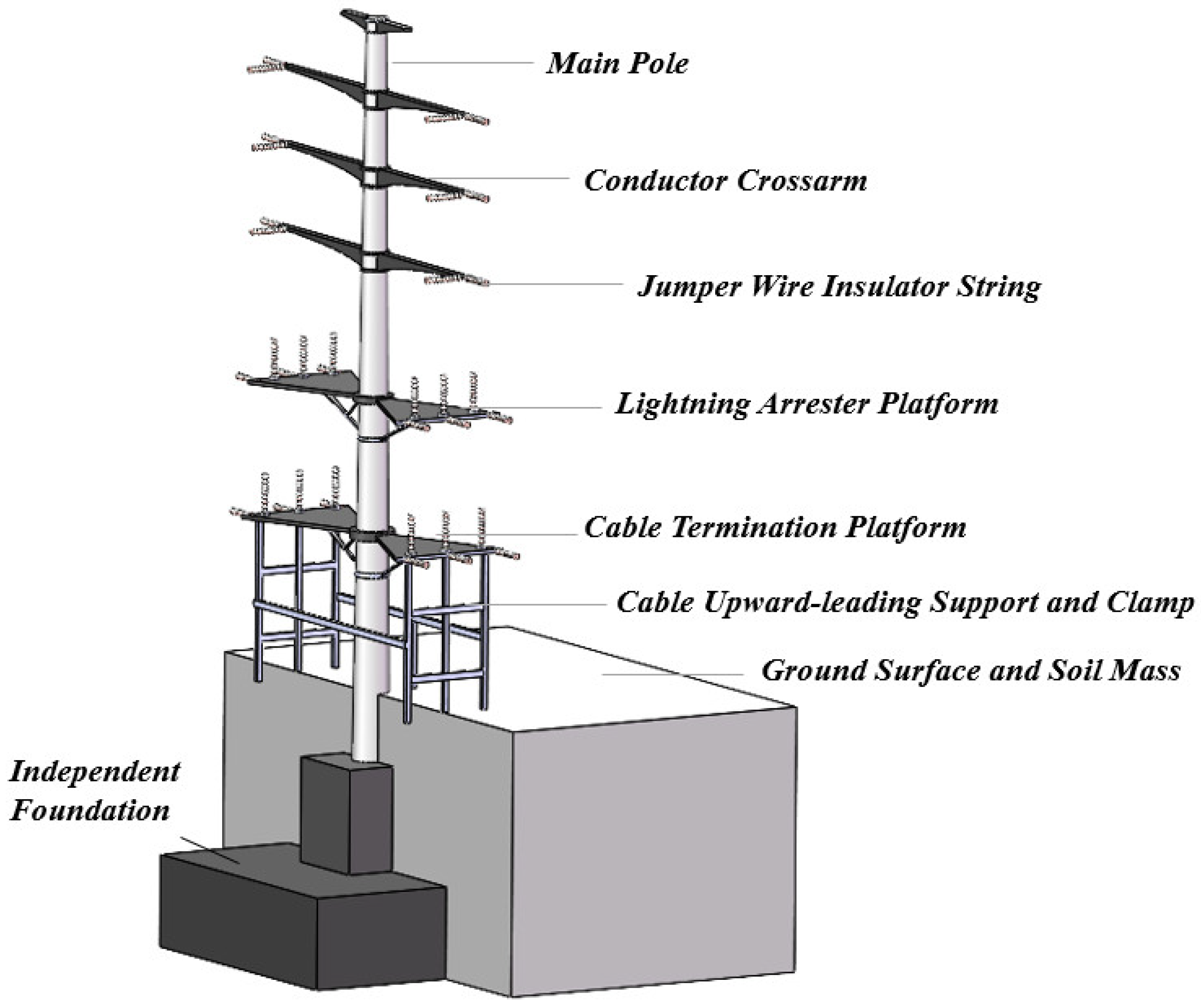
A cable termination support mainly consists of the main pole, conductor crossarm, lightning arrester platform, cable termination platform, and cable upward-leading support, as well as functional accessories including the jumper wire insulator string and composite crossarm insulator, as shown in Figure 1.
Among these components, the main pole serves as the supporting main body of the entire terminal, which is usually a multi-section steel pipe structure and bears the weight of all crossarms, platforms and equipment. According to the structural characteristics of the cable termination pole, its foundation part mainly carries vertical forces. The traditional cast-in-place concrete foundation for cable termination supports involves full wet construction, which results in long construction and curing periods. Moreover, the on-site construction conditions are not conducive to the assembly and application of large, prefabricated components. Therefore, this study proposes an easy-to-install modular prefabricated foundation for cable termination supports that does not require large-scale transportation and hoisting equipment, alternatively it may be named as the “segmented connection foundation”.
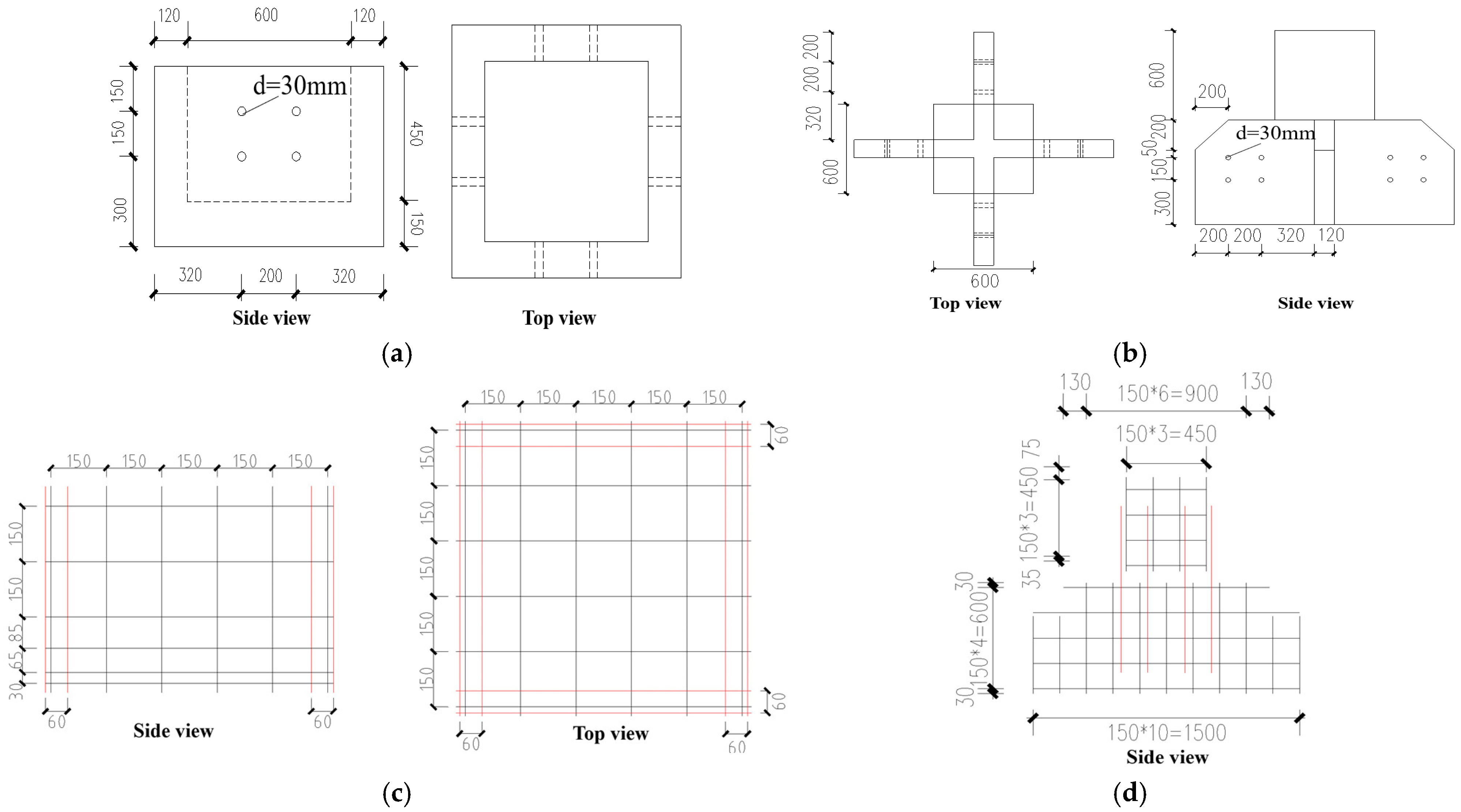
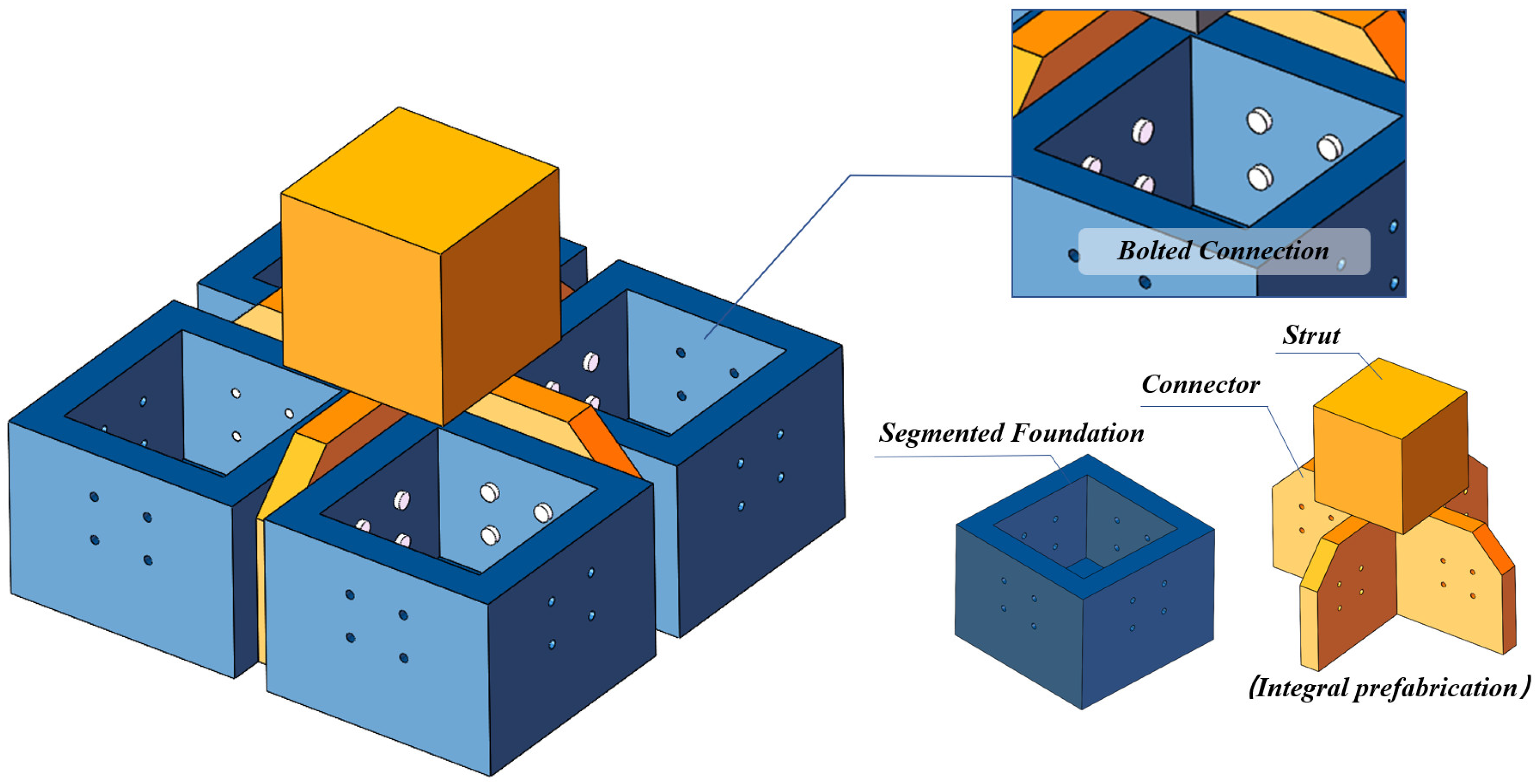
This modular prefabricated foundation for cable termination supports is mainly composed of two prefabricated units: segmented foundations, as well as connector and strut. Each prefabricated unit is equipped with reinforcement mesh or reinforcement cage, as shown in Figure 2. In application, all components are connected via bolts through pre-set bolt holes. The overall dimensions of the segmented foundation are 840 × 840 × 600 mm, with its middle part hollowed out to facilitate installation and save materials, and double-layered reinforcements are arranged on each side. Bolt holes of 30 mm are fabricated on the side walls of the segmented foundation to connect with connector and other segmented foundations. The middle connector is designed as a cross-shape, with a thickness of 120 mm and a length and width of 1560 mm each, and is equipped with a single-layer reinforcement mesh. Its corners are cut off, and bolt holes of the same size are arranged on the plate surface. The foundation of a cable termination support is usually an independent foundation. In the design of this modular prefabricated foundation, the struts at the upper end of the independent foundation are prefabricated integrally with the connector, among which the cross-section of the struts is 600 × 600 mm. The specific dimensions and reinforcement details of each foundation component are shown in Figure 3. The red lines of Figure 3c represent the side wall reinforcements of the segmented foundation, and the red lines in Figure 3d represent the continuous reinforcements used for the integral prefabrication of the strut and the connector. Among them, the prefabricated components of struts and connector are provided with through-length reinforcement to ensure connection stiffness. Overall, compared with the monolithic cast-in-place concrete foundation of the same size, this prefabricated foundation achieves a reduction of nearly 40% in concrete consumption. In practical application, the steel pipe at the bottom end of the main pole of the cable termination support can be prefabricated together with the prefabricated components of strut and connector in the factory, or connected with the main pole of the cable termination support by means of pre-embedded flanges. In addition, the on-site installation of this prefabricated foundation adopts all dry construction operations, featuring convenient fast installation and minimal impact on the in-site environment.

3. Finite Element Analysis of the Prefabricated Foundation

This study uses ABAQUS 2020 software to analyze the proposed prefabricated foundation and investigates its settlement and bearing capacity under the axial compressive load.

3.1. FEA Model

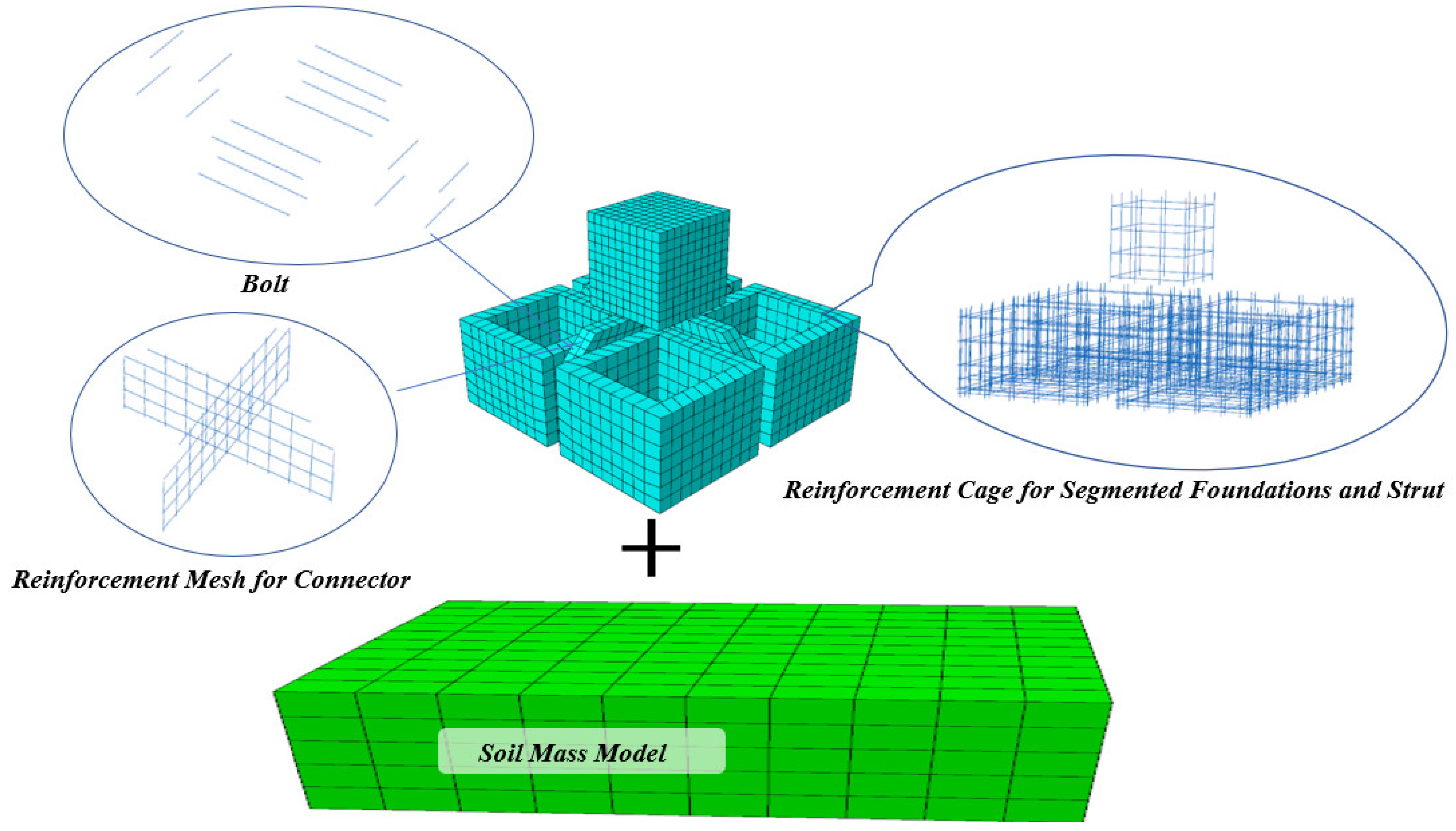
Considering comprehensively the influences of factors such as material constitutive relations, contact properties, boundary conditions, load application, and mesh generation, this study established a FEA model for the prefabricated foundation of cable termination supports. Since the stress of the strut of this prefabricated foundation is much lower than its compressive strength under load, and the foundation bears only the axial compressive load, the strut and connector were modeled separately in the FEA model, focusing on investigating the overall performance and mechanical properties of the connector and segmented foundations. Therefore, the FEA model includes the foundation soil, segmented foundations, connector, strut, bolts, as well as the reinforcement mesh or reinforcement cage inside the above-mentioned concrete components. Concrete components were simulated using linear hexahedral elements with eight nodes and reduced integration (C3D8R), reinforcement bars were simulated using two-node linear three-dimensional truss elements (T3D2), and bolts were simulated using beam elements (B31) to capture potential shear forces. During modeling, the size of the soil mass was set to more than three times that of the foundation [6,25], with dimensions of 6 × 6 × 3 m. The FEA model is shown in Figure 4.

3.2. Material Constitutive Model

3.2.1. Concrete Constitutive Model

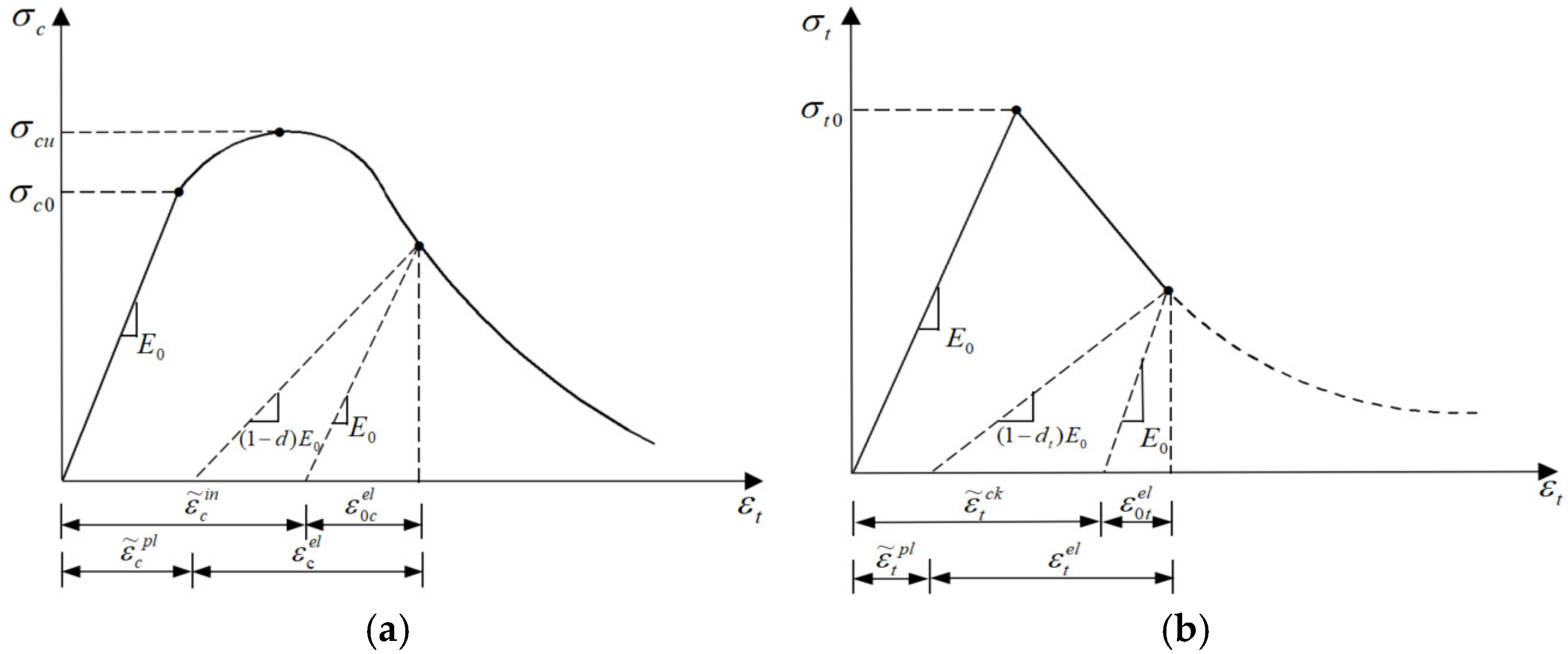
C40 grade concrete was adopted in the FEA model, and its constitutive relation was defined by the concrete damage plastic (CDP) model. The CDP model employs the Drucker–Prager yield surface, which is modified from the classical circular shape in the deviatoric plane to a smooth, nearly triangular hyperbolic function profile. It adopts a non-associated plastic flow rule to appropriately control the plastic volumetric expansion. The CDP model separately defines the distinct behaviors of concrete under uniaxial tension and uniaxial compression [26]. It combines non-associated multi-hardening plasticity with isotropic damaged elasticity to describe the irreversible damage generated during the crushing of concrete, making it suitable for the monotonic loading scenario considered in this study and ensuring favorable numerical convergence. Additionally, this model employs the compressive stiffness recovery factor and tensile stiffness recovery factor to describe the recovery of material stiffness under cyclic loading [27,28]. The irreversible degradation of stiffness in concrete due to the development of micro-cracks is described in the CDP model via damage factors, as illustrated in Figure 5. The material parameters are listed in Table 1.
In the model, the inelastic strain under compression is used to define the compressive hardening data, while the cracking strain under tension defines the tensile stiffening behavior; σ c 0 is the initial yield stress; σ c u is the ultimate stress; σ t 0 is the failure stress; ε ~ t p l and ε ~ c p l represent the equivalent plastic strain of concrete in tension and compression, respectively. The cracking strain is defined as ε ~ t c k = ε t ε ~ 0 t e l , ε ~ 0 t e l = σ t / E 0 , and the inelastic strain ε ~ c i n = ε c ε 0 c e l , ε ~ 0 e e l = σ c / E 0 ;   d t and d c denote the tensile and compressive damage factors of concrete, respectively, E 0 represents the initial elastic stiffness of concrete [29].
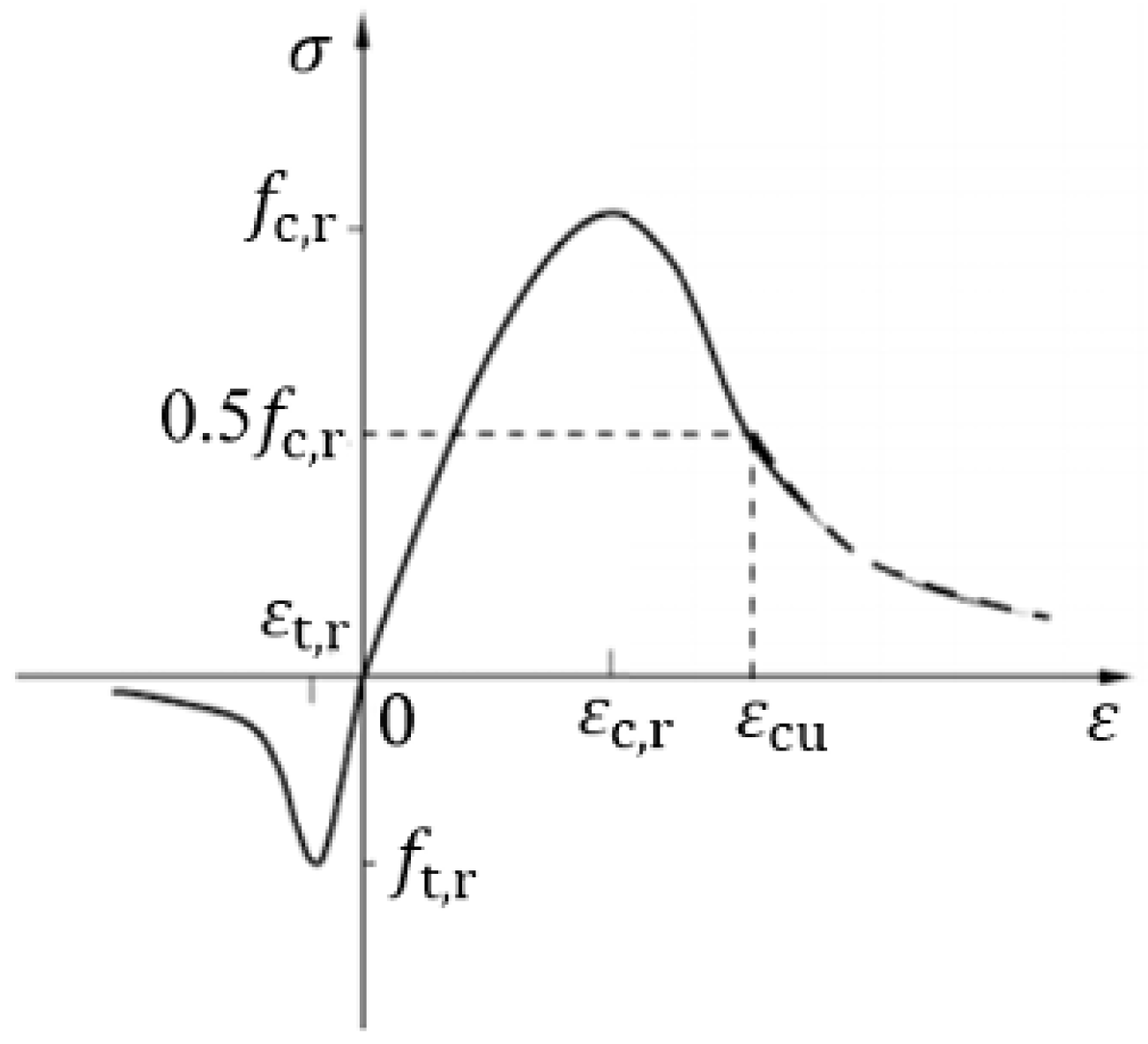
Furthermore, the stress versus inelastic strain relationships under compression and tension were determined based on the uniaxial tensile and compressive curves of concrete specified in the design code [30]. The uniaxial stress–strain curve of concrete is shown in Figure 6, where f t , r denotes the tensile strength of concrete (it was taken as 4 MPa); ε t , r denotes the peak tensile strain under uniaxial tension; f c , r denotes the compressive strength of concrete (it was taken as 40 MPa); ε c , r denotes the peak compressive strain under uniaxial compression and ε c u denotes the ultimate compressive strain of concrete; In addition, the elastic modulus of concrete was taken as 32,500 MPa [30].

3.2.2. Reinforcement Constitutive Model

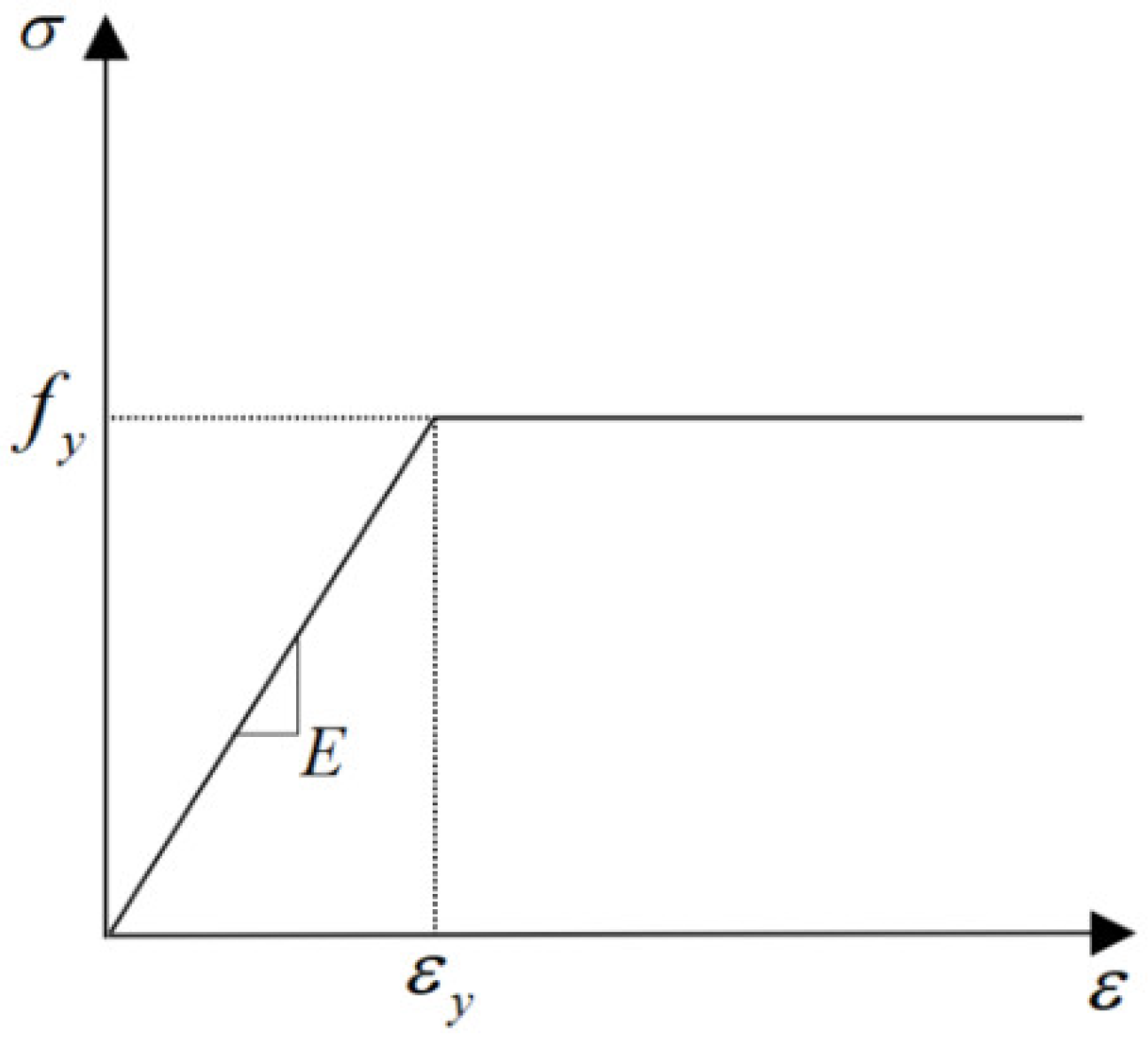
Since the stress in the reinforcing steel during the mesh convergence analysis was significantly lower than its yield stress, an ideal elastoplastic model (Figure 7) was adopted for simulation. The reinforcement was modeled using HRB335 steel, incorporating the isotropic von Mises yield criterion, and was implemented in the software via the “Plastic” material model. The stress–strain curve is shown in Figure 6 [31], where f y denotes the yield strength, taken as 335 MPa according to the code [30]; ε y denotes the yield strain; E denotes the elastic modulus, taken as 206,000 MPa [30]. The Poisson’s ratio was taken as the typical value of 0.3.

3.2.3. Bolt Constitutive Model

Grade 10.9 bolts were adopted in the FEA model, and their constitutive relation was defined by the same ideal elastoplastic model as that of the reinforcement bars. According to the code [32], the yield strength was taken as 900 MPa and the elastic modulus as 210,000 MPa; the Poisson’s ratio was taken as 0.3.

3.2.4. Soil Mass Constitutive Model

The foundation soil adopted the Mohr-Coulomb constitutive model [33]. In this FEA model, the bearing stratum of the foundation soil was set as sandstone slab, and its main material parameters are listed in Table 2 in accordance with the geological engineering handbook [34].

3.3. Constraints and Interactions

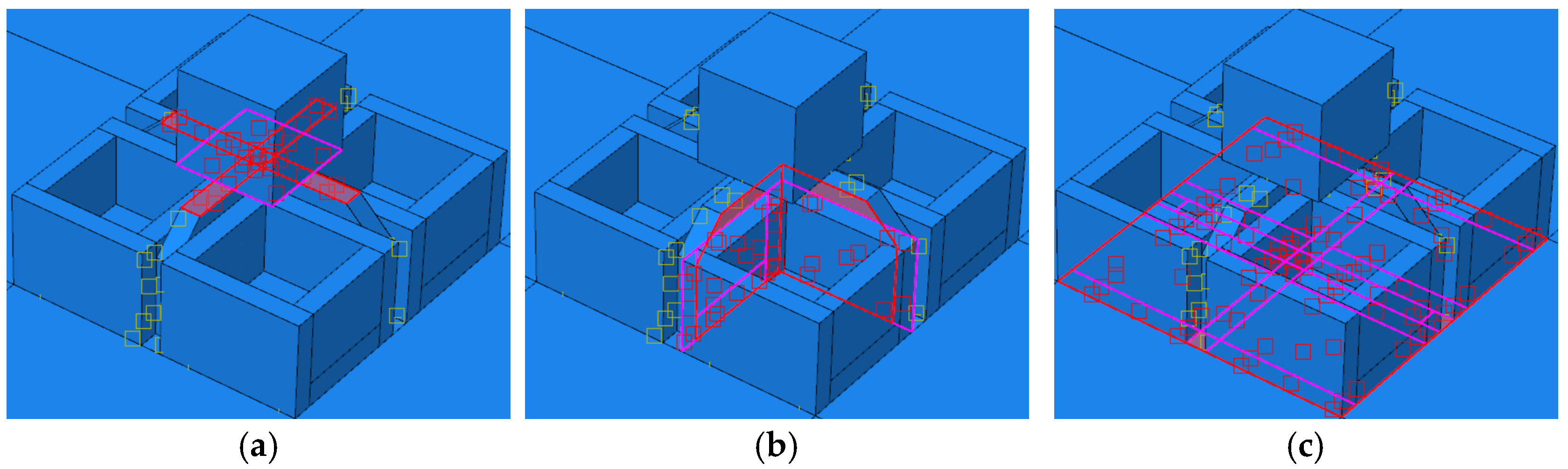
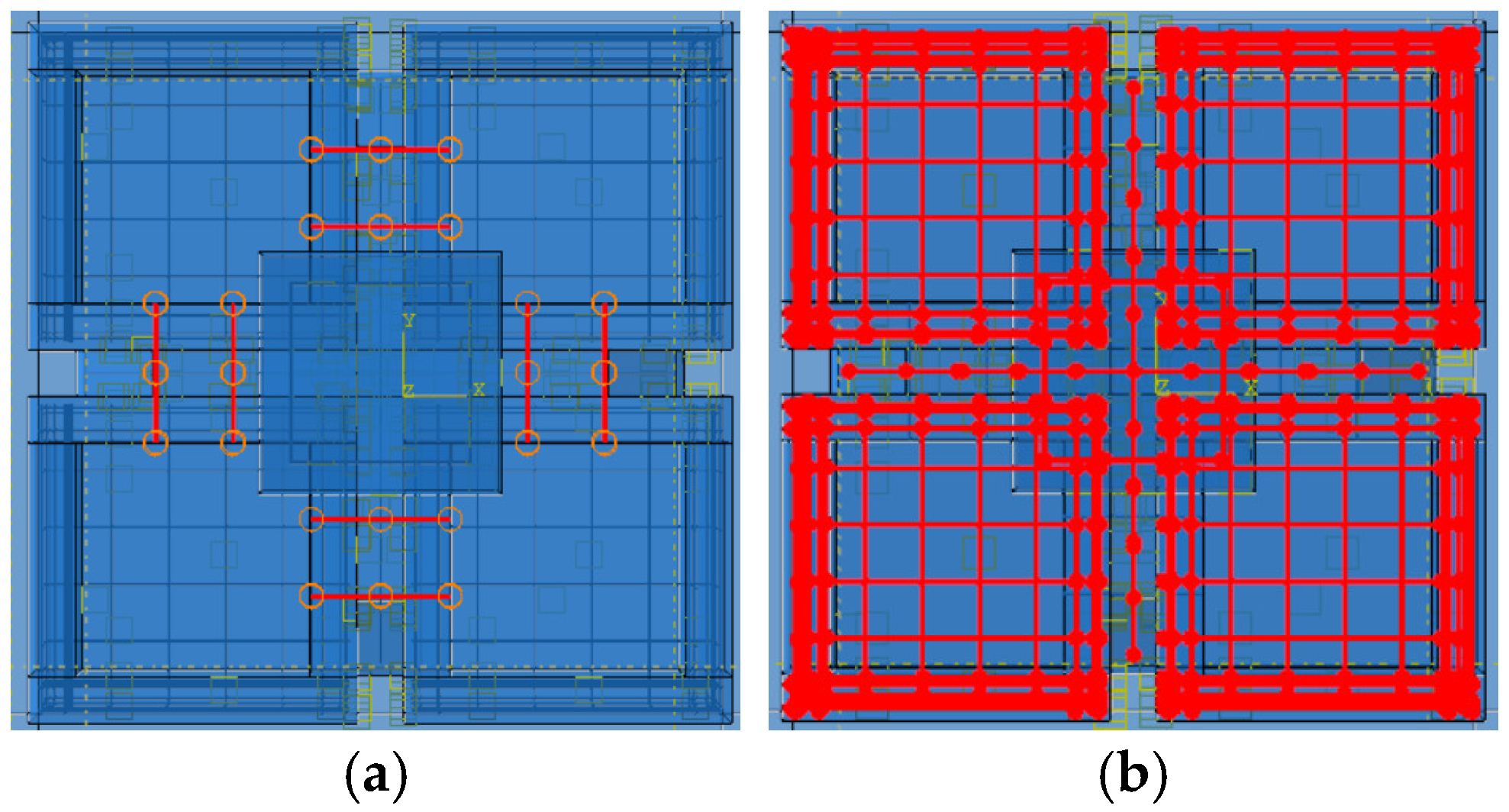
The prefabricated foundation for the cable termination support is mainly divided into four parts: segmented foundations, connector, bolts, and reinforcement mesh. The contact between the segmented foundations and the connector is simulated using surface-to-surface contact, wherein the normal behavior is defined as separable “hard” contact (strict no-penetration unilateral constraint). Considering the definition of tangential behavior in the literature [15] and the effect of bolt preload during the actual service of this prefabricated foundation, the tangential behavior in the present model is characterized as “penalty” frictional contact with a friction coefficient of 0.8. The same contact settings are adopted between the struts and the connector. For the contact between the bottom surfaces of the foundation and the soil, the normal behavior is also set to be “hard contact”, and the tangential behavior is “penalty” frictional contact with the friction coefficient being of 0.5, as shown in Figure 8. The constraints between bolts and the foundation, as well as between reinforcement bars and the foundation, are realized through “Embed” technique, as shown in Figure 9.
In addition, to simulate a real and stable stress state of the soil, geostatic stress balance of the soil was performed, and constraints were applied to the horizontal direction and rotation angle of the soil’s bottom surface to avoid calculation divergence caused by initial stress imbalance.

3.4. Load and Boundary Conditions

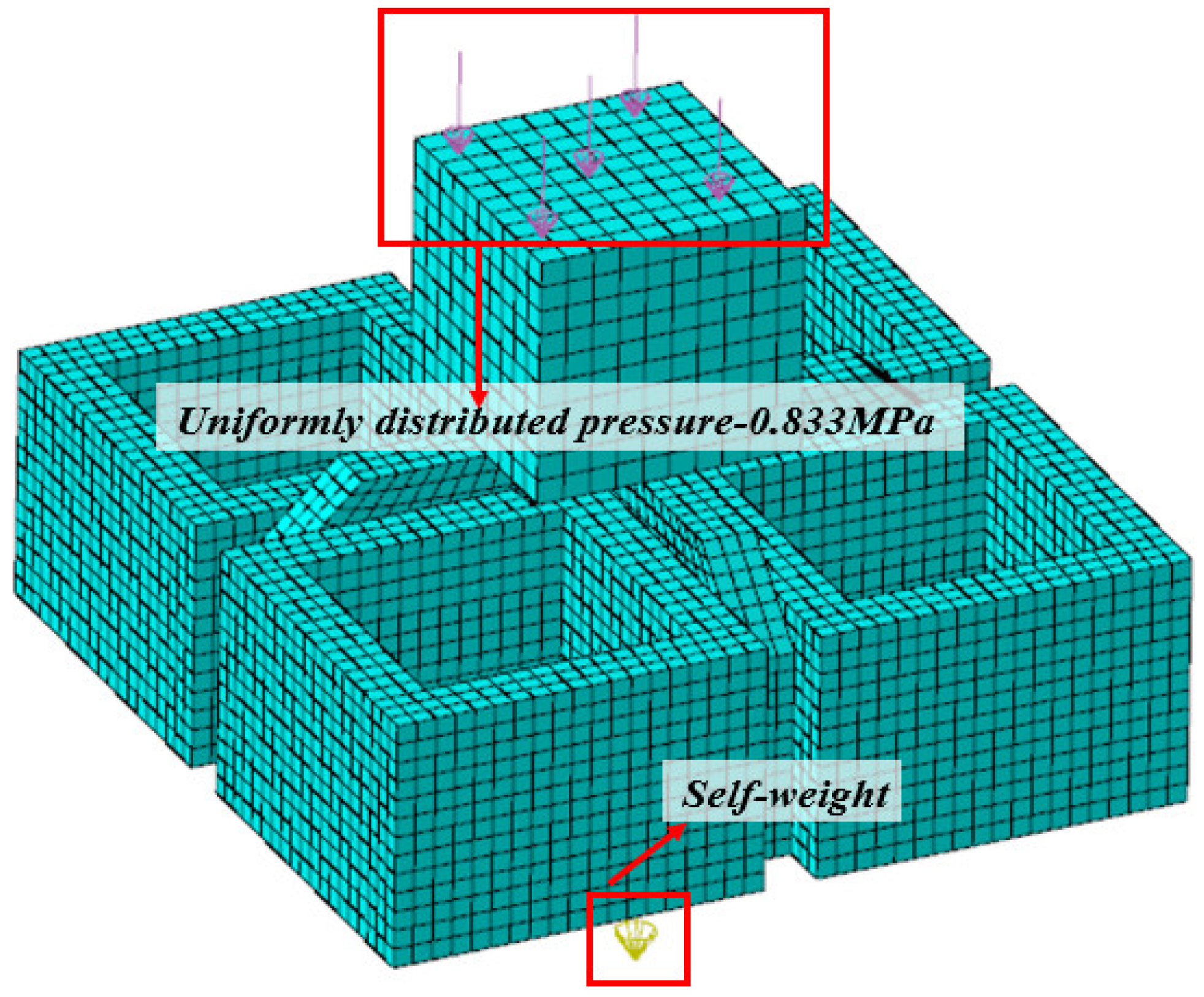
Two “Static, General” analysis steps were set in the FEA model. In the “Initial” analysis step, the geostatic stress balance field of the soil was predefined. In the second analysis step, in addition to applying the self-weight load to the foundation, a total vertical compressive force of 300 kN was imposed. This load includes permanent loads such as the self-weight of the cable termination support and the equipment. It was applied in the form of a uniformly distributed pressure of 0.833 MPa on the top surface of the strut, as shown in Figure 10. In addition, the minimum load increment for each analysis step was set to be “1 × 10⁻⁵” to enable the calculation convergence.

3.5. Mesh Generation

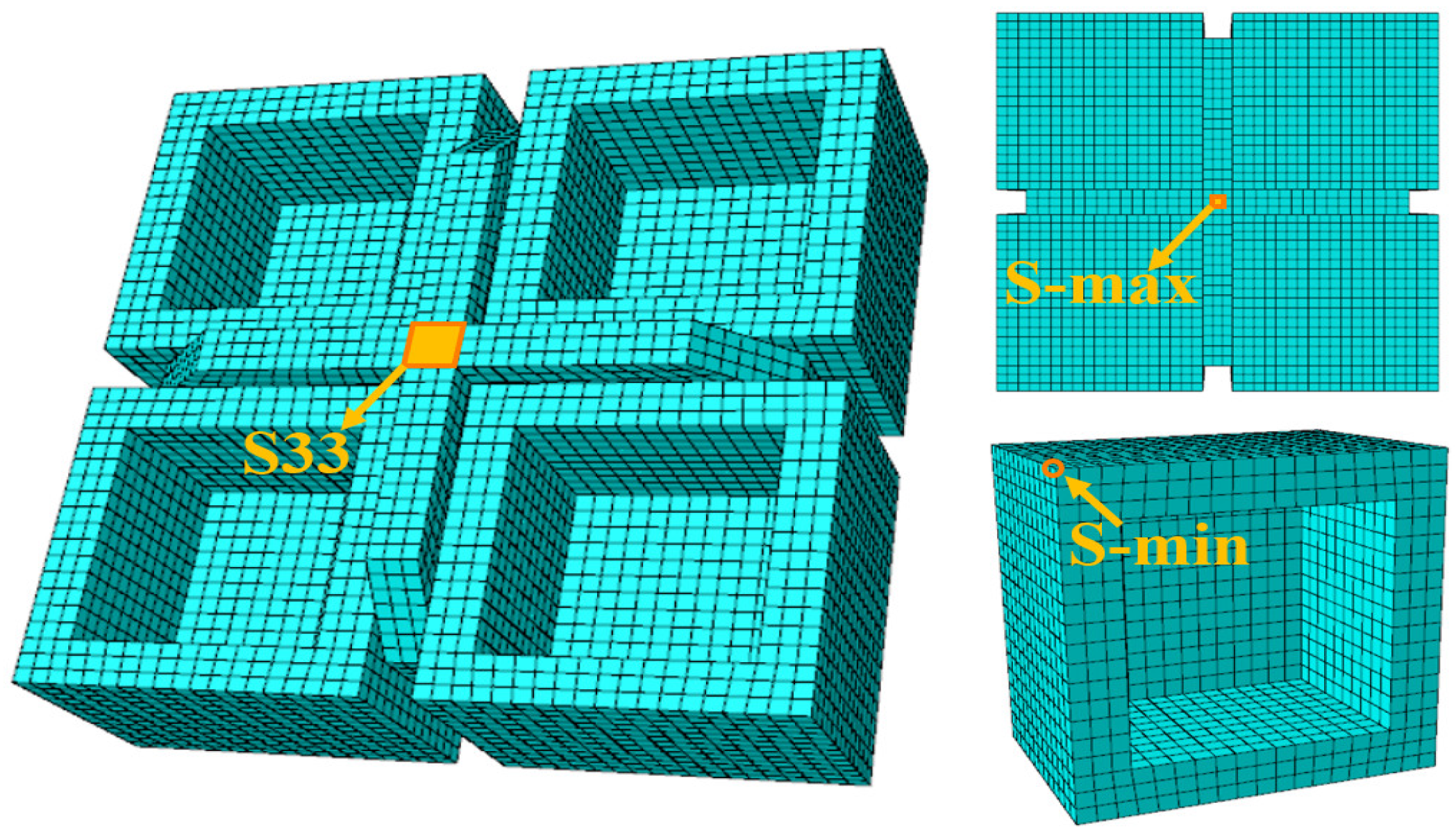
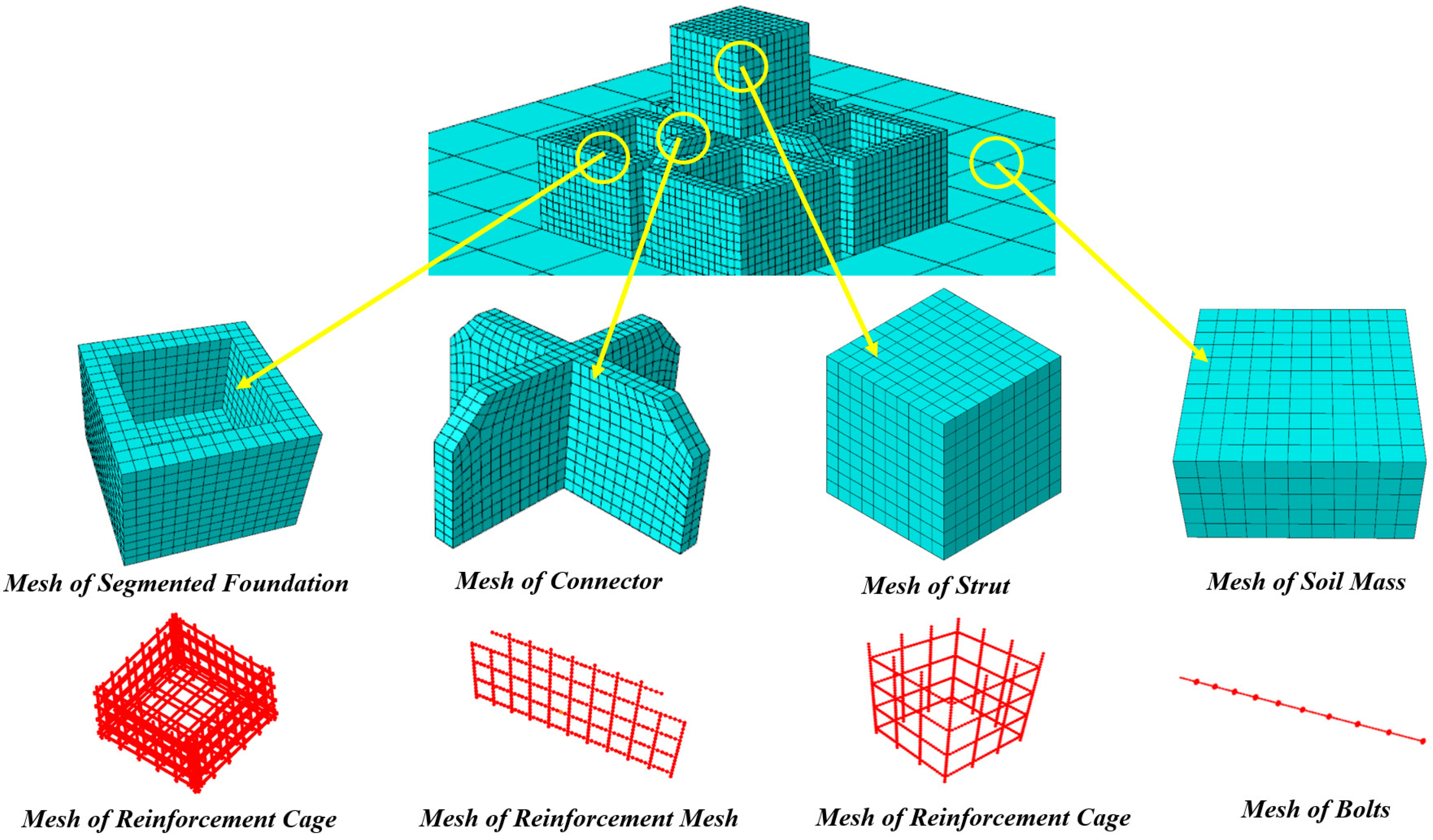
Mesh generation has an important impact on the calculation accuracy and model convergence speed for a FEA [35]. This study comparatively analyzed foundation settlement values under different mesh sizes (Table 3), as well as principal tensile and compressive stresses at critical concrete locations (Figure 11), the computational results are presented in Table 4. Taking into account both computational efficiency and result stability, mesh sizes of 45 mm and 20 mm were ultimately selected for the concrete components and the reinforcement/bolt components, respectively. The total number of elements after meshing is 46,396. Under this mesh configuration, the finite element results converge satisfactorily, with computational errors maintained at a low level.
In addition, since the geostatic stress balance response of soil is not sensitive to the change in soil mesh size, and the geostatic stress balance results under various mesh sizes are highly consistent, a soil mesh size of 600 mm is selected for computational economy. The entire mesh model as well as mesh model of each component are shown in Figure 12.

4. FEA Results and Analysis

4.1. Foundation Stress State

4.1.1. Geostatic Stress Balance

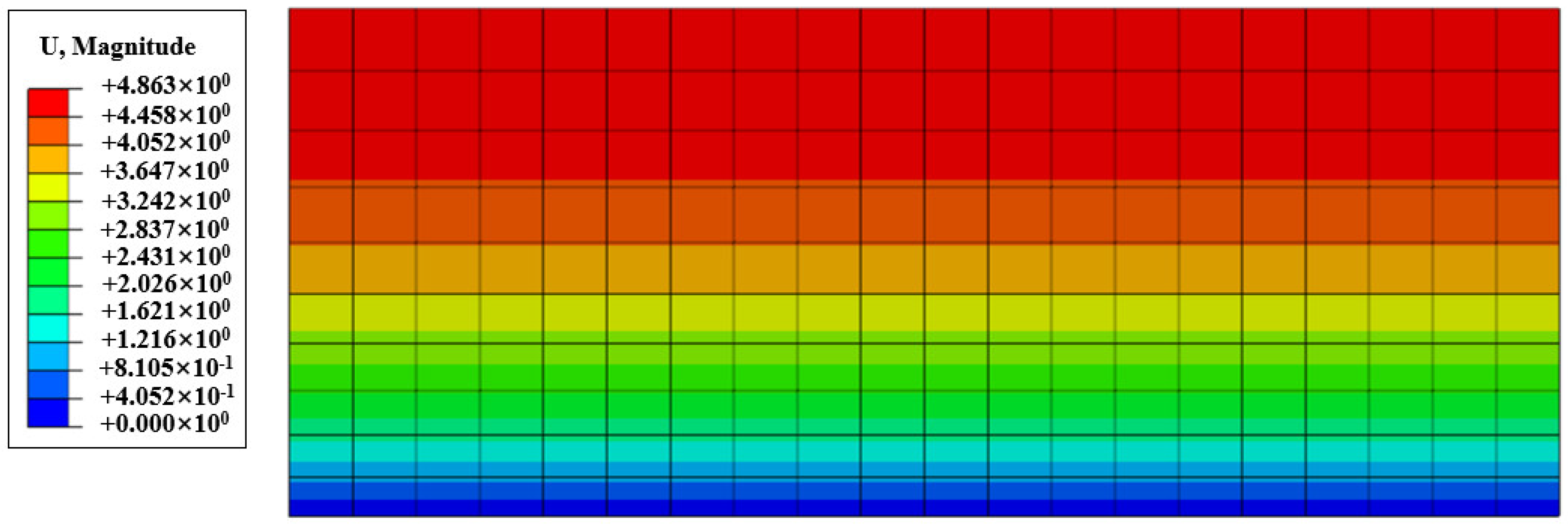
The results of geostatic stress balance calculation for the set soil are shown in Figure 13, and subsequent simulations are carried out based on this balance field.

4.1.2. Stress Analysis of Foundation Soil

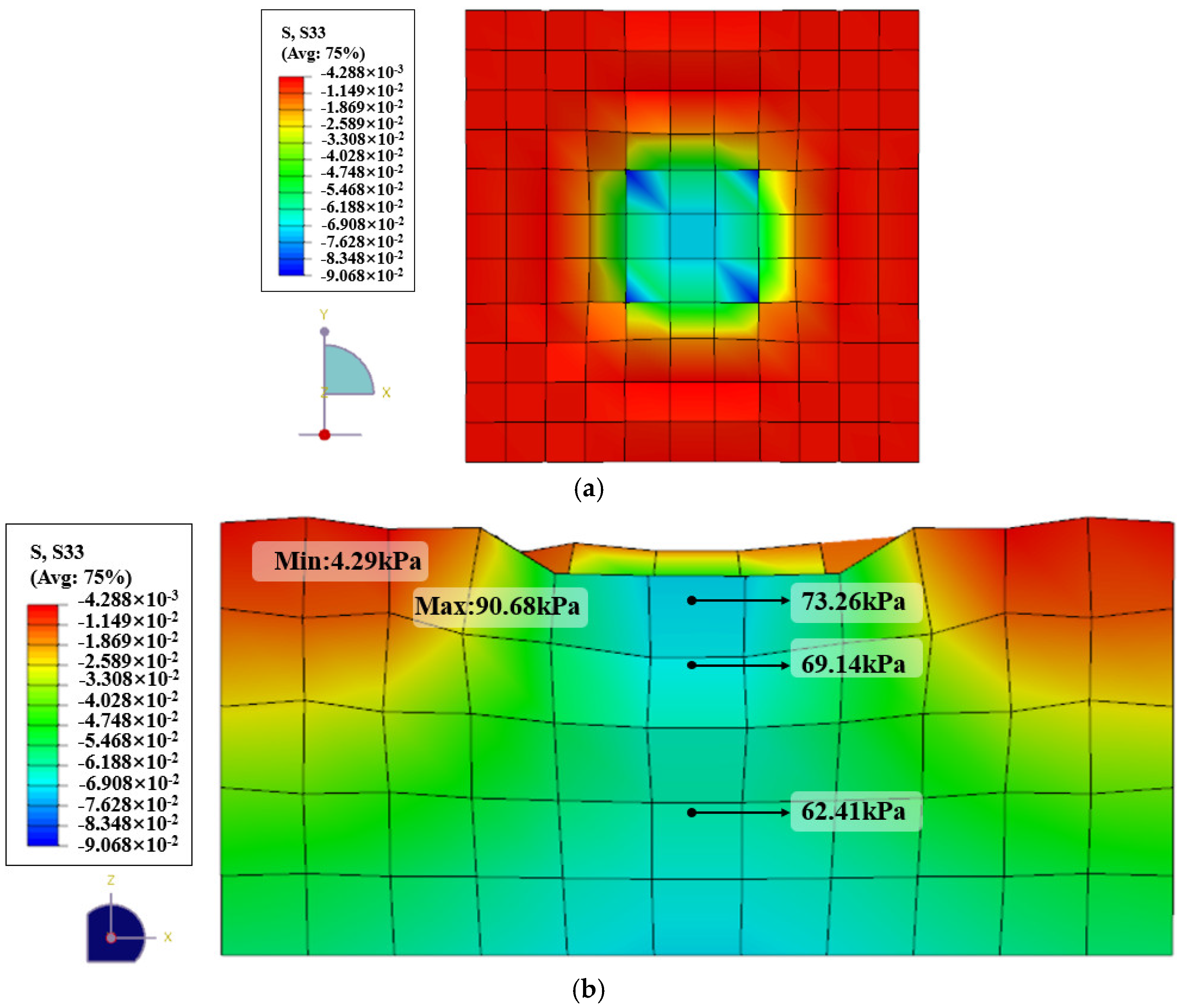
When the foundation is in service, the prefabricated foundation for the cable termination support bears an axial compression of 30 kN; therefore, the stress in the Z-direction (S33) is extracted for analysis. The stress distribution of the foundation soil is shown in Figure 14. FEA result indicates that the maximum compressive stress of the soil occurs at the location beneath the corners of the prefabricated foundation, with a value of 90.68 kPa, and the stress distribution is symmetrical along the foundation length and width directions. The overall stress transfer pattern of the foundation is approximately circular, where the compressive stress diffuses outward in all directions and decreases gradually. Analysis of the stress distribution of the central cross-section of the foundation soil shows that the maximum compressive stress at the contact area between the bottom surface of the foundation and the top surface of the soil is 73.26 kPa. The stress of the foundation soil originates from the bottom surface of the foundation and diffuses downward in a roughly conical shape; as the distance from the contact surface increases, the stress gradually decreases and extends horizontally.

4.2. Foundation Settlement Behavior

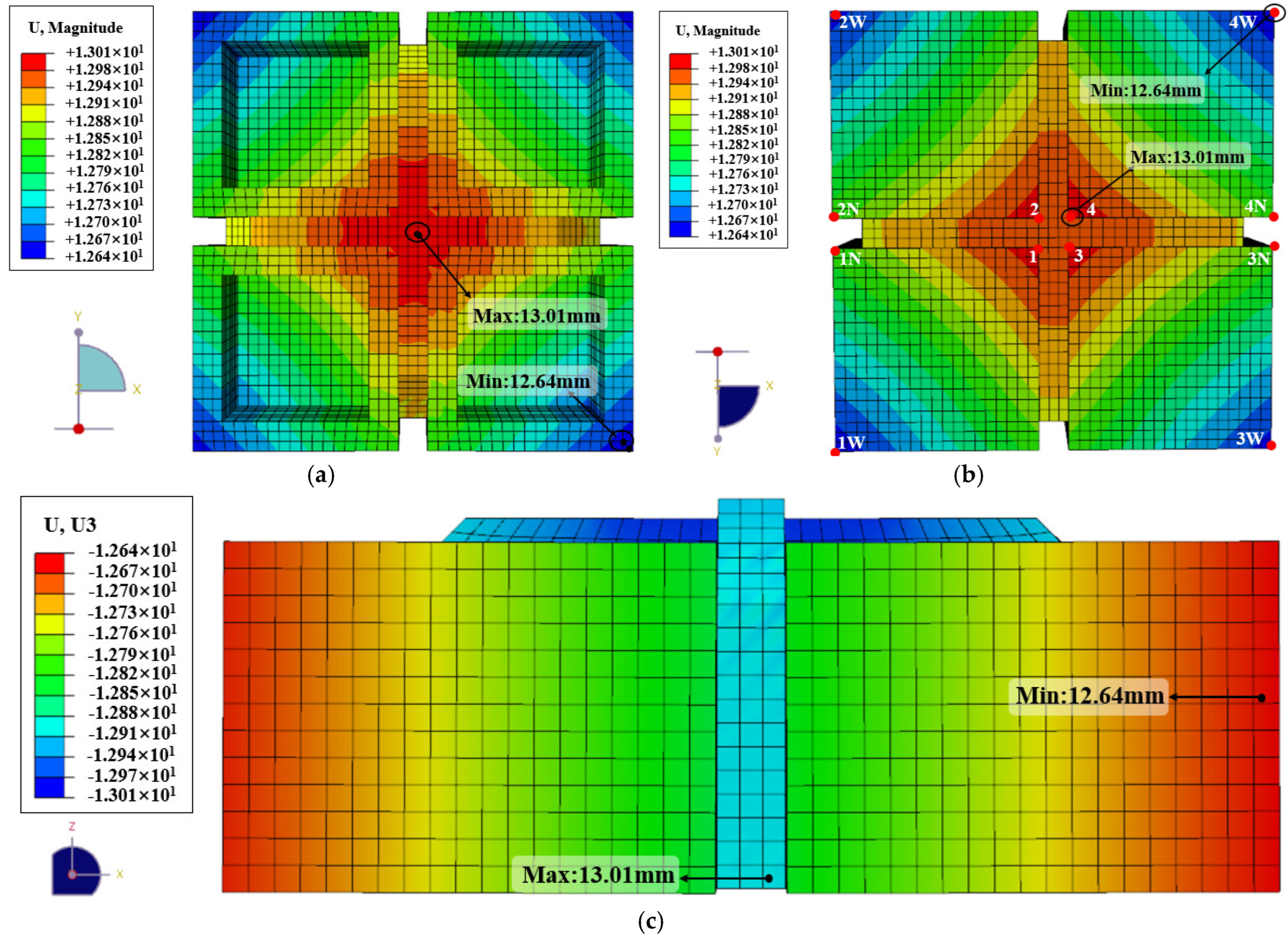
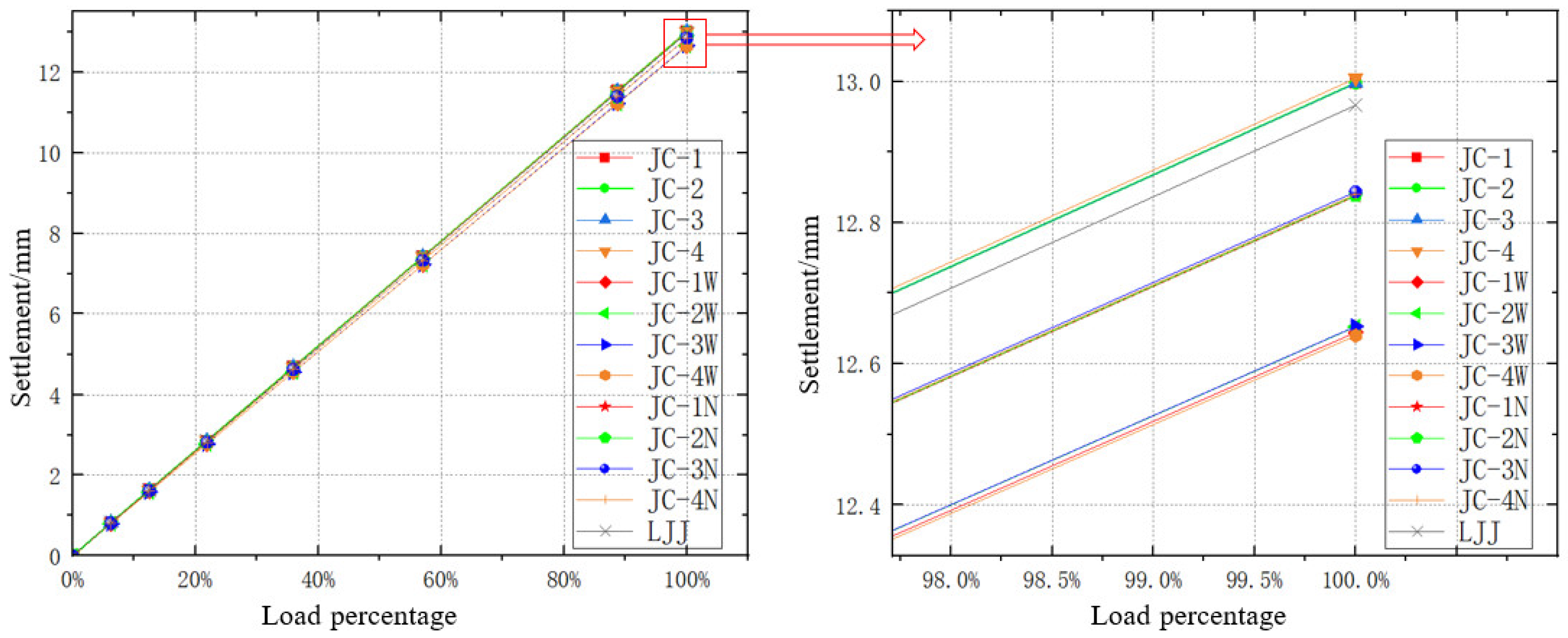
The settlement behavior of this prefabricated foundation is shown in Figure 15. The finite element analysis results indicate that under axial compression, the maximum settlement of the foundation occurs at the corner joints where the segmented foundations connect to the connectors, with a magnitude of 13.01 mm. This value is significantly less than the allowable limit specified in the code DLT 5457-2012 Technical Specification for Substation Building Structure Design [36]. Taking the center of the cross-shaped connector as the center, the overall settlement of the foundation is relatively concentrated within a range with a diameter of approximately 1/3 of the connector length. As the distance from the foundation center increases, the settlement develops mainly along the connector, while the settlement of the segmented foundations is relatively small. As the distance from the foundation center further increases, the settlement decreases gradually until reaching the minimum at the outer edges of the segmented foundations, which is 12.64 mm. Obvious gaps appear between the segmented foundations and the connector at the base, but reliable bolt connections ensure tight bonding of the upper part. By selecting characteristic points on the foundation bottom surface (as shown in Figure 15b), the load–settlement curve of this prefabricated foundation is plotted, as shown in Figure 16. Here, the “JC-1” curve represents the settlement of the corner node at the interface between the bottom surface of a segmented foundation and the bottom surface of the connector; “JC-1W” and “JC-1N” denote the settlement at the outer-edge corners of the bottom surface of this segmented foundation; and the same principle applies to the other labels. Additionally, “LJJ” indicates the displacement of the central point at the bottom of the connector.
During the loading process, the load and settlement of the foundation show a linear relationship, indicating that the prefabricated foundation is in an elastic working state. The settlement difference among different characteristic locations of each segmented foundation is obvious, indicating that each segmented foundation undergoes a certain degree of elastic deformation. In addition, this phenomenon is consistent with the loading condition, indicating that the segmented foundations and the connector have undergone a certain degree of bending deformation. At the same time, the uniform settlement also indicates that the foundation has good integrity, and the connector have reliable performance.

4.3. Stress Analysis of Foundation Components

This study disassembles the prefabricated foundation and analyzes it from three aspects, namely the concrete parts, reinforcement parts of the segmented foundations and connector, as well as the connecting bolts.

4.3.1. Stress Analysis of the Concrete

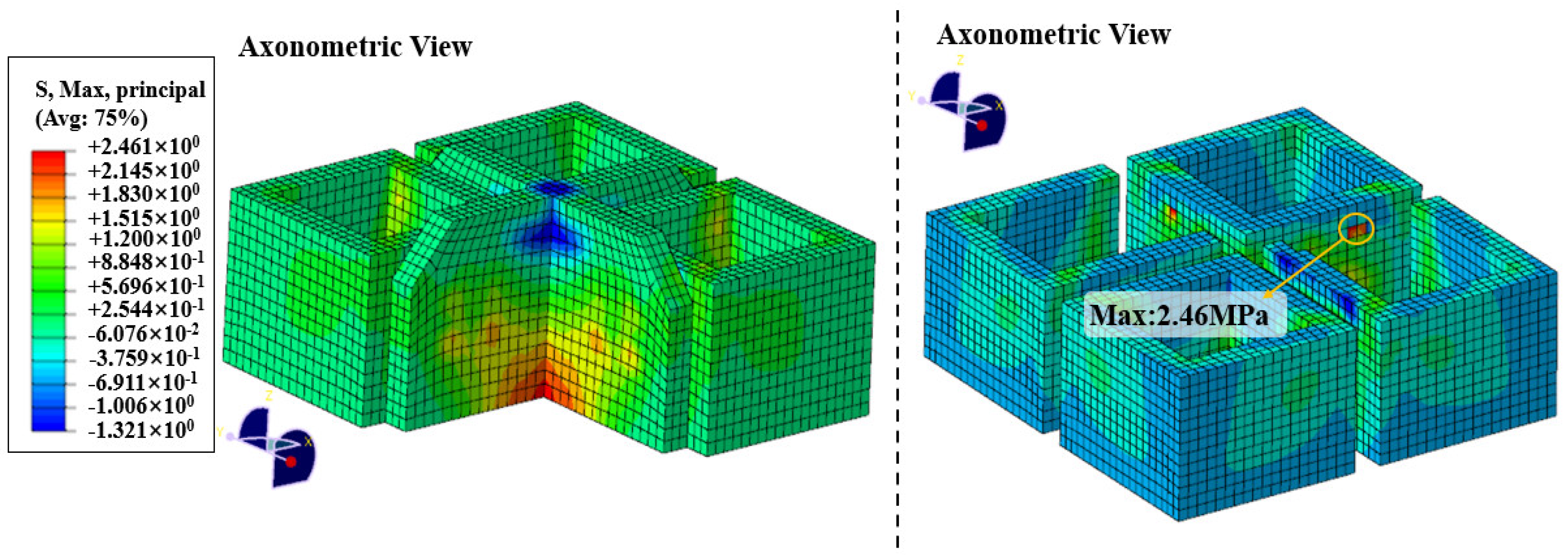
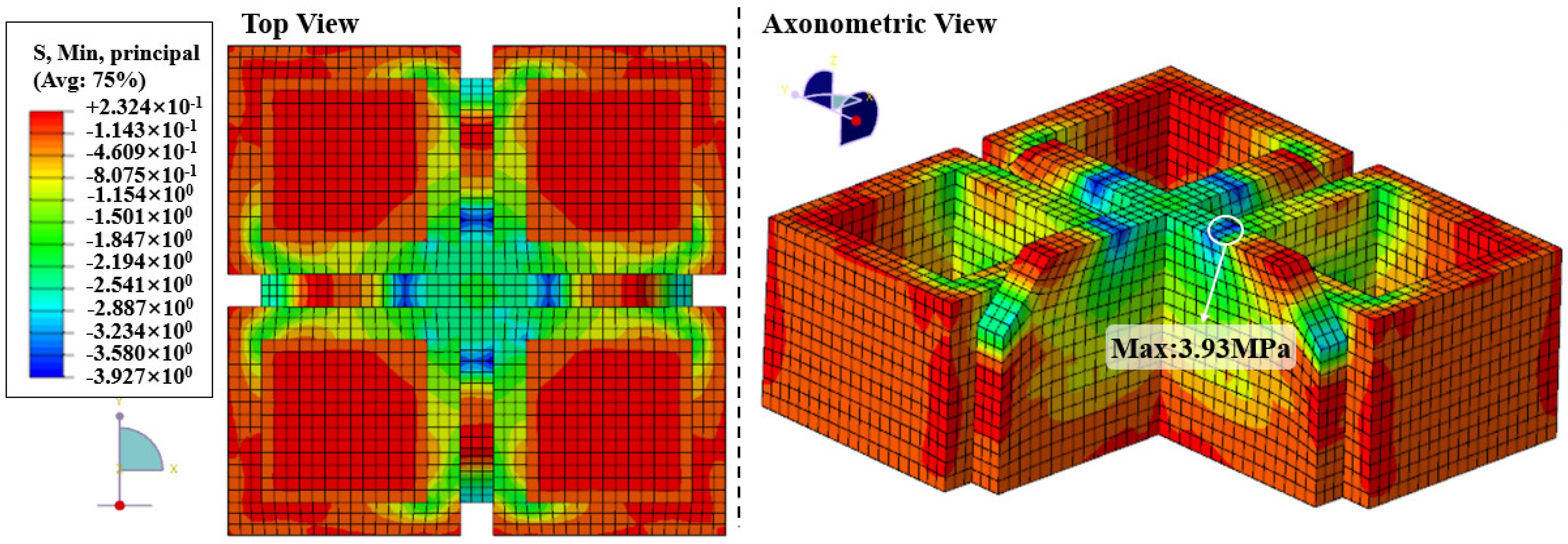
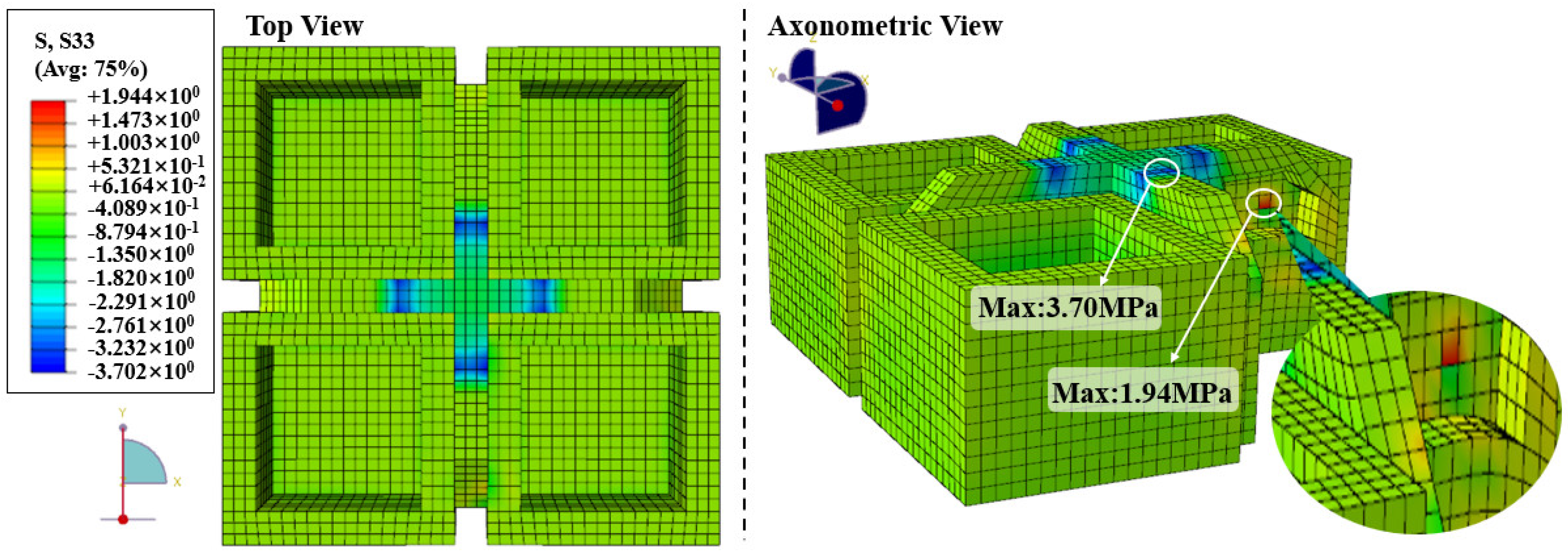
From the maximum principal stress (Figure 17) and minimum principal stress (Figure 18) contours of the concrete, it can be observed that the maximum principal stress in the concrete is primarily distributed around the bolt holes of the segmented foundation. The maximum principal tensile stress reaches 2.46 MPa, which does not exceed the design tensile strength of C40 concrete (4 MPa). Additionally, the concrete at the bottom of the connector exhibits relatively lower maximum principal stress, ranging between 1.83 MPa and 2.15 MPa. The minimum principal stress in the concrete is located at the top of the ribs of the connector, with a magnitude of 3.93 MPa. As shown in Figure 19, the maximum axial stress also occurs at the top of the connector ribs, with a value of being 3.70 MPa. All the above values are significantly lower than the design compressive strength of C40 concrete.
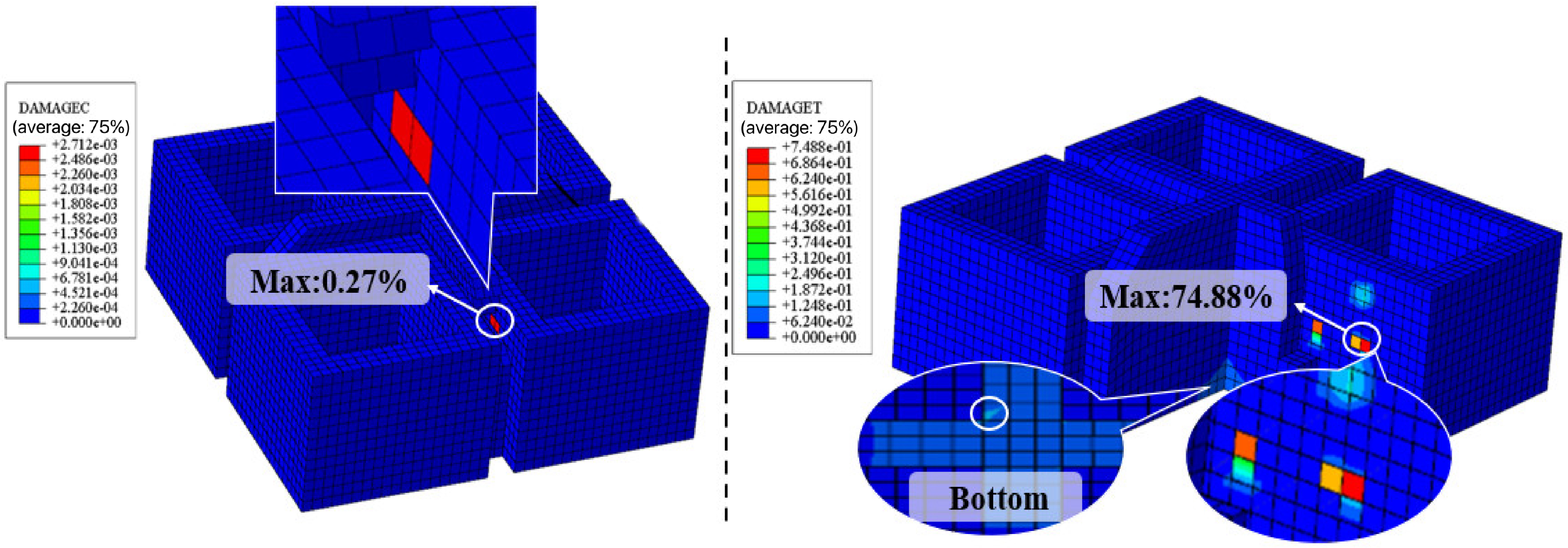
The results (Figure 20) indicate that the maximum compressive damage in the concrete occurs at the upper-layer bolt locations of the segmented foundation, reaching 0.27%, which is well below the failure threshold, suggesting that the concrete in these areas remains essentially intact. The most severe tensile damage in the concrete occurs near the lower-layer bolt connections of the segmented foundation, with stiffness degradation reaching 74.88%. Multiple cracks are likely to develop in this region. The analysis reveals that under axial compressive loading, the center of the connector settles downward. As the bolts move downward together with the connector, the segmented foundation impose reverse constraints on the concrete in this region. The interaction between these two effects generates tensile stress in the concrete. However, the stiffness of the concrete in this area has not fully degraded, and it retains its load-bearing capacity with approximately 30% reserve strength. In this study, the cable termination support foundation is applied in near-surface regions where the corrosive environment is relatively mild and the corrosion rate is comparatively slow. Hence, the influence of such corrosion damage on the durability of the prefabricated foundation is considered negligible. Furthermore, the tensile damage in the concrete near the inner bolt connections of the lower layer and the outer bolt connections of the upper layer reaches about 60% and 20%, respectively, while the tensile damage in the concrete at the bottom of the connector reaches 20%. These findings indicate that the potential weak points in the proposed prefabricated foundation are at the bolt connection regions and the bottom of the connector.
The concrete in all parts of the prefabricated foundation demonstrates satisfactory performance, with no significant damage. Integrating the simulation results discussed above, the concrete in the prefabricated foundation is subjected to uniform stress distribution, the concrete material strength is appropriately utilized, the load transfer path within the foundation is clear, and the design meets the strength requirements for the serviceability limit state.

4.3.2. Stress Analysis of Reinforcements

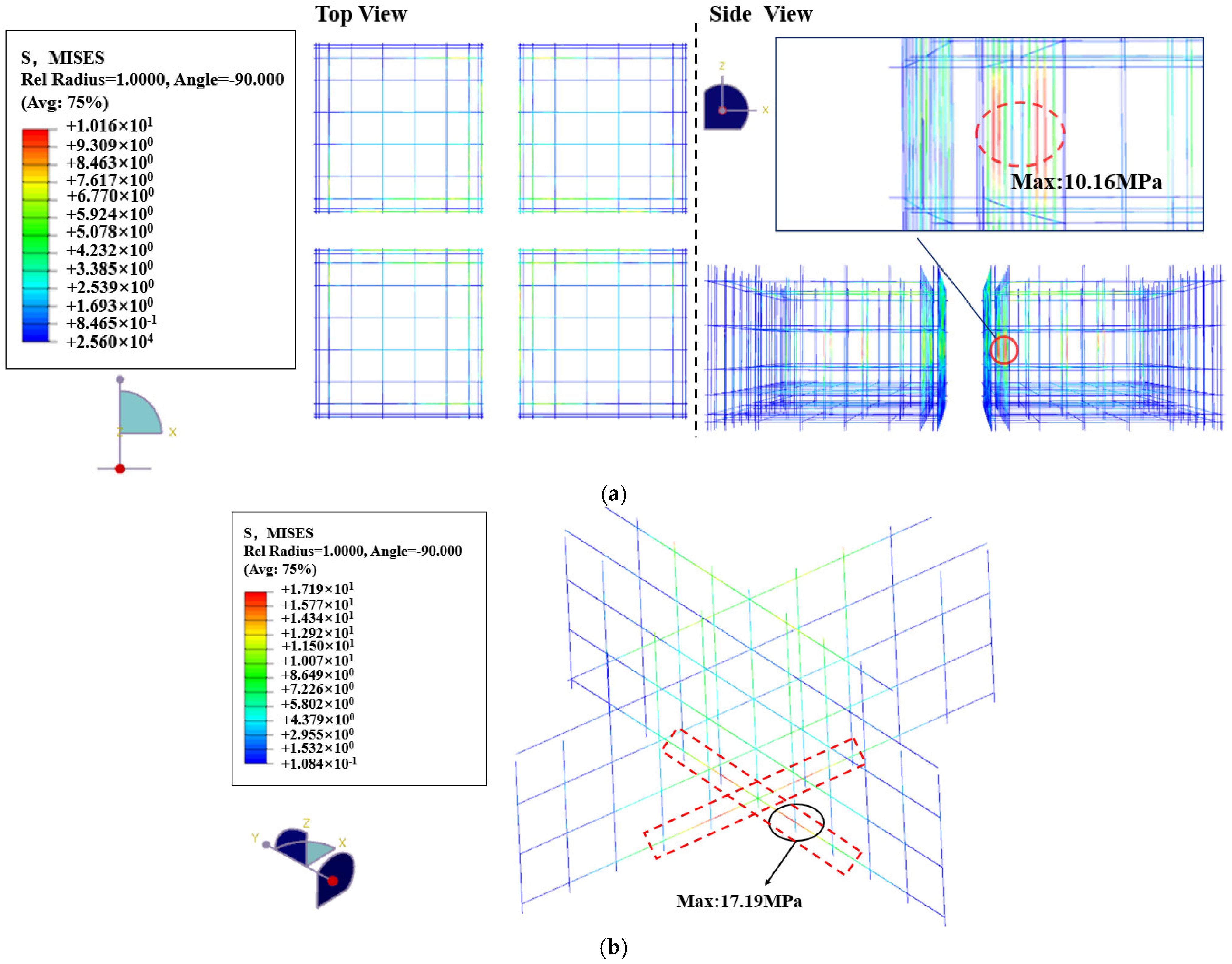
The computational model of this prefabricated foundation comprises two main steel components: the segmented foundation reinforcement cages and the connector reinforcement mesh. The stress calculation results are presented in Figure 21.
As shown in Figure 21a, the mises stress in the reinforcement cages is relatively higher near the joints between each segmented foundation and the connector. The maximum stress in the reinforcement cages reaches 10.16 MPa, occurring at the vertical reinforcement bars around the bolt hole connections. Overall, the stress distribution within the reinforcement cages is fairly uniform and exhibits symmetry about the connector. The elevated stress observed at the bolt connections aligns with the settlement behavior of the foundation: significant settlement at the center and smaller settlement towards the periphery. Due to the downward displacement of the connector coupled with the limited settlement at the outer edges of the segmented foundations, the upper reinforcement bars near the bolt connections display a noticeable tensile displacement toward the connector. Similarly, the maximum mises stress in the connector reinforcement meshes is 17.19 MPa (Figure 21b), located in the bottom-layer meshes. Stresses are also relatively high in the middle of the connector and at the joint regions (the red dashed box), attributable to the differential settlement. Under serviceability conditions, the maximum mises stress in all reinforcement bars remains well below the yield stress of HRB335, indicating that all reinforcement is operating within the elastic range. This confirms that the reinforcement design of the prefabricated foundation is rational and performs well.

4.3.3. Stress Analysis of Bolts

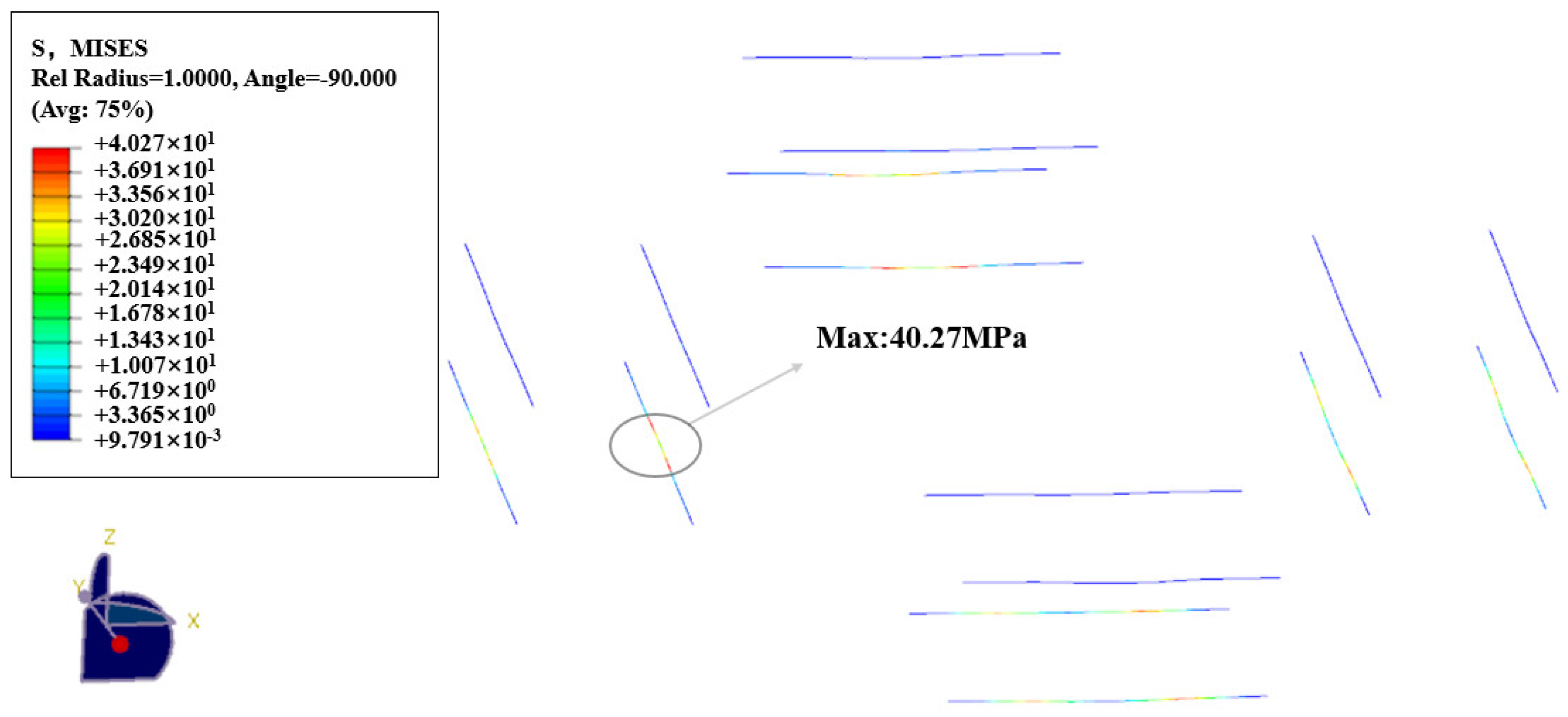
The bolts, which serve as critical connectors between the segmented foundations and the connector in this computational model, exhibit the stress distribution shown in Figure 22. In conjunction with the differential settlement between the connector and the segmented foundations (Figure 14), the stress at the mid-section of each bolt is significantly higher than at other locations, and the stress in the lower-layer bolts is markedly greater than that in the upper-layer bolts—a behavior consistent with the principle of minimum potential energy. The maximum mises stress occurs in the bolts of the lower layer, reaching 40.27 MPa, which remains well below the yield strength of the bolt material.
As observed from the bolt deformation in Figure 22, under serviceability conditions, the downward pressing action of the connector induces bending and deflection in the mid-region of each bolt. Using the built-in result query function of the finite element analysis software, the corresponding deformation is found to be very small, approximately 0.06 mm.
In summary, the bolt connections in this model perform well and remain within the elastic range, fulfilling the connection requirements for the prefabricated foundation.

5. Conclusions

(1)
The modular prefabricated foundation designed and developed in this study features simple components, convenient connections, and ease of processing. Additionally, all its components are suitable for standardized production, and on-site construction employs a fully dry operation method, which is conducive to further advancing green construction practices in substations.
(2)
Under axial loads, this prefabricated foundation remains in the elastic stage. It features uniform settlement and demonstrates excellent integrity and deformation compatibility. The stresses of reinforcement bars and bolts are far below their respective yield strengths, and the concrete does not reach its compressive or tensile limit, thus exhibiting a good performance and a considerable safety margin.
(3)
This study focuses solely on verifying the bearing capacity of the prefabricated foundation under axial loading. In regions with significant horizontal loads or high wind loads, targeted design measures—particularly for connection details—are required to meet the practical performance demands.

Author Contributions

Conceptualization, L.W. (Liqiang Wang), L.W. (Lei Wang) and X.W.; methodology, X.W., L.G. and B.L.; investigation, S.H., X.W. and T.L.; writing—original draft preparation, S.H., X.W. and T.L.; writing—review and editing, T.L. and S.H.; visualization, T.L., X.W. and S.H.; project administration, X.W., L.W. (Liqiang Wang), L.G. and L.W. (Lei Wang). All authors have read and agreed to the published version of the manuscript.

Funding

This research was funded by the Funding Project: Wuhan Huayuan Electric Power Co., Ltd., Technical R&D of an Easily Installable Foundation for Cable Termination Supports, HBJJ-2024-024.

Data Availability Statement

Data are contained within the article.

Acknowledgments

The authors thank all the people who have supported this research.

Conflicts of Interest

Authors Liqiang Wang, Lei Wang, and Lingxiao Gao were employed by the company Wuhan Huayuan Electric Power Co., Ltd. Author Bo Lu was employed by the company Hubei Bieyige Steel Construction Technology Development Co., Ltd. The remaining authors declare that the research was conducted in the absence of any commercial or financial relationships that could be construed as a potential conflict of interest.

References

  1. Li, H.; Wang, X.P. Research Review of Assembled Foundation in Power Industry. Build. Mater. World 2020, 41, 53–57. [Google Scholar]
  2. Qin, L.; Lin, X.B. Application of Prefabrication Technology in Substation Structures. Build. Electr. Appl. 2025, 7, 206–208. [Google Scholar]
  3. Yang, P.; Yang, Z.; Li, T.B.; Yuan, Y.; Lu, J. Study on Detailed Design and Key Construction Technology of Qingling 110 kV Fabricated Concrete Transformer Substation. Eng. J. Wuhan Univ. 2024, 57, 166–172. [Google Scholar]
  4. Zhu, D.; Gao, Z.; Wang, Y.P.; Yu, W. Research Review of Assembled Foundation in Substation. Eng. J. Wuhan Univ. 2022, 55, 147–151. [Google Scholar]
  5. Yin, J.G.; Xiong, C.Y.; Hu, D.F.; Feng, Y.; Zhou, L.T.; Zhang, X.Y.; Chen, B. Experimental Research on the Bearing Performance of New Prefabricated Foundation in Substation Distribution Building. Sci. Technol. Ind. 2024, 24, 199–205. [Google Scholar]
  6. Zhang, H.J.; Liu, C.; Gao, B.H.; Wang, J.F.; Li, J.Z. Mechanical Behavior and Numerical Analysis of Substation GSU Modular Prefabricated Foundation. Struct. Eng. 2022, 38, 138–147. [Google Scholar]
  7. Tian, W.; Li, Z.; Wan, H. Design and Analysis of a Novel Prefabricated Foundation for Substation Buildings. Buildings 2024, 14, 4073. [Google Scholar] [CrossRef]
  8. Ju, H.T.; Zhang, K.; Wang, X.P.; Tang, Y.; Huo, X.G.; Jiang, W.; He, S.Z.; Li, T.; Tong, X. Bending Test and FE Analysis of Novel Grouted Plug-in Connection for Prefabricated Assembled Raft Foundation. Buildings 2025, 15, 3931. [Google Scholar] [CrossRef]
  9. Shao, G.D.; Liu, J.; Zou, J.; Zhao, G.; Zheng, T.T.; Meng, X.R.; Tian, L.; Liu, J.C. Experimental Study on the Bearing Performance of Segmented Prestressed Assembled Foundation with Full-Scale Testing. J. Adv. Concr. Technol. 2025, 23, 123–137. [Google Scholar] [CrossRef]
  10. Wang, W.M.; Gao, Y.H.; Wang, Z.; Zhang, L.J.; An, Z.H.; Shao, S.C. An Experimental Study on Plate Splicing of Prefabricated Plate Foundation. Buildings 2023, 13, 2114. [Google Scholar] [CrossRef]
  11. Wang, W.M.; Ma, H.C.; Shao, S.C.; Wang, Z.; Gao, Y.H.; Zheng, X.W.; Zhang, Z.Q. An Experimental Study on Plate Splicing of a New Prefabricated Plate-type Foundation. KSCE J. Civ. Eng. 2025, 30, 100380. [Google Scholar] [CrossRef]
  12. Wang, W.D.; Cui, Q.; Han, Y.C.; Zhang, S.L.; Meng, X.Q. Experimental Investigation on Frost Resistance of Assembled Foundation with Cone Tube and Slab of Transmission Line in Alpine Region Area. J. Disaster Prev. Mitig. Eng. 2022, 42, 542–552. [Google Scholar]
  13. Li, X.Y.; Hao, H.G.; Wang, H.J.; Zhang, L.Y.; Guo, Y.H.; Lian, J.J.; Du, Y.Y.; Wang, X.W.; Zeng, C. Design and Analysis of a New Prefabricated Foundation for Onshore Wind Turbines. Buildings 2024, 14, 193. [Google Scholar] [CrossRef]
  14. Zhou, Z.; Zhou, X.; Wang, Y.; Ke, K. Axial Compression Behavior of Steel-UHPC Grouted Connections for Offshore Wind Turbines. J. Constr. Steel Res. 2025, 235, 109831. [Google Scholar] [CrossRef]
  15. Wang, H.J.; Liu, C.; Guo, Y.H.; Hao, H.G.; Zhang, L.Y. Experimental Study on the Mechanical Characteristics of Prefabricated Dense Ribs Foundation for Onshore Wind Turbines. Structures 2025, 73, 108273. [Google Scholar] [CrossRef]
  16. Qi, J.; Ye, Y.; Jiang, L.; Lü, W.; Lu, B.; Wu, J. A Study on the Mechanical Behavior of a Wind Turbine Foundation with a Constrained Structural Shear Connector. Buildings 2024, 14, 3162. [Google Scholar] [CrossRef]
  17. Li, L.; Yan, N.; Liu, Z.; Wu, W.; Jiang, G.; Chen, L.; Liu, H. Investigation on the Cyclic Laterally-Loaded Response of Pile-Bucket Foundation with Grouted Connection. Mar. Struct. 2025, 103, 103808. [Google Scholar] [CrossRef]
  18. Pul, S.; Senturk, M.; Ilki, A.; Hajirasouliha, I. Experimental and Numerical Investigation of a Proposed Monolithic-like Precast Concrete Column-Foundation Connection. Eng. Struct. 2021, 246, 113090. [Google Scholar] [CrossRef]
  19. Cogurcu, M.T.; Uzun, M. Experimental Investigation of a New Precast Column-Foundation Connection under Cyclic Loading. J. Build. Eng. 2022, 50, 104245. [Google Scholar] [CrossRef]
  20. Constantinescu, H.; Toader, T.-N. Structural Design and Technology of Pocket Foundations for Long Precast Concrete Columns in Seismic Areas. Buildings 2024, 14, 3466. [Google Scholar] [CrossRef]
  21. Comité Européen de Normalisation (CEN). Eurocode 2: Design of Concrete Structures—Part 1-1: General Rules and Rules for Buildings (Abbreviated EN 1992-1-1, Informally EC2); CEN: Brussels, Belgium, 2004; Available online: https://eurocodes.jrc.ec.europa.eu/EN-Eurocodes/eurocode-2-design-concrete-structures (accessed on 19 January 2026).
  22. Xu, Y.; Chen, Z.; Miao, X.; Chen, Z. Research on Grouting Connection Technology in PHC Pipe Piles and Bearing Platform Integration. J. Build. Eng. 2025, 106, 112633. [Google Scholar] [CrossRef]
  23. Zhu, G.; Zhou, M.; Song, J.; Tian, X. Seismic Performance of the Precast Segmental Hollow Section Bridge Columns with UHPC Wet Joint Connections and UHPC Grouted Duct Connections. Structures 2025, 71, 108009. [Google Scholar] [CrossRef]
  24. Hernández, H.; Toro, M.F.; López, S. Assessing Prefabricated Foundation Systems for Circular Industrialized Construction Through Manufacturing, Assembly, and Disassembly Principles. Buildings 2026, 16, 74. [Google Scholar] [CrossRef]
  25. Zhao, C.; Song, W.; Hao, W.; Guo, F.; Yang, Y.; Kang, M.; Zhang, L.; Wang, Y. Study on the Bearing Performance of Pole-Assembled Inclined Pile Foundation Under Downward Pressure-Horizontal Loads. Buildings 2025, 15, 2656. [Google Scholar] [CrossRef]
  26. Dassault Systèmes. ABAQUS Analysis User’s Manual (Version 2020); Dassault Systèmes Simulia Corp.: Providence, RI, USA, 2020. [Google Scholar]
  27. Labibzadeh, M. The numerical simulations of the strengthened RC slabs with CFRPs using standard CDP material model of Abaqus code. Eur. J. Environ. Civ. Eng. 2015, 48, 1268–1287. [Google Scholar] [CrossRef]
  28. Wu, K.; Ye, X.; Wu, S. Nonlinear finite element of reinforced concrete and constitutive model of concrete in ansys. In Thirteenth National Conference on Structural Engineering; The Chinese Society of Theoretical and Applied Mechanics: Beijing, China, 2004; pp. 138–143. [Google Scholar]
  29. Zhang, G.; Su, J. Nonlinearity Analysis of Reinforced Concrete Based on ABAQUS. Sci. Technol. Eng. 2008, 7, 5621–5625. [Google Scholar]
  30. GB/T 50010-2010; Code for Design of Concrete Structures. Ministry of Housing and Urban-Rural Development of the People’s Republic of China: Beijing, China; China Architecture & Building Press: Beijing, China, 2010.
  31. GB/T 228.1-2010; Metallic Materials–Tensile Testing–Part 1: Method of Test at Ambient Temperature. Ministry of Housing and Urban-Rural Development of the People’s Republic of China: Beijing, China; China Architecture & Building Press: Beijing, China, 2010.
  32. GB/T 3098.1-2010; Mechanical Properties of Fasteners—Bolts, Screws and Studs. National Technical Committee on Fasteners of Standardization Administration of China: Beijing, China; Standards Press of China: Beijing, China, 2011.
  33. Zhao, Z.Y.; Akenjiang, T.H.; Yuan, F.; Li, E.H. Study on Post-peak Mechanical Properties of Adobe Masonry Based on Mohr-Coulomb Model. Build. Struct. 2020, 50, 124–128. [Google Scholar]
  34. Hua, J.X.; Zheng, J.G. Engineering Geology Handbook, 5th ed.; China Architecture & Building Press: Beijing, China, 2018. [Google Scholar]
  35. Gu, C.Z.; Wu, X.Y. A Review of FEM and Trend of Development. J. Front. Comput. Sci. Technol. 2008, 2, 248–259. [Google Scholar]
  36. DL/T 5457-2012; Technical Code for the Design of Substation Buildings and Structures. National Energy Administration: Beijing, China; China Planning Press: Beijing, China, 2012.
Figure 1. Cable termination support.
Buildings 16 00848 g001
Figure 2. The modular prefabricated foundation.
Buildings 16 00848 g002
Figure 3. Dimensions and Reinforcement Arrangement of Foundation Components. (a) Dimension of segmented foundation. (b) Dimension of connector. (c) Reinforcement of segmented foundation. (d) Reinforcement of strut and connector.
Buildings 16 00848 g003
Figure 4. Prefabricated Foundation and Soil Mesh Model.
Buildings 16 00848 g004
Figure 5. Definition of Damage Factors. (a) Inelastic strain in compression; (b) Cracking strain in tension.
Buildings 16 00848 g005
Figure 6. Uniaxial Stress–Strain Curve of the Concrete.
Buildings 16 00848 g006
Figure 7. Ideal Elastoplastic Model of Reinforcement Bars.
Buildings 16 00848 g007
Figure 8. Interactions. (a) Bottom of the strut and top of the foundation; (b) Segmented foundations and connector; (c) Bottom surface of the foundation and the soil.
Buildings 16 00848 g008
Figure 9. Constraints. (a) Embedded Bolts; (b) Embedded Reinforcement Bars.
Buildings 16 00848 g009
Figure 10. Load application.
Buildings 16 00848 g010
Figure 11. Concerned critical points.
Buildings 16 00848 g011
Figure 12. Selected FEA mesh model.
Buildings 16 00848 g012
Figure 13. Geostatic stress balance.
Buildings 16 00848 g013
Figure 14. Stress distribution of the foundation soil. (a) Top view. (b) Cross-section view.
Buildings 16 00848 g014
Figure 15. Settlement of the foundation. (a) Top view. (b) Bottom view. (c) Side view.
Buildings 16 00848 g015
Figure 16. Load–settlement curve at critical locations.
Buildings 16 00848 g016
Figure 17. Concrete maximum principal stress.
Buildings 16 00848 g017
Figure 18. Concrete minimum principal stress.
Buildings 16 00848 g018
Figure 19. Concrete S33 stress.
Buildings 16 00848 g019
Figure 20. Concrete Compressive and Tensile Damage.
Buildings 16 00848 g020
Figure 21. Reinforcement mises Stress. (a) Segmented Foundation Reinforcement Cage. (b) Connector Reinforcement Mesh.
Buildings 16 00848 g021
Figure 22. Bolts mises Stress.
Buildings 16 00848 g022
Table 1. CDP parameters of C40 concrete.
ParameterDilation AngleFlow Potential Eccentricity f b 0 / f c 0  1KViscosity Parameter
Value38°0.11.160.6666670.005
1  f b 0 / f c 0 is the ratio of the initial biaxial compressive strength to the uniaxial compressive strength.
Table 2. Parameters of soil mass.
ParametersElastic Modulus (MPa)Poisson’s RatioAngle of Friction
(°)
Dilation Angle
(°)
value12.80.3305.73
Table 3. Dimensions of mesh independence analysis.
Mesh CaseComponent Mesh Size (mm)Mesh CaseComponent Mesh Size (mm)
ConcreteRebarBoltConcreteRebarBolt
110050502804040
36030304502525
54520206402020
73015158201515
Table 4. Calculation Results at critical points.
CaseSegmented FoundationConcrete Stress
Settlement (max)
(mm)
Settlement (min)
(mm)
S-max
(MPa)
S-min
(MPa)
S33
(MPa)
113.2912.442.048−3.131−1.684
213.2012.542.079−2.814−1.511
313.0212.642.077−2.796−1.466
413.0412.622.067−2.755−1.453
513.0112.642.048−2.725−1.449
612.9912.612.043−2.654−1.417
712.9612.602.039−2.560−1.413
812.9212.581.972−2.118−1.404
Disclaimer/Publisher’s Note: The statements, opinions and data contained in all publications are solely those of the individual author(s) and contributor(s) and not of MDPI and/or the editor(s). MDPI and/or the editor(s) disclaim responsibility for any injury to people or property resulting from any ideas, methods, instructions or products referred to in the content.