3.2. Experimental Observations and Failure Modes
(1) SW5
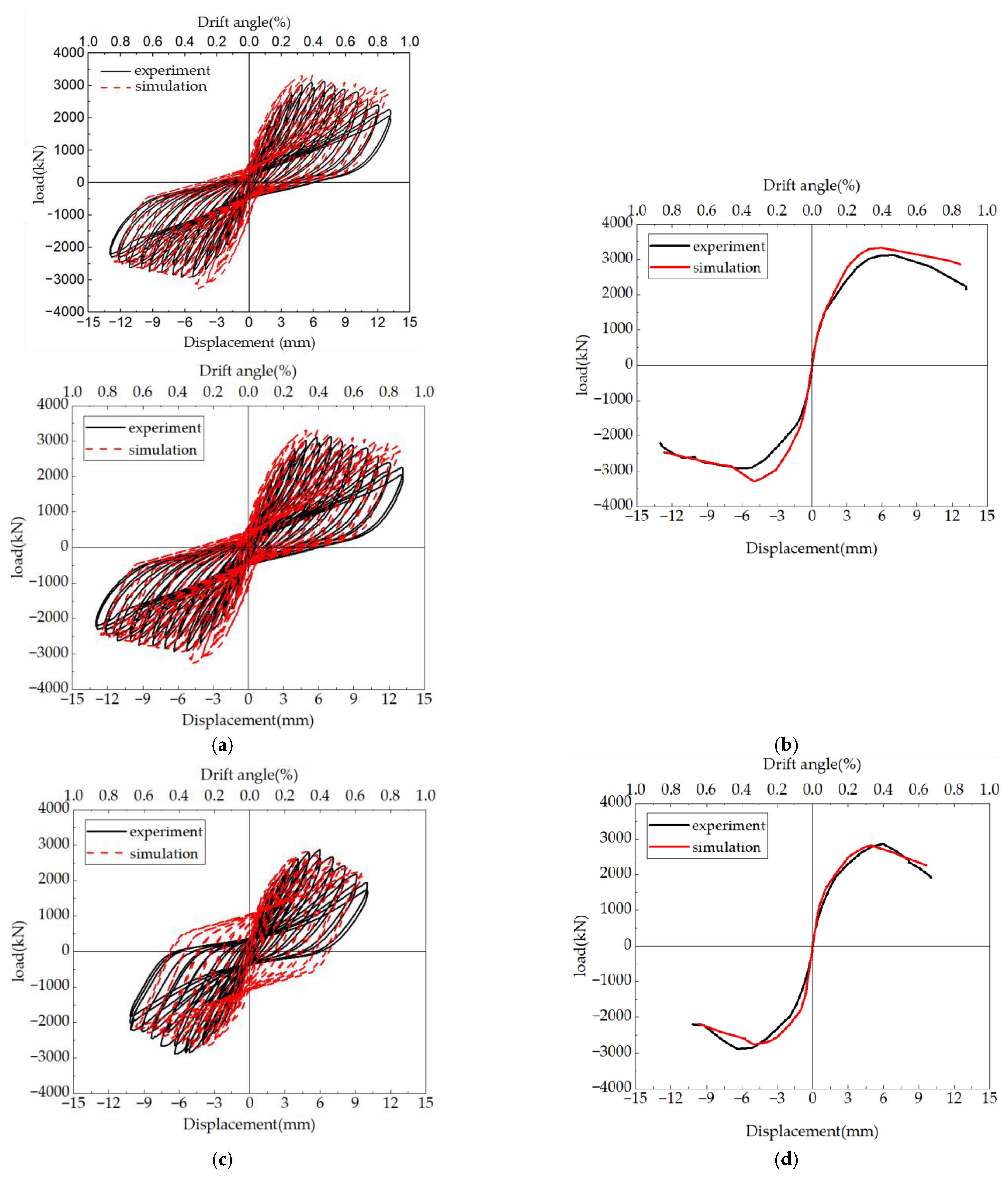
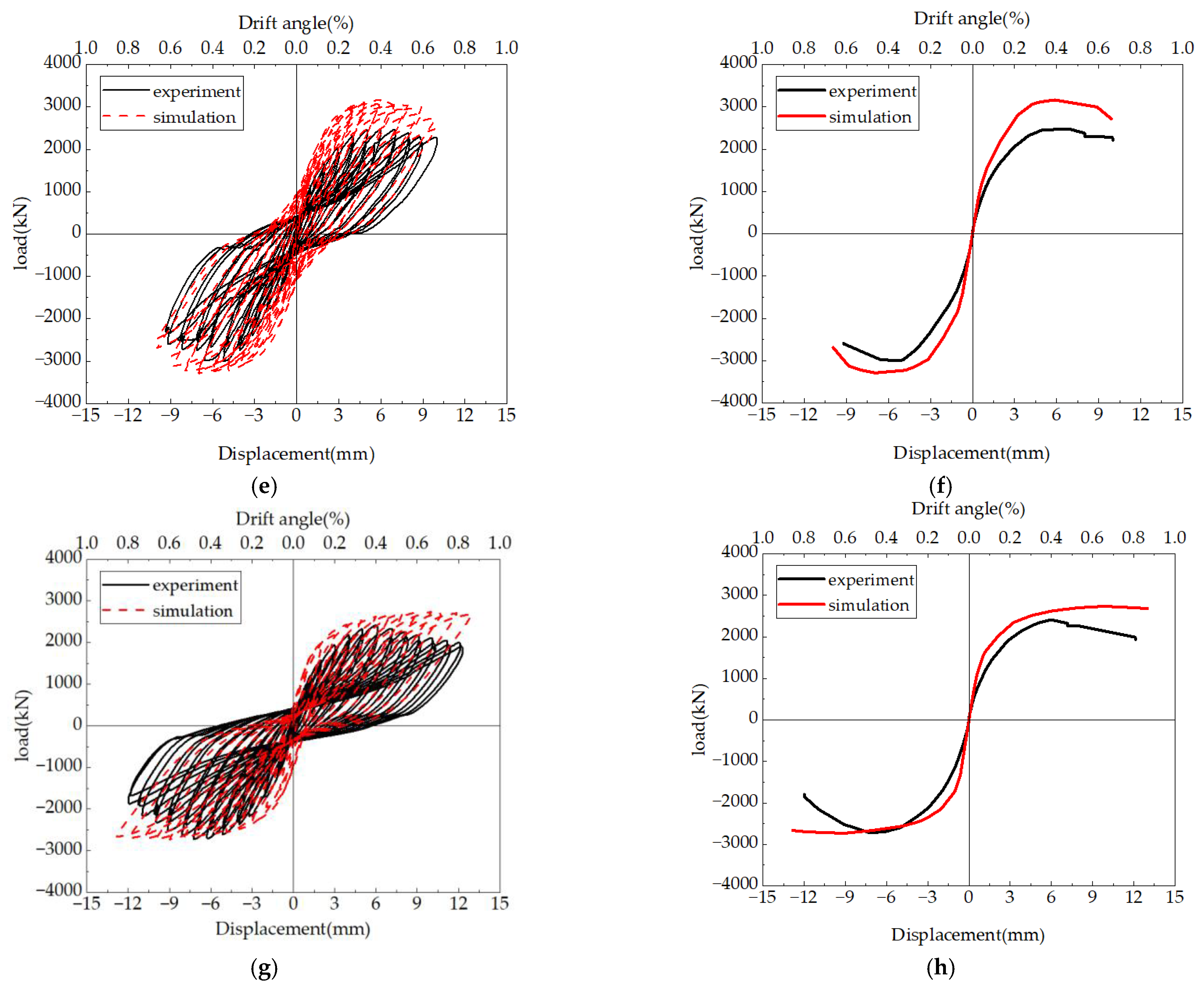
Specimen SW5 was a modular shear wall with a roughened inner surface of the leaf wall and without a post-cast strip. The wall had a height of 1.5 m, a width of 3.0 m, and a thickness of 0.185 m. A double-layer, bidirectional reinforcement arrangement was adopted, with a reinforcement ratio of 1.6% and an axial compression ratio of 0.1. When the horizontal load reached +1300 kN, the first diagonal crack appeared at the base of the southern end of the shear wall, with a length of 120 mm, after which the loading mode was switched to displacement control.
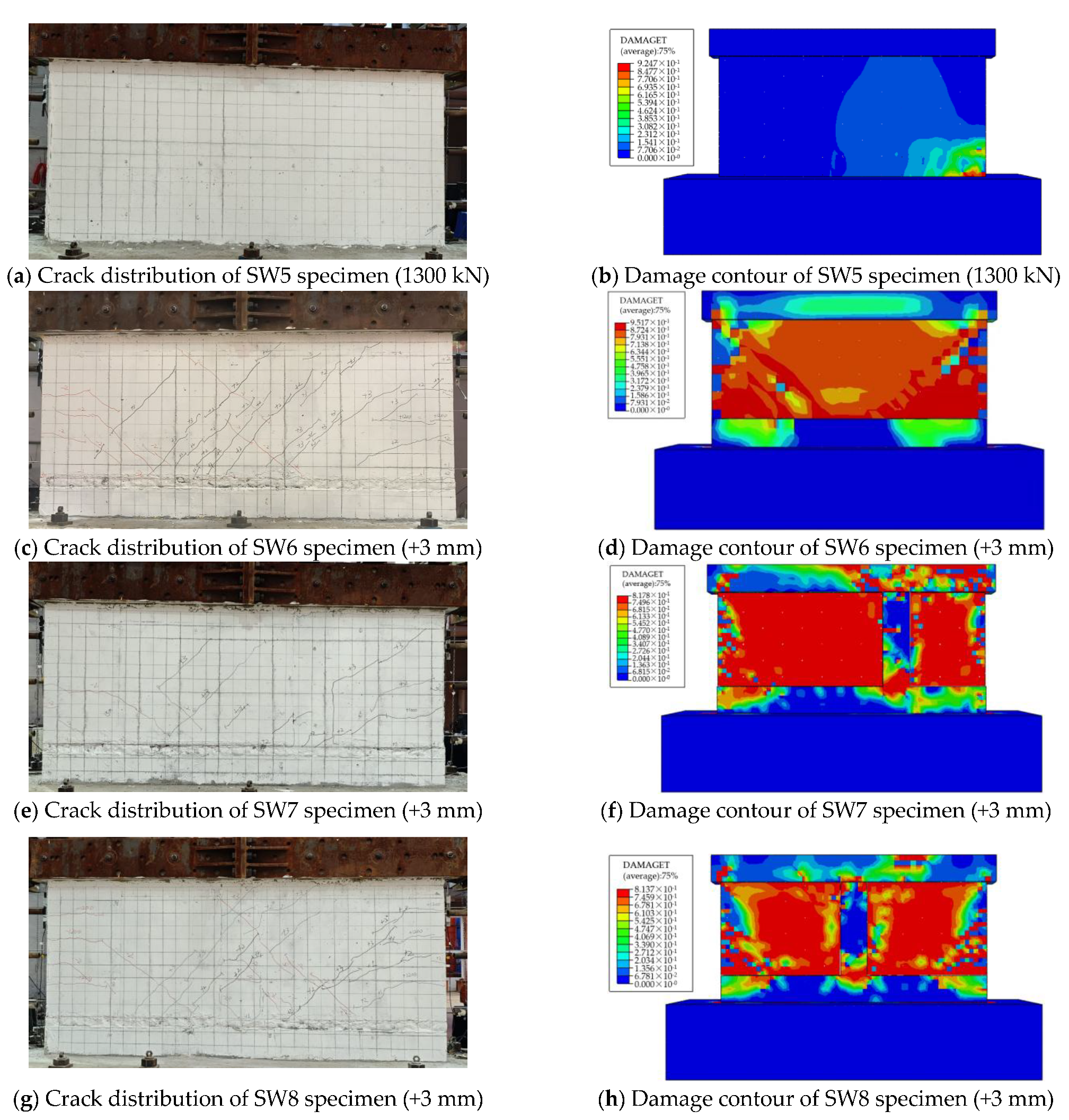
At a horizontal displacement of +1 mm, the applied load was 1350 kN, and seven additional diagonal cracks inclined upward toward the south developed on the southern side of the shear wall. When the displacement increased to +3 mm, the load reached 2322 kN, and four diagonal cracks penetrating upward and downward appeared on the northern side and in the middle region of the wall. Meanwhile, the horizontal crack at the southern end propagated inward, and the other diagonal cracks continued to extend. When the displacement reached +9 mm, the load was 2584 kN, and one new diagonal crack with a length of 420 mm developed at the bottom of the northern side. Upon loading to −9 mm displacement, the load was 2468 kN, and another diagonal crack with a length of 240 mm formed at the bottom of the northern sid. When the displacement reached +13 mm, severe concrete crushing occurred at the base of the northern side, with reinforcement bars exposed, and the loading was terminated. The final failure mode of specimen SW5 was shear–compression failure, as shown in
Figure 3.
(2) SW6
Specimen SW6 was modified from specimen SW5 by introducing a 300 mm thick UHPC horizontal post-cast strip at the base of the wall, while all other parameters remained unchanged. When the horizontal load reached +1200 kN (corresponding to a horizontal displacement of 0.96 mm), the first horizontal crack appeared in the middle region of the southern side of the shear wall, with a length of 550 mm, after which the loading mode was switched to displacement control.
At a horizontal displacement of +1 mm, the applied load was 1252 kN, and one crack with a length of 250 mm developed along the post-cast strip joint at the southern end of the shear wall. When the displacement reached −1 mm, the load was 1285 kN, and cracking occurred along the post-cast strip joint at the northern end of the shear wall, with a crack length of 220 mm. When the displacement increased to +6 mm, the load reached 2625 kN, and diagonal cracks on the northern side extended downward to the top of the post-cast strip, while one existing crack on the southern side propagated through the modular wall. Local spalling of surface concrete was observed along the post-cast strip joint. At a displacement of −6 mm, the load was 2577 kN, and a new diagonal crack initiated at the top of the middle region of the modular wall, propagating downward toward the south and penetrating through the modular wall, terminating at the top of the post-cast strip, with a maximum crack width of 0.3 mm.
When the displacement reached the +10 mm level, the load decreased to 1750 kN, and concrete crushing occurred at the connection between the northern modular wall and the post-cast strip. Upon loading to the −10 mm level, the load was 1873 kN, and concrete crushing was observed at the connection between the base of the southern modular wall and the post-cast strip, after which the loading was terminated. The final failure mode of specimen SW6 was shear–compression failure, as shown in
Figure 4.
(3) SW7
Specimen SW7 was further modified by adding a 300 mm thick UHPC vertical post-cast strip at one-third of the wall length on the basis of the horizontal post-cast strip at the wall base, forming a composite horizontal–vertical post-cast strip system. When the horizontal load reached +1000 kN (corresponding to a horizontal displacement of 0.86 mm), a horizontal crack with a length of 500 mm appeared in the middle region of the southern side of the shear wall, after which the loading mode was switched to displacement control.
At a horizontal displacement of +1 mm, the applied load was 1006 kN, and one crack with a length of 70 mm developed along the post-cast strip joint at the southern end of the shear wall. When the displacement reached −1 mm, the horizontal load was 1198 kN, and cracking occurred at the joint between the bottom of the northern end modular wall and the post-cast strip, with a crack length of 400 mm. When the displacement increased to +6 mm, the load reached 2100 kN, and cracking was observed at the connection between the root of the vertical post-cast strip and the modular wall. One existing diagonal crack on the northern side, which initiated at the upper part of the vertical post-cast strip, propagated diagonally downward toward the north to the top edge of the bottom post-cast strip, while a diagonal crack in the horizontal post-cast strip at the northern end extended toward the end region. At this stage, the maximum crack width was 0.3 mm.
When the displacement reached −6 mm, the load was 2577 kN, and a new diagonal crack initiated at the top of the middle region of the modular wall, propagating downward toward the south and penetrating through the modular wall, terminating at the top of the post-cast strip, with a maximum crack width of 1.3 mm. When the displacement reached +11 mm, the load decreased to 1744 kN, and surface concrete spalling occurred at the connection between the modular wall and the bottom post-cast strip. UHPC crushing was observed at the lower northern corner, after which the loading was terminated. The failure mode of specimen SW7 was shear–compression failure, as shown in
Figure 5.
For specimen SW8, the position of the vertical post-cast strip was adjusted to the mid-length (1/2 of the wall length), while all other parameters remained the same as those of specimen SW7. When the horizontal load reached −1200 kN, three horizontal cracks appeared symmetrically at the northern and southern ends of the shear wall. From top to bottom, the crack lengths were 430 mm, 430 mm, and 450 mm, respectively, after which the loading mode was switched to displacement control.
At a horizontal displacement of +1 mm, the applied load was 963 kN, and one initial horizontal crack at the lower part of the southern end of the shear wall began to propagate downward. When the displacement reached −1 mm, the horizontal load was 1012 kN, and cracking occurred along the post-cast strip joint at the northern end of the shear wall, with a crack length of 990 mm. When the displacement increased to +6 mm, the load reached 2163 kN. One diagonal crack on the northern side extended upward to the top of the modular wall, penetrating through the modular wall, and a new diagonal crack with a length of 320 mm developed in the upper region of the northern side. In addition, a new horizontal crack with a length of 500 mm formed along the post-cast strip joint, and a new diagonal crack with a length of 330 mm developed at the base of the wall.
At a displacement of −6 mm, the load was 2492 kN, and a new diagonal crack with a length of 290 mm developed on the southern side. When the displacement reached −10 mm, the load decreased to 2065 kN, and concrete spalling occurred at the connection between the base of the southern modular wall and the post-cast strip, accompanied by UHPC crushing at the southern corner. The loading was then terminated. The final failure mode of specimen SW8 was shear–compression failure, as shown in
Figure 6.
3.3. Analysis of Crack Development Patterns
The crack development of all four specimens followed a common evolution path, beginning with initial horizontal cracking, followed by the formation of diagonal cracks, the interaction and intersection of diagonal cracks, and finally the development of through cracks. However, the presence and location of post-cast strips had a significant influence on crack distribution, crack penetration behavior, and crack width.
SW5 (no post-cast strip): The initial cracks appeared as horizontal cracks at the wall ends. With increasing load, these cracks rapidly transformed into diagonal cracks and eventually developed into intersecting diagonal cracks penetrating the entire wall. The cracks were evenly distributed, mainly concentrated in the mid-to-lower regions of the wall, with a maximum crack width of 0.4 mm. In the absence of post-cast strip constraints, cracks propagated freely, resulting in strong through-crack connectivity and pronounced overall shear deformation.
SW6 (horizontal post-cast strip only): The initial cracking occurred as horizontal cracks along the post-cast strip joint. As loading continued, diagonal cracks developed in the region above the post-cast strip. Crack propagation was confined to this upper region and could not extend downward, eventually forming dense intersecting diagonal cracks, with a maximum crack width of 0.3 mm. The horizontal post-cast strip effectively concentrated crack distribution and reduced through-crack connectivity, while locally increasing crack width.
SW7 (horizontal + vertical post-cast strip at 1/3 wall length): Initial cracks formed at the horizontal post-cast strip joint and at the base of the vertical post-cast strip. With further loading, diagonal cracks developed in multiple regions of the wall. The vertical post-cast strip restricted lateral crack penetration, resulting in the formation of several relatively independent load-bearing units. Crack distribution became more dispersed, with a maximum crack width of 2.3 mm. Due to the eccentric placement of the vertical post-cast strip, cracks on the smaller wall segment were denser and wider.
SW8 (horizontal + vertical post-cast strip at mid-span, 1/2 wall length): Initial cracks appeared as symmetric horizontal cracks along the horizontal post-cast strip joint. These subsequently evolved into left–right symmetric diagonal cracks. Although the centrally located vertical post-cast strip did not completely prevent crack penetration, it effectively delayed the penetration process. Cracks were evenly distributed across the wall, ultimately forming full-span intersecting diagonal cracks with a maximum width of 2.3 mm. The central arrangement of the vertical post-cast strip promoted symmetric and coordinated crack development, effectively avoiding local crack concentration.