Article

Seismic Performance of In-Plane Loaded Modular Squat Shear Walls and the Influence of Post-Cast Strips

1
School of Civil Engineering, Harbin Institute of Technology, Harbin 150090, China
2
Key Laboratory of Structures Dynamic Behavior and Control of the Ministry of Education, Harbin Institute of Technology, Harbin 150090, China
3
Key Laboratory of Smart Prevention and Mitigation of Civil Engineering Disasters of the Ministry of Industry and Information Technology, Harbin Institute of Technology, Harbin 150090, China
*
Author to whom correspondence should be addressed.
Buildings 2026, 16(4), 847; https://doi.org/10.3390/buildings16040847
Submission received: 30 December 2025 / Revised: 11 February 2026 / Accepted: 17 February 2026 / Published: 20 February 2026

Abstract

This study investigates modular low-rise shear walls by designing and fabricating four in-plane loaded specimens at a scale ratio of 1:2.7. Quasi-static low-cycle reversed loading tests combined with numerical simulations were systematically conducted to examine the effects of the type and location of post-cast strips on the seismic performance of shear walls. The experimental program comparatively analyzed crack development patterns, failure modes, and seismic performance indices of specimens with four construction configurations: without post-cast strips, with only a horizontal post-cast strip, with a horizontal post-cast strip combined with an eccentrically placed vertical post-cast strip, and with a horizontal post-cast strip combined with a centrally placed vertical post-cast strip. The results indicate that specimens without post-cast strips exhibit uniformly distributed and highly penetrative cracks, characterized by typical global shear failure. The horizontal post-cast strip restricts downward crack propagation, leading to crack concentration above the post-cast strip, whereas the combined arrangement of horizontal and vertical post-cast strips promotes dispersed crack development and significantly alleviates excessive local damage concentration. The specimen with a centrally located vertical post-cast strip exhibited the best overall seismic performance, characterized by full hysteretic curves, the largest cumulative energy dissipation, and the most gradual stiffness degradation, whereas the specimen with only a horizontal post-cast strip showed relatively poor energy dissipation capacity and ductility. The finite element model established based on the experimental results accurately reproduces the mechanical responses and failure characteristics of all specimens, validating the mechanism by which post-cast strips improve wall performance through stress dispersion and crack development regulation. The findings demonstrate that a rational arrangement of post-cast strips, particularly the adoption of a centrally placed vertical post-cast strip, can effectively enhance the seismic performance of modular low-rise shear walls.

1. Introduction

Modular building systems have been extensively studied and increasingly adopted in recent years owing to their significant advantages, including high construction efficiency, strong quality controllability, and reduced environmental impact [1,2]. As the primary lateral force–resisting component in modular buildings, shear walls play a decisive role in determining the overall structural safety, reliability, and durability under seismic actions, and their seismic performance is therefore of critical importance [3,4]. Compared with conventional cast-in-place shear walls, modular shear walls exhibit pronounced differences in load-bearing mechanisms, force transfer paths, and failure modes due to the presence of assembly joints, prefabricated component connections, and post-cast strips [5]. In particular, modular squat shear walls are more strongly governed by shear behavior and are prone to brittle shear failure under seismic loading, which can severely compromise the seismic safety of the structure [6,7]. This issue has become a key bottleneck restricting the widespread application of modular buildings in regions with high seismic intensity.
Extensive research has been conducted by scholars worldwide on the seismic performance of conventional shear walls and certain types of modular wall systems. In the field of traditional shear walls, experimental investigations combined with numerical simulations have been widely employed to examine the effects of key parameters—such as axial compression ratio, shear span ratio, and reinforcement ratio—on seismic behavior, and a variety of structural measures have been proposed to enhance ductility and energy dissipation capacity [8,9]. Regarding modular shear walls, existing studies have primarily focused on the optimization of assembly joint configurations, including grouted sleeve connections, bolted connections, and staggered connections, and their influences on seismic performance [10,11]. Gu Sheng et al. [10] reported that improvements in grouted sleeve connection techniques can effectively mitigate the adverse effects of reinforcement connection defects on the seismic performance of precast shear walls. Bai Jiulin et al. [12] demonstrated that the use of double U-shaped connectors to achieve closed stirrup continuity between modules can significantly enhance the confinement performance of boundary elements in modular composite shear walls. In addition, the application of advanced materials, such as ultra-high-performance concrete (UHPC) and fiber-reinforced composites, has provided new approaches for improving the seismic performance of modular shear walls [13,14]. Studies by Yan Wenxun and Gu Jinben et al. [11,15] indicated that incorporating UHPC in critical regions of shear walls can substantially improve their load-bearing capacity and deformation performance. For squat shear walls as a special structural type, Zhang Huadong and Kildashti, Kamyar et al. [16,17] verified through full-scale experiments the effectiveness of different structural configurations in enhancing seismic performance, while the integrated design of insulation modules and shear walls has also offered new insights into the coordinated optimization of seismic resistance and energy efficiency [9,18].
As a key structural detail for achieving reliable connections between prefabricated components and ensuring the overall integrity of modular structures, post-cast strips play a critical role in governing internal force transfer paths and damage evolution within shear walls; their material selection, layout configuration, and construction procedures therefore exert a direct influence on structural performance [3,19]. Wang Xiang and Wang Dayang et al. [20,21] reported that different post-cast strip configurations can significantly alter crack propagation patterns, stiffness degradation behavior, and energy dissipation characteristics of shear walls. However, for modular squat shear walls as a special structural component, systematic investigations into the effects of post-cast strip type (e.g., conventional concrete, UHPC, and fiber-reinforced concrete post-cast strips) and layout position (e.g., boundary regions, mid-span regions, and layered arrangements) on seismic performance remain limited [22,23]. Existing studies have mainly focused on shear walls with conventional aspect ratios, while for squat shear walls with shear span ratios less than 1.0, the mechanisms by which post-cast strips regulate shear-dominated failure modes and delay brittle failure under seismic loading have yet to be clearly elucidated [17,24]. Moreover, the emergence of novel modular shear wall systems—such as hollow modular walls and walls incorporating embedded steel plates or steel–reinforced concealed bracing—has further raised new research demands regarding the collaborative mechanical performance between post-cast strips and advanced wall systems [25,26].
Finite element numerical simulation has become an important tool for investigating the seismic performance of shear walls [8,27]. Using software such as ABAQUS and SAP2000, researchers have established refined shear wall models that effectively capture the nonlinear mechanical behavior of walls under cyclic loading [28,29]. However, most existing numerical models focus on modular shear walls with a single structural configuration and lack multi-parameter coupled analyses that account for variations in post-cast strip properties and layouts, making it difficult to comprehensively reflect the regulatory mechanisms of post-cast strips on the seismic performance of modular squat shear walls [30,31]. In addition, current seismic design codes for modular shear walls largely draw on the experience of conventional cast-in-place shear walls, and specific design provisions addressing the influence of post-cast strips remain insufficient [31,32]. As a result, post-cast strip design in engineering practice often involves a degree of subjectivity and uncertainty, which in turn constrains the optimization of seismic performance and the broader engineering application of modular squat shear wall structures [14,33].
To address the aforementioned research gaps, this study focuses on in-plane loaded modular squat shear walls and systematically investigates the effects of different post-cast strip configurations on their seismic performance. Four scaled specimens with varying post-cast strip types and layout arrangements were designed and tested through quasi-static low-cycle reversed loading experiments. Key seismic performance indicators—including crack development processes, failure modes, hysteretic behavior, load-carrying capacity, ductility, and energy dissipation capacity—were comprehensively analyzed. In conjunction with finite element numerical simulations, the regulatory effects of post-cast strips on stress distribution, damage accumulation, and failure mechanisms of the walls were further elucidated. The findings of this study aim to clarify the cooperative working mechanisms between modular squat shear walls and post-cast strips, establish an optimized design approach for post-cast strip parameters, and provide experimental evidence and theoretical support for the seismic design and engineering application of modular squat shear wall structures.

2. Model Experiment

2.1. Experimental Design

This experimental program was designed based on similarity theory. Considering the available laboratory space, the capacity of the loading equipment, the requirements for loading accuracy, and the demands of large-scale model testing, a geometric similarity ratio of 2.7 was adopted for this study. The material density and elastic modulus of the model were consistent with those of the prototype. Based on the basic similarity ratios of geometric dimensions, elastic modulus, and material density, the similarity relationships of various physical quantities in the model test were derived, as summarized in Table 1.
The prototype shear wall has a height of 4.05 m, a width of 8.1 m, and a thickness of 0.5 m, and is constructed using C40 concrete with an axial compression ratio of 0.1. The shear wall adopts a double-layer reinforcement layout, with both horizontal and vertical reinforcement consisting of HRB400 steel bars with a diameter of 32 mm at a spacing of 200 mm. The reinforcement ratios in both directions are 1.60%, and the reinforcement is arranged in a mesh pattern.
According to the selected scaling ratio, the dimensions of the basic test specimen were determined to be 1.5 m in height, 3.0 m in width, and 0.185 m in thickness. The double-layer reinforcement ratios in the horizontal and vertical directions (ρs and ρsv) were both maintained at 1.6%, and the axial compression ratio was set to μG = 0.1. The design parameters of the prototype structure and the model specimens are summarized in Table 2.
The model was constructed at a geometric scale of 1:2.7. By matching key mechanical similarity relationships of stress, strain, and load, as well as critical design indices such as reinforcement ratio and axial compression ratio, consistency in the macroscopic mechanical behavior between the model and the prototype was achieved. Meanwhile, it is necessary to note the inherent limitations of the scaled model in this study: the reinforcement bar diameters were not strictly scaled, the effect of concrete aggregate size was not considered, and the construction details of local components such as the post-cast strip interface differ from those of the prototype. These factors may influence local failure modes and crack distribution at the mesoscopic level; however, they do not alter the overall load-resisting mechanism and seismic performance trends, nor do they affect the macroscopic analysis of the influence of post-cast strip configuration.
Based on practical shear wall engineering, four in-plane loaded specimens were designed with the basic specimen as the reference, by adjusting the inner surface roughness of the web walls and the type and location of post-cast strips. The detailed parameters of the specimens are listed in Table 3. The reinforcement layouts of the specimens are shown in Figure 1.

2.2. Experimental Loading

The test loading system was centered on a 30,000 kN multifunctional loading frame, accompanied by two electro-hydraulic servo actuators, a liftable reaction beam, an anchor system, and a data acquisition system. The vertical actuators possess bidirectional horizontal tracking capability, ensuring that the vertical load always remains aligned with the vertical direction. The system provides a vertical loading capacity of 30,000 kN and a horizontal loading capacity of 5000 kN, which is sufficient to meet the loading requirements of large-scale shear wall specimens.
To satisfy the loading demands of the quasi-static test, the specimens were equipped with a top loading beam and a bottom beam. The top loading beam has a cross-sectional size of 300 mm × 300 mm and contains the corresponding reinforcement, with the horizontal load applied 150 mm below the top surface of the beam. A reinforced concrete bottom beam was provided as a fixed end, with dimensions of 1300 mm × 800 mm × 4000 mm, anchored to the test frame using anti-uplift ground anchor bolts [34]. Reaction piers were placed on both sides of the base beam and preloaded with hydraulic jacks to prevent specimen sliding under horizontal loading. A sliding bearing was installed between the loading beam and the vertical actuator to ensure stability of the vertical force during horizontal loading. The loading setup is illustrated in Figure 2.
The test adopted a combined load–displacement control method, with the specific procedure as follows:
(1) Preloading: The specimen was subjected to one cycle of loading and unloading at 40% of the vertical axial force (336 kN) to eliminate internal heterogeneity and connection gaps, and to adjust the bolts fixing the base beam.
(2) Formal Loading: The vertical load was first applied to 840 kN and maintained until the end of the test. Horizontal loading was carried out in two stages. Before cracking, load control was applied, starting from an initial load of 200 kN with increments of 100 kN (reduced when approaching the estimated cracking load), with one cycle per load level. After cracking, the control was switched to displacement control, with a displacement increment of 1 mm per level and two cycles per increment, continuing until the specimen’s load dropped to 85% of the maximum load or further loading was no longer possible.

2.3. Measured Parameters and Sensor Arrangement

The measured parameters of the test included horizontal and vertical loads, displacements at various locations of the specimen, reinforcement strains, crack development, and failure modes. The specific instrumentation layout is as follows:
(1) Displacement Measurement: Vertical displacement transducers were installed at both ends of the base beam to measure vertical displacements caused by ground anchor deformation and slippage. Horizontal displacement transducers were installed at both ends of the base beam to capture translational movements. Vertical and horizontal displacement transducers were arranged at both ends of the loading beam to eliminate the influence of beam sway on the measurements. One displacement transducer was placed at the top of the specimen and another at the mid-height of the wall to verify horizontal displacement data. Two dial gauges were installed at the corners of the specimen, connected along the diagonals with steel wires, to measure shear deformations. The displacement transducer layout is shown in Figure 3.
(2) Crack and failure pattern recording: A camera was used to capture the crack development process of the wall in real time, and the crack location, length, width, and propagation trend were recorded. After the completion of the test, the final failure pattern of the specimen was photographed to retain image documentation.

2.4. Material Properties

The concrete was designed with a strength grade of C40. The aggregate was continuously graded with a particle size range of 5–25 mm and a maximum size of 25 mm. Ordinary Portland cement was used, with a maximum water–cement ratio of 0.45 and a minimum cementitious material content of 320 kg/m3. Standard cubic and prismatic specimens were cast simultaneously with the test specimens and cured under the same conditions. Prior to testing, the mechanical properties of the concrete corresponding to each specimen were measured, and the results are presented in Table 4. where fc,k denotes the axial compressive strength; fcu,k represents the standard value of cube compressive strength; ftu is the tensile strength of UHPC; and E c denotes the elastic modulus of concrete.
The post-cast strips were made of MC120-type UHPC premix, with a steel fiber volume fraction of 1%. The steel fibers were copper-coated, with a diameter of 0.2 mm, a length of 13 mm, and a tensile strength of 3284 MPa. The mechanical properties of UHPC were measured, and the results are presented in Table 5.
Both the horizontal and vertical reinforcement bars were HRB400 grade, while the stirrups were HPB300 grade. Before testing, samples of the reinforcement bars were taken, and three specimens of each diameter were subjected to standard tensile tests to determine the yield strength and ultimate strength. The mechanical properties of the reinforcement are summarized in Table 6.

3. Experimental Procedure and Failure Modes

3.1. Experimental Overview

The experiment was conducted using a quasi-static low-cycle reversed loading method to investigate the mechanical responses and failure characteristics of four in-plane loaded modular squat shear wall specimens (SW5–SW8). The loading procedure began with preloading, during which one cycle of loading and unloading at 40% of the vertical axial force was applied to eliminate internal heterogeneity and connection gaps between loading components, and to adjust the base beam bolts to ensure specimen stability. The vertical load was then gradually increased to 840 kN and remained constant until the end of the experiment.
Horizontal loading was applied using a combined load–displacement control strategy. Before cracking, load control was employed, starting from an initial load of 200 kN and increased stepwise according to the preset increments, with reduced increments when approaching the estimated cracking load, and one cycle per level. After cracking, the control was switched to displacement control, with a displacement increment of 1 mm per level and two cycles per increment, continuing until the load dropped to 85% of the maximum load or the specimen could no longer sustain further loading [35].
Considering the high stiffness and small deformation characteristics of the specimens, the preloading stage was used to eliminate the effects of anchor slippage and actuator connection gaps. The loading control strategy was optimized to achieve a smooth transition between load control and displacement control. During the experiment, displacement transducers and load sensors were monitored in real time, and actuator parameters were dynamically adjusted to avoid loading shocks caused by sudden stiffness changes, ensuring the accuracy and reliability of the experimental data.

3.2. Experimental Observations and Failure Modes

(1) SW5
Specimen SW5 was a modular shear wall with a roughened inner surface of the leaf wall and without a post-cast strip. The wall had a height of 1.5 m, a width of 3.0 m, and a thickness of 0.185 m. A double-layer, bidirectional reinforcement arrangement was adopted, with a reinforcement ratio of 1.6% and an axial compression ratio of 0.1. When the horizontal load reached +1300 kN, the first diagonal crack appeared at the base of the southern end of the shear wall, with a length of 120 mm, after which the loading mode was switched to displacement control.
At a horizontal displacement of +1 mm, the applied load was 1350 kN, and seven additional diagonal cracks inclined upward toward the south developed on the southern side of the shear wall. When the displacement increased to +3 mm, the load reached 2322 kN, and four diagonal cracks penetrating upward and downward appeared on the northern side and in the middle region of the wall. Meanwhile, the horizontal crack at the southern end propagated inward, and the other diagonal cracks continued to extend. When the displacement reached +9 mm, the load was 2584 kN, and one new diagonal crack with a length of 420 mm developed at the bottom of the northern side. Upon loading to −9 mm displacement, the load was 2468 kN, and another diagonal crack with a length of 240 mm formed at the bottom of the northern sid. When the displacement reached +13 mm, severe concrete crushing occurred at the base of the northern side, with reinforcement bars exposed, and the loading was terminated. The final failure mode of specimen SW5 was shear–compression failure, as shown in Figure 3.
(2) SW6
Specimen SW6 was modified from specimen SW5 by introducing a 300 mm thick UHPC horizontal post-cast strip at the base of the wall, while all other parameters remained unchanged. When the horizontal load reached +1200 kN (corresponding to a horizontal displacement of 0.96 mm), the first horizontal crack appeared in the middle region of the southern side of the shear wall, with a length of 550 mm, after which the loading mode was switched to displacement control.
At a horizontal displacement of +1 mm, the applied load was 1252 kN, and one crack with a length of 250 mm developed along the post-cast strip joint at the southern end of the shear wall. When the displacement reached −1 mm, the load was 1285 kN, and cracking occurred along the post-cast strip joint at the northern end of the shear wall, with a crack length of 220 mm. When the displacement increased to +6 mm, the load reached 2625 kN, and diagonal cracks on the northern side extended downward to the top of the post-cast strip, while one existing crack on the southern side propagated through the modular wall. Local spalling of surface concrete was observed along the post-cast strip joint. At a displacement of −6 mm, the load was 2577 kN, and a new diagonal crack initiated at the top of the middle region of the modular wall, propagating downward toward the south and penetrating through the modular wall, terminating at the top of the post-cast strip, with a maximum crack width of 0.3 mm.
When the displacement reached the +10 mm level, the load decreased to 1750 kN, and concrete crushing occurred at the connection between the northern modular wall and the post-cast strip. Upon loading to the −10 mm level, the load was 1873 kN, and concrete crushing was observed at the connection between the base of the southern modular wall and the post-cast strip, after which the loading was terminated. The final failure mode of specimen SW6 was shear–compression failure, as shown in Figure 4.
(3) SW7
Specimen SW7 was further modified by adding a 300 mm thick UHPC vertical post-cast strip at one-third of the wall length on the basis of the horizontal post-cast strip at the wall base, forming a composite horizontal–vertical post-cast strip system. When the horizontal load reached +1000 kN (corresponding to a horizontal displacement of 0.86 mm), a horizontal crack with a length of 500 mm appeared in the middle region of the southern side of the shear wall, after which the loading mode was switched to displacement control.
At a horizontal displacement of +1 mm, the applied load was 1006 kN, and one crack with a length of 70 mm developed along the post-cast strip joint at the southern end of the shear wall. When the displacement reached −1 mm, the horizontal load was 1198 kN, and cracking occurred at the joint between the bottom of the northern end modular wall and the post-cast strip, with a crack length of 400 mm. When the displacement increased to +6 mm, the load reached 2100 kN, and cracking was observed at the connection between the root of the vertical post-cast strip and the modular wall. One existing diagonal crack on the northern side, which initiated at the upper part of the vertical post-cast strip, propagated diagonally downward toward the north to the top edge of the bottom post-cast strip, while a diagonal crack in the horizontal post-cast strip at the northern end extended toward the end region. At this stage, the maximum crack width was 0.3 mm.
When the displacement reached −6 mm, the load was 2577 kN, and a new diagonal crack initiated at the top of the middle region of the modular wall, propagating downward toward the south and penetrating through the modular wall, terminating at the top of the post-cast strip, with a maximum crack width of 1.3 mm. When the displacement reached +11 mm, the load decreased to 1744 kN, and surface concrete spalling occurred at the connection between the modular wall and the bottom post-cast strip. UHPC crushing was observed at the lower northern corner, after which the loading was terminated. The failure mode of specimen SW7 was shear–compression failure, as shown in Figure 5.
For specimen SW8, the position of the vertical post-cast strip was adjusted to the mid-length (1/2 of the wall length), while all other parameters remained the same as those of specimen SW7. When the horizontal load reached −1200 kN, three horizontal cracks appeared symmetrically at the northern and southern ends of the shear wall. From top to bottom, the crack lengths were 430 mm, 430 mm, and 450 mm, respectively, after which the loading mode was switched to displacement control.
At a horizontal displacement of +1 mm, the applied load was 963 kN, and one initial horizontal crack at the lower part of the southern end of the shear wall began to propagate downward. When the displacement reached −1 mm, the horizontal load was 1012 kN, and cracking occurred along the post-cast strip joint at the northern end of the shear wall, with a crack length of 990 mm. When the displacement increased to +6 mm, the load reached 2163 kN. One diagonal crack on the northern side extended upward to the top of the modular wall, penetrating through the modular wall, and a new diagonal crack with a length of 320 mm developed in the upper region of the northern side. In addition, a new horizontal crack with a length of 500 mm formed along the post-cast strip joint, and a new diagonal crack with a length of 330 mm developed at the base of the wall.
At a displacement of −6 mm, the load was 2492 kN, and a new diagonal crack with a length of 290 mm developed on the southern side. When the displacement reached −10 mm, the load decreased to 2065 kN, and concrete spalling occurred at the connection between the base of the southern modular wall and the post-cast strip, accompanied by UHPC crushing at the southern corner. The loading was then terminated. The final failure mode of specimen SW8 was shear–compression failure, as shown in Figure 6.

3.3. Analysis of Crack Development Patterns

The crack development of all four specimens followed a common evolution path, beginning with initial horizontal cracking, followed by the formation of diagonal cracks, the interaction and intersection of diagonal cracks, and finally the development of through cracks. However, the presence and location of post-cast strips had a significant influence on crack distribution, crack penetration behavior, and crack width.
SW5 (no post-cast strip): The initial cracks appeared as horizontal cracks at the wall ends. With increasing load, these cracks rapidly transformed into diagonal cracks and eventually developed into intersecting diagonal cracks penetrating the entire wall. The cracks were evenly distributed, mainly concentrated in the mid-to-lower regions of the wall, with a maximum crack width of 0.4 mm. In the absence of post-cast strip constraints, cracks propagated freely, resulting in strong through-crack connectivity and pronounced overall shear deformation.
SW6 (horizontal post-cast strip only): The initial cracking occurred as horizontal cracks along the post-cast strip joint. As loading continued, diagonal cracks developed in the region above the post-cast strip. Crack propagation was confined to this upper region and could not extend downward, eventually forming dense intersecting diagonal cracks, with a maximum crack width of 0.3 mm. The horizontal post-cast strip effectively concentrated crack distribution and reduced through-crack connectivity, while locally increasing crack width.
SW7 (horizontal + vertical post-cast strip at 1/3 wall length): Initial cracks formed at the horizontal post-cast strip joint and at the base of the vertical post-cast strip. With further loading, diagonal cracks developed in multiple regions of the wall. The vertical post-cast strip restricted lateral crack penetration, resulting in the formation of several relatively independent load-bearing units. Crack distribution became more dispersed, with a maximum crack width of 2.3 mm. Due to the eccentric placement of the vertical post-cast strip, cracks on the smaller wall segment were denser and wider.
SW8 (horizontal + vertical post-cast strip at mid-span, 1/2 wall length): Initial cracks appeared as symmetric horizontal cracks along the horizontal post-cast strip joint. These subsequently evolved into left–right symmetric diagonal cracks. Although the centrally located vertical post-cast strip did not completely prevent crack penetration, it effectively delayed the penetration process. Cracks were evenly distributed across the wall, ultimately forming full-span intersecting diagonal cracks with a maximum width of 2.3 mm. The central arrangement of the vertical post-cast strip promoted symmetric and coordinated crack development, effectively avoiding local crack concentration.


4. Experimental Results Analysis

4.1. Hysteresis Curve Analysis

Hysteretic curves can comprehensively reflect the seismic performance of shear walls under low-cycle reversed loading, including load-carrying capacity, energy dissipation capacity, and stiffness degradation, and are therefore key indicators for evaluating the seismic behavior of shear walls. The hysteretic curves of the four specimens in this study all exhibit typical characteristics of shear-dominated members; however, their shapes show significant differences depending on the configuration and location of the post-cast strips, as shown in Figure 7.
For specimen SW5 (without post-cast strips), the hysteretic curves generally exhibit a “spindle-shaped” pattern. In the elastic stage, the curves are nearly linear, and after cracking, the hysteresis loops gradually open but with moderate fullness, accompanied by a slight pinching effect. This behavior can be attributed to the absence of post-cast strip confinement, which allows diagonal cracks to develop freely, leading to uniform stiffness degradation. During cyclic loading, the wall exhibits relatively good deformation recovery capacity, resulting in relatively small residual deformations.
Specimen SW6 (with only a horizontal post-cast strip) shows hysteretic curves with lower fullness than those of specimen SW5, and a more pronounced pinching effect. The introduction of the horizontal post-cast strip causes a stiffness discontinuity between the upper and lower wall segments, making the region above the post-cast strip a stress concentration zone. Crack development is constrained within this region, resulting in a more concentrated load transfer path, reduced hysteresis loop area, and a decrease in the energy dissipation capacity of the structure.
For specimen SW7 (with a horizontal post-cast strip and a vertical post-cast strip located at one-third of the wall width), the fullness of the hysteretic curves is significantly improved and the pinching effect is mitigated. The combined action of the horizontal and vertical post-cast strips forms a multi-region load-resisting system. The partitioning effect of the vertical post-cast strip reduces the continuity of diagonal cracks. Compared with specimen SW6, specimen SW7 develops more plastic deformation during cyclic loading, resulting in a larger hysteresis loop area and enhanced energy dissipation capacity. However, due to the eccentric arrangement of the vertical post-cast strip, slight asymmetry is observed in the hysteretic curves under positive and negative loading, with fuller hysteresis loops on the side with the smaller wall segment.
Specimen SW8 (with a horizontal post-cast strip and a centrally located vertical post-cast strip at one-half of the wall width) exhibits symmetric “spindle-shaped” hysteretic curves with the highest fullness and the weakest pinching effect. The centrally arranged vertical post-cast strip ensures symmetric force transfer on both sides of the wall, resulting in uniform crack distribution and strong crack continuity. The load transfer paths are more dispersed, allowing sufficient development of plastic deformation under cyclic loading. Consequently, specimen SW8 exhibits the largest hysteresis loop area, demonstrating the beneficial role of a centrally located vertical post-cast strip in improving force coordination and energy dissipation capacity.

4.2. Skeleton Curves and Bearing Capacity Analysis

The skeleton curves can clearly reflect the strength, stiffness evolution, and failure-stage characteristics of shear walls, as shown in Figure 8. The skeleton curves of all four specimens experienced three stages: a linear elastic stage, a post-cracking inelastic stage, and a post-peak descending stage; however, significant differences were observed in the characteristics of each stage and in the bearing capacity indices.
In the linear elastic stage, the skeleton curves of the four specimens were nearly linear, with relatively small differences in slope (initial stiffness). Specimen SW5 exhibited the largest initial stiffness, while SW6 showed the smallest, with SW7 and SW8 lying in between. This indicates that the introduction of a horizontal post-cast strip reduces the initial stiffness of the wall, whereas the addition of a vertical post-cast strip can partially compensate for the stiffness loss. Moreover, a centrally arranged vertical post-cast strip provides a greater stiffness enhancement than an eccentrically arranged one.
In the post-cracking inelastic stage, the slope of the skeleton curve for SW5 decreased gradually, and the bearing capacity continued to increase. In contrast, SW6 exhibited a more rapid reduction in slope and a slower growth rate of bearing capacity, indicating that the horizontal post-cast strip restricted the uniform development of cracks and accelerated stiffness degradation. The slope reduction in SW7 and SW8 fell between those of SW5 and SW6, with SW8 showing a more stable increase in bearing capacity, highlighting the positive effect of a symmetric force-transfer system on load-carrying stability.
Regarding peak bearing capacity, SW5 achieved the highest peak loads (3127 kN in the positive direction and 2919 kN in the negative direction), while SW6 exhibited the lowest (2596 kN in the positive direction and 2785 kN in the negative direction). The peak loads of SW7 and SW8 were similar and fell between those of SW5 and SW6. These results demonstrate that the inclusion of a horizontal post-cast strip reduces the peak bearing capacity of the wall, whereas the addition of a vertical post-cast strip can mitigate this reduction. The difference in peak bearing capacity between centrally and eccentrically arranged vertical post-cast strips is relatively small.
In the post-peak stage, SW5 showed a relatively rapid load drop, reflecting pronounced brittle failure characteristics. The load of SW6 decreased even more rapidly, indicating aggravated brittleness. In contrast, SW7 exhibited a slower post-peak load reduction and a relatively extended post-peak stage. SW8 showed the most gradual load degradation and the most prominent ductile behavior, indicating that a centrally arranged vertical post-cast strip can effectively improve the post-peak mechanical performance of the wall and delay the failure process.

4.3. Energy Dissipation Capacity Analysis

The energy dissipation performance of shear wall specimens reflects their seismic behavior. In this study, the energy dissipation capacity of the shear walls is evaluated in terms of cumulative energy dissipation, the energy dissipation coefficient, and the equivalent viscous damping coefficient.
The cumulative energy dissipation of the shear wall specimens is quantified by the area enclosed by the load–displacement hysteresis loops, calculated as the cumulative sum of the hysteretic loop areas from the load–displacement hysteresis curves. In this study, the hysteresis loop from the first loading cycle at each displacement level is used as the basis for calculating the energy dissipation capacity of the shear walls. The comparative results are presented in Figure 9.
As shown in Figure 9, the cumulative energy dissipation of all four specimens increases approximately linearly with displacement, but the growth rates differ significantly. Specimen SW8 exhibits the highest cumulative energy dissipation, exceeding 300 kJ at the ultimate displacement. SW7 ranks second, SW5 is intermediate, and SW6 has the lowest cumulative energy dissipation, reaching less than 200 kJ at the ultimate displacement. These results indicate that a centrally arranged vertical post-cast strip can maximize the wall’s energy dissipation capacity, an eccentrically arranged vertical post-cast strip is less effective, and a horizontal post-cast strip alone reduces energy dissipation efficiency.
The energy dissipation capacity can also be reflected by the viscous damping coefficient during loading, with a larger damping coefficient indicating stronger energy dissipation. During loading, the equivalent viscous damping coefficient is directly related to the area of the hysteresis loops: the larger the hysteresis loop area, the greater the equivalent viscous damping coefficient. The energy dissipation performance of the shear wall specimens is expressed by the equivalent viscous damping coefficient ξeq. The schematic for calculating the equivalent viscous damping coefficient is shown in Figure 10, and the calculation method is given by Equation (1):
ξ e q = 1 2 π S A B C + C D A S O B E + O D F
In this study, the hysteresis loop from the first loading cycle at each displacement level was used as the basis for calculating the equivalent viscous damping coefficient of the shear walls. The comparative results are shown in Figure 11. As illustrated, at the initial stage of loading (before cracking), the damping coefficients of all four specimens were relatively low and similar, ranging from approximately 0.05 to 0.08. After wall cracking, the damping coefficients increased significantly, with the upward trend continuing until the end of the experiment. Among the specimens, SW8 exhibited the highest damping coefficient, with a peak exceeding 0.15; SW7 ranked second, with a peak of about 0.13; SW5 reached a peak of approximately 0.11; and SW6 had the lowest, with a peak of only 0.09. These results indicate that the configuration of post-cast strips has a significant impact on the damping and energy dissipation performance of the walls. A centrally arranged vertical post-cast strip maximizes damping energy dissipation by optimizing crack distribution and promoting plastic deformation development.

4.4. Ductility Analysis

The ductility of shear wall specimens refers to their deformation capacity from yielding to the maximum load or to a certain control point beyond the maximum load [36]. The ductility of a structure or component is usually expressed by the ductility factor. The displacement ductility factor is defined as shown in Equation (2):
μ = U u U y
In the equation, μ is the displacement ductility factor; Uu is the ultimate displacement of the specimen; and Uy is the yield displacement of the specimen.
The yield displacement was calculated using the energy method. The schematic of the energy method is shown in Figure 12. The analysis is conducted on the skeleton curve of the shear wall specimen. Point C represents the peak load. From point C, a vertical line is drawn, and a line connecting the origin O to a point B on this vertical line is drawn such that the two shaded areas in the figure are equal. Then, from point B, a horizontal line is drawn to intersect the skeleton curve at point E. Point E is defined as the yield point, and the corresponding load and displacement are taken as the yield load and yield displacement, respectively.
The calculated characteristic displacements and drift angles of each specimen are presented in Table 7.
Based on the data in Table 7, the ductility coefficients of the four specimens range from 2.76 to 4.13. The influence of different post-cast strip configurations on ductility shows significant differentiation. Specimen SW5 (no post-cast strip) exhibits the best ductility performance, with a positive ductility coefficient of 3.79 and a negative ductility coefficient of 4.13. Without post-cast strip constraints, the overall force-transfer characteristics allow cracks to be evenly distributed with strong penetration, enabling sufficient development of global shear deformation and providing ample space for plastic deformation, resulting in optimal ductility. Specimen SW7 (horizontal post-cast strip + 1/3-width eccentrically located vertical post-cast strip) ranks second, with positive and negative ductility coefficients of 3.28 and 3.58, respectively. Although the eccentric vertical post-cast strip leads to slight asymmetry between positive and negative ductility, the combined action of horizontal and vertical post-cast strips effectively disperses stress and avoids local damage concentration, resulting in better ductility than specimens with a single structural configuration. Specimen SW8 (horizontal post-cast strip + 1/2-width centrally located vertical post-cast strip) shows ductility coefficients of 2.99 (positive) and 2.82 (negative). The centrally located vertical post-cast strip forms a symmetric stress system, promoting coordinated crack development and stable plastic deformation; however, due to the moderate constraint imposed by the post-cast strip configuration on overall deformation, its ductility is lower than that of SW5 and SW7. Specimen SW6 (only horizontal post-cast strip) exhibits the smallest ductility coefficients, with 2.76 (positive) and 3.34 (negative). The horizontal post-cast strip confines cracks to the region above the strip, leading to pronounced stress concentration in this area, dense crack development, and restricted plastic deformation, thereby aggravating brittle failure characteristics and suppressing ductility improvement.

4.5. Stiffness Degradation Analysis

Stiffness degradation is characterized using the secant stiffness, which is calculated using the formula shown in Equation (3):
K i = + P i + P i + Δ i + Δ i
In the equation: Ki is the secant stiffness during the i-th loading cycle; +Pi, −Pi and are the positive and negative peak loads in the i-th loading cycle; +Δi and −Δi are the corresponding displacements at the positive and negative peak loads in the i-th loading cycle.
The secant stiffness degradation curves of the shear walls, calculated based on the backbone curves, are compared in Figure 13. As shown, the secant stiffness of all four specimens decreases monotonically with increasing displacement, and the degradation trends are consistent with the characteristics of shear-type members. However, the degradation rates differ significantly: the stiffness of SW6 degrades the fastest, with a rapid drop after cracking, and the secant stiffness at the ultimate displacement is only about 20% of the initial stiffness; SW5 exhibits a slower degradation rate; the stiffness degradation of SW7 and SW8 is relatively gradual, with the secant stiffness remaining above 30% of the initial value at ultimate displacement. This indicates that the addition of vertical post-cast strips can effectively slow down stiffness degradation by dispersing stress and limiting the concentrated development of cracks, with the central vertical post-cast strip showing a more pronounced effect.

5. Numerical Simulation

To further reveal the structural behavior of modular low-rise shear walls and verify the reliability of the experimental results, finite element models of the four specimens were established. By comparing the numerical results with the experimental data, the accuracy and applicability of the models were validated, providing numerical support for the design and performance optimization of similar structures.

5.1. Finite Element Model Development

A finite element model was established using ABAQUS. The finite element model was built based on the experimental specimen. Concrete and UHPC materials in the structure were simulated using C3D8R solid elements, while the reinforcement was modeled using T3D2 truss elements. The reinforcement was embedded into the concrete elements to ensure coordinated behavior between the reinforcement and the concrete. The mesh size in the main wall region was set to 50 mm × 50 mm × 50 mm, and the mesh was refined to 20 mm × 20 mm × 20 mm in the post-cast strip, reinforcement-dense zones, and critical corner areas to balance calculation accuracy and efficiency. Concrete was modeled using the CDP model, UHPC was modeled using a simplified damage plasticity model, and reinforcement was modeled using an ideal elastoplastic constitutive model. The reinforcement was connected through embedded interactions, and material parameters were determined based on the experimental results, as shown in Table 8, Table 9, Table 10, Table 11 and Table 12. Fixed constraints were applied at the bottom of the base beam to simulate the anchorage effect of ground anchor bolts. A constant vertical load was applied at the top of the loading beam, while horizontal loading was controlled by displacement. The loading amplitude was synchronized with the test to achieve an equivalent simulation of low-cycle cyclic loading.

5.2. Comparison of Simulation Results with Experimental Validation

(1) Comparison of Hysteresis and Skeleton Curves
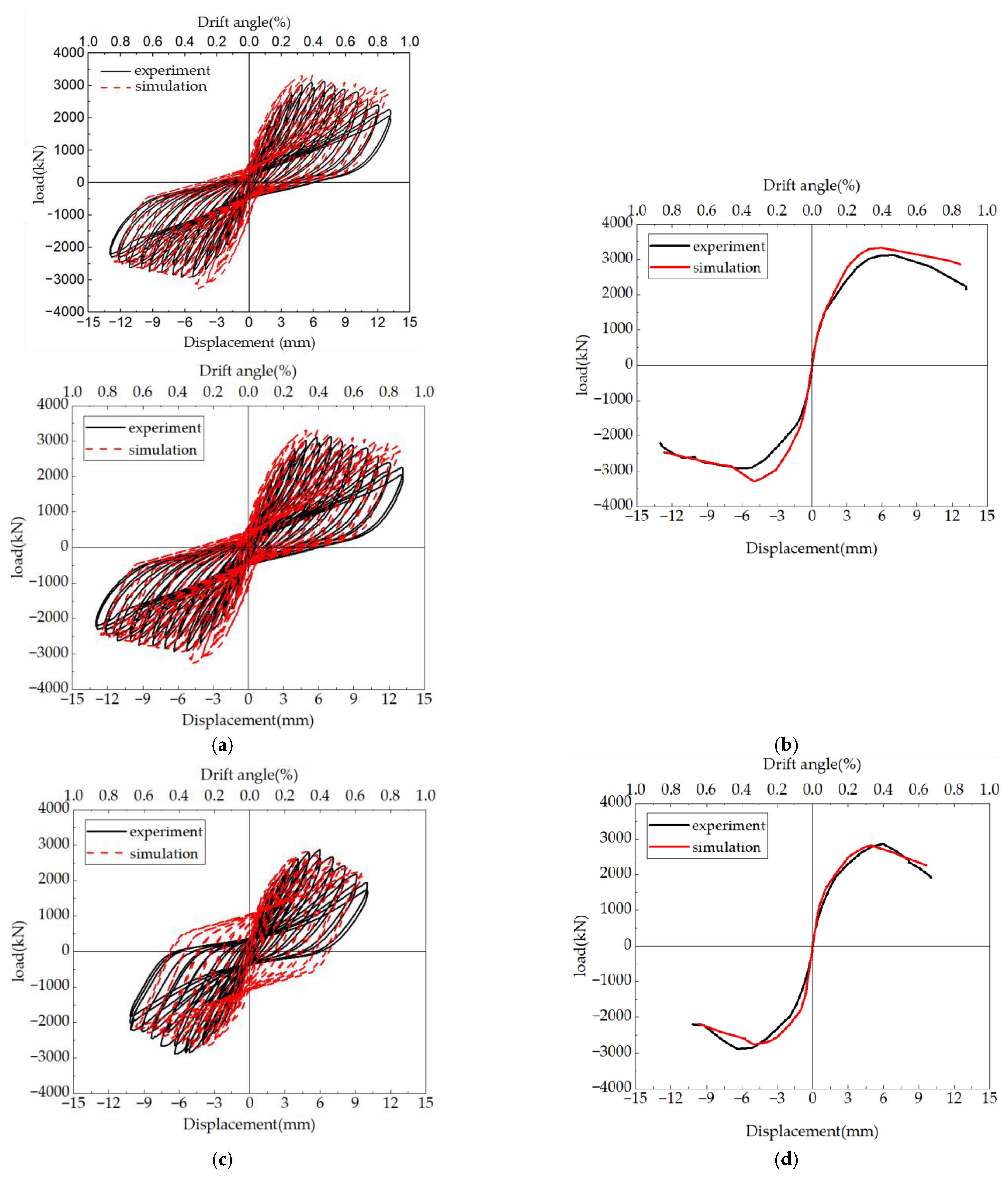
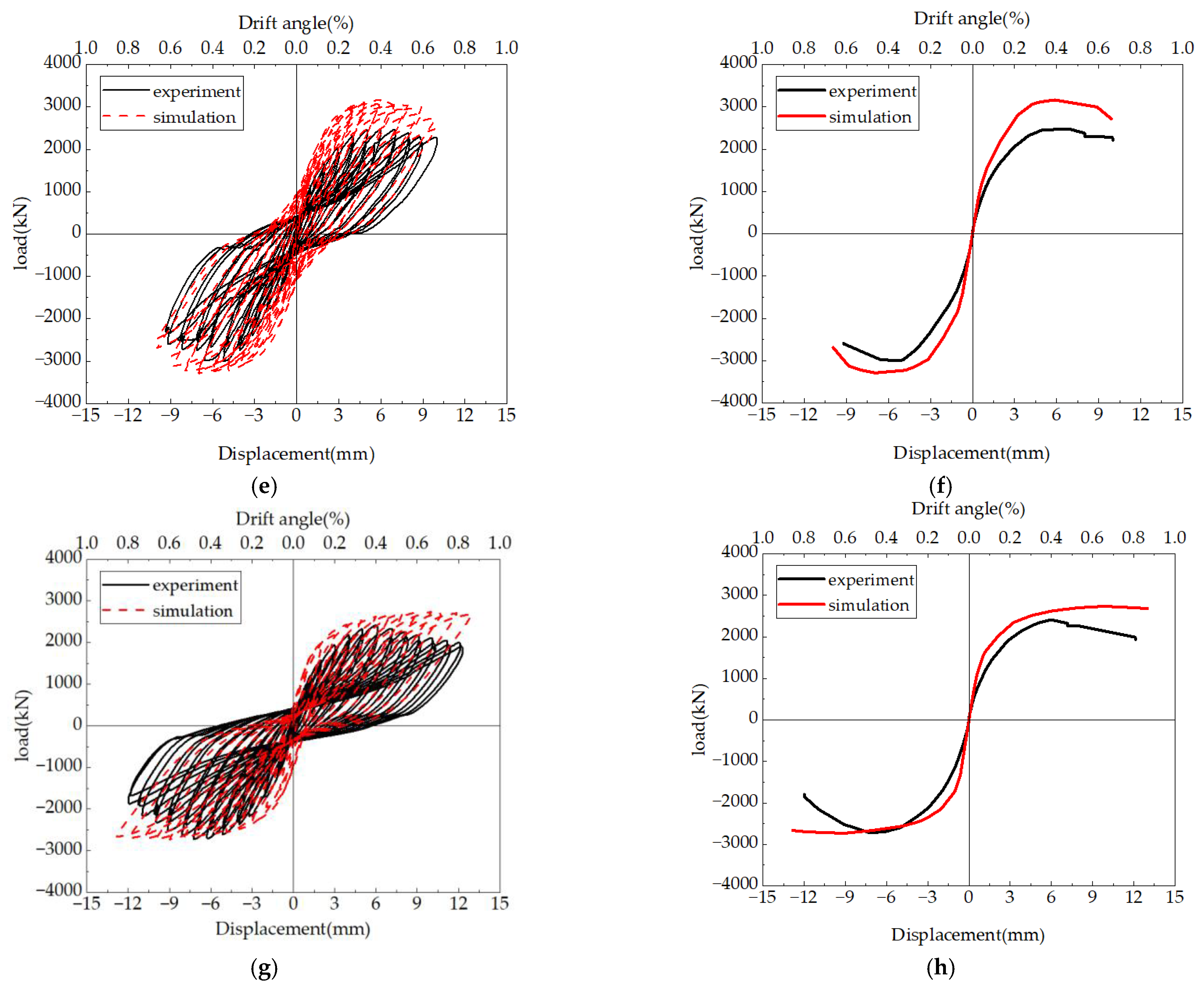
The numerical simulation hysteresis curves of the four specimens closely match the experimental curves in shape, accurately reflecting the hysteretic characteristics under different post-cast strip configurations, as shown in Figure 14. Analysis indicates that the simulated peak load of the SW5 specimen is 3333 kN, compared to the experimental value of 2919 kN, with an error of 12%. For the SW6 specimen, the simulated peak load is 2816 kN, versus 2886 kN experimentally, yielding an error of only 1.6%. The peak load simulation errors for SW7 and SW8 specimens are 5.2% and 0.3%, respectively, all within acceptable engineering limits.
The simulation results indicate that the errors of key indicators, including peak load, cracking displacement, and yield displacement, are mostly within 15% for all specimens. For specimen SW8, the simulation error of the ultimate displacement is 19%, mainly because the numerical model does not fully account for local concrete spalling. Nevertheless, the overall trends are in good agreement with the experimental results.
(2) Comparison of Failure Modes and Crack Patterns
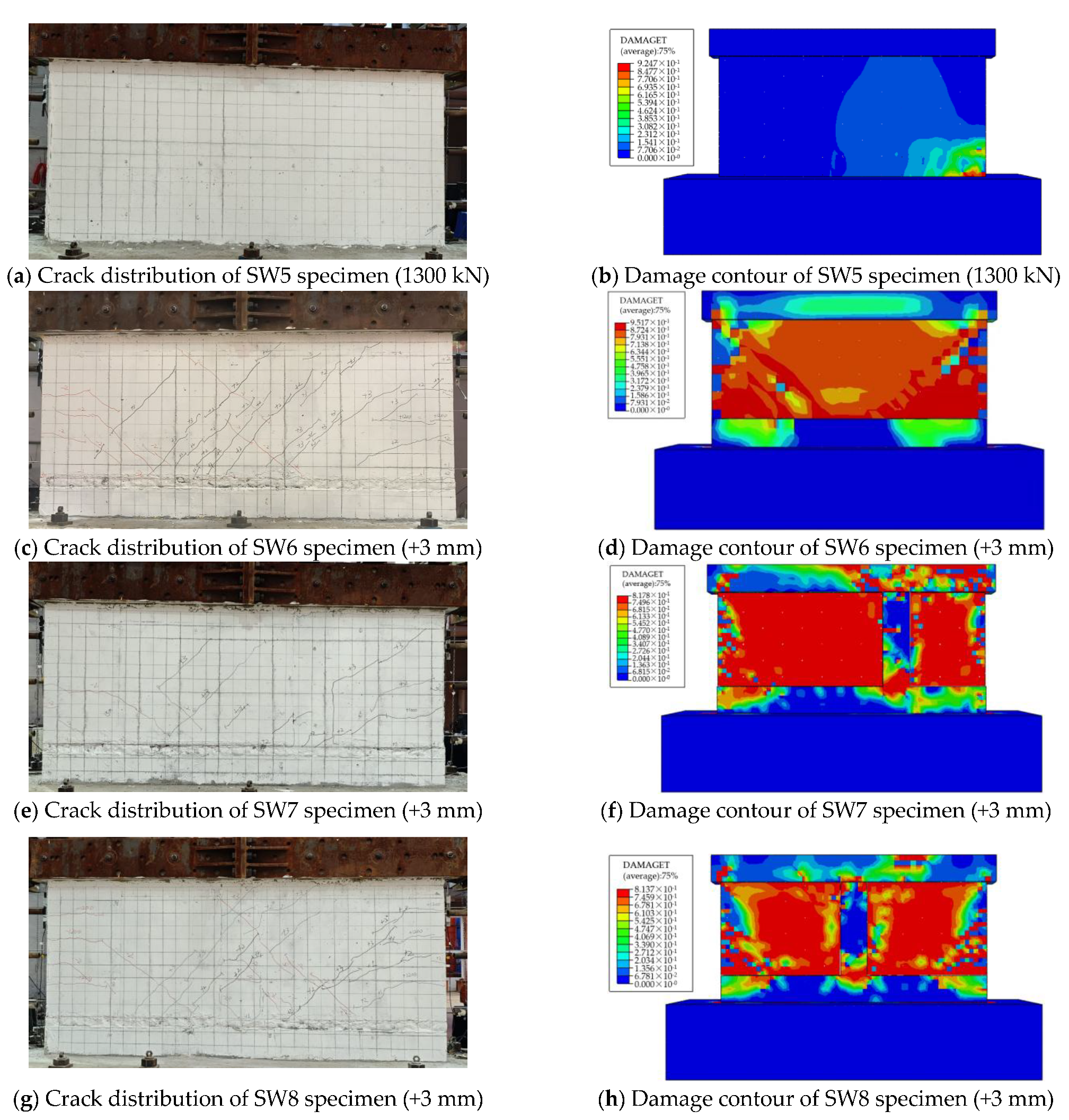
The failure modes and crack patterns of the numerically simulated specimens are fully consistent with the experimental results, all exhibiting shear-compression failure, and the characteristics of crack distribution match closely, as shown in Figure 15. For the SW5 specimen, the first crack in the simulation occurred at the bottom right of the wall, consistent with the experiment. In the SW6 specimen, simulated cracks were concentrated above the post-cast strip, demonstrating a constraint effect in line with experimental observations. The SW7 and SW8 specimens show dispersed cracking patterns and symmetric/asymmetric distribution trends in the simulations, which are consistent with the experimental results. The simulated crack widths indicate that at peak load, the maximum crack width differs from the experimental value by less than 20%, and the crack propagation paths and penetration characteristics are accurately reproduced, demonstrating that the model can effectively capture the influence of post-cast strip arrangements on crack development.

5.3. Mechanism Analysis Based on Numerical Simulation

Figure 16 presents the tensile damage contours of the finite element models at different loading stages. As shown, for the specimen without post-cast strips (SW5), the stress is relatively uniformly distributed, with the mid-to-lower region of the wall acting as the main zone of shear stress concentration. After introducing a horizontal post-cast strip (SW6), the stress level in the region above the strip increases significantly, and the stress concentration factor reaches approximately 1.3. With the addition of vertical post-cast strips (SW7 and SW8), the stress field is divided into multiple regions, and the concentration factor is reduced to below 1.1, confirming the stress-dispersing effect of the post-cast strips.
The simulation results indicate that damage in the SW5 specimen initiates at the wall base and gradually propagates upward, resulting in relatively uniform damage over the entire wall. In the SW6 specimen, damage is concentrated in the region above the horizontal post-cast strip and develops more severely. In contrast, damage in the SW8 specimen evolves symmetrically and is more uniformly distributed throughout the wall, which explains why the centrally placed vertical post-cast strip effectively enhances ductility and energy dissipation capacity. It is inferred that the UHPC post-cast strips, owing to their high stiffness and high tensile strength, restrict crack propagation and modify the stress transfer paths, transforming the wall behavior from overall shear deformation to partitioned and cooperative deformation. This mechanism is clearly quantified through numerical simulation, providing deeper theoretical support for engineering design.
Through multi-dimensional comparisons of hysteresis curves, backbone curves, failure modes, crack distributions, and reinforcement strains, the numerical simulation results show a high degree of agreement with the experimental data, with errors remaining within reasonable ranges. The developed model can accurately reproduce the mechanical response and failure characteristics of in-plane loaded modular low-rise shear walls and effectively predict their seismic performance under different post-cast strip configurations, offering a reliable numerical tool for parameter optimization and seismic performance evaluation of modular shear wall systems.

6. Conclusions

This study conducted quasi-static low-cycle cyclic loading tests and numerical simulations on four modular low-rise shear wall specimens under in-plane loading and systematically analyzed the effects of the type and location of post-cast strips on the seismic performance of shear walls. The main conclusions are as follows:
(1) Post-cast strips have a significant regulating effect on crack development: the specimen without post-cast strips exhibited evenly distributed and highly penetrative cracks, showing an overall shear failure mode. After setting a horizontal post-cast strip, cracks were restricted to the region above the strip and became more concentrated. The addition of vertical post-cast strips (especially centrally located ones) can effectively disperse crack development, delay the penetration process, and improve the concentration of local damage.
(2) The specimen with the centrally located vertical post-cast strip exhibited the best overall seismic performance, characterized by full hysteretic curves, the largest cumulative energy dissipation, and the most gradual stiffness degradation. In contrast, the specimen without a post-cast strip showed the highest ductility coefficient.
(3) Seismic performance of the specimen with only a horizontal post-cast strip is relatively poor: Specimen SW6 showed inferior energy dissipation capacity, ductility, and stiffness degradation performance, indicating that a single horizontal post-cast strip easily leads to stress concentration and local damage, which is unfavorable for the overall seismic performance of the wall.
(4) This study has made certain progress in exploring the influence of post-cast strips on the seismic performance of modular low-rise shear walls, but several limitations still exist and need to be further addressed in future research. The tests compared only four post-cast strip configurations, without systematically considering the coupled effects of multiple parameters such as strip width, material type, and reinforcement arrangement, resulting in a relatively limited variable range. Meanwhile, the tests employed in-plane unidirectional quasi-static loading, which could not simulate bidirectional seismic action or the complex response of the structure under actual spatial combined loading. The boundary conditions were also based on the ideal fixed-connection assumption, which differs from the connection stiffness in engineering practice. Furthermore, according to the research results, although the post-cast strip can improve crack distribution, it does not significantly enhance the bearing capacity and ductility of modular low-rise shear walls, and it increases construction complexity. Therefore, its engineering practicability and economic efficiency still need further verification.

Author Contributions

H.C.: Conceptualization, Methodology, Writing—original draft. W.Z.: Supervision, Funding acquisition. C.Z.: Resources. All authors have read and agreed to the published version of the manuscript.

Funding

This research was funded by NSFC (Project No. 52178126).

Data Availability Statement

The original contributions presented in this study are included in the article. Further inquiries can be directed to the corresponding author(s).

Acknowledgments

The research described in this paper was financially supported by the National Natural Science Foundation of China (Grant No. 52178126).

Conflicts of Interest

The authors declare that they have no known competing financial interests or personal relationships that could have appeared to influence the work reported in this paper.

References

  1. Zhao, B.; Wu, D.; Zhu, H. New modular precast composite shear wall structural system and experimental study on its seismic performance. Eng. Struct. 2022, 264, 114381. [Google Scholar] [CrossRef]
  2. Wu, D.; Jiang, D.; Zhao, B. Nonlinear numerical modeling approach and seismic mechanism analysis on new modular precast composite shear wall structure. Eng. Struct. 2022, 270, 114868. [Google Scholar] [CrossRef]
  3. Chen, H.; Yang, C.; Ou, J.; Zhao, B.; Li, C.; Li, C. Experimental study on seismic performance of modular cast-in-situ coupled shear wall with LRC infill wall. J. Build. Eng. 2023, 72, 106613. [Google Scholar] [CrossRef]
  4. Xiong, Z.; Liang, J.; Chen, X. Seismic Performance Evaluation of Reinforced Concrete Frame–Shear Wall Structural Systems in Thermal Power Plants. Buildings 2025, 15, 419. [Google Scholar] [CrossRef]
  5. Zhou, D.; Mei, Y.; Ke, X.; Liu, Z.; Xu, W. Experimental study on large-scale subway station model considering adjustable water and soil pressure. Undergr. Space 2025, 25, 262–280. [Google Scholar] [CrossRef]
  6. Zhang, Y.; Zhao, Q.; Zhao, K.; Hao, J.; Hu, Y. Experimental study on seismic performance of shear wall with insufficient concrete strength strengthened by partial concrete replacement. Structures 2024, 69, 107537. [Google Scholar] [CrossRef]
  7. Cheng, Y.; He, H.; Sun, H.; Cao, Q. In-plane and out-of-plane seismic performance and damage evaluation of reinforced concrete shear wall structures subjected to mainshock-aftershock sequences. Earthq. Eng. Struct. D 2024, 53, 3263–3286. [Google Scholar]
  8. Wang, K.; Yang, S.; Liu, W.; Xu, H.; Liu, W. Performance optimization of hollow precast concrete shear walls under high axial compression ratios: Numerical investigation and mechanism analyses. Structures 2025, 81, 110246. [Google Scholar] [CrossRef]
  9. Wang, K.; Liu, W.; Yang, S.; Xu, H. Seismic behavior of a hollow precast concrete shear wall with insulation under high axial compression ratios. Eng. Struct. 2024, 318, 118672. [Google Scholar] [CrossRef]
  10. Gu, S.; Gu, J.; Guo, J.; Tao, Y.; Zhang, J. Seismic performance of precast concrete shear wall with treatments of connecting reinforcement defects in grouted sleeves under combined axial tension and cyclic horizontal load. J. Build. Eng. 2024, 97, 110941. [Google Scholar] [CrossRef]
  11. Gu, J.; Tao, Y.; Guo, J.; Gu, S.; Gao, X. Seismic retrofitting of precast shear wall with connecting reinforcements defect in grouted sleeve using UHPC. Soil Dyn. Earthq. Eng. 2025, 198, 109592. [Google Scholar] [CrossRef]
  12. Bai, J.; Yang, B.; Xie, B.; Yang, J. Design and experimental study on RC modular superimposed shear wall boundary elements with new inter-module connections. J. Build. Eng. 2024, 95, 110193. [Google Scholar] [CrossRef]
  13. Yu, J.; Wang, H.; Chang, Y. Experimental and numerical study on seismic performance of a novel RC-UHPC composite shear wall. J. Build. Eng. 2025, 115, 114553. [Google Scholar] [CrossRef]
  14. Sharda, A.; Manalo, A.; Ferdous, W.; Bai, Y.; Nicol, L.; Mohammed, A.; Benmokrane, B. Flexural behaviour of composite modular wall systems under uniformly distributed and concentrated loads. Compos. Struct. 2023, 303, 116346. [Google Scholar] [CrossRef]
  15. Yan, W.; Zhang, Y.; Lou, G.; Sun, K. Seismic behavior and design method of a novel UHPC panel sandwich shear wall: Experimental and numerical study. Eng. Struct. 2025, 334, 120243. [Google Scholar] [CrossRef]
  16. Zhang, H.; Yuan, K.; Zou, R.; Zhang, G.; Guo, J. Experimental study on seismic performance of squat precast concrete sandwich shear walls under low axial load ratio. Structures 2024, 63, 106483. [Google Scholar] [CrossRef]
  17. Kildashti, K.; Nash, S.; Samali, B. In-plane lateral behaviour of PVC modular concrete form squat walls: Experimental and numerical study. J. Build. Eng. 2022, 52, 104494. [Google Scholar] [CrossRef]
  18. Xu, Z.; Yuan, G.; Liu, M.; Shu, Q.; Zhao, Z.; Wang, Z. Effect of vertical location of post-opening on seismic behaviour of RC shear wall: Experimental and numerical analysis. Case Stud. Constr. Mater. 2024, 21, e03940. [Google Scholar] [CrossRef]
  19. Yuan, Q.; Wang, Z.; Li, H.; Zhu, H.; Suo, N. Experimental study on seismic performance of new-type fabricated shear wall with mortar connection. J. Build. Eng. 2021, 43, 103103. [Google Scholar] [CrossRef]
  20. Wang, D.; Zhang, Y.; Zhu, Y.; Wu, C.; Zhou, Y.; Han, Q. Mechanical performance of sustainable modular prefabricated composite shear panels under cyclic loading. J. Constr. Steel Res. 2021, 179, 106423. [Google Scholar] [CrossRef]
  21. Wang, X.; Dong, G.; Deng, Q.; Tan, Y.; Wen, S.; Gu, Q. Seismic performance and deformation mechanism of precast single-face superposed shear wall. J. Build. Eng. 2023, 80, 108026. [Google Scholar] [CrossRef]
  22. Ma, Z.; Chen, D.; Zhang, J.; Yang, G.; Wang, S.; Sun, X.; Xu, W.; Wang, X. Experimental research on seismic performance of prefabricated monolithic wall connection of modular concrete structure. Structures 2024, 68, 107202. [Google Scholar] [CrossRef]
  23. Mei, C.; Zhao, Z.; Zhang, Y.; Wang, D.; Wu, C. Performance Evaluation and Shear Resistance of Modular Prefabricated Two-Side Connected Composite Shear Walls. Ksce J. Civ. Eng. 2021, 25, 2936–2950. [Google Scholar] [CrossRef]
  24. Wei, F.; Chen, H.; Xie, Y. Experimental study on seismic behavior of reinforced concrete shear walls with low shear span ratio. J. Build. Eng. 2022, 45, 103602. [Google Scholar] [CrossRef]
  25. Wang, W.; Wang, Y.; Lu, Z. Experimental study on seismic behavior of steel plate reinforced concrete composite shear wall. Eng. Struct. 2018, 160, 281–292. [Google Scholar] [CrossRef]
  26. Rong, C.; Qu, Y.; Shah, A.A.; He, H. Seismic performance of energy dissipation low reinforced concrete shear wall with shear lead dampers. Case Stud. Constr. Mat. 2023, 19, e02276. [Google Scholar] [CrossRef]
  27. Zhou, B.; Si, Q.; Li, B.; Zong, L.; Li, S. Experimental and numerical study on seismic behavior of shear wall with cast-in situ concrete infilled walls. Struct. Concr. J. Fib 2024, 25, 5056–5070. [Google Scholar] [CrossRef]
  28. Wang, K.; Zhang, W.; Chen, Y.; Ding, Y. Macro modeling of composite shear wall with stiffened steel plates and infilled concrete. Structures 2024, 62, 106240. [Google Scholar] [CrossRef]
  29. Liu, H.; Shi, N.; Fu, X.; Zhang, J. Seismic Performance of Precast Double-Skin Composite Shear Wall with Horizontal Connection Region. Buildings 2024, 14, 1617. [Google Scholar] [CrossRef]
  30. Lee, D.; Kang, S. Safe Seismic Design of Intermediate Precast Shear Wall System. J. Struct. Eng. 2024, 150, 04024101. [Google Scholar] [CrossRef]
  31. Jia, S.; Huang, J.; Zhan, D. Seismic resilience assessment and retrofit of the reinforced concrete frame shear wall building. Earthq. Struct. 2025, 28, 89–106. [Google Scholar]
  32. Mahmoud, S. In-Plane Shear-Wall Configuration Effects on the Seismic Performance of Symmetrical Multistory Reinforced-Concrete Buildings. Int. J. Civ. Eng. 2021, 19, 1195–1208. [Google Scholar] [CrossRef]
  33. Jung, J.; Kwak, C.; Lim, W.; Lee, K. Seismic capacity evaluation of a reinforced concrete frame infilled with precast modular block wall for enhancing the horizontal load. J. Build. Eng. 2024, 97, 110961. [Google Scholar] [CrossRef]
  34. Zhou, D.; Mei, Y.; Ke, X.; Liu, Z.; Xu, W. Study on the structural behavior and reinforcement design of openings in subway station floor slabs. J. Build. Eng. 2024, 98, 110994. [Google Scholar] [CrossRef]
  35. Hu, X.; Xue, W.; Lv, Y. Seismic behavior of a new type of precast concrete shear wall using UHPC connections at boundary elements. Eng. Struct. 2024, 302, 117468. [Google Scholar] [CrossRef]
  36. Wang, T.; Ma, X.; Jiang, R.; Dou, L.; Liu, J.; Hao, Y.; Li, L.; Zhou, Z.; Cao, Y.; Ma, H. Seismic performance of repaired prefabricated shear walls. Case Stud. Constr. Mater. 2023, 18, e01896. [Google Scholar]
Figure 1. Shows the reinforcement layout of the specimens.
Buildings 16 00847 g001aBuildings 16 00847 g001bBuildings 16 00847 g001c
Figure 2. Experimental loading setup.
Buildings 16 00847 g002
Figure 3. Failure Mode of Specimen SW5.
Buildings 16 00847 g003
Figure 4. Failure Mode of Specimen SW6.
Buildings 16 00847 g004
Figure 5. Failure Mode of Specimen SW7.
Buildings 16 00847 g005
Figure 6. Failure Mode of Specimen SW8.
Buildings 16 00847 g006
Figure 7. Load–displacement hysteresis curves of the specimens.
Buildings 16 00847 g007
Figure 8. Load–displacement skeleton curves of the specimens.
Buildings 16 00847 g008
Figure 9. Comparison of cumulative energy dissipation curves of the specimens.
Buildings 16 00847 g009
Figure 10. Schematic for calculating the equivalent viscous damping coefficient.
Buildings 16 00847 g010
Figure 11. Comparison of equivalent viscous damping coefficient curves of the specimens.
Buildings 16 00847 g011
Figure 12. Schematic Diagram of the Equal Energy Method.
Buildings 16 00847 g012
Figure 13. Comparison of stiffness degradation curves of each specimen.
Buildings 16 00847 g013
Figure 14. Comparison of Hysteresis and Backbone Curves between Specimens and Numerical Simulations. (a) Comparison of Hysteresis Curves between SW5 Specimen and Numerical Simulation. (b) Comparison of Skeleton Curves between SW5 Specimen and Numerical Simulation. (c) Comparison of Hysteresis Curves between SW6 Specimen and Numerical Simulation. (d) Comparison of Skeleton Curves between SW5 Specimen and Numerical Simulation. (e) Comparison of Hysteresis Curves between SW7 Specimen and Numerical Simulation. (f) Comparison of Skeleton Curves between SW5 Specimen and Numerical Simulation. (g) Comparison of Hysteresis Curves between SW8 Specimen and Numerical Simulation. (h) Comparison of Skeleton Curves between SW5 Specimen and Numerical Simulation.
Buildings 16 00847 g014aBuildings 16 00847 g014b
Figure 15. Comparison of Failure Modes between Experimental Specimens and Numerical Simulations.
Buildings 16 00847 g015
Figure 16. Tensile damage contour plots of the finite element model at different loading stages.
Buildings 16 00847 g016aBuildings 16 00847 g016b
Table 1. Similarity Relationships for the Model Test.
Physical QuantitySymbolsSimilarity Relationship
LengthLCL = λ
DensityρCρ = 1
StrainεCε = 1
MassmCm = λ3
AccelerationaCa = 1
VelocityvCv = λ1/2
StressσCσ = λ
Elastic ModulusECE = λ
TimetCt = λ1/2
FrequencyfCf = λ1/2
Table 2. Design Parameters of the Prototype and Model Structures.
NameHeight (m)Width (m)Thickness (m)Horizontal Reinforcement Ratio (%)Vertical Reinforcement Ratio (%)Axial Compression Ratio
Prototype4.058.10.51.61.60.1
Model1.53.00.1851.61.60.1
Table 3. Parameters of the Model Specimens.
ModelHorizontal ReinforcementVertical ReinforcementLoading DirectionPost-Cast Strip Arrangement
SW5C18@180C20@220In-plane loadingNone
SW6C18@180C20@220In-plane loading300 mm-thick UHPC horizontal post-cast strip at the wall base
SW7C18@180C20@220In-plane loadingHorizontal post-cast strip at the wall base + vertical UHPC post-cast strip at 1/3 of the wall width
SW8C18@180C20@220In-plane loadingHorizontal post-cast strip at the wall base + vertical UHPC post-cast strip at 1/2 of the wall width
Table 4. Mechanical Properties of Concrete.
ModelWeb Wall Concrete fcu,k (MPa)Web Wall Concrete fc,k (MPa)Concrete in Wall Core fcu,k (MPa)Concrete in Wall Core fc,k (MPa)Elastic Modulus Ec
(×104 N/mm2)
SW545.7036.1046.2436.533.35
SW643.3034.2144.1034.843.20
SW745.7036.1045.5435.983.35
SW845.6036.0244.6235.253.35
Table 5. Mechanical Properties of UHPC.
ModelAverage Cube Compressive Strength (MPa)Axial Compressive Strength fc,k (MPa)Tensile Strength ftu (MPa)Elastic Modulus Ec (N/mm2)
SW6103.8082.006.9938,000
SW7113.1789.406.9438,000
SW8104.3382.426.5838,000
Table 6. Mechanical Properties of Reinforcement Steel.
Diameter (mm)Yield Strength fy (N/mm2)Ultimate Strength fu (N/mm2)
10456655
18443612
20424604
25403516
Table 7. Characteristic Point Displacements and Drift Angles.
ModelLoading DirectionCracking Load/kNCracking Displacement/mmYield Load/kNYield Displacement/mmPeak Load/kNPeak Displacement/mmUltimate Load/kNUltimate Displacement/mmDuctility Factor
SW5Positive13000.9026023.4331276.98265713.003.79
Negative14001.0023633.1529196.33248113.004.13
SW6Positive12000.9622503.6226806.96227810.002.76
Negative12501.0023202.9927505.21233810.003.34
SW7Positive10000.8625503.3830606.52260111.073.28
Negative12001.0023003.1028756.05244411.103.58
SW8Positive12001.2520803.3424805.97210810.002.99
Negative12001.1523003.6126807.23227810.172.82
Table 8. Material plasticity parameter settings.
MaterialPoisson’s Ratio v Dilation AngleYield Stress RatioInvariant Stress RatioViscosity Parameter
C400.2301.160.6670.0005
UHPC0.2371.140.6670.0005
Table 9. Compressive damage parameters of C40 concrete.
Compressive Stress/MPa14.8622.6825.8421.2716.9613.7611.439.04
Plastic strain/%00.0190.1110.1890.2660.3390.4090.512
Compressive damage factor00.0770.2970.4650.6050.7070.7780.847
Table 10. Tensile damage parameters of C40 concrete.
Tensile Stress/MPa2.411.631.140.8740.4990.3350.2800.260
Plastic strain/%00.0070.0130.0180.0350.0580.0730.081
Tensile damage factor00.5500.7680.0350.9540.9810.9870.989
Table 11. Compressive damage parameters of UHPC.
Compressive Stress/MPa121.07122.11101.7772.4451.9638.9830.5224.78
Plastic strain/%00.0180.0110.2300.3270.4080.4800.547
Compressive damage factor00.2160.3460.4890.5950.6700.7230.762
Table 12. Tensile damage parameters of UHPC.
Tensile Stress/MPa11.8812.1910.768.015.764.253.262.58
Plastic strain/%00.0000.0080.0190.0290.0370.0440.051
Tensile damage factor00.08270.2090.3690.5000.5940.6630.714
Disclaimer/Publisher’s Note: The statements, opinions and data contained in all publications are solely those of the individual author(s) and contributor(s) and not of MDPI and/or the editor(s). MDPI and/or the editor(s) disclaim responsibility for any injury to people or property resulting from any ideas, methods, instructions or products referred to in the content.