Abstract
The punching shear capacity of reinforced ultra-high-performance concrete (UHPC) two-way slabs in applications such as floor slabs and bridge decks has attracted increasing attention. However, due to the insufficient consideration of the internal force transmission path and failure mechanism, existing empirical formulas exhibit limited accuracy for predicting the punching shear capacity of reinforced UHPC slabs. Therefore, based on the critical shear crack theory (CSCT), this study proposes a specific theoretical model where the tensile strain-hardening behavior and tensile strength of UHPC, the punching shear-span ratio, and the reinforcement ratio are comprehensively considered. In the proposed model, the steel fiber bridging contribution is derived via the variable engagement method (VEM), for which an equation describing the bond strength between steel fibers and UHPC matrix was developed. The feasibility of the proposed model was validated through an established experimental database. Furthermore, the effects of several key parameters on the punching shear behavior of reinforced UHPC slabs were analyzed. The results show that the proposed models can accurately predict the punching shear capacity and ultimate rotation angle of reinforced UHPC slabs. With increasing slab thickness, UHPC strength, and reinforcement ratio, the punching shear capacity increases, whereas the corresponding ultimate rotation angle and steel fiber contribution ratio decrease. Increasing the fiber volume fraction enhances both the fiber contribution and the punching shear capacity. For slabs with higher UHPC strength, the reinforcing effect of a higher reinforcement ratio is more pronounced.
1. Introduction
Against the backdrop of the growing demand for lightweight and high-durability components in civil engineering structures, reinforced ultra-high-performance concrete (UHPC) slabs are widely used in scenarios such as floor slabs and bridge decks due to their combined advantages of UHPC’s high strength and excellent toughness [1,2,3,4]. Nevertheless, UHPC slabs with thin cross-sections may undergo punching shear failure when subjected to localized concentrated loads [4]. Therefore, an effective evaluation of the punching shear capacity is highly necessary for the design of reinforced UHPC slabs.
Several experimental studies on the punching shear behavior of reinforced UHPC slabs have been documented. Existing findings have confirmed that the bridging effect of steel fibers plays an important role in enhancing the punching shear capacity of UHPC slabs [5,6,7,8,9]. Furthermore, the punching shear resistance of these slabs can be improved to varying degrees, with increases in UHPC’s compressive strength, loading area, steel reinforcement ratio, and slab thickness [4,10,11,12,13]. Fan et al. [10] found that under a concentrated load, UHPC slabs might fail in flexural, punching shear, and flexural-punching shear modes, respectively. Liu et al. [12] reported that a critical thickness of at least 100 mm was identified as the threshold distinguishing punching shear failure from flexural failure; while a higher reinforcement ratio of 3.5% slightly increased the first cracking load, it greatly enhanced the ultimate capacity. Hassan et al. [14] demonstrated that the punching shear capacity of UHPC slabs increased with an increase in punching shear cone angle. Fang et al. [15] reported that both the cone angle and punching shear strength of UHPC slabs decreased with an increase in the punching shear-span ratio within the range of 3 to 7. Liao et al. [16] stated that adding steel fibers could enhance the initial cracking load of the slab, and adding polyethylene fibers could intensify the post-crack ductility response, with both contributing to an enhanced punching shear capacity; the installation of shear reinforcements appeared to be more cost-effective than increasing steel fiber content.
Currently, certain empirical equations have been developed for calculating the punching shear capacity of reinforced UHPC slabs. These empirical equations were established based on the statistical laws pertaining to several parameters. For example, Al-Quraishi et al. [7] empirically approximated the punching shear capacity of UHPC slabs as the sum of three terms related to the contributions of the UHPC matrix, steel fibers, and steel bars, respectively. The formulas provided by the Chinese technical specification DBJ43/T325-2017 [17] and the Japan Society of Civil Engineers (JSCE) [18] adopt a series of empirical coefficients to consider the influences of loading area, slab thickness, and other factors. Nevertheless, in the calculation model suggested by the French code NF P 18-710 [19], the punching shear strength of the slab mainly depends on the tensile strength of UHPC. The incompleteness or inconsistency of parameters in the above empirical formulas stems from their reliance on limited specific experimental databases and thus have limited applicability. This drawback leads to the formulas being either conservative or unsafe when applied to the actual design of UHPC slabs against punching shear failure.
Establishing an effective computational model that can reflect and describe the physical process of punching shear failure is expected to address the shortcomings of the aforementioned empirical formulas. Currently, the critical shear crack theory (CSCT) has been applied to develop calculation models for the punching shear capacity of normal concrete (NC) slabs [20,21,22,23]. This theory directly links the punching shear resistance of reinforced concrete slabs to the critical shear crack width, providing a more reasonable prediction model based on physical mechanisms. However, few studies, if any, have been conducted on a theoretical calculation method for the punching shear capacity of UHPC slabs based on the CSCT. The key unresolved issues regarding the application of CSCT to UHPC slabs lie in the differences in mechanical behavior between UHPC and NC slabs. Firstly, UHPC exhibits a pronounced tensile strain-hardening behavior, leading to a significant difference in the moment-curvature response from that of NC slabs [24,25]. Meanwhile, the tensile strength of UHPC is significant and should be considered, whereas the tensile strength of NC is often ignored. Secondly, the aggregate size of UHPC is smaller than that of NC, leading to a difference in aggregate interlock along the critical shear cracks. Moreover, the punching shear-span ratio has a different effect on the punching shear behavior of UHPC slabs compared to NC slabs [15].
Consequently, the present study aims to develop a mechanism-based theoretical model for calculating the punching shear capacity of reinforced UHPC two-way slabs based on the CSCT. In this model, the tensile strain-hardening behavior and tensile strength of UHPC, as well as the punching shear-span ratio and the reinforcement ratio, were comprehensively considered. Accordingly, the load-rotation curve and the failure criteria were formulated. Moreover, the fiber contribution is calculated by integrating the bridging stress along the punching shear cone, using a newly fitted bond strength equation between steel fibers and UHPC matrix. Based on an experimental database of the punching shear capacity of reinforced UHPC slabs, the feasibility of the proposed model was verified. Subsequently, the effects of several key parameters on the punching shear behavior of UHPC slabs were evaluated.
2. Punching Shear Model for Reinforced UHPC Two-Way Slabs
2.1. Conventional Critical Shear Crack Theory
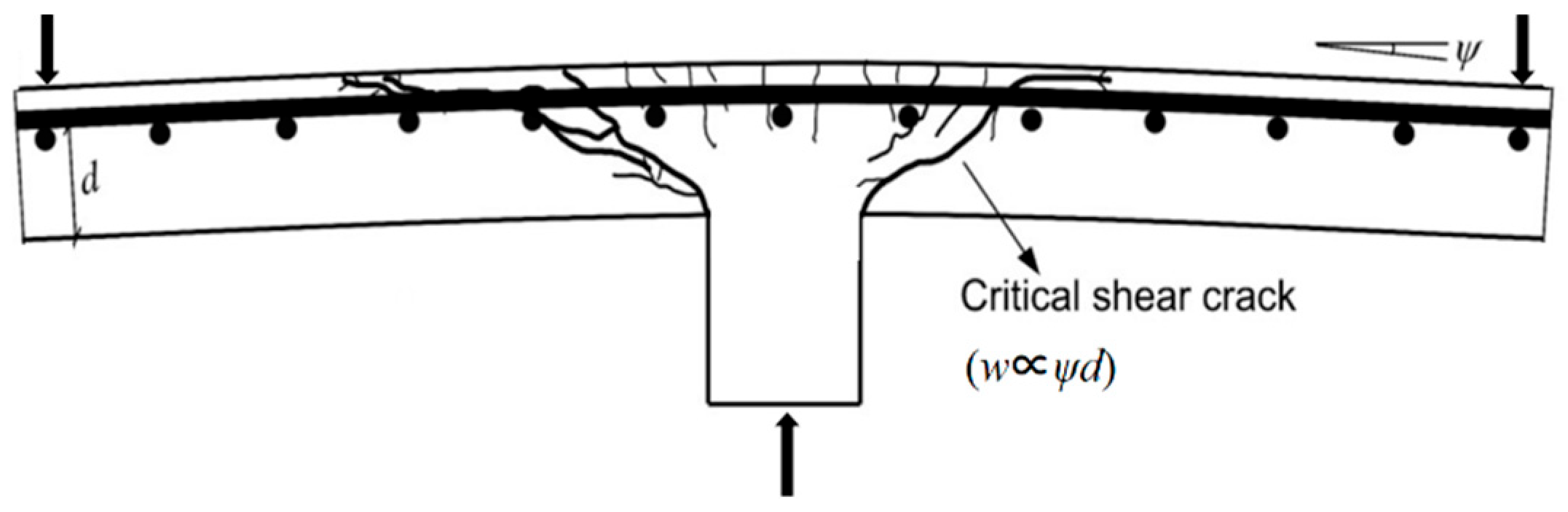
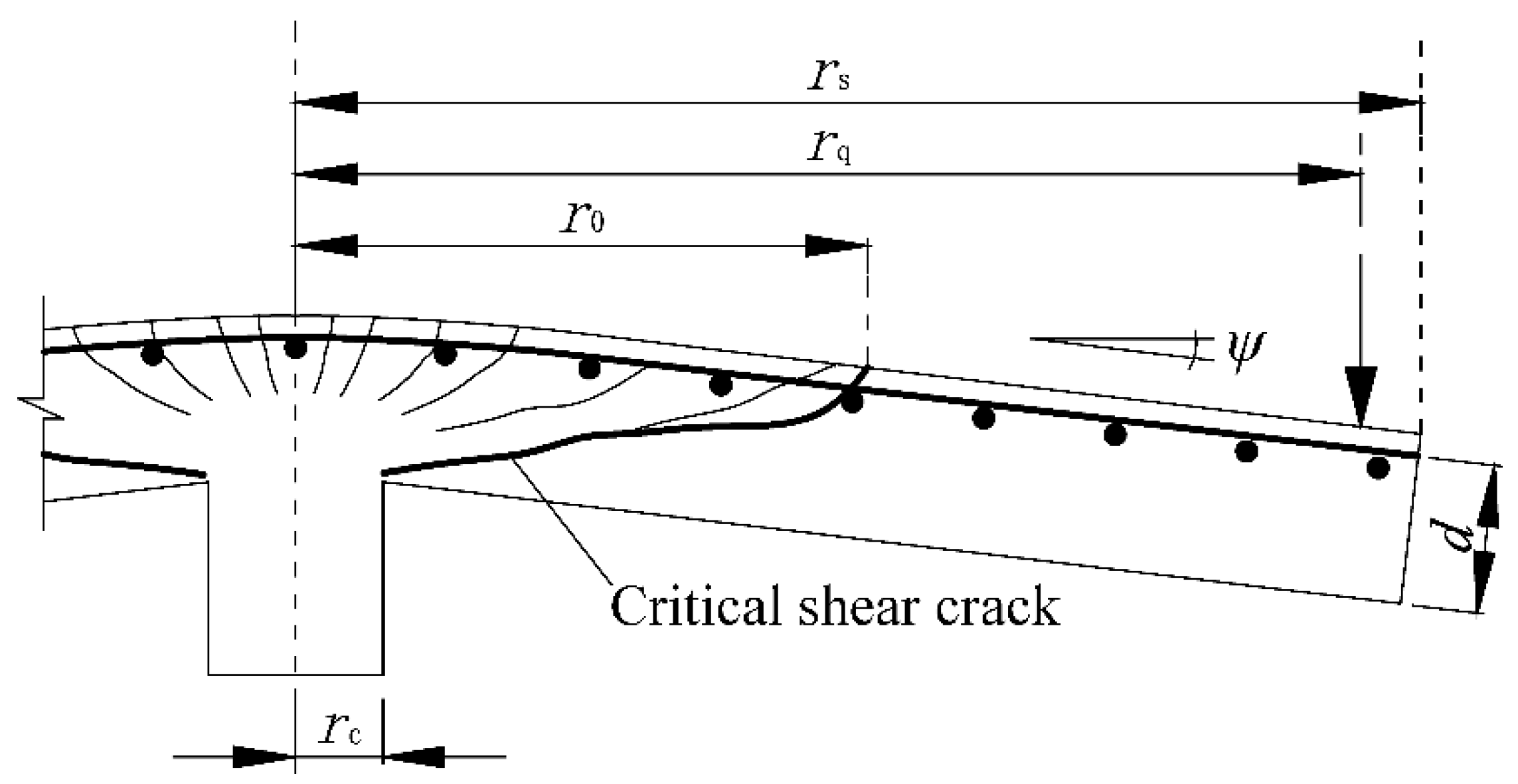
When a reinforced concrete (RC) slab is subjected to a localized punching load, the shear force is transferred from the column to the inclined compression struts [20]. As the load increases, a critical shear crack forms and propagates, intersecting the compression struts, as presented in Figure 1. Based on the CSCT, the widening of this critical shear crack reduces the shear strength provided by the inclined concrete compressive struts and ultimately leads to punching shear failure. Thus, the punching shear strength decreases with the development of the critical shear crack as the slab rotates.
Figure 1.
Development of critical shear cracks.
Muttoni et al. [26] presumed that the width of the critical shear crack (w) was proportional to the rotation angle of the slab (ψ) outside the column region and the effective depth of the cross section (d), as shown in Figure 1. In Vecchio’s study [27], the shear force transferred along the critical shear crack is influenced by the roughness of the punching shear cone surface, which is in turn related to the aggregate size of concrete (dg). Considering the effects of aggregate size and other critical parameters, Muttoni [20] suggested a failure criterion for RC slabs without transverse reinforcement under punching shear loads, as expressed in Equation (1).
where VP.c is the punching shear capacity; b0 is the perimeter of the control cross section at a distance of 0.5d from the column face; and fc is the axial compressive strength of concrete. dg0 is the reference aggregate size and is equal to 16 mm [20].
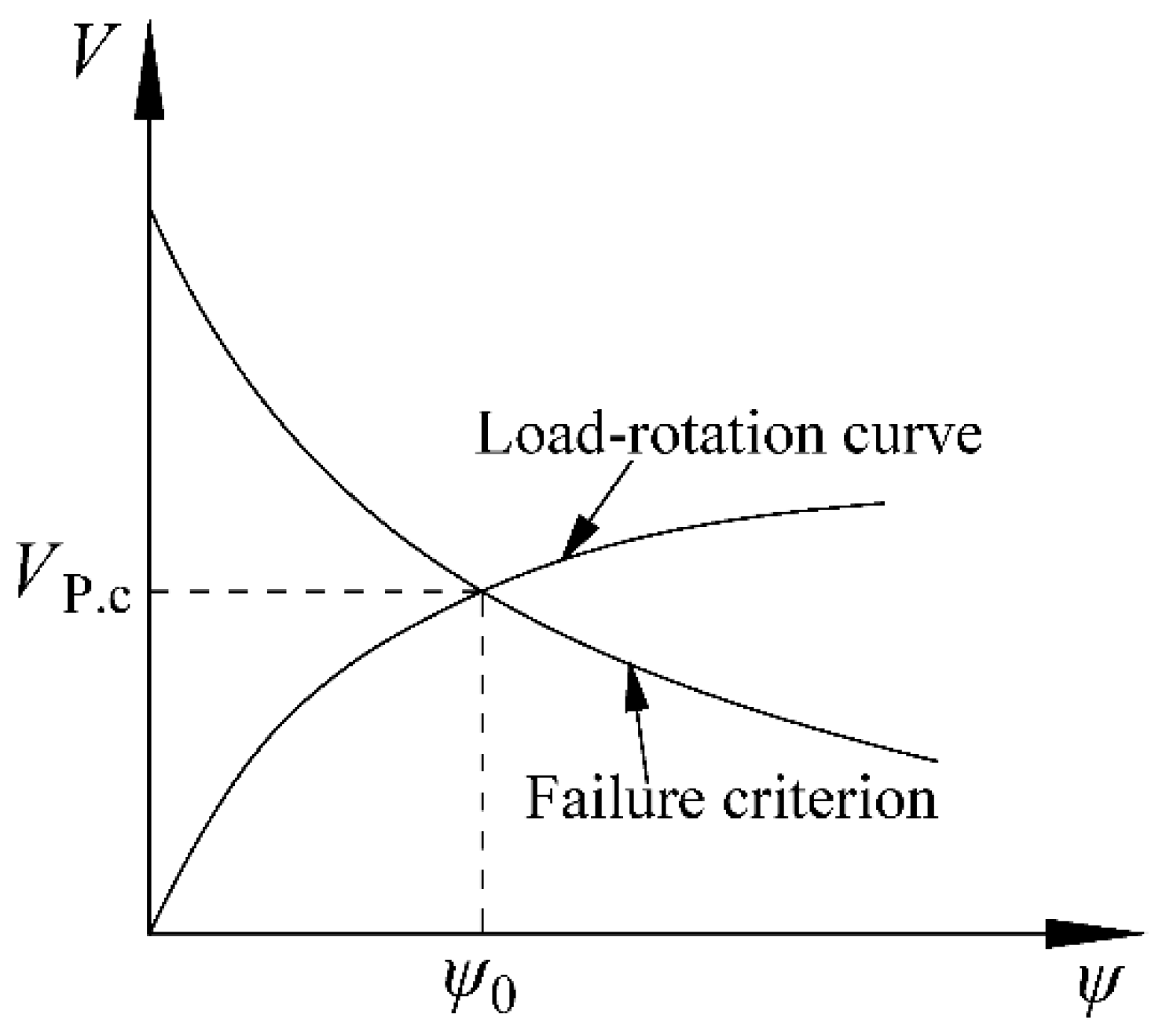
To calculate the punching shear capacity, the load-rotation curve (demand curve) needs to be obtained. At failure, the intersection between the demand curve and the capacity curve (failure criterion) defines the capacity, as depicted in Figure 2.
Figure 2.
Calculation principle in CSCT.
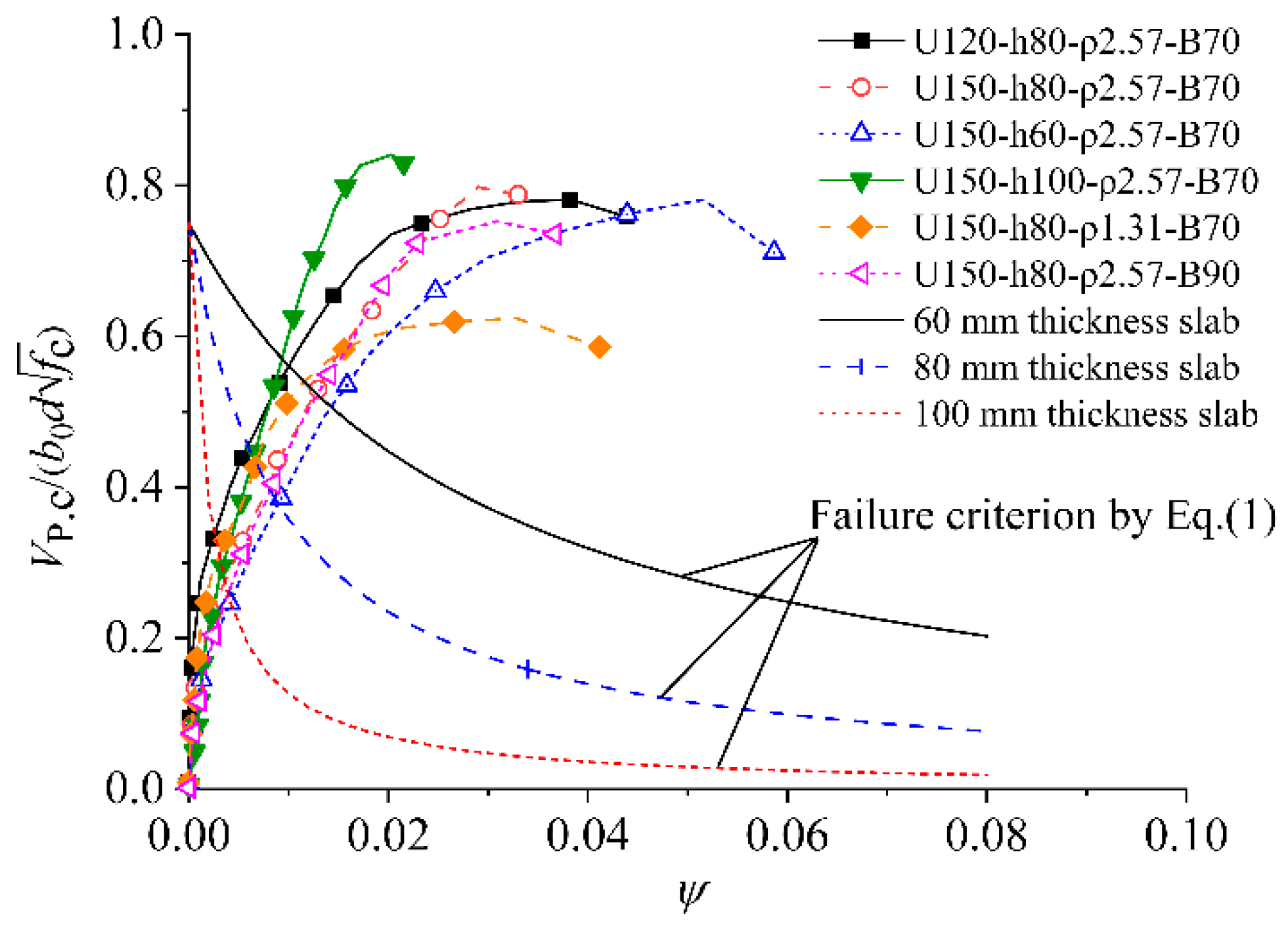
Figure 3 presents the load-rotation curves of the UHPC slabs tested by Fang et al. [15], where the notations U, h, ρ, and B (followed by numerical values) denote the compressive strength of UHPC, slab thickness, reinforcement ratio, and side length of the loading area, respectively. The intersections between the measured load-rotation curves and the calculated capacity curve lie to the left of the peak point, implying that the failure criterion proposed by Muttoni [20] underestimates the punching shear strength of UHPC slabs. This underestimation may be attributed to the omission of the contribution of steel fibers in Equation (1). Moreover, the aggregate interlock in UHPC slabs is weaker than that in NC slabs because of the smaller aggregate size, a factor also not accounted for in Equation (1).
Figure 3.
Load–rotation curves of UHPC slabs tested by Fang et al. [15].
2.2. Key Assumptions
The distributions of internal forces and deformations of RC slabs are complex and need to be simplified [23]. Compared to NC, both the tensile strain-hardening behavior and the tensile strength of UHPC must be considered. To apply the CSCT to UHPC slabs, several key assumptions were made as follows.
- (1)
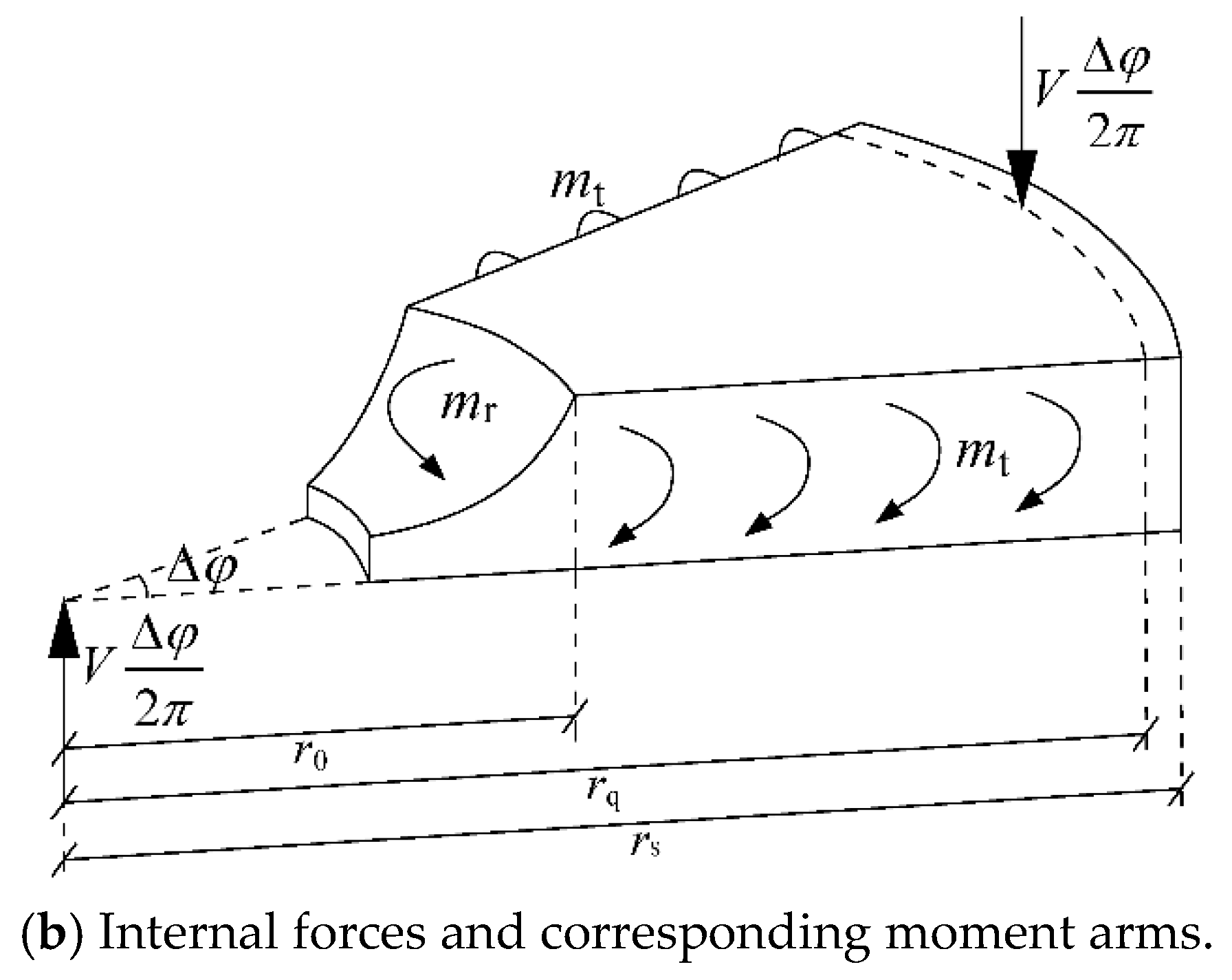
- A geometrical model of an equivalent circular UHPC slab was introduced [20], as shown in Figure 4, where rc is the column radius; r0 is the radius of the critical shear crack; rq is the radius of the circular support line; and rs is the radius of the slab. In the region within the radius r0, the intensive tangential cracks are assumed to form, and the radial curvature (χr) equals the tangential curvature (χt). Outside the radius r0, the radial curvature decreases quickly and can be ignored. Thus, the corresponding slab portion was assumed to be a cone with a constant rotation. The above simplifications can be expressed as Equation (2), where r denotes the radial distance from the column center.
Figure 4. Geometrical parameters of axisymmetric UHPC slab.
- (2)
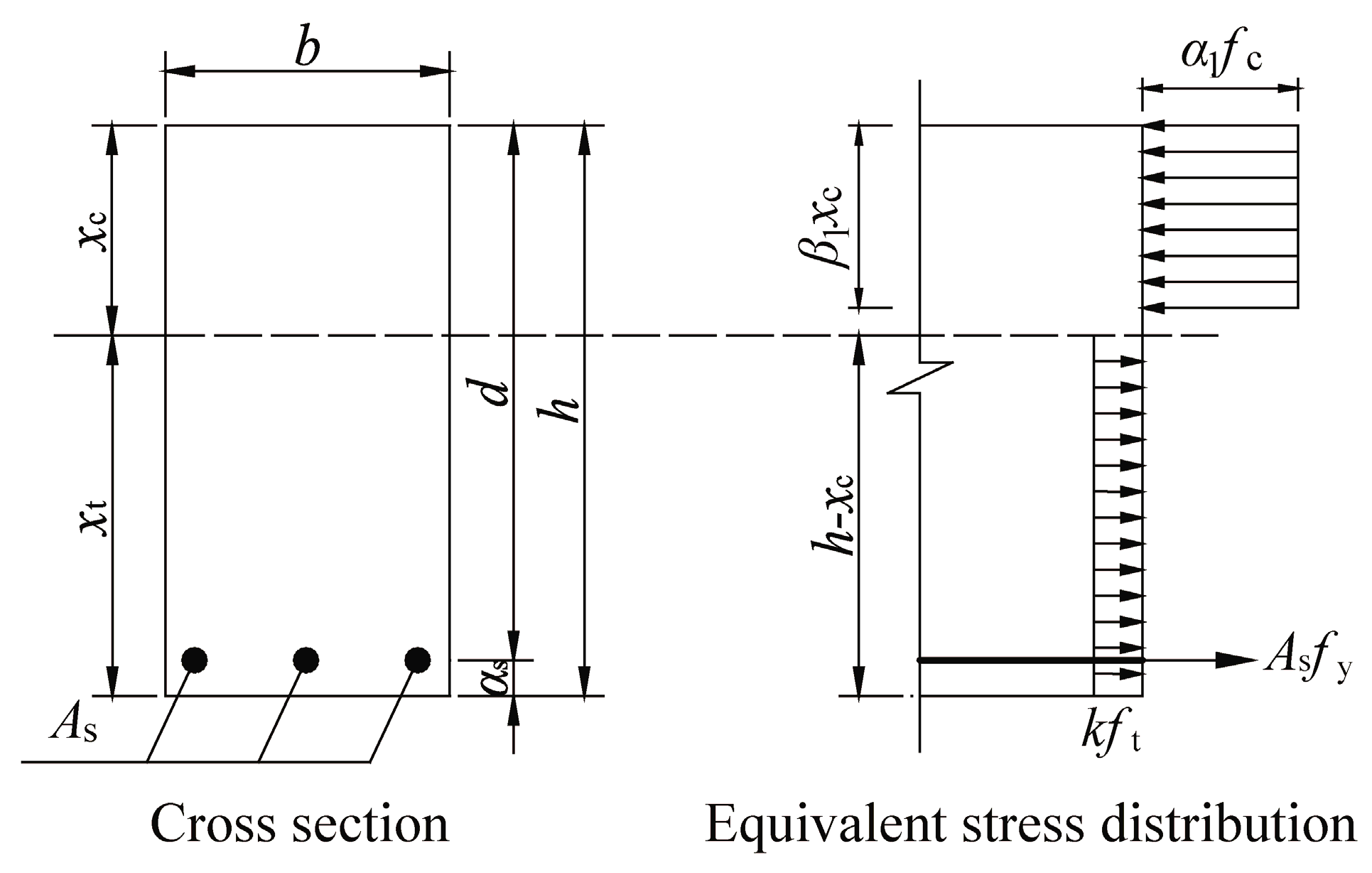
- A rectangular stress block distribution is assumed for both the compressive and tensile zones [28], as shown in Figure 5, where xc and xt are the depth of compressive zone and tensile zone, respectively; b is the section width; d is the effective depth; α1 is the ratio of average compressive stress to fc; β1 is the ratio of height of rectangular stress block to xc; fy is the yield strength of steel bar; ft is the axial tensile strength of UHPC; and k is the ratio of average tensile stress to ft, taken as 0.8 [28].
Figure 5. Equivalent stress distribution along the cross-section at the ultimate state.
- (3)
- Square slabs are converted into equivalent circular slabs based on the virtual work principle and yield line theory, assuming bi-directional uniform reinforcement.
- (4)
- Aggregate interlock in UHPC is ignored (dg = 0) because of the small aggregate size (≤5 mm for commercial UHPC).
- (5)
- The critical shear crack width is proportional to the slab rotation outside the column region and the effective depth (w∝ψd) [21].
- (6)
- For practical calculation, the steel fiber bridging stress along the punching shear failure surface can be simplified as uniformly distributed [22].
2.3. Load-Rotation Curves of Reinforced UHPC Slabs
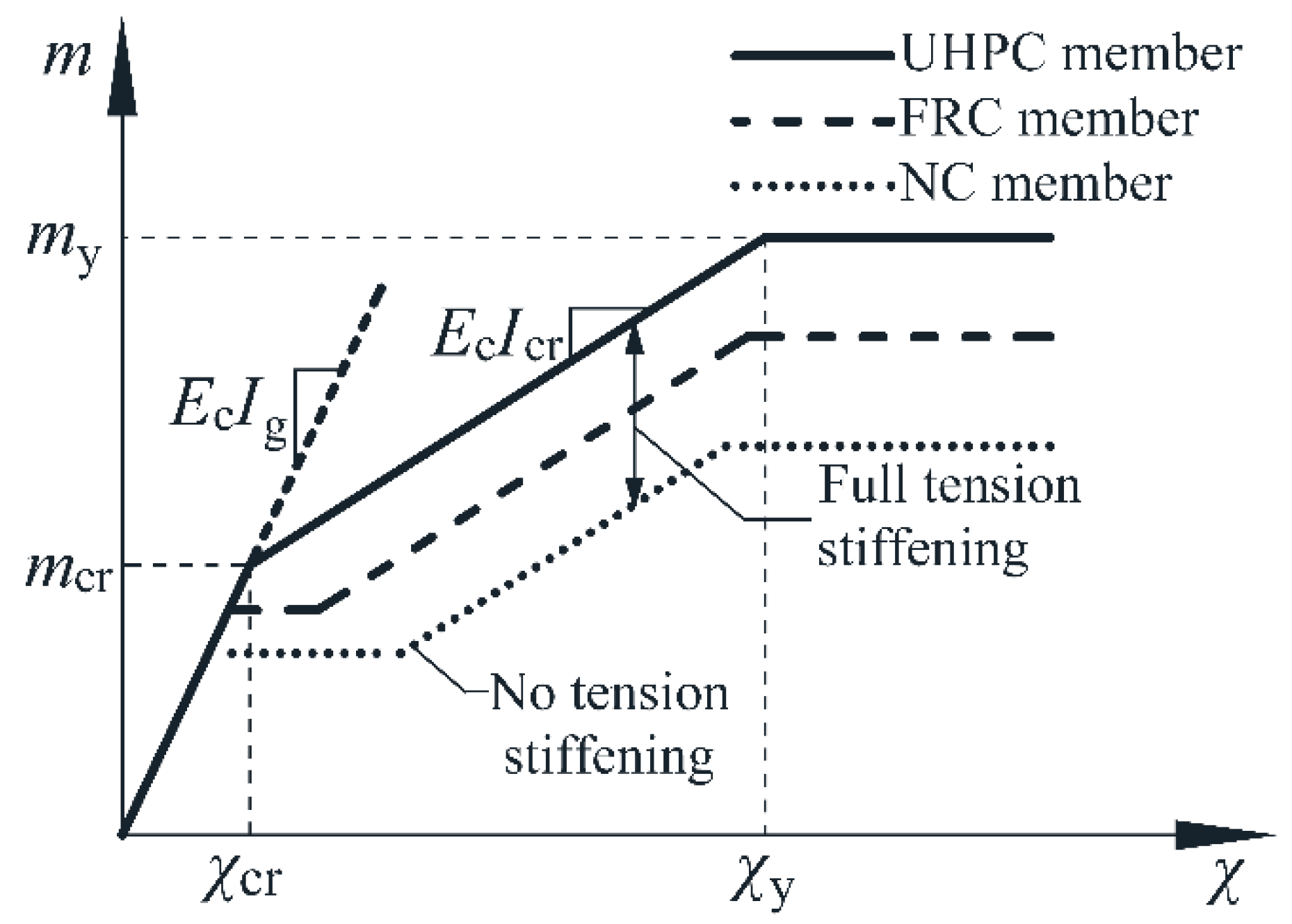
Figure 6 shows the moment-curvature curves of different types of RC members [22,25], where mcr and my are the cracking moment and the ultimate moment per unit width, respectively; χcr and χy are the curvatures at mcr and my, respectively; Ec is the elastic modulus of UHPC; Ig is the gross moment of inertia; and Icr is the moment of inertia of the cracked section. Compared to traditional fiber-reinforced concrete (FRC) members, UHPC members exhibit a more pronounced tension-hardening response. This is because the denser microstructure of UHPC enhances the bond strength between steel fibers and the matrix, thereby improving the bridging effect. The moment-curvature curves of UHPC members can be divided into three stages, including the uncracked, cracked, and yield stages, respectively.
Figure 6.
Moment-curvature relationships of different types of RC members.
The cracking curvature (χcr) and yielding curvature (χy) of UHPC members can be expressed as Equation (3).
Based on the document [25], mcr, Ig and Icr of singly reinforced rectangular UHPC member can be expressed as Equations (4) and (5).
where γm is the plastic influence coefficient and equal to 1.5 [25]; yt is the distance from the neutral axis of gross section to the tension face; h is the section depth; As is the sectional area of steel bar; ns is the elastic modulus ratio of steel bar to UHPC; αs is the distance from the center of steel bars to the tension face; δ is the ratio of the neutral axis depth to the effective depth; ρs is the reinforcement ratio.
According to Figure 5 and the moment equilibrium, the expression for calculating the bending capacity my of a rectangular UHPC member is derived as Equation (6).
The equation for the theoretical load-rotation curve can be derived by first evaluating the radial moment acting within the region of radius r0, and then integrating this moment along the tangential direction based on the moment-curvature curve of the UHPC member shown in Figure 6. Thus, the three stages of the moment-curvature curve correspond to three distinct regions within the reinforced UHPC slab. The radii for delimiting each region are calculated by substituting Equation (3) into Equation (2). Specifically, the region extending from the column face to the onset of UHPC cracking is defined by the cracking radius (rcr). The region spanning from the cracking front to the location of reinforcement yielding is bounded by the yielding radius (ry).
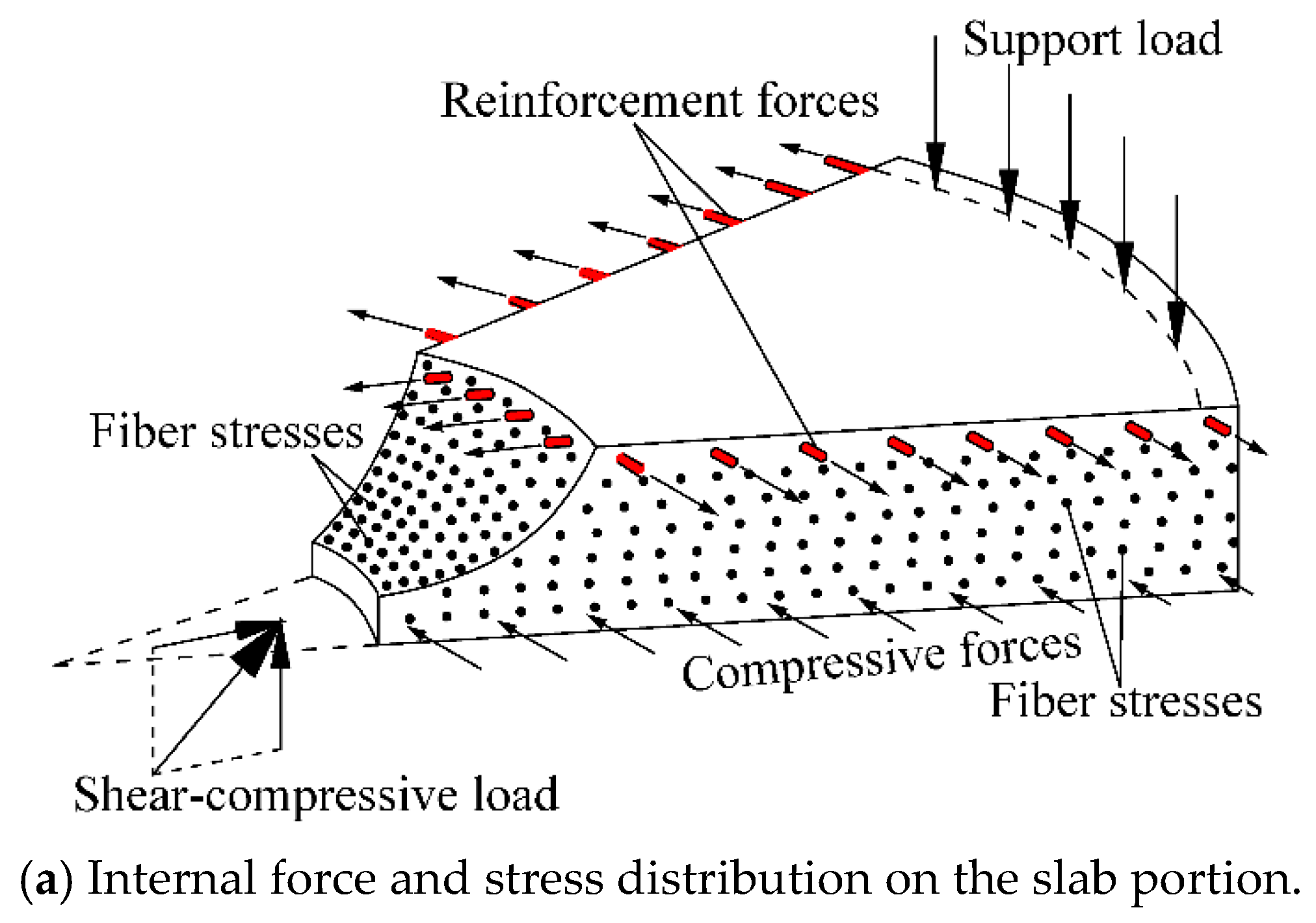
Figure 7 presents the internal force and stress distributions on the slab portion. Thus, the balance equation is obtained as shown in Equation (8).

Figure 7.
Mechanical diagram of the slab portion under a local load.
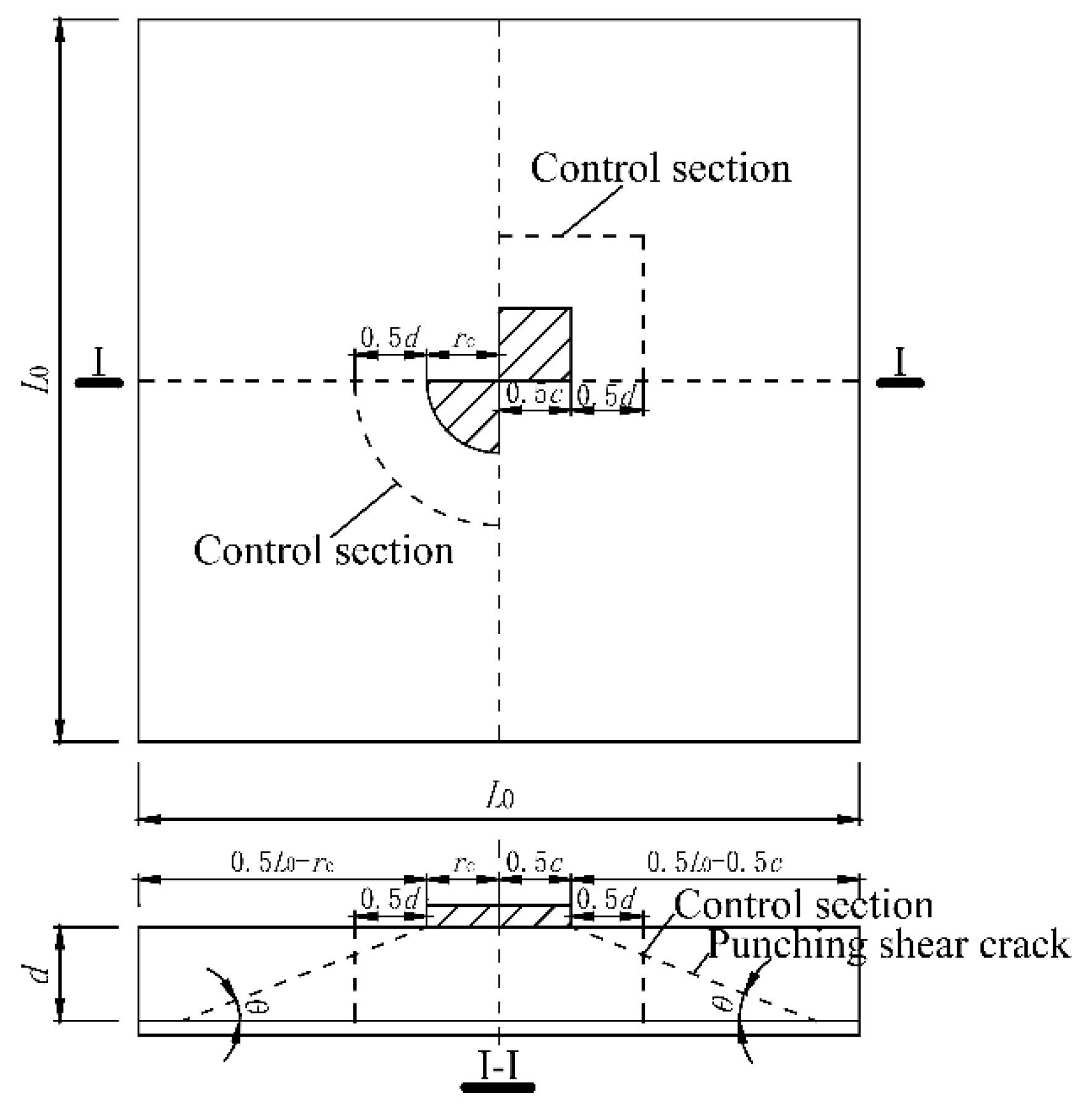
Based on Figure 8, λp can be calculated using Equation (9), where L0 and c are the slab span and the side length of the square loading area, respectively.
Figure 8.
Schematic of control cross-section and punching shear cone.
With the help of Figure 6, Equations (7) and (8), the expression for the punching load (V) can be derived as Equation (10).
where the operator [x] is x for x > 0 and zero for x < 0.
2.4. Equivalent Method for Square Slabs
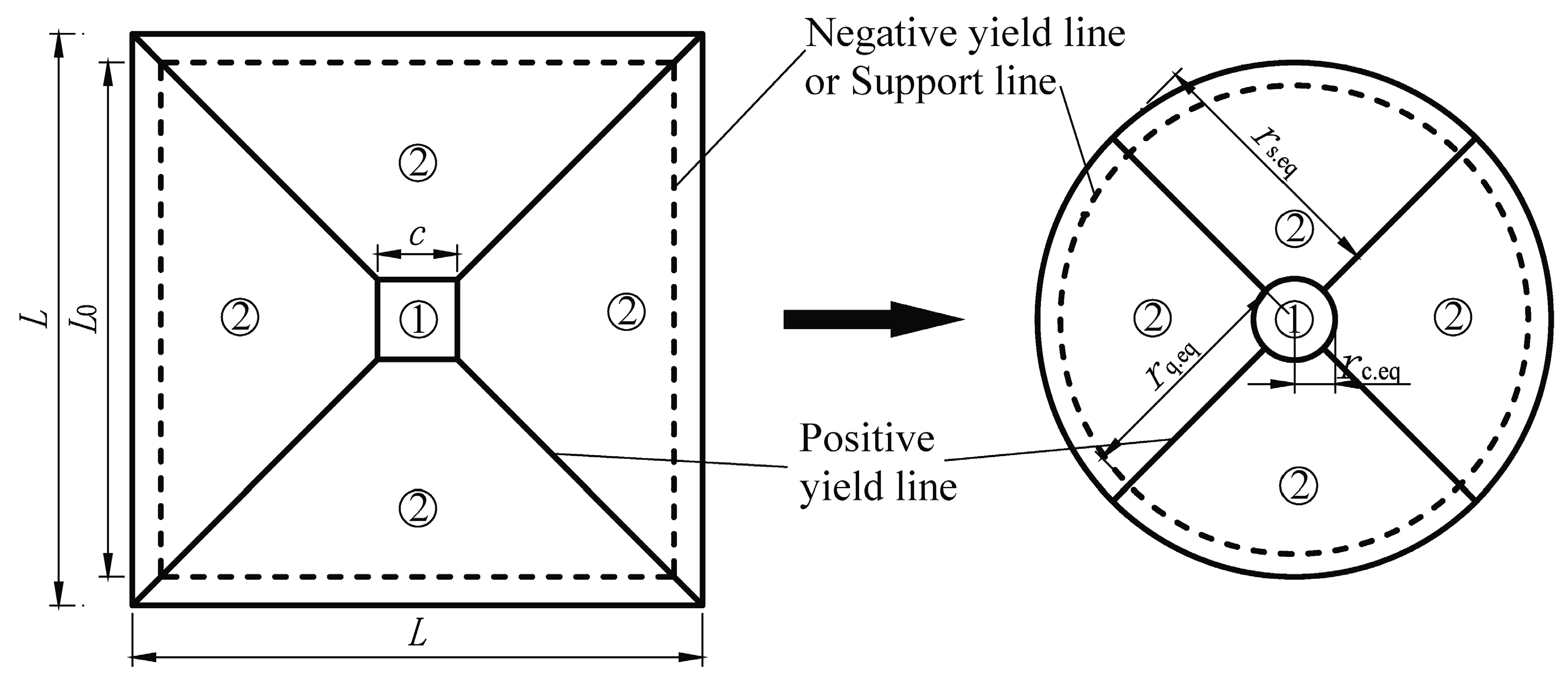
Equation (10) is suitable for predicting the load-rotation behavior of circular UHPC slabs with a circular loading area. For practical applications involving square slabs, an equivalent transformation to a circular configuration is therefore required. Referring to the crack patterns documented in Refs. [4,8,11,15], a general yield-line pattern is adopted for the UHPC slabs, as shown in Figure 9, where L is the side length of the square slab; rs.eq, rq.eq and rc.eq are the radii of the equivalent circular slab, the circular support line, and the loading area, respectively.
Figure 9.
Equivalent transformation from square slab to circular slab.
In this model, the UHPC slab is divided into five parts by the yield lines. For the square slab subjected to a localized load, a unit virtual displacement of part ① is applied. Moreover, part ① is assumed to translate only in the loading direction without rotation. Accordingly, the rotation angle (θ12) between part ① and part ② and the relative rotation angle (θ22) between the two symmetric parts ② are respectively expressed as Equation (11).
Based on the virtual work principle that the internal virtual work equals the external, the ultimate load (Pu) of the square UHPC slab is calculated by Equation (12).
where m’y is the negative moment, and m’y = 0 for the case of a slab simply supported on four edges.
For the circular slab subjected to a localized load, the rotation angle (θ12) between part ① and part ② and the relative rotation angle (θ22) between the two symmetric parts ② are computed via Equation (13).
The ultimate load (Pu) of the circular UHPC slab is calculated by Equation (14).
By equating Equations (12)–(14), the equivalent radii of the circular slab and the loading area are calculated by Equation (15).
Therefore, the demand curves of square UHPC slabs can be obtained by replacing rq and rc in Equation (10) with rq.eq and rc.eq, respectively.
2.5. Failure Criterion
According to Ref. [22], the punching shear capacity of the FRC slabs can be estimated as the linear superposition of concrete contribution and fiber contribution. Therefore, the punching shear capacity (VP) of reinforced UHPC two-way slab can be calculated by Equation (16).
where VP.c and VP.f are the contributions of the UHPC matrix and steel fibers to punching shear capacity, respectively.
Fang et al. [15] reported that (1) the punching shear failure surface is smooth except for randomly distributed steel fibers, implying a negligible interlocking effect induced by the aggregates; (2) under the punching shear failure, UHPC slabs present better ductility than NC slabs due to the bridging effect of steel fibers, which allows for more extensive development of inclined shear cracks, thereby further reducing aggregate interlock. Therefore, the value of dg in Equation (1) can be conservatively taken as zero to neglect the aggregate interlock. For nondimensionalization, a reference aggregate size dg0 is required. For the commercial UHPC, the maximum aggregate size is often 4 to 5 mm. Thus, dg0 can be taken as 4 mm. Considering the influences of punching shear-span ratio, reinforcement ratio, and UHPC strength on the punching shear capacity of slab [15], the formula for calculating the contribution of UHPC matrix was proposed as Equation (17).
where ft0 is the elastic limit strength of UHPC, taken as 0.06 times the prism compressive strength [17]; βρ is a factor regarding the effect of reinforcement ratio; and b0 is the perimeter of the control cross section at a distance of 0.5d from the column edge [15].
Based on the test results of UHPC slabs without steel fibers in Refs. [9,11], the values of constants A and B were calculated to be 7.3 and 3, respectively, via nonlinear curve fitting. As such, Equation (19) was obtained as
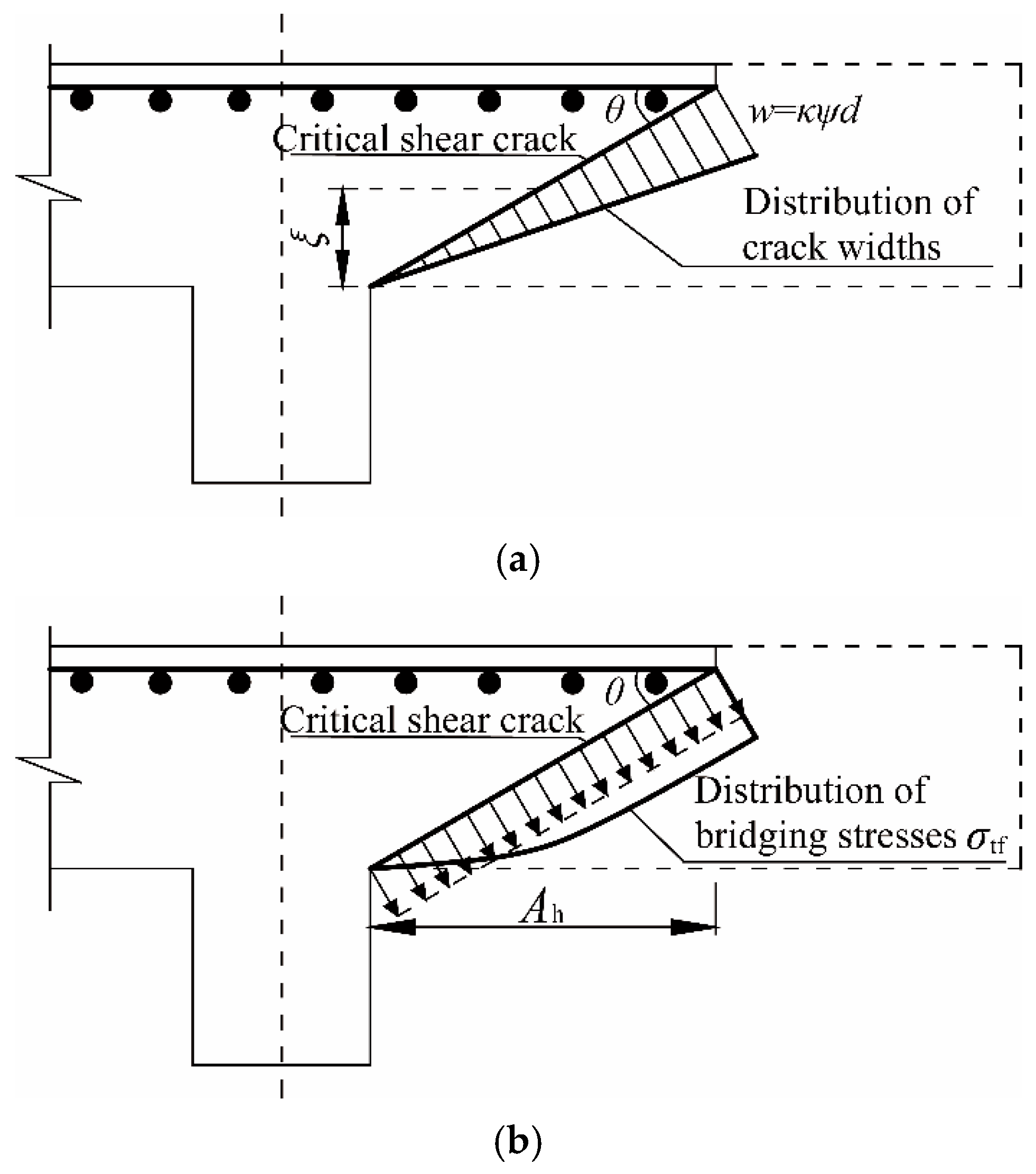
The contribution of steel fibers in UHPC to the punching shear strength is a function of the critical shear crack width, which is proportional to the rotation angle and the effective depth of the slab [22]. Based on the kinematic assumption in reference [21], the distribution of the inclined shear crack width along the surface of the punching shear cone is linear, as shown in Figure 10a.
Figure 10.
Calculation diagram for bridging effects of steel fibers in UHPC. (a) Distribution of shear inclined crack widths along the surface of the punching shear cone. (b) Distribution of fiber bridging stresses along the surface of the punching shear cone.
Therefore, the shear crack widths at a vertical distance (ξ) from the top of the slab can be computed by Equation (20).
where w is the critical shear crack width; κ is a coefficient relating the rotation angle to the critical shear crack width. κ = 0.5 is adopted in the present study because this value, as used in the CSCT, provides reasonable predictions for the punching shear strength and deformability of concrete slabs [21].
The distribution of fiber bridging stresses along the failure surface was nonlinear, as presented in Figure 10b, and the stress (σtf) was a function of the rotation angle and the positions of steel fibers in the slab [22]. Based on Equation (20), the contribution of steel fibers can be computed by integrating the bridging stress corresponding to each crack width, as shown in Equation (21).
where Ah is the horizontally projected area of the punching shear failure surface, which increases with the decrease in punching shear angle (θ).
As indicated by Equation (21), a reasonable method for calculating the bridging stresses of steel fibers in UHPC is crucial. In the variable engagement method (VEM) [29], the tensile behavior of randomly distributed steel fibers can be reasonably assessed, leading to Equation (22) for bridging stress.
where Kf is a coefficient accounting for fiber orientation; lf, df, and Vf are the length, diameter, and volume fraction of steel fibers, respectively; and τb is the bond stress between a steel fiber and the UHPC matrix. Voo et al. [29] stated that Kf is a function of critical shear crack width (w), and proposed Equation (23) for factor Kf based on the assumption that randomly distributed steel fibers are pulled out from the matrix rather than fracturing.
where ηe is the engagement parameter, recommended as 3.5. Voo et al. [29] calibrated ηe by assuming an uniform bond stress along the fiber length and verified its accuracy based on the numerous experimental results.
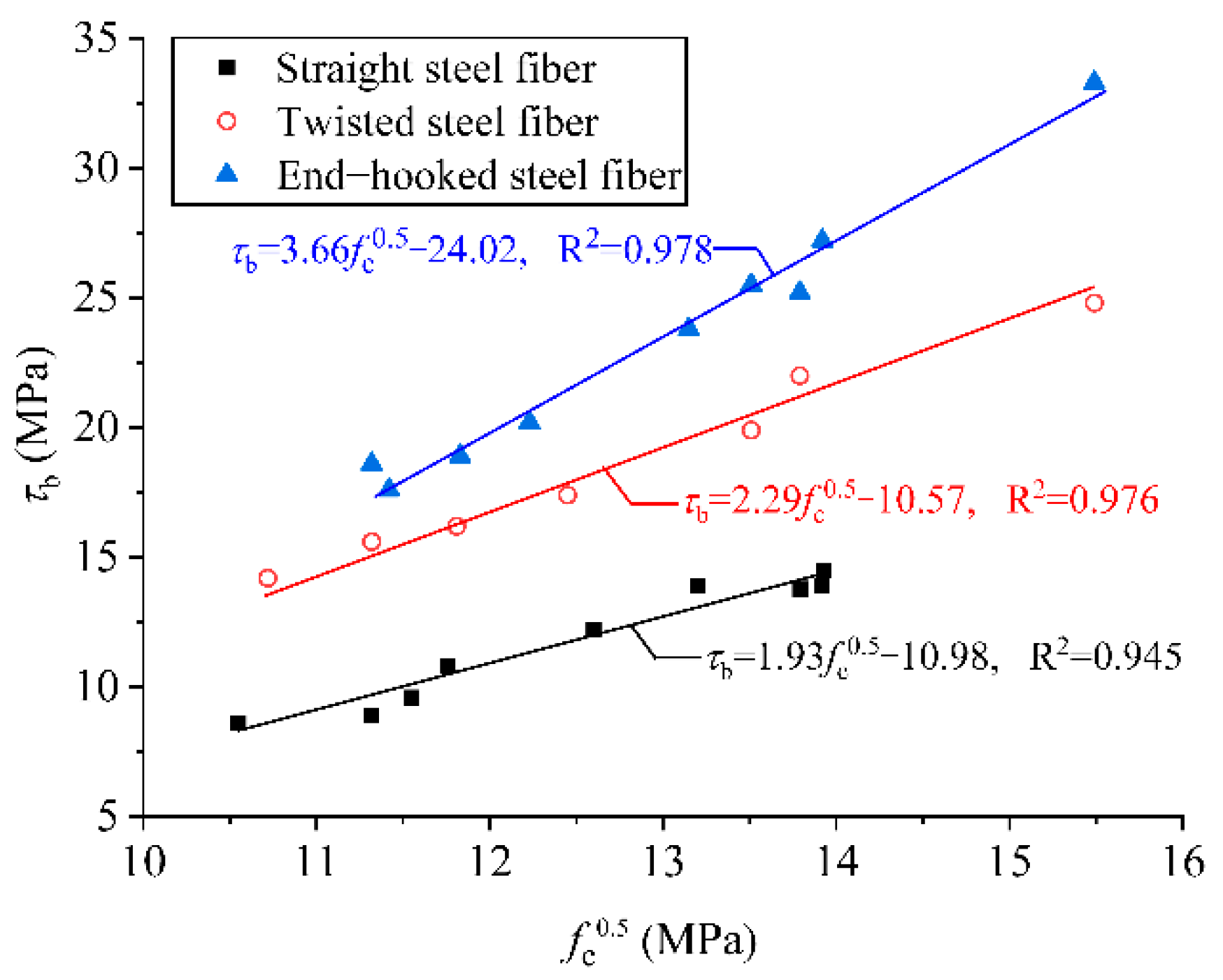
In the present study, the test results of twenty-five fiber pullout specimens were collected from references [30,31,32,33,34,35] to investigate the bond strengths of steel fibers in UHPC matrix, as shown in Figure 11. A significant linear positive correlation between bond strength and the square root of UHPC compressive strength was obtained. Compared with straight steel fibers, higher bond strengths were obtained for twisted fibers and end-hooked fibers in UHPC.
Figure 11.
Relationship between the bond strength of steel fiber and the square root of UHPC compressive strength.
Based on the linear fitting, Equation (24) was proposed to calculate the bond strength of steel fibers in UHPC:
Combining Equations (20)–(24), the steel fiber contributions on punching shear capacity of the UHPC slab can be calculated by Equation (25).
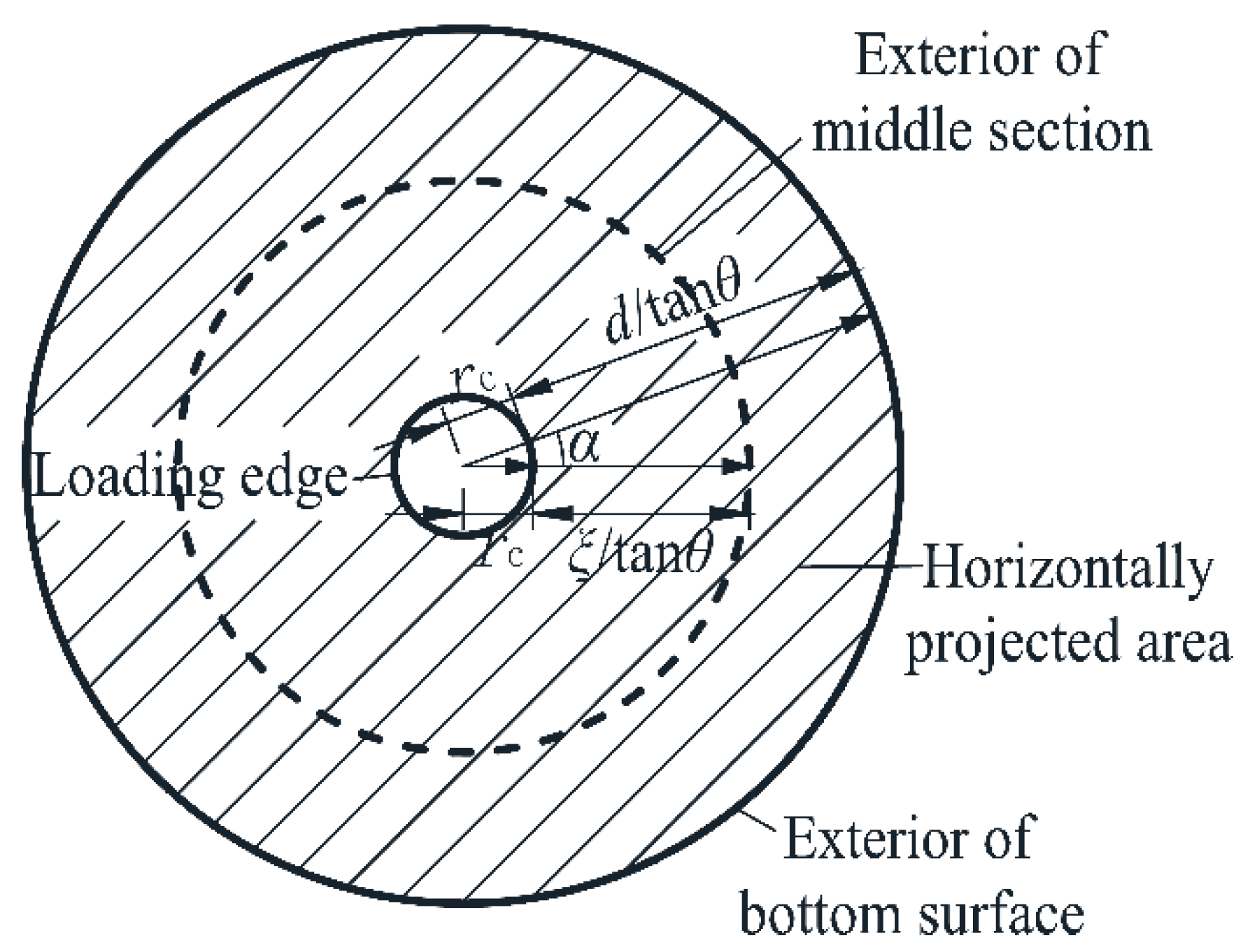
where α is the angle with reference to the circle radius in the horizontal direction, as depicted in Figure 12.
Figure 12.
Vertical view of punching shear cone.
Nevertheless, Equation (25) is complex for practical application. For FRC slabs or UHPC slabs, the distribution of steel fiber bridging stresses tends to be uniform along the punching shear failure surface [3,22], as depicted in Figure 10. Thus, an average bridging stress was introduced in the present study. The expression for the fiber contribution was proposed as Equation (26).
where ξc is the control distance from the top of the UHPC slab; Ah is computed based on Figure 12.
The average fiber bridging stress can be taken as the stress at a control distance d/3 from the top of the slab, which is a function of the rotation angle [22]. Hence, Equation (26) can be simplified as Equation (27).
For ease of application, a term (1 + βvλf) was introduced to comprehensively regard the contribution of steel fibers on the punching shear strength of UHPC slabs [15], where βv is the enhancement coefficient of steel fibers. This approach significantly reduces the computational effort compared to using Equation (25) or Equation (27). Introducing (1 + βvλf) to Equation (19), a simplified equation for obtaining the capacity curve is given, as shown in Equation (28).
where λf is the characteristic value of steel fiber content, equal to lf/dfVf. Based on Refs. [15,17], the value of βv is taken as 0.4.
2.6. Calculation Procedure for Reinforced UHPC Slabs
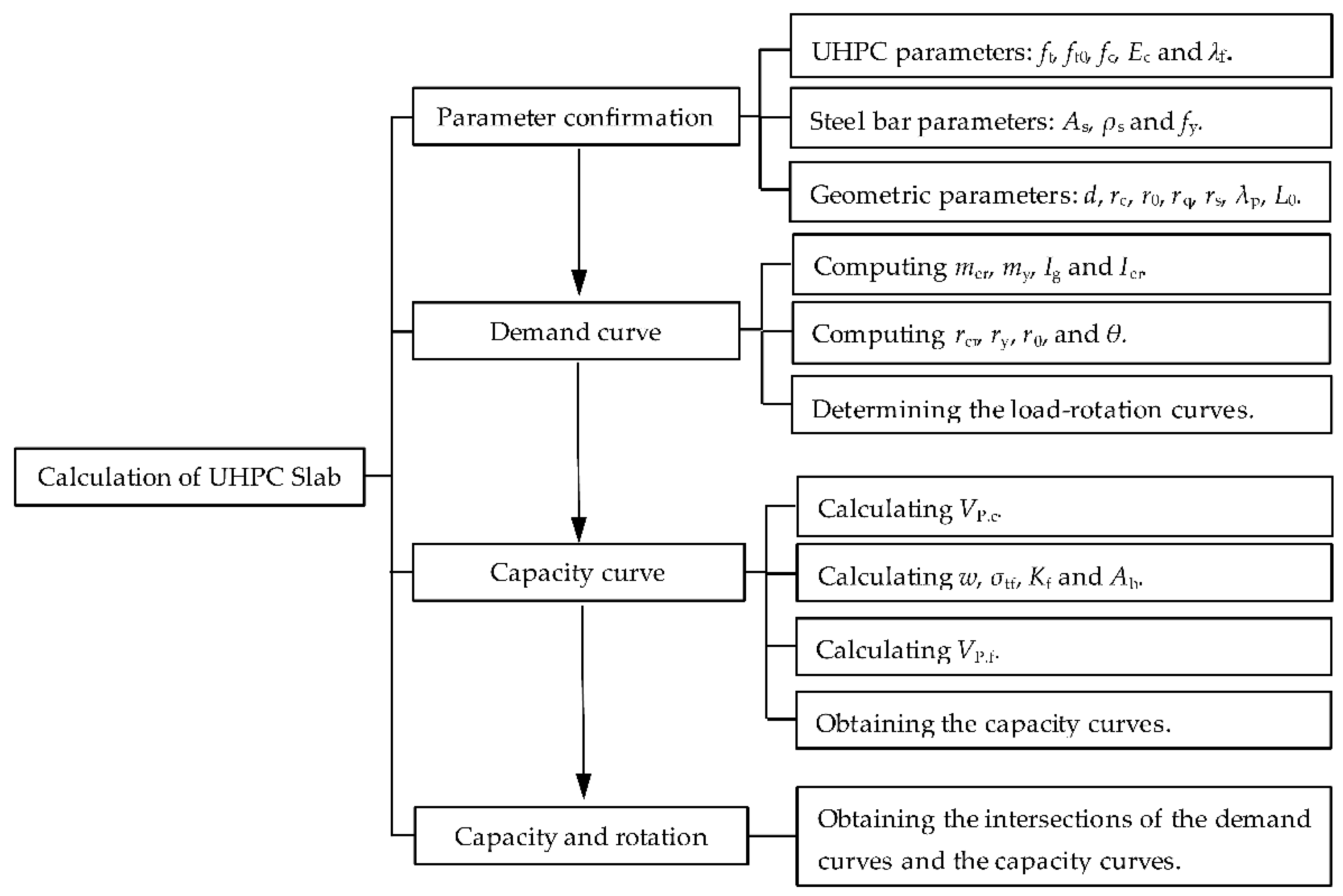
The calculation procedure for determining punching shear capacity of reinforced UHPC slab is depicted in Figure 13. It consists of the following four steps: First, the material and geometric parameters need to be predefined. For square slabs, Equation (15) is used to transform the geometry into an equivalent circular configuration. Next, the load-rotation curve is established. In this step, mcr, my, Ig and Icr are computed using Equations (4)–(6); rcr, ry, r0 and θ are computed using Equations (7) and (8). The demand curve is then determined by Equation (10). Subsequently, the failure criterion is formulated. Herein, VP.c is calculated via Equation (19); w, σtf, Kf, and Ah are computed using Equation (20), Equation (22), Equation (23), and Equation (26a), respectively; VP.f is calculated using Equation (25) or Equation (27). The capacity curve is subsequently determined by Equation (16). Finally, the punching shear strength and the corresponding critical rotational angle of the reinforced UHPC slabs are obtained by determining the intersection point of the demand curve and the capacity curve.
Figure 13.
Schematic flowchart of the calculation procedure.
3. Verification of Models
3.1. Evaluation of Proposed Models
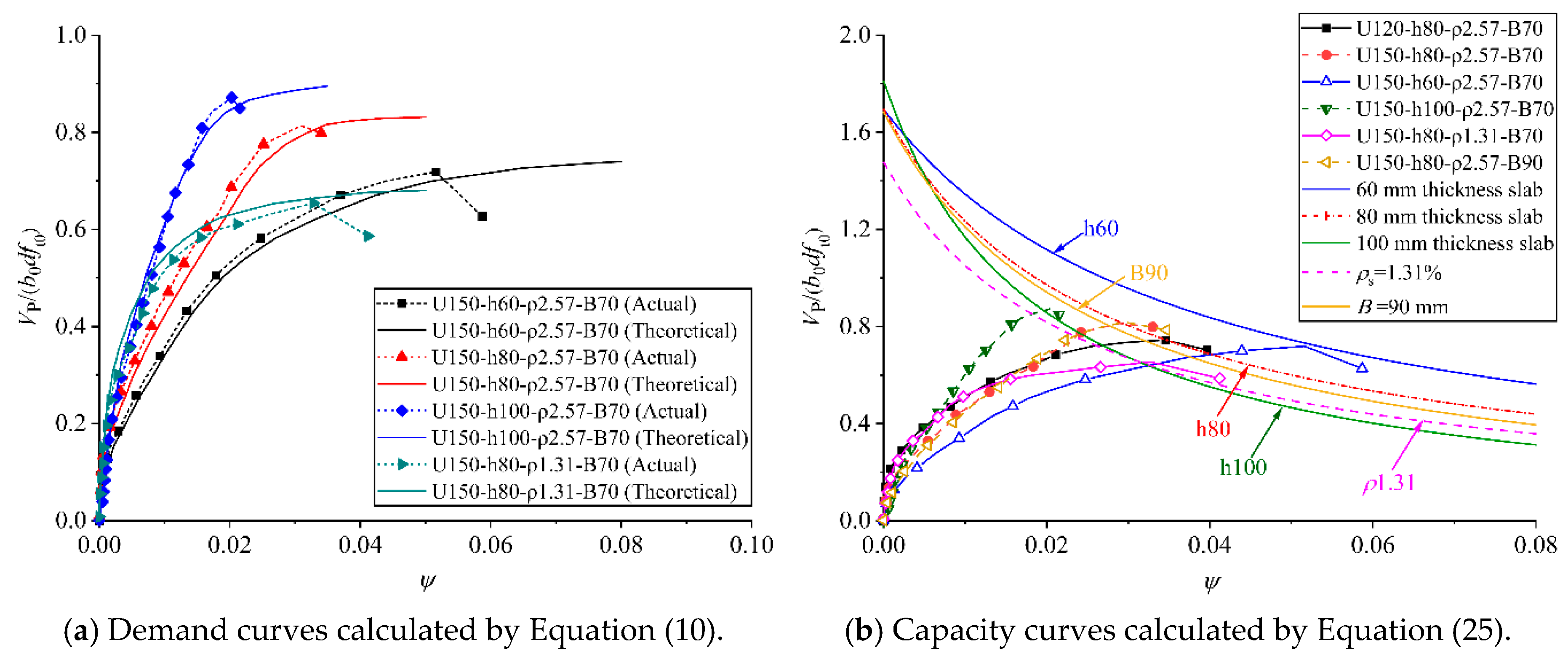
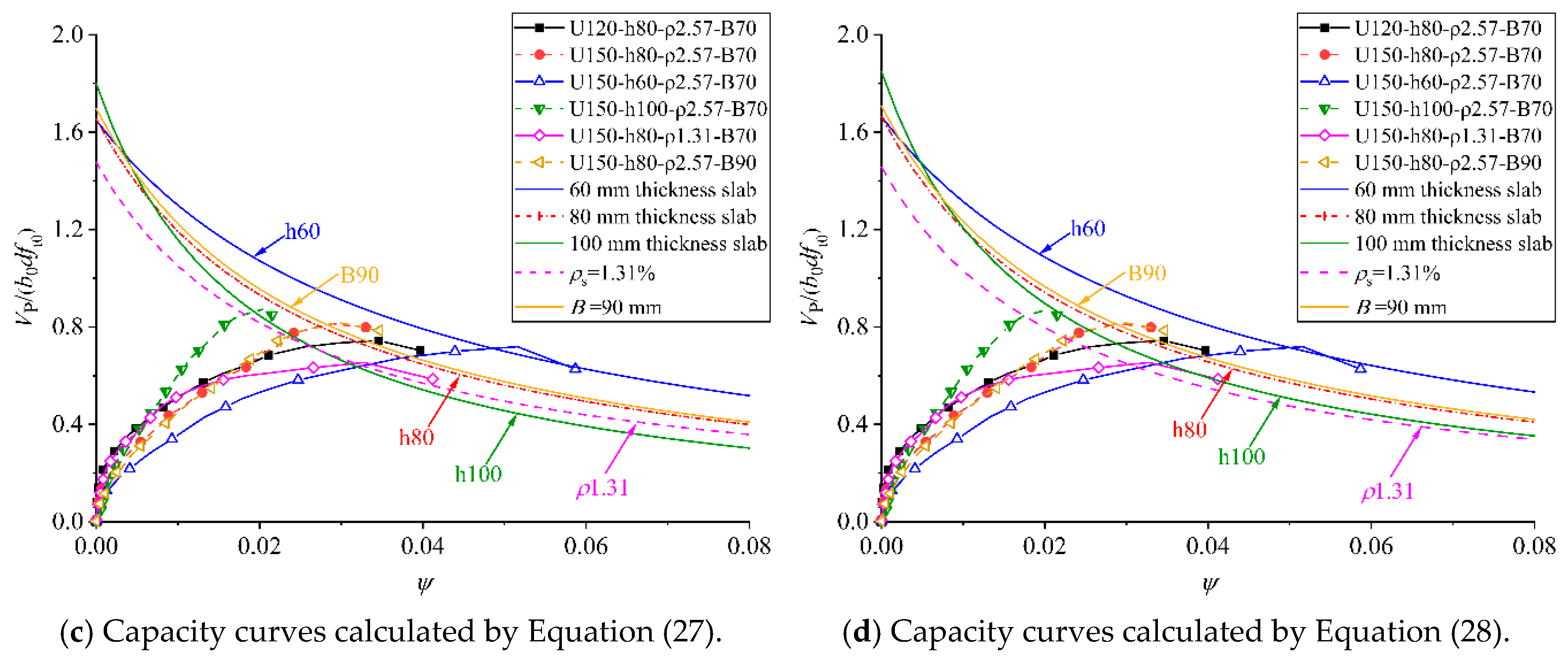
The demand and capacity curves for the reinforced UHPC slabs tested by Fang et al. [15] were calculated using the proposed equations. The results are shown in Figure 14. The theoretical demand curves agree well with the experimental demand curves. Furthermore, the intersections between the calculated capacity curves and the experimental curves generally coincide with the peak loads from the tests. Therefore, the proposed methods can reasonably predict the punching shear capacity of UHPC slabs.

Figure 14.
Calculation results of UHPC slabs tested by Fang et al. [15].
To further verify the accuracy of the proposed models, the experimental results of forty-three UHPC slabs in the third-party literature were introduced. Table 1 summarizes the configurations of all specimens, and Table 2 shows the corresponding punching shear capacities. Note that for square loading areas and square slabs, rc and rq in Table 1 are calculated using Equation (15); λp and b0 are calculated using Equation (9) and Equation (18), respectively. In Table 2, ψu and VP. Equation (25) are the ultimate rotation angle and predicted capacity, respectively, calculated considering the UHPC matrix contribution from Equation (19) and the fiber contribution from Equation (25); VP. Equation (27) is calculated using Equation (27) for fiber contribution; VP. Equation (28) is calculated by Equation (28); Cs is the fiber contribution ratio, defined as the ratio of fiber contribution from Equation (25) to VP. Equation (25).
Table 1.
Configurations of UHPC two-way slabs.
Table 2.
Punching shear capacities of UHPC two-way slabs.
As shown in Table 2, the direct integration of Equation (25) for the steel fiber contribution gives the best prediction of punching shear capacity, where the mean ratio of measured values to predicted results is 1.06 with a standard deviation of 0.07. Compared to the integration, the application of average fiber bridging stress is more convenient. In so doing, the average ratio of predicted values to test results is 1.12 with a standard deviation of 0.1, indicating an accurate calculation. Equation (28) provided the acceptable prediction with an average ratio of 1.13 and a standard deviation of 0.11. When the fiber volume fraction varied from 0.5% to 3%, the fiber contribution ratio was 16.3% to 54.9%. This range is consistent with the values of 20.5% to 63.8% reported in Refs. [7,8,9,12].
Several cases with notable deviations warrant discussion based on Table 1 and Table 2. First, the model underestimates the capacity for slabs with a thickness of about 40 mm (e.g., an underestimation exceeding 20% for specimen BCV-1%-40-1.92). This may be because the constant factor k is difficult to reflect the law that the tensile contribution of UHPC decreases with the decrease in slab thickness [25]. Second, the model slightly overestimates the capacity when the fiber volume fraction is 0% or 0.5% (e.g., an overestimation of about 10% for specimen G5Ufy560), likely because the weak bridging effect at low fiber contents is not fully captured by the VEM. Based on the analyzed data, the following applicability limits for the proposed models are suggested: (1) steel fiber volume fraction (Vf) varying from 0.5% to 3%; (2) slab thickness (h) varying from 40 mm to 100 mm; (3) UHPC compressive strength (fc) varying from 100 MPa to 220 MPa; and (4) reinforcement ratio (ρs) varying from 0% to 3.5%.
3.2. Assessment of Typical Empirical Formulas
Table 3 lists several typical equations for calculating the punching shear capacity of reinforced UHPC slabs. Al-Quraishi et al. [7] proposed Equation (29) to consider the contributions of UHPC matrix, steel fibers, and steel bars. Equation (30), suggested by JSCE [18], separately accounts for the contributions of steel fibers and other factors. Equation (31), recommended by NF P 18-710 [19], determines the punching shear strength primarily based on the tensile strength of UHPC. In the Chinese specification DBJ43/T325-2017 [17], Equation (32) employs a coefficient (βv) to holistically account for the positive effects of steel fibers. Equation (33) proposed by Fang et al. [15] incorporates the effect of the punching shear-span ratio on the punching shear capacity.
Table 3.
Typical equations for calculating punching shear capacity of UHPC slab.
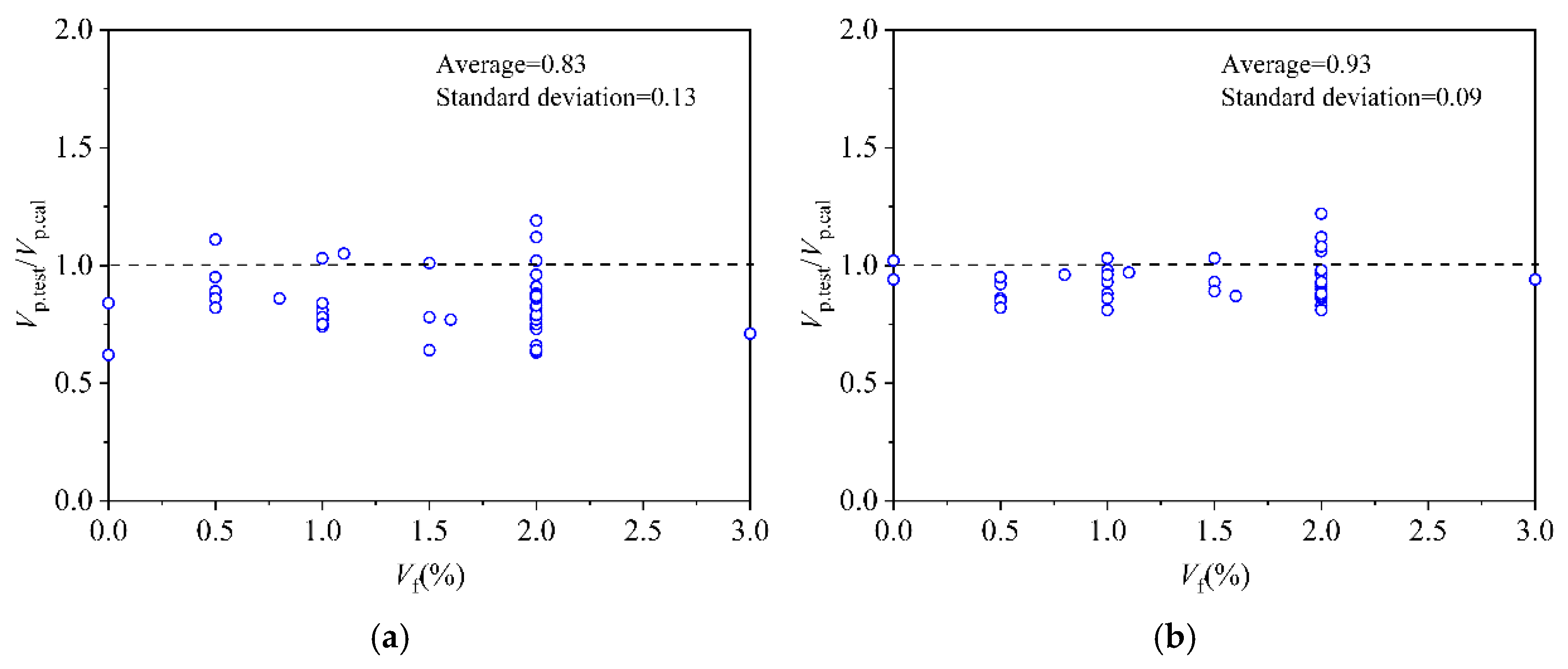
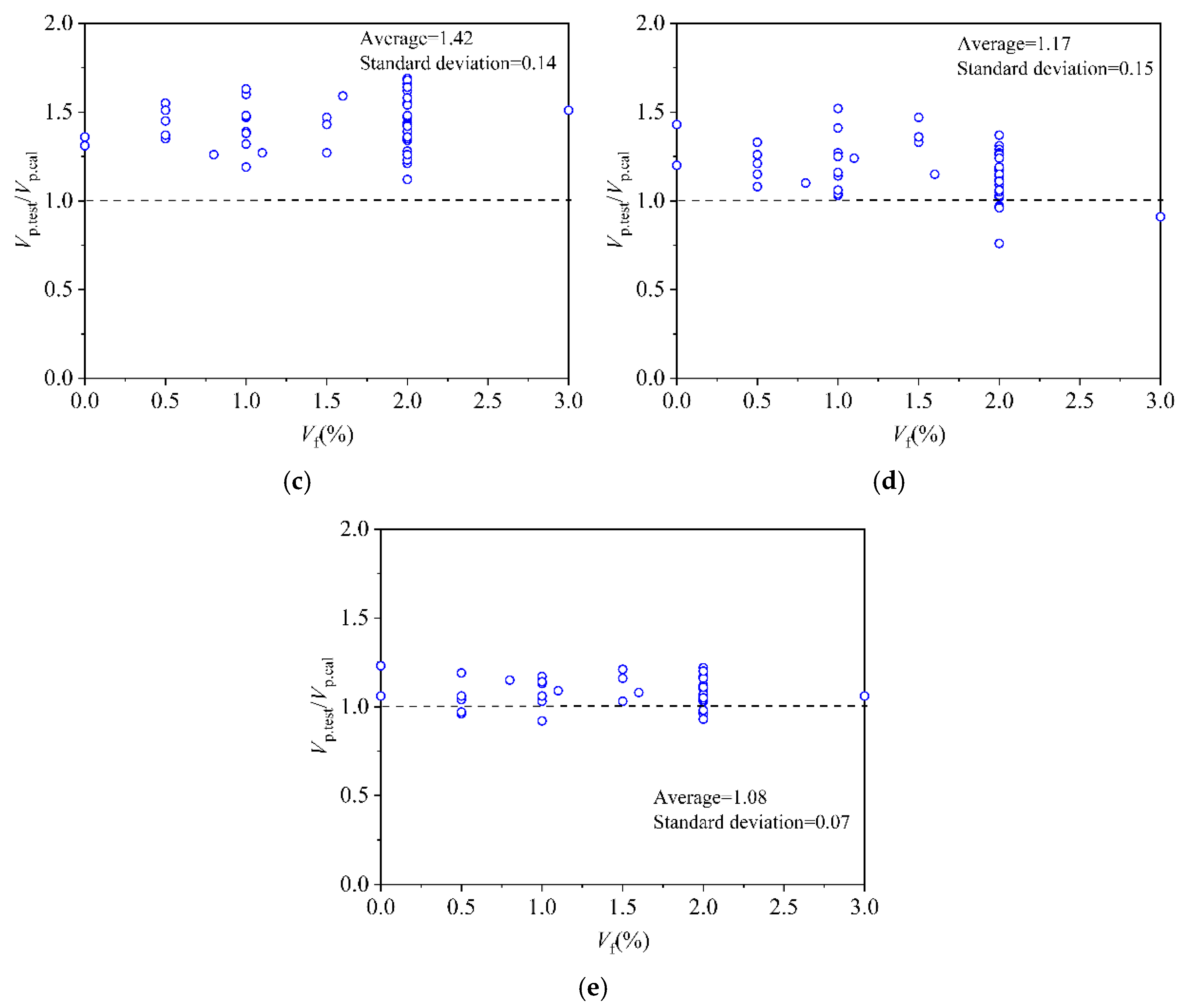
The punching shear capacities of forty-three UHPC slabs in Refs. [4,7,8,11,12,13,15] were calculated using Equations (29)–(33). The ratios of the test results (Vp.test) to the calculated values (Vp.cal) are presented in Figure 15. Compared to the proposed models, the previous methods suggested by Al-Quraishi et al. [7] and NF P 18-710 [19] exhibit greater scatter and provide less accurate predictions for the punching shear capacity of reinforced UHPC slabs. The equations in JSCE [18] and DBJ43/T325-2017 [17] show relatively reasonable accuracy but do not account for the influence of the punching shear-span ratio. Although Equation (33) proposed by Fang et al. [15] achieves relatively high accuracy, it does not mechanistically incorporate the tensile strain-hardening of UHPC.

Figure 15.
Verification of typical empirical formulas. (a) Equation proposed by Al-Quraishi et al. [7]. (b) Equation proposed by JSCE [18]. (c) Equation proposed by NF P 18-710 [19]. (d) Equation proposed by DBJ43/T325-2017 [17]. (e) Equation proposed by Fang et al. [15].
4. Parameter Analysis and Discussion
4.1. Influence of Slab Thickness
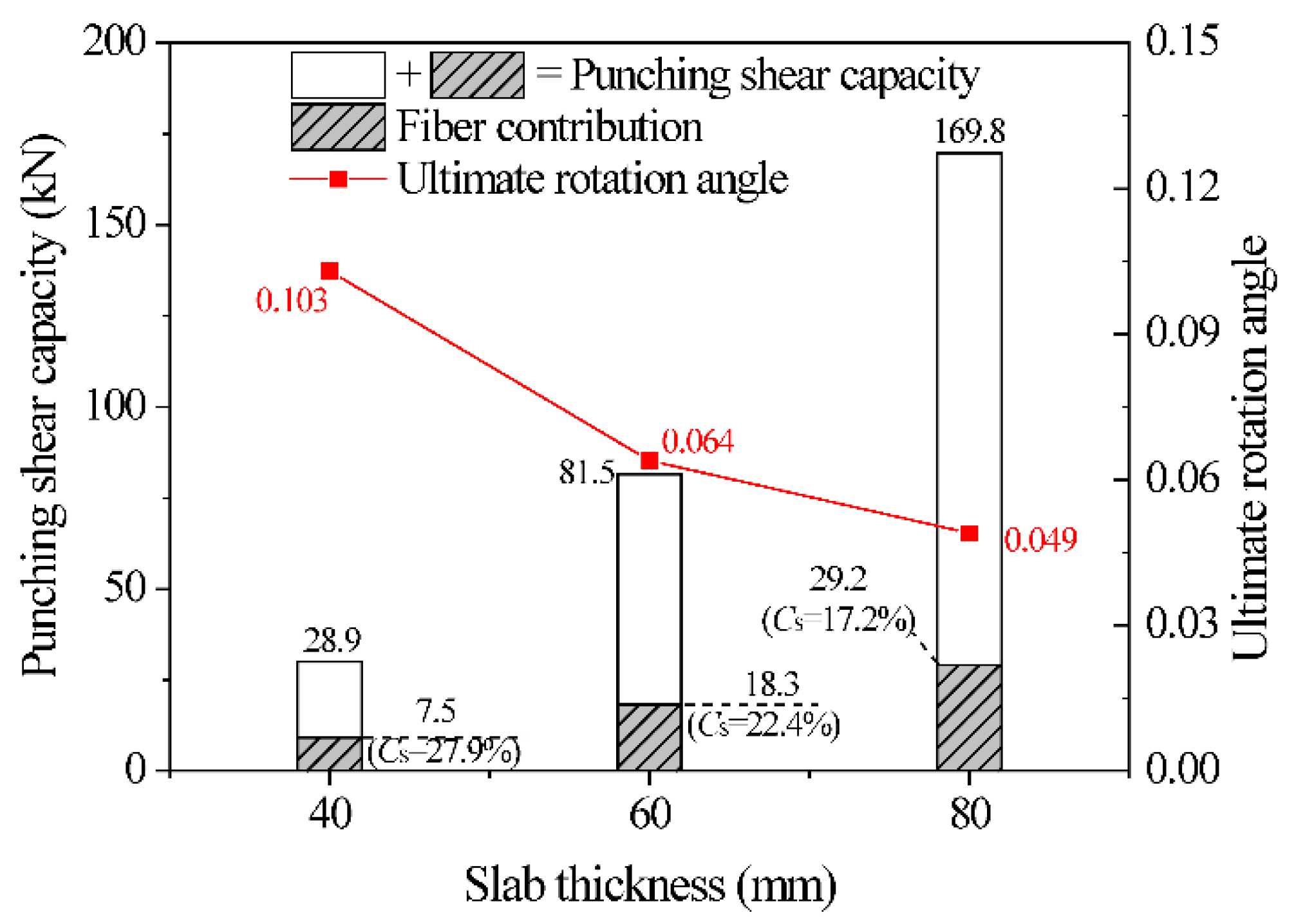
Figure 16 presents the influence of slab thickness on the punching shear capacity and ultimate rotation angle based on the calculation results (from Equation (25)) of slabs tested by Moreillon [8]. Compared to slabs with a 40 mm thickness, the punching shear capacities of slabs with 60 mm and 80 mm thickness increased by 182% and 487%, respectively, while the corresponding steel fiber contribution ratios decreased by 19.7% and 38.3%, respectively. As the slab thickness increased, the punching shear-span ratio decreased, and the critical failure perimeter increased, resulting in an improvement in the punching shear capacity. Furthermore, the flexural stiffness of the UHPC slabs improved with the increase in slab thickness, which restricted the development of the critical shear crack and reduced the fiber bridging effect [25]. Hence, the fiber contribution ratio decreased.
Figure 16.
Effects of slab thickness.
4.2. Influence of Fiber Volume Fraction
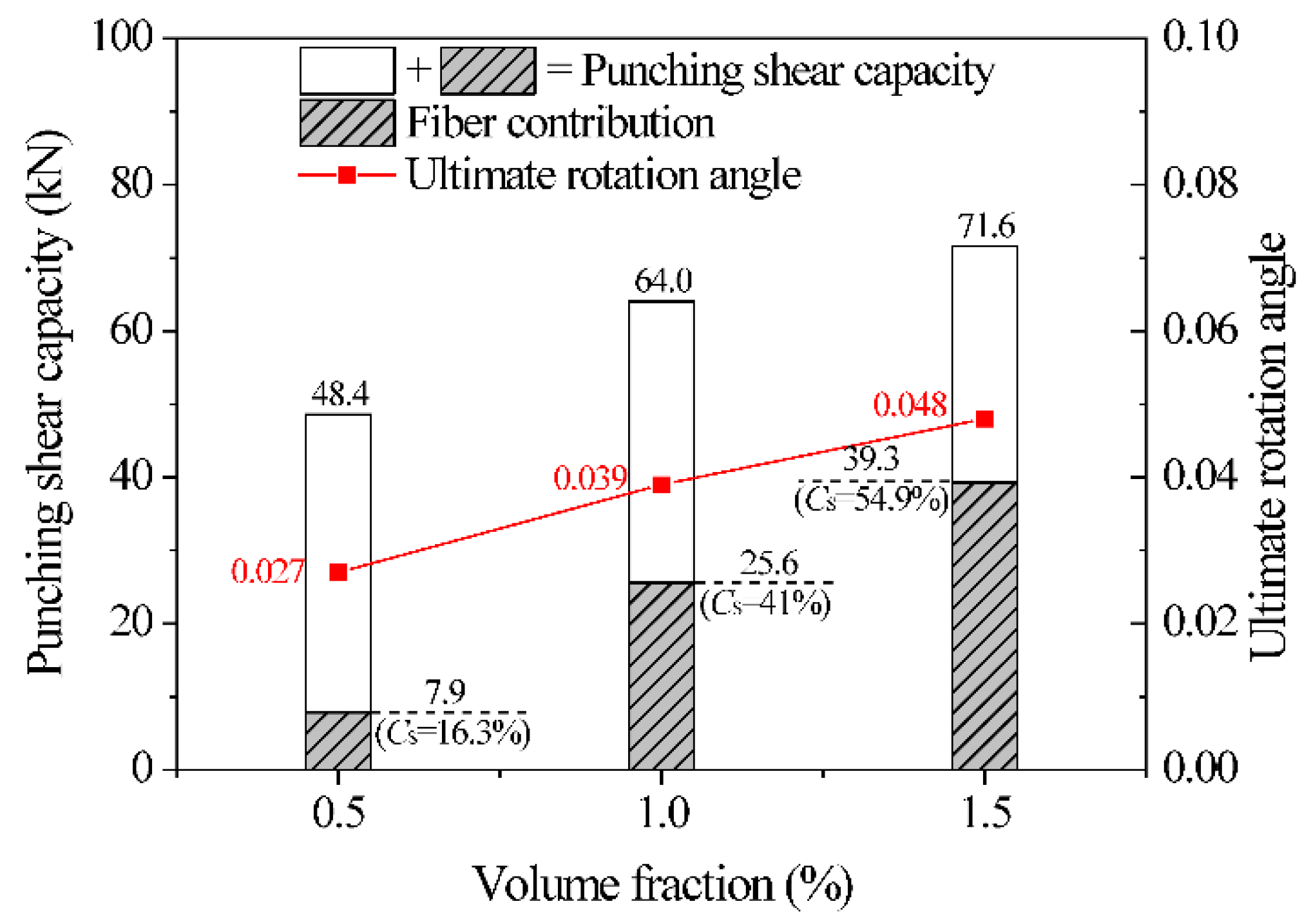
The influence of fiber volume fraction on the punching shear capacity and ultimate rotation angle was investigated based on the predicted results of UHPC slabs tested by Park [11], as depicted in Figure 17. Compared to the slab with a steel fiber volume content of 0.5%, the punching shear capacities of slabs with volume fractions of 1.0% and 1.5% increased by 51.9% and 71.4%, respectively, which results from the enhanced bridging effect of steel fibers. Moreover, a higher fiber volume fraction leads to an increase in the fiber contribution ratio and enhances slab ductility, which consequently improves the ultimate rotation angle.
Figure 17.
Effects of fiber volume content.
4.3. Influence of UHPC Compressive Strength
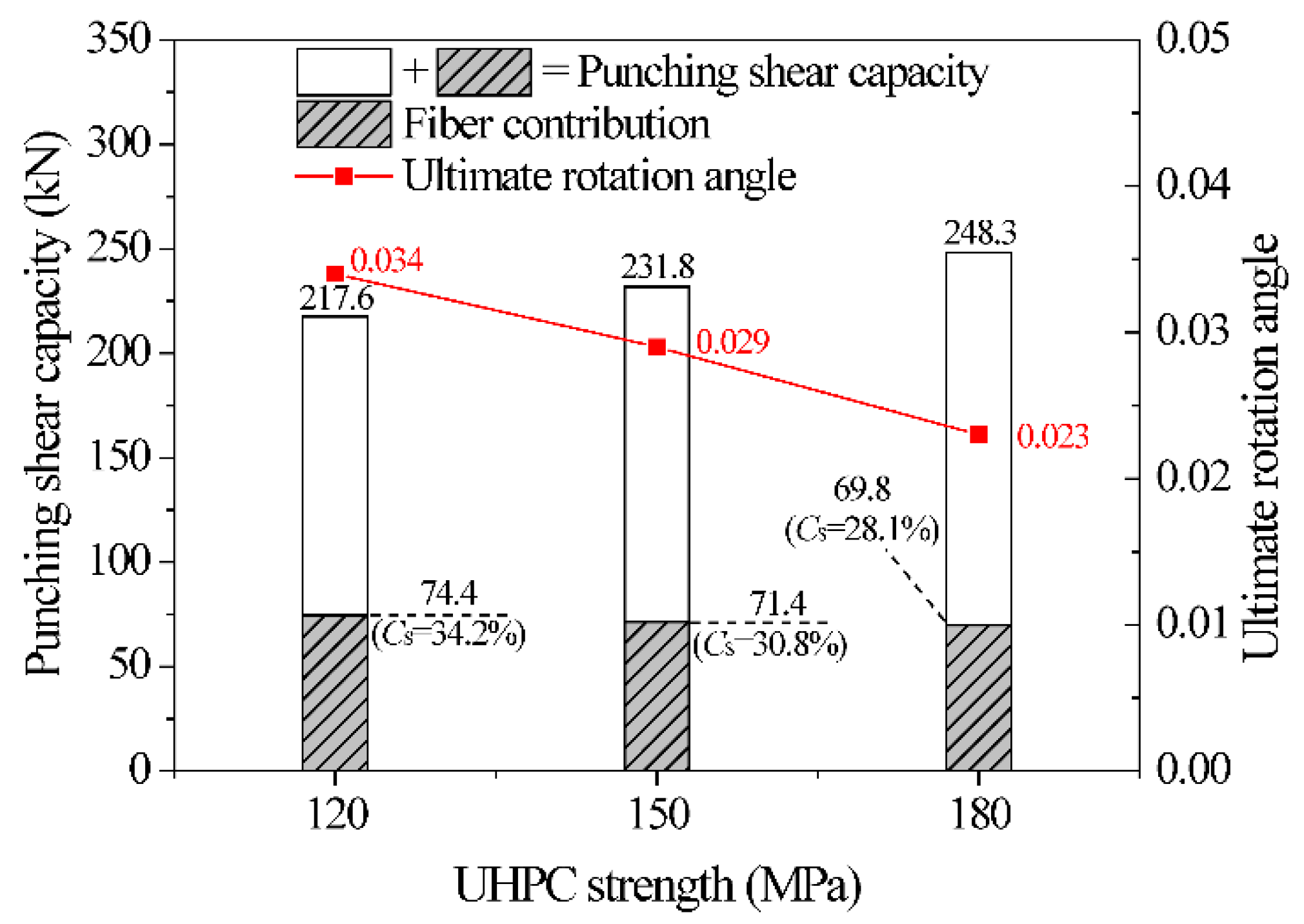
The influence of UHPC compressive strength on the punching shear capacity and ultimate rotation angle was analyzed based on the results of UHPC slabs tested by Fang et al. [15], as shown in Figure 18. Compared to slabs with a UHPC compressive strength of 120 MPa, the punching shear capacities of slabs with a UHPC of 150 MPa and 180 MPa improved by 6.5% and 14.1%, respectively. This improvement is attributed to the increase in tensile strength of UHPC and the shear resistance in the shear-compression zone. Furthermore, the elastic modulus increases with UHPC compressive strength, leading to an improvement in the flexural stiffness of the UHPC slab. Consequently, the development of the critical shear crack was restricted, and the fiber bridging effect decreased. Therefore, the fiber contribution ratio decreased with the increase in UHPC compressive strength.
Figure 18.
Effects of UHPC compressive strength.
4.4. Influence of Reinforcement Ratio
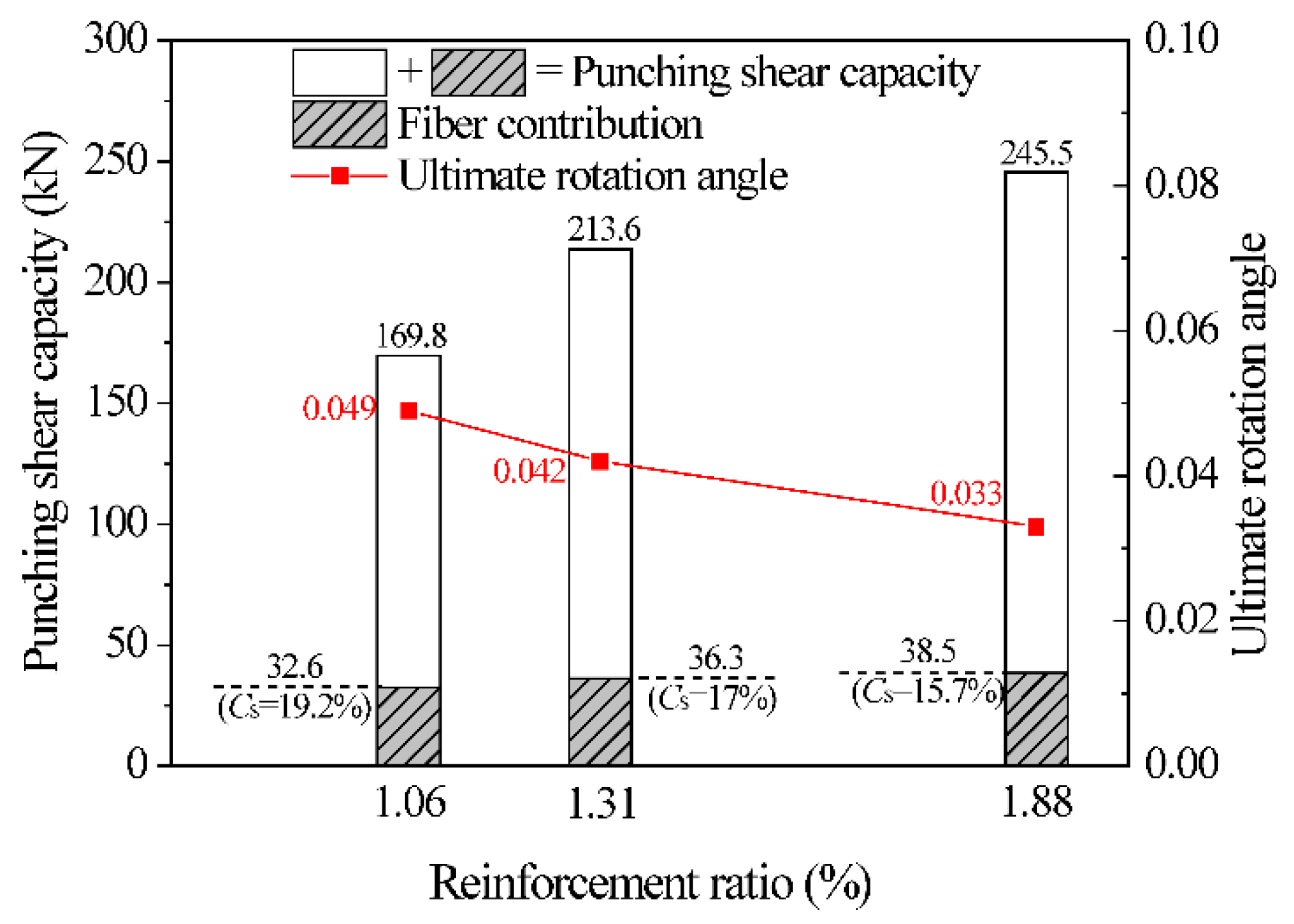
The influence of reinforcement ratio on the punching shear capacity and ultimate rotation angle was identified based on the calculation results of slabs tested by Moreillon [8], as shown in Figure 19. Compared to UHPC slabs with a reinforcement ratio of 1.06%, the punching shear capacities of those with reinforcement ratios of 1.31% and 1.88% increased by 25.8% and 44.6%, respectively, while the steel fiber contribution ratios decreased by 11.5% and 18.2%, respectively. This trend results from two primary factors: (1) the dowel action of steel bars improves with increasing reinforcement ratio; and (2) the increased flexural stiffness limits the development of the critical shear crack.
Figure 19.
Effects of reinforcement ratio.
4.5. Discussion
Based on the results in Table 2 and the preceding parametric analysis, a coupling effect exists among several key parameters, including UHPC slab thickness, compressive strength, steel fiber volume fraction, and reinforcement ratio. For instance, as the slab thickness decreases, the contribution of steel fibers becomes more significant, and the influence of the steel fiber volume fraction Vf is consequently amplified. This interaction is quantified by the proposed model: for 40 mm thick slabs (D40-f1.0 and D40-f1.5 in Ref. [11]), a 50% increase in Vf (from 1.0% to 1.5%) results in a 13.9% increase in the fiber contribution ratio Cs. In contrast, for 80 mm thick slabs (BCV-1%-80-1.88 and BCV-2%-80-1.88 in Ref. [8]), a 100% increase in Vf (from 1.0% to 2.0%) yields only a 7.9% increase in Cs. The proposed model effectively captures the interaction effects between different parameters. Therefore, the proposed model provides a mechanism-based foundation for future revisions of UHPC structural design codes pertaining to punching shear design. To further refine the model and broaden its applicability, future work could incorporate a detailed consideration of tensile damage and crack propagation behavior in UHPC [36,37].
5. Conclusions
This study develops a physical–mechanical model for reinforced UHPC slabs based on the critical shear crack theory (CSCT). This model enables the calculation of the punching shear capacity and ultimate rotation angle of reinforced UHPC slabs. The following conclusions are drawn.
1. The contribution of steel fibers is calculated based on the assumption that the critical shear crack width is proportional to the slab rotation angle and effective depth. The proposed model incorporates the tensile strain-hardening behavior and tensile strength of UHPC, the punching shear-span ratio, and the reinforcement ratio, while the aggregate interlock is neglected.
2. The contribution of the UHPC matrix is formulated considering key geometrical and mechanical parameters. The variable engagement method (VEM) can be effectively applied to evaluate the steel fiber contribution to the punching shear capacity of UHPC slabs.
3. A significant linear positive correlation exists between the bond strength of steel fibers in the UHPC matrix and the square root of the UHPC compressive strength. Based on this finding, an equation describing the bond strength between steel fibers and UHPC matrix was developed.
4. Comparisons between experimental results from the literature and model predictions indicate that the proposed model can accurately compute the punching shear capacity and ultimate rotation angle of reinforced UHPC slabs. The models are applicable for the following parameter ranges: steel fiber volume fraction from 0.5% to 3%, slab thickness from 40 mm to 100 mm, UHPC compressive strength from 100 MPa to 220 MPa, and reinforcement ratio from 0% to 3.5%.
5. With increasing slab thickness, UHPC compressive strength, and reinforcement ratio, the punching shear capacity increases, whereas the ultimate rotation angle and fiber contribution ratio decrease. Increasing the fiber volume fraction enhances both the fiber contribution and the ultimate capacity. For slabs with higher UHPC strength, the beneficial effect of a higher reinforcement ratio is more pronounced.
Author Contributions
Methodology, X.T.; validation, Q.W.; formal analysis, J.C.; investigation, J.C. and Q.W.; resources, X.T. and Q.W.; data curation, J.C.; writing—original draft preparation, J.C.; writing—review and editing, X.T.; visualization, X.T. All authors have read and agreed to the published version of the manuscript.
Funding
This research is supported by the Postdoctoral Fellowship Program of CPSF (Grant No. GZC20252147), and China Postdoctoral Science Foundation (Grant No. 2025M773266).
Data Availability Statement
Data will be made available on request.
Conflicts of Interest
The authors declare that they have no known competing financial interests or personal relationships that could have appeared to influence the work reported in this paper.
References
- Larsen, I.L.; Thorstensen, R.T. The influence of steel fibers on compressive and tensile strength of ultra high performance concrete: A review. Constr. Build. Mater. 2020, 256, 119459. [Google Scholar] [CrossRef]
- Chen, J.X.; Fang, Z.; Fang, C.; Tan, X.Y. Flexural performance of UHPC two-way slab reinforced with FRP bars. Eng. Struct. 2025, 322, 119158. [Google Scholar] [CrossRef]
- Ngo, T.T.; Park, J.K.; Pyo, S.; Kim, D.J. Shear resistance of ultra-high-performance fiber-reinforced concrete. Constr. Build. Mater. 2017, 151, 246–257. [Google Scholar] [CrossRef]
- Harris, D.K. Characterization of the Punching Shear Capacity of Thin Ultra-High Performance Concrete Slabs. Master’s Thesis, Virginia Polytechnic Institute and State University, Blacksburg, VA, USA, 2004. [Google Scholar]
- Zohrevand, P.; Yang, X.; Jiao, X.; Mirmiran, A. Punching shear enhancement of flat slabs with partial use of ultra high-performance concrete. J. Mater. Civ. Eng. 2015, 27, 04014255. [Google Scholar] [CrossRef]
- Ricker, M.; Häusler, F.; Randl, N. Punching strength of flat plates reinforced with UHPC and double headed studs. Eng. Struct. 2017, 136, 345–354. [Google Scholar] [CrossRef]
- Al-Quraishi, H.A.A. Punching Shear Behavior of UHPC Flat Slabs. Ph.D. Thesis, University of Kassel, Kassel, Germany, 2014. [Google Scholar]
- Moreillon, L. Shear Strength of Structural Elements in High Performance Fiber Reinforced Concrete (HPFRC). Master’s Thesis, University of Paris, Paris, France, 2013. [Google Scholar]
- Nguyen, T.N.; Nguyen, T.T.; Pansuk, W. Experimental study of the punching shear behavior of high performance steel fiber reinforced concrete slabs considering casting directions. Eng. Struct. 2017, 131, 564–573. [Google Scholar] [CrossRef]
- Fan, J.S.; Wang, Z.; Yang, S.; Chen, F.; Ding, R. Research on punching shear and bending behavior of ultra-high performance concrete slabs. Eng. Mech. 2021, 38, 30–43. [Google Scholar] [CrossRef]
- Park, J.H. Estimation of Punching Shear on UHPC Slab. Master’s Thesis, Seoul National University, Seoul, Korea, 2015. [Google Scholar]
- Liu, J.P.; Chen, B.C.; Afefy, H.M.; Sennah, K. Experimental study on punching shear behavior of ultra-high-performance concrete (UHPC) slabs. Buildings 2025, 15, 15101656. [Google Scholar] [CrossRef]
- Joh, C.; Hwang, H.; Kim, B. Punching shear and flexural strengths of UHPC slabs. High Perform. Struct. Mater. 2008, 97, 97–106. [Google Scholar]
- Hassan, A.M.T.; Mahmud, G.H.; Jones, S.W.; Whitford, C. A new test method for investigating punching shear strength in Ultra High Performance Fibre Reinforced Concrete (UHPFRC) slabs. Compos. Struct. 2015, 131, 832–841. [Google Scholar] [CrossRef]
- Fang, Z.; Chen, J.X.; Cao, Q. Experimental study on punching shear behavior of UHPCtwo-way slabs. China J. Highw. Transp. 2021, 34, 91–105. [Google Scholar]
- Liao, J.J.; Zeng, J.J.; Lin, X.C.; Zhuge, Y.; He, S.H. Punching shear behavior of FRP grid-reinforced ultra-high performance concrete slabs. J. Compos. Constr. 2023, 27, 04023031. [Google Scholar] [CrossRef]
- DBJ43/T325-2017; Technical Specification for Reactive Powder Concrete Structures. Housing and Construction Department of Hunan Province: Changsha, China, 2017.
- JSCE. Recommendations for Design and Construction of Ultra-High Strength Fiber Reinforced Concrete Structures (Draft); Japan Society of Civil Engineers: Tokyo, Japan, 2004. [Google Scholar]
- NF P 18-710; National Addition to Eurocode 2-Design of Concrete Structures: Specific Rules for Ultra-High Performance Fiber-Reinforced Concrete (UHPFRC). French Standard Institute: Paris, France, 2016.
- Muttoni, A. Punching shear strength of reinforced concrete slabs without transverse reinforcement. ACI Struct. J. 2008, 105, 440–450. [Google Scholar]
- Ruiz, M.F.; Muttoni, A. Applications of critical shear crack theory to punching of reinforced concrete slabs with transverse reinforcement. ACI Struct. J. 2009, 106, 485–494. [Google Scholar] [CrossRef]
- Maya, L.F.; Ruiz, M.F.; Muttoni, A.; Foster, S.J. Punching shear strength of steel fiber reinforced concrete slabs. Eng. Struct. 2012, 40, 83–94. [Google Scholar] [CrossRef]
- Fan, X.L.; Gu, S.J.; Wu, X.; Jiang, J.F. Critical shear crack theory-based punching shear model for FRP-reinforced concrete slabs. Adv. Struct. Eng. 2021, 24, 1208–1220. [Google Scholar] [CrossRef]
- Malena, B.M.; Eugen, B. Composite model for predicting the punching resistance of R-UHPFRC-RC composite slabs. Eng. Struct. 2016, 117, 603–616. [Google Scholar]
- Peng, F.; Fang, Z.; Song, C. Deflection calculation for reinforced ultra-high-performance concrete beams based on effective moment of inertia. ACI Struct. J. 2022, 119, 263–275. [Google Scholar]
- Muttoni, A.; Schwartz, L. Behaviour of beams and punching in slabs without shear reinforcement. In IABSE Colloquium; International Association for Bridge and Structural Engineering (IABSE): Zurich, Switzerland, 1991. [Google Scholar]
- Vecchio, F.J.; Collins, M.P. The modified compression-field theory for reinforced concrete elements subjected to shear. ACI J. 1986, 83, 219–231. [Google Scholar]
- Peng, F.; Fang, Z. Calculation approach for flexural capacity of reinforced UHPC beams. China Civ. Eng. J. 2021, 54, 86–97. [Google Scholar]
- Voo, J.Y.L.; Foster, S.J. Tensile fracture of fiber reinforced concrete: Variable engagement model. In Proceedings of the 6th Rilem Symposium of Fiber Reinforced Concrete (FRC), Varenna, Italy, 20–22 September 2004. [Google Scholar]
- Yoo, D.Y.; Kim, S.; Kim, J.J.; Chun, B. An experimental study on pullout and tensile behavior of ultra-high-performance concrete reinforced with various steel fibers. Constr. Build. Mater. 2019, 206, 46–61. [Google Scholar] [CrossRef]
- Wille, K.; Naaman, A.E. Pullout behavior of high-strength steel fibers embedded in ultra-high performance concrete. ACI Mater. J. 2012, 109, 479–487. [Google Scholar]
- Qi, J.N.; Wu, Z.M.; Ma, Z.G.; Wang, J.Q. Pullout behavior of straight and hooked-end steel fibers in UHPC matrix with various embedded angles. Constr. Build. Mater. 2018, 191, 764–774. [Google Scholar] [CrossRef]
- Zhang, H.R.; Ji, T.; Lin, X.Y. Pullout behavior of steel fibers with different shapes from ultra-high performance concrete (UHPC) prepared with granite powder under different curing conditions. Constr. Build. Mater. 2019, 211, 688–702. [Google Scholar] [CrossRef]
- Kim, J.J.; Yoo, D.Y. Effects of fiber shape and distance on the pullout behavior of steel fibers embedded in ultra-high-performance concrete. Cem. Concr. Compos. 2019, 103, 213–223. [Google Scholar] [CrossRef]
- Huang, H.H.; Gao, X.J.; Khayat, K.H.; Su, A. Influence of fiber alignment and length on flexural properties of UHPC. Constr. Build. Mater. 2021, 290, 122863. [Google Scholar] [CrossRef]
- Krahl, P.A.; Carrazedo, R.; Debs, M.K.E. Mechanical damage evolution in UHPFRC: Experimental and numerical investigation. Eng. Struct. 2018, 170, 63–77. [Google Scholar] [CrossRef]
- Maio, U.D.; Gaetano, D.; Greco, F.; Lonetti, P.; Pranno, A. An adaptive cohesive interface model for fracture propagation analysis in heterogeneous media. Eng. Fract. Mech. 2025, 325, 111330. [Google Scholar] [CrossRef]
Disclaimer/Publisher’s Note: The statements, opinions and data contained in all publications are solely those of the individual author(s) and contributor(s) and not of MDPI and/or the editor(s). MDPI and/or the editor(s) disclaim responsibility for any injury to people or property resulting from any ideas, methods, instructions or products referred to in the content. |
© 2026 by the authors. Licensee MDPI, Basel, Switzerland. This article is an open access article distributed under the terms and conditions of the Creative Commons Attribution (CC BY) license.