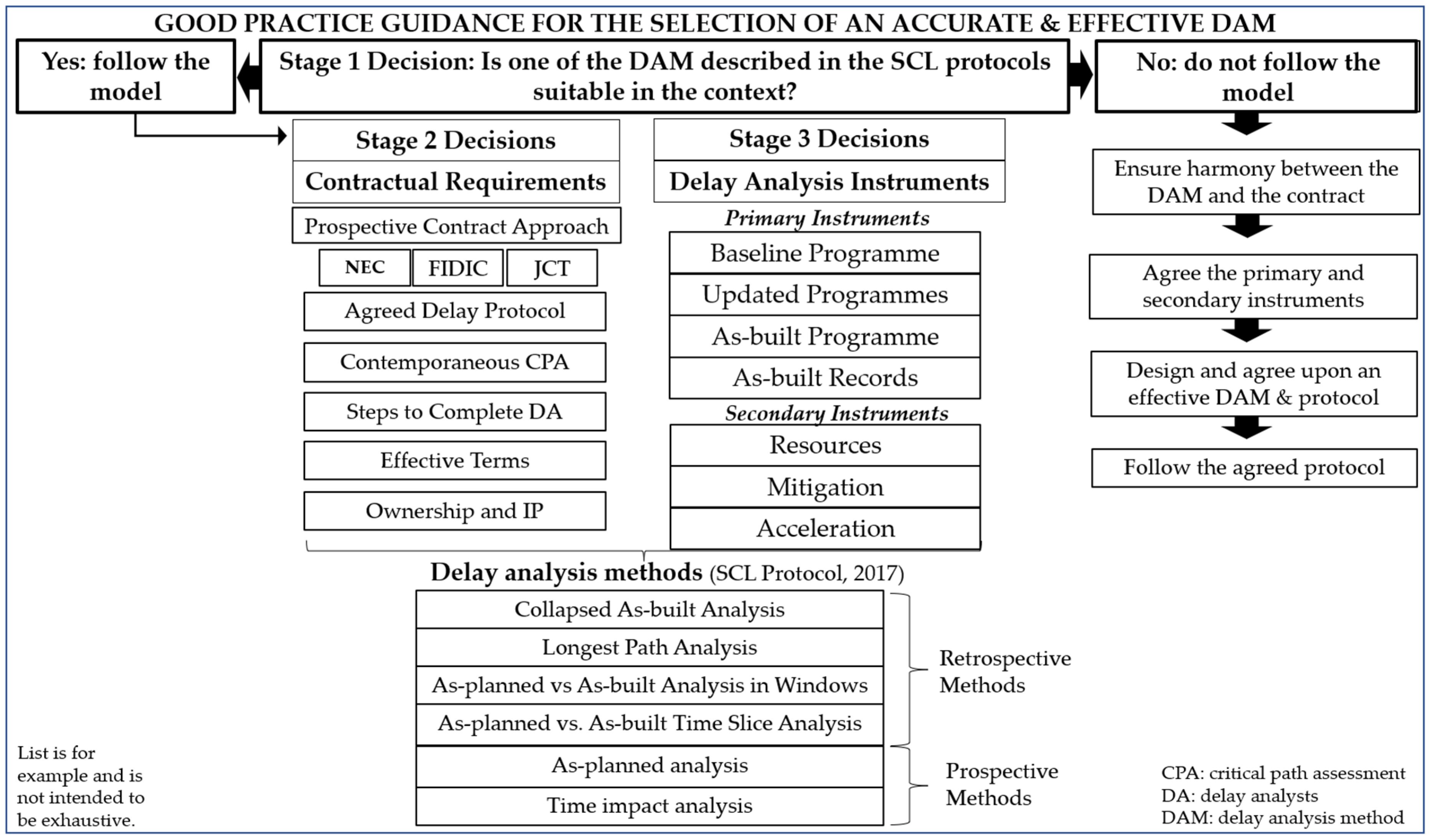

Good Practice Guidance for Selecting Delay Analysis Methods

Abstract
1. Introduction
1.1. Background and Research Rationale
- To offer good practice guidance on the selection and application of DAMs that is instrument-based, precision-oriented, impartial, effective, and coordinated with legal systems and construction contracts.
- To recommend ideas and principles that can be used to verify the effectiveness of innovative DAMs.
1.2. Legal Principles and Contract Law
1.3. Construction Contracts
1.4. Delay Analysis Methods and Primary Delay Analysis Instruments
1.5. Delay Quantification Techniques and Secondary Delay Analysis Instruments
2. Materials and Methods
3. Results
3.1. Case Law
3.2. Academic and Grey Literature
3.3. DAM Selection Guidelines
4. Discussion
5. Conclusions
Funding
Data Availability Statement
Acknowledgments
Conflicts of Interest
Abbreviations
| AACE | American Association of Cost Engineering |
| CPM | critical path method |
| DAM | delay analysis method |
| EOT | extension of time |
| FIDIC | Fédération Internationale des Ingénieurs-Conseils |
| JCT | Joint Contracts Tribunal |
| NEC | New Engineering Contract |
| SCL | Society of Construction Law |
| TCC | Technology and Construction Court |
| TIA | time impact analysis |
References
- RIBA. RIBA Construction Contracts and Law Report 2022; RIBA: London, UK, 2022; Available online: https://architecturaltechnology.com/resource/riba-construction-contracts-and-law-report-2022.html (accessed on 12 December 2025).
- Arcadis. 2022 Global Construction Disputes Report; Arcadis: Amsterdam, The Netherlands, 2022; Available online: https://www.arcadis.com/en-gb/insights/perspectives/global/global-construction-disputes-report (accessed on 11 December 2025).
- Arcadis. 2025 Global Construction Disputes Report; Arcadis: Amsterdam, The Netherlands, 2025; Available online: https://www.arcadis.com/en-gb/expertise/contract-solutions (accessed on 11 December 2025).
- Park, J.E. Schedule Delays of Major Projects: What Should We Do about It? Transp. Rev. 2021, 41, 814–832. [Google Scholar] [CrossRef]
- Society of Construction Law (UK). Society of Construction Law Delay and Disruption Protocol; Society of Construction Law (UK): Hinckley, UK, 2017; Available online: https://www.scl.org.uk/sites/default/files/documents/SCL_Delay_Protocol_2nd_Edition_Final.pdf (accessed on 11 December 2025).
- Grzeszczyk, G.; Sainati, T.; Unterhitzenberger, C. The Evolution of Forensic Delay Analysis: A Literature Review Investigating Changes and Progress in Project Management Approaches to Delay Measurement. J. Leg. Aff. Dispute Resolut. Eng. Constr. 2024, 16, 03123001. [Google Scholar] [CrossRef]
- Kirimi, H.; Wanjohi, J. Factors Influencing Use of Alternative Dispute Resolution in Construction Projects: Case of Imenti North Sub County, Meru County. Int. Acad. J. Inf. Sci. Proj. Manag. 2019, 3, 572–602. [Google Scholar]
- Atanasov, V.A.; Greenwood, D.J.; Sanchez, D.E.; Hatcher, C.J. Factual Disagreements in Construction Delay Disputes: Identification, Evaluation and Testing of the Justifications for Differences in Opinion. IOP Conf. Ser. Earth Environ. Sci. 2022, 1101, 052001. [Google Scholar] [CrossRef]
- Atanasov, V.A.; Greenwood, D.J.; Ross, H.; Sanchez, D.E. Forensic Delay Analysis as Evidence of Transaction Costs in Construction Projects. IOP Conf. Ser. Earth Environ. Sci. 2022, 1101, 052009. [Google Scholar] [CrossRef]
- Mischke, J.; Stokvis, K.; Vermeltfoort, K.; Biemans, B. Delivering on Construction Productivity Is No Longer Optional; McKinsey & Company: New York, NY, USA, 2024; Available online: https://www.mckinsey.com/capabilities/operations/our-insights/delivering-on-construction-productivity-is-no-longer-optional (accessed on 12 December 2025).
- Ližbetinová, L.; Fábera, P.; Jambal, T.; Caha, Z. Road Tax as an Economic Tool of the Support for the Development of Multimodal Transport in Selected EU States. MATEC Web Conf. 2017, 134, 00031. [Google Scholar] [CrossRef][Green Version]
- Cabinet Office. The Construction Playbook; Cabinet Office: Singapore, 2022. Available online: https://assets.publishing.service.gov.uk/media/6312222de90e075880923330/14.116_CO_Construction_Playbook_Web.pdf (accessed on 15 December 2025).
- Doyle, J.; Nardone, F.; Krisnan, V. Peak Construction (Liverpool) Ltd. v McKinney Foundations Ltd. (1970)1 BLR 111; Doyles Construction Lawyers: Sydney, Australia, 2005. [Google Scholar]
- Yang, J.; Arditi, D.; Lee, D.-E.; Mutis, I. Delay Analysis Selection Model for a Construction Project. KSCE J. Civ. Eng. 2022, 26, 4926–4941. [Google Scholar] [CrossRef]
- WASC. John Holland Pty Ltd. v The Minister for Works; WASC: Burlingame, CA, USA, 2021; p. 312. [Google Scholar]
- QSC. Built Qld Pty Ltd. v Pro-Invest Hospitality Opportunity (ST) Pty Ltd.; QSC: Costa Mesa, CA, USA, 2021; p. 224. [Google Scholar]
- Pickavance, K. Delay and Disruption in Construction Contracts, 4th ed.; Sweet and Maxwell: London, UK, 2014. [Google Scholar]
- Pohan, M. Principle of Freedom Contracts at a Company. Utopía Prax. Latinoam. 2021, 26, 158–167. [Google Scholar]
- Daadoush, G.H. The Contractual Practice and Legal Framework Applicable to Investor-States Contracts: The Principle of Sanctity of Contracts (Pacta Sunt Servanda) as the Leading Maxim of Contract Law Generally Has Priority over Changes in the Surrounding Economic Conditions. 2024. Available online: https://scholar.google.com/scholar?hl=en&as_sdt=0%2C5&q=The+Contractual+Practice+and+Legal+Framework+Applicable+to+Investor-States+Contracts%2C++Critical+Discussion+of+the+Quotes%3A+The+Principle+of+Sanctity+of+Contracts+%28pacta+sunt+servanda%29+as+the+Leading+Maxim+of+Contract+Law+Generally+has+Priority+over+Changes+in+the+Surrounding+Economic+Conditions&btnG= (accessed on 15 December 2025).
- Gillette, C.P. Standard Form Contracts. In Contract Law and Economics; Edward Elgar Publishing Ltd.: Cheltenham, UK, 2011; pp. 115–124. [Google Scholar]
- Kornet, N. The Interpretation and Fairness of Standardized Terms: Certainty and Predictability under the CESL and the CISG Compared. Eur. Bus. Law Rev. 2013, 24, 319–339. [Google Scholar] [CrossRef]
- Swenson, K. Federal District Court Judges and the Decision to Publish. Justice Syst. J. 2004, 25, 121–142. [Google Scholar] [CrossRef]
- Nicholas, G.; Partasides, C. LCIA Court Decisions on Challenges to Arbitrators: A Proposal to Publish. Arbitr. Int. 2007, 23, 1–42. [Google Scholar] [CrossRef]
- Eng, S. The Doctrine of Precedent in English and Norwegian Law: Some Common. and Specific Features; Stockholm Institute for Scandianvian Law: Stockholm, Sweden, 1993. [Google Scholar]
- Uff, J. Construction Law, 14th ed.; Sweet & Maxwell: London, UK, 2025. [Google Scholar]
- Bailii. Adyard Abu Dhabi v SD Marine Services [2011] EWHC 848 (Comm) (11 April 2011); Bailii: London, UK, 2011; Available online: https://uk.practicallaw.thomsonreuters.com/D-013-9068?transitionType=Default&contextData=(sc.Default)&firstPage=true (accessed on 14 January 2026).
- Henry Boot Construction (UK) Ltd. v Malmaison Hotel (Manchester) Ltd. (1999) 70 Con LR 32. Available online: https://uk.practicallaw.thomsonreuters.com/D-013-9101?transitionType=Default&contextData=(sc.Default) (accessed on 14 January 2026).
- CSIH. City Inn Ltd. v Shepherd Construction Ltd.; CSIH: Edinburgh, Scotland, 2010; p. 68. [Google Scholar]
- Madebwe, T.; Atanasov, V.; Pfumorodze, J. Taking Advantage of Option X29 of NEC4’s Potential to Advance Transnational Efforts to Limit Climate Impacts of Construction. Clim. Law 2025. Available online: https://rgu-repository.worktribe.com/output/3085943 (accessed on 15 December 2025).
- Patterson, R. NEC Newsletter Issue 47—Patterson on NEC Outside the UK. Available online: https://www.neccontract.com/getmedia/f6108714-0dee-4cfa-a565-8df352d7e2c3/Patterson-on-NEC-outside-the-UK-in-NEC-Newsletter-Issue-47.pdf (accessed on 10 January 2026).
- International Federation of Consulting Engineers. FIDIC Annual Report; International Federation of Consulting Engineers: Geneva, Switzerland, 2024; Available online: https://fidic.org/node/44978 (accessed on 10 January 2026).
- Slawson, W.D. Standard Form Contracts and Democratic Control of Lawmaking Power. Harv. Law Rev. 1971, 84, 529–566. [Google Scholar] [CrossRef]
- Jaeger, A.-V.; Hök, G.-S. English and International Standard Forms of Contract. In FIDIC—A Guide for Practitioners; Jaeger, A.-V., Hök, G.-S., Eds.; Springer: Berlin/Heidelberg, Germany, 2010; pp. 71–79. [Google Scholar] [CrossRef]
- Frame, S.; McEwen, L. Delay Analysis: A Comparison of the UK and US Approaches. Constr. LAW Int. 2018, 13, 53. [Google Scholar]
- Cooper, W. A Question of Programme—The Joint Contracts Tribunal; JCT: London, UK, 2016; Available online: https://corporate.jctltd.co.uk/a-question-of-programme/ (accessed on 12 December 2025).
- McInnis, J.A. The New Engineering Contract: A Legal Commentary; NEC Publishing: Tokyo, Japan, 2001. [Google Scholar]
- Odeyinka, H.A.; Lowe, J.; Kaka, A. An Evaluation of Risk Factors Impacting Construction Cash Flow Forecast. J. Financ. Manag. Prop. Constr. 2008, 13, 5–17. [Google Scholar] [CrossRef]
- Royal Brompton Hospital NHS Trust v Hammond (No. 7) (2001) EWHC Technology 39, 76 Con LR 148. 2001. Available online: https://vlex.co.uk/vid/royal-brompton-hospital-nhs-792948597 (accessed on 19 December 2025).
- Northern Ireland Housing Executive v Healthy Buildings (Ireland) Limited [2017] NIQB 43. 2017. Available online: https://uk.westlaw.com/Document/I3DF13EE0398A11E7AE85833B2CBE4728/View/FullText.html?originationContext=document&transitionType=SearchItem&ppcid=788b5d2f16f44782b0822076eb6680c9&contextData=(sc.Search)&navigationPath=Search%2Fv1%2Fresults%2Fnavigation%2F (accessed on 12 December 2025).
- Braimah, N.; Ndekugri, I. Factors Influencing the Selection of Delay Analysis Methodologies. Int. J. Proj. Manag. 2008, 26, 789–799. [Google Scholar] [CrossRef]
- AACE. 29R-03: Forensic Schedule Analysis; ACCE: Waynesville, NC, USA, 2011; Available online: https://web.aacei.org/docs/default-source/toc/toc_29r-03.pdf?sfvrsn=4 (accessed on 11 December 2025).
- Kelley, J.E.; Walker, M.R. Critical-Path Planning and Scheduling. In Papers Presented at the December 1–3, 1959, Eastern Joint IRE-AIEE-ACM Computer Conference on—IRE-AIEE-ACM ’59 (Eastern); ACM Press: Boston, MA, USA, 1959; pp. 160–173. [Google Scholar] [CrossRef]
- Parry, A. The Improvement of Delay Analysis in the UK Construction Industry; University of Northumbria at Newcastle (United Kingdom): Newcastle upon Tyne, UK, 2015; Available online: https://search.proquest.com/openview/bdf0b7ef2abc11746b9524317ff6191d/1?pq-origsite=gscholar&cbl=51922 (accessed on 12 December 2025).
- Gardiner, P.D.; Ritchie, J.M. Project Planning in a Virtual World: Information Management Metamorphosis or Technology Going Too Far? Int. J. Inf. Manag. 1999, 19, 485–494. [Google Scholar] [CrossRef]
- Sriprasert, E.; Dawood, N. Requirements Identification for 4D Constraint-Based Construction Planning and Control System. In Proceedings of the CIB W78 Conference 2002, Århus, Denmark, 12–14 June 2002. [Google Scholar]
- Zhang, H.; Tam, C.; Shi, J. Simulation-Based Methodology for Project Scheduling. Constr. Manag. Econ. 2002, 20, 667–678. [Google Scholar] [CrossRef]
- Schultmann, F.; Sunke, N. Resource Allocation in Construction Projects: The Contribution of Resource-Constrained Project Planning Models. In Proceedings of the Inaugural Construction Management and Economics “Past, Present and Future”; University of Reading: Berkshire, UK, 2007; pp. 1215–1226. [Google Scholar]
- Elmahdi, A.; Le, H.-H.; Bargstädt, H.-J. A Multi-Layer Constraint and Decision Support System for Construction Operation. In SIMUL; IARIA: Barcelona, Spain, 2011; pp. 94–100. [Google Scholar]
- Alhumaidi, H.; Tan, F. A Fuzzy Logic Approach to Model Delays in Construction Projects Using Translational Models. Civ. Eng. Environ. Syst. 2010, 27, 353–364. [Google Scholar] [CrossRef]
- Grzeszczyk, G.; Unterhitzenberger, C.; Abdelmegid, M.; Sainati, T. Beyond Guesswork: Predicting Project Delays and Timelines with a Forward-Looking Risk-Adjusted Approach. Constr. Manag. Econ. 2025, 43, 1045–1059. [Google Scholar] [CrossRef]
- Aouad, G.; Price, A.D.F. Construction Planning and Information Technology in the UK and US Construction Industries: A Comparative Study. Constr. Manag. Econ. 1994, 12, 97–106. [Google Scholar] [CrossRef]
- Wickwire, J.; Smith, R. The Use of Critical Path Method Techniques in Contract Claims. Public. Contract. Law J. 1974, 7, 1–45. [Google Scholar]
- Wickwire, J.M.; Ockman, S. Use of Critical Path Method on Contract Claims—200 Obstacles to Success. Constr. Lawyer 1999, 19, 12–21. [Google Scholar]
- Katz, J.; McConnell, W.J.; Salamirad, A.; Sargent, A. Understanding Construction Scheduling—A Critical Path to Successful Claims Handling. Tort. Trial Insur. Pract. Law J. 2022, 57, 765–800. [Google Scholar]
- Abdelhadi, Y.; Dulaimi, M.F.; Bajracharya, A. Factors Influencing the Selection of Delay Analysis Methods in Construction Projects in the UAE. Int. J. Constr. Manag. 2019, 19, 329–340. [Google Scholar] [CrossRef]
- Hopkins, K. Law Firms, Technology, and the Double-Billing Dilemma. Geo. J. Leg. Ethics 1998, 12, 95. [Google Scholar]
- Fluor v Shanghai Zhenhua Heavy Industry Co, Ltd. [2018] EWHC 1 (TCC). Available online: https://plus-lexis-com.ezproxy.rgu.ac.uk/uk/cases-uk/fluor-v-shanghai-zhenhua-heavy-industry-co-lt_4/?crid=4a722041-c797-4bc7-a4f7-ca27ff688260&pddocumentnumber=3 (accessed on 15 December 2025).
- Wang, S. Development of an Automated Transformer-Based Text Analysis Framework for Monitoring Fire Door Defects in Buildings. Sci. Rep. 2025, 15, 43910. [Google Scholar] [CrossRef]
- Wang, S. Graph Neural Network–Driven Text Classification for Fire-Door Defect Inspection in Pre-Completion Construction. Sci. Rep. 2025, 15, 44382. [Google Scholar] [CrossRef] [PubMed]


| Entry | Judicial Decision | Case Citation |
|---|---|---|
| 1 | Detailed, valid, reliable, fully logically linked, regularly and frequently updated programmes, and as-built data are the primary instruments required for the determination of the impact of construction delays. If a contractor and an employer formed a contract that requires proactive resolution of claims and then do not conform to the prospective nature of the contract and the delay assessments, the infringing party should not benefit from such an infringement by relying on a theoretical prospective delay assessment after the impact of the delay has materialized and is known. | The Royal Brompton Hospital NHS Trust v Frederick Alexander Hammond and Others (No. 7) (2001) EWHC Technology 39, 76 Con LR 148; George Sollitt Constr. Co. v. United States, 64 Fed. Cl. 229, 238 n. 8 (2005); Kane Constructions Pty Ltd. v Sopov (2005) VSC (30 June 2005); Northern Ireland Housing Executive v Healthy Buildings (Ireland) Limited [2017] NIQB 43; SCL, (2017). |
| 2 | The DAMs that rely upon the use of such programmes produce relatively more accurate results as long as (a) the updated programmes are contemporaneously validated against the as-built data and concurrently verified by both parties to ensure that, inter alia, the facts do not collide with the programme logic; (b) the analysis is conducted in an objective, logical, and detailed way; (c) the programmes include all works and are produced at regular and reasonably short intervals; and (d) the programmes and the analysis incorporate the effect of all operative delays but exclude significant errors and are supported by additional studies (e.g., analysis of resources). | Skanska Construction UK Ltd. v Egger (Barony) Ltd. (2004) EWHC 1748 (TCC); John Barker Construction Limited v. Portman Hotel Limited (1996) 83 BLR; Balfour Beatty Construction Limited v The Mayor and Burgesses of the London Borough of Lambeth (2002) BLR 288; George Sollitt Constr. Co. v. United States, 64 Fed. Cl. 229, 238 n. 8 (2005); Mirant Asia-Pacific Construction (Hong Kong) Ltd. v Ove Arup Partners International Ltd. & Anor [2007] EWHC 918 (TCC). |
| 3 | As far as the regularity of the programme updates is concerned, it is accepted that one month is a reasonable interval. However, the as-built data should be produced more frequently, for example, on a daily or a weekly basis, when, e.g., such data is likely to be required to assess the criticality of the works. | Walter Lilly & Company Ltd. v Mackay and Anor (2012) EWHC 1773 (TCC). |
| 4 | Generally, the delay must exceed the total float in the programme to demonstrate a loss and recover damages. Only delays on the critical path of a construction project (or a section of a project) can affect the completion/section completion date of that project. | Blackhawk Heating & Plumbing Co., GSBCA No. 2432, 75-1 BCA ¶ 11,261 (1975); Ascon Contracting Ltd. v Alfred McAlpine Construction Isle of Man Ltd. (1999) 66 Con. |
| 5 | Whether the DAM relied upon for the assessment of construction delays is prospective or retrospective is dictated by the contract type and terms. | Built Qld Pty Ltd. v Pro-Invest Hospitality Opportunity (ST) Pty Ltd. [2021] QSC 224 and John Holland Pty Ltd. v The Minister for Works [2021] WASC 312. |
| 6 | It is important to consider, evaluate, and demonstrate the impact of activities and events on near-critical paths, as well as the critical path, to understand their potential impact on construction projects and the completion/section completion dates. | Skanska Construction UK Ltd. v Egger (Barony) Ltd. (2004) EWHC 1748 (TCC). |
| 7 | A valid critical path must be established both initially and at regular intervals, as well as all material points, because the critical path can change throughout construction projects. | Balfour Beatty Construction Limited v The Mayor and Burgesses of the London Borough of Lambeth (2002) BLR 288. |
| 8 | Only delays on the critical path can affect completion; specifically, what must be demonstrated is: (a) a delay to an activity on the critical path must occur (which is of a certain number of days) and (b) that delay, in fact, delayed the completion date at the end of the project (or one or more section completion dates) by a given number of days after taking account of any mitigation or acceleration measures and/or descoping of construction projects. Resources, mitigation, or acceleration measures must be taken into account when EOT claims are prepared and assessed. The analysis must include the interrelationship between all the operative delays/events from the start to the finish of a project. | Santa Fe, Inc., VABCA No. 1943–1946, 84-2 BCA ¶ 17,341 (1984); Henry Boot Construction (UK) Ltd. v Malmaison Hotel (Manchester) Ltd. (1999) 70 Con LR 33; Morrison Knudsen Corp. v. Fireman’s Fund Insurance Co., 175 F.3rd 1221 (10th Cir. 1999); Motherwell Bridge Construction Ltd. v Micafil Vakuumtechnik (2002) 81 ConLR 44; Mirant Asia-Pacific Construction (Hong Kong) Ltd. v Ove Arup Partners International Ltd. & Anor [2007] EWHC 918 (TCC); Costain Ltd. v Charles Haswell & Partners Ltd. (2009) EWHC 3140 (TCC); City Inn Ltd. v Shepherd Construction Ltd. [2010] ScotCS CSIH 68. |
| 9 | Although it is accepted that the interpretation (e.g., prospective or retrospective) of the critical path should be dictated by the contract, contemporaneous critical path assessments are recommended for preparation, assessment, and award of EOT entitlements because, among other things, contractors typically use forecasts to identify the planned/projected critical paths of construction projects and rarely have the benefit of hindsight. | UK Petrochemicals Ltd. v Punj Lloyd Ltd. [2013] EWHC 2916 (TCC); Van Oord UK Ltd. & Anor v Allseas UK Ltd. [2015] EWHC 3074 (TCC). |
| 10 | Analyses of resources, mitigation, and acceleration measures are essential in the determination of the impact of delays. | Vivergo Fuels Ltd. v Redhall Engineering Solutions Ltd. [2013] EWHC 4030 (TCC). |
| 11 | There are no legal rules that prevent parties to contracts from selecting, drafting, and/or amending construction contracts in such ways to incorporate protocols for the assessment of construction delays that specify, inter alia, the DAMs, the way criticality will be calculated, and the programmes and as-built data required to complete the delay analysis, including each step that delay analysts should undertake to complete such assessments and how the as-built data will be acquired, stored, and shared between all parties, including the frequency of as-built data updates. | Built Qld Pty Ltd. v Pro-Invest Hospitality Opportunity (ST) Pty Ltd. [2021] QSC 224; John Holland Pty Ltd. v The Minister for Works [2021] WASC 312. |
| 12 | Unilaterally modified DAMs are likely to cause disagreements over delay assessments. | Thomas Barnes & Sons Plc v Blackburn with Darwen Borough Council [2022] EWHC 2598 (TCC). |
Disclaimer/Publisher’s Note: The statements, opinions and data contained in all publications are solely those of the individual author(s) and contributor(s) and not of MDPI and/or the editor(s). MDPI and/or the editor(s) disclaim responsibility for any injury to people or property resulting from any ideas, methods, instructions or products referred to in the content. |
© 2026 by the author. Licensee MDPI, Basel, Switzerland. This article is an open access article distributed under the terms and conditions of the Creative Commons Attribution (CC BY) license.
Share and Cite
Atanasov, V.A. Good Practice Guidance for Selecting Delay Analysis Methods. Buildings 2026, 16, 831. https://doi.org/10.3390/buildings16040831
Atanasov VA. Good Practice Guidance for Selecting Delay Analysis Methods. Buildings. 2026; 16(4):831. https://doi.org/10.3390/buildings16040831
Chicago/Turabian StyleAtanasov, Vasil Angelov. 2026. "Good Practice Guidance for Selecting Delay Analysis Methods" Buildings 16, no. 4: 831. https://doi.org/10.3390/buildings16040831
APA StyleAtanasov, V. A. (2026). Good Practice Guidance for Selecting Delay Analysis Methods. Buildings, 16(4), 831. https://doi.org/10.3390/buildings16040831