


Abstract
Life Cycle Assessment (LCA) is widely applied in building research and practice to quantify environmental impacts, yet its contribution to architectural decision-making remains limited. This paper argues that this limitation is not primarily methodological, but interpretative. LCA results are often presented independently of the hierarchy, timing, and reversibility of architectural decisions, obscuring where environmental responsibility can meaningfully be exercised. This study reframes LCA as an interpretative tool for understanding environmental responsibility across successive orders of architectural decision-making. A conceptual framework linking decision hierarchy, reversibility, and the temporal distribution of impacts is developed and examined through six deliberately selected case studies drawn from the peer-reviewed literature. The cases span early geometric and structural decisions, retrofit strategies, operational constraints, regulatory lock-in, and methodological assumptions. The analysis shows that the effectiveness of LCA varies systematically with decision order. At early design stages, LCA can inform highly irreversible choices and shape long-term environmental trajectories. At later stages, its role shifts toward exposing constrained trade-offs, residual conflicts, and limited remaining agency rather than enabling optimisation. By explicitly linking life-cycle impacts to decision hierarchy and time, this paper addresses a conceptual gap in current LCA research and supports more reflective architectural decision-making under uncertainty.
1. Introduction
1.1. Life Cycle Assessment in Building Design: Maturity Without Decision Clarity
Life Cycle Assessment (LCA) has become a central instrument in the environmental evaluation of buildings. Over the past two decades, methodological refinement, database development, and regulatory uptake have transformed LCA from a research-oriented method into a widely applied assessment framework used in design practice, certification systems, and policy guidance [1,2,3]. Today, LCA is routinely employed to quantify embodied emissions, operational impacts, and life-cycle costs across both new construction and retrofit scenarios [4,5].
Despite this methodological maturity, a persistent gap remains between assessment and architectural decision-making. In practice, Life Cycle Assessment is frequently applied as an ex post verification tool, while its potential role as an ex ante design support remains largely unrealised, particularly at early design stages when architectural decisions exerting the greatest long-term influence and the largest degrees of freedom are still available [1,6,7]. Results are often communicated as aggregated indicators, rankings, or compliance scores, while the decision structure that produced those outcomes remains implicit.
This disconnect between assessment and decision-making has been repeatedly observed in systematic reviews of LCA practice. Ref. [8] shows that LCA is most commonly introduced after major architectural decisions have already been made, when its capacity to influence design direction is inherently limited. Similarly, ref. [9] note that early architectural design variables such as the building plan, window-to-wall ratio, and primary envelope materials are widely recognised as influential, yet are rarely evaluated through life-cycle metrics at the moment when these variables are first defined.
Recent reviews focusing on the integration of Life Cycle Assessment into early design workflows through Building Information Modelling, parametric modelling, and artificial intelligence confirm the growing availability of assessment tools, while leaving largely unaddressed how LCA results should be interpreted in relation to architectural decision hierarchy and reversibility [10]. As ref. [8] notes, this tendency contributes to a predominantly reactive use of LCA, where assessment is introduced after key design outcomes have already been established.
Several review studies highlight this limitation. Ref. [3] observes that embodied carbon reduction strategies are frequently discussed in isolation from broader architectural logic, leading to fragmented and sometimes contradictory recommendations. Ref. [11] demonstrates that different methodological choices in circular renovation LCA can generate opposing conclusions for the same building. Ref. [12] further shows that high circularity scores do not necessarily correspond to lower global warming potential.
Taken together, these findings suggest that the primary challenge facing LCA in architectural design is no longer methodological, but interpretative: how assessment results are read, contextualised, and translated into design decisions across time. This challenge is particularly acute at early design stages, where uncertainty is high but long-term environmental trajectories are established [8,13].
1.2. Environmental Conflicts as a Structural Feature of Building Design
A growing body of literature indicates that environmental performance in buildings is shaped by structural conflicts embedded in architectural design, not by isolated inefficiencies. Trade-offs between embodied and operational emissions, between comfort and resilience, or between durability and adaptability are intrinsic to architectural decision-making and cannot be eliminated through single-parameter optimisation [3,14,15].
Large-scale empirical investigations of completed buildings further demonstrate that environmental performance does not scale linearly with the increased use of any single material commonly labelled as “low-impact”. Analyses across multiple impact categories show that improvements observed in one indicator are frequently accompanied by stagnation or increases in others, reflecting the multi-dimensional nature of life-cycle environmental burdens. In practice, material substitution strategies therefore tend to redistribute impacts across categories, without delivering proportional reductions in overall environmental burden. Such findings confirm that environmental conflicts in buildings are not artefacts of modelling assumptions or limited case studies, but emerge consistently in real-world datasets when whole-building performance is evaluated across a broad set of indicators [16].
A frequently cited example concerns the role of thermal mass. Increasing thermal inertia can enhance summer stability and resilience to heat waves, yet typically increases construction-stage emissions [4,17]. Comparable tensions arise between long-lived, durable assemblies and future adaptability, where reduced replacement frequency may come at the cost of material lock-in and reduced flexibility [14,18].
Whole-building studies further demonstrate that such conflicts are often embedded in early architectural decisions related to form and structure. Parametric explorations of concept-stage design space show that variations in building geometry and structural configuration can lead to substantial differences in cumulative life-cycle carbon, with compact forms and structurally efficient systems consistently outperforming more articulated alternatives [13]. These differences cannot be neutralised by later-stage optimisation, as they originate in decisions that define material quantities and load paths at the outset.
Life Cycle Assessment is uniquely suited to reveal such conflicts because it integrates impacts over time. However, when results are reduced to single aggregated indicators, these tensions are easily obscured. Solutions that appear favourable under one boundary condition may represent substantial compromises under another, particularly when future climate scenarios and changing energy systems are considered [1,18,19].
Recognising environmental conflicts as structural features of architectural design implies that the role of Life Cycle Assessment is to clarify and locate trade-offs, making them explicit, comparable, and traceable to specific design decisions. This interpretative role becomes particularly relevant at early design stages, where conflicts are latent but design trajectories remain open to modification [8,9].
Recent prospective whole-life carbon analyses show that neglecting temporal variations in grid and material decarbonisation may significantly distort long-term environmental trajectories, with dynamic modelling approaches indicating reductions of over 50% relative to static LCA calculations [20].
1.3. Circularity Beyond Indicators: Testing Decision Quality over Time
The discourse on circular economy in the built environment further illustrates the interpretative limits of conventional LCA practice. Circularity is often framed as a set of material strategies, including reuse, recycling, and design for disassembly, evaluated through dedicated indicators or certification credits [21,22]. While valuable, such approaches risk treating circularity as an end in itself, detached from the architectural decisions that generate material flows and replacement patterns. Critical contributions to the circular economy debate emphasise that circularity frameworks are inherently normative and decision-laden, and that an exclusive focus on material loops can shift environmental burdens across life-cycle stages without resolving them [23].
Recent studies demonstrate that circular strategies can generate unintended environmental burdens when assessed over the full life cycle. Ref. [14] shows that circular internal wall systems may increase life-cycle emissions due to additional material flows and shorter replacement cycles. Ref. [11] highlights how methodological choices in circular LCA strongly influence outcomes, while ref. [12] shows that circularity metrics and embodied carbon reduction do not necessarily align.
These findings support a conceptual shift increasingly reflected in the recent literature. Circularity should be understood as a test of decision quality over time, capturing whether early architectural choices allow selective adaptation and replacement without introducing disproportionate environmental burdens in later life-cycle phases [11,22]. The capacity of a building to accommodate change, enable selective replacement, and avoid unnecessary material lock-in is therefore determined primarily by early decisions related to form, structure, and system integration.
Material lock-in is largely determined by early architectural decisions related to form, geometry, structural logic, and system integration. Empirical evidence from early stage design studies indicates that these decisions dominate both embodied impacts and the scope for future adaptation [9,13].
From this perspective, circularity represents a temporal conflict problem. It concerns not only end-of-life scenarios, but also the timing, frequency, and scope of interventions throughout the building’s existence [18,24]. LCA can reveal these dynamics only when results are interpreted in relation to decision hierarchy and the temporal distribution of impacts.
1.4. From Optimisation to Interpretation: The Role of Pareto Thinking
Multi-objective optimisation and Pareto analysis are increasingly applied to address environmental trade-offs in building design [3,25,26]. These methods explicitly acknowledge that improving one criterion often requires sacrificing another, generating sets of non-dominated solutions instead of a single optimum.
In practice, however, Pareto fronts are frequently misinterpreted as selection tools, while their primary value lies in representing underlying conflict. Designers may be encouraged to identify a “best” Pareto point without sufficient reflection on what is being compromised, at which decision level, and over what time horizon [27,28]. Reviews of LCA integration into design workflows further suggest that this tendency is reinforced by tool-driven optimisation environments that prioritise numerical convergence over interpretative clarity [8].
This article adopts a different stance. Drawing on design theory, reflective practice, and anthropological accounts of architectural practice [29,30], Pareto analysis is treated as an interpretative language that articulates the structure of environmental trade-offs, while responsibility for selection remains normative and context-dependent.
Importantly, many architectural trade-offs are not simultaneous but distributed over time. Circularity, adaptability, and resilience can therefore be understood as Pareto problems unfolding along temporal axes and across successive stages of the building life cycle, instead of being expressed solely through concurrent performance indicators. Making this temporal dimension explicit is essential for responsible architectural decision-making under uncertainty, particularly in early stage design contexts where long-term impacts are shaped under conditions of limited information [8,13].
1.5. Literature Gap: From Quantified Impacts to Interpretable Design Decisions
Despite extensive methodological development, current literature lacks an explicit interpretative framework that connects Life Cycle Assessment outcomes with the hierarchy, timing, and reversibility of architectural design decisions.
Studies on embodied carbon, circularity, and multi-objective optimisation typically address isolated performance dimensions, while the structural relationships between early design choices, temporal impact distribution, and unavoidable environmental conflicts remain implicit. Circularity is frequently operationalised through indicators or certification criteria, and Pareto-based optimisation is commonly applied as a selection mechanism, without clarifying how these tools relate to decision order, time, and architectural responsibility. Systematic reviews repeatedly note that early design decisions are recognised as influential, yet insufficiently supported by LCA-based decision guidance [8,9].
As a result, LCA is often able to quantify environmental impacts with high numerical precision, yet provides limited support for understanding why particular design trajectories emerge and where meaningful environmental responsibility can still be exercised within the design process.
1.6. Aim and Contribution of the Article
Against this background, this article argues that the primary value of Life Cycle Assessment in architectural design lies in structuring environmental decision-making. The study reframes LCA as an interpretative device that makes structural and temporal design conflicts explicit, without proposing new indicators or optimisation techniques.
The article contributes to current debates in four ways. First, it introduces a decision hierarchy framework that links environmental impacts to the reversibility and long-term influence of architectural choices. Second, it reinterprets circularity as a temporal test of decision quality, moving beyond its use as a standalone performance objective. Third, it positions Pareto analysis as an interpretative language for reading environmental trade-offs, with responsibility for selection remaining normative and context-dependent. Fourth, these concepts are operationalised through six case studies intentionally positioned across different decision orders.
Together, these contributions provide a conceptual and practical basis for using LCA as a tool for reflective and responsible architectural decision-making under uncertainty. In doing so, the article addresses a conceptual gap in current LCA research by linking quantified environmental impacts to the structure and reversibility of architectural decision-making.
2. Conceptual Framework: Interpreting Life Cycle Assessment as a Design Decision Tool
Life Cycle Assessment is commonly presented as a neutral analytical method for quantifying environmental impacts within predefined system boundaries. However, as established in the preceding sections, its relevance for architectural design depends less on numerical precision than on how results are interpreted in relation to design decisions, time, and uncertainty. This section therefore outlines the conceptual framework adopted in this article, positioning LCA not as an optimisation instrument, but as an interpretative support for reflective architectural decision-making.
2.1. Design Decisions as Interpretative Context
From a design-theoretical perspective, architectural decisions are not homogeneous. They differ fundamentally in timing, reversibility, and long-term influence on building performance. Design theory characterises architectural practice as a reflective process in which early framing decisions define the space of possible outcomes, while later adjustments operate within constraints already established. Architectural design is therefore shaped by path dependency, with early decisions exerting disproportionate influence over subsequent possibilities.
In the context of environmental assessment, this implies that LCA results cannot be meaningfully interpreted without reference to the order of decisions that produced them. A growing body of research implicitly acknowledges this asymmetry by showing that early stage design choices dominate life-cycle impacts, while later optimisations often yield marginal improvements. Yet this insight is rarely formalised as an explicit interpretative framework. As a result, LCA outcomes are frequently detached from the decision structures that generated them, obscuring where environmental responsibility is exercised and where it has already been constrained.
2.2. Time, Durability, and Path Dependency
A second conceptual dimension concerns time. Buildings are long-lived artefacts whose environmental impacts unfold unevenly across decades. Emissions associated with material production occur largely upfront, while operational emissions, maintenance, replacements, and adaptations accumulate gradually and remain highly sensitive to future climate conditions, energy systems, and patterns of use. Treating LCA outputs as static indicators therefore risks masking the temporal structure of environmental trade-offs.
This temporal dimension is particularly critical in discussions of circularity and adaptability. Recent studies show that circular strategies can shift environmental burdens when replacement cycles, additional material flows, and uncertainty are taken into account, even when reductions are observed in selected indicators. Circularity thus emerges as a means of testing whether early design decisions allow selective change over time without generating disproportionate environmental costs. From this perspective, circularity is not a discrete performance attribute, but a temporal property of design decisions whose consequences unfold throughout the building life cycle.
2.3. Environmental Conflict and the Limits of Optimisation
A third element of the conceptual framework concerns environmental conflict. Building performance is shaped by competing objectives that cannot be simultaneously maximised. Multi-objective optimisation and Pareto analysis formalise this condition by identifying sets of non-dominated solutions and by explicitly acknowledging trade-offs between criteria such as embodied emissions, operational performance, comfort, and adaptability.
In practice, Pareto fronts are often treated as selection tools, even though their analytical value lies in representing unavoidable conflict. This article adopts a different stance. Building on design theory and critiques of optimisation-driven sustainability assessment, Pareto analysis is treated here as an interpretative language that articulates the structure of environmental trade-offs. Pareto diagrams are used to show where conflicts occur, how fragile particular compromises are, and which decisions constrain future options. Responsibility for choosing among trade-offs remains normative and context-dependent, residing with the designer.
Within this framework, Life Cycle Assessment is not expected to produce a single optimised outcome. Its primary value lies in revealing how environmental impacts are distributed across time and across different orders of design decisions. When combined with an explicit recognition of decision hierarchy, temporal dependency, and environmental conflict, LCA becomes a tool for understanding the consequences and limits of architectural choices, instead of an instrument aimed at eliminating trade-offs.
This conceptual framework is examined through six deliberately selected case studies, each positioned at a distinct level of the architectural decision hierarchy. Together, they illustrate how similar assessment tools reveal fundamentally different environmental conflicts depending on where and when design decisions are made.
Figure 1 synthesises this conceptual framework by situating Life Cycle Assessment within a hierarchy of architectural decisions that differ in timing, reversibility, and long-term influence. Rather than presenting LCA as a uniform optimisation tool, the diagram clarifies how its interpretative role shifts as design decisions accumulate, and how environmental conflicts are revealed, constrained, or reconfigured across successive decision orders. This framework provides the analytical structure through which the following case studies are examined.
Figure 1.
Interpreting life cycle assessment across architectural decision orders.
The diagram presents a hierarchical and interpretative framework rather than a procedural or causal model. It illustrates how the role of Life Cycle Assessment shifts as architectural decisions accumulate and become increasingly irreversible over time, clarifying where environmental agency is greatest and where it becomes progressively constrained.
3. Case-Based Analytical Method
3.1. Rationale for Case Selection and Analytical Positioning
The methodological approach adopted in this article is grounded in the assumption that environmental conflicts in building design cannot be fully understood through abstract modelling or indicator-based comparisons alone. Instead, such conflicts become most legible when Life Cycle Assessment results are interpreted in relation to concrete architectural decisions made at different stages of the design process. For this reason, the study employs a deliberately selective, case-based analytical method.
The case studies are not intended to represent best practices, optimisation benchmarks, or statistically representative samples. They function as analytical probes positioned along the hierarchy of architectural decisions, allowing specific types of environmental conflict to be isolated and examined. This approach aligns with traditions in design research in which case studies are used to expose structural relationships and decision logic, with emphasis placed on interpretative insight and analytical understanding of design processes.
While case-based reasoning is widely applied in sustainability and building research, it is often used to illustrate technical solutions or demonstrate optimisation potential. In the present study, cases are positioned explicitly in relation to decision order, reversibility, and temporal impact distribution, and are treated as methodological instruments designed to reveal how environmental conflicts emerge across different stages of architectural decision-making.
Six cases were selected to span successive levels of the decision hierarchy, from early geometric and structural decisions to retrofit, operational, regulatory, and methodological constraints. The selection follows three criteria derived from the conceptual framework. First, each case involves a clearly identifiable dominant decision order. Second, each case exhibits a distinct environmental conflict that cannot be resolved through lower-order optimisation alone. Third, each case is documented in peer-reviewed literature using Life Cycle Assessment or closely related assessment methods, ensuring transparency and comparability.
3.2. Analytical Structure: LCA, Circularity, and Pareto Interpretation
Each case is analysed through three interrelated analytical lenses: Life Cycle Assessment, circularity, and Pareto interpretation. These perspectives are applied jointly and integrated into a single interpretative framework, instead of being treated as independent methods.
Life Cycle Assessment provides the primary means of tracing environmental impacts over time. In this study, LCA is used to examine how impacts are distributed across life-cycle phases and decision moments, with emphasis placed on interpretation within the design process. Particular attention is given to the distinction between upfront embodied emissions and impacts accumulating through operation, maintenance, and replacement, as these processes decisively shape long-term environmental trajectories. Circularity is analysed as a temporal dimension of life-cycle interpretation, not as a separate performance domain. Circular strategies are understood to modify the timing, frequency, and scope of material interventions, without necessarily reducing cumulative environmental impacts. Within this framework, circularity serves as a diagnostic of whether early architectural decisions allow selective change over time without generating disproportionate environmental burdens.
Pareto analysis is used to articulate environmental conflict. Pareto fronts are interpreted as representations of trade-offs between competing objectives that inform understanding of environmental compromise, not as rules for selecting preferred solutions. This interpretative use aligns with critiques emphasising that optimisation methods cannot replace normative judgement in design contexts. Several conflicts identified in the cases unfold over time and across successive life-cycle stages, challenging static optimisation approaches and underscoring the need for trajectory-based interpretation under changing climatic and contextual conditions.
3.3. Linking Cases to the Decision Hierarchy
To ensure consistency across cases, each study is analysed using a common interpretative structure that explicitly links environmental outcomes to decision order. Four orders of architectural decision-making are distinguished: first-order decisions related to form and geometry; second-order decisions concerning structural systems and envelope logic; third-order decisions involving passive and technical strategies; and fourth-order decisions associated with operation, control, and user behaviour.
For each case, the dominant decision order is identified and the corresponding environmental conflict is interpreted in relation to its reversibility and temporal implications. This structure enables comparison across cases without reducing them to a single performance metric, and clarifies why certain conflicts cannot be mitigated through later interventions, even when advanced systems or circular strategies are introduced.
3.4. Scope and Limitations
The case-based analytical method adopted in this study is intentionally qualitative and interpretative. It does not aim to provide statistically generalisable results or universal design prescriptions. Instead, it seeks to identify recurrent patterns in how environmental conflicts manifest across different decision orders and temporal horizons.
The cases are presented in a condensed form, with emphasis placed on dominant conflicts and their interpretative significance. This approach limits direct quantitative comparison while enhancing interpretative clarity and aligning with the article’s objective of supporting reflective architectural decision-making and informed judgement.
The method is also sensitive to system boundary definitions and scenario assumptions, a limitation inherent to all LCA-based analyses. The study therefore treats uncertainty as an integral part of the design context, reinforcing the argument that environmental responsibility cannot be reduced to deterministic outcomes or single-point estimates.
Within these limits, the case-based approach provides a robust framework for examining how Life Cycle Assessment, circularity, and Pareto interpretation interact with architectural decision hierarchy. The following section applies this framework to six case studies, illustrating how environmental conflicts shift character depending on where and when design decisions are made.
All case studies are discussed using the definitions, benchmarks, and assumptions reported in the original source publications; LCA results are not recalculated, but consistently interpreted across decision orders.
To support cross-case synthesis and reader navigation, Table 1 summarises the six analysed case studies in terms of decision order, temporal framing, and the dominant environmental conflict revealed through life-cycle interpretation.
Table 1.
Cross-case comparison of decision order, temporal framing, and dominant environmental conflict identified through LCA interpretation.
4. Case Studies Across Decision Orders
Each case study analysed in this section is drawn from previously published, peer-reviewed research and reinterpreted here as an analytical probe situated at a distinct level of the architectural decision hierarchy. The cases are intentionally concise and selective; their purpose is not to reproduce full methodological workflows, but to demonstrate how environmental conflicts revealed by Life Cycle Assessment change in nature as design decisions shift from early geometric definition to later stages of structural commitment, retrofit constraint, operation, regulation, and methodological assumption.
The case studies are ordered according to the level of decision-making at which LCA becomes operative, illustrating how its role evolves from shaping environmental trajectories to interpreting constraints as design freedom progressively narrows across time, context, and scale.
Case Study 1. First-order decisions: envelope geometry and immediate environmental constraints
(based on [31])
This case examines fenestration geometry and external shading design in a hot–humid climate as an example of first-order architectural decisions, whose environmental consequences are immediate, non-accumulative, and largely irreversible. The analysed study investigates window-to-wall ratio (WWR), façade orientation, and shading configuration using multi-objective optimisation of energy use intensity (EUI), thermal comfort percentage (TCP), daylight metrics (UDI, sDA), and view performance.
The decisive feature of this case is that the dominant design variables—window orientation and WWR—are fixed prior to any life-cycle reasoning. These parameters establish the fundamental solar exposure and daylighting regime of the space and therefore define the boundary conditions within which all subsequent material or system-level adjustments must operate. From the perspective adopted in this article, they represent archetypal first-order decisions.
The results demonstrate that geometric decisions alone generate environmental performance differences of a magnitude comparable to full system-level optimisation. Relative to the baseline configuration, the best-performing variants achieved reductions in EUI of 18.6–25.6%, alongside improvements in TCP of 11.2–23.2%. However, these gains were accompanied by substantial and unavoidable trade-offs in daylight autonomy: sDA was reduced by 63–91% in the lowest-EUI solutions. Correlation analysis confirms the structural nature of these conflicts. Across all orientations and shading types, TCP and EUI exhibit strong positive correlations (Pearson r = 0.71–0.98), while TCP and sDA show strong negative correlations (r down to –0.82), indicating that improvements in thermal comfort and energy performance are systematically coupled to losses in daylight autonomy.
Crucially, these conflicts emerge instantaneously. They are not the result of cumulative operational effects or long-term climate evolution, but of the geometric relationship between the façade and solar radiation. No subsequent optimisation of materials, systems, or control strategies can recover the lost degrees of freedom once unfavourable first-order choices have been made. From a life-cycle perspective, this implies that LCA applied after geometric decisions have been fixed cannot alter the environmental trajectory; it can only reveal the structure and steepness of the trade-offs already embedded in the design.
Interpreted through a Pareto lens, this case does not present a problem of selecting an optimal solution over time. Instead, the Pareto front maps an immediate conflict surface, where marginal gains in one performance dimension entail disproportionate losses in another. The primary value of LCA in this context lies in making this conflict legible, not in resolving it. The case therefore illustrates how first-order decisions delimit the environmental solution space before life-cycle assessment becomes operative as a decision-support tool.
From immediate geometric conflicts to time-distributed structural trajectories
The first case demonstrates how environmental conflicts can be generated instantaneously by first-order geometric decisions, before any meaningful life-cycle reasoning becomes possible. In that context, LCA functions primarily as an interpretative device that reveals the severity and irreversibility of trade-offs already embedded in the design.
However, not all architectural decisions produce immediate effects. Some choices do not manifest as abrupt conflicts between performance indicators, but instead shape how environmental impacts accumulate, shift, and reconfigure over time. In such cases, the relevance of life-cycle assessment emerges not at the moment of decision, but through the temporal evolution of building performance under changing climatic and energy-system conditions.
This distinction becomes critical when moving from geometric decisions to structural ones.
Case Study 2. Second-order decisions: thermal mass, ground coupling, and time-distributed environmental trajectories
(based on [17])
The second case addresses second-order architectural decisions related to structural logic, thermal mass, and interaction with the ground, using a prospective life-cycle assessment of two full-scale residential buildings in a temperate transitional climate. Unlike the immediate, non-accumulative conflicts observed in Case Study 1, the environmental consequences examined here unfold gradually and become legible only over extended time horizons.
The study compares two geometrically identical, equally used dwellings: a medium-weight masonry building directly coupled to the ground (B1) and a lightweight timber-frame building with a fully insulated slab-on-ground (B2). Both buildings were empirically monitored over multiple seasons and evaluated using a cradle-to-grave LCA over a 75-year horizon (2026–2100), incorporating three Shared Socioeconomic Pathways and stepwise grid decarbonisation. Heating and cooling demands were modelled dynamically, reflecting projected climate warming and shifts in seasonal energy balance.
At the outset, B2 exhibits a short-term operational advantage due to lower heating demand. However, this advantage erodes as cooling demand increases under warmer conditions. By contrast, B1 leverages structural thermal inertia and direct ground coupling to buffer indoor temperatures passively, delaying or avoiding the need for mechanical cooling. This divergence becomes increasingly pronounced over time. Cumulative operational emissions over the full assessment period amount to 25.4 t CO2 for B1 and 28.4 t CO2 for B2, despite grid decarbonisation reducing absolute emissions in both cases.
When embodied emissions (A1–A3), operational emissions (B6), and end-of-life impacts (C1–C4) are aggregated, the long-term implications of the second-order design choices become clear. Total cradle-to-grave emissions reach 69.6 t CO2 for B1 and 75.2 t CO2 for B2, corresponding to annualised values of 7.07 vs. 8.15 kg CO2·m−2·yr−1, an approximately 8% reduction for the ground-coupled, massive configuration. Even when a conservative biogenic carbon credit is applied to timber components in B2, the lightweight building exceeds B1’s cumulative emissions after 15–16 years of operation.
The significance of this case lies not in the absolute magnitude of the percentage difference, but in its temporal structure. The environmental benefit of thermal mass and ground coupling is modest in the early years and grows steadily as cooling demand becomes dominant. This behaviour cannot be captured by static LCAs or short-term performance indicators. It requires a prospective framework that accounts for climate trajectories, evolving energy systems, and the delayed manifestation of operational penalties in lightweight envelopes.
From the perspective of decision hierarchy, this case exemplifies second-order decisions whose consequences are neither immediate nor easily reversible. Once the structural system and floor–ground relationship are established, their influence persists throughout the building’s life, shaping operational resilience, cooling dependency, and cumulative emissions. Here, LCA functions not as a tool for fine-tuning performance, but as a means of revealing long-term environmental trajectories and identifying break-even points that are invisible in conventional assessments.
Together with Case Study 1, this analysis highlights a fundamental distinction: while first-order geometric decisions impose instant constraints on environmental performance, second-order structural decisions govern how environmental impacts accumulate and transform over decades. Life-cycle assessment becomes decision-relevant only when these temporal dimensions are explicitly recognised.
From time-distributed trajectories to constrained optimisation
Case Study 2 demonstrated that second-order decisions related to structural logic, thermal mass, and ground coupling generate environmental effects that unfold gradually and become visible only through prospective life-cycle assessment. In that context, LCA revealed how early structural commitments shape long-term emission trajectories, particularly as cooling demand increases under climate change.
However, many real-world design situations do not allow such fundamental decisions to be revisited. In existing buildings, geometry, orientation, structural system, and often even envelope composition are already fixed. Environmental action therefore shifts from shaping trajectories to operating within constraints imposed by prior decisions. In these contexts, Life Cycle Assessment and multi-objective optimisation cannot redefine the building’s underlying environmental logic. Instead, they expose how limited the remaining degrees of freedom are and how fragile optimisation outcomes become under future climatic conditions.
This condition is examined in the third case study, which focuses on envelope retrofitting under future climates. Here, LCA and Pareto analysis no longer operate at the level of shaping form or structure, but at the level of third-order decisions, where optimisation is performed within a pre-defined architectural and regulatory framework.
Case Study 3. Third-order decisions: retrofit optimisation under constrained hierarchies
(based on [32])
This case investigates building envelope retrofitting as an example of third-order architectural decisions, where design freedom is significantly constrained by pre-existing geometry, structure, and programmatic requirements. The analysed study evaluates a representative medium-sized office building across four Australian cities, integrating passive, active, and renewable retrofit strategies within a simulation-based multi-objective optimisation framework under present and future climate scenarios.
Unlike the previous cases, the architectural form, orientation, window-to-wall ratio, and structural system are fixed at the outset. The decision space is therefore limited to envelope modifications, adaptive façade controls, and the integration of building-integrated photovoltaics (BIPV). From the perspective of decision hierarchy, this positions the case firmly downstream of both first-order geometric decisions and second-order structural decisions.
The optimisation framework simultaneously minimises three competing objectives: net energy use (NEU), overheating hours (OH), and life-cycle cost (LCC), using projected weather data for the 2050s under a high-emission scenario (RCP8.5). Across all climate zones, the results reveal a systematic shift of Pareto fronts under future conditions. Retrofit solutions that are optimal under current climates frequently become suboptimal when evaluated against future weather projections.
Quantitatively, the study shows that climate change substantially narrows the feasible optimisation space. In warm climates such as Brisbane and Sydney, average NEU increases by 48–143% under future scenarios, while overheating hours rise by up to 24%, despite extensive retrofit interventions. Life-cycle costs also increase markedly, with future-optimal solutions in Sydney exceeding present-day optimal LCCs by more than 38%. These shifts indicate that retrofit strategies optimised for current conditions lose robustness as cooling demand intensifies.
In contrast, cooler climates such as Melbourne and Hobart exhibit a broader Pareto solution space under future conditions. In Hobart, future-optimal retrofit configurations achieve negative NEU values (−5.7 kWh·m−2), indicating net energy generation, while maintaining life-cycle costs comparable to present levels. This divergence highlights how climatic context interacts with retrofit constraints to shape the remaining degrees of environmental agency.
From a life-cycle perspective, the case illustrates that Life Cycle Assessment at the retrofit stage primarily functions as a diagnostic tool, revealing the limits of achievable improvement and the structure of residual trade-offs. Although renewable energy integration and adaptive façade systems mitigate some impacts, they cannot compensate for earlier design decisions that predispose the building to overheating or high cooling demand. Pareto fronts in this context become steeper and more fragmented, indicating fragile trade-offs in which marginal gains in one objective incur disproportionate penalties in others.
Importantly, the study shows that optimisation outcomes are highly sensitive to decision-maker preferences. The application of a multi-criteria decision-making framework (AHP–TOPSIS) demonstrates that different weighting of cost, energy, and comfort leads to materially different retrofit configurations identified as “optimal”. This finding reinforces the argument that, at this decision level, optimisation outcomes are inseparable from normative judgement. The Pareto front does not yield a single best answer; it delineates a constrained field of compromise shaped by prior architectural commitments and future uncertainty.
Interpreted within the decision hierarchy framework, this case exemplifies how third-order decisions operate under conditions of environmental lock-in. At this stage, LCA and associated optimisation tools can still reduce impacts and improve resilience, but their function differs fundamentally from that at earlier decision levels. They clarify how limited the remaining options are and how rapidly potential gains diminish as climatic pressures intensify.
Together with the previous cases, this analysis completes a progression from immediate geometric conflicts (Case Study 1), through time-distributed structural trajectories (Case Study 2), to constrained retrofit optimisation (Case Study 3). The sequence demonstrates that the value of Life Cycle Assessment lies not in producing universally optimal solutions, but in clarifying where environmental responsibility can still be exercised and where it has already been structurally constrained by earlier design decisions.
Transition: from constrained optimisation to operational agency
The preceding analysis shows that when architectural form and structural logic are fixed, environmental action shifts toward optimisation within increasingly narrow boundaries. At this point, design decisions no longer reshape the environmental trajectory of the building, but instead attempt to mitigate the consequences of earlier commitments. Yet even within such constrained contexts, not all remaining decisions operate at the same level of agency.
Once retrofit strategies and system configurations have been selected, environmental performance becomes increasingly dependent on how buildings are operated, controlled, and inhabited. Life-cycle assessment applied at this stage does not evaluate design alternatives in the conventional sense, but reveals how sensitive environmental outcomes are to user behaviour, control strategies, and social acceptance.
Case Study 4. Fourth-order decisions: operational strategies and behavioural constraints
(based on [33])
This case examines operational and user-mediated interventions as fourth-order decisions, where architectural form, envelope composition, and system choices are already fixed. The analysed study investigates a residential apartment building in Norway constructed in the 1990s, using a multi-criteria assessment framework that combines energy performance, life-cycle carbon emissions, economic cost, and social factors.
At this decision level, the scope for environmental improvement is limited to measures such as ventilation control, temperature set-point adjustment, lighting upgrades, and selective integration of renewable systems. The study evaluates eighteen retrofit combinations, ranging from moderate interventions relying primarily on operational control to extensive packages incorporating renewable technologies.
The results demonstrate that operationally focused retrofit packages yield disproportionately favourable outcomes relative to their intervention depth. Combinations that primarily adjust control strategies and upgrade active systems achieve primary energy reductions of 22–25%, with global costs as low as 210–216 €/m2 and payback periods below 6 years. In contrast, more extensive retrofit packages achieve higher absolute energy reductions but at significantly increased economic and embodied carbon costs, with payback periods extending beyond 30–40 years.
From a life-cycle perspective, the findings reveal that at this decision level, environmental performance is governed less by architectural potential than by user tolerance, disturbance acceptance, and operational discipline. Social assessment results show that retrofit packages involving minimal disruption consistently rank higher across stakeholder groups, even when deeper energy savings are technically achievable. LCA thus exposes a critical constraint: operational decisions can improve performance efficiently, but only within the narrow corridor left open by earlier design choices.
Interpreted through a Pareto lens, this case illustrates a steep optimisation surface in which marginal improvements in energy and carbon performance rapidly incur economic and social penalties. The Pareto front becomes fragmented and highly sensitive to weighting assumptions, underscoring that optimisation outcomes at this stage are inseparable from normative judgement and stakeholder priorities. Life-cycle assessment functions here primarily as a diagnostic tool, revealing how little environmental agency remains once higher-order decisions have been exhausted.
Transition: from operational limits to regulatory lock-in
While operational strategies can deliver relatively efficient gains under constrained conditions, their effectiveness ultimately depends on the degree of freedom permitted by regulatory, cultural, and heritage frameworks. In many contexts, even operational and system-level interventions are restricted by preservation requirements, conservation ethics, or legal protection.
In such cases, environmental performance is no longer shaped by optimisation or control, but by negotiation between environmental ambition and non-negotiable constraints.
Case Study 5. Heritage constraints and regulatory lock-in under future climates
(based on [34])
This case investigates the renovation of a protected historic building in China under future climate conditions, illustrating how regulatory and heritage constraints impose a form of decision lock-in that fundamentally alters the role of life-cycle assessment. The study applies a four-objective optimisation framework integrating energy demand, life-cycle carbon emissions, economic cost, and thermal comfort over a 50-year horizon, explicitly accounting for projected climate warming.
Unlike conventional retrofit contexts, the range of permissible interventions is severely restricted. External insulation, window replacement, and alterations to façade appearance are prohibited. Retrofit options are limited to internal insulation, shading devices, and HVAC set-point adjustments. As a result, the optimisation space is defined not by design ambition but by heritage compliance.
Quantitatively, the optimal solution achieves reductions of 23% in energy demand, 21% in life-cycle carbon emissions, 14% in life-cycle cost, and 21% in thermal discomfort hours relative to the non-retrofitted building. These improvements are substantial within the given constraints, yet modest compared to what would be achievable in non-protected buildings. Importantly, sensitivity analysis reveals that the most influential parameters are not material choices, but operational set-points, particularly heating and cooling temperatures.
From an interpretative standpoint, this case demonstrates that LCA under heritage constraints no longer functions as a comparative design tool. Instead, it delineates the maximum achievable improvement envelope consistent with preservation ethics. Pareto fronts remain present, but they are tightly compressed, indicating limited flexibility and heightened trade-offs between comfort, energy, and conservation integrity. Environmental responsibility at this level is therefore exercised not through optimisation, but through transparent acknowledgement of constraint-driven compromise.
Transition: from spatial constraints to temporal assumptions
The preceding cases illustrate how architectural, structural, operational, and regulatory constraints progressively narrow environmental agency. Yet even when all physical and regulatory decisions are fixed, environmental outcomes remain highly sensitive to one further dimension: how time is represented within life-cycle assessment itself.
At this stage, environmental performance is shaped not by design or operation, but by methodological assumptions regarding lifespan, replacement cycles, and system boundaries.
Case Study 6. Temporal assumptions and methodological lock-in in circular LCA
(based on [24])
This final case examines the role of lifespan assumptions and replacement modelling in whole-building LCA, highlighting a form of methodological lock-in that operates independently of architectural design decisions. The analysed study compares two LCA approaches for a highly energy-efficient residential building over a 100-year reference period: one assuming replacement of individual building components, and another assuming replacement of aggregated building layers based on circular design frameworks.
The results demonstrate that lifespan modelling choices alone can alter life-cycle carbon outcomes by a magnitude comparable to major design interventions. When component-level replacements are assumed, recurring embodied emissions reach 231,171 kg CO2e over the use phase, compared to 205,975 kg CO2e when layer-based replacement assumptions are applied. In both cases, recurring embodied emissions exceed the upfront carbon of initial construction, effectively doubling total life-cycle impacts.
Critically, these differences arise not from physical changes to the building, but from how temporal processes are represented in the LCA model. Services emerge as the dominant source of recurring emissions, accounting for up to 50% of replacement-related impacts, primarily due to frequent renewal of photovoltaic systems and mechanical equipment. The choice between component-based and layer-based lifespans thus fundamentally shapes the perceived environmental burden of circular strategies.
From the perspective of decision hierarchy, this case illustrates that once all architectural and operational decisions are fixed, methodological assumptions become de facto design decisions. LCA no longer reflects environmental performance alone, but embeds normative judgements about durability, maintenance, and circularity. Pareto analysis at this level does not describe trade-offs between design options, but between competing representations of time.
Synthesis across Case Studies
Taken together, the six cases trace a progressive reduction of environmental agency from early design decisions to methodological interpretation. First-order geometric choices define immediate constraints; second-order structural decisions shape long-term trajectories; third-order retrofit strategies operate within fixed envelopes; fourth-order operational decisions manage residual performance; regulatory frameworks impose non-negotiable limits; and finally, methodological assumptions determine how impacts are counted across time.
Across all cases, Life Cycle Assessment does not eliminate environmental conflict. Instead, its value lies in revealing where responsibility resides, when it can still be exercised, and when it has already been constrained.
5. Discussion
5.1. From Quantified Impacts to Interpretable Design Responsibility
The findings of this study reinforce and extend a growing recognition in the literature that the principal limitation of Life Cycle Assessment in architectural design does not lie in its analytical robustness, but in its interpretative deployment. While LCA has reached a high level of methodological maturity in terms of inventory databases, calculation standards, and computational integration, its capacity to inform meaningful design decisions remains limited when results are interpreted independently of the structure, timing, and reversibility of architectural choices. Even in highly optimised net-zero or zero-carbon case studies, tensions between operational balance and embodied impacts remain evident [35].
This observation is consistent with earlier critiques of industry and research practice, which have shown that LCA results are frequently presented as isolated numerical outcomes, detached from the design decisions that generated them [36]. In such contexts, design teams may focus on optimising secondary parameters, such as material substitutions or system efficiencies, while remaining unaware that dominant environmental trajectories have already been fixed by earlier decisions that are largely irreversible. The present study demonstrates that this disconnect is not incidental, but structural, arising from a mismatch between the temporal logic of architectural decision-making and the way LCA results are commonly interpreted.
Taken together, the analysed cases allow direct responses to the research questions posed in this study. First, they show that the limited decision relevance of Life Cycle Assessment in architectural practice arises from a mismatch between how assessment results are presented and how architectural decisions are structured over time, not from methodological deficiencies. Second, they demonstrate that the role of LCA is not constant across the design process, but shifts systematically from shaping environmental trajectories at early decision orders to interpreting constraints and residual trade-offs at later stages. Third, the findings confirm that environmental conflicts are inherent features of architectural design that change form as decisions accumulate, rather than anomalies that can be eliminated through optimisation. Finally, the results clarify that circularity and Pareto analysis function most effectively as interpretative frameworks that support reflective judgement under uncertainty, instead of prescriptive selection mechanisms.
The sequence of case studies analysed here shows that LCA becomes decision-relevant only when its results are explicitly interpreted in relation to decision hierarchy. Numerical improvements achieved through late-stage interventions frequently fail to alter the underlying environmental trajectory established by first- and second-order decisions. This finding indicates that further refinement of LCA methods alone is unlikely to substantially improve environmental outcomes without complementary interpretative frameworks that align assessment results with architectural agency.
5.2. Environmental Conflicts as an Inherent Design Condition
A central contribution of this study is the explicit framing of environmental conflicts as an inherent and unavoidable feature of architectural design. Across all analysed cases, trade-offs between embodied and operational emissions, durability and adaptability, or comfort and resilience were not eliminated through design refinement. Instead, these conflicts were displaced, redistributed over time, or transformed in character depending on the level at which decisions were made.
This interpretation is consistent with consequential LCA research demonstrating that strategies often labelled as environmentally preferable can generate higher cumulative impacts once replacement cycles, temporal dynamics, and system interactions are accounted for [14]. Similarly, reviews of embodied carbon practice have highlighted that attempts to reduce one impact category frequently exacerbate another, particularly when assessments focus on single indicators or static boundary conditions [36].
The present analysis advances this body of work by showing that the nature of the conflict itself changes with decision order. What appears as a material efficiency problem at lower decision levels often originates from geometric or structural choices that are no longer accessible to modification. Interpreting LCA results solely in terms of magnitude therefore risks misattributing responsibility. Instead, environmental impacts must be understood in relation to where, when, and under what constraints they were generated within the design process.
5.3. Circularity as a Test of Decision Quality over Time
The discussion of circularity further illustrates the limitations of indicator-driven sustainability frameworks. Although circular economy principles are increasingly promoted through policy instruments, certification schemes, and design guidance, recent research has questioned the assumption that circular strategies automatically result in lower life-cycle impacts [11,21].
The cases analysed in this study support this critique. Design strategies prioritising disassembly, flexibility, or material reuse frequently introduced additional material flows, increased replacement frequency, or higher embodied emissions at earlier stages. These outcomes align with empirical findings from circular building assessments, where design for disassembly enhanced reuse potential but did not necessarily reduce cumulative environmental burdens [37].
Interpreted through the framework proposed here, circularity emerges as a diagnostic of decision quality over time. It reveals whether early architectural choices permit selective adaptation without triggering disproportionate environmental costs in subsequent phases. This temporal reading of circularity aligns with arguments that circular frameworks should be understood as decision-support structures that guide interpretation and judgement [21].
5.4. Pareto Analysis as an Interpretative Language
Multi-objective optimisation and Pareto analysis are commonly introduced as tools for resolving environmental trade-offs. However, the findings of this study confirm concerns raised in the literature that Pareto fronts are frequently misused as selection mechanisms, encouraging the identification of a single “optimal” solution without sufficient reflection on what is being sacrificed, by whom, and over what time horizon [27,35].
In contrast, the present analysis demonstrates the value of Pareto analysis as an interpretative language that supports judgement, not a prescriptive decision rule. Across the analysed cases, Pareto diagrams proved most informative when used to expose the geometry of conflict, including steep regions where marginal gains entail disproportionate environmental costs, and flatter regions corresponding to more robust compromise zones.
Crucially, several conflicts could not be meaningfully represented within a single static Pareto front. Instead, they appeared as shifting or compressing fronts over time, driven by climate change, evolving energy systems, and changing patterns of use. This dynamic behaviour underscores the limitations of static optimisation approaches and supports calls for trajectory-based and uncertainty-aware interpretation, particularly at early design stages [20,38].
5.5. Decision Hierarchy and the Limits of Optimisation
The explicit articulation of decision hierarchy provides a unifying framework for interpreting these findings. While previous studies have acknowledged that early design decisions dominate life-cycle impacts, this insight has rarely been formalised as an interpretative structure guiding the use of assessment tools [1,6].
Lower-order decisions retain a degree of flexibility, but operate within constraints imposed by higher-order choices. As a result, LCA-based optimisation at advanced design stages often improves numerical indicators without addressing the dominant sources of impact. This observation aligns with critiques of BIM-integrated LCA tools, which have shown that increasing computational sophistication does not necessarily lead to better environmental decisions when the framing of design choices remains unexamined [10,39].
5.6. Implications for Practice and Research
Taken together, these findings suggest a reframing of the role of Life Cycle Assessment in architectural design. LCA should not be expected to deliver optimal solutions, nor to arbitrate between competing values. Its primary contribution lies in making environmental conflicts explicit, locating them within the decision hierarchy, and revealing their temporal distribution across the building life cycle.
For practice, this implies that sustainability claims based on isolated indicators, circularity scores, or selected Pareto-optimal solutions should be treated with caution. Meaningful environmental responsibility requires an understanding of which decisions remain open to change and which have already constrained future outcomes.
For research, the results highlight the need to move beyond methodological refinement toward interpretative frameworks that connect assessment results with architectural agency. Future work should explore how such frameworks can be operationalised within design education, professional workflows, and policy instruments, and how they interact with emerging digital tools without reinforcing tool-driven decision-making.
By positioning Life Cycle Assessment as an interpretative support for reflective design, this article contributes to a growing body of literature that understands sustainability as a question of responsibility exercised under uncertainty.
6. Limitations of the Study
The present study has several limitations that should be acknowledged when interpreting its findings.
First, the case studies are intentionally selective and illustrative. They are positioned along different orders of the decision hierarchy to expose distinct types of environmental conflict, without aiming to provide statistically representative evidence. As a result, the findings should be understood as analytically generalisable in scope, but not empirically universal.
Second, the study does not aim to compare numerical performance outcomes across cases using a unified functional unit or harmonised system boundaries. Differences in climate, building type, lifespan assumptions, and assessment scope are treated as part of the analytical context and not as variables to be normalised. While this limits direct quantitative comparison, it remains consistent with the article’s focus on interpretation, decision structure, and temporal dynamics.
Third, uncertainty is addressed conceptually. Although future climate scenarios, replacement cycles, and system transitions are discussed, the analysis does not include formal uncertainty propagation or stochastic modelling. This choice reflects the article’s emphasis on design reasoning and decision framing, while necessarily constraining the precision with which risk can be quantified.
Fourth, social, economic and regulatory dimensions are considered primarily through their influence on decision feasibility and robustness, not through detailed socio-economic modelling. In cases involving user behaviour or social acceptance, these factors are treated qualitatively, acknowledging their importance without claiming comprehensive coverage.
Finally, the interpretative use of Pareto analysis presented in this study departs from conventional optimisation-driven applications. While this reframing is deliberate and theoretically grounded, it may not align with expectations in research contexts focused on algorithmic performance or solution ranking.
7. Directions for Future Research
The findings of this study suggest several directions for future research.
First, the proposed decision hierarchy framework could be tested across larger datasets and additional building typologies. Comparative studies involving multiple projects at similar decision levels would help evaluate the transferability of the observed conflict structures.
Second, future work could integrate explicit uncertainty modelling with the interpretative framework developed here. Combining decision hierarchy analysis with probabilistic LCA or scenario ensembles would allow a more formal assessment of robustness under deep uncertainty.
Third, the temporal interpretation of circularity could be further developed through longitudinal studies of real buildings. Empirical data on actual replacement cycles, adaptation events and operational changes would strengthen the link between design intent and life-cycle outcomes.
Fourth, the role of Pareto analysis as an interpretative tool could be expanded by exploring alternative visualisations and narrative techniques. Dynamic Pareto representations or time-dependent trade-off maps may offer additional insight into shifting environmental priorities.
Finally, future research could investigate how the proposed framework can be operationalised in collaborative design settings. Integrating interpretative LCA outputs into early stage design workflows, decision-support tools or participatory processes with clients and stakeholders remains an important challenge.
8. Conclusions
This article examined the role of Life Cycle Assessment in architectural design from an interpretative perspective grounded in decision hierarchy, time, and responsibility. Drawing on six deliberately selected case studies positioned across successive orders of architectural decision-making, the study demonstrated that the primary value of LCA lies in clarifying how environmental responsibility is structured, constrained, and redistributed as design decisions accumulate over time.
The findings show that the limited decision relevance of LCA in architectural practice does not result from deficiencies in analytical methods, databases, or standards. Instead, it arises from a persistent mismatch between how assessment results are commonly presented and how architectural decisions are hierarchically organised in practice. When LCA outputs are interpreted independently of decision order, timing, and reversibility, they tend to obscure the dominant drivers of environmental impact and redirect attention toward parameters whose influence is already constrained by earlier choices. Interpreting LCA results in relation to decision hierarchy reveals where environmental trajectories are effectively fixed and where meaningful agency remains available.
Across all analysed cases, environmental conflicts emerged as structural features of architectural design. Trade-offs between embodied and operational emissions, between comfort and resilience, or between durability and adaptability were not eliminated through refinement or optimisation. Instead, they changed form as decisions accumulated, shifting from immediate geometric constraints to time-distributed structural trajectories, and further into progressively narrower corridors of improvement under retrofit, operational, regulatory, and methodological conditions. This pattern challenges narratives that frame sustainability as a problem of progressive optimisation and supports an understanding of environmental conflict as an inherent condition of architectural decision-making.
A further contribution of the study concerns the differentiated effectiveness of Life Cycle Assessment across successive decision orders. The analysis shows that LCA does not operate with uniform effectiveness throughout the design process. At first-order levels, where decisions concerning form, geometry, and basic spatial logic are made, LCA has the greatest potential to shape environmental trajectories, as these choices establish boundary conditions that are largely irreversible. At second-order levels, related to structural systems, material logic, and thermal mass, LCA remains highly effective, particularly in revealing time-distributed trade-offs and long-term resilience under changing climatic conditions.
At third-order levels associated with retrofit strategies and system integration, the role of Life Cycle Assessment shifts. Its effectiveness lies less in redefining environmental logic and more in identifying constrained improvement corridors within limits imposed by earlier decisions. Meaningful reductions remain possible, but they are achieved through negotiation among competing objectives and incremental adjustment, rather than through fundamental redirection of environmental trajectories. At fourth-order levels, where decisions concern operation, control, and user behaviour, LCA functions primarily as a diagnostic and reflective tool. Its capacity to substantially alter cumulative impacts is limited, yet it remains critical for exposing the sensitivity of outcomes to behavioural assumptions, governance arrangements, and patterns of use.
The study also clarifies the role of circularity and Pareto analysis within this interpretative framework. Circularity cannot be understood as a standalone performance objective. When interpreted temporally, circular strategies function as tests of decision quality over time, revealing whether early architectural choices enable selective adaptation without generating disproportionate environmental burdens in later life-cycle phases. Similarly, Pareto analysis proved most valuable when used as an interpretative language that exposes the geometry of environmental conflict and the fragility of compromises. In several cases, conflicts could not be meaningfully represented within a static Pareto front, underscoring the need for time-aware interpretation under conditions of climatic and contextual change.
Taken together, these findings support a reframing of Life Cycle Assessment as an interpretative support for reflective architectural design. In this role, LCA structures understanding of environmental consequences by making conflicts explicit, locating them within the hierarchy of design decisions, and clarifying their temporal distribution across the building life cycle. It does not replace architectural judgement, but informs it by revealing where responsibility can still be exercised and where it has already been constrained.
By explicitly linking quantified environmental impacts to the structure and reversibility of architectural decision-making, this article addresses a conceptual gap in current LCA research. The proposed decision hierarchy framework, together with the interpretative use of circularity and Pareto analysis, provides a coherent basis for integrating life-cycle thinking more meaningfully into architectural practice, education, and policy. Advancing environmental performance in architecture ultimately depends less on further refinement of assessment tools than on improving how their results are interpreted and acted upon under conditions of uncertainty.
Author Contributions
Conceptualization, A.B.-S.; methodology, A.B.-S. and T.K.; formal analysis, T.K. and A.B.-S.; resources, T.K. and A.B.-S.; data analysis T.K. and A.B.-S., data curation, A.B.-S.; writing—original draft preparation, A.B.-S.; writing—review and editing, T.K. and A.B.-S.; visualization, A.B.-S.; supervision, T.K. All authors have read and agreed to the published version of the manuscript.
Funding
This research received no external funding.
Data Availability Statement
Data are contained within the article.
Conflicts of Interest
The authors declare no conflicts of interest.
References
- Häkkinen, T.; Kuittinen, M.; Ruuska, A.; Jung, N. Reducing embodied carbon during the design process of buildings. J. Build. Eng. 2015, 4, 1–13. [Google Scholar] [CrossRef] [Scilit]
- Fregonara, E.; Giordano, R.; Rolando, D.; Tulliani, J.M. Integrating environmental and economic sustainability in new building construction and retrofits. J. Urban Technol. 2016, 23, 3–28. [Google Scholar] [CrossRef] [Scilit]
- Shi, Y.; Cao, X.; Yang, X. Assessment and reduction of embodied carbon emissions. Energy Build. 2025, 345, 116058. [Google Scholar] [CrossRef] [Scilit]
- Hart, J.; D’Amico, B.; Pomponi, F. Whole-life embodied carbon in multistory buildings. J. Ind. Ecol. 2021, 25, 403–418. [Google Scholar] [CrossRef] [Scilit]
- Felicioni, L.; Casalone, L.; Marchi, L.; Gaspari, J. Integrating life cycle assessment and cost analysis in decision making. Energy Build. 2025, 347, 116399. [Google Scholar] [CrossRef] [Scilit]
- Attia, S.; Gratia, E.; De Herde, A.; Hensen, J.L.M. Simulation-based decision support tool for early stages of zero-energy building design. Energy Build. 2012, 49, 2–15. [Google Scholar] [CrossRef] [Scilit]
- Tu, S.; Roberts, M.; Zhuang, W. Climate impact reduction strategies in early architectural design. J. Build. Eng. 2026, 117, 114621. [Google Scholar] [CrossRef] [Scilit]
- Roberts, M.; Allen, S.; Coley, D. Life cycle assessment in the building design process: A systematic literature review. Build. Environ. 2020, 185, 107274. [Google Scholar] [CrossRef] [Scilit]
- Wang, X.; Teigland, R.; Hollberg, A. Identifying influential architectural design variables for early-stage building sustainability optimization. Build. Environ. 2024, 252, 111295. [Google Scholar] [CrossRef] [Scilit]
- Kumar, D.; Maurya, K.K.; Mandal, S.K.; Mir, B.A.; Nurdiawati, A.; Al-Ghamdi, S.G. Life cycle assessment in the early design phase of buildings: Strategies, tools, and future directions. Buildings 2025, 15, 1612. [Google Scholar] [CrossRef] [Scilit]
- McCann, S.; Corona, B. Circularity, not so straightforward. J. Build. Eng. 2025, 114, 114089. [Google Scholar] [CrossRef] [Scilit]
- Fernandes, J.; Ferrão, P. Bridging circular economy and embodied carbon: A quantitative assessment method for building refurbishment design. Dev. Built Environ. 2025, 24, 100801. [Google Scholar] [CrossRef] [Scilit]
- Torabi, M.; Evins, R. Evaluating building carbon footprint in concept design stage. In Proceedings of the Building Simulation 2023: 18th Conference of IBPSA, Shanghai, China, 4–6 September 2023. [Google Scholar] [CrossRef] [Scilit]
- Buyle, M.; Galle, W.; Debacker, W.; Audenaert, A. Sustainability assessment of circular building alternatives: Consequential LCA and LCC for internal wall assemblies as a case study. J. Clean. Prod. 2019, 218, 141–156. [Google Scholar] [CrossRef] [Scilit]
- Calautit, J.K.; Yong, L.X. Fad or future? Navigating challenges and proposing holistic solutions in sustainable building design. One Earth 2023, 6, 1395–1409. [Google Scholar] [CrossRef] [Scilit]
- Andersen, C.E.; Hoxha, E.; Rasmussen, F.N.; Sørensen, C.G.; Birgisdóttir, H. Evaluating the environmental performance of 45 real-life wooden buildings: A comprehensive analysis of low-impact construction practices. Build. Environ. 2024, 250, 111201. [Google Scholar] [CrossRef] [Scilit]
- Kuczyński, T.; Gortych, M.; Staszczuk, A. Life cycle carbon impacts of thermal mass and ground coupling. Energy 2025, 340, 139142. [Google Scholar] [CrossRef] [Scilit]
- Chen, Z.; Lau, S.S.Y.; Zhang, Z.; Kee, T. A modular framework for estimating carbon emissions from building component replacements in LCA. Energy Build. 2025, 349, 116424. [Google Scholar] [CrossRef] [Scilit]
- de Wilde, P.; Tian, W. Identification of key factors for uncertainty in the prediction of the thermal performance of an office building under climate change. Build. Simul. 2009, 2, 157–174. [Google Scholar] [CrossRef] [Scilit]
- Norouzi, M.; Haddad, A.N.; Jiménez, L.; Mohajerani, M.; Boer, D. Long-term decarbonization prediction of buildings. Renew. Energy 2025, 242, 122476. [Google Scholar] [CrossRef] [Scilit]
- Nußholz, J.; Çetin, S.; Eberhardt, L.; De Wolf, C.; Bocken, N. From circular strategies to actions. Resour. Conserv. Recycl. Adv. 2023, 17, 200130. [Google Scholar] [CrossRef] [Scilit]
- De Silva, S.; Samarakoon, S.M.S.M.K.; Haq, M.A.A. Use of circular economy practices during the renovation of old buildings in developing countries. Sustain. Futures 2023, 6, 100135. [Google Scholar] [CrossRef] [Scilit]
- Pomponi, F.; Moncaster, A. Circular economy for the built environment: A research framework. J. Clean. Prod. 2017, 143, 710–718. [Google Scholar] [CrossRef] [Scilit]
- Davis, A.; Quintana-Gallardo, A.; Martí Audí, N.; Guillén Guillamón, I. The impact of lifespan assumptions in LCA: Comparing the replacement of building parts versus building layers. Energy Build. 2025, 326, 115050. [Google Scholar] [CrossRef] [Scilit]
- Deb, K.; Pratap, A.; Agarwal, S.; Meyarivan, T. A fast and elitist multiobjective genetic algorithm: NSGA-II. IEEE Trans. Evol. Comput. 2002, 6, 182–197. [Google Scholar] [CrossRef] [Scilit]
- Tagliabue, L.C.; Di Giuda, G.M.; Villa, V.; De Angelis, E.; Ciribini, A.L.C. Techno-economic analysis based on parametric evaluation. Energy Build. 2018, 158, 736–749. [Google Scholar] [CrossRef] [Scilit]
- Marler, R.T.; Arora, J.S. Survey of multi-objective optimization methods. Struct. Multidiscip. Optim. 2004, 26, 369–395. [Google Scholar] [CrossRef] [Scilit]
- Zavadskas, E.K.; Turskis, Z.; Kildienė, S. State of the art surveys of MCDM methods. Technol. Econ. Dev. Econ. 2014, 20, 165–179. [Google Scholar] [CrossRef] [Scilit]
- Schön, D.A. The Reflective Practitioner; Basic Books: New York, NY, USA, 1983. [Google Scholar]
- Ingold, T. Making: Anthropology, Archaeology, Art and Architecture; Routledge: London, UK, 2013. [Google Scholar]
- Wu, Z.; Xu, Y.; Wang, Z. Multi-objective optimisation of fenestration and shading systems. PLoS ONE 2025, 20, e0325290. [Google Scholar] [CrossRef] [Scilit]
- Le, D.M.; Park, D.Y.; Baek, J.; Karunyasopon, P.; Chang, S. Climate-resilient retrofit design using multi-objective optimisation. Case Stud. Therm. Eng. 2025, 72, 106219. [Google Scholar] [CrossRef] [Scilit]
- Chen, X.; Qu, K.; Calautit, J.; Ekambaram, A.; Lu, W.; Fox, C.; Gan, G.; Riffat, S. Multi-criteria assessment approach for a residential building retrofit in Norway. Energy Build. 2020, 215, 109668. [Google Scholar] [CrossRef] [Scilit]
- Wang, Y.; Zhen, Y.; Ning, Q. Four-objective optimisation of historic building renovation. J. Build. Eng. 2025, 110, 113017. [Google Scholar] [CrossRef] [Scilit]
- Grinham, J.; Fjeldheim, H.; Yan, B.; Dokka, H.T.; Edwards, K.; Hegli, T.; Malkawi, A. Zero-carbon balance: The case of HouseZero. Build. Environ. 2022, 207, 108511. [Google Scholar] [CrossRef] [Scilit]
- De Wolf, C.; Pomponi, F.; Moncaster, A. Measuring embodied carbon dioxide equivalent of buildings: A review and critique of current industry practice. Energy Build. 2017, 140, 68–80. [Google Scholar] [CrossRef] [Scilit]
- Eberhardt, L.C.M.; Birgisdóttir, H.; Birkved, M. Life cycle assessment of a Danish office building designed for disassembly. Build. Res. Inf. 2019, 47, 666–680. [Google Scholar] [CrossRef] [Scilit]
- Hopfe, C.J.; Hensen, J.L.M. Uncertainty analysis in building performance simulation for design support. Energy Build. 2011, 43, 2798–2805. [Google Scholar] [CrossRef] [Scilit]
- Soust-Verdaguer, B.; Llatas, C.; García-Martínez, A. Critical review of BIM-based LCA method to buildings. Energy Build. 2017, 136, 110–120. [Google Scholar] [CrossRef] [Scilit]
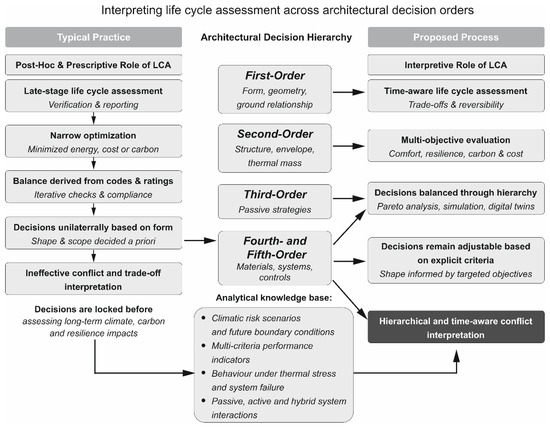

Disclaimer/Publisher’s Note: The statements, opinions and data contained in all publications are solely those of the individual author(s) and contributor(s) and not of MDPI and/or the editor(s). MDPI and/or the editor(s) disclaim responsibility for any injury to people or property resulting from any ideas, methods, instructions or products referred to in the content. |
© 2026 by the authors. Licensee MDPI, Basel, Switzerland. This article is an open access article distributed under the terms and conditions of the Creative Commons Attribution (CC BY) license.