1. Introduction
Water and wastewater facilities are essential for a country’s health [
1]; however, the aging of water and wastewater infrastructures in the US is causing several challenges [
2]. Treatment plants have a service life of 15 to 20 years, and sewer networks have a life expectancy of 50 years, while many of the current wastewater systems were constructed more than 50 years ago [
1]. Also, the majority of subsurface drinking water infrastructures has reached the end of their usable lives, according to the American Water Works Association [
3], because they were built 50 years ago or more. This study also showed a
$1.3 trillion capital investment for the repair and replacement of water infrastructures in the US over the next 25 years. Furthermore, according to the American Water Works Association (AWWA), delaying this type of investment might lead to a decline in water quality, an increase in water outages, and a rise in the price of emergency repairs. American Society of Civil Engineers (ASCE) grades U.S. infrastructure every 4 years using A-F based on their capacity, funding, future need, operation, and maintenance public safety and resilience. The higher the grade the better the infrastructures based on the above key criteria. In 2025, drinking water and wastewater infrastructures received a “C−” and a “D+” from ASCE, respectively. The United States experiences 240,000 water main breaks annually, according to this estimate, and upgrading the nation’s wastewater and storm water infrastructure will cost
$271 billion in capital over the next 20 years [
2,
4,
5]. The AWWA most recent annual poll found that infrastructure renewal and replacement, capital improvement financing, and long-term drinking water supply were the top problems facing the water community [
3].
Like other construction projects, water and wastewater facilities have also been delivered using the traditional delivery method, typically referred to as Design–Bid–Build (DBB). Despite being used for the past several decades due to its familiarity, it has some limitations such as the designer only providing one engineering solution and short-term objectives to spend the available funds. Another limitation is the tendency to choose a contractor based on the lowest bid and the designer being less familiar with newer construction technologies, which is not ideal for complex projects [
2,
6,
7]. Owners are choosing methods like Design–Build (DB) and Construction Management-at-Risk (CMAR) due to these limitations along with changes in procurement laws and the success of alternative delivery methods [
1,
2]. Alternatives like these provide flexible project financing and managing, bring integration and innovation, and select contractors based on price and quality [
2,
7]. Being advantageous to DBB, their use has increased and thus created a need to measure the effectiveness of these various delivery methods. Various research compares performance of project delivery in the highway and building sectors; however, far less research focuses on the water/wastewater industry [
1]. The research thus benchmarks the performance of DB and CMAR water and wastewater projects with DBB projects so that owners can make informed decisions when selecting the delivery method according to the project needs.
The paper is organized as follows:
Section 2 presents the objectives of the study.
Section 3 reviews the relevant literature on project delivery methods and performance in water and wastewater infrastructure projects.
Section 4 identifies the research gaps addressed by this study.
Section 5 describes the data collection process and methodology used to evaluate cost growth, schedule growth, and construction intensity across delivery methods.
Section 6 presents the results of the analysis.
Section 7 discusses the findings and summarizes the conclusions of the study.
3. Literature Review
3.1. Project Delivery Methods
3.1.1. Design–Bid–Build
DBB, a conventional project delivery method, involves the owner having two separate contracts, one with a designer, who designs the facility, and one with a contractor, who builds the facility. After the design is completed, contract documents are created, and bids are requested from contractors. The responsive bidder with the lowest bid is then normally chosen to receive the contract. The contractor then starts building the project. Upon completion, the owner will take care of the operation and maintenance. The benefits of this approach include the opportunity to divide the work among numerous contractors, the capacity to attract competition, the owner’s control over the design phase, the knowledge of the process, and the owner and contractor’s experience with the process. One of the drawbacks includes the lack of opportunity to provide contractor input during the design phase. This lack of communication leads to project delays and cost growth, significant time taken during design and construction due to them being sequential steps with no overlap, and the owner retaining the risk for design errors [
6,
7].
3.1.2. Design–Build
DB, an alternative to DBB, has owners contracting with a single entity for both the design and construction of the project. Unlike DBB, the contractor, also known as the design-builder in this case, is selected based on qualifications and price rather than price alone. Since the design-builder is in charge of the design, the liability of the design is passed to the contractor from the owner [
8]. This approach is perfect for owners who are willing to give contractors some control and influence over a project and are less experienced with construction project management and delivery. Design and construction proceed simultaneously in this method, with early construction phases being started and latter parts still under design, ultimately saving time. The DB method also facilitates communication between the design engineer and the contractor, which avoids probable disputes in the implementation of the design. With improved communication compared to DBB, this will lead to less change orders and project delays and cost growth can thus be avoided [
6,
7].
3.1.3. Construction Management-at-Risk
CMAR, also used as an alternative, is like DBB in terms of having two separate contracts with designer and contractor, but with a major difference. Unlike DBB, the contractors, which are also known as CMAR firms in this case, are also involved during the design phase and can provide valuable input to the design. In this way, there is frequent coordination and communication between the design team and CMAR team, which avoids problems later in the design implementation. Major design tasks are often delegated to the CMAR firm; although, the owner normally still retains ownership and accountability of the design [
9]. Furthermore, unlike DBB, the CMAR bid award procedure allows for awards to be made based on a combination of qualifications and cost. The advantages of CMAR include providing pre-construction services to the owner such as acting as a consultant in the design and construction phase. The CMAR firms and owners who agree upon the GMP (guaranteed maximum price) will make the CM conscientious of the budget throughout the entire project, leading to cost accuracy and transfer of financial liability to the CM as they take responsibility for budget overruns [
6].
3.2. Characteristics of Water and Wastewater Projects
Water and wastewater infrastructure projects are characterized by a high degree of technical complexity and regulatory oversight. These projects commonly include water and wastewater treatment plants, pumping stations, pipelines, and storage facilities, which require the integration of specialized mechanical, electrical, and process systems. In addition, such projects are often constructed within or adjacent to active facilities, requiring careful sequencing, phased construction, and coordination to maintain continuous operation.
Water and wastewater projects are also subject to environmental regulations, permitting requirements, and public health standards, which can introduce schedule constraints and design uncertainty. Subsurface conditions, process equipment procurement, and system commissioning further contribute to project risk and complexity. As a result, the selection of an appropriate project delivery method plays a critical role in managing cost, schedule, and construction efficiency. Delivery methods such as DB and CMAR, which allow earlier integration of design and construction expertise, are frequently adopted in this sector to address constructability challenges, accelerate schedules, and manage risk relative to traditional DBB approaches.
3.3. Project Delivery Method Comparison
The project delivery method is the process for planning and financing the design, construction, operations, and maintenance services for the project being worked on. Before the renaissance period, the master builder approach was used to complete large-scale construction projects in which the work of the architect, engineer, and contractor was done by a single entity. However, during the renaissance, these works were divided into separate disciplines of engineering, architecture, and construction which continued until the 20th century. However, these divisions caused a reduction in the cooperation and collaboration of multiple entities. One of the traditional methods of project delivery, known as DBB, was introduced toward the end of 19th century, which reduces the risk of corruption, increases schedule predictability, and brings initial cost certainty. This method still possesses the limited chances of collaboration among the parties. DBB is a conventional delivery method used in projects with less uncertainty and complexity, but in relatively complex projects, it is beneficial to use alternative project methods such as CMAR and DB because it brings innovation and integration and helps manage risks. Alternative methods such as CMAR and DB thus create a collaborative environment in the process by making communication between the owner, architects, engineers, and contractors more effective. Among the many critical factors used to define the project’s success, indicators like cost, schedule, and quality are used in this research as performance metrics. The owners should deliberate upon their objectives and assess the performance history of project delivery methods using performance metrics as a basis for selecting an appropriate one.
3.3.1. Project Performance Comparison in Buildings
Roth [
10] compared 6 DBB and 6 DB Navy childcare facilities and found that DB reduced the design and construction costs significantly. Bennett [
11] showed that alternative methods like DB and CMAR performed better than DBB in terms of cost and schedule. James [
12] observed that the cost growth in DB approach surpassed that of the DBB approach (Cost growth: 6.7% vs. 12.8%). However, DBB (41.2%) had a better schedule growth than DB (48.4%).
Sanvido [
13] compares DB, DBB and CMAR delivery methods in 351 building projects and shows that the cost growth for DB was 5.2% less than DBB projects and 12.6% less than CMAR projects; the schedule growth for DB was also 11.4% less than DBB and 2.2% less than CMAR. In addition, DBB had 7.8% less cost growth than CMAR. However, CMAR had 9.2% less schedule growth than DBB. The construction speed for DB projects was 12% faster than that for DBB projects and 7% faster than CMAR projects. Furthermore, CMAR projects were 5.8% faster than DBB projects in terms of construction speed. The delivery speed for DB projects was 33.5% faster than that for DBB projects and 23.5% faster than CMAR projects. Furthermore, CMAR projects were 13.3% faster than DBB projects in terms of delivery speed.
Molenaar and Songer [
14] conducted a study on 104 building, industrial, and highway projects and discovered that 59% of the DB projects experienced cost growth below 2% of the established budget, while 77% of these projects encountered schedule growth below 2% of the established schedule. Allen [
15] indicated that the cost growth for DB projects stood at 4.2%, surpassing that of DBB projects, which registered at 24.6%.
Thomas [
16] revealed that DB projects exhibited superior performance compared to DBB projects concerning cost, schedule, changes, rework, and practice use. However, significant disparities were particularly evident in the latter three metrics. Gransberg [
17] showed that DB performed better in terms of cost and schedule than DBB, as the mean cost growth for DB was 2.2% as compared to DBB 18.8%, and the mean for schedule growth for DB was −1.4% as compared to DBB 18.98%. Ibbs [
18] discovered that DB projects demonstrated superior performance in terms of alterations in both design and construction costs, as well as adjustments in schedule compared to DBB projects. Riley [
19] revealed that the increase in costs for DB projects was 4.7%, significantly lower than the 16.6% increase observed in DBB projects. Additionally, the total number of change orders in DB projects stood at 5%, significantly less when contrasted with the 38% observed in DBB projects.
The above papers were challenged by Williams Jr [
20], whose research was conducted on the performance comparison of 215 Oregon public schools delivered using CMAR and DBB. The paper did not show any statistically significant differences in terms of cost or schedule, but it did establish that CMAR had a higher cost per square foot than DBB schools. The research also showed that CMAR provided better performance for projects that require fast-track schedules. Another study that challenged the above papers was Rojas and Kell [
21], which showed that CMAR had insignificant differences in change order costs with DBB.
Hyun [
22] determined that the DB approach exhibited enhanced design performance compared to DBB across eight categories: flow path considerations, sunlight and ventilation, adaptable space, household unit specialization, utility, analysis of finishing material quality, maintenance and repair, and ecological floor space ratio. Hale et al. [
23] evaluated the cost and schedule performance of 38 DB and 39 DBB projects involving U.S. Navy Bachelor Enlisted Quarters within the Military Construction program, highlighting that DB projects exhibited superior performance in cost growth and all schedule-related metrics compared to DBB projects. Rosner [
24] revealed a significant discrepancy in cost growth between DB projects (4.5%) and DBB projects (6.4%), indicating a substantial decrease in contrast to the latter.
Moon [
25] conducted a comparative analysis of the performance between DB and DBB multifamily housing projects. The findings indicated that DB projects outperformed DBB projects across various metrics: cost growth (2.5% vs. 8.2%), construction schedule growth (1.1% vs. 3.4%), delivery growth (0.8% vs. 3.3%), design speed (299 vs. 231 m
2/day), construction speed (92 vs. 65 m
2/day), and delivery speed (69 vs. 49 m
2/day). Likewise, Park [
26] discovered a significant advantage of DB projects over DBB projects in cost growth (1.1% vs. 1.2%) and construction speed (38 vs. 50 days/floor), specifically observed during the construction of apartment buildings.
Mollaoglu-Korkmaz [
27] gathered data from 12 case studies to assess project performance among sustainable and high-performance buildings executed through DB, DBB, and CMAR methods. The analysis revealed that most DB projects exhibited superior characteristics in team integration, sustainability, and overall performance in comparison to CMAR and DBB projects. Nikou [
28] conducted a comprehensive literature review encompassing seven studies focused on building comparisons between DB and DBB projects. Of these studies, six indicated a cost advantage associated with DB projects, while only one study reported a schedule advantage. Chen [
29] discovered that half of the DB projects experienced cost overruns, whereas 75% of the same projects were completed ahead of schedule.
While comparing public universities, Shrestha and Fernane [
30] revealed a significantly lower mean contract-award cost growth in DB projects compared to DBB projects (−10.4% vs. −3.5%). Additionally, regarding schedule performance, DB surpassed DBB in design and construction schedule growth, total schedule growth, and construction intensity (−5.3%, −5.3%, and 194 SF/day vs. 7.5%, 30.1%, and 68 SF/day, respectively). Regarding change orders, the quantity of construction-related change orders in DB was significantly lower than that observed in DBB (22 vs. 43). Carpenter and Bausman [
31] showed that DBB significantly outperformed CMAR in all the cost-related metrics except the construction cost growth and project cost growth, whereas no significant difference was seen in the mean schedule-related metrics of the DBB and CMAR projects. CMAR also outperformed DBB significantly in all areas of product quality. CMAR was also significantly better than DBB in terms of team service quality.
3.3.2. Project Performance Comparison in Highways
Warne [
32] assessed 21 DB highway projects by collecting data from questionnaires and interviews and discovered that 76% of the DB projects were finalized ahead of their scheduled completion, with the average cost growth for these projects being under 6%. The study demonstrated that the average cost growth for DB projects remained below 4%, leading to the conclusion that DB presents enhanced price predictability and mitigates cost growth more effectively compared to DBB.
Dornan [
33] conducted research on 11 DB and 11 DBB highway projects and found that the average schedule growth of DB projects was −4.2%, while DBB projects had 4.8%. The average cost growth was found to be higher in DB, as the average cost growth was 7.2% in DB and 3.6% in DBB.
On the other hand, Shrestha [
34] challenged this paper and showed quite opposite findings while analyzing the performance of 4 DB and 11 DBB highway projects. The average cost growth was found to be higher in DBB, as the average cost growth was −5.47% in DB and 4.12% in DBB. However, the schedule growth findings were similar to Doran’s study [
33], as the average schedule growth of DB projects was less than that of DBB; the average schedule growth of DB was found to be 7.59%, while DBB projects had 12.88%.
Regarding cost performance, Shrestha [
35] showed that the mean contract-award cost growth, total cost growth, and mean actual cost per lane mile of DBB projects (−4.4%, 6.3% and
$4.3 mil) were all found to be less than those in DB projects (14.8%, 7.8% and
$5.1 mil, respectively). However, this was not statistically significant. Regarding schedule performance, Shrestha [
35] showed that the mean total schedule growth was found to be 5.1% in DBB projects and 20.5% in DB projects, but this was not a significant difference. However, the mean project delivery speed per lane mile in DB was found to be 0.5 months per lane mile. This was significantly different from DBB, which required 2 months per lane mile. The mean construction speed per lane mile in DB was also found to be 11 days per lane mile. This was significantly different from DBB, which had 29 days per lane mile. As for change order performance, Shrestha [
35] showed that the mean number of change orders and mean cost per change order for DB was 65 and
$177,700, respectively, while for DBB, it was 25 and
$288,100, respectively. This was also not statistically significant. The study also computed the correlation between input and output variables, revealing that, among the 21 input variables assessed, 14 displayed a noteworthy association with one or multiple output variables. The associations of the input variables with the output variables are as follows:
There was a significant positive correlation between cost growth and the number of lost working days, indicating that an increase in lost working days corresponds to an increase in cost growth.
The cost per lane distance demonstrated a substantial positive correlation with bridge area, design work hours per week, the quantity of Right-Of-Ways (ROWs), and ROWs obtained through an eminent domain. Additionally, there was a negative correlation between design hours per week and the cost per lane distance.
The schedule growth had significant correlation with five input variables. Schedule performance bonus, partnering, and construction workdays per week are all negatively correlated, while the number of interchanges and pavement types were positively correlated.
The project delivery speed per lane metric had a noteworthy positive correlation with partnering, environmental assessment, concrete pavement type, and the number of design workdays per week. Conversely, it exhibited a significant negative correlation with the number of interchange and bridge areas.
The construction speed per lane distance metric was correlated with five input variables: partnering, level of environmental assessment, responsibility of ROW procurement, the number of interchanges, and bridge area. It was positively correlated with the former three and negatively correlated with the latter two.
The metric measuring cost per change order exhibited noteworthy positive associations with the construction’s nature, the number of design workdays per week, and working days lost.
Minchin [
36] discovered that, within the Florida Department of Transportation, DBB projects exhibited significantly superior cost performance compared to DB projects. However, no significant schedule differences were observed between these two project types. Tran [
37] demonstrated that cost growth in highway projects executed through both DB and DBB approaches was contingent upon project size. Additionally, for projects within the
$10 million to
$50 million range, DB exhibited superior cost growth performance compared to DBB [
37].
3.3.3. Project Performance Comparison in the Water and Wastewater Sectors
Molenaar [
38] conducted an industrywide survey and three in-depth case studies and found large-scale growth in the use of DB project delivery for water and wastewater facilities throughout the United States. The findings also discovered the best practices for project success, such as selecting an appropriate delivery system, using a contract created specifically for DB, allocating risks appropriately, creating equitable and transparent proposal evaluation processes, reducing the level of design in the request for proposals, using DB consultants for proposal preparation and contract monitoring, partnering and establishing trust, identifying key players early, and using sequential permitting processes.
Bogus [
39] analyzed the performance of 31 DB and 68 DBB public water and wastewater projects procured under cost-plus fee with a guaranteed maximum price (GMP) contract with a traditional lump sum contract and found the mean cost growth of projects procured under cost-plus fees with GMP contracts to be significantly less than those procured under lump sum contracts.
R. W. Beck conducted a survey that found about 90% of water/wastewater owners to be aware of alternative project delivery methods (APDMs), but only half of them use it. The most common ADPM was DB, and it was mainly used to save time and cost and increase project quality. However, some owners expressed dissatisfaction with this method. To respond to this, Molenaar [
38] created a set of practices for DB water/wastewater; however, he did not compare DB with other APDMs quantitatively.
Shane [
1] collected data from 31 DB projects and 69 DBB projects and used it for performance analysis. It was found that larger projects use DB more frequently than DBB. The largest DB project had a cost of
$330 million versus the largest DBB projects, which had a cost of
$178 million. Regarding schedule, Shane [
1] identified that DB projects exhibited a lower cumulative growth in schedule duration compared to DBB projects (1.0 month vs. 2.0 month, median average). Also, more DB projects finished faster than DBB projects, considering the overall project schedule (48% vs. 35%). On the other hand, regarding cost, DB projects had less cost growth in both phases (design and construction; construction) than DBB projects (1.6% vs. 3.6%, median values). Also, more DB projects finished on or below budget than DBB projects (38% vs. 20%). In terms of quality, no statistically significant variance was discovered between the two modes of project delivery.
Francom [
40] studied 80 completed water pipeline projects and ascertained that CMAR exhibited enhanced performance concerning cost and schedule metrics, indicating a 6.5% and 12.5% advantage, respectively, when compared to DBB projects. Specifically, the outcomes indicated that DBB projects averaged a mean and median cost growth of 0.55%, while CMAR projects displayed mean and median cost growths of −6.0%. Moreover, the median schedule growth was recorded at 18.33% for DBB projects and 5.83% for CMAR projects.
Asmar [
7] collected data from 34 projects, which included 12 DBB, 12 CMAR, and 10 DB projects. One third of the projects were wastewater treatment plan projects, and the remaining ones were water treatment plan projects. In terms of cost, Asmar [
7] found that DBB had the highest construction cost growth whereas CMAR and DB performed better in terms of this metric. Regarding schedule, the study found that DB had the highest project speed, whereas CMAR had the second highest, and DBB performed the most poorly them all.
Feghaly [
6] compared DBB, DB, and CMAR water and wastewater projects using a set of metrics, including cost growth, schedule growth, project speed and intensity, as well as quality-related outcomes such as warranty issues and latent defects. The study found that DB outperformed DBB and CMAR in terms of project speed and project intensity, while no statistically significant differences were observed among the three delivery methods with respect to cost and schedule growth. The results also showed that DB outperformed DBB and CMAR in terms of warranty and latent defects; CMAR and DB outperformed DBB in meeting project expectations; the delivery method that is most likely to be reused on future projects was DBB.
Shrestha [
2] conducted a survey targeting water and wastewater utility managers, project personnel, and policymakers to analyze the perspectives of DB and CMAR adopters concerning their perceived advantages. The study identified the top four benefits associated with employing DB and CMAR methods: encompassing the degree of owner involvement in the design process, the resultant project quality, the communication procedures between the company and owner, and the overall experience inherent to each project delivery method. Additionally, the research highlighted that DB exhibited lower cost and schedule growth rates compared to CMAR, registering 0.21% and 2.41% for cost growth, respectively, and 0.65% and 1.06% for schedule growth, respectively. Furthermore, the findings indicated that the primary rationale behind selecting DB and CMAR methods was the schedule advantages they offered. Conversely, DB users perceived greater cost efficiency in contrast to CMAR users. Nonetheless, CMAR users perceived their projects as having superior quality compared to those involving DB.
5. Methodology
5.1. Data Collection
The study collected project level data for water and wastewater projects delivered by DBB, DB, and CMAR using a structured questionnaire and administrative source. Questionnaires were specifically developed for DBB, DB, and CMAR to ensure a comprehensive and accurate comparison among the three delivery approaches. These distributions of questionnaires targeted public and private water and wastewater utility owners, design consultants, contractors, and industry experts. They were firstly contacted through email, and if they agreed to participate in the survey, the questionnaire was also distributed through the email in an Excel format. To mitigate nonresponse, respondents were offered a flexible completion window, multiple reminder emails were issued, and follow-up phone calls were made as needed. Confidentiality assurances were included in all correspondence. The questionnaire was distributed via email and included questions in the following categories:
Respondent Information (Name, Title, Organization, Address);
Project Specific Information (Name, Number, ID, Location);
Project Description (Type, Contractor Selection Method, NTP);
Cost Information (Estimated Cost, Contract Cost, Completion Cost);
Duration Information (Estimated Schedule, Contract Schedule, Completion Schedule).
For all projects, the cost variables represent the total project cost, where “contracted cost” refers to the total project cost at contract award and “final completion cost” refers to the total project cost at project completion. Similarly, the duration variables represent the total project duration, measured from Notice to Proceed (NTP) to the original and final project completion dates. These definitions were applied consistently across all data sources to ensure comparability among delivery methods.
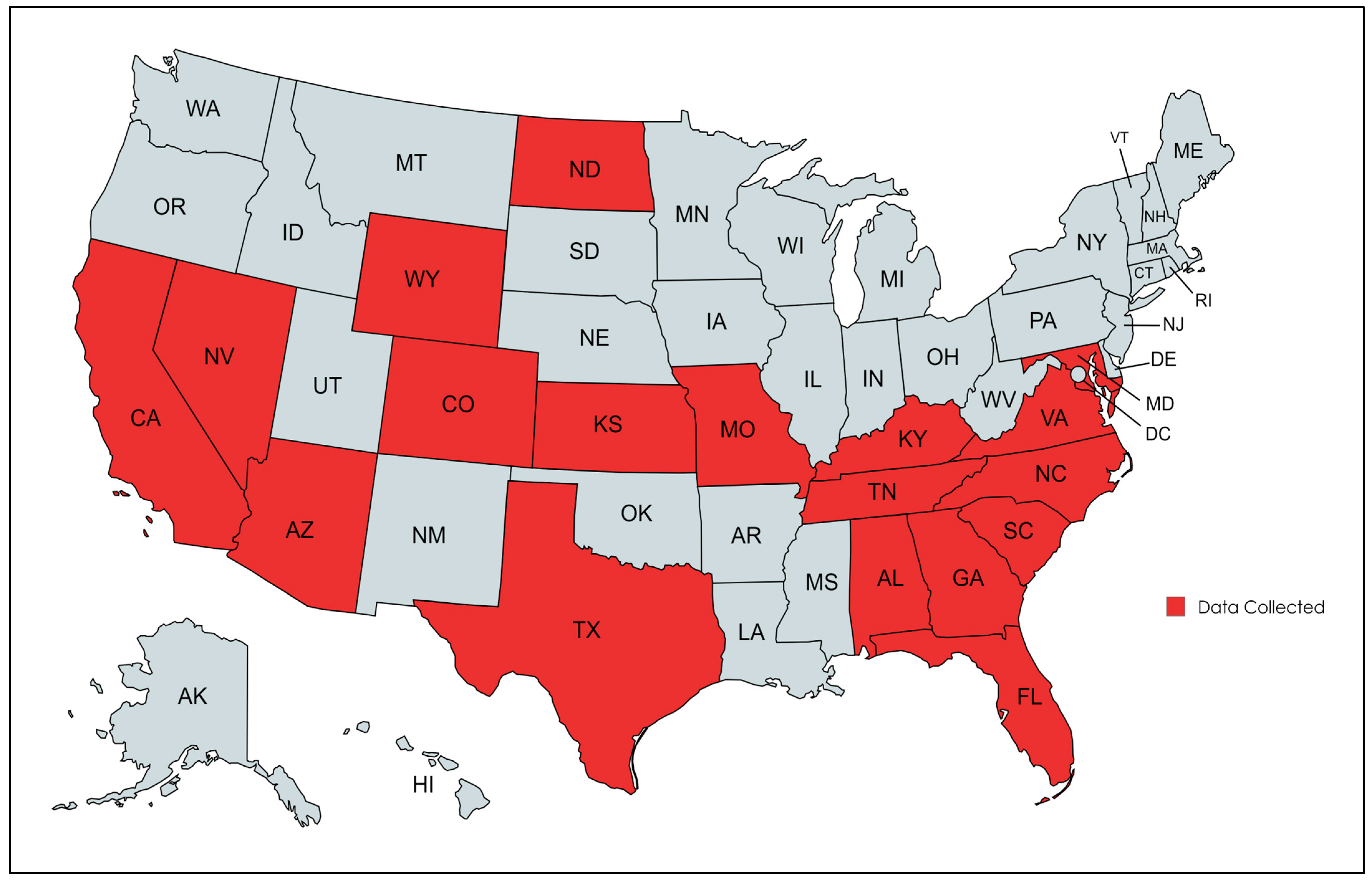
A total of 81 questionnaires were distributed, resulting in 23 completed returns from organizations spanning 18 states: Alabama, Arizona, California, Colorado, Florida, Georgia, Kansas, Kentucky, Maryland, Montana, Nevada, North Carolina, North Dakota, South Carolina, Tennessee, Texas, Virginia, and Wyoming. The questionnaire is provided in
Appendix A. The majority of DBB and CMAR projects were obtained directly from public agencies and owners, while DB projects were obtained from a combination of agency responses and the Design–Build Institute of America (DBIA) database. Owner-side sources included counties, water districts, and public utilities, while contractor-side sources included major construction firms. Several respondents provided data records for multiple completed water and wastewater projects rather than single project responses, which resulted in a substantially larger project level dataset. For the DBB projects (235 projects), the majority of the records were obtained from owner organizations (151 projects), with the remaining projects provided by contractor organizations (84 projects). For DB projects (84 projects), records were obtained from contractor organizations (23 projects), owner organizations (7 projects), and the DBIA database (54 projects), which accounted for a substantial portion of the DB sample. For CMAR projects (38 projects), data were primarily obtained from contractor organizations (35 projects), with limited contributions from owner organizations (3 projects). This distribution reflects the availability of completed project records across delivery methods.
5.2. Performance Comparison
The performance comparison evaluates project outcomes across DBB, DB, and CMAR using three metrics: cost growth, schedule growth, and construction intensity. To ensure comparability over time, all cost fields used in these calculations were first standardized to a common base. Specifically, contract/award cost and final completion cost were multiplied by the National Highway Construction Cost Index (NHCCI) for Q1 2025 and expressed in Q1-2025 dollars. This adjustment was applied consistently across all projects to remove inflation effects and enable like-for-like cost comparisons among delivery methods.
Cost growth was then computed as the percentage change from the contracted cost to the final completion cost using these inflation-adjusted values. Schedule growth was computed using durations measured in working days to reflect construction practice and contract administration. Working-day durations were derived from NTP and the recorded completion milestones using the ‘NETWORKDAYS’ function in Microsoft Excel. This function calculates the number of working days between two dates by excluding weekends (Saturday and Sunday) and a predefined list of U.S. federal holidays. A standard 5-day workweek was assumed, and the same working-day calendar was applied consistently to all the projects. Construction Intensity was calculated as the ratio of the inflation-adjusted final completion cost to the actual completion duration in working days, yielding a daily expenditure rate in Q1-2025 dollars per working day.
Table 1 shows the equations used to calculate these metrics.
Prior to testing, data were screened for completeness and internal consistency; records lacking the fields required for a given metric were excluded from that specific analysis but retained for others. Outliers and extreme values were reviewed for validity and retained unless contradicted by source documentation.
5.3. Research Hypothesis and Null Hypothesis
This study aims to compare the project performance metrics such as cost growth, schedule growth, and construction intensity of the DBB, DB, and CMAR delivery methods. To fulfill this aim, the following research hypotheses are generated:
Research Hypothesis 1 (Cost Growth): There is a significant difference in mean cost growth among DBB, DB, and CMAR water and wastewater projects.
Research Hypothesis 2 (Schedule Growth): There is a significant difference in mean schedule growth among DBB, DB, and CMAR water and wastewater projects.
Research Hypothesis 3 (Construction Intensity): There is a significant difference in mean construction intensity among DBB, DB, and CMAR water and wastewater projects.
The above research hypotheses are converted into following null hypothesis for statistical tests:
Null Hypothesis 1 (Cost Growth): There is no significant difference in mean cost growth across DBB, DB, and CMAR.
Null Hypothesis 2 (Schedule Growth): There is no significant difference in mean schedule growth across DBB, DB, and CMAR.
Null Hypothesis 3 (Construction Intensity): There is no significant difference in mean construction intensity across DBB, DB, and CMAR.
5.4. Statistical Analysis
All statistical analyses were conducted in IBM Statistical Package for Social Science (SPSS 28). The analysis first summarized the data, then checked distributions, and finally used bootstrap t-tests, emphasizing effect sizes and confidence intervals and reporting adjusted p-values.
5.4.1. Normality Tests
For each delivery method (DBB, DB, CMAR) and outcome (cost growth, schedule growth, construction intensity), distributional shape was assessed to inform test choice and interpretation. In SPSS, the normality was evaluated using the Shapiro–Wilk test for small–moderate samples and, where appropriate, the Kolmogorov–Smirnov test with Lilliefors correction [
41,
42]. The null hypothesis stated that the sample was drawn from a normally distributed population. A result of
p < 0.05 suggests that the population deviates from normality.
5.4.2. Levene’s Test of Equal Variance
Levene’s test of Equal Variance is conducted to check the homogeneity of variance in the two dependent variables used for comparison. The null hypothesis states that the variances of the two dependent variables are equal. If the p-value is less than 0.05, the null hypothesis would be rejected, which would indicate that the variances of these two dependent variables are equal.
5.4.3. Bootstrap t-Tests
Pairwise differences in mean cost growth, schedule growth, and construction intensity between delivery methods (DBB vs. DB, DBB vs. CMAR, DB vs. CMAR) were evaluated using bootstrap independent-samples
t-tests in IBM SPSS. This approach was applied when distributional checks indicated non-normal or skewed data, when group sizes were small or imbalanced, and to obtain confidence intervals that do not rely on normality assumptions. In SPSS, a simple bootstrap was used, resampling with replacement within each group, preserving the original group sizes, with 1000 bootstrap samples and 95% percentile confidence intervals. The test statistic was the independent-samples t with equal variances not assumed. For each comparison, SPSS computed the observed Welch t, generated the bootstrap resamples, and reported the two-sided bootstrap
p-value and the 95% percentile confidence interval (CI) for the mean difference (A–B) [
43,
44]. The difference was considered statistically significant if the 95% CI did not include zero (equivalently,
p < 0.05).
5.4.4. Power Analysis
A power analysis (
Appendix B) was conducted to assess the ability of the available sample sizes to detect observed differences among project delivery methods. The results indicate that comparisons involving construction intensity are supported by high statistical power, whereas comparisons for cost and schedule growth exhibit low to moderate power due to small observed effect sizes. Given that the delivery method comparisons involve independent samples with unequal and, in some cases, relatively small group sizes, hypothesis testing was conducted using Welch’s
t-test with bootstrap resampling to provide a detailed inference that is less sensitive to distributional assumptions. Accordingly, the power results are interpreted as diagnostic indicators that complement the bootstrap-based statistical comparisons (
Table A1 and
Table A2).
6. Results
A total of 338 water and wastewater projects were collected nationwide through the support of utility owners, design and construction companies, and databases from official websites. These 338 projects were distributed across delivery methods as 216 DBB, 84 DB, and 38 CMAR projects. For analysis, two nested subsets were created. First, after standardizing costs to Q1-2025 dollars using the NHCCI and performing basic cleaning, the full analytic subset comprised 177 DBB, 76 DB, and 34 CMAR projects. Specifically, 39 DBB, 8 DB, and 4 CMAR projects were excluded because these records lacked the cost or date information required to apply the NHCCI or compute the schedule-based metrics. Screening was limited to data validity and completeness; no statistical outlier detection based on extreme cost or duration values was performed. Second, to compare performance within a common size-band, a
$10–110 million subset was defined using inflation-adjusted final costs: projects greater than
$10 million and up to
$110 million (the maximum observed for DBB after NHCCI adjustment). This yielded 80 DBB, 43 DB, and 26 CMAR projects. All statistical analyses are reported for both the full analytic sample and the size-banded sample (
$10–
$110 M), enabling comparison of findings across the full sample and a consistent size range. The projects were obtained nationwide and represented a total of 18 states from US as shown in
Figure 1. The states were Alabama, Arizona, California, Colorado, Florida, Georgia, Kansas, Kentucky, Maryland, Montana, Nevada, North Carolina, North Dakota, South Carolina, Tennessee, Texas, Virginia, and Wyoming.
To assess whether project size may influence the observed performance differences, a correlation analysis was conducted between total project cost and key performance metrics (cost growth, schedule growth, and construction intensity).
Table 2 summarizes the Pearson correlation results. The analysis indicates that total project cost is not significantly correlated with either cost growth or schedule growth (
p > 0.05). The results show a positive correlation between total project cost and construction intensity (
p < 0.001), which is expected because construction intensity is defined as the ratio of project costs and the project duration.
To validate or refute the null hypothesis, it is necessary to conduct statistical tests. These tests often rely on assumptions to ensure the validity and reliability of their results. Since the objective of the study is to compare project performances of DBB, DB, and CMAR water and wastewater projects, it is necessary to examine whether there is a significant difference between the datasets by comparing the group means. The t-test is often adopted for comparing the means of two groups. The three main assumptions associated with the t-test are (i) dataset independence, (ii) normality assumption, and (iii) homogeneity of variances between groups.
6.1. Cost Growth Results
6.1.1. Cost Growth Descriptive Statistics Results
The mean project cost observed for each delivery method was: DBB—
$13,195,190.37; DB—
$106,976,889.13; and CMAR—
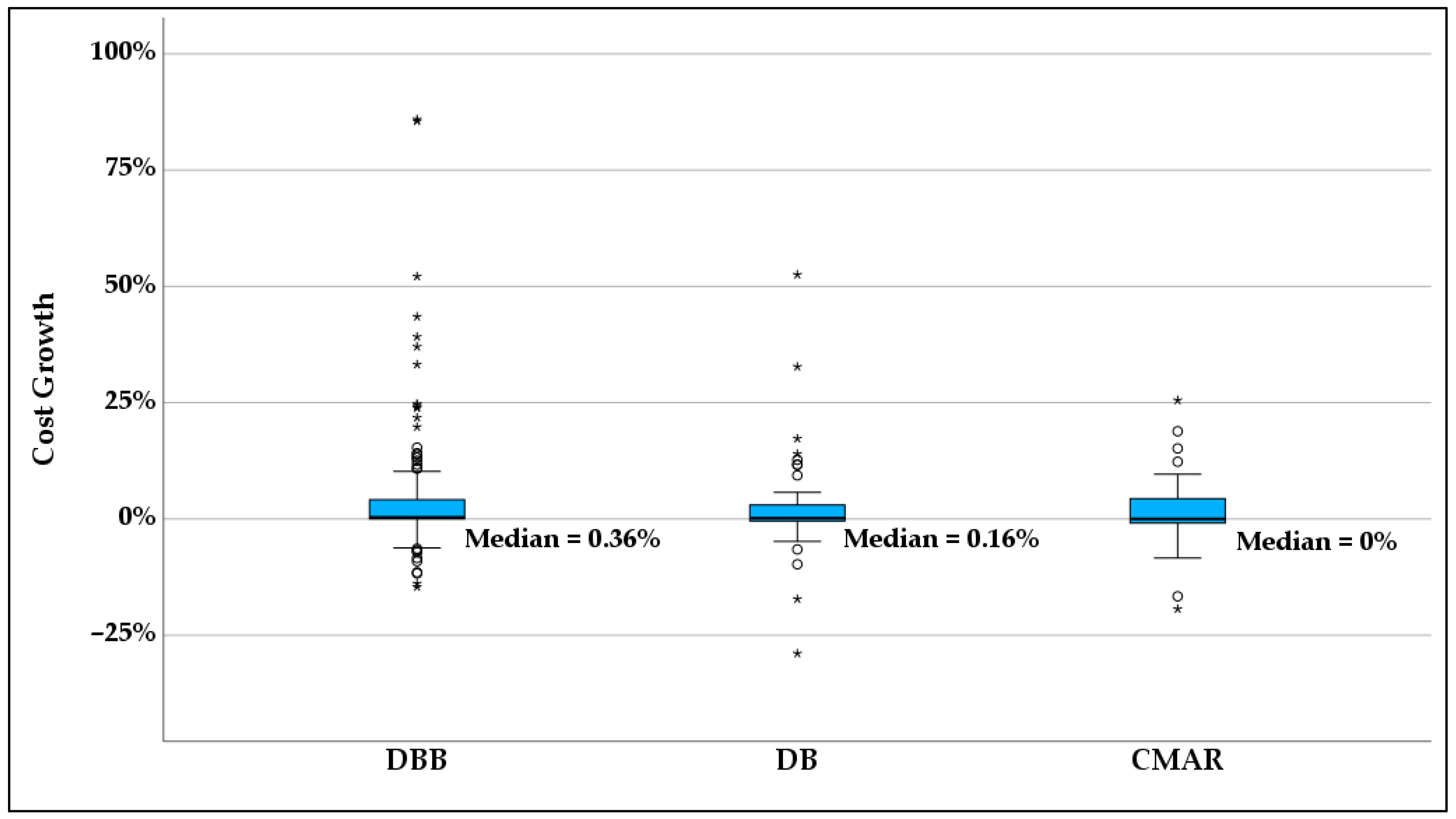
$57,036,891.21. For the full analytic sample, the mean cost growth observed is 3.93% for DBB, 1.75% for DB, and 1.66% for CMAR. DBB projects show high skewness (3.99) and kurtosis (20.98), indicating asymmetric distributions with a presence of extreme cost growth values.
Figure 2 shows the box plot of cost growth for the full analytical sample. DB projects also show asymmetric distributions with higher skewness (2.34) and kurtosis (14.91), though to a lesser extent than DBB. In contrast, CMAR projects displayed approximately symmetric distributions with lower skewness (0.3) and kurtosis (2.07) values, indicating a limited presence of extreme cost growth values.
For the
$10–
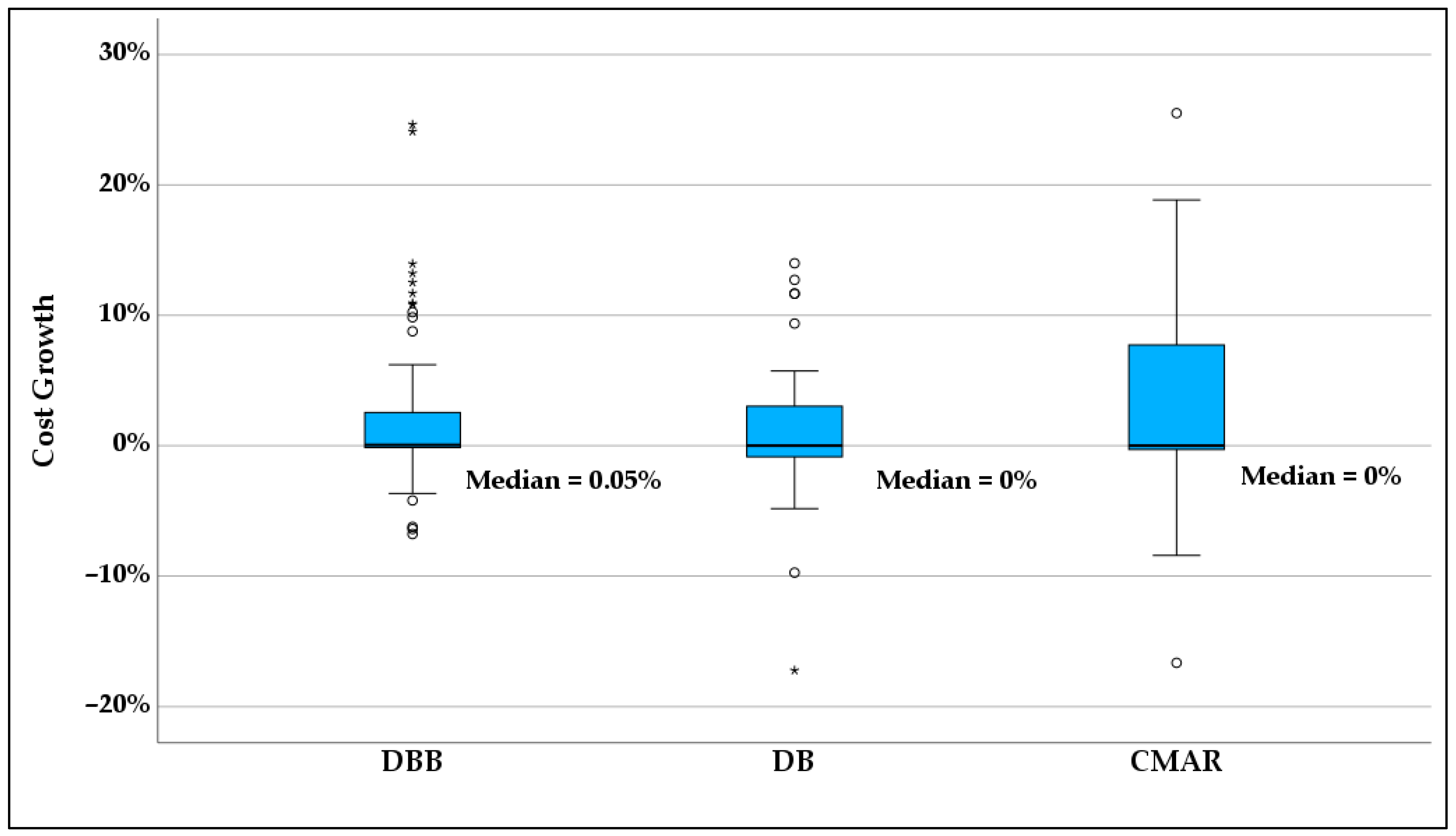
$110 M size-banded sample, mean cost growth is 1.97% for DBB, 0.97% for DB, and 2.74% for CMAR.
Figure 3 shows the box plot of cost growth with the size-banded sample. Similar to the full analytic sample. DBB projects show asymmetric distributions with higher skewness (2.03) and kurtosis (5.37), whereas DB shows near symmetric distributions with relatively lower skewness (−0.13) and kurtosis (2.60), and CMAR exhibit modest asymmetry with lower skewness (0.60) and kurtosis (1.44). Overall, the magnitude of extreme cost growth values is reduced in the
$10–
$110 M size-banded sample compared to the full analytic sample.
6.1.2. Cost Growth Normality Tests Results
For both the full analytic sample and the
$10–
$110 M size-banded sample, Shapiro–Wilk and Kolmogorov–Smirnov tests returned
p-values below 0.05 for cost growth, leading to a rejection of the null hypothesis of normality and indicating that cost growth is non-normally distributed across all delivery methods in both samples. The results for both samples are presented in
Table 3 and
Table 4.
6.1.3. Cost Growth Homogeneity of Variances Between Groups Results
Levene’s test for the full analytic sample, as presented in
Table 5, returned
p-values greater than 0.05 for all pairwise comparisons, indicating that the assumption of equal variances was satisfied and supporting the use of
t-tests with equal variances. In the
$10–
$110 M size-banded sample presented in
Table 6, the
p-value for DBB vs. DB was greater than 0.05, suggesting equal variances for this pair; however,
p-values for DBB vs. CMAR and DB vs. CMAR were below 0.05, indicating unequal variances and the need to use
t-tests that do not assume homogeneity of variance for these comparisons.
6.1.4. Cost Growth Bootstrap t-Tests Results
Bootstrap independent-samples
t-tests in SPSS for both the full analytic sample and the
$10–
$110 M size-banded sample indicated no statistically significant differences in the mean cost growth between any pair of delivery methods, as all
p-values exceeded the 0.05 threshold (
Table 7 and
Table 8).
6.2. Schedule Growth Results
6.2.1. Schedule Growth Descriptive Statistics Results
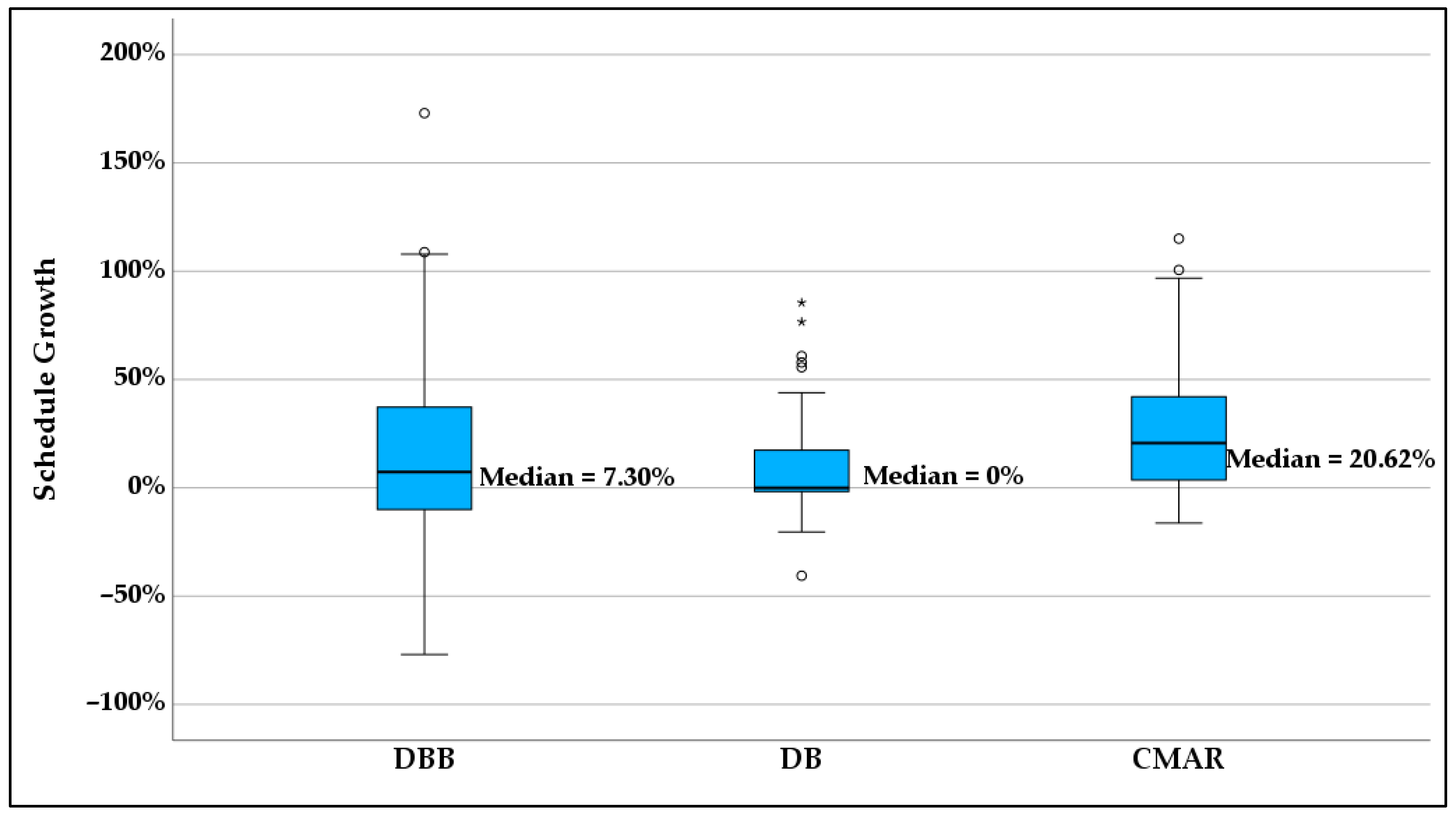
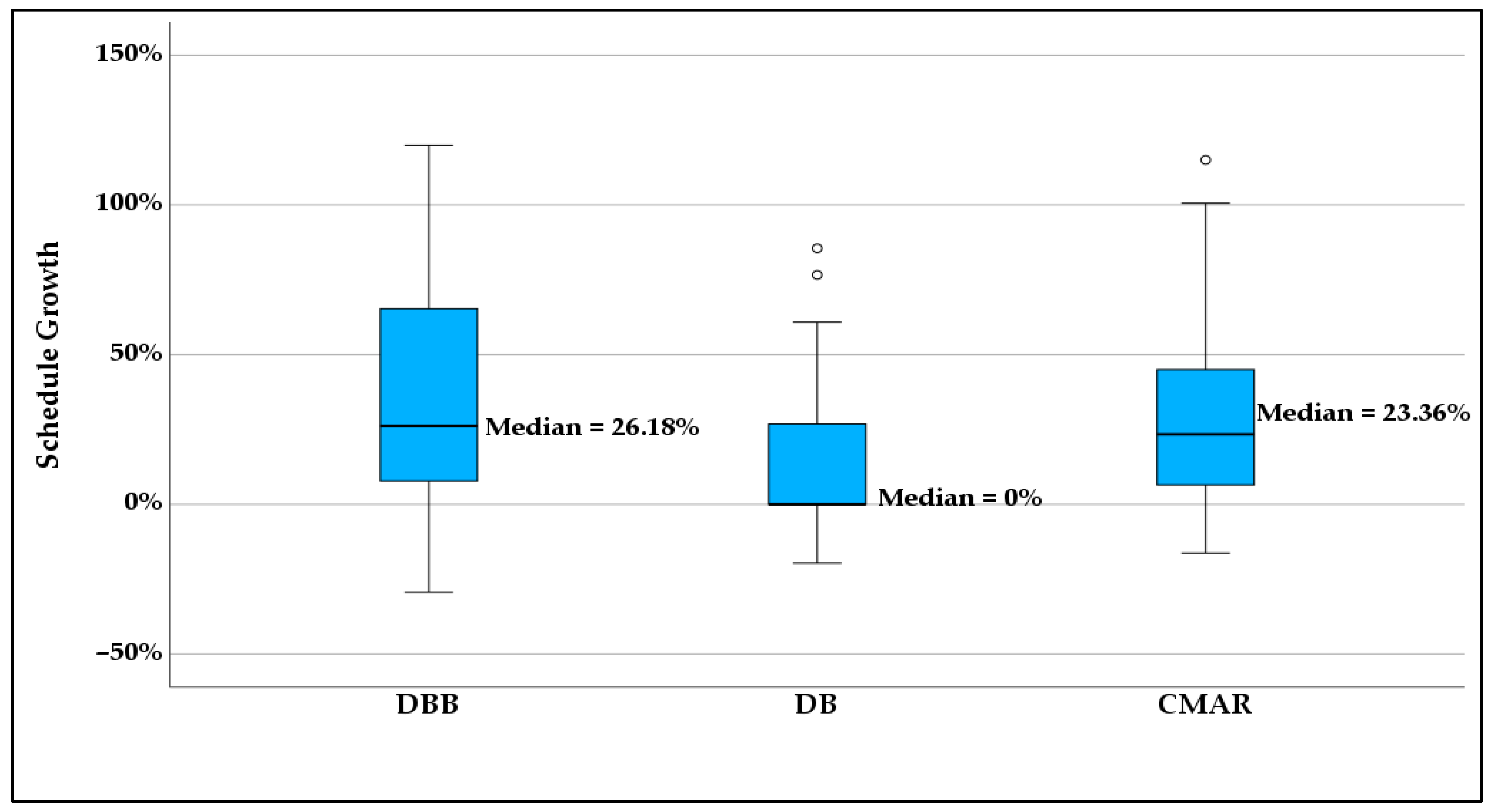
For the full analytic sample, mean schedule growth was 14.70% for DBB, 8.99% for DB, and 28.89% for CMAR.
Figure 4 shows the box plot of schedule growth with the full analytic sample. DBB projects exhibit moderate skewness (0.73) and kurtosis (0.81), indicating asymmetric distributions with the presence of extreme schedule growth values. DB projects show greater asymmetry (skewness = 1.35, kurtosis = 2.43), suggesting a higher presence of projects with unusually large schedule growth compared with DBB. CMAR projects also exhibit asymmetric distributions with higher skewness and kurtosis (skewness = 1.15, kurtosis = 0.89), indicating the presence of extreme schedule growth values and greater dispersion relative to DBB and DB projects.
For the
$10–
$110 M size-banded sample, mean schedule growth was 36.48% for DBB, 12.77% for DB, and 32.56% for CMAR.
Figure 5 shows the box plot of schedule growth with the size-banded sample. DBB projects exhibit reduced asymmetry relative to the full analytic sample (skewness = 0.58, kurtosis = −0.68), indicating a more balanced distribution with fewer extreme schedule growth values. DB projects show increased asymmetry (skewness = 1.50, kurtosis = 1.84), reflecting a continued presence of projects with unusually high schedule growth. CMAR projects exhibit near-symmetric distributions with relatively low kurtosis (skewness = 0.96, kurtosis = 0.18), indicating a limited presence of extreme schedule growth values. Overall, the magnitude and prevalence of extreme schedule growth values are reduced in the size-banded sample compared to the full analytic sample.
6.2.2. Schedule Growth Normality Tests Results
For both the full analytic sample and the
$10–
$110 M size-banded sample, normality tests for schedule growth showed significant deviations from a normal distribution for DBB and DB in both the Kolmogorov–Smirnov and Shapiro–Wilk tests (
p < 0.001). For CMAR, the Kolmogorov–Smirnov test did not reject normality in either sample, but the more sensitive Shapiro–Wilk test indicated non-normality (
p = 0.004 in the full sample;
p = 0.028 in the size-banded sample). Accordingly, schedule growth is treated as non-normal for all three delivery methods in both samples, giving greater weight to the Shapiro–Wilk results. The results for both samples are presented in
Table 9 and
Table 10.
6.2.3. Schedule Growth Homogeneity of Variances Between Groups Test Results
For both the full analytic sample and the
$10–
$110 M size-banded sample, Levene’s test indicated that the assumption of equal variances was satisfied for DBB vs. CMAR (
p > 0.05), whereas for DBB vs. DB and DB vs. CMAR (
p < 0.05) the variances differed significantly. Accordingly,
t-tests not assuming equal variances were applied to comparisons involving DB, while the equal-variance assumption was considered acceptable for DBB vs. CMAR. The results for both samples are presented below in
Table 11 and
Table 12.
6.2.4. Schedule Growth Bootstrap t-Tests Results
Bootstrap independent-samples
t-tests for the full analytic sample show that the difference in the mean schedule growth between DBB and DB is not significant (
p > 0.05), whereas the differences for DBB vs. CMAR and DB vs. CMAR are statistically significant (
p < 0.05), with CMAR exhibiting higher schedule growth in both comparisons (
Table 13). In the
$10–
$110 M size-banded sample, the difference in mean schedule growth between DBB and DB is statistically significant (
p < 0.001), with DBB showing higher schedule growth than DB; the difference between DBB and CMAR is not significant (
p > 0.05); and the difference between DB and CMAR is statistically significant (
p = 0.019), with CMAR exhibiting higher schedule growth than DB (
Table 14).
6.3. Construction Intensity Results
6.3.1. Construction Intensity Descriptive Statistics Results
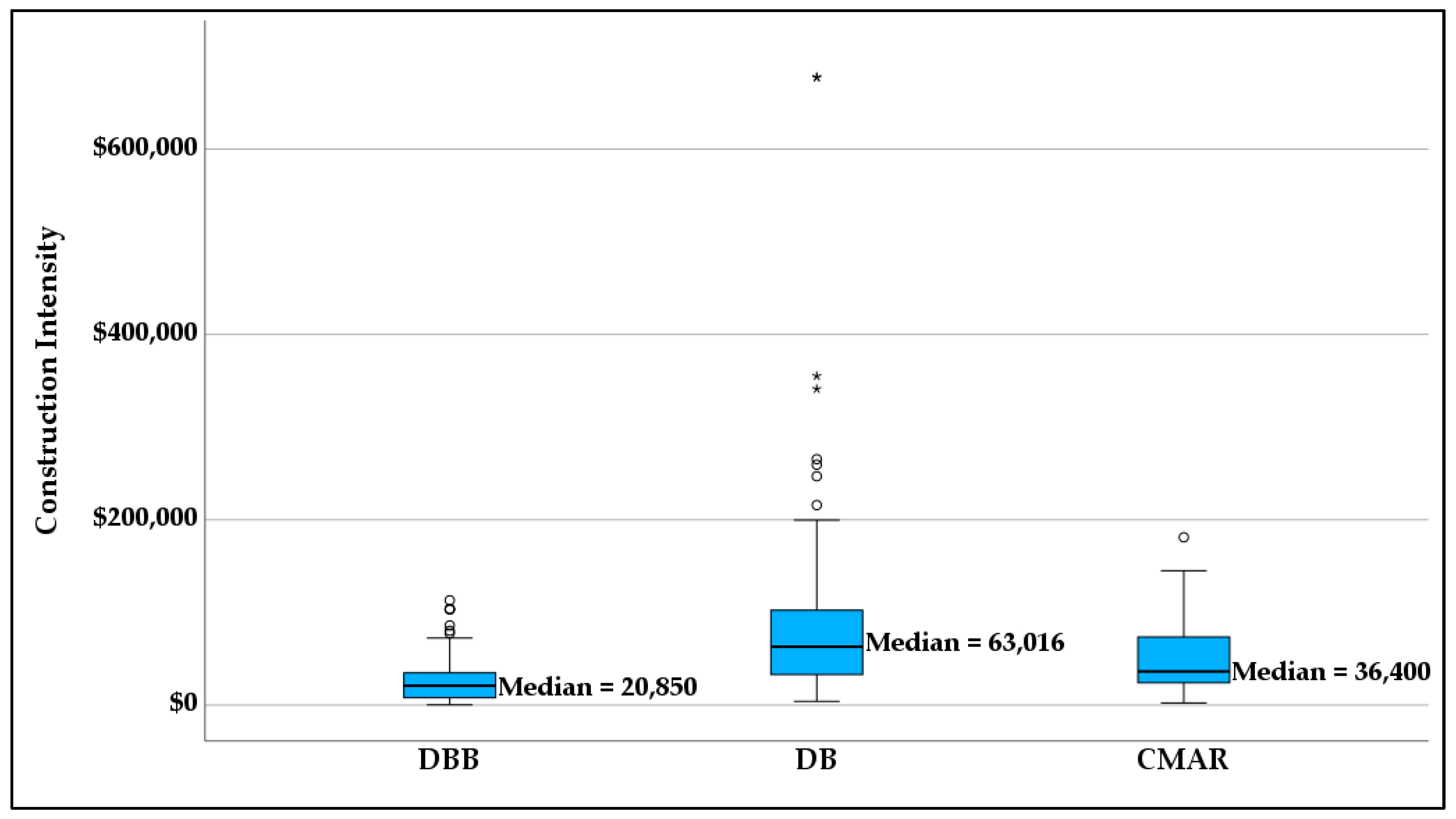
For the full analytic sample, mean construction intensity was
$26,000/day for DBB,
$97,000/day for DB, and
$52,000/day for CMAR.
Figure 6 shows the box plot of construction intensity with the full analytic sample. DBB projects exhibit moderate asymmetric distributions and higher kurtosis (skewness = 1.39, kurtosis = 2.28), indicating distributions that are not symmetric and include extreme construction intensity values. DB projects show asymmetry with substantially higher kurtosis (skewness = 3.30, kurtosis = 12.89), suggesting the presence of projects with unusually high construction intensity. CMAR projects also exhibit asymmetric distributions (skewness = 1.35) with comparatively lower kurtosis (1.78), indicating the presence of extreme values, though less than those observed for DB projects.
In the
$10–
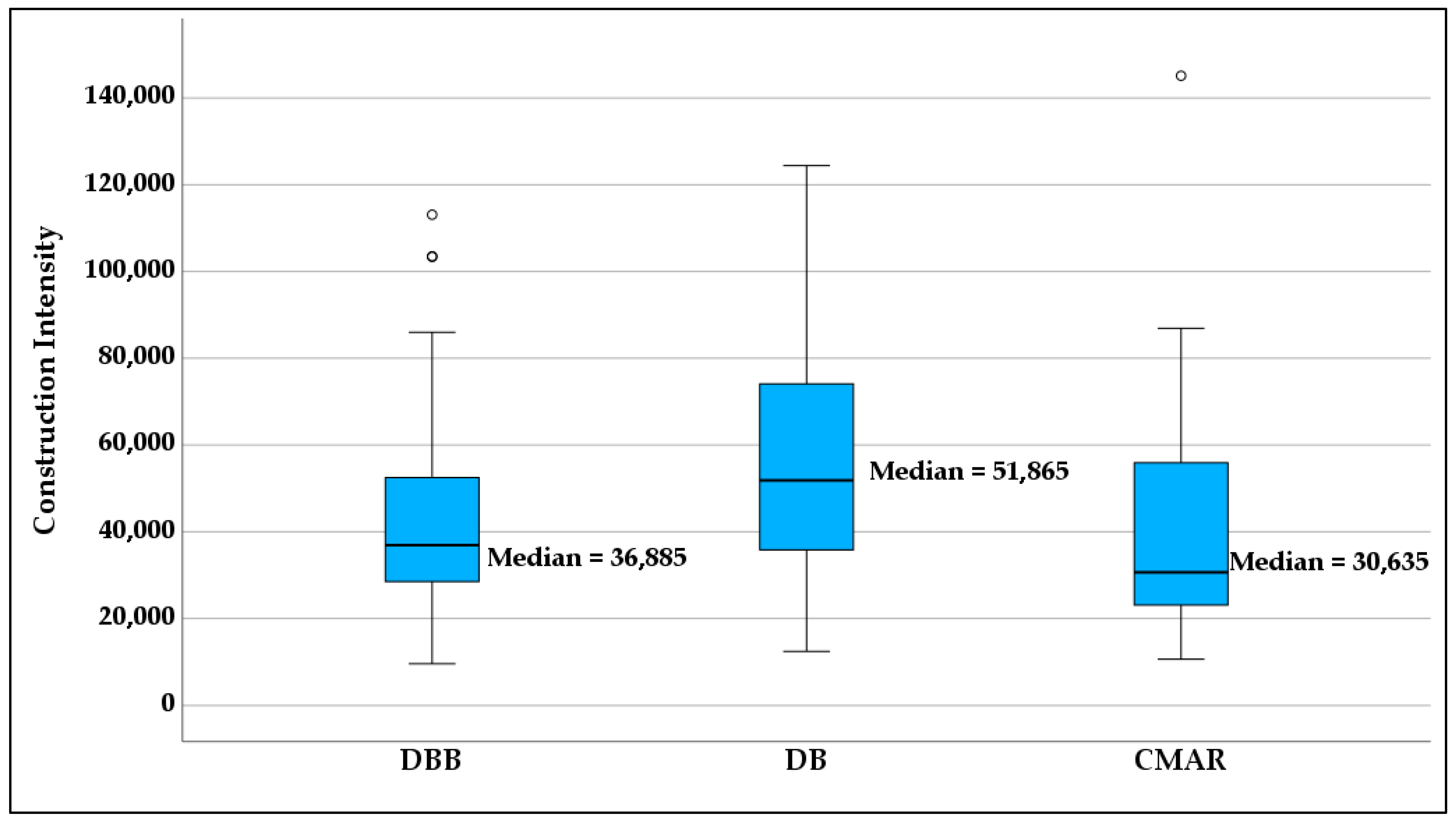
$110 M size-banded sample, mean construction intensity was
$43,000/day for DBB,
$59,000/day for DB, and
$41,000/day for CMAR.
Figure 7 shows the box plots of construction intensity with size-banded sample. DBB projects continue to exhibit asymmetric distributions with higher kurtosis (skewness = 1.36, kurtosis = 2.10), indicating the presence of extreme construction intensity values. DB projects display near-symmetric distributions with low kurtosis (skewness = 0.69, kurtosis = −0.46), indicating a limited presence of extreme values within this size range. In contrast, CMAR projects exhibit increased asymmetry and kurtosis (skewness = 1.84, kurtosis = 4.41), suggesting a higher presence of extreme construction intensity values compared to DBB and DB in the size-banded sample.
6.3.2. Construction Intensity Normality Tests Results
For the full analytic sample, Kolmogorov–Smirnov and Shapiro–Wilk tests for construction intensity returned
p < 0.001 for DBB, DB, and CMAR, indicating non-normal distributions for all three methods. In the
$10–
$110 M size-banded sample, significant deviations from normality were also observed for DBB and CMAR; for DB, the Kolmogorov–Smirnov test did not reject normality, but the Shapiro–Wilk test (
p = 0.010) indicated non-normality. Given the greater reliability of the Shapiro–Wilk test for these sample sizes, construction intensity is treated as non-normal for all the delivery methods in both samples. The results for both samples are presented in
Table 15 and
Table 16.
6.3.3. Construction Intensity Homogeneity of Variances Between Groups Test Results
For the full analytic sample, Levene’s test returned
p-values greater than 0.05 for all pairwise comparisons, indicating that the assumption of equal variances was satisfied and
t-tests with equal variances were appropriate. In the
$10–
$110 M size-banded sample, equal variances were indicated for DB vs. CMAR (
p > 0.05), while DBB vs. DB and DBB vs. CMAR showed
p-values below 0.05, indicating differing variances and the need to apply
t-tests that do not assume equal variances for comparisons involving DBB. The results for both samples are presented below in
Table 17 and
Table 18.
6.3.4. Construction Intensity Bootstrap t-Tests Results
Bootstrap independent-samples
t-tests for the full analytic sample show statistically significant differences in construction intensity among all delivery methods (
p < 0.05), with DB exhibiting the highest intensity, CMAR intermediate, and DBB the lowest (
Table 19). In the
$10–
$110 M size-banded sample, the difference between DBB and DB remains statistically significant (
p = 0.004) with DB higher than DBB; the difference between DBB and CMAR is not significant (
p = 0.876), indicating similar intensities. The difference between DB and CMAR is statistically significant (
p = 0.024) with DB higher than CMAR (
Table 20).
6.4. Sensitivity Analysis
To address potential bias associated with supplementing DB project data from the DBIA database, a sensitivity analysis was conducted by excluding all DBIA-sourced projects and re-running the bootstrap-based Welch independent-sample comparisons. In the full analytic dataset, the sample included 177 DBB projects, 76 DB projects, and 34 CMAR projects. After excluding the DBIA-sourced records, the DB sample size was reduced to 25 projects, while the DBB and CMAR sample sizes remained unchanged. The sensitivity analysis indicates that the cost growth findings are largely unchanged, while DB-related differences in schedule growth and construction intensity observed in the full sample analysis are no longer statistically significant when the DBIA-sourced projects are excluded. This is due to the same reason that the sample size of DB has significantly reduced, reducing the probability of finding the significant difference. Therefore, the DB projects collected from the DBIA database were not excluded in this study. Detailed sensitivity analysis results are provided in
Table 21,
Table 22 and
Table 23.
7. Discussion and Conclusions
This study analyzed 287 DBB, DB, and CMAR water and wastewater projects to determine whether these projects’ cost and schedule performance are significantly different from one another. For cost performance, the cost growth that shows the deviation of cost from its contract cost was used to determine whether the projects were completed on time. For schedule performance, schedule growth and construction intensity were used to measure whether the projects’ schedule performances were significantly different from one another. Schedule growth shows whether the projects were delayed with their contract duration, and construction intensity shows how fast the project was built by considering the cost spent per day.
The study used the bootstrap testing method, which will assist in creating more samples to determine whether the mean differences in cost and schedule performance are significantly different among these three delivery methods. The analysis was conducted for all the project samples irrespective of their cost. Then, the projects that cost between
$10 to
$110 million were included to see whether the project size had any effect on the cost and schedule performance using the DBB, DB, and CMAR methods. When all the project data were included in the analysis, the result showed that there is no cost growth difference in water and wastewater projects delivered using these three methods, as the
p-values were all more than 0.05 and thus rejected the null hypotheses. These results were unchanged, even when the analysis was performed including only projects that cost
$10 to
$110 million. This finding is similar to the research conducted by Feghaly [
6], in which he did not find any significant differences in cost growth among DBB, DB, and CMAR water and wastewater projects. However, Shane et al. [
1] found that DB water and wastewater projects were completed significantly below budget compared to DBB water and wastewater projects.
In the analysis that was conducted for schedule growth, the results showed that CMAR water and wastewater projects have significantly higher schedule growth than DB and DBB projects. The CMAR schedule growth was three times higher than that of DB and about two times higher than that of DBB. However, when the
$10 million to
$110 million projects were analyzed, the mean values of schedule growths for all these three types of water and wastewater projects increased. For DBB, the mean schedule growth increased from 14.7% to 36.48%; for DB, it increased from 8.99% to 12.77%; and for CMAR, it increased from 28.89% to 32.56%. When the bootstrap
t-test was conducted, DB schedule growth was found to be significantly better than that of DBB and CMAR for the project sizes between
$10 to
$110 million. However, no difference in schedule growth between the DBB and CMAR was detected during the statistical test. In contrast, for all project data, DB and DBB schedule growth was found to be better than that of CMAR projects. This shows that DB was superior in terms of having lower schedule growth compared to the two other types of large projects. However, Shane et al. [
1] found that the schedule growth of DB water and wastewater projects is half that of DBB projects and is significant at a 0.05 alpha level for all project sizes. This study could not find that DB schedule growth is significantly better than DBB for all-sized projects. However, Feghaly [
6] did not find any difference in schedule growth among these three delivery methods for water and wastewater projects. Both the previous studies did not compare the schedule growth for these three delivery methods for large projects whose cost exceeded
$10 million.
When comparing cost and schedule growth among these three delivery methods, the power was found to be very low because the sample size and the difference between their means were not so large. When the power is low, the probability of finding significant differences between the two groups will also be low. In addition, when the sensitivity analysis was conducted by removing DB projects from the DBIA database, the significant findings could not be detected due to low DB sample size.
The construction intensity is the measure of how fast the project is built based on the amount of money spent per day. The statistical test results showed that DB projects (
$97,000/day) have significantly higher construction intensity compared to that of DBB (
$26,000/day) and CMAR (
$52,000/day) for all-sized projects. In addition, CMAR projects have significantly higher construction intensity than that of DBB projects. When the
$10 million to
$110 million projects were analyzed, the construction intensity of DB projects (
$59,000/day) was found to be significantly higher than that of DBB (
$43,000/day) and CMAR projects (
$41,000/day). However, no statistical difference in construction intensity between DBB and CMAR was found. This is similar to Feghaly’s [
6] findings. Except Feghaly, none of the other previous studies have compared the construction intensity of these three types of water and wastewater projects.
The power analysis showed that when construction intensities were compared among DB, CMAR, and DBB, the power was found to be very high even if the sample size was low because the difference in means among these three groups were very large. However, the study found that the schedule growth and construction intensity differences between DB, CMAR, and DBB were significant for all-sized projects, when all the DB sample data were included. Therefore, this study found a significant difference in schedule growth and construction intensity in large-sized projects despite the sample size being low.
In summary, this study found that if all-sized projects are included in the database, the schedule growth of DB and DBB was found to be significantly better than that of CMAR. Regarding construction intensity, DB and CMAR were found to be better than DBB. Also, DB construction intensity was significantly higher than CMAR. However, when only projects costing more than $10 million were included, DB schedule growth and construction intensity were found to be better than that for DBB and CMAR. No significant differences in these two metrics were found in DBB and CMAR. It can be concluded that DB water and wastewater projects preformed significantly better in terms of schedule growth and construction intensity compared to DBB and CMAR water and wastewater projects only in large-sized projects. This shows that the project performance varies based on the project size as well.
The major contribution of this study is to detect the difference in schedule growth and construction intensity between DB, DBB, and CMAR water and wastewater projects, irrespective of project size. When only large projects were compared to one another, DB water and wastewater projects were found to be superior in terms of schedule growth and construction intensity than that of DBB and CMAR projects, but CMAR was not found to be superior to DBB projects in terms of schedule-related performance metrics. This finding is valuable to project owners when choosing the project delivery method for their water and wastewater projects. This study shows that the owners should select the DB delivery method to have better schedule growth and construction intensity in their water and wastewater projects, irrespective of the size. However, if they want to have better schedule growth and construction intensity in their projects, they should choose the CMAR method over the DBB method for small water and wastewater projects. The authors recommend conducting further research to determine whether DB is a better delivery method in terms of timeliness and punctuality in the water and wastewater industry. It also recommended to collect large randomized samples from various databases that will improve the reliability of the statistical analysis.
The theoretical contribution of this study is that it strengthens and validates the findings of a previous study that DB large projects are beneficial in terms of schedule savings and project completion compared to large DBB [
35]. In DB projects, the design and construction phases overlap, allowing the design-builder to design some portions of the project and start construction without completing the entire project design. This concurrent design and construction helped the design-builder to save time and complete the project faster. As in highway and building projects, this study shows that water and wastewater owners should consider using the DB delivery method if the projects are time-sensitive and need to be completed quickly. As this study did not show any cost savings, owners who are looking for cost savings in their projects or agencies operated by taxpayer dollars, e.g., counties, municipalities, and other state agencies, may not have an incentive to use the DB method in their water and wastewater projects.
Despite the contributions of this study, several limitations should be acknowledged. This study could not obtain diverse and random samples from multiple respondents. A large number of samples came from one type of respondent, which can skew the findings. This study only collected the cost and schedule data without considering the type of water and wastewater projects, project complexity, and project risks, as the cost and schedule growth can be affected by these factors as well as others. This study could not collect other confounding variables during the data collection because those data were not available. Therefore, authors would like to recommend conducting further study by collecting large, diverse, and random samples from various types of water and wastewater projects. In addition, the further study could also include the Progressive Design–Build (PDB) and Public–Private Partnership (PPP) water and wastewater projects.