
Review

Annual Operation Energy Efficiency Benchmarking of Chilled Water Plants: A Systematic Review of Global Cases (2014–2025)


1
Institute of Future Human Habitats, Tsinghua Shenzhen International Graduate School, Tsinghua University, Shenzhen 518055, China
2
DeepCtrls Technologies Co., Ltd., Nanjing 210000, China
*
Author to whom correspondence should be addressed.
Buildings 2026, 16(4), 756; https://doi.org/10.3390/buildings16040756
Submission received: 15 January 2026 / Revised: 31 January 2026 / Accepted: 1 February 2026 / Published: 12 February 2026

Abstract

Improving the energy efficiency of chilled water (CHW) plants has become a critical pathway toward reducing energy consumption in buildings. Gaining a thorough and up-to-date understanding of current CHW system performance is essential for informing standard revisions, guiding retrofit strategies, and assessing operational effectiveness. Yet, existing research often remains fragmented, with a predominant focus on isolated cases under limited conditions, lacking broader synthesis. In response, this study conducts a systematic review of annual operational energy efficiency in CHW plants spanning from 2014 to 2025, drawing upon 124 publications encompassing 229 individual cases. Through multi-dimensional analysis—including case characteristics, energy efficiency metrics, and rating outcomes—the study further examines optimized scenarios to identify key factors driving performance improvements. The research reveals the following results: (1) Optimization efforts led to an average efficiency gain of 18.87% (median energy efficiency ratio ( E E R a o ) increased from 4.61 to 5.48), though 34.41% and 59.04% of cases still failed to meet top-tier efficiency levels defined by U.S. and Chinese standards, respectively. (2) Climatic region and nominal cooling capacity (NCC) are significant determinants of system performance and should be explicitly integrated into future evaluation frameworks. (3) Systems with lower initial efficiency showed greater improvement potential (71.13% vs. 9.71%), while combined strategies involving equipment and control upgrades outperformed control-only approaches (35.38% vs. 11.60%). Additionally, model-based and model-free control techniques yielded comparable results (11.71% vs. 10.19%). These insights offer a valuable foundation for cross-case benchmarking and point to several priorities for future research and policy development.

1. Introduction

The growing urgency of achieving carbon neutrality has directed widespread global attention toward energy conservation and carbon emission reduction. To realize this goal, countries are adopting a variety of strategic measures, particularly focusing on technologies that enhance energy efficiency [1]. For example, the EU has committed to maximizing energy efficiency, aiming to reduce energy consumption to 50% of 2005 levels by 2050 [2]. The building sector plays a significant role in this context, accounting for 29% of global energy use and 28% of carbon emissions [3]. In the U.S., buildings consumed over 70% of electricity and were responsible for 30% of carbon emissions by 2022 [4]. In China, buildings contributed 21% of total energy consumption and 22% of national carbon emissions in 2020 [5]. Among building systems, heating, ventilation, and air conditioning (HVAC) systems are the primary energy consumers, representing nearly half of total building energy demand [6]. Within these systems, chilled water (CHW) plants alone account for approximately 42% to 68% of the energy consumption in centralized HVAC configurations [7]. Consequently, improving the operational efficiency of CHW plants is a key strategy for reducing overall building energy consumption.
In recent years, a growing body of research has been devoted to CHW systems [8], applying diverse methods to lower energy use—including equipment retrofits [9,10], intelligent control strategies [11,12], and integrated technological solutions [13,14]. However, most of these studies are fragmented and focus on individual cases under specific conditions. In Table 1, existing review literature has largely emphasized optimization approaches such as model-based and data-driven control. Yet, no study has comprehensively synthesized energy efficiency performance across a wide range of CHW plant cases. Gaining a thorough understanding of the current landscape—particularly through comparing performance before and after optimization—is essential for benchmarking technological progress, improving control algorithms, and informing future standards and certification frameworks.
To address the existing research gap, this paper presents a systematic review of CHW plant case studies, with a particular emphasis on energy efficiency and its influencing factors. The annual operation energy efficiency ratio ( E E R a o ) is adopted as the core performance indicator, as it offers a holistic assessment of CHW plant efficiency over an entire year. Unlike short-term metrics, E E R a o accounts for seasonal climate variability and thus better reflects real-world operational conditions and energy performance [19]. While other performance indicators—such as the standard E E R [20], nominal E E R [21], and short-term or real-time E E R [22]—have been used in CHW-related studies, these were excluded from this review due to their limited applicability in capturing full-year performance. Specifically, the standard E E R [20] is measured under a limited set of standardized test conditions such as fixed evaporating and condensing temperature and a specified part-load ratio. The nominal E E R [21] shows energy efficiency under several nominal conditions defined by manufacturers, which also correspond to discrete and idealized operating states. Short-term or instantaneous E E R values [22] only provide momentary performance under certain load and weather boundary conditions. However, real CHW plants operate across a wide range of cooling loads and ambient weather conditions throughout the year. Variations in outdoor temperature, humidity, and part-load operation significantly influence CHW plant performance. These dynamic effects cannot be adequately represented by a single-point or limited-points EER metrics. As a result, standard, nominal, and short-term EER metrics do not comprehensively characterize the system’s annual, weather-dependent energy performance. In contrast, E E R a o is calculated as the ratio of total annual cooling capacity to annual operation energy consumption ( E C a o , Equation (1)), covering electricity use from chillers, CHW pumps, condenser water pumps, and cooling towers. This makes E E R a o a more robust and representative metric for evaluating year-round operational efficiency of CHW systems.
E E R a o = Q a o E C a o
where Q a o and E C a o represent the CHW plant’s annual cooling capacity (kWh) and annual energy consumption (kWh), respectively.
This study makes four key contributions: (1) compiling annual operational energy efficiency and energy consumption data for CHW plants from 2014 to 2025; (2) identifying energy efficiency levels and ratings to characterize the current performance status of CHW systems; (3) analyzing the principal factors that influence improvements in energy efficiency; and (4) revealing existing research gaps while proposing directions for future investigation.
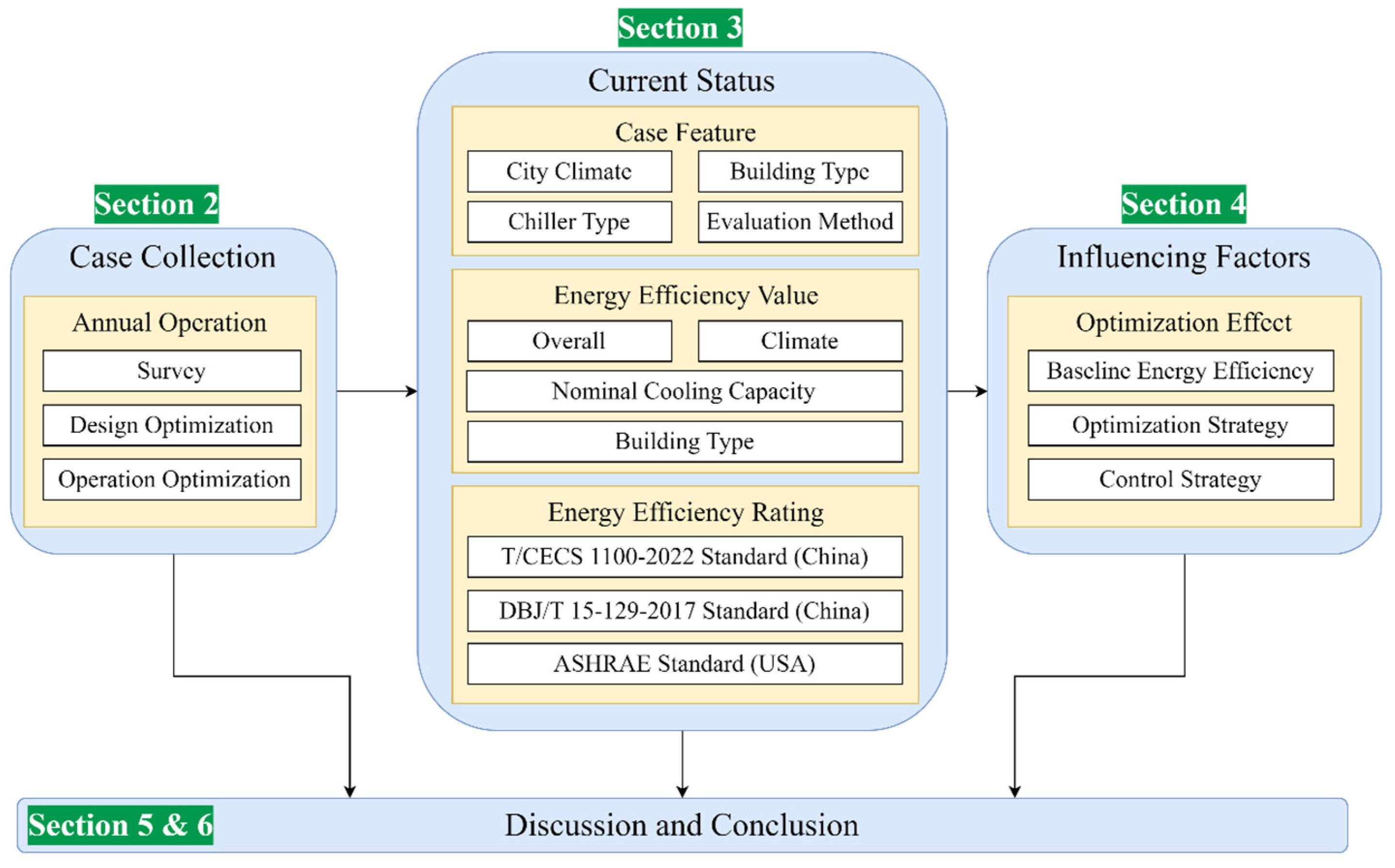
Figure 1 illustrates an overview of the research framework. Section 2 outlines the methodology used for identifying and screening CHW plant cases based on annual operational performance data. Building upon the selected dataset, Section 3 provides an in-depth analysis along three main dimensions. Firstly, it examines case characteristics—including climate zones, building types, chiller configurations, and evaluation methods. Secondly, it benchmarks energy efficiency performance from four perspectives: the full case set, different climate regions, nominal cooling capacity (NCC) categories, and building types. Thirdly, it evaluates compliance with existing rating standards, referencing “Assessment Standard for High Efficiency Air Conditioning Refrigerating Station” (T/CECS 1100-2022), “Standard for Energy Efficiency Measurement and Assessment of Centralized Chiller Plant Systems” (DBJ/T 15-129-2017), and American Society of Heating, Refrigerating and Air-Conditioning Engineers (ASHRAE) benchmarks to provide a systematic assessment of E E R a o across all cases. Section 4 further explores the key determinants of CHW plant performance, focusing on baseline efficiency levels, optimization strategies, and control approaches. Finally, Section 5 and Section 6 present the discussion of findings and overarching conclusions, respectively.

2. Methodology

Case collection forms the cornerstone of this study. This section details the methodology adopted to identify and screen relevant case studies from publications over the past decade.
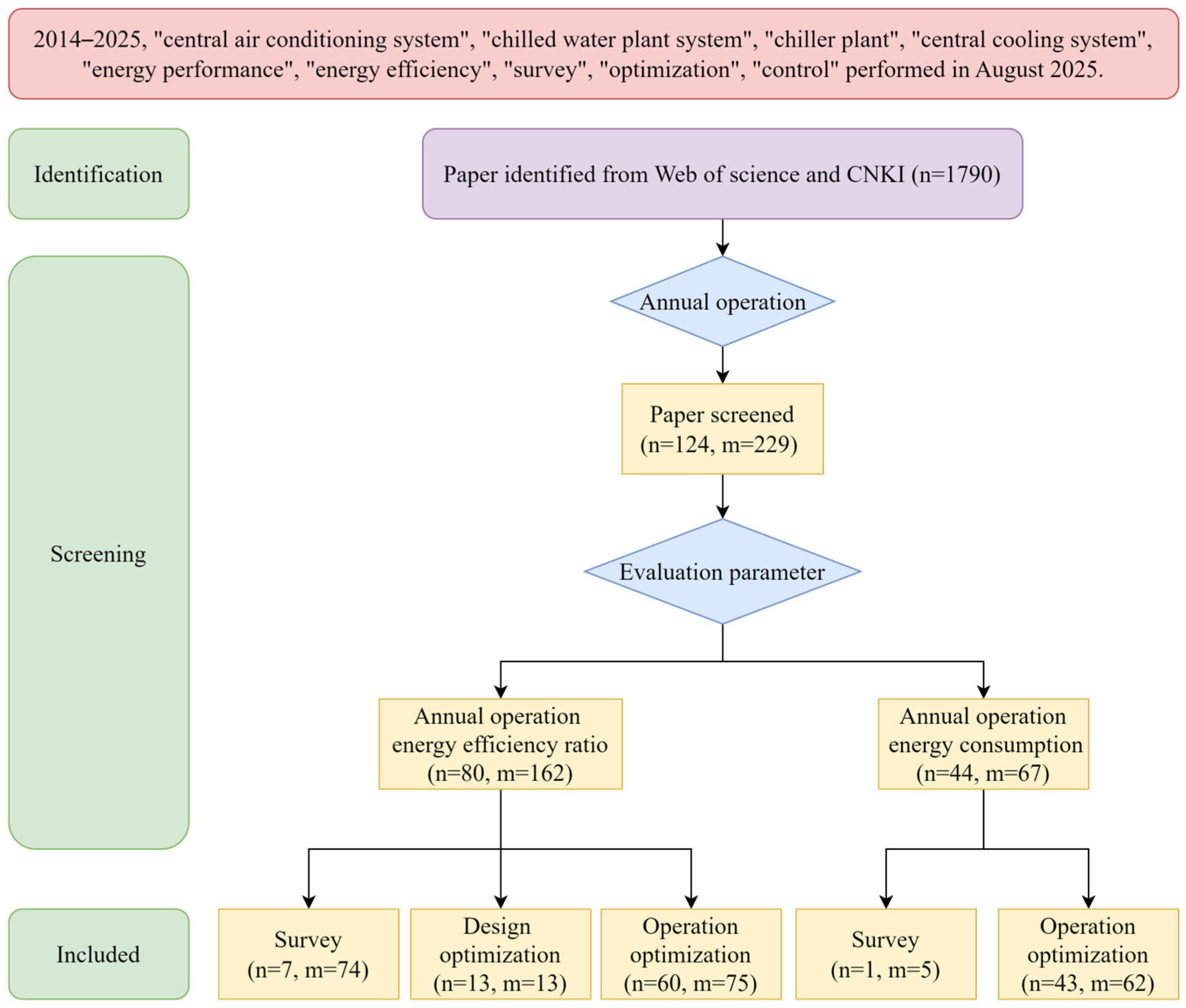
In Figure 2, a total of 1790 records published between 2014 and August 2025 were retrieved through keyword searches conducted across two major academic databases: Web of Science (838 records) and China National Knowledge Infrastructure (CNKI, 952 records). The final search was completed on 20 August 2025. The selected keywords included: “central air conditioning system”, “chilled water plant system”, “chiller plant”, “central cooling system”, “energy performance”, “energy efficiency”, “survey”, “optimization”, and “optimized control”. The complete search string was: ((“central air conditioning” OR “central cooling” OR “chilled water plant*” OR “chiller plant*”) AND (“energy performance” OR “energy efficiency” OR “energy” OR “design”) AND (“optim*” OR “survey”)).
During the literature screening process, titles and abstracts were used for the initial screening to exclude clearly irrelevant studies, while final inclusion decision was made based on a full-text review of the methodology, results, and analysis sections. The screening was performed based on the following inclusion criteria: (1) The study focused on CHW systems incorporating chillers, CHW pumps, condenser water pumps, and cooling towers; (2) It employed either the E E R a o or annual operation energy consumption ( E C a o ) as a core performance metric; (3) The source material was limited to peer-reviewed journal articles, conference proceedings, academic theses, or official research reports.
Studies that did not meet these criteria were excluded. For example, research on refrigeration or air-conditioning units lacking cooling towers was deemed irrelevant. Likewise, marine cooling systems were excluded due to their fundamentally different configurations from land-based CHW systems. In addition, any studies that assessed CHW plant performance only under design conditions, partial loads, or over short durations (e.g., specific days, weeks, or months) were omitted.
Following this rigorous screening process, 124 publications were ultimately selected, representing a total of 229 distinct case studies. The higher number of cases relative to papers is attributable to several studies reporting multiple CHW plant examples. Of these, 162 cases [23,24,25,26,27,28,29,30,31,32,33,34,35,36,37,38,39,40,41,42,43,44,45,46,47,48,49,50,51,52,53,54,55,56,57,58,59,60,61,62,63,64,65,66,67,68,69,70,71,72,73,74,75,76,77,78,79,80,81,82,83,84,85,86,87,88,89,90,91,92,93,94,95,96,97,98,99,100,101,102,103,104,105,106,107,108,109,110,111,112] adopted E E R a o as the key performance indicator, while the remaining 67 cases [10,11,12,13,14,113,114,115,116,117,118,119,120,121,122,123,124,125,126,127,128,129,130,131,132,133,134,135,136,137,138,139,140,141,142,143,144,145,146,147,148,149,150,151,152,153,154,155] relied on E C a o as the primary metric. The corresponding calculation is presented in Equation (1). The detailed information of these 229 cases is provided in Supplementary Materials (Table S1: EERao cases; Table S2: ECao cases).
The collected cases were further classified into three distinct categories: survey, design optimization, and operation optimization. The survey group comprises studies that examine the energy efficiency performance of either newly constructed or retrofitted CHW plants, typically relying on empirical field measurements. The design optimization group consists of research focused on the planning and design of new CHW systems with an emphasis on maximizing energy efficiency. In contrast, the operation optimization group includes studies aimed at enhancing the performance of existing systems through improved control strategies and operational management techniques. In total, the dataset includes 79 survey cases, 13 design optimization cases, and 137 operation optimization cases.

3. Current Status of CHW Plant Energy Efficiency

Investigating the current status of a research domain is essential for understanding its developmental trajectory and identifying emerging trends. Such assessments provide researchers with a clearer picture of the existing landscape and offer valuable insights to guide future directions.
Drawing upon the case dataset established in Section 2, this section provides a comprehensive evaluation of the energy efficiency profile of CHW plants from three analytical perspectives: case characteristics (including city climate, building type, chiller technology, and evaluation methods); E E R a o performance (analyzed by climate zone, nominal cooling capacity, and building type); and E E R a o benchmarked against several international standards.
It is noted that the analysis of CHW plant E E R a o performance was conducted using a single-factor grouping approach, rather than a multi-factor cross-grouping. Although factors such as climate zone, plant cooling capacity, and building type can jointly influence energy performance, applying cross-group analysis would create a large number of subgroups (e.g., 3 climate zones × 2 capacity ranges × 4 building types = 24 subgroups). Given the limited number of available cases (91 optimized cases and 98 unoptimized cases), this would result in very small sample sizes in each subgroup and reduce the representativeness and reliability of the results. Therefore, single-factor grouping was adopted to ensure sufficient data in each group. This is a limitation of the present study and can be addressed in future research by collecting a broader and more diverse set of case studies, which would allow more detailed multi-factor analysis.

3.1. Case Characteristics

This section employs cluster analysis and multidimensional data decomposition to explore the distribution patterns of CHW plant cases across four key dimensions: city climate, building type, chiller type, and evaluation methodology.

3.1.1. City Climate

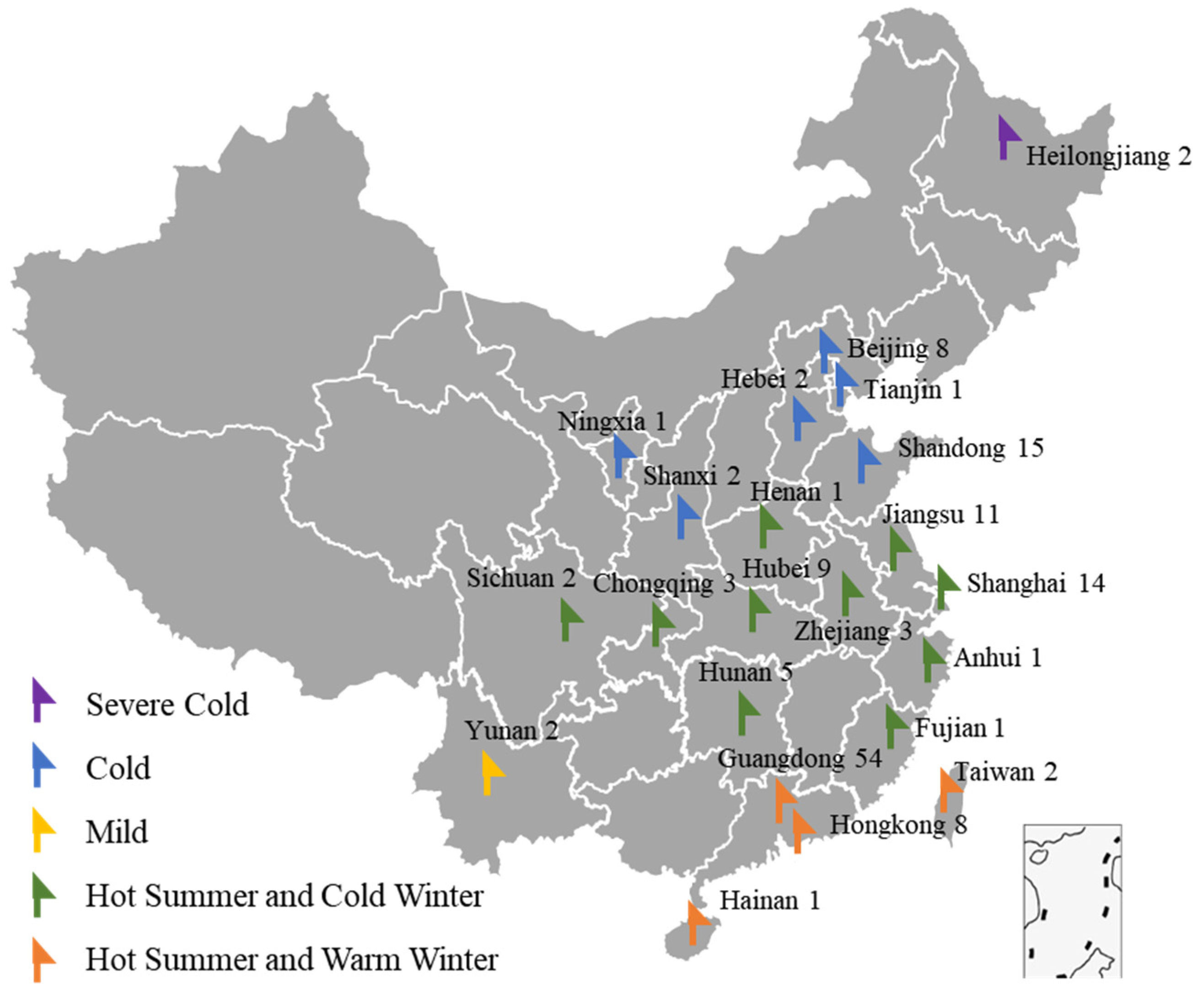
Among the screened CHW plant cases, 177 were explicitly linked to specific cities across a range of geographic regions. Of these, 148 were located in Chinese cities, while the remaining 29 originated from international locations—namely, 17 in the U.S., 4 in South Korea, 3 in Singapore, and 1 case each in the U.A.E., Mongolia, France, Saudi Arabia, and Sri Lanka.
According to China’s thermal design zoning standards [156], urban climates are divided into five categories based on temperature-related parameters: Severe Cold, Cold, Mild, Hot Summer-Cold Winter (HSCW), and Hot Summer-Warm Winter (HSWW). The classification is primarily determined by the average temperature of the coldest month, with the following threshold ranges: Severe Cold ,   10 , Cold 10 ,     0 , HSCW 0 ,   10 , and HSWW 10 , + . As ambient temperatures increase, cooling seasons extend accordingly—for example, the cooling season in the Cold zone typically spans from 15 May to 30 September, while in the HSWW zone, it runs from 15 April to 15 November [157].
Figure 3 depicts the provincial distribution of the 148 Chinese cases and their corresponding climate zones: 65 are situated in HSWW, 50 in HSCW, 29 in Cold zones, and 2 each in the Severe Cold and Mild categories. This distribution reflects a strong research emphasis on regions with longer cooling seasons, where the potential for energy savings is generally greater. Notably, Guangdong Province—classified within the HSWW—accounts for 54 of these cases, underscoring the combined influence of climatic demand and economic development. Guangzhou and Shenzhen, both first-tier cities, contribute 31 and 13 cases, respectively.
To facilitate consistent cross-regional comparisons, the 29 international cases included in the dataset were mapped into China’s climate zoning framework. This reclassification was based on a comparative analysis of climatic parameters—specifically, the average temperature of the coldest month—for each international city, as obtained from https://climate.onebuilding.org (accessed on 20 August 2025) [158]. These values were then aligned with the threshold criteria defined in China’s thermal zoning standards [156]. This method represents an approximate mapping intended solely for comparative analysis. As climate classification systems vary across countries, discrepancies in climate zoning assignments and a degree of uncertainty are to be expected. Nevertheless, most of the international case studies fall within the HSCW or HSWW under the Chinese classification scheme (Table 2).

3.1.2. Building Type

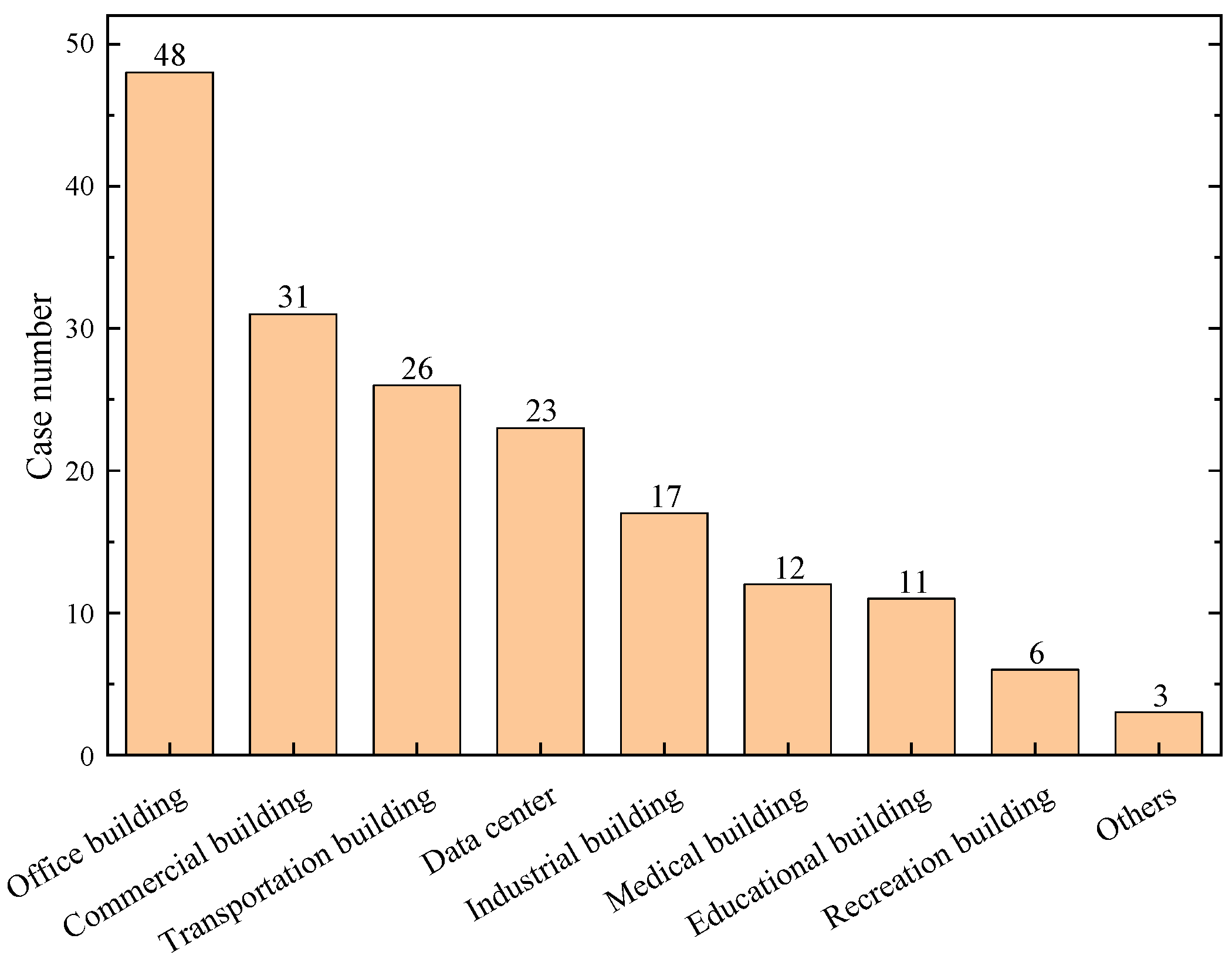
Figure 4 presents the distribution of the reviewed cases by building type. Office buildings constitute the largest category, with 48 cases, followed by commercial buildings and transportation hubs, which account for 31 and 26 cases, respectively. Notably, data centers—an increasingly critical component of modern infrastructure in the information era—have experienced rapid expansion in both number and scale, driven by continuous advancements in information technology [160]. Reflecting this trend, the study includes 23 cases that specifically examine the annual energy performance of data centers.

3.1.3. Chiller Type

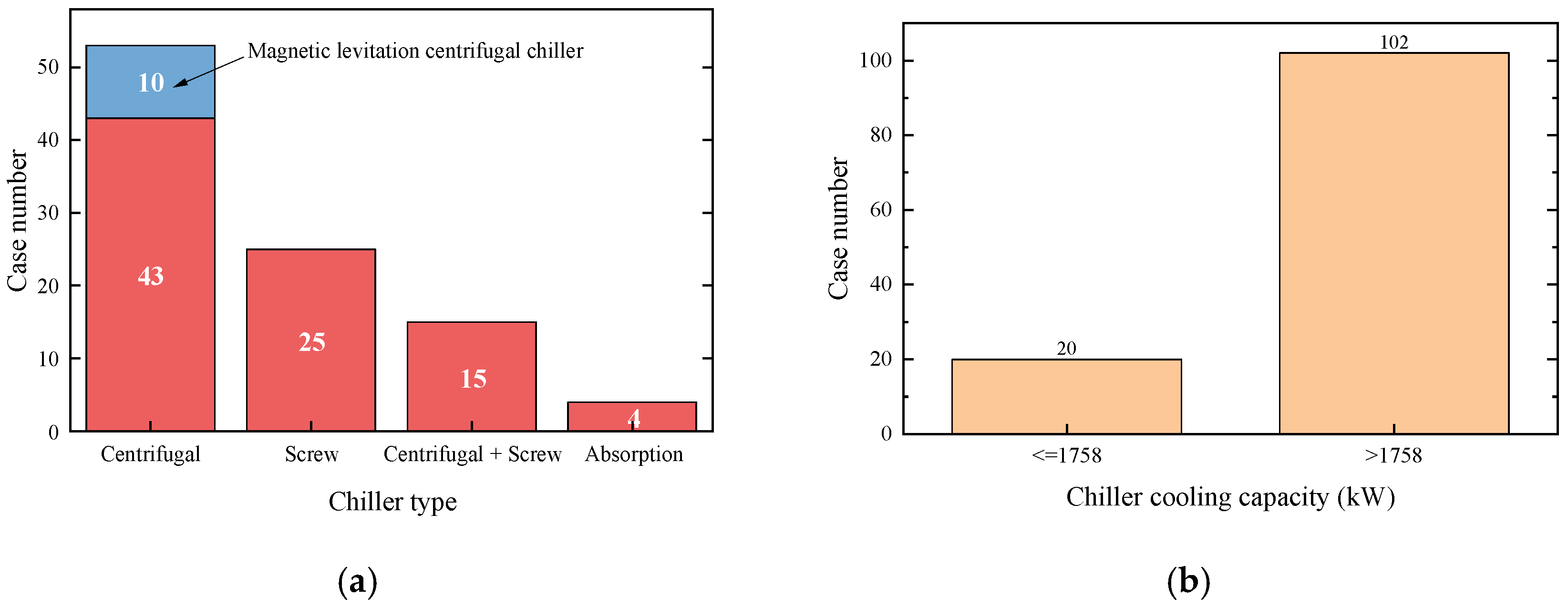
Figure 5 illustrates the distribution of CHW plant cases based on chiller type and cooling capacity. In Figure 5a, centrifugal chillers are the most commonly adopted, appearing in 53 cases—10 of which specifically utilize high-efficiency magnetic levitation centrifugal chillers. Owing to their superior energy performance, magnetic levitation chillers have become a preferred choice for recent system upgrades and retrofits [160]. In addition, 15 cases feature hybrid configurations that combine centrifugal and screw chillers. This mixed setup enables more flexible responses to fluctuating cooling loads by leveraging the varying capacities of each chiller type, thereby improving load distribution, meeting cooling demand more effectively, and enhancing overall energy efficiency.
Figure 5b depicts the distribution of chiller cooling capacities. According to Singapore’s “Code of Practice for Air-Conditioning and Mechanical Ventilation in Buildings” (SS553-2016) [161], a threshold of 1758 kW is used to differentiate E E R a o . Among the 122 cases reporting capacity data, 84% exceed this threshold, highlighting a predominant research focus on large-capacity CHW systems.

3.1.4. Evaluation Method

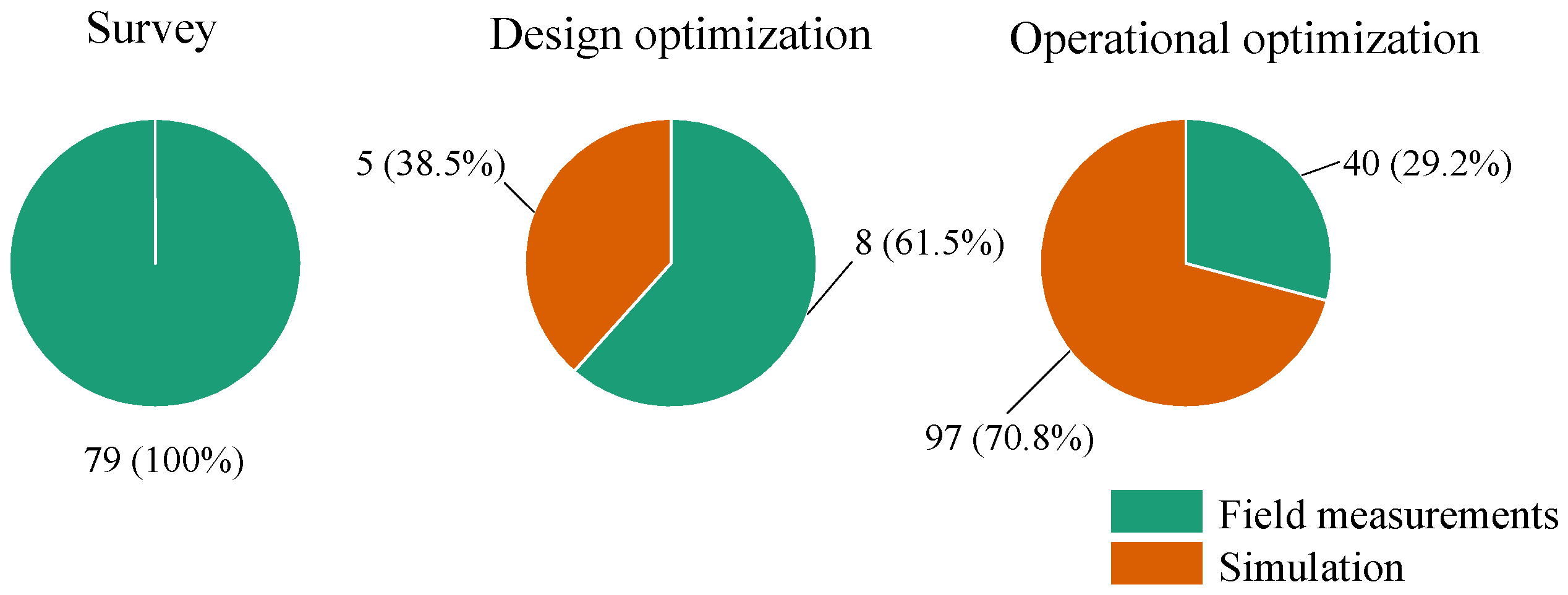
The collected cases in this study were classified into three categories: survey, design optimization, and operational optimization. In Figure 6, the energy efficiency of CHW plants was evaluated using either field measurements or simulation-based methods. All survey cases employed field measurements to assess real-world system performance. Among the design optimization cases, 62% also relied on field data. In contrast, operational optimization studies were predominantly based on simulations, which accounted for 71% of the cases in this group. This heavy reliance on simulation methods suggests that many proposed operational optimization strategies have yet to be widely implemented or validated in practical settings. Simulation approaches used across the cases include both model-based and model-free methods. The most frequently adopted tools were TRNSYS [28,31,34] (25 cases), Modelica [36,113,114] (10 cases), and EnergyPlus [124,127,132] (5 cases).

3.2. Energy Efficiency Value

This section provides a quantitative analysis of the E E R a o for all CHW plant cases, utilizing a grouped comparison approach to evaluate performance before and after optimization. The objective of this analysis is to characterize the current energy efficiency levels of both unoptimized and optimized CHW plant cases. The results reflect the overall performance distribution and offer empirical evidence to support the refinement of E E R a o benchmarks. The analysis also helps validate the necessity of incorporating key grouping factors such as climate and capacity when benchmarking system performance.
The primary input variables consist of E E R a o values from 98 unoptimized and 91 optimized CHW plant cases reported in the literature. No additional data normalization was applied. In addition to overall analysis, cases were further investigated from three perspectives. (1) Climate Zone: Following China’s thermal design zoning standards and reflecting the dominant distribution of cases, the analysis focuses on three major climate zones: HSWW, HSCW, and Cold. (2) Building Type: Cases were classified into the major building types commonly reported in the literature, including office, commercial, transportation, and industrial facilities. (3) Nominal Cooling Capacity (NCC): In accordance with the threshold defined by standard SS553-2016 [161], cases are divided into two groups: those with NCC below 1758 kW and those with NCC equal to or exceeding 1758 kW.

3.2.1. Overall Analysis

Most design optimization and operational optimization studies report E E R a o values both before and after CHW plant optimization. Ho [30] conducted an operational algorithm optimization for a chiller plant in Hong Kong, where the E E R a o improved from 3.69 to 4.31, reflecting a 16.8% increase in annual energy efficiency. Based on this pattern, the present study classifies all cases into two categories: unoptimized and optimized. The unoptimized group includes E E R a o from survey studies as well as pre-optimization data from optimization studies. The optimized group consists exclusively of post-optimization E E R a o . This classification facilitates a direct comparison of energy efficiency performance before and after optimization, enabling quantitative assessment of improvement outcomes.
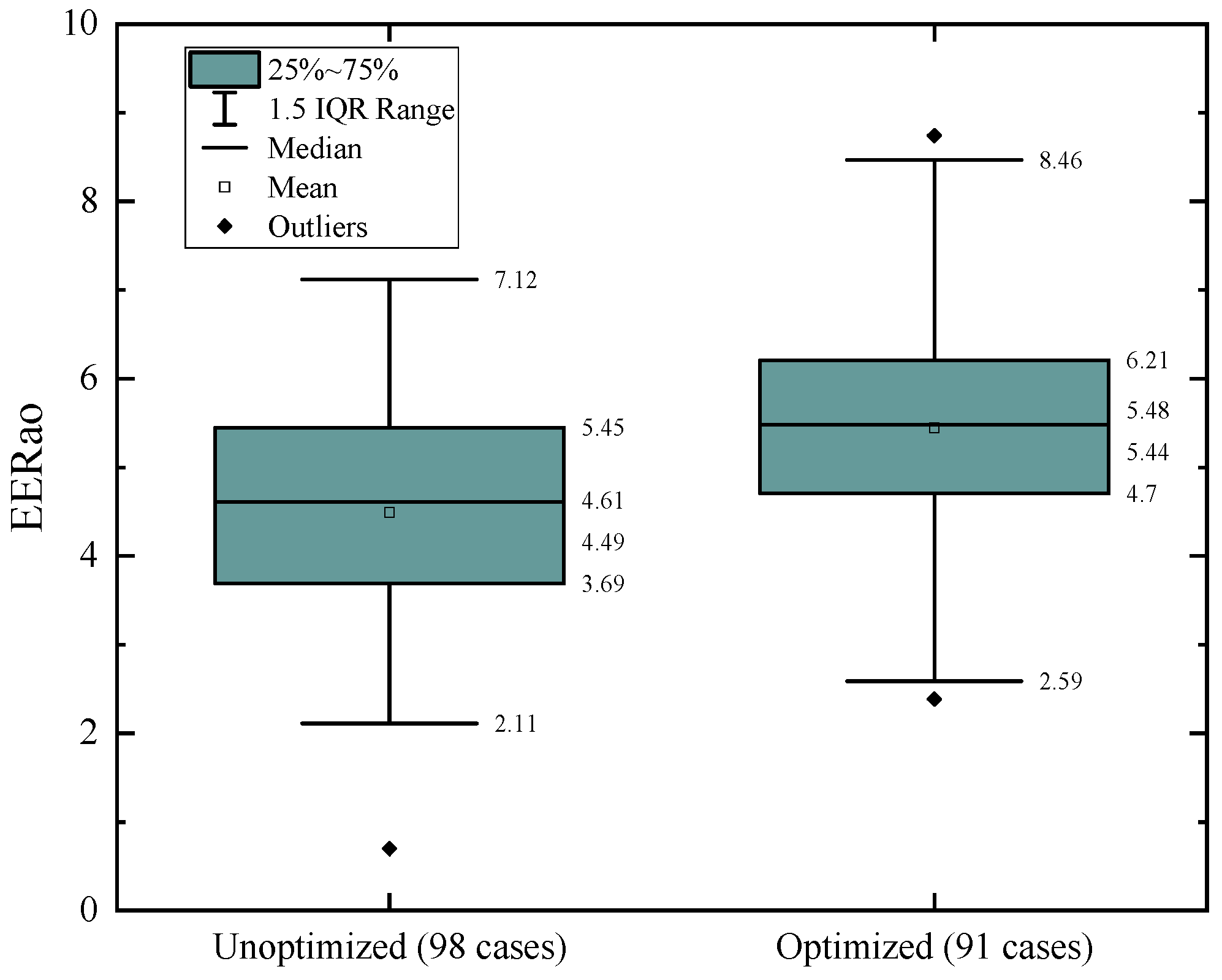
In Figure 7, the E E R a o for 98 unoptimized and 91 optimized CHW plant cases are compared. The interquartile range (IQR, 25~75%) for the unoptimized group spans from 3.69 to 5.45, whereas the optimized group ranges from 4.70 to 6.21. This shift indicates a notable overall improvement in annual energy performance. Specifically, the median E E R a o increased by 18.9%, from 4.61 in the unoptimized group to 5.48 in the optimized group. Moreover, both the mean value and the full distribution of the optimized group exceed those of the unoptimized group, further confirming a consistent enhancement in system efficiency following optimization.

3.2.2. Climate Zones

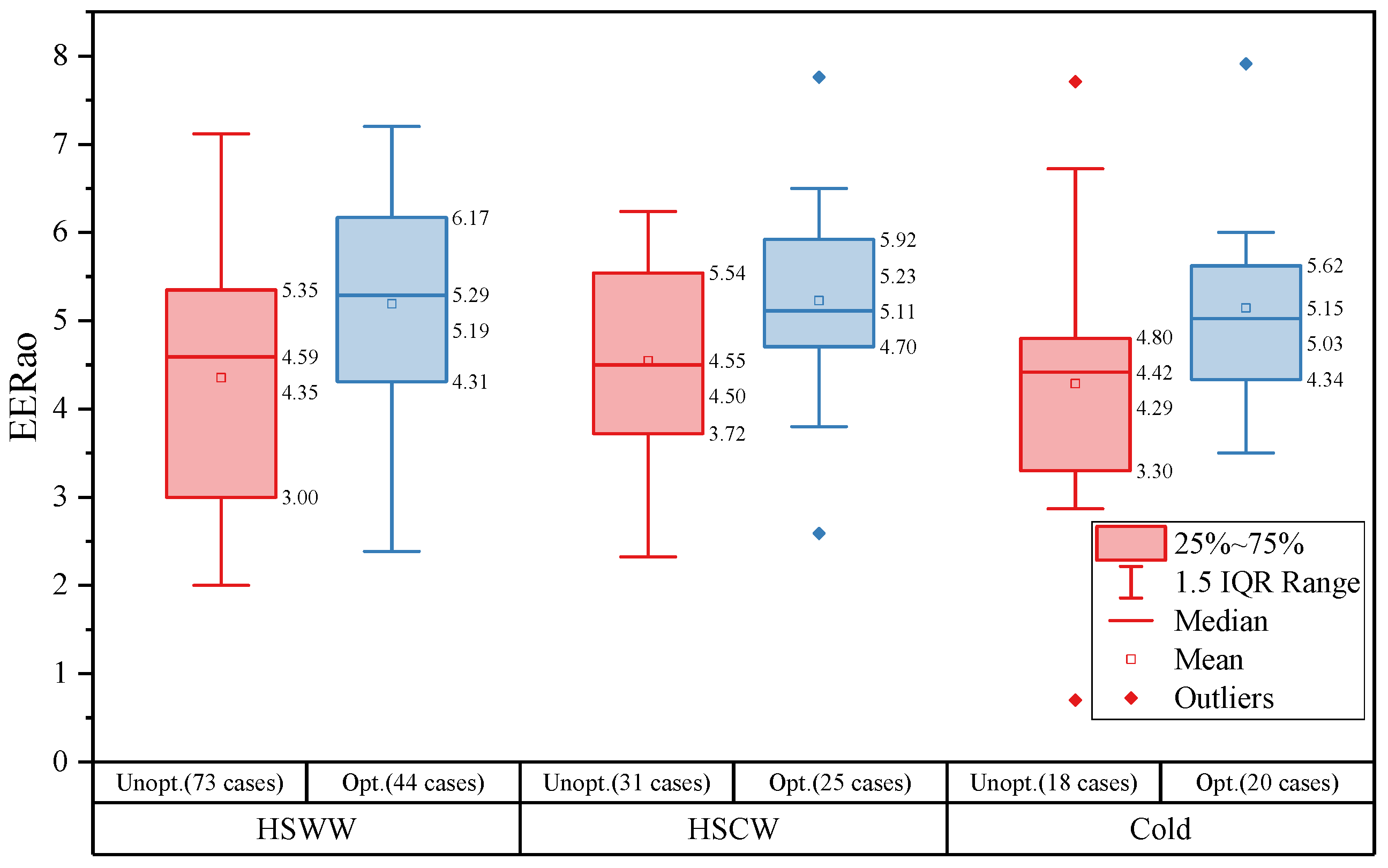
Figure 8 presents the box plots of E E R a o for CHW plants across three climate zones—HSWW, HSCW, and Cold—before and after optimization. The results reveal modest variations in energy efficiency performance among the different climate zones. In the unoptimized group, the median E E R a o were 4.59 for HSWW, 4.50 for HSCW, and 4.42 for Cold regions. Following optimization, the median values increased to 5.29, 5.11, and 5.03, respectively, corresponding to improvements of 15.25%, 13.56%, and 13.80%. These findings indicate that the optimization process led to a consistent and significant enhancement in annual energy efficiency across all climate zones.
Notably, both before and after optimization, the median E E R a o followed the same trend: HSWW > HSCW > Cold. This pattern suggests a positive correlation between ambient temperature and system energy efficiency. Specifically, in the unoptimized group, the median E E R a o increased by 0.08 from the Cold to the HSCW zone, and by 0.09 from the HSCW to the HSWW zone. In the optimized group, the corresponding increases were 0.08 and 0.18, respectively.

3.2.3. Nominal Cooling Capacities

The three standards—“Energy Efficiency Rating and the Minimum Allowable Value for Central Air-Conditioning Chillers” (T/DZJN 78-2022), DBJ/T 15-129-2017, and SS553-2016—all classify E E R a o based on NCC, with more stringent requirements applied to systems of higher capacity. This classification approach reflects the principle that large-scale equipment, when properly designed, can achieve higher energy efficiency due to improved resource utilization. During the design phase, such systems can benefit from parameter optimization—for example, by increasing the heat exchange surface area or enhancing compressor performance.
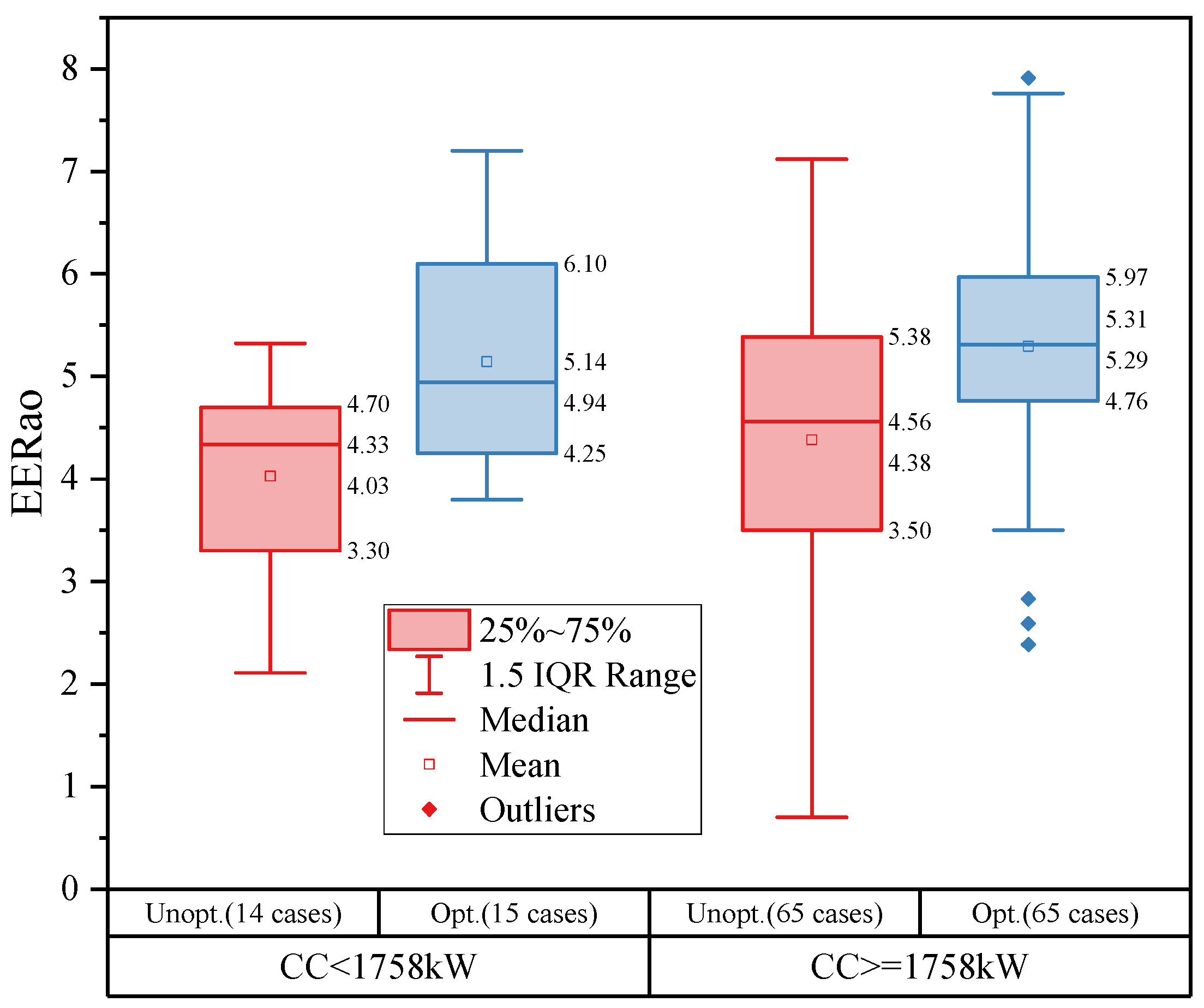
Figure 9 compares the E E R a o values of CHW plants grouped by cooling capacity thresholds: below 1758 kW and at or above 1758 kW. In the unoptimized group, there are 14 and 15 cases in the two categories, respectively. The optimized group includes 65 cases in each capacity range.
The results indicate that optimized E E R a o are consistently higher than their unoptimized counterparts. The median improvement is 0.61 for CHW plants with NCC < 1758 kW, and 0.75 for those with NCC ≥ 1758 kW. Moreover, in both the unoptimized and optimized groups, plants with larger NCC (≥1758 kW) exhibit higher mean and median E E R a o compared to their smaller-capacity counterparts. The maximum observed difference in median values between the two categories reaches 0.37.
These findings align with the NCC-based classification schemes adopted in various energy efficiency standards, thereby reinforcing the rationale and validity of imposing stricter performance requirements on higher-capacity systems.

3.2.4. Building Type

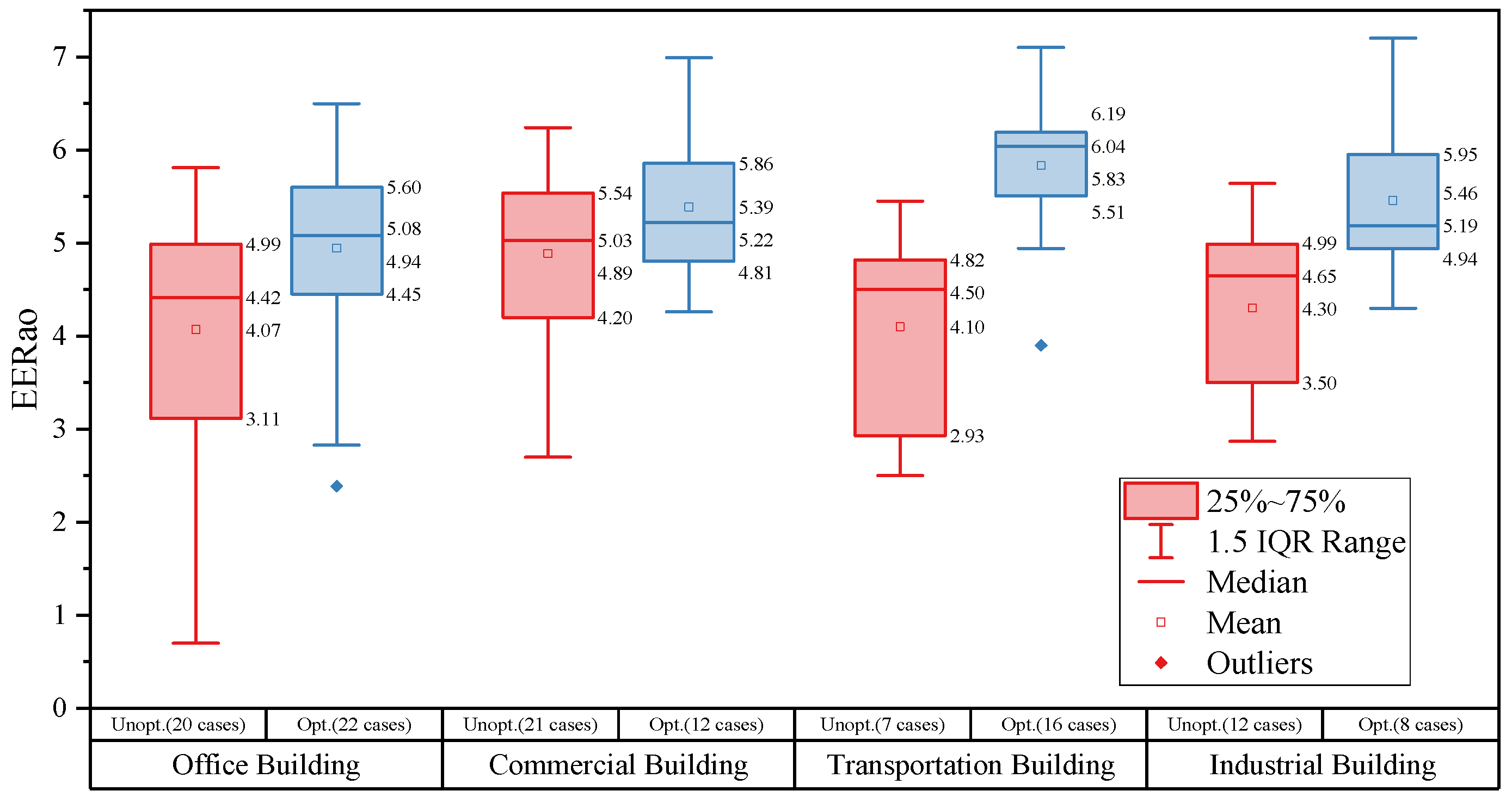
Based on building type, the reviewed cases in this study are classified into five categories: office buildings, commercial buildings, transportation facilities, industrial and buildings. Figure 10 compares the distribution of E E R a o across the four primary building types in both the unoptimized and optimized groups.
The results reveal notable differences in E E R a o performance across building types. In the unoptimized group, commercial buildings exhibited the highest median E E R a o at 5.03, followed by industrial buildings (4.65), transportation facilities (4.50), and office buildings (4.42). Following optimization, the ranking shifted: transportation facilities achieved the highest median E E R a o at 6.04, followed by commercial (5.22), industrial (5.19), and office buildings (5.08).
Across both groups, office buildings consistently recorded the lowest median E E R a o , suggesting that future optimization strategies should prioritize enhancing the energy efficiency of CHW plant systems in this category.
Substantial improvements were observed across all building types after optimization. Specifically, the median E E R a o increased by 0.66 for office buildings, 0.19 for commercial buildings, 1.54 for transportation facilities, and 0.54 for industrial buildings. Notably, transportation facilities achieved the largest relative improvement (34.22%) primarily driven by a series of subway station retrofitting projects in Guangzhou, China, which are included under this category and demonstrated significant energy savings.

3.3. Energy Efficiency Rating

3.3.1. E E R a o -Based Rating Standard

Globally, the energy efficiency of CHW plants is assessed using a variety of country-specific rating systems. In many regions, these systems focus solely on individual components—such as chillers or pumps—rather than evaluating the performance of the entire plant. Table 3 summarizes three representative rating frameworks that assess annual operation E E R a o at the plant level.
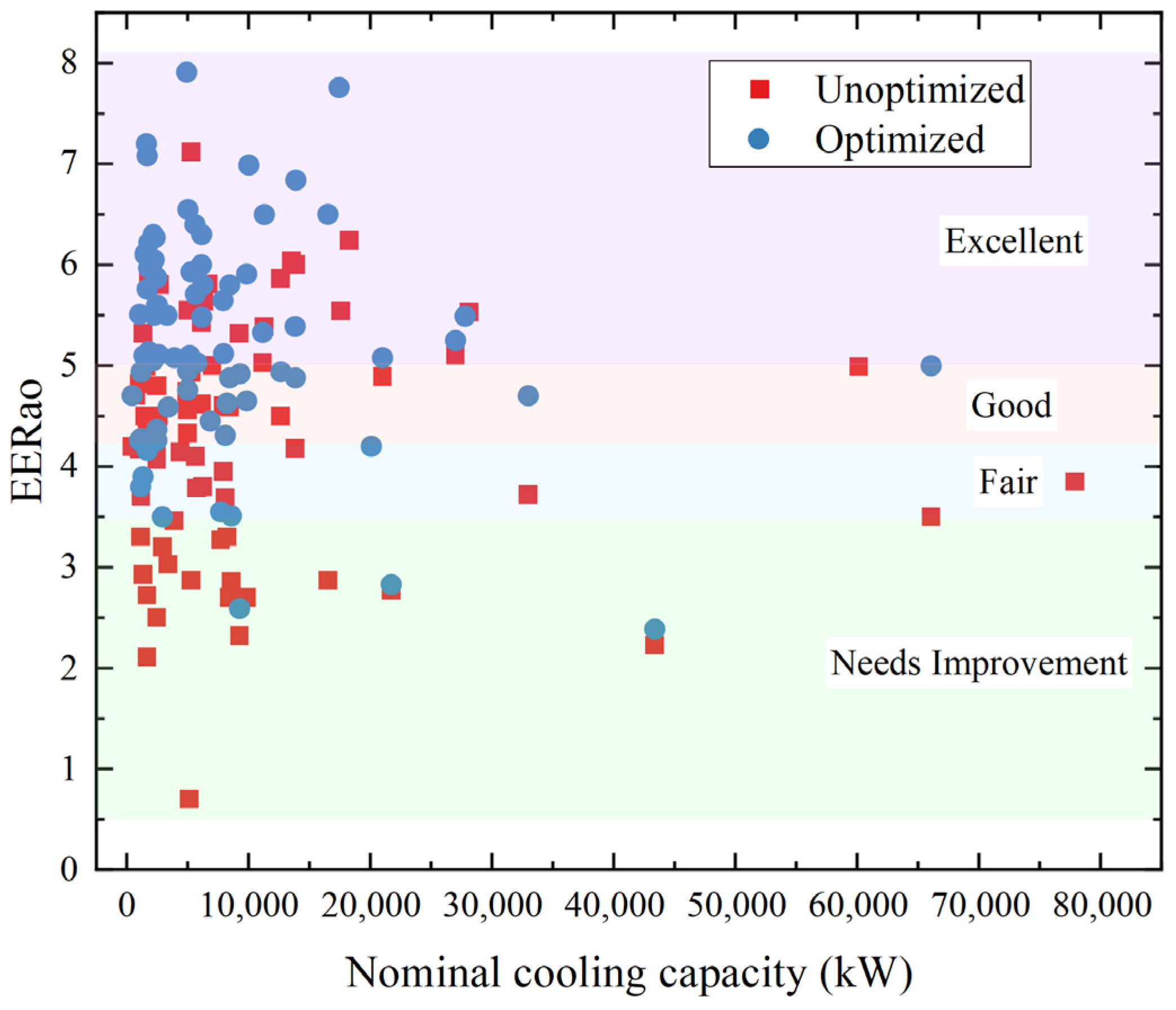
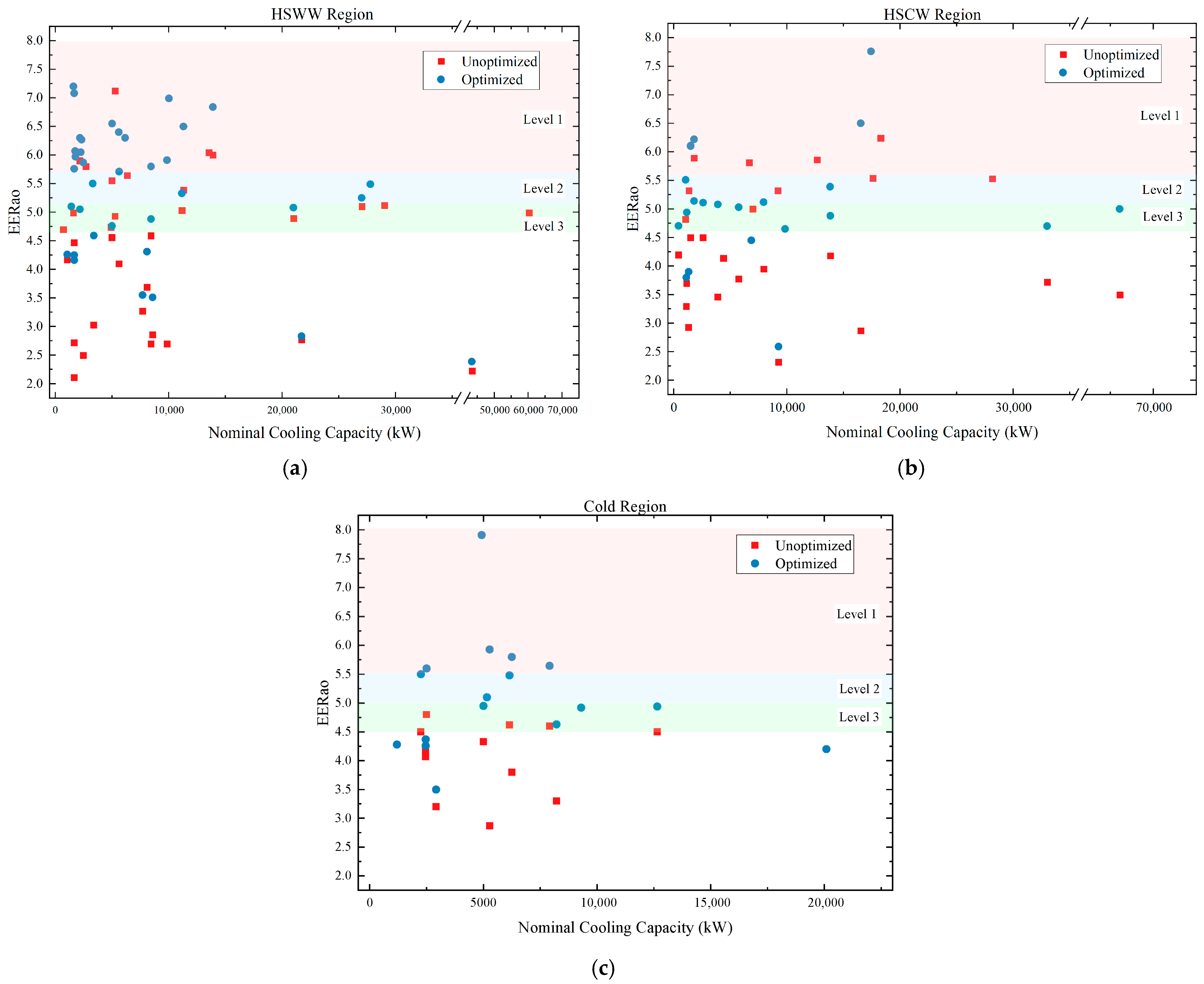
In the U.S., Hartman [163] was the first to propose annual operating energy efficiency grading benchmarks for CHW plants. These benchmarks have since been widely cited in both academic and industry literature [164,165,166]. The study classified E E R a o into four rating levels: “Excellent (Level 1)” (COP ≥ 5.0), “Good” (COP 4.0~5.0), “Fair” (COP 3.5~4.0), and “Needs Improvement” (COP < 3.5). SS553-2016 [161] provides standardized E E R a o criteria for CHW plants in commercial, office, and institutional buildings (excluding hospitals). The classification distinguishes between systems with NCC below and above 1758 kW (equivalent to 500 refrigeration ton (RT), where 1 RT = 3.517 kW), with three rating levels defined for each capacity category. The highest rating, Platinum (Level 1), requires an E E R a o above 5.41 for systems with NCC ≥ 1758 kW, and above 5.17 for smaller systems. In China, T/CECS 1100-2022 [162] offers a more granular classification framework. It defines three climate zones, each with five efficiency rating levels, where Level 1 represents the most efficient performance, and Levels 4~5 signal a need for upgrades. For instance, the E E R a o threshold for Level 1 is 5.5 in Cold zones, 5.6 in HSCW, and 5.7 in HSWW.
It is important to note that the definitions and rating thresholds across these standards (e.g., ASHRAE- versus China-based thresholds) differ by standard and climate context. Therefore, comparisons among rating levels (e.g., ‘Level 1’ or ‘Excellent’) should be interpreted as indicative of relative performance within each standard’s own framework, rather than as strictly equivalent benchmarks.

3.3.2. Energy Efficiency Rating Analysis

To facilitate a clearer comparison of energy efficiency performance between unoptimized and optimized CHW plants, each case’s E E R a o was benchmarked against both the 2001 U.S. rating system and T/CECS 1100-2022. Table 4 and Figure 11 present the classification results based on the U.S. 2001 rating framework. In the unoptimized group, 32 out of 92 cases (34.8%) achieved the “Excellent” rating. After optimization, this proportion increased substantially to 65.6%, highlighting the effectiveness of the implemented optimization strategies. Nevertheless, 9 optimized cases still remained in the “Fair” or “Needs Improvement” categories.
Table 5 and Figure 12 present the classification of E E R a o under the T/CECS 1100-2022 across three climate zones. Across all zones, the E E R a o of CHW plants improved substantially following optimization. For example, in the HSWW region, only six cases initially met the Level 1 rating threshold. After optimization, the E E R a o of individual cases increased to varying degrees, raising the number of Level 1-rated plants to 20. Similar improvements were observed in the HSCW and Cold zones, where the number of Level 1 cases increased by 3 and 6, respectively.
However, despite these gains, 59.0% of the optimized cases still failed to meet the Level 1 efficiency standard—particularly in the HSCW and Cold regions, where approximately 70% of cases remained below the highest rating. This outcome underscores the need for continued research into advanced optimization strategies.

4. Analysis of Factors Influencing Energy Efficiency Improvement

Among the 229 annual operation cases analyzed in this study, 138 cases (76 cases reporting E E R a o and 62 cases reporting E C a o ) specifically focus on energy efficiency improvement. This suggests the area of CHW plant energy efficiency improvement is a prominent research hotspot. Building on the status analysis in Section 3, this section aims to identify and examine the key factors that drive efficiency improvements in order to inform the future development and optimization of CHW plants.
Accordingly, this section centers on three core elements of energy efficiency enhancement: baseline energy efficiency, optimization strategy, and control strategy. The comparative analysis presented in Section 4.1, Section 4.2 and Section 4.3 adopts a grouped analysis approach. The primary input variable for this analysis is the percentage improvement in EERao calculated with Equation (2). For each factor of interest, case studies are grouped according to relevant characteristics (e.g., baseline efficiency range or strategy type). Group performance is then evaluated by comparing the distribution of improvement percentages across cases within each group. The percentage improvement provides a standardized, dimensionless metric for assessing optimization effectiveness across diverse case contexts, as it normalizes the influence of varying initial performance levels and enables equitable cross-case comparisons. No additional data normalization was applied beyond the calculation of percentage improvements in EERao ( r E E R a o ).
r E E R a o = E E R a o n e w E E R a o o l d E E R a o o l d × 100 % = E C a o o l d E C a o n e w E C a o n e w × 100 %
where r E E R a o represents the percentage improvement in E E R a o ; E E R a o n e w and E E R a o o l d represent the optimized and pre-optimization annual operation energy efficiency, respectively; while E C a o n e w and E C a o o l d represent the optimized and pre-optimization annual operation energy consumption, respectively.

4.1. Baseline Energy Efficiency

Baseline energy efficiency, defined as the E E R a o under non-optimized conditions, serves as a critical reference point for evaluating both the current technological maturity of a CHW plant and its potential for further optimization.
This subsection explores the relationship between initial system performance and achieved efficiency improvements. Cases were grouped according to baseline E E R a o using predefined thresholds of 3.0, 4.0, and 5.0, which align with commonly adopted engineering benchmarks and the key efficiency classification levels outlined in international standards (Section 3.3.1). This classification results in four performance tiers: <3.0, [3.0, 4.0), [4.0, 5.0), and ≥5.0.
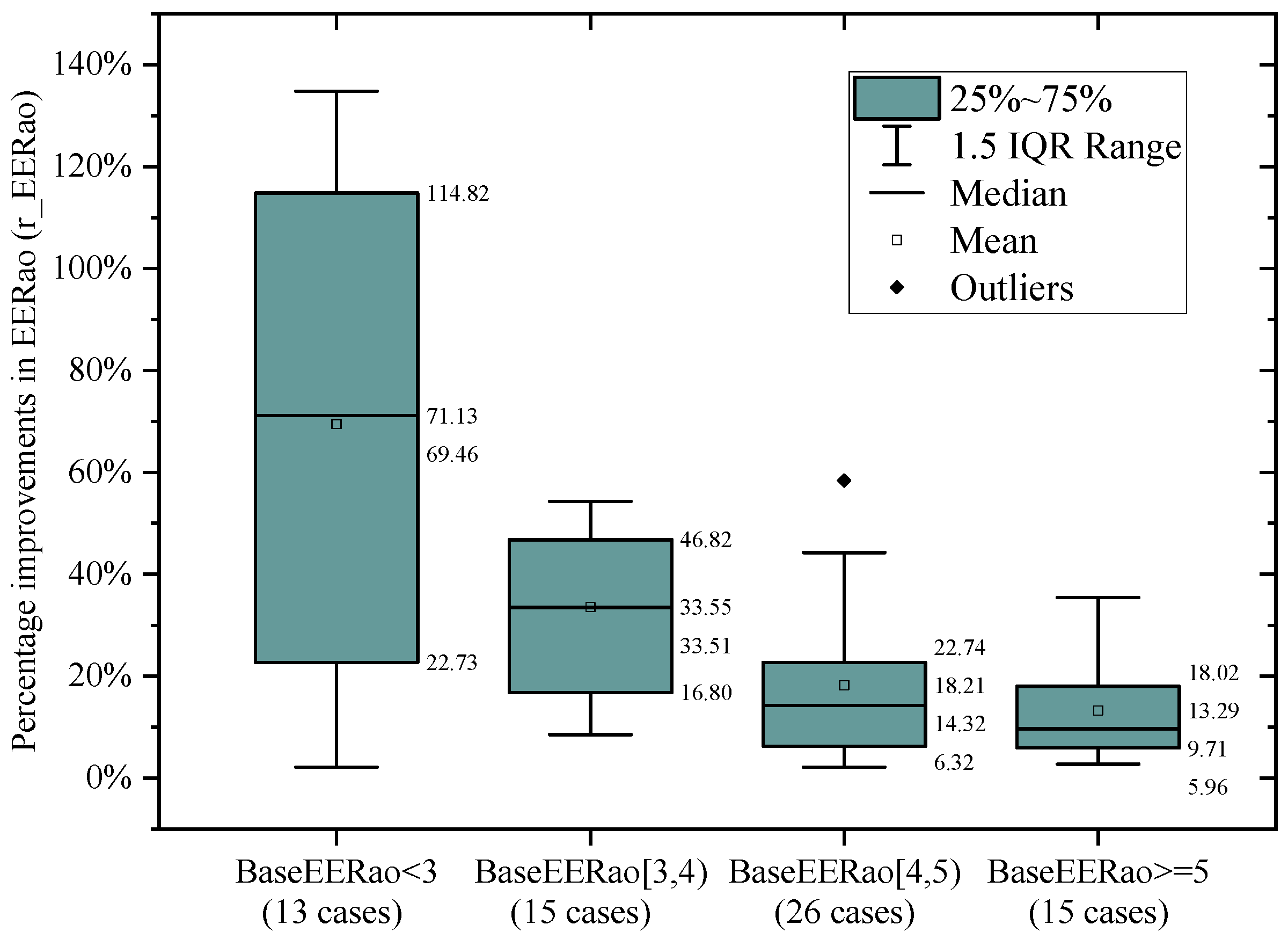
Figure 13 illustrates the distribution of r E E R a o across the four baseline efficiency tiers. When the baseline E E R a o is below 3.0, the average improvement ratio reaches 69.46%. As the baseline E E R a o increases, the average efficiency gains decrease—falling to 33.55%, 18.21%, and 13.29% for the ranges [3.0, 4.0), [4.0, 5.0), and ≥5.0, respectively. These results highlight a clear trend: systems with lower baseline efficiency offer greater optimization potential, while those with higher initial performance exhibit diminishing returns.
Accordingly, when formulating optimization strategies, it is essential to define realistic goals that are tailored to the baseline efficiency level of the system. Such an approach not only enhances the effectiveness and precision of optimization efforts but also enables more equitable and informative comparisons across different methods and case conditions.

4.2. Optimization Strategy

Based on whether the optimization strategy involves equipment upgrades, optimization approaches can be classified into two categories: pure operational control optimization and operational control optimization with equipment improvements.
Pure operational control optimization focuses on enhancing system energy efficiency exclusively through advanced control strategies and algorithms, without altering existing CHW plant hardware. Chan [32] proposed a hybrid predictive control strategy for a hospital CHW plant in Hong Kong, achieving an approximate 8.6% improvement in the coefficient of performance compared to conventional methods.
In contrast, operational control optimization with equipment improvements combines control strategies with physical upgrades to system components. Shan [34] recommended integrating a thermal energy storage device alongside a model predictive control (MPC) algorithm to coordinate the switching between storage systems and chillers. Field testing in a high-rise building in Hong Kong demonstrated a 3.10% gain in cooling efficiency using this integrated approach.
To assess the relative effectiveness of these two strategies, cases were grouped according to the type of optimization method employed. This classification was derived from a qualitative review of each study’s methodology, rather than from a quantitative clustering process.
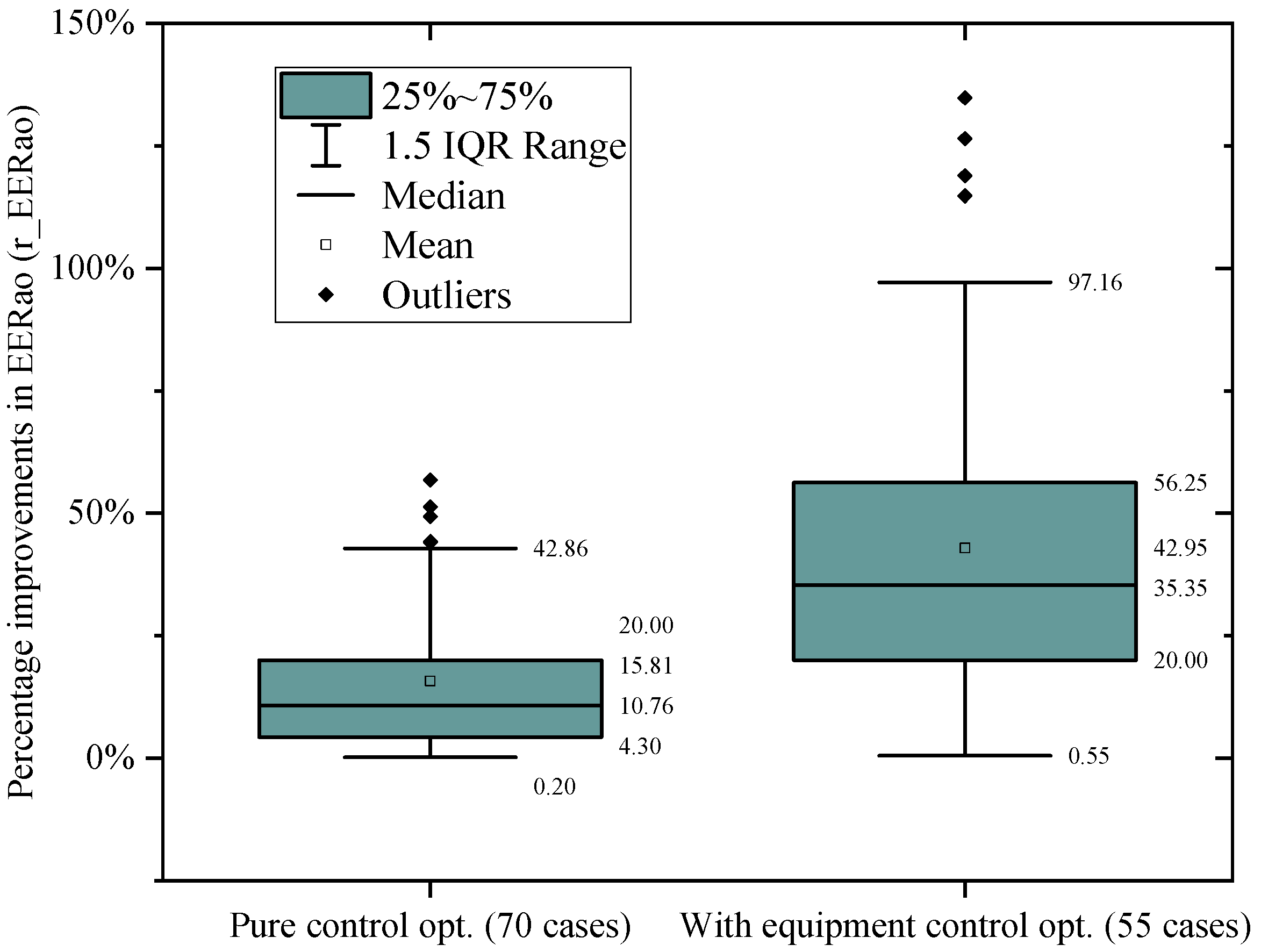
Figure 14 compares the performance outcomes of the two optimization categories across 70 cases (pure control) and 55 cases (control with equipment improvements). The results indicate a significantly higher median improvement ratio for strategies involving equipment upgrades—35.35%—compared to 10.76% for pure control optimization. This represents a roughly 3.29-fold increase, strongly emphasizing the added value of equipment retrofits in enhancing energy efficiency. However, the substantial energy gains from equipment improvements must be weighed against the higher initial capital investment. Practical implementation requires careful evaluation of economic feasibility, cost–benefit trade-offs, and long-term operational savings.
Commonly adopted equipment retrofit measures include water-side economizers (WSE) [159], unit reconfiguration [41], and the adoption of magnetic levitation chillers [90]. These technologies not only improve the energy efficiency of CHW systems but also help reduce operating costs, thereby enhancing overall economic performance.

4.3. Control Strategy

Predictive control strategies are the most popular operational control optimization methods for CHW plants. They can be broadly categorized into model-based and model-free approaches [167]. Model-based predictive control requires the development of a mathematical model that accurately captures the dynamics of the CHW plant system. This model serves as the foundation for optimization. Yu [117] constructed a full-variable-speed chiller system model in TRNSYS and performed optimization analysis, achieving a 19.7% reduction in annual electricity consumption. In contrast, model-free predictive control does not rely on an explicit mathematical model. Instead, it employs data-driven techniques such as expert systems or reinforcement learning algorithms. Takabatake [128] implemented a Bayesian optimization-based model-free control strategy for a CHW plant, resulting in an energy savings of 10.38%.
This subsection evaluates the effectiveness of two predictive control approaches. The reviewed cases were classified according to the control methodology described in each study: Model-Based Predictive Control and Model-Free Predictive Control. The categorization was established based on the technical characteristics outlined in the source literature.
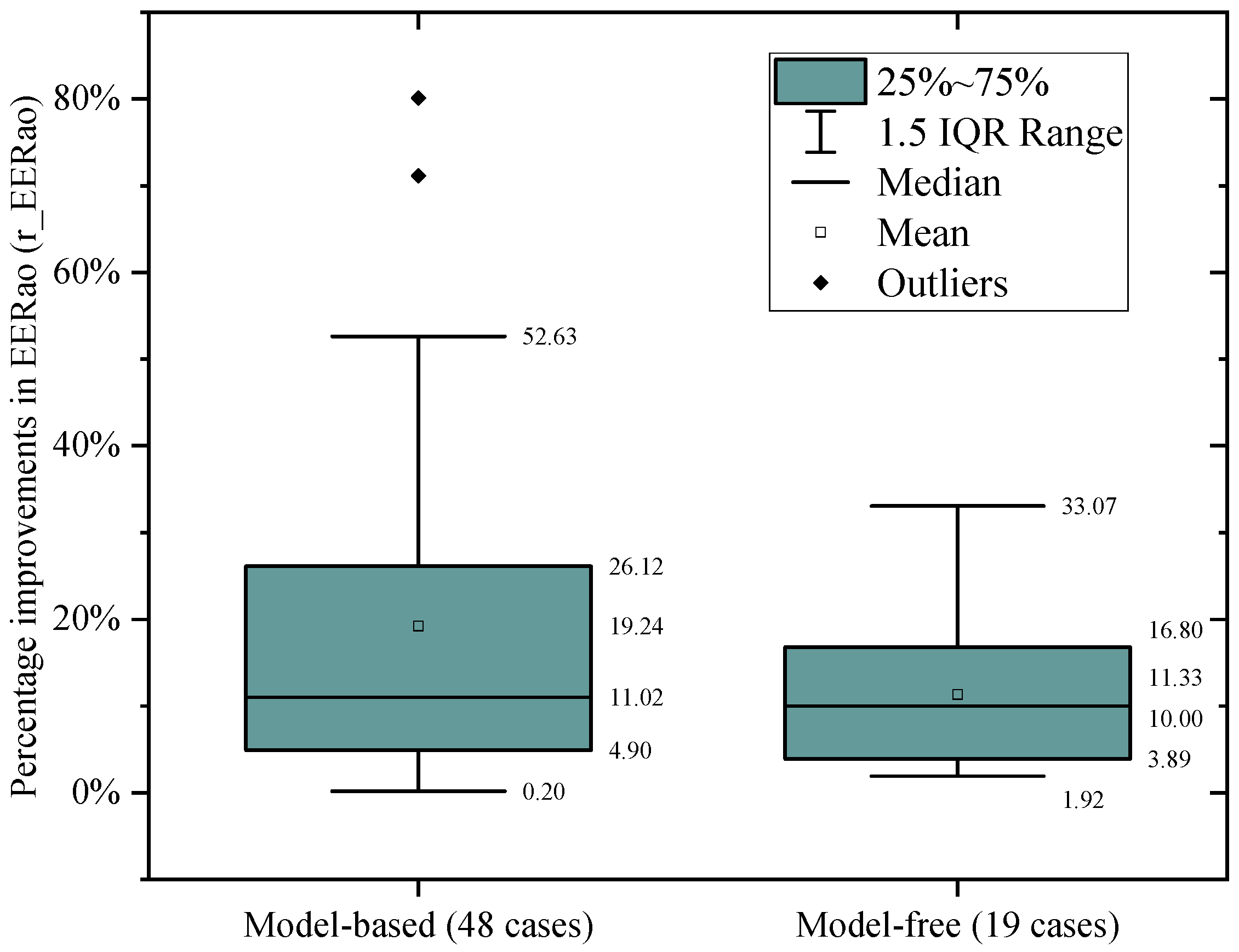
Figure 15 compares the performance of these two approaches, covering 48 model-based cases and 19 model-free cases. The results show that model-based methods achieved a slightly higher median improvement ratio of 11.02%, compared to 10.00% for model-free approaches. This suggests that, under current technological maturity, model-based techniques may offer more precise system representation and marginally superior energy efficiency gains.
Nevertheless, in both categories, the distribution of performance outcomes is highly dispersed. The mean improvement for model-based strategies exceeded the median by 8.22%, while the difference for model-free strategies was 1.33%. This skew indicates that a few outlier cases with exceptional performance substantially elevated the average results. These findings highlight that the effectiveness of predictive control methods is highly case-dependent, influenced by factors such as system configuration, optimization objectives, implementation environment, and external boundary conditions. Future research should thus consider these contextual factors when evaluating or selecting control strategies.

5. Discussion and Outlook

The statistical analysis presented above confirms that research on CHW plants has gained considerable momentum in recent years, leading to measurable improvements in energy efficiency. However, several critical challenges have also emerged alongside this progress. This section discusses key technical, methodological, and practical issues that currently constrain energy efficiency improvements in CHW plants. In addition, it offers strategic recommendations to inform future research and development directions in this domain.

5.1. Annual Operation Energy Efficiency Ratio

Currently, energy efficiency rating standards for CHW plants in China, the U.S., and Singapore are primarily based on the E E R a o . This metric captures system performance over an entire year, offering a more comprehensive and representative measure of energy efficiency than short-term indicators such as daily, weekly, or monthly efficiency ratios.
However, the literature review conducted in this study—which identified 1790 relevant records—revealed that only 124 studies utilized annual performance metrics, and merely 80 cases explicitly adopted E E R a o . This indicates a limited emphasis on annual performance evaluation in current academic research and highlights that E E R a o has not yet been widely adopted as a standard assessment metric. As a result, many studies suffer from incomplete or inconsistent evaluations, limiting their comparability and the generalizability of their findings.
To fill this gap, it is imperative to promote the broader adoption of annual energy efficiency indicators, including both E E R a o and E C a o , within the research community. Standardizing the use of such metrics would support more accurate, systematic, and holistic performance assessments, thereby enhancing the reliability of optimization research and contributing to the development of effective policies and energy efficiency standards for CHW systems.

5.2. Energy Efficiency Rating Standard

Section 3.3.1 summarized three rating standards from China (STD1), Singapore (STD4), and the U.S. (STD5), highlighting differences not only in rating thresholds but also in the underlying evaluation factors. While variation in rating thresholds is understandable—reflecting disparities in economic development, technological advancement, and carbon reduction priorities—the divergence in the design logic and indicator composition of these standards merits closer examination.
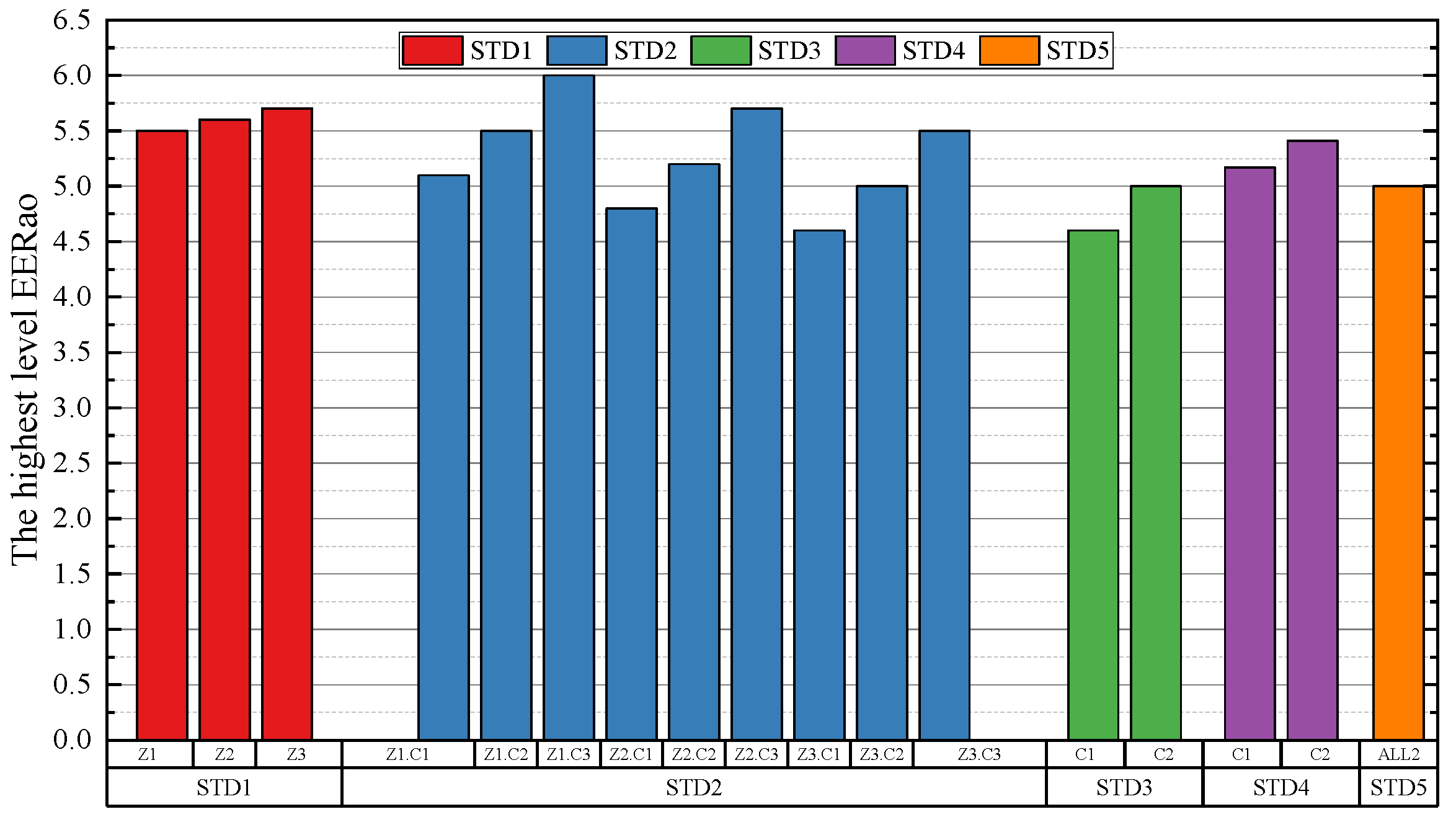
To further explore this issue, two additional Chinese standards—T/DZJN 78-2022 [168] (STD2) and DBJ/T 15-129-2017 [163] (STD3)—were incorporated into the comparative analysis. Figure 16 depicts the Level 1 energy efficiency thresholds across these five standards, with STD1–STD3 representing Chinese guidelines and STD4–STD5 corresponding to Singaporean and American standards, respectively. For clarity of comparison, Z1, Z2, and Z3 refer to China’s climate zones (Cold; HSCW; HSWW), while C1–C3 indicate NCC categories, with C1 denoting the smallest size range. Despite differences in absolute threshold values, a common trend is observed across all standards: higher NCC are subject to more stringent energy efficiency requirements.
Building upon the statistical analyses presented in Section 3.2, this study further investigates the relationship between energy efficiency ratios and three key influencing factors: climate zone, nominal cooling capacity, and building type. The results revealed notable variations across climate zones and capacity categories: in both unoptimized and post-optimization conditions, efficiency ratios were lowest in Cold regions and highest in HSWW zones, aligning with the classification logic adopted in STD1. Similarly, systems with larger NCC generally demonstrated higher energy efficiency, consistent with the principles outlined in STD2, STD3, and STD4. Importantly, most of the case studies included in the database did not explicitly align with any national energy efficiency standards, thereby minimizing the potential confounding effects of regulatory compliance on performance outcomes. As such, the observed trends can be interpreted as a genuine reflection of intrinsic system behavior, rather than artifacts of standard-driven design.
From a practical standpoint, climate zone significantly affects operating conditions, including ambient temperature ranges and cooling season duration, which in turn influence system efficiency. Meanwhile, NCC—a fundamental parameter in system design—determines both the equipment scale and its potential for performance optimization. The interaction between these two factors leads to substantial disparities in energy efficiency across different projects and system configurations. To enhance objectivity, comparability, and fairness in performance evaluation, future E E R a o rating standards should explicitly incorporate both climatic zoning and cooling capacity segmentation into their assessment frameworks.

5.3. Future Research to Improve Energy Efficiency

The findings of this study demonstrate that numerous optimization efforts have been carried out on existing CHW plants, resulting in notable improvements in energy efficiency. Detailed metadata for the 10 cases with the greatest improvement in EERao are provided in Table S3. On average, the reviewed cases achieved an efficiency improvement rate of 18.87%. However, depending on the evaluation standard adopted, 34.41% to 59.04% of optimized cases still failed to meet Level 1 performance, highlighting the ongoing need for further research and system refinement.
Section 4 analyzed three primary factors influencing optimization outcomes: baseline energy efficiency, optimization strategy, and control strategy. The results reveal that baseline efficiency and optimization strategy exert the strongest influence on performance improvement, while the difference between model-based and model-free control approaches appears relatively minor. These insights suggest that assessing CHW plant optimization effectiveness requires both longitudinal comparisons (pre- vs. post-optimization within the same system) and horizontal benchmarking (across different projects under comparable conditions). Such multi-dimensional evaluation offers a more objective and comprehensive understanding of performance gains.
Baseline Energy Efficiency: Systems with lower pre-optimization E E R a o achieved the largest relative improvements. This finding emphasizes the need to segment cases based on baseline performance (e.g., E E R a o < 3.0, [3.0, 4.0), [4.0, 5.0), and ≥5.0) when conducting cross-case comparisons to ensure analytical rigor and fairness.
Optimization Strategy: A combined approach integrating both equipment upgrades and control enhancements consistently outperforms control-only strategies. Nonetheless, due to the higher capital investment required for equipment retrofits, future studies should include cost–benefit analyses to determine the feasibility and scalability of such interventions.
Control Strategy: Both model-based and model-free predictive control methods yielded comparable efficiency gains, based on current case statistics. Therefore, future research should explore not only energy savings but also consider factors such as economic cost, implementation complexity, robustness, and long-term stability to guide strategy selection.
Despite these insights, the analysis was constrained by limited sample sizes and the incomplete availability of detailed public data. These limitations prevented more granular, statistically robust subgroup analyses. Moving forward, building open-access databases and promoting standardized reporting of CHW plant performance data will be essential to support more comprehensive investigations into the key drivers of energy efficiency improvement.

5.4. Energy Efficiency Case Database

In the context of accelerating global decarbonization, the demand for enhancing the energy efficiency of CHW plants is steadily rising. It is anticipated that future research efforts will increasingly prioritize the optimization and retrofitting of these systems. At the core of such efforts lies the availability of reliable operational data and detailed case characteristics, which form the essential foundation for performance benchmarking and strategy development. However, current CHW plant case studies remain highly fragmented, often scattered across disparate sources and lacking in standardized reporting. This fragmentation imposes a significant burden on researchers, who must invest substantial time in data acquisition, validation, and screening.
To address this gap, it is imperative to establish a global open-access database of CHW plant energy efficiency cases. Such a platform would provide a unified foundation for developing performance standards, evaluating optimization solutions, and conducting large-scale cross-case analyses. Moreover, it would enable researchers and policymakers to obtain a more comprehensive and systematic understanding of prevailing practices, technological trends, and emerging opportunities in the CHW domain.

6. Conclusions

A comprehensive understanding of the current energy efficiency status of CHW plants is essential for updating performance standards, retrofitting existing systems, and evaluating optimization outcomes. However, existing studies remain highly fragmented, often limited to isolated case analyses under specific operating conditions, and generally lack systematic and comparative perspectives. Although annual operation energy efficiency metrics ( E E R a o and E C a o ) offer a more accurate and holistic reflection of long-term system performance by capturing seasonal variations, they have not received adequate attention in previous research. To address this gap, this study presents a systematic review of CHW plant annual energy efficiency research conducted between 2014 and 2025, encompassing five international rating standards and 124 publications, which together report 229 operational cases. The main findings are summarized as follows:
Limited Adoption of Annual Efficiency Metrics: Among the five national E E R a o standards (China, U.S., Singapore), all incorporate E E R a o as a core performance indicator. However, of the 1790 records retrieved, only 124 studies (covering 229 cases) applied annual energy efficiency metrics. This highlights the pressing need to promote the broader adoption of annualized performance indicators in both academic and engineering research.
Partial Realization of Optimization Potential: Across 189 cases reporting E E R a o before and after optimization, the median value improved from 4.61 (non-optimized, m = 98) to 5.48 (optimized, m = 91), representing a notable 18.87% increase. Nonetheless, 34.41% and 59.04% of the optimized cases still fell short of Level 1 performance as defined by U.S. and Chinese standards, respectively—revealing considerable room for further efficiency improvement.
Influence of Climate Zone and NCC: Analysis of 211 cases with defined climate zones showed a consistent performance hierarchy: HSWW > HSCW > Cold, both pre- and post-optimization. Similarly, among 159 cases categorized by NCC, systems with NCC ≥ 1758 kW exhibited consistently higher energy efficiency than smaller systems. These findings reinforce the need to integrate climate zone and system scale into future efficiency rating frameworks.
Evaluation of Optimization Strategies and Control Methods: Among 69 cases with pre-optimization data, systems with lower baseline efficiency achieved the greatest relative improvement (up to 71.13%), highlighting the importance of baseline segmentation in comparative evaluations. Additionally, among 125 optimization cases, those employing combined equipment and control strategies significantly outperformed pure control approaches (35.38% vs. 11.60%). Finally, model-based and model-free control strategies delivered comparable improvements (11.71% vs. 10.19%), suggesting that implementation context and boundary conditions may be more critical than control algorithm type alone.
In summary, this study offers the first systematic synthesis of CHW plant energy efficiency performance and improvement outcomes over the past decade, providing both quantitative benchmarks and qualitative insights. These findings deliver important evidence to support data-driven optimization, standard formulation, and future research prioritization in the field of CHW plant energy management.

Supplementary Materials

The following supporting information can be downloaded at: https://www.mdpi.com/article/10.3390/buildings16040756/s1. Table S1: EERao cases; Table S2: ECao cases; Table S3: Ten CHW plant cases with the greatest improvement in EERao.

Author Contributions

All authors contributed to the study conception and design. Material preparation, data collection and analysis were performed by H.Y., G.L., W.Z. and H.L. The first draft of the manuscript was written by H.Y. and all authors commented on previous versions of the manuscript. All authors have read and agreed to the published version of the manuscript.

Funding

This work was supported by scientific research start-up funds grant QD2024005C from Tsinghua Shenzhen International Graduate School, Tsinghua University.

Data Availability Statement

No new data were created or analyzed in this study. Data sharing is not applicable to this article.

Conflicts of Interest

Author Hui Li was employed by the company DeepCtrls Technologies Co., Ltd. The remaining authors declare that the research was conducted in the absence of any commercial or financial relationships that could be construed as a potential conflict of interest.

Abbreviations

The following abbreviations are used in this manuscript:
ASHRAEAmerican society of heating, refrigerating and air-conditioning engineers
CHWChilled Water
CNKIChina National Knowledge Infrastructure
DBJ/TLocal recommended technical standards for construction
HSCWHot summer and cold winter
HSWWHot summer and warm winter
HVACHeating, ventilation, and air-conditioning
NCCNominal cooling capacity
RTRefrigeration ton
SSSingapore Standards
STDStandard
T/CECSThe team standard of the China Association for Engineering Construction Standardization
T/DZJNThe team standard of China Electronics Energy Saving Technology Association
TRNSYSTransient system simulation program
UAEUnited Arab Emirates
WSEWater-side economizers

References

  1. Xu, Y.; Ramanathan, V. Well below 2 °C: Mitigation strategies for avoiding dangerous to catastrophic climate changes. Proc. Natl. Acad. Sci. USA 2017, 114, 10315–10323. [Google Scholar] [CrossRef] [PubMed]
  2. European Environment Agency. Energy Efficiency. 2024. Available online: https://www.eea.europa.eu/en/topics/in-depth/energy-efficiency?activeTab=fa515f0c-9ab0-493c-b4cd-58a32dfaae0a (accessed on 20 August 2025).
  3. International Energy Agency. Energy Statistics Data Browser. 2023. Available online: https://www.iea.org/topics/buildings (accessed on 20 August 2025).
  4. EPA. Sources of Greenhouse Gas Emissions. 2022. Available online: https://www.epa.gov/ghgemissions/sources-greenhouse-gas-emissions (accessed on 20 August 2025).
  5. China Association of Building Energy Efficiency. 2022 Research Report of China Building Energy Consumption and Carbon Emissions (R); China Association of Building Energy Efficiency: Chongqing, China, 2022. [Google Scholar]
  6. Cao, X.; Dai, X.; Liu, J. Building energy-consumption status worldwide and the state-of-the-art technologies for zero-energy buildings during the past decade. Energy Build. 2016, 128, 198–213. [Google Scholar] [CrossRef]
  7. Pérez-Lombard, L.; Ortiz, J.; Pout, C. A review on buildings energy consumption information. Energy Build. 2008, 40, 394–398. [Google Scholar] [CrossRef]
  8. Jia, L.; Wei, S.; Liu, J. A review of optimization approaches for controlling water-cooled central cooling systems. Build. Environ. 2021, 203, 108100. [Google Scholar] [CrossRef]
  9. Lyu, W.; Wang, Z.; Li, X.; Xin, X.; Chen, S.; Yang, Y.; Xu, Z.; Yang, Q.; Li, H. Energy efficiency and economic analysis of utilizing magnetic bearing chillers for the cooling of data centers. J. Build. Eng. 2022, 48, 103920. [Google Scholar] [CrossRef]
  10. Nassif, N.; AlRaees, N.; AlRifaie, F. Optimizing the Design of Chilled-Water Plants for Commercial Building Energy Systems. ASHRAE Trans. 2017, 123, 64–71. [Google Scholar]
  11. Moghaddas-Zadeh, N.; Farzaneh-Gord, M.; Ebrahimi-Moghadam, A.; Bahnfleth, W.P. ANN-based procedure to obtain the optimal design and operation of the compression chiller network—Energy, economic and environmental analysis. J. Build. Eng. 2023, 72, 106711. [Google Scholar] [CrossRef]
  12. Al Qahtani, F.; Muaafa, M. Chiller Plant Management Optimization By Artificial Intelligence. In Proceedings of the 2022 Saudi Arabia Smart Grid (SASG), Riyadh, Saudi Arabia, 12–14 December 2022. [Google Scholar] [CrossRef]
  13. Bhattacharya, A.; Vasisht, S.; Adetola, V.; Huang, S.; Sharma, H.; Vrabie, D.L. Control co-design of commercial building chiller plant using Bayesian optimization. Energy Build. 2021, 246, 111077. [Google Scholar] [CrossRef]
  14. Hinkelman, K.; Wang, J.; Zuo, W.; Gautier, A.; Wetter, M.; Fan, C.; Long, N. Modelica-based modeling and simulation of district cooling systems: A case study. Appl. Energy 2022, 311, 118654. [Google Scholar] [CrossRef]
  15. Ala’raj, M.; Radi, M.; Abbod, M.F.; Majdalawieh, M.; Parodi, M. Data-driven based HVAC optimisation approaches: A Systematic Literature Review. J. Build. Eng. 2022, 46, 103678. [Google Scholar] [CrossRef]
  16. Taheri, S.; Hosseini, P.; Razban, A. Model predictive control of heating, ventilation, and air conditioning (HVAC) systems: A state-of-the-art review. J. Build. Eng. 2022, 60, 105067. [Google Scholar] [CrossRef]
  17. Ahmad, M.W.; Mourshed, M.; Yuce, B.; Rezgui, Y. Computational intelligence techniques for HVAC systems: A review. Build. Simul. 2016, 9, 359–398. [Google Scholar] [CrossRef]
  18. Lu, S.; Zhou, S.; Ding, Y.; Kim, M.K.; Yang, B.; Tian, Z.; Liu, J. Exploring the comprehensive integration of artificial intelligence in optimizing HVAC system operations: A review and future outlook. Results Eng. 2025, 25, 103765. [Google Scholar] [CrossRef]
  19. Anka, S.K.; Lamptey, N.B.; Choi, J.M. Comparative analysis and optimization of the annual performance for a novel internet data center cooling system. J. Build. Eng. 2023, 67, 106064. [Google Scholar] [CrossRef]
  20. Zarei, A.; Zaboli, S.; Babaie Rabiee, M. Energy and exergy analysis of a high-efficiency multi-evaporator absorption refrigeration system with integrated ejectors and compression cooling system. Appl. Therm. Eng. 2025, 267, 125753. [Google Scholar] [CrossRef]
  21. Yang, Z.; Zhao, N.; Sun, H.; Zhao, H.; Wu, Y.; Duan, M.; Lin, B. Comparison of the energy performance of novel dual-temperature cooling systems: From field testing to simulations. J. Build. Eng. 2023, 75, 106920. [Google Scholar] [CrossRef]
  22. Homod, R.Z. Analysis and optimization of HVAC control systems based on energy and performance considerations for smart buildings. Renew. Energy 2018, 126, 49–64. [Google Scholar] [CrossRef]
  23. Vu, H.D.; Chai, K.S.; Keating, B.; Tursynbek, N.; Xu, B.; Yang, K.; Yang, X.; Zhang, Z. Data driven chiller plant energy optimization with domain knowledge. In Proceedings of the 2017 ACM on Conference on Information and Knowledge Management, Singapore, 6–10 November 2017. [Google Scholar] [CrossRef]
  24. Jaramillo, R.C.; Braun, J.E.; Horton, W.T. A near-optimal control algorithm for central cooling plants with electric and/or gas-driven chillers. Sci. Technol. Built Environ. 2020, 26, 1132–1150. [Google Scholar] [CrossRef]
  25. Jaramillo, R.C.; Braun, J.E.; Horton, W.T. Application of Near-Optimal Tower Control and Free Cooling on the Condenser Water Side for Optimization of Central Cooling Systems. In Proceedings of the International High Performance Buildings Conference, West Lafayette, IN, USA, 14–17 July 2014. [Google Scholar]
  26. Cho, J.; Yang, J.; Lee, C.; Lee, J. Development of an energy evaluation and design tool for dedicated cooling systems of data centers: Sensing data center cooling energy efficiency. Energy Build. 2015, 96, 357–372. [Google Scholar] [CrossRef]
  27. Ayrir, W.; Helmi, A.M.; Abongmbo, S.; Benhaddou, D. Towards Sustainable Buildings: Chilled Water System Analysis & Efficiency Modeling. In Proceedings of the 2024 6th Global Power, Energy and Communication Conference (GPECOM), Budapest, Hungary, 4–7 June 2024. [Google Scholar] [CrossRef]
  28. Hussain, S.A.; Huang, G.; Yuen, R.K.K.; Wang, W. Adaptive regression model-based real-time optimal control of central air-conditioning systems. Appl. Energy 2020, 276, 115427. [Google Scholar] [CrossRef]
  29. Teimourzadeh, H.; Jabari, F.; Mohammadi-Ivatloo, B. An augmented group search optimization algorithm for optimal cooling-load dispatch in multi-chiller plants. Comput. Electr. Eng. 2020, 85, 106434. [Google Scholar] [CrossRef]
  30. Ho, W.; Yu, F. Improved model and optimization for the energy performance of chiller system with diverse component staging. Energy 2021, 217, 119376. [Google Scholar] [CrossRef]
  31. Asad, H.S.; Wan, H.; Kasun, H.; Rehan, S.; Huang, G. Distributed real-time optimal control of central air-conditioning systems. Energy Build. 2022, 256, 111756. [Google Scholar] [CrossRef]
  32. Chan, K.; Wong, V.T.; Yow, A.K.; Yuen, P.; Chao, C.Y. Development and performance evaluation of a chiller plant predictive operational control strategy by artificial intelligence. Energy Build. 2022, 262, 112017. [Google Scholar] [CrossRef]
  33. Cen, J.; Zeng, L.; Liu, X.; Wang, F.; Deng, S.; Yu, Z.; Zhang, G.; Wang, W. Research on energy-saving optimization method for central air conditioning system based on multi-strategy improved sparrow search algorithm. Int. J. Refrig. 2024, 160, 263–274. [Google Scholar] [CrossRef]
  34. Shan, K.; Fan, C.; Wang, J. Model predictive control for thermal energy storage assisted large central cooling systems. Energy 2019, 179, 916–927. [Google Scholar] [CrossRef]
  35. Fu, Q.; Chen, X.; Ma, S.; Fang, N.; Xing, B.; Chen, J. Optimal control method of HVAC based on multi-agent deep reinforcement learning. Energy Build. 2022, 270, 112284. [Google Scholar] [CrossRef]
  36. Bai, X.; Tang, Q.; Luo, J.; Mao, Y.; Liang, C.; Zhang, X. Optimizing energy efficiency in multi-chiller systems: A comprehensive Modelica-based approach. J. Build. Eng. 2024, 95, 110087. [Google Scholar] [CrossRef]
  37. Wu, X.; Chen, Z. Performance analysis of a district cooling system based on operation data. Procedia Eng. 2017, 205, 3117–3122. [Google Scholar] [CrossRef]
  38. Huang, Z.; Chen, X.; Wang, K.; Zhou, B. Air conditioning load forecasting and optimal operation of water systems. Sustainability 2022, 14, 4867. [Google Scholar] [CrossRef]
  39. Wang, P.; Sun, J.Q.; Yoon, S.; Zhao, L.; Liang, R.B. A global optimization method for data center air conditioning water systems based on predictive optimization control. Energy 2024, 295, 130925. [Google Scholar] [CrossRef]
  40. Deng, Q.; Chen, Z.; Zhu, W.; Li, Z.; Yuan, Y.; Li, X.; Jiang, Z.; Yin, S.; Yang, C.; Gui, W. Intelligent monitoring and optimal control of HVAC system and its cloud-edge implementation. IFAC-Pap. 2024, 58, 414–419. [Google Scholar] [CrossRef]
  41. Chen, Y.; Yang, C.; Pan, X.; Yan, D. Design and operation optimization of multi-chiller plants based on energy performance simulation. Energy Build. 2020, 222, 110100. [Google Scholar] [CrossRef]
  42. Shi, W.; Wang, J.; Lyu, Y.; Jin, X.; Du, Z. Optimal control of chilled water systems based on collaboration of the equipment’s near-optimal performance maps. Sustain. Energy Technol. Assess. 2021, 46, 101236. [Google Scholar] [CrossRef]
  43. Xu, W. China High Efficiency Air Conditioning Refrigeration Station Development Research Report 2021; China Architecture Publishing: Beijing, China, 2022. [Google Scholar]
  44. Peng, L.; Yin, Y.; Yang, F.; Deng, X.; Liu, H.; Ma, Y. Design of air conditioning system and carbon emission reduction for high-efficiency refrigeration plant room of a hospital in Hainan. Heat. Vent. Air Cond. 2022, 52, 43–49. [Google Scholar] [CrossRef]
  45. Jiang, Y.; Xie, C.; Wang, G.; Li, Y.; Li, B.; Zhang, J.; Zhou, M.; Yu, Y.; Yang, J. Research and practice of high-efficiency chiller plant rooms in office buildings. Heat. Vent. Air Cond. 2024, 54, 56–60. [Google Scholar]
  46. Li, Y.; Jiang, Z.; Liu, G. Technical application and energy efficiency analysis of metro intelligent environmental control system. Mod. Urban Transit 2020, 12, 53–58. [Google Scholar]
  47. Qian, H.; Zou, S.; Xu, Z.; Qu, G.; Tan, H.; Liu, S.; Huang, D.; Lin, H. High energy efficiency optimization of refrigeration room system in a low-temperature process project. Refrig. Air-Cond. 2024, 24, 68–76. [Google Scholar]
  48. Lin, J. Design and energy efficiency ratio analysis of high efficiency refrigeration equipment for subway. People’s Public Transp. 2024, 12, 64–66. [Google Scholar]
  49. Zhang, B.; Dong, F.; Zhang, R.; Zang, Z.; Qu, K. Analysis on the Operation of a High-Efficiency Refrigeration Station. Constr. Sci. Technol. 2024, 11, 43–46. [Google Scholar] [CrossRef]
  50. Fang, X.; Li, Y.; Qiu, Y.; Hu, J.; Huang, M.; Guan, X.; Yan, J.; Liang, R. Application Analysis of High-Efficient Chiller Plant Room Key Energy-Saving Technologies in Commercial Building. Chin. J. Refrig. Technol. 2022, 42, 64–72. [Google Scholar] [CrossRef]
  51. Tan, H.; Li, J.; Qu, G.; Liu, J. Design of high-efficiency air conditioning system for existing teaching building of a university. Heat. Vent. Air Cond. 2022, 52, 25–29. [Google Scholar] [CrossRef]
  52. Lin, W.; Yan, S.; Fan, H.; Meng, J.; Ou, H.; Fan, Y. Efficient renovation of refrigeration systems in a comprehensive building. Heat. Vent. Air Cond. 2021, 51, 118–121. [Google Scholar]
  53. Tan, H.; Qu, G.; Huang, D.; Jiang, S.; Luo, Z.; Wu, B.; Li, G. Energy-saving transformation of air conditioning system in a hotel based on energy efficiency target. Heat. Vent. Air Cond. 2022, 52, 13–18+105. [Google Scholar] [CrossRef]
  54. Chen, S. Global Optimization of Dedicated Outdoor Air System with Double Heat Recovery Based on Machine Learning and Model Predictive Control. Doctoral Dissertation, Guangzhou University, Guangzhou, China, 2023. Available online: https://link.cnki.net/doi/10.27040/d.cnki.ggzdu.2023.002186 (accessed on 20 August 2025).
  55. Yang, S. Design of Energy Saving Control System for the Refrigerating Machine Room of Central Air Conditioning. Master’s Thesis, Anhui University of Science and Technology, Huainan, China, 2018. Available online: https://kns.cnki.net/kcms2/article/abstract?v=HbazLCXbuSV4IORXcMSaT9TrvtXiwnc2j4_JS3ZLBfGpXCea_QbhrSdjMIe6ewgknBFB10Q_8rYKXHOJgqQDt5OVCqmKeqI5_z3NEh10i9E8BQAnbusijwBqxzRDKq47CB_FvUJZjhDZbc1ATSOKHJ4i8El20G7bwb0XNXgtSuU7HQo1FgF_G1dOXSd1kDWoLkdilSBQk2o=&uniplatform=NZKPT&language=CHS (accessed on 20 August 2025).
  56. Li, S.; Wang, J.; Zhang, R.; Liu, D.; Zhang, Y. Performance of refrigerating station based on active optimization control system. Refrig. Air-Cond. 2023, 23, 56–61. [Google Scholar]
  57. Wu, X. Research on Energy Saving Renovation of Refrigeration Room of the Central Air Condition System of a Hospital in GuangZhouMajor: Building and Civil Engineering. Master’s Thesis, Guangzhou University, Guangzhou, China, 2015. [Google Scholar]
  58. Fan, C.; Zou, Y. Equation-based modelling and energy efficiency evaluation of chiller plants system in data center. Shanxi Archit. 2022, 48, 117–119+123. [Google Scholar] [CrossRef]
  59. Mo, Z. Research on Efficient Operation of Refrigeration Room System Based on Operating Parameters of Cooling Tower. Master’s Thesis, Guangzhou University, Guangzhou, China, 2024. Available online: https://link.cnki.net/doi/10.27040/d.cnki.ggzdu.2024.000711 (accessed on 20 August 2025).
  60. Yi, Q. Operation diagnosis and simulation optimization of a plant cooling room in Jiangmen City. Master’s Thesis, Guangzhou University, Guangzhou, China, 2023. Available online: https://link.cnki.net/doi/10.27040/d.cnki.ggzdu.2023.000924 (accessed on 20 August 2025).
  61. Pei, Q.; Yi, Q.; Mo, Z.; Lin, Y.; Du, M.; Hu, F. Actual System Operation of the Refrigeration Room for a Factory in Jiangmen City. Build. Energy Effic. 2024, 52, 134–140. [Google Scholar] [CrossRef]
  62. Zhang, Y. Analysis and discussion based on high efficiency refrigeration room technology. House Collect. 2023, 11, 167–169. [Google Scholar]
  63. Luo, L.; Li, Y.; Qiu, Y.; Fan, B.; Huang, M.; Guan, X.; Huang, Y.; Hu, Q.; Fei, J.; Sun, J.; et al. Simulation Design and Efficient Construction of Chiller Plant Taking a Commercial Complex as an Example. Contam. Control Air-Cond. 2023, 2, 89–95. [Google Scholar]
  64. Li, Y.; Qiu, Y.; Liu, Z.; Guan, X.; Hu, Q.; Fang, X.; Sun, J.; Xiong, M.; Yang, P.; Wang, C.; et al. High efficiency refrigeration room design of Heyou International Hospital. Refrig. Air-Cond. 2024, 24, 66–71. [Google Scholar]
  65. Qin, M. Exploration of a Result Oriented High-Efficiency Refrigeration Room Construction Mechanism: Construction of high-efficient refrigeration room for cultural and sports buildings in “400 meter forest belt” of Changning, Shanghai. Build. Energy Effic. 2022, 50, 141–144. [Google Scholar]
  66. Wang, Y.; Wang, J.; Liu, B.; Xu, X.; Chen, G.; Xu, X. Analysis of Operating Energy Data of a High-Efficient Commercial Building Chiller Plant. Build. Energy Effic. 2024, 52, 65–72+121. [Google Scholar] [CrossRef]
  67. Song, J.; Zheng, Y.; Zhang, W. Experimental Analysis of Renovation of High-Efficiency Refrigeration Room for Air Conditioning System at a Station in Shanghai Subway. Shanghai Energy Sav. 2024, 1, 116–123. [Google Scholar] [CrossRef]
  68. Jiang, H. Optimization design and comparative analysis of high efficiency refrigeration room. Energy Conserv. 2023, 42, 16–19. [Google Scholar]
  69. Liu, C. Research on deepening design methods and system operation strategies for high efficiency refrigeration equipment rooms. Refrig. Air-Cond. 2024, 25, 1–7+15. [Google Scholar]
  70. Jian, Y.; Chen, G.; Jia, P.; Zhang, F.; Zhou, Q.; Zhao, X. Design of high-efficiency refrigeration and air conditioning system for a commercial project in Nanjing. Heat. Vent. Air Cond. 2022, 52, 47–51. [Google Scholar] [CrossRef]
  71. Ping, L. Efficient Renovation of a Chiller Plant System Based on Near-Optimal Control of Overall Energy Efficiency. Dev. Innov. Mach. Electr. Prod. 2023, 36, 150–154. [Google Scholar] [CrossRef]
  72. Lin, M.; Huang, J. Renovation Practice of a High-Efficiency Chiller Plant in a Biopharmaceutical Plant. Chem. Eng. Manag. 2021, 8, 188–190. [Google Scholar] [CrossRef]
  73. Jiang, Y. Research on the Operational Characteristics of an High Efficiency Refrigeration Station Based on Optimized Control of Air Conditioning Water System. Master’s Thesis, Yangzhou University, Yangzhou, China, 2023. Available online: https://link.cnki.net/doi/10.27441/d.cnki.gyzdu.2023.000276 (accessed on 20 August 2025).
  74. Liu, H. Study on energy efficiency ratio of high efficiency refrigeration plant in industrial building: A case of Batteryfactory. Master’s Thesis, Guangzhou University, Guangzhou, China, 2021. Available online: https://link.cnki.net/doi/10.27040/d.cnki.ggzdu.2021.000221 (accessed on 20 August 2025).
  75. He, Z.; Zheng, L.; Chen, L. Energy efficiency grade calculation of Zhongtian Qiantang Ginza central air-conditioning refrigeration room. Heat. Vent. Air Cond. 2023, 53, 82–84. [Google Scholar]
  76. Ren, D. Energy Conservation Regulation and Control Method of District Cooling System in a University. Build. Energy Effic. 2020, 48, 14–20+31. [Google Scholar]
  77. Zhang, W. Design and analysis of high efficiency refrigeration room of a project in Hefei City. Anhui Archit. 2024, 31, 79–80+99. [Google Scholar] [CrossRef]
  78. Yi, J.; Ren, Z.; Yang, X. Application Analysis on High Efficiency Air Conditioning Refrigeration Room Construction. Shanghai Energy Sav. 2023, 12, 1892–1897. [Google Scholar] [CrossRef]
  79. Yin, C.; Wu, Z.; Wei, Q.; Chen, Y. Summary and discussion on design of high-efficiency refrigeration machine room in Wuhan Optics Valley Joy City. Heat. Vent. Air Cond. 2024, 54, 36–40+46. [Google Scholar] [CrossRef]
  80. Xiong, Q.; Jiang, W. Analysis of energy saving technology of integrated refrigeration station in Wuhan Metro station. China Constr. 2024, 3, 143–145. [Google Scholar]
  81. Zhuo, M.; Wang, S.; Han, G.; He, Y. Operational Energy Analysis of High Efficiency Variable-Frequency Screw Chillers in Cooling Station. Chin. J. Refrig. Technol. 2019, 39, 72–77. [Google Scholar]
  82. Han, G. Operational energy efficiency of refrigeration plant room energy-saving renovation project for one office building. Refrig. Air-Cond. 2022, 22, 64–69. [Google Scholar]
  83. Wang, Y.; Zheng, L.; Zhu, J.; Li, M.; Cheng, L. Design and operation data analysis of efficient computer room system for Xinhe Wanda Plaza project. Installation 2023, 5, 59–61+65. [Google Scholar]
  84. Xue, S. Research on Performance Test and Energy Saving Control Optimization of Refrigeration Room System in Public Buildings. Master’s Thesis, Beijing University of Civil Engineering and Architecture, Beijing, China, 2023. Available online: https://link.cnki.net/doi/10.26943/d.cnki.gbjzc.2023.000578 (accessed on 20 August 2025).
  85. Sun, Y. Research on Load Forecast and Control Strategy of High-Efficiency Refrigeration Station Based on Particle Swarm Optimization. Master’s Thesis, Qingdao University of Technology, Qingdao, China, 2021. Available online: https://link.cnki.net/doi/10.27263/d.cnki.gqudc.2021.000240 (accessed on 20 August 2025).
  86. Yang, J. Simulation Research on Lithium Bromide Unity Replace by High Efficiency Eletric Chiller in Energy Saving Reconstruction of Existing Public Buildings. Master’s Thesis, Qingdao University of Technology, Qingdao, China, 2018. [Google Scholar]
  87. Niu, M. Research on Energy Saving Optimization Operation of Central Air-Conditioning Water System Based on TRNSYS. Master’s Thesis, Qingdao University of Technology, Qingdao, China, 2023. Available online: https://link.cnki.net/doi/10.27263/d.cnki.gqudc.2023.000767 (accessed on 20 August 2025).
  88. Liu, N.; Guan, L.; Bian, S.; Shao, D. Optimization of operation strategy for chiller room in a hotel. Heat. Vent. Air Cond. 2024, 54, 36–41+86. [Google Scholar] [CrossRef]
  89. Zhang, R. Research on Low Energy Consumption of CentralAir-Conditioning Cooling Water System Based on High-Efficiency Machine Room—Take a Shopping Mall in Yantai as an Example. Master’s Thesis, Yantai University, Yantai, China, 2020. Available online: https://link.cnki.net/doi/10.27437/d.cnki.gytdu.2020.000150 (accessed on 20 August 2025).
  90. Jiang, K. Application and Research of Oil-Free Centrifugal Chillers in Pubilc Buildings. Master’s Thesis, Qingdao University of Technology, Qingdao, China, 2019. Available online: https://link.cnki.net/doi/10.27263/d.cnki.gqudc.2019.000481 (accessed on 20 August 2025).
  91. Chen, X.; Sun, Y.; Cui, H. Design and energy saving analysis of high efficiency refrigeration room of typical office building in Qingdao. JU SHE 2024, 14, 91–94+105. [Google Scholar]
  92. Wei, D.; Jiao, H.; Feng, H. Nonlinear predictive control of refrigeration system based on load forecasting. Control Theory Appl. 2021, 38, 1619–1630. [Google Scholar] [CrossRef]
  93. Cheng, Y.; Chen, X.; Li, W.; Wang, B.; Zhang, J.; Wang, J.; Zhang, J.; Yuan, Y. Strategies and Methods of Energy Efficiency Improvement of Hospital Central Air Conditioning Freezing Station. Chin. Hosp. Archit. Equip. 2024, 25, 64–71. [Google Scholar] [CrossRef]
  94. Zhang, R.; Zhang, Z. Refrigeration System Group Control Solution Based on Industrial Internet of Things and Soft PLC. Mod. Manuf. Technol. Equip. 2023, 59, 179–181. [Google Scholar] [CrossRef]
  95. Wu, F.; Li, H.; Chen, J. Construction and engineering practice of high efficiency refrigeration system. Heat. Vent. Air Cond. 2022, 52, 129–132. [Google Scholar]
  96. Ning, Z.; Yi, J.; Xie, Y. The Chiller Water Plant Systems’ Development in Hot Summer and Warm Winter Zone. Build. Energy Effic. 2024, 52, 65–69. [Google Scholar]
  97. Wang, F. Research on Performance Improvement Design of High-Efficiency Refrigeration Plant Room. Green Build. 2023, 15, 73–77. [Google Scholar]
  98. Yide, Q.; Yuanyang, L.; Xing, F.; Jie, F.; Xin, Y.; Qin, H.; Zheng, L.; Cong, W.; Jiawei, W.; Xulei, G.; et al. Standardized design of high-efficiecy intelligent environmental control system and its application to metro projects. Refrig. Air-Cond. 2023, 23, 84–92. [Google Scholar]
  99. Hua, L.; Hu, C.; Li, J.; Tian, Y.; Dong, L.; Wang, Y.; Wu, J.; Zhang, X.; Guo, L.; Yu, K. Research and application of deep energy saving control technology of high energy efficiency factory refrigerating station. Installation 2022, S1, 73–74. [Google Scholar]
  100. Zhou, Y.; Luo, X.; Wang, G. Application of energy-saving and environment-friendly high efficiency refrigeration room in pharmaceutical industry. Low Carbon World 2022, 12, 85–87. [Google Scholar] [CrossRef]
  101. Fan, C. Modelling and Optimal Control for Chiller Plants Integrated with Water-Side Economizer System. Doctoral Dissertation, Guangzhou University, Guangzhou, China, 2021. Available online: https://link.cnki.net/doi/10.27040/d.cnki.ggzdu.2021.001269 (accessed on 20 August 2025).
  102. Cao, Z.; Zhou, X.; Wu, X.; Zhu, Z.; Liu, T.; Neng, J.; Wen, Y. Data Center Sustainability: Revisits and Outlooks. IEEE Trans. Sustain. Comput. 2024, 9, 236–248. [Google Scholar] [CrossRef]
  103. Alan, F.M.; Nelson, L.B. Transforming Chiller Plant Efficiency with SC+BAS: Case Study in a Hong Kong Shopping Mall. Urban Sci. 2025, 9, 253. [Google Scholar] [CrossRef]
  104. Liao, Y.; Liao, F.; Huang, G.; Fan, C. Investigating the impact of operating parameters on the energy efficiency of evaporative precooling systems in data centers in hot and humid climates. J. Build. Eng. 2025, 104, 112353. [Google Scholar] [CrossRef]
  105. Guan, L.; Li, C.; Xia, J.; Ge, P. Design of Efficient Refrigeration Room System for a PCB Plant Project in Guangzhou and the Actual Operation Effect Analysis. Refrigeration 2024, 43, 11–15. [Google Scholar]
  106. Jie, X.; Yong, G.; Linwen, G.; Wenbing, T. Design Scheme for HVAC of Guangzhou Infinitus Plaza. Refrigeration 2025, 44, 21–26. [Google Scholar]
  107. Xu, X. Comparison of Energy-Saving Optimisation Options for a Commercial Office Building’s Refrigeration Plant Room. Green Build. 2025, 17, 113–119. [Google Scholar]
  108. Zhong, L.; Zhang, L.; Mei, J.; Lin, X. Renovation Practice of Hospital Green Low-Carbon and High-Efficiency Refrigeration Room. Chin. Hosp. Archit. Equip. 2025, 26, 19–26. [Google Scholar]
  109. Su, Y.; Liao, Y.; Jin, Y.; Wang, F.; Lou, Y.; Xia, J.; Ma, M.; Deng, J.; Qiang, W.; Wei, Q. Measurement of operation performance of a high-efficiency chilled-water plant for a commercial complex in hot summer and cold winter zone. Heat. Vent. Air Cond. 2025, 55, 15–23. [Google Scholar] [CrossRef]
  110. Liu, Z.; Zhou, B.; Hong, H.; Hu, P.; Lei, F. Operation Optimization of Hospital Air Conditioning System in Cold Season in Hot Summer and Cold Winter Area. Build. Energy Effic. 2025, 53, 127–134. [Google Scholar] [CrossRef]
  111. Wang, T.; Chen, X.; Niu, M.; Cui, H.; Sun, R. Research on energy-asaving and optimal operation of central air conditioning water system. Energy Conserv. 2025, 44, 48–51. [Google Scholar]
  112. Wu, X. Research on Energy Efficiency Optimization of High Efficiency Refrigeration Room in Building A. Master’s Thesis, Inner Mongolia University of Science & Technology, Baotou, China, 2025. Available online: https://link.cnki.net/doi/10.27724/d.cnki.gnmgk.2025.000887 (accessed on 20 August 2025).
  113. Huang, S.; Zuo, W.; Sohn, M.D. Improved cooling tower control of legacy chiller plants by optimizing the condenser water set point. Build. Environ. 2017, 111, 33–46. [Google Scholar] [CrossRef]
  114. Huang, S.; Zuo, W. Optimization of the water-cooled chiller plant system operation. In Proceedings of the 2014 ASHRAE/IBPSA-USA Building Simulation Conference, Atlanta, GA, USA, 10–12 September 2014. [Google Scholar]
  115. Huang, S.; Zuo, W.; Sohn, M.D. Amelioration of the cooling load based chiller sequencing control. Appl. Energy 2016, 168, 204–215. [Google Scholar] [CrossRef]
  116. Fong, K.F.; Hanby, V.I.; Chow, T.-T. HVAC system optimization for energy management by evolutionary programming. Energy Build. 2006, 38, 220–231. [Google Scholar] [CrossRef]
  117. Yu, F.; Chan, K. Environmental performance and economic analysis of all-variable speed chiller systems with load-based speed control. Appl. Therm. Eng. 2009, 29, 1721–1729. [Google Scholar] [CrossRef]
  118. Ling, L.; Zhang, Q.; Yu, Y.; Ma, X.; Liao, S. Energy saving analysis of the cooling plant using lake water source base on the optimized control strategy with set points change. Appl. Therm. Eng. 2018, 130, 1440–1449. [Google Scholar] [CrossRef]
  119. Zhu, Y.; Zhang, Q.; Zeng, L.; Wang, J.; Zou, S.; Zheng, H. An advanced control strategy for optimizing the operation state of chillers with cold storage technology in data center. Energy Build. 2023, 301, 113684. [Google Scholar] [CrossRef]
  120. Cho, J.; Kim, Y. Improving energy efficiency of dedicated cooling system and its contribution towards meeting an energy-optimized data center. Appl. Energy 2016, 165, 967–982. [Google Scholar] [CrossRef]
  121. Ham, S.-W.; Kim, M.-H.; Choi, B.-N.; Jeong, J.-W. Energy saving potential of various air-side economizers in a modular data center. Appl. Energy 2015, 138, 258–275. [Google Scholar] [CrossRef]
  122. Ma, Z.; Wang, S. Supervisory and optimal control of central chiller plants using simplified adaptive models and genetic algorithm. Appl. Energy 2011, 88, 198–211. [Google Scholar] [CrossRef]
  123. Yu, F.W.; Chan, K. Optimization of water-cooled chiller system with load-based speed control. Appl. Energy 2008, 85, 931–950. [Google Scholar] [CrossRef]
  124. Ha, J.-w.; Cho, S.; Kim, H.-y.; Song, Y.-h. Annual energy consumption cut-off with cooling system design parameter changes in large office buildings. Energies 2020, 13, 2034. [Google Scholar] [CrossRef]
  125. He, Y.; Xu, Q.; Li, D.; Mei, S.; Zhang, Z.; Ji, Q. Energy-saving method and performance analysis of chiller plants group control based on Kernel Ridge Regression and Genetic Algorithm. Sci. Technol. Built Environ. 2023, 29, 545–559. [Google Scholar] [CrossRef]
  126. Wang, Z. Research on Automatic Control and Regulation System of Central Air Conditioning Based on Computer Automatic Control Technology. In Proceedings of the 2023 IEEE 3rd International Conference on Power, Electronics and Computer Applications (ICPECA), Shenyang, China, 29–31 January 2023. [Google Scholar] [CrossRef]
  127. Chen, Z.; Deng, Z.; Chong, A.; Chen, Y. AutoBPS-BIM: A toolkit to transfer BIM to BEM for load calculation and chiller design optimization. Build. Simul. 2023, 16, 1287–1298. [Google Scholar] [CrossRef]
  128. Takabatake, T.; Yamamoto, M.; Hino, H. Algorithm for searching optimal set values of absorption chiller system using Bayesian optimization. Sci. Technol. Built Environ. 2022, 28, 188–199. [Google Scholar] [CrossRef]
  129. Lin, Y.L.; Yang, W.; Liu, M.S. Central Plant Control Optimization with a Thermal Chilled Water Energy Storage System: A Case Study in a High-Tech Building. Adv. Mater. Res. 2015, 1070, 1989–1993. [Google Scholar] [CrossRef]
  130. Suzuki, Y.; Imazu, M.; Shinoda, J.; Furukawa, R.; Araki, Y.; Tanabe, S.-i.; Fujino, K.; Hatori, D.; Hirasuga, N.; Kato, S. Efficient operation of heat source using high-temperature chilled water in an advanced office building. E3S Web Conf. 2019, 111, 03071. [Google Scholar] [CrossRef]
  131. Walgama, S.; Kumarawadu, S.; Pathirana, C.D. Indoor and Outdoor Conditions Utilized Energy Saving Scheme for HVAC Cooling Water Systems in Smart Commercial Buildings. In Proceedings of the 2021 IEEE Electrical Power and Energy Conference (EPEC), Toronto, ON, Canada, 22–31 October 2021. [Google Scholar] [CrossRef]
  132. Chen, L.; Meng, F.; Zhang, Y. MBRL-MC: An HVAC control approach via combining model-based deep reinforcement learning and model predictive control. IEEE Internet Things J. 2022, 9, 19160–19173. [Google Scholar] [CrossRef]
  133. Qiu, S.; Li, Z.; Li, Z.; Li, J.; Long, S.; Li, X. Model-free control method based on reinforcement learning for building cooling water systems: Validation by measured data-based simulation. Energy Build. 2020, 218, 110055. [Google Scholar] [CrossRef]
  134. Yang, J.; Wu, J.; Xian, T.; Zhang, H.; Li, X. Research on energy-saving optimization of commercial central air-conditioning based on data mining algorithm. Energy Build. 2022, 272, 112326. [Google Scholar] [CrossRef]
  135. Si, Q.; Peng, Y.; Jin, Q.; Li, Y.; Cai, H. Multi-Objective Optimization Research on the Integration of Renewable Energy HVAC Systems Based on TRNSYS. Buildings 2023, 13, 3057. [Google Scholar] [CrossRef]
  136. Yu, F.; Ho, W. Load allocation improvement for chiller system in an institutional building using logistic regression. Energy Build. 2019, 201, 10–18. [Google Scholar] [CrossRef]
  137. Garnier, A.; Eynard, J.; Caussanel, M.; Grieu, S. Predictive control of multizone heating, ventilation and air-conditioning systems in non-residential buildings. Appl. Soft Comput. 2015, 37, 847–862. [Google Scholar] [CrossRef]
  138. Wang, J.; Zhang, Q.; Yoon, S.; Yu, Y. Impact of uncertainties on the supervisory control performance of a hybrid cooling system in data center. Build. Environ. 2019, 148, 361–371. [Google Scholar] [CrossRef]
  139. Tao, C.; Hong, X.; Youcai, M.; Zhigao, H.; Cong, W. Design practice of energy saving and carbon reduction renovation of air conditioning system for a dispatch communication building. Heat. Vent. Air Cond. 2024, 54, 59–64. [Google Scholar] [CrossRef]
  140. Ren, T. Energy Saving Diagnosis and Analysis of Refrigeration Room System in Some Building in Shanghai. Shanghai Energy Sav. 2023, 11, 1668–1676. [Google Scholar] [CrossRef]
  141. Sun, G.; Liu, Q.; Li, A. Research and application of energy-saving scheme for refrigeration in communication room in cold area. Telecom Eng. Tech. Stand. 2023, 36, 79–83. [Google Scholar] [CrossRef]
  142. Wu, F. PCB factory efficient refrigeration room project practice and research. Installation 2023, S1, 198–199. [Google Scholar]
  143. Qi, B.; Li, L.; Li, S. Taking a pension project in cold area as an example, the application of high efficiency refrigeration room system is discussed. Heat. Vent. Air Cond. 2023, 53, 173–177. [Google Scholar]
  144. Zhang, L. Application of Energy-saving and Low-carbon Technology in Refrigerating Station and Its Effect Verification. Energy Energy Conserv. 2023, 6, 97–100. [Google Scholar] [CrossRef]
  145. Cao, M. Power-Saving Design and Research on Air-Conditioning Refrigeration Station Based on Central Air-Conditioning Power Management System. Master’s Thesis, Shandong Jianzhu University, Jinan, China, 2020. Available online: https://link.cnki.net/doi/10.27273/d.cnki.gsajc.2020.000684 (accessed on 20 August 2025).
  146. Liang, J.; Li, C. Design of High-Efficient Refrigeration System for HVAC of one Office Building in Beijing. Build. Energy Environ. 2017, 36, 103–105+161. [Google Scholar]
  147. Li, J. A Case Study on Energy Saving Retrofitting of a Shopping Mall. Master’s Thesis, Tsinghua University, Beijing, China, 2016. [Google Scholar]
  148. Pan, J.; Ma, Y. Application of Metasys Group Control System in Refrigeration Room. Build. Energy Effic. 2015, 43, 97–100+114. [Google Scholar] [CrossRef]
  149. Feng, Y.; Wei, S. Research on the Design of “Cost Reduction and Efficiency Enhancement” for a Refrigeration Station in an Office Building in Chengdu. Refrig. Air Cond. 2024, 38, 376–384. [Google Scholar]
  150. Wang, X.; Zhang, Q.; Chen, Z.; Yang, J.; Chen, Y. Development of Chiller Plant Models in OpenAI Gym Environment for Evaluating Reinforcement Learning Algorithms. Energies 2025, 18, 2225. [Google Scholar] [CrossRef]
  151. Shu, X.; Dong, Y.; Liu, J.; Xu, X. Study of the Optimal Control of the Central Air Conditioning Cooling Water System for a Deep Subway Station in Chongqing. Buildings 2025, 15, 8. [Google Scholar] [CrossRef]
  152. Junjie, H.; Caihua, L.; Hui, H.; Xi, B.; Yubo, M.; Qi, T. Energy-Saving Optimization Strategy Research for Chilled Water Units Based on Active Water Storage. J. Refrig. 2025, 46, 108–115. [Google Scholar]
  153. Li, Y. Research on Energy-Saving Scheme of Central Air Conditioning in Data Rooms Based on Airflow Organization and Equipment Efficiency Optimization. Energy Conserv. 2024, 43, 86–88. [Google Scholar]
  154. Jia, Y.; Zhang, H.; Li, Z. Research on the Energy-saving Degree of Metro Environmental Control Strategies Based on Dymola. Heat. Vent. Air Cond. 2024, 54, 377–381. [Google Scholar]
  155. Ma, M.; Bian, S.; Liu, B. A Central Air Conditioning Operation Control Method Based on Ridge Regression and Long Short Term Memory Algorithms. In Proceedings of the 2024 Chinese Automation Congress (CAC), Qingdao, China, 1–3 November 2024. [Google Scholar] [CrossRef]
  156. GB 50176-2016; Code for Thermal Design of Civil Building. China Architecture & Building Press: Beijing, China, 2016.
  157. Huang, D.; Qu, G.; Tan, H.; Jiang, S.; He, H.; Lin, H.; Li, X. Study on energy efficiency ratio evaluation zoning of high-efficiency refrigeration room system based on building thermal zoning. Heat. Vent. Air Cond. 2022, 52, 1–7. [Google Scholar] [CrossRef]
  158. Lawrie, K.L.; Crawley, D.B. Development of Global Typical Meteorological Years (TMYx). 2022. Available online: https://climate.onebuilding.org (accessed on 20 August 2025).
  159. Fan, C.; Hinkelman, K.; Fu, Y.; Zuo, W.; Huang, S.; Shi, C.; Mamaghani, N.; Faulkner, C.; Zhou, X. Open-source Modelica models for the control performance simulation of chiller plants with water-side economizer. Appl. Energy 2021, 299, 117337. [Google Scholar] [CrossRef]
  160. Zhou, F.; Gu, W.L.; Ma, G.Y. Advancements in data center cooling systems: From refrigeration to high performance cooling. Energy Build. 2024, 320, 114634. [Google Scholar] [CrossRef]
  161. SS553-2016; Code of Practice for Air-Conditioning and Mechanical Ventilation in Buildings. Singapore Standards Council: Singapore, 2017.
  162. T/CECS 1100-2022; Assessment Standard for High Efficiency Air Conditioning Refrigerating Station. China Association for Engineering Construction Standardization: Beijing, China, 2022.
  163. DBJ/T 15-129-2017; Standard for Energy Efficiency Measurement and Assessment on Chiller Plant Systems in Centralized Air Conditioning Systems. Guangdong Provincial Department of Housing and Urban-Rural Development: Guangzhou, China, 2017.
  164. Cao, Y.; Wang, C.; Wang, S.; Fu, X.; Ming, X. Energy modeling and optimization of building condenser water systems with all-variable speed pumps and tower fans: A case study. Build. Simul. 2024, 17, 1085–1111. [Google Scholar] [CrossRef]
  165. Trautman, N.; Razban, A.; Chen, J. Overall chilled water system energy consumption modeling and optimization. Appl. Energy 2021, 299, 117166. [Google Scholar] [CrossRef]
  166. Thangavelu, S.R.; Myat, A.; Khambadkone, A. Energy optimization methodology of multi-chiller plant in commercial buildings. Energy 2017, 123, 64–76. [Google Scholar] [CrossRef]
  167. Xin, X.; Zhang, Z.; Zhou, Y.; Liu, Y.; Wang, D.; Nan, S. A comprehensive review of predictive control strategies in heating, ventilation, and air-conditioning (HVAC): Model-free vs. model. J. Build. Eng. 2024, 94, 110013. [Google Scholar] [CrossRef]
  168. T/DZJN78-2022; Energy Efficiency Grade and the Minimum Allowable Value for Central Air-Conditioning Chiller Plant System Part 1: Electrically Driven Water-Cooled Chiller. China Electronics Energy Saving Technology Association: Beijing, China, 2022.
Figure 1. Overview of Research Methodology.
Buildings 16 00756 g001
Figure 2. Screening Process of CHW Plant Cases for Systematic Review (Note: n denotes the number of literatures and m denotes the number of cases).
Buildings 16 00756 g002
Figure 3. Distribution of CHW Plant Cases in China’s Cities by Climate Zone.
Buildings 16 00756 g003
Figure 4. The Distribution of CHW plant Cases by Building Types.
Buildings 16 00756 g004
Figure 5. The Distribution of CHW plant Cases by Chiller Types. (a) Chiller type; (b) Chiller cooling capacity.
Buildings 16 00756 g005
Figure 6. Evaluation Methods for CHW Plant Case Studies.
Buildings 16 00756 g006
Figure 7. Box Plots of E E R a o for Unoptimized and Optimized CHW Plants.
Buildings 16 00756 g007
Figure 8. Boxplot of E E R a o in Different Climate Zones.
Buildings 16 00756 g008
Figure 9. Boxplot of E E R a o with Different NCC.
Buildings 16 00756 g009
Figure 10. Boxplot of E E R a o across Different Building Types.
Buildings 16 00756 g010
Figure 11. Energy Efficiency Level of CHW Plant Cases Studies with ASHRAE Standard.
Buildings 16 00756 g011
Figure 12. Energy Efficiency Level of CHW Plant Case Studies with T/CECS 1100-2022. (a) HSWW; (b) HSCW; (c) Cold.
Buildings 16 00756 g012
Figure 13. Comparison of Optimization Effects for Different Baseline Energy Efficiencies.
Buildings 16 00756 g013
Figure 14. Comparison of Optimization Effects for Different Optimization Strategies.
Buildings 16 00756 g014
Figure 15. Comparison of Optimization Effects under Different Control Strategies.
Buildings 16 00756 g015
Figure 16. Comparison of Highest Energy Efficiency Limits across Different Standards or Literature.
Buildings 16 00756 g016
Table 1. Summary of Existing Review Studies on CHW Plants.
ReferenceReview ContentsMain Results and Conclusions
Jia et al., 2021 [8]Reviewed 98 publications (2005–2021) focusing on optimization of water-cooled central cooling systems. Comparative analysis between model-based and data-driven approaches was conducted across key components: decision variables, objective functions, constraints, and algorithms.1. Holistic optimization strategies utilizing directly controllable variables and metaheuristic algorithms are recommended.
2. Model-based approaches offer a balance between efficiency, robustness, and computational speed, albeit with inherent trade-offs.
3. Data-driven methods show promise but require further development for enhanced control precision and practical implementation.
Maher et al., 2022 [15]Synthesized findings from 142 studies (2001–2021) on data-driven HVAC control systems, with emphasis on modeling, control strategies, and optimization techniques aimed at improving energy efficiency while maintaining thermal comfort.1. Existing research predominantly emphasizes thermal comfort, often neglecting indoor air quality, visual, and acoustic factors.
2. Optimization strategies rarely account for dynamic electricity pricing or demand-response mechanisms; ensemble methods are underutilized.
3. MPC effectively addresses system nonlinearities.
4. High reliance on simulation limits real-world validation; limited applicability across diverse building types and climatic zones.
Saman et al., 2022 [16]Reviewed applications of computational intelligence in HVAC systems, including energy management, fault detection and diagnosis, and system-level optimization.1. Studies tend to prioritize energy and thermal performance, overlooking financial costs, demand response, and emissions.
2. Conventional MPC approaches dominate, with limited adoption of deep learning despite its advantages in pattern recognition.
3. Validation efforts are concentrated on residential and office buildings, with insufficient coverage of educational and industrial facilities.
4. Integration of building subsystems and refinement of performance metrics remain underexplored.
Muhammad et al., 2016 [17]Provided a theoretical and practical overview of computational intelligence techniques for HVAC system prediction, optimization, control, and fault diagnosis.1. Computational intelligence techniques such as fuzzy logic, neural networks, and genetic algorithms improve energy efficiency and occupant comfort. Multi-agent systems and particle swarm optimization excel in addressing complex, multi-objective problems.
2. Key challenges include high computational complexity and limited real-time applicability, necessitating more efficient and scalable algorithms.
Lu et al., 2025 [18]Reviewed 184 studies (2000–2024) on artificial intelligence applications in HVAC system optimization, with a focus on artificial intelligence implementation strategies and technological integration.1. Machine learning techniques enhance HVAC performance and user comfort; computer vision facilitates real-time fault detection.
2. Personalized control strategies based on occupant behavior, supported by digital twins and Internet of Things, enable predictive maintenance and adaptive optimization.
3. The integration of building information modeling, Internet of Things, and artificial intelligence supports comprehensive smart management, advancing building energy efficiency and carbon neutrality goals.
Table 2. Classification of International Cities by Climate Zone Referenced in Case Studies.
CountryCityAvg Temp °C
(Coldest Month)
Climate Zone *Reference
AmericaTucson, AZ10HSCW[159]
Atlanta, GA4.44HSCW[159]
San Francisco, CA8.33HSCW[132,159]
Seattle, WA5HSCW[159]
Denver, CO0.56HSCW[159]
Rochester, NY−5.56Cold[159]
Lafayette, IN−7.78Cold[24,25]
Houston, TX11.67HSWW[27]
Washington, CO−3.89Cold[113,114]
Greensboro, NC0.56HSCW[10]
Golden, GA11.67HSWW[132]
Sterling, CO−2.22Cold[132]
Chicago, IL−5Cold[132]
Tampa, FL16.11HSWW[132]
SingaporeKent Ridge, SG25HSWW[23,102,120]
KoreaSeoul, KG−2.22Cold[26,120,124]
Sri LankaKandy, CP22.78HSWW[11]
Saudi ArabiaRiyadh, RI14.44HSWW[12]
FrancePerpignan, LP7.22HSCW[137]
UAEAbu Dhabi, AZ20HSWW[120]
MongoliaUlaanbaatar, UB−23.87Severe Cold[120]
* The climate zones of these international cities were determined based on China’s thermal zoning standards [156].
Table 3. Comparison of Standards Rating Values.
StandardClimateNCC (kW)Energy Efficiency Rating
Level 1Level 2Level 3
T/CECS 1100-2022 [162]ColdAll≥5.5≥5.0≥4.5
HSCWAll≥5.6≥5.1≥4.6
HSWWAll≥5.7≥5.2≥4.7
SS553-2016 [161]AllNCC ≥ 1758≥5.41≥5.17≥5.17
NCC < 1758≥5.17≥5.02≥4.40
ASHRAE [163]AllAll≥5.0≥4.15≥3.5
Table 4. Comparison of Energy Efficiency Level Between Unoptimized and Optimized Group with ASHRAE standard.
UnoptimizedOptimized
Needs Improvement213
Fair116
Good2823
Excellent3261
Total9293
Table 5. Comparison of Energy Efficiency Level Between Unoptimized and Optimized Group with T/CECS 1100-2022.
HSWWHSCWCold
UnoptimizedOptimizedUnoptimizedOptimizedUnoptimizedOptimized
No level179164107
Level 3855854
Level 2445513
Level 16205806
Total353831251620
Disclaimer/Publisher’s Note: The statements, opinions and data contained in all publications are solely those of the individual author(s) and contributor(s) and not of MDPI and/or the editor(s). MDPI and/or the editor(s) disclaim responsibility for any injury to people or property resulting from any ideas, methods, instructions or products referred to in the content.