


Abstract
Decarbonization of the concrete industry has arisen as one of the main priorities for the construction sector in order to mitigate the negative climate impact associated with construction. The carbon emissions of concrete mainly originate from the production of cement, and it is essential to find supplementary cementitious materials (SCMs) to achieve eco-friendly construction materials. The use of tailings as SCMs could reduce the carbon footprint of concrete, as well as improve the environmental impact of waste management within the mining sector. To investigate the effects of using lead–zinc tailings as a partial replacement for ordinary Portland cement (OPC), an experimental study was conducted. Two types of lead–zinc tailings were utilized in the experiments to replace 10% and 20% of OPC. A mechanical activation method was adopted using a vibratory cup mill. The effects of activation on the tailings’ particle size distributions and mineralogy were evaluated. The results indicated that the activation was insufficient to promote the pozzolanic activity in T1 and only partially promoted it in T2. A total of 18 different tailing-based mortar (TBM) specimens were produced from the raw and activated tailings, and their flowability, setting time, and compressive strengths after 7, 28, and 90 days were evaluated. The microstructures of the specimens were analyzed using scanning electron microscopy with energy dispersive X-ray spectroscopy. No alteration of mineralogy was observed in T1 after activation; however, a reduction in muscovite was observed in T2. The TBM specimens with 10% activated tailings exhibited comparable 28-day compressive strengths to the control specimen. For the replacement level above 10%, there was a loss of compressive strength at 28 days, both for the activated and raw tailings and for both T1 and T2. Evaluation of the microstructure showed that the use of tailings caused regions in the cement matrix with high metal concentrations. Microcracks could be observed in or around such grains in several cases. The study demonstrated that 10% of OPC can be replaced by lead–zinc tailings while retaining the compressive strength of the specimens.
1. Introduction
Concrete is the most utilized construction material, and its production consumes massive amounts of raw materials and energy. The concrete industry faces great challenges in reducing its climate impact, and with cement being responsible for roughly 90% of the CO2 emissions of concrete [1], great effort is directed toward finding eco-friendly alternative binders, so-called supplementary cementitious materials (SCMs). The global demand for cement is projected to increase by 0.2–0.5% annually in the coming decades [2], and this calls for urgent action to reduce emissions from cement production.
Meanwhile, mining activities generate enormous amounts of waste, such as waste rock, tailings, and slag. The volume of these wastes exceeds that of all other types of waste generated by human activities, and waste management is an issue of great concern to the mining industry. Tailings alone are generated at a rate of approximately 14 billion tons yearly [3]. While being large in volume, tailings have a low utilization rate, and their primary management methods are storage in tailing dams, dry stacking, or cemented paste backfill [4]. They could be associated with severe adverse environmental effects; heavy metal contamination of soil, groundwater, and air; land occupation; and the risk of dam failures and landslides, among others, if not managed properly. Therefore, waste management is an issue of great concern for the mining industry in Sweden, and initiatives are being undertaken to increase the valorization of tailings through their reuse, for example, as construction products.
Tailings have the potential to be an environmentally friendly partial replacement for ordinary Portland cement (OPC) as they may exhibit pozzolanic activity. Gou et al. [3] reviewed tailing utilization in construction products and found that the topic is still in its embryonic phase and that there is a limited body of knowledge. However, several conclusions can be drawn from the existing literature; for example, replacing cement with tailings reduces the workability and at higher replacement levels decreases the compressive strength. Regarding durability, there is no consensus on the effect of tailings in concrete, but most researchers agree that the incorporation of tailings in concrete is an efficient method for immobilizing heavy metals [3]. Adiguzel [5] reviewed the use of tailings as cement or a fine aggregate replacement and concluded that 5–20% of cement could usually be replaced by tailings, depending on the tailing’s composition. The sum of SiO2, Al2O3, and Fe2O3 content should be above 70%, and SiO2 content over 75% was especially beneficial for use as an SCM [5]. The use of tailings as SCM is positive for freeze–thaw resistance and negative for carbonation resistance [5]. Furthermore, it reduces the costs and the CO2 emissions of concrete [5]. Compressive strength decreases with an increasing percentage of tailing replacement and in most studies, replacement levels of 10% and 20% corresponded to losses of 28-day compressive strength of 4–30% and 5–27%, respectively. Similar trends were observed for the flexural strength [5]. While the compressive and flexural strengths are somewhat decreased, the overall performance may be enhanced, as the CO2 emissions from concrete are lessened [6].
The pozzolanic reaction takes place between SCMs and calcium hydroxide (CH) from the cement hydration. In addition to acting as a pozzolan, SCMs can exert a filler effect. The fine particle size of tailings allows the cement hydration reactions to take place on the surface, acting as a nucleation site. The fine grains of tailings can fill voids in the matrix and thereby densify the structure, which is a positive factor for enhancing the compressive strength [5].
While tailings have been pointed out as a candidate for SCM, most research works have focused on iron, copper, and gold tailings. Few researchers have concentrated on lead–zinc tailings for cement replacement. Li et al. [7] reviewed the status of lead–zinc tailings in construction products and concluded that they may be used for clinker production with a potential reduction in process temperature, geopolymer production, and fine aggregates in concrete. Luo et al. [8] studied the utilization of lead–zinc tailings in supersulfated cement and found potential for its use as an activator of ground granulated blast furnace slag. However, research on their use as SCMs is very limited. Saedi et al. [9] replaced up to 100% of the cement with high-calcium lead–zinc tailings and found that they could replace cement up to 40% with acceptable properties. At 90 days of curing, 20% replacement (40.85 MPa) outperformed the conventional concrete (38.15 MPa). Zhou et al. [10] produced a concrete material with 15 MPa compressive strength using up to 47% lead–zinc tailings, in combination with 3% fly ash. Wang et al. [11] studied the effect of grinding on the pozzolanic activity of lead–zinc tailings and found that particle sizes up to 13 µm positively correlated with increased strength activity, with 3.3–6.5 µm being the optimal particle size with the most positive influence on the activity index. The activity index increased by increasing the grinding time, and for the planetary ball mill, the effect was negligible after 120 min [11]. Wang et al. [12] produced ultra-high-performance concrete by producing a blend of lead–zinc tailings (225 kg/m3), cement (525 kg/m3), steel fibers, silica fume, and fly ash, resulting in concrete with 28-day compressive strength just above 150 MPa. Zhang et al. [13] found that the compressive strength would decrease with increasing lead–zinc tailing replacement and recommended keeping the replacement level below 10%.
Another concern is the potential leaching of harmful substances from tailing-based mortars (TBMs). Few studies have investigated the leaching behavior of lead–zinc TBM. Wang et al. [11] found the leaching toxicity to be acceptable according to the toxicity characteristic leaching procedure test for replacement ratios up to 30%, and Zhang et al. [13] evaluated the leaching of lead and found it to be kept at low levels for pH ≥ 7. Hernandez-Ramos et al. [14] concluded that the alkaline nature of portlandite benefits the immobilization of heavy metals. Nonetheless, Li et al. [15] pointed out the relationship between smaller particle sizes and increased mobility of metals.
Commonly, tailings exhibit little or low pozzolanic reactivity in their initial state; however, reducing crystallinity and increasing the specific surface area can promote reactivity [9,16,17,18,19]. Through thermal or mechanical activation, crystallinity and particle sizes are decreased, which enhances reactivity and strength development. The most common type of activation method is mechanical grinding, which has been extensively investigated with positive results [11,16,18,20,21,22,23,24]. In most of the previous research attempts, mechanical activation has been performed using planetary ball mills, and between 60 and 90 min of grinding time is recommended for the optimal output. The potential for minerals to be activated varies with their mineralogy. Kaolinite, illite, microcline, calcite, albite, and muscovite are minerals that have been found to be susceptible to mechanical activation at various degrees, but quartz, on the other hand, rarely undergoes amorphization after mechanical activation [25,26,27,28]. Yao et al. [28] evaluated the mechanical activation of muscovite in a planetary ball mill and found a reduction in the crystallinity to 37% of the original value after 80 min of grinding.
While the technological potential of activating materials on a laboratory scale has been demonstrated, the economic feasibility and scalability have been questioned due to the need to process large volumes of material in high-energy processes, causing negative environmental effects. Therefore, designing an activation method with lower energy demand would favor the development of tailing-based construction products.
Although energy-intense activation treatments may be needed to enhance the reactivity of tailings, the net effect is positive for the higher strength concrete. Vargas and Rigamonti [6] concluded that the positive effect on environmental performance was more pronounced for concrete with 41 MPa compressive strength, with CO2 savings of around 25% and a cement reduction of 135 kg/m3 concrete, while for concrete with 20 MPa compressive strength, the positive impact of replacing cement was offset by the impact of the activation. To achieve scalability and optimize energy efficiency, the ambition is to design an activation method with a minimized activation time. To assess the possibility of minimizing the activation time, the vibratory cup mill activation method has been assessed in this study. Kappel et al. [29] found this activation method to enhance reactivity for iron-rich sewage sludge after only 6 min milling time, reducing D50 to approximately 10% of the original particle size. Despite the relatively low SiO2, the sewage sludge was found to be pozzolanic after mechanical activation in a vibratory cup mill for 3–10 min, and up to 20% of cement could be replaced with activated sludge [29]. Although this activation method has shown promising results for sewage sludge, it has not previously been evaluated for lead–zinc tailings.
Research Significance
The aim of this study was to evaluate the effect of vibratory cup mill activation on the mineralogical and physical characteristics of two types of lead–zinc tailings (T1 and T2) and subsequently to assess the pozzolanic activity of TBMs by replacing 10–20% of OPC with raw and activated tailings and evaluating the strength activity index of the mortar specimens. The effects of activation on the mineralogy of the T1 and T2 tailings were evaluated by X-ray diffraction (XRD). The fresh properties (flowability and setting time) of the mortar mixes were assessed, and the compressive strengths of the mortars were measured at 7, 28, and 90 days. Furthermore, the microstructure of TBMs was studied using scanning electron microscopy (SEM) with energy dispersive X-ray spectroscopy (EDS) to evaluate the effect of raw and activated lead–zinc tailings as SCMs on the microstructure of the specimens. No leaching tests were performed at this stage of the study.
The prospect of using lead–zinc tailings as an eco-friendly construction material largely depends on feasible methods to enhance their pozzolanic reactivity. The vibratory cup mill mechanical activation has not previously been evaluated for lead–zinc tailings, but its potential has been shown for other SCMs [29]. The novelty of this study lies in its contribution to the understanding of the applicability of this activation method to lead–zinc tailings, which could allow for increased cement replacement. Moreover, this study provides insights into the technical aspects of using lead–zinc TBMs, which can aid in the green transition of the construction sector.
2. Materials and Methods
In this study, two types of lead–zinc tailings were used as a partial replacement of ordinary Portland cement (OPC), at replacement rates of 10% and 20%. To study the effect of activation, both raw and activated tailings were utilized as cement replacement. The raw materials and the experimental and analytical procedures are presented in this section. The experiments in this research were conducted in the Vattenfall R&D research facility in Älvkarleby, Sweden.
2.1. Raw Materials
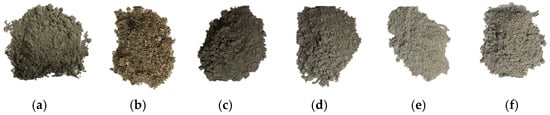
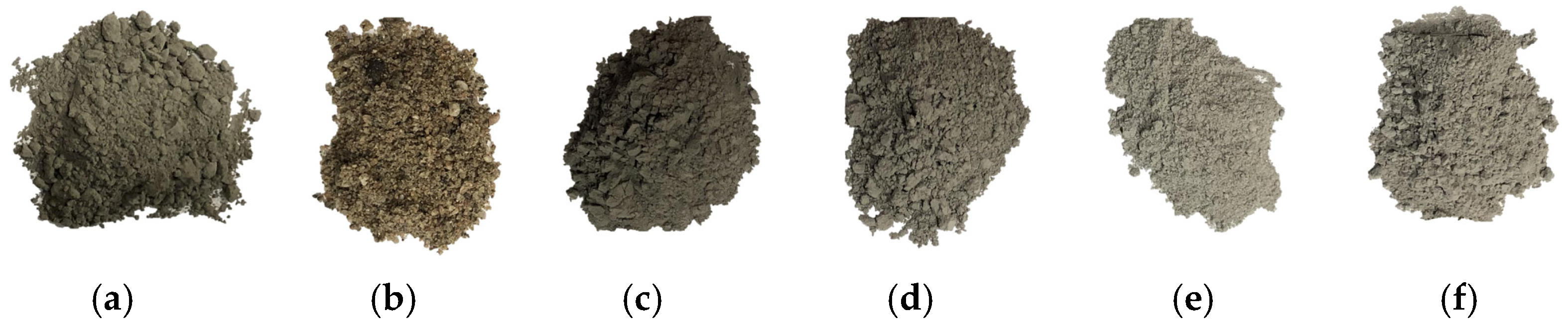
Commercially available OPC CEM I 42.5 N was used, manufactured by Cementa (Slite, Sweden). The OPC complied with the requirements of EN-197-1 [30]. Natural sand (0–8 mm) was utilized, provided by Vattenfall R&D. The sand contained 5% moisture, which was accounted for when mixing the materials. Tap water was used to prepare the specimens. Two types of lead–zinc tailings were employed: T1 was supplied by Boliden (Stockholm, Sweden), originating from the Tara mine in Ireland, and T2 was supplied by Zinkgruvan (Askersund, Sweden), originating from the flotation stage at the Zinkgruvan mine in Sweden. Oxide compositions of the OPC, T1, and T2 are presented in Table 1. The visual appearances of the materials are displayed in Figure 1.
Table 1.
Main chemical constituents of OPC, T1, and T2 (wt%).
Figure 1.
Visual appearance of (a) OPC; (b) natural sand; (c) T1 raw; (d) T1 activated; (e) T2 raw; and (f) T2 activated.
Compared to OPC, T2 has a low CaO content, while T1 has an intermediate CaO content. The loss on ignition (LOI) is remarkably high in T1 tailings (21%), due to the presence of CaCO3 in the material. Martins et al. [31] pointed out that high LOI often results from mass losses caused by the decarbonization of carbonate minerals occurring at 600–800 °C [32]. Since the analytical method for oxide analysis includes melting, this may lead to the decomposition of CaCO3 into CO2 and CaO, which is then identified as CaO in the analytical procedure.
2.2. Methods
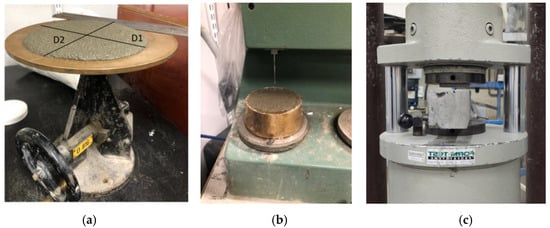
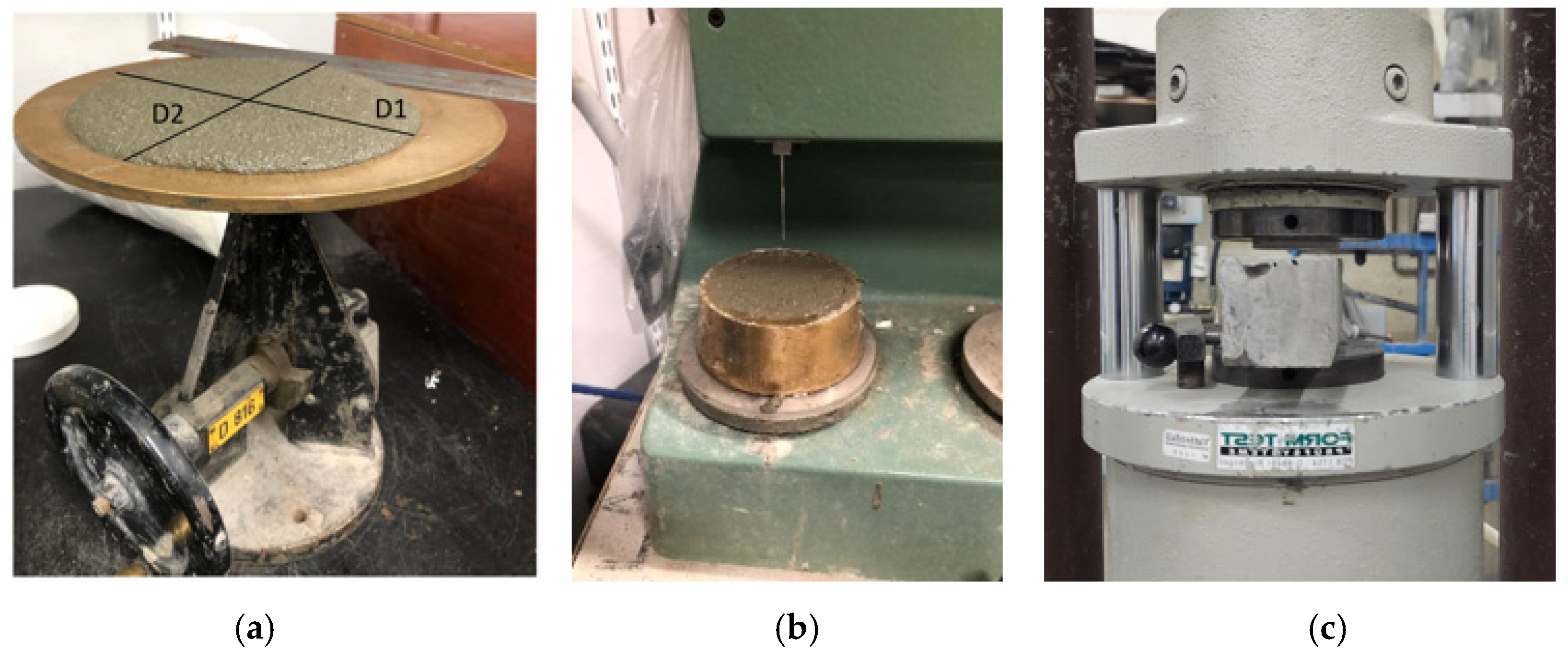
The oxide compositions were analyzed using inductively coupled plasma mass spectrometry (ICP-MS) according to EN ISO 17294-2:2016 [33], which provides a method for direct measurement. The mineralogy of both raw and activated tailings was analyzed utilizing XRD based on EN-13925 [34]. LOI1000 °C was analyzed following ASTM D3682-21 [35]. The particle size distribution was measured by sieving in accordance with SS-27123 [36] for particle sizes above 63 µm and by sedimentation with a hydrometer according to SS-27124 [37] for particle sizes below 63 µm. Flowability was measured based on SS-EN 1015-3 [38]. Setting time was investigated following SS-EN 480-2:2006 [39] using a Vicat machine with automatic readings every 15 min. Flowability and setting-time tests were performed on the mortar mixes. The experimental equipment used for measuring flowability, setting time, and compressive strength is shown in Figure 2a–c.
Figure 2.
(a) Principle of flowability measurement based on diameters D1 and D2; (b) setup for measuring setting time; and (c) equipment for compressive strength test.
2.3. Activation
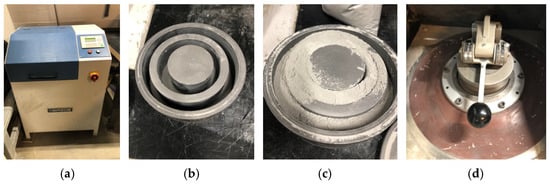
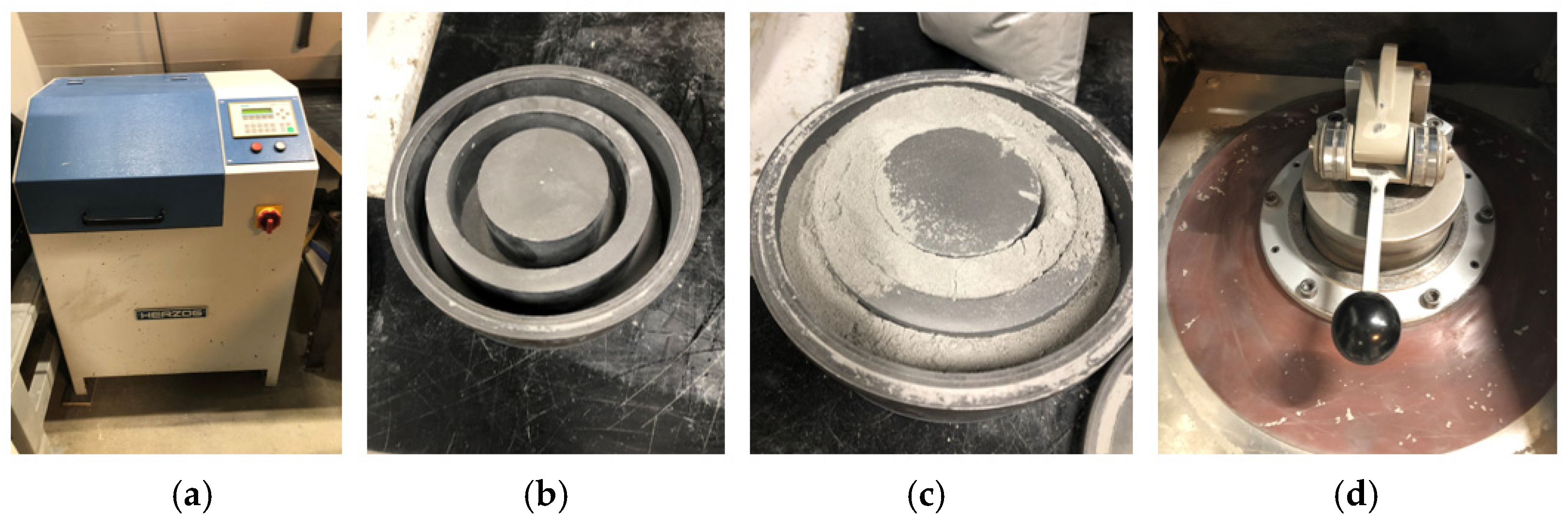
Tailings were activated by 6 min of pulverization in a Herzog vibratory cup mill. The activation time of 6 min was chosen, as it was found to be efficient for activation by Kappel et al. [29]. The principle involves placing the sample in a steel cup which contains a ring and a puck. The cup is placed on a vibrating plate, and a horizontal oscillating movement grinds the material with high frictional forces between the cup, the ring, and the puck. The maximum sample volume is 200 mL. The equipment is displayed in Figure 3a–d. Activation of the tailings took place 1–2 days before mixing, and the tailings were stored in a sealed airtight plastic box between activation and mixing.
Figure 3.
(a) Vibratory cup mill; (b) cup, ring, and puck for placing specimen when pulverizing; (c) filled cup; and (d) clamped cup.
The mix proportions of TBMs are displayed in Table 2. The binder-to-sand ratio was 0.36 and the water-to-binder ratio was 0.5, considering the mass of the tailings.
Table 2.
Mix proportions of TBMs.
2.4. Specimen Preparation
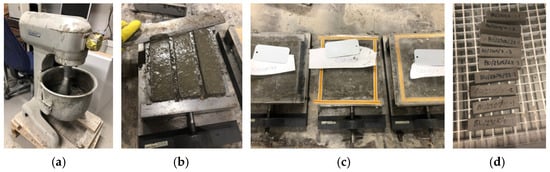
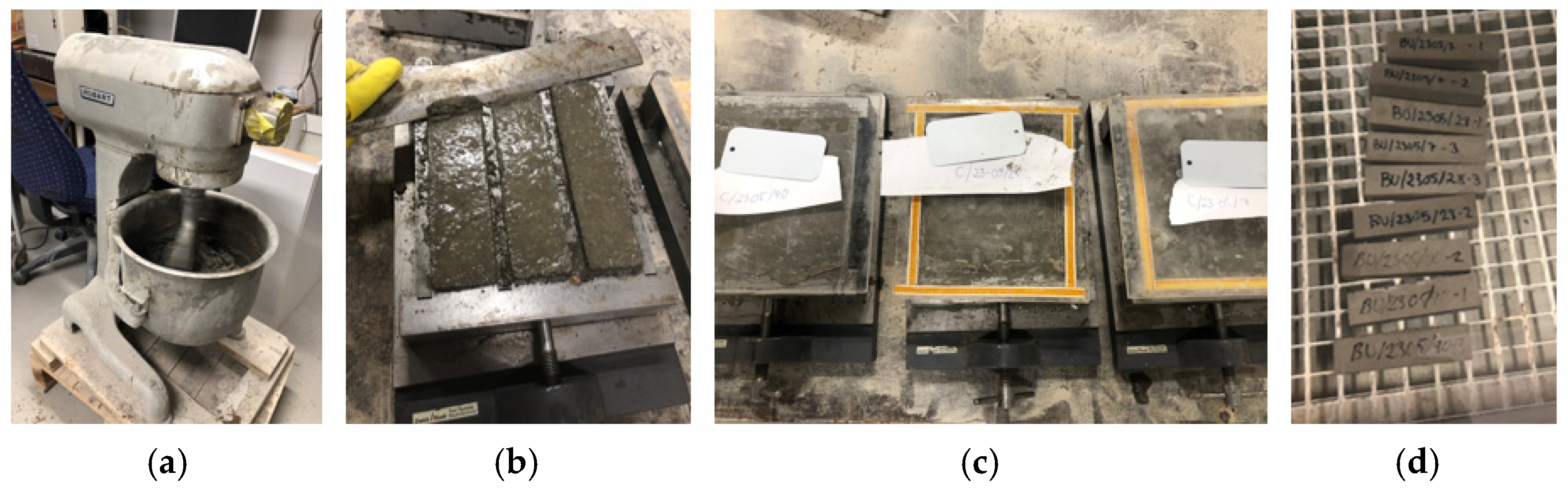
The specimens were cast in the shape of 160 × 40 × 40 mm prisms. Mixing was performed in accordance with SS-EN 196-1:2016 [40]. After mixing, molding, compacting, and sealing with Plexiglas, the specimens were stored at 20 °C for 24 h until demolding. Immediately after demolding they were placed in water at 20.5 ± 2 °C until testing. The procedure is demonstrated in Figure 4a–d.
Figure 4.
(a) Mixing; (b,c) molding; and (d) storing samples after demolding.
Compressive strength tests were performed according to SS-EN 196-1:2016 [40] after 7, 28, and 90 days of curing. Three prisms were tested for each mix and results were reported as the mean of the three samples. The microstructure of the specimens was studied after 160 days of curing using SEM and EDS. Specimens were dried at 100 °C for two hours prior to analysis.
3. Results and Discussion
The findings from the experimental tests are presented and discussed in this section. First, the effect of activation on tailing properties is evaluated. Second, the results from the flowability, setting time, and compressive strength tests of TBMs containing raw and activated lead–zinc tailings are reported and analyzed. Finally, the results from the microstructural analysis conducted on TBMs containing activated tailings are presented and discussed.
3.1. Activation
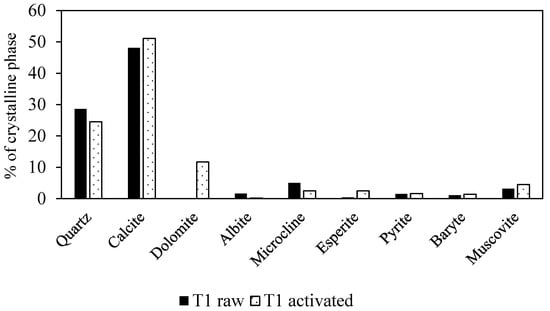
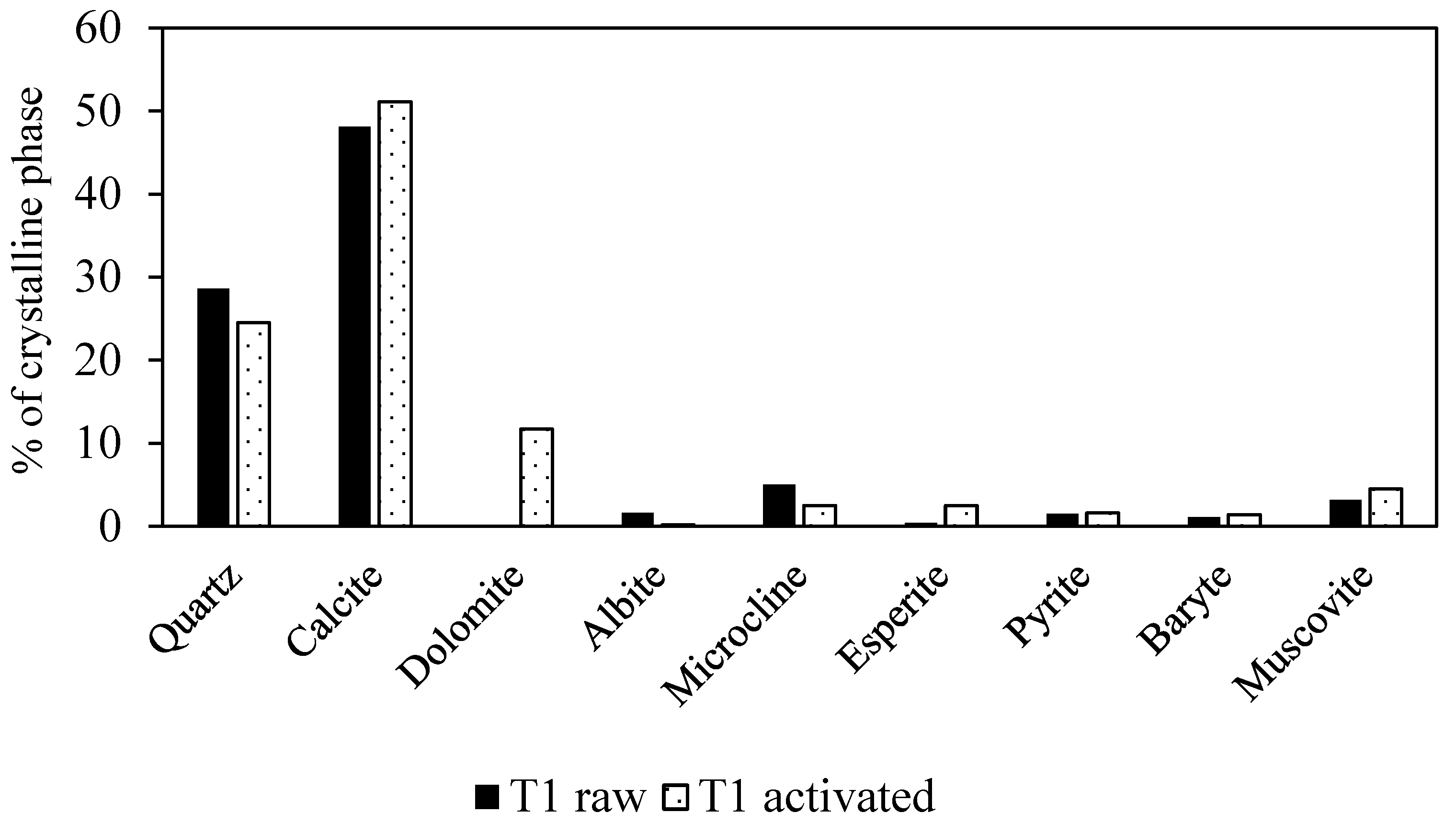
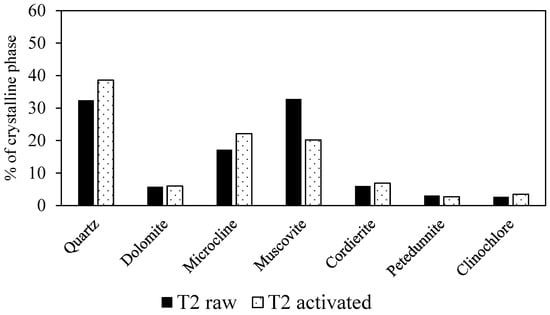
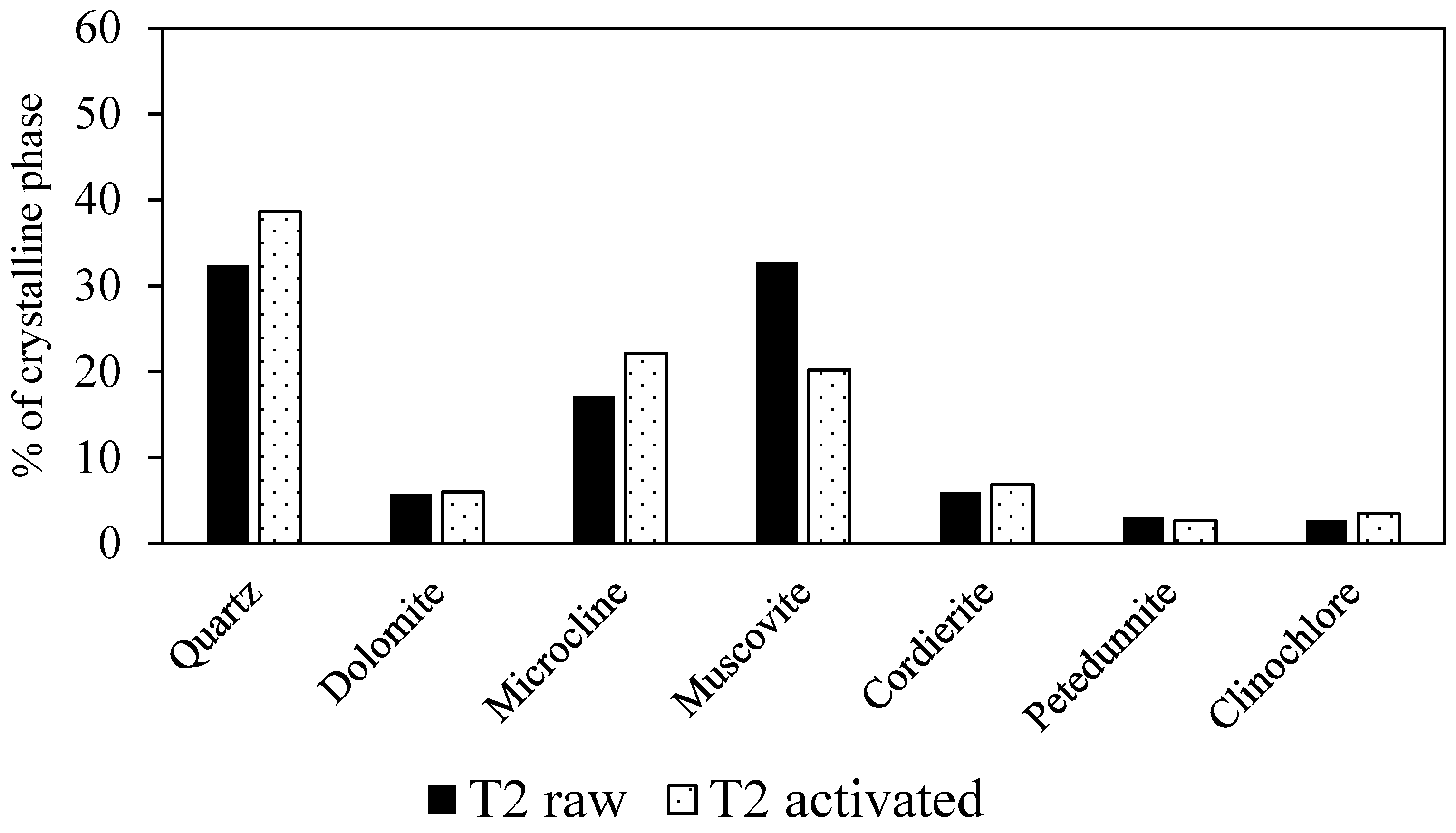
Figure 5 and Figure 6 illustrate the mineralogy of the T1 and T2 specimens before and after activation, respectively. Due to the heterogeneous characteristics of tailings, natural variations in the microstructure are expected. For T1, no clear difference could be observed between the raw and activated materials. No significant alterations in mineralogy appeared to occur. Calcite was the dominant mineral both before and after the activation, followed by quartz. Pyrite and baryte were present in T1 at 1.5 wt% and 1.1 wt%, respectively.
Figure 5.
Mineralogy of T1 (raw and activated).
Figure 6.
Mineralogy of T2 (raw and activated).
In the T2 tailings, mineralogical transformations were observed after activation. For T2 raw, the dominant mineral was quartz, followed by muscovite and microcline. After the activation, the amount of muscovite decreased from 33% to 20%. It has been established in previous research that muscovite can be mechanically activated, positively affecting pozzolanic activity [26]. Moreover, raw muscovite has a laminar shape, and this may explain the higher particle sizes in T2, as shown in Figure 7. As discussed by Baki et al. [26], mechanical activation tends to break the laminar shape of muscovite, transforming it to fine grains, and this leads to mechanically activated muscovite having notably higher specific surface areas than raw muscovite [26]. The results suggest that muscovite underwent partial transformation, and its amount decreased by about 40% after 6 min of activation in the vibratory cup mill.
Figure 7.
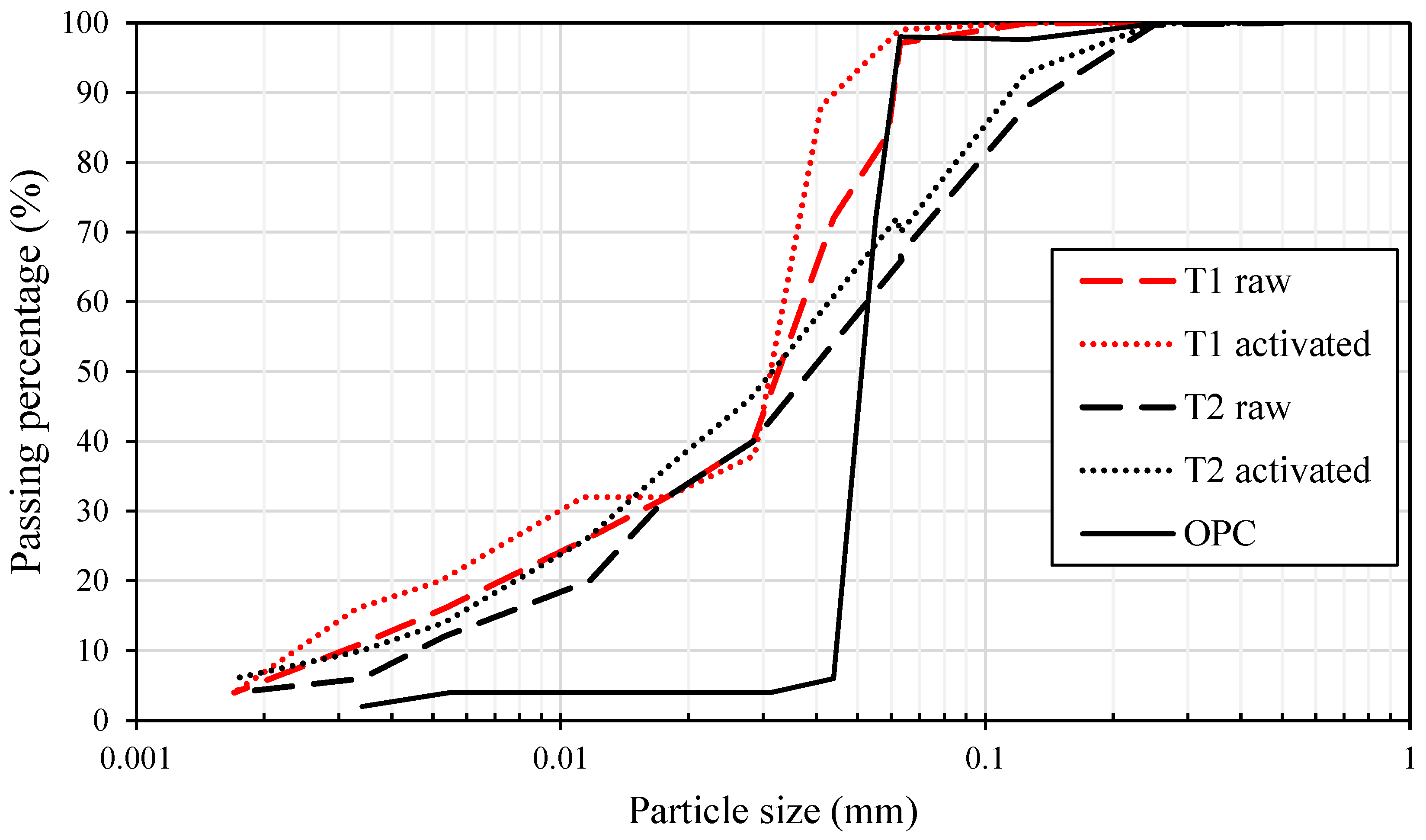
Particle size distributions of OPC and tailings (raw and activated).
Furthermore, microcline and albite can be mechanically activated. Microcline was present in low levels in T1, and while there was a change from 5.0 wt% before activation to 2.5 wt% after activation, the total amount of microcline was low and thus unlikely to contribute significantly to the pozzolanic effect. Similarly, albite existed in T1 raw in low amounts (1.6 wt%) and decreased further after the activation (0.2 wt%). While the effect of the activation could be analytically observed, the levels of both microcline and albite were too low to have a noticeable effect on the activity index of the specimens. For T2, no albite was identified. Notably, T1 contained sulfides in the form of pyrite and baryte, and pyrite in particular has been pointed out as a concern regarding internal sulfate attacks [31]. Pyrite may provoke the formation of needle-shaped ettringite in proximity to the pyrite grains, and this may have a positive effect on strength development on a short-term time scale. However, due to the volume expansion of ettringite, this could lead to crack formation, and the risk is higher at higher pyrite levels and with finer grain sizes [41]. The mineralogical analysis of T2 did not detect any sulfides. When assessing the sulfide content of tailings, one must take into consideration the “nugget effect”, namely that sulfide minerals are unevenly distributed in the material and the concentration at a specific point may not be representative of the whole tailing body [42].
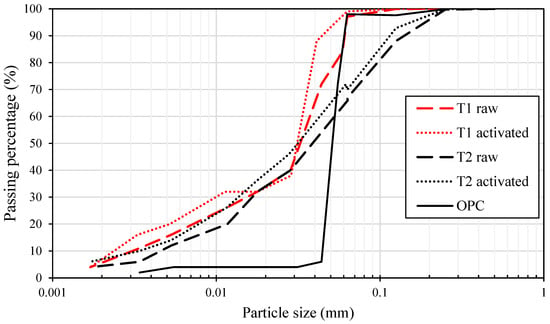
The particle size distributions of the tailings (T1 and T2) and OPC are depicted in Figure 7, along with their corresponding D10, D60, and D90 values in Table 3. All tailings had a wider particle size distribution than OPC, for which 92% of the particles were within the size range of 31–55 µm. Activation decreased the particle sizes of both T1 and T2, with the effect being more uniform in T2.
Table 3.
Effective particle sizes (µm).
For T1, the total percentage of the particles within the size range 20–30 µm remained the same, which can be explained either by the fact that these particles did not undergo any size reduction or by the fact that many of the particles with larger sizes that were crushed ended up in this category, replacing the particles that were removed from this category. Additionally, the particles with sizes around 50 µm seem to have been reduced to a larger extent than others. This is in line with the results found by Yao et al. [17], who established that not all particle size fractions of tailings are equally affected by milling.
In contrast to T1, the particle size distribution curve of T2 has the same shape before and after the activation but has shifted to the left. This means that all particle sizes were similarly affected by the mechanical grinding and the size reduction was not predominant for any specific particle sizes. For T1 raw, D90 was 53 µm, decreasing to 44 µm after the activation. Similarly, for T2 raw, D90 was 141 µm, and the corresponding size was 115 µm after the activation. While the effect on the particle size may be more pronounced in T2, the actual particle size was smaller in T1, and the particle size distribution was narrower in T1, with nearly all the particles having diameters below 125 µm. For T2, there was a larger span of particle sizes, with most of the particles in T2 raw below 250 µm. The presence of sheet-formed muscovite particles in T2 may explain the larger particle sizes compared with T1.
A review [15] concluded that tailings with a D50 within the range of 20–400 µm may be suitable for cement replacement. The tailings used in this study fall within this range, both before and after activation. However, it is known from other research that the optimal particle size for tailings as SCM is between 3 and 13 µm [11,20] and while the activation increased the number of the particles within this range, most of the particles were larger. From the results obtained in this experimental study, it can be concluded that although the vibratory cup mill activation had a positive effect, it was not complete.
3.2. Flowability
The flowability of the mortar specimens is listed in Table 4. The flowability was reduced when activated tailings were used, and a higher replacement ratio correlated with a lower flowability. For T1 and T2, the flowability was 157 mm and 168.5 mm, respectively, when using 20% activated tailings, compared with 174 mm for the control specimen. This can be explained by the smaller particle sizes and a higher adsorption of water to the particle surfaces.
Table 4.
Flowability, initial and final setting times, and compressive strengths of specimens.
Interestingly, no such trend was observed when raw tailings were used. The flowability is equal to or slightly higher than that of the control specimen for both T1 and T2 when 20% raw tailings were added. Mechanical activation of the tailings increased the water demand. This phenomenon has been discussed in previous studies [43,44] which conclude that incorporating finer particles with higher specific surface areas into the mortar increases the water demand, due to the increased water adsorption to the particle surfaces. Furthermore, irregularly shaped particles may increase the water demand compared with smooth-surface particles, as the frictional forces between particles are larger and larger volumes of water are needed to disperse the particles [43]. Zhao et al. [45] pointed out that the presence of muscovite increases the water demand.
The results from the flowability tests demonstrate that mechanical activation of the lead–zinc tailings reduced particle sizes, thereby increasing the surface area available for the water to adsorb, which affects the rheology of the mortars. Previous research has reported similar observations and reported the need for superplasticizers to obtain acceptable workability when using activated tailings as SCM [43,46,47]. Carvalho et al. [48] found a correlation between the particle sizes of SCM and flowability, with particles larger than OPC increasing the flowability and particles smaller than OPC decreasing the flowability. Although the effect of activation on the tailings’ particle sizes was relatively moderate, its effect on flowability was more pronounced.
3.3. Setting Time
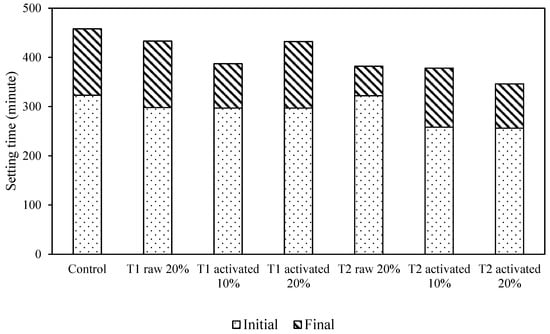
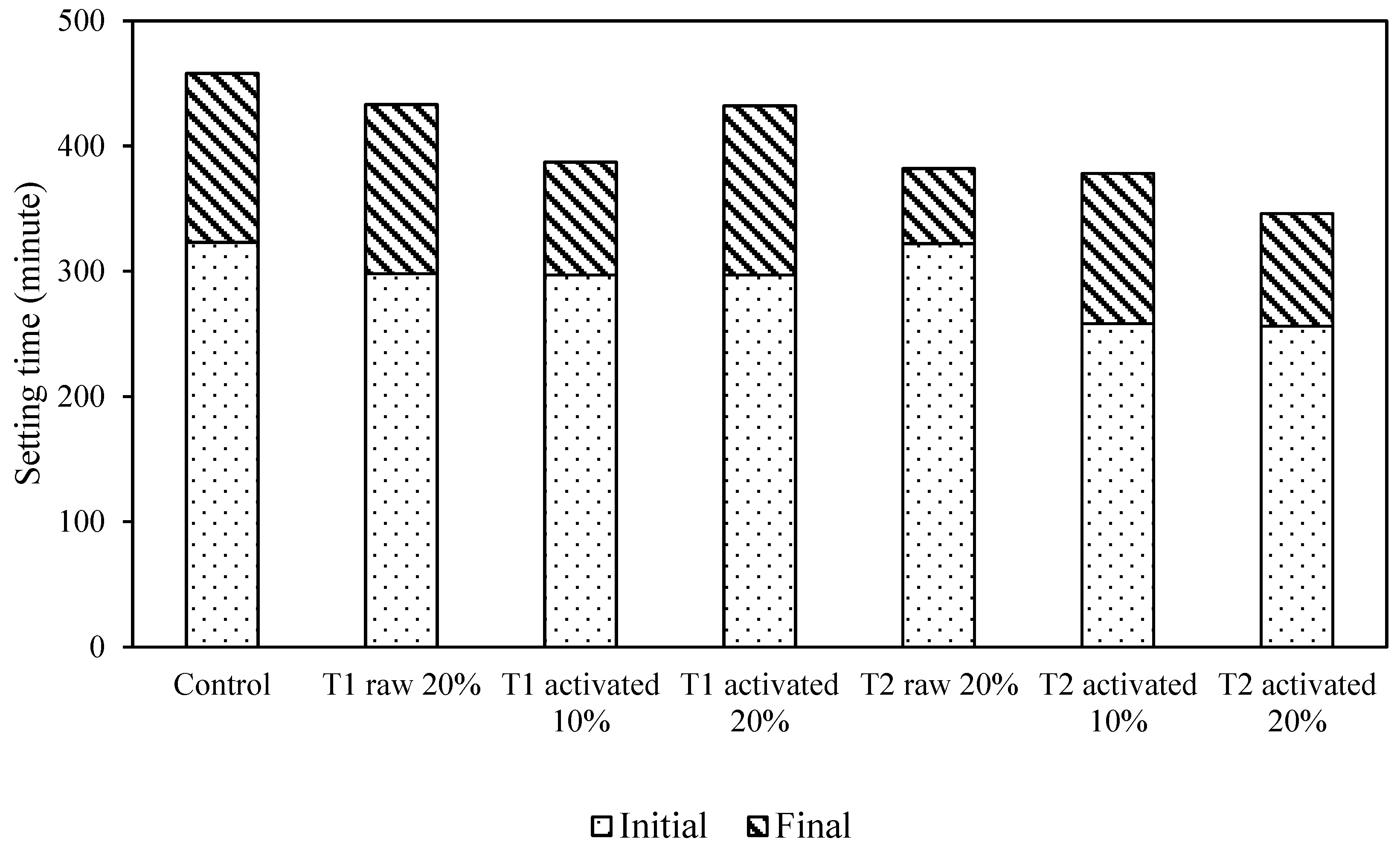
The setting times of the mortars are shown in Figure 8. For the control specimen, the initial and final setting times were 323 and 458 min, respectively. Both the initial and final setting times were accelerated for all the TBM specimens, compared with the control specimen. The initial and final setting times were reduced to 21% and 25%, respectively, with the most pronounced effect in the T2 activated TBMs. Comparing T2 raw 20% and T2 activated 20% in Figure 8 demonstrates a difference in initial and final setting time of 66 min and 42 min, respectively. No such difference can be observed when comparing T1 raw 20% with T1 activated 20%, which further confirms the lesser effect of activation in T1 tailings.
Figure 8.
Initial and final setting times of specimens.
The mineralogical modifications in T2 during mechanical activation have consequently influenced the fresh properties. This may be connected to the activation of muscovite, which changes not only the particle sizes but also the shape and specific surface area when sheet-formed particles are transformed into granular material [26]. Talera et al. [49] discuss the accelerating effect of filler materials and conclude that fine particles with higher water absorption capacity tend to accelerate setting to a greater degree.
Research findings on the effect of tailings on setting times have been inconsistent. While Adediran et al. [50] found that tailings reduce the setting times, other studies report contradicting results. In some studies, tailings have shown to retard setting, but finer tailing particles retard setting to a lesser degree [43,45]. Similarly, Tsardaka et al. [51] demonstrated that a lower water-to-cement ratio corresponded to shorter setting times. Their results also indicated that cement mixes with lower flowability tend to have shorter setting times. As the activated tailings seemed to adsorb water and reduce flowability, less water was available in the mixture, thereby reducing the setting times.
In addition, there may be other phenomena contributing to the shortened setting times. A hypothesis is that the presence of chlorides and sulfates reduces the setting times, as they affect the permeability of the CSH gel and the reaction with CH to form ettringite [52]. Carbonates may also accelerate the setting of OPC [53]. It should be noted that the results from this experimental test contrast with some previous research in which tailing replacement resulted in increased setting times [48,54,55].
3.4. Compressive Strength
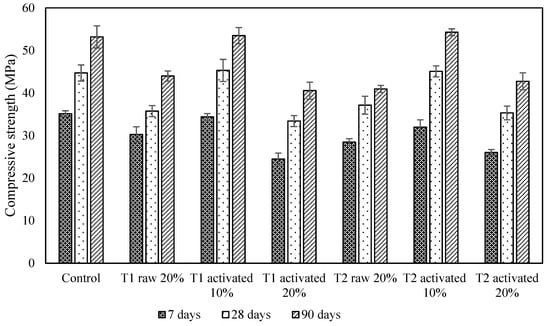
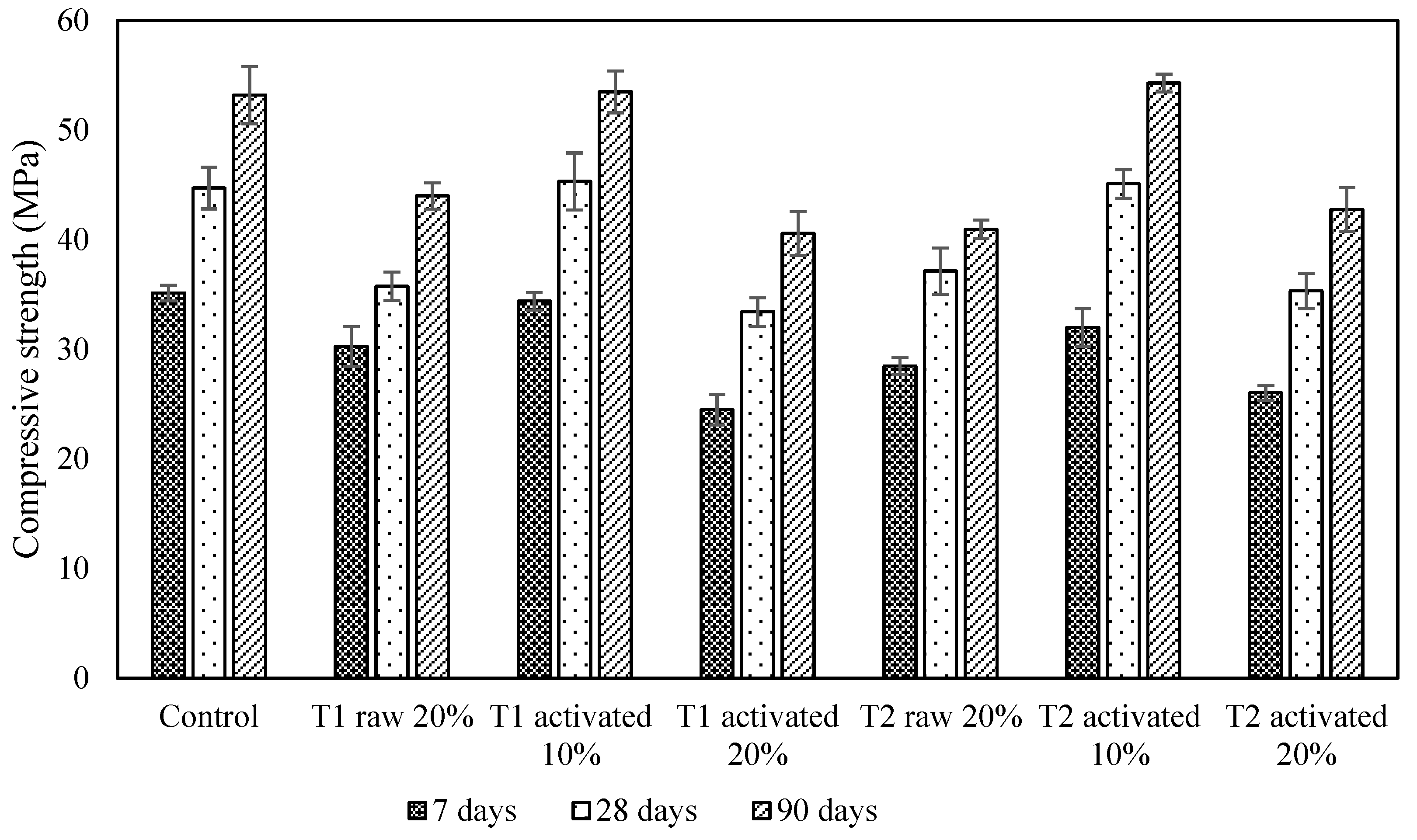
Figure 9 illustrates the compressive strengths of the specimens after 7, 28, and 90 days. For the control specimen, the compressive strengths at 7, 28, and 90 days were 35.14 MPa, 44.71 MPa, and 53.19 MPa, respectively. At the replacement level of 10%, the compressive strength of both the T1 and T2 specimens slightly exceeded that of the control specimen after 28 and 90 days. At the replacement level of 20%, the compressive strengths of the T1 and T2 specimens were notably lower than those of the control specimens at all ages.
Figure 9.
Compressive strengths of mortar specimens at 7, 28, and 90 days.
For T1, the compressive strength was lower when utilizing activated tailings compared to raw tailings at 7, 28, and 90 days. However, for T2, the compressive strengths at 7 and 28 days were lower when using activated tailings, but the opposite was observed after 90 days, where the activated tailing specimens exhibited higher compressive strength than the raw tailing specimens. This could signify that a pozzolanic reaction took place, which contributed to strength development, since a pozzolanic reaction follows cement hydration, consuming the CH formed during cement hydration.
The compressive strengths of T2 activated 20% specimens exceeded those of T1 activated 20% specimens at all ages. For the specimens with 10% activated tailings, T1 had a faster early strength development, with higher compressive strengths at 7 and 28 days compared with T2, whereas later-age strength development in T2 yielded a higher compressive strength at 90 days. The higher later-age compressive strength in T2 may indicate a pozzolanic effect, suggesting that activation was more effective in T2. This could be attributed to the presence of muscovite in T2, which has been shown in previous studies to have potential for pozzolanic activation [25]. The faster early-age strength development in T1 specimens could potentially be due to the smaller particle sizes, promoting filler effects as observed in [49].
Interestingly, when comparing the T1 raw 20% with T1 activated 20% specimens, the relative strength development from day 7 to 28 and from day 28 to 90 followed a similar pattern, regardless of activation. In contrast, comparing the T2 raw 20% and T2 activated 20% specimens demonstrates higher relative strength development between day 28 and day 90 in the T2 activated mix, further supporting the presence of a pozzolanic reaction in T2 activated 20%.
In general, there were no major differences in compressive strength between the control specimens and the T1 activated 10% and T2 activated 10% specimens at ages beyond 7 days. While initial strength development may be slower for these mixes, comparable compressive strengths can be expected for days 28 and 90, similar to the control mix. When replacing 20% of the cement with tailings, a sharp decrease in compressive strength was observed in both T1 and T2. Therefore, the results indicate that the optimal use of activated lead–zinc tailings should not exceed 10%.
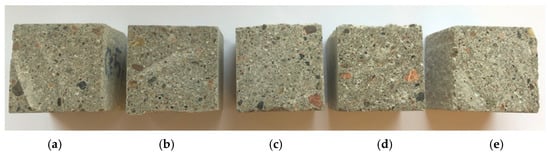
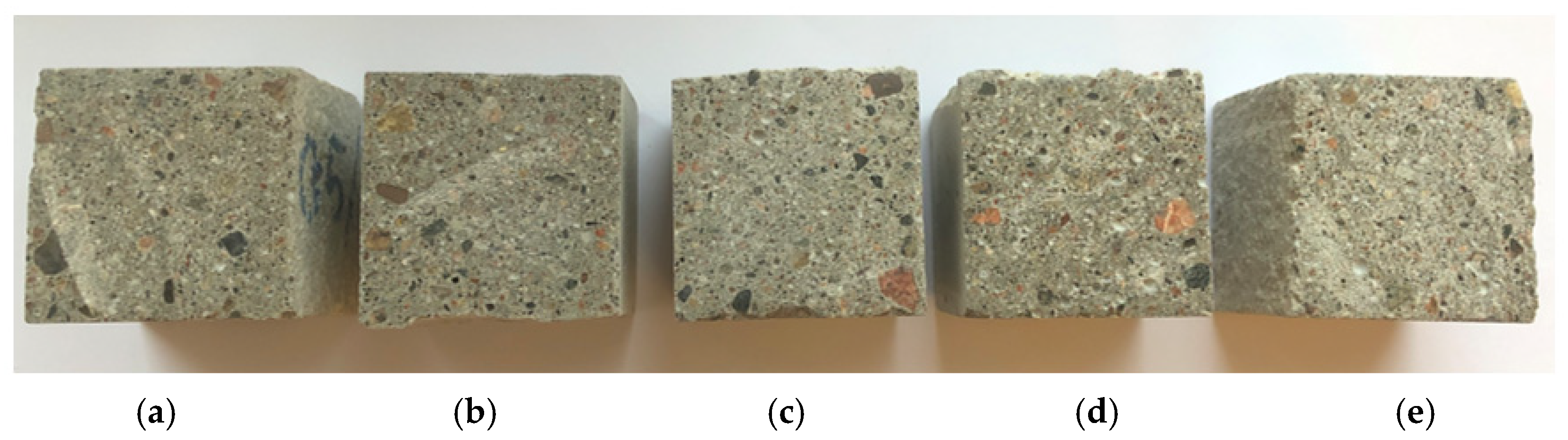
There were no changes in appearance (e.g., color or structure) when replacing 10–20% of OPC with T1 or T2. The cross-sectional appearances of the mortar specimens are depicted in Figure 10.
Figure 10.
Visual appearance of dried specimens after 160 days curing: (a) control; (b) T1 activated 10%; (c) T1 activated 20%; (d) T2 activated 10%; and (e) T2 activated 20%.
3.5. Microstructure
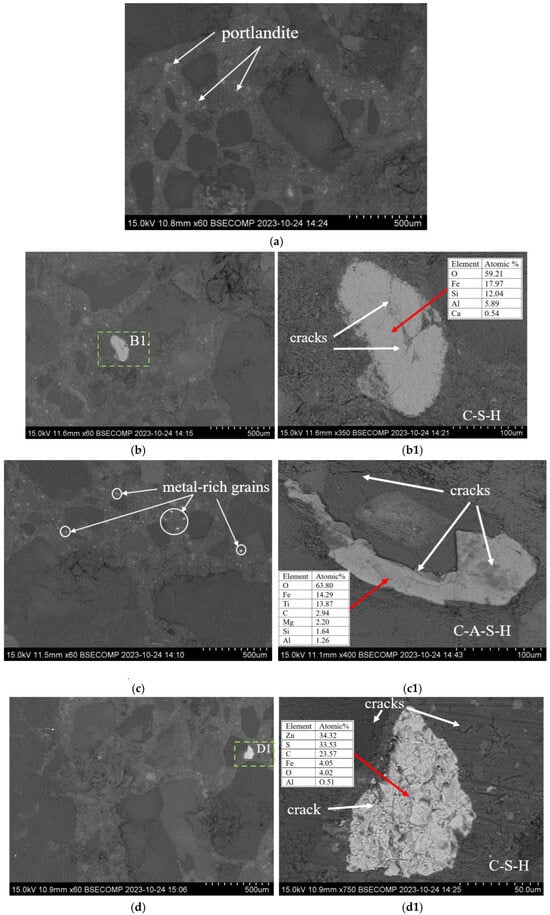
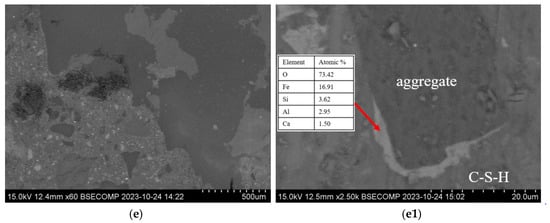
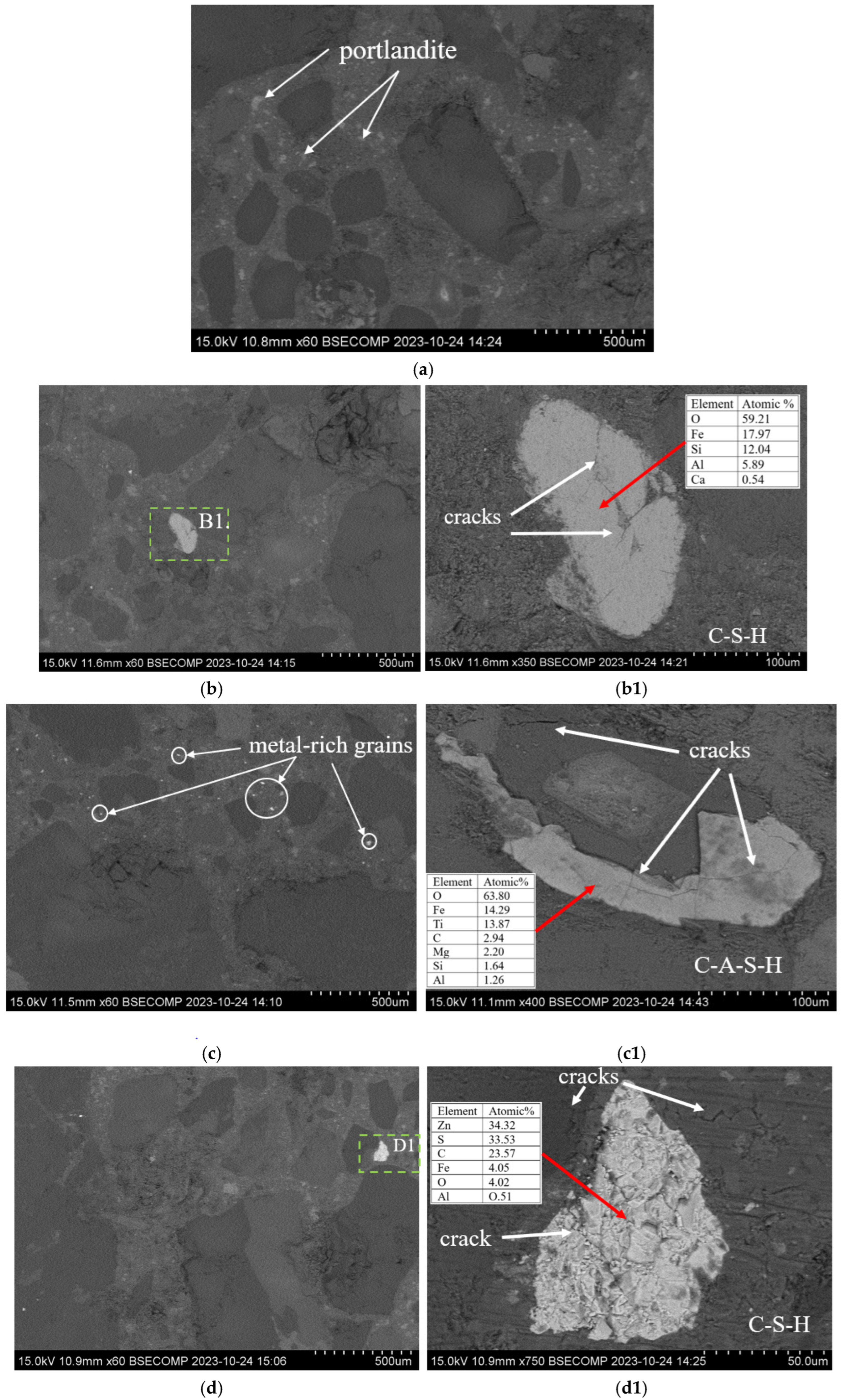
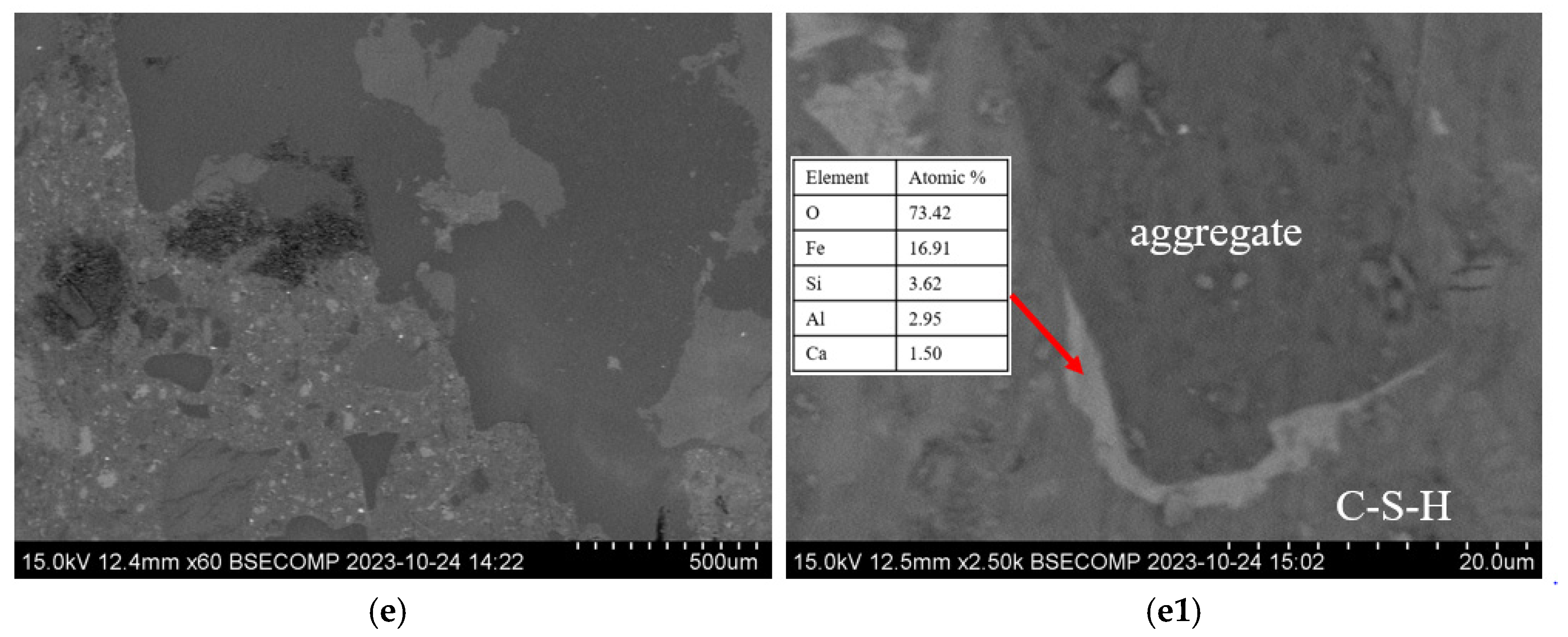
The microstructures of the TBM specimens after 160 days were examined by SEM-EDS, and the images are shown in Figure 11. Bright white spots can be observed in the TBM specimens, and spectrum analysis revealed that these areas had high concentrations of various metals, originating from the tailing particles. These metal-rich phases were only present in the TBM specimens and not in the control specimens, suggesting that the use of tailings as SCM leads to entrapment of heavy metal particles in the cement matrix, rather than a uniform distribution of the metals. Mawire et al. [19] described the phenomenon, attributing it to the dissolution and incorporation of minerals from the tailings into the C-S-H matrix, particularly when the Ca/Si ratio is low. The metal-rich phases appear to be bound within the dense cement matrix, with no distinct boundaries between the grains and the cement paste. Interestingly, cracks are observed in or near several such metal-rich grains, as seen in Figure 11(b1,c1,d1). Previous studies have illustrated that microcracks in the cement paste are associated with a negative effect on mechanical strength [56].
Figure 11.
SEM images of mortars after 160 days curing. (a) Control; (b) T1 activated 10%; (b1) magnification of detail in T1 activated 10%; (c) T1 activated 20%; (c1) magnification of detail in T1 activated 20%; (d) T2 activated 10%; (d1) magnification of detail in T2 activated 10%; (e) T2 activated 20%; (e1) magnification of detail in T1 activated 20%.
The control specimen (a) shows no metal-rich grains, and the lighter-gray areas correspond to CH (portlandite). The image of the T1 activated 10% specimen (b), with an iron-rich grain magnified in (b1), reveals cracks across the grain. The T1 activated 20% specimen (c) shows metal-rich grains distributed within the C-A-S-H gel. EDS analysis of the metal grains indicates that they contain metals; one example, shown in (c1), is high in iron and titanium with a flakey appearance. Cracks run across the grain, often perpendicular to each other. In the T2 activated 10% specimen (d), a metal-rich grain containing zinc, sulfur, and carbon is identified (d1). Although no sulfur is detected in the oxide analysis of the T2 tailings, sulfide species are found in the EDS analysis, highlighting the importance of considering the nugget effect. Cracks are also observed across and near the sulfur-rich grain, consistent with previous findings that sulfide-bearing minerals may provoke cracking due to volume expansion during reactions, causing internal stresses [31,41,42]. In the T2 activated 20% specimen (e), magnification of the interfacial transition zone between aggregate and cement paste (e1) shows areas of iron-rich material around the aggregate, similar to regions found around CH grains.
The microstructural analysis shows that TBM specimens contain local regions with high metal concentrations, and it is not known how the presence of such regions affects the mechanical properties of the mortar. The loss of compressive strength associated with higher cement replacement could be partly explained by the cracks visible in the iron-, zinc-, and titanium-rich phases (b1), (c1), and (d1) and in the cement paste surrounding the zinc–sulfur-rich phase (d1).
4. Conclusions
In this study, two types of lead–zinc tailings were used to produce mortars with reduced OPC content. The efficiency of the vibratory cup mill as a method for mechanical activation of lead–zinc tailings was investigated. Flowability, setting time, compressive strength, and microstructure of the mortars were experimentally evaluated. The conclusions are as follows:
- Mechanical activation for 6 min in a vibratory cup mill reduced the particle size of the tailings and decreased the amount of crystalline muscovite, microcline, and albite in the tailings. The reduction in particle size and crystallinity was not complete, indicating potential for further optimization of the activation process.
- Flowability of the mortars decreased when using activated tailings compared with raw tailings or OPC alone. Mechanically activated tailings adsorb more water than raw tailings, likely due to their larger surface area. The use of plasticizers should be considered when employing activated lead–zinc tailings as SCMs.
- Initial and final setting times of the mortars were shortened by up to 21% and 25%, respectively, when replacing 10–20% of OPC with lead–zinc tailings, primarily due to water adsorption on particle surfaces. This effect was more pronounced for T2, showing that activation of tailings influences the fresh properties and decreases the workable time of the mortars.
- We were able to produce two types of mortar with 45.31 MPa and 45.09 MPa by replacing 10% of OPC with tailings T1 and T2, respectively. For replacement levels above 10%, compressive strength decreased, both in the short term (7 days) and long term (90 days). The results from this study suggest that, for the optimal use of lead–zinc tailings as an SCM, cement replacement should not exceed 10%.
- Microstructural analysis confirms the detrimental effect of sulfides. Moreover, it shows that heavy metals are unevenly dispersed in the cement matrix in clearly distinguishable grains or regions. Microcracks were observed near such grains. It is not clear what impact this may have on the performance of the mortar; nonetheless, the presence of sulfur in such grains is associated with microcrack formation after 160 days of curing.
- While the activation method had a limited effect on improving the reactivity of the tailings, the results indicate that the activation process could be further optimized to reduce the particle sizes and activate the minerals. The D90 values were reduced from 53 µm to 44 µm in T1 and from 141 µm to 115 µm in T2. For the vibratory cup mill activation to efficiently promote pozzolanic reactivity, previous studies suggest that the particles should be further reduced in size, preferably to below 13 µm. Future studies should focus on optimizing the activation method to reach target particle sizes < 13 µm, while evaluating the benefits of using the vibratory cup mill compared with conventional planetary ball milling in terms of energy use, cost, and scalability.
- In future studies, flexural and tensile strengths of TBM should be investigated, as well as durability-related parameters. The effect of the microcracks should be further studied to evaluate their impact on macrostructural performance. Environmental and durability aspects of TBM should also be further investigated, as they were not addressed in this study.
Author Contributions
Conceptualization, L.J., A.B., M.C., and M.W.; methodology, L.J., A.B., M.C., and M.W.; validation, L.J., A.B., M.C., and M.W.; formal analysis, A.B., M.C., and M.W.; investigation, L.J., A.B., M.C., and M.W.; writing—original draft preparation, L.J.; writing—review and editing, L.J., A.B., M.C., and M.W.; supervision, A.B., M.C., and M.W.; funding acquisition, A.B. All authors have read and agreed to the published version of the manuscript.
Funding
This research received no external funding.
Data Availability Statement
The raw data supporting the conclusions of this article will be made available by the corresponding author on request.
Acknowledgments
The authors are thankful to the University of Gävle, Sweden, for funding this research work. The authors also acknowledge the support of the Vattenfall laboratory in Älvkarleby, Sweden, for assistance in conducting the experiments. Moreover, the authors appreciate Boliden and Zinkgruvan in Sweden for providing the tailings.
Conflicts of Interest
The authors declare no conflicts of interest.
Abbreviations
The following abbreviations are used in this article:
| OPC | Ordinary Portland cement |
| SCM | Supplementary cementitious material |
| LOI | Loss on ignition |
| TBM | Tailing-based mortar |
| C-A-S-H | Calcium–aluminate–silicate–hydrate |
| C-S-H | Calcium–silicate–hydrate |
| CH | Calcium hydroxide (portlandite) |
| SEM | Scanning electron microscopy |
| EDS | Energy dispersive X-ray spectroscopy |
| XRD | X-ray diffraction |
References
- Habibi, A.; Tavakoli, H.; Esmaeili, A.; Golzary, A. Comparative life cycle assessment (LCA) of concrete mixtures: A critical review. Eur. J. Environ. Civ. Eng. 2023, 27, 1285–1303. [Google Scholar] [CrossRef] [Scilit]
- Bataille, C.G.F. Physical and policy pathways to net-zero emissions industry. Wiley Interdiscip. Rev. Clim. Change 2020, 11, e633. [Google Scholar] [CrossRef] [Scilit]
- Gou, M.; Zhou, L.; Then, N.W.Y. Utilization of tailings in cement and concrete: A review. Sci. Eng. Compos. Mater. 2019, 26, 449–464. [Google Scholar] [CrossRef] [Scilit]
- Beylot, A.; Bodénan, F.; Guezennec, A.G.; Muller, S. LCA as a support to more sustainable tailings management: Critical review, lessons learnt and potential way forward. Resour. Conserv. Recycl. 2022, 183, 106347. [Google Scholar] [CrossRef] [Scilit]
- Adiguzel, D.; Tuylu, S.; Eker, H. Utilization of tailings in concrete products: A review. Constr. Build. Mater. 2022, 360, 129574. [Google Scholar] [CrossRef] [Scilit]
- Vargas, F.; Rigamonti, L. Environmental evaluation of treated tailing as supplementary cementitious material. Procedia CIRP 2020, 90, 280–284. [Google Scholar] [CrossRef] [Scilit]
- Li, R.; Yin, Z.; Lin, H. Research Status and Prospects for the Utilization of Lead–Zinc Tailings as Building Materials. Buildings 2023, 13, 150. [Google Scholar] [CrossRef] [Scilit]
- Luo, Z.; Ge, M.; Ou, J.; Liu, X.; Mu, Y.; Zhang, W.; Ye, J.; Zhang, M.; Gao, M.; Yang, Y.; et al. Precalcination-modified lead-zinc tailings for supersulfated cement production: Insights into phase assemblages, microstructure, and mechanical properties. Constr. Build. Mater. 2025, 473, 141076. [Google Scholar] [CrossRef] [Scilit]
- Saedi, A.; Jamshidi-Zanjani, A.; Mohseni, M.; Darban, A.K. Effect of mechanochemical activation on hydration properties of lead-zinc sulfide tailings for concrete construction. Case Stud. Constr. Mater. 2023, 18, e01996. [Google Scholar] [CrossRef] [Scilit]
- Zhou, Y.; Duan, X.; Chen, T.; Yan, B.; Li, L. Mechanical properties and toxicity risks of lead-zinc sulfide tailing-based construction materials. Materials 2021, 14, 2940. [Google Scholar] [CrossRef] [Scilit] [PubMed]
- Wang, H.; Ju, C.; Zhou, M.; Zheng, F.; Dong, Y.; Hou, H.; Liu, S. Grinding kinetics of lead–zinc tailing powders and its optimal particle size as a pozzolanic admixture in cement mortar. Adv. Powder Technol. 2022, 33, 103730. [Google Scholar] [CrossRef] [Scilit]
- Wang, X.; Yu, R.; Shui, Z.; Zhao, Z.; Song, Q.; Yang, B.; Fan, D. Development of a novel cleaner construction product: Ultra-high performance concrete incorporating lead-zinc tailings. J. Clean. Prod. 2018, 196, 172–182. [Google Scholar] [CrossRef] [Scilit]
- Zhang, D.; Shi, S.; Wang, C.; Yang, X.; Guo, L.; Xue, S. Preparation of cementitious material using smelting slag and tailings and the solidification and leaching of Pb2+. Adv. Mater. Sci. Eng. 2015, 2015, 352567. [Google Scholar] [CrossRef] [Scilit]
- Hernández-Ramos, S.; Trejo-Arroyo, D.; Cholico-González, D.; Rodríguez-Torres, G.; Zárate-Medina, J.; Vega-Azamar, R.; León-Patiño, C.; Ortíz-Lara, N. Characterization and effect of mechanical and thermal activation in mining tailings for use as supplementary cementitious material. Case Stud. Constr. Mater. 2024, 20, e02270. [Google Scholar] [CrossRef] [Scilit]
- Li, L.; Yu, H.; Zhou, S.; Dao, V.; Chen, M.; Ji, L.; Benhelal, E. Activation and utilization of tailings as CO2 mineralization feedstock and supplementary cementitious materials: A critical review. Mater. Today Sustain. 2023, 24, 100530. [Google Scholar] [CrossRef] [Scilit]
- Agrawal, Y.; Gupta, T. Examining the effect of the particle modification on zinc tailing waste as a cementitious material in concrete: Performance and toxicity assessment. J. Mater. Cycles Waste Manag. 2022, 24, 1156–1171. [Google Scholar] [CrossRef] [Scilit]
- Yao, G.; Wang, Z.; Yao, J.; Cong, X.; Anning, C.; Lyu, X. Pozzolanic activity and hydration properties of feldspar after mechanical activation. Powder Technol. 2021, 383, 167–174. [Google Scholar] [CrossRef] [Scilit]
- Cheng, Y.-h; Tong, B.-q; Sun, X.-h; Zhang, J.-y. On the grinding effects of high-silicon iron tailings. Environ. Sci. Pollut. Res. 2022, 29, 73326–73340. [Google Scholar] [CrossRef] [Scilit]
- Mawire, G.; McDonald, R.; Austin, P.; Mukherjee, A.; Esteban, L.; Dhami, N.K. Recycling of mine tailings as supplementary cementitious material: Impact of mine tailings’ mineralogy on hydration behaviour and phase assemblage of Ordinary Portland cement blends. Clean. Mater. 2025, 15, 100288. [Google Scholar] [CrossRef] [Scilit]
- Liu, B.; Meng, H.; Pan, G.; Zhou, H.; Li, D. Relationship between the fineness and specific surface area of iron tailing powder and its effect on compressive strength and drying shrinkage of cement composites. Constr. Build. Mater. 2022, 357, 129421. [Google Scholar] [CrossRef] [Scilit]
- Yang, Y.; Yang, Z.; Cheng, Z.; Zhang, H. Effects of wet grinding combined with chemical activation on the activity of iron tailings powder. Case Stud. Constr. Mater. 2022, 17, e01385. [Google Scholar] [CrossRef] [Scilit]
- Xu, X.; Wang, F.; Gu, X.; Zhao, Y. Mechanism of Different Mechanically Activated Procedures on the Pozzolanic Reactivity of Binary Supplementary Cementitious Materials. Minerals 2022, 12, 1365. [Google Scholar] [CrossRef] [Scilit]
- Liu, S.; Li, Q.; Song, J. Study on the grinding kinetics of copper tailing powder. Powder Technol. 2018, 330, 105–113. [Google Scholar] [CrossRef] [Scilit]
- Wang, Z.; Chu, H.; Wang, J.; Feng, E.; Zhang, Y.; Lyu, X. Mechanical activation of siliceous tailings and its application as cement admixtures. Miner. Eng. 2022, 177, 107366. [Google Scholar] [CrossRef] [Scilit]
- Tole, I.; Delogu, F.; Qoku, E.; Habermehl-Cwirzen, K.; Cwirzen, A. Enhancement of the pozzolanic activity of natural clays by mechanochemical activation. Constr. Build. Mater. 2022, 352, 128739. [Google Scholar] [CrossRef] [Scilit]
- Baki, V.A.; Ke, X.; Heath, A.; Calabria-Holley, J.; Terzi, C.; Sirin, M. The impact of mechanochemical activation on the physicochemical properties and pozzolanic reactivity of kaolinite, muscovite and montmorillonite. Cem. Concr. Res. 2022, 162, 106962. [Google Scholar] [CrossRef] [Scilit]
- Santos, S.F.; França, S.C.A.; Ogasawara, T. Method for grinding and delaminating muscovite. Min. Sci. Technol. 2011, 21, 7–10. [Google Scholar] [CrossRef] [Scilit]
- Yao, G.; Liu, Q.; Wang, J.; Wu, P.; Lyu, X. Effect of mechanical grinding on pozzolanic activity and hydration properties of siliceous gold ore tailings. J. Clean. Prod. 2019, 217, 12–21. [Google Scholar] [CrossRef] [Scilit]
- Kappel, A.; Ottosen, L.M.; Kirkelund, G.M. Colour, compressive strength and workability of mortars with an iron rich sewage sludge ash. Constr. Build. Mater. 2017, 157, 1199–1205. [Google Scholar] [CrossRef] [Scilit]
- SS-EN 197-1:2011; Cement—Part 1: Composition, Specifications and Conformity Criteria for Common Cements. Swedish Institute for Standards: Stockholm, Sweden, 2011.
- Martins, N.P.; Srivastava, S.; Simão, F.V.; Niu, H.; Perumal, P.; Snellings, R.; Illikainen, M.; Chambart, H.; Habert, G. Exploring the potential for utilization of medium and highly sulfidic mine tailings in construction materials: A review. Sustainability 2021, 13, 12150. [Google Scholar] [CrossRef] [Scilit]
- Duarte, M.S.; Almada, B.S.; José dos Santos, W.; Lima Bessa, S.A.; Cesar da Silva Bezerra, A.; Paulino Aguilar, M.T. Influence of mechanical treatment and magnetic separation on the performance of iron ore tailings as supplementary cementitious material. J. Build. Eng. 2022, 59, 105099. [Google Scholar] [CrossRef] [Scilit]
- ISO 17294-2:2016; Water Quality—Application of Inductively Coupled Plasma Mass Spectrometry (ICP-MS)—Part 2: Determination of Selected Elements Including Uranium Isotopes. International Standardization Organization: Geneva, Switzerland, 2016.
- SS-EN 13925-2; Non-Destructive Testing—X-Ray Diffraction from Polycrystalline and Amorphous Materials—Part 2: Procedures. Swedish Institute for Standards: Stockholm, Sweden, 2003.
- ASTM D3682-21; Standard Test Method for Major and Minor Elements in Combustion Residues from Coal Utilization Processes by Atomic Spectrometry. ASTM International: West Conshohocken, PA, USA, 2013.
- SS-27123; Geotechnical Tests—Particle Size Distribution-Sieving. Swedish Institute for Standardization: Stockholm, Sweden, 1992.
- SS-27124; Geotechnical Tests—Particle Size Distribution-Sedimentation, Hydrometer Method. Swedish Institute for Standardization: Stockholm, Sweden, 1992.
- SS-EN 1015-3; Methods of Test for Mortar for Masonry—Part 3: Determination of Consistence of Fresh Mortar (by Flow Table). Swedish Institute for Standardization: Stockholm, Sweden, 2006.
- SS-EN 480-2:2006; Admixtures for Concrete, Mortar and Grout—Test Methods—Part 2: Determination of Setting Time. Swedish Institute for Standardization: Stockholm, Sweden, 2006.
- SS-EN 196-1:2016; Methods of Testing Cement—Part 1: Determination of Strength. Swedish Institute for Standardization: Stockholm, Sweden, 2016.
- Capraro, A.P.B.; Braga, V.; de Medeiros, M.H.F.; Hoppe Filho, J.; Bragança, M.O.G.P.; Portella, K.F.; de Oliveira, I.C. Internal attack by sulphates in cement pastes and mortars dosed with different levels of pyrite. J. Build. Pathol. Rehabil. 2017, 2, 7. [Google Scholar] [CrossRef] [Scilit]
- Duchesne, J.; Rodrigues, A.; Fournier, B. Concrete damage due to oxidation of sulfide-bearing aggregate: A review of recent advances and limitations. RILEM Tech. Lett. 2021, 6, 82–92. [Google Scholar] [CrossRef] [Scilit]
- Abrão, P.C.R.A.; Cardoso, F.A.; John, V.M. Efficiency of Portland-pozzolana cements: Water demand, chemical reactivity and environmental impact. Constr. Build. Mater. 2020, 247, 118546. [Google Scholar] [CrossRef] [Scilit]
- da Silva, M.R.C.; Malacarne, C.S.; Longhi, M.A.; Kirchheim, A.P. Valorization of kaolin mining waste from the Amazon region (Brazil) for the low-carbon cement production. Case Stud. Constr. Mater. 2021, 15, e00756. [Google Scholar] [CrossRef] [Scilit]
- Zhao, Z.; Ji, C.; Wang, J.; Zhu, L.; Wang, D.; Tošić, N. Investigation of gold mine tailings as supplementary cementitious material: Performance and carbon footprint. J. Clean. Prod. 2025, 518, 145933. [Google Scholar] [CrossRef] [Scilit]
- Chakurkar (Anawkar), S.; Guptha, K.G. Optimization of cement quantity through the engineering of particle size distribution—A sustainable approach. Results Mater. 2023, 19, 100408. [Google Scholar] [CrossRef] [Scilit]
- Barzegar Ghazi, A.; Jamshidi-Zanjani, A.; Nejati, H. Utilization of copper mine tailings as a partial substitute for cement in concrete construction. Constr. Build. Mater. 2022, 317, 125921. [Google Scholar] [CrossRef] [Scilit]
- Franco de Carvalho, J.M.; Defáveri, K.; Mendes, J.C.; Schmidt, W.; Kühne, H.C.; Peixoto, R.A.F. Influence of particle size-designed recycled mineral admixtures on the properties of cement-based composites. Constr. Build. Mater. 2021, 272, 121640. [Google Scholar] [CrossRef] [Scilit]
- Talero, R.; Pedrajas, C.; González, M.; Aramburo, C.; Blázquez, A.; Rahhal, V. Role of the filler on Portland cement hydration at very early ages: Rheological behaviour of their fresh cement pastes. Constr. Build. Mater. 2017, 151, 939–949. [Google Scholar] [CrossRef] [Scilit]
- Adediran, A.; Van Truong, T.; Perumal, P. Novel non-conventional raw materials as supplementary cementitious materials for low-carbon composite cement: Chemical reactivity, fresh and hardened state characterization. Environ. Res. 2025, 271, 121146. [Google Scholar] [CrossRef] [Scilit]
- Tsardaka, E.C.; Sougioultzi, K.; Konstantinidis, A.; Stefanidou, M. Interpreting the setting time of cement pastes for modelling mechanical properties. Case Stud. Constr. Mater. 2023, 19, e02364. [Google Scholar] [CrossRef] [Scilit]
- Cao, Y.; Guo, L.; Chen, B.; Fei, X. Modeling early age hydration kinetics and the hydrated phase of cement paste blended with chloride and sulfate. Constr. Build. Mater. 2020, 261, 120537. [Google Scholar] [CrossRef] [Scilit]
- Dorn, T.; Blask, O.; Stephan, D. Acceleration of cement hydration—A review of the working mechanisms, effects on setting time, and compressive strength development of accelerating admixtures. Constr. Build. Mater. 2022, 323, 126554. [Google Scholar] [CrossRef] [Scilit]
- Li, H.W.; Wang, R.; Wei, M.W.; Lei, N.Z.; Sun, H.X.; Fan, J.J. Mechanical properties and hydration mechanism of high-volume ultra-fine iron ore tailings cementitious materials. Constr. Build. Mater. 2022, 353, 129100. [Google Scholar] [CrossRef] [Scilit]
- Zheng, K.; Zhou, J.; Gbozee, M. Influences of phosphate tailings on hydration and properties of Portland cement. Constr. Build. Mater. 2015, 98, 593–601. [Google Scholar] [CrossRef] [Scilit]
- Luo, S.; Guo, M.Z.; Ling, T.C. Mechanical and microstructural performances of fly ash blended cement pastes with mixing CO2 during fresh stage. Constr. Build. Mater. 2022, 358, 129444. [Google Scholar] [CrossRef] [Scilit]

Disclaimer/Publisher’s Note: The statements, opinions and data contained in all publications are solely those of the individual author(s) and contributor(s) and not of MDPI and/or the editor(s). MDPI and/or the editor(s) disclaim responsibility for any injury to people or property resulting from any ideas, methods, instructions or products referred to in the content. |
© 2026 by the authors. Licensee MDPI, Basel, Switzerland. This article is an open access article distributed under the terms and conditions of the Creative Commons Attribution (CC BY) license.