Article

Quantitative Perceptual Analysis of Feature-Space Scenarios in Network Media Evaluation Using Transformer-Based Deep Learning: A Case Study of Fuwen Township Primary School in China


1
School of Architecture, Xi’an University of Architecture and Technology, Xi’an 710055, China
2
School of Architecture and Civil Engineering, Xi’an University of Science and Technology, Xi’an 710054, China
3
School of Information Science and Technology, Hokkaido University, Kita 14, Nishi 9, Kita-ku, Sapporo 060-0814, Japan
4
School of Art, Xi’an University of Architecture and Technology, Xi’an 710055, China
5
School of Human Settlement and Civil Engineering, Xi’an Jiaotong University, Xi’an 710049, China
*
Author to whom correspondence should be addressed.
Buildings 2026, 16(4), 714; https://doi.org/10.3390/buildings16040714
Submission received: 2 January 2026 / Revised: 30 January 2026 / Accepted: 5 February 2026 / Published: 9 February 2026
(This article belongs to the Section Architectural Design, Urban Science, and Real Estate)

Abstract

Against the dual backdrop of the rural revitalization strategy and the pursuit of high-quality, balanced urban–rural education, optimizing rural campus spaces has emerged as an important lever for addressing educational resource disparities and improving pedagogical quality. However, conventional evaluation of campus space optimization faces two systemic dilemmas. First, top-down decision-making often neglects the authentic needs of diverse stakeholders and place-based knowledge, resulting in spatial interventions that lose regional distinctiveness. Second, routine public participation is constrained by geographical barriers, time costs, and sample-size limitations, which can amplify professional cognitive bias and impede comprehensive feedback formation. The compounded effect of these challenges contributes to a disconnect between spatial optimization outcomes and perceived needs, thereby constraining the distinctive development of rural educational spaces. To address these constraints, this study proposes a novel method that integrates regional spatial feature recognition with digital media-based public perception assessment. At the data collection and ethical governance level, the study strictly adheres to platform compliance and academic ethics. A total of 12,800 preliminary comments were scraped from major social media platforms (e.g., Douyin, Dianping, and Xiaohongshu) and processed through a three-stage screening workflow—keyword screening–rule-based filtering–manual verification—to yield 8616 valid records covering diverse public groups across China. All user-identifying information was fully anonymized to ensure lawful use and privacy protection. At the analytical modeling level, we develop a Transformer-based deep learning system that leverages multi-head attention mechanisms to capture implicit spatial-sentiment features and metaphorical expressions embedded in review texts. Evaluation on an independent test set indicates a classification accuracy of 89.2%, aligning with balanced and stable scoring performance. Robustness is further strengthened by introducing an equal-weight alternative strategy and conducting stability checks to indicate the consistency of model outputs across weighting assumptions. At the scenario interpretation level, we combine grounded-theory coding with semantic network analysis to establish a three-tier spatial analysis framework—macro (landscape pattern/hydro-topological patterns), meso (architectural interface), and micro (teaching scenes/pedagogical scenarios)—and incorporate an interpretive stakeholder typology (tourists, residents, parents, and professional groups) to systematically identify and quantify key features shaping public spatial perception. Findings show that, at the macro level, naturally integrated scenarios—such as “campus–farmland integration” and “mountain–water embeddedness”—exhibit high affective association, aligning with the “mountain-water-field-village” spatial sequence logic and suggesting broad public endorsement of ecological campus concepts, whereas vernacular settlement-pattern scenarios receive relatively low attention due to cognitive discontinuities. At the meso level, innovative corridor strategies (e.g., framed vistas and expanded corridor spaces) strengthen the building–nature interaction and suggest latent value in stimulating exploratory spatial experience. At the micro level, place-based practice-oriented teaching scenes (e.g., intangible cultural heritage handcraft and creative workshops) achieve higher scores, aligning with the compatibility of vernacular education’s “differential esthetics,” while urban convergence-oriented interdisciplinary curriculum scenes suggest an interpretive gap relative to public expectations. These results indicate an embedded relationship between public perception and regional spatial features, which is further shaped by a multi-actor governance process—characterized by “Government + Influencers + Field Study”—that mediates how rural educational spaces are produced, communicated, and interpreted in digital environments. The study’s innovative value lies in integrating sociological theories (e.g., embeddedness) with deep learning techniques to fill the regional and multi-actor perspective gap in rural campus POE and to promote a methodological shift from “experience-based induction” toward a “data-theory” dual-drive model. The findings provide inferential evidence for rural campus renewal and optimization; the methodological pipeline is transferable to small-scale rural primary schools with media exposure and salient regional ecological characteristics, and it offers a new pathway for incorporating digital media-driven public perception feedback into planning and design practice. The research methodology of this study consists of four sequential stages, which are implemented in a systematic and progressive manner: First, data collection was conducted: Python and the Octopus Collector were used to crawl online comment data related to Fuwen Township Central Primary School, strictly complying with the user agreements of the Douyin, Dianping, and Xiaohongshu platforms. Second, semantic preprocessing was performed: The evaluation content was segmented to generate word frequency statistics and semantic networks; qualitative analysis was conducted using Origin software, and quantitative translation was realized via Sankey diagrams. Third, spatial scene coding was carried out: Combined with a spatial characteristic identification system, a macro–meso–micro three-tier classification system for spatial scene characteristics was constructed to encode and quantitatively express the textual content. Finally, sentiment quantification and correlation analysis was implemented: A deep learning model based on the Transformer framework was employed to perform sentiment quantification scoring for each comment; Sankey diagrams were used to quantitatively correlate spatial scenes with sentiment tendencies, thereby exploring the public’s perceptual associations with the architectural spatial environment of rural campuses.

1. Introduction

The improvement of rural education quality is a core proposition in realizing the rural revitalization strategy. According to statistics from the Ministry of Education, the number of rural primary schools in China has decreased by 35% over the past decade [1], making the enhancement of quality and efficiency in existing educational facilities a critical task. As the cultural heart of rural communities, school campuses not only fulfill basic teaching functions but also play an irreplaceable role in maintaining cultural heritage [2], promoting quality-oriented education [3], and optimizing the educational ecosystem [4]. Against the backdrop of policies such as the “Rural Revitalization Strategic Plan (2018–2022)” [5], the “National Education Development 14th Five-Year Plan” [6], and the “Opinions on Comprehensively Strengthening and Improving Esthetic Education in Schools in the New Era” [7], conducting Post-Occupancy Evaluation (POE) for existing rural educational facilities has become a necessary step for spatial optimization and renewal [8,9].
Existing research has made certain progress in the field of POE for rural school campuses, primarily focusing on objective dimensions such as the physical environment, functional layout [10], and spatial comfort [11]. For example, scholars like Shao Zhangyu et al. established a quantitative model linking campus green spaces to students’ mental health improvement, demonstrating the stress-relieving effects of natural environments [12]. Zhao Yanping utilized space syntax analysis to reveal that internal factors, such as diverse spatial typologies, are key determinants of the vibrancy of outdoor social spaces on campuses [13]. With the evolution of educational paradigms, research has increasingly shifted toward examining how space influences behavioral development. Huzaifa found that campus architectural spaces incorporating regional cultural symbols can enhance locals’ cultural identity index [14], emphasizing that preserving local culture helps elevate spiritual well-being and quality of life [15]. Gong et al. discovered that after the implementation of the “double reduction” policy, students’ demand for activity spaces surged significantly [16]. However, most existing evaluations rely heavily on expert assessments while neglecting the localized perceptions of key stakeholders—such as students, teachers, and other users—leading to a disconnect between design practices and real-world needs.
However, integrating objective data with users’ subjective experiences remains an unresolved challenge. Most current campus evaluations are still confined to traditional questionnaire surveys [17], which, while capable of capturing some spatial usage feedback [18], are limited in sample size and data dimensionality. More importantly, “public participation” in traditional post-occupancy evaluation (POE) is mostly decision-making oriented (e.g., face-to-face consultations, stakeholder workshops), which is constrained by geographical barriers and time costs and thus fails to cover diverse stakeholders. In contrast, the “public” focused on in this study refers to a broadly defined heterogeneous group that expresses perceptions via social media platforms, including students’ parents, local residents, visitors, and education sector followers. Although their comments are influenced by platform algorithms, visibility economics, and self-selection effects, they constitute socially embedded perceptual signals that are difficult to capture through conventional methods. These signals are not isolated “raw preferences” but are deeply embedded in social relations, regional cultures, and platform ecologies, reflecting the valuation of campus space by different stakeholders in authentic contexts [19]. Researchers have begun experimenting with combining multiple data sources. For instance, Kraf et al. analyzed students’ spatial usage patterns by integrating GPS trajectory data with activity logs [20]. While these studies adopt targeted methods for specific objectives, the diversity of data types, complexity of indicators, and lack of objectivity highlight the need for an intelligent evaluation system based on multi-source data fusion as a critical direction. Secondly, modern sensing technologies—such as environmental monitoring [21] and behavior recognition [22]—can more accurately capture the usage characteristics of campus spaces. Meanwhile, advancements in deep learning algorithms provide new tools for processing complex evaluation data [23]. Introducing artificial intelligence into rural campus evaluation systems can reduce the subjectivity of human judgment [24], offering more scientific decision-making support for campus space optimization.
Notably, the core of this study is not to replace traditional public participation, but to complement its limitations via digital media data. Traditional participation excels in in-depth negotiation and interest coordination yet suffers from limited coverage. In contrast, the perceptual data in this study offers advantages in breadth and timeliness, enabling the capture of latent preferences among diverse stakeholders but lacks the interactivity inherent in direct decision-making participation. This balance of trade-offs renders the proposed method an important complement to—rather than a replacement for—traditional post-occupancy evaluation (POE) [25,26]. Furthermore, as a “valuation tool,” online comments essentially serve to stabilize the definition of “good campus space” through platform discourse [27,28]. The value of this study lies precisely in formalizing and operationalizing this implicit, decentralized valuation process, rather than merely “measuring preferences.”
To address the aforementioned challenges, this study attempts to construct a public perception evaluation framework for distinctive campus spatial scenarios based on a Transformer deep learning model. The methodology consists of three components: “mul-tisource collection of online reviews—deep learning model analysis—perceptual extraction of distinctive scenarios.” Taking China’s most beautiful rural primary schools (which serve dual functions as both educational institutions and tourist attractions) as a case study, this research conducts a high-precision evaluation of the schools’ spatial scenarios and cultural expressions.
The key research aims are as follows:
(1)
To examine the adaptability and generalizability of online review data when analyzed using Transformer-based deep learning models;
(2)
To conduct a comparative analysis of the perception mechanisms and impacts of different spatial scenarios in rural primary schools;
(3)
To reveal the differential performance of spatial scenarios in terms of public perception and cultural inheritance through a representative case study;
(4)
To identify key features influencing spatial scenario preferences and propose design strategies for optimizing distinctive spaces in rural schools.
The innovations of this study are twofold: First, through objective analysis of public online perceptual data using the Transformer model, it breaks the dependence of traditional identification and evaluation methods on expert experience, enabling bottom-up, digital media perception-driven analysis. Distinct from traditional consensus-based participatory approaches, this study focuses on the latent perceptual signals of diverse stakeholders, thereby supplementing the participatory perspective of post-occupancy evaluation (POE). Second, the proposed “macro-meso-micro” framework for identifying distinctive spatial scenarios provides a methodological reference for holistically understanding school environments and their integration with the surrounding “mountain-water-field-village” landscape [29]. This expands the conventional limitations of campus spatial analysis, shifting the research perspective from isolated school spaces to a broader context where campuses interact with rural landscapes [30], thereby offering better guidance for the construction and renovation of rural primary schools [31]. This research not only fills the gap in multi-stakeholder public perceptual perspectives in the post-occupancy evaluation of educational facilities and addresses the limited coverage of traditional public participation, but also provides support for subsequent research on characteristic spatial elements that integrate schools with regional culture. Furthermore, the introduction of embeddedness theory strengthens the sociological significance of perceptual data.

2. Literature Review

2.1. Review of Post-Occupancy Evaluation (POE) for School Spaces

The current academic research system on POE for school spaces can be systematically deconstructed into three core dimensions: evaluation content, participating stakeholders, and methodological frameworks. In terms of evaluation content, scholars both domestically and internationally have primarily focused on the physical environment, the scale and configuration of multi-functional campus spaces, and the comfort of public activity areas. Internationally, Martínez-Molina et al. [11] developed a thermal comfort evaluation model, revealing differences in thermal perception between teachers and students in school environments. The Hameen team [32] created an assessment protocol encompassing 12 key indicators, providing a standardized tool for energy-efficient school renovations. Domestically, Wang Deming et al. [33] conducted innovative research integrating green retrofitting design with POE for multi-functional spaces, proposing a dual-track evaluation framework of “spatial performance-energy efficiency.” In the field of spatial configuration, Gao Bo’s team investigated the scale, allocation, and utilization rates of multi-functional campus spaces [18]. Zheng Yifan [34] analyzed urban school public activity spaces through POE, considering factors such as physical environment and spatial perception. However, while POE methods in school evaluations cover various spatial and physical elements (e.g., thermal environments), they often lack consideration for the surrounding context—particularly in rural primary school assessments. Rarely do existing studies account for regional spatial characteristics or the influence of macro-natural elements such as mountains, water bodies, and farmland. Current research predominantly concentrates on urban schools and their city-based environments, with limited attention paid to rural schools and their integration with rural landscapes. As a result, studies in this area remain underdeveloped.
In terms of evaluation participants, POE practices have undergone a paradigm shift from “expert-led” to “multi-stakeholder governance.” Early studies were predominantly dominated by architectural evaluation agencies and government regulatory bodies [35], with assessment indicators primarily focused on technical compliance. With the rise of human-centered research paradigms, Thomson [36] later proposed involving school users and other stakeholders in the evaluation process. Zhang Hanming [37] was the first to employ Importance-Performance Analysis (IPA) to reveal significant differences between teachers’ and students’ needs regarding classroom lighting environments. Chen Ruiqi [38] introduced stakeholder theory into POE, constructing an evaluation framework that includes six participant categories (teachers/students/parents/support staff/designers/administrators) for campus space assessment. Li Wanrong et al. [39] further integrated gap analysis to gather post-occupancy feedback from students, faculty, parents, as well as architects, contractors, and infrastructure personnel involved in the projects. However, current POE practices still face notable limitations in stakeholder inclusion: while the participation of professional groups (e.g., architectural experts, designers, and administrators) has become institutionalized, and feedback mechanisms for core users like teachers and students are gradually being established, broader societal stakeholders—such as local community residents, educational nonprofits, and parent association representatives—remain systematically excluded from the evaluation process. This oversight creates a blind spot in truly comprehensive and inclusive POE implementation.
In terms of evaluation methods, post-occupancy evaluation (POE) practices for school spaces have largely focused on diagnostic-level assessments, primarily employing data collection techniques such as interviews, observational studies, walk-through surveys, questionnaires, cognitive mapping, and behavioral logs. Depending on the target population, more customized data collection methods can be employed. For instance, in the Manahasa study [40], researchers integrated children’s drawings with visual questionnaires to gain deeper insights into their preferences and experiences regarding campus spaces. However, traditional survey methods face several limitations, including restricted sample sizes and challenges in conducting continuous investigations. With advancements in big data and digital tools, an increasing number of POE studies are integrating online data and leveraging artificial intelligence for analysis. Applications of semantic analysis on web-based texts have already emerged in POE studies related to neighborhood renewal and architectural heritage. For example, Wang Zhaoyu and Zhuang Weimin [41] combined online street-view imagery with deep learning techniques to propose a POE framework for urban block renewal. Lin Yicong et al. [42] used text sentiment analysis to extract the emotional tendency and influencing factors in tourists’ online reviews during the post-use evaluation of architectural heritage and formed the results. While these studies provide methodological references for post-occupancy evaluation (POE) [43] of campus spaces, the identification of rural campus-specific territorial characteristics still lacks adaptable intelligent analytical tools, and a data-theory dual-driven evaluation framework has not yet been established.

2.2. Review of Semantic Analysis Research

Research on semantic analysis of built environments has evolved from traditional scale-based assessments to big data analytics. Early studies were grounded in Osgood’s Semantic Differential (SD) method [44], which quantified spatial perception through predefined adjective pairs. Scholars such as Wang De [45], Li Lixin [46], and Murray Parker [47] applied this approach to analyze the semantic evaluation of streets and social spaces, while Yang Liu’s analysis of residents’ declarative memory captured implicit cognition to identify village spatial characteristics [48]. However, such static evaluation systems struggled to adapt to complex spatial scenarios. With the advancement of big data technologies, researchers like Wang Zhaoyu [49], Jia Mengyan [50], Guo Ruimin [51], Ziyang Wang [52], and Weng FF [53] employed web scraping and semantic network analysis to map spatial features, marking a shift from manual analysis to data-driven text mining. Case studies further illustrate this transition: Ma Yue analyzed online public reviews of the Guangzhou Opera House, extracting keywords to assess focus areas and satisfaction levels [54]; Ota Keisuke examined spatiotemporal and textual characteristics of Tokyo neighborhoods using Twitter data [55]; and Yamaga Kyoko studied place identity and evaluations in Kamakurayama based on Facebook data [56]. Zeng et al. demonstrated that online texts can effectively reveal “space-emotion” correlations [57].
In the field of semantic intelligent analysis, scholars have continuously optimized model algorithms: Yan et al. obtained public perceptual outcomes using ROSTCM6 software (Version 6.0) and Python (Version 3.9) language models [58]; Xie et al. analyzed public spatial imagery via the TF-IDF model [59]; Guo et al. summarized textual themes with the LDA model [60]; Lin et al. improved the accuracy of textual analysis through the Involution model [61], yet this model still exhibits limitations in handling textual diversity. Notably, social media comments are not a direct reflection of “raw preferences” but rather a socially embedded valuation tool—their discourse reflects the categorization and identification of “good spaces” by diverse stakeholders, which provides a theoretical foundation for the deep integration of semantic analysis and post-occupancy evaluation (POE).

2.3. Literature Synthesis and Research Hypotheses

Based on the above literature review, while significant progress has been made in post-occupancy evaluation (POE) of school spaces and semantic analysis research, three core gaps remain: Lack of a territorial dimension in rural campus POE: No evaluation framework has been established that encompasses the characteristics of mountain–water–farmland–village landscapes. Insufficient sociological depth in participant analysis: Existing research overlooks the differentiated sense of place and embedded perceptions of non-professional groups. Inadequate methodological integration: Semantic analysis and intelligent models have not been effectively adapted to the need for identifying territorial characteristics of rural campuses. To address these gaps, this study, grounded in interdisciplinary theoretical integration, defines the following core hypotheses and research boundaries:

2.3.1. Core Research Hypotheses

(1)
Perceptual Embeddedness Hypothesis
Public perceptions of rural campuses are not isolated individual preferences, but social signals embedded in institutional contexts (rural revitalization policies, POE evaluation systems), platform logics (social media algorithms, visibility economics), and social relations (place identity, community networks). Their expression is shaped by bureaucratic mediation and the distribution of participatory rights [62].
(2)
Discursive Valuation Hypothesis
As a valuation tool [63], social media comments reflect value categorizations of rural campus spaces by diverse stakeholders (e.g., esthetic value, educational value, rural–local value) rather than mere affective feedback. This valuation process is influenced by the institutional construction logic of spatial quality.
(3)
Place Belonging-Driven Hypothesis
The core driver of differences in public perceptions is typological variation in place belonging: Tourists’ public familiarity corresponds to a focus on visual characteristics [64]; Local residents’ local pride corresponds to a focus on territorial adaptability; Parents’ education demand-oriented belonging corresponds to a focus on functional practicality.

2.3.2. Research Propositions and Boundaries

(1)
Core Proposition
This study aims to develop an evaluation method that integrates the Transformer model [65] with a macro–meso–micro three-tier spatial framework, enabling the precise mapping of unstructured online text [66] to territorial perceptual characteristics of rural campuses [67]. It supplements the multi-stakeholder perspective of rural POE, reveals the associative patterns between territorial spatial characteristics and public perceptions, and provides data–theory dual-driven methodological support for the optimization of rural campus spaces.
(2)
Explicit Boundaries
No claim to verify causal relationships: The study only reveals associations between “spatial characteristics–affective perceptions” in platform discourse, rather than the direct causal impacts of spatial design on learning outcomes or well-being. No claim to cover all stakeholders: Acknowledging the selection bias of platform data (excluding silent groups), the findings serve as a complement to, rather than a replacement for, traditional POE. No claim to universal representativeness: The method is emphasized for its transferability to small-scale rural schools with certain media visibility and a need to integrate territorial characteristics, rather than being applicable to all rural campuses [68]. No claim to value neutrality: The method is explicitly framed as a valuation tool rather than a neutral measurement tool; its results require interpretation in the context of the right politics and de-commodification debates of rural revitalization [69].
The innovative value of this study lies in: the organic integration of sociological theories (embeddedness, valuation, and place belonging) with the Transformer deep learning model, advancing the transformation of rural campus POE from “technical compliance evaluation” to “socio–spatial perceptual evaluation”. Meanwhile, through interdisciplinary literature synthesis, it lays a solid theoretical foundation for methodological construction, transcending a purely empirical level to engage in broader scientific discourse.

3. Materials and Methods

3.1. Materials

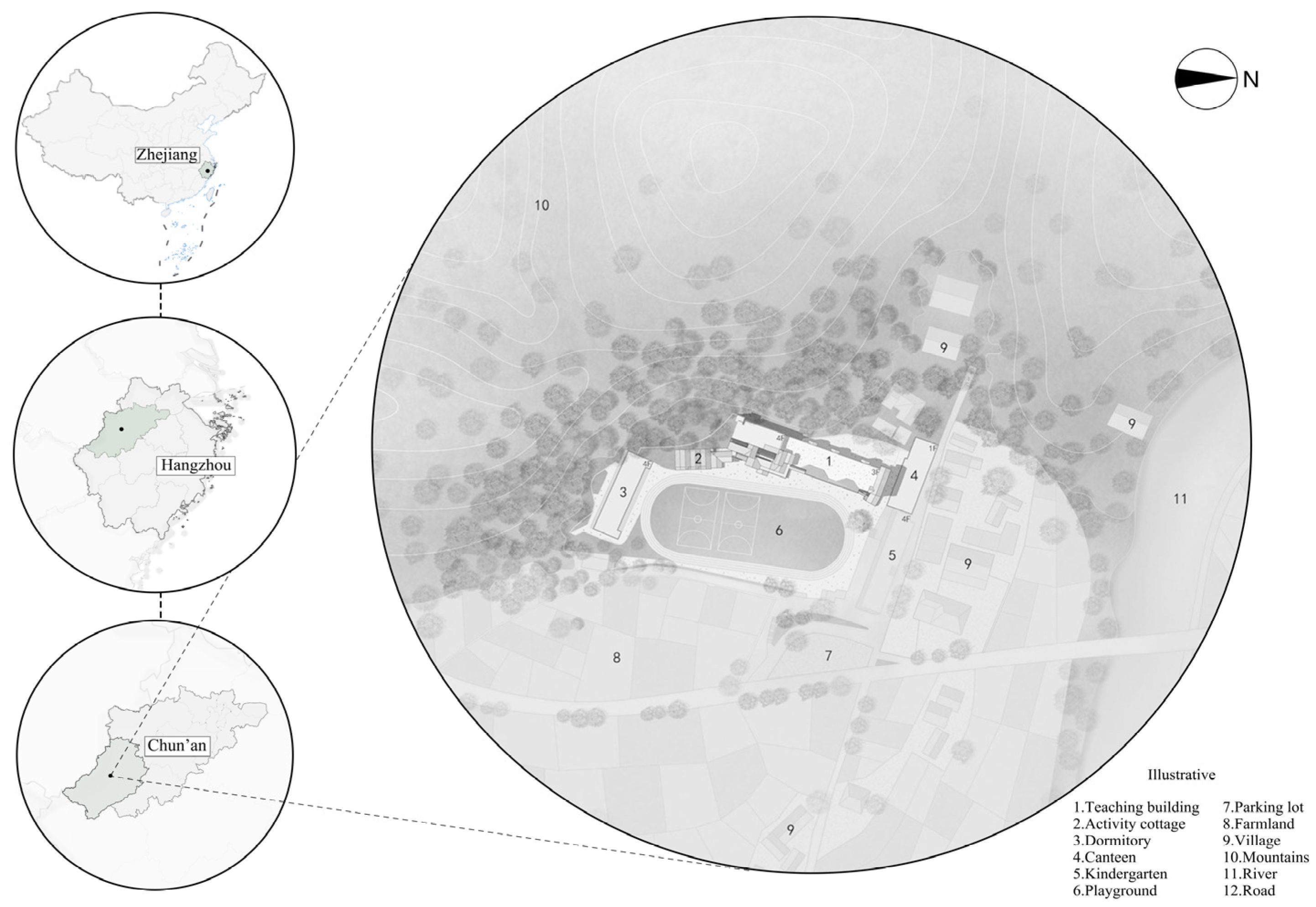
Fuwen Township Central Primary School is nestled in the green mountains and valleys of Fuwen Village, Fuwen Township, Chun’an County. It was designated as a pilot school for the comprehensive reform project of overall improvement of rural small-scale schools in Hangzhou in 2016, and was fully put into use after reconstruction on 20 February 2019 (Figure 1). Renowned as the “Most Beautiful Rural Primary School” [70] for its attic-castle architectural form and colorful school buildings, the school has achieved high media visibility through a “government + internet celebrity + study tour” communication model. It should be clarified that the high visibility of this case is not only a manifestation of its status as a model for rural education revitalization but also directly contributed to the generation of a massive volume of diverse online comments (providing a valuable data sample for this study). This specific context serves as an important prerequisite for the subsequent discussion on the transferability of the proposed method. The research value of the Fuwen Township Central Primary School case can be presented from the following two dimensions:

3.1.1. Typicality of the Case

Fuwen Township Central Primary School (1956–2016), as a typical representation of China’s rural education challenges, achieved triple breakthroughs under rural revitalization: First, as a pilot for small-scale school renovation in Hangzhou, it explored a new pathway for sustaining rural micro-schools through “policy-space-education” systemic reforms [71]; Second, reconstructing spatial esthetics with the “Nature-Education Complex” concept, it translated mountainous terrain into terraced clusters, creating demonstrations of reverse urban–rural resource flow via designs like chromatic glass facades; Third, establishing a “Government + Influencers + Field Study” digital communication matrix, it generated 230 million views on Douyin and accumulated 100,000 multidimensional comment datasets as invaluable samples for rural education research. Its innovative value further manifests in the “contemporary translation of vernacular genes”: annular gallery bridges connecting 26 chromatic glass boxes form a “miniaturized mountain village” topology, preserved stone foundations integrated with modern materials, and informal learning spaces like mountain-shaped rooftop observatories [72]. This “cultural DNA extraction–modern syntax reassembly” strategy establishes it as a classic case for studying rural modernity.

3.1.2. Transferability of Cases and Extension of Application Scenarios

Fuwen Township Central Primary School, as a typical case for rural campus research, exhibited spatial characteristics before renovation that were highly isomorphic with most rural primary schools in China. This isomorphism manifests in four key dimensions, making conclusions derived from multi-perspective public experience analysis after its renovation universally referential for spatial optimization design of similar schools: In terms of scale characteristics, the school’s enrollment plummeted from nearly 1000 students in the 1990s to fewer than 200 in 2017 (6 classes, average 30 students per class), with a per capita floor area of 17.6 m2 and absence of specialized classrooms, aligning with the nationwide trend of rural primary school downsizing; spatially, pre-renovation layouts predominantly followed linear row-column arrangements with a “classroom + corridor + playground” linear spatial sequence; regarding location and transportation, it served 8 administrative villages within a 10 km radius, with students averaging 25 min commutes reliant on a 4.5 m wide county-level road lacking sidewalks, reflecting typical rural education accessibility challenges; in spatial environment utilization, despite being surrounded by mountains, farmland, and streams, interaction with the environment was blocked by retaining walls, natural slopes remained untransformed for educational purposes and were left as scrub woodland, indicating widespread ecological resource wastage.
Therefore, based on the dual characteristics of exemplarity and universality in the aforementioned case, the approach of multi-stakeholder perspective evaluation and analysis for Fuwen Township Central Primary School is endowed with substantial research value, with the findings possessing universal applicability and persuasiveness.

3.2. Data Collection

To ensure the comprehensiveness and representativeness of research data, online reviews regarding Fuwen Township Central Primary School were collected from three prominent platforms: Dianping (https://www.dianping.com/), Douyin (TikTok, https://www.douyin.com/), and Xiaohongshu (Red Book, https://www.xiaohongshu.com/), accessed between October and December 2024. User-generated content broadly reflects public perception of the institution. The selection criteria for these platforms are as follows:
  • As a video-based social platform, TikTok leverages its visual-centric dissemination mechanisms to capture users’ real-time responses and emotional resonance towards distinctive school scenarios (e.g., vernacular curriculum modules, campus facilities). The platform’s recommendation algorithms propagate high-engagement content (e.g., the Most Beautiful Rural School campaign), enabling efficient collection of large-scale, geographically diverse public opinions [73];
  • Dianping, China’s preeminent local lifestyle services platform, demonstrates notable strengths in review quality control. The platform implements stringent review verification processes, particularly through mechanisms preventing the proliferation of fraudulent positive reviews. Moreover, its high-credibility localized evaluations focus on vertical specialization in lifestyle services, attracting parental communities to share authentic campus experiences (e.g., curriculum design, faculty qualifications), with commentary exhibiting high information density and geographical specificity [74];
  • Xiaohongshu (Red Book) is positioned as a social platform for lifestyle sharing among younger demographics [75], facilitating in-depth dissemination of parenting philosophies and educational observations. Its user-generated content combines professional insights with quotidian perspectives, providing optimal data for analyzing societal value propositions toward rural educational innovation. With educational content notes demonstrating an annual growth rate exceeding 200%, the platform’s thematic alignment corresponds with emergent research priorities in educational innovation. The coexistence of rational discourse and affective narratives among users enables triangulation between Dianping’s utilitarian evaluations and TikTok’s perceptual cognition datasets.

3.3. Methods

This study integrates the research methods of emotional semantic analysis by Ruimin Guo [51], Murray Parker [47], Feifan Weng [53], Weimin Zhuang [41], along with the identification and extraction methods for “macro-meso-micro” characteristic scenes by Duan Jin [29], Wang Kai [76], Yang Liu [48], Yixin Liu [77], to construct a post-evaluation methodology system for characteristic scenes in rural campuses based on public perception and Transformer deep learning models. Building upon methodologies including textual semantic analysis, term frequency analysis, and grounded theory coding, this research innovatively quantifies sentiment analysis. Deep learning models were employed to evaluate affective characteristics in online comments from tourists, parents, and villagers across social media platforms. Public commentary provides critical feedback on actual perceived experiences of the built campus environment:
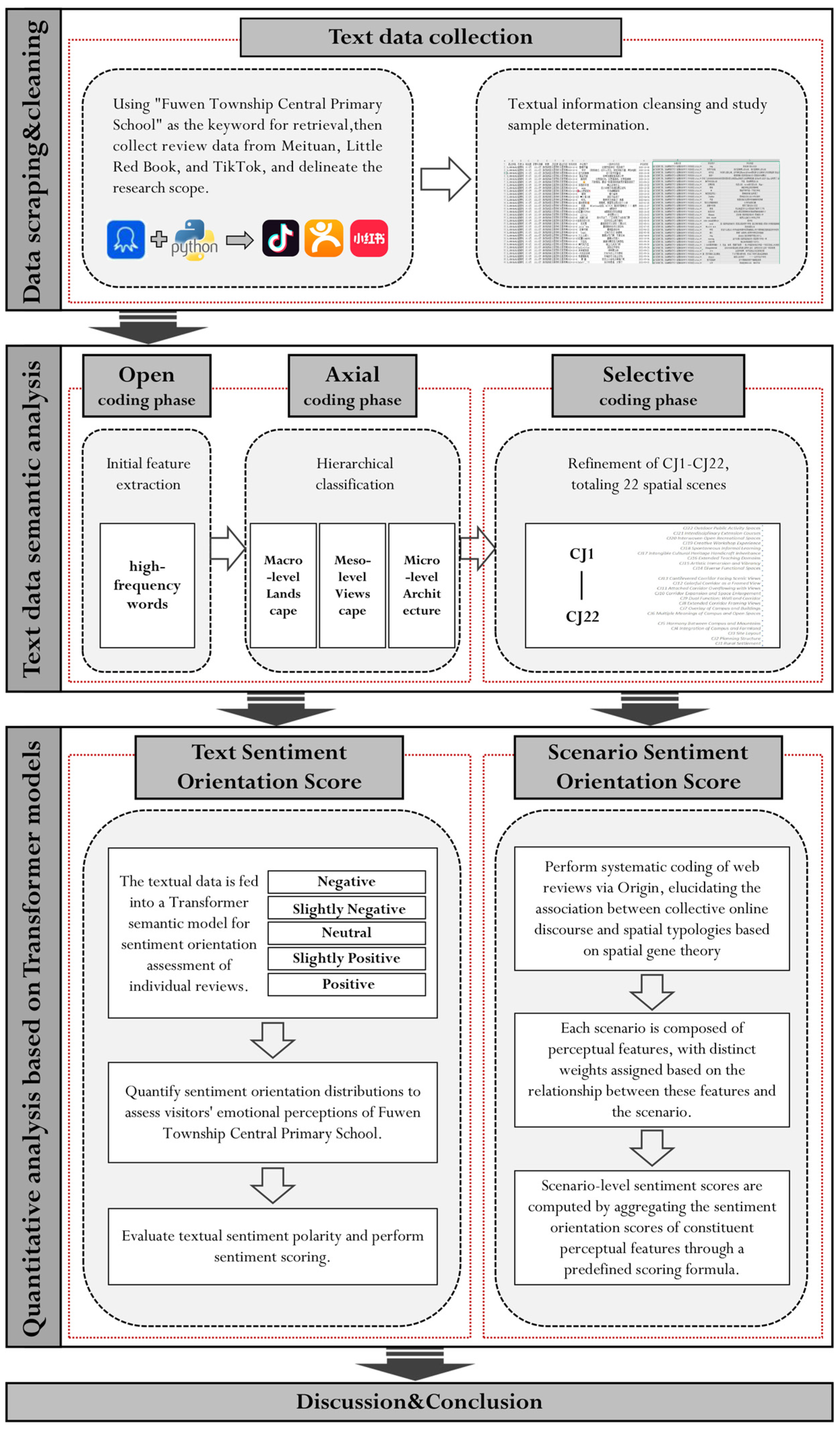
The research methodology of this study consists of four sequential stages, which are implemented in a systematic and progressive manner: First, data collection was conducted: Python and the Octopus Collector were used to crawl online comment data related to Fuwen Township Central Primary School, strictly complying with the user agreements of the Douyin, Dianping, and Xiaohongshu platforms. Second, semantic preprocessing was performed: The evaluation content was segmented to generate word frequency statistics and semantic networks; qualitative analysis was conducted using Origin software, and quantitative translation was realized via Sankey diagrams. Third, spatial scene coding was carried out: Combined with a spatial characteristic identification system, a macro–meso–micro three-tier classification system for spatial scene characteristics was constructed to encode and quantitatively express the textual content. Finally, sentiment quantification and correlation analysis were implemented: A deep learning model based on the Transformer framework was employed to perform sentiment quantification scoring for each comment; Sankey diagrams were used to quantitatively correlate spatial scenes with sentiment tendencies, thereby exploring the public’s perceptual impacts on the architectural spatial environment of rural campuses (Figure 2).

3.3.1. Data Crawling, Ethical Governance, and Data Cleaning

1.
Data Crawling and Ethical Governance
Data crawling in this study strictly adheres to academic research ethical norms and platform rules: (1) Compliance Assurance: Crawling activities strictly comply with the User Service Agreements, Content Ecology Governance Rules, and robots.txt protocols of Douyin, Dianping, and Xiaohongshu. Only publicly visible user comments were obtained, with no access to non-public platform interfaces or users’ private information. (2) Anonymization Processing: Full desensitization was performed on user identification information in the crawled data (e.g., nicknames, IDs, avatar links, geographic location tags), retaining only non-identifiable information relevant to the research—such as comment text and publication time—to avoid infringing on user privacy. (3) Ethical Constraints: The boundaries of user-generated content usage were clearly defined: all data were used exclusively for academic research, with no commercial use or secondary dissemination, in compliance with the relevant provisions of the Personal Information Protection Law of the People’s Republic of China on the reasonable use of public information.
In the initial crawling phase, a total of 12,800 preliminary data entries (covering the period from January 2022 to December 2024) were obtained via multi-platform keyword searches (core keywords: Fuwen Township Central Primary School, Most Beautiful Rural Primary School, Fuwen Primary School Study Tour, Fuwen Primary School Visit, etc.). These included invalid data types such as duplicate posts, irrelevant content, and non-textual entries, requiring further screening and purification.
2.
Sampling and Filtering Rules
To ensure data validity, a three-level purification process—keyword screening + rule filtering + manual review—was adopted, with specific criteria as follows: (1) Relevance Filtering: Comments irrelevant to Fuwen Township Central Primary School (e.g., misassociated with other schools of the same name, only mentioning “Chun’an tourism” without reference to campus space) were deleted, verified via dual matching of “campus name + spatial feature keywords (architecture, classroom, playground, landscape, etc.)”. (2) Invalid Content Filtering: Pure promotional content (containing keywords such as “discount”, “promotion”, “group purchase”) and non-textual comments (pure emoticons, meaningless symbol combinations, image-only posts without textual descriptions) were excluded. (3) Duplicate Data Filtering: Duplicate comments posted by the same user in a short period and cross-platform reposted comments with identical content were removed. (4) Manual Review: Ambiguous boundary cases (e.g., brief comments such as “good” or “great” without explicit reference to spatial characteristics) were manually judged, and comments related to campus space and usage experience were retained.
Through the above process, 8616 valid comments were screened from the 12,800 preliminary data entries.

3.3.2. Semantic and Sentiment Feature Analysis of Text Data

Following data crawling, ethical processing, and cleaning, this study conducted a preliminary semantic analysis of valid comments using Origin software. High-frequency words were extracted via the word frequency analysis function to identify potential theme clusters (e.g., natural landscape, teaching space, architectural color, etc.). Drawing on Guo’s [51] grounded theory coding and tourist perceptual feature classification framework, this study constructed a tripartite qualitative-quantitative research method integrating “semantic parsing—spatial coding—scene mapping”, and supplemented a standardized annotation protocol to ensure coding reliability: (1) Coder Configuration: Two coders with a background in architectural spatial research from the research team independently completed coding. Prior to coding, unified training was conducted to clarify the three-level coding definitions and examples for macro landscape (mountains, water, farmland, etc.), meso environment (corridors, courtyards, etc.), and micro architecture (classrooms, viewing platforms, etc.). (2) Consistency Test: The Cohen’s kappa coefficient was adopted to test coding consistency. In the pre-coding stage, pilot coding was performed on 2.5% of the sample (220 comments), yielding a kappa value of 0.85 (≥0.75 indicates excellent consistency) (Appendix A). (3) Ambiguity Resolution: For cases of coding divergence (e.g., “colorful houses” could be classified as either color features of the meso environment or micro architectural appearance), a consensus was reached through expert review external to the research team + analysis of the original comment context, ultimately forming unified coding results.
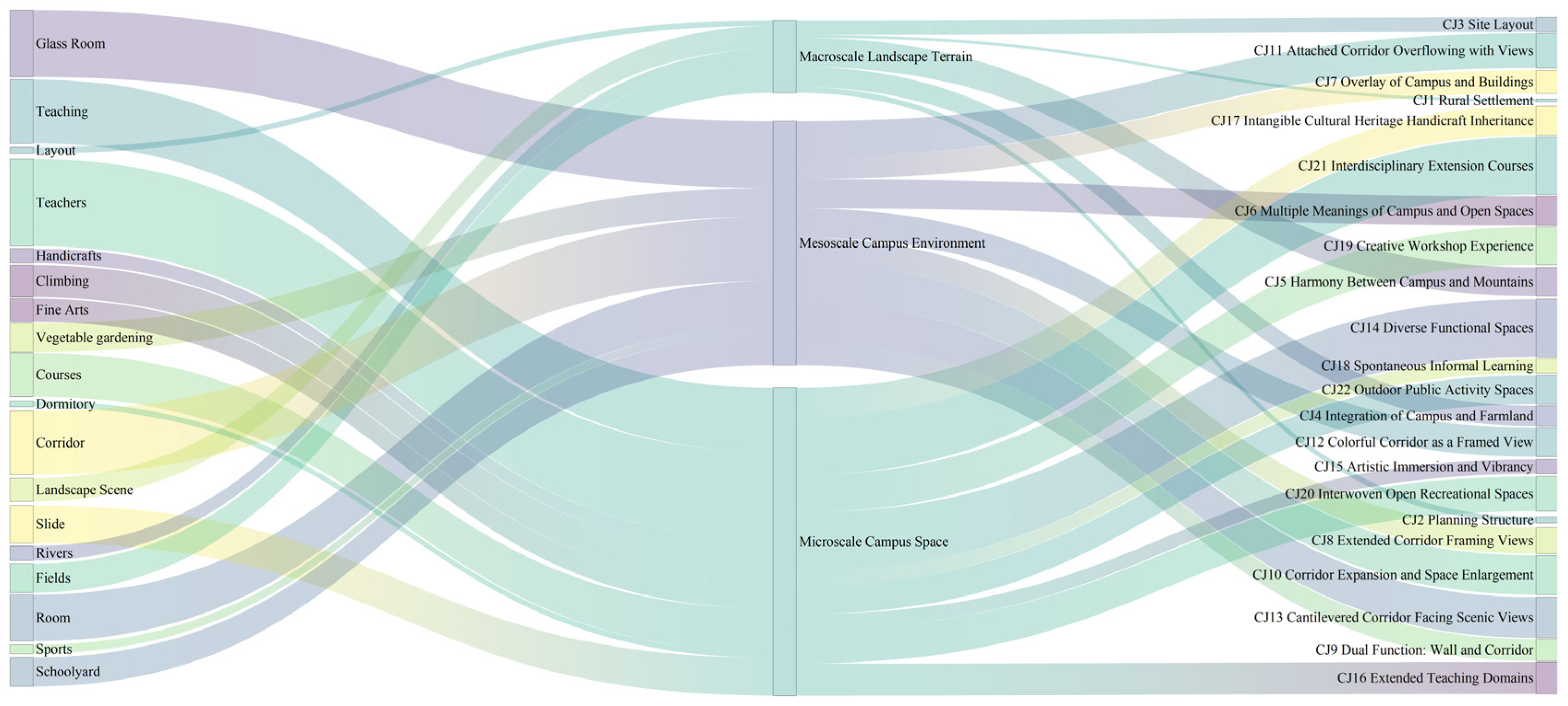
In the specific coding process: (1) Open Coding Stage: Comment text was parsed line by line, and high-frequency words such as teacher, course, mountain-water scene, and stained glass were integrated into initial concepts. (2) Axial Coding Stage: A social semantic network was constructed using XMind 8 software to cluster discrete concepts into the macro landscape–meso environment–micro architecture three-tier system. (3) Selective Coding Stage: The core category “perceptual features” was extracted for selective coding, and the three-level text content coding and perceptual feature classification framework were refined. (4) Quantitative Correlation: A Sankey diagram dynamic correlation model was constructed to quantify feature weights and reveal the correlation between high-frequency words and corresponding spatial scenes (e.g., the correlation weights of multiple high-frequency words such as teacher, course, vegetable planting with the teaching space scene).

3.3.3. Transformer-Based Deep Learning Framework for Semantic-Sentiment Evaluation

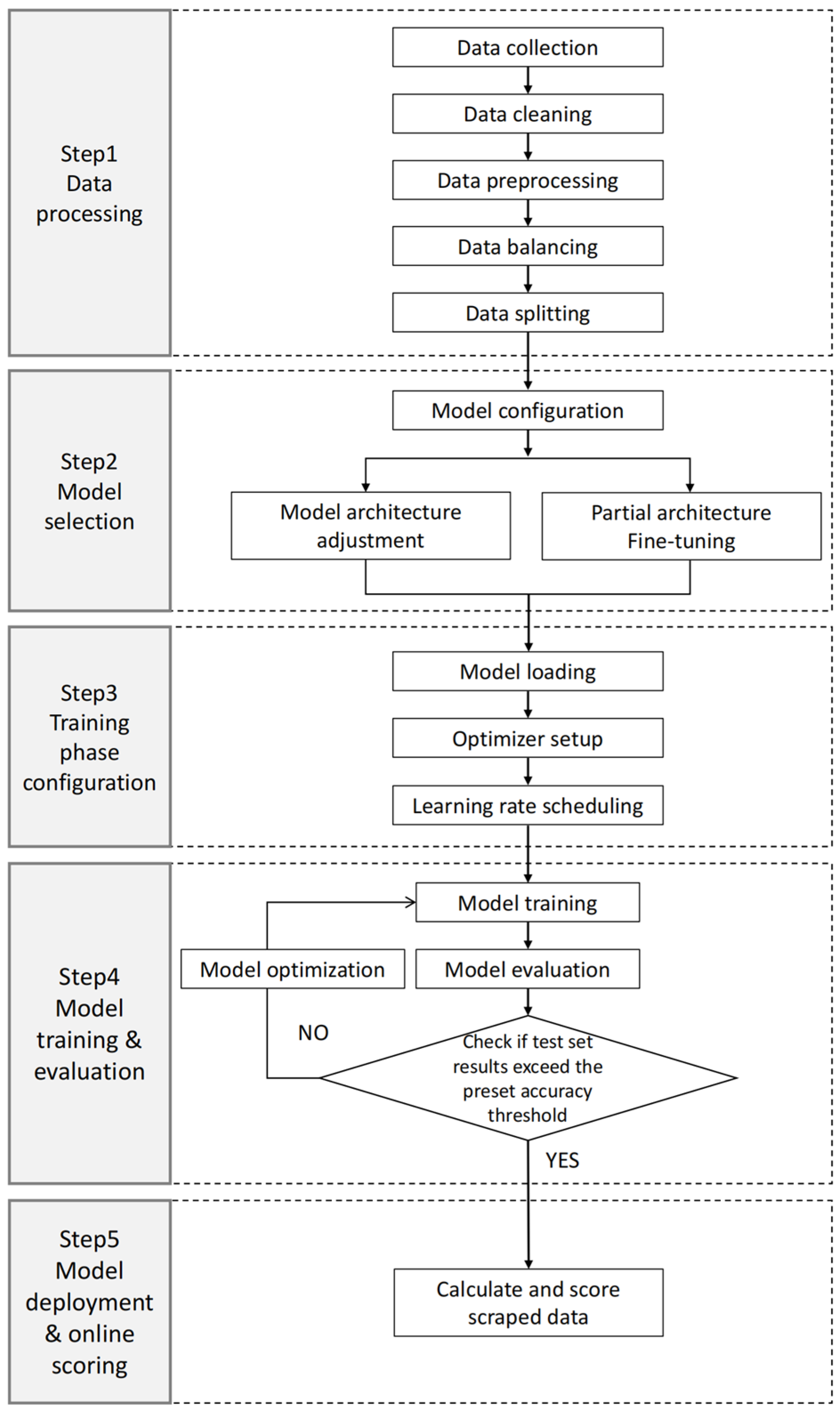
The Transformer-based deep learning sentiment recognition methodology comprises five procedural phases (Figure 3):
1.
Data preprocessing
Multi-annotator cross-validation was performed on the foundational dataset to ensure labeling consistency. Sentiment labels were assigned across five categories—Negative (1), Moderately Negative (2), Neutral (3), Moderately Positive (4), and Positive (5)—yielding a sentiment-annotated architectural comment dataset. Class balancing was subsequently implemented to address data skewness, producing a refined sentiment dataset. The processed dataset was partitioned into training, validation, and test sets at an 8:1:1 ratio using stratified random sampling.
2.
Model selection
Based on the Transformer architecture, pre-trained models were employed with structural adjustments after configuration. The Bert-base-Chinese model [78] provided by Hugging Face was selected, and its classification head was modified to accommodate five-class classification tasks. Data processed by Panda was subsequently tokenized using BERT’s tokenizer (Bert Tokenizer), with the primary objective of converting raw text into model-comprehensible inputs by transforming Chinese characters into tensors.
3.
Training phase configuration
The AdamW optimizer was employed in conjunction with a linear learning rate scheduling strategy to enhance training efficiency. Weight decay regularization was configured to mitigate overfitting risks. Learning rates were dynamically adjusted using a scheduler mechanism to stabilize the model training process.
4.
Model training and evaluation
The preprocessed training set from the sentiment-annotated architectural comment dataset was input into the Transformer-based pre-trained model. Optimization was conducted using a cross-entropy loss function to fine-tune the model parameters, yielding validated training outcomes for subsequent testing phases.
5.
Model Application and Scoring
The crawled datasets underwent sentiment quantification and scoring, with public commentaries on architectural spaces classified into five affective categories. Spatial preference metrics were computed based on the sentiment classification outcomes to evaluate spatial desirability.

3.3.4. Public Perception Quantification of Characteristic Spatial Scenarios

Public sentiment analysis toward characteristic scenarios in rural schools constitutes the fundamental prerequisite for extracting spatial genomic signatures. This study employs a Transformer-based model to perform itemized sentiment scoring of user-generated comments, integrating a semantic-affective quantification framework bridging commentary texts and spatial scenarios. The methodological workflow for affective evaluation of distinctive spatial environments is operationalized through the following computational steps and formulae:
1.
Building upon the textual data encoding and classification framework established in the preceding section, each commentary text was categorized into thematic datasets. The sentiment polarity score (1–5 scale) for individual comments, derived from Transformer-based model quantification, underwent weighted averaging to calculate affective tendency scores for perceptual characteristics within each dataset category. The computational formulation is expressed as:
S j = i = 1 n w i s i i = 1 n w i
Sj = Affective tendency score for dataset category j
si = Sentiment score (1–5) of comment i
wi = Term frequency-inverse document frequency (TF-IDF) weight of comment i
n = Total comments in category j
2.
Each spatial scene is composed of three categories of spatial classification: macro, micro and macro. The macro, micro and micro categories of spatial classification are composed of multiple subject words with perceptual classification characteristics. The weighted score of each subject word with public perception characteristics is quantitatively correlated with the specific spatial scene through the sangchi diagram. That is, the process of associating the data set of 18 subject words to the meso layer weight B in the macro, and then associating the meso layer weight B to the scene weight of 22 C spaces. Thus, the score of each specific space scene is obtained, and the calculation formula is as follows:
W A i C k = W A i × j = 1 3 ( R A i B j × R B i C k )
WAi = The weight of the i-th A (dataset of the topic)
R A i B j = The weight ratio of A i flowing to B j ( B j = 1, 2, 3), satisfy j = 1 3 R A i B j = 1 (If there is no correlation, the proportion is 0)
R B i C k = The weight ratio of B j flowing to C k ( k = 1, 2, 3, …, 22), satisfy k = 1 22 R B i C k = 1 (If there is no correlation, the proportion is 0)

4. Results

4.1. Crowd-Sourced Web Semantic Analysis and Spatial Scenario Correlation Classification

4.1.1. Semantic Analysis of High-Frequency Terms and Keyword Profiling Based on Web-Mediated Data

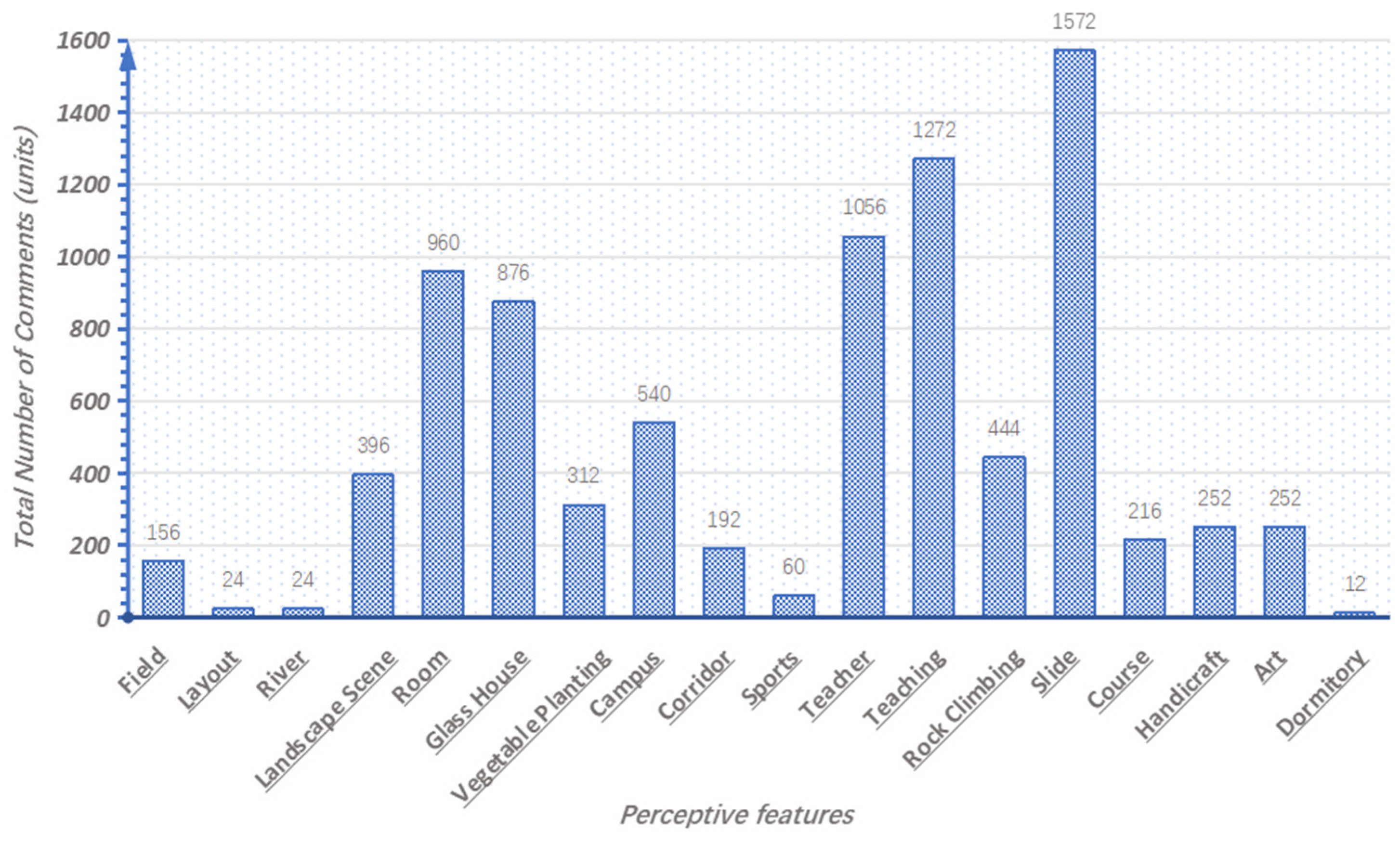
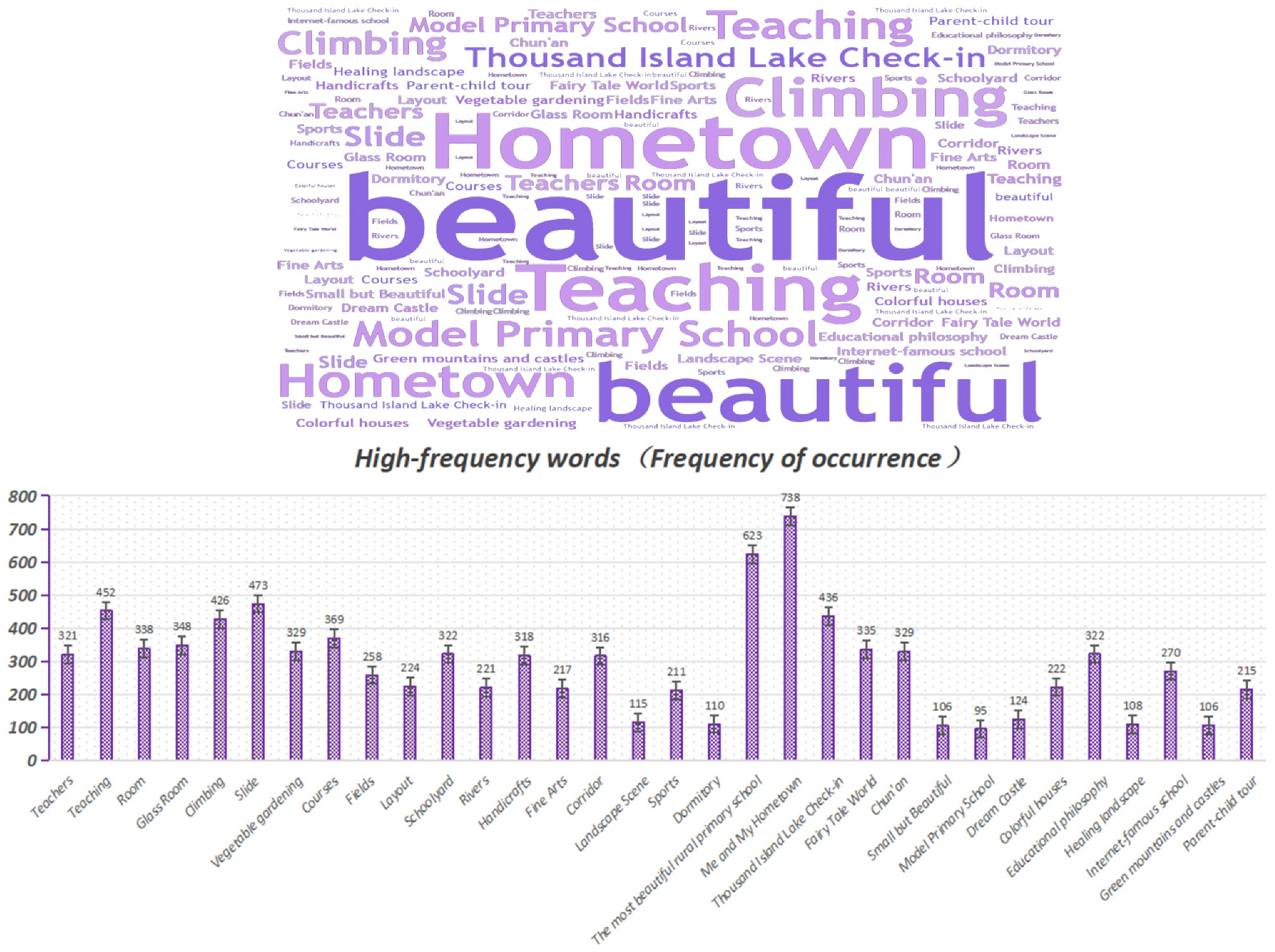
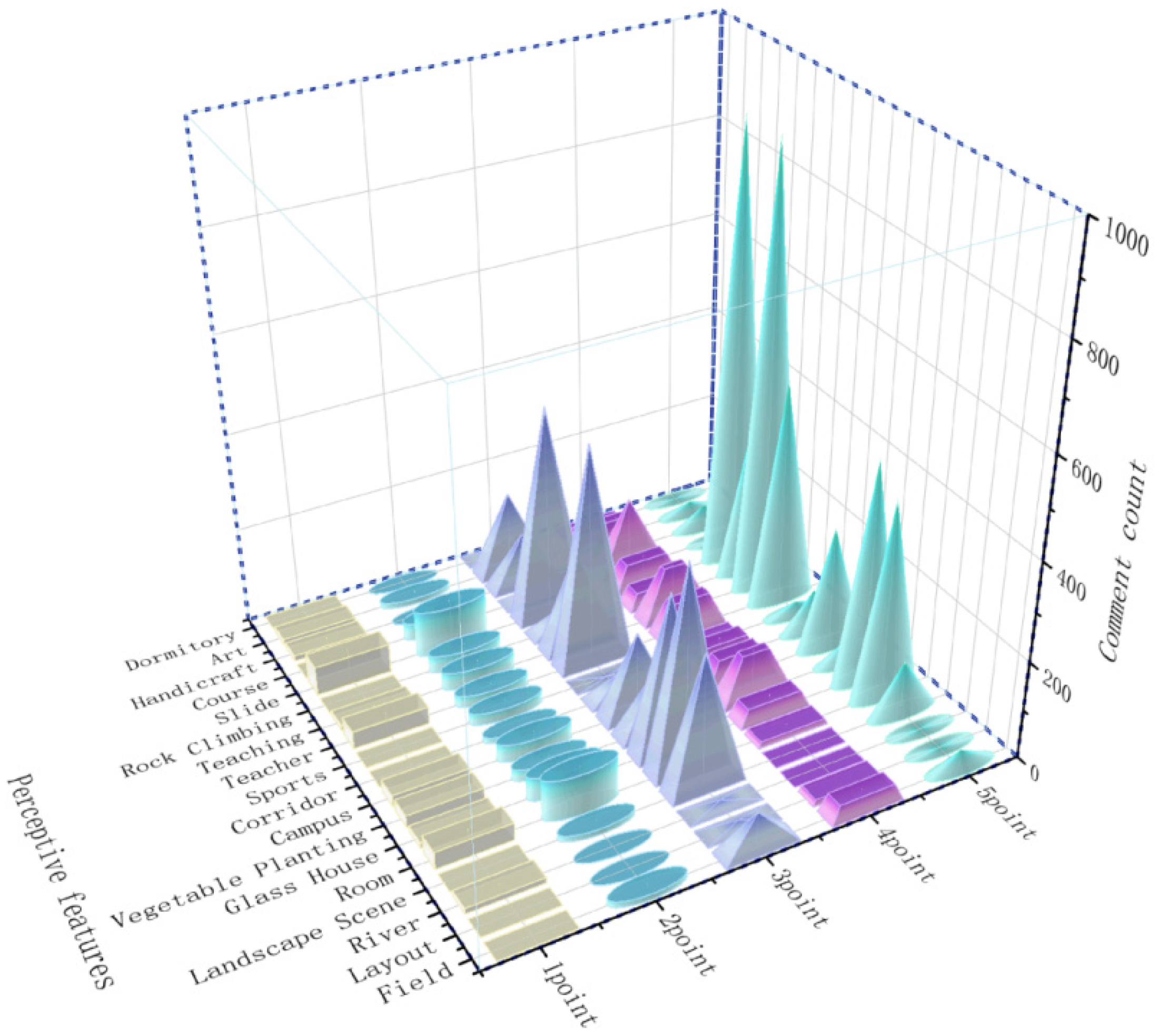
Online textual analysis of public-generated evaluations is recognized as a vital methodology for comprehending collective destination image perception, serving as a critical diagnostic instrument for enhancing destination quality [79]. The frequency of key thematic terms demonstrates significant correlations with public experiences [80]; high-frequency lexical items indicate heightened cognitive salience toward their represented factors, which substantially contribute to place identity formation [81]. The data visualization chart (Figure 4) delineating the distribution patterns of perceptual characteristics reveals significant findings: analysis of the collected 8616 online reviews demonstrates marked heterogeneity in user attention allocation across distinct spatial attributes. Analysis of the commentary distribution reveals three-tiered engagement patterns: the primary cluster comprising “slide” (1572 entries), “instruction” (1272 entries), and “teacher” (1056 entries) reflects the public’s core focus on recreational infrastructure and pedagogical services. Notably, the commentary volume for “slide” exceeds that of “instruction” by 23.6%, with its wave-like temporal distribution suggesting periodic engagement surges. In contrast, environmental attributes such as “layout” (24 entries), “river” (24 entries), and “dormitory” (12 entries) collectively account for merely 13.6% of total commentary, with “dormitory” commentary representing less than 20% of “slide” engagement. This magnitude disparity preliminarily indicates cognitive prioritization tendencies, while also revealing a data sparsity issue within the environmental evaluation dimension. In particular, the “river” feature exhibits an apparent mismatch between its commentary volume and its actual ecological value; however, this should be interpreted only as an initial signal based on the currently limited sample size rather than definitive evidence of spatial cognitive bias. Such a mismatch may be associated with reviewers’ spatial use frequency, scenario accessibility, or perceptual blind spots, and therefore warrants further verification.
This study filtered lower-ranked high-frequency terms from online commentary data across social media platforms, excluding scenario-irrelevant terminology, colloquial expressions, and numerical symbols. Analytical results demonstrate that evaluations of Fuwen Township Central Primary School predominantly focus on teachers, instruction, rooms, and glass-enclosed spaces (Figure 5), indicating significant public impression formation regarding the institution’s educational environment and infrastructural development. Particularly noteworthy are the modern pedagogical facilities, professional teacher competencies, and distinctive architectural esthetics. These findings reveal that public spatial perception of school environments primarily derives from three dimensions: exterior contextualization, interior spatial configuration, and educational praxis. These commentaries demonstrate that public perception of school spatial scenarios is primarily shaped by three formative dimensions, external environmental context, interior spatial configuration, and educational praxis, while highlighting the compelling attractiveness of rural primary schools through their embodiment of local cultural vernacular, rural settlement typologies, innovative pedagogical methodologies, and multifunctional spatial programming within educational ecosystems.

4.1.2. Public Perception of Spatial Distinctiveness and Scenario Classification Based on Spatial Genetic Theory

Perceptual characteristics represent the aggregate of sensory and cognitive cues embedded in public experience-based evaluation texts of rural primary schools, constituting a generalized articulation of public spatial experience. In this study, all high-frequency perceptual lexemes were derived exclusively from online review datasets. These user-generated reviews provide detailed accounts of authentic on-site spatial experiences and overall impressions reported by visitors (including tourists, parents, and local residents), thereby offering an objective and vivid empirical basis for mining perceptual characteristics.
To avoid circular argumentation in scenario extraction—namely, the sequence of “a priori assumptions → textual confirmation”—and to ensure the objectivity of coding and classification, this research strictly followed a three-step protocol of “text-blind coding → intercoder reliability testing → post hoc multi-source verification.” Public perceptual distinctiveness extraction and spatial scenario classification were completed through the three-stage grounded-theory procedure of open coding, axial coding, and selective coding. The operational procedures for each stage are as follows.
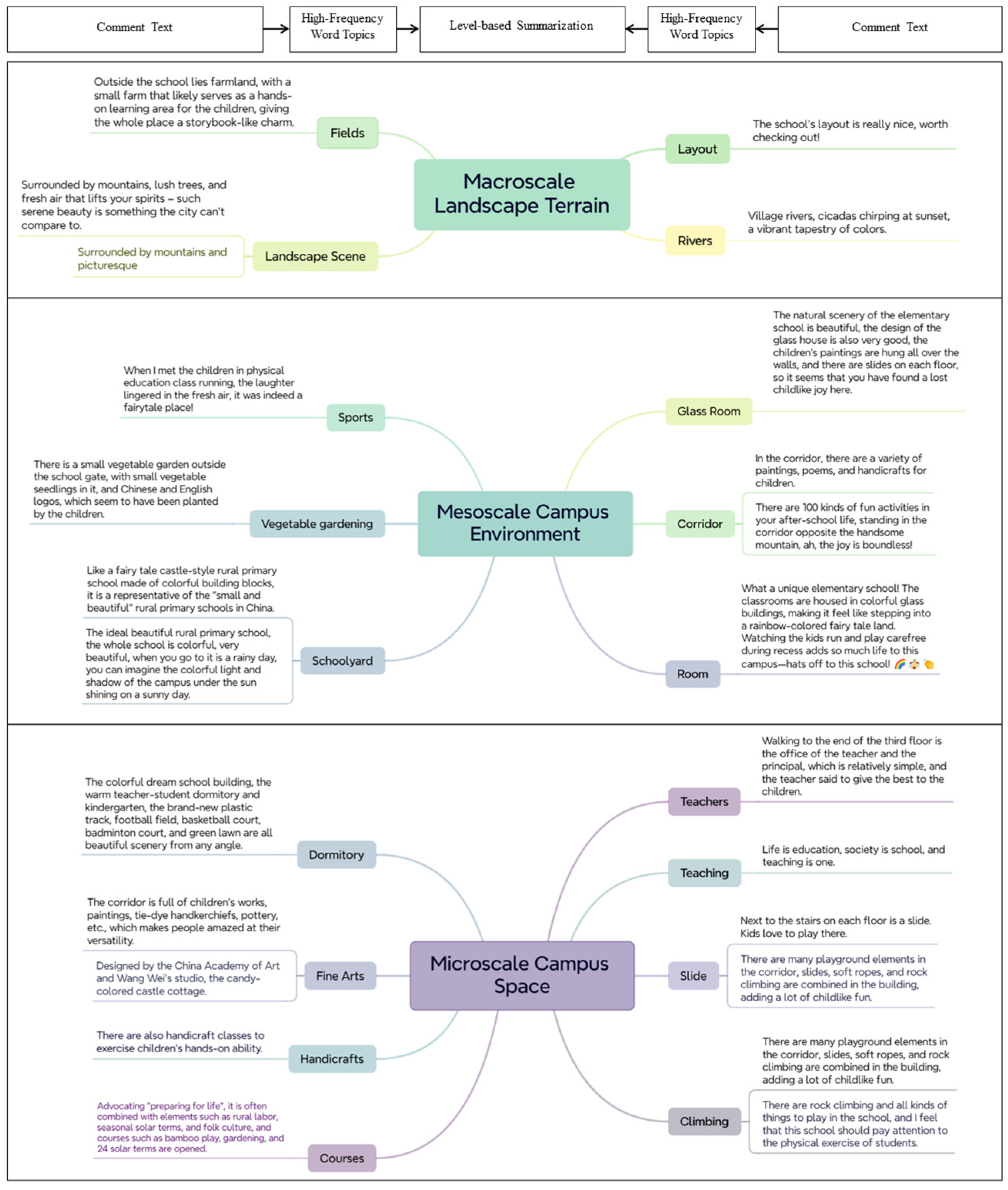
During the open coding phase, interference from auxiliary materials (e.g., narrative summaries, on-site photographs, and aerial imagery) was rigorously excluded. A dual-coder independent blind-coding scheme was adopted: Coder A and Coder B accessed only the online review text corpus and received no scenario-related presuppositional information. Through sentence-by-sentence parsing of review texts and logical structuring using XMind 8, high-ranking core lexemes from the frequency results—such as “teacher,” “curriculum,” “mountain–water scenery,” “rice paddies,” “corridor,” and “layout”—were selected as initial coding nodes. The commentary corpus was then fragmented, clustered, and tagged to clarify the core connotations of each perceptual theme (Figure 6). After coding completion, intercoder reliability was assessed using Cohen’s Kappa, yielding Kappa = 0.81, indicating high agreement. Divergent cases were subsequently adjudicated via group discussion with the involvement of a third, experienced coder external to the project team, thereby ensuring the reliability of the coding outcomes.
During the axial coding phase, building on the agreed open-coding results, core perceptual dimensions were further distilled by integrating proportional frequency distributions of high-frequency lexemes and qualitative semantic translation. Ultimately, rural campus spatial characteristics were organized into three hierarchical tiers—macro, meso, and micro—and 18 high-frequency lexemes were identified to represent the core public perceptual characteristics. Each lexeme corresponded to substantial volumes of public commentary texts; accordingly, 18 foundational datasets were constructed from online evaluation corpora, providing the data substrate for subsequent quantitative analyses. Intercoder consistency was also rechecked in this phase to ensure the objectivity of hierarchical structuring and core-feature selection, with no subjective scenario presuppositions introduced.
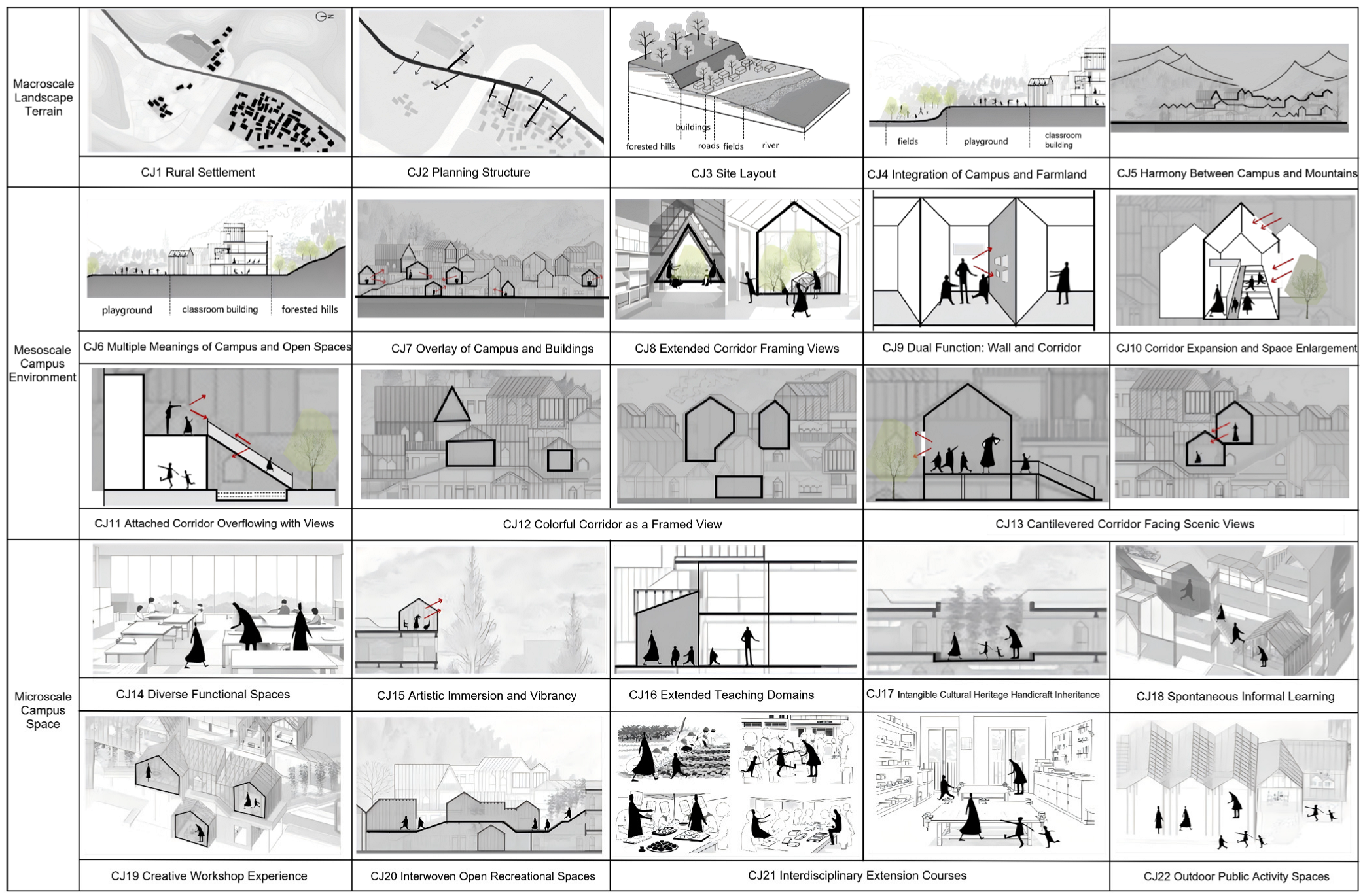
During the selective coding phase, data visualization was conducted in OriginPro 2024 (https://www.originlab.com/2024). A Sankey diagram was employed to establish an association map between the 18 core perceptual characteristics and specific spatial scenarios (Figure 7). This mapping process remained strictly grounded in the text-based coding results and did not incorporate external auxiliary materials. Subsequently, the 18 perceptual-feature datasets were subjected to post hoc cross-validation against multi-dimensional information, including on-site photographs, historical documentation, aerial imagery, video records, and descriptive texts (used for verification rather than pre-screening). In parallel, triangulation was conducted using unbiased third-party sources—such as Baidu Maps user comments and local government campus-renovation reports—to mitigate the risk of researcher-driven material selection bias. Ultimately, on the basis of multiple verification layers, 22 representative spatial scenarios that comprehensively characterize rural primary school features were extracted (Figure 8) at the macro level, five categories of natural environmental attributes centered on pastoral landscapes and mountain–water configurations; at the meso level, eight functional-space categories including chromatic corridors and planting gardens; and at the micro level, nine human-scale detail spaces exemplified by climbing walls and handicraft classrooms.

4.2. Transformer-Based Perception Analysis for Characteristic Spatial Scenarios

4.2.1. Model Learning Rate Selection

Learning rate constitutes a critical hyperparameter in deep model training, profoundly influencing convergence efficiency and ultimate performance. For Transformer-based architectures (e.g., BERT), three initial learning rate ranges (1 × 10⁻⁴, 2 × 10⁻⁵, 5 × 10⁻⁵) were experimentally selected based on three key considerations: (1) the rate must balance gradient stability and convergence dynamics (e.g., mitigating gradient explosion/convergence lag), aligning with text classification requirements; (2) fine-tuning phases necessitate constrained parameter perturbation to preserve pre-trained semantic representations while enabling task adaptation, thereby suppressing gradient oscillations; (3) AdamW optimization was employed to decouple weight decay from gradient updates, with λ-value tuning achieving regularization–flexibility equilibrium through noise-dependent constraint mechanisms that inhibit overfitting.
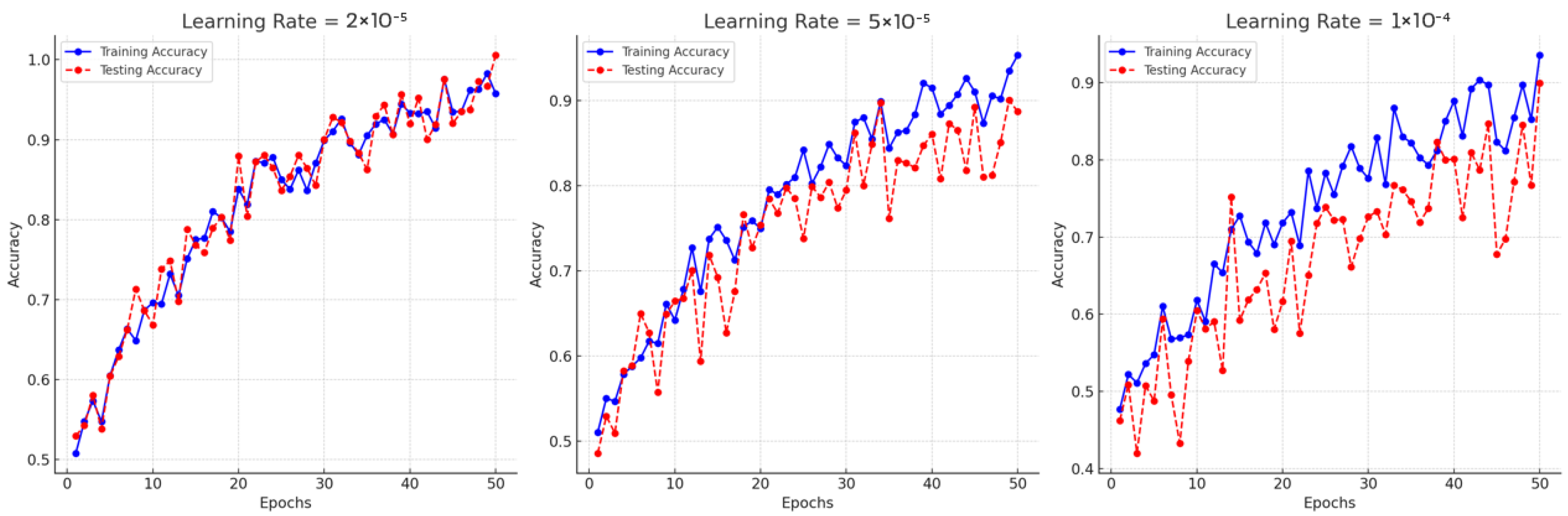
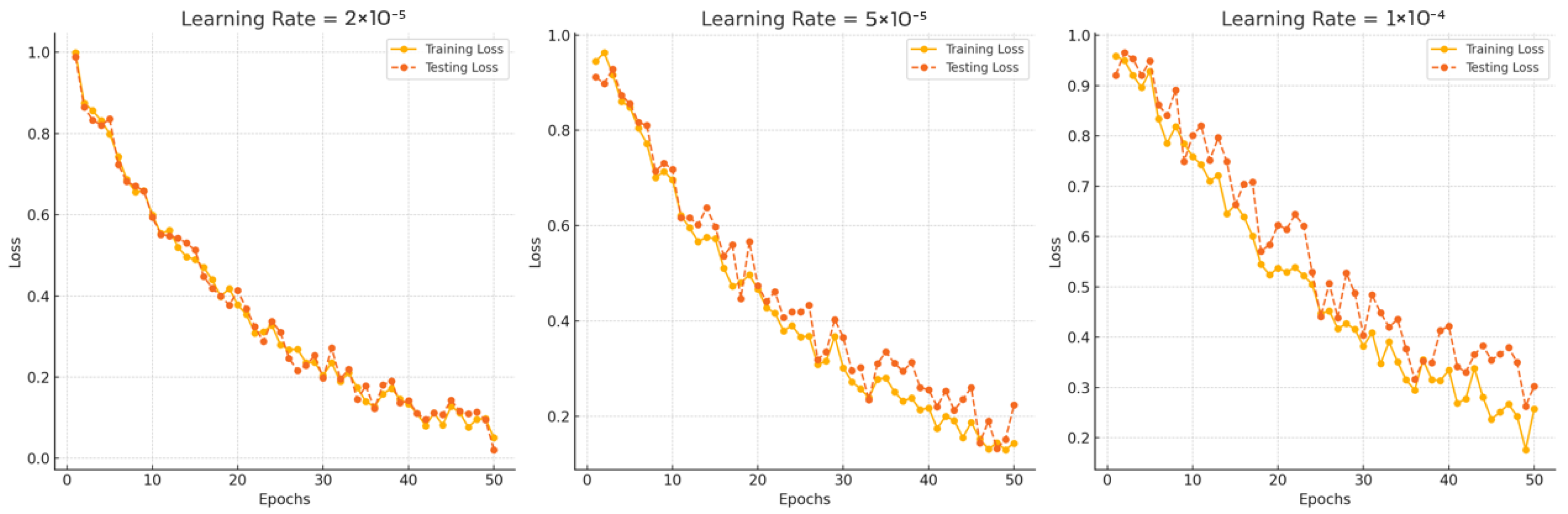
As demonstrated in Figure 9, higher initial learning rates (e.g., 1 × 10⁻⁴) yielded faster increases in training accuracy, yet exhibited significant fluctuations in test accuracy during early epochs, suggesting potential overfitting risks. In contrast, a learning rate of 2 × 10⁻⁵ produced smoother test accuracy trajectories with improved consistency between training and testing performance. Figure 10 further reveals that elevated learning rates (5 × 10⁻⁵ and 1 × 10⁻⁴) accelerated loss reduction but introduced convergence instability during later training phases, evidenced by oscillatory loss patterns. Conversely, the 2 × 10⁻⁵ learning rate configuration achieved monotonic loss decay with minimal variance, demonstrating superior training stability and algorithmic robustness.
Comprehensive evaluation reveals that all three learning rate configurations achieve competitive sentiment classification accuracy, yet exhibit marked disparities in model stability and convergence dynamics. Lower learning rates (e.g., 2 × 10⁻⁵) facilitate balanced model performance with enhanced stability. Conversely, higher learning rates (1 × 10⁻⁴) demonstrate accelerated initial loss reduction but necessitate supplementary regularization mechanisms to mitigate overfitting risks and oscillatory behavior. Ultimately, based on research requirements, the 2 × 10⁻⁵ learning rate configuration was selected to analyze and score the online commentary corpus of Fuwen Township Central Primary School.

4.2.2. Sentiment Polarity Scoring in Crowd-Sourced Web Text Classification

Integrating the balanced and stable sentiment recognition results from the Transformer-based deep learning model, sentiment scores for 18 public commentary datasets were obtained. The detailed analysis is as follows:
Perceptual attributes receiving the highest five-point (positive) ratings—”slide”, “instruction”, “teachers”, “glass-enclosed spaces”, and “rooms”—were predominantly observed, suggesting these elements constitute focal public concerns and indicating positive affective impacts from the renovated pedagogical concepts and informational spaces. Conversely, within the 1-point (negative) ratings, “slide”, “teachers”, and “rooms” demonstrated lower scores, though “slide” and “teachers” ratings primarily clustered within the 3–5 point range, necessitating further investigation into contextual perceptual determinants. Notably, “rooms” exhibited a bimodal distribution with concentrations in both sub-3-point and 5-point ratings, reflecting polarized spatial perceptions. Regarding overall affective tendency scores, while commentary types demonstrated variability across perceptual attributes, spatial layout, riverine features, and dormitory facilities consistently scored below the aggregate mean with low commentary volume, suggesting diminished public salience in evaluative cognition (Figure 11).
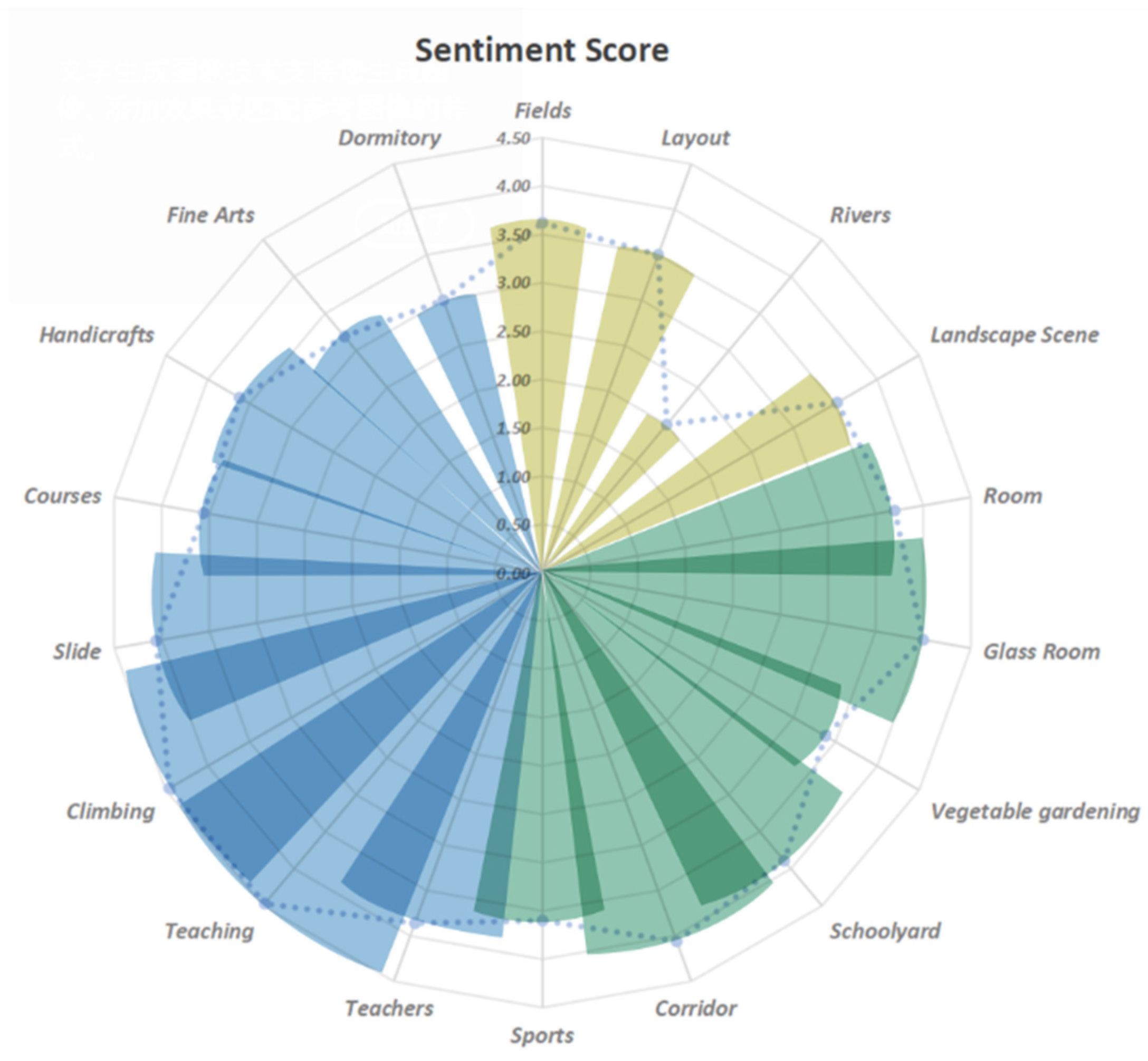
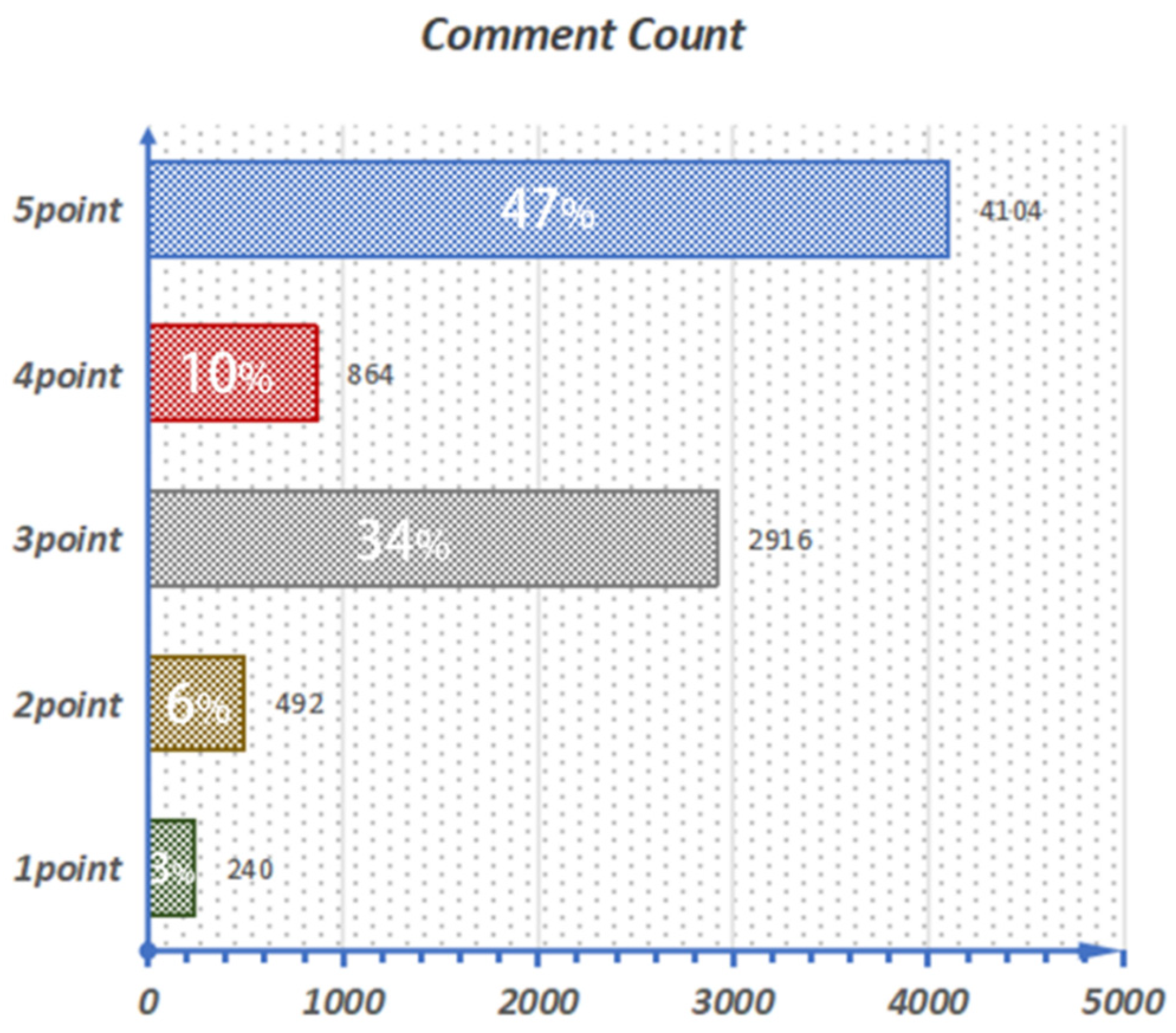
Applying Formula (1) to the affective tendency data of each perceptual attribute yielded weighted average scores for the 18 datasets (Figure 12). With the exception of “river” features, all other perceptual attribute datasets scored above the neutral threshold (3 points), predominantly clustering in the upper range (3.5–5 points). Positive evaluations (5-point) constituted the highest proportion at 47.6%, followed by neutral ratings (3-point) at 33.8%, with negative scores (1-point) representing the minimal proportion. Aggregate analysis indicates a predominantly positive evaluative bias toward Fuwen Township Central Primary School (Figure 13).

4.2.3. Perception Score of Characteristic Spatial Scenarios

Spatial scene scores can be calculated using the corresponding scoring Formula (2). Each scene is composed of a thematic combination of multiple sets of perceptual features, with different weights assigned based on the relationships between perceptual features and scenes.
1.
Macroscale Landscape Terrain
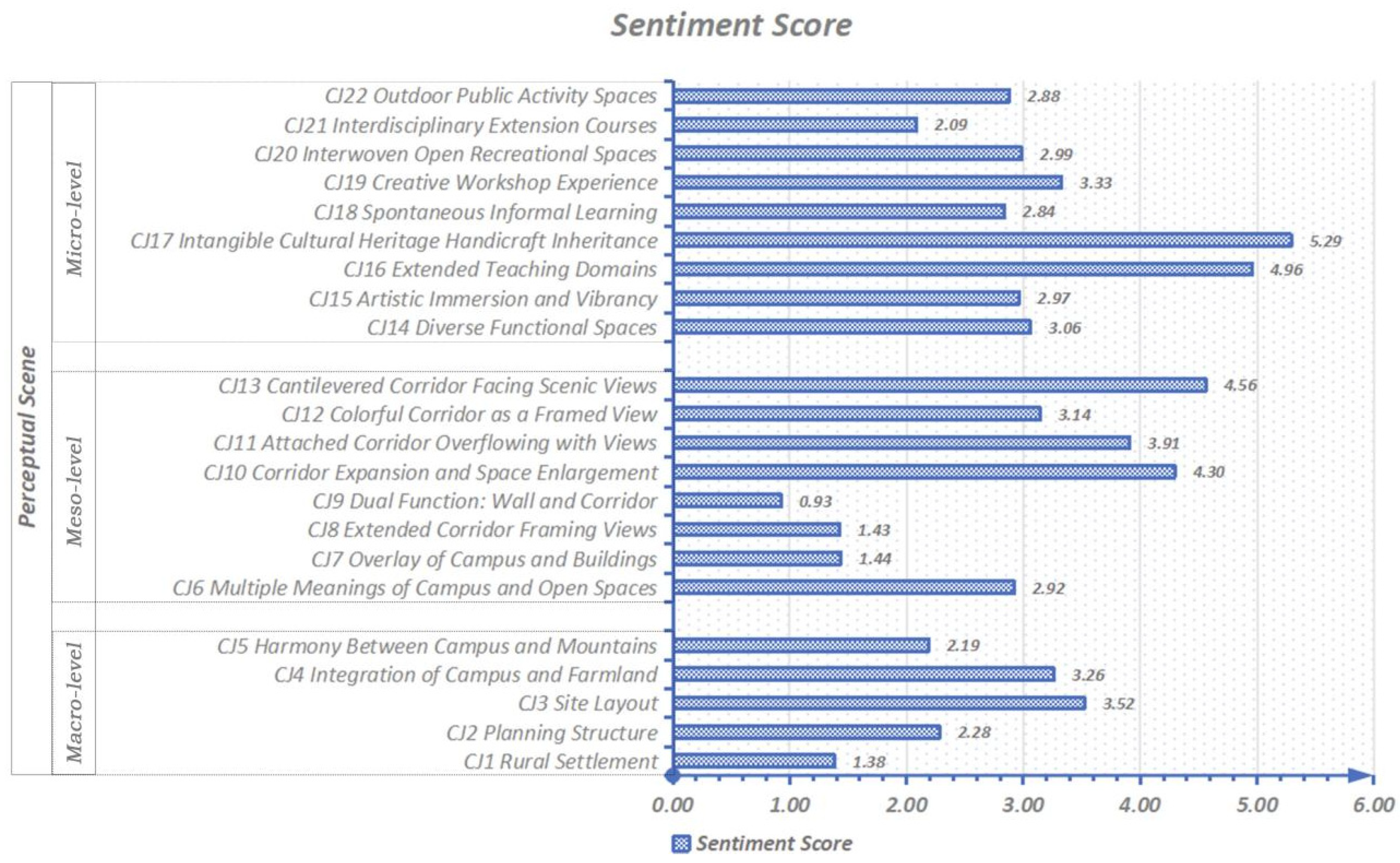
Within the macro mountain-water landscape, CJ3 (Site Layout, 3.52) and CJ4 (Integration of School and Farmland, 3.26) received notably positive feedback, approximately 40% above the average score (2.53), which aligns with the strong public aspiration for the integration of campus and natural organic elements; the naturally evolved rural human settlement environment resonates emotionally with the public’s ideal campus imagery. In contrast, CJ1 (Rural Settlement, 1.38) exhibited significantly lower attention and recognition, a result that preliminarily suggests a weak emotional response from the public to traditional Rural Settlement layouts. CJ2 (Planning Structure, 2.28) and CJ5 (Harmony between School and Mountain, 2.20) had mean scores concentrated in the 2.10–2.53 range, below the average (2.53), indicating a relatively convergent emotional response from the public to traditional planning strategies (Figure 14).
2.
Macroscale Landscape Terrain
Within the meso campus environment, CJ13 (Corridor View Framing, 4.56), CJ10 (Corridor Expansion and Site Enlargement, 4.30), and CJ11 (Attached Corridor and Scenic Extension, 3.91) received high scores, which indicates strong public recognition of the composite three-dimensional corridor space—through vertical spaces (e.g., suspended viewing platforms, multi-elevation interactive paths), this space not only forms a transparent “natural viewfinder” for sightlines but also realizes spatial playfulness via slide topological connections + climbing networks, fostering a “miniature landscape” experiential field with environmental behaviors within a limited site. CJ7 (Stacking of School and Dormitory, 1.44) and CJ8 (Corridor Extension for View Framing, 1.43) were significantly below the average (2.82), with a deviation of 1.38 and ranking in the bottom 10th percentile, preliminarily suggesting weak public perception of these two scene types. CJ9 (Wall-Corridor Hybrid, 0.93) received the lowest score, with negative evaluations relative to other scenes; public opinions diverged on the performance of materials used in the building, and overall evaluation differences were pronounced. However, this conclusion is based on a small sample size and requires validation with a larger sample in future research.
3.
Mesoscale Campus Environment
Within the micro campus space, CJ17 (Intangible Cultural Heritage Handcraft Inheritance, 5.29) and CJ16 (Extension of Teaching Field, 4.96) scored highly, ranking in the top 10th percentile. Art and labor education courses with rural regional characteristics, combined with nature-integrated teaching methods, foster public recognition of regional cultural inheritance online. CJ21 (Interdisciplinary Expansion Courses, 2.09) scored relatively low, significantly below the average (3.382) with a deviation of 1.30, suggesting a potential perceptual gap (rather than definitive evidence of a spatial blind spot) between urban-centric curriculum design and rural educational expectations. With the exception of CJ21, all other scenes fell within the 2.7–3.38 range and received favorable perceptual evaluations. The introduction of these practical teaching models has expanded the connotation of basic education, serving not only as an extension and supplement to traditional knowledge and classroom instruction but also in realizing the experiential infiltration of local rural teaching and the strategic goal of revitalizing local talent.

5. Discussion

Taking Fuwen Township Central Primary School in China as a typical case, this study constructs an intelligent architectural spatial sentiment evaluation system based on the Transformer model architecture and establishes a three-tier spatial analysis framework: macro (mountain-water pattern)–meso (architectural interface)–micro (teaching scene), to achieve precise perception of characteristic scenes in rural campuses. It should be clarified that the core of this study is to capture public perceptual associations under platform conditions, rather than to verify direct causal impacts of spatial design on learning outcomes or well-being—the model outputs comparative perceptual rankings based on online discourse and interpretable mappings between features and scenes, providing inferential references for spatial optimization rather than definitive conclusions. The findings indicate that this method can effectively identify and quantify public perceptual characteristics of characteristic spatial scenes in rural campuses, offering important theoretical basis and practical guidance for the optimal design of rural educational spaces.

5.1. Stakeholder Perceptual Typology and Sociological Interpretation

The comment data in this study are derived from diverse stakeholders on platforms such as Douyin, Dianping, and Xiaohongshu. Their perceptual expressions are not homogenized “public opinions” but differentiated feedback shaped by identity positions, the degree of association with the campus, and platform usage logic. Based on the semantic features and latent positions of comment content, combined with Savage et al.’s [82] theory of “elective belonging” and Blokland’s [83] perspective of public familiarity, the following interpretive typology can be constructed to deepen the sociological understanding of perceptual differences: (1) Visually Attracted Tourists (≈42% of total comments): Core focus on visual features of campus architecture (e.g., colored glass curtain walls) and mountain-water landscape integration, with comments frequently containing expressions such as “great for photos” and “internet celebrity check-in”. Their sense of belonging stems from identification with the media narrative of the “Most Beautiful Rural Primary School” rather than in-depth spatial use experience [84]. (2) Place-Identified Residents (≈20%): Emphasis on the campus’s role in driving rural revitalization (e.g., “pride of hometown” and “attracting more visitors”), with attention to the association between spatial design and village texture. Their perception carries strong local pride, reflecting the “alignment of life course and place” in “elective belonging”. (3) Education—Evaluating Parents (≈25%): Focus on the practicality of teaching scenes (e.g., “intangible cultural heritage handcraft courses” and “outdoor teaching spaces”) and safety/convenience, with comments implying a logic of evaluating their children’s educational environment; their perception is directly linked to educational needs. (4) Professional Observation Groups (≈13%): Including architectural design practitioners and educational researchers, comments involve professional terms such as “spatial topology” and “translation of rural genes”, with attention to the implementation effect and innovative value of design concepts.
This typology reveals that public perception of campus space is essentially a “claim to belonging”, and differences in evaluation stem from variations in social identity, daily practices, and platform usage purposes [85]. For example, tourists’ high evaluation of macro mountain-water integration complements residents’ focus on “school-village texture coordination”, while parents’ preference for micro teaching scenes aligns more closely with educational functional needs. Meanwhile, the limitations of platform-based publics must be acknowledged—online comments systematically exclude silent groups who “use the internet but do not comment” (e.g., some elderly villagers and low-activity parents), leading to a certain selection bias in perceptual feedback, which is a direction to be addressed through hierarchical evaluation models in future research.

5.2. Perceptual Associations and Mechanistic Interpretation of Identification Results

The study finds that while perceptions vary across different types of stakeholders, consensual preferences emerge for core spatial characteristics, and the results align with relevant theories and practical orientations rather than “verifying” the effectiveness of specific design concepts:

5.2.1. Macro Level: Associations Between Mountain-Water Integration and Locality Perception

Public preference for macro mountain-water landscapes is concentrated in CJ3 (Site Layout) and CJ4 (Integration of School and Farmland). Data show that designs embedding architectural texture into mountain-water patterns and site context through farmland landscapes correlate with strong emotional resonance among the public. This aligns with the connotation of the “mountain-water-farmland-village” spatial sequence of characteristic spaces proposed by Duan et al. [29], and echoes Chen et al.’s [86] research on the functional compounding of “pond-gully field-dwelling” in hilly rural settlements in Chongqing, suggesting a positive public perceptual response to the ecological campus concept. In contrast, CJ1 (Rural Settlement) received low attention and recognition, which may stem from a cognitive conflict between the self-organized evolutionary characteristics of the village where Fuwen Township Central Primary School is located (unplanned native texture) and the public’s idealized nostalgia narrative or spatially reproduced planning paradigm for “rural settlements”; meanwhile, the visual disconnection between the design language and surrounding rammed-earth dwellings and random paths further exacerbates confusion about the “real rural”. This perceptual difference does not negate design value but provides feedback closer to multi-stakeholder cognition for the “translation of rural genes”—professional understandings of locality by designers [66] need to better connect with public cultural memory and media narratives.

5.2.2. Meso Level: Associations Between Corridor Space Design and Interactive Perception

Public preference at the meso level is concentrated in CJ13 (Corridor View Framing), CJ10 (Corridor Expansion and Site Enlargement), and CJ11 (Attached Corridor and Scenic Extension). The staggered corridor space strengthens the interaction between architecture and the natural environment, which aligns with Manahasa et al.’s (2021) [40] finding that “irregular spaces can stimulate children’s exploratory behavior”, indicating the potential value of innovative spatial layouts in breaking the sense of boundary in traditional campuses and expanding teaching scenes. It should be clarified that this study only captures the association between corridor design and positive sentiment, rather than directly demonstrating its causal impact on teaching effectiveness—this association may derive from the visual experience and activity possibilities provided by corridor spaces, and further examination combined with field observations is still required.

5.2.3. Micro Level: Associations Between Rural Teaching Scenes and Experiential Perception

Public preference at the micro level is concentrated in CJ17 (Intangible Cultural Heritage Handcraft Inheritance), CJ16 (Extension of Teaching Field), and CJ19 (Creative Workshop Experience). The local experience of farming and labor provides students with opportunities to observe rural life, which aligns with D.W. Winnicott’s transitional space theory that “informal learning areas as a ‘transitional space between reality and fantasy’ can stimulate creative thinking”, suggesting that the “differential esthetics” of rural education better matches public expectations for rural campuses [87]. CJ21 (Interdisciplinary Expansion Courses) scored low, which may reflect an interpretive gap between urban-convergent curriculum design [88] and the differentiated public demand for rural education, providing a direction for the collaborative optimization of subsequent curricula and spaces.

5.3. Methodological Innovations and Robustness Governance

5.3.1. Comparative Advantages of Methodological Innovations

This study adopts a Transformer model-based sentiment evaluation method, whose core positioning is to efficiently extract user sentiment attitudes (positive, negative, neutral) from massive online comment data, providing technical support for systematically capturing public sentiment trends toward architectural spatial environments. Compared with traditional research methods, this method has significant adaptability in processing large-scale unstructured text data. (1) Compared with traditional questionnaire assessments adopted by Shang [18], Yang & Liu [48], it is not limited by the physical boundaries of sample size and can cover feedback from a wider range of user groups. (2) Compared with manual scoring methods used by Cai et al. [89], Yan et al. [58], its automated text processing reduces biases from subjective judgment, providing more consistent basic data for sentiment analysis. (3) Furthermore, the intelligent processing logic of this method offers a technical path different from studies by Wang [41], Qi et al. [90] for public semantic sentiment analysis.
The core characteristic of the Transformer model lies in its strong contextual understanding ability and long-range dependency modeling capability, enabling it to capture subtle sentiment fluctuations implied in complex linguistic forms such as metaphors and contrasts—this adapts to the diverse sentiment expression and complex semantic logic of architectural comment texts. In the field of architectural spatial perception analysis, models such as Vasavi et al.’s [91] LSTM model, Guo ‘s LDA model [60], and Lin ‘s Involution model are all effective text analysis tools [61], each with adapted research scenarios and technical advantages. This study selects the Transformer model mainly based on the adaptation between its contextual modeling characteristics and the study’s data (online comments)—it can better mine latent emotional factors implied in comment texts, providing more detailed feedback for spatial optimization. This selection aims to match the core needs of this study, rather than making an absolute judgment on the merits of different models.

5.3.2. Robustness Analysis of Weight Setting

To address the limitation of “perceptual feature weights relying on expert judgment” in the research method, this study supplements a robustness test with equal weight allocation—assigning the same weight to all perceptual features and recalculating the sentiment scores of spatial scenes to strengthen methodological governance: combined with the phased interpretation of the correlation between the two weight scores (Appendix B Table A2 and Table A3). Spearman’s ρ value = 0.83 > 0.7 and p < 0.05, indicating that the scene rankings under the two weight settings are highly consistent, demonstrating that scene rankings have good stability under reasonable weight perturbations and are not merely a product of subjective mapping. This robustness analysis not only aligns with the study’s goal of “reducing reliance on expert bias” but also provides empirical support for the transferability of the method.

5.4. The Shaping Role of Governance Processes on Perceptual Data

The perceptual data and conclusions of this study are not “objective results” isolated from social context, but embedded in the multi-stakeholder governance process of “government + internet celebrity + study tour”—this governance process is not merely a policy background, but a core shaping campus spatial characteristics and media visibility. (1) Government level: The pilot policy for the renovation of rural small-scale schools in Hangzhou provides institutional support for campus spatial renewal, clarifying the design orientation of a “natural education complex”, which directly influences the creation of core scenes such as mountain-water integration and corridor systems. (2) Internet celebrity communication level: The media narrative of the “Most Beautiful Rural Primary School” amplifies the exposure of architectural appearance and visual landscapes, leading to a high proportion of comments from tourist groups on macro mountain-water and meso corridor spaces. (3) Study tour activity level: Organized participation by study tour institutions promotes the experience and commenting of micro teaching scenes (e.g., intangible cultural heritage handcraft, creative workshops), making rural education-related characteristics the focus of perception.
The discontinuity and multi-stakeholder interactivity of this governance process [92] directly influence the composition of comment data and the distribution of perceptual preferences—for example, the synergy of policy and internet celebrity communication draws more attention to “visual spatial characteristics”, while local residents’ perception of “school-village coordination” stems from their daily association with the village. Clarifying this process not only roots the study in the tradition of governance sociology but also explains the “embeddedness” nature of perceptual data: spatial evaluations in comments are not purely esthetic or functional judgments, but social signals shaped by multiple factors such as policy orientation, media logic, and daily practices.

5.5. Research Contributions, Limitations and Future Prospects

The core contributions of this study are reflected in three dimensions: It constructs a public perception evaluation method system of “multi-source comment collection–Transformer model analysis-three-tier spatial parsing”, strengthens methodological rigor through robustness tests, and fills the gap of multi-stakeholder perceptual perspectives in educational facility POE. It proposes an interpretive typology of commenters, deepens the understanding of perceptual differences by integrating sociological theories, and provides a sociological supplement for computational POE research. Through governance process analysis, it reveals the embedded relationships between spatial perception and institutions, media, and daily practices, elevating the study beyond mere technical method construction to connect interdisciplinary dialog between urban planning and sociology. Limitations and Future Prospects:
(1)
Research method: Although weight robustness analysis is supplemented, expert judgment still contains a certain degree of subjectivity. Future research can adopt quantitative tools such as the Delphi method and analytic hierarchy process (AHP) for multi-round, and further test the rationality of weight setting through sensitivity analysis; meanwhile, the quantitative correlation method of Sankey diagrams can be optimized by combining machine learning algorithms to reduce manual intervention.
(2)
Data collection: The impact of temporal heterogeneity in evaluations (e.g., weekdays/weekends, seasonal cycles) on scores has not been fully considered. Future research can introduce time series analysis to explore the inherent laws of score fluctuations; in addition, the selection bias of platform-based publics leads to the absence of silent stakeholders’ perceptions, and future research can improve data dimensions through user portrait clustering and hierarchical evaluation models (e.g., combining targeted interviews and small-scale questionnaires).
(3)
Research object: The commenter typology is still based on semantic inference, lacking direct verification from platform metadata (e.g., user geographic location, identity tags). Future research can combine multi-source data (e.g., study tour institution records, local community interviews) for cross-validation to improve the accuracy of the typology; meanwhile, the transferability of the research results needs further examination in more diverse types of rural campuses (e.g., remote mountain schools, non-internet celebrity schools).
(4)
Model algorithm: The generalization performance of the Transformer model relies on manual annotation. Future research can explore multi-scenario self-supervised learning methods, expand the diversity of training data (e.g., covering comments from rural campuses in different regions and types), and improve the model’s adaptability to multi-sample and multi-scenario contexts.

6. Conclusions

Against the backdrop of China’s rural revitalization strategy and the ongoing contraction of rural primary schools, this study takes Fuwen Township Central Primary School—a key case combining educational functions with tourism attributes—as the empirical anchor to develop a Transformer-based intelligent architectural spatial affect assessment system. A tri-scalar spatial analytical framework—macro (hydro-topological patterns), meso (architectural interfaces), and micro (pedagogical scenarios)—is established to enable high-precision quantitative evaluation of 22 distinctive spatial scenarios, thereby providing inferential evidence for improving the quality and efficiency of existing rural educational facilities. The study moves beyond the conventional dependence of Post-Occupancy Evaluation (POE) on expert judgment by integrating multi-dimensional data—online reviews, spatial functions, and cultural perception—to construct a bottom-up, public-participatory evaluation paradigm. In doing so, it also reinforces interdisciplinary dialog between urban planning and sociology, aligning with how multi-actor governance mechanisms under rural revitalization shape educational space production.
Key findings indicate that, at the macro level, naturally evolved landscape-integration scenarios—such as CJ3 (Site Planning Configuration) and CJ4 (“campus-farmland” integration)—achieve more than 40% higher affective recognition than the overall mean compared with the more conventional settlement layout (CJ1). This not only aligns with the practical value of ecological campus concepts, but also indicates an affective resonance mechanism between vernacular context and contemporary educational space. At the meso level, the composite three-dimensional corridor system—represented by CJ13 (Framed Vista Corridor) and CJ10 (Expanded Corridor Plaza)—indicates how vertical landscape permeability and “microcosmic landscape” spatial narration can overcome site constraints, achieving high scores in the 4.30–4.56 range. By contrast, functionally constrained architectural interfaces (CJ7–CJ9) suggest public acceptability challenges related to material selection and formal articulation. At the micro level, practice-oriented teaching scenarios deeply embedded in regional culture-such as CJ17 (Intangible Cultural Heritage Craftsmanship) and CJ16 (Extended Pedagogical Domains)-perform exceptionally (exceeding 5), aligning with the effectiveness of place-based educational innovation. Conversely, the relatively weaker performance of CJ21 (Interdisciplinary Extension Courses) suggests the need to strengthen design alignment between curricular content and spatial-scenario affordances.
Collectively, these results suggest that contemporary rural campus construction should operationalize a three-dimensional synergistic mechanism of “natural permeability-spatial innovation-cultural deepening.” First, ecological design strategies that extend hydro-topological patterns should embed farmland, streams, and other natural elements into the campus spatial sequence. Second, three-dimensional and play-oriented spatial narration should be leveraged to create teaching environments that stimulate exploration. Third, culturally specific scenarios—such as intangible-heritage workshops and seasonal agricultural gardens—should serve as carriers to enable innovative integration of traditional culture and modern education. The case of Fuwen Township Central Primary School indicates that this synergistic model not only correlates with enhanced affective identification with campus space but also aligns with supporting talent cultivation through renewed educational systems that strengthen cultural confidence rooted in place.
The core contribution of this study lies in proposing a “data-space-culture” integrated evaluation methodology tailored to the dual attributes of rural campuses. The Transformer-based model targets the semantic complexity of online review texts, while the tri-scalar spatial framework enables precise mapping between public perception and spatial design, offering quantifiable and transferable technical support for distinctive rural school development (with transferability constrained to small-scale rural primary schools featuring media exposure and evident regional ecological characteristics). At the same time, clear boundaries remain: as a single-case study, the statistical generalizability of empirical results requires further examination through multi-case research; findings derived from small-sample scenarios should be treated as preliminary signals and warrant further analysis with larger datasets. Future work may extend model capability for dialect processing and cultural-metaphor interpretation, and strengthen investigation of interaction mechanisms between virtual-space commentary and on-site environmental perception in the context of “digital rural” development. Expanding case coverage across diverse ecological regions will also help test the cross-context stability of the framework, providing more precise decision support for educational space optimization and culturally responsive innovation under rural revitalization.
The research methodology of this study consists of four sequential stages, which are implemented in a systematic and progressive manner: First, data collection was conducted: Python and the Octopus Collector were used to crawl online comment data related to Fuwen Township Central Primary School, strictly complying with the user agreements of the Douyin, Dianping, and Xiaohongshu platforms. Second, semantic preprocessing was performed: The evaluation content was segmented to generate word frequency statistics and semantic networks; qualitative analysis was conducted using Origin software, and quantitative translation was realized via Sankey diagrams. Third, spatial scene coding was carried out: Combined with a spatial characteristic identification system, a macro-meso-micro three-tier classification system for spatial scene characteristics was constructed to encode and quantitatively express the textual content. Finally, sentiment quantification and correlation analysis were implemented: A deep learning model based on the Transformer framework was employed to perform sentiment quantification scoring for each comment; Sankey diagrams were used to quantitatively correlate spatial scenes with sentiment tendencies, thereby exploring the public’s perceptual associations with the architectural spatial environment of rural campuses.

Author Contributions

Conceptualization, Y.L. (Yixin Liu) and Z.L.; methodology, Y.L. (Yixin Liu) and Z.L.; software, and validation, Y.L. (Yixin Liu) and R.W. (Ruqin Wang); formal analysis, Y.L. (Yixin Liu) and S.W.; investigation, Y.L. (Yixin Liu), S.W., R.W. (Ruonan Wu), Z.Z., X.L., Y.Q. and L.L.; data curation, Y.L. (Yixin Liu); writing—original draft preparation, Y.L. (Yixin Liu), L.L. and S.W.; writing—review and editing, Y.L. (Yixin Liu), Z.L., L.L., S.W. and Y.Q.; funding acquisition: Y.L. (Yujia Liu), Z.L. and R.W. (Ruqin Wang); visualization, Y.L. (Yixin Liu), S.W., D.X., D.X., D.X., S.C. and R.W. (Ruonan Wu); supervision, Y.L. (Yujia Liu), Z.L.; project administration, Z.L., L.L., Y.Q. and Y.L. (Yixin Liu) All authors have read and agreed to the published version of the manuscript.

Funding

This research was supported by the National Natural Science Foundation of China (No. 52108030), Shaanxi Provincial Social Science Foundation Project (No. 2025J055), the Fundamental Research Funds for the Central Universities (No. xxj032025025), the National Natural Science Foundation of China (No. 52478033), Shaanxi Provincial Social Science Foundation Project (No. 2022J021), the National Key Research and Development Program of China (No. 2019YFD1100703).

Institutional Review Board Statement

This study strictly adheres to the ethical standards for human-related research stipulated in the Declaration of Helsinki and the International Committee of Medical Journal Editors (ICMJE). It also complies with the requirements of the General Data Protection Regulation (GDPR) and China’s Personal Information Protection Law regarding the processing of publicly available user-generated data. All data collection and analysis procedures are designed to safeguard user privacy and information securit.

Informed Consent Statement

The review data used in this study are publicly available anonymous content on the platforms. After anonymization, the data contain no personally identifiable information, placing this study in the category of “minimal risk” research. In accordance with the requirement of international ethical standards that waives the need for individual informed consent for publicly available anonymous data (based on Article 32 of the Declaration of Helsinki), no separate informed consent was obtained from individual users.

Data Availability Statement

The data presented in this study are available on request from the corresponding author. The data are not publicly available due to personal privacy.

Acknowledgments

The authors would like to thank all the anonymous reviewers and editors who contributed their time and knowledge to this study.

Conflicts of Interest

The authors declare no conflicts of interest.

Appendix A

This appendix describes the pre-encoding and consistency check between high-frequency words and macro-micro-micro levels by two coders in the research group.
Table A1. Coding personnel and coding consistency check.
ModelMacro CodingMeso CodingMicro
Coding
AggregateKappa Price
1Encoder 140100802200.857
Encoder 25010070

Appendix B

This appendix provides scores and correlation analysis for 22 spatial scenarios under equal weighting and expert weighting.
Table A2. Equal weight and expert weight spatial scenario score distribution.
Space Scene NameExpert Weighted ScoreEqual-Weight Score
CJ11.387.14
CJ22.289.12
CJ33.5211.84
CJ43.2611.74
CJ52.198.06
CJ62.9210.87
CJ71.4411.76
CJ81.438.52
CJ90.935.62
CJ104.3011.66
CJ113.9111.95
CJ123.1411.70
CJ134.5611.95
CJ143.0614.22
CJ152.9710.37
CJ164.9616.35
CJ175.2915.51
CJ182.8411.33
CJ193.3314.23
CJ202.9911.52
CJ212.0911.22
CJ222.8811.52
Table A3. The analysis of Equal Weight and Expert Weight Correlation.
ModelSpearman ρpNDeviationThe Error of the
Average
1Expert Weight Score1.000.00220.000.00
Equal weight score0.830.0022−0.220.101

References

  1. Yicai. China’s Primary Schools Decrease by 35% in 10 Years, Many Face Closure Within 3 Years. 2023. Available online: https://www.yicai.com/news/101721680.html (accessed on 13 February 2025).
  2. Feng, C.Y. Analysis of the Dilemma of Rural Cultural Inheritance Under the Background of School Layout Adjustment. Tsinghua J. Educ. 2012, 33, 96–99, 124. [Google Scholar] [CrossRef]
  3. Wang, Z. Research on the Development of Characteristic Community Education Courses Based on Regional Cultural Inheritance. J. High. Contin. Educ. 2021, 34, 61–67. [Google Scholar]
  4. Tian, P. The Practical Logic of Cultural Order Reconstruction in Farmers’ Concentrated Residential Areas From the Perspective of Subjectivity. J. Huazhong Agric. Univ. (Soc. Sci. Ed.) 2024, 207–218. [Google Scholar] [CrossRef]
  5. CPC Central Committee. State Council. Rural Revitalization Strategy Plan (2018–2022). 2018. Available online: http://www.gov.cn/zhengce/2018-09/26/content_5325534.htm (accessed on 5 March 2025).
  6. National Development and Reform Commission; Ministry of Education; Ministry of Human Resources and Social Security. Implementation Plan for the Education Power Promotion Project During the 14th Five-Year Plan Period (No. Fa Gai She Hui [2021] 671). 2021. Available online: https://www.gov.cn/zhengce/zhengceku/2021-05/20/content_5609354.htm (accessed on 5 March 2025).
  7. General Office of the CPC Central Committee and General Office of the State Council. Opinions on Comprehensively Strengthening and Improving Aesthetic Education in Schools in the New Era. 2020. Available online: http://www.gov.cn/zhengce/2020-10/15/content_5551609.htm (accessed on 5 March 2025).
  8. Woolner, P. (Ed.) School Design Together, 1st ed.; Routledge: London, UK, 2014. [Google Scholar]
  9. Hu, B.Y.; Roberts, S.K. A Qualitative Study of the Current Transformation to Rural Village Early Childhood in China: Retrospect and Prospect. Int. J. Educ. Dev. 2013, 33, 316–324. [Google Scholar] [CrossRef]
  10. Lackney, J.A. Results of the 2004 DesignShare POE Program: Students and Teachers Tell Us What They Really Think. 2007. Available online: https://files.eric.ed.gov/fulltext/ED497681.pdf (accessed on 25 March 2025).
  11. Martinez-Molina, A.; Boarin, P.; Tort-Ausina, I.; Vivancos, J.L. Post-Occupancy Evaluation of a Historic Primary School in Spain: Comparing PMV, TSV and PD for Teachers’ and Pupils’ Thermal Comfort. Build. Environ. 2017, 117, 248–259. [Google Scholar] [CrossRef]
  12. Shao, Z.Y.; Ying, J.; Wu, X.H. A Pathway Study on the Impact of Campus Green Spaces on College Students’ Mental Health from a Configuration Perspective. Zhejiang For. Sci. Technol. 2023, 43, 98–106. [Google Scholar]
  13. Zhao, Y.P.; Li, S.; Liao, H.Y. Research on the Vitality of Outdoor Interaction Spaces in University Campuses Based on Spatial Syntax: A Case Study of Hunan University of Technology. Archit. Des. China Abroad 2021, 97–102. [Google Scholar] [CrossRef]
  14. Huzaifa, R.A.; Barliana, M.S.; Mardiana, R. Cultural Expression of Local Architecture for Developing Educational Campus Design. In Proceedings of the 6th UPI International Conference on TVET 2020 (TVET 2020); Atlantis Press: Dordrecht, The Netherlands, 2021; pp. 70–74. [Google Scholar]
  15. Setyaningrum, N.D.B. Budaya Lokal di Era Global. Ekspresi Seni 2018, 20, 102. [Google Scholar] [CrossRef]
  16. Gong, X.; Gu, H.; Gao, W.; Wang, S. Effects of After-School Program Participation on Students’ Noncognitive Development in China: An Empirical Study of a Wuhan Sample Under the “Double Reduction” Policy. Sch. Eff. Sch. Improv. 2025, 36, 127–152. [Google Scholar] [CrossRef]
  17. Cui, H.S. Post-Evaluation of Reader Usage in the Atrium Space of Beijing University of Civil Engineering and Architecture Library Based on SD Method. Art Des. (Theory) 2021, 2, 64–66. [Google Scholar]
  18. Shang, L.X.; Gao, B.; Zheng, Y.F. A Case Study on Pre-Planning and Post-Evaluation Practices of Intensive Campus Development: A Case Study of Xi’an Aerospace City No.1 Middle School. J. Xi’an Univ. Archit. Technol. (Nat. Sci. Ed.) 2023, 55, 424–431. [Google Scholar]
  19. Granovetter, M. Economic action and social structure: The problem of embeddedness. Am. J. Sociol. 1985, 91, 481–510. [Google Scholar] [CrossRef]
  20. Kraft, S.; Květoň, T.; Blažek, V.; Pojsl, L.; Rypl, J. Travel Diaries, GPS Loggers and Smartphone Applications in Mapping the Daily Mobility Patterns of Students in an Urban Environment. Morav. Geogr. Rep. 2020, 28, 259–268. [Google Scholar] [CrossRef]
  21. García-Monge, M.; Zalba, B.; Casas, R.; Cano, E.; Guillén-Lambea, S.; López-Mesa, B.; Martínez, I. Is IoT Monitoring Key to Improve Building Energy Efficiency? Case Study of a Smart Campus in Spain. Energy Build. 2023, 285, 112882. [Google Scholar] [CrossRef]
  22. Liu, Q.; Jiang, X.; Jiang, R. Classroom Behavior Recognition Using Computer Vision: A Systematic Review. Sensors 2025, 25, 373. [Google Scholar] [CrossRef]
  23. Khan, M.; Hanan, A.; Kenzhebay, M.; Gazzea, M.; Arghandeh, R. Transformer-Based Land Use and Land Cover Classification with Explainability Using Satellite Imagery. Sci. Rep. 2024, 14, 16744. [Google Scholar] [CrossRef]
  24. UNESCO. AI for Equitable Education. 2024. Available online: https://unesdoc.unesco.org/ark:/48223/pf0000376709 (accessed on 28 May 2025).
  25. Stark, D.; Beunza, D.; Girard, M.; Lukács, J. From Field Research to the Field of Research. In The Sense of Dissonance: Accounts of Worth in Economic Life; Princeton University Press: Princeton, NJ, USA, 2009; pp. 163–203. [Google Scholar] [CrossRef]
  26. Thévenot, L. Rules and implements: Investment in forms. Soc. Sci. Inf. 1984, 23, 1–45. [Google Scholar] [CrossRef]
  27. Vitale, T.; Bruno, I.; Didier, E. Statactivism: Statistics and Activism. Partecip. Conflitto 2014, 7, 198–356. [Google Scholar]
  28. Vitale, T. Regulation by incentives, regulation of the incentives in urban policies. Transnatl. Corp. Rev. 2010, 2, 35–45. [Google Scholar] [CrossRef]
  29. Duan, J.; Jiang, Y.; Li, Y.G.; Lan, W.L. Connotation and Mechanism of Spatial Gene. City Plan. Rev. 2022, 46, 7–14+80. [Google Scholar]
  30. Duan, J.; Shao, R.Q.; Lan, W.L.; Liu, J.H.; Jiang, Y. Spatial Gene. City Plan. Rev. 2019, 43, 14–21. [Google Scholar]
  31. Liu, W.L.; Ju, Y.X.; Wang, Z.M. Research on the Evolution Trend of Primary and Secondary School Campus Space Design Under the Future Education Development Model. Urban Archit. Space 2023, 30, 105–109. [Google Scholar]
  32. Cochran Hameen, E.; Ken-Opurum, B.; Son, Y.J. Protocol for Post Occupancy Evaluation in Schools to Improve Indoor Environmental Quality and Energy Efficiency. Sustainability 2020, 12, 3712. [Google Scholar] [CrossRef]
  33. Wang, D.M.; An, Y.H.; Wang, A.Q.; Shi, C.H. Research on Green Renovation Design of Composite Functional Space Based on Post-Occupancy Evaluation: A Case Study of the Corridor in Shenyang Jianzhu University. Build. Energy Eff. (Chin. Engl.) 2024, 52, 83–91. [Google Scholar]
  34. Zheng, Y. POE Study of Middle School Activity Spaces. Master’s Thesis, Xi’an University of Architecture and Technology, Xi’an, China, 2022. [Google Scholar]
  35. Wang, S.W.; Du, C.M. Review and Enlightenment of Foreign Research on Post-Occupancy Evaluation of School Space. Glob. Educ. Outlook 2024, 53, 104–120. [Google Scholar]
  36. Thomson, K. Progress on Evaluating School Buildings in Scotland; PEB Exchange, Programme on Educational Building; OECD Publishing: Paris, France, 2006; pp. 23–25. [Google Scholar] [CrossRef]
  37. Zhang, H. Classroom Research Based on POE. Master’s Thesis, Shandong Jianzhu University, Jinan, China, 2024. [Google Scholar]
  38. Chen, R.Q.; Wu, T.Y.; Li, H.R.; Hou, M.J.; Li, L. Research on Innovative Design Methods of Primary and Secondary School Buildings Based on Post-Occupancy Evaluation. Archit. Cult. 2021, 223–225. [Google Scholar] [CrossRef]
  39. Li, W.R.; Wang, Q.; Qu, Z. Post-Occupancy Evaluation of Middle School Campuses Based on Gap Analysis. World Archit. 2024, 56–61. [Google Scholar] [CrossRef]
  40. Manahasa, O.; Özsoy, A.; Manahasa, E. Participatory school design with children. Build. Environ. 2021, 188, 107374. [Google Scholar] [CrossRef]
  41. Wang, Z.Y.; Zhuang, W.M. Research on Post-Update Evaluation Methods for Neighborhood Renovation Based on Image Deep Learning: A Case Study of Beijing’s Shichahai District. New Archit. 2022, 5–8. Available online: https://vpn.lib.xauat.edu.cn/https/webvpn34dba54512b1dbccec764ab274be469e/kcms2/article/abstract?v=dKcr_PZ1zcv8cmMjTYA1yHeWypXvbZq9CQVF0TDaVdT5yKL4YIZQPjDJAi6OcIQZGqq8MKfgRecY6XGRAorM6W_vj5G7sH06xo1RPAnn5AoLMHu-kgpQknNbU_KIvrPJJQtyqCmDqg0S6xlvYZ96hZGb6nLJB3D6QLdgqF4pOQ32qQX09-yT_g==&uniplatform=NZKPT&language=CHS (accessed on 16 December 2025).
  42. Lin, Y.C.; Wang, W. Construction of a Post-Use Evaluation System for Architectural Heritage: A Case Study of the Yellow Building in Sanfang Qixiang. Archit. Technol. (Chin. Engl.) 2024, 30, 106–110. [Google Scholar]
  43. Zhuang, W.; Liang, S.; Wang, T. Post-Occupancy Evaluation in China; China Architecture & Building Press: Beijing, China, 2017. [Google Scholar]
  44. Osgood, C.E.; Suci, G.J.; Tannenbaum, P.H. The Measurement of Meaning; University of Illinois Press: Champaign, IL, USA, 1957. [Google Scholar]
  45. Wang, D.; Zhang, Y. A Study on Spatial Perception of Shanghai Streets Based on Semantic Difference Method. J. Tongji Univ. (Nat. Sci. Ed.) 2011, 39, 1000–1006. [Google Scholar]
  46. Li, L.X.; Liu, L. Post-Occupancy Evaluation of Communication Space in Neighborhood Centers Based on the Semantic Differential Method: A Case Study of Suzhou Hanlin Neighborhood Center. Urban Archit. 2020, 17, 95–99. [Google Scholar] [CrossRef]
  47. Parker, M.; Spennemann, D.H.R.; Bond, J. Using Destination Reviews to Explore Tourists’ Sensory Experiences at Christmas Markets in Germany and Austria. J. Herit. Tour. 2024, 19, 172–200. [Google Scholar] [CrossRef]
  48. Yang, L.; Xie, X.Y.; Xu, Z.Y. Preliminary Study on the Identification, Expression and Evolution Process of Spatial Genes in Characteristic Villages and Towns: A Case Study of Heyuan Platform Area in Mingyue Mountain Range of Eastern Sichuan Parallel Ridges and Valleys. Dev. Small Towns 2023, 41, 32–40. [Google Scholar]
  49. Wang, Z.Y.; Zhuang, W.M. Post-Occupancy Evaluation of the Semantic Differential Method for Perceptual Evaluation Driven by Review Data: A Case Study of Urban and Rural Historical Blocks. New Archit. 2019, 38–42. Available online: https://vpn.lib.xauat.edu.cn/https/webvpn34dba54512b1dbccec764ab274be469e/kcms2/article/abstract?v=dKcr_PZ1zcsZVcfyK5Q5-hhE6yYUCT9Y7lgMJ6UEN386aH12_xSmBbSGmPo0Op5HH6ItigUVL3-lG7UjiI7MTmR8mpqIQ8Q0Ij_ljFCefLNuyrBwi9GVA64uGwN-xCllaLMatP_hthbtt-K6Z-sHVu8hk0egfX3_Ew1nmbZ6DsQiy8nki2W7-Q==&uniplatform=NZKPT&language=CHS (accessed on 16 December 2025).
  50. Jia, M.; Feng, J.; Chen, Y.; Zhao, C. Visual Analysis of Social Media Data on Experiences at a World Heritage Tourist Destination: Historic Centre of Macau. Buildings 2024, 14, 2188. [Google Scholar] [CrossRef]
  51. Guo, R.; He, Y.; Zhang, X.; He, L.; Zhou, Q.; He, G. Semantic Comparison of Online Texts for Historical and Newly Constructed Replica Ancient Towns from a Tourist Perception Perspective: A Case Study of Tongguan Kiln Ancient Town and Jinggang Ancient Town. Land 2024, 13, 2197. [Google Scholar] [CrossRef]
  52. Wang, Z.; Zhou, Q.; Man, T.; He, L.; He, Y.; Qian, Y. Delineating Landscape Features Perception in Tourism-Based Traditional Villages: A Case Study of Xijiang Thousand Households Miao Village, Guizhou. Sustainability 2024, 16, 5287. [Google Scholar] [CrossRef]
  53. Weng, F.; Li, X.; Xie, Y.; Xu, Z.; Ding, F.; Ding, Z.; Zheng, Y. Study on Multidimensional Perception of National Forest Village Landscape Based on Digital Footprint Support-Anhui Xidi Village as an Example. Forests 2023, 14, 2345. [Google Scholar] [CrossRef]
  54. Ma, Y. Internet-based public POE methods. New Archit. 2017, 62–65. Available online: https://kns.cnki.net/kcms2/article/abstract?v=Mz9udXFtQxnYTt5bRFoxqy8VEgmSml9rVMXNCxrMx9JHYmVubchn8n7z2MQ6bDKadLLz6uZ1ft2Oi2y5uah9LyeITC1J3dWFuwJgI8e-5jOtptBDPnuR9jDLrGjVbRbh8TgFOK40qd5hLCqCvUztFg-BAbgqOvmfgXOvKS8B7D9RsvNKW8KneQ==&uniplatform=NZKPT&language=CHS (accessed on 26 December 2025).
  55. Ota, K.; Imai, K.; Honma, K. A study on identification of regional characteristics based on temporal-spatial analysis of geotaged-tweet data. J. Archit. Plan. (Trans. AIJ) 2017, 82, 283–289. [Google Scholar] [CrossRef]
  56. Yamashita, K.; Zheng, Y. The Features of the places found in Facebook ‘Kamakurasan’. J. Archit. Plan. (Trans. AIJ) 2015, 80, 923–931. [Google Scholar] [CrossRef]
  57. Zeng, Z.; Wang, M.; Liu, D.; Yu, X.; Zhang, B. A Semantic Analysis Method of Public Public Built Environment and Its Landscape Based on Big Data Technology: Kimbell Art Museum as Example. Land 2024, 13, 655. [Google Scholar] [CrossRef]
  58. Yan, H.; Li, H. Post-occupancy evaluation of Chongqing historic districts based on online text analysis. In Proceedings of 2024 China Urban Planning Annual Conference, Hefei, China, 7 September 2024; pp. 1005–1015. [Google Scholar] [CrossRef]
  59. Xie, Y.; Peng, X.; Huang, Z.; Liu, Y. Perception of Beijing’s hotspot areas using Weibo data. Prog. Geogr. 2017, 36, 1099–1110. [Google Scholar]
  60. Guo, C.; Li, Y. Social media text and semantic networks: New method for spatial gene identification from public perception—Case study of Penglai District, Yantai. Urban Rural. Plan. 2024, 83–89. Available online: https://vpn.lib.xauat.edu.cn/https/webvpn34dba54512b1dbccec764ab274be469e/kcms2/article/abstract?v=dKcr_PZ1zctsdHhe1QBDYK6numyDL_RExnnb-8-Yg9K-kDUWsUFp-eHc5HMQ-BfCehAPdBTKlg4x6D2_qC0-zFmvnVHtth_8FVqor2xRRiEpXus2On72XTmvBUTwH8THIdS7VTA8gBjqSfdvlECTLNMpsVbf3R-eXnLYXeYsDT3QLLCtP9K5EQ==&uniplatform=NZKPT&language=CHS (accessed on 26 December 2025).
  61. Lin, Z.; Chen, P. Text sentiment analysis model based on block attention mechanism and involution. Data Anal. Knowl. Discov. 2023, 7, 37–45. [Google Scholar]
  62. Ferreira, J.J.M.; Fernandes, C.I.; Veiga, P.M. The effects of knowledge spillovers, digital capabilities, and innovation on firm performance: A moderated mediation model. Technol. Forecast. Soc. Change 2024, 200, 123086. [Google Scholar] [CrossRef]
  63. Stark, D.; Beunza, D.; Girard, M.; Lukács, J. Heterarchy: The Organization of Dissonance. In The Sense of Dissonance: Accounts of Worth in Economic Life; Princeton University Press: Princeton, NJ, USA, 2009; pp. 1–34. [Google Scholar] [CrossRef]
  64. Zahnow, R.; Corcoran, J. The importance of public familiarity for sense of belonging in Brisbane neighborhoods. J. Urban Aff. 2024, 48, 1–15. [Google Scholar] [CrossRef]
  65. He, Y.J.; Du, F.; Shi, Y.J.; Song, L.J. A Review of Named Entity Recognition Research Based on Deep Learning. Comput. Eng. Appl. 2021, 57, 21–36. [Google Scholar]
  66. Zhang, Z.L.; Chen, W.J.; Shen, M.T.; Shang, S.S. Residents’ Perception and Inheritance of Spatial Genes in Traditional Villages of Suzhou—A Case Study of Luxiang Ancient Village. Urban Dev. Stud. 2020, 27, 1–6. [Google Scholar]
  67. Wang, N.Y.; Ye, Y.X.; Liu, L.; Feng, L.; Bao, T.; Peng, T. Research Progress of Language Models Based on Deep Learning. J. Softw. 2021, 32, 1082–1115. [Google Scholar]
  68. Le Galès, P. How much does territorial governance matter. In La Gouvernance Territoriale, 3rd ed.; Pasquier, R., Simoulin, V., Eds.; LGDJ: Paris, France, 2025. [Google Scholar]
  69. Cafora, S.; Lareno, J.; Vitale, T. Policies to Decommodify and Revive the Right to Housing in Italy; Fondazione Feltrinelli: Milano, Italy, 2024; Available online: https://www.sciencespo.fr/research/cities/2024/10/10/cafora-s-lareno-j-and-vitale-t-policies-to-decommodify-and-revive-the-right-to-housing-in-italy-fondazione-feltrinelli-2024/ (accessed on 18 August 2025).
  70. Central Committee of the CPC and State Council. China Education Modernization 2035. 2019. Available online: https://www.cs.com.cn/sylm/syzcj/201902/t20190223_5925855.html (accessed on 2 August 2025).
  71. Gao, Y. Path Innovation of Rural Education Revitalization from the Perspective of “Social Reputation”: An Investigation Based on Fuwen Township Central Primary School. Res. Educ. Dev. 2022, 42, 31–38. [Google Scholar]
  72. Wang, W.; Wu, Z.P.; Hu, B.; Zheng, P.W.; Wei, S.J.; Qian, L.W.; Shao, C.F.; Lang, S.L. The Design Institute of Landscape & Architecture, China Academy of Art Co., Ltd. Fuwen Township Central Primary School. Archit. Pract. 2019, 170–173. Available online: https://vpn.lib.xauat.edu.cn/https/webvpn34dba54512b1dbccec764ab274be469e/kcms2/article/abstract?v=dKcr_PZ1zcszp54kM9dbOaQECNJS6H_UGb45mZrTwsE13SmlLAdzeWWMS6V7WDAHpntv04hLnZaNpEa_IGc4POKltmLi8BvzJ5PwnUSoCcKpK_Fz9ZVwylLmjHnb-Z8n-K26V7uQZTy81BTv6-iFyP5rZ8DB9qzFHvNMbf8qWhPm0p83RE11ug==&uniplatform=NZKPT&language=CHS (accessed on 15 February 2025).
  73. Peng, L. Short Videos: “Transgenesis” and Reforestation of Video Productivity. J. Press Circ. 2019, 34–43. [Google Scholar] [CrossRef]
  74. Lu, X.H.; Feng, Y. The Value of Online Word-of-Mouth: An Empirical Study Based on Online Restaurant Reviews. Manag. World 2009, 126–132+171. [Google Scholar] [CrossRef]
  75. Zhu, J. “Internet Celebrity Economy” and “Emotional Labor”: A Perspective for Understanding “Xiaohongshu”. Theory Crit. Lit. Art 2021, 77–87. [Google Scholar] [CrossRef]
  76. Wang, K.; Han, X.; Li, H.T.; Yin, M.; Zhang, Z.G.; Zhu, X.H. Preliminary Study on the Identification, Extraction, and Inheritance Application Methods of Spatial Genes in Characteristic Villages and Towns. J. Urban Plan. 2022, 193–201. [Google Scholar] [CrossRef]
  77. Liu, Y.; Li, Z.; Tian, Y.; Gao, B.; Wang, S.; Qi, Y.; Zou, Z.; Li, X.; Wang, R. A Study on Identifying the Spatial Characteristic Factors of Traditional Streets Based on Visitor Perception: Yuanjia Village, Shaanxi Province. Buildings 2024, 14, 1815. [Google Scholar] [CrossRef]
  78. Devlin, J.; Chang, M.W.; Lee, K.; Toutanova, K. BERT: Pre-training of deep bidirectional transformers for language understanding. In Proceedings of the 2019 Conference of the North American Chapter of the Association for Computational Linguistics: Human Language Technologies, Volume 1 (Long and Short Papers); Association for Computational Linguistics: Minneapolis, MN, USA, 2019; pp. 4171–4186. [Google Scholar]
  79. Lin, P.; Chen, L.; Luo, Z. Analysis of Tourism Experience in Haizhu National Wetland Park Based on Web Text. Sustainability 2022, 14, 3011. [Google Scholar] [CrossRef]
  80. Pan, X.; Xue, Y. Advancements of Artificial Intelligence Techniques in the Realm About Library and Information Subject-A Case Survey of Latent Dirichlet Allocation Method. IEEE Access 2023, 11, 132627–132640. [Google Scholar] [CrossRef]
  81. Sun, G. Symmetry Analysis in Analyzing Cognitive and Emotional Attitudes for Tourism Consumers by Applying Artificial Intelligence Python Technology. Symmetry 2020, 12, 606. [Google Scholar] [CrossRef]
  82. Savage, M.; Bagnall, G.; Longhurst, B. Globalization and Belonging; Theory, Culture and Society Series; Sage Publications Ltd.: London, UK, 2005. [Google Scholar]
  83. Blokland, T.; Schultze, H. Belonging, Conviviality or Public Familiarity; Jagiellonian University Press: Kraków, Poland, 2019. [Google Scholar]
  84. Blokland, T.; Nast, J. From public familiarity to comfort zone: The relevance of absent ties for belonging in Berlin’s mixed neighbourhoods. Int. J. Urban Reg. Res. 2014, 38, 1142–1159. [Google Scholar] [CrossRef]
  85. Vacca, R.; Cañarte, D.; Vitale, T. Beyond ethnic solidarity: The diversity and specialisation of social ties in a stigmatised migrant minority. J. Ethn. Migr. Stud. 2022, 48, 3113–3141. [Google Scholar] [CrossRef]
  86. Chen, X.; He, J.C.; Lu, J.; Duan, J.H. Spatial Characteristics of Human Settlements and Comprehensive Protection Strategies of Traditional Villages in Chongqing. J. Resour. Ecol. 2024, 15, 1607–1617. [Google Scholar]
  87. Practical Psychology. Donald W. Winnicott Biography—Contributions to Psychology. 2023. Available online: https://practicalpie.com/donald-w-winnicott-biography/ (accessed on 15 May 2025).
  88. Yang, Z.S.; Jin, J. Constructing “Standardized Schools” to Build an Operational Platform for the Balanced Development of Compulsory Education. J. Northeast Norm. Univ. 2005, 36–41. [Google Scholar] [CrossRef]
  89. Cai, Z.; Peng, L.; Zhao, L. Research on the Post-Use Evaluation of Traditional Streets Based on Online Review Data-Taking Wudian City in Jinjiang as an Example. Archit. Cult. 2022, 157–159. [Google Scholar] [CrossRef]
  90. Qi, Y.; Yue, L.; Guo, T.; Zhou, D.; Ren, Y.; Wang, M.; Liu, Y.; Yang, Y. A Study on the Perception of Local Characteristics in Cultural Street Vending Spaces, Taking Xi’an Baxian Temple as an Example. Buildings 2024, 14, 192. [Google Scholar] [CrossRef]
  91. Vasavi, B.; Dileep, P.; Srinivasarao, U. Aspect-aware LSTM for targeted sentiment analysis. Data Technol. Appl. 2024, 58, 447–471. [Google Scholar]
  92. Galès, P.; Vitale, T. Governing the Large Metropolis: A Research Agenda; Sciences Po: Paris, France, 2013; pp. 1–20. Available online: https://www.studeersnel.nl/nl/document/universiteit-utrecht/inleiding-planologie/governing-large-metropolises-a-research-agenda-cities-are-back-in-town/130938643 (accessed on 28 December 2025).
Figure 1. Location map of the Fuwen Township Central Primary School.
Buildings 16 00714 g001
Figure 2. Research framework.
Buildings 16 00714 g002
Figure 3. Model process framework.
Buildings 16 00714 g003
Figure 4. High-frequency word co-occurrence matrix and frequency ranking for Fuwen Township Central Primary School.
Buildings 16 00714 g004
Figure 5. Public online review text classification.
Buildings 16 00714 g005
Figure 6. Qualitative induction of perceptual features in Fuwen township text data.
Buildings 16 00714 g006
Figure 7. Association of Fuwen township text and scene coding.
Buildings 16 00714 g007
Figure 8. Spatial scene classification of review texts.
Buildings 16 00714 g008
Figure 9. Accuracy trend of the model on the training and test sets during the training process.
Buildings 16 00714 g009
Figure 10. Loss trend of the model during the training process.
Buildings 16 00714 g010
Figure 11. Visualization of sentiment scores in the text dataset.
Buildings 16 00714 g011
Figure 12. Overall sentiment score of the text dataset.
Buildings 16 00714 g012
Figure 13. Overall sentiment score of public online texts.
Buildings 16 00714 g013
Figure 14. Of perceptual scores for campus feature spatial scenes.
Buildings 16 00714 g014
Disclaimer/Publisher’s Note: The statements, opinions and data contained in all publications are solely those of the individual author(s) and contributor(s) and not of MDPI and/or the editor(s). MDPI and/or the editor(s) disclaim responsibility for any injury to people or property resulting from any ideas, methods, instructions or products referred to in the content.