Review

Review of Health Monitoring and Intelligent Fault Diagnosis for High-Strength Bolts: Failure Mechanisms, Multi-Modal Sensing, and Data-Driven Approaches


1
School of Intelligent Construction and Civil Engineering, Zhongyuan University of Technology, Zhengzhou 450007, China
2
Guangzhou Municipal Engineering Testing Co., Ltd., Guangzhou 510520, China
*
Author to whom correspondence should be addressed.
Buildings 2026, 16(4), 691; https://doi.org/10.3390/buildings16040691
Submission received: 8 January 2026 / Revised: 1 February 2026 / Accepted: 5 February 2026 / Published: 7 February 2026
(This article belongs to the Special Issue Advances in Building Structure Analysis and Health Monitoring)

Abstract

High-strength bolted connections are fundamental load-bearing components in critical engineering infrastructures such as wind turbines, bridges, and heavy machinery. Under complex service environments involving dynamic loading, vibration, corrosion, and temperature variations, bolts are prone to interacting failure mechanisms, including fatigue fracture, corrosion-assisted cracking, hydrogen embrittlement, and progressive preload loss, which pose significant challenges for reliable condition monitoring and early fault diagnosis. This review provides a structured synthesis of recent advances in bolt health monitoring and intelligent fault diagnosis. A unified framework is established to link multi-physics failure mechanisms with multi-modal sensing technologies and data-driven diagnostic methods. Key sensing approaches—such as piezoelectric impedance techniques, ultrasonic phased array inspection, and computer vision-based monitoring—are critically reviewed in terms of their physical principles, diagnostic capabilities, and limitations. Furthermore, the transition from traditional model-based and signal-processing-driven methods to machine learning- and deep learning-based approaches is examined, with emphasis on multi-modal data fusion, real-time monitoring, and lifecycle-oriented health management enabled by IoT and digital twin technologies. Finally, key challenges and future research directions toward robust and scalable intelligent bolt health management systems are outlined. This review’s primary contribution lies in establishing a novel, integrated framework that links failure physics to sensing and diagnosis, thereby providing a structured roadmap for transitioning from isolated component monitoring to lifecycle-oriented, intelligent health management systems for critical bolted connections.

1. Introduction

High-strength bolts are critical fastening components renowned for their superior connection strength and reliability [1,2,3]. They are extensively deployed in vital industrial sectors such as wind power generation [4], aerospace [5], bridge construction [6], and heavy machinery [7]. In these applications, bolts are subjected to complex and dynamic loads—including wind loads, centrifugal forces, tension, and vibrations [8]—serving as fundamental guarantors of structural integrity and long-term operational safety for infrastructure. However, their failure, manifesting as fracture, loosening, or corrosion, can lead to catastrophic consequences. A stark example is the 2020 collapse of a wind turbine in China, caused by the fracture of 128 tower connection bolts, resulting in significant economic loss. Such incidents underscore the paramount importance of effective condition monitoring and accurate fault diagnosis for high-strength bolted connections.
The pursuit of reliable monitoring and diagnosis faces significant practical challenges. Firstly, the operational environment introduces considerable interference. External factors like vibration, humidity, and corrosion, combined with internal factors related to material properties and structural design, complicate signal acquisition and obscure fault signatures, thereby increasing identification difficulty [9]. For instance, bolted flange connections in offshore wind turbines are particularly susceptible to corrosion-fatigue damage due to the synergistic effects of high cyclic loads, corrosive seawater, and structural flexibility [10]. Secondly, bolts exhibit diverse failure modes under varying service conditions [11], such as overload fracture, thread wear, corrosion cracking, and preload loss. Each mode presents distinct physical characteristics, making comprehensive and precise fault diagnosis a formidable task. Consequently, achieving effective monitoring and precise diagnosis of high-strength bolts under complex, multi-factorial working conditions remains a core research objective.
In response, research in bolt health management has evolved significantly. Traditional monitoring methods, including sensor-based strain measurement and nondestructive ultrasonic testing, have been widely studied [12,13,14]. Meanwhile, emerging techniques leveraging computer vision [15], machine learning (ML) [16], and artificial intelligence (AI) [17] are demonstrating considerable potential for automated, high-precision fault identification. Furthermore, the integration of the Internet of Things (IoT) and Digital Twin (DT) technology is paving the way for real-time, predictive maintenance frameworks.
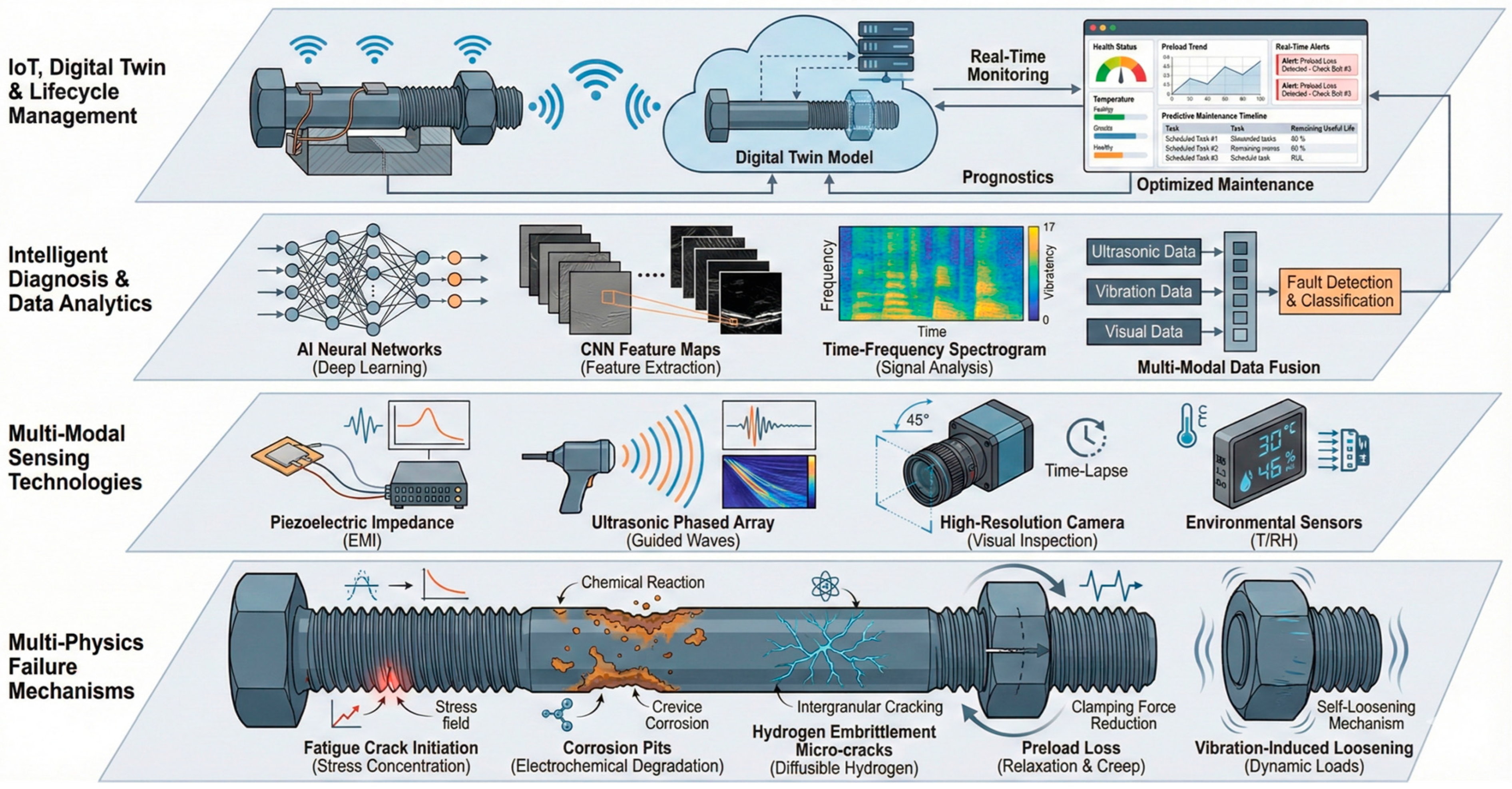
Despite these advances, current research often focuses on isolated fault modes or single sensing modalities. There is a pressing need for a systematic integration of multi-modal sensing data and the development of robust, data-driven diagnostic algorithms capable of operating in real time. This review aims to synthesize the current state of knowledge by establishing a structured and integrative framework encompassing “failure mechanism–multi-modal sensing–intelligent diagnosis”. Unlike previous surveys that often treat these domains separately, this framework explicitly creates causal linkages between them, grounding data-driven approaches in physical understanding and culminating in a system-level vision for lifecycle management. It will provide a critical analysis of prevalent failure modes in high-strength bolts, review the latest advances in both conventional and emerging smart monitoring technologies, and compare traditional model-based diagnostics with modern data-driven approaches. Finally, the review will outline persistent challenges and propose future research directions focused on creating integrated, intelligent, and lifecycle-oriented bolt health management systems. An integrated framework (as shown in Figure 1) linking multi-physics failure mechanisms, multi-modal sensing technologies, and intelligent diagnosis for high-strength bolted connections. It is important to note that the behavior and health of a bolted connection are systemic properties, arising from the interaction of all its components (bolts, plates, welds, etc.), as recognized in holistic design approaches like the Component Method (Eurocode 3). While this review maintains a focused scope on the bolt itself—due to its critical and often vulnerable role—the discussed monitoring and diagnostic principles contribute essential sub-system knowledge that is fundamental for future integrated assessment of the entire connection.

2. Analysis of Multi-Physics Failure Mechanisms in High-Strength Bolts

The integrity of bolted connections is paramount for structural safety, yet high-strength bolts are susceptible to various failure mechanisms under service conditions. These failures can be broadly categorized into two primary forms [18]: fracture and loosening, each stemming from distinct but often interacting physical and chemical processes (as shown in Table 1).

2.1. Fracture Failure: Coupled Mechanisms of Overload, Fatigue, Hydrogen Embrittlement, and Corrosion

Fracture represents a catastrophic, sudden failure mode where the bolt completely separates, leading to immediate connection loss. It is typically the result of one or more of the following mechanisms acting in concert.
(1) Overload Fracture: This occurs when the applied external force exceeds the bolt’s ultimate tensile strength. It is often instantaneous, characterized by a relatively flat fracture surface, and usually results from improper installation (e.g., excessive torque), unexpected operational overloading, or the use of under-specification bolts [19]. Design or manufacturing flaws can also precipitate this failure.
(2) Fatigue Fracture: A prevalent failure mode in dynamically loaded structures, fatigue fracture happens under cyclic stresses well below the material’s yield strength. Cracks initiate at stress concentrators like thread roots or surface imperfections and propagate gradually. The fracture surface exhibits a characteristic “beach mark” morphology due to incremental crack advancement [20]. This process underscores the insidious nature of fatigue, where failure can occur without prior macroscopic warning.
(3) Hydrogen Embrittlement (HE): HE is a delayed, brittle fracture caused by the ingress and subsequent accumulation of hydrogen atoms within the bolt material, severely reducing its ductility [21,22]. Hydrogen tends to concentrate at microstructural defects, elevating local stress and promoting crack initiation under static or cyclic loads. HE is particularly treacherous as it can cause fracture under nominal stress levels.
(4) Corrosion-Assisted Fracture: Exposure to aggressive environments (e.g., marine, industrial) leads to material degradation. While uniform corrosion reduces cross-sectional area, localized forms like pitting and, most critically, Stress Corrosion Cracking (SCC) are more severe. SCC requires the synergistic combination of a susceptible material, a corrosive environment, and tensile stress (residual or applied), leading to crack propagation with little plastic deformation [23,24].
Critically, from a structural health monitoring perspective, the synergy between hydrogen embrittlement (HE) and fatigue can manifest in sensor-detectable signatures that differ from pure mechanical fatigue. While both lead to crack growth, HE-accelerated fatigue is characterized by a more brittle fracture component [25], which may be indicated by higher-energy acoustic emission events, altered nonlinear ultrasonic responses, and—most notably—a dramatically increased rate of damage accumulation metrics (e.g., stiffness loss, damping increase, or harmonic generation) under cyclic loading [26]. Distinguishing this interaction from pure fatigue often requires multi-modal data: vibration or impedance monitoring to quantify accelerated degradation rates, complemented by localized ultrasonic or acoustic emission sensing to characterize crack growth behavior.

2.2. Loosening Failure: The Dynamic Process of Preload Attenuation

Unlike fracture, loosening is a progressive failure mode where the bolt gradually loses its clamping force (preload), compromising connection stiffness and integrity [27]. It does not cause immediate collapse but increases the risk of secondary failures like fatigue or ultimate fracture. The primary drivers include:
(1) Insufficient Initial Preload [28]: Caused by torque tool calibration errors, inaccurate friction coefficient estimation, or improper installation procedures, leading to a connection that is vulnerable from the outset.
(2) Vibration-Induced Loosening [29]: This is the most common cause in machinery and dynamic structures. Under transverse or cyclic loads, relative micro-motion (fretting) occurs at the threads and bearing surfaces, which can cause a “self-loosening” rotational back-off of the nut, progressively reducing preload.
(3) Creep and Stress Relaxation [30,31]: At elevated temperatures, the bolt material can undergo slow plastic deformation (creep), leading to a time-dependent loss of preload even in the absence of vibration. This is a critical consideration for bolts operating in high-temperature environments.

2.3. Synergistic Failure Evolution Paths

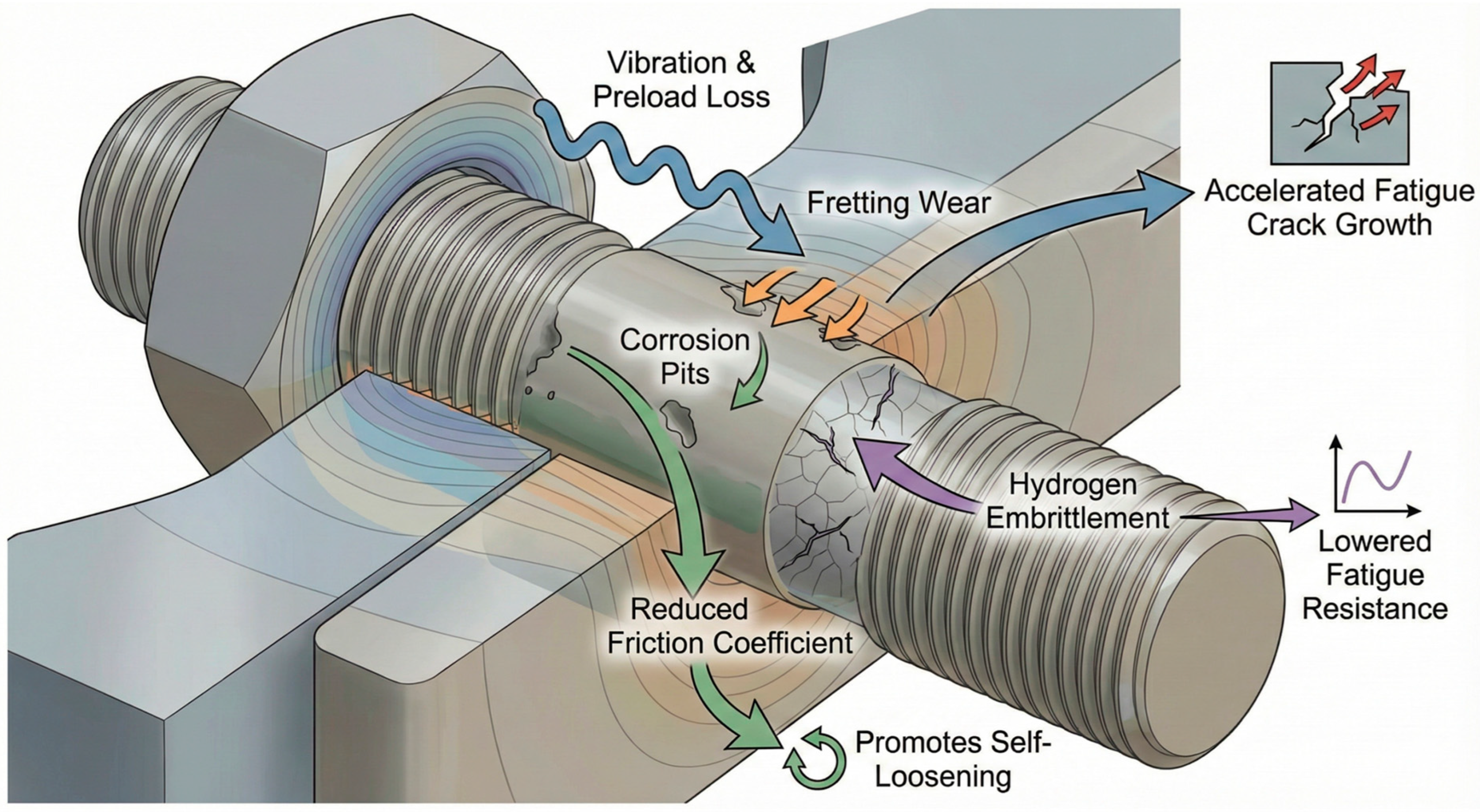
The interaction between different mechanisms often defines the practical failure scenario [32]. A loose bolt experiences higher amplitude vibration and bending moments, accelerating fatigue crack initiation [33]. Conversely, corrosion can reduce the friction coefficient at contact interfaces, promoting loosening. This interplay creates complex evolution paths where one degradation mode (e.g., loosening) accelerates the onset of another (e.g., fatigue fracture), making holistic monitoring and diagnosis essential. To translate the understanding of interacting mechanisms into actionable monitoring and maintenance strategies, it is critical to identify the dominant failure mechanism(s) under specific service conditions. While multiple mechanisms often co-exist, environmental and operational factors typically dictate which process governs the degradation rate and ultimate failure mode. The following table (Table 2) summarizes this relationship by mapping characteristic service environments to the primary failure mechanisms and their most probable synergistic interactions. This condition-based classification provides a foundational guide for prioritizing sensing targets and diagnostic logic in practical applications. Synergistic multi-physics failure evolution paths (as shown in Figure 2) of high-strength bolts under complex service conditions. Understanding these multi-physics failure mechanisms provides the fundamental basis for selecting appropriate sensing modalities and developing targeted diagnostic algorithms, as explored in the following chapters.
While this review establishes the qualitative pathways of synergistic failure, translating these into quantitative, prognostic evolution models remains a pivotal frontier. The development of such models—for instance, predicting the number of cycles to failure under coupled relaxation–fatigue–corrosion conditions—requires the integration of context-specific parameters: corrosion rate kinetics, material-specific crack growth laws, and precise load spectra. The framework presented here delineates the necessary multi-physics linkages and sensing variables for calibrating and validating these future quantitative models, which must be tailored to specific bolt geometries, materials, and operational environments.

3. Multi-Modal Intelligent Sensing Technologies for Bolt Health State

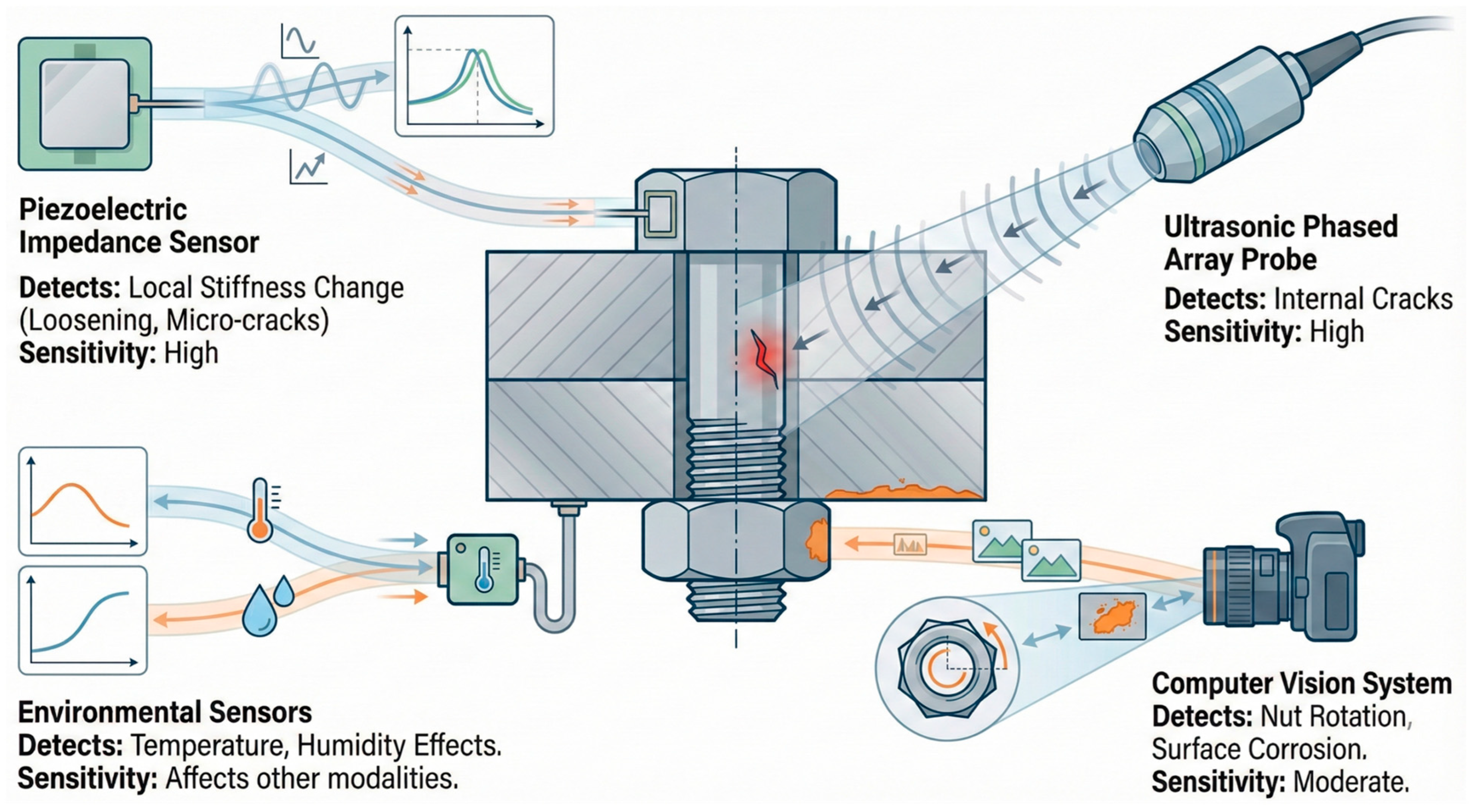
The effective monitoring of high-strength bolt health necessitates technologies capable of detecting subtle changes in stress state, internal integrity, and surface geometry [34]. Recent advancements have moved beyond single-point measurements towards multi-modal sensing frameworks [35], which integrate data from various physical principles to enhance diagnostic robustness, accuracy, and coverage. Schematic illustration (as shown in Figure 3) of multi-modal sensing technologies and their sensitivities to different bolt damage states.

3.1. Strain Sensing and Piezoelectric Impedance Techniques: From Local Response to Global Monitoring

Direct monitoring of the bolt’s mechanical state is achieved through strain and impedance-based methods. The Piezoelectric Electromechanical Impedance (EMI) technique is particularly prominent. It utilizes the electromechanical coupling of Lead Zirconate Titanate (PZT) transducers bonded to or embedded near the bolt [36]. When the PZT is excited by a high-frequency electrical signal, its mechanical impedance, influenced by the local dynamic stiffness of the host structure (bolt connection), is reflected in the measured electrical impedance. Changes in preload or the onset of damage (e.g., micro-cracks, loosening) alter the structural stiffness, thereby shifting the impedance spectrum. This allows for bolt preload estimation and early-stage looseness detection [37,38].
Research continues to enhance this approach. For instance, novel sensor designs like Piezoelectric Micromachined Ultrasonic Transducers (PMUT) have been developed to non-invasively monitor axial stress in bolts by leveraging the acoustoelastic effect and time-of-flight difference of ultrasonic waves [39]. Furthermore, the integration of signal processing algorithms, such as Dynamic Mode Decomposition (DMD), with PZT active sensing enables the extraction of high-frequency components to construct sensitive health indices for quantifying bolt loosening [40]. Another strategy uses the energy of the leading wave packet in guided wave propagation, which exhibits a linear relationship with preload over a wide range, overcoming saturation issues common in traditional methods [41]. While highly sensitive to local changes, challenges remain regarding sensor durability in harsh environments and the influence of temperature fluctuations, which can mask impedance changes caused by damage [36].

3.2. Ultrasonic Phased Array and Total Focusing Method: Visualization and Quantification of Internal Defects

Ultrasonic Testing (UT) is a cornerstone non-destructive evaluation method for internal defect detection and stress assessment [42,43,44]. It operates by analyzing the propagation, reflection, and scattering of high-frequency sound waves within the material. For complex geometries like bolts, Ultrasonic Phased Array (PAUT) technology is transformative. PAUT uses multi-element probes where the firing sequence of each element is electronically controlled, allowing for dynamic beam steering and focusing without moving the probe. This enables the in-situ inspection of fatigue cracks in critical areas such as threaded sections without disassembly.
The evolution towards Full Matrix Capture (FMC) [45] and the Total Focusing Method (TFM) [46] represents a significant leap. This approach acquires data from all possible transmitter-receiver pairs and synthetically focuses at every point in the imaging region in post-processing. The result is a high-resolution, 3D visual image of the bolt’s interior, dramatically improving the detectability and characterization of small cracks or flaws. Array geometry optimization, such as using a Fermat spiral array, has been shown to improve fill factor and reduce grating lobes, leading to superior energy delivery and more precise imaging of root cracks in bolts [47]. Beyond defect detection, ultrasonic methods are also used for axial stress measurement via the acoustoelastic effect (stress-induced velocity change), though accuracy is influenced by material texture and temperature [48]. The integration of Deep Convolutional Neural Networks (DCNN) with ultrasonic data is a powerful trend, enabling the automatic classification of bolt tightness levels or defect types from complex waveform or image data [49,50].

3.3. Computer Vision and Image Processing: Non-Contact Surface State Recognition

Computer Vision-based Structural Health Monitoring (CV-SHM) offers a completely non-contact approach for monitoring surface-related conditions like gross loosening (nut rotation), corrosion, or visible cracks [51]. The core principle involves using cameras (from smartphones to industrial systems) to capture images of bolted connections and applying image processing algorithms to extract diagnostic features.
For detecting rotational loosening, methods often track the angular displacement of a nut or bolt head relative to a reference marker. One practical implementation uses a QR code attached to the nut, which is read by a vision system to calculate the rotation angle and correlate it with preload loss. For scenarios where rotation is not apparent, Digital Image Correlation (DIC) techniques are employed [52]. DIC tracks the deformation of a random speckle pattern painted on the bolt’s surface. By analyzing the relative displacement of subsets of this pattern, the surface strain field and bolt elongation can be measured, providing an estimate of axial tension [53,54].
The field is being revolutionized by deep learning. Models like Faster R-CNN, YOLO (You Only Look Once), and Single Shot MultiBox Detector (SSD) can be trained on large datasets of bolt images to automatically locate bolts in complex scenes (e.g., on a bridge or wind tower) and classify their state as tight or loose [55,56,57,58]. This automates the labor-intensive process of manual inspection. Advanced architectures, including Vision Transformers (ViT), are also being explored for this purpose, demonstrating high accuracy even in challenging conditions [59]. Beyond visible light, techniques like Digital Shearing Speckle Pattern Interferometry (DSSPI) capture minute surface deformations under load, with the resulting fringe patterns analyzed by Recurrent Neural Networks (RNNs) to detect loosening in multi-bolt connections [60].

3.4. Towards Multi-Sensor Fusion: Enhancing Robustness and Environmental Adaptability

Each sensing modality has inherent strengths and limitations. Strain/EMI is highly sensitive to local stiffness changes but is contact-based and affected by temperature [61,62]. Ultrasound excels at internal inspection but requires coupling and can be complex to deploy [63]. Vision is excellent for surface and geometric changes but requires line-of-sight and is sensitive to lighting and occlusion [64]. The future lies in multi-modal data fusion, which synergistically combines information from these disparate sources at the data, feature, or decision level. For example, fusing ultrasonic stress measurement with vision-based rotation data and temperature readings from an IoT sensor could provide a far more reliable and comprehensive assessment of bolt health, distinguishing between true preload loss and apparent changes caused by environmental effects [65]. This fusion is key to developing robust, adaptive monitoring systems capable of reliable operation in the complex and variable environments where high-strength bolts serve.

3.5. Analysis of Environmental Effects as Error Sources

A critical consideration for deploying reliable monitoring systems is understanding the susceptibility of each sensing modality to prevalent environmental factors. Table 3 comparatively summarizes the dominant error sources introduced by temperature, humidity, and electromagnetic noise for the key sensing technologies discussed [66]. This analysis highlights that while temperature is a pervasive challenge for most physical sensors (PZT, ultrasonic), humidity is the critical limitation for vision-based systems, and electromagnetic noise is paramount for acoustic emission. This inherent diversity in environmental susceptibility forms a strong rationale for multi-modal data fusion, where the weakness of one modality under specific conditions can be compensated by the relative robustness of another [67].

3.6. Comparative Uncertainty Analysis for Quantified Fault Detection

A crucial step in selecting and fusing sensors is understanding their comparative measurement uncertainty when targeting a specific, quantified fault [68]. To illustrate, consider the detection of a 20% preload (pre-stress) loss, a common incipient fault condition. The ability and reliability of different modalities to detect this change vary significantly due to their underlying physical principles and susceptibility to confounding factors [69]. Table 4 summarizes the key uncertainty sources and typical detection capabilities for this scenario. This analysis highlights that no single sensor provides a certain measurement; for instance, a 20% preload loss might be indistinguishable from a moderate temperature change for a PZT impedance sensor, or might not produce a visually detectable rotation for a vision system if the nut does not turn. Therefore, multi-modal fusion is not merely beneficial but necessary to triangulate the true fault state by cross-validating measurements with differing uncertainty profiles, thereby reducing the overall diagnostic uncertainty.

3.7. Quantitative Comparison of Key Sensing Modalities

To facilitate objective evaluation and practical decision-making, Table 5 provides a comparative summary of the primary sensing technologies discussed, focusing on key quantitative and qualitative metrics including sensitivity, spatial resolution, cost, durability, and power consumption. The values and ratings presented are synthesized from typical performance ranges reported in the research literature cited throughout this review and are intended to illustrate general trends and trade-offs. Specific performance can vary significantly based on sensor model, implementation details, and operational environment.

4. From Traditional Diagnostics to Data-Driven Intelligent Fault Identification

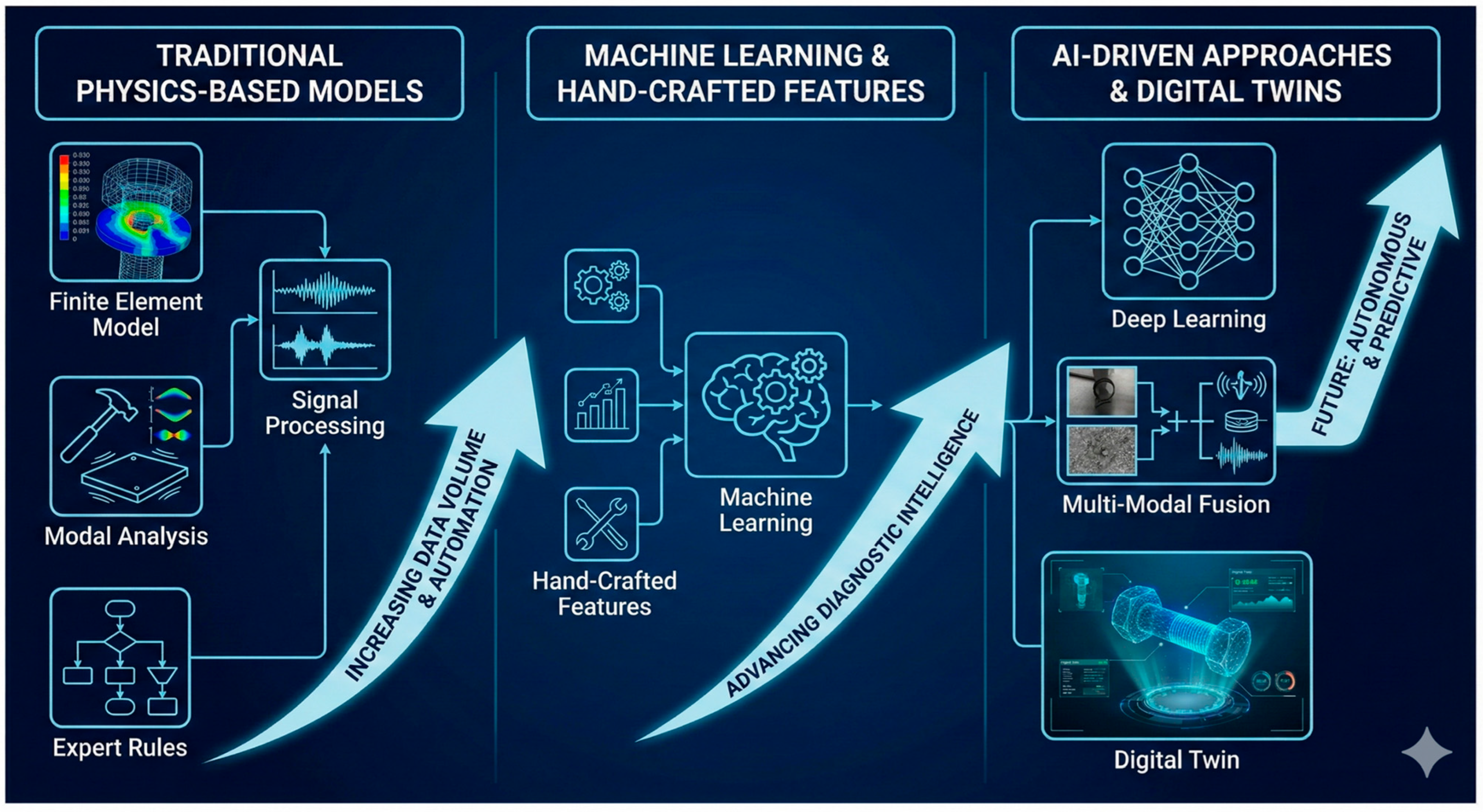
The evolution of fault diagnosis for high-strength bolts mirrors the broader digital transformation in engineering, shifting from reliance on physical models and expert heuristics towards data-driven, intelligent systems [70]. The general diagnostic pipeline involves: (1) data acquisition using sensors (as detailed in Chapter 3); (2) feature extraction from raw signals to isolate damage-sensitive information; and (3) fault classification/severity assessment to determine the type, location, and extent of the fault. The core distinction lies in the methodologies employed for the latter two steps. Evolution of bolt fault diagnosis methods from physics-based and signal-driven approaches to data-driven and intelligent models (as shown in Figure 4).

4.1. Traditional Diagnostic Methods: Limitations and Applicable Scenarios

Traditional methods are rooted in established physical principles and signal processing techniques. It mainly includes the following aspects:
(1) Model-Based Methods: These approaches rely on constructing accurate physical or mathematical models of the bolted joint, such as a Finite Element Model (FEM) or a Dynamic Stiffness Matrix (DSM). Faults are diagnosed by detecting discrepancies between the model’s predicted response and the measured data (e.g., vibration response). For instance, FEM can simulate the stress distribution under varying preloads or identify local stiffness loss due to loosening [71,72]. Particle filters have been used with DSMs to estimate bolt stiffness changes for looseness detection [73]. While highly accurate when models are precise, their major limitation is the “reality gap”—the difficulty in creating models that fully capture the complexity, nonlinearity, and environmental variability of real-world structures, making them less adaptable [74].
(2) Signal Processing-Based Methods: This category extracts fault signatures directly from sensor data without an explicit physical model. Techniques include:
  • Modal Analysis: Tracking changes in natural frequencies or mode shapes, which are global properties affected by local stiffness loss (loosening). However, sensitivity can be low for early-stage faults [74];
  • Time–frequency Analysis: Essential for non-stationary vibration signals. Wavelet Transform excels in localizing transient features in both time and frequency domains, making it suitable for impact-induced or progressive fault signals [75]. Generalized S-transform offers superior time–frequency resolution and cross-term suppression for capturing weak fault signatures [76];
  • Nonlinear Vibro-Acoustic Modulation (VAM): A powerful method for detecting early-stage, nonlinear damage like incipient loosening. It exploits the modulation effect a low-frequency vibration (pump) has on a high-frequency ultrasonic wave (probe) when nonlinearities (e.g., contact acoustical nonlinearity from micro-slip) are present, providing earlier warning than linear methods [77].
  • Audio Signal Analysis: Using the sound from a mechanical impact (e.g., hammer tap) to assess bolt tightness based on the extracted acoustic features [78].
  • Expert Systems & FMEA: These systems encode human expertise and failure mode knowledge into rule-based algorithms or frameworks like Failure Mode and Effects Analysis (FMEA). They are valuable for systematic risk assessment and guiding maintenance decisions. Advanced versions integrate Cloud Models (CM) and Analytic Hierarchy Process (AHP) to handle uncertainties in risk factor weighting and ranking [79]. However, they struggle with scalability, knowledge acquisition bottlenecks, and reasoning speed when rule sets become large and complex.

4.2. Machine Learning and Deep Learning in Bolt Health State Classification

Data-driven methods learn the mapping between sensor data (features) and fault states directly from data, overcoming the need for explicit physical models and manual feature engineering [80].
(1) Machine Learning (ML) Algorithms: Supervised models like Support Vector Machines (SVM) and ensemble methods (XGBoost, LightGBM) are widely used. They are trained on labeled datasets containing features (e.g., time–frequency features from vibration signals, statistical features from ultrasonic data) corresponding to known health states (tight, loose, cracked). Their performance hinges on the quality and relevance of the hand-crafted input features [81,82,83].
(2) Deep Learning (DL): This represents a paradigm shift by enabling automatic feature learning from raw or minimally processed data. Convolutional Neural Networks (CNNs) are particularly dominant, applied to:
  • Image Data: Automatically detecting and classifying loose bolts from visual images or thermal maps, achieving high precision [56,59,84].
  • 1D Signal Data: Treating vibration, acoustic emission (AE), or ultrasonic waveforms as 1D “images,” CNNs can directly learn hierarchical patterns indicative of specific faults, such as classifying bolt loosening levels or wear mechanisms from AE signals [85,86].
  • 2D Time–Frequency Representations: Converting signals into spectrograms or scalograms (using Short-Time Fourier Transform or Wavelet Transform) and applying 2D CNNs for classification [87,88].
Advanced architectures like Vision Transformers (ViT) and Recurrent Neural Networks (RNNs) are also being explored for sequential data or image classification, showing competitive results [60]. Semi-supervised learning techniques are emerging to leverage vast amounts of unlabeled operational data alongside limited labeled examples, addressing a key practical constraint [89].

4.3. AI and IoT-Enabled Real-Time Monitoring and Early Warning Systems

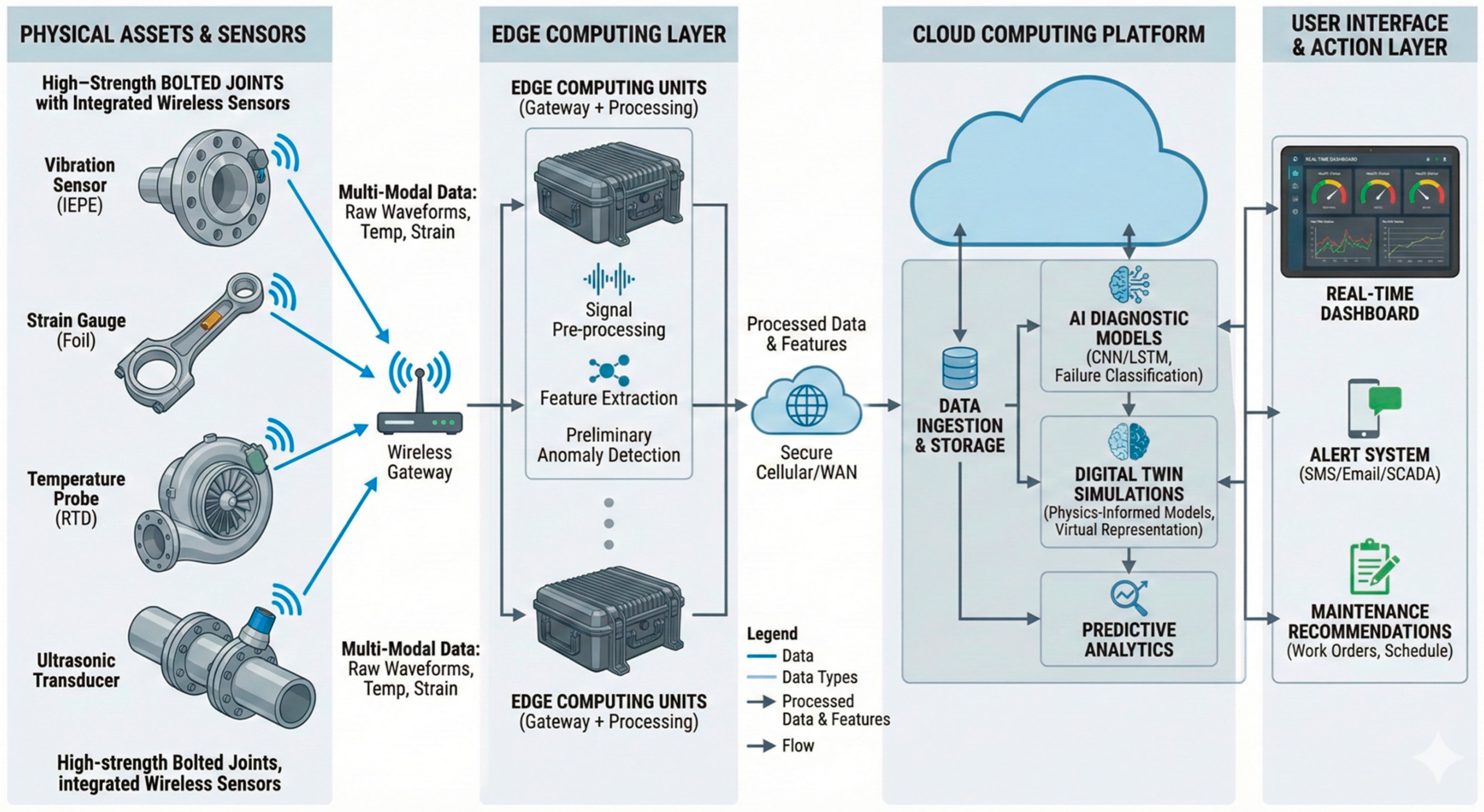
The convergence of Artificial Intelligence (AI) algorithms and the Internet of Things (IoT) enable a transition from periodic inspection to continuous, real-time health management [90]. IoT frameworks deploy networks of wireless smart sensors (strain gauges, accelerometers, PZTs) on bolted connections [91]. The data is streamed to edge computing devices or cloud platforms where pre-trained AI models perform on-line analysis. This facilitates: (1) Real-Time Condition Dashboard: Visualizing the health state of numerous bolts across an entire structure (e.g., a wind farm or bridge). (2) Automated Alerts: Triggering warnings when a bolt’s health index degrades beyond a threshold. (3) Predictive Maintenance: By trending the degradation of features over time, these systems can forecast remaining useful life or optimal maintenance intervals, moving from schedule-based to condition-based maintenance. System architecture of an AI- and IoT-enabled real-time monitoring and fault diagnosis framework for bolted connections (as shown in Figure 5).

4.4. Digital Twin: Virtual Mapping and Simulation for Full Lifecycle Health Management

Digital Twin (DT) technology represents the next frontier, creating a dynamic, high-fidelity virtual replica of a physical bolted connection or entire structure [92]. The DT is continuously updated with real-time sensor data (IoT feed), creating a living digital model [93]. For bolt diagnostics, a DT enables: (1) High-Fidelity Simulation: Running FEM or multi-body dynamics simulations under real operational loads to predict stress hotspots and potential failure locations, validating against measured data [94]. (2) Hypothesis Testing & Root Cause Analysis: Simulating “what-if” scenarios (e.g., “what is the effect of a 20% preload loss on adjacent bolts?”) to understand failure propagation. (3) Prognostics & Health Management (PHM): Integrating historical data, physics-based models, and ML predictions within the DT framework to provide a comprehensive view of past performance, current state, and future reliability. Novel methods are also using simulation models to generate abundant, labeled fault data for training robust diagnostic algorithms, tackling the challenge of real-world data scarcity [95].
Implementing such a lifecycle Digital Twin necessitates addressing several key methodological questions. First, model fidelity must be appropriate to the diagnostic or prognostic task, often employing a multi-scale approach where detailed local models (e.g., of a bolt thread) are embedded within coarser global system models. Second, the synergy between physics-based and data-driven components is achieved through hybrid modeling strategies. This includes using operational data to continuously calibrate physical model parameters (data assimilation) and employing physics-informed machine learning to ensure data-driven surrogates respect fundamental laws. Finally, validation and verification constitute an ongoing process. The DT is initially validated against controlled test data, and its performance is continuously monitored against the stream of field sensor data. A persistent divergence triggers a model update cycle, with all changes documented as part of a managed digital thread, ensuring the twin remains a trustworthy reflection of its physical counterpart throughout its service life.
In summary, the diagnostic landscape is converging towards hybrid approaches that combine the interpretability of physics-based models with the adaptive power of data-driven AI, all integrated within IoT-enabled, real-time frameworks. The ultimate goal is an intelligent, self-aware structural system where the health of every critical bolt is known, managed, and predicted.

4.5. Case Studies and Field Applications

To ground the discussed methodologies in practical contexts, this section briefly highlights representative applications. For instance, Huynh et al. [64] successfully deployed a vision-based autonomous system for bolt-looseness detection in steel splice connections of a bridge, demonstrating robust performance under varying lighting conditions. In the domain of guided waves, Wang et al. [35] implemented a piezoelectric active sensing network to monitor preload loss in bolted flange connections of an operational chemical processing unit, achieving early detection of relaxation under thermal cycling. Furthermore, the integration of ultrasonic phased arrays for inspecting wind turbine tower bolts, as demonstrated by Sun et al. [47] showcases the translation of advanced NDE into field maintenance routines. These examples illustrate the transition of sensing and diagnostic methods from laboratory validation to real-world structural health monitoring, addressing the practical challenges outlined in previous sections.

5. Future Research Directions and System-Oriented Development Recommendations

The comprehensive review presented in the preceding chapters underscores significant progress in the monitoring and diagnosis of high-strength bolts. However, the transition from experimental validation and isolated case studies to robust, widely deployable intelligent maintenance systems demands focused efforts in several key areas. This chapter synthesizes the identified limitations and opportunities to propose three principal, interconnected research thrusts for the future. The proposed “failure mechanism–multi-modal sensing–intelligent diagnosis” framework naturally leads to several new, structured research questions that extend beyond the scope of current isolated studies, guiding the field toward integrated, physics-informed, and scalable solutions. The following research directions are not merely a list of open technical questions. They are directly derived from the gaps and inter-dependencies exposed by the proposed integrative framework, which highlights the necessity of moving beyond isolated technological advances toward synergistic system solutions.

5.1. Constructing Open, Shared High-Strength Bolt Fault Databases and Standardization Platforms

A fundamental bottleneck in advancing data-driven diagnostics, particularly for deep learning, is the scarcity of high-quality, well-labeled, and diverse fault data. Current research often relies on limited, privately held datasets from laboratory tests or specific field cases, hindering the development and benchmarking of generalizable algorithms. There is a lack of large-scale, open-access databases that encompass diverse bolt types (grades, sizes), failure modes (from incipient loosening to full fracture), and operating conditions (varying load, temperature, corrosion). Data formats, acquisition parameters, and annotation standards are inconsistent.
Recommendation & Path Forward: The research community should advocate for and contribute to the establishment of curated public fault databases. This requires: (1) Standardized Data Protocols: Developing and adopting community-wide standards for data formatting, metadata description (including material specs, load history, environmental conditions), and communication protocols for sensor networks. (2) Collaborative Data Curation: Encouraging academia and industry to share anonymized operational and failure data through trusted platforms. Initiatives could be organized by professional societies or through publicly funded research projects. (3) Benchmarking and Challenges: Creating standardized benchmark datasets and organizing international challenges to objectively compare the performance of different diagnostic algorithms, fostering innovation and transparency. Such a resource would accelerate algorithm development and facilitate the study of cross-domain failure mechanisms [86].

5.2. Developing Multi-Modal Data Fusion and Adaptive Online Diagnostic Algorithms

While multi-modal sensing is recognized as crucial, most current diagnostic methods still operate on data from a single source (e.g., only vibration or only vision). The true potential lies in intelligently fusing heterogeneous data streams to achieve robustness against environmental noise and the ability to diagnose complex, co-occurring faults. Existing methods lack sophisticated frameworks for fusing data from strain, ultrasonic, visual, and environmental sensors at the data, feature, or decision level. Furthermore, most algorithms are static, trained on historical data, and lack the ability to adapt to unforeseen operational changes or new fault patterns in real time. The framework explicitly raises new research questions in this domain, such as: How can we optimally fuse heterogeneous data streams in real time to distinguish between environmental noise and true degradation signals? How can physics-based models be embedded into deep learning architectures to improve generalization with limited data?
Recommendation & Path Forward: Future research should focus on: (1) Advanced Fusion Architectures: Exploring hybrid models that combine physics-based understandings with data-driven learning. For example, physics-informed neural networks (PINNs) could integrate constraints from ultrasonic wave propagation models with learned features from vibration data to estimate stress and detect defects simultaneously. (2) Self-Adaptive and Continual Learning: Developing diagnostic systems capable of online learning and adaptation. Techniques like reinforcement learning could allow systems to dynamically adjust diagnostic thresholds or feature weights based on changing operational contexts (e.g., seasonal temperature shifts). Continual learning algorithms are needed to incorporate new fault examples without catastrophically forgetting previous knowledge. (3) Edge-AI Optimization: Designing lightweight yet accurate models (e.g., pruned CNNs, knowledge distillation) suitable for deployment on resource-constrained edge devices within IoT networks, enabling real-time, localized decision-making with low latency.

5.3. Toward Integrated, Lifecycle-Oriented Intelligent Operation and Maintenance Systems

The ultimate goal is a holistic management system that oversees the bolt’s entire lifecycle—from design and installation through service to decommissioning. Current approaches often address only one phase (e.g., in-service monitoring) in isolation. There is a disconnect between design assumptions, installation records (e.g., as-built torque values), real-time monitoring data, and maintenance history. This prevents a coherent lifecycle analysis that can predict long-term reliability and optimize maintenance strategies. The framework extends the diagnostic pipeline toward system-level management, prompting research questions such as: How can Digital Twins be dynamically updated with real-time multi-modal data to simulate failure progression and test “what-if” maintenance scenarios? and What data structures and interoperability standards are needed to create a “digital thread” for individual bolts?
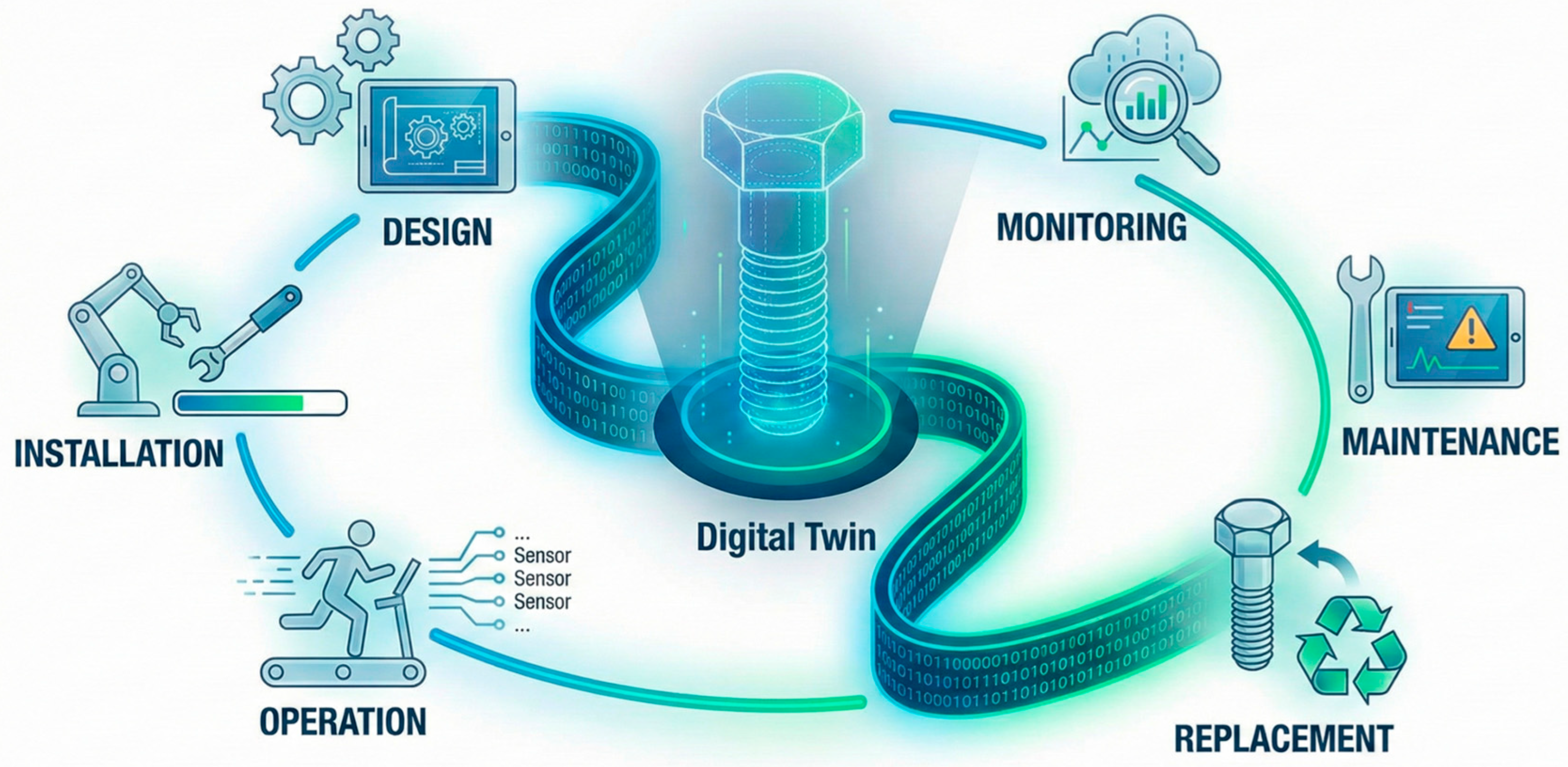
Recommendation & Path Forward: Research must move towards integrated system design: (1) Lifecycle Digital Thread: Creating a “Digital Thread” that links all lifecycle data for each critical bolted connection. This thread feeds into and is updated by a high-fidelity Digital Twin (DT). The DT would simulate and predict performance, allowing for virtual testing of maintenance actions and remaining useful life (RUL) prognosis under various future loading scenarios. (2) Closed-Loop Verification: Establishing a framework where field monitoring data continuously validates and refines the simulation models within the DT. Concurrently, insights from the DT (e.g., identified critical locations, predicted degradation rates) guide the optimization of the physical sensor network layout and inspection schedules. (3) Prescriptive Maintenance Platforms: Evolving from predictive (what will fail and when) to prescriptive systems (what should be done and why). These platforms would use the integrated DT and AI analytics to not only forecast failures but also recommend optimal intervention strategies (e.g., re-torque sequence, replacement priority) considering operational constraints, costs, and risks. Conceptual vision of lifecycle-oriented bolt health management based on digital twin and digital thread integration (as shown on Figure 6).

5.4. Summary of Questions

The proposed framework directly enables a set of structured, forward-looking research questions that move beyond incremental improvements: (1) Mechanism-Informed Sensing & Modeling: How do coupled failure mechanisms (e.g., corrosion-fatigue, hydrogen-assisted loosening) interact in real time, and how can their synergistic effects be quantified to guide sensor selection and prognostic modeling? (2) Adaptive Multi-Modal Diagnostics: How can we develop self-adaptive diagnostic algorithms that continuously learn from new operational data streams in an IoT environment, distinguishing between novel fault patterns and benign environmental variations? (3) Scalable & Translational System Integration: What lightweight, edge-compatible AI models and wireless sensor network architectures can deliver reliable, real-time diagnostics for large-scale infrastructure deployments (e.g., wind farms, long-span bridges)? (4) Verification & Validation in Digital Twins: How can we establish robust metrics and protocols for validating the fidelity of bolt health Digital Twins against real-world, multi-modal monitoring data across the lifecycle? (5) Addressing these questions will require sustained cross-disciplinary collaboration between materials science, mechanics, computer science, and civil/mechanical engineering, ultimately enabling self-aware infrastructures where bolt health is proactively managed.

6. Conclusions

This review has systematically traversed the landscape of high-strength bolt fault monitoring and diagnosis, establishing a novel framework that explicitly links multi-physics failure mechanisms with advanced sensing modalities and intelligent diagnostic paradigms. Unlike previous surveys that often treat these domains in isolation, our integrated “failure mechanism–multi-modal sensing–intelligent diagnosis” approach provides a cause-effect-guided and system-oriented narrative. It demonstrates how understanding coupled physical degradation processes directly informs the selection and fusion of multi-modal sensing data, which in turn shapes the development of robust, physics-informed diagnostic and prognostic algorithms.
The analysis reveals a clear trajectory: the field is evolving from reliance on manual inspection and simplistic thresholds towards autonomous, intelligent, and prognostic health management systems. The synergistic integration of multi-modal sensing (strain, ultrasound, vision), data-driven AI (especially deep learning for automatic feature extraction), and cyber–physical frameworks (IoT, Digital Twin) forms the cornerstone of this future. While traditional model-based and signal processing methods retain value for specific, well-understood scenarios, their limitations in handling high-dimensional data and complex, variable environments are being overcome by adaptive learning algorithms.
The proposed framework not only synthesizes existing knowledge but also charts a coherent path for future research, as detailed in Section 5. It moves beyond compartmentalized technological surveys to highlight the necessity of building open fault databases, developing adaptive multi-modal fusion algorithms, and creating lifecycle-oriented digital management systems. By fostering cross-disciplinary collaboration, the next generation of bolt health management will transition from responsive diagnostics to prescriptive, resilience engineering, ensuring the long-term safety and reliability of the critical systems upon which modern society depends.
Ultimately, integrating this bolt-focused knowledge into a holistic framework for monitoring entire connections—inspired by system-level methodologies like the Component Method—represents a vital next frontier for achieving comprehensive structural health management.

Author Contributions

Conceptualization: Y.W. and S.T.; methodology: G.C. and Z.S.; software: F.Y. and J.Y.; validation: X.S. and Y.Z.; formal analysis: Y.W. and G.C.; data curation: Z.S.; writing—original draft preparation: Y.W., F.Y. and J.Y.; writing—review and editing: G.C., X.S., Y.Z. and S.T. All authors have read and agreed to the published version of the manuscript.

Funding

This paper was funded by the Young Backbone Teachers in Zhongyuan University of Technology (No. 2025XQG03), Plan for Enhancing the Strength of Advantageous Disciplines in Zhongyuan University of Technology: “Civil Engineering” (No. SD202423), National Natural Science Foundation of China (No. 52508178), Guangdong Basic and Applied Basic Research Foundation (No. 2025A1515010155), Natural Science Foundation of Henan Province (No. 252300423474), Open Project Funding for Henan Key Laboratory of Grain and oil storage facility & safety (No. 2025KF02), Guangzhou Construction Group Co., Ltd. Technology Plan Project (No. 2024-KJ081), Science and Technology in Henan Province (No. 242102241025).

Data Availability Statement

The original contributions presented in the study are included in the article; further inquiries can be directed to the corresponding author.

Conflicts of Interest

The authors declare no competing interest. The authors Jun Yang and Xiaoli Sun were employed by the Guangzhou Municipal Engineering Testing Co., Ltd. There is no conflict of interest between any of the authors and the company.

References

  1. Hassan, E.M.; Mahmoud, H.; Riveros, G.; Lopez, S. Multi-axial fatigue behavior of high-strength structural bolts. J. Constr. Steel Res. 2023, 205, 107912. [Google Scholar] [CrossRef]
  2. Yang, X.; Zhang, L.; Zhang, S.; Zhou, K.; Li, M.; He, Q.; Wang, J.; Wu, S.; Yang, H. Atmospheric Corrosion Behaviour and Degradation of High-Strength Bolt in Marine and Industrial Atmosphere Environments. Int. J. Electrochem. Sci. 2021, 16, 151015. [Google Scholar] [CrossRef]
  3. Escobar, J.A.; Romero, A.F.; Lobo-Guerrero, J. Failure analysis of submersible pump system collapse caused by assembly bolt crack propagation by stress corrosion cracking. Eng. Fail. Anal. 2016, 60, 1–8. [Google Scholar] [CrossRef]
  4. Rajaperumal, T.A.; Christopher Columbus, C. Enhanced wind power forecasting using machine learning, deep learning models and ensemble integration. Sci. Rep. 2025, 15, 20572. [Google Scholar] [CrossRef]
  5. Zhao, L.; Hou, L.; Wang, S.; Yang, D.; Lei, X.; Yang, S.; Li, Q. A novel approach to forward design elastic ring squeeze film dampers by decoupling stiffness and damping parameters in aerospace engines. Mech. Syst. Signal Process. 2025, 241, 113561. [Google Scholar] [CrossRef]
  6. Li, Z.; Shao, P.; Zhao, M.; Yan, K.; Liu, G.; Wan, L.; Xu, X.; Li, K. Optimized deep learning for steel bridge bolt corrosion detection and classification. J. Constr. Steel Res. 2024, 215, 108570. [Google Scholar] [CrossRef]
  7. Shang, Z.; Qin, X.; Zhang, Z.; Jiang, H. Bolt Loosening and Preload Loss Detection Technology Based on Machine Vision. Buildings 2024, 14, 3897. [Google Scholar] [CrossRef]
  8. Yang, L.; Yang, B.; Yang, G.; Xu, Y.; Xiao, S.; Jiang, S.; Chen, J. Analysis of competitive failure life of bolt loosening and fatigue. Eng. Fail. Anal. 2021, 129, 105697. [Google Scholar] [CrossRef]
  9. Li, Q.; Zhao, Q.; Wang, S.; Jing, X. Bolt-loosening Fault Diagnosis in Rotor Systems with Nonlinear Vibration Transmissibility Function-based Features and Indexes. Struct. Health Monit. 2025, 24, 3120–3137. [Google Scholar] [CrossRef]
  10. Ramana, L.; Choi, W.; Cha, Y.-J. Fully automated vision-based loosened bolt detection using the Viola–Jones algorithm. Struct. Health Monit. 2019, 18, 422–434. [Google Scholar] [CrossRef]
  11. Krot, P.; Shiri, H.; Dąbek, P.; Zimroz, R. Diagnostics of Bolted Joints in Vibrating Screens Based on a Multi-Body Dynamical Model. Materials 2023, 16, 5794. [Google Scholar] [CrossRef]
  12. Liu, Z.; Lv, H. YOLO_Bolt: A lightweight network model for bolt detection. Sci. Rep. 2024, 14, 656. [Google Scholar] [CrossRef]
  13. Sui, X.; Zhang, R.; Luo, Y.; Fang, Y. Multiple bolt looseness detection using SH-typed guided waves: Integrating physical mechanism with monitoring data. Ultrasonics 2025, 150, 107601. [Google Scholar] [CrossRef]
  14. Gong, Y.; Tang, G.; Wang, X.; Liu, Z. Detection and Monitoring Technologies for Bolt Connection Loosening: A Review. J. Beijing Univ. Technol. 2025, 51, 192–213. [Google Scholar] [CrossRef]
  15. Lei, W.; Yuan, F.; Guo, J.; Wang, H.; Geng, Z.; Wu, T.; Gong, H. Vision-Based Real-Time Bolt Loosening Detection by Identifying Anti-Loosening Lines. Sensors 2024, 24, 6747. [Google Scholar] [CrossRef]
  16. Rangwala, H.; Vora, T.; Baz, A. Integrating machine learning with electromechanical impedance for non-destructive detection of bolt looseness in steel structures. Case Stud. Constr. Mater. 2025, 23, e05430. [Google Scholar] [CrossRef]
  17. Jiang, P.; Geng, Y.; Sang, Z.; Lin, L. Bolt Loosening Detection Method Based on Improved YOLOv8 and Image Matching. IEEE Access 2025, 13, 1133–1146. [Google Scholar] [CrossRef]
  18. Reza Kashyzadeh, K.; Ghorbani, S.; Kasimovich, A.-A.M. Common causes of failures in the industrial bolt and nut connections. Eng. Fail. Anal. 2025, 173, 109431. [Google Scholar] [CrossRef]
  19. Zhang, J.; Heng, J.; Dong, Y.; Baniotopoulos, C.; Yang, Q. Coupling multi-physics models to corrosion fatigue prognosis of high-strength bolts in floating offshore wind turbine towers. Eng. Struct. 2024, 301, 117309. [Google Scholar] [CrossRef]
  20. Grimsmo, E.L.; Aalberg, A.; Langseth, M.; Clausen, A.H. Failure modes of bolt and nut assemblies under tensile loading. J. Constr. Steel Res. 2016, 126, 15–25. [Google Scholar] [CrossRef]
  21. Elsheikh, A.; Ali, A.; Essa, F.A.; Omer, M.A.E.; Abou-Ali, M.G.; Ma, N. Hydrogen Embrittlement in Storage Tank Materials and Welded Joints. Mater. Today Sustain. 2025, 33, 101282. [Google Scholar] [CrossRef]
  22. Sobola, D.; Dallaev, R. Exploring Hydrogen Embrittlement: Mechanisms, Consequences, and Advances in Metal Science. Energies 2024, 17, 2972. [Google Scholar] [CrossRef]
  23. He, Z.; Zhang, N.; Xie, Z.; Wei, Q.; Han, C.; Guo, F.; Yin, Y.; Liu, Y. Multi-scale experimental study on the failure mechanism of high-strength bolts under highly mineralized environment. Geomech. Geophys. Geo Energy Geo Resour. 2024, 10, 111. [Google Scholar] [CrossRef]
  24. Hagarová, M.; Peterka, P.; Mantič, M.; Vojtko, M.; Baranová, G.; Matvija, M. Failure analysis of leaded brass bolt. Eng. Fail. Anal. 2023, 143, 106899. [Google Scholar] [CrossRef]
  25. Zheng, Z.; Wang, X.; Guo, W.; Yang, Z.; Sun, X.; Li, X. Failure Analysis of a MW-Class Wind Turbine Blade Root Bolt. J. Fail. Anal. Prev. 2019, 19, 986–991. [Google Scholar] [CrossRef]
  26. Valles González, P.; Pastor Muro, A.; García-Martínez, M. Failure analysis study on a fractured bolt. Eng. Fail. Anal. 2020, 109, 104355. [Google Scholar] [CrossRef]
  27. Sun, J.; Xiang, X.; Li, H.; He, T.; Wang, H.; Xu, Y.; Liu, J.; Zhu, M. Anti-Loosening and fatigue performance of bolted joints with crimping Self-Locking nuts. Eng. Fail. Anal. 2025, 169, 109235. [Google Scholar] [CrossRef]
  28. Hofmann, M.; Faß, M.; Eberhard, A.; Klein, M.; Baumgartner, J.; Oechsner, M.; Melz, T. Method of accumulation of preload loss of bolted joints due to rotational self-loosening caused by cyclic, transversal excitation. Eng. Fail. Anal. 2024, 162, 108404. [Google Scholar] [CrossRef]
  29. Wang, Y.; He, H.; Zhuge, F.; Wang, C.; Guo, H. Comprehensive diagnosis method for bolt loosening based on the fusion of vibration characteristics and sound signal variability. Measurement 2025, 256, 118451. [Google Scholar] [CrossRef]
  30. Jiang, K.; Liu, Z.; Zhang, T.; Wang, F. Influence of bolt creep induced pre-tightening force relaxation on dynamic response of the bolted joint system. J. Sound Vib. 2025, 596, 118800. [Google Scholar] [CrossRef]
  31. Guan, K.; Zhu, R.; Pérez-Rey, I.; Zhu, W.; Liu, X.; Zhou, J. Creep behavior and prestress relaxation mechanism of bolt-reinforced jointed specimen disturbed by dynamic impact. Int. J. Rock Mech. Min. Sci. 2025, 196, 106338. [Google Scholar] [CrossRef]
  32. Yang, B.; Tan, K.H. Experimental tests of different types of bolted steel beam–column joints under a central-column-removal scenario. Eng. Struct. 2013, 54, 112–130. [Google Scholar] [CrossRef]
  33. Gao, S. Nonlinear finite element failure analysis of bolted steel-concrete composite frame under column-loss. J. Constr. Steel Res. 2019, 155, 62–76. [Google Scholar] [CrossRef]
  34. Hu, M.; Salmani Pour Avval, S.; He, J.; Yue, N.; Groves, R.M. Explainable artificial intelligence study on bolt loosening detection using Lamb waves. Mech. Syst. Signal Process. 2025, 225, 112285. [Google Scholar] [CrossRef]
  35. Wang, W.; Li, A.; Fan, Y.; Li, L. Detecting bolt looseness of flanged joint based on multiple-mode conversion. Struct. Health Monit. 2026, 25, 350–375. [Google Scholar] [CrossRef]
  36. Sahm, D.; Pak, D. Influence of temperature and preload force on capacitance and electromechanical impedance of lead zirconate titanate piezoelectric wafer active sensors for structural health monitoring of bolts. Appl. Phys. A 2024, 130, 156. [Google Scholar] [CrossRef]
  37. Na, W.S.; Baek, J. A Review of the Piezoelectric Electromechanical Impedance Based Structural Health Monitoring Technique for Engineering Structures. Sensors 2018, 18, 1307. [Google Scholar] [CrossRef]
  38. Shao, J.; Wang, T.; Yin, H.; Yang, D.; Li, Y. Bolt Looseness Detection Based on Piezoelectric Impedance Frequency Shift. Appl. Sci. 2016, 6, 298. [Google Scholar] [CrossRef]
  39. Li, Z.; Li, J.; Zhao, Y.; Li, Z.; Shi, X.; Qin, S.; Li, J.; Yuan, J.; Ma, Q.; Zhao, Z.; et al. Noninvasive Stress Detection Based on Piezoelectric Micromachined Ultrasonic Transducers for Bolt Loosening Warning. IEEE Trans. Instrum. Meas. 2024, 73, 1–16. [Google Scholar] [CrossRef]
  40. Tan, B.; Wang, T.; Fang, Q.; Yang, D.; Wang, H.; Lu, G. Bolt looseness monitoring using dynamic mode decomposition with piezoelectric active sensing. Measurement 2024, 238, 115204. [Google Scholar] [CrossRef]
  41. Wang, T.; Wang, H.; Yang, D.; Tan, B.; Deng, S.; Lu, G. Early bolt looseness monitoring using the leading waves energy in piezoelectric active sensing. Smart Mater. Struct. 2024, 33, 035033. [Google Scholar] [CrossRef]
  42. Yang, H.; Yang, L.; Yang, Z.; Shan, Y.; Gu, H.; Ma, J.; Zeng, X.; Tian, T.; Ma, S.; Wu, Z. Ultrasonic detection methods for mechanical characterization and damage diagnosis of advanced composite materials: A review. Compos. Struct. 2023, 324, 117554. [Google Scholar] [CrossRef]
  43. Alqurashi, I.; Alver, N.; Bagci, U.; Catbas, F.N. A Review of Ultrasonic Testing and Evaluation Methods with Applications in Civil NDT/E. J. Nondestruct. Eval. 2025, 44, 53. [Google Scholar] [CrossRef]
  44. Yun, H.; Rayhana, R.; Pant, S.; Genest, M.; Liu, Z. Nonlinear ultrasonic testing and data analytics for damage characterization: A review. Measurement 2021, 186, 110155. [Google Scholar] [CrossRef]
  45. Xu, Q.; Wang, H.; Tian, G.; Ma, X.; Hu, B.; Chu, J. Compressive sensing of ultrasonic array data with full matrix capture in nozzle welds inspection. Ultrasonics 2023, 134, 107085. [Google Scholar] [CrossRef]
  46. Teng, D.; Liu, L.; Xiang, Y.; Xuan, F.-Z. An optimized total focusing method based on delay-multiply-and-sum for nondestructive testing. Ultrasonics 2023, 128, 106881. [Google Scholar] [CrossRef] [PubMed]
  47. Sun, H.; Dong, J.; Diao, X.; Huang, X.; Huang, Z.; Cai, Z. Crack Detection Method for Wind Turbine Tower Bolts Using Ultrasonic Spiral Phased Array. Sensors 2024, 24, 5204. [Google Scholar] [CrossRef]
  48. Hu, Y.; Chen, P.; Peng, X.; Yin, A.; Yu, X. Measurement of axial stress in high-strength short bolts using ultrasonic attenuation. Meas. Sci. Technol. 2023, 34, 085013. [Google Scholar] [CrossRef]
  49. Tran, D.Q.; Kim, J.-W.; Tola, K.D.; Kim, W.; Park, S. Artificial Intelligence-Based Bolt Loosening Diagnosis Using Deep Learning Algorithms for Laser Ultrasonic Wave Propagation Data. Sensors 2020, 20, 5329. [Google Scholar] [CrossRef] [PubMed]
  50. Medak, D.; Milković, F.; Posilović, L.; Subašić, M.; Budimir, M.; Lončarić, S. Detection of Defective Bolts from Rotational Ultrasonic Scans Using Convolutional Neural Networks. In Proceedings of the 2022 27th International Conference on Automation and Computing (ICAC), Bristol, UK, 1–3 September 2022; pp. 1–6. [Google Scholar]
  51. Dong, C.Z.; Catbas, F.N. A review of computer vision–based structural health monitoring at local and global levels. Struct. Health Monit. 2020, 20, 692–743. [Google Scholar] [CrossRef]
  52. Jiménez-Peña, C.; Lavatelli, A.; Balcaen, R.; Rossi, B.; Debruyne, D. Model Based Bolt Preload Monitoring Using Digital Image Correlation. Proceedings 2018, 2, 514. [Google Scholar] [CrossRef]
  53. Zhao, Y.; Lin, Q.; Liu, Y.; Pan, W. Vision-based detection of bolt tension considering non-rotatory loosening via a new calculation method of bolt flexibility coefficient. Struct. Health Monit. 2025, 24, 434–446. [Google Scholar] [CrossRef]
  54. Li, Y.; Wu, Y.; Gao, K.; Yang, H. Early Bolt Loosening Detection Method Based on Digital Image Correlation. Sensors 2024, 24, 5397. [Google Scholar] [CrossRef] [PubMed]
  55. Huynh, T.-C.; Park, J.-H.; Jung, H.-J.; Kim, J.-T. Quasi-autonomous bolt-loosening detection method using vision-based deep learning and image processing. Autom. Constr. 2019, 105, 102844. [Google Scholar] [CrossRef]
  56. Zhang, Y.; Sun, X.; Loh, K.J.; Su, W.; Xue, Z.; Zhao, X. Autonomous bolt loosening detection using deep learning. Struct. Health Monit. 2020, 19, 105–122. [Google Scholar] [CrossRef]
  57. Sun, Y.; Li, M.; Dong, R.; Chen, W.; Jiang, D. Vision-Based Detection of Bolt Loosening Using YOLOv5. Sensors 2022, 22, 5184. [Google Scholar] [CrossRef]
  58. Hua, G.; Zhang, H.; Huang, C.; Pan, M.; Yan, J.; Zhao, H. An enhanced YOLOv8-based bolt detection algorithm for transmission line. IET Gener. Transm. Distrib. 2024, 18, 4065–4077. [Google Scholar] [CrossRef]
  59. Zhao, X.; Zhang, Y.; Wang, N. Bolt loosening angle detection technology using deep learning. Struct. Control Health Monit. 2019, 26, e2292. [Google Scholar] [CrossRef]
  60. Deng, L.; Sa, Y.; Li, X.; Lv, M.; Kou, S.; Gao, Z. A Vision-Based Bolt Looseness Detection Method for a Multi-Bolt Connection. Appl. Sci. 2024, 14, 4385. [Google Scholar] [CrossRef]
  61. Sanli, A.; Demirkale, B.; Kanoun, O. Real-time detection of loosening torque in bolted joints using piezoresistive pressure-sensitive layer based on multi-walled carbon nanotubes reinforced epoxy nanocomposites. Sci. Rep. 2025, 15, 4830. [Google Scholar] [CrossRef]
  62. Matveenko, V.; Fedorov, A.; Serovaev, G.; Galkina, E.; Vindokurova, E. Flange joint monitoring based on strain measurement with fiber optic sensors embedded in gaskets. Sens. Int. 2025, 6, 100306. [Google Scholar] [CrossRef]
  63. Luo, L.; Fan, J.; Ma, J.; Chen, W.; Song, W.; Bao, S. A nonlinear ultrasonic wave mixing method for looseness detection of bolted joints. Ultrasonics 2024, 142, 107402. [Google Scholar] [CrossRef]
  64. Huynh, T.-C. Vision-based autonomous bolt-looseness detection method for splice connections: Design, lab-scale evaluation, and field application. Autom. Constr. 2021, 124, 103591. [Google Scholar] [CrossRef]
  65. Wang, Z.; Ma, J.; Xue, G.; Gu, F.; Ren, R.; Zhou, Y.; He, B. Bolt Looseness Quantitative Visual Detection With Cross-Modal Fusion. Struct. Control Health Monit. 2025, 2025, 2282684. [Google Scholar] [CrossRef]
  66. Liang, F.R.; Su, H.; Yang, C.F. Vibration-Induced Friction Temperature Field Analysis Under Different Working Condition of Heavy Load Bolt. J. Iron Steel Res. Int. 2011, 18, 641–645. [Google Scholar]
  67. Lacalle, R.; Cicero, S.; Ferreno, D.; Alvarez, J.A. Failure analysis of a bolt in a scaffolding system. Eng. Fail. Anal. 2008, 15, 237–246. [Google Scholar] [CrossRef]
  68. Shimada, F.; Murakami, K.; Senoo, T.; Ishikawa, M. Bolt loosening detection using multi-purpose robot hand. In Proceedings of the IEEE/ASME International Conference on Advanced Intelligent Mechatronics (AIM), Boston, MA, USA, 6–9 July 2020; pp. 1860–1866. [Google Scholar]
  69. Duffey, T.A.; Hess, J.E.D. Selection of Bolt Preload for Impulsively Loaded Vessels. In Proceedings of the ASME Pressure Vessels and Piping Conference, Waikoloa, HI, USA, 16–20 July 2017. [Google Scholar]
  70. Chen, D.; Chen, M.; Lang, B.; Wang, X.; Xu, Q.; Shen, J.; Liang, L.; Luo, Q. Research on Loosening Fault Diagnosis Method of Escalator Drive Mainframe Anchor Bolts Based on Improved High-Strength Denoising RCDAE Model. Sensors 2025, 25, 5219. [Google Scholar] [CrossRef]
  71. Huda, F.; Kajiwara, I.; Hosoya, N.; Kawamura, S. Bolt loosening analysis and diagnosis by non-contact laser excitation vibration tests. Mech. Syst. Signal Process. 2013, 40, 589–604. [Google Scholar] [CrossRef]
  72. Maggi, Y.I.; Gonçalves, R.M.; Leon, R.T.; Ribeiro, L.F.L. Parametric analysis of steel bolted end plate connections using finite element modeling. J. Constr. Steel Res. 2005, 61, 689–708. [Google Scholar] [CrossRef]
  73. Yin, T.; Wang, X.-Y.; Zhu, H.-P. A probabilistic approach for the detection of bolt loosening in periodically supported structures endowed with bolted flange joints. Mech. Syst. Signal Process. 2019, 128, 588–616. [Google Scholar] [CrossRef]
  74. Krot, P.; Korennoi, V.; Zimroz, R. Vibration-Based Diagnostics of Radial Clearances and Bolts Loosening in the Bearing Supports of the Heavy-Duty Gearboxes. Sensors 2020, 20, 7284. [Google Scholar] [CrossRef] [PubMed]
  75. Wang, L.; Gao, J.; Pan, J.; Gao, Y.; Wang, B. Incipient Fault Diagnosis for the Fastening Bolt Loosening of Limit Switch Based on Wavelet Transform and Support Vector Machine. J. Fail. Anal. Prev. 2021, 21, 1764–1774. [Google Scholar] [CrossRef]
  76. Wang, X.; Yu, H.; Qi, J.; Li, X.; Zhang, H.; Jia, X.; Zhao, N. Research on application detection method of bolt vibration time-frequency analysis. In Proceedings of the 2024 5th International Conference on Computer Engineering and Application (ICCEA), Hangzhou, China, 12–14 April 2024; pp. 1129–1133. [Google Scholar]
  77. Qin, X.; Peng, C.; Zhao, G.; Ju, Z.; Lv, S.; Jiang, M.; Sui, Q.; Jia, L. Full life-cycle monitoring and earlier warning for bolt joint loosening using modified vibro-acoustic modulation. Mech. Syst. Signal Process. 2022, 162, 108054. [Google Scholar] [CrossRef]
  78. Huang, J.; Liu, J.; Gong, H.; Deng, X. A comprehensive review of loosening detection methods for threaded fasteners. Mech. Syst. Signal Process. 2022, 168, 108652. [Google Scholar] [CrossRef]
  79. Li, F.; Zhang, L.; Dong, S.; Xu, L.; Zhang, H.; Chen, L. Risk assessment of bolt-gasket-flange connection (BGFC) failures at hydrogen transfer stations based on improved FMEA. Int. J. Hydrogen Energy 2024, 50, 700–716. [Google Scholar] [CrossRef]
  80. Coelho, J.S.; Machado, M.R.; Dutkiewicz, M. Integrating Virtual Sensor Data Augmentation Into Machine Learning for Damage Quantification of Bolted Structures Under Assembly Uncertainty. Struct. Control Health Monit. 2025, 2025, 8030303. [Google Scholar] [CrossRef]
  81. Qianhua, G.; Dexing, W.; Kai, S.; Dongli, W. Fault Diagnosis of Wind Turbine Bolts based on ICEEMD-SSA-SVM Model. Recent Adv. Electr. Electron. Eng. 2024, 17, 269–282. [Google Scholar] [CrossRef]
  82. Tang, M.; Meng, C.; Wu, H.; Zhu, H.; Yi, J.; Tang, J.; Wang, Y. Fault Detection for Wind Turbine Blade Bolts Based on GSG Combined with CS-LightGBM. Sensors 2022, 22, 6763. [Google Scholar] [CrossRef]
  83. Guo, M.; Guo, Y.; Peng, Y.; Zhang, W.; Ling, Q. Fault Diagnosis of Bolt Loosening Based on LightGBM Recognition of Sound Signal Features. IEEE Sens. J. 2023, 23, 22777–22787. [Google Scholar] [CrossRef]
  84. Wang, X.; Yue, Q.; Liu, X. Bolted lap joint loosening monitoring and damage identification based on acoustic emission and machine learning. Mech. Syst. Signal Process. 2024, 220, 111690. [Google Scholar] [CrossRef]
  85. Wang, C.; Wang, Y.; Wu, J.; Xu, X.; Li, X. Intelligent Fault Diagnosis of Engine Bolt Tightening Based on One-dimensional Convolutional Neural Network. In Proceedings of the 2021 Global Reliability and Prognostics and Health Management (PHM-Nanjing), Nanjing, China, 15–17 October 2021; pp. 1–5. [Google Scholar]
  86. Li, D.; Nie, J.-H.; Wang, H.; Ren, W.-X. Loading condition monitoring of high-strength bolt connections based on physics-guided deep learning of acoustic emission data. Mech. Syst. Signal Process. 2024, 206, 110908. [Google Scholar] [CrossRef]
  87. Yang, Z.; Huo, L. Bolt preload monitoring based on percussion sound signal and convolutional neural network (CNN). Nondestruct. Test. Eval. 2022, 37, 464–481. [Google Scholar] [CrossRef]
  88. Gao, X.; Wang, W.; Du, J. Bolt load looseness detection for slip-critical blind bolt based on wavelet analysis and deep learning. Structures 2024, 64, 106521. [Google Scholar] [CrossRef]
  89. Coelho, J.S.; Machado, M.R.; Dutkiewicz, M.; Teloli, R.O. Data-driven machine learning for pattern recognition and detection of loosening torque in bolted joints. J. Braz. Soc. Mech. Sci. Eng. 2024, 46, 75. [Google Scholar] [CrossRef]
  90. Zhang, H.; Zhang, R.; Sun, J. Developing real-time IoT-based public safety alert and emergency response systems. Sci. Rep. 2025, 15, 29056. [Google Scholar] [CrossRef]
  91. Alshuhail, A.; Alshahrani, A.; Mahgoub, H.; Ghaleb, M.; Darem, A.A.; Aljehane, N.O.; Alotaibi, M.; Alzahrani, F. Machine edge-aware IoT framework for real-time health monitoring: Sensor fusion and AI-driven emergency response in decentralized networks. Alex. Eng. J. 2025, 129, 1349–1361. [Google Scholar] [CrossRef]
  92. Mihai, S.; Yaqoob, M.; Hung, D.V.; Davis, W.; Towakel, P.; Raza, M.; Karamanoglu, M.; Barn, B.; Shetve, D.; Prasad, R.V.; et al. Digital Twins: A Survey on Enabling Technologies, Challenges, Trends and Future Prospects. IEEE Commun. Surv. Tutor. 2022, 24, 2255–2291. [Google Scholar] [CrossRef]
  93. Kim, W.; Youn, B.D. Physics-based digital twin updating and twin-based explainable crack identification of mechanical lap joint. Reliab. Eng. Syst. Saf. 2025, 253, 110515. [Google Scholar] [CrossRef]
  94. Zhang, C.; Ai, Y.; Yao, Y.; Jiang, F.; Tian, J. Digital twin construction and optimization design of disk-drum bolted structure for aero-engines. Proc. Inst. Mech. Eng. Part C J. Mech. Eng. Sci. 2025, 239, 7568–7579. [Google Scholar] [CrossRef]
  95. Zhou, C.; He, J.; Xiong, X.; Yang, S.; Sun, J. Simulation data-driven attention fusion network with multi-similarity metric: A single-domain generalization diagnostic method for tie rod bolt loosening of a rod-fastening rotor system. Measurement 2025, 240, 115565. [Google Scholar] [CrossRef]
Figure 1. Overall conceptual framework.
Buildings 16 00691 g001
Figure 2. Multi-physics failure evolution.
Buildings 16 00691 g002
Figure 3. Multi-modal sensing comparison.
Buildings 16 00691 g003
Figure 4. Diagnostic methodology evolution.
Buildings 16 00691 g004
Figure 5. AI–IoT enabled monitoring architecture.
Buildings 16 00691 g005
Figure 6. Lifecycle-oriented digital twin vision.
Buildings 16 00691 g006
Table 1. Common failure modes, causes, and characteristics of high-strength bolts.
Failure Form Failure Mode Causes/Conditions Failure Characteristics
FractureOverloadExternal or tensile load exceeds design limit; manufacturing defects; excessive clamping force loss.One of the most common causes of bolt fracture; occurs almost instantaneously with a flat fracture surface.
FatigueCyclic loading under operational conditions; stress concentration at thread roots or surface defects.Typical “beach mark” morphology on fracture surface; progressive crack propagation under stress below yield strength.
Hydrogen EmbrittlementPresence of hydrogen atoms in the material, often introduced during manufacturing or in service.Delayed brittle fracture under relatively low stress; significant loss of material toughness.
Corrosion-AssistedExposure to corrosive environments (marine, industrial); combined with tensile stress.Includes uniform corrosion, pitting, and Stress Corrosion Cracking (SCC); often shows intergranular cracking with little plastic deformation.
LooseningInsufficient PreloadTorque tool calibration error; inaccurate friction coefficient; improper installation.Bolt does not reach designed clamping force; micro-motion may occur at interfaces.
Vibration-InducedCyclic or transverse loads leading to relative motion; absence of locking elements (e.g., washers, thread locker).Gradual self-rotation (back-off) of the nut; preload decreases progressively under dynamic loads.
Creep RelaxationHigh-temperature service environment; insufficient material creep resistance.Time-dependent loss of preload due to plastic deformation at elevated temperatures (e.g., >300 °C).
Table 2. Dominant failure mechanisms and synergistic interactions under characteristic service conditions for high-strength bolts.
Service Environment Dominant Failure Mechanism(s) Characteristic Synergistic Interaction & Evolution Path Critical Monitoring Target
Offshore Marine (e.g., wind turbine towers, offshore platforms)Corrosion-Assisted FatigueCyclic loading (wind/waves) + seawater corrosion → accelerated crack initiation & propagation (corrosion-fatigue synergy). Hydrogen embrittlement may also be a factor.Crack initiation at stress concentrators (e.g., thread roots); pitting corrosion depth; preload loss.
High-Temperature Industrial (e.g., petrochemical, power generation)Creep Relaxation & Stress Corrosion Cracking (SCC)Sustained high temperature + static tensile stress → time-dependent preload loss via creep. Combined with specific corrosive agents → SCC.Preload attenuation over time; surface condition for SCC initiation; temperature history.
High-Frequency Vibration Machinery (e.g., engines, compressors, vibrating screens)Vibration-Induced Loosening & Pure FatigueTransverse or shock vibrations → progressive self-loosening → loss of clamping force → increased cyclic stress amplitude → accelerated fatigue fracture.Nut rotation/angle; preload level; vibration spectrum; early-stage fatigue cracks.
Static Heavily Loaded Structures (e.g., bridges, heavy machinery frames)Overload Fracture & Long-Term Stress RelaxationSustained high static load (potentially exceeding design) → overload fracture. Over long durations, even at lower loads, micro-creep and material relaxation can lead to preload loss.Absolute strain/stress level; long-term preload trend; visual inspection for deformation.
Cyclic Loading in Corrosive Atmospheres (e.g., coastal bridges, industrial plants)Fatigue-Corrosion InteractionCyclic stress combined with atmospheric corrosion (chlorides, SO2) → reduced fatigue life. Corrosion pits act as stress concentrators for crack initiation.Corrosion product buildup; pitting morphology; crack detection at corrosion sites.
Table 3. Dominant error sources.
Sensing Modality Dominant Environmental Error Source & Effect Secondary Error Sources
PZT Impedance & Strain-BasedTemperature: Causes significant baseline drift in impedance/strain signals, masking damage-induced changes.Humidity (sensor degradation); EMI (for unshielded systems).
Ultrasonic (Phased Array, Guided Wave)Temperature: Alters wave velocity and attenuation, critically impacting time-of-flight and amplitude-based measurements.Humidity (couplant performance); Minimal direct EMI effect.
Computer VisionHumidity (e.g., fog, rain, condensation): Obscures the target, causing complete data loss or misdetection.Temperature (indirect via thermal expansion/contraction).
Acoustic Emission (AE)Electromagnetic Noise: High susceptibility to ambient electrical and mechanical noise in industrial settings.Temperature (sensor calibration, wave attenuation).
Table 4. Key uncertainty sources and typical detection capabilities for this scenario.
Sensing Modality Primary Measurand for Preload Typical Capability to Detect 20% Preload Loss Dominant Sources of Measurement Uncertainty
PZTLocal dynamic stiffness/impedance shift.Moderate to High sensitivity in controlled lab settings.High: Temperature drift (can mimic stiffness change). Sensor bonding degradation, material nonlinearities at high loads.
Ultrasonic (Time-of-Flight/Acoustoelastic)Axial stress via sound velocity change.Moderate, requires high-precision timing.High: Temperature (strong effect on velocity). Material texture (anisotropy), surface condition, couplant consistency.
Strain Gauge/Fiber Optic SensorDirect axial strain.High, in principle.Moderate: Temperature compensation errors, installation quality (gauge alignment), long-term drift.
Computer Vision (Nut Rotation)Angular displacement of nut/bolt head.Conditional. High if rotation occurs; may be Low/None if loss is due to embedding/settling without rotation.Moderate–high: Lighting, occlusion, resolution. Fundamental limitation: Cannot detect non-rotational preload loss.
Vibration-Based (Modal Frequency)Global structural stiffness.Low to Very Low for early, localized loss. Insensitive to small changes.Very High: Environmental and operational condition changes massively overshadow local bolt stiffness change.
Digital Image Correlation (DIC)Surface strain field.High, but requires surface preparation.Moderate: Requires high-quality speckle pattern. Sensitive to lighting and out-of-plane motion. Costly setup.
Table 5. Comparative analysis of key sensing modalities for bolt health monitoring.
Metric/Modality PZT Impedance Ultrasonic Phased Array Computer Vision Acoustic Emission (AE)
Primary MeasurandLocal dynamic stiffness (Impedance shift)Internal defects/Stress (Wave velocity/attenuation)Surface geometry/DisplacementHigh-frequency stress waves from crack growth
Typical Sensitivity to Preload LossHigh (for early loosening)Moderate–high (for stress measurement)Conditional (High if rotation occurs)Low (for loosening)
Spatial ResolutionLocal (cm-scale around sensor)High (mm-scale for imaging)Dependent on camera resolution (pixel-level)Low to Moderate (source location accuracy ~cm)
Accuracy/PrecisionModerate (Highly env.-sensitive)High (for defect sizing)High (for displacement measurement)Moderate (for source location)
Typical CostLow–Moderate (sensor & electronics)High (system & probe)Low–moderate (camera & processor)Moderate–high (sensor & DAQ system)
Durability/Env. RobustnessModerate (Bonding degrades; temp. sensitive)Moderate (Couplant required; temp. sensitive)Low (Requires line-of-sight; affected by weather)Moderate (Sensor robust; vulnerable to noise)
Power ConsumptionLow–moderate (active sensing)Moderate–high (pulser/receiver)Low–moderate (camera & processing)Low (passive sensing)
Key StrengthHigh sensitivity to local stiffness change; suitable for embedded networks.Superior internal defect imaging and sizing.Non-contact, rich information, scalable for visual inspection.Passive, real-time monitoring of active damage.
Key LimitationSevere temperature sensitivity; requires bonding.High cost; complex deployment; requires coupling.Weather/lighting dependent; cannot detect internal defects.High noise susceptibility; difficult to quantify damage severity.
Disclaimer/Publisher’s Note: The statements, opinions and data contained in all publications are solely those of the individual author(s) and contributor(s) and not of MDPI and/or the editor(s). MDPI and/or the editor(s) disclaim responsibility for any injury to people or property resulting from any ideas, methods, instructions or products referred to in the content.