Indoor Odor Pollution: An Interdisciplinary Review from Sources to Control and an Intelligent Building Environment Management Framework
Abstract
1. Introduction
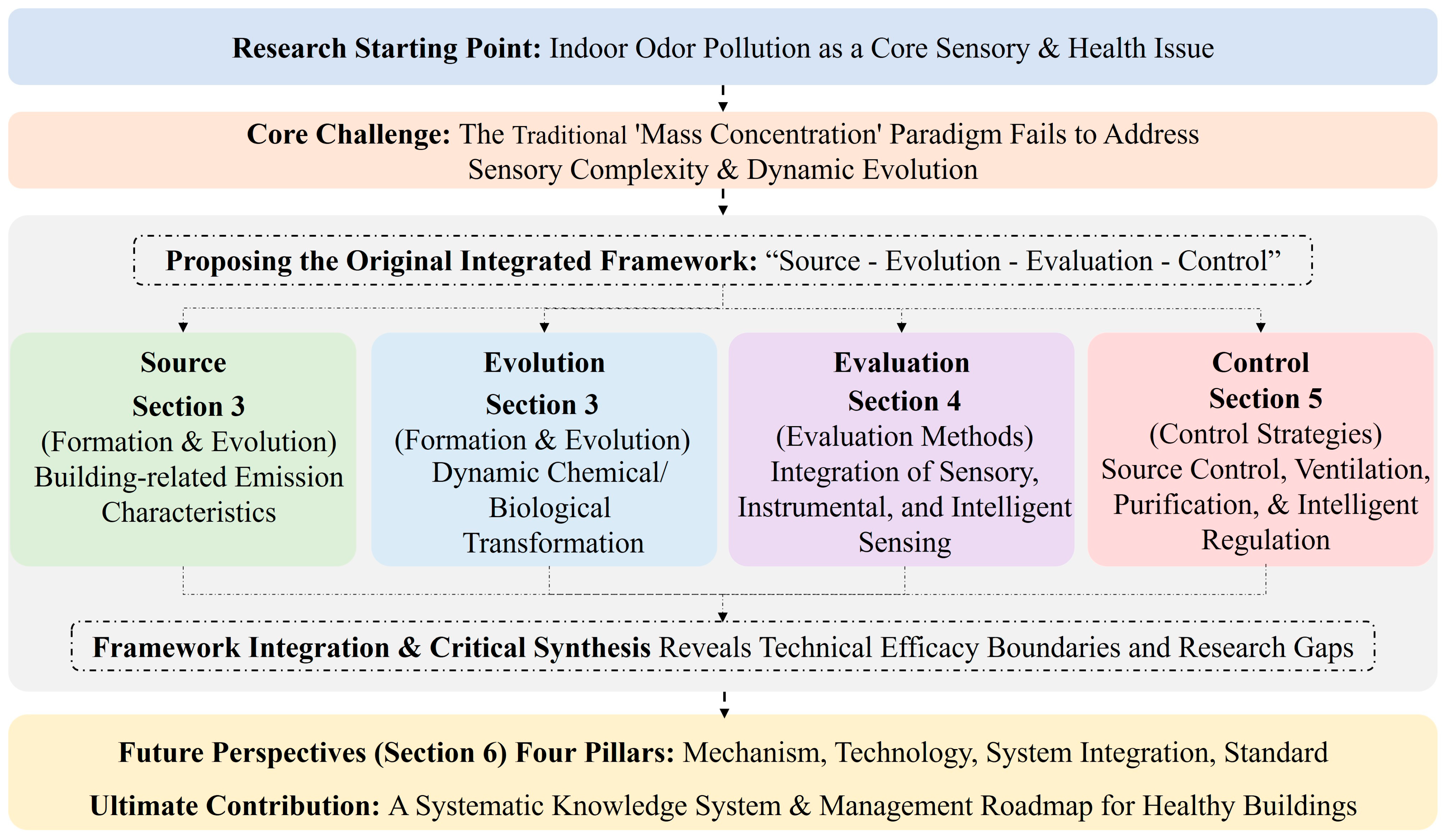
2. Research Design and Methodology
2.1. Literature Search Strategy
2.2. Time Span and Focus Areas
3. Formation Mechanisms and Dynamic Evolution of Indoor Odor Pollution
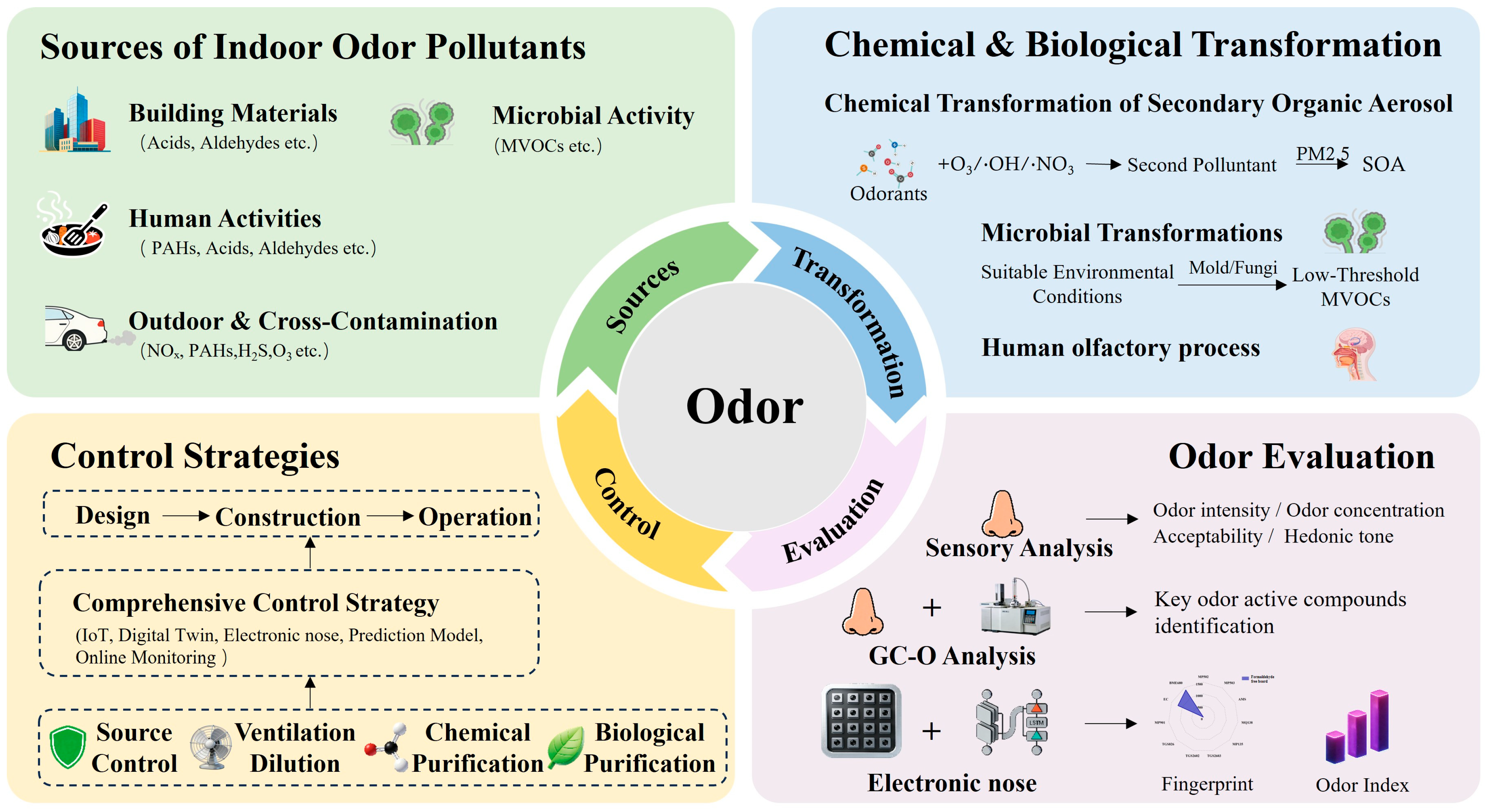
3.1. Diverse Sources and Emission Characteristics of Indoor Odors
3.2. Physiological and Psychological Basis of Odor Perception
3.3. Dynamic Evolution Patterns of Indoor Odors
3.3.1. Chemical Transformation and Secondary Organic Aerosol Formation
3.3.2. Microbial Transformations
3.3.3. Interactions Among Odorants
3.3.4. Spatiotemporal Distribution and Long-Term Evolution of Indoor Odors
4. Evaluation of Indoor Odor Pollution
4.1. Sensory Analysis
4.2. Instrumental Analysis and Intelligent Sensing
4.2.1. Gas Chromatography–Olfactometry (GC–O)
4.2.2. Electronic Nose
4.3. Methodological Integration and Prospects for a Comprehensive Evaluation Framework
5. Control of Indoor Odor Pollution
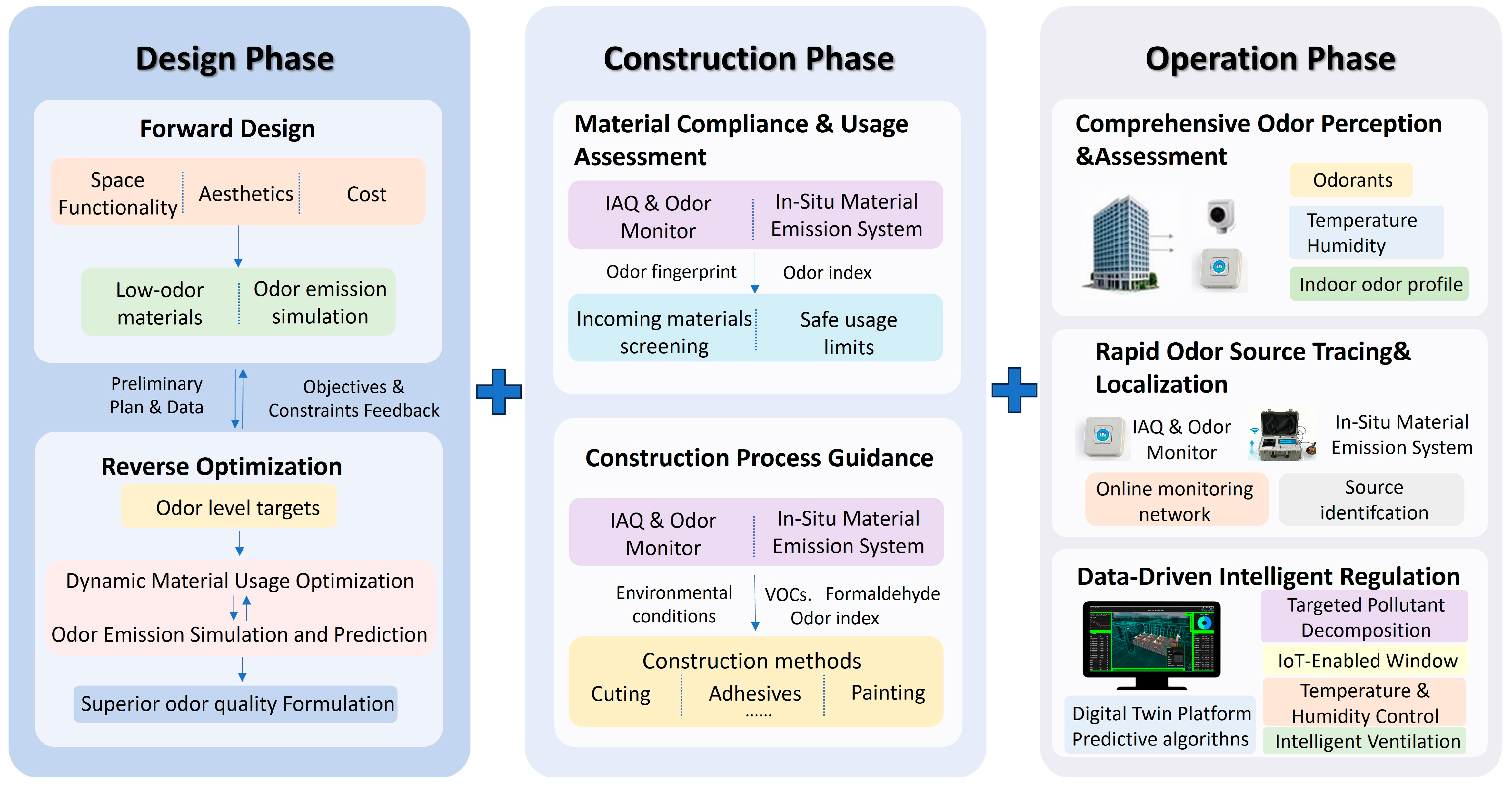
5.1. Source Control
5.2. Ventilation Dilution
5.3. Terminal Purification Technologies
5.4. Integrated Management and Intelligent Regulation: A New Paradigm
6. Conclusions and Perspectives
- Mechanistic elucidation and data-driven modeling: Advanced techniques such as exposomics and single-cell sequencing should be leveraged to elucidate microbial metabolic pathways and olfactory receptor response mechanisms under complex exposure scenarios. Concurrently, multi-source monitoring data should be integrated with building information modeling to develop digital twin systems capable of high-fidelity simulation of odor dispersion, transformation, and sensory impacts, providing essential tools for prediction and scenario analysis.
- Technological Innovation and Material Development: Priority should be given to the development of next-generation adsorptive materials, such as functionalized MOFs and COFs, with high selectivity, large capacity, and low flow resistance, as well as stable catalysts exhibiting high quantum efficiency, broadband light responsiveness, and product pathways favoring complete mineralization. In parallel, synthetic biology approaches should be employed to select and engineer high-performance functional microbial strains and enzymes, alongside optimized bioreactor designs, to enhance the robustness of biological purification technologies.
- Intelligent system integration and engineering implementation: A central challenge lies in overcoming the engineering bottlenecks associated with low-cost, long-lifespan, and highly reliable intelligent sensor networks, as well as in developing robust algorithms capable of adapting to variability in real-world environments. Furthermore, open interface standards should be established to enable seamless interoperability and intelligent coordination among sensing networks, building automation systems, and purification actuators, thereby reducing technical and economic barriers to large-scale deployment.
- Health-oriented reconstruction of standard systems: Management paradigms should evolve from focus on sensory comfort and chemical concentration limit toward comprehensive standard systems integrating health risk assessment. This requires the establishment of health risk databases for odorants based on exposure–dose–response relationships and the exploration of incorporating dynamic sensory evaluation indicators into green building certification and post-occupancy evaluation frameworks, thereby providing a more scientific basis for healthy building governance.
Author Contributions
Funding
Data Availability Statement
Conflicts of Interest
Abbreviations
| AI | Artificial intelligence |
| ANN | Artificial Neural Networks |
| BRI | Building-Related Illness |
| cAMP | Cyclic adenosine monophosphate |
| CFD | Computational Fluid Dynamics |
| CNG | Cyclic nucleotide-gated |
| COFs | Covalent organic frameworks |
| DBD | Dielectric barrier discharge |
| GC-O | Gas chromatography olfactometry |
| HVAC | Heating ventilation and air conditioning |
| IAQ | Indoor air quality |
| IEQ | Indoor Environmental Quality |
| IoT | Internet of Things |
| IVOCs | Intermediate-volatility organic compounds |
| MDI | Methylene Diphenyl Diisocyanate |
| MEMS | Micro Electro Mechanical System |
| MOFs | Metal–organic frameworks |
| MOS | Metal oxide semiconductor |
| MVOCs | Microbial volatile organic compounds |
| NTP | Non thermal plasma |
| OAV | Odor activity value |
| ORs | Olfactory receptors |
| OSNs | Olfactory sensory neurons |
| OVOCs | Oxygenated volatile organic compounds |
| PAHs | Polycyclic aromatic hydrocarbons |
| PCO | Photocatalytic oxidation |
| PIDs | Photoionization detectors |
| RF | Random Forest |
| SBS | Sick Building Syndrome |
| SOA | Secondary organic aerosols |
| SVM | Support Vector Machines |
| SVOCs | Semi-volatile organic compounds |
| VOCs | Volatile organic compounds |
References
- Pruszyński, J.; Cianciara, D.; Włodarczyk-Pruszyńska, I.; Górczak, M.; Padzińska-Pruszyńska, I. Indoor Generation Era. Risks and Challenges. J. Educ. Health Sport 2023, 48, 23–40. [Google Scholar] [CrossRef]
- Niza, I.L.; Bueno, A.M.; Broday, E.E. Indoor Environmental Quality (IEQ) and Sustainable Development Goals (SDGs): Technological Advances, Impacts and Challenges in the Management of Healthy and Sustainable Environments. Urban Sci. 2023, 7, 96. [Google Scholar] [CrossRef]
- Wu, F.; Jacobs, D.; Mitchell, C.; Miller, D.; Karol, M.H. Improving Indoor Environmental Quality for Public Health: Impediments and Policy Recommendations. Environ. Health Perspect. 2007, 115, 953–957. [Google Scholar] [CrossRef]
- Torriani, G.; Torresin, S.; Lara-Ibeas, I.; Albatici, R.; Babich, F. Perceived Air Quality (PAQ) Assessment Methods in Office Buildings: A Systematic Review towards an Indoor Smellscape Approach. Build. Environ. 2024, 258, 111645. [Google Scholar] [CrossRef]
- Dalton, P.; Claeson, A.-S.; Horenziak, S. The Impact of Indoor Malodor: Historical Perspective, Modern Challenges, Negative Effects, and Approaches for Mitigation. Atmosphere 2020, 11, 126. [Google Scholar] [CrossRef]
- Ma, N.; Zhang, Q.; Murai, F.; Braham, W.W.; Samuelson, H.W. Learning Building Occupants’ Indoor Environmental Quality Complaints and Dissatisfaction from Text-Mining Booking. Com Reviews in the United States. Build. Environ. 2023, 237, 110319. [Google Scholar] [CrossRef]
- Cone, J.E.; Shusterman, D. Health effects of indoor odorants. Environ. Health Perspect. 1991, 95, 53–59. [Google Scholar] [CrossRef] [PubMed]
- Bhandari, S.; De Ferreyro Monticelli, D.; Xie, K.; Ramkairsingh, A.; Maher, R.; Eykelbosh, A.; Henderson, S.B.; Zimmerman, N.; Giang, A. Odor, Air Quality, and Well-Being: Understanding the Urban Smellscape Using Crowd-Sourced Science. Environ. Res. Health 2024, 2, 035012. [Google Scholar] [CrossRef]
- World Health Organization. Ambient Air Pollution: A Global Assessment of Exposure and Burden of Disease. Clean Air J. 2016, 26, 6. [Google Scholar] [CrossRef]
- Lewkowska, P.; Dymerski, T.; Gębicki, J.; Namieśnik, J. The Use of Sensory Analysis Techniques to Assess the Quality of Indoor Air. Crit. Rev. Anal. Chem. 2017, 47, 37–50. [Google Scholar] [CrossRef]
- Silva-Néto, R.; Peres, M.; Valença, M. Odorant Substances That Trigger Headaches in Migraine Patients. Cephalalgia 2014, 34, 14–21. [Google Scholar] [CrossRef]
- Schiffman, S.S.; Williams, C.M. Science of Odor as a Potential Health Issue. J. Env. Qual. 2005, 34, 129–138. [Google Scholar] [CrossRef]
- Lin, Z.; Wang, T.; Norback, D.; Kan, H.; Sundell, J.; Zhao, Z. Sick Building Syndrome, Perceived Odors, Sensation of Air Dryness and Indoor Environment in Urumqi, China. Chin. Sci. Bull. 2014, 59, 5153–5160. [Google Scholar] [CrossRef]
- Surawattanasakul, V.; Sirikul, W.; Sapbamrer, R.; Wangsan, K.; Assavanopakun, P.; Panumasvivat, J. Perceived Draught and Odors: The Key to SBS and Indoor Environment in Hospital Administrative Offices—The AIRMED Project. Build. Environ. 2024, 258, 111592. [Google Scholar] [CrossRef]
- Bardana, E.J.; Montanaro, A.; O’Hoilaren, M.T. Building-Related Illness: A Review of Available Scientific Data. Clin. Rev. Allergy 1988, 6, 61–89. [Google Scholar] [CrossRef]
- Diaz, C.N.; Izquierdo, C.; Antón, A.; Kavanagh, R. Economic Impact of the Lack of Odour Management. In Proceedings of the 9th International olores.org & IWA Odour and VOC/Air Emissions Conference, Bilbao, Spain, 26–27 October 2021. [Google Scholar]
- Clements-Croome, D.J. Work performance, productivity and indoor air. Scand. J. Work. Environ. Health 2008, 69–78. [Google Scholar]
- Burdack-Freitag, A.; Heinlein, A.; Mayer, F. Material Odor Emissions and Indoor Air Quality. In Springer Handbook of Odor; Buettner, A., Ed.; Springer International Publishing: Cham, Switzerland, 2017; pp. 65–66. ISBN 978-3-319-26930-6. [Google Scholar]
- Zhao, Y.; Zhao, B. Emissions of Air Pollutants from Chinese Cooking: A Literature Review. Build. Simul. 2018, 11, 977–995. [Google Scholar] [CrossRef]
- Salonen, H.; Salthammer, T.; Castagnoli, E.; Täubel, M.; Morawska, L. Cleaning Products: Their Chemistry, Effects on Indoor Air Quality, and Implications for Human Health. Environ. Int. 2024, 190, 108836. [Google Scholar] [CrossRef] [PubMed]
- Wang, K.; Lin, Z.; Dou, J.; Jiang, M.; Shen, N.; Feng, J. Identification and Surveys of Promoting Plant Growth VOCs from Biocontrol Bacteria Paenibacillus Peoriae GXUN15128. Microbiol. Spectr. 2023, 11, e04346-22. [Google Scholar] [CrossRef]
- Sun, C.; Wang, Z.; Yang, Y.; Wang, M.; Jing, X.; Li, G.; Yan, J.; Zhao, L.; Nie, L.; Wang, Y.; et al. Characteristics, Secondary Transformation and Odor Activity Evaluation of VOCs Emitted from Municipal Solid Waste Incineration Power Plant. J. Environ. Manag. 2023, 326, 116703. [Google Scholar] [CrossRef]
- Huang, C.; Xu, W.; Ning, J.; Li, L.; Jian, Y.; Liu, Z. Characterization, Health Risks, Ozone and Secondary Organic Aerosol Formation, and Odor-Causing Analysis of Gaseous Pollutants from Pig Houses. Air Qual. Atmos. Health 2024, 17, 401–415. [Google Scholar] [CrossRef]
- Sterer, N.; Rosenberg, M. Odor Perception. In Breath Odors; Springer International Publishing: Cham, Switzerland, 2020; pp. 29–33. ISBN 978-3-030-44730-4. [Google Scholar]
- Pírez, N.; Gascue, F.A.; Sorrentino, M.R.; Locatelli, F.F. Sensory Adaptation Modulates Coding and the Perceptual Quality of Odor Mixtures. iScience 2025, 28, 112999. [Google Scholar] [CrossRef]
- Trimmer, C.; Keller, A.; Murphy, N.R.; Snyder, L.L.; Willer, J.R.; Nagai, M.H.; Katsanis, N.; Vosshall, L.B.; Matsunami, H.; Mainland, J.D. Genetic Variation across the Human Olfactory Receptor Repertoire Alters Odor Perception. Proc. Natl. Acad. Sci. USA 2019, 116, 9475–9480. [Google Scholar] [CrossRef]
- Keller, A.; Hempstead, M.; Gomez, I.A.; Gilbert, A.N.; Vosshall, L.B. An Olfactory Demography of a Diverse Metropolitan Population. BMC Neurosci. 2012, 13, 122. [Google Scholar] [CrossRef] [PubMed]
- Blazy, V.; De Guardia, A.; Benoist, J.C.; Daumoin, M.; Guiziou, F.; Lemasle, M.; Wolbert, D.; Barrington, S. Correlation of Chemical Composition and Odor Concentration for Emissions from Pig Slaughterhouse Sludge Composting and Storage. Chem. Eng. J. 2015, 276, 398–409. [Google Scholar] [CrossRef]
- Fukutani, Y.; Abe, M.; Saito, H.; Eguchi, R.; Tazawa, T.; De March, C.A.; Yohda, M.; Matsunami, H. Antagonistic Interactions between Odorants Alter Human Odor Perception. Curr. Biol. 2023, 33, 2235–2245.e4. [Google Scholar] [CrossRef]
- Singh, V.; Murphy, N.R.; Balasubramanian, V.; Mainland, J.D. Competitive Binding Predicts Nonlinear Responses of Olfactory Receptors to Complex Mixtures. Proc. Natl. Acad. Sci. USA 2019, 116, 9598–9603. [Google Scholar] [CrossRef] [PubMed]
- Wang, Y.; Shao, L.; Kang, X.; Zhang, H.; Lü, F.; He, P. A Critical Review on Odor Measurement and Prediction. J. Environ. Manag. 2023, 336, 117651. [Google Scholar] [CrossRef] [PubMed]
- González-Martín, J.; Kraakman, N.J.R.; Pérez, C.; Lebrero, R.; Muñoz, R. A State–of–the-Art Review on Indoor Air Pollution and Strategies for Indoor Air Pollution Control. Chemosphere 2021, 262, 128376. [Google Scholar] [CrossRef]
- Conti, C.; Guarino, M.; Bacenetti, J. Measurements Techniques and Models to Assess Odor Annoyance: A Review. Environ. Int. 2020, 134, 105261. [Google Scholar] [CrossRef]
- Hammond, C.J. Chemical Composition of Household Malodours—An Overview. Flavour Fragr. J. 2013, 28, 251–261. [Google Scholar] [CrossRef]
- Al-Jabiri, A.A.; Balla, H.H.; Al-zuhairy, M.S.; Alahmer, H.; Al-Manea, A.; Al-Rbaihat, R.; Alahmer, A. Applied AMT Machine Learning and Multi-Objective Optimization for Enhanced Performance and Reduced Environmental Impact of Sunflower Oil Biodiesel in Compression Ignition Engine. Int. J. Thermofluids 2024, 24, 100838. [Google Scholar] [CrossRef]
- Jiang, C.; Li, D.; Zhang, P.; Li, J.; Wang, J.; Yu, J. Formaldehyde and Volatile Organic Compound (VOC) Emissions from Particleboard: Identification of Odorous Compounds and Effects of Heat Treatment. Build. Environ. 2017, 117, 118–126. [Google Scholar] [CrossRef]
- Liang, W.; Hu, Y.; Ren, L.; Xu, Y. Volatile Organic Compounds and Odor Emissions from Typical Building Materials and Air Sample Storage Time Analysis. Build. Environ. 2024, 255, 111433. [Google Scholar] [CrossRef]
- Guo, S.; Liang, W. Volatile Organic Compounds and Odor Emissions Characteristics of Building Materials and Comparisons with the On-Site Measurements during Interior Construction Stages. Build. Environ. 2024, 252, 111257. [Google Scholar] [CrossRef]
- Zhao, Z.; Pei, Y.; Zhao, P.; Wu, C.; Qu, C.; Li, W.; Zhao, Y.; Liu, J. Characterizing Key Volatile Pollutants Emitted from Adhesives by Chemical Compositions, Odor Contributions and Health Risks. Molecules 2022, 27, 1125. [Google Scholar] [CrossRef] [PubMed]
- Baran, E.; Czernik, S.; Hynowski, M.; Michałowski, B.; Piasecki, M.; Tomaszewska, J.; Michalak, J. Quantifying Environmental Burdens of Plasters Based on Natural vs. Flue Gas Desulfurization (FGD) Gypsum. Sustainability 2021, 13, 4298. [Google Scholar] [CrossRef]
- Ge, M.; Zheng, Y.; Zhu, Y.; Ge, J.; Zhang, Q. Effects of Air Exchange Rate on VOCs and Odor Emission from PVC Veneered Plywood Used in Indoor Built Environment. Coatings 2023, 13, 1608. [Google Scholar] [CrossRef]
- Komorowicz, M.; Janiszewska-Latterini, D.; Przybylska-Balcerek, A.; Stuper-Szablewska, K. Fungal Biotransformation of Hazardous Organic Compounds in Wood Waste. Molecules 2023, 28, 4823. [Google Scholar] [CrossRef]
- Xue, J.; Cai, H.; Li, W.; Pei, Y.; Guan, H.; Guo, Z.; Wu, C.; Qu, C.; Li, W.; Liu, J. Emissions of VOCs and SVOCs from Polyvinyl Chloride Building Materials: Contribution to Indoor Odor and Inhalation Health Risks. Build. Environ. 2023, 229, 109958. [Google Scholar] [CrossRef]
- Sapuan, S.M.; Ilyas, R.A.; Asyraf, M.R.M. Emission of Hazardous Air Pollution in the Composite Production. In Safety and Health in Composite Industry; Composites Science and Technology; Springer: Singapore, 2022; pp. 35–66. ISBN 978-981-16-6135-8. [Google Scholar]
- Feltracco, M.; Mazzi, G.; Barbaro, E.; Gregoris, E.; Bortolini, M.; Barbante, C.; Gambaro, A. Insights into Size-Segregated Distribution of Benzothiazoles in Indoor Aerosol from Office Environments. Environ. Sci. Atmos. 2024, 4, 571–577. [Google Scholar] [CrossRef]
- Wang, N.; Ernle, L.; Bekö, G.; Wargocki, P.; Williams, J. Emission Rates of Volatile Organic Compounds from Humans. Environ. Sci. Technol. 2022, 56, 4838–4848. [Google Scholar] [CrossRef]
- Wang, L.; Xiang, Z.; Stevanovic, S.; Ristovski, Z.; Salimi, F.; Gao, J.; Wang, H.; Li, L. Role of Chinese Cooking Emissions on Ambient Air Quality and Human Health. Sci. Total Environ. 2017, 589, 173–181. [Google Scholar] [CrossRef] [PubMed]
- Harding-Smith, E.; Shaw, D.R.; Shaw, M.; Dillon, T.J.; Carslaw, N. Does Green Mean Clean? Volatile Organic Emissions from Regular versus Green Cleaning Products. Environ. Sci. Process. Impacts 2024, 26, 436–450. [Google Scholar] [CrossRef] [PubMed]
- Zender-Świercz, E.; Polański, M. Influence of road traffic on indoor air quality. SAE 2022, 14, 142–152. [Google Scholar] [CrossRef]
- Palmiotto, M.; Fattore, E.; Paiano, V.; Celeste, G.; Colombo, A.; Davoli, E. Influence of a Municipal Solid Waste Landfill in the Surrounding Environment: Toxicological Risk and Odor Nuisance Effects. Environ. Int. 2014, 68, 16–24. [Google Scholar] [CrossRef]
- Ren, Y.; Guan, X.; Peng, Y.; Gong, A.; Xie, H.; Chen, S.; Zhang, Q.; Zhang, X.; Wang, W.; Wang, Q. Characterization of VOC Emissions and Health Risk Assessment in the Plastic Manufacturing Industry. J. Environ. Manag. 2024, 357, 120730. [Google Scholar] [CrossRef]
- Xu, L.; Hu, Y.; Liang, W. Composition and Correlation of Volatile Organic Compounds and Odor Emissions from Typical Indoor Building Materials Based on Headspace Analysis. Build. Environ. 2022, 221, 109321. [Google Scholar] [CrossRef]
- You, B.; Zhou, W.; Li, J.; Li, Z.; Sun, Y. A Review of Indoor Gaseous Organic Compounds and Human Chemical Exposure: Insights from Real-Time Measurements. Environ. Int. 2022, 170, 107611. [Google Scholar] [CrossRef]
- Fahy, W.D.; Wania, F.; Abbatt, J.P.D. When Does Multiphase Chemistry Influence Indoor Chemical Fate? Environ. Sci. Technol. 2024, 58, 4257–4267. [Google Scholar] [CrossRef]
- Tong, Z.; Liu, X.; Song, Y.; Guan, H.; Wen, X.; Hu, S.; Lu, M. The Influence of Odors on Cognitive Performance Based on Different Olfactory Preferences. Build. Environ. 2025, 271, 112603. [Google Scholar] [CrossRef]
- Billesbølle, C.B.; De March, C.A.; Van Der Velden, W.J.C.; Ma, N.; Tewari, J.; Del Torrent, C.L.; Li, L.; Faust, B.; Vaidehi, N.; Matsunami, H.; et al. Structural Basis of Odorant Recognition by a Human Odorant Receptor. Nature 2023, 615, 742–749. [Google Scholar] [CrossRef]
- Soudry, Y.; Lemogne, C.; Malinvaud, D.; Consoli, S.-M.; Bonfils, P. Olfactory System and Emotion: Common Substrates. Eur. Ann. Otorhinolaryngol. Head Neck Dis. 2011, 128, 18–23. [Google Scholar] [CrossRef]
- Duchamp-Viret, P.; Duchamp, A.; Chaput, M.A. Single Olfactory Sensory Neurons Simultaneously Integrate the Components of an Odour Mixture. Eur. J. Neurosci. 2003, 18, 2690–2696. [Google Scholar] [CrossRef] [PubMed]
- Egger, V.; Kuner, T. Olfactory Bulb Granule Cells: Specialized to Link Coactive Glomerular Columns for Percept Generation and Discrimination of Odors. Cell Tissue Res. 2021, 383, 495–506. [Google Scholar] [CrossRef]
- Kadohisa, M. Effects of Odor on Emotion, with Implications. Front. Syst. Neurosci. 2013, 7, 66. [Google Scholar] [CrossRef]
- Weschler, C.J. Roles of the Human Occupant in Indoor Chemistry. Indoor Air 2016, 26, 6–24. [Google Scholar] [CrossRef] [PubMed]
- Wolkoff, P.; Wilkins, C.K.; Clausen, P.A.; Nielsen, G.D. Organic Compounds in Office Environments—Sensory Irritation, Odor, Measurements and the Role of Reactive Chemistry. Indoor Air 2006, 16, 7–19. [Google Scholar] [CrossRef]
- Weschler, C.J.; Shields, H.C. Indoor Ozone/Terpene Reactions as a Source of Indoor Particles. Atmos. Environ. 1999, 33, 2301–2312. [Google Scholar] [CrossRef]
- Wolkoff, P.; Clausen, P.A.; Larsen, S.T.; Hammer, M.; Nielsen, G.D. Airway Effects of Repeated Exposures to Ozone-Initiated Limonene Oxidation Products as Model of Indoor Air Mixtures. Toxicol. Lett. 2012, 209, 166–172. [Google Scholar] [CrossRef]
- Weschler, C.J.; Shields, H.C. Potential Reactions among Indoor Pollutants. Atmos. Environ. 1997, 31, 3487–3495. [Google Scholar] [CrossRef]
- Yang, L.; You, B.; Zhou, W.; Xu, W.; Li, Z.; Zhang, Z.; Zhang, Z.; Zhang, Y.; Li, Y.; Sun, Y. Rapid Evolution of Indoor Primary and Secondary Organic Aerosols from Human Activities. Build. Environ. 2024, 261, 111736. [Google Scholar] [CrossRef]
- Pytel, K.; Marcinkowska, R.; Rutkowska, M.; Zabiegała, B. Recent Advances on SOA Formation in Indoor Air, Fate and Strategies for SOA Characterization in Indoor Air—A Review. Sci. Total Environ. 2022, 843, 156948. [Google Scholar] [CrossRef] [PubMed]
- Schleibinger, H.; Laussmann, D.; Bornehag, C.-G.; Eis, D.; Rueden, H. Microbial Volatile Organic Compounds in the Air of Moldy and Mold-Free Indoor Environments. Indoor Air 2008, 18, 113–124. [Google Scholar] [CrossRef]
- Polizzi, V.; Adams, A.; Saeger, S.D. Influence of various growth parameters on fungal growth and volatile metabolite production by indoor molds. Sci. Total Environ. 2012, 414, 277–286. [Google Scholar] [CrossRef]
- Claeson, A.-S.; Levin, J.-O.; Blomquist, G.; Sunesson, A.-L. Volatile Metabolites from Microorganisms Grown on Humid Building Materials and Synthetic Media. J. Environ. Monit. 2002, 4, 667–672. [Google Scholar] [CrossRef]
- Dos Passos Menezes, P.; Dos Santos, P.B.P.; Dória, G.A.A.; De Sousa, B.M.H.; Serafini, M.R.; Nunes, P.S.; Quintans-Júnior, L.J.; De Matos, I.L.; Alves, P.B.; Bezerra, D.P.; et al. Molecular Modeling and Physicochemical Properties of Supramolecular Complexes of Limonene with α- and β-Cyclodextrins. AAPS PharmSciTech 2017, 18, 49–57. [Google Scholar] [CrossRef] [PubMed]
- Yan, L.; Liu, J.; Fang, D. Use of a Modified Vector Model for Odor Intensity Prediction of Odorant Mixtures. Sensors 2015, 15, 5697–5709. [Google Scholar] [CrossRef] [PubMed]
- Wang, Z.; Chang, X.; Hao, W.; Wang, Y.; Huang, M.; Sun, B.; Zeng, X.-A.; Liu, H.; Wu, J.; Zhao, D. Study on Interaction of Aromatic Substances and Correlation between Electroencephalogram Correlates of Odor Perception in Light Flavor Baijiu. J. Agric. Food Chem. 2024, 72, 16519–16529. [Google Scholar] [CrossRef]
- Yin, Y.; Pei, J.; Liu, J. The Effectiveness of Kitchen Ventilation for Organic Gaseous Compound Control in Chinese Residential Buildings. Build. Environ. 2022, 226, 109764. [Google Scholar] [CrossRef]
- Wang, Y.; Li, H.; Feng, G. Numerical Study of the Influence of Ventilation Modes on the Distribution and Deposition of Particles Generated from a Specific Cooking Process in a Residential Kitchen. Indoor Built Environ. 2021, 30, 1676–1692. [Google Scholar] [CrossRef]
- Noorian Najafabadi, S.A.; Sugano, S.; Bluyssen, P.M. Impact of Carpets on Indoor Air Quality. Appl. Sci. 2022, 12, 12989. [Google Scholar] [CrossRef]
- Li, J.; Xie, C.J.; Yan, L.S.; Cai, J.; Xie, P. Carbonyl Levels and Personal Exposures in Large Shopping Malls of Nanchang, China. Anal. Lett. 2013, 46, 1025–1043. [Google Scholar] [CrossRef]
- Mentese, S.; Rad, A.Y.; Arısoy, M.; Güllü, G. Multiple Comparisons of Organic, Microbial, and Fine Particulate Pollutants in Typical Indoor Environments: Diurnal and Seasonal Variations. J. Air Waste Manag. Assoc. 2012, 62, 1380–1393. [Google Scholar] [CrossRef]
- Yin, T.; Gao, W.; Wei, X.; Wu, L.; Wang, C. Dynamics of Indoor Volatile Organic Compounds and Seasonal Ventilation Strategies for Residential Buildings in Northeast China. Indoor Built Environ. 2025, 34, 227–250. [Google Scholar] [CrossRef]
- Winneke, G. Structure and Determinants of Psychophysiological Response to Odorant/Irritant Air Pollution. Ann. N. Y. Acad. Sci. 1992, 641, 261–276. [Google Scholar] [CrossRef] [PubMed]
- EN 13725:2022; Air Quality—Determination of Odour Concentration by Using Dynamic Olfactometry. European Committee for Standardization (CEN): Brussels, Belgium, 2022.
- E679-19; Practice for Determination of Odor and Taste Thresholds By a Forced-Choice Ascending Concentration Series Method of Limits. American Society for Testing and Materials: West Conshohocken, PA, USA, 2010. [CrossRef]
- Kamigawara, K. Odor Regulation and Odor Measurement in Japan; The Ministry of the Environment: Japan, Tokyo, 2003. [Google Scholar]
- HJ 1262-2022; Ambient Air and Waste Gas—Determination of Odor—Triangle Odor Bag Method. Ministry of Ecology and Environment of the People’s Republic of China (MEE): Beijing, China, 2022.
- E544-10; Practices for Referencing Suprathreshold Odor Intensity. American Society for Testing and Materials (ASTM): West Conshohocken, PA, USA, 2010. [CrossRef]
- VDI 3882 Blatt 1; Olfactometry—Determination of Odour Intensity. Association of German Engineers (VDI): Düsseldorf, Germany, 1992.
- Nicell, J.A. Assessment and Regulation of Odour Impacts. Atmos. Environ. 2009, 43, 196–206. [Google Scholar] [CrossRef]
- GB/T 43353-2023; Determination of Odour Emissions for Building Products—Test Chamber Method. State Administration for Market Regulation (SAMR). Standardization Administration of the People’s Republic of China (SAC): Beijing, China, 2023.
- E0619-17; Practice for Evaluating Foreign Odors and/or Flavors from Paper Packaging. American Society for Testing and Materials: West Conshohocken, PA, USA, 2017. [CrossRef]
- VDI 3882 Blatt 2; Olfactometry—Determination of Hedonic Odour Tone. Association of German Engineers (VDI): Düsseldorf, Germany, 1994.
- T/ACEF 155—2024; Technical Guidelines for Field Olfactory Inspection of Odor. All-China Environment Federation (ACEF): Beijing, China, 2024.
- David, M.; Sucker, K.; Hameister, J. The German approach to evaluate complaints about odour annoyance in indoor environments. Indoor Environ. 2024, 1, 100020. [Google Scholar] [CrossRef]
- ISO16000-28 2020; Indoor Air—Part 28: Determination of Odour Emissions from Building Products Using Test Chambers. International Organization for Standardization (ISO): Geneva, Switzerland, 2020.
- ANSI/ASHRAEStandard 62.1-2022; Ventilation for Acceptable Indoor Air Quality. American Society of Heating, Refrigerating and Air-Conditioning Engineers (ASHRAE): Peachtree Corners, GA, USA, 2022.
- Wang, W.; Shen, J.; Liu, M.; Xu, W.; Wang, H.; Chen, Y. Comparative Analysis of Very Volatile Organic Compounds and Odors Released from Decorative Medium Density Fiberboard Using Gas Chromatography–Mass Spectrometry and Olfactory Detection. Chemosphere 2022, 309, 136484. [Google Scholar] [CrossRef]
- Brattoli, M.; Cisternino, E.; Dambruoso, P.; De Gennaro, G.; Giungato, P.; Mazzone, A.; Palmisani, J.; Tutino, M. Gas Chromatography Analysis with Olfactometric Detection (GC-O) as a Useful Methodology for Chemical Characterization of Odorous Compounds. Sensors 2013, 13, 16759–16800. [Google Scholar] [CrossRef]
- Mahmoud, M.A.A.; Zhang, Y. Enhancing Odor Analysis with Gas Chromatography–Olfactometry (GC-O): Recent Breakthroughs and Challenges. J. Agric. Food Chem. 2024, 72, 9523–9554. [Google Scholar] [CrossRef]
- Yu, M.; Yang, P.; Song, H.; Guan, X. Research Progress in Comprehensive Two-Dimensional Gas Chromatography-Mass Spectrometry and Its Combination with Olfactometry Systems in the Flavor Analysis Field. J. Food Compos. Anal. 2022, 114, 104790. [Google Scholar] [CrossRef]
- Cheng, L.; Meng, Q.-H.; Lilienthal, A.J.; Qi, P.-F. Development of Compact Electronic Noses: A Review. Meas. Sci. Technol. 2021, 32, 062002. [Google Scholar] [CrossRef]
- Ijaz, U.; Ali, M.; Ahmad, I.; Hamza, S.A.; Kim, H.-D. A Comprehensive Review of Electronic Nose Systems: Design, Sensors, and Future Directions. Chem. Eng. J. 2025, 524, 169482. [Google Scholar] [CrossRef]
- Li, Y.; Wang, Z.; Zhao, T.; Li, H.; Jiang, J.; Ye, J. Electronic Nose for the Detection and Discrimination of Volatile Organic Compounds: Application, Challenges, and Perspectives. TrAC Trends Anal. Chem. 2024, 180, 117958. [Google Scholar] [CrossRef]
- Sun, C.; Liu, H.; Shao, J.; Pan, G.; Yang, X.; Wang, M.; Dong, J.; Zhu, M.; Qi, Y. Au-Loaded Zn2SnO4/SnO2/ZnO Nanosheets for Fast Response and Highly Sensitive TEA Gas Sensors. Sens. Actuators B Chem. 2023, 376, 132951. [Google Scholar] [CrossRef]
- Hingangavkar, G.M.; Kadam, S.A.; Ma, Y.-R.; Selvaraj, M.; Mulik, R.N.; Patil, V.B. On the Behavior of MoS2-rGO Nanocomposites for Chemiresistive H2S Detection at Room Temperature. Sens. Actuators B Chem. 2024, 399, 134843. [Google Scholar] [CrossRef]
- Gao, N.; Yu, J.; Tian, Q.; Shi, J.; Zhang, M.; Chen, S.; Zang, L. Application of PEDOT:PSS and Its Composites in Electrochemical and Electronic Chemosensors. Chemosensors 2021, 9, 79. [Google Scholar] [CrossRef]
- Chen, Z.; Chen, K.; Yu, W.; Wang, X.; He, X.; Zhang, Q.; Ge, C.; Shi, H.; Huang, Y. SERS-AI Based Detection and Bioanalysis of Malodorous Components in Kitchen Waste. Anal. Chem. 2024, 96, 19615–19622. [Google Scholar] [CrossRef]
- Qu, C.; Liu, Z.; Liu, J.; Wu, C.; Pei, Y.; Zhao, P.; Liu, J. Rapid Determination of Chemical Concentration and Odor Concentration of Paint-Emitted Pollutants Using an Electronic Nose. Build. Environ. 2023, 227, 109783. [Google Scholar] [CrossRef]
- Kumar, K.; Tripathi, S.L.; Mahmud, M. Internet of Things Enabled Smart E-Nose System for Pollutants Hazard Detection and Real-Time Monitoring in Indoor Mosquito Repellents. SN Comput. Sci. 2024, 5, 438. [Google Scholar] [CrossRef]
- Jiang, Y.; Wang, Z.; Hu, Y.; Lin, W.; Yao, L.; Xiao, W.; Hu, J.; Liu, W.; Zheng, C.; Chen, L.; et al. Intelligent Sniffer: A Chip-Based Portable e-Nose for Accurate and Fast Essence Evaluation. Sens. Actuators B Chem. 2025, 426, 136989. [Google Scholar] [CrossRef]
- Wan, Z.; Zhang, W.; Ma, S.; Song, Z.; Wang, C.; Ding, Y.; Chan, C.L.J.; Xue, F.; Wan, Z.; Ye, W.; et al. Inkjet-Printed Wearable E-Nose with Liquid-Phase Ligand-Exchanged Quantum Dots for Human-Centered Gas/Odor Monitoring. ACS Sens. 2025, 10, 8447–8457. [Google Scholar] [CrossRef]
- Zhang, J.; Liu, L.; Yang, Y.; Huang, Q.; Li, D.; Zeng, D. A Review on Two-Dimensional Materials for Chemiresistive- and FET-Type Gas Sensors. Phys. Chem. Chem. Phys. 2021, 23, 15420–15439. [Google Scholar] [CrossRef]
- Ye, Z.; Liu, Y.; Li, Q. Recent Progress in Smart Electronic Nose Technologies Enabled with Machine Learning Methods. Sensors 2021, 21, 7620. [Google Scholar] [CrossRef] [PubMed]
- Baruah, S.; Mazumder, D.H. A Review on Application of Machine Learning Techniques Coupled With E-Nose in Healthcare, Agriculture, and Allied Domains. IEEE Trans. Instrum. Meas. 2025, 74, 2514623. [Google Scholar] [CrossRef]
- Yi, D.; Zhang, L.; Wang, Z.; Wang, L.; Duan, S.; Yan, J. Robust Domain Correction Latent Subspace Learning for Gas Sensor Drift Compensation. IEEE Trans. Syst. Man Cybern, Syst. 2023, 53, 7668–7680. [Google Scholar] [CrossRef]
- Ye, Z.; Li, Y.; Jin, R.; Li, Q. Toward Accurate Odor Identification and Effective Feature Learning With an AI-Empowered Electronic Nose. IEEE Internet Things J. 2024, 11, 4735–4746. [Google Scholar] [CrossRef]
- Yu, C.; Wang, Y.; Yan, Y.; Shi, Y.; Ying, Y.; Men, H. A Method for Assessing the Odor Intensity of Polypropylene Materials with an Electronic Nose to Simulate a Panel of Olfactory Sensory. Chem. Eng. J. 2025, 525, 170026. [Google Scholar] [CrossRef]
- Nivithaa, S.; Mondal, A.; Tripathy, A. Early Diagnosis of Lung Cancer Through VOC Detection Using an Affine Deep Learning E-Nose System. IEEE Access 2025, 13, 181429–181442. [Google Scholar] [CrossRef]
- Zhang, Y.; Xiang, S.; Wang, Z.; Peng, X.; Tian, Y.; Duan, S.; Yan, J. TDACNN: Target-Domain-Free Domain Adaptation Convolutional Neural Network for Drift Compensation in Gas Sensors. Sens. Actuators B Chem. 2022, 361, 131739. [Google Scholar] [CrossRef]
- Mari, M. Green Building Certifications and Rating Systems. In New Perspectives in Indoor Air Quality; Elsevier: Amsterdam, The Netherlands, 2026; pp. 233–248. ISBN 978-0-443-26643-0. [Google Scholar]
- Gonçalves, S.; Curling, S.F.; Ormondroyd, G.; Paiva, N.T.; Martins, J.; Magalhães, F.D.; Carvalho, L.H. Volatile Organic Compound (VOC) Emissions from No-Added-Formaldehyde Lignosulphonate/pMDI Particleboards and Their Effect on Indoor Air Quality. Wood Mater. Sci. Eng. 2024, 21, 9–17. [Google Scholar] [CrossRef]
- Zhao, L.; Arnett, C.M.; Casey, V.I.; Scott, J.W.; Davis, M.A.; Heidkamp, G.; Wilson, R.C. Profiling Specific Volatile Organic Compounds for Mold Detection and Species Identification. Indoor Air 2025, 2025, 9350601. [Google Scholar] [CrossRef]
- Chandra, S.; Bricknell, L.; Makiela, S.; Bruce, S.; Naweed, A. Odour and Indoor Air Quality Hazards in Railway Cars: An Australian Mixed Methods Case Study. J. Environ. Health Sci. Eng. 2024, 22, 503–517. [Google Scholar] [CrossRef]
- Wang, C.; Collins, D.B.; Hems, R.F.; Borduas, N.; Antiñolo, M.; Abbatt, J.P.D. Exploring Conditions for Ultrafine Particle Formation from Oxidation of Cigarette Smoke in Indoor Environments. Environ. Sci. Technol. 2018, 52, 4623–4631. [Google Scholar] [CrossRef]
- Meng, W.; Zhong, Q.; Chen, Y.; Shen, H.; Yun, X.; Smith, K.R.; Li, B.; Liu, J.; Wang, X.; Ma, J.; et al. Energy and Air Pollution Benefits of Household Fuel Policies in Northern China. Proc. Natl. Acad. Sci. USA 2019, 116, 16773–16780. [Google Scholar] [CrossRef] [PubMed]
- Park, S.; Kagi, N.; Umishio, W.; Shinohara, N.; Kim, H. Influence of Mechanical Ventilation Systems on Indoor VOC Concentrations in Residential Buildings. J. Asian Archit. Build. Eng. 2025, 1–21. [Google Scholar] [CrossRef]
- Lin, Y.-P. Natural Ventilation of Toilet Units in K–12 School Restrooms Using CFD. Energies 2021, 14, 4792. [Google Scholar] [CrossRef]
- Weschler, C.J.; Nazaroff, W.W. Semivolatile Organic Compounds in Indoor Environments. Atmos. Environ. 2008, 42, 9018–9040. [Google Scholar] [CrossRef]
- Ahmed Alsharif, M. Understanding Adsorption: Theories, Techniques, and Applications. In Adsorption Fundamental Mechanisms and Applications; Shabatina, T.I., Gromova, Y.A., Eds.; IntechOpen: London, UK, 2025; ISBN 978-1-83634-491-9. [Google Scholar]
- Wang, T.; Zhang, Y.; Yuan, Y.; Chen, P.; Yang, Z.; Zhao, T.; Qin, Y.; Fu, C.; Zhang, J. Efficient Oxidative Removal of Indoor Formaldehyde Using Functionalized Activated Alumina. ACS Appl. Mater. Interfaces 2025, 17, 6188–6197. [Google Scholar] [CrossRef]
- Chao, Y.; Deng, N.; Zhou, Z. A Review of Recent Advances in Metal-Organic Frameworks Materials for Zero-Energy Passive Adsorption of Chemical Pollutants in Indoor Environments. Sci. Total Environ. 2024, 953, 175926. [Google Scholar] [CrossRef] [PubMed]
- Mamaghani, A.H.; Haghighat, F.; Lee, C.-S. Photocatalytic Oxidation Technology for Indoor Environment Air Purification: The State-of-the-Art. Appl. Catal. B Environ. 2017, 203, 247–269. [Google Scholar] [CrossRef]
- Janczarek, M.; Klapiszewski, Ł.; Jędrzejczak, P.; Klapiszewska, I.; Ślosarczyk, A.; Jesionowski, T. Progress of Functionalized TiO2-Based Nanomaterials in the Construction Industry: A Comprehensive Review. Chem. Eng. J. 2022, 430, 132062. [Google Scholar] [CrossRef]
- Schiavon, M.; Torretta, V.; Casazza, A.; Ragazzi, M. Non-Thermal Plasma as an Innovative Option for the Abatement of Volatile Organic Compounds: A Review. Water Air Soil Pollut. 2017, 228, 388. [Google Scholar] [CrossRef]
- Vazquez, T.; Lavrikova, A.; Wiedermann, D.; Babic, J.; Palko, M.; Palko, M.; Machala, Z. Non-Thermal Plasma Coupled with Photocatalysis for Indoor Air Treatment at High Air Flow Rates: Effects on VOCs and Bio-Aerosols. J. Electrost. 2025, 138, 104160. [Google Scholar] [CrossRef]
- Zhang, B.; Ma, Z.; Zhang, Y.; Wang, L.; Yan, J.; Ling, S.; Fang, X. Odor Control Technologies for Municipal Solid Waste Mechanical Biological Treatment Plant: A Review. Clean. Techn. Environ. Policy 2025, 27, 2741–2758. [Google Scholar] [CrossRef]
- Tombuloglu, H.; Aga, O.; Boudellioua, I.; Anil, I.; Yaman, C.; Qureshi, A. Removal of Hydrogen Sulfide (H2S) with Thiobacillus Denitrificans Biofilter: Study of the Microbial Community Conducted through 16S rRNA Sequencing Analysis. 3 Biotech 2025, 15, 344. [Google Scholar] [CrossRef]
- Wei, X.; Lyu, S.; Yu, Y.; Wang, Z.; Liu, H.; Pan, D.; Chen, J. Phylloremediation of Air Pollutants: Exploiting the Potential of Plant Leaves and Leaf-Associated Microbes. Front. Plant Sci. 2017, 8, 1318. [Google Scholar] [CrossRef]
- Waqar, M.; Kim, H. Enhancing Urban Air Quality: The Efficacy of Plant-Based Greenery Systems in Air Purification. Int. J. Sci. Eng. Res. 2024, 8. [Google Scholar]
- Wang, H.; Kou, X.; Gao, R.; Huang, S.; Chen, G.; Ouyang, G. Enzyme-Immobilized Porous Crystals for Environmental Applications. Environ. Sci. Technol. 2024, 58, 11869–11886. [Google Scholar] [CrossRef]



| Primary Source Category | Specific Source Examples | Representative Odorants | Odor Character | Formation/Emission Conditions | Ref. |
|---|---|---|---|---|---|
| Building Materials | Plaster/Gypsum | Acetic acid, Pentanoic acid, Hexanoic acid | Sour, sweaty, musty | Material curing, hydrolysis of organic binders | [18] |
| Dimethyl trisulfide, Propanethiol | Sulfurous, putrid | Sulfur impurities in raw materials, specific processing | [40] | ||
| Wood & Wood-Based Panels | Formaldehyde, Pentanal, Hexanal | Pungent, grassy, fatty | Release from resin binders, emission from wood itself, oxidation | [18] | |
| 1-Methylene-1H-indene, 2-Methylnaphthalene, α-Pinene, Δ3-Carene | Slightly bitter, wheat aroma, piney, resinous | Inherent release from wood | [18,41] | ||
| Pentachlorophenol (PCP), Pentachloroanisole (PCA), Chlorophenol derivatives, PAHs | Pungent, earthy, musty, tarry | Microbial transformation of preservative-treated wood | [42] | ||
| Polymer Materials (e.g., PP, PE, PVC) | 2-Nonenal, 1-Octen-3-one | Rancid, mushroomy, earthy | Oxidation of the polymer matrix during processing or use | [18] | |
| Triethyl phosphate, Cyclohexanone, n-Butyl acetate, 4-Methyl-2-pentanone, 2-Ethyl-1-hexanol | Pungent, sweet, musty, plastic-like | Primary emissions from PVC flooring and wallcoverings | [43] | ||
| Styrene | Plastic-like, solvent-like | Release from polystyrene-containing composites | [44] | ||
| Rubber | Benzothiazole | Rubber-like, sulfurous | Release of accelerators used in vulcanization | [45] | |
| Human Activities | Bioeffluents (Breath/Sweat) | Acetone, Isoprene, Methanol | Sweet, fruity | Basic metabolic products released via breath and skin | [46] |
| 6-Methyl-5-hepten-2-one (6-MHO), 4-Oxopentanal (4-OPA) | Sweaty, oily, sulfurous | Reaction of skin lipids (e.g., squalene) with ozone | [46] | ||
| Cooking & Smoking | Aromatic Hydrocarbons (PAHs) | Oily, burnt | High-temperature cooking, incomplete tobacco combustion | [19] | |
| Fatty acids (e.g., Palmitic acid), Aldehydes (Formaldehyde, Acetaldehyde, Acrolein) | Cooking fume, rancid, pungent | High-temperature heating of cooking oil and food | [47] | ||
| Cleaning & Air Freshening Agents | Limonene, α-Pinene, β-Pinene, Eucalyptol | Citrus, pine, fresh herbal | Volatilization of intentionally added fragrances | [20,48] | |
| Ethanol, Methanol | Alcoholic, sharp | Volatilization of solvents during use or at high temps | [48] | ||
| Formaldehyde, Acetaldehyde, Nonanal, Decanal | Pungent, citrus peel, waxy | Direct emission or generated from terpene oxidation | [18,48] | ||
| Microbial Activity | Mold/Fungi | 1-Octen-3-ol, 3-Methyl-1-butanol, 2-Ethyl-1-hexanol | Musty, earthy, alcoholic | Growth on damp, poorly ventilated building materials/furniture | [21] |
| Geosmin | Strong earthy | Metabolites from microbes (e.g., actinobacteria); common in damp environments | [18] | ||
| Outdoor & Cross-Contamination | Vehicle Exhaust | Nitrogen Oxides (NOₓ), PAHs, Ozone | Pungent, gasoline-like, metallic | Infiltration through windows, doors, building cracks | [49] |
| Industrial Emissions | Hydrogen Sulfide, Ammonia | Rotten egg, pungent | Emissions from waste facilities, transported by wind | [50] | |
| Aldehydes, Acids, Aromatic hydrocarbons (e.g., BTEX) | Pungent, sour, aromatic | Industrial processes (chemical, plastic, pharma) | [51] |
| Odor Indicator | Standard/Method | Panel Size | Key Assessment Method | Output/Scale | Ref. |
|---|---|---|---|---|---|
| Odor Concentration | EN 13725:2022 | ≥4 | Dynamic dilution; Yes/No or forced-choice detection | European Odor Unit (oue/m3) | [81] |
| ASTM E679-19 | No fixed minimum | Dynamic dilution; forced-choice (3-AFC) | Best-Estimate Threshold (BET) | [82] | |
| Japan Triangular Odor Bag Method | ≥6 | Static dilution; triangle odor bag | Odor Index = 10 × log (Odor Concentration) | [83] | |
| HJ 1262-2022 (China) | ≥4–6 | Pressure-assisted static dilution; triangle odor bag | Dimensionless dilution factor | [84] | |
| Odor Intensity | ASTM E544-10 | ≥6 | Matching to n-butanol reference series | Geometric progression (step factor 2) | [85] |
| VDI 3882 Blatt 1 (2021) | ≥8 | 7-point descriptive scale rating | 0 (undetectable) to 6 (extremely strong) | [86] | |
| Japan Triangular Odor Bag Method | ≥6 | 6-point descriptive scale rating | 0 (no odor) to 5 (repulsive) | [87] | |
| GB/T 43353-2023 (China) | ≥8 | Matching to acetone scale + 7-point rating | Linear pi scale (0–20) and 7-point descriptive scale | [88] | |
| Acceptability | GB/T 43353-2023 (China) | ≥15 | Direct sniffing and rating | −1 (completely unacceptable) to +1 (completely acceptable) | [88] |
| ASTM E619-17 | ≥5 | Indirect determination based on guidelines/experience | Qualitative decision (no direct scale) | [89] | |
| Hedonic Tone | VDI 3882 Blatt 2 | ≥15 | 9-point scale rating | −4 (extremely unpleasant) to +4 (extremely pleasant) | [90] |
| T/ACEF 155-2024 (China) | ≥4 | 5-point scale rating | −3 (extremely unpleasant) to +1 (pleasant) | [91] |
| Technology/Sensing Material | Key Advantages | Main Limitations | Typical Applications | Ref. |
|---|---|---|---|---|
| Metal Oxide Semiconductor (MOS/MOX) | High sensitivity, low cost, robust, MEMS-compatible | High power (high temp.), drift, humidity interference | Indoor/outdoor air quality, industrial odor monitoring, pollutant detection (paints, repellents) | [106,107,108] |
| Quantum Dots (PbS CQD, MCSQD) | ppb-level sensitivity, room-temp. operation, printable, tunable selectivity via ligand exchange | Ink stability issues, complex synthesis | Wearable e-nose, TVOC/NO2/CO monitoring, breath analysis | [109] |
| 2D Materials (Graphene, TMDs, MXene, BP) | Large surface area, room-temp. operation, fast response, FET-compatible | Humidity/oxygen sensitivity, fabrication scaling | VOC detection, healthcare diagnostics, food quality, robotics | [110] |
| Conductive Polymers | Flexible, low-cost, room-temp. operation | Poor long-term stability, slow response | Food freshness, medical diagnostics | [111,112] |
| MOS + Advanced ML (CNN, LSTM, Domain Adaptation) | Excellent classification (>97%), drift compensation, quantitative prediction | Needs large training data, computational load | Disease diagnosis, food authentication, odor intensity regression | [113,114,115] |
| IoT + Cloud-Enabled E-nose | Real-time remote monitoring, portable, scalable | Connectivity dependency, data privacy | Smart homes, mosquito-repellent pollutant tracking, indoor IAQ | [107,109] |
| Technology Category | Representative Technology | Core Principle | Advantages | Limitations | Application Scenarios & Building Integration Considerations | Ref. |
|---|---|---|---|---|---|---|
| Adsorption Technology | Activated Carbon/Modified Adsorbents | Physisorption/chemisorption on porous surfaces |
|
|
| [127,128] |
| Metal/Covalent Organic Framework Materials (MOFs/COFs) | Selective adsorption via ultra-high surface area & tunable pores |
|
|
| [129] | |
| Chemical Catalysis & Oxidation | Photocatalytic Oxidation (PCO) | UV light generates reactive oxygen species (ROS) to degrade pollutants |
|
|
| [130,131] |
| Non-Thermal Plasma (NTP) | High-voltage discharge creates plasma, degrade odorants |
|
|
| [132,133] | |
| Biological Purification | Microbial Filtration | Immobilized microbes metabolize pollutants |
|
|
| [134,135] |
| Plant–Microbe Synergistic Systems | Plants & rhizosphere microbes degrade synergistically |
|
|
| [136,137] | |
| Enzyme-based catalytic purification | Immobilized enzymes catalyze specific reactions |
|
|
| [138] |
Disclaimer/Publisher’s Note: The statements, opinions and data contained in all publications are solely those of the individual author(s) and contributor(s) and not of MDPI and/or the editor(s). MDPI and/or the editor(s) disclaim responsibility for any injury to people or property resulting from any ideas, methods, instructions or products referred to in the content. |
© 2026 by the authors. Licensee MDPI, Basel, Switzerland. This article is an open access article distributed under the terms and conditions of the Creative Commons Attribution (CC BY) license.
Share and Cite
Liu, N.; Ning, Z.; Jia, Y.; Ren, Y.; Liu, W.; Zhang, Y.; Zhao, P.; Sun, P.; Zhang, J.; Liu, J. Indoor Odor Pollution: An Interdisciplinary Review from Sources to Control and an Intelligent Building Environment Management Framework. Buildings 2026, 16, 687. https://doi.org/10.3390/buildings16040687
Liu N, Ning Z, Jia Y, Ren Y, Liu W, Zhang Y, Zhao P, Sun P, Zhang J, Liu J. Indoor Odor Pollution: An Interdisciplinary Review from Sources to Control and an Intelligent Building Environment Management Framework. Buildings. 2026; 16(4):687. https://doi.org/10.3390/buildings16040687
Chicago/Turabian StyleLiu, Ning, Zhanwu Ning, Yiting Jia, Yifan Ren, Weijie Liu, Yanni Zhang, Peng Zhao, Peng Sun, Jingjing Zhang, and Jinhua Liu. 2026. "Indoor Odor Pollution: An Interdisciplinary Review from Sources to Control and an Intelligent Building Environment Management Framework" Buildings 16, no. 4: 687. https://doi.org/10.3390/buildings16040687
APA StyleLiu, N., Ning, Z., Jia, Y., Ren, Y., Liu, W., Zhang, Y., Zhao, P., Sun, P., Zhang, J., & Liu, J. (2026). Indoor Odor Pollution: An Interdisciplinary Review from Sources to Control and an Intelligent Building Environment Management Framework. Buildings, 16(4), 687. https://doi.org/10.3390/buildings16040687