Article

Inelastic Displacement Ratios for Degrading Concrete Systems Under Repeated Earthquakes

1
Department of Civil Engineering, Istanbul Technical University, Ayazaga Campus, 34469 Istanbul, Turkey
2
Department of Architecture, Computing and Engineering, University of East London, 4-6 University Way, London E16 2RD, UK
*
Author to whom correspondence should be addressed.
Buildings 2026, 16(3), 663; https://doi.org/10.3390/buildings16030663
Submission received: 5 September 2025 / Revised: 7 December 2025 / Accepted: 12 December 2025 / Published: 5 February 2026

Abstract

This extensive work was carried out to demonstrate the variations in inelastic displacement ratios (IDR) of degrading concrete structures under repeated earthquakes. While the development of sophisticated methods for assessing the seismic demands under repeated earthquakes has been ongoing, these methods are still based on simple material models. None of these models consider the degradation effect. Similarly, the seismic provisions currently in use do not consider repeated earthquakes. They assume that the structure resists the main shock only. The stiffness and strength of the structure is reduced as a result of initial loading, and likewise, the retrofitting of the structure cannot be provided in a brief time; hence, the successive shocks cause more structural damage or failure. Material deterioration effects are evident in structures that experience repeated earthquakes. Even though they survive under the main shock, they collapse under smaller aftershocks. This study comprises the simulation of repeated earthquakes, running simulations with degradation taking into account, preparing IDR curves, and comparing the results that show repeated earthquakes have a profound impact on the IDR of concrete structures compared to single earthquakes, and degradation provides significantly lower IDR values for both single and repeated earthquakes.

1. Introduction

Performance-based design, as one of the most recent developments in earthquake engineering, is the most sophisticated procedure for seismic design so far. It is based on defining performance objectives for different hazard levels before the event occurs by means of probabilistic analysis and by evaluating the social and financial impacts of the hazard. To achieve a correct evaluation, it is fundamental to estimate inelastic displacements in the structure as accurately as possible. These approaches have taken place in many different standards, codes, and guidelines such as ATC, FEMA 450, TBI, and Eurocode 8 [1,2,3,4]. The estimation of maximum target inelastic displacement is associated with modification factors that relate displacements of single degree of freedom (SDOF) systems to roof displacements of multi degree of freedom (MDOF) systems, the ratio of maximum inelastic to maximum elastic displacement, and the degradation effects and the second order effects.
In 1960, Veletsos and Newmark [5] were some of the earliest researchers to bring forward the idea of the equal displacement rule, which states that the maximum inelastic deformation is equal to the maximum elastic deformation for low frequency regions of structures. Shimozaki and Sozen [6] achieved the same results afterwards with one earthquake record and different hysteretic models; however, in that study, no degradation was considered. In 1991, Qi and Moehle [7] had similar results in their study; in the acceleration-sensitive spectral region, the inelastic deformation ratio (IDR) was decreased due to post-yield stiffness.
The maximum inelastic displacement demand of structures is the key element in displacement-based seismic design procedures. The maximum inelastic displacement is typically found by scaling down the elastic displacement through the inelastic displacement ratio. The inelastic displacement ratio is described as the ratio of the maximum inelastic displacement of the structure to the maximum displacement of the elastic structure, and it was first formed in [8,9,10]. Then, a ground-breaking study was carried out by Miranda [11] using several records by also accounting for the soil effect, which was then followed by the development of inelastic displacement ratio plots for structures, which demonstrated that the inelastic deformation is insignificant for periods longer than one second.
The effects of ground motion and structural characteristics on the IDR were also statistically conducted, and some predictive models for the estimation of the IDR were also suggested by Ruiz Garcia and Miranda [12]. They estimated the IDR value by including different parameters in a simplified equation, and these are the structural period, lateral yielding strength, strain hardening ratio, site conditions, and earthquake-related parameters such as magnitude and distance to source. Even though this equation became very convenient for structural design purposes, it was agreed that IDRs underestimate the expected maximum lateral deformations. Ruiz-García [13] studied IDRs to assess structures subjected to forward-directivity near-fault ground motions and proposed an equation to obtain IDRs for these types of structures. Miranda and Akkar [14] conducted a study on the dynamic stability of a single-degree-of-freedom system to examine the post-yield stiffness and the effect of the period of vibration, which are subjected to 72 recorded ground motions, and oscillators were measured with a bilinear hysteretic behavior with negative post-yield stiffness. It was shown that the mean normalized lateral strength dropped as negative post yield stiffness increased. Rahnama and Krawinkler [15] conducted a similar study with a smaller set of ground motions; except, this time strength degradation, pinching, and P-delta effects were considered in their model. Likewise, Gupta and Kunnath [16] used a three-parameter model to investigate the effects of stiffness and strength degradation and pinching on IDR. Further research has been conducted to estimate the inelastic response of systems with proper IDR factors, which was then included in seismic design guidelines. IDRs have been utilized in not only design but also retrofitting codes such as FEMA P-695 and ASCE/SEI 41-13. Alternative nonlinear methods that enable us to interpret relations between inelastic deformations and performance of structures were also proposed.
Song and Pinchiera [17] proposed a model with both strength and stiffness degradation, but their study did not account for the hysteretic energy dissipation; therefore, no potential collapse could be estimated. Two different equations were developed with 214 earthquake records by Chopra and Chintanapakdee [18] to estimate the IDR values for existing and new structures, but the model disregarded the effect of degradation.
In the studies of Chenouda and Ayoub [19,20], two different material models were adopted, which were a bilinear model for steel structures and a modified Clough model for concrete structures. They suggested a new energy-based model that consists of four regions, including the elastic branch, strain hardening branch, and softening cap branch. It was found that shorter period structures’ IDR values were more affected by degradation in comparison to systems with no degradation.
Degrading and non-degrading structures have been examined in many studies and researched at an advanced level and counting. As an example, Dutta [21] studied the torsional behavior of RC structures using deterioration characteristics. One of the latest studies was carried out by Malaga-Chuquitaype [22] for various degrading eccentric structures, which were subjected to bidirectional earthquake loading by means of dimensional and orientational analysis.
While the impact of various parameters on IDR estimation has been continuously investigated, structures subjected to repeated earthquakes have also been examined recently. Repeated earthquakes are characterized by occurring in the same location, where complex fault systems exist, at separate times. They represent the relief of strains from the first event till the stabilization of the faulting system. Repeated earthquakes have alike seismic waveforms, which allow us to examine the source and material properties of the rocks where wave propagates [23]. Hatzigeorgiou and Beskos [24] studied SDOF systems under repeated earthquakes with 112 earthquake records and found that they have significant impacts on IDR values and, therefore, maximum displacements. Another implication on the same perspective came from Faisal et al. [25], who presented the outcomes of their study on concrete structures with 20 ground motions. The stiffness and strength degrading hysteresis rule applied in the study shows that repeated earthquakes tend to increase the story ductility demand by 1.3 to 1.4 times when repeated earthquakes are induced.
Strength reduction factor, R, being one of main parameters of this study, has also drawn other researchers’ attention. For instance, Amadio et al. [26] discussed the effects of repeated ground motions on SDOF systems and how strongly the strength reduction factor is influenced when using different hysteretic models. The noteworthy outcome is that the q factor under repeated earthquakes sharply reduces compared to the equivalent SDOF system, especially for elastic–perfect plastic and moment resisting steel systems.
Thara et al. [27] investigated IDR variations under repeated earthquakes for three, six, and nine story concrete buildings and showed a significant increase in IDR values that can go up to 21% more than the case with no repeated records. Furthermore, Ozkul et al. [28] brought an expanded approach to the topic by using a fuzzy logic model to predict IDR values for SDOF RC structures, which resulted in more accuracy than other classical methods used. Similarly, a machine-learning-related comparative study was conducted by Lazaridis et al. [29] to estimate the structural damage of an eight story RC building subjected to single and successive earthquakes, where the structural damage was given in terms of damage indices. More recently, Zhang et al. [30] studied main– aftershock sequences on concrete-filled steel tube structures (CFSTS) and buckling-restrained braces (BRB) frame structures, and their results confirmed that the structural vulnerability of the two structures is meaningfully greater under the main–aftershock sequences than under the main shock only. They concluded that the structure with BRBs could decrease the displacement demand and the hysteretic energy and increase the seismic performance. Additionally, Hu et al. [31] assessed the seismic resilience of structures by comparing single shocks and multiple aftershocks in terms of economic loss and found out that multiple aftershocks amplified the economic loss by 20–30% on average.
Even though there have been several studies investigating the effect of degradation on various structures in the past, no studies have attempted to examine the coupled effect of repeated earthquakes and degradation acting simultaneously on a structure. Thus, our effort is to draw attention to this gap and to make a novel contribution to evaluate how IDR values vary by means of assessing those two impacts at once. Hence, the purpose of this new study is to examine the IDR variation and potential for collapse of RC systems under repeated earthquakes by taking energy-based degradation into consideration.

2. Analytical Model

Strong earthquakes have aftershocks that can be more destructive than the main event. This is because sequences usually last for days, and the structure is already damaged from the main event, where retrofit cannot be provided in a short amount of time. As a result, the structure is not able to stand the aftershock sequence. The damage develops out of loss of stiffness and strength deterioration under successive loading. Therefore, it is crucial to include degradation in modeling the hysteretic behavior. Experimental verification confirms that all materials deteriorate as a function of the loading history. Each inelastic loading causes damage. and the damage increases with the increase of the number of loadings. Rahnama and Krawinkler [15] discussed different types of degradation in detail by using experimental test observation. They covered many scenarios of cyclic loading and found that the energy-based degradation model showed a better fit to experimental results than the other approaches. The study concerned the effects of history-dependent strength and stiffness deterioration on displacement demands, and the renewal of the deterioration parameter of the hysteretic energy dissipation was crucial for each excursion. On the other hand, the response was perceptive to the deterioration parameter that classified the strength deterioration occurrence level.
Typically, degradation is considered in the following ways:
  • The degradation function of element ductility is a displacement-based approach. This method does not provide accurate enough results to simulate the degrading behavior of specimens subjected to loading cycles producing constant ductility.
  • The degradation function of hysteretic energy is an energy-based approach. This method has proven that produced results pair well with experimental results, while also requiring simpler procedures for calibration of the degradation parameters.
  • The degradation function of both the element ductility and dissipated hysteretic energy requires more factors for calibration of the degradation parameters; thus, it is more complex than other approaches.
As the energy-based approach characterizes a good compromise between accuracy and easiness, it was preferred in the current study. Additionally, four types of cyclic degradation based on hysteretic energy were considered to account for the degradation and were concurrently employed for bilinear and Clough models [32]. This approach is based on the work of Krawinkler’s method and is later used as it was developed by Ayoub et al. [33,34] and Ibarra et al. [35].
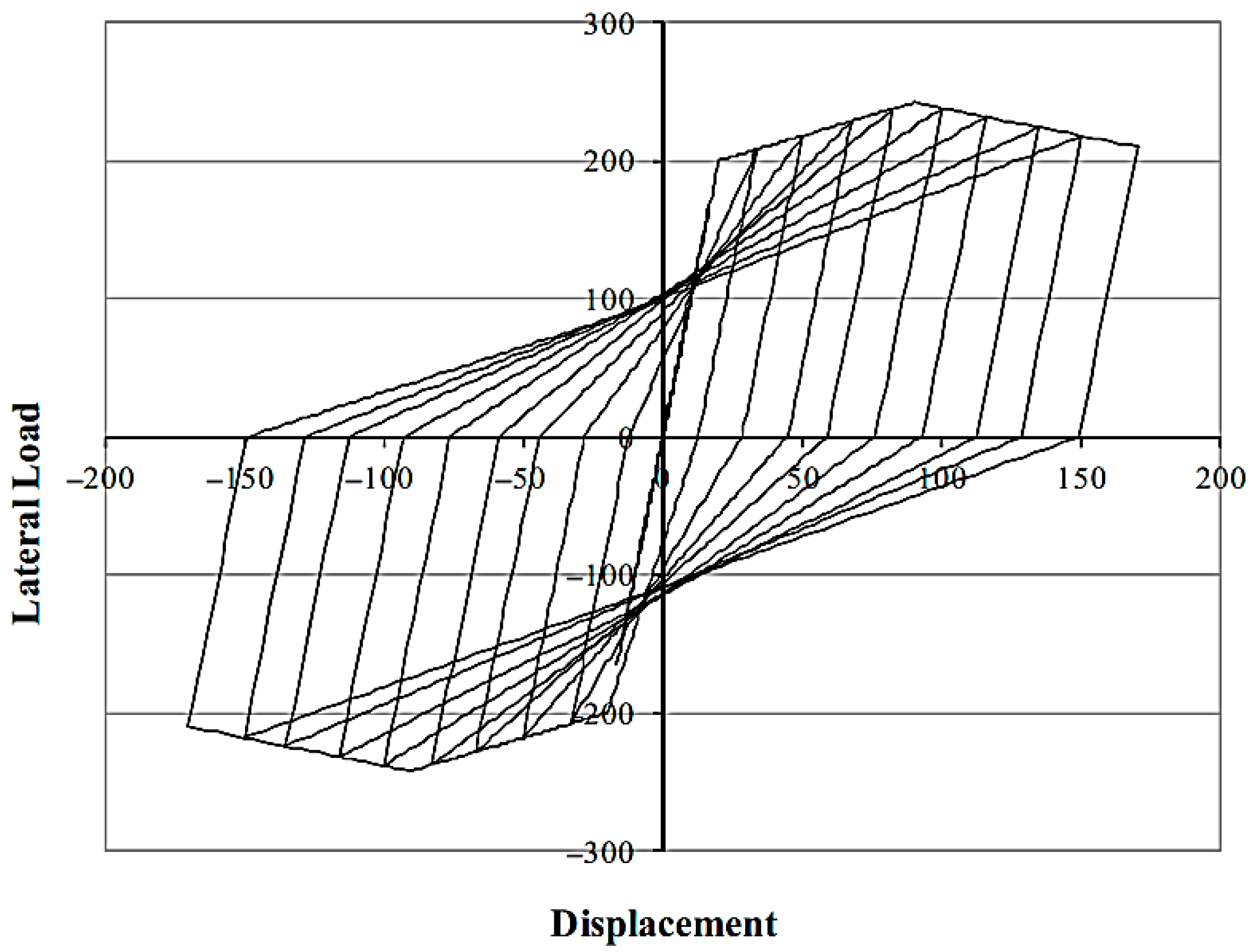
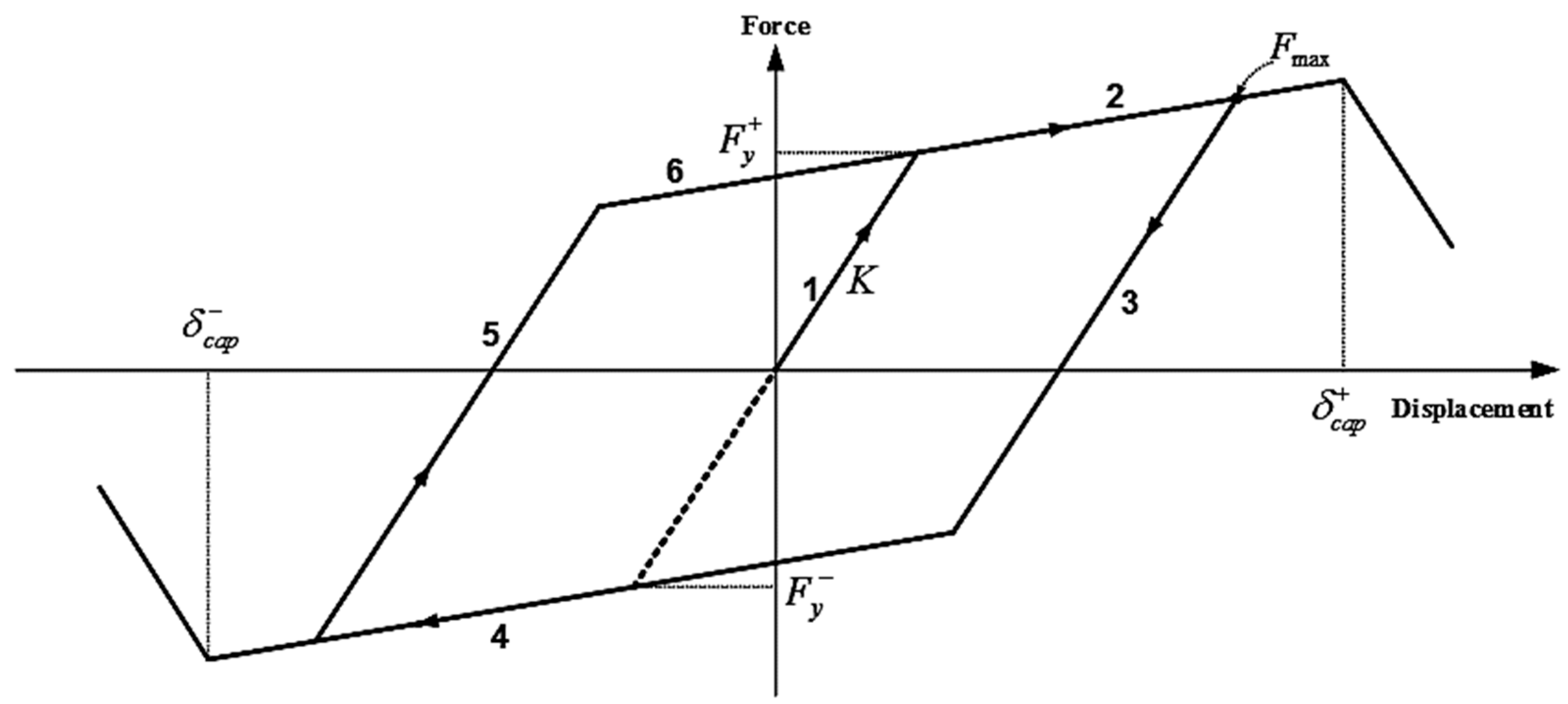
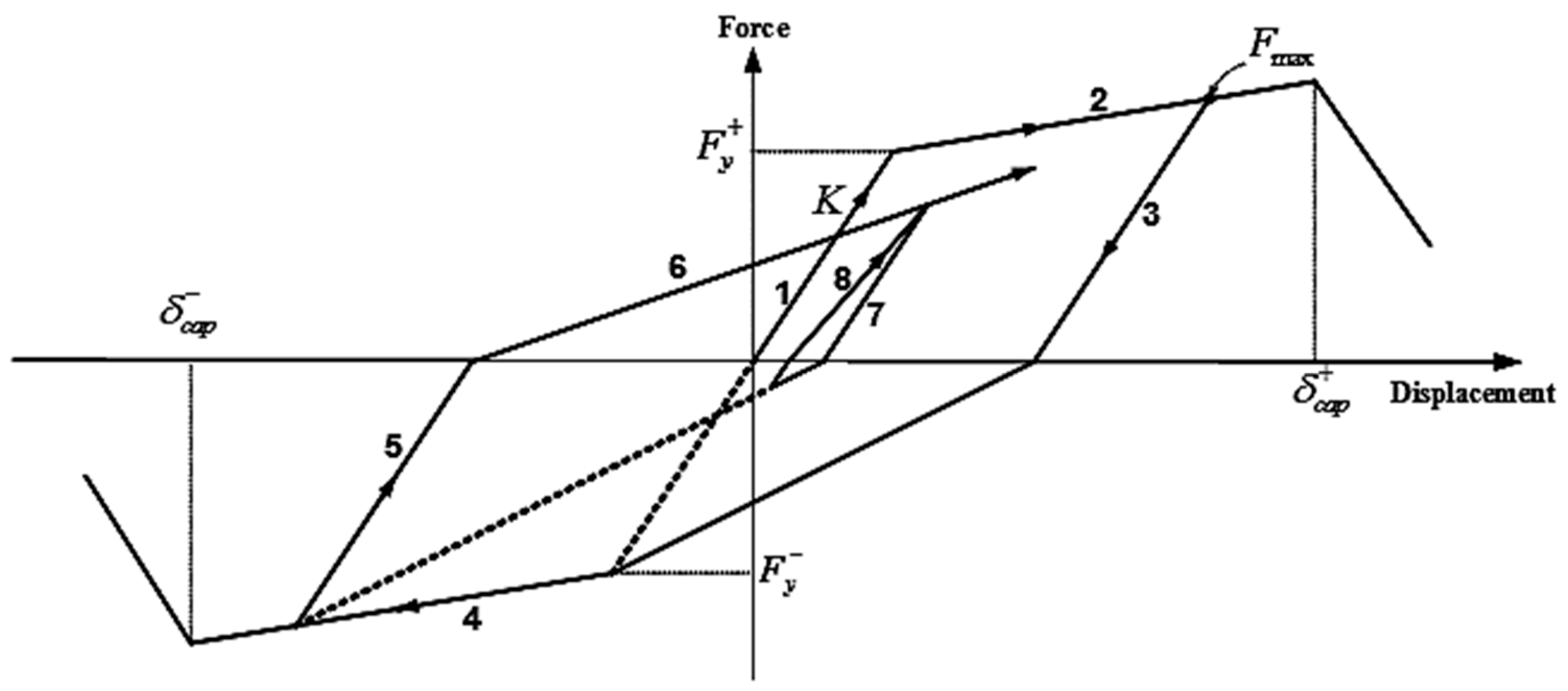
Figure 1 and Figure 2 below demonstrate force–displacement degradation envelopes for bilinear and Clough models, respectively. The monotonic behavior of the element includes three branches, which are the elastic branch, strain hardening branch, and softening branch. The latter is also known as the cap branch. As seen in Figure 2, the modified Clough model cyclic loading has four parts, which are loading, unloading, reloading, and unloading. The loading and reloading parts are followed by an unloading part, of which, the slope is parallel to the initial slope. In this study, the modified Clough model was chosen to account for degradation under repeated loading, especially due to aftershocks being destructive for repeated earthquakes, and this may cause more structural vulnerability on its damaged status.
The types of degradation considered are as follows:
  • Yield (Strength) Degradation
Yield degradation is defined as the reduction of yield strength value in loading history, which is represented in Figure 3.
The yield degradation is derived through the following equation:
F y i   = F y i 1 ( 1 β s t r i )
where
F y i   = yield strength at the current excursion i;
F y i 1   = yield strength at the previous excursion i − 1;
β s t r i = a scalar parameter, ranging from 0 to 1, that accounts for yield degradation effects at the current excursion i.
β s t r i is defined by the following equation:
β s t r i = E i E c a p a c i t y   j = 1 i E j C s t r
E i = hysteretic energy dissipated in the current excursion i;
j = 1 i E j = total hysteretic energy dissipated in all excursions up to the current one;
C s t r = exponent rate for yield strength under cyclic loading defining the rate of deterioration.
E c a p a c i t y is the energy dissipation capacity of the concrete column, which is calculated as a function of the strain energy as in the following:
E c a p a c i t y   =   γ s t r   ·   F y δ y
where Fy is the initial yield strength, and δy is the corresponding deformation ti initial deformation strength, respectively. γstr is the rate of the degradation for yield strength under cyclic loading. γstr and C s t r are calibrated for each material by means of experimental data.
2.
Unloading Stiffness Degradation
Unloading stiffness degradation is defined as the reduction of unloading stiffness as a function of loading history, which is represented in Figure 4.
The decrease in unloading stiffness as a function of the loading history is given in the equation below:
K u n l i   = K u n l i 1     ( 1 β u n l i )
where
K u n l i   = unloading stiffness at the current excursion i;
K u n l i 1 = unloading stiffness at the previous excursion i − 1;
β u n l i   = a scalar parameter (from 0 to 1) for accounting for unloading stiffness degradation at current path i;
γunl is the rate of the degradation for unloading stiffness under cyclic loading;
Cunl is the exponent rate for unloading stiffness degradation under cyclic loading.
3.
Accelerated Stiffness Degradation
In peak oriented models, the reloading stiffness degrades as a function of cumulative loading. This is considered in hysteretic models by modifying the target point to which the loading is directed, as shown in Figure 5.
The accelerated stiffness degradation parameter β a c c i is similar to those parameters used for strength and unloading stiffness degradation, except C and γ are different values and are referred to as Cacc and γacc, respectively. The displacement value of the target point can be calculated through the following Equation (5):
δ t a r i   = δ t a r i 1     ( 1 + β a c c i )
where
δ t a r i is the displacement of the target point at the current excursion i;
δ t a r i 1 is the displacement of the target point at the previous excursion i − 1;
β a c c i   is a scalar parameter (from 0 to 1) for accounting for accelerated stiffness degradation at current path i;
γacc is the rate of the degradation for accelerated stiffness degradation under cyclic loading;
Cacc is the exponent rate for accelerated stiffness degradation under cyclic loading.
4.
Cap Degradation
The experiments show that the point of onset of softening shifts inwardly because of cumulative damage, as it is referred to cap degradation. The modified envelope due to cap degradation is represented in Figure 6.
The onset of the softening point can be modified through the following equation, which is used to find cap stiffness degradation type:
δ c a p i   = δ c a p i 1     ( 1 β c a p i )
where
δ c a p i is the displacement of the onset of the softening point at the current excursion i;
δ c a p i 1 is the displacement of the onset of the softening point at the previous excursion i − 1;
  β c a p i is a scalar parameter (from 0 to 1) used for accounting for cap degradation at the current path i;
γacc is the rate of the degradation for cap degradation under cyclic loading;
Cacc is the exponent rate for cap degradation under cyclic loading.
For further information on the types of degradation and formulations, the readers are encouraged to look at references [19,28,33,34].

2.1. Degradation Effects on SDOF Systems

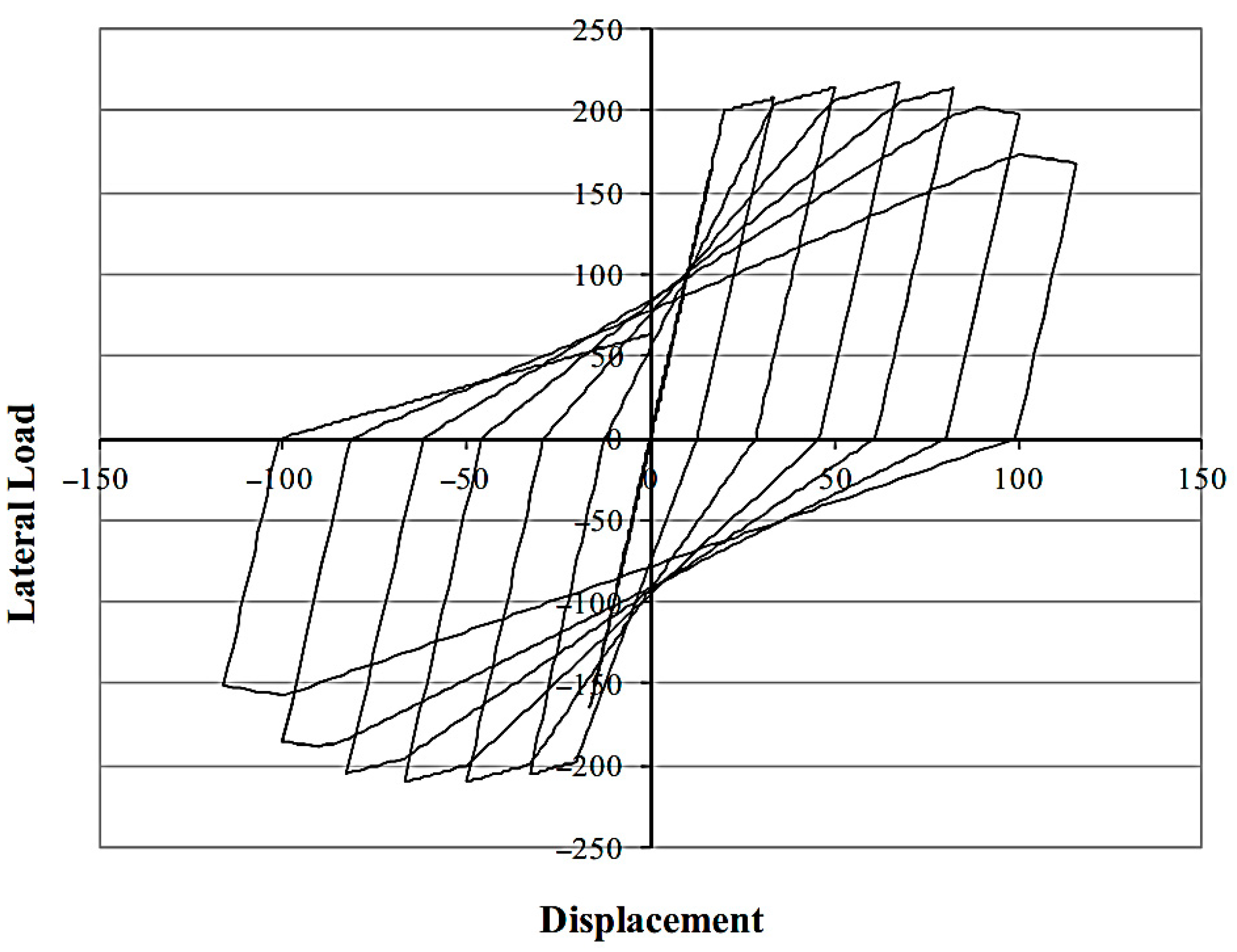
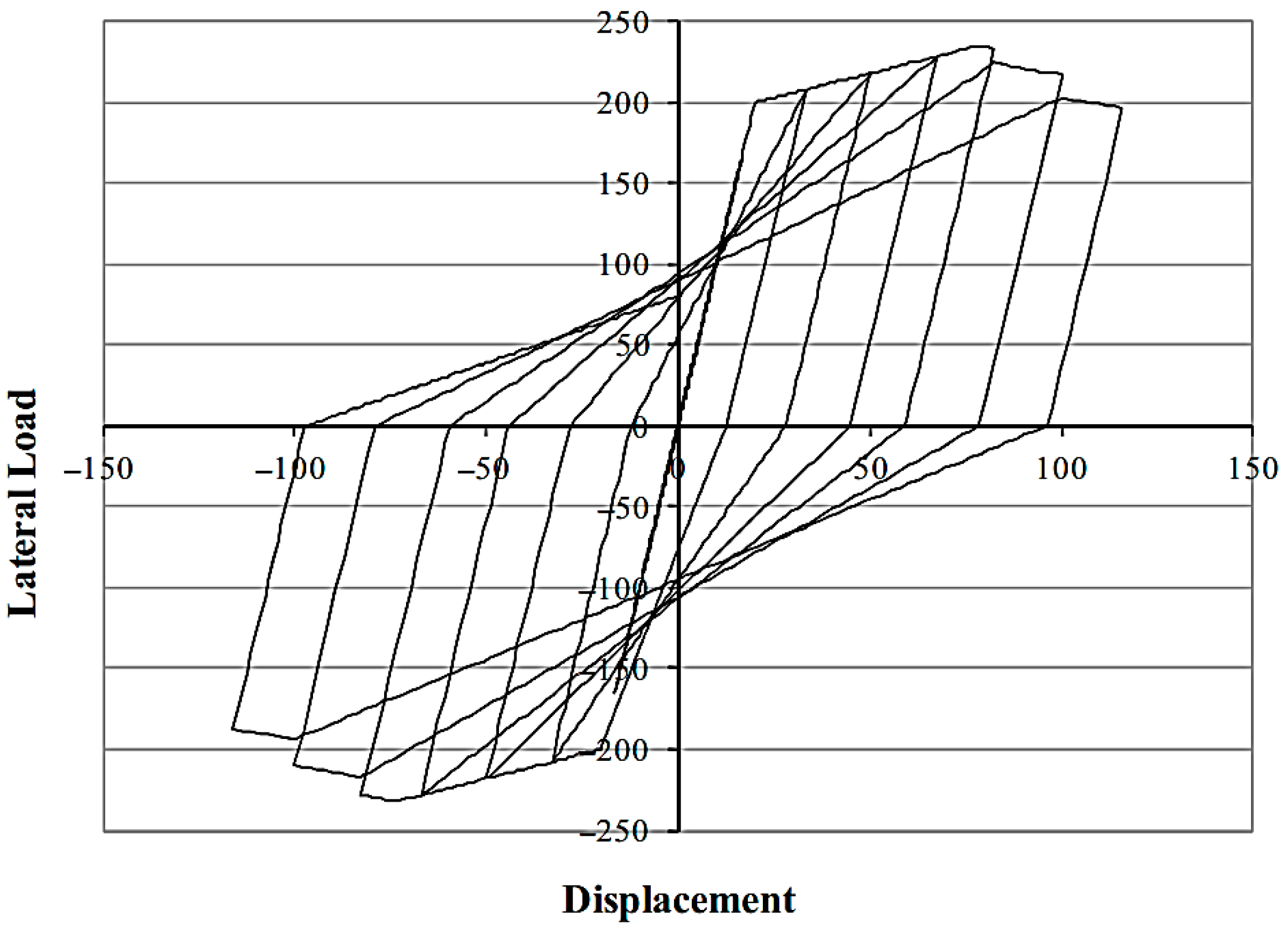
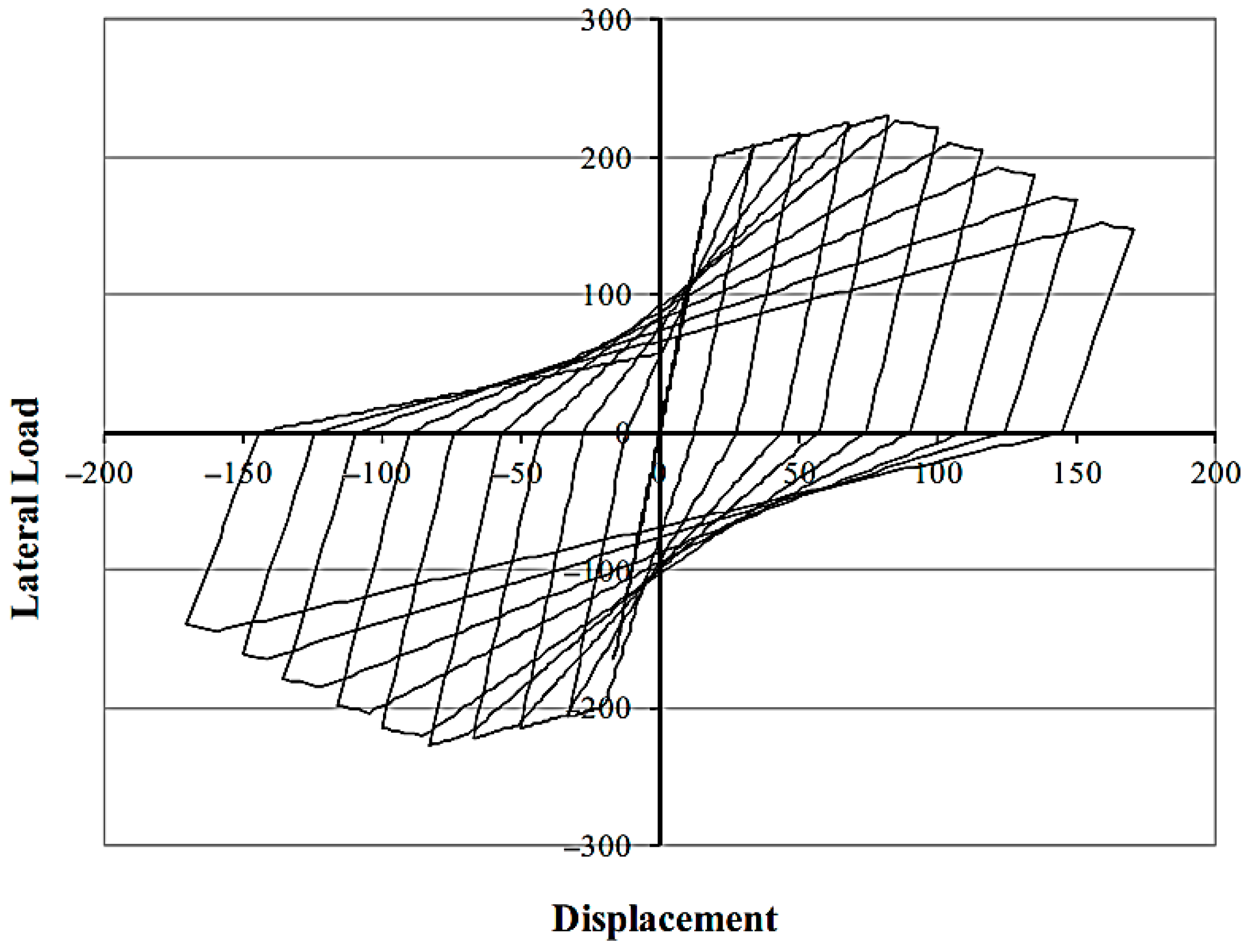
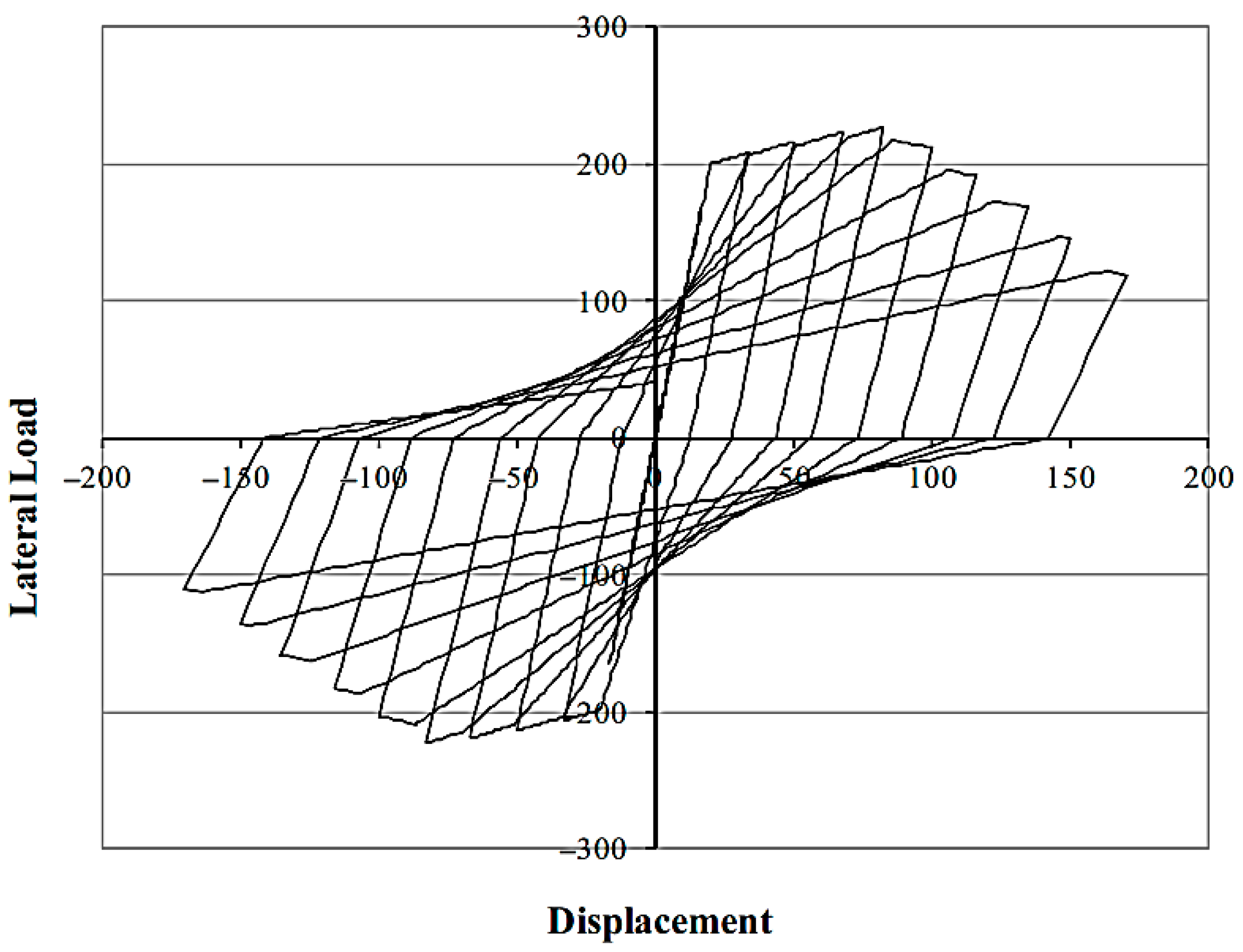
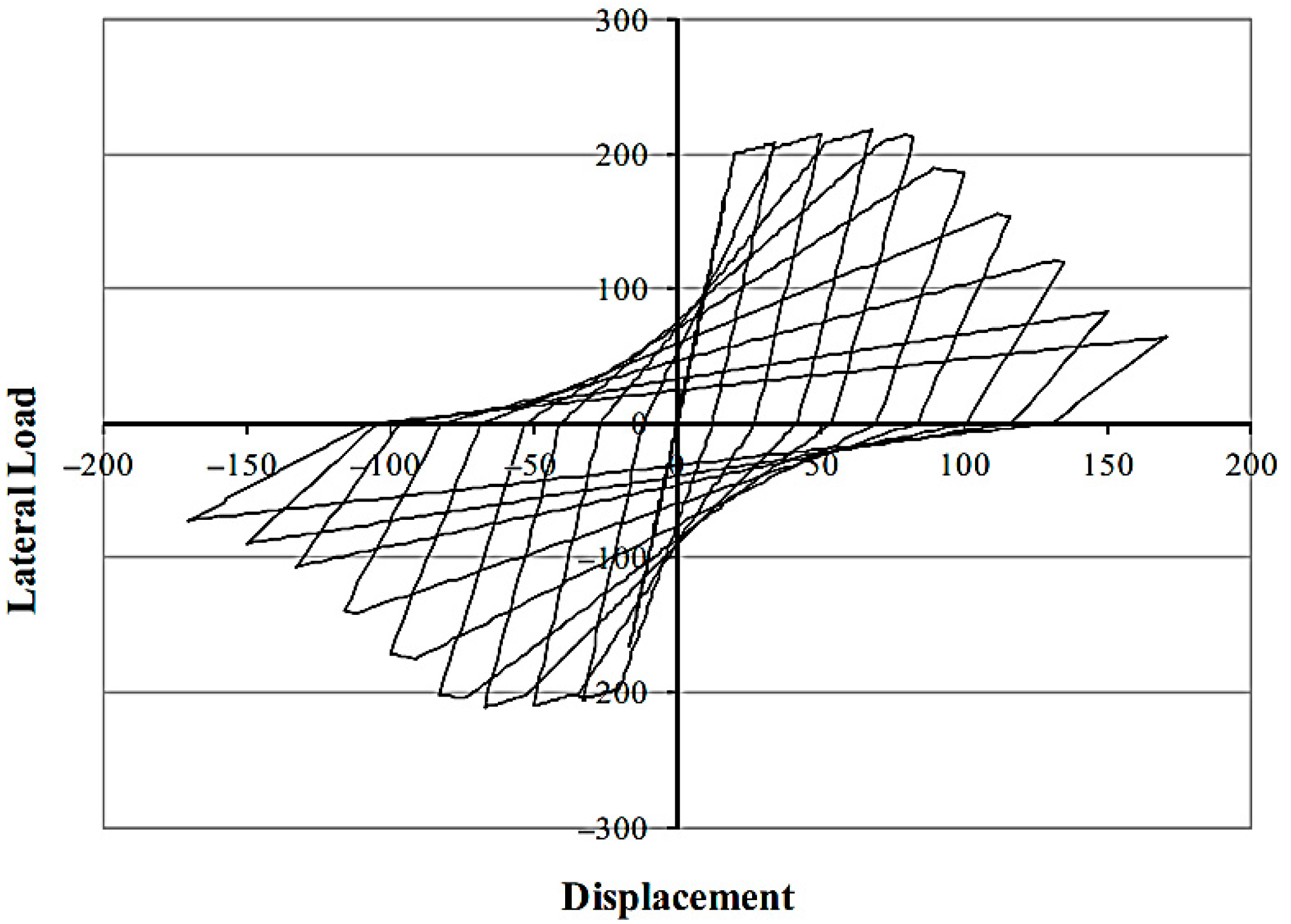
The modified Clough model is considered to represent concrete structures in this study. Under cyclic loading and in case of no degradation, the system does not collapse, as seen in Figure 7. On the other hand, for systems with degradation (from low to severe), the envelope of the cycle degrades, which leads the system potentially into collapse as seen in Figure 8, Figure 9 and Figure 10. Lateral load versus displacement plots (Figure 3, Figure 4, Figure 5, Figure 6, Figure 7, Figure 8, Figure 9 and Figure 10) have been given to illustrate the generic behavior of various types of degradation in kN and in mm, respectively, as cited in references.

2.2. Collapse of Structural Elements

A structural element is assumed as totally collapsed if either of the following two criteria are proven:
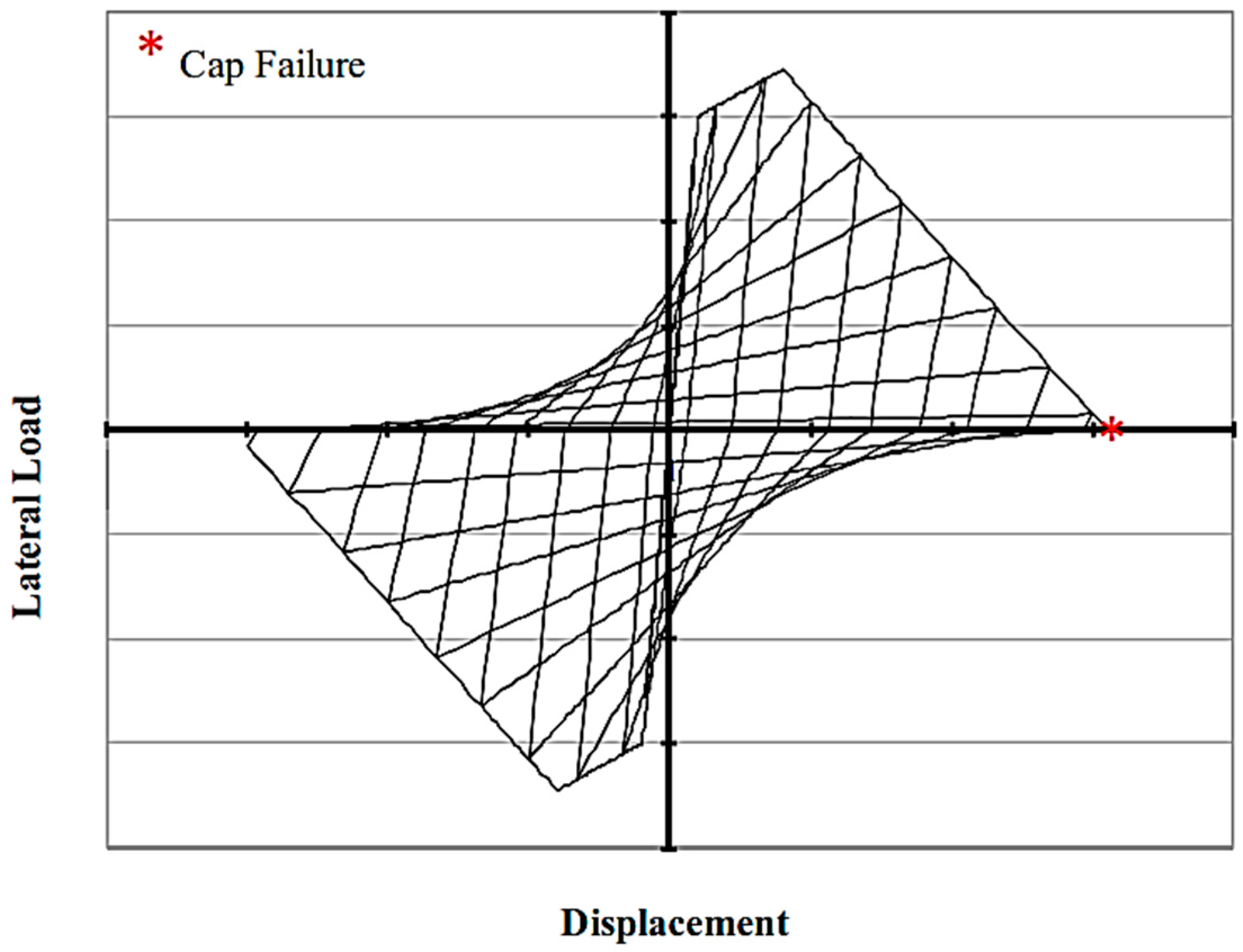
  • Cap failure: The displacement surpasses the value of the intersection point of the cap slope with the residual strength line.
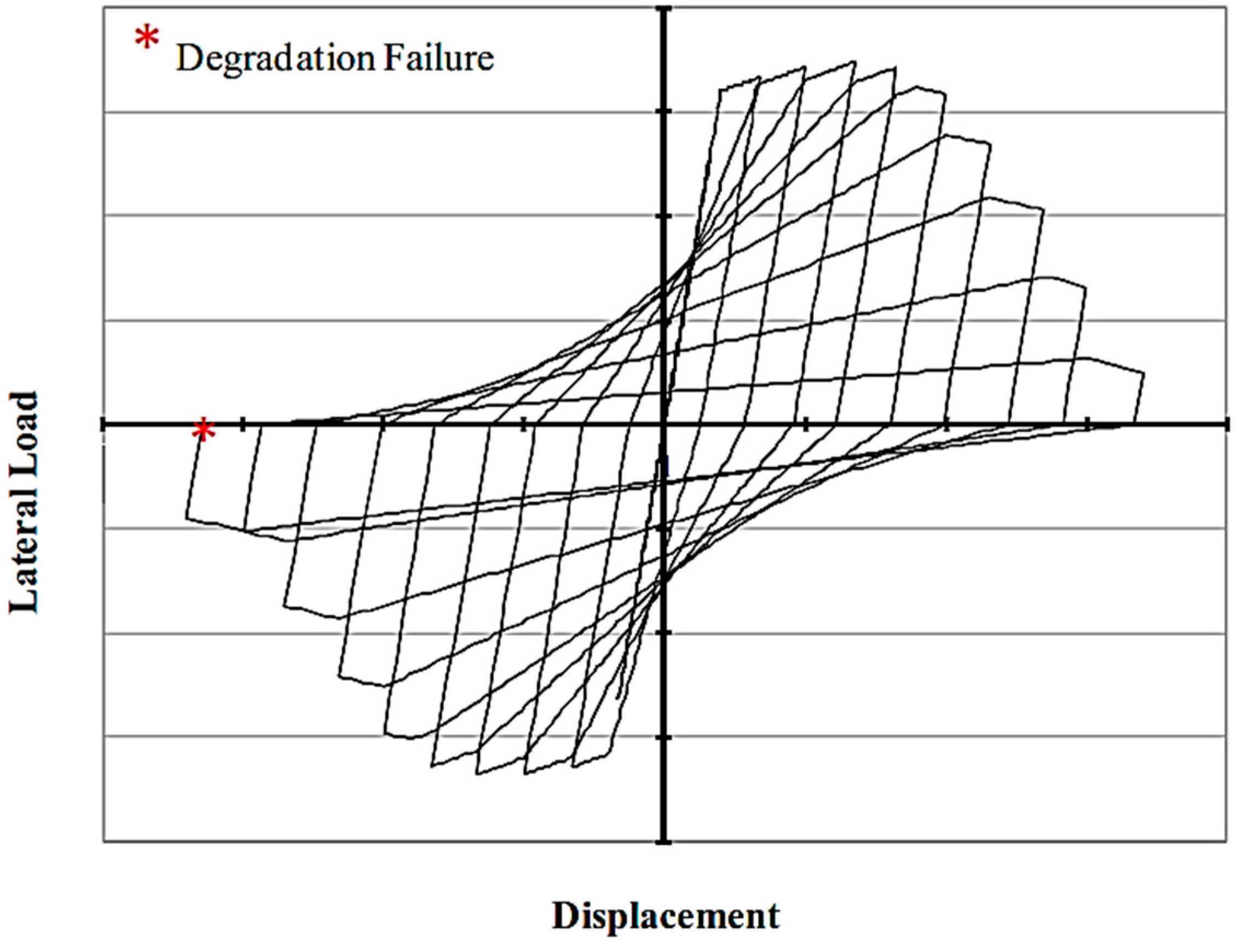
  • Cyclic degradation failure: The scalar parameter (β; ranging from 0 to 1, accounting for degradation effect at each current path) exceeds a value of 1.
The first one occurs when the displacement exceeds the intersection of the cap slope and the residual strength axis. In this study, residual strength is taken as zero. In this case, the ductility capacity is reached. The second type of collapse occurs when the β value of any of the degradation types, explained in the text, exceeds value of 1. In this case, the system has practically no strength to resist any loads. Mathematically, given in the following equation, outside of the limits (0 < β < 1), hysteretic energy capacity is exhausted, and collapse phenomena take place.
β i = E i E c a p a c i t y j = 1 i E j C
where Ei is the hysteretic energy dissipated in excursion and Ej is the hysteretic energy dissipated in all previous excursions. Cyclic degradation in excursion (i) is generalized by the β i parameter.
Complete collapse occurs if any of these collapse types mentioned above are formed. The following is applied to this study: the system’s collapse has been defined when all the earthquake record data are applied to the system, and if the system shows any of the failure modes under 50% of the records, the authors assume that the system is failing. This is a probabilistic approach, is statistically proven, and has been used in the past studies [36,37].
Figure 11 and Figure 12 represent the two types of failure of the structural elements with their failure point notations.

3. Model Validation and Analysis Method

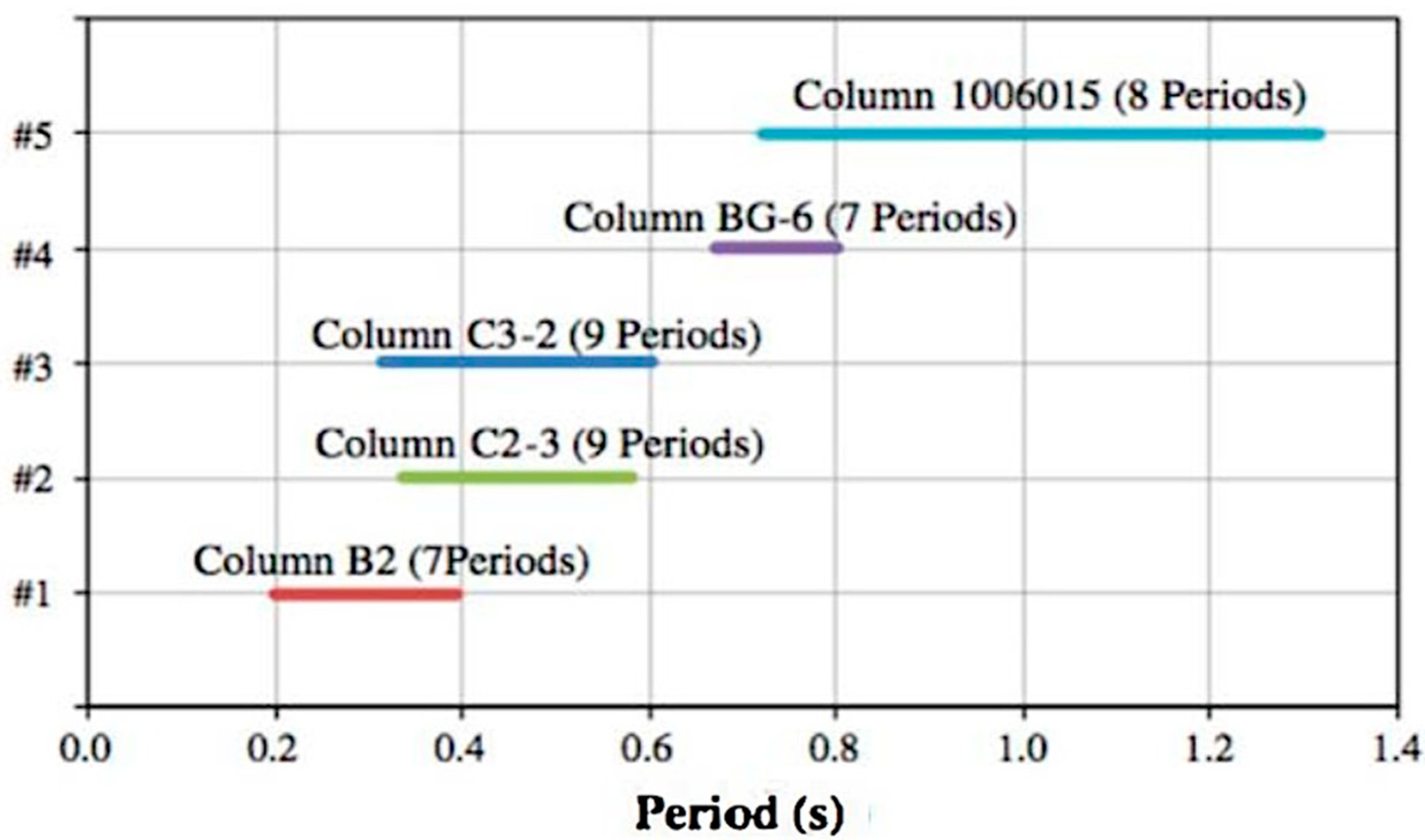
The experimental cyclic force–displacement responses of the selected columns for model validation have been taken from the PEER Structural Performance Database (PEER Report 2007/03) [38]. Five RC columns were chosen out of 255 tested columns with model parameters of hardening slope, cap slope, and cyclic deterioration. The chosen criteria are to have a decent correlation of the analytical model and column specimen for the force displacement history. The selected RC columns are column B2 tested by Thomsen and Wallace [39], columns C2-3 and C32 tested by Mo and Wang [40], column BG-6 tested by Saatcioglu and Grira [41], and column 1006015 tested by Legeron and Paultre [42]. The period of vibration changes between 0.2 s and 1.4 s as shown in Figure 13.
It can be seen from Figure 13 that columns were selected for this study to represent traditional RC columns with their rebar configuration with long periods, too. For this study, the beam–column element parameters have predominantly matched the periods of vibration from 0.2 to 1.4 s under seismic loading, with a similar hardening and cap slope as well as cyclic deterioration parameters. For instance, the Thomsen and Wallace column was tested to consider fitting the ductile moment resisting frames in moderate to high seismic areas, whereas Column C2-3 and Column C3-2 from Mo and Wang accounted for the impact of transverse reinforcement configurations on the seismic behavior of RC columns. The BG-6 column was tested to consider welded grid confinement in the concrete, while Column 1006015 was tested to examine axial-load level under seismic excitation. The criterium is to have a decent correlation between the experimental results and simulations performed using PEER Report 2007/03 recommended beam–column element parameters and the model parameters. The latter was used for its simplicity for this study. Force–displacement responses of each column were taken from the PEER Structural Performance Database. Table 1 indicates the selection of the beam column element parameters versus model parameters, including hardening slope, cap slope, and energy dissipation capacity.
As for the validation of the model, recommended beam–column element parameters were given in the PEER Report 2007/03 [43]. These parameters were used to simulate the behavior of the five selected RC columns, and a good match was found.
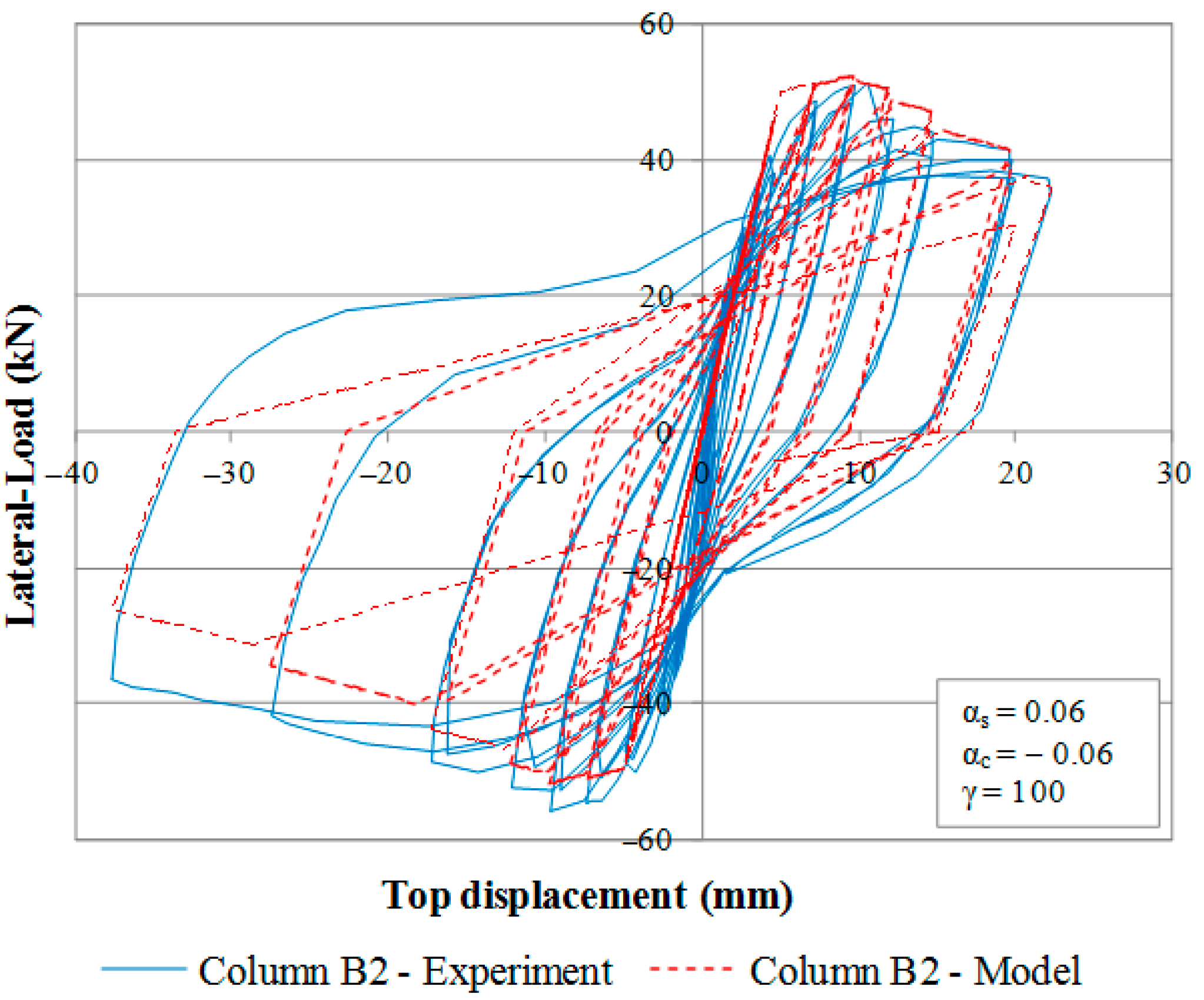
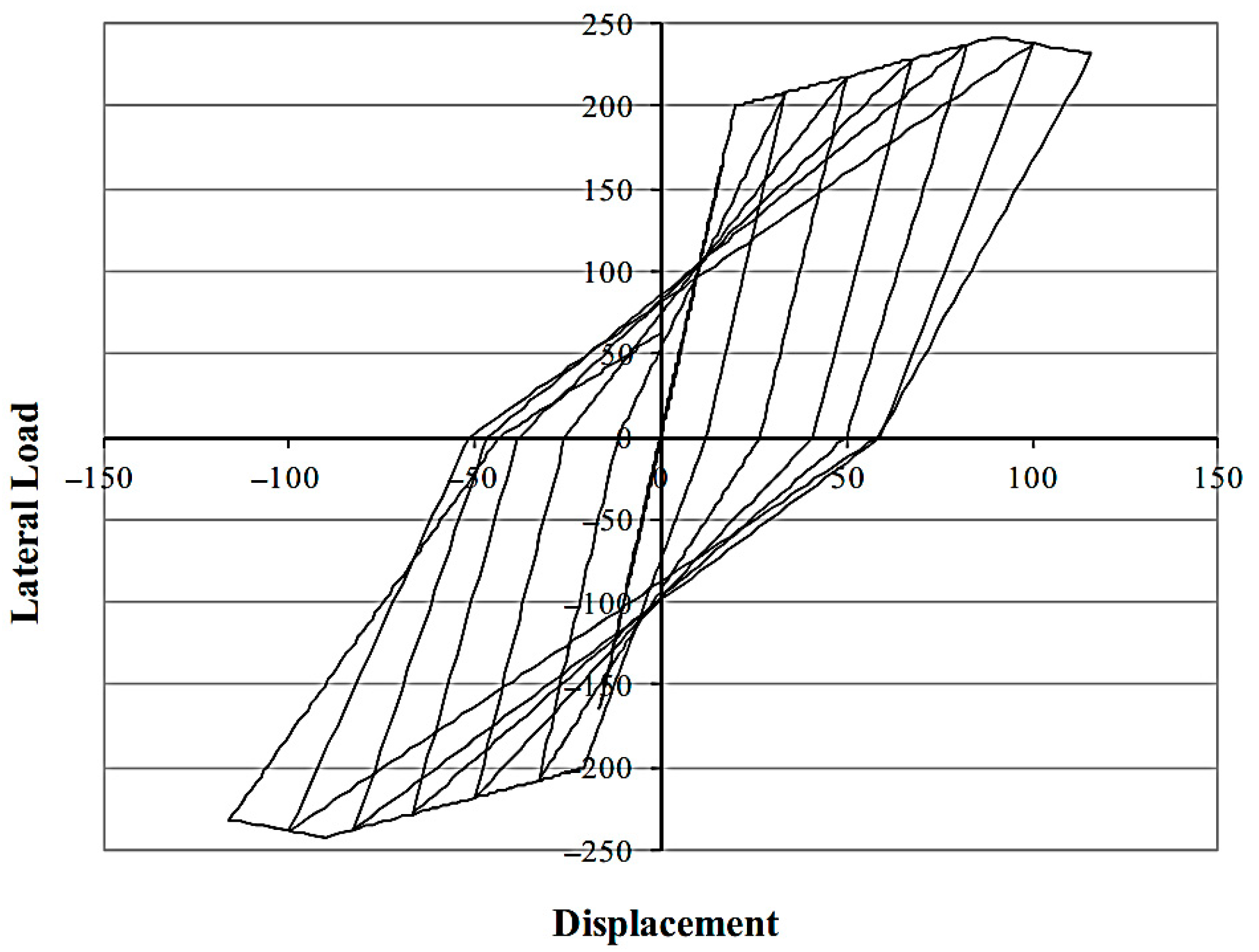
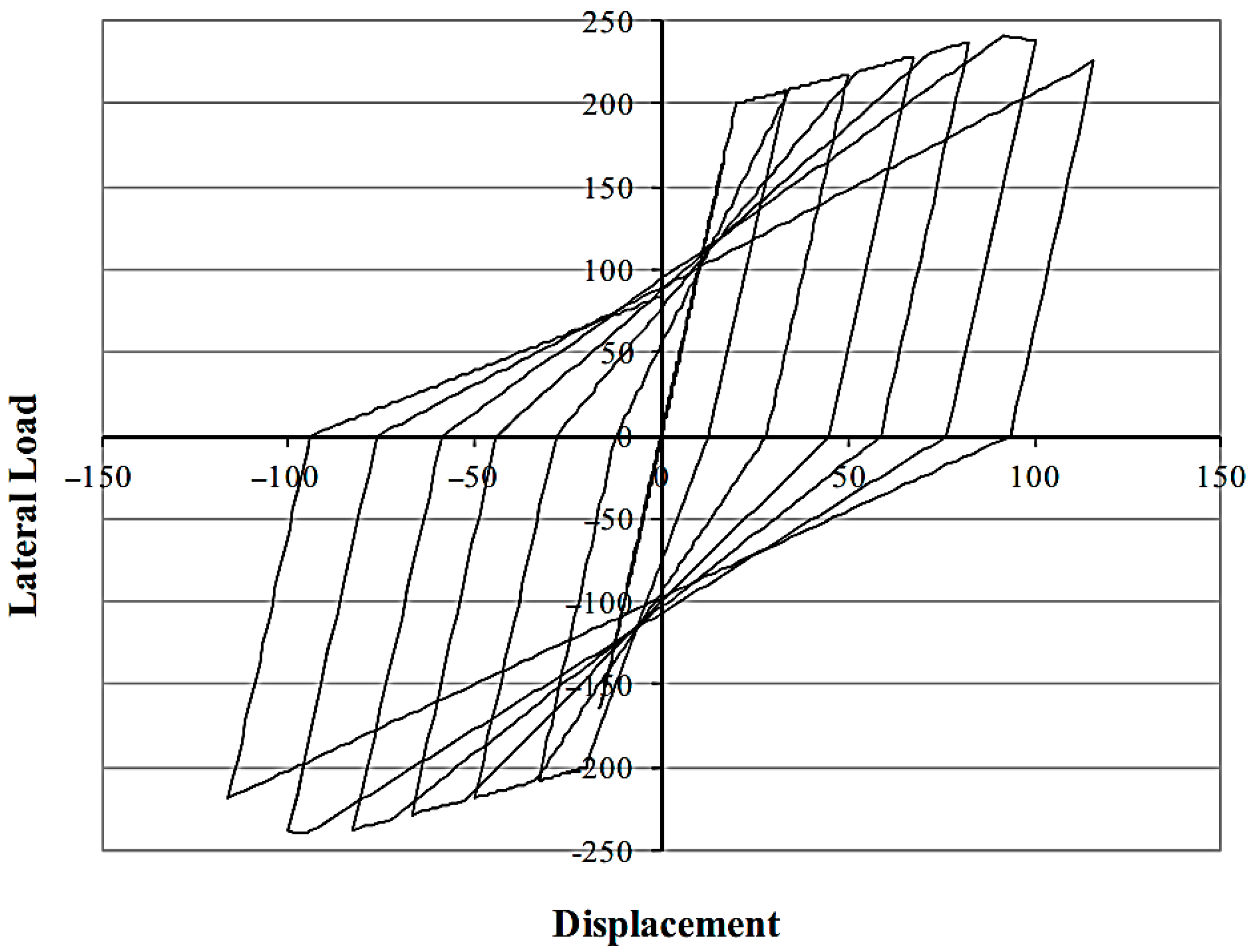
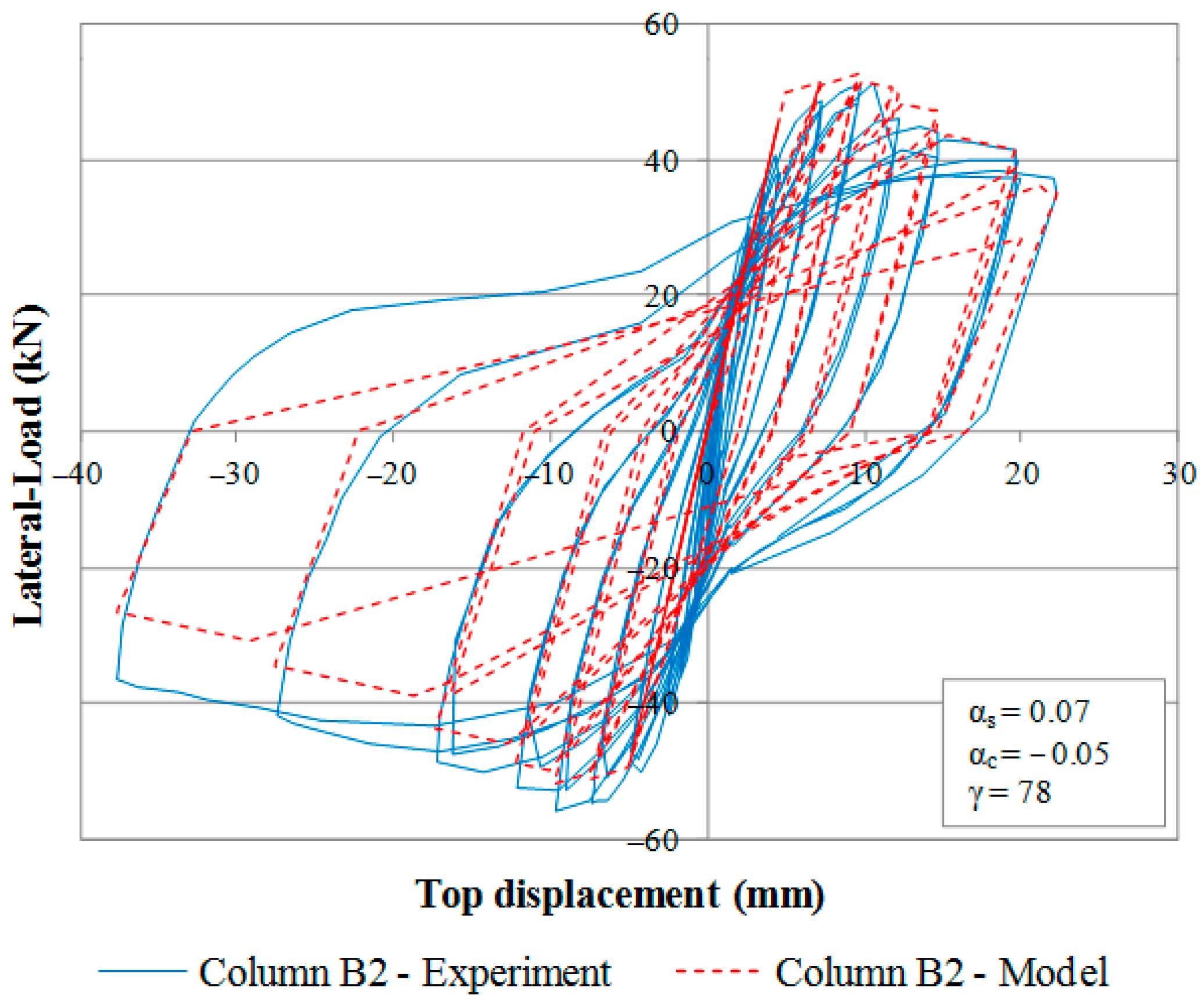
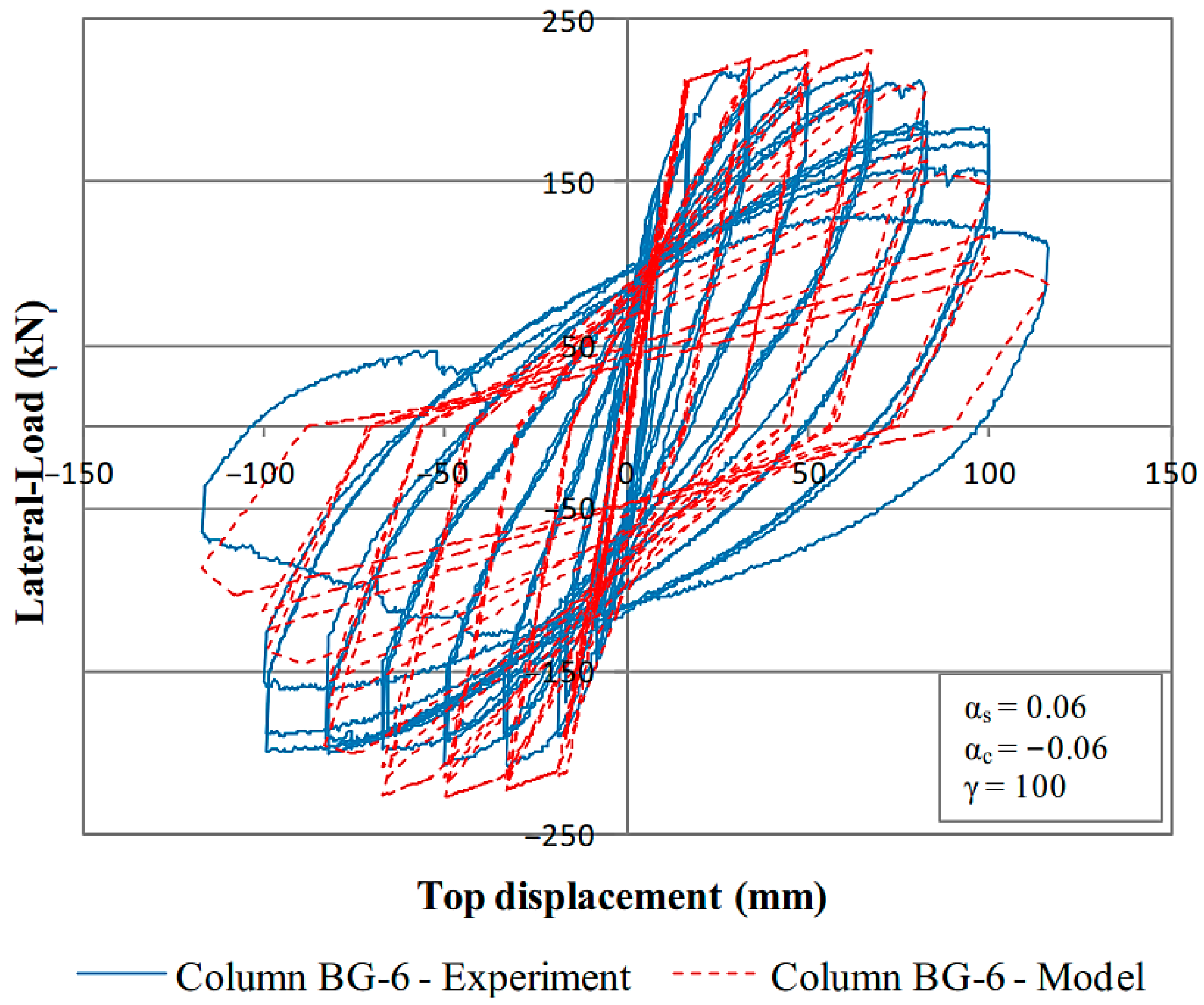
The degradation coefficient, gamma (γ), represents the rate of the degradation under cyclical loading and consists of four sub-coefficients, with each describing a type of degradation. The subcomponents are associated with each degradation modes. The validation study was conducted with varying values of degradation parameters gamma for each degradation type. For simplicity, γ was assumed to be equal for all four types of degradation to have a smaller number of parameters (i.e., γstr = γunl = γacc = γcap = γ). The value of γ = 100 was found to provide a very good match with experimental results for moderately degraded concrete structures. Ibarra and his co-workers [35] performed calibrations of the degradation parameters with experimental data from tests of steel, wood, and RC specimens. It turned out that the backbone characteristics and degradation coefficient parameter (i.e., γstr, γunl, γacc, γcap) limit the cyclic deterioration modes no matter the loading history. Additionally, γ = 100 is higher than γ = 50, which means the hysteretic dissipation capacity is larger, but it has a low rate of cyclic deterioration with respect to the latter. In practice, 50 for steel structures and 100 for RC structures are representative values. Figure 14, Figure 15 and Figure 16 are given to highlight the reasonable match between the analysis and experimental results for different columns. Figure 14 gives the lateral load displacement history of the B2 column based on the PEER Report 2007/03-recommended beam–column element parameters, while Figure 15 represents lateral load displacement history based on the author’s selected model parameters. As proven with the results, the analytical model captures the cyclic response well. Figure 15 and Figure 16 show a comparison between the numerical and experimental results of columns B2 and BG-6 using a constant value of gamma γ = 100. The selected model parameters exhibited a reasonable match between analysis and test results. Further information is provided in [28,39], with conveyance of a numerical study on degradation to calibrate the value of gamma for the best fit to experimental results.
On the other hand, C, the exponent rate for each degradation modes, has been chosen as 1 to represent a good match to the experiments in the model.
The inelastic displacement ratio (IDR) in this paper is expressed as the ratio of the maximum lateral inelastic displacement demand of a structure to the maximum lateral elastic displacement demand as referenced in [11]. Δelastic is the absolute maximum displacement response of an elastic SDOF, defined by a period of vibration and damping ratio. Δinelastic is the absolute maximum displacement of an inelastic SDOF, defined by a period of vibration and damping ratio and R, which is the strength reduction factor used to bring various levels of lateral strength demand. IDR is defined as the ratio of Δinelastic to Δelastic.
The coefficient method used in FEMA 450 [2] is based on simplified expressions of IDR. Its main goal is to determine the maximum target displacement used in performance-based seismic design procedures with a simplified, yet acceptable, accuracy. In the method of coefficients, the target displacement at a specific hazard level is calculated by multiplying the maximum corresponding elastic displacement by a series of coefficients that account for inelastic behavior, higher mode effects, degradation, and dynamic second-order effects that consider the inelastic behavior. The coefficients used in the procedure are all evaluated from corresponding IDR results. A static pushover analysis is then conducted for the structure up to the specified target displacement to assess the different seismic demand parameters. The coefficients that have been used in the procedure reflect the inelastic behavior (with accounting C1) and degradation type (embedded into C2); hence, the IDR results of this study contain these coefficients. C0 is the modification factor that associates the spectral displacement of an equivalent SDOF system to the roof displacement of the building MDOF system by following the requested procedure or using a related table or calculation. C1 is the modification factor used to relate expected maximum displacement to displacement calculated for linear elastic response. C2 is the modification factor used to signify the effect of pinched hysteresis shape, cyclic stiffness degradation, and strength deterioration on the maximum displacement response calculated per the equation given in the standard. It is worth mentioning that C1 is also known as Cr in some standards and is described as the inelastic displacement ratio (IDR) in the literature [13]. C2 is taken into account in IDR calculations, as it substitutes the hysteretic behavior on the maximum displacement.
IDR values in this study have been evaluated for SDOF systems undergoing different levels of inelastic deformation when subjected to several recorded earthquake ground motions. They have been calculated as the median of the maximum inelastic displacements of all records divided by the median of the maximum elastic displacements. A system is considered to collapse if more than 50% of the earthquake records cause failure, as defined through the previously described collapse criteria.
Six different strength reduction factors (R = 1, 1.5, 2, 4, 6, and 8) that intend to cover different levels of ductility have been used to establish IDRs for fixed based systems with periods varying from 0.2 to 1.4 sec. The strength reduction factor, denoted as R in this study, is a key parameter in seismic design that is used to substitute various ductility levels for the structures. It is placed in many codes. R (strength reduction factor) has been one of the most-used indicator parameters for determination of the IDR values of the structure for various periods under repeated earthquakes in this study. Table 2 is given to expand R value meanings in terms of design coefficients and factors for various seismic force-resisting systems.
The modified Clough model was used in order to conduct the analysis on the SDOF systems under the effect of 104 earthquake records given in Appendix A. The analyses were based on moderately degraded SDOF systems with the assumption that the degradation constant, γ = 100, emphasizes the significance of degradation of single and repeated events on SDOF systems.
The system collapse is defined as when 50% of the 104 ground motion records happen to fail. The collapse point has been marked with “a cross in black box” on the graphs, and the numerical results of IDR values have been given in the numerical results section.

3.1. Scaling

The scaling of earthquake ground motions is essential in applying the seismic loads to the structure. Scaling the ground motion records to fit a target spectrum is one of the most common practices to ensure that the records will have a similar magnitude. Therefore, scaling should be conducted for each vibration period. Huang et al. [44] carried out a study to examine four different scaling procedures. The first method was Geometric Mean Scaling, in which amplitude scaling a pair of seed motions by applying a factor was considered. This was performed to decrease the sum of the squared errors between the target spectral values and the geometric mean of the spectral ordinates. This method was put forward by Somerville et al. [45]; however, Huang and his co-workers found it hard to select ground motions with median spectrums that closely matched the target spectrum for wide-ranging period evaluations. The second method was the Spectrum-Matching Method that is used to estimate the seismic demands of structural systems; however, the disadvantage to this method was that peak median displacement and the dispersion in the displacement response were remarkably underestimated. The third method was the Sa (T1) method that was suggested by Shome et al. [46]. The records were scaled to a definite spectral acceleration at the first-mode period of the structure. The unbiased median displacement response can be forecasted by this method. The fourth method was the Distribution Scaling (D-scaling) Method. By using the attenuation relationship, the method aims to frame spectral acceleration at a certain period to find the spectra. Unbiased estimates of median-level displacement responses can be produced by using this method. However, it was found that the dispersions in the displacement responses were conservative. The last method was the Distribution-Scaling Method, which was similarly found to estimate the median displacement responses with no bias. In addition, it was demonstrated in [46] that the median values of response quantities do not change when a set of earthquake records—even if they do not initially fall in the same hazard level—is scaled to any common value of spectral acceleration using the Sa (T1) scaling method, and they fall in the same hazard level with correct scaling. Consequently, the number of analyses needed for statistical assessment could be reduced drastically. Furthermore, Iervolino and Cornell [47] explored the impact of the selection and scaling of the accelerograms on estimating the nonlinear seismic response. Both SDOF and MDOF structures, which have different structural features, were considered based on their first natural period, force–deformation relationship, target ductility, and structure type, and this was practiced in two groups of record sets (real and arbitrary sets that were compared to statistically confirm that they had an equivalent median) to establish the limits of their hypothesis. In fact, the scaling performed on specific criteria or randomly and the meticulous record selection are unlikely to affect nonlinear response of structures. Other attempts at evaluating the effect of numerous amplitude scaling approaches on the nonlinear analysis have been made in the literature. Recently, Demir et al. [48] calculated the mean of the intensity measures for different ground motion sets and compared the scaling effect for each set; then, they concluded that amplitude scaling has no significant effect on the ground motion characteristics even if the scaling calculation brought slight deviations in the results.
In this study, the Sa (T1) method, which was suggested by [46], was conducted due to its efficiency and easy application, as it allows for making an unbiased displacement response prediction. All earthquake records have been scaled to the same spectral acceleration in line with Eurocode [4] so that, for the same analysis, records would fall within the equivalent hazard level. The records have been scaled to a specific spectral acceleration at the first mode period of the structure.

3.2. Modelling of Repeated Earthquakes

Since RC structures are at risk for repeated earthquakes in their life of service, and seismically retrofitted structures have most likely experienced multiple earthquake shaking, the effect of repeated earthquakes must be considered in the design codes. Table 3 shows some examples of repeated earthquakes and their significance in PGA.
In Di Sarno’s [49] investigation of multiple earthquakes on structural damage, actual earthquake data comprised of the foreshock, mainshock, and the aftershock were used. However, the data are extremely limited; thus, this method is difficult to incorporate into this investigation. The magnitude and time of the aftershock can be determined by empirical formulas such as Gutenberg–Richter Law or modified Omori’s Law, which are supported by real earthquake data. There are also other approaches that simulate multiple earthquakes. Hatzigeorgiou and Beskos [24] highlighted a method used to simulate multiple earthquakes through an artificial way by multiplying the mainshock with a factor to produce aftershocks and foreshocks, while they estimated IDRs of a structure under repeated earthquakes. A factor was multiplied to the copied shock to produce an aftershock or foreshock. The Joyner–Boore empirical relation gives new factored PGA values in their study, which indicates that each event of PGA equal to Ag,max creates two earthquakes with PGA equal to 0.8526 Ag,max and three earthquakes with PGA 0.7767 Ag,max.
The following four cases were put forward in that study:
  • Case 1: (1.0000, 0.0000, 0.0000);
  • Case 2: (1.0000, 1.0000, 0.0000);
  • Case 3: (1.0000, 1.0000, 1.0000);
  • Case 4: (0.8526, 1.0000, 0.8526).
Li and Ellingwood [50] also constructed a statistical earthquake sequence while conducting the modal response history analysis of different story steel frames. They expressed the aftershock magnitude as a function of the mainshock by adopting the Gutenberg-Richter formula and assembled both replicated and randomized ground motion sets for different seismic hazard levels to calculate the damage ratios of the structures. The earthquake data sets were scaled by factors of 0.7, 0.8, 0.9, and 1.0 to derive the aftershock in the study.
Within the light of abovementioned studies, in addition to Arulanantham’s [51] proposal in his dissertation, it has been considered that the most appropriate scale factors for the foreshock, mainshock, and aftershock would be as follows:
  • Model 1: (0.8526, 1.0000, 0.8526) as Hatzigeorgiou and Beskos suggested.
  • Model 2: (0.0000, 1.0000, 0.9000) as Li and Ellingwood suggested.
The two models are mentioned as Repeated Earthquake Case 1 and Repeated Earthquake Case 2, respectively, in the numerical results.
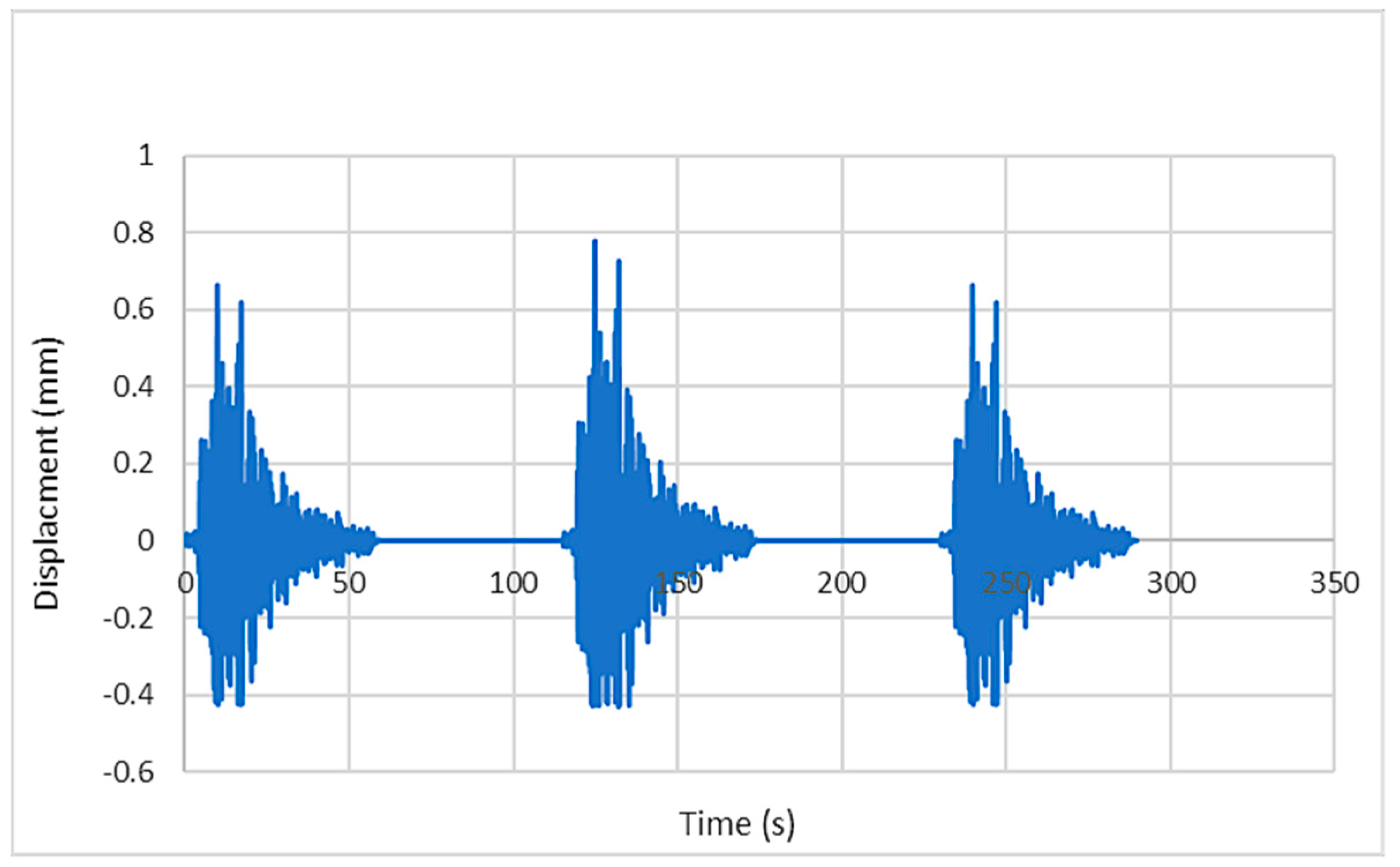
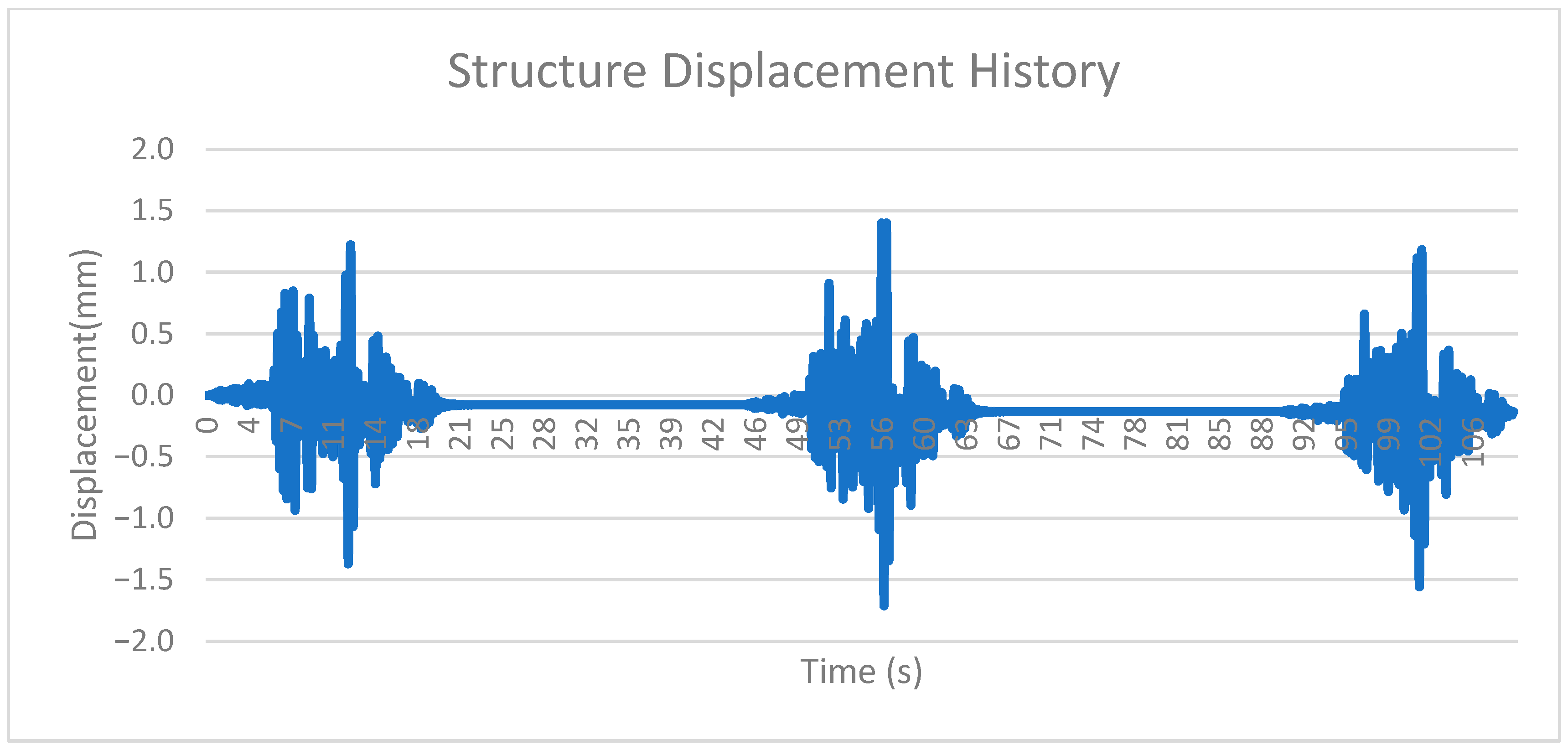
Figure 17 represents the displacement vs. time graph for the actual record belonging to the Northridge Earthquake at Palisades station and have been edited in the form of Repeated Earthquake Case 1.
The flat sections between the shocks indicate free vibration. During the free vibration phase, no external load has been applied. The free vibrations have been simulated by applying a series of zeros (also represented by a scale of 0.00) between the edited shocks.
Actual repeated seismic events have not been placed in this study due to the difficulty in collecting the data over the world as well as having more complicated results to interpret.

4. Numerical Results

A total of 104 real earthquake records, taken from the PEER ground motion database, have been used to generate a single earthquake and two different models of repeated earthquakes for fixed-base structures. Moderate degradation has been taken into account in this study, and dynamic analyses have been performed to evaluate the IDRs using the modified Clough degradation model. Structural periods vary from 0.2 to 1.4 s. An in-house Fortran-based program (SNAP—Single Degree of Freedom Non-Linear Analysis Programme) was used for the investigation.
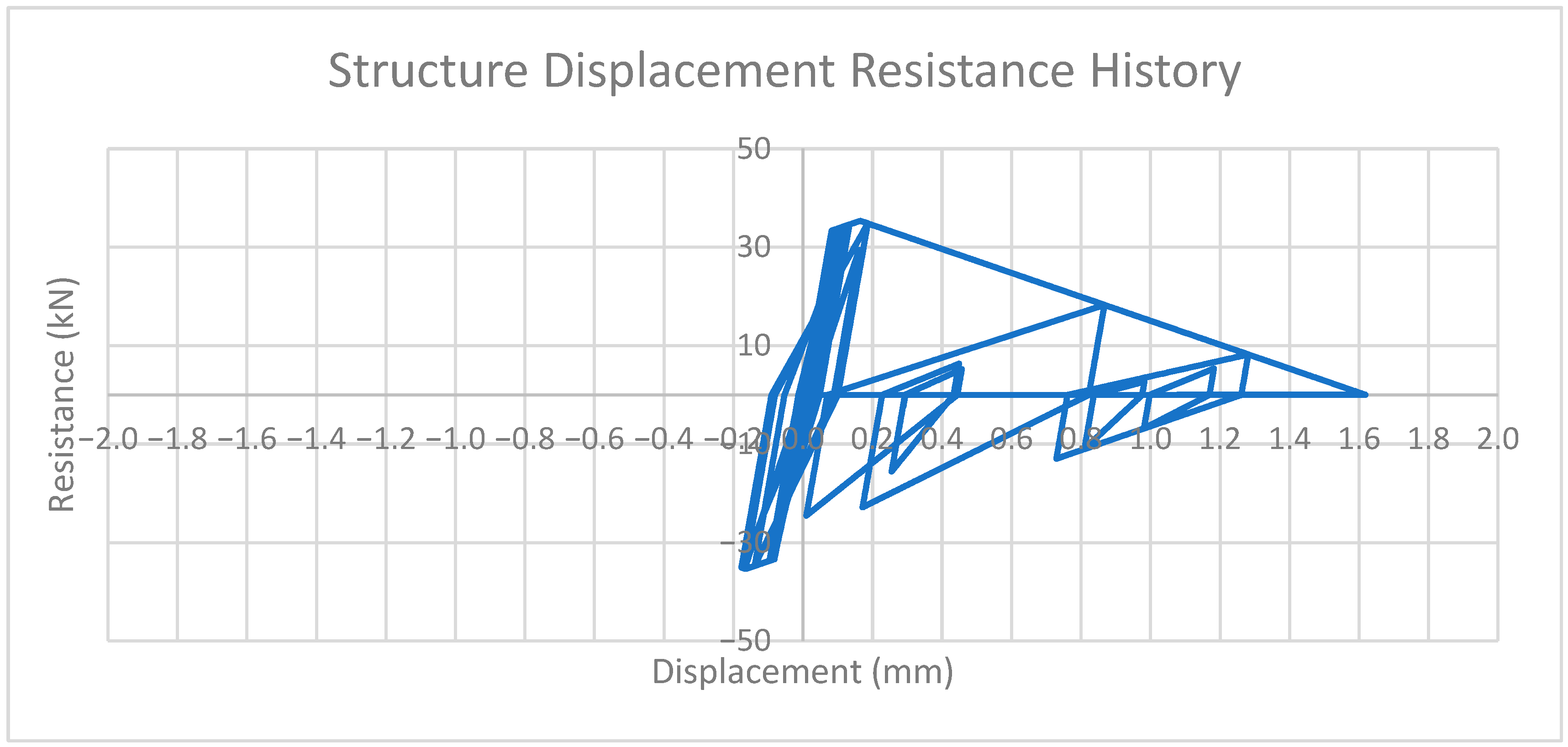
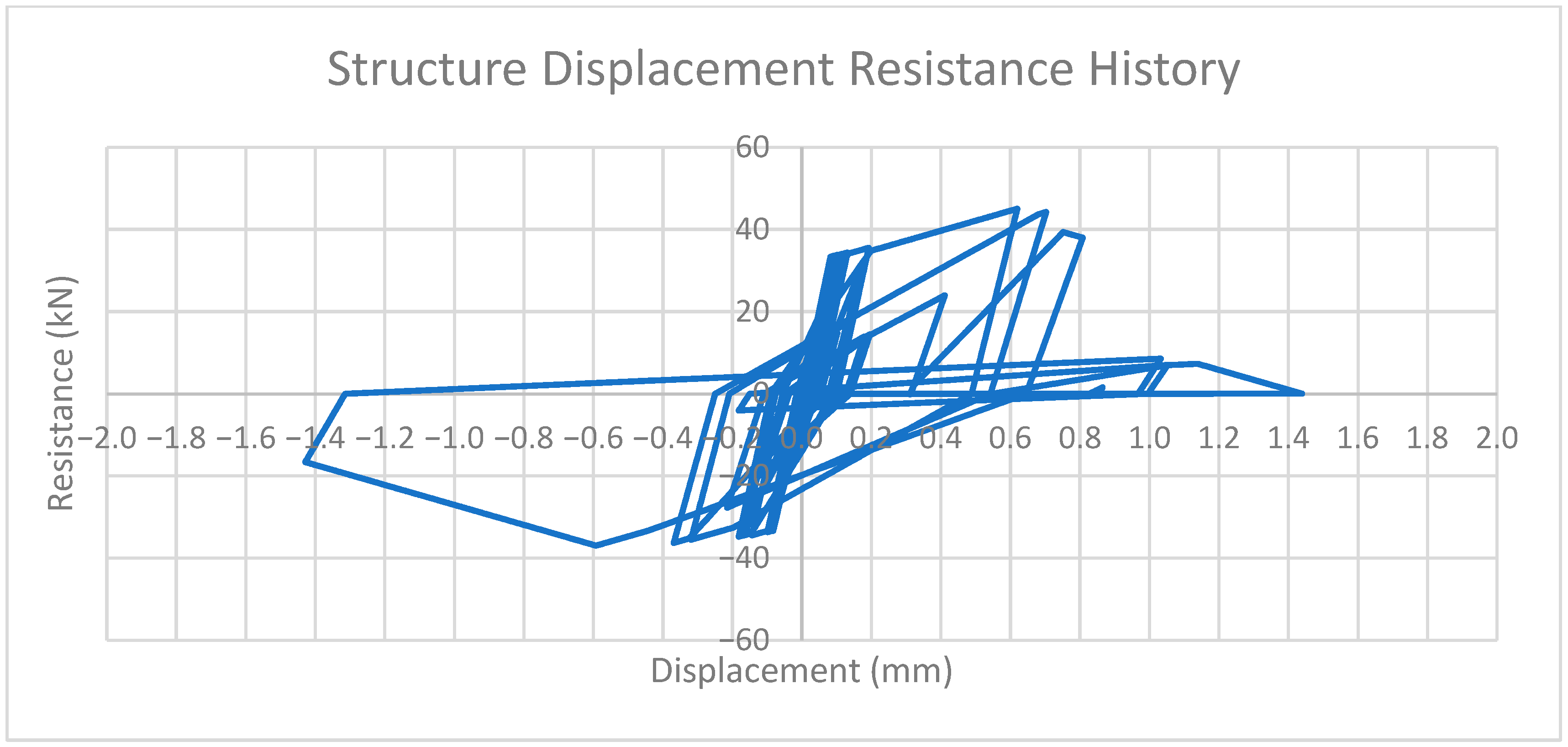
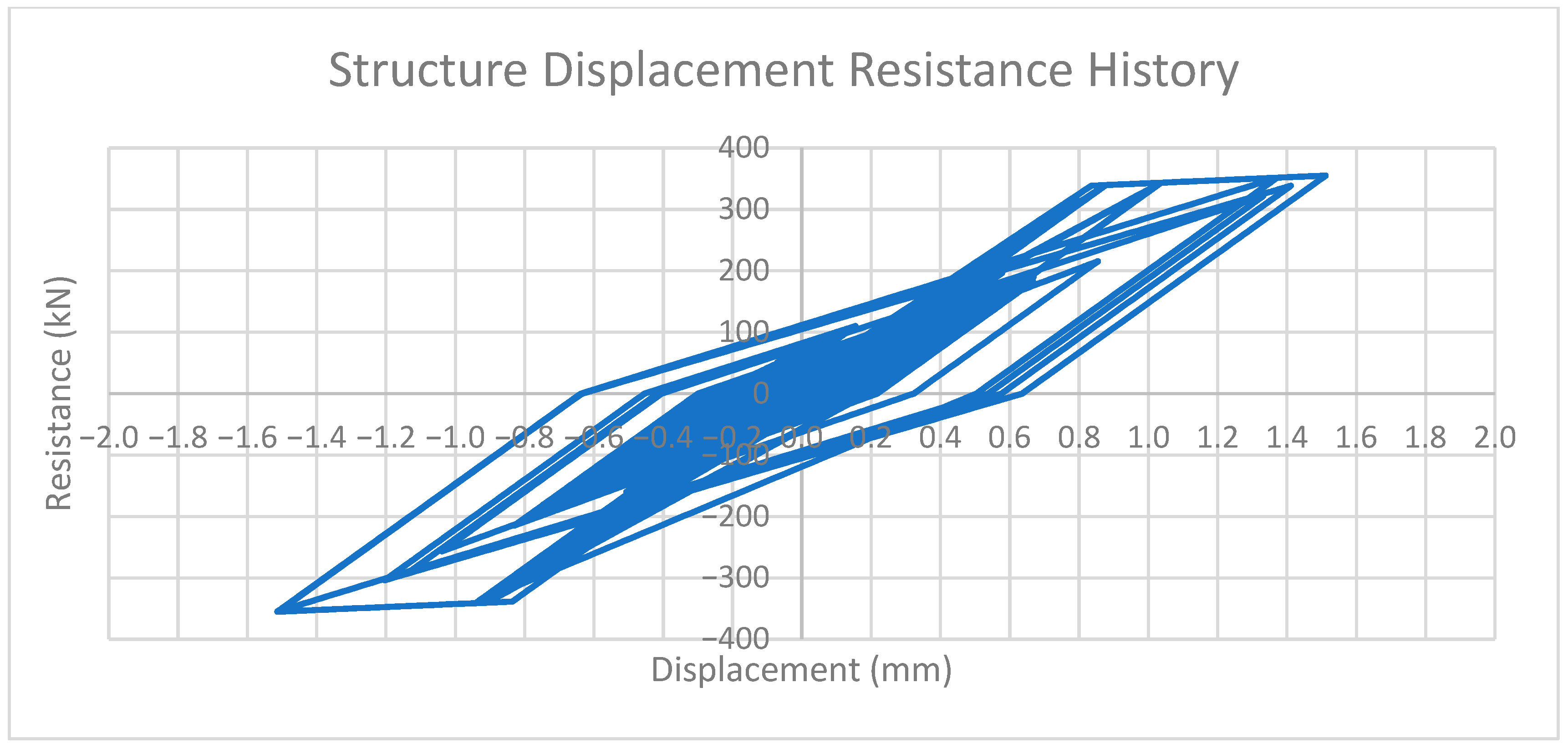
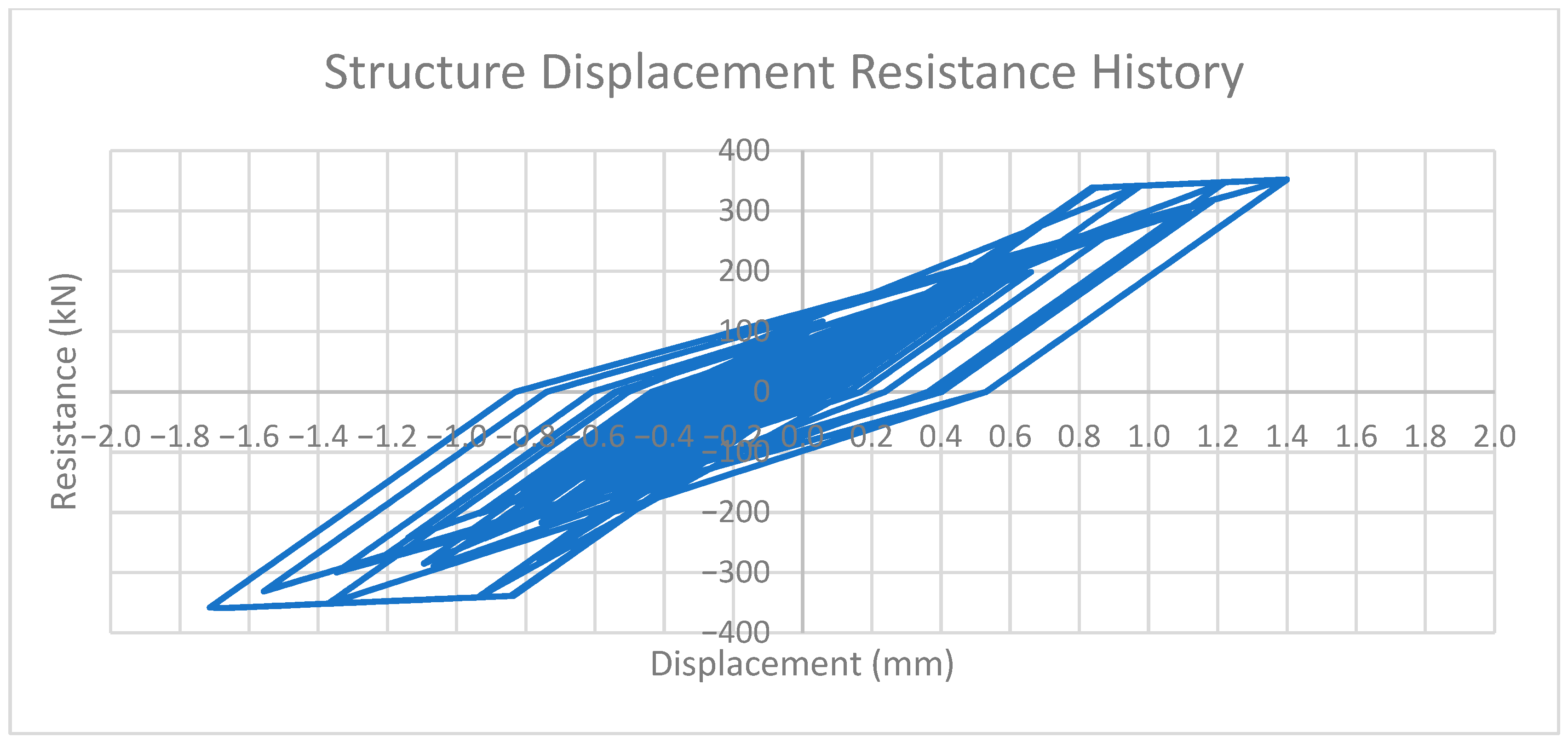
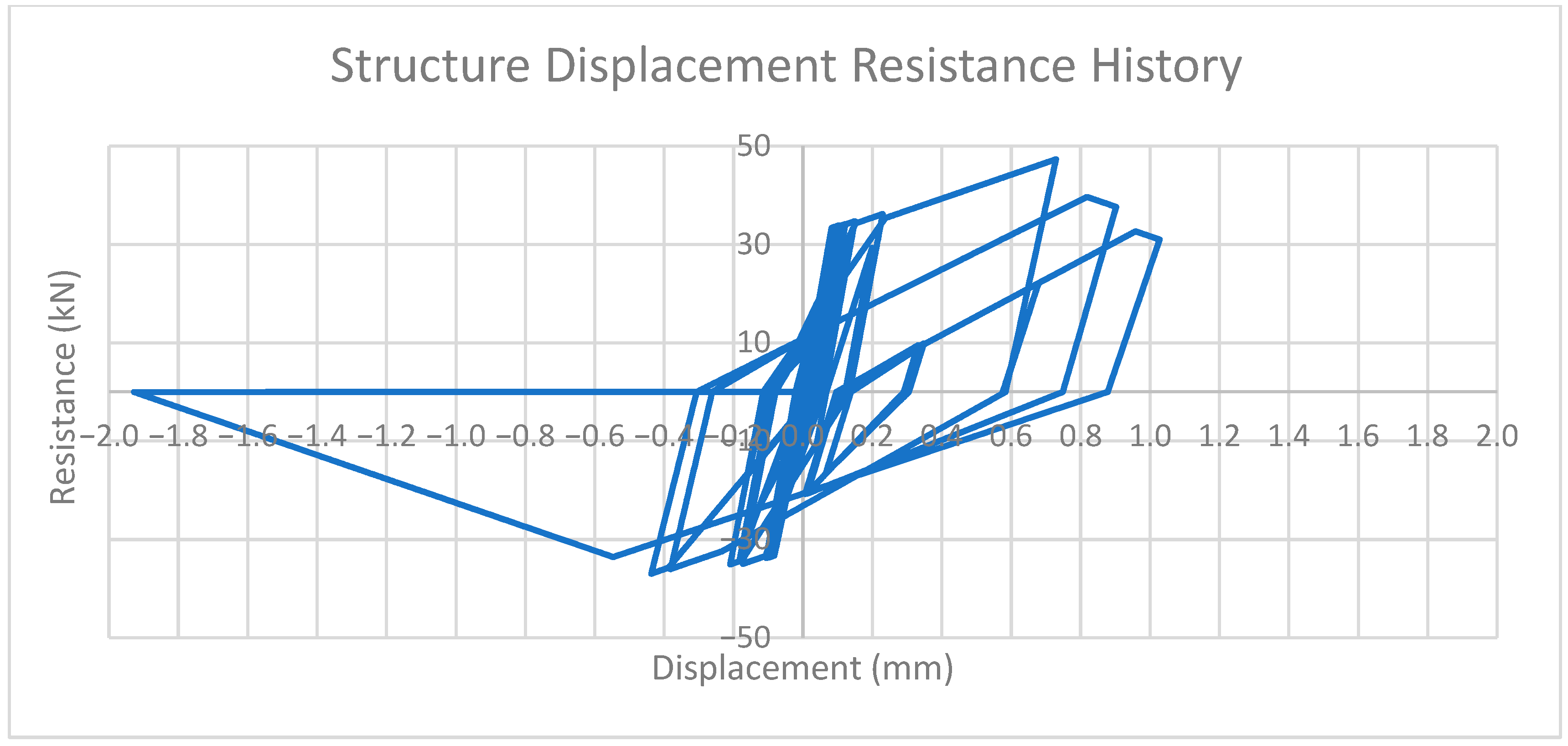
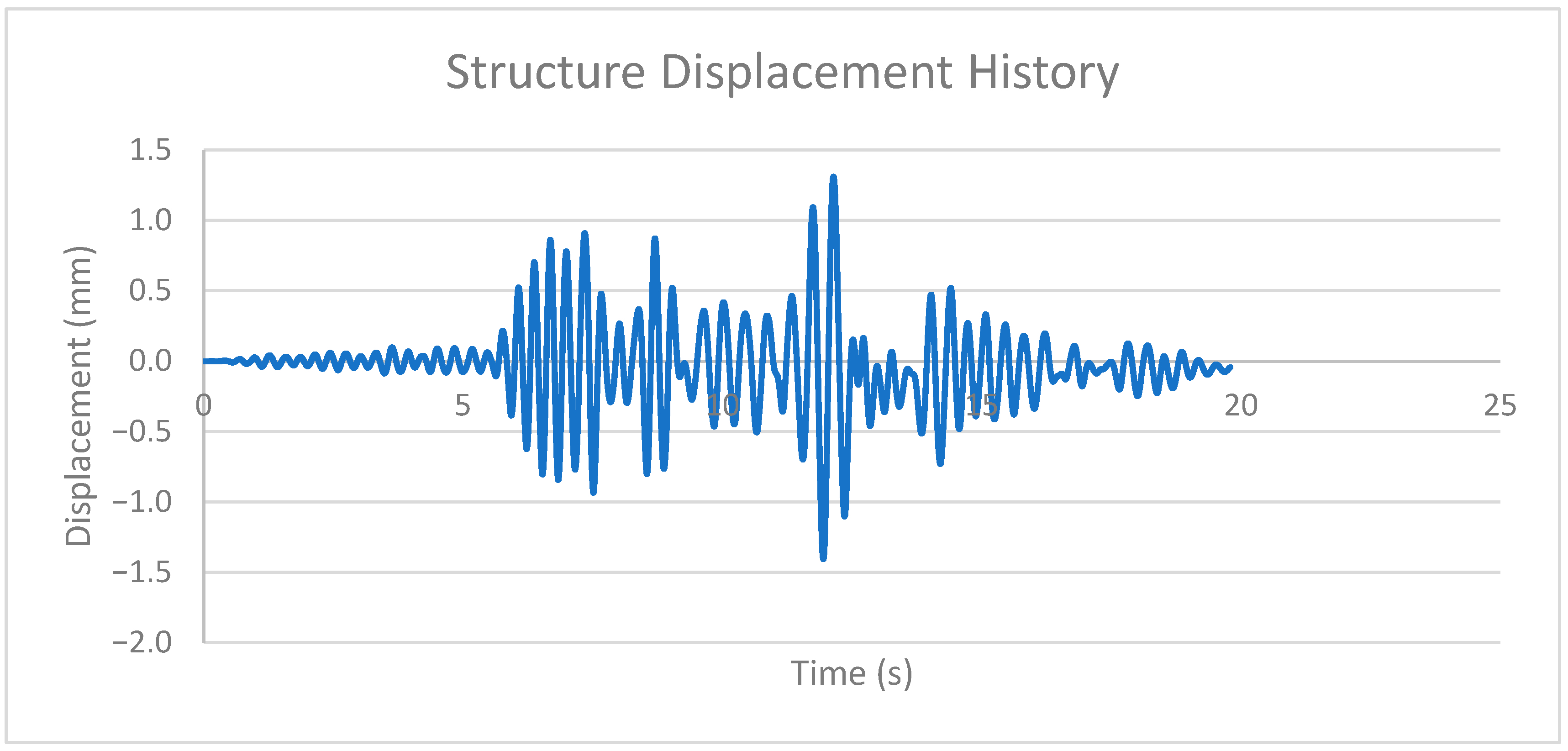
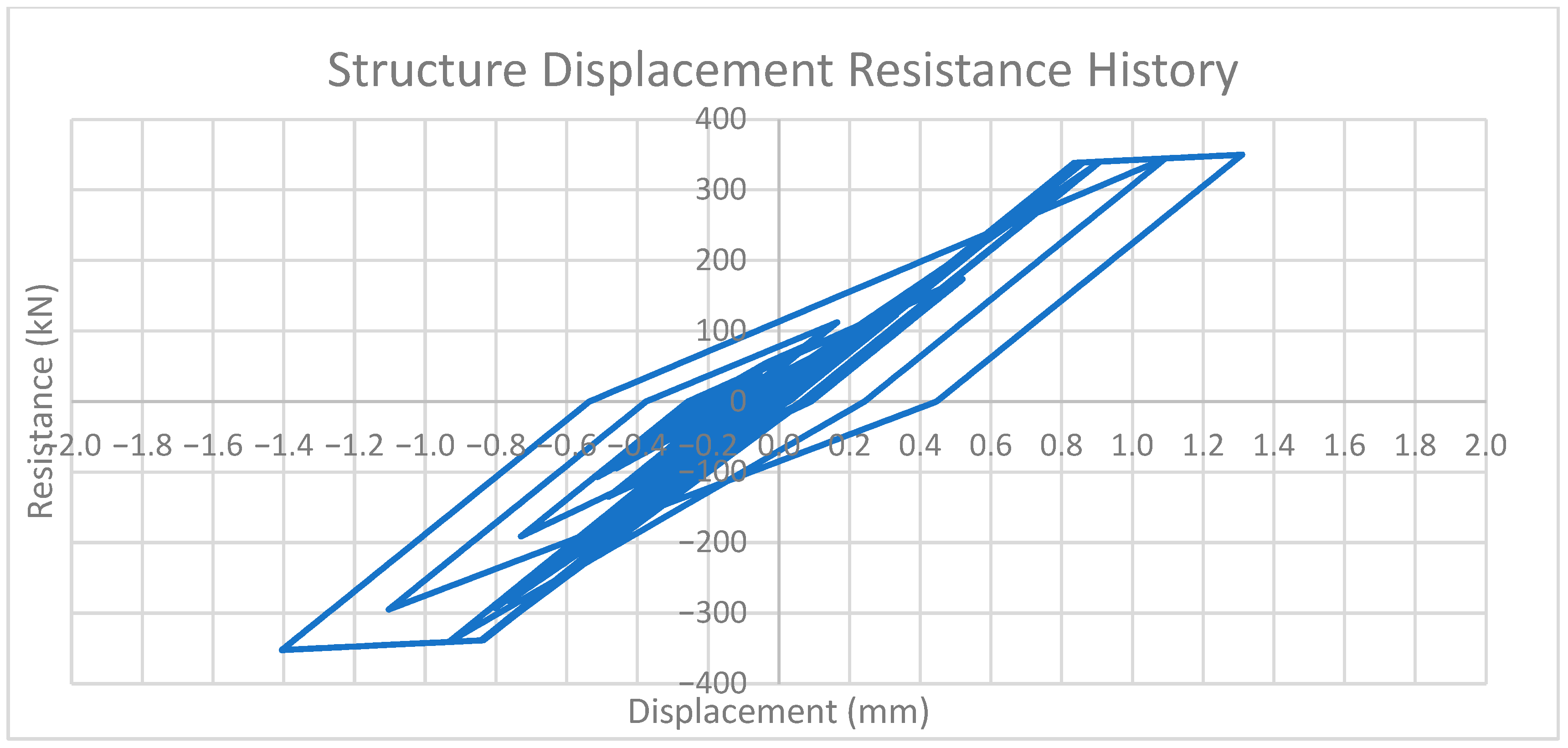
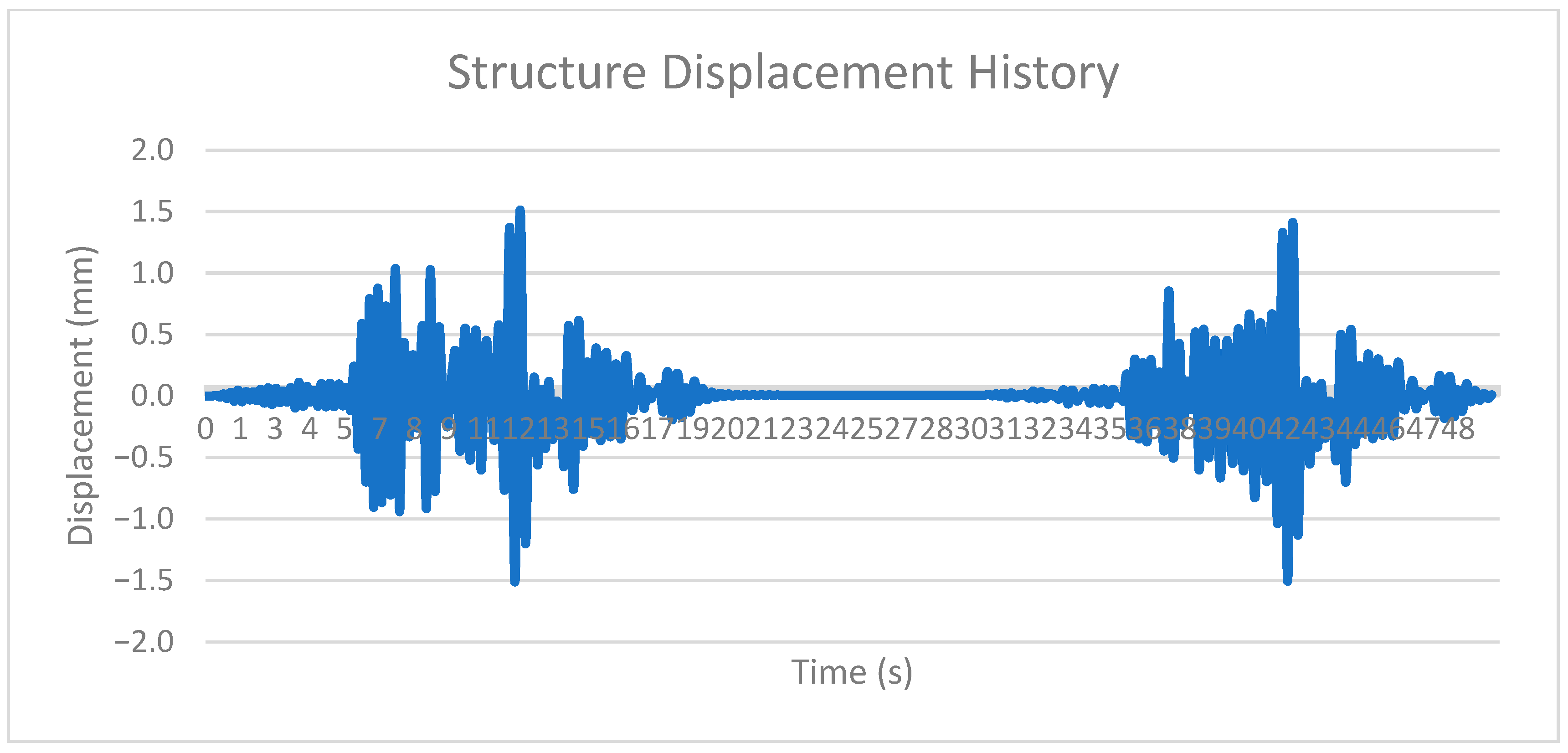
The amount of degradation is shown by the implemented load–deformation graphs in Figure 18, Figure 19 and Figure 20. The Northridge Earthquake (17 January 1994) was picked to indicate the necessity of taking both degradation and multiple earthquakes into consideration. To begin with, the Pasadena-N Sierra Madre Villa record has been used to demonstrate the significant effect of degradation on the system and how the resistance vs. displacement hysteresis changes with the severity of the degradation. Following this, the Northridge-01, Alhambra—Fremont School, UP record has been used to validate the different structural resistance behaviors by using single vs. repeated earthquake comparisons, as shown in Figure 21, Figure 22, Figure 23, Figure 24, Figure 25 and Figure 26.
In Figure 21, Figure 22, Figure 23, Figure 24, Figure 25 and Figure 26, two different repeated earthquake models are compared alongside the results from a single earthquake on the fixed-base model. At the end, by considering both the resistance history of repeated earthquakes for the systems with degradation and the pseudo spectral acceleration values of the median response spectrum for selected time histories, it can be said that the damage caused by repeated earthquakes controls the new IDR values. Four types of degradation were concurrently applied in the model, and the strength reduction factor was taken as R = 4 for the SDOF system with the first vibration period of 0.31 s.
Figure 18, Figure 19 and Figure 20 show the structures’ displacement resistance histories that allow readers to observe how different degrees of degradation are critical for a single earthquake. In the system with low degradation, the hysteresis is dominated by the cap rather than energy dissipation, as shown in Figure 18; on the other hand, in the systems with moderate (Figure 20) and severe degradation (Figure 19), the behavior of the hysteretic curves changes.
A structure with no degradation will have the same effect for a single earthquake as it does for a vast number of earthquake loadings. However, with the effect of degradation, the structure is weakened for each earthquake loading.
Figure 21, Figure 22, Figure 23, Figure 24, Figure 25 and Figure 26 are given in structural response envelopes versus time in seconds and displacement in mm.
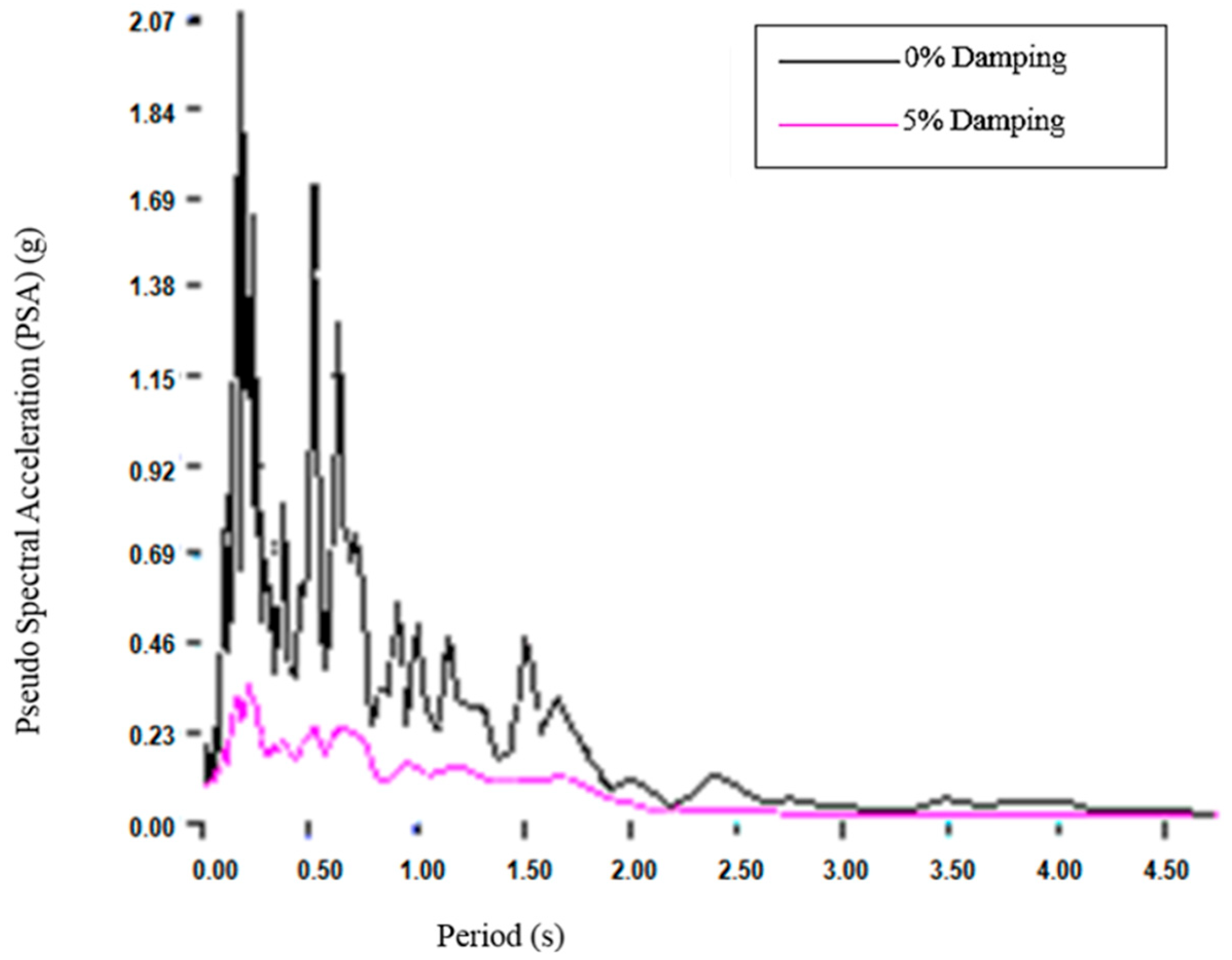
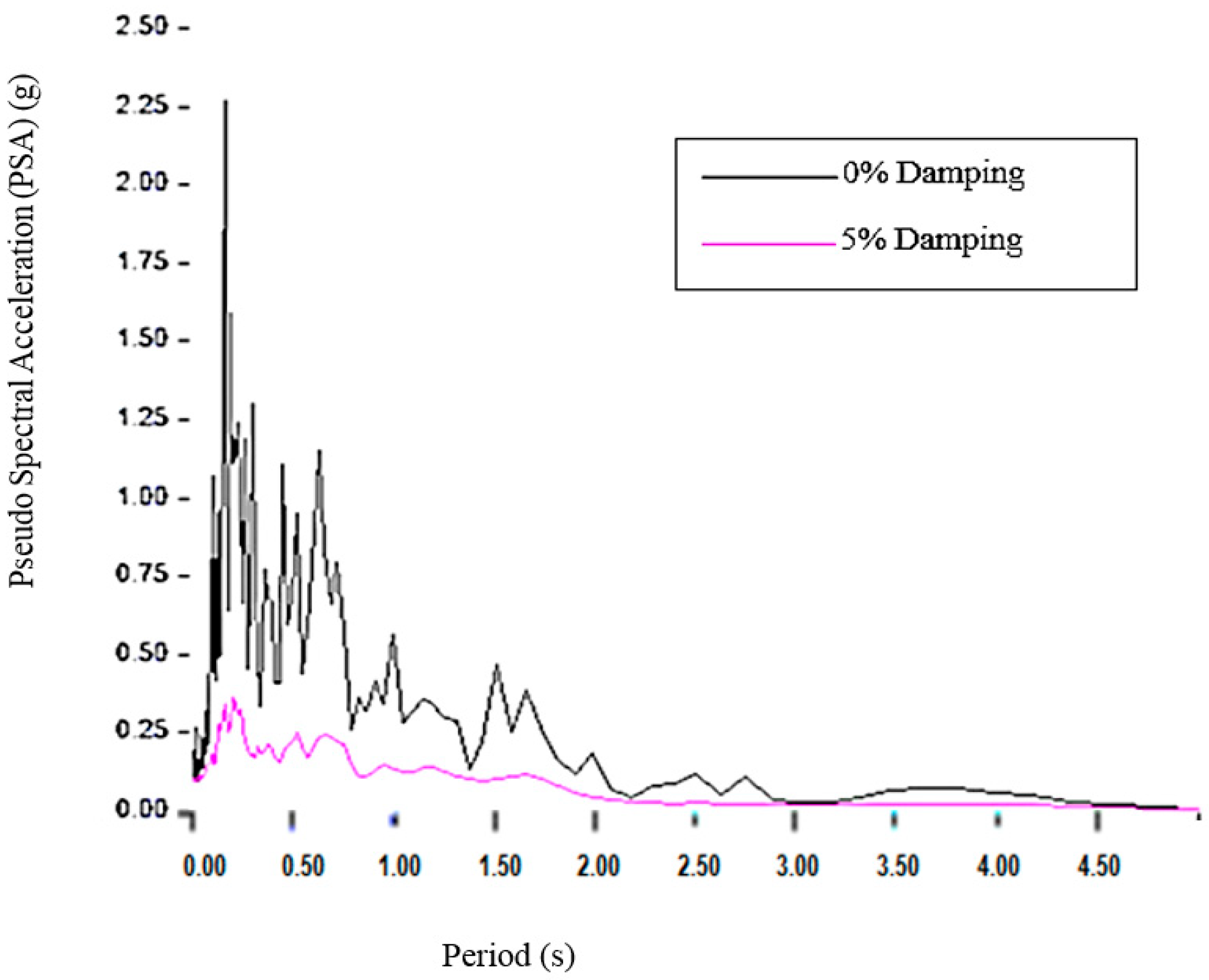
Figure 27 and Figure 28 represent the median response spectra, as a factor of g, versus the period for a single earthquake and different repeated earthquake model cases (1 and 2). For the Northridge Earthquake, 17 January 1994, Alhambra Fremont School, real data have been used for plotting the response spectra with no (shown in black) damping and 0.05 (shown in pink) damping.
The related figures are presented to obtain the idea of the response spectrum based on the earthquake data set used in this study and how the records look. This is also used to compare which repeated earthquake case could possibly have created a higher response that eventually led to higher IDR values. The median response spectrum for the single earthquake case and Repeated Earthquake for Model 1 Case has a maximum PSA of 0.39 g, while the spectrum has a maximum of 0.36 g for the single earthquake case and Repeated Earthquake for Model 2 Case with 5% damping.
It is worth noting that, for generating these specific plots, it was assumed that response spectrum functions are a factor of g, the acceleration of gravity, which is equal to 9.81.
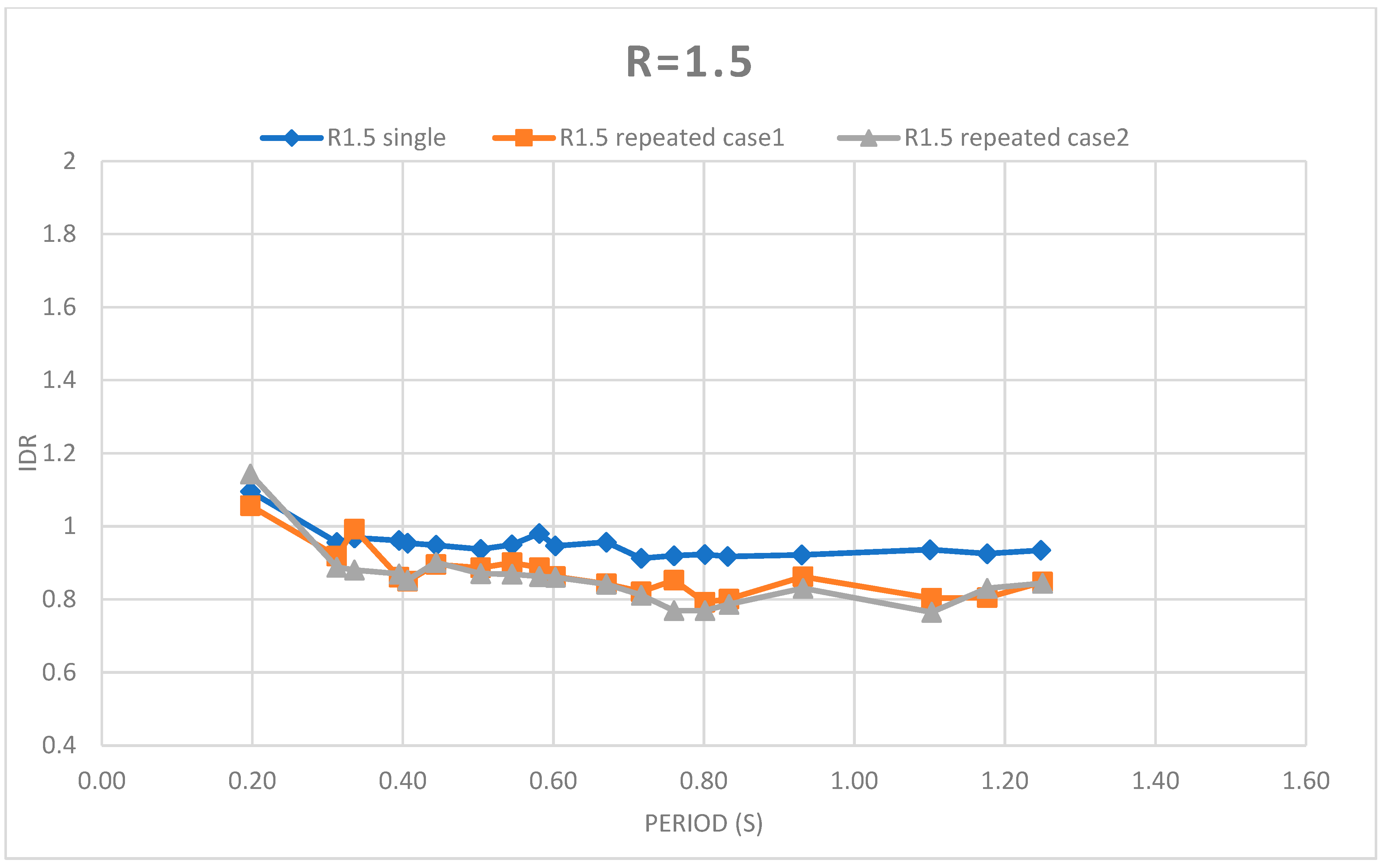
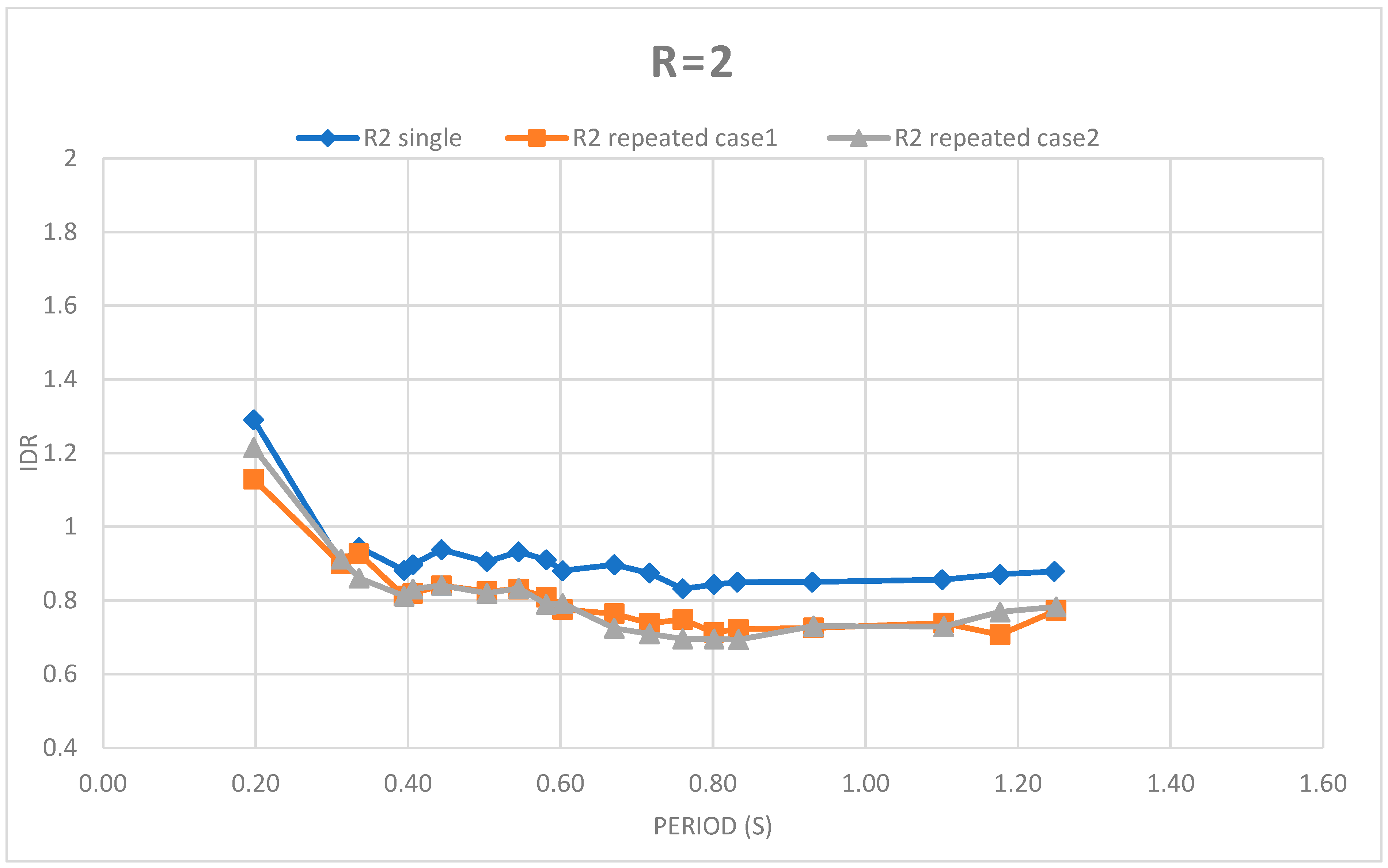
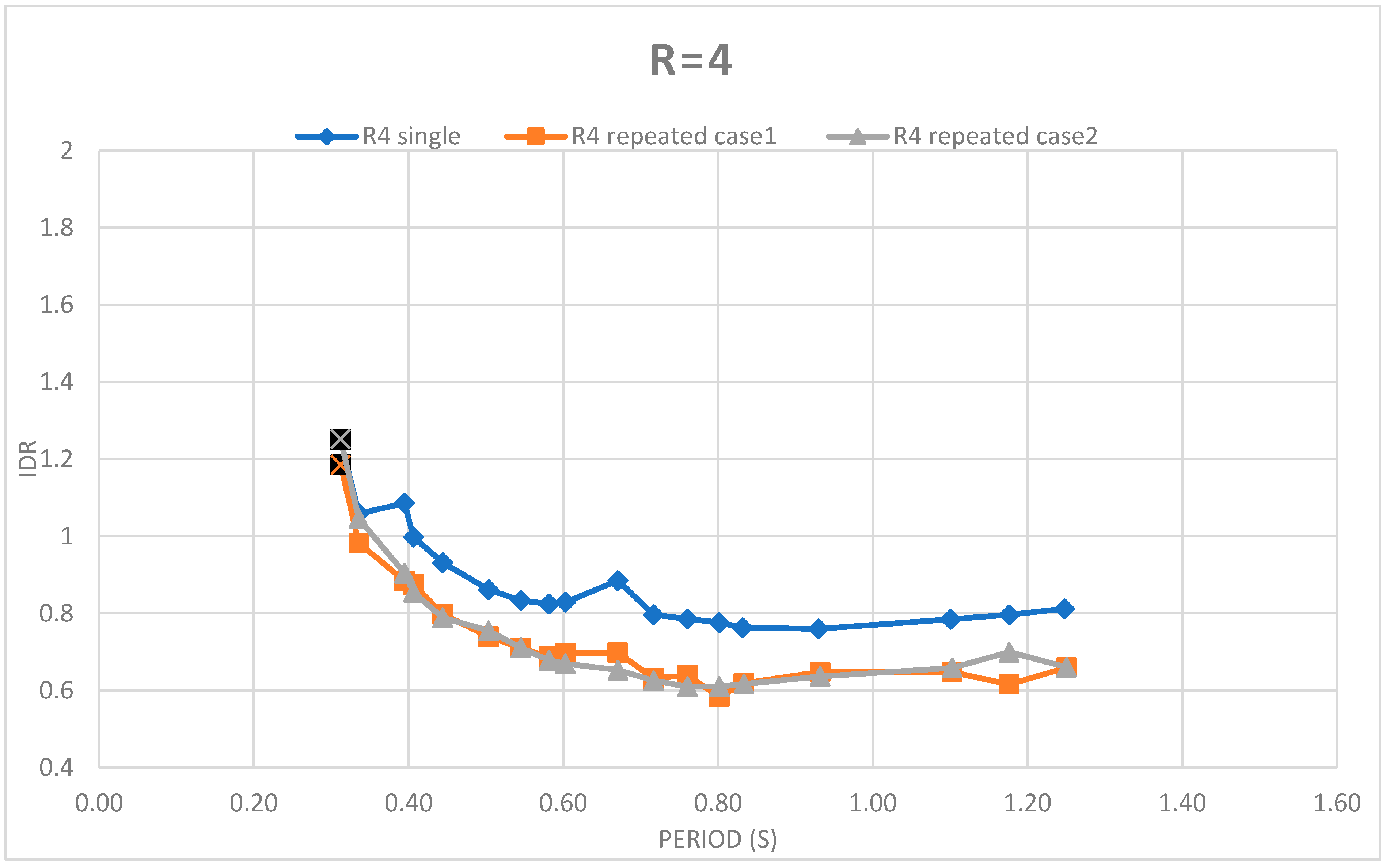
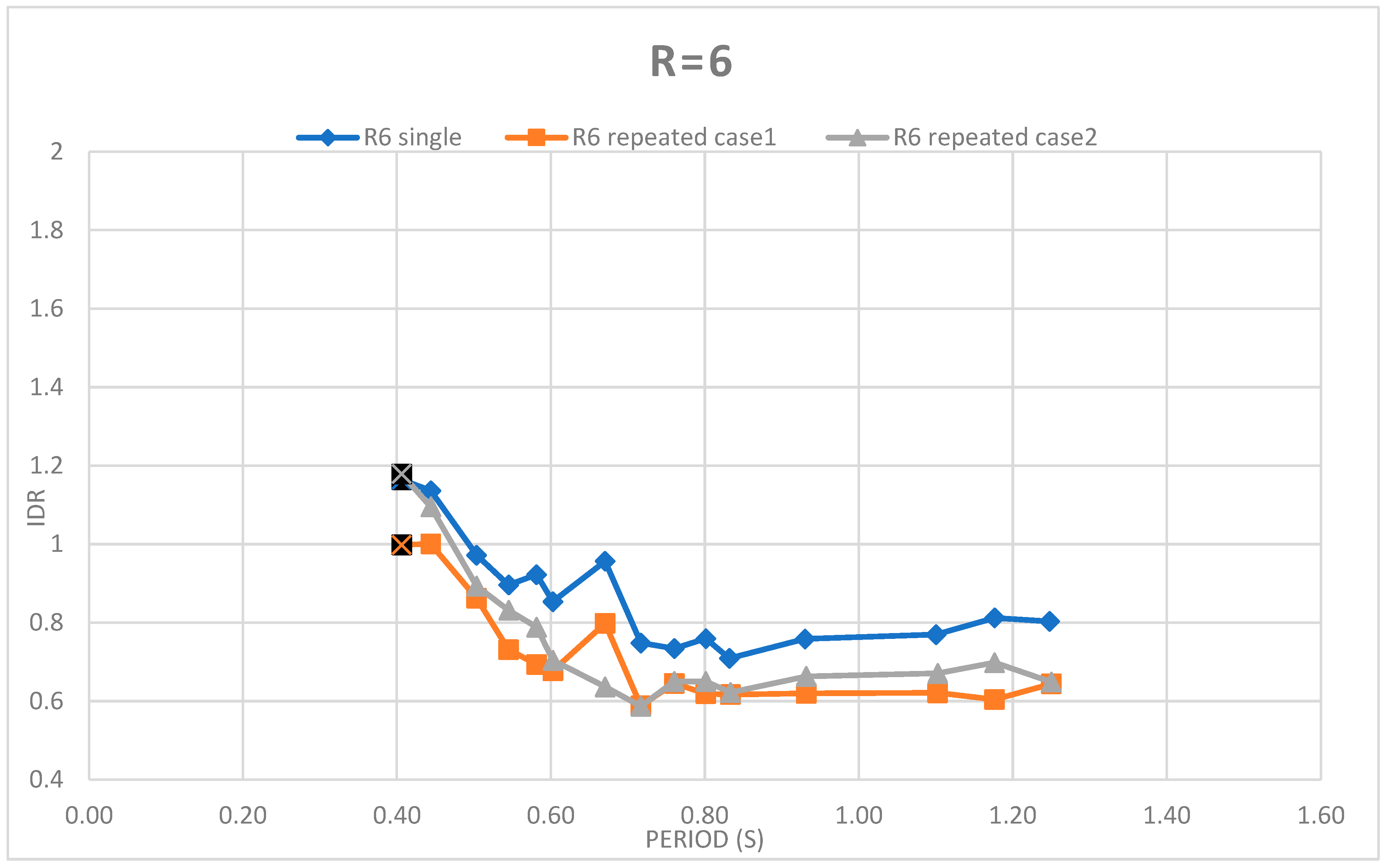
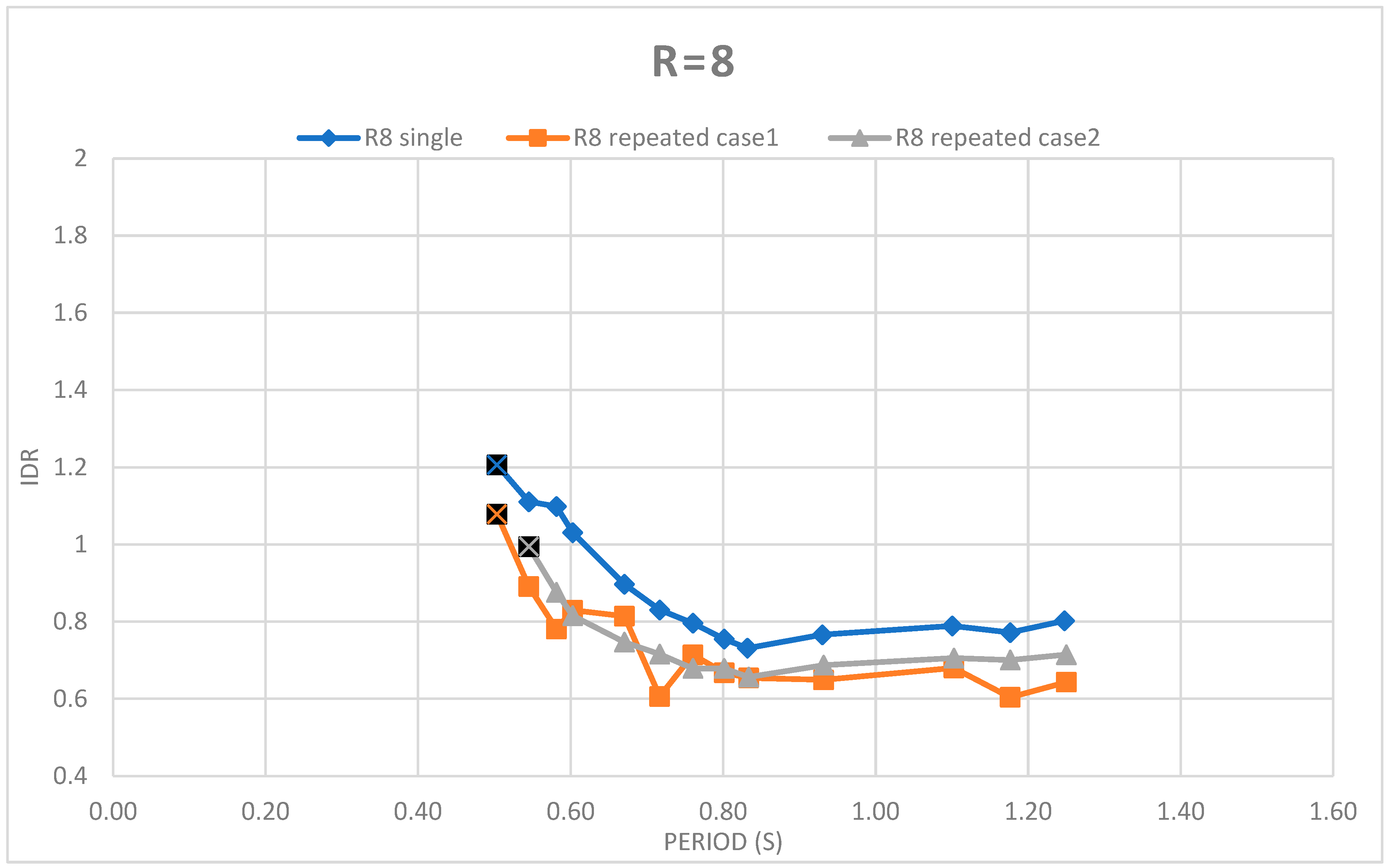
Ultimately, Figure 29, Figure 30, Figure 31, Figure 32 and Figure 33 presented below show the relationship between the IDR values and the period. When at least half the earthquake records fail, this is classified as collapse. The period just before collapse was marked with a black square with a cross. For all cases, the fixed-base period of the SDOF system was used. The strength reduction factors considered are R = 1.5, 2, 4, 6, and 8, respectively.
In Figure 29, it can be seen that the IDR values change from 0.77 to 1.14 for R = 1.5. Repeated Case 2 has the lowest IDR values among the three cases; however, it starts with the highest value at period 0.2 sec. All three cases follow the same trend, and the biggest drop occurs in the low period range. Repeated earthquake cases are more alike than the single record case. Among the three lines, the Repeated Case 2 line starts at the highest point at 1.14 but drops to 0.77 at 0.80 s. The single case IDR value starts at 1.06 and falls to 0.92, but subsequently, it remains constant. In summary, the Repeated Case 2 and Repeated Case 1 lines show the closest similarities, except for a negligible upward movement of the latter at 0.33 s. The single case shows a drop at the beginning, but it does not show any significant change for higher periods.
In Figure 30, the IDR values range between 1.29 and 0.69 for R = 2. The single case has the highest start at 0.2 s, followed by the Repeated Case 2 and the Repeated Case 1. All three lines drop to an IDR of 0.92 around 0.30 s.
Figure 31 shows IDR values ranging between 1.25 and 0.60 for R = 4. Single and Repeated Case 2 share the highest starting point with an IDR = 1.25, followed by Repeated Case 1 with an IDR = 1.19. Whilst both the Repeated Case 1 and Repeated Case 2 lines side by side continuously fall to 0.61 at 0.80 s and then follow a constant value until the end, the single case runs at a higher line.
Figure 32 shows dynamic movement for all three lines. All three lines start at 0.41 s (marked with black crossed box) and end at 1.25 s for R = 6. The fixed case starts with an IDR of 1.18, and Repeated Case 1 starts with an IDR of 1.0; they end with an IDR of 0.80 and 0.65, respectively. Both show the same movement, including an upward movement followed by a downward movement at 0.67 s with an IDR of 0.96 for the single case and IDR of 0.80 for Repeated Case 1. Repeated Case 2 shows a more stable movement, starting with an IDR of 1.18 and moving down to an IDR of 0.58 at 0.72 s, then a constant movement to an IDR of 0.64 at the end.
Figure 32 starts at higher periods, since the system collapsed at the lower period, as seen with a black crossed box.
Figure 33 represents the IDR values for R = 8, which is the most failing of all R factors. The single case and Repeated Case 1 start at 0.50 s, whereas Repeated Case 2 starts at 0.54 s. All three lines end at 1.25 s. Both the single case and Repeated Case 2 show stable downward movements. Both then constantly go up to an IDR = 0.80 and IDR = 0.71, respectively. Repeated Case 1, however, goes down from its starting point with an IDR = 1.08 and follows a downward movement.
Finally, fail percentages of the systems that belong to each earthquake case are demonstrated in Table 4. It was considered that, once the structure failed, it was not presented in the associated figure.
It can be stated that more than 50% of the structures collapsed under R = 8 for short periods (below 0.50 s), and more than 30% collapsed for periods between 0.50 to 0.80 s for each earthquake case.
Table 4 demonstrates how fail percentages change with the period of the system for varying strength reduction factors. As the value of R increases, the system has a higher tendency to collapse. This is more obvious for the shorter periods, especially between 0.20 s and 0.50 s. Shorter periods have more than 50% of collapse in the system for R values of 4, 6, and 8. From 0.50 s to 0.70 s, the failure percentages are around 30%, while Repeated Earthquake Case 2 shows slightly higher values than the two other cases. For the higher periods (0.70 s upwards), each case fail percentage stands below 30%. For R = 1.5 and R = 2, fail percentages are quite low with respect to those having higher R values for the same periods. Fail percentages belonging to the single earthquake case are more similar to Repeated Earthquake Case 1 than Repeated Earthquake Case 2, since Repeated Earthquake Case 2 has the highest value of fail percentages for different periods. R = 8 for Repeated Earthquake Case 2 is the only case in which fail percentage goes beyond 50% at 0.55 s.

5. Discussion of the Results and Conclusion Remarks

In this work, the effect of repeated earthquakes versus a single earthquake on the behavior of concrete structures is investigated. The structure is assumed to have a moderate degradation (γ = 100). Two different repeated earthquake models were used for the analysis. The main innovation of this work is to reveal the seismic sequence effect on displacement demands, with two different repeated earthquake models, accounting for degradation effects.
Qualitative discussions are given below for the generic trend of the data and tendency of the results; on the other hand, quantitative results have data. The IDR results from Repeated Earthquake Cases 1 and 2 are compatible with the results of the aforementioned studies, such as [24]. Moreover, IDR values oscillate around a value of 1, as suggested in [5].
  • IDR values tend to increase when the strength reduction factor (R) increases, especially in short periods below 0.50 s.
  • When the strength reduction factor increases from 2 to 4, 6, and 8, it can be observed that more failures occur. It can also be seen that at least 50% of failure happens as early as around 0.50 s when R = 8 for Repeated Earthquake Case 2.
  • For IDR values between 0.5 and 0.8, the change of the trend on each plot is similar for each case.
  • If R rises from 1.5 to 4 or higher, the failure point shifts from low to higher periods. This is more apparent for the R = 8 and R = 6 cases.
  • R = 8 has the biggest number of failures among all strength reduction factors regardless of repeated earthquake cases.
  • Repeated Earthquake Case 1 has 1.25 times lower IDR values than the single earthquake case.
  • Repeated earthquakes can have a greater impact on the collapse mechanisms of degrading structures than single earthquakes by at least 1.25 times for R values of 4, 6, and 8.
  • Lower periods, up to 0.50 s, tend to have higher differences in IDR values, and higher periods do not seem to have much of a difference. It is worth noting that, for R = 8, Repeated Earthquake Case 2 has more than 50% failure at 0.50 s, while the other two cases have no more than 39% failure at any period.
Finally, taking degradation into account gives lower values of IDR for repeated earthquake cases as both the main shock and after shock sequence cause additional weakening to the stiffness of the system. As both elastic and inelastic deformations are higher for the repeated excursions, IDR values are expected to be lower than for single events. Seismic guidelines and codes should include the effect of repeated earthquake cases and degradation, particularly for high strength reduction factors, which plays a vital role in the collapse of structures.

Author Contributions

Conceptualization, I.A. and A.S.A.; methodology, A.S.A.; validation, I.A. and A.S.A.; software, I.A. and A.S.A.; formal analysis I.A.; investigation, I.A.; data curation, I.A.; writing—original draft preparation, I.A.; writing—review and editing, I.A. and A.S.A.; visualization, I.A.; supervision A.S.A. All authors have read and agreed to the published version of the manuscript.

Funding

This research received no external funding.

Data Availability Statement

The original contributions shown in the study are included in the paper. Further inquiries can be directed to the corresponding author.

Conflicts of Interest

The authors declare no conflicts of interest.

Appendix A

Table A1. Earthquake data set.
No.Earthquake
Name
Country/
Region
Station
Name
Date
(dd/mm/yyyy)
Magnitude
(M)
ComponentPGA
(g)
1Northridge-01USAJensen Filter Plant17/01/19946.692921.024
2Northridge-01USALA—Sepulveda VA17/01/19946.693600.934
3ChristchurchNew ZealandLyttelton Port Company21/02/20116.30S80W0.881
4Northridge-01USASimi Valley -17/01/19946.6900.877
5Northridge-01USASylmar—Olive View17/01/19946.693600.843
6Northridge-01USASylmar—Converter17/01/19946.69180.828
7ChristchurchNew ZealandChristchurch Resthaven21/02/20116.30S88E0.718
8Northridge-01USABeverly Hills—1252017/01/19946.69350.606
9Northridge-01USACastaic—Old Ridge17/01/19946.69900.568
10ChristchurchNew ZealandChristchurch Botanic Gardens21/02/20116.30N890.527
11Northridge-01USALA Dam17/01/19946.69640.511
12Northridge-01USALA—Univ. Hospital17/01/19946.6950.493
13ChristchurchNew ZealandChristchurch Cathedral Coll.21/02/20116.30N64E0.483
14Northridge-01USALA—UCLA Grounds17/01/19946.693600.474
15Northridge-01USAPacific Palisades -17/01/19946.691900.469
16Whittier Narrows-01USAGarvey Res. -01/10/19875.993300.457
17Northridge-01USAPacoima Kagel17/01/19946.693600.433
18Whittier Narrows-01USAAlhambra—Fremont01/10/19875.992700.414
19ChristchurchNew ZealandChristchurch Cashmere High21/02/20116.30N10E0.397
20Northridge-01USALA 0017/01/19946.69900.388
21Northridge-01USALA—Wadsworth VA17/01/19946.693250.383
22Whittier Narrows-01USAPasadena—CIT Lura01/10/19875.99900.36
23ChristchurchNew ZealandChristchurch Hospital21/02/20116.30S89W0.359
24Northridge-01USAGlendale—Las17/01/19946.691770.357
25Northridge-01USATopanga—Fire Sta17/01/19946.693600.332
26Northridge-01USALA—City Terrace17/01/19946.691800.316
27Whittier Narrows-01USABrea Dam01/10/19875.991300.313
28Whittier Narrows-01USASan Gabriel—E01/10/19875.991800.304
29Whittier Narrows-01USAAltadena—Eaton01/10/19875.9900.299
30Northridge-01USAN Hollywood -17/01/19946.691800.298
31Whittier Narrows-01USAGlendale—Las01/10/19875.991770.296
32Northridge-01USAMoorpark—Fire Sta17/01/19946.691800.292
33Northridge-01USASanta Susana Ground17/01/19946.69900.289
34Whittier Narrows-01USAArcadia—Campus Dr01/10/19875.9990.28
35Whittier Narrows-01USAPasadena—CIT Calif01/10/19875.993600.271
36Whittier Narrows-02USAAltadena—Eaton04/10/19875.2700.262
37Whittier Narrows-01USAPasadena—Old01/10/19875.99900.258
38Northridge-01USALake Hughes #12A17/01/19946.691800.257
39Northridge-01USASan Gabriel—E17/01/19946.692700.256
40Northridge-01USALA—Wadsworth VA17/01/19946.692350.254
41Whittier Narrows-01USAN Hollywood -01/10/19875.992700.25
42Northridge-01USABig Tujunga, Angeles17/01/19946.693520.245
43Northridge-01USAPasadena—N Sierra17/01/19946.691800.245
44Whittier Narrows-01USAPasadena—CIT01/10/19875.99900.239
45Northridge-06USAPacoima Kagel20/03/19945.283600.228
46Northridge-01USALA—Chalon Rd17/01/19946.69700.225
47Northridge-01USAPoint Mugu—Laguna17/01/19946.69900.223
48ChristchurchNew ZealandChristchurch Canterbury Ae.21/02/20116.30N500.221
49Northridge-01USALake Hughes #917/01/19946.69900.217
50Whittier Narrows-01USALA—Fletcher Dr01/10/19875.992340.213
51Whittier Narrows-02USASan Marino—SW04/10/19875.273600.212
52ChristchurchNew ZealandChristchurch Papanui H. Sch.21/02/20116.30S33W0.212
53Northridge-01USALA—Cypress Ave17/01/19946.69530.21
54Northridge-01USALa Habra—Briarcliff17/01/19946.69900.206
55Whittier Narrows-01USASan Marino—SW01/10/19875.993600.204
56ChristchurchNew ZealandSwannanoa School21/02/20116.30N660.202
57Northridge-01USAManhattan Beach -17/01/19946.6900.201
58Whittier Narrows-01USAOrange Co. Reservoir01/10/19875.99960.198
59Whittier Narrows-01USALB—Rancho Los01/10/19875.99900.194
60ChristchurchNew ZealandRolleston School21/02/20116.30S29E0.193
61Northridge-01USALA—Brentwood VA17/01/19946.691950.186
62Northridge-04USAMoorpark—Fire Sta17/01/19945.931800.184
63Northridge-01USALA—Temple & Hope17/01/19946.691800.184
64Whittier Narrows-01USALa Habra—Briarcliff01/10/19875.9900.183
65Northridge-06USABeverly Hills—1252020/03/19945.28350.179
66Whittier Narrows-01USABig Tujunga, Angeles01/10/19875.993520.178
67Northridge-01USALa Crescenta—New17/01/19946.69900.178
68Whittier Narrows-02USAAlhambra—Fremont04/10/19875.272700.178
69Northridge-01USALA—N Figueroa St17/01/19946.693280.174
70Northridge-01USAMontebello—Bluff17/01/19946.692060.171
71Northridge-01USARancho Palos Verdes17/01/19946.6950.167
72Whittier Narrows-01USALA—N Figueroa St01/10/19875.993280.166
73Whittier Narrows-01USAPacoima Kagel01/10/19875.9900.166
74Whittier Narrows-01USAPasadena—Brown01/10/19875.991800.164
75Northridge-01USALA—W 15th St17/01/19946.691800.159
76Northridge-01USASunland—Mt Gleason17/01/19946.692600.157
77Whittier Narrows-01USALA—Cypress Ave01/10/19875.99530.156
78Northridge-06USASylmar—Converter20/03/19945.28180.155
79Northridge-01USALawndale—Osage17/01/19946.691820.153
80Northridge-01USASan Marino—SW17/01/19946.693600.15
81Whittier Narrows-01USABrea Dam (L Abut)01/10/19875.991300.149
82Northridge-01USALeona Valley #5 -17/01/19946.6900.147
83Whittier Narrows-01USALa Crescenta—New01/10/19875.991800.141
84Whittier Narrows-01USABeverly Hills—1252001/10/19875.991220.138
85Northridge-01USAPlaya Del Rey -17/01/19946.6900.136
86Northridge-06USABig Tujunga, Angeles20/03/19945.282620.134
87ChristchurchNew ZealandTempleton School21/02/20116.30N270.122
88Northridge-01USARolling Hills Est-17/01/19946.69900.116
89Northridge-01USAArcadia—Campus Dr17/01/19946.692790.11
90Whittier Narrows-01USAGlendora—N01/10/19875.991700.11
91Northridge-01USALeona Valley #317/01/19946.69900.106
92Northridge-06USASimi Valley -20/03/19945.28900.105
93Northridge-05USACastaic—Old Ridge17/01/19945.13900.105
94Northridge-01USANewport Bch—Newp and C.17/01/19946.69900.103
95Northridge-01USAAlhambra—Fremont School17/01/19946.69900.101
96Northridge-01USASan Pedro—Palos Verdes17/01/19946.6900.101
97Whittier Narrows-01USAMill Creek, Angeles Nat For01/10/19875.9900.089
98Whittier Narrows-01USASunland—Mt Gleason Ave01/10/19875.991800.089
99ChristchurchNew ZealandKowai21/02/20116.30N70E0.088
100ChristchurchNew ZealandAshley School21/02/20116.30N850.088
101Northridge-06USASunland—Mt. Gleason A.K. V.20/03/19945.281700.088
102Northridge-01USACarson—Catskill Ave17/01/19946.69900.087
103ChristchurchNew ZealandWaikari21/02/20116.30S10E0.083
104ChristchurchNew ZealandSpringfield Fire Station21/02/20116.30N730.082

References

  1. ATC32:1996; Improved Seismic Design Guidelines for Bridges. Applied Technology Council: Redwood City, CA, USA, 1996.
  2. FEMA-450:2003; NEHRP Recommended Provisions for Seismic Regulations for New Buildings and Other Structures. Building Seismic Safety Council National Institute of Building Science for Federal Emergency Management Agency (FEMA): Washington, DC, USA, 2003.
  3. TBI (2017/06); Guidelines for Performance-Based Seismic Design of Tall Buildings. Pacific Earthquake Engineering Research Center, Tall Building Initiative: Berkeley, CA, USA, 2017.
  4. EN 1998-1:1994; Eurocode 8: Design Provisions for Earthquake Resistance of Structures. European Committee for Standardization: Brussels, Belgium, 1994.
  5. Veletsos, A.S.; Newmark, N.M. Effect of inelastic behaviour on the response of simple systems to earthquake motions. In Proceedings of the Second World Conference on Earthquake Engineering, Tokyo, Japan, 11–18 July 1960; pp. 895–912. [Google Scholar]
  6. Hamasaki, K.; Sozen, M.A. Seismic Drift of Reinforced Concrete Structures; Technical Research Reports of Hazama-Gumi Ltd.: Tokyo, Japan, 1984. [Google Scholar]
  7. Qi, X.; Moehle, J.P. Displacement Design Approach for Reinforced Concrete Structures Subjected to Earthquakes; Report No. EERC/UCB-91/02; Earthquake Engineering Research Center, University of California: Berkeley, CA, USA, 1991. [Google Scholar]
  8. Miranda, E. Seismic Evaluation and Upgrading of Existing Buildings. Ph.D. Thesis, University of California, Berkeley, CA, USA, 1991. [Google Scholar]
  9. Miranda, E. Evaluation of site dependent inelastic seismic design spectra. J. Struct. Eng. 1993, 119, 1319–1338. [Google Scholar] [CrossRef]
  10. Miranda, E. Evaluation of seismic design criteria of highway bridges. Earthq. Spectra 1993, 9, 233–250. [Google Scholar] [CrossRef]
  11. Miranda, E. Inelastic displacement ratios for structures on firm sites. J. Struct. Eng. 2000, 126, 1150–1159. [Google Scholar] [CrossRef]
  12. Ruiz-Garcia, J.; Miranda, E. Inelastic displacement ratios for evaluation of existing structures. Earthq. Eng. Struct. Dyn. 2003, 32, 1237–1258. [Google Scholar] [CrossRef]
  13. Ruiz-García, J. Inelastic displacement ratios for seismic assessment of structures subjected to forward-directivity near-fault ground motions. J. Earthq. Eng. 2011, 15, 449–468. [Google Scholar] [CrossRef]
  14. Miranda, E.; Akkar, S.D. Dynamic instability of simple structural systems. J. Struct. Eng. 2003, 129, 1722–1726. [Google Scholar] [CrossRef]
  15. Rahnama, M.; Krawinkler, H. Effects of Soils and Hysteresis Models on Seismic Design Spectra; Report 117; The John A. Blume Earthquake Engineering Centre, Stanford University: Stanford, CA, USA, 1993. [Google Scholar]
  16. Gupta, B.; Kunnath, S. Effect of hysteretic model parameters on inelastic seismic demands. In Proceedings of the 6th National Conference on Earthquake Engineering, Earthquake Engineering Research Institute, Seattle, WA, USA, 31 May–4 June 1998. [Google Scholar]
  17. Song, J.K.; Pincheira, J.A. Spectral displacement demands of stiffness- and strength-degrading systems. Earthq. Spectra. 2000, 16, 817–851. [Google Scholar] [CrossRef]
  18. Chopra, A.K.; Chintanapakdee, C. Inelastic deformation ratios for design and evaluation of structures: Single-degree-of-freedom bilinear systems. J. Struct. Eng. 2004, 130, 1309–1319. [Google Scholar] [CrossRef]
  19. Chenouda, M.; Ayoub, A.S. Inelastic displacement ratios of degrading systems. J. Struct. Eng. 2008, 134, 1030–1045. [Google Scholar] [CrossRef]
  20. Chenouda, M.; Ayoub, A.S. Probabilistic collapse analysis of degrading multi degree of freedom structures Under earthquake excitation. Eng. Struct. 2009, 31, 2909–2921. [Google Scholar] [CrossRef]
  21. Dutta, S.C. Effect of strength deterioration on inelastic seismic torsional behaviour of asymmetric RC buildings. Build Environ. 2001, 36, 1109–1118. [Google Scholar] [CrossRef]
  22. Málaga-Chuquitaype, C. Strong-motion duration and response scaling of yielding and degrading eccentric structures. Earthq Eng. Struct. Dyn. 2021, 50, 635–654. [Google Scholar] [CrossRef]
  23. Uchida, N.; Bürgmann, R. Repeating Earthquakes. Annu. Rev. Earth Planet. Sci. 2019, 47, 305–332. [Google Scholar] [CrossRef]
  24. Hatzigeorgiou, G.; Beskos, D. Inelastic displacement ratios for SDOF structures subjected to repeated earthquakes. Eng Struct. 2009, 31, 2744–2755. [Google Scholar] [CrossRef]
  25. Faisal, A.; Majid, T.A.; Hatzigeorgiou, G. Investigation of story ductility demands of inelastic concrete frames subjected to repeated earthquakes. Soil Dyn. Earthq. Eng. 2013, 44, 42–53. [Google Scholar] [CrossRef]
  26. Amadio, C.; Fragiacomo, M.; Raigeli, S. The effects of repeated earthquake ground motions on the nonlinear response of SDOF systems. Earthq. Eng. Struct. Dyn. 2003, 32, 291–308. [Google Scholar] [CrossRef]
  27. Tahara, R.M.K.; Majid, T.A.; Zaini, S.S. Effect of repeated earthquake on inelastic moment resisting concrete frame, American Institute of Physics. AIP Conf. Proc. 2017, 1892, 020019. [Google Scholar]
  28. Ozkul, S.; Ayoub, A.S.; Altunkaynak, A. Fuzzy-logic based inelastic displacement ratios of degrading RC structures. Eng. Struct. 2014, 75, 590–603. [Google Scholar] [CrossRef]
  29. Lazaridis, P.C.; Kavvadias, I.E.; Demertzis, K.; Iliadis, L.; Vasiliadis, L.K. Structural Damage Prediction of a Reinforced Concrete Frame under Single and Multiple Seismic Events Using Machine Learning Algorithms. Appl. Sci. 2022, 12, 3845. [Google Scholar] [CrossRef]
  30. Zhang, C.; Li, J.; Liu, Y.; Cheng, Q.; Sun, Z. Seismic Vulnerability Analysis of Concrete-Filled Steel Tube Structure under Main–Aftershock Earthquake Sequences. Buildings 2024, 14, 869. [Google Scholar] [CrossRef]
  31. Hu, J.; Wen, W.; Zhai, C.; Pei, S.; Duofa, J. Seismic resilience assessment of buildings considering the effects of mainshock and multiple aftershocks. J. Build. Eng. 2023, 68, 106110. [Google Scholar] [CrossRef]
  32. Clough, R.W.; Johnston, S.B. Effect of stiffness degradation on earthquake ductility requirements. In Proceedings of the 2nd Japan Earthquake Engineering Symposium, Tokyo, Japan, 17–20 October 1966; pp. 227–232. [Google Scholar]
  33. Ayoub, A.S.; Mijo, C.; Chenouda, M. Seismic fragility analysis of degrading structural systems. In Proceedings of the 13th World Conference on Earthquake Engineering, Vancouver, BC, Canada, 1–6 August 2004; p. 2617. [Google Scholar]
  34. Ayoub, A.S.; Chenouda, M.; Mijo, C. Displacement estimates and collapse prediction of degrading structural systems. In Proceedings of the 13th World Conference on Earthquake Engineering, Vancouver, BC, Canada, 1–6 August 2004; p. 2618. [Google Scholar]
  35. Ibarra, L.; Medina, R.; Krawinkler, H. Hysteretic models that incorporate strength and stiffness deterioration. Earthq. Eng. Struct. Dyn. 2005, 34, 1489–1511. [Google Scholar] [CrossRef]
  36. Ozkul, S. New Inelastic Displacement Ratio of SDOF Structures Using Expert Systems. Master’s Thesis, University of Houston, Houston, TX, USA, 2011. [Google Scholar]
  37. Demirol, E.; Ayoub, A.S. Inelastic displacement ratios of SSI systems. Soil Dyn. Earthq. Eng. 2017, 96, 104–114. [Google Scholar] [CrossRef]
  38. Pacific Earthquake Engineering Research Center. PEER Structural Performance Database. Available online: http://nisee.berkeley.edu/spd/search.html (accessed on 1 June 2023).
  39. Thomsen, J.H.; Wallace, J.W. Lateral load behaviour of reinforced concrete columns constructed using high-strength materials. ACI Struct. J. 1994, 91, 605–615. [Google Scholar]
  40. Mo, Y.L.; Wang, S.J. Seismic behavior of RC columns with various Tie configurations. J. Struct. Eng. 2000, 126, 1122–1130. [Google Scholar] [CrossRef]
  41. Saatcioglu, M.; Grira, M. Confinement of reinforced concrete columns with welded reinforcement grids. ACI Struct. J. 1999, 96, 29–39. [Google Scholar] [CrossRef] [PubMed]
  42. Legeron, F.; Paultre, P. Behaviour of high-strength concrete columns under cyclic flexure and constant axial load. ACI Struct. J. 2000, 97, 591–601. [Google Scholar]
  43. Haselton, C.B.; Liel, A.B.; Lange, S.T.; Deierlein, G.G. Beam–Column Element Model Calibrated for Predicting Flexural Response Leading to Global Collapse of RC Framing Buildings; PEER Report 2007/03; Pacific Earthquake Engineering Research Center, University of California: Berkeley, CA, USA, 2008. [Google Scholar]
  44. Huang, Y.N.; Whittaker, A.S.; Luco, N.; Hamburger, R.O. Scaling earthquake ground motions for performance-based assessment of buildings. J. Struct. Eng. 2011, 137, 311–321. [Google Scholar] [CrossRef]
  45. Somerville, P.; Smith, N.; Punyamurthula, S.; Sun, J. Development of Ground Motion Time Histories for Phase 2 of the FEMA/SAC Steel Project; Report no. SAC/BC-97/04; SAC Joint Venture: Sacramento, CA, USA, 1997. [Google Scholar]
  46. Shome, N.; Cornell, C.A.; Bazurro, P.; Carballo, J.E. Earthquakes, records, and nonlinear responses. Earthq. Spectra 1998, 14, 469–500. [Google Scholar] [CrossRef]
  47. Iervolino, I.; Cornell, A. Record Selection for Nonlinear Seismic Analysis of Structures. Earthq. Spectra 2005, 21, 685–713. [Google Scholar] [CrossRef]
  48. Demir, A.; Palanci, M.; Kayhan, A.H. Evaluation the effect of amplitude scaling of real ground motions on seismic demands accounting different structural characteristics and soil classes. Bull. Earthq. Eng. 2024, 22, 365–393. [Google Scholar] [CrossRef]
  49. Di Sarno, L. Effects of multiple earthquakes on inelastic structural response. Eng. Struct. 2013, 56, 673–681. [Google Scholar] [CrossRef]
  50. Li, Q.; Ellingwood, B. Performance evaluation and damage assessment of steel frame buildings under main shock–aftershock earthquake sequences. Earthq. Eng. Struct. Dyn. 2007, 36, 405–427. [Google Scholar] [CrossRef]
  51. Arulanantham, S. Seismic Behaviour of Degrading SDOF Systems under Repeated Earthquakes. Master’s Thesis, University of London, London, UK, 2015. [Google Scholar]
Figure 1. Yield stiffness degradation envelope for the bilinear model [19]. (Numbers and arrows are to show the loading-reloading-unloading segments).
Buildings 16 00663 g001
Figure 2. Yield stiffness degradation envelope for the modified Clough model [19]. (Numbers and arrows are to show the loading-reloading-unloading segments).
Buildings 16 00663 g002
Figure 3. Yield stiffness degradation envelope for the modified Clough model, adopted from [36].
Buildings 16 00663 g003
Figure 4. Unloading stiffness degradation envelope for the modified Clough model [36].
Buildings 16 00663 g004
Figure 5. Accelerated degradation envelope for the modified Clough model [36].
Buildings 16 00663 g005
Figure 6. The cap degradation modified envelope for the modified Clough model [36].
Buildings 16 00663 g006
Figure 7. No degradation envelopes for the modified Clough model [36].
Buildings 16 00663 g007
Figure 8. Low degradation envelope for the modified Clough model [36].
Buildings 16 00663 g008
Figure 9. Moderate degradation envelope for the modified Clough model [36].
Buildings 16 00663 g009
Figure 10. Severe degradation envelope for the modified Clough model [36].
Buildings 16 00663 g010
Figure 11. Cap failure for the modified Clough model [36].
Buildings 16 00663 g011
Figure 12. Cyclic degradation failure for the modified Clough model [36].
Buildings 16 00663 g012
Figure 13. Period of vibrations of selected RC columns [28].
Buildings 16 00663 g013
Figure 14. Lateral load displacement history of the B2 column (by using PEER Report 2007/03-recommended beam–column element parameters).
Buildings 16 00663 g014
Figure 15. Lateral load displacement history of the B2 column (by using author’s selected model parameters).
Buildings 16 00663 g015
Figure 16. Lateral load displacement history of the BG-6 column (by using author’s selected model parameters).
Buildings 16 00663 g016
Figure 17. Representation of Repeated Earthquake Case 1 in displacement vs. time.
Buildings 16 00663 g017
Figure 18. Structure displacement resistance history with low degradation.
Buildings 16 00663 g018
Figure 19. Structure displacement resistance history with severe degradation.
Buildings 16 00663 g019
Figure 20. Structure displacement resistance history with moderate degradation.
Buildings 16 00663 g020
Figure 21. Structure displacement history for a single earthquake.
Buildings 16 00663 g021
Figure 22. Structure displacement resistance history for a single earthquake.
Buildings 16 00663 g022
Figure 23. Structure displacement history for Repeated Earthquake Model 2.
Buildings 16 00663 g023
Figure 24. Structure displacement resistance history for Repeated Earthquake Model 2.
Buildings 16 00663 g024
Figure 25. Structure displacement history for Repeated Earthquake Model 1.
Buildings 16 00663 g025
Figure 26. Structure displacement resistance history for Repeated Earthquake Model 1.
Buildings 16 00663 g026
Figure 27. Median response spectrum for the single earthquake case and for Repeated Earthquake Case 1 with damping ratios of 0% and 5%.
Buildings 16 00663 g027
Figure 28. Median response spectrum for the single earthquake case and for Repeated Earthquake Case 2 with damping ratios of 0% and 5%.
Buildings 16 00663 g028
Figure 29. IDR for R = 1.5.
Buildings 16 00663 g029
Figure 30. IDR for R = 2.
Buildings 16 00663 g030
Figure 31. IDR for R = 4.
Buildings 16 00663 g031
Figure 32. IDR for R = 6.
Buildings 16 00663 g032
Figure 33. IDR for R = 8.
Buildings 16 00663 g033
Table 1. Column parameters (recommended versus model) adopted from [28].
ColumnsBeam–Column Element ParametersModel Parameters
Hardening Slope (αs)Cap Slope (αc)Energy Dissipation Capacity (λ)Hardening Slope (αs)Cap Slope (αc)Energy Dissipation Capacity (λ)
B20.07−0.05780.06−0.06100
C2-30.07−0.071150.06−0.06100
C3-20.06−0.05910.06−0.06100
BG-60.0450.07810.06−0.06100
10060150.001−0.021270.06−0.06100
Table 2. Design coefficients and factors for seismic force-resisting systems (adopted from [2]).
Basic Seismic Force Resisting System/Building Frame Systems/Dual Systems with Special Moment FramesR aΩ0 bCd cSystem Limitations and Height Limits (ft) by Seismic Design Category d
BCD eE eF f
Bearing Wall Systems
Ordinary reinforced concrete shear walls44NLNLNPNPNP
Detailed plain concrete shear walls22NLNPNPNPNP
Building Frame Systems
Steel eccentrically braced frames with moment-resisting connections at columns away from links824NLNL160160100
Buckling-restrained braced frames, moment-resisting beam–column connections85NLNL160160100
Special reinforced concrete shear walls65NLNL160160100
Moment Resisting Frame Systems
Special reinforced concrete moment frames83NLNLNLNLNL
Dual Systems with Special Moment Frames
Special reinforced concrete shear walls8NLNLNLNLNL
Ordinary reinforced concrete shear walls65NLNLNPNPNP
a Response modification coefficient. R, for use throughout mentioned Provisions. b The tabulated value of Ω0 may be reduced by subtracting ½ for structures with flexible diaphragms but shall not be taken as less than 2.0 for any structure. c Deflection amplification factor, Cd, for use throughout mentioned Provisions. d NL = not limited and NP = not permitted. e See the description of building systems limited to buildings with a height of 240 ft (70 m) or less in the refences. f See the description of building systems limited to buildings with a height of 160 ft (50 m) or less in the refences.
Table 3. Cases of repeated earthquakes around the world (ESD = European Strong Motion Database; Cosmos = Cosmos Virtual Data Centre). Courtesy of [49].
No.CountryStationDirectionEarthquake NameDateTimeMag.PGA (g)Source
1TurkeyLDEO C0375VON-S Duzce7 November 199916:57Mw = 7.20.919ESD
N-SDuzce (aftershock)12 November 199916:54Mw = 4.90.352ESD
N-SDuzce (aftershock)13 November 199900:54Mw = 4.50.304ESD
N-SDuzce (aftershock)19 November 199919:59Mw = 4.40.595ESD
2GreeceKalamata OTE BLDGE-WKalamata13 September 198617:24Ms = 6.20.240ESD
E-WKalamata
(aftershock)
13 September 198611:41Ms = 5.40.240ESD
3TaiwanCHY080E-WChi-Chi20 September 199917:47Mw = 7.60.082Cosmos
E-WChi-Chi (aftershock)20 September 199918:03Mw = 6.20.048Cosmos
4USAImperial Valley Array 9E-WImperial Valley15 October 197923:16Mw = 6.50.236Cosmos
E-WImperial Valley
(aftershock)
15 October 197923:19Mw = 5.00.189Cosmos
5USACedar Hill NA, TarzanaE-WNorthridge 17 January 199412:30Mw = 6.7 1.778Cosmos
E-WNorthridge
(aftershock)
20 March 199421:20Mw = 5.30.372Cosmos
Table 4. Fail percentages of each earthquake case.
Period (s)Single EarthquakeRepeated Earthquake Case 1Repeated Earthquake Case 2
Fail Percentages % Fail Percentages %Fail Percentages %
R1.5R2R4R6R8R1.5R2R4R6R8R1.5R2R4R6R8
0.200.05.851.075.687.31.910.651.085.692.31.05.851.085.693.3
0.310.00.014.359.077.10.01.918.362.579.80.00.024.068.379.8
0.340.00.05.846.049.90.00.08.950.052.30.00.010.651.966.3
0.390.01.010.251.069.20.01.012.551.069.20.01.011.556.774.0
0.410.01.05.233.753.80.01.06.733.753.80.00.03.833.758.7
0.440.00.06.928.851.90.00.07.728.850.00.00.03.831.753.8
0.500.00.01.923.436.50.00.04.824.038.50.00.01.927.950.0
0.550.00.01.022.136.50.00.03.822.136.50.00.01.021.235.6
0.580.00.03.820.235.60.00.03.820.235.60.00.03.823.131.7
0.600.00.01.018.331.51.00.02.920.236.50.00.01.021.234.6
0.670.00.03.419.534.60.00.05.826.939.40.00.01.018.327.9
0.720.00.00.015.429.80.00.01.015.429.80.00.00.014.428.8
0.760.00.00.011.528.80.00.01.013.528.80.00.00.011.525.0
0.800.00.00.012.125.00.00.00.014.425.00.00.00.012.524.0
0.830.00.00.015.419.20.00.00.015.419.20.00.00.011.519.2
0.930.00.00.013.523.10.00.00.013.523.10.00.00.07.717.3
1.100.00.00.07.715.40.00.01.09.615.40.00.01.07.713.5
1.180.00.01.05.818.20.00.01.08.721.20.00.01.95.816.3
1.250.00.01.05.816.30.00.01.08.720.20.00.01.97.715.4
Disclaimer/Publisher’s Note: The statements, opinions and data contained in all publications are solely those of the individual author(s) and contributor(s) and not of MDPI and/or the editor(s). MDPI and/or the editor(s) disclaim responsibility for any injury to people or property resulting from any ideas, methods, instructions or products referred to in the content.