Article

Influence of Cracks at the Middle-Height Layer Position on the Load-Bearing Capacity of Timber Beams: A Study Based on Small-Sized Specimens and a Large Sample Size


by
Le Zhou
,
Xiaoyi Hu
*,
Dalie Liu
,
Sishi Li
,
Hongchao Liu
and
Xin Hou
College of Optical, Mechanical and Electrical Engineering, Zhejiang A&F University, Hangzhou 311300, China
*
Author to whom correspondence should be addressed.
Buildings 2026, 16(3), 650; https://doi.org/10.3390/buildings16030650
Submission received: 2 January 2026 / Revised: 28 January 2026 / Accepted: 2 February 2026 / Published: 4 February 2026
(This article belongs to the Section Building Structures)

Abstract

The anisotropic properties of wood make timber beams prone to developing longitudinal cracks. Notably, cracks occurring at the mid-height position are both highly common and critically detrimental to structural load-bearing capacity. This study focuses on the influence mechanisms of such cracks through four-point bending tests on 860 specimens, finite element simulations, and fracture morphology analyses. By introducing a horizontal crack location parameter called crack eccentricity (e), the influence of cracks at different horizontal positions on timber beam load-bearing capacity was investigated. The experimental results show that the horizontal position of the crack has a “critical eccentricity effect”: when e is below the critical value, cracks will not propagate and will have a minor impact on the load-bearing performance of timber beams; when e exceeds the critical value, cracks will propagate and their harmfulness will increase dramatically. As a special case, specimens with side-opening cracks (e = 1) exhibit “damage saturation” characteristics. That is, when the crack length exceeds the threshold (half of the beam span), regardless of further lengthening, the bearing capacity is unchanged and the damage evolution reaches a saturation plateau. The above analysis results suggest that the influence of cracks on the bearing capacity of timber beams may be counterintuitive. The calculation method for the “crack hazard coefficient” proposed in this study can provide a reference for crack hazard assessments.

1. Introduction

Crack damage, as a major form of failure in components, poses a significant threat to the safety and durability of load-bearing structures. Classical fracture mechanics theory indicates that crack tips induce severe stress concentrations and may lead to unstable crack propagation, thereby drastically reducing the bearing capacity of the component. However, the mechanical behavior of cracks strongly depends on material properties: ductile materials can dissipate energy and mitigate stress concentration through plastic deformation zones at the crack tip, thereby suppressing crack propagation whereas brittle materials lack such mechanisms, making cracks prone to catastrophic propagation. Wood, as a naturally grown biocomposite material, exhibits far more complex microstructural and mechanical behavior than homogeneous ductile or brittle materials, displaying significant anisotropy, heterogeneity, and viscoelastic characteristics [1,2,3]. These complex constitutive properties of wood make it challenging to directly apply traditional fracture mechanics theory to predict the mechanical behavior of cracked wooden components. Therefore, it is essential to conduct fracture mechanics experiments specific to wood, reveal its unique failure mechanisms, and subsequently develop or modify existing theoretical models to establish fracture prediction and safety assessment methods suitable for wooden components.
Crack damage in wood is a ubiquitous phenomenon, as shown by the adage: “There is no timber without cracks.” From the perspective of wood science, this stems from its natural biological structure and anisotropy [4]. During the drying process, the evaporation rate of moisture at the surface exceeds that inside the wood, leading to uneven shrinkage and generating tensile stress in the surface layers. When this stress exceeds the bonding strength between wood cells, drying-induced cracks are initiated, typically propagating along the fiber direction [5]. Additionally, the release of internal growth stresses after tree felling is a significant factor contributing to cracking [6,7]. Since the tensile strength of wood is much higher along the grain than across it, most stress-induced cracks propagate parallel to the wood fibers, often resulting in large longitudinal cracks along the sides of substantial timber beams [8]. As critical load-bearing components in timber structures, longitudinal cracks in timber beams directly affect the overall structural performance and safety. Research indicates that the cracking rate in timber beams of ancient buildings ranges from 84.5% to 88.1% [9], highlighting the importance and urgency of investigating the influence of longitudinal cracks.
In recent years, scholars have used various methods to investigate the impact of cracks on the mechanical properties of timber beams. In the field of experimental mechanics, Fang et al. [10] studied GFRP bamboo–wood composite sandwich beams usingfour-point bending tests. They found that increasing the thickness of the bamboo and GFRP layers significantly enhanced the bending stiffness and bearing capacity of the beams, indicating that this structure combines excellent mechanical performance with lightweight potential, providing a basis for engineering applications such as bridge decks. Naychuk [11] conducted experimental tests on timber beams with through-thickness cracks and found that cracks propagate under shear stress at their tips, with bearing capacities varying depending on crack length and location. They proposed a bearing capacity assessment method and stiffness reduction factors based on the crack length, and experimental results validated the reliability of the calculation method. In their study on carbon-fiber-reinforced timber beams, Halicka et al. [12] observed that cracks under four-point bending predominantly propagated longitudinally and documented their distribution patterns. Zhang et al. [13] employed digital image correlation (DIC) technology to monitor the strain field of Mongolian pine timber beams with shrinkage cracks in real time. They discovered that as the severity of cracks increased, the failure mode shifted from pure bending failure to bending-shear or parallel-to-grain shear failure. Regarding crack propagation mechanisms, Romanowicz et al. [14] used double-cantilever beam (DCB) tests combined with DIC to decompose the fracture process of pine wood into two stages: pre-peak microcracking and post-peak fiber bridging. They quantified their contributions to fracture energy and identified micro-cracking as the primary toughening mechanism. Qiu et al. [15] successfully simulated the propagation of longitudinal cracks in glued laminated timber beams using the extended finite element method (XFEM), validating the applicability of fracture mechanics to wood. Instudies on specimens of different sizes, Nakao et al. [16] found that traditional bending strength theory could not fully explain the fracture of cracked timber beams, whereas fracture mechanics theory modified with the stress intensity factor KIC demonstrated good applicability. Additionally, Tu et al. [17] combined digital image correlation (DIC) with acoustic emission (AE) technology to establish a quantitative relationship between crack propagation length and AE event counts. Zlamal et al. [18] developed an elastoplastic constitutive model for high-moisture-content wood and verified its effectiveness in finite element simulations. Chi et al. [19] visualized the dynamic three-dimensional migration of moisture within wood during the drying process. These studies have deepened the understanding of wood fracture behavior and moisture–mechanical coupling effects. However, systematic research on the influence of crack geometric parameters (e.g., location and length) on the bearing capacity of timber beams—particularly regarding potential threshold effects and non-monotonic influence patterns—still requires further exploration.
Regarding the mechanical performance of timber beams with cracks, existing studies have either focused on the influence of specific crack types on bearing capacity or aimed to elucidate crack formation and propagation mechanisms. However, there is still a lack of systematic fracture mechanics experiments based on large samples, and few studies have comprehensively analyzed or revealed the influence patterns of key geometric crack parameters, such as length and location, along with their underlying mechanisms. To address this, the present study aims to systematically investigate the influence mechanisms of the geometric parameters of longitudinal cracks on the bending capacity of timber beams. First, by introducing a “crack eccentricity (e)” parameter, the influence of crack position along the span direction is systematically analyzed. Second, the effects of side-open cracks with different lengths are examined. The experimental design specifically compares loading configurations under different lengths of pure bending segments to elucidate the interaction mechanisms between cracks and the stress states within timber beams.

2. Materials and Methods

2.1. Wood Selection

Pinus sylvestris var. mongolica was obtained from the Krasnoyarsk Krai region in Russia and used as the experimental material in this study. This wood species has a standard air-dry density of ρ0 = 480 kg/m3. It offers advantages such as moderate strength, good durability, ease of processing, and relatively low cost, making it a commonly used material for timber beams in structures [20,21]. To minimize the uncertainty in experimental results caused by variations among individual specimens, a relatively large sample size was tested for each experimental group, resulting in a total sample size of 860.
To avoid excessive consumption of timber and simultaneously reduce specimen processing difficulty and energy consumption, small-sized specimens were employed for the tests in this study. It should be noted that small-sized specimens may introduce size effects. As a natural biocomposite material, the mechanical behavior of wood may vary with changes in dimensions. This study aims to summarize the mechanical influence of horizontal crack positions on the load-bearing capacity of timber beams through mechanical experiments with a large sample size. Although variations may occur in full-scale beams due to factors such as stress gradients, differences in the scale of material heterogeneity, and the relative proportion of the crack-tip process zone size to beam height, the fundamental investigation based on a large sample size in this study will enable more targeted design of experiments with selected crack parameters in full-scale timber beam tests, thereby reducing unnecessary wood consumption. Furthermore, the primary objective of this study is to systematically reveal the qualitative laws and threshold effects of a crack’s geometric parameters (position and length) on the flexural performance of timber beams. These fundamental mechanical mechanisms also provide valuable insights for understanding the mechanical behavior of full-scale timber beams.

2.2. Selection of Pre-Crack Locations for Experimental Specimens

Cracks in timber beams are mainly formed by shrinkage phenomena. Bazant et al. have systematically studied the formation mechanism of shrinkage cracks and provided theoretical prediction formulas for the development process of shrinkage cracks [22]. Based on his theory, it is also possible to predict the most likely location of shrinkage cracks formed on timber beams.
Considering a system of n interacting cracks propagate in the wood beam cross-section with spacing s = H/n and at lengths a1, a2, …, aN with fracture energy Γ, the Helmholtz free energy has the general form:
H = U ( a 1 ,   a 2 ,   ,   a N ) + i = 1 N Γ d a i
where U is the elastic strain energy. There are many possible fracture equilibrium solutions, while the requirements for a system to evolve is that H should be minimized. The goal of the task is to determine the stable or unstable solution and then to obtain the stable solution.
The equilibrium and stability of crack system is decided by the first and second variations:
δ H = i = 1 m U a i + Γ δ a i + j = m + 1 n U a j δ a j
δ 2 H = 1 2 i = 1 n j = 1 n 2 U a i a j δ a i δ a j = 1 2 i = 1 n j = 1 n H j j δ a i δ a j
Here, i = 1, …, m are the cracks that are propagating (δai > 0), dissipating fracture energy Γ; i = m + 1, …, n are the cracks that are shortening (δai > 0), for which the fracture energy is 0; and i = n + 1, …, N are the cracks that are arrested (δai = 0), which occurs when the energy release rate −∂U/∂ai is non-zero, but less than the critical value.
Equilibrium crack propagation requires vanishing the first parenthesized expression in Equation (3), which represents the Griffith crack propagation criterion of linear elastic fracture mechanics. There exist many equilibrium solutions, reachable along a stable equilibrium path. Fracture stability requires the matrix of H,ij, equal to U,ij, to be positive definite, i.e.,
Det U,ij > 0 and U11 > 0
for the vectors of admissible variations δai.
The admissible crack length variations δai are those satisfying the following restrictions:
for ∂U/∂ai = Γ: δai ≥ 0
for 0 < ∂U/∂ai < Γ: δai = 0
for ∂U/∂ai = 0: δai ≤ 0
In the special case of a parallel system of preexisting shrinkage cracks that are open up to length aj but closed beyond, the effective fracture energy is 0, and then
for ∂U/∂aj = 0: δaj ≤ 0
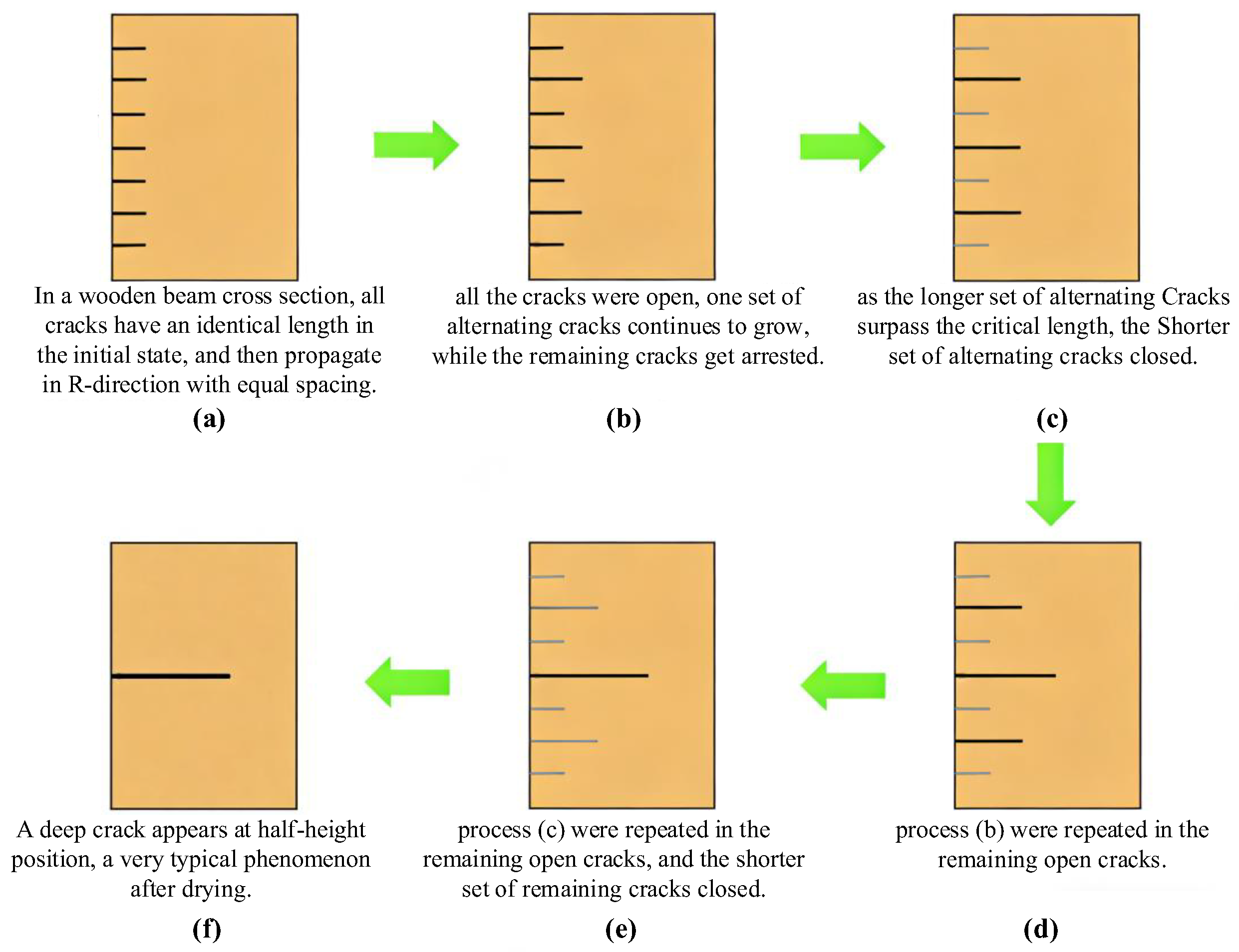
Based on the above theoretical analysis, a schematic diagram of the crack propagation process on the cross-section of the timber beam can be drawn, as shown in Figure 1.
From the development process of shrinkage cracks in the cross-section of the timber beam shown in Figure 1, it can be seen that a deep shrinkage crack is easily formed at the middle-height layer of the timber beam. The existing mechanical experimental results of cracked timber beams indicate that the cracks here also have the most serious impact on the load-bearing capacity of the timber beams [23]. Therefore, it is necessary to conduct systematic experimental research specifically on cracks of different lengths and eccentricities at the middle-heightlayer of the timber beams.

2.3. Setup of Load-Bearing Capacity Experiments

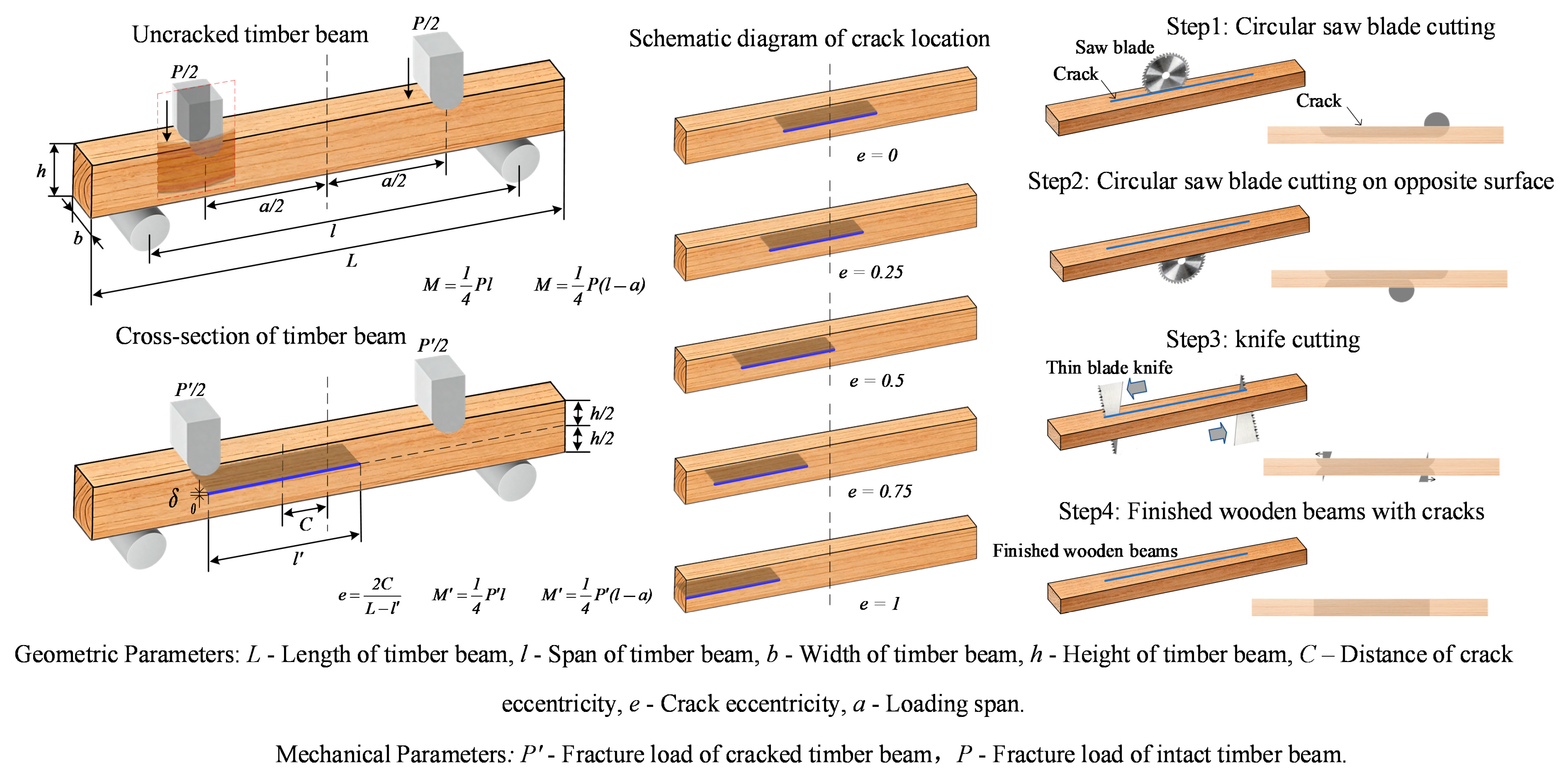
Considering that the reduction in the load-bearing capacity of timber beams is most severe when the longitudinal crack is at the middle-heightlayer, and based on the theoretical analysis result that shrinkage cracks in timber beams also tend to occur there, this study focus on the influence of longitudinal cracks located at the middle-heightlayer on the load-bearing capacity of timber beams. Although actual shrinkage cracks may not necessarily penetrate the entire beam width, this study only analyzes fully penetrating cracks as the most critical scenario. Furthermore, this study employs the fracture bending moment rather than the fracture load to evaluate the load-bearing capacity. The loading configuration, geometric parameters, and calculation method for the fracture bending moment used in the experiments are illustrated in Figure 2. This method contributes to accurately assessing the load-bearing capacity of timber beams under the most serious conditions, thereby providing reliable support for decisions regarding structural repair, reinforcement, or replacement, and avoiding potential safety hazards due to the underestimation of the load-bearing capacity.
Owing to its fibrous microstructure, wood exhibits a slightly higher elastic modulus in tension than in compression. This means that the neutral layer is not coincident with the middle-heightlayer in timer beams, but is slightly elevated above it [24]. Furthermore, the presence of longitudinal cracks may also induce minor shifts in the neutral layer location. In this study, the magnitude of neutral layer offset resulting from the aforementioned factors is considered relatively small. Additionally, accounting for this offset would introduce substantial complexity into the theoretical analysis. Therefore, it was assumed that the neutral layer coincides with the middle-heightlayer in all timber beams in this study.
To facilitate the comparison of the experimental results among different specimens and to minimize the uncertainty arising from variations in beam dimensions and density, this study defined the relationship between beam span and height as l = 10 h. Specimens of uniform size and span (l0 = 150 mm, h0 = 15 mm, b0 = 10 mm, L0 = 160 mm) were used for testing. Prior to testing, 120 defect-free specimens and a total number of 740 cracked specimens with varying crack lengths (l′) and crack eccentricities (e) were fabricated. The pre-crack operation was using an ultra-thin small-diameter saw blade with a thickness of only 0.5 mm, followed by secondary shaping of the crack profile using a thin blade cutter. Longitudinal cracks were prefabricated to achieve geometrically controllable and repeatable regular cracks, and this approach effectively isolates and investigates the influence of specific geometric variables.
It should be noted that the experimental conditions differ from the natural shrinkage cracks formed in timer beams during actual service. Natural shrinkage cracks typically exhibit more irregular tip morphologies, and the crack surfaces may present a “fiber bridging” effect due to partially unbroken wood fibers connecting across the crack faces. Fiber bridging consumes additional fracture energy, which may delay crack propagation and thereby alter the rate of load-bearing capacity degradation and the specific threshold at which “damage saturation” occurs.
In addition, it is impossible to produce a large number of specimens with identical crack sizes and positions by prefabricating cracks using natural drying methods, which makes the reproducibility of the experiment very poor. The cracks prefabricated by manual sawing processing can maintain a high degree of consistency in the shape of the cracks in the sample, which is conducive to conducting parametric experimental research based on a large sample size.
The specific fabrication methodology is illustrated in Figure 1. All fabricated specimens were stored in a dedicated drying chamber to maintain their moisture content within 12.0% ± 1.5%. Before commencing the experiments, the moisture content of the specimens was verified using a KT50 upgraded inductive wood moisture meter (Jingtai Instrument Co., Ltd., Xinghua, China). To address the challenge of measuring individual small-sized specimens, bundles of 4 × 5 specimens were stacked and measured together. Only specimens meeting the moisture content requirement were used. Subsequently, the cross-sectional width (b), height (h), and total length (L) of each specimen were measured using a vernier caliper. Finally, the static mass (m) was measured using an electronic weighing device with a resolution of 0.01 g.
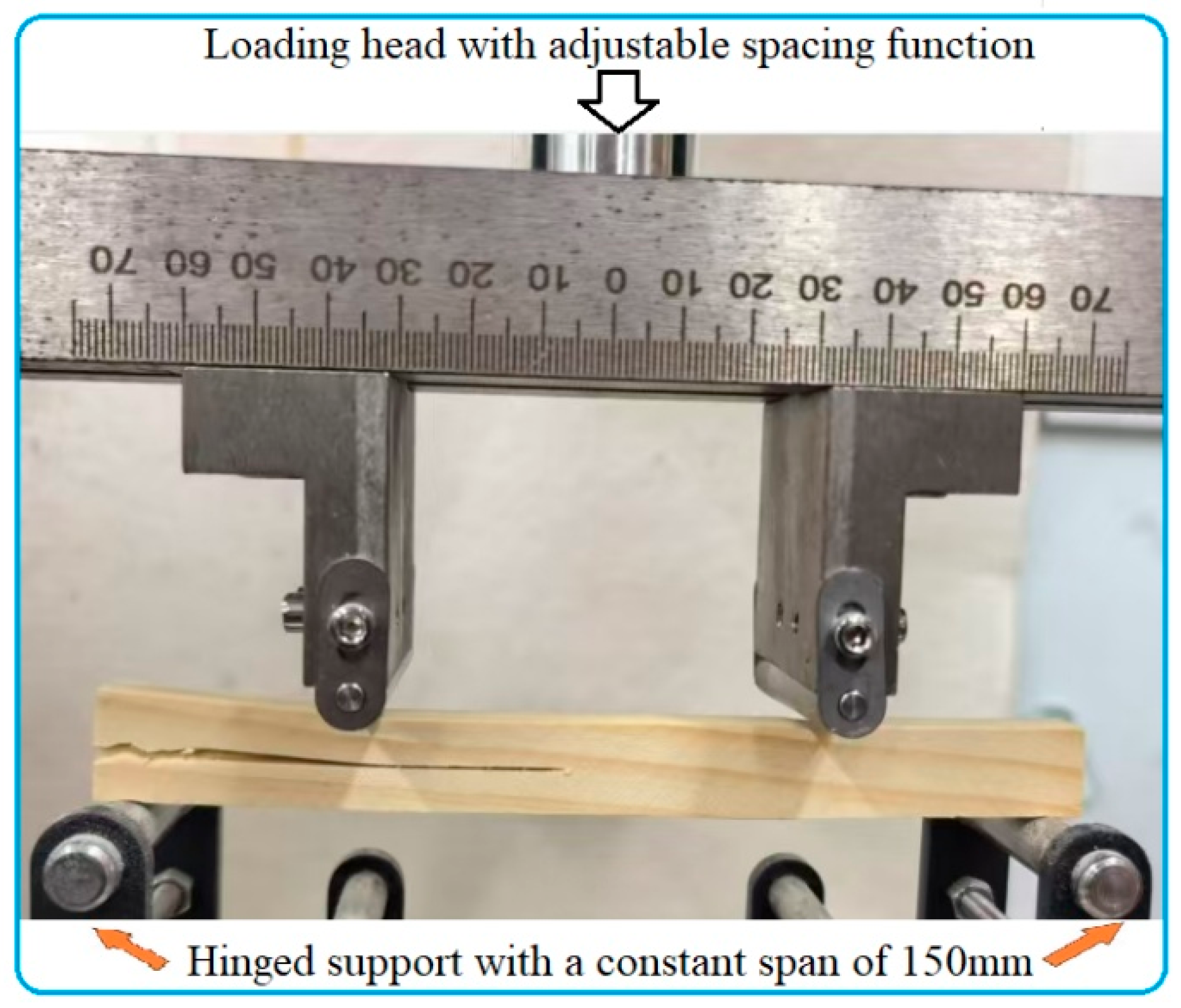
During the experiments, fracture failure loading was applied to the specimens using a Multi-functional mechanical testing machine: PUYAN980 (Yaofeng Electronic Equipment Co., Ltd., Dongguan, China), its maximum load is 20 kN (load measurement resolution 0.01 N) and equipped with a custom-designed four-point bending loading head and fixed-span hinge support (see Figure 3). Testing was conducted first on 60 defect-free specimens to record the maximum load P sustained by each specimen prior to fracture failure. Subsequently, specimens containing prefabricated cracks were tested, and the maximum load P′ prior to fracture failure was recorded for each. Following the experiments, the measured fracture load values were converted into fracture bending moment values M and M′ using the formula provided in Figure 1.
To mitigate the uncertainty in experimental results caused by variations in beam dimensions and density, it is further necessary to convert the fracture bending moment values M and M′ into their equivalent values Me and Me′ using the following specific conversion formula:
M e = M · C ρ · C W
M e = M · C ρ · C W
In Formulas (9) and (10), M and Me represent the measured fracture bending moment and the equivalent fracture bending moment for defect-free specimens, respectively; M′ and Me′ denote the measured fracture bending moment and the equivalent fracture bending moment for pre-cracked specimens, respectively. Cρ is the density influence coefficient used to correct for the effect of density variations on experimental results. CW is the cross-sectional dimension influence coefficient employed to correct for the influence of differences in cross-sectional dimensions on experimental results. The physical meaning of the equivalent fracture bending moment is the fracture bending moment of a specimen with a standard density and identical cross-sectional dimensions, converted under the assumption that the bearing capacity of the specimen is proportional to its density.
The calculation formula for the density influence coefficient Cρ is as follows:
C ρ = ρ 0 ρ
where ρ0 represents the standard air-dry density of Pinus sylvestris var. mongolica (taken as ρ0 = 480 kg/m3); ρ denotes the actual air-dry density of the specimen, which is calculated using the following formula:
ρ = ρ 1 · 1 1 ( δ 0 l / L h )
where ρ1 = m/Lbh represents the preliminary calculated density of the specimen (where m is the static mass measured by a high precision electronic weighing device and L, b, and h are the length, width, and height of the specimen, respectively). δ0 is the crack width and l′ is the crack length. It is evident that this density calculation formula accounts for the volume of wood removed during crack prefabrication process. Furthermore, the mass measurement was conducted under the condition of a moisture content of 12%, ensuring that the density value obtained via Formula (11) corresponds to the actual air-dry density of the specimen.
The calculation method for the cross-sectional dimension influence coefficient CW is given by Formula (13):
C W = b 0 h 0 2 b h 2
In the formula, b0 and h0 represent the standard width and height of the specimen (b0 = 10.0 mm, h0 = 15.0 mm), while b and h are the actual measured cross-sectional width and height of the beam obtained using a vernier caliper (accurate to 0.1 mm). Correcting the experimental results using the cross-sectional influence coefficient can significantly reduce the impact of specimen dimensional machining errors on the outcomes. Table 1 provides an example of the conversion of fracture loads and the correction of fracture bending moments for the specimen under two different loading conditions considered in this study.
As illustrated in the fracture bending moment correction process in the table, if the cross-sectional dimensions and density of the specimen are smaller than the standard, the corrected fracture bending moment value increases compared to the measured value. Conversely, if the cross-sectional dimensions and density are larger, the corrected value decreases relative to the measured value. This correction method helps to mitigate the influence of dimensional and density variations among specimens on the experimental results, thereby yielding more reasonable outcomes. Although such corrections are applied, the inherent variability in the mechanical properties of specimens still introduces uncertainty into the experimental results. This study addresses random factors by employing a relatively large sample size. For experimental conditions requiring higher precision, a sample size of n = 60 was used, while for conditions with general precision requirements, a sample size of n = 40 was used. The specific sample sizes for each experimental condition are detailed in Table 2, Table 3 and Table 4.
In the experiments, specimens with a crack length parameter of l′ = L/3 were initially selected. Specimens with different crack eccentricity values e = {0, 0.25, 0.5, 0.75, 1} were tested separately. By comparing the load-bearing capacity of specimens with different crack eccentricities, it was verified that the load-bearing capacity was weakest when e = 1. Following the comparative analysis of specimens with varying crack eccentricities, tests were then conducted specifically for the condition of e = 1 using side-opening cracks. The tested side-opening crack lengths included l′ = (L/8, L/6, L/5, L/4, L/3, 2L/5, L/2, 2L/3, 4L/5).
The selection of above crack lengths is based on considerations of the crack size effect, the coverage of critical thresholds, and the numerical simplicity to facilitate calculation and fabrication. Specifically, short cracks (L/8, L/6, L/5) are used to investigate the sensitivity of load-bearing capacity to the initial presence of cracks; medium and critical lengths (L/4, L/3, 2L/5, L/2) are of practical significance in structural engineering, with L/4 and L/2 pre-defined as potential key turning points affecting structural behavior; long cracks (2L/3, 4L/5) are adopted to study whether the load-bearing capacity tends to stabilize and whether the failure mode undergoes fundamental changes when cracks extend to occupy most of the beam span.
Furthermore, the design of this length sequence also takes into account comparisons with the length of the pure bending region, aiming to analyze the interaction mechanism between crack length and typical stress field. Load-bearing capacities of specimens with different crack lengths were investigated for the further discussion of the underlying mechanical mechanisms.

2.4. Correlation Coefficient and Calculation Formula of Crack Influence

To conveniently quantify the impact of cracks on load-bearing capacity of timber beams, three coefficients are defined in this study: the “load-bearing capacity coefficient (R)”, the “bearing capacity degradation coefficient (D)”, and the “crack hazard effect coefficient (Λ)”. The first two coefficients are expressed as percentages.
The physical meaning of the load-bearing capacity coefficient (R) is the ratio of the fracture bending moment of a cracked timber beam to that of an uncracked timber beam under identical conditions. Its calculation formula is
R = M e M e × 100 %
In the formula, Me′ represents the equivalent fracture bending moment of the cracked timber beam and Me is the equivalent fracture bending moment of the uncracked timber beam under the same loading conditions. Since the fracture bending moment of a cracked timber beam is generally lower than that of a defect-free timber beam, the value of R is typically less than 1. In engineering assessments, the R value can be directly used to quickly evaluate the safety margin of a structural member.
The physical meaning of the bearing capacity degradation coefficient (D) is the rate of reduction in the load-bearing capacity of the timber beam caused by the crack. Its calculation formula is
D = ( 1 R ) × 100 %
where R is the load-bearing capacity coefficient of the cracked timber beam. The load-bearing capacity degradation coefficient (D) is the complement of load-bearing capacity coefficient (R), representing the percentage of load-bearing capacity loss due to the presence of cracks. In structural repair decision-making, the D value helps quantify the “extent of damage.” A higher D value indicates that cracks have caused significant strength loss, necessitating prioritized reinforcement measures.
The physical meaning of the crack hazard effect coefficient (Λ) is the ratio of the load-bearing capacity degradation rate of the cracked timber beam to the proportion of the crack length. Its calculation formula is
Λ = D × L l
where D is the bearing capacity degradation coefficient of the timber beam, and L and l′ are the beam length and the crack length, respectively. The crack hazard effect coefficient (Λ) is designed to comprehensively assess the “weakening efficiency” of a crack, characterizing its equivalent level of danger. Its physical meaning can be interpreted as the rate of load-bearing capacity degradation caused per unit of relative crack length. Thus, Λ can serve as an effective engineering tool for identifying and quantifying “high-risk cracks”. In the “Results” section, the influence patterns and mechanisms of cracks on the bearing capacity of timber beams are analyzed through the load-bearing capacity coefficient curves and the crack hazard effect coefficient curves.

2.5. Data Analysis Methods

For the input, organization, calculation, and analysis of key experimental data, including beam dimensions (L, b, h), mass (m), density (ρ), density influence coefficient (Cρ), cross-sectional dimension influence coefficient (CW), fracture load (P, P′), and fracture bending moment (M, M′, Me′) (encompassing maximum, minimum, average values, and the CV value), a custom-built mini-program developed by the research group was employed in conjunction with Excel. This approach enhanced the automation level of data analysis, accelerated the processing speed, and reduced the manual workload involved in data analysis. The software Origin2024 and Visio2023 were utilized to generate the curves for the load-bearing capacity coefficient and the crack hazard effect coefficient, as well as to create relevant schematic diagrams for mechanistic analysis.

2.6. Numerical Simulation Method

The finite element modeling strategy employed in this study aims to efficiently and accurately reproduce the mechanical response of the four-point bending experiment and reveal the influence mechanisms of the cracks. The model simulates simply supported boundary conditions using two cylindrical rigid supports spaced at the specimen’s span length, with tie constraints applied at the contact interfaces to ensure displacement compatibility and system stability. The loading process is implemented via two symmetrically arranged cylindrical rigid indenters under displacement control to achieve quasi-static loading, thereby establishing an ideal uniform pure bending stress state in the mid-span region.
Within this standardized loading and constraint framework, the specimen’s slenderness ratio satisfies the fundamental assumptions of classical beam theory, allowing for the use of a two-dimensional plane stress model for simulation. This model achieves accuracy comparable to that of a three-dimensional model in predicting mid-span deflection and reconstructing the longitudinal stress field. Moreover, by avoiding complex three-dimensional contact issues, it significantly enhances computational efficiency, making it suitable for large-scale parametric analysis.
The wood material is modeled as a homogeneous orthotropic linear elastic solid, with its elastic properties defined by a set of engineering constants (see Table 2). Cracks are precisely modeled by directly cutting the solid geometry, with their length (l′) and crack eccentricity (e) serving as direct control parameters. This approach ensures the strict geometric accuracy of the cracks and provides clear boundaries for stress analysis.
To further accurately capture stress concentration phenomena at the crack tip, significant mesh refinement is applied in that region. This enables the more reliable calculation of the stress concentration factor, providing clear numerical evidence for analyzing the influence of cracks on stress distribution.

3. Results

3.1. Experimental Data and Analysis of Defect-Free Specimens

Table 3 presents a comparison of the experimental data for defect-free specimens under two different loading point distance conditions. The data in the table show that the fracture load differs by 22.4% between the two conditions. After the correction using the equivalent fracture bending moment method, this difference was reduced to 9.8%. The above analysis results indicate that the fracture bending moment value provides a more objective reflection of the load-bearing capacity of specimens and is less influenced by the loading condition. In the subsequent analysis and discussion, the equivalent fracture bending moment value of specimens will be adopted.
By comparing the CV for the equivalent fracture bending moment values of the specimens, it can be observed that under working conditions with the larger loading point distances, the coefficient of variation for the equivalent fracture bending moment is also greater. It can be predicted that as the loading point distance increases, the length of the pure bending segment (normal stress region) in timber beams extends, while the maximum shear stress in the transverse bending segment (mixed stress region) also rises. The combined effect of these changes enhances the randomness of failure induced by microscopic defects within timber beams, which macroscopically manifests as an increase in the CV of the fracture bending moment.

3.2. Comparative Study of Specimens with Cracks Located at Different Horizontal Positions

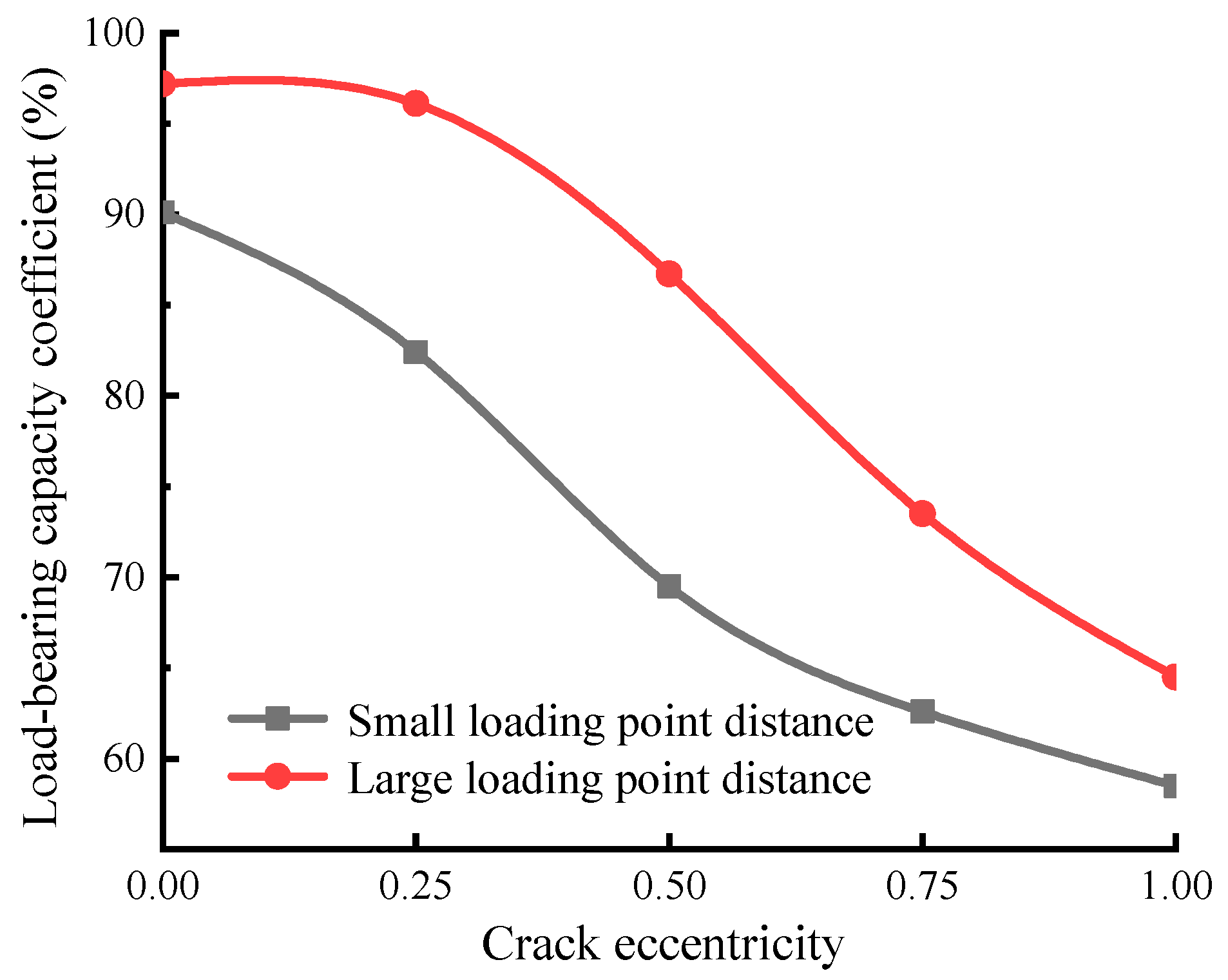
Table 4 presents the experimental data of Pinus sylvestris var. mongolica specimens with varying crack eccentricities (e = 0–1), given a constant crack length of l′ = L/3. The variations in equivalent fracture bending moment values and the load-bearing capacity coefficient derived from the table reveal that, although the crack length (l′)remains identical, the horizontal position of the crack significantly influences the load-bearing capacity of specimens. When the crack is located at the mid-span position (e = 0),the load-bearing capacity coefficient under both large and small loading point distance conditions exceeds 90%. In contrast, when the crack eccentricity reaches its maximum (e = 1), the load-bearing capacity coefficients for both loading condition drops to below 70%. Furthermore, the changes in the crack hazard effect coefficient (Λ) indicate that the hazard posed by the crack increases with greater eccentricity.
Figure 4 illustrates the relationship between crack eccentricity (e) and the load-bearing capacity coefficient of pre-cracked specimens. As observed from the curves, under both conditions, the load-bearing capacity coefficient exhibits a decreasing trend with increasing crack eccentricity. However, under the large loading point distance condition, the coefficient consistently remained higher than that under the small loading point distance condition.
Notably, within the eccentricity range of e = 0–0.25, the load-bearing capacity coefficient for specimens under the large loading point distance condition decreased by merely 1% and remained above 96%. This phenomenon can be attributed to the fact that, under the large loading point distance condition, the length of the pure bending segment within the beam exceeds the crack length. When the crack eccentricity is less than 0.25, the entire crack is located in the pure bending region of the timber beam. Within this beam segment, the crack is effectively shielded from shear stress, thereby inhibiting its propagation and allowing for the beam to retain a high load-bearing capacity. Conversely, when the loading-point distance is small, the resulting pure bending segment is too short to encompass the entire crack. Consequently, this “shear-stress-free” protective mechanism cannot develop.
On the load-bearing capacity coefficient curve for the large loading point distance condition, a distinct inflection point is evident at e = 0.25: when the crack eccentricity (e) exceeds this threshold, further increases lead to a rapid decline in the beam’s bearing capacity. This is attributed to the crack tip entering the transverse bending segment of the beam at this point, where shear stress induces crack propagation, thereby significantly weakening the beam’s capacity. This study refers to this phenomenon as the “critical eccentricity effect” of crack position on the load-bearing capacity of timber beams with eccentric cracks. The underlying mechanism of this effect will be further illustrated through crack morphology photographs and finite element (FE) simulation results.
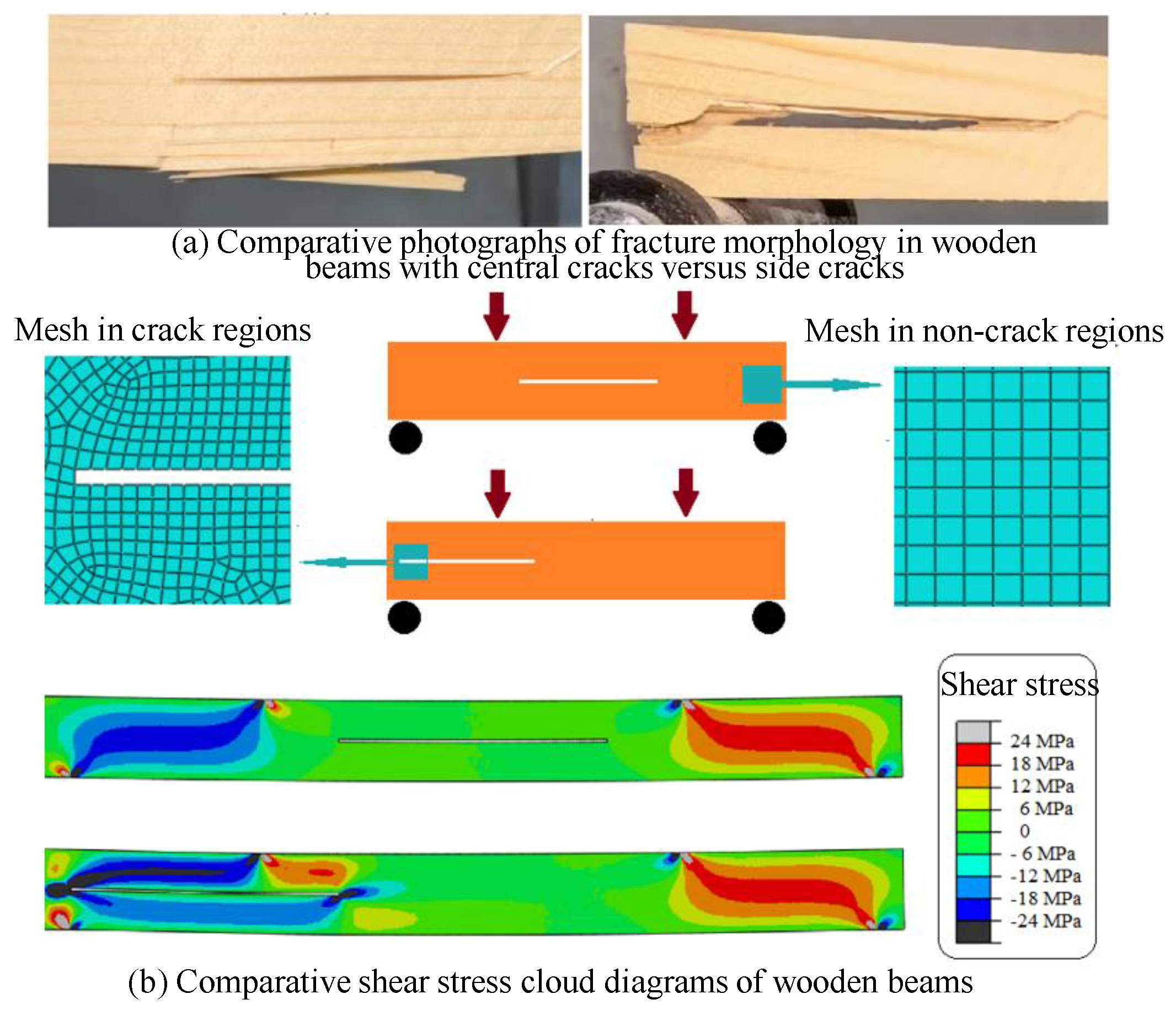
Figure 5a,b show the fracture morphology and FE diagrams for beams with cracks at e = 0 and e = 1, respectively. As seen in Figure 5a, for the beam with the crack at the horizontal center position (e = 0), the crack did not propagate; instead, fracture occurred in the wood fibers below the crack. In contrast, for the beam with the crack at offset position (e > 0.5), crack propagation was observed. Figure 5b reveals that for the beam with the crack at the horizontal center position, the crack corresponds to the green region in the FE stress contour plot, where shear stress is zero. Conversely, for the beam with the crack at the offset position, the crack tip aligns with the dark blue region in the stress contour plot, where shear stress is the highest. Thus, both the fracture morphology and the FE stress contour plots demonstrate that the stress characteristics at the crack location are consistent with the expectations of material mechanics. The above analysis indicates that assessing the hazard of a crack not only requires considering its length and depth, but also critically evaluating its position.

3.3. Comparative Study of Specimens with Side-Opening Cracks

Table 5 presents the experimental data for Pinus sylvestris var. mongolica specimens with different crack lengths, which is under the loading condition a = 4l/15 and with a side-opening crack (e = 1) configuration. The data in the table indicate that the length of the side-opening crack has a significant nonlinear influence on the four-point bending mechanical properties of the specimens.
The equivalent fracture moments, load-bearing capacity coefficients, and crack hazard efficacy coefficients for specimens under different crack lengths are summarized in Table 5. Analysis of variance indicates that crack length has a highly significant effect on the load-bearing capacity (F(8, 371) = 76.11, p < 0.001). Results from the Tukey post hoc test reveal that the influence of crack length exhibits distinct stages: when the crack is short (L/8), the load-bearing capacity is the highest (Group A); as the crack length increases (L/6, L/5), it decreases significantly (Group B); when the crack length reaches or exceeds L/4, the load-bearing capacity enters a relatively stable plateau (Group C), with no significant differences observed among the various lengths within this stage.
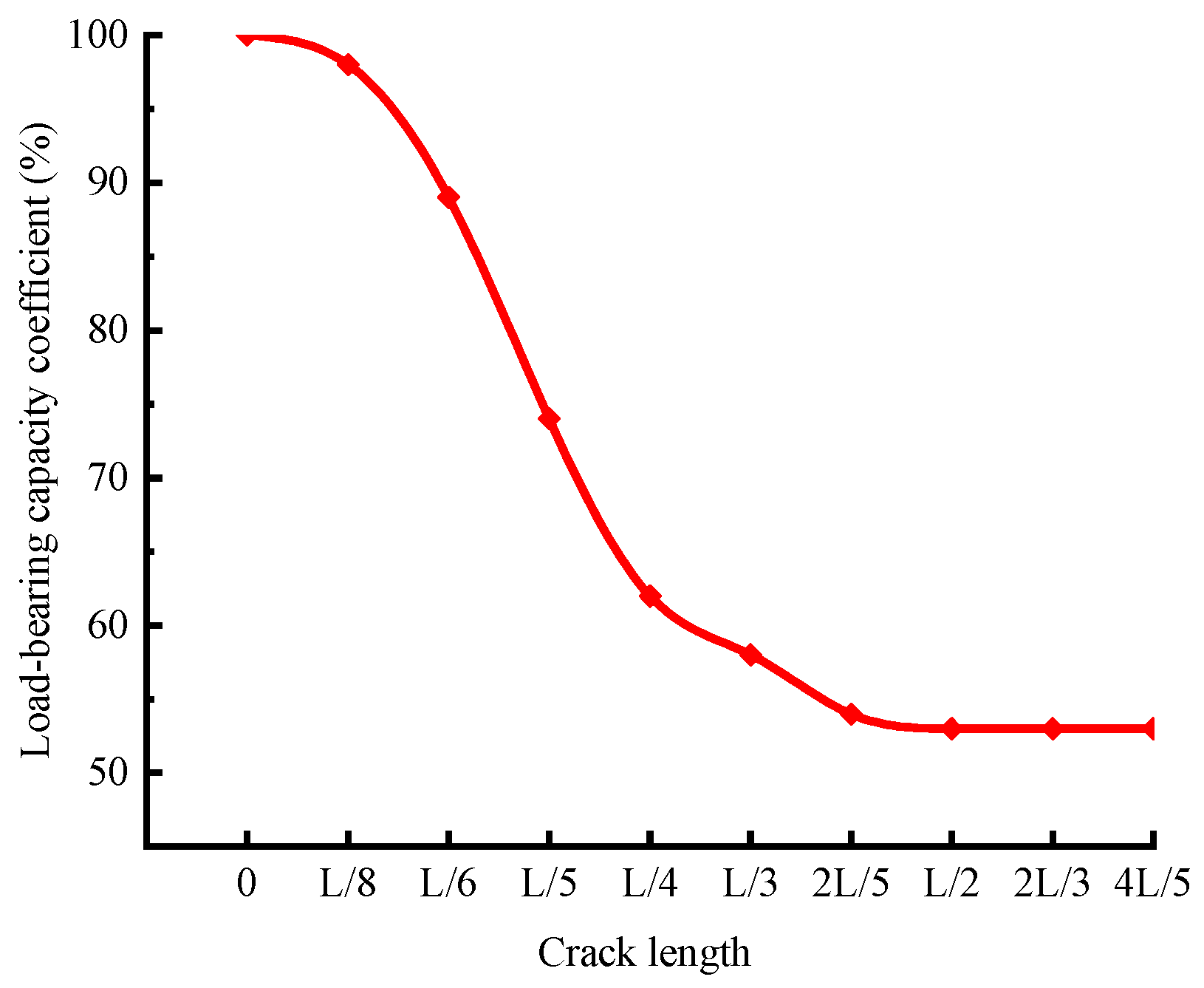
As shown in Figure 6, Further plotting the variation in the load-bearing capacity coefficient against crack length demonstrates that when the crack length does not exceed L/4, the load-bearing capacity coefficient declines rapidly with increasing crack length; when the crack length exceeds L/4 but remains below L/2, the rate of decline slows; once the crack length reaches L/2, further increases in crack length almost cease to weaken the beam’s load-bearing capacity. Additionally, when the crack length continues to grow to 2L/3, it is classified into Group D, which shows a significant difference from the node at L/4. This may statistically indicate that the load-bearing capacity coefficient no longer changes. This analysis suggests that in timber beams with side-open cracks, a “damage saturation” phenomenon exists, meaning that beyond a certain critical length, further crack propagation no longer leads to additional degradation of the beam’s load-bearing capacity.
The above statistical grouping results and the trend observed in the curve mutually corroborate each other, providing strong support for the “damage saturation” phenomenon.
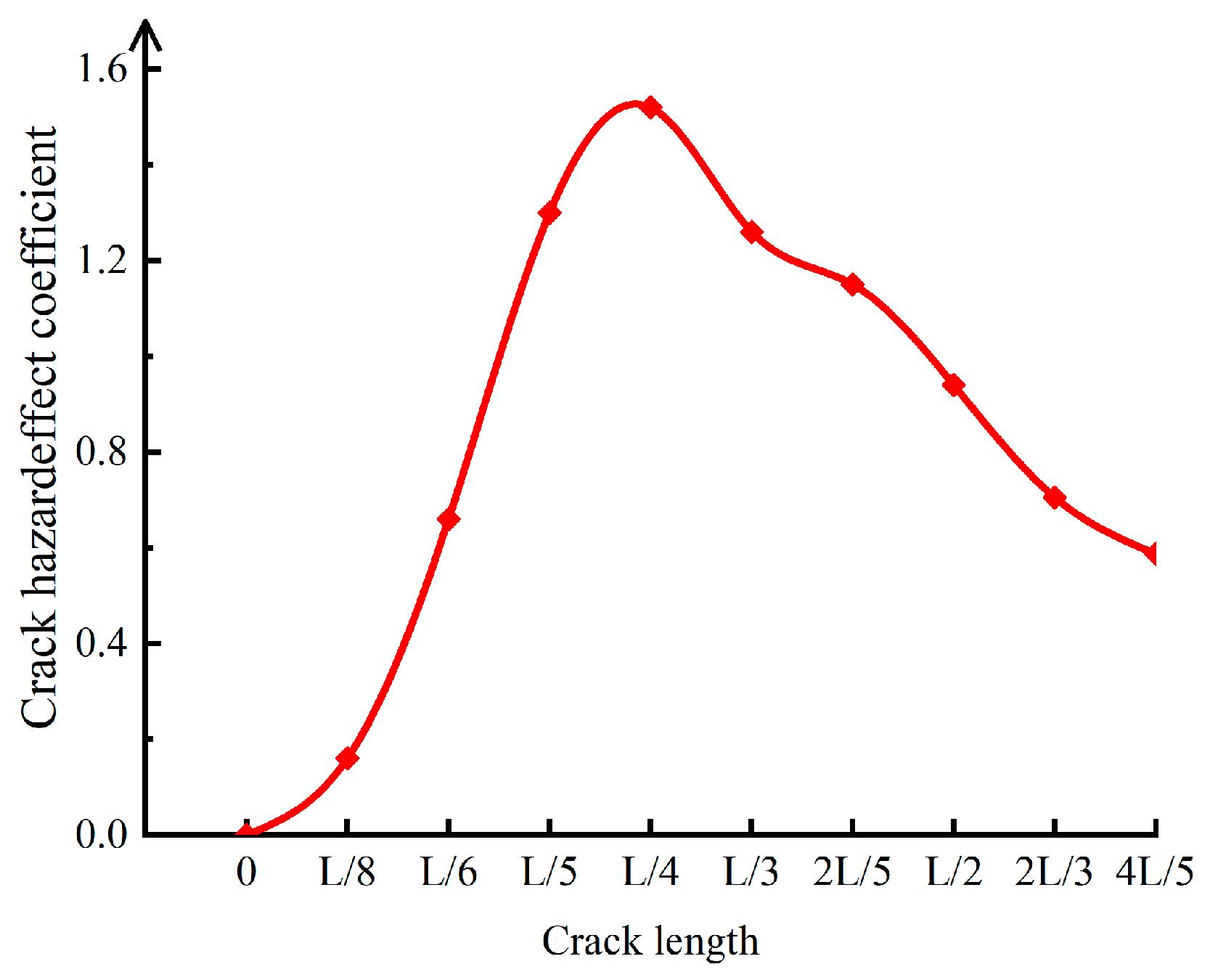
To further investigate the influence of side-opening cracks on timber beams, a curve illustrating the crack hazard effect coefficient across varying crack lengths was plotted, as shown in Figure 7.
As illustrated in the curve, the variation process of the crack hazard effect coefficient can be divided into two distinct stages: (1) When the crack length is less than L/4, the coefficient increases rapidly. (2) When the crack length exceeds L/4, the coefficient decreases rapidly. It can be seen that there is a clear inflection point on the curve between the two stages mentioned above.
One-way ANOVA confirmed that crack length has a highly significant effect on the crack harzard efficient, and subsequent Tukey HSD post hoc tests indicated that near this inflection point (L/4), the crack hazard efficient already exhibits significant differences compared to groups with shorter cracks. This indicates that the crack presents the highest level of hazard at this point: while not the longest in length, the unit length of its impact on the beam’s load-bearing capacity is most severe. Because the crack is not at its maximum length, its danger is often overlooked, making it potentially more hazardous than longer cracks. Once the crack length exceeds this threshold, the crack hazard effect coefficient begins to decrease. At this stage, even the crack propagates and the load-bearing capacity coefficient remains largely unchanged.
It is noteworthy that the Tukey grouping results show that when the crack length increases from L/4, most groups exhibit no statistically significant differences in load-bearing capacity coefficients. This statistically supports the notion that load-bearing capacity has entered a stabilized stage. This is because the primary load-bearing section of the timber beam has already been divided into two separate sections by the crack [26]; further crack extension primarily affects non-load-bearing sections and does not further reduce the beam’s load-bearing capacity.
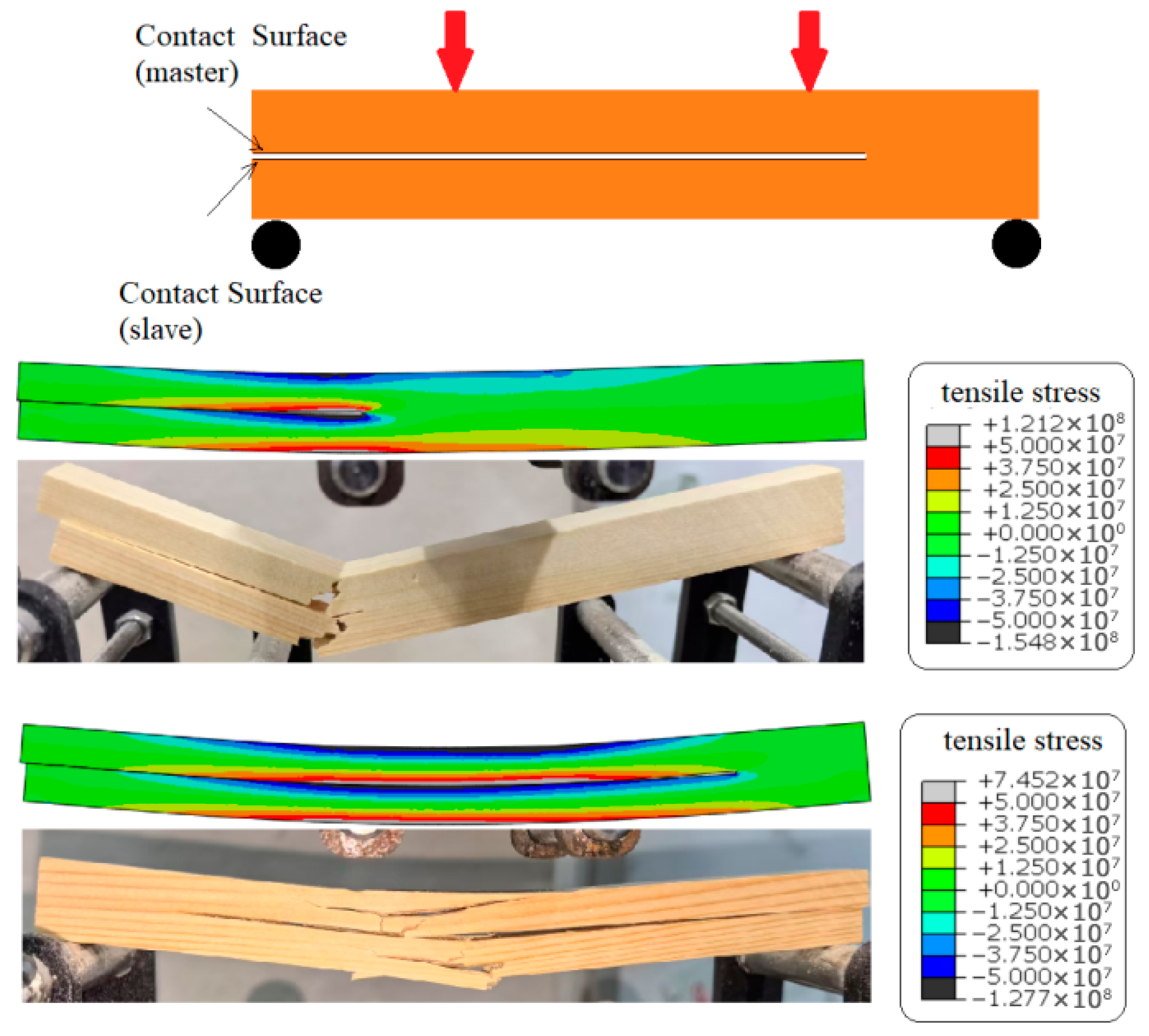
To visually demonstrate the aforementioned effects of side-opening cracks, Figure 8 presents fracture photographs and FE stress contours of specimens with side-opening cracks. As shown in the fracture photographs, when the crack length reaches two-fifths of the beam length, the failure mode of the specimen transitions to the independent fracture of the two sub-beams partitioned by the crack.
As revealed by the FE stress contours, the maximum tensile stress in the specimen with a crack length of 4L/5 is lower than that in the specimen with a crack length of 2L/5, and the stress concentration at the crack tip is also alleviated. This observation further validates that cracks with a length of 4L/5 are less prone to propagation compared to those with a length of 2L/5.

4. Discussion

4.1. Two Mechanical Phenomena and Their Mechanisms

This study reveals the “critical eccentricity effect” and “damage saturation” phenomenon of wood cracks, presenting a dialectical relationship between classical fracture mechanics models and existing wood design assumptions that is both consistent and yet partially transcends them.
On the one hand, the observed “critical eccentricity effect” largely aligns with theoretical predictions of Linear Elastic Fracture Mechanics (LEFM). Conventional LEFM suggests that shear stress significantly promotes crack propagation. In this study, the sharp decline in load-bearing capacity once the crack eccentricity exceeds 0.25 is a direct manifestation of shear-stress-driven crack extension. On the other hand, the discovered “damage saturation” phenomenon is not entirely consistent with the conventional assumption in classical fracture mechanics that crack length is negatively correlated with load-bearing capacity. This indicates that, for heterogeneous, anisotropic materials like wood, once a crack extends to a certain length, the structure is effectively partitioned into two relatively independent parts that jointly bear the load. Further extension of the crack did not further weaken the overall bending capacity.
Furthermore, the crack hazard coefficient (Λ) proposed in this study peaks when the crack length is approximately one-quarter of the beam length. This further suggests that medium-length cracks may pose a higher risk than very long cracks.
These findings provide a significant supplement to the current wood design codes, which primarily rely on crack size for strength reduction assessment. They emphasize that, in practical engineering evaluations, it is essential to comprehensively consider the interaction among crack location, length, and the structural stress state.

4.2. The Positive Significance of Experimental Findings

The findings of this study offer insights for the damage assessment, repair decision-making, and safety design of wooden structures, particularly those incorporating historic timber, although their applicability must be noted. The experimental results suggest that when evaluating bending wood beams, priority should be given to assessing the crack’s location along the span rather than merely focusing on its size. The Λ coefficient can assist in identifying high-risk cracks. Based on the “critical eccentricity effect” and “damage saturation” phenomenon, a qualitative framework for crack risk assessment can be preliminarily established:
If a crack is entirely within the pure bending region, its risk is relatively low, and the residual load-bearing capacity of the member retains a high safety margin. Such cracks have relatively low urgency for short-term reinforcement. Conversely, once the crack tip enters the shear-bending region, its risk increases significantly, and load-bearing capacity may drop sharply. Such cracks should be flagged as high-risk and prioritized for reinforcement intervention. This provides a concise criterion for the rapid screening and identification of key monitoring targets for in-service wood beams.
Furthermore, for common side-open cracks, the following framework can be used: When the crack length approaches L/4, the load-bearing capacity is extremely sensitive to crack extension. This stage represents the optimal window for preventive reinforcement to halt further propagation; When the crack length is between L/4 and L/2, the decline in load-bearing capacity slows, but has already been significantly compromised, entering a relatively stable plateau. At this point, assessment and planning for load-bearing reinforcement are necessary; When the crack length increases further, the member’s load-bearing capacity enters the “damage saturation” plateau, where further changes in length have minimal impact on the residual capacity. Here, the focus of structural assessment should shift from the crack’s own extension to the independent load-bearing capacities of the two “sub-beams” formed by the crack and the stability of their connection region. Reinforcement strategies should be adjusted accordingly.

4.3. Validity and Limitations of the Experimental Method

This study adopted a strategy of using small-scale specimens combined with a large sample size (n = 860), which, while reducing experimental cost and complexity to some extent, also introduced issues such as size effects and material homogeneity. Wood, as a naturally anisotropic material, exhibits mechanical properties significantly influenced by its microstructure (e.g., fiber orientation, distribution of earlywood and latewood). This is likely the primary reason for the relatively high CV (21.0%) observed in the load-bearing capacity of uncracked specimens. Although experimental data were standardized by introducing density and cross-sectional size-correction factors, the randomness of the microstructure may still affect the generalizability of the results.
In future work, the research team will consider gradually reducing the sample size while increasing the specimen dimensions, aiming to identify the most suitable specimen size from the perspective of balancing size effects and experimental cost. Although full-scale timber beam tests most closely represent real structural behavior, it is impractical to conduct such tests with sample sizes up to several hundred. In addition, through small-scale specimen experiments with large sample sizes, some basic fracture mechanics laws can be revealed, which can provide important references for the rational design of crack parameters for full-size timber beams, thereby avoiding ineffective experiments and wood waste. Based on the above viewpoint, experiments on small-scale specimens remain both important and necessary.

5. Conclusions

This study investigates the influence of geometric parameters (crack eccentricity e and crack length l′)of longitudinal cracks on the load-bearing capacity of timber beams through systematic four-point bending experiments using small-scale Pinus sylvestris var. mongolica specimens with artificially prefabricated cracks. The main conclusions are as follows:
(1)
A “critical eccentricity effect” exists for crack horizontal eccentricity, and its impact is significantly governed by the stress state. Under loading conditions with a large distance between loading points, when the crack is entirely within the pure bending region of the beam (e ≤ 0.25), the shear stress at the crack location is nearly zero, suppressing crack propagation. In this case, no significant reduction in load-bearing capacity is observed (R > 96%). Once the crack tip enters the shear-bending region (e > 0.25), shear stress drives crack propagation, leading to a sharp decline in load-bearing capacity at the transition point. This result indicates that the interaction between crack location and the structural stress field must be comprehensively considered when assessing crack risk.
(2)
The residual load-bearing capacity of side-open cracks (e = 1) decreases nonlinearly with increasing crack length and exhibits “damage saturation” characteristics. When the crack length does not exceed L/4, the load-bearing capacity is highly sensitive to crack length, declining rapidly. When the crack length is between L/4 and L/2 of the beam span, the rate of decline slows, entering a relatively stable plateau. Beyond L/2, the load-bearing capacity stabilizes, and further crack extension causes no significant weakening, indicating the occurrence of “damage saturation.” Statistical grouping results from Tukey HSD post hoc tests support this pattern: after the crack length reaches L/4, multiple long-crack groups show no statistically significant differences in load-bearing capacity (all belonging to Group C). Furthermore, when the crack extends to 2L/3, it is classified into Group D, indirectly supporting the persistence of “damage saturation” from a statistical perspective. This suggests the existence of a critical crack length beyond which further propagation no longer reduces the beam’s ultimate bending capacity.
(3)
The crack hazard efficacy coefficient (Λ) peaks at a crack length of approximately L/4, indicating that risk does not increase monotonically. At this length, although the crack is not the longest, its potential for propagation and its harmfulness in weakening load-bearing capacity is the highest, representing the most critical stage. Statistical analysis further confirms that the load-bearing capacity at a crack length of about L/4 is significantly different from that of groups with shorter cracks. Beyond this critical length, the hazard coefficient decreases because the load-bearing mechanism shifts to the independent capacities of the two segments formed by the crack.
Through four-point bending fracture experiments on 860 specimens, this study clarifies the underlying mechanical mechanisms through which crack location and length affect the load-bearing capacity of wood beams (stress-state-governed propagation and load-path transition). These findings hold significant practical implications for the damage assessment of historic timber members, the determination of repair and reinforcement timing, and the consideration of defect tolerance in timber structure design.

Author Contributions

Conceptualization, X.H. (Xiaoyi Hu); methodology, L.Z. and X.H. (Xiaoyi Hu); software, L.Z. and D.L.; validation, H.L. and X.H. (Xin Hou); formal analysis, L.Z.; investigation, S.L.; resources, X.H. (Xiaoyi Hu); data curation, L.Z. and X.H. (Xiaoyi Hu); writing—original draft preparation, L.Z.; writing—review and editing, X.H. (Xiaoyi Hu); visualization, L.Z.; supervision, X.H. (Xiaoyi Hu); project administration, X.H. (Xiaoyi Hu); funding acquisition, X.H. (Xiaoyi Hu) and D.L. All authors have read and agreed to the published version of the manuscript.

Funding

This research was funded by the National Natural Science Foundation of China, grant number 32171700.

Data Availability Statement

The original contributions presented in this study are included in the article. Further inquiries can be directed to the corresponding author.

Acknowledgments

The authors gratefully acknowledge the support from the National Natural Science Foundation of China, Grant No. 32171700.

Conflicts of Interest

The authors declare no conflicts of interest. The funders had no role in the design of the study; in the collection, analyses, or interpretation of data; in the writing of the manuscript; or in the decision to publish the results.

Abbreviations

The following abbreviations are used in this manuscript:
AEAcoustic emission
CVCoefficient of variation
DICDigital image correlation
FEFinite element

References

  1. Estrella, X.; Guindos, P.; Almazán, J.L.; Malek, S. Efficient Nonlinear Modeling of Strong Wood Frame Shear Walls for Mid-Rise Buildings. Eng. Struct. 2020, 215, 110670. [Google Scholar] [CrossRef]
  2. Chakkour, T.; Perré, P. Developing the orthotropic linear-elastic model for wood applications using the FE method. Mater. Adv. 2024, 5, 7747–7765. [Google Scholar] [CrossRef]
  3. Zhan, T.; Jiang, J.; Lu, J.; Zhang, Y.; Chang, J. Temperature-Humidity-Time Equivalence and Relaxation in Dynamic Viscoelastic Response of Chinese Fir Wood. Constr. Build. Mater. 2019, 227, 116637. [Google Scholar] [CrossRef]
  4. Vidal-Sallé, E.; Chassagne, P. Constitutive Equations for Orthotropic Nonlinear Viscoelastic Behaviour Using a Generalized Maxwell Model Application to Wood Material. Mech. Time-Depend. Mater. 2007, 11, 127–142. [Google Scholar] [CrossRef]
  5. Majka, J.; Sydor, M. Analysis of Stress Development during Kiln Drying of Beech Timber. Eur. J. Wood Wood Prod. 2023, 81, 1189–1200. [Google Scholar] [CrossRef]
  6. Gril, J.; Jullien, D.; Bardet, S.; Yamamoto, H. Tree Growth Stress and Related Problems. J. Wood Sci. 2017, 63, 411–432. [Google Scholar] [CrossRef]
  7. Hu, X.Y.; Liu, Z.L.; Zhuang, Z. XFEM Study of Crack Propagation in Logs after Growth Stress Relaxation and Drying Stress Accumulation. Wood Sci. Technol. 2017, 51, 1447–1468. [Google Scholar] [CrossRef]
  8. Liu, H.C.; Wu, Y.; Li, A.Q.; Deng, Y. Analysis and Prospect of Restoration and Reinforcement Techniques for Cracked Wood Components of Ancient Buildings. Ind. Constr. 2023, 53, 29–44. [Google Scholar] [CrossRef]
  9. Han, X.; Zhou, H.B.; Huang, L.; Wang, S.Y.; Wang, W.B. Crack Types and Characteristics of Timber Members in Ancient Building in North China. Chin. J. Wood Sci. Technol. 2024, 38, 1–11. [Google Scholar] [CrossRef]
  10. Fang, H.; Sun, H.; Liu, W.; Wang, L.; Bai, Y.; Hui, D. Mechanical Performance of Innovative GFRP-Bamboo-Wood Sandwich Beams: Experimental and Modelling Investigation. Compos. Part B Eng. 2015, 79, 182–196. [Google Scholar] [CrossRef]
  11. Naychuk, A.Y. Estimation of Load-Bearing Capacity and Stiffness of Timber Beams with Through-Thickness Cracks. Adv. Mater. Res. 2013, 778, 361–368. [Google Scholar] [CrossRef]
  12. Halicka, A.; Ślósarz, S. Analysis of Behavior and Failure Modes of Timber Beams Prestressed with CFRP Strips. Compos. Struct. 2022, 301, 116171. [Google Scholar] [CrossRef]
  13. Zhang, B.; Xie, Q.; Xue, J. Study on the Flexural Behavior Evolution of Timber Beams with Natural Shrinkage Cracks in Historic Timber Structure. Structures 2025, 73, 108429. [Google Scholar] [CrossRef]
  14. Romanowicz, M.; Grygorczuk, M. The Effect of Crack Orientation on the Mode I Fracture Resistance of Pinewood. Int. J. Fract. 2024, 248, 27–48. [Google Scholar] [CrossRef]
  15. Qiu, L.P.; Zhu, E.C.; van de Kuilen, J.W.G. Modeling Crack Propagation in Wood by Extended Finite Element Method. Eur. J. Wood Wood Prod. 2014, 72, 273–283. [Google Scholar] [CrossRef]
  16. Nakao, T.; Susanti, C.M.E.; Yoshihara, H. Examination of the Failure Behavior of Wood with a Short Crack in the Radial–Longitudinal System by Single-Edge-Notched Bending Test. J. Wood Sci. 2012, 58, 453–458. [Google Scholar] [CrossRef]
  17. Tu, J.; Zhao, D.; Zhao, J.; Zhao, Q. Experimental Study on Crack Initiation and Propagation of Wood with LT-Type Crack Using Digital Image Correlation (DIC) Technique and Acoustic Emission (AE). Wood Sci. Technol. 2021, 55, 1577–1591. [Google Scholar] [CrossRef]
  18. Zlámal, J.; Mařík, R.; Vojáčková, B.; Cristini, V.; Brabec, M.; Praus, L.; Tippner, J. Elasto-Plastic Material Model of Green Beech Wood. J. Wood Sci. 2024, 70, 29. [Google Scholar] [CrossRef]
  19. Chi, X.; Tang, S.; Song, X.; Ren, Z.; Han, G.; Cheng, W.; Avramidis, S. Visible Dynamic Changes in the Mechanism of Water Evaporation Surface Formation during Wood Drying. Wood Sci. Technol. 2023, 57, 1061–1076. [Google Scholar] [CrossRef]
  20. Peng, S.; Qiao, Y.F.; Song, Y.; Xie, X.Q.; Yao, Y.K.; Jia, Y.S.; Wu, D.P. Study on Axial Compression Behavior of Pinus Sylvestris Var. Mongolica Splice Timber Columns. Case Stud. Constr. Mater. 2025, 23, e05452. [Google Scholar] [CrossRef]
  21. Li, Z.; Tao, X.; Zhao, Z.C.; Sun, H.Y.; Lei, Z. Mechanical Properties and Crack Propagation for Camphor Pine during Compression Process. Forg. Stamp. Technol. 2024, 49, 87–93. [Google Scholar] [CrossRef]
  22. Bazant, Z.P.; Ohtsubo, H.; Aoh, K. Stability and post-critical growth of a system of cooling or shrinkage cracks. Int. J. Fract. 1979, 15, 443–456. [Google Scholar] [CrossRef]
  23. Xiong, L.M.; Xing, X.F.; Lin, L.Y.; Zhou, Y.D.; Fu, F. Effects of High-Field-Intensity Microwave Treatment on Macroscopic Cracks in Mongolian Scotch Pine. China Wood Ind. 2020, 34, 1–4. [Google Scholar] [CrossRef]
  24. Toivanen, M.; Pajunen, S.; Emre Ilgın, H. Effect of Cracks on the Load-Carrying Capacity of Glulam. Wood Mater. Sci. Eng. 2025, 1–8. [Google Scholar] [CrossRef]
  25. Zhou, L.; Hu, X.; Liu, H.; Hou, X.A. Multi-model collaborative finite element approach for service-state analysis of timber components. BioResources 2026, 21, 1497–1514. [Google Scholar] [CrossRef]
  26. Jiang, Y.M.; Song, X.B.; Gu, X.L.; Wang, M.Q.; Shang, S.S. Experimental Study and Numerical Simulation on Flexural Behaviour of Longitudinally Cracked Wood Beams. In Proceedings of the 2015 International Conference on Electrical, Automation and Mechanical Engineering, Phuket, Thailand, 26–27 July 2015; Atlantis Press: Phuket, Thailand, 2015; pp. 675–679. [Google Scholar]
Figure 1. Schematic diagram of crack propagation process (taking the cracks formed on one side of the surface of a timber beam as an example). In the figure, dark black lines indicate the propagated or opened cracks, and light gray lines indicate the closed crack. (af) represent the process of forming shrinkage cracks.
Buildings 16 00650 g001
Figure 2. Dimensions and crack-related parameters of the specimens.
Buildings 16 00650 g002
Figure 3. Four-point bending loading head with adjustable distance between loading points and fixed-span hinge support.
Buildings 16 00650 g003
Figure 4. Relationship between crack eccentricity and load-bearing capacity coefficient of specimens under two loading conditions.
Buildings 16 00650 g004
Figure 5. Photos of the fracture morphology of cracks at two different horizontal positions and a demonstration of the “critical eccentricity effect” principle at the horizontal position of the cracks.
Buildings 16 00650 g005
Figure 6. Relationship between the crack length and load-bearing capacity coefficient inside-opening-crack specimens.
Buildings 16 00650 g006
Figure 7. Relationship between the crack length and hazard effect coefficient inside-opening-crack specimens.
Buildings 16 00650 g007
Figure 8. Fracture photo and FE stress contour of a specimen with a side-opening crack.
Buildings 16 00650 g008
Table 1. Example of correction of fracture load value and fracture bending moment value.
aM/
(g)
L/
(mm)
b/
(mm)
h/
(mm)
lρ1/
(kg·m−3)
ρ/
(kg·m−3)
CρCWP′/
(N)
M′/
(N·m)
Me′/
(N·m)
4l/1511.316010.015.0L/24714790.9961.00094626.526.4
l/212.32160.110.115.22L/35015120.9320.964150228.225.3
Table 2. Parameters of anisotropic wood members.
Constitutive ParametersER (MPa)ET (MPa)EL
(MPa)
GRL
(MPa)
GRT (MPa)GTL (MPa) υ RT υ RL υ TLσb (MPa)
Values80040010,000620705400.60.030.0360
CV3.73%4.61%6.08%5.09%10.84%7.03%8.65%4.89%14.7%/
Note: Parameters in the table are macroscopic elastic properties under the air-dried condition with a moisture content of approximately 12%. The elastic constant data in the simulation is from reference [25].
Table 3. Comparison of experimental data of defect-free Pinus sylvestris var. mongolicas pecimens under two typical loading conditions.
aSample SizeAverage Fracture Load/(N)Equivalent Fracture Moment Value/(N·m)
Average/(N·m)Max/(N·m)Min/(N·m)CV/%
4l/1560102628.438.814.416.6
l/260132325.650.114.821.0
Table 4. Comparison of experimental data of Pinus sylvestris var. mongolica specimens with a longitudinal crack located at different horizontal positions.
eaSample SizeEquivalent Fracture Moment Value/(N·m)R/%Λ
Average/(N·m)Max/(N·m)Min/(N·m)CV/%
04l/156025.632.618.915.590.1%0.297
l/26024.933.116.316.097.2%0.084
0.254l/154023.430.816.215.282.4%0.528
l/24024.636.219.713.196.1%0.117
0.54l/154019.830.413.716.569.5%0.915
l/24022.231.614.914.486.7%0.399
0.754l/154017.825.85.921.362.6%1.122
l/24018.823.314.610.973.5%0.795
14l/156016.624.610.817.858.5%1.245
l/24016.522.711.714.864.5%1.065
Table 5. Experimental data of Pinus sylvestris var. mongolicas pecimens with side-opening cracks.
Crack LengthSample SizeEquivalent Fracture Moment Value/(N·m)R/%ΛTukeyHSD
α = 0.05
Average/(N·m)Max/(N·m)Min/(N·m)CV/%
L/84027.9136.4720.9812.6598%0.16A
L/64025.4737.3517.7416.9389%0.66B
L/54021.1832.5913.8923.9374%1.30B
L/44017.8224.2612.6026.5462%1.52C
L/36016.6124.5910.8117.8358%1.26CD
2L/54015.4821.518.7719.4654%1.15CD
L/24015.1525.227.8724.4753%0.94CD
2L/34015.0725.058.6920.3453%0.71D
4L/54015.2120.196.7924.7053%0.59CD
Note: A, B, C and D represent the groups, with no significant differences between groups of the same letter but significant differences between groups of different letters.
Disclaimer/Publisher’s Note: The statements, opinions and data contained in all publications are solely those of the individual author(s) and contributor(s) and not of MDPI and/or the editor(s). MDPI and/or the editor(s) disclaim responsibility for any injury to people or property resulting from any ideas, methods, instructions or products referred to in the content.