Article

Dynamic Fracture Behaviour of Cracked H-Shaped Beam-Column Joints with Beam Ends Supported by Columns

1
Public Safety and Emergency Management, Kunming University of Science and Technology, Kunming 650093, China
2
Faculty of Land and Resources Engineering, Kunming University of Science and Technology, Kunming 650093, China
3
School of Electric Power, Kunming University of Science and Technology, Kunming 650093, China
*
Author to whom correspondence should be addressed.
Buildings 2026, 16(3), 642; https://doi.org/10.3390/buildings16030642
Submission received: 12 January 2026 / Revised: 30 January 2026 / Accepted: 30 January 2026 / Published: 3 February 2026

Abstract

The study of the mechanical response and crack propagation behaviour of H-shaped beam-column specimens is of great significance for ensuring the safety and stability of buildings. As a connection structure that has gained ubiquity in modern shopping malls and high-rise buildings, an in-depth exploration of the failure mechanisms of H-shaped beam-column components will facilitate more accurate technical support for building maintenance and service life prediction. The present study employs a combination of drop-weight impact tests and the caustic method to systematically investigate the dynamic fracture characteristics of H-shaped beam-column joints under various prefabricated crack configurations. The results demonstrate that the number and location of cracks in H-shaped beam-column specimens have a significant impact on the propagation path and velocity. Specifically, beam-end cracks are prone to bifurcation, while column-end cracks predominantly initiate from the beam-column intersection. This phenomenon is particularly evident in specimens with prefabricated cracks at both the beam ends and column ends. The propagation of cracks at the beam ends is arrested due to the presence of compressive stress when they reach the beam-column intersection. During this period, the stress intensity of the column-end cracks increases significantly, with a growth rate of 33%.

1. Introduction

The load-bearing structure of buildings is formed by components which are connected by joints. It is imperative that, in order to ensure the effective functioning of the system, the components in question are able to withstand not only static loads but also dynamic loads such as seismic, explosion and impact loads. In contradistinction to static loads, dynamic loads are distinguished by their brief duration and abruptness. Chen Xijun et al. [1] developed the PMFEP-SRC model in order to fit the hysteretic curves of SRC beam-column specimens exhibiting various failure modes. This theoretical framework provides a foundation for the application of engineering principles. Jin et al. [2] constructed a sophisticated finite element model of joints and proposed a design method to prevent failure in the connection area. Li Hui et al. [3] verified the rationality of prefabricated PVA-ECC beam-column joints by checking the joints’ bearing capacity. Li Qing et al. [4,5] conducted impact tests on beams and beam-column specimens with prefabricated cracks and analysed the changes in fracture mechanics parameters and fracture modes of the specimens. Yang Renshu et al. [6,7,8] investigated the interaction between moving and internal cracks, determining the initiation toughness of the latter and the variation law of stress intensity factors(SIF). Wang Dongzhu et al. [9,10,11] utilised histogram equalisation technology to analyse images of the fatigue changes in concrete beam-column specimens under load, with the objective of detecting cracks and studying the laws of crack propagation. Song Min et al. [12,13] conducted a series of dynamic three-point bending tests on reinforced concrete beams with varying reinforcement ratios. Utilising drop-weight impact tests, the researchers investigated the influence of impact velocity on the failure mode, bearing capacity and energy dissipation of the beam specimens. Du Yuxiang et al. [14,15,16] conducted drop-weight impact tests under various conditions involving different impact masses, velocities, and energies, combined with multiple measurement methods. The failure modes of short reinforced concrete beams under these conditions were analysed. Dazhong Zhang et al. [17] utilised a combination of four-point bending tests and acoustic emission technology to qualitatively analyse the damage process of various reinforced concrete beams, thereby providing a theoretical foundation for damage qualification. Saghafi Mohammad Hossein et al. [18] conducted a study and developed an enhanced beam-column joint. The upgraded joints demonstrated a shift from shear failure mode to flexural plastic strain in the central region of the beam while maintaining constant joint strength.
The extant studies have analysed the failure modes, crack correlations, and specimen geometries of concrete specimens through theoretical analysis and experimentation. Nevertheless, there has been a paucity of attention paid to the dynamic fracture characteristics of specimens at specific locations of beam-column connection. In the domain of disaster prevention and mitigation, the evaluation of the operational status of components and structures under dynamic loads, in conjunction with the crack propagation trajectories of defective in-service components, can provide a framework for structural reinforcement. In the field of engineering, a multitude of beam-column connection joints are present. It is highly probable that stress concentration points will form at the junctions of columns and beams, which may result in joint failure under high stress. The aforementioned characteristics result in significant differences in failure behaviour between H-shaped beam-column joints and ordinary portal specimens. It is imperative that the dynamic fracture of H-shaped beam-column specimens with prefabricated edge cracks is studied. This study systematically investigates the dynamic responses of cracks in multiple locations, including the bottom of the beam, the ends of the beam, and the ends of the column. By combining drop-weight impact tests with the caustic method, the study captures the instantaneous fracture characteristics more effectively than traditional testing methods. The study fills a research gap in the fracture laws of H-shaped joints under specific crack distributions, clarifies how the number and location of cracks influence joint performance and provides targeted technical support for assessing defects, designing reinforcements and predicting the service life of H-shaped joints in engineering practice.

2. Design of Test Models and Experimental Process

2.1. Specimen Preparation

The present study investigates the dynamic fracture process of beam-column joints with upper constraints under the action of stress waves. To this end, portal specimens were processed into an H-shape, enabling the addition of constraints to the upper part of the specimens. The upper and lower constraints of the columns were fixed using self-developed supports; the thickness of all specimens is 5 mm.
The test material employed was polymethyl methacrylate (PMMA). In the experiment, given the material’s light transmittance, PMMA was selected as the material to be investigated. In addition to its technical advantages, such as the ease with which it can be processed, PMMA displays fracture behaviour in the elastic stage that is not significantly different from that of quasi-brittle materials, such as concrete. The sole distinguishing factor pertains to the load values it can withstand during failure, a capability that enables its effective simulation of the fracture mechanisms of brittle materials, such as concrete. The dynamic mechanical parameters of the acrylic glass employed in the test are shown in Table 1.
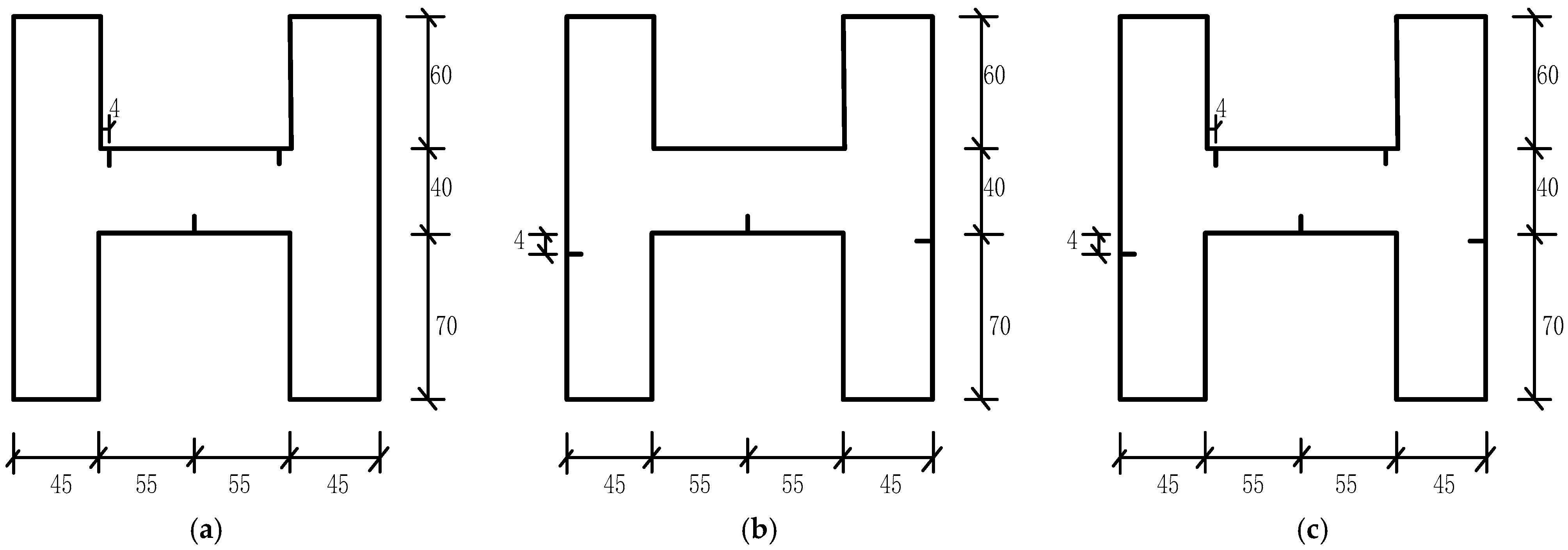
Figure 1 presents the schematic diagram of the specimens. As can be seen from the evidence presented in this study, specimen H-S-1 contained three prefabricated cracks. Two of these cracks were located on the beam, symmetrical about the axis of symmetry, with a distance of 4 mm from the core area. The third crack was located at the midpoint of the beam bottom. Specimen H-S-2 exhibited two prefabricated cracks on the column, located 4 mm from the core area. Specimen H-S-3 exhibited a total of five prefabricated cracks, which were distributed along the beam bottom and the column. The cracks on the columns are not distributed in the upper part of the columns in order to analyse whether new cracks will form in the upper region of the columns. All prefabricated cracks were cut to a uniform length of 6 mm by means of laser cutting, with a width of 0.3 mm.
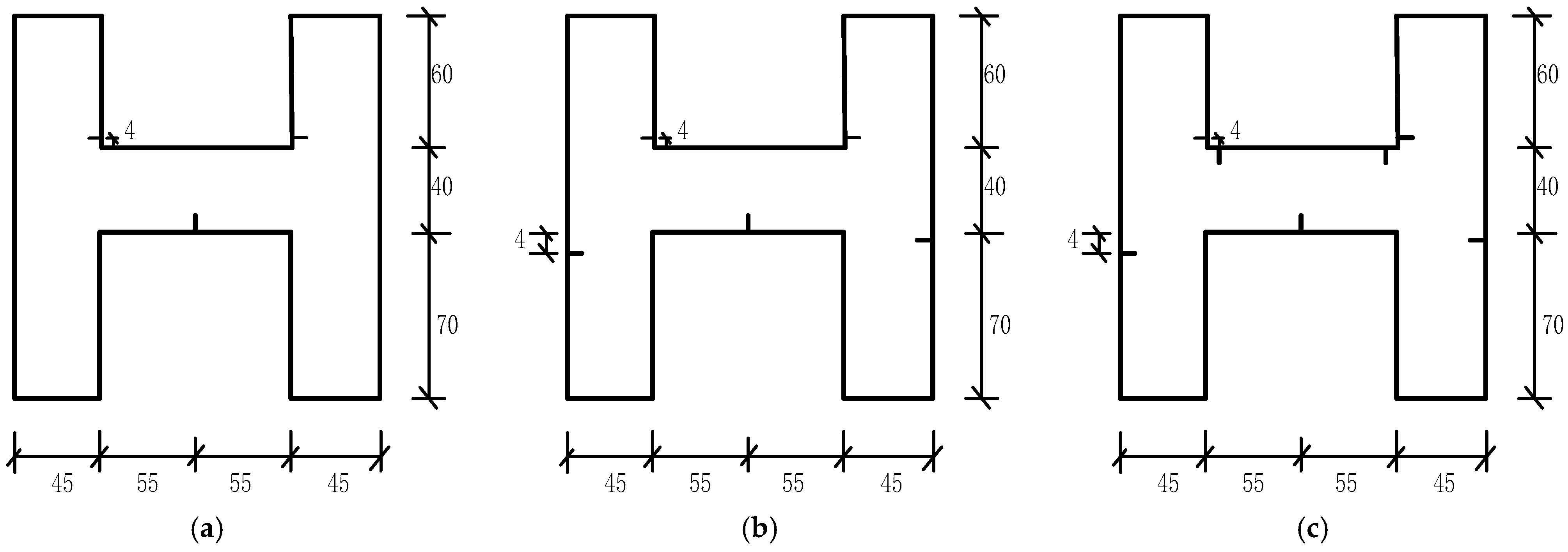
The dimensions of specimens with prefabricated cracks in the upper part of the column are demonstrated in Figure 2. Stress concentration has been observed to form at the upper beam-column intersection, and there are also prefabricated cracks on the lower side of the column. Specimen H-S-4 exhibits prefabricated cracks at the beam bottom and the inner side of the upper column. The prefabricated cracks are situated 4 mm from the beam-column core area. Specimen H-S-5 exhibits four prefabricated cracks. These cracks are symmetrically located on the inner side of the upper column and the outer side of the lower column. Specimen H-S-6 exhibits a total of six prefabricated cracks, distributed along the upper surface of the beam, the inner surface of the column, and the outer surface of the column. The dimensions of all prefabricated cracks are consistent, with a length of 6 mm and a width of 0.3 mm.
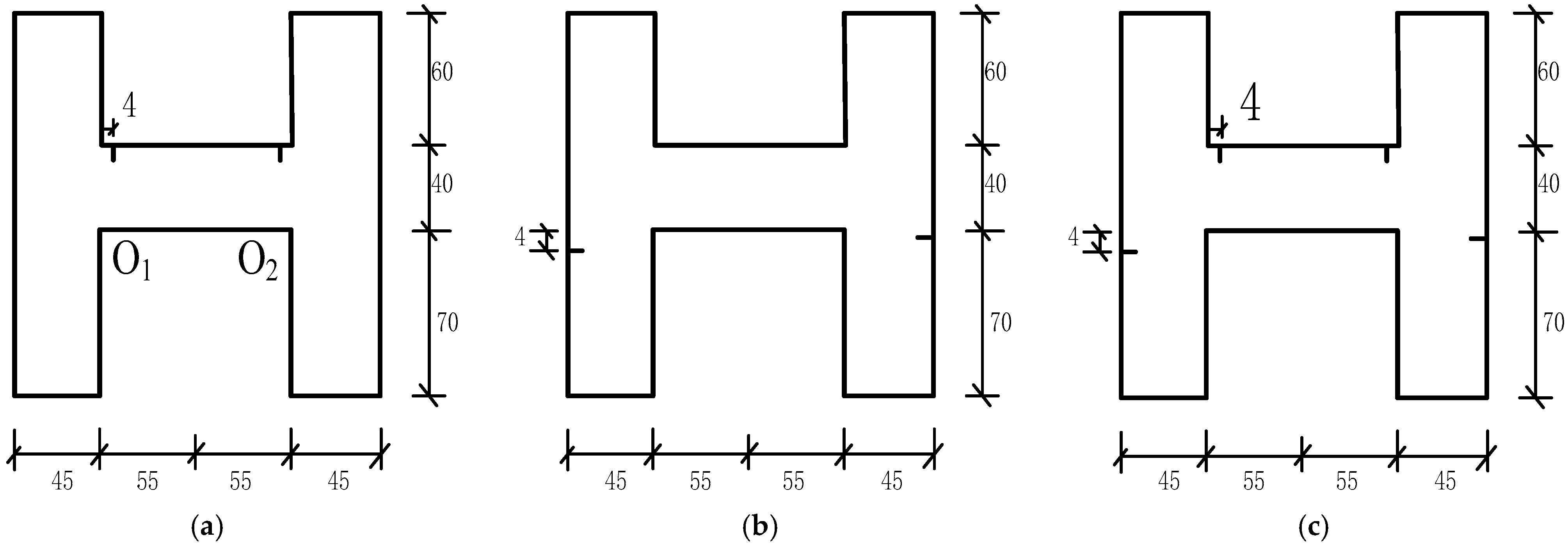
The test material is PMMA, and the specimen schematic diagram is shown in Figure 3. Specimen H-W-1 has two prefabricated cracks at the beam end. It is evident that specimen H-W-2 exhibits two prefabricated cracks at the column end, in proximity to the beam-column core area. Specimen H-W-3 exhibits prefabricated cracks on both the beam and the column. The dimensions of these prefabricated cracks are 6 mm in length and 0.3 mm in width.

2.2. Dynamic Caustic Line Experiment System Drop Weight Test

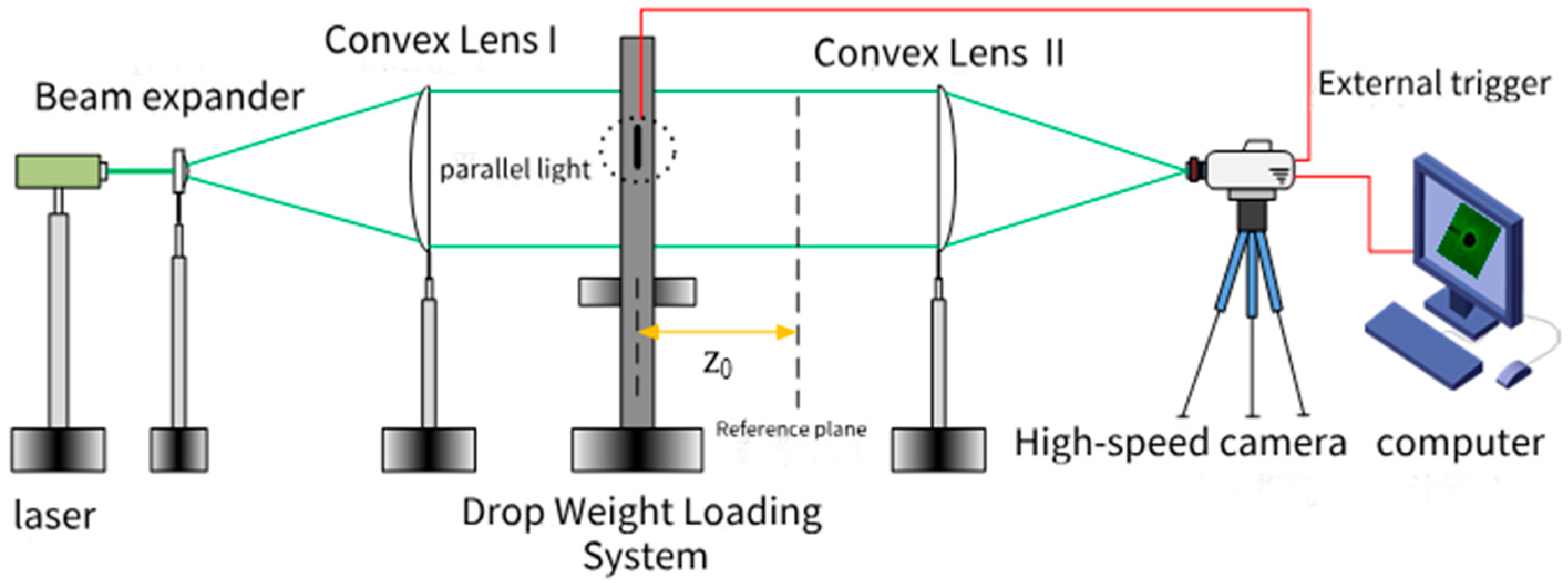
The transmission-type focal line testing system consists mainly of a laser light source, a beam expander, a convex lens, a high-speed camera, a computer and a loading frame (see Figure 4). This system enables the rapid recording of crack propagation in specimens undergoing dynamic loading, with minimal systematic error. The high-speed camera is a Fastcam SA5 (16G) colour digital camera from the United States capable of capturing up to 107 frames per second. The laser uses a pumped green laser source with an adjustable intensity ranging from 0 mW to 200 mW, which can be adjusted to meet experimental requirements.
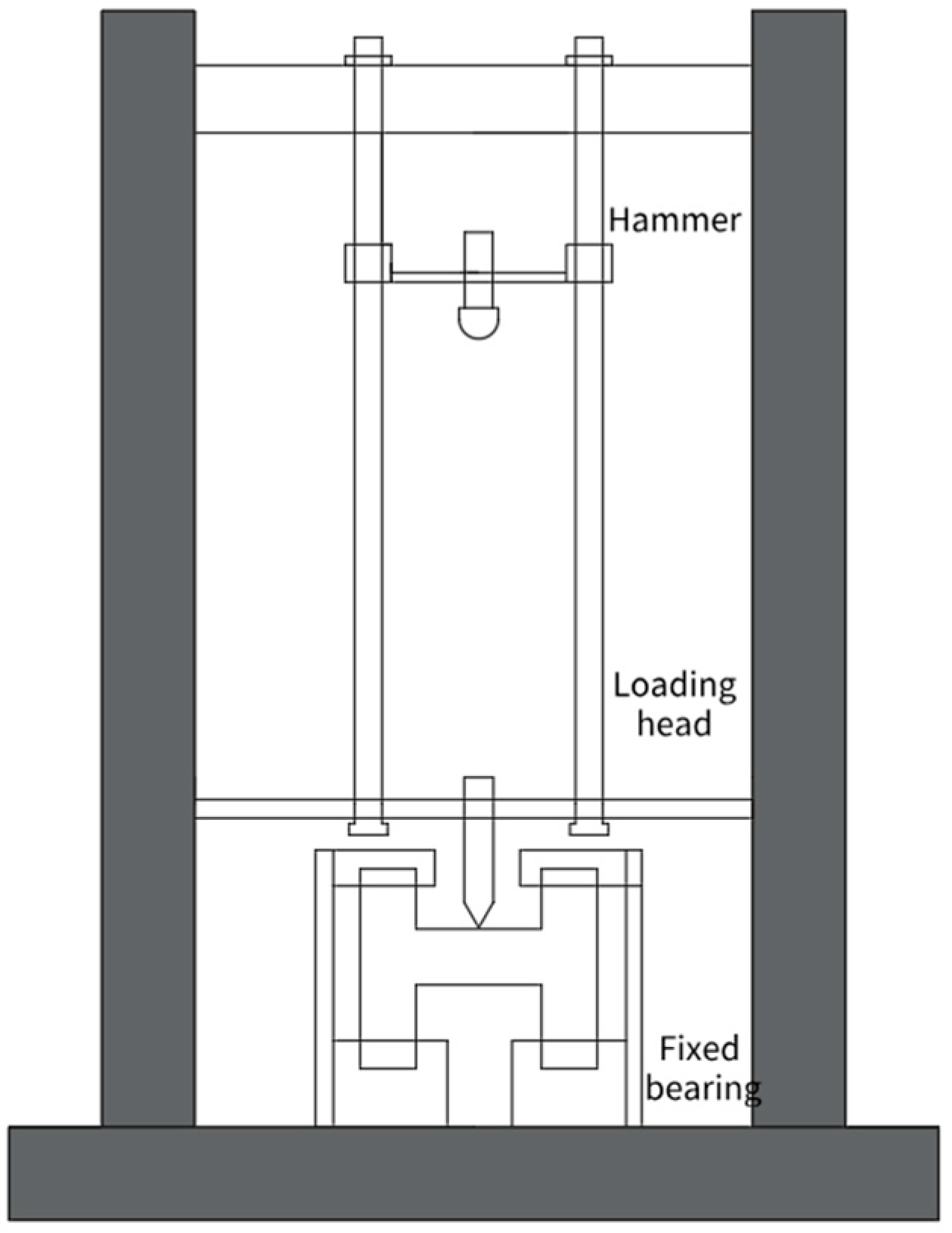
The drop height of the hammer was set at h = 300 mm, the mass of the drop hammer was 2 kg, the impact loading speed was 2.5 m/s, and the impact loading point was positioned directly above the beam. It is noteworthy that both the upper and lower ends of the column are semi-fixed with supports. It is imperative to limit significant displacement of the specimen in order to ensure loading stability. However, it is equally crucial to permit slight rotation at the column end. This will approximate actual engineering loading conditions. The purpose of this is to avoid experimental distortion caused by overly idealised constraints. As illustrated in Figure 5, the loading diagram for the H-shaped specimen in the drop weight test is presented.

2.3. Determination of Dynamic Stress Intensity Factor

In the context of composite dynamic fracture, it is imperative to ascertain the stress or strain field at the crack tip, a process that is intricately linked to the focal line method. This enables the establishment of its mapping equation, thereby deriving the relationship between characteristic parameters and the stress intensity factor. As stated in Reference [19], the expression for the stress intensity factor can be derived based on the characteristic dimensions of the typical focal line:
K Ι = D t ( t ) δ y 5 2 3 2 2 π | c | d z 0 ( 1 + tan 2 α ) 1 2 Q ( v ) 1
K Ι = D l ( t ) δ x 5 2 3 2 2 π | c | d z 0 ( 1 + tan 2 α ) 1 2 Q ( v ) 1  
where K Ι denotes the stress intensity factor at the crack tip; D t ( t ) and D l ( t ) represent the characteristic dimensions of the caustic line in the transverse and longitudinal directions, respectively; δ x and δ y denote the characteristic angular displacement differences in the caustic line in the x-direction and y-direction, respectively; | c | is the optical constant; d z 0 stands for the distance from the crack tip to the imaging plane; α is the characteristic angle of the caustic line; and Q ( v ) is a dimensionless function associated with the crack propagation velocity v , which is defined as follows:
Q ( v ) = B Ι ( v ) ( α l 2 α s 2 )
α l = ( 1 v 2 / C l 2 ) 1 2
α s = ( 1 v 2 / C s 2 ) 1 2
Among these, B Ι ( v ) is the coefficient related to crack velocity; C l and C s are the longitudinal and transverse wave velocities of the material, respectively. It should be noted that C l is identical to CP in Table 1. All parameters in the equation can be obtained through calculation, so the stress intensity factor at fracture can be determined by measuring the characteristic dimensions of the char spot during the dynamic fracture process.

3. Dynamic Fracture of Specimens: Beam-Bottom Prefabricated Cracks (Upper Column Initially Uncracked)

3.1. Analysis of Dynamic Fracture Results of Specimens

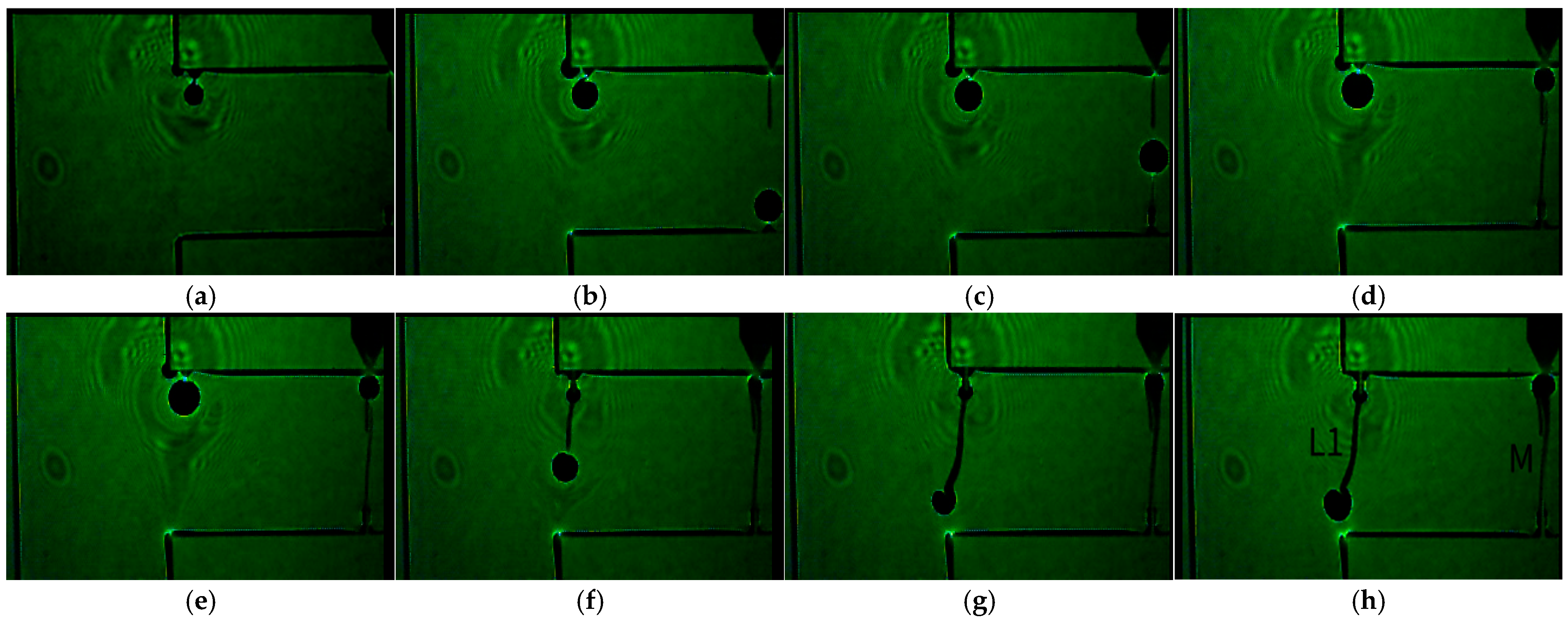
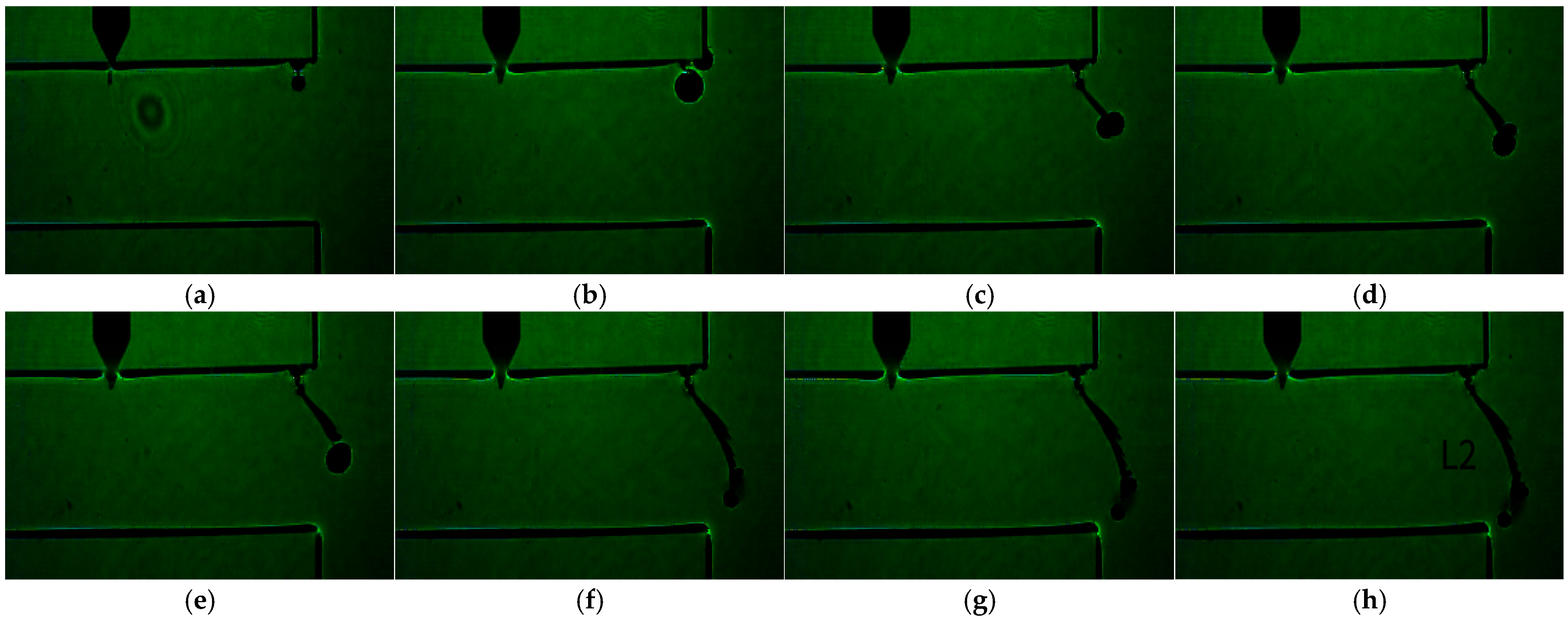
As illustrated in Figure 6, Figure 7 and Figure 8, the caustic pattern of crack propagation is evident. In the context of impact loading, stress waves are propagated from the impact point in all directions, as evidenced in Specimen H-S-1. The stress waves undergo a series of physical processes, including reflection, refraction, and diffraction, upon encountering the crack at the beam bottom. This results in the formation of tensile stress at the crack tip. Consequently, the number of caustics increases gradually. At t = 120 µs, the diameter of the caustics reaches its maximum, triggering the initiation of the beam-bottom crack (designated as Crack M). While the stress waves interact with the beam-bottom crack, those propagating to the upper-beam cracks also cause stress concentration at these cracks. The stress concentration at the beam-end cracks manifests at a comparatively late stage and exhibits a gradual growth trajectory during the propagation of the primary crack, designated as M. Upon the substantial completion of the propagation of crack M, the initiation of the upper beam-end crack, labelled L1, occurs. Subsequent to the propagation of the crack below the neutral axis of the beam, a precipitous decline in crack propagation speed is observed, resulting in oscillatory crack propagation until the beam-column intersection O1 is reached.
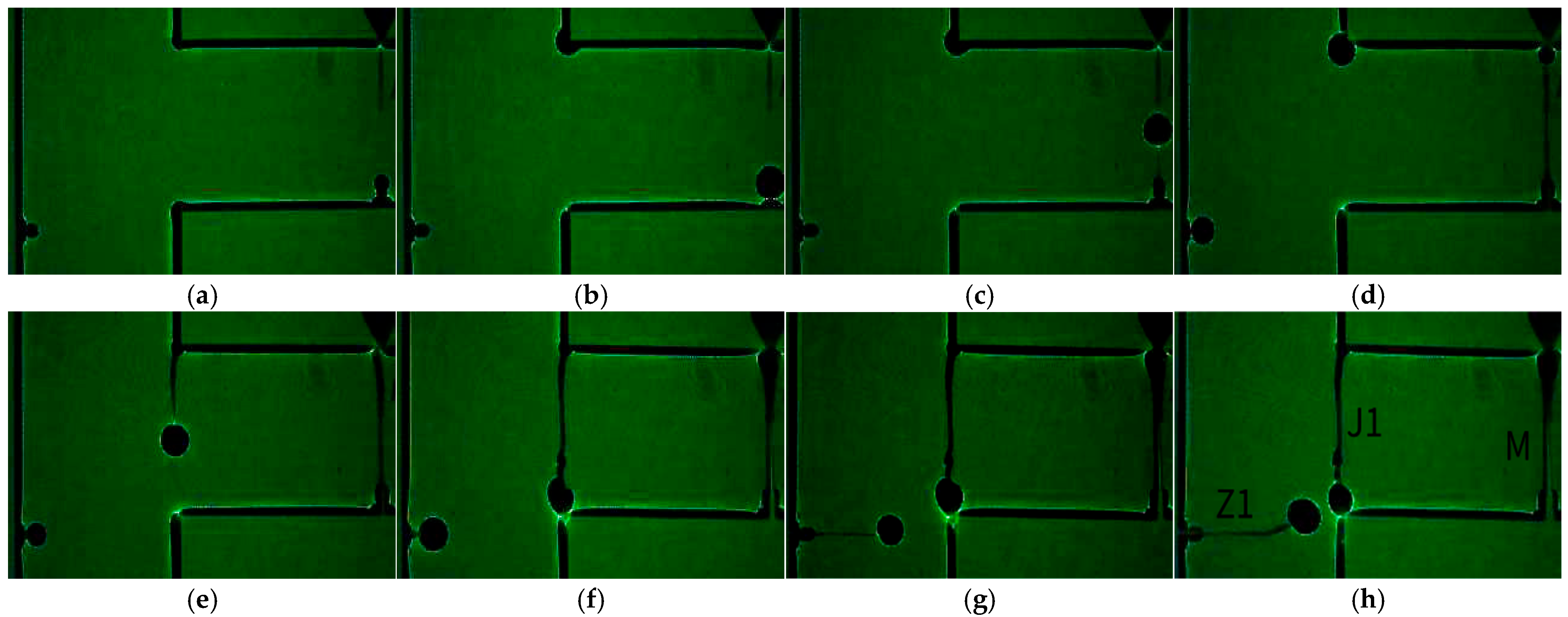
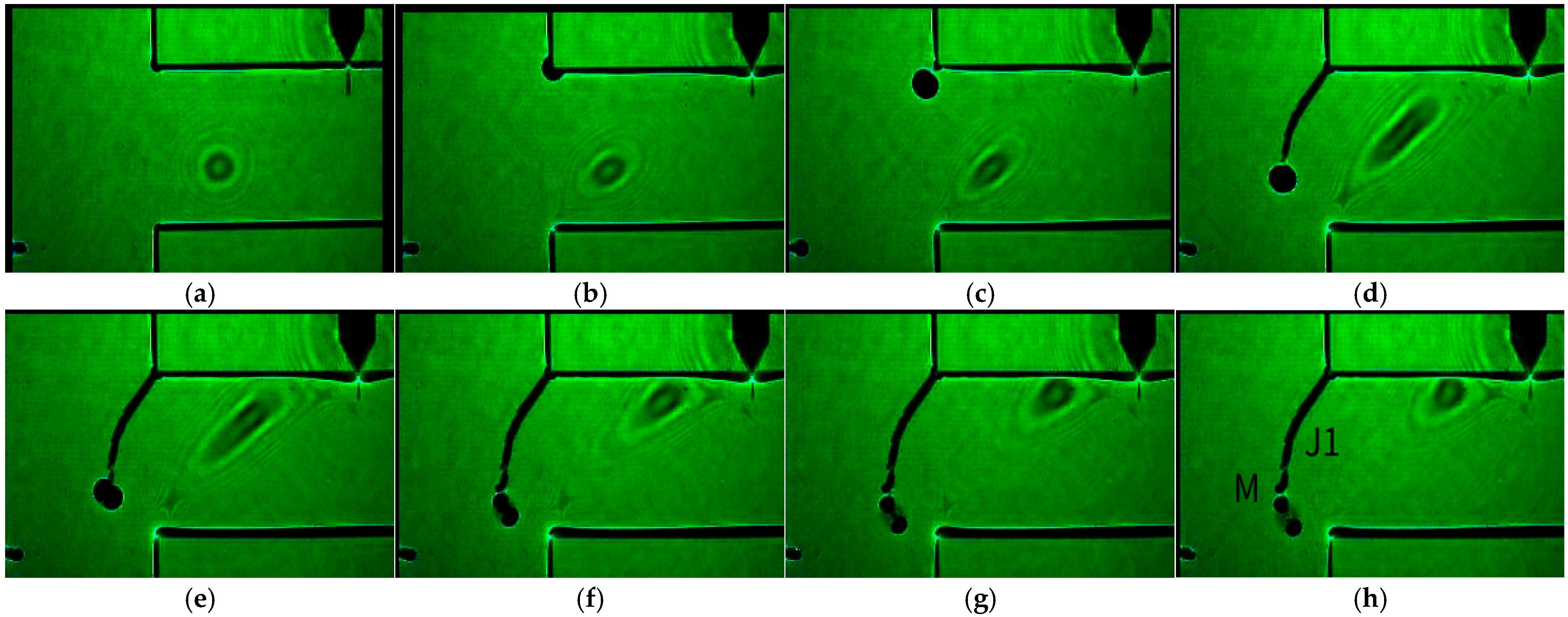
A comparison of Specimen H-S-2 and Specimen H-S-1 reveals several differences in the fracture process. The upper beam-column intersection is identified as a weak point in Specimen H-S-2. When stress waves propagate to this location, stress concentration is formed, initiating a crack (designated as Crack J1). When Crack J1 propagates to the vicinity of O1, the energy accumulated at the column crack Z1 reaches the critical value for crack initiation, causing the column crack Z1 to initiate and propagate.
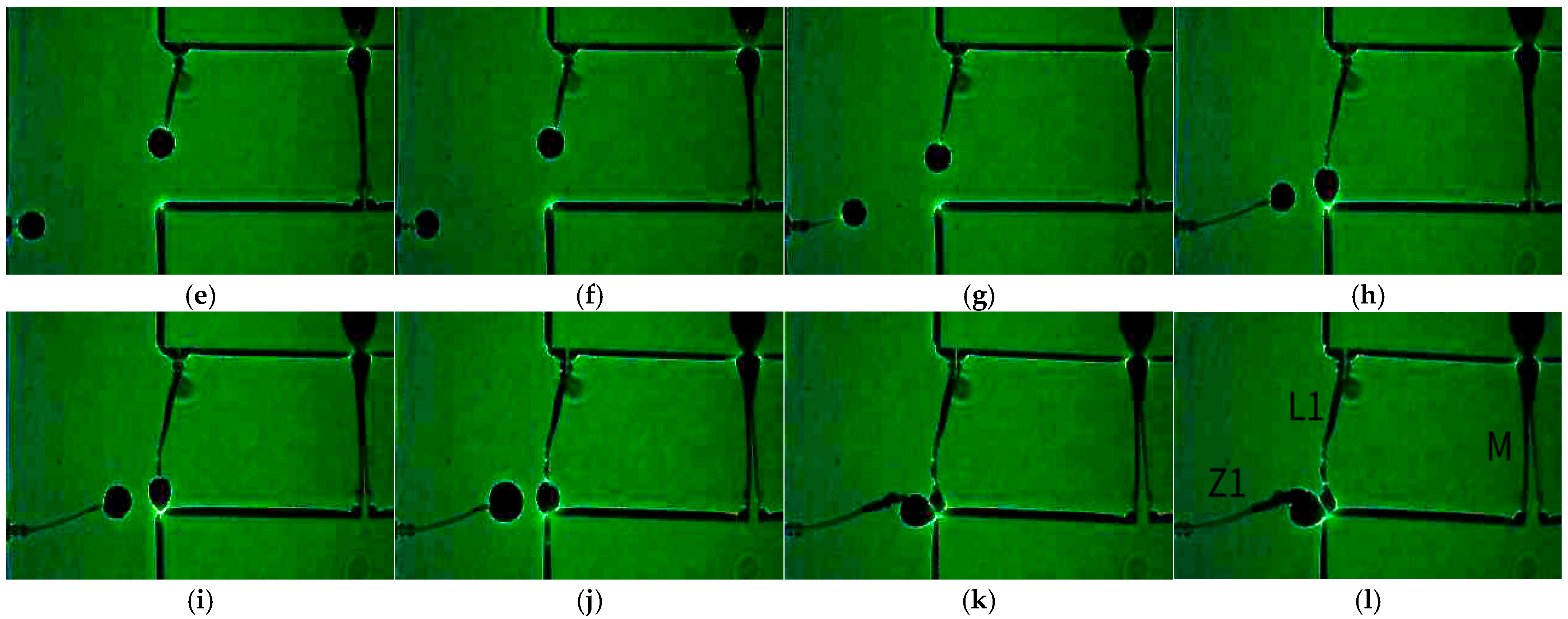
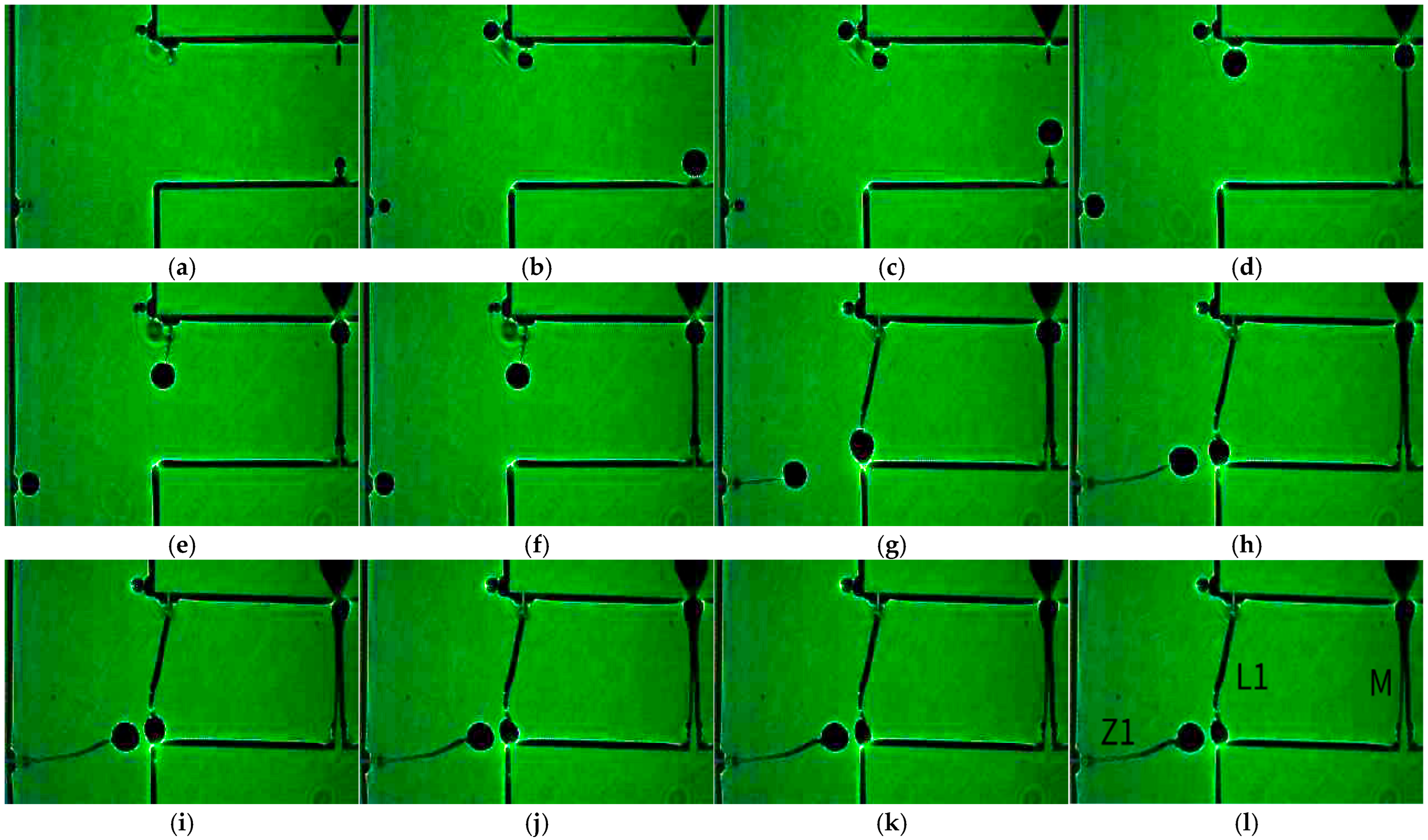
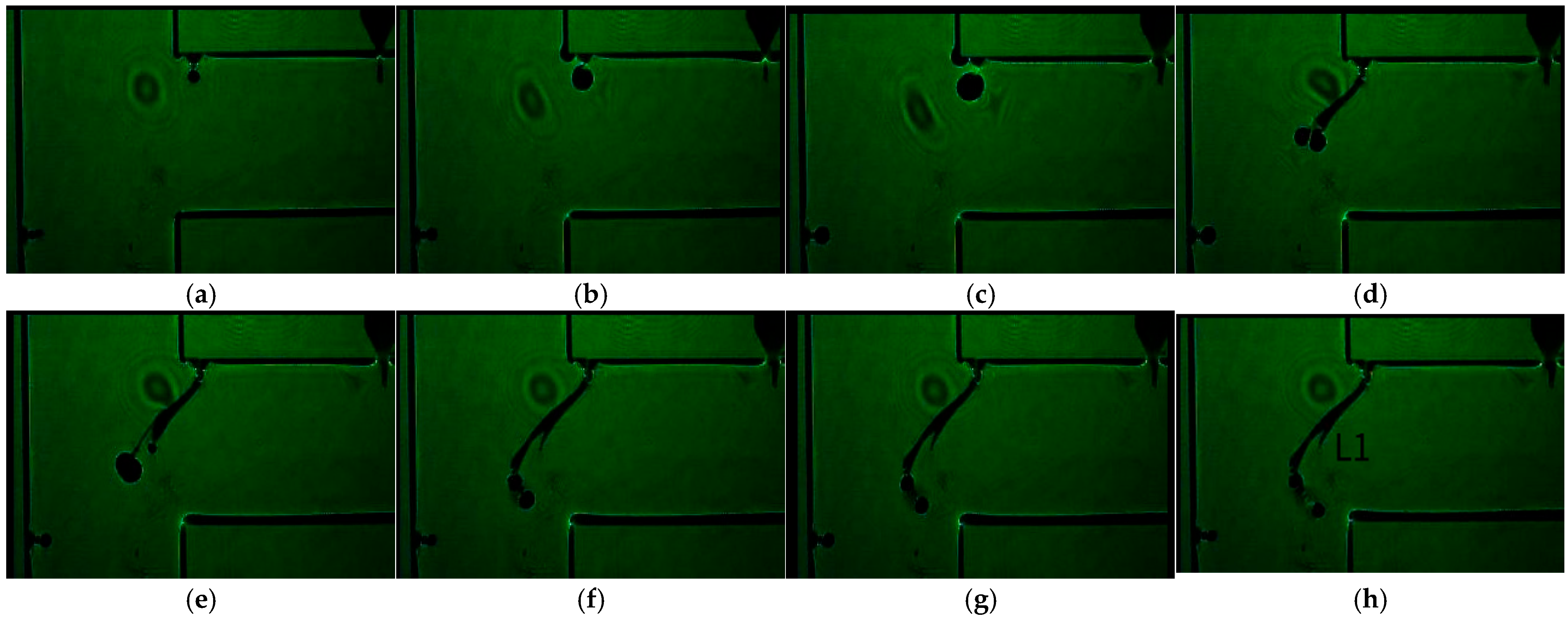
Following the impact fracture, Specimen H-S-3 exhibited a total of five cracks, distributed symmetrically about the axis of symmetry. These were designated as the primary crack M, two beam cracks L1 and L2, and two column cracks Z1 and Z2. The propagation process of Specimen H-S-3 exhibited notable parallels with that of Specimen H-S-2. However, a distinguishing feature was the absence of crack initiation at the upper beam-column intersection, attributable to the presence of cracks in the upper part of the beam.

3.2. Variation Law of Crack Propagation Velocity

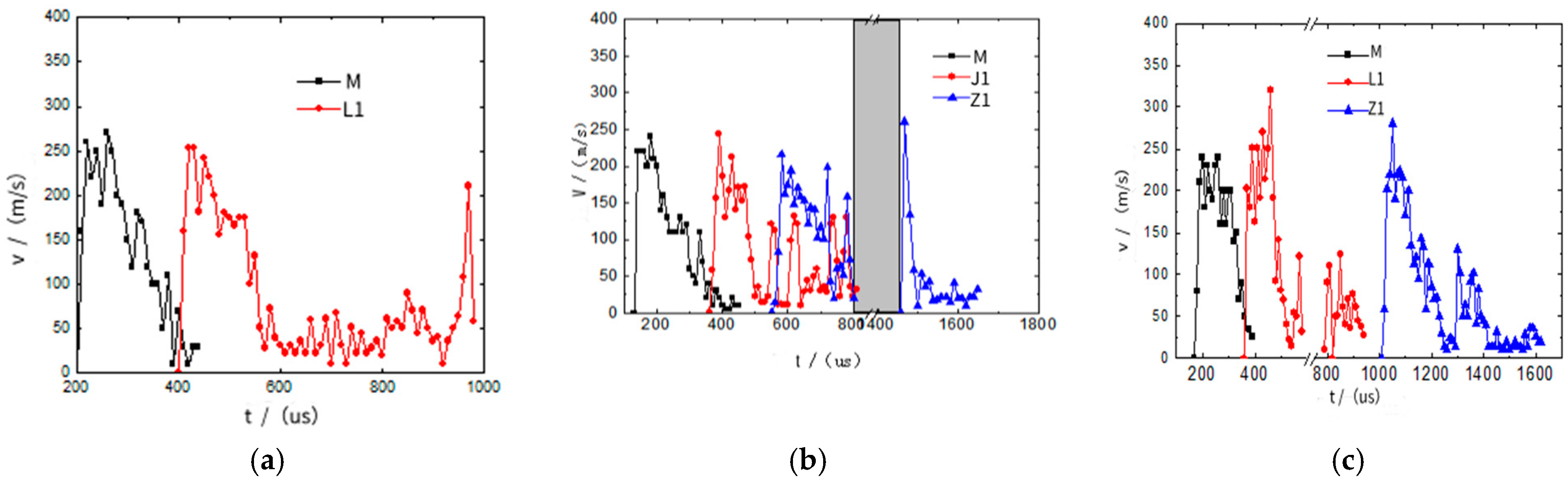
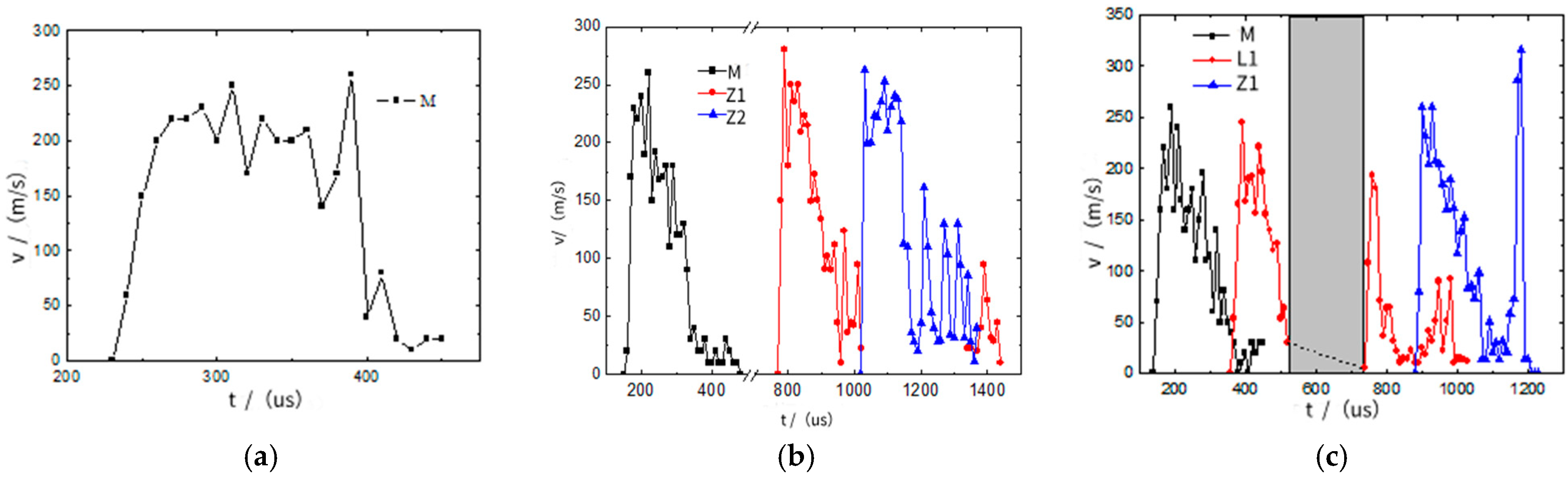
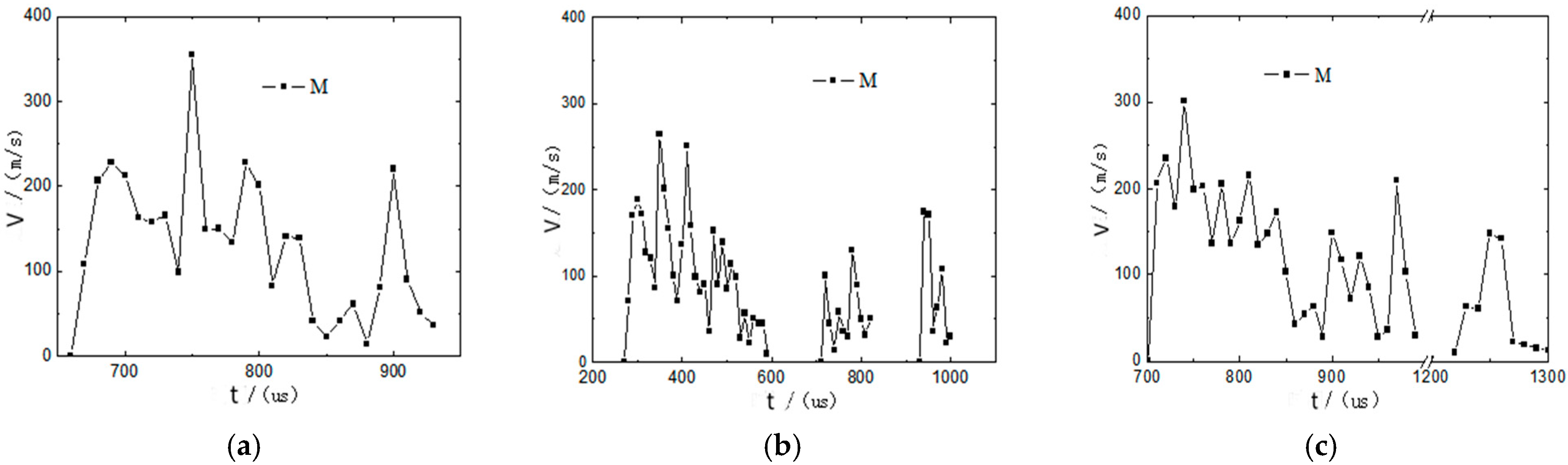
As illustrated in Figure 9, the variation law of crack propagation velocity for the three specimens is demonstrated. For the beam cracks of Specimen H-S-1, during the initial propagation stage (400 μs–600 μs), the velocity variation trend is similar to that of the main crack M, but the oscillation amplitude is smaller than that of the main crack. The velocity oscillates at a relatively low level between 600 µs and 910 µs. This is due to the fact that the compressive stress at the point of intersection between the beam and the column hinders the further propagation of the cracks. Under the action of stress waves inside the specimen, the crack propagation velocity oscillates at a low level. It has been demonstrated that sustained stress concentration results in a substantial augmentation in crack propagation velocity at the culminating stage. The gray shaded regions in the figures represent the energy input stage before the crack enters the active propagation phase, and the same logic applies to the gray shaded areas in the other figures presented.
The variation law of the propagation velocity of the main crack M in Specimen H-S-2 is analogous to that in Specimen H-S-1, but the amplitude of velocity oscillation is reduced relative to that of H-S-1. The velocity of Crack J1 increases to 324 m/s between 400 μs and 470 μs, then decreases rapidly to 25 m/s. From 560 μs to 790 μs, the stress intensity factor of Crack J1 changes while its velocity remains essentially zero. Following the re-initiation of the crack, the maximum propagation velocity of Crack J1 is recorded as 110 m/s, which is significantly lower than the maximum velocity recorded during the initial propagation. Crack Z1 initiates relatively late; its velocity reaches a maximum value after 40 μs, then decreases with oscillation. Upon the intersection of the propagating crack tip of Crack Z1 with Crack J1 in proximity to point O1, the stress field at the tip of Crack J1 exerts a substantial hindering effect on the propagation of Crack Z1. Consequently, Crack Z1 undergoes a propagation trajectory towards the fracture surface formed by Crack J1, accompanied by a modest augmentation in velocity.
The following table presents a comparison of the average and maximum propagation velocities between specimens H-S-3 and H-S-2. As demonstrated in Table 2, the average propagation velocities of Crack Z in the two specimens are closely similar, with that of Specimen H-S-3 exhibiting a marginal increase over that of H-S-2. For the mean propagation velocities of Crack M and Crack J (L), Specimen H-S-2 exhibits a 50% and 32% superior performance compared to H-S-3, respectively. A comparison of the crack propagation paths reveals that Specimen H-S-2 exhibits a shorter crack propagation length, resulting in a lower surface energy of the propagating crack in comparison to H-S-3. Consequently, the kinetic energy of the cracks in H-S-2 is higher than that in H-S-3. Meanwhile, Specimen H-S-3 exhibits greater oscillatory variation in velocity; the interaction between stress waves and moving cracks is more complex, leading to uneven energy release.

3.3. Variation Law of the Stress Field at the Crack Tip

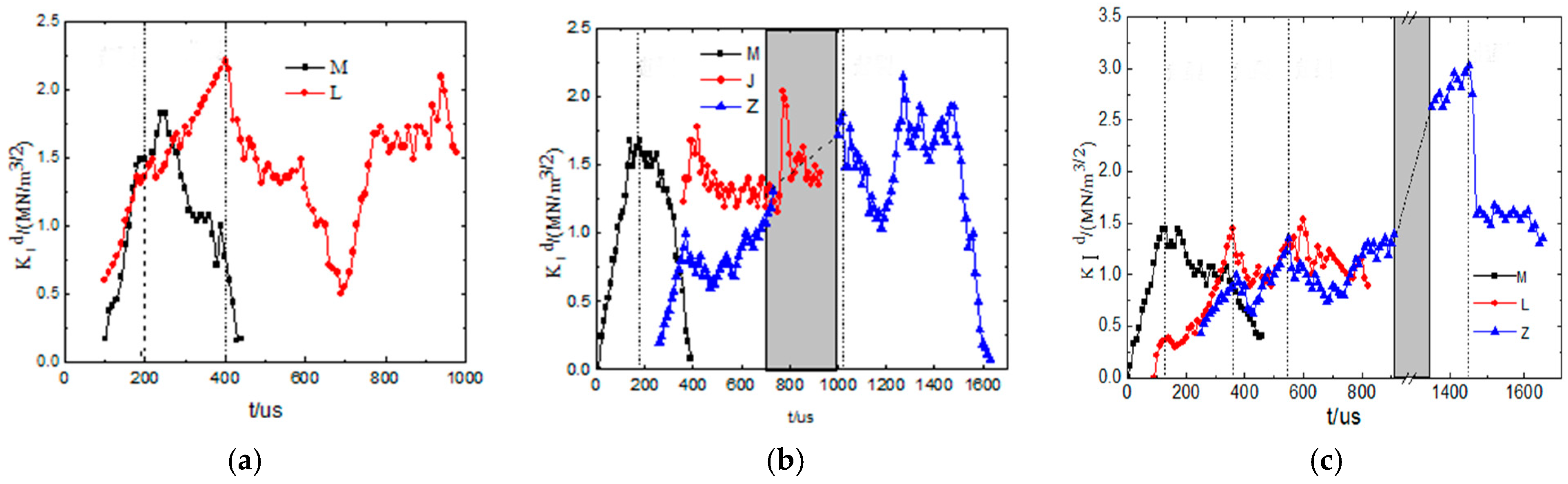
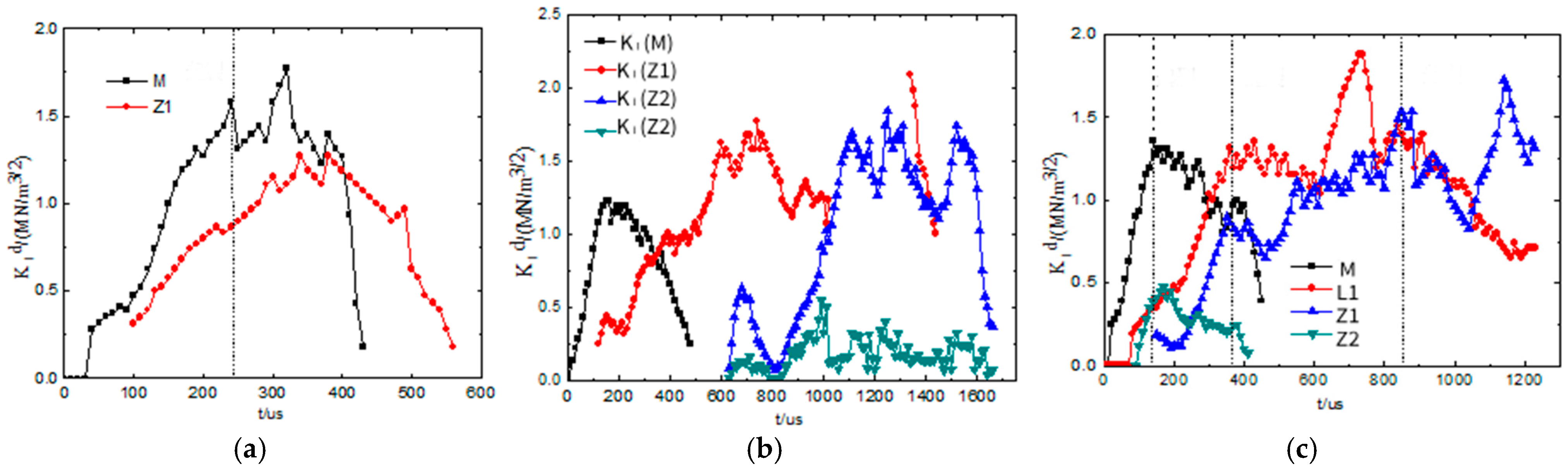
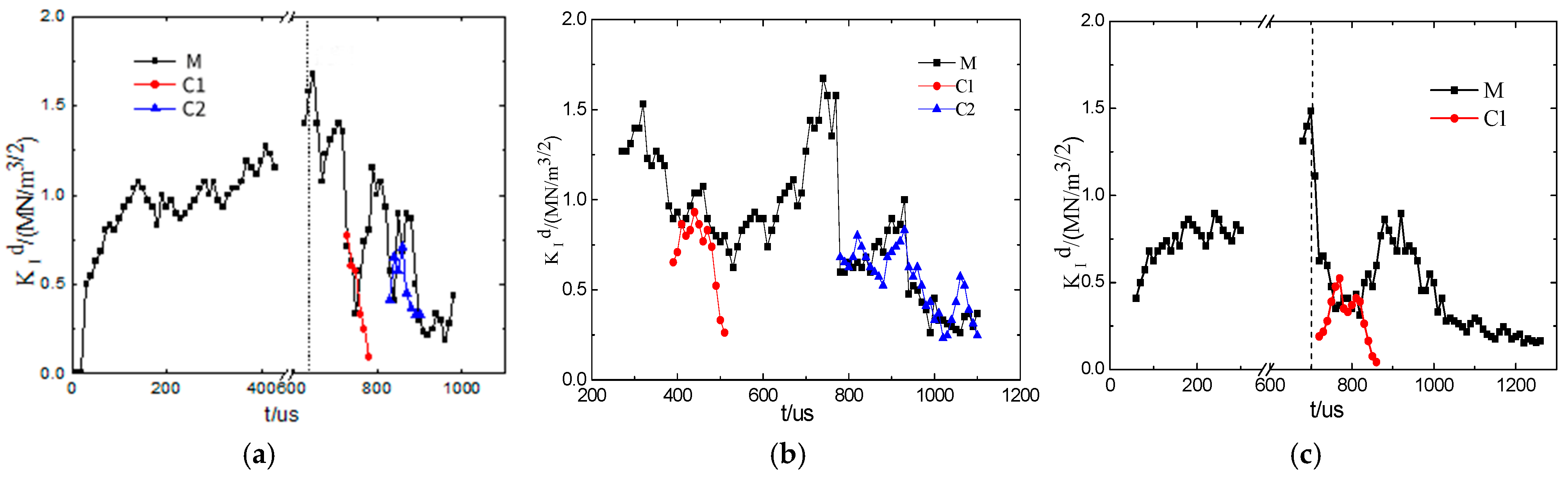
As illustrated in Figure 10, the variation law of the SIF at the crack tip is demonstrated. For specimen H-S-1, the impact stress wave initially propagates to the primary crack, designated M, and the SIF undergoes a continuous increase. At t = 200 µs, the fracture toughness of 1.48 MN/m3/2 is reached, thereby initiating the main crack. The SIF increases with oscillation until 250 µs; after that, affected by the compressive stress field in front of the moving crack, the SIF at the crack tip gradually decreases. Since the formation of caustics at the beam cracks, the SIF at their tips has shown a continuous increasing trend. Between t = 200 µs and 300 µs, the superposition of reflected stress waves and impact stress waves at the main crack results in a change in the SIF of the main crack with oscillation. The alteration in the overall energy release of the structure instigates a slight oscillation of Crack L. Moreover, the reflected waves propagating to the column boundary and reflecting back also affect the degree of stress concentration at its crack tip. Subsequent to the initiation of the secondary crack, a decrease in the SIF is observed. The curved propagation of the crack and the strong compressive stress field at the beam-column intersection O1 act in such a manner as to inhibit crack propagation entirely between t = 640 µs and 960 µs, thus leading to crack arrest. As evidenced by the caustic pattern, the crack tip is subjected to tension-shear stress at this particular juncture. At t = 950 µs, the beam crack continues to propagate, and the degree of stress concentration decreases accordingly. The black dashed lines in the figure serve as reference lines for the crack initiation moment, and the same logic applies to the other figures.
The sequence of crack initiation for specimen H-S-2 is as follows: main crack M, joint crack J1, and column crack Z1. The main crack initiates at 190 µs with an initiation toughness of 1.57 MN/m3/2. Thereafter, the SIF decreases gradually, while the degree of stress concentration at joint J increases concomitantly, and crack J1 initiates at 360 µs. Subsequent to the initiation process, the SIF undergoes oscillatory behaviour, increasing to 1.75 MN/m3/2 under the influence of stress waves. From t = 520 µs to 790 µs, crack propagation is essentially static, and the SIF oscillates sharply around 1.3 MN/m3/2 with an oscillation interval of 10 µs. This oscillatory phenomenon is attributable to the interaction between the stress waves propagating within the specimen and the crack tip. At this stage, there is a significant increase in the stress field at column crack Z1, rising from 1.25 MN/m3/2 to 1.75 MN/m3/2, with an increase rate of 33%.
For Specimen H-S-3, the three propagating cracks sequentially exhibit a variation law of “peak-valley” changes: the main crack M shows only one peak, crack L shows two peaks, and crack Z shows three peaks throughout the entire impact loading process.
The primary crack is the first to initiate, and it is less susceptible to the propagation of other cracks. The formation of beam cracks is influenced by various factors, including loading stress waves, reflected stress waves, and the propagation of the primary crack. The column cracks are affected by the propagation of secondary cracks. The initiation toughness of the main crack and beam cracks is found to be quite similar and slightly higher than that of the column cracks.
The initiation time of each crack in Specimen H-S-3 is observed to precede that of Specimens H-S-1 and H-S-2. This finding suggests a direct correlation between the propagation of stress waves and the stability of the structure under dynamic response, with an increased number of cracks resulting in more paths for energy dissipation. This, in turn, leads to a reduction in structural stability and an amplified impact of dynamic response on the structure. When the number of prefabricated cracks is equal, the initiation time of Specimen H-S-1 is earlier than that of H-S-2. In this case, local stability plays a crucial role in crack initiation. It is evident that specimen H-S-1 exhibits three cracks, which are concentrated along the beam, thus rendering it more susceptible to failure.
As demonstrated in the preceding analysis, it can be deduced that following the completion of a crack’s propagation stage, stress waves rapidly amass at points susceptible to accumulation and seek pathways conducive to dissipation. The degree of stress concentration is affected by the compressive stress field at a certain distance in front of the crack tip, resulting in crack stagnation in the later propagation stage of the main crack and beam cracks. During the crack arrest period, the stress concentration at the location of the next initiating crack undergoes a relatively significant increase.

4. Dynamic Fracture of Specimens: Beam-Bottom, Upper Column and Column-Bottom Prefabricated Cracks

4.1. Fracture Process of the Specimen

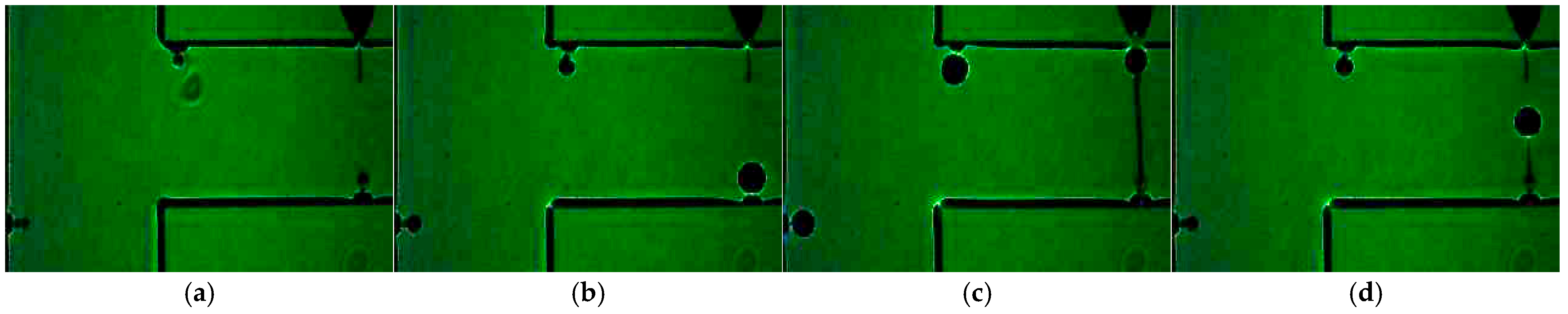
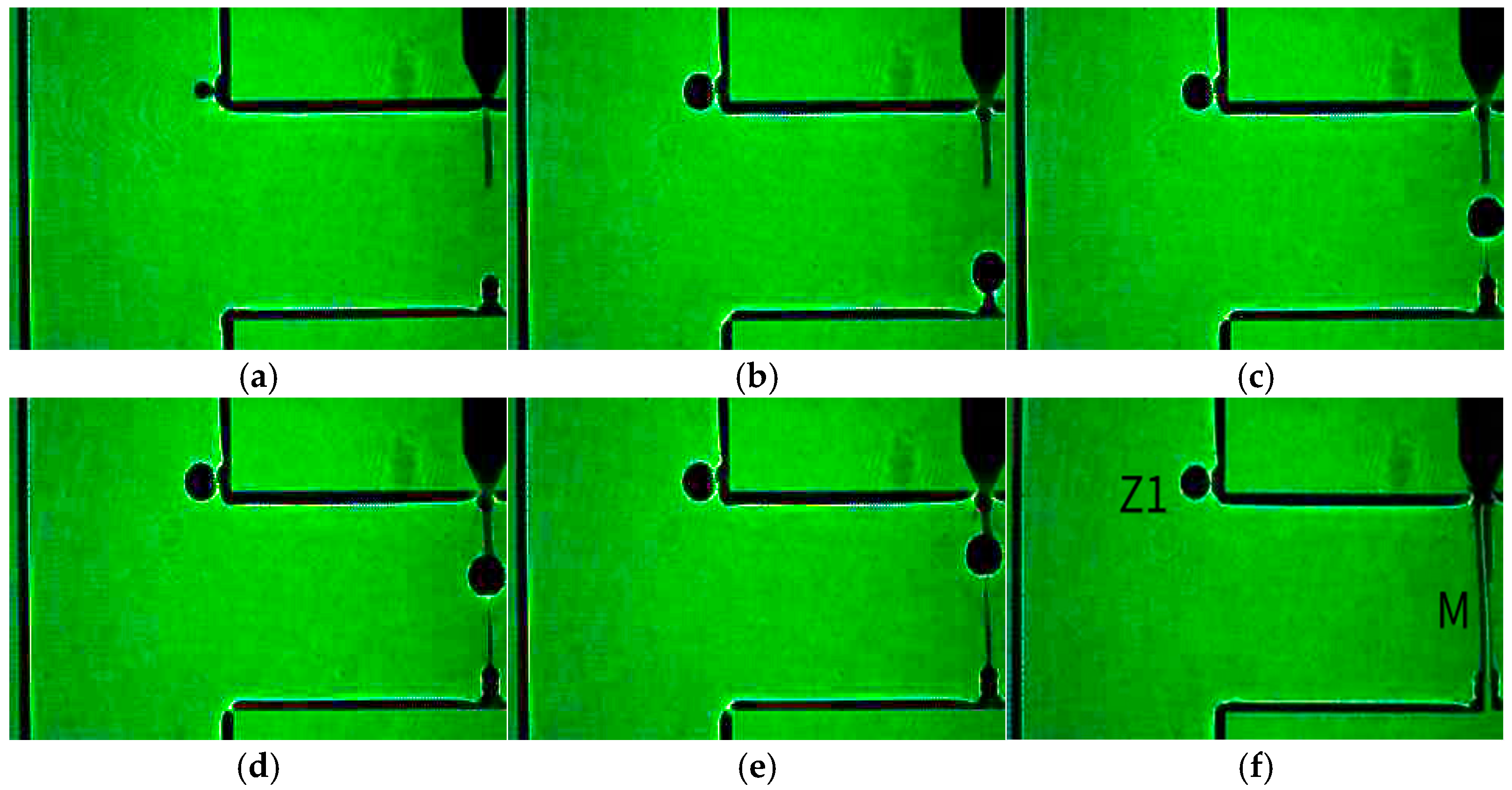
As illustrated in Figure 11, Figure 12, Figure 13 and Figure 14, the sequence diagram delineates the alterations in caustic patterns during the fracture process of the specimen. For Specimen H-S-4, the downward-propagating impact stress wave undergoes diffraction at the tip of the beam crack, forming a stress concentration. Given the proximity of the crack to the loading point, a strong interaction between the wave and the crack is observed, leading to the initiation and rapid propagation of the beam-bottom crack M. The stress wave propagates to the left side of the specimen and forms a stress concentration at the upper-column crack Z1; however, crack Z1 does not initiate due to the low degree of stress concentration.
The specimen H-S-5 exhibits three propagating cracks: the primary crack M, the lower-column crack Z1, and the upper-column crack Z2. Subsequent to the initiation of crack Z1, a rapid deviation from the prefabricated crack direction is observed, resulting in the propagation of the crack within the joint core area. This process culminates in the eventual connection at point O1. Following initiation, the crack Z2 propagates along a deviated path towards the impact loading point. In the subsequent stages of propagation, a low-velocity period ensues, characterised by a shift in the crack’s trajectory towards the beam-column intersection O2.
Following the initiation of the main crack, designated M, in Specimen H-S-6, the subsequent propagation of crack L1 is observed. The SIF at the tip of the column crack adjacent to the beam crack oscillates but does not lead to crack initiation. The column crack Z1 initiates; at intersection O1, the interaction between the stress field at the tip of the moving crack and the stress field of crack L (which has propagated to the vicinity of O1) causes Z1 to deviate towards the fracture surface formed by L and propagate along it.

4.2. Variation Law of Crack Propagation Velocity

Figure 15 shows the variation law of the propagation velocity of the specimens following the initiation of the main crack, designated M, in Specimen H-S-6; the subsequent propagation of crack L is observed. The SIF at the tip of the column crack adjacent to the beam crack oscillates but does not lead to crack initiation. The column crack Z initiates; at intersection O1, the interaction between the stress field at the tip of the moving crack and the stress field of crack L (which has propagated to the vicinity of O1) causes Z1 to deviate towards the fracture surface formed by L and propagate along it.
The velocity of the main crack in Specimen H-S-5 reaches a maximum of 260 m/s after passing through two peak points. At t = 230 µs, a sudden decrease in velocity is observed, with a drop to 150 m/s. Subsequent to this, a gradual decrease in velocity is evident, accompanied by a renewed oscillatory pattern at t = 290 µs. This oscillatory behaviour persists until the fracture is fully connected at t = 310 µs. The oscillation amplitude of Crack Z1 is minimal prior to t = 900 µs and undergoes a substantial increase between 900 µs and 1020 µs. At this stage, the maximum points available are three, and the minimum points are two. As the crack gradually propagates to the beam-column intersection O2, the stress field at the crack tip and the stress wave diffracted through O2 inhibit crack propagation, while the loading stress wave transmitted here and the reflected wave from the column boundary promote crack propagation. The velocity demonstrates marked oscillatory changes under the influence of these two opposing effects.
During the propagation of the main crack in Specimen H-S-6, its velocity reaches a maximum of 265 m/s after two oscillatory changes. The velocity displays four peak points during its downward trend, with an average velocity of the main crack of 100 m/s. The beam crack arrests 160 µs after initiation. At t = 740 µs, the crack re-initiates, with the velocity peak after re-initiation being approximately 25% lower than that of the initial propagation. Furthermore, the velocity oscillates within the range of 100 m/s. Two peak points occur in the velocity during the subsequent propagation stage of the crack, which is the consequence of long-term energy accumulation at the crack tip and subsequent sudden release of energy. The column crack displays parallels with the beam crack in terms of propagation: both exhibit a cessation in their propagation for a period, followed by a sudden escalation in velocity. For Specimen H-S-6, the high stress at point O1 and the reflected waves here slow down the crack propagation.

4.3. Variation Law of the Stress Intensity Factor at the Crack Tip

Figure 16 shows the variation curve of the stress intensity factor at the crack tip of the specimen. For specimen H-S-4, the SIF of the main crack oscillated and increased until t = 240 µs, and the crack initiated when the stress intensity factor reached 1.6 MN/m3/2. Between 300 µs and 350 µs, affected by the reflected wave from the lower boundary of the beam, the SIF exhibited a “peak”, after which it continued to decrease. For crack Z1, after its stress intensity factor increased to a maximum value, Z1 did not initiate because the propagation of the main crack consumed a large amount of energy.
Following the attainment of a maximum value by the SIF at the tip of the main crack in Specimen H-S-5, a subsequent decrease is observed. The SIF value of the main crack is 1.25 MN/m3/2, which is approximately 28% lower than that of Specimen H-S-4. The decline in initiation toughness can be attributed to the diminished overall stability of the structure, thereby facilitating the initiation of the primary crack. For column crack Z1, the SIF reaches 1.77 MN/m3/2 at t = 740 μs. Following the propagation of the crack over a period of time, it arrests between 1000 µs and 1300 µs, with the SIF demonstrating oscillatory changes. This phenomenon can be attributed to the dynamic equilibrium that exists between the formation of a new crack surface following propagation and the dissipation of crack kinetic energy over time. The interplay between these two processes results in the attenuation of the “driving force” at the crack tip, leading to the stagnation of the crack. Conversely, point O2 constitutes a high-pressure stress zone, wherein the energy propagated by the propagating crack is not readily dissipated. Prior to the onset of column crack Z2, its SIF undergoes a continuous and protracted increase. At the time t = 1020 μs, the initiation of column crack Z2 is observed, accompanied by a stress intensity factor KI = 0.95 MN/m3/2. At 1500 μs, the SIF attained a minimum value of 1.1 MN/m3/2. Subsequently, the stress waves propagated within the specimen, thereby promoting an augmentation of the SIF at the crack tip and consequently driving the crack to propagate to point O1. The rationale behind the crack’s propagation along a specific trajectory within the joint core region, subsequently deviating towards point O1, can be attributed primarily to the constraints imposed on both the upper and lower extremities of the column. This constraint results in a substantial increase in stiffness, thereby impeding the propagation of the crack.
The relationship between the crack initiation toughness of Specimen H-S-6 is as follows: the initiation toughness of the main crack is quite similar to that of the beam crack, and both are lower than that of the column crack Z1. This phenomenon can be attributed to the initial accumulation of stress waves at the primary crack, designated as M, and the beam crack, denoted as L1. During the propagation of stress waves towards the column crack, designated as Z1, a process of attenuation occurs, resulting in a reduction in the energy carried by the waves. Consequently, the column crack Z1 is less prone to failure and requires a longer time for energy accumulation, which leads to the higher initiation toughness at Z1.

5. H-Shaped Specimens: Dynamic Fracture Without Beam-Bottom Edge Cracks

5.1. Analysis on Dynamic Fracture Morphology of Specimens

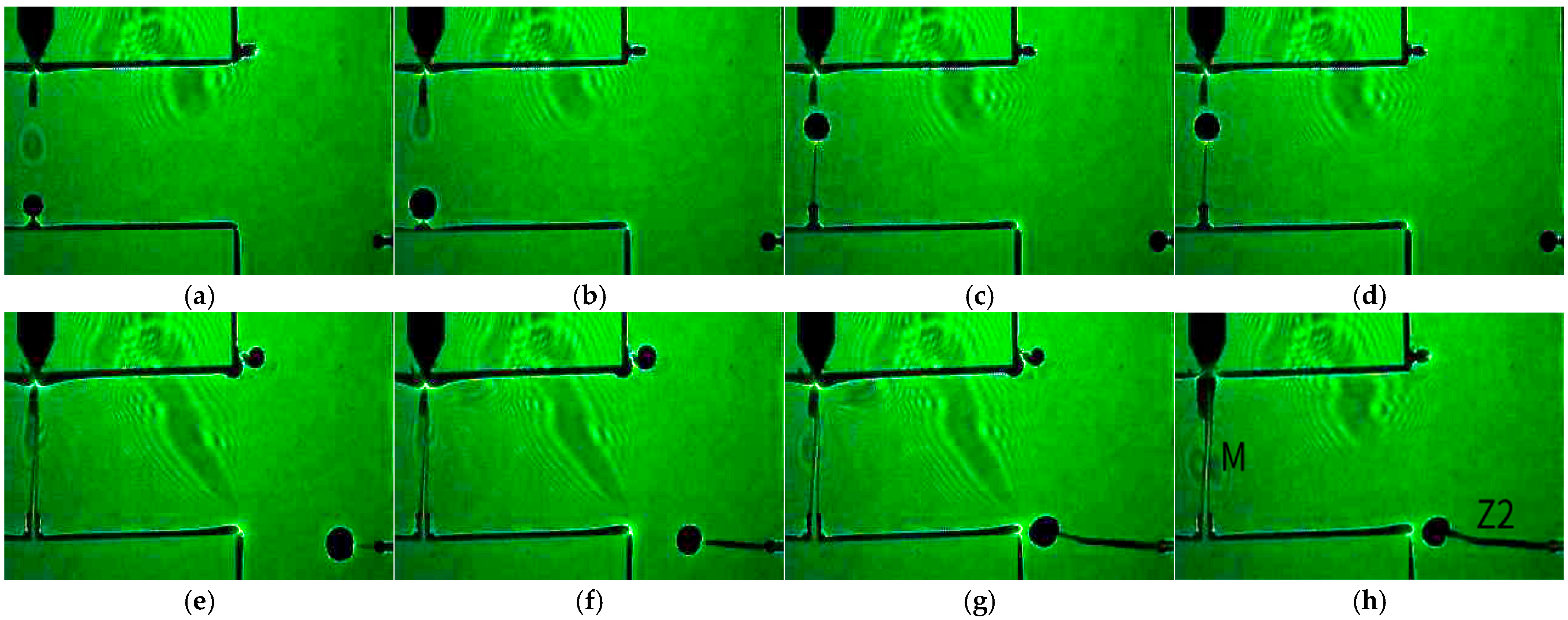
As illustrated in Figure 17, Figure 18 and Figure 19, the specimen, designated H-W-1, exhibits a propensity to initiate cracks L1 and L2 in both prefabricated beams under the action of stress waves, manifesting an approximately symmetrical fracture path. The caustic spots at the crack tips are minute. During the process of crack propagation, the propagating main cracks exhibit a branching phenomenon, and new caustic spots continuously appear around the main propagating crack and mix with the caustic spots of the main crack. The fracture path is characterised by the presence of numerous “burrs”, resulting in a marked enhancement of the surface roughness.
Specimen H-W-2 initiates fracture from the beam-column intersection (crack J1), and its propagation path is denoted as M. In the early propagation stage of crack M, a small caustic spot appears at the prefabricated crack of the column end. As crack M propagates, the stress concentration phenomenon at the prefabricated crack of the column end disappears accordingly. As demonstrated in Figure 18b, crack branching manifests at the tip of the primary crack at two distinct time points: t = 350 μs and t = 870 μs. The propagation path of the crack J1 in the core area is approximately “C”-shaped.
The cracks in Specimen H-W-3 originate from the prefabricated cracks at the ends of the beam. During this process, the main crack M branches successively into three secondary cracks. Each of these forms a relatively small caustic spot. Ultimately, the main crack M penetrates at point O1.

5.2. Variation Law of Crack Propagation Velocity

As illustrated in Figure 20, the variation law of crack propagation velocity is demonstrated. For specimen H-W-1, the velocity achieves a maximum value of 235 m/s at t = 690 µs. The velocity oscillates between a maximum and minimum value, with an interval of 750 µs to 800 µs. During this time period, the branched crack C1 emerges. The work required to overcome resistance is provided by the crack C2, which causes a change in the energy release state at the crack tip and leads to velocity oscillation. In the subsequent phase of crack propagation, between 850 µs and 900 µs, the velocity oscillation is predominantly influenced by the branched crack C2.
Following the initiation of the crack in Specimen H-W-2, the velocity oscillates erratically between 340 µs and 400 µs, exhibiting two maximum values. This change is attributable to the fact that the joint crack J1 is subject to severe compression when propagating in the core area, resulting in a high degree of crack curvature. Between t = 400 µs and t = 510 µs, the branched crack C1 propagates, and the energy at the tip of the crack is consumed jointly by crack M and branched crack C1. The propagation of C1 results in alterations to the stress field distribution at the tip of the crack M. These alterations, in turn, intensify the oscillatory changes in velocity.
The velocity of Specimen H-W-3 reaches a maximum of 302 m/s at t = 750 µs and then propagates stably at around 180 m/s. At t = 890 µs, the velocity is approximately 20 m/s, and the system oscillates until entering the crack arrest stage. At t = 1220 µs, the crack re-initiates. The stress intensity factor and the velocity oscillate at a relatively low level until the end of propagation.

5.3. Analysis of Stress Intensity Factor at the Crack Tip

As illustrated in Figure 21, the variation curve of the SIF at the crack propagation tip is demonstrated. Following the initiation of Specimen H-W-1, the SIF undergoes a rapid decrease, accompanied by a gradual increase in the amplitude of the oscillatory decline. At t = 730 µs, the SIF of the primary crack M exhibits the most significant decrease, coinciding with the emergence of the branched crack C1. Subsequent to the initiation of C1, the SIF demonstrates a downward trend, with a rate of decrease that exceeds that of the primary crack. It is evident that at a time of 790 µs, the secondary crack C1 becomes non-existent. The primary crack persists in its propagation, while the branched crack C2 emerges at t = 850 µs. New branching occurs during the propagation of the main crack, and the SIF of the secondary crack shows a trend of first increasing and then decreasing. The rationale behind the declining trend of the branched crack C2 can be attributed to the diminution of stress concentration at the tip of the primary crack, which results in a gradual decrease in the propagation velocity and an apparent reduction in the crack branching phenomenon.
Following the initiation of the crack in Specimen H-W-2, there was a rapid increase in velocity, accompanied by the release of elastic strain energy at the crack tip and a gradual decrease in the SIF. It has been established that, upon attaining a specified crack propagation velocity, a new crack surface is formed. It has been demonstrated that the process of crack branching leads to an increase in the roughness of the crack surface. According to Reference [20], the crack length and the unevenness of the crack surface satisfy a fractal relationship. The manifestation of branched cracks results in an augmentation of their actual length. From a macroscopic perspective, this necessitates an increase in the work required to overcome the crack per unit length. Concurrently, the surface energy undergoes an increase, while the SIF experiences a decrease.
The onset of the crack in Specimen H-W-3 is synchronised with the peak of the SIF. The SIF of crack M demonstrates a continuous decrease between t = 700 µs and t = 800 µs. As demonstrated in Figure 21b, the branched crack C1 emerges at a time of 720 µs. The stress field at the crack tip undergoes a gradual strengthening process. As the branched crack C1 propagates, the degree of stress concentration at the crack tip weakens gradually, and C1 subsequently arrests. It is evident that the energy concentration at the tip of the main crack, designated as M, increases, which consequently results in an increase in the SIF. As demonstrated in the preceding analysis, the manifestation of bifurcation phenomena in cracks invariably exerts a discernible influence on the propagation of these fissures. Branching cracks have been shown to generate greater surface energy than single propagating cracks, thus providing a new path for the release of crack tip energy. This has been demonstrated to reasonably reduce the stress concentration at the crack tip of the main crack.
As demonstrated in the preceding analysis, it can be deduced that the occurrence of crack branching will have a certain impact on crack propagation. Branched cracks have been shown to generate greater surface energy than a single propagating crack. Concurrently, they provide a new path for the release of energy at the crack tip, which reasonably reduces the degree of stress concentration at the tip of the main crack.
In the context of impact loading, the interaction between stress waves and the crack tip has been shown to initiate the crack. The crack propagates in the beam-column core area, where it is subjected to both large compressive stress and strong shear action, making it difficult for the energy at the crack tip to be released. Branching occurs under conditions of high stress, thereby achieving the purpose of dispersing energy and reducing the degree of stress concentration at the crack tip.

6. Results and Discussion

(1)
In the context of impact loading, the behaviour of H-shaped beam-column specimens with prefabricated cracks at the beam bottom has been observed to be such that the cracks at the beam bottom initiate first, followed by the initiation of cracks at the beam ends. In the case of specimens exhibiting cracks at the column extremities, the initiation at the beam-column intersection occurs in advance of that of the column cracks. In the case of specimens with prefabricated cracks at both the beam and column extremities, following the initiation of cracks at the beam base, the cracks at the beam extremities will propagate, with the cracks at the column extremities initiating subsequently. The propagation of cracks at the extremities of the beams is subject to compressive stress at the point of intersection with the columns, which results in the cessation of further propagation. It is evident that during this period, the stress intensity factor of the column-end cracks undergoes a substantial increase, exhibiting a 33% rise in the stress intensity factor. The crack initiation time is closely related to the number of cracks. Structures with a greater number of cracks are prone to initiation and failure and have poor stability.
(2)
In the case of H-shaped specimens exhibiting cracks at the beam bottom and upper column, it was observed that the cracks at the beam bottom were the only ones to propagate. In the case of specimens with prefabricated cracks in the lower column, a decrease in structural stability is observed due to the propagation of cracks in the lower column. Furthermore, cracks in the upper column propagate in the beam-column core area. In the case of specimens with prefabricated cracks at the beam ends, upper column and lower column, the cracks at the beam ends and lower column initiate. Furthermore, the average propagation velocity of the cracks is relatively low. When the cracks propagate to the beam-column joints, the velocity of the cracks decreases gradually and the cracks arrest. Subsequent to the re-initiation of cracks, their propagation velocity is lower than that of the initial crack propagation.
(3)
The present study investigates the dynamic fracture characteristics of H-shaped specimens with prefabricated cracks exclusively at the joints. During the propagation process of specimens with beam-end cracks, the cracks gradually exhibit branching. It has been demonstrated that the stress field at the tip of the main crack weakens, the propagation velocity of the main crack decreases, and the secondary cracks disappear after existing for a period of time. In the case of specimens exhibiting column-end cracks, it has been observed that the cracks do not originate from the column-end points. Instead, the initiation of the cracks occurs at the upper intersection of the beam and column. These cracks then propagate within the core area before penetrating to the lower intersection of the beam and column. The presence of branched cracks has been observed to result in a decline in the propagation velocities of both the primary and secondary cracks.
It is evident from the experimental data presented in this study that reinforced concrete can be utilised as a substitute for PMMA in future research endeavours. This will facilitate further investigation into the dynamic fracture characteristics of this particular component. The incorporation of numerical simulation facilitates the exploration of the effects of varying impact energies and constraint conditions on joint fracture. Furthermore, it enables the analysis of the correlation between crack propagation and the evolution of dynamic performance of components following long-term service. Despite the fact that the present study concentrates on impact loading, the dynamic fracture mechanism of cracks under impact loading is analogous to the brittle fracture characteristics of nodes under seismic loading. Consequently, the revealed dynamic fracture characteristics can be applied to analyse the seismic response of cracked members.
This study uses impact loading in the direction of gravity because vertical loads, such as the weight of load-bearing structures, are the most critical forces acting on joints. These loads directly impact structural safety. Any impact occurring in the gravitational direction can severely compromise a joint’s load-bearing capacity, potentially leading to catastrophic consequences such as building collapse or instability. Single-vertical loading precisely isolates and reveals the core mechanism of dynamic joint failure. It should be noted that real-world building nodes often endure combined vertical and horizontal forces, which differs from the single-loading scenario in this study. Nevertheless, the core findings, including the identification of node weak points and crack propagation patterns, possess universal applicability. In particular, the formation of a crack at the end of a beam can trigger a phenomenon of multi-crack interaction, whereby the stress intensity factor at the end of the column surges by 33%. This finding challenges the conventional understanding of independent crack evolution. They provide fundamental mechanical insights for damage analysis under a combined theoretical basis.

Author Contributions

Conceptualization, K.W. and Y.X.; validation, K.W., C.Y. and Y.H.; formal analysis, T.Y.; resources, Y.H. and Y.X.; data curation, Y.D.; writing—original draft preparation, K.W.; writing—review and editing, C.Y.; funding acquisition, K.W. All authors have read and agreed to the published version of the manuscript.

Funding

This research was funded by the Yunnan Provincial Department of Education Science Research Fund Project, grant number 2022J1713, and Research on the Failure Mechanism and Fracture Characteristics of Reinforced Concrete Beams with Defects and the Youth Fund of the Science and Technology Department, grant number KKSQ202467047.

Data Availability Statement

The original contributions presented in this study are included in the article. Further inquiries can be directed to the corresponding author.

Conflicts of Interest

The authors declare no conflicts of interest.

References

  1. Chen, X.; Han, X.; Zhang, L.; Wu, Z.; Ji, J. Parameter optimization of fiber elements for steel-concrete composite beams and columns based on random forest algorithm. J. Harbin Inst. Technol. 2025, 57, 127–139. [Google Scholar] [CrossRef]
  2. Jin, B.; Liu, X.; Chen, X.; Yu, S. Seismic performance of bolted support-type joints for prefabricated steel structure beams and columns. J. Archit. Struct. 2025, 55, 9–15. [Google Scholar] [CrossRef]
  3. Li, H.; Yang, D.; Guo, R.; Yu, Z. Seismic performance of prefabricated PVA-ECC beam-column joints. J. Archit. Struct. 2025, 55, 38–43. [Google Scholar] [CrossRef]
  4. Li, Q.; Zhang, D.; Yang, Y.; Hao, J.; Xue, Y.; Wang, Q.; Li, J. Experimental study on dynamic impact fracture process of beams with unilateral precracked beams. Shock. Vib. 2015, 34, 205–210. [Google Scholar]
  5. Li, Q.; Zhang, D.; Zhang, S.; Wang, Y.; Wang, S.; Han, T. Dynamic fracture of beam and column specimens with pre-cracks under impact. Explos. Impact 2015, 35, 651–658. [Google Scholar]
  6. Yang, R.; Wang, Y.; Hou, L.; Yang, L. DLDC test on crack propagation in defective media under impact load. J. Rock Mech. Eng. 2014, 33, 1971–1976. [Google Scholar]
  7. Yang, R.; Ding, C.; Yang, L.; Chen, C.; Sun, J. Impact fracture test of structures with defects. Shock. Impact 2016, 35, 103–108. [Google Scholar]
  8. Yang, R.; Su, H.; Chen, C.; Gong, Y.; Zhang, Y. Experimental study on dynamic fracture of interpenetrating cracks. Shock. Vib. 2017, 36, 134–139. [Google Scholar]
  9. Wang, D. Visual inspection method for fatigue cracks in concrete beams and columns under dynamic loads. Electron. Des. Eng. 2025, 33, 91–95. [Google Scholar] [CrossRef]
  10. Liu, H.; Zhang, Y.; Zhang, K. Influence of interface strength on concrete beams under dynamic loading. J. Shenzhen Univ. (Sci. Eng. Ed.) 2023, 40, 470–475. [Google Scholar] [CrossRef]
  11. Fu, L.; Dong, X.; Liu, J.; Li, Y. Research on Fully Automatic Concrete Compressive Strength Test Based on Machine Vision. Build. Mater. Decor. 2024, 20, 25–27. [Google Scholar] [CrossRef]
  12. Song, M.; Wang, Z.; Zhang, J.; Gao, S.; Wang, Z. Experimental Study on Failure Modes of Reinforced Concrete Notched Beams under Impact Load. J. Vib. Impact 2022, 41, 126–134. [Google Scholar] [CrossRef]
  13. Tong, K.; Zhang, J.; Ji, H.; Du, W.; Xun, F. Study on the remaining bearing capacity and bearing mechanism of reinforced concrete beams after impact. J. Vib. Impact 2023, 42, 122–130. [Google Scholar] [CrossRef]
  14. Du, Y.; Jia, Y.; Sun, J.; Yao, Y.; Xie, Q.; Wang, Y.; Nie, S. Study on the Response and Failure of Short Reinforced Concrete Beams under Hammer Impact. J. Explos. 2023, 40, 115–123. [Google Scholar] [CrossRef]
  15. Luo, X.; Lin, B.; Zhang, C. Dynamic response analysis of reinforced concrete deep beams under impact loading. Highw. Traffic Sci. Technol. 2022, 39, 94–100, 108. [Google Scholar]
  16. Zhao, D.; Yi, W. Research on Impact Resistance and Design Method of Reinforced Concrete Beam. Vib. Impact 2015, 34, 139–145. [Google Scholar] [CrossRef]
  17. Zhang, D.; Zhang, S.; Chayan, S.M.; Fan, Y.; Shah, S.P.; Zheng, J. Acoustic emission characteristics of concrete beam with different reinforcements during bending and damage process. Mater. Struct. 2025, 58, 171. [Google Scholar] [CrossRef]
  18. Saghafi, M.H.; Golafshar, A. Seismic retrofit of deficient 3D RC beam–column joints using FRP and steel PT rods. Mater. Struct. 2022, 55, 210. [Google Scholar] [CrossRef]
  19. Gao, G.; Zhou, J.; Li, Z. Experimental Study on the Interaction between Cracks and Damage in Brittle Materials. Chin. J. Rock Mech. Eng. 2017, 36, 2650–2661. [Google Scholar]
  20. Hu, L. Mechanism of Dynamic Rock Fracture Under Impact Load. Ph.D. Thesis, Central South University, Changsha, China, 2005. [Google Scholar]
Figure 1. Schematic diagram of specimen (mm). (a) Specimen H-S-1; (b) Specimen H-S-2; (c) Specimen H-S-3.
Buildings 16 00642 g001
Figure 2. Schematic diagram of specimen (mm). (a) Specimen H-S-4; (b) Specimen H-S-5; (c) Specimen H-S-6.
Buildings 16 00642 g002
Figure 3. Schematic diagram of specimen (mm). (a) Specimen H-W-1; (b) Specimen H-W-2; (c) Specimen H-W-3.
Buildings 16 00642 g003
Figure 4. Digital laser dynamic caustic experimental system.
Buildings 16 00642 g004
Figure 5. Drop hammer impact system.
Buildings 16 00642 g005
Figure 6. Photos of crack propagation (H-S-1). (a) t = 0 μs; (b) t = 120 μs; (c) t = 180 μs; (d) t = 320 μs; (e) t = 410 μs; (f) t = 560 μs; (g) t = 770 μs; (h) t = 1410 μs.
Buildings 16 00642 g006
Figure 7. Photos of crack propagation (H-S-2). (a) t = 0 μs; (b) t = 150 μs; (c) t = 220 μs; (d) t = 350 μs; (e) t = 450 μs; (f) t = 1010 μs; (g) t = 1120 μs; (h) t = 1240 μs.
Buildings 16 00642 g007
Figure 8. Photos of crack propagation (H-S-3). (a) t = 0 μs; (b) t = 120 μs; (c) t = 190 μs; (d) t = 360 μs; (e) t = 560 μs; (f) t = 570 μs; (g) t = 640 μs; (h) t = 770 μs; (i) t = 880 μs; (j) t = 1320 μs; (k) t = 1650 μs; (l) t = 1980 μs.
Buildings 16 00642 g008aBuildings 16 00642 g008b
Figure 9. Correlation between crack propagation velocity and time. (a) Specimen H-S-1; (b) Specimen H-S-2; (c) Specimen H-S-3.
Buildings 16 00642 g009
Figure 10. Correlation between stress intensity factor and time. (a) Specimen H-S-1; (b) Specimen H-S-2; (c) Specimen H-S-3.
Buildings 16 00642 g010
Figure 11. Photos of crack propagation (H-S-4). (a) t = 0 μs; (b) t = 250 μs; (c) t = 300 μs; (d) t = 320 μs; (e) t = 350 μs; (f) t = 580 μs.
Buildings 16 00642 g011
Figure 12. Photos of crack propagation (H-S-5 left). (a) t = 0 μs; (b) t = 100 μs; (c) t = 140 μs; (d) t = 460 μs; (e) t = 490 μs; (f) t = 560 μs; (g) t = 630 μs; (h) t = 880 μs.
Buildings 16 00642 g012aBuildings 16 00642 g012b
Figure 13. Photos of crack propagation (H-S-5 right). (a) t = 0 μs; (b) t = 90 μs; (c) t = 190 μs; (d) t = 680 μs; (e) t = 720 μs; (f) t = 780 μs; (g) t = 990 μs; (h) t = 1100 μs.
Buildings 16 00642 g013
Figure 14. Photos of crack propagation (H-S-6). (a) t = 0 μs; (b) t = 130 μs; (c) t = 180 μs; (d) t = 360 μs; (e) t = 410 μs; (f) t = 430 μs; (g) t = 890 μs; (h) t = 960 μs; (i) t = 1050 μs; (j) t = 1110 μs; (k) t = 1190 μs; (l) t = 1370 μs.
Buildings 16 00642 g014
Figure 15. Correlation between crack propagation velocity and time. (a) Specimen H-S-4; (b) Specimen H-S-5; (c) Specimen H-S-6.
Buildings 16 00642 g015
Figure 16. Digital caustic photos of crack propagation. (a) Specimen H-S-4; (b) Specimen H-S-5; (c) Specimen H-S-6.
Buildings 16 00642 g016
Figure 17. Photos of crack propagation (H-W-1). (a) t = 0 μs; (b) t = 690 μs; (c) t = 790 μs; (d) t = 800 μs; (e) t = 820 μs; (f) t = 980 μs; (g) t = 1180 μs; (h) t = 1320 μs.
Buildings 16 00642 g017
Figure 18. Photos of crack propagation (H-W-2). (a) t = 0 μs; (b) t = 220 μs; (c) t = 350 μs; (d) t = 760 μs; (e) t = 870 μs; (f) t = 1020 μs; (g) t = 1100 μs; (h) t = 1210 μs.
Buildings 16 00642 g018
Figure 19. Photos of crack propagation (H-W-3). (a) t = 0 μs; (b) t = 220 μs; (c) t = 71 μs; (d) t = 820 μs; (e) t = 930 μs; (f) t = 1040 μs; (g) t = 1150 μs; (h) t = 1260 μs.
Buildings 16 00642 g019
Figure 20. Correlation between crack propagation velocity and time. (a) Specimen H-W-1; (b) Specimen H-W-2; (c) Specimen H-W-3.
Buildings 16 00642 g020
Figure 21. Correlation between stress intensity factor and time. (a) Specimen H-W-1; (b) Specimen H-W-2; (c) Specimen H-W-3.
Buildings 16 00642 g021
Table 1. Dynamic optics constant of model material.
Parameterρ/(kg/m3)CP/(m/s)Cs/(m/s)Ed/(N/m2)γd|Ct|/(m2/N)
Numerical value1.12 × 106214012006.1 × 1090.340.85 × 10−10
Table note: CP longitudinal wave velocity; Cs transverse wave velocity; Ed dynamic elastic modulus; γd dynamic Poisson’s ratio; |Ct| dynamic stress optical constant.
Table 2. Contrast of average speed of test piece expansion.
Test-PieceM Average SpeedJ (L) Average SpeedZ Average Speed
H-S-214410472
H-S-3957983
Disclaimer/Publisher’s Note: The statements, opinions and data contained in all publications are solely those of the individual author(s) and contributor(s) and not of MDPI and/or the editor(s). MDPI and/or the editor(s) disclaim responsibility for any injury to people or property resulting from any ideas, methods, instructions or products referred to in the content.