

Article

The Coupling Coordination Relationship and Influencing Factors Between the Green Building Industry and the Development Environment: A Case Study of the Yangtze River Economic Belt

1
School of Civil Engineering and Architecture, Southwest University of Science and Technology, Mianyang 621010, China
2
Planning and Finance Department, Southwest University of Science and Technology, Mianyang 621010, China
*
Author to whom correspondence should be addressed.
Buildings 2026, 16(3), 563; https://doi.org/10.3390/buildings16030563
Submission received: 22 December 2025 / Revised: 22 January 2026 / Accepted: 27 January 2026 / Published: 29 January 2026

Abstract

As a primary economic engine and strategic region in China, the development of the green building industry in the Yangtze River Economic Belt (YREB) holds demonstrative significance for the low-carbon transition of the country’s construction sector. Utilizing panel data from 11 provinces and municipalities within the YREB during 2012–2022, this study constructs a comprehensive evaluation index system to measure the coupling coordination degree (CCD) between the green building industry and the development environment. The spatio-temporal evolution of the CCD is analyzed using methods including kernel density estimation, the Dagum Gini coefficient, spatial autocorrelation, and standard deviational ellipse. A fixed-effects model is further employed to identify its influencing factors. The results show that (1) both the green building industry and its development environment in the YREB exhibited upward trends, with the gap between them gradually narrowing. (2) The CCD across provinces and municipalities showed an overall upward trend, characterized by simultaneous “overall improvement” and “internal gradient differentiation” in spatio-temporal distribution, and displayed a spatial pattern of “higher values in the east and lower in the west.” (3) Urbanization level, government regulation, technological innovation, and consumption capacity exerted significant positive effects on the CCD, whereas the influence of education level and public environmental awareness remained insignificant. This study provides insights for formulating differentiated regional policies and optimizing the development environment for the green building industry.

1. Introduction

Against the backdrop of a deepening global climate crisis and the advancing “Dual Carbon” (carbon peaking and carbon neutrality) strategy, China, as one of the world’s largest carbon emitters, is undergoing a green transition that is crucial to global emission reduction efforts. In 2020, the Chinese government formally announced the “Dual Carbon” goals—achieving carbon peaking by 2030 and carbon neutrality by 2060—at the United Nations General Assembly [1], marking a national strategic commitment to a comprehensive green transition of its economy and society. The 2023 China Building Energy Consumption and Carbon Emissions Research Report indicates that in 2021, total carbon emissions from the entire building process in China reached 4.07 billion tonnes of CO2, accounting for 38.2% of the nation’s energy-related carbon emissions. This figure underscores not only the substantial mitigation potential within the sector but also the urgency of its low-carbon transition. As a crucial vehicle for achieving the “Dual Carbon” goals, green building—with its demonstrated efficacy in significantly reducing energy consumption and carbon emissions throughout its life cycle—is increasingly becoming a strategic pivot for driving the industry’s transformation and shaping high-quality living environments [2,3]. In response, the national government has promulgated a series of targeted policy documents, establishing a top-down institutional framework to support the industry’s development. Notably, the guiding opinion issued by the Central Committee of the Communist Party of China and the State Council, titled Guiding Opinions on the Complete, Accurate, and Comprehensive Implementation of the New Development Philosophy to Achieve Carbon Peak and Carbon Neutrality, explicitly advocates “vigorously developing energy-saving and low-carbon buildings” and emphasizes “continuously upgrading energy-saving standards for new construction”. Complementing this, the Green Building Creation Action Plan jointly issued by the Ministry of Housing and Urban-Rural Development and other departments focuses on implementation pathways, setting the target of steadily increasing the proportion of green building area in new urban construction by 2025. The Carbon Peak Action Plan Before 2030 further identifies “accelerating the improvement of building energy efficiency” and “promoting green building materials and construction methods” as key priorities. These guidelines are closely aligned with specialized policies such as the 14th Five-Year Plan for Building Energy Efficiency and Green Building Development, collectively forming a coherent policy framework aimed at promoting the large-scale, industrialized development of green building.
Notably, the YREB has been strategically positioned for “ecological conservation and green development.” It functions not only as a primary engine for China’s economic growth but also as a critical pilot zone for exploring the synergistic advancement of ecological protection and socioeconomic development [4]. This unique status, along with its substantial economic scale, makes the region an ideal case for examining the interactive mechanisms between industrial and environmental systems, providing significant demonstrative value for advancing the low-carbon transition in construction and regional green development. In fact, the development of the green building industry does not proceed in isolation. Rather, it is deeply embedded within and dependent on a systemic “development environment” composed of multiple factors such as policy, market dynamics, technology, and finance [5,6]. Consequently, the relationship between the industrial and environmental systems is not one of simple linear correlation but is characterized by complex nonlinear interactions and dynamic coupling [7]. This nonlinear coupling directly governs the industry’s capacity to effectively absorb and transform inputs from multidimensional environments—spanning policy, economic, social, and technological spheres—which in turn shapes the sustainability and stability of its upgrading process. A high degree of compatibility and synergy between these systems can foster a virtuous “policy-driven, technology diffusion, and market-responsive” cycle [8], thereby establishing a robust pathway toward the “Dual Carbon” goals. Conversely, disconnects or conflicts between systems can readily lead to policy ineffectiveness, resource misallocation, and market failure, constraining the high-quality development of green building. Therefore, scientifically assessing their CCD and uncovering the underlying mechanisms constitute both a significant theoretical challenge and an urgent practical necessity for optimizing regional green governance and enhancing the low-carbon transition efficiency of the building industry.
In light of this, scholars in China and abroad have conducted extensive research focusing on the conceptual dimensions, external environment, and development pathways of the green building industry. (1) Conceptual definition. Existing studies have primarily developed two complementary perspectives. The first, grounded in life-cycle theory, defines it as an integrated system encompassing the entire process from planning and design to construction, operation, demolition, and recycling. This framework aims to create resource-efficient and environmentally friendly building forms and usage patterns [9,10,11,12]. The second perspective, informed by industrial linkage theory, emphasizes its distinctly cross-sectoral nature, which involves deep integration and collaboration across sectors such as construction, manufacturing, finance, and technology services [13,14]. Together, these perspectives—addressing the longitudinal process and cross-sectoral structure, respectively—collectively establish the theoretical foundation for understanding the systemic attributes of the green building industry. (2) External environment. Research predominantly focuses on three dimensions: economic, social, and policy. Within the economic dimension, the level of regional economic development is widely considered a key driver for the proliferation of green buildings [15,16], while green finance facilitates the industry’s green transition and enhances the resilience of its supply chain by guiding capital flows and optimizing resource allocation [6,17,18]. In the social dimension, technological maturity, construction management proficiency, and operational and maintenance capabilities directly determine the actual performance outcomes of green buildings [19,20,21]. Furthermore, variations in public environmental awareness—particularly the higher acceptance of green buildings among well-educated groups—significantly contribute to market penetration. In the policy dimension, government-led standard setting, fiscal support, and regulatory assessment systems are widely recognized as pivotal mechanisms for addressing early-stage market failures and scaling up the industry [22,23,24]. Collectively, these studies provide a multidimensional theoretical basis for clarifying the external enablers and constraints of green building development. (3) Development pathways. Confronted with intensifying ecological and environmental constraints, green building is increasingly acknowledged as a critical lever for achieving the “Dual Carbon” goals [25,26]. At the micro level, its advantages in improving indoor environmental quality and enhancing occupant health and comfort have been well substantiated by empirical evidence [27,28], further highlighting its dual value in mitigating climate change and optimizing the human living environment.
However, while existing research has laid a solid foundation concerning the conceptual underpinnings, environmental impacts, and development pathways of green buildings, two critical shortcomings remain. Theoretically, prevailing studies tend to examine environmental factors in isolation or model the industry-environment relationship as static and unidirectional. This approach fails to capture the systematic, bidirectional feedback and dynamic coupling between the two systems, thereby obscuring their nonlinear interactions and co-evolutionary dynamics. Spatially, the literature has largely been descriptive, documenting broad regional patterns (e.g., eastern, central, and western China) without systematically investigating the structural causes of these disparities, their spatial dependence, or evolutionary trajectories. Consequently, it lacks explanatory power regarding the underlying mechanisms that drive such differentiation. To move beyond this descriptive impasse, this study constructs a systematic analytical framework to address the following core questions: (1) How does the coupling coordination between the green building industry and its developmental environment evolve spatiotemporally across the Yangtze River Economic Belt (YREB)? (2) What are the structural sources and interaction mechanisms underlying its spatial heterogeneity? (3) In what ways do key factors drive or constrain this synergistic process? By addressing these questions, this research aims to advance theoretical discourse by providing a mechanistic explanation for the observed dynamics.
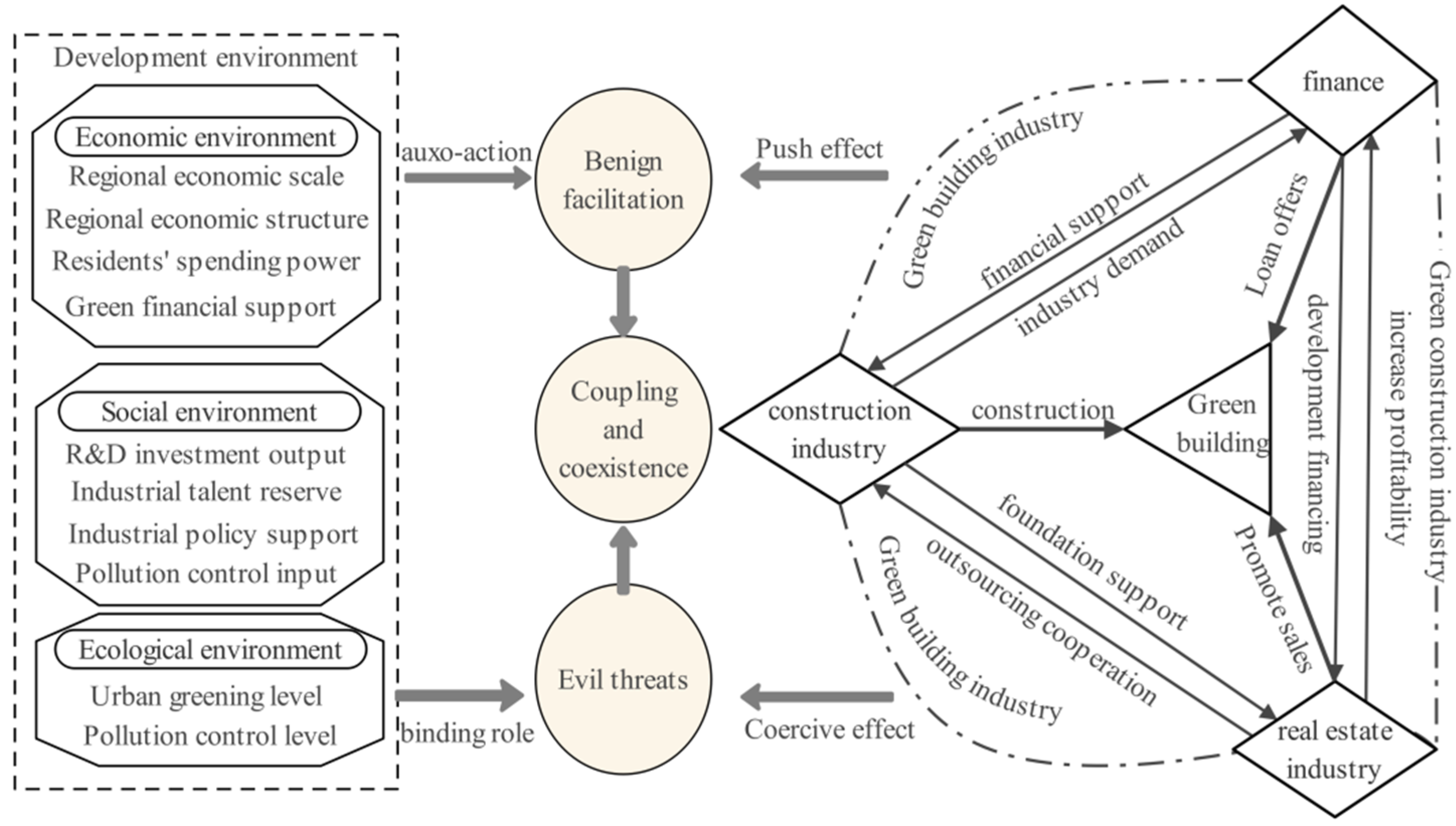
To address these research gaps, this study, grounded in systems theory, develops an integrative analytical framework encompassing “bidirectional interaction, policy integration, and system evolution,” aiming to uncover the coupling mechanisms between the green building industry and its development environment. Specifically, this mechanism manifests as a dynamic process characterized by bidirectional interaction and systemic integration. On the one hand, the development environment provides continuous empowerment to the green building industry through a composite pathway integrating policy, market, technology, and finance. At the policy level, mandatory regulations centered on Assessment Standard for Green Building [29], together with incentive policies outlined in the 14th Five-Year Plan series, form a dual-driver mechanism of “mandatory constraint and incentive guidance.” This synergy regulates industrial development direction and stimulates market vitality. At the market level, the new urbanization process steered by the “Dual Carbon” goals and the public’s green consumption ethos reinforce each other, continuously expanding the market space for green buildings. At the technological level, digital technologies such as Building Information Modeling (BIM) and artificial intelligence are deeply integrated with green construction, effectively overcoming the high-consumption, low-efficiency bottlenecks of traditional methods and becoming a core driver for industrial upgrading [30,31,32,33]. At the financial level, instruments such as green credit and green bonds optimize resource allocation, providing crucial funding for technological R&D, project implementation, and industrial scaling [34,35]. On the other hand, the green building industry also proactively shapes its external environment through a “feedback-driven optimization” pathway [36], which is concretely manifested in three dimensions: First, through life-cycle practices in energy saving, water conservation, and emission reduction, it directly enhances regional eco-environmental quality, providing tangible support for implementing the “Dual Carbon” goals [37]. Second, the expansion of the industrial scale drives the growth of related industrial clusters, such as those producing green building materials and providing energy efficiency services, thereby promoting the green and low-carbon transition of the regional economic structure [38,39]. Third, the widespread adoption of green buildings progressively elevates societal green awareness, forming a virtuous “cognition enhancement–demand growth–policy refinement” feedback cycle that, in turn, nurtures the continuous optimization of the policy system. Ultimately, propelled by the combined forces of “bidirectional interaction” and “policy integration,” the relationship between the green building industry system and its development environment system exhibits distinct dynamic evolution characteristics (Figure 1). Therefore, systematically revealing their coupling coordination patterns and optimizing the corresponding regulatory mechanisms constitutes not only the theoretical core of this study but also a critical practical imperative for advancing the regional implementation of the “Dual Carbon” goals and supporting the green development of the YREB.
Compared to existing studies, the primary contributions of this study are threefold. Compared to prior research, it advances the field by establishing an integrated analytical framework that moves beyond descriptive accounts of spatial disparity and enables novel mechanistic insights into the co-evolution of the complex industry-environment system at the watershed scale. Theoretically, this work reconceptualizes the green building industry and its developmental environment as a dynamically coupled system governed by nonlinear feedback. It not only validates their coordinated relationship empirically but also maps its geographic evolution through the stages of gradient differentiation, club convergence, and spatial locking, thereby advancing discourse on core–periphery structures and spatial spillovers in green transitions. Methodologically, the sequential application of the CCD model, Dagum Gini coefficient, spatial autocorrelation, and standard deviational ellipse enables a comprehensive spatial diagnosis—from coordination levels and disparity drivers to agglomeration patterns and evolutionary trends. This integrated, multi-method approach effectively overcomes the limitations of single-method analyses in deciphering complex spatial mechanisms. Practically, evidence derived from the fixed-effects model provides a robust scientific basis for shaping a “core-led, axis-radiated, gradient-transfer” development pattern for green-building clusters in the YREB, while offering actionable policy pathways to overcome regional coordination barriers and advance the national “Dual Carbon” agenda.

2. Study Area and Data Sources

2.1. Study Area

The YREB is situated at the confluence of eastern, central, and western China, encompassing 11 provinces and municipalities within the Yangtze River Basin and covering approximately 2.05 million square kilometers. This study selects the YREB as the case study based on three primary considerations. First, the region is a critical front for the low-carbon transition of China’s building sector. Given the substantial carbon emission base of its agglomerated building industry, the development quality of the green building sector within the YREB is decisive for the success of the national transition. Consequently, investigating the coupling coordination between its industry and environment is essential for implementing the “Dual Carbon” strategy. Second, the YREB constitutes an exemplary case for examining synergistic “industry-environment” development. Designated as a strategic proving ground for reconciling ecological conservation with economic growth (Guiding Opinions on Promoting the Development of the YREB by Leveraging the Golden Waterway, 2014), it features intricate nonlinear interactions between its green building industry and factors such as policy and market dynamics. This makes it an ideal setting for probing interaction mechanisms, with insights offering valuable references for optimizing green governance nationwide. Third, the region exhibits pronounced internal developmental gradients. This heterogeneity provides a valuable comparative basis for uncovering the driving mechanisms operative at different developmental stages, thereby enhancing the explanatory power and generalizability of the research findings.

2.2. Data Sources

This study draws its data from multiple sources. Information on green building projects was compiled from PKULAW.cn, the official website of the Chinese Society for Urban Studies, provincial and municipal green building associations, and public notices issued by provincial Departments of Housing and Urban-Rural Development. The resulting dataset includes 11,417 star-rated projects certified under China’s Green Building Evaluation Standard (GB/T 50378) between 2012 and 2022, with details on evaluation year, star rating, and label type, including data on evaluation year, star rating, and certification label type. Data on indicators related to the green building development environment were sourced from the China Statistical Yearbook, China Financial Yearbook, Urban Statistical Yearbook, China Industrial Statistical Yearbook, China Education Statistical Yearbook, the Wind database, and the EPS database, among others. Data on public environmental attention were obtained from the Baidu Index platform [40,41]. To ensure the completeness and usability of the dataset, linear interpolation was employed to address the small number of random missing values present in the data.

2.3. Comprehensive Indicator System

Building on the coupling coordination analysis and prior research [42,43,44,45], this study conceptualizes the green building industry as an integrated composite system structured around an “input–output–performance” chain. Guided by the system analysis logic of “structure–function–performance,” we construct an evaluation system organized under two primary criteria: Industrial Foundation and Developmental Outcome. Industrial Foundation captures the system’s factor inputs and structural underpinnings. It is measured by indicators such as R&D expenditure intensity, the value added of the financial sector, and the value added of the construction and real estate industries. These metrics collectively reflect the resource endowment and structural conditions essential for industrial advancement. Developmental Outcome assesses the system’s functional realization and integrated performance. It is gauged by indicators including the number of green building certified projects, the share of projects rated two-star or above, certified projects per capita, and the number of projects with operational certification. These indicators systematically characterize the industry’s performance across multiple dimensions: scale, quality, market penetration, and sustainable operation.
The development environment in this study is conceptualized as the totality of external conditions that drive, constrain, and shape the evolution of the green building industry. Grounded in environment-system interaction theory and the sustainable development framework, we evaluate this environment across seven interrelated dimensions: Economic Foundation: constitutes the market demand and capital conditions for industrial development. Green Finance: reflects the capital market’s preference for green activities and the efficiency of resource allocation. Technology Input: measures the regional capacity for knowledge innovation and the level of technological stock. Talent Cultivation: represents the supply of specialized human capital and the long-term knowledge base. Policy Incentive: captures the government’s regulatory intensity, fiscal incentives, and institutional support. Green Habitat: signifies the societal demand for low-carbon, ecological living spaces and the corresponding infrastructure. Pollution Control: directly reflects the pressure on the ecological environment and society’s responsive governance capacity. These seven dimensions integrate key elements—policy, market, technology, talent, society, and ecology—to collectively form a comprehensive external environment that influences the development of the green building industry.
Based on the theoretical framework outlined above and with full consideration of data availability, continuity, and reliability, this study constructs a comprehensive evaluation indicator system. The finalized indicator system is presented in Table 1.

3. Methods

3.1. Comprehensive Evaluation Model Method

To scientifically assess the comprehensive development levels of the green building industry and its development environment, this study employs a comprehensive evaluation model for quantitative analysis. The specific calculation procedure consists of three key steps:
(1)
Data Standardization
To eliminate differences in dimensions and magnitudes among indicators, the min-max normalization method was employed to standardize the raw data [46,47,48]. For positive indicators, the calculation formula is as follows:
x i j = x i j min ( x j ) max ( x j ) min ( x j )
For negative indicators, the calculation formula is as follows:
x i j = max ( x j ) x i j max ( x j ) min ( x j )
(2)
Objective Determination of Weights
To avoid bias caused by subjective weighting, this study employs the entropy method to objectively determine the weights of each indicator. First, the information entropy of the j-th indicator is calculated as follows:
e j = k i = 1 n p i j ln ( p i j )
Subsequently, the weights are calculated based on the entropy values:
w j = 1 e j j = 1 m ( 1 e j )
Among them, the smaller the entropy value, the larger the differences among indicators, and the higher their weights.
(3)
Calculation of Comprehensive Evaluation Values
After data standardization and weight assignment, the comprehensive evaluation values for the green building industry system and the development environment system were calculated separately using the linear weighting method. The calculation is given as follows:
U i = i = 1 n W j × Y k
Among them, U i denotes the comprehensive evaluation index of the i-th system; w j represents the weight of the j-th indicator; and Y k stands for the standardized indicator value.

3.2. Coupling Coordination Degree Model

The CCD model, as an established analytical framework for examining linkages between systems, consists of two core dimensions: coupling degree and coordination degree [49]. The coupling degree primarily captures the degree of interconnection and interaction among multiple systems, while the coordination degree focuses on reflecting the actual outcomes of coordinated development between them. The specific formulas are as follows:
C = U 1 U 2 U 1 + U 2 2 2 = 2 U 1 U 2 U 1 + U 2
U 1 and U 2 denote the comprehensive level indices of the green building industry and the development environment, respectively. The coupling degree C ranges within the interval [0, 1] [50]; the closer its value is to 1, the stronger the interactions between the two systems and the tighter their correlations. However, the coupling degree solely reflects the intensity of interaction and cannot discern the quality of coordinated development. A notably high coupling value may arise even when both systems are at low development levels but with comparable scores—a scenario often termed “pseudo-coordination” or low-level coupling. To comprehensively assess the synergistic state that integrates both interaction intensity and developmental achievement, a coordination degree model is introduced. This model jointly measures the coupled and coordinated development level between the industry and its environment, formulated as follows [51,52]:
D = C × T ,   T = α × U 1 + β × U 2
In the formula, D represents the coordination degree, which measures the overall synergistic level between the two systems. T denotes the comprehensive development index, capturing the combined development status of both systems. The coefficients α and β are weighting parameters that reflect the relative importance assigned to each system. Given the fundamental interdependence between the green building industry and its development environment, they are considered equally important in this analysis; therefore, α = β = 0.5 [46,47,48]. Following established methodological conventions [53], the CCD values are classified into ten distinct levels using a uniform segmentation method. The specific classification criteria are presented in Table 2.

3.3. Kernel Density Estimation

Kernel density estimation (KDE) is a nonparametric method that fits the probability density curve of sample data using a convolution-smoothed kernel function as the weighting scheme. It is employed to detect distribution patterns under conditions of data heterogeneity and to analyze the evolution of the CCD. The specific formula is as follows:
f ( x ) = 1 n h i = 1 n k x i x h
In the equation, x i denotes the observed CCD of a random sample, n is the sample size, x is the mean CCD, k represents the Gaussian kernel function, and h is the bandwidth parameter. The value of h is positively related to the smoothness of the estimated density curve and negatively related to its precision.

3.4. Dagum Gini Coefficient

The Dagum Gini coefficient decomposition method provides an analytical framework for discerning the sources of regional disparities [54]. Distinguished from conventional inequality measures such as the Gini coefficient and Theil index, this method effectively addresses the issue of overlapping sample distributions, thereby allowing for a more accurate identification of the structural determinants of regional differences. In this study, the YREB is stratified into three sub-regions: the Upper, Middle, and Lower Reaches. Employing the Dagum decomposition approach, the overall Gini coefficient is disaggregated into three components: the contribution of intra-regional disparities (Gw), the net contribution of inter-regional disparities (Gnb), and the contribution of transvariation intensity (Gt), satisfying the identity G = Gw + Gnb + Gt [55]. The overall Gini coefficient G is calculated as follows:
G = j = 1 k h = 1 k i = 1 n ( j ) r = 1 n ( h ) y j i y h r 2 n 2 y -
In the formula, G is the Gini coefficient representing the overall difference; k is the number of provinces; nj (nh) is the number of provinces in the j-th (h-th) region; yji (yhr) denotes the synergistic development level of the green building industry in provinces within the j-th (h-th) region, where i and r are the number of provinces in the respective regions, representing the average synergistic level of each region.

3.5. Spatial Autocorrelation Model

To systematically reveal the spatial dependence and heterogeneity of the CCD, this study employs spatial autocorrelation analysis. First, the global Moran’s I index is used to determine whether spatial dependence exists across the entire YREB [56]. The index ranges from −1 to 1: a significantly positive value indicates a positive spatial correlation, manifesting as a “high-high” or “low-low” agglomeration pattern; a significantly negative value denotes a negative spatial correlation, i.e., a “high-low” heterogeneous distribution; and a value near zero suggests a random spatial pattern. The calculation formula is as follows:
I = n S 0 × i = 1 n j = 1 n w i j ( y i y - ) ( y j y - ) i = 1 n ( y i y - ) 2
S 0 = i = 1 n j = 1 n w i j
In the formula: n is the number of spatial units; yi and yj, respectively, represent the CCD of region i and region j; y - denotes the average value of the CCD across all regions; wij is an element of the spatial weight matrix; and S0 is the sum of all elements in the spatial weight matrix.
To further identify the local spatial association structure and its agglomeration types, this study employs the Local Indicators of Spatial Association (LISA) [57,58]. This indicator can be regarded as the localized decomposition of the global Moran’s I, which is capable of accurately identifying the specific locations, types, and significance of local spatial agglomeration, thus addressing the questions of “where agglomeration occurs” and “what type of agglomeration it is”. Its calculation formula is as follows:
I i = ( y i y - ) S 2 j = 1 n w i j ( y j y - )
In the formula: S2 is the sample variance.

3.6. Standard Deviation Ellipse (SDE)

Standard Deviation Ellipse (SDE) [59,60] is an effective tool for characterizing the spatial distribution pattern, orientation, and evolutionary trend of geographic elements at a global scale. By utilizing a series of parameters—including the centroid, rotation angle, semi-major axis, and semi-minor axis of the ellipse—it precisely delineates the central tendency, directional extension, and dispersion degree of the spatial distribution. The core computational steps of the SDE are as follows:
(1)
Determining the spatial distribution centroid
The centroid refers to the weighted average center of all spatial units, reflecting the spatial equilibrium position of the CCD. The calculation formula is as follows:
X - = w i x i w i ,     Y - = w i y i w i
In the formula: ( x i , y i ) represents the geographical coordinates of the i-th province, and wi denotes the CCD of the i-th province.
(2)
Calculating the ellipse rotation angle
The rotation angle θ denotes the angle between the semi-major axis of the ellipse and true north. It serves to identify the dominant orientation of the spatial distribution. The calculation formula is as follows:
tan θ = w i x i 2 w i y i 2 + w i x i 2 w i y i 2 2 + 4 w i x i y i 2 2 w i x i y i
(3)
Calculation of major and minor semi-axes
The major and minor semi-axes reflect the dispersion degree of spatial data in the dominant direction and perpendicular direction, respectively, and they are calculated based on the standard deviation of rotated coordinates.
σ x = w i ( x i cos θ y i sin θ ) 2 w i σ y = w i ( x i sin θ + y i cos θ ) 2 w i
In the formula: ( x i , y i ) are the new coordinates after rotating the original coordinates by an angle of θ.

4. Results

4.1. Evaluation Results of Green Building Industry and Development Environment Levels

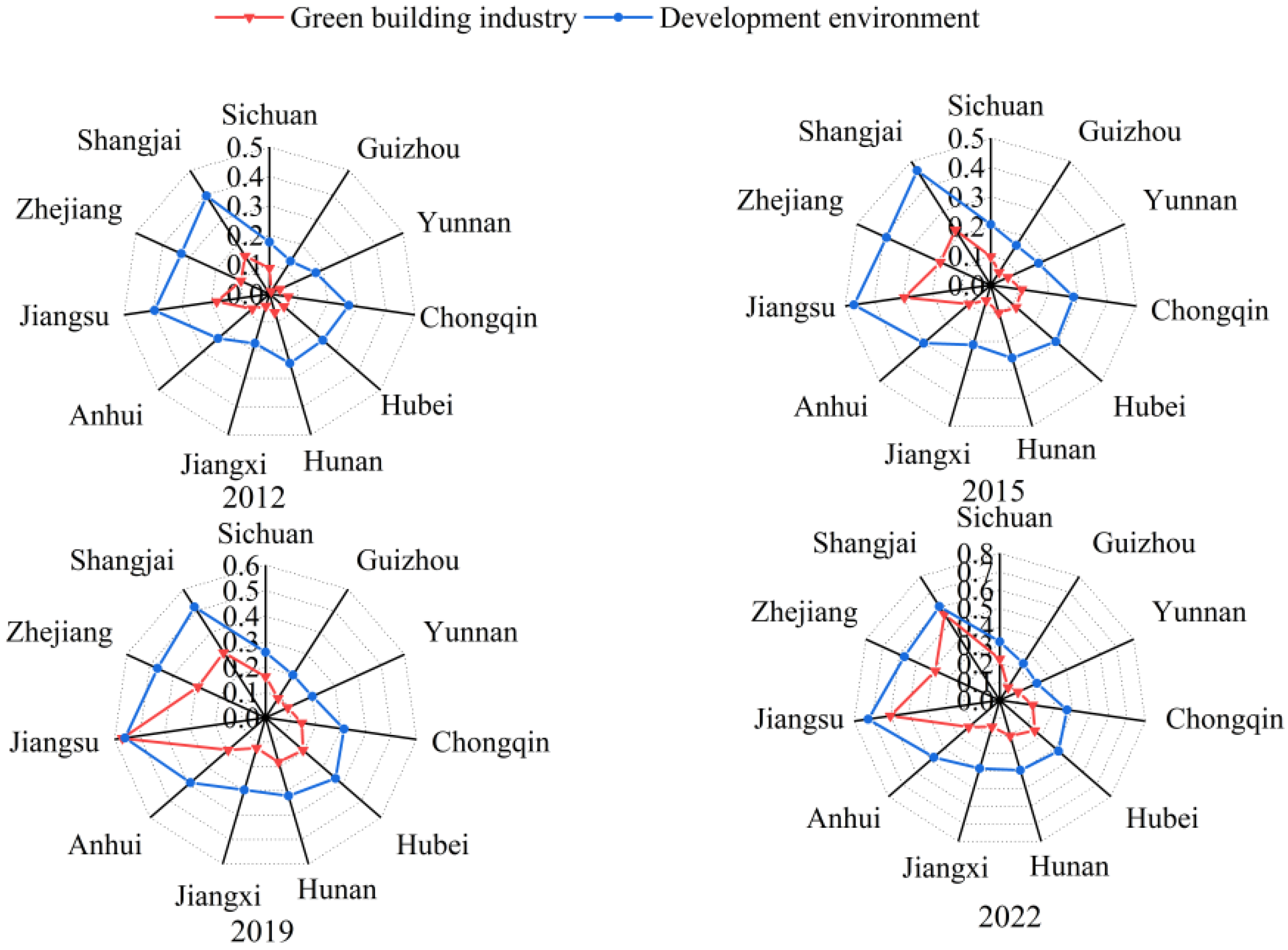
This study quantitatively assesses the comprehensive development levels of the green building industry and its environment within the YREB from 2012 to 2022. As shown in Table 3, both systems exhibited steady upward trends: the industry index (U1) rose from 0.0814 to 0.2699, and the environment index (U2) increased from 0.2520 to 0.4301. Although the U1/U2 ratio grew from 0.3230 to 0.6275—indicating a narrowing gap—U1 consistently remained below U2, confirming that the industry’s development lags behind its external support. A deeper analysis reveals structural and spatial challenges. Within the industrial evaluation system, the highest-weighted indicator, “number of operational green building certified projects” (27.32%), has a low actual proportion, pointing to performance shortfalls in the operational phase. Meanwhile, the low weight (4.06%) for “proportion of projects rated two-star and above” reflects a limited share of high-quality projects. Spatially, significant imbalance exists, with a pronounced development gap between upstream provinces and midstream/downstream regions. Furthermore, external support systems lack synergy; a disconnect persists among technology R&D, green finance, and policy implementation, hindering industrial clustering and constraining overall competitiveness.
Figure 2 visually depicts the spatial differentiation of the comprehensive development levels of the green building industry and its corresponding environment within the YREB from 2012 to 2022. A clear “eastern-leading, central-catching-up, western-lagging” gradient is evident. This spatial configuration fundamentally represents the geographical projection of regional variations in the intensity and efficacy of coupling within the “industry-environment” system. This gradient can be delineated into three distinct tiers: The first tier (Jiangsu Province, Shanghai Municipality, and Zhejiang Province), forming the core of the Yangtze River Delta (YRD), leverages its strong economic base, mature industrial ecosystem, and proactive policies. Substantial resource allocation has fostered a relatively advanced industrial system and supportive environment, resulting in comprehensive levels far exceeding other regions within the Belt. The second tier (Sichuan Province, Chongqing Municipality, Hubei Province, Hunan Province, and Anhui Province) possesses a foundational industrial and environmental capacity. However, a significant gap persists compared to the first tier, primarily due to weakened market demand from population outflow and reduced agglomeration effects associated with comparatively lower urbanization. The third tier (Guizhou, Yunnan, and Jiangxi provinces) illustrates a state of low-level systemic lock-in. Constrained by weaker economic foundations, less-developed technology markets, and incomplete policy frameworks, the incubation and growth of the green building industry are hindered, trapping the “industry” and “environment” systems in a cycle of mutual constraint.

4.2. CCD Level of Green Building Industry and Development Environment

4.2.1. Spatio-Temporal Pattern Analysis of CCD

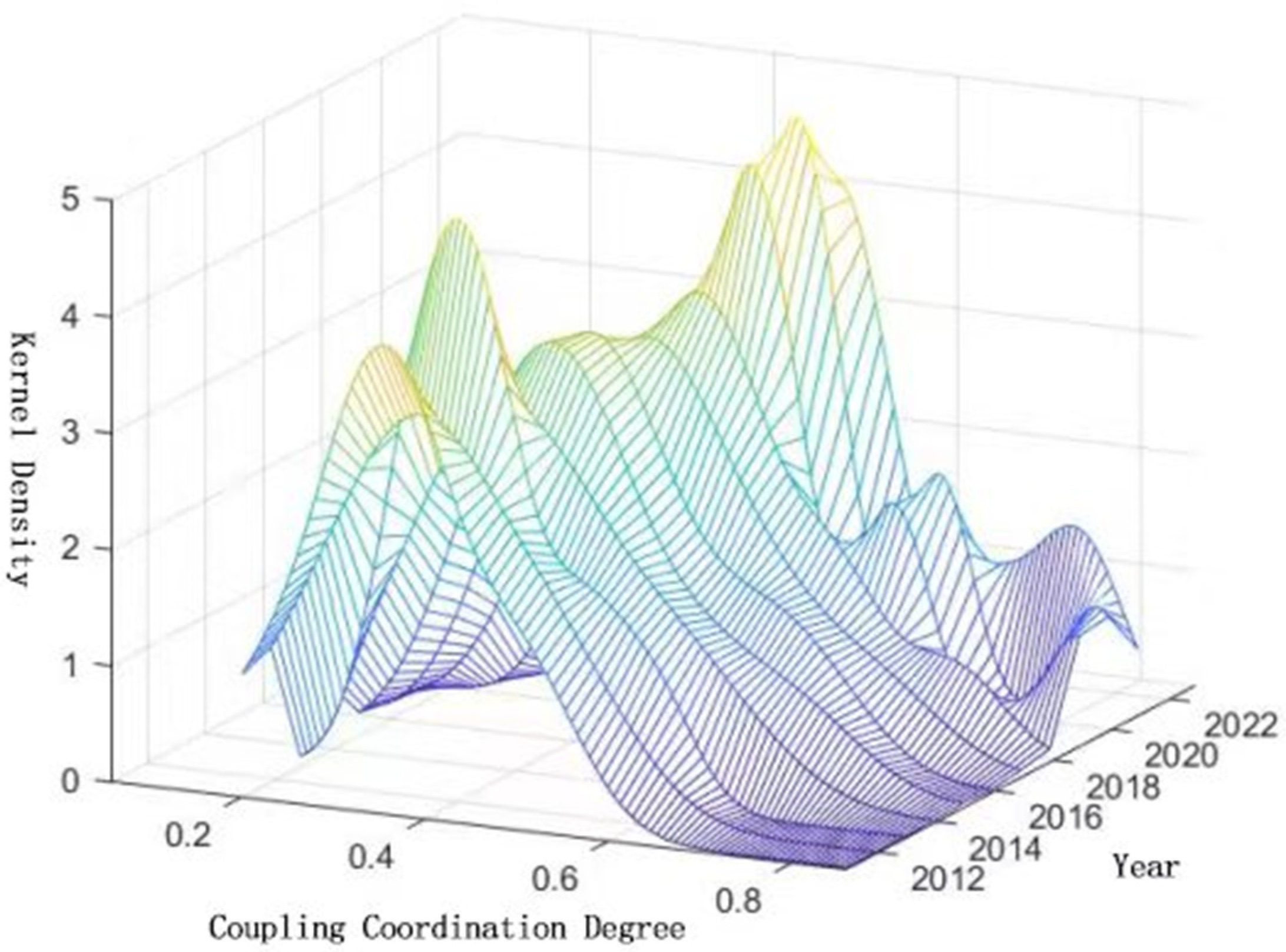
This study employed kernel density estimation on the Matlab platform to generate 3D surface plots, visualizing the dynamic evolution of the CCD between the green building industry and its developmental environment in the YREB (2012–2022; Figure 3). The analysis reveals four key evolutionary characteristics.
First, the primary peak of the CCD distribution shows a persistent rightward shift, indicating an overall improvement in coordination levels and a strengthened alignment between the industry and regional development conditions across provinces. Second, the distribution profile transitioned through distinct phases: a sharp peak (2012–2015) gave way to a flattened one (2015–2019) before sharpening again (2019–2022). This “sharp–flat–sharp” progression reflects an underlying trajectory of polarization → moderation → re-polarization in the CCD. Third, the consistent rightward skew of the curve highlights a group of provinces with higher CCD values, which function as leading growth poles. Fourth, and notably, the distribution shifted from a unimodal to a bimodal pattern after 2019, signaling an emerging multipolarity in the regional development landscape. In summary, the evolution of the CCD is characterized by the co-existence of overall improvement and internal gradient differentiation, illustrating a complex process of synergistic yet uneven development.
Based on the Dagum Gini coefficient decomposition, Table 4 presents the spatial sources and temporal evolution of disparities in the CCD between the green building industry and its development environment in the YREB from 2012 to 2022. Overall, the mean overall Gini coefficient remained stable around 0.126 with limited fluctuation throughout the study period, indicating a relatively consistent pattern of total disparity in coordination. In terms of disparity sources, inter-regional differences were the primary contributor, with an average contribution of 83.634% and a persistent expanding trend. By contrast, intra-regional disparity and transvariation density contributed averages of only 13.755% and 2.611%, respectively, both showing gradual declines. Examining intra-regional disparities in detail, the Gini coefficient for the upstream region fluctuated downward from 0.119 to 0.075, reflecting a mitigation of internal imbalance. The midstream and downstream regions exhibited relatively low and stable internal disparities, with Gini coefficients ranging narrowly from 0.021–0.058 and 0.03–0.063, respectively, suggesting more balanced internal development. Regarding inter-regional disparities, the largest gap existed between the upstream and downstream regions (Gini coefficients between 0.217 and 0.259), followed by the upstream–midstream disparity, while the midstream–downstream difference was the smallest. This spatial pattern—characterized by “growing divergence between regions alongside convergence within them”—implies that a clear gradient transmission effect has formed in the coupling coordination of the green building industry and its development environment in the YREB.
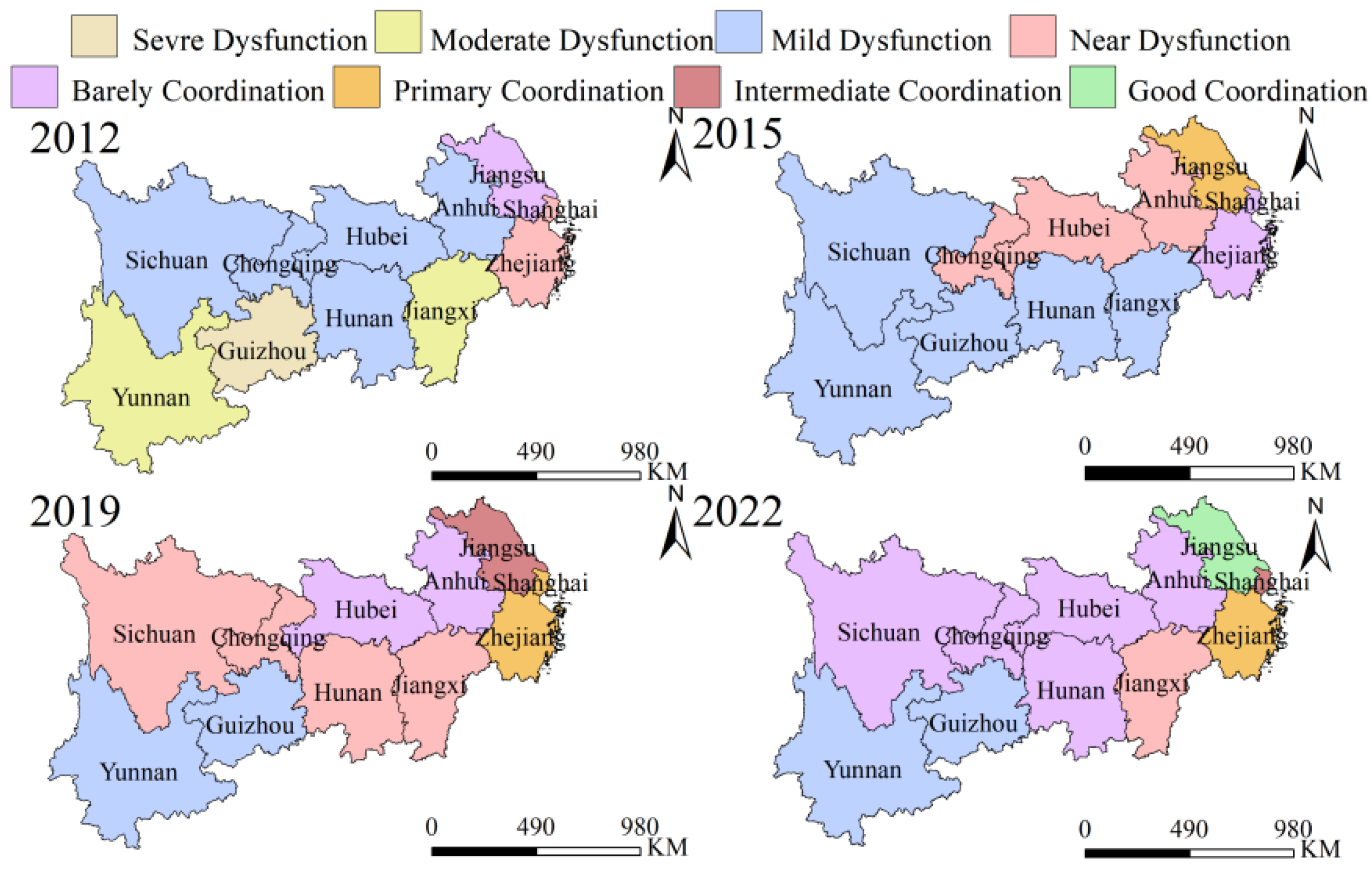
Based on the spatial distribution of the CCD (Figure 4) and the coordination classification criteria (Table 2), the coupling coordination status within the YREB showed marked improvement from 2012 to 2022. The overall coordination level exhibited a continuous upward trend, and the initially diverse coordination types (eight categories) gradually converged toward a more concentrated pattern. In 2012, most provinces were in an uncoordinated state, with all upstream and midstream regions classified as imbalanced. By 2015, Anhui and Hubei (midstream) and Chongqing (upstream) had entered a coordinated state, representing the first breakthrough in regional coordination. By 2019, coordinated development had expanded notably, encompassing all provinces except Guizhou and Yunnan. In 2022, Jiangsu, Zhejiang, and Shanghai (downstream) achieved at least primary coordination, while midstream provinces continued to improve steadily. Nevertheless, Guizhou and Yunnan (upstream) remained in the uncoordinated range, underscoring a persistent east-high, west-low gradient in regional coordination. In summary, while the coordination between the green building industry and the development environment in the YREB has improved overall, pronounced spatial gradients and regional gaps remain.

4.2.2. Spatial Autocorrelation Analysis of CCD

According to the global Moran’s I index test results presented in Table 5, under the adjacency spatial weight matrix, the indices for all years during the study period passed the significance test at the 1% level, ranging from 0.140 to 0.268, and demonstrating an overall upward trend. This indicates that the CCD between the green building industry and the development environment in the YREB exhibits a statistically significant positive spatial autocorrelation, characterized by an increasingly intensified spatial clustering effect over time.
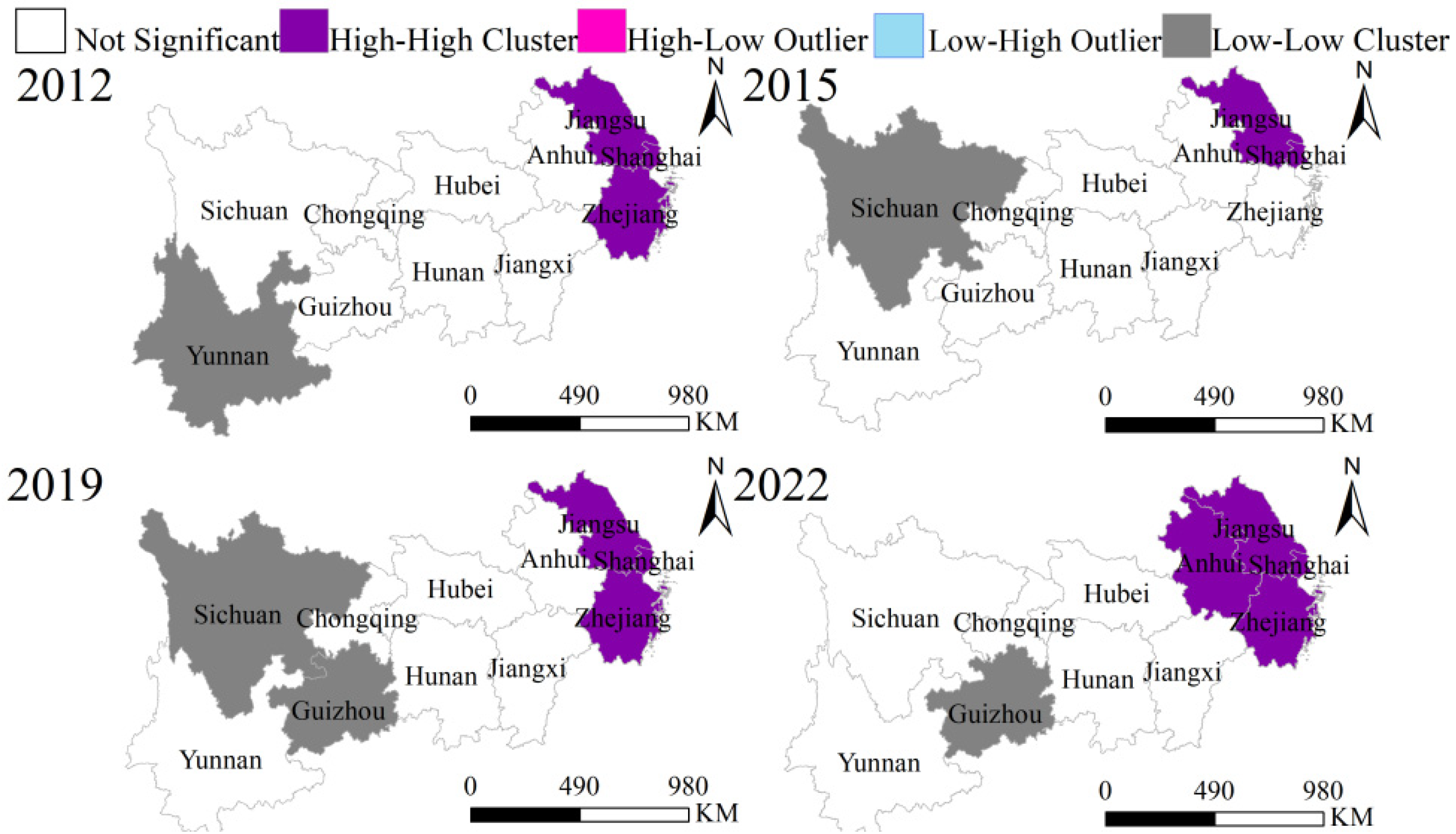
Figure 5 illustrates the LISA spatial clustering patterns of the CCD between the green building industry and the development environment in the YREB from 2012 to 2022. In terms of local spatial association characteristics, high-high clusters were stably located in the YRD region (Shanghai, Jiangsu, Zhejiang). Benefiting from a mature green building industry chain and a highly integrated regional coordination mechanism, this area has evolved into a prominent “hotspot” with a radiating influence, exhibiting a CCD far superior to that of the midstream and upstream provinces. Conversely, low-low clusters were primarily concentrated in the southwestern provinces of Guizhou, Sichuan, and Yunnan, displaying a distinct “sink effect.” The spatial blocking effect arising from this low-value clustering significantly hinders the improvement of the overall regional coordination level. Notably, with the advancement of the Chengdu-Chongqing urban agglomeration development strategy, the “low-low” clustering pattern in Sichuan Province had become insignificant by 2022, suggesting that the implementation of regional coordination policies has mitigated local imbalances to some extent.
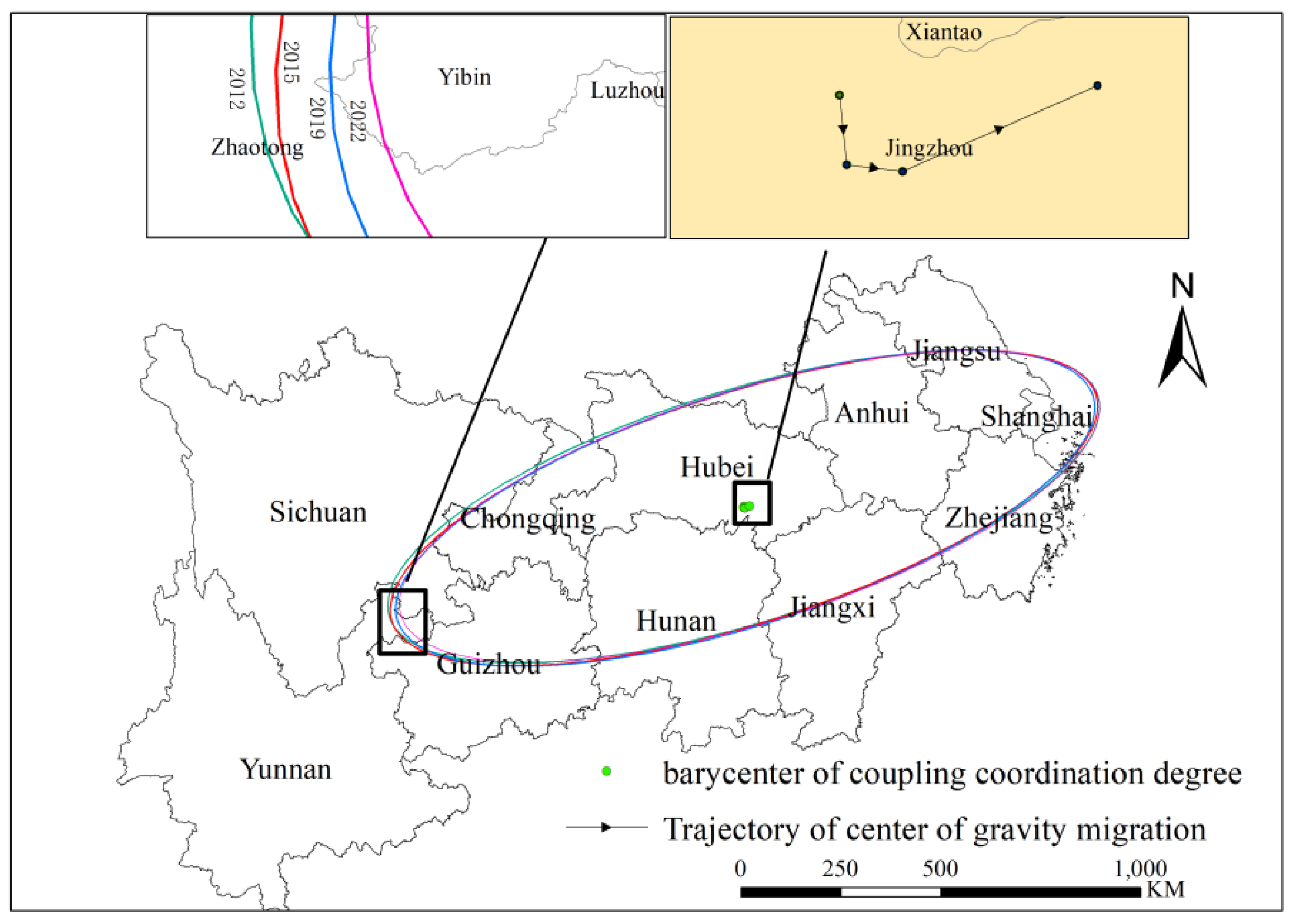
Figure 6 further clarifies the spatial distribution and dynamic evolution of the CCD across the YREB from 2012 to 2022 by applying the SDE method. In terms of spatial orientation, the major axis of the ellipse follows a southwest–northeast alignment, closely corresponding with the course of the Yangtze River main stem and key transportation corridors. Regarding centroid movement, the distribution centroid of the coordination degree remained within Jingzhou City, Hubei Province, throughout the period, showing an overall eastward shift. Specifically, it moved 3.7 km southeast between 2015 and 2019, and then 13.89 km northeast from 2019 to 2022. This trajectory reflects both the rising coordination level of the YRD region—whose radiative influence appears to be spreading upstream—and the persistent, structurally widening east–west development gap. Morphologically, the ellipse area fluctuated but generally contracted from 2012 to 2022, pointing to increased spatial concentration of coordination and a pronounced polarization effect in more advanced regions. Concurrently, the shortening of the major axis alongside the lengthening of the minor axis signals a shift from a predominantly “riverine agglomeration” pattern toward a more “multipolar diffusion”, indicating stronger north–south spatial connectivity and the gradual emergence of a coordinated green-building network.

4.3. Influencing Factors of the CCD Between the Green Building Industry and Development Environment

4.3.1. Selection of Influencing Factors

The coupling coordination between the green building industry and its development environment represents a complex systemic process involving multiple dimensions and stakeholders. Its coordinated progression relies not only on internal drivers within the industry but also on systematic external support spanning policy, market, technology, and societal dimensions. Grounded in existing literature and theoretical mechanisms, this study selects the following core explanatory variables to systematically examine their impact mechanisms on the CCD: urbanization level, purchasing power, public environmental concern, government regulatory capacity, technological innovation level, and educational attainment. Specifically, urbanization generates market demand and infrastructure support for the green building industry through agglomeration effects. Enhanced resident purchasing power directly translates into effective demand for greener building products. Public environmental concern, reflecting societal ecological awareness, influences the industry’s green transition through both public opinion pressure and consumption preferences. Government regulatory capacity, manifested through policy guidance and institutional safeguards, plays a key role in mitigating market failures and cultivating a sound industrial ecosystem. The level of technological innovation acts as the core driver for advancing green building technologies and optimizing costs. Meanwhile, educational attainment underpins the reserve of professional talent and shapes societal green awareness, providing the intellectual foundation for the industry’s sustainable development. The specific definitions and measurement methods for each variable are detailed in Table 6:

4.3.2. Baseline Regression Results

(1)
Model Specification
Considering the regional characteristics of provinces and municipalities within the YREB and the structure of the panel data, this study specifies the following two-way fixed effects model:
ln D i t = β 0 + β 1 ln u   r b i t + β 2 ln p   u r i t + β 3 ln e   n v i t + β 4 ln i   n c i t + β 5 ln p   a t i t + β 6 ln l   a b i t + μ i + λ t + ε i t
In the model: l n D i t is the dependent variable, representing the CCD between the green building industry and its development environment; i indexes provinces and municipalities within the YREB; t denotes the time period; β 0 is the constant term; β i (where I = 1,…,6) are the coefficients for the explanatory variables; μ i captures individual fixed effects; ν i captures time fixed effects; ε i t is the idiosyncratic error term.
(2)
Analysis of Results
Based on the baseline regression results of the two-way fixed effects panel model (Model (1) in Table 6), urbanization level (β1 = 0.245, p < 0.05), consumption capacity (β2 = 0.131, p < 0.1), government regulatory capacity (β4 = 0.053, p < 0.1), and scientific and technological innovation level (β5 = 0.050, p < 0.05) all show a statistically significant positive association with the CCD. This indicates that, within the YREB, the ongoing process of urbanization, rising household income and consumption, government fiscal support for environmental protection and green development, and advances in scientific and technological innovation are key drivers in enhancing the coordination between the green building industry and its development environment. Notably, the coefficient for education level, although positive, is statistically insignificant, suggesting that the proportion of highly educated individuals or average years of schooling does not yet exert a significant direct effect on coordination at this stage. The coefficient for public environmental awareness is negative and insignificant, implying that societal environmental consciousness has not effectively translated into tangible market demand or consumption behavior for green buildings—a phenomenon that can be described as an “awareness–behavior gap.”

4.3.3. Robustness Test

To ensure the reliability of the baseline regression results, this study employs three robustness checks (as presented in Table 7). First, the estimation model is replaced. In Model (2), the Tobit model is adopted for re-estimation. Given that the range of the dependent variable (lnD) is left-censored with a right boundary at zero, the Tobit specification is more appropriate for addressing such limited dependent variables, thereby strengthening the robustness of the findings. Second, the explanatory variables are substituted. In Model (3), “general fiscal budget expenditure” replaces the original “environmental protection expenditure” as a proxy for government regulatory capacity, while the “number of invention patent grants” is used instead of the “number of invention patent applications” to better capture the level of regional technological innovation output. Third, the influence of extreme values is mitigated. In Model (4), all continuous variables are winsorized at the top and bottom 5% to reduce the potential bias introduced by outliers. The robustness check results indicate that the signs and significance levels of the key variables remain largely consistent with those in the baseline model, demonstrating that the empirical findings regarding the impact mechanisms of the CCD are robust.

5. Discussion

5.1. Interpreting the Mechanisms of the Macro-Spatial Pattern

The results reveal an “east-high, west-low” gradient in the CCD, accompanied by a spatial club effect marked by “high-high” and “low-low” clustering. This pattern is not incidental but reflects a macro-scale manifestation of the lack of synergistic interaction among policy, market, and institutional factors across regions. First, policy effectiveness demonstrates significant spatial decay. Downstream regions, capitalizing on strong resource mobilization and implementation capacity, rapidly translate low-carbon policies into concrete incentives and projects, establishing a virtuous “policy-market-technology” cycle. In contrast, upstream regions, hindered by insufficient supporting capacity, experience ineffective policy implementation and a consequent attenuation of policy dividends over space. This finding aligns with the theory of spatial dependence in green building development [61] and confirms that systemic coordination is substantially constrained by regional boundaries and institutional barriers [7]. Second, market demand is structurally fragmented. The high income and purchasing power in downstream regions generate effective demand for green buildings, continuously driving industrial upgrading. Conversely, upstream regions remain locked in a vicious cycle of low demand, limited supply, and weak awareness.
This study finds a pronounced attitude-behavior gap [27,28]: despite a significant increase in public environmental concern, this awareness has not effectively translated into market choices or consumption behaviors for green buildings. Consequently, societal environmental awareness currently fails to act as an effective catalyst for market support. Additionally, cross-regional flows of production factors face persistent institutional barriers [6]. Challenges including inadequate technical standards recognition, restricted inter-regional green finance, and deficient talent exchange mechanisms impede the diffusion of knowledge, technology, and capital from high- to low-coordination regions. This not only reinforces “spatial stickiness” in less-developed areas but also perpetuates and even widens inter-regional coordination disparities.

5.2. Discerning the Mechanisms of Micro-Level Synergies

Regarding the micro-level driving mechanisms, urbanization, government regulation, technological innovation, and purchasing power constitute the key factors currently underpinning system coordination. Urbanization creates the conditions for centralized green infrastructure through population and economic agglomeration. Concurrently, governments employ a policy mix of regulation and incentives to guide market behavior and direct investment flows [22,23]. Technological innovation promotes the widespread adoption of low-carbon technologies by enhancing building performance and reducing construction and operational costs [30,31,33]. The improvement in residents’ purchasing power generates effective market demand, thereby providing sustained economic incentives for the industry [17,27]. More importantly, these factors constitute an interconnected and dynamically coupled system. Urbanization generates scale demand, which creates application scenarios for green technology innovation. Government regulation reduces market uncertainty and guides investment, while technological innovation responds to and reinforces market demand through performance gains and cost reductions. Residents’ purchasing power serves as the fundamental driver that sustains this circular operation. This study further reveals that the direct effects of educational attainment and public environmental concern are not statistically significant. This implies that, at the current stage, fundamental constraints—such as economic feasibility, technological accessibility, and policy implementation capacity—play a more dominant role than general human capital or broad environmental awareness. Furthermore, pronounced bidirectional feedback effects exist between the systems [7]. The large-scale implementation of green building projects not only directly reduces carbon emissions but also improves the local microclimate and regional environmental quality. This, in turn, stimulates the development of related industries and enhances societal green awareness, ultimately forming a synergistic, self-reinforcing cycle of “industrial advancement → environmental optimization → factor upgrading → further industrial advancement.” This feedback mechanism reveals a “reverse optimization” pathway, whereby the industrial system proactively shapes and improves its external environment. This underscores the dynamic evolutionary nature of the “industry-environment” system as a complex adaptive system.

6. Conclusions

Based on the CCD model, this study applies an integrated analytical framework combining kernel density estimation, Dagum Gini-coefficient decomposition, spatial autocorrelation analysis, SDE, and two-way fixed-effects panel regression. Using this approach, we systematically examine the coupling coordination relationship between the green building industry and its development environment in the YREB over the period 2012–2022. The research aims to uncover the spatio-temporal evolution patterns, spatial-association characteristics, and underlying influencing mechanisms of this relationship. By interpreting the empirical results in dialogue with existing theories, the following key conclusions are drawn.
(1)
Regarding the overall development level, the green building industry exhibits a persistent lag behind its developmental environment, with a distinct east-high, west-low gradient pattern observed across regions. Throughout the study period, while the comprehensive evaluation values for both the green building industry (U1) and the development environment (U2) increased, U1 consistently remained lower than U2. Spatially, the downstream YRD region (Jiangsu, Shanghai, Zhejiang) has emerged as a clear frontrunner, whereas several upstream provinces continue to trail behind. This spatial disparity underscores significant imbalances in industrial foundation, market maturity, and policy implementation efficacy.
(2)
Regarding the coupling coordination relationship, the overall coordination level between the two systems improved during the study period. However, this improvement has been accompanied by the formation of a “spatial club convergence” effect. Specifically, while the CCD shifted from a predominantly imbalanced to a more coordinated state, indicating enhanced interaction, it remains subject to persistent spatial dependence, as evidenced by “high-high” and “low-low” clustering. Furthermore, the standard deviational ellipse analysis reveals an eastward centroid shift and increasing spatial concentration. These trends imply that enduring regional development disparities not only persist but have solidified as the key structural bottleneck to achieving higher overall coordination.
(3)
The mechanism analysis, based on panel regression and robustness checks, shows that urbanization level, government regulatory capacity, technological innovation, and residents’ purchasing power positively and significantly affect the CCD. In contrast, the impacts of educational attainment and public environmental concern are statistically insignificant. This suggests that, at this stage, general environmental awareness and human capital have not effectively translated into market demand or industrial synergy, highlighting both a distinct “attitude–behavior” gap and a disconnection between the education sector and industry needs.
Based on the above research findings, and to promote the transition of the green building industry and its developmental environment in the YREB toward high-quality coordination, this study proposes the following three targeted recommendations, which are designed to precisely align with both the “dual carbon” goals and the specific conditions of regional development:
  • Implementing a “region-specific precision regulation” strategy is proposed to address the challenges of “club convergence” and gradient lock-in. The study reveals a stable “east-high, west-low” gradient pattern and a spatial club effect characterized by “high-high” and “low-low” clustering in the CCD, with inter-regional disparities identified as the primary and persistently widening source of overall variation. Therefore, a shift from a “one-size-fits-all” policy approach to region-specific precision regulation is imperative. For downstream regions characterized by “high-high” clustering, policies should transition from “scale expansion” to “quality leadership and radiating empowerment.” For midstream and upstream regions exhibiting “low-low” clustering, the policy focus should be on “capacity building and foundational reinforcement.” It is recommended to establish a “YREB Green Building Synergistic Development Fund” to specifically support projects in these regions focusing on the introduction, assimilation, and localized application of green technologies, as well as initial market cultivation. Concurrently, priority should be given to these areas in green finance policies to reduce financing costs and break the cycle of “low-level lock-in.”
  • Developing mechanisms to bridge the “attitude-behavior” gap is essential to tap into latent market demand. Empirical findings indicate that public environmental concern has not been effectively translated into market choices, revealing a significant attitude-behavior disparity. Therefore, policy should shift from mere awareness campaigns to designing behavioral interventions. It is essential to implement a “Green Building Performance Labeling and Information Disclosure” system that mandates the public disclosure of key performance data—such as energy consumption and carbon emissions—for newly built green buildings, alongside the establishment of an official, user-friendly public information platform for easy access to such data. In upstream regions where public acceptance remains low but breakthroughs are urgently needed, governments and enterprises should collaboratively provide a number of “green building demonstration apartments” or “green office spaces” for short-term free or subsidized trial use. Simultaneously, offering personal income tax deductions or deed tax reductions to consumers who purchase or lease high-performance green buildings can directly translate environmental awareness into economic incentives.
  • Establishing a coordinated governance framework to facilitate the cross-regional flow of production factors is essential for alleviating regional disparities. The study reveals that barriers to the inter-regional mobility of technology, capital, and talent are key drivers of structural divides between regional clusters. To this end, it is necessary to establish a regional collaborative governance mechanism, including the formation of a “Green Building Industry Development Alliance for the YREB.” This alliance should promote the compilation of a regional green building technology promotion catalog and standards harmonization guide to eliminate barriers to the mutual recognition of technical standards. Simultaneously, financial institutions should be encouraged to develop cross-regional green financial products, establish a regional green building project portfolio, and attract policy banks and green development funds for batch investment, thereby guiding capital allocation along the river basin in a spatially targeted manner.
This study provides policy insights for promoting the synergistic development and overall performance optimization of China’s green building industry and its environmental system, establishes an empirical foundation for green and low-carbon practices in river basin economic belts, and broadens research perspectives on system coupling and spatial analysis within the green building field. However, this study has several limitations that warrant further investigation. First, regarding the evaluation dimensions, future studies could be expanded to incorporate “soft-environment” factors such as local governance efficacy and green cultural identity, thereby building a more comprehensive assessment framework. Second, in terms of mechanism analysis, the current study, based on a static panel model, primarily identifies contemporaneous influencing factors, while insufficient attention is given to the dynamic inertia of the system and the time-lag effects of variables. Future research could address these gaps by constructing a dynamic panel model using longer time-series data or by adopting system dynamics simulation, thereby enabling a deeper exploration of the nonlinear interactions and dynamic feedback mechanisms within the system. Third, regarding the research scale, future studies could further incorporate micro-level dynamic variables such as corporate ESG practices and key technological innovations. By integrating these with field research and case-study materials, more targeted pathways for synergistic enhancement could be proposed.

Author Contributions

N.L. and H.W. wrote the main manuscript text, H.Z. and B.W. prepared figures and tables, B.W. provided funding support. All authors reviewed the manuscript. All authors have read and agreed to the published version of the manuscript.

Funding

This work was supported by the National Social Science Fund of China (Grant No. 22BJY142).

Data Availability Statement

Interested researchers may request access to the data by contacting NILI at lini@mails.swust.edu.cn. Access to the data will be granted on a case-by-case basis.

Conflicts of Interest

The authors declare no conflicts of interest.

Abbreviations

The following abbreviations are used in this manuscript:
SDEStandard Deviation Ellipse
CCDCoupling Coordination Degree
YRDYangtze River Delta
YREBYangtze River Economic Belt

References

  1. Zhou, Z.; Li, K.; Liu, Q.; Tao, Z.; Lin, L. Carbon Footprint and Eco-Efficiency of China’s Regional Construction Industry: A Life Cycle Perspective. J. Oper. Res. Soc. 2021, 72, 2704–2719. [Google Scholar] [CrossRef]
  2. Chen, L.; Hu, Y.; Wang, R.; Li, X.; Chen, Z.; Hua, J.; Osman, A.I.; Farghali, M.; Huang, L.; Li, J.; et al. Green building practices to integrate renewable energy in the construction sector: A review. Environ. Chem. Lett. 2024, 22, 751–784. [Google Scholar] [CrossRef]
  3. Elnaklah, R.; Walker, I.; Natarajan, S. Moving to a green building: Indoor environment quality, thermal comfort and health. Build. Environ. 2021, 191, 107592. [Google Scholar] [CrossRef]
  4. He, Z. The spatial disequilibrium and influencing factors of carbon emissions in the Yangtze River Economic Belt based on nighttime light data. Humanit. Soc. Sci. Commun. 2025, 12, 1383. [Google Scholar] [CrossRef]
  5. Liao, B.; Li, L. How does population aging affect green building development?: A study from China evidence. Environ. Dev. Sustain. 2024, 26, 1203–1222. [Google Scholar] [CrossRef]
  6. Akomea-Frimpong, I.; Kukah, A.S.; Jin, X.; Osei-Kyei, R.; Pariafsai, F. Green finance for green buildings: A systematic review and conceptual foundation. J. Clean. Prod. 2022, 356, 131869. [Google Scholar] [CrossRef]
  7. Bungau, C.C.; Bungau, T.; Prada, I.F.; Prada, M.F. Green buildings as a necessity for sustainable environment development: Dilemmas and challenges. Sustainability 2022, 14, 13121. [Google Scholar] [CrossRef]
  8. Madushika, U.G.D.; Lu, W.S. Transitioning of existing buildings to green in developing economies: A case of Sri Lanka. Energy Sustain. Dev. 2024, 83, 101580. [Google Scholar] [CrossRef]
  9. Zhang, Y.; He, Z. Brief analysis of the development and application of green building design and green energy-saving buildings. Iran. J. Sci. Technol. Trans. Civ. Eng. 2024, 48, 1131–1141. [Google Scholar] [CrossRef]
  10. Wang, W.; Tian, Z.; Xi, W.; Tan, Y.R.; Deng, Y. The influencing factors of China’s green building development: An analysis using RBF-WINGS method. Build. Environ. 2021, 188, 107425. [Google Scholar] [CrossRef]
  11. Bibang Bi Obam Assoumou, S.S.; Zhu, L.; Khayeka-Wandabwa, C. Healthy building standards, their integration into green building practices and rating systems for one health. Discov. Sustain. 2025, 6, 796. [Google Scholar] [CrossRef]
  12. Wang, G.; Li, Y.; Zuo, J.; Hu, W.; Nie, Q.; Lei, H. Who drives green innovations? Characteristics and policy implications for green building collaborative innovation networks in China. Renew. Sustain. Energy Rev. 2021, 143, 110875. [Google Scholar] [CrossRef]
  13. Yan, H.; Fan, Z.; Zhang, Y.; Zhang, L.; Hao, Z. A city-level analysis of the spatial distribution differences of green buildings and the economic forces—A case study in China. J. Clean. Prod. 2022, 371, 133433. [Google Scholar] [CrossRef]
  14. Zhang, L.; Wu, J.; Liu, H.Y. Policies to enhance the drivers of green housing development in China. Energy Policy 2018, 121, 225–235. [Google Scholar] [CrossRef]
  15. Yin, S.; Zhao, Y. An agent-based evolutionary system model of the transformation from building material industry (BMI) to green intelligent BMI under supply chain management. Humanit. Soc. Sci. Commun. 2024, 11, 468. [Google Scholar] [CrossRef]
  16. Chang, R.; He, T.; Han, Y.; Xue, R.; Zhang, W.E. Geographical Imbalance and Influential Characteristics of the Green Building Market. J. Constr. Eng. Manag. 2023, 149, 04023093. [Google Scholar] [CrossRef]
  17. Cai, T.; Choong, W.W.; Wee, S.C.; Xu, T. Urban residents’ intention to purchase green buildings in China’s emerging first-tier cities: A multigroup analysis. Energy Build. 2025, 344, 116031. [Google Scholar] [CrossRef]
  18. Elseknidy, M.; Al-Mhdawi, M.K.S.; Qazi, A.; Ojiako, U.; Mahammedi, C.; Rahimian, F.P. Developing a sustainability-driven risk management framework for green building projects: A literature review. J. Clean. Prod. 2025, 519, 145891. [Google Scholar] [CrossRef]
  19. Daoud, A.O.; Oke, A.E.; Singh, A.K.; Famakin, I.O.; Abdel Aziz, K.M.; Olayemi, T.M. Exploring the building information modelling benefits for sustainable construction using PLS-SEM. Sci. Rep. 2025, 15, 35781. [Google Scholar] [CrossRef]
  20. She, W.; Cao, L.; Zhu, Y. Research on the coupling coordination of high-quality development and carbon emission in China’s construction industry. Sci. Rep. 2025, 15, 34130. [Google Scholar] [CrossRef]
  21. Zheng, S.; Zhang, Y.; Luo, T.; Gong, Y. Synergistic effects of digital technology and environmental regulation on the green transformation of China’s manufacturing industry. Sci. Rep. 2025, 15, 36092. [Google Scholar] [CrossRef] [PubMed]
  22. Lu, X.; Yang, C.; Ma, W.; Yang, H. Evolutionary game analysis on governments and developers’ behavioral strategies: Impact of dynamic incentives for green building. Energy Build. 2025, 336, 115631. [Google Scholar] [CrossRef]
  23. Wang, S.; Zhu, D.L. Strategies for promoting green buildings: Integrating evolutionary game and SEIR models. Sci. Rep. 2025, 15, 558. [Google Scholar] [CrossRef]
  24. Li, X.; Feng, W.; Liu, X.; Yang, Y. A comparative analysis of green building rating systems in China and the United States. Sustain. Cities Soc. 2023, 93, 104520. [Google Scholar] [CrossRef]
  25. Chen, L.; Chan, A.P.; Owusu, E.K.; Darko, A.; Gao, X. Critical success factors for green building promotion: A systematic review and meta-analysis. Build. Environ. 2022, 207, 108452. [Google Scholar] [CrossRef]
  26. Song, Y.; Li, C.; Zhou, L.; Huang, X.; Chen, Y.; Zhang, H. Factors affecting green building development at the municipal level: A cross-sectional study in China. Energy Build. 2021, 231, 110560. [Google Scholar] [CrossRef]
  27. Patil, M.; Boraste, S.; Minde, P. A comprehensive review on emerging trends in smart green building technologies and sustainable materials. Mater. Today Proc. 2022, 65, 1813–1822. [Google Scholar] [CrossRef]
  28. Eti, S.; Dincer, H.; Yuksel, S.; Uslu, Y.D.; Gokalp, Y.; Kalkavan, H.; Mikhaylov, A.; Pinter, G. Determination of priority criteria in green building transformation: An analysis on the service industry. Res. Glob. 2023, 7, 100164. [Google Scholar] [CrossRef]
  29. He, Q.; Wu, Z.; Chen, X. An integrated framework for automatic green building evaluation: A case study of China. Front. Eng. Manag. 2024, 11, 269–287. [Google Scholar] [CrossRef]
  30. Cao, Y.; Kamaruzzaman, S.N.; Aziz, N.M. Green building construction: A systematic review of BIM utilization. Buildings 2022, 12, 1205. [Google Scholar] [CrossRef]
  31. Waqar, A.; Othman, I.; Saad, N.; Azab, M.; Khan, A.M. BIM in green building: Enhancing sustainability in the small construction project. Clean. Environ. Syst. 2023, 11, 100149. [Google Scholar] [CrossRef]
  32. Sun, Y. The impact of green buildings on CO2 emissions: Evidence from commercial and residential buildings. J. Clean. Prod. 2024, 469, 143168. [Google Scholar] [CrossRef]
  33. Meng, G.; Hu, H.; Chen, L. The application obstacles of BIM technology in green building project and its key role path analysis. Sci. Rep. 2024, 14, 30330. [Google Scholar] [CrossRef]
  34. Debrah, C.; Chan, A.P.C.; Darko, A. Green finance gap in green buildings: A scoping review and future research needs. Build. Environ. 2022, 207, 108443. [Google Scholar] [CrossRef]
  35. Hu, J.; Zhang, H. Has green finance optimized the industrial structure in China? Environ. Sci. Pollut. Res. 2023, 30, 32926–32941. [Google Scholar] [CrossRef]
  36. Xiang, Y.; Chen, Y.; Xu, J.; Chen, Z. Research on sustainability evaluation of green building engineering based on artificial intelligence and energy consumption. Energy Rep. 2022, 8, 11378–11391. [Google Scholar] [CrossRef]
  37. Wu, J.J.; Ying, X.Y. Development trend of green residential buildings in China under the guidance of the low-carbon concept: A policy review and analysis. J. Urban Manag. 2024, 13, 246–261. [Google Scholar] [CrossRef]
  38. Olawumi, T.O.; Chan, D.W.M. Cloud-based sustainability assessment (CSA) system for automating the sustainability decision-making process of built assets. Expert Syst. Appl. 2022, 188, 116020. [Google Scholar] [CrossRef]
  39. Al-Atesh, E.A.; Rahmawati, Y.; Zawawi, N.A.W.A.; Utomo, C. A decision-making model for supporting selection of green building materials. Int. J. Constr. Manag. 2023, 23, 922–933. [Google Scholar] [CrossRef]
  40. Dai, M. How to Enhance Public Participation in Environmental Governance? Evidence from China. Sustainability 2024, 16, 3154. [Google Scholar] [CrossRef]
  41. Dong, L.; Wang, Z.; Zhou, Y. Public participation and the effect of environmental governance in China: A systematic review and meta-analysis. Sustainability 2023, 15, 4442. [Google Scholar] [CrossRef]
  42. Guo, K.; Li, Q.; Zhang, L.; Wu, X. BIM-based green building evaluation and optimization: A case study. J. Clean. Prod. 2021, 320, 128824. [Google Scholar] [CrossRef]
  43. Zhu, S.; Quan, Z.; Gao, S.; Wang, W.; Aslam, B.; Jiang, J. How does the construction industry affect economic growth and environmental quality in China? Clean Technol. Environ. Policy 2025, 27, 7039–7106. [Google Scholar] [CrossRef]
  44. Meena, C.S.; Kumar, A.; Jain, S.; Rehman, A.U.; Mishra, S.; Sharma, N.K.; Bajaj, M.; Shafiq, M.; Eldin, E.T. Innovation in green building sector for sustainable future. Energies 2022, 15, 6631. [Google Scholar] [CrossRef]
  45. Saka, N.; Olanipekun, A.O.; Omotayo, T. Reward and compensation incentives for enhancing green building construction. Environ. Sustain. Indic. 2021, 11, 100138. [Google Scholar] [CrossRef]
  46. Tang, M.; Hu, F. Land Urbanization and Urban CO2 Emissions: Empirical Evidence from Chinese Prefecture-Level Cities. Heliyon 2023, 9, e19834. [Google Scholar] [CrossRef] [PubMed]
  47. Yang, L.; Meng, H.; Wang, J.; Wu, Y.; Zhao, Z. The Vulnerability Assessment and Obstacle Factor Analysis of Urban Agglomeration along the Yellow River in China from the Perspective of Production-Living-Ecological Space. PLoS ONE 2024, 19, e0299729. [Google Scholar] [CrossRef]
  48. Li, D.; Cao, L.; Zhou, Z.; Zhao, K.; Du, Z.; Han, K. Coupling Coordination Degree and Driving Factors of New-Type Urbanization and Low-Carbon Development in the Yangtze River Delta: Based on Nighttime Light Data. Environ. Sci. Pollut. Res. 2022, 29, 81636–81657. [Google Scholar] [CrossRef]
  49. Zhang, Z.; Qi, J.; Wang, Q.; Wang, S.; Hu, F. Analysis and forecast of the coupled development level of socioeconomy ecological environment and tourism in China’s Yellow River Basin. Sci. Rep. 2025, 15, 5446. [Google Scholar] [CrossRef]
  50. Huang, W.; Li, J. The Coupling Relationship Between Urbanization and Carbon Emissions from Land Use in Ningxia. Front. Environ. Sci. 2022, 10, 927798. [Google Scholar] [CrossRef]
  51. Jiang, J.; Zhu, S.; Wang, W.; Li, Y.; Li, N. Coupling Coordination between New Urbanisation and Carbon Emissions in China. Sci. Total Environ. 2022, 850, 158076. [Google Scholar] [CrossRef] [PubMed]
  52. Liu, C.; Sun, W.; Li, P. Characteristics of Spatiotemporal Variations in Coupling Coordination between Integrated Carbon Emission and Sequestration Index: A Case Study of the Yangtze River Delta, China. Ecol. Indic. 2022, 135, 108520. [Google Scholar] [CrossRef]
  53. Mu, X.F.; Fang, C.L.; Yang, Z.Q. Spatio-temporal evolution and dynamic simulation of the urban resilience of Beijing-Tianjin-Hebei urban agglomeration. J. Geogr. Sci. 2022, 32, 1766–1790. [Google Scholar] [CrossRef]
  54. Guo, L.; Liu, K. Spatiotemporal patterns and drivers of coupling coordination between digital technological innovation and economic resilience in the Yangtze river economic belt. Sci. Rep. 2025, 15, 30975. [Google Scholar] [CrossRef]
  55. Zhao, F.; Guo, M.; Zhao, X.; Shu, X. Spatio-temporal characteristics and coupling coordination factors of industrial water resource system resilience and utilization efficiency: A case study of the Yangtze River Economic Belt. Ecol. Indic. 2024, 167, 112704. [Google Scholar] [CrossRef]
  56. Wang, M.; Zhu, X.; Yin, S. Spatial–temporal coupling coordination and interaction between digitalization and traditional industrial upgrading: A case study of the Yellow River Basin. Sci. Rep. 2023, 13, 17997. [Google Scholar] [CrossRef]
  57. Chen, J.; Wang, L.; Li, Y. Research on the Impact of Multi-Dimensional Urbanization on China’s Carbon Emissions under the Background of COP21. J. Environ. Manag. 2020, 273, 111123. [Google Scholar] [CrossRef]
  58. Fan, J.; Zhou, L. Impact of Urbanization and Real Estate Investment on Carbon Emissions: Evidence from China’s Provincial Regions. J. Clean. Prod. 2019, 209, 309–323. [Google Scholar] [CrossRef]
  59. Tong, L.; Tang, L. Regional Differences and Spatial-Temporal Evolution Characteristics of Digital Economy Development in China. Sustainability 2025, 17, 4737. [Google Scholar] [CrossRef]
  60. Wang, C.; Ibrahim, H.; Wu, F.; Chang, W. Spatial and temporal evolution patterns and spatial spillover effects of carbon emissions in China in the context of digital economy. J. Environ. Manag. 2025, 373, 123811. [Google Scholar] [CrossRef]
  61. Gao, Y.; Yang, G.S.; Xie, Q.H. Spatial-Temporal Evolution and Driving Factors of Green Building Development in China. Sustainability 2020, 12, 2773. [Google Scholar] [CrossRef]
Figure 1. Evolution of the coupling coordination relationship between the green building industry and the industrial development environment.
Buildings 16 00563 g001
Figure 2. Levels of the Green Building Industry and Development Environment in 2012, 2015, 2019, and 2022.
Buildings 16 00563 g002
Figure 3. Three-dimensional kernel density variation in the CCD between the green building industry and the development environment.
Buildings 16 00563 g003
Figure 4. Spatio-temporal Evolution of the CCD between the Green Building Industry and the Development Environment.
Buildings 16 00563 g004
Figure 5. LISA cluster map of the CCD between the green building industry and the development environment.
Buildings 16 00563 g005
Figure 6. Standard deviation ellipse and Centroid migration trajectory of the CCD.
Buildings 16 00563 g006
Table 1. Green building Industry and development environment evaluation Index system.
System LevelCriterion LevelIndicator LevelMeaningDirectionUnitWeight
(%)
Green
Building Industry
Industrial FoundationR&D Expenditure IntensityUpstream SupportPositive%6.84
Added Value of Financial IndustryPositive100 Million CNY10.76
Added Value of Construction IndustryCore IndustryPositive100 Million CNY7.28
Added Value of Real Estate IndustryDownstream SupportPositive100 Million CNY9.53
Development EffectNumber of Green Building Certified ProjectsAggregate LevelPositiveItem(s)18.34
Proportion of Green Building Certified Projects at Two-Star Level and AboveQuality LevelPositive%4.06
Number of Certified Projects per Million PeoplePer Capita LevelPositiveItem(s) per Million People18.57
Number of Operational Green Building Certified ProjectsOperational LevelPositiveItem(s)27.32
Development
Environment
Economic FoundationRegional Per Capita GDPRegional Economic ScalePositive100 Million CNY5.66
Per Capita Total Retail Sales of Consumer GoodsResidents’ Consumption LevelPositiveCNY per Person5.24
Proportion of Foreign Direct Investment (FDI) in GDPRegional Market OpennessPositive%4.54
Proportion of Added Value of Secondary Industry in GDPRegional Industrial StructurePositive%2.11
Proportion of Added Value of Tertiary Industry in GDPPositive%3.03
Green FinanceInterest Expenditure of High-Energy-Consuming Industrial Sectors/Total Industrial Interest ExpenditureRegional Green Credit LevelNegative%2.20
Proportion of Total Output Value of Environmental Protection Enterprises in A-Share Market ValueRegional Green Securities ScalePositive%6.88
Technology InputProportion of Science and Technology Expenditure in Fiscal ExpenditureRegional Technology R&D Input IntensityPositive%9.53
Full-Time Equivalent of R&D PersonnelRegional Scientific and Technological Human Input LevelPositivePerson-Year10.43
Total Number of Authorized Green PatentsRegional R&D Output LevelPositivePiece(s)12.91
Talent CultivationProportion of Population with Higher EducationRegional Talent ReservePositive%7.41
Number of Higher Education InstitutesRegional Talent Cultivation LevelPositiveInstitute(s)4.43
Policy IncentivesPublic Expenditure on Energy Conservation and Environmental Protection/General Fiscal Budget ExpenditureRegional Environmental Pollution Control InputPositive%2.46
Proportion of Environmental Pollution Control Investment in GDPPositive%6.02
Number of Green Building Policies IssuedGovernment Support for Green BuildingsPositiveItem(s)7.81
Green Human SettlementsEnergy Consumption per Unit GDPRegional Environmental Protection LevelNegativeTon per 10,000 CNY0.71
Green Coverage Rate of Built-Up AreasRegional Urban Greening LevelPositive%1.68
Pollution ControlWastewater Discharge per 10,000 CNY GDPUrgency of Regional Environmental GovernanceNegativeTon per 10,000 CNY1.99
SO2 Emission per 10,000 CNY GDPNegativeKilogram per 10,000 CNY0.50
Comprehensive Utilization Rate of Solid WastePositive%4.16
Table 2. Classification of CCD.
CCD IntervalDegree of Coupling CoordinationCCD IntervalDegree of Coupling Coordination
[0.0~0.1)Extreme Imbalance[0.5~0.6)Marginal Coordination
[0.1~0.2)Severe Imbalance[0.6~0.7)Primary Coordination
[0.2~0.3)Moderate Imbalance[0.7~0.8)Intermediate Coordination
[0.3~0.4)Mild Imbalance[0.8~0.9)Good Coordination
[0.4~0.5)Borderline Imbalance[0.9~1.0]High-Quality Coordination
Table 3. Annual average values of green building Industry and development environment levels.
YearU1U2U1/U2
20120.08140.25200.3230
20130.08690.26780.3245
20140.10860.28320.3835
20150.12660.29260.4327
20160.15540.30660.5068
20170.15980.31690.5043
20180.17890.33460.5347
20190.21400.35350.6054
20200.26440.36880.7169
20210.26330.39820.6612
20220.26990.43010.6275
Table 4. Overall differences, Intra-regional differences, Inter-regional differences and their sources.
YearOverallUpper ReachesMiddle ReachesLower ReachesUpper-Middle ReachesUpper-Lower ReachesMiddle-Lower ReachesContribution Rate of Gw
(%)
Contribution Rate of Gnb
(%)
Contribution Rate of Gt
(%)
20120.1310.1190.0390.0390.0940.2330.1716.460%78.473%5.067%
20130.1380.1110.0580.030.1040.2470.17515.924%79.140%4.936%
20140.1150.0510.0490.0430.0710.2170.16313.806%83.263%2.931%
20150.1240.0690.050.0350.0760.2290.18113.880%81.223%4.897%
20160.1260.0540.0480.0560.0760.2350.1813.862%82.709%3.429%
20170.1230.0620.0420.0420.0830.2350.16913.031%84.348%2.621%
20180.1220.0680.0490.0510.090.2270.15515.102%81.994%2.905%
20190.1180.0540.0360.0480.0930.2320.14712.702%86.314%0.984%
20200.1310.0660.0240.0630.0940.2590.16912.315%87.685%0.000%
20210.1250.0660.0210.0550.0940.2480.15812.045%87.955%0.000%
20220.1290.0750.0320.0380.0990.2530.16312.182%86.865%0.953%
Mean0.1260.0720.0410.0450.0890.2380.16613.755%83.634%2.611%
Table 5. Global Moran’s I Index of the Coupling Coordination Degree.
Year20122013201420152016201720182019202020212022
Moran’s I0.1400.2200.1940.1850.1900.2470.2680.1730.2160.2440.257
p-value0.0070.0020.0010.0010.0010.0000.0000.0010.0010.0000.000
Table 6. Definition of Influencing factors.
Variable TypeVariable NameVariable SymbolVariable Description
Dependent variableCoupling Coordination DegreeDCoupling coordination degree between the green building industry and development environment in the Yangtze River Economic Belt
Independent variablesUrbanization levelurbRatio of urban population to total population
Consumption capacitypurTotal wage of employees in urban units
Public environmental concernenvAnnual average daily search volume of “green building” on Baidu Index
Government regulation capacityincRepresented by regional environmental protection expenditure
Scientific and technological innovation LevelpatNumber of accepted invention patent applications
Education levellabAverage years of schooling per capita
Table 7. Results of Baseline Regression and Robustness Tests.
VariableModel (1)Model (2)Model (3)Model (4)
Benchmark RegressionModel Replacement (Tobit)Variable ReplacementWinsorization (5%)
lnurb0.245 **
(0.121)
0.291 **
(0.114)
0.224 **
(0.111)
0.253 **
(0.113)
lnpur0.131 *
(0.069)
0.120 **
(0.059)
0.142 **
(0.067)
0.938 **
(0.023)
lnenv−0.139
(0.094)
−0.124
(0.087)
−0.122
(0.092)
0.077
(0.062)
lninc0.053 *
(0.029)
0.044 *
(0.025)
0.203 **
(0.087)
0.073 ***
(0.023)
lnpat0.050 **
(0.021)
0.051 ***
(0.018)
0.083 ***
(0.029)
0.050 ***
(0.015)
lnlab0.159
(0.249)
0.059
(0.263)
0.324
(0.299)
0.250
(0.228)
cons−2.222 **
(0.947)
−1.908 **
(0.971)
−4.366 ***
(1.268)
−3.278 ***
(0.681)
Province fixed effectsYesYesYesYes
Time fixed effectsYesYesYesYes
N121121121121
F81.93\139.05114.03
R20.933\0.9630.951
Note: Standard errors are in parentheses. * p < 0.1, ** p < 0.05, *** p < 0.01; All independent variables are in natural logarithm form (ln). Variable definitions correspond to those in Table 5.
Disclaimer/Publisher’s Note: The statements, opinions and data contained in all publications are solely those of the individual author(s) and contributor(s) and not of MDPI and/or the editor(s). MDPI and/or the editor(s) disclaim responsibility for any injury to people or property resulting from any ideas, methods, instructions or products referred to in the content.