
Article

Cooling-Fog Impacts on Microclimate and Thermal Comfort in Gwajeong Park, Busan
1
Department of Civil & Environmental Engineering, Pusan National University, Busan 46241, Republic of Korea
2
Education & Research Center for Infrastructure of Smart Ocean City, Pusan National University, Busan 46241, Republic of Korea
3
Department of Environmental Landscape Architecture, Gangneung-Wonju National University, Gangneung 25457, Republic of Korea
4
Department of Fire Protection Engineering, Pukyong National University, 45, Yongso-ro, Nam-gu, Busan 48513, Republic of Korea
*
Authors to whom correspondence should be addressed.
Buildings 2026, 16(3), 503; https://doi.org/10.3390/buildings16030503
Submission received: 26 November 2025 / Revised: 5 January 2026 / Accepted: 15 January 2026 / Published: 26 January 2026

Abstract

Rapid urbanization and climate change have increased urban air temperatures and intensified the urban heat island effect through the expansion of impervious surfaces, loss of green areas, and high-density development. This study quantitatively evaluates the heat-mitigation performance and outdoor-thermal-comfort benefits of a high-pressure micro-mist cooling-fog system installed in the Oncheoncheon area of Busan, South Korea. Five environmental sensors were deployed in Gwajeong Park to monitor the near-pedestrian air temperature and relative humidity, and thermal comfort was assessed using the Universal Thermal Climate Index and the Physiological Equivalent Temperature derived from meteorological variables. Both indices indicated improved thermal comfort during fog operation relative to the control condition. The relationship between air temperature and perceived thermal conditions was strong, while the mean radiant temperature exhibited substantial dispersion even under similar air temperatures. Higher global horizontal irradiance (GHI: incoming solar radiation on a horizontal surface) was associated with elevated mean radiant temperature, highlighting the importance of radiative load in pedestrian thermal stress. Overall, the findings provide field-based evidence that high-pressure micro-misting can improve outdoor thermal comfort and function as practical cooling infrastructure for heat-stress mitigation and urban climate resilience.

1. Introduction

Extreme climatic events such as heatwaves, droughts, floods, and cold spells have been occurring with increasing frequency and severity worldwide. In urban environments, the reduction in green and water surfaces and the intensified emission of anthropogenic heat from dense development have exacerbated high-temperature conditions, accelerating the urban heat island (UHI) phenomenon. Consequently, the amount of heat-related health incidents and property damage has risen sharply, accompanied by higher cooling energy demand, deteriorating air quality, and declining residential thermal comfort. The average temperature difference between urban and suburban areas has been reported to reach approximately 2–7 °C [1]. Furthermore, the retention of daytime heat within cities prevents adequate nocturnal cooling, maintaining a persistently high thermal environment and intensifying heatwave impacts [2]. Mitigating the urban heat island effect is therefore a critical strategy not only for environmental improvement but also for enhancing urban climate resilience and ensuring sustainable comfort. Various countermeasures have been proposed, including the expansion of green spaces, the application of high-albedo materials, and the improvement of urban water circulation systems [3]. Recent technological developments focus on three key areas: (1) improving cooling efficiency through optimization of nozzle droplet size and spray patterns; (2) establishing IoT- and AI-based real-time control systems linked to meteorological data; and (3) optimizing installation locations through GIS-based urban-heat-environment analyses. In this manuscript, the term “cooling fog” refers to high-pressure water misting intended for evaporative cooling at the pedestrian scale; the nozzle specifications and operating conditions are summarized in Section 2. These technologies aim to maximize temperature reduction while minimizing water and energy consumption and reducing discomfort from excessive humidity or water re-entrainment [4]. Because evaporative cooling is constrained by ambient humidity and modulated by wind-driven dispersion and solar radiation, the net comfort benefit can vary widely across warm-season conditions, especially in warm–humid coastal climates [5,6]. In practice, many cities have adopted combinations of nature-based and engineering measures—such as cool roofs/cool pavements, urban greening/blue infrastructure, and localized cooling installations—to reduce heat exposure in vulnerable outdoor spaces [7,8,9,10,11,12,13,14,15,16]. In South Korea, including major coastal cities such as Busan, the UHI phenomenon has intensified with rapid urbanization and climate change. Increased impervious surface area, reduced vegetation, and growing energy consumption have collectively deteriorated the thermal environment of metropolitan areas [17]. According to the Korea Meteorological Administration (KMA), Seoul’s annual mean temperature has risen by approximately 2.2 °C over the past 50 years, significantly exceeding the suburban increase of 1.0 °C. The number of tropical nights continues to rise, and nighttime urban temperatures remain over 5 °C higher than suburban levels [18]. In Seoul’s central districts, high-rise buildings and extensive asphalt pavements contribute to heat entrapment, while additional heat from air conditioning and vehicular traffic amplifies UHI intensity. The city has responded with a range of strategies, including rooftop greening, cool roofs, and permeable pavements. Comparative analyses indicate that integrated heat-mitigation approaches are more effective than single interventions, with vegetation- and water-based measures providing long-term temperature stabilization and cooling-fog or cool-pavement systems delivering immediate perceptual cooling. Among low-impact cooling technologies, cooling-fog systems—utilizing high-pressure micro-mist sprays that induce evaporative cooling through the latent heat of vaporization—have emerged as an effective urban microclimate adaptation solution [19,20]. Field studies have shown that such systems can reduce local air temperatures by 2–5 °C in high-radiation zones (e.g., pedestrian streets, plazas, bus stops, and parks) while significantly lowering thermal indices (Universal Thermal Climate Index (UTCI) and Physiological Equivalent Temperature (PET)) and enhancing outdoor comfort [5,6]. Because PET and UTCI integrate radiative and aerodynamic effects in addition to air temperature and humidity, their values can differ markedly within UHI environments, where shading, street-canyon geometry, and ventilation vary strongly at the pedestrian scale. Accordingly, PET/UTCI have been widely applied not only to diagnose UHI-related heat stress but also to evaluate mitigation measures such as vegetation and urban parks, cool materials, and water-based interventions (e.g., spray/misting), reporting substantial reductions in perceived heat stress, particularly when evaporative cooling is combined with shade [20,21,22,23,24]. Additional benefits include increased user retention time, improved pedestrian environments, and localized mitigation of UHI hotspots. Beyond field observations, high-resolution computational fluid dynamics (CFD) is widely used to resolve pedestrian-level wind, heat, and moisture transport in complex street canyons, enabling map-based predictions of UTCI/PET under alternative design and control scenarios [25,26,27]. Although Busan is a coastal city, its complex topography and inland-oriented urban structure create localized heat accumulation zones. The Oncheoncheon area, characterized by a mix of walking trails, cycling paths, and vegetation, records summer temperatures approximately 2.5 °C higher than nearby coastal zones. Given the substantial influence of radiation and convection in outdoor conditions, the actual perceived temperature often deviates from measured air temperature. Consequently, standardized indices such as the Universal Thermal Climate Index (UTCI) and the Physiological Equivalent Temperature (PET) are essential tools for evaluating outdoor thermal comfort. Both UTCI and PET are grounded in human energy-balance principles, but they differ in their thermophysiological assumptions and sensitivities to key meteorological drivers (e.g., wind speed and mean radiant temperature). UTCI offers a standardized heat-stress classification suitable for risk communication, whereas PET is widely used in urban climate and design studies due to its intuitive temperature scale; using both can improve interpretability across disciplines and heterogeneous micro-sites [28,29,30,31]. Both indices are widely employed in urban microclimate research to quantify human heat stress [32]. However, in Korea, few studies have conducted empirical, data-driven evaluations of thermal comfort in outdoor cooling systems. Recent park-scale studies have begun to quantify the cooling effects of water-related interventions and microclimate design, yet evidence remains limited for small parks and pedestrian-scale fog operation under warm–humid conditions [33,34,35]. Therefore, this study aims to quantify the thermal comfort enhancement and heat-mitigation performance of a cooling-fog system by comparing variations in UTCI and PET across spatial zones (vegetated, paved, shaded). Through these analyses, this research verifies the practical effectiveness of cooling fog as an urban heat-mitigation infrastructure and contributes to establishing evidence-based strategies for enhancing urban thermal resilience. To infer causal cooling beyond simple before–after contrasts, we briefly adopt a two-way fixed-effects difference-in-differences (DiD) framing that compares treated (fogged) and control (non-fogged) micro-sites while measuring site and time effects; this approach is robust to common fluctuations and supports a clean average treatment effect for UTCI and PET changes [36,37]. For consistency, key terms and their synonyms used in this study are summarized in Table 1.

2. Materials and Methods

2.1. Study Site and Measurement Setup

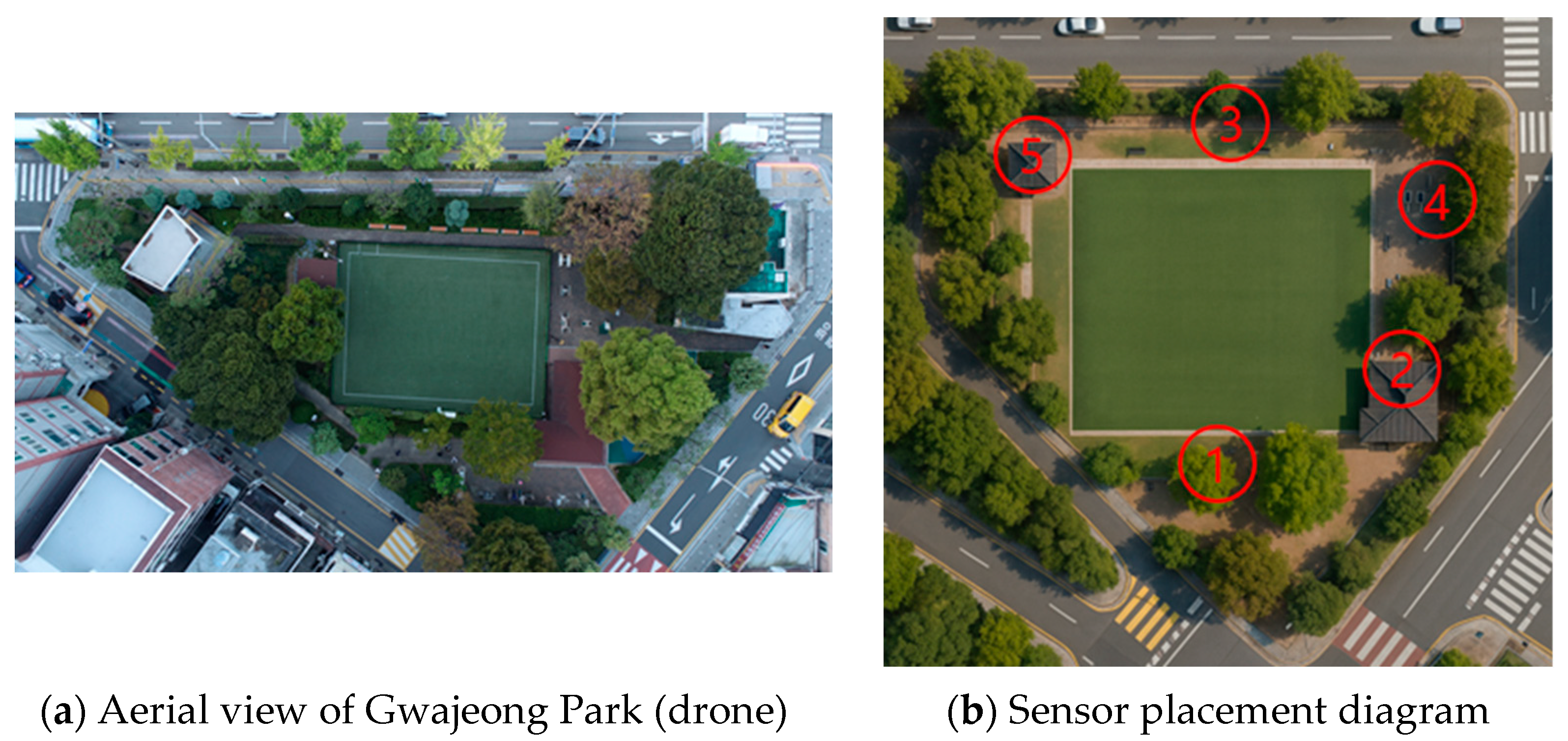
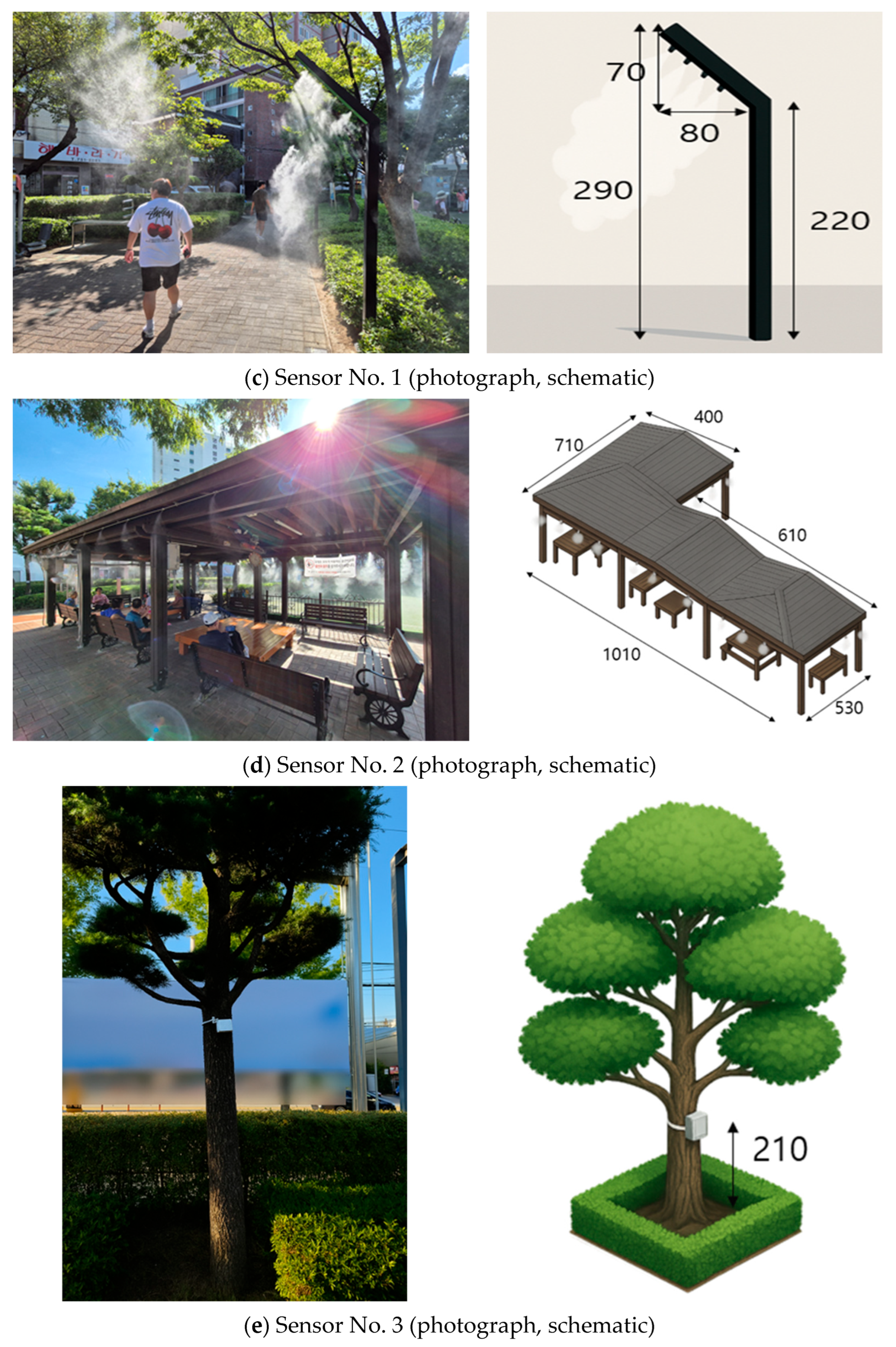
The study was conducted in Gwajeong Park, located in Busan Metropolitan City, South Korea—a small neighborhood park characterized by prominent urban heat accumulation. The site is surrounded by roads and buildings, consisting of a mixed surface of asphalt pavement and green areas, making it suitable for evaluating microclimatic variations associated with the urban heat island effect. To quantify changes in the thermal environment before and after the installation of the cooling fog system, five measurement stations (No. 1–No. 5) were deployed across the park (Figure 1). Each station recorded air temperature (Ta) and relative humidity (RH). Air temperature was recorded at a 1 min resolution using an SK-L754 datalogger (SK SATO, Tokyo, Japan) fitted with the plug-in temperature probe SK-L751-1 (Cat. No. 8810-01). The probe has a measuring range of −10.0 to 60.0 °C and accuracy of ±0.5 °C. Sensor No. 1 was installed near a pedestrian walkway on the southern side of the park, where a pillar-type cooling-fog unit (height ≈ 2.9 m) emitted fine mist particles from nozzles positioned at 0.7–0.8 m intervals along the upper section. This configuration simulated the human walking experience and evaluated localized cooling and thermal comfort enhancement. Sensor No. 2 was placed within a central shaded pavilion (length ≈ 10 m, width ≈ 4 m) that integrates seating and mist nozzles. The pavilion functions both as a resting space for vulnerable populations (e.g., elderly, children) and as a test site for indoor–outdoor perceived temperature comparison. Sensor No. 3, attached to the trunk of a tree at 2.1 m above ground level, was located in a vegetated area unaffected by direct mist.
To support the computation of biometeorological indices (PET and UTCI), wind speed and global horizontal irradiance (GHI) were supplemented using observations from the Korea Meteorological Administration (KMA) Busan surface station (ASOS; Station ID 159; Busan Regional Meteorological Administration, 32 Bokbyeongsan-ro, Jung-gu, Busan; 35.10468° N, 129.03203° E), located several kilometers from Gwajeong Park. Because station-based wind and radiation can differ from local UHI micro-environments due to shading and urban morphology, this is treated as a limitation and is discussed accordingly. Additionally, periods affected by precipitation were excluded from the analysis to avoid confounding effects associated with wet surfaces and atypical evaporation conditions. However, the study design emphasizes within-park, site-resolved comparisons between mist-affected and reference locations, which helps reduce bias when estimating mitigation effects.
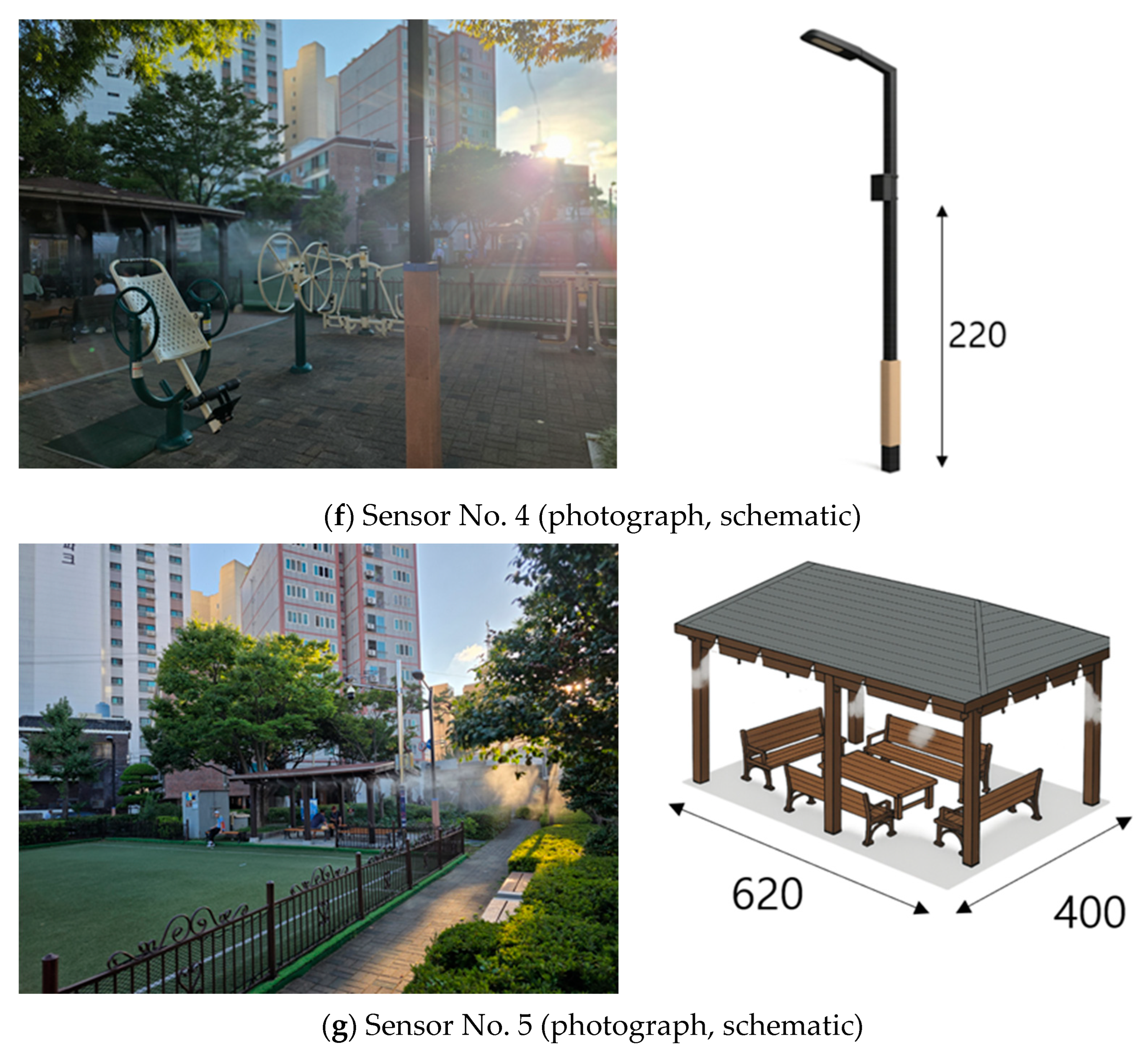
The placement captured the natural cooling influence of shading and evapotranspiration, serving as a control zone for evaluating differences in mean radiant temperature and air temperature between shaded and misted spaces. Sensor No. 4 was mounted on a streetlamp adjacent to outdoor fitness equipment, 2.2 m above ground level, where it captured high-radiant-heat exposure, to monitor thermal conditions in an active, paved zone frequently used by park visitors. Sensor No. 5 was installed inside a northern pavilion equipped with multiple ceiling-mounted mist nozzles. The shelter (6.2 m × 4.0 m) provided shaded seating and experienced direct-mist operation, enabling analysis of combined shading and evaporative cooling effects. The five-station configuration allowed comprehensive evaluation of spatial heterogeneity in thermal comfort.

2.2. Cooling-Fog System and Data Processing

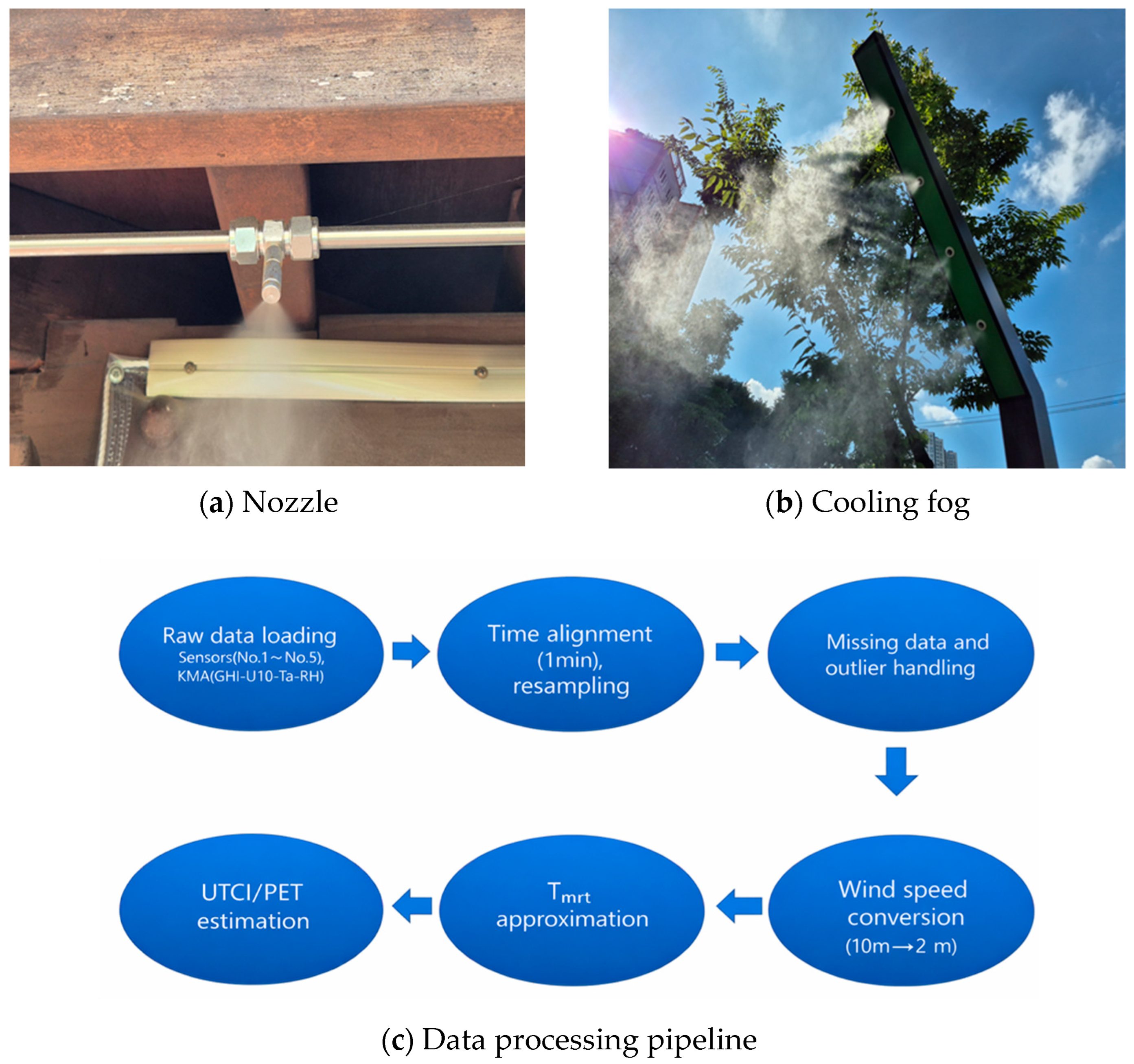
To quantitatively analyze the thermal effects of the cooling-fog system, field measurements were integrated with reference data from the Korea Meteorological Administration (KMA), forming a unified dataset (Figure 2). The dataset included on-site measurements of Ta, RH, and time stamps. KMA data—10 m wind speed (u10), reference air temperature (Ta,ref), RH, and GHI—were used to complement missing values and estimate Tmrt and wind speed adjustments. Because the reference station is located several kilometers from Gwajeong Park, local wind and radiative conditions within the UHI environment may differ due to shading and urban geometry; this potential mismatch is considered in the interpretation of index estimates.
The mean radiant temperature (Tmrt) was derived by first assembling the total absorbed radiative flux (Rabs) from short-wave (solar) and long-wave (sky/ground) components and then inverting the Stefan–Boltzmann relation.
Absorbed radiative flux was defined as Rabs = Kabs + Labs, where Kabs is absorbed short-wave radiation and Labs is absorbed long-wave radiation. Water vapor pressure e (hPa) was derived from air temperature Ta (°C) and relative humidity RH (%) as follows:
e = ( R H / 100 ) · e s ( T a ) ,   e s ( T a ) = 6.112 · e x p ( 17.67 · T a / ( T a + 243.5 ) ) .
Sky emissivity was approximated as follows:
ε s k y = c l i p ( 0.72 + 0.005 · e , 0.72 , 1.0 ) .
Here,  c l i p ( x ,   a ,   b ) constrains x to the range [a, b]. Absorbed short-wave radiation was computed from global horizontal irradiance (GHI) as follows:
K a b s = α p · f p · G H I · ( 1 + α g ) .
Absorbed long-wave radiation was computed as follows:
L a b s = ε p · L d o w n + L g n d 2 ,
where
L d o w n = ε s k y · σ · T a , K 4 and   L g n d = σ · T a , K 4 .
σ is the Stefan-Boltzmann constant and Tmrt was obtained by inversion as follows:
T m r t ( K ) = R a b s ε p · σ 1 4 ,   and   T m r t ( ) = T m r t ( K ) 273.15 .
Unless stated otherwise, the effective human emissivity was set to   ε p = 0.95 and ground albedo to  a g = 0.20 ; sky/ground emissivities followed standard clear-sky and typical-surface values, and the projected-area factor fp was set to 0.70 to represent a standing pedestrian under typical outdoor postures.
In accordance with the UTCI operational procedure, wind speed at 10 m was used for UTCI computation [38]. To represent pedestrian-level convective conditions in PET, the 10 m wind speed was converted to 2 m using a standard power-law profile. The mean radiant temperature (Tmrt) was estimated using a radiation-based approach driven by global horizontal irradiance (GHI); however, since local short-wave shielding and long-wave exchanges due to canopy/structures were not explicitly resolved, Tmrt-related interpretations are reported conservatively and emphasize site-to-site contrasts rather than absolute radiative magnitudes.
All data were temporally aligned to one-minute intervals through reindexing and resampling. Duplicate entries were averaged, and missing intervals (≤10 min) were interpolated linearly. When pedestrian-level wind speed (u2) was unavailable, it was estimated from the 10 m wind speed (u10) using an urban power-law approximation under near-neutral conditions:
u 2 = u 10 × z 2 z 10 α
with  z 2 = 2.0   m and  z 10 = 10   m . We set  α = 0.20 as the baseline value, reflecting the mixed park–pavilion roughness at the site, and verified robustness over  α = 0.14 0.30 . This correction improves the representation of the pedestrian-level microclimate, and sensitivity checks across α did not materially change the regression coefficients or conclusions.
To avoid ambiguity in biometeorological calculations, the wind speed at pedestrian height (u2) was used for PET to represent convective heat exchange in the near-pedestrian environment, whereas the UTCI was calculated using the wind speed at 10 m (u10) as required by the UTCI definition. The u10-to-u2 conversion is therefore reported for PET (and descriptive pedestrian-level interpretation) and is not applied to UTCI.
The cooling-fog system was operated under a temperature-triggered automatic control. Specifically, the system ran a periodic duty cycle of 10 min ON and 5 min OFF (ON–OFF = 10:5) only when the air temperature exceeded 30 °C and the relative humidity was below 70%. Stainless steel nozzles (≤10 μm droplet diameter), with an orifice diameter of 0.15 mm, were installed along the gazebo perimeter at 0.70–0.80 m spacing and oriented downward toward the occupied zone, spraying fine mist at a height of 2.0–2.2 m, with a flow rate of approximately 3 L/min.

2.3. Causal Estimation via Difference-in-Differences (DiD)

The causal effect of cooling-fog activation on thermal conditions was estimated using a two-way, fixed-effects difference-in-differences (DiD) design at 1 min resolution within the daytime analysis window (09:00–18:00). The outcome Yit denotes, depending on specification, UTCI, PET, or the sensor–KMA air temperature difference ∆T for sensor   i at time  t . Each regression includes sensor fixed effects to measure time-invariant micro-site heterogeneity (e.g., exposure, canopy, surroundings) and day  × time fixed effects (10–15 min cells) to capture diurnal structure and day-specific meteorological drift. The treatment indicator FogOnit equals one when the cooling-fog system is actively spraying; all models control for air temperature (Ta), global horizontal irradiance (GHI), pedestrian-level wind speed at 2 m (u2; converted from 10 m winds), and relative humidity (RH). Standard errors are clustered by day to account for serial correlation within dates; robustness checks consider day  × sensor two-way clustering and wild-cluster bootstrap p-values. Because the system follows a 10 min ON/5 min OFF duty cycle, a dose–response variant replaces the binary treatment with the realized duty fraction over the preceding 15 min to test proportionality of effects.
Identification relies on parallel trends in the absence of activation within day  × time strata across sensors, absence of sensor-level anticipatory responses, and conditional exogeneity of activation given the included fixed effects and meteorological covariates. Periods with precipitation or high winds (plume instability) are masked ex ante to reduce differential exposure to dispersion.

2.4. Evaluation of Cooling and Thermal Comfort Effects

UTCI and PET are both derived from human energy-balance concepts, yet they can respond differently to the same meteorological forcing. UTCI is widely used for standardized heat-stress communication and is particularly sensitive to wind speed and mean radiant temperature (Tmrt), which strongly affect convective and radiative heat exchange. PET is commonly applied in urban climate and design studies because it provides an intuitive temperature-equivalent metric under explicitly stated activity and clothing assumptions. Reporting both indices, therefore, allows us to (i) assess whether the inferred cooling effects are robust across two established frameworks and (ii) interpret the roles of air temperature, wind speed, and radiative load in shaping heat stress during fog operation.

2.4.1. Universal Thermal Climate Index (UTCI)

The Universal Thermal Climate Index (UTCI) was employed to assess the impact of the cooling-fog system on outdoor thermal comfort. The UTCI integrates air temperature, relative humidity, wind velocity, and mean radiant temperature to quantify perceived thermal stress. Unlike simple air temperature measures, the UTCI accounts for convection, radiation, and physiological heat exchange, thus providing a realistic indicator of outdoor heat stress.
The UTCI was calculated using the UTCI operational procedure proposed by Bröde et al. (2012) [38], which provides either look-up tables or a validated 6th-order polynomial approximation of the UTCI offset as a function of four variables (Ta, Tmrt, humidity expressed as water vapor pressure or RH, and wind speed at 10 m). In this study, UTCI was computed via the 6th-order polynomial approximation as implemented in the pythermalcomfort library (function: utci; version: 2.6.0). Because UTCI is defined with wind speed at 10 m height, the measured/available 10 m wind speed (u10) was used directly for UTCI without applying a vertical wind profile (power-law) conversion.
The UTCI computation used: dry-bulb air temperature (Ta, °C) and relative humidity (RH, %) measured at the on-site stations, mean radiant temperature (Tmrt, °C) estimated as described in Section 2.2, and 10 m wind speed (u10, m s−1) obtained from the nearest KMA station. UTCI heat-stress categories were interpreted using the standard UTCI assessment scale shown in Table 2 [29,30,31,32].

2.4.2. Physiological Equivalent Temperature (PET) Evaluation

To quantitatively assess the human physiological response to the thermal environment, this study applied the Physiological Equivalent Temperature (PET) index. PET is a representative, physiology-based indicator used to comprehensively evaluate human thermal comfort. It considers not only meteorological variables such as air temperature (Ta), mean radiant temperature (Tmrt), relative humidity (RH), and wind speed (u), but also physiological parameters including metabolic rate and clothing insulation.
PET was computed using the pythermalcomfort 2.6.0 package with fixed thermophysiological inputs (met = 1.2; clo = 0.5).
The PET value represents the equivalent air temperature (°C) under standard indoor reference conditions in which a person would maintain the same physiological state as in the given outdoor environment. This allows diverse outdoor thermal conditions to be interpreted and compared within a unified framework.
Since PET is derived from the human energy-balance equation, it physically simulates the body’s thermoregulation process—including convection, radiation, evaporation, metabolism, and heat dissipation. For this reason, PET has been widely applied in international research for outdoor-thermal-environment assessment, urban-thermal-comfort analysis, and evaluation of the effects of green and shading infrastructure.
Thermophysiological inputs were fixed to represent summer walking conditions (met = 1.2; clo = 0.5). Because absolute PET categories depend on these assumptions and on parameterization of skin/clothing heat and radiation exchange, results are interpreted primarily in relative terms (pre- vs. post-activation and across-site contrasts) rather than as invariant categorical thresholds.
In comparison with the UTCI, both indices are governed by Tmrt, but their intended uses differ. The UTCI benefits from standardized parameterization and widely adopted stress categories, facilitating risk communication, whereas PET retains the advantage of an intuitive Celsius scale commonly used in urban design practice. For field application, the indices are complementary: PET is informative for diagnosing sensitivity to radiative-environment modifications (shade, high-albedo surfaces, vegetation), and the UTCI is well-suited for communicating heat-stress levels and operational guidance.
Interpretation caveats are as follows: (1) spray-induced surface or clothing wetness may reduce perceived comfort despite thermal relief; (2) strong wind or precipitation disperses the spray plume and weakens apparent effects—these periods were therefore masked in the analysis; (3) findings pertain to summer daytime walking conditions with clo = 0.5 and may not directly generalize to other seasons, activities, or clothing ensembles, for which absolute PET categories require recalibration.

2.4.3. Relationship Between Air Temperature (Ta) and Mean Radiant Temperature (Tmrt)

The objective of this section is to quantify the heterogeneity of mean radiant temperature (Tmrt) under identical air temperature (Ta) conditions and to identify the primary determinants of this variability. For this purpose, daytime (09:00–18:00) subsets of field data from all five sensor locations (No.1–No.5) were analyzed.
Scatterplots were generated to represent the relationship between Ta and Tmrt at each site, with color gradients denoting global horizontal irradiance (GHI), thereby enabling visual comparison of radiation environments under varying solar conditions.
The following summary indicators and regression models were applied:
  • Median Radiant Load Difference (∆Ri):
To evaluate the relative magnitude of radiant heat load at each sensor, the median difference between Tmrt and Ta was calculated for each site  i , defined as follows:
R i = m e d i a n ( T m r t T a ) i
  • Base Linear Model:
To determine the dependency of mean radiant temperature on air temperature, a simple linear model was established as follows:
T m r t = α + β 1 T a + ε
  • Adjusted Model (Including Solar Radiation):
To isolate the influence of solar irradiance, an additional explanatory variable (GHI) was included, resulting in the following adjusted model:
T m r t = α + β 1 T a + β 2 G H I + ε
  • Quantile Summary Analysis:
To examine nonlinear patterns and heteroscedasticity, a quantile summary was performed, calculating the median and 10–90% percentile ranges of Tmrt within each 1 °C bin of Ta. This method enabled quantitative comparison of the distribution and variability of radiant load across temperature intervals.
Through this multilayered approach, the analysis elucidated how factors such as solar irradiance, shading, and surface characteristics collectively influence radiant temperature, even when air temperature remains constant.

3. Results

3.1. DiD Results

Within the 09:00–18:00 window, the DiD analysis indicates that cooling-fog operation is associated with micro-site-dependent cooling. Table 3 summarizes the Average Treatment Effect on the Treated (ATT) estimates and their 95% confidence intervals for each sensor. In this analysis, the treated condition corresponds to periods when the cooling-fog system was ON at fog-exposed micro-sites (No. 1, No. 2, No. 3, and No. 5), while No. 4 served as an open control reference.
The largest and statistically supported cooling effect is observed at the near-spray location (No. 1; ATT = −1.812 °C, 95% CI [−2.637, −0.986]), and a smaller but still supported effect is found at the vegetated micro-site (No. 3; ATT = −1.063 °C, 95% CI [−2.064, −0.063]). In contrast, the pavilion-interior locations (No. 2 and No. 5) and the open reference site (No. 4) show confidence intervals that include zero, indicating greater uncertainty in the estimated effect under those micro-environmental conditions.
Overall, the spatial pattern is consistent with stronger cooling in the near field and in locations with partial shading/vegetation, whereas the open reference site remains largely unaffected. Detailed comparisons with prior misting/spray studies and discussion of transferability are provided in Section 4.

3.2. Relationship Between Air Temperature (Ta) and Mean Radiant Temperature (Tmrt)

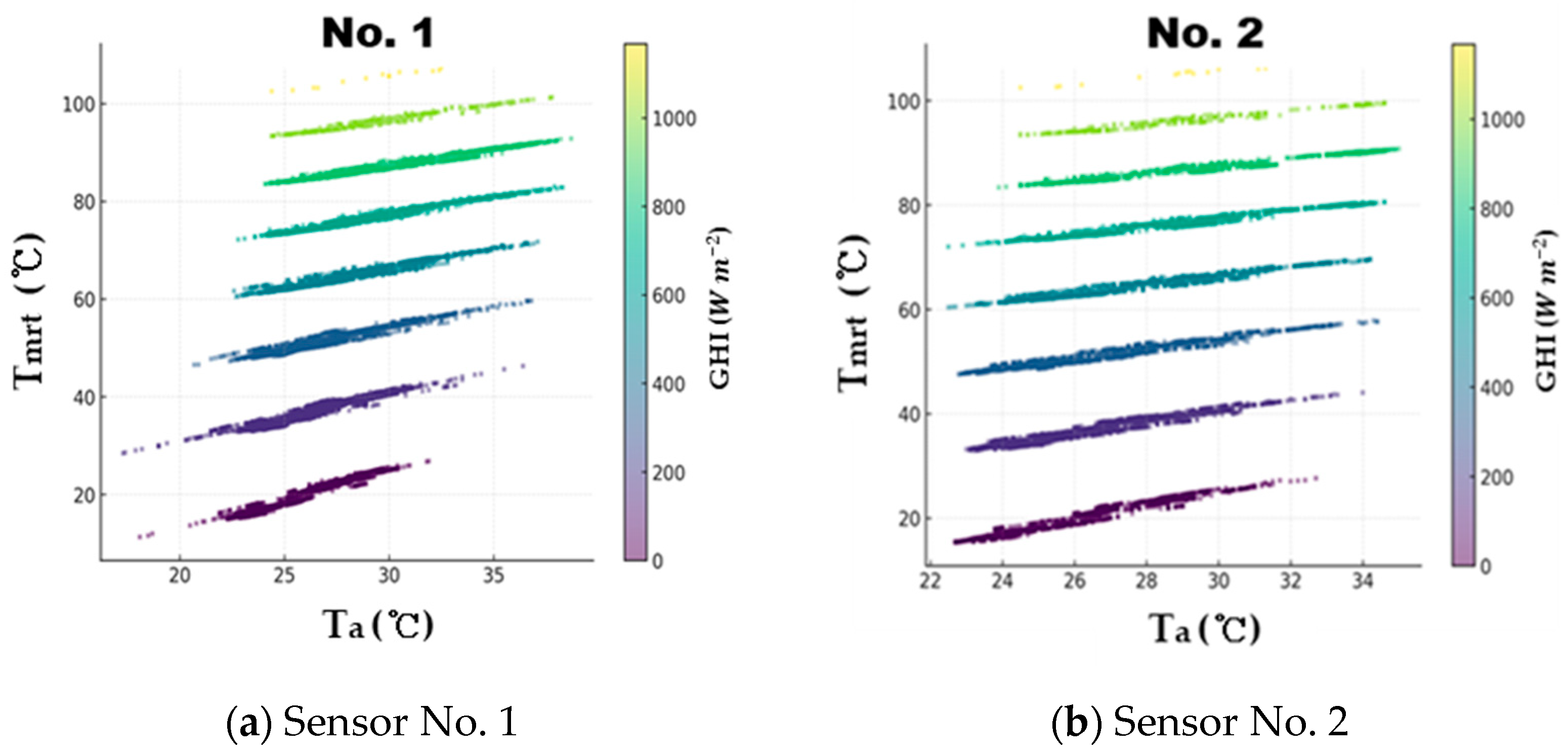
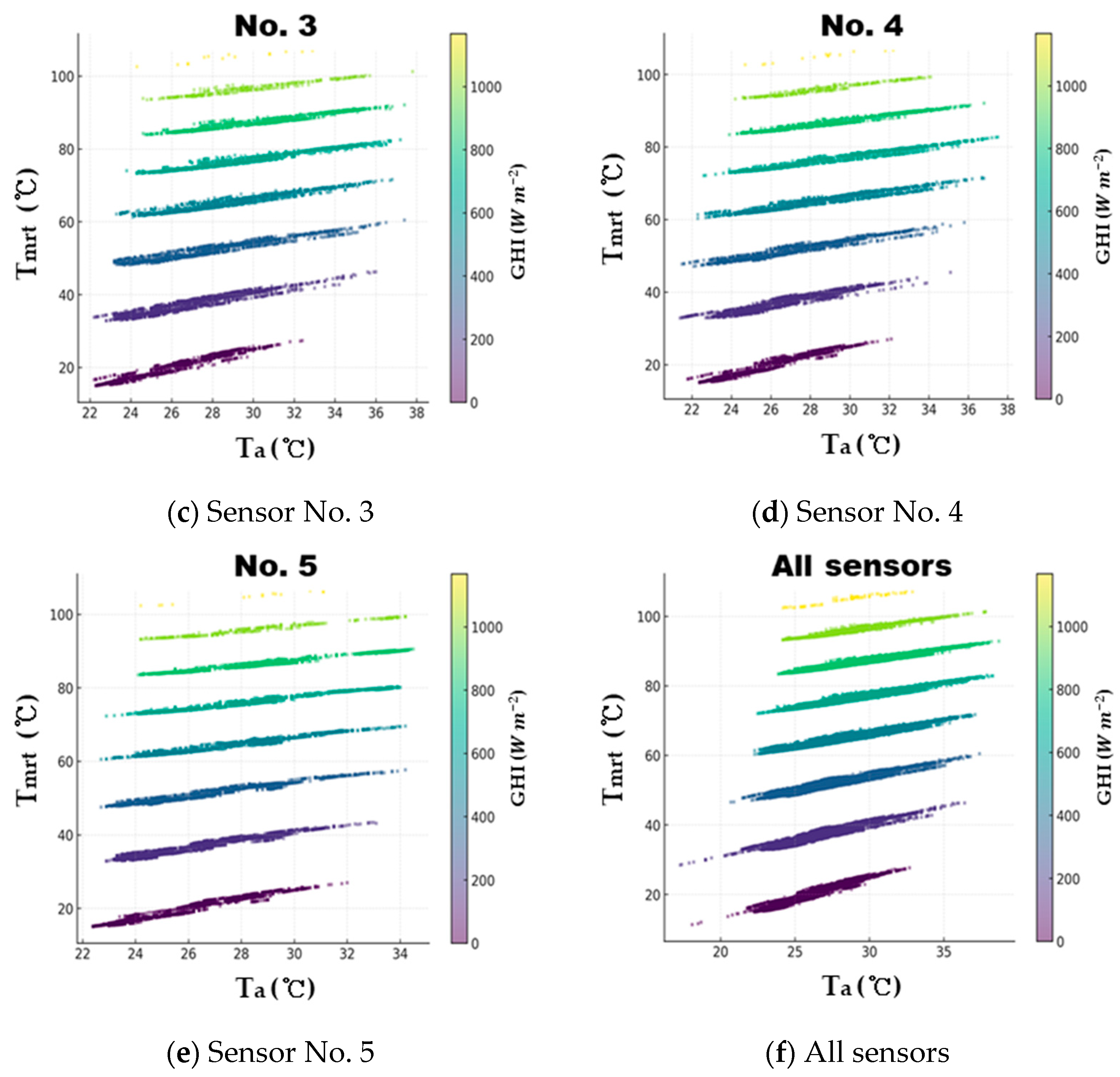
Figure 3 depicts scatterplots of Ta versus Tmrt for daytime (09:00–18:00) periods at all measurement stations, with point color representing solar irradiance (GHI, W m−2). Across all sites, Tmrt increased linearly with Ta, especially under high solar radiation (>800 W m−2), demonstrating the dominant role of radiation in heat accumulation. Even at identical Ta levels, Tmrt showed significant dispersion among sites, primarily due to surface characteristics and shading conditions.
The vegetated site (No. 3) exhibited the lowest median ∆R (TmrtTa), while the paved zone (No. 4) showed the highest, indicating severe radiative-heat accumulation. In contrast, shaded and misted pavilions (No. 2, No. 5) recorded reduced and less variable Tmrt values due to combined shading and evaporative effects. Regression models revealed that GHI coefficients (β2) were positive across all sites, with sensitivity decreasing in the order No. 4 ≳ No. 1 > No. 3 > No. 2/No. 5. This indicates that shaded/vegetated locations experience reduced effective direct solar exposure, which is consistent with smaller changes in estimated Tmrt for a given change in GHI.
Furthermore, quantile analyses showed broader variance in high-temperature ranges, confirming that radiation effects become more pronounced under extreme conditions. Collectively, the results highlight the important contribution of radiant load (Tmrt) to perceived heat. Cooling fog primarily affects the near-surface microclimate, whereas radiative load is more strongly governed by the presence of shade. Thus, differences reflect radiative environment rather than ‘inefficiency’ of fog. Therefore, combining cooling fog with shading structures, reflective pavements, or vegetated surfaces can yield synergistic improvements in UTCI and PET indices.

3.3. Analysis of UTCI

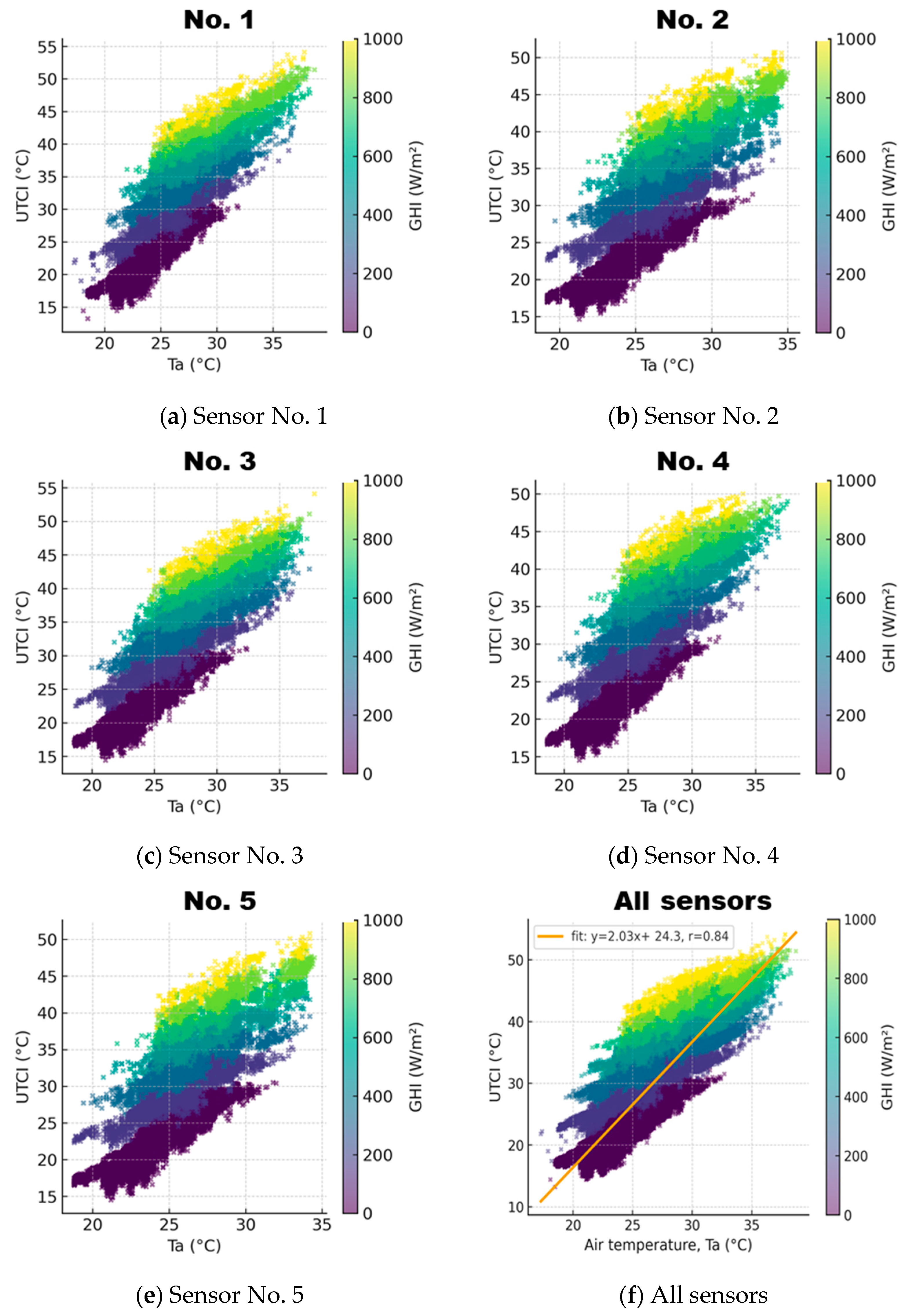
Figure 4 illustrates the relationship between air temperature (Ta, °C) and the UTCI (°C) for all measurement stations, with color gradients indicating global horizontal irradiance (GHI, W m−2). The scatterplots quantitatively represent variations in thermal comfort under different solar radiation conditions before and after the operation of the cooling-fog system. All stations exhibited a strong positive correlation between Ta and UTCI, particularly during periods of high GHI, indicating that solar radiation intensity directly contributes to perceived heat stress. In cooling-fog zones, UTCI values were consistently lower than those in non-fog areas under the same Ta conditions, confirming the localized cooling effect of micro-mist spraying.
UTCI may show only modest site-to-site separation under certain meteorological regimes (e.g., high radiative loading combined with a common wind input). In such cases, the key information lies in the within-site variability (percentile bands) and in contrasts between exposure regimes, rather than in the median difference at a single condition.
The vegetated site (No. 3) demonstrated intermediate UTCI values, while the paved area (No. 4) showed the highest UTCI due to accumulated surface radiation. The shaded pavilion (No. 5), influenced by both structural shading and evaporative cooling, displayed the most stable UTCI trends, with minimal increases under strong solar radiation. Regression analysis across all sensors produced the following empirical equation: UTCI = 2.03 × Ta + 24.3 (r = 0.84). This strong linear correlation indicates that air temperature is a major driver of UTCI variations, modulated by radiation and evaporative effects. Consequently, spaces combining vegetation and cooling fog achieved lower perceived temperatures, confirming the synergistic benefits of integrating natural and artificial cooling systems in urban parks.

3.4. Analysis of PET

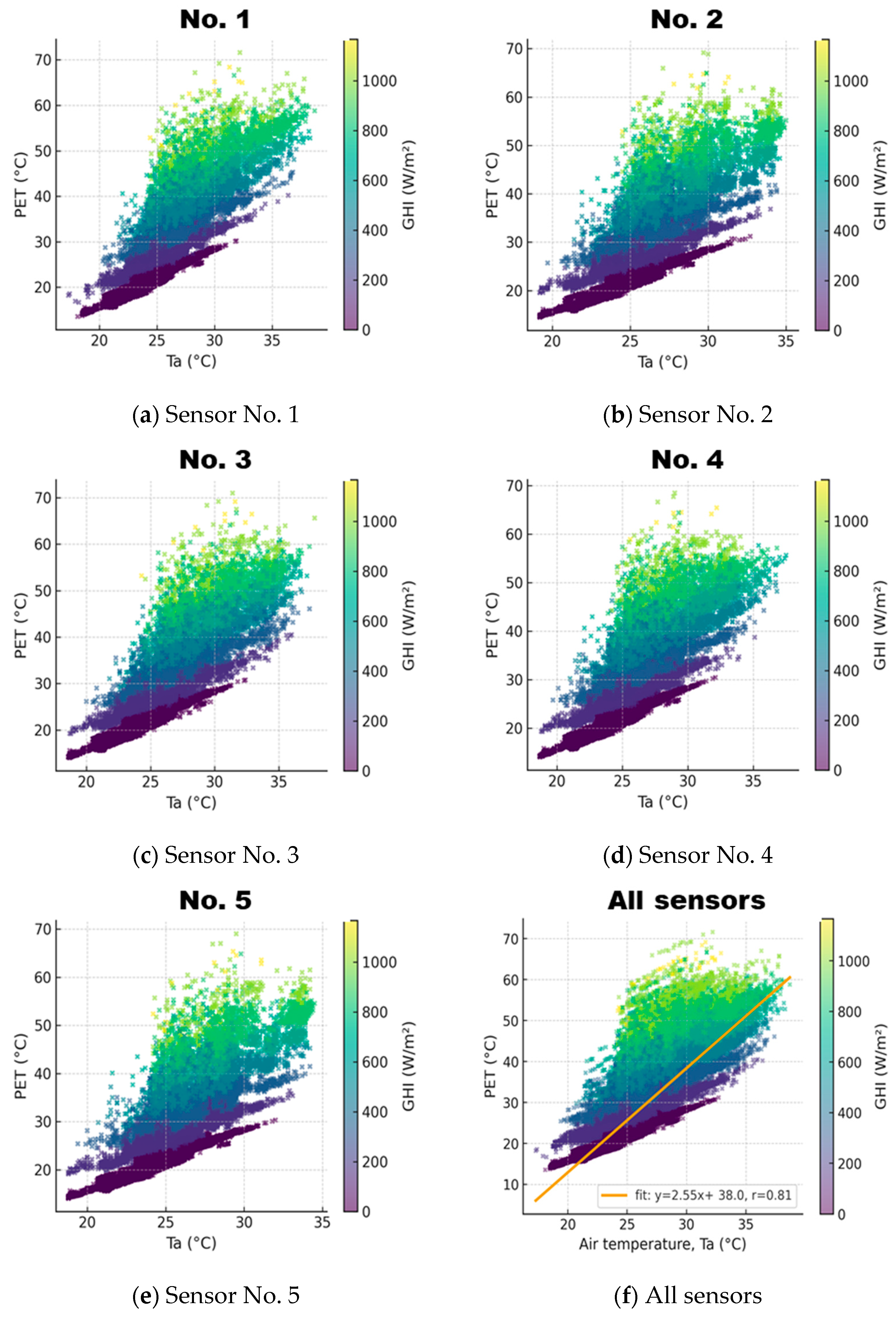
Figure 5 shows the relationship between air temperature (Ta, °C) and Physiological Equivalent Temperature (PET, °C) at each monitoring point. PET increased strongly with both Ta and GHI, suggesting that radiation and convection collectively determine perceived heat load. Cooling-fog zones consistently recorded lower PET values than non-fog areas under identical Ta conditions, reflecting the effective reduction in localized heat stress through evaporative cooling. Conversely, the unshaded paved zone (No. 4) exhibited the highest PET, while the vegetated area (No. 3) displayed moderate reductions due to shading and evapotranspiration.
The shaded pavilion (No. 5) again presented the lowest PET variability, indicating that combined shading and cooling fog provided effective buffering against heat stress. Regression results across all sensors were expressed as PET = 2.55 × Ta + 38.0 (r = 0.81). This demonstrates a strong dependence of PET on air temperature and radiant conditions.
Both indices, however, consistently verified that cooling-fog installation substantially enhances outdoor thermal comfort in urban open spaces. The reported equations are site-specific empirical linear fits intended to summarize local covariation; they do not replace the standard UTCI/PET definitions.

3.5. Combined Analysis of UTCI and PET

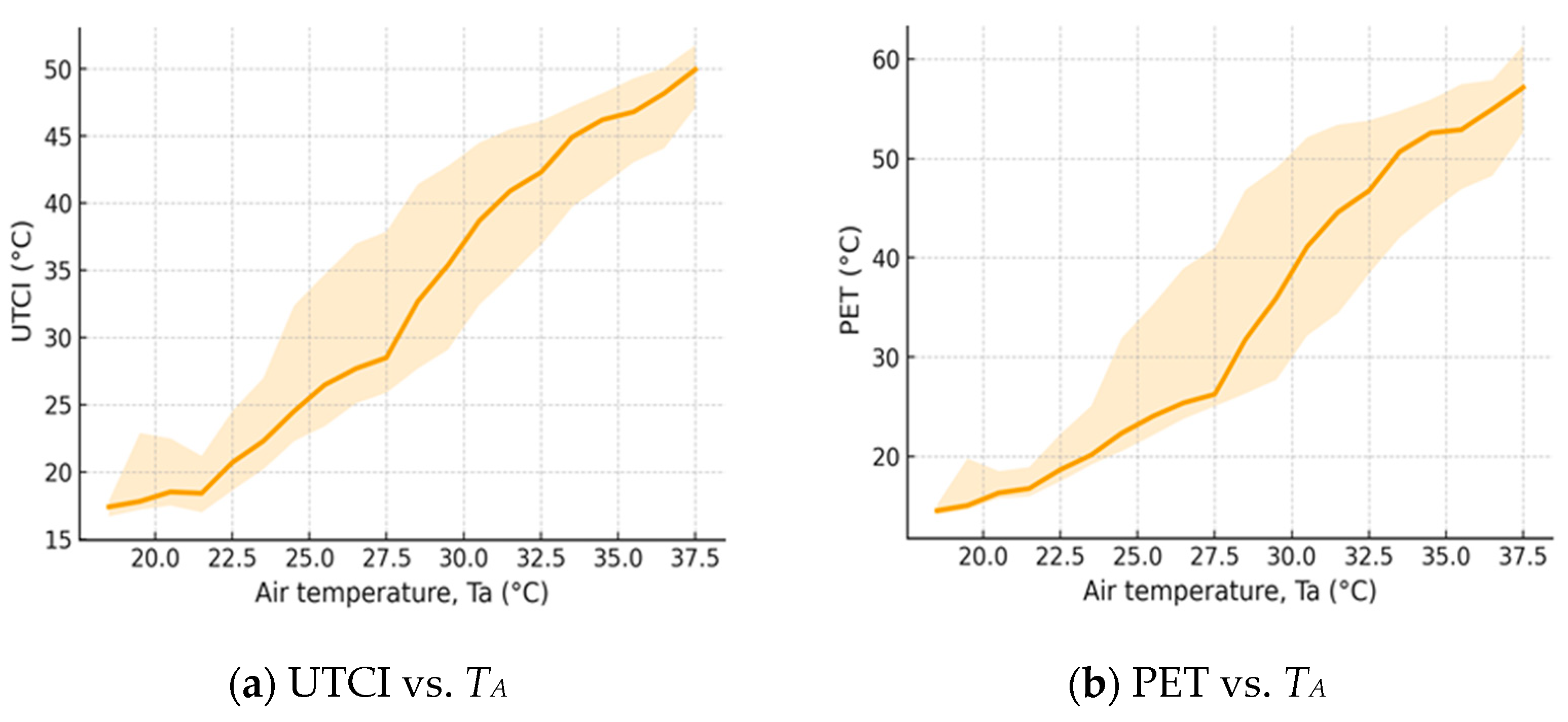
Figure 6 presents the median values of the UTCI and PET binned in 1 °C increments of Ta, with shaded bands representing the 10th–90th percentile ranges. The UTCI showed a nearly linear increase with rising Ta, particularly beyond 25 °C, where perceived thermal stress increased sharply. For Ta > 35 °C, the UTCI reached 50 °C, corresponding to ‘extreme heat stress.’ PET exhibited a similar trend but maintained values approximately 5–10 °C higher than the UTCI across all temperature ranges. The wider interquantile range in PET suggests greater variability in thermal comfort across spatial conditions, influenced by shading, surface type, and mist exposure.
A key implication is that the two indices can diverge most under conditions where wind speed or radiative load changes rapidly: the UTCI tends to respond strongly to ventilation (wind) and radiation through its convective and radiative heat-exchange terms, while PET provides an alternative temperature-equivalent interpretation under fixed activity/clothing assumptions. Reporting both indices, therefore, allows us to evaluate whether the inferred cooling effect is robust and to attribute site differences to (i) evaporative cooling/humidity changes during fog operation versus (ii) radiative shielding in shaded micro-sites.
These results highlight that both indices complement each other—the UTCI serves as a comprehensive climatic measure, while PET reflects physiological responses. Their combined use provides a more robust understanding of urban thermal environments and supports integrated evaluation of comfort conditions.

4. Discussion

This study quantitatively evaluated the temperature reduction and thermal-comfort improvement effects of a cooling-fog (micro-mist) system installed in the Oncheoncheon area of Busan, South Korea. The field-based experimental framework, equipped with five environmental sensors, enabled real-time monitoring of microclimatic conditions, including air temperature (Ta), relative humidity (RH), mean radiant temperature (Tmrt), and two representative thermal indices (UTCI and PET). The experimental results clearly demonstrated that the operation of the cooling-fog system improved thermal comfort under typical urban outdoor conditions. Under extreme weather conditions (Ta ≈ 40 °C), the system achieved a UTCI reduction of up to 0.94 °C and an average air temperature decrease of 0.95 °C at the pedestrian level (1.75 m). Regression analyses revealed strong linear relationships between air temperature and perceived thermal indices (UTCI = 2.03 × Ta + 24.3, r = 0.84; PET = 2.55 × Ta + 38.0, r = 0.81), confirming the sensitivity of human thermal comfort to combined effects of air temperature and radiation. Despite the limited influence of relative humidity on cooling efficiency, the results indicated that convective and evaporative cooling from fine misting substantially improved pedestrian-level thermal perception. The comparison of different micro-environments demonstrated that misted and shaded areas exhibited the lowest UTCI and PET values, while exposed paved zones experienced the highest. This finding underscores the importance of integrated design approaches that combine evaporative cooling (cooling fog) with shading structures, reflective pavements, and vegetated surfaces. Overall, the study provides empirical evidence that cooling-fog systems function as effective low-impact cooling infrastructure for mitigating urban heat islands and enhancing human thermal comfort. The approximately 1 °C improvement in UTCI observed under extreme summer conditions is not only statistically significant but also practically relevant for improving urban livability. From a design perspective, the co-deployment of misting and shading infrastructure is expected to yield synergistic benefits in reducing heat stress and improving comfort metrics such as the UTCI and PET. Future work should incorporate seasonal field observations and numerical simulations to validate model robustness and identify parameter sensitivities. Moreover, scenario-based optimization considering nozzle height, spray density, vegetation arrangement, and airflow dynamics could support the development of tailored cooling-fog design guidelines for various urban typologies.
These findings are broadly consistent with prior outdoor misting/spray studies reporting (i) larger comfort benefits in the near field of spray exposure and (ii) enhanced perceived cooling when evaporative cooling is combined with shading, while weaker effects are expected in exposed or wind-dispersive conditions [4,5,6,19,20]. In particular, the observed spatial heterogeneity across the paved, vegetated, and pavilion micro-sites is qualitatively in line with established evidence that pedestrian-scale wind, humidity, and radiative load can vary substantially within warm–humid UHI environments.
From an implementation perspective, the results suggest that cooling-fog systems are most effective when deployed as targeted, pedestrian-scale interventions in high-exposure locations (e.g., open walkways and seating areas) and when co-designed with shading and surface strategies that reduce radiative load (tree canopy, shade structures, and/or high-albedo materials). Accordingly, transferability of the estimated effect sizes is most plausible for sites with comparable summer daytime meteorological conditions and similar nozzle configurations, installation geometry, and control logic [5,6,19,20].
Several limitations should be noted. First, solar radiation and wind forcing were obtained from the nearest KMA surface station, located several kilometers from the study site; local radiative shielding and ventilation within the park may therefore differ from station conditions. Second, the analysis focuses on summer daytime operation and fixed thermophysiological assumptions (met and clo), so absolute index categories may not generalize to other seasons or activity levels. Third, we did not collect concurrent subjective comfort surveys; future work combining site-resolved radiation/wind measurements and user responses would strengthen operational design guidance and health-relevant interpretations.
Overall, this study contributes field-based evidence that a high-pressure micro-mist system can provide measurable reductions in heat-stress indices in a small urban park, with benefits concentrated in mist-exposed and shaded micro-sites. The results highlight the central role of radiative load in shaping perceived heat and support integrated mitigation designs that pair evaporative cooling with shading and surface strategies to maximize outdoor comfort.

Author Contributions

Conceptualization, J.C. and S.K.; methodology, J.C.; software, J.C.; validation, J.C., J.K. (Jaekyoung Kim), and T.K.; formal analysis, J.C.; investigation, J.K. (Jaemoon Kim); resources, S.K.; data curation, J.C.; writing—original draft preparation, J.C.; writing—review and editing, S.K.; visualization, T.K.; supervision, T.K.; project administration, J.K. (Jaekyoung Kim); funding acquisition, S.K. All authors have read and agreed to the published version of the manuscript.

Funding

This work was supported by the “Graduate school of Green Restoration specialization” of Korea Environmental Industry & Technology Institute grant funded by the Ministry of Environment, Republic of Korea.

Data Availability Statement

The data presented in this study are available in the current manuscript, and raw data are available on request from the corresponding authors.

Conflicts of Interest

The authors declare no conflicts of interest.

References

  1. Oke, T.R. Boundary Layer Climates, 2nd ed.; Routledge: London, UK, 1987. [Google Scholar] [CrossRef]
  2. Santamouris, M. Cooling the cities—A review of reflective and green roof mitigation technologies to fight heat island and improve comfort in urban environments. Sol. Energy 2014, 103, 682–703. [Google Scholar] [CrossRef]
  3. Kim, Y.H.; Baik, J.J. Maximum urban heat island intensity in Seoul. J. Appl. Meteor. Climatol. 2002, 41, 651–659. [Google Scholar] [CrossRef]
  4. Ulpiani, G.; Di Giuseppe, E.; Di Perna, E.; D’Orazio, C.; Zinzi, M. Thermal comfort improvement in urban spaces with water spray systems: Field measurements and survey. Build. Environ. 2019, 156, 46–61. [Google Scholar] [CrossRef]
  5. Kim, J.; Kang, J. Evaluating the efficiency of fog cooling for climate change adaptation in vulnerable groups: A case study of Daegu Metropolitan City. Build. Environ. 2022, 217, 109120. [Google Scholar] [CrossRef]
  6. Xie, X.; Sun, Z.; Zhu, X.; Zhao, S.; Wang, Z.; Zhai, Y. Influence of Misting System on the Thermal Environment and Thermal Comfort of Seated People in Semi-Outdoor Space in Xi’an, China. Front. Archit. Res. 2024, 13, 668–681. [Google Scholar] [CrossRef]
  7. ESMAP. Primer for Cool Cities: Reducing Excessive Urban Heat. Energy Sector Management; Assistance Program (ESMAP) Knowledge Series 031/20; World Bank: Washington, DC, USA, 2020. [Google Scholar]
  8. Bloomberg Associates. Mitigating Urban Heat Island Effects Cool Pavement Interventions; Bloomberg Associates: New York, NY, USA, 2019. [Google Scholar]
  9. NYC Mayor’s Office of Resiliency. Cool Neighborhoods NYC: Resiliency and Heat Mitigation Plan; NYC Mayor’s Office: New York, NY, USA, 2019.
  10. Greater London Authority. The London Plan (Urban Greening Factor Guidance Included); GLA: London, UK, 2021.
  11. Zhou, D.; Zhao, S.; Zhang, L.; Sun, G.; Liu, Y. The footprint of urban heat island effect in China. Sci. Rep. 2015, 5, 11160. [Google Scholar] [CrossRef] [PubMed]
  12. Greenpeace East Asia. Extreme Temperature Rise in East Asia Cities; Greenpeace East Asia: Beijing, China, 2021. [Google Scholar]
  13. Sun, L.; Fertner, C.; Jørgensen, G. Beijing’s First Green Belt—A 50-Year Long Chinese Planning Story. Land 2021, 10, 969. [Google Scholar] [CrossRef]
  14. Western Sydney Regional Organisation of Councils. Turn Down the Heat: Strategy and Action Plan; WSROC: Sydney, Australia, 2018. [Google Scholar]
  15. Mohammed, A.; Pignatta, G.; Topriska, E.; Santamouris, M. Canopy Urban Heat Island and Its Association with Climate Conditions in Dubai, UAE. Climate 2020, 8, 81. [Google Scholar] [CrossRef]
  16. National Parks Board (NParks). Factsheet C—Skyrise Greenery in Singapore; NParks: Singapore, 2017.
  17. Hong, J.-W.; Hong, J.; Kwon, E.E.; Yoon, D.K. Temporal Dynamics of Urban Heat Island Correlated with the Socio-Economic Development over the Past Half-Century in Seoul, Korea. Environ. Pollut. 2019, 254, 112934. [Google Scholar] [CrossRef]
  18. Korea Meteorological Administration (KMA). Annual Report 2016; KMA: Seoul, Republic of Korea, 2017. [Google Scholar]
  19. Santamouris, M.; Gaitani, N.; Spanou, A.; Saliari, M.; Giannopoulou, K.; Vasilakopoulou, K.; Kardomateas, T. Using cool paving materials to improve microclimate of urban areas—Design realization and results of the flisvos project. Build. Environ. 2012, 53, 128–136. [Google Scholar] [CrossRef]
  20. Vanos, J.K.; Wright, M.K.; Kaiser, A.; Middel, A.; Ambrose, H.; Hondula, D.M. Evaporative misters for urban cooling and comfort: Effectiveness and motivations for use. Int. J. Biometeorol. 2022, 66, 357–369. [Google Scholar] [CrossRef]
  21. Lai, D.; Liu, W.; Gan, T.; Liu, K.; Chen, Q. A review of mitigating strategies to improve the thermal environment and thermal comfort in urban outdoor spaces. Sci. Total Environ. 2019, 661, 337–353. [Google Scholar] [CrossRef] [PubMed]
  22. Ren, J.; Shi, K.; Li, Z.; Kong, X.; Zhou, H. A Review on the Impacts of Urban Heat Islands on Outdoor Thermal Comfort. Buildings 2023, 13, 1368. [Google Scholar] [CrossRef]
  23. Błażejczyk, K.; Kuchcik, M.; Błażejczyk, A.; Milewski, P.; Szmyd, J. Assessment of urban thermal stress by UTCI—Experimental and modelling studies: An example from Poland. DIE ERDE—J. Geogr. Soc. Berl. 2014, 145, 16–33. [Google Scholar] [CrossRef]
  24. Montazeri, H.; Toparlar, Y.; Blocken, B.; Hensen, J.L.M. Simulating the cooling effects of water spray systems in urban landscapes: A computational fluid dynamics study in Rotterdam, The Netherlands. Landsc. Urban Plan. 2017, 159, 85–100. [Google Scholar] [CrossRef]
  25. Kim, J.; Park, S.; Jung, S.; Lee, G. Urban cold stress assessment using computational fluid dynamics and universal thermal climate index: A case study of Gwacheon City, South Korea. Sustain. Cities Soc. 2025, 133, 106830. [Google Scholar] [CrossRef]
  26. Kim, J.; Park, S.; Lee, G. Analyzing urban thermal comfort changes due to modifications in urban material properties in a large-scale new town: A CFD study based on the universal thermal climate index (UTCI). Sustain. Cities Soc. 2025, 130, 106627. [Google Scholar] [CrossRef]
  27. Wu, J.; Chang, H.; Yoon, S. Numerical Study on Microclimate and Outdoor Thermal Comfort of Street Canyon Typology in Extremely Hot Weather—A Case Study of Busan, South Korea. Atmosphere 2022, 13, 307. [Google Scholar] [CrossRef]
  28. Jendritzky, G.; de Dear, R.; Havenith, G. UTCI—Why another thermal index? Int. J. Biometeorol. 2012, 56, 421–428. [Google Scholar] [CrossRef]
  29. Błażejczyk, K.; Jendritzky, G.; Bröde, P.; Fiala, D.; Havenith, G.; Epstein, Y.; Psikuta, A.; Kampmann, B. An introduction to the Universal Thermal Climate Index (UTCI). Geogr. Pol. 2013, 86, 5–10. [Google Scholar] [CrossRef]
  30. Höppe, P. The Physiological Equivalent Temperature—A universal index for the biometeorological assessment of the thermal environment. Int. J. Biometeorol. 1999, 43, 71–75. [Google Scholar] [CrossRef]
  31. Matzarakis, A.; Mayer, H.; Iziomon, M. Applications of a universal thermal index: Physiological equivalent temperature. Int. J. Biometeorol. 1999, 43, 76–84. [Google Scholar] [CrossRef]
  32. Di Napoli, C.; Pappenberger, F.; Cloke, H.L. Verification of Heat Stress Thresholds for a Health-Based Heat-Wave Definition. J. Appl. Meteorol. Climatol. 2019, 58, 1177–1194. [Google Scholar] [CrossRef]
  33. Lim, Y.S.; Zoh, H.D.; Kim, T.H.; Kwon, T.K. Analyzing the Cooling Effects of Water Facilities in Urban Park: The Case of Sangju Namsan Park, South Korea. Atmosphere 2024, 15, 1456. [Google Scholar] [CrossRef]
  34. Chan, S.Y.; Chau, C.K. On the study of the effects of microclimate and park and surrounding building configuration on thermal comfort in urban parks. Sustain. Cities Soc. 2021, 64, 102512. [Google Scholar] [CrossRef]
  35. Rahmadyani, H.; Fahri, M. A study of the microclimate effects on thermal comfort in warm-humid climate for urban parks, Pangkalpinang. IOP Conf. Ser. Earth Environ. Sci. 2023, 1267, 012075. [Google Scholar] [CrossRef]
  36. Callaway, B.; Sant’Anna, P.H.C. Difference-in-differences with multiple time periods. J. Econom. 2021, 225, 200–230. [Google Scholar] [CrossRef]
  37. Goodman-Bacon, A. Difference-in-differences with variation in treatment timing. J. Econom. 2021, 225, 254–277. [Google Scholar] [CrossRef]
  38. Bröde, P.; Fiala, D.; Błażejczyk, K.; Holmér, I.; Jendritzky, G.; Kampmann, B.; Tinz, B.; Havenith, G. Deriving the operational procedure for the Universal Thermal Climate Index (UTCI). Int. J. Biometeorol. 2012, 56, 481–494. [Google Scholar] [CrossRef]
Figure 1. Cooling-fog installations and sensor placements in Gwajeong Park. (a) Aerial view of Gwajeong Park (drone), (b) sensor placement diagram, (cg) Sensor No. 1–5 (photographs and schematics). Numbers in the schematics denote sensor heights (cm) and structure scale bar (cm).
Buildings 16 00503 g001aBuildings 16 00503 g001bBuildings 16 00503 g001c
Figure 2. Cooling-fog system and data processing pipeline. (a) High-pressure pump–manifold assembly and nozzle heads; (b) probe layout attached to the datalogger; (c) analytics pipeline.
Buildings 16 00503 g002
Figure 3. Scatterplots between Ta and Tmrt for daytime (09:00–18:00) periods.
Buildings 16 00503 g003aBuildings 16 00503 g003b
Figure 4. Scatterplots of air temperature (Ta, °C) and UTCI (°C). Note: Lines/equations depict site-specific empirical linear fits.
Buildings 16 00503 g004
Figure 5. Scatterplots of air temperature (Ta, °C) and PET (°C). Note: Lines/equations depict site-specific empirical linear fits.
Buildings 16 00503 g005
Figure 6. Median UTCI and PET binned by 1 °C of Ta; shaded bands show the 10th–90th percentiles.
Buildings 16 00503 g006
Table 1. Key terms and corresponding synonyms.
SymbolDescription
TaAir temperature (°C)
RHRelative humidity (%)
TmrtMean radiant temperature (°C)
UTCIUniversal Thermal Climate Index (°C)
PETPhysiological Equivalent Temperature (°C)
GHIGlobal horizontal irradiance (W m−2)
KMAKorea Meteorological Administration
u10Wind speed at 10 m height (m s−1)
u2Estimated wind speed at 2 m height (m s−1)
DiDDifference-in-differences
ATTAverage treatment effect on the treated
RabsTotal absorbed radiative flux used for Tmrt estimation (W m−2)
metMetabolic rate (met)
cloClothing insulation (clo)
Table 2. Thermal stress interpretation ranges defined by UTCI and PET [29,30,31,32].
UTCIPETStress Category
>46>41Extreme heat stress
38 to 4635 to 41Very strong heat stress
32 to 3829 to 35Strong heat stress
26 to 3223 to 29Moderate heat stress
9 to 2618 to 23No thermal stress
0 to 913 to 18Slight cold stress
−13 to 08 to 13Moderate cold stress
−27 to −134 to 8Strong cold stress
−40 to −27<4Very strong cold stress
<−40-Extreme cold stress
Table 3. Values of Average Treatment Effect on the Treated (ATT).
SensorATT (β)95% CI
No. 1 (near-spray)−1.812[−2.637, −0.986]
No. 2 (pavilion interior)−0.268[−1.206, 0.671]
No. 3 (vegetated)−1.063[−2.064, −0.063]
No. 4 (open control)−0.018[−2.033, 1.997]
No. 5 (pavilion interior)−0.891[−1.982, 0.200]
Note: ATT estimates are obtained from the DiD specification allowing sensor-specific fog ON effects; 95% confidence intervals are based on clustered standard errors (by day).
Disclaimer/Publisher’s Note: The statements, opinions and data contained in all publications are solely those of the individual author(s) and contributor(s) and not of MDPI and/or the editor(s). MDPI and/or the editor(s) disclaim responsibility for any injury to people or property resulting from any ideas, methods, instructions or products referred to in the content.