Next Article in Journal
Applying Action Research to Developing a GPT-Based Assistant for Construction Cost Code Verification in State-Funded Projects in Vietnam
Next Article in Special Issue
Study on the Three-Edge Bearing Capacity of Ultra-High-Performance Concrete Jacked Pipes
Previous Article in Journal
Optimization of Earth Dam Cross-Sections Using the Max–Min Ant System and Artificial Neural Networks with Real Case Studies
Previous Article in Special Issue
Experimental and Numerical Analyses on the Flexural Tensile Strength of Ultra-High-Performance Concrete Prisms with and Without Rice Husk Ash
 
 
Due to scheduled maintenance work on our servers, there may be short service disruptions on this website between 11:00 and 12:00 CEST on March 28th.
Article

Development and Evaluation of Thixotropic UHPC Overlay Mixtures for Bridge Deck and Low-Slope Roof Slab Repair


1
Department of Civil and Environmental Engineering, University of Nebraska-Lincoln, Omaha, NE 68182, USA
2
Durham School of Architectural Engineering and Construction, University of Nebraska–Lincoln, Omaha, NE 68182, USA
*
Author to whom correspondence should be addressed.
Buildings 2026, 16(3), 500; https://doi.org/10.3390/buildings16030500

Submission received: 2 December 2025 / Revised: 17 January 2026 / Accepted: 23 January 2026 / Published: 26 January 2026

Abstract

Ultra-high-performance concrete (UHPC) is a sophisticated construction material known for its exceptional strength and durability. Conventional UHPC generally self-consolidates, which makes it unsuitable for roof and bridge deck rehabilitation applications due to its thin layers and inclined surfaces. UHPC overlay construction generally requires a highly thixotropic material that responds well to vibration and remains stable on slopes. Despite the complex rheological properties of thixotropic UHPC, there are limited testing methods for effectively assessing the workability of overlay mixes. Therefore, this paper provides a comprehensive evaluation of the workability of overlay UHPC using existing and newly developed tests. Besides the commonly used static and dynamic flow tests, this study introduces Patting Response (PR) and Vibration-Slope Stability (VSS) tests, designed to evaluate different qualities of UHPC overlay mixtures. Seven groups of mixtures with varying binder content, water-to-binder ratio (w/b), fiber reinforcement, and admixture dosages were prepared and tested. A lab-scale sloped slab was constructed to validate the buildability of the most promising mixtures. These tests and mixtures support effective overlay solutions for roof slab and bridge deck repairs, providing protection against infrastructure deterioration and improving overall performance by introducing a dense, durable UHPC overlay. Results indicate that mixtures with static flow below 6 in. and dynamic flow between 7 and 8 in. consistently passed both PR and VSS tests, demonstrating stable vibration response and slope retention. The constructability evaluation confirmed the effectiveness of the new testing methods. Additionally, the correlation between different tests, particularly flow and VSS, was examined. Recommendations for appropriate ranges for various workability tests were established based on the performance of the developed mixtures. The proposed static and dynamic flow ranges are performance-based and are expected to be broadly applicable to thixotropic UHPC overlay systems exhibiting comparable workability and rheological behavior under vibration and sloped placement conditions. Overall, these tests and thixotropic UHPC mixtures facilitate effective repair of roof slabs and bridge decks, providing overlay protection against deterioration and potentially enhancing structural capacity through composite behavior.

1. Introduction

Concrete roofs are a crucial part of modern infrastructure, especially in commercial, industrial, and parking facilities, where durability, structural integrity, and waterproofing are essential. These roof slabs, often built using cast-in-place, precast, or post-tensioned concrete methods, function not just as enclosures but also as structural components exposed to environmental, mechanical, and thermal stresses [1]. Over time, exposure to freeze–thaw cycles, moisture ingress, chloride penetration, surface wear, and reinforcement corrosion gradually reduces the performance of concrete roof slabs, threatening serviceability and safety. This necessitates durable rehabilitation strategies that restore waterproofing, enhance structural resilience, and slow long-term infrastructure deterioration.
A roof assembly includes the roof slab and the roof system. The roof system is a coordinated set of components designed to weatherproof and typically insulate the building’s top surface. In practice, a roof assembly comprises the roof slab, vapor retarder (if needed), thermal insulation, and the roof covering, most often a waterproofing membrane [1]. The waterproofing membrane is especially important because it protects the roof slab and the building interior from rain, snow, and other atmospheric effects [2]. Since membranes can be punctured, delaminate, or age naturally, roof maintenance has traditionally focused on periodic membrane replacement or recoating [1]. Over the past decades, the range of waterproofing systems has expanded from traditional built-up roofing (BUR) to elastomeric and thermoplastic single-ply membranes such as ethylene propylene diene monomer (EPDM), polyvinyl chloride (PVC), thermoplastic polyolefin (TPO), and modified bitumen membranes (MBM) [2]. While these membrane systems effectively resist water for short- to medium-term periods, their deterioration eventually affects other roof components, especially the concrete roof slab [3]. When the waterproofing layer fails, cracks in the roof slab allow moisture and chlorides to penetrate, accelerating reinforcement corrosion and causing spalling, delamination, and structural deterioration, further exacerbated by freeze–thaw cycles and deicing salts. Traditionally, crack sealing, epoxy injection, localized patch repairs, and bonded overlays with normal-strength or polymer-modified concrete have been practical and economical options for roof slab repair [4]. However, these methods generally offer only a limited extension of service life because their performance is hindered by issues such as poor long-term bond, susceptibility to shrinkage cracking, and susceptibility to environmental degradation [5].
Considering the limitations of membrane systems and traditional roof slab repair methods, there is a clear need for rehabilitation approaches that address both waterproofing and structural durability. Roof types with rigid concrete substrates that are continuously exposed to environmental loading, such as low-slope structural roofs, podium decks, open-air parking structures, and heavy-traffic plaza decks, are particularly suitable for advanced solutions. These structures share key functional demands with bridge decks, including effective drainage, resistance to freeze-thaw damage, tolerance of mechanical wear, and extended service life. Like bridges, concrete roof slabs require rehabilitation strategies that go beyond surface sealing to improve tensile performance, bond strength, and overall durability. This helps reduce the risks of cracking, delamination, and progressive deterioration caused by environmental exposure and mechanical wear. In this context, ultra-high-performance concrete (UHPC) has become a promising material. UHPC has been extensively validated in bridge deck applications where thin bonded overlays offer exceptional mechanical properties, impermeability, and long-term durability. Although its use in building-scale roofing systems is still in the early stages, the success of UHPC in bridge deck rehabilitation provides a strong precedent for expanding these benefits to concrete roof slabs.
Ultra-high-performance concrete is a new class of concrete with mechanical and durability properties that far surpass those of conventional concrete. Using UHPC results in significant improvements in both structural capacity and long-term durability. Its impervious nature, along with high compressive and tensile strength (both early and ultimate), makes UHPC a suitable choice for overlay applications [6]. UHPC overlays have been demonstrated to enhance flexural capacity, bond durability, and freeze–thaw resistance, making them especially effective for infrastructure rehabilitation [7]. Due to the presence of many fine powders, a very low water-to-binder ratio (w/b), and high dosages of high-range water reducers (HRWR) used in UHPC, its proportioning and batching differ greatly from that of conventional concrete. However, conventional UHPC designed for bridge connections and precast concrete does not meet specific requirements for bridge and roof slab overlays, such as high thixotropy, workability retention, suitability for sloped construction, and increased fiber content [7]. While UHPC is generally expected to be self-consolidating with high flowability, for overlay purposes, a stiffer mixture is preferable to ensure slope stability and respond well to vibration [7]. This high thixotropy facilitates proper placement and effective bonding. Another distinct feature of UHPC in overlay applications is the rapid loss of workability due to its high HRWR content. This makes it difficult for UHPC to maintain workability over extended periods, posing challenges for transportation and placement during overlay construction [8]. Moreover, because overlays are thin, achieving significant strain-hardening behavior requires at least 3% fiber content [9]. Consequently, it is crucial to develop appropriate mixture designs and test methods for evaluating UHPC overlay materials. Currently, no existing framework evaluates flow behavior, vibration-induced mobility, and slope stability of thixotropic UHPC mixtures for sloped roof slabs or bridge deck overlays collectively. Existing standards such as ASTM C1856 [10], ASTM C1437 [11], VSA [12], and SIA 2052 [13] each assess only one aspect. A comprehensive, UHPC-specific constructability testing framework for sloped surfaces is still lacking.
Recent studies have shown that the fresh-state behavior and constructability of UHPC overlays are highly sensitive to mixture design parameters, especially binder composition, w/b ratio, fiber volume fraction, and HRWR dosage. FHWA field and laboratory investigations indicate that UHPC overlays require a different rheological profile than self-consolidating UHPC used for precast connections, requiring a controlled static yield stress, strong thixotropic rebuilding, and vibration-activated flow to maintain slope stability and ensure proper consolidation [6,14,15]. State DOT programs, including those of the Iowa and New Jersey Departments of Transportation, further confirmed that overlay UHPC must meet narrow flowability and stability criteria for successful construction on sloped bridge decks [16,17]. Comprehensive rheological studies by Khayat et al. [18], Wu et al. [19], and Meng et al. [20] revealed that UHPC rheology depends on particle packing density, binder fineness, silica fume content, admixture chemistry, and fiber volume. These factors directly affect flowability, segregation resistance, and workability retention. Ranade et al. [21] and Teng et al. [22] also showed that fiber volume and admixture compatibility are crucial in controlling thixotropic rebuilding and static yield stress in fiber-reinforced concrete and UHPC. A recent review by Teng et al. [23] confirmed that thixotropy and structural rebuilding are key rheological traits necessary for vibration-assisted UHPC placement. Meanwhile, recent efforts to develop non-proprietary UHPC systems have focused on performance-based mixture design rather than prescriptive formulas, enabling systematic optimization of both fresh and hardened properties to suit specific construction conditions [6,24,25].
Alongside recent material design studies that establish quantitative relationships between formulation variables and performance metrics, this study adopts a performance-driven mixture development framework for thixotropic UHPC overlays. Instead of relying on empirical trial-and-error methods, key mixture parameters—including binder content (1450–1900 pcy), water-to-binder ratio (0.18–0.20), fiber volume fraction (2–3%), HRWR dosage, and retarder dosage—were systematically varied to assess their impact on static flow, dynamic flow, vibration response, and slope stability. This approach reflects modern engineering material design practices, in which material formulation is viewed as a multi-parameter optimization problem governed by coupled processing–structure–performance relationships, as widely used in contemporary cementitious composite development [26,27,28,29]. In this framework, constructability metrics such as flowability, vibration-induced mobility, and geometric stability act as design constraints for overlay placement on sloped structural surfaces.
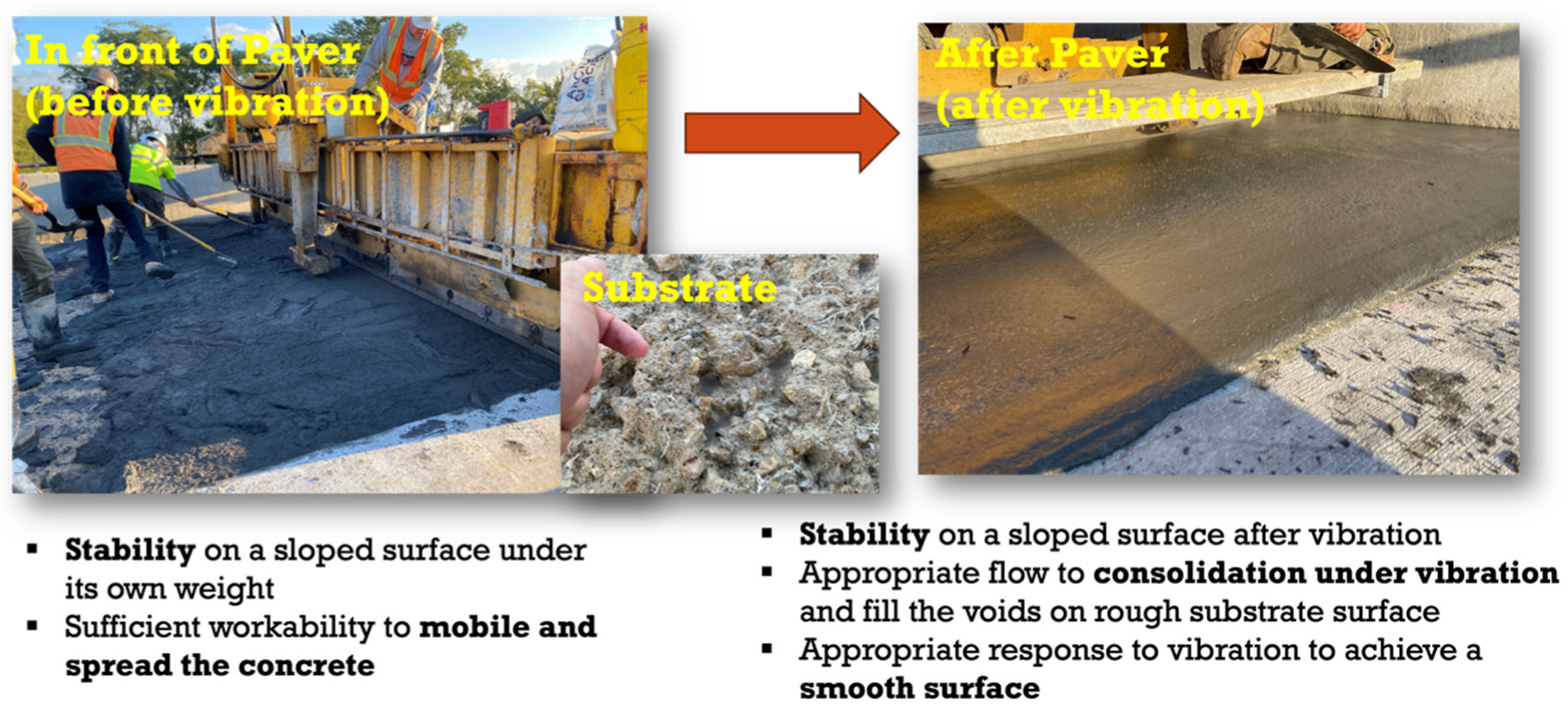
Due to its limited flowability without external mechanical agitation, UHPC overlay material is typically referred to as thixotropic UHPC. Thixotropy, a characteristic of non-Newtonian fluids, involves time-dependent shear-thinning behavior, offering solid-like qualities when static, while allowing flow under agitation or shear [7]. Mainly used in constructing bridge deck overlays, thixotropic UHPC meets the specific need to place overlays on sloped concrete structures [30]. This unique feature enables UHPC to be applied on sloped surfaces, accommodating gradients up to 10 percent while maintaining the required profiles [6,7,31,32]. Figure 1 shows the workability features of thixotropic UHPC with sample photos from a bridge deck overlay project in September 2023 in Cass County, Iowa. Although previous research and field use of UHPC overlays have focused mainly on bridge decks, the fundamental performance requirements are directly relevant to rehabilitating sloped concrete roof slabs. Roof slabs, especially those with low to moderate drainage slopes, face similar demands for structural waterproofing, surface durability, and environmental exposure. While UHPC has been widely studied and used for bridge deck overlays, no published research has explored its use as a repair material for concrete roof slabs. Despite the lack of roof-specific studies, roof slabs and bridge decks share several key functions, such as thin bonded overlays, slope-dependent constructability, vibration-assisted placement, and exposure to harsh environmental conditions. Therefore, the knowledge and techniques developed for UHPC bridge overlays provide a solid basis for advancing UHPC-based roof slab repairs. This study builds on this foundation by creating workability and constructability evaluation methods applicable to both systems. Accordingly, existing bridge overlay research provides a suitable basis for developing roof-slab repair strategies using thixotropic UHPC.
Firstly, the thixotropic UHPC must demonstrate suitable flow properties both before and after vibration (Figure 1). While self-consolidating (non-thixotropic) UHPC is typically evaluated only for static flow per ASTM C1856 [10], understanding the behavior of UHPC overlay materials under movement and agitation requires dynamic flow testing. The kinetic energy from the drops should cause the UHPC to disperse, enabling an assessment of whether the material has too much or too little flow. Various studies and organizations have reported typical dynamic flow ranges for UHPC overlay material. The Federal Highway Administration (FHWA) [7] and commercial overlay UHPC [30] indicated that optimal dynamic flow is between 6 and 8 inches, while the Iowa Department of Transportation (IADOT) [16] and Harris et al. [33] suggested a range of 8 to 10 inches. The New Jersey Department of Transportation (NJDOT) [17] found an effective dynamic flow range of 7 to 10 inches. Literature clearly shows that dynamic flow ranges can vary widely. Therefore, it is important to note that the acceptable dynamic flow range, typically 6 to 10 inches, depends on factors such as the structure’s shape, grade, and cross-slope. The values provided by FHWA [7] apply to UHPC overlay materials suitable for slopes up to 6 percent. Conversely, commercial overlay UHPC [30] reports that the same dynamic flow range can be used on slopes up to 15 percent. The procedure for overlay dynamic flow testing was based on ASTM C1437 [11], although most of the literature states that only 20 drops were used [7,17,30,33]. In their 2022 study, IADOT [16] and NJDOT [17] indicated that the UHPC supplier can determine the number of drops needed to achieve an acceptable spread. The existing literature does not specify static flow ranges, although dynamic flow ranges are established between 6 and 10 inches. It is reasonable to infer that the static flow range is between 4 and 6 inches. Similarly, commercial overlay UHPC [30] reports a typical static flow range of 4 to 6 inches for their overlay mixture.
Since thixotropic UHPC for overlays requires external intervention, such as vibration, to change from a stable workability to a flowable state, evaluating the material’s performance under external energy to achieve a smooth surface and good consolidation is essential. This introduces the second unique workability characteristic of thixotropic UHPC: its response to vibration, as shown in Figure 1. Traditional slump or flow tests do not accurately measure workability because they do not replicate field conditions where vibration energy is applied. The Vibrating Slope Apparatus (VSA), developed by the Waterway Experiment Station of the US Army Corps of Engineers for the FHWA, is used to qualify low-slump concrete for paving [12]. The VSA places a concrete sample in a box chute, consolidates it, and then raises the chute to a specific angle [12]. A vibrator evacuates the concrete, and the time needed for the concrete to move out of the chute under vibration is measured to assess workability [26]. Although the VSA does not directly evaluate the material’s response to vibration, the sloped chute under vibration resembles the sloped construction of UHPC overlays. This leads to the third workability characteristic of thixotropic UHPC: its constructability on a sloped surface. Because concrete roofs and bridge decks are often uneven, thixotropic UHPC must maintain its intended slope under vibration, as demonstrated in Figure 1. While the VSA does not test mixtures for slope stability, vibrating under sloped conditions is advantageous. The Swiss Standard SIA 2052 for UHPFRC [13] developed a similar method to verify a mixture’s ability to sustain a desired slope. This involves using a platform to simulate the concrete roof’s slope and adjusting the UHPC overlay mixture accordingly. The goal is to create a mix that achieves optimal flowability for ease of placement while keeping the specified slope. However, it is important to note that although the slope test recommended by SIA 2052 [13] tests the stability of a mixture under sloped conditions, it does not include vibration to evaluate its effect on stability, thereby neglecting the relevance of vibrator-induced effects in roof and bridge overlay construction.
Although advances in UHPC technology for bridge deck overlays have been made, no previous research has focused specifically on UHPC overlays for roof slab rehabilitation. Additionally, existing literature does not offer comprehensive workability test methods designed for the placement challenges of thixotropic UHPC on sloped surfaces, challenges shared by roof slabs and bridge decks. Current methods for assessing how these materials respond to vibration and their constructability on sloped surfaces provide limited insights. The VSA test [12], which includes a sloped chute and vibration, primarily evaluates workability rather than vibration response or slope stability. Similarly, the slope test developed by SIA 2052 [13] gauges the stability of mixtures on slopes but overlooks the influence of vibration on this stability. Therefore, the static and dynamic flow tests remain the only relevant techniques for assessing the consistency of thixotropic UHPC.
Recognizing these limitations and the lack of a comprehensive UHPC overlay workability framework, this study introduces two new field-oriented tests: the Patting Response (PR) and Vibration-Slope Stability (VSS) tests, designed to measure the vibration response and slope stability of thixotropic UHPC mixtures. A series of non-proprietary thixotropic UHPC mixtures was formulated with varying binder content, water-to-binder ratios, fiber incorporation, and admixture dosages. The successful mixtures were selected based on their performance in standard flow tests and the newly developed PR and VSS tests. To assess the constructability of the chosen mixtures, a lab-scale sloped slab was prepared to mimic field batching conditions typically encountered during roof slab or bridge deck repairs. Correspondingly, the study also established recommended flow range criteria based on the results. The experimental program described here focuses on the fresh-state workability and constructability of thixotropic UHPC overlay mixtures and is not intended to replace evaluations of mechanical or load-bearing performance. Structural performance, including strength, bond behavior, and composite action with the substrate, is being investigated separately and will be reported in a companion study.
Extending UHPC overlay technology to sloped roof slabs advances current developments in UHPC structural applications. Beyond workability, thixotropic UHPC’s ability to maintain geometric accuracy under vibration is essential to ensuring uniform overlay thickness, reliable waterproofing, and effective composite action with the existing substrate. Although UHPC is increasingly used in bridges, no existing framework fully addresses workability, vibration response, and slope stability simultaneously for roof and bridge deck overlay applications. This study addresses this gap by developing two new field-oriented test methods, the PR and VSS tests, and by evaluating UHPC overlays explicitly designed for sloped structural members. The research advances UHPC materials and construction by offering the first comprehensive test suite that measures flow behavior, vibration-induced mobility, and slope stability of thixotropic UHPC. These capabilities support the growing application of UHPC in complex structural rehabilitation, including building roof slabs and sloped infrastructure surfaces, where traditional UHPC mixtures and standard workability tests fall short.
Although UHPC overlay technology has been widely researched for bridge decks, no published studies systematically assess thixotropic UHPC overlays for building roof slabs. This gap in research highlights an opportunity rather than a lack of relevance, since roof slabs and bridge decks have similar constructability requirements, such as thin bonded overlays, vibration-assisted placement, and slope considerations for stability.

2. Materials and Methods

2.1. Materials

In this investigation, all mixture designs used Type IL Portland cement conforming to ASTM C150 [34], obtained from Ash Grove Company (Louisville, NE, USA). The mix also included sand with a maximum aggregate size of No. 10 from Lyman-Richey Corporation (Omaha, NE, USA), ground-granulated blast-furnace slag (GGBFS) according to ASTM C989 from Central Plains Cement Company (Chicago, IL, USA) [35], densified silica fume, and micro straight steel fibers measuring 0.5 inches in length and 0.08 inches in diameter from Bekaert (Wilkes-Barre, PA, USA), as dry constituents. The liquid components incorporated in this research consisted of a water-reducing and retarding admixture (WRT) that meets the Type S admixture specifications outlined in ASTM C494 [36], along with a modified polycarboxylate-based high-range water-reducing (HRWR) admixture adhering to Type F admixture standards, both from CHRYSO (Royse City, TX, USA). The mixing process used tap water. It should be noted that the fine aggregate was air-dried (moisture content approximately 0.2%), and minor differences in moisture content were adjusted before batching. Table 1 lists the proportions of the non-proprietary mixes developed for overlay applications.
The UHPC mixtures were divided into Groups A–G to systematically study how admixture amount, water-to-binder ratio, binder content, and fiber volume affect thixotropic behavior and constructability. Group A is a self-consolidating UHPC reference mixture, while Groups B–D were created by adjusting admixture amounts and water content to achieve different levels of thixotropy. Additional groups were used to explore how binder content and fiber dosage influence thin overlay applications.
Fiber volume fractions (Fib) of 2% and 3% were studied to assess how fiber dosage affects constructability and overlay performance. A 3% fiber content is more commonly used in UHPC overlay applications, especially for thin overlays, where improved crack control and strain-hardening behavior are important, while a lower fiber content of 2% was also tested to evaluate potential reductions in material use and workability issues. The relatively high binder content reflects mixture proportions developed in the authors’ previous UHPC studies [25] and was necessary to ensure proper particle packing and stability in the fresh state when using locally available materials. In this context, binder content was determined more by packing efficiency and constructability needs rather than solely by compressive strength requirements.

2.2. Mixing Procedure

In this study, two different types of mixers were used. A 0.67 ft3 Vollrath benchtop mixer (0.5 HP) (Sheboygan, WI, USA) with three-speed settings was utilized to mix 0.20 ft3 of UHPC overlay for small batches. For larger batches, selected mixtures were prepared using an IMER 120 Vertical Shaft Mixer (Southlake, TX, USA) with batch sizes of approximately 1 ft3.
The mixing procedure used in this study was based on the procedure of a recently developed non-proprietary UHPC for the Nebraska Department of Transportation (NDOT) [25]. UHPC was mixed in three main steps to achieve the desired consistency: dry ingredients mixing, water and admixtures addition, and steel fiber incorporation. Typically, for small batches, the first step involved loading air-dried sand and silica fume into the mixer and stirring for 5 min at speed 1 (200–120 RPM), followed by adding cement and slag and mixing for another 5 min. Before introducing water into the mixture (which begins the second step), 100% of the total WRT was premixed with 80% of the total water. This premixed solution was then added to the mixer to be stirred with the dry ingredients for 7 min at speed 1. The remaining water (20% of the total content) and HRWR admixture were premixed again and loaded into the mixer. It is important to note that admixtures were premixed with water before adding to the mixer for conventional UHPC [25], and the same process was followed for thixotropic UHPC to ensure uniform distribution of admixtures throughout the mix. Adding the remaining water with HRWR initiated the transition from powder to paste, which typically takes 3 to 7 min at speed 2 (200–220 RPM). Visual examination is necessary to determine the appropriate time to add fibers, as the mix must be flowable by then. Note that the mixing time varies with the mixer, depending on factors such as paddle configuration, mixer size, speed, and batch volume. Once a smooth, viscous mixture was achieved, fibers were gradually introduced into the mixer over a 1 min loading period, followed by an additional 3 min of mixing at speed 1 to ensure uniform fiber dispersion. For large batches, a similar mixing procedure was used, except that a constant speed of 45–50 RPM was maintained. The final thixotropic UHPC product was used to evaluate the mixture’s properties in both its fresh and hardened states.

2.3. Test Methods

2.3.1. Flow Test

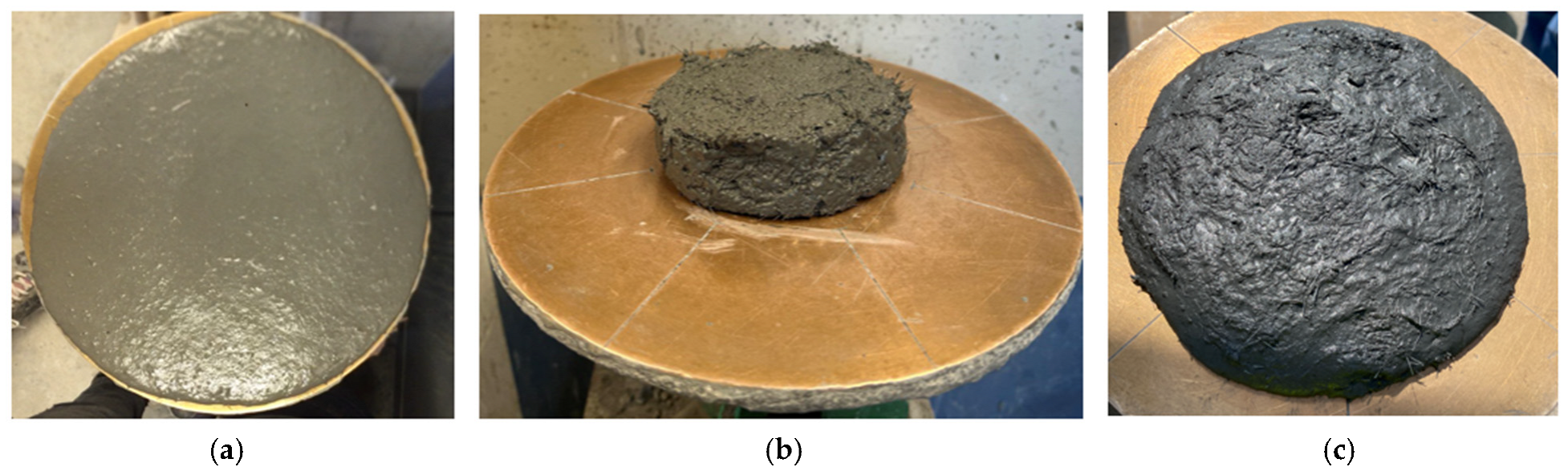
The flowability of each UHPC overlay mixture was tested to ensure proper thixotropic properties and overall workability. The standard flow table, 10 inches in diameter, was used along with a standard flow cone measuring 4 inches in diameter at the bottom and 2.5 inches at the top, as specified in ASTM C230 [37]. Static flow testing followed ASTM C1856 [10], while dynamic flow testing was performed according to ASTM C1437 [11]. After measuring and reporting the average static flow diameter at two minutes, the table was dropped 25 times, and the dynamic flow diameter was recorded. For both static and dynamic flow tests, four diameter measurements were taken for each specimen following ASTM procedures, and the reported flow value is the average of these measurements. The results for conventional UHPC at static flow and the thixotropic overlay UHPC after static and dynamic flow tests are illustrated in Figure 2.
The static and dynamic flows were measured at 0 and 30 min after mixing. The material was kept inside a container and covered with a plate between tests. Before conducting the test at 30 min, the material was stirred for 30 s. For overlay UHPC, the material is expected to maintain its flowability for at least 30 min to ensure proper placement. The acceptance criteria for flow results are based on an extensive review of relevant literature and established standards from authoritative agencies [7,16,17,30]. The acceptance criteria for static flowability are set at less than 6 inches, while those for dynamic flow are set at more than 6 inches. Failure to meet the specified flow results at the designated times in either test indicates that the mixture has not met the acceptance criteria.

2.3.2. Patting Response (PR) Test

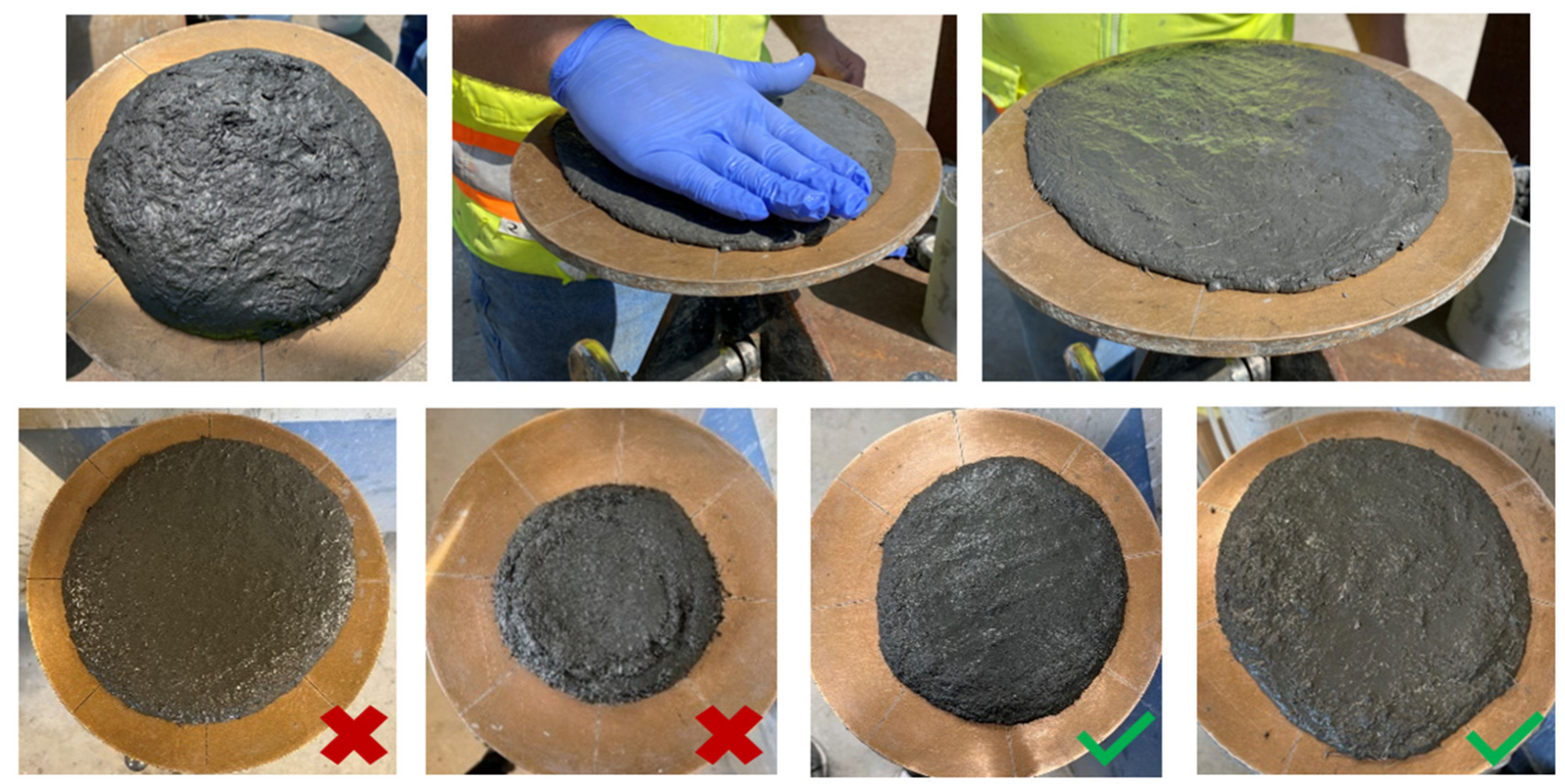
Given that the UHPC overlay material will be subjected to external energy (vibration) during consolidation, the performance of the fresh mixtures under external energy was assessed using a newly developed PR test. Since thixotropic UHPC must react well under vibration for proper consolidation and placement, a PR was created to evaluate the developed UHPC mixtures. The test focuses on how readily the material responds to vibration, ensuring it provides a smooth surface and maintains optimal viscosity, i.e., neither too fluid nor too stiff. Once the dynamic flow test was completed, the agitated UHPC overlay mixtures were patted 10 to 15 times to assess their response to external energy (Figure 3). The PR was determined based on the appearance of the UHPC mixture after patting. To reduce subjectivity, all PR evaluations were performed by the same operator, using consistent patting force (0.2 to 0.5 lb estimated hand pressure) and rate (2–3 pats per second), ensuring a repeatable assessment.
As shown in Figure 3, if the material is too flowable, the handprints after patting will not remain, indicating failure mode 1 (F1). Conversely, if the material is not flowable enough, the handprints will not be imprinted at all due to the stiff surface, classified as failure mode 2 (F2). If the handprints remain after patting and the UHPC surface exhibits a uniform texture with no irregularities, the mixture passes the test, known as mode 1 (P1). However, there are cases where the mixture responds well to external energy, clearly imprinting handprints, but the imprint surface is not perfectly smooth; this is considered a pass as long as the mixture meets the constructability criteria, referred to as passing mode 2 (P2). In this study, the PR test was performed whenever a flow test was conducted. Failure at either 0 or 30 min indicates that the mixture did not pass the test.
Although the Patting Response (PR) test is not meant to be a fully quantitative measurement, it was intentionally designed as a quick, field-based screening tool to evaluate how thixotropic UHPC overlays respond to external energy during placement. Similar qualitative acceptance criteria are often used in concrete construction to assess finishing quality and vibration sensitivity. The standardized test procedure outlined here offers consistent and repeatable results under controlled conditions, while future research may include quantitative methods such as digital handprint image analysis or surface texture measurements to improve objectivity and reproducibility.

2.3.3. Vibration-Slope Stability (VSS) Test

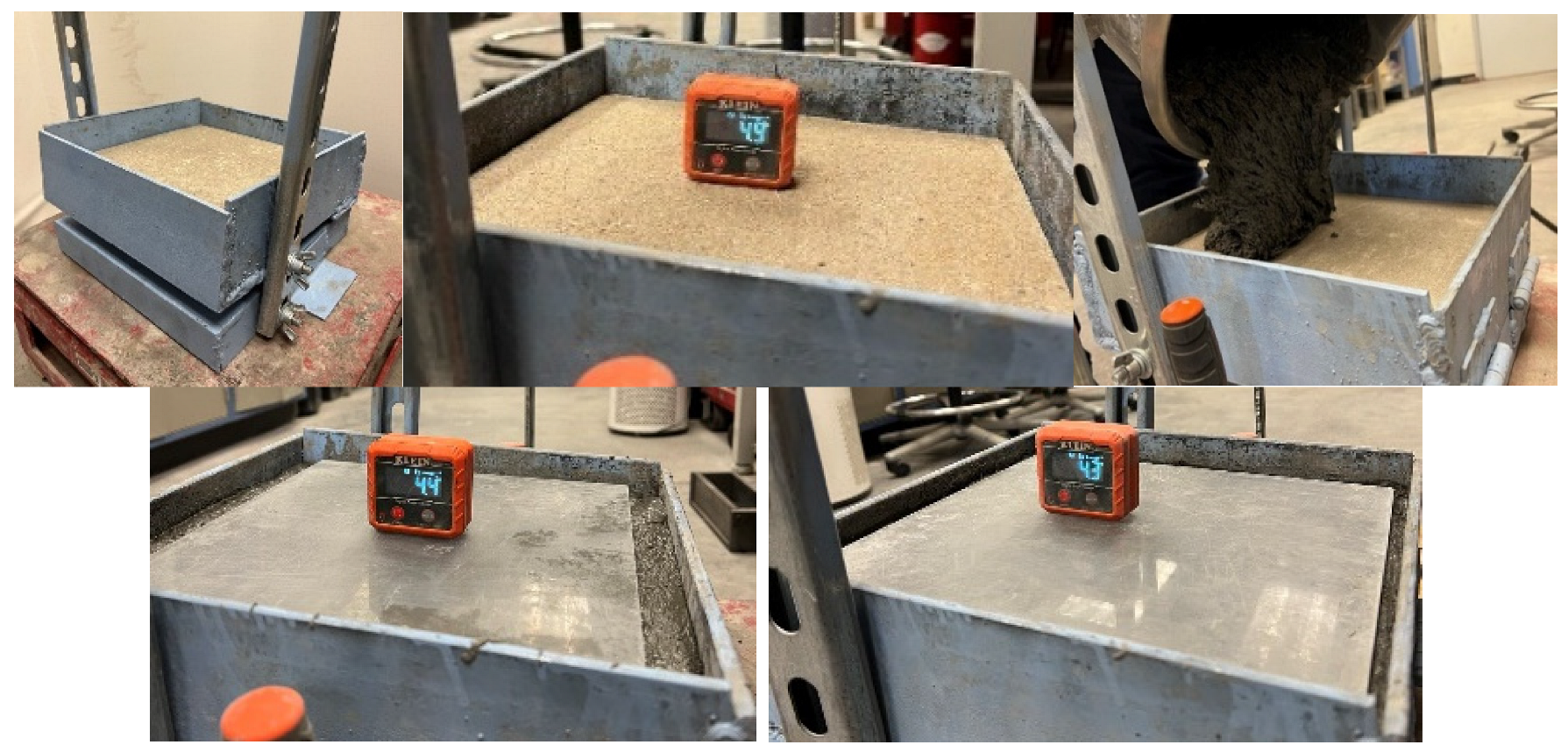
To validate the mixtures’ ability to maintain the desired slope before and during vibration, a VSS test was conducted. The test setup includes a 12″ × 12″ × 4″ steel frame positioned at a 5-degree slope (8.75% grade) and securely attached to a vibrating table, as shown in Figure 4. To mimic the surface of a roughened concrete roof, a 12″ × 12″ × 2″ masonry block with a slightly rough surface was placed inside the testing equipment. The fresh UHPC overlay, 1 inch thick, was manually applied over the masonry block and finished to a smooth surface for better assessment. The installed material was subjected to vibration at a moderate power level of 5 watts and a rotational speed of 6500 revolutions per minute for 1 min, consistent with vibration levels commonly applied in laboratory studies of stiff concrete mixtures that require vibration for consolidation to activate mixture response without causing excessive segregation. These parameters were chosen based on laboratory experience and aimed to provide a representative vibration condition for comparing mixture stability on a sloped surface, rather than replicating a specific field vibration system. Figure 4 illustrates the testing procedure for the developed UHPC overlay mixtures for slope stability under vibration.
Due to surface roughness on the placed UHPC overlay material, plexiglass was placed on top to ensure consistent angle measurements. If the angle after placement prior to vibration was less than or equal to 1.0 degrees (ΔAngleap ≤ 1.0°), it suggested that the material was sufficiently stable for the intended slope, thereby partially passing the test. Following this, if the angle remained stable post-vibration and showed a change of less than 0.5 degrees (ΔAngleav ≤ 0.5°), it indicated that the material maintained consistent flow during vibration, ensuring uniform thickness and adherence to the intended slope, and thus fully passed the test. On the other hand, if the angle either before vibration (after placement) exceeded 1.0 degrees (ΔAngleap > 1.0°) or after vibration exceeded 0.5 degrees (ΔAngleav > 0.5°), it suggested that the material might be too fluid for the intended slope, leading to failure of the test. It is worth noting that failure at either Angleap (angle after placement) or Angleav (angle after vibration) indicates that the mixture failed the test in this study.
The 5° slope was chosen as a conservative screening criterion to enhance the detection of instability under vibration. Mixtures that stay stable at this angle are expected to perform adequately at lower slopes typically found in roof and deck applications, while steeper slopes may need additional adjustments to mixture flow and thixotropic properties.

3. Results

3.1. Performance Evaluation

In this study, various UHPC overlay mixtures were prepared with different binder contents, w/b ratios, fiber contents, and varying dosages of WRT and HRWR admixtures, as illustrated in Table 2. The mixtures were divided into seven groups, each distinguished by the specific amounts of incorporated materials. Different binder contents, w/b ratios, and fiber contents were used in developing the UHPC overlay mixtures. Two binder contents (1900 pcy and 1450 pcy), two w/b ratios (0.180 and 0.196), and fiber contents of 2% and 3% were evaluated, with the corresponding admixture dosages summarized in Table 2. Each mixture is identified based on the following parameters: the percentage of fibers relative to the total volume, binder content, w/b ratio, and the amounts of HRWR and WRT admixtures in pcy, as shown later in Table 3. For clarity, the shortened mixture IDs are listed in the order of mixing for further reference in the paper.
The reference mixture was identified as conventional Cast-in-Place (CIP) UHPC from Group A, which is a non-proprietary, self-consolidating UHPC developed by the research team through a recently completed Nebraska DOT (NDOT) project (SPR-P 1 (18) M 072) titled “Feasibility Study of Development of Ultra-High-Performance Concrete (UHPC) for Highway Bridge Applications in Nebraska” [25]. Therefore, Group A includes only one control conventional UHPC with high flowability (9.3 inches of static flow) and self-consolidating properties, as detailed in Table 2 and Table 3. However, due to the thixotropic nature of the UHPC overlay material, admixture quantities were adjusted in each group while keeping other parameters constant. Mixtures in Groups B and F (3% fiber content, case) were derived from the conventional UHPC base with significantly reduced amounts of HRWR and WRT. These modifications aimed to alter the mixture’s thixotropic characteristics while maintaining the desired consistency. As shown in Table 3, several successful mixtures in Groups B and F passed all the tests described above. Group D mixtures featured a lower binder content of 1450 pcy compared to 1900 pcy in Group B. Despite this reduction, the w/b ratio remained constant at 0.180. The binder content was reduced proportionally, maintaining the same silica (8%) and slag (30%) percentages as in the Group B mixture designs. The main reason for evaluating a reduced binder content mixture was the relatively low need for high compressive strength in deck overlay applications [38]. Deck overlays generally serve as protective layers rather than significantly enhancing structural strength [39]. However, adjustments in admixture amounts did not yield successful overlay mixtures for either Group D or Group G, the latter being the 3% fiber case of Group D. The primary issue appeared to be the limited amount of incorporated water [25], which caused surface roughness during patting and ultimately led to failure of the PR test, despite passing the flow and VSS tests. Therefore, for Groups C and E (3% fiber content, case), the w/b ratio was increased to 0.196 while maintaining the low binder content of 1450 pcy. Similar to Groups B and D, the amounts of HRWR and WRT in Groups C and E were adjusted to achieve the desired flowability, which was successful.
The key to changing self-compacting behavior to thixotropic behavior is the use of admixtures. Unlike self-consolidating UHPC, thixotropic overlay UHPC requires a higher WRT than HRWR to maintain flowability for a longer period. Therefore, among each of the six developed groups, only the amount of admixtures was adjusted to reach suitable ranges, while other parameters stayed the same. Table 3 shows the results of flow at 0 and 30 min, PR at 0 and 30 min, and VSS at 0 min after mixing for all mixtures. Comparing the results shows that using WRT alone without HRWR increases flowability over time. A proper amount of HRWR balances WRT’s effect, helping maintain steady flowability. The optimal HRWR range was found to be 3–5 pcy (approximately 2.3–3.9 fl-oz/cwt and 3.1–5.1 fl-oz/cwt for the 1900 and 1450 pcy mixtures, respectively), as higher levels disrupt this balance and cause a significant drop in flow over time. The right WRT range is between 47 and 54 pcy (approximately 36–41 fl-oz/cwt for the 1900 pcy mixes and 47–54 fl-oz/cwt for the 1450 pcy mixes). Still, because mixture consistency can vary with batch size, mixing energy, temperature, and mixing time, adjustments in HRWR and WRT amounts may be needed to achieve the desired consistency in the field. The flow results for Groups B and C mixtures (also Groups F and E) generally increased within a certain range during testing. In contrast, Group D mixtures showed decreased flowability, sometimes failing to maintain proper dynamic flow for up to 30 min.
Generally, increased fiber content is believed to decrease flowability [20,40,41,42]. This reduction can be attributed to the increased internal specific surface area resulting from the high fiber content, which enhances cohesive forces between the fibers and the concrete matrix. Since fibers are significantly more elongated than aggregates, their surface area is proportionally larger for the same volume. Additionally, the random distribution of steel fibers throughout the matrix creates a structural framework that further impedes the flow of fresh concrete [20,40,41,42]. This study found that increasing fiber content from 2% to 3% has a minimal impact on flowability across all groups, provided the WRT amount is not excessively large. The trend was evident in Groups C and E, where static flow results were higher in Group C mixtures than in Group E, though dynamic flow results were relatively similar. However, within this paper’s scope, increasing fiber content required a corresponding reduction in sand content, which may explain the consistent flowability despite the change in fiber amount. It has also been observed that, at the same fiber content and w/b ratio, higher binder content results in better flowability, as seen in Groups B and D. The increased flowability in Group B can be attributed to the higher paste content, which reduces viscosity and enhances the mixture’s flowability [25]. Additionally, the higher paste content improves cohesion by reducing segregation [25]. Conversely, the difference in binder content does not significantly affect static flow results within Groups B and C or Groups E and F, aside from slightly higher results in Group B for the same reason. It is also important to note that a higher w/b ratio in Group C mixtures did not necessarily lead to higher flow values.
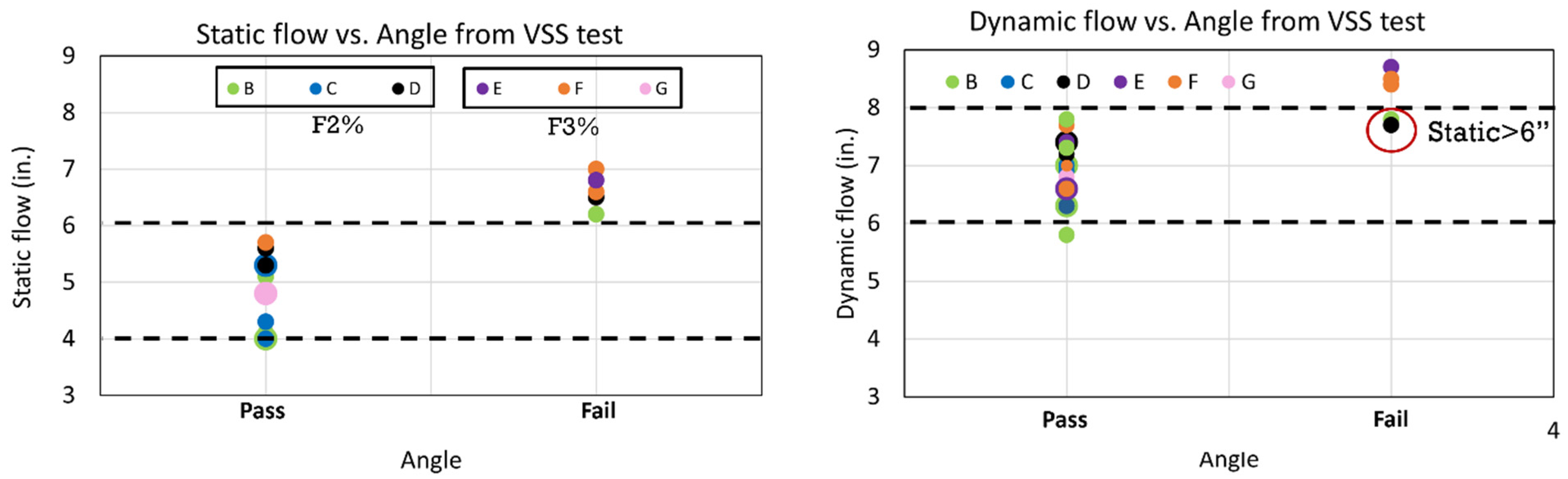
Figure 5 shows the relationship between flow at 0′ and the angle of the VSS results. Mixtures labeled “Pass” passed the VSS test, maintaining their angle after placement and vibration, while mixtures labeled “Fail” did not. The results reveal that static and dynamic flow outcomes align well with VSS test results. The dynamic flow graph suggests that mixtures with a flow value over 8 inches are generally considered to have failed the VSS, with some exceptions that fall within the acceptable range but fail the static flow by exceeding 6 inches.
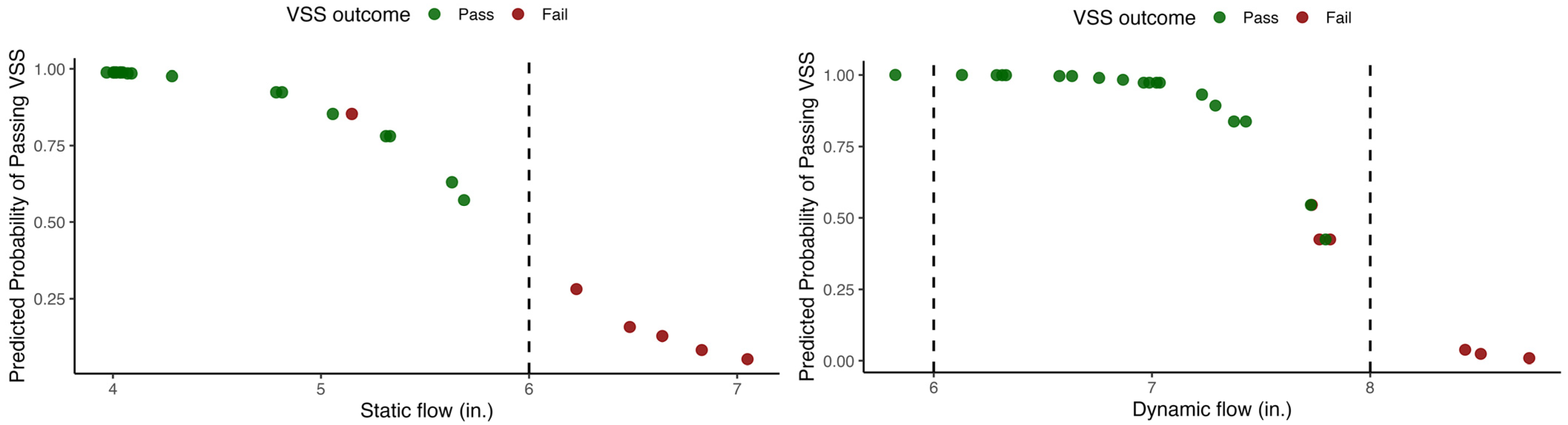
Because the VSS outcome is binary (pass/fail), logistic regression was used to analyze the relationship between flow measurements and VSS performance. Due to the limited sample size and the clear separation between passing and failing mixtures, a bias-reduced (Firth) logistic regression approach was applied in R (version 4.3.2) in RStudio (version 2023.12.1+402). Model performance was assessed using receiver operating characteristic (ROC) analysis, which measures a predictor’s ability to reliably distinguish between pass and fail results at various classification thresholds. The discriminative power of each model was summarized by the area under the ROC curve (AUC), with values near 1 indicating excellent separation. Static flow showed strong predictive ability with an AUC of 0.9605, while dynamic flow performed even better with an AUC of 0.9781. Figure 6 displays the predicted probability of passing the VSS test based on flow, derived from the logistic regression models. Generally, mixtures within the dynamic flow range that fail the VSS test do not meet the static flow criterion. The exceptions are Mixture 5, which passed the VSS test despite low dynamic flow, and Mixture 6, which failed the VSS test despite falling within acceptable flow ranges. Both mixtures failed to meet flow criteria at 30’. These findings quantitatively confirm the strong link between flow behavior and VSS results and support using static and dynamic flow ranges as dependable indicators of mixture stability under vibration.
The relatively high binder content improved paste cohesion and stability during placement, enhancing constructability and resistance to segregation under vibration. While increased binder content might also lead to higher compressive strength, its primary role in this study was to support fresh-state stability and the constructability of thin UHPC overlays rather than to optimize strength.
Overall, the results show that conventional static and dynamic flow tests alone are insufficient to fully characterize the constructability of thixotropic UHPC overlay mixtures. The PR and VSS tests offered complementary insights into vibration response, surface stability, and time-dependent behavior that flow measurements did not capture. These findings emphasize the importance of combining flow-based and performance-oriented tests when choosing UHPC overlay mixtures for sloped and vibration-assisted placement conditions.

3.2. Constructability

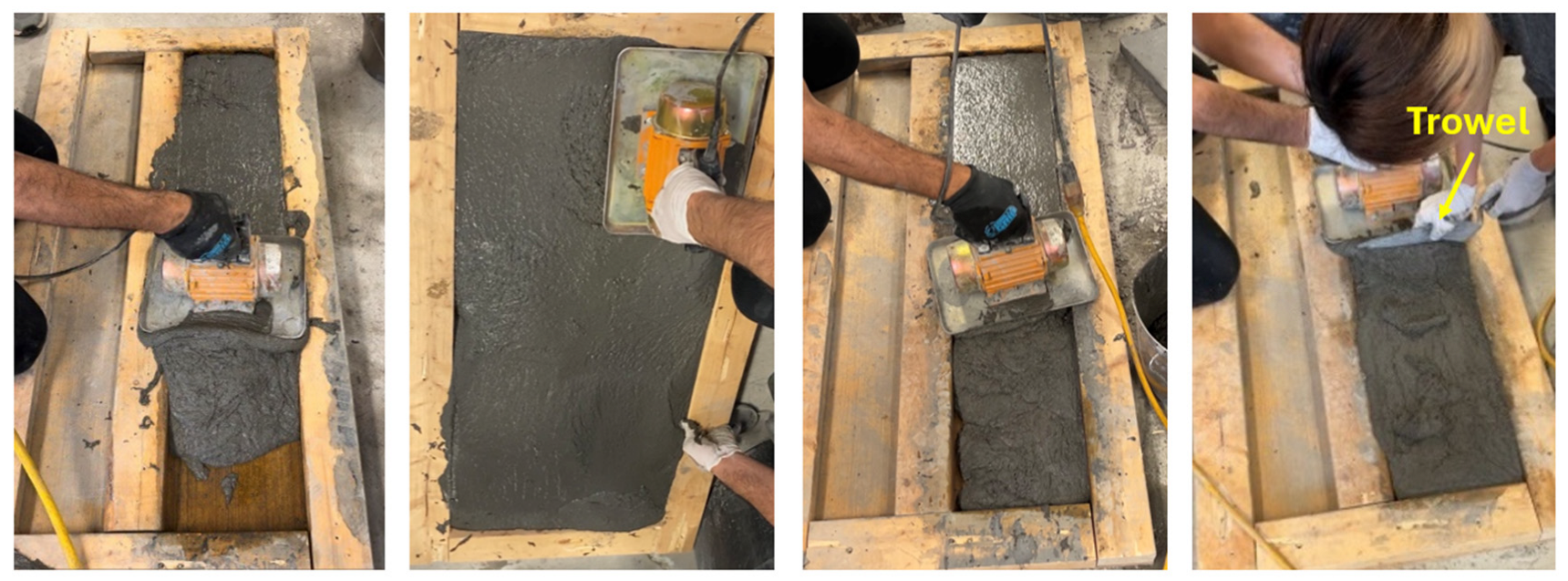
Based on the performance evaluation results, four UHPC overlay mixtures from Groups B, C, E, and F were selected for further constructability testing. Although several mixtures in each group were successful, their only difference was the amount of admixture added, which can be adjusted within acceptable flow ranges. A wooden test frame measuring 41 inches by 9 inches by 1 inch was built to simulate a mock-up slab construction. The setup was tilted at a 2-degree angle (3.5% grade) to assess UHPC performance under sloped conditions. A 1-inch thick UHPC overlay was then applied to the wooden surface using surface vibration, as shown in Figure 6, to replicate the consolidation process of a vibrator on roof and bridge structures. The test was performed 15–30 min after mixing was completed. The material was placed from the top to the bottom of the slope. After confirming that the material did not flow out under its own weight (without vibration), surface vibration was applied to distribute the material from the top to the bottom of the slope. The material responded and spread evenly as the surface vibration moved toward the sloped side. Figure 7 illustrates the UHPC overlay placement process for the four selected groups.
The acceptance criteria for this test were as follows: if the material spread easily with surface vibration but stopped flowing without it, it passed. However, the mixture did not pass if it required external assistance beyond surface vibration to flow. Constructability results for all mixtures met acceptable standards, except for Group F, which had a more viscous mixture than the others. Figure 6 shows that an external force, such as a trowel, was required to spread the UHPC overlay, indicating that surface vibration alone was insufficient for proper spreading and consolidation. This suggests a stiffer, more viscous material. Additionally, visual observations during UHPC placement indicated the material might not fully fill the voids on the roughened surface of the roof substrate, which is necessary for strong bonding. In contrast, other overlay mixtures spread smoothly on a sloped surface with surface vibration alone, without external help.
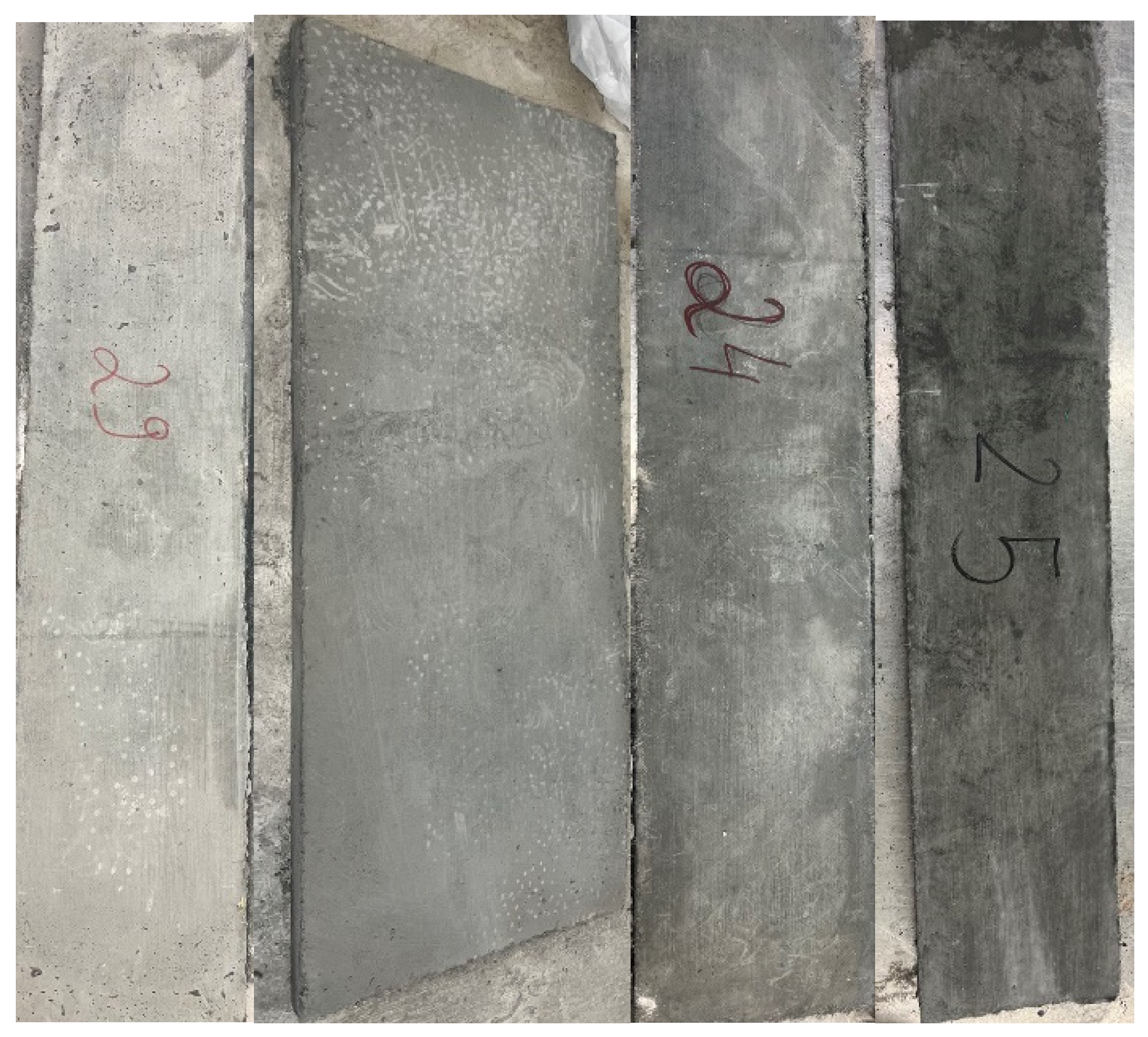
The constructability evaluation also included inspecting the surface condition of the hardened slabs, both the top and bottom surfaces. The final UHPC overlay must be free of significant air voids and honeycombs to ensure structural integrity and durability. Figure 8 shows UHPC overlay slabs at the hardened stage. Measurements indicate that the percentage of surface air voids larger than 0.09 in2 is 0.29% for Group B, 0.16% for Group C, 0.17% for Group E, and 0.37% for Group F. These results suggest that the mixtures effectively minimize large air voids, indicating good consolidation and a smooth surface. Even Group F showed favorable results because it received external help beyond surface vibration for consolidation.
The flow, PR, and constructability outcomes for the four developed UHPC overlay mixtures are summarized in Table 4. The Group F mixture exhibited marginal dynamic flow (6 in. at 30 min) and failed the constructability test, indicating that increased vibration energy or duration may be necessary for adequate placement of stiffer materials.

3.3. Compressive Strength

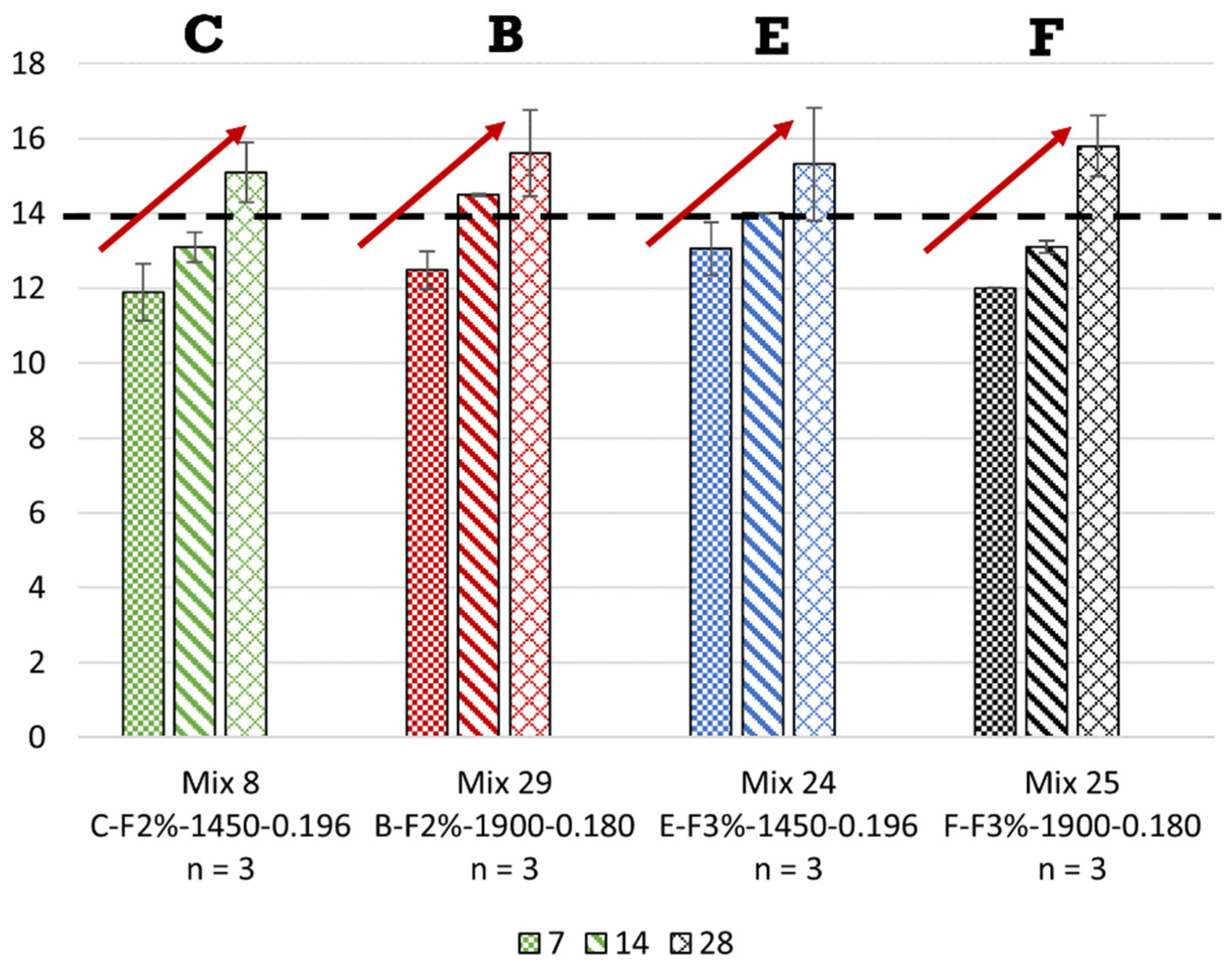
Figure 9 shows the average compressive strength as a function of age for the four developed UHPC overlay mixtures. As indicated by the red arrows, all mixtures exhibited increasing compressive strength with curing time. All mixtures surpassed the 28-day compressive strength requirement of 14 ksi specified by IADOT (2022) [16], as denoted by the dashed horizontal line in Figure 9. Mixtures with lower binder content (Groups C and E) achieved 28-day strengths similar to those with higher binder content (Groups B and F), and all mixtures showed a consistent increase in strength over time.
Qualitatively, mixture performance was most sensitive to the balance between WRT and HRWR dosages, which controlled thixotropic recovery, vibration response, and surface stability. Finding the right balance between these admixtures helped achieve sufficient flowability while enabling rapid structural build-up after vibration, leading to stable placement on sloped surfaces. Conversely, mixtures with insufficient water content or excessive HRWR dosage (such as those in Group D) showed inadequate surface response and loss of cohesion at later ages, even though they met conventional static and dynamic flow criteria. This indicates that high flow values alone can mask underlying instability caused by delayed thixotropic recovery or excessive paste lubrication. The discrepancies between flow-based acceptance and PR or VSS results further highlight that the constructability of thixotropic UHPC overlays depends on a combined interaction of mixture composition, time-dependent rheological recovery, and external energy input, rather than flow measurements alone.

4. Discussion

The workability and constructability findings from this study provide important insights into the placement behavior of thixotropic UHPC overlay mixtures. In UHPC overlays, poor flow or instability during vibration can lead to excessive thickness variations, poor consolidation, and weak bond quality, all of which impair the long-term performance of UHPC structural systems. The validated different workability measurement methods address key constructability issues related to bond, integrity, and structural compatibility of UHPC overlays used in bridges and buildings.
To the authors’ knowledge, the PR and VSS tests presented in this study do not have direct equivalents in the existing literature for UHPC overlay evaluation. Unlike traditional flow-based tests, which mainly assess spreadability, these methods are specifically designed to evaluate vibration response, surface stability, and time-dependent behavior relevant to sloped and vibration-assisted UHPC overlay placement. Accordingly, the PR and VSS tests serve as field- and lab-oriented tools for constructability assessment, complement existing workability tests, and fill important gaps in current UHPC overlay evaluation methods. Although the literature reports a wide range of acceptable dynamic flow values for UHPC overlays (typically 6–10 in.), the flow acceptance criteria proposed in this study were derived empirically from VSS pass/fail outcomes rather than adopted in advance from existing specifications.
Building on this performance-based framework, the experimental program demonstrated that the new test methods, particularly the PR and VSS tests, effectively assess the thixotropic properties and overall workability of UHPC overlay mixes. As summarized in Table 3, both PR and VSS results closely matched static and dynamic flow measurements, giving a better overall understanding of flowability, slope stability, and surface response to vibration. With the exception of Groups A and D, all mix groups performed satisfactorily after adjusting admixture amounts. The poor results of Group A matched its self-consolidating nature, while Group D’s mixes showed inadequate vibration response, as per the PR acceptance criteria. These findings agree with previous studies [5,6], which also observed that thixotropic UHPC behavior is very sensitive to paste volume and mix balance. Figure 5 and Figure 6 show the relationship between static and dynamic flow measurements and VSS test outcomes. Logistic regression analysis confirms a strong link between flow behavior and VSS pass/fail results, suggesting that flow measurements can effectively indicate mixture stability under vibration. Based on these findings, performance-based flow criteria were established to distinguish stable and unstable thixotropic UHPC overlay mixtures, rather than relying on predefined limits from existing specifications. It is important to note that these recommendations are based on tests conducted on a 5° slope; at lower roof inclinations, flow may not be noticeable even under vibration. Although the VSS procedure provides a direct evaluation of field constructability by yielding a more realistic assessment of slope stability under vibration, its complexity may limit its routine use. Therefore, it is advisable to use the static and dynamic flow ranges established in this study as practical indicators for verifying slope stability in field conditions.
Constructability assessments further validated the reliability of the proposed testing framework. Based on the flow ranges established from the VSS results, a strong link exists between constructability performance and both flow and PR outcomes, supporting the use of these laboratory tests for predicting field performance. As shown in Table 4, mixtures with static flow less than 4 in. and dynamic flow between 6 and 8 in. successfully meet the constructability criteria. The only Group F mixture that showed marginal dynamic flow (6 inches at 30 min) failed the constructability test, indicating that additional vibration energy or duration may be needed for proper placement of highly viscous materials. Conversely, mixtures with dynamic flow values above 7 inches at 25 droppings consistently achieved full consolidation and a uniform surface finish. Accordingly, the optimal dynamic flow range for thixotropic UHPC overlays is refined to 7–8 in., offering the best constructability performance. This refinement aligns with the decreased slope angle used in the constructability test, which was reduced from 5° in the VSS setup to 2° in the constructability evaluation.
Because the constituent materials of the UHPC system remain unchanged and only the admixture dosages are adjusted to achieve thixotropic behavior, the fundamental mechanical, durability, and bonding properties of UHPC are unlikely to be negatively affected. Instead, the improved thixotropic response mainly influences fresh-state performance by enhancing placement stability, vibration response, and resistance to segregation on sloped surfaces. Consequently, thin UHPC overlays designed with these principles are expected to retain the exceptional durability, low permeability, and strong bonding to substrates characteristic of UHPC systems, while adding minimal dead load to the structure. It is important to note that proper surface preparation of the substrate, including cleaning, roughening, and moisture conditioning, is critical to ensure adequate bond strength and composite action. Previous FHWA studies [6,7,32] have shown that thixotropic UHPC overlays, when correctly proportioned and placed, do not compromise long-term durability or bond performance, supporting the applicability of the constructability-based recommendations presented in this study. Accordingly, the constructability-based recommendations in this study should be considered alongside traditional mechanical performance requirements for UHPC overlay applications.
While these findings provide valuable guidance, more data are needed to refine the recommended flow range for optimal field constructability. These observations emphasize that progress in UHPC materials must go hand in hand with advances in field-applicable constructability tools. The ability of thixotropic UHPC mixtures to maintain slope stability, respond predictably to vibration, and achieve uniform consolidation is vital for developing reliable UHPC structural systems. The results support a growing trend in UHPC research, in which fresh-state stability, mixture rheology, and placement control are seen as key factors contributing to UHPC’s superior mechanical and durability properties.
The laboratory mixing process partly relies on visual assessment to determine when to add fiber, which can be difficult when increasing batch size. To test scalability, selected mixtures were later prepared using an IMER mixer with batch volumes of up to about 4 ft3, demonstrating fresh behavior and buildability similar to those observed in laboratory-scale mixing. Results from these larger-batch trials are not included in this study because their addition was outside the scope of this paper and its focus on constructability assessment methods.
The compressive strengths of all four UHPC overlay mixtures exceeded the 14 ksi requirement at 28 days as specified by IADOT (2022) [16]. However, they did not meet the 18 ksi requirement set by NJDOT [17], NYDOT (2021) [38], and the commercial Ductal overlay product [30]. It is important to note that this 18 ksi requirement aligns with the standards for CIP UHPC, as ASTM C1856 [10] requires a 28-day compressive strength of 17 ksi for CIP UHPC. Nevertheless, UHPC overlays serve a fundamentally different purpose than CIP UHPC, as they are primarily designed for protection rather than for increasing structural capacity. As noted by Wibowo and Sritharan (2018) [39], tensile performance, durability, and bonding behavior are more critical than compressive strength for overlay applications. As a result, the 14 ksi 28-day strength is considered acceptable, and all four mixtures meet this standard. Additionally, the strength gain over time ensures long-term load-bearing capacity, durability, and structural integration of the UHPC overlay.
It is also noteworthy that mixtures with lower binder content (Groups C and E) showed compressive strengths at 28 days that were nearly the same as those of Groups B and F. Overall, the findings confirm that adjusting admixture content, especially balancing HRWR and WRT, enables controlled thixotropic behavior suitable for roof and deck overlay applications. The developed PR and VSS test methods reliably predict workability and constructability, while compressive-strength results confirm that lower-binder UHPC mixtures can meet performance requirements. These results collectively demonstrate a practical, cost-effective, and field-ready framework for designing UHPC overlays with consistent placement quality, durability, and structural integrity.
While this study provides a comprehensive laboratory assessment of thixotropic UHPC, certain limitations should be acknowledged. Only one slope angle (5°) and thickness (1 inch) were examined, although actual roof and deck configurations may vary. The constructability evaluation was performed at a constant slope of 2°, which represents typical conditions for bridge decks and low-slope roof applications. Although this slope is common in practice, using only one inclination limits the direct applicability of the results to steeper geometries. Future research should examine constructability performance over a broader range of slope angles to improve mixture selection criteria. Further testing across a range of slopes (1–10%), overlay thicknesses, and vibration energies is also recommended to extend these conclusions to different field conditions. The PR method, while effective for quick field assessment, still depends on visual interpretation and would benefit from future quantitative measures such as instrumented vibration or image-based evaluation. Future research will build on these findings by investigating tensile behavior, bond strength, shrinkage resistance, and durability to better evaluate the suitability of these mixtures for UHPC structural overlays. These next steps align with ongoing efforts to advance UHPC structural systems.

5. Conclusions

This study introduced the development of non-proprietary thixotropic UHPC mixtures suitable for use as overlays on both bridge decks and low-slope roof slabs. These mixtures were evaluated through static and dynamic flow tests along with the newly introduced PR and VSS methods. The results confirm that the developed mixtures offer the workability needed for overlay applications on low-slope surfaces. Several non-proprietary thixotropic UHPC mixtures with varying binder content, water/binder ratio, fiber content, and admixture dosages were prepared and tested. Lab-scale slabs were created to simulate field roof and bridge overlay construction, aiding in assessing constructability and the effectiveness of these workability tests for overlay applications. Based on the results of the constructability tests, recommended flow-range criteria were established. The comprehensive laboratory study led to the following conclusions:
  • The static and dynamic flow, PR, and VSS tests can effectively assess different aspects of thixotropic UHPC and provide comprehensive information on workability characteristics, such as maintaining proper flow, responding well to vibration, and ensuring slope stability during vibration for overlay construction.
  • In addition to static and dynamic flow tests for the UHPC overlay mixture, the PR test can be easily performed in the field as a quality control measure, especially to evaluate the mixture’s ability to achieve surface smoothness after vibration.
  • Comparing results from various test methods, static and dynamic flow results show a good correlation with VSS results. However, due to the complexity of the VSS test, it may be more appropriate for use during the mixture development stage in the lab.
  • Thixotropic UHPC mixtures can be created with a high dosage of workability-retaining admixtures (WRT), using both 1900 and 1450 pcy binder contents and w/b ratios of 0.18 and 0.20, respectively. Of the seven groups evaluated, Group A is a conventional (self-consolidating) UHPC that was deemed unsuitable for overlay; Groups D and G did not flow due to their limited water content, while Groups B, C, E, and F showed excellent workability for overlay construction.
  • Mixtures with fiber contents of 2% and 3% demonstrated satisfactory workability. However, further research is needed into their mechanical and durability properties to determine the best fiber content for UHPC overlay mixtures.
  • Unlike conventional UHPC, which usually contains a high dosage of HRWR, overlay UHPC requires a different approach due to its thixotropic characteristics and longer construction times. Specifically, overlay UHPC calls for a large amount of workability-retaining admixture (WRT) and a smaller amount of HRWR. Research shows that an optimal balance of HRWR improves WRT effectiveness, resulting in stable flowability. The recommended range for WRT in the developed overlay UHPC mixes is 47–54 pcy (approximately 36–41 fl-oz/cwt for the 1900 pcy mixes and 47–54 fl-oz/cwt for the 1450 pcy mixes), while HRWR is much lower, at 3–5 pcy (approximately 2.3–3.9 fl-oz/cwt and 3.1–5.1 fl-oz/cwt for the 1900 and 1450 pcy mixes, respectively).
  • Constructability evaluation has confirmed the effectiveness of the developed test methods. After evaluating the constructability of promising mixtures from four different groups, it is recommended that static flow be less than 6 inches, and dynamic flow be between 7 and 8 inches at 25 drops to ensure successful UHPC overlay construction.
This study advances UHPC structural materials by establishing a validated, field-oriented workability framework for thixotropic UHPC used on sloped structural elements such as roof slabs and bridge decks. The workability criteria and mixture proportions provided here offer a practical foundation to support design standards, improve constructability, and enhance the placement quality of UHPC overlays in real-world applications. By applying UHPC overlay technology to roof slabs, this research addresses a crucial gap in repairing aging building infrastructure and provides a durable alternative to traditional membrane systems.

Author Contributions

Conceptualization, A.A., G.M. and J.H.; Methodology, A.A., M.G., G.M. and J.H.; Validation, A.A.; Formal analysis, A.A.; Investigation, M.G.; Data curation, A.A. and M.G.; Writing—original draft, A.A.; Writing—review and editing, M.G., G.M. and J.H.; Visualization, A.A.; Supervision, G.M. and J.H.; Project administration, G.M. and J.H.; Funding acquisition, G.M. and J.H. All authors have read and agreed to the published version of the manuscript.

Funding

This research was funded by Nebraska Department of Transportation grant number NDOT FY24(034).

Data Availability Statement

The original contributions presented in this study are included in the article. Further inquiries can be directed to the corresponding author.

Acknowledgments

The authors express their gratitude to the Nebraska Department of Transportation (NDOT) for financing the research project. They especially acknowledge the NDOT Technical Advisory Committee members for their technical guidance, valuable input, and continuous support. Additionally, they extend special thanks to David Hill, and Rachel Osborn for their significant support and assistance in the laboratory work.

Conflicts of Interest

The authors declare no conflicts of interest.

Abbreviations

The following abbreviations are used in this manuscript:
UHPCUltra-High-Performance Concrete
CIPCast-in-Place
VSSVibration-Slope Stability
PRPatting Response
HRWRHigh-Range Water Reducer
WRTWorkability Retaining Admixture
BURBuilt-up Roofing
EPDMEthylene Propylene Diene Monomer
PVC.Polyvinyl Chloride
TPOThermoplastic Polyolefin
MBMModified Bitumen Membranes
VSAVibrating Slope Apparatus
FHWAFederal Highway Association
ASTMAmerican Society for Testing and Materials
IADOTIowa Department of Transportation
NJDOTNew Jersey Department of Transportation
NDOTNebraska Department of Transportation
NYSDOTNew York State Department of Transportation

References

  1. Flickinger, D. Roof systems. In Standard Handbook for Civil Engineers, 4th ed.; Merritt, F.S., Ricketts, J.T., Eds.; McGraw-Hill: Columbus, OH, USA, 1999. [Google Scholar]
  2. Kalibatas, D.; Kovaitis, V. Selecting the most effective alternative of waterproofing membranes for multifunctional inverted flat roofs. J. Civ. Eng. Manag. 2017, 23, 650–660. [Google Scholar] [CrossRef]
  3. Walter, A.; de Brito, J.; Grandão Lopes, J. Current flat roof bituminous membranes waterproofing systems—Inspection, diagnosis and pathology classification. Constr. Build. Mater. 2005, 19, 233–242. [Google Scholar] [CrossRef]
  4. ElKhatib, L.W.; Elkordi, A.; Khatib, J. Methods and surface materials repair for concrete structures—A review. BAU J.-Sci. Technol. 2023, 4, 7. [Google Scholar] [CrossRef]
  5. Teng, L.; Valipour, M.; Khayat, K. Design and performance of low shrinkage UHPC for thin bonded bridge deck overlay. Cem. Concr. Compos. 2021, 118, 103953. [Google Scholar] [CrossRef]
  6. Graybeal, B.; Haber, Z. Ultra-high performance concrete for bridge deck overlays. US Dep. Transp. FHWA 2018, 40, 4–16. [Google Scholar]
  7. Haber, Z.B.; Foden, A.; McDonagh, M.; Ocel, J.M.; Zmetra, K.; Graybeal, B.A. Design and Construction of UHPC-Based Bridge Preservation and Repair Solutions; No. FHWA-HRT-22-065; United States. Federal Highway Administration. Office of Infrastructure Research and Development: Washington, DC, USA, 2022. [Google Scholar] [CrossRef]
  8. Mendonca, F.; Hu, J. Impact of chemical admixtures on time-dependent workability and rheological properties of ultra-high-performance concrete. ACI Mater. J. 2021, 118, 383–394. [Google Scholar] [CrossRef]
  9. Brühwiler, E. Rehabilitation and strengthening of concrete structures using ultra-high FloMoyo. In Concrete Repair, Rehabilitation and Retrofitting III; Taylor & Francis Group: Oxfordshire, UK, 2012; pp. 72–79. ISBN 978-0-415-89952-9. [Google Scholar]
  10. ASTM C1856; Standard Practice for Fabricating and Testing Specimens of Ultra-High-Performance Concrete. ASTM International (American Society for Testing and Materials): West Conshohocken, PA, USA, 2017.
  11. ASTM 1437; Standard Test Method for Flow of Hydraulic Cement Mortar. ASTM International (American Society for Testing and Materials): West Conshohocken, PA, USA, 2020.
  12. Wong, G.S.; Alexander, A.M.; Haskins, R.; Poole, T.S.; Malone, P.G.; Wakeley, L. Portland-Cement Concrete Rheology and Workability; No. ERDC-TR-S-XX-00; FHWA-RD-00-025; Turner-Fairbank Highway Research Center: McLean, VA, USA, 2001. [Google Scholar]
  13. Swiss Society of Engineers and Architects. SIA 2052: Guidelines for Ultra-High-Performance Fiber-Reinforced Concrete (UHPFRC). Available online: https://www.sia.ch (accessed on 23 October 2025).
  14. Graybeal, B.A.; Haber, Z.B.; Nakashoji, B.; Parra-Montesinos, G.J. Field Testing of an Ultra-High Performance Concrete Overlay; FHWA-HRT-17-096; Federal Highway Administration, U.S. Department of Transportation: Washington, DC, USA, 2017. Available online: https://www.fhwa.dot.gov/publications/research/infrastructure/structures/bridge/17096/ (accessed on 23 October 2025).
  15. Haber, Z.; De la Varga, I.; Munoz, J.F.; Graybeal, B.A. UHPC Overlays for Highway Bridge Decks: Bond Behav-ior, Durability, and Structural Performance. Int. Interact. Symp. Ultra-High Perform. Concr. Pap. 2019, 2. [Google Scholar] [CrossRef]
  16. IADOT. Special Provisions for Ultra High Performance Concrete Overlay; SP-150886; Iowa Department of Transportation: Ames, IA, USA, 2022. [Google Scholar]
  17. NJDOT. Sample Draft Special Provisions for UHPC Overlay; New Jersey Department of Transportation: Trenton, NJ, USA, 2025. [Google Scholar]
  18. Khayat, K.; Meng, W.; Vallurupalli, K.; Teng, L. Rheological Properties of Ultra-High-Performance Concrete—An overview. Cem. Concr. Res. 2019, 124, 105828. [Google Scholar] [CrossRef]
  19. Wu, Z.; Khayat, K.H.; Shi, C. Changes in rheology and mechanical properties of ultra-high performance concrete with silica fume content. Cem. Concr. Res. 2019, 123, 105786. [Google Scholar] [CrossRef]
  20. Meng, W.; Khayat, K.H. Effect of hybrid fibers on fresh properties, mechanical properties, and autogenous shrinkage of cost-effective UHPC. J. Mater. Civ. Eng. 2018, 30, 04018030. [Google Scholar] [CrossRef]
  21. Ranade, R.; Li, V.C.; Stults, M.D.; Heard, W.F.; Rushing, T.S. Composite properties of high-strength, high-ductility concrete. ACI Mater. J. 2013, 110, 413–422. [Google Scholar] [CrossRef]
  22. Teng, L.; Jin, M.; Du, J.; Khayat, K.H. Synergetic effect of viscosity modifying admixtures and polycarboxylate ether superplasticizer on key characteristics of thixotropic UHPC for bonded bridge deck overlay rehabilitation. Case Stud. Constr. Mater. 2024, 20, e02739. [Google Scholar] [CrossRef]
  23. Teng, L.; Khayat, K.H.; Liu, J. Recent Advances in the Rheological Properties of Ultra-High-Performance Concrete: A Critical Review. Engineering 2025. [Google Scholar] [CrossRef]
  24. Haber, Z.B.; De la Varga, I.; Graybeal, B.A.; Nakashoji, B.; El-Helou, R. Properties and Behavior of UHPC-Class Materials; FHWA-HRT-18-036; HRDI-40/3-18 (WEB) EHIF; Federal Highway Administration, Office of Infrastructure Research and Development: Washington, DC, USA, 2018. Available online: https://www.fhwa.dot.gov/publications/research/infrastructure/structures/bridge/18036/ (accessed on 23 October 2025).
  25. Mendonca, F.; El-Khier, M.A.; Morcous, G.; Hu, J. Feasibility Study of Development of Ultra-High Performance Concrete (UHPC) for Highway Bridge Applications in Nebraska; No. SPR-P1 (18) M072; University of Nebraska—Lincoln: Lincoln, NE, USA, 2020. [Google Scholar]
  26. Li, V.C.; Wang, S.; Wu, C. Tensile strain-hardening behavior of polyvinyl alcohol engineered cementitious composite (PVA-ECC). ACI Mater. J. 2001, 98, 483–492. [Google Scholar] [CrossRef]
  27. Yoo, D.Y.; Banthia, N. Mechanical properties of ultra-high-performance fiber-reinforced concrete: A review. Cem. Concr. Compos. 2016, 73, 267–280. [Google Scholar] [CrossRef]
  28. Wille, K.; Kim, D.J.; Naaman, A.E. Strain-hardening UHP-FRC with low fiber contents. Mater. Struct. 2011, 44, 583–598. [Google Scholar] [CrossRef]
  29. Habel, K.; Gauvreau, P. Response of ultra-high performance fiber reinforced concrete (UHPFRC) to impact and static loading. Cem. Concr. Compos. 2008, 30, 938–946. [Google Scholar] [CrossRef]
  30. Holcim. Ductal Overlay Product Sheet. 2023. Available online: https://www.holcim.us/sites/us/files/2023-05/ductal_overlay_product_sheet_v2.pdf (accessed on 23 October 2025).
  31. Sritharan, S.; Doiron, G.; Bierwagen, D.; Keierleber, B.; Abu-Hawash, A. First application of UHPC bridge deck overlay in North America. Transp. Res. Rec. 2018, 2672, 40–47. [Google Scholar] [CrossRef]
  32. Haber, Z.B.; Munoz, J.F.; Graybeal, B.A. Field Testing of an Ultra-High Performance Concrete Overlay; No. FHWA-HRT-17-096; United States. Federal Highway Administration. Office of Infrastructure Research and Development: Washington, DC, USA, 2017. [Google Scholar]
  33. Harris, D.K.; Carbonell Muñoz, M.A.; Gheitasi, A.; Ahlborn, T.M.; Rush, S.V. The challenges related to interface bond characterization of ultra-high-performance concrete with implications for bridge rehabilitation practices. Adv. Civ. Eng. Mater. 2015, 4, 75–101. [Google Scholar] [CrossRef]
  34. ASTM C150; Standard Specification for Portland Cement. ASTM International (American Society for Testing and Materials): West Conshohocken, PA, USA, 2012.
  35. ASTM C989; Standard Specification for Slag Cement for Use in Concrete and Mortars. ASTM International (American Society for Testing and Materials): West Conshohocken, PA, USA, 2022.
  36. ASTM C494; Standard Specification for Chemical Admixtures for Concrete. ASTM International (American Society for Testing and Materials): West Conshohocken, PA, USA, 2019.
  37. ASTM C230; Standard Specification for Flow Table for Use in Tests of Hydraulic Cement. ASTM International (American Society for Testing and Materials): West Conshohocken, PA, USA, 2023.
  38. NYSDOT. Special Provisions for Ultra High Performance Concrete Overlay; 584.21010001; New York State Department of Transportation: Albany, NY, USA, 2022. [Google Scholar]
  39. Wibowo, H.; Sritharan, S. Use of Ultra-High-Performance Concrete for Bridge Deck Overlays; No. IHRB Project TR-683; Department of Transportation: Washington, DC, USA, 2018. [Google Scholar]
  40. Abbas, S.; Soliman, A.M.; Nehdi, M.L. Exploring mechanical and durability properties of ultra-high performance concrete incorporating various steel fiber lengths and dosages. Constr. Build. Mater. 2015, 75, 429–441. [Google Scholar] [CrossRef]
  41. Wu, Z.; Shi, C.; He, W.; Wu, L. Effects of steel fiber content and shape on mechanical properties of ultra-high performance concrete. Constr. Build. Mater. 2016, 103, 8–14. [Google Scholar] [CrossRef]
  42. Yu, R.; Spiesz, P.; Brouwers, H.J.H. Mix design and properties assessment of ultra-high performance fibre reinforced concrete (UHPFRC). Cem. Concr. Res. 2014, 56, 29–39. [Google Scholar] [CrossRef]
Figure 1. Thixotropic (overlay) UHPC workability characteristics.
Buildings 16 00500 g001
Figure 2. Examples of UHPC mixtures after flow test (from left to right: (a) Static flow of conventional UHPC; (b) Static flow of overlay UHPC; (c) Dynamic flow of overlay UHPC).
Buildings 16 00500 g002
Figure 3. Test process and results from PR test ((Top row) from (left) to (right): Mixture appearance after dynamic flow test (prior to patting); patting; mixture appearance after patting; (Bottom row) from (left) to (right): flowable UHPC (F1); stiff overlay UHPC (F2); thixotropic UHPC (P1); Semi-Thixotropic UHPC (P2)).
Buildings 16 00500 g003
Figure 4. VSS test setup and process ((top row) from (left) to (right): test setup; initial angle measurement; overlay UHPC placing; (bottom row) from (left) to (right): angle measurements after placing (AP); angle measurement after vibration (AV)).
Buildings 16 00500 g004
Figure 5. Classification of VSS pass and fail mixtures based on static and dynamic flow results.
Buildings 16 00500 g005
Figure 6. Probabilities of passing VSS test as a function of flow.
Buildings 16 00500 g006
Figure 7. Placing of overlay UHPC slabs (from left to right: batches of mixtures from Groups B, C, E, and F, respectively).
Buildings 16 00500 g007
Figure 8. Bottom surfaces of overlay UHPC slabs (from left to right: specimens from Groups B, C, E, and F, respectively).
Buildings 16 00500 g008
Figure 9. Compressive strength of developed UHPC overlay mixtures at different ages.
Buildings 16 00500 g009
Table 1. Non-proprietary UHPC overlay mixture designs.
Mixture
ID
Mixture IDCementSlagSilica FumeSandFiberWaterHRWRWRTw/bHRWR
%
WRT
(%)
Fib
(%)
ACIPF2%-1900-0.18-H51-W211206586161159726530250.820.70.182.601.062
BMix 3F2%-1900-0.18-H21-W441206586161160226530620.744.00.181.062.252
Mix 4F2%-1900-0.18-H10-W441206586161160826531410.044.00.180.512.252
Mix 5F2%-1900-0.18-H0-W5612065861611607265313055.60.1802.852
Mix 6F2%-1900-0.18-H0-W6912065861611599265304068.60.1803.512
Mix 12F2%-1900-0.18-H4-W65120658616115992653043.964.70.180.203.312
Mix 13F2%-1900-0.18-H4-W61120658616116012653063.960.80.180.203.112
Mix 16F2%-1900-0.18-H4-W56120658616116052653103.956.00.180.202.872
Mix 18F2%-1900-0.18-H0-W6112065861611603265309060.90.1803.122
Mix 28F2%-1900-0.18-H3-W52120658616116082653033.051.80.180.152.652
Mix 29F2%-1900-0.18-H3-W47120658616116102653172.947.10.180.152.412
CMix 7F2%-1450-0.20-H0-W528954351202233265248051.90.2003.582
Mix 8F2%-1450-0.20-H3-W5489543512022302652452.653.60.200.183.702
Mix 14F2%-1450-0.20-H3-W5289543512022312652462.951.50.200.203.552
Mix 15F2%-1450-0.20-H3-W4789543512022342652492.947.10.200.203.252
Mix 19F2%-1450-0.20-H0-W498954351202234265250049.00.2003.382
DMix 9F2%-1450-0.18-H8-W5489543512022882652188.153.60.180.563.702
Mix 11F2%-1450-0.18-H8-W7389543512022752652058.172.50.180.565.002
Mix 17F2%-1450-0.18-H4-W5489543512022902652214.053.60.180.283.702
EMix 20F3%-1450-0.20-H4-W5989543512021813972403.659.10.200.254.073
Mix 24F3%-1450-0.20-H3-W5489543512021863972452.653.60.200.183.703
Mix 26F3%-1450-0.20-H3-W4789543512021903972492.947.10.200.203.253
FMix 21F3%-1900-0.18-H5-W62120658616115553973055.062.00.180.263.173
Mix 22F3%-1900-0.18-H4-W58120658616115583973083.958.20.180.202.983
Mix 23F3%-1900-0.18-H4-W56120658616115603973103.956.00.180.202.873
Mix 25F3%-1900-0.18-H3-W54120658616115623973122.653.70.180.132.753
Mix 27F3%-1900-0.18-H3-W47120658616115663973162.947.20.180.152.423
GMix 10F3%-1450-0.18-H10-W62895435120223639721010.362.20.180.714.293
Table 2. Descriptions of each group based on mixture parameters.
GroupsBinder Content (pcy)w/bFiber Content (%)HRWR (pcy)WRT (pcy)
Group A19000.1825121
Group B19000.1820–2144–65
Group F33–547–62
Group C14500.2020–347–54
Group E33–447–59
Group D14500.1824–854–73
Group G31062
Table 3. Flow, PR, slope, compressive strength, and unit weight results of UHPC overlay.
GroupsMixture No.Mixture IDFlow (0′) (in.)Flow (30′) (in.)PR (0′)PR (30′)Slope
StaticDynamicStaticDynamicAngle
ACIPF2%-1900-0.180-H51-W219.3N/AN/AN/AN/AN/AN/A
BMix 3F2%-1900-0.180-H21-W4410.5N/A9.5N/AN/AN/AN/A
Mix 4F2%-1900-0.180-H10-W444.06.84.05.9P1P1N/A
Mix 5F2%-1900-0.180-H0-W564.05.84.05.6F2F2P
Mix 6F2%-1900-0.180-H0-W695.17.87.18.4P1F1F
Mix 12F2%-1900-0.180-H4-W654.17.06.87.6P1F1P
Mix 13F2%-1900-0.180-H4-W614.17.05.57.3P1P1P
Mix 16F2%-1900-0.180-H4-W566.27.85.67.5P1P1F
Mix 18F2%-1900-0.180-H0-W614.06.34.06.7P1P1P
Mix 28F2%-1900-0.180-H3-W525.17.85.17.5P1P1P
Mix 29F2%-1900-0.180-H3-W474.17.34.17.0P1P1P
CMix 7F2%-1450-0.196-H0-W524.06.35.07.0P1P1P
Mix 8F2%-1450-0.196-H3-W545.37.05.57.1P1P1P
Mix 14F2%-1450-0.196-H3-W524.36.96.07.3P1P1P
Mix 15F2%-1450-0.196-H3-W474.06.34.16.0P1P1P
Mix 19F2%-1450-0.196-H0-W494.06.14.06.0P1P1P
DMix 9F2%-1450-0.180-H8-W545.37.24.56.0P1F2P
Mix 11F2%-1450-0.180-H8-W736.57.74.05.0P1F2F
Mix 17F2%-1450-0.180-H4-W545.67.45.56.9P1F2P
EMix 20F3%-1450-0.196-H4-W596.88.46.37.8F1F1F
Mix 24F3%-1450-0.196-H3-W544.87.45.57.3P1P2P
Mix 26F3%-1450-0.196-H3-W474.16.64.16.6P1P1P
FMix 21F3%-1900-0.180-H5-W627.08.57.58.9P1P1F
Mix 22F3%-1900-0.180-H4-W586.68.47.08.3P1P1F
Mix 23F3%-1900-0.180-H4-W565.77.76.27.8P1P1P
Mix 25F3%-1900-0.180-H3-W544.07.04.37.0P1P1P
Mix 27F3%-1900-0.180-H3-W474.06.64.05.9P1P1P
GMix 10F3%-1450-0.180-H10-W624.86.84.05.0P1F2P
Table 4. Flow, PR, and constructability results of UHPC overlay.
GroupMixture No.Mixture IDWorkability Test Results
TimeStatic
Flow
Dynamic FlowPRConstructability
BMix 29F2%-1900-0.180-H3-W470′4.1″7.6″P1P
30′4.1″6.8″P1
CMix 8F2%-1450-0.196-H3-W540′6.0″7.6″P1P
30′5.8″7.0″P1
EMix 24F3%-1450-0.196-H3-W540′5.4″8.0″P2P
30′6.3″7.8″P1
FMix 25F3%-1900-0.180-H3-W540′4.0″6.6″P1F
30′4.0″6.0″P1
Disclaimer/Publisher’s Note: The statements, opinions and data contained in all publications are solely those of the individual author(s) and contributor(s) and not of MDPI and/or the editor(s). MDPI and/or the editor(s) disclaim responsibility for any injury to people or property resulting from any ideas, methods, instructions or products referred to in the content.