Numerical Simulation of Large-Span Bifurcated Tunnels with Large Cross-Sections in Urban Underground Interchanges

Abstract
1. Introduction
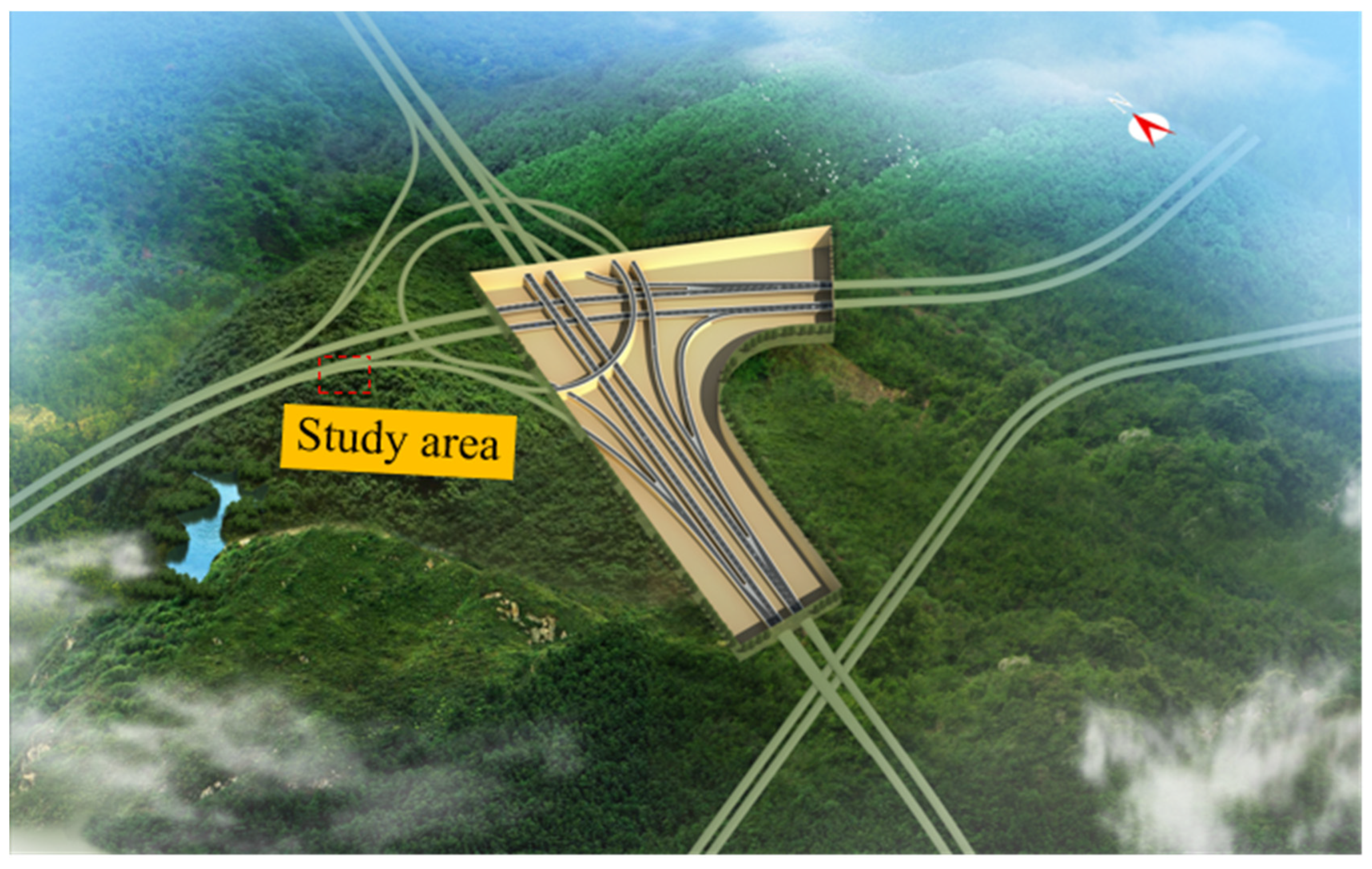
2. Engineering Background
3. Three-Dimensional Numerical Simulation of Extra-Large Cross-Section Bifurcated Tunnels
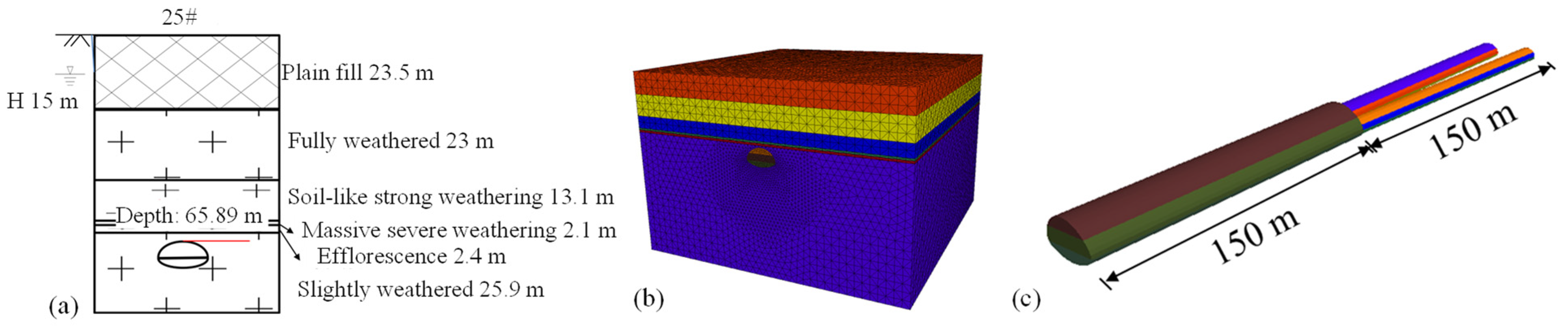
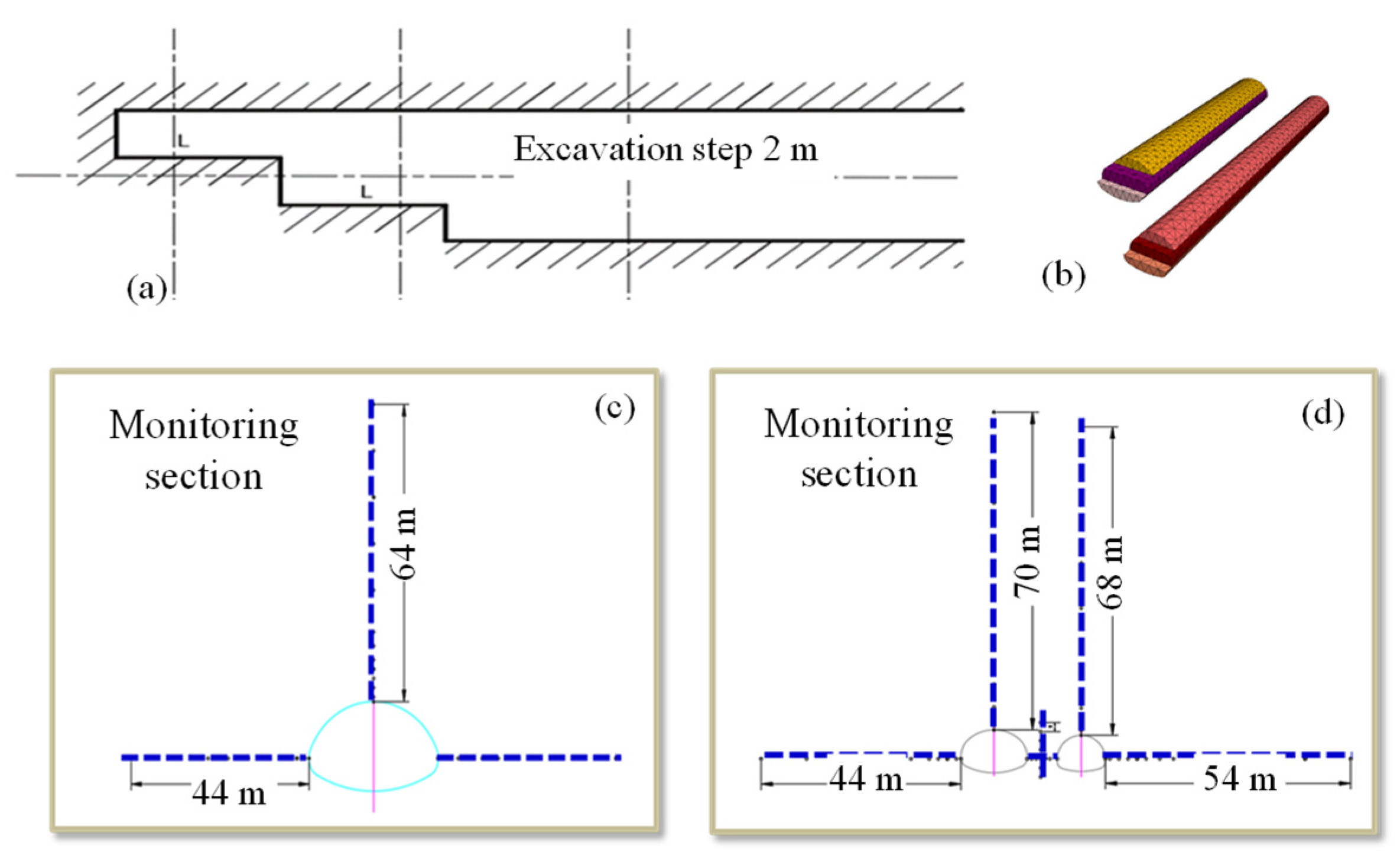
3.1. Numerical Model
3.2. Analysis of Monitoring Results of the Large Span Section
3.3. Analysis of Monitoring Results of the Bifurcated Tunnel Section
3.4. Interaction Between the Large-Span and Bifurcated Sections
4. Comparative Study on Bearing Mechanism of Surrounding Rock with Different Stiff Layer Thickness
4.1. Analysis of Stress Variation Under Different Stiff Layer Thicknesses
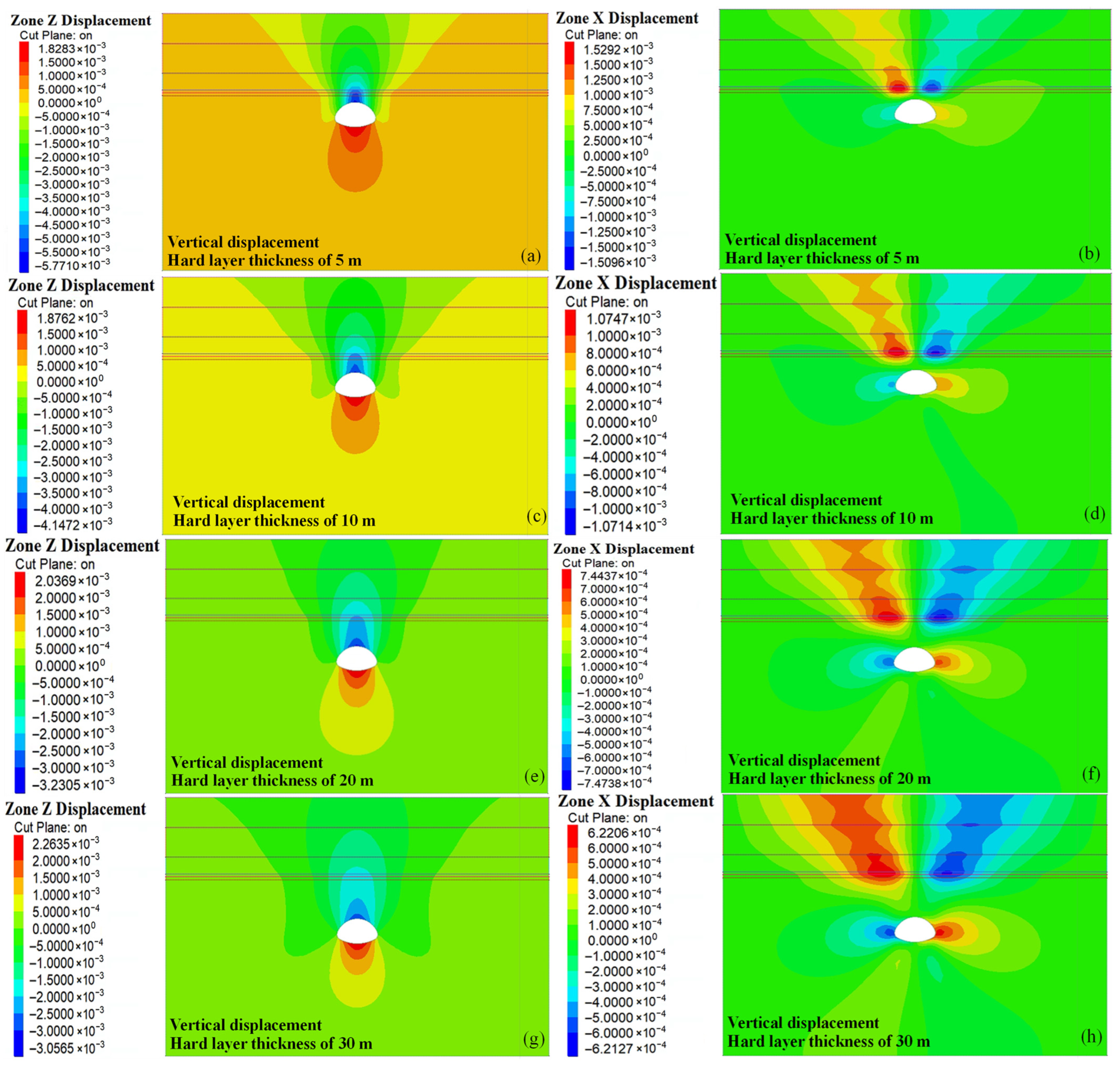
4.2. Analysis of Displacement Variation Under Different Stiff Layer Thicknesses
5. Conclusions
- (1)
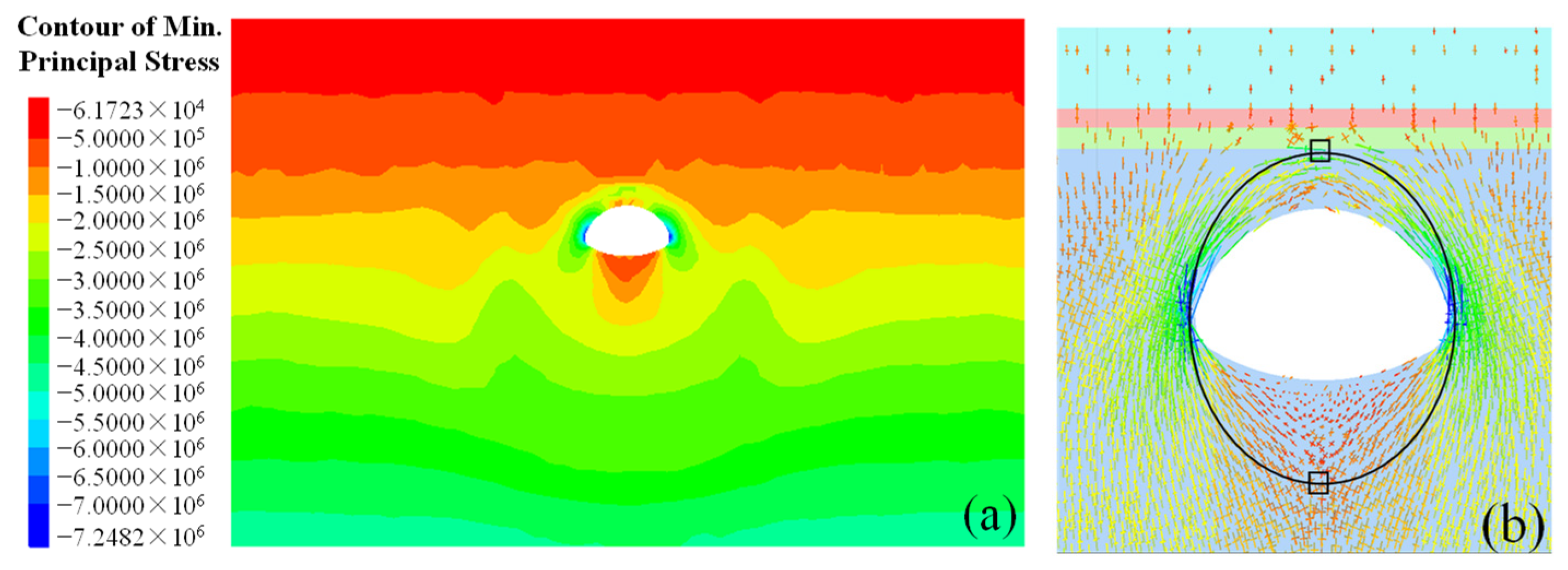
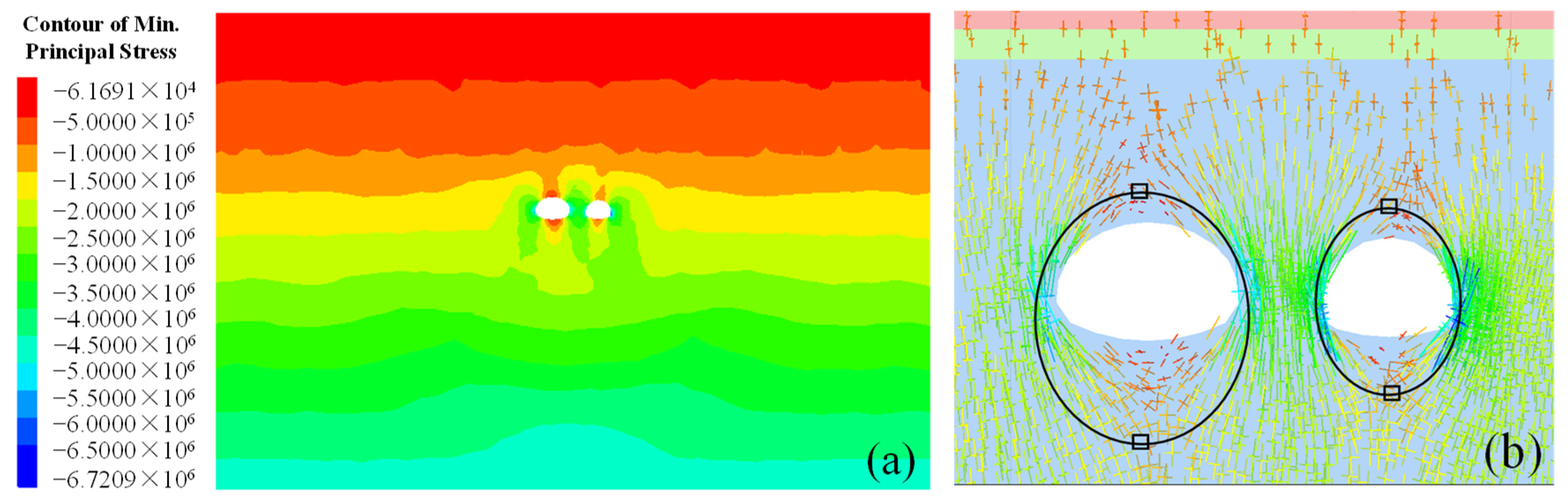
- During tunnel excavation, the stress distribution of the surrounding rock differs between large-span and bifurcated sections. The maximum principal stress is more concentrated in the large-span sections, while in the interbedded rock, the surrounding rock exhibits an approximately uniaxial stress state.
- (2)
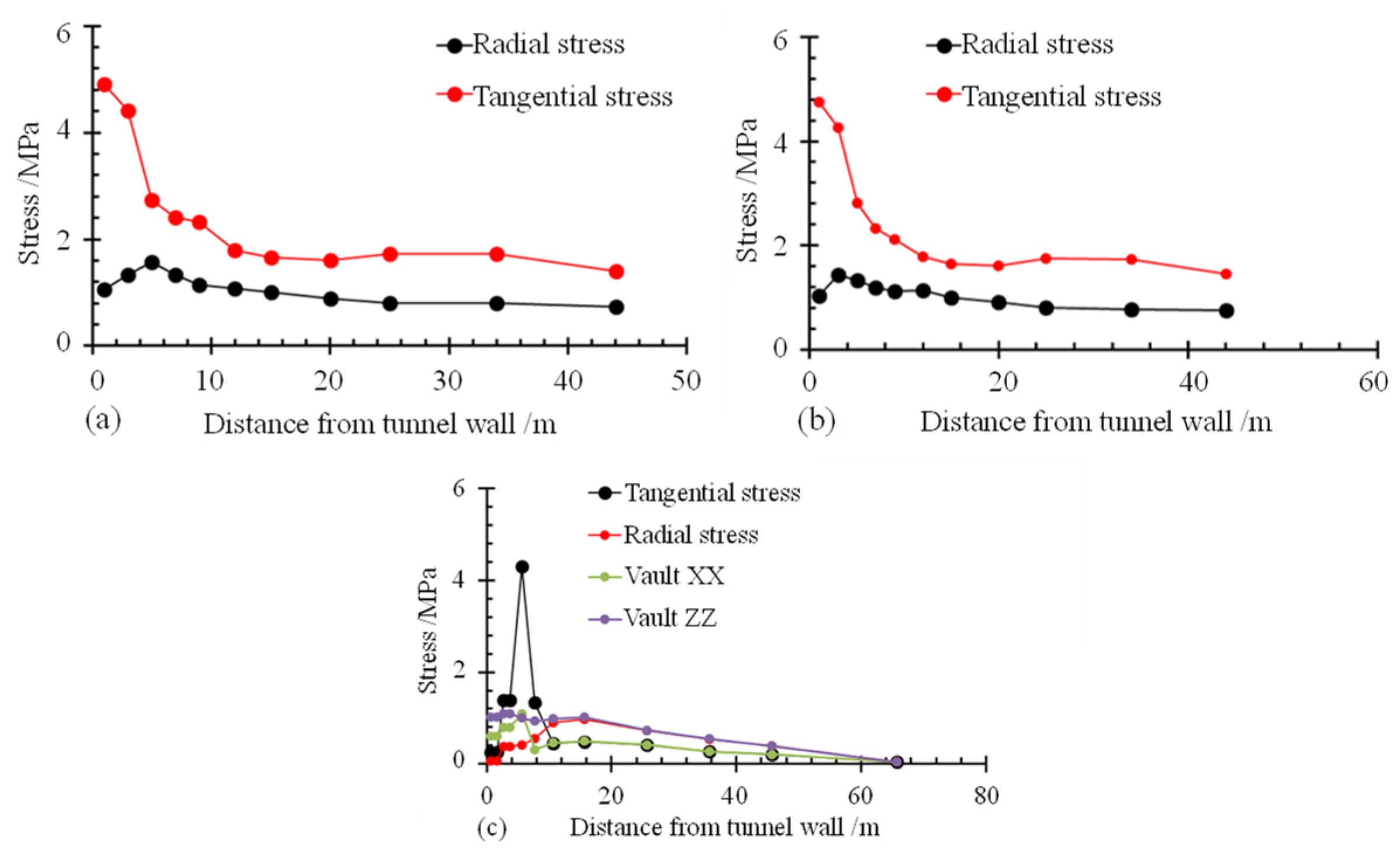
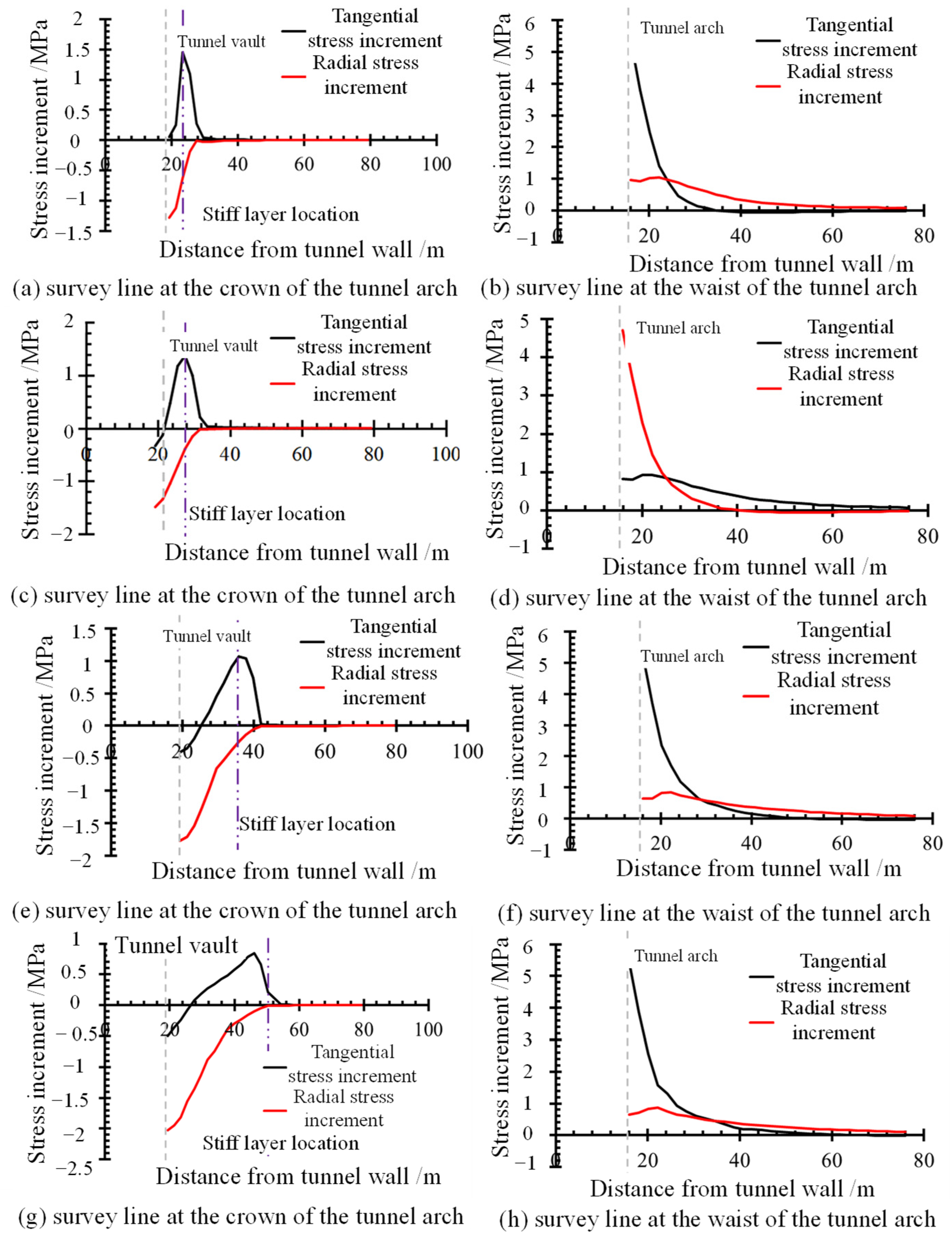
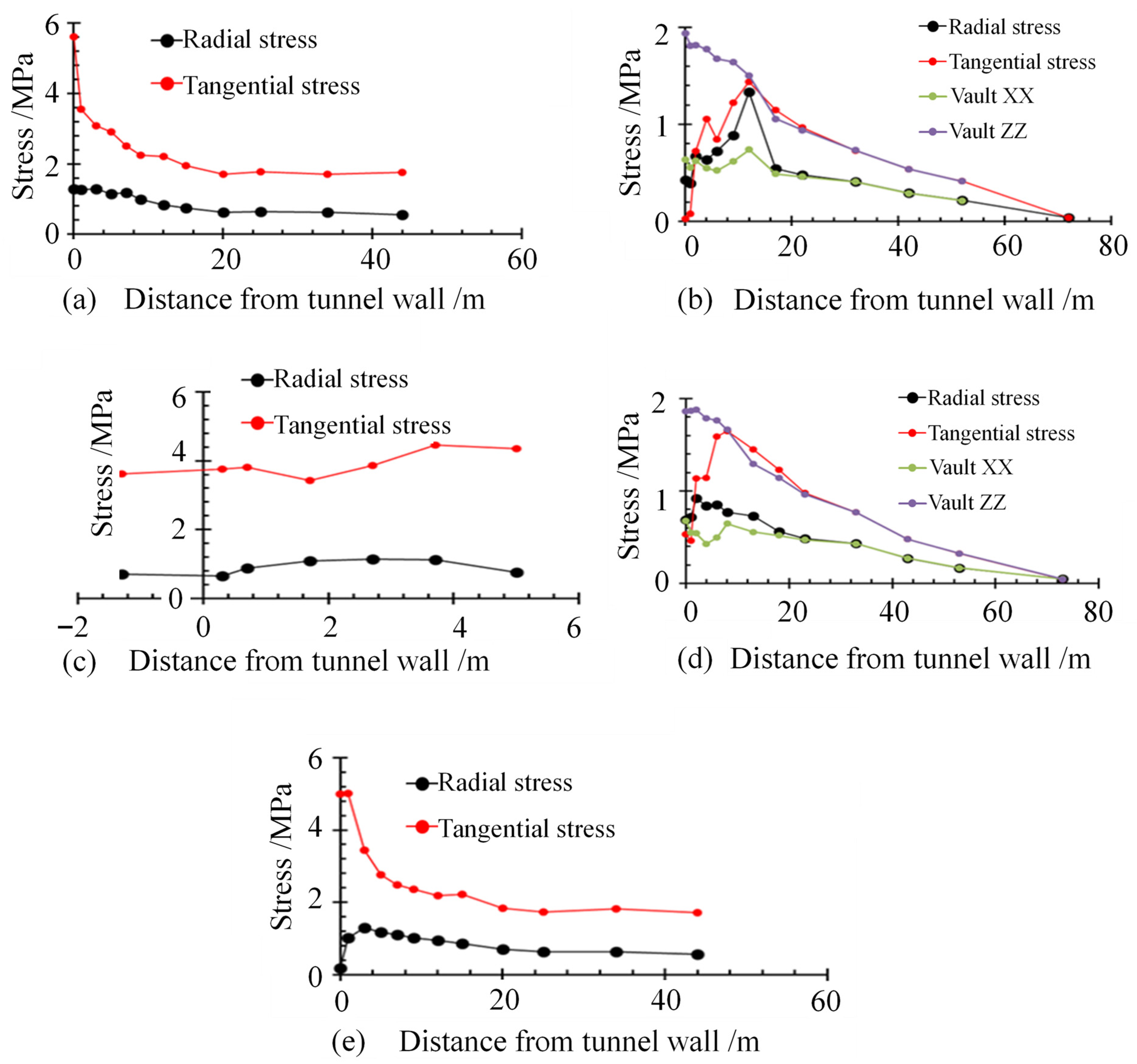
- Both radial and tangential stresses in the surrounding rock exhibit distinct patterns of change after excavation. Radial stress typically increases first, then decreases, eventually stabilizing. Tangential stress, on the other hand, is concentrated at the tunnel wall and gradually decreases, eventually returning to pre-excavation ground stress levels in areas farther from the wall, with this trend being particularly pronounced at the vault.
- (3)
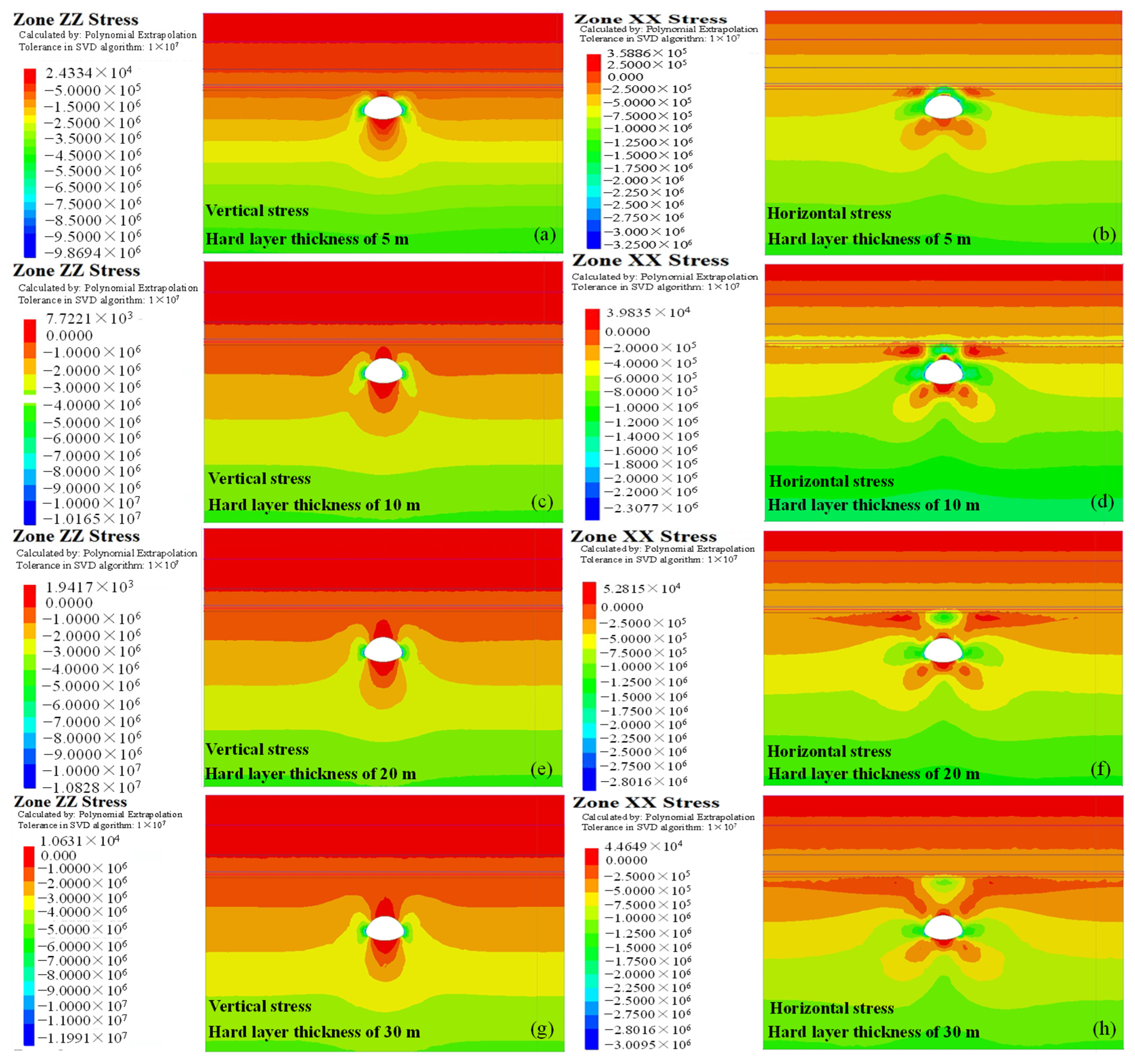
- In large-span tunnels, as the thickness of the stiff layer increases from 5 m to 20 m, the stress relaxation zone grows from 0 m to 8 m, and the stress-bearing zone expands from 10 m to 27 m; when the stiff layer thickness is less than 20 m and the tunnel burial depth is relatively shallow, the maximum tangential stress typically occurs at the stiff layer boundary, whereas when the stiff layer thickness reaches 30 m and the tunnel burial depth increases, the maximum tangential stress shifts to within the stiff layer, leading to the development of a plastic zone in the surrounding rock, which means that both the stiff layer thickness and tunnel burial depth must be considered simultaneously in the design process.
Author Contributions
Funding
Institutional Review Board Statement
Informed Consent Statement
Data Availability Statement
Conflicts of Interest
References
- Deng, C.; Yu, F.; Li, K.L.; Xiao, D.; Li, S.; He, C. Reliability Analysis and Evaluation of the Design of Bifurcation Tunnel Diverting and Merging Areas. In Proceedings of the 2024 8th International Conference on System Reliability and Safety (ICSRS), Sicily, Italy, 20–22 November 2024; pp. 240–244. [Google Scholar]
- Li, J.; Feng, X.; Li, Y.; Xu, P.; Yin, C.C.; Chen, C.; Li, Y. Numerical studies on smoke spread in urban underground tunnel with horizontal junctions. Procedia Eng. 2014, 71, 441–445. [Google Scholar] [CrossRef] [Scilit]
- Gao, H.J. Strain Softening Model of Rock Mass and Its Application Research on Surrounding Rock Stability Analysis of Extra-Large Section Bifurcation Tunnels. Ph.D. Thesis, Beijing Jiaotong University, Beijing, China, 2022. [Google Scholar]
- Fang, Y.S.; Lin, J.S.; Su, C.S. An estimation of ground settlement due to shield tunnelling by the Peck–Fujita method. Can. Geotech. J. 1994, 31, 431–443. [Google Scholar] [CrossRef] [Scilit]
- Fujita, K. Prediction of surface settlements caused by shield tunneling. In Proceedings of the International Conference on Soil Mechanics, Edmonton, AB, Canada, 31 May–4 June 1982; Volume 1, pp. 239–246. [Google Scholar]
- Ghaboussi, J.; Ranken, R.E. Interaction between two parallel tunnels. Int. J. Numer. Anal. Methods Geomech. 1977, 1, 75–103. [Google Scholar] [CrossRef] [Scilit]
- Chehade, F.H.; Shahrour, I. Numerical analysis of the interaction between twin-tunnels: Influence of the relative position and construction procedure. Tunn. Undergr. Space Technol. 2008, 23, 210–214. [Google Scholar] [CrossRef] [Scilit]
- Kim, S.H. Interaction behaviours between parallel tunnels in soft ground. Tunn. Undergr. Space Technol. 2004, 19, 448. [Google Scholar] [CrossRef] [Scilit]
- Wen, X.M.; Yang, J.H.; Zhu, H.H. Experimental Study on Reasonable Distance of Tunnels with Small-Clearance Section; Advanced Materials Research; Trans Tech Publications Ltd.: Wollerau, Switzerland, 2012; Volume 368, pp. 2621–2624. [Google Scholar]
- Osman, A.S. Stability of unlined twin tunnels in undrained clay. Tunn. Undergr. Space Technol. 2010, 25, 290–296. [Google Scholar] [CrossRef] [Scilit]
- Vlachopoulos, N.; Vazaios, I.; Madjdabadi, B.M. Investigation into the influence of excavation of twin-bored tunnels within weak rock masses adjacent to slopes. Can. Geotech. J. 2018, 55, 1533–1551. [Google Scholar] [CrossRef] [Scilit]
- Lu, B. Research on Minimum Safe Clearance of Small-Scale Tunnels and Optimization of the Middle Wall of Twin-Arch Tunnels. Master’s Thesis, Chang’an University, Xi’an, China, 2004. [Google Scholar]
- Tian, Z.Y. Similarity Model Test Study of Highway Tunnels with Small Clearance. Master’s thesis, Southwest Jiaotong University, Chengdu, China, 2006. [Google Scholar]
- Wang, G.F.; Liao, J.M.; Zhang, Y.X.; Wang, G. Study on safe clear distance and mechanical characteristics of middle rock pillar for shallow large-span tunnel with small clear distance. Geotech. Investig. Surv. 2011, 39, 18–23+27. [Google Scholar]
- Cao, F.; Ling, T.H.; Liu, J.S.; Zhang, L.; Gu, D. Analysis on blasting vibration effect of shallow multi-arch section of bifurcated tunnel. J. Highw. Transp. Res. Dev. 2018, 35, 86–94. [Google Scholar]
- Wang, J.; Tang, S.; Zheng, H.; Zhou, C.; Zhu, M. Flexural behavior of a 30-meter full-scale simply supported prestressed concrete box girder. Appl. Sci. 2020, 10, 3076. [Google Scholar] [CrossRef] [Scilit]
- Li, A.; Zhang, D.; Fang, Q.; Luo, J.; Cao, L.; Sun, Z. Safety Distance of Shotcrete Subjected to Blasting Vibration in Large-Span High-Speed Railway Tunnels. Shock Vib. 2019, 2019, 2429713. [Google Scholar] [CrossRef] [Scilit]
- Liu, C.; Li, S.C.; Zhou, Z.Q.; Li, L.P.; Wang, K.; Hou, F.J.; Qian, C.S.; Gao, C.L. Model test on mechanical characteristics of surrounding rock during construction process of super-large section tunnel in complex strata. Rock Soil Mech. 2018, 39, 3495–3504. [Google Scholar]
- Yang, G.L.; Hu, M.; Shen, Z.Q.; Yang, J. Research on Bearing Modes of Compound Middle-wall of Multi-arch Tunnels with Large Spans. Mod. Tunn. Technol. 2020, 57, 136–141. [Google Scholar]
- Gao, H.J.; He, P.; Chen, Z. Calculation of process load of deep-buried asymmetric multi-arch tunnels. Chin. J. Geotech. Eng. 2020, 42, 1059–1066. [Google Scholar]
- Zhang, H.B.; Lin, F.; Qin, Y. Study on reasonable clearance of small-clearance section section tunnels in layered surrounding rock. Highway 2020, 65, 309–313. [Google Scholar]
- Zhang, Q.Y.; Li, S.C.; Li, Y.; Wang, H.P. 3D geomechanical model test research on stability and supporting for surrounding rock mass of a large-scale diversion tunnel. Chin. J. Rock Mech. Eng. 2007, 26, 4051–4059. [Google Scholar]
- Yang, R.S.; Wang, Y.B. Understanding and considering service safety in underground space engineering. Chin. J. Eng. 2022, 44, 487–495. [Google Scholar]
- Xiao, Y.M.; Qiao, Y.F.; Li, Y.P.; Yan, J.C.; He, M.C. Numerical analysis on the bearing mechanism of branch tunnel in upper softer and lower hard ground. In Proceedings of the ISRM International Symposium-Asian Rock Mechanics Symposium, Beijing, China, 21–25 October 2021. [Google Scholar]






| Formation Name | Gravity/kN·m−3 | Young’s Modulus/N·m−2 | Poisson’s Ratio | Cohesion /kPa | Friction Angle/° |
|---|---|---|---|---|---|
| Plain Fill | 18.70 | 7.50 × 10⁶ | 0.38 | 20.00 | 15.00 |
| Earthy Strongly Weathered Medium-Grained Granite | 19.50 | 1.80 × 10⁸ | 0.33 | 27.00 | 32.00 |
| Massive Strongly Weathered Medium-Grained Granite | 23.00 | 3.00 × 10⁸ | 0.32 | 39.00 | 35.00 |
| Completely Weathered Medium-Grained Granite | 19.20 | 8.00 × 10⁷ | 0.35 | 32.00 | 28.00 |
| Moderately Weathered Medium-Grained Granite | 26.00 | 7.50 × 10⁹ | 0.30 | 3.40 × 10³ | 36.00 |
| Slightly Weathered Medium-Grained Granite | 26.20 | 3.00 × 10¹⁰ | 0.23 | 8.00 × 10³ | 40.00 |
| Number | Simulated Stratum | Simulated Stiff Layer Thickness |
|---|---|---|
| 1 | No. 25 | 5 m |
| 2 | No. 25 | 10 m |
| 3 | No. 25 | 20 m |
| 4 | No. 25 | 30 m |
Disclaimer/Publisher’s Note: The statements, opinions and data contained in all publications are solely those of the individual author(s) and contributor(s) and not of MDPI and/or the editor(s). MDPI and/or the editor(s) disclaim responsibility for any injury to people or property resulting from any ideas, methods, instructions or products referred to in the content. |
© 2026 by the authors. Licensee MDPI, Basel, Switzerland. This article is an open access article distributed under the terms and conditions of the Creative Commons Attribution (CC BY) license.
Share and Cite
Cao, S.; Ma, R.; Li, Y. Numerical Simulation of Large-Span Bifurcated Tunnels with Large Cross-Sections in Urban Underground Interchanges. Buildings 2026, 16, 498. https://doi.org/10.3390/buildings16030498
Cao S, Ma R, Li Y. Numerical Simulation of Large-Span Bifurcated Tunnels with Large Cross-Sections in Urban Underground Interchanges. Buildings. 2026; 16(3):498. https://doi.org/10.3390/buildings16030498
Chicago/Turabian StyleCao, Shiding, Ruiyang Ma, and Yunpeng Li. 2026. "Numerical Simulation of Large-Span Bifurcated Tunnels with Large Cross-Sections in Urban Underground Interchanges" Buildings 16, no. 3: 498. https://doi.org/10.3390/buildings16030498
APA StyleCao, S., Ma, R., & Li, Y. (2026). Numerical Simulation of Large-Span Bifurcated Tunnels with Large Cross-Sections in Urban Underground Interchanges. Buildings, 16(3), 498. https://doi.org/10.3390/buildings16030498