Mitigation of Time Overruns in Construction Projects in Afghanistan by Applying Risk Management

Abstract
1. Introduction
2. Literature Review
2.1. Risk Management in Construction Industry
2.2. Types of Risks in Construction Industry
- Construction Risk: These encompass efficiency in labor, labor disputes, site conditions, failures of equipment, design modifications, excessively high-quality standards, and the implementation of new technologies.
- Environmental Risks: Natural disasters encompass dangers such as earthquakes, floods, extreme weather, landslides, and localized risks, all of which heighten safety concerns and need adherence to environmental regulations.
- Financial Risks: Financial risks are affected by increased material costs, uncertain currency fluctuations, payment delays, defective estimation, and low market demand.
- Organizational Risks: Organizational risks encompass a wide range of factors, such as contractor experience, participant attitudes, a lack of experience among employees, and problems with communication.
- Physical Risks: Physical risks encompass possible harm to infrastructure and machinery, employee injuries, and events such as fire and theft of supplies and equipment, as well as problems arising from inadequate safety regulation.
- Socio-Political Risks: Contamination of the environment, ethical behavior, unlawful payments, changes to regulations, corruption, official approvals, war, community dispute, and insecurity are all examples of socio-political risks.
- Technical Risk: Technical risks encompass risks linked to defective design, lacking specifications, poor site inspections, changes in scope, method of construction, and limited resource availability.
2.3. Time Overrun
2.4. Time Overruns in Afghan Construction Projects
2.5. Monte Carlo Simulation
3. Methodology
3.1. Data Collection
3.2. Classification of Risks
- ✓
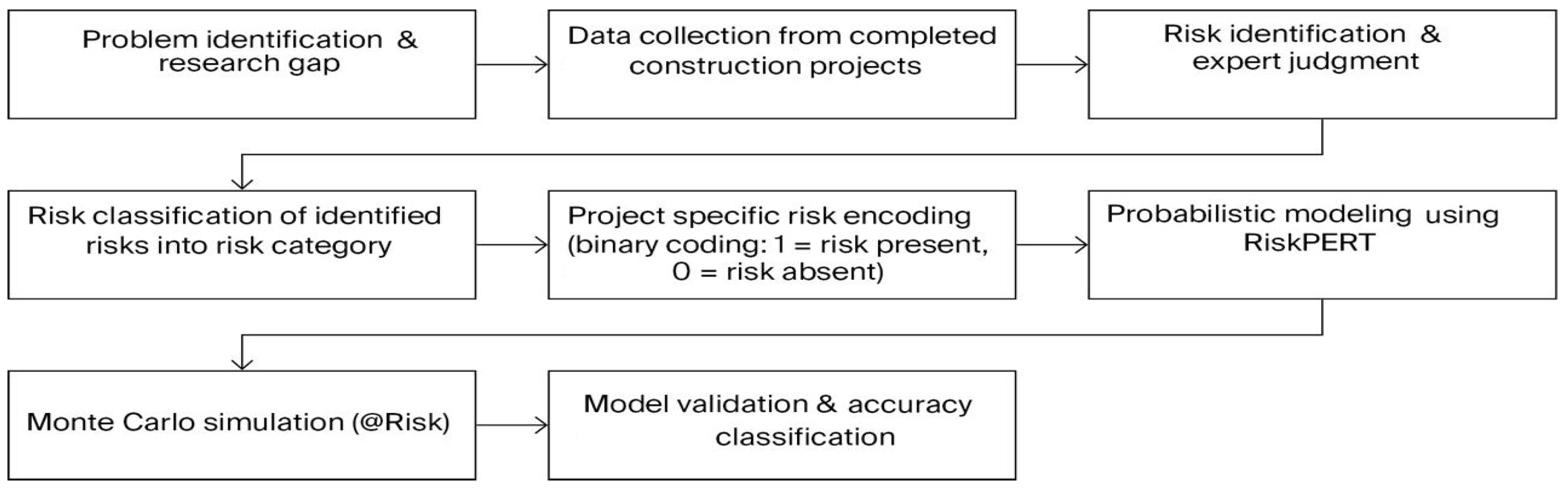
- Simulation Input Design: The existence of risk can be employed to generate average risk input values, especially for time overruns modeling using expert-derived RiskPert formulas.
- ✓
- Post-Simulation Risk Analysis: By connecting the precision of simulation results (Excellent, Good, Moderate, Poor) with the incidence of each risk category, patterns of substantial risks can be identified and highlighted.
3.3. Software and Configuration of Simulation
Setting Up and Running the Simulation
- Number of iterations: 10,000 (to guarantee convergence and reliability).
- Sampling method: Latin Hypercube Sampling for enhanced variability management.
- Confidence intervals: Results were analyzed at the 90% and 95% confidence levels.
- Captured Outputs
- Simulated values for duration.
- Histograms and S-curves (Probability distribution of results).
- Tornado charts (sensitivity analysis of input risk factors).
- Summary statistics (mean, min, max, standard deviation).
3.4. Accuracy Classification
4. Data Analysis and Finding
4.1. Construction Projects
4.2. Simulation Outputs and Results
5. Discussion
5.1. Mitigation Measures and Recommendations for Identified Risks
5.2. Corrective and Preventive Actions
- Governments and acquiring agencies should take steps to reduce land acquisition delays. If possible, prevent land acquisitions and thoroughly analyze landowners and assets before bidding. Land purchases before civil works can be accelerated by learning from earlier projects. Timely compensation for impacted individuals requires appropriate pre-allocated cash based on average annual land income, modified for land usage type like harvesting, agriculture, or housing.
- An effective approach must incorporate unified risk mitigation frameworks that use technical resources, improve capabilities, engage communities, and follow stringent legal rules. These steps ensure project quality and minimize cost and schedule implications. It emphasizes the significance of using digital technology, standard rules, and stakeholder interaction to manage socio-political risks and ensure projects satisfy social goals and public trust.
- Effective communication and contingency planning are essential for improving safety in construction firms. Developing a proactive safety culture is essential, as it promotes robust emergency response capabilities to address safety issues and derive lessons from it.
- Construction firms, especially in regions like Afghanistan that encounter extreme weather conditions such as thunderstorms, hailstorms, and flooding, must adopt proactive measures to mitigate weather-related risks. Essential strategies encompass anticipating adverse events, incorporating buffer periods into project schedules, and employing weather-resistant methodologies. Moreover, developing efficient communication among stakeholders is essential for the early identification of risks, while continuous evaluations of weather effects on project limitations facilitate required modifications.
- Many Afghan individuals lack sufficient management experience, highlighting the necessity for investment in their education and development to enhance project management skills. Moreover, sustaining regular interaction among stakeholders is essential for reducing delays and executing effective risk management methods, which also entails improving engineering and project management skills.
- Construction companies employ de-scoping to address financial difficulties by lowering costs and prioritizing projects, while also maintaining client satisfaction and integrity. Construction risks encompass poor supervision, alterations in project scope, technical challenges, poor management, contractor deficiencies, and difficulties in material procurement. To improve project outcomes, it is advisable to employ proficient project engineers for scheduling, ensure early supervision, and uphold quality standards. Moreover, efficient communication among customers, contractors, and stakeholders is essential for quickly solving scope alterations and technical issues.
- Prioritize early material acquisition via market analysis, ensure efficient planning for mobilization and logistics from project start to completion, conduct regular assessments of environmental and related risks during the design phase, and strengthen management standards and oversight to enhance contractor performance and address material procurement challenges.
6. Conclusions
Author Contributions
Funding
Data Availability Statement
Conflicts of Interest
References
- Rivas, R.A.; Borcherding, J.D.; González, V.; Alarcón, L.F. Analysis of Factors Influencing Productivity Using Craftsmen Questionnaires: Case Study in a Chilean Construction Company. J. Constr. Eng. Manag. 2011, 137, 312–320. [Google Scholar] [CrossRef]
- Mohamed, O.; Nour, M.; Elazizy, I.; Hagras, M. A Suggested Module for Risk Framework of Water Control Construction Projects Using Qualitative and Quantitative Techniques. Int. J. Eng. Adv. Technol. 2020, 9, 1448–1454. [Google Scholar] [CrossRef]
- Pooworakulchai, C. Applied Risk Management in Construction Industry: A Review. Int. J. Eng. 2018, 5, 234–240. [Google Scholar] [CrossRef]
- Project Management Institute, Inc. A Guide to the Project Management Body of Knowledge (PMBOK Guide); Project Management Institute, Inc.: Newtown Square, PA, USA, 2017. [Google Scholar]
- Bahamid, R.A.; Doh, S.I. A Review of Risk Management Process in Construction Projects of Developing Countries. In IOP Conference Series: Materials Science and Engineering; IOP Publishing: Bristol, UK, 2017; Volume 271, p. 012042. [Google Scholar] [CrossRef]
- Assaf, S.A.; Al-Hejji, S. Causes of Delay in Large Construction Projects. Int. J. Proj. Manag. 2006, 24, 349–357. [Google Scholar] [CrossRef]
- Alshihri, S.; Al-gahtani, K.; Almohsen, A. Risk Factors That Lead to Time and Cost Overruns of Building Projects in Saudi Arabia. Buildings 2022, 12, 902. [Google Scholar] [CrossRef]
- Niazi, G.A.; Painting, N. Significant Factors Causing Cost Overruns in the Construction Industry in Afghanistan. Procedia Eng. 2017, 182, 510–517. [Google Scholar] [CrossRef]
- Khalifa, W.M.A.; Mahamid, I. Causes of Change Orders in Construction Projects. Eng. Technol. Appl. Sci. Res. 2019, 9, 4956–4961. [Google Scholar] [CrossRef]
- Ahbab, C.; Daneshvar, S.; Çelik, T. Cost and Time Management Efficiency Assessment for Large Road Projects Using Data Envelopment Analysis. Tek. Dergi/Tech. J. Turk. Chamb. Civ. Eng. 2019, 30, 8937–8959. [Google Scholar] [CrossRef]
- Faten Albtoush, A.M.; Doh, S.I. A Review on Causes of Cost Overrun in the Construction Projects. Int. J. New Innov. Eng. Technol. 2019, 12, 15–22. [Google Scholar]
- Mahmoud al-Mukahal, A.A. Risk Management of Construction Projects. Eng. Manag. Res. 2020, 9, 15. [Google Scholar] [CrossRef]
- Safaeian, M.; Fathollahi-Fard, A.M.; Kabirifar, K.; Yazdani, M.; Shapouri, M. Selecting Appropriate Risk Response Strategies Considering Utility Function and Budget Constraints: A Case Study of a Construction Company in Iran. Buildings 2022, 12, 98. [Google Scholar] [CrossRef]
- Szymański, P. Risk Management in Construction Projects. Procedia Eng. 2017, 208, 174–182. [Google Scholar] [CrossRef]
- Iqbal, S.; Choudhry, R.M.; Holschemacher, K.; Ali, A.; Tamošaitienė, J. Risk Management in Construction Projects. Technol. Econ. Dev. Econ. 2015, 21, 65–78. [Google Scholar] [CrossRef]
- Ali, A.A.; Faruq, I.; Ahmad, A.; Gandu, Y. Exploring the Awareness of Advanced Programmatic Risk Analysis and Management Model in Managing Construction Projects in Nigeria. Afr. J. Earth Environ. Sci. 2020, 2, 465–475. [Google Scholar]
- Mohib, I. Risk Management in Construction Projects in Afghanistan. J. Sci. Technol. 2022, 7, 73–116. [Google Scholar] [CrossRef]
- Nieto-Morote, A.; Ruz-Vila, F. A Fuzzy Approach to Construction Project Risk Assessment. Int. J. Proj. Manag. 2011, 29, 220–231. [Google Scholar] [CrossRef]
- Mhetre, K.; Konnur, B.A.; Landage, A.B. Risk Management in Construction Industry. Int. J. Eng. Res. 2016, 1, 153–155. [Google Scholar] [CrossRef]
- Albasyouni, W.; Kamara, J.; Heidrich, O. Key Challenges and Opportunities to Improve Risk Assessments in the Construction Industry. Buildings 2025, 15, 1832. [Google Scholar] [CrossRef]
- Danso, H.; Antwi, J.K. Evaluation of the Factors Influencing Time and Cost Overruns in Telecom Tower Construction in Ghana. Civ. Environ. Res. 2012, 2, 15–24. [Google Scholar]
- Callegari, C.; Szklo, A.; Schaeffer, R. Cost Overruns and Delays in Energy Megaprojects: How Big Is Big Enough? Energy Policy 2018, 114, 211–220. [Google Scholar] [CrossRef]
- Long, N.D.; Ogunlana, S.; Quang, T.; Lam, K.C. Large Construction Projects in Developing Countries: A Case Study from Vietnam. Int. J. Proj. Manag. 2004, 22, 553–561. [Google Scholar] [CrossRef]
- Precious, D. Infrastructure Project Cost Overrun and Schedule Delay in Ghana: Is It an Issue of Resource Misallocation or Financial Constraints? Proj. Leadersh. Soc. 2025, 6, 100188. [Google Scholar] [CrossRef]
- Alenazi, E.; Adamu, Z.; Al-Otaibi, A. Exploring the Nature and Impact of Client-Related Delays on Contemporary Saudi Construction Projects. Buildings 2022, 12, 880. [Google Scholar] [CrossRef]
- Gidado, K. Factors Influencing Construction Productivity in Afghanistan. In Proceedings of the Third International Conference on Engineering, Project and Production Management, Brighton, UK, 10–12 September 2022. [Google Scholar]
- Habibi, I. Investigation on Causes of Delays and Cost Overruns of Construction Projects in Afghanistan. J. Manag. Inf. Decis. Sci. 2023, 26, 1–16. [Google Scholar]
- Aloko, M.N. Risk Assessment Process for Construction Projects in Afghanistan. Int. J. Adv. Eng. Res. Sci. 2018, 5, 211–217. [Google Scholar] [CrossRef]
- Qaytmas, N. Causes of Delays in Construction Projects in Faryab/Afghanistan. Int. J. Res. Appl. Sci. Biotechnol. 2020, 7, 72–77. [Google Scholar] [CrossRef]
- Rafi, R.; Gupta, S.; Dash, A.K. A study on the delays in construction projects in Afghanistan. JETIR 2021, 8, d265–d272. [Google Scholar]
- Habibi, I.; Renu, A. A Review on Investigation into the Causes of Delays and Cost Overruns in Construction Projects in Afghanistan. Int. Res. J. Eng. Technol. 2020, 7, 1574–1581. [Google Scholar]
- Ahmadzai, M.B.; Ye, K. Modelling the Impacts of Security on Construction Delays: A Case of Afghanistan. Heliyon 2024, 10, e32662. [Google Scholar] [CrossRef]
- Kivrak, S.; Baha, M.Y. Causes of Delay in Road Construction Projects in Afghanistan. J. Sci. Ind. Res. 2024, 83, 46–57. [Google Scholar] [CrossRef]
- Anwari, Z. Causes of Time Delay and Cost Overrun of Rural Road Projects in Afghanistan. Kardan J. Econ. Manag. Sci. 2022, 5, 1–18. [Google Scholar] [CrossRef]
- Ismail, I.B. Risk Assessment of Time and Cost Overrun Factors throughout Construction Project Lifecycle. Ph.D. Thesis, Universiti Tun Hussein Onn Malaysia, Batu Pahat, Malaysia, 2014. [Google Scholar]
- KarimiAzari, A.; Mousavi, N.; Mousavi, S.F.; Hosseini, S.B. Risk Assessment Model Selection in Construction Industry. Expert Syst. Appl. 2011, 38, 9105–9111. [Google Scholar] [CrossRef]
- Rezakhani, P. A Review of Fuzzy Risk Assessment Models for Construction Projects. Slovak J. Civ. Eng. 2013, 20, 35–40. [Google Scholar] [CrossRef][Green Version]
- Kwak, Y.H.; Ingall, L. Exploring Monte Carlo Simulation Applications for Project Management. IEEE Eng. Manag. Rev. 2009, 37, 83. [Google Scholar] [CrossRef]
- Rezaie, K.; Amalnik, M.S.; Gereie, A.; Ostadi, B.; Shakhseniaee, M. Using Extended Monte Carlo Simulation Method for the Improvement of Risk Management: Consideration of Relationships Between Uncertainties. Appl. Math. Comput. 2007, 190, 1492–1501. [Google Scholar] [CrossRef]
- Ildarabadi, P.; Alamatian, J. Proposing a New Function for Evaluation of the Financial Risk of Construction Projects Using Monte Carlo Method: Application on Iranian Construction Industry. J. Build. Eng. 2021, 43, 103143. [Google Scholar] [CrossRef]
- Bouayed, Z. Using Monte Carlo Simulation to Mitigate the Risk of Project Cost Overruns. Int. J. Saf. Secur. Eng. 2016, 6, 293–300. [Google Scholar] [CrossRef]
- Senova, A.; Tobisova, A.; Rozenberg, R. New Approaches to Project Risk Assessment Utilizing the Monte Carlo Method. Sustainability 2023, 15, 1006. [Google Scholar] [CrossRef]
- Vartanian, T.P. Secondary Data Analysis; Oxford University Press: New York, NY, USA, 2011. [Google Scholar]
- Shafiei, N.A.; Puttanna, K. An Investigation into the Factors Causing International Development Project Failure in Developing Countries: Focus on Afghanistan. J. Proj. Manag. 2021, 6, 157–170. [Google Scholar] [CrossRef]
- Asmitha, P. Time Delay and Cost Overrun in Construction Projects. Iconic Res. Eng. J. 2019, 3, 44–51. [Google Scholar]
- Sharifzada, H.; Deming, Y. Construction Project Delay Risk Assessment Based on 4M1E Framework and Afghanistan Situation. Civ. Eng. J. 2024, 10, 100–116. [Google Scholar] [CrossRef]
- Faqiri, A.; Rasool, A. Role of Risk Management in Construction Project in Afghanistan. Int. Educ. Appl. Res. J. 2018, 2, 1–9. [Google Scholar]
- Urgilés, P.; Claver, J.; Sebastián, M.A. Methods for Quantitative Risks Analysis of Cost and Deadline Overruns in Complex Projects. Procedia Manuf. 2019, 41, 658–665. [Google Scholar] [CrossRef]
- Apurva, P.; Sharareh, K.; Elnaz, S. Challenges in Post-Disaster Housing Reconstruction: Analysis of Urban vs. Rural Communities. In Creative Construction e-Conference 2020; Budapest University of Technology and Economics: Budapest, Hungary, 2020; pp. 103–110. [Google Scholar] [CrossRef]
- Dong, R.R.; Muhammad, A.; Nauman, U. The Influence of Weather Conditions on Time, Cost, and Quality in Successful Construction Project Delivery. Buildings 2025, 15, 474. [Google Scholar] [CrossRef]
- Schuldt, S.J.; Nicholson, M.R.; Adams, Y.A., II; Delorit, J.D. Weather-Related Construction Delays in a Changing Climate: A Systematic State-of-the-Art Review. Sustainability 2021, 13, 2861. [Google Scholar] [CrossRef]
- Moda, H.M.; Filho, W.L.; Minhas, A. Impacts of Climate Change on Outdoor Workers and Their Safety: Some Research Priorities. Int. J. Environ. Res. Public Health 2019, 16, 3458. [Google Scholar] [CrossRef] [PubMed]
- Yap, J.B.H.; Lee, K.Y.; Skitmore, M. Analysing the Causes of Corruption in the Malaysian Construction Industry. J. Eng. Des. Technol. 2020, 18, 1823–1847. [Google Scholar] [CrossRef]



| Categories | Sub-Categories | Summary (%) |
|---|---|---|
| Educational Background | Ph.D. | 3% |
| Masters | 48.5% | |
| Bachelor | 48.5% | |
| Employment Position | Project Manager | 24.2% |
| Consultant | 12.1% | |
| Quality Assurance | 18.2% | |
| Site Engineer | 9.1% | |
| Other Senior Technical/Managerial Roles | 36.4% | |
| Professional Experience | ≥15 years | 42.4% |
| 5–10 years | 18.2% | |
| 3–5 years | 24.2% | |
| 1–3 years | 12.2% | |
| <1 year | 3% | |
| Organization Associations | International Organizations | 39.4% |
| Government Organizations | 27.3% | |
| NGOs and Private Sectors | 33.3% |
| Risk Code | Risk Causes | Reference |
|---|---|---|
| R1 | Budget Constraints | [27,44] |
| R2 | Construction Materials Price | [28] |
| R3 | Contract Termination | [17] |
| R4 | Contractors, Sub-Contractors, Poor Contractor Capacity | [8,28,29,30,31,32,34] |
| R5 | Corruption and Fraud | [27,28,29,30,33,34,45,46] |
| R6 | COVID-19 | [17] |
| R7 | De-Scoping | [17,28,47] |
| R8 | Engineering Personnel/lack of Professional People | [17,28,33] |
| R9 | Financial issues | [8,17,28,29,30,33,34,44,47] |
| R10 | Geographical condition and access to projects | [17,27] |
| R11 | Geotechnical Surveys | [17] |
| R12 | Insufficient Supervision | [17,30,31,33,34,45] |
| R13 | Internal Community Conflicts | [17] |
| R14 | Land Acquisition and Resettlement Plan (LARP) | [17,33] |
| R15 | Logistical issues | [17,28,32,34] |
| R16 | Natural Disaster | [17] |
| R17 | Political, governance | [8,17,28,32,33,44,46] |
| R18 | Poor Management | [28,30,31,44] |
| R19 | Poor Site Selection | [17,27,47] |
| R20 | Price escalation | [17,28] |
| R21 | Procurement | [8,27,28,30,33,45,46] |
| R22 | Project Management | [17,28,33,34,46,47] |
| R23 | Quality | [17,27,46] |
| R24 | Safety | [17] |
| R25 | Security | [8,17,28,31,32,33,45,47] |
| R26 | Design issues | [8,17,28,31,46] |
| R27 | The Contractor’s inadequate Performance | [17,30,34] |
| R28 | Variation order | [8,17,27,28,29,33,46] |
| R29 | Weather | [27,34] |
| Risk Categories | Min% | Most Likely% | Max% |
|---|---|---|---|
| R00-1 (Construction Risk) | 10 | 20 | 35 |
| R00-2 (Environmental Risks) | 3 | 6 | 12 |
| R00-3 (Financial Risks) | 8 | 15 | 30 |
| R00-4 (Organizational Risks) | 5 | 12 | 25 |
| R00-5 (Physical Risks) | 2 | 5 | 15 |
| R00-6 (Socio-Political Risks) | 10 | 18 | 40 |
| R00-7 (Technical Risks) | 5 | 10 | 20 |
| R00-T (Unknown Causes for Schedule Delay) | 5 | 20 | 50 |
| Category | Accuray Range (%) | Projects | Percentage |
|---|---|---|---|
| Excellent | ≥80% | 28 | 37.84 |
| Good | (60–79)% | 26 | 35.14 |
| Moderate | (40–59)% | 12 | 16.22 |
| Poor | <40% | 8 | 10.81 |
| Total | 74 | 100.00 |
| Risk Code | Excellent | Good | Moderate | Poor | Total | %Poor |
|---|---|---|---|---|---|---|
| R00-1 | 5 | 1 | 0 | 0 | 6 | 0 |
| R00-2 | 5 | 1 | 0 | 0 | 6 | 0 |
| R00-3 | 11 | 11 | 4 | 6 | 32 | 18.75 |
| R00-4 | 13 | 15 | 5 | 5 | 38 | 13.16 |
| R00-5 | 1 | 2 | 1 | 1 | 5 | 20 |
| R00-6 | 18 | 20 | 8 | 6 | 52 | 11.54 |
| R00-7 | 6 | 5 | 2 | 0 | 13 | 0 |
| R00-T | 9 | 6 | 6 | 2 | 23 | 8.70 |
| Statistic | Planned Duration (Days) | Actual Duration (Days) | Simulated Duration (Days) | Actual Time Overrun (%) | Simulated Overrun (%) | P90 Duration |
|---|---|---|---|---|---|---|
| Mean | 1119 | 1944 | 1569 | 111 | 40 | 1681 |
| Min | 149 | 288 | 231 | −13 | 14 | 235 |
| Max | 3823 | 5559 | 4500 | 1001 | 69 | 4889 |
| Std.dev. | 678 | 1080 | 971 | 155 | 13 | 1041 |
| Risk Code | Risk Causes | Corrective Action | Preventive Action |
|---|---|---|---|
| R1 | Budget Constraints | Corrective actions for managing budget constraints in construction projects include assigning liability for supplementary payments to the responsible contractual party and holding prompt meetings with contractors to reach satisfactory resolutions. Additional measures involve timely adjustments within the executing or advisory firm, revising budgets, and prioritizing ongoing or suspended work. | Preventive actions for addressing budget constraints in construction projects encompass precisely describing the scope of work, informing clients about the consequences of scope alterations, and guaranteeing comprehensive document verification prior to submission. Essential practices include performing comprehensive project assessments before bidding, utilizing precise data for estimations, and engaging experienced designers and estimators. It is essential to verify errors, dismiss unrealistic estimations, and develop budgets with the assistance of experienced professionals. Moreover, evaluations by external specialists and the modification of cost units to align with local market values are essential. Ultimately, aligning designs with budgets and including explicit contract provisions for additional work are essential. |
| R2 | Construction Material Price | Corrective actions to mitigate construction material price issues encompass initial forecasting and study of inflation and foreign exchange rates before project commencement. Measures entail incorporating contractual provisions for price stability, allocating risks appropriately, and securing goods via advance payments to mitigate possible cost increases. Organizations should anticipate currency fluctuations, formulate strategic contingencies, do regular contract evaluations, and include stakeholders to effectively manage material price risks. | Preventive actions to mitigate construction material price volatility include creating detailed lists of suitable materials with their advantages and disadvantages, accelerating approval processes through expert consultations, and utilizing lessons from past projects to improve efficiency. Additionally, reducing bureaucratic procedures and leveraging advanced technologies for enhanced collaboration can improve decision-making effectiveness. |
| R20 | Price Escalation | The integration of price escalation clauses in contracts, the application of fixed pricing mechanisms, and the continuous observation of price trends are vital strategies in contract management. It is important to secure labor and material costs for specified durations while also ensuring that the risks associated with inflation are equitably shared between the client and the contractor. | Preventive actions to mitigate construction material price escalation include renewing contractual terms, adjusting budgets and timelines, substituting materials with cost-effective alternatives, optimizing resource use, minimizing waste, revising cost plans, and implementing effective procurement strategies. |
| R21 | Procurement | Corrective actions encompass temporarily utilizing internal client or contractor resources to address deficiencies, improving construction processes, eliminating non-essential operations, adjusting project schedules, reducing durations of essential duties, and executing independent tasks simultaneously. | Preventive actions in procurement emphasize the early engagement of qualified advisors, empowering them with decision-making authority, and assuring early payments in advance to maintain seamless operations. Precise contract provisions defining responsibilities and risks, in combination with comprehensive security evaluations prior to project commencement, substantially mitigate procurement delays and conflicts. |
| R3 | Contract Termination | Corrective action for contract termination encompasses immediate replacement of the terminated party to prevent delays, the adjustment of the project timeline for a seamless transition, arranging of urgent meetings to address unresolved concerns, and the enforcement of contractual clauses to protect financial and legal interests. Moreover, using internal resources or engaging proficient consultants can facilitate the continuity of project advancement throughout the period of transition. | Preventive actions for preventing contract termination include comprehensive contractor assessment and selection based on expertise and competence, sustaining ongoing communication among project stakeholders, reducing scope and design modifications, implementing strict site oversight, and establishing fixed-price contracts with clear risk distribution. Moreover, implementing contingency plans and fostering confidence in internal project management improve stability and diminish conflicts that may result in termination. |
| R7 | De-Scoping | Corrective actions entail eliminating unnecessary expenses, implementing rigorous budgeting strategies, reallocating resources effectively, and revising project components in accordance with the adjusted scope while avoiding delays. | Preventive techniques for de-scoping encompass precise original scope definition, extensive site investigations, complete comprehension of client needs, rejection of unrealistic scope modifications, and periodic feasibility assessments to mitigate scope creep. |
| R12 | Insufficient Supervision | Corrective actions include improving supervision quality, enhancing communication, rescheduling duties, and adopting appropriate construction methods to diminish time overruns. | Preventive actions for insufficient supervision include hiring proficient project managers, enabling efficient communication, implementing continual monitoring, and offering employee training. |
| R18 | Poor Management | Corrective actions for poor management include adjusting project timelines, enhancing team skills by adding qualified personnel, and improving client communication. In severe cases, legal action or contract changes may be necessary, alongside strategies like overtime or resource reallocation. Engaging external advisors and following revised timelines can help mitigate delays caused by poor management. | Preventive actions emphasize the recruitment of senior and competent project managers and personnel who possess familiarity with similar project situations. Develop successful communication lines among all stakeholders to maintain understanding in the project’s goals and ongoing collaboration. Implementing comprehensive training and establishing a culture of responsibility alongside regular supervision can further mitigate failures in management. |
| R22 | Project Management | Corrective actions encompass immediate detection of performance deficiencies with contractors, substitution of inadequate subcontractors, implementation of innovative technologies, rescheduling of work, and legal recourse when required. Moreover, prolonging working hours and enhancing labor productivity assists in reducing delays. Collectively, these techniques boost project success by proactively mitigating risks and efficiently addressing arising issues. | Preventive actions encompass comprehensive site assessments, precise scope description, prompt delivery of accurate blueprints, selection of senior contractors and proficient personnel, and reduction of design or scope modifications throughout construction. Facilitating timely payments and promoting effective communication and collaboration among project stakeholders are essential. |
| R27 | The contractor’s Inadequate Performance | Performance monitoring ensures project adherence to timelines and quality standards. It may be necessary to replace subcontractors or contractors to maintain project integrity. Implementing strategies to increase productivity optimizes resource utilization, while consulting experts can provide valuable insights for project improvement. Controlling work scope prevents scope creep, and effective management of contractual liabilities mitigates risks and upholds legal obligations. | To prevent inadequate contractor performance, it is imperative to emphasize appropriate contractor selection, engage proficient personnel, and establish training programs. Efficient communication and resource allocation are essential for project success. Preventing modifications in design or scope ensures project integrity, while employing fixed-price contracts with explicit provisions guarantees accountability. Moreover, timely payments are essential to cultivate favorable relationships with contractors. |
| R28 | Variation Order | Corrective actions for handling variation orders in construction projects entail a rapid start of change management, schedule compression, and the accurate issue of modifications by the owner. Essential steps involve evaluating new scope elements, revising pricing, and employing contractual clauses for justifying additional time and compensation. Moreover, comprehensive documentation, official client approvals, and modifications to project expenses and schedules are essential for reducing disagreements and mitigating negative effects on project duration. | Preventive actions for variation orders include providing full and precise project details at the time of tender, outlining modifications to scope directions in the contract of employment, and receiving customer written agreement before making any changes. Changes must be managed financially, and project stakeholders must communicate. Design modifications should be managed by authorized staff using robust change management methods. Gaining knowledge from previous projects and monitoring progress reduce construction time overruns. |
| R5 | Corruption and Fraud | Corrective actions to mitigate corruption and fraud risks in construction projects include regularly scheduled stakeholder meetings to resolve issues, reallocating resources, redefining responsibilities, streamlining activities, utilizing competent staff members, and integrating novel technologies. These measures seek to minimize delays, manage expenses, and improve the project’s overall efficacy. | Preventive actions regarding corruption and fraud in construction projects include improving transparency, establishing effective auditing procedures, applying rigorous laws and regulations, streamlining administrative processes, enhancing capacity through training, delegating authority to reliable personnel, and ensuring equitable compensation. |
| R13 | Internal Community Conflicts | Corrective actions include performing comprehensive evaluations that determine the community’s needs and desires, therefore preventing the selection of projects that might create resistance or conflict. Projects that do not match with the community’s agreement are likely to encounter challenges, including denial of utilization of contractors and insufficient community participation in oversight. | Preventive actions to avoid internal community conflicts involve selecting projects with the consent of local residents, consequently promoting community support and engagement in execution, monitoring, and supervision. It provides a conducive atmosphere for project implementation. |
| R14 | Land Acquisition and Resettlement Plan (LARP) | Corrective actions concentrate on mitigating time overruns via efficient land acquisition methods, settling compensation conflicts with landowners to minimize rising costs and civil disturbance, and tackling challenges associated with urbanization and population increase to improve LARP success. | Preventive actions for Land Acquisition and Resettlement Plans (LARP) encompass early involvement of stakeholders, clear communication of project value, and compliance with international standards, community engagements being essential for developing support and mitigating conflicts. |
| R17 | Political, Governance | Corrective actions for resolving political issues in construction projects encompass lawsuits for compensation, strengthening project management with experienced specialists, altering activities, altering plans, halting work for protecting assets and security, possibly ending contracts, filing insurance claims, swapping goods with other options, adhering to revised schedules, hiring local labor, increasing performance to recover lost time, securing funding, engaging specialists, and strengthening communication with clients. | Preventive actions for governance challenges in construction projects encompass steering clear of unstable areas, performing comprehensive political risk evaluations, obtaining insurance and governmental assurances, employing fixed-cost and collaborative agreements, and integrating provisions for delays and price hikes. Supplementary techniques include pre-acquisition of materials, engaging seasoned professionals, sustaining efficient communication, guaranteeing legal readiness, facilitating adaptable rescheduling, and employing local labor in international projects to mitigate political risks and reduce project delays. |
| R25 | Security | Risk mitigation planning for construction projects involves many tactics designed to diminish the probability and consequences of security concerns. Essential elements encompass stakeholder collaboration, executing comprehensive security evaluations, ongoing surveillance, and formulating contingency strategies. Moreover, training and raising awareness within project teams, along with strengthening involvement with local stakeholders, is crucial. Flexible project scheduling facilitates flexibility in risk management, ensuring that both corrective and preventive actions are implemented to efficiently handle possible security threats. | |
Disclaimer/Publisher’s Note: The statements, opinions and data contained in all publications are solely those of the individual author(s) and contributor(s) and not of MDPI and/or the editor(s). MDPI and/or the editor(s) disclaim responsibility for any injury to people or property resulting from any ideas, methods, instructions or products referred to in the content. |
© 2026 by the authors. Licensee MDPI, Basel, Switzerland. This article is an open access article distributed under the terms and conditions of the Creative Commons Attribution (CC BY) license.
Share and Cite
Mohib, I.; Çelik, T. Mitigation of Time Overruns in Construction Projects in Afghanistan by Applying Risk Management. Buildings 2026, 16, 491. https://doi.org/10.3390/buildings16030491
Mohib I, Çelik T. Mitigation of Time Overruns in Construction Projects in Afghanistan by Applying Risk Management. Buildings. 2026; 16(3):491. https://doi.org/10.3390/buildings16030491
Chicago/Turabian StyleMohib, Inayatullah, and Tahir Çelik. 2026. "Mitigation of Time Overruns in Construction Projects in Afghanistan by Applying Risk Management" Buildings 16, no. 3: 491. https://doi.org/10.3390/buildings16030491
APA StyleMohib, I., & Çelik, T. (2026). Mitigation of Time Overruns in Construction Projects in Afghanistan by Applying Risk Management. Buildings, 16(3), 491. https://doi.org/10.3390/buildings16030491