
Article

Reframing Residential Property Repairs as a Tool for Built Environment Social Sustainability: An Exploratory Case Study of Relational Service Delivery from a Professional Perspective


School of Architecture and Built Environment, Northumbria University, Newcastle upon Tyne NE1 8ST, UK
*
Author to whom correspondence should be addressed.
Buildings 2026, 16(20), 3993; https://doi.org/10.3390/buildings16203993
Submission received: 20 July 2026 / Revised: 1 October 2026 / Accepted: 3 October 2026 / Published: 9 October 2026
(This article belongs to the Special Issue Sustainable Urban Development and Real Estate Analysis)

Abstract

Sustainability debates in the built environment have concentrated on adaptation and retrofit as the principal mechanisms for extending building life and reconciling financial and social value. The repairs service, arguably the most routine and continuous point of contact between landlords and the fabric and inhabitants of a building has attracted comparatively little scholarly attention, despite its equal claim to be a site of sustainable practice. This study addresses neglect by reframing responsive repairs as a relational function contributing to wider social sustainability goals, rather than a reactive, transactional exercise in asset maintenance. A single exploratory case study of an innovative, bespoke repairs service for older residents introduced by an English social housing organisation is examined through a qualitative analysis from a professional perspective. Quantitative outcomes and resident evaluation are not incorporated in this research, rather semi-structured interviews and a workshop with frontline and strategic professionals embedded within a volatile regulatory and legislative context, capture practitioner-informed reflections on novel practice. Findings suggest that reframing repairs as an interaction, rather than a transaction, generates complex, mutually reinforcing, and often unanticipated outcomes spanning landlord–resident relations, inter-professional working practices, and organisational culture, with perceived implications for resident wellbeing, while exposing the persistent methodological challenge of evaluating such intangible, relational value. By extending the sustainability lens to the everyday practice of repairs, the paper offers original empirical evidence and conceptual insights to inform scholars and policymakers navigating the sector’s evolving social and environmental remit.

1. Introduction

Repairs are part of the continual adaptation of existing buildings which make up the vast majority of the built environment as opposed to new development [1]. While renovation and retrofitting buildings has become central to agendas for environmental sustainability [2], the role of day-to-day responsive repairs has received far less attention. Yet repairs provide a critical interface between building, owner and occupier, thus shaping how buildings work in practice. Alongside physical repair choices contributing to low carbon [3], the delivery of repairs within property management provides a pivotal and ongoing interaction between occupiers and owners, with the potential to contribute to qualitative social aspects, including building the effective relationships between property owners and users that are central to an integrated concept of sustainable development [4]. This aligns strongly with contemporary developments in the residential sector where attributing social value to property management is evident both within emerging literature [5,6,7] and housing and professional policy frameworks. In England, legislative developments such as the Renters’ Rights Act 2025 [8] and the Social Housing (Regulation) Act 2023 [9] prioritise residents and their wellbeing as a central tenet in the rebuilding of landlord–resident relations in rental housing [10,11] following the tragic consequences of critical failures in social housing management [12,13]. A conceptual reframing of repairs as a relational rather than transactional service, embedded within a ’human-centric’ approach to service provision [14], recognises the capacity for repairs service delivery to generate social and relational outcomes, extending its scope beyond asset maintenance.
At a critical juncture in the evolution of residential property management, this paper examines an exploratory case study of an English social landlord’s bespoke repairs service innovation targeted at older residents. The qualitative research is embedded in novel practice from a professional standpoint, investigating respondents’ experience and perceptions as they implement a relational, person-centred approach instead of a traditional generic, call-centre-led delivery. The research addressed three research questions:
  • How are professionals delivering a relational service in practice?
  • How do professionals perceive and articulate the breadth and complexity of its benefits?
  • How do professionals perceive these to be valued within an organisation, and what are the implications for service evaluation?
In seeking to understand more about the nature of this alternative person-centred repairs service in practice, the diverse range of perceived associated gains—including social and relational aspects—and the implications for how value is attributed to such less tangible outcomes from a professional perspective, this paper explores the potential of repairs delivery as an under-recognised site of social sustainability within residential property management and considers the wider relevance for effective asset management strategy implementation.
This paper makes two contributions. Firstly, the timing and vantage point of the qualitative data and analysis from insider frontline and strategic-level housing and property management practitioners engaged in live implementation against a backdrop of simultaneous regulatory upheaval [8,9] contribute to professional and organisational learning that is key to delivering service and cultural reform [14,15,16]. The research coincides with a period where policy makers and regulators are actively reconsidering what a satisfactory landlord–resident relationship should look like in practice. The case study context of the English social housing sector amplifies the dynamics of implementing change given new legislative requirements and multiple competing demands on landlords constrained resources [17,18]. Secondly, this paper applies the conceptual fluidity of property and housing management [7,19,20,21] to the granularity of the repair interaction itself, informing how repairs may be reframed to incorporate aspects of social sustainability. The implications of associating social value with landlord services [6] are analysed at an operational repairs level, illustrating the inherent tensions between intangible relational value and the dominant professional and organisational cultures. The paper bridges property management, social housing management and relational public services literatures, which have developed largely in parallel. While the social construction of housing management [22] is well established, with its varying emphases between people versus property-led approaches [20,23,24], emerging property management literature suggests the boundaries around its remit are becoming more porous with a move towards customer-orientation and resident wellbeing [5,7,21]. Relational public services literature emphasises a refocusing on human relationships between providers and users, at the same time acknowledging the organisational and professional obstacles to such reform given the legacy of New Public Management’s (NPM) cost-led efficiencies and performance measurement metrics associated with transactional service delivery [25,26].
The significance of the research reflects the nature and importance of repairs as the most common and most consequential landlord–resident interaction. ‘Repairs are the single biggest driver of complaints and determining factor of resident trust’ [27] (p. 3). The timing of this research heightens its significance as the repairs service is fundamental to an emerging policy and professional framework which requires transformative practice across residential property management [27,28]. The professional perspective explored within the case study of service innovation during a period of legislative change captures a window of opportunity for practice-based learning to influence evolving agendas, informing landlord decision-making and ongoing service reform. It provides timely insights to shape how local and national policy makers and regulators may support transformation within both social housing and wider property management agendas across rental housing. Conceptually, this research on reframing repairs has implications for how property management defines its boundaries and parameters into the future, both as a profession and an academic discipline. This paper argues that within an integrated concept of sustainable built environments, asset management scholarship needs to incorporate relational and social value creation as well as physical or financial value.

2. Reframing Repairs in a Shifting Context

2.1. An Agenda for Social Sustainability in Property Management

Social sustainability is integral to sustainable development [4]. However, the term has been identified as complex and contested, with multiple aspects ranging from meeting basic human needs such as safety, through to behaviours impacting on environmental goals, as well as community resilience and social inclusion [29,30]. How organisations embrace social sustainability in their practice is key to contributing to the long-term, systemic nature of the process [31]. Quality of life provides an overarching and measurable framework for evaluating social sustainability, to which wellbeing is central. The mechanism of a human-centric [14] approach to residential property management—oriented around the person inhabiting the property and their social and relational wellbeing as well as physical health—is an emerging aspect of an inclusive sustainability agenda across rental housing [7]. The concept of social value underpins the attribution of worth to such outcomes, moving beyond the intrinsic physical and financial value of property. The UK Green Building Council [32] (p. 6) states, ‘in the context of the built environment, social value is created when buildings, places and infrastructure support environmental, economic and social wellbeing, and in doing so improve the quality of life of people’. While a growing recognition of social value as a metric is evident across the property industry, additionality often remains focused on transactional, quantitative indicators related to development and procurement. This paper supports a wider framing of social value within asset management, incorporating the potential for, and importance of, achieving qualitative social and relational gains through core service delivery approaches.
Responsive repairs—mending or replacing broken or damaged aspects of a property—are a core service at an operational property management level, while retrofitting incorporates fundamental changes to property through integrating new technology or features. Strategic level retrofitting programmes within asset management planning are distinct from day-to-day repairs; however, the landlord–resident relationship is critical to the effective implementation of both within the residential sector. The far-reaching implications of active engagement and a positive relationship between landlords and residents for wider asset management and retrofitting strategies are increasingly apparent. At the forefront of large-scale decarbonisation programmes across their stock, recent research highlights how social landlords are developing strategies to build trust with residents in the face of significant numbers of customers refusing retrofitting proposals [33]. This highlights the need for an integrated concept of sustainable practice which recognises the social and emotional aspects of home [6,14] alongside the property-led aspects. Environmental sustainability is an important priority for change in retrofitting buildings [2]; however, a narrow framing based on physical and technical aspects risks understating the social dimension. Although there is a growing awareness of resident wellbeing outcomes, current retrofit evaluations often focus on building performance [34]. A service-led repairs delivery perspective highlights the potential to impact on ‘higher order’ [30] (p. 343) social sustainability indicators such as wellbeing and quality of life as well as contributing to environmental and economic sustainability through developing a positive and mutually beneficial relationship between landlords and residents. At a critical interface, the responsive repair function has been a primary focus of necessary reorientation towards a relational approach in addressing mistrust and disconnect [27,28]. This research explores how delivering repairs differently can contribute to direct and indirect social and relational gains. The reframing of repairs beyond a technical asset management task illustrates the potential for positioning strategic asset management and retrofitting within a broader social sustainability framework, recognising social value in more complex ways, with implications for facilitating effective implementation and evaluating impact.
The English social housing sector is at the forefront of change following extensive legislative, regulatory and professional agendas [35,36], fundamental to which is restoring tenants’ trust in their landlords which many in the sector feel has been lost [11] (p. 6–7). The findings from the Inquiry into the Grenfell Tower fire in 2017 where 72 people died reported a long-standing troubled and unequal relationship between the social landlord and residents characterised by mistrust as one aspect of multiple failures [37]. Following the death of two-year-old Awaab Ishak in 2020, as a result of prolonged exposure to mould in his social housing home [13], the Housing Ombudsman (HO) [38] identified landlord service failure. The Social Housing (Regulation) Act 2023 introduced a new regulatory framework to ‘drive significant change in landlord behaviour to focus on the need of their tenants’ [9], with additional powers for the Regulator of Social Housing (RSH) to inspect landlords against new Consumer standards Code of Practice [39]. It also enabled the Hazards in Social Housing (Prescribed Requirements) (England) Regulations, commonly known as Awaab’s Law - introduced in 2025 this includes a requirement for landlords to address emergency and significant hazards within 24 h.
The legislative imperative has placed a spotlight on responsive repairs delivery. The day-to-day and face-to-face nature of these repairs provides an opportunity for reconnection; the delivery epitomises the potential for innovation through reorienting away from a traditionally asset-based remit to incorporate social goals and building better relationships. Responsive repairs are the main interaction with their landlord for many tenants and satisfaction with repairs and maintenance service is the primary driver for overall satisfaction with landlords in England [40], as well as for resident complaints [27]. The HO [27] outlines ‘empathic, people-focused’ (p. 5) approaches to repairs as key to facilitating the mutual understanding and implementation of shared agendas that are essential for the effective, sustainable management of buildings. However, calls for reform are located within challenging operating environments. Requirements to deal with deteriorating stock, addressing remediation and decarbonisation [36], alongside rising costs of materials [41] pose considerable budgetary pressures for social landlords’ repairs and maintenance delivery. In 2025 private registered providers spend on repairs and maintenance reached £10.0 billion [42], exceeding record spending in the previous year which was up 53% compared to pre-pandemic levels [43]. As well as additional resource, doing things differently requires cultural shifts often in entrenched organisational settings; improving cultures and behaviours is identified as a key theme within the professional agenda [28].

2.2. Conceptual Fluidity and Property Management

The dynamic constructions of property and housing management—both as functions and professions—provide a framework for examining the opportunities and challenges to reframing repairs within a wider social sustainability framework. Social housing management is a fluid concept with changing parameters and shifting emphases over time reflecting changing roles for the tenure in varying social, economic and policy environments; categorisation reflects a central dichotomy of contractual, property-led approaches versus wider people-led, social or welfare-oriented approaches [19,20,22,23,24,44]. Within multiple constructions of housing management [19], contested interpretations around ‘housing management’s boundary conflicts’ [20] (p. 284) reflect debates about the extent and nature of its social purpose. The repairs service is identified as a more property-focused, contractual aspect of social housing management [11] and less fluid in its conceptualisation. Professionally, repairs sit within the field of property management—traditionally defined as buildings-focused and technical in nature [45] with objectives of optimising operation and maximising value in relation to the property [46]. However, there is evidence of a movement away from a narrower, transactional approach to property management delivery as parameters become broader, with growing emphases on the customer [21]. Sanderson and Read [21] highlight the value creation of a customer-focused approach, demonstrating ‘a widely held notion that property managers can no longer do their jobs effectively when they devote more time to the buildings than to the people who occupy them’ (p. 752).
A more inclusive and less reductionist interpretation of property management resonates with the current policy agenda in social housing. Lee and Chan [7] suggest ‘a more customer-oriented, welfare-oriented and partnership approach has become the current trend of property management’ recognising ‘building trust and harmonious relationships as key to success’ (p. 97), with mutual benefits for residents’ quality of life and providers’ business outcomes. The risks of not embracing residents and management service delivery within a multi-dimensional and interconnected framework for sustainability can limit the impact and effectiveness of strategic goals for retrofitting buildings [33]. Historically, Arnison [47] identified property management as a very conventional practice area, suggesting changing attitudes and procedures within a redefinition of the professional property management would be beneficial to both owners and users. Read and Carswell [5] outline the potential for repositioning property management as a value-added professional service rather than a commodity as it continues to evolve in more complex ways. This is evident in the emerging build-to-rent market sector, characterised by a higher level of professional service and extended management offer associated with resident satisfaction, well-being, and investor return [48,49].

2.3. A Relational Approach to Service Delivery: Opportunities and Challenges

Moving from a transactional to a relational approach to repairs is indicative of a wider public service reform agenda of refocusing on the human relationships between providers and service users [25]. The repairs service in this research epitomises how landlords and practitioners can be at the vanguard of innovation where the approach to delivery, rather than merely the repair itself, has the potential to contribute to building relationships and wellbeing through adopting a more flexible, person-centred approach instead of the transactional, narrow metrics-led characteristics associated with traditional delivery. Staff-resident interactions are identified as central in facilitating such change and influencing residents’ perceptions of the renewed emphasis on professionalism and good landlordism that recent reform in the English social housing sector requires [17,36]. The importance of achieving a greater connection with residents is demonstrated in the emerging application of the Making Every Contact Count (MECC) principle [50] to social housing; ‘encouraging landlords to refocus their attention on embracing every contact with a resident as an opportunity to get to know their customers, understand their needs and build relationships’ [51]. As well as associated operational and property maintenance benefits, such as reducing missed appointments and revisits in carrying out repairs, and earlier identification of defects, better relationships can bring wider gains [28]. NHF [52] (p. 8) reported ‘an increased awareness of—and focus on—resident wellbeing across property teams’ because of MECC and suggest ‘evidence of a significant shift in corporate focus and organisational culture across the sector’. However, within a challenging environment the need for additional resource to apply MECC [52] highlights the importance of practitioners and organisations understanding more about the range and complexity of benefits—both direct and indirect—associated with a relational approach. The bespoke repairs service in this case study is targeted at older households where issues of social isolation [53] and social care are prominent, epitomising the importance of repairs as a critical interface.
Despite emerging relational approaches to public service delivery, the legacy of Neo-liberalism and NPM’s marketisation and managerialism can be an obstacle to innovation amongst professionals embedded in a culture of transactional, cost-led efficiencies and performance management [25,26]. At the same time as regulatory requirements accelerate the need for service delivery reform, social landlords face an ‘unstable operating and policy environment’ [18] with increasingly constrained budgets while housing a greater proportion of vulnerable households posing more complex demands on housing management [11,16,17]. Long-term underinvestment in the face of reduced government funding, and government-imposed rent reduction and welfare reform, created external pressures on social landlords [54] with a greater reliance on private finance and business-led decision-making creating debate about commercial versus social purpose [55]. Sprigings [56] and Walker [20] highlight the impact of NPM on the interpretation and practices of the housing management function, contributing to a property-focused remit creating tensions between business and social goals. Walker [20] (p. 297) states ‘property management implies a retreat into the task-based nature of the (housing management) profession and its role in managing bricks and mortar’. In relation to repairs, Fulcher et al. [57] recognise marketisation in social housing as encouraging a narrower, traditional asset management focus. More widely, within the market rental sectors, commercial drivers and cost-led decision-making can inhibit service innovation. The context of professional, investor, and organisational cultures are pivotal to facilitating alternative people-centred approaches to property management practice [21,46].

2.4. Considering Value

How the value of a relational service innovation is assessed is key to landlord decision-making. Given the additional investment required, a greater understanding of the associated benefits is crucial to informing notions of value amongst providers. In evaluating MECC in social housing, ‘every organisation said that the extra cost and demand on resources represents good value’ [52] (p. 10). What value entails, and how it is measured, is integral to the reframing of service delivery. Absalom [6] highlights the need to recalibrate the social value of landlords’ core services such as repairs, incorporating what is ‘socially and emotionally valuable for tenants in terms of their home and home-related services’ (p. 4). The recognition of home as an emotional place is reinforced by the HO [27]: ‘treating a house as a home, rather than a property to be worked on’ (p. 7); ‘a repair is more than a job’ (p. 3). However, outcomes such as building trusting relations and changing organisational culture are intrinsically difficult to measure and demonstrate. CIH/NHF [28] (p. 17) highlight how ‘what gets measured gets done’; ‘quantifiable measures are easier to monitor and review’ [11] (p. 30). While the importance of evolving tools and metrics to examine the experience and outcomes of repairs and maintenance services for residents is recognised, a gap in the adequacy of Key Performance Indicators (KPIs) to monitor culture and behaviours in relation to this service delivery is identified [28]. Absalom [6] suggests radical reform is required in ‘making visible the hidden value’ (p. 16) which recognises people’s relationships with their homes and therefore the landlord. The challenges of changing approaches may be reinforced by the influence of existing NPM-led performance management approaches. Taylor, as cited in Sprigings [56], states the ‘audit culture (in social housing) tended inevitably to focus on the most easily measurable aspects of a service—an approach which was ill-suited to capturing the relational focus of the social exclusion discourse’ (p. 16). In recognising the ongoing influence of NPM as an obstacle to current public sector reform, Wilson et al. [25] (p. 554) suggest traditional indicators of service evaluation amongst policy makers can ‘limit the horizon and scope of possible solutions’. Encompassing social value indicators within repairs service evaluation poses cultural and methodological challenges across property management, yet addressing these is crucial to facilitating an integrated sustainability approach to building performance which recognises the worth of social and relational gains alongside physical and environmental evaluation. The analysis of a repairs service innovation from a professional perspective in this research highlights the implications for how national and local policy makers, and investors and owners in the market sector, might evaluate performance differently, incorporating social value within a wider (re)framing of value.

3. Methods

This paper draws upon an exploratory case study of an innovative bespoke repairs service for older persons. It provides an example of an English social landlord doing repairs differently by moving towards relational, resident-centred delivery and away from a traditional transactional approach (Table 1). The research adopts a qualitative approach to examine the perspectives and experiences of the professionals involved in transformational practice. This study does not attempt a quantitative assessment of the service change or a multiple perspective evaluation incorporating the service-user experience, although both would clearly be valuable in the future. Rather, the research utilises the practitioners’ frame of reference in an exploratory way, reflecting the importance of moving beyond traditional frameworks for delivering and evaluating repairs delivery and their pivotal role in developing and delivering change to influence the quality of landlord–resident relations. The professional perspective is therefore distinctive here and is key to the evolving practice which is at the core of the current policy agenda for reform.

3.1. The Case Study

The selection of a single case of innovative service delivery in this research is valuable in discovering new insights which exemplify relationships and processes in real-life contexts [58], something which can be particularly useful in organisational and practice-oriented research [59]. Dul and Hak, cited in Ebneyamini et al. [59], highlight the case study as a useful strategy to examine implementation dynamics on the ground within the realities of operating contexts. The significance of this case is heightened by the mutually reinforcing timing of the research and the exploratory approach that was evident amongst the professionals involved.
The case study was self-selecting in that senior professionals identified a need to understand the innovation that was taking place in more complex ways, to inform ongoing professional and organisational learning within a shifting policy agenda. Such professional curiosity—those involved with the implementation approached their delivery innovation in an almost experimental way—facilitated and framed the study’s insider position. The professionally led and smaller-scale, discrete nature of the case study service perhaps contributed to the reflective professional context, providing rich data to explore the conceptual potential for reframing of traditional service remits from a practitioner standpoint.
Although the research was initiated by the service provider, no funding was provided by the organisation, and the researchers had no prior relationships with them. The exploratory remit of the research was agreed at the outset and reiterated through individual and organisational consent processes which informed access, data collection and analysis. The researchers designed interview questions and workshop agendas and carried out data collection and analysis independently.
A sample of professional respondents (n = 6) participated in qualitative data collection through interviews and a workshop. Participants were identified internally via purposive and snowball sampling in line with a research team requirement to incorporate different levels of seniority and different roles to provide a range of insider, expert views on the implementation of the service innovation (Table 2). The technique of using elite or expert interviews offers an important data collection method in analysing the complex dynamics of decision-making [60,61]. Although it is a small sample, the qualitative and layered data from multiple interactions with practitioners in a discrete service setting are appropriate for an exploratory case study. This is illustrative of a more ‘nuanced approach to preparation, implementation and data analysis’ [62] (p. 408) evident in elite or expert interviewing beyond the semi-structured interview method. The relevance of asking housing practitioners about their reflections on evolving practice, given the fluid nature of the social housing management profession, has been identified elsewhere [19,22].
Qualitative data was gathered during 5 months between November 2023 and March 2024, commencing approximately 22 months after the original innovation and just over one year since it was extended (Table 1). This provided the opportunity for reflections on developing practice. Moreover, the research took place during a time of emergent and radical regulatory and legislative reform, after the recent enactment of the Social Housing Regulation Act 2023 and ahead of the introduction of new consumer standards by the regulatory body. Social housing organisations were contemplating how to address new expectations in the face of ongoing budgetary pressures context.

3.2. Data Collection

Qualitative data was gathered in three phases across six unique individual respondents (n = 6). Processes of informed consent, anonymity and data management were followed in line with the project’s ethical approval from the researchers’ University (ID 4795). As outlined in Table 2, data collection included preliminary discussions with senior/management representatives involved with the service, followed by semi-structured interviews, and subsequently an interactive workshop. Meetings and interviews totalled approximately 5 h, plus the 4 h workshop. Participants included senior managers who were instrumental in the development and implementation of the bespoke service as well as those in frontline roles such as housing and support officers, incorporating perspectives from across property, housing and support specialists within the organisation. Some of the respondents were involved in discussions more than once, allowing an iterative approach to following up emerging key themes with respondents in both data gathering and analysis (See Table 2). All respondents had experience of their organisation both before and after the implementation of the service innovation. In addition, most of the respondents had been in the organisation within different roles and therefore had a unique insight into the organisation and their residents.
The semi-structured interviews were conducted around three key topics: reflections on the nature of the different approach, reflections on the range and complexity of implications, and thinking about future developments. Interview questions are outlined in full in the Supplementary Files. In addition to providing qualitative professional insights, one interview involved visiting an older person accommodation scheme, allowing the researcher to see firsthand some of the implications of the innovation. This provided contextual familiarisation for the researchers only. Following on from the interviews, an interactive workshop was held. All previous respondents were invited; however, some were unable to attend (R1, 2, 5) so alternative representatives participated (R3, 6), alongside R4. The participants included management and frontline professionals. The workshop agenda, including presentation of initial findings and follow-up discussion points (see Supplementary Files), was carefully prepared and delivered in an interactive way to emphasise the evolving status of findings so far and encourage discussion about their significance whilst remaining open to new insights. Researchers recognised the dynamics of different colleagues from different backgrounds and sought to create a participatory environment, clearly outlining parameters and participant information at the outset. Although small-scale, the workshop environment provided an opportunity for colleagues to share their experiences from different perspectives, adding to the depth of reflection on practice and implications.

3.3. Data Analysis

Qualitative data was collected via audio recordings. These were transcribed verbatim and notes were taken during the meetings, interviews and workshop. The data was subsequently analysed thematically, primarily using an inductive approach [63]. Although driven by the qualitative data from respondents, it is important to acknowledge the analysis was informed by the conceptual frameworks discussed in Section 2. For example, the breadth and complexity of perceived benefits was actively sought, but the extent and nature of these emerged from the data.
In line with the established process of thematic analysis set out by Braun and Clarke [63], stages included familiarisation and coding before identifying emergent themes. This was done manually using Microsoft Word across the co-researchers. The two researchers coded within the structure of the interview topic guide with some general codes agreed, but there remained significant flexibility for additional codes to emerge within this. The researchers worked closely to ensure consistency in data collection and analysis and incorporated processes of cross-checking. Two interviews were carried out jointly to aid with co-analysis. Emerging themes were identified for the first interviews individually before sharing these with each other to inform subsequent analysis. Themes were identified and refined between the authors to clarify meaning and interpretation to ensure interpretative differences were addressed. The interconnected and cross-cutting nature of many of the issues raised by respondents’ perceptions meant the analysis was an ongoing and iterative process. For example, in exploring perceived benefits, the theme of working relationships between colleagues emerged as a significant issue in the interviews, as well as the implications for landlord–resident relations, and this was explored further in the workshop. The workshop served as a tool for the checking of emerging data and issues as well as adding further perspectives and meaning. While not all workshop participants contributed to the interview data, their individual responses in the workshop setting were included in identifying and developing themes. The workshop allowed for ongoing critical reflection and reflexivity which added to insider perspectives. Similarly, contested notions of how relational repairs service delivery is ‘valued’ within organisational and national policy and decision-making contexts became evident from responses to thinking about future service evolution. These key themes are explored through the paper in developing a greater understanding of practitioners’ perceptions of the complex and interacting gains and their implications for developing transformative practice.

4. Results and Discussion

4.1. A Different Approach: Enhancing Service as an Interaction

The professional intent behind this practice reform was clear: to ‘try and do something different’; there was an awareness they were taking a ‘calculated risk’ (R1). Management respondents reported that the repairs service delivered to vulnerable households prior to the bespoke offer was not working; there was a need for ‘a better offer, a better customer experience’ (R2). The language used by the range of professional respondents to describe the bespoke repairs service suggests the extent to which the approach was perceived as different, often accentuated in comparison to traditional delivery; ‘very different to working in general repairs and maintenance’ (R5). Various respondents reported it as ‘dedicated’, ‘flexible’, ‘responsive’, ‘transparent’, and ‘personalised’, reflecting the referral and organisation processes, additional time allocation, and a familiar staff team which were part of the bespoke offer. This was often presented in contrast to the repairs call centre as impersonal, automated and appointment-driven, with no recognition of diverse needs. As well as operational features of the service, respondents introduced higher level process and conceptual phrases emphasising the relational approach. Responses included perceptions of the service as ‘joined up’ and characterised by ‘knowledge’ and ‘interaction’ (not only between residents and professionals but also between different professionals within and across teams in the organisation). Moreover, the language of ‘relationships’, ‘understanding’, ‘continuity’ and ‘trust’ was reported by several of the respondents, indicating an overlap between the repairs service as a physical function and wider social wellbeing. Although not self-defining as a relational service, the perception and experience of their service innovation as described by the respondents was in line with evolving national policy and professional frameworks setting out the need to rethink landlord services to rebuild relations between social landlords and their residents and the centrality of repairs [14,15,27].
In practical terms, ‘getting the job done right the first time’ (R4) was reported as the main benefit across all respondents. The bespoke delivery was seen to provide a different, better offer, with a higher level of service enhancing the customer experience, reducing complaints and the need to return to jobs. As well as enhancing customer service, the change in delivery facilitated a more coordinated, flexible, and proactive approach to repairs: ‘earlier to sort, better it is’ (R1), with implications for long-term maintenance of stock. In addition to the efficacy of repairs outcomes, respondents reported perceived benefits beyond the repair itself which were associated with the attitudes and processes of the delivery: ‘It’s not just what you do but how you do it’ (R3). Respondents working on the frontline suggested the ‘personalised service is incredible’ (R4), highlighting the extent of movement away from ‘past experiences’ to the ‘service we are delivering now’ (R6). Relationship building was a consistent theme that respondents reported with implications for customer-professional-organisation relations. One senior manager (R2) highlighted how the new approach to service delivery was ‘building trust and relationships’; others stated, ‘life’s about relationships; you’re much less likely to get any issues…. concerns from customers’ (R1); “if bespoke repairs works, it’s because of the relationship’’ (R3). The analysis identified a sense amongst the housing and property professionals of being able to (re)make connections with residents and colleagues that had perhaps been lost or at least to broaden or strengthen these through repairs delivery. The case study findings provide an indication of the perceived need to overcome a distance from residents which is indicative of the transactional approach associated with marketisation and NPM [20,56,57].
The face-to-face nature of repairs was emphasised by the respondents. There was consistent recognition amongst the different respondents that for residents who pay their rent and do not have any anti-social behaviour issues the repairs team may well be the only contact with their landlord organisation, providing an important contact point. The role of repairs as a two-way communication link between a resident and the landlord organisation was heightened within the bespoke repairs service due to the trust and relationship building with known tradespeople:
‘people want to let us (landlord) in and want to talk to us’ …… ‘the biggest benefit for me is you know that person, you trust that person, hopefully you like that person … and you can probably have a different conversation’.
(R1)
The additional time and familiarity of the bespoke offer alongside the day-to-day nature of repairs were key to providing the potential for a different quality of interaction. The smaller team with its discrete job allocation within the bespoke repairs model facilitated a personal, human-centric service [14]. The increased knowledge of tradespeople—about both the property and the resident—was identified as crucial to creating a positive interaction as well as minimising disruption and uncertainty, especially where residents were more vulnerable. Moreover, the importance of residents seeing the ‘same faces’ was highlighted as key to the nature of the interaction, and particularly beneficial where residents had issues with mental health and dementia (R5). Across the professional respondents involved with the service there was a clear perception of the associated social and emotional wellbeing benefits of the different approach. Such perceived benefits were presented as learning through implementation-an additional, if unexpected, gain:
(it was) ‘never a direct intention through this, to pick up social isolation … this has … it’s assisted with that …. this could be the only person that the customer sees that day, that week’.
(R1)
A heightened awareness of the interactional features of their repairs service delivery was apparent amongst respondents, indicative of a widening remit for property management identified in the literature and policy debates [5,7,10]. Although one respondent referred to the small-scale nature of interactions such as having a chat while carrying out the repairs visit (R4), its perceived significance in reconnecting with residents was evident amongst all respondents—whether in terms of making their day-to-day job better or contributing to meeting regulatory demands. Moreover, the connection presented the opportunity to ‘maximise that interaction’ in terms of resident welfare: here was the potential to pick up a ‘person really struggling behind closed doors’ from ‘one repair’ (R1/R3). The case study research was illustrative of MECC principles evolving in practice [52]. The repairs teams already received training-‘toolbox talks on welfare’ (R4)-so were aware of what to look out for given their crucial role in terms of safeguarding. The potential for different types of conversations with people through the process of repairing properties was seen as key to organisational learning across the sector ‘because the repairs team in general needs (housing) gets into properties in a way that housing officers don’t. They are the eyes and ears …’ (R3). This case study places repairs as key to effective asset management post-completion with a remit beyond a property transaction, incorporating a social and relational dimension.
While interview topics were led by exploring perceptions of associated gains in more complexity in line with the research questions, the researchers also asked about perceived limitations. Finance and budget constraints were the dominant challenges: ‘costing is a big one’ (R4). Frontline respondents acknowledged, ‘I would hate to see the budgeting’ (R6), recognising ‘costing is very much on the agenda’ for the organisation (R5). Senior respondents were also aware of the additional costs incurred but were keen to discuss these more holistically in relation to the perceived and unexpected gains and cost efficiencies. Due to the nature of the bespoke repairs service, limitations around upscaling and transferability were mentioned as this ‘would come at a significant risk’ (R1), and perhaps ‘running at small-scale’ (R2) was part of the reason it was operating well. R4 also commented on the staffing challenges of managing a small team of tradespeople, particularly around annual leave and the limited availability of replacement staff. As well as supply side issues, all respondents mentioned concerns about raising expectations, over-reliance, and increased demand associated with the perceived benefits of the innovation, with the potential for ‘creating a monster’ (R6). Staff who interacted directly with residents highlighted ‘communication is huge’ (R5), both in implementing the service and managing expectations.

4.2. Reorienting Working Practice

Respondents reported practical and cultural gains for the staff involved and subsequently the organisation. Practically, respondents perceived the efficiencies of the bespoke delivery as allowing greater responsiveness and flexibility to get things done, freeing up time for more proactive activities approach, whilst delivering ‘more than expected’ (R6). The responsive nature of the bespoke service and dealing with a smaller team was welcomed by those managing the properties; it was seen as saving them a lot of wasted time chasing and following up repairs as well as creating more positive (rather than negative) interactions with residents. Fewer resident complaints were reported by the professional respondents, and more than that two respondents directly involved with delivery reported the ‘self-satisfaction’ associated with the relational approach: ‘you feel great, you know you’ve cheered someone up with a 10 min conversation that they might not normally have with anyone’ (R4); ‘a different type of busy and this is more satisfying’ (R5). Alongside upskilling, developing communication and interpersonal skills, and growing confidence amongst the staff involved, a greater pride and satisfaction in the service was identified which epitomised the mutually reinforcing nature of the gains:
‘they (the repairs team) deliver a really good service, they’ve built up that relationship, they know they are responsible for that pool of properties-the customers get huge benefits out of it, the staff who work within the schemes feel like they get lots of benefits out of it as well, so it feels like there’s a lot more pride in the service’.
(R2)
The enhanced organisational knowledge and understanding of the resident and their property was seen as critical within the emerging regulation and inspection agenda. One senior manager respondent reported on how the experience of the bespoke service resonated with the new regulator demands [39]. This research demonstrated the potential to gain a greater depth and quality of knowledge because of the rapport built between residents and members of the repairs team: ‘We’re getting through doors … a big thing is customers like us … people want to talk to us’ (R1).
Positive developments in working practices were perceived by all respondents, with implications for organisational culture. The bespoke service provided a crucial intersection around which teamwork and joint problem solving happened, in contrast to disjointed working between different departments. The ability to share knowledge and build relations and understanding across traditional team boundaries—whether in diagnosing the repair, ensuring appointments are kept, or identifying someone who is struggling—was seen as a significant benefit. A senior manager recognised the closer working across divisions: ‘they’re not having to work hard at working together’ (R2).
There was an agreed perception across respondents that the enhanced repairs offer was attractive to both current and future residents, impacting on sustainable tenancies: ’if the customers feel happy where they are then they’re gonna invest in their homes and really want to stay there … that obviously benefits the organisation’ (R2). Moreover, some respondents reported the positive impact on organisational image as a less expected benefit. More than satisfaction with the repair, some respondents suggested a sense of changing resident perceptions of the landlord. The importance of repairs staff having greater insights into people lives, having a brief chat, not just ‘fixing the tap and ignoring the wider situation’ was highlighted: ‘what a difference…that person cares’ (R1).
This case study illustrates changing working practices and attitudes that are key to the agenda for cultural change and people-centred service provision [17] in residential property management. The identification of the underlying relational approach emerged from the qualitative data. In discussing the new approach to delivery, one respondent reported, ‘life’s about relationships’ (R1, emphasis added). The potential for repairs to provide a relational interaction which can impact in multiple and unexpected ways was evident in this case study. For example, the value of a familiar face was central to the operational shift at an immediate level; however, it is also indicative of the mutually reinforcing ‘spin off’ benefits for residents, their homes, the staff involved, working practices, and the wider organisation. Disaggregating the mutually reinforcing and interconnected nature of perceived benefits evident in this research is key to future research. To inform organisational asset management strategies and decision-making, a quantitative evaluation to isolate which factors are having the most significant impact on the perceived outcomes as identified in this research would be valuable. For example, adapting the approach taken by Fulcher et al. [57] in their case study analyses of a repairs service.

4.3. Revaluing Social Outcomes Within Service Evaluation

The respondents were all acutely aware of the resource-constrained operational environment within which the more intensive bespoke service was implemented, and the additional investment it required. This research did not attempt an economic cost–benefit analysis, or financial costing; future research may look at potential cost savings and attributing value to relational impacts alongside additional budget over time. However, the exploratory nature of an innovation in its early stages provided valuable insights into the complexity of associated benefits-and how these might be interpreted. Qualitative professional reflections provided a greater understanding of the complexity and interrelatedness of perceived gains, which was seen as a crucial first step for organisational learning about how such innovation might be evaluated. Analyses in this case study illustrate how understanding more about value in a broader sense of investing in the transformational practice of a relational approach to repairs is not only essential for organisational decision-making, but also in terms of how policy makers frame regulatory and funding frameworks. Across the different roles, respondents agreed about the importance of incorporating ‘costs prevented’ in assessing the implemented change. The bespoke job allocation system was associated with fewer missed appointments, less need for revisits and less travel time, therefore reducing a significant amount of abortive time (R1; R2; R4; R5). Longer-term gains associated with greater flexibility included a preventative approach to dealing with repairs and maintenance issues as they arose, avoiding further deterioration. There was a clear consensus about the scale of the beneficial impact of fewer problems and complaints on the workload of both housing and repairs professionals. One respondent asked, ‘what would we lose if didn’t do this?’ (R3). Recognising impact beyond the repairs service and budget became important in considering gains in a more holistic way. Customer satisfaction was seen as having implications across the organisation, especially in terms of landlord–resident relations. This was evident when considering the cross-organisation and working practice gains associated with the different processes. Moreover, the potential to contribute to tackling social isolation and identifying vulnerable people was seen as particularly valuable, or ‘priceless’ (R3). In developing understanding of indirect benefits, the research highlights the relevance of integrating social and relational variables within asset management strategies [6].
Moving from call centre-led provision to a smaller, coordinated team working with a specific resident group and stock involved additional financial costs. It was recognised that direct financial return on such investment is more challenging to demonstrate. Alongside benefits directly associated with the repair completion, the importance of valuing the wider implications of reorienting customer relations, social and well-being impacts, evolving working practices, organisational culture and resident-landlord relations was emphasised. Repairs are a core purpose for the residents and the organisation. Fixing the physical problem effectively and efficiently remains central—but there are distinct opportunities to explore associated, indirect benefits with repairs providing a triggering influence in building trust and relationships. The relational approach epitomised how the ‘little things’ can make a ‘massive’ difference (R6). While professionals were clearly feeling the benefits on the ground, challenges about how to demonstrate the relational, tangential, and longer-term gains were identified, reflecting current professional debates about effective metrics [28].

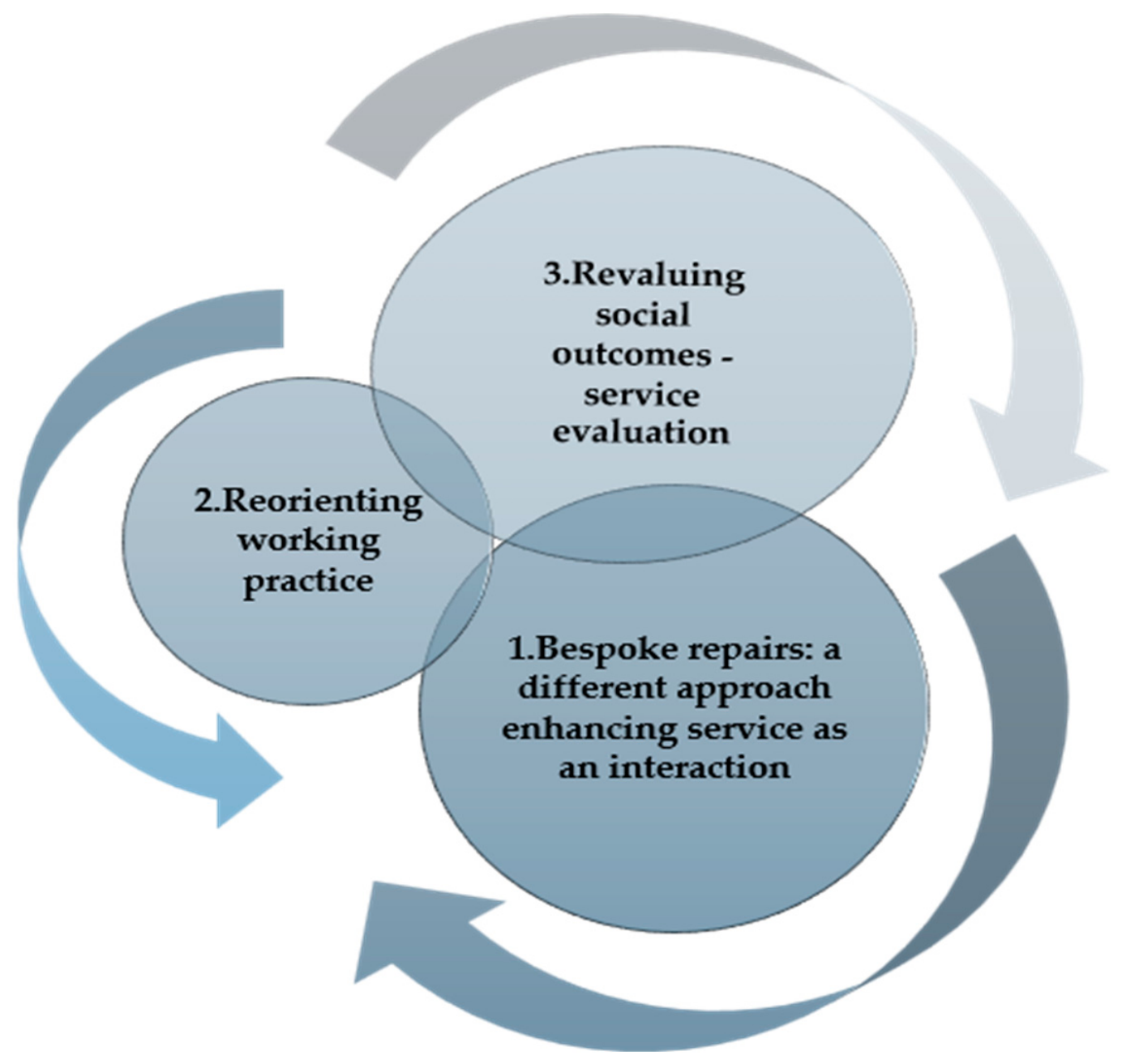
4.4. Interconnecting Research Finding Clusters

The three clusters identified in the findings and their interconnections are illustrated in Figure 1 (below). The relational service reform in the case study suggests an enhanced interactive repairs service associated with multiple interacting benefits from a professional perspective. Reorienting working practices represents both a mechanism and product of the different approach adopted and is pivotal to the wider agenda of building landlord–resident relations. While social value has tended to be outcome-focused, this study locates it instead in the manner of an ongoing service relationship, providing additional dimensions to be incorporated in evolving frameworks for attributing social value and recognising its significance as an integrated element of built environment sustainability.
This case study draws attention to the significance of responsive repairs as a fundamental service with the potential to provide a foundation for wider strategic objectives through developing landlord–resident relations. Exploiting this potential is an under-discussed aspect of sustainable retrofit practice. Reframing the routine physical repair to a property towards a relational exchange within someone’s homes elevates repairs beyond the transactional benefits to the landlord of sustaining asset value and the physical benefits accruing to the residents and sets the repairing process within the wider context of the landlord–resident relationship. This deeper recognition of property as someone’s home, and the role of service provision within this [6,27], has implications for broadening out the focus of asset management and retrofit strategies beyond existing social aspects of resident use behaviours and physical health [34].

5. Conclusions

5.1. Key Findings and Summary

In addressing the research questions, professionals’ qualitative insights illustrated the distinctive interactive and relational characteristics of their bespoke service delivery, indicative of an advocated ‘human-centric’ approach [14] being enacted in practice. The processes of building relationships emerged from empirical evidence as a central feature and underlying principle. The findings suggest that enhancing the service as an interaction rather than a transaction created multiple, complex, mutually reinforcing gains, ranging from the perceived efficacy of the repairs process to the potential to impact resident wellbeing by building connections and trust. The findings highlighted a number of perceived professional and organisational benefits, suggesting the relational gains of service reform may accrue as much through the professional workforce as through the resident relationship it is designed to improve. In exploring perceptions about the attribution of value to such social and relational benefits within the operational and strategic context, a need to move beyond traditional service evaluation metrics in order to fully reflect social value was identified.

5.2. Contribution

The exploratory and insider professional perspective adopted in the research at a time of policy and regulatory flux is crucial in understanding the practitioner and organisational learning necessary for transformative change. Grounding the analyses within a fluid concept of property management, bringing together property, social housing management, and relational public service delivery literature, offers new ways to recognise and frame the role of the everyday repairs service beyond a narrow asset management remit. The research introduces an intersection between how buildings are managed in terms of the physical repair function and how organisations relate to their residents, advancing the complexity and significance of the social sustainability dimension within an integrated, inclusive framework for delivering sustainable outcomes across wider asset management and retrofit strategies.

5.3. Implications

The reframing of repairs contributes to academic and practice debates about the evolving boundaries of residential property management, with implications for what is studied and how, and the training and development needs of practitioners. A more holistic, relational approach requires significant cultural and funding change. Applying a dynamic concept of property management provides a potential framework for change which has strong synergies with contemporary policy and professional agendas for rental housing reform. However, it must also be recognised that policy evolution in practice sits within a wider external environment that can bring both opportunities and constraints. For example, narrow, transactional service evaluation metrics could limit innovation [25], especially in budget constrained organisations. It is crucial that strategic policy and decision makers seek to develop service evaluation indicators which recognise the importance of social and relational dimensions. The shifting policy, professional, and regulatory context of this research offers a narrow but consequential window for informing how regulatory and policy frameworks evolve. The evaluative challenge identified in this research is not confined to social housing and may inform how relational value is considered across the wider rental sector in the face of regulatory scrutiny.

5.4. Limitations and Future Research

It is important to recognise the bounded nature of the findings that draw upon interview and workshop data from six professional respondents involved with a single case study. The insider-practitioner perspective provided the opportunity to explore transformative practice and its diverse and complex potential benefits with relevance for professionals working across property management. It must be recognised that the research does not incorporate a resident perspective or a quantitative evaluation of relative costs and benefits. In terms of wider transferability, the findings should be read as propositions grounded in one organisational context rather than as claims about the prevalence of such gains elsewhere. Nevertheless, this exploratory research identifies propositions for further testing in this emerging area. Multi-perspective evaluation across case studies of relational repairs services, incorporating quantitative cost–benefit analysis, is required to provide a more comprehensive and demonstrable measure of impact. A comparative case study analysis of a relational and non-relational repairs service would add to our understanding of impacts on resident interaction and influencing factors. Longitudinal studies would be worthwhile in demonstrating the extent and nature of relational and social wellbeing implications for service users. In illustrating the relevance and complexity of social value implications, this paper suggests less tangible, indirect gains from different perspectives should be incorporated within evolving metrics for evaluating the repairs service. Further research is needed to identify indicators of, and how to attribute value to, such qualitative social outcomes, as well as disaggregating the relative influence of different features of service reform. Beyond the responsive repairs function, this research hypothesises a potential relationship between the quality of landlord–resident relations and the effectiveness of strategic asset management and retrofit programmes. The findings inform an emerging research agenda which examines the notion that investing in a relational approach to the repairs service built on trust lays the foundation for more successful and sustainable retrofit programme outcomes. Broadening the repairs and retrofit research agendas to integrate social and relational aspects of social sustainability is key to inform evolving policy and practice and conceptual frameworks in this critical and dynamic aspect of the built environment.

Supplementary Materials

The following supporting information can be downloaded at https://www.mdpi.com/article/10.3390/buildings16203993/s1, Table S1: Interview questions for professional respondents; Table S2: Summary of workshop agenda for professional participants; Table S3: Research questions, interview and workshop questions, themes and findings clusters.

Author Contributions

Conceptualization, C.H. and R.K.; methodology, C.H. and R.K.; validation, C.H. and R.K.; formal analysis, C.H. and R.K.; investigation, C.H. and R.K.; resources, C.H. and R.K.; writing—original draft preparation, C.H. and R.K.; writing—review and editing, C.H. and R.K.; All authors have read and agreed to the published version of the manuscript.

Funding

This research received no external funding. Internal funding from the affiliated university supported the workshop.

Institutional Review Board Statement

The study was approved by Research Ethics Committee at Northumbria University (Project ID 4795). Informed consent for participation was obtained from all subjects involved in the study.

Informed Consent Statement

Informed consent was obtained from all subjects involved in the study.

Data Availability Statement

The qualitative data set generated during the study is not available for release due to privacy and ethical limitations.

Conflicts of Interest

The authors declare that they have no known competing financial interests or personal relationships that could have appeared to influence the work reported in this paper.

Abbreviations

The following abbreviations are used in this manuscript:
CIHChartered Institute of Housing
HOHousing Ombudsman
KPIKey Performance Indicators
MECCMaking Every Contact Count
MHCLGMinistry of Housing, Communities and Local Government
NHFNational Housing Federation
NPMNew Public Management
RSHRegulator of Social Housing

References

  1. Ravetz, J. State of the stock—What do we know about existing buildings and their future prospects? Energy Policy 2008, 36, 4462–4470. [Google Scholar] [CrossRef] [Scilit]
  2. European Environment Agency. Building Renovation: Where Circular Economy and Climate Meet (Briefing No.12/2022). Publications Office of the European Union. 2022. Available online: https://www.eea.europa.eu/en/analysis/publications/building-renovation-where-circular-economy-and-climate-meet (accessed on 23 June 2026).
  3. Historic England. The Role of Maintenance and Repair in a Low Carbon Future. 2024. Available online: https://historicengland.org.uk/research/heritage-counts/heritage-and-environment/maintenance-repair/ (accessed on 23 June 2026).
  4. United Nations. Transforming Our World: The 2030 Agenda for Sustainable Development, UN General Assembly. 2015. Available online: https://sdgs.un.org/2030agenda (accessed on 29 June 2026).
  5. Read, D.C.; Carswell, A. Is property management viewed as a value-added service? Prop. Manag. 2019, 37, 262–274. [Google Scholar] [CrossRef] [Scilit]
  6. Absalom, H. Rethinking Regulated Housing in England: Home As an Emotional Place. (University of Birmingham, Centre for Urban Wellbeing, Taroe Trust). 2023. Available online: https://www.birmingham.ac.uk/documents/college-les/taroe-trust-uob-rethinking-regulated-housing-in-england.pdf (accessed on 4 June 2025).
  7. Lee, K.-Y.E.; Chan, W.-W.V. The Repositioning of Professional Housing Management: Community Wellbeing and Social Sustainability. In Inclusive Housing Management and Community Wellbeing: A Case Study of Hong Kong; Springer Nature: Singapore, 2024; pp. 69–119. [Google Scholar]
  8. Renters Rights Act c.26. 2025. Available online: https://www.legislation.gov.uk/ukpga/2025/26/contents (accessed on 23 June 2026).
  9. Social Housing (Regulation) Act 2023. Available online: https://www.legislation.gov.uk/ukpga/2023/36 (accessed on 23 February 2025).
  10. MHCLG. Social Housing Green Paper: A ‘New Deal’ for Social Housing. HMSO. 2018. Available online: https://assets.publishing.service.gov.uk/media/5b71a31840f0b61376d5e3d8/A_new_deal_for_social_housing_web_accessible.pdf (accessed on 23 February 2025).
  11. Chartered Institute of Housing. New Approaches to Housing Management; Chartered Institute of Housing: Coventry, UK, 2020; Available online: https://cih.org/media/00ziaz15/new-approaches-to-housing-management.pdf (accessed on 2 June 2025).
  12. Grenfell Inquiry. Grenfell Tower Inquiry Phase 1 Report Government Response. 2019. Available online: https://www.gov.uk/government/publications/grenfell-tower-inquiry-phase-1-report-government-response/grenfell-tower-inquiry-phase-1-report-government-response (accessed on 23 February 2025).
  13. Coroner’s Report. “Awaab Ishak—Prevention of Future Deaths Report—2022-0365,” Courts and Tribunals Judiciary, November 2022. Available online: https://www.judiciary.uk/wp-content/uploads/2022/11/Awaab-Ishak-Prevention-of-future-deaths-report-2022-0365_Published.pdf (accessed on 23 February 2025).
  14. Housing Ombudsman (HO). Spotlight Report on Attitudes, Respect and Rights—Relationship of Equals. 2024. Available online: https://www.housing-ombudsman.org.uk/reports/spotlight-reports/spotlight-on-attitudes-respect-and-rights-relationship-of-equals/ (accessed on 2 June 2025).
  15. MHCLG. The Charter for Social Housing Residents: Social Housing White Paper. HMSO. 2020. Available online: https://www.gov.uk/government/publications/the-charter-for-social-housing-residents-social-housing-white-paper (accessed on 23 February 2025).
  16. McCall, V.; McKee, K.; Theakstone, D.D.; McCulloch, C.G.; Taylor, H. The reflective housing practitioner: The role of qualifications for building empathy and person-centered approaches in the housing sector. Hous. Soc. 2026, 53, 53–74. [Google Scholar] [CrossRef] [Scilit]
  17. NHF/CIH. Better Social Housing Review. 2022. Available online: https://www.housing.org.uk/our-work/quality/better-social-housing-review/recommendations (accessed on 23 February 2025).
  18. NHF. Housing Associations in 2025: A Strategic Review. 2025. Available online: https://www.housing.org.uk/resources/nhf-strategic-review-2025/ (accessed on 15 May 2025).
  19. Franklin, B.J. Demands, Expectations and Responses: The Shaping of Housing Management. Hous. Stud. 2000, 15, 907–927. [Google Scholar] [CrossRef] [Scilit]
  20. Walker, R. The Changing Management of Social Housing: The Impact of Externalisation and Managerialism. Hous. Stud. 2000, 15, 281–299. [Google Scholar] [CrossRef] [Scilit]
  21. Sanderson, D.; Read, D. Recognizing and Realizing the Value of Customer-Focused Property Management. Prop. Manag. 2020, 38, 749–764. [Google Scholar] [CrossRef] [Scilit]
  22. Franklin, B.; Clapham, D. The social construction of housing management. Hous. Stud. 1997, 12, 7–26. [Google Scholar] [CrossRef] [Scilit]
  23. Power, A. Property Before People: The Management of Twentieth-Century Council Housing, 1st ed.; Routledge: London, UK, 1987. [Google Scholar] [CrossRef] [Scilit]
  24. Cairncross, L.; Clapham, D.; Goodlad, R. Housing Management, Consumers and Citizens; Routledge: London, UK, 1997. [Google Scholar]
  25. Wilson, R.; French, M.; Hesselgreaves, H.; Lowe, T.; Smith, M. New development: Relational public services—Reform and research agenda. Public Money Manag. 2024, 44, 553–558. [Google Scholar] [CrossRef] [Scilit]
  26. Clarke, J.; Newman, J. Debate: Beyond the New Public Management? Public Money Manag. 2025, 45, 6–7. [Google Scholar] [CrossRef] [Scilit]
  27. Housing Ombudsman (HO). Spotlight Report on Repairs and Maintenance—Repairing Trust. 2025. Available online: https://www.housing-ombudsman.org.uk/reports/spotlight-reports/repairing-trust/ (accessed on 4 June 2025).
  28. CIH/NHF. Working in Partnership to Improve Repairs and Maintenance Services: How to Respond to Recommendation Three of the Better Social Housing Review. 2024. Available online: https://cih.org/media/esspxtb1/0508-wp-improve-repairs-maintenance-services-jan25-web.pdf (accessed on 2 April 2025).
  29. Ly, A.M.; Cope, M.R. New Conceptual Model of Social Sustainability: Review from Past Concepts and Ideas. Int. J. Environ. Res. Public Health 2023, 20, 5350. [Google Scholar] [CrossRef] [Scilit] [PubMed] [PubMed Central]
  30. Vallance, S.; Perkins, H.C.; Dixon, J.E. What is social sustainability? A clarification of concepts. Geoforum 2011, 42, 342–348. [Google Scholar] [CrossRef] [Scilit]
  31. CHAS. What Is Social Sustainability? Key Facts and Examples. 2025. Available online: https://www.chas.co.uk/blog/what-is-social-sustainability/ (accessed on 23 August 2026).
  32. UKGBC. Framework for Defining Social Value. 2021. Available online: https://ukgbc.org/wp-content/uploads/2021/02/Framework-for-Defining-Social-Value.pdf (accessed on 23 August 2026).
  33. Marshall, M.; Zhang, M.L.; Brown, P.; Berry, P. Transforming Social Housing Through Decarbonisation: The Challenges and Opportunities in Decarbonising at Scale. 2025. Available online: https://housingevidence.ac.uk/project/transforming-social-housing-through-decarbonisationthe-challenges-and-opportunities-in-decarbonising-at-scale/ (accessed on 13 July 2026).
  34. Xu, J.F.; Green, A.; Jain, S.; Chan, D.; Billington, S.L. Impact of sustainable retrofitting on resident wellbeing: A critical review. Build. Environ. 2025, 284, 113354. [Google Scholar] [CrossRef] [Scilit]
  35. Cromarty, H. Social Housing Reform in England: What Next? Research Briefing House of Commons Library. 2023. Available online: https://researchbriefings.files.parliament.uk/documents/CBP-9227/CBP-9227.pdf (accessed on 23 February 2025).
  36. NHF/CIH. Joint NHF and CIH Action Plan in Response to the Better Social Housing Review. 2023. Available online: https://www.cih.org/media/lmzdndty/nhf-cih-action-plan-bshr-2023-final.pdf (accessed on 14 March 2025).
  37. Grenfell Tower Inquiry. Grenfell Tower Inquiry Phase 2 Report (HC 173); House of Commons: London, UK, 2024. Available online: https://www.gov.uk/government/publications/publication-of-the-grenfell-tower-inquiry-phase-2-report (accessed on 29 December 2025).
  38. Housing Ombudsman. Special Report on Rochdale Boroughwide Housing. 2023. Available online: https://www.housing-ombudsman.org.uk/wp-content/uploads/2023/03/P49-RBH-FINAL-200323.pdf (accessed on 23 February 2025).
  39. RSH (Regulator of Social Housing). Consumer Standards Code of Practice. 2024. Available online: https://www.gov.uk/government/publications/consumer-standards-code-of-practice (accessed on 31 December 2025).
  40. RSH. Tenant Satisfaction Measures 2023/4 Headline Report. 2024. Available online: https://assets.publishing.service.gov.uk/media/673f38f64ebce30ac7baf03b/TSM_Headline_Publication_Final.pdf (accessed on 12 March 2025).
  41. Gov.uk. 2023 Global Accounts of Private Registered Providers. 2023. Available online: https://www.gov.uk/government/publications/2023-global-accounts-of-private-registered-providers (accessed on 12 March 2025).
  42. RSH. 2025 Global Accounts for Private Registered Providers. 2026. Available online: https://www.gov.uk/government/publications/2025-global-accounts-of-private-registered-providers/2025-global-accounts-of-private-registered-providers (accessed on 18 July 2026).
  43. RSH. Annual Report and Accounts 2023–24. 2025. Available online: https://www.gov.uk/government/publications/regulator-of-social-housing-annual-report-and-accounts-2023-24 (accessed on 18 July 2026).
  44. Furbey, R.; Reid, B.; Cole, I. Housing Professionalism in the United Kingdom: The Final Curtain or a New Age? Hous. Theory Soc. 2001, 18, 36–49. [Google Scholar] [CrossRef] [Scilit]
  45. Real Estate Management, 3rd ed.; Royal Institution of Chartered Surveyors: London, UK, 2016; Available online: https://www.rics.org/profession-standards/rics-standards-and-guidance/sector-standards/real-estate-standards/real-estate-management (accessed on 4 June 2025).
  46. Thompson, B. Innovation in property management. J. Prop. Invest. Financ. 2015, 33, 436–445. [Google Scholar] [CrossRef] [Scilit]
  47. Arnison, C. Positive Property Management—A new prospectus (concluded). Prop. Manag. 1984, 2, 314–320. [Google Scholar] [CrossRef] [Scilit]
  48. Knight Frank. Build to Rent Resident Experience Index. 2023. Available online: https://www.knightfrank.co.uk/research/reports/build-to-rent-resident-experience-index-2734/contentassets/build-to-rent-resident-experience-index-2023-10495.pdf (accessed on 22 June 2026).
  49. Carvalho, R.; Liu, T.; Zhang, F.; Yu, R.; Oh, E. Key themes of build-to-rent: Developing a conceptual framework for achieving successful developments through a systematic literature review. Buildings 2023, 13, 1926. [Google Scholar] [CrossRef] [Scilit]
  50. Public Health England; NHS England and Health Education England. Making Every Contact Count (MECC): Consensus Statement; Public Health England, : London, UK; NHS England: London, UK, 2016. Available online: https://www.england.nhs.uk/wp-content/uploads/2016/04/making-every-contact-count.pdf (accessed on 25 February 2025).
  51. Housing Ombudsman (HO). 9.1.25 News Press Releases—Ombudsman’s New Power to Issue Good Practice to Focus on Relationship Management in Its First Edition. 2025. Available online: https://www.housing-ombudsman.org.uk/2025/01/09/good-practice-to-focus-on-relationship-management/#:~:text=9%20January%202025&text=The%20consultation%20received%20163%20responses,relationships%20which%20have%20broken%20down (accessed on 4 June 2025).
  52. NHF. Making Every Contact Count. 2024. Available online: https://www.housing.org.uk/globalassets/files/bshrknowing-our-homes/making-every-contact-count-2024.pdf (accessed on 25 February 2025).
  53. Centre for Social Justice. Lonely Nation Part 2: Ending Loneliness Among Older People. 2024. Available online: https://www.centreforsocialjustice.org.uk/wp-content/uploads/2024/08/CSJ-Lonely_Nation_part-2.pdf (accessed on 24 April 2025).
  54. Williams, P.; Clarke, A.; Whitehead, C. Intended and Unintended Consequences? A Case Study Survey of Housing Associations and Welfare Reforms; Centre for Housing and Planning Research, Cambridge University: Cambridge, UK, 2013. [Google Scholar]
  55. Chevin, D. Social Hearted, Commercially Minded: A Report on Tomorrows Housing Associations; The Smith Institute: London, UK, 2013. [Google Scholar]
  56. Sprigings, N. Delivering Public Services—Mechanisms and Consequences: Delivering Public Services Under the New Public Management: The Case of Public Housing. Public Money Manag. 2002, 22, 11–17. [Google Scholar] [CrossRef] [Scilit]
  57. Fulcher, M.; Edwards, D.J.; Lai, J.H.K.; Thwala, W.D.; Hayhow, S. Analysis and modelling of social housing repair and maintenance costs: A UK case study. J. Build. Eng. 2022, 52, 104389. [Google Scholar] [CrossRef] [Scilit]
  58. Yin, R.K. Case Study Research and Applications: Design and Methods, 6th ed.; Sage Publications: Thousand Oaks, CA, USA, 2016. [Google Scholar]
  59. Ebneyamini, S.; Sadeghi Moghadam, M.R. Toward Developing a Framework for Conducting Case Study Research. Int. J. Qual. Methods 2018, 17. [Google Scholar] [CrossRef] [Scilit]
  60. Niu, H. Navigating Power Dynamics in Elite Interviews. J. Educ. Adm. Hist. 2024, 1–26. [Google Scholar] [CrossRef] [Scilit]
  61. Von Soest, C. Why Do We Speak to Experts? Reviving the Strength of the Expert Interview Method. Perspect. Politics 2023, 21, 277–287. [Google Scholar] [CrossRef] [Scilit]
  62. Scally, G.; Black, D.; Pilkington, P.; Williams, B.; Ige-Elegbede, J.; Prestwood, E. The Application of ‘Elite Interviewing’ Methodology in Transdisciplinary Research: A Record of Process and Lessons Learned during a 3-Year Pilot in Urban Planetary Health Research. J. Urban Health 2021, 98, 404–414. [Google Scholar] [CrossRef] [Scilit] [PubMed] [PubMed Central]
  63. Braun, V.; Clarke, V. Using thematic analysis in psychology. Qual. Res. Psychol. 2006, 3, 77–101. [Google Scholar] [CrossRef] [Scilit]
Figure 1. Interconnecting research finding clusters.
Buildings 16 03993 g001
Table 1. The bespoke repairs service case study.
Case Study Bespoke Repairs Service Innovation
Organisational Context
and Origins
Service Remit: Stock and
Residents
Previous Service FeaturesBespoke Repairs Service
Features
A large social landlord operating at arms-length within a metropolitan local authority in England, with a large portfolio of diverse housing stock.
An organisational review of the supported housing offer identified repairs as a key concern for customers. Subsequently, the decision was taken to develop a bespoke repairs scheme for vulnerable people. This included adults with learning disabilities and autism who were living independently in specialist housing schemes as well as older people in similar schemes *, epitomising the importance of a familiar and reliable repairs team to reduce anxiety.
The bespoke repairs scheme applies to housing stock accommodating older people (55 years plus), who are living independently with low levels of additional support.
It initially included supported accommodation blocks and was subsequently extended across older people’s bungalows and new-build stock.
Responsive repairs were reported and delivered via the single, generic call centre and repairs team which operated across the landlord organisations’ stock and residentsA specific Repairs Coordinator and scheduler introduced. Housing scheme officers contact the dedicated scheduler directly, liaising between housing and the bespoke repairs teams in identifying and reporting repairs.
Repairs delivered by a team of specific tradespeople across the different professions (Plumbing, Electrical, Joinery, Plastering). Images and names of tradespeople displayed in accommodation schemes.
Additional time allocated per visit; specific time slots provided to residents.
* this research focuses on the older persons housing stock only.
Table 2. Respondent information.
Respondents
(Total n = 6)
Organisational RoleParticipation in Initial MeetingParticipation in InterviewParticipation in Workshop
R1Senior manager (Repairs and Maintenance)xx
R2Senior manager
(Housing services)
x
R3Manager
(Support services)
x
R4Manager
(Repairs and Maintenance)
xxx
R5Officer
(Housing/support)
x
R6Officer
(Housing/support)
x
Disclaimer/Publisher’s Note: The statements, opinions and data contained in all publications are solely those of the individual author(s) and contributor(s) and not of MDPI and/or the editor(s). MDPI and/or the editor(s) disclaim responsibility for any injury to people or property resulting from any ideas, methods, instructions or products referred to in the content.