Valuer-in-the-Loop: A Co-Adaptive Workflow for AI-Enabled Real Estate Valuation


Abstract
1. Introduction
2. Methodology
2.1. Research Design
2.2. Literature Identification and Boundaries

| Review Component | Key Literature/Approach | Purpose |
|---|---|---|
| Initial seeding: valuation process | Blackledge [4] | Established the valuation process as a conceptual foundation. |
| Crosby et al. [5] | ||
| Wyatt [28] | ||
| Initial seeding: valuation hierarchy | French and Gabrielli [31,32] | Established the literature on the valuation hierarchy, including approaches, methods and models. |
| Numan and Yusuf [29] | ||
| Pagourtzi et al. [30] | ||
| Initial seeding: AVMs | Rosen [35] | Established the conceptual and professional literature on automated valuation models and the implications for valuation practice. |
| Downie and Robson [12] | ||
| Glumac and Des Rosiers [33] | ||
| RICS [20,23] | ||
| IVSC [19] | ||
| Initial seeding: Human-centred AI | Crootof et al. [36] | Established the conceptual foundations for understanding human–AI interaction, human oversight, and the role of human judgement in AI-supported decision-making. |
| Lindsay [37] | ||
| Natarajan et al. [38] | ||
| Trippi [39] | ||
| Iterative identification | Scopus and Web of Science searches; professional body website searches; backward and forward citation tracking; searches of related work by initial seeding authors | Expanded the literature and refined the emerging conceptual framework, with sources retained where they made a substantive contribution to the framework’s central conceptual concerns. |
| Stopping rule | Continued searching and citation tracking until no new relevant conceptual categories or distinctions emerged | Established conceptual saturation. |
2.3. Standards Comparison and Framework Development Process
2.4. Scope and Limitations
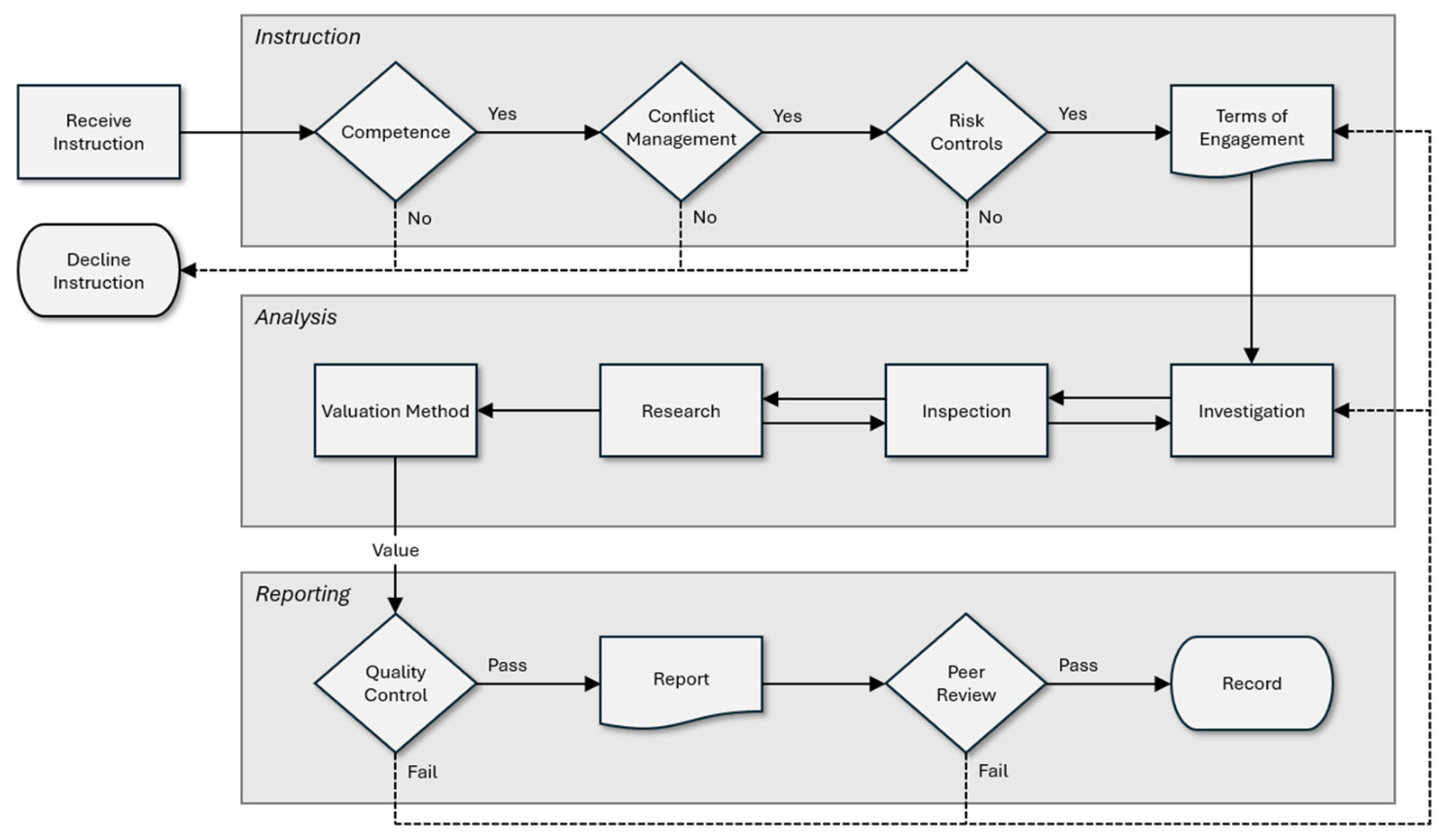
3. The Valuation Process
3.1. Instruction
3.2. Analysis
3.3. Reporting
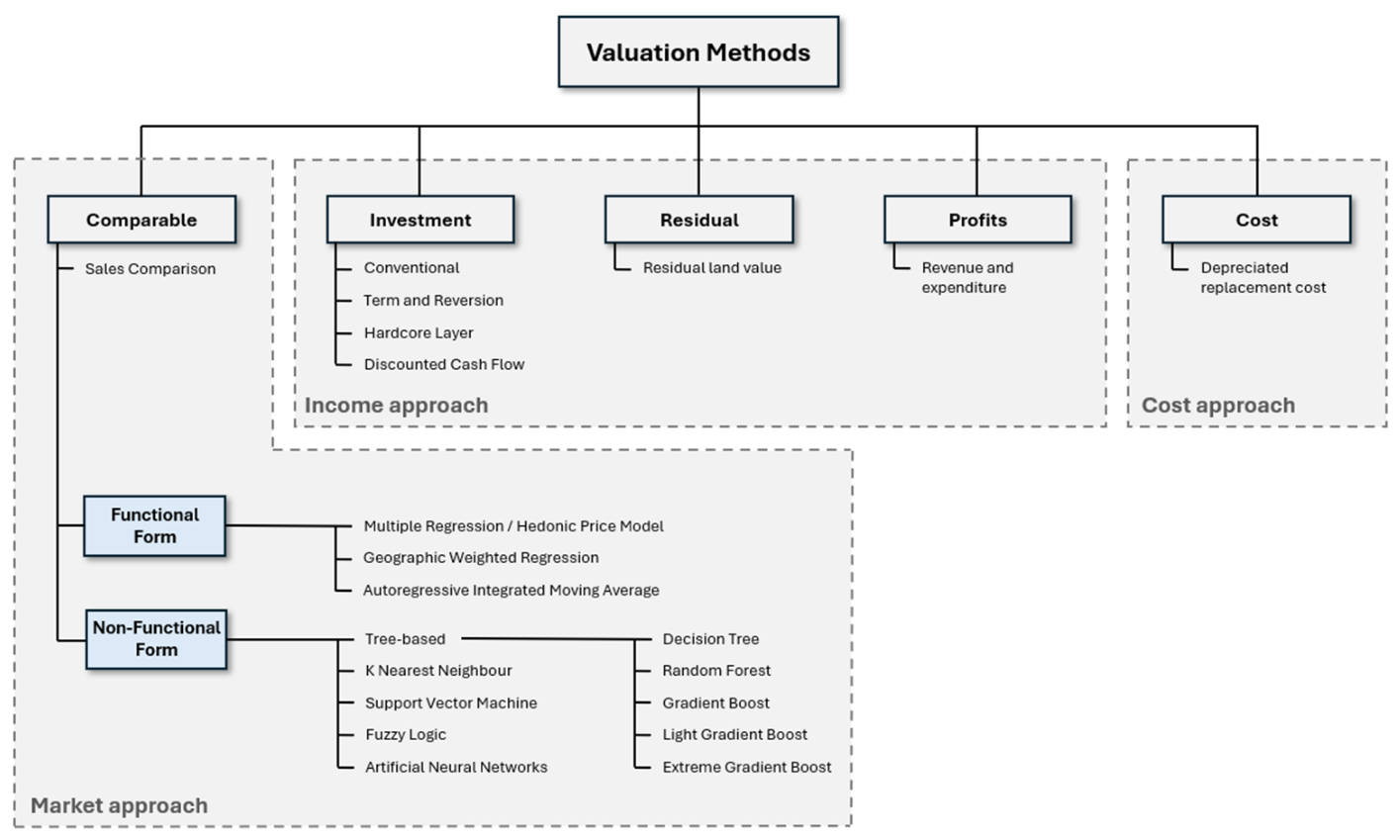
4. The Valuation Hierarchy
4.1. Valuation Approaches
- Market approach: Value as a price equilibrium—an indicative value of the subject property can be derived by comparison to similar property assets, assuming a buyer will pay no more than the cost of acquiring an asset of equivalent utility.
- Income approach: Value as an anticipated benefit—an indicative value of the subject property can be derived by converting future cash flows into a present value, assuming a buyer will pay a capital price for the benefit of receiving future income.
- Cost approach: Value as the cost of substitution—an indicative value of the subject property can be derived by estimating the total reproduction cost of the asset, assuming a buyer will pay no more than the cost to construct an asset of equivalent utility.
4.2. Valuation Methods
4.3. Valuation Models
‘A valuation model is a tool used for the quantitative implementation of a valuation method in whole or in part… [and] converts inputs into outputs used in the development of a value, whereas a valuation method is a specific technique to develop a value… No model without the valuer applying professional judgement, for example an automated valuation model (AVM), can produce an IVS-compliant valuation’[50].
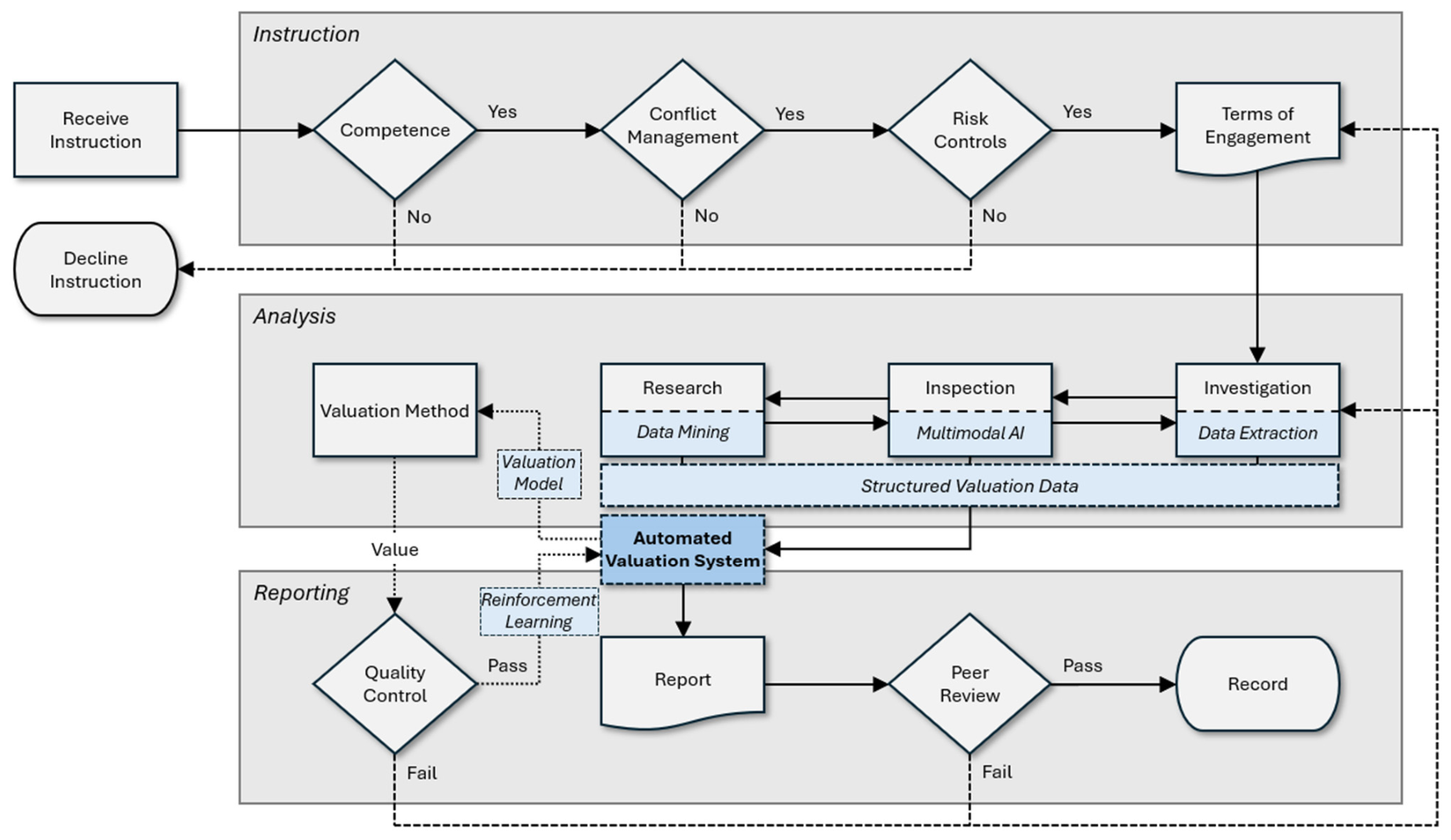
5. The Valuer-in-the-Loop Workflow
“The future for both AVMs and valuers is for the two elements to come together—an AVM in the hands of the valuer with relevant expert local knowledge and able to manipulate the data is like 2 + 2 = 5!”[12].
- Investigation: Documentary evidence relating to the subject property, such as statutory due diligence, is collected and organised through data and information extraction techniques [78]. Data extraction is the automated process of identifying and retrieving relevant data from structured or unstructured sources, such as documents and databases, and converting it into a structured format for subsequent analysis [79]. While digital technologies such as Natural Language Processing (NLP) substantially reduce the administrative burden associated with information collection, automated extraction may misinterpret, omit, or incorrectly structure information, particularly where documentary evidence is incomplete, ambiguous, or presented in inconsistent formats; therefore, the verification of evidence and determination of its materiality remain professional responsibilities requiring the valuer’s judgement.
- Inspection: Multimodal AI techniques, including computer vision, support the extraction of observable property attributes from photographs [80] and street-view and satellite datasets [81]. Computer vision is the use of AI techniques to analyse and interpret visual information, enabling observable features within images to be identified and converted into structured data [82]. These methods assist the identification of physical attributes to augment the collection of observable evidence. However, these techniques may fail to identify physical features in poor quality images. Consequently, AI-derived observations should be treated as supplementary evidence that enhances the efficiency of translating physical observations into structured digital data, rather than replacing the valuer’s interpretation and validation of evidence.
- Research: AI processes can support the analysis of market evidence through techniques such as data mining. Data mining is the process of using computational techniques to identify relationships, patterns, and trends within large datasets that may not be readily apparent through manual analysis [83]. Techniques such as NLP facilitate the extraction of relevant property data from large property datasets that are too large to analyse manually [84,85]. However, the relationships identified through automated analysis may reflect spurious correlations or biases within the underlying data [86], requiring the valuer to assess their reliability before incorporating into the AVS.
6. Conclusions and Further Research
- First, recognising that variance is inherent to real estate valuation, detailed consideration should be given to uncertainty within the Valuer-in-the-Loop workflow. The treatment of uncertainty remains a fundamental challenge since its explicit recognition in both The Mallison Report (1994) and The Carsberg Report (2002), with their practical consequences experienced during the Global Financial Crisis in 2008 and the Coronavirus Pandemic in 2020 [47,48]. In this regard, the principal contribution of artificial intelligence in AVS may by the integration of probabilistic methods—such as sensitivity analysis, scenario testing, and discrete probability modelling—which, historically, have proven computationally laborious in traditional calculation methods. Such a system represents a connection between probabilistic reasoning and deterministic outputs, producing a “risk-aware” simulation model that can lead to a better understanding of the nature of the real estate asset under consideration [28,41].
- Secondly, a systematic review would provide a clearer understanding of the capabilities and limitations of individual techniques across the broader valuation workflow, extending the conceptual foundations established by the Valuer-in-the-Loop workflow.
- Thirdly, further research is required into the engineering of valuation data. This includes the development of structured data representations that maintain provenance and regulatory compliance under the professional standards framework.
- Finally, empirical research examining professional attitudes towards the Valuer-in-the-Loop workflow would provide valuable insight into the organisational and practical challenges associated with their adoption. Further research in this regard should be conducted through a pilot study to develop a data specification based on the professional standards framework identified in Table 1. Further, a Delphi study should be conducted to present the data specification to relevant professional bodies and a representative sample of professional valuers to ensure the data specification presents a practical framework for implementation.
Author Contributions
Funding
Data Availability Statement
Conflicts of Interest
References
- Gilbertson, B.; Preston, D. Practice Briefing A Vision for Valuation. J. Prop. Invest. Finance 2005, 23, 123–140. [Google Scholar] [CrossRef] [Scilit]
- Harvey, J.; Jowsey, E. Urban Land Economics, 6th ed.; Red Globe Press: London, UK, 2003. [Google Scholar]
- Zhang, J.J.; Danivska, V.; Schraven, D.; Remøy, H. A Historical Narrative of Value Theory in Economics and Appraisal. J. Prop. Res. 2026, 43, 145–166. [Google Scholar] [CrossRef] [Scilit]
- Blackledge, M. Introducing Property Valuation, 2nd ed.; Routledge: Oxon, UK, 2017. [Google Scholar]
- Crosby, N.; Hutchinson, N.; Lusht, K.; Yu, S.M. Valuations and Their Importance for Real Estate Investments. In Routledge Companion to Real Estate Investment; MacGregor, B.D., Schulz, R., Green, R.K., Eds.; Routledge: Oxon, UK, 2018. [Google Scholar]
- Pérez-Rave, J.I.; Correa-Morales, J.C.; González-Echavarría, F. A Machine Learning Approach to Big Data Regression Analysis of Real Estate Prices for Inferential and Predictive Purposes. J. Prop. Res. 2019, 36, 59–96. [Google Scholar] [CrossRef] [Scilit]
- Forys, I. Machine Learning in House Price Analysis: Regression Models versus Neural Networks. In Procedia Computer Science; Elsevier B.V.: Amsterdam, The Netherlands, 2022; Volume 207, pp. 435–445. [Google Scholar] [CrossRef] [Scilit]
- Harahap, T.H.; Dachi, S.W.; Sitompul, D.N. K-Nearest Neighbor Algorithm for Predicting Land Sales Price. Int. Comput. Sci. Inf. Technol. (AIoCSIT) J. 2022, 3, 58–67. [Google Scholar]
- Baur, K.; Rosenfelder, M.; Lutz, B. Automated Real Estate Valuation with Machine Learning Models Using Descriptions. Expert Syst. Appl. 2023, 213, 119147. [Google Scholar] [CrossRef] [Scilit]
- Cardone, B.; Di Martino, F.; Senatore, S. Real Estate Price Estimation through a Fuzzy Partition-Driven Genetic Algorithm. Inf. Sci. 2024, 667, 120442. [Google Scholar] [CrossRef] [Scilit]
- El Jaouhari, A.; Samadhiya, A.; Kumar, A.; Šešplaukis, A.; Raslanas, S. Mapping the landscape: A systematic literature review on automated valuation models and strategic applications in real estate. Int. J. Strateg. Prop. Manag. 2024, 28, 286–301. [Google Scholar] [CrossRef] [Scilit]
- Downie, M.-L.; Robson, G. Integrating Automated Valuation Models (AVMs) with Valuation Services to Meet the Needs of UK Borrowers, Lenders and Valuers. In Proceedings of the ERES 2009 Conference, Stockholm, Sweden, 24–27 June 2009. [Google Scholar]
- Baum, A.; Saull, A.; Braesemann, F. Proptech 2020: The Future of Real Estate; Proptech: Oxford, UK, 2020. [Google Scholar]
- Starr, C.W.; Saginor, J.; Worzala, E. The Rise of PropTech: Emerging Industrial Technologies and Their Impact on Real Estate. J. Prop. Invest. Finance 2021, 39, 157–169. [Google Scholar] [CrossRef] [Scilit]
- de la Cal, A.S.; Raya, A.M.; Morales-Alonso, G. Mapping the Role of Artificial Intelligence in Real Estate: A Bibliometric and Case Study Analysis. J. Entrep. Manag. Innov. 2025, 21, 5–23. [Google Scholar] [CrossRef] [Scilit]
- Renigier-Bilozor, M.; Ache, P.; Dimopoulos, T.; Janowski, A. The future of property valuation: Avms and camas in the era of AI. Econ. Environ. 2026, 96, 974. [Google Scholar] [CrossRef] [Scilit]
- Al-haimi, B.; Khalid, H.; Zakaria, N.H.; Jasimin, T.H. Digital Transformation in the Real Estate Industry: A Systematic Literature Review of Current Technologies, Benefits, and Challenges. Int. J. Inf. Manag. Data Insights 2025, 5, 100340. [Google Scholar] [CrossRef] [Scilit]
- Orr, A.M.; Stewart, J.L. Property Use Diversity and Spatial Accessibility within Urban Retailing Centres: Drivers of Retail Rents. J. Prop. Res. 2022, 39, 365–392. [Google Scholar] [CrossRef] [Scilit]
- International Valuation Standards Council. Navigating the Rise of AI in Valuation: Opportunities, Risks, and Standards; International Valuation Standards Council: London, UK, 2024. [Google Scholar]
- Royal Institution of Chartered Surveyors. Responsible Use of Artificial Intelligence in Surveying Practice; Royal Institution of Chartered Surveyors: London, UK, 2025. [Google Scholar]
- PricewaterhouseCoopers. PWC AVM Benchmarking Survey; PricewaterhouseCoopers: London, UK, 2026. [Google Scholar]
- United States Government Accountability Office. Property Technology for Homebuying: Products Present Benefits and Risks Amid Evolving Federal Oversight Report to Congressional Requesters United States Government Accountability Office; United States Government Accountability Office: Washington, DC, USA, 2025. [Google Scholar]
- Royal Institution of Chartered Surveyors. Automated Valuation Models Roadmap for RICS Members and Stakeholders Automated Valuation Models; Royal Institution of Chartered Surveyors: London, UK, 2021. [Google Scholar]
- European AVM Alliance. Joint Paper on the Use of Automated Valuation Models in Europe; European AVM Alliance: Brussels, Belgium, 2025. [Google Scholar]
- Torraco, R.J. Writing Integrative Literature Reviews: Guidelines and Examples. Hum. Resour. Dev. Rev. 2005, 4, 356–367. [Google Scholar] [CrossRef] [Scilit]
- Grant, M.J.; Booth, A. A Typology of Reviews: An Analysis of 14 Review Types and Associated Methodologies. Health Inf. Libr. J. 2009, 26, 91–108. [Google Scholar] [CrossRef] [Scilit]
- Bartke, S.; Schwarze, R. The Economic Role and Emergence of Professional Valuers in Real Estate Markets. Land 2021, 10, 683. [Google Scholar] [CrossRef] [Scilit]
- Wyatt, P. Property Investment Valuation. In Property Valuation in an Economic Context; John Wiley & Sons: Oxford, UK, 2007. [Google Scholar]
- Numan, J.A.A.; Yusoff, I.M. Identifying the Current Status of Real Estate Appraisal Methods. Real Estate Manag. Valuat. 2024, 32, 12–27. [Google Scholar] [CrossRef] [Scilit]
- Pagourtzi, E.; Assimakopoulos, V.; Hatzichristos, T.; French, N. Real Estate Appraisal: A Review of Valuation Methods. J. Prop. Invest. Finance 2003, 21, 383–401. [Google Scholar] [CrossRef] [Scilit]
- Gabrielli, L.; French, N. Pricing to Market: Property Valuation Methods—A Practical Review. J. Prop. Invest. Finance 2021, 39, 464–480. [Google Scholar] [CrossRef] [Scilit]
- French, N.; Gabrielli, L. Pricing to Market: Property Valuation Revisited: The Hierarchy of Valuation Approaches, Methods and Models. J. Prop. Invest. Finance 2018, 36, 391–396. [Google Scholar] [CrossRef] [Scilit]
- Glumac, B.; Des Rosiers, F. Towards a Taxonomy for Real Estate and Land Automated Valuation Systems. J. Prop. Invest. Finance 2020, 39, 450–463. [Google Scholar] [CrossRef] [Scilit]
- Johnson, L.; Muldoon-Smith, K.; Greenhalgh, P. Unlocking Value: The Impact of Traditional Valuation Practices on the Number of Vacant Retail Units in the Built Environment. Environ. Plan. F 2024, 3, 268–285. [Google Scholar] [CrossRef] [Scilit]
- Rosen, S. Hedonic Prices and Implicit Markets: Product Differentiation in Pure Competition. J. Political Econ. 1974, 82, 34–55. [Google Scholar] [CrossRef] [Scilit]
- Crootof, R.; Kaminski, M.E.; Nicholson, W.; Ii, P.; Bagley, N.; Bechtold, S.; Bernstein, D.; Copeland, C.; Deacon, D.; Eisenberg, R.; et al. Humans in the Loop. Vanderbilt Law Rev. 2023, 76, 429–509. [Google Scholar]
- Lindsay, R.K.; Buchanan, B.G.; Feigenbaum, E.A.; Lederberg, J.; Lindsay, R.K. DENDRAL: A Case Study of the First Expert System for Scientific Hypothesis Formation. Artif. Intell. 1993, 61, 209–261. [Google Scholar] [CrossRef] [Scilit]
- Natarajan, S.; Mathur, S.; Sidheekh, S.; Stammer, W.; Kersting, K. Human-in-the-Loop or AI-in-the-Loop? Automate or Collaborate? In Proceedings of the AAAI Conference on Artificial Intelligence, Vancouver, BC, Canada, 26–27 February 2024; pp. 28594–28600. [Google Scholar]
- Trippi, R.R. Decision Support and Expert Systems for Real Estate Investment Decisions: A Review. Interfaces 1990, 20, 50–60. [Google Scholar] [CrossRef] [Scilit]
- Royal Institution of Chartered Surveyors. Valuation of Development Property; Royal Institution of Chartered Surveyors: London, UK, 2019. [Google Scholar]
- Wyatt, P. Property Valuation; John Wiley & Sons: Hoboken, NJ, USA, 2008. [Google Scholar]
- Amidu, A.R.; Boyd, D.; Agboola, A.O. The Role of Knowledge in Valuation Practice: Expert Valuers’ Perceptions. J. Prop. Invest. Finance 2019, 37, 524–540. [Google Scholar] [CrossRef] [Scilit]
- Salzman, D.; Zwinkels, R.C.J. Behavioural Real Estate. J. Real Estate Lit. 2017, 25, 77–106. [Google Scholar] [CrossRef] [Scilit]
- Crosby, N.; Lavers, A.; Murdoch, J. Property Valuation Variation and the ‘Margin of Error’ in the UK. J. Prop. Res. 1998, 15, 305–330. [Google Scholar] [CrossRef] [Scilit]
- Boyd, T.; Irons, J. Valuation variance and negligence: The importance of reasonable care. Pac. Rim Prop. Res. J. 2002, 8, 107–126. [Google Scholar] [CrossRef] [Scilit]
- Royal Institution of Chartered Surveyors. RICS Valuation-Global Standards; Royal Institution of Chartered Surveyors: London, UK, 2025. [Google Scholar]
- Thorne, C. Valuation Uncertainty—When and Why This Is Important. J. Prop. Invest. Finance 2020, 39, 500–508. [Google Scholar] [CrossRef] [Scilit]
- French, N.; Gabrielli, L. The Uncertainty of Valuation. J. Prop. Invest. Finance 2005, 22, 484–500. [Google Scholar] [CrossRef] [Scilit]
- Hemphill, L.; Lim, J.L.; Adair, -C.; Mcgreal, A. The Role of International and Local Valuation Standards in Influencing Valuation Practice in Emerging and Established Markets; Royal Institution of Chartered Surveyors: London, UK, 2014. [Google Scholar]
- International Valuation Standards Council. International Valuation Standards; International Valuation Standards Council: London, UK, 2025. [Google Scholar]
- The Appraisal Foundation. Uniform Standards of Professional Appraisal Practice (USPAP); Appraisal Foundation, Appraisal Standards Board: Washington, DC, USA, 2024. [Google Scholar]
- The European Government of Valuers’ Association. European Valuation Standards; The European Government of Valuers’ Association: Bruxelles, Belgium, 2025. [Google Scholar]
- Jowsey, E. Real Estate Concepts; Routledge: London, UK, 2014. [Google Scholar]
- Royal Institution of Chartered Surveyors. Technical Due Diligence of Commercial Property; Royal Institution of Chartered Surveyors: London, UK, 2023. [Google Scholar]
- Just, T.; Stapenhorst, H. Real Estate Due Diligence; Springer International Publishing: Cham, Switzerland, 2018. [Google Scholar] [CrossRef] [Scilit]
- French, N. Pricing to Market an Investigation into the Use of Comparable Evidence in Property Valuation. J. Prop. Invest. Finance 2020, 41, 300–318. [Google Scholar]
- Baum, A. Real Estate Investment; Routledge: London, UK, 2022. [Google Scholar]
- Limitation Act 1980. Legislation.gov.uk. Available online: https://www.legislation.gov.uk/ukpga/1980/58 (accessed on 28 August 2026).
- RICS. Valuer Registration. Rics.org. Available online: https://www.rics.org/regulation/regulatory-schemes/valuer-registration (accessed on 28 August 2026).
- Jefferies, R.L. A Brief History and Development of “Real Value” Valuation Models—The Last Four Decades. In Proceedings of the Pacific Rim Real Estate Society Conference, Sydney, Australia, 18–21 January 2009. [Google Scholar]
- Crosby, N.; Henneberry, J. Changing valuation practices—A critical history of uk investment valuation. In Proceedings of the 17th Annual European Real Estate Society Conference, Milan, Italy, 23–26 June 2010. [Google Scholar]
- Wiejak-Roy, G. Transparency in the Real Estate Market-A Global Comparative Study. In Proceedings of the FIG Working Week 2024, Accra, Ghana, 19–24 May 2024. [Google Scholar]
- Bidanset, P.E.; Rakow, R. Survey on the Use of Automated Valuation Models (AVMs) in Government Assessment Offices: An Analysis of AVM Use, Acceptance, and Barriers to More Widespread Implementation. J. Prop. Tax Assess. Adm. 2022, 19, 3. [Google Scholar] [CrossRef] [Scilit]
- Royal Institution of Chartered Surveyors. AI in Commercial Property and Construction Report 2026; Royal Institution of Chartered Surveyors: London, UK, 2026. [Google Scholar]
- Royal Institution of Chartered Surveyors. Automated Valuation Models (AVMs); Royal Institution of Chartered Surveyors: London, UK, 2013. [Google Scholar]
- Royal Institution of Chartered Surveyors. Automated Valuation Models (AVMs): Implications for the Profession and Their Client; Royal Institution of Chartered Surveyors: London, UK, 2022. [Google Scholar]
- Lipton, Z.C. The Mythos of Model Interpretability. Commun. ACM 2018, 61, 36–43. [Google Scholar] [CrossRef] [Scilit]
- Shneiderman, B. Human-Centered AI. In Proceedings of the 5th Workshop on Human Factors in Hypertext; ACM: New York, NY, USA, 2022; pp. 1–2. [Google Scholar] [CrossRef] [Scilit]
- Cheung, K.S. Real Estate Insights: Establishing Transparency—Setting AI Standards in Property Valuation. J. Prop. Invest. Finance 2024, 42, 406–408. [Google Scholar] [CrossRef] [Scilit]
- Clapp, J.M. A Semiparametric Method for Valuing Residential Location. SSRN 2001. [Google Scholar]
- Power, D.J.; Sharda, R. Model-Driven Decision Support Systems: Concepts and Research Directions. Decis. Support Syst. 2007, 43, 1044–1061. [Google Scholar] [CrossRef] [Scilit]
- Nelson Ford, F. Decision Support Systems and Expert Systems: A Comparison. Inf. Manag. 1985, 8, 21–26. [Google Scholar] [CrossRef] [Scilit]
- Mccarthy, J. Programs with Common Sense; RLE and MIT Computation Center: Cambridge, MA, USA, 1959. [Google Scholar]
- Mueller, S.T.; Veinott, E.S.; Hoffman, R.R.; Klein, G.; Alam, L.; Mamun, T.; Clancey, W.J. Principles of Explanation in Human-AI Systems. arXiv 2020, arXiv:2102.04972. [Google Scholar]
- Schön, D.A. The Reflective Practitioner: How Professionals Think in Action; Basic Books: New York, NY, USA, 1983. [Google Scholar]
- Russell, S.J.; Norvig, P.; Chang, M.-W.; Devlin, J.; Dragan, A.; Forsyth, D.; Goodfellow, I.; Malik, J.; Mansinghka, V.; Pearl, J.; et al. Artificial Intelligence: A Modern Approach; Pearson: London, UK, 2022. [Google Scholar]
- Dellermann, D.; Ebel, P.; Söllner, M.; Leimeister, J.M. Hybrid Intelligence. Bus. Inf. Syst. Eng. 2019, 61, 637–643. [Google Scholar] [CrossRef] [Scilit]
- Müller, P.M.; Päuser, P.; Kurzrock, B.M. Fundamentals for Automating Due Diligence Processes in Property Transactions. J. Prop. Invest. Finance 2021, 39, 97–124. [Google Scholar] [CrossRef] [Scilit]
- Adnan, K.; Akbar, R. An Analytical Study of Information Extraction from Unstructured and Multidimensional Big Data. J. Big Data 2019, 6, 91. [Google Scholar] [CrossRef] [Scilit]
- Poursaeed, O.; Matera, T.; Belongie, S. Vision-Based Real Estate Price Estimation. Mach. Vis. Appl. 2018, 29, 667–676. [Google Scholar] [CrossRef] [Scilit]
- Law, S.; Paige, B.; Russell, C. Take a Look around: Using Street View and Satellite Images to Estimate House Prices. ACM Trans. Intell. Syst. Technol. 2019, 10, 1–19. [Google Scholar] [CrossRef] [Scilit]
- Fawakherji, M.; Alaoui, S.; Turjya, S.M. Learning to See with Less: A Survey on Computer Vision with Limited and Imperfect Data. Arch. Comput. Methods Eng. 2026, 33, 8627–8663. [Google Scholar] [CrossRef] [Scilit]
- Han, J.; Kamber, M.; Pei, J. Data Mining: Concepts and Techniques; Elsevier/Morgan Kaufmann: Amsterdam, The Netherlands, 2012. [Google Scholar]
- Hromada, E. Real Estate Valuation Using Data Mining Software. Procedia Eng. 2016, 164, 284–291. [Google Scholar] [CrossRef] [Scilit]
- Ahmed, E.; Moustafa, M. House Price Estimation from Visual and Textual Features. arXiv 2016, arXiv:1609.08399. [Google Scholar]
- Ye, W.; Jiang, L.; Xie, E.; Zheng, G.; Ma, Y.; Cao, X.; Guo, D.; Qi, D.; He, Z.; Tian, Y.; et al. The Clever Hans Mirage: A Comprehensive Survey on Spurious Correlations in Machine Learning. arXiv 2025, arXiv:2402.12715. [Google Scholar]
- Bjørgve, E.; Oust, A.; Pollestad, A.J.; Sandnes, C.; Sønstebø, O.J. Comparing Housing Valuation Techniques and Stacked Generalization: Exploiting Explainable AI. J. Real Estate Finance Econ. 2026, 72, 640–665. [Google Scholar] [CrossRef] [Scilit]
- Sutton, R.S.; Barto, A.G. Reinforcement Learning: An Introduction; The MIT Press: Boston, MA, USA, 2020. [Google Scholar]
- Gutiérrez-García, F.J.; Alayón-Miranda, S.; Pérez-Díaz, P. A Fuzzy Decision Support System for Real Estate Valuations. Electronics 2024, 13, 5046. [Google Scholar] [CrossRef] [Scilit]


| Component | IVSC | RICS | TAF | TEGoVA |
|---|---|---|---|---|
| International Valuation Standards [50] | RICS Valuation—Global Standards [46] | Uniform Standards of Professional Appraisal Practice [51] | European Valuation Standards [52] | |
| Competence | IVS 100.10.02 | PS 2 paragraph 2.1 | The COMPETENCY RULE | EVS 3.4 |
| Conflict Management | IVS 100.10.01 | PS 2 paragraph 2.3 | The ETHICS RULE | EVS 3.5.2 |
| Risk Controls | IVS 100.20 | VPS 1.3 m) | The ETHICS RULE | EVS 3.5.4 |
| Terms of Engagement | IVS 101 | VPS 1 | The SCOPE OF WORK RULE | EVS 4.3 |
| Investigation | IVS 400.40.08 | VPGA 8.2 VPGA 8.3 | Standards Rule 1–2 (e) | EVS 4.6.3 |
| Research | IVS 104 IVS 400.100 | Standards Rule 1–3 | EVS 4.6.1 | |
| Inspection | IVS 400.40 | VPGA 8.1 | Standards Rule 1–2 | EVS 4.6.2 |
| Valuation Methods | IVS 103 A10 IVS 103 A20 IVS 103 A30 | VPS 3 | Standards Rule 1–4 | II.6 II.7 II.8 II.9 |
| Quality Control | IVS 100.20 | VPS 4.3 | Standards Rule 1–6 | II.10 II.11 |
| Reporting | IVS 106.30 | VPS 6 | Standards Rule 2–1 Standards Rule 2–2 | EVS 5 |
| Recording | IVS 106.20 | VPS 4.3 | The RECORD KEEPING RULE | EVS 4.6.1 |
| Approach | Method | Description |
|---|---|---|
| Market | Comparable | Value is estimated based on direct capital comparison with transactions of similar assets with suitable adjustments, on total price or price per area. |
| Income | Investment | Value is estimated based on actual or estimated income that is, or could be, generated by the owner. |
| Residual | Value is estimated based on the completed gross development value after deducting development costs and return to arrive at the residual value of the land. | |
| Profit | Value is estimated based on the actual or potential cash flows that would accrue to the owner of the building from trading activity. | |
| Cost | Cost | Value is estimated based on the cost to build a modern equivalent, adjusted for depreciation, including the value of the land. |
Disclaimer/Publisher’s Note: The statements, opinions and data contained in all publications are solely those of the individual author(s) and contributor(s) and not of MDPI and/or the editor(s). MDPI and/or the editor(s) disclaim responsibility for any injury to people or property resulting from any ideas, methods, instructions or products referred to in the content. |
© 2026 by the authors. Licensee MDPI, Basel, Switzerland. This article is an open access article distributed under the terms and conditions of the Creative Commons Attribution (CC BY) license.
Share and Cite
Pearson, J.; Johnson, L. Valuer-in-the-Loop: A Co-Adaptive Workflow for AI-Enabled Real Estate Valuation. Buildings 2026, 16, 3727. https://doi.org/10.3390/buildings16183727
Pearson J, Johnson L. Valuer-in-the-Loop: A Co-Adaptive Workflow for AI-Enabled Real Estate Valuation. Buildings. 2026; 16(18):3727. https://doi.org/10.3390/buildings16183727
Chicago/Turabian StylePearson, Jonathan, and Lynn Johnson. 2026. "Valuer-in-the-Loop: A Co-Adaptive Workflow for AI-Enabled Real Estate Valuation" Buildings 16, no. 18: 3727. https://doi.org/10.3390/buildings16183727
APA StylePearson, J., & Johnson, L. (2026). Valuer-in-the-Loop: A Co-Adaptive Workflow for AI-Enabled Real Estate Valuation. Buildings, 16(18), 3727. https://doi.org/10.3390/buildings16183727